Category Archives: News and current events

To Say that there is to be No Criticism of the President is Unpatriotic and Treasonable

Friends of Padre Steve’s World,

I find it both interesting and troubling to listen to many supporters of President Trump castigate anyone for any criticism offered about the President, sometimes going as far to say that critics are being “unfair,” “disrespectful,”or most disturbing, “disloyal” or “treasonous.” Even the President tweets out those kind of accusations on a whim.

Admittedly some forms of criticism cross boundaries and are personally insulting and disrespectful of the President. In my writings I try, even when being very critical of his policies, words, or actions, to refrain from personal insults that could be considered disrespectful to the President because I am still on active duty.  As my readers know I am a historian as well as an theologian/ethicist and when I do write about the actions of the President and his administration I do so based on careful study and comparison with historical, ethical, or legal precedents. My views are likewise informed by my education and and belief in the principles of the Enlightenment, my belief in human rights as set out in the Preamble of the Declaration of Independence, the U.S. Constitution, and the French Rights of Man and the Citizen, as well as my understanding of the Anglican Christian tradition of “Scripture, Tradition, and Reason” being the foundations of faith.

But it is not disloyal or treasonous to offer criticism of policies, legislative proposals, executive orders, or actions and words of the President or his advisers that could endanger the security of the United States, its citizens, and its alliances, or potentially be unlawful.

Even so I am occasionally criticized for offering historical examples that compare the President and his most ardent supporters in an unfair way, some even calling those disrespectful. I find their double standards and lack of appreciation of irony quite fascinating as most of these people have spent the last eight years or more disparaging and disrespecting President Obama with some of the most racist, vile, contemptible, and false accusations ever made against a sitting President, while at the same time condemning others for simply repeating what the President himself has said.

I found out last year when I had a couple of students criticize some of my teaching at Gettysburg when comparing the anti-immigrant Know Nothings of the 1830s-1850s to current anti-immigrant Trump supporters, and stated that some Trump Administration Civil Rights proposals to be a throwback to Jim Crow. My words then were not insulting nor disrespectful, but simply valid historical criticism; but some Trump supporters are so thin-skinned that they cannot abide any criticism of the President, despite dishing out incredibly racist and disgusting personal comments about President Obama, which were mostly devoid of any non-racially based political or ideological principles.

Unlike President Obama the current President is ensnared in numerous legal, criminal, and Constitutionally backed investigations which range from simply enriching himself as a public official (the emoluments clause) and his family, or more seriously collusion with not only Russian, but Saudi, and other nations to influence his election. The Senate committee investigating the Russian connection said that this actually happened and backed up the evidence submitted by U.S. law enforcement, military, and intelligence agencies concerning this. The Saudi and other Sunni Arab connections were just brought to public light last week. Lord knows how many other governments were involved with Donald Trump Jr., and others to seek to influence the 2016 elections and U.S. foreign policy since then.

Theodore Roosevelt had to defend himself in 1918 from such criticism from the supporters of President Woodrow Wilson. Roosevelt was criticizing the Wilson administration because of how badly he thought they were pursuing the war effort against Germany. For this people were castigating him. People said that newspapers should not print what Roosevelt had to say as well as “He should stand by the President” and “He should be stood before a stone wall and shot.” Roosevelt ended up writing an op-ed in the Kansas City Star in which he noted:

“The President is merely the most important among a large number of public servants. He should be supported or opposed exactly to the degree which is warranted by his good conduct or bad conduct, his efficiency or inefficiency in rendering loyal, able, and disinterested service to the Nation as a whole. Therefore it is absolutely necessary that there should be full liberty to tell the truth about his acts, and this means that it is exactly necessary to blame him when he does wrong as to praise him when he does right. Any other attitude in an American citizen is both base and servile. To announce that there must be no criticism of the President, or that we are to stand by the President, right or wrong, is not only unpatriotic and servile, but is morally treasonable to the American public. Nothing but the truth should be spoken about him or any one else. But it is even more important to tell the truth, pleasant or unpleasant, about him than about any one else.”

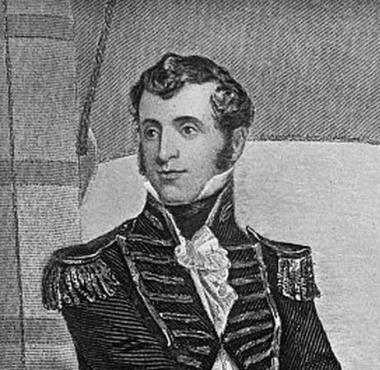
This is exactly how I base any criticism I offer of the President, his policies, words, and actions. I heartily agree with the words of Senator Stephen A. Douglas when he battled President James Buchanan over the pro-slavery attempt to have Kansas admitted to the Union as a Slave State in 1858. Douglas said of his encounter with Buchanan:

“God forbid,” I said “that I ever surrender my right to differ from a President of the United States for my own choice. I am not a tool of any President!”

Sadly, there are very few GOP Senators who would have the moral courage to do what Stephen Douglas did in 1858. He did so even though it doomed his chances to be President.

I admire Stephan Douglas but there is a difference. Now there is a difference, I am not a Senator or elected Representative, I am an officer and must carry out the orders of the President. However, if I ever come to believe that I cannot in good conscience carry them out, or if I believe that they are un-Constitutional I will retire from the military in order to allow myself the freedom to speak out more openly. To ‘this point in time I have not to have been forced to Carr out any illegal or unconstitutional orders, and as a Chaplain I have been able to speak my thoughts openly, though I am careful in how I say them at least in order to maintain my respect for the office of the President.

One of my examples is the German General Ludwig Beck, who resigned as head of the German Army in 1938 over Hitler’s aggression and his plan to attack Czechoslovakia. He wrote something that I hold particularly important in my service at this point in history:

“It is a lack of character and insight, when a soldier in high command sees his duty and mission only in the context of his military orders without realizing that the highest responsibility is to the people of his country.” 

Unlike the current President who sought numerous deferments from entering the military in a time of war: Stephen Douglas put his political career on the line to follow the Constitution, Theodore Roosevelt resigned from his office as Assistant Secretary of the Navy Since to go to war and place himself in harms way, Ludwig Beck would die in the failed attempt to kill Hitler in July 1944. All three men were far more honorable than President Trump, and their words should be heeded by Americans regardless of their political affiliation.

I am still dealing with the effects of the water damage in our house I will wish you a good night.

Until tomorrow,

Peace,

Padre Steve+

1 Comment

Filed under ethics, History, leadership, Military, national security, News and current events, Political Commentary

Not People but Animals…

Friends of Padre Steve’s World

Yesterday President Trump revealed something about himself that I have long suspected, the President believes that some human beings are not that, but in his words, “not people, but animals”. His first wife, Ivana said what back in 1990 that her husband kept a book of Adolf Hitler’s speeches at his bedside, and if you careful read his tweets, comments to the press, interviews, and immigration policies you can see a certain amount of genuine contempt for humanity in them, especially for those who are of a darker pigmentation.

Yesterday, in his remarks at an immigration roundtable the President said these words after an exchange with the Sheriff of Fresno County California in which she touched upon a number of subjects including members of the MS-13 criminal gang.

“We have people coming into the country, or trying to come in — and we’re stopping a lot of them — but we’re taking people out of the country. You wouldn’t believe how bad these people are. These aren’t people. These are animals. And we’re taking them out of the country at a level and at a rate that’s never happened before. And because of the weak laws, they come in fast, we get them, we release them, we get them again, we bring them out. It’s crazy.

The dumbest laws, as I said before, the dumbest laws on immigration in the world. So we’re going to take care of it, Margaret. We’ll get it done.”

Today the President tried to clarify his statement that he was talking about MS-13. However, in the broader context of the President’s years long history of broad brushing Mexicans and other immigrants as criminals. In announcing his candidacy in 2015 the President said:

“When Mexico sends its people, they’re not sending their best. They’re not sending you. They’re not sending you. They’re sending people that have lots of problems, and they’re bringing those problems with us. They’re bringing drugs. They’re bringing crime. They’re rapists. And some, I assume, are good people.”

Sadly this is par for the course at Trump National. One cannot forget his “shithole country” comments, or his description of the White Supremacist violence in Charlottesville, and too many other examples to list here.

Please don’t get me wrong but members of MS-13 tend to be violent criminals, but they are still human beings, just as are criminals and murderers of other gangs and home grown White American groups. But if we want to go into other brutal and deadly crime syndicates we cannot leave out Russian and Eastern European syndicates. The Russians for God’s sakes are little different from MS-13 and often have ties to the Russian government and corporations.

But there is a big difference. The Russians are White, and the President has many Russian ties. Yet many of these Russian and Eastern European gangsters many are just as illegal in their immigration status as those of darker complexion who the President calls “animals.”

Back during the 2016 elections I lost quite a few friends because I openly called candidate Trump a “racist.” That is not because I disliked the man, but it was based on his words and policy proposals about ethnic minorities and immigrants, legal or not. He has now been in office for almost a year and a half and his race and religiously based policies of deporting or keeping from American soil have been out there for all to see. Yesterday was little different, except that the President himself, and not one of his appointees or media sycophants said the words.

His words were little different from Hitler and the Nazis who called the Jews, Slavs, and many other non-Nordic ethnic groups “Untermenschen” or sub-human. The Jews in particular were referred to as rats, vermin, and parasites. As such after years of propaganda many Germans became willing participants in the genocide of the Jews and mass extermination of what they called subhuman races.

The President has given his tacit approval to the basest and most vile aspects of American racial and religious prejudice by his constant dehumanization of Mexicans, other Latin Americans, Blacks, Arabs, Muslims, as well as members of the LGBTQ community, and his political opponents that it is having its intended effects. Incidents of race hatred, religious discrimination, and even politically motivated violence are on the rise.

I’m sorry but this is not making America great again, it is dragging the United States into the company the worst examples of humanity. As a Christian as well as a humanist I think back to the words of Dietrich Bonhoeffer concerning the direction of our country:

“We have been silent witnesses of evil deeds; we have been drenched by many storms; we have learnt the arts of equivocation and pretence; experience has made us suspicious of others and kept us from being truthful and open; intolerable conflicts have worn us down and even made us cynical. Are we still of any use? What we shall need is not geniuses, or cynics, or misanthropes, or clever tacticians, but plain, honest, and straightforward men. Will our inward power of resistance be strong enough, and our honesty with ourselves remorseless enough, for us to find our way back to simplicity and straightforwardness?”

I’m tired of those who try to excuse the President’s behavior, especially Christians and based on history I can only imagine where this ends if he remains in power.

Until tomorrow,

Peace,

Padre Steve+

1 Comment

Filed under ethics, History, News and current events, Political Commentary

Trump and Kelly: Leaders of the New Know Nothings

1john_kelly_donald_trump_Vanit

Friends of Padre Steve’s World,

I was not surprised when I read the words of President Trump’s Chief of Staff, John Kelly in an interview with NPR this week. Instead, I was reminded that the retired Marine Corps General has often expressed the views of the people that opposed the immigration and citizenship desires of his Irish and Italian ancestors. His Irish ancestors fled famine and British political persecution, while his Italian ancestors fled poverty and political instability.

For that matter we can say the same about his boss the President, whose German ancestors were discriminated against and persecuted from the time that the first major wave hit following the 1848 Revolution in Germany. The President’s Great Grandfather immigrated to the United States in 1885 fleeing poverty and obligatory military service to the Kingdom of Bavaria. He went to work as a barber in New York for a number of years and moved to Seattle when he opened a restaurant which also served as a hotel and base for prostitutes, something that he repeated during the Yukon Gold Rush. He became a U.S. citizen in 1892. He attempted to return to Bavaria in 1904 but was returned to the United States because the Bavarian government considered that he had immigrated to avoid military service.  When the First World War came along he claimed to be Swedish and not German simply because of the stigma associated with being from a country that we were at war.

The fact is that the current policies and attitudes of the President, his Chief of Staff, and many of his followers in the Republican Party including White Supremacists, Klansmen, Neo-Nazis advocate for are not new and can be traced to the Know Nothing movement that began in the 1830s and reached its peak in the 1850s. While I do not believe that most of Trump’s Republicans are Neo-Nazis or White Supremacists, it does seem that almost all of the Neo-Nazis or White Supremacists are Trump supporters or Republicans, including the former head of the Illinois Nazis who is the GOP nominee for a House seat in Illinois, and the leading GOP candidate for Senate in California publicly proclaims his adoration of Adolf Hitler and support for a “Jew Free” United States. At least he was not endorsed by the California GOP who had the decency to expel him from their convention while he dragged the flag of Israel on the ground and spit on it. There are plenty of others, either current or past candidates or those who support identical policies to them without claiming their mantle, but I won’t for now. There are too many.

Conservative columnist and Trump opponent George Will discussed current and past immigration policies in the Washington Post. That article is well worth the read. Will quoted Peter H. Schuck, professor emeritus at Yale Law School who discussed how Congress in 1939 voted down a bill “to rescue 20,000 children from Nazi Germany despite American families’ eagerness to sponsor them — on the ground that the children would exceed Germany’s quota!”

The ancestors of both men fled poverty, famine, political persecution, and war to come to the United States. They made a life for themselves, and Kelly’s Italian ancestors did not speak English for decades after they arrived in the country.  Italian immigrants of the late 19th and early 20th centuries were considered racially inferior by many Americans and were treated with distain and revulsion by many American “Anglo-Saxon” Protestant Christians. You would think that appreciating what their ancestors went through that the President and chief of Staff might have a little bit of sympathy for current immigrants, those who came here legally and those who did not for the same reasons that motivated their ancestors: freedom, safety, and opportunity. But they don’t.

When I see what they are doing to make immigration more white and to return people who came here legally, or were brought here as children and raised as Americans to countries that they either do not know or would be in danger if they returned I am reminded of, and echo of words of Abraham Lincoln who said:

“I am not a Know-Nothing. That is certain. How could I be? How can any one who abhors the oppression of negroes, be in favor or degrading classes of white people? Our progress in degeneracy appears to me to be pretty rapid. As a nation, we began by declaring that “all men are created equal.” We now practically read it “all men are created equal, except negroes” When the Know-Nothings get control, it will read “all men are created equal, except negroes, and foreigners, and Catholics.” When it comes to this I should prefer emigrating to some country where they make no pretense of loving liberty — to Russia, for instance, where despotism can be taken pure, and without the base alloy of hypocracy [sic].”

Until tomorrow,

Peace

Padre Steve+

Leave a comment

Filed under civil rights, culture, ethics, History, holocaust, laws and legislation, News and current events, Political Commentary

Downfall: Imagining the Coming Götterdämmerung

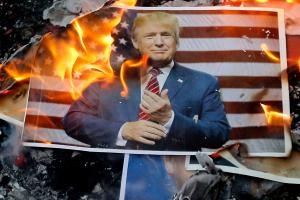
trump-flames-iran-protests

Friends of Padre Steve’s World,

I am watching the movie Downfall tonight as I imagine the coming Götterdämmerung that awaits the United States under President Trump. I do not know when it is coming or exactly how it will happen. But I believe that unless something happens to curb his power, which at the present time is unrestrained by his political party, I expect that the rule of law and the rights enumerated in the Constitution will end. When it does, if not before, the country will plunge into wars without allies that it cannot win, unless winning is defined by obliterating enemies in a nuclear holocaust. If that happens there are no winners.

Somehow when the final cataclysm occurs I expect that the President and his most devoted followers will in the midst of the flames consuming them will blame the very people who helped them to power for the downfall. And they do so without any feeling for them.

When SS General Wilhelm Mohnke who was in charge of the defense of the area around the Reich Chancellory begged Josef Goebbels to convince Hitler to surrender Berlin to allow the people of the city to live, Goebbels responded:

“I feel no sympathy. I repeat, I feel no sympathy! The German people chose their fate. That may surprise some people. Don’t fool yourself. We didn’t force the German people. They gave us a mandate, and now their little throats are being cut!”

Neither he President nor his propagandists have any sense of compassion or empathy. In the days before he killed himself Hitler ranted to those in his bunker including Albert Speer:

“Everyone has lied to me, everyone has deceived me, non[sic] one has told me the truth. The armed forces have lied to me and now the SS have left me in the lurch. The German people has not fought heroically, it deserves to perish. It is not I who have lost the war, but the German people.”

Believe me, however the Trump administration meets its end, be it by the Muller investigation, a porn star, a change of control in the House and Senate, or a disastrous war the response of the President and his media sycophants will be quite similar to Goebbels and Hitler. It will be everyone else’s fault, including those who believed in him, faithfully supported his policies, and followed them into the abyss.

I do pray that I am wrong but I cannot see how this will end in anything less than a disaster.

Again I pray that I am wrong.

Until tomorrow,

Peace

Padre Steve+


1 Comment

Filed under ethics, film, History, holocaust, national security, News and current events

“MENE, MENE, TEKEL, UPHARSIN” The Writing is On the Wall: Trump and Iran

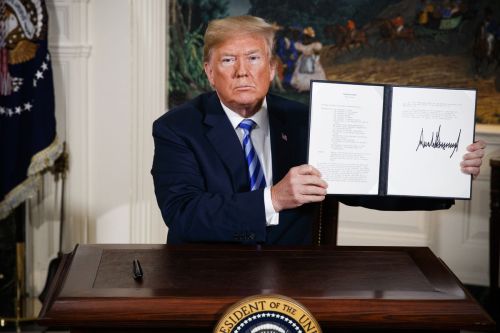
AP_18128668795181.0

Friends of Padre Steve’s World,

In the aftermath of President Trump’s decision to break the word of the United States in regard to the Iran Nuclear deal I have done a lot of reading and reflecting. His decision seems to be bereft of any real strategy or strengthening of the overall United States position not just concerning Iran but which will have repercussions around the world; perhaps most importantly with the coming summit with North Korea. The President  made his decision to withdraw from the accord despite opposition from the Pentagon, the CIA, and the State Department and it appears that there is no real plan for what happens next.

The deal was a flawed instrument but it was the only thing keeping Iran from moving forward on its nuclear program. Inspectors on the ground and the constant monitoring of Iranian nuclear facilities were the best way of ensuring that Iran could not restart its nuclear program. Did the deal keep Iran from playing a part in Syria or Yemen? Of course not, but absent it the Iranians might already be nuclear capable.

The President went against are oldest and most reliable allies and gave the Iranians, as well as the Russians an edge to exploit. The Iranians have already moved to exploit this by pledging to remain in compliance. Whether they meant it or not it gave them the rare opportunity to make themselves look more reasonable than the United States. Likewise it inserted the United States directly into the Iranian – Saudi/ Shia – Sunni divide and emboldened Israeli Prime Minister Benjamin Netanyahu to launch attacks on Syria military and Iranian Revolutionary Guard positions in Syria under the premise of preventive strike by the Iranians on Israel.

The players in this deadly game of brinksmanship are so numerous that you can’t keep track of them without a scorecard. There are the major players; the Iranians, Saudis, the United States, Russia, Israel, the EU, and NATO, as well as the lesser but also important players; Oman, the UAE, Kuwait, Bahrain, Qatar, the war ravaged Yemen, the fragile Iraqi state, the Kurds in Iraq and Syria, Turkey, Jordan, Lebanon, Hezbollah, the Palestinians, various Syrian rebel groups, ISIL, Al Qaida, Afghanistan, the Taliban, and possibly even Egypt, Pakistan and India.

All of these players have their own agenda and capabilities to throw a monkey wrench into anything that the President is attempting to do and both the Pakistanis and Israelis have nukes that they can deliver. Many of these nations or groups have well tested short and intermediate ballistic missile systems as well as well as vast asymmetrical warfare capabilities.

As far as new sanctions the Iranians who have the support of both the Russians and Chinese have many ways to circumvent them.  The President’s strategy, if you can call it that appears to be more about reinforcing his base in American domestic politics by playing fast and loose with the truth while moving towards war.

Let me be fair, I hope against hope that whatever the President is trying to do actually works to deescalate the tensions in the region and maybe even free the people of Iran from the Mullahs. But I really do not think that peace is his intention, not that I trust the Iranians as far as I can throw one, and I certainly believe that Vladimir Putin is doing his damnedest to split the Western alliance and NATO and that President Trump is playing right into his hand.

Do I know what is going to happen in the coming weeks and months? Not really, but I can read the writing on the wall. “MENE, MENE, TEKEL, UPHARSIN.” It is something that I think that the President should take seriously because he is steering the nation and the world towards a disaster. I don’t want that but I can see it coming with the Four Horsemen, and the President will be the man most responsible when everything comes crashing down. The President lives in a world of self-deception and fantasy and as much as I hope that he gets this right I know in my heart that he will not because he is unwilling to have his beliefs checked by facts. Facts are his enemy.

Barbara Tuchman wrote in her book The March of Folly: 

“Wooden-headedness, the source of self-deception, is a factor that plays a remarkably large role in government. It consists in assessing a situation in terms of preconceived fixed notions while ignoring or rejecting any contrary signs. It is acting according to wish while not allowing oneself to be deflected by the facts.”

Until tomorrow,

Peace

Padre Steve+

Leave a comment

Filed under Foreign Policy, History, middle east, News and current events, Political Commentary, Religion

Forgotten Soldiers: Remembering the Men of Dien Bien Phu 64 Years After the Battle

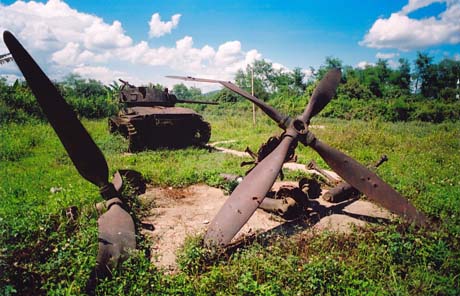
Dien Bien Phu War Remnants

Dien Bien Phu Today

It was an epic battle in a tragic war and most people neither know or care what happened in the valley where a small border post named Dien Bien Phu became synonymous with forgotten sacrifice. This year fewer remembrances are taking place. Some are in Vietnam and others in France.

Diplomat_Sep10059-227x300

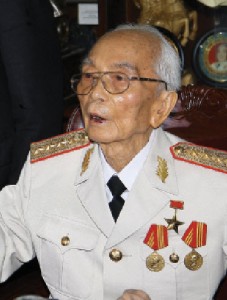
General Vo Nguyen Giap

On May 7th 2011 in Hanoi a small remembrance was held to mark the fall of Dien Bien Phu and honor the victor, 101 year old General Vo Nguyen Giap at his home. Giap was the last senior commander on either side at that time, and he died a year and a half later at the age of 102.  That 2011 ceremony was one of the few remembrances held anywhere marking that battle which was one of the watersheds of the 20th Century. A half a world away in Houston Texas a small group of French veterans, expatriates and historians laid a wreath at the Vietnam War Memorial.  In Paris an ever shrinking number of French survivors used to gather each year on May 7th at 1815 hours for a religious service at the Church of Saint Louis des Invalides to remember the dead and missing of the French Expeditionary Corps who were lost in Indochina. A small number of other small ceremonies were held as late as 2014. There appear to be no services to honor their memory this year.

155fdecaef82e8d699102f2c5390203c

Legionnaires of the Second Foreign Legion Parachute Battalion at Dien Bien Phu 

This battle is nearly forgotten by time even though it and the war that it symbolized is probably the one that we need to learn from before Afghanistan becomes our Indochina.

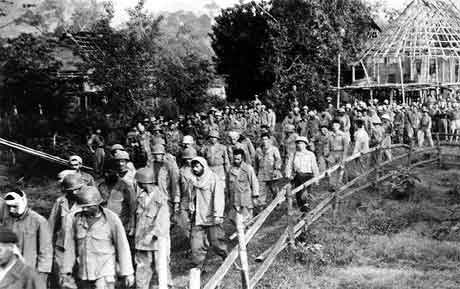
FRENCH SOLDIERS SURRENDER

French Prisoners

On May 8th 1954 the French garrison of Dien Bien Phu surrendered to the Viet Minh.  It was the end of the ill-fated Operation Castor in which the French had planned to lure the Viet Minh Regulars into open battle and use superior firepower to decimate them.  The strategy which had been used on a smaller scale the previous year at Na Son.

The French had thought they had come up with a template for victory based on their battle at Na Son in how to engage and destroy the Viet Minh. The plan was called the “Air-land base.”  It involved having strong forces in a defensible position deep behind enemy lines supplied by air.  At Na Son the plan worked as the French were on high ground, had superior artillery and were blessed by General Giap using human wave assaults which made the Viet Minh troops fodder for the French defenders.  Even still Na Son was a near run thing for the French and had almost no effect on Viet Minh operations elsewhere while tying down a light division equivalent and a large portion of French air power.

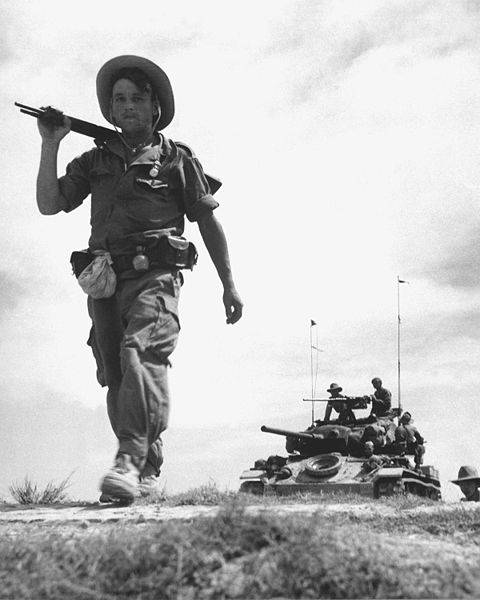
nlfmainforce

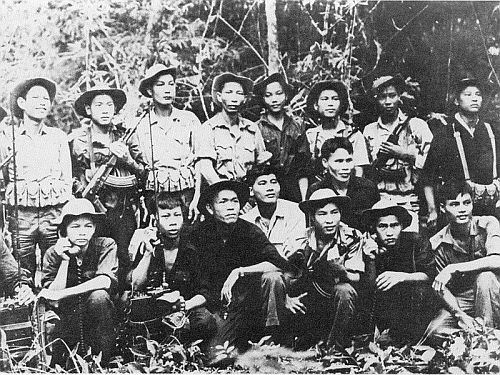
Viet Minh Regulars

The French took away the wrong lesson from Na-Son and repeated it at Dien Bien Phu.  The French desired to use Dien Bien Phu as a base of operations against the Viet Minh.  Unfortunately the French chose badly. Instead of high ground they elected to occupy a marshy valley surrounded by hills covered in dense jungle. They went light on artillery and the air head was at the far end of the range of French aircraft, especially tactical air forces which were in short supply.  To make matters worse, General Navarre, commander of French forces in Indochina was informed that the French government was going to begin peace talks and that he would receive no further reinforcements. Despite this, he elected to continue the operation.

dien-bien-phu

French Paras Drop into Dien Bien Phu

Once on the ground French logistics needs were greater than the French Air Force and American contractors could supply.  French positions at Dien Bien Phu were exposed to an an enemy who held the high ground, had more powerful artillery, and placed in defensive positions that were not mutually supporting. The terrain was so poor that French units were incapable of any meaningful offensive operations against the Viet Minh. As such they could only dig in and wait for battle. Despite this many positions were not adequately fortified and the artillery was in emplaced positions that were easily targeted by Viet Minh artillery and not hardened.

bigeard_instruction_saut

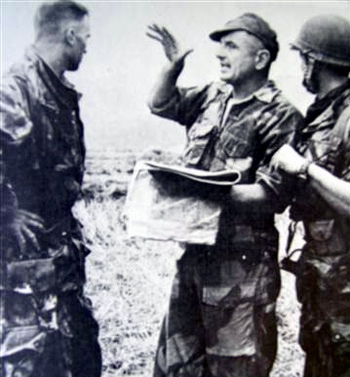
Major Marcel Bigeard 

The French garrison was a good quality military force composed of veteran units. It was comprised of Paras, Foreign Legion, Colonials (Marines), North Africans and Vietnamese troops. Ordinarily in a pitched battle it would have done well, but this was no ordinary battle and their Viet Minh opponents were equally combat hardened, well led and well supplied and fighting for their independence.

Many of the French officers including Lieutenant Colonel Langlais and Major Marcel Bigeard commander of the 6th Colonial Parachute Battalion were among the best leaders in the French Army. Others who served in Indochina including David Galula and Roger Trinquier would write books and develop counter-insurgency tactics which would help Americans in Iraq. Unfortunately the French High Command badly underestimated the capabilities and wherewithal of the Giap and his divisions.

65193421-small_269244

Viet Minh Supply Column

Giap rapidly concentrated his forces and built excellent logistics support.  He placed his artillery in well concealed and fortified positions which could use direct fire on French positions. Giap also had more and heavier artillery than the French believed him to have.  Additionally he brought in a large number of anti-aircraft batteries whose firepower from well concealed positions enabled the Viet Minh to take a heavy toll among the French aircraft that attempted to supply the base.  Unlike at Na-Son, Giap did not throw his men away in human assaults.  Instead he used his Sappers (combat engineers) to build protective trenches leading up to the very wire of French defensive positions. These trenches provided both concealment and protection from the French. In time these trenches came to resemble a spider web that enveloped the French base.

Without belaboring the point the French fought hard as did the Viet Minh. One after one French positions were overwhelmed by accurate artillery and well planned attacks.  The French hoped for U.S. air intervention, even the possibility of the United States using nuclear weapons against the Viet Minh. They were turned down by a US Government that had grown tired of a war in Korea.

dien bien phu6

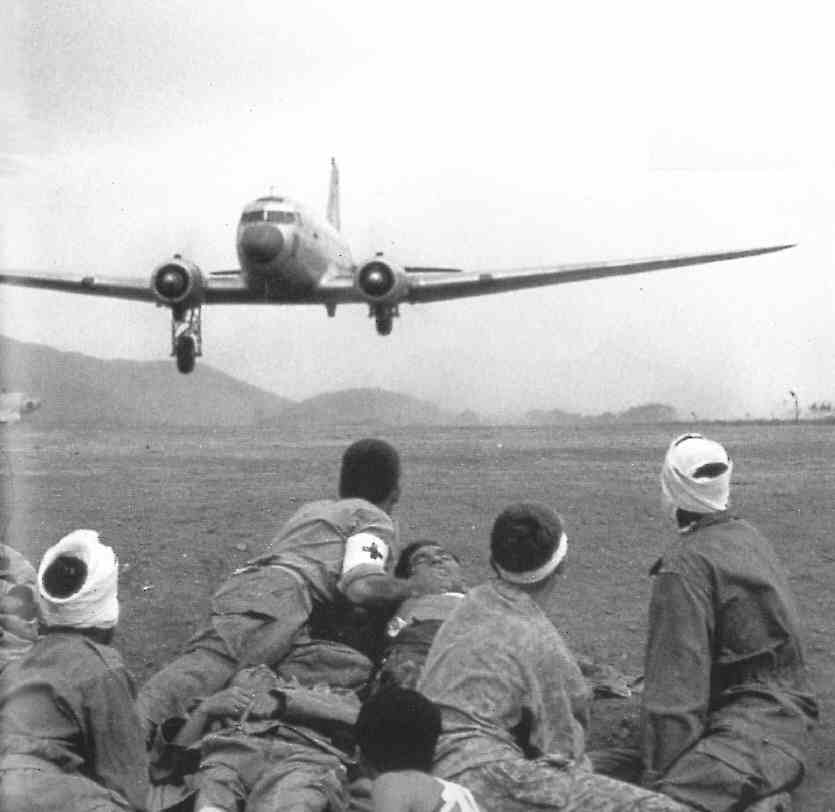
Wounded Awaiting Medivac 

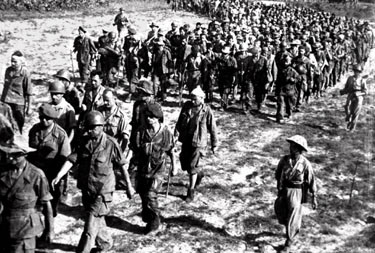
Relief forces were unable to get through and the garrison died, despite the bravery of the Paratroops. Colonials and Legionaries. The French garrison was let down by their high command and their government and lost the battle due to inadequate logistics and air power. The survivors endured a brutal forced march of nearly 400 miles on foot to POW camps in which many died. Many soldiers who survived the hell of Dien Bien Phu were subjected to torture, including a practice that we call “water boarding.” General Georges Catroux who presided over the official inquiry into the debacle at Dien Bien Phu wrote in his memoirs: “It is obvious that there was, on the part of our commanding structure, an excess of confidence in the merit of our troops and in the superiority of our material means.”

Few French troops caved to the Viet Minh interrogations and torture but some would come away with the belief that one had to use such means to fight the revolutionaries.  Some French troops and their Algerian comrades would apply these lessons against each other within a year of their release. French soldiers and officers were shipped directly from Indochina to Algeria to wage another protracted counterinsurgency often against Algerians that they had served alongside in Indochina. The Algerian campaign proved to be even more brutal and it was lost politically before it even began.

dien_bien_phu

The March to Captivity

The wars in Indochina and Algeria tore the heart out of the French Army. The defeats inflicted a terrible toll. In Indochina many French career soldiers felt that the government’s “lack of interest in the fate of both thousands of missing French prisoners and loyal North Vietnamese…as dishonorable.” Divisions arose between those who served and those who remained in France or Germany and created bitter enmity between soldiers. France would endure a military coup which involved many who had fought in Vietnam and Algeria. Having militarily won that war these men called The Centurions by Jean Lartenguy had been turned into liars by their government.  They were forced to abandon those who they had fought for and following the mutiny, tried, imprisoned, exiled or disgraced. Colonial troops who remained loyal to France were left without homes in their now “independent” nations. They saw Dien Bien Phu as the defining moment. “They responded with that terrible cry of pain which pretends to free a man from his sworn duty, and promises such chaos to come: ‘Nous sommes trahis!’-‘We are betrayed.’

The effects of the wars in French Indochina, Algeria and Vietnam on the French military establishment were long lasting and often tragic. The acceptance of torture as a means to an end sullied even the hardest French officers. Men like Galula and Marcel Bigeard refused to countenance it, while others like Paul Aussaresses never recanted.

One of the most heart rending parts of the Dien Bien Phu story for me is that of Easter 1954 which fell just prior to the end for the French:

“In all Christendom, in Hanoi Cathedral as in the churches of Europe the first hallelujahs were being sung. At Dienbeinphu, where the men went to confession and communion in little groups, Chaplain Trinquant, who was celebrating Mass in a shelter near the hospital, uttered that cry of liturgical joy with a heart steeped in sadness; it was not victory that was approaching but death.” A battalion commander went to another priest and told him “we are heading toward disaster.” (The Battle of Dienbeinphu, Jules Roy, Carroll and Graf Publishers, New York, 1984 p.239)

Like many American veterans of Vietnam, many of the survivors of Dien Bien Phu made peace and reconciled with the Vietnamese soldiers who opposed them. While many still regretted losing they respected their Vietnamese opponents and questioned the leadership of their country and army. Colonel Jacques Allaire, who served as a lieutenant in a battalion under the command of MajorMarcel Bigeard reflected to a Vietnamese correspondent in 2014:

“I am now 92 years old and not a single day has gone by since the Dien Bien Phu loss that I haven’t wondered to myself about why the French army lost…Victory was impossible and too far away from us. The aircrafts were not able to give us relief. The French Government changed 19 times in nine years and that messed everything up. General Navarre did not know anything about the battlefield in Vietnam. After the Na San battle, the French commanders thought they could win and decided to attack at Dien Bien Phu, but they were wrong. It was Vietnamese soldiers who owned the hills, because it was their country… I respect my own enemies, who fought hard for national independence…Vietnam Minh soldiers were true soldiers with the will, courage and morality…” 

As a veteran of Iraq whose father served in Vietnam I feel an almost a spiritual link to our American and French brothers in arms who fought at Dien Bien Phu, the Street Without Joy, Algiers and places like Khe Sanh, Hue City, the Ia Drang and the Mekong. When it comes to this time of year I always have a sense of melancholy and dread as I think of the unlearned lessons and future sacrifices that we may be asked to make.

FrenchForeignLegionaireVtNamDOD

Legionairs on the Street Without Joy

The lessons of the French at Dien Bien Phu and in Indochina were not learned by the United States as it entered Vietnam, Iraq or Afghanistan. Nor were the lessons of Algeria. It was an arrogance for which we paid dearly and I do not think that many in our political, media and pundits or military have entirely learned or that we in the military have completely shaken ourselves. We lost 54,000 dead in Vietnam, nearly 4500 in Iraq and so far over 2400 in Afghanistan, and 20,000 wounded which does not count many of the PTSD or TBI cases. Add the casualties suffered by our NATO allies the number of allied dead is now over 3500. Some 36,000 Afghan National Army soldiers and Police officers have been killed. Afghan civilian deaths are estimated between 100,000 and 400,000, not counting the wounded or those killed in Pakistan. In January 2018 the Pentagon classified data on Afghan military, police, and civilian casualties.

The Afghan debacle has spanned three Presidential administrations so there accountability for it must be shared between Presidents Bush, Obama, and Trump, as well as their administrations, the military, and Congress. President Trump has shifted gears from the time he was a candidate when he pronounced the war “lost” to when addressed it as President on August 21st 2017. In his speech at fort Myer Virginia he said:

“When I became President, I was given a bad and very complex hand, but I fully knew what I was getting into:  big and intricate problems.  But, one way or another, these problems will be solved — I’m a problem solver — and, in the end, we will win.” 

But he also said:

“Someday, after an effective military effort, perhaps it will be possible to have a political settlement that includes elements of the Taliban in Afghanistan, but nobody knows if or when that will ever happen…” 

There are those even as we have been at war for almost 17 years in Afghanistan who advocate even more interventions in places that there is no good potential outcome, only variations on bad. I do not know how the President who calls himself a “problem solver” will define winning, but how many more American Soldiers, Sailors, Marines and Airmen will need die  for a “victory” that we cannot even define?

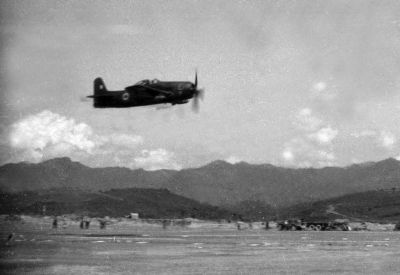
normal_03_56_F8F_decollage_a_DBP_Beriel_ph

French Navy F-8 Bearcat at Dien Bien Phu

Like the French our troops who returned from Vietnam were forgotten.The U.S. Army left Vietnam and returned to a country deeply divided by the war. Vietnam veterans remained ostracized by the society until the 1980s. As Lieutenant General Harold Moore  who commanded the battalion at the Ia Drang immortalized in the film We Were Soldiers recounted “in our time battles were forgotten, our sacrifices were discounted, and both our sanity and suitability for life in polite American society were publicly questioned.”

I think that will be the case for those of us who served in Iraq, Afghanistan, or Syria. Americans love to say they support the troops and are overwhelmingly polite and even kind when they encounter veterans. But that being said even as they do that they don’t are ignorant about our campaigns, battles, and sacrifices; and even worse fail to hold the government regardless of administration accountable for sending American troops into wars that they cannot win.

I guess that is why I identify so much with the men of Dien Bien Phu. The survivors of that battle are now in their nineties and dissolved their Veterans of Dien Bien Phu association in 2014 due to the difficulties most had in traveling.

For those interested in the French campaign in Indochina it has much to teach us. Good books on the subject include The Last Valley by Martin Windrow, Hell in a Very Small Place by Bernard Fall; The Battle of Dien Bien Phu by Jules Roy; and The Battle of Dien Bien Phu – The Battle America Forgot by Howard Simpson. For a history of the whole campaign, read Street Without Joy by Bernard Fall. A novel that has some really good insights into the battle and the French Paras and Legionnaires who fought in Indochina and Algeria is Jean Larteguy’s  The Centurions. 

I always find Fall’s work poignant.  The French journalist served as a member of the French Resistance in the Second World War and soldier later and then became a journalist covering the Nuremberg Trials and both the French and American wars in Vietnam. He was killed on February 21st 1967 near Hue by what was then known as a “booby-trap” and what would now be called an IED while covering a platoon of U.S. Marines.

I do pray that we will learn the lessons before we enter yet another hell somewhere else.

Peace

Padre Steve+


14 Comments

Filed under Foreign Policy, History, iraq,afghanistan, Military, News and current events, Political Commentary, shipmates and veterans, vietnam

Ordinary Men and Genocide: Introduction…

babi yar

Massacre at Babi Yar

Friends of Padre Steve’s World,

Anyone who follows my writing know I write a lot about the Holocaust and the war crimes perpetuated by the Nazi State. I began studying this as an undergraduate and graduate level history student at California State University at Northridge under Dr. Helmut Heussler, who served as a wartime interrogator for the 82nd Airborne Division during the Second World War and then as an interpreter at the Major War Crime trials at Nuremberg.  I studied under him for three years dealing with the end of Imperial Germany, the German Civil War, the Weimar Republic and the Nazi era. He gave me a lot of freedom to explore and research the subject and allowed me to do that research in undergraduate and graduate level independent study projects. I continued that study personally as well as during seminary and my second Master’s Degree in Military History.

Since I read, speak and write German well and can often pass myself off as German in Germany because of my lack of an American accent when speaking the language. I speak German with a blend of a Bavarian and Hessen dialect and that helps when I visit various Holocaust sites, museums, and research centers in Germany. I will be doing some of that again this fall when I make another trip to Munich, Hessen, and Baden-Wurttemberg. Last week I spent five hours at the U.S. Holocaust Museum in Washington D.C. contemplating things that I mostly already knew while exploring details of the Holocaust that made it more real and personal.

As part of my academic work at the Joint Forces Staff College I taught military ethics as related to the Just War Theory. In the class on jus post bellum or justice after war I dealt with the implication of participating in war crimes. It is a serious subject and in the class I attempted to make my students, all relatively senior officers from the United States and allied nations as uncomfortable as possible. I used a number of examples from the major war crimes trials at Nuremberg as well as the Generals Trial and I used the film Conspiracy, which is about the Wannsee Conference where mostly mid-level officers and bureaucrats hashed out the coordination of the Endlosung or Final Solution to what Nazis euphemistically called “the Jewish Question.” 

As I went through previous notes and research to teach my students I felt a tenseness and revulsion for the actions of those that ordered, committed or condoned these crimes; many of whom were like me, professional military officers, historians, and theologians. So I realize how easily it is for normal, rational, and even basically decent people to succumb to either participating in or turning a blind eye to crimes against others, even on a massive scale.  In fact the bigger those crimes are they seem easier for some people to dismiss, because the victims cease be human, and simply a statistic. Sadly, Josef Stalin probably got human nature right when he said “The death of one man is a tragedy. The death of millions is a statistic.” That comment causes great revulsion in my soul, but I have to admit it seems to be the way that many people deal with such great crimes.

September 29th 2017 was the 76th anniversary of the Babi Yar massacre. It was committed by members of the SS Einsatzgruppen C near Kiev shortly after the German Army captured that city. 33,771 Jews were exterminated by the members of Sonderkommando 4b of Einsatzgruppen C as well as members of a number of Ordungspolizei, police battalions supported by the logistics and protection of the German Army. About 10,000 others, mainly Communist Officials and Gypsies were rounded up and killed in the same operation. The victims were stripped of all of their belongings taken to a ravine and shot. It was the second largest killing action by the various Einsatzgruppen in the war. The killings were done up close and personal. The men who conducted the operation either believed that the people that they were killing were sub-human, or did not have the courage to stand up and say no.

These issues are still with us and as I watch the rise of Right Wing and other Fascist movements in Russia, Europe, and the United States I get very concerned. But even more concerning are the large number of people who are content to dismiss their threats and violence, often because while too respectable to utter their words themselves they secretly condone their race hatred. Hannah Arendt made the comment that “The sad truth is that most evil is done by people who never make up their minds to be good or evil.”

Of course these are uncomfortable subjects. When I tell friends of the places that I have visited and studies I have done quite a few openly tell me that they find the subject so uncomfortable hat they could not visit those places. These friends span the political spectrum, just as did the people who said nothing or willingly followed orders to commit genocide in Nazi Germany.

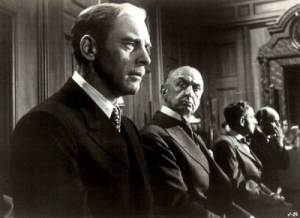
We like to say that the Nazis were different than us or others. To some extent this is true, but the real truth is that most of the Christian Western European countries, and I include the United States have also committed gross crimes against humanity against peoples that we believed were less than human and not afforded human rights or protections. In the movie Judgement at Nuremberg Spencer Tracy makes a comment that should send chills through any of us. He spoke concerning one of the judges on trial, “Janning, to be sure, is a tragic figure. We believe he loathed the evil he did. But compassion for the present torture of his soul must not beget forgetfulness of the torture and the death of millions by the Government of which he was a part. Janning’s record and his fate illuminate the most shattering truth that has emerged from this trial: If he and all of the other defendants had been degraded perverts, if all of the leaders of the Third Reich had been sadistic monsters and maniacs, then these events would have no more moral significance than an earthquake, or any other natural catastrophe.But this trial has shown that under a national crisis, ordinary – even able and extraordinary – men can delude themselves into the commission of crimes so vast and heinous that they beggar the imagination….”

Babi Yar is just one example of how civilized people can get can commit great atrocities in the name of ideology and race, and it does not stand alone. The tragic fact is that it really doesn’t take much to condition people to go commit such crimes; just teach people from childhood that people of certain races or religions are less than human. Then subjugate them to incessant propaganda and then turn them loose using the pretext that they are killing terrorists or insurgents. In the coming days I am posting in small sections an article that I wrote that deals with the ideological as well as military reasons that brought about Babi Yar and so many other atrocities committed by the Nazis during the campaigns in Poland and the Soviet Union.

What happened at Babi Yar is just one example of how civilized people can get can commit great atrocities in the name of ideology and race, and it does not stand alone. The tragic fact is that it really doesn’t take much to condition people to go commit such crimes; just teach people from childhood that people of certain races or religions are less than human. Then subjugate them to incessant propaganda and then turn them loose using the pretext that they are killing terrorists, insurgents, or other enemies of the state. Dr Timothy Snyder wrote:

“The European history of the twentieth century shows us that societies can break, democracies can fall, ethics can collapse, and ordinary men can find themselves standing over death pits with guns in their hands. It would serve us well today to understand why.”

The coming series of articles deal with the ideological as well as military reasons that brought about Babi Yar and so many other atrocities committed by the Nazis during the campaigns in Poland and the Soviet Union. I will probably intersperse other articles as the need arises but there will be five more sections to this series.

So until tomorrow,

Peace

Padre Steve+

1 Comment

Filed under ethics, faith, History, holocaust, Military, nazi germany, News and current events, Political Commentary

My Country Right or Wrong?

29f03605f6b48a52887c2b51a20b5382

Friends of Padre Steve’s World,

Even since I was a child I was an avid reader of history, especially military history and biography. I idolized the men that I read about and many of the things that they said and did, and almost always skewed them into an almost perverse form of patriotism. After the attacks of 9-11-2001 and during the run up to the invasion of Iraq I got into a internet argument with a man who later became the Presiding Bishop of my former denomination. He was and still is a very honorable man.

While very conservative theologically he had a strong sense of social justice and having come to adulthood during Vietnam war era he had a certain sense of distrust about military adventurism that I, an officer who at that time had some twenty years of military service did not fully appreciate. I responded to one of his comments with a quote from one of my favorite American Naval heroes, Captain Stephen Decatur who once remarked:

“Our Country! In her intercourse with foreign nations may she always be in the right; but right or wrong, our country!”

decatur 2 sqaure

There is some truth in what Decatur said, but his words should not be used to justify imperialistic nationalism, racism, or militarism. Sadly back then that was exactly how I used it to attempt to shut down the arguments of an honorable man. If he ever reads this I hope that Bishop Craig Bates accepts my heartfelt apology for how I treated him back then.

It took me two combat tours, one at sea where I was a member of a boarding team, and the other in Iraq’s Al Anbar Province, and a lot more military and historical education that I realized how wrong that I was in doing this. Using patriotic quotes to buttress immoral, illegal, unconstitutional, and un-Christian policies is damnable. G. K. Chesterton noted: “‘My country, right or wrong,’ is a thing that no patriot would think of saying. It is like saying, ‘My mother, drunk or sober.’”

But, I am afraid that my former understanding of patriotism is exactly what many Americans follow today, regardless of their political affiliation or ideology seem to automatically defer to the decisions of the President in launching military strikes. This has been largely true since the end of Second World War until now with the exception of Vietnam. No one wants to be “against the troops” and I am still one of those troops, but opposing nationalism, imperialism, and militarism is not the same as “supporting the troops.” The late Army Lieutenant General Hal Moore, who led his battalion into the Battle of the Ia Drang in 1965 and was memorialized in the film We Were Soldiers told West Point Cadets in 2005:

“The war in Iraq, I said, is not worth the life of even one American soldier. As for Secretary Rumsfeld, I told them, I never thought I would live long enough to see someone chosen to preside over the Pentagon who made Vietnam-era Defense Secretary Robert McNamara look good by comparison. The cadets sat in stunned silence; their professors were astonished. Some of these cadets would be leading young soldiers in combat in a matter of a few months. They deserved a straight answer.

The expensive lessons learned in Vietnam have been forgotten and a new generation of young American soldiers and Marines are paying the price today, following the orders of civilian political leaders as they are sworn to do. The soldiers and those who lead them will never fail to do their duty. They never have in our history. This is their burden. But there is another duty, another burden, that rests squarely on the shoulders of the American people. They should, by their vote, always choose a commander in chief who is wise, well read in history, thoughtful, and slow-exceedingly slow-to draw the sword and send young men and women out to fight and die for their country. We should not choose for so powerful an office someone who merely looks good on a television screen, speaks and thinks in sixty-second sound bites, and is adept at raising money for a campaign.

If we can’t get that part right then there will never be an end to the insanity that is war and the unending suffering that follows in war’s wake-and we must get it right if we are to survive and prosper as free Americans in this land a million Americans gave their lives to protect and defend.”

I remember reading General Moore’s back words then and despite my respect for him I didn’t see their truth, I still believed the lies of Donald Rumsfeld, the Bush Administration, and the Right wing media. I was wrong, and within two and a half years I would discover just how right that he was.

Today, some ten years after I returned from Iraq I find that we now have a President whose historical, ethical, and policy blindness is subjected to his narcissistic and paranoid personality. He is a man who dodged the draft, avoided military service, condemned men and women wounded. killed, or captured in combat as losers while bragging that avoiding sexually transmitted diseases in the 1980s was his Vietnam.

War is a great way to distract from other real concerns, especially if it gives the President, any President, a chance to divert attention from his own malfeasance and criminality. Our Republic is in danger and I do not think that the danger will soon pass. I only wish that it would.

So until tomorrow,

Peace

Padre Steve+


Leave a comment

Filed under ethics, Foreign Policy, History, iraq, leadership, Military, national security, News and current events, Political Commentary, vietnam

A Road Built With Hate and Paved With Indifference: The Path of the Trump Era

photo-jugement-a-nuremberg-judgment-at-nuremberg-1961-1

Friends of Padre Steve’s World,

We returned from a visit with our friends near Washington D.C. and I am a bit tired and want to do some reading before getting ready for bed. While we were there I visited the Holocaust Museum and I also finished reading Dr. Timothy Snyder’s new book The Road to Unfreedom: Russia, Europe, and the United States.  As I mentioned last night I have become very reflective in light of those things and what I see going on in our country today.

Since I am tired I am going to repost a slightly modified article from about a year ago. I think that it is as timely now as when I first wrote it, and I hope that it will resonate with my readers. Historian Ian Kershaw wrote: “The road to Auschwitz was built by hate, but paved with indifference.” I find that comment all too real today when I look at the President, his propagandists, and those who follow him without question even when they know that he is lying to them.

The longer that I live the more that I understand how this happens. Today, as there were in 1930s and 1940s Nazi Germany, there are all too many hate-filled ideologues who desire to destroy or subjugate entire races and ethnic groups, or members of different religions or political ideologies. In the United States they have free reign to do speak and write freely about their goals and for many years we have regarded most of them as fringe characters who had no chance of ever enacting anything that they proposed. Many of these were and continue to be the most vocal supporters of President Trump, and see in him a man who will help them accomplish their desires as no President has done before. One of them, Steve Bannon serves as his chief policy adviser and strategist, and there are no shortage of civil rights opponents and proponents of a police state in his cabinet, including his Attorney General.

The sad thing is despite the myriad of actions taken by the Trump administration, its abuses of power, its probable connections to a hostile power, its attempts to shut down law enforcement probes of the Russia connections, its unabashed attempts to silence the press and all other opponents, and its nearly uncountable number of lies and distortions that it makes on a daily basis; that the vast majority of Congressional Republicans nor his followers seem to care. Don’t get me wrong, there is plenty of opposition, but among his followers and the great number of people in the middle who prefer not to get involved there is little real opposition; moral, religious, ethical, or political to anything that he says or does, mostly because they do not understand how it effects them or their liberties, nor how toxic it is to the nation. It seems to me that they are not only apathetic to the abuses of power, but have no empathy towards the people that they are directed against.

img_0476

For the Trump supporters this is not a problem. He represents a chance for them to recover their greatness, just as Hitler did for many of his followers in the 1930s, including those who joined the Party late. One of the greatest film monologues that illustrated this phenomenon is that of Burt Lancaster in his portrayal of a Nazi judge who is on trial in the movie Judgment at Nuremberg. His comments remind me so much of what I see among many Trump supporters today:

“There was a fever over the land. A fever of disgrace, of indignity, of hunger. We had a democracy, yes, but it was torn by elements within. Above all, there was fear. Fear of today, fear of tomorrow, fear of our neighbors, and fear of ourselves. Only when you understand that – can you understand what Hitler meant to us. Because he said to us: ‘Lift your heads! Be proud to be German! There are devils among us. Communists, Liberals, Jews, Gypsies! Once these devils will be destroyed, your misery will be destroyed.’ It was the old, old story of the sacrificial lamb. What about those of us who knew better? We who knew the words were lies and worse than lies? Why did we sit silent? Why did we take part? Because we loved our country! What difference does it make if a few political extremists lose their rights? What difference does it make if a few racial minorities lose their rights? It is only a passing phase. It is only a stage we are going through. It will be discarded sooner or later. Hitler himself will be discarded… sooner or later. The country is in danger. We will march out of the shadows. We will go forward. Forward is the great password. And history tells how well we succeeded, your honor. We succeeded beyond our wildest dreams. The very elements of hate and power about Hitler that mesmerized Germany, mesmerized the world! We found ourselves with sudden powerful allies. Things that had been denied to us as a democracy were open to us now. The world said ‘go ahead, take it, take it! Take Sudetenland, take the Rhineland – remilitarize it – take all of Austria, take it! And then one day we looked around and found that we were in an even more terrible danger. The ritual began in this courtoom swept over the land like a raging, roaring disease. What was going to be a passing phase had become the way of life. Your honor, I was content to sit silent during this trial. I was content to tend my roses. I was even content to let counsel try to save my name, until I realized that in order to save it, he would have to raise the specter again. You have seen him do it – he has done it here in this courtroom. He has suggested that the Third Reich worked for the benefit of people. He has suggested that we sterilized men for the welfare of the country. He has suggested that perhaps the old Jew did sleep with the sixteen year old girl, after all. Once more it is being done for love of country. It is not easy to tell the truth; but if there is to be any salvation for Germany, we who know our guilt must admit it… whatever the pain and humiliation.”

While we have not reached the point that the Third Reich did between 1933 and 1938, it would not take much for us to get there. We misjudge ourselves if we belief that such things cannot happen here, as Timothy Snyder wrote: “The European history of the twentieth century shows us that societies can break, democracies can fall, ethics can collapse, and ordinary men can find themselves standing over death pits with guns in their hands. It would serve us well today to understand why.”

Reinhold Niebuhr, the great American theologian noted: “Ultimately evil is done not so much by evil people, but by good people who do not know themselves and who do not probe deeply.”

We should heed their warnings before we cross that precipice and head into the abyss.

Until tomorrow,

Peace

Padre Steve+

1 Comment

Filed under ethics, film, History, holocaust, News and current events, Political Commentary

“But Then It Was Too Late” A Reflection on May 1st 2018

Friends of Padre Steve’s World,

My wife and I took a few days of leave to spend with our friends David and Melissa and to let our three Papillon dogs spend time with their four Pappies. It’s been nice and relaxing. I was able to spend Friday at the Holocaust Museum and on Saturday go with Judy, David and Melissa to George Washington’s Mount Vernon. I also caught up on some reading, finishing Timothy Snyder’s new book The Road to Unfreedom: Russia, Europe, and the United States, which I highly recommend.

I did some other reading and today I took a seven mile walk on the trails along the Potomac River, including a portion that borders the Trump National Country Club. That allowed me to do a lot of thinking without being on social media for a couple of hours. Honestly, even though I tried just to enjoy nature, take pictures of wildlife, and the river, I found myself really wondering if our system of government will survive.

I do like to be hopeful, but that being said I really don’t know if we will. I think that is in part due to how a number of people in the White House and Washington D.C. Press Corps responded to what was admittedly rude and sometimes vulgar, but otherwise truthful performance by comedian Michele Wolf at the annual White House Correspondents Dinner. Her comments may have been in poor taste, but at least they were truthful as compared to how the President, his Press Secretary, and his own host of Right Wing media flacks talk and write about people, including the Press, which they say are not just their enemies, but those of the American people and State.

As I thought about that my mind wander back to Milton Mayer’s book They Thought they Were Free. Mayer was an American Professor of German-Jewish origins who lived and worked in the area of Hessen, northwest of Frankfurt in the late 1940s and 1950s. His book deals with his interactions and friendships with townspeople of various backgrounds after the collapse of the Third Reich. It really is a remarkable book which I think that every American regardless of their political affiliation or ideology should read.

Chapter thirteen of that book contains Mayer’s account of meeting with one of his German academic colleagues at the university where he taught. Tonight I only ask you to read it and reflect upon it and the time in which we live, and then ask yourself what you would do.

As for me I think that ten or fifteen years ago I would have reacted much the same as the Professor in Mayer’s book. But I don’t think I could do that now. Of course there are other things that I am pondering tonight related to this but they are of such a personal nature related to something that was spoken over me when I was ordained as a priest in 1996 that I don’t dare share it here, but it weighs on me in ways that it did not when those words were uttered by the diocesan Archdeacon.

I cannot share those words in print because frankly, today, more than when they were first spoken they frighten me. There are many times now that I wish I could share a conversation with Dietrich Bonhoeffer or Martin Niemoller about how to deal with this. I think I know what they would say but it would comfort me to share it with them.

So until tomorrow I will leave you with Chapter Thirteen of Milton Mayer’s book They Thought They Were Free.

Until tomorrow,

Peace

Padre Steve+

Chapter 13: But Then It Was Too Late

“What no one seemed to notice,” said a colleague of mine, a philologist, “was the ever widening gap, after 1933, between the government and the people. Just think how very wide this gap was to begin with, here in Germany. And it became always wider. You know, it doesn’t make people close to their government to be told that this is a people’s government, a true democracy, or to be enrolled in civilian defense, or even to vote. All this has little, really nothing, to do with knowing one is governing.

“What happened here was the gradual habituation of the people, little by little, to being governed by surprise; to receiving decisions deliberated in secret; to believing that the situation was so complicated that the government had to act on information which the people could not understand, or so dangerous that, even if the people could not understand it, it could not be released because of national security. And their sense of identification with Hitler, their trust in him, made it easier to widen this gap and reassured those who would otherwise have worried about it.

“This separation of government from people, this widening of the gap, took place so gradually and so insensibly, each step disguised (perhaps not even intentionally) as a temporary emergency measure or associated with true patriotic allegiance or with real social purposes. And all the crises and reforms (real reforms, too) so occupied the people that they did not see the slow motion underneath, of the whole process of government growing remoter and remoter.

“You will understand me when I say that my Middle High German was my life. It was all I cared about. I was a scholar, a specialist. Then, suddenly, I was plunged into all the new activity, as the university was drawn into the new situation; meetings, conferences, interviews, ceremonies, and, above all, papers to be filled out, reports, bibliographies, lists, questionnaires. And on top of that were the demands in the community, the things in which one had to, was ‘expected to’ participate that had not been there or had not been important before. It was all rigmarole, of course, but it consumed all one’s energies, coming on top of the work one really wanted to do. You can see how easy it was, then, not to think about fundamental things. One had no time.”

“Those,” I said, “are the words of my friend the baker. ‘One had no time to think. There was so much going on.’”

“Your friend the baker was right,” said my colleague. “The dictatorship, and the whole process of its coming into being, was above all diverting. It provided an excuse not to think for people who did not want to think anyway. I do not speak of your ‘little men,’ your baker and so on; I speak of my colleagues and myself, learned men, mind you. Most of us did not want to think about fundamental things and never had. There was no need to. Nazism gave us some dreadful, fundamental things to think about—we were decent people—and kept us so busy with continuous changes and ‘crises’ and so fascinated, yes, fascinated, by the machinations of the ‘national enemies,’ without and within, that we had no time to think about these dreadful things that were growing, little by little, all around us. Unconsciously, I suppose, we were grateful. Who wants to think?

“To live in this process is absolutely not to be able to notice it—please try to believe me—unless one has a much greater degree of political awareness, acuity, than most of us had ever had occasion to develop. Each step was so small, so inconsequential, so well explained or, on occasion, ‘regretted,’ that, unless one were detached from the whole process from the beginning, unless one understood what the whole thing was in principle, what all these ‘little measures’ that no ‘patriotic German’ could resent must some day lead to, one no more saw it developing from day to day than a farmer in his field sees the corn growing. One day it is over his head.

“How is this to be avoided, among ordinary men, even highly educated ordinary men? Frankly, I do not know. I do not see, even now. Many, many times since it all happened I have pondered that pair of great maxims, Principiis obsta and Finem respice—‘Resist the beginnings’ and ‘Consider the end.’ But one must foresee the end in order to resist, or even see, the beginnings. One must foresee the end clearly and certainly and how is this to be done, by ordinary men or even by extraordinary men? Things might have. And everyone counts on that might.

“Your ‘little men,’ your Nazi friends, were not against National Socialism in principle. Men like me, who were, are the greater offenders, not because we knew better (that would be too much to say) but because we sensed better. Pastor Niemöller spoke for the thousands and thousands of men like me when he spoke (too modestly of himself) and said that, when the Nazis attacked the Communists, he was a little uneasy, but, after all, he was not a Communist, and so he did nothing; and then they attacked the Socialists, and he was a little uneasier, but, still, he was not a Socialist, and he did nothing; and then the schools, the press, the Jews, and so on, and he was always uneasier, but still he did nothing. And then they attacked the Church, and he was a Churchman, and he did something—but then it was too late.”

“Yes,” I said.

“You see,” my colleague went on, “one doesn’t see exactly where or how to move. Believe me, this is true. Each act, each occasion, is worse than the last, but only a little worse. You wait for the next and the next. You wait for one great shocking occasion, thinking that others, when such a shock comes, will join with you in resisting somehow. You don’t want to act, or even talk, alone; you don’t want to ‘go out of your way to make trouble.’ Why not?—Well, you are not in the habit of doing it. And it is not just fear, fear of standing alone, that restrains you; it is also genuine uncertainty.

“Uncertainty is a very important factor, and, instead of decreasing as time goes on, it grows. Outside, in the streets, in the general community, ‘everyone’ is happy. One hears no protest, and certainly sees none. You know, in France or Italy there would be slogans against the government painted on walls and fences; in Germany, outside the great cities, perhaps, there is not even this. In the university community, in your own community, you speak privately to your colleagues, some of whom certainly feel as you do; but what do they say? They say, ‘It’s not so bad’ or ‘You’re seeing things’ or ‘You’re an alarmist.’

“And you are an alarmist. You are saying that this must lead to this, and you can’t prove it. These are the beginnings, yes; but how do you know for sure when you don’t know the end, and how do you know, or even surmise, the end? On the one hand, your enemies, the law, the regime, the Party, intimidate you. On the other, your colleagues pooh-pooh you as pessimistic or even neurotic. You are left with your close friends, who are, naturally, people who have always thought as you have.

“But your friends are fewer now. Some have drifted off somewhere or submerged themselves in their work. You no longer see as many as you did at meetings or gatherings. Informal groups become smaller; attendance drops off in little organizations, and the organizations themselves wither. Now, in small gatherings of your oldest friends, you feel that you are talking to yourselves, that you are isolated from the reality of things. This weakens your confidence still further and serves as a further deterrent to—to what? It is clearer all the time that, if you are going to do anything, you must make an occasion to do it, and then you are obviously a troublemaker. So you wait, and you wait.

“But the one great shocking occasion, when tens or hundreds or thousands will join with you, never comes. That’s the difficulty. If the last and worst act of the whole regime had come immediately after the first and smallest, thousands, yes, millions would have been sufficiently shocked—if, let us say, the gassing of the Jews in ’43 had come immediately after the ‘German Firm’ stickers on the windows of non-Jewish shops in ’33. But of course this isn’t the way it happens. In between come all the hundreds of little steps, some of them imperceptible, each of them preparing you not to be shocked by the next. Step C is not so much worse than Step B, and, if you did not make a stand at Step B, why should you at Step C? And so on to Step D.

“And one day, too late, your principles, if you were ever sensible of them, all rush in upon you. The burden of self-deception has grown too heavy, and some minor incident, in my case my little boy, hardly more than a baby, saying ‘Jewish swine,’ collapses it all at once, and you see that everything, everything, has changed and changed completely under your nose. The world you live in—your nation, your people—is not the world you were born in at all. The forms are all there, all untouched, all reassuring, the houses, the shops, the jobs, the mealtimes, the visits, the concerts, the cinema, the holidays. But the spirit, which you never noticed because you made the lifelong mistake of identifying it with the forms, is changed. Now you live in a world of hate and fear, and the people who hate and fear do not even know it themselves; when everyone is transformed, no one is transformed. Now you live in a system which rules without responsibility even to God. The system itself could not have intended this in the beginning, but in order to sustain itself it was compelled to go all the way.

“You have gone almost all the way yourself. Life is a continuing process, a flow, not a succession of acts and events at all. It has flowed to a new level, carrying you with it, without any effort on your part. On this new level you live, you have been living more comfortably every day, with new morals, new principles. You have accepted things you would not have accepted five years ago, a year ago, things that your father, even in Germany, could not have imagined.

“Suddenly it all comes down, all at once. You see what you are, what you have done, or, more accurately, what you haven’t done (for that was all that was required of most of us: that we do nothing). You remember those early meetings of your department in the university when, if one had stood, others would have stood, perhaps, but no one stood. A small matter, a matter of hiring this man or that, and you hired this one rather than that. You remember everything now, and your heart breaks. Too late. You are compromised beyond repair.

“What then? You must then shoot yourself. A few did. Or ‘adjust’ your principles. Many tried, and some, I suppose, succeeded; not I, however. Or learn to live the rest of your life with your shame. This last is the nearest there is, under the circumstances, to heroism: shame. Many Germans became this poor kind of hero, many more, I think, than the world knows or cares to know.”

I said nothing. I thought of nothing to say.

“I can tell you,” my colleague went on, “of a man in Leipzig, a judge. He was not a Nazi, except nominally, but he certainly wasn’t an anti-Nazi. He was just—a judge. In ’42 or ’43, early ’43, I think it was, a Jew was tried before him in a case involving, but only incidentally, relations with an ‘Aryan’ woman. This was ‘race injury,’ something the Party was especially anxious to punish. In the case at bar, however, the judge had the power to convict the man of a ‘nonracial’ offense and send him to an ordinary prison for a very long term, thus saving him from Party ‘processing’ which would have meant concentration camp or, more probably, deportation and death. But the man was innocent of the ‘nonracial’ charge, in the judge’s opinion, and so, as an honorable judge, he acquitted him. Of course, the Party seized the Jew as soon as he left the courtroom.”

“And the judge?”

“Yes, the judge. He could not get the case off his conscience—a case, mind you, in which he had acquitted an innocent man. He thought that he should have convicted him and saved him from the Party, but how could he have convicted an innocent man? The thing preyed on him more and more, and he had to talk about it, first to his family, then to his friends, and then to acquaintances. (That’s how I heard about it.) After the ’44 Putsch they arrested him. After that, I don’t know.”

I said nothing.

“Once the war began,” my colleague continued, “resistance, protest, criticism, complaint, all carried with them a multiplied likelihood of the greatest punishment. Mere lack of enthusiasm, or failure to show it in public, was ‘defeatism.’ You assumed that there were lists of those who would be ‘dealt with’ later, after the victory. Goebbels was very clever here, too. He continually promised a ‘victory orgy’ to ‘take care of’ those who thought that their ‘treasonable attitude’ had escaped notice. And he meant it; that was not just propaganda. And that was enough to put an end to all uncertainty.

“Once the war began, the government could do anything ‘necessary’ to win it; so it was with the ‘final solution of the Jewish problem,’ which the Nazis always talked about but never dared undertake, not even the Nazis, until war and its ‘necessities’ gave them the knowledge that they could get away with it. The people abroad who thought that war against Hitler would help the Jews were wrong. And the people in Germany who, once the war had begun, still thought of complaining, protesting, resisting, were betting on Germany’s losing the war. It was a long bet. Not many made it.”

Copyright notice: Excerpt from pages 166-73 of They Thought They Were Free: The Germans, 1933-45 by Milton Mayer, published by the University of Chicago Press. ©1955, 1966 by the University of Chicago. All rights reserved. This text may be used and shared in accordance with the fair-use provisions of U.S. copyright law, and it may be archived and redistributed in electronic form, provided that this entire notice, including copyright information, is carried and provided that the University of Chicago Press is notified and no fee is charged for access. Archiving, redistribution, or republication of this text on other terms, in any medium, requires the consent of the University of Chicago Press. (Footnotes and other references included in the book may have been removed from this online version of the text.)

1 Comment

Filed under ethics, faith, History, nazi germany, News and current events, Political Commentary