Category Archives: News and current events

The “Chosen People” of the Confederacy and the Mission to Advance Slavery

Friends of Padre Steve’s World,

Another in my series dealing with aspects of Black history in the United States which is in every bit a part of American history as any other historical narrative about our nation. One thing that constantly amazes me is the way that some people, in fact many people, including the School Board of the State of Texas go out of their way to minimize the real and tragically crime against humanity that American slavery represented. Like many of the proponents of the whitewashing of slavery out of school textbooks, many of the most vehement supporters of the institution of slavery and its supposed Divine mandate were Christian churches, preachers, and writers. They were in the forefront of the secession movement and at the beginning of the Civil War bragged about how “God was on their side.” One again this is not an easy read if you take your Christian faith seriously, and it has direct application in how american Christians treat other despised races, ethnic groups, religions, and lifestyles today.

So have a great day,

Peace

Padre Steve+
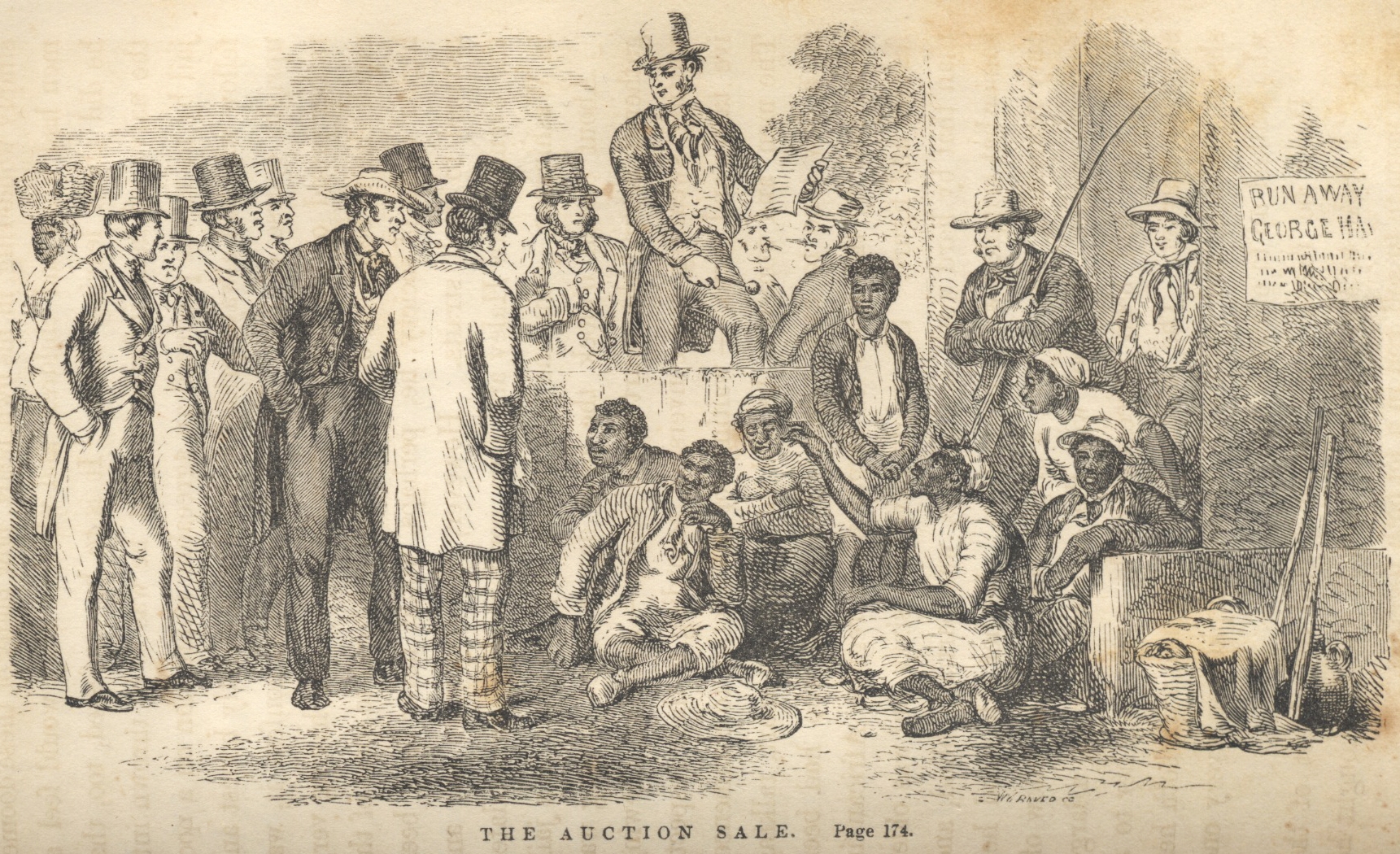
OTCauction


“Lo! Suddenly, to the amazement of the world a mighty kingdom arose…. [of strictly providential Divine origin….The One like the Son of Man has appeared in the ride of the Confederate States.” Reverend William Seat 1862 [1]

Perhaps more than anything, the denominational splits helped prepare the Southern people as well as clergy for secession and war. They set precedent by which Southerners left established national organizations. When secession came, “the majority of young Protestant preachers were already primed by their respective church traditions to regard the possibilities of political separation from the United States without undue anxiety.” [2]

One of the most powerful ideological tools since the days of the ancients has been the linkage of religion to the state. While religion has always been a driving force in American life since the days of the Puritans in the Massachusetts Bay Colony, especially in the belief about the destiny of the nation as God’s “Chosen People,” it was in the South where the old Puritan beliefs took firm root in culture, society, politics and the ideology which justified slavery and became indelibly linked to Southern nationalism. “Confederate independence, explained a Methodist tract quoting Puritan John Winthrop, was intended to enable the South, “like a city set on a hill’ [to] fulfill her God given mission to exalt in civilization and Christianity the nations of the earth.” [3]

Religion and the churches “supplied the overarching framework for southern nationalism. As Confederates cast themselves as God’s chosen people.” [4]  the defense of slavery was a major part of their mission. Southern clergymen had to find a balance between the two most important parts of their political and religious identity, evangelicalism and republicanism. Since these concepts could mean different things to different people Southern clergy and politicians had to find a way to combine the two. Depending on the interpreter “republicanism and evangelicalism could be reactionary or progressive in implication, elitist or democratic.” [5] This can be seen in how Northern and Southern evangelicals supported abolition or the institution of slavery.

A group of 154 clergymen calling themselves “The Clergy of the South” “warned the world’s Christians that the North was perpetuating a plot of “interference with the plans of Divine Providence.” [6] A Tennessee pastor bluntly stated in 1861 that “In all contests between nations God espouses the cause of the Righteous and makes it his own….The institution of slavery according to the Bible is right. Therefore in the contest between the North and the South, He will espouse the cause of the South and make it his own.” [7]

The effect of such discourse on leaders as well as individuals was to unify the struggle as something that linked the nation to God, and God’s purposes to the nation identifying both as being the instruments of God’s Will and Divine Providence. As such, for Southern preachers to be successful agents of the state, the “key to their success as the foundation of a hegemonic ideology lay in making” [8] evangelicalism and republicanism to seem to be both elitist and democratic at the same time.  This resulted in a need to convince the “Southern people to acknowledge God’s authority was bound up with a legitimization of both clerical and civil rulers. Christian humility became identified with social and political deference as the clergy urged submission to both God and Jefferson Davis.” [9]

“Sacred and secular history, like religion and politics, had become all but indistinguishable… The analogy between the Confederacy and the chosen Hebrew nation was invoked so often as to be transformed into a figure of everyday speech. Like the United States before it, the Confederacy became a redeemer nation, the new Israel.” [10]
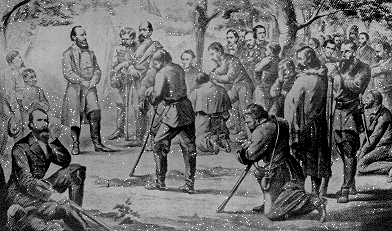
jackson-prayer

This theology also motivated men like the convinced hard line Calvinist-Presbyterian, General Stonewall Jackson on the battlefield. Jackson’s brutal, Old Testament understanding of the war caused him to murmur: “No quarter to the violators of our homes and firesides,” and when someone deplored the necessity of destroying so many brave men, he exclaimed: “No, shoot them all, I do not wish them to be brave.” [11] He told Richard Ewell after that General order his men not to fire on a Union officer galloping on a white horse during the Valley campaign, “Never do such a thing again, General Ewell. This is no ordinary war. The brave Federal officers are the very kind that must be killed. Shoot the brave officers and the cowards will run away with their men with them.” [12]

For Southerner’s, both lay and clergy alike “Slavery became in secular and religious discourse, the central component of the mission God had designed for the South….The Confederates were fighting a just war not only because they were, in the traditional framework of just war theory, defending themselves against invasion, they were struggling to carry out God’s designs for a heathen race.” [13]

From “the beginning of the war southern churches of all sorts with few exceptions promoted the cause militant” [14] and supported war efforts.  The early military victories of Robert E. Lee’s Army of Northern Virginia and the victories of Stonewall Jackson in the Shenandoah Valley   were celebrated as “providential validations of the cause that could not fail…” Texas Methodist minister William Seat wrote: “Never surely since the Wars of God’s ancient people has there been such a remarkable and uniform success against tremendous odds. The explanation is found in the fact that the Lord goes forth to fight against the coercion by foes of his particular people. Thus it has been and thus it will be to the end of the War.”  [15]
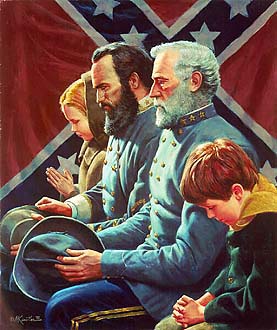
lee-jackson-in-prayer

This brought about a intertwining of church and state authority, a veritable understanding of theocracy as “The need for the southern people to acknowledge God’s authority was bound up with a legitimation of the authority of clerical and civil rulers. Christian humility became identified with social and political deference to both God and Jefferson Davis.” [16]

Jefferson Davis and other leaders helped bolster this belief:

“In his repeated calls for God’s aid and in his declaration of national days of fasting, humiliation, and prayer on nine occasions throughout the war, Jefferson Davis similarly acknowledged the need for a larger scope of legitimization. Nationhood had to be tied to higher ends. The South, it seemed, could not just be politically independent; it wanted to believe it was divinely chosen.” [17]

Davis’s actions likewise bolstered his support and the support for the war among the clergy. A clergyman urged his congregation that the people of the South needed to relearn “the virtue of reverence – and the lesson of respecting, obeying, and honoring authority, for authority’s sake.” [18]

leonidas-polk

Bishop Leonidas Polk

Confederate clergymen not only were spokesmen and supporters of slavery, secession and independence, but many also shed their clerical robes and put on Confederate Gray as soldiers, officers and even generals fighting for the Confederacy. Bishop Leonidas Polk, the Episcopal Bishop of Louisiana, who had been a classmate of Jefferson Davis at West Point was commissioned as a Major General and appointed to command the troops in the Mississippi Valley. Polk did not resign his ecclesiastical office, and “Northerners expressed horror at such sacrilege, but Southerners were delighted with this transfer from the Army of the Lord.” [19] Lee’s chief of Artillery Brigadier General Nelson Pendleton was also an academy graduate and an Episcopal Priest.

Southern churches were supremely active in the war effort. Churches contributed to the Confederate cause through donations of “everything from pew cushions to brass bells, Southern churches gave direct material aid to the cause. Among all the institutions in Southern life, perhaps the church most faithfully served the Confederate Army and nation.” [20] Likewise, many Southern ministers were not content to remain on the sidelines in the war and “not only proclaimed the glory of their role in creating the war but also but also went off to battle with the military in an attempt to add to their glory.” [21]

Sadly, the denominational rifts persisted until well into the twentieth century. The Presbyterians and Methodists both eventually reunited but the Baptists did not, and eventually “regional isolation, war bitterness, and differing emphasis in theology created chasms by the end of the century which leaders of an earlier generation could not have contemplated.” [22]  The Southern Baptist Convention is now the largest Protestant denomination in the United States and many of its preachers are active in often-divisive conservative social and political causes. The denomination that it split from, the American Baptist Convention, though much smaller remains a diverse collection of conservative and progressive local churches. Some of these are still in the forefront of the modern civil rights movement, including voting rights, women’s rights and LGBT issues, all of which find some degree of opposition in the Southern Baptist Convention.

But the religious dimensions were far bigger than denominational disagreements about slavery; religion became one of the bedrocks of Confederate nationalism. The Great Seal of the Confederacy had as its motto the Latin words Deo Vindice, which can be translated “With God as our Champion” or “Under God [Our] Vindicator.” The issue was bigger than independence itself; it was intensely theological. Secession “became an act of purification, a separation from the pollutions of decaying northern society, that “monstrous mass of moral disease,” as the Mobile Evening News so vividly described it.” [23]

The arguments found their way into the textbooks used in schools throughout the Confederacy. “The First Reader, For Southern Schools assured its young pupils that “God wills that some men should be slaves, and some masters.” For older children, Mrs. Miranda Moore’s best-selling Geographic Reader included a detailed proslavery history of the United States that explained how northerners had gone “mad” on the subject of abolitionism.” [24] The seeds of future ideological battles were being planted in the hearts of white southern children by radically religious ideologues, just as they are today in the Madrassas of the Middle East.

While the various theological and ideological debates played out and fueled the fires of passion that brought about the war, they also provided great motivation to their advocates.  This was true especially to Confederates during the war, that their cause was righteous. While this fueled the passion of the true believers, other very real world decisions and events in terms of politics, law and lawlessness, further inflamed passions.

Notes

[1] Ibid. Daly When Slavery was called Freedom p.147

[2] Brinsfield, John W. et. al. Editor, Faith in the Fight: Civil War Chaplains Stackpole Books, Mechanicsburg PA 2003 p.67

[3] Ibid. Faust The Creation of Confederate Nationalism p.27

[4] Ibid. Gallagher The Confederate War pp.66-67

[5] Ibid. Faust The Creation of Confederate Nationalism p.32

[6] Ibid. Daly When Slavery Was Called Freedom  p.145

[7] Ibid. Daly When Slavery Was Called Freedom p.138

[8] Ibid. Faust The Creation of Confederate Nationalism p.32

[9] Ibid. Faust The Creation of Confederate Nationalism p.33

[10] Ibid. Faust The Creation of Confederate Nationalism p.29

[11] Fuller, J.F.C. Grant and Lee: A Study in Personality and Generalship, Indiana University Press, Bloomington IN 1957 p.129

[12] Davis, Burke They Called Him Stonewall: A Life of T.J. Jackson CSA Random House, New York 1954 and 2000 p.192

[13] Ibid. Faust, The Creation of Confederate Nationalism p.60

[14] Ibid. Thomas The Confederate Nation 1861-1865 pp.245-246

[15] Ibid. Daly When Slavery Was Called Freedom pp.145 and 147

[16] Ibid. Faust The Creation of Confederate Nationalism p.26

[17] Ibid. Faust The Creation of Confederate Nationalism p.33

[18] Ibid. Faust The Creation of Confederate Nationalism p.32

[19] Foote, Shelby, The Civil War, A Narrative. Volume One: Fort Sumter to Perryville Random House, New York 1963 1958 p.87

[20] Ibid. Thomas The Confederate Nation p.246

[21] Ibid. Daly When Slavery Was Called Freedom p.142

[22] Ibid. McBeth The Baptist Heritage pp.392-393

[23] Ibid. Faust The Creation of Confederate Nationalism p.30

[24] Ibid. Faust The Creation of Confederate Nationalism p.62

2 Comments

Filed under christian life, civil rights, civil war, faith, History, News and current events, Political Commentary, Religion

“An Example of Somebody Who’s done an Amazing Job” Frederick Douglass’s Immortal Words for the Church and Trump

Douglass.JPG

Frederick Douglass 

Friends of Padre Steve’s World,

A couple of weeks ago President Trump made an interesting acknowledgement of African American Abolitionist and civil rights champion, Frederick Douglass. The President said:   “Frederick Douglass is an example of somebody who’s done an amazing job and is getting recognized more and more, I notice.” But I really wonder if the President, and the 80% plus continent of Evangelical and other conservative Christians really understand what Douglass stood for, or have ever heard his harsh words for the church of his day, which are as applicable now as when he penned them in 1845. It is hard read if you claim to be a follower of Jesus, because while the issue of slavery has been resolved, at least officially, there are many others who reside in this country now who are with the blessing of many “Christians” are discriminated against, persecuted, and even hated. Yes, Douglass’s words still echo loudly in our land.

Anyway, have a good day.

Peace,

Padre Steve+

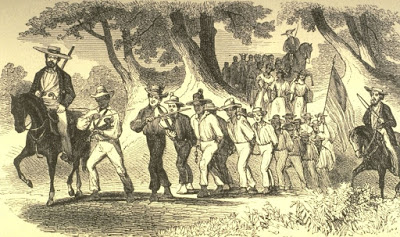
slave-coffle2

But African Americans too had an effect on the debate. In the 1820s Black abolitionists organized with white abolitionists and of their own accord “in order to improve their lives and to attack slavery.” [1] Even before “Garrison published his famous Liberator in Boston in 1831, the first national convention of Negroes had been held, David Walker had already written his “appeal,” and a black abolitionist magazine named Freedom’s Journal had appeared.” [2] Initially most blacks that could simply desired to improve their lives and hoped that their self-improvement would result in less discrimination and more opportunity. This was known as the self-improvement doctrine. But in the face of continued discrimination in the North and in a society where slavery was expanding and slavery proponents “philosophical and political defenders became ever more in intransigent, and where racism became an increasingly rigid barrier even to the most highly talented blacks, the self-improvement doctrine lost viability.” [3]

Escaped former slaves like Frederick Douglass, Sojourner Truth and others added their voices to the debate. Unlike the white abolitionists these leaders “formative years and antislavery educations were spent on southern plantations, and not in organizations dedicated to moral suasion.” [4] Douglass became a prominent abolitionist leader and was very critical of the role of churches, especially Southern churches, in the maintenance of slavery as an institution.

However, Douglass did not spare Northern churches from criticism for buttressing the peculiar institution. Douglass’s polemics against Northern and Southern churches in the South in his autobiography reads like the preaching of an Old Testament prophet such as Amos, or Jeremiah railing against the corrupt religious institutions of their day:

“I find, since reading over the foregoing Narrative, that I have, in several instances, spoken in such a tone and manner, respecting religion, as may possibly lead those unacquainted with my religious views to suppose me an opponent of all religion. To remove the liability of such misapprehension, I deem it proper to append the following brief explanation. What I have said respecting and against religion, I mean strictly to apply to the slaveholding religion of this land, and with no possible reference to Christianity proper; for, between the Christianity of this land, and the Christianity of Christ, I recognize the widest possible difference‐‐so wide, that to receive the one as good, pure, and holy, is of necessity to reject the other as bad, corrupt, and wicked. To be the friend of the one, is of necessity to be the enemy of the other. I love the pure, peaceable, and impartial Christianity of Christ: I therefore hate the corrupt, slaveholding, women‐whipping, cradle‐plundering, partial and hypocritical Christianity of this land.

“Indeed, I can see no reason, but the most deceitful one, for calling the religion of this land Christianity. I look upon it as the climax of all misnomers, the boldest of all frauds, and the grossest of all libels. Never was there a clearer case of “stealing the livery of the court of heaven to serve the devil in.” I am filled with unutterable loathing when I contemplate the religious pomp and show, together with the horrible inconsistencies, which every where surround me. We have men-stealers for ministers, women-whippers for missionaries, and cradle-plunderers for church members. The man who wields the blood-clotted cowskin during the week fill the pulpit on Sunday, and claims to be a minister of the meek and lowly Jesus. The man who robs me of my earnings at the end of each week meets me as a class-leader on Sunday morning, to show me the way of life, and the path of salvation. He who sells my sister, for purposes of prostitution, stands forth as the pious advocate of purity. He who proclaims it a religious duty to read the Bible denies me the right of learning to read the name of the God who made me. He who is the religious advocate of marriage robs whole millions of its sacred influence, and leaves them to the ravages of wholesale pollution. The warm defender of the sacredness of the family relation is the same that scatters whole families, — sundering husbands and wives, parents and children, sisters and brothers, — leaving the hut vacant and the heart desolate. We see the thief preaching against theft, and the adulterer against adultery. We have men sold to build churches, women sold to support the gospel, and babes sold to purchase Bibles for the poor heathen! All for the glory of God and the good of souls.”

The Christianity of America is a Christianity, of whose votaries it may be as truly said, as it was of the ancient scribes and Pharisees, ʺThey bind heavy burdens, and grievous to be borne, and lay them on menʹs shoulders, but they themselves will not move them with one of their fingers. All their works they do for to be seen of men.‐‐They love the uppermost rooms at feasts, and the chief seats in the synagogues, . . . . . . and to be called of men, Rabbi, Rabbi.‐‐But woe unto you, scribes and Pharisees, hypocrites! for ye shut up the kingdom of heaven against men; for ye neither go in yourselves, neither suffer ye them that are entering to go in. Ye devour widowsʹ houses, and for a pretence make long prayers; therefore ye shall receive the greater damnation. Ye compass sea and land to make one proselyte, and when he is made, ye make him twofold more the child of hell than yourselves.‐‐Woe unto you, scribes and Pharisees, hypocrites! for ye pay tithe of mint, and anise, and cumin, and have omitted the weightier matters of the law, judgment, mercy, and faith; these ought ye to have done, and not to leave the other undone. Ye blind guides! which strain at a gnat, and swallow a camel. Woe unto you, scribes and Pharisees, hypocrites! for ye make clean the outside of the cup and of the platter; but within, they are full of extortion and excess.‐Woe unto you, scribes and Pharisees, hypocrites! for ye are like unto whited sepulchres, which indeed appear beautiful outward, but are within full of dead menʹs bones, and of all uncleanness. Even so ye also outwardly appear righteous unto men, but within ye are full of hypocrisy and iniquity.ʺ  Dark and terrible as is this picture, I hold it to be strictly true of the overwhelming mass of professed Christians in America. They strain at a gnat, and swallow a camel… They attend with Pharisaical strictness to the outward forms of religion, and at the same time neglect the weightier matters of the law, judgment, mercy, and faith. They are always ready to sacrifice, but seldom to show mercy. They are they who are represented as professing to love God whom they have not seen, whilst they hate their brother whom they have seen. They love the heathen on the other side of the globe. They can pray for him, pay money to have the Bible put into his hand, and missionaries to instruct him; while they despise and totally neglect the heathen at their own doors.

Such is, very briefly, my view of the religion of this land; and to avoid any misunderstanding, growing out of the use of general terms, I mean by the religion of this land, that which is revealed in the words, deeds, and actions, of those bodies, north and south, calling themselves Christian churches, and yet in union with slaveholders. It is against religion, as presented by these bodies, that I have felt it my duty to testify. [5]

Douglass and other African American abolitionists were cognizant of the fact that in spite of their good intentions that many Northern abolitionists were unconscious of their own racism and many black abolitionists were repelled by it. As such black abolitionists were characterized by “racial independence and pragmatism” while white abolition leaders though “still committed to antislavery principles, increasingly divided over doctrines such as political action or evangelical reform.” [6] Douglass and others realized that blacks had to take control of their own destiny and take an active role in the abolitionist movement. In 1854 Douglass declared “it is emphatically our battle; no one else can fight it for us….Our relations to the Anti-Slavery movement must be and are changed. Instead of depending on it we must lead it.”  [7] Douglass and other black abolitionist leaders found this necessary because many white abolitionists were unable to “comprehend the world in other than moral absolute, as well as their unwillingness to confront issues of racial prejudice and poverty….” [8] As a result Douglass and other black abolitionist leaders went into the critical decade before the Civil War with a clear idea that the fight would be much more difficult and complicated than many of their white counterparts could image.

Notes

[1] Blight, David W. Beyond the Battlefield: Race, Memory and the American Civil War University of Massachusetts Press Amherst and Boston 2002 p.30

[2] Ibid. Zinn The Other Civil War p.23

[3] Ibid. Blight Beyond the Battlefield p.31

[4] Ibid. Blight Beyond the Battlefield p.31

[5] Douglass, Frederick. Life and Times of Frederick Douglass: His Early Life as a Slave, His Escape From Bondage, and His Complete History. Anti-Slavery Office, Boston, 1845. Retrieved from http://antislavery.eserver.org/narratives/narrativeofthelife/narrativeofthelife.pdf/view February 24, 2017  copyright © 2005 by the Antislavery Literature Project.

[6] Ibid. Blight Beyond the Battlefield p.32

[7] Ibid. Zinn The Other Civil War p.24

[8] Ibid. Blight Beyond the Battlefield p.32

1 Comment

Filed under christian life, civil rights, History, News and current events, Political Commentary, Religion

Resistance to Authoritianism: Part Two 


Friends of Padre Steve’s World,

Yesterday I began an article about resistance to authoritarian movements or leaders. The underlying premise of the first part was to set the stage by talking about freedom, truth, critical thinking and the all too often fact that most people do not like facing unpleasant truths. I ended that section with a quote by Hannah Arendt that: 

The ideal subject of totalitarian rule is not the convinced Nazi or the convinced Communist, but people for whom the distinction between fact and fiction ( i.e., the reality of experience) and the distinction between true and false ( i.e ., the standards of thought) no longer exist.

That thought can be applied to any country where the evil of authoritarian rule threatens. The British military historian and theorist, B.H. Liddell-Hart wrote:

All of us do foolish things, but the wiser realize what they do. The most dangerous error is failure to recognize our own tendency to error. That failure is a common affliction of authority. 

Based on the performance of the Trump administration during the transition and over its first two weeks in office one wonders if most of its members have any capacity for reflection or ability to admit when they are wrong. Right now I see little proof that this tendency will change anytime soon. Thus it is imperative that all citizens, including those who serve in the institutions of government be the conscience of the nation. This is the most important part of successfully resisting the implementation of authoritarian government. All too often that does not happen. One can look at the histories of numerous nations where the citizenry, and those who executed the day to day functions of government did not do this, usually with very dire results for their nations. 

The reason for most, is usually nothing inherently evil on their part, they simply want to get along without asking too many questions, and turning their eyes from the unpleasantries, and evil. Resistance is dangerous. Liddell-Hart noted:

We learn from history that the critics of authority have always been rebuked in self-righteous tones, if no worse fate has befallen them, yet have repeatedly been justified by history. To be “agin the Government” may be a more philosophic attitude than it appears. For the tendency of all “governments” is to infringe the standards of decency and truth; this is inherent in their nature and hardly avoidable in their practice.

Hence the duty of the good citizen who is free from the responsibility of Government is to be a watchdog upon it, lest Government impair the fundamental objects which it exists to serve. It is a necessary evil, thus requiring constant watchfulness and check.

Authoritarian leaders who are able to gain control of an unquestioning populace and powerful bureaucracy are able to do much damage to liberty. Thus it it important that citizens constantly question it, and when it is failing to abide by the ideals, laws, and norms of the nation, to resist; using lawful means, and maintaining to moral high ground. However, that too is hard to do, many who resist do so in a highly emotional manner which sometimes leads them to tactics that are not helpful, even in the near term. 

That being said it is important that resistance be based on telling the truth in spite of opposition, and this means calling out the untruths and outright lies of the authoritarian leader and his sycophants. These are not hard to spot, but too many people are afraid to call a lie a lie. But the lies are the basis for the declarations of faith that authoritarian leaders uses to gain the support of both true believers, as well as the angry and disaffected people who recognize the lie, but due to their cynicism about government and disappointment in the democratic process support the authoritarian leader. The authoritarian leader takes advantage of the primal fears and hatreds of both in order to cement his bond with them which makes resisting more dangerous, because those who do resist are demonized. As Eric Hoffer wrote in his classic The True Believer:

Mass movements can rise and spread without belief in a God, but never without belief in a devil. Usually the strength of a mass movement is proportionate to the vividness and tangibility of its devil. When Hitler was asked whether he thought the Jew must be destroyed, he answered: “No…. We should have then to invent him. It is essential to have a tangible enemy, not merely an abstract one.” 

Those who resist or those who are different prove to be ideal devils for the authoritarian leader and his followers. Liddell-Hart understood this and noted that those who believe in freedom must resist authoritarian rule because it does not respect the power of thought and the intellect, so I am going to close for today with his words: 

It is man’s power of thought which has generated the current of human progress through the ages. Thus the thinking man must be against authoritarianism in any form, because it shows its fear of thoughts which do not suit momentary authority.

Any sincere writer must be against it, because it believes in censorship. Any true historian must be against it, because he can see that it leads to the repetition of old follies, as well as to the deliberate adulteration of history. Anyone who tries to solve problems scientifically must be against it, since it refuses to recognize that criticism is the life blood of science. In sum, any seeker of truth must be against it, because it subordinates truth to state expediency. This spells stagnation.

Those who resist cannot do so simply because they are against the authoritarian leader, but they must stand for something positive and far reaching in order to expand freedom for others. Liddell-Hart wrote:

But “anti-Fascism” or “anti-Communism” is not enough. Nor is even the defence of freedom. What has been gained may not be maintained, against invasion without and erosion within, if we are content to stand still. The peoples who are partially free as a result of what their forebears achieved in the seventeenth, eighteenth, and nineteenth centuries must continue to spread the gospel of freedom and work for the extension of the conditions, social and economic as well as political, which are essential to make men free.

Have a great day, and enjoy the Super Bowl, and remember God couldn’t care less who wins it; the Deity is a baseball fan. 

Peace,

Padre Steve+


1 Comment

Filed under History, leadership, News and current events, Political Commentary

Resisting Authortarianism: Part One


Friends of Padre Steve’s World,

Tonight, like last night I am posting another thought from B.H. Liddell-Hart’s book Why don’t We Learn from History? 

The book is worth the read for anyone, even though it is written by a military historian and theorist. Liddell-Hart had a keen understanding of the limitations of Democracy, but recognized the inherent evil of the totalitarian or authoritarian state, and such leaders. Thus, when we see a democratically elected leader rapidly move toward authoritarianism, attempting to silence political and press critics, accused the acting head of the Department of Justice of “betrayal,” and attacking the institutions of justice that oppose him, while praising foreign despots, we should be concerned for our liberty. 

Liddell-Hart wrote something very profound that we should all think about: 

What is of value in “England” and “America” and worth defending is its tradition of freedom, the guarantee of its vitality. Our civilization, like the Greek, has, for all its blundering way, taught the value of freedom, of criticism of authority, and of harmonising this with order. Anyone who urges a different system, for efficiency’s sake, is betraying the vital tradition.

He noted:

It is man’s power of thought which has generated the current of human progress through the ages. Thus the thinking man must be against authoritarianism in any form, because it shows its fear of thoughts which do not suit momentary authority.

The power of thought, the unending quest for truth, the questioning of authorities who claim absolute power, are all essential to maintaining human freedom. However, freedom cannot be defended if its defenders have either forgotten how to think critically, or never learned to at all. The latter should be concerning as for years the emphasis of education has been to train people for a job with specific but narrow skills, while critical thinking, based in reason, science, history, philosophy, literature, and the arts has taken a back seat. Giles Lauren who wrote the preface to the latest edition of Why don’t We Learn from History? wrote:

Education, no longer liberal, has largely become a question of training in a skill for gain rather than teaching us how to think so as to find our own way. ‘It is strange how people assume that no training is needed in the pursuit of truth.’ We must learn to test and judge the information that comes before us. After all: ‘Whoever habitually suppresses the truth … will produce a deformity from the womb of his thought.’

This my friends is not comfortable, and neither should it be. But the truth is that most people actually fear truth because it is uncomfortable. Liddell-Hart wrote:

We learn from history that in every age and every clime the majority of people have resented what seems in retrospect to have been purely matter-of-fact comment on their institutions. We learn too that nothing has aided the persistence of falsehood, and the evils resulting from it, more than the unwillingness of good people to admit the truth when it was disturbing to their comfortable assurance. Always the tendency continues to be shocked by natural comment and to hold certain things too “sacred” to think about.

I am watching people, many of them good people, decent people, even brilliant people either openly support the move toward authoritarianism, or remain silent, even when they recognize the truth. In such times it is important to seek the truth, and proclaim the truth, even if it unpopular, and unpleasant. This means that we also have to look inside ourselves, and be honest because we all have the capacity to believe the lie and not to recognize the distinction between fact and fiction. Hannah Arendt wrote in her book The Origins of Totalitarianism:

The ideal subject of totalitarian rule is not the convinced Nazi or the convinced Communist, but people for whom the distinction between fact and fiction ( i.e., the reality of experience) and the distinction between true and false ( i.e ., the standards of thought) no longer exist.

I will continue this tomorrow. Have a great night and sleep well.

Peace

Padre Steve+ 

Leave a comment

Filed under History, News and current events, Political Commentary

Groundhog Day and Nazi Comparisons

groundhog-day-driving

Friends of Padre Steve’s World,

Today was Groundhog day and Punxsutawney Phil has promised us another six weeks of winter. Since is was sixty degrees today with partly cloudy skies and light winds, I say let it continue. But that’s not really really what I’m writing about today, though historically it seems that we are in an era that seems like the movie Groundhog Day, except we aren’t repeating yesterday every day, but we are seeing history unfold in a similar way to an era that we would rather consign to to musty history books about the Third Reich.

Today, two friends shared an article of a blogger condemning those who are comparing the actions of President Trump to Adolf Hitler and the Nazis. He started his article “I’m no expert but…” and then went on to minimize what people are saying about Trump, comparing them to others on the right and left who have made comparisons of their political opponents with Hitler. I agree that there are people, plenty of them on the right and left who have compared their political opponents to Hitler, and if Donald Trump was a normal president I would say that such comparisons would be unfounded, but in my humble opinion, they are not.

I am a historian, as one of my colleagues told me yesterday, a “historian masquerading as a chaplain, and that’s not a bad thing.” My chief area of study in my undergraduate days was in German history, particularly the period of the end of Imperial Germany, the German civil war, the Weimar Republic, and the Nazi era. The same was true with my second master’s degree in Military History, and much of my church history studies in seminary. I have written on a number of aspects of the subject, it is included in the Military Ethics class that I teach, and I would dare say that I am an expert in the subject and that I do not make comparisons to the Nazi era, or its leaders, to American political leaders lightly.

In fact, until the rise of Donald Trump, I have never had cause to compare the words, methods, or actions of any American President or serious presidential candidate to the Nazis. Any such comparisons, even to Richard Nixon, would be to unfounded hyperbole and ludicrous. I do know that there are people on the political left and right who have compared their political opponents to the Nazis or even Adolf Hitler himself, and as a serious historian I find their accusations to demean the historical importance of the period, especially in view of the great evil of the Nazis, especially in regard to the Holocaust.

Likewise when I see someone write a lengthy blog about these comparisons and begin it with “I’m not an expert but…” I am offended because it demeans the work of serious people, real experts, and equates them with ignorance. The man cited many of the differences between Germany of 1933 and the United States of 2016. There are differences, significant differences, but they do not disqualify comparisons between the periods, or between Herr Hitler and Mr. Trump. Those comparisons are in matters of substance, psychology, language, sociological, and political trends.

In 2001 the United States, which had just gone a divisive election which was decided in the Supreme Court was attacked. The shock to the country was immense, the attack was followed by prolonged wars and a massive economic crisis followed by the election of a President who was African American, an event which brought out some of the worst and most open racism I have ever seen in my life. In 1918, Germany lost a war, had its system of government fall, and was enveloped in a civil war punctuated with being saddled with the full blame for the war that they lost, and were ruled not by the Kaiser, not by conservatives, or nationalists, but by Socialists, something that many could not abide. As such, the Socialists were saddled with the blame for a war started by nationalists, and the myth of the Stab in the Back was used to explain the defeat of the German armies.

stab in the back

The Stab in the Back

In both situations, the politics of the countries became exceptionally divisive, and over time the political center began to dissolve. In both instances, populist movements of the right and left stamped out the center, compromise was off the table. In both 1933 and 2016, the politician who took power represented a minority of the electorate, and neither had ever held any elected office. They were both demagogues who found convenient internal racial and religious scapegoats, and foreign powers to blame for the woes of the country. Neither Trump, nor Hitler was ever given a chance of gaining power, until they achieved it.

Both took advantage of the struggles of people who had not done well during the economic downturns, played on longstanding prejudices, exploited the weakness of the major political parties, coopted the fears of religious people who felt that they were not being considered. They were also supported by people of means, who were quite well off and willing to take their chances with a leader who could deliver people who would otherwise reject them. The similarities, while not exact go on and on.

But even more, when it comes down to the person of President Trump, honestly he cannot be compared to Adolf Hitler himself. Hitler was much more subtle and much more clever, although both were narcissists, both had no real friends and treated people as commodities, both demonstrated a need to be loved, and fear of rejection, as well as a compulsive need to demean, degrade, and bully any opponents, but Trump is but a cheap copy of Hitler.

It is interesting that the President’s first wife, who by the way supported his run for president, said that Trump kept copies of Mein Kampf and Hitler’s speeches by his bedside. During his campaign he frequently praised dictators and even quoted Mussolini in a tweet. His repeated use of the term “America First” is a throwback to an American movement that supported Hitler and his aggression in Europe up until Pearl Harbor and Hitler’s declaration of war on the United States a few days later. If you look at the structure of his speeches during the campaign, they are laden with phrases used by the German dictator, and their structure is similar, albeit without Hitler’s mesmerizing prose. I have seen him speak in person, and watched the anger that he incites in his followers. I watched his inauguration speech several times, and read it again and again and I was struck by the similarity in tenor to many of Hitler’s speeches. If I was not so well acquainted with Hitler’s speeches, and his books, I would never dare to make the comparisons, it would not only be unwise, but also terribly wrong to make such a comparison based on a personal or ideological dislike, based on raw emotion and ignorance of the subject.

women-cheering-hitler

1-rtx211ir

He has surrounded himself with advisors who openly support fascist methods, and use propaganda techniques which mimic Hitler and his propaganda chief, Joseph Goebbels. Like Hitler, once in power President Trump has used his office to demonize his opponents and rule by executive decree, effectively marginalizing the legislature and to defy and eviscerate the courts. In one important difference since Trump took power of a superpower, he did not have to wait years like Hitler in order to build up a military to threaten his neighbors and defy international institutions.

I could go on and on, but if there was any other historical comparison that I could use instead of the Nazi comparison, I would. But let me qualify that statement. Trump is not Hitler and he has not at least yet, acted on his most radical statements concerning deportations of millions of people, discrimination based on race or religion, banning all opposition, and curtailing freedom of speech, although he and his advisors constantly threaten the press and anyone who voices the slightest opposition to them, including simply pointing out their repeated lies. Nor has he embarked on any new wars, though his words and the words of Steve Bannon, his closest advisor, threaten war with China, Iran, Mexico, and are destroying the bonds that we have with our longest and closest allies.  On the National Security Council the President has sidelined his military chiefs and replaced them with the ideologue Bannon. The sad thing about the last part was this was exactly how Hitler treated his military chiefs. They were called in to carry out orders, not to give sane advice, and he undercut them whenever he needed. In both cases many of their followers tolerated no criticism of their leader, often resorting to threats of violence or actual physical violence to suppress their opponents. In both cases their leaders not only tolerated such behavior, but encouraged it.

Hitler is dead, his Reich defeated, but his ideas are still around and can be seen in the current right-wing nationalist movements masquerading as populists in Europe and the United States. What happened in Germany in the 1930s  can happen again. Thus it is better to sound an early warning using facts and reason to hopefully ensure that it doesn’t happen. Such warnings should not be taken for granted, too many people and political leaders, not only in Germany, but around the world, took Hitler for granted believing that he could be controlled and that his radical ideas were hyperbole and would never be acted on. They were wrong. As a result the world, and Germany itself paid a massive price in human life for ignoring the danger until it was too late.

Again I don’t make such comparisons lightly, and in a relatively short article like this I cannot go into the detail with all the citations, though I have the material at hand to do so, I haven’t the time to write a book about it, though I’m sure that I could. I have three books that I am currently working on, all dealing with the American Civil War, one of which is getting to the point that I am trying hard to complete it and get it to a publisher in the next month or two, so I really don’t want to start another book. But I think that this weekend I will provide my readers a list of references on the Third Reich as well as totalitarianism, that if read critically, and thoughtfully, would be of great help to understanding our own time.

If you want you can look at some of my articles on this site dealing with mass movements, and totalitarianism, especially those that are based on the writings of Eric Hoffer or Hannah Arendt. They are helpful to understanding the political, ideological, and emotional aspects of how people like Hitler and Trump gain power, and why people are willing to through out reason, logic, ethics, and even faith, to support them.

So anyway, until the weekend, have a great day.

Peace

Padre Steve+

P.S. I did watch the movie Groundhog Day last night. It is one of my traditions.


2 Comments

Filed under ethics, History, leadership, News and current events, Political Commentary

The Psychology of Dictatorship: A Historical Retrospective

by Howard Coster, half-plate film negative, 1939

                  Sir B.H. Liddell-Hart

Friends of Padre Steve’s World,

Last year I read the short but poignant little but by the British military historian B.H. Liddell-Hart entitled Why Don’t We Learn from History. The book was written in not long before his death in 1970 and it is good quite good. It deals with a number of issues, including the conflict between history and propaganda, or when faith, especially religious faith as treated as historic or scientific fact; especially when propaganda or faith is preached as if it were history, if it were truth. But he also contrasted democracy and totalitarianism.

Liddell-Hart was a realist, especially about democracy and totalitarianism. While he admitted the inefficiencies of democracy, he realized that it was far less dangerous than the “stupidity” of totalitarianism. In fact it was important for him to note just how this inefficient system was for freedom. He wrote:

“What is of value in “England” and “America” and worth defending is its tradition of freedom, the guarantee of its vitality. Our civilization, like the Greek, has, for all its blundering way, taught the value of freedom, of criticism of authority, and of harmonising this with order. Anyone who urges a different system, for efficiency’s sake, is betraying the vital tradition.”

There is much to ponder in his book and I will probably write some more of my thoughts on it, but when I read it I was struck by just how much Liddell-Hart in his description of a despot described President Donald Trump through the his campaign and after his election and inauguration.

“We learn from history that self-made despotic rulers follow a standard pattern. In gaining power: They exploit, consciously or unconsciously, a state of popular dissatisfaction with the existing regime or of hostility between different sections of the people. They attack the existing regime violently and combine their appeal to discontent with unlimited promises (which, if successful, they fulfil only to a limited extent). They claim that they want absolute power for only a short time (but “find” subsequently that the time to relinquish it never comes). They excite popular sympathy by presenting the picture of a conspiracy against them and use this as a lever to gain a firmer hold at some crucial stage.” 

Once authoritarian, despotic, or dictatorial leaders gain power through the democratic process they seldom deviate from how they behave when seeking power. Liddell-Hart wrote:

“We learn from history that time does little to alter the psychology of dictatorship. The effect of power on the mind of the man who possesses it, especially when he has gained it by successful aggression, tends to be remarkably similar in every age and in every country.”

So please, take a breathe for a second and think about this in terms of President Trump and his actions during his first two weeks in office. Liddell-Hart noted that once a despot achieves power that their reign is marked by the following types of events:

“On gaining power:  They soon begin to rid themselves of their chief helpers, “discovering” that those who brought about the new order have suddenly become traitors to it. 

They suppress criticism on one pretext or another and punish anyone who mentions facts which, however true, are unfavourable to their policy. They enlist religion on their side, if possible, or, if its leaders are not compliant, foster a new kind of religion subservient to their ends. 

They spend public money lavishly on material works of a striking kind, in compensation for the freedom of spirit and thought of which they have robbed the public. 

They manipulate the currency to make the economic position of the state appear better than it is in reality. 

They ultimately make war on some other state as a means of diverting attention from internal conditions and allowing discontent to explode outward. 

They use the rallying cry of patriotism as a means of riveting the chains of their personal authority more firmly on the people. 

They expand the superstructure of the state while undermining its foundations by breeding sycophants at the expense of self-respecting collaborators, by appealing to the popular taste for the grandiose and sensational instead of true values, and by fostering a romantic instead of a realistic view, thus ensuring the ultimate collapse, under their successors if not themselves, of what they have created. 

This political confidence trick, itself a familiar string of tricks, has been repeated all down the ages. Yet it rarely fails to take in a fresh generation.”

Now pause for a moment. Donald Trump has been in office barely two weeks. Look at how he is behaving. Read his words, examine his actions, and not just during the past two weeks but throughout his business career and his campaign for the presidency. Then, take the time to let Liddell-Hart’s words sink in, hours, days, weeks, or even months. Contemplation and reflection are far better than visceral and emotional reactions.

This is something to think about.

Peace

Padre Steve+

Leave a comment

Filed under History, News and current events, philosophy, Political Commentary

Survival as What?

justice-weeps

Friends of Padre Steve’s World

The events, including the executive orders and actions of President Trump on a number of subject over the past few days have given me cause for much concern. Likewise, seeing the comments of people that I know personally doing backflips to justify actions that had they been done by any other President leave me dumbfounded. I have Muslim friends, including friends who are Naval officers with distinguished careers of service to this country whose families now live in fear because of what has been unleashed. People I know are being threatened by people who don’t just want political power to enact tax cuts, repeal the ACA, or reduce regulations, but who want to crush and destroy their opposition. Some of the memes that I have seen on Facebook and Twitter are to be kind, little better than Julius Streicher and Joseph Goebbel’s Nazi murder inducing racist pornography of the Third Reich. If you have never been physically threatened by such people you have no idea, I have been threatened more times than I can count going back to 2010, well before the advent of President Trump.

In the television series Star Trek the Next Generation there is an episode called The Drumhead. In it there is a dialogue between Captain Picard and his Chief of Security, Lieutenant Worf. It sums up what I am feeling regarding the events of the last week.

Lieutenant Worf: “Sir, the Federation does have enemies. We must seek them out.”


Captain Jean-Luc Picard: “Oh, yes. That’s how it starts. But the road from legitimate suspicion to rampant paranoia is very much shorter than we think. Something is wrong here, Mister Worf. I don’t like what we have become.”

I do not like what we have become.

For me this is not about political party, though I did have a number of people suggest this. My political beliefs, while liberal and progressive are founded on the premise in the proposition of the preamble of the Declaration of Independence, which was reiterated by Abraham Lincoln in the Gettysburg Address, that “all men are created equal.”

Those who have read my writings for any length of time have heard me talk about that time after time, whether it be in the words of Jefferson, Madison, Virginia Baptist leader John Leland, and of course Lincoln himself. What the Trump administration is doing today is destroying that proposition before our eyes in the name of the false god of security, flamed by fear, suspicion, hatred, and ignorance. He promises a utopia where he will “make America great again,” but to quote Spencer Tracy’s character in the film Inherit the Wind: As long as the prerequisite for that shining paradise is ignorance, bigotry and hate, I say the hell with it.”

If followed to their logical end, it will be then end of the proposition that is the spiritual heart of the United States of America. It is the one proposition that set us apart, even when imperfectly done, that set us apart from every nation on earth. It is the one thing that most Americans ancestors came to this country to enjoy; the proposition that “we hold these truth to be self evident, that all men are created equal and endowed by their creator with the rights to life, liberty and the pursuit of happiness…”  

Charles Morgan Jr. who I have written about before, wrote these haunting words after the bombing the the 16th Street Baptist Church in Birmingham by members of the Ku Klux Klan in 1964:

“It is not by great acts but by small failures that freedom dies. . . . Justice and liberty die quietly, because men first learn to ignore injustice and then no longer recognize it.”

That my friends is happening today before our very eyes. Judge Learned Hand, perhaps the best qualified man ever to not serve on the Supreme Court wrote,

“Liberty lies in the hearts of men and women; when it dies there, no constitution, no law, no court can even do much to help it. The spirit of Liberty is the spirit which is not too sure that it is right; the spirit of Liberty is the spirit which seeks to understand the minds of other men and women; the spirit of Liberty is that which weighs their interests alongside its own without bias.” 

During the climax of The Drumhead, Captain Picard tells his inquisitor, “With the first link, the chain is forged. The first speech censured, the first thought forbidden, the first freedom denied, chains us all irrevocably.”

The question is: Will we sell the very proposition that sets us apart from all other nations for the false god of security? of survival? If so, we have to answer the question: “survival as what?”

That is the question my friends that I leave you with to start this week. Survival as what?

Peace

Padre Steve+


2 Comments

Filed under civil rights, ethics, History, holocaust, national security, News and current events, Political Commentary

The World’s Guilt: The Flaw in Character that Allows us to Look the Other Way

Friends of Padre Steve’s World,

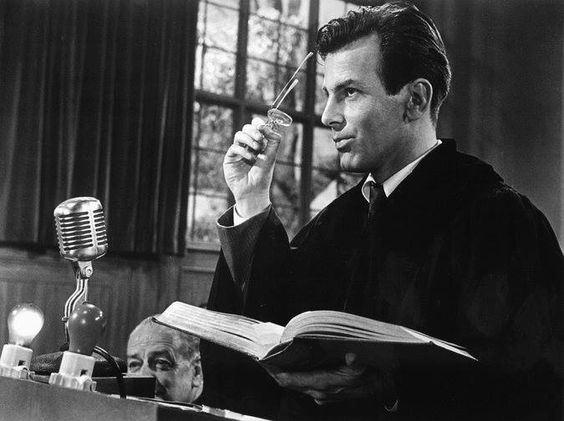
rolfe

Today just a short follow up to my last few posts about the Holocaust and the other crimes of the Nazi state. A couple of those dealt with the film Judgment at Nuremberg. The film is profoundly disturbing when one looks at the time that we live. This is one of the more disturbing sections because in it, Maximillian Schell who played Hans Rolfe, the defense counsel for Burt Lancaster.

His summation of the defense following his client’s admission of guilt is damning. It is something that when we, and by we I mean people around the world, look at the atrocities of genocide, war crimes, ethnic cleansing, the willful starvation of millions by criminal regimes; and then stand by saying little or nothing and doing nothing, sometimes even supporting the regimes that commit these actions.

Please, no matter what your political point of view, take the time to watch the film, and read the transcript of Schell’s speech below:

“Your Honor, it is my duty to defend Ernst Janning, and yet Ernst Janning has said he is guilty. There’s no doubt, he feels his guilt. He made a great error in going along with the Nazi movement, hoping it would be good for his country. But, if he is to be found guilty, there are others who also went along, who also must be found guilty. Ernst Janning said, “We succeeded beyond our wildest dreams.” Why did we succeed, Your Honor? What about the rest of the world? Did it not know the intentions of the Third Reich? Did it not hear the words of Hitler’s broadcast all over the world? Did it not read his intentions in Mein Kampf, published in every corner of the world? Where’s the responsibility of the Soviet Union, who signed in 1939 the pact with Hitler, enabled him to make war? Are we not to find Russia guilty? Where’s the responsibility of the Vatican, who signed in 1933 the Concordat with Hitler, giving him his first tremendous prestige? Are we not to find the Vatican guilty? Where’s the responsibility of the world leader, Winston Churchill, who said in an open letter to the London Times in 1938 – 1938! Your Honor – “were England to suffer national disaster should pray to God to send a man of the strength of mind and will of an Adolf Hitler!” Are we not to find Winston Churchill guilty? Where is the responsibility of those American industrialists, who helped Hitler to rebuild his armaments and profited by that rebuilding? Are we not to find the American industrialists guilty? No, Your Honor. No! Germany alone is not guilty: The whole world is as responsible for Hitler’s Germany. It is an easy thing to condemn one man in the dock. It is easy to condemn the German people to speak of the basic flaw in the German character that allowed Hitler to rise to power and at the same time positively ignore the basic flaw of character that made the Russians sign pacts with him, Winston Churchill praise him, American industrialists profit by him! Ernst Janning said he is guilty. If he is, Ernst Janning’s guilt is the world’s guilt – no more and no less.”

Sadly, little has changed in the character of humanity. If we do or say nothing, if we support those who do such things, if we close our eyes and pretend that it is not our problem, then we are the guilty party.  As Hannah Arendt wrote: “The sad truth is that most evil is done by people who never make up their minds to be good or evil.”

Peace

Padre Steve+

1 Comment

Filed under ethics, film, Foreign Policy, History, holocaust, nazi germany, News and current events, Political Commentary

Holocaust Remembrance 2017: “Most evil is done by People who never make up their minds to be Good or Evil”

1483285_10152114931522059_1612934841_n

Friends of Padre Steve’s World,

I normally don’t post twice in a day but this I thought was important, for I believe that we are at a point in world history where the not so distant specter of a horrifying past is is rising before our eyes and all too many people cannot see it.

Friday, January 27th 2017 was Holocaust Remembrance Day. On that day seventy-two years ago the Soviet Red Army liberated the Auschwitz Concentration Camp, the centerpiece of the Nazi Death Camp machine. To be sure, in his panic to save his neck, in late 1944 Heinrich Himmler had begun to switch from his tactic of extermination to using the Jews as bargaining chips., but by then most of the Jews under Nazi control were dead. Those that remained, emaciated and dying by the thousands to starvation, and unchecked disease, as they were marched in ghastly conditions to camps deeper inside Nazi controlled areas.

On Friday two things happened in the United States that caused me to shake my head and wonder if we are becoming a place that will turn its eyes away from current atrocities, genocide, ethnic and religious cleansing, and walk away. President Trump issued a proclamation to observe Holocaust Remembrance Day, a statement that did not mention the Jews. How one remembers the Holocaust without mentioning the Jews is beyond me, but some of the President’s closest advisers, including Steve Bannon, are closely connected to the self-proclaimed Alt-Right, a movement of white supremacists and neo-Nazis looking for respectability. The second thing the President did was to issue an Executive Order halting the immigration of refugees from certain Muslim majority countries, and to cap the number entering. I’m not going to go into details about that but it is not the first time that the United States stopped refugees from entering the country on national security grounds, as in the 1930s and 1940s one of the reasons used to keep German Jewish refugees out of the country was exactly that, they might be Nazi spies and saboteurs, but I digress…

However, this is a day that we should never forget. The horrors perpetrated by the Nazi regime, all in the name of “race purity” and the extermination of the Jews and others deemed by the Nazis to be “sub-human” or untermenschen is something that is hard for most to imagine. Last year about this time I finished reading Bettina Stangneth’s book, Eichmann Before Jerusalem: The Unexamined Life of a Mass Murderer. While I am very well informed and educated on the lives, writings, actions, and statements of many of the Nazi war criminals, this new book on Eichmann is the most troubling that I have ever read. In particular it is the accounts of his writings and interviews with other pro-Nazi, or former Nazis in Argentina, particularly the Sassen Interviews, which span hundreds of hours of tape and thousands of pages of transcripts.

I am a Christian, a gentile, and a historian, as well as a thirty-five year military who served alongside our advisors and the Iraqis who fought alongside of us. I have lived in Germany, read, speak and write German and have many friends in that country, including members of the German military, retired and active duty.  My study and association with Holocaust survivors goes back to my college days at California State University Northridge when as an undergraduate history major I spent much of my time studying Germany from the first unification and the Kaiser Reich, the First World War, Versailles, Weimar and the Hitler Regime. My professor, Dr. Helmut Heussler, whose family left Germany in the late 1920s, served in the U.S. Army in World War II and was an interrogator at Nuremberg. I took a number of classes from Dr. Heussler, including Hitler’s Germany and the Holocaust. In the latter I had the chance to meet Holocaust survivor Mel Mermelstein, who was later played by Leonard Nimoy in the TV movie Never Forget. 

Since my college days I have continued to read and study, and to get a second Masters Degree in History in which much of my work dealt with the Nazi regime. I have visited the sites of former concentration camps including Dachau and Bergen-Belsen. I have been to the sites of the Nazi Party rallies in Nuremberg, as well as to the courtroom where the Nuremberg Trails were conducted. One day, God willing I will get to Auschwitz.

The Nazis had begun their persecution of the Jews shortly after Hitler took power in 1933. Later in the year the Enabling Act gave Hitler and his henchmen the legal means to begin their persecution of the Jews and others. These were followed by the Nuremberg Laws and other laws that targeted the Jews. Persecution increased throughout the 1930s, and sadly most countries refused to accommodate increased Jewish immigration. Then came Kristallnacht, or the Night of Broken Glass, when on 9-10 November 1938, a series of orchestrated attacks on Jewish businesses, Synagogues, institutions and individuals. On that night close to 200 synagogues, 7000 Jewish businesses and 29 major department stores were destroyed or damaged. Over 30,000 Jews, mostly men, were arrested and sent to concentration camps, 91 people were killed outright, and several thousand died in the aftermath.

mass killing einsatzgruppen

When the Nazis invaded Poland, its Jews were rounded up and placed into ghettos where many died of starvation and abuse even before the ghettos were liquidated and the people who lived in them were deported to the extermination camps. In 1941 as the German military seemed to be assured of victory in the Soviet Union the Nazis decided to exterminate the Jews of Europe. In the Soviet Union four Einsatzgruppen followed each of the German Army Groups and systematically began to massacre the Jews of every city and village which German soldiers captured. Over a million and a half Soviet Jews were killed by the Einsatzgruppen, Ordungspolizei battalions, Army Security Divisions and locally recruited units.

At the Wansee Conference of January 20th 1942 the specifics of the “Final Solution” were mapped out by Himmler’s number two man, SS General Reinhard Heydrich. What followed is beyond the comprehension of most people, but the perpetrators were for the most part men and women who were terrifyingly normal.

The truly terrifying thing about the Nazi perpetrators of the Holocaust to me is that most of the men at Wansee, men that commanded the Concentration camps and the Einsatzgruppen were very ordinary men who simply believed that they were doing their jobs. Very few could be described as psychopathic killers by nature. They were lawyers, doctors, career police officials, businessmen, and bureaucrats who carried out an extermination campaign that killed by their own numbers between 5.5 and 6 million Jews, not to mention others deemed to be subhuman including the handicapped, the mentally ill, homosexuals, and other non-Jewish minorities like the Gypsies not to mention the wide variety of those considered political enemies. But it was the Jews that bore the most tragic fate.

When you read their writings, listen to them when they were interviewed, or watch footage of them during or after the war, you find that they had absolutely no empathy for their victims. When confronted about the evil that they engineered they invariably blamed their victims, just as many like them do today.

Most of the men who coordinated the massive effort to exterminate the Jews of Europe following the Wansee Conference of January 20th 1942 approached their jobs dispassionately. This was a common attitude among the civil service, military and police officials that oversaw the Holocaust. They simply did their jobs and followed the law, and for most of them, their victims meant nothing.

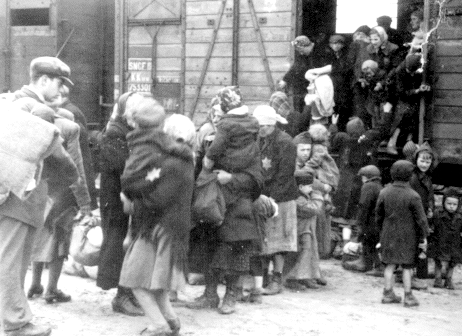
ChildrenBirkenau

Hungarian Jews being sent to Extermination Camps

Adolf Eichmann summed up the attitude of many when he said regarding his work to deport hundreds of thousands of Hungarian Jews to Auschwitz in in just a few weeks during the fall of 1944, “Whether they were bank directors or mental cases, the people who were loaded on those trains meant nothing to me.” Speaking to Willem Sassen in 1957 Eichmann reveled in that accomplishment, “It was an achievement that was never matched before or since.” Eichmann also enjoyed leading his victims on, pretending that he might listen, and they might change his mind. Eichmann was proud of what he did. He told his staff, “I will leap into my grave laughing because the feeling that I have five million human beings on my conscience is for me a source of extraordinary satisfaction.”

Hannah Arendt wrote of Eichmann:

“The trouble with Eichmann was precisely that so many were like him, and that the many were neither perverted nor sadistic, that they were, and still are, terribly and terrifyingly normal. From the viewpoint of our legal institutions and of our moral standards of judgment, this normality was much more terrifying than all the atrocities put together.”

This was what made the Holocaust committed against the Jews of Europe by Nazi Germany a phenomenon different than other genocides. Many of the perpetrators were not driven by centuries old hate as in the Balkans, tribal blood lust as occurred in Rwanda, or the products of Soviet Communism or Communist Chines Maoist regimes.

dachaumorgue1945

It was the racial ideology of the Nazis which deemed the Jews and other non-Aryans to be sub-human. That ideology undergirded the German treatment of the Jews, and the conduct of the war, especially in the East. But the execution of the plan required the bureaucratic, administrative, technical and legal skills brought to the table by ordinary men. Men who sought promotion, advancement and economic security for their families. Individually many would have never killed, but in their positions they ran the rail network, the factories, the banking and finance industries and supported the war effort, most not thinking much about the evil that they abetted or if they did finding a way, be it social, scientific, religious, patriotic, legal or simply in the name of efficiency.

Survivors of Auschwitz

That is what makes the evil committed by them so terrifying. It is the product of “normal” people in an advanced Western nation. Make no bones about it, their actions were evil. They aided and abetted the genocide of the Jews, the disabled, other “sub-human” races, particularly Slavs, as well as those that they deemed less than suitable.

I think that the most chilling thing about the Holocaust was that the greatest atrocities were committed by ordinary men, sometimes well educated, decent family men. These were men who simply executed orders and often went home at night. Arendt wrote that “The sad truth is that most evil is done by people who never make up their minds to be good or evil.” She was right, there was an ordinariness to the evil perpetrated by the Nazis, at the same time there are those who consciously decide to participate in evil.

It is important that we do not forget the Holocaust. It is also important to recognize that the instruments of that horror were on the whole “ordinary” men who as they saw it were simply doing their job. It is something that everyone needs to remember. Bettina Stangneth wrote “Systematic mass murder is not just the sum of isolated instances of sadism but the result of a political thinking that is perverted from the ground up.”

So many of the perpetrators saw nothing wrong in what they were doing, in fact at his trial in Jerusalem Eichmann said, “To sum it all up, I must say that I regret nothing.”

They believed that their victims were less than human and like so many people even today, they had no empathy. Gustave Gilbert, an American Army Psychologist at the major War Criminal Trials at Nuremberg said it so well: “Evil is the absence of empathy.”

It is important that we never forget, especially now when we could be watching it begin all over again.

Peace

Padre Steve+

3 Comments

Filed under civil rights, ethics, Foreign Policy, History, holocaust, iraq,afghanistan, laws and legislation, national security, nazi germany, News and current events, Political Commentary

“Because we Loved our Country!” Why People Believe the Lies

seanspicer_brownsuit

Press Secretary Sean Spicer

Friends of Padre Steve’s World,

I couple of days ago I asked the question “how did we get here?” when I was discussing drumbeat of lies, which are now called alternate truth by the President and members of his administration. As the past few days have unfolded I have asked the question to myself a number of times as the statements continue, along with the admonitions from Steve Bannon, Sean Spicer, and Kellyanne Conway to “always believe” what is being said by the President and for the media and other critics to “shut up.” The media of course now is always lying so it goes, and sadly some journalists have added fuel to the flame by misreporting, that doesn’t mean that journalists or the press as a whole are lying, but it sets up straw men for the President and his advisors to attack. Opposition is considered treason, and opponents must be silenced because it is the patriotic thing to do.

Likewise there is the silencing of Federal workers, and even agencies who simply report the truth, and the quashing of dissent by removing officials who may be troublesome later on. His foreign policy seems like it is going to be a go it alone, aggressive hyper-nationalism, forsaking longstanding and faithful allies to ally himself with the Russian dictator, and to threaten military action, trade wars, and to bring back torture. Yet, those are actions that in the long run are bound to destroy the United States, but there is no push back from the GOP majority in Congress.

Then of course are the executive orders which are being issued daily. President Trump is doing exactly what he promised to do during the campaign when we were told not to take what he said literally. Before his inauguration the President said that he may issue 200 executive orders in his first month in office. Such is to rule by fiat, to bypass Congress, the Courts, and ultimately the people, yet it is entirely legal and at the same time if unchecked by the Congress or the Courts will lead to a totalitarian state.

Yet the President’s supporters and the the vast majority of the Republican Congress say nothing and some are calling him brilliant. So I ask myself why? What is going on when people, people who are basically good, turn a blind eye to emerging tyranny. Why is it that otherwise decent, and even brilliant people will allow such things to happen, and even more, to wholeheartedly support the policies.

Then I began to think of the classic film, Judgment at Nuremberg. The question of how many Germans, who should have known better abandoned all sense and supported Hitler seems to me to be quite similar to what is going on with many Trump supporters. They are afraid of the future, they are frustrated, and their fear of the past, present, and future is such that they are willing to cast aside logic and blindly support a man who can only be called a madman. They are doing it out of “love for country.”

In the movie, Burt Lancaster plays a prominent German legal scholar and jurist named Ernst Janning. As the trial dragged on he was content to allow his defense attorney to use whatever means necessary, even re-victimizing the people who were in fact the victims of his own judgments in support of his government’s policy. When he went to the witness stand his conscience finally got the best of him and he explained his guilt and how he and so many people like him abandoned all sense and morality in supporting Hitler. I could imagine when all of what we are just beginning to see happen before our eyes is done, and our world has crashed in about us, I wonder if some of those who supported the President and asked no questions will have the courage to say like Janning:

“There was a fever over the land. A fever of disgrace, of indignity, of hunger. We had a democracy, yes, but it was torn by elements within. Above all, there was fear. Fear of today, fear of tomorrow, fear of our neighbors, and fear of ourselves. Only when you understand that – can you understand what Hitler meant to us. Because he said to us: ‘Lift your heads! Be proud to be German! There are devils among us. Communists, Liberals, Jews, Gypsies! Once these devils will be destroyed, your misery will be destroyed.’ It was the old, old story of the sacrificial lamb. What about those of us who knew better? We who knew the words were lies and worse than lies? Why did we sit silent? Why did we take part? Because we loved our country! What difference does it make if a few political extremists lose their rights? What difference does it make if a few racial minorities lose their rights? It is only a passing phase. It is only a stage we are going through. It will be discarded sooner or later. Hitler himself will be discarded… sooner or later. The country is in danger. We will march out of the shadows. We will go forward. Forward is the great password. And history tells how well we succeeded, your honor. We succeeded beyond our wildest dreams. The very elements of hate and power about Hitler that mesmerized Germany, mesmerized the world! We found ourselves with sudden powerful allies. Things that had been denied to us as a democracy were open to us now. The world said ‘go ahead, take it, take it! Take Sudetenland, take the Rhineland – remilitarize it – take all of Austria, take it! And then one day we looked around and found that we were in an even more terrible danger. The ritual began in this courtroom swept over the land like a raging, roaring disease. What was going to be a passing phase had become the way of life. Your honor, I was content to sit silent during this trial. I was content to tend my roses. I was even content to let counsel try to save my name, until I realized that in order to save it, he would have to raise the specter again. You have seen him do it – he has done it here in this courtroom. He has suggested that the Third Reich worked for the benefit of people. He has suggested that we sterilized men for the welfare of the country. He has suggested that perhaps the old Jew did sleep with the sixteen year old girl, after all. Once more it is being done for love of country. It is not easy to tell the truth; but if there is to be any salvation for Germany, we who know our guilt must admit it… whatever the pain and humiliation.”

I do not know what is going to happen, I still hope and pray that the President will do good things for the country and the world; but every word, and every action coming from him and his spokespeople serve to dampen any measure of hope that I have for this very young administration. Thankfully, there are people who are using legal means to resist and to speak out, but I wonder if that will be enough.

Peace

Padre Steve+

2 Comments

Filed under ethics, film, History, laws and legislation, nazi germany, News and current events, Political Commentary