Category Archives: News and current events

The Unfinished Work of Memorial Day

img_0578

Friends of Padre Steve’s World,

This is Memorial Day Weekend, a weekend where we remember those who died in the service of our country. It is not a day to thank the living veterans, that day is Veteran’s Day. Nor is it the day to thank those men and women who currently wear the uniform and fight the wars of our country. This weekend I am reposting a number of articles from past years to remind my regular readers and those new to my writings about how important this remembrance is, not just to me, but to all of us. I do not say that lightly. Memorial Day is the offspring of the families of the American Civil War dead, when people who lost loved ones in the cause of liberty and the defense of the Union honored their loved ones.

No matter what your political views, ideology, or religious beliefs, please take time to remember the high human cost of freedom this weekend, especially on Monday when we observe Memorial Day.

Peace,

Padre Steve+

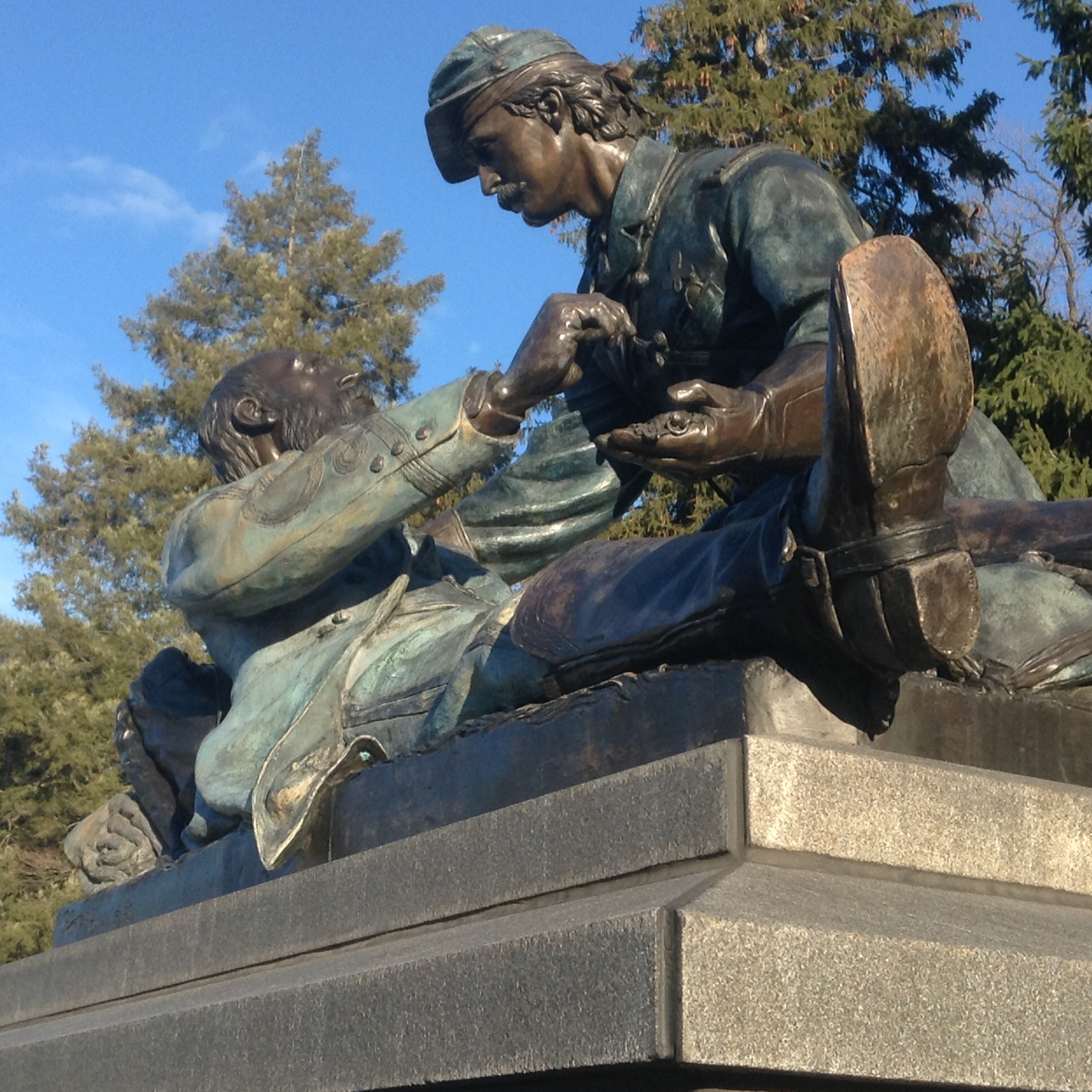
burford reynolds monuments

Abraham Lincoln said that “It is for us the living, rather, to be dedicated here to the unfinished work which they who fought here have thus far so nobly advanced…” Likewise, Joshua Chamberlain, the hero of Little Round Top at Gettysburg said, “Heroism is latent in every human soul – However humble or unknown, they (the veterans) have renounced what are accounted pleasures and cheerfully undertaken all the self-denials – privations, toils, dangers, sufferings, sicknesses, mutilations, life-” 

Sometimes it is best to remember that people that lived long before us have profound things to say about subjects that we often address in rather cheap and banal ways. It is easy to do this; in fact many people, especially ideologues and pundits simply quote the great men and women of history simply to buttress what they want to say in much the same manner that preachers from all sides of the theological spectrum will comb the Bible or the Church Fathers to find support for often decidedly un-Christian ideas. Of course unscrupulous preachers of other religions do the same with their sacred texts so it tends be a universal problem.

Of course we should know better than to do this but all of us do it to one degree or another. Even worse are those that will misquote people either to bolster their arguments or to tear down the person that they quote. It should not be that way on Memorial Day. The sacrifices of those that gave “the last full measure” in defense of their homeland, principles and those that they loved are too great to trivialize by using the sacrifices of the fallen to promote themselves as they prepare to launch political campaigns as was recently done by a prominent politician at an annual event which honors veterans in Washington DC.
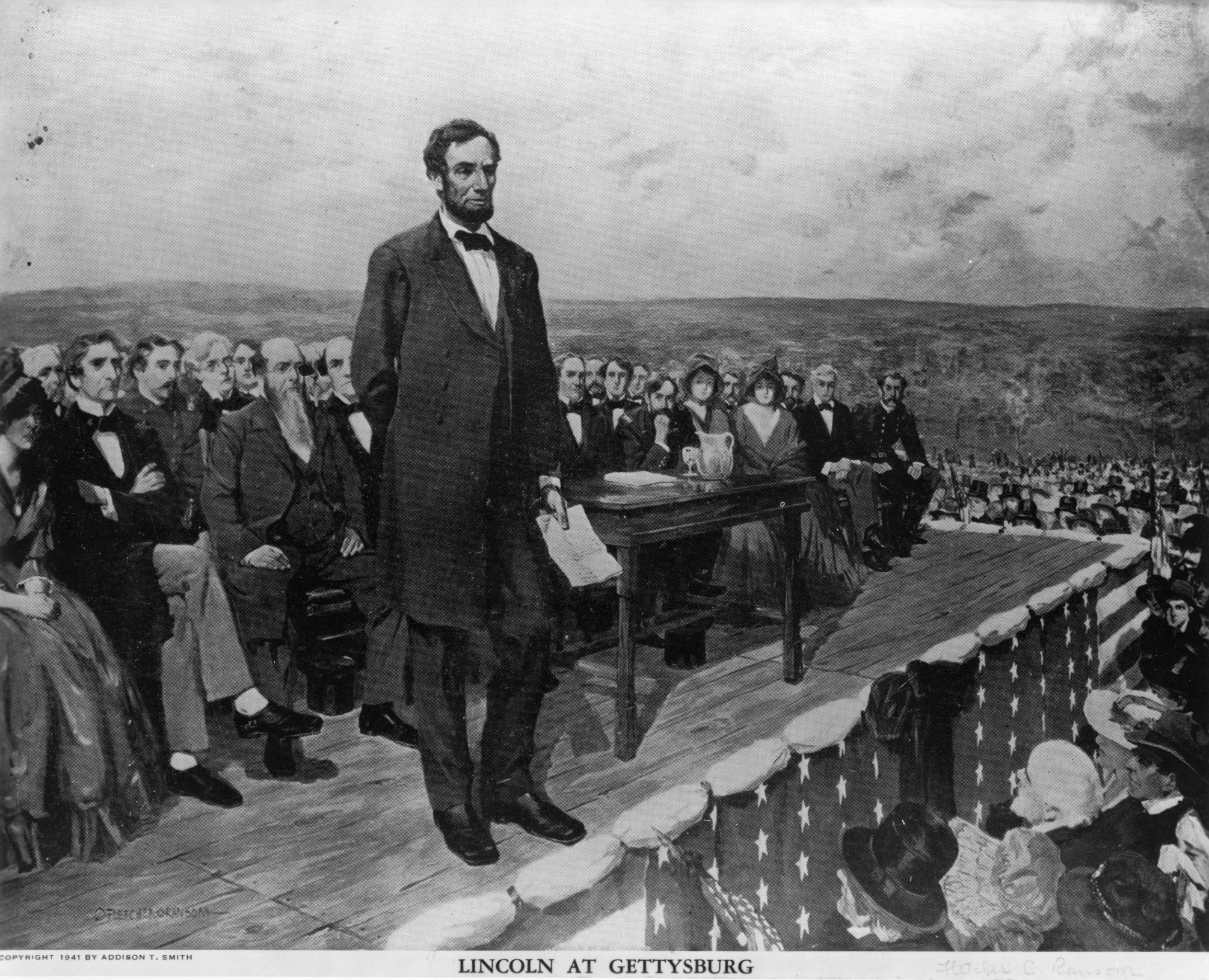
Gettysburg Address

I think that Abraham Lincoln eulogized the fallen better than almost anyone in the history of our nation when he traveled to Gettysburg and gave a refreshingly short speech for a politician. Lincoln considered the speech a failure but history shows it to be one of the most remarkable ever made by any American public figure.

“Four score and seven years ago our fathers brought forth on this continent, a new nation, conceived in Liberty, and dedicated to the proposition that all men are created equal.

Now we are engaged in a great civil war, testing whether that nation, or any nation so conceived and so dedicated, can long endure. We are met on a great battlefield of that war. We have come to dedicate a portion of that field, as a final resting place for those who here gave their lives that that nation might live. It is altogether fitting and proper that we should do this.

But, in a larger sense, we cannot dedicate—we cannot consecrate—we cannot hallow—this ground. The brave men, living and dead, who struggled here, have consecrated it, far above our poor power to add or detract. The world will little note, nor long remember what we say here, but it can never forget what they did here. It is for us the living, rather, to be dedicated here to the unfinished work which they who fought here have thus far so nobly advanced. It is rather for us to be here dedicated to the great task remaining before us—that from these honored dead we take increased devotion to that cause for which they gave the last full measure of devotion—that we here highly resolve that these dead shall not have died in vain—that this nation, under God, shall have a new birth of freedom— and that government of the people, by the people, for the people, shall not perish from the earth.”

Gettysburg_Unknowns.JPG

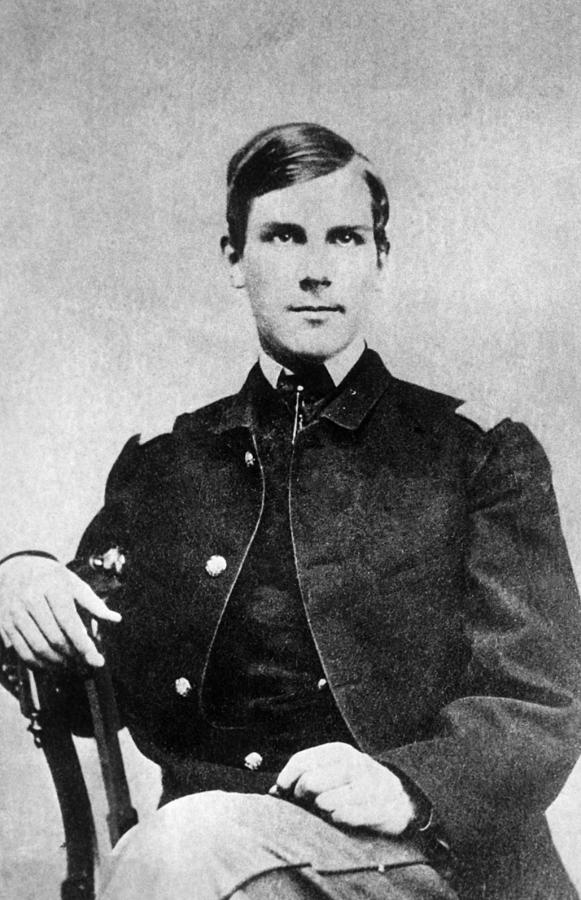
Supreme Court Justice Oliver Wendell Holmes gave a speech in 1884 twenty years after his service in the 20th Massachusetts Regiment in the Civil War. A veteran of Antietam and other major engagements he made these remarks in a speech so powerful that it was a key factor in Theodore Roosevelt’s decision to nominate him for the Court.

“Every year–in the full tide of spring, at the height of the symphony of flowers and love and life–there comes a pause, and through the silence we hear the lonely pipe of death. Year after year lovers wandering under the apple trees and through the clover and deep grass are surprised with sudden tears as they see black veiled figures stealing through the morning to a soldier’s grave. Year after year the comrades of the dead follow, with public honor, procession and commemorative flags and funeral march–honor and grief from us who stand almost alone, and have seen the best and noblest of our generation pass away…

But grief is not the end of all. I seem to hear the funeral march become a paean. I see beyond the forest the moving banners of a hidden column. Our dead brothers still live for us, and bid us think of life, not death–of life to which in their youth they lent the passion and joy of the spring. As I listen, the great chorus of life and joy begins again, and amid the awful orchestra of seen and unseen powers and destinies of good and evil our trumpets sound once more a note of daring, hope, and will.”
kennedy-john-f-flag

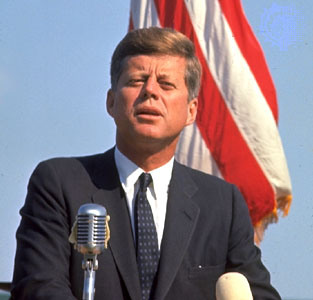
In his inaugural address President John F. Kennedy a combat veteran of the Solomons Campaign provided a message which though not directly related to Memorial Day certain echoed the themes of the sacrifices of our fallen but also call us to the highest ideals of our nation. As a Naval Officer in command of PT 109 his boat was rammed and sunk by a Japanese destroyer after which his leadership and courage was a deciding factor in the survival of most of his crew. Kennedy was a child of privilege but he volunteered for the arduous duty of service on the tiny PT Boats. The speech is considered one of the premier speeches by an American President.

“In your hands, my fellow citizens, more than mine, will rest the final success or failure of our course. Since this country was founded, each generation of Americans has been summoned to give testimony to its national loyalty. The graves of young Americans who answered the call to service surround the globe.

Now the trumpet summons us again — not as a call to bear arms, though arms we need — not as a call to battle, though embattled we are — but a call to bear the burden of a long twilight struggle, year in and year out, “rejoicing in hope; patient in tribulation,”² a struggle against the common enemies of man: tyranny, poverty, disease, and war itself….

In the long history of the world, only a few generations have been granted the role of defending freedom in its hour of maximum danger. I do not shrink from this responsibility — I welcome it. I do not believe that any of us would exchange places with any other people or any other generation. The energy, the faith, the devotion which we bring to this endeavor will light our country and all who serve it. And the glow from that fire can truly light the world.

And so, my fellow Americans, ask not what your country can do for you; ask what you can do for your country.

My fellow citizens of the world, ask not what America will do for you, but what together we can do for the freedom of man.

Finally, whether you are citizens of America or citizens of the world, ask of us here the same high standards of strength and sacrifice which we ask of you. With a good conscience our only sure reward, with history the final judge of our deeds, let us go forth to lead the land we love, asking His blessing and His help, but knowing that here on earth God’s work must truly be our own.”
fort hood memorial

In 1984 President Ronald Reagan visited Omaha Beach in Normandy, the site of the bloodiest of the D-Day landings on June 6th 1944. Reagan was a master of rhetoric and understood the importance of his visit to this hallowed site at the apex of the Cold War. At that time it was unimaginable to most people that the Soviet Union would be no more barely 5 years hence and Reagan used the speech to link the sacrifices of those who fought and died at Normandy to those that served in his day. While his focus was on the sacrifice of America and its British, Canadian and French allies that landed on the beaches of Normandy he recognized the sacrifices of the Soviet Union which lost 20 million soldiers and civilians in the war against the Nazis. Reagan said of those who went ashore in Normandy:

“The men of Normandy had faith that what they were doing was right, faith that they fought for all humanity, faith that a just God would grant them mercy on this beachhead or on the next. It was the deep knowledge — and pray God we have not lost it — that there is a profound, moral difference between the use of force for liberation and the use of force for conquest. You were here to liberate, not to conquer, and so you and those others did not doubt your cause. And you were right not to doubt.

You all knew that some things are worth dying for. One’s country is worth dying for, and democracy is worth dying for, because it’s the most deeply honorable form of government ever devised by man. All of you loved liberty. All of you were willing to fight tyranny, and you knew the people of your countries were behind you….The men of Normandy had faith that what they were doing was right, faith that they fought for all humanity, faith that a just God would grant them mercy on this beachhead or on the next. It was the deep knowledge — and pray God we have not lost it — that there is a profound, moral difference between the use of force for liberation and the use of force for conquest. You were here to liberate, not to conquer, and so you and those others did not doubt your cause. And you were right not to doubt.

You all knew that some things are worth dying for. One’s country is worth dying for, and democracy is worth dying for, because it’s the most deeply honorable form of government ever devised by man. All of you loved liberty. All of you were willing to fight tyranny, and you knew the people of your countries were behind you.”

President Barak Obama made these remarks a few years ago to conclude his speech following the solemn duty that all Presidents have in laying a wreath at the Tomb of the Unknowns at Arlington National Cemetery. Obama who is vilified by his most extreme opponents, as was Reagan for that matter ended his speech with these comments in which he eloquently expressed what the nation must do for its military, veterans and those killed in action or missing as well as the highest example of the brotherhood that those of us who have served in harm’s way feel for our fellow Soldiers, Marines, Sailors, Airmen and Coast Guardsmen:

“Our nation owes a debt to its fallen heroes that we can never fully repay. But we can honor their sacrifice, and we must. We must honor it in our own lives by holding their memories close to our hearts, and heeding the example they set. And we must honor it as a nation by keeping our sacred trust with all who wear America’s uniform, and the families who love them; by never giving up the search for those who’ve gone missing under our country’s flag or are held as prisoners of war; by serving our patriots as well as they serve us — from the moment they enter the military, to the moment they leave it, to the moment they are laid to rest.”

That is how we can honor the sacrifice of those we’ve lost. That is our obligation to America’s guardians — guardians like Travis Manion. The son of a Marine, Travis aspired to follow in his father’s footsteps and was accepted by the USS [sic] Naval Academy. His roommate at the Academy was Brendan Looney, a star athlete and born leader from a military family, just like Travis. The two quickly became best friends — like brothers, Brendan said.

After graduation, they deployed — Travis to Iraq, and Brendan to Korea. On April 29, 2007, while fighting to rescue his fellow Marines from danger, Travis was killed by a sniper. Brendan did what he had to do — he kept going. He poured himself into his SEAL training, and dedicated it to the friend that he missed. He married the woman he loved. And, his tour in Korea behind him, he deployed to Afghanistan. On September 21st of last year, Brendan gave his own life, along with eight others, in a helicopter crash.

Heartbroken, yet filled with pride, the Manions and the Looneys knew only one way to honor their sons’ friendship — they moved Travis from his cemetery in Pennsylvania and buried them side by side here at Arlington. “Warriors for freedom,” reads the epitaph written by Travis’s father, “brothers forever.”

The friendship between 1st Lieutenant Travis Manion and Lieutenant Brendan Looney reflects the meaning of Memorial Day. Brotherhood. Sacrifice. Love of country. And it is my fervent prayer that we may honor the memory of the fallen by living out those ideals every day of our lives, in the military and beyond. May God bless the souls of the venerable warriors we’ve lost, and the country for which they died.

Sometimes our fallen are eulogized by the less notable and sometimes oft vilified people. One of these men was Robert Ingersoll, a politician, orator and lecturer as well as an agnostic in a time when that was not a popular belief. Ingersoll was the son of a Congregationalist minister who often preached for revivalist Charles Finney. Ingersoll was also a veteran of the Civil War where he raised and commanded the 11th Illinois Cavalry Regiment which fought at Shiloh. remarked:

“These heroes are dead. They died for liberty – they died for us. They are at rest. They sleep in the land they made free, under the flag they rendered stainless, under the solemn pines, the sad hemlocks, the tearful willows, and the embracing vines. They sleep beneath the shadows of the clouds, careless alike of sunshine or of storm, each in the windowless Place of Rest. Earth may run red with other wars – they are at peace. In the midst of battle, in the roar of conflict, they found the serenity of death. I have one sentiment for soldiers living and dead: cheers for the living; tears for the dead.”

As we look forward this Memorial Day let us remember those who have given the last full measure of duty for our nation, those who have served those that continue to serve and the friends and loved ones who cherish the lives and memories of each one. Let us remember as a nation, as fellow citizens and never let our own agendas, ambitions or even our baser instincts sully their memory. May we choose the higher calling of service to our country and each other as Americans, the ideals of which are woven in the lives and sacrifices of those that we honor today and as Lincoln said to finish “the great task remaining before us—that from these honored dead we take increased devotion to that cause for which they gave the last full measure of devotion—that we here highly resolve that these dead shall not have died in vain—that this nation, under God, shall have a new birth of freedom— and that government of the people, by the people, for the people, shall not perish from the earth.”
 

1 Comment

Filed under civil war, Gettysburg, History, Military, News and current events

Why We Keep Memorial Day

Friends of Padre Steve’s World,

This is Memorial Day Weekend, a weekend where we remember those who died in the service of our country. It is not a day to thank the living veterans, that day is Veteran’s Day. Nor is it the day to thank those men and women who currently wear the uniform and fight the wars of our country. This weekend I am reposting a number of articles from past years to remind my regular readers and those new to my writings about how important this remembrance is, not just to me, but to all of us. I do not say that lightly. Memorial Day is the offspring of the families of the American Civil War dead, when people who lost loved ones in the cause of liberty and the defense of the Union honored their loved ones.

No matter what your political views, ideology, or religious beliefs, please take time to remember the high human cost of freedom this weekend, especially on Monday when we observe Memorial Day.

Peace,

Padre Steve+

1-oliver-wendell-holmes-jr-1841-1935-everett

Oliver Wendell Holmes 

“even if those who come after us are to forget all that we hold dear, and the future is to teach and kindle its children in ways as yet unrevealed, it is enough for us that this day is dear and sacred…”

Nearly 20 years after the Civil War, Oliver Wendell Holmes Jr. then serving as Chief Justice of the Massachusetts Supreme Court spoke on Memorial Day 1884 in Keene New Hampshire at a gathering of veterans. He recalled an incident not long before where he had heard a young man ask “why people still kept up Memorial Day. The question was one that he pondered before his speech and that he attempted to find an answer, not to his fellow veterans who certainly understood their shared memories of war “but an answer which should command the assent of those who do not share our memories.”

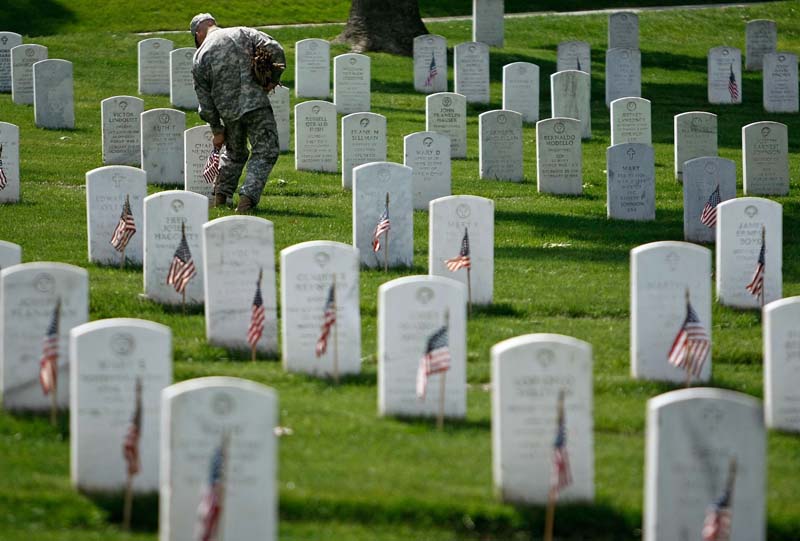
3rd Infantry Places American Flags At The Graves Of U.S. Soldiers

I think that having an answer for the question is as timely now as when Holmes first pondered it. Though his war was twenty years past and had torn the nation apart, there were still many men on both sides who had served in that terrible time and but even so many people were not only forgetting the war and the sacrifices made by so many but intent on becoming rich. Something that he would directly state in a Memorial Day address to the graduating class of Harvard University in 1895:

“The society for which many philanthropists, labor reformers, and men of fashion unite in longing is one in which they may be comfortable and may shine without much trouble or any danger. The unfortunately growing hatred of the poor for the rich seems to me to rest on the belief that money is the main thing (a belief in which the poor have been encouraged by the rich), more than on any other grievance. Most of my hearers would rather that their daughters or their sisters should marry a son of one of the great rich families than a regular army officer, were he as beautiful, brave, and gifted as Sir William Napier. I have heard the question asked whether our war was worth fighting, after all. There are many, poor and rich, who think that love of country is an old wife’s tale, to be replaced by interest in a labor union, or, under the name of cosmopolitanism, by a rootless self-seeking search for a place where the most enjoyment may be had at the least cost.”

However his message to his fellow veterans, mostly men from his own former regiment, the 20th Massachusetts was quite personal and something that they could find meaning in. Holmes understood war, he had seen much action and had been wounded at Ball’s Bluff, Antietam and Chancellorsville. He talked of the shared experience of war, something that those who have fought in our nation’s wars, as well as combat veteran soldiers in other countries can understand far more than people that have only known peace, even while their countrymen are at war.

Memorial Day Series

Holmes’s remembrances of the war and the comrades that he and those present had served with, those living and those dead is powerful. Many of us who have served in the wars that began on September 11th 2001 have lost friends in either Iraq or Afghanistan, and many more who are wounded or maimed in body, mind and spirit. Many survivors of wounds today would have died in previous wars.

Likewise his descriptions of the memories of war, triggered by “accidents” are real to those that have experienced war and combat.

“Accidents may call up the events of the war. You see a battery of guns go by at a trot, and for a moment you are back at White Oak Swamp, or Antietam, or on the Jerusalem Road. You hear a few shots fired in the distance, and for an instant your heart stops as you say to yourself, The skirmishers are at it, and listen for the long roll of fire from the main line. You meet an old comrade after many years of absence; he recalls the moment that you were nearly surrounded by the enemy, and again there comes up to you that swift and cunning thinking on which once hung life and freedom–Shall I stand the best chance if I try the pistol or the sabre on that man who means to stop me? Will he get his carbine free before I reach him, or can I kill him first?These and the thousand other events we have known are called up, I say, by accident, and, apart from accident, they lie forgotten.”

We all have our memories of our wars, those of us who remain, be we veterans of Iraq or Afghanistan, Somalia, Desert Storm, Lebanon, Vietnam, Korea or World War II. It is hard to believe that so few remain from World War II and Korea, and that even the Vietnam veterans are aging rapidly, most now in their 60s or 70s. In as much as the wars of the past decade have been fought by a tiny minority of American citizens fewer and fewer will understand the bond that we share through our memories of the living and the dead. We have been set apart by our experiences, even though the wars that we have fought differ in many ways.

481801_10151367001287059_1003164983_n-1.jpg

As such we should whenever possible take the time to meet and remember. That might be as groups of friends, unit associations or perhaps local chapters of Veterans organizations. We do this to remember but also to remind ourselves that we cannot live in the past alone, for the present likewise calls us to action, even after our service is complete.

Holmes put it well: “When we meet thus, when we do honor to the dead in terms that must sometimes embrace the living, we do not deceive ourselves. We attribute no special merit to a man for having served when all were serving. We know that, if the armies of our war did anything worth remembering, the credit belongs not mainly to the individuals who did it, but to average human nature. We also know very well that we cannot live in associations with the past alone, and we admit that, if we would be worthy of the past, we must find new fields for action or thought, and make for ourselves new careers.”

We remember the past, we remember our fallen and we remember the families who have lost loved ones in these wars as well as those whose lives have been changed and maybe even torn apart by the changes that war has wrought in their loved ones who returned different from war. In our service we have been set apart and as such as Holmes so well states we have the duty to “bear the report to those who will come after us.” His words carry forth to us today, we few we happy few as Shakespeare so eloquently wrote.

“nevertheless, the generation that carried on the war has been set apart by its experience. Through our great good fortune, in our youth our hearts were touched with fire. It was given to us to learn at the outset that life is a profound and passionate thing. While we are permitted to scorn nothing but indifference, and do not pretend to undervalue the worldly rewards of ambition, we have seen with our own eyes, beyond and above the gold fields, the snowy heights of honor, and it is for us to bear the report to those who come after us.”

I will remember my time in Iraq and those that I served alongside. I will also remember friends who served in other units who did not return as well as those Marines, Sailors and Soldiers that I see every day in our Naval Hospital suffering from the physical, psychological and spiritual wounds of war.

This weekend I will remember and on Monday, that sacred day that we set aside to remember the fallen I take some time at noon to join in that time of remembrance and pray that maybe someday war will be no more.

That is why I think that we should remember Memorial Day even if others forget.

Peace

Padre Steve+

Leave a comment

Filed under civil war, History, iraq,afghanistan, Military, News and current events, shipmates and veterans, vietnam, world war one, world war two in europe, world war two in the pacific

Equality: The Early Women’s Rights Movement

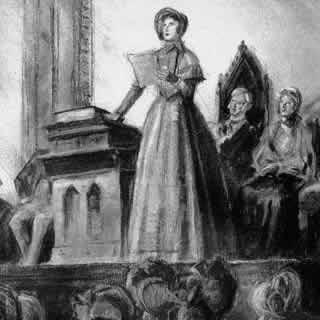
senecafalls-womanspeaking

The Seneca Convention

Friends of Padre Steve’s World,

The issue of Women’s Rights is still in the forefront of political debate in the United States. Women’s rights have been slow to progress despite the passage of the 19th Amendment which gave women the right to vote in 1920. The defeat of the Equal Rights Amendment in 1982 gave added ammunition to conservative opponents of Women’s rights to fight them.

Though women have long been in the workplace in many cases there is a large gap in pay for men and women doing the same jobs and having the same qualifications, likewise, the number of women in senior positions in the private sector and in government is still dwarfed by the numbers of men. The are numerous disparities in how men and women are treated in society, and in many cases and in many parts of conservative society, especially churches, women are still considered less than equal to men. In light of the fact that we will likely have a woman running as the Democratic Party nominee for President the issue is even more pronounced, and Hilary Clinton, whether one likes her or not, and regardless of her policies, or previous record as a Senator or Secretary of State, is held to a higher standard of scrutiny than men in those position.

But this is nothing new, and in light of this I have decided to re-post a sightly edited portion of the chapter in my Civil War and Gettysburg text that deals with the early Women’s Rights movement. I hope that you find it insightful.

Peace

Padre Steve+

Another development, which in large part is related to the abolition movement, was the campaign for women’s rights. The Civil War was also revolutionary because it was instrumental in propelling women into positions in American society that they had never before been allowed. The war Some of this was because many women decided to like those who campaigned for the end of slavery and the rights of African Americans to turn the world upside down. The war allowed the women who served, “in uniform or not, war permitted these women to experiment with a series of role reversals in gender,” [1] and in some cases gender and race. These experiments are the beginning of women’s’ equality and to women serving in the military.

In much of the country and in particular the South, women’s rights were the same as granted in English Common Law. Common law held to the more archaic understanding of the Christian Church that women were the property of their husbands, especially in cases of infidelity including during the trial of Dan Sickles for killing Barton Key.

Southern culture and law ensured that women had even few rights than the women in the North who were making some gains in the workplace and in various professions such as teaching and nursing. This was in large part due to the understanding that the “household was a spatial unit, defined by the property to which the owner not only held legal title over, but over which he exercised exclusive rights.” [2] As such Southern men had nearly unlimited rights and power over what occurred on his property, for “in societies in which landed property comprised the chief means of subsistence…legal title to the land had historically incorporated claims over the persons and labor of those who were dependents on it.” [3]

Thus for Southern men the stakes of ensuring slavery’s continuation and expansion were high, the culture of the South ante-bellum South was deeply patriarchal and “The possibility that the black man might be empowered like any other was such a threat to the southern social hierarchy that some white southerners were inclined to fear not only for their position as slaveowners but for the entire basis of their claim to patriarchal power. They feared for their power not only over their slaves but over their women as well.[4]

William Lloyd Garrison and the leaders of the abolitionist movement came into contact with two southern women who had converted to the abolitionist cause; South Carolina cotton heiresses, Sarah and Angelina Grimke. The two women were passionate as well as eloquent and became popular lecturers on the abolitionist speaking circuit. Angelina Grimke was a powerful speaker and linked abolition and women’s rights:

“We cannot push Abolitionism forward with all our might until we take up the stumbling block out of the road…. If we surrender the right to speak in public this year, we must surrender the right to petition next year, and the right to write the year after, and so on. What then can the woman do for the slave, when she herself is under the feet of man and shamed into silence?” [5]

The Grimke sisters and other women like them brought Garrison and others in the abolitionist movement into contact with the early leaders of the new women’s rights movement. The leaders of the movement, Elizabeth Cady Stanton, Abby Kelley, and Lydia Maria Child were outspoken in their belief that “a campaign to emancipate slaves could not avert its eyes from the need to emancipate American women from social conventions and legal restraints that prevented them, like the slave, from owning property and voting, and kept them altogether subservient to the interests of white males.” [6]

The principals involved in the abolitionist and the women’s movements, those of freedom, emancipation and equality eventually forged a bond between them, and have provided inspiration to others in their quest for political and social equality. For William Lloyd Garrison “the woman question clearly demonstrated how the logic of reform united all good causes and carried them to new ground. If in their endeavors to break the chains of slavery women discovered, as Abby Kelley put it, that “we were manacled ourselves,” the abolitionist principle required a defense of equal rights without regard to race or sex.” [7]

However, women found that their rights were not considered as important by the political leadership fighting for the rights of black men. Few in Congress “responded sympathetically to feminists’ demands. Reconstruction they insisted, was the “Negro’s hour.” [8] Though the economic situation of women began to improve, especially through women being admitted to the Civil Service. Likewise women began to have more educational opportunities in the post-war years. Women’s suffrage was not included in the Fifteenth Amendment, which caused a split between women’s groups and their long-time abolitionist allies who told them “If put on the same level and urged in the same connection, neither will soon be accomplished.” [9]  Even so in some territories women were granted the right to vote in territorial elections, “women were given the vote in Wyoming Territory in 1869. However, Wyoming’s admission as a state twenty years later came only after a heated debate on the women’s suffrage article in the state constitution.” [10]

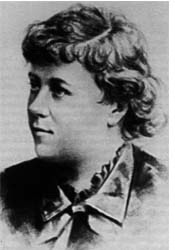
Elizabeth Cady Stanton

In the 1800s women in the United States were bound by English common law. Women had no claim to property, wages, or even their children. Single women had few rights while married women had even fewer as:

“marriage very nearly meant the legal annihilation of a woman…once a woman was married all property and property rights were transferred to her husband, and she was permitted to own nothing in her own name. Married women could not make contracts, could not sue, could not buy or sell, except over their husband’s signatures.” [11]

A married woman’s position was as close to being a slave as could be, and only the plight of black female slaves was worse, for they were simply chattel. The few free black women mainly stayed unmarried “in order to maintain what few property rights they were entitled to.” [12] As they also did over blacks, white men ruled over women in all spheres of life. While the eventual emancipation of blacks provided more rights for black men, those did not help many black women as Sojourner Truth, a pioneering African-American abolitionist who spent forty-years as a slave said toward the end of her long life:

“There is a great stir about colored men getting their rights, but not one word about colored women; and if colored men get their rights, and not colored women theirs, you see colored men will be master over the women, and it will be just as bad as it was before. So I am for keeping the thing going while things are still stirring because if we wait till it is still, it will take a great while to get it going again….I suppose I am the only colored woman that goes on to speak for the rights of the colored women. I want to keep the thing stirring, now that the ice is cracked…” [13]

Elizabeth Cady Stanton was among the most vocal of women’s rights advocates. She believed that a woman’s place in the home was ultimately destructive and “reflected her subordinate position in society and confined her to domestic duties that served to “destroy her confidence in her own powers, lessen her self respect, and to make her willing to lead a dependent and abject life.” [14] Stanton noted how the condition of women of her day was “more fully identified with the slave than man possibly can be… For while the man is born to do whatever he can, for the woman and the negro the is no such privilege.” [15] It was a key observation and something even today, a state that some politicians, pundits and preachers would like to return women.

Since nearly all of the most “outspoken feminists had been schooled in abolitionist movement” they were “suspect in the South, where society was conservative, patriarchal, and insistence that ladies live in a kind of earthly limbo.” [16] Such women posed a threat to the pillars of Southern society. Since the South was now fighting tooth and nail against the abolitionist movement, anything closely connected with that movement, including the women who advocated abolition and women’s rights were shunned and their message rejected and inflammatory and revolutionary. It was not until the crisis caused by the Civil war that Southern women began to seize “the opportunity to lay claim to an increased reciprocity in gender relations.” [17]

But even with the abolition movement there was opposition the women’s rights, the 1839 meeting of the American Anti-Slavery Society witnessed a debate over including women in the membership. Conservative Evangelicals recoiled in disgust, and when the convention voted to allow women into the membership Lewis Tappan “got up a starchy “protest” which condemned the “repugnant” admission of women as an ‘expression of local and sectarian feelings…well suited to the unnecessary reproach and embarrassment to the cause of the enslaved as [it] is at variance with the general usage and sentiments of this and other nations.” [18] In May of 1840 the American Anti-Slavery Society split among religious lines when leading evangelicals led by the Tappan brothers withdrew from it.

But that neither stopped Garrison from working with women, nor kept Frederick Douglass from embracing them as part of the abolitionist movement. From this rather inauspicious beginning, the women’s rights movement began to infiltrate society, especially in the field of education. In 1848 at Seneca New York there was a convention that launched the modern women’s rights movement. Led by Stanton and Elizabeth Mott the delegates published a “Declaration of Sentiments, modeled on the Declaration of Independence, proclaimed “that all men and women are created equal” and deserved their “inalienable rights” include the right to elective franchise.” [19] The declaration was bold and its denunciation of the place of women in society to be considered revolutionary in character. Part read:

“He has never permitted her to exercise her inalienable right to elective franchise. He has compelled her to submit to laws, in the formation of which she had no voice. He has withheld from her rights which are given to the most ignorant and degraded men – both natives and foreigners… He has made her, if married, in the eye of the law, civilly dead. He has taken from her all right to property, even to the wages that she earns…. After depriving her of all her rights as a married woman, if single, and the owner of property, he has taxed her to support a government which recognizes her only when her property can be made profitable to it. He has monopolized nearly all the profitable employments, and from those she is permitted to follow she receives but a scanty remuneration. He closes against her all the avenues to wealth and distinction which he considers honorable to himself. As a teacher of theology, medicine of the law, she is not known… He has created a false public sentiment by giving the world a different code of morals for men and women, by which moral delinquencies which exclude women from society, are not only tolerated, but deemed of little account in man. He has usurped the prerogative of Jehovah alone, claiming his right to assign for her a sphere of action, when that belongs to her conscience and to her God. He has endeavored, in every way that he could, to destroy her confidence in her own powers, lessen her self-respect, and to make her willing to lead an abject and dependent life.” [20]

The declaration also stated, in words which inflamed many men that: “the history of mankind is a history of repeated injuries and usurpations on the part of man toward woman, having in direct object of an absolute tyranny over her.” [21] In the years following this meeting women took up an even more important place in the abolitionist movement, Abby Kelly Foster returned to head the work and recruited many talented women agents including Sallie Holley, Lucy Stone and Susan B. Anthony who “often made five or six appearances a week” in various abolitionist meetings and in 1850-1851 they were joined by the “black evangelist Sojourner Truth, whom Garrison had met and the Northampton colony in 1843 and for whom he had printed an autobiographical narrative.” [22] These women contributed greatly to the abolitionist cause and would in the years to come be among those who continued to fight not only for the rights of blacks, but the rights of women.

The new women’s rights groups continued to work hand in hand with the abolitionist groups but also began a campaign for the rights of women. In the mid-1850s primarily focused on “obtaining state laws guaranteeing women’s right to control their property and wages, to be legal guardians of their children, and to be paid salaries commensurate with their labors, while a few women advocated for more liberal divorce laws so that they could rid themselves of alcoholic, insane, criminal, or brutal husbands.” [23] These efforts secured some modest gains and by 1861 most states had granted women some type of property rights or had changed their laws to follow the community property principle.

While the movement made modest progress regarding property rights for women in some states, they made little progress in terms of elective franchise and better wages and working conditions. During the ante-bellum period, women who lobbied for such rights were met with open opposition and scorn. The press “frequently denounced and ridiculed the “strong-minded women…” [24] Despite such attitudes women did make some significant advancements, particularly in lay aspects of the church, such as Bible societies, moral reform organizations, as well as the abolition and temperance movements, which had gained prominence during the Second Great Awakening.

During the ante-bellum period women made great progress in education. By 1850 the United States was the only country where “girls went to elementary school and achieved literacy in virtually the same proportion as boys.” [25] Likewise a few women entered higher education, particularly at women’s seminaries, which were for all practical purposes boarding schools that produced teachers and writers, as well as the Oberlin College, which was founded by Christian abolitionists and welcomed students of both genders as well as of any racial minority. During the three decades prior to the war women made some specific gains, but more important “was the development to their talents for organization, cooperation, leadership, and self expression. It was a time of beginnings and not fulfillment, a time when most women realized and accepted the fact that they lived in a man’s world, a time when a few dedicated but belligerent visionaries were frustrated in their attempt to remake the social order “overnight.” [26]

However, the war would help bring about many more opportunities for women. In 1850 a follow on conference to the Seneca conference, the National Women’s Rights Convention denied the right of anyone to dictate what women could do with their lives:

“The right of any portion of the species to decide for another portion, of any individual to decide for another Individual what is not their “proper sphere”; that the proper sphere for all human beings is the largest and highest to which they are able to attain; what this is, can not be ascertained without complete Liberty of choice; women therefore, ought to choose for herself what sphere she will fill, what education she will seek, and what employment she will follow, and will not be bound to accept, in submission, the rights, the education, and the place which man thinks proper to allow her.” [27]

Notes

[1] Ibid. Guelzo Fateful Lightening p.395

[2] McCurry, Stephanie The Politics of Yeoman Households in South Carolina in Divided Houses: Gender and the Civil War Oxford University Press, Oxford and New York 1992 p.23

[3] Ibid. McCurry The Politics of Yeoman Households in South Carolina p.23

[4] Whites, Leeann The Civil War as a Crisis in Gender in Major Problems in the Civil War and Reconstruction, 3rd Edition Edited by Michael Perlman and Murrell Taylor Wadsworth Centage Learning, Boston 2011 p.16

[5] Ibid. Zinn The Other Civil War p.121

[6] Ibid. Guelzo Fateful Lightening pp.49-50

[7] Mayer, Henry All on Fire: William Lloyd Garrison and the Abolition of Slavery W.W. Norton and Company, New York and London 1998 p.265

[8] Ibid. Foner Forever Free p.124

[9] Ibid. Foner Forever Free p.125

[10] Massey, Mary Elizabeth, Women in the Civil War University of Nebraska Press, Lincoln NE 1966 p. 358

[11] Ibid. Guelzo Fateful Lightening p.391

[12] Ibid. Guelzo Fateful Lightening p.391

[13] Ibid. Zinn The Other Civil War pp.53-54

[14] Ibid. Goldfield America Aflame p.74

[15] Ibid. Guelzo Fateful Lightening p.50

[16] Ibid. Massey Women in the Civil War p. 19

[17] Ibid. Whites The Civil War as a Crisis in Gender p.21

[18] Ibid. Mayer All on Fire p.267

[19] Ibid. McPherson Battle Cry of Freedom p.36

[20] Blanton, DeAnne and Cook, Lauren M. They Fought Like Demons: Women Soldiers in the Civil War Vintage a books, a Division of Random House New York 2002 pp.3-4

[21] Ibid. Guelzo Fateful Lightening p.392

[22] Ibid. Mayer All on Fire p.424

[23] Ibid. Massey Women in the Civil War p.21

[24] Ibid. Massey Women in the Civil War pp.21-22

[25] Ibid. McPherson The Battle Cry of Freedom p.36

[26] Ibid. Massey Women in the Civil War p.23

[27] Ibid. Guelzo Fateful Lightening p.392.

1 Comment

Filed under civil rights, History, laws and legislation, leadership, News and current events, Political Commentary

Trumped: The End of the GOP as We Knew It


Friends of Padre Steve’s World,

Today I have just a few quick thoughts on the end of the GOP’s #NeverTrump campaign. 

It came as I thought with the crushing defeat that the Donald dealt Ted Cruz and John Kasich in Indiana last night. Now I really expected one or both to stay in the campaign to try and deny Trump a first ballot nomination in Cleveland, but the campaign to stop Trump seemed to end today when Ohio Governor John Kasich ended his campaign.

It started last night when “God’s Annointed One” for the Presidency, Ted Cruz ended his campaign to establish a theocratic state based on the theology of Christian Dominionism. Though he tried to cast himself as a successor to Ronald Reagan’s conservative mantle in the #NeverTrump movement, that was nothing more than a charade, Reagan would have never considered Cruz a real conservative, nor would have Barry Goldwater, the true ideological father of the now dead modern conservative movement. In fact Goldwater detested and distrusted the Christian Right. The end of Cruz’s campaign was also the death kneel of the Christian Right which expected that one of its own, Cruz, Huckabee, or Ben Carson, would be the GOP nominee this year. It is funny, back in October or November Teddy of last year was one of the favorites to win the nomination while Trump was considered a long shot outsider at best. 

However, the problem for Cruz and the other candidates of the Christian Right was threefold. First the influence of the Christian Right is declining. It’s leaders are old and increasingly ignored inside and outside the GOP, with the exception of people like Cruz. The polling numbers on this are incontrovertible, and the fact is that the incredibly partisan and hardline policies of leaders of the Christian Right is contributing to the rapid loss of young people in churches and the growth of the demographic known as the Nones, or those with no religious preference.  Second, there were too many of them in the race, and they bled votes from Cruz in the early primaries. The third was brought on by Cruz himself, nobody, even in his party likes him. He is viewed as creepy, Nixon without the charm, and former Speaker of the House, John Boehner summed up what many people feel when he  said that Cruz was “Lucifer in the flesh.” That fact was demonstrated in the Iowa caucuses when Cruz’s campaign used dirty tricks and torpedoed the campaign of Ben Carson, making thousands of phone calls the day of the caucus to tell caucus voters to vote for Cruz since Carson had dropped out. It was a bold faced lie and it enabled him to steal a win there. 

As far as Cruz goes, and everything that he represents, I can only say good riddance, and I hope you lose your next senate race. 

What this signals for the GOP is yet to be determined, but like many others I beleive that it signals the end of the GOP as we have known it. The party leadership may attempt to unify behind him and to control him, but it will be an uncomfortable alliance, and one which Trump holds the winning cards. The GOP is broken, it ignored the advice of those who wrote the post-mortem of the 2012 defeat of Mitt Romney, and now they have been “Trumped” so to speak. Trump’s negatives are such that even if he wins the general election, which based on current polls that pit him against either Clinton or Sanders show him losing hardly, the GOP may well lose the Senate, and many seats in the House. The fact is that Trump does not give a damn what Reince Priebus and GOP leadership think, he will do what he needs to win and if he does win, he will take the credit and do as he pleases. Some influential members the GOP conservative media base are already saying that in spite of the collapse that they will not support Trump. 

At first the GOP dismissed Trump. Then they tried to marginalize him, then when it was too late attempted to stop him. At every turn Trump outmaneuver end them, appealed to the anger and frustration of GOP voters, harnessed that energy, and “Trumped” the GOP leadership at every turn. It was quite fascinating to watch, and if I wasn’t a historian and well aware of the kinds of emotions Trump is playing to I would laugh it off. 

But as I have Sid since November, Trump cannot be underestimated, and if the Democratic nominee and party underestimate him, they too may end up being Trumped. So if there are Democrats or progressive out there feeling a sense of satisfactory schadenfreude in this, don’t celebrate too soon. 

So anyway, enough for today. Have a great evening. 

Peace,

Padre Steve+

Leave a comment

Filed under News and current events, Political Commentary

The End of the Republic?

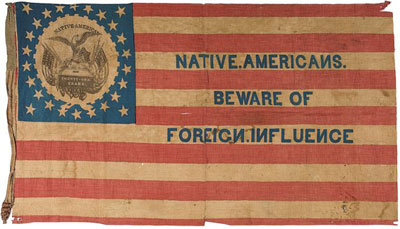
know-nothing_flag

Friends of Padre Steve’s World,

Today Donald Trump will likely bury his Republican competitors in Indiana nearly ensuring that he will win the GOP nomination, and in doing so he will have defied the logic of the GOP leadership by channeling the rage and anger against the status quo that they themselves have fomented over the past four decades. As he does this he will move on, and while some people assume that he will be swept away in November by the Democratic Party nominee, there is no guarantee of that, and those who are wise should not underestimate Trump, or the movement forming around him. The great American philosopher, Eric Hoffer once wrote, “Hatred is the most accessible and comprehensive of all the unifying agents. Mass movements can rise and spread without belief in a god, but never without a belief in a devil.”

Hatred is an amazing emotion. I have been almost overwhelmed by the amount of hatred being posted on social media, blogs, much of it by supposedly Christian preachers, politicians and pundits. Of course if you want find a politician, pundit and preacher all wrapped into one person look no further than Baptist preacher, conservative media pundit, and former Arkansas Governor Mike Huckabee, or the “anointed one” Ted Cruz. But these charlatans of the Christian right pale in comparison to Donald Trump in their ability satiate the desire for a savior of people who are angry and fearful, people that feel cheated, that they have lost their country or their status in it.

This is scary, as it possibly portends the end of our great experiment as a nation. For unlike love, hatred is easy to conjure up. It is kind of like what you need to build a fire; fuel, oxygen and heat. To generate hatred on a massive scale all you need is a disaffected populace, a convenient target, and an agent to ignite the mixture.

Shrewd politicians, preachers, and pundits do this well. Honestly, I think that most effective politician doing this today this is Donald Trump, a man who is lavishly rich, but connects with regular people by speaking their language, and channeling their anger. The situation is much like Germany in 1930 when became a true national party capitalizing on the frustration and anger of Germans at the flailing and failing Weimar Republic. Richard Evans wrote about that in his book “The Coming of the Third Reich.”

“Voters were not really looking for anything very concrete from the Nazi Party in 1930. They were, instead, protesting against the failure of the Weimar Republic. Many of them, too, particularly in rural areas, small towns, small workshops, culturally conservative families, older age groups, or the middle-class nationalist political milieu, may have been registering their alienation from the cultural and political modernity for which the Republic stood, despite the modern image which the Nazis projected in many respects. The vagueness of the Nazi programme, its symbolic mixture of old and new, its eclectic, often inconsistent character, to a large extent allowed people to read into it what they wanted to and edit out anything they might have found disturbing.” 

It does not matter to many of Trump’s followers that his policy propositions in terms of ending alliances, building walls around the border with Mexico paying the bill, massive deportations of people, trade wars to end the deficit, and total bans on travel to this country based on religion, are quite literally impossible. But as Hoffer noted Trump’s followers, like those of any frustrated group and marked by a “facility for make-believe, a readiness to hate, a readiness to imitate [and] credulity, a readiness to attempt the impossible.”

Mass movements, like the one that Trump is building before our very eyes, demonize the target group or population and then let the hatred of their disaffected followers flow. The leaders need that disaffected and angry base in order to rise to power; such was how Hitler, Stalin, and so many other despots gained power. They took advantage of a climate of fear, and found others to blame. For Hitler it was the Jews; while for Stalin it was various groups like the Ukrainians, or the Poles who were the devil to be feared and destroyed. Timothy Snyder in his book Bloodlands: Europe Between Hitler and Stalin wrote:

“Dead human beings provided retrospective arguments for the rectitude of policy. Hitler and Stalin thus shared a certain politics of tyranny: they brought about catastrophes, blamed the enemy of their choice, and then used the death of millions to make the case that their policies were necessary or desirable. Each of them had a transformative utopia, a group to be blamed when its realization proved impossible, and then a policy of mass murder that could be proclaimed as a kind of ersatz victory.”

Snyder is quite correct, demonizing a people and making them some kind of “other”, “they”, or “them”, is a wonderful way to blame a group of people for the ills of society. It is also a good way to deflect the blame for the corporate failures of societies and governments onto a convenient scapegoat; and to blame others for the personal failures and petty jealousies of the people doing the demonizing. It also allows people to abandon ethics and the simple notion of the Golden Rule an engage in genocide.

Mass movements and their leaders love to use this technique; especially when using it against those of other races or religions. The technique is not at all new, it has been used from antiquity but has become much more dangerous in the modern era with the spread of instant communications technology. History shows us all too clearly how it has happened and how easily it can happen again. Witch hunts, slavery and Jim Crow, the extermination of the Native Americans which inspired Hitler in his campaign of genocide and the Holocaust; the Soviet gulags and ethnic cleansing, the Rape of Nanking, the Chinese Communist “Cultural Revolution” the Rwandan genocide, Srebrenica, the Turkish genocide of the Armenians, and the current crimes against humanity of the so called Islamic State. Sadly, the list can go on and on.

All of these events simply required the elements of a disaffected population, a devil or scapegoat to blame, and a leader or leaders to ignite the volatile mixture; fuel, oxygen and heat. Hoffer was quite correct that “Mass movements can rise and spread without belief in a god, but never without a belief in a devil.” The really successful leaders of such movements understand this. For Hitler it was the Jews and other untermenschen; for American Southerners after the Civil it was the Blacks and their white supporters. For the American “Know Nothings” of the 1840s and 1850s it was immigrants, especially Irish and Germans who were Catholic; for Stalin it was non-Russian ethnic minorities. For the leaders of the Islamic State, it is Jews, Shi’ite Moslems, less than “faithful” Sunnis, Christians and well for that matter anyone who does not line up one hundred percent with them on every issue. The examples are so plentiful to support this fact that it is almost overwhelming.

The problem is that when any society, or government begins to label or stigmatize a race, religion, ethnicity, sexual preference, or political ideology, and then in the process demonize those people to the point that they become less than human we have reached a tipping point. Trump has been doing that for his entire campaign. We are very close to the point where we are just one crisis away from all of those crimes against humanity that we believe that we are no longer capable of doing.

But sadly, we human beings are not nearly as evolved as we think and I think that the tipping point in the United States may be far closer than we could ever imagine. In fact, Andrew Sullivan wrote today that “right now, American is a breeding ground for tyranny,” and that “Trump is not just a wacky politician of the far right, or a riveting television spectacle, or a Twitter phenom and bizarre working-class hero. He is not just another candidate to be parsed and analyzed by TV pundits in the same breath as all the others. In terms of our liberal democracy and constitutional order, Trump is an extinction-level event. It’s long past time we started treating him as such.”

I really do not think that we are too far from some tipping point where the politicians, pundits and preachers; especially those of the political right and the media whores who are more concerned about market share than truth, decide that their “devils” must be exterminated and Trump, is the man to make this happen. Of course when he does, his supporters will claim a higher moral, religious, or racial, purpose; or perhaps use the language of Manifest Destiny, the Lost Cause, or the Stab in the Back or some other historical myth that suffices to justify their actions.

As I have said before, Trump’s GOP and potential Democratic opponents would be wise not to underestimate Trump and maybe even form common cause to stop him before it is too late. If they do not the tipping point will have been reached and we will move on into real tyranny.

In the Star Trek the Next Generation episode entitled The Drumhead Captain Picard has to warn his security officer, Lieutenant Worf about the dangers of rampant paranoia. Worf starts: “Sir, the Federation does have enemies. We must seek them out.”
 

Picard pauses and then notes:

“Oh, yes. That’s how it starts. But the road from legitimate suspicion to rampant paranoia is very much shorter than we think. Something is wrong here, Mister Worf. I don’t like what we have become.”

To claim Picard’s words for myself, I have to admit that I don’t like what we have become either.

Peace

Padre Steve+

4 Comments

Filed under leadership, News and current events, Political Commentary

Why Can’t We Be Friends?

Friends of Padre Steve’s World,

It is a good day. I have spent the last couple of days talking about life kinds of things and continue that trend by sharing a few thoughts about friendship, politics, and religion.

I have read a number of articles recently that addressed the growing political divide in the country and one of the commonly cited factors are that a growing number of Americans now pick their friends based on politics, religion, and ideology. That reminded me of Thomas Jefferson who once noted, “I never considered a difference of opinion in politics, in religion, in philosophy, as cause for withdrawing from a friend.”

Sadly, I have lost friends for these very reasons and every one of them saddened me. In most cases I was not the one that broke off the friendship. Now there have been a couple of times where the relationship had grown so toxic that I had to break it off to in order not end up in the position of hating the person, and to protect myself. But those cases have been few and far between. I think that I can count them on one hand.

I have friends that span the political, ideological, religious, ethnic and racial, and even sexual orientation spectrum. Hell, I even count Los Angeles Dodger’s and New York Yankee’s fans among my friends, and that coming from a diehard San Francisco Giant and Baltimore Orioles fan is truly exceptional.

I guess that most of why I am like this is because I loved the diversity that I experienced at Edison High School in Stockton, California, which I went to because of court-ordered desegregation, and close to thirty-five years of military service. In both cases I got to experience the friendship, in many cases lifelong friendships with people whose experience, culture, and backgrounds were very different from mine. This has enriched me as a human being. 

Today, my closest friends are those that I hang out at my local Gordon Biersch Brewery bar, and the local ballpark. They span the spectrum from the most liberal and progressive Bernie supporters to most devoted supporters of Donald Trump, not to mention mainline liberals and conservatives, Libertarians, Greens, as well as Social Conservatives and members of the Christian Right.

The same is true of my social media, both Facebook and Twitter. I do not have to agree with someone to respect them, care about them, and be a friend. I personally don’t understand how anyone can only hang out with people that are like them, frankly that to me sounds boring. I don’t mind exchanging ideas with friends, but I do get put off by ideologues of all beliefs who care nothing for anything but their agenda. I am not adverse to people having strong beliefs, but to impose them as a condition of friendship is beyond me.

My friends know my beliefs. They know that I am liberal, and a proponent of expanding civil rights, and against any law that is written expressly to deny the rights of others purely for the sake of religion. But that being said I don’t need to impose them as a condition of friendship. I gain so much by the multitude of people that are my friends, their real diversity in all things. I cannot imagine doing anything to intentionally lose any of their friendship this political season.

It’s just my opinion, but I think that we would all be better off to try to do the same this year and build bridges. I think instead of condemning people we don’t know just because they are different that we should take the time to get to know them and become friends that we could actually work together, solve our problems, and heal our wounds. 

But then maybe I am too much of a relic of the 1960’s and 1970’s. Maybe, to use the immortal words of John Lennon “I’m just a dreamer, but I’m not the only one. I hope one day you’ll join us, and the world will live as one.” 

So anyway, have a great weekend.

Peace

Padre Steve+


1 Comment

Filed under News and current events, philosophy, Political Commentary

Never Forget: The Murrah Federal Building Bombing of 1995

murrah bombing

Friends of Padre Steve’s World,

Just a short note for today. Amid all the political drama associated with the Republican and Democratic primaries this week, one thing that was overlooked by most people was the anniversary of the bombing of the Murrah Federal Building by Timothy McVeigh and Terry Nichols in 1995.

I don’t think that I could ever forget the day. I was working as a hospital ER department chaplain where I worked a 3:00-11:00 shift. Having just got up I turned on the news and was drinking my coffee when the news about the bombing flashed across the screen. I was stunned, especially when I found out that the bombers were Americans, and both former soldiers.

168 people, including babies and young children in the day care center were killed, hundreds of others wounded. McVeigh and Nichols were part of the anti-government so-called “militia” movement that still exists in parts of this country, of which the Bundy family, which occupied a Federal Wildlife Sanctuary earlier this year in order to bring about a revolt against the government is part.

Sadly, there are such people who would do the same today if given the chance, and as this attack shows, they are not all Islamic terrorists, but some are plain old Americans, people you might see in the grocery store or the gas station.

So let’s never forget.

Peace

Padre Steve+

1 Comment

Filed under History, News and current events, Political Commentary, terrorism

Friday Thoughts

img_2503

Friends of Padre Steve’s World,

I have a few loose thoughts today and am kind of taking a break to again read and ponder different subjects, but first I want to thank those folks who took the time to send warm wishes, thoughts and prayers our way following my wife’s procedure to get some Kidney Stones blasted to smithereens. She is recovering well.

I was really happy to hear that Harriet Tubman, the great former slave and heroine of the Underground Railroad will replace Andrew Jackson on the $20 bill. I think it is long overdue, Tubman was a hero who put her life on the line time after time to help slaves escape before and during the war. She helped lead the Combanhee River Riad in June of 1863 which freed over 750 raids. Of course the announcement was cricized by the retired neurosurgeon and failed presidential candidate Ben Carson. 

I was absolutely shocked and saddened to hear about the passing of the iconic and brilliant musician Prince yesterday. He was an amazing musician, incredible performer, and so versatile. While his music will remain a part of our lives and culture, he died far too young at the age of 57.

I was sad to see that Chicago Cubs outfielder Jason Heyward had to deal with racist taunts on his first trip back to St. Louis on Monday. I hoped that we had gotten past that kind of idiocy and hatred, but maybe not. Some things seem to never change, Jackie Robison got the same treatment in St. Louis when he broke the color barrier.

Speaking of the Cubs, Jake Arrieta pitched the second no-hitter of his career last night, defeating the Cincinnati Reds. Having watched and gotten to know Jake at the Orioles Triple A affiliate, the Norfolk Tides, I am always happy to hear of his success. 

Since I have been doing a lot of reading lately, I want to remind folks of the great Barbara Tuchman’s comment about the importance of books. She said, “Books are … companions, teachers, magicians, bankers of the treasures of mind. Books are humanity in print.”

With that I shall wish you a wonderful weekend because I do plan on having one.

Peace

Padre Steve+

Leave a comment

Filed under Loose thoughts and musings, News and current events

Post New York Thoughts

trumphillarynewyork_032516getty2

Friends of Padre Steve’s World,

I have just a few short thoughts about the New York primaries and the massive victories recorded by Hillary Clinton and Donald Trump.

My gut feeling, looking at the results, as well as polling data available for most of next week’s primaries in Pennsylvania, Delaware, Maryland, Connecticut and Rhode Island is that this marks the end of any real chance for Bernie Sanders to win the Democratic nomination, and the same for either Ted Cruz or John Kasich to come back and have an outright win against Trump.

On the Republican side the best Trump’s opponents can hope for is that he falls short of the needed number to win on the first ballot and that uncommitted delegates do not support him. If it goes to a contested convention, turn out the lights on the GOP. I still expect the GOP establishment will throw in everything to try to stop Trump, and they may yet succeed, but New York was a massive blow against their hope to stop him.

As for the Democrats, the New York results showed how formidable that Hillary is, she not only trounced Sanders by close to 300,000 votes, but collected about 200,000 than all the Republicans combined. The primary wasn’t close and the complaints of Sanders and his supporters that the primary was rigged against them make them sound like sore losers. The next series of primaries play to Hillary’s strengths and I expect her to add to her delegate lead, and after New York I don’t expect any upsets.

Honestly, I think that Sanders made a huge mistake by going so negative against Hillary, and that is actually going to turn people away from him. He is at his best when he is positive and talks about his ideas, and looks like a crotchety old man when he goes negative, and his attacks on Clinton are not likely to win him the support of the Super-Delegates. The fact that he hasn’t been able to go into details about his plans, and the fact that he appears unprepared and defensive when interviewed about them, does not help his cause with voters that want specifics. As I have said many times before many of his ideas resonate with me, but just having ideas with no plan of how you will get them through a potentially hostile Congress is a non-starter.

I am pragmatic, and I think that Bernie needs to figure out what his campaign can do realistically and decide on a realistic course of action. If he continues to go negative and tolerate his supporters making asses out of themselves by doing the same he not only risks his campaign, but damages the one person who might get at least some of those good ideas through Congress. If he plays that game he only helps the Republicans.

A historical analogy is how the Independent Socialists, who joined with the Communist Party after the German Revolution at the end of the First World War, torpedoed the Majority Socialist’s attempts to promote a progressive agenda during the Weimar Republic. They accused the Social Democrats of being worse than the Nazis and during the Republic’s crisis of 1928-1933, they cooperated with the Nazis to collapse support for the Social Democrats and bring down the government, with disastrous results for Germany.

Anyway, that’s all for now,

Peace

Padre Steve+

Leave a comment

Filed under News and current events, Political Commentary

The Straw that Stirs the Drink: The Implications of Resurgent Religion for Strategists and Policy Makers

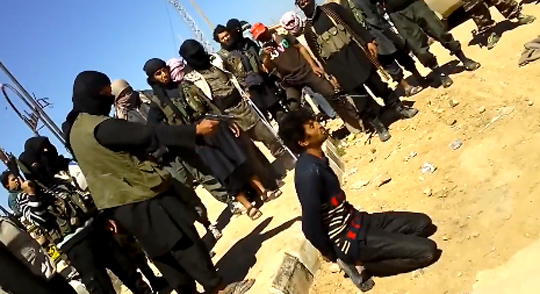
isis-terrorists

Friends of Padre Steve’s World,

I am being published in the most recent issue of Campaigning: The Journal of the Joint Forces Staff College. The article will be available along with the rest of the journal at the website of the college, but I am posting it here. It is an interesting topic since religion is raising its head in numerous conflicts around the world, and is a very real part of the contemporary American political climate. Note, the pictures are not included in the Campaigning issue.

I hope that you enjoy.

Peace

Padre Steve+

One can never separate war and the means by which it is fought from its political ends. There are, however, many societies whose language and religious ideology shape the leader’s political ends. To borrow the immortal words of legendary baseball slugger Reggie Jackson, religion is often “the straw that stirs the drink.” The fact that religious ideologies influence societies and international relations is not new, but after almost three centuries of decline the twenty-first century promises to begin a new age of religious influence. Samuel Huntington notes, “Western secular models of the state are being challenged and replaced”[1] in many nations as religious influence grows. The indicators of this shift, religious, cultural, and racial, are glaringly obvious in the Middle East but clearly present in Eastern Europe, Russia, the Balkans, India, Latin America, and the United States, and threaten to subvert Western secular models of the state.

According to Clausewitz, war is an extension or continuation of politics. Clausewitz, a product of classic German Liberalism, understood the term politics in light of the German concept Weltanschauung, which translates as “World View.” The term is not limited to a particular doctrine or the ideology of party politics, but it encompasses the worldview of a people or culture and includes religion. Religious leaders, as well as media outlets and politicians, use a world view to influence their populatio. In fact, the world view is often crucial in the decision by a people to go to war, their rationale for going to war, whom they war against, the means for conducting war, and the end state they envision from warring.

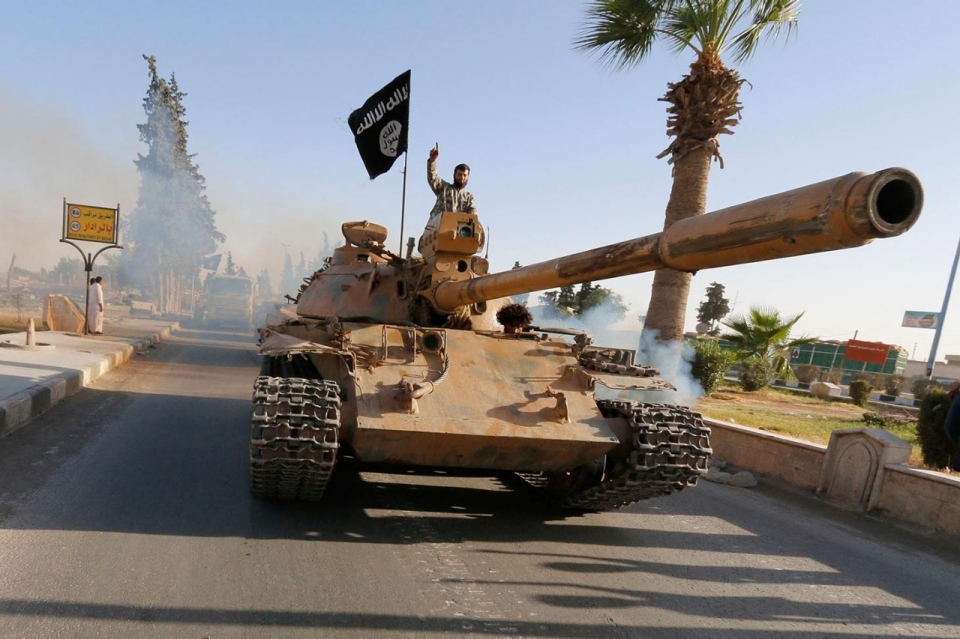
image.adapt.960.high

Because Weltanschauung includes all elements of culture, to include race, religion, and economy, as well as sociological and historical factors; religious leaders, as well as media outlets and politicians, use it to manipulate their people. Radical proponents of religious fundamentalism around the world, who reject the pluralities of modernism and science, skillfully “use each new method of communication” [2] to spread their message of fear in a dualistic manner  to influence those most vulnerable to the threat of change.

Modern Americans and Western European policy makers tend to look at the world, and issues of politics and policy in isolation from each other, and especially in isolation from religion. Such an atomistic method ensures that many policy makers cannot see the forest for the trees. This is particularly true when religion is a motivating factor and an ideological component of conflict. Religiously based ideology is a powerful and “often intractable force that can be quite unresponsive to all the instrumentalities of state power, let alone the instrumentalities of foreign policy,” [3] and has been so from the advent of civilization to the present day. Samuel Huntington observed, “To a very large degree, the major civilizations in human history have been closely identified with the world’s great religions; and people who share ethnicity and language but differ in religion may slaughter each other….” [4]

Even among religions that claim to worship the same god beliefs may differ, and that fact underscores Colin Gray’s all important, “contexts of war.” Gray makes the case for seven essential contexts policy makers and military leaders must understand regarding war that “can have strong negative consequences,” [5] if ignored or misunderstood.

Each of the contexts is associated with the manner of social development, and define the essential characteristics of a particular armed conflict. In many areas of the world religion functions as the “central political pillar maintaining the power of [the] ruler—a major pole in determining people’s loyalty—and as a key ingredient in determining a nation’s stability or instability.” [6] Religion and religious values remain instrumental to the ethics and the social norms of a society and dictate how it deals with other nations and peoples, as well as how it conducts war.

Over the course of the last three centuries the emphasis on rational and empirical thought predisposed western strategists and policy makers to exclude religion as a component of analysis. Furthermore, the scientific methodology used by many analysts dictates that they asses individual components of issues in isolation from each other, and often without connection to their opponent’s world view. Experts dissect economic factors, military capabilities, existing political systems, diplomatic considerations, and the ways societies gather information and exhaustively examine and evaluate each individual component. But the problem comes when policymakers fail to understand how world view, ideological factors, history, and religious belief impact how a given opponent will conduct war.

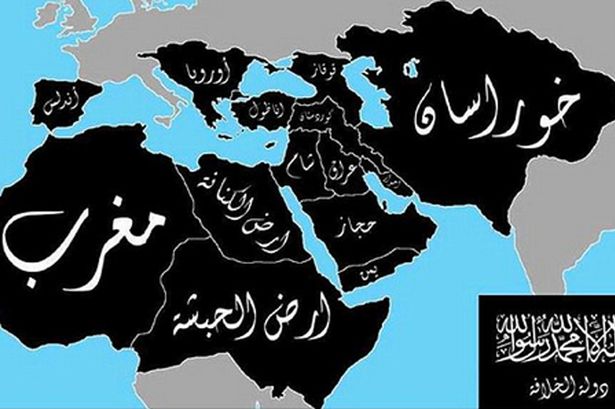
ISIS-MAP

In part, policy makers tend to interpret information through their own worldview. As Gray notes, “Policy and strategy will be influenced by the cultural preferences bequeathed by a community’s unique interpretation of its history as well as by its geopolitical-geostrategic context.” [7] As such, both military and civilian policy makers fail to address the criticality of religion to developing effective strategy. Barbara Tuchman wrote, “When information is relayed to policy-makers, they respond in terms of what is already inside their heads and consequently make policy less to fit the facts than to fit the notions and intentions formed out of the mental baggage that has accumulated in their minds since childhood.” [8] A world view imposes cultural prejudices and blinders on western policy makers and strategists, that predispose them to look for shortcuts, or the most convenient explanations selected from the information they can see. Edward Luttwak wrote:

Enlightenment prejudice has remained amply manifest in the contemporary professional analysis of foreign affairs. Policymakers, diplomats, journalists, and scholars who are ready to overinterpret economic causality, who are apt to dissect social differentiations most finely, and who will minutely categorize political affiliations are still in the habit of disregarding the role of religion, religious institutions, and religious motivations in explaining politics and conflict, and even in reporting their concrete modalities. Equally the role of religious leaders, religious institutions, and religiously motivated lay figures in conflict resolution has also been disregarded – or treated as a marginal phenomenon hardly worth noting. [9]

Unbeknownst to policy makers, their prejudices, the world view blinders they wear, inhibit them from seeing how interconnected the most primal elements of the human experience are to others’ worldviews, even their own. As such, both military and civilian policy makers fail to address the criticality of religion to developing effective strategy.

Many people believed that modern ideas, “such as science, technology, secularism, and humanism would overcome the religious concept of the universe that dominated premodern society.” [10] Contemporary Western strategists and policy makers came to adulthood in a culture that supplanted the importance of religious ideas and need. A global, four-decade resurgence of religious ideals makes adaptation for strategists and planners difficult because of the dramatic shift in essential, unquestioned views. [11] Others’ worldviews, including religious beliefs, often influence the application of economic, political, diplomatic, military power, and the use and dissemination of information. That fact remains true despite the religion or sect involved, and especially in a decidedly secular, or at least outwardly non-religious, nation. Perhaps, by ignorance or a refusal to admit the importance of religious motivations in conflict, strategists and planners fail to realize the western culture arose from primal religious beliefs that informed politics, philosophy, ethics, law, economics, art, racial constructs, and science for nearly 1500 years. Perhaps, that refusal fueled a justified appall or embarrassment of the religious justifications their forbearers used to incite war that subjugated or exterminated peoples.

The United States Military made a belated attempt to address ideology, culture, and religion in terms of counter-insurgency doctrine when it published the U.S. Army/Marine Counterinsurgency Manual. The discussion of these issues is limited to two pages that specifically deal with various extreme Moslem groups that use religion as a pillar of their ideology, strategy, and operations. But the analysis in the counterinsurgency manual is limited because its focus is very general and at a tactical level. While the manual encourages leaders to attempt to understand the cultural differences it contains little to help leaders understand the importance of religion and ideology at the strategic and operational levels.

Commendably, the manual discusses how terrorist and insurgent groups use ideology, which is frequently based on religion to create a narrative. The narrative often involves a significant amount of myth presented as history, such as how Al Qaida and ISIL use the Caliphate as a religious and political ideal that for many Moslems, “produces a positive image of the golden age of Islamic civilization.” [12]

A purely intellectual understanding of how Al Qaida and ISIL use symbolism and imagery limits how strategists and planners can develop methods to counter it. Rather, strategists and planners would benefit from a historical introspection that leads to a personal reflection, aimed at understanding how the theological tools of the Christian religion subjugated peoples and the ramifications today. Protestant Christianity, particularly the Puritan concept of “a city set on a hill” undergirded the American belief in the nation’s Manifest Destiny, which in large part led to the extermination of the Native Americans, the War with Mexico, the romanticism of the ante-bellum American South, the belief that African Americans were sub-human, and that God ordained slavery. The concept persisted after the Civil War in the myth of the Lost Cause, and was exported abroad as the United States belatedly entered the race for overseas colonies.

Manife4

The concept of Manifest Destiny is still an essential element of the idea of American Exceptionalism, which often justifies much of American foreign policy. Former President George W. Bush alluded to this idea in his 2003 State of the Union Address where he said, “that freedom is the right of every person and the future of every nation. The liberty we prize is not America’s gift to the world, it is God’s gift to humanity.” [13] Throughout the Bush presidency, the President’s idea that God undergirded the policy of the United States led to a mismatch of policy ends and the means to accomplish them. Former Israeli Ambassador to the United States and historian Michael Oren wrote:

Not inadvertently did Bush describe the struggle against Islamic terror as a ‘crusade to rid the world of evildoers.’ Along with this religious zeal, however, the president espoused the secular fervor of the neoconservatives…who preached the Middle East’s redemption through democracy. The merging of the sacred and the civic missions in Bush’s mind placed him firmly in the Wilsonian tradition. But the same faith that deflected Wilson from entering hostilities in the Middle East spurred Bush in favor of war. [14]

Only when policy makers and strategists understand that the use of religious ideology to conquer, subjugate, and terrorize in the name of God is universal, does it become easier to defeat those who employ it.

American Presidents often invoke the name of God to justify the compulsion to conquer, such as McKinley did when he decided to annex the Philippines in 1899 following the defeat of the Spanish. The war against the Filipinos used some of the most bloodthirsty tactics employed to fight the Filipino insurgents, who only wanted independence, and stained our own national honor. Mark Twain wrote: “There must be two Americas: one that sets the captive free, and one that takes a once-captive’s new freedom away from him, and picks a quarrel with him with nothing to found it on; then kills him to get his land. . . .” [15]

A doubtlessly sincere McKinley sought counsel from God about whether he should annex the Philippines or not. Barbara Tuchman wrote: “He went down on his knees, according to his own account, and ‘prayed to Almighty God for light and guidance’. He was accordingly guided to conclude “that there was nothing left to do for us but to take them all, and to educate the Filipinos. And uplift and civilize and Christianize them, by God’s grace to do the very best we could by them, as our fellowmen for whom Christ died.” [16]

The counterinsurgency manual does mention how “Ideology provides a prism, including a vocabulary and analytical categories, through which followers perceive their situation.” [17] But again, it does this at a micro-level and the lessons are not applied at the higher levels of strategic thinking and policy. This is often due to the fact that American and other western strategists and policy makers view religion “as a set of theological issues rather than as a profoundly political influence in public life.”[18] Even after nearly a decade and a half of unremitting war against enemies for whom religion is at the center of their politics, policy makers still misread or neglect the importance of religion and religiously based ideology in the political motivations of their opponents. In many cases, the religion of a people is a stronger part of their identity than that of the state. Nations created during the post-colonial era “continue to see religion, clan, ethnicity, and other such factors as the markers of community identity” [19] Despite the advances in communications and technology and the globalization of so many western concepts, the political and religious leaders of Islamic nations view modern western political and social concepts as unwanted intrusions on their ancient cultures, and more importantly, insults to their religion.

kim davis pastor

But, lest American policy makers and strategists see this rise as something completely foreign, a similar phenomenon is occurring in the United States. Despite the fact that a growing number of Americans espouse no-religious preference and, according to multiple studies conducted over a period of two decades, are leaving organized Christianity, adherents of two highly motivated and militant branches of Christianity have grown in strength and political power over the last forty years. The group known as Christian Dominionism advocates Christian domination of all parts of society and culture, and Pre-Millennial Dispensationalists believe in the imminent return of Christ to earth, including the belief that most of the earth’s population will be killed during the Apocalypse. A Pew Research Center survey found that by the year 2050, that 41% of Americans believe that Jesus Christ will return to earth. [20] Leaders, politicians (including major conservative presidential hopefuls), pundits, and preachers often weigh in on public policy, to include military strategy, and claim that God’s law supersedes that of the state. They simultaneously reject secularism while legislating against those they deem enemies, and advocate for a “holy war” against Islam without distinction to Islam’s own divisions and distinctive denominational differences.

may appear irrational American strategists and policy makers, but it is completely rational to those who subscribe to it. The study of history, particularly how the deep roots of religion and faith shape cultural worldviews, as well as the actions of various peoples and nations, helps the policy maker and strategist adapt policy, strategy, and ultimately operational and tactical methods to the context of the conflict at hand. To do this effectively it is important that American strategists not be afraid to examine our own past to see how our ancestors used religion for good as well as for evil. However, the often dark mirror of history can be disconcerting to peer into. People tend to be uncomfortable when the face that they see in the mirror is all too similar to their current enemies, to the point that one might turn away in fear of what they see. The inability to look into the dark mirror of our own history is especially perilous when enemies are perfectly willing to wage war without end unto the destruction of the world in the name of their God, because when you belatedly look back in the mirror, failure will be staring you right in the face.

Notes

[1] Huntington, Samuel P. Who Are We? America’s Great Debate The Free Press, Simon and Schuster Europe, London 2004 p.360

[2] Jacoby, Susan. The Age of American Unreason Revised and Updated Vintage Books, A Division of Random House, New York 2008 p.18

[3] Luttwak, Edward. The Missing Dimension  in Religion: The Missing Dimension of Statecraft  Oxford University Press, Oxford and New York 1994 p.13  

[4] Huntington, Samuel P. The Clash of Civilizations and the Remaking of the World Order Touchstone Books, New York 1997 p.42

[5] Gray, Colin S. Fighting Talk: Forty Maxims on War, Peace, and Strategy Potomac Book, Dulles VA 2009 p.5

[6] Rubin, Barry Religion in International Affairs in Religion: The Missing Dimension of Statecraft  Oxford University Press, Oxford and New York 1994 pp.20-21

[7] Ibid. Gray Fighting Talk p.25

[8] Tuchman, Barbara W. Practicing History Alfred A. Knopf, New Your 1981 p.289

[9] Ibid Luttwak The Missing Dimension pp.9-10

[10] Ibid. Rubin Religion in International Affairs p.21

[11] Ibid. Rubin Religion in International Affairs p.21

[12] ___________ U.S. Army/ Marine Counterinsurgency Field Manual FM 3-24 MCWP 3-33.5 15 December 2006 with and forward by General David A Petraeus and General James Amos, Konecky and Konecky, Old Saybrook CT 2007 p.26

[13] Bush, George W. State of the Union Address Washington D.C. January 28th 2003 retrieved from Presidential Rhetoric.com http://www.presidentialrhetoric.com/speeches/01.28.03.html 10 June 2015

[14] Oren, Michael Power, Faith and Fantasy: America and the Middle East 1776 to the Present W.W. Norton and Company, New York and London 2007 p.584

[15] Twain, Mark To the Person Sitting in Darkness February 1901 Retrieved from The World of 1898: The Spanish American War The Library of Congress http://www.loc.gov/rr/hispanic/1898/twain.html 12 December 2014

[16] Ibid. Tuchman Practicing History p.289

[17] Ibid. U.S. Army/ Marine Counterinsurgency Field Manual p.27

[18] Ibid. Rubin Religion in International Affairs in Religion p.20

[19] Ibid. Rubin Religion in International Affairs p.22

[20] Pew Research Center, U.S. Politics and Policy, http://www.people-press.org/2010/06/22/public-sees-a-future-full-of-promise-and-peril/

8 Comments

Filed under Foreign Policy, History, middle east, national security, News and current events, Religion