Category Archives: philosophy

Truth and Un-sanitized History

10570298_10152872503382059_5058681841617456899_n

Friends of Padre Steve’s World,

I have spent the last couple of days introducing to new readers to things that I have come to believe. Since I am a historian I will continue to do that today.

I have a passion for truth, especially in the realm of historical thought, in fact over the past few years this passion has deepened to a level of profoundness that I never dreamed. In fact for me this passion has become a duty, a duty to truth; an un-sanitized, warts and all examination of subjects attempting to strip away the veneer of myth in order to find truth. This is not easy, but it is what my life has become, knowing that in the long run I will not discover all truth, but hopefully point others to examine history, the sciences, philosophy and even theology to find truth. The process can be uncomfortable, especially when confronted by facts, documents, scientific and archeological data which shows what we used to think was truth, as either incomplete, romantic myth, or even complete lies, untruths and fabrication. Oscar Wilde once wrote,“The truth is rarely pure and never simple.”

Barbara Tuchman once wrote: “The reality of a question is inevitably more complicated than we would like to suppose.” That is the nature of truth. It does not matter if it is truth about history, biography, philosophy and religion, science, politics, economics or any part of life. To actively seek truth means that one must open up themselves to the possibility of doubting, as Rene Descartes wrote: “If you would be a real seeker after truth, it is necessary that at least once in your life you doubt, as far as possible, all things.” I admit that this is not comfortable, but it is necessary.

As a historian I have a tremendous passion for truth, and for unsanitized history and for me this means looking at what we know with a critical eye, to compare and examine sources to question what we or others knew before. Far too often what we believe about our own history is often more preserving myth more than by asking hard questions and applying reasoned critical study. To do this is dangerous, because to do so we have to admit that what we know today could be proven wrong at some time in the future when new facts, documents, archeological finds or other historical or scientific are discovered. To those content with half-truth, partial truth or even myth this is disconcerting, and those of us who attempt to unravel myth from fact and present things in a new way are called “revisionists” as if that is somehow a bad thing. The sad thing is we are having to revise in many cases, supposed history that was revised by people who needed to propagate myth, such as with those who promoted the myth of the Lost Cause, the romantic, noble Confederacy which for well over a half century was propagated as historical truth. This myth was sold to the American public in such in film, television and books, fiction and non-fiction alike, to the point that much of white America, even outside the South accepted the myth of the Lost Cause as truth. Films like Birth of a Nation, Gone with the Wind and even Disney’s Song of the South, helped ingrain the myth as truth, and even today when so much more is known, many people hold on to the myth and attack those who differ. 

A lot of my readers may wonder why I write so much about the American Civil War as well as the ante-bellum and Reconstruction eras of American history. For me they are very important for a couple of reasons; first they are eras, that for good and bad define us as a nation and people. Second, they still have relevance to what happens today, especially in the understanding of liberty, civil rights and race relations.

I have a passion for this. The American Civil War and the Battle of Gettysburg are intrinsic parts of who we are as Americans today. The events of that war and this battle continue to reverberate in many aspects of our political, social and national life. Thus for me teaching about this event and what happened on the “hallowed ground” of Gettysburg, as Abraham Lincoln called it, and even 150 years later it matters far more than most of us realize.

Civil War hero Joshua Chamberlain is an icon of the Civil War and American history. A professor of Rhetoric and Natural and Revealed Religions at Bowdoin College he volunteered to serve with the 20th Maine Infantry, his military career in the Civil War has been depicted in movies such as Gettysburg and Gods and Generals and written about in biographies and even historical fiction. Chamberlain was one of the heroes of Gettysburg, and his story has a myth like quality, but he too was a complex, contradictory and sometimes flawed character. However, Chamberlain attached a great importance to passing down the stories of people who did noble deeds and who lived exemplary lives. He wrote, “The power of noble deeds is to be preserved and passed on to the future.”

I sincerely believe what Chamberlain said and I am getting ready to lead another Staff Ride for students from our Staff College to Gettysburg next month.  I do beleive that the power of noble deeds needs to be preserved and passed on to the future.  Even the deeds of less than perfect, often contradictory and sometimes even scandalous  individuals. That is part of the task of the historian. I do this in what I teach and what I write, both in the academic setting as well as on this website.

We live in a time of great cynicism, some of which I can understand. We also live in a time where many people and our institutions operate in a “zero defect” culture, those who fail in any way are shunted aside, punished or even chastised or ostracized. However, when I look at the men who fought at Gettysburg, or for that matter almost any individual who has accomplished great things, none are perfect people and many have great flaws in character, or supported causes or ideologies that were evil. That being said, even less than perfect people can rise to do great deeds, deeds that need to be remembered, passed down and told to succeeding generations.

Many great leaders, or other men and women that we consider today to be great, influential or important were or are quite fallible. Even those who did great things often made gross mistakes, had great flaws in their character, and some lived scandalous lives. Such deeds may tarnish their legacy or take some of the luster away from their accomplishments. But I think that these flaws are often as important as their successes for they demonstrate the amazing capacity of imperfect people to accomplish great things, as well as the incredible complexity of who we are as people. No one is perfect. There are degrees of goodness and even evil in all of us. It is part of the human condition. That is the beauty of un-sanitized history, that is the beauty of stripping away myth to discover the humanity of people, and to recognize who they are, who we are, the good, the bad and even the ugly.

When I look at the perfection that imperfect people expect of others I am reminded of something that William Tecumseh Sherman said about his relationship with Ulysses Grant. These were flawed men, but they were in large part responsible for the Union victory in the Civil War. However, to be honest, neither man would never reach the level of command that they rose to in our current military culture, nor would they rise to the top in corporate America. They are too flawed. Sherman said it well, “Grant stood by me when I was crazy, and I stood by him when he was drunk, and now we stand by each other.” 

That is a part of my passion about Gettysburg and my appreciation and admiration of the brave men who fought in that battle. As I continue to write about that battle and about those men I hope that my readers will gain a new appreciation of their complex and contradictory natures, as well as think about what that means to us today, as individuals and as a society, for it is only when we strip away the myth and seek the truth. Marcus Aurelius wrote:

“If someone is able to show me that what I think or do is not right, I will happily change, for I seek the truth, by which no one was ever truly harmed. It is the person who continues in his self-deception and ignorance who is harmed.”

Those truths can be scientific, they can be historical or literary, and quite often the truth can also be quite personal.

As John F Kennedy said at Yale in 1962: “The great enemy of truth is very often not the lie–deliberate, contrived and dishonest–but the myth–persistent, persuasive and unrealistic. Too often we hold fast to the cliches of our forebears. We subject all facts to a prefabricated set of interpretations. We enjoy the comfort of opinion without the discomfort of thought.”

So until tomorrow, have a thoughtful night.

Peace

Padre Steve+


1 Comment

Filed under civil war, History, philosophy

Chasing Rabbits in Pursuit of Truth

bugs-bunny-whats-up-doc

Friends of Padre Steve’s World

I have been thinking about new articles write and you will see some in the next few days. I have been very busy this weekend working on my Gettysburg text and the usual weekend activities. Even so, I have found that in the Gettysburg text and other things that I have been working on I have been often engaged in the very productive activity of chasing rabbits in pursuit of truth.

Some would say that this is a bad thing but I would choose to disagree. I think that we miss a lot by not chasing rabbits, especially those that lead us to truth, knowledge and wisdom that we would otherwise never come to know.

I think that I learned the value of chasing rabbits from my Professor of New Testament at Southwestern Baptist Theological Seminary back in 1991-1992, Dr. Tom Urrey. Dr. Urrey was a fascinating character, a brilliant mind, gifted teacher and someone who never lost his sense of being able to connect theology with life. I had him for a year of New Testament survey courses. The first semester was devoted to the Gospels and the Book of Acts, and the second semester to the remainder of the New Testament.

One thing about Dr. Urrey was that he tended to go off script and chase rabbits, and we students were very good at encouraging this behavior by the questions that we raised. As such we did not even finish the Gospel of Matthew the first semester, and only made it through Romans, First Corinthians and a bit of Second Corinthians the second semester. However, I do not feel that I missed much because what Dr Urrey did do was to lead us to truth by chasing rabbits, truth that we would never had seen had he insisted on driving us through the text at ludicrous speed. (please note the gratuitous Mel Brooks Spaceballs reference)

Now you have to understand something about me. Back then such behavior was frustrating to me because I had the misconception from my time in the that in order to learn something you had to ram your way through it no matter what the cost. Now a quarter century later, I really appreciate what Dr. Urrey allowed us to do in class by enabling him to chase rabbits, and for that I am forever grateful.

For me now it is important, be it in teaching, writing, or research to follow the rabbit wherever he may lead. In doing so I find that I am discovering knowledge that I would have never before attained had I stayed between the lines. I know that by following the rabbit regarding the subject matter in my Gettysburg texts that I have been led to so much new knowledge about contemporary subjects only tangentially related to the Battle of Gettysburg or the Civil War.

Some of this you will see when I put out a major revision to something that I have written and posted here before, especially in my work on Gettysburg and the Civil War. Of course I do this with other subjects as well, but since so much of my time over the past two years has been devoted to Gettysburg and the Civil War era it is those subjects have captivated me and brought me so much more understanding, not just of them in isolation, but for what is going on today.

Now over the coming week I plan on publishing some new material here, some of it relating to the ongoing implosion of the politically minded Christian Right and their political allies related to the Duggar family and their cover up of the admitted criminal activity of their son Josh. I have been spending some time on thinking how to approach that subject, especially because for me truth matters too much to jump the gun and get things wrong in the process.

Apart from that subject we will see where chasing the rabbit leads me. So until tomorrow, I wish you a good evening and pleasant dreams.

Peace

Padre Steve+


Leave a comment

Filed under civil war, History, philosophy, Teaching and education

Writing About War

IMG_0535

“What a cruel thing is war: to separate and destroy families and friends, and mar the purest joys and happiness God has granted us in this world; to fill our hearts with hatred instead of love for our neighbors, and to devastate the fair face of this beautiful world.” Robert E. Lee in a letter to his wife 1864

Memorial Day weekend is over but I have not stopped reflecting on war and its cost. Having served in combat myself, and having stood over the wounded in field hospitals in Iraq and having seen the devastation of war up close and personal I have a hard time reducing war to the technology, the tactics and trivia that seem to satisfy the consumers of war porn. Call me whatever you want but I cannot get around the human cost of war. William Tecumseh Sherman reflected that “It is only those who have neither fired a shot nor heard the shrieks and groans of the wounded who cry aloud for blood, more vengeance, more desolation. War is hell.” 

One of my favorite historians of the Second World War, Cornelius Ryan who wrote the magnificent accounts of D-Day, The Longest Day, Operation Market Garden, A Bridge Too Far, and the Battle of Berlin, The Last Battle said about his accounts: “What I write about is not war but the courage of man.” I think that writing about courage is appropriate and I do a lot of that. But I think in addition to courage that we also must write about the frailty and fallibility of human beings, especially the leaders who plan and conduct war.

When I teach or write about military history I find it important to make sure that the people who made that history are not forgotten.  After all, as the British military theorist Colin Gray says “people matter most” when we deal with history, policy, or politics, especially in the matter of war. He is right of course, people are the one constant in war. Weapons and tactics may change, but people do not. 

Likewise we cannot forget that war, even wars for the most excruciatingly correct and even righteous reasons are always tragic. The cost of war, even so called “good wars” is devastating. Ernest Hemingway wrote “Never think that war, no matter how necessary, nor how justified, is not a crime.” To the war porn addicts the words of Sherman or Hemingway surely are offensive, but they provide a necessary warning to the politicians, pundits and preachers who cannot get enough war to satiate their bloodlust and need for power. Sadly, most of the men and women who revel in war without end have neither served in combat or have any skin in the game regarding the wars that they support and those which they work so hard to bring about. Maybe if they did then they would not be so quick to send young men and women to war.

Those who follow me on this site know that I write about war a lot, some might say too much, but I cannot help that. My life has been forever changed by war.  If you look back through my archives you can see how my writing has evolved when it comes to dealing with war and part of that is because I do not want the sacrifices of the men and women who fought those wars to be forgotten or cheapened by a society which from the very beginning of our history has done so. Lieutenant General Hal Moore who co-authored the book We Were Soldiers Once, and Young wrote: “in our time battles were forgotten, our sacrifices were discounted, and both our sanity and suitability for life in polite American society were publicly questioned.” By continuing to write and teach I hope to ensure that this does not happen. Maybe I am pissing into the wind so to speak, but I cannot stand by silently.

I am a combat veteran, I have seen the devastation of war, I have lost friends in war, men and women who did not come home. I have seen other friends struggle in the aftermath of war, and I have seen some lose that struggle. Because I am a military historian as well as a priest and I have a sacred duty to ensure that people know the real cost of war.

I do this in my official capacity teaching ethics and leading the Gettysburg Staff Ride for the Staff College where I have the honor to serve as faculty.This itself is interesting as I am spending the final few years of a three and a half decade military career teaching the men and women who in not too long of time will be our nation’s senior military leaders. That is a responsibility that I take most seriously. Thus I always, whether it is in teaching the ethics of war, or about the Battle of Gettysburg I attempt to impress this on my students. I preach from day one to every class that their decisions in the planning process, their recommendations to senior political and military leaders, and their decisions on the battlefield impact real people, their soldiers, the people in the lands that they fight and on the home front. 

I have been writing a text for the Gettysburg Staff Ride which I believe will eventually become at least two and maybe more books. I tie a lot of biographic material in with the text, again in order to make what could be a dry and mechanical affair more real to my students and readers. That is one of the reasons that I find going to Gettysburg and walking that hallowed ground so important.

I find that the lives, beliefs, motivations, relationships, and experiences of people to be paramount to understanding events. People are complex, multi-layered and often contradictory. All of my heroes all have feet of clay, which in a sense makes their stories even richer, and the events that they helped bring about far more more fascinating. By not denying their humanity, by understanding and appreciating their flaws, even the flaws in their character, I gain a more holistic perspective and develop a greater appreciation and empathy for them and a deeper understanding of my own flaws. As T.E. Lawrence wrote “Immorality, I know. Immortality, I cannot judge.” 

The complex and contradictory nature of humanity leads to a lot of confusion for people who see the world through the black and white lens of cosmic dualism where there is only good and evil and “if you’re not for us, you’re against us.”  Human nature shows us that things are much more complex, nuanced and blurry, there are far more than fifty shades of gray when it comes to humanity and the participation of men and women in war.

Because of this otherwise good and honorable people can find themselves for any number of reasons, fighting for an evil cause, while people who are more evil than good can end up fighting for a good cause. Now if you are one of those people who are trapped by an absolute ideological or religious certitude which cannot allow for such contradictions, that statement may confuse or even offend you. For that I do not apologize and I hope that you are offended enough to face the truth, for that is the human condition, and that my friends is what history, and especially that dealing with the most destructive and consequential issues involving humanity must deal with.

Over the weekend I did a series on this site about the tragedy of the British Battlecruiser HMS Hood and the German Battleship Bismarck which transpired over the course of a week in May 1941. In that week the two largest and most powerful warships of their day were sunk taking over 3600 of the roughly 3750 sailors aboard to a watery grave in the North Atlantic. While doing this I had the opportunity to go aboard the USS Wisconsin here in Norfolk, a ship that is roughly the same size of those two doomed warships. As I walked the passageways surrounded by massive armor plating It helped me, a sailor who has served aboard a modern Guided Missile Cruiser and other warships to appreciate the life and death of the sailors on those ships. I thought of the Hood’s who with the exception of three sailors being annihilated as the massive ship exploded, and then I thought about the crew of the Bismarck who had nearly half a day to contemplate their end before the British shells turned their ship into a funeral pyre.

So I will continue to write about war and try in the process to humanize it for my readers and to tell the stories of the tragedy that is war in such a way that even those who have not been to war, can imagine it and in doing so make wise decisions if they are to send other people’s children to fight their wars. The subject is far too important to be left to the purveyors of war porn who seek to satiate the bloodlust of others.

As for the form of my writing, I am becoming much more deliberate in trying to craft the story. Barbara Tuchman wrote something that I am now beginning to appreciate as I write my own book on Gettysburg and the Civil War: “I have always felt like an artist when I work on a book. I see no reason why the word should always be confined to writers of fiction and poetry.”

Anyway, that is all for tonight. Over the coming week I should be putting out my next chapter revision to my Gettysburg text and some other articles.

I wish you all the best.

Peace

Padre Steve+

2 Comments

Filed under History, Military, philosophy

Monday Musings: Books the Carriers of Civilization 


Friends of Padre Steve’s World

It is Monday and I am traveling back home from the conference that I attended in Houston and I am tired after traveling and spending most of the weekend sick. But to be fair the conference was well worth it. 

 As I muse about the the coming week I am stuck on something that I saw about the decline in the number of Americans who read books, and it occurred to me that this is probably a major factor in the ignorance displayed by so many Americans on so many subjects. A Pew survey reported that 23% of Americans read no books whatsoever in 2013 and over a hefty half  of Americans read fewer than five books. The survey did not ask what people were reading but by my perusal of best-seller lists, Amazon.com notifications and bookstore racks it appears that much of what is read is junk. No judgement intended but the best sellers in the non-fiction world are almost universally written by popular but biased and often ignorant political pundits, preachers and politicians. 

As a society we just don’t read, and much of what we do read is not directed toward learning but political-religious indoctrination, or to make us feel good about our own lifestyle or prejudices. 

I am a historian, theologian and stand-up philosopher. I have always read. Since the day I was introduced to the library and the card catalogue in grade school I have never ceased to read, and if I do not become distracted I can read hundreds of pages a day by authors who challenge my presuppositions or shed new light on subjects I already thought myself competent. My wife Judy is the same way, her tastes in subjects is different than mine, but she almost always is reading, be it a real book in print for or and-book. However, that being said I know many people, including people who are educated who have either stopped reading or console themselves in the works of the pundits, politicians and preachers, that Trinity of Evil whose one overriding goal is to convince people to follow what they say without thinking critically. 

if we don’t read, as a civilization we die.

Barbara Tuchman wrote:

 “Books are the carriers of civilization. Without books, history is silent, literature dumb, science crippled, thought and speculation at a standstill. Without books, the development of civilization would have been impossible. They are engines of change (as the poet said), windows on the world and lighthouses erected in the sea of time. They are companions, teachers, magicians, bankers of the treasures of the mind. Books are humanity in print.”

Abraham Lincoln, though lacking a formal education was always reading, it helped make him into one of the most formidable thinkers of his day, and helped him keep perspective even when he met setback after setback that would have crushed anyone else. There are hundreds, if not thousands of other examples that I could cite of men and women whose personal strength and character was shaped by what they read. Sadly, we lack that today, but thankfully it does appear that there might be some hope. According to the Pew survey Minnenials read more than those older than them. 

But just looking around we can see the result of the literary deprivation that afflicts our society. Half-baked conspiracy theories promoted by politicians, pundits and preachers are given the air of respectability by supposed news organizations. When someone has the integrity to ask hard questions or challenge the purveyors of such intellectual smut they are condemned. That my friends is a demonstration of the level of ignorance that we have allowed ourselves to sink to, something that in an age where we have the literary, scientific, philosophical, religious and historical classics of civilization at our figertips, is inexcusable. 

I shall come back to this another time because writing in the aisle seat of a Boeing 737 has some limitations. 

So this week I should be putting out at least one Gettysburg article and possibly one Abraham Lincoln. I will be doing one about the Dootlitle Raid on Toyko which occurred 73 years ago this week during the darkest days of the Second World War as well as some other subjects that I am musing about. 

As for now I am going to use the last hour of my flight to continue reading Doris Kearns Goodwin’s Pulitizer Prize winning book Team of Rivals: The Political Genious of Abraham Lincoln. I highly recommend it. 

So from 39000 feet over Southeestern Ohio I wish you a good day.

Peace

Padre Steve+

8 Comments

Filed under books and literature, Loose thoughts and musings, philosophy, Political Commentary

Gettysburg and the Human Cost of War

“Ashes of soldiers South or North, As I muse retrospective murmuring a chant in thought, The war resumes, again to my sense your shapes, And again the advance of the armies. Noiseless as mists and vapors, From their graves in the trenches ascending, From cemeteries all through Virginia and Tennessee, From every point of the compass out of the countless graves, In wafted clouds, in myriads large, or squads of twos or threes or single ones they come, And silently gather round me…”

From Walt Whitman- Ashes of Dead Soldiers
gburg dead2 

Friends of Padre Steve’s World

In a day or two I will be posting an article on the terrible nature of war. I am a career military officer who suffers from PTSD, TBI and other afflictions after serving in Iraq’s Al Anbar Province in 2007-2008.  I have seen firsthand the terrible effects of war. I am also a historian and I Assostant Professor at a major military staff college which helps educate senior military officers from this country and other countries. I my capacity there I teach ethics as well as lead a staff ride, or study of the Battle of Gettysburg. In my teaching I always attempt to deal with the human cost of war. Gettysburg was the most costly battle ever fought on the American continent. Around 50,000 men were killed or wounded there in three days of battle. William Tecumseh Sherman noted that “war is hell.” I agree, there is nothing romantic about it. The effects of war last generations and though we have been at war for the last thirteen and a half years, war itself is an abstract concept to most Americans. Fought by professionals and only experienced by most Americans on the news, movies or most the banal manner, video games, the cost in human terms is not fully appreciated, and nor can it be. Our politicians have insulated the public from war and in doing so have ensured that we are in a perpetual war which benefits no one. That is a big reason why I write so much about it, not to glorify or romanticize it, but to try in some war to help make it real  to my readers. This is a draft chapter from my Gettysburg text. 

Peace

Padre Steve+

Too often we look at distant battles and campaigns in terms of strategy, operations, tactics, leadership and the weaponry employed. Likewise we might become more analytical and look at the impact of the battle or campaign in the context of the war it was fought, or in the manner in which the tactics or weapons used revolutionized warfare. Sometimes in our more reflective moments we might look at individual bravery or sacrifice, often missing in our analysis is the cost in flesh and blood.

Admittedly the subject is somewhat macabre. But with the reality being that very few people in the United States, Canada or Western Europe have experienced the terrible brutality of war it is something that we should carefully consider any time the nation commits itself to war. By we, I mean all citizens, including the many soldiers, sailors and airmen who never see the personally see people they kill, or walk among the devastation caused by the highly advanced, precision weapons that they employ from a great distance, sometimes thousands of miles. In some parts of our military we have men and women who have the mission of targeting and killing enemies and then walking home to their families, but in the Civil War killing in combat “remained essentially intimate; soldiers were able to see each other’s faces and to know whom they had killed.” [1]

While the words of William Tecumseh Sherman that “War is Hell” are as true as when he spoke them; the tragic fact is that for most people war is an abstract concept, antiseptic and unreal; except for the occasional beheading of a hostage by Islamic militants or the videos shot by the perpetrators of crimes against humanity on the internet. Thus the cost of war and its attendant cost in lives, treasure and to the environment are not real to most people in the West.

We use words to describe the business of war which dehumanize the enemy, and we describe their deaths in words more palatable to us. Dave Grossman, the army infantry officer who has spent his post military life writing about the psychology of war and killing wrote:

“Even the language of men at war is the full denial of the enormity of what they have done. Most solders do not “kill,” instead the enemy was knocked over, wasted, greased, taken out, and mopped up. The enemy is hosed, zapped, probed, and fired on. The enemy’s humanity is denied, and he becomes a strange beast called a Jap, Reb, Yank, dink, slant, or slope. Even the weapons of war receive benign names- Puff the Magic Dragon, Walleye, TOW, Fat Boy, Thin Man- and the killing weapon of the individual soldier becomes a piece or a hog, and a bullet becomes a round.” [2]

We can now add the terms Haji and Raghead to Grossman’s list of dehumanizing terms for our opponents from our most recent wars in Iraq and Afghanistan.

The words of Guy Sager in his classic work The Forgotten Soldier about World War Two on the Eastern front is lost on many that study war:

“Too many people learn about war with no inconvenience to themselves. They read about Verdun or Stalingrad without comprehension, sitting in a comfortable armchair, with their feet beside the fire, preparing to go about their business the next day, as usual…One should read about war standing up, late at night, when one is tired, as I am writing about it now, at dawn, while my asthma attack wears off. And even now, in my sleepless exhaustion, how gentle and easy peace seems!” [3]

In an age where so few have served in the military and even few have seen combat in some way shape or form many who study war are comfortable experts who learn about war with no inconvenience to themselves. When I hear men and women, the pundits, politicians and preachers, that Trinity of Evil who constantly exhort governments and peoples to go to war for causes, places or conflicts that they have little understanding of from the comfort of their living rooms or television studios I grow weary. I fully comprehend the words of Otto Von Bismarck who said: “Anyone who has ever looked into the glazed eyes of a soldier dying on the battlefield will think hard before starting a war.” [4]

As a historian who also is a military chaplain who has seen war I struggle with what Sager said. Thus when I read military history, study and write about particular battles or engagements, or conduct staff rides as like the Gettysburg trip that we are embarking on, the human cost is always present in my mind. The fact that I still suffer the effects of PTSD including night terrors and chronic insomnia keeps what I do in good focus, and prevents me from being a comfortable expert.

Thus, it is my view, to conduct a staff ride, to walk the battlefield; especially in somewhat uncomfortable weather is a good thing. It connects us more in at least a small way to the men that fought there, died there, or brought home wounds that changed them forever.

To walk a battlefield where tens of thousands of men were killed and wounded is for me a visit to hallowed ground. I have felt that at Waterloo, Verdun, Arnhem, Normandy, the Bulge, the West Wall, the Shuri Line on Okinawa, Antietam, Chancellorsville, Stone’s River, and of course the battlefield which I have visited more than any in my life, Gettysburg. There are times when I walk these fields that I am overcome with emotion. This I think is a good thing, for as an American who has family ties to the Civil War, Gettysburg in particular is hallowed ground.

In doing this I try to be dispassionate in how I teach and while dealing with big issues that my students will face as Joint Staff Officers. Some of them will become Flag or General Officers, with the responsibility of advising our nation’s leaders as well planning and conducting the military operations on which the lives of thousands or maybe hundreds of thousands of people depend. Thus I do feel a certain responsibility to teach not only the strategy and other important military aspects of this campaign, but also the cost in human lives and ethical considerations. I take this work seriously because it forces us to remember what war is about and its nature, which Clausewitz wrote is “a paradoxical trinity-composed of primordial violence, hatred and enmity…” [5] which William Tecumseh Sherman so rightly understood without the euphemisms that we so frequently use to describe it: “War is cruelty, and you cannot refine it….”

As the sun set on the evening of July 3rd 1863 the battered Army of Northern Virginia and the battered but victorious Army of the Potomac tended their wounds, buried their dead and prepared for what might happen next. On that afternoon it was as if “the doors of Hell had shut” and the next day, the Glorious 4th of July “The heavens opened, and a thunderstorm of biblical proprotions drenched the battlefield, soaking dead, wounded and able-bodied men equally.” [6]

Following the disastrous attack aimed at the Union center, Lee and his surviving commanders prepared for an expected Union counter attack. However, George Meade, the commander of the Army of the Potomac who had correctly anticipated Lee’s assault decided not to gamble on a counter attack, though it was tempting. He knew too well the tenacity and skill of the Confederate commanders and soldiers on the defense and did not want to risk a setback that might give Lee another chance, thus “the two sides stared at each other, each waiting for the other to resume the fighting, neither did.” [7]

As the Confederate army retreated and Meade’s army pursued another army remained at Gettysburg, “an army of the wounded, some 20,350 in number, a third of them Confederate….” Just 106 surgeons were spared from the Army of the Potomac and “the comparatively few overburdened surgeons and attendants now on duty still labored every day to the point of exhaustion.” [8] These overworked men were aided by local volunteers as well as members of the U.S. Sanitary Commission, the Christian Commission and the Sisters of Charity. These men and women “brought organization to the hospitals, relief to the medical staffs and the local volunteers, and immense comfort to the wounded, whether blue or butternut.” [9]

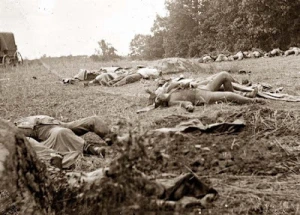
The dead and wounded littered the battlefield and the sights and smells were ghastly:

“Wherever men gazed, they saw dead bodies. A New Yorker thought they “lay as thick as the stones that is on father’s farm.” A stench smothered the field, moving John Geary to tell his wife, “My very clothes smell of death.” A Regular Army veteran exclaimed, “I have seen many a big battle, most of the big ones of the war, and I never saw the like.” [10] A resident of Gettysburg walked up to Little Round top and wrote of what she observed from the peak of that rocky hill:

“surrounded by the wrecks of battle, we gazed upon the valley of death beneath. The view there spread out before us was terrible to contemplate! It was an awful spectacle! Dead soldiers, bloated horses, shattered cannon and caissons, thousands of small arms. In fact everything belonging to army equipments was there in one confused and indescribable mass.” [11]

At Joseph Sherfy’s farm, scene of some of the heaviest fighting on the second day, his barn “which had been used as a field hospital, was left a burnt ruin, with “crisped and blackened limbs, heads and other portions of bodies” clearly visible.” [12] When the rains came, the wounded suffered terribly. Many of the field aid stations were set up next to the creeks that crisscrossed the battlefield, and those streams quickly flooded as torrents of rain water caused them to overflow their banks. “A New Jersey soldier watched in horror as the flood waters washed over and carried away badly wounded men unable to move to safety….” [13]

Oliver Howard took his escort to do a reconnaissance of the town on July 4th, one of the cavalry troopers described the scene:

“The battle field was the Awfulest sight I ever saw…The woods in front of our men the trees were riddled with Cannon ball and bullets evry limb shot off 20 feet high. Some say the Rebel dead lay six deep in the grave yard where we lay. Nearly every grave stone was shattered by shots and everything was torn to pieces. I went through the town on the 4th of July with the General. The streets were covered with dead. Evry frame house were riddled with balls the brick ones dented thick where shot had hit.” [14]

Field hospitals were often little more than butcher shops where arms and legs were amputated by overworked surgeons and attendants while those with abdominal wounds that could not be easily repaired were made as comfortable as possible. Triage was simple. If a casualty was thought to have a reasonable chance at survival he was treated, if not they were set aside in little groups and allowed to die as peacefully as possible. Churches were requisition for use of the surgeons. A volunteer nurse noted: “Every pew was full; some sitting, some lying, some leaning on others. They cut off the legs and arms and threw them out the windows. Every morning the dead were laid on the platform in a sheet or blanket and carried away.” [15]

Chaplains were usually found with the doctors, caring for the physical as well as the spiritual needs of the wounded. Protestant chaplains might ensure that their soldiers “knew Jesus” and Catholics administered the Last Rites, often working together across denominational lines to care for their soldiers.

A Union chaplain described the ministry in the field hospitals and aid stations:

“Some of the surgeons were posted well up toward the front to give first aid. More of them were in the large field hospitals of division in more secure places at the rear. The chaplain might be at either place or at both by turns. Some made a point of watching for any wounded man who might be straggling back, who perhaps could be helped up into the saddle and ride back to the hospital. When the demand for help became urgent the chaplains were nurses. As the rows of wounded men grew longer, chaplains went from man to man to see what could be done to relieve their pain, perhaps to take a message or letter. All day into the night this work would continue. A drink of water, a loosened bandage on a swollen limb, a question answered, a surgeon summoned, a whispered word of comfort marked their course. Each night at sundown the men who died during the day were buried, with a short prayer, side by side in a common grave, each in his uniform with canvas wrapped around his face and a strip of paper giving his name and regiment in a bottle buttoned under his blouse.” [16]

The war would challenge the theology of the clergy who served as chaplains on both sides, as “individuals found themselves in a new and different moral universe, one in which unimaginable destruction had become a daily experience. Where could God belong in such a world? How could a benevolent deity countenance such cruelty and suffering? Doubt threatened to overpower faith….” [17] That sense of bewilderment is not lacking today among those of faith who return from war.

Some men, clergy and laity alike would attempt to find a theological meaning to the suffering. Many would do so in the theology of John Calvin which emphasized the Providence and foreknowledge of God. That theological frame of reference, of the results of battles and the death or wounding of men in war and the attendant suffering was found in the will, or providence of God was quite common among men of both sides who grew up during the Second Great Awakening, as it is today; and for some it was carried to fatalistic extremes. However, others like Colonel William Oates of the 15th Alabama, who considered himself a believing Christian, wrote that he believed God:

“endowed men with the power of acting for themselves and with responsibility for their acts. When we went to war it was a matter of business, of difference of opinion among men about their temporal affairs. God had nothing to do with it. He never diverted a bullet from one man, or caused it to hit another, nor directed who should fall or who should escape, nor how the battle should terminate. If I believed in such intervention of Providence I would be a fatalist….” [18]

The carnage around the battlefield was horrifying to most observers. Corporal Horatio Chapman of the 20th Connecticut Volunteers wrote about the sight on Cemetery Ridge on the night of July 3rd following the repulse of Pickett’s Charge:

But in front of our breastworks, where the confederates were massed in large numbers, the sight was truly awful and appalling. The shells from our batteries had told with fearful and terrible effect upon them and the dead in some places were piled upon each other, and the groans and moans of the wounded were truly saddening to hear. Some were just alive and gasping, but unconscious. Others were mortally wounded and were conscious of the fact that they could not live long; and there were others wounded, how bad they could not tell, whether mortal or otherwise, and so it was they would linger on some longer and some for a shorter time-without the sight or consolation of wife, mother, sister or friend. I saw a letter sticking out of the breast pocket of one of the confederate dead, a young man apparently about twenty-four. Curiosity prompted me to read it. It was from his young wife away down in the state of Louisiana. She was hoping and longing that this cruel war would end and he could come home, and she says, “Our little boy gets into my lap and says, `Now, Mama, I will give you a kiss for Papa.’ But oh how I wish you could come home and kiss me for yourself.” But this is only one in a thousand. But such is war and we are getting used to it and can look on scenes of war, carnage and suffering with but very little feeling and without a shudder.” [19]

Colonel William Oates of the 15th Alabama whose brave troopers assaulted Little Round Top on July 2nd wrote:

“My dead and wounded were nearly as great in number as those still on duty. They literally covered the ground. The blood stood in puddles in some places on the rocks; the ground was soaked with the blood of as brave men as ever fell on the red field of battle.” [20]

Another Confederate soldier described the scene west of the town on July 4th:

“The sights and smells that assailed us were simply indescribable-corpses swollen to twice their size, asunder with the pressure of gases and vapors…The odors were nauseating, and so deadly that in a short time we all sickened and were lying with our mouths close to the ground, most of us vomiting profusely.” [21]

The burial of the dead was too much for the soldier’s alone to accomplish. “Civilians joined the burial of the dead out of both sympathy and necessity. Fifty Confederates lay on George Rose’s fields; seventy-nine North Carolinians had fallen on a perfect line on John Forney’s farm.” [22]

Those tending the wounded recalled how many of the wounded selflessly asked medical personnel to tend others more badly wounded than themselves; a volunteer nurse wrote her sister: “More Christian fortitude was never witnessed than they exhibit, always say-‘Help my neighbor first, he is worse.’” [23] The Confederate wounded were the lowest priority for the badly overwhelmed Union surgeons and Lee had not done much to help, leaving just a few surgeons and attendants to care for the Confederates left on the battlefield. The Confederate wounded housed in the classrooms of Pennsylvania College were left in dire straits:

“All the rooms, halls and hallways were occupied with the poor deluded sons of the South,” and “the moans prayers, and shrieks of the wounded and dying were everywhere.” Between 500 and 700 wounded Confederates were jammed in with “five of our surgeons” and “no nurses, no medicines no kinds of food proper for men in our condition….” [24]

Across the battlefield the wounded were being treated in a variety of makeshift aid stations and field hospitals:

“Sergeant Major David E. Johnson of the Seventh Virginia was taken to the Myers house after the bombardment, suffering from a shrapnel wound to his left side and arm. “The shed in which I was placed,” he recalled, “was filled with the wounded and dying….I spoke to no one, and no one to me, never closed my eyes to sleep; the surgeons close by being engaged in removing the limbs of those nearby to be amputated….I heard nothing but the cries of the wounded and the groans of the dying, the agonies of General Kemper, who lay nearby, frequently being heard.” [25]

The suffering was not confined to the hospitals; John Imboden commanding the cavalry brigade protecting the Confederate wounded being transported home and supply trains described the horror of that movement:

“Scarcely one in a hundred had received adequate surgical aid, owning to the demands on the hard working surgeons from still far worse cases tat had to be left behind. Many of the wounded in the wagons had been without food for thirty-six hours. Their torn and bloody clothing, matted and hardened, was rasping the tender, inflamed, and still oozing wounds….From nearly every wagon as the teams trotted on, urged by whip and shout came such cries and shrieks as these:

“My God! Why can’t I die?” “My God! Will no one have mercy and kill me?” “Stop! Oh! For God’s sake stop for just one minute; take me out and leave me to die on the roadside.” “I am dying! I am dying! My poor wife, my dear children, what will become of you?” [26]

Eventually, by July 22nd with most of the wounded evacuated a proper general hospital was set up east of the town and the remaining wounded taken there. That hospital, named Camp Letterman grew into “a hundred –acre village of cots and tents, with its own morgue and cemetery, and served more than 3,000 wounded before it was finally closed in November.” [27]

As for the families of the dead, many never found out the details of their loved one’s deaths, which caused their losses to be “in some sense unreal and thus “unrealized,” as the bereaved described them, recognizing the inhibition of mourning that such uncertainty imposed.” [28] Much was because of how overwhelmed the field hospital staffs were, and how inadequate their records of treatment and the dispositions of bodies were sketchy at best. “Reports from field hospitals were riddled with errors and omissions, often lacked dates, and were frequently illegible, “written with the faintest lead pencil.” [29]

Among the killed and wounded were the great and the small. John Reynolds who died on day one, Winfield Scott Hancock, the valiant commander of the Union II Corps was severely wounded during Pickett’s Charge. Dan Sickles, the commander of Third Corps who had nearly brought disaster on the Federal lines by advancing to the Peach Orchard on July 2nd had his leg amputated after being grazed by a cannon ball at the Trostle Farm. Sickles, who survived the wound and the war, would visit the leg, which had carefully ordered his surgeons to preserve. The leg is now displayed at the National Museum of Health and Medicine in Washington D.C.

The Army of the Potomac lost a large number of brigade and regimental commanders including Strong Vincent, the young and gallant brigade commander who helped save Little Round Top; George Willard who brought redemption to his Harper’s Ferry brigade on Cemetery Ridge stopping Barksdale’s charge on July 2nd; Colonel Augustus Van Horne Ellis who before being killed at Devil’s Den told his staff “the men must see us today;” and the young Elon Farnsworth, who had been promoted from Captain to Brigadier General just days before his death in a senseless ordered by his division commander Judson “Kill Cavalry” Kilpatrick, against Hood and McLaws dug in divisions as the battle ended.

The Confederates suffered grievous losses. Divisional commanders like Dorsey Pender and Johnston Pettigrew were mortally wounded, John Bell Hood was severely wounded, Isaac Trimble, wounded and captured while Harry Heth was wounded. Casualties were even higher for commanders and the brigade and regiment level, the list included excellent commanders such as Paul Semmes and William Barksdale, while Wade Hampton, Stuart’s best brigade commander was seriously wounded and would be out of action for months. The toll of brigade and regimental commanders who were killed or wounded was fearful. “At the regimental level approximately 150 colonels, lieutenant colonels and majors had been killed, wounded or captured. Of that number nineteen colonels had been slain, the most in any single battle in which the army had been engaged. Captains now led regiments.” [30]

In Picket’s division alone all three brigade commanders, Kemper, Armistead and Garnett were killed or wounded while twenty-six of forty Field Grade officers were casualties. Forty-six percent (78 of 171) of the regiments of the Army of Northern Virginia suffered casualties at the command level. The Confederate casualties, especially among the best leaders were irreplaceable and Lee’s Army never recovered from the loss of seasoned leaders who were already in short supply.

For some like Private Wesley Culp of the 2nd Virginia it was a final trip home. Culp had grown up in Gettysburg and had taken a job in Virginia prior to the war. In 1861 he enlisted to serve among his friends and neighbors. He was killed on the morning of July 3rd on Culp’s Hill on the very property owned by his uncle where he grew up and had learned to hunt.

One witness, Frank Haskell looked in at a field hospital in the Union II Corps area and wrote:

“The Surgeons with coats off and sleeves rolled up…are about their work,… “and their faces and clothes are spattered with blood; and though they look weary and tired, their work goes systematically and steadily on- how much and how long they have worked, the piles of legs, arms, feet, hands, fingers…partially tell.” [31]

All told between 46,000 and 51,000 Americans were killed or wounded during the three days of Gettysburg. Busey and Martin’s Regimental Strengths and Losses at Gettysburg list the following casualty figures, other accounts list higher numbers, some as many as 53,000. One also has to remember that many of the missing soldiers were killed in action, but their bodies were simply never found.

                           Killed               wounded         missing         total

Union                    3,155                14,531             5,369           23,055

Confederate         4,708                12,693             5,830            23,231

Total                     7,863               27,224            11,199          46,286

To provide a reference point we need to remember that in 8 years of war in Iraq the United States suffered fewer casualties than during the three days of Gettysburg. It was the bloodiest single battle in American history, and it was a battle between brothers not against foreign enemies. To put it another perspective, even at the lowest estimates “the “army of Northern Virginia suffered something comparable to two sinkings of the Titanic, the 2001 attacks on the World Trade Center and the Pentagon, ten repetitions of the Great Blizzard of 1888, and two Pearl Harbors.” [32]Robert E Lee testified to Congress following the war “the war… was an unnecessary condition of affairs, and might have been avoided if forbearance and wisdom had been practiced on both sides.” [33]  Lee’s “Old Warhorse” James Longstreet asked “Why do men fight who were born to be brothers?” [34]

The carnage and death witnessed by survivors of Gettysburg and the other battles of the war changed Civil War soldiers as much as war has before or after. James Garfield, who served as a general in the Union army and went on to become President of the United States noted: “at the sight of these dead men whom other men killed, something went out of him, the habit of a lifetime, that never came back again: the sense of the sacredness of life and the impossibility of destroying it.” [35]

Others, like veterans of today had trouble adjusting to life after the war. “Civil War veterans had trouble finding employment and were accused of being drug addicts. Our word “hobo” supposedly comes from homeless Civil War veterans- called “hoe boys” – who roamed the lanes of rural America with hoes on their shoulders, looking for work.” [36] Following the war, during the turmoil of Reconstruction and the massive social change brought about by the industrialization of society and rise of “industrial feudalism” numerous veterans organizations were founded, for those that belonged to them they were “one of the principle refuges for old soldiers who had fought for a very different world than the one they found around them.” The Grand Army of the Republic was the most prominent of these organizations. “In more than 7,000 GAR posts across the United States, former soldiers could immerse themselves in a bath of sentimental memory; there, they established a ritualized camp geography, rekindled devotion to emancipation and preached the glories of manly independence.” [37]

At the end of the war, Joshua Chamberlain, the hero of Little Round Top who was well acquainted with the carnage of war suffered immensely. His wounds never healed fully, and he struggled to climb out of “an emotional abyss” in the years after the war. Part was caused by his wounds which included wounds to his sexual organs, shattering his sexuality and caused his marriage to deteriorate. He wrote his wife about the “widening gulf between them, one created at least in part by his physical limitations: “There is not much left in me to love. I feel that all too well.” [38]

Gouverneur Warren, who had helped save the Union at Little Round Top wrote to his wife while on Engineering duty after the war: He wrote in 1866 “Indeed the past year…was one of great despondency for me…I somehow don’t wonder that persons often remark how seldom I laugh, but it is really seldom that I do.” He wrote again in 1867 “I wish I did not dream that much. They make me sometimes dread to go to sleep. Scenes from the war, are so constantly recalled, with bitter feelings I wish to never experience again. Lies, vanity, treachery, and carnage.” [39]

The killing at Gettysburg and so many other battles “produced transformations that were not readily reversible; the living into the dead, most obviously, but the survivors into different men as well, men required to deny, to numb basic human feelings at costs they may have paid for decades after the war ended, as we know twentieth and twenty-first-century soldiers from Vietnam to Iraq continue to do; men who like James Garfield, were never quite the same again after seeing fields of slaughtered bodies destroyed by me just like themselves.” [40]

Joshua Chamberlain asked the most difficult questions when viewing the devastation around Petersburg in the final days of the war:

“…men made in the image of God, marred by the hand of man, and must we say in the name of God? And where is the reckoning for such things? And who is answerable? One might almost shrink from the sound of his own voice, which had launched into the palpitating air words of order–do we call it?–fraught with such ruin. Was it God’s command that we heard, or His forgiveness that we must forever implore?” [41]

Notes

Chamberlain’s questions should always be in our minds as we send young men and women to war.

[1] Faust, Drew Gilpin, This Republic of Suffering: Death and the American Civil War Vintage Books, a division of Random House, New York 2008 p.41

[2] Grossman, Dave On Killing: The Psychological Costs of Learning to Kill in War and Society. Back Bay Books, Little, Brown and Company New York 1995, 1996 p.92

[3] Sager, Guy The Forgotten Soldier originally published as Le Soldat Oublie Editions Robert Laffont 1967, Translation Harper and Row Inc 1971, Brasey’s Washington D.C 2000 p.223

[4] Bismarck, Otto von Speech, August 1867

[5] Clausewitz, Carl von. On War Indexed edition, edited and translated by Michael Howard and Peter Paret, Princeton University Press, Princeton NJ 1976 p.89

[6] Wittenberg, Eric J, Petruzzi, David and Nugent, Michael F. One Continuous Fight: The Retreat from Gettysburg and the Pursuit of Lee’s Army of Northern Virginia July 4-14 1863 Savas Beatie LLC New York NY and El Dorado Hills CA 2008,2001 p.27

[7] Ibid. Wittenberg One Continuous Fight p.28

[8] Sears, Stephen W Gettysburg Houghton Mifflin Co. Boston and New York 2003 p.508

[9] Ibid. Sears Gettysburg p.510

[10] Wert, Jeffry D. The Sword of Lincoln: The Army of the Potomac Simon and Schuster, New York and London 2005 p.303

[11] Schultz, Duane The Most Glorious Fourth: Vicksburg and Gettysburg July 4th 1863. W.W. Norton and Company New York and London, 2002 p.357

[12] Faust This Republic of Suffering p.81

[13] Ibid. Wittenberg One Continuous Fight p.30

[14] Ibid. Wittenberg One Continuous Fight pp.32-33

[15] Ibid. Sears Gettysburg. p.508

[16] Brinsfield, John W. et. al. Editor, Faith in the Fight: Civil War Chaplains Stackpole Books, Mechanicsburg PA 2003 pp.121-122

[17] Ibid. Faust. This Republic of Suffering p.267

[18] Oates, Willam C. and Haskell, Frank A. Gettysburg: The Confederate and Union Views of the Most Decisive Battle of the War in One Volume Bantam Books edition, New York 1992, originally published in 1905 p.138

[19] Chapman, Horatio Civil War Diary of a Forty-niner pp.22-24 Retrieved from http://www.dbappdev.com/vpp/ct20/hdc/HDC630703.htm 8 April 2014

[20] Oates, William C. Southern Historical Papers, April 6th, 1878 retrieved from http://www.brotherswar.com/Civil_War_Quotes_4h.htm 18 July 2014

[21] _________ What Happened to Gettysburg’s Confederate Dead? The Blog of Gettysburg National Military Park, retrieved from http://npsgnmp.wordpress.com/2012/07/26/what-happened-to-gettysburgs-confederate-dead/ 18 July 2014

[22] Ibid. Faust. This Republic of Suffering p.81

[23] Catton, Bruce The Army of the Potomac: Glory Road Doubleday and Company, Garden City New York, 1952 p.333

[24] Guelzo, Allen C. Gettysburg: The Last Invasion Vintage Books a Division of Random House, New York 2013 p.469

[25] Brown, Kent Masterson Retreat from Gettysburg: Lee, Logistics and the Gettysburg Campaign University of North Carolina Press, Chapel Hill and London, 2005 p.56

[26] Imboden, John D. The Confederate Retreat from Gettysburg in Battles and Leaders of the Civil War Volume III, The Tide Shifts. Edited by Robert Underwood Johnson and Clarence Clough Buel Castle, Secaucus NJ p.424

[27] Ibid. Guelzo Gettysburg: The Last Invasion pp.469-470

[28] Ibid. Faust. This Republic of Suffering p.267

[29] Ibid. Faust. This Republic of Suffering p.113

[30] Wert, Jeffry D. A Glorious Army: Robert E. Lee’s Triumph 1862-1863 Simon and Schuster, New York and London 2011 Ibid. Guelzo Gettysburg: The Last Invasion p.444

[31] Sears, Stephen W. Gettysburg Mariner Books, Houghton Mifflin Company Boston, New York 2004 p.466

[32]

[33] Flood, Charles Bracelen, Lee: The Last Years Houghton Books, New York 1981 p.124

[34] Longstreet, James in New York Times, July 24, 1885, retrieved from the Longstreet Society http://www.longstreetsociety.org/Longstreet_Quotes.html 18 July 2014

[35] Ibid. Faust. This Republic of Suffering p.55

[36] Shay, Jonathan Odysseus in America: Combat Trauma and the Trials of Homecoming Scribner, New York and London 2002 p.155

[37] Guelzo Allen C. Fateful Lightening: A New History of the Civil War Era and Reconstruction Oxford University Press, Oxford and New York 2012 p.523

[38] Longacre, Edward Joshua Chamberlain: The Soldier and the Man Combined Publishing Conshohocken PA 1999 p.259

[39] Jordan, David M. Happiness is Not My Companion: The Life of G.K. Warren Indiana University Press, Bloomington Indiana 2001 pp.248-249

[40] Ibid. Faust. This Republic of Suffering p.60

[41] Chamberlain, Joshua Lawrence, The Passing of the Armies: An Account of the Final Campaign of the Army of the Potomac, Based on the Personal Reminisces of the Fifth Corps G.P Putnam’s Son’s 1915, Bantam Books, New York 1993 Amazon Kindle Edition p.41

4 Comments

Filed under civil war, ethics, Gettysburg, History, Military, philosophy

Deny the Liberty of the Enemies of God: Christian Politics

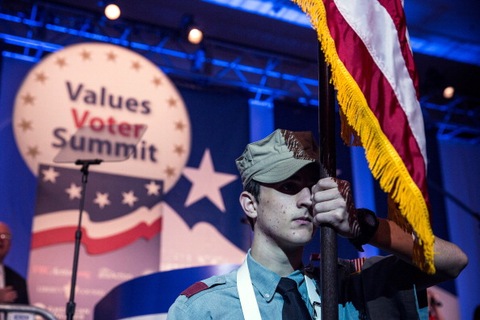
valuesvoterssummit

“We think we’ve come so far. Torture of heretics, burning of witches it’s all ancient history. Then – before you can blink an eye – suddenly it threatens to start all over again.” Captain Jean Luc Picard, Star Trek the Next Generation “The Drumhead”

I expect that this article and subject might make some people uncomfortable but it is something that I need to return to yet again.  I fear what is happening to our country, and the agenda of the politically motivated Christian Right and its leaders, especially those who are using what is known as Seven Mountains or Dominionist theology to implement laws at local and state level. These laws damage the fabric of society and encourage discrimination in order to solidify the political power of a minority of conservative Christians.

I get very frustrated and tired of the way many leaders of the American Religious Right, that political animal that only thinks of itself have worked so fervently to poison any sense of unity and community that we might have as Americans regardless of our religious faith, or lack of faith. Back in the 1940’s through the 1970’s that was unity was referred to as “American Civil Religion.” Robert Bellah defined it “at best” as a “genuine apprehension on universal and religious reality as seen in, or as one could almost say, as revealed through the experience of the American people.” (Huntington, Samuel P. Who are We? America’s Great Debate p.103) While I do have a lot of issues with the concept of American Civil Religion, and h0w it has been used to justify some pretty horrible actions undertaken by leaders of this country, as well as some harmful myths as to our system of government and God’s blessing of our actions, even the immoral ones, it did provide some positives in regard to how Americans of different faiths treated each other with respect in the public square. As Huntington noted: “America’s civil religion provides a religious blessing to what Americans feel they have in common.” (Huntington p.104)

In the decades since the United States has undergone a seismic transformation in terms of religious makeup, and while those faith traditions who dominated the religious history of our first two hundred years are still dominant in many ways, they are in decline, especially in terms of the fastest growing segment of the population, those who identify themselves as The Nones those with no religious preference. In response the more conservative and politically minded Christians of the Christian Right have launched a culture war to ensure their dominance in all areas of society. Known as Christian Dominionism, Reconstructionism, or the Seven Mountains theology it is a blatant attempt to legislate a particular type of Christianity as the law of the land. As Gary North, an adviser to Ron and Rand Paul as well as other conservative Christian political leaders wrote:

“We must use the doctrine of religious liberty to gain independence for Christian schools until we train up a generation of people who know that there is no religious neutrality, no neutral law, no neutral education, and no neutral civil government. Then they will get busy in constructing a Bible-based social, political and religious order which finally denies the religious liberty of the enemies of God.”

You can see the influence of this theology in many of the state legislatures of what are called Red States where laws specifically intended to solidify conservative Christian dominance of government which allow for legal discrimination against others, by public officials and private businesses are becoming law. Likewise, such legislatures pass laws which crush the ability of local communities to pass non-discrimination ordinances against gays. This has happened in both Arkansas and West Virginia and similar proposals are being put forth in other states.

One of the leading proponents of this theology is Dr. C. Peter Wagner who wrote a number of influential books on evangelism used in many conservative evangelical seminaries and churches. Wagner is credited with beginning what is called the New Apostolic Reformation and taught at Fuller Seminary until his retirement from teaching in 2001. Wagner has written:

“Our theological bedrock is what has been known as Dominion Theology. This means that our divine mandate is to do whatever is necessary, by the power of the Holy Spirit, to retake the dominion of God’s creation which Adam forfeited to Satan in the Garden of Eden. It is nothing less than seeing God’s kingdom coming and His will being done here on earth as it is in heaven.” Letter dated 31 May 2007

I am a Christian, albeit one with many doubts and concerns. I am a Priest and I am a Navy Chaplain, I have grown up and seen this transformation of our society, especially over the last twenty years as a chaplain in both the Army and the Navy, I have concerns in the trends I see but mostly I am concerned about this radical theology that has helped turn faith into a war zone and is destroying the fabric of American life.  In fact if you wonder why so  many of these “Christians” are doing their best to disenfranchise voters and supporting policies that have turned this country from a republic that functioned on the basis of democracy, to an oligarchy controlled by a few one only has to look to the words of the original Dominionist, the father in law of Gary North, R.J. Rushdooney:

“One faith, one law and one standard of justice did not mean democracy. The heresy of democracy has since then worked havoc in church and state . . . Christianity and democracy are inevitably enemies.” (R.J. Rushdoony, The Institutes of Biblical Law p.100)

That being said, with all the change in the composition of the population of this country I really don’t fear that change. But for the most part I fear these politically minded Christians who are bent on imposing their form of Christianity on the people of this country. There are many reasons for this. Some are more general in the way I see Christians treat others; their own wounded as well as non-believers, the political machinations of pastors and “Christian” special interest groups masquerading as ministries. Wagner once said:

“See, the problem is, is that Satan has had too much of his way in our society because he has a government! And the only way to overthrow a government is with a government. It won’t happen otherwise.”

This is radical, for it is the basis of theocracy. Franklin Graham, son of Billy used words of fear to motivate his base saying at the Liberty Counsel Awakening Conference  “But we’re going to lose everything if we don’t win in this next election – and we only have this next election, I think for our voice to be heard.”  I think that it is pathetic that Graham has to resort to such fear and loathing in order to galvanize people to fight against the rights of others not to be discriminated against.

These groups have turned the Chaplain Corps into a political football. I once found the chaplain ministry to be the epitome of how ministers of various denominations or religions should be able to work together for the benefit of others. Some of the Chaplains that I served with from across the denominational and religious spectrum helped ingrain a respect and care for others that I would never had received working in a civilian parish. While I can do this with some chaplains even today they are few and far between.  The highly politicized environment is destroying the effectiveness and community of the Chaplain Corps. As a result I plan on retiring without seeking a promotion to Captain, which I would be eligible for the promotion boards in 2016. While I may help other priests and ministers in their parishes I have no desire to work in any other form of chaplaincy when I retire.

I have been worn down by all of this and sadly the controversies are now unavoidable. As a result I have experienced a lot of pain, heartache and rejection at the hand of many Christians, some of whom I had counted as close friends, and  many of whom are pastors, priests or chaplains. To experience rejection or being shamed by people that you thought were friends is very hard, especially when that at one time you trusted them implicitly to care for you. However to be rejected by those that you trusted “in the name of God, ” or rather because you violated supposedly “correct” doctrinal beliefs about God is frightening.

It seems to me that with many Christians and churches that the “unconditional” love of God that they proclaim not really unconditional. It is totally conditional on believing what they believe or behaving in the way they think that you should.

For those that do not know me or my story I am a career military officer with over 30 years of service between the Army and Navy. I have been a chaplain since 1992 and served in the National Guard, Army Reserve, Active Duty Army and the Navy. I am a trained hospital chaplain; I have a great academic background. I went to Iraq in 2007 and came home with a terrible case of severe chronic PTSD. I still suffer from some anxiety, depression and plenty of insomnia. I find mental health care hard to get in my new assignment and I realize how woefully unprepared that our medical system, military, VA and civilian is to care for that vast numbers of veterans like me.

After Iraq I suffered a collapse of my faith and for close to two years was a practical agnostic. Only my deep sense of call and vocation kept me going and there were times that I wondered if I would be better off dead.

When faith returned through what I call my Christmas miracle it was different. I totally relate to author Anne Rice who said:

“My faith in Christ is central to my life. My conversion from a pessimistic atheist lost in a world I didn’t understand, to an optimistic believer in a universe created and sustained by a loving God is crucial to me. But following Christ does not mean following His followers. Christ is infinitely more important than Christianity and always will be, no matter what Christianity is, has been, or might become.”

I have always questioned a lot that is taught by the church, but after my crisis of faith I really began to see through the bullshit. I began to not only question things my former church taught, but openly stated my convictions about how we treat others as Christians, the equality of people in general and tolerance for those different than us including gays and Moslems who for some Christians are rather low on the scale of those that God might love. As such I openly support the LGBT community, American Moslems and Arabs in general, as well as those who adhere to other non-Christian religions, are agnostic, or even atheist when they are attacked in the media, or by supposedly Christian politicians, preachers and pundits.

After Iraq I was sickened by the crass politicization of conservative American Christianity and many of its leaders. Men and women who advocate war without end, be it real wars against “enemies” of American, or promote a culture war even against other Christians that they do not like or agree with. Of course this is all done in “Jesus name.”

Likewise I question the opulence and materialism of the church. I question the nearly cult like focus and near worship accorded to the Pastor-CEOs of the mega-churches and the television preachers and teachers. I wonder in amazement about how many of these leaders live like royalty and have devoted followers who despite repeated scandals treat them as the voice of God.

Along with the that I question the preference of many American Christian leaders for the rich and their disdain for the poor, the alien and the outcasts among us. This actually comes from baptizing capitalism and objectivist philosophy as Christian and leaving the Gospel behind.

All of that got me thrown out of a church that I had served 14 years a priest and chaplain back in 2010. I thought I had a lot of friends in that church. I still have some that keep in contact with me but after my dismissal most abandoned me. That hurts worse than anything.

In fact when I came home from Iraq in crisis and falling apart the first person who asked about how I was doing with God was not clergy. It was my first shrink. I was asked by a commanding officer after Iraq “where does a chaplain go for help?” I told him “not to other chaplains.”  The sad thing is that man who did care about me suffered untreated terrible PTSD and Traumatic Brain Injury and committed suicide in January 2014.

I have had a few experiences the past few weeks that have opened that wound again and reminded me of why I am afraid of many that call themselves Christians. I have shared some of those so I will not belabor them here.

Dietrich Bonhoeffer said:

“Many people are looking for an ear that will listen. They do not find it among Christians, because these Christians are talking where they should be listening.”

That being said I am thankful that I have a number of friends, including a good number of Christians from various backgrounds and some chaplains who have stood by me even if they disagree with my theology, politics or favorite baseball team.

That being said with the exception of such people who have been with me through thick and thin I am mostly terrified of being around conservative Christians.

Church in most cases is a frightening place for me, and the sad fact is that if I were not already a Christian there is little in American Christianity that would ever cause me to be interested in Jesus.  I can totally understand why churches are hemorrhaging members, especially young people whose religious preference is “none,” for I too am in some sense an outcast.

I would like to think that we have come so far in our understanding of people, and of civil rights. But as Jean Luc Picard said, it is threatening to happen again.

Pray for me a sinner,

Peace

Padre Steve+

8 Comments

Filed under christian life, civil rights, ethics, faith, laws and legislation, LGBT issues, philosophy, Religion

Killing the Mockingbird: Christians and Hate

mock

A couple of nights ago I again watched the classic film To Kill a Mockingbird with my wife Judy. I am also re-reading the book for the first time in decades. After watching it again I am convinced that many people that call themselves “conservative Christians,” are so busy protecting their place and power in society that they despise anyone not like them. They would kill the Mockingbird to ensure that they keep their privileged position in society. The Mockingbirds are those that they have condemned to social inferiority and discrimination and eternal punishment, especially gays and the LGBT community, but others as well.

This is especially the case of the preachers, pundits and politicians that crowd the airwaves and internet with their pronouncements against Gays, immigrants, Arabs, poor blacks, political liberals, progressive Christians, and for that matter anyone who simply wants the same rights enjoyed by these Christians.

In the book there is a line spoken by Miss Maudie Atkinson, a neighbor of Atticus Finch and his children. She says to Atticus’s daughter Scout:

“Sometimes the Bible in the hand of one man is worse than a whisky bottle in the hand of another… There are just some kind of men who – who’re so busy worrying about the next world they’ve never learned to live in this one, and you can look down the street and see the results.”

As I survey the world of Christian conservatives I become surer of this every day. I’ve often wrote about my own fears in regard to dealing with such people as well as the troubling trends that I see. Last week I wrote five articles on the trends that I see in the church, trends toward greed, political power, social isolation and the active campaign of some to deny basic civil rights to people that they hate on purely religious grounds.

The language of some like Matt Staver of Liberty Counsel, Tony Perkins of the American Family Association and a host of others describe actions of governments and courts to ensure equal treatment of all people under the law as threats to Christians, affronts to them and of course to God. Their words are chilling. Matt Staver commented this week that if the Supreme Court upheld marriage equity for gays that it would be like the Dred Scott decision. Of course that is one of the most Orwellian statements I have heard in a while, for the Dred Scott decision rolled back the few rights that blacks had anywhere in the country and crushed the rights of non-slave states.

Again, as a reminder to readers, especially those new to the site, I spent a large amount of my adult Christian life in that conservative Evangelical cocoon. I worked for a prominent television evangelist for several years, a man who has become an extreme spokesman for the religious political right. I know what goes on in such ministries, I know what goes on in such churches. I know the intolerance and the cold hearted political nature of the beast. I know and have gone to church with Randall Terry, the former head Operation Rescue who once said: “Let a wave of intolerance wash over you. I want you to let a wave of hatred wash over you. Yes, hate is good…” I have walked in those shoes, I have been whipped up by those preachers. I fully understand them.

As Atticus Finch told his children:

“You never really understand a person until you consider things from his point of view… Until you climb inside of his skin and walk around in it.”

Thus I total reject the message of such people now, not out of ignorance, but because I have walked in their shoes. At times I supported their causes, not to any extreme, but all too often my crime was simply said nothing when I knew that what they preached, taught and lived was not at all Christian, but from the pits of Hell.

As far as them being entitled to hold whatever opinion they want, even if I disagree, yes that is their right. But as Atticus said:

“People are certainly entitled to think that I’m wrong, and they are entitled to full respect for their opinions. But before I can live with other folks I’ve got to live with myself. The only thing that doesn’t abide by majority rule is a person’s conscience.”

My conscience will not allow me to be silent when I see men like Staver, Perkins, Franklin Graham and so many others preach hatred towards those who are different than them.

In the movie and the book the Mockingbirds were Tom Robinson, the black man falsely accused of rape and assault and Boo Radley, a shy recluse feared by his neighbors, a man who stories were made up about; stories that turned a simple man into a monster in the eyes of people who did not know him. Today they are others who fit the Mockingbird role, people who just want to get along and live in peace, but who endure discrimination and damnation from those who call themselves Christians.

Jem Finch, the son of Atticus asks his sister a question in the book and the film:

“If there’s just one kind of folks, why can’t they get along with each other? If they’re all alike, why do they go out of their way to despise each other?”

I ask the same question on a daily basis.

Peace

Padre Steve+

4 Comments

Filed under civil rights, faith, LGBT issues, movies, philosophy, Political Commentary

Another Year on the Margins of the Church

1622612_10152232336042059_727365308_nMe and my Little Buddy, Minnie Scule

I have been living on the margins of American Christianity for a bit over seven years now. The watershed moment was when I returned from Iraq in February 2008 my faith shattered and my soul wounded suffering from severe PTSD. I was not in good shape then and two years later after faith returned, albeit in a different form I realized that I no longer fit in the mainstream of conservative American Christianity.

The process of return took me to the margins of the faith that I knew and grew up in. For a while I felt like a victim, but over the course of the years I have discovered a tremendous freedom in living on the margins of the church. Jamake Highwater wrote something that really struck me as true:

“What outsiders discover in their adventures on the other side of the looking glass is the courage to repudiate self-contempt and recognise their “alienation” as a precious gift of freedom from arbitrary norms that they did not make and did not sanction. At the moment a person questions the validity of the rules, the victim is no longer a victim.”

When I began to express some of those changes, which mainly had to do in the manner of how I viewed others I got in trouble. At the time I was part of a pretty conservative Episcopal-Catholic denomination with very strong Evangelical and Charismatic leanings. I wrote that I thought that homosexuals could be Christians and not automatically damned to hell. I wrote that not all Moslems were bad. I expressed a great deal of empathy for non-believers, particularly Atheists and Agnostics having recently come out of a period where for all intents I was an Agnostic praying that God really did exist and care. I also asserted that I saw no reason why women could not or should not be ordained to the Priesthood and the Episcopacy and I expressed other views that while not connected with anything to do in the Christian faith was not politically correct in conservative circles.

During that time period I found that I was getting slammed and “unfriended” on Facebook by people I had previously considered friends whenever I had the nerve to disagree with them, or innocently post something that they disagreed with on my Facebook page. I think that was the hardest part for me, I was shocked that people who I had thought were friends, who knew what I was going through were so devoted to their ideology that they condemned me and threw me away. I found that I agreed with Mahatma Gandhi who observed: “I like your Christ; I do not like your Christians. Your Christians are so unlike your Christ.” Of course I say that with a fair amount of humility because most of the time I am not a very good Christian, if that means actually trying to emulate Jesus.

Of course that is not uncommon in the annals of Christianity. Ulrich Zwingli, the Reformer of Zurich was so upset when his students and closest associates became Anabaptist that he had them drowned in the Rhine River. In fact any time Church leaders have had significant powers over people through the levers of the State they have quite often used that power to crush anyone that did not believe like them or questioned their authority.

In a sense for two millennia various groups of Christians have been creating God in their own image and inflicting their beliefs on others. Christians punishing other Christians for having views that they do not agree is so common. Last week a Chaplain of a Nazarene college was fired for questioning Christian support for war in the wake of the movie American Sniper. Sadly most of the time that Christians are condemned by other Christians it is not even for any of major doctrinal beliefs found in the Creeds, the great Ecumenical Councils of the Church, or even of the various Confessions or Statements of Faith of any denomination. Instead they usually have to with unpopular stands on political or social issues. Anne Lamott has a pithy little thought that I love which I think describes this type of Christian persecution: “You can safely assume you’ve created God in your own image when it turns out that God hates all the same people you do.”

In September of 2010 I was asked to leave that church, even though my actual theological orthodoxy, as to what I believed about God and Christ was unchanged. Thankfully another church, the Apostolic Catholic Orthodox Church, a denomination of the Old Catholic tradition took me in. It is a tiny denomination, much like the Old Catholic Church of the Netherlands, but very affirming and I fit well in it.

As far as my old church, it was going through a difficult time and the Bishop who threw me out was a big part of the problem. He was removed a few months later when it was revealed that he was plotting to take all of the military chaplains out of the denomination to another without consulting the other bishops. One friend who is still in that church speculated that I was asked to leave by the bishop because he thought I might reveal his plans, even though he had not told me directly about them.

What was odd about that church was that in 2004 I was censured by the then second ranking archbishop in that church, forbidden from publishing and even having or having any personal contact with his clergy where I was living because I was “too Catholic.” The irony was that this bishop was a big cause of the trouble that the church went through including the massive splits that occurred in 2005-2010. He left that church, became the editor of a conservative Catholic website and now is a Priest in the Anglican Ordinate and effectively a Roman Catholic Priest.  I love irony.

Thankfully I still have a number friends in my old church, and thankfully there are good people there doing their best to live the Gospel. I can’t say that I would fit in there anymore, but I have no residual animosity to the current leadership of that denomination and pray that they continue to recover from the tumult and division that marked their struggle from 2005-2011. I admit that it was a painful time and for a while I was quite bitter about how I had been treated, but it has been easier to live by forgiving. C. S. Lewis noted: “To be a Christian means to forgive the inexcusable because God has forgiven the inexcusable in you.” Since I have been forgiven for so much how can I not at least try to live in a forgiving manner?

I have written a lot about my frustrations with American Christianity in particular the conservative Christian subculture. Looking at what I wrote I can see that I definitely exist on the margins of that world. But that is not a bad thing, there is a certain amount of freedom as well as intellectual honesty and integrity that I have now that I could not have being for all intents closeted in my former denomination.

Living on the margins allows me to echo Galileo who wrote: “I do not feel obliged to believe that the same God who has endowed us with sense, reason, and intellect has intended us to forgo their use.” It allows me to be at the intersection of faith and unbelief and allows me entry into both worlds, both of which I believe to be sacred and both need to be heard, as well as protected.

Thus when I champion religious liberty, it is not the liberty to use religion to bludgeon others or to use the police power of the State to enforce their religious views on others. Unfortunately that is what I see going on in this country as conservative American Christians especially Evangelicals, Charismatics and conservative Roman Catholics wage a Kulturkampf against modernism and secularism. It as if many of the leaders of that movement desire to set up a Christian theocracy. Gary North, a longtime adviser to Ron Paul and many in the Tea Party movement wrote:

“We must use the doctrine of religious liberty to gain independence for Christian schools until we train up a generation of people who know that there is no religious neutrality, no neutral law, no neutral education, and no neutral civil government. Then they will get busy in constructing a Bible-based social, political and religious order which finally denies the religious liberty of the enemies of God.”

Personally, and with no invective intended I have to imagine that if a Moslem leader in this country said something similar that the Religious Right would be screaming bloody murder and that Bill O’Reilly and Fox News would be leading the charge.


Thus we see a reprise of the Scopes Monkey Trial in efforts to diminish the teaching of real science in schools and replace it with various religious theories of origins such as Young Earth Creationism. It doesn’t seem to matter what the issue is: equality for women, minorities, gays, teaching science, caring for the poor, the sick and the weak, acknowledging the value of other cultural traditions and religions it seems that many politically charged conservative Christians have no tolerance for anyone outside their often quite narrow belief system. North wrote:

“The long-term goal of Christians in politics should be to gain exclusive control over the franchise. Those who refuse to submit publicly to the eternal sanctions of God by submitting to His Church’s public marks of the covenant–baptism and holy communion–must be denied citizenship, just as they were in ancient Israel.”

I’m sorry but again this sounds not too dissimilar to the Taliban in Afghanistan and Pakistan, without the sheep and the comfortable clothes, or the Moslem Brotherhood types, Hezbollah or the Iranian Imams. The religion of North might be different from the Taliban but the goals are eerily similar, and only a fool would not see that. But then we Christians are quite good at ignoring the hate being preached by those that claim to be defending us from those “evil” Moslems.

This is no empty threat, throughout the country Christian Conservatives and their political front men are ramming through laws that have but one intent, the establishment of a Christian theocracy and the persecution of those who do not agree. Allegedly all of these laws are designed to “protect religious liberty” but in fact are nothing more than a legislative attempt to disenfranchise non-believers or others that the majority does not approve. Unfortunately the people pushing these laws do not understand that once the become law they can be used against them if another group comes into power. They set precedent and under such precedent even Sharia Law could be enacted in Moslem dominated areas of the country, such as Dearborn Michigan, or polygamy in separatist Mormon communities in Utah and Idaho.

I am sorry but that is antithetical to the thoughts of our founders and the real defenders of religious liberty in the early days of our republic. John Leland, head of the Virginia Baptists and a key player in the drafting of the First Amendment and religious liberty protections in Virginia wrote:

“The notion of a Christian commonwealth should be exploded forever…Government should protect every man in thinking and speaking freely, and see that one does not abuse another. The liberty I contend for is more than toleration. The very idea of toleration is despicable; it supposes that some have a pre-eminence above the rest to grant indulgence, whereas all should be equally free, Jews, Turks, Pagans and Christians.”

Leland understood what he was talking about, because in Virginia Baptists and others were being persecuted by Anglicans who before the Revolution had been the State Church of Virginia and wanted to be again in the new republic. James Madison wrote of the danger:  “Who does not see that the same authority which can establish Christianity, in exclusion of all other religions, may establish with the same ease any particular sect of Christians, in exclusion of all other sects?”

I will defend the right of religious conservative to believe what they want, including the right to teach it in their churches, church schools and homes and to express those views in the public square as part of real dialogue. I may not agree with them, but if I want my views to be protected I should grant others what I would want. What I cannot support is the attempt of some politically active Christian conservatives to force those views on others through the power of the State, the public schools or any other place where the citizens of our very diverse and pluralistic society have to co-exist.

Likewise, I have become much more outspoken in defending those who are the targets of real Christian hate, in particular the LGBT community, unbelievers, especially atheists and agnostics and Moslems. That may seem odd, but really, if we as Christians do not show God’s love to them, just how do we expect that they will embrace what we believe?

I love the movie Inherit the Wind. I especially love the scene where Spencer Tracy playing the fictionalized version of Clarence Darrow gives a logical yet passionate defense of religious, civil and intellectual liberty.

“Can’t you understand? That if you take a law like evolution and you make it a crime to teach it in the public schools, tomorrow you can make it a crime to teach it in the private schools? And tomorrow you may make it a crime to read about it. And soon you may ban books and newspapers. And then you may turn Catholic against Protestant, and Protestant against Protestant, and try to foist your own religion upon the mind of man. If you can do one, you can do the other. Because fanaticism and ignorance is forever busy, and needs feeding. And soon, your Honor, with banners flying and with drums beating we’ll be marching backward, BACKWARD, through the glorious ages of that Sixteenth Century when bigots burned the man who dared bring enlightenment and intelligence to the human mind!”

Since I don’t want to go back to the 16th Century I will be content to live in the freedom that I have on the margins of contemporary American Christianity. Personally I would rather be there than in the 16th century.

bloom-county-liberal-label-1

Back in 2010 when I was getting kicked out of my old church and suffering the rejection of friends it wasn’t something that I enjoyed. However, I am grateful to be where I am now and to have the freedom that I enjoy. I certainly didn’t plan it this way, but I am definitely okay with the way things have turned out. Living on the margins of American Christianity beats the hell out of living within the hateful, greedy and oppressive structures that permeate our American Christian landscape.

Peace

Padre Steve+

1 Comment

Filed under christian life, civil rights, ethics, faith, LGBT issues, ministry, philosophy, political commentary, Religion

The Reward of Teaching


I love getting to do what I do as an Assistant Professor teaching Ethics and the Gettysburg Staff Ride. Through most of my career, be it as a Medical Service Corps officer and Chaplain in the Army, as well as a Navy Chaplain has been dealt with teaching ethics or history. However, until this assignment those duties have been things I took on in addition to my normal duties. 

I try to challenge my students, no matter what I teach to see issues in relationship to people; their character, intellect, strengths, weaknesses, beliefs, faith, ideology, and their relationships. In other words, their humanity. For it is our humanity that is the common thread in all of history. Technology changes, political models change, and humanity is constantly evolving, or sometimes devolving, but the one constant is people. 

Sadly all to often humanity is left out, we find a way to dehumanize almost everything, even how businesses, governments and even religious bodies refer to people as “human capital,” “resources” or in the case of some money grubbing churches “tithing units.” 

However, when I teach, I may teach about history, philosophy, or ethics, I still concentrate on people; who they and why they matter. That is at least for me is what matters. Events, inventions, theories, methods are all important, but if we leave out the actual part about the people they don’t connect. 

So in addition to the classroom, or touring historic sites, I focus on people, and then, especially on trips where I am out with my students for two or three days. On these trips we travel tighter, we eat and drink together and spend time discussing the events and people we are studying, but also share our life experiences and time together. So for me, teaching is also about my students, and to see their interst piqued, who then come back and later tell me that they went and explored the life of the people that we discussed. It is like them dis coving buried treasure. 

I think that is the joy and the reward of teaching, especially higher education, but I am sure any teacher, even those who teach primary and secondary education could do the same thing if they are creative, for it is the people who connect us, people matter.


Today we had to break off the last day of our Gettybsurg trip due to a winter storm that shifted south and made road conditions really bad. From DC to Richmond I lost count of the number of accidents. Thankfully it looks like things get a bit better south of Richmond. 

But anyway for now, and if you live in the path of this storm, stay safe.

Peace

Padre Steve+

1 Comment

Filed under History, Loose thoughts and musings, philosophy, Teaching and education

“You Must Have Faith…” RIP Leonard Nimoy

Today we lost a great human being and wonderfully actor who playing the Vulcan “Mr Spock” in Star Trek help to teach us to be better human beings. As I mentioned earlier I am on the way to Gettysburg and I found out as my iPhone lit up with news alerts. Thankfully I am not driving. 

Those who follow my writings know just how much Star Trek in all its forms means to me, it is one of the constants in my life, which along with baseball and history has helped make me who I am today. 

One of the key players in that show, who I have always had a certain fondness for was Mr Spock, played by Leonard Nimoy. Nimoy played a character who could have been a one dimensional caricature with a depth, sensitivity, and complex subtlety that enriched us who watched him. 

Of course Nimoy was much more than Spock, he was a tremendously gifted actor and his career even without Star Trek would have been considered quite successful. But it was his portrayal of Spock in the original series, the films that flowed from that series and his reprise of the role in Star Trek the Next Generation and Star Trek: Into Darkness which made him an icon of film and television, and made me look for something higher, better and more noble in life. I’m sure others who grew up with him would agree with me in that. 

I was thinking about the many things that Nimoy said, as Mr Spock as well as out of character which were so rich. One of the most fascinating is in the movie Star Trek VI The Undiscovered Country where Captain Spock startles a young Vulcan Lieutenant when discussing a possible peace treaty with the Klingon Empire. 

Spock: History is replete with turning points, Lieutenant. You must have faith.” 

Valeris: Faith?

Spock: That the universe will unfold as it should

Valeris: But is that logical? Surely we must….

Spock: Logic, logic and, logic….Logic is the beginning of wisdom, Valeris, not the end…

I am a terribly logical person, I doubt at least as much and often more than I have faith. Sometimes I have a hard time getting around my logical side to believe, to have faith. Thus the exchange is something that resonates with me. 

Nimoy, as Nimoy had a profound wit, as well as wisdom. Nimoy tweeted his last tweet on February 23rd it is quite profound.

“A life is like a garden. Perfect moments can be had, but not preserved, except in memory. LLAP” 

For those who don’t get the last bit of that LLAP is the line that Spock and Nimoy are both most remembered for, live long and prosper. 

It is a fitting benediction. I shall miss him. 

Live long, and prosper.

Peace

Padre Steve+ 

2 Comments

Filed under faith, Loose thoughts and musings, philosophy, star trek