Category Archives: Political Commentary

Know Nothings, Racism, Walls and Trump


Friends of Padre Steve’s World,

Long before President Trump was elected President and uttered the words Shithole countries” in slandering the people of Haiti as well as African nations; long before he said that there were “very good people” among the new-Nazis and White Supremacists at Charlottesville; but not before he had made disparaging comments about Mexicans and began talking about making “Mexico pay for a border wall,” I wrote about his penchant for obvious racist terminology and tactics.

I trace that terminology and tactics back to a movement long before Trump was ever thought of, in fact to a time when his German immigrant ancestors were scorned and hated because of their ethnicity. That being said his immigrant grandfather made a small fortune in the Pacific Northwest and the Klondike Gold Rush mostly catering to prospectors and women of ill-repute. Like many immigrants the man was incredibly successful; he made a fortune and returned to Germany where he was discovered was thrown out of the country because the Kingdom of Bavaria believed that he had gone to America to of all things, to avoid military service. The fact that he didn’t have to get a doctor to say he had heel spurs to avoid conscription makes him far more admirable than his grandson. But I digress…

I wrote the following article back in July of 2016 simply because the Trump family story happened to coincide with the subject of my draft book “Mine Eyes Have Seen the Glory”: Race, Religion, Ideology, and Politics in the Civil War Era. It just happens to be that the Donald’s father, Fred happened to get arrested during a march of the Ku Klux Klan in New York in 1927 while dressed as a Klansman. Imagine that.

Back then the blowback that I received for that article from from friends, including a woman who was one of the bridesmaids at our wedding, was so intense that I never wanted to go through it again. However, I went through worse last year when a parishioner at my Navy Chapel attempted to have me tried by Court Martial for allegedly showing disrespect to the President in a sermon. I did no such thing, and the charges were shown false and politically motivated, but they shook me to the core.

It really is amazing when one makes a credible claim that a candidate for the Presidency is a racist and have long time friends castigate you and condemn you for telling the truth. Thus I found it quite refreshing when Congresswoman Alexandria Ocasio-Cortez told CNN’s Anderson Cooper that President Trump was “no question” a racist before noting, as I have so often on this site:

“When you look at the words that he uses, which are historic dog whistles of white supremacy. When you look at how he reacted to the Charlottesville incident, where neo-Nazis murdered a woman, versus how he manufactures crises like immigrants seeking legal refuge on our borders, it’s — it’s night and day,”

But once again I digress but the irony of the current President going after immigrants and defending Klansmen while calling the countries of many current immigrants is far too rich to ignore. But the sad truth is that racism is still to common and is being given voice by the President of the United States in ways that haven’t been seen since the presidency of Woodrow Wilson. Supreme Court Justice Thurgood Marshall noted:

“I wish I could say that racism and prejudice were only distant memories. We must dissent from the indifference. We must dissent from the apathy. We must dissent from the fear, the hatred and the mistrust…We must dissent because America can do better, because America has no choice but to do better.” 

Now the government has been shut down for two weeks because Trump is holding out on building his wall, a wall that will be another budget buster and not do anything to increase national security or stop terrorists. Despite this, the President is now threatening to declare a State Of Emergency in order to find a way to build his wall. If he does, there are many other powers that he can use to shore up his flailing regime.

It is a very dangerous time.

So anyway, here is what I wrote back in July 2016,

Peace,

Padre Steve+

Mark Twain reportedly said that “History does not repeat itself, but it often rhymes.” One can see that in the nomination of Donald Trump as the nominee of the Republican Part for President. Eleven months ago I wrote an article called Trump and the Return of the Know Nothings. At the time few people gave him little chance of becoming the Republican nominee, and now he is the nominee and for all practical purposes owns the GOP.

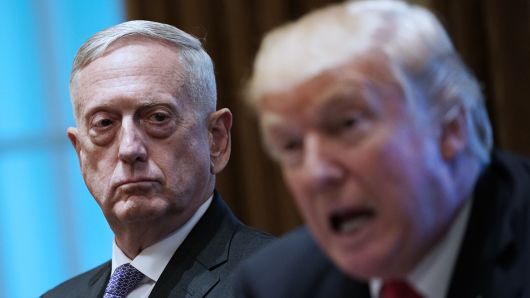
180103-donald-trump-se-253p_1e0ab4bbfc2b637051d31d044ad52abf.nbcnews-ux-2880-1000

Trump’s xenophobic views on immigration charged the debate in the Republican Party during the primaries, and his positions which were fringe positions of most Republicans for decades became the mainstream, just as the same issue did during the 1840s and 1850s. So this is not a new phenomenon, and even over the past few decades the debate has come and gone, but it has returned with a vengeance as Donald Trump made immigration, or rather a virulent anti-immigration platform the centerpiece of his campaign. Trump’s focus on the issue forced other Republican candidates to scramble in order to find a position close enough to Trump’s without completely throwing away the vote of immigrants who they will need to win in many states; if they are to have any hope of winning back the presidency in 2016. But they failed. Trump outmaneuvered them at every point, and in the end Trump’s strongest opponent, Senator Ted Cruz went into the witch’s cauldron of the Republican National Convention not to endorse Trump but to stand on principle and in the process destroy his politic career and maybe endanger his life.

But Trump’s positionresonated with parts of the Republican base, and by appealing to their anger and frustration he has built a solid core of support which loyally supported him in a campaign that featured so many blunders and heneous comments that in a normal election cycle his campaign would not have survived past the Southern Super Tuesday. But he did, and if on the  takes the time to read Trump’s speeches and the reactions to them by his supporters it becomes apparent that Trump has tapped into that vast reservoir of nativism that has always been a part of the American body-politic.


As I said, such attitudes and movements are nothing new. Anti-immigrant movements in the United States go back to our earliest days, ever since the first Irish Catholics showed up in the northeast in the late 1790s and early 1800s. Met with scorn and treated as criminals the Irish Catholics had to work hard to gain any kind of acceptance in Protestant America. But immigrants continued to come, seeking the freedom promised in the Declaration of Independence.

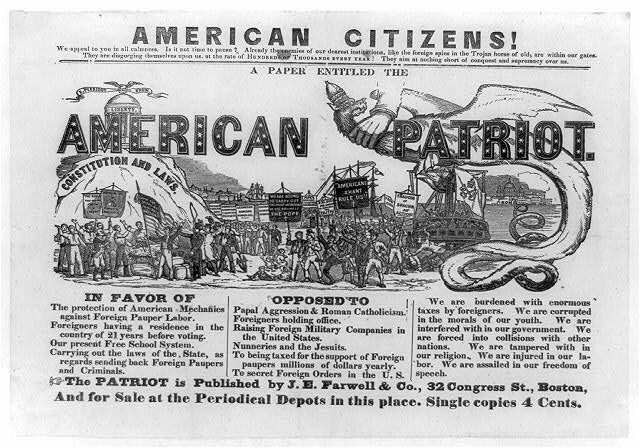
Many White American Protestants viewed Irish, German and other European immigrants to the Unites States in the 1830s, 1840s, and 1850s as interlopers who were attempting to take over the country. The immigrants were regarded as poor, uneducated, uncouth, and immoral, and in the case of Catholic immigrants as representatives and foot soldiers of a hostile government, the Vatican, headed by the Pope and the bishops. Those who opposed immigration formed a movement that was aimed at forbidding immigrants from being granted full rights, especially the rights of citizenship and voting. The fear was pervasive. Many Northern Whites were afraid that immigrants would take their jobs, since like slaves in the South, the new immigrants were a source of cheap labor.

Northern Protestant church leaders and ministers were some of the most vocal anti-immigrant voices and their words were echoed by politicians and in the press. The movement grew and used government action, the courts and violence to oppress the Irish and Germans who were the most frequent targets of their hate. The movement eventually became known as the “Know Nothing” movement.

Know Nothing leaders were not content to simply discuss their agenda in the forum of ideas and political discourse, they often used mob-violence and intimidation to keep Catholics away from the ballot box. Mobs of nativist Know Nothings sometimes numbering in the hundreds or even the thousands attacked immigrants in what they called “Paddy hunts,” Paddy being a slur for the Irish. To combat immigrants who might want to exercise their right to vote, the Know Nothings deployed gangs like the New York’s Bowery Boys and Baltimore’s Plug Uglies. They also deployed their own paramilitary organization to intimidate immigrants on Election Day. This group, known as the Wide Awakes was especially prone to use violence and physical intimidation in pursuit of their goals. The Nativist paramilitaries also provided security for anti-immigrant preachers from angry immigrants who might try to disrupt their “prayer” meetings.

Know Nothing’s and other Nativist organizations, organized mass meetings throughout the country which were attended by thousands of men. The meetings were often led by prominent Protestant ministers who were rich in their use of preaching and prayer to rile up their audiences. The meetings often ended with physical attacks and other violence against German or Irish immigrants and sometimes with the burning of the local Catholic Church. They also provided security for preachers from angry immigrants who might try to disrupt nativist prayer meetings.


Bloody Monday, Louisville 1855

The violence was widespread and reached its peak in the mid-1850s.

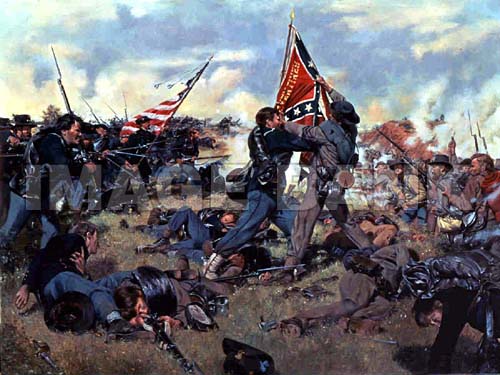
Monday, August 6, 1855 was Election Day in Louisville, Kentucky. To prevent German and Irish Catholics from voting, Know Nothing mobs took to the street and launched a violent attack on immigrants as well as their churches and businesses. Known now as “Black Monday” the Nativists burned Armbruster’s Brewery, they rolled cannons to the doors of the St. Martin of Tours Church, the Cathedral of the Assumption and Saint Patrick’s Church, which they then were searched for arms. The private dwellings and the businesses of immigrants were looted. A neighborhood known as “Quinn’s Row” was burned with the inhabitants barricaded inside. At least 22 persons were killed in the violence and many more were injured. In Baltimore the 1856, 1857, and 1858 elections were all marred by violence perpetrated by Nativist mobs. In Maine, Know Nothing followers tarred and feathered a Catholic priest and burned down a Catholic church.

The Know Nothings did not merely seek to disenfranchise immigrants through violence alone, they were more sophisticated than that. They knew that to be successful they had to change the law. Then, as now, a new immigrant had to live in the United States for five years before becoming eligible to become a naturalized of the United States. The Know nothings felt that this was too short of time and their party platform in the 1856 election had this as one of the party planks:

A change in the laws of naturalization, making a continued residence of twenty-one years, of all not heretofore provided for, an indispensable requisite for citizenship hereafter, and excluding all paupers, and persons convicted of crime, from landing upon our shores; but no interference with the vested rights of foreigners.

The rational of the Know Nothings for the 21 year wait was that if a baby born in the United States had to wait until it was 21 years old he could vote, that immigrants were being permitted to “jump the line” and vote sooner than native-born Americans. But really what the Know Nothings wanted to was to destroy the ability of immigrant communities to use the ballot box. In many localities and some states Know Nothing majorities took power. The Massachusetts legislature, which was dominated by Know Nothings, passed a law barring immigrants from voting for two additional years after they became United States citizens.

The 1856 platform Know Nothing Party was synopsized by a Know Nothing supporter:

(1) Repeal of all Naturalization Laws.

(2) None but Americans for office.

(3) A pure American Common School system.

(4) War to the hilt, on political Romanism.

(5) Opposition to the formation of Military Companies, composed of Foreigners.

(6) The advocacy of a sound, healthy and safe Nationality.

(7) Hostility to all Papal influences, when brought to bear against the Republic.

(8) American Constitutions & American sentiments.

(9) More stringent & effective Emigration Laws.

(10) The amplest protection to Protestant Interests.

(11) The doctrines of the revered Washington.

(12) The sending back of all foreign paupers.

(13) Formation of societies to protect American interests.

(14) Eternal enmity to all those who attempt to carry out the principles of a foreign Church or State.

(15) Our Country, our whole Country, and nothing but our Country.

(16) Finally,-American Laws, and American Legislation, and Death to all foreign influences, whether in high places or low

In addition to their violent acts, the use of the courts and political intimidation the Know Nothings waged a culture war against immigrants. Latin mottoes on courthouses were replaced by English translations. Actions were taken to remove immigrants who had become naturalized citizens from public offices and civil service jobs as well as to use the government to persecute Catholic churches. In Philadelphia, all naturalized citizens on the police force were fired, including non-Catholics who has supported Catholic politicians, and in Boston, a special board was set up to investigate the sex lives of nuns and other supposed crimes of the Catholic church.

In the political upheaval of the 1850s Nativists tried to find homes in the different political parties. Some Know Nothings who were abolitionists became part of the new Republican Party, and Abraham Lincoln condemned them in harsh terms. He wrote his friend Joshua Speed about the hypocrisy that they displayed by supposedly being against the oppression of blacks while willing to oppress immigrants:

“I am not a Know-Nothing. That is certain. How could I be? How can any one who abhors the oppression of negroes, be in favor or degrading classes of white people? Our progress in degeneracy appears to me to be pretty rapid. As a nation, we began by declaring that “all men are created equal.” We now practically read it “all men are created equal, except negroes” When the Know-Nothings get control, it will read “all men are created equal, except negroes, and foreigners, and Catholics.” When it comes to this I should prefer emigrating to some country where they make no pretence of loving liberty — to Russia, for instance, where despotism can be taken pure, and without the base alloy of hypocracy [sic].”

As an organized movement, the Know Nothings died out by the early 1860s, migrating to different parties and causes. In the North many became part of the pro-slavery Copperhead movement, which opposed Lincoln on emancipation and the Thirteenth Amendment. In the post-war South the anti-Catholic parts of the Nativist movement found a home in the Ku Klux Klan and other white terrorist organizations which also used racist and nativist propaganda to perpetuate violence, and disenfranchise emancipated blacks in the decades following the end of the Civil War and the end of Reconstruction. The Nativist and anti-immigrant sentiments have periodically found a home in different parts of the country and the electorate. Violence was used against Chinese, Japanese and Filipino immigrants on the West Coast, against Mexicans in the Southwest, Italians, Slavs, Eastern Europeans and Jews in the Northeast.

Sadly it seems that the Know Nothing is being turned against others today. I find it strange that there are a host of people, mostly on the political right that are doing their best in their local communities, state legislatures and even Congress to roll back civil liberties for various groups of people. There is a certain amount of xenophobia in regard to immigrants of all types, especially those with darker skin white Americans, but some of the worst is reserved for Arabs and other Middle-Easterners, even Arab Christians who are presumed as all Middle Easterners are to be Moslem terrorists, even those who have been here decades and hold respectable places in their communities.

But immigrants are not alone, there seems to be in some states a systematized attempt to disenfranchise the one group of people that has almost always born the brunt of legal and illegal discrimination, African Americans.

Likewise there have been numerous attempts to roll back the rights of women, especially working women; the use of the legislature by religious conservatives to place limits on the reproductive rights of women, holding them to the standard of a religion that they do not practice. Despite the Supreme Court’s ruling for Marriage Equality in Obergfell v. Hodges there still are numerous attempts to curb any civil rights, including the right to marriage or civil unions of the LGBT community.


As I said, this is nothing new, that hatred and intolerance of some toward anyone who is different than them, who they deem to be a threat is easily exploited by politicians, pundits and preachers, none of whom care for anything but their prosperity, ideology, religion, or cause. While I would not call them a new incarnation of the Know Nothings, I have to notice the similarities in their message and the way that they push their agenda. As for those among them who claim the mantle of Christ and call themselves Christians I am troubled, because I know that when religion is entwined with political movements that are based in repressing or oppressing others that it does not end well. As Brian Cox who played Herman Goering in the television miniseries Nuremberg told the American Army psychologist Captain Gustave Gilbert played by Matt Craven: “The segregation laws in your country and the anti-Semitic laws in mine, are they not just a difference of degree?

That difference of degree does matter, and there have been and still could be times when the frustration and anger of people, especially religious people can be whipped into a frenzy of violence and government sanctioned oppression by unscrupulous politicians, preachers and pundits. History is replete with examples of how it can happen. When I think of this I am reminded of the close of Spencer Tracy’s remarks in the movie Judgment at Nuremberg:

But this trial has shown that under a national crisis, ordinary – even able and extraordinary – men can delude themselves into the commission of crimes so vast and heinous that they beggar the imagination. No one who has sat through the trial can ever forget them: men sterilized because of political belief; a mockery made of friendship and faith; the murder of children. How easily it can happen. There are those in our own country too who today speak of the “protection of country” – of ‘survival’. A decision must be made in the life of every nation at the very moment when the grasp of the enemy is at its throat. Then, it seems that the only way to survive is to use the means of the enemy, to rest survival upon what is expedient – to look the other way. Well, the answer to that is ‘survival as what’? A country isn’t a rock. It’s not an extension of one’s self. It’s what it stands for. It’s what it stands for when standing for something is the most difficult! Before the people of the world, let it now be noted that here, in our decision, this is what we stand for: justice, truth, and the value of a single human being.”

So for today I will leave it there. I probably will return to the similarities between the Know Nothings and Trump, but not this moment. I actually do have a life and want to write about other things. But that being said, there are times when history rhymes, and this is one of them.

So have a wonderful day.

Peace,

Padre Steve+

1 Comment

Filed under civil rights, ethics, History, laws and legislation, leadership, News and current events, Political Commentary

Jerry Falwell Jr. and the Christian Nationalist Church Of Trump

President Trump and Jerry Falwell Jr.

Friends of Padre Steve’s World,

Atticus Finch, the hero of the book and film To Kill a Mockingbird said: 

“Sometimes the Bible in the hand of one man is worse than a whisky bottle in the hand of (another)… There are just some kind of men who – who’re so busy worrying about the next world they’ve never learned to live in this one, and you can look down the street and see the results.”

I think that most people like to believe that religion is a benign or positive influence in the world. As much as I want to believe the positive aspects I have to admit based on the historical and sociological evidence that this is not so, especially during unsettled times of great change.

We live in such an era and when it comes to identity, God is the ultimate trump card, or in the case of Jerry Falwell Jr., Donald Trump is the ultimate God card. Falwell exemplifies the ideal of Christian Nationalism in his idolatrous and uncritical support of the President.

When asked the question Is there anything President Trump could do that would endanger that support from you or other evangelical leaders? during an interview with the Washington Post, Falwell said: No.

The interviewer who had listened to a number of long winded and theologically unbelievable answers in which he attempted to tie his uncritical support of the President by linking it to Martin Luther’s teaching of the “Two Kingdoms” then noted, That’s the shortest answer we’ve had so far, to which Falwell using perfect circular logic responded:

Only because I know that he only wants what’s best for this country, and I know anything he does, it may not be ideologically “conservative,” but it’s going to be what’s best for this country, and I can’t imagine him doing anything that’s not good for the country.

Truthfully whenI saw and then read the interview which you can see here:

https://www.washingtonpost.com/lifestyle/magazine/jerry-falwell-jr-cant-imagine-trump-doing-anything-thats-not-good-for-the-country/2018/12/21/6affc4c4-f19e-11e8-80d0-f7e1948d55f4_story.html?noredirect=on&utm_term=.8fd8a874afb5

Falwell’s arguments are very similar to Reichsbishof Müller and the Nazi supported German Christians, or Otto Dibelius, who before he became an anti-Nazi and General Superintendent of the Confessional Lutherans claimed:

“We have learned from Martin Luther that the Church cannot get in the way of State power when it does what it is called to do. Not even when [the state] becomes hard and ruthless…. When the state carries out its office against those who destroy the foundations of state order, above all against those who destroy honor with vituperative and cruel words that scorn faith and vilify death for the Fatherland, then [the state] is ruling in God’s name!”

Robert Jeffress, the Pastor of the mammoth First Baptist Church Of Dallas, Texas, is another who seems like Falwell Jr. for the Office of Reichsbishof of Trump’s MAGA State, said:

“You know, I was debating an evangelical professor on NPR, and this professor said, ‘Pastor, don’t you want a candidate who embodies the teaching of Jesus and would govern this country according to the principles found in the Sermon on the Mount?’” Jeffress said. “I said, ‘Heck no.’ I would run from that candidate as far as possible, because the Sermon on the Mount was not given as a governing principle for this nation.”

I wonder what some of Jeffress’s predecessors in that storied pulpit would think of his and Falwell’s unlimited support and blessing of the lawless President would say. Actually I don’t wonder a bit, I know what they would say. George Truett Who pastored First Dallas and served as the President of Southwestern Baptist Theological Seminary wrote:

“Constantine, the Emperor, saw something in the religion of Christ’s people which awakened his interest, and now we see him uniting religion to the state and marching up the marble steps of the Emperor’s palace, with the church robed in purple. Thus and there was begun the most baneful misalliance that ever fettered and cursed a suffering world…. When … Constantine crowned the union of church and state, the church was stamped with the spirit of the Caesars…. The long blighting record of the medieval ages is simply the working out of that idea.”

So, if one wonders why the most fanatical individuals and groups on earth are tied to religions, it is because they honestly believe that they are acting in the Name Of God. Sadly,mit is the theology of Falwell and others like him that leads to genocide. In that as Pact, Christian history is often little different from the bloodthirsty if the non State actors of Islamic State: Al Qaeda, Boko Haram, or Hezbollah, although it is much closer to the State sponsored acts of the Christian Crusaders, the Ottoman Turks, and the Catholic versus Protestant wars of the Reformation. Likewise, some Ultra-Orthodox Orthodox Jews, radical Hindus, and Buddhists Of course all of these groups have different goals, and some are less violent than the others, but their overall thoughts and philosophy are quite similar: they desire to impose their religious authority on others using the means of the state or if they cannot gain control of government, through terror.

Robert Heinlein wrote:

“Almost any sect, cult, or religion will legislate its creed into law if it acquires the political power to do so.”

Heinlein, the author of the classic Starship Troopers was absolutely correct. Just look at any place in any time where any religion, sect or cult has gained control of a government. They are not loving, they are not forgiving and they use the police power of the state to persecute any individual or group that is judged to be in error, or even worse has the gall to question their authority. Samuel Huntington wrote in his book The Clash of Civilizations:

“Whatever universalist goals they may have, religions give people identity by positing a basic distinction between believers and non-believers, between a superior in-group and a different and inferior out-group.”

That distinction is on display all over the world and in our own country when conservative Christians write laws that allow them the right to discriminate against other people based solely on their religious beliefs and to secure themselves the preeminent position in society. Gary North, one of the most eloquent expositors of the Christian Dominionist movement and a long time adviser to Ron and Rand Paul and other conservative Christian politicians wrote:

“The long-term goal of Christians in politics should be to gain exclusive control over the franchise. Those who refuse to submit publicly to the eternal sanctions of God by submitting to His Church’s public marks of the covenant–baptism and holy communion–must be denied citizenship, just as they were in ancient Israel.”

Huntington was right, you see the true believers, those who follow their religion without question and believe that it is superior to all others also believe that their religion entitles them to be atop the food chain, others who don’t believe like them be damned both in this life and the next. That is the certitude of the true believer, especially the religious one. Secular or atheistic fanatics could care less about the next life, for this life is all that they have. But the religious “true believers” are not only interested in destroying someone in this life, but ensuring that in the next that they suffer for eternity, unless they believe in the annihilation of the soul after death, which really spoils the whole Dante’s Inferno perspective of the damned in the afterlife.

The great American philosopher, Eric Hoffer wrote:

“The impression somehow prevails that the true believer, particularly the religious individual, is a humble person. The truth is the surrendering and humbling of the self breed pride and arrogance. The true believer is apt to see himself as one of the chosen, the salt of the earth, the light of the world, a prince disguised in meekness, who is destined to inherit the earth and the kingdom of heaven too. He who is not of his faith is evil; he who will not listen will perish.”

That is why they, the religious true believers of any faith, men like Jerry Falwell Jr., are capable of such great evil, and why such people can bless the murder innocents in the most brutal manner simply because they do not believe correctly.

Under President Trump, conservative American Christians are getting their chance to do their worst, and will only get more militant and violent as the walls close in around the President and they form the last protective barrier around him, like a Praetorian Guard, unless they are fought at every turn. As Falwell and others including Robert Jeffress, Franklin Graham, and hundreds of other conservative Christians leaders rally around him, Trump, knowing that their worship,is directed toward him will cleave to them ever more faithfully.

Based on the unwavering and increasing loyalty of men like Falwell, Jeffress, and their followers, Trump was right about his supporters when he claimed in 2015:

“You know what else they say about my people? The polls, they say I have the most loyal people. Did you ever see that? Where I could stand in the middle of Fifth Avenue and shoot somebody and I wouldn’t lose any voters, okay? It’s like incredible.” 

It is incredible, and dangerous.

So until tomorrow,

Peace

Padre Steve

15 Comments

Filed under christian life, ethics, faith, History, Loose thoughts and musings, nazi germany, News and current events, Political Commentary

Padre Steve: Your Not for Profit Prophet

Friends of Padre Steve’s World,

I neither claim to be a prophet nor the son of the prophet, but I do have a pretty good sense about the future, not because I am in any sense a seer, but because I am a historian and student of how people of any age deal with turbulent times.

On March 14th 2016 I wrote:

“I am afraid. Over the past few weeks violence has become commonplace at the campaign rallies of Donald Trump. In the past week a reporter from the Breitbart News service, an organization that is solidly behind Trump was assaulted by Trump’s campaign manager, and Breitbart threw her under the bus for him. Protesters have been assaulted, reporters threatened, Trump not only condones the actions, he encourages them, threatening to use the law and courts to ruin people’s lives, and offering to pay the legal bills of his supporters who have been charged with crimes. He labels any opponents as “bad people” who need to be punished. The ultimate cruelty is that though he is the one inciting the violence, he and his supporters blame that violence on the victims, be they Democrats or Republicans, protestors or media, pundits, politicians or preachers. He is creating a frenzy among his most violent supporters that demands victims to satiate their new found bloodlust…

If he succeeds in his takeover bid, it will forever change American politics, especially if he is able to ride the fear, and to the White House. I don’t think the latter will happen, but I would not exclude it from the realm of the possible…”

On May 4th 2016 I wrote:

“What this signals for the GOP is yet to be determined, but like many others I beleive that it signals the end of the GOP as we have known it. The party leadership may attempt to unify behind him and to control him, but it will be an uncomfortable alliance, and one which Trump holds the winning cards. The GOP is broken, it ignored the advice of those who wrote the post-mortem of the 2012 defeat of Mitt Romney, and now they have been “Trumped” so to speak. Trump’s negatives are such that even if he wins the general election, which based on current polls that pit him against either Clinton or Sanders show him losing hardly, the GOP may well lose the Senate, and many seats in the House. The fact is that Trump does not give a damn what Reince Priebus and GOP leadership think, he will do what he needs to win and if he does win, he will take the credit and do as he pleases. Some influential members the GOP conservative media base are already saying that in spite of the collapse that they will not support Trump. 

At first the GOP dismissed Trump. Then they tried to marginalize him, then when it was too late attempted to stop him. At every turn Trump outmaneuver end them, appealed to the anger and frustration of GOP voters, harnessed that energy, and “Trumped” the GOP leadership at every turn. It was quite fascinating to watch, and if I wasn’t a historian and well aware of the kinds of emotions Trump is playing to I would laugh it off. 

But as I have said since November, Trump cannot be underestimated, and if the Democratic nominee and party underestimate him, they too may end up being Trumped. So if there are Democrats or progressive out there feeling a sense of satisfactory schadenfreude in this, don’t celebrate too soon.

On July 20th 2016 I wrote on this site:

“Once ensconced in power Trump will use his executive powers in ways never imagined by the Founders. He has no respect for the separation of powers and will ignore the Constitution, Congress, and the Courts anytime that he desires, and sadly, if he has a Republican majority in Congress, he will get all that desires. Like the Nazi dominated Reichstag, Congress will become nothing more than a rubber stamp for Trump’s edicts. Those conservatives who thought they would be able to restrain Trump will, like the German conservatives of the 1930s will be disappointed. Those who don’t support him will be purged.

I could go on, but since all of these comments were posted before anyone, including me thought that Trump would actually be elected, I think that I was pretty spot on. Truthfully, I would have rather been wrong about all of this. However, when I look back I have been pretty accurate.

Since I am retiring from the military in the next six months please tell MSNBC, PBS, CNN, the Washington Post, the New York Times or any other news organization that might need a pretty sharp talking head that I am available.

Until tomorrow,

Peace,

Padre Steve+

2 Comments

Filed under News and current events, Political Commentary

The Emancipation Proclamation: The Antidote to the Cornerstone

Friends of Padre Steve’s World

Yesterday was the 156th anniversary of the Emancipation Proclamation. The proclamation made by Abraham Lincoln when the outcome of the rebellion of the Southern slave states against the Union was still up in the air was a watershed for civil rights in the United States. Though it was a military order that only affected slaves in the rebellious states, it also set the stage for the 13th, 14th, and 15th Amendments and other legal rulings that affected not only African Americans and former slaves, but also Native Americans, Women, other racial minorities and LGBTQ people. It is something that in our era when so many civil rights are under threat that we must remember and continue to fight for in the coming years. Freedom is never free.

This article is a part of my hopefully soon to be published book “Mine Eyes Have Seen the Glory!” Race, Religion, Ideology, and Politics in the civil War Era. 

Peace

Padre Steve+

From the beginning of the war many Northerners, especially abolitionists and radical Republicans believed that “as the “cornerstone” of the confederacy (the oft-cited description by the South’s vice-president, Alexander H. Stephens) slavery must become a military target.” [1]When some Union generals made their own attempts at issuing emancipation orders, Lincoln countermanded them for exceeding their authority. Lincoln resisted the early calls of the abolitionists to make that a primary war goal for very practical reasons, he had to first ensure that the Border Slave States did not secede, something that would have certainly ensured that the Union would not survived. As a result in the first year of the war, Lincoln “maneuvered to hold Border South neutrals in the Union and to lure Union supporters from the Confederacy’s Middle South white belts. He succeeded on both scores. His double success with southern whites gave the Union greater manpower, a stronger economy, and a larger domain. These slave state resources boosted free labor states’ capacity to should the Union’s heavier Civil War burden.” [2] His success in doing this was instrumental in enabling him to turn to emancipation in 1862.

Finally, some twenty months after Fort Sumter fell and after nearly two years of unrelenting slaughter culminating in the bloody battle of Antietam, Abraham Lincoln published the Emancipation Proclamation. Emancipation was a tricky legal issue for Lincoln as “an executive order of emancipation would be beyond the powers of the president, but not, Lincoln concluded, if such an order were issued as furtherance of the executive’s war powers.” [3] Lincoln had desired to issue the order during the summer and sounded out elected officials and soldiers as to his plan.

Lincoln discussed his views with General George McClellan during a visit to the latter’s headquarters. McClellan stated his strident opposition to them in writing. McClellan did not admire slavery but he despised abolitionists and he wrote one of his political backers “Help me to dodge the nigger – we want nothing to do with him. I am fighting for the Union…. To gain that end we cannot afford to mix up the negro question.”  [4]

Lincoln then called border state Congressmen to sound them out on the subject on July 12th 1862 only to be met with opposition. Such opposition caused Lincoln “to give up trying to conciliate conservatives. From then on the president tilted toward the radical position, though this would not become publicly apparent for more than two months.” [5]

Lincoln’s cabinet met to discuss the proclamation on July 22nd 1862 and after some debate decided that it should be issued, although it was opposed by Postmaster General Montgomery Blair who believed that “the Democrats would capitalize on the unpopularity of such a measure in the border states and parts of the North to gain control of the House in the fall elections.” [6] Wisely, Lincoln heeded the advice of Secretary of State Seward to delay the announcement until military victories ensured that people did not see it as a measure of desperation. Seward noted: “I approve of the proclamation, but I question the expediency of its issue at this juncture. The depression of the public mind, consequent on our repeated reverses, is so great I fear…it may be viewed as the last measure of an exhausted government, a cry for help…our last shriek on the retreat.” Seward suggested that Lincoln wait “until the eagle of victory takes his flight,” and buoyed by military success, “hang your proclamation about his neck.” [7]

After the Battle of Antietam, President Lincoln issued the Preliminary Emancipation Proclamation. This document served as a warning to the leaders of the South, and insisted that there was much more at stake in their rebellion unless they surrendered; their slaves, the very “property” for which the seceded. The document “warned that unless the South laid down its arms by the end of 1862, he would emancipate the slaves.” [8] This was something that they could not and would not do, even as their cities burned and Confederacy collapsed around them in 1864.

The proclamation was a military order in which Lincoln ordered the emancipation of slaves located in the Rebel states and areas of those states occupied by Union troops. It was not designed to change law, which would have to wait until Lincoln felt he could have Congress amend the Constitution.  Instead of law it was “the doctrine of military necessity justified Lincoln’s action.” [9] The concept emanated from Boston lawyer William Whiting who argued “the laws of war “give the President full belligerent rights” as commander and chief to seize enemy property (in this case slaves) being used to wage war against the United States.” [10] There was a legitimate military necessity in the action as Confederate armies used slaves as teamsters, laborers, cooks, and other non-combatant roles to free up white soldiers for combat duty, and because slaves were an important part of the Southern war economy which could not function without them. The proclamation gave inspiration to many slaves throughout the South to desert to the Union cause or to labor less efficiently for their Confederate masters. A South Carolina planter wrote in 1865:

“the conduct of the Negro in the late crisis of our affairs has convinced me that we were all laboring under a delusion….I believed that these people were content, happy, and attached to their masters, But events and reflection have caused me to change these positions….If they were content, happy and attached to their masters, why did they desert him in the moment of need and flocked to the enemy, whom they did not know….” [11]

The proclamation authorized that freed blacks be recruited into the Federal army and it ensured that freed slaves would not again be surrendered back into slavery. As Montgomery Blair had warned Lincoln and the Republicans suffered sharp electoral reverses as “Democrats made opposition to emancipation the centerpiece of their campaign, warning that the North would be “Africanized” – inundated by freed slaves competing for jobs and seeking to marry white women.”  [12]

Lincoln’s response was to continue on despite the opposition and issue the Proclamation in spite of electoral reverses and political resistance. The vehemence of some Northern Democrats came close to matching that of white Southerners. The “white Southerner’s view of Lincoln as a despot, hell-bent on achieving some unnatural vision of “equality,” was shared by Northern Democrats, some of whom thought the president was now possessed by a “religious fanaticism.” [13] But Lincoln was not deterred and he understood “that he was sending the war and the country down a very different road than people thought they would go.” [14] He noted in December 1862:

“Fellow citizens, we cannot escape history….This fiery trial through which we pass, will light us down, in honor or dishonor, to the latest generation….In giving freedom to the slave, we assure freedom to the free – honorable alike in what we give, and what we preserve.”[15]

For Lincoln the Emancipation Proclamation was something that he believed was something that he had to do, and he believed that it would be the one thing that he did in life that would be remembered. He had long been convicted of the need for it, but timing mattered, even six months before it might have created a political backlash in the North which would have fractured support for the war effort, and in this case timing and how he made the proclamation mattered.

The Emancipation Proclamation had military, domestic political, and diplomatic implications, as well as moral implications for the conduct of the war.

The military implication would take some time to achieve but were twofold. First, Lincoln hoped that the Emancipation Proclamation would encourage former slaves, as well as already free blacks in the North to join the Union cause and enlist to serve in the Federal Army. The act would vest African Americans in the Union’s cause as little else could, and at the same time begin to choke-off the agricultural labor force that provided the backbone of the Confederate economy. Frederick Douglass eloquently made the case for African Americans to serve in July 1863, telling a crowd in Philadelphia, “Do not flatter yourself, my friends, that you are more important to the Government than the Government is to you. You stand but as a plank to the ship. This rebellion can be put down without your help. Slavery can be abolished by white men: but Liberty so won for the black man, while it may leave him an object of pity, can never make him an object of respect…. Young men of Philadelphia, you are without excuse. The hour has arrived, and your place is in the Union army. Remember that the musket – the United States musket with its bayonet of steel – is better than all the parchment guarantees of Liberty. In you hands the musket means Liberty…” [16] By the end of the war over 180,000 African American men would serve as volunteers in the United States Army.

Politically the proclamation would the diplomatic purpose by isolating the Confederacy from European assistance. This it did, after the proclamation public sentiment, especially among Europe’s working classes turned solidly against the Confederacy. Domestically it would break-ground for the Thirteenth Amendment, which Lincoln, the pragmatic lawyer was needed to actually abolish slavery. Morally, it  would serve as the guarantee of The United States Government’s public, irrevocable pledge of freedom to African Americans if the North won the war.

Lincoln signed the order on January 1st 1863. As he got ready to sign the document he paused and put down the pen, speaking to Seward he said “I never, in my life, felt more certain that I was doing right, than I do now in signing this paper….If my name ever goes down in history it will be for signing this act, and my whole soul is in it.” [17] The opening paragraph read:

“That on the first day of January, in the year of our Lord one thousand eight hundred and sixty-three, all persons held as slaves within any State or designated part of a State, the people whereof shall then be in rebellion against the United States, shall be then, thenceforward, and forever free; and the Executive Government of the United States, including the military and naval authority thereof, will recognize and maintain the freedom of such persons, and will do no act or acts to repress such persons, or any of them, in any efforts they may make for their actual freedom.” [18]

At the ends of the proclamation he added the words suggested by his devoutly Christian Secretary of the Treasury Salmon Chase: “And upon this act, sincerely believed to be an act of justice, warranted by the Constitution, upon military necessity, I invoke the considerate judgment of mankind, and the gracious favor of Almighty God.” [19]

The response throughout the North was euphoric as celebrations took place throughout the North. In some cities one hundred gun salutes were fired. At Boston’s Tremont Temple people broke out singing a hymn “Sound the loud timbrel o’er Egypt’s dark sea, Jehovah hath triumphed, his people are free.” [20] The Boston Daily Evening Telegraph predicted, “Slavery from this hour ceases to be a political power in this country…such a righteous revolution as it inaugurates never goes backward.” [21]

Frederick Douglass wrote about his reactions to the Emancipation proclamation as he had nearly despaired wondering if the Lincoln administration would actually take up the fight for emancipation:

“The fourth of July was great, but the first of January, when we consider it in all of its relations and bearings in incomparably greater. The one we respect to the mere political birth to a nation, the last concerns national life and character, and is to determine whether that life and character shall be radiantly and glorious with all high and noble virtues, or infamously blackened, forevermore, with all the hell-darkened crimes and horrors which we attach to Slavery.” [22]

The proclamation was not all some had hoped for and it was certainly provoked a negative response in the South and among many Northern Democrats. Southerners accused Lincoln of inciting racial warfare and Jefferson Davis responded “The day is not so distant when the old Union will be restored with slavery nationally declared to be the proper condition of all of African descent.” [23]

But the proclamation did something that politicians, lawyers did not comprehend, that “the details of the emancipation decree were less significant than the fact that there was an emancipation decree, and while the proclamation read like a dull legal brief, filled with qualifying clauses and exceptions, it was not language made for this, finally, a moral document. It was its existence, its title, its arrival into this world, its challenge to the accepted order, and from that there was no turning back. In this sense it was a revolutionary statement, like the Declaration itself, and nearly as significant.” [24]That the proclamation most certainly was and it was a watershed from which there was no stepping back. “It irrevocably committed the government of the United States to the termination of slavery. It was an act of political courage, take at the right time, in the right way.” [25]

However, it would take another two years, with the Confederacy crumbling under the combined Federal military onslaught before Lincoln was able to secure passage of the Thirteenth Amendment to the Constitution in January 1865.  The amendment abolished slavery and involuntary servitude throughout the country, as well as nullified the fugitive slave clause and the Three-Fifths Compromise. It would be followed after Lincoln’s death by the Fourteenth Amendment which reversed the result of the Dred Scott decision and declared that all people born in the United States were citizens and entitled to the rights of citizenship. During the Grant administration the Fifteenth Amendment was passed, and this finally extended to African American men, the right to vote in every state.

Though limited in scope, the Emancipation Proclamation had more than a domestic military, social and political effect. It also had an effect on foreign policy which ensured that Britain, and thereby France would not intervene in the war on behalf of the Southern Confederacy. It stopped all British support for the Rebels to include seizing warships that had been contracted for by Confederate agents that were building or being fitted out in British Yards. Likewise the British rejected various proposals of Emperor Napoleon III to intervene in the war in late 1862 and during the summer of 1863.

Effects of the Emancipation Proclamation on Military Law

The Emancipation Proclamation and the elimination of slavery also impacted the Union war effort in terms of law, law that eventually had an impact around the world as nations began to adapt to the changing character of war. It was important because for the first time slavery was accounted for in the laws of war. The “Instructions for the Government of Armies of the United States in the Field, General Orders No. 100 by President Lincoln, April 24, 1863; Prepared by Francis Lieber, LLD noted in Article 42 of that Code:

“Slavery, complicating and confounding the ideas of property, (that is of a thing,) and of personality, (that is of humanity,) exists according to municipal or local law only. The law of nature and nations has never acknowledged it. The digest of the Roman law enacts the early dictum of the pagan jurist, that “so far as the law of nature is concerned, all men are equal.” Fugitives escaping from a country in which they were slaves, villains, or serfs, into another country, have, for centuries past, been held free and acknowledged free by judicial decisions of European countries, even though the municipal law of the country in which the slave had taken refuge acknowledged slavery within its own dominions.” [26]

It continued in Article 43:

“Therefore, in a war between the United States and a belligerent which admits of slavery, if a person held in bondage by that belligerent be captured by or come as a fugitive under the protection of the military forces of the United States, such person is immediately entitled to the rights and privileges of a freeman To return such person into slavery would amount to enslaving a free person, and neither the United States nor any officer under their authority can enslave any human being. Moreover, a person so made free by the law of war is under the shield of the law of nations, and the former owner or State can have, by the law of postliminy, no belligerent lien or claim of service.” [27]

The Continued Fight for Emancipation: Dealing with the Copperheads and the Passage of the Thirteenth Amendment

But there were still legitimate concerns that slavery might survive as the war continued. Lincoln knew that in issuing the Emancipation Proclamation raised the stakes of the war far higher than they had been. He noted, “We shall nobly save, or meanly lose, the last best hope on earth.” [28] The threat of the destruction of the Union and the continuance of slavery in either the states of the Confederacy, the new western states, territories, or the maintenance of the Union without emancipation was too great for some; notably, the American Freedmen’s Commission to contemplate. With Grant’s army stalled outside Richmond the Copperheads and the peace party gained influence and threatened to bring about a peace that allowed Confederate independence and the continuance of slavery; members of that caucus they Edwin Stanton in the spring of 1864:

“In such a state of feeling, under such a state of things, can we doubt the inevitable results? Shall we escape border raids after fleeing fugitives? No man will expect it. Are we to suffer these? We are disgraced! Are we to repel them? It is a renewal of hostilities!…In the case of a foreign war…can we suppose that they will refrain from seeking their own advantage by an alliance with the enemy?”[29]

The effort of the Copperheads and the peace party to was soon crushed under the military successes of William Tecumseh Sherman’s armies in Georgia. This was especially true of the capture of Atlanta, which was followed by Sherman’s march to the sea and the Carolinas. Additionally the naval victory of David Farragut’s fleet at the Battle of Mobile Bay served to break the stranglehold that the Copperheads were beginning to wield in Northern politics.  These efforts helped secure Lincoln’s reelection by a large margin in the 1864 presidential election over a divided Democratic opposition, whose presidential nominee McClellan could not even endorse his party’s platform.

In his Second Inaugural Address, Abraham Lincoln discussed the issue of slavery as the chief cause of the war. In it, Lincoln noted that slavery was the chief cause of the war in no uncertain terms and talked in a language of faith that was difficult for many, especially Christians, who “believed weighty political issues could be parsed into good or evil. Lincoln’s words offered a complexity that many found difficult to accept,” for the war had devastated the playground of evangelical politics, and it had “thrashed the certitude of evangelical Protestantism” [30] as much as the First World War shattered Classic European Protestant Liberalism.  Lincoln’s confrontation of the role that people of faith brought to the war in both the North and the South is both illuminating and a devastating critique of the religious attitudes that so stoked the fires of hatred.  His realism in confronting facts was masterful, and badly needed.  He spoke of “American slavery” as a single offense ascribed to the whole nation.” [31]

“One-eighth of the whole population were colored slaves, not distributed generally over the Union, but localized in the southern part of it. These slaves constituted a peculiar and powerful interest. All knew that this interest was somehow the cause of the war. To strengthen, perpetuate, and extend this interest was the object for which the insurgents would rend the Union even by war, while the Government claimed no right to do more than to restrict the territorial enlargement of it. Neither party expected for the war the magnitude or the duration which it has already attained. Neither anticipated that the cause of the conflict might cease with or even before the conflict itself should cease. Each looked for an easier triumph, and a result less fundamental and astounding. Both read the same Bible and pray to the same God, and each invokes His aid against the other. It may seem strange that any men should dare to ask a just God’s assistance in wringing their bread from the sweat of other men’s faces, but let us judge not, that we be not judged. The prayers of both could not be answered. That of neither has been answered fully. The Almighty has His own purposes. “Woe unto the world because of offenses; for it must needs be that offenses come, but woe to that man by whom the offense cometh.” If we shall suppose that American slavery is one of those offenses which, in the providence of God, must needs come, but which, having continued through His appointed time, He now wills to remove, and that He gives to both North and South this terrible war as the woe due to those by whom the offense came, shall we discern therein any departure from those divine attributes which the believers in a living God always ascribe to Him? Fondly do we hope, fervently do we pray, that this mighty scourge of war may speedily pass away. Yet, if God wills that it continue until all the wealth piled by the bondsman’s two hundred and fifty years of unrequited toil shall be sunk, and until every drop of blood drawn with the lash shall be paid by another drawn with the sword, as was said three thousand years ago, so still it must be said “the judgments of the Lord are true and righteous altogether.” [32]

Notes 

[1] Ibid. Foner Forever Free: The Story of Emancipation and Reconstruction p.42

[2] Ibid. Freehling The South vs. The South p.47

[3] Brewster, Todd. Lincoln’s Gamble: The Tumultuous Six Months that Gave America the Emancipation Proclamation and Changed the Course of the Civil War Scribner a Division of Simon and Schuster, New York and London p.59

[4] Ibid. McPherson The Battle Cry of Freedom p.364

[5] Ibid. McPherson The Battle Cry of Freedom p.504

[6] McPherson, James M. Tried by War: Abraham Lincoln as Commander in Chief Penguin Books, New York and London 2008 p.109

[7] Ibid. Goodwin Team of Rivals p. 468

[8] Ibid. Foner Forever Free p.49

[9] McGovern, George Abraham Lincoln Times Books, Henry Holt and Company, New York 2009 p.70

[10] Ibid. McPherson Tried by War: p.108

[11] Ibid. Zinn The Other Civil War p.39

[12] Ibid. Foner Forever Free p.49

[13] Ibid. Brewster Lincoln’s Gamble p.169

[14] Ibid. Guelzo Fateful Lightning p.184

[15] Ibid. Foner Forever Free p.49

[16] Douglass, Frederick. Philadelphia Speech of July 6th 1863 recorded in the Liberator in The Civil War and Reconstruction: A Documentary Collection edited by William E. Gienapp, W.W. Norton and Company, New York and London 2001 p.221

[17] Ibid. Goodwin Team of Rivals p. 499

[18] Lincoln, Abraham The Emancipation Proclamation The National Archives & Records Administration retrieved from http://www.archives.gov/exhibits/featured_documents/emancipation_proclamation/transcript.html 14 June 2014

[19] Ibid. Lincoln The Emancipation Proclamation

[20] Ibid. Brewster Lincoln’s Gamble p.244

[21] Ibid. McPherson The Battle Cry of Freedom p.501

[22] Ibid. Guelzo Fateful Lightning pp. 180-181

[23] Ibid. Goldfield America Aflame p.263

[24] Ibid. Brewster Lincoln’s Gamble p.245

[25] Ibid. McGovern Abraham Lincoln p.78

[26] Reichberg, Gregory M, Syse Henrik, and Begby, Endre The Ethics of War: Classic and Contemporary Readings Blackwell Publishing Ltd, Malden, MA and Oxford UK 2006 p.570

[27] Ibid. Reichberg et al. The Ethics of War p.570

[28] Ibid. Goldfield America Aflame p.263

[29] Ibid. Guelzo Fateful Lightning p.534

[30] Ibid. Goldfield  America Aflame p.358

[31] Ibid. Wills Lincoln at Gettysburg p.186

[32] Lincoln, Abraham Second Inaugural Address March 4th 1865 retrieved from www.bartleby.com/124/pres32.html 24 March 2014

Leave a comment

Filed under civil rights, civil war, Gettysburg, History, laws and legislation, News and current events, Political Commentary

2019: The Coming Disorder and a Spark that Cannot be Extinguished

Friends of Padre Steve’s World,

Abraham Lincoln noted:

“The best thing about the future is that it comes one day at a time.”

It is good to remember Lincoln’s words in times of turmoils. I do, and they bring me great motivation to work, believe, and fight for justice, truth, and the belief in a spark of goodness in humanity which enables me to believe the words of the Declaration of Independence:

“We hold these truths to be self-evident, that that all men are created equal, that they are endowed by their Creator with certain unalienable Rights, that among these are Life, Liberty and the pursuit of Happiness.”

The fact that those words come from a time of tumult, yet in a time where men were beginning to wrestle with and proclaim principles of the Enlightenment matters much to me, especially in times like we live today, where that principle is being attacked and undermined by the American President.

That being said, I believe that 2019 will be remembered in history as a time great turmoil, upheaval, and probably usher in a new epoch of war, economic, and ecological disaster. We may again be witnesses to genocide that leaders of governments fail to take the necessary actions to stop.

I don’t want to sound like a pessimist, but as a historian I to look at the world through how human beings, governments, and businesses behave in times of crisis. In fact, human beings are the singular constant in history and in crisis human beings don’t always live up to our ideals.

When major powers and international systems of order break down, or collapse for whatever reason, instability, disorder, and primordial hatreds based on nationalism, religion, and racism rise. A vacuum is created, filled by other powers, but not without some element of travail. Edmond Taylor wrote in his classic “The Fall of the Dynasties: The Collapse of the Order, 1905-1922:

“The collapse of the great supranational — or at least supraparochial — authorities and the dissolution of long-accepted Imperial bonds released upon Europe a fearsome flood of conflicting national ambitions, of inflamed minority particularisms, of historic (sometimes almost prehistoric) irredentisms, of irreconcilable social aspirations and of rival political fanaticisms.

The impending collapse of the old order today can be seen in a return to a more isolationist policy by the United States, rising populist, nationalist, and ethnocentric movements in Europe which are threatening the existence of the European Union. Those include Brexit, ethnic nationalism mixed with a bit of Fascism in Hungary, Italy, Poland, and great strains in France and Germany between right and left wing populist movements.

The common thread is the center which was the key to so much social progress, democracy, economic growth and stability, scientific advancement, and international security is giving way. There are many reasons for this, on the American side going back to the imperialist overreach of the George W. Bush administration, the inconsistent and detached method of the Obama administration towards the Middle East, especially Syria and Iraq, following that, and now the decidedly inconsistent, often irresponsible, and irreconcilable policies of isolationism and militarism.

A rejuvenated Russia is rushing to fill the void in the Middle East as well as working to destabilize its neighbors, Europe, and even the United States. The Chinese are attempting to make gains in other areas and to drive the United States out of Asia by using every element of national power: diplomacy, information, military might, and economics, while the United States following the Trump Administration’s withdraw from the Trans Pacific Partnership, and subsequent punishing tariffs that are hurting allies and Americans more than China the United States is now at a decided disadvantage in Asia.

I could go on, and could go into details on the causes of the current situation but they are many. What we are seeing now is the beginning of the collapse of an order that we have known most of our lives. While many people might be uneasy, most don’t view things in terms of history, in many cases because the events that led to the establishment of the current order are too distant and the witnesses to those times are few, and dying off. People today seldom study history, and even worse no longer know people, including family members who remember what happened to remind them of it.

That was quite similar to the situation in 1914. Europe had been at relative peace for a century. With the exception of the French Republic, most of Europe was still ruled by monarchies with rather limited democratic participation, if any. Barbara Tuchman wrote in her book The Proud Tower: A Portrait Of the World Before the War, 1890-1914:

“The proud tower built up through the great age of European civilization was an edifice of grandeur and passion, of riches and beauty and dark cellars. Its inhabitants lived, as compared to a later time, with more self-reliance, more confidence, more hope; greater magnificence, extravagance and elegance; more careless ease, more gaiety, more pleasure in each other’s company and conversation, more injustice and hypocrisy, more misery and want, more sentiment including false sentiment, less sufferance of mediocrity, more dignity in work, more delight in nature, more zest. The Old World had much that has since been lost, whatever may have been gained. Looking back on it from 1915, Emile Verhaeren, the Belgian Socialist poet, dedicated his pages, “With emotion, to the man I used to be.”

I believe that 2019 will the a year of multiple crises and the further erosion, if not collapse of the old order. What will come I do not know, but I expect that at the minimum it will be unsettling and disruptive, if not catastrophic. That doesn’t mean that I am a pessimist, it means that I study history. Provided that humanity does not find a way to destroy itself, we will recover. It may not be pretty and it certainly will not be the same as it was, but we will recover.

Walter Lord wrote about this his book on American in the early Twentieth Century The Good Years: 1900-1914. In the book he wrote about how things changed for Americans as Europe plunged into war. The effects of the war were soon felt in the United States though it would not enter the war until 1917. Lord wrote:

Economics were only part of the story. Almost overnight, Americans lost a happy, easygoing, confident way of looking at things. Gone was the bright lilt of “When You Wore a Tulip”; already it was the sadly nostalgic, “There’s a Long, Long Trail a-Winding,” or the grimly suggestive, “I Didn’t Raise My Boy to Be a Soldier.” A mounting crescendo of screaming headlines… atrocity stories… U-boat sinkings… charges and counter-charges shocked the nation, jarred its faith, left a residue of doubt and dismay.

Nothing seemed simple any more. Nothing was black and white. Nothing was “right” or “wrong,” the way Theodore Roosevelt used to describe things. And as the simple problems vanished, so did the simple solutions. Trust-busting, direct primaries, arbitration treaties and all the rest. They somehow lost their glamour as exciting panaceas, and nothing took their place. But the problems grew and grew —preparedness… taxes… war… Bolshevism… disillusionment… depression… Fascism… Moscow… fallout… space… more taxes.

So the old life slipped away, never to return again, and wise men sensed it almost at once. Men like Henry White, the immensely urbane diplomat who had served the country so well. “He instinctively felt,” according to his biographer Allan Nevins, “that his world —the world of constant travel, cosmopolitan intercourse, secure comfort and culture —would never be the same again.” The Philadelphia North American felt the same way, but in blunter words: “What does this mean but that our boasted civilization has broken down?”

Perhaps it was just as well. There was much that was wrong with this old way of living —its injustices, its naivete, its waste, its smug self-assurance. Men would come along to fix all that. New laws, controls, regulations, forms filled out in triplicate would keep anybody from getting too much or too little. And swarms of consultants, researchers, special assistants, and executive committees would make sure that great men always said and did the right thing.

There would be great gains. But after all the gains had been counted, it would turn out that something was also lost —a touch of optimism, confidence, exuberance, and hope. The spirit of an era can’t be blocked out and measured, but it is there nonetheless. And in these brief, buoyant years it was a spark that somehow gave extra promise to life. By the light of this spark, men and women saw themselves as heroes shaping the world, rather than victims struggling through it.

Actually, this was nothing unique. People had seen the spark before, would surely do so again. For it can never die as long as men breathe. But sometimes it burns low, leaving men uncertain in the shadows; other times it glows bright, catching the eye with breath-taking visions of the future.

The truth is, even in the midst of crises that the spark that enables people to believe, to hope, and to labor for a better future where the possibilities of peace, justice, freedom, and progress can be realized.

2019 will likely be a very difficult year, a year of change and turbulence, and truthfully it will probably be just the beginning; but unless finds a way to destroy itself, it will not be the end.

So, unless I get a hair up my ass to write something else before midnight, I wish you a Happy New Year, and all the best.

Peace,

Padre Steve+
1 Comment

Filed under ethics, faith, History, leadership, life, middle east, Military, national security, News and current events, Political Commentary, Religion

Yes Men and No Men: Hermann Goering and Johannes Steinhoff in the Age of Trump

Friends of Padre Steve’s World,

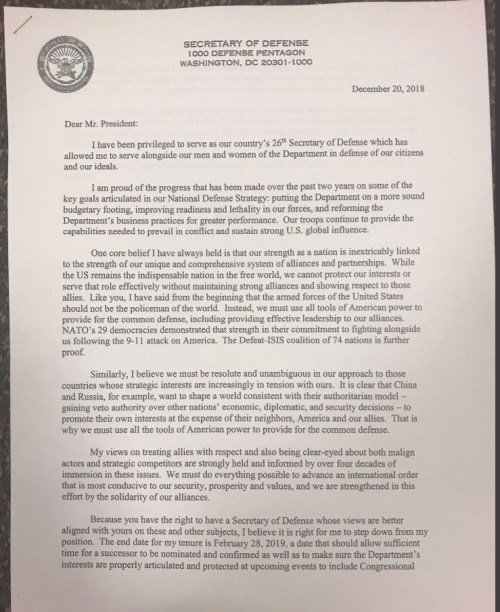
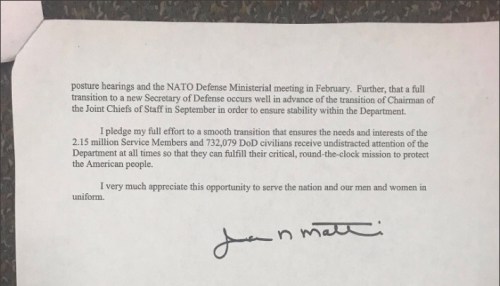
I am posting a slightly updated version on an article that I have published before because I think it is even more relevant following how President Trump has treated, Secretary of Defense James Mattis, Lieutenant General H. R. McMaster, and Mattis’s recommendation of Air Force General David Goldfein to be the next Chairman Of the Joint Chiefs of Staff. All are decorated combat commanders, had been under enemy fire, and all are scholars capable of self-reflection. All stand for a different type of military than that Trump admires, they are not yes men, nor Trump’s Generals. That is why Goldfein was rejected by Trump, why Mattis and McMaster both resigned, and were replaced by men that Trump sees as yes men, the same as with the replacement of Attorney General Jeff Sessions, FBI Director James Comey, and Ambassador to the United Nations Nikki Haley, by people thought to be loyal to the President, most of whom are totally unqualified for their office but whose personal loyalty to the President, not the Constitution, is unquestionable.

At Nuremberg, Hermann Goering was asked by Gustave Gilbert as to “why he and the others had been such abject “yes men,” Goering replied: “Please show me a ‘no man’ in Germany who is not six feet under the ground today.” Goering, who was exceptionally intelligent and talented subordinated himself to Hitler and while not completely correct in regards to the fate of all the “no men” did understand the principle of unconditional personal loyalty to his leader, which makes the actions of men like Johannes Steinhoff much more remarkable.

A few months back I did some research on the anti-Nazi resistors, which caused me to go back are re-read a book by World War II German Luftwaffe ace Johannes Steinhoff, which I believe should be requires reading for any military officer or public servant in the Trump era.

Steinhoff was unlike many of the German officers who wrote memoirs following the war, memoirs that historian Williamson Murray wrote “fell generally into two categories; generals writing in the genre of “if the fuhrer had only listened to me!” and fighter pilots or tank busters writing about their heroics against the productive flood from America or the primitively masses of the Soviet Union.”

Steinhoff’s book, The Final Hours: The Luftwaffe Plot Against Goering should be essential reading for any currently serving officer, diplomat, Federal law enforcement, intelligence, or Department of Justice official  as the Trump administration becomes more established and capricious.

steinhoff6

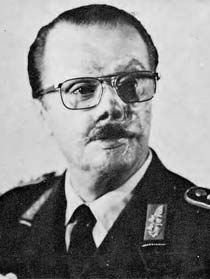
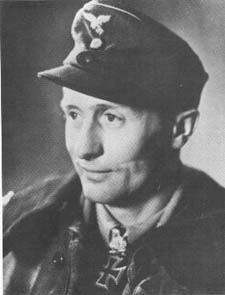
General Johannes Steinhof (above) as a Bundeswehr and NATO officer, showing his burns and before his crash (below)

steinhoff WW II

In his books, Steinhoff does something that you do not see authors do in most military or political memoirs, he actually does serious self reflection on his role in supporting an evil regime. In his introduction to his book The Final Hours the legendary fighter ace who was horribly disfigured when his Me-262 jet fighter crashed and burned two weeks prior to the end of the war wrote:

“In recalling these events, which had been long buried in my memory, it has not been my intention to make excuses. Our unconditional self-sacrifice in the service of the Third Reich is too well documented for that….

So it is because of what is happening today—with freedom threatened in virtually every respect by its own abuse—that I offer this contribution, in the form of an episode in which I was myself involved, to the history of the soldier in the twentieth century. Soldiers have always, in every century of their existence, been victims of the ruthless misuse of power; indeed, given the opportunity, they have joined in the power game themselves. But it fell to our own century to accomplish, with the aid of a whole technology of mass extermination, the most atrocious massacres in the history of mankind. This fact alone makes pacifism a philosophy worthy of respect, and I have a great deal of sympathy with those who profess it. 

The figure of the soldier in all his manifestations is thus symptomatic of the century now nearing its close, and it is to the history of that figure that I wish to contribute by describing what happened to me. I have tried to show what it is possible to do to men, how insidiously they can be manipulated by education, how they can be hoisted onto a pedestal as “heroes,” how they can be so corrupted as even to enjoy the experience—and how they can be dropped and denounced as mutineers when they discover that they have scruples. The complete lack of scruples that such treatment implies is peculiar to rulers who believe that the problems of their own and other peoples can be solved by imposing, through the use of military force, peace on their, the rulers’, terms—in our case a pax germanica, but the second Latin word is readily interchangeable.” from “The Final Hours: The Luftwaffe Plot Against Goring (Aviation Classics)” by Johannes Steinhoff

Since I am a historian and and a career military officer with service in the Iraq War, a war that was illegal and unjust by all measure I can understand Steinhof’s words. Because much of my undergraduate and graduate work focused on German history, particularly that of Imperial Germany after the unification, the Weimar Republic, and the Nazi Reich, I draw a lot of lessons from the period. I also understand how people in this country can fall for the same kind of vitriolic propaganda that the Germans of that era did. I can understand because for years I fell for the lies and propaganda being put out by the politicians, pundits and preachers of the American political right.

In fact I wrote about an incident that happened to me in my own chapel where a dedicated Trump supporter attempted to have me charged with Conduct Unbecoming an Officer and Contempt for the President.  He did this because I used biblical preaching backed by sound theology and history to condemn the President’s comparison of immigrants of darker skin colors as “animals” and an “infestation.” I compared those words with the way Hitler and other totalitarian leaders used such terminology to dehumanize their victims. As I mentioned I was completely cleared by the preliminary inquiry but it sends a chill through my spine.

10665323_10154041610267059_5277331492232210946_n

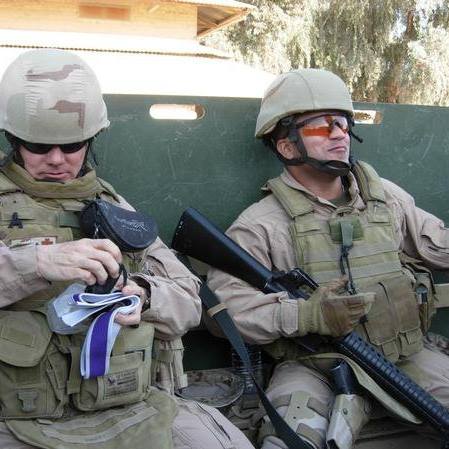
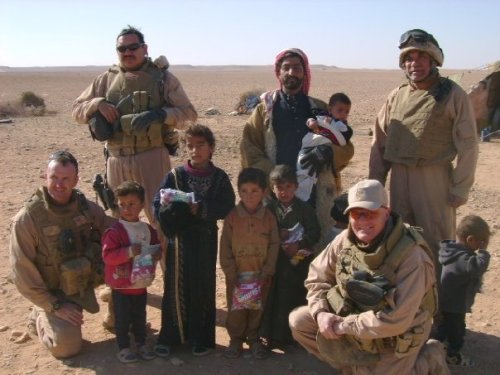
A picture of me (on left) in Iraq 2007 with my assistant and bodyguard RP1 Nelson Lebron

One of those lessons is that in times of crisis, that people, no matter what their race, culture, religious belief system, educational, or economic background are still human. Humanity is the one constant in all of history, our prejudices are often ingrained in us during childhood and reinforced by the words of politicians, pundits, and preachers. In times of stress, crisis, and societal change or upheaval even good people, moral people, people of great intellectual, scientific abilities can fall prey to demagogues who preach hate and blame others, usually racial, ethnic, or religious minorities, as well as civil libertarians who champion the rights of those minorities for the problems of the nation.

Shrewd politicians, preachers, and pundits do this well. They demonize the target group or population and then let the hatred of their disaffected followers flow. The leaders need that disaffected and angry base in order to rise to power; such was how Hitler, Stalin, and so many other despots gained power. They took advantage of a climate of fear, and found others to blame. For Hitler it was the Jews, Slavs, Socialists and Communists; while for Stalin it was various groups like the Ukrainians, or the Poles who were the devil to be feared and destroyed. Timothy Snyder in his book Bloodlands: Europe Between Hitler and Stalin wrote:

“Dead human beings provided retrospective arguments for the rectitude of policy. Hitler and Stalin thus shared a certain politics of tyranny: they brought about catastrophes, blamed the enemy of their choice, and then used the death of millions to make the case that their policies were necessary or desirable. Each of them had a transformative utopia, a group to be blamed when its realization proved impossible, and then a policy of mass murder that could be proclaimed as a kind of ersatz victory.”

But that being said, there are a lot of people who from childhood believe the lies about others without question. In good times such people continue on with life as normal, but in crisis those hatreds and prejudices come to the fore. Rudolf Höss, the notorious sociopath who commanded Auschwitz told American Army psychologist Gustave Gilbert about his reaction when ordered to turn the camp into an extermination center. He said that the order “fitted in with all that had been preached to me for years,” and “at the same time I didn’t think of it as propaganda, but as something one just had to believe.” 

Eugene Davidson in his book on the Nuremberg Trials wrote:

“Every society has in it at all times negative, criminal, sadistic, asocial forces. What holds them in check more than law and police is the consensus of the society – a general belief that despite everything wrong and stupid and muddleheaded in politics, the state is a going concern that will somehow make its way into the future.” (Davidson, The Trial of the Germans p.581)

But when things do not go well, when people do not feel that things will be okay, that the future will be better, and that they have a purpose they look for answers. However, they tend to find their answers in the rantings of demagogues, race baiters, conspiracy theorists, and others who they would tend to dismiss out of hand in good times. In Germany it was the loss of the First World War, the humiliation of Versailles and the economic chaos and social change of the Weimar period which allowed Hitler to gain an audience, then a following, then political power. The demagogues played to what was already in the hearts and minds of the disaffected masses, without that fertile soil, the rantings of Hitler and his propagandists would have never succeeded. Albert Speer wrote:

“As I see it today, Hitler and Goebbels were in fact molded by the mob itself, guided by its yearnings and its daydreams. Of course, Goebbels and Hitler knew how to penetrate through to the instincts of their audiences; but in the deeper sense they derived their whole existence from these audiences. Certainly the masses roared to the beat set by Hitler’s and Goebbels’ baton; yet they were not the true conductors. The mob determined the theme. To compensate for misery, insecurity, unemployment, and hopelessness, this anonymous assemblage wallowed for hours at a time in obsessions, savagery and license. The personal unhappiness caused by the breakdown of the economy was replaced by a frenzy that demanded victims. By lashing out at their opponents and vilifying the Jews, they gave expression and direction to fierce primal passions.”

In a sense a similar thing has happened in the United States which has experienced a series of wars beginning with Vietnam, the shock of the 9-11-2001 attacks, the economic crash of 2007 and 2008 which devastated the savings, home ownership, and investments of many Americans while at the same time benefiting the banking and brokerage houses whose government assisted policies brought about the crash. Of course there are other issues, many religious conservatives hate the progress made by the Women’s and Gay Rights movements, and their leaders play to their fears in apocalyptic terms. I could go on, but I am sure that my readers can identify other issues which demagogues and others use to spread fear and hate to further their goals. The fact is that without the the fertile soil that lays in the hearts of their most fervent followers they would never have a following.

In Weimar Germany hate mongers like Julius Streicher and propagandist Josef Goebbels stuck a chord with disenchanted people who felt that they had lost their country. They were fearful, angry, and desired a leader who would “make Germany great again.” Hitler and his Nazi media sycophants played to that fear, and took advantage of their anger at the existing order. Davidson wrote such people “exist everywhere and in a sick society they can flourish.” 

For decades the way has been prepared for true extremists to take advantage of the fears and doubts of people as modern American versions of Streicher and Goebbels have been at work for years. Rush Limbaugh was a modern pioneer of this in the United States, and he has been joined by so many who are even more extreme in their rantings that it is hard to name them all. Likewise, whole media corporations especially Fox News, websites, and political networks spread such fear every minute of the day, claiming that they, and they alone are real Americans. They actively support politicians who condemn, and sometimes even threaten people who oppose them, and all the while claim that “make America great again.”

When I was younger I devoured that propaganda, despite all of my learning I followed the rantings of men who I realize today are propagandists who promote the basest of lies, and hatred, often in the name of God. I was changed when I was at war, and when I returned home from Iraq in 2008 I realized through hard experience that I had been lied to, and that as a result that thousands of my brothers and sisters were dead, and tens of thousands shattered in body, mind, and spirit. Likewise I saw the massive destruction levied on Iraq and realized how terrible war really is. That was my epiphany, that is what it took to see how much I had been lied to, and it called me to question everything else that I had so willingly believed, things which had been fed to me by years of indoctrination in church, through the media, and by politicians who I believed were truly Christian. I can understand now how Martin Niemoller felt after the Nazi seizure of power when he said, “I hated the growing atheistic movement, which was fostered and promoted by the Social Democrats and the Communists. Their hostility toward the Church made me pin my hopes on Hitler for a while. I am paying for that mistake now; and not me alone, but thousands of other persons like me.”

There was a time that I hated people who espouse the views that I hold today, the views that I write about so often here on this site. I can remember how angry I would get as I listened to the propaganda being put out by Limbaugh, Hannity, the Fox News Channel and all of the others that I listened to every time that I had the chance. But when I changed after Iraq, I felt the sting of that hatred in very real ways. I remember the day I was called by my bishop in my former church, who told me that I had to leave because my views on women, gays, and Moslems were to use his words were now “too liberal.” After that, many men who I considered to be the best of friends turned their backs on me, some in the most bitter and vindictive of ways.

But I realize now that what they did was because I had in a sense left the cult, and had to be ostracized. I can understand that now, because when I was under the spell I too turned my back on people who had fallen out of favor, or people who had rejected the tenants of the church or the political movement, and those are things that I can never undo. But at the time it made sense, it fitted in with all I had been taught for decades, as Albert Speer wrote of Hitler, “One seldom recognizes the devil when he is putting his hand on your shoulder.”

What happened to Steinhoff’s generation is threatening to happen again, in our country, an authoritarian movement is threatening to destroy our democracy and republic. In it soldiers are esteemed, until they realize what is going on and speak out, but by then it is usually too late. I am understanding that fact more and more every day, and having had people troll this blog and call me a traitor and worse, I understand just a bit of what happened to Steinhoff and his fellow officers when they protested to the highest levels what was happening to Germany in early 1945.

In 1944 he and other fighter pilots were subjected to a political indoctrination session and realized that in the Nazi state loyalty and doctrinal purity to Naziism was more important than either combat service or competence. He wrote:

“Now, however, we realized to our horror that a group of officers had decided, after five years of war, to conduct a purge among the troops with the object of eliminating all those “whose past life and present conduct were not consonant with the National-Socialist type” and who did not “stand firm on National-Socialist principles.” We sat there petrified, but some of those present appeared hugely to enjoy the ensuing discussion of what they called “National-Socialist guidelines.” Perhaps, though, for many it was simply an attempt to escape into a less concrete area of discussion than the desperate military situation—and then there was the added satisfaction of being able to censure others. Fanaticism took the place of hopelessness, and phrases like “faith in the Führer,” “rootedness in National-Socialist ideology,” and “irreproachability of character” fell without hesitation from people’s lips. The Luftwaffe leadership, it was said, must be “combed” from top to bottom, and then someone even came out with the “National-Socialist soul…”

We will soon know how military professionals react to being labeled as traitors. President Trump and his followers have been demonizing the personnel of the nation’s intelligence, law enforcement, and diplomatic communities since before the election. The President lambasts critics of any station on his Twitter feed which results in them receiving death threats from his followers. I expect that when Secretary of Defense James Mattis speaks his mind and tells the truth that we will find out.

Personally I expect that when he does that Trump and his most strident supporters will label him as a traitor for doing so. Like a religious cult they have no capacity to tolerate dissent, loyalty to the man will supersede loyalty to the country or the Constitution. When that happens it will be interesting to see the throngs of people in the military and outside of it who make the choice to throw one of the most courageous, selfless, and intellectual soldiers ever produced by our nation under the bus.

Their’s will be a conscious decision. My opinion is that the Constitution and the country will always come first. I wanted to give the President the benefit of the doubt and prayed that he world do the right thing for the country. But I was wrong. I am concerned because of his past and current behavior that his only loyalty is to himself. General Ludwig Beck, who resigned rather than obey Hitler’s order to invade Czechoslovakia in 1938 and died in the anti-Hitler coup attempt in 1944 said:

“It is a lack of character and insight, when a soldier in high command sees his duty and mission only in the context of his military orders without realizing that the highest responsibility is to the people of his country.” 

I have no doubt that General Mattis understands that and will courageously speak his mind, even if he is condemned for doing so. Sadly I have many doubts about other leaders: be they military, political, business, or religious. There are many people who will sell their souls for their personal advancement, the advancement of their agenda, or an increase in their bottom line. It is after all human nature.

But the question is: will we see true men and women of courage who will stand when it appears there is no chance of success? As Atticus Finch said in To Kill a Mockingbird: “Real courage is when you know you’re licked before you begin, but you begin anyway and see it through no matter what.” 

That will be what is demanded in the coming months and years.

Peace

Padre Steve+

5 Comments

Filed under ethics, History, leadership, Military, nazi germany, News and current events, Political Commentary, world war two in europe

Joyeux Noël, Christmas Eve 2018: History and Memory, the Stubborn Humanity Within Us

joyeux_noel3

Friends of Padre Steve’s World,

Last night I rewatched the film Joyeux Noel (Merry Christmas) which is one of my Christmas traditions. When I watch it I cannot stop. I don’t look at my social media, I don’t tweet. Although it recounts an incident that occurred over a century ago, I am drawn to it out of a feeling of camaraderie, and a hope that people of good will can, and maybe will someday put and end to the scourge of war. I guess one reason I have to put down everything else is that I cry through most of the film.

I do not think that  end of war will happen anytime soon, for as Henry Wordsworth Longfellow wrote some fifty years before this incident, “for hate is strong, and mocks the song, of peace on earth, goodwill to men.” 

But I dare not, even in the age of a madman in the White House and warmongering dictators and despots wreaking havoc on the world, give up the hope of peace. I tend to watch it before or after reading Stanley Weintraub’s book: Silent Night: the Story Of the World War One Christmas Truce. 

It was a book that I refused to read until after I returned from Iraq in 2008. Of course as a military historian I knew of the Christmas Truce, but it was something that I tried to keep a distance from after September 11th, 2001. After my experience of Christmas on the Iraq – Syrian Border In 2007 I could no longer ignore it.

Weintraub Wrote:

Christmas 1914 evokes the stubborn humanity within us, and suggests an unrealized potential to burst its seams and rewrite a century.

I say that my time in Iraq did that to me. I cannot forget the Masses that I celebrated on the border and my time with Americans, Iraqi Soldiers, and local Bedouin during those days.

In the film, one of the main characters is the Chaplain of the Scottish battalion played by Gary Lewis tells a Lieutenant:

“Tonight, these men were drawn to that altar like it was a fire in the middle of winter. Even those who aren’t devout came to warm themselves. Maybe just to be together, maybe just to forget the war.” 

12010440-mmmain

The war was supposed to be over by Christmas, or so the planners had said. Instead after a series of massive battles that produced unprecedented number of casualties the war settled into a stalemate. As the sides exhausted themselves in a series of meeting engagements throwing the flower of their idealistic youth into the great maw of the front to be torn apart by massed artillery and machine gun fire the planners sought new ways to find military victory.

In December 1914 with neither side having the ability to force the issue and casualties already running over a million dead and wounded the armies dug in. Massive trench networks were constructed in the mud of France and Belgium as the artillery continued its impersonal work of destroying men, machines and the homeland of millions of civilians.

From Clipboard

Despite the stalemate the high commands of the various nations continued to through their troops into meaningless attacks to gain a few yards of their opponent’s trench networks. The attackers always suffered the worst as they went “over the top” and were cut down by well sited machine guns and networks of defensive redoubts.

As Christmas neared individual parties of British and German troops began to fraternize exchanging gifts and attempting despite the wishes of their commanders to maintain an attitude of live and let live. On Christmas Eve German troops began to decorate their trenches with Christmas trees and lights, carols were sung and Christmas greetings exchanged as the local truces became widespread and soldiers met in no man’s land to talk and give each other gifts of cigarettes, alcohol, food and souvenirs.  In some places the sides helped each other collect and bury their dead and some Chaplains even led Christmas services in which men of both sides worshipped.

football-truce

The truce would not last as the high commands of each side issued strict orders against them and within days had moved the units that they believed most “infected” by the Christmas spirit to other locations and replaced them with units inculcated with the message of the inhumanity of their enemy. Such messages often included the religious understanding of this being a “holy war” against enemies of God and humanity. It is funny that though Muslims are frequently demonized for committing Jihad, that Christians have a terrible record when it comes to finding theological reasons to kill those that they believe, even other Christians to be the enemy.

Christmas Day December 1914 World War One

joyeux-noel-2


joyeux-noel-3

This really wasn’t surprising, after all for in the years leading up to the war many school children, especially in France and Germany had been propagandized. Churches and ministers cooperated in the carnage.

In the movie Joyeux Noel the British Padre who had cooperated in the Christmas truce is relieved by his Bishop and sent home. The Bishop then preaches to the newly arrived soldiers, those replacing the men who had found peace for a moment. The sermon is not a work of fiction, it is actually part of a sermon that actually was given in Westminster Abbey in 1915. It was a sentiment that fit the mood of the high command who sought to minimize the danger of peace without victory. It was a sermon, the likes of which were preached by ministers, preachers, priests and bishops throughout that terrible war. It is a sermon that many preachers, Christian, Jewish, Islamic and Hindu even today mimic with terrible consequences.

“Christ our Lord said, “Think not that I come to bring peace on earth. I come not to bring peace, but a sword.” The Gospel according to St. Matthew. Well, my brethren, the sword of the Lord is in your hands. You are the very defenders of civilization itself. The forces of good against the forces of evil. For this war is indeed a crusade! A holy war to save the freedom of the world. In truth I tell you: the Germans do not act like us, neither do they think like us, for they are not, like us, children of God. Are those who shell cities populated only by civilians the children of God? Are those who advanced armed hiding behind women and children the children of God? With God’s help, you must kill the Germans, good or bad, young or old. Kill every one of them so that it won’t have to be done again.”

Unfortunately I have met and heard men preach the same message against those they hate, a message that twists the words of Jesus in a diabolical way to justify the worst acts of nations and peoples. In the year 2018 wars rage around the world. Some are conducted by well organized professional militaries but many by militias, paramilitary and terrorists groups. In some cases the brutality and inhumanity exhibited makes the industrialized carnage of the First World War seem sane. Even now preachers of various religions, including Christians, Moslems and Jews advocate the harshest treatment of the enemies of their peoples all in “the name of God.”

295_26912097058_4309_n

n671902058_1153798_5336

Eleven short years ago I was traveling up and down the western border of Iraq with Syria. I was visiting our Marines that were advising the Iraqi Army and Border Forces, conducting Christmas services for them and also visiting Iraqi soldiers as well as civilians. In a couple of instances Iraqi and Jordanian Christians working as interpreters came to the Eucharist services, for one it had been years since he had received the Body and Blood of Christ in the Holy Communion. While out and about visiting Iraqis we were hosted by Iraqi troops and well as Bedouin tribesmen and their families. The warmth and hospitality and faith of these wonderful people was amazing.

T.E. Lawrence wrote that the Bedouin could not look for God within him: he was too sure that he was within God.” 

n671902058_1153804_6925

I think that for me that Christmas week was the one that will remain with me more than any and despite being in a war zone, it for me was a time of peace on earth and good will toward men. Some people cannot imagine how a career military officer could feel that way. In the movie the French company commander is confronted by his father after the truce, and after the military postal censors had reported the many incidents of fraternization with the enemy to the various high commands in France, Germany, and Great Britain.

The Country? What does it know of what we suffer here? Of what we do without complaints? Let me tell you, I felt closer to the Germans than to those who cry “Kill the Krauts!” before their stuffed turkey…  no, you’re just not living the same war as me. Or as those on the other side.”  

Weintraub wrote:

“To many, the end of the war and the failure of the peace would validate the Christmas cease-fire as the only meaningful episode in the apocalypse. It belied the bellicose slogans and suggested that the men fighting and often dying were, as usual, proxies for governments and issues that had little to do with their everyday lives. A candle lit in the darkness of Flanders, the truce flickered briefly and survives only in memoirs, letters, song, drama and story.”

During World War One there were men who retained their conscience and tried to mitigate the effects of the war and suffering. Likewise there were those who could not let go of their hate. One such Soldier was Adolf Hitler, whose story is recounted in Weintraub’s book:

Although he was out of the line in reserve, discussion arose about crossing into Niemandsland to share Christmas with the British. He refused. “Such a thing should not happen in wartime,” Hitler argued. “Have you no German sense of honor left at all?” More than patriotic scruples were involved. Although a baptized Catholic, he rejected every vestige of religious observance while his unit marked the day in the cellar of the Messines monastery to which they had retired on the 23rd. “Adi” was distinctly odd. He received no mail or parcels, never spoke of family or friends, neither smoked nor drank, and often brooded alone in his dugout. In the ruins open to the sky, Corporal Frobenius, a Lutheran theology student also decorated with the Iron Cross, read the Christmas gospel to a joint congregation of Catholics and Protestants, but not to Corporal Hitler.

Hitler’s Nihilism, racist nationalism, and unrepentant rejection of his religious heritage while gaining the support of the most religious Christians in the Reich would be part  of his life until he took it in his Berlin Bunker In 1945, and it would be shared by all too many men since the First World War until the present.

I will not be one of them.

Maybe someday we will begin to understand, until then, like so many others in so many wars before, I am still dreaming of home.

Until tomorrow,

Peace

Padre Steve+

2 Comments

Filed under ethics, faith, film, History, Military, movies, Political Commentary, world war one

Hope In Hell: Dr. Kurt Reuber and the Madonna Of Stalingrad

Bundeswehr zeigt "Stalingrad"-Ausstellung

Friends of Padre Steve’s World,

It is almost Christmas and I am reflecting about the true meaning of Christmas in a world where hope seems to be dying before our eyes. In such an environment I reflect on men who lived in a human made hell, a hell made by hate filled ideologues who launched the world into its bloodiest war, and I wonder, could it happen again? A decade ago I would have said it never could again happen, but now I am not so sure. So, in the age of Donald Trump, I must try to find hope wherever I can find it.

I think most of my readers know that I am a career military officer and have served in peace and war as a chaplain. That service includes a tour in Iraq, a war, which by almost any standard would have been considered unjust and illegal, yet I served there, and came back a changed man. As such the stories of those who served in war, especially those who serve in hopeless battles, and even in evil causes during Christmas have a special place in my heart. One of those men was a German pastor and medical doctor named Kurt Reuber.

k_reuberl

As I said, Reuber was a theologian, pastor and medical doctor, likewise he was an accomplished artist and used that medium to convey his own faith, and doubts. He was a friend of Albert Schweitzer in 1939 he was conscripted to serve as a physician in the Germany Army. By November 1942 he was a seasoned military physician serving with the 16th Panzer Division, part of the German 6th Army, which had been fighting in the hell of Stalingrad. When his division along with most of 6th Army was surrounded by the Soviets, cut off from most supply and without real hope of relief, he like other physicians continued to serve the soldiers committed to his care.

pg-34-stalingrad-2-getty

However, unlike most physicians, the care Reuber offered care included spiritual matters, as he sought to help his soldiers deal with the hopelessness of their situation. As Reuber reflected on the desperation of the German soldiers in the Stalingrad pocket. He wrote to his family.

“I wondered for a long while what I should paint, and in the end I decided on a Madonna, or mother and child. I have turned my hole in the frozen mud into a studio. The space is too small for me to be able to see the picture properly, so I climb on to a stool and look down at it from above, to get the perspective right. Everything is repeatedly knocked over, and my pencils vanish into the mud. There is nothing to lean my big picture of the Madonna against, except a sloping, home-made table past which I can just manage to squeeze. There are no proper materials and I have used a Russian map for paper. But I wish I could tell you how absorbed I have been painting my Madonna, and how much it means to me.”

“The picture looks like this: the mother’s head and the child’s lean toward each other, and a large cloak enfolds them both. It is intended to symbolize ‘security’ and ‘mother love.’ I remembered the words of St. John: light, life, and love. What more can I add? I wanted to suggest these three things in the homely and common vision of a mother with her child and the security that they represent.”

The picture was drawn on the back of a captured Soviet map and when he finished it he displayed it in his bunker, which became something of a shrine. Reuber wrote:

“When according to ancient custom I opened the Christmas door, the slatted door of our bunker, and the comrades went in, they stood as if entranced, devout and too moved to speak in front of the picture on the clay wall…The entire celebration took place under the influence of the picture, and they thoughtfully read the words: light, life, love…Whether commander or simple soldier, the Madonna was always an object of outward and inward contemplation.”

drkrop

As the siege continued men came to the bunker for both medical care and spiritual solace.  On Christmas Eve Reuber found himself treating a number of men wounded by bombs outside the bunker. Another soldier lay dying, just minutes before the soldier had been in the bunker singing the Christmas hymn O Du Froehliche.  Reuber wrote:

“I spent Christmas evening with the other doctors and the sick. The Commanding Officer had presented the letter with his last bottle of Champagne. We raised our mugs and drank to those we love, but before we had had a chance to taste the wine we had to throw ourselves flat on the ground as a stick of bombs fell outside. I seized my doctor’s bag and ran to the scene of the explosions, where there were dead and wounded. My shelter with its lovely Christmas decorations became a dressing station. One of the dying men had been hit in the head and there was nothing more I could do for him. He had been with us at our celebration, and had only that moment left to go on duty, but before he went he had said: ‘I’ll finish the carol with first. O du Frohliche!” A few moments later he was dead. There was plenty of hard and sad work to do in our Christmas shelter. It is late now, but it is Christmas night still. And so much sadness everywhere.”

On January 9th 1943 with all hope of escape or reinforcement gone Reuber gave the picture to the battalion commander as the officer was too ill to carry on and was one of the last soldiers to be evacuated from the pocket. Reuber’s commander carried the Madonna out of the pocket and returned it delivered it to Reuber’s family, preserving it for all.

Reuber was taken prisoner and survived the harrowing winter march to the Yelabuga prison camp. In late 1943 Reuber wrote his Christmas Letter to a German Wife and Mother – Advent 1943. It was a spiritual reflection but also a reflection on the hope for life after the war, when the Nazi regime would be defeated, and Germany given a new birth.

Reuber wrote:

“The concatenation of guilt and fate has opened our eyes wide to the guilt. You know, perhaps we will be grateful at the end of our present difficult path yet once again that we will be granted true salvation and liberation of the individual and the nation by apparent disappointment of our “anticipation of Advent”, by all of the suffering of last year’s as well as this year’s Christmas. According to ancient tradition, the Advent season is simultaneously the season of self-reflection. So at the very end, facing ruin, in death’s grip – what a revaluation of values has taken place in us! We thus want to use this period of waiting as inner preparation for a meaningful new existence and enterprise in our family, in our vocation, in the nation. The Christmas light of joy is already shining in the midst of our Advent path of death as a celebration of the birth of a new age in which – as hard as it may also be – we want to prove ourselves worthy of the newly given life.”  (Erich Wiegand in Kurt Reuber, Pastor, Physician, Painter, Evangelischer Medienverb. Kassel 2004. )

prisoner's madonna

Reuber did not live to see that day. He died of Typhus on January 20th 1944, not long after writing this and just a few weeks after painting another portrait of the Madonna, this one entitled The Prisoner’s Madonna. He was not alone, of the approximately 95,000 German POWs taken at Stalingrad only about 6,000 returned home.

His paintings survived the war and his family gave The Madonna of Stalingrad to the Kaiser Wilhelm Memorial Church in Berlin after it was restored as a symbol of hope and reconciliation. Copies are also displayed in Coventry Cathedral and the Russian Orthodox Cathedral in Volgograd, the former Stalingrad. A copy of The Prisoner’s Madonna is now displayed at the Church of the Resurrection in Kassel.

I have a print of the Madonna of Stalingrad in my office. It has become one of the most meaningful pictures I have since I returned from Iraq in 2008. To me they are symbols of God’s presence when God seems entirely absent.

Praying for an end to war.

Peace

Padre Steve+

3 Comments

Filed under christian life, faith, History, Military, nazi germany, Political Commentary, world war two in europe

”For Hate is Strong and Mocks the Song Of Peace on Earth Goodwill to Men” Henry Wordsworth Longfellow and Christmas 2018


Friends of Padre Steve’s World,

I could be writing about the travails being inflicted on the country and the world by President Donald Trump, but I do enough of that. Christmas is coming and even when I don’t explicitly write about Teump, the message of the season stands against him and against all that he stands.

Looking at the news of the week; the resignation on principle by Secretary of Defense James Mattis, the abandonment of the Kurds in Syria to the Turks, Russia, as ISIS, the crashing stock markets, and the completely preventable partial government shutdown brought about President Trump and his most fanatical followers, it is easy to despair. Frankly, there are many times that I do, and Inhave to remember how people before us went through great trials and tribulations.

The great American poet Henry Wadsworth Longfellow penned these words of hope on Christmas Day, 1863:

“God is not dead, nor doth He sleep; The wrong shall fail, the right prevail With peace on earth, good will to men.”

Christmas is coming and I feel that Longfellow’s words are as pertinent today as when he first penned them. The thought of what is to come in the next few years, in the United States and in many other liberal democracies bodes ill for our future as authoritarian and often xenophobic leaders rise to power. The world that we grew up is is passing away, and what comes in its place, a dystopian world where hope will be a rare commodity beckons.

Longfellow’s words became the heart of the song I Heard the Bells on Christmas Day.  I have heard it a number of times in the past few days and each time it really touches me.

The song has been recorded in a number of versions by different artists over the years. However, the words of the song go back to the American Civil War. It began as a poem written by Henry Wadsworth Longfellow on Christmas Day 1863 following the serious wounding of his son Charles, a Lieutenant in the Union Army at the Battle of New Hope Church, and the death of his wife in a fire two years before. Longfellow had much to despair about, but he maintained a faith in God, as well as the founding principles of the United States.

His words are haunting. Probably because they demonstrate the profound tension that lies at the heart of the Incarnation, which is the heart of Christmas and the Christian faith. the tension, played out so well in the song is the existence of a message of peace and reconciliation in a world where war and hatred of many kinds rip human beings apart coupled with the tragic inability of Christendom, especially American Conservative Evangelicalism to even come close to the message of Christmas.

I heard the bells on Christmas day

Their old familiar carols play,

And wild and sweet the words repeat

Of peace on earth, good will to men.

I thought how, as the day had come,

The belfries of all Christendom

Had rolled along th’ unbroken song

Of peace on earth, good will to men.

gburg dead2

The reality of this is seen in the third verse. It is a verse that echoes throughout history and seems to be true even today, in fact it seems to be the most real as we deal with war, hatred, terrorism, killing in the name of God, and political fratricide.

And in despair I bowed my head

“There is no peace on earth,” I said,

“For hate is strong and mocks the song

Of peace on earth, good will to men.”

syria-war-holocaust-unicef-678x381

The interesting part about the songs as opposed to the poem is that they omit three of Longfellow’s verses that admittedly in a reunited country would not help record sales. Those verses speak to the heart of the Civil War.

Till ringing, singing on its way,
The world revolved from night to day,

A voice, a chime,

A chant sublime

Of peace on earth, good-will to men!

Then from each black, accursed mouth
The cannon thundered in the South,

And with the sound

The carols drowned

Of peace on earth, good-will to men!

It was as if an earthquake rent
The hearth-stones of a continent,

And made forlorn

The households born

Of peace on earth, good-will to men!

But Longfellow hears in the bells something more powerful. It is the message of Christmas and the incarnation. The message that justice and peace will finally embrace.

Then pealed the bells more loud and deep:

“God is not dead, nor doth He sleep;

The wrong shall fail, the right prevail

With peace on earth, good will to men.”

Till ringing, singing on its way

The world revolved from night to day,

A voice, a chime, a chant sublime

Of peace on earth, good will to men.

The song has been recorded many times by many artists. I like the version sung by Frank Sinatra, which the music was composed by Johnny Marks, composer of Rudolph the Red Nosed Reindeer. Another earlier version composed by John Baptiste Calkin has been recorded by Elvis Presley and Johnny Cash among others.


As wars rage in the Middle East, tensions rise in Asia, Africa and even Eastern Europe while the Unholy Trinity of Politicians, Pundits and Preachers, led by the American President rage as we go into another, and even more perilous year with the possibility of nuclear war more probably than not, people still look for hope.

Longfellow, who lost so much in a short time in the midst of a terrible Civil War, reminds us that in such times, “God is not dead, nor doth He sleep; The wrong shall fail, the right prevail With peace on earth, good will to men.”

In a time like this when the world led by the American President seems to be hurtling into the abyss, it is important to remember Longfellow’s words and the message of Christ and the Incarnation. The child born as an outcast in a manger would die as a criminal, crucified by an occupying power with the full support of the leaders of the occupied country. As the German theologian Jurgen Moltmann wrote:

“He humbles himself and takes upon himself the eternal death of the godless and the godforsaken, so that all the godless and the godforsaken can experience communion with him.” 

Yes, the wrong shall fail, and the right prevail, but it in the age of Trump it will certainly involve much travail. As for the travail, it is just beginning.

Until tomorrow,

Peace

Padre Steve+

3 Comments

Filed under christian life, civil war, faith, Foreign Policy, History, middle east, music, Political Commentary

A Watershed Moment, and a Time to Be Afraid: Jim Mattis Resigns in Protest

Friends of Padre Steve’s World,

Secretary of Defense James Mattis resigned his position in protest at the manner in which President Trump is endangering the security of the United States. His resignation letter speaks for itself but it echoes many things that I have written regarding the Trump military and foreign policy since his election campaign. The final straw for Mattis was Trump’s unilateral decision against the advice of Mattis, the Department Of Defense, the State Department, and the National Security Council to withdraw all U.S. Troops from Syria falsely claiming that ISIS had been defeated.

Secretary Mattis’s letter is show below.

It was a watershed moment in American History. Honestly, I never expected Mattis to survive this long in the Trump Swamp. Everything about him stands in complete opposition to everything that Donald Trump embodies. The disgraced convicted felon Michael Flynn much more represents for which Trump stands.

Mattis was and remains a Marine who exemplified the Marine motto Semper Fidelis, and of living the creed of Duty, Honor, Country. Many times during his time in office he resisted the worst impulses and decisions made by the President. He knew that his duty and oath were to the Constitution of the United States and not the President. I think that he has become a tragic figure, he accepted the position thinking that he could serve the country better by taking it rather than not.

In the end Mattis could not abide the constant attacks on what he believed were the foundations of American national security and he resigned in protest. In a way he reminds me of Colonel General Ludwig Beck, Chief of Staff of the German Army, who resigned in protest over Hitler’s planned invasion of Czechoslovakia in 1938. Beck, who died in the attempt to kill Hitler on July 20th, 1944 said:

It is a lack of character and insight, when a soldier in high command sees his duty and mission only in the context of his military orders without realizing that the highest responsibility is to the people of his country.”

Working with former Secretary of State Rex Tillerson, and former National Security Advisor H.R. McMaster he had allies within the administration who could help check the President’s worst instincts. But Tillerson and McMaster were forced out and replaced by men who Trump believes that are more personally loyal to him, leaving Mattis isolated in the administration. Mattis was not able to get his recommendation for the next Chairman of the Joint Chiefs of Staff, Air Force Chief of Staff General David Goldfein approved by Trump. Mattis took this as a personal affront because the Secretary of Defense usually gets his recommendation for the position approved by the President. I wonder if Trump rejected Goldfein because in addition to being a decorated combat veteran who was actually shot down over Serbia in 1999, is also Jewish. Honestly, I don’t think that Trump could stomach having a Jewish war hero as his Chief military advisor. Maybe someone should ask that question, but I digress…

Mattis’s resignation, combined with Trump’s declaration of victory over ISIS and withdraw announcement sent a chill throughout Washington and around the world. Even influential Republican leaders who have carried Trump’s water are seeing the approaching danger of Trump unrestrained. The only question is if they will have the courage to choose principle over personal profit and power. Sadly, to this point they have not backed their words with action. Perhaps with the wheels coming off this presidency they will, but I think they are more afraid of his cult like followers than they are of him, so we will have to see.

Trump promises that he will nominate a replacement for Mattis soon. Make no mistake, whoever Trump chooses will be pliant and nothing more than his lackey. The replacement will be someone in the tradition of Field Marshal Wilhelm Keitel, who was absolutely committed to Adolf Hitler and who not only went along with, but signed criminal orders that obliged the German military to commit war crimes, at home and abroad. Supreme Court Justice Robert Jackson who served as the Chief American Prosecutor at Nuremberg said about Keitel:

“Keitel, the weak and willing tool, delivered the armed forces, the instrument of aggression, over to the party and directed them in executing its felonious designs.”

I am not sure who would want the job, but I am sure that he will be an modern embodiment of Keitel, and I will be glad that I will be retired within a few months of his confirmation. A year ago I thought that Senator Tom Cotton would gladly take it, but since he was one of the leading critics of the Syria withdraw, that he saw as a surrender to Russia I am not so sure. I don’t think that he’s that stupid. Instead, I think that Trump may pick a retired General or Admiral from his partisans for the job, there are plenty of them out there who would take it, I could be wrong, but we’ll have to see.

Regardless of who takes over for Mattis is the fact that with Mattis out of the way, Trump’s worst instincts will win policy debates and he may even lose John Bolton. Today the danger to our country and to to world has increased exponentially. To quote General Colin Powell’s words in his waning days as Secretary of State, “I sleep like a baby … every two hours I wake up screaming.”

I think that may be the case for many of us in the coming days, weeks, and months. Since I already do that due to my PTSD and combat based nightmares and night terrors this will be nothing new. If that hasn’t been the case for you, welcome to my world.

Peace,

Padre Steve+

6 Comments

Filed under ethics, Foreign Policy, History, leadership, Military, national security, nazi germany, News and current events, Political Commentary