Category Archives: Political Commentary

Equality: The Early Women’s Rights Movement

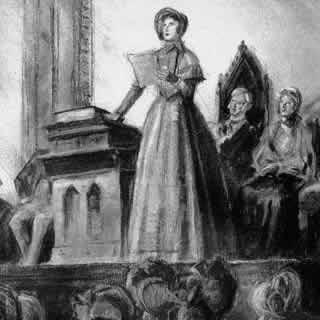
senecafalls-womanspeaking

The Seneca Convention

Friends of Padre Steve’s World,

The issue of Women’s Rights is still in the forefront of political debate in the United States. Women’s rights have been slow to progress despite the passage of the 19th Amendment which gave women the right to vote in 1920. The defeat of the Equal Rights Amendment in 1982 gave added ammunition to conservative opponents of Women’s rights to fight them.

Though women have long been in the workplace in many cases there is a large gap in pay for men and women doing the same jobs and having the same qualifications, likewise, the number of women in senior positions in the private sector and in government is still dwarfed by the numbers of men. The are numerous disparities in how men and women are treated in society, and in many cases and in many parts of conservative society, especially churches, women are still considered less than equal to men. In light of the fact that we will likely have a woman running as the Democratic Party nominee for President the issue is even more pronounced, and Hilary Clinton, whether one likes her or not, and regardless of her policies, or previous record as a Senator or Secretary of State, is held to a higher standard of scrutiny than men in those position.

But this is nothing new, and in light of this I have decided to re-post a sightly edited portion of the chapter in my Civil War and Gettysburg text that deals with the early Women’s Rights movement. I hope that you find it insightful.

Peace

Padre Steve+

Another development, which in large part is related to the abolition movement, was the campaign for women’s rights. The Civil War was also revolutionary because it was instrumental in propelling women into positions in American society that they had never before been allowed. The war Some of this was because many women decided to like those who campaigned for the end of slavery and the rights of African Americans to turn the world upside down. The war allowed the women who served, “in uniform or not, war permitted these women to experiment with a series of role reversals in gender,” [1] and in some cases gender and race. These experiments are the beginning of women’s’ equality and to women serving in the military.

In much of the country and in particular the South, women’s rights were the same as granted in English Common Law. Common law held to the more archaic understanding of the Christian Church that women were the property of their husbands, especially in cases of infidelity including during the trial of Dan Sickles for killing Barton Key.

Southern culture and law ensured that women had even few rights than the women in the North who were making some gains in the workplace and in various professions such as teaching and nursing. This was in large part due to the understanding that the “household was a spatial unit, defined by the property to which the owner not only held legal title over, but over which he exercised exclusive rights.” [2] As such Southern men had nearly unlimited rights and power over what occurred on his property, for “in societies in which landed property comprised the chief means of subsistence…legal title to the land had historically incorporated claims over the persons and labor of those who were dependents on it.” [3]

Thus for Southern men the stakes of ensuring slavery’s continuation and expansion were high, the culture of the South ante-bellum South was deeply patriarchal and “The possibility that the black man might be empowered like any other was such a threat to the southern social hierarchy that some white southerners were inclined to fear not only for their position as slaveowners but for the entire basis of their claim to patriarchal power. They feared for their power not only over their slaves but over their women as well.[4]

William Lloyd Garrison and the leaders of the abolitionist movement came into contact with two southern women who had converted to the abolitionist cause; South Carolina cotton heiresses, Sarah and Angelina Grimke. The two women were passionate as well as eloquent and became popular lecturers on the abolitionist speaking circuit. Angelina Grimke was a powerful speaker and linked abolition and women’s rights:

“We cannot push Abolitionism forward with all our might until we take up the stumbling block out of the road…. If we surrender the right to speak in public this year, we must surrender the right to petition next year, and the right to write the year after, and so on. What then can the woman do for the slave, when she herself is under the feet of man and shamed into silence?” [5]

The Grimke sisters and other women like them brought Garrison and others in the abolitionist movement into contact with the early leaders of the new women’s rights movement. The leaders of the movement, Elizabeth Cady Stanton, Abby Kelley, and Lydia Maria Child were outspoken in their belief that “a campaign to emancipate slaves could not avert its eyes from the need to emancipate American women from social conventions and legal restraints that prevented them, like the slave, from owning property and voting, and kept them altogether subservient to the interests of white males.” [6]

The principals involved in the abolitionist and the women’s movements, those of freedom, emancipation and equality eventually forged a bond between them, and have provided inspiration to others in their quest for political and social equality. For William Lloyd Garrison “the woman question clearly demonstrated how the logic of reform united all good causes and carried them to new ground. If in their endeavors to break the chains of slavery women discovered, as Abby Kelley put it, that “we were manacled ourselves,” the abolitionist principle required a defense of equal rights without regard to race or sex.” [7]

However, women found that their rights were not considered as important by the political leadership fighting for the rights of black men. Few in Congress “responded sympathetically to feminists’ demands. Reconstruction they insisted, was the “Negro’s hour.” [8] Though the economic situation of women began to improve, especially through women being admitted to the Civil Service. Likewise women began to have more educational opportunities in the post-war years. Women’s suffrage was not included in the Fifteenth Amendment, which caused a split between women’s groups and their long-time abolitionist allies who told them “If put on the same level and urged in the same connection, neither will soon be accomplished.” [9]  Even so in some territories women were granted the right to vote in territorial elections, “women were given the vote in Wyoming Territory in 1869. However, Wyoming’s admission as a state twenty years later came only after a heated debate on the women’s suffrage article in the state constitution.” [10]
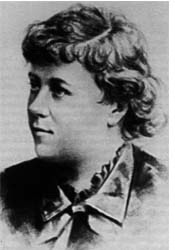
Elizabeth Cady Stanton

In the 1800s women in the United States were bound by English common law. Women had no claim to property, wages, or even their children. Single women had few rights while married women had even fewer as:

“marriage very nearly meant the legal annihilation of a woman…once a woman was married all property and property rights were transferred to her husband, and she was permitted to own nothing in her own name. Married women could not make contracts, could not sue, could not buy or sell, except over their husband’s signatures.” [11]

A married woman’s position was as close to being a slave as could be, and only the plight of black female slaves was worse, for they were simply chattel. The few free black women mainly stayed unmarried “in order to maintain what few property rights they were entitled to.” [12] As they also did over blacks, white men ruled over women in all spheres of life. While the eventual emancipation of blacks provided more rights for black men, those did not help many black women as Sojourner Truth, a pioneering African-American abolitionist who spent forty-years as a slave said toward the end of her long life:

“There is a great stir about colored men getting their rights, but not one word about colored women; and if colored men get their rights, and not colored women theirs, you see colored men will be master over the women, and it will be just as bad as it was before. So I am for keeping the thing going while things are still stirring because if we wait till it is still, it will take a great while to get it going again….I suppose I am the only colored woman that goes on to speak for the rights of the colored women. I want to keep the thing stirring, now that the ice is cracked…” [13]

Elizabeth Cady Stanton was among the most vocal of women’s rights advocates. She believed that a woman’s place in the home was ultimately destructive and “reflected her subordinate position in society and confined her to domestic duties that served to “destroy her confidence in her own powers, lessen her self respect, and to make her willing to lead a dependent and abject life.” [14] Stanton noted how the condition of women of her day was “more fully identified with the slave than man possibly can be… For while the man is born to do whatever he can, for the woman and the negro the is no such privilege.” [15] It was a key observation and something even today, a state that some politicians, pundits and preachers would like to return women.

Since nearly all of the most “outspoken feminists had been schooled in abolitionist movement” they were “suspect in the South, where society was conservative, patriarchal, and insistence that ladies live in a kind of earthly limbo.” [16] Such women posed a threat to the pillars of Southern society. Since the South was now fighting tooth and nail against the abolitionist movement, anything closely connected with that movement, including the women who advocated abolition and women’s rights were shunned and their message rejected and inflammatory and revolutionary. It was not until the crisis caused by the Civil war that Southern women began to seize “the opportunity to lay claim to an increased reciprocity in gender relations.” [17]

But even with the abolition movement there was opposition the women’s rights, the 1839 meeting of the American Anti-Slavery Society witnessed a debate over including women in the membership. Conservative Evangelicals recoiled in disgust, and when the convention voted to allow women into the membership Lewis Tappan “got up a starchy “protest” which condemned the “repugnant” admission of women as an ‘expression of local and sectarian feelings…well suited to the unnecessary reproach and embarrassment to the cause of the enslaved as [it] is at variance with the general usage and sentiments of this and other nations.” [18] In May of 1840 the American Anti-Slavery Society split among religious lines when leading evangelicals led by the Tappan brothers withdrew from it.

But that neither stopped Garrison from working with women, nor kept Frederick Douglass from embracing them as part of the abolitionist movement. From this rather inauspicious beginning, the women’s rights movement began to infiltrate society, especially in the field of education. In 1848 at Seneca New York there was a convention that launched the modern women’s rights movement. Led by Stanton and Elizabeth Mott the delegates published a “Declaration of Sentiments, modeled on the Declaration of Independence, proclaimed “that all men and women are created equal” and deserved their “inalienable rights” include the right to elective franchise.” [19] The declaration was bold and its denunciation of the place of women in society to be considered revolutionary in character. Part read:

“He has never permitted her to exercise her inalienable right to elective franchise. He has compelled her to submit to laws, in the formation of which she had no voice. He has withheld from her rights which are given to the most ignorant and degraded men – both natives and foreigners… He has made her, if married, in the eye of the law, civilly dead. He has taken from her all right to property, even to the wages that she earns…. After depriving her of all her rights as a married woman, if single, and the owner of property, he has taxed her to support a government which recognizes her only when her property can be made profitable to it. He has monopolized nearly all the profitable employments, and from those she is permitted to follow she receives but a scanty remuneration. He closes against her all the avenues to wealth and distinction which he considers honorable to himself. As a teacher of theology, medicine of the law, she is not known… He has created a false public sentiment by giving the world a different code of morals for men and women, by which moral delinquencies which exclude women from society, are not only tolerated, but deemed of little account in man. He has usurped the prerogative of Jehovah alone, claiming his right to assign for her a sphere of action, when that belongs to her conscience and to her God. He has endeavored, in every way that he could, to destroy her confidence in her own powers, lessen her self-respect, and to make her willing to lead an abject and dependent life.” [20]

The declaration also stated, in words which inflamed many men that: “the history of mankind is a history of repeated injuries and usurpations on the part of man toward woman, having in direct object of an absolute tyranny over her.” [21] In the years following this meeting women took up an even more important place in the abolitionist movement, Abby Kelly Foster returned to head the work and recruited many talented women agents including Sallie Holley, Lucy Stone and Susan B. Anthony who “often made five or six appearances a week” in various abolitionist meetings and in 1850-1851 they were joined by the “black evangelist Sojourner Truth, whom Garrison had met and the Northampton colony in 1843 and for whom he had printed an autobiographical narrative.” [22] These women contributed greatly to the abolitionist cause and would in the years to come be among those who continued to fight not only for the rights of blacks, but the rights of women.

The new women’s rights groups continued to work hand in hand with the abolitionist groups but also began a campaign for the rights of women. In the mid-1850s primarily focused on “obtaining state laws guaranteeing women’s right to control their property and wages, to be legal guardians of their children, and to be paid salaries commensurate with their labors, while a few women advocated for more liberal divorce laws so that they could rid themselves of alcoholic, insane, criminal, or brutal husbands.” [23] These efforts secured some modest gains and by 1861 most states had granted women some type of property rights or had changed their laws to follow the community property principle.

While the movement made modest progress regarding property rights for women in some states, they made little progress in terms of elective franchise and better wages and working conditions. During the ante-bellum period, women who lobbied for such rights were met with open opposition and scorn. The press “frequently denounced and ridiculed the “strong-minded women…” [24] Despite such attitudes women did make some significant advancements, particularly in lay aspects of the church, such as Bible societies, moral reform organizations, as well as the abolition and temperance movements, which had gained prominence during the Second Great Awakening.

During the ante-bellum period women made great progress in education. By 1850 the United States was the only country where “girls went to elementary school and achieved literacy in virtually the same proportion as boys.” [25] Likewise a few women entered higher education, particularly at women’s seminaries, which were for all practical purposes boarding schools that produced teachers and writers, as well as the Oberlin College, which was founded by Christian abolitionists and welcomed students of both genders as well as of any racial minority. During the three decades prior to the war women made some specific gains, but more important “was the development to their talents for organization, cooperation, leadership, and self expression. It was a time of beginnings and not fulfillment, a time when most women realized and accepted the fact that they lived in a man’s world, a time when a few dedicated but belligerent visionaries were frustrated in their attempt to remake the social order “overnight.” [26]

However, the war would help bring about many more opportunities for women. In 1850 a follow on conference to the Seneca conference, the National Women’s Rights Convention denied the right of anyone to dictate what women could do with their lives:

“The right of any portion of the species to decide for another portion, of any individual to decide for another Individual what is not their “proper sphere”; that the proper sphere for all human beings is the largest and highest to which they are able to attain; what this is, can not be ascertained without complete Liberty of choice; women therefore, ought to choose for herself what sphere she will fill, what education she will seek, and what employment she will follow, and will not be bound to accept, in submission, the rights, the education, and the place which man thinks proper to allow her.” [27]

Notes

[1] Ibid. Guelzo Fateful Lightening p.395

[2] McCurry, Stephanie The Politics of Yeoman Households in South Carolina in Divided Houses: Gender and the Civil War Oxford University Press, Oxford and New York 1992 p.23

[3] Ibid. McCurry The Politics of Yeoman Households in South Carolina p.23

[4] Whites, Leeann The Civil War as a Crisis in Gender in Major Problems in the Civil War and Reconstruction, 3rd Edition Edited by Michael Perlman and Murrell Taylor Wadsworth Centage Learning, Boston 2011 p.16

[5] Ibid. Zinn The Other Civil War p.121

[6] Ibid. Guelzo Fateful Lightening pp.49-50

[7] Mayer, Henry All on Fire: William Lloyd Garrison and the Abolition of Slavery W.W. Norton and Company, New York and London 1998 p.265

[8] Ibid. Foner Forever Free p.124

[9] Ibid. Foner Forever Free p.125

[10] Massey, Mary Elizabeth, Women in the Civil War University of Nebraska Press, Lincoln NE 1966 p. 358

[11] Ibid. Guelzo Fateful Lightening p.391

[12] Ibid. Guelzo Fateful Lightening p.391

[13] Ibid. Zinn The Other Civil War pp.53-54

[14] Ibid. Goldfield America Aflame p.74

[15] Ibid. Guelzo Fateful Lightening p.50

[16] Ibid. Massey Women in the Civil War p. 19

[17] Ibid. Whites The Civil War as a Crisis in Gender p.21

[18] Ibid. Mayer All on Fire p.267

[19] Ibid. McPherson Battle Cry of Freedom p.36

[20] Blanton, DeAnne and Cook, Lauren M. They Fought Like Demons: Women Soldiers in the Civil War Vintage a books, a Division of Random House New York 2002 pp.3-4

[21] Ibid. Guelzo Fateful Lightening p.392

[22] Ibid. Mayer All on Fire p.424

[23] Ibid. Massey Women in the Civil War p.21

[24] Ibid. Massey Women in the Civil War pp.21-22

[25] Ibid. McPherson The Battle Cry of Freedom p.36

[26] Ibid. Massey Women in the Civil War p.23

[27] Ibid. Guelzo Fateful Lightening p.392.

1 Comment

Filed under civil rights, History, laws and legislation, leadership, News and current events, Political Commentary

War What is it Good For? Sometimes Something: The Context of War

cropped-the_storming_of_ft_wagner-lithograph_by_kurz_and_allison_1890a.jpg

Friends of Padre Steve’s World,

Today something different. Yesterday I did a post about the Gettysburg Address and the importance of the proposition that of democracy that all men are created equal. It is a radical proposition that since the writing of the Declaration of Independence, the Emancipation Proclamation, the Gettysburg Address, the Thirteenth, Fourteenth, Fifteenth and Nineteenth Amendments, the Voting Rights Act of 1964 and Civil Rights Act of 1965, as well as Supreme Court decisions in Brown v. Board of Education and Obergfell v. Hodges, has grown in or country to encompass civil rights for African Americans and other racial minorities, Women, and Gays. But those liberties had to be fought for, and would most likely never happened had not Abraham Lincoln and others in the North understood that neither liberty or Union could survive if the South succeeded. In fact, all of us owe our continued freedom to that understanding and the necessity of total war to achieve it.

However, yesterday I had a Twitter troll snipe at me, this time a left-wing troll who claimed to be a “liberal progressive.” However, his remarks were so ignorant of history and reality that I am sure the the had no clue how his words betrayed his alleged beliefs. So in a few words I told him that he was basically ignorant and blocked him. Most of the time when this happens to me it comes from supposed “conservatives,” or “white nationalists” of various flavors, to include the KKK and Neo-Nazi types. But the fact that this came from a self-proclaimed “liberal and progressive” proves that ignorance is not confined to any ideology. That is a sad commentary on our time.

So what I am posting today is an updated and slightly edited portion of the first chapter of my Civil War and Gettysburg text. The entire chapter is close to 150 pages and is probably going to become a book in its own right, but I think it is important for my readers to understand, that sometimes liberty only comes with great sacrifice and the complete defeat of those who want to deny it. That does not matter if it was the Confederacy, Nazi Germany, or even the so-called Islamic State.

As a man who came back changed by war I can only say that I hate it. That being said, though I am a progressive and liberal, I am a realist and understand that as evil as war is, that surrendering liberty to those who believe in “liberty for the few, and slavery for all others.” 

The section of the book may seem a bit wonkish, but it is important. I understand that some of my readers will disagree, but one cannot escape reality.

So anyway, that being said I wish you a good day.

Peace,

Padre Steve+

Richard Evans wrote something in the preface to his book The Third Reich in History and Memory that those who study military history often forget. He noted: “Military history, as this volume shows, can be illuminating in itself, but also needs to be situated in a larger economic and cultural context. Wherever we look, at decision making at the top, or at the inventiveness and enterprise of second rank figures, wider contextual factors remained vital.” [1] Thus while this work is an examination of the Gettysburg campaign it is important to understand the various issues that were formative for the men who directed and fought the battle. One cannot understand the determination the determination of Robert E. Lee to maintain the offensive, the dogged persistence of Joshua Chamberlain or Strong Vincent to hold Little Round Top, what brought John Buford to McPherson’s Ridge, what motivated Daniel Sickles to move Third Corps to the Peach Orchard, and what motivated the men of Pickett’s division to advance to their death on Cemetery Ridge, without understanding the broader perspective of culture, politics, economics, religion, sociology, and ideology that shaped these men.

The American Civil War was the first modern war. It was a watershed event in an era, which introduced changes in new types of weapons, more lethal versions of older weapons, tactics, army organization, logistics, intelligence and communications. Though the war did not change the essential nature of war, which Clausewitz says is “is an act of violence to compel our opponent to fulfill our will” [2] it expanded the parameters of war and re-introduced the concept of “total war” to the world and “because its aim was all embracing, the war was to be absolute in character.” [3] In a sense it was a true revolution in military affairs.

The Civil War was truly a revolution in military affairs. The war changed the character of war, as it had been known for centuries, since the Peace of Westphalia and the end of the Thirty Years War. In the American Civil War, the character of war changed from a limited war waged between opposing armies into a war that at times bordered on Clausewitz’s understanding of absolute or total war. This conflict was waged between two people who shared much in common but were divided by an ideology which encompassed politics, economics, society, law, and even religion.

The war was revolutionary in other ways, and brought about a host of social, philosophical, economic, and political changes which continue to impact the lives of people in the United States and around the world even today. Some of these, especially those regarding the abolition of slavery and emancipation, as well as the beginnings of the Women’s Rights movement have had a ripple effect in matters of political and social equality for other previously disenfranchised groups of citizens. One writer noted in regard to the social impacts that “The Civil War uprooted institutions, transformed our politics, influenced social relationships of half a continent, and wrought changes that echo down the generations.” [4] Mark Twain wrote in 1873 that the war “uprooted institutions that were centuries old, changed the politics of a people …and wrought so profoundly upon the national character that cannot be measured short of two or three generations.” [5]

In a sense, when Abraham Lincoln proclaimed “a new birth of freedom” in his Gettysburg address it served as a watershed moment in American history because it brought to the forefront the understanding of Jefferson and the other signers of the Declaration of Independence that all men are created equal. That statement, flowing from the Declaration was key to Lincoln’s understanding of human rights and dignity, and from it came the Emancipation Proclamation and the Thirteenth Amendment, which abolished slavery. Those would be followed by the Republican Congresses’ passage of the Fourteenth Amendment, which overturned the Dred Scott Decision, which denied all citizenship to blacks across the country, and by Ulysses S. Grant’s Fifteenth Amendment, which gave African American men to right to vote. That is the human and political context by which we have to understand the American Civil War.

Thus it is important to study the Gettysburg campaign in the context of the Civil War because the campaign of 1863 in the east cannot be divorced from what was happening in the west at Vicksburg, nor the Union blockade, nor the diplomatic, economic and informational aspects of the war. Likewise the Gettysburg campaign cannot be separated from its relationship to the broader understanding of the nature and character of war. To do this one must examine the connection between them and policies made by political leaders; to include the relationship of political to military leaders, diplomats, the leaders of business and industry and not to be forgotten, the press and the people. Likewise we must understand the various contexts of war, to include the social, political, ideological and even the religious components of war, how they impacted Civil War leaders and why civilian policy makers and military leaders must understand them today.

While the essential nature of war remains constant, wars and the manner in which they are fought have changed in their character throughout history, and this distinction matters not only for military professionals, but also policy makers. The changing character of war was something that military leaders as well as policy makers struggled with during the American Civil War much as today’s military leaders and policy makers seek to understand the character of warfare today. British military theorist Colin Gray writes “Since the character of every war is unique in the details of its contexts (political, social-cultural, economic, technological, military strategic, geographical, and historical), the policymaker most probably will struggle of the warfare that is unleashed.” [6] That was not just an issue for Abraham Lincoln and Jefferson Davis, both of whom struggled with the nature of the war which had been unleashed, but it is one for our present political leaders, who as civilian politicians are “likely to be challenged by a deficient grasp of both the nature of war as well as its contemporary context-specific character.” [7]

In addition to being the first modern war, or maybe I should say, the first war of the Industrial Age, the Civil War prefigured the idea of total war written about by Clausewitz that occurred in the World Wars of the Twentieth Century. The war combined a massive number of technological advances, which both preceded and occurred during it, in which the philosophical nature of the Industrial Revolution came to the fore.

Likewise, the enmity of the two sides for one another had been fostered by a half century of relentless and violent propaganda that ushered from the mouths of politicians, the press and even from the pulpit brought the element of hatred to the fore of the conflict. A Confederate Captain wrote his wife to teach his children “a bitter and unrelenting hatred of the Yankee race” that had “invaded our country and devastated it…[and] murdered our best citizens…. If any luckless Yank should unfortunately come my way he need not petition for mercy. If he does I will give him lead.” A soldier from a Wisconsin regiment wrote to his fiancée after the assault on Resaca, Georgia that his unit had captured twenty-three Confederates and “or boys asked if they remembered Fort Pillow and killed them all. Where there is no officer with us, we take no prisoners…. We want revenge for our brother soldiers and will have it…. Some of the [rebels] say they will fight as long as there is one of them left. We tell them that is what we want. We want to kill them all off and cleanse the country.” [8]

As such there were many times the American Civil War came close to Clausewitz’s understanding of absolute war in its in character, and it prefigured the great ideological wars of the twentieth century. J.F.C. Fuller noted “for the first time in modern history the aim of war became not only the destruction of the enemy’s armed forces, but also of their foundations- his entire political, social and economic order.” [9] It was the first war where at least some of the commanders, especially Ulysses S. Grant and William Tecumseh Sherman were men of the Industrial Age, in their thought and in the way that they waged war, in strategy, tactics even more importantly, psychologically. Fuller wrote:

“Spiritually and morally they belonged to the age of the Industrial Revolution. Their guiding principle was that of the machine which was fashioning them, namely, efficiency. And as efficiency is governed by a single end- that every means is justified- no moral or spiritual conceptions of traditional behavior must stand in its way.” [10]

Both men realized in early 1864 that “the South was indeed a nation in arms and that the common European practice of having standing armies engaged each other in set-piece battles to determine the outcome of a war was not enough to win this struggle.” [11] Though neither man was a student of Clausewitz, their method of waging war was in agreement with the Prussian who wrote that “the fighting forces must be destroyed; that is, they must be put in such a position that they can no longer carry on the fight” but also that “the animosity and the reciprocal effects of hostile elements, cannot be considered to have ended so long as the enemy’s will has not been broken.” [12]

William Tecumseh Sherman told the mayor of Atlanta after ordering the civilian population expelled that “we are not only fighting hostile armies, but a hostile people, and must make the old and young, the rich and poor, feel the hard hand of war.” [13] Sherman was one of the first American military leaders to understand that a civil war could not be waged according to the limited war doctrines most American officers had been taught. He not only “carried on war against the enemy’s resources more extensively and systematically than anyone else had done, but he developed also a deliberate strategy of terror directed against the enemy’s minds.” [14] While some might find this troubling, the fact remains that it was Sherman’s Southern sweep of all that lay before him that broke the back of the Confederacy.

vincent

Strong Vincent

But Sherman and Grant were not alone in understanding the problem of fighting a limited war against the Confederacy. In the fall of 1862 a twenty-five year volunteer Colonel serving with McClellan’s army in Virginia who would be instrumental in throwing back Hood’s assault on Little Round Top, and die leading the defense of that edifice, by the name of Strong Vincent, understood what had to happen if the Union were to overcome the rebellion of the Confederacy.

“We must fight them more vindictively, or we shall be foiled at every step.  We must desolate the country as we pass through it, and not leave a trace of a doubtful friend or foe behind us; make them believe that we are in earnest, terribly in earnest; that to break this band in twain is monstrous and impossible; that the life of every man, yea, of every weak woman or child in the entire South, is of no value whatever compared with the integrity of the Union.” [15]

To most modern Americans who have no experience of war other than seeing it as a video spectator, the words of Vincent and Sherman seem monstrous and even inhuman. However, those who persist in such thinking fail to understand the nature and context of war. While some wars may be fought in a limited manner, others, especially ones driven by militant and uncompromising ideologies, often backed by fanatical religious beliefs cannot be limited, and those that fight such wars must, to paraphrase the words of Strong Vincent, “must fight them more vindictively, or be foiled at every step.” It would have been interesting to see what Vincent might have achieved had he not been cut down by Confederate bullets on Little Round Top.

Abraham Lincoln came to embrace the eternal nature of war as well as the change in the character of the war over time. Lincoln had gone to war for the preservation of the Union, and initially pursued the war in a limited way, seeking to defeat Confederate armies in the field while sparing the people of the Confederacy from total destruction.

But in his quest to preserve the Union, something that for him was almost spiritual in nature, as is evidenced by the language he used in both of his inaugural addresses and the Gettysburg Address, he found that Confederacy would only return to the Union if conquered, and he became convinced that the South’s peculiar institution, that of slavery, must be destroyed in the process. Thus, instead of a war to simply re-unite the Union and let bygones be bygones, Lincoln changed the narrative of the war when he signed the Emancipation Proclamation. When this happened the war not only became a war to restore the Union, but the a war for the liberation of enslaved African Americans, After January 1st 1863 when the Emancipation Proclamation went into effect, Lincoln “told an official of the Interior Department, “the character of the war will be changed. It will be one of subjugation…The [old] South is to be destroyed and replaced by new propositions and ideas.” [16] That too was a modern understanding of war.

Of course, the revolution in military affairs that characterized the Civil War took time, but it was the political and military leaders of the North who better adapted themselves and their nation to the kind of war that was being fought. “Lincoln’s remarkable abilities gave him a wide edge over Davis as a war leader, while in Grant and Sherman the North acquired commanders with a concept of total war and the determination to make it succeed.” [17]

At the beginning of the war the leaders and populace of both sides still held a misguided and unrealistic romantic idea of war. Most people in the North and the South held on to the belief that the war would be over in a few months and that would be settled by a few decisive battles and that casualties would be comparatively light. This included most politicians as well as many military officers on both sides. There were some naysayers who believed that the war would be long and costly, like the venerable and rather corpulent General Winfield Scott, but politicians and the press mocked Scott and other doubters who even suggested that the war would be long, hard, and bloody. Of course those who predicted a short, easy, and relatively bloodless war were the ones proven wrong, though it would take the leaders and the people of both sides over a year to understand. When it was done the American Civil War became the bloodiest war ever waged by Americans, and it was against other Americans.

Notes

[1] Evans, Richard J. The Third Reich in History and Memory Oxford University Press, Oxford and New York 2015 p.ix

[2] Clausewitz, Carl von. On War Indexed edition, edited and translated by Michael Howard and Peter Paret, Princeton University Press, Princeton NJ 1976 p.75

[3] Fuller, J.F.C. The Conduct of War 1789-1961 Da Capo Press, New York 1992. Originally published by Rutgers University Press, New Brunswick N.J p.99

[4] Lowry, Thomas P. The Stories the Soldiers Wouldn’t Tell: Sex in the Civil War Stackpole Books, Mechanicsburg PA 1994 p.176

[5] McPherson, James The War that Forged a Nation: Why the Civil War Still Matters Oxford University Press, Oxford and New York 2015 p.48

[6] Gray, Colin S. Fighting Talk: Forty Maxims on War, Peace, and Strategy Potomac Book, Dulles VA 2009 p.36

[7] Ibid. Gray Fighting Talk p.36

[8] Ibid. McPherson The War that Forged a Nation pp.49-50

[9] Fuller, J.F.C. A Military History of the Modern World, Volume Three: From the Seven Days Battle, 1862, to the Battle of Leyte Gulf, 1944 Minerva Press 1956 p.88

[10] Ibid. Fuller A Military History of the Modern World, Volume Three p.88

[11] Flood, Charles Bracelen, Grant and Sherman: The Friendship that Won the War, Harper Perennial, New York 2005 p.238

[12] Ibid. Clausewitz p.90

[13] McPherson, James. The Battle Cry of Freedom: The Civil War Era Oxford University Press, Oxford and New York 1988 p.809

[14] Weigley, Russell F. The American Way of War: A History of United States Military History and Policy University of Indiana Press, Bloomington IN, 1973 p.149

[15] Nevins, James H. and Styple, William B. What Death More Glorious: A Biography of General Strong Vincent Belle Grove Publishing Company, Kearney NJ 1997 p.57

[16] Ibid. McPherson The Battle Cry of Freedom p.558

[17] Ibid. McPherson The Battle Cry of Freedom p.857

Leave a comment

Filed under civil rights, civil war, ethics, History, Military, Political Commentary

Gettysburg and the Importance of Democracy

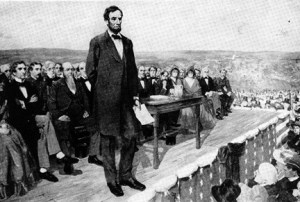
gburg address

Friends of Padre Steve’s World,

If you followed my writings over the past week you knew that I was again in Gettysburg leading my students on our Gettysburg Staff Ride.

This event was interesting as I was accompanied by five South Korean officers, all of whom were outstanding students, interested in learning, who also were able to glean the material and make application to today, not only in a military setting, but socially and politically. It was a joy to spend time with them each night over dinner and continue to discuss elements of the Civil War and the Battle of Gettysburg and hear them discuss social, political, diplomatic, and military connections between then and now, as well as the tensions that exist in their own country.

I wish that more Americans were able to do that, instead all too often we, no matter what our political or ideological position, choose to believe myth presented as history and biography.

Today I am not going to explore the issue of myth being presented and believed as history, as I have written about it relatively recently. Instead I want to remind my readers of the continued importance of Lincoln’s Gettysburg Address.

As always I end the Staff Ride at the Soldier’s Cemetery on Cemetery Hill and close with a talk about the human cost of war, and the importance of the Gettysburg Address today. I actually think that this event, which commemorated the soldiers who fought an died for a proposition, magnifies the importance of that victory, even as it marked the beginning of a universalizing the concept of liberty, a concept at the time which was still pretty much limited to White men.

In a time where many are wearied by the foibles and follies of our politicians, even wondering about our form of government can survive Lincoln’s words matter. Dr. Allen Guelzo, Professor of Civil War Studies at Gettysburg College wrote in the New York Times:

“The genius of the address thus lay not in its language or in its brevity (virtues though these were), but in the new birth it gave to those who had become discouraged and wearied by democracy’s follies, and in the reminder that democracy’s survival rested ultimately in the hands of citizens who saw something in democracy worth dying for. We could use that reminder again today.” [1]

Dr. Guelzo is quite correct. With the rise of Donald Trump and the frustration of so many people, on both the political right and left, many people in this country and around the world are having grave doubts about our democracy. I wonder myself, but I am an optimist. I do believe that we will recover because for the life of me I see no nation anywhere else with our resiliency and ability to overcome the stupidity of politicians, pundits and preachers.

Lincoln was sick when he delivered the address having what was mostly likely a mild form of Smallpox when he gave the address. Thus the tenor, simplicity and philosophical depth of the address are even more remarkable. It is a speech given in the manner of Winston Churchill’s “Blood sweat toil and tears” address to Parliament upon being appoint Prime Minister in 1940. Likewise it echoes the Transcendentalist understanding of the Declaration of Independence as a “test for all other things.”

Many in the United States and Europe did not agree and argued that no nation found on such principles could long survive. The more reactionary European subscribers of Romanticism ridiculed the “idea that a nation could be founded on a proposition….and they were not reluctant to point to the Civil War as proof that attempting to build a government around something as bloodless and logical as a proposition was futile.” [2]

But Lincoln disagreed. He believed that the “sacrifices of Gettysburg, Shiloh, Murfreesboro, Chancellorsville, and a hundred other places demonstrated otherwise, that men would die rather than to lose hold of that proposition. Reflecting on that dedication, the living should themselves experience a new birth of freedom, a determination – and he drove his point home with a deliberate evocation of the great Whig orator Daniel Webster – “that government of the people, by the people, for the people, shall not perish from the earth.” [3]

The Unitarian pastor and leading Transcendentalist Theodore Parker wrote:

“Our national ideal out-travels our experience, and all experience. We began our national career by setting all history at defiance – for that said, “A republic on a large scale cannot exist.” Our progress since that has shown that we were right in refusing to be limited by the past. The practical ideas of the nation are transcendent, not empirical. Human history could not justify the Declaration of Independence and its large statements of the new idea: the nation went beyond human history and appealed to human nature.” [4]

Likewise Lincoln’s address echoes the thought of George Bancroft who wrote of the Declaration:

“The bill of rights which it promulgates is of rights that are older than human institutions, and spring from the eternal justice…. The heart of Jefferson in writing the Declaration, and of Congress in adopting it, beat for all humanity; the assertion of right was made for the entire world of mankind and all coming generations, without any exceptions whatsoever.” [5]

Parker’s words also prefigured an idea that Lincoln used in his address, that being: The American Revolution, with American history since, is an attempt to prove by experience this transcendental proposition, to organize the transcendental idea of politics. The ideal demands for its organization a democracy – a government of all, for all, and by all…” [6]

So I ask that you take the time to reflect on the words of this remarkable speech, and in spite of all the cynicism take the time to read it again and imagine why it is still so important.

Four score and seven years ago our fathers brought forth on this continent, a new nation, conceived in Liberty, and dedicated to the proposition that all men are created equal.

Now we are engaged in a great civil war, testing whether that nation, or any nation so conceived and so dedicated, can long endure. We are met on a great battle-field of that war. We have come to dedicate a portion of that field, as a final resting place for those who here gave their lives that that nation might live. It is altogether fitting and proper that we should do this.

But, in a larger sense, we cannot dedicate — we can not consecrate — we can not hallow — this ground. The brave men, living and dead, who struggled here, have consecrated it, far above our poor power to add or detract. The world will little note, nor long remember what we say here, but it can never forget what they did here. It is for us the living, rather, to be dedicated here to the unfinished work which they who fought here have thus far so nobly advanced. It is rather for us to be here dedicated to the great task remaining before us — that from these honored dead we take increased devotion to that cause for which they gave the last full measure of devotion — that we here highly resolve that these dead shall not have died in vain — that this nation, under God, shall have a new birth of freedom — and that government of the people, by the people, for the people, shall not perish from the earth.[7]

Peace,

Padre Steve+

Notes

[1] Guelzo, Allen C. Lincoln’s Sound Bite: Have Faith in Democracy New York Time Opinionator, November 17th 2013 retrieved from http://opinionator.blogs.nytimes.com/2013/11/17/lincolns-sound-bite-have-faith-in-democracy/?_php=true&_type=blogs&_r=0 July 18th 2014

[2] Ibid. Guelzo. Fateful Lightening p.409

[3] Ibid. Guelzo. Fateful Lightening p.408

[4] Ibid. Wills. Lincoln at Gettysburg p.110

[5] Ibid. Wills. Lincoln at Gettysburg p.105

[6] Ibid. Wills. Lincoln at Gettysburg p.105

[7] Lincoln, Abraham The Gettysburg Address the Bliss Copy retrieved from http://www.abrahamlincolnonline.org/lincoln/speeches/gettysburg.htm

Leave a comment

Filed under civil rights, civil war, History, Political Commentary

Trumped: The End of the GOP as We Knew It


Friends of Padre Steve’s World,

Today I have just a few quick thoughts on the end of the GOP’s #NeverTrump campaign. 

It came as I thought with the crushing defeat that the Donald dealt Ted Cruz and John Kasich in Indiana last night. Now I really expected one or both to stay in the campaign to try and deny Trump a first ballot nomination in Cleveland, but the campaign to stop Trump seemed to end today when Ohio Governor John Kasich ended his campaign.

It started last night when “God’s Annointed One” for the Presidency, Ted Cruz ended his campaign to establish a theocratic state based on the theology of Christian Dominionism. Though he tried to cast himself as a successor to Ronald Reagan’s conservative mantle in the #NeverTrump movement, that was nothing more than a charade, Reagan would have never considered Cruz a real conservative, nor would have Barry Goldwater, the true ideological father of the now dead modern conservative movement. In fact Goldwater detested and distrusted the Christian Right. The end of Cruz’s campaign was also the death kneel of the Christian Right which expected that one of its own, Cruz, Huckabee, or Ben Carson, would be the GOP nominee this year. It is funny, back in October or November Teddy of last year was one of the favorites to win the nomination while Trump was considered a long shot outsider at best. 

However, the problem for Cruz and the other candidates of the Christian Right was threefold. First the influence of the Christian Right is declining. It’s leaders are old and increasingly ignored inside and outside the GOP, with the exception of people like Cruz. The polling numbers on this are incontrovertible, and the fact is that the incredibly partisan and hardline policies of leaders of the Christian Right is contributing to the rapid loss of young people in churches and the growth of the demographic known as the Nones, or those with no religious preference.  Second, there were too many of them in the race, and they bled votes from Cruz in the early primaries. The third was brought on by Cruz himself, nobody, even in his party likes him. He is viewed as creepy, Nixon without the charm, and former Speaker of the House, John Boehner summed up what many people feel when he  said that Cruz was “Lucifer in the flesh.” That fact was demonstrated in the Iowa caucuses when Cruz’s campaign used dirty tricks and torpedoed the campaign of Ben Carson, making thousands of phone calls the day of the caucus to tell caucus voters to vote for Cruz since Carson had dropped out. It was a bold faced lie and it enabled him to steal a win there. 

As far as Cruz goes, and everything that he represents, I can only say good riddance, and I hope you lose your next senate race. 

What this signals for the GOP is yet to be determined, but like many others I beleive that it signals the end of the GOP as we have known it. The party leadership may attempt to unify behind him and to control him, but it will be an uncomfortable alliance, and one which Trump holds the winning cards. The GOP is broken, it ignored the advice of those who wrote the post-mortem of the 2012 defeat of Mitt Romney, and now they have been “Trumped” so to speak. Trump’s negatives are such that even if he wins the general election, which based on current polls that pit him against either Clinton or Sanders show him losing hardly, the GOP may well lose the Senate, and many seats in the House. The fact is that Trump does not give a damn what Reince Priebus and GOP leadership think, he will do what he needs to win and if he does win, he will take the credit and do as he pleases. Some influential members the GOP conservative media base are already saying that in spite of the collapse that they will not support Trump. 

At first the GOP dismissed Trump. Then they tried to marginalize him, then when it was too late attempted to stop him. At every turn Trump outmaneuver end them, appealed to the anger and frustration of GOP voters, harnessed that energy, and “Trumped” the GOP leadership at every turn. It was quite fascinating to watch, and if I wasn’t a historian and well aware of the kinds of emotions Trump is playing to I would laugh it off. 

But as I have Sid since November, Trump cannot be underestimated, and if the Democratic nominee and party underestimate him, they too may end up being Trumped. So if there are Democrats or progressive out there feeling a sense of satisfactory schadenfreude in this, don’t celebrate too soon. 

So anyway, enough for today. Have a great evening. 

Peace,

Padre Steve+

Leave a comment

Filed under News and current events, Political Commentary

The End of the Republic?

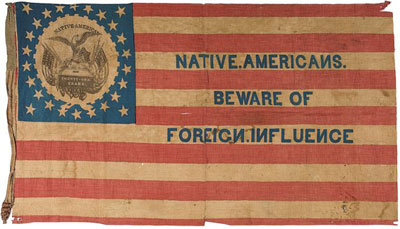
know-nothing_flag

Friends of Padre Steve’s World,

Today Donald Trump will likely bury his Republican competitors in Indiana nearly ensuring that he will win the GOP nomination, and in doing so he will have defied the logic of the GOP leadership by channeling the rage and anger against the status quo that they themselves have fomented over the past four decades. As he does this he will move on, and while some people assume that he will be swept away in November by the Democratic Party nominee, there is no guarantee of that, and those who are wise should not underestimate Trump, or the movement forming around him. The great American philosopher, Eric Hoffer once wrote, “Hatred is the most accessible and comprehensive of all the unifying agents. Mass movements can rise and spread without belief in a god, but never without a belief in a devil.”

Hatred is an amazing emotion. I have been almost overwhelmed by the amount of hatred being posted on social media, blogs, much of it by supposedly Christian preachers, politicians and pundits. Of course if you want find a politician, pundit and preacher all wrapped into one person look no further than Baptist preacher, conservative media pundit, and former Arkansas Governor Mike Huckabee, or the “anointed one” Ted Cruz. But these charlatans of the Christian right pale in comparison to Donald Trump in their ability satiate the desire for a savior of people who are angry and fearful, people that feel cheated, that they have lost their country or their status in it.

This is scary, as it possibly portends the end of our great experiment as a nation. For unlike love, hatred is easy to conjure up. It is kind of like what you need to build a fire; fuel, oxygen and heat. To generate hatred on a massive scale all you need is a disaffected populace, a convenient target, and an agent to ignite the mixture.

Shrewd politicians, preachers, and pundits do this well. Honestly, I think that most effective politician doing this today this is Donald Trump, a man who is lavishly rich, but connects with regular people by speaking their language, and channeling their anger. The situation is much like Germany in 1930 when became a true national party capitalizing on the frustration and anger of Germans at the flailing and failing Weimar Republic. Richard Evans wrote about that in his book “The Coming of the Third Reich.”

“Voters were not really looking for anything very concrete from the Nazi Party in 1930. They were, instead, protesting against the failure of the Weimar Republic. Many of them, too, particularly in rural areas, small towns, small workshops, culturally conservative families, older age groups, or the middle-class nationalist political milieu, may have been registering their alienation from the cultural and political modernity for which the Republic stood, despite the modern image which the Nazis projected in many respects. The vagueness of the Nazi programme, its symbolic mixture of old and new, its eclectic, often inconsistent character, to a large extent allowed people to read into it what they wanted to and edit out anything they might have found disturbing.” 

It does not matter to many of Trump’s followers that his policy propositions in terms of ending alliances, building walls around the border with Mexico paying the bill, massive deportations of people, trade wars to end the deficit, and total bans on travel to this country based on religion, are quite literally impossible. But as Hoffer noted Trump’s followers, like those of any frustrated group and marked by a “facility for make-believe, a readiness to hate, a readiness to imitate [and] credulity, a readiness to attempt the impossible.”

Mass movements, like the one that Trump is building before our very eyes, demonize the target group or population and then let the hatred of their disaffected followers flow. The leaders need that disaffected and angry base in order to rise to power; such was how Hitler, Stalin, and so many other despots gained power. They took advantage of a climate of fear, and found others to blame. For Hitler it was the Jews; while for Stalin it was various groups like the Ukrainians, or the Poles who were the devil to be feared and destroyed. Timothy Snyder in his book Bloodlands: Europe Between Hitler and Stalin wrote:

“Dead human beings provided retrospective arguments for the rectitude of policy. Hitler and Stalin thus shared a certain politics of tyranny: they brought about catastrophes, blamed the enemy of their choice, and then used the death of millions to make the case that their policies were necessary or desirable. Each of them had a transformative utopia, a group to be blamed when its realization proved impossible, and then a policy of mass murder that could be proclaimed as a kind of ersatz victory.”

Snyder is quite correct, demonizing a people and making them some kind of “other”, “they”, or “them”, is a wonderful way to blame a group of people for the ills of society. It is also a good way to deflect the blame for the corporate failures of societies and governments onto a convenient scapegoat; and to blame others for the personal failures and petty jealousies of the people doing the demonizing. It also allows people to abandon ethics and the simple notion of the Golden Rule an engage in genocide.

Mass movements and their leaders love to use this technique; especially when using it against those of other races or religions. The technique is not at all new, it has been used from antiquity but has become much more dangerous in the modern era with the spread of instant communications technology. History shows us all too clearly how it has happened and how easily it can happen again. Witch hunts, slavery and Jim Crow, the extermination of the Native Americans which inspired Hitler in his campaign of genocide and the Holocaust; the Soviet gulags and ethnic cleansing, the Rape of Nanking, the Chinese Communist “Cultural Revolution” the Rwandan genocide, Srebrenica, the Turkish genocide of the Armenians, and the current crimes against humanity of the so called Islamic State. Sadly, the list can go on and on.

All of these events simply required the elements of a disaffected population, a devil or scapegoat to blame, and a leader or leaders to ignite the volatile mixture; fuel, oxygen and heat. Hoffer was quite correct that “Mass movements can rise and spread without belief in a god, but never without a belief in a devil.” The really successful leaders of such movements understand this. For Hitler it was the Jews and other untermenschen; for American Southerners after the Civil it was the Blacks and their white supporters. For the American “Know Nothings” of the 1840s and 1850s it was immigrants, especially Irish and Germans who were Catholic; for Stalin it was non-Russian ethnic minorities. For the leaders of the Islamic State, it is Jews, Shi’ite Moslems, less than “faithful” Sunnis, Christians and well for that matter anyone who does not line up one hundred percent with them on every issue. The examples are so plentiful to support this fact that it is almost overwhelming.

The problem is that when any society, or government begins to label or stigmatize a race, religion, ethnicity, sexual preference, or political ideology, and then in the process demonize those people to the point that they become less than human we have reached a tipping point. Trump has been doing that for his entire campaign. We are very close to the point where we are just one crisis away from all of those crimes against humanity that we believe that we are no longer capable of doing.

But sadly, we human beings are not nearly as evolved as we think and I think that the tipping point in the United States may be far closer than we could ever imagine. In fact, Andrew Sullivan wrote today that “right now, American is a breeding ground for tyranny,” and that “Trump is not just a wacky politician of the far right, or a riveting television spectacle, or a Twitter phenom and bizarre working-class hero. He is not just another candidate to be parsed and analyzed by TV pundits in the same breath as all the others. In terms of our liberal democracy and constitutional order, Trump is an extinction-level event. It’s long past time we started treating him as such.”

I really do not think that we are too far from some tipping point where the politicians, pundits and preachers; especially those of the political right and the media whores who are more concerned about market share than truth, decide that their “devils” must be exterminated and Trump, is the man to make this happen. Of course when he does, his supporters will claim a higher moral, religious, or racial, purpose; or perhaps use the language of Manifest Destiny, the Lost Cause, or the Stab in the Back or some other historical myth that suffices to justify their actions.

As I have said before, Trump’s GOP and potential Democratic opponents would be wise not to underestimate Trump and maybe even form common cause to stop him before it is too late. If they do not the tipping point will have been reached and we will move on into real tyranny.

In the Star Trek the Next Generation episode entitled The Drumhead Captain Picard has to warn his security officer, Lieutenant Worf about the dangers of rampant paranoia. Worf starts: “Sir, the Federation does have enemies. We must seek them out.”
 

Picard pauses and then notes:

“Oh, yes. That’s how it starts. But the road from legitimate suspicion to rampant paranoia is very much shorter than we think. Something is wrong here, Mister Worf. I don’t like what we have become.”

To claim Picard’s words for myself, I have to admit that I don’t like what we have become either.

Peace

Padre Steve+

4 Comments

Filed under leadership, News and current events, Political Commentary

Why Can’t We Be Friends?

Friends of Padre Steve’s World,

It is a good day. I have spent the last couple of days talking about life kinds of things and continue that trend by sharing a few thoughts about friendship, politics, and religion.

I have read a number of articles recently that addressed the growing political divide in the country and one of the commonly cited factors are that a growing number of Americans now pick their friends based on politics, religion, and ideology. That reminded me of Thomas Jefferson who once noted, “I never considered a difference of opinion in politics, in religion, in philosophy, as cause for withdrawing from a friend.”

Sadly, I have lost friends for these very reasons and every one of them saddened me. In most cases I was not the one that broke off the friendship. Now there have been a couple of times where the relationship had grown so toxic that I had to break it off to in order not end up in the position of hating the person, and to protect myself. But those cases have been few and far between. I think that I can count them on one hand.

I have friends that span the political, ideological, religious, ethnic and racial, and even sexual orientation spectrum. Hell, I even count Los Angeles Dodger’s and New York Yankee’s fans among my friends, and that coming from a diehard San Francisco Giant and Baltimore Orioles fan is truly exceptional.

I guess that most of why I am like this is because I loved the diversity that I experienced at Edison High School in Stockton, California, which I went to because of court-ordered desegregation, and close to thirty-five years of military service. In both cases I got to experience the friendship, in many cases lifelong friendships with people whose experience, culture, and backgrounds were very different from mine. This has enriched me as a human being. 

Today, my closest friends are those that I hang out at my local Gordon Biersch Brewery bar, and the local ballpark. They span the spectrum from the most liberal and progressive Bernie supporters to most devoted supporters of Donald Trump, not to mention mainline liberals and conservatives, Libertarians, Greens, as well as Social Conservatives and members of the Christian Right.

The same is true of my social media, both Facebook and Twitter. I do not have to agree with someone to respect them, care about them, and be a friend. I personally don’t understand how anyone can only hang out with people that are like them, frankly that to me sounds boring. I don’t mind exchanging ideas with friends, but I do get put off by ideologues of all beliefs who care nothing for anything but their agenda. I am not adverse to people having strong beliefs, but to impose them as a condition of friendship is beyond me.

My friends know my beliefs. They know that I am liberal, and a proponent of expanding civil rights, and against any law that is written expressly to deny the rights of others purely for the sake of religion. But that being said I don’t need to impose them as a condition of friendship. I gain so much by the multitude of people that are my friends, their real diversity in all things. I cannot imagine doing anything to intentionally lose any of their friendship this political season.

It’s just my opinion, but I think that we would all be better off to try to do the same this year and build bridges. I think instead of condemning people we don’t know just because they are different that we should take the time to get to know them and become friends that we could actually work together, solve our problems, and heal our wounds. 

But then maybe I am too much of a relic of the 1960’s and 1970’s. Maybe, to use the immortal words of John Lennon “I’m just a dreamer, but I’m not the only one. I hope one day you’ll join us, and the world will live as one.” 

So anyway, have a great weekend.

Peace

Padre Steve+


1 Comment

Filed under News and current events, philosophy, Political Commentary

What is Freedom ? The 14th Amendment

14-amendment

Friends of Padre Steve’s World,

I am going to be traveling today for a get together tonight celebrating the life of one of my friends in North Carolina. The man who passed away, “New York Mike” was one of the people who brought me into their lives in Emerald Isle when I was stationed away from my wife, and still dealing with terrible depression and other symptoms of PTSD. Mike was great, and he will be missed. When one of my other friends let me know, I was stunned. At the same time I am glad that he was a part of my life, and that he will not suffer anymore. It is good to have friends who care, and I am blessed to have many.

So today I am basically re-running an older post about the 14th Amendment from my Civil War text.

Have a great day and please be safe.

Peace

Padre Steve+

The situation for newly emancipated blacks in the South continued to deteriorate as the governors appointed by President Johnson supervised elections, which elected new governors, and all-white legislatures composed chiefly of former Confederate leaders. Freedom may have been achieved, but the question as to what it meant was still to be decided, “What is freedom?” James A. Garfield later asked. “Is it the bare privilege of not being chained?… If this is all, then freedom is a bitter mockery, a cruel delusion.” [1] The attitude of the newly elected legislatures and the new governors toward emancipated blacks was shown by Mississippi’s new governor, Benjamin G. Humphreys, a former Confederate general who was pardoned by Andrew Johnson in order to take office. In his message to the legislature Humphreys declared:

“Under the pressure of federal bayonets, urged on by the misdirected sympathies of the world, the people of Mississippi have abolished the institution of slavery. The Negro is free, whether we like it or not; we must realize that fact now and forever. To be free does not make him a citizen, or entitle him to social or political equality with the white man.”  [2]

Johnson’s continued defiance of Congress alienated him from the Republican majority who passed legislation over Johnson’s veto to give black men the right to vote and hold office, and to overturn the white only elections which had propelled so many ex-Confederates into political power. Over Johnson’s opposition Congress took power over Reconstruction and “Constitutional amendments were passed, the laws for racial equality were passed, and the black man began to vote and to hold office.” [3] Congress passed measures in 1867 that mandated that the new constitutions written in the South provide for “universal suffrage and for the temporary political disqualification of many ex-Confederates.” [4]  As such many of the men elected to office in 1865 were removed from power, including Governor Humphreys who was deposed in 1868.

These measures helped elect bi-racial legislatures in the South, which for the first time enacted a series of progressive reforms including the creation of public schools. “The creation of tax-supported public school systems in every state of the South stood as one of Reconstruction’s most enduring accomplishments.” [5] By 1875 approximately half of all children in the South, white and black were in school. While the public schools were usually segregated and higher education in tradition White colleges was restricted, the thirst for education became a hallmark of free African Americans across the county. In response to discrimination black colleges and universities opened the doors of higher education to many blacks.  Sadly, the White Democrat majorities that came to power in Southern states after Reconstruction rapidly defunded the public primary school systems that were created during Reconstruction.  Within a few years spending for on public education for white as well black children dropped to abysmal levels, especially for African American children, an imbalance made even worse by the Supreme Court’s ruling in Plessy v. Ferguson which codified the separate but equal systems.

They also ratified the Thirteenth and the Fourteenth Amendments, but these governments, composed of Southern Unionists, Northern Republicans and newly freed blacks were “elicited scorn from the former Confederates and from the South’s political class in general.” [6] Seen as an alien presence by most Southerners the Republican governments in the South faced political as well as violent opposition from defiant Southerners.

The Fourteenth Amendment was of particular importance for it overturned the Dred Scott decision, which had denied citizenship to blacks. Johnson opposed the amendment and worked against its passage by campaigning for men who would oppose it in the 1866 elections. His efforts earned him the opposition of former supporters including the influential New York Herald declared that Johnson “forgets that we have passed through a fiery ordeal of a mighty revolution, and the pre-existing order of things is gone and can return no more.” [7]

Johnson signed the Amendment but never recanted his views on the inferiority of non-white races. In his final message to Congress he wrote that even “if a state constitution gave Negroes the right to vote, “it is well-known that a large portion of the electorate in all the States, if not a majority of them, do not believe in or accept the political equality of Indians, Mongolians, or Negroes with the race to which they belong.” [8]

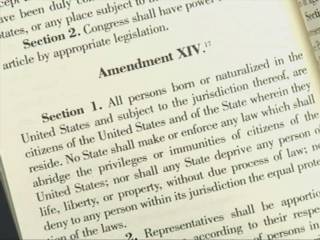
When passed by Congress the amendment was a watershed that would set Constitutional precedent for future laws. These would include giving both women and Native Americans women the right to vote. It would also be used by the Supreme Court in the 1954 Brown v. Board of Education decision that ended the use of “separate but equal” and overturned many other Jim Crow laws. It helped lead to the passage of the Voting Rights Act of 1964 and the Civil Rights Act of 1965, and most recently was the basis of the Supreme Court decision in Obergfell v. Hodges, which give homosexuals the right to marry. Section one of the amendment read:

“All persons born or naturalized in the United States, and subject to the jurisdiction thereof, are citizens of the United States and of the state wherein they reside. No state shall make or enforce any law which shall abridge the privileges or immunities of citizens of the United States; nor shall any state deprive any person of life, liberty, or property, without due process of law; nor deny to any person within its jurisdiction the equal protection of the laws.” [9]

Even so, for most white Southerners “freedom for African Americans was not the same as freedom for whites, as while whites might grant the black man freedom, they had no intention of allowing him the same legal rights as white men.” [10] As soon as planters returned to their lands they “sought to impose on blacks their definition of freedom. In contrast to African Americans’ understanding of freedom as a open ended ideal based on equality and autonomy, white southerners clung to the antebellum view that freedom meant mastery and hierarchy; it was a privilege, not a universal right, a judicial status, not a promise of equality.”  [11] In their systematic efforts to deny true freedom for African Americans these Southerners ensured that blacks would remain a lesser order of citizen, enduring poverty, discrimination, segregation and disenfranchisement for the next century.

Notes

[1] Ibid. Foner A Short History of Reconstruction p.30

[2] Ibid. Lord The Past that Would Not Die pp.11-12

[3] Ibid. Zinn The Other Civil War p.54

[4] Ibid. McPherson The War that Forged a Nation p. 178

[5] Ibid. Foner Forever Free p.162

[6] Perman, Michael Illegitimacy and Insurgency in the Reconstructed South in The Civil War and Reconstruction Documents and Essays Third Edition edited by Michael Perman and Amy Murrell Taylor Wadsworth Cengage Learning Boston MA 2011 p.451

[7] Ibid. Foner Forever Free p.121

[8] Ibid. Langguth After Lincoln p.232

[9] _____________ The 14th Amendment to the U.S. Constitution retrieved from https://www.law.cornell.edu/constitution/amendmentxiv 29 June 2015

[10] Ibid. Carpenter Sword and Olive Branch p.93

[11] Ibid. Foner Forever Free p.92

1 Comment

Filed under civil rights, civil war, History, laws and legislation, Political Commentary

Never Forget: The Murrah Federal Building Bombing of 1995

murrah bombing

Friends of Padre Steve’s World,

Just a short note for today. Amid all the political drama associated with the Republican and Democratic primaries this week, one thing that was overlooked by most people was the anniversary of the bombing of the Murrah Federal Building by Timothy McVeigh and Terry Nichols in 1995.

I don’t think that I could ever forget the day. I was working as a hospital ER department chaplain where I worked a 3:00-11:00 shift. Having just got up I turned on the news and was drinking my coffee when the news about the bombing flashed across the screen. I was stunned, especially when I found out that the bombers were Americans, and both former soldiers.

168 people, including babies and young children in the day care center were killed, hundreds of others wounded. McVeigh and Nichols were part of the anti-government so-called “militia” movement that still exists in parts of this country, of which the Bundy family, which occupied a Federal Wildlife Sanctuary earlier this year in order to bring about a revolt against the government is part.

Sadly, there are such people who would do the same today if given the chance, and as this attack shows, they are not all Islamic terrorists, but some are plain old Americans, people you might see in the grocery store or the gas station.

So let’s never forget.

Peace

Padre Steve+

1 Comment

Filed under History, News and current events, Political Commentary, terrorism

Post New York Thoughts

trumphillarynewyork_032516getty2

Friends of Padre Steve’s World,

I have just a few short thoughts about the New York primaries and the massive victories recorded by Hillary Clinton and Donald Trump.

My gut feeling, looking at the results, as well as polling data available for most of next week’s primaries in Pennsylvania, Delaware, Maryland, Connecticut and Rhode Island is that this marks the end of any real chance for Bernie Sanders to win the Democratic nomination, and the same for either Ted Cruz or John Kasich to come back and have an outright win against Trump.

On the Republican side the best Trump’s opponents can hope for is that he falls short of the needed number to win on the first ballot and that uncommitted delegates do not support him. If it goes to a contested convention, turn out the lights on the GOP. I still expect the GOP establishment will throw in everything to try to stop Trump, and they may yet succeed, but New York was a massive blow against their hope to stop him.

As for the Democrats, the New York results showed how formidable that Hillary is, she not only trounced Sanders by close to 300,000 votes, but collected about 200,000 than all the Republicans combined. The primary wasn’t close and the complaints of Sanders and his supporters that the primary was rigged against them make them sound like sore losers. The next series of primaries play to Hillary’s strengths and I expect her to add to her delegate lead, and after New York I don’t expect any upsets.

Honestly, I think that Sanders made a huge mistake by going so negative against Hillary, and that is actually going to turn people away from him. He is at his best when he is positive and talks about his ideas, and looks like a crotchety old man when he goes negative, and his attacks on Clinton are not likely to win him the support of the Super-Delegates. The fact that he hasn’t been able to go into details about his plans, and the fact that he appears unprepared and defensive when interviewed about them, does not help his cause with voters that want specifics. As I have said many times before many of his ideas resonate with me, but just having ideas with no plan of how you will get them through a potentially hostile Congress is a non-starter.

I am pragmatic, and I think that Bernie needs to figure out what his campaign can do realistically and decide on a realistic course of action. If he continues to go negative and tolerate his supporters making asses out of themselves by doing the same he not only risks his campaign, but damages the one person who might get at least some of those good ideas through Congress. If he plays that game he only helps the Republicans.

A historical analogy is how the Independent Socialists, who joined with the Communist Party after the German Revolution at the end of the First World War, torpedoed the Majority Socialist’s attempts to promote a progressive agenda during the Weimar Republic. They accused the Social Democrats of being worse than the Nazis and during the Republic’s crisis of 1928-1933, they cooperated with the Nazis to collapse support for the Social Democrats and bring down the government, with disastrous results for Germany.

Anyway, that’s all for now,

Peace

Padre Steve+

Leave a comment

Filed under News and current events, Political Commentary

Jim Crow and After

blog-crow-copy

Friends of Padre Steve’s World,

I am taking the day off to be with my wife as she recovers from her procedure and am posting another section of my Civil War text, this dealing with the coming of Jim Crow. It is still a pertinent topic, especially because there are quite a few people in our country today who would like nothing more than to re-establish it and in addition to African Americans include others such as Hispanics, Muslims, and Gays to their list of people that it would be legal to discriminate against. We are already seeing this in a number of Southern States when it comes to laws making it harder from Blacks to vote, especially elderly and poor ones, as well as religiously inspired anti-LGBT laws which are so vague, that they could be used against anyone.

So anyway, have a good day,

Peace,

Padre Steve+

The legislation enacted by Congress to declare African Americans free, the Thirteenth Amendment; to recognize them as citizens, the Fourteenth Amendment; and to give African American men the right to vote, the Fifteenth Amendment were revolutionary documents. However, after Reconstruction ended every state in the South, with the acquiescence of Northern businessmen and politicians worked to roll back those rights and this ensured that the “resurrected South would look a great deal like the Old South, a restored regime of white supremacy, patriarchy, and states’ rights. This political and cultural principles became holy tenants, dissent from which threatened redemption.” [1] The means used to regain this in included state legislation against blacks, violence committed by people associated with racist terrorist groups such as the Ku Klux Klan, and the actions of Federal Courts including the Supreme Court to regulate those rights out of existence.

Newly elected President Rutherford B. Hayes officially ended Reconstruction in 1877 and all Federal troops assigned to enforce it were withdrawn. Despite this, some people in the South attempted to fight for the rights of African Americans, including men like former Confederate Generals James Longstreet, William Mahone and Wade Hampton. Their motives varied and all of them were vilified by their political opponents and by the press. The attacks on Longstreet were particularly vicious and in the Myth of the Lost Cause he is painted as a man worse than Judas Iscariot.

Hampton is perhaps the most contradictory and curious of these men. Hampton was and remained an avowed White Supremacist who used his own money to finance, recruit and lead a regimental sized unit in the Civil War. He was elected as the first post-Reconstruction governor of South Carolina despite the generous help and assistance of the Red Shirts to rig the election by suppressing the black vote, actually campaigned against the black codes. During his term in office Hampton, to the chagrin of white South Carolinians even appointed African Americans to political offices in the state and maintained a regiment of African American state militia in Charleston against strident opposition.

While Hampton remained a white supremacist and used the Red Shirt militia to help in his election as Governor of South Carolina, he disappointed many of his white supremacist supporters. Hampton, despite his past, was also was committed to the upholding the law and “promoting the political rights to which freedmen were entitled to under law, and he consistently strove to protect those rights.” [2] This made Hampton anathema for many South Carolina politicians, including Benjamine Tillman who as governor during the 1890s dismantled policies that Hampton had introduced to allow blacks to political patronage appointments. Once he did that Tillman set out to deprive South Carolina’s blacks of almost every basic civil right, and in 1895 he led “a successful effort to rewrite the South Carolina constitution in such a way as to virtually disenfranchise every black resident of the state.” [3] Longstreet, who had become a Republican, was wounded while leading Louisiana militia in an unsuccessful fight against White Leaguers in New Orleans on September 14th 1873.

voting

The Supreme Court, the Congress and the Presidents rolled back these rights after Reconstruction ended. The Courts were the first to do this and once they had set the precedent were followed by the now Democrat controlled Congress and President Grover Cleveland. In 1883 “the Civil Rights Act of 1875, outlawing discrimination against Negroes using public facilities, was nullified by the Supreme Court, which said: “individual invasion of individual rights is not the subject-matter of the amendment.” The Fourteenth Amendment, it said, was aimed at state action only. No state shall…” [4] Associate Justice Joseph Bradley who had so eviscerated the Enforcement Act again played his hand in overturning a law that he despised on principle. He had written when Grant first signed the act in 1875 “to deprive white people of the right of choosing their own company would be to introduce another kind of slavery…. It can never be endured that the white shall be compelled to lodge and eat and sit with the Negro. The latter can have his freedom and all legal and essential privileges without that. The antipathy of race cannot be crushed and annihilated by legal enactment.” [5] In writing to overturn the Civil Rights Act of 1875 Bradley wrote that such laws were made African Americans a “special favorite of laws” and ignored the fact that in most of the country blacks were indeed not a favorite and were in fact still the subject of discrimination, segregation, political disenfranchisement, systematized violence, murder and lynching.

The actions of the court and alliances between Northern corporations and Southern landowners led to even more discrimination and disenfranchisement for blacks, “From the 1880s onward, the post-Reconstruction white governments grew unwilling to rely just on intimidation at the ballot box and themselves in power, and turned instead to systematic legal disenfranchisement” [6] which furthered the black codes into what we now call the era of Jim Crow.

For years after the Supreme Court’s Cruikshank decision blacks throughout the South attempted to vote despite intense opposition from Southern whites and armed bands of thugs. But with White Democrats now in charge of local government and “in control of the state and local vote-counting apparatus, resistance to black voting increasingly took the form of fraud as well as overt violence and intimidation. Men of color who cast Republican votes often found later that they had been counted for the party of white supremacy.” [7]

101111-national-civil-rights-act-1875.jpg

In 1896 the Supreme Court in the case of Plessy v. Ferguson upheld the black codes and Jim Crow laws. That ruling established the “separate but equal” doctrine and ushered in an era of de jure segregation in almost all arenas of life including education, transportation, entertainment and health care. The limited social equity and privileges enjoyed by blacks, not only in the South, but in the entire nation were erased by the stroke of the judicial pen. The justices ruled on the concept that the Constitution only guaranteed or protected a people’s political rights in the social arena that African-Americans could not interact with whites and assumed their racial inferiority.

Not all on the Court agreed with these rulings. One of them was Associate Justice John Harlan, who was a former slaveholder. Harlan dissented in Court’s decision to overturn the Civil Rights Act of 1875 and also in Plessy v. Ferguson. In the case of the Civil Rights Act ruling Harlan insisted “our Constitution is color blind” [8] and wrote a strongly worded opinion:

“The destinies of two races, in this country are indissolubly linked together, and the interests of both require that the common government of all should not permit the seeds of race hate to be planted under the sanction of law. What can more certainly arouse race hate, what more certainly create and perpetuate a feeling of distrust between these races, than state enactments, which, in fact, proceed on the ground that colored citizens are so inferior and degraded that they cannot be allowed to sit in public coaches occupied by white citizens? That, as all will admit, is the real meaning of such legislation as was enacted in Louisiana.” [9]

As eloquent and as correct as Justice Harlan’s argument was, it was not sufficient to turn the tide of the new Court backed segregation laws. Harlan “was fighting a force greater than the logic of justice; the mood of the Court reflected a new coalition of northern industrialists and southern businessmen-planters.” [10] The “separate but equal” measures approved by the Court majority in Plessy v. Ferguson led to the widespread passage of Jim Crow laws, not only in the South but in other areas of the country. The Jim Crow era took nearly a century to reverse, and “only began to disappear with Brown v. Board of Education in 1954 and the Civil Rights and Voting Rights Acts of 1964 and 1965.” [11]

These court decisions and legislation strengthened racism and discrimination against blacks, “effectively excluding blacks from public places, from the right to votes, from good public education, and so forth.” [12] The Plessy ruling was a watershed. Southern legislators, now unencumbered by Federal interference passed “state laws mandating racial segregation in every aspect of life, from schools to hospitals, waiting rooms to toilets, drinking fountains to cemeteries…segregation was part of a complex system of white domination, in which each component – disenfranchisement, unequal economic status, inferior education – reinforced the others.” [13] For decades future courts would cite Plessy and Cruikshank as well as other decisions as precedent in deny rights to blacks. It would not be until 1954 when the Supreme Court overturned Plessy and the “Separate but Equal” Jim Crow laws in Brown v. Board of Education. Brown was a watershed for it deemed that separate schools were “inherently unequal.” The reaction across the South, especially Mississippi was stunned shock, disbelief and anger. “A Mississippi judge bemoaned “black Monday” and across the South “Citizen’s Councils” sprung up to fight the ruling. [14]

Mississippi led the way in disenfranchising black voters through the use of voter qualifications that would eliminate most blacks from the rolls of voters. In 1895 the state legislature passed a measure that would “technically apply to everybody but actually eliminate the Negro without touching the white.” [15] The move was in open defiance of the Fifteenth Amendment and resulted in tens of thousands of black voters being dropped from the rolls, in most cases under 5% of black voters who had been eligible to vote in 1885 remained eligible in 1896. Mississippi was rewarded in 1898 when the Supreme Court in Williams v. Mississippi that “there was no reason to suppose that the state’s new voting qualification were aimed specifically at Negroes.” [16] “In 1900 blacks comprised 62 percent of Mississippi, the highest percentage in the nation. Yet the state had not one black elected official.”  [17]

Violence was used with great effect and between 1880 and 1968 approximately 3,500 people were murdered or lynched throughout the South. This had become a far easier task and far less dangerous for the perpetrators of violence against blacks as Supreme Court “interpreted black people’s other constitutional rights almost out of existence.” [18] Since the court had “limited the federal government’s role in punishing violations of Negro rights” this duty fell to the states, which seldom occurred, and when “those officials refused to act, blacks were left unprotected.”  [19]

The effects of these actions were shown in the number of African Americans in elected office. In 1869 there were two African American United States Senators and twenty black members of the House of Representatives. After Reconstruction ended these numbers dwindled and “the last black left Congress in 1901.” [20]

One of these was the case of United States v. Harris where the federal prosecutors had indicted “twenty members of a Tennessee lynch mob for violating section two of the enforcement Act, which outlawed conspiracies to deprive anyone of “equal protection of the laws.” However the Court struck down section 2 because the “lynching was not a federal matter, the Court said, because the mob consisted only of private individuals.” [21]

Many Southern states, especially Mississippi continued to tighten Jim Crow throughout the first half of the twentieth century. “In 1922 a new Jim Crow law kept up with the times by segregating taxis. In 1930 another new law prohibited “publishing, printing, or circulating any literature in favor of or urging inter-racial marriage or social equality.” [22] Not only were physical barriers being erected, but thought and free speech was now illegal if one supported equal rights.

64982-004-E91C3D02

This remained the case until the 1960s when during the Freedom Rides when Mississippi again became a battleground in the Civil Rights movement. In 1961 James Meredith, a veteran of the U.S. Air Force, became the first black to ever be admitted to the University of Mississippi. His admission was fought by the university, Mississippi politicians including U.S. Senator James Eastland, Governor Ross Barnett, numerous congressmen and state representatives, and a populace that threatened violence and even war if the Federal government or courts order them to comply. Governor Barnett spoke for many when he made a statewide television address in September 1961 “We must either submit to the unlawful dictates of the federal government or stand up like men and tell them ‘NEVER!’” [23] He then called for the arrest of any federal officials who attempted to hold a state official for defying federal court orders. Backed by federal court orders to admit Meredith, and by the Brown v. Board of Education ruling, Attorney General Robert F. Kennedy called Barnett on September 24th.

“Governor,” Kennedy observed, “you a part of the United States.”

            “We have been a part of the United States, but I don’t know whether we are or not.”

            Are you getting out of the Union?”

            “It looks like we are being kicked around – like we don’t belong to it.”

            Back to specifics again, Kennedy ended the talk with a typical crisp wrap-up. “My job is to enforce the laws of the United States.” [24]

The resultant conflict nearly came to violence as thousands of Mississippians, whipped into an anti-black and anti-federal government frenzy by their elected leaders, radio, and television and newspaper commentators and supported by the KKK, the John Birch Society and other groups mobilized to fight the “invasion.” Eventually a deal was reached to admit Meredith on September 30th. As Meredith entered the campus he was protected by Federal Marshals and Border Patrol officers, as well as the State Police, which had just a few hours before been deployed to keep Meredith and the federals out. Despite this thousands of people ringed the campus, and the Confederate Battle Flag was raised over the Civil War memorial on campus. The rioters uttered death threats and assaulted anyone who supported Meredith. Members of the press, even southerners, faculty members and civilian supporters were beaten, bricks, stones and bottles thrown, tires of federal vehicles slashed. Finally the marshals themselves were attacked and eight injured, forcing them to deploy tear gas to protect themselves and the State police withdrew.

freedom_cross1

Eventually U.S. Army MPs and mobilized National Guard units were called up and battled Molotov cocktails which were being thrown by the anti-integration protests to relieve the beleaguered marshals and border patrolmen. The troops finally cleared the campus and ended the riot. During the riot 160 marshals were hurt, some 28 of who were wounded by bullets fired by the protestors. The next morning with Meredith admitted to the university a local clergyman saw the Confederate flag still flying and “with firm step, he strode out to the pole, loosened the halyard and lowered the Confederate flag.” [25]

The battle to integrate Ole’ Miss was over. Meredith graduated peacefully in August of 1963 and by then Mississippi abandoned its defiance of Federal authority, but many in the state still protested the admission as well as the later passage of the Civil Rights and Voting Rights Acts. Violence still occurred and even intensified at times as the Civil Rights movement, now led by Dr. Martin Luther King Junior made headway.

In South Carolina, which had fought integration in the courts outgoing Governor Ernest F. Hollings realized that the handwriting was on the wall, and South Carolina was different than Mississippi, its racism was the old aristocratic type, which gave more value to an orderly society. Hollings told the legislature:

“As we meet, South Carolina is running out of courts. If and when every legal remedy has been exhausted, the General Assembly must make clear South Carolina’s choice, a government of laws rather than a government of men. As determined as we are, we of today must realize the lesson of once hundred years ago, and move on for the good of South Carolina and our United States. This should be done with dignity. It must be done with law and order.” [26] When Clemson University admitted its first student later in the year, there was no violence.

More violence would occur in Mississippi and other states during the 1960s. During the Freedom Rides, students and educators came from around the nation to the state to help register blacks to vote in 1964. This brought generations of barely concealed hatred to the surface. Bruce Watson in his book Freedom Summer wrote:

“In Mississippi’s most remote hamlets, small “klaverns” of ruthless men met in secret to discuss the “nigger-communist invasion of Mississippi.” They stockpiled kerosene, shotguns, and dynamite, then singled out targets – niggers, Jews, “nigger-lovers.” One warm April night, their secret burst into flames. In some sixty counties, blazing crosses lit up courthouse lawns, town squares, and open fields. The Klan was rising again in Mississippi. Like “White Knights” as their splinter group was named, the Klan planned a holy war against the “dedicated agents of Satan…determined to destroy Christian civilization.” The Klan would take care of your business, a recruiting poster said. “Get you Bible out and PRAY! You will hear from us.” [27]

Eventual the violence of these people led to the killings of three of the organizers, Michael Schwerner, James Cheney and Andrew Goldman were killed by a group of Klansmen led by members of the Neshoba County Sheriff’s Department on June 21st 1964. The resultant search for their bodies and the subsequent investigation transfixed the nation and led to the passage of the Civil Rights and Voting Rights Acts of 1964 and 1965.

200px-AndrewGoodman-JamesChaney-MichaelSchwerner

After he left office, Ulysses Grant gave an interviewer a sober assessment of Reconstruction’s failure. Grant concluded that at the end of the war what the South really needed was a benevolent dictatorship until it could be fully reintegrated into the Union. He told the interviewer:

“Military rule would have been just to all… the Negro who wanted freedom, the white man who wanted protection, the Northern man who wanted Union. As state after state showed a willingness to come into the Union, not on their terms but upon ours, I would have admitted them. The trouble about the military rule in the South was that our people did not like it. It was not in accordance with our institutions. I am clear now that it would have been better to suffrage, reconstruction, State governments, for ten year, and held the South in a territorial condition. But we made our scheme, and we must do what we must with it.” [28]

Grant was correct in his analysis. The policies enacted by the North in 1865 that were considered benevolent were seized upon as signs of weakness in the defeated South. The leaders of the South knew that the Republican Party was a coalition and worked to push the fault lines of the Republicans until they broke, and they were successful. The Confederacy may have lost the war in a military and economic sense, but in the “ways that mattered most to white Southerners – socially, politically, and ideologically – the South itself did not.” [29] Grant died in 1885 hailed throughout the nation, but knowing that he was unable to secure the new birth of freedom, that he and his friend Abraham Lincoln and so many others had fought for in the Civil War.

The example of Reconstruction’s failure shows that in order to secure peace that military victory must be accompanied by the political will to ensure that the avowed goals of that victory are secured after the war in ensuring a just peace. In retrospect, a harsh peace and a long period of nation building may have benefited the nation more than botched reconstruction, but as Grant noted “our people did not like it.”

Southerners may have lost the shooting war, but they did not accept the peace and by successfully wearing down the will of the people of the North and exploiting the fissures in varying components of the Republican Party, they succeeded in winning the things most important to them in regard to race relations and White Supremacy.

After the war, White Southerners resorted to all means to reverse their military defeat through political, social, economic and judicial means and “justice was sacrificed for the unjust peace ushered in by “redemption” of the South, a peace marred by Jim Crow, poverty and lynching.” [30] Most Northern leaders, politicians, the media and the clergy failed to appreciate this until it was far too late, and hindered by President Johnson’s opposition failed to win the peace in the South when they had the best chance. They failed to appreciate that even after the shooting is often that “there is a need for further threats, and indeed action, because postwar disorder and even chaos will have to be address, and victorious allies are always likely to squabble over the spoils of victory” [31] as certain was the case in the divided Republican Party of the Reconstruction era. By the time Ulysses S. Grant was elected President many in the North were already tiring of Reconstruction and African Americans and when he resorted to harsh yet effective means of quelling violence and enforcing the laws many, even in his own Republican Party rebelled, ensuring the former Confederates of a political and social victory that took nearly another hundred years to end, if indeed it is truly ended.

Notes

[1] Ibid. Goldfield American Aflame p.403

[2] Longacre, Edward G. Gentleman and Soldier: The Extraordinary Life of General Wade Hampton Rutledge Hill Press, Nashville TN 2003 p.265

[3] Ibid. Longacre Gentleman and Soldier p.274

[4] Ibid. Zinn The Other Civil War p.57

[5] Ibid. Lane The day Freedom Died p.253

[6] Ibid. Guelzo Fateful Lightening p.526

[7] Ibid. Lane The day Freedom Died p.251

[8] Ibid. Zinn The Other Civil War p.58

[9] LaMorte, Michael W. School Law: Cases and Concepts 9th Edition 2008 Allyn and Bacon Inc. 2008 p.300

[10] Zinn, Howard A People’s History of the United States Harper Perennial, New York 1999 pp.204-205

[11] Ibid. Huntington Who are We? p.54

[12] Gonzalez, Justo L. The History of Christianity Volume 2: The Reformation to the Present Day Harper and Row Publishers San Francisco 1985 p.252

[13] Ibid. Foner Forever Free p.208

[14] Ibid. Watson Freedom Summer p.46

[15] Ibid. Lord The Past that Wouldn’t Die p.22

[16] Ibid. Lord The Past that Wouldn’t Die p.23

[17] Ibid. Watson Freedom Summer p.41

[18] Ibid. Lane The day Freedom Died p.253

[19] Ibid. Langguth After Lincoln p.338

[20] Ibid. Zinn A People’s History of the United States p.200

[21] Ibid. Lane The day Freedom Died p.253

[22] Ibid. Lord The Past that Wouldn’t Die p.25

[23] Ibid. Lord The Past that Wouldn’t Die p.139

[24] Ibid. Lord The Past that Wouldn’t Die p.159

[25] Ibid. Lord The Past that Wouldn’t Die p.231

[26] Bass, Jack and Nelson, Jack The Orangeburg Massacre Mercer University Press, Macon and Atlanta 1984, 1996 & 2002 pp.11-12

[27] Ibid. Watson Freedom Summer p.12

[28] Ibid. Lane The day Freedom Died p.254

[29] Ibid. Lane The day Freedom Died p.254

[30] Ibid. McPherson The War that Forged a Nation p. 191

[31] Ibid. Gray Fighting Talk p.14

Leave a comment

Filed under civil rights, History, News and current events, Political Commentary