Category Archives: Religion

Holy Week and the Outcasts

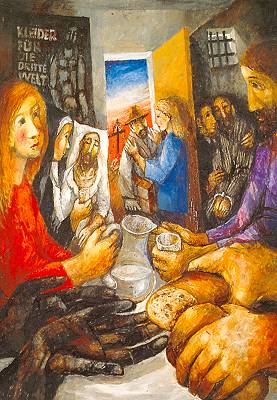
Sieger Köder
“Barmherzigkeit”

“Let us not underestimate how hard it is to be compassionate. Compassion is hard because it requires the inner disposition to go with others to place where they are weak, vulnerable, lonely, and broken. But this is not our spontaneous response to suffering. What we desire most is to do away with suffering by fleeing from it or finding a quick cure for it.” Henri Nouwen

Holy Week is here and on my way home from work and a visit with my shrink I was doing some thinking about Christians that have suffered a crisis in faith or loss of faith. I meet them all the time and read their stories on blogs, books and social media.  Of course I run across more now because I have gone through such a crisis and have written about it and through that had my story publicized. As a result I am contacted by people who have suffered trauma, especially related to PTSD as well as those that care for such people.

For many of the people Holy Week and Easter can be particularly painful. Having known plenty of these people I can say that this phenomena is one of the more tragic aspects of the season.  People who at one time felt the presence of God in their life only sense emptiness and aloneness which sometimes becomes a feeling of hopelessness where even death appears more comforting than life in the present.

I say this because people suffering through this often go unnoticed or are ignored in church. Their loss could be that of a spouse or child, the loss of something else significant or the experience of trauma that devastates them but no matter the cause of the suffering many people discover that they are now outcasts in the place where they should be cared about more than anywhere else.

Likewise there are many pastors and priests who are either unaware of them, uncomfortable around them or irritated by them because they don’t respond like “normal” people do to the message of Easter.  I have found from my own experience returning from Iraq that Easter despite the message of resurrection and hope often triggers a despair of life itself when one no longer senses the presence of God and feels alone against the world, especially in church.

Years ago I believed that if someone was in the midst of a crisis in faith if they read the Bible more, prayed more and made sure that they were in church that things would work out.  I believed then that somehow with a bit of counseling, the right concept of God and involvement in church activities that God would “heal” them.  Call me a heretic but that line of thinking is nice for people experiencing a minor bump in their life but absolutely stupid advice for people who are severely traumatized or clinically depressed and suicidal who no longer perceive the presence of God in their lives.  For those abused by parents or clergy this is I think an even deeper wound one in which the very concept and understanding of God becomes skewed in the minds and hearts of the victims.

I cannot condemn those who have lost their faith or are wavering in their faith due to trauma, abuse or other psychological reason. The numbers of people have been victimized by family, teachers, clergy other authority figures or physical trauma related to accidents, near death experiences or combat is mind numbing. They are all over the place and many go unnoticed in the church.

Sometimes the damage wrought on people makes it nearly impossible for them to comprehend a God who both cares about them and who is safe to approach.  My experience came from Iraq and the trauma of my return and were absolutely frightening so much so that I left a Christmas Eve Mass in 2008 and walked through the dark wondering if God even existed.  My isolation from Christian community and sense of despair during that time showed me that such a loss of faith is not to be trifled with or papered over with the pretty wallpaper or neat sets of “principles” drawn up in the ivory theological towers by theologians and “pastors” who refuse to deal with the reality of the consequences of a fallen world and their impact on real people.

Those that I have talked to and read about who have suffered a crisis or loss of faith almost always mention to me is that that feel cut off and even abandoned by God.  It is not simply depression that they are dealing with but despair of life itself when death or just going to sleep is preferable to living. This overwhelming despair impacts almost all of life.  It is if they never are able to leave the “God forsakenness” of Good Friday and cannot climb out of the tomb.   For some the pain is so much that suicide becomes an option and the belief that their family, friends and loved ones would be better off without them. I have seen this too many times to count.

It is hard to reach out to people in this situation.  I have to admit in my case that it was only people who chose to remain with me and walk with me through the ordeal in spite of my frequent crashes, depression, anger and even rage that helped get me through the worst of this.  However I’m sure that my condition burned some people out.  There were some that would not walk with me as I first began to go down this road and the sad thing is that many were ministers and fellow chaplains.  In some ways I don’t blame them.  However it is telling that the first person that asked me about my spiritual life “or how I was with the Big Guy” was my first therapist.

The topic of a loss of faith or the reality of feeling God forsaken is had to deal with but is something that we need to face especially during Holy Week. The Cross necessitates this, Jesus was considered “God-Forsaken” and that is what is so perplexing about Good Friday.

Yet scripture plainly teaches that we are to “bear one another’s burdens, and in this way you will fulfill the law of Christ.”  As Dietrich Bonhoeffer said  We must learn to regard people less in light of what they do or omit to do, and more in the light of what they suffer.”  It is our willingness to be with people in their suffering that is one of the true marks of the Christian.  Being with someone in triumph is far easier than with those who suffer the absence of God.  It is presence and love not sermons that people who have lost their faith need as Bonhoeffer so eloquently said “Where God tears great gaps we should not try to fill them with human words.”

I do pray that as we walk with Jesus this Holy Week that we will not forget those who despair of live and feel as if they are “God-forsaken.”

Peace

Padre Steve+

2 Comments

Filed under christian life, faith, Pastoral Care, PTSD, Religion

The Paradox of the Passion: Reflections on Palm or Passion Sunday

I celebrated a quiet Palm Sunday liturgy this morning.  As I read the scriptures, especially the Passion Narrative of Mark the Evangelist I was moved in a way that I have not been for some time and found that my time of prayer following the readings and the recitation of the Creed was perhaps more impassioned on account of all the suffering and injustice that I see in the world.  As such I wondered what to write and thought about the story of Longinus the Centurion who was according to tradition the Centurion at the foot of the Cross of the day of the crucifixion.  I went back through a number of articles that I wrote last year about what I imagined a soldier and officer of his time might imagine in such a situation and I will repost those articles on Good Friday, Holy Saturday and Easter. However today I decided to go back into my archives and repost with a few modification a more theological reflection on this Sunday which marks the beginning of Holy Week for Christians around the world. 

“Although we praise our common Lord for all kinds of reasons, we praise and glorify him above all for the cross. Paul passes over everything else that Christ did for our advantage and consolation and dwells incessantly on the cross. The proof of God’s love for us, he says, is that Christ died for us while we were yet sinners. Then in the following sentence he gives us the highest ground for hope: If, when we were alienated from God, we were reconciled to him by the death of his Son, how much more, now that we are reconciled, shall we be saved by his life!” John Chrysostom (AD 347-407)

“God speaking to Luther: “Discipleship is not limited to what you can comprehend—it must transcend all comprehension. … Not to know where you are going is the true knowledge. My comprehension transcends yours. Thus Abraham went forth from His father… not knowing whither he went. … Behold, that is the way of the cross. You cannot find it yourself, so you must let me lead you as though you were a blind man. Wherefore it is not you, no man… but I myself, who instruct you by my Word and Spirit in the way you should go. Not the work which you choose, not the suffering you devise, but the road which is clean contrary to all you choose or contrive or desire—that is the road you must take. To that I call you and in that you must be my disciple.” Dietrich Bonhoeffer the Cost of Discipleship

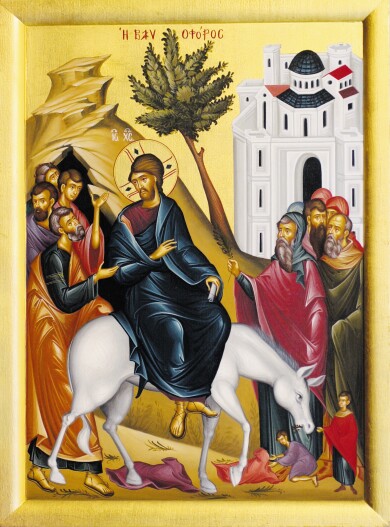
Palm or Passion Sunday always is a day that invokes mixed emotions in me. It is the last Sunday of the Lenten Season and in modern times has become a juxtaposition of two events, the Triumphant Entry of Jesus into Jerusalem where he according to all four Gospels was greeted by crowds of people who lined the street with palms as Jesus riding on a donkey processed from Bethany and Bethphage where he had been staying with Lazarus into Jerusalem and the narrative of the Passion.  As such it is a roller coaster ride in our experience of walking with Jesus in the most difficult times.

This particular occasion is the Sunday where the disciples of Jesus are confronted with the reality that our earthy expectations of him do not meet the reality of his condensation to walk among us fully Divine yet fully Human but one too well acquainted with suffering, rejection and shame.  He shatters our expectations that he will bless any particular political or social ideology that we allow to take pre-eminence over him, even those that invoke his name. Thus our liturgy brings us to this strange day where in a sense we are confronted with celebrating the entrance of the King and in the next breath cursing him and betraying him to those who torture and crucify him.

In the Roman Catholic and Anglican liturgy the observance is divided between the Liturgy of the Palms which takes place outside the Church Nave either outside the church building or in the Narthex in cold or inclement weather.  After an opening collect and reading of the Gospel passage from one of the synoptic Gospels, which one depends on which of the three year liturgical readings that the church is in. Following the reading of the Gospel the congregation led by choir, acolytes and clergy process into the church reciting the words of Psalm 118: 18-29 or singing a hymn such as “All Glory Laud and Honor.”  Once the congregation is in the church the Liturgy of the Word continues and when the Passion Gospel is read and specific roles may be assigned to members of the congregation, while the congregation remains seated through the first part of the Passion the congregation stands at the verse where “Golgotha” is mentioned and remains standing.

The liturgy takes the congregation on an emotional and spiritual roller coaster.  As the congregation begins outside the following is read:

When Jesus had come near Bethphage and Bethany, at the place called the Mount of Olives, he sent two of the disciples, saying, “Go into the village ahead of you, and as you enter it you will find tied there a colt that has never been ridden. Untie it and bring it here. If anyone asks you, ‘Why are you untying it?’ just say this, ‘The Lord needs it.’” So those who were sent departed and found it as he had told them. As they were untying the colt, its owners asked them, “Why are you untying the colt?” They said, “The Lord needs it.” Then they brought it to Jesus; and after throwing their cloaks on the colt, they set Jesus on it. As he rode along, people kept spreading their cloaks on the road. As he was now approaching the path down from the Mount of Olives, the whole multitude of the disciples began to praise God joyfully with a loud voice for all the deeds of power that they had seen, saying,

“Blessed is the king who comes in the name of the Lord!

Peace in heaven, and glory in the highest heaven!”

Some of the Pharisees in the crowd said to him, “Teacher, order your disciples to stop.” He answered, “I tell you, if these were silent, the stones would shout out.” Luke 19:29-40

It is hard when you read this passage and be caught in the reenactment of this procession not to feel the excitement that must have accompanied that procession.  It has the feeling of a victory parade but this road ends in a manner that those present, those seeking an earthly king and Messiah who would drive our the Roman oppressor and restore the kingdom to Israel would not expect with some of them perhaps playing a role in the drama that would take place later in the week.  I particularly like the hymn “All Glory Laud and Honor.”

All glory, laud and honor,
To Thee, Redeemer, King,
To Whom the lips of children
Made sweet hosannas ring.

Thou art the King of Israel,
Thou David’s royal Son,
Who in the Lord’s Name comest,
The King and Blessèd One.
Refrain

The company of angels
Are praising Thee on High,
And mortal men and all things
Created make reply.
Refrain

The people of the Hebrews
With palms before Thee went;
Our prayer and praise and anthems
Before Thee we present.
Refrain

To Thee, before Thy passion,
They sang their hymns of praise;
To Thee, now high exalted,
Our melody we raise.
Refrain

Thou didst accept their praises;
Accept the prayers we bring,
Who in all good delightest,
Thou good and gracious King.

During the Liturgy of the Word one of the following is read, either Isaiah 45:21-25 or Isaiah 52:13-53:12, the second being the Song of the Suffering Servant.  The Psalm is Psalm 22 where the Psalmist foretells Jesus’ anguished cry from the Cross; “My God, my God, why have you forsaken me? and are so far from my cry and from the words of my distress?”And then we have the New Testament reading Philippians 2: 5-11, the hymn to Christ is read:

Let the same mind be in you that was in Christ Jesus, who, though he was in the form of God, did not regard equality with God as something to be exploited, but emptied himself, taking the form of a slave, being born in human likeness. And being found in human form, he humbled himself and became obedient to the point of death– even death on a cross. Therefore God also highly exalted him and gave him the name that is above every name, so that at the name of Jesus every knee should bend, in heaven and on earth and under the earth, and every tongue should confess that Jesus Christ is Lord, to the glory of God the Father.”
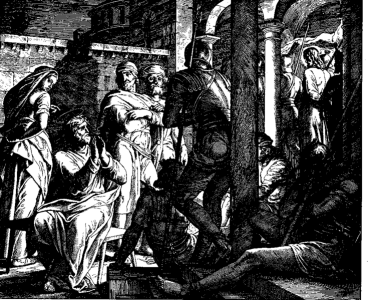
This year the Passion Narrative is that of Mark (14:1-15:47) but I find the passage in Luke 22:39-71 and 23:1-49 (50-56) to be more dramatic.  The three parts of Luke’s narrative that stand out in this narrative for me are Peter’s denial of Jesus, the interaction of Jesus with those crucified with him and that of the Centurion:

“Then they seized him and led him away, bringing him into the high priest’s house. But Peter was following at a distance. When they had kindled a fire in the middle of the courtyard and sat down together, Peter sat among them. Then a servant-girl, seeing him in the firelight, stared at him and said, “This man also was with him.” But he denied it, saying, “Woman, I do not know him.” A little later someone else, on seeing him, said, “You also are one of them.” But Peter said, “Man, I am not!” Then about an hour later still another kept insisting, “Surely this man also was with him; for he is a Galilean.” But Peter said, “Man, I do not know what you are talking about!” At that moment, while he was still speaking, the cock crowed. The Lord turned and looked at Peter. Then Peter remembered the word of the Lord, how he had said to him, “Before the cock crows today, you will deny me three times.” And he went out and wept bitterly.”

Peter’s denial is in large part because he has had his illusions about Jesus shattered and the fact that he had not understood the message up to that point.  As Bonhoeffer says “Jesus is a rejected Messiah. His rejection robs the passion of its halo of glory. It must be a passion without honor. Suffering and rejection sum up the whole cross of Jesus. To die on the cross means to die despised and rejected of men. Suffering and rejection are laid upon Jesus as a divine necessity, and every attempt to prevent it is the work of the devil, especially when it comes from his own disciples; for it is in fact an attempt to prevent Christ from being Christ.”

Likewise Jesus interaction with the condemned thieves that were crucified with him:

“One of the criminals who were hanged there kept deriding him and saying, “Are you not the Messiah? Save yourself and us!” But the other rebuked him, saying, “Do you not fear God, since you are under the same sentence of condemnation? And we indeed have been condemned justly, for we are getting what we deserve for our deeds, but this man has done nothing wrong.” Then he said, “Jesus, remember me when you come into your kingdom.” He replied, “Truly I tell you, today you will be with me in Paradise.”

Mark (15:25-32) records that interaction in this manner:

“It was nine o’clock in the morning when they crucified him. The inscription of the charge against him read, “The King of the Jews.” And with him they crucified two bandits, one on his right and one on his left. Those who passed by derided him, shaking their heads and saying, “Aha! You who would destroy the temple and build it in three days, save yourself, and come down from the cross!” In the same way the chief priests, along with the scribes, were also mocking him among themselves and saying, “He saved others; he cannot save himself. Let the Messiah, the King of Israel, come down from the cross now, so that we may see and believe.” Those who were crucified with him also taunted him.”

The final passage from this narrative that strikes me is the moment of Jesus’ death on the Cross:

“It was now about noon, and darkness came over the whole land until three in the afternoon, while the sun’s light failed; and the curtain of the temple was torn in two. Then Jesus, crying with a loud voice, said, “Father, into your hands I commend my spirit.” Having said this, he breathed his last. When the centurion saw what had taken place, he praised God and said, “Certainly this man was innocent.” And when all the crowds who had gathered there for this spectacle saw what had taken place, they returned home, beating their breasts. But all his acquaintances, including the women who had followed him from Galilee, stood at a distance, watching these things.”

Mark records that event in Mark 15: 33-39. In Mark’s account the reaction of the Centurion (15:39) to the death of Jesus is even more salient than the account of Luke.

“When it was noon, darkness came over the whole land until three in the afternoon. At three o’clock Jesus cried out with a loud voice, “Eloi, Eloi, lema sabachthani?” which means, “My God, my God, why have you forsaken me?” When some of the bystanders heard it, they said, “Listen, he is calling for Elijah.” And someone ran, filled a sponge with sour wine, put it on a stick, and gave it to him to drink, saying, “Wait, let us see whether Elijah will come to take him down.” Then Jesus gave a loud cry and breathed his last. And the curtain of the temple was torn in two, from top to bottom. Now when the centurion, who stood facing him, saw that in this way he breathed his last, he said, “Truly this man was God’s Son!”

The darkness of this is event is perplexing to those who want to find God in some place where he is untouched by human suffering to them the Cross is folly for what kind of God would submit himself to such ignominy but as Martin Luther wrote “He who does not know Christ does not know God hidden in suffering. Therefore, he prefers works to suffering, glory to the cross, strength to weakness, wisdom to folly. For they hate the cross and suffering and love works and the glory of works. Thus they call the good of the cross, evil and the evil of a deed, good. God can only be found in suffering and the cross.” It is in the contradiction of this week that we come to know God, not a God who seeks not the righteous or the powerful, those who seek the power of an earthy kingdom backed by an ideology of power which tramples the weak, but rather those who will simply walk in the footsteps of Jesus the Christ who rules by serving the least, the lost and the lonely.

The liturgy of this day be from any of the Passion narratives takes us to the heart of the Gospel as we led by the writers through the triumph of the entrance into Jerusalem, to the betrayal of Jesus by Judas, the abandonment of him by the disciples and the denial of Peter.  As the writers lead us through his trial, conviction, scourging and trek to Golgotha we see the gamut of human emotions and reactions to Jesus and we know that we can be there as well in any of the characters simply because we are human and capable of compassion or betrayal.  As Jesus is on the Cross it is not the religious or upstanding that remain with him.  He is left with his mother, the other Mary and John the beloved.  He is shown compassion by a thief and recognized as the Son of God by the Roman Centurion, a gentile serving an empire oppressing the people of Israel and whose governor had pronounced the sentence of death upon him.  In this liturgy we have been taken from the heights of exhilaration in the triumphant entry to the depths of despair felt by his disciples that Friday afternoon. It is in this time that we realize how right Dietrich Bonhoeffer is when he writes “God loves human beings. God loves the world. Not an ideal human, but human beings as they are; not an ideal world, but the real world. What we find repulsive in their opposition to God, what we shrink back from with pain and hostility, namely, real human beings, the real world, this is for God the ground of unfathomable love.”

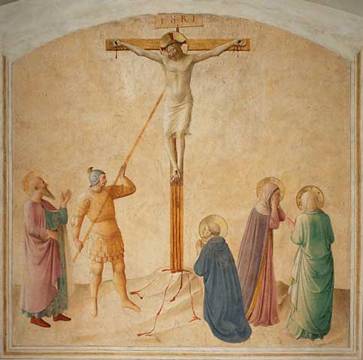
It is the Centurion for which I have the greatest affinity in this story. He is a soldier and in the words of so many soldiers who have obey orders carried out the sentence upon Christ by crucifying him and then as the life ebbs out of Christ’s crucified body exclaims “surely this was a good man” or in other accounts “surely this was the Son of God.” That is the cry of a man who knows that he has executed an unjust sentence, the reaction of a true penitent, the reaction of a man who comes to realize even before many of Jesus’ closest followers understood.  According to tradition the Centurion was named Longinus who left the service of the Imperial Legion, was baptized by the Apostles and was martyred under the orders of Pontius Pilate by soldiers of the unit that he had once commanded.

It is important for the Church not to lose this identification.  The Church is not to become enmeshed and co-opted by those who attempt to use the Gospel to promote ideologies foreign to it as is the temptation in times of crisis.  As Jürgen Moltmann notes:

“In Christianity the cross is the test of everything which deserves to be called Christian… The Christian life of theologians, churches and human beings is faced more than ever today with a double crisis: the crisis of relevance and the crisis of identity. These two crises are complementary. The more theology and the church attempt to become relevant to the problems of the present day, the more deeply they are drawn into the crisis of their own Christian identity….Christian identity can be understood only as an act of identification with the crucified Christ, to the extent to which one has accepted that in him God has identified himself with the godless and those abandoned by God, to whom one belongs oneself.” The Crucified God [pgs. 7, 19]

Nor is our task is not to attempt to invent “crosses” for ourselves in acts of pseudo-martyrdom but simply to be faithful in loving Jesus and our neighbor as Bonhoeffer noted “Must the Christian go around looking for a cross to bear, seeking to suffer? Opportunities for bearing crosses will occur along life’s way and all that is required is the willingness to act when the time comes. The needs of the neighbor, especially those of the weak and downtrodden, the victimized and the persecuted, the ill and the lonely, will become abundantly evident.” The mark of the Christian is not to blindly give his life for a cause or be consumed by the false “messiah’s” promoted by politicians, pundits and even preachers captivated by the lust for power and glory.

As we walk through the mystery of Holy Week together let us renew our faith in the Crucified One and not be conformed to those things that seek to turn us from the way of discipleship and the way of the Cross.

Peace

Padre Steve+

Leave a comment

Filed under christian life, film, Religion

They didn’t Pray Enough: Pat Robertson’s latest “Patwah”

“If enough people were praying, [God] would intervene. You could pray, Jesus stilled the storm, you could still storms.” Pat Robertson on the 700 Club

“But I tell you, love your enemies and pray for those who persecute you, 45 that you may be children of your Father in heaven. He causes his sun to rise on the evil and the good, and sends rain on the righteous and the unrighteous.” Jesus (Matthew 5:44-45)

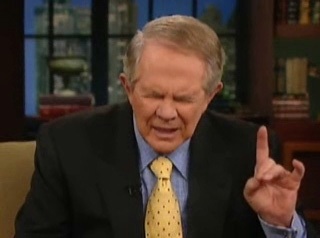
Well Pat Robertson the Grand Mullah of Virginia Beach has again come up with new a Patwah declaring today that the people across the Ohio and Tennessee Valleys who were devastated by unseasonable tornadoes and storms this week could have avoid them “if they had prayed more.”

Of course such statements are nothing new from the Tidewater’s favorite Taliban and certainly to be expected.  Some it seems that no matter what the question that Mullah Pat needs to have an answer direct from God on high. He was responding to a question from one of his viewers about why “God would cause” such disasters and instead of doing the thing that Jesus did when asked a similar question about why Jewish insurgents had died fighting the Romans that Jesus mentioned the 18 people killed at the tower of Siloam.  Jesus basically asked his questioners if the 18 people killed at the tower of Siloam were worse sinners than anyone else in Jerusalem, the answer of course was “well duh, stuff happens.” Even in the New testament it was understood that the “rain falls on the just and the unjust.” But today it seems that the people like Pat have to find an answer that they can attribute to God to bust the chops of people that they think really need to be whacked.

I’m sorry but such theological insanity coming from a “Christian” is a shame and comparable to the Fatwahs issued by extremist Muslim preachers in Afghanistan, Iran and other locations. The only difference is that Pat is claiming that he is getting his word from Jesus and the Holy Spirit.

Sorry Pat but the 39 people killed and thousands injured or displaced by these storms deserve better from a “Christian” preacher who has indulged himself upon their generous financial contributions for the last 40 years.  Heck, these were not even people that live in Blue States, these storms hit the Red State Republican heartland and some swing states.  If those states are not safe from God’s wrath then who is? But then if prayer could have kept these things from happening does that mean that the people killed, injured or rendered homeless were somehow at odds with God?

Well if you ask Jesus probably not.  However if you hold Jesus in less esteem than Pat then maybe so.  Now I do believe that God answers prayer and sometimes in most unusual and seemingly miraculous ways. However it seems that sometimes stuff happens, even to good people.  I guess that is why we need folks like Mullah Pat to guide our way…but then maybe we don’t need him to do this.

Peace

Padre Steve+

Leave a comment

Filed under christian life, faith, Political Commentary, Religion

Faith for those that Struggle with Faith

“When we honestly ask ourselves which person in our lives mean the most to us, we often find that it is those who, instead of giving advice, solutions, or cures, have chosen rather to share our pain and touch our wounds with a warm and tender hand. The friend who can be silent with us in a moment of despair or confusion, who can stay with us in an hour of grief and bereavement, who can tolerate not knowing, not curing, not healing and face with us the reality of our powerlessness, that is a friend who cares.” 
― Henri J.M. Nouwen, The Road to Daybreak: A Spiritual Journey

I’m taking a few minutes tonight even while watching primary returns and political punditry from Michigan and Arizona to muse a bit on faith during Lent.  I’ll post my analysis of tonight’s results tomorrow.

I have found over the past couple of years that there are many people that grew up in some kind of Christian home that for a host of reasons are struggling with faith, God and  the church. It is something that I find interesting from more than a theoretical premise because I went through a period after returning from Iraq where I struggled and could best be described as an agnostic struggling to recover faith.  Faith for me is still a work in progress, I can fully relate to father of the child Jesus healing in Mark 9:24 saying “I believe help my unbelief” and Thomas who after the Resurrection that he would not believe without being able to put his hands in the wounds of Christ.  Saint Anselm of Canterbury talked about faith seeking understanding and I think that is the mark of theological honesty.  I believe but seek understanding but even if I don’t understand I can have faith even if it is imperfect and plagued with doubts as well as frustration about things I see done in the church and in the name of Jesus.

When people come to me and admit their struggles I simply try to listen and let them be honest about their doubts and to know that even if they struggle that God still cares about them. I think that people, at least from what I hear are tired of the lack of honesty that characterizes much of what is being sold as Christianity in America.  What they struggle with is that “faith” marketed  by the health, wealth and political power preachers, pundits and politicians that make up the Unholy Trinity of American religious life.

Lent is one of those times of reflection where hopefully those that call on the name of Jesus can deepen faith or in the case of many that struggle, return to faith.  I really believe that honesty with God, each other and the world is one of the keys to faith and for those of us that struggle absolutely vital.

Part of that honesty to recover faith is to realize that God does love the real and very imperfect world that we live in. God loves wounded, doubting and imperfect people. Dietrich Bonhoeffer the German pastor, theologian and martyr said it this way “God loves human beings. God loves the world. Not an ideal human, but human beings as they are; not an ideal world, but the real world. What we find repulsive in their opposition to God, what we shrink back from with pain and hostility, namely, real human beings, the real world, this is for God the ground of unfathomable love.” 

Peace

Padre Steve+

1 Comment

Filed under christian life, faith, Religion

Christian Dominionsim on Display the Return of Constantine: We Were Warned by Barry Goldwater

“[I]n our country are evangelists and zealots of many different political, economic and religious persuasions whose fanatical conviction is that all thought is divinely classified into two kinds — that which is their own and that which is false and dangerous.” — Justice Robert H Jackson, American Communications Assn. v. Douds, 339 US 382, 438; 70 SCt. 674, 704 (1950)

It is Fat Tuesday and tomorrow Lent begins with Ash Wednesday, a season of penitence   and self reflect that hopefully draws the Christian into a closer relationship with Christ and his people.  Unfortunately I don’t believe that the political climate of the country now dominated by the most extreme will allow many people to enjoy that as politicians and politically minded preachers are using their “faith” to fuel animus against President Obama and Mitt Romney to further their political aims.

I am a Christian and a Priest in a small Old Catholic denomination. I am a graduate of a premier Evangelical Protestant Seminary where I came to appreciate and revere religious liberty. What I am going to write today may offend some but it has to be said. I believe that the cause of religious liberty, and for that matter the liberty of the Christian Church to be faithful to its call and unencumbered by unseemly political alliances is in danger due to the actions of people that in many cases honestly believe that they are defending religious liberty. Justice Robert Jackson prosecuted the major Nazi War criminals at Nuremberg and was able to view the results of what happened when churches that entered into such alliances.

Today I saw Franklin Graham, the son of Billy Graham basically say that President Obama was a Moslem without saying it flat out and that Mitt Romney is not a Christian.  The fact is I don’t care what Franklin Graham thinks about anyone’s faith that is not and never has been a criteria for elected office in this country. Meanwhile Rick Santorum running against Romney has all but compared the President to Hitler and the President’s Christian faith into question but then when asked if he was doing acted like he didn’t mean anything by his comments. I was incredulous as I watched and realized just how right Barry Goldwater was so many years about the character of this movement.

Barry Goldwater, the man who inspired Ronald Reagan to run for President and who was the conservative bulwark for many years in Washington DC warned what would happen when the Religious Right took over the Republican Party. Goldwater said of the types of people that currently dominate the conservative movement, if it can be still called that:

“Mark my word, if and when these preachers get control of the [Republican] party, and they’re sure trying to do so, it’s going to be a terrible damn problem. Frankly, these people frighten me. Politics and governing demand compromise. But these Christians believe they are acting in the name of God, so they can’t and won’t compromise. I know, I’ve tried to deal with them.” November, 1994, in John Dean, Conservatives Without Conscience.

Billy Graham, a saint if there ever was one and a man who used his faith to build bridges even while being unabashedly evangelical warned back in 1981 about the current crop of religious conservatives and stand in sharp contrast to the words and actions of Franklin:

 “I don’t want to see religious bigotry in any form. It would disturb me if there was a wedding between the religious fundamentalists and the political right. The hard right has no interest in religion except to manipulate it.” Parade Magazine February 1, 1981, from Albert J Menendez and Edd Doerr, The Great Quotations on Religious Freedom

What we are seeing today is the expressed manifestation of religious bigotry operating under the guise of defending religious freedom. It is being shown in its ugliness by the brazen If there is any way to lose religious freedom it is to follow this attempt to marry the Christian faith with the American government is not only short sighted but does great damage to the faith and our American liberties.

Rick Santorum, Franklin Graham and a host of influential of Evangelical leaders, politicians and even Roman Catholic Bishops have said what they believe religious liberty means to them and it has little in common with the understanding of our founders. It has nothing to do with limited government nor religious liberty. It is the imperial religion of Constantine, dressed up a bit to keep up with the times.  It is simply an attempt by these leaders to use the apparatus of the government to support themselves.

George Truett, the great Southern Baptist Pastor who served as President of Southwestern Baptist Theological Seminary wrote in his book Baptists and Religious Liberty in 1920 about the decidedly negative effect of when the Church became the State religion:

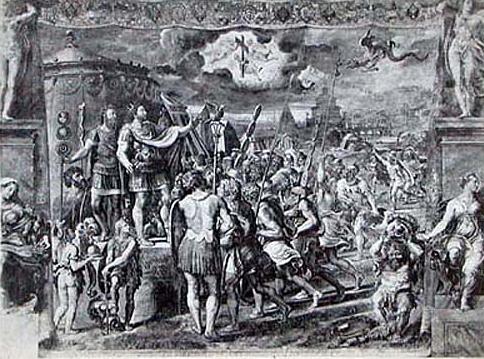
“Constantine, the Emperor, saw something in the religion of Christ’s people which awakened his interest, and now we see him uniting religion to the state and marching up the marble steps of the Emperor’s palace, with the church robed in purple. Thus and there was begun the most baneful misalliance that ever fettered and cursed a suffering world…. When … Constantine crowned the union of church and state, the church was stamped with the spirit of the Caesars…. The long blighting record of the medieval ages is simply the working out of that idea.”

The late Senator Mark Hatfield a strongly committed Evangelical Christian before it became popular in Washington made this comment concerning those that are now driving this spurious debate:

“As a Christian, there is no other part of the New Right ideology that concerns me more than its self-serving misuse of religious faith. What is at stake here is the very integrity of biblical truth. The New Right, in many cases, is doing nothing less than placing a heretical claim on Christian faith that distorts, confuses, and destroys the opportunity for a biblical understanding of Jesus Christ and of his gospel for millions of people.”  quoted in the pamphlet “Christian Reconstruction: God’s Glorious Millennium?” by Paul Thibodeau

The current campaign is the imposition of Christian Dominionism onto the rest of the country. It may reference the Gospel and even certain Christian moral understandings even as it mocks other just as “Biblical” Christian teachings.

Back in 1981 Barry Goldwater said on the Senate Floor “The religious factions that are growing throughout our land are not using their religious clout with wisdom. They are trying to force government leaders into following their position 100 percent.” 

Like it or not Goldwater was right about this crowd. They will drive their churches and their political party into the abyss.

Peace

Padre Steve+

3 Comments

Filed under faith, News and current events, Political Commentary, Religion

Religious Freedom and Religious Hypocrisy the New Improved 2012 Model

In the last few days there has been a uproar regarding the Department of Health and Human Services decision to require employers, including church related service institutions including schools, universities and hospitals to provide FDA approved contraception in their health insurance benefits.  Such benefits are already law in over half of the States of the United States. While many provide some exemptions for churches in eight States churches and related religious institutions receive no exemption in the State laws from contraception mandates.

The Roman Catholic Church as well as some Evangelicals such as Richard Land the President of the Southern Baptist Church have called this an assault on religious liberty.  They have been joined by numerous politicians who with the exception of Rick Santorum seem more intent on using it as a rallying cry against President Obama because for years under Republican administrations they did not complain a bit about about this. It just seems disingenuous and I just have to wonder why now and not then?

However my purpose today is not to argue the particular merits of this case. I really don’t see it as a case of religious liberty but rather employment rights under the law which apply to all employers which religious institutions receive numerous exemptions that no secular employers receive in kind. Religious institutions receive tremendous amounts of tax exemptions, exemptions regarding employment rights and other benefits  that secular institutions or employers do not. That is a product of our continued religious liberty and the place of privilege of religious institutions, particularly Christian ones in this country.

We Christians can cry out that we are being persecuted but we do so from a position of privilege that Christians in other countries where persecution is real and often involves prison and death. I find it hard to take seriously the cries of persecution on this issue by Bishops who preside over diocese which have universities and hospitals that already provide the contraceptive coverage to employees that is being mandated now. Likewise I have a hard time reconciling a claim of persecution by many who have been complicit in the cover up of massive numbers of sexual abuse crimes by clergy and religious and who have used the courts to try to deny the redress if these issues by the victims of these crimes.

The point I want to make is that it seems to me that Christians in the United States generally only rally to the cause of religious freedom when it benefits them economically, socially and legally. I seldom see conservative Christians be they Catholic or Protestant come to the defense of religious rights of minority religions.  In fact more often than not it seems that they are all in favor of restricting the practices of those that don’t agree with them.

I respect the right of the Roman Catholic Church to its beliefs and practice. However it is hypocritical for it or other churches accept and lobby for special exemptions and privileges that no one else receives from the government and then cry that it is being persecuted when required to provide benefits that all other employers are required to provide. It is simply a matter of fairness.

Thomas Jefferson wrote to Horatio Spafford in March 1814 that “In every country and in every age, the priest has been hostile to liberty. He is always in alliance with the despot, abetting his abuses in return for protection to his own.” It seems to me that this is the case now.

I do think that the choice of Catholic bishops as well as the denominational leaders of churches which have no opposition to contraception to make this a major fight is a mistake. I believe that will harm the witness of the church and further increase the perception that American Christians care more about themselves and their rights than they do about those of others. Truthfully this kind of action is the opposite of the early church which in spite of real persecution never stopped loving or caring about those that persecuted them. But then those Christians didn’t have to worry about running the church like a business, political party or government.  I guess that must make a difference.

I do expect some hate mail on this post but oh well, such it life.

Peace

Padre Steve+

1 Comment

Filed under faith, healthcare, Political Commentary, Religion

Revisiting the Gift of Religious Liberty: The Danger posed by Fanatics

“Congress shall make no law respecting the establishment of religion, or prohibiting the free exercise thereof; or abridging the freedom of speech, or of the press; or the right of the people peaceably to assemble, and to petition the Government for a redress of grievances.” The First Amendment of the US Constitution

“no man shall be compelled to frequent or support any religious worship, place, or ministry whatsoever, nor shall be enforced, restrained, molested, or burdened in his body or goods, nor shall otherwise suffer, on account of his religious opinions or belief; but that all men shall be free to profess, and by argument to maintain, their opinions in matters of religion, and that the same shall in no wise diminish, enlarge, or affect their civil capacities.” Thomas Jefferson in the 1779 Virginia Statute for Religious Freedom

Those that read this site and have gotten to know me through it over the past few years know that I am passionately devoted to religious liberty.  I find it throughout the writings of our founders and and have written about it before numerous times and the comment was in regard to this article The Gift of Religious Liberty and the Real Dangers to It  https://padresteve.com/2011/05/10/the-gift-of-religious-liberty-and-the-real-dangers-to-it/

I do want to say up front that this article is in no way a denigration of those that believe, especially in this case since my critic claims to be a Christian a criticism of other Christians that are committed to their faith but also respect the religious liberties of others and that give God and his grace a little bit of credit to work in the lives of others that are different from them.

A couple of days ago I received a comment on that post that I quote in part:

“I have a serious problem with anyone who calls themselves a Christian supporting the religious liberty of all those who are not Christians because by doing so you condone their worship of false gods which is idolatry. I would rather see all religious worship outlawed than to allow worshippers of false gods allowed to spew their demon inspired idolatrous lies in public.” (pingecho728 Jonathan) 

It is amazing to me to see such words voiced over a subject that is so much a part of the fabric of our country.  Unfortunately with all the poisonous division in the country that religious liberty is in peril in some cases from left wing fanatics that despise all religion but is becoming more pronounced on the fanatical right particularly in the views of some parts of American Evangelical and Conservative Catholic Christianity.

But with that said this commentator is a very angry person and a search Facebook and a Google search that took all of about 5 minutes told me more than I wanted to know about this man. He is a fanatic who has flip-flopped in his passionate beliefs, responding to an atheist on another website in December 2010 regarding the irrationality of Biblical faith.

“PingEcho728  Dec 1, 2010 01:55 PM
I love what you wrote and agree wholeheartedly. Ironically I used to be once upon a time one of those religionist who was content with the “God did it” answer..if the Bible said it I believed it a hundred percent but once I opened my eyes and actually examined everything I had once easily believed to see why I had believed those things I found I had no good rational answer or evidence for believing those things. So I did the only thing a rational freethinking person could do, I abandoned beliefs for which I had no reason or evidence to support it.”

When I responded to the man and noted that everyone was someone else’s heretic and that even Conservative Christians might find his views heretical he responded. “There are certainly no Christians more conservative than me nor would any true Christian call me a heretic.”  Talk about flip-flopping, but this is typical among fanatics of every variety. They easily change sides because they need a cause bigger then them to provide meaning to their lives.  This man who on other Tea Party blogs practically deifies the Founders says of them regarding religious liberty: “I trust in the founders no more than I trust in any fallible man. The freedom to disagree is one thing to allow false religions to flourish in America is one that will undoubtedly lead to the destruction of America and the rise of the antichrist.”

Philosopher Eric Hoffer wrote in his book The True Believer about mass movements and their fanatical followers.  He did not see the followers of the different causes be they religious, secular, atheist, Fascist or Communist to be that different from each other. He saw them as brothers in a sense and their real opponent is the moderate, not the opposing extremist. Hoffer saw that the “true believers” were far easier to convert to an opposing view than you would think and he noted how fanatical Germans and Japanese often were converted to Communism while in captivity after the war.  It was their devotion to the cause not the cause that they became devoted to serving that was what gave meaning to their life.

Hoffer wrote:

“The fanatic is perpetually incomplete and insecure. He cannot generate self assurance out of his individual resources-out of his rejected self-but finds it only by clinging to whatever cause he happens to embrace. This passionate attachment is the source of his blind devotion and religiosity, and he sees in it the source of all virtue and strength. Through his single minded dedication is a holding on for dear life , he easily sees himself as the supporter and defender of the holy cause to which he clings….Still his sense of security is derived from his passionate attachment and not from the excellence of his cause. The fanatic is not really a stickler to principle. He embraces a cause not because of its justness and holiness but because of his desperate need for something to hold on to. Often, indeed, it is his need for passionate attachment which turns every cause he embraces into a holy cause. The fanatic cannot be weened away from his cause by an appeal to reason or moral sense. He fears compromise and cannot be persuaded to qualify the certitude of his holy cause. But he finds no difficulty in swinging suddenly and wildly from one holy cause to another. He cannot be convinced but only converted. His passionate attachment is more vital than the cause to which he is attached.”

Unfortunately there are many people on the extremes of the political spectrum that are like this. They can be found in the factions of the Tea Party and in the Occupy Movement as well as other even more extreme groups.  They are the kind of people that in the social, economic and political turmoil of the 1920s and 1930s were sucked into the great radical movements Communism, Fascism and Naziism.  In fact this has little to do with Christianity itself, even the most conservative expressions of it.  It is a matter that fanatics would rather destroy freedom for everyone than to give it to anyone that they disagree.

The real thing that sets our nation apart from others is the fact that when it came to religious liberty that the Founders were quite clear that religious liberty was the property of every individual. It was not to be forced by the state or by religious bodies acting on behalf of the state. We are not Iran, Saudi Arabia or even Israel. Our founders knew the dangers of fanatical religion having seen the effect of it during the brutal religious wars in England which pitted Anglicans against Separatists and Roman Catholics in the 17th Century.  They harbored no illusions about the danger posed by well meaning “true believers” who would use the powers of the state to enforce their religious beliefs on others as well as those that would seek to obliterate religion from public life as happened during the French Revolution.

I will gladly take criticism from people that believe that I am not a Christian because I defend the religious liberties of others.  I am a Christian and make no apology but  I figure that this liberty is too precious to so despised by those that most depend on it.  Religion can and has often been abused and used as a dictatorial bludgeon. Those who now advocate so stridently for their faith to be made the law of the land should well remember the words of James Madison:

“Who does not see that the same authority which can establish Christianity, in exclusion of all other religions, may establish with the same ease any particular sect of Christians, in exclusion of all other sects?”

Peace

Padre Steve+

1 Comment

Filed under christian life, faith, History, philosophy, Political Commentary, Religion

The Heresy of Thinking and Reason in an Age of Fanaticism

Note: I felt the need to republish this article in light of so many of the controversies that have been in the news lately, especially because some of the visceral reactions that I see from so many people about them. I just hope that people take the time to try to get as much of each story and controversy possible, examine them in the light of history and reason before jumping to unsubstantiated conclusions. The fact is that many of us do precisely this and that is in large part due to how terribly divided we are. However, that being said there is seldom any issue that is totally clear, most actually are quite opaque and clouded in the fog of many shades of gray, and what history teaches us is that we need to be careful before jumping to conclusions.

Peace

Padre Steve+

“Unreason and anti-intellectualism abominate thought. Thinking implies disagreement; and disagreement implies nonconformity; and nonconformity implies heresy; and heresy implies disloyalty. So, obviously, thinking must be stopped. But shouting is not a substitute for thinking and reason is not the subversion but the salvation of freedom.” Adlai Stevenson – A Call to Greatness (1954)

I had a Church History professor in seminary who was known for his attention to detail and his expectation that his students would master the subject.  His method was quite simple. A fellow student asked him during review for a mid-term exam “what do we need to study for the test?”  His answer was simple “everything.” The student restated his question “what do we really need to know?”  My professor paused and made a comment that did not make the student very happy.  He said something that I paraphrase here “it is the details that enable you to see the big picture, without the details you know nothing.”

A good number of my fellow students did not appreciate the fact that he was deadly serious.  It was not simply the ability to remember names and dates and events but to be able to connect them and see what was really important.  Many did not take him seriously and when the test came many failed it.  In fact some continued to fail every exam because they could not reconcile that details were important. The attitude of a good number of my classmates was that history, philosophy or even systematic theology were not important especially if they involved study of people or ideas that they did not agree with.

Unfortunately we now live in an age of anti-intellectualism and anti-historicism. Instead of trying to figure out what is really important and studying the details of the great questions of our day we have become lazy. We simply fall back on the dogmas presented by the Unholy Trinity of Pundits, Politicians and Preachers that cater to our ideology for reassurance.  And they are quite good at co. If you listen to talk radio or are a devoted fan of any particular cable news pundit you can see this on display daily and even more so by our political leaders and those seeking political power. What is presented by the Unholy Trinity is at best half-truth sprinkled with deadly venom of hatred to make the half-truth an absolute truth.  In such a world facts are only important if the “true believer” can use them buttress his ideological bias even if he has to take the completely out of context to in order to do so.  It is so much easier to call an opponent a Communist or Nazi, Fascist or Imperialist, Unbeliever or Heretic and connect them to the evil we want to demonize them as than it is to actually,  engage in a truthful debate and to see things in their historical context. Likewise when we use such labels against those that disagree with us we dehumanize our opponents thereby justifying any evil that we use to silence them.

It seems that we presume that if we repeat what we believe enough, even if it is unsound or erroneous that it will become truth.  As individuals, governments, institutions and businesses we settle for the easy answers that agree with our presuppositions and dismiss opposing views as heresy.  We allow people of little learning but great charm and salesmanship ability sell us myth in place of fact and this happens across the political, social, economic and theological spectrum.

The past few days I have been talking about the study of history as well as ways of learning.  The little things do matter, and the study of history, philosophy, theology, the sciences, economics in fact anything of any importance is based on understanding details, and things like precedent and context.  It is not enough to string together a series of quotations or citations if they are taken out of context, altered or intentionally misused to fit our ideology or doctrine.

This may comfort the true believer in whatever cause and even make them feel superior to those that disagree but such thinking. But it blind them to reality and not conscious of their own envy, malice, pettiness and dishonesty. The “wall of words” that flow so easily from the mouths and pens of the members of the Unholy Trinity that the faithful are unable to separate them from reality, truth from fiction, opinion from fact.  This “wall of words” serves as their protection against any thought, fact, presumption or doctrine that contradicts them.  John F Kennedy said “Too often we enjoy the comfort of opinion without the discomfort of thought.” 

In such times it is important to take the time to learn from history, not just generalities that mix fact and myth but the little details that make up history and for that matter the sciences, philosophy, sociology, political thought and theology.  As a society we have ceased to do this and until we take the time to return to such study, dialogue and put aside our blinders we will be doomed to remain as we are no matter what political party is in power or ideology dominates the airwaves and cyber space.

There is a prayer that neatly sums up what I desire for me and for our society:

From the cowardice that dares not face new truth
From the laziness that is contented with half truth
From the arrogance that thinks it knows all truth,
Good Lord, deliver me.

Peace

Padre Steve+

2 Comments

Filed under philosophy, Political Commentary, Religion

Advent and Incarnation: Merry Christmas!

“It might be easy to run away to a monastery, away from the commercialization, the hectic hustle, the demanding family responsibilities of Christmas-time. Then we would have a holy Christmas. But we would forget the lesson of the Incarnation, of the enfleshing of God—the lesson that we who are followers of Jesus do not run from the secular; rather we try to transform it. It is our mission to make holy the secular aspects of Christmas just as the early Christians baptized the Christmas tree. And we do this by being holy people—kind, patient, generous, loving, laughing people—no matter how maddening is the Christmas rush…” Andrew Greeley

I really do love the seasons of Advent and Christmas.  This year it has been so busy that Advent has gone by way too fast. Advent which begins four Sundays before Christmas is the season of preparation, it is the season for the Christian of the promise of Christ, his coming in the flesh or “Incarnation” being born of Mary and also his coming at the consummation when as the Creed says “He shall come again….”

Advent is a time which has pretty much been stomped all over by the religion of commercialism and its high holy day of Black Friday which falls the Friday before Advent begins.  However it is really important if one wants to comprehend the full religious significance of Christmas.  It helps the Christian place Christmas in its appropriate context, not as “Jesus’ Birthday party” where we wear a little button that says “Happy Birthday Jesus” but that day where God became human as Paul wrote so eloquently:

“But when the fullness of time had come, God sent his Son, born of a woman, born under the law, in order to redeem those who were under the law, so that we might receive adoption as children. And because you are children, God has sent the Spirit of his Son into our hearts, crying, “Abba! Father!” So you are no longer a slave but a child, and if a child then also an heir, through God.” (Gal. 4:4-7) 

In the fullness of time…Advent helps point us to that time when God humbled himself to become a human being.  It is the time where in an ideal world we would slow down just a bit and begin to prepare ourselves for his coming. However our culture often with the blessing of Christians and the Church has eliminated that time of reflection.  It is a time where God not only makes us his children but his brothers and sisters and I think even more importantly friends.

Advent as a season is a period of patient expectation, a season of hope in the midst of despair. It is the message that God still cares and that what we wait for is not far off, the nativity of Emmanuel, God with us which is expressed so well in my favorite hymn of the season O Come O Come Emmanuel 

Oh, come, oh, come, Emmanuel,
And ransom captive Israel,
That mourns in lonely exile here
Until the Son of God appear.
Rejoice! Rejoice! Emmanuel
Shall come to you, O Israel!

The Irish singer Enya has a wonderful version of this song which I have placed the link here:  http://www.youtube.com/watch?v=DPHh3nMMu-I&feature=share

German pastor, theologian and martyr Dietrich Bonhoeffer wrote from prison in 1943

that “A prison cell like this is a good analogy for Advent: one waits, hopes, does this or that—ultimately negligible things—the door is locked and can only be opened from the outside.”

This year has been like brutal prison for many people and nations in the world. Wars, natural disasters, economic problems and political instability have caused much suffering.  Man’s inhumanity to man has been demonstrated time and time again by terrorists, criminals and repressive governments.  Our lack of control over nature as was shown in Fukishima Japan when a massive Earthquake and Tsunami destroyed cities and a nuclear power plant killing thousands.  At the same time we have seen the best people rising to meet disaster and persecution, poverty and unrest with courage, faith and mercy motivated by love in the face of death.  In spite of all, love still triumphs.

The Advent season which is now drawing to an end leads us to the hope of the God who chooses to be with us.  Tomorrow evening we celebrate when “the Word was made flesh and we beheld his glory.” It is a time when the world is reminded even in the most secular ways that God choses to be with us in the babe born in a dingy stable in a town that few cared about.  In that humble beginning God draws near to us and his creation.

It is a time to rejoice for Jesus the Christ is born.

Merry Christmas,

Padre Steve+

1 Comment

Filed under christian life, faith, Religion

Faith and Doubt: A Reflection on Christmas

“God weeps with us so that we may one day laugh with him.” Jürgen Moltmann

There was a time in my life that faith in God, for me the Christian God, Father, Son and Holy Spirit was something that I pretty much took for granted until I had my own crisis of faith when I returned from Iraq in 2008.  It was that crisis where for all practical purposes I was an agnostic trying to believe while feeling abandoned by God and many of his people.  That crisis has etched a permanent scar in my soul which has led to some fairly major changes in my life but even more so forced me to actually enter what Saint John of the Cross called the “Dark Night of the Soul.”  Not that that is in any way a bad thing as difficult as it is.

I will not tell of how my great spiritual disciplines helped me get through this as they did not. I found it hard to pray or believe in anything for nearly two years as I struggled with abandonment. I felt that God, the Church and the Navy had abandoned me.  I was losing my battle with PTSD during that time, depressed, anxious and despairing I threw myself into my work among the critically ill ICU patients and those that cared for them.  Christmas Eve of 2008 was spent in despair as I wandered through the darkness on a cold night after leaving Mass because I could not get through it.

Though I found a community and camaraderie among those that I worked with and tried to provide spiritual care for my own condition grew worse, so much so that my clinical duties had to be curtailed in September of 2009.  I still stood the overnight duty and filled in for others as needed but for a number of months I had no ward assignments.  On one of the on call nights not long before Christmas I received a call to the ER where I was called to give the last rites to a retired Navy Medical Doctor who was a true Saint, faithful to God, his Church and the community where for years he had dedicated much of his practice to the poorest members of the community to include prisoners in the Portsmouth City Jail. He breathed his last as I prayed this prayer following the anointing of the sick:

Depart, O Christian soul, out of this world;

In the Name of God the Father Almighty who created you;

In the Name of Jesus Christ who redeemed you;

In the Name of the Holy Spirit who sanctifies you.

May your rest be this day in peace,

and your dwelling place in the Paradise of God.

Something happened that night and by Christmas Eve I realized that something was happening to me. As I wrote in Padre Steve’s Christmas Miracle on Christmas Eve of 2009 following an incredibly busy day full of life and death situations and ministry which amazed me:

“Mid afternoon I was walking down the hall and I experienced a wave of emotion flood over me, and unlike the majority of emotions that I have felt in the past couple of years this was different.  It was a feeling of grace and I guess the presence of God.  I went up and talked with Elmer the shrink about what I was feeling and the experience was awesome, I was in tears as I shared, not the tears of sadness, but of grace.  I am beginning to re-experience the grace of God, something that has been so long absent that I did not expect it, at least right now.  I didn’t do anything differently; I certainly was not working extra hard to pray more, get more spiritual or pack my brain full of Bible verses.  I was too far gone to do those things.  It was all I could do many mornings just to get out of bed and come to work.”

Since that time I have continued to recover faith and belief. I cannot say that it is the same kind of faith that I had before Iraq. No this was different, it was faith born of the terrible emptiness and pain of abandonment and despair, a faith that is not content with easy answers and not afraid to ask questions.  It is a faith in Jesus Christ, the crucified one who’s image we see hanging from the crucifix and adorning icons of the Crucifixion. It is as Jürgen Moltmann wrote in The Crucified God:

“The Symbol of the Crucifix in church points to the God who was crucified not between two candles on an altar, but between two thieves in the place of the skull, where the outcasts belong, outside the gates of the city. It is a symbol which therefore leads out of the church and out of religious longing in to the fellowship of the oppressed and abandoned. On the other hand, it is a symbol which calls the oppressed and godless into the church and through the church into the fellowship of the crucified God”

My Philosophy of Religion Professor in seminary, Dr. Yandall Woodfin told us in class that until we had “dealt with the reality of suffering and death we were not doing Christian theology.” At the time the words were offensive to me, but by the time I had graduated and also done a year of Clinical Pastoral Education they became a part of my experience, but even then that did not prepare me for the darkness that I lived in from February of 2008 until that Christmas Eve of 2009.  I would say that in addition to grappling with suffering and death that one has to add the abandonment of the outcast to the equation.

It is from this perspective that I will look at an ancient document that for many Christians is their Baptismal statement of faith or Creed.  ‘Credo in unum Deum’ “I Believe in God” is no longer for me simply a theological proposition which I both ascent to and defend, but rather an experience of God born out of pain, despair, anxiety, doubt, unbelief and abandonment finding almost no Christians willing to walk through the darkness with me, including clergy. It was if I was radioactive, many people had “answers” but none understood the questions and until my therapist Dr. Elmer Maggard asked me “how I was with the big guy?” and Commodore Tom Sitsch asked me “Where does a Chaplain go for help?”

When I finally collapsed in the summer of 2008 and met with Dr. Maggard I made a conscious decision that I would not hide what I was going through because I felt that if someone didn’t speak out then others like me wouldn’t seek help. In the nearly three years since I returned from Iraq I have encountered many people, men and women, current and former military personnel and families of veterans who came to me either in person or through this website.  Included were military chaplains also experiencing life and faith crisis. Most said that I was the first Chaplain or minister that they had met or read who said that he struggled with faith, belief and didn’t know if God existed.  In each of those encounters there was a glimmer of hope for me and I think for them, for the first time we had people that we could be open with.  Co-workers and others said that I was “real” and I certainly do not boast of that because it was painful to try to be transparent with people while in the depths of doubt and despair while hoping that somehow God would touch them with some measure of grace when I found it hard to believe.  I guess it was the fact that I was willing to walk, sometimes in unusual circumstances and locations with them even if it meant facing my own pain and doubt. I was learning something about being what Henri Nouwen called a wounded healer.  Nouwen wrote:

“Nobody escapes being wounded. We all are wounded people, whether physically, emotionally, mentally, or spiritually. The main question is not “How can we hide our wounds?” so we don’t have to be embarrassed, but “How can we put our woundedness in the service of others?” When our wounds cease to be a source of shame, and become a source of healing, we have become wounded healers.”

In the past year I have still had my times of struggle but have also found others that have gone through similar times.  People like me that have experienced the terrible effects of a crisis of faith that leads a person into despair of even to the point of life itself and all that is good. I am fortunate. I was talking with my Bishop recently in regard to the struggle that I have had in recovering the disciplines of the spiritual life. Thankfully she does understand and was encouraging. I guess that is why now when I have more compassion for someone when they tell me that they “lost their faith” especially those that have been changed by their experience of war or other trauma. I don’t necessarily have all the answers for them because I am quite obviously still figuring it out myself. However as I found sometimes it is not the person with the answers but simply the person that takes time to listen and care that is more important to a person when they struggle, especially for those that before the traumatic event had been strong believers.

I’ll write a bit more about Christmas and faith but not tonight.

Peace

Padre Steve+

3 Comments

Filed under christian life, faith, Pastoral Care, Religion