Tag Archives: adolf hitler

Genocide Does Not Occur in a Vacuum: The Necessity of the Appearance of Law and a Compliant Military

Friends of Padre Steve’s World

Many people have no understanding that genocide does not appear in a vacuum. At its core it require a base and evil race hatred. But it needs to be backed by the appearance of law to be accepted, and is helped when there is a military doctrine that supports it, and a military willing to assist in carrying it out, or whose officers look the other way. 

This is the next installment of my article on war crimes, genocide and the role of ordinary people in them. This focuses on the legal, ideological, and military doctrine foundations of the German race war in Poland and Russia. Without these foundations it would have been difficult, maybe even impossible for the Germans to implement genocide on such a vast scale. 

Peace

Padre Steve+

???????????????

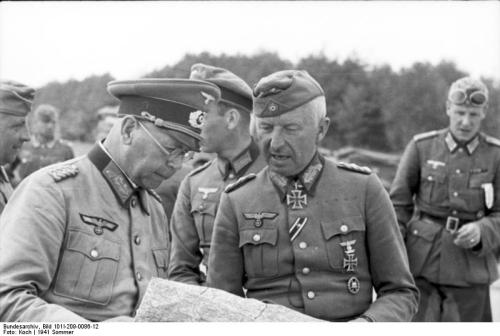
Wilhelm Keitel: “war was a fight for survival….dispense with outdated and traditional ideas about chivalry and the generally accepted rules of warfare…” Bundesarchiv Bild

This study will focus on the German policy of ideological-racial war in Poland and Russia. The German war against the Soviet Union and to a certain extent Poland was waged with an unforgiving ferocity against Hitler’s enemy, the Jewish-Bolshevik state and the Slavic Untermenschen.

The campaigns in Poland and the Soviet Union were characterized by the rise of a “political- ideological strategy.” 25 Operation “Barbarossa showed the fusion of technocracy and ideology in the context of competitive military planning.” 26 Hitler’s “ideological and grandiose objectives, expressed in racial and semi-mystical terms, made the war absolute.” 27

Field Marshal Keitel noted a speech in March 1941 where Hitler talked about the inevitability of conflict between “diametrically opposed ideologies” and that the “war was a fight for survival and that they dispense with their outdated and traditional ideas about chivalry and the generally accepted rules of warfare.” 28 General Halder, Chief of the OKH in his War Dairy for that meeting noted “Annihilating verdict on Bolshevism…the leaders must demand of themselves the sacrifice of understanding their scruples.” 29

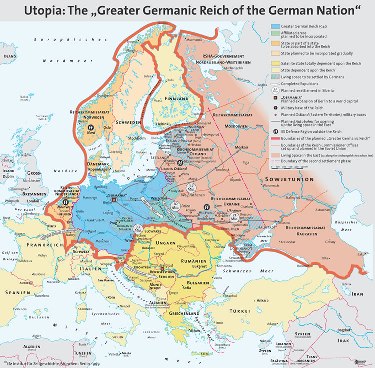
Based on Lebensraum and race, the German approach to war would combine “racism and political ideology” for the purpose of the “conquest of new living space in the east and its ruthless Germanization.” 30 Hitler explained that the “struggle for the hegemony of the world will be decided in favor of Europe by the possession of the Russian space.”31 Conquered territories would be “Reich protectorates…and that these areas were to be deprived of anything in the nature of a Slav intelligentsia.” 32

This goal was manifest in the “Criminal Order” issued by OKW which stated that the war was “more than mere armed conflict; it is a collision between two different ideologies…The Bolshevist-Jewish intelligentsia must be eliminated….” 33 Other displaced inhabitants of the conquered eastern lands would be killed or allowed to starve. 34 Part of this was due to economic considerations in the Reich, which gave Germans priority in distribution of food, even that from the conquered lands. Starvation was a population control measure that supplemented other forms of annihilation. 35 As Fest notes in Russia Hitler was “seeking nothing but “final solutions.”” 36Despite numerous post-war justifications by various Wehrmacht generals, the “Wehrmacht and army fell into line with Hitler because there was “a substantial measure of agreement of “ideological questions.”” 37

Hitler’s racial ideology was central to his worldview and fundamental to understanding his actions in the war. 38 However twisted Hitler’s ideological formulations were his ideas found acceptance beyond the Nazi faithful to the Army and Police, who would execute the campaigns in Poland and Russia in conjunction with the Einsatzgrüppen and Nazi party organizations. In these organizations he found allies with pre-existing cultural, political and doctrinal understandings which allowed them to be willing participants in Hitler’s grand scheme of eastern conquest.

ss recruiting poster

Military Doctrine and Ideology

While Hitler’s racial ideology was more extreme than many in the German military and police, these organizations had cultural beliefs and prejudices as well as doctrinal and ideological foundations which helped them become willing accomplices to Hitler. These factors were often, consciously or unconsciously, excluded from early histories of World War II. The Allies relied on German officers to write these histories at the beginning of the Cold War, developing the “dual myth of German military brilliance and moral correctness.”39 British historian and military theorist B.H. Liddell-Hart makes the astounding statement that “one of the surprising features of the Second World War was that German Army in the field on the whole observed the rules of war than it did in 1914-1918-at any rate in fighting its western opponents….” 40

While Liddell-Hart might be excused by lack of knowledge of some German army atrocities he could not have been ignorant. It was not just the SS who he blamed the atrocities but many of the men who he interviewed. In doing this Liddell-Hart and others presented a myth as truth. 41 The myths were helped by the trials of Manstein and Kesselring where “historical truth had to be sacrificed…to the demands of the Cold War.” 42 British military historian Kenneth Macksey confronted the myth that only the “Waffen SS committed barbaric and criminal acts” noting: “Not even the Knights of the Teutonic Order and their followers in the Middle Ages sank to the depths of the anti-Bolshevik Wehrmacht of 1941.” 43

Germany had a long running history of anti-Semitism before Hitler. German anti-Semitism often exhibited a “paranoid fear of the power of the Jews,” 44 and included a “fashionable or acceptable anti-Semitism” 45 which became more pronounced as the conditions of the Jews became better and Jews who had fled to Eastern Europe returned to Germany. 46 Sometimes this was tied to religious attitudes, but more often focused on the belief that the Jews “controlled certain aspects of life” and presented in “pseudo-scientific garb” the “myth of a secret Jewish plot for world domination which was simultaneously part of the internationalism of Freemasonry.” 47

Admiral Wilhelm Canaris provides an example as he “had grown up in the atmosphere of “moderate” anti-Semitism prevailing in the Ruhr middle class and in the Navy believed in the existence of a “Jewish problem”” and would “suggest during 1935-1936 that German Jews should be identified by a Star of David as special category citizens….” 48 Wehrmacht soldiers were “subject to daily doses of propaganda since the 1930s” and that with the “start of the Russian campaign propaganda concerning Jews became more and more aggressive.” 49 Some officers objected to Nazi actions against Jews. Von Manstein protested the “Aryan paragraph” in the Reichswehr on general principal.” 50 Yet some of the men who planned and executed the most heinous crimes like, Adolf Eichmann had “no fanatical anti-Semitism or indoctrination of any kind.” 51

The military “looked to the regime to reshape society in every respect: political, ideological, economic and military…Propaganda would hammer home absolute nature of the struggle…” 52 Ideological training began in the Hitler Youth and Reichsarbeitsdienst and produced a soldier in which “Anti-Semitism, anti-communism, Lebensraum – these central tenants of Nazism were all inextricably linked with the Landser’s conception of duty, with his place and role in the vast machinery of war.” 53

Following the dismissal of General Fritsch in 1938, General Brauchitsch promised Hitler that “he would make every effort to bring the Army closer to the State and the State’s ideology.” 54

Alfred Novotny, a Austrian soldier in the Gross Deutschland division noted how training depicted the Russians as Untermenschen and how they were “subjected to official rantings about how the supposedly insidious, endless influence of the Jews in practically every aspect of the enemy’s endeavors…Jews were portrayed as rats, which were overrunning the world….” 55

anti-jewish poster

This ideological component added to the already “harsh military discipline”which had a long tradition in Germany conditioning soldiers to violence and brutalization of their enemy. Similar programs existed in the Order Police which would play a large part in the eastern campaign, the “image of “treasonous” leftists and Jews helped shape the personal and political beliefs of many policemen throughout the interwar period.” 56 Even ordinary police training before the war in German speaking Europe “was brutalizing.”57 These troops were recipients of an ideological formation which “aimed at shaping the worldview of the police leading to the internalization of belief along National Socialist lines.” 58 Waffen SS soldiers, especially those of the Totenkopf division were subjected to even more systematic political indoctrination on the enemies of National Socialism, the Jews, freemasonry, Bolshevism and the churches. 59

Along with cultural anti-Semitism and the Nazification of German thought in the 1930s, there were aspects of military doctrine which helped prepare the way for the eastern campaign. The most important were the Army’s anti-partisan and rear area security doctrine. The history of security anti-partisan operations dated back to the Prussian Army’s Ettapen, which began in 1813 with the Landwehr’srole in security against looters and others. 60 These units supported and supplied offensive operations from the rear to the combat zone with a secondary mission of countering partisans and preventing disruptions in the rear area. The Ettapen would be reformed and regulated in 1872 following the Franco-Prussian War. 61

The German experience fighting guerrillas and partisans, the francs-tireurs in the Franco- Prussian War, “scarred the Army’s institutional mentality.” 62 Field Marshal Von Moltke the elder was “shattered,” and wrote his brother that “war was now taking on an ever more hate-inspired character.” 63 He was “appalled by improvised armies, irregular elements, and appeals to popular passion, which he described as a “return to barbarism.” 64He wrote:  “Their gruesome work had to be answered by bloody coercion. Because of this our conduct of the war finally achieved a harshness that we deplored, but which we could not avoid.” 65

The brutal German response to the franc-tireurs found its legal justification in Franz Lieber’s principles for classification of belligerents and non-belligerents, which determined that guerrillas were outlaws or bandits. 66 Leiber’s principles were written for the Federal Army of the United States during the U.S. Civil War. Propagated as General Order 100 and signed by Abraham Lincoln the sections dealing with irregular forces and partisans dealt with this in section IV of that code:

Article 82 stated: “Men, or squads of men, who commit hostilities, whether by fighting, or inroads for destruction or plunder, or by raids of any kind, without commission, without being part and portion of the organized hostile army, and without sharing continuously in the war, but who do so with intermitting returns to their homes and avocations, or with the occasional assumption of the semblance of peaceful pursuits, divesting themselves of the character or appearance of soldiers – such men, or squads of men, are not public enemies, and, therefore, if captured, are not entitled to the privileges of prisoners of war, but shall be treated summarily as highway robbers or pirates.”

Article 84 stated: “Armed prowlers, by whatever names they may be called, or persons of the enemy’s territory, who steal within the lines of the hostile army for the purpose of robbing, killing, or of destroying bridges, roads or canals, or of robbing or destroying the mail, or of cutting the telegraph wires, are not entitled to the privileges of the prisoner of war.”

Article 85 stated: “War-rebels are persons within an occupied territory who rise in arms against the occupying or conquering army, or against the authorities established by the same. If captured, they may suffer death, whether they rise singly, in small or large bands, and whether called upon to do so by their own, but expelled, government or not. They are not prisoners of war; nor are they if discovered and secured before their conspiracy has matured to an actual rising or armed violence.” 67

The German Army adapted that code and incorporated it in its doctrine for dealing with partisans. In response to their experience in France during the Franco-Prussian War the Germans systematically reorganized the Ettapen to include railroad and security troops, special military courts, military police, intelligence and non-military police, including the Landespolizei and the Grenzschutzpolizei. 68

The doctrinal response to partisans, or as they would become known in German writings as “bandits,” was that bandits should be encircled and destroyed. This was employed in the Southwest Africa German colonies. The Germans, influenced by the experience in France, “displayed a ferocity surpassing even that of the racially brutalized campaigns of its imperialist peers.” 69

von trotha

Lothar Von Trotha

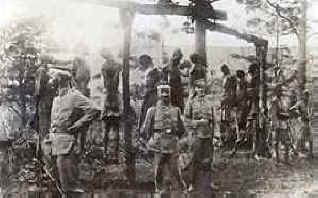
The campaign against the Herero tribes which resisted the occupation of Namibia from 1904- 1912 utilized encirclement operations, racial cleansing and what would become known as Bandenkämpfung operations. 70 In 1904 the Herero were banished from their lands which were handed over to German settlers. When the Herero resisted Von Trotha ordered that they be exterminated. “Every Herero found within German borders with or without weapons, was to be shot. But most of them died without violence. The Germans simply drove them out into the desert and sealed off the border.” 71
20030228_Herero

Of about 80,000 Herero some 60,000 died in the desert, a few thousand survived to be “sentenced to hard labor in German concentration camps.” 72 Despite praise from some in the General Staff the brutality shocked many Germans and General Alfred Von Schielffen who had to defend himself from the “accusations that he had harmed the good name of the army” ensured that “Trotha never served in the field again.” 73 Despite this the application of such Bandenkämpfung operations found their way into German military doctrine.

This was further developed in the First World War, especially in the east where General Fritz Gempp described the security problem as a “ruthless struggle”in which German pacification policy “was in reality the application of terror to galvanize the population into accepting German rule.” 74 Anti-partisan doctrine was codified in the Truppenführung of 1933 which stated that “area defense against partisan warfare is the mission of all units” and that the preferred method of combating partisan bands was that they be surrounded and destroyed. 75 General Erhard Rauss later described active and passive measures used to deal with partisans, focusing on the tactic of encirclement to destroy the enemy. 76

The accounts of the German General Staff praised Von Trotha’s operation. “The month long sealing of desert areas, carried out with iron severity, completed the work of annihilation…the sentence had been carried out” and “the Hereros had ceased to exist as an independent people.” 77

Anti-partisan doctrine focused on the destruction of the partisans, was coupled a total war philosophy and provided fit well with Hitler’s radical ideology. The “propensity for brutality in anti-guerrilla warfare was complimented by officers’ growing preoccupation, both during and after World War I, with the mastery and application of violence.” 78 Michael Geyer notes: “ideological mobilization for the creation of a new national and international order increasingly defined the parameters of technocratic planning.” 79 The acceptance of long used brutal tactics to destroy the enemy combined with Hitler’s radical racial animus against the Jews could only be expected to create a maelstrom in which all international legal and moral standards would be breached.

To be continued…

Notes

25 Geyer, Michael. German Strategy 1914-1945 in Makers of Modern Strategyfrom Machiavelli to the Nuclear Age.

Peter Paret, editor. Princeton University Press, Princeton NJ. 1986. p.582

26 Ibid. Geyer. German Strategy p.587

27 Strachan, Hew. European Armies and the Conduct of War. George, Allen and Unwin, London, UK 1983 p.174

28 Goerlitz, Walter. The Memoirs of Field Marshal Wilhelm Keitel: Chief of the German High Command 1938- 1945. Translated by David Irving. Cooper Square Press 2000, First English Edition 1966 William Kimber and Company Ltd. German edition published by Musterschmnidt-Verlad, Gottigen 1961 p. 135

29 Ibid. Fest, Hitler. p. 649

30 Ibid. Megargee, War of Annihilation p.7

31 Trevor-Roper, H.R. Hitler’s Table Talk 1941-1944 with an introduction by Gerhard L Weinberg, Translated by Norman Cameron and R.H. Stevens, Enigma Books, New York, NY 2000. Originally published in Great Britain by

Weidenfeld & Nicholoson, London 1953 p. 27 Goebbels notes a similar theme in his recollection of Hitler’s reasons for destroying Russia a power . See Taylor, Fred, Editor and Translator. The Goebbels Diaries 1939-1941, Penguin Books Ltd, Harmondsworth UK and New York NY 1984 pp. 413-415.

32 Goerlitz, Walter. History of the German General Staff.” Translated by Brian Battershaw, Westview Press, Boulder

and London, 1985. Originally published as Die Deutsche Generalstab Verlag der Frankfurter Hefte, Frankfur am Main, 1953 p.390

33 Warlimont, Walter. Inside Hitler’s Headquarters 1939-45. Translated by R.H. Berry, Presido Press, Novato CA,

1964 p. 150

34 Weinberg, Gerhard L. Visions of Victory: The Hopes of Eight World War II Leasers. Cambridge University Press, New York, NY 2005. p. 24

35 Aly, Gotz and Heim, Susanne. Architects of Annihilation :Auschwitz and the Logic of Destruction Phoenix

Paperbacks, London, 2003, Originally published as Vordenker der Vernichtung, Hoffman und Campe, Germany 1991, English translation by Allan Blunden. First published in Great Britain Weidenfeld & Nicholson, London, 2002 pp. 245-246

36 Ibid. Fest. Hitler p.649

37 Wette, Wolfram. The Wehrmacht: History, Myth, Reality. Translated by Deborah Lucas Schneider. Harvard University Press, Cambridge, MA 2006. Originally published as Die Wehrmacht: Feindbilder, Vernichtungskreig, Legenden. S. Fischer Verlag, GmbH, Frankfurt am Main, 2002 p.93

38 This understanding is different than many historians who as Friedlander notes advocate something like this: “The persecution and extermination of the Jews of Europe was but a secondary consequence of major German policies pursued toward entirely different goals.” See Friedlander p.xvi

39 Ibid. Megargee. War of Annihilation p.xii

40 Liddell-Hart, B.H. The German Generals Talk. Quill Publishing, New York, NY. 1979. Copyright 1948 by B.H. Liddell-Hart p.22

41 It has to be noted that Liddell-Hart published this work in 1948 and was limited in the materials available, his

primary sources being German officers who he viewed with sympathy because he saw them as exponents of his theory of the indirect approach. The time was also around the beginning of the Cold War and the Berlin Blockade when many American and British leaders were trying to end the war crimes trials and bring the West Germans into the new anti-Communist alliance.

42 Ibid. Wette. The Wehrmacht p.224

43 Macksey, Kenneth. Why the Germans Lose at War: The Myth of German Military Superiority. Barnes and Noble Books, New York 2006, originally published by Greenhill Books, 1996. p.139

44 Stern, Fritz. Gold and Iron: Bismarck, Bleichroder and Building of the German Empire. Vintage Books a division of Random House, New York 1979 First published by Alfred a Knopf 1977. p.495

45 Ibid. Stern. Gold and Iron p.494

46 Ibid. Bracher. The German Dictatorship p.34

47 Ibid. Bracher The German Dictatorship pp.34-35

48 Höhne, Heinze. Canaris: Hitler’s Master Spy. Translated by J. Maxwell, Brownjohn. Cooper Square Press,New York 1999. Originally published by C. Bertelsmann Verlag Gmbh, Munich 1976, first English edition by Doubledayand Company 1979 p. 216. Canaris would later protest the Kristalnacht to Keitel (p.334) and become convinced of the crime of the Nazis against the Jews.

49 Ibid. Witte. The Wehrmacht p.98

50 Ibid Witte The Wehrmacht, p.73

51 Arendt, Hannah, Eichmann in Jerusalem: A Report on the Banality of Evil. Revised and Enlarged Edition. Penguin Books, Harmondsworth, England and New York, NY 1965. Originally published by Viking Press, New York, NY 1963 p.26

52 Ibid. Megargee. War of Annihilation p.6

53 Fritz, Stephen G. Frontsoldaten: The German Soldier in World War II. The University Press of Kentucky, Lexington, KY 1995 p.195

54 Craig, Gordon A. The Politics of the Prussian Army 1640-1945. Oxford University Press, London and New York, 1955 p.495

55 Novatny, Alfred. The Good Soldier. The Aberjona Press, Bedford, PA 2003 p.40

56 Westermann, Edward B. Hitler’s Police Battalions: Enforcing Racial War in the East. University Press of Kansas, Lawrence, KS. 2005 p.64 Westermann also notes the preponderance of SA men who entered the Order Police in the 1930s, a factor which helped further the politicization of that organization.

57 Ibid. Rhodes Masters of Death p.23

58 Ibid. Westermann Hitler’s Police Battalions p.103

59 Sydnor, Charles W. Soldiers of Destruction: The SS Death’s Head Division, 1933-1945. Princeton University Press, Princeton, NY 1977 p. 28

60 Shepherd, Ben. War in the Wild East: The German Army and Soviet Partisans. Harvard University Press, Cambridge, MA 2004 p.41

61 Blood, Philip. Hitler’s Bandit Hunters: The SS and the Occupation of Europe. Potomac Books Inc. Washington, DC 2008 p.11

62 Ibid. Shepherd. War in the Wild East p.42

63 Ibid. Goerlitz. History of the German General Staff p.93

64 Rothenburg, Gunther. Moltke, Schieffen, and the Doctrine of Strategic Envelopment in Makers of ModernStrategy from Machiavelli to the Nuclear Age. Peter Paret, editor. Princeton University Press, Princeton NJ. 1986 p.305

65 Hughes, Daniel J. editor. Moltke on the Art of War: Selected Writings, translated by Harry Bell and Daniel J Hughes. Presidio Press, Novato CA 1993. p.32

66 Ibid. Blood Hitler’s Bandit Hunters p.6 Lieber was a Prussian emigrant to the US who taught law at Columbia University.

67 Instructions for the Government of Armies of the United States in the Field, prepared by Francis Lieber, LL.D., Originally Issued as General Orders No. 100, Adjutant General’s Office, 1863, Washington 1898: Government Printing Office. Retrieved from http://avalon.law.yale.edu/19th_century/lieber.asp 6 May 2014

68 Ibid. Blood Hitler’s Bandit Hunters pp.12-13

69 Ibid. Shepherd Wild War in the East p.42

70 Ibid. Blood. Hitler’s Bandit Hunters pp.16-19 71 Ibid. Lindqvist Exterminatethe Brutes p.149 72 Ibid. Lindqvist Exterminate the Brutes p.149 73 Ibid. Blood. Hitler’s Bandit Hunters p.19

74 Ibid. Blood. Hitler’s Bandit Hunters p.22

75 Condell, Bruce and Zabecki, David T. Editors. On the German Art of War: Truppenführung, Lynn Rienner Publishers, Boulder CO and London 2001. p.172

76 Tsouras, Peter G. Editor, Fighting in Hell: The German Ordeal on the Eastern Front The Ballantine Publishing

Group, New York, 1998. First published 1995 by Greenhill Books pp. 142-146. It is interesting to note that Rauss does not describe any actual anti-partisan operation

77 Ibid. Lindqvist. P.149

78 Ibid. Shepherd. War in the Wild East p.45

79 Ibid. Geyer. German Strategy p.584
Leave a comment

Filed under ethics, Foreign Policy, History, Military, national security, nazi germany, Political Commentary, world war two in europe

Downfall: Imagining the Coming Götterdämmerung

trump-flames-iran-protests

Friends of Padre Steve’s World,

I am watching the movie Downfall tonight as I imagine the coming Götterdämmerung that awaits the United States under President Trump. I do not know when it is coming or exactly how it will happen. But I believe that unless something happens to curb his power, which at the present time is unrestrained by his political party, I expect that the rule of law and the rights enumerated in the Constitution will end. When it does, if not before, the country will plunge into wars without allies that it cannot win, unless winning is defined by obliterating enemies in a nuclear holocaust. If that happens there are no winners.

Somehow when the final cataclysm occurs I expect that the President and his most devoted followers will in the midst of the flames consuming them will blame the very people who helped them to power for the downfall. And they do so without any feeling for them.

When SS General Wilhelm Mohnke who was in charge of the defense of the area around the Reich Chancellory begged Josef Goebbels to convince Hitler to surrender Berlin to allow the people of the city to live, Goebbels responded:

“I feel no sympathy. I repeat, I feel no sympathy! The German people chose their fate. That may surprise some people. Don’t fool yourself. We didn’t force the German people. They gave us a mandate, and now their little throats are being cut!”

Neither he President nor his propagandists have any sense of compassion or empathy. In the days before he killed himself Hitler ranted to those in his bunker including Albert Speer:

“Everyone has lied to me, everyone has deceived me, non[sic] one has told me the truth. The armed forces have lied to me and now the SS have left me in the lurch. The German people has not fought heroically, it deserves to perish. It is not I who have lost the war, but the German people.”

Believe me, however the Trump administration meets its end, be it by the Muller investigation, a porn star, a change of control in the House and Senate, or a disastrous war the response of the President and his media sycophants will be quite similar to Goebbels and Hitler. It will be everyone else’s fault, including those who believed in him, faithfully supported his policies, and followed them into the abyss.

I do pray that I am wrong but I cannot see how this will end in anything less than a disaster.

Again I pray that I am wrong.

Until tomorrow,

Peace

Padre Steve+


1 Comment

Filed under ethics, film, History, holocaust, national security, News and current events

The Justification of Genocide: Race Hatred and the Quest for Living Space

hitler

Introduction

Friends of Padre Steve’s World,

This is the second part of an article that deals with war crimes, genocide and how seemingly normal human beings can become complicit in such crimes. To understands this we must look at some of the intellectual and ideological foundations.

Peace

Padre Steve+

The German war against the Soviet Union was the first truly race-based ideological war in history with the campaign against Poland its precursor. Adolf Hitler’s racial theories and beliefs played a dominant role in Germany’s conduct of the war in the East in both the military campaign and occupation. This has become clearer in recent years as historians have had the opportunity to examine Hitler’s writings, those of senior Nazi officials and military officers and documents which had been unavailable until the end of the Cold War. Understanding the Nazi ideological basis and the underlying cultural prejudice against the Jews and eastern Europeans in general is foundational to understanding Hitler’s conduct of the war and why the destruction of the Jews figured so highly in his calculations. One must also understand the military and police cultures and doctrines that enabled them to cooperate so closely in the conduct of the war.

The German war in the east would differ from any previous war. Its underlying basis was ideological. Economic and geopolitical considerations were given importance in relationship to the understanding of the German “Master Race.” Race and Lebensraum was the goal of the State that “concentrates all of its strength on marking out a way of life for our people through the allocation of Lebensraum for the next one hundred years…the goal corresponds equally to the highest national and ethnic requirements.” 1

Hitler believed that Germany was “entitled to more land…because it was the “mother of life” not just some “little nigger nation or another.”” 2 The Germans planned to “clear” the vast majority of the Slavic population and the “settlement of millions of hectares of eastern Lebensraum with German colonists” complimented by a short term exploitation of the land to “secure the food balance of the German Grossraum.” 3 Joachim Fest notes that Hitler called it a “crime” to wage war only for the acquisition of raw materials. Only the issue of living space permitted resort to arms. 4

Following the Peace of Westphalia wars in Europe typically emphasized conquest of territory and natural resources either to expand empires or promote some kind of self-sufficiency. The Thirty Years War, which was ended by the Treaty of Westphalia had a heavy religious component which added to its brutality. However the root of much of this conflict was about increasing the power of emerging nation states led by men not necessarily loyal to their religious brethren. 5

The American and Russian Civil wars had some ideological basis and helped usher in the brutality of total war. Both had major effect in these nations’ development and both were bitterly contested with the winners imposing to various degrees political changes on their vanquished brothers they were civil wars. 6

Adam Tooze sees the Holocaust as the first step of the “last great land grab in the long and bloody history of European colonialism…” 7 This does have merit, Hitler’s desire for Lebensraum or living space was a type of colonialism. However, Tooze’s argument does not take away from the basic premise that Germany’s war in the east was at its heart motivated by ideological factors.

Lebensraum

Lebensraum

German Anti-Semitism and Adolf Hitler

The root of this war was in the mind of Adolf Hitler himself. Hitler was born in Linz Austria during a time when various Pan-German and Ant-Semitic groups, publications and propaganda were widespread. As a young man Hitler moved to Vienna hoping to become an artist, something that he found little commercial success. While struggling to make a living in Vienna he was exposed to a culture far different from the provincial city of his youth, a city that had much culture but was also a meeting ground for the various peoples that populated the Austro- Hungarian Empire, including Slavs and many Jews. While many of the Germanic or Austrian Jews were outwardly little different from their Christian neighbors the Jews from Eastern Europe repulsed Hitler.

This attitude was not unique to German but found its roots in the various anthropologies written by other Europeans as well as Germans regarding the lack of rights of “inferior cultures” as related to their colonial expansion as well as the westward expansion of Americans. Friedrich Ratzel a German anthropologist and a founder of the Pan-German League paired the Jews with “the stunted hunting people of the African interior” into “the class of scattered people with no

land.” 8 Ratzel’s work where he also studied the conquest of the Native American tribes by whites helped form the basis of Hitler’s Understanding of Lebensraum, a concept that he borrowed from Ratzel. Ratzel was originally a zoologist. In his concept of Lebensraum Ratzel “linked the biological theory of life with the geographical theory of space.” Ratzel believed that to “conquer and hold sufficient Lebensraum, others have to be displaced.” Ratzel noted how European settles had taken over land from the Native Americans to take it for themselves. He noted that “the result was an annihilating struggle, the prize for which was the land, the space.” 9

Another German academic and lecturer at the University of Glasgow Alexander Tille, wrote in 1893 that it is “the right of the stronger race to annihilate the lower…when that race does not maintain its ability to resist then it has no right to exist, for anyone who cannot maintain himself must be content to go under.” Tille’s “laws” were easily applied to both primitive peoples as well as to “the economically less successful peoples of Europe.” 10

Hitler’s lack of success, struggle with poverty and resentment of others led him to the writings of the Pan-Germanic and Anti-Semitic movements. His years in Vienna were foundational as he as he absorbed the ideas of these Pan-German, anti-Semitic groups through newspapers like the Deutsches Volksblatt11 In Vienna Hitler began to connect the Jews with Marxism.12 Joachim Fest notes that in Vienna Hitler became obsessed by the fear of the Slavs and Jews, hated the House of Hapsburg, the Social Democratic Party, and “envisioned the end of Germanism.” 13

Hitler’s racial views were amplified after the war in turbulent Weimar Germany where he became a member of the NDSAP, rising rapidly within it, eventually taking over party leadership, reorganizing it so that it “became the instrument of Hitler’s policies.” 14 Following the unsuccessful Beer Hall Putsch of 1923 Hitler wrote Mein Kampf while imprisoned in the Landsberg prison in which he enunciated his views about the Jews, Slavs and Lebensraum. Hitler believed that Imperial Germany had been “hopelessly negligent” in regard to the Jews 15 and that the Jews in conjunction with the Catholic Center Party and Socialists worked together for “maximum damage to Germany.” 16

Likewise he saw the Jews as heading the “main ideological scourges of the nineteenth and twentieth century’s.” 17 It was the ideology of Hitler’s “obsessive anti-Semitism” 18 that drove Nazi Germany’s policy in regard to the Jews and against Jewish-Bolshevism. By the 1920s Hitler had “combined his hatred of the Jews and of the supposedly Jewish dominated Soviet state with existing calls to conquer additional Lebensraum, or living space, in the east.” 19 Hitler wrote: “The fight against Jewish world Bolshevism requires a clear attitude toward Soviet Russia. You cannot drive out the Devil with Beelzebub.” 20 Richard Evans notes that Mein Kampf clearly enunciated that “Hitler considered racial conflict…the essence of history, and the Jews to be the sworn enemy of the German race ….” And that the “Jews were now linked indissolubly in Hitler’s mind with “Bolshevism” and “Marxism.” 21

When Hitler became the dictator of Germany “his ideology and strategy became the ends and means of German foreign policy.” 22 His aims were clear, Hitler remarked to Czech Foreign Minister Chvalkovsky on 21 January 1939: “We are going to destroy the Jews.” 23It was clear that Hitler understood his own role in this effort noting to General Gotthard Heinrici that “he was the first man since Charlemagne to hold unlimited power in his own hand. He did not hold this power in vain, he said, but would know how to use it in the struggle for Germany…” 24

To be continued…

Notes

1 Weinberg, Gerhard L. Ed. Hitler’s Second Book: The Unpublished Sequel to Mein Kampf by Adolph Hitler.  Translated by Krista Smith, Enigma Books, New York, NY 2006. Originally published as Hitlers zweites Buch, Gerhard Weinberg editor, 1961 p. 159

2 Davidowicz, Lucy S. The War Against the Jews 1933-1945 Bantam Books, New York, NY 1986. p.91

3 Tooze, Adam. The Wages of Destruction Penguin Books, New York, NY, 2008. First Published by Allen Lane Books, Penguin Group, London UK, 2006. p.463

4 Fest, Joachim, Hitler. Translated by Richard and Clara Winston. Harcourt Brace Jovanovich Publishers, San Diego,

New York, London, 1974. German Edition by Verlag Ullstein 1973 pp. 607-608

5 Note the actions of Cardinal Richelieu in France who worked to expand French power at the expense of other Catholic nations and the Vatican itself.

6 In the United States the Reconstruction policies produced great resentment in the south with decidedly negative

results for the newly freed slaves which lasted another 100 years, while in the Soviet Union great numbers of “opponents of Socialism” were killed, imprisoned or driven out of the county

7 Ibid. Tooze. The Wages of Destruction p.462

8 Lindqvist, Sven Exterminate All the Brutes: One Man’s Oddessy into the Heart of Darkness and the Origins of European Genocide Translated from the Swedish by Joan Tate, The New Press , New York and London 1992 p.145

9 Ibid. Lindqvist p.154 It is interesting to note that the current American “historian” of the American Religious right

David Barton made the same arguments recently about the American Indians. Barton said: “You have to deal, a lot of it, with how the enemy responds. It’s got to be based on what the enemy responds [to,] you cannot reason with certain types of terrorists; and see that’s why we could not get the Indians to the table to negotiate with us on treaties until after we had thoroughly whipped so many tribes …” “People complain about the fact that the American military and buffalo hunters went out and wiped out all the buffalo in the western plains. Doing that was what brought the Indians to their knees because the Indians lived on those wide western plains where there were very few towns; Indians didn’t go into town to buy supplies, they went to the buffalo herds, that’s where they got their meat, that’s where they got their coats, the hides provided coats, they provided covering for their teepees.

If you don’t have the buffalos, those Indians cannot live on the open western plains without those buffalo and so what happened was the military wiped out the supply line by wiping out the buffalo. That’s what brought those wars to an end, that’s what brought the Indians to their knees and ended all the western conflict.” Retrieved from Barton’s Wallbuilders Live broadcast http://www.wallbuilderslive.com/Historic.asp?cdate=77515 9 May 2014 and text   from   http://www.rightwingwatch.org/content/david-barton-explains-just-war-theory-we-had-destroy-indian-  tribes-until-they-became-civiliz

10 Ibid. Lindqvist p.148

11 Ibid. Davidowicz, The War Against the Jews pp.8-9 12 Ibid. Davidowicz. TheWar Against the Jews p.12 13 Ibid. Fest Hitler. p.47

14 Bracher, Karl Dietrich. The German Dictatorship: The Origins, Structure, and Effects of National Socialism.

Translated by Jean Steinberg, Holt Rinehart and Winston, New York, NY 1979. Originally Published under the title Die Deutsche Diktatur: Entstehung, Struktur,Folgen des Nationalsocialismus. Verlag Kiepenheuer & Witsch. Koln and Berlin, 1969 p.93

15 Weinberg, Gerhard L. Germany Hitler and World War II . Cambridge University Press, New York, NY 1995 p.61

16 Ibid. Weinberg, Hitler’s Second Book p.60

17 Friedlander, Saul Nazi Germany and the Jews 1939-1945: The Years of Extermination. Harper Perennial, New York, NY 2007 p.xviii

18 Ibid. Friedlander, The Years of Extermination p.xvii Friedlander called this anti-Semitism “Redemptive anti- Semitism” in which “Hitler perceived his mission as a kind of crusade to redeem the world by eliminating the Jews.

19 Megargee, Geoffrey P. War of Annihilation: Combat and Genocide on the Eastern Front 1941.Bowman and

Littlefield Publishers Inc. Lanham, Boulder, New York. 2007 p.4

20 Hitler, Adolf Mein Kampf translated by Ralph Manheim. Mariner Books, Houghton Mifflin Company, New York, NY 1999. Houghton Mifflin Company 1943, copyright renewed 1971. Originally published in Germany by Verlag Frz.

Eher Nachf. GmbH 1925. p.662.

21 Evans, Richard J. The Coming of the Third Reich Penguin Books, New York 2004. First published by Allen Lane 2003 p.197

22 Ibid. Davidowicz The War Against the Jews pp. 88-89

23 Rhodes, Richard. Masters of Death: The SS Einsatzgruppen and the Invention of the Holocaust. Vintage Books a division of Random House, New York, NY 2002 p.37

24 Speer, Albert. Inside the Third Reich. Collier Books, a Division of MacMillan Publishers, Inc. New York, NY 1970 p.166

7 Comments

Filed under History, holocaust, nazi germany

Ordinary Men and Genocide: Introduction…

babi yar

Massacre at Babi Yar

Friends of Padre Steve’s World,

Anyone who follows my writing know I write a lot about the Holocaust and the war crimes perpetuated by the Nazi State. I began studying this as an undergraduate and graduate level history student at California State University at Northridge under Dr. Helmut Heussler, who served as a wartime interrogator for the 82nd Airborne Division during the Second World War and then as an interpreter at the Major War Crime trials at Nuremberg.  I studied under him for three years dealing with the end of Imperial Germany, the German Civil War, the Weimar Republic and the Nazi era. He gave me a lot of freedom to explore and research the subject and allowed me to do that research in undergraduate and graduate level independent study projects. I continued that study personally as well as during seminary and my second Master’s Degree in Military History.

Since I read, speak and write German well and can often pass myself off as German in Germany because of my lack of an American accent when speaking the language. I speak German with a blend of a Bavarian and Hessen dialect and that helps when I visit various Holocaust sites, museums, and research centers in Germany. I will be doing some of that again this fall when I make another trip to Munich, Hessen, and Baden-Wurttemberg. Last week I spent five hours at the U.S. Holocaust Museum in Washington D.C. contemplating things that I mostly already knew while exploring details of the Holocaust that made it more real and personal.

As part of my academic work at the Joint Forces Staff College I taught military ethics as related to the Just War Theory. In the class on jus post bellum or justice after war I dealt with the implication of participating in war crimes. It is a serious subject and in the class I attempted to make my students, all relatively senior officers from the United States and allied nations as uncomfortable as possible. I used a number of examples from the major war crimes trials at Nuremberg as well as the Generals Trial and I used the film Conspiracy, which is about the Wannsee Conference where mostly mid-level officers and bureaucrats hashed out the coordination of the Endlosung or Final Solution to what Nazis euphemistically called “the Jewish Question.” 

As I went through previous notes and research to teach my students I felt a tenseness and revulsion for the actions of those that ordered, committed or condoned these crimes; many of whom were like me, professional military officers, historians, and theologians. So I realize how easily it is for normal, rational, and even basically decent people to succumb to either participating in or turning a blind eye to crimes against others, even on a massive scale.  In fact the bigger those crimes are they seem easier for some people to dismiss, because the victims cease be human, and simply a statistic. Sadly, Josef Stalin probably got human nature right when he said “The death of one man is a tragedy. The death of millions is a statistic.” That comment causes great revulsion in my soul, but I have to admit it seems to be the way that many people deal with such great crimes.

September 29th 2017 was the 76th anniversary of the Babi Yar massacre. It was committed by members of the SS Einsatzgruppen C near Kiev shortly after the German Army captured that city. 33,771 Jews were exterminated by the members of Sonderkommando 4b of Einsatzgruppen C as well as members of a number of Ordungspolizei, police battalions supported by the logistics and protection of the German Army. About 10,000 others, mainly Communist Officials and Gypsies were rounded up and killed in the same operation. The victims were stripped of all of their belongings taken to a ravine and shot. It was the second largest killing action by the various Einsatzgruppen in the war. The killings were done up close and personal. The men who conducted the operation either believed that the people that they were killing were sub-human, or did not have the courage to stand up and say no.

These issues are still with us and as I watch the rise of Right Wing and other Fascist movements in Russia, Europe, and the United States I get very concerned. But even more concerning are the large number of people who are content to dismiss their threats and violence, often because while too respectable to utter their words themselves they secretly condone their race hatred. Hannah Arendt made the comment that “The sad truth is that most evil is done by people who never make up their minds to be good or evil.”

Of course these are uncomfortable subjects. When I tell friends of the places that I have visited and studies I have done quite a few openly tell me that they find the subject so uncomfortable hat they could not visit those places. These friends span the political spectrum, just as did the people who said nothing or willingly followed orders to commit genocide in Nazi Germany.

We like to say that the Nazis were different than us or others. To some extent this is true, but the real truth is that most of the Christian Western European countries, and I include the United States have also committed gross crimes against humanity against peoples that we believed were less than human and not afforded human rights or protections. In the movie Judgement at Nuremberg Spencer Tracy makes a comment that should send chills through any of us. He spoke concerning one of the judges on trial, “Janning, to be sure, is a tragic figure. We believe he loathed the evil he did. But compassion for the present torture of his soul must not beget forgetfulness of the torture and the death of millions by the Government of which he was a part. Janning’s record and his fate illuminate the most shattering truth that has emerged from this trial: If he and all of the other defendants had been degraded perverts, if all of the leaders of the Third Reich had been sadistic monsters and maniacs, then these events would have no more moral significance than an earthquake, or any other natural catastrophe.But this trial has shown that under a national crisis, ordinary – even able and extraordinary – men can delude themselves into the commission of crimes so vast and heinous that they beggar the imagination….”

Babi Yar is just one example of how civilized people can get can commit great atrocities in the name of ideology and race, and it does not stand alone. The tragic fact is that it really doesn’t take much to condition people to go commit such crimes; just teach people from childhood that people of certain races or religions are less than human. Then subjugate them to incessant propaganda and then turn them loose using the pretext that they are killing terrorists or insurgents. In the coming days I am posting in small sections an article that I wrote that deals with the ideological as well as military reasons that brought about Babi Yar and so many other atrocities committed by the Nazis during the campaigns in Poland and the Soviet Union.

What happened at Babi Yar is just one example of how civilized people can get can commit great atrocities in the name of ideology and race, and it does not stand alone. The tragic fact is that it really doesn’t take much to condition people to go commit such crimes; just teach people from childhood that people of certain races or religions are less than human. Then subjugate them to incessant propaganda and then turn them loose using the pretext that they are killing terrorists, insurgents, or other enemies of the state. Dr Timothy Snyder wrote:

“The European history of the twentieth century shows us that societies can break, democracies can fall, ethics can collapse, and ordinary men can find themselves standing over death pits with guns in their hands. It would serve us well today to understand why.”

The coming series of articles deal with the ideological as well as military reasons that brought about Babi Yar and so many other atrocities committed by the Nazis during the campaigns in Poland and the Soviet Union. I will probably intersperse other articles as the need arises but there will be five more sections to this series.

So until tomorrow,

Peace

Padre Steve+

1 Comment

Filed under ethics, faith, History, holocaust, Military, nazi germany, News and current events, Political Commentary

Never Again? Holocaust Days of Remembrance 2018

img_4761

Friends of Padre Steve’s World,

April 8th to 15th are the Holocaust Days of Remembrance in the United States. I am glad we do this but sadly I don’t think that the vast majority of Americans really care about the Holocaust or its eternal precedent because frankly we live in an age where history, unless it is being bastardized to fit the propaganda message of political ideologues matters not a wit.

Historian Timothy Snyder refers to the current trend of history being cherry picked and perverted in support of ideology as the  politics of eternity. Over the past two decades this concept has replaced the politics of inevitability  which defined the immediate ear after the Cold War. Inevitability presumed that no-matter what happened that the future would unfold in a manner that ultimately benefited everyone.

That understanding lasted until the disastrous American war against Iraq, the collapse of the banking system, and the politics of inequity that by 2010 made most Americans feel that they were being shortchanged. The social contract that had buttressed society has given way much in the way that it had in Europe following the First World War. Many, regardless of where they lay on the political spectrum feel victimized and angry. Their victimhood and anger require scapegoats who in turn become victims and many times the scapegoats are those who were traditionally exploited and persecuted based on race or religion, or new immigrants who have taken the place of the previously persecuted peoples that now embrace the very ideologies used to persecute their ancestors.

Snyder noted that the politics of “eternity places one nation at the centre of a cyclical story of victimhood. Time is no longer a line into the future, but a circle that endlessly returns the same threats from the past. Within inevitability, no one is responsible because we all know that the details will sort themselves out for the better; within eternity, no one is responsible because we all know that the enemy is coming no matter what we do. Eternity politicians spread the conviction that government cannot aid society as a whole, but can only guard against threats. Progress gives way to doom.”

To those that practice the politics of eternity, no matter what nation they hail from the precedent of the Holocaust looms large.

Snyder correctly observed that “The world is now changing, reviving fears that were familiar in Hitler’s time, and to which Hitler responded. The history of the Holocaust is not over. Its precedent is eternal, and its lessons have not yet been learned.”

That is something that we must never forget lest the would be architects of annihilation of our day; the politicians, preachers, propagandists, and profiteers, who demonize the Jews, Muslims, dark skinned immigrants, LTBTQ people and other inconvenient elements and prepare people to do evil or ignore it: the ordinary men who just obey orders. Primo Levi wrote:Primo Levi wrote, “Monsters exist, but they are too few in number to be truly dangerous. More dangerous are the common men, the functionaries ready to believe and to act without asking questions.” 

Levi was right, the common men, those that don’t think but simply follow orders or turn their heads and ignore the evil who are the most dangerous.

But of all of the people victimized by the politics of eternity it has to be the Jewish people  who have suffered the greatest from often disparate enemies. Anti-Semitism knows few boundaries and is not just one prejudice among many, even though the purveyors of it often persecute and massacre others. Christopher Hitchens noted about the Nazi crimes in Eastern Europe which were often aided by local militias: “We should not at all allow ourselves to forget the millions of non-Jewish citizens of Belarus, Russia, Ukraine, and other Slav territories who were also massacred. But for me the salient fact remains that anti-Semitism was the regnant, essential, organizing principle of all the other National Socialist race theories. It is thus not to be thought of as just one prejudice among many.” 

That is one major reason why I fear the surge in the politics of eternity in the United States, Europe, and other nations. I fear that the Jews will again be a sacrificial victim especially because a part of the American electorate which allegedly supports Israel, Evangelical Christians only do so because their theology requires the sacrifice of the Jews and Israel at the hand of the Anti-Christ during Christ’s Second Coming.  Sadly, these are the same people who unabashedly support a President that mocks their faith and Christ in word and deed, and whose often disparaging tone toward American Jews is well known. As such I cannot help but think that it could indeed happen here. If this is what it means to make America Great again then we are deep trouble. Snyder wrote: “When exactly was the “again” in the president’s slogan “Make America great again”? Hint: It is the same “again” that we find in “Never again.”

Milton Mayer wrote in his book They Thought They Were Free about a German colleague during the 1950s that had lived through the Hitler years as an academic. The man tried to explain how changes were so gradual that people like him who should have known better did not take action, if they did at all until it was too late. The man asked Mayer:

“How is this to be avoided, among ordinary men, even highly educated ordinary men? Frankly, I do not know. I do not see, even now. Many, many times since it all happened I have pondered that pair of great maxims, Principiis obsta and Finem respice—‘Resist the beginnings’ and ‘Consider the end.’ But one must foresee the end in order to resist, or even see, the beginnings. One must foresee the end clearly and certainly and how is this to be done, by ordinary men or even by extraordinary men? Things might have. And everyone counts on that might.”

With what is happening on the border of Israel in Syria I am very much afraid that there will be a backlash against American Jews, as well as American Muslims from both the political left and right. The precedent of the Holocaust is indeed eternal and it is incumbent on us to ensure that it does not happen again. That being said if it does and some of us have the courage to resist and even risk martyrdom it will not be the martyrdom of the innocent. Sadly, most of us regardless of our ideological or political point of view have contributed to the situation that we see today. Dietrich Bonhoeffer spoke these words as the Nazi Party became the largest and most powerful in Germany before Hitler was appointed Chancellor by Hindenburg:

“the blood of martyrs might once again be demanded, but this blood, if we really have the courage and loyalty to shed it, will not be innocent, shining like that of the first witnesses for the faith. On our blood lies heavy guilt, the guilt of the unprofitable servant who is cast into outer darkness” 

I am one of those unprofitable servants because for some thirty years I supported the party and policies that brought about Trump and turned a blind eye toward the consequences until I saw the terrible results of the polices that I supported when I went to Iraq in 2007 and 2008.

Until tomorrow,

Peace

Padre Steve+

Leave a comment

Filed under ethics, faith, History, holocaust, middle east, nazi germany, News and current events, Political Commentary

Dietrich Bonhoeffer and the Martyrs of Flossenburg: A Lesson for Christians in the Age of Trump

D.Bonhoeffer im Gefaengnis Berlin-Tegel

Friends of Padre Steve’s World,

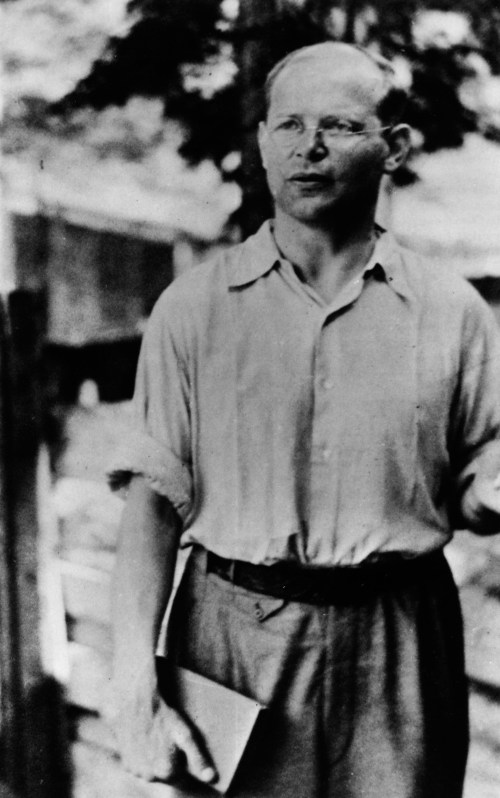
Seventy-three years ago at the Flossenburg Concentration Camp near the German-Czech border a pastor, an Admiral, and a General were martyred on the specific order of Adolf Hitler. The pastor was the eminent Dietrich Bonhoeffer, the Admiral, Wilhelm Canaris the former head of the German military intelligence service; the Abwehr, the General, Hans Oster, Canaris’s deputy. All three were Christians and all three opponents of Hitler’s regime. Condemned with them were Karl Sack a senior military jurist, retired General Friedrich Von Rabenau who was also a theologian, and several others connected with the Abwehr and the resistance.

I think that in an age where politically conservative Christians have trampled their own faith to support of a leader who makes a mockery of the Christian faith as he blasphemes the very name of Christ and the teachings of Jesus in his words and deeds. While I am not comparing the President to Hitler I am comparing the corrupt and evil Christian leaders and organizations which support him to the German Christians who eagerly supported Hitler and his diabolical regime. Thus the men who lost their lives in the fight against Hitler on April 9th 1945 and their courage need to be remembered and emulated should the Trump administration continue down its path to trample the Constitution and crush civil and human rights, and quite possibly engage in aggressive preemptive wars that would be illegal under the precedents of the Nuremberg Trials; all in the name of Making America Great Again.

But it is Bonhoeffer that I will focus on tonight. As early as 1932 Bonhoeffer realized the menace and evil of Hitler’s growing Nazi Party and movement. In a sermon the recently ordained Bonhoeffer, then only 26 years old noted that danger and the complicity of all Germans in it, especially Christians.  He warned that resistance to it could well involve martyrdom. But he believed that the the evil of the tyrant gave no one the luxury of claiming innocence:

“the blood of martyrs might once again be demanded, but this blood, if we really have the courage and loyalty to shed it, will not be innocent, shining like that of the first witnesses for the faith. On our blood lies heavy guilt, the guilt of the unprofitable servant who is cast into outer darkness” 

On February 1st 1933, two days after Hitler’s accession to power Bonhoeffer was beginning a previously scheduled speech on what was known as the concept known as the Fuhrerprinzep. The speech was not a direct attack on Hitler but a warning of the limits of power. He had barely begun the speech when for unexplained circumstances he was cut off. While there was no proof that this was deliberately done it would not have been unlike the Nazis to engage in such subterfuge. The speech was printed in a non-Nazi conservative newspaper and he was invited to give the speech in early March at the University of Berlin’s college of political science. At the end of the speech, which included no remarks on current events Bonhoeffer criticized the Fuhrerprinzep which he believed could easily become an idolatrous cult. However, Hitler had ridden into power upon upon that concept as people sought a strong leader to bring Germany out of political, social, and economic turmoil.

“The fearful danger of the present time is that above the cry for authority, be it of a Leader or of an office, we forget that man stands alone before the ultimate authority and that anyone who lays violent hands on man here is infringing eternal laws and taking upon himself superhuman authority which will eventually crush him. The eternal law that the individual stands alone before God takes fearful vengeance where it is attacked and distorted. Thus the Leader points to the office, but Leader and office together point to the final authority itself, before which Reich or state are penultimate authorities. Leaders or offices which set themselves up as gods mock God and the individual who stands alone before him, and must perish.”

german-christians-march

At that early stage Hitler whose office was conditional on the support of President Paul Von Hindenburg and headed a cabinet in which his Nazis were a minority partner realized that he had to say the right things to maintain it, he could not appear too radical. One group that he courted were politically conservative German Christians. In a speech delivered the same day as Bonhoeffer’s curtailed speech, Hitler claimed that the Christian faith would serve as “the basis of our collective morality.” It was a lie but it assuaged the fears of Christians in non-Nazi conservative and moderate parties, many who became a part of the Nazi German Christian movement which decidedly in the service of Hitler espousing Nazi racial doctrines and attacks upon the Jews.

As Hitler and the Nazis stepped up their persecution of their political opponents and the Jews based on the emergency provisions of the Reichstag Fire Decree Bonhoeffer both worked and spoke his opposition to the tyranny that was beginning to envelop Germany. In April 1933 while speaking of the responsibility of Christians and the church to stand against injustice he wrote in his essay The Church and the Jewish Question: 

“The church has an unconditional obligation to the victims of any ordering society, even if they do not belong to the Christian community.” and also“We are not to simply bandage the wounds of victims beneath the wheels of injustice, we are to drive a spoke into the wheel itself.”

He became a key member of what became known as the Confessing Church and the Pastors Emergency League where he helped draft the Barmen Declaration. He ran an underground seminary to train theology students. He had the chance to remain in the United States in June of 1939 but refused the pleas of his American friends to do so. He explained his position to the American theologian Reinhold Niebuhr:

“I have come to the conclusion that I made a mistake in coming to America. I must live through this difficult period in our national history with the people of Germany. I will have no right to participate in the reconstruction of Christian life in Germany after the war if I do not share the trials of this time with my people… Christians in Germany will have to face the terrible alternative of either willing the defeat of their nation in order that Christian civilization may survive or willing the victory of their nation and thereby destroying civilization. I know which of these alternatives I must choose but I cannot make that choice from security.”

On his return to Germany he was forbidden to speak in public, prohibited from publishing and required to report his movements to the police. However he did have friends. His brother in law, the lawyer Hans Dohnányi who was a member of the opposition, recruited Bonhoeffer for the Abwehr the German military service in order to prevent him from being conscripted into the Wehrmacht based on the proposition that his contacts with British and American could prove useful to to German intelligence. While Bonhoeffer remained suspect to Nazi officials the appointment brought him into the orbit of Admiral Wilhelm Canaris, General Hans Oster, and other leaders of the military opposition to Hitler.

From these men he began to comprehend the fulness of the Nazi evil and learned of early plots against Hitler’s life. Bonhoeffer, a pacifist realized that he must become an active part of the resistance and wrote: “the ultimate question for a responsible man to ask is not how he is to extricate himself heroically from the affair, but how the coming generation shall continue to live.” By participating in the conspiracy Bonhoeffer can be accused of hypocrisy, and he knew it. He explained his position in a letter to his sister:

“If I sit next to a madman as he drives a car into a group of innocent bystanders, I can’t, as a Christian, simply wait for the catastrophe, then comfort the wounded and bury the dead. I must try to wrestle the steering wheel out of the hands of the driver.”

During his tenure with the Abwehr he served as a courier to make contact with Allied leaders in Switzerland in order to gain support for opposition efforts, attempts that the Allies ignored, even as he wrote his book Ethics. Bonhoeffer worked with Dohnányi and others in the Abwehr to smuggle fourteen Jews out of German to Switzerland along with large sums of currency. However, the Sicherheitsdienst, the intelligence branch of Heinrich Himmler’s SS  became aware of their activities and both were arrested in April 1943, not so much for that but in order to discredit the rival Abwehr. While the Abwehr was able to cover for most of their activities they were charged with breaking the Nazi laws regarding the Jews.

He was imprisoned in Berlin’s Tegel Prison while awaiting trial but during that time he produced many theological writings which were smuggled out of the prison to his student Eberhard Bethage by his fiancé and sympathetic guards. These uncensored works would become the book Letters and Papers from Prison. He expressed no bitterness in his arrest but reflected on what he and others in the resistance had learned, lessons that privileged Christians in the United States who worship the ungodly political, economic, and military power reveled in by President Trump would be wise to heed:

“We in the resistance have learned to see the great events of world history from below, from the perspective of the excluded, the ill treated, the powerless, the oppressed and despised… so that personal suffering has become a more useful key for understanding the world than personal happiness.”

Documents that exposed Bonhoeffer’s connection to the anti-Hitler plot that resulted in the July 20th 1944 assassination attempt on Hitler by Lieutenant Colonel Claus von Stauffenberg were discovered by the Gestapo in September 1944 and he was moved to the SS Prison at the Reichssicherheitshauptamt, the Reich Security Main Office. When that facility was bombed in February 1945 he was moved to Buchenwald and finally to Flossenburg where he would die.

Two of his writings which he produced while in prison have had a profound impact on my faith.

“During the last year or so I’ve come to know and understand more and more the profound this-worldliness of Christianity.  The Christian is not ahomo religiosus, but simply a man, as Jesus was a man…I’m still discovering right up to this moment, that it is only by living completely in this world that one learns to have faith. One must completely abandon any attempt to make something of oneself, whether it be a saint, or a converted sinner, or a churchman (a so-called priestly type!) a righteous man or an unrighteous one, a sick man or a healthy one.  By this-worldliness I mean living unreservedly in life’s duties, problems, successes and failures, experiences and perplexities.  In so doing we throw ourselves completely into the arms of God, taking seriously, not our own sufferings, but those of God in the world—watching with Christ in Gethsemane. That, I think, is faith; that is metanoia; and that is how one becomes a man and a Christian.”

“I discovered later, and I’m still discovering right up to this moment, that is it only by living completely in this world that one learns to have faith. By this-worldliness I mean living unreservedly in life’s duties, problems, successes and failures. In so doing we throw ourselves completely into the arms of God, taking seriously, not our own sufferings, but those of God in the world. That, I think, is faith.”

Bonhoeffer’s fate was sealed when on April 4th 1945 Canaris’s secret diaries were found. When Hitler read them he became enraged and demanded that the Abwehr traitors be destroyed. Bonhoeffer and his companions were taken to Flossenburg, but at a stop Bonhoeffer became separated from them and was held with other prisoners in the small town of Schoenberg. While there on Sunday 8 April 1945, Bonhoeffer was asked to conduct a service on the second Sunday of Easter. He had just finished conducting the service at a schoolhouse when plainclothes Gestapo agents arrived to arrest him. British prisoner Payne Best noted that Bonhoeffer:

“spoke to us in a manner which reached the hearts of all, finding just the right words to express the spirit of our imprisonment and the thoughts and resolutions which it had brought.”

As Bonhoeffer was taken he said to another prisoner, “This is the end – but for me, the beginning of life.” He was driven to Flossenburg where he along with the other Abwehr conspirators was condemned at a drumhead trial by SS Judge Sturmbannfuhrer (Major) Otto Thorbeck without witnesses or records of proceedings or defense and hanged the next day, two weeks before American soldiers liberated the camp.

The only account of his death was written by the SS doctor of the camp.

“On the morning of that day between five and six o’clock the prisoners, among them Admiral Canaris, General Oster, General Thomas and Reichgerichtsrat Sack were taken from their cells, and the verdicts of the court martial read out to them. Through the half-open door in one room of the huts I saw Pastor Bonhoeffer, before taking off his prison garb, kneeling on the floor praying fervently to his God. I was most deeply moved by the way this lovable man prayed, so devout and so certain that God heard his prayer. At the place of execution, he again said a short prayer and then climbed the steps to the gallows, brave and composed. His death ensued after a few seconds. In the almost fifty years that I worked as a doctor, I have hardly ever seen a man die so entirely submissive to the will of God.”

So until tomorrow,

Peace

Padre Steve+

Leave a comment

Filed under christian life, ethics, faith, History, holocaust, nazi germany, News and current events, philosophy, Political Commentary, Religion, world war two in europe

“My Oath did not Expire When I took off the Uniform” Ralph Peters Resigns from Fox News

Army-Lt.-Col.-Ralph-Peters-ret-on-Fox-News-screencap-800x430

Friends of Padre Steve’s World,

I have called Fox News and many of its hosts a propaganda network for some time. At one time, back in the late 1990s and up until I went to Iraq in July of 2007 I watched Fox nearly nonstop along with my daily diet of Rush Limbaugh and Sean Hannity on the radio. It took a number of years of their listening incessantly to their propaganda before I became revulsed by it while serving in Iraq.

Sitting in a dining facility late one evening after coming back from an intensive mission I saw some Fox News talking heads discussing the war on a television. What they were discussing was pure propaganda and had no relationship to what was going on in that country. At that point I made up my mind that what I had tried to believe was true was all lies; lies spun by the Bush administration and aided by the supposedly “Fair and Balanced” team at Fox News. When I returned home in 2008 every time I heard a Fox pundit or saw them on the news I became very angry. To this day I cannot watch them and when I see the lies and propaganda that they spread today I can only compare many of their hosts to the propagandists of Nazi Germany and the Soviet Union, except neither the Nazis or the Soviets claimed to be ‘fair and balanced.”

Yesterday I was pleasantly surprised to find out that retired Army Lieutenant Colonel Ralph Peters quit his post as a commentator for Fox. I met him in 1999 not long after I had transferred from the Army to the Navy and was serving at Camp LeJeuene with the Second Marine Division. Peters was doing a book tour for his first non-fiction title Fighting for the Future, and I got to meet and talk to him at the bookstore in the Main Exchange. He had enlisted in the Army five years before me and was commissioned three years before me. Both of us had served tours in Germany. He was an Intelligence officer with a specialization on the Soviet Union and Eastern Europe. I was a history major who in the wisdom of the Army assignment gods had been branched as a Medical Service Corps officer. Peters retired in 1998 as I was preparing to leave the Army for the Navy.

He certainly, like many military officers is very conservative but at the same time a realist. While initially supporting the war in Iraq he would become a critic by 2006 and in 2009 recommend pulling out of Afghanistan. He recently stated that assault weapons should be banned, something that is anathema to Fox and most of its loyal viewers.

Peters thought that President Obama was too soft on Putin and Russia, and despite being a big supporter of President Obama I had to agree with him. I think that while President Obama was in a no-win situation had he confronted and opposed Putin in 2016, he could have done more in 2015, and despite being in a no-win situation politically in 2016 that he should have hammered Putin and exposed the Russian attempts to undermine the country and elect Trump in 2016. His actions were too little and too late.

In his resignation from Fox, Peters showed something that is seldom seen in the media. He demonstrated courage and honor over personal gain. He had a good following on Fox and certainly could have stayed at the network and continued to make good money. But he finally hit the point with them that I hit in 2007, his honor and his commitment to his office would not allow him to stay.

His resignation latter was published by Buzzfeed on Tuesday. It is one of the most remarkable resignation letters I have ever read. It was an indictment of Fox and many of its hosts and commentators as pure propagandists “for a destructive and ethically ruinous administration.” I heartily agree with him. I have posted his letter in its entirety below.

On March 1st, I informed Fox that I would not renew my contract. The purpose of this message to all of you is twofold:

First, I must thank each of you for the cooperation and support you’ve shown me over the years. Those working off-camera, the bookers and producers, don’t often get the recognition you deserve, but I want you to know that I have always appreciated the challenges you face and the skill with which you master them.

Second, I feel compelled to explain why I have to leave. Four decades ago, I took an oath as a newly commissioned officer. I swore to “support and defend the Constitution,” and that oath did not expire when I took off my uniform. Today, I feel that Fox News is assaulting our constitutional order and the rule of law, while fostering corrosive and unjustified paranoia among viewers. Over my decade with Fox, I long was proud of the association. Now I am ashamed.

In my view, Fox has degenerated from providing a legitimate and much-needed outlet for conservative voices to a mere propaganda machine for a destructive and ethically ruinous administration. When prime-time hosts–who have never served our country in any capacity–dismiss facts and empirical reality to launch profoundly dishonest assaults on the FBI, the Justice Department, the courts, the intelligence community (in which I served) and, not least, a model public servant and genuine war hero such as Robert Mueller–all the while scaremongering with lurid warnings of “deep-state” machinations– I cannot be part of the same organization, even at a remove. To me, Fox News is now wittingly harming our system of government for profit.

As a Russia analyst for many years, it also has appalled me that hosts who made their reputations as super-patriots and who, justifiably, savaged President Obama for his duplicitous folly with Putin, now advance Putin’s agenda by making light of Russian penetration of our elections and the Trump campaign. Despite increasingly pathetic denials, it turns out that the “nothing-burger” has been covered with Russian dressing all along. And by the way: As an intelligence professional, I can tell you that the Steele dossier rings true–that’s how the Russians do things.. The result is that we have an American president who is terrified of his counterpart in Moscow.

I do not apply the above criticisms in full to Fox Business, where numerous hosts retain a respect for facts and maintain a measure of integrity (nor is every host at Fox News a propaganda mouthpiece–some have shown courage). I have enjoyed and valued my relationship with Fox Business, and I will miss a number of hosts and staff members. You’re the grown-ups.

Also, I deeply respect the hard-news reporters at Fox, who continue to do their best as talented professionals in a poisoned environment. These are some of the best men and women in the business..

So, to all of you: Thanks, and, as our president’s favorite world leader would say, “Das vidanya.”

The various oaths that I have sworn to the Constitution, first as an enlisted man and then as a Commissioned Officer in the Army, the Army National Guard, the Army Reserve, and the Navy are foundational to my life. I have served under six Presidents. I have agreed and disagreed with the various policies and positions of the first five, but never did I think that any of them were truly a threat to the Constitution and the foundation of the country as I believe that President Trump and his administration are such a threat.

It is my adherence to the Constitution; the radical proposition of the Declaration of Independence that “all men are created equal and endowed by their creator with certain unalienable rights, that among these are life, liberty, and the pursuit of happiness.” I could add the Gettysburg Address in which Abraham Lincoln gave new life to the propositions of the Declaration and the preamble of the Constitution. Now is the time for every American to be as recommit themselves to those ideals or lose them forever.

The President and his propagandists at Fox News are not patriots. One can place a thousand flags behind them or adorn the lapels of their suit jackets with American flag pins, but that does not mean that they are patriots. Patriots stand for those principles, and the Constitution; all of it, not just the parts that they agree with while working to undermine the protections of the Constitution to those who they may hate or disapprove.

In his book On Tyranny Dr Timothy Snyder wrote:

“The president is a nationalist, which is not at all the same thing as a patriot. A nationalist encourages us to be our worst, and then tells us that we are the best. A nationalist, “although endlessly brooding on power, victory, defeat, revenge,” wrote Orwell, tends to be “uninterested in what happens in the real world.” Nationalism is relativist, since the only truth is the resentment we feel when we contemplate others. As the novelist Danilo Kiš put it, nationalism “has no universal values, aesthetic or ethical.” A patriot, by contrast, wants the nation to live up to its ideals, which means asking us to be our best selves. A patriot must be concerned with the real world, which is the only place where his country can be loved and sustained. A patriot has universal values, standards by which he judges his nation, always wishing it well—and wishing that it would do better.” 

Ralph Peters is a patriot whether you agree or disagree with him on various issues. He did the right thing for the right reason. Some may think that it took him too long to do so, but just how many others in the Fox News and Right Wing media vortex or the Republican Party have stated the truth as Lieutenant Colonel Peters did? Even those who publicly disagree with the President, with nothing to lose, often equivocate and show that they are cowards when after they say that they will stand against him, simply slink away until the next time.

So until the next time,

Peace

Padre Steve+


1 Comment

Filed under ethics, Foreign Policy, History, iraq,afghanistan, leadership, Military, News and current events, Political Commentary

The Threat to the Constitution in the Age of Trump: The Lesson of the French Third Republic

Friends of Padre Steve’s Word,

As most of my readers know I am a historian who specializes in both the American Civil War as well as the years between the First World War and the end of the Second World War. On of my favorite authors whose works specialize in the latter is the late William Shirer, author of The Rise and Fall of the Third Reich, Berlin Diary, The Nightmare Years, and maybe most importantly for Americans and Western Europeans today, The Collapse of he Third Republic: an Inquiry into the Fall of France 1940. 

The Collapse of the Third Repubic is a massive work, and Shirer was one of the first to gain access to the records of the Third Republic and to interview its political and military leaders in the years after the Second World War. For me, the most interesting part of this work is how many parallels there are between the French Third Republic in the 1920s and 1930s as there are in contemporary American life, culture, and politics. Those comparisons are too many to discuss in a short article like this, but there was  one point that struck me as particularly important was the attitude of wealthy to the existence of the Republic itself. The Hobbesian attitude of the wealthy conservative classes in the Third  Republic was not terribly different than many in the United States today, men and women who value their wealth and privilege above the very country that they call home and which helps to subsidize their existence.

Shirer wrote about the wealthy French citizens who had been saved by the sacrifice of four out of every ten French men in the First World War, the physical destruction of much of the country, and the debt incurred by nation during the which often benefited the people and the  businesses which profited during, who in turn abandoned the Republic during its hour of need. Shirer wrote:

“The power of a small elite which possessed most of the wealth was greater than the power of the republican government elected by the people, presumably to run the country in the interest of all the citizens. This group was determined to preserve its privileged position and thus its money. In effect, since the triumph of the Republic over President MacMahon there had been a virtual alliance between the possessor class and the Republic, which it manipulated through its control of the Press, the financing of political parties, and the handling of its vast funds to influence the fiscal policies of government.”

While the attitude and actions of the wealthy French business leaders became apparent in the 1870s and 1880s, it appeared full bloom after the First World War.  Shirer wrote:

“And more and more, as the last years of the Third Republic ticked off, the wealthy found it difficult to put the interest of the nation above that of their class. Faced with specific obligations to the country if the state were not to flounder in a financial morass, they shrank from meeting them. The Republic might go under but their valuables would be preserved. In the meantime they would not help keep it afloat by paying a fair share of the taxes. The tax burden was for others to shoulder. If that were understood by the politicians, the Republic could continue. If not… were there not other forms of government possible which promised more security for entrenched wealth? The thoughts of some of the biggest entrepreneurs began to turn to the Fascist “experiment” in Italy and to the growing success of the Nazi Party in Germany.”

The French business elites, as well as their conservative allies hated the Republic so much that they were unwilling to support it and worked to destroy it, even if that meant overthrowing it and establishing an authoritarian state. When the Germans defeated the French in 1940, many of these political and business leaders embraced the Nazis and supported the Vichy state. They were even willing to surrender true freedom and independence, becoming subservient to the Nazis in order to destroy the Republic.

I believe that the French example serves as warning for us today when we see government and business leaders working to destroy the institutions that define our republic and are there to protect its citizens. Thus, Shirer’s book is an important and timely read for Americans today.

Marshal Petain warmly greets Hitler

There is much more in the book, including justified criticism of the French left of the time, but I will finish with this today. General Weygand, who led the French armies during the final phase of the German campaign against France despised the Republic. When it fell he said. “I didn’t get the Boches, but I got the regime.” A more traitorous comment could not have been uttered by a soldier.

One of the few dissenting legislators to the dissolution of the Third Republic by Marshal Petain and Prime Mister Laval, Senator Boivin-Champeaux noted:

“It is not without sadness that we shall bid adieu to the Constitution of 1875. It made France a free country…. It died less from its imperfections than from the fault of men who were charged with guarding it and making it work.” 

Will that be said of us someday?

Peace,

Padre Steve+

4 Comments

Filed under History, leadership, Political Commentary, world war two in europe

No One Will Be Spared: Beleaguered Sessions Fires McCabe

Friends of Padre Steve’s World,

On Friday Night Attorney General Jeff Sessions fired former FBI Deputy Director Andrew McCabe just hours from his retirement. I expected this because of the incredible pressure being put upon him in public, and probably in private to dispatch McCabe. Last night McCabe maintained his innocence of any wrongdoing. For months President Trump has led the chorus of condemnation against McCabe so I am not at all surprised that the last minute firing was an act of personal vengeance by Trump calculated to instill fear in the heart of anyone in the FBI or Justice Department that dares to oppose him or investigate his actions in relation to Russia or any other potential crimes committed by him or his administration.

To do this to McCabe he used Attorney General Jeff Sessions who has been the constant whipping boy of the President for recusing himself in the Muller investigation. It is believed that because of the President’s personal antipathy to Sessions because of his perceived “lack of personal loyalty” means that the the Attorney General will also soon be gone. Sessions may have acted against McCabe to spare his own job and prove his loyalty but I am sure that it will not be enough to save him.

I was reminded of two incidents following the failed attempt on Hitler’s life on July 20th 1944. The first was General Erich Fromm when he ordered the spot execution of Colonel Claus Von Stauffenberg, General Friedrich Olbricht, Lieutenant Colonel Albrecht Mertz Von Quirnheim, and Lieutenant Werner Von Haeften.

Fromm had known of the plans for the coup but would neither declare himself for it nor expose it. When it failed he rapidly declared himself for Hitler but to cover his tracks disobeyed orders to take the men alive ordered their execution and is told that he will not escape.

That moment is depicted in the 2008 film Valkyrie:

Von Haeften : You’re as guilty as any of us.

Fromm: [scoffing]  Spare me, Lieutenant.

Stauffenberg: No one will be spared.

Stauffenberg was correct. Two days later Fromm was arrested and interrogated. He was discharged from the Army in September 1944, tried before the Volksgericht and convicted of cowardice before the enemy. He was executed on March 12th 1945.

Sessions should have known better and in firing McCabe has given up any shred of honor that he might have retained during his tenure as Attorney General.

Likewise I thought about the words of Field Marshal Erwin Von Witzleben before Judge Roland Freisler and the Volksgericht following the July 20th 1944 attempt on Hitler’s life. Freisler was one of the most notorious of all the Nazis using his People’s Court, which was separate from the regular judicial system to viciously humiliate the accused before sentencing most (90%) to death. During his reign he personally pronounced the death sentence on over 5000 German citizens including distinguished military personnel, civil servants, and opponents of the regime including many people connected with the July 20th plot, as well as Sophie Scholl and the other members of the White Rose resistance.

After his death sentence was pronounced Von Witzleben who had been one of the earliest military opponents of Hitler used his last moments in public to tell Freisler:

“You may hand us over to the executioner, but in three months time, the disgusted and harried people will bring you to book and drag you alive through the dirt in the streets.” At their trial in February 1943 Sophie and Hans Scholl were convicted for having “published leaflets at a time of war, calling for people to sabotage armaments, and to overthrow our people’s National Socialist way of life. They propagated defeatist ideas and visciously insulted the Fuhrer.”

Hans Scholl told the court: “If you and Hitler weren’t afraid of our opinion, we wouldn’t be here.” Sophie told Freisler, “You will soon be standing where we stand now.”

Freisler was spared that ignominy when he was killed by an American bomb which destroyed his courtroom.

But the Nazi regime which had so twisted law and Justice that it was no longer recognizable ended up on the ash heap of history, leaving Germany devastated. Unless the Trump administration changes its ways it will do the same to the United States.

Luise Jodl, the wife of General Alfred Jodl was working at the Lützow Hospital when Freisler’s body was brought in, recalled that a worker commented, “It is God’s verdict.” According to Mrs. Jodl, “Not one person said a word in reply.”

I believe that when Sessions falls to Trump that few will mourn for him. He should have remembered the words of Stauffenberg, no one will be spared.

Until tomorrow,

Peace,

Padre Steve+

Leave a comment

Filed under crime, ethics, film, History, leadership, national security, News and current events, Political Commentary

Manstein’s Counter Stroke: Turning Certain Defeat into Victory

Friends of Padre Steve’s World,

I’m pullings something out of my archives today. It’s actually a paper I wrote for one of my Masters Degree Classes back in 2009 that I decided to post on the site. I have been reading Paul Carrell’s Unternehem Barbarossa Im Bild (Operation Barbarossa in Pictures) in German I decided to repost it today.  I could probably do more with it but except for more biographical work on Von Manstein I don’t expect that I will. For me character matters more than battlefield brilliance.

The article deals with the crisis that the German armies faced following Stalingrad and how Field Marshal Erich von Manstein succeeded in talking Adolf Hitler out of certain defeat and inflicting a massive defeat on the now overconfident and over extended Soviet armies.

Von Manstein was a brilliant strategist, his bold plan to conquer France in 1940 was a masterpiece, and his conduct of combat operations on the Eastern Front until his relief in March of 1944 for withdrawing (and saving) his armies from Soviet destruction without Hitler’s approval. Von Manstein was a brilliant commander at the operational level of war, but he also gave his approval and support to war crimes committed by the SS Einsatzgruppen against the Jews and others in his area of operations. He believed that Bolshevism and the Jews were linked, thus in his codicil to Von Reichenau’s Severity Order in November 1941 stated:

“Jewish Bolshevik system must be wiped out once and for all and should never again be allowed to invade our European living space … It is the same Jewish class of beings who have done so much damage to our own Fatherland by virtue of their activities against the nation and civilisation, and who promote anti-German tendencies throughout the world, and who will be the harbingers of revenge. Their extermination is a dictate of our own survival.”

He is a complex character, he defended German Jews in the Reichswehr yet went on to cooperate in the deaths of hundreds of thousands of Jews in Russia. There is a decent possibility that he had some Jewish ancestry, he opposed the Aryan Paragraph which banned Jews from serving in the German armed forces telling General Ludwig Beck that anyone who had volunteered to serve had already proved their worth. Though tried and convicted of war crimes he was given an early release from prison at the behest of Winston Churchill, Konrad Adenauer and other notables; and went on to advise the German government on the organization of the new Bundeswehr. His post war writings were highly critical of Hitler and for the most part he succeeded in rehabilitating himself. When he died in 1973 at the age of 85 he was the last surviving German Field Marshal and was buried with full military honors .

He was a brilliant commander and strategist, but he aided and abetted one of the most criminal regimes in history. The German magazine Der Spiegel wrote of him: “He assisted in the march to catastrophe—misled by a blind sense of duty.”

My concern today is if American Generals will be misled by their blind sense of duty and assist in a march to catastrophe.

Until tomorrow,

Peace,

Padre Steve+

Introduction

After Stalingrad the Soviets followed up on their success and attempted to entrap the rest of Army Group South. Field Marshall von Manstein attempted to save the Army Group and perhaps prevent the Soviets from collapsing the entire German front.

Bild 101I-209-0086-12Manstein (center) planning at the front

Chaos and Peril in the South

As 6th Army died at Stalingrad field Marshall von Manstein was faced with one of the most challenging situations faced by any commander in modern times.  He faced strategic and operational “problems of a magnitude and complexity seldom paralleled in history.”[i] Manstein had to deal with a complex military situation where he had minimal forces to counter the moves of a superior enemy force that was threatening to entrap all German forces in southern Russia. Additionally Manstein had to deal with the “Hitler’s obstinate opposition to a maneuver defense and a Red Army flushed with the victory of Stalingrad.”[ii]Facing him were the six Russian armies of the Voronezh and Southwestern Front’s led by Mobile Group Popov[iii]. These Armies had broken through the Hungarian and Italian armies “making a breach 200 miles wide between the Donetz and Voronezh, and were sweeping westward past Manstein’s flank.”[iv]

flak in caucasus

The most dangerous threat that Manstein faced was to Army Group A in the Caucasus. This Army Group “found itself in danger of being cut off, forcing an immediate withdraw.”[v] Disaster was averted by the desperate holding actions of Manstein’s meager forces, Army detachment’s Fretter-Pico and Hollidt, and winter conditions that made “offensive operations extraordinarily difficult, even for the hardiest Soviet troops.”[vi] A smart withdraw executed by General von Kleist managed to extricate the Army group “just as the Stalingrad forces collapsed.”[vii] To parry the Soviet thrusts the Germans lacked forces to “establish a deeply echeloned defense” and “instead combined maneuver… with stubborn positional defense to give artificial depth to the battlefield.  In this way the Germans were able to break major Soviet attacks, preventing catastrophic breakthroughs….”[viii] The timely introduction of a battalion of Tiger tanks prevented the Russians from breaking through to Rostov and “cutting the rail and road lines on which First Panzer Army’s retreat depended.”[ix] Even so the escape of the Army Group was narrow. “In terms of time, space, force, and weather conditions it was an astonishing performance-for which Kleist was made a field-marshal.”[x] With the Russians only 70 kilometers from Rostov and his own forces 650 kilometers from that city Kleist executed a withdraw “which had appeared hardly possible to achieve.”[xi] The divisions extricated by Kleist would be instrumental in the coming weeks as Manstein moved to counter the Soviet offensive.

Ostfront, Adolf Hitler, Erich v. Manstein

Hitler and Manstein

Despite the successful withdraw the situation was still precarious in early February, Manstein had no effective contact with his left wing, the bulk of which was tied to Kharkov, The Russians had “virtually complete freedom of action across a fifty-mile stretch of the Donetz on either side of Izyum.”[xii] Manstein was hard pressed to “halt the raids of Mobile Group Popov and other exploiting Soviet tank corps in Operation Gallop.”[xiii] Manstein’s forces in the eastern sector had been divided by Russian penetrations, which threatened 1st Panzer Army’s western flank and blocked the Army Group’s main railway line.[xiv] On 15 February “the SS Panzer Corps withdrew from Kharkov-in spite of orders from Hitler…that the city was to be held to the last.”[xv] SS General Paul Hausser, the corps commander realized that the order to hold Kharkov was impossible and requested permission to withdraw. This was was refused by General Lanz. Under pressure from encircling Russian forces outside and from partisans inside the city, Hausser disobeyed the order and extricated his troops,[xvi] thereby saving thousands of German soldiers and preserved the SS Panzer Corps as a fighting unit.[xvii] Lanz was relieved by Hitler for the loss of Kharkov and although Hausser would escape immediate censure, “Hitler did see it as a black mark against his name.”[xviii] With Kharkov in Soviet hands the gap between Manstein’s army group and Field Marshal von Kluge’s Army Group Center increased to over 100 miles.[xix] It appeared that the entire German southern flank was disintegrating.  Manstein estimated the ratio of German to Soviet forces in his area at 1:8.[xx] He believed that the Soviets could advance and subsequently “block the approaches to the Crimea and the Dnieper crossing at Kherson” which would “result in the encirclement of the entire German southern wing.”[xxi] Popov’s Mobile Group crossed the Donets and reached Krasnoarmeiskaia by 12 February. Vatutin committed two additional fresh tank corps toward Zaporozhe, a critical transport node which was also the location of Manstein’s headquarters.[xxii]

SS-Tiger-LSAH-01Tiger Tanks assigned to 1st SS Panzer Division
Hitler arrived to consult with Manstein on 17 February and remained for three days with Soviet forces perilously close.  Manstein only had some flak units and the Army Group Headquarters Company between him and Popov’s advanced elements. On Hitler’s last day “some T-34’s approached to within gun range of the airfield.”[xxiii]

The conference of Hitler with Manstein at Zaporozhe as well as a previous conference at the Wolfsschanze on 6 February was critical to the development of Manstein’s plan to restore the front. Manstein had now gotten both the 1st and 4th Panzer Armies across the Don, and “with this striking force, he felt confident of smashing the Russian offensive if he was given a free hand to withdraw from the line of the Donetz, evacuate Rostov and take up a much shorter front along the Mius river.”[xxiv] The conference on the 6th was one of the “rare moments in the war where Hitler authorized a strategic withdraw on a major scale.”[xxv] Yet as the Russians continued to advance Hitler became concerned and came to Zaporozhe.  At first Hitler would not concede to Manstein, as he wanted to assemble the SS Panzer Corps for an attack to recapture Kharkov.[xxvi]Manstein explained the need for a counter stroke and through much explanation was able to convince Hitler that the capture of Kharkov was not possible unless “we first removed the danger of the Army Group being cut off from its rear communications.”[xxvii]

T34_Stalingrad-Offensive-px800Soviet formations advance

The Russian aim was now obvious[xxviii] and Manstein had correctly discerned their strategy.  Manstein knew that his Army Group had to hold the line on the Mius and then quickly defeat the enemy between 1st Panzer Army and Army Detachment Kempf[xxix] in “order to prevent its own isolation from the Dnieper crossings.”[xxx] The Soviets had outrun their logistics support and had suffered heavy losses of their own and had serious equipment shortages.[xxxi] Manstein explained to Hitler the opportunity offered as it was now the Russians who “were worn out” and far from their supply dumps as the Germans had been in November 1942.  Manstein “foresaw an opportunity to seize the operational initiative with a counter offensive of his own.  Manstein’s target was the Soviet armored spearheads, still careening southwestward between Kharkov and Stalino.”[xxxii] Manstein believed that when the Russian “spearhead lunged, as it must toward the crossings on the upper Dnieper,” then Hoth’s Army would be let loose again.  The three SS Panzer divisions could then “play their rightful role as avengers, and strike southeast to meet 4th Panzer Army, catching the Russian armour in a noose.”[xxxiii] Hitler agreed to Manstein’s plan and Manstein shifted 4th Panzer Army to assume control of the SS Panzer Corps, now reinforced by 3rd SS Panzergrenadier Division “Totenkopf.” Hitler reinforced Manstein and released 7 battle worn Panzer and motorized divisions for his attack.[xxxiv]

Soviet Miscalculation

It was now Stalin’s time to miscalculate. He and his subordinates “continued to believe that they were on the verge of a great victory. German defenses in southern Russia appeared to be crumbling and the Stavka sought to expand that victory to include Army Group Center.”[xxxv] To this end they diverted armies to the north and launched attacks in that direction.  However German defenses were stiff and the plan was “predicated on the assumption of continued offensive success further south.”[xxxvi] Reinforcements from Stalingrad failed to deploy and “Army Group Center’s defenses, prepared for the past year and a half proved formidable.”[xxxvii]

In the south Stalin saw the Dnieper and almost “heedlessly drove his armies towards what he thought would be the decisive victory on the banks of this huge Russian river,”[xxxviii] but, Soviet “ambitions exceeded their available resources and the skill of their commanders.”[xxxix] The SS Panzer Corps withdraw from Kharkov “further heightened the Soviet’s intoxication with victory”[xl] and confirmed their beliefs that the Germans were withdrawing.  Stalin believed that “it was inconceivable that Hitler’s Praetorian Guard would abandon Kharkov except as part of a general order to retreat.”[xli] He believed that the encirclement of Army Group South would lead to a chain reaction and quick way to victory over German forces in the east.  Believing that there was no way for the Germans to recover and establish a solid front on the Mius,[xlii] Stalin continued to drive his forces to attack, yet the Russian offensive in the south had reached what Clausewitz had called the “culminating point” and Stalin’s armies were now extremely vulnerable. “The weather, the devastated communications, and their own inexperience in maintaining the traffic density required to support a deep penetration on a narrow front had combined to force a dangerous dispersal of effort on the Russian advance which had broken down into four separate groups.”[xliii]

panzer ivfPanzers assembling to attack

The Soviet forces were now in a dangerous predicament being spread out across the entire south of Russia.  One group, composed of the 69th Army and 3rd Tank Army pushed against Army detachment Kempf west of Kharkov.  To the south the badly depleted 6th Army and 1st Guards Army were now “strung out down a long corridor they had opened between Izyum and Pavlograd,”[xliv] Mobile Group Popov was lagging further east near Krasnoarmeiskaia.   Additional units were isolated behind the front of Army Detachment Fretter-Pico and near Matveyev.  Soviet commanders believed that the Germans were in worse shape and that “the risks of dispersal were justified.”[xlv] They had not anticipated or made allowance for Manstein’s coolness under pressure and actions to preserve his armor while thinning his front “well past the accepted danger limit.”[xlvi]Likewise the Soviets did not know that the Germans had cracked the code used by the Southwest front and from 12 February on “were now privy to Popov’s and Vatutin’s thoughts,” now knowing precisely where the Russians would attack.[xlvii] Manstein had withstood temptation and Hitler’s pressure to use his reserves “for a direct defense of the Dnieper line.”[xlviii] As such he was prepared to launch a devastating counter-stroke against the dispersed and weakened Russian armies which were still advancing into the trap he planned for them. He had managed to “save his counteroffensive plan from Hitler’s shrill demands that the new reserves be thrown into battle piecemeal to prevent further territorial losses.”[xlix] The stage was now set for a two classic mobile operations.[l]

The Destruction of Mobile Group Popov, 6th Army and 1st Guards Army

Manstein launched his counter-stroke on 21 February against Popov’s Mobile Group using XL Panzer Corps under the command of General Henrici composed of the 7th and 11th Panzer Divisions and SS Motorized Division Viking. Popov’s Group was exposed. Popov had “succeed in cutting the railway from Dnepropetrovsk to Stalino and was itching to push further south to Mariupol on the Sea of Azov.”[li] The Soviets once again had failed to discern German intentions, believing that the Germans were retreating.[lii] Likewise the Soviet high command did not fully understand Popov’s situation. His force was weak in tanks and low on fuel and his Mobile Group was defeated in detail by the German Corps.  Popov’s immobilized tank and motorized rifle formations resisted desperately but were bypassed by the panzers.  The 330th Infantry Division mopped up the remnants of these formations.[liii] The key battles took place around the town of Krasnoarmeiskaia and the battle became a running battle between that town and the Donets River.[liv] Popov requested permission to retreat, but still believing the Germans to be retreating Vatutin gave a categorical “no.” The terrain in the area was “almost completely open”[lv] and “Popov’s proud Armoured Group was cut up like a cake.”[lvi] Popov extricated some of his units but “only after serious losses in manpower and equipment.”[lvii] Despite this it would not be until the 24th that Vatutin would order a halt to offensive operations.[lviii]

kharkovSS Panzers in Kharkov

As Popov sought to get his units out of the German scythe Manstein set his sights on 6th Army, 1st Guards Army and 25th Tank Corps which was approaching Zaporozhe.[lix] He assigned the task to Hoth’s 4th Panzer Army and its XLVIII Panzer Corps under General Knobelsdorf composed of the 6th and 17th Panzer Divisions and the SS Panzer Corps comprising SS Divisions LiebstandarteDas Reich and Totenkopf.[lx] Manstein gave Hoth a brief but explicit order: “The Soviet Sixth Army, now racing towards Dnepropetrovsk through the gap between First Panzer Army and Army Detachment Kempf, is to be eliminated.”[lxi] The XLVIII Panzer Corps and SS Panzer Corps were unleashed against the exposed flank of the 6th Army and 1st Guards Army.   XLVIII Panzer Corps quickly “seized bridgeheads over the Samara River, and prepared to move north into the rear of the exhausted Soviet Sixth Army.”[lxii] The two Panzer Corps then made a coordinated concentric attack northwest which “came as a complete surprise to the Russians.”[lxiii] Das Reich thrust deep into the flank of 6th Army supported by Stukas from Richthofen’s 4th Air Fleet.  This attack dislodged one Soviet Rifle Corps and destroyed another allowing the division to capture Pavlograd while XLVIII Panzer Corps led by 17th Panzer Division pushed from the south linking up with the SS Corps. This cut off the Soviet 25th Tank Corps and threatened 6thArmy.[lxiv] What followed was a disaster for the Russians.        Despite overwhelming evidence to the contrary the Stavka and Front commanders still believed that the Germans were retreating.  6th Army was ordered to continue its advance by the front commander who believed that the two German Panzer Corps were withdrawing.[lxv] In a few days the 17th Panzer Division “gained the Izyum-Protoponovka sector on the Donetz River, while the SS Panzer Corps took Losovaya and established contact with Army Detachment Kempf, which had joined the attack from the west.”[lxvi] XL Panzer Corps with the 3rd and 7thPanzer Divisions and 333rd Infantry Division joined in the attack on Popov’s remaining forces completing their destruction.[lxvii] As Hoth and Hausser converged on Pavlograd, Das Reich and Totenkopf “swung left to the east and then wheeled back north again running parallel to the Russian divisions fleeing from Forty-eighth Panzer Corps. What ensured was a turkey shoot.”[lxviii]Fleeing Russian forces on the open steppe were visible and engaged at long range.[lxix] Leibstandarte helped by holding the left flank against Russian counter attacks from the units now isolated in the west,[lxx] and Totenkopf’sgrenadiers fanned out supported by Stukas to “kill or capture as many Russians as possible.”[lxxi] By 1 March the Russian penetrations had been eliminated. Popov’s Mobile Group was smashed, 6th Army and 1st Guards Army badly mauled. 25th Tank Corps and three Rifle divisions had to be completely written off and numerous other corps and divisions took heavy casualties.  Two additional corps, encircled before the offensive began were eliminated by German forces.[lxxii] The Germans counted 23,000 Russian dead on the battlefield, and Manstein noted that “the booty included 615 tanks, 354 field pieces, 69 anti-aircraft guns and large numbers of machine guns and mortars.”[lxxiii] The Germans only took 9,000 prisoners as they were too weak, especially in infantry to seal off the encircled Soviet forces.[lxxiv] Yet the forces that escaped they were in no condition to “block the continued progress of the Panzers and SS.”[lxxv] Now there was a 100 mile gap in the Russian lines with nothing no troops to fill it and only “General Mud” could stop the Germans.[lxxvi] Manstein was not yet finished and the next phase of his operation against the Soviet formations west of Kharkov and that city were about to commence.

The Destruction of 3rd Tank Army

With the immediate threat to his Army Group eliminated and having regained the initiative, Manstein and Army Group South now “proceeded to deliver the stroke against the ‘Voronezh Front’– i.e. the forces located in the Kharkov area.”[lxxvii] But the Russians had not been idle. In order to attempt to assist 6thArmy 3rd Tank Army moved two tank corps and three Rifle divisions south and these ran into Manstein’s advancing panzers.[lxxviii] Manstein’ noted his objective now was “not the possession of Kharkov but the defeat-and if possible the destruction of the enemy units located there.”[lxxix] Between March 1st and 5th his forces advanced on Kharkov. Not knowing the Germans dispositions[lxxx]3rd Tank Army made the mistake of moving between the Leibstandarte’s defensive positions and the attacking divisions of the SS Panzer Corps. Hausser wheeled Totenkopf around and completed an encirclement of these units near Bereka on 3 March.[lxxxi] The Russians made futile attempts to break out but the SS Divisions tightened the noose around them and they were eliminated by the SS Panzer Corps which “engaged in concentric attacks during the three days of hard fighting.”[lxxxii] Even Regimental commanders like Heinz Harmel of Das Reich’s Der Fuhrer regiment became engaged in close combat with the Russians.[lxxxiii] The battle was fought in “snowstorms whose intensity caused the SS severe privations.”[lxxxiv] Totenkopf and Das Reich slammed the Russians “back against the Tiger tanks and assault guns of the Leibstandarte.”[lxxxv] The elimination of these units netted another 12,000 Russians killed,[lxxxvi] knocking “out the last remaining obstacle between the Germans and Kharkov.”[lxxxvii]

Return to Kharkov and Controversy

Manstein turned his attention to Kharkov, supported by Richthofen’s 4th Air Fleet which for the last time in Russia “provided undisputed air superiority for a major German mechanized operation.”[lxxxviii] He decided to “roll up the enemy from the flank and force him away from Kharkov in the process.”[lxxxix]He ordered a “pincer on the town, sending Grossdeutschland around to the north with a reinforced Kempf detachment and the combined force of Hoth and the SS to attack the town from the south and rear.”[xc] Manstein planned to make a wide envelopment to avoid embroiling his panzers in costly urban combat stating “that at all costs the Army Group wished to avoid Kharkov’s becoming a second Stalingrad in which our assault forces might become irretrievably committed.”[xci] To this end he sent Das Reich and Totenkopfapproaching from the south to west of the city[xcii] while XLVIII Panzer Corps swung east toward the Donetz.[xciii] As Hoth’s forces came up from the south to envelope the city, Grossdeutschland and the XI and LI Corps fought the Russians to the north and west,[xciv] eventually moving up to Belgorod.  By 8 March lead elements of the SS Panzer Corps were on the outskirts of the city.

At this point there is some controversy as to German actions. As noted Manstein wished to avoid urban combat and desired to surround the city and force its surrender.  According to one writer Hoth ordered Hausser “to seal off the city from the west and north and to take any opportunity to seize it.”[xcv] Others including Glantz and House and Murray and Millett state that Hausser “ignored a direct order” and attacked into the city.[xcvi] Manstein does not explicitly say that there was a direct order but notes that the Army Group “had to intervene vigorously on more than one occasion to ensure that the corps did not launch a frontal attack on Kharkov.”[xcvii] Sydnor states that Hausser ignored a direct order by Hoth on the 11th by detailing a battalion of Totenkopf to assist Das Reich and Leibstandarte in retaking Kharkov by direct assault. The order entailed pulling Das Reich out of the city and taking it to the east.[xcviii] Lucas adds that this order came in the midst of hard fighting in the city and could not be carried out by the division.[xcix]Carell notes that on 9 March Hoth instructed Hausser that “opportunities to seize the city by a coup are to be utilized,”[c] and goes into detail regarding how Hoth’s 11 March order applied to Das Reich. It was to be pulled out of action and brought east, but division was heavily engaged and in the process of breaking through Soviet defenses “quicker in fact than if he had pulled “Das Reich” out of the operation and led it all the way round the city along those terrible muddy and time wasting roads.”[ci] In the end the SS took Kharkov, Manstein said that the city “fell without difficulty”[cii] while others note the difficulty of the action and the casualties suffered by the SS.  Kharkov’s capture; the defeat of Rokossovsky’s campaign against Orel and the beginning of the spring Rasutitsa ended the winter campaign and stabilized the front.

Analysis

The Russian winter offensive following Stalingrad had great potential.  Manstein said: “the successes attained on the Soviet side, the magnitude of which is incontestable.”[ciii] The greatest Soviet shortcomings were inexperience in conducting deep mobile operations and the inability of their logistics system to keep up with their advance.  Clark notes that this was their “first experience of an offensive war of movement on a large scale.[civ] Glantz and House are not alone in noting that the “Stavka continued to undertake operations that were beyond its resources.”[cv] Murray and Millett state that they “lacked the operational focus that had marked the Stalingrad offensive.”[cvi] Had they had the resources and ability to execute their plans they might have destroyed all German forces in the south.  They misread German intentions based on their own over-optimistic expectations opened their forces to Manstein’s devastating counter stroke.  Von Mellenthin, possibly showing some prejudice commented that the Russian soldier “when confronted by surprise and unforeseen situations he is an easy prey to panic.”[cvii]

The Germans snatched victory out of what appeared to be certain defeat aided by Russian mistakes and operational shortcomings.  Manstein refused to panic and conserved his forces for his counterattack.[cviii] Kleist brought his Army Group out of what might have been encirclement worse than Stalingrad.  Hitler for the most part gave Manstein operational freedom which he had not provided other commanders.  German Panzer forces conducted mobile operations against superior enemy armored forces and bested them.  Landsers held their own in at critical junctures, especially on the Mius and gave Manstein the opportunity to employ the panzers in the mobile defense.[cix] The Luftwaffe recovered its balance and the coordinated operations between it and German ground forces gave them an edge at a point where the Red Air Force was unable to support the Red Army.[cx] Above all the Germans still maintained the edge in both overall quality of generalship, especially that of Manstein and Kleist, but not to exclude Hoth, Hausser and lower level commanders.  Additionally the average German soldier still maintained an edge over his Soviet adversary in the confusion of mobile operations in open terrain.   Manstein and his forces gave Hitler breathing room on the eastern front.[cxi] As Clark notes: “few periods in World War II show a more complete and dramatic reversal of fortune than the fortnight in February and the first in March 1943…it repaired its front, shattered the hopes of the Allies, nipped the Russian spearhead. Above all it recovered its moral ascendancy.”[cxii]

Notes 


[i] Von Mellenthin, F.W. Panzer Battles: A Study of the Employment of Armor in the Second World War. Translated by H. Betzler, Ballantine Books, New York, NY, 1971. Originally Published University of Oklahoma Press, 1956. p245

[ii] Glantz, David M. and House, Jonathan. When Titans Clashed: How the Red Army Stopped Hitler. University Press of Kansas, Lawrence, KS. 1995. p.143

[iii] Ibid. Glantz. P.143. These units include 3rd Tank Army, 1st and 3rd Guards Armies and the 6th, 40th and 69th Armies.

[iv] Liddell-Hart. B.H. Strategy.  A Signet Book, the New American Library, New York, NY 1974, first published by Faber and Faber Ltd. London, 1954 and 1967. p.253

[v] Raus, Erhard. Panzer Operation: The Eastern Front Memoir of General Raus, 1941-1945. Compiled and Translated by Steven H Newton. Da Capo Press a member of the Perseus Book Group, Cambridge, MA 2003. p.185

[vi] Murray, Williamson and Millett, Allan R. A War to Be Won: Fighting the Second World War, The Belknap Press of Harvard University Press, Cambridge MA. 2000. pp.291-292

[vii] Liddell-Hart, B.H. History of the Second World War. G.P. Putnam’s Son’s, New York, NY. 1970  p.478

[viii] Wray, Timothy A. Standing Fast: German Defensive Doctrine on the Russian Front in World War II, Prewar to March 1943. U.S. Army Command and General Staff College, Fort Leavenworth, KS. 1986. p.161

[ix] Ibid. Murray and Millett. p.292

[x] Ibid. Liddell-Hart, Second World War. p.479

[xi] Liddell-Hart, B.H. The German Generals Talk. Quill Publishing, New York, NY. 1979. Copyright 1948 by B.H. Liddell-Hart. pp.211-212.

[xii] Clark, Alan. Barbarossa: The Russian-German Conflict, 1941-45.Perennial, an Imprint of Harper Collins Books, New York, NY 2002. Originally published by William Morrow, New York, NY 1965. pp.299-300

[xiii] Glantz, David M and House, Jonathan. The Battle of Kursk.  University Press of Kansas, Lawrence, KS. 1999. p.11

[xiv] Manstein, Erich von. Lost Victories. Translated by Anthony G. Powell, Zenith Press, an imprint of MBI Publishing Company, St Paul, MN. 2004. First Published as Verlorene Siege Athenaum-Verlag, Bonn, GE 1955, English edition Methuen & Company Ltd. 1958  p.417

[xv] Ibid. Clark. p.300

[xvi] Carell, Paul. Scorched Earth: The Russian German War 1943-1944. Translated by Ewald Osers, Ballantine Books, New York, NY 1971, published in arrangement with Little-Brown and Company. pp.196-199

[xvii] Lucas, James. Das Reich: The Military History of the 2nd SS Division.Cassell Military Paperbacks, London, UK, 1999. First published by Arms and Armour, 1991. p.91  Glantz and House criticize Hausser saying that the SS Panzer Corps Staff lacked the experience to perform its mission.  (Titans Clashed p.144) Most other commentators agree with the necessity of his withdraw.

[xviii] Messenger, Charles. Sepp Dietrich: Hitler’s Gladiator. Brassey’s Defence Publishers, London, 1988. p.113

[xix] Ibid. Clark. p.300

[xx] Ibid. Manstein. p.419

[xxi] Ibid. Manstein. pp.418-419

[xxii] Ibid. Glantz and House. When Titans Clashed. p.144

[xxiii] Ibid. Clark. p.300

[xxiv] Ibid. Von Mellenthin. p.251

[xxv] Ibid. Carell. p.191

[xxvi] Ibid. Manstein. p.424.

[xxvii] Ibid. Manstein. p.428

[xxviii] Ibid. Liddell-Hart. Second World War. p.481

[xxix] This had previously been Army Detachment Lanz, but Lanz had bee relieved over the loss of Kharkov.

[xxx] Ibid. Manstein. p.429

[xxxi] Ibid. Murray and Millet. p.292

[xxxii] Ibid. Wray. p.162

[xxxiii] Ibid. Clark. p.302.

[xxxiv] Ibid. Glantz and House. When Titans Clashed. p.145

[xxxv] Ibid. Glantz and House. When Titans Clashed . pp.144-145

[xxxvi] Ibid. Glantz and House. When Titans Clashed. p.146

[xxxvii] Ibid. Murray and Millett. p.293

[xxxviii] Ibid. Carell. p.191

[xxxix] Ibid. Murray and Millett. p.292

[xl] Ibid. Carell. p.199

[xli] Ibid. Carell. p.199

[xlii] Ibid. Carell. p.193

[xliii] Ibid. Clark. p.303

[xliv] Ibid. Clark. p.304

[xlv] Ibid. Clark. p.304

[xlvi] Ibid. Clark. p.304

[xlvii] Ibid. Carell. p.210

[xlviii] Ibid. Liddell-Hart. Strategy p.253

[xlix] Ibid. Wray. p.163

[l] Ibid. Glantz and House. When Titans Clashed. p.147. Note comments by Glantz and House in footnote 31 on relative strengths of forces involved, especially the weakness of German forces.

[li] Butler, Rupert. SS Wiking: The History of the Fifth SS Division 1941-45.Casemate, Havertown, PA. 2002. p.93

[lii] Ibid. Carell. p.211

[liii] Ibid. Carell. p.210

[liv] Ibid. Glantz and House. When Titans Clashed. p.147

[lv] Ibid. von Mellenthin. p.253

[lvi] Ibid. Carell. p.210

[lvii] Ibid. Murray and Millett. p.293

[lviii] Ibid. Carell. p.213

[lix] Ibid. Glantz and House. When Titans Clashed. p.147

[lx] There is difference in various accounts as to which units composed these Panzer Corps. Von Mellenthin adds 11th Panzer to the XLVIII Panzer Corps and some accounts do not list the Liebstandarte as part of the SS Panzer Corps.

[lxi] Ibid. Carell. p.211

[lxii] Sydnor, Charles W. Soldiers of Destruction: The SS Death’s Head Division 1933-1945. Princeton University Press, Princeton NJ. 1977. p.268

[lxiii] Ibid. Von Mellenthin. p.252

[lxiv] Ibid. Carell. p.212

[lxv] Ibid. Carell. p.212

[lxvi] Ibid. Von Mellenthin. p.252

[lxvii] Ibid. Carell. p.213

[lxviii] Ibid. Sydnor. pp.268-269

[lxix] Ibid. Von Mellenthin. p.253

[lxx] Meyer, Kurt. Grenadiers. Translated by Michael Mende and Robert J. Edwards. J.J. Fedorowicz Publishing Inc. Winnipeg, Manitoba. Canada. 2001. pp.180-181

[lxxi] Ibid. Sydnor. p.269

[lxxii] Ibid. Manstein. p.433

[lxxiii] Ibid. Manstein. p.433. Sydnor lists an addition 600 anti-tank guns and notes that the tanks were almost all T-34s. (Sydnor. p.269)

[lxxiv] Ibid. Glantz and House. When Titans Clashed. p.147

[lxxv] Ibid. Clark. p.306

[lxxvi] Ibid. Carell. p.216

[lxxvii] Ibid. Manstein. p.433

[lxxviii] Ibid. Glantz and House. When Titans Clashed. p.187

[lxxix] Ibid. Manstein. p.433

[lxxx] Ibid. Meyer. p.181

[lxxxi] Ibid. Carell. p.216

[lxxxii] Ibid. Meyer. pp.181-182

[lxxxiii] Ibid. Lucas. p.95

[lxxxiv] Ibid. Lucas. p.95

[lxxxv] Ibid. Sydnor. p.277

[lxxxvi] Ibid. Manstein. p.434

[lxxxvii] Ibid. Sydnor. p.277

[lxxxviii] Ibid. Glantz and House. Kursk. p.13

[lxxxix] Ibid. Manstein. p.435

[xc] Ibid. Clark. p.306

[xci] Ibid. Manstein. p.435

[xcii] Ibid. Sydnor. p.278

[xciii] Weingartner, James. J. Leibstandarte SS Adolf Hitler: A Military History, 1933-45. Battery Press, Nashville, TN.(no publication date listed)  p.75

[xciv] Ibid. Raus. pp.189-192

[xcv] Ibid. Messenger. p.114

[xcvi] See Glantz and House p.187 and Murray and Millett p.293

[xcvii] Ibid. Manstein. p.436

[xcviii] Ibid. Sydnor. p.278

[xcix] Ibid. Lucas. p.96

[c] Ibid. Carell. p.216

[ci] Ibid. Carell. p.219

[cii] Ibid. Manstein. p.436

[ciii] Ibid. Manstein. p.437

[civ] Ibid. Clark. p.303

[cv] Ibid. Glantz and House. p.143

[cvi] Ibid. Murray and Millett. p.292

[cvii] Ibid. Von Mellenthin. p.254

[cviii] A comment by Von Mellenthin commenting on Manstein’s coolness in the conduct of his operations compares him to Robert E. Lee. “To find another example of defensive strategy of this caliber we must go back to Lee’s campaign in Virginia in the summer of 1864. (Von Mellenthin. p.245)

[cix] For some additional comments along these lines see vn Mellenthin who notes four points in regard to the counter stroke: 1. High level commanders did not restrict the moves of armored formations, but gave them long range tasks. 2. Armored formations had no worries about their flanks because the High Command had a moderate infantry force available for counterattacks. 3. All commanders of armored formations, including corps, conducted operations not from the rear, but from the front. 4. The attack came as a surprise regarding the time and place. (Von Mellenthin p.254)

[cx] Ibid. Murray and Millett. p.293

[cxi] Despite his success Hitler was not happy with Manstein in regard to giving up ground for operational purposes and Manstein would lose much of the freedom that he enjoyed by March. Wray has a discussion of this.  See Wray. pp.162-163.  The Nazi hierarchy actively promoted the exploits of the SS Panzer Corps and its leaders, especially the commander of the Leibstandarte Sepp Dietrich. (see Weingartner pp. 76-77) The recognition of Hausser would be delayed, some speculate as a result of his disobedience in giving up Kharkov in February.

[cxii] Ibid. Clark. p.306

Bibliography

Butler, Rupert. SS Wiking: The History of the Fifth SS Division 1941-45.Casemate, Havertown, PA. 2002

Carell, Paul. Scorched Earth: The Russian German War 1943-1944. Translated by Ewald Osers, Ballantine Books, New York, NY 1971, published in arrangement with Little-Brown and Company

Clark, Alan. Barbarossa: The Russian-German Conflict, 1941-45. Perennial, an Imprint of Harper Collins Books, New York, NY 2002. Originally published by William Morrow, New York, NY 1965

Glantz, David M and House, Jonathan. The Battle of Kursk.  University Press of Kansas, Lawrence, KS. 1999

Glantz, David M. and House, Jonathan. When Titans Clashed: How the Red Army Stopped Hitler. University Press of Kansas, Lawrence, KS. 1995

Liddell-Hart, B.H. The German Generals Talk. Quill Publishing, New York, NY. 1979. Copyright 1948 by B.H. Liddell-Hart.

Liddell-Hart, B.H. History of the Second World War. G.P. Putnam’s Son’s, New York, NY.

Liddell-Hart. B.H. Strategy.  A Signet Book, the New American Library, New York, NY 1974, first published by Faber and Faber Ltd. London, 1954 and 1967

Lucas, James. Das Reich: The Military History of the 2nd SS Division. Cassell Military Paperbacks, London, UK, 1999. First published by Arms and Armour, 1991

Manstein, Erich von. Lost Victories. Translated by Anthony G. Powell, Zenith Press, an imprint of MBI Publishing Company, St Paul, MN. 2004. First Published as Verlorene Siege Athenaum-Verlag, Bonn, GE 1955, English edition Methuen & Company Ltd. 1958

Messenger, Charles. Sepp Dietrich: Hitler’s Gladiator. Brassey’s Defence Publishers, London, 1988

Meyer, Kurt. Grenadiers. Translated by Michael Mende and Robert J. Edwards. J.J. Fedorowicz Publishing Inc. Winnipeg, Manitoba. Canada. 2001

Raus, Erhard. Panzer Operation: The Eastern Front Memoir of General Raus, 1941-1945. Compiled and Translated by Steven H Newton. Da Capo Press a member of the Perseus Book Group, Cambridge, MA 2003

Sydnor, Charles W. Soldiers of Destruction: The SS Death’s Head Division 1933-1945. Princeton University Press, Princeton NJ. 1977

Von Mellenthin, F.W. Panzer Battles: A Study of the Employment of Armor in the Second World War. Translated by H. Betzler, Ballantine Books, New York, NY, 1971. Originally Published University of Oklahoma Press, 1956

Weingartner, James. J. Leibstandarte SS Adolf Hitler: A Military History, 1933-45. Battery Press, Nashville, TN.(no publication date listed)

Wray, Timothy A. Standing Fast: German Defensive Doctrine on the Russian Front in World War II, Prewar to March 1943. U.S. Army Command and General Staff College, Fort Leavenworth, KS. 1986

3 Comments

Filed under History, leadership, Military, nazi germany, war crimes, world war two in europe