Tag Archives: andrew johnson

The Notorious Black Codes 

  
Friends of Padre Steve’s World

As I work on my Civil War and Gettysburg text I continue to write about truth, and truth can be very uncomfortable. Today is a section of my text that deals with the Black Codes that were enacted in Southern States in the immediate aftermath of the Civil War. They sprang up because Abraham Lincoln’s successor, Andrew Johnson was a unregenerate racist who encouraged such measures.  In the next few days I will be posting more sections of the text dealing with specific aspects of Reconstruction and the more often than not heavily racist opposition to rights of any kind being granted to blacks in the North and the South. 

Sadly, there are people today, people who were expensive suits, walk the halls of Congress, speak in our largest churches and travel in high style accompanied by the media who continue to fight against the rights of not only blacks, but of immigrants, the LGBTQ community, women and Moslems.

Have a great night,

Peace

Padre Steve+

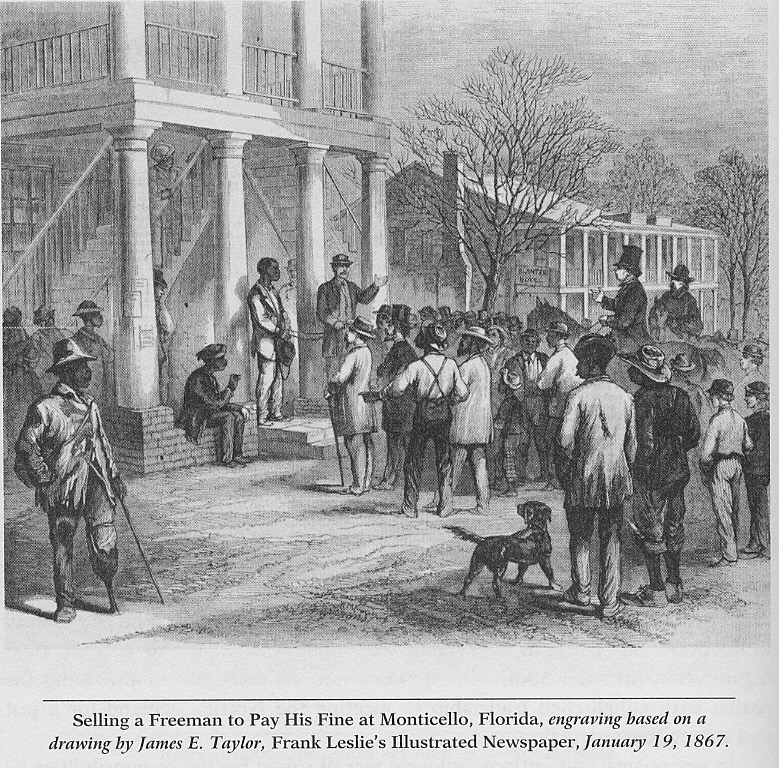
White Southerners including the newly pardoned Confederates enacted black codes that “codified explicit second-class citizenship for freedpeople.” [1] The legislature of Mississippi refused to ratify the Thirteenth Amendment, and did not do so until 1995. One Southerner noted that “Johnson “held up before us the hope of a ‘white man’s government,’ and this led us to set aside negro suffrage…. It was natural that we should yield to our old prejudices.” [2] Former Confederates, including Alexander Stephens the former Vice President of the Confederacy were elected to high office, Stephens to the United States Senate and the aggrieved Republicans in Congress in turn refused to admit the former Confederates. Many Union veterans were incensed by Johnson’s actions, one New York artilleryman noted “I would not pardon the rebels, especially the leaders, until they should kneel in the dust of humiliation and show their deeds that they sincerely repent.” [3] He was not alone, many Northern Veterans who formed the integrated Grand Army of the Republic veterans maintained a patent disregard, if not hatred of what the old South stood for and felt that their efforts in the war had been betrayed by the government.

  
Johnson’s restoration of property to the former white owners drove tens of thousands of blacks off lands that they had been farming, or left them as laborers for their former slave masters. Johnson countermanded General William Tecumseh Sherman and Secretary of War Edwin Stanton’s Field Order 15 to “divide abandoned and confiscated lands on the Sea Islands and in a portion of the Low Country coast south of Charleston into forty-acre plots for each black family.” [4] As such many freed blacks were now at the mercy of their former white owners for any hope of economic sustenance.

  
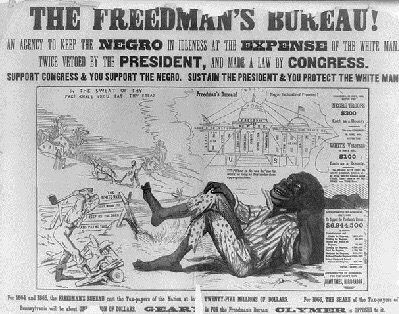
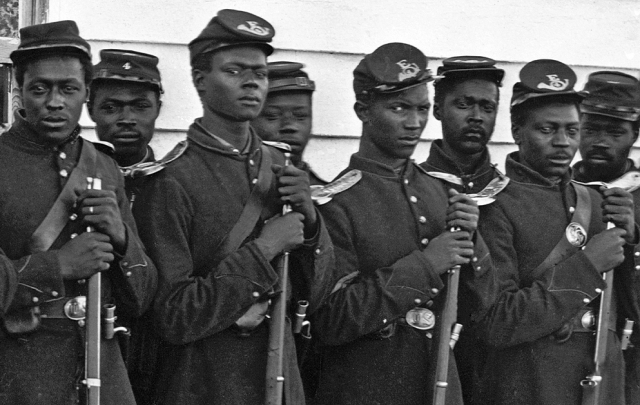
Johnson worked stridently, and often successfully to frustrate the efforts of the Freedmen’s Bureau headed by Major General Oliver Howard to help freed blacks to become landowners and to protect their legal rights. In immediate post-war South states organized all white police forces and state militias composed primarily of confederate veterans, many still wearing their gray or butternut uniforms. In such a climate blacks had few rights, and officers of the Freedmen’s Bureau lamented the situation. In Georgia one officer wrote that no jury would “convict a white man for killing a freedman,” or “fail to hang” a black man who killed a white in self-defense. Blacks commented another agent, “would be just as well off with no law at all or no Government,” as with the legal system established in the South under Andrew Johnson. “If you call this Freedom,” wrote one black veteran, “what do you call slavery?” [5]

  
The struggle between Johnson Congress intensified when Johnson vetoed the Civil Rights Bill. Congress responded by overriding his veto. Eventually the battle between Johnson and Congress climaxed when Johnson was impeached when he tried to remove Secretary of War Stanton from office. Johnson barely survived the impeachment proceedings and was acquitted by one vote in the Senate in 1868.

The various black codes enacted throughout the South were draconian measures to codify and institutionalize racism and White Supremacy:

“passed labor laws that bound blacks to employers almost as tightly as slavery once bound them to their masters. Other codes established patterns of racial segregation that had been impossible under slavery, barred African Americans from serving on juries or offering testimony in court against whites, made “vagrancy,” “insulting gestures,” and “mischief” offenses by blacks punishable by fines or imprisonment, forbade black-white intermarriage, ad banned ownership by blacks of “fire-arms of any kind, or any ammunition, dirk or bowie-knife.” [6]

The black codes which were condoned and supported by President Johnson recognized minimal elements of black freedom but their provisions confirmed the observations of one journalist who wrote “the whites seem wholly unable to comprehend that freedom for the negro means the same thing as freedom for them. They readily admit that the Government has made him free, but appear to believe that the have the right to exercise the old control.” [7]

Likewise within weeks of the end of the war, violence against blacks began to break out in different parts of the South and it continued to spread as Johnson and Congress battled each other in regard to Reconstruction policy:

“In Memphis, Tennessee, in May of 1866, whites on a rampage of murder killed forty-six Negroes, most of them veterans of the Union army, as well as two white sympathizers. Five Negro women were raped. Ninety homes, twelve schools and four churches were burned. In New Orleans in the summer of 1866, another riot against blacks killed thirty-five Negroes and three whites.” [8]

Colonel Samuel Thomas, the director of the Freedmen’s Bureau in Mississippi noted the attitudes that he saw in many whites toward the newly emancipated African Americans. He wrote that white public sentiment had not progressed and that whites had not “come to the attitude in which it can conceive of the negro having any rights at all. Men, who are honorable in their dealings with their white neighbors, without feeling a single twinge of honor….And however much they confess that the President’s proclamation broke up the relation of the individual slave to their owners, the still have the ingrained feeling that the black people at large belong to whites at large.” [9] Sadly, the attitude reported by Colonel Thomas not only remained but grew more violent with each passing month.

Notes

[1] Ibid. McPherson The War that Forged a Nation p. 177

[2] Ibid. Guelzo Fateful Lightening p.491

[3] Jordan, Brian Matthew. Marching Home: Union Veterans and Their Unending Civil War Liveright Publishing Corporation a Division of W.W. Norton and Company Inc. New York and London 2014 p.119

[4] Ibid. Goldfield America Aflame p.411

[5] Ibid. Foner Forever Free p.96

[6] Ibid. Guelzo Fateful Lightening p.491

[7] Ibid. Foner Forever Free pp.93-94

[8] Ibid. Zinn The Other Civil War p.55

[9] Ibid. Foner Forever Free p.92

1 Comment

Filed under civil rights, civil war, History, Political Commentary

Ulysses Grant’s Fight Against the KKK

Friends of Padre Steve’s World

This is another article excerpted from my Civil War and Gettysburg texts, this dealing with the fight against the Ku Klux Klan and other racist terrorist groups operating in the South. Unlike his predecessor, Andre Johnson, Ulysses S. Grant believed in freedom and equality for African Americans and was willing to use to the military and police power of the Federal Government to crush violent terrorist groups. In the end his effort failed, however among U.S. Presidents after Abraham Lincoln, Grant was most committed to ending racism and promoting equality in the United States.

Sadly, while the Klan and other groups like operate only on the margins of society, only popping up for Confederate Flag rallies, a protest here or there and of course the occasional mass killing; there are millions of others who harbor many of the same attitudes held by the Klan against African Americans, other minority groups, immigrants, and non-Christian religions. These people just maintain a tidier act. They wear expensive suits, Hang out with presidential candidates and popular preachers. They get interviewed on cable news to spread fear and loathing of those that they hate, and then capitalizing on that fear they use political action and the courts to push their agenda. Interestingly enough these well to do hatemongers almost never criticize or condemn the attitudes and action of Klan members or other white supremacists. If they do they brush it off as an “isolated” incident unconnected to their own ideology. 

The fact is they don’t condemn them because they share the same goal; a racially pure white supposedly Christian country. That my friends is why this still matters and why I admire that great General and far too under appreciated, President, Ulysses S Grant.

Have a great and thoughtful day,

Peace

Padre Steve+

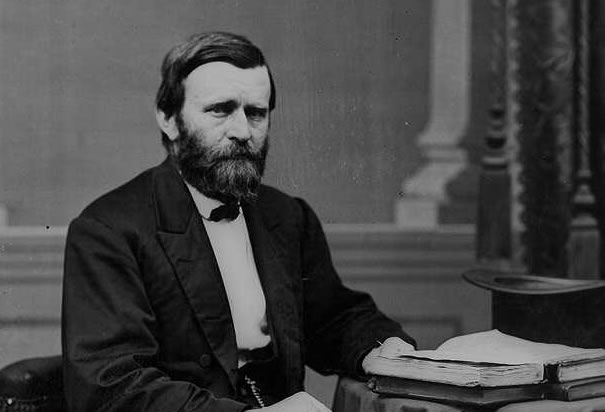
ulysses-s-grant-book

President Ulysses S. Grant

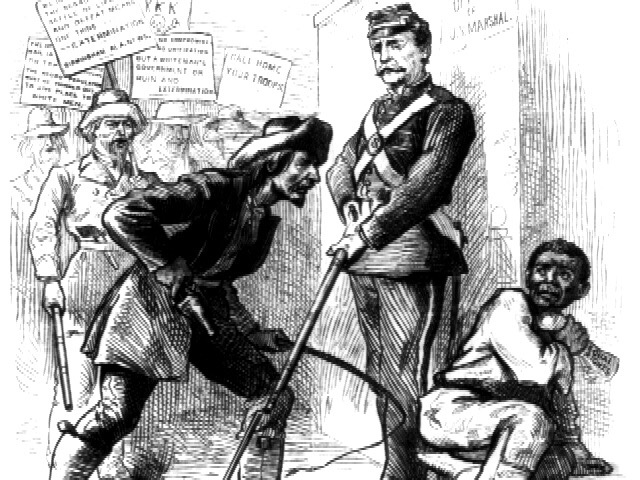
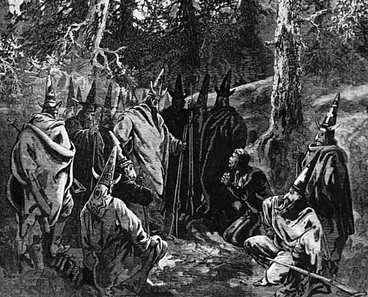
The passage of the Fourteenth and Fifteenth Amendments provoked even more violence from enraged Southerners. Thousands of Southerners, many former Confederate soldiers, formed a variety of violent racist organizations which turned the violence from sporadic attacks to what amounted to a full-fledged insurgency against the new Reconstructionist state governments and African Americans. Organizations like the Ku Klux Klan which engaged in terroristic violence while heavily armed so called  “social clubs” that operated under the aegis of the state Democratic Party leadership in most Southern states did the same. Under the leadership of former Confederate general Nathan Bedford Forrest whose troops had conducted the Fort Pillow massacre, the Klan’s membership throughout the South “was estimated at five hundred thousand” [1] and the majority were former Confederate soldiers. As the shadowy organization grew it became bolder and more violent in its attacks on African Americans, Republican members of the Reconstruction governments, and even Southern Jews.

64982-004-E91C3D02

Early KKK Gathering

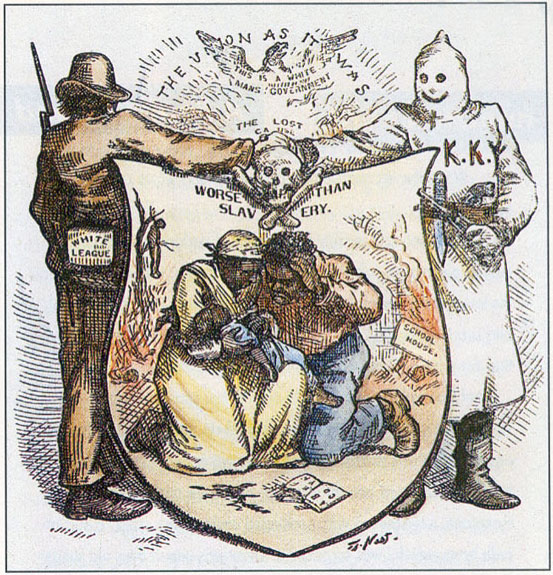
Allegedly organized for self-defense against state militia units composed of freed blacks they named themselves “White Leagues (Louisiana), White Liners or Rifle Clubs (Mississippi), or Red Shirts (South Carolina). They were, in fact, paramilitary organizations that functioned as armed auxiliaries of the Democratic Party in southern states in their drive to “redeem” the South from “black and tan Negro-Carpetbag rule.” [2] These men, mostly Confederate veterans “rode roughshod over the South, terrorizing newly freed slaves, their carpetbagger allies, and anyone who dared to imagine a biracial democracy as the war’s change.” [3] This unrequited violence and hatred set the stage for the continued persecution, murder and violence against blacks and those who supported their efforts to achieve equality in the South for the next century.

Throughout his term in office Johnson appealed to arguments used throughout later American history by “critics of civil rights legislation and affirmative action. He appealed to fiscal conservatism, raised the specter of an immense federal bureaucracy trampling on citizens’ rights, and insisted that self-help, not government handouts, was the path to individual advancement.” [4]

black-voter-threatening

White League Members Intimidating Blacks at the Polls

Ulysses S. Grant succeeded Johnson as President in 1869. “For Grant, freedom and equal rights were matters of principle, not symbolism.” [5] Grant used his political capital to fight for the passage of the Fifteenth Amendment which gave black men the right to vote. It was one of the things that he remained most proud of in his life, he noted, “A measure which makes at once four million people voter who were heretofore declared by the highest tribunal in the land to be not citizens of the United States, nor eligible to become so…is indeed a measure of grander importance than any other act of the kind from the foundation of our free government to the present day.” [6] Grant ordered his generals in the South to enforce the Reconstruction Act and when the Ku Klux Klan attempted to stop blacks from voting Grant got Congress to pass the “enforcement Act, which made racist terrorism a federal offense.” [7] He created the Justice Department to deal with crimes against Federal law and in 1871 pushed Congress to pass a law known as the Ku Klux Klan Act and sent in the army and federal agents to enforce the law.

KKK-Nast

White League and KKK Poster

Grant’s efforts using the military as well as agents of the Justice Department and the Secret Service against the Klan were hugely successful, thousands were arrested, hundreds of Klansmen were convicted and others were either driven underground or disbanded their groups. The 1872 election, was the first and last in which blacks were nearly unencumbered as they voted until the passage of the 1964 Civil Rights Act and 1965 Voting Rights Act.

However, Grant’s actions triggered a political backlash which doomed reconstruction. The seminal moment in this came 1873 when General Philip Sheridan working in Louisiana, asked Grant for “permission to arrest leaders of the White League and try them by courts-martial” [8] for their violent acts against blacks and their seizure of the New Orleans City Hall in a brazen coup attempt. The leak of Sheridan’s request sparked outrage and even northern papers condemned the president’s actions in the harshest of terms.

Apart from the effort to support voting rights for African Americans Grant’s efforts at Reconstruction were met mostly by failure. Part of this was due to a weariness on the part of many Northerners to continue to invest any more effort into the effort. Slowly even proponents of Reconstruction began to retreat from it, some like Carl Schurz were afraid that the use of the military against the Klan in the South could set precedent to use it elsewhere. Others, embraced an understanding of Social Darwinism which stood against all types of government interference what they called the “natural” workings of society, especially misguided efforts to uplift those at the bottom of the social order…and African Americans were consigned by nature to occupy the lowest rungs of the social ladder.” [9]

Southerners knew that they were winning the political battle and continued their pressure in Congress and in the media to demonize supporters of Reconstruction as well as African Americans. Southerners worked to rig the political and judicial process through the use of terror to demoralize and drive from power anyone, black or white, who supported Reconstruction. By 1870 every former Confederate state had been readmitted to the Union, in a sense fulfilling a part Lincoln’s war policy, but at the same time denying what the war was waged for.

To be continued….

Notes

[1] Ibid. Lane The Day Freedom Died p.230

[2] Ibid. McPherson The War that Forged a Nation p. 178

[3] Ibid. Jordan Marching Home p.118

[4] Ibid. Foner Forever Free p.116

[5] Ibid. Lane The Day Freedom Died: p.2

[6] Flood, Charles Bracelen, Grant’s Final Victory: Ulysses S. Grant’s Heroic Last Year DaCapo Press, Boston 2011 pp.78-79

[7] Ibid. Lane The Day Freedom Died p.4

[8] Ibid. Langguth, A.J. After Lincoln p.314

[9] Ibid. Foner Forever Free pp.192-193

3 Comments

Filed under civil rights, civil war, History, Political Commentary

The Unreconstructed President: Andrew Johnson

Friends of Padre Steve’s World

I am going to be exploring the issue of the abolition of slavery and Reconstruction after the Civil War. Sadly, the effort to integrate society and to ensure that African Americans had the same rights, political, social, legal, economic and educational as whites failed due to a number of factors. The biggest factor was that former Confederates continued the war by other means until they wore down the will of the North and reestablished white supremacy in all areas of Southern life and in the process re-wrote history in the form of the myth of the Lost Cause, something that continues even today with the new Texas history textbooks which promote that myth, minimize slavery and not even talk about Jim Crow. 

Yesterday I received a comment from an officer of the Sons of Confederate Veterans and the Georgia Military Order of the Stars and Bars calling my work revisionism and spouting the lies of the sanitized history presented by such groups.  That has emboldened me to continue my work on this subject. Here is a part of my text dealing with the immediate aftermath of the Civil War and the work of President Andrew Johnson to subvert the efforts of Congress and those who worked to provide African Americans the basics to lift themselves out of the hole dug for them by their White masters before the war. 

So I continue today,

Peace

Padre Steve+

10467FS_DA_090409_worst-johnson

Andrew Johnson

Colin Gray writes that “A successful exercise in peacemaking should persuade the defeated party to accept its defeat.” [1] When the war ended the Confederacy was beaten and most people in the South would have agreed to anything that the North presented regarding peace and return to the Union. The primary political policy goal of Lincoln regarding the war was the reestablishment of the Union and one of the military measures adopted by Lincoln was the emancipation of the South’s slaves who were an important part of the Southern war economy. “During the last two years of the war the abolition of slavery evolved from a means of winning the war to a war aim – from national strategy to national policy.” [2] By Lincoln’s reelection in 1864 that policy included the unconditional surrender of the Confederacy as well as the passage of the Thirteenth Amendment.

That change in policy, the complete abolition of slavery necessitated a remaking of the old South, a culture where economics, social standing and even religion was linked to the “peculiar institution.” In a sense Reconstruction was “what the war was about.” [3] Just two months after Lee’s surrender at Appomattox, Richard Henry Dana, a Federal District Attorney in Boston, declared that “a war is over when its purpose is secured. It is a fatal mistake to hold that this war is over because the fighting has ceased. This war is not over…” [4] As Dana, and Clausewitz understood so well that war is a continuation of policy and politics by other means, and the failure of the President Johnson and others in the North to fully grasp this fact led to over a century of subjugation of emancipated African Americans. The confusion and lack of determined purpose has fueled a continual racial divide in the United States that is still felt today. Defeated on the battlefield Southerners soon turned to political, psychological and violent means to reverse their losses.

Douglass.JPG

Frederick Douglass

Frederick Douglass understood that simple emancipation was not enough, and that the “war and its outcome demanded racial equality.” [5] Despite the that efforts of many in the North this would not happen during Reconstruction and Douglass knew that the failure to accomplish this would be disastrous, “Whether the tremendous war so heroically fought…shall pass into history a miserable failure…or whether on the other hand, we shall, as the rightful reward of victory over treason have a solid nation, entirely delivered from all contradictions and social antagonisms, must be determined one way or another.” [6]

There was a problem with implementing Reconstruction; when John Wilkes Booth assassinated Abraham Lincoln, the political leaders of the North could not agree on how to do this. The new President, Andrew Johnson was probably the worst possible leader to lead the country in the aftermath of war for all practical purposes Johnson was a Democrat who believed in white supremacy, he had been brought onto the ticket for his efforts to keep Kentucky in the Union and to support Unionist elements in Tennessee. While his selection helped Lincoln in parts of the North and the Border States it was a disaster for the post-war era. Johnson’s approach to reconstruction was very simply to “impose minimal demands on the South. He required only minor concessions from the former Confederates before allowing them to resume their political rights and retain their land. As for freedmen, he seemed to think that the needed no further protection beyond the fact of their emancipation.” [7]

Johnson was “a lonely stubborn man with few confidants, who seemed to develop his policies without consulting anyone, then stuck to them inflexibly in the face of any and all criticism. He lacked Lincoln’s ability to conciliate his foes and his capacity for growth, which was best illustrated by Lincoln’s evolving attitude to black suffrage during the Civil War.” [8] In the months after his unexpected accession to the presidency Johnson demonstrated that he had no understanding of Lincoln’s political goals for the South and the desires of the Republican dominated Congress.

By the summer of 1865 Johnson was already demonstrating “that his sympathies were with the Southern white population and that he believed that their interests should be cared for even at the expense of freedmen.” [9] Johnson’s approach to reconstruction was very simply to “impose minimal demands on the South. He required only minor concessions from the former Confederates before allowing them to resume their political rights and retain their land. As for freedmen, he seemed to think that the needed no further protection beyond the fact of their emancipation.” [10] Johnson gave individual pardons to more than thirteen thousand “high-ranking Confederate civil and military officers and wealthy Southerners.” [11] While doing this he minimized political influence the Southern Unionists who had not supported the Confederacy and ensured that freed slaves were excluded from the political process. He issued a number of orders “appointing interim provisional governors and urging the writing of new state constitutions based upon the voter qualifications in force at the time of secession in 1861 – which meant, in large but invisible letters, no blacks.” [12]

When Frederick Douglass led a delegation of blacks to meet with Johnson in February 1866 Johnson preached that it was impossible to give political freedom to blacks. When Douglass attempted to object Johnson became angry and told Douglass “I do not like to be arraigned by some who can get up handsomely-rounded periods and rhetoric, and talk about abstract ideas of liberty, who never periled life, liberty, or property.” [13] When Douglass took his objections to Johnson’s harangue to a Washington newspaper, Johnson railed against Douglass “I know that d—–d Douglass…he’s just like any other nigger & would sooner cut a white man’s throat than not.” [14]

To be continued…

Notes

[1] Ibid. Gray Fighting Talk p.14

[2] Ibid. McPherson The War that Forged a Nation p. 132

[3] Perman, Michael and Murrell Taylor, Amy editors The Civil War and Reconstruction Documents and Essays Third Edition Wadsworth Cengage Learning Boston MA 2011 p.323

[4] Ibid. McPherson The War that Forged a Nation p. 175

[5] Ibid. Goldfield America Aflame p.407

[6] Ibid. Goldfield America Aflame p.407

[7] Ibid. Perman and Taylor The Civil War and Reconstruction Documents and Essays Third Edition p.323

[8] Foner, Eric Forever Free: The Story of Emancipation and Reconstruction Vintage Books a Division of Random House, New York 2005 p.108

[9] Carpenter, John A. Sword and Olive Branch: Oliver Otis Howard Fordham University Press, New York 1999 p.109


[10] Ibid. Perman and Taylor The Civil War and Reconstruction Documents and Essays Third Edition p.323

[11] Ibid. McPherson The War that Forged a Nation p. 177

[12] Ibid. Guelzo Fateful Lightening p.490

[13] Ibid. Guelzo Fateful Lightening p.494

[14] Ibid. Guelzo Fateful Lightening p.494

Leave a comment

Filed under civil rights, civil war, History, Political Commentary

Racism & the Failure of Reconstruction

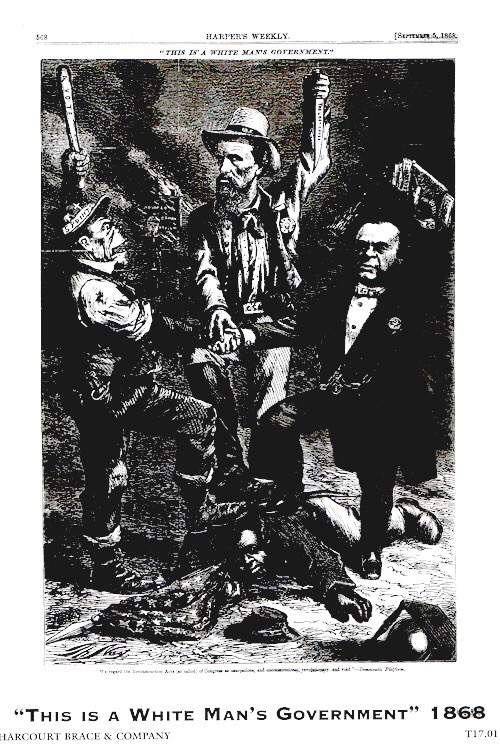
this-is-a-white-mans-government


Friends of Padre Steve’s World

Some events and attitudes are timeless, one of these is racism. Being white myself, I know that many whites are loath to admit that the scourge of racism still exists, but it does and it runs deep in our history. The more that I work on my Civil War and Gettysburg text, which now appears will morph into at least two and maybe three books when I am done, I find terribly distressing parallels to attitudes and actions of some which mirror the attitudes and actions of our ancestors, Northern and Southern following the Civil War. When the shooting stopped and the South was vanquished, many Southerners continued the war by other means and Northerners, divided after the death of Abraham Lincoln failed to achieve the most important political goal, after the restoration of the Union, that of true freedom for African Americans. Sadly, for some that war is still not over, as was evidenced in the aftermath of the Emanuel A.M.E. Massacre just two weeks ago. Likewise the burnings of six predominantly black churches across the South raises the specter of the racial violence that targeted blacks for a century after the Civil War.

This is another section of my text. I do hope that it challenges you as much as writing it challenged me.

Peace

Padre Steve+


When the war ended the Confederacy was beaten and most people in the South would have agreed to anything that the North presented regarding peace and return to the Union. In a sense Reconstruction was “what the war was about.” [1] Richard Henry Dana, the declared that “a war is over when its purpose is secured. It is a fatal mistake to hold that this war is over because the fighting has ceased. This war is not over…” [2] As Dana, and Clausewitz understood so well that war is a continuation of policy and politics by other means, and the failure of the North to fully grasp this fact led to over a century of subjugation of emancipated African Americans and has fueled a continual racial divide in the United States that is still felt today. Defeated on the battlefield Southerners soon turned to political, psychological and violent means to reverse their losses.

Frederick Douglass understood that simple emancipation was not enough, and that the “war and its outcome demanded racial equality.” [3] Despite the that efforts of many in the North this would not happen during Reconstruction and Douglass knew that the failure to accomplish this would be disastrous, “Whether the tremendous war so heroically fought…shall pass into history a miserable failure…or whether on the other hand, we shall, as the rightful reward of victory over treason have a solid nation, entirely delivered from all contradictions and social antagonisms, must be determined one way or another.” [4]

There was a problem with implementing Reconstruction; when John Wilkes Booth assassinated Abraham Lincoln, the political leaders of the North could not agree on how to do this. The new President, Andrew Johnson was probably the worst possible leader to lead the country in the aftermath of war for all practical purposes Johnson was a Democrat who believed in white supremacy, he had been brought onto the ticket for his efforts to keep Kentucky in the Union and to support Unionist elements in Tennessee. While his selection helped Lincoln in parts of the North and the Border States it was a disaster for the post-war era. Johnson’s approach to reconstruction was very simply to “impose minimal demands on the South. He required only minor concessions from the former Confederates before allowing them to resume their political rights and retain their land. As for freedmen, he seemed to think that the needed no further protection beyond the fact of their emancipation.” [5]

Johnson was “a lonely stubborn man with few confidants, who seemed to develop his policies without consulting anyone, then stuck to them inflexibly in the face of any and all criticism. He lacked Lincoln’s ability to conciliate his foes and his capacity for growth, which was best illustrated by Lincoln’s evolving attitude to black suffrage during the Civil War.” [6] In the months after his unexpected accession to the presidency Johnson demonstrated that he had no understanding of Lincoln’s political goals for the South and the desires of the Republican dominated Congress.

By the summer of 1865 Johnson was already demonstrating “that his sympathies were with the Southern white population and that he believed that their interests should be cared for even at the expense of freedmen.” [7] Johnson’s approach to reconstruction was very simply to “impose minimal demands on the South. He required only minor concessions from the former Confederates before allowing them to resume their political rights and retain their land. As for freedmen, he seemed to think that the needed no further protection beyond the fact of their emancipation.” [8] Johnson gave individual pardons to more than thirteen thousand “high-ranking Confederate civil and military officers and wealthy Southerners.” [9] While doing this he minimized political influence the Southern Unionists who had not supported the Confederacy and ensured that freed slaves were excluded from the political process. He issued a number of orders “appointing interim provisional governors and urging the writing of new state constitutions based upon the voter qualifications in force at the time of secession in 1861 – which meant, in large but invisible letters, no blacks.” [10]

When Frederick Douglass led a delegation of blacks to meet with Johnson in February 1865 Johnson preached that it was impossible to give political freedom to blacks. When Douglass attempted to object Johnson became angry and told Douglass “I do not like to be arraigned by some who can get up handsomely-rounded periods and rhetoric, and talk about abstract ideas of liberty, who never periled life, liberty, or property.” [11] When Douglass took his objections to Johnson’s harangue to a Washington newspaper, Johnson railed against Douglass “I know that d—–d Douglass…he’s just like any other nigger & would sooner cut a white man’s throat than not.” [12]

White Southerners including the newly pardoned Confederates enacted black codes that “codified explicit second-class citizenship for freedpeople.” [13] The legislature of Mississippi refused to ratify the Thirteenth Amendment, and did not do so until 1995. One Southerner noted that “Johnson “held up before us the hope of a ‘white man’s government,’ and this led us to set aside negro suffrage…. It was natural that we should yield to our old prejudices.” [14] Former Confederates, including Alexander Stephens the former Vice President of the Confederacy were elected to high office, Stephens to the United States Senate and the aggrieved Republicans in Congress in turn refused to admit the former Confederates. Many Union veterans were incensed by Johnson’s actions, one New York artilleryman noted “I would not pardon the rebels, especially the leaders, until they should kneel in the dust of humiliation and show their deeds that they sincerely repent.” [15] He was not alone, many Northern Veterans who formed the integrated Grand Army of the Republic veterans maintained a patent disregard, if not hatred of what the old South stood for and felt that their efforts in the war had been betrayed by the government.

Johnson’s restoration of property to the former white owners drove tens of thousands of blacks off lands that they had been farming, or left them as laborers for their former slave masters. Johnson countermanded General William Tecumseh Sherman and Secretary of War Edwin Stanton’s Field Order 15 to “divide abandoned and confiscated lands on the Sea Islands and in a portion of the Low Country coast south of Charleston into forty-acre plots for each black family.” [16] As such many freed blacks were now at the mercy of their former white owners for any hope of economic sustenance. Johnson stridently to frustrate the efforts of the Freedmen’s Bureau headed by Major General Oliver Howard to help freed blacks to become landowners. Johnson vetoed the Civil Rights bill but Congress overrode his veto. Eventually the battled between Johnson and Congress resulted in Johnson’s impeachment and narrow acquittal by one vote in the Senate in 1868.

The various black codes enacted throughout the South:

“passed labor laws that bound blacks to employers almost as tightly as slavery once bound them to their masters. Other codes established patterns of racial segregation that had been impossible under slavery, barred African Americans from serving on juries or offering testimony in court against whites, made “vagrancy,” “insulting gestures,” and “mischief” offenses by blacks punishable by fines or imprisonment, forbade black-white intermarriage, ad banned ownership by blacks of “fire-arms of any kind, or any ammunition, dirk or bowie-knife.” [17]

Likewise within weeks of the end of the violence against blacks began to break out in different parts of the South and it continued to spread as Johnson and Congress battled each other in regard to Reconstruction policy. “In Memphis, Tennessee, in May of 1866, whites on a rampage of murder killed forty-six Negroes, most of them veterans of the Union army, as well as two white sympathizers. Five Negro women were raped. Ninety homes, twelve schools and four churches were burned. In New Orleans in the summer of 1866, another riot against blacks killed thirty-five Negroes and three whites.” [18]

This alienated him from the Republican majority who passed legislation over Johnson’s veto to give black men the right to vote and hold office, and to overturn the white only elections which had propelled so many ex-Confederates into political power. Over Johnson’s opposition congress took power over Reconstruction and “Constitutional amendments were passed, the laws for racial equality were passed, and the black man began to vote and to hold office.” [19] Congress passed measures in 1867 that mandated that the new constitutions written in the South provide for “universal suffrage and for the temporary political disqualification of many ex-Confederates.” [20]   These measures helped elect bi-racial legislatures in the South which for the first time enacted a series of progressive reforms including the creation of public schools. They also ratified the Thirteenth and the Fourteenth Amendments, but these governments, composed of Southern Unionists, Northern Republicans and newly freed blacks were “elicited scorn from the former Confederates and from the South’s political class in general.” [21] Seen as an alien presence by most Southerners the Republican governments in the South faced political and was as violent opposition.

The Fourteenth Amendment was of particular importance for it overturned the Dred Scott decision which denied citizenship to blacks. Johnson opposed the amendment and worked against its passage by campaigning for men who would oppose it in the 1866 elections. His efforts earned him the opposition of former supporters including the influential New York Herald declared that Johnson “forgets that we have passed through a fiery ordeal of a mighty revolution, and the pre-existing order of things is gone and can return no more.” [22]

When passed by Congress the amendment was a watershed which would set Constitutional precedent for future laws to give women the right to votes, end Jim Crow laws, enact the Voting Rights Act of 1965, and most recently to give homosexuals the right to marry. Section one of the amendment read:

“All persons born or naturalized in the United States, and subject to the jurisdiction thereof, are citizens of the United States and of the state wherein they reside. No state shall make or enforce any law which shall abridge the privileges or immunities of citizens of the United States; nor shall any state deprive any person of life, liberty, or property, without due process of law; nor deny to any person within its jurisdiction the equal protection of the laws.” [23]

But these measures provoked even more violence from enraged Southerners who formed a variety of violent racist organizations which turned the violence from sporadic attacks to what amounted to a full-fledged insurgency against the new state governments and African Americans. Organizations like the Ku Klux Klan which engaged in terroristic violence to heavily armed “social clubs” which operated under the aegis of the state Democratic Party leadership in most Southern states. Allegedly organized for self-defense against state militia units composed of freed blacks they named themselves “White Leagues (Louisiana), White Liners or Rifle Clubs (Mississippi), or Red Shirts (South Carolina). They were, in fact, paramilitary organizations that functioned as armed auxiliaries of the Democratic Party in southern states in their drive to “redeem” the South from “black and tan Negro-Carpetbag rule.” [24] These men, mostly Confederate veterans “rode roughshod over the South, terrorizing newly freed slaves, their carpetbagger allies, and anyone who dared to imagine a biracial democracy as the war’s change.” [25] This unrequited violence and hatred set the stage for the continued persecution, murder and violence against blacks and those who supported their efforts to achieve equality in the South for the next century.

Throughout his term in office Johnson appealed to arguments used throughout later American history by “critics of civil rights legislation and affirmative action. He appealed to fiscal conservatism, raised the specter of an immense federal bureaucracy trampling on citizens’ rights, and insisted that self-help, not government handouts, was the path to individual advancement.” [26] While many of his Republican opponents supported these measures, many moderate Republicans could not abandon their support of or and ties to big corporations, and

Ulysses S. Grant succeeded Johnson as President in 1869 but his efforts at Reconstruction were met mostly by failure as well as a weariness on the part of many Northerners to continue to invest any more effort into it. Slowly even proponents of Reconstruction began to retreat from it and Southerners, knowing that they were winning the political battle continued their pressure. Both politically and through the use of terror to demoralize and drive from power anyone who supported it. By 1870 every former Confederate state had been readmitted to the Union, in a sense fulfilling a part Lincoln’s war policy, but at the same time denying what the war was waged for.

Congressman Thaddeus Stevens, one of the most effective leaders of the Radical Republicans died in 1868 in despair that the rights of blacks were being rolled back even as legislation was passed supporting them. The old firebrand asked “to be buried in a segregated cemetery for African American paupers so that “I might illustrate in death the principles which I advocated through a long life, Equality of man before his creator.” [27] Others including Senator Ben Wade, were not returned to office while others including Edwin Stanton, Salmon Chase and Charles Summer all died during Grant’s administration.

While Grant attempted to smash the Ku Klux Klan by military means his administration, heavily made up of economic conservative Republicans who had little interest in the rights of African Americans gave little other support to those fighting for equal rights for blacks. In the end Southern intransigence wore out the political will of Northerners to carry on, even the strongest supporters of equality.

By “1870 Radical Republicanism as a coherent political movement was rapitdl6y disintegrating” [28] and during the early 1870s many of the antislavery activists had left the Republican party either to death or defection, many “no longer felt at home in a party that catered to big business and lacked the resolve to protect black rights.” [29]

In 1872, some former radical Republicans revolted against Grant and the corruption in the Republican Party. Calling themselves “Liberal Republicans” they supported the candidacy of Horace Greeley uniting with Democrats to call for an end to Reconstruction. For many this was not so much because they no longer supported the rights of African Americans, but because for them, like so many, “economic concerns now trumped race relations…. Henry Adams, who shared the views of his father, Charles Francis Adams, remarked that “the day is at hand when corporations far greater than [the] Erie [Railroad]…will ultimately succeed in directing the government itself.” [30] The numbers of Federal troops in the South continued to be reduced to the point where they could offer little or no support to state militia.

Violence now became a means to further politics in the South and carried out in broad daylight and “intended to demoralize black voters and fatally undermine the Republican Party…. They paraded at regular intervals through African American sections of small towns in the rural black majority areas, intimidating the residents and inciting racial confrontations.” [31] These armed bands were highly successful, if they were successful in provoking a racial incident they would then fan out throughout the area to find blacks in order to beat up and kill, hundreds of blacks were killed by them. During the elections of 1876 the White Liners, Red Shirts and others would be seen in threatening positions near Republican rallies and on Election Day swarmed the polls to keep blacks and Republicans out, even seizing ballot boxes. The strategy employed was to use “Lawless and utterly undemocratic means…to secure the desired outcome, which was to win a lawful, democratic election.” [32]

The elected governor of Mississippi, Republican General Adelbert Ames, who was one of the most able and honest of all the Northerners to hold elected office in the South wrote in 1875 about the power of the paramilitary groups, “The “white liners” have gained their point – they have, by killing and wounding, so intimidated the poor Negroes that they can in all human probability prevail over them at the election. I shall try at once to get troops form the general government. Of course it will be a difficult thing to do.” [33] Ames did not get his troops. Grant’s Attorney general wrote “The whole public are tired out with these autumnal outbreaks in the South…and the great majority are now ready to condemn any interference on the part of the government….Preserve the peace by the forces in your own state….” [34] Ames, who had been a strong proponent of emancipation and black suffrage understood that he was being abandoned and in order to prevent more bloodshed gave up the fight. He negotiated a deal with Democrats which resulted in blacks being forced form the polls and the Democrats returning to power in the state.

The White League in Louisiana was particularly brutal and on Easter Sunday massacred blacks in Colfax Louisiana killing at least seventy-one and possibly as many as three-hundred blacks, killing many as they tried to surrender. Another White League detachment southwest of Shreveport “forced six white Republicans to resign their office on pain of death – and then brutally murdered them after they had resigned.” [35]

Reconstruction was officially ended in 1877 by newly elected President Rutherford B. Hayes and all Federal troops assigned to enforce it were withdrawn. Despite this, some people in the South attempted to fight for the rights of African Americans, including men like former Confederate Generals James Longstreet, William Mahone and Wade Hampton. Hampton was elected as the first post-Reconstruction governor of South Carolina in and campaigned against the black codes, and during his term in office even appointed African Americans to political offices in the state and maintained a regiment of African American state militia in Charleston against strident opposition.

While Hampton remained a white supremacist he also was committed to the upholding the law and “promoting the political rights to which freedmen were entitled to under law, and he consistently strove to protect those rights.” [36] This made him anathema to many South Carolina politicians, including Benjamine Tillman who as governor during the 1890s dismantled policies that Hampton had introduced to allow blacks to political patronage appointments. Once he did that Tillman set out to deprive South Carolina’s blacks of almost ever basic civil right, and in 1895 he led “a successful effort to rewrite the South Carolina constitution in such a way as to virtually disenfranchise every black resident of the state.” [37] Longstreet, who had become a Republican was wounded while leading Louisiana militia in an unsuccessful fight against White Leaguers in New Orleans on September 14th 1873.

The legislation which helped provide blacks with some measure of freedom was rolled back after Reconstruction ended. In 1883 “the Civil Rights Act of 1875, outlawing discrimination against Negroes using public facilities, was nullified by the Supreme Court, which said: “individual invasion of individual rights is not the subject-matter of the amendment.” The Fourteenth Amendment, it said, was aimed at state action only. No state shall…” [38]

The actions of the court and alliances between Northern corporations and Southern landowners led to even more discrimination and disenfranchisement for blacks, “From the 1880s onward, the post-Reconstruction white governments grew unwilling to rely just on intimidation at the ballot box and themselves in power, and turned instead to systematic legal disenfranchisement” [39] which furthered the black codes into what we now call the era of Jim Crow.

In 1896 the black codes were upheld by the Supreme Court in the case of Plessy v. Ferguson. That ruling established the “separate but equal” doctrine and ushered in an era of de jure segregation in almost all arenas of life including education, transportation, entertainment and health care. The limited social equity and privileges enjoyed by blacks, not only in the South, but in the entire nation were erased by the stroke of the judicial pen. The justices ruled on the concept that only people’s political rights were protected by the Constitution and that in the social arena that African-Americans could not interact with whites and assumed their racial inferiority.

Associate Justice John Harlan, a former slaveholder who had dissented in Court’s decision to overturn the Civil Rights Act of 1875 insisted “our Constitution is color blind” [40] and wrote in dissent:

“The destinies of two races, in this country are indissolubly linked together, and the interests of both require that the common government of all should not permit the seeds of race hate to be planted under the sanction of law. What can more certainly arouse race hate, what more certainly create and perpetuate a feeling of distrust between these races, than state enactments, which, in fact, proceed on the ground that colored citizens are so inferior and degraded that they cannot be allowed to sit in public coaches occupied by white citizens? That, as all will admit, is the real meaning of such legislation as was enacted in Louisiana.” [41]

These court decisions and legislation strengthened racism and discrimination against blacks, “effectively excluding blacks from public places, from the right to votes, from good public education, and so forth.” [42] The Plessy ruling was followed by “state laws mandating racial segregation in every aspect of life, from schools to hospitals, waiting rooms to toilets, drinking fountains to cemeteries…segregation was part of a complex system of white domination, in which each component – disenfranchisement, unequal economic status, inferior education – reinforced the others.” [43] Violence was used with great effect and between 1880 and 1968 approximately 3,500 people were murdered or lynched throughout the South. The “separate but equal” measures of the Jim Crow era took nearly a century to reverse, and “only began to disappear with Brown v. Board of Education in 1954 and the Civil Rights and Voting Rights Acts of 1964 and 1965.” [44]

The example of Reconstruction’s failure shows that in order to secure peace that military victory must be accompanied by the political will to ensure that the avowed goals of that victory are secured after the war in ensuring a just peace. Southerners may have lost the shooting war, but they did not accept the peace and resorted to all means to reverse their military defeat through political, social, economic and judicial means and “justice was sacrificed for the unjust peace ushered in by “redemption” of the South, a peace marred by Jim Crow, poverty and lynching.” [45] Most Northern leaders failed to appreciate this until far too late, and hindered by President Johnson’s opposition failed to win the peace in the South. They failed to appreciate that even after the shooting is often that “there is a need for further threats, and indeed action, because postwar disorder and even chaos will have to be address, and victorious allies are always likely to squabble over the spoils of victory” [46] as certain was the case in the divided Republican Party of the Reconstruction era.


Notes

[1] Perman, Michael and Murrell Taylor, Amy editors The Civil War and Reconstruction Documents and Essays Third Edition Wadsworth Cengage Learning Boston MA 2011 p.323

[2] Ibid. McPherson The War that Forged a Nation p. 175

[3] Ibid. Goldfield America Aflame p.407

[4] Ibid. Goldfield America Aflame p.407

[5] Ibid. Perman and Taylor The Civil War and Reconstruction Documents and Essays Third Edition p.323

[6] Foner, Eric Forever Free: The Story of Emancipation and Reconstruction Vintage Books a Division of Random House, New York 2005 p.108

[7] Carpenter, John A. Sword and Olive Branch: Oliver Otis Howard Fordham University Press, New York 1999 p.109


[8] Ibid. Perman and Taylor The Civil War and Reconstruction Documents and Essays Third Edition p.323

[9] Ibid. McPherson The War that Forged a Nation p. 177

[10] Ibid. Guelzo Fateful Lightening p.490

[11] Ibid. Guelzo Fateful Lightening p.494

[12] Ibid. Guelzo Fateful Lightening p.494

[13] Ibid. McPherson The War that Forged a Nation p. 177

[14] Ibid. Guelzo Fateful Lightening p.491

[15] Jordan, Brian Matthew. Marching Home: Union Veterans and Their Unending Civil War Liveright Publishing Corporation a Division of W.W. Norton and Company Inc. New York and London 2014 p.119

[16] Ibid. Goldfield America Aflame p.411

[17] Ibid. Guelzo Fateful Lightening p.491

[18] Ibid. Zinn The Other Civil War p.55

[19] Ibid. Zinn The Other Civil War p.54

[20] Ibid. McPherson The War that Forged a Nation p. 178

[21] Perman, Michael Illegitimacy and Insurgency in the Reconstructed South in The Civil War and Reconstruction Documents and Essays Third Edition edited by Michael Perman and Amy Murrell Taylor Wadsworth Cengage Learning Boston MA 2011 p.451

[22] Ibid. Foner Forever Free p.121

[23] _____________ The 14th Amendment to the U.S. Constitution retrieved from https://www.law.cornell.edu/constitution/amendmentxiv 29 June 2015

[24] Ibid. McPherson The War that Forged a Nation p. 178

[25] Ibid. Jordan Marching Home p.118

[26] Ibid. Foner Forever Free p.116

[27] Ibid. Guelzo Fateful Lightening p.504

[28] Ibid. Foner Forever Free p.170

[29] Ibid. Egnal Clash of Extremes p.337

[30] Ibid. Egnal Clash of Extremes p.337

[31] Ibid. Perman Illegitimacy and Insurgency in the Reconstructed South pp.459-460

[32] Ibid. Perman Illegitimacy and Insurgency in the Reconstructed South p.461

[33] Ames, Adelbert Governor Adelbert Ames deplores Violence in Mississippi, September 1875 in The Civil War and Reconstruction Documents and Essays Third Edition edited by Michael Perman and Amy Murrell Taylor Wadsworth Cengage Learning Boston MA 2011 p.434

[34] Ibid. McPherson The War that Forged a Nation p. 190

[35] Ibid. McPherson The War that Forged a Nation p. 185

[36] Longacre, Edward G. Gentleman and Soldier: The Extraordinary Life of General Wade Hampton Rutledge Hill Press, Nashville TN 2003 p.265

[37] Ibid. Longacre Gentleman and Soldier p.274

[38] Ibid. Zinn The Other Civil War p.57

[39] Ibid. Guelzo Fateful Lightening p.526

[40] Ibid. Zinn The Other Civil War p.58

[41] LaMorte, Michael W. School Law: Cases and Concepts 9th Edition 2008 Allyn and Bacon Inc. 2008 p.300

[42] Gonzalez, Justo L. The History of Christianity Volume 2: The Reformation to the Present Day Harper and Row Publishers San Francisco 1985 p.252

[43] Ibid. Foner Forever Free p.208

[44] Ibid. Huntington Who are We? p.54

[45] Ibid. McPherson The War that Forged a Nation p. 191

[46] Ibid. Gray Fighting Talk p.14


2 Comments

Filed under civil rights, civil war, History, laws and legislation, News and current events, Political Commentary

A Terrible Good Friday: The Assassination of Abraham Lincoln

gburg address

Good Friday is somber day, and I think that there was none more somber than Good Friday 1865. Shortly after 10 P.M. at Ford’s theater a handsome and well known actor walked into the booth occupied by President Lincoln at Washington’s Ford’s Theater. The President was there with his wife Mary Todd Lincoln and another couple after a very full day of business to watch the play Our American Cousin a farcical look at the visit of an American visiting his English relatives when going to settle the family estate.

Lincoln was looking forward to the play. Though the war continued the surrender of Robert E. Lee’s Army of Northern Virginia to Ulysses S. Grant on April 9th for all intents and purposes had placed the final nail in the Confederacy’s malevolent coffin, and it was if a burden have been removed from Lincoln’s shoulders. His task now what the reintegration of the rebellious states back into the Union, a task that he believed needed to be accomplished without malice while still seeking justice. He made this clear in his Second Inaugural Address just over a month before:

“With malice toward none, with charity for all, with firmness in the right as God gives us to see the right, let us strive on to finish the work we are in, to bind up the nation’s wounds, to care for him who shall have borne the battle and for his widow and his orphan, to do all which may achieve and cherish a just and lasting peace among ourselves and with all nations.”

Just three days before Lincoln had given his last public speech at the White House. It was a practical speech dealing with the nuts and bolts reuniting the country including announcing his support for Negro Suffrage. He said:

“By these recent successes the re-inauguration of the national authority — reconstruction — which has had a large share of thought from the first, is pressed much more closely upon our attention. It is fraught with great difficulty. Unlike a case of a war between independent nations, there is no authorized organ for us to treat with. No one man has authority to give up the rebellion for any other man. We simply must begin with, and mould from, disorganized and discordant elements. Nor is it a small additional embarrassment that we, the loyal people, differ among ourselves as to the mode, manner, and means of reconstruction.”

In the speech Lincoln discussed the issues related to the new government of Louisiana and its dealings with African Americans, which did not go far enough for Lincoln, who was intent on extending the franchise to vote for all blacks, even if it took time to make it so. John Wilkes Booth was in attendance that day and as he listened he became ever angrier and he vowed to a fellow conspirator Lewis Powell, “That is the last speech he will make” and Booth was going to ensure this himself.

Lincoln had been troubled for some time by terrible insomnia and dreams, both bizarre and ghoulish. A few days before he had told Mary and others sharing dinner with them of a troubling dream which he described in detail, Mary and those at the table so accustomed to Lincoln’s customary wit and humor were stunned as Lincoln spoke. He closed the description with these words:

“Determined to find the cause of a state of things so mysterious and shocking, I kept on until I entered the East Room, which I entered. There I was met with a sickening surprise. Before me was a catafalque, on which rested a corpse wrapped in funeral vestments. Around it were stationed soldiers who were acting as guards; and a throng of people, some gazing mournfully at the corpse, whose face was covered, others weeping pitifully: ‘Who is dead in the White House?’ I demanded of one of the soldiers. ‘The President’ was the answer; ‘he was killed by an assassin!’ “Then came a loud burst of grief from the crowd…” [1]

Mary and the others were so upset, particularly with the large number of death threats Lincoln had received throughout the war. However, Lincoln told them all not to worry as “it was only a dream.”

On that Good Friday Lincoln was determined not to mourn, instead of attending Good Friday services or contemplating the war, or reconstruction, he simply wanted to laugh and chose to attend the play, wanting General Grant and his wife to attend. However Grant needed to travel to New Jersey and declined the offer.

Despite this Lincoln was in a cheerful mood, looking forward to the future and discussing all the things that he wanted to see and do after his term in office. Mary was startled by his cheerfulness and Lincoln told her “I have never felt better in my life.” [2] Lincoln and his party arrived late to the cheers of the cast and took their seats in the box about 8:30 to the strains of Hail to the Chief. As the play resumes Lincoln’s bodyguard slips away to get a drink and about twelve minutes after ten Booth slipped into the box where Lincoln sat watching the play. As the crowd roared its delight at a particularly funny scene a shot rings out and Lincoln’s arm jerks up and he slumps over. Booth then jumped to the stage from the box, injuring his leg and shouting “Sic semper tyrannis” or thus always to tyrants. It was the beginning of a series of attempted assassinations designed to decapitate the Federal government, Secretary of State Seward was badly wounded by Lewis Payne, a third assassin backed out at the last minute and failed to attack Vice President Johnson.

Though physicians sought to save the President the wound was mortal, the bullet having ender the back of his head, and dug deep into his brain, lodging behind his left eye. At 7:22 A.M. Abraham Lincoln was dead. It was a disaster for the nation as the new President, Andrew Johnson was a political enemy of Lincoln and not in line with Lincoln’s understanding of reconstruction and reconciliation. A poor Southerner from Tennessee, Johnson hated the Southern plantation aristocracy and would act as a punisher, while radical reconstructionist members of the cabinet and Congress would act in such a way that reconstruction would never achieve all that Lincoln believed that it could.

While radical Confederates rejoiced in Lincoln’s death others were more circumspect. Jefferson Davis who was fleeing and hoping to continue the war realized that the South would not fare as well under Johnson as Lincoln. In fact Johnson’s lack of understanding of the nuances of northern politics as well as his loathing of blacks, his “beliefs, prejudices, personality traits were a recipe for disaster at a time when an unprecedented national crisis put a premium on the capacity to think in new and creative ways.” [3]

The Army of the Potomac learned of Lincoln’s assassination on Easter Sunday. Joshua Chamberlain told a woman whose mansion was at the center of his division’s camp when she asked what disturbed him “It is bad news for the South.” When the woman asked if it was Lee or Davis Chamberlain told her that it was Lincoln and said “The South has lost its best friend, Madam.” [4]

Chamberlain ordered chaplain to conduct a field memorial for the fallen President. The division chaplain a Catholic Priest, Father Egan spoke and roused the men, and Egan ended his service “Better so, Better to die glorious, than live infamous. Better to be buried beneath a nation’s tears, than to walk the earth guilty of the nation’s blood.” [5]

During the war Lincoln had endeared himself to his soldiers and they responded with great emotion. One burst into tears and sobbed “He was our best friend. God bless him,” another wrote home “What a hold Old Abe had on the hearts of the soldiers of the army could only be told by the way they showed their mourning for him.” Admiral David Dixon Porter wrote “The United States has lost the greatest man she ever produced.” [6]

The bullet fired by John Wilkes Booth was a disaster for the country. Sadly, there are some today, in particular the White Supremacist group The League of the South are choosing to celebrate the assassination of the man that they so hate, and honor the assassin as a hero. However, I have to agree with Admiral Porter, there has never been a President before or after who was anything like this man, and I dedicate myself to the quest for equality of all people and for a reconciliation like the leaders of the League of the South and their forbearers will never embrace, for they hate this nation as much as they hate Lincoln. I also fear what such people would do to President Obama should they ever get the opportunity.

Peace

Padre Steve+

Notes

[1] Winik, Jay April 1865: The Month that Saved America Harper Collins, New York 2001 p.205

[2] Ibid. Winik April 1865 p.220

[3] Foner, Eric Forever Free: The Story of Emancipation and Reconstruction Vintage Books, New York 2005 p.109

[4] Wallace, Willard. The Soul of the Lion: A Biography of Joshua L. Chamberlain Stan Clark Military Books, Gettysburg PA 1960 p.193

[5] Ibid. Wallace The Soul of the Lion p.194.

[6] Flood, Charles Bracelen Grant and Sherman: The Friendship that Won the War Harper Perennial, New York 2005 pp.329-330

Leave a comment

Filed under civil war, History, leadership, Political Commentary

The Romantic Rebel: George Pickett

Friends of Padre Steve’s World

I am continuing to periodically intersperse and publish short articles about various commanders at Gettysburg on the site. These all are drawn from my student text and may become a book in their own right.  The reason is I am going to do this is because I have found that readers are often more drawn to the lives of people than they are events. As I have noted before that people matter, even deeply flawed people, and we can learn from them.

Today’s article is about Major General George Edward Pickett who gained immortal fame at Gettysburg. He too is a complex, contradictory and controversial  figure in the Civil War, particularly in regard to the post war controversies regarding who was to blame for the Confederate defeat and his open criticism of Robert E. Lee’s decision to order the ill fated charge that made him famous.

Peace

Padre Steve+

Pickett

George Pickett was born to wealth and privilege in a Neo-feudal society [1] and came from an old and distinguished Virginia family with a long military heritage dating to the Revolution and the War of 1812. He attended the Richmond Academy until he was sixteen and had to withdraw due to the financial losses his parents had suffered during the panic of 1837.

This led to the young Pickett being sent to live with and study law under his mother’s older brother, Andrew Johnston in Quincy Illinois. Johnston was a lawyer, Whig politician and friend of Abraham Lincoln. The family’s continued financial distress led them to get George to consider the free education provided by West Point. His mother asked Johnston to assist and Johnston set about obtaining an appointment for his nephew. As befit an up-and-coming politician, his quest was short and successful. His Springfield acquaintances included a United States Congressman who happened to be a fellow Southerner and brother Whig, Kentucky native John T. Stuart. [2] There is a long running myth that connects Pickett’s appointment to West Point to Abraham Lincoln, but it is fiction, fabricated by Pickett’s widow Sallie long after her husband and Lincoln’s death. [3]

Pickett entered West Point in 1842 where he was described by a fellow cadet thought a jolly good fellow with fine natural gifts sadly neglected [4] through his tendency to demonstrate in word and deed that henhouse neither to authority nor submit to what’re considered the Academys narrow, arbitrary, unrealistic, harshly punitive, and inconsistently applied code of conduct [5] became a loyal patron of Benny Havens tavern where he was stealing away regularly now to life his glass in good fellowship…” [6]

Pickett’s academic performance, as well as his record of disciplinary infractions at West Point was exceptionally undistinguished. He racked up vast amounts of demerits for everything from being late to class, chapel and drill, uniform violations and pranks on the drill field where he mocked those who observed proper drill and ceremonies. Pickett graduated last in the class of 1846, something that his vast amount of demerits contributed.

His widow Sallie wrote after his death that he accumulated them so long as he could afford the black marks and punishments they entailed. He curbed his harmful behavior, however, when he found himself approaching the magic number of 200 demerits per year that constituted grounds for dismissal. [7] Pickett finally graduated only five behavioral demerits short of expulsion. [8] The graduating class included George McClellan, A.P. Hill, Thomas, later “Stonewall” Jackson as well as a number of other cadets, most of whom who went on to distinguished military and other careers. At West Point Pickett was considered to be the class clown by many of his classmates was the most popular and prominent young man in the class. [9] Among the many friends that he made was an upperclassman named Ulysses S. Grant and their friendship would span decades and would survive the fire of a war that placed them at swords point. [10]

Pickett was commissioned into the infantry and served alongside James Longstreet in the Mexican War where they fought valiantly in a number of battles, including Contreras, Churubusco, El Molino Del Rey. [11] Pickett distinguished himself at Chapultepec where he had been the first American to scale the ramparts of Chapultepec, where he planted the flag before the admiring gaze of his friend Longstreet. [12] During that assault Longstreet was wounded and Pickett had snatched the colors and planted them on the castle heights for all to see and cheer. [13] For his actions he received a brevet promotion to First Lieutenant.

Following the war Pickett married but was widowed less than two years later when his wife Sally Minge Pickett died during childbirth along with their infant son in 1852. The loss was devastating to the young officer. He went into a deep depression caused by grief and considered leaving the army. He was persuaded by friends, peers and understanding commanding officers to remain.

While on leave following Sally’s death, he was at Fort Monroe, laying under an umbrella at Point Comfort when a child approached him and took pity on him. The child was the nine year old La Salle “Sallie” Corbell and she broke through his emotional defenses by persistently, as only a child can do asking what the source of his grief was. Pickett told the child that his heart had been broken by a sorrow almost too great to bear. When the child asked how ones heart could break, he replied that God broke it when he took from him his loved ones and left him so lonely. [14] While Pickett may not have thought much of the meeting, he did give the little girl a ring and a golden heart bearing his wife’s name. He likely expected never to see her again but though she was a child she was a willful and determined one. She knew her own mind and heart, both told her that one day she would marry George Pickett. [15]

Pickett returned to Texas to serve with the 8th Infantry and was promoted to Captain and ordered to take command of the newly raised Company “D” 9th Infantry at Fort Monroe. Transferred to the Pacific Northwest he married. Widowed after that war he served in the Pacific Northwest where he took a Native American wife who bore him a son, however she did not survive childbirth and when she died in early 1858 Pickett was again widowed. In 1859 Captain Pickett faced down British troops from the Hudson Bay Company in an incident now known at the Pig War which at its heart was a dispute about whether the British or the Americans own San Juan Island. The dispute, which brought the two nations to the brink of war, was settled without bloodshed, save for the unfortunate pig, and Pickett became a minor celebrity in the United States and anathema to the British.

When Virginia seceded from the Union, Pickett like many other southern officers was conflicted in his feelings and loyalties and hoped to the last that he would have to take up arms against neither state nor country. [16] Pickett resigned his commission on June 25th 1861. He wrote to Sallie with who he now maintained a frequent correspondence about his decision and decidedly mixed feelings as he:

Always strenuously opposed disunion…” But While I love my neighbor, i.e., my country, I love my household, i.e., my state, more, and I could not be an infidel and lift my sword against my own kith and kin, even though I do believethat the measure of American greatness can be achieved only under one flag. [17]

Pickett returned to Virginia by a circuitous route where he was commissioned as a Captain in the new Confederate army on September 14th and two weeks later was promoted to Colonel and assigned to command forces along the Rappahannock. Though he had as yet seen no combat serving in the Confederate army, Pickett was promoted to brigadier General and assigned to command a Virginia brigade belonging to Longstreet’s division.

Pickett led his brigade well on the peninsula and at Williamsburg was instrumental in routing an advancing Federal force, and at Seven Pines had helped repel a dire threat to the Confederate position. At Gaines Mill Pickett was wounded in the shoulder during the assault put out of action and placed on convalescent leave to recover from his wounds. During his convalescence he fell in love with an old acquaintance; La Salle Corbell, who as a young girl had cheered him after the loss of his wife now a beautiful young woman nursed him back to health and started a chain reaction that would nearly engulf the Confederate officer. [18]

Pickett was promoted to Major General in October 1862 and was assigned command of the division formerly commanded by David R. Jones, which was assigned to Longstreet’s First Corps. The division was sent to peripheral areas and took no part in the battles of late 1862 or Chancellorsville serving instead in the Tidewater with Longstreet’s corps. The corps took part in a series of operations against Union forces in the Hampton Roads area and Pickett’s division bested a Federal force at Suffolk on April 24th 1863, though it was hardly a true test of his ability to command the division in combat. During this time Pickett spent much time visiting La Salle, much to the concern of some of his officers and Longstreet’s staff, and by the time the corps left the area the two were engaged to be married.

When the Division returned to the Army of Northern Virginia after Chancellorsville, it was among the forces considered by Jefferson Davis to be sent west for the relief of Vicksburg. Since that operation never materialized, the division was assigned to accompany First Corps with the army during the upcoming Pennsylvania campaign. However, much to the consternation of Lee, Longstreet and Pickett, two of its brigades were detached by the order of Jefferson Davis to protect Richmond from any Federal incursion.

During the advance into Pennsylvania the division, now composed of the brigades of James Kemper, Lewis Armistead and Richard Garnett was the trail division in Longstreet’s corps and often, in the absence of cavalry assigned to guard the corps and army trains. Due to its late release from these duties at Chambersburg, Pickett’s Division did not arrive at Gettysburg until late afternoon on July 2nd. Lee decided that they would not be needed that day and Longstreet placed that the division in bivouac at Marsh Creek for the night, sending word by messenger to tell Pickett I will have work for him tomorrow. [19]

Pickett spent the night with his soldiers and woke them about 3 a.m. After a quick breakfast Pickett moved the division to Seminary Ridge marshaling his troops in Spangler’s Woods where there was a modicum of protection from Federal fires and observation. However, despite these advantages it placed his division about 1000 yards from the extreme right of Pettigrew’s division with which he would have to coordinate his attack that fateful day.

Pickett scribbled a final note to Sallie as his troops prepared to attack. Oh, may God in his mercy help me as He never has helped me beforeremember always that I love you with all my heart and soul That now and forever I am yours. [20]

Pickett was never the same after the charge of July 3rd 1863. Pickett’s after action report which complained about the lack of support his division received was suppressed and destroyed by Lee who wrote Pickett You and your men have crowned yourselves in glory But we have an enemy to fight, and must carefully, at this critical moment, guard against dissections which the reflections in your report will create. [21]

Pickett married La Salle “Sallie” Corbell in September of 1863, and the marriage would last until his death in 1875. Sallie, impoverished by the death of “her soldier” took up writing as well as speaking tours in both the South and the North. Sallie was a stalwart defender of her husband, who she said had the keenest sense of justice, most sensitive consciousness of right, and the highest moral courage but also opposing hatred, sectionalism and strife. [22] Though much of her work was panned by historians and shunned by established magazines and periodicals; her writing were published by newer popular magazines. Her book The Heart of a Soldier, as Revealed in the Intimate Letters of General George Pickett, C.S.A. was for the most part fabrications authored by her, but she found a niche in newer popular magazines and journals, including Cosmopolitan for which she authored a ten part serial of the Pickett family story on the fiftieth anniversary of the battle. Sallie Pickett’s:

idealized portrait of her husband made him a Confederate hero. He never reached the status of Robert E. Lee or Stonewall Jackson, but his association with the famed but futile charge at Gettysburg helped. Virginia veterans and newspapers began romanticizing Picketts all-Virginia divisions role soon after the battle; it was almost by association that George too would share in this idolization…” [23]

Pickett retained command of his division after Gettysburg. The division was reconsituted and shipped off to North Carolina where he and it performed adequately but without marked distinction. Pickett had one moment of glory when reacting to a Federal Army under Benjamin Butler advancing on Petersburg he threw a scratch force together which preserved Petersburg and its vital rail line in early May 1864. This allowed General P.T.G. Beauregard to bring up more troops to hold the city.

The division performed adequately in the defensive battles around Richmond and Petersburg, though it suffered terribly from the lack of rations, medicines, clothing and equipmentaggravated by the rigors of life in the trenches. [24] Morale and desertion was a terrible problem in Pickett’s division and Lee was concerned enough to bring enough to bring the matter to Longstreet. Lee used terms like unsoldierly and unmilitary, lax in discipline, loose in military instruction [25] to describe the division. Though he was fully cognizant of the conditions of the trenches Lee identified the source of the problem as Pickett and his officers who were not sufficiently attentive to the men,not informed as to their condition and he told Longstreet: I desire you to correct the evils in Picketts divisionby every means in your power… I beg that you will insist upon these points. [26]

During the Richmond and Petersburg campaign, Pickett was often sick, and at several intervals he was unable to exercise command, and the poor state of his general health, aggravated by the unusually stressful conditions of the past year, age him beyond his years. [27]

The end came at the battle at Five Forks where Pickett’s division was deployed on the far right of the Confederate line, was overwhelmed by a massive assault by Sheridan’s cavalry and the Fifth Corps which destroyed it as a fighting formation. Pickett, for unknown reasons did not put much effort into the defense of Five Forks. He successfully repulsed an attack by Sheridan on March 31st but evidently did not expect an attack the following day. On the afternoon of April 1st Pickett was away from his division at a Shad bake with Fitzhugh Lee and Thomas Rosser when the attack came and destroyed his division as a fighting unit. No cowardice was involved; Pickett simply misjudged the situation by assuming that no attack was imminent, yet it left a bad taste in everyones mouth. [28] That being said Picketts lackadaisical effort in holding Five Forks is indefensible. So to is his incredible derelict behavior late on the morning of April 1st when he slipped away from his command to the shad bake not even informing the next senior officer, Rooney Lee that he was gone. [29]

Whether cowardice was involved or not, Pickett’s decision to be away from his division with a very aggressive Federal army at his front was ill-advised and demonstrated to Lee that Pickett was unfit for command. Two days later Pickett and two other generals, including Richard Anderson were relieved of their duties and dismissed by Lee. However Pickett remained with his division until the end and at Appomattox Lee was heard to remark in what some believed was a disparaging manner Is that man still with this army? [30]

George Pickett attempted to rebuild his life after the war and the task was not easy, for though he applied for amnesty, his case was complicated by an incident where he had ordered the execution of twenty-two former North Carolina militiamen who had defected to the Union and been re-captured by the Confederates. Pickett’s action was no different than many Confederate commanders who followed the Richmond government’s decision to take ruthless measures to suppress Unionist sentiments and secession of areas of the Confederacy where Union sympathies ran high. The area of Pickett’s operation was a haven for Tories who openly supported U.S. troops. What was worse, hundreds of local Unionists engaged in the most violent guerrilla activities, shooting and burning out their secessionist neighbors, waylaying Confederate supply trains, attacking outposts. [31] Some of these men had previously served in Confederate service which in the eyes of Pickett and many others made them traitors to the Confederate cause.

In a sense Pickett was engaged in what are now known as counter-insurgency operations. Like many commanders involved in such operations, he descended into the same type of barbaric actions of those he was fighting. “By early 1864 the war was turning into a grim, hate-filled struggle that knew few rules and niceties, and Pickett was changing to the pattern. [32] When Pickett captured the former militiamen he refused to treat them as prisoners of war and instead he court-martialed them and hanged them all. [33] He established a military court composed of Virginia, North Carolina and Georgia officers, hauled the deserters-in-arms before it, and approved the death sentences. [34] When the prisoners went to the gallows Pickett reportedly told each of them God damn you, I reckon you will ever hardly go back there again, you damned rascals; Ill have you shot, and all the other damned rascals who desert. [35]

Federal authorities thought about charging him with war crimes. Pickett fled to Canada in late 1865 before returning to Virginia. It took the intervention of Pickett’s faithful friend Ulysses S. Grant to have the charges dismissed and for Pickett to be granted amnesty by President Johnson in 1868. Grant admitted that the punishment was harsh, however, Grant’s judgment was steeped in the fact that many Northern commanders had resorted to similar actions in combating insurgents and deserters. Grant wrote in his friend’s defense:

But it was in time of war and when the enemy no doubt it necessary to retain, by some power, the services of every man within their reach. Gen. Pickett I know personally to be an honorable man but in this case his judgement [sic] prompted him to do what can not well be sustained though I do not see how good, either to the friends of the deceased or by fixing an example for the future, can be secured by his trial now. [36]

Even so, Pickett’s life was difficult. Health difficulties plagued him and employment was scarce, even for a man of Pickett’s stature in Virginia. He refused employment which would take him away from Sallie and his children and finally took a job as an insurance agent in Richmond. It was a job which he felt demeaning, requiring that he attempt to sell insurance policies to destitute and out of work Confederate veterans and their families. Sallie wrote that he could not come to terms with a profession that made its profits through what one colleague called gall, gall, old man, gall and grub. [37] Distinctly unhappy the dejected old soldier told her Id sooner face a canon,than to take out a policy with me. [38]

In 1870 he was convinced by John Singleton Mosby to visit Lee when the latter was visiting Richmond as Lee was making a final tour of battlefields and other sites. For Pickett the visit only reinforced his resentment that he felt for Lee, who he felt blamed him for the defeat at Five Forks and had ostracized him. The meeting occurred in Lees room at the Ballard Hotel was icy and lasted only two or three minutes. [39]

Mosby realized quickly that the meeting was not going well and Sensing the unpleasantness of the meeting, Mosby got up in a few moments and Pickett followed him. Once outside the room, Pickett broke out bitterly against that old man who, he said, had my division massacred at Gettysburg. [40] Mosby attempted to assuage his friend’s feelings but Pickett was not mollified by Mosbys rejoinder that it made you immortal. [41] Edwin Coddington wrote that it would have been better for his reputation if had been called to give his life or if the attack had been known for what it was, Longstreets Second Assault. [42]

George Pickett was a romantic as well as a true believer in the cause of the Confederacy. Pickett was vain, often self-serving and even irresponsible. He certainly as Porter Alexander noted was a better brigade commander than division commander, a position that he desired but at which never excelled. He was a poor administrator, and in the campaigns of 1864 and 1865 demonstrated exceptionally poor leadership.

His temperament, especially his seeming inability to function in a hierarchical structure, and the rebellious streak that he had as a cadet at West Point was never exercised: He resented authority and chafed at deferring to any man as his superiorPickett never understood his place in the hierarchy. He considered himself part of the cream of the Army of Northern Virginia, but without being willing to shoulder all the responsibilities and sacrifices that entailed. [43]

He died in the summer of 1875 while on a business trip to Norfolk with his wife at his side, but a single tragic charge had made his name immortal. [44] Bitter and discouraged at the end of his life he uttered his last words to Sallie’s uncle who had also served in the Army of Northern Virginia Well, Colonel, the enemy is too strong for me againmy ammunition is all out He closed his eyes, and settled back as if at peace for the first time in his life. Sallie never left his side; two hours after his death they gently pried her hands from his. [45]

[1] Ibid. Longacre Pickett p.4

[2] Ibid. Longacre Pickett p.6

[3] See Longacre Pickett pp.6-7. The myth was quite successful and it endures in some accounts of Pickett’s life and in a number of military histories including Larry Tagg’s The Generals of Gettysburg

[4] Waugh, John C. The Class of 1846 from West Point to Appomattox: Stonewall Jackson, George McClellan and their Brothers A Ballantine Book, New York 1994 pp.38-39

[5] Ibid. Longacre Pickett p.7

[6] Ibid. Waugh The Class of 1846 from West Point to Appomattox p.39

[7] Ibid. Longacre Pickett p.12

[8] Guelzo, Allen C. Gettysburg: The Last Invasion Vintage Books a Division of Random House, New York 2013 p.378

[9] Ibid. Guelzo Gettysburg: The Last Invasion p.378

[10] Ibid. Longacre Pickett p.20

[11] Ibid. Hess Picketts Charge p.37

[12] Ibid. Dowdy Lee and His Men at Gettysburg p.264

[13] Ibid. Waugh The Class of 1846 p.457

[14] Ibid. Longacre Pickett p.32

[15] Ibid. Longacre Pickett p.33

[16] Ibid. Longacre Pickett pp.50-51

[17] Ibid. Longacre Pickett p.51

[18] Ibid. Hess Pickett’s Charge p.38

[19] Ibid. Hess Pickett’s Charge p.47

[20] Ibid. Dowdy Lee and his Men at Gettysburg p.296

[21] Ibid. Hess Pickett’s Charge p.354

[22] Ibid. Reardon The Convergence of History and Myth in the Southern Past: Pickett’s Charge p.76

[23] Gordon, Lesley J. “Let the People See the Old Life as it Was” La Salle Corbell Pickett and the Myth of the Lost Cause in The Myth of the Lost Cause and Civil War History edited by Gallagher, Gary W. and Nolan, Alan T. Indiana University Press, Bloomington and Indianapolis 2000 p.170

[24] Ibid. Longacre Pickett p.160

[25] Selcer, Richard F. Lee vs. Pickett: Two Divided by War Thomas Publications, Gettysburg PA 1998 p.66

[26] Ibid. Selcer Lee vs. Pickett p.66

[27] Ibid. Longacre Pickett pp.160-161

[28] Ibid. Hess Pickett’s Charge p.375

[29] Ibid. Longacre Pickett pp.166-167

[30] Ibid. Hess Pickett’s Charge p.375

[31] Ibid. Longacre Pickett p.137

[32] Ibid. Longacre Pickett p.141

[33] Guelzo Allen C. Fateful Lightening: A New History of the Civil War Era and Reconstruction Oxford University Press, Oxford and New York 2012 p.368

[34] Ibid. Longacre Pickett p.140

[35] Ibid. Guelzo Fateful Lightening p.368

[36] Ibid. Longacre Pickett p.175

[37] Ibid. Longacre Pickett p.178

[38] Ibid. Longacre Pickett p.178

[39] Ibid. Hess Pickett’s Charge p.377

[40] Ibid. Freeman Lee p.569

[41] Ibid. Waugh The Class of 1846 p.529

[42] Ibid. Coddington The Gettysburg Campaign p.528

[43] Ibid. Selcer Lee vs. Pickett p.101

[44] Ibid. Waugh The Class of 1846 p.529

[45] Ibid. Longacre Pickett p.180

4 Comments

Filed under civil war, Gettysburg, History, leadership, Military

Emancipation and the U.S. Military: the Civil War and After

 HD_4USCinfantryDetail.preview

Friends of Padre Steve’s World

Tomorrow is the holiday where we remember the birth of Dr. Martin Luther King Jr. So I felt it appropriate to put out a revised section of my Civil War and Gettysburg text dealing with Emancipation and beginnings of African Americans being allowed to take their place in serving their country.  Sadly, a country that so often, both before, and after emancipation, treated them as either something less than human, or as second class citizens. But the sacrifice of these pioneers helped pave the way for the civil rights of others: women, other ethnic minorities, and most recently the LGBT community. Without blacks, who certainly endured the most odious treatment under slavery than any other group in this country, the long and slow progress others have made would not have been possible. This is certainly not to say that our system, nor our treatment of minorities, immigrants, women and gays is completely fair and equitable. It is not, there are many flaws, and still much discrimination, prejudice and fear mongering which demonizes certain groups as well as seeks to roll back the gains that individuals belonging to these groups have made to be accepted into American society. Thus we continue to strive for “a more perfect Union.” 

Peace

Padre Steve+

The war brought about another change to warfare in America. This was a societal and political change that has shaped American military history, culture and life ever since. The Emancipation Proclamation gave African Americans, both Freedmen and recently freed slaves the opportunity to serve in the Union Army. The change of policy instituted by Lincoln was revolutionary as well as controversial and it had strategic implications for the war effort. There were many doubters in the north whose attitudes towards African Americans were not much different than Southerners, especially among the Copperheads.

Prior to the Emancipation some Union commanders in occupied Confederate territory “had unofficially recruited black soldiers in Kansas and in occupied portions of South Carolina and Louisiana in 1862. But the administration had not sanctioned these activities.” [1] But as the war continued on, consuming vast numbers of lives the attitude of Lincoln and the administration began to change.

Lincoln and the closest members of his cabinet were beginning to understand that the “North could not win the war without mobilizing all of its resources and striking against Southern resources used to sustain the Confederate war effort.” [2]

Lincoln’s Secretary of War, Edwin Stanton; who was a passionate believer in the justice of emancipation “Instantly grasped the military value of the proclamation. Having spent more time than any of his colleagues contemplating the logistical problems facing the army, he understood the tremendous advantage to be gained if the massive workforce of slaves could be transferred from the Confederacy to the Union.” [3]
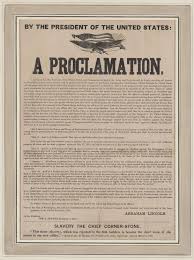
emancipation

Lincoln emphasized the “military necessity” of emancipation and “justified the step as a “fit and necessary war measure for suppressing the rebellion.” [4] The process of emancipation now became not only a moral crusade, but now became a key part of national strategy. Lincoln wrote to his future Vice President, Andrew Johnson, then the military governor of occupied Tennessee that “The colored population is the great available and yet unavailed of, force for restoration of the Union.” [5] The idea of simply mollifying the border states was dropped and policy changed that of “depriving the Confederacy of slave labor. Mobilizing that manpower for the Union- as soldiers as well as laborers- was a natural corollary.” [6] Reflecting President Lincoln’s and Stanton’s argument for the military necessity of emancipation, General Henry Halleck wrote to Ulysses Grant that:

“the character of the war has very much changed within the past year. There is now no possibility of reconciliation with the rebels… We must conquer the rebels or be conquered by them….Every slave withdrawn from the enemy is the equivalent of a white man put hors de combat.” [7]

Grant concurred with the decision. Grant wrote to in a letter to Lincoln after the assault on Battery Wagner “by arming the negro we have added a powerful ally. They will make good soldiers and taking them from the enemy weakens him in the same proportion as it strengthens us.” [8] Lincoln wrote after the Emancipation Proclamation that “the emancipation policy, and the use of colored troops, constitute the heaviest blow yet dealt to the rebellion.” [9] The change was a watershed in both American history as well as the future of the U.S. Military services.

Emancipation allowed for the formation of regiments of United States Colored Troops (USCT), mustered directly into Federal service, which in numbers soon dwarfed the few state raised Black Regiments. However, it was the inspiration provided by those first state raised regiments as well as the violence directed against Blacks in the draft riots helped to provoke “many northerners into a backlash against the consequences of violent racism.” [10] The valor of the state regiments, as well as the USCT units that managed to get into action was remarkable, especially in regard to the amount of discrimination levied at them by some northerners, and the very real threat of death that they faced of captured by Confederates.

In May of 1863 Major General Nathaniel Banks dared to send the First and Third Regiments of “Louisiana Native Home Guard regiments on a series of attacks on Confederate positions at Port Hudson, Louisiana” [11] where they received their baptism of fire. They suffered heavy losses and “of the 1080 men in the ranks, 271 were hit, or one out of every four.” [12] Banks said of them in his after action report: “They answered every expectation…In many respects their conduct was heroic…The severe test to which they were subjected, and the determined manner in which they encountered the enemy, leave upon my mind no doubt of their ultimate success.” [13]
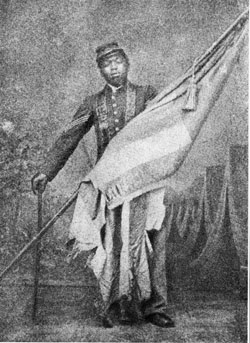
william_carney

Sergeant William H. Carney of the 54th Massachusetts, Medal of Honor

But the most famous African American volunteer regiment was the 54th Massachusetts, commanded by Colonel Robert Gould Shaw, the “North’s showcase black regiment.” [14] Raised in Boston and officered by many men who were the sons of Boston’s blue blood abolitionist elite, the regiment was authorized in March 1863. Since there was still opposition to the formation of units made up of African Americans, Massachusetts Governor John Andrew authorized the formation of the 54th under the command of white officers, a practice that with few exceptions, became standard in the U.S. military until President Truman desegregated the armed forces in 1948. Governor Andrew was determined to ensure that the officers of the 54th were men of “firm antislavery principles…superior to a vulgar contempt for color.” [15]

The 54th saw action first in early June and at Gould’s urging sent into battle against the Confederate positions at Fort Wagner on July 18th 1863. Leading the attack the 54th lost nearly half its men, “including Colonel Shaw with a bullet through his heart. Black soldiers gained Wagner’s parapet and held it for an hour before falling back.” [16] Though they tried to hold on they were pushed back after a stubborn fight to secure a breach in the fort’s defenses. “Sergeant William H Carney staggered back from the fort with wounds in his chest and right arm, but with the regiment’s Stars and Stripes securely in his grasp. “The old flag never touched the ground, boys,” Carney gasped as he collapsed at the first field hospital he could find.” [17] Shaw was buried with his men by the Confederates and when Union commanders asked for the return of his body were told “We have buried him with his niggers,” Shaw’s father quelled a northern effort to recover his son’s body with these words: We hold that a soldier’s most appropriate burial-place is on the field where he has fallen.” [18] As with so many frontal attacks on prepared positions throughout the war, valor alone could not overcome a well dug in enemy. “Negro troops proved that they could stop bullets and shell fragments as good as white men, but that was about all.” [19]

Despite the setback, the regiment went on to further actions where it continued to distinguish itself. The Northern press, particularly abolitionists papers brought about a change in the way that many Americans in the North, civilians as well as soldiers, saw blacks. The Atlantic Monthly noted “Through the cannon smoke of that dark night, the manhood of the colored race shines before many eyes that would not see.” [20]

Frederick Douglass, who had two sons serving in the 54th Massachusetts, understood the importance of African Americans taking up arms against those that had enslaved them in order to win their freedom:

“Once let a black man get upon his person the brass letters U.S… let him get an eagle on his button, and a musket on his shoulder and bullets in his pockets, and there is no power on earth which can deny he has won the right to citizenship in the United States.” [21]
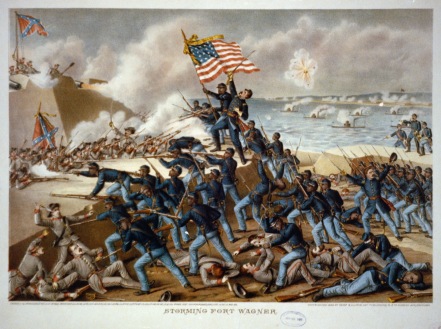
The_Storming_of_Ft_Wagner-lithograph_by_Kurz_and_Allison_1890a

Other African American units less famous than the illustrious 54th Massachusetts distinguished themselves in action against Confederate forces. Two regiments of newly recruited blacks were encamped at Milliken’s Bend Louisiana when they were attacked by a Confederate brigade attempting to relieve the Vicksburg Garrison. The troops were untrained and ill-armed but held on against a determined enemy:

“Untrained and armed with old muskets, most of the black troops nevertheless fought desperately. With the aid of two gunboats they finally drove off the enemy. For raw troops, wrote Grant, the freedmen “behaved well.” Assistant Secretary of War Dana, still with Grant’s army, spoke with more enthusiasm. “The bravery of the blacks,” he declared, “completely revolutionized the sentiment in the army with regard to the employment of negro troops. I heard prominent officers who had formerly in private had sneered at the idea of negroes fighting express after that as heartily in favor of it.” [22]

By the end of the war 179,000 African American Soldiers, commanded by 7,000 white officers served in the Union armies. For a number of reasons most of these units were confined to rear area duties or working with logistics and transportation operations. The policies to regulate USCT regiments to supporting tasks in non-combat roles “frustrated many African American soldiers who wanted a chance to prove themselves in battle.” [23] Many of the soldiers and their white officers argued to be let into the fight as they felt that “only by proving themselves in combat could blacks overcome stereotypes of inferiority and prove their “manhood.” [24] Even so in many places in the army the USCT and state regiments made up of blacks were scorned:

“A young officer who left his place in a white regiment to become colonel of a colored regiment was frankly told by a staff officer that “we don’t want any nigger soldiers in the Army of the Potomac,” and his general took him aside to say: “I’m sorry to have you leave my command, and am still more sorry that you are going to serve with Negroes. I think that it is a disgrace to the army to make soldiers of them.” The general added that he felt this way because he was sure that colored soldiers just would not fight.” [25]

The general of course, was wrong. In the engagements where USCT units were allowed to fight, they did so with varying success most often attributable to the direction of their senior officers. When given the chance they almost always fought well, even when badly commanded. This was true as well when they were thrown into hopeless situations. One such instance was when Ferrero’s Division, comprised of colored troops were thrown into the Battle of the Crater at Petersburg when “that battle lost beyond all recall.” [26] The troops advanced in good order singing as they went, while their commander, General Ferrero took cover in a dugout and started drinking; but the Confederate defenders had been reinforced and “Unsupported, subjected to a galling fire from batteries on the flanks, and from infantry fire in front and partly on the flank,” a witness write, “they broke up in disorder and fell back into the crater.” [27] Pressed into the carnage of the crater where white troops from the three divisions already savaged by the fighting had taken cover, the “black troops fought with desperation, uncertain of their fate if captured.” [28] In the battle the division lost 1327 of just under 4000 men. [29]

When captured by Confederates, black soldiers and their white officers received no quarter from many Confederate opponents. General Edmund Kirby Smith who held overall command of Confederate forces west of the Mississippi instructed General Richard Taylor to simply execute black soldiers and their white officers: “I hope…that your subordinates who may have been in command of capturing parties may have recognized the propriety of giving no quarter to armed negroes and their officers. In this way we may be relieved from a disagreeable dilemma.” [30] This was not only a local policy, but echoed at the highest levels of the Confederate government. In 1862 the Confederate government issued an order that threatened white officers commanding blacks: “any commissioned officer employed in the drilling, organizing or instructing slaves with their view to armed service in this war…as outlaws” would be “held in close confinement for execution as a felon.” [31]

On April 12th 1864 at Fort Pillow, troops under the command of General Nathan Bedford Forrest massacred the bulk of over 231 Union most of them black as they tried to surrender. While it is fairly clear that Forrest did not order the massacre and even attempted to stop it, it was clear that he had lost control of his troops. His soldiers fought with the fury of men possessed by hatred of an enemy that they considered ‘a lesser race’ slaughtered the Union troops as they either tried to surrender or flee; but he was not displeased with the result. Ulysses Grant wrote that:

“These troops fought bravely, but were overpowered I will leave Forrest in his dispatches to tell what he did with them.

“The river was dyed,” he says, “with the blood of the slaughtered for up to 200 years. The approximate loss was upward of five hundred killed; but few of the officers escaped. My loss was about twenty killed. It is hoped that these facts will demonstrate to the Northern people that negro soldiers cannot cope with Southerners.” Subsequently Forrest made a report in which he left out the part that shocks humanity to read.” [32]

”The bulk of the killing was directed at the black soldiers of the 6th U.S. Colored Heavy Artillery, which composed over a third of the garrison. “Of the 262 Negro members of the garrison, only 58- just over 20 percent- were marched away as prisoners; while of the 295 whites, 168- just under sixty percent were taken.” [33] A white survivor of the 13th West Tennessee Cavalry, a Union unit at the fort wrote: “We all threw down our arms and gave tokens of surrender, asking for quarter…but no quarter was given….I saw 4 white men and at least 25 negroes shot while begging for mercy….These were all soldiers. There were also 2 negro women and 3 little children standing within 25 steps of me, when a rebel stepped up to them and said, “Yes, God damn you, you thought you were free, did you?” and shot them all. They all fell but one child, when he knocked it in the head with the breech of his gun.” [34]A Confederate Sergeant wrote home a week after the massacre: “the poor deluded negroes would run up to our men, fall upon their knees and with uplifted hands scream for mercy, but were ordered to their feet and shot down.” [35]
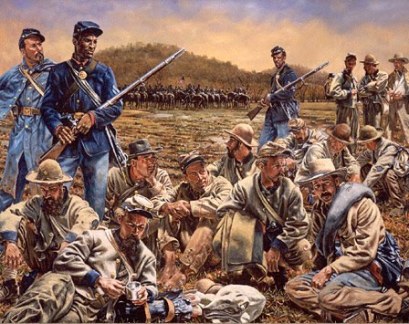
pride_over_prejudice-reeves-b-of-nashville

African American soldiers proved themselves during the war and their efforts paved the way for Lincoln and others to begin considering the full equality of blacks as citizens. If they could fight and die for the country, how could they be denied the right to votes, be elected to office, serve on juries or go to public schools? Under political pressure to end the war during the stalemate before Petersburg and Atlanta in the summer of 1864, Lincoln reacted angrily to Copperheads as well as wavering Republicans on the issue of emancipation:

“But no human power can subdue this rebellion without using the Emancipation lever as I have done.” More than 100,000 black soldiers were fighting for the Union and their efforts were crucial to northern victory. They would not continue fighting if they thought the North intended to betray them….If they stake their lives for us they must be prompted by the strongest motive…the promise of freedom. And the promise being made, must be kept…There have been men who proposed to me to return to slavery the black warriors. “I should be damned in time & in eternity for so doing. The world shall know that I will keep my faith to friends & enemies, come what will.” [36]

Despite this, even in the North during and after the war, blacks, including former soldiers would be discriminated against, sometimes by the white men that they served alongside. Those rights would be fought for another century and what began in 1863 with the brave service and sacrifice of these African American soldiers began a process of increased civil rights that is still going on today. It would not be until after the war that some blacks were commissioned as officers in the Army. When Governor John Andrew, the man who had raised the 54th Massachusetts attempted to:

“issue a state commission to Sergeant Stephen Swails of the 54th…the Bureau of Colored Troops obstinately refused to issue Swails a discharge from his sergeant’s rank, and Swails promotion was held up until after the end of the war. “How can we hope for success to our arms or God’s blessing,” raged the white colonel of the 54th, Edward Hallowell, “while we as a people are so blind to justice?” [37]

The Southern Debate about Emancipation and Black Soldiers

In the South, politicians and many senior Confederate Officers fought against any allowance for blacks to serve, for they knew if they allowed this, that slavery itself must be swept away. Despite this, a few such as General Patrick Cleburne, an Irish immigrant and a division commander in the Army of Tennessee demonstrated the capacity for forward thinking in terms of race: Cleburne advocated that blacks serve as soldiers should be emancipated.

Cleburne, known as “the Stonewall Jackson of the West” was a bold fighter who put together a comprehensive plan. He noted that the Confederacy was losing the war because it did not have soldiers, the supplies or resources; and most significantly that “slavery, from being one of our chief sources of strength at the beginning of the war, has now become in a military point of view, one of our chief sources of weakness.” [38] Cleburne recommended that “we immediately commence training a large reserve of the most courageous of our slaves, and further that we guarantee freedom within a reasonable time to every slave in the South who shall remain to the confederacy in this war.” [39]

His proposal was radical. He was asking more from his fellow Southerners than they could risk. He was “asking them to surrender the cornerstone of white racism to preserve their nation” [40] and he presented it in stark terms that few could stomach “As between the loss of independence and the loss of slavery, we can assume that every patriot will freely give up the latter- give up the Negro slave rather than be a slave himself.” [41]

In January 1864 General W.H.T Walker obtained a copy of Cleburne’s proposal and sent it to Davis. Walker opposed it and expressed his outrage over it. Cleburne’s proposal went from being a military matter to a political matter and Davis intervened to quash the proposal. “Convinced that the “propagation of such opinions” would cause “discouragements, distraction, and dissension” in the army, Jefferson Davis ordered the Generals to stop discussing the matter…The only consequence of Cleburne’s action seemed to be the denial of promotion to this ablest of the army’s division commanders, who was killed ten months later at the Battle of Franklin.” [42] In fact Cleburne was “passed over for command of an army corps and promotion to lieutenant general” three times in the next eight months, and in “each care less distinguished, less controversial men received the honors.” [43] All copies of Cleburne’s proposal were destroyed by the order of Davis.

Cleburne was not the only military man to advocate the formation of Negro units or even emancipation. Robert E. Lee was one of the chief proponents of this. Lee said after the war that he had told Davis “often and early in the war that the slaves should be emancipated, that it was the only way to remove a weakness at home and to get sympathy abroad, and divide our enemies, but Davis would not hear of it.” [44]

Ten months later Davis raised the issue of arming slaves as he now believed that military necessity left him little choice. He was opposed by some of his closest political allies including Howell Cobb who warned “The day that you make soldiers of them is the beginning of the end of the revolution. If slaves will make good soldiers our whole theory of slavery is wrong.” [45] Lee wrote to a member of Virginia’s legislature “we must decide whether slavery shall be extinguished by our enemies and the slaves used against us, or use them ourselves at the risk of the effects which may be produced on our social institutions…” and he pointed out that “any act for the enrolling of slaves as soldiers must contain a “well digested plan of gradual and general emancipation”: the slaves could not be expected to fight well if their service was not rewarded with freedom.” [46]

The debate began in earnest in the fall of 1864 and revealed a sharp divide in the Confederacy between those who supported the measure and those against it. Cabinet members such as Judah Benjamin and a few governors “generally supported arming the slaves.” [47] They were opposed by the powerful governors of Georgia and North Carolina, Joe Brown and Zebulon Vance as well as President pro-tem of the Confederate Senate R.M.T. Hunter, who forcibly opposed the measure. Led by Governor “Extra Billy” Smith, Virginia’s General Assembly voted “to permit the arming of slaves but included no provision for emancipation, either before or after military service.” [48]

Finally in March of 1865 the Confederate Congress passed by one vote a watered down measure to allow for the recruitment of slaves. It stipulated that “the recruits must all be volunteers” [49] and those who volunteered must also have “the approbation of his master by a written instrument conferring, as far as he may, the rights of a freed man.” [50] While this in itself was a radical proposition for a nation which had went to war to maintain slavery, the fact was that the slave’s service and freedom were granted not by the government, but by his owner, and even at this stage of the war, few owners were willing to part with their property. It was understood by many that giving freedom to a few was a means of saving the “particular institution.” The Richmond Sentinel noted during the November debate: “If the emancipation of a part is the means of saving the rest, this partial emancipation is eminently a pro-slavery measure.” [51] Thus the law made “no mention of emancipation as a reward of military service” [52] and in deference to “state’s rights, the bill did not mandate freedom for slave soldiers.” [53]

But even the watered down measure was opposed by diehards. Robert Kean, who headed the Bureau of War and should have understood the stark reality of the Confederacy’s strategic situation, note in his diary, that the law:

“was passed by a panic in the Congress and the Virginia Legislature, under all the pressure the President indirectly, and General Lee directly, could bring to bear. My own judgment of the whole thing is that it is a colossal blunder, a dislocation of the foundations of society from which no practical results will be reaped by us.” [54]

It was Lee’s prestige alone that allowed the measure to pass, but even that caused some to question Lee’s patriotism. The Richmond Examiner dared to express a doubt whether Lee was “a ‘good Southerner’: that is, whether he is thoroughly satisfied of the justice and beneficence of negro slavery.” [55] Robert Toombs of Georgia stated that “the worst calamity that could befall us would be to gain our independence by the valor of our slaves” [56] and a Mississippi congressman stated that “Victory itself would be robbed of its glory if shared with slaves.” [57] On March 23rd 1865 the War Office issued General Order Number 14, which authorized the call up and recruitment of slaves to the Confederate cause and on March 25th two companies were formed for drill in Richmond’s Capitol Square and as they did so to the sounds of fifes and drums, “Small boys jeered and threw rocks” [58] at them. None of those few volunteers would see action as within a week the Confederate government had fled Richmond.

But some would see that history was moving, and attitudes were beginning to change. It took time, and the process is still ongoing. As imperfect as emancipation was and though discrimination and racism remained, African Americans had reached “levels that none had ever dreamed possible before the war.” [59] In April 1865 as Jefferson Davis and his government fled Richmond, with Davis proclaiming “again and again we shall return, until the baffled and exhausted enemy shall abandon in despair his endless and impossible task of making slaves of a people resolved to be free.” [60]

The irony in Davis’s empty vow was stunning. Within a week Lee had surrendered and in a month Davis himself would be in a Federal prison. The Federal troops who led the army into Richmond came from General Godfrey Weitzel’s Twenty-fifth Corps, of Ord’s Army of the James. The Every black regiment in the Army of the James was consolidated in Weitzel’s Corps, along with Ferrero’s former division which had suffered so badly at the Battle of the Crater. “Two years earlier in New Orleans, Weitzel had protested that he did not believe in colored troops and did not want to command them, and now he sat at the gates of Richmond in command of many thousands of them, and when the citadel fell he would lead them in and share with them the glory of occupying the Rebel capital.” [61] were regiments of black “cavalrymen and infantrymen. Many were former slaves; their presence showed their resolve to be free.” [62]

The Post War Experience of Blacks in the U.S. Army

Some of those early African American soldiers went on to distinguish themselves on the prairie as the immortal Buffalo Soldiers. Other Blacks would fight in Cuba and the Philippines during the Spanish American War. In the First World War, despite there being some instances of racial harmony, blacks, including officers faced discrimination and met with violent acts. “Refusals to arrest white soldiers who physically assaulted black soldiers accompanied by the tendency to rescind unpopular racial orders and to discourage black officers from demanding salutes from white soldiers” [63] was common.

Most of the Regular Army “Buffalo Soldier” units were not allowed to fight in the First World War. Instead they were left on the frontier and a new generation of draftees and volunteers became the nucleus of two infantry divisions, the 92nd and 93rd. However, at the beginning they were regulated to labor service units. The protests of organizations such as the NAACP and men like W.E.B. DuBois, and Phillip Randolph forced the War Department to reconsider the second class status of these men and to form them into combat units.

Despite this, the leadership of the AEF, or the American Expeditionary Force, refused to allow these divisions to serve under American command. Instead they were broken up and the regiments of the 93rd Division were attached to French divisions. The 369th “Harlem Hellfighters” were assigned to the French 16th Division and then to the 161st Division. The 370th “Black Devils” were attached to the French 26th Division, while the 371st and 372nd were assigned to the French 157th (Colonial) Division, which was also known as the Red Hand Division. The 157th Division had suffered badly during the war and been decimated in the unrelenting assaults in the trench warfare of the Western Front. It was reconstituted in 1918 with one French Regiment and the two African American regiments. Both fought exceptionally well and were cited by the French government for their efforts. The 371st was awarded the French Croix de Guerre and Légion d’honeur. Corporal Freddie Stowers of the 1st Battalion 371st was the only African American awarded the Congressional Medal of Honor in the First World War. The 372nd was also awarded the Croix de Guerre and Légion d’honeur for its service with the 157th Division.
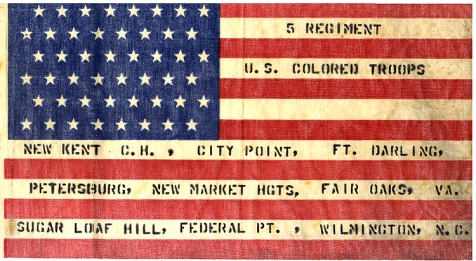
41_090_lg

While many white American soldiers depreciated their French hosts and attempted to sow the seeds of their own racial prejudice against the black soldiers among the French, Southerners in particular warned the French of “black rapist beasts.” However the French experience of American blacks was far different than the often scornful treatment that they received from white American soldiers.

“Soldiers from the four regiments that served directly with the French Army attested to the willingness of the French to let men fight and to honor them for their achievements. Social interactions with French civilians- and white southern soldiers’ reactions to them- also highlighted crucial differences between the two societies. Unlike white soldiers, African Americans did not complain about high prices in French stores. Instead they focused on the fact that “they were welcomed” by every shopkeeper that they encountered.” [64]

Official and unofficial efforts by those in the Army command and individual soldiers to stigmatize them and to try to force the French into applying Jim Crow to laws and attitudes backfired. Villages now expressed a preference for black over white American troops. “Take back these soldiers and send us some real Americans, black Americans,” wrote one village mayor after a group of rowdy white Americans disrupted the town.” [65]

Even after President Truman desegregated the armed forces in 1948, African Americans, as well as other racial minorities, women and gays have faced very real discrimination. The military continues to make great strides, and while overt racist acts and other types of discrimination are outlawed, racism still remains a part of American life.

Today things have changed, and that in large part is due to the unselfish sacrifice in the face of hatred and discrimination of the men of the USCT and the State Black Regiments like the 54th Massachusetts and the Louisiana Home Guards who blazed a way to freedom for so many. Those who followed them as Buffalo Soldiers and volunteers during the World Wars continued to be trail blazers in the struggle for equal rights. A white soldier who served with the 49th Massachusetts wrote “all honor to our negro soldiers. They deserve citizenship. They will secure it! There would be much suffering in what he termed “the transition state” but a “nation is not born without pangs.” [66]

Those birth pangs helped to bring about a new birth of freedom for the United States.

Notes

[1] McPherson, James M. Tried by War: Abraham Lincoln as Commander in Chief Penguin Books, New York and London 2008

[2] McPherson, James M. Drawn With the Sword: Reflections on the American Civil War Oxford University Press, Oxford and New York 1996 p.101

[3] Godwin, Doris Kearns Team of Rivals: The Political Genius of Abraham Lincoln Simon and Shuster, New York and London 2005

[4] Egnal, Marc Clash of Extremes: The Economic Origins of the Civil War Hill and Wang a division of Farrar, Straus and Giroux New York 2009 p.318

[5] Ibid. McPherson Tried by War p.159

[6] Ibid. McPherson Drawn With the Sword p.159

[7] McPherson, James M. Abraham Lincoln and the Second American Revolution Oxford University Press, New York and Oxford 1991 p.35

[8] Ibid. Guelzo Fateful Lighteningp.381

[9] Ibid. McPherson Abraham Lincoln and the Second American Revolution p.35

[10] Ibid. McPherson. The Battle Cry of Freedom p.686

[11] Ibid. Guelzo Fateful Lightening p.379

[12] Ibid. Foote , The Civil War, A Narrative. Volume Two p.398

[13] Ibid. Guelzo Fateful Lightening p.379

[14] Ibid. McPherson. The Battle Cry of Freedom p.686

[15] Ibid. McPherson Drawn With the Sword p.101

[16] Ibid. McPherson. The Battle Cry of Freedom p.686

[17] Ibid. Guelzo Fateful Lightening pp. 380-381

[18] Ibid. McPherson. The Battle Cry of Freedom pp.686-687

[19] Ibid. Foote , The Civil War, A Narrative. Volume Two p.697

[20] Ibid. McPherson. The Battle Cry of Freedom p.686

[21] Ibid. Guelzo Fateful Lightening p. 381

[22] Ibid. McPherson. The Battle Cry of Freedom p.634

[23] Gallagher, Gary W. The Union War Harvard University Press, Cambridge MA and London 2011

[24] Ibid. McPherson Drawn With the Sword p.89

[25] Catton, Bruce. A Stillness at Appomattox Doubleday and Company Garden City, New York 1953 p.227

[26] Ibid. Catton A Stillness at Appomattox p.249

[27] Foote, Shelby, The Civil War, A Narrative. Volume Three Red River to Appomattox Random House, New York 1974 p.537

[28] Wert, Jeffry D. The Sword of Lincoln: The Army of the Potomac Simon and Schuster, New York and London 2005 pp.384-385

[29] Ibid. Foote The Civil War, A Narrative. Volume Three p.537

[30] Ibid. Guelzo Fateful Lightening p. 377

[31] Ibid. Guelzo Fateful Lightening p. 377

[32] Grant, Ulysses S. Preparing for the Campaigns of ’64 in Battles and Leaders of the Civil War Volume IV, Retreat With Honor Edited by Robert Underwood Johnson and Clarence Clough Buel Castle, Secaucus NJ pp.107-108

[33] Ibid. Foote The Civil War, A Narrative. Volume Three p.111

[34] Ibid. Guelzo Fateful Lightening p. 378

[35] Ibid. Foote The Civil War, A Narrative. Volume Three p.112

[36] Ibid. McPherson Abraham Lincoln and the Second American Revolution p.89

[37] Ibid. Guelzo Fateful Lightening p. 376

[38] Ibid. Thomas, The Confederate Nation p.262

[39] Ibid. Thomas, The Confederate Nation p.262

[40] Ibid. Guelzo Fateful Lightening p. 370

[41] Ibid. Thomas, The Confederate Nation p.262

[42] Ibid. McPherson. The Battle Cry of Freedom p.833

[43] Ibid. Thomas, The Confederate Nation p.262

[44] Ibid. Gallagher The Confederate War p.47.

[45] Ibid. Guelzo Fateful Lightening p. 370

[46] Korda, Michael. Clouds of Glory: The Life and Legend of Robert E. Lee Harper Collins Publishers, New York 2014 p.643

[47] Ibid. Thomas, The Confederate Nation p.293

[48] Ibid. Foote. The Civil War, A Narrative. Volume Three pp.754-755

[49] Ibid. Foote. The Civil War, A Narrative. Volume Three p. 755

[50] Ibid. Thomas, The Confederate Nation p.296

[51] Ibid. McPherson. The Battle Cry of Freedom p.836

[52] Ibid. Foote. The Civil War, A Narrative. Volume Three p.755

[53] Ibid. McPherson. The Battle Cry of Freedom p.837

[54] Ibid. Foote. The Civil War, A Narrative. Volume Three p.860

[55] Ibid. McPherson. The Battle Cry of Freedom p.837

[56] Ibid. Foote. The Civil War, A Narrative. Volume Three p.860

[57] Ibid. McPherson. The Battle Cry of Freedom p.835

[58] Ibid. Foote. The Civil War, A Narrative. Volume Three p.860

[59] Ibid. Guelzo Fateful Lightening p. 386

[60] Levine, Bruce Half Slave and Half Free: The Roots of the Civil War Revised Edition, Hill and Wang, a division of Farrar, Strauss and Giroux, New York 1992 and 1995 p.241

[61] Catton, Bruce Grant Takes Command Little, Brown and Company Boston, Toronto and London 1968 p.411

[62] Ibid. Levine Half Slave and Half Free pp.241-242

[63] Keene, Jennifer D. Doughboys, the Great War, and the Remaking of America The Johns Hopkins University Press, Baltimore and London 2001 p.88

[64] Ibid. Keane Doughboys, the Great War, and the Remaking of America p.128

[65] Ibid. Keane Doughboys, the Great War, and the Remaking of America p.129

[66] Ibid Gallagher The Union War p.113

1 Comment

Filed under civil rights, civil war, History, Military