Tag Archives: barbara tuchman

Dealing With the Reality of the Trump Presidency

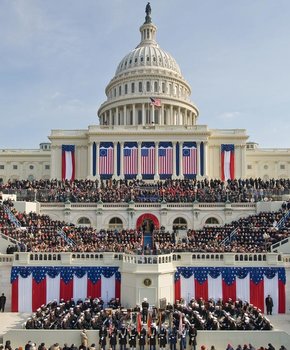
us-capitol-west-front-inauguration-2009-barack-obama

Friends of Padre Steve’s World,

There are times in history when eras end and new ones begin. As a historian I think that we are on the verge of one of those moments in history and that is not necessarily a good thing. Barbara Tuchman wrote that as England declared war on Germany in 1914 of British Foreign Secretary Earl Edward Grey:

“Watching with his failing eyes, the lamps being lit in St. James Park, Grey was heard to remark that “the lamps are going out all over Europe; we shall not see them again in our lifetime.”

I believe that could well be the case in our country and the world in the not too distant future, the symbolism of the lamps going out may be all too real.

At 12:01 today Donald Trump will take the Oath of Office and become the President of the United States. That is a fact. We can argue about his legitimacy. Like it or not he is the legal and thus the legitimate President. Of course that is one definition of legitimate. But there is another definition that can be argued to say that he is not, and this one is quite important to our form of government. That definition is “conforming to recognized principles or accepted rules and standards.” This is something that no-one can claim that Mr. Trump has done in his long business life or in his short political life. The latter is incredibly important, but it does not take away the legality of his election. Unless something extraordinary happens in the next five and a half hours he will be the President, and if something were to happen the resulting chaos who likely be worse than the transition of power to a man who appears to have been elected with the help of a hostile foreign power, and who lost the popular vote by one of the widest margins ever for someone who won the electoral vote. The truth be told I wish I had never seen this day come, but it has.

That my friends, like it or lump it is reality, and as the masthead of this site reads, I am a “progressive realist in Wonderland.” 

Now we can say “Never Trump” all we want, but he will still be President. We can put hashtags saying “not my President,” but he will still be President. That is cold hard reality. We can talk about resistance, but if we resist we need to be smart in how we do it and apply reason, logic, and hard work.

Does that mean that his policies should not be opposed on principle of they harm people? Never. There are many of his stated policies which if implemented will be harmful to the country. Likewise, some of the things that he has said regarding foreign policy not only will make us weaker but could end up in an even chaotic world and the real possibility of war with nations that could do us great harm, militarily and economically. Of course we could find out that once in office he becomes more pragmatic, realistic, and flexible. I kind of doubt it but it is a possibility.

A lot depends on what he says tomorrow, if he conducts himself with humility, dignity, and shows respect for all Americans, he could change the tenor of the debate in the country and instead of having to crush those who question his legitimacy, he could earn their respect, even if it is grudging. Again, while this is possible, I am not hopeful that it will happen, but I could be wrong. Even so, no-matter how he conducts himself today, he will still be President.

So what are the realistic options?

Protest is always an option, but those who do so must be very careful and not allow themselves to be provoked into any action that could cause President Trump to enact measures that are written in the Constitution, in established law, and in executive orders that deal with civil unrest. We have to remember that there are “agent provocateurs” who do things to cause individuals to do things that puts them on the wrong side of the law. One stupid or violent action against the President could bring the whole house down. If we protest it must be peaceful and those who do cannot allow themselves to respond to violence and intimidation in kind. That is what we learned from men like Dr. Martin Luther King Jr. and Representative John Lewis. The path has to be non-violent.

What else can we do?

Get involved. Write your state and Federal representatives and senators on all important issues. Don’t just tweet to your friends.

Revitalize the political party system in the country by participating at all levels.

Run for office, especially at the local and state level. That is where real change happens, if your don’t win there it doesn’t matter if you win the Presidency once in a while. Many offices around the country are won by people who run unopposed; don’t let that happen.

Donate money to political groups, parties, and those who represent what you believe.

Speak up for those who have no voice and who are demonized by Trump’s most radical followers as well as those in the Republican Party who have demonized them far longer than Mr. Trump has been a member of that party.

Speak truth to power and do not spread rumors or innuendo. Get away from spreading political memes that even if they are factual are not conducive to reasoned debate.

Read long articles in newspapers, and journals. Things that require thought and reflection. When you share them do what I do. Ask people to read them and then ask them if the want to comment pro or con to do so themselves and not on your social media timeline or to discuss things in personal messages or even better in person. Avoid Twitter wars and Facebook rants, be careful of what you say in e-mails and comment sections of public forums.

Gather together in person and discuss issues, even with people with whom you disagree. Do it over a meal, a drink, but do it respectfully and build bridges that break down the walls of division. It’s hard to hate people that you break bread with.

Remember, there are people who initially support authoritarian leaders who sooner or later realize that they were deceived by false promises and come around. One of those was the German Pastor Martin Niemoller who initially supported Hitler, then when he realized that he had been lied to, spoke up, and resisted. In a concentration camp he wrote these words:

“I hated the growing atheistic movement, which was fostered and promoted by the Social Democrats and the Communists. Their hostility toward the Church made me pin my hopes on Hitler for a while. I am paying for that mistake now; and not me alone, but thousands of other persons like me.” 

Believe me, there will be a lot of people who voted for President Trump and his GOP allies who will be dealing with buyer’s remorse in the not too distant future. When that happens we need to be there for them.

Read. Barbara Tuchman wrote:

“Books are the carriers of civilization. Without books, history is silent, literature dumb, science crippled, thought and speculation at a standstill. Without books, the development of civilization would have been impossible. They are engines of change (as the poet said), windows on the world and lighthouses erected in the sea of time. They are companions, teachers, magicians, bankers of the treasures of the mind. Books are humanity in print.”

Read real books on history, political science, law and the Constitution. Read how we got the Declaration of Independence and the story of how in the face of real rebellion and war, Abraham Lincoln began the quest for “a new birth of freedom.”

Read the biographies of statesmen and women, politicians, Presidents, and Prime Ministers, civil rights leaders, labor leaders, and even religious leaders. Read the classics, and even poetry. Learn about courage to face trying times and uncertain futures from those who went before us. Learn from their successes and also their failures. Most of them had feet of clay, but the good ones made a difference. We can too.

These are things that matter and in the long run can defeat the worst attempts of Trump, his cabinet officials, people he appoints as justices and judges, and GOP dominated legislatures.

Will you get instant gratification? No. This is hard work. It requires patience, humility, the ability to admit when we are wrong, and the courage to face reality. Part of that reality is that Donald Trump will be President at 12:01 today. I will not bury my head in the sand, and as painful and distasteful as it will probably be I will watch the inauguration today, if nothing else to show my respect to our outgoing President and his family, who I will miss as President.

I remember watching Barak Obama’s inauguration in 2009. When he took the Oath of Office, I was standing beside the bed of a critically ill African American woman in the ICU of the Medical center that I then worked. She was nearly 90 years old. Her late husband had been a military man back during Jim Crow and then the Civil Rights era, she remembered the hatred and discrimination that they both faced. I remember watching that moment with her, holding her hand, and listening to her joy in spite of her pain at seeing a moment that she never dreamed that she would live to see. It was a profound honor for me.

Truthfully, all of that being said, I am very afraid of what President Trump and his administration may do in a very short amount of time. It is much easier to destroy systems and crush dissent than to built bridges and renew the country. At the same time I will be a voice of reason and speak the truth the best I can given the limitations of my own office. I do want to be wrong, and I will pray for him and his family because if he screws up we are all screwed. That too is reality.

But that’s what we have to do. we cannot give up, but if we resist, we must do it smartly and effectively. Highly emotional outbursts that lead to less than wise actions will doom resistance. We must be to use the words of Jesus, “wise as serpents and gentle as doves.”

So until tomorrow.

Peace,

Padre Steve+


4 Comments

Filed under civil rights, History, laws and legislation, News and current events, Political Commentary

A Useful Nostrum Against Despair: History and Future

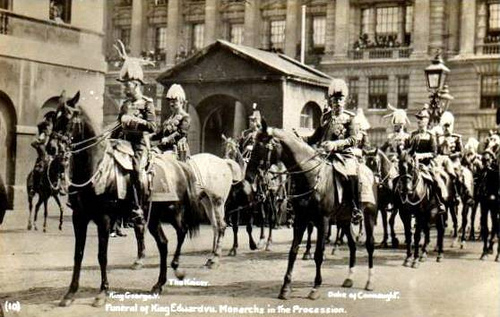
edward-vii-funeral

Friends of Padre Steve’s World,

In two days we will have a new President. While his supporters see great things in his Presidency, many others, not just in this country do not. We can try to deduce how President Trump will govern in a number of ways, but the best is through the lens of the past. I am a historian and I am not hopeful of what the future has in store for us, but given that I will not give in to despair. Barbara Tuchman whose books covered many of greatest eras of change and crisis in world history wrote these words:

“The story and study of the past, both recent and distant, will not reveal the future, but it flashes beacon lights along the way and it is a useful nostrum against despair.”

That being said given my study of history and my observations of our soon to be President I am not optimistic. Many people more learned and informed than I have written volumes about what they think will happen in the coming weeks and months. I have read a lot of those analysis and most give me cause for concern. My one hope is that the in spite of his past, including his recent statements, that President Trump will listen to men like soon to be Secretary of defense James Mattis, who alone among our leaders I believe can stand up to Trump’s most unreasonable and problematic actions in regard to NATO, Russia, and China. He actually may be the man who will save the nation from disaster if President Trump makes good on his promises and threats worldwide.

Of course I hope things never reach that point and that some modicum of sanity will possess the President as well as Congress. Likewise I hope that our institutions will be able to survive.

Even so I expect that when President Trump departs the Capital building for the White House that our world will be irrevocably changed. Tuchman wrote of the gathering of leaders at the death of King Edward VII in 1910 in words that I think could easily be modified to 2017 Washington DC.

“The muffled tongue of Big Ben tolled nine by the clock as the cortege left the palace, but on history’s clock it was sunset, and the sun of the old world was setting in a dying blaze of splendor never to be seen again.”

I believe that the world that we knew is never going to be the same. While I have no idea how our future will play out, I still look to the light of the past to keep from despair.

Until tomorrow,

Peace

Padre Steve+

1 Comment

Filed under History, News and current events, Political Commentary

The First Duty: Speaking Truth in “Post-Truth” Trump Era

IMG_0535

Friends of Padre Steve’s World,

For me the past month has been one of constant amazement. I am not speeaking about politics, but what matters more than any political ideology, the very idea of truth. Because of this I write using history and as best as I can objective and indisputable fact as my guide.

Most of my readers know that in addition to being a Priest and Navy Chaplain that I am a historian and teach both ethics and about Gettysburg as a faculty member at a Staff College. Many of the men and women that I teach will lead our military as commanders, planners and staff officers. I will transfer in the spring but even so, as a chaplain, officer, and educator I cannot be silent.

Thus it is my first duty, whether it is in teaching, writing or in ministry is to the truth, politicans and pundits be damned to hell. I believe the words spoken by Captain Jean Luc Picard, played by Sir Patrick Stewart in Star Trek the Next Generation: “the first duty of every Starfleet officer is to the truth, whether it’s scientific truth, historical truth or personnel truth…”

I am not a Starfleet Officer, but a Navy officer and I have always believed that the truth matters, but sadly, I, like so many of us have turned the other way and not spoken out too many times in my life. That changed during my combat tor in Iraq, and now the older I get the more I realize that I cannot be silent about subjects that at one time I turned a blind eye to because they were uncomfortable, unpopular or might hurt my career either in the church or in the military, so when I see people in power and who are close to power saying that truth and objective fact no longer matters I become fearful, because I know that the path that denying facts and truth leads.

Throughout the campaign Trump and his campaign surrogates not only twisted truth, but lied so many times that fact checkers could hardly keep up with their untruths. After the election, Trump surroget Scottie Nell Hughes told Diane Rehm of NRP: “There’s no such thing, unfortunately, anymore, of facts,” she continued,“Mr. Trump’s tweet, amongst a certain crowd, a large — a large part of the population, are truth. When he says that millions of people illegally voted, he has some — in his — amongst him and his supporters, and people believe they have facts to back that up. Those that do not like Mr. Trump, they say that those are lies, and there’s no facts to back it up.”

Her words, as well as those of former Trump campaign director and CNN talking head, Corey Lewindowski, and Newt Gingrinch have maintained that truth does not matter, only what people believe does. The fact that so many of Trump’s supporters don’t seem to care about facts, bodes ill for our country.

As such I have continued to write about subjects that many people are controversial and as such many people are uncomfortable with those topics. Whether the issue is civil rights, racism, Gay rights and marriage equality, voting rights, religious freedom and religious intolerance, and even xenophobia, or the connection of symbols such as the Confederate Battle Flag to a heritage that goes to a hatred that extends far beyond the battlefields of the Civil War; I am speaking out.

I am fully aware of that many of these subjects are controversial and are now targeted by Trump’s supporters, Congressional Repiublicans, and GOP legislators in every state. I have been asked in comments on this site and on my various social media accounts, particularly Facebook, why I keep bringing up the uncomfortable past. But I have to, I have a duty to the truth, and as Oscar Wilde noted “The truth is rarely pure and never simple.”

The late Howard Zinn, a brilliant historian whose work at one time I discounted, said: “But I suppose the most revolutionary act one can engage in is… to tell the truth.” Who would think that telling the truth could or would be a revolutionary act? However, when one lives in a society where the truth is bent, run over and shredded by politicians, preachers and pundits, what I call the Trinity of Evil; when state school boards whitewash history and force their religious views on children in public schools; where corporations and advertisers use the most crass means to deceive customers; and where established science is not met with denial under the guise of “skepticism;” telling the truth is a revolutionary affair.

In 1943, George Orwell, wrote about the Spanish Civil War how the German and Italian propaganda about it had been accepted without question by most people in westren democracies. His words echo my feelings about the incoming administration:

“This kind of thing is frightening to me, because it often gives me the feeling that the very concept of objective truth is fading out of the world. After all, the chances are that those lies, or at any rate similar lies, will pass into history. How will the history of the Spanish war be written? If Franco remains in power his nominees will write the history books, and (to stick to my chosen point) that Russian army which never existed will become historical fact, and schoolchildren will learn about it generations hence. But suppose Fascism is finally defeated and some kind of democratic government restored in Spain in the fairly near future; even then, how is the history of the war to be written? What kind of records will Franco have left behind him? Suppose even that the records kept on the Government side are recoverable — even so, how is a true history of the war to be written? For, as I have pointed out already, the Government, also dealt extensively in lies. From the anti-Fascist angle one could write a broadly truthful history of the war, but it would be a partisan history, unreliable on every minor point. Yet, after all, some kind of history will be written, and after those who actually remember the war are dead, it will be universally accepted. So for all practical purposes the lie will have become truth. 

In spite of everything going on I will continue to speak the truth, which will likely will be called radical, revolutionary, and unpatriotic. That has happened over the past few years and I expect that it will happen on a more frequent basis, but I do not want the lie to become truth.

The honest truth is that I never expected to be a revolutionary in terms of defending civil rights. Truthfully, believing what authority figures, be they political, or religious say is much easier than asking the hard questions. Barbara Tuchman once wrote: “The reality of a question is inevitably more complicated than we would like to suppose.” I guess that is why so many people would rather be content with obvious lies than to ask the really hard questions; be they about history, religion, and science or for that matter anything. One of the must uncomfortable things to admit is that truth is always evolving as we learn more, it is dynamic, not static and to attempt to force people to live by the “truth” of our ancestors is disingenuous, dishonest and denies the reality of the universe that we live. Thomas Jefferson recognized this and wrote:

“I know also, that laws and institutions must go hand in hand with the progress of the human mind. As that becomes more developed, more enlightened, as new discoveries are made, new truths disclosed, and manners and opinions change with the change of circumstances, institutions must advance also, and keep pace with the times. We might as well require a man to wear still the coat which fitted him when a boy, as civilized society to remain ever under the regimen of their barbarous ancestors.” 

So why I continue to write? I will write so that we never forget or push aside the great evils that human beings are capable of committing: The Holocaust, slavery and Jim Crow, the extermination of Native Americans by the millions in the name of God and Manifest Destiny, the enslavement, exploitation, and sometimes the extermination of whole peoples by colonialism; the witch trials, the religious wars of the Reformation, the Inquisition, the Chinese Cultural Revolution, Stalin’s purges, the Tuskegee experiments, the Japanese barbarity in the Rape of Nanking and other places in Asia, the Srebrenica genocide and the Rwandan genocide, the inhumanity of the so-called Islamic State, just to name a few; and add to that whatever happens in the next few years that will be aided and abbetted by men and women who overthrow democracy by the democratic process, using people’s fear to establish authoritatian or totalitarian states.

All too often the perpetrators of those events and their descendants as all too willing to last the past lie dormant and allow present wrongs to persist and look the other way.

But at what cost do we do so? Do we sacrifice justice on the altar of prosperity and peace; do we sacrifice uncomfortable truth in order to remain undisturbed and comforted by myth? Do we condemn our descendants to live under the myths of our ancestors? Would we sacrifice the truth and justice in order to ensure obedience? Howard Zinn correctly observed, “Historically, the most terrible things – war, genocide, and slavery – have resulted not from disobedience, but from obedience.”

President John F. Kennedy spoke these words at Yale in 1962: “The great enemy of truth is very often not the lie–deliberate, contrived and dishonest–but the myth–persistent, persuasive and unrealistic. Too often we hold fast to the cliches of our forebears. We subject all facts to a prefabricated set of interpretations. We enjoy the comfort of opinion without the discomfort of thought.”

Personally I would rather ask the questions and confront the past so we might have a better future, because though I am a realist, I also believe in my heart that humanity is capable of overcoming hatred, prejudice and ignorance. The problem is that times get difficult those attitudes can overcome our better nature. As Spencer Tracy’s character in the movie Judgment at Nuremberg said:

“But this trial has shown that under a national crisis, ordinary – even able and extraordinary – men can delude themselves into the commission of crimes so vast and heinous that they beggar the imagination. No one who has sat through the trial can ever forget them: men sterilized because of political belief; a mockery made of friendship and faith; the murder of children. How easily it can happen. There are those in our own country too who today speak of the “protection of country” – of ‘survival’. A decision must be made in the life of every nation at the very moment when the grasp of the enemy is at its throat. Then, it seems that the only way to survive is to use the means of the enemy, to rest survival upon what is expedient – to look the other way. Well, the answer to that is ‘survival as what’? A country isn’t a rock. It’s not an extension of one’s self. It’s what it stands for. It’s what it stands for when standing for something is the most difficult! Before the people of the world, let it now be noted that here, in our decision, this is what we stand for: justice, truth, and the value of a single human being.”

That my friends, is why I write: for justice, truth, and the value of a single human life, even if that means being considered unpatriotic.

Peace

1 Comment

Filed under ethics, History, News and current events, philosophy, Political Commentary

The Power of Folly

lemmi_cliff

Friends of Padre Steve’s World,

We are entering a dangerous time and while we hold out hope that our new President will be a wise and judicious executive, his words and actions after his election give us little hope of that.

Barbara Tuchman wrote in her book The March of Folly: From Troy to Vietnam, “Strong prejudices in an ill-formed mind are hazardous to government.” We are about to see just how those strong prejudices in the ill-formed mind of our President-Elect will do to our Republic, and the actions of his already powerful friends and lackeys jockeying for position in the incoming Trump administration. Tuchman wrote, “Chief among the forces affecting political folly is lust for power, named by Tacitus as “the most flagrant of all passions.” One can already see how this is likely to play out over the coming months and years.

Dietrich Bonhoeffer was a German pastor and theologian who openly opposed Hitler and his policies in an age when the bulk of German Christians either threw their wholehearted allegiance behind Hitler, or simply did nothing. Bonhoeffer wrote about the violence of Nazi power, and how it, like other brazen displays of power produces outbursts of folly. He noted:

“If we look more closely, we see that any violent display of power, whether political or religious, produces an outburst of folly in a large part of mankind; indeed, this seems actually to be a psychological and sociological law: the power of some needs the folly of others. It is not that certain human capacities, intellectual capacities for instance, become stunted of destroyed, but rather that the upsurge of power makes such an overwhelming impression that men are deprived of their independent judgment, and…give up trying to assess the new state of affairs for themselves.”

Our Republic and democracy is a brilliantly engineered system of government. It has a certain resiliency, but ultimately it is a fragile thing, one can look at our own history and the history of other republics with democratic institutions to see just how fragile it is.  To survive it depends on educated citizens to recognize the dangers of demagogues who rely on the folly others to gain power, but in this case we have failed to do that. If we are not careful we very well may see the institutions of our country used to destroy the foundations of our form of government.

We stand at a precipice and in the coming months and years it will be incumbent on people who value the proposition that of our Declaration of Independence and Lincoln’s Gettysburg Address that “all men are created equal” to do all that we can to hinder the march of folly that our newly elected President and Congress are about to embark upon. W.H. Auden penned the verse in his poem September 1, 1939:

Exiled Thucydides knew
All that a speech can say
About Democracy,
And what dictators do,
The elderly rubbish they talk
To an apathetic grave;
Analysed all in his book,
The enlightenment driven away,
The habit-forming pain,
Mismanagement and grief:
We must suffer them all again.


We are going to be pummeled by an Orwellian disinformation campaign and it is terribly important that we continually speak the truth, for the truth may well be the only weapon that will remain at our side. As Winston Churchill wrote:

“You see these dictators on their pedestals, surrounded by the bayonets of their soldiers and the truncheons of their police … yet in their hearts there is unspoken fear. They are afraid of words and thoughts: words spoken abroad, thoughts stirring at home — all the more powerful because forbidden — terrify them. A little mouse of thought appears in the room, and even the mightiest potentates are thrown into panic.” 

Peace

Padre Steve+

Leave a comment

Filed under History, News and current events, philosophy, Political Commentary

Never Flatline Intellectually 


Friends of Padre Steve’s World,

Just a short note to end the week. Today was the 70th anniversary of the establishment of the Joint Forces Staff College where I teach. It was a very good, but long day with morning and evening ceremonies and activities. Our chief speaker was retired Marine Corps General Anthony Zinni, one of the most distinguished, honest, and outspoken military men of the past generation. Had the Bush administration listened to him we probably would have never ended up in the Iraq and Afghanistan quagmires. But I digress… 

One of General Zinni’s points was that no matter who you are that you must never stop learning. He lives this. At the age of 72 he holds three masters degrees and is working on a doctorate, lugging his books into doctoral seminars at Creighton University. He believes like I do, and history has shown, that when military budgets are cut the last thing that should be sacrificed is education. He noted that the most dangerous military officer is one whose intellectual curiosity has flatlined. General Zinni certainly does not subscribe to the principles that caused Barbara Tuchman to write “learning from experience is experience is a faculty almost never practiced,” and “nothing so comforts the military mind as the maxim of a great but dead general.” 

General Zinni is one of those remarkable people who can speak the truth without being an ideologue and who is a realist. I have always admired him and have had the pleasure of hearing him speak many times. His books “The Battle for Peace: A Frontline Vision of America’s Power and Purpose,” and “Before the First Shots are Fired: How America can Win or Lose off the Battlefield” should be required reading. 

His words reminded me of those spoken by the late Baltimore Orioles manager Earl Weaver, who said “it’s what you learn after you no it all that counts.” Those are words that I live by. I continually read, study and research, and when I finish my current writing projects I will probably begin to work on a doctorate, not because I need it, but because I never want to stop learning. I never want to flatline intellectually. I know too many people, smart and intelligent people who have flatlined, and far too many more whose intellectual quest stalled before they ever got out of the gate. All of them are dangerous because most devolve into mindless ideologues who readily sacrifice truth for a cause and cannot accept anything that challenges their uncritical worldview. 

So until tomorrow have a great night and better morning. 

1 Comment

Filed under History, Military, philosophy

Hiroshima, Nukes, and Trump

Cloud-2

Hiroshima, August 6th 1945

Friends of Padre Steve’s World,

Today is the 71st anniversary of the first atomic bomb being used against the city of Hiroshima. In an instant ninety percent of the city was destroyed, 80,000 people killed, and tens of thousands more would die of radiation exposure in the weeks, months, and years following the bombing. Three days later another atomic bomb was dropped on Nagasaki. In the decades that followed, the United States, the Soviet Union, Britain, France, China, India, Pakistan, probably Israel, and maybe even North Korea have constructed thousands of nuclear weapons, most of them more powerful than the ones used by the United States against Japan.

In the decades since, none of the countries that have built these weapons have used them. There is a good reason for that. Once a nation crosses the nuclear threshold today there is no going back. It was something that President John F. Kennedy understood, and he led the nation through a potential nuclear Armageddon during the Cuban Missile Crisis, “We will not prematurely or unnecessarily risk the costs of worldwide nuclear war in which even the fruits of victory would be ashes in our mouth.”

I have always been concerned about the character and temperament of Donald Trump, especially when I think of the possibility of the use of nuclear weapons, Back in the 1980s during the Cold War I was a Nuclear, Biological, and Chemical Defense Officer. I had to learn all about the effects of nuclear weapons on people. I could tell you how many Rads, or the absorbed radiation dose that a soldier could be exposed to and still function. I could tell you how best to survive a nuclear strike, what kind of structure, or vehicle would provided you some amount of protection from radiation exposure. I could tell you how long you could remain in an area where a nuclear blast, or in the case of the Chernobyl meltdown occurred, and I could plot fallout patterns. The maps we used to plot those things in our training included the city that I lived in. I know more about this than I ever wanted to, and those when I hear politicians or for that matter anyone advocating for the use of nuclear weapons, especially as a first strike option, I get concerned.

This week, Joe Scarborough of the MSNBC morning show “The Morning Joe” reported that a senior national security policy adviser was asked by Donald Trump “why can’t we use nukes?” three times within less than an hour. When I heard Trump’s acceptance speech, he said that he would defeat the Islamic State “quickly,” even as he derided the U.S. Miltary as a “disaster.” To me that meant only one thing, that he would use nuclear weapons as a first strike option against an enemy that has no capacity to destroy us. The Islamic State is evil, but it is not an existential threat to the United States or any of its allies, thus from an ethical, moral, legal, and military standpoint the use of nuclear weapons would be criminal.

I believe that it spoke volumes as to why he is unfit to lead this country, and why so many military and national security experts are not supporting him. The fact is that Trump has no self-control. He acts on emotion and perceived slights to his person. His prejudices are now legend, and his ignorance of basic national security strategy policy, government, and even the Constitution itself are shown on a daily basis. Barbara Tuchman wrote something that I think is very applicable to Trump. “Strong prejudices and an ill-informed mind are hazardous to government, and when combined with a position of power even more so.” [1]

When I read Tuchman’s words I can only think about Donald Trump with his finger on the nuclear trigger.

Anyway, it is something to seriously ponder. Have a great weekend.

Peace

Padre Steve+

[1] Tuchman, Barbara The March of Folly: From Troy to Vietnam A Ballantine Book published by Random House, New York 1984 p.138

1 Comment

Filed under ethics, History, Military, News and current events, Political Commentary

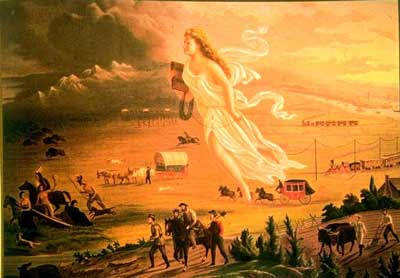
Manifest Destiny, American Exceptionalism and U.S. Foreign Policy

Manife4

Manifest Destiny

Friends of Padre Steve’s World,

Once again I return to the text that I am working on, Mine Eyes Have Seen the Glory: Race, Religion, and Ideology in the Civil War Era because however much we long to escape our history, it is still very much present. Have a great night.

Peace,

Padre Steve+

Manifest Destiny and American Exceptionalism

The foreign policy of the United States nearly always reflects to one degree or another a quasi-religious belief in the continued importance of the United States in spreading democracy around the world.

The United States was an anomaly among western nations in the early 1800s. During that time the percentage of people in Europe who were active churchgoers was shrinking and the number of skeptics rising as the industrial revolution, and advances in science, and the philosophies and theology of classic Liberalism permeated the elites of the continent. But in the United States, the situation was different. The Second Great Awakening helped shape and define the purpose of the nation, and by the “mid-nineteenth century, from North to South, was arguably Christendom’s most churchgoing nation, bristling with exceptionalist faith and millennial conviction.” [1] This was especially true of American Protestantism were “church attendance rose by a factor of ten over the period 1800 to 1860, comfortably outstripping population growth. Twice as many Protestants went to church at the end of this period as the beginning.” [2]

This exceptionalist faith kindled a belief in the nation’s Manifest Destiny in large part was an outgrowth of the Second Great Awakening which was particularly influential among the vast numbers of people moving into the new western territories. As people moved west, Evangelical religion came with them, often in the form of vast revival and camp meetings which would last weeks and which would be attended by tens of thousands. The first of these was at Cane Ridge Kentucky in 1801, organized by a Presbyterian others, including Baptists and Methodists joined in the preaching, and soon the revivals became a fixture of frontier life and particularly aided the growth of the Methodist and Baptists who were willing to “present the message as simply as possible, and to use preachers with little or no education,” [3] and which soon became the largest denominations in the United States. These meetings appealed to common people and emphasized emotion rather than reason. Even so the revivals “not only became the defining mark of American religion but also played a central role in the nation’s developing identity, independence, and democratic principles.” [4]

The West came to be viewed as a place where America might be reborn and “where Americans could start over again and the nation fulfill its destiny as a democratic, Protestant beacon to inspire peoples and nations. By conquering a continent with their people and ideals, Americans would conquer the world.” [5] The westward expansion satiated the need for territorial conquest and the missionary zeal to transform the country and the world in the image of Evangelical Christianity.

The man who coined the term “Manifest Destiny,” New York journalist John O’Sullivan a noted that “Manifest Destiny had ordained America to “establish on the earth the moral dignity and salvation of man,” to disseminate its principles, both religious and secular abroad,” [6] and New York Journalist Horace Greely issued the advice, “Go West, young man” which they did go, by the millions between 1800 and 1860.

But the movement also had a dark side. Americans poured westward first into the heartland of the Deep South and the Old Northwest, then across the Mississippi, fanning westward along the great rivers that formed the tributaries of the new territories. As they did so, the “population of the region west of the Appalachians grew nearly three times as fast as the original thirteen states” and “during that era a new state entered the Union on the average of three years.” [7]

The combination of nationalism fueled by Evangelical religion was combined with the idea from revolutionary times that America was a “model republic” that could redeem the people of the world from tyranny,” [8] as well an ascendant rational nationalism based on the superiority of the White Race. This, along with the belief that Catholicism was a threat to liberty was used as reason to conquer Mexico as well as to drive Native Americans from their ancestral homes. “By 1850 the white man’s diseases and wars had reduced the Indian population north of the Rio Grande to half of the estimated million who had lived there two centuries earlier. In the United States all but a few thousand Indians had been pushed west of the Mississippi.” [9] The radical racism used pseudo-scientific writings to “find biological evidence of white supremacy, “radical nationalism” cast Mexicans as an unassimilable “mixed “race “with considerable Indian and some black blood.” The War with Mexico “would not redeem them, but would hasten the day when they, like American Indians, would fade away.” [10]

Manifest Destiny and American Foreign Policy

Just as the deeply Evangelical Christian religious emphasis of Manifest Destiny helped shape American domestic policy during the movement west, it provided similar motivation and justification for America’s entry onto the world stage as a colonial power and world economic power. It undergirded United States foreign policy as the nation went from being a continental power to being an international power; claiming as Hawaii, and various former Spanish possessions in 1890s, and which would be seen again in the moralizing of Woodrow Wilson in the years leading up to America’s entry into World War One.

The belief in Manifest Destiny can still be seen in the pronouncements of American politicians, pundits, and preachers who believe that that this message is to be spread around the world. Manifest Destiny is an essential element of the idea of American Exceptionalism which often has been the justification for much recent American foreign policy, including the Freedom Agenda of former President George W. Bush. Bush referenced this during his 2003 State of the Union Address, “that freedom is the right of every person and the future of every nation. The liberty we prize is not America’s gift to the world, it is God’s gift to humanity.” [11] Bush frequently used language in his speeches in which biblical allusions were prominent in justifying the morality of his policy, and by doing this “Bush made himself a bridge between politics and religion for a large portion of his electorate, cementing their fidelity.” [12]

Throughout the Bush presidency the idea that God was directing him even meant that his faith undergirded the policy of the United States and led to a mismatch of policy ends and the means to accomplish them. Former Israeli Ambassador to the U.S. and historian Michael Oren wrote:

“Not inadvertently did Bush describe the struggle against Islamic terror as a “crusade to rid the world of evildoers.” Along with this religious zeal, however, the president espoused the secular fervor of the neoconservatives…who preached the Middle East’s redemption through democracy. The merging of the sacred and the civic missions in Bush’s mind placed him firmly in the Wilsonian tradition. But the same faith that deflected Wilson from entering hostilities in the Middle East spurred Bush in favor of war.” [13]

Policy makers and military leaders must realize that if they want to understand how culture and religious ideology drive others to conquer, subjugate and terrorize in the name of God, they first have to understand how our ancestors did the same thing. It is only when they do that that they can understand that this behavior and use of ideology for such ends is much more universal and easier to understand.

One can see the influence of Manifest Destiny abroad in a number of contexts. Many American Christians became missionaries to foreign lands, establishing churches, colleges, schools, and hospitals in their zeal to spread the Gospel. As missionaries spread across the globe, American policy makers ensured their protection through the presence of the United States Navy, and missionaries frequently called upon the United States Government for help and the naval strength of the United States during the period provided added fuel to their zeal. In 1842, Dabney Carr, the new American ambassador to the Ottoman Empire “declared his intention to protect the missionaries “to the full extent of [his] power,” if necessary “by calling on the whole of the American squadron in the Mediterranean to Beyrout.” [14] Such episodes would be repeated in the Middle East, Asia, the Pacific, and Central America over and over again until the 1920s.

The White Man’s Burden, Imperialism, Business, and Faith: Manifest Destiny and the Annexation of the Philippines

If one wants to see how the use of this compulsion to conquer in the name of God in American by a national leader one needs to go no farther than to examine the process whereby President McKinley, himself a veteran of the Civil War, decided to annex the Philippine in 1898 following the defeat of the Spanish. That war against the Filipinos that the United States had helped liberate from Spanish rule saw some of the most bloodthirsty tactics ever employed by the U.S. Army to fight the Filipino insurgents. The Filipino’s who had aided the United States in the war against Spain were now being subjugated by the American military for merely seeking an independence that they believed was their right. While the insurgency was suppressed in a violent manner and American rule was established, some Americans came to see the suppression of the Filipino’s as a stain on our national honor which of which Mark Twain wrote: “There must be two Americas: one that sets the captive free, and one that takes a once-captive’s new freedom away from him, and picks a quarrel with him with nothing to found it on; then kills him to get his land. . .” [15]

William McKinley was a cautious man, and after the United States had defeated the Spanish naval squadron at Manila Bay and wrestled with what to do with the Philippines. McKinley was a doubtless sincere believer, and according to his words, he sought counsel from God about whether he should make the decision to annex the Philippines or not. For him this was not a mere exercise, but a manifestation of his deep rooted faith which was based on Manifest Destiny. Troubled, he sought guidance, and he told a group of ministers who were vesting the White House:

“Before you go I would like to say a word about the Philippine business…. The truth is I didn’t want the Philippines, and when they came to us as a gift from the gods, I did not know what to do with them…. I sought counsel from all sides – Democrat as well as Republican – but got little help…. I walked the floor of the White House night after night until midnight; and I am not ashamed to tell you, gentlemen, that I went down on my knees and prayed Almighty God for guidance more than one night. And late one night it came to me this way – I don’t know how it was but it came….” [16]

He then went on to discuss what he supposedly heard from God, but reflected more of a calculated decision to annex the archipelago. He discussed what he believed would be an occupation of just a few islands and Manila, ruled out returning them to Spain as that would be “dishonorable,” ruled out turning them over to France or Germany because “that would be bad for business,” or allowing Filipino self-rule, as “they were unfit for self-government.” [17] The last was a reflection of the deep-rooted opinion of many Americans that the dark skinned Filipinos were “niggers.”

Barbara Tuchman described McKinley’s comments to the ministers:

“He went down on his knees, according to his own account, and “prayed to Almighty God for light and guidance.” He was accordingly guided to conclude “that there was nothing left to do for us but to take them all, and to educate the Filipinos. And uplift and civilize and Christianize them, by God’s grace to do the very best we could by them, as our fellowmen for whom Christ died.” [18]

But the result, regardless of whether McKinley heard the voice of God, or took the advice of advisers with imperialist, business, or religious views, he made the choice to annex the Philippines, believing it to be the only rational course of action, and something that he could not avoid. In a sense McKinley, of who Barbara Tuchman wrote “was a man made to be managed,” and who was considered spineless by Speaker of the House Thomas Reed who said “McKinley has no more backbone than a chocolate éclair.” [19] It appears that McKinley was more convinced by the arguments of those who desired to annex the Philippines for military reasons, a business community which saw the islands as a gateway to the markets of Asia, and by Protestant clergy, who saw “a possible enlargement of missionary opportunities.” [20] He rejected a proposal by Carl Schurz who urged McKinley to “turn over the Philippines as a mandate to a small power, such as Belgium or Holland, so the United States could remain “the great neutral power in the world.” [21]The combination of men who desired the United States to become an imperialist and naval power, business, and religion turned out to be more than McKinley could resist, as “the taste of empire was on the lips of politicians and business interests throughout the country. Racism, paternalism, and the talk of money mingled with the talk of destiny.” [22] Though there was much resistance to the annexation in congress and in the electorate, much of which was led by William Jennings Bryant, but which crumbled when Bryant with his eyes on the Presidency embraced imperialism.

The sense of righteousness and destiny was encouraged by magazine publisher S.S. McClure, who published a poem by Rudyard Kipling addressed to Americans debating the issue entitled The White Man’s Burden:

Take up the White Man’s burden–
Send forth the best ye breed–
Go bind your sons to exile
To serve your captives’ need;
To wait in heavy harness,
On fluttered folk and wild–
Your new-caught, sullen peoples,
Half-devil and half-child…

Take up the White Man’s burden–
The savage wars of peace–
Fill full the mouth of Famine
And bid the sickness cease…

Take up the White Man’s burden–
Ye dare not stoop to less–
Nor call too loud on Freedom
To
cloke your weariness;
By all ye cry or whisper,
By all ye leave or do,
The silent, sullen peoples
Shall weigh your gods and you…
[23]

McKinley’s decision and the passage of the peace treaty with Spain to acquire the Philippines sparked an insurrection led by Filipino revolutionary Emilio Aguinaldo who had been leading resistance to Spanish rule on the island of Luzon for several years prior to the American defeat of Spanish naval forces at the Battle of Manila Bay, and the subsequent occupation of Manila. The following war lasted nearly three years and was marked by numerous atrocities committed by American forces against often defenseless civilians and it would help to change the nature of the country. After American troops captured Manila, Walter Hines Page, the editor of the Atlantic Monthly believed that Americans would face greater challenges and difficulties in the coming years than they had known in previous years. He wrote:

“A change in our national policy may change our very character… and we are now playing with the great forces that may shape the future of the world – almost before we know it…. Before we knew the meaning of foreign possessions in a world ever growing more jealous, we have found ourselves the captors of islands in both great oceans; and from our home staying policy of yesterday we are brought face to face with world-wide forces in Asia as well as Europe, which seem to be working, by the opening of the Orient, for one of the greatest challenges in human history…. And to nobody has the change come more unexpectedly than ourselves. Has it come without our knowing the meaning of it?” [24]

Within the span of a few months, America had gone from a nation of shopkeepers to an imperial power, and most people did not realize the consequences of that shift. Manifest destiny and American Exceptionalism had triumphed and with it a new day dawned, where subsequent generations of leaders would invoke America’s mission to spread freedom and democracy around the world, as President George W. Bush said, “that freedom is the right of every person and the future of every nation. The liberty we prize is not America’s gift to the world, it is God’s gift to humanity.”

Notes

[1] Ibid. Phillips American Theocracy: The Peril and Politics of Radical Religion, Oil and Borrowed Money in the 21st Century p.143

[2] McGrath, Alister Christianity’s Dangerous Idea: The Protestant Revolution A History from the Sixteenth Century to the Twenty-First Harper Collins Publishers, New York 2007 p.164

[3] Gonzalez, Justo L. The History of Christianity Volume 2: The Reformation to the Present Day Harper and Row Publishers San Francisco 1985 p.246

[4] Ibid. McGrath Christianity’s Dangerous Idea: The Protestant Revolution A History from the Sixteenth Century to the Twenty-First p.164

[5] Goldfield, David America Aflame: How the Civil War Created a Nation Bloomsbury Press, New York, London New Delhi and Sidney 2011 p.5

[6] Ibid. Oren Power, Faith and Fantasy: America and the Middle East 1776 to the Present p130

[7] McPherson, James. The Battle Cry of Freedom: The Civil War Era Oxford University Press, Oxford and New York 1988 p.42

[8] Varon, Elizabeth R. Disunion! The Coming of the American Civil War 1789-1858 University of North Carolina Press, Chapel Hill NC 2008 p.183

[9] Ibid. McPherson The Battle Cry of Freedom: The Civil War Era p,45

[10] Ibid. Varon. Disunion! The Coming of the American Civil War 1789-1858 p.183

[11] Bush, George W. State of the Union Address Washington D.C. January 28th 2003 retrieved from Presidential Rhetoric.com http://www.presidentialrhetoric.com/speeches/01.28.03.html 10 June 2015

[12] Ibid. Phillips American Theocracy: The Peril and Politics of Radical Religion, Oil and Borrowed Money in the 21st Century p.252

[13] Oren, Michael Power, Faith and Fantasy: America and the Middle East 1776 to the Present W.W. Norton and Company, New York and London 2007 p.584

[14] Ibid. Oren Power, Faith and Fantasy: America and the Middle East 1776 to the Present p130

[15] Twain, Mark To the Person Sitting in Darkness February 1901 Retrieved from The World of 1898: The Spanish American War The Library of Congress http://www.loc.gov/rr/hispanic/1898/twain.html 12 December 2014

[16] Zinn, Howard A People’s History of the United States Harper Perennial, New York 1999 pp.312-313

[17] Ibid. Zinn A People’s History of the United States p.313

[18] Ibid. Tuchman Practicing History p.289

[19] Tuchman, Barbara The Proud Tower: A Portrait of the World Before the War, 1890-1914 Random House Trade Paperbacks Edition, New York 2008 originally published 1966 by McMillan Company. Amazon Kindle edition location 2807 of 10746

[20] Hofstadter, Richard The Paranoid Style in American Politics Vintage Books a Division of Random House, New York 1952 and 2008 p167

[21] Ibid. Tuchman The Proud Tower: A Portrait of the World Before the War, 1890-1914 location 3098 of 10746

[22] Ibid. Zinn A People’s History of the United States p.313

[23] Kipling, Rudyard “The White Man’s Burden: The United States and the Philippine Islands” 1899 retrieved from https://public.wsu.edu/~brians/world_civ/worldcivreader/world_civ_reader_2/kipling.html 6 August 2016

[24] Ibid. Hofstadter The Paranoid Style in American Politics pp.183-184

1 Comment

Filed under Foreign Policy, History, middle east

The Context of History, Memory & War

16-2 Gettysburg Staff Ride, May 2016-37

With my Students at Little Round Top

Friends of Padre Steve’s World,

As always I have been doing a lot of reading and of course that has led me to do some more revisions to my Civil War and Gettysburg text. I re-wrote the introduction to the first chapter in order to talk about the nature and role of history in understanding who we are as a people today. The section is part of a chapter that is now over 150 pages long and probably will become a book in its own right. Of course this section, and the rest of the chapter will likely be worked on some more in the coming months but I think that you will like it.

Peace,

Padre Steve+

“No one is so sure of his premises as the man who knows too little.” [1]

Barbara Tuchman

Finite human beings find themselves bound by time and space, we live in the present, but not the present alone, but rather three worlds: one that is, one that was, and one that will be. Ernst Breisach wrote, “In theory we know these three worlds as separate concepts but we experience as inextricably linked and influencing each other in many ways. Every new and important discovery about the past changes how we think about the present and what we expect of the future; on the other hand every change in the conditions of the present and in the expectations of the future revises our perception of the past. In this complex context history is born ostensibly as reflection of the past; a reflection which is never isolated from the present and the future. History deals with human life as it “flows” through time.” [2]

Richard Evans wrote something in the preface to his book The Third Reich in History and Memory that those who study military history often forget. He noted: “Military history, as this volume shows, can be illuminating in itself, but also needs to be situated in a larger economic and cultural context. Wherever we look, at decision making at the top, or at the inventiveness and enterprise of second rank figures, wider contextual factors remained vital.” [3] Thus while this work is an examination of the Gettysburg campaign it is important to understand the various issues that were formative for the men who directed and fought the battle, as well as the vast continuum of often distant and seemingly events that come together at one time in the lives of the participants in any historic event.

One cannot understand the determination the determination of Robert E. Lee to maintain the offensive, the dogged persistence of Joshua Chamberlain or Strong Vincent to hold Little Round Top, what brought John Buford to McPherson’s Ridge, what motivated Daniel Sickles to move Third Corps to the Peach Orchard, and what motivated the men of Pickett’s division to advance to their death on Cemetery Ridge, without understanding the broader perspective of history, as well as how culture, politics, economics, religion, sociology, ideology, experience, and  that shaped these men and their actions.

Likewise in order to understand the context of this battle, or for that matter any battle in any war, one has to understand the events, ever distant events which play a role in the battle. All too often those that delve into military history, or a particular battle see that as separate event, often disconnected from other historical events. But as historian Edward Steers Jr. correctly notes, history “does not exist in a series of isolated events like so many sound bites in a newscast. It is a continuum of seemingly unrelated and distant events that so often come together in one momentous collision of time.” [4] In the case of Gettysburg events like Lincoln’s publication of the Emancipation Proclamation, the failure of Confederate diplomacy to bring France or Great Britain into the war or at least to recognize the Confederacy, the failures of the Confederate armies in the West to maintain their hold on the Mississippi River, all play a crucial role in Robert E. Lee’s ill-advised decision to launch an invasion of Pennsylvania. Additionally, the loss of so many key leaders in the Army of Northern Virginia, especially that of Stonewall Jackson impacts how Lee manages the campaign, and shows up at numerous crucial points in the battle.

Another element that must be connected in order to understand the Battle of Gettysburg is the part that policy, strategy, war aims and operational doctrine played in the campaign of 1863 and how those influenced the decisions of participants before, during and after the campaign. Finally, the Battle of Gettysburg cannot be looked at as a stand-alone event. What happens there as the Confederacy surges to and ebbs back from its “high water mark” influences the rest of the While the war would go on for nearly two more years, the Union victory at Gettysburg coupled with the victory of Grant at Vicksburg ensured that the Confederacy, no matter how hard it tried would not be able to gain its independence through military means.

Maybe even more importantly the story of Gettysburg is its influence today. The American Civil War was America’s greatest crisis. It was a crisis that that “has cast such a shadow over the relations between the North and the South that the nation’s identity and its subsequent history have been considerably influenced by it.” [5]

The Battle of Gettysburg itself is enshrined in American history and myth and is woven deeply into the story of the nation. In this narrative the Battle of Gettysburg is often different ways; in the North viewed as a victory that brings an end to the institution of slavery, and freedom for enslaved African Americans, and preserves the Union. In the South it is often part of the myth of the Noble Confederacy and the Lost Cause where the South was defeated by the Northern superiority in men and war making ability.

Yet in both cases, the truth is not so simple; in fact it is much more complex, and the truth is we are still in the process of learning from and interpreting the historical records of the events that led to the American Civil War, the war itself, and the aftermath. They are all connected and for that matter still influence Americans today more than any other era of our history. In fact James McPherson who is one of the nation’s preeminent scholars on the Civil War and Reconstruction wrote,

“I became convinced that I could not fully understand the issues of my own time unless I learned about their roots in the era of the Civil War: slavery and its abolition; the conflict between North and South; the struggle between state sovereignty and the federal government; the role of the government in social change and resistance to both government and social change. These issues are as salient and controversial today as they were in the 1960s, not to mention the 1860s.” [6]

The prolific American military historian Russel Weigley wrote of how the war, and in particular how the Battle of Gettysburg changed the American Republic.

“The Great Civil War gave birth to a new and different American Republic, whose nature is to be discovered less in the Declaration of Independence than in the Address Delivered at the Dedication of the National Cemetery at Gettysburg. The powerful new Republic shaped by the bayonets of the Union Army of the Civil War wears a badge less benign aspect than the older, original American Republic. But it also carries a larger potential to do good for “the proposition that all men are created equal” both at home and around the world.” [7]

Thus it is important for Americans to learn about the Battle of Gettysburg and the American Civil War, but not solely for its military significance, nor for clear cut answers or solutions. The fact is that “situations in history may resemble contemporary ones, but they are never exactly alike, and it is a foolish person who tries blindly to approach a purely historical solution to a contemporary problem. Wars resemble each other more than they resemble other human activities, but similarities can be exaggerated.” [8]  As Michael Howard warned, “the differences brought about between one war and another by social or technological changes are immense, and an unintelligent study of military history which does not take into account these changes may quite easily be more dangerous than no study at all. Like the statesman, the soldier has to steer between the dangers of repeating the errors of the past because his is ignorant that they have been made, and of remaining bound by theories deduced from past history although changes in conditions have rendered these theories obsolete.” [9] The ideal that we reach for is to understand the Battle of Gettysburg and the American Civil War in context, which includes understanding what led to the war as well as the period of Reconstruction, and the post-Reconstruction era. In doing so we attempt to draw lessons from it without making the mistake of assuming that what we learn and know about them is immutable and thus not subject to change, for the past influences the present, even as the present and future will influence how we view and interpret the past.

Notes

[1] Tuchman, Barbara The March of Folly: From Troy to Vietnam Random House Publish Group, New York 2011 p.319

[2] Breisach, Ernst, Historiography: Ancient, Mediaeval & Modern University of Chicago Press, Chicago and London 1983 and 1994 p.2

[3] Evans, Richard J. The Third Reich in History and Memory Oxford University Press, Oxford and New York 2015 p.ix

[4] Steers, Edward Jr. Blood on the Moon: The Assassination of Abraham Lincoln The University of Kentucky Press, Lexington 2001 p.5

[5] Perman, Michael and Murrell Taylor, Amy editors The Civil War and Reconstruction Documents and Essays Third Edition Wadsworth Cengage Learning Boston MA 2011 p.3

[6] McPherson, James The War that Forged a Nation: Why the Civil War Still Matters Oxford University Press, Oxford and New York 2015 p.4

[7] Weigley, Russell F. A Great Civil War: A Military and Political History 1861-1865 Indiana University Press, Bloomington and Indianapolis 2000 p.xviii

[8] Griess, Thomas E. A Perspective on Military History in A Guide to the Study and Use of Military History edited by John E. Jessup Jr. and Robert Coakley, Center for Military History, United States Army, 1982 p.33

[9] Howard, Michael. The Use and Abuse of Military History  in Journal of the Royal United Service Institution 107 (1962):7

1 Comment

Filed under civil rights, civil war, Gettysburg, History

Read or Perish

CW-GettysburgDead

Friends of Padre Steve’s World

Just a short note today as I continue to read, reflect and do some research and writing on my Civil War and Gettysburg Staff Ride text, even as I get ready to lead another staff ride to Gettysburg this weekend.

Those that follow me and read my articles on this site on a regular basis know that I am a voracious reader, especially when it comes to history and biography. Frankly, I am amazed about all that we can learn just from the accounts of those that have already made the same mistakes that we are intent on making, because ultimately, there is nothing new under the sun. The fact that so many supposed strategists, thinkers, and policy makers are too ignorant to remember the past, ensures that the same mistakes will be made over and over again with more and more bodies filling the body bags of hubris.

I have been adding books that I have read over the past few months to my “read” list on my Facebook page, and there were a lot more than I remembered as I worked my way through my stack. If you add things to your Facebook page, movies, books, music or television shows, Facebook will provide lists of suggested titles that you can browse. This of course includes books, and not surprisingly to me, most of the books that were suggested were various forms of fiction or children’s books. There were a few literature classics among the suggestions and a host of Bible books. What I noticed was there were few books on history, philosophy, political science, world affairs or even theology listed.

I was troubled by this; not because I am against people reading fiction or children’s book by any means, but typically those books, with the exception of some of the children’s books are for entertainment, not learning. As entertainment they are fine, but since almost everything else in our culture is geared toward entertainment I wonder where people are being challenged to think critically, and not simply be sponges for the sound bites offered by the politicians, preachers and pundits who dominate so much of our airwaves and the internet.

Barbara Tuchman wrote, “Books are the carriers of civilization. Without books, history is silent, literature dumb, science crippled, thought and speculation at a standstill. Without books, the development of civilization would have been impossible. They are engines of change (as the poet said), windows on the world and lighthouses erected in the sea of time. They are companions, teachers, magicians, bankers of the treasures of the mind. Books are humanity in print.”

Sadly, many people in this country and around the world are sadly deficient in knowing any history at all, and much of what they do know is based on myth. This is dangerous, historian George Santayana wrote, “Those who cannot remember the past are condemned to repeat it.” But I think that Howard Zinn said it the best:

“History can come in handy. If you were born yesterday, with no knowledge of the past, you might easily accept whatever the government tells you. But knowing a bit of history–while it would not absolutely prove the government was lying in a given instance–might make you skeptical, lead you to ask questions, make it more likely that you would find out the truth.”

Have a great night,

Peace

Padre Steve+

2 Comments

Filed under History, leadership, philosophy

The Truth is Rarely Pure & Never Simple

MenBrooklyn

Friends of Padre Steve’s World,

The past few days I have posted short articles about some very personal things dealing with life and relationships. In a sense that continues today as I prepare for another “Staff Ride” with my students to Gettysburg. This trip will be interesting because over half of the students attending the staff ride will be officers from South Korea. Over the past couple of weeks I have been working on major revisions and additions to another chapter of my Gettysburg text and I hope to share that before the coming week is out.

I have a passion for truth, especially in the realm of historical thought, in fact over the past few years this passion has deepened to a level of profoundness that I never dreamed. In fact for me this passion has become a duty, a duty to truth; an un-sanitized, warts and all examination of subjects attempting to strip away the veneer of myth in order to find truth. This is not easy, but it is what my life has become, knowing that in the long run I will not discover all truth, but hopefully point others to examine history, the sciences, philosophy and even theology to find truth. The process can be uncomfortable, especially when confronted by facts, documents, scientific and archeological data which shows what we used to think was truth, as either incomplete, romantic myth, or even complete lies, untruths and fabrication. Oscar Wilde once wrote,“The truth is rarely pure and never simple.”

Barbara Tuchman once wrote: “The reality of a question is inevitably more complicated than we would like to suppose.” That is the nature of truth. It does not matter if it is truth about history, biography, philosophy and religion, science, politics, economics or any part of life. To actively seek truth means that one must open up themselves to the possibility of doubting, as Rene Descartes wrote: “If you would be a real seeker after truth, it is necessary that at least once in your life you doubt, as far as possible, all things.” I admit that this is not comfortable, but it is necessary.

As a historian I have a tremendous passion for truth, and for unsanitized history and for me this means looking at what we know with a critical eye, to compare and examine sources to question what we or others knew before. Far too often what we believe about our own history is often more preserving myth more than by asking hard questions and applying reasoned critical study. To do this is dangerous, because to do so we have to admit that what we know today could be proven wrong at some time in the future when new facts, documents, archeological finds or other historical or scientific are discovered. To those content with half-truth, partial truth or even myth this is disconcerting, and those of us who attempt to unravel myth from fact and present things in a new way are called “revisionists” as if that is somehow a bad thing. The sad thing is we are having to revise in many cases, supposed history that was revised by people who needed to propagate myth, such as with those who promoted the myth of the Lost Cause, the romantic, noble Confederacy which for well over a half century was propagated as historical truth. This myth was sold to the American public in such in film, television and books, fiction and non-fiction alike, to the point that much of white America, even outside the South accepted the myth of the Lost Cause as truth. Films like Birth of a Nation, Gone with the Wind and even Disney’s Song of the South, helped ingrain the myth as truth, and even today when so much more is known, many people hold on to the myth and attack those who differ.

A lot of my readers may wonder why I write so much about the American Civil War as well as the ante-bellum and Reconstruction eras of American history. For me they are very important for a couple of reasons; first they are eras, that for good and bad define us as a nation and people. Second, they still have relevance to what happens today, especially in the understanding of liberty, civil rights and race relations.

I have a passion for this. The American Civil War and the Battle of Gettysburg are intrinsic parts of who we are as Americans today. The events of that war and this battle continue to reverberate in many aspects of our political, social and national life. Thus for me teaching about this event and what happened on the “hallowed ground” of Gettysburg, as Abraham Lincoln called it, and even 150 years later it matters far more than most of us realize.

Civil War hero Joshua Chamberlain is an icon of the Civil War and American history. A professor of Rhetoric and Natural and Revealed Religions at Bowdoin College he volunteered to serve with the 20th Maine Infantry, his military career in the Civil War has been depicted in movies such as Gettysburg and Gods and Generals and written about in biographies and even historical fiction. Chamberlain was one of the heroes of Gettysburg, and his story has a myth like quality, but he too was a complex, contradictory and sometimes flawed character. However, Chamberlain attached a great importance to passing down the stories of people who did noble deeds and who lived exemplary lives. He wrote, “The power of noble deeds is to be preserved and passed on to the future.”

I sincerely believe what Chamberlain said and I am getting ready to lead another Staff Ride for students from our Staff College to Gettysburg this week. I do beleive that the power of noble deeds needs to be preserved and passed on to the future. Even the deeds of less than perfect, often contradictory and sometimes even scandalous individuals. That is part of the task of the historian. I do this in what I teach and what I write, both in the academic setting as well as on this website.

We live in a time of great cynicism, some of which I can understand. We also live in a time where many people and our institutions operate in a “zero defect” culture, those who fail in any way are shunted aside, punished or even chastised or ostracized. However, when I look at the men who fought at Gettysburg, or for that matter almost any individual who has accomplished great things, none are perfect people and many have great flaws in character, or supported causes or ideologies that were evil. That being said, even less than perfect people can rise to do great deeds, deeds that need to be remembered, passed down and told to succeeding generations.

Many great leaders, or other men and women that we consider today to be great, influential or important were or are quite fallible. Even those who did great things often made gross mistakes, had great flaws in their character, and some lived scandalous lives. Such deeds may tarnish their legacy or take some of the luster away from their accomplishments. But I think that these flaws are often as important as their successes for they demonstrate the amazing capacity of imperfect people to accomplish great things, as well as the incredible complexity of who we are as people. No one is perfect. There are degrees of goodness and even evil in all of us. It is part of the human condition. That is the beauty of un-sanitized history, that is the beauty of stripping away myth to discover the humanity of people, and to recognize who they are, who we are, the good, the bad and even the ugly.

When I look at the perfection that imperfect people expect of others I am reminded of something that William Tecumseh Sherman said about his relationship with Ulysses Grant. These were flawed men, but they were in large part responsible for the Union victory in the Civil War. However, to be honest, neither man would never reach the level of command that they rose to in our current military culture, nor would they rise to the top in corporate America. They are too flawed. Sherman said it well, “Grant stood by me when I was crazy, and I stood by him when he was drunk, and now we stand by each other.”

That is a part of my passion about Gettysburg and my appreciation and admiration of the brave men who fought in that battle. As I continue to write about that battle and about those men I hope that my readers will gain a new appreciation of their complex and contradictory natures, as well as think about what that means to us today, as individuals and as a society, for it is only when we strip away the myth and seek the truth. Marcus Aurelius wrote:

“If someone is able to show me that what I think or do is not right, I will happily change, for I seek the truth, by which no one was ever truly harmed. It is the person who continues in his self-deception and ignorance who is harmed.”

Those truths can be scientific, they can be historical or literary, and quite often the truth can also be quite personal.

As John F Kennedy said at Yale in 1962: “The great enemy of truth is very often not the lie–deliberate, contrived and dishonest–but the myth–persistent, persuasive and unrealistic. Too often we hold fast to the cliches of our forebears. We subject all facts to a prefabricated set of interpretations. We enjoy the comfort of opinion without the discomfort of thought.”

So until tomorrow, have a thoughtful night.

Peace

Padre Steve+

Leave a comment

Filed under civil rights, civil war, History, leadership, Military