Tag Archives: battle of midway

Five Minutes that Changed History: The Battle of Midway 1022-1027 hours June 4th 1942

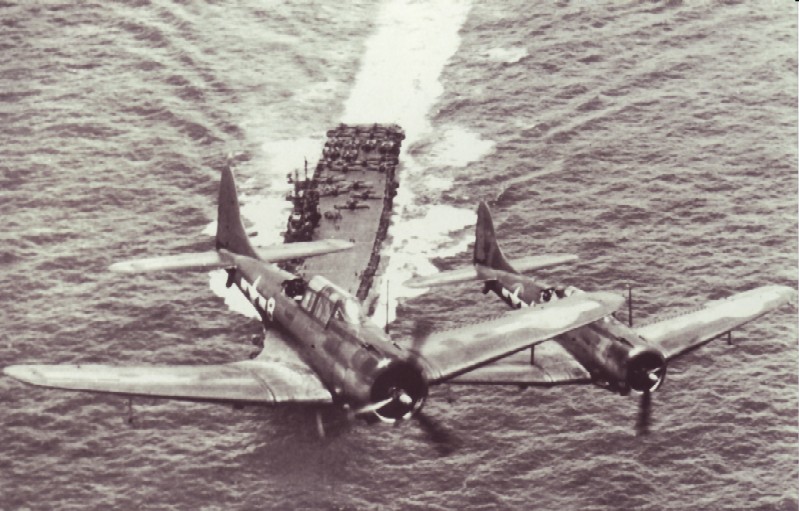
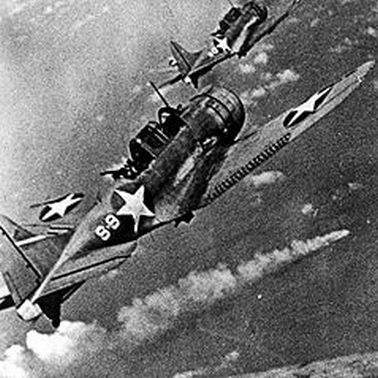
Instruments of Death SBD Dauntless Dive Bombers at Midway

Six months after Pearl Harbor the United States Navy met the Imperial Japanese Navy in battle on the seas and in the airspace around Midway Island. It was a battle between a fleet that had known nothing but victory in the months after Pearl Harbor, sweeping across the Pacific and the Indian Oceans and decimating Allied Naval forces that stood in their way, the HMS Prince of Wales and HMS Repulse off of Singapore, a force of Royal Navy cruisers and the Aircraft Carrier HMS Hermes in the Indian Ocean, the bulk of the US Asiatic Fleet in the waters around the Philippines and the Dutch East Indies culminating in the Battle of the Java Sea where the bulk of the American, British, Dutch and Australian naval forces engaged were annihilated.  In only one place had a Japanese Naval task force been prevented from its goal and that was at the Battle of the Coral Sea where Task Force 11 and Task Force 17 centered on the Carriers USS Lexington and USS Yorktown prevented a Japanese invasion force from taking Port Moresby sinking the light carrier Shoho, damaging the modern carrier Shokaku and decimating the air groups of the Japanese task force.

In May US Navy code breakers discovered the next move of the Imperial Navy an attack on Midway Island and the Aleutian islands.   Since the occupation of Midway by Japanese forces would give them an operational base less than 1000 miles from Pearl Harbor Admiral Chester Nimitz committed the bulk of his naval power, the carriers USS Enterprise CV-6, USS Yorktown CV-5 and USS Hornet CV-8 and their 8 escorting cruisers and 15 destroyers, a total of 26 ships with 233 aircraft embarked to defend Midway along with a force of 5 cruisers and 4 destroyers to cover the Aleutians.  Midway had a mixed Marine, Navy and Army air group of 115 aircraft which included many obsolete aircraft, 32 PBY Catalina Flying Boats, of which the 83 fighters, dive bombers, torpedo planes and Army Air Force bombers piloted by a host of inexperienced pilots.

The Japanese Flagship Akagi

The Japanese sent a force of 7 battleships, 7 carriers including the elite First Carrier Striking Group composed of the Pearl Harbor attackers Akagi, Kaga, Soryu and Hiryu and their highly trained and combat experienced air groups composed of 273 aircraft along with 14 cruisers and 39 destroyers assigned to take Midway and destroy the US Navy when it came out to fight as well as a force of 4 battleships, 12 destroyers assigned screen to the Aleutian invasion force which was accompanied by 2 carriers 6 cruisers and 10 destroyers.   The other carriers embarked a further 114 aircraft.  A factor which aided the Americans was the distance between the Japanese Task forces which were scattered over thousands of square miles of the Northern Pacific Ocean from which they could not rapidly come to the assistance of any other group.

With the foreknowledge provided by the code breakers the US forces hurried to an intercept position northeast of Midway eluding the Japanese submarine scout line which the Japanese Commander Admiral Yamamoto presumed would find them when they sailed to respond to the Japanese attack on Midway.  Task Force 16 with the Enterprise and Hornet sailed first under the command of Rear Admiral Raymond A Spruance and Task Force 17 under Rear Admiral Frank “Jack” Fletcher with the Yorktown which had been miraculously brought into fighting condition after suffering heavy damage at Coral Sea. Fletcher assumed overall command by virtue of seniority and Admiral Nimitz instructed his commanders to apply the principle of calculated risk when engaging the Japanese as the loss of the US carriers would place the entire Pacific at the mercy of the Japanese Navy.

On June 3rd a PBY Catalina discovered the Japanese invasion force and US long range bombers launched attacks against it causing no damage.  The morning of the 4th the Americans adjusted their search patterns in and the Japanese came into range of Midway and commenced their first strike against the island.  In response land based aircraft from Midway attacked the Japanese carrier force taking heavy casualties and failing to damage the Japanese task force.  The American Carrier task forces launched their strike groups at the Japanese fleet leaving enough aircraft behind of the Combat Air Patrol and Anti-submarine patrol.  As the Americans winged toward the Japanese fleet the Japanese were in confused.  A scouting report by an aircraft that had been delayed at launch discovered US ships but did not identify a carrier until later into the patrol.  This was the Yorktown and TF 17. The Japanese attempted to recover their strike aircraft and prepare for a second strike on the island and then on discovery of the carrier embarked on the task of unloading ground attack ordnance in favor of aerial torpedoes and armor piercing bombs.  The hard working Japanese aircrew did not have time to stow the ordnance removed from the aircraft but by 1020 they had the Japanese strike group ready to launch against the US carriers.

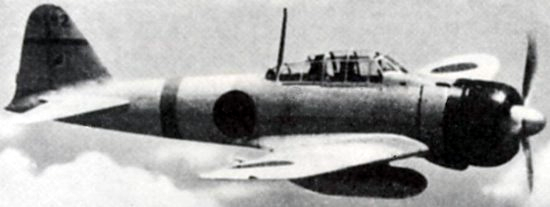
AM6-2 Zeros Mauled the US Torpedo Bombers

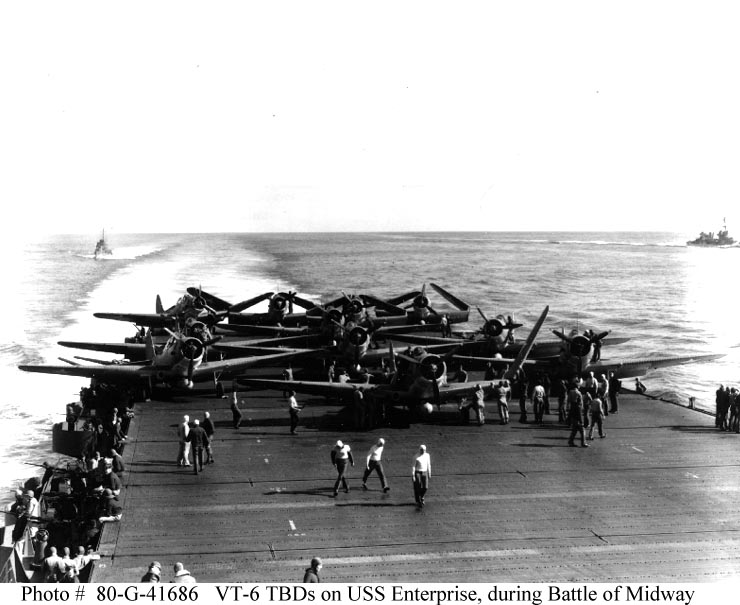
As the Japanese crews worked the Japanese carriers were engaged in fending off attacks by the US torpedo bomber squadrons, VT-6 from Enterprise, VT-8 from Hornet and VT-3 from Yorktown.  The Japanese Combat Air Patrol ripped into the slow, cumbersome and under armed TBD Devastators as they came in low to launch their torpedoes.  Torpedo Eight from Hornet under the command of LCDR John C Waldron pressed the attack hard but all 15 of the Devastators were shot down.  Only Ensign George Gay’s aircraft was able to launch its torpedo before being shot down and Gay would be the sole survivor of the squadron.

Hopelessly obsolete 40 of 44  TBD Devastators were lost in action

Torpedo 6 under the command of LCDR Eugene Lindsey suffered heavy casualties losing 10 of 14 aircraft with Lindsey being one of the casualties.  The last group of Devastators to attack was Torpedo 3 under the command of LCDR Lem Massey from the Yorktown.  These aircraft were also decimated and Massey killed but they had drawn the Japanese Combat Air Patrol down to the deck leaving the task force exposed to the Dive Bombers of the Enterprise and Yorktown.
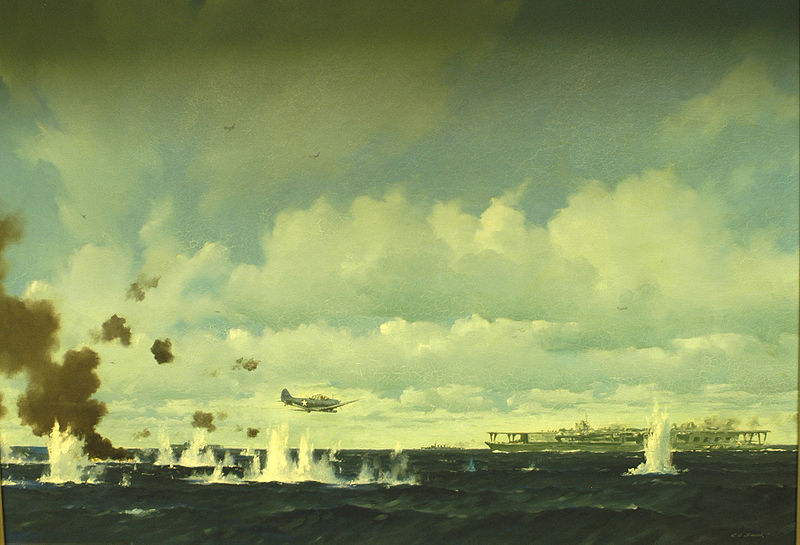
TBD Devastator attacking Akagi

There had been confusion among the Americans as to the exact location of the Japanese Carriers, the Bombing 8 and Scouting 8 of Hornet did not find the carriers and had to return for lack of fuel with a number of bombers and their fighter escort having to ditch inn the ocean and wait for rescue.  The Enterprise group under LCDR Wade McClusky was perilously low on fuel when the wake of a Japanese destroyer was spotted.  McClusky followed it to the Japanese Task Force.  The Yorktown’s group under LCDR Max Leslie arrived about the same time.  The found the skies empty of Japanese aircraft. Aboard the Japanese ships there was a sense of exhilaration as each succeeding group of attackers was brought down and with their own aircraft ready to launch and deal a fatal blow to the American carrier wondered how big their victory would be.

At 1020 the first Zero of the Japanese attack group began rolling down the flight deck of the flagship Akagi, aboard Kaga aircraft were warming up as they were on the Soryu.  The unsuspecting Japanese were finally alerted when lookouts screamed “helldivers.” Wade McClusky’s aircraft lined up over the Akagi and Kaga pushing into their dives at 1022. There was a bit of confusion when the bulk of Scouting 6 joined the attack of Bombing 6 on the Kaga.  The unprepared carrier was struck by four 1000 pound bombs which exploded on her flight deck and hangar deck igniting the fully fueled and armed aircraft of her strike group and the ordnance littered about the hangar deck.  Massive fires and explosions wracked the ship and in minutes the proud ship was reduced to an infernal hell with fires burning uncontrollably. She was abandoned and would sink at 1925 taking 800 of her crew with her.     LT Dick Best of Scouting 6 peeled off from the attack on Kaga and shifted to the Japanese flagship Akagi. On board Akagi were two of Japans legendary pilots CDR Mitsuo Fuchida leader of and CDR Minoru Genda the architect of the Pearl Harbor attack and subsequent string of Japanese victories.  Both officers were on the sick list and had come up from sick bay to watch as the fleet was attacked.  Seeing Kaga burst into flames they stood mesmerized until Akagi’s lookouts screamed out the warning “helldivers” at 1026.  Best’s aircraft hit with deadly precision landing tow of their bombs on Akagi’s flight deck creating havoc among the loaded aircraft and starting fires and igniting secondary explosions which turned the ship into a witch’s cauldron.  By 1046 Admiral Nagumo and his staff were forced to transfer the flag to the cruiser Nagara as Akagi’s crew tried to bring the flames under control. They would do so into the night until nothing more could be done and abandoned ship at 2000.  Admiral Yamamoto ordered her scuttled and at 0500 on June 5th the pride of the Japanese carrier force was scuttled.

Scouting 6 gets the Akagi

VB-3 under LCDR Max Leslie from the Yorktown stuck the Soryu with 17 aircraft, only 13 of which had bombs due to an electronic arming device malfunction on 4 of the aircraft including the squadron leader Leslie.  Despite this they dove on the Soryu at 1025 hitting that ship with 3 and maybe as many as 5 bombs. Soryu like her companions burst into flames as the ready aircraft and ordnance exploded about her deck. She was ordered abandoned at 1055 and would sink at 1915 taking 718 of her crew with her.

The remaining Japanese flattop the Hiryu attained the same fate later in the day after engaging in an epic duel with the Yorktown which her aircraft heavily damaged.

It was quite miraculous what happened at Midway in those five pivotal minutes.  Authors have entitled books about Midway Incredible Victory and Miracle at Midway and the titles reflect the essence of the battle.  A distinctly smaller force defeated a vastly superior fleet in terms of experience, training and equipment and when it appeared that the Japanese Fleet would advance to victory in a span of less than 5 minutes turn what looked like certain defeat into one of the most incredible and even miraculous victories in the history of Naval warfare.  In those 5 minutes history was changed in a breathtaking way.  While the war would drag on and the Japanese still inflict painful losses and defeats on the US Navy in the waters around Guadalcanal the tide had turned and the Japanese lost the initiative in the Pacific never to regain it.   The Japanese government hid the defeat from the Japanese people instead proclaiming a great victory while the American government could not fully publicize the information that led to the ability of the US Navy to be at the right place at the right time and defeat the Imperial Navy.

When one looks at implications of the victory it did a number of things. First it changed the course of the war in the Pacific probably shortening it by a great deal.  Secondly it established the aircraft carrier and the fast carrier task force as the dominant force in naval warfare which some would argue it still remains.  Finally those five minutes ushered in an era of US Navy dominance of the high seas which at least as of yet has not ended as the successors to the Enterprise, Hornet and Yorktown ply the oceans of the world and the descendants of those valiant carrier air groups ensure air superiority over battlefields around the world.

Peace

Padre Steve+
7 Comments

Filed under History, Military, US Navy, world war two in the pacific

Adjusting Strategy to Reality: The Pacific War- Why the Japanese Lost

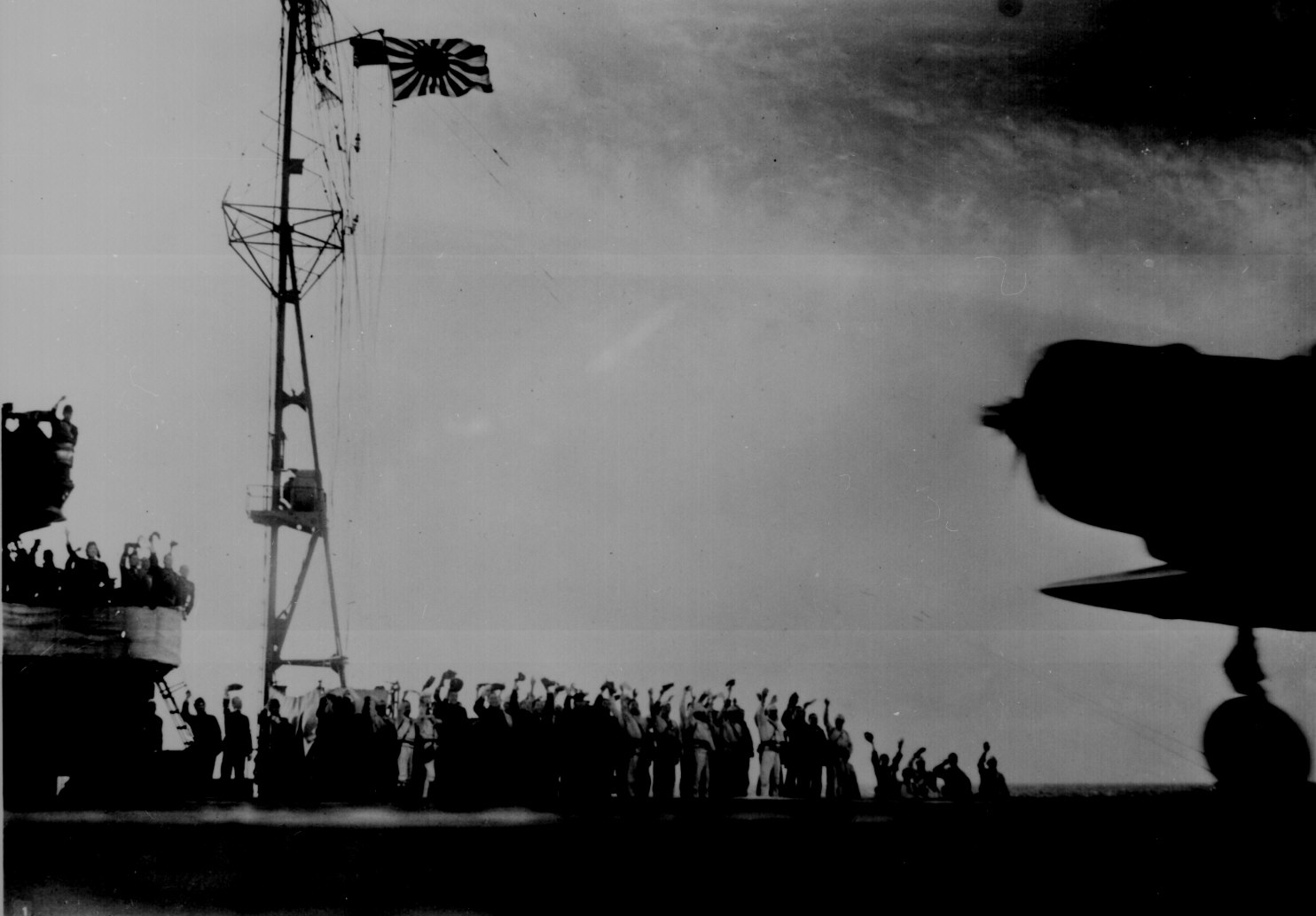
Lead aircraft ready to take off of IJN Carrier Akagi to attack Pearl Harbor beginning a 6 month chain of Japanese victories in the Pacific

The outcome of the Pacific war was directly related to the ability of the Americans to adjust strategy to the realities of the Pacific war, a unity of effort directed by the National Command Authority and superior industrial, technological and logistical capabilities. The Japanese after initial success did little to adapt and were hamstrung by inter-service rivalries and inadequate industrial capacity and limited natural resources.

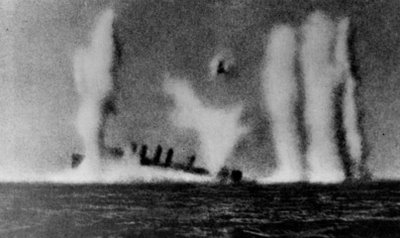
US Destroyer USS Pope being blasted out of the water by Japanese Cruisers at the Battle of Java Sea

The Japanese and the Americans each had war plans in place for the Pacific campaign.  The American plans, Plan Orange had been developed since the early part of the 20th Century after the Spanish-American War and Russo-Japanese War.  Predicated on holding the Philippines until relief could arrive Orange assumed that the US Pacific Fleet would sail across the Pacific and fight the Japanese Navy in a manner written about by Alfred Thayer Mahan; see Weigley in The American Way of War and Ronald Spector in “Eagle Against the Sun: The American War Against Japan.”

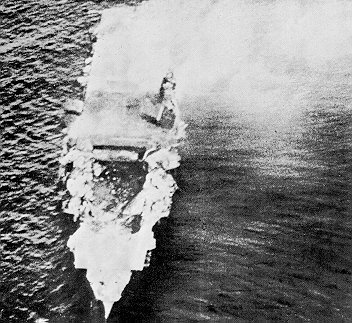
IJN Carrier Hiryu heavily damaged and abandoned at Midway. Hiryu, Akagi, Kaga and Soryu the creme of the Japanese carrier fleet were lost at Midway, the Japanese found it hard to replace them or their decimated air crews

The Japanese were conflicted.  The Navy desired a campaign that would destroy the American Navy and expand the Empire to the East and to Southeast Asia and the Indian Ocean. The Army was fixated on the China strategy having been embroiled on the Asian continent since the early 1930s. John Toland discusses this in good detail in his book “Rising Sun: The Decline and Fall of the Japanese Empire 1936-1945” In addition other Japanese Army leaders had designs on Siberia and fought a brief campaign against the Soviets which ended in a defeat.

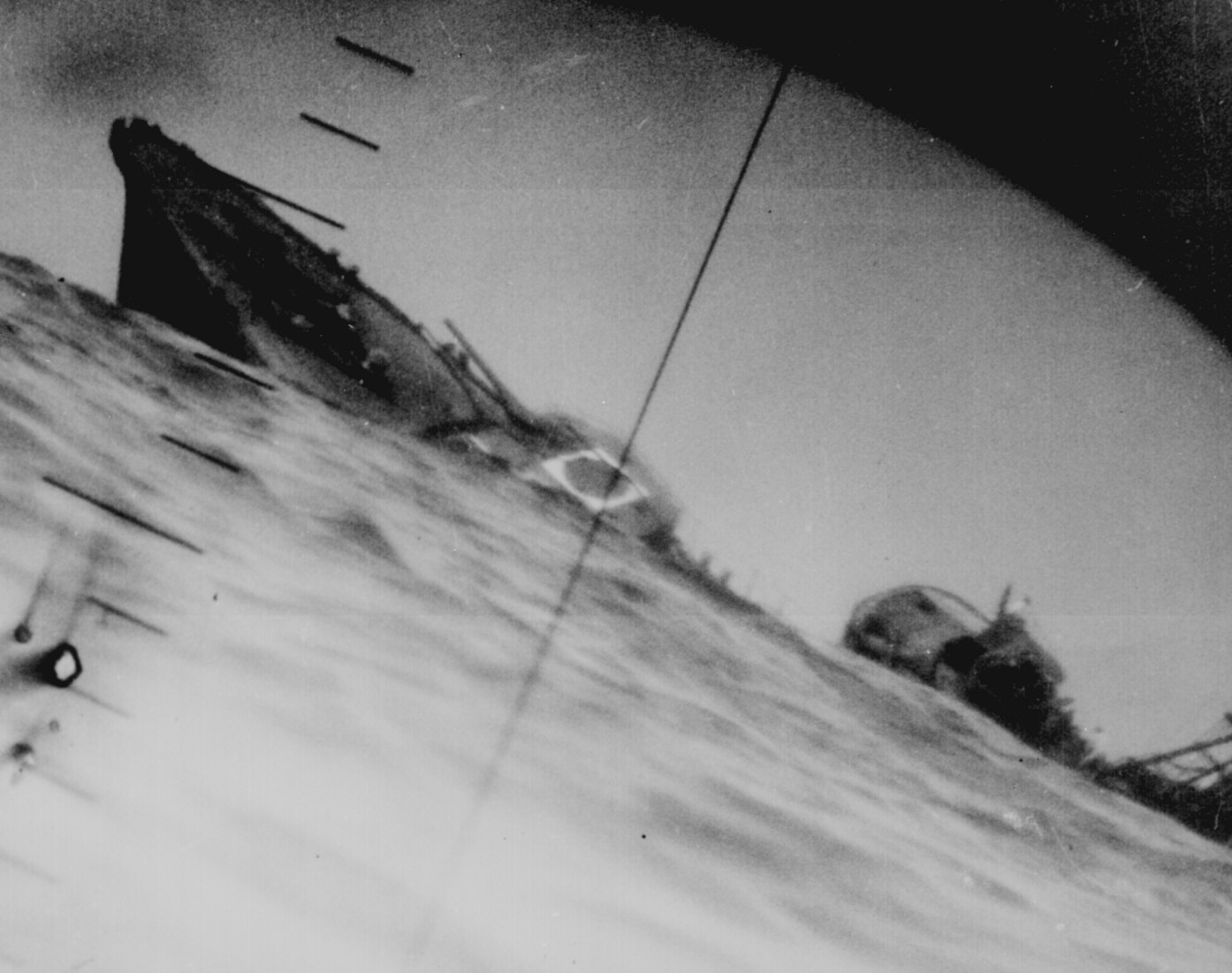
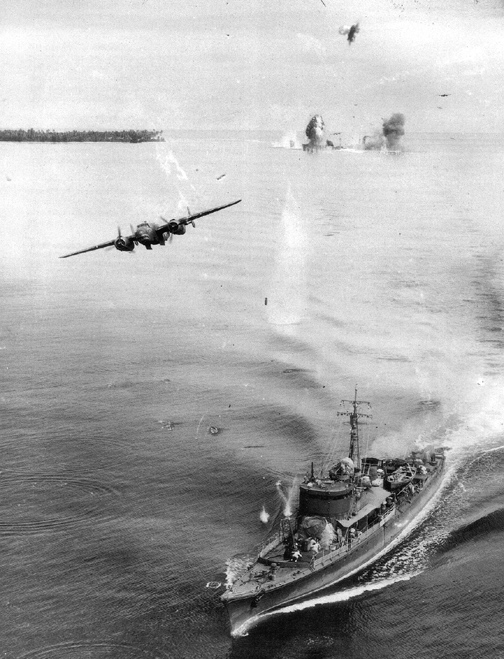
Japanese destroyer shown sinking after being torpedoed by a US submarine

When the Japanese attacked Pearl Harbor as well as the Philippines and Southeast Asia defeating American and Allied forces in detail, crippling the American Navy and dooming the Philippines the Americans were able to adjust strategy to first a defensive one supplemented by raids against the Japanese perimeter by carrier forces and the beginnings of a nascent submarine campaign against Japanese merchant shipping.  The Americans were able to parry the Japanese thrust at the Coral Sea and inflict a major defeat on the Japanese Carrier Forces at Midway prior to launching the first limited offensive by the Navy and the Marines at Guadalcanal.

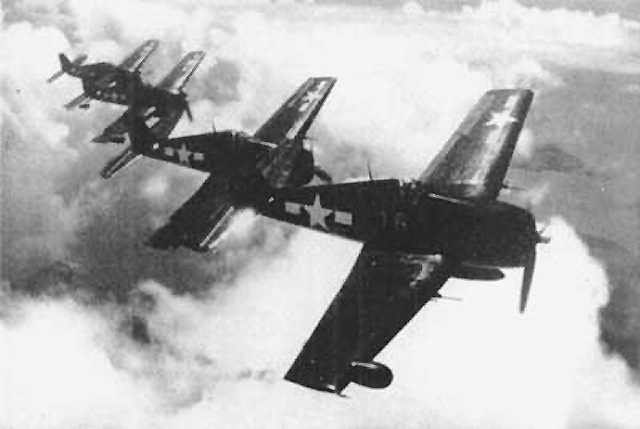
Aircraft like the F6F Hellcat drove Japanese aircraft such as the A6M2 Zero from the skies in the Pacific


The Japanese remained mired in their conflicting strategies with the Navy primarily fighting the Pacific campaign aided by limited Army and Army Air Forces on the islands Japan had occupied or fortified while the bulk of the Army was engaged in China, Southeast Asia or sitting on the Manchurian-Soviet border.

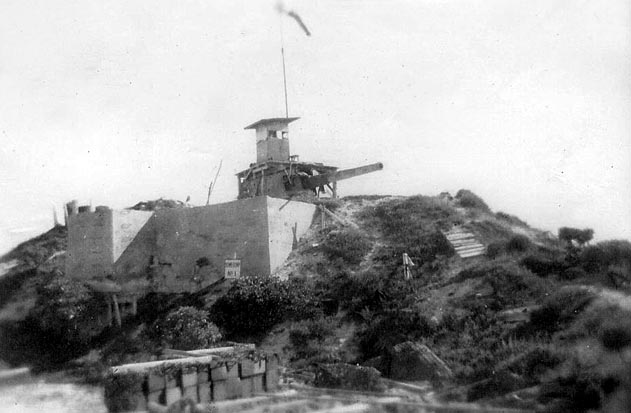
Heavily fortified Japanese islands were either bypassed or taken in bloody assaults, here a 8″ gun on Tarawa

Once the Americans shifted to the offensive a campaign of island hopping coordinated between the Southwest Pacific Area under General MacArthur and the Central Pacific Area under Admiral Nimitz focused on gaining control of islands which contained airbases and anchorages capable of sustaining the American advance while bypassing islands not necessary for this along with their Army garrisons. Both American advances in the South Pacific and Central Pacific focused on retaking the Philippines and cutting the Japanese lines of communication and supply with Southeast Asia. From late 1942 on the Japanese strategy was focused on individual areas of danger versus a overall coordinated defensive effort.

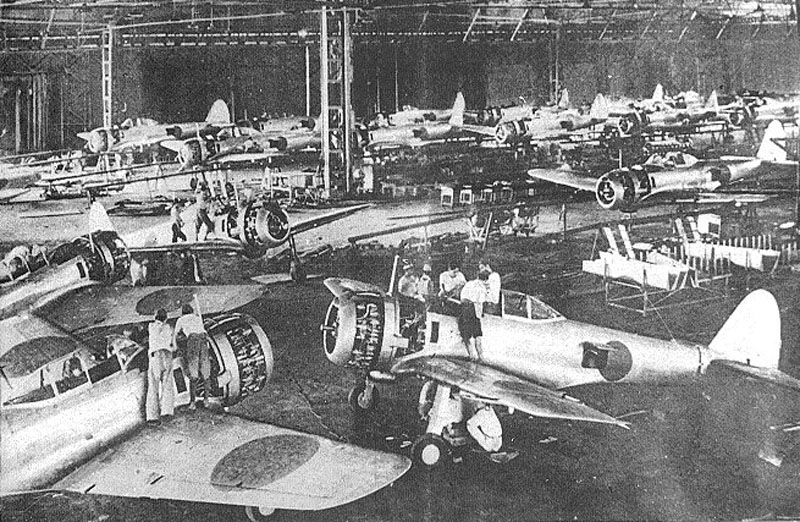
Japanese war industries were woefully ill equipped to match US war production. Here a factory producing Oscar fighter planes

The Japanese were hamstrung from the beginning of the war by limited natural resources, especially oil and oil refining capacities, limited industrial capacity, especially in the realm of the manufacture of steel and machining tools.  All of these were supplied in large part by their opponents and were cut off once the war began.

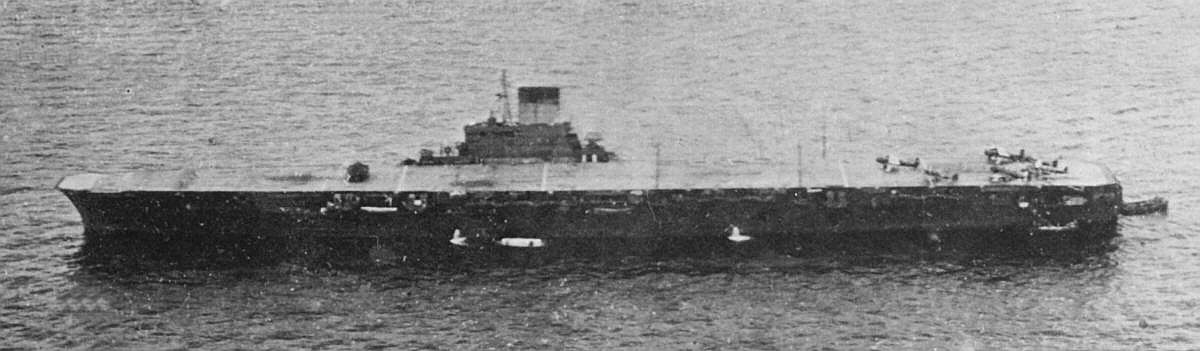
The Carrier Taiho was the equivalent of the Essex Class but the Japanese could only produce one unit

Michael Barnhart in his book Japan Prepares for Total War” has an excellent account of the limitations of Japanese economic, industrial and natural resource capacities, as well as the continual struggle by the Army and the Navy for priority in access to them and the inability of Japanese planners, both civilian and military to resolve this conflict. The Americans had a different situation; although American industrial capacity was enormous it had to be split between to Theaters of Operations and support the needs of American Allies, Britain, the Soviet Union, Canada and China.

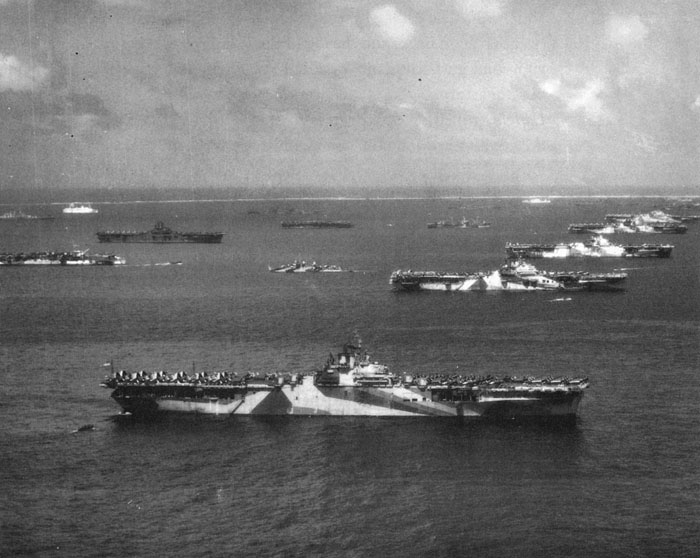
An Armada of US Essex Class Carriers in 1944 the Japanese could not keep pace with US Naval production

Despite this the Americans in a relatively short time were able to amass forces equal to or great than the Japanese who were unable to replace losses in ships, aircraft or the highly trained personnel needed to man them.  At the beginning of the war Japanese Air and Naval forces in the Pacific outmatched everything the Allies could offer, however once they began to experience significant losses at Midway and during the Guadalcanal Campaign their air and naval capabilities diminished to the point that they had to conserve ships and aircraft hoping to be able to gain local advantage in critical defensive areas.

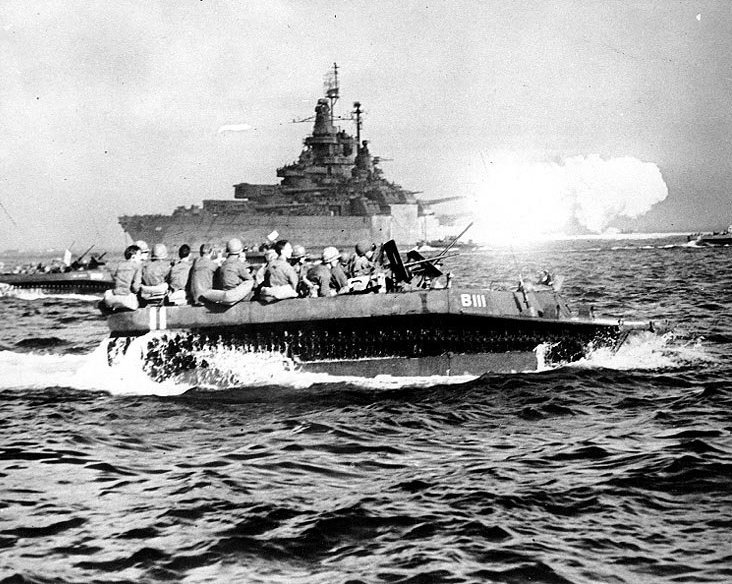
The US Amphibious warfare capacity was a key factor in the ability of the United States to take the war to Japan

New American ships and aircraft introduced during the war were superior to Japanese designs, many of which had reached their apex by 1942.  American advantages in radar, communications equipment added to American advantages throughout the war.  Japanese ground forces in the Pacific were dependant on the Navy and merchant marine for supply and reinforcements. As the American submarine campaign became better organized this became more difficult as the American submarines copying German Wolf pack tactics decimated the Japanese merchant Marine. I particularly like Samuel Elliott Morrison’s account of this in “The Two Ocean War” and “The History of US Navy Operations in World War II” which has a volume devoted to this subject.

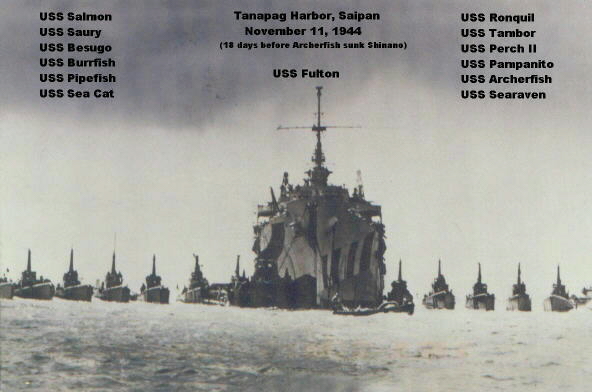
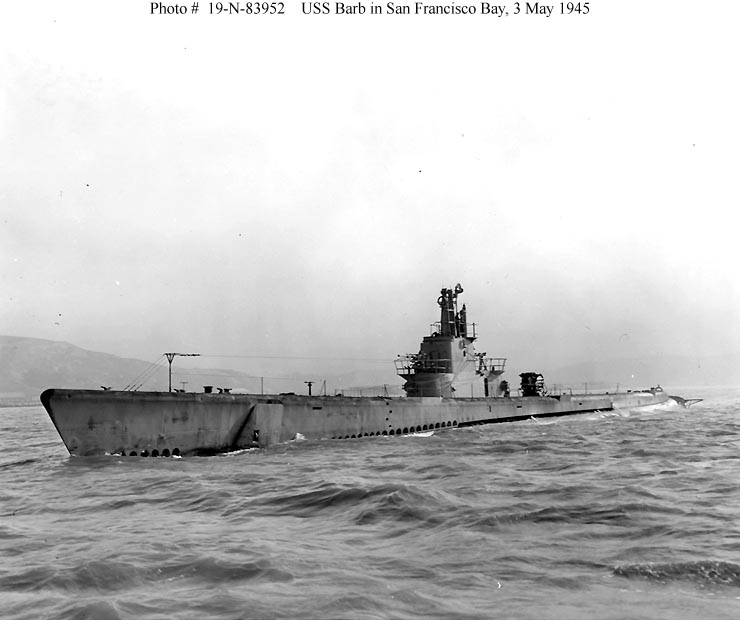
US Navy Submarines cut off Japan from its vital natural resources in Southeast Asia. A Sub Squadron above and USS Barb below

Japanese forces would always fight determined battles but they often expended great amounts of manpower in senseless Banzai charges rather than make the Americans force them out of well prepared positions.  Where the Japanese maintained excellent defense such as at Tarawa and Iwo Jima they made the Americans pay greatly for their gains.  American Marines were apart from the 82nd and 101st Airborne Divisions were the best infantry in the US Military and their skill at amphibious operations and integrated air-ground and naval warfare increased as the war went on.  The Americans were well equipped with modern weapons while the Japanese operated antiquated tanks and often substandard artillery.

Japanese leadership at the strategic and political level was inept throughout the war. They failed to coordinate any strategy with the Germans and failed to enunciate any sort of Grand Strategy.  On the operational and tactical levels the Japanese forces, especially the surface navy performed well, however as the American numeric and technologic advantage increased the Navy became less effective.  After the death of Admiral Yamamoto in 1943 Japanese Naval Leadership became far less effective. The Americans as mentioned before were able to devise a Grand Strategy which not only dealt with Japan but also Germany and coordinated the efforts of forces, war production, planning and logistics to advance their war aims.  At the operational and tactical level American forces, especially the Navy and Marines and later the Army Air Forces and Army became more skilled and than their Japanese counterparts with the possible exception of General Simon Bolívar Buckner at Okinawa. See Spector and Thomas Costello “The Pacific War.” In the air the Americans continued to increase their combat capabilities at the tactical and strategic level and used massed fire bombing raids to devastate the Japanese homeland.  The Japanese in contrast due to inexperienced pilots and fewer competitive aircraft were forced into suicide or Kamikaze missions as the war neared Japan.

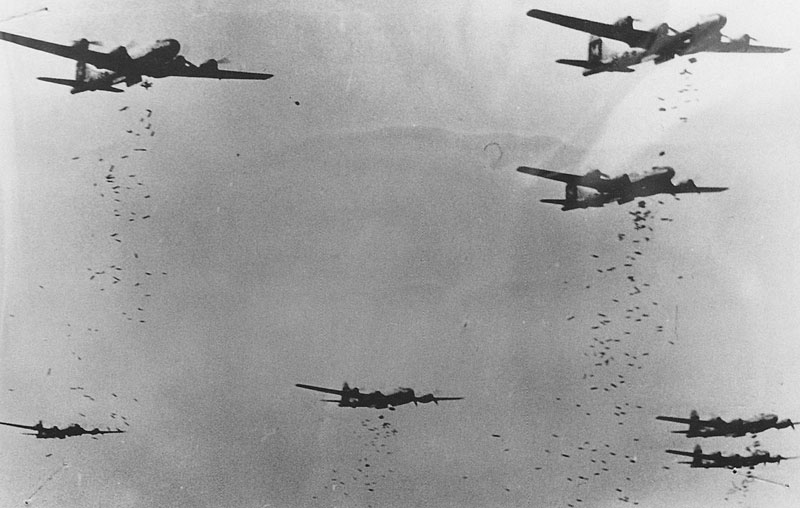
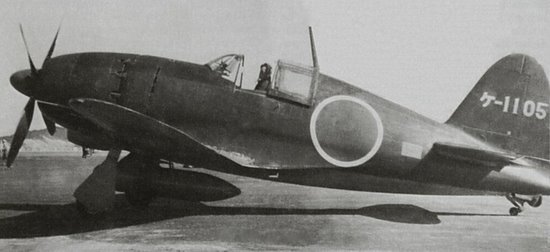
B-29 Super-fortresses leveled Japanese cities and even excellent fighters like the Mitsubishi J2M Raiden could not stop them


The outcome of the Pacific war was directly related to the ability of the Americans to adjust strategy to the realities of the Pacific war as well as the unity of effort which enabled the American superiority in industrial, technological and logistical capabilities to overwhelm the Japanese. The Japanese after initial success did little to adapt and were hamstrung by inter-service rivalries and inadequate industrial capacity and limited natural resources, fell behind in technology and were unable to replace losses among the ships, men and aircraft that they needed to fight an effective war.  Japanese leaders at many levels failed to adapt strategy, tactics or methods to match the reality of the war and the places that they did do so were done by local commanders and never instituted throughout the Japanese military.

2 Comments

Filed under History, Military, world war two in the pacific

They Held the Line: The USS Yorktown CV-5, USS Enterprise CV-6 and USS Hornet CV-8, Part Three the Enterprise

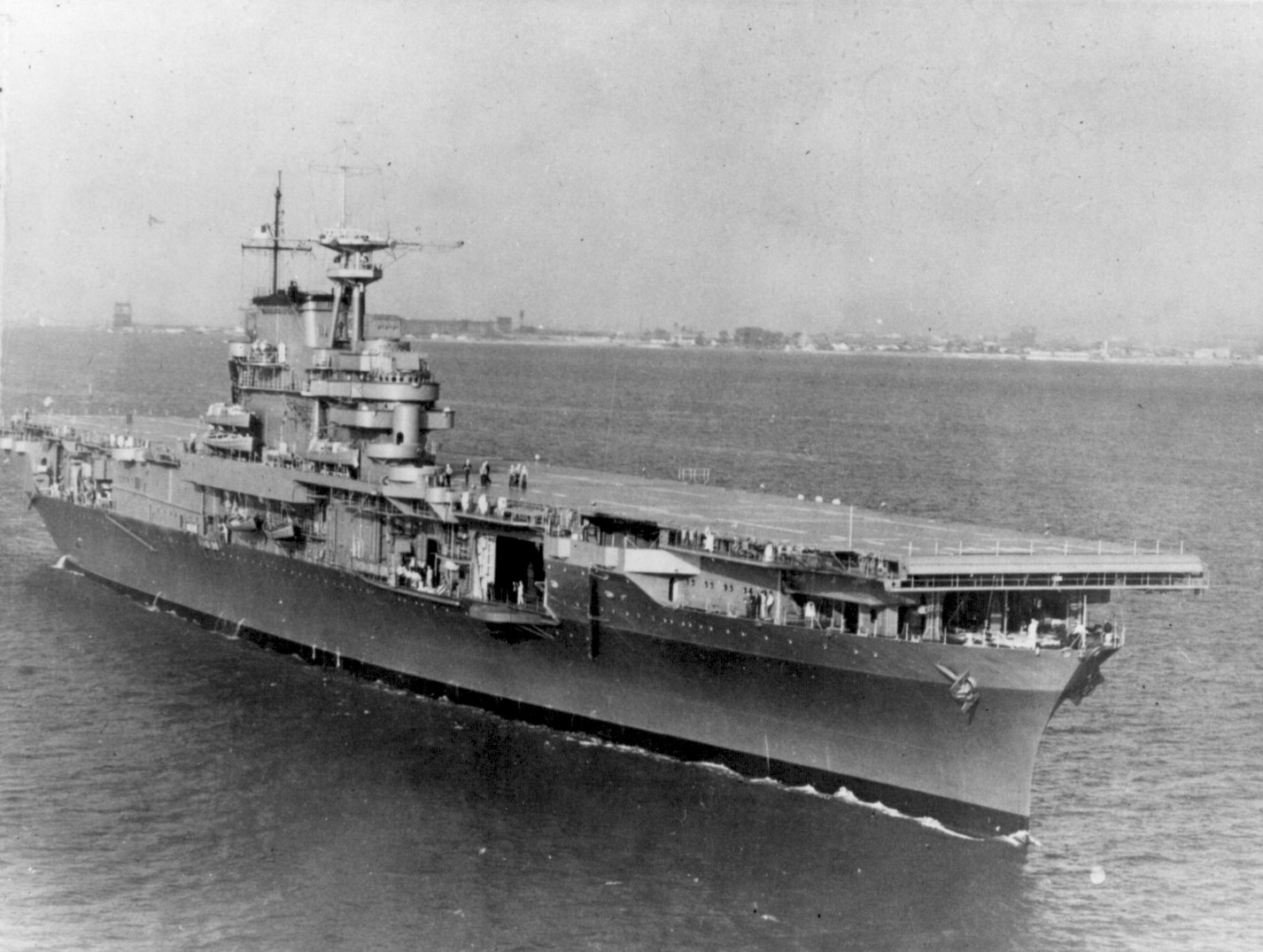
Enterprise CV-6 circa 1940

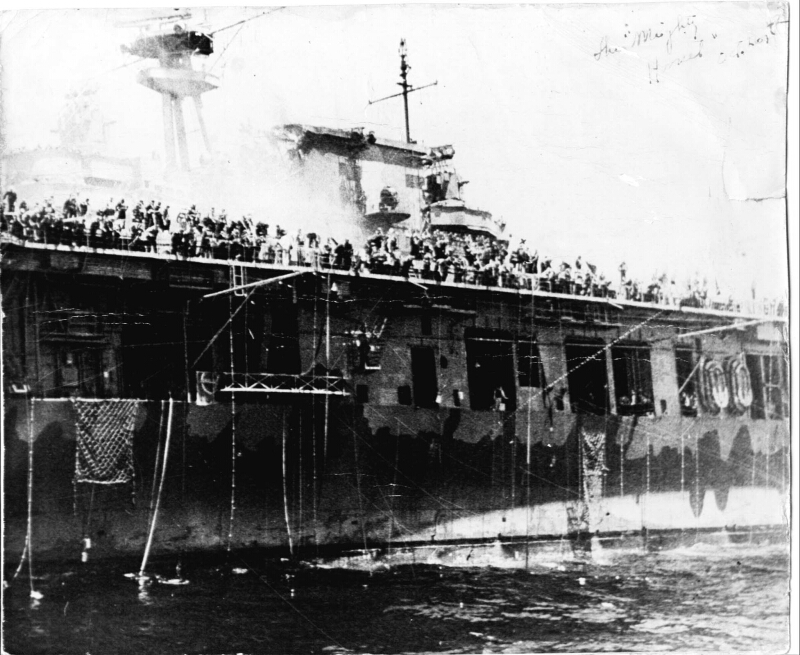
This is the last of a three part series about the USS Yorktown Class Aircraft Carriers. It is the story of the USS Enterprise CV-6, the legendary “Big E” and possibly the most celebrated American warship of the Second World War.

The USS Enterprise CV-6, the second ship of the Yorktown class was ordered by the Navy on 3 August 1933 as authorized under the National Industrial Recovery Act of 16 June 1933.  She was laid down just under a year later and launched on 3 October 1936 at Newport News Shipbuilding and Drydock Company, Newport News Virginia.  She was commissioned on May 12th 1938 to begin one of the most celebrated careers of any US Navy ship in history.  Displacing 25,500 tons full load Enterprise like her sister ships were designed for fast carrier operation working in conjunction with other carriers not tied to the battle line.  With good protection and speed the Enterprise incorporated the lessons learned in the preceding carriers.

Pre-War photo of Enterprise

After her shakedown cruise she operated in the Atlantic and Caribbean until April 1939 when she was transferred to the Pacific Fleet and based a Pearl Harbor. As the flagship of Task Force 16 under Rear Admiral Bill “Bull” Halsey Enterprise conducted training operations and shuttled aircraft to various US island bases in the Central Pacific one such mission to Wake Island which had her out of Pearl Harbor when the Japanese attacked on December 7th 1941.  Following the attack Enterprise and Task Force 16 would cover the Hawaiian Islands and then be used to conduct raids against Japanese bases in the Marshalls and protect convoys bound for Samoa.

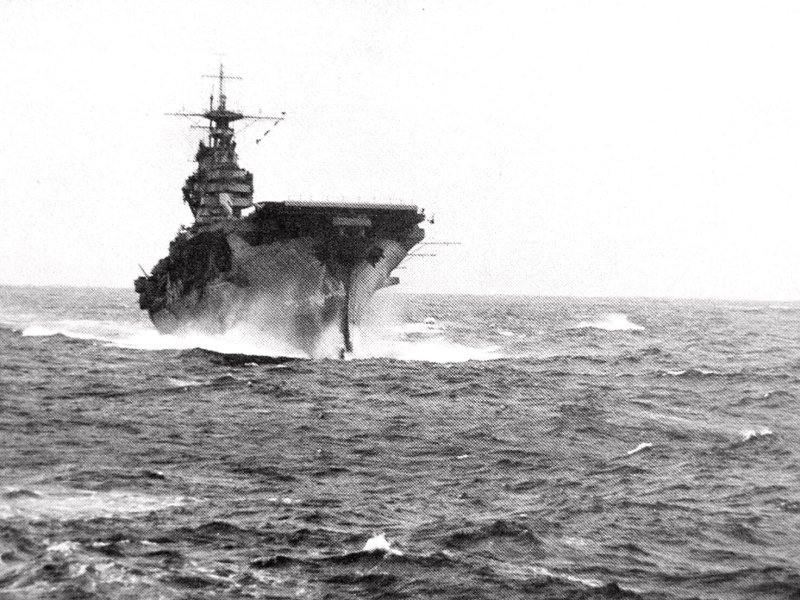
Rare photo of the Enterprise at Midway

In April she escorted the newly arrived USS Hornet CV-8 to conduct the famed “Doolittle Raid” on Tokyo.  Five days after returning to Pearl Harbor Enterprise was dispatched to the Coral Sea but could not arrive before that historic carrier battle.  She returned to Pearl Harbor on May 26th and with Halsey sick departed two days later as flagship of TF-16 under the command of Rear Admiral Raymond A Spruance in company with Hornet, 6 cruisers and 10 destroyers with orders “to hold Midway and inflict maximum damage on the enemy by strong attrition tactics.”

TBD Devastator landign on Enterprise May 1942

They would be joined 2 days later by the hastily repaired USS Yorktown flagship of Rear Admiral Frank “Jack” Fletcher and TF-17 escorted by 2 cruisers and 6 destroyers.  Fletcher the senior officer assumed tactical command of this comparatively small force which represented the bulk of US naval power in the Pacific.

This tiny force would face 4 fleet (CV) and 2 light fleet (CVL) carriers, 7 battleships, 10 heavy (CA) and 2 light (CL) cruisers and 42 destroyers.  Additionally the Japanese had an additional 2 carriers, 4 battleships, 3heavy cruisers 4 light cruisers and 23 destroyers involved in some way the simultaneous invasion of the Aleutian Islands which could be called into the fight if Admiral Yamamoto desired.

SBD Dauntless Dive Bombers over Enterprise

The Battle of Midway was an epic of warfare and Enterprise and her Air Group 6 would play a pivotal role. Torpedo Six under LCDR Max Leslie in its obsolete, underpowered and under armored TBD Devastators was chopped to pieces as they attempted torpedo attacks on the First Carrier Strike Force of Admiral Nagumo losing 10 of 14 aircraft.  As the gallant air crews of Torpedo Six along with Yorktown’s Torpedo 3 and Hornet’s ill-fated Torpedo Eight made their attacks Bombing Six under the command of CDR Wade McCloskie and Scouting Six under the command of  LT Dick Best attacked and mortally wounded the Japanese Flagship Akagi and the Soryu.  Later in the day aircraft from Enterprise would help sink the Hiryu and the following day helped mortally wound the Heavy Cruiser Mikuma. The Enterprise was not damaged by the Japanese at Midway.

Flight Operations on Enterprise

Following the Miracle at Midway the Enterprise took part in the Guadalcanal campaign participating in the invasion as well as the Battles of Santa Cruz and the Eastern Solomons.  In each of these actions she was seriously damaged but her air group was instrumental in the campaign at sea and ashore.   Following the sinking of the Wasp, Hornet and damage to Saratoga Enterprise was the only US carrier in action in the fall of 1942.

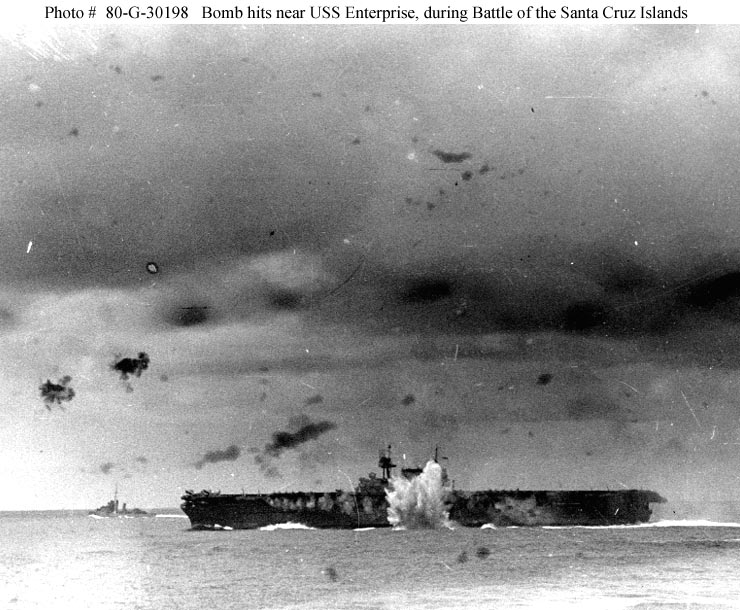
Enterprise under attack at the Battle of Santa Cruz Islands

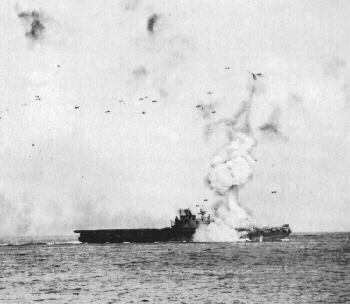
Bomb Explosion on Enterprise at the Battle of Eastern Solomons

In November she took part in the Naval Battle of Guadalcanal where her aircraft helped to finish off the Japanese battleship Hiei and participated in the sinking of 16 Japanese ships including transports which carried troops, equipment and supplies to the Japanese defenders of Guadalcanal. After another 6 months of action in the Solomons supporting the US advance Enterprise returned first to Pearl Harbor at which time she was awarded the Presidential Unit Citation by Admiral Chester Nimitz, the first carrier awarded the citation in the Second World War and then to Bremerton for a badly needed overhaul.

Emterprise struck by Kamikaze

Enterprise was back in action by November 1943 and participated in the US offensives in the Gilberts, Marshalls and the Marianas taking part in numerous raids, support to Marines ashore and in the Battle of the Philippine Sea, the Marianas Turkey Shoot.  After a month long refit at Pearl Harbor she participated in the attacks on the Volcano, Bonin and Palau including strikes on Yap and Ulithi followed by the fast carrier raids on Japanese facilities on Okinawa, Formosa and the Philippines which culminated in her participation in the Battle of Leyte Gulf, the largest naval battle in history.  Her aircraft would participate in strikes on each of the Japanese surface forces hitting battleships, cruisers and other Imperial Navy units in the epic naval battle.

Enterprise made a short return trip to Pearl Harbor in December 1944 where she embarked an air group trained in night operations. Rejoining the fleet she took part in sweeps against Japanese bases, ships and facilities in Indochina, the Philippines, Formosa and Okinawa prior to the invasion of Iwo Jima.

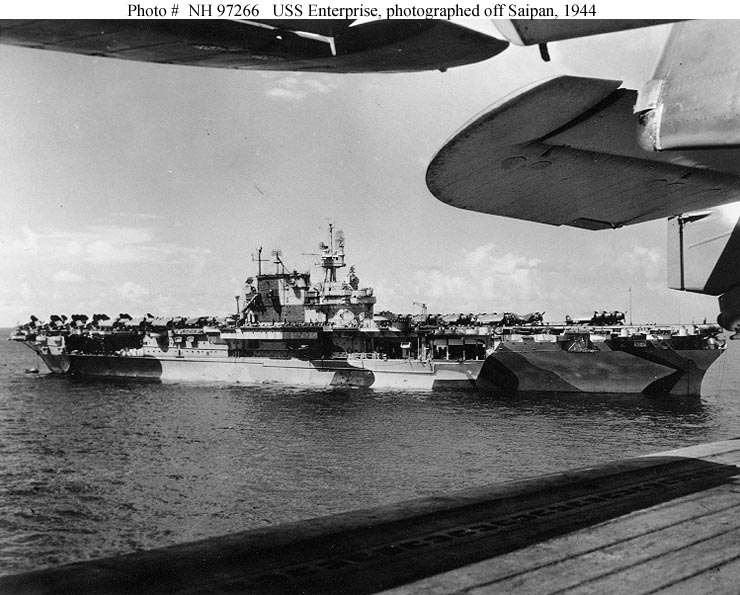
Enterprise at Saipan

During this operation her aircraft worked night and day to provide air strikes and air defense to the fleet.  She then joined the raids against Honshu, Kyushu and the Inland Sea where her aircraft provided night strikes against Japanese targets ashore as well as air defense to fleet units. She was damaged by a Japanese bomb on the 18th of March and on 11 April damaged by Kamikazes off Okinawa and again on 5 May prior to her last wound of the war on 14 May when a Kamikaze struck forward elevator necessitating repairs at Bremerton.

Kamikaze Damage or forward elevator

Returning to the fleet to late for the final actions of the war Enterprise took part in Operation Magic Carpet returning US troops to the United States at the end of hostilities.  She was decommissioned on February 17th 1947.  While she was in reserve the Enterprise was redesignated first as an Attack Aircraft Carrier (CVA), and then as Anti-submarine Carrier (CVS).

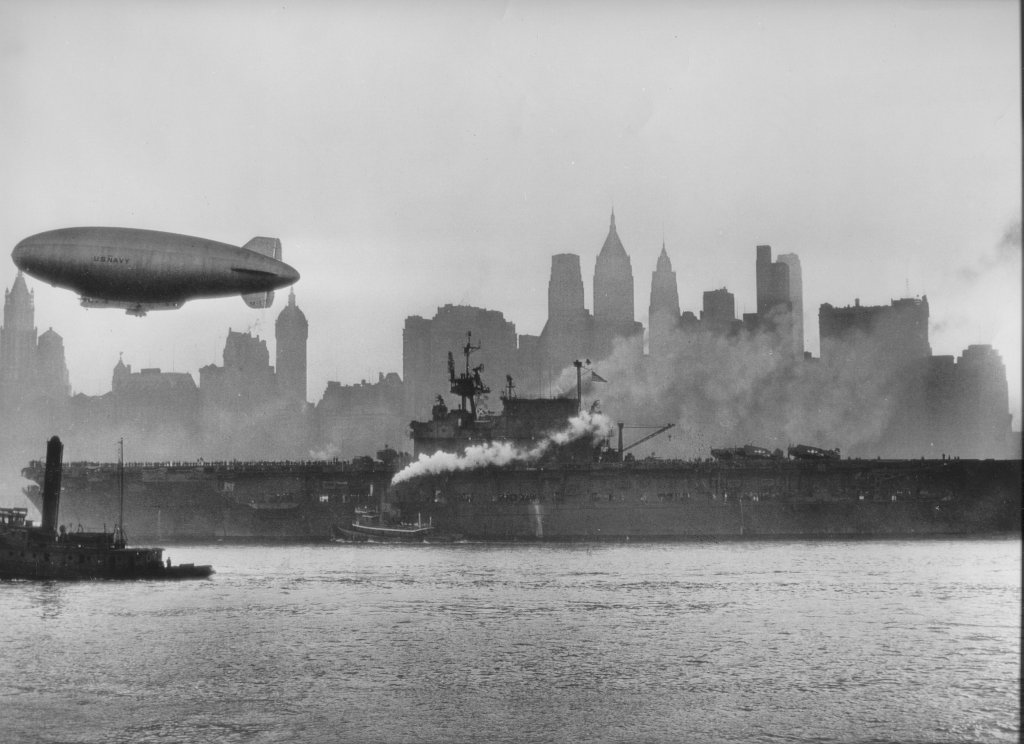
Enterprise Fleet Week New York 1945

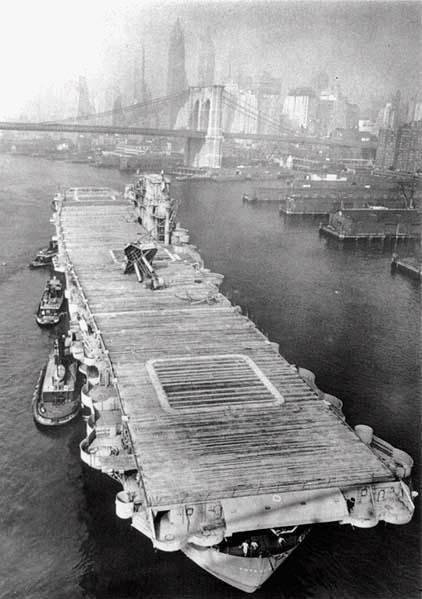
As the super-carrier entered the scene and the Essex and Midway Classes were modernized to accommodate jet aircraft the Enterprise was determined to be in excess of Navy needs.  Despite attempts by some to save her as a Naval Museum the money could not be raised, even with the support of the dying Fleet Admiral Bill Halsey.  Enterprise which Secretary of the Navy Forrestal said was “the one vessel that most nearly symbolizes the history of the Navy in this war” was sold for scrap on 1 July 1958 and scrapped at Kearney New Jersey from September 1958 to March 1960.  Like so many ships which serve their country so well she was casually disposed of by a nation which had forgotten its past.

Enterprise alongside new CVA 1958

Enterprise on the way to the breakers

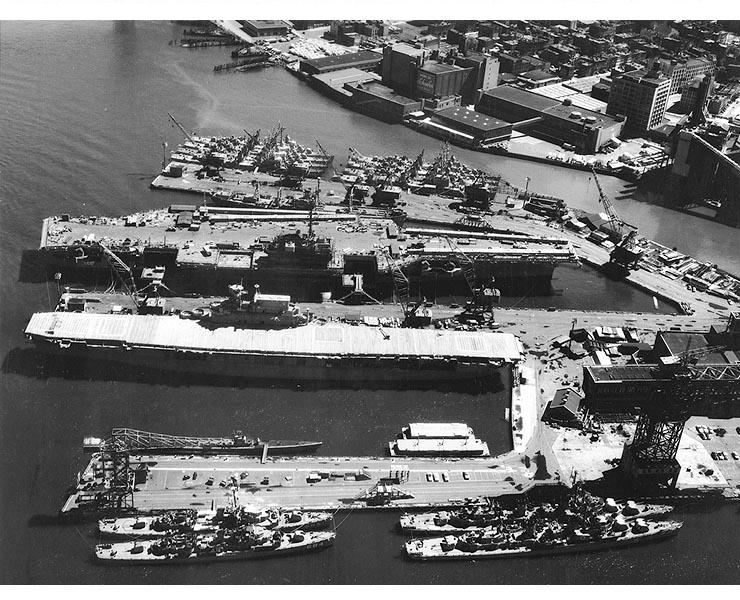
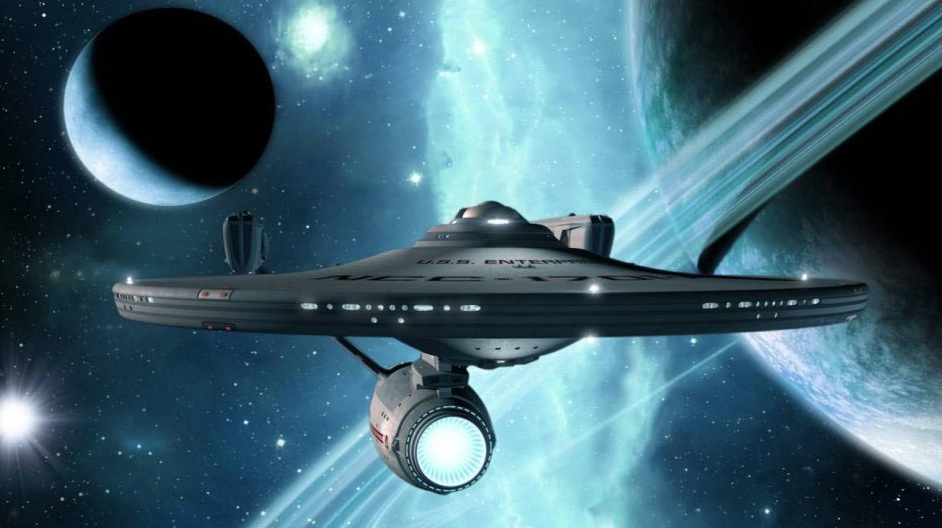
Enterprise was the only ship to receive both the Presidential and Naval Unit Citations for her service in World War Two and she was awarded the Asiatic-Pacific Campaign Medal with 20 battle stars.  Her place in the carrier force would be taken by a new Enterprise, CVN-65, the First Nuclear carrier which after nearly 50 years of service is still in commission. The Enterprise is so significant that her legacy continues in Hollywood Science fiction in the various Star Trek series as the Federation Starship Enterprise NCC-1701, 1701-A, 1701-B, 1701-D and 1701-E, so much so that NASA named the first experimental Space Shuttle Enterprise.

Never Forgotten USS Enterprise NCC-1701-B

2 Comments

Filed under History, Navy Ships, world war two in the pacific

Padre Steve’s World: Top 10 articles of 2009

I began Padre Steve’s World Back in February of 2009. I started it mainly as a place to write about my experience in the Iraq War and my struggle with PTSD. It initial was, and on occasion still is a vehicle to help integrate those experiences into my life so that I might experience some measure of healing.  When I began this site I really did not expect it to become what it has become.

Now as anyone knows I am a member of the Church of Baseball, Harbor Park Parish and that the Deity Herself speaks to me through Baseball.  That combined with the fact that I am a historian somewhat of a military theorist means that I love statistics.  I also love to look at facts, data and interesting stories and try to make sense of them. I do this with baseball of course, as well as how leaders can apply lessons of the past to present conflicts and recognize dangers of their possible courses of action.

I am an introvert but writing has helped me get out of myself.  I have ended up writing about people in my life, significant losses experienced at our medical center and how others have made a difference in my life.  As the site matured I found that I was writing less about me and more about other people, history, theory and various social and political events.  Of course the latter frequently stirred up a lot of crap in me so at times, especially dealing with subjects such as “The Lies of World Net Daily” or former Navy Chaplain, defrocked priest, convicted criminal and professional liar Gordon “Chaps” Klingenschmitt.  The site also allowed me to spend a lot of time sharpening my academic research skills as well as writing about baseball.  So this has become something more than a navel gazing site where I pick out the lint of my soul for all to see.  While my experiences pervade a lot of what I write as no one can write in a vacuum one’s experience, training, culture and worldview all influence what we write about and how we interpret events, they are not the central focus of the site anymore.  I think I have about 40 different subject areas that I post on now and who knows if that number will grow.

During this past year I have met a lot of people in person and online and had a good number of people post some very kind comments as well as some very challenging ones.  On the rather amazing side I have had people from my past, like the UCLA Army ROTC “Chief Lord of Discipline” Colonel Bruce Lawson find me and look me up as well as the son of the late Master Sergeant Harry Zilkan who was out training NCO as well as others.  I have had visitors and comments from around the world including the United Kingdom, Canada, Germany, France, Italy, Singapore, Australia and Russia.  In all I have had over 700,000 views of the site since February and thousands of clicks on individual articles.  The comments that touch me the most are those who comment that what I write has touched them, helped them or provided them added knowledge about a given subject as well as those that in my more difficult times have offered me encouragement and prayed for me.  Through this I have also come across some very good bloggers and writers that I enjoy reading.  It has provided me a new network of acquaintances and associates to bounce ideas off of and have input from.  So I have to say that this has been a very helpful thing for me this past year and has given me ideas that I hope will one day will get published.  I have over the past year discovered some topics that I would like to publish and a I am ruminating on those even now.

My top 10 articles this year are listed here, as you can see they represent a wide range of topics:

Star Trek, God and Me 1966 to 2009

The USS Enterprise NCC-1701 B

I posted this on May 29th 2009 and to date it has 6827 hits.  This was done on a lark and kind of took on a life of its own. There is a reason that Star Trek is so popular after over 40 years.  It is that it touches people’s lives and the stories, though set in the future are about the human condition and people can relate to them even now.   I know I do and that was the point of this article. The post still gets 10-40 hits a day.

The Ideological War: How Hitler’s Racial Theories Influenced German Operations in Poland and Russia

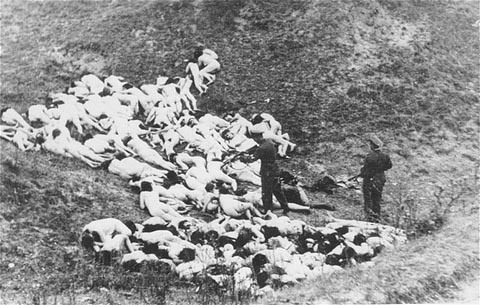
Einsatzgruppen at Work

I published this article on September 14th 2009 and it now has gathered a total of 3649 hits. This article is a revision of an academic paper that I wrote for my Masters Degree in Military History.  I have studied modern German History, 1870 to the present for many years; in fact the bulk of my undergraduate history studies involved the topic.  In particular the period from the fall of the Kaiser in 1918, the German Civil War, the Weimar Republic and the Nazi Period have been my specialty.  When I posted this I expected that it would primarily be read by history wonks like me but it seems to have gained a substantial number of readers and still picks up a decent number of daily hits.

Halloween Book Burning Update: Bring the Marshmallows Please!

Pastor Marc of Amazing Grace Baptist Church, Book and Bible Burner and Heretic Confronter in Chief

I posted this on October 25th as a follow up to an article about a little Baptist Church that was hosting a book burning.  I found the subject fascinatingly terrible and had to write about it.  Humor blended with satire, history, religion, sociology and a bit of dare I say sarcasm created a monster.  This is my fastest growing article.  It’s funny how that “Old Tyme Religion” can get you going.  To date this post has 3292 hits.

The Forgotten Cold Warriors

Icon of the Cold War: The Berlin Wall Goes Up

I wrote this back on July 26th 2009 as a tribute to those who served in a truly forgotten war, the Cold War.  It now has gathered 2906 hits. As a Cold War vet myself like my dad I have felt for many years that the American government and both political parties have done little to recognize those who served, frequently in harm’s way during this conflict that spanned the globe over a period of 40 years.  I imagine that the same is true in Russia and the former Warsaw Pact nations. The article still gets a decent number of daily views, not like the top three but still a good number showing me that a significant number of people have feelings for those who served as well as their own service during the Cold War.

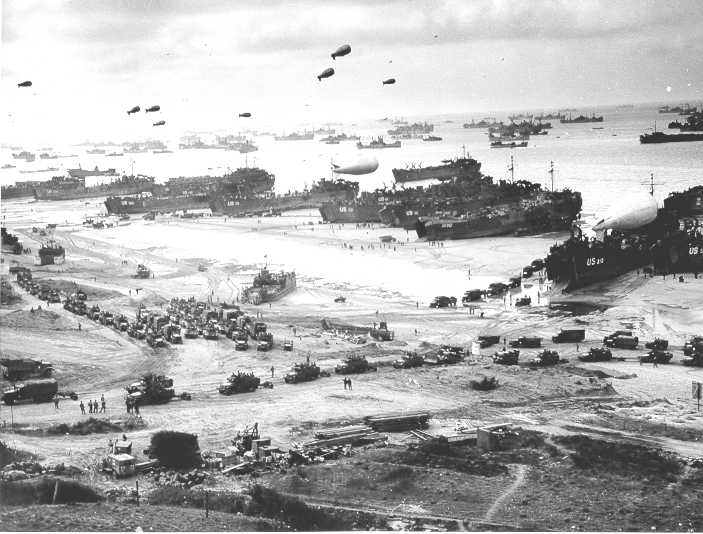
D-Day- Courage, Sacrifice and Luck, the Costs of War and Reconciliation

Omaha Beach at Low Tide

This was published on June 6th 2009 as a tribute to those who served and gave their lives on D-Day and during the Normandy campaign.  It talks about the reconciliation between Allied and German soldiers after the war and I relate it to my own dealings with the Iraqi people and military.  It voices my hope that one day Iraqi and American veterans can have the kind of reconciliation experienced by some of those who fought so hard against one another during the brutal Normandy campaign. To date it has 2887 views. 

Operation “Dachs” My First Foray into the Genre “Alternative History”

Field Marshall Erich Von Manstein

This article was posted on August 9th 2009 and was a rewrite of a paper I wrote in one of my Masters Degree classes.  It was inspired by Kenneth Macksey’s alternative history “Disaster at D-Day.” It was unusual in the fact that I wrote an alternative history as if it had actually taken place using real sources, people, places and events and writing as if the “what ifs” had actually occurred. In this case that would be the success of the March 1943 attempt on Hitler’s life had succeeded.  It has 2314 hits to date and still gathers a decent number of hits making me wonder if it has potential for expansion as a possible book. 

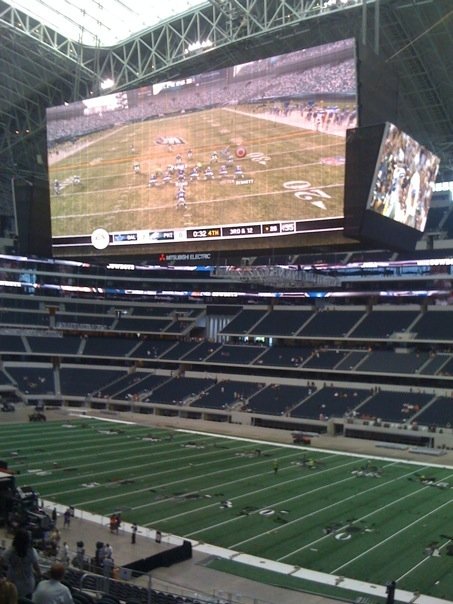
Cowboys Stadium meets Seinfeld: A Scoreboard and a Nose that You Can’t Miss

Cowboy’s Stadium and its Massive Scoreboard

This post combined my twisted sense of Seinfeld like humor into what I think is a pretty witty post about the monstrous scoreboard at the new Cowboy’s Stadium in Arlington Texas.  It seems to get a decent number of hits whenever the Cowboys play.  I wrote it on August 30th 2009 and it has 1570 hits to date.

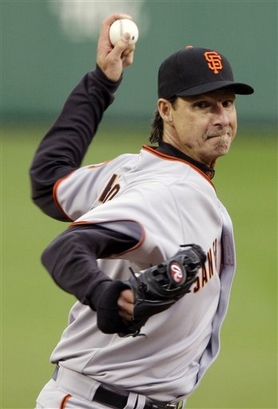
Turning Points: The Battle of Midway, Randy Johnson Gets his 300th Win and Chief Branum Gets Her Star

SBD Dauntless Dive Bombers at Midway

This article was posted on June 4th 2009 and dealt with three different but for me interrelated events.  The first was a tribute to those who fought at the Battle of Midway, the second future Hall of Fame pitcher Randy Johnson getting his 300th career win as a member of the San Francisco and a fallen Shipmate, Senior Chief Hospital Corpsman Pamela Branum who was posthumously promoted to Senior Chief at her memorial service.  To date it has 1449 views and a significant number of comments.

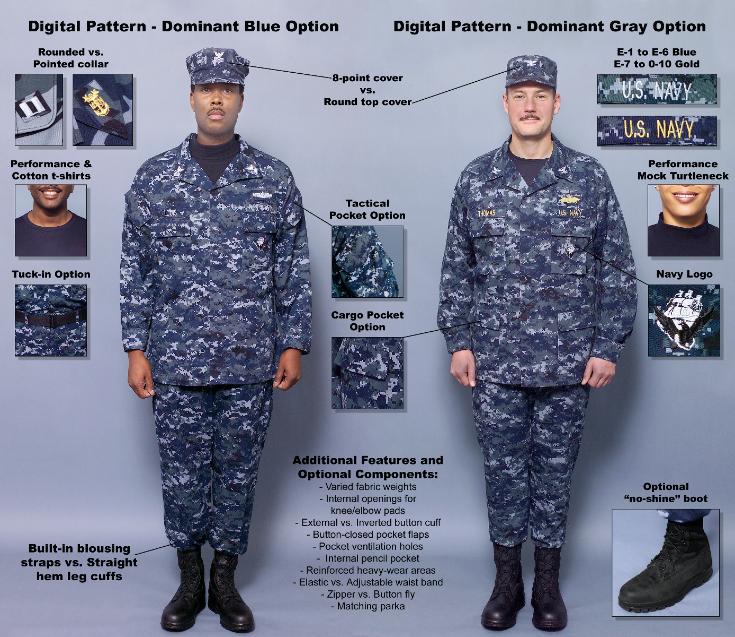
These Boots were Made for Walking: The Navy NWU Suede boots

The NWU and its Boots

This was one of my earlier posts done on April 18th 2009 and provided my review of the new US Navy suede work boot which is worn with the Naval Working Uniform or the NWU.  It has surprised me that it has garnered 1332 hits.  It was a follow up article to a humorous article that I had written previously about all the different kinds of camouflage uniforms in use by the US Military entitled: The NWU- Now we all have different camouflage.

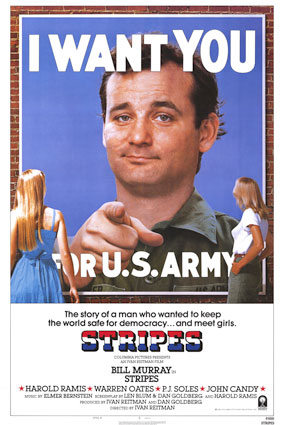
Memorable Recruiting Slogans and the All Volunteer Force


This article was a humorous look back at some of the military recruiting slogans that have been around since the beginning of the “All Volunteer” military in the mid 1970s.  I posted it on May 4th 2009 and it now has 1084 hits.

Other Articles of Interest

Since I have posted well over 300 articles to the site since its creation I have listed some other articles that I thought were significant below:

Baseball in Between Life and Death in the ICU

Mortain to Market-Garden: A Study in How Armies Improvise in Rapidly Changing Situations

The Treaty Cruisers: A Warship Review

Sometimes You Wanna go Where Everybody Knows Your Name

It’s what you learn after you know it all that counts-Thoughts on 26 Years of Commissioned Service

You Win a Few, You Lose a Few. Some Get Rained Out. But You Got to Dress for All of Them

Remembering the Veterans in My Life…Memorial Day 2009

Alzheimer’s Disease, Ghost Fleets and Waiting for the End

Reformation Day: How Martin Luther and Hans Kung Brought Me to an Anglo-Catholic Perspective, a Book and Bible Burning Reaches Ludicrous Speed and Yankees take Game Three 8-5

My Brotherhood of War

Connecting…Baseball and Having My Dad Back for a Few Minutes

Lessons for the Afghan War: The Effects of Counterinsurgency Warfare on the French Army in Indo-China and Algeria and the United States Military in Vietnam

The Uncomfortable Legacy of Colonel General Ludwig Beck

A Christian Defense of the Rights of Moslems and Others in a Democracy (or Constitutional Republic)

I like Jesus very much, but He no help with Curveball

Comebacks in Baseball and Life: 27 Outs- the Baltimore Orioles teach us a Lesson in Life

Here’s to you Jackie Robinson

The Demons of PTSD: Abandonment

Doubt and Faith: My Crisis in Faith and Why I am Still a Christian an Advent Meditation

Padre Steve’s World Series Prediction and Book and Bible Burning Update

Dien Bien Phu- Reflections 55 Years Later

Brothers to the End…the Bond between those Who Serve Together in Unpopular Wars

World Series Game Six: Duel of the Old Dogs

The 2009 Season at Harbor Park…the View from 102 a Season in Pictures

I guess that is enough for anyone who wants to poke around on the site.  There is a place to subscribe to this site via e-mail if you want as well as a place to subscribe to comments.

I look forward to a good year of writing as life goes on.  I pray that you have a wonderful New Year.

Peace,

Padre Steve+
1 Comment

Filed under Loose thoughts and musings

They Held the Line: The USS Yorktown CV-5, USS Enterprise CV-6 and USS Hornet CV-8, Part Two the Hornet

USS Hornet CV-8 Building at Newport News VA

This is part two of a three part series about the USS Yorktown Class Aircraft Carriers. Part one serves as an introduction as well as the story of the lead ship of the Class, the USS Yorktown CV-5.  Part One about the Yorktown is located here: https://padresteve.wordpress.com/2009/12/27/they-held-the-line-the-uss-yorktown-cv-5-uss-enterprise-cv-6-and-uss-hornet-cv-8-part-one/

Hornet as Completed off Hampton Roads shortly after Her Commissioning

The USS Hornet CV-8 was the third ship of the Yorktown Class and is sometimes referred to as her own one ship Hornet Class.  Laid down on 25 September1939 under the Naval Expansion act of May 17th 1938, Hornet was part of the pre-war naval build up authorized by President and Congress.  The previous Yorktown design was used to speed construction.  Hornet was slightly modified from her sisters Yorktown and Enterprise being 15 feet longer, 5 feet wider in the beam and displacing about 1000 tons more than her near sisters.  Her anti-aircraft armament was also slightly improved.  As with her near sisters Hornet had good protection except that her underwater protection was weak.  However, as would be born out in combat Hornet like her sisters would prove to be extraordinarily tough.

Hornet in Rough Seas Preparing to Launch the Doolittle Raid

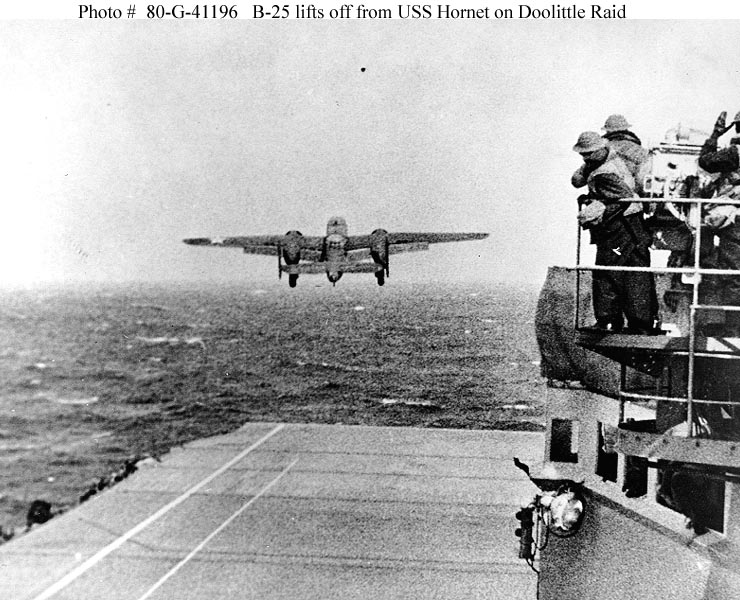
Hornet was launched on 14 December 1940 and commissioned 25 October 1941 with Naval Aviation pioneer Captain Marc A Mitscher Commanding. Hornet conducted her initial training and air group qualifications while operating out of Norfolk.  On February 2nd two Army Air Corps B-25 Medium Bombers were loaded aboard.  As Hornet put to sea the bombers were launched to the astonishment of the crew. Hornet departed Norfolk for the Pacific where she embarked 16 B-25s under the command of Colonel Jimmy Doolittle.  Hornet’s own air group was stowed in the hanger bay.  On April 2nd Hornet departed from San Francisco for a rendezvous with Admiral Halsey’s Task Force 16 and her sister ship Enterprise.  As the ship departed Mitscher informed the crew of their mission.  Hornet would launch Colonel Doolittle’s aircraft against the heart of the Imperial Japanese Empire, Tokyo.

Hornet Launching B-25

The plan was for the task force to sail to 400 miles from Japan and launch the bombers. Enterprise was to provide air cover for the task force while Hornet’s air group was inaccessible while the bombers remained aboard.  On the morning of 18 April the task force was spotted by a Japanese patrol boat.  The craft was quickly dispatched by the heavy cruiser USS Nashville but not before the craft had reported the presence of the task force.  Though the task force was still 600 some miles from Japan Halsey ordered that Doolittle’s aircraft be launched against Tokyo.  The attack while militarily insignificant came as a major surprise to the Japanese who anticipating a raid by naval aircraft believed that any attack could not take place until the following day.  Even more significantly the attack stunned the Japanese military establishment, especially the Navy. The attack would provoke Admiral Yamamoto to attack Midway in order to draw out the American carriers and destroy them.

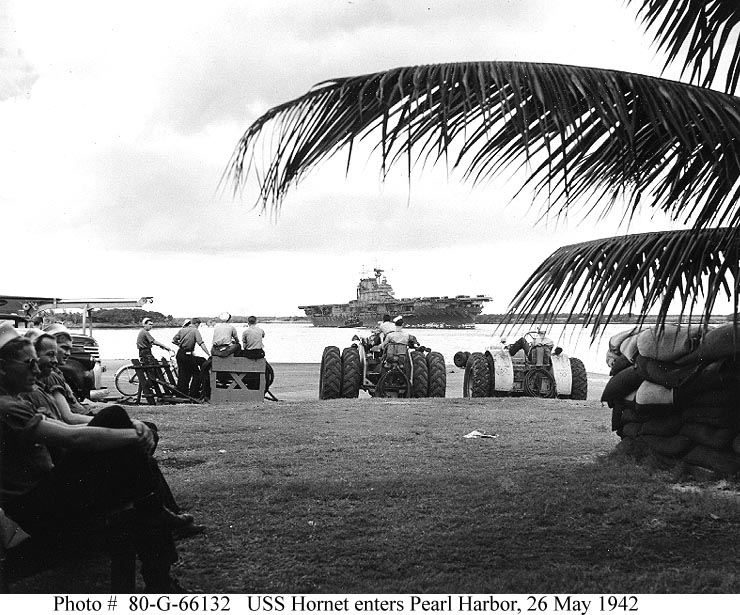
Hornet Arrives at Pearl Harbor Before Midway

Hornet along with Task Force 16 sailed back to Pearl Harbor arriving a week later and the mission would remain secret for over a year.  The task force steamed to assist the Yorktown and Lexington at the Battle of Coral Sea but that battle was over before they could arrive.  The task force returned to Pearl Harbor on the 26th of May and sail on the 28th for Midway.  Hornet’s air group was plagued with bad luck.  Torpedo Squadron 8, or Torpedo 8 commanded by LCDR John Waldron found and attacked the Japanese task force losing all aircraft and all pilots save one.  6 new TBF Avengers from her air group operating from Midway met with heavy losses in their attack against the Japanese.  Only one pilot from Torpedo 8 with Waldron’s group survived, Ensign George Gay.  Hornet’s dive bombers followed bad reports of the location of the Japanese carriers and took no part in the action.  Many would have to ditch in the ocean as they ran out of fuel.  Hornet’s air group would help sink the Japanese Heavy Cruiser Mikuma and heavily damaged Mogami on the 6th.  The Battle of Midway was one of the major turning points of the war.  The Japanese had lost six carriers which had attacked Pearl Harbor along with their aircraft and many of their highly trained pilots and flight crews. Coupled with their losses at Coral Sea the Japanese suffered losses that they could ill afford and could not easily replace.

Following Midway Hornet had new radar installed and trained out of Pearl Harbor until order to the Southwest Pacific to take part in the struggle for Guadalcanal.  By the time she arrived she was the only operational American carrier in the Pacific. Enterprise had suffered bomb damage at the Battle of Easter Solomons on August 24th; Saratoga was damaged by a submarine torpedo on August 31st and the Wasp was sunk by a submarine on September 15th.  In the space of 3 weeks the United States Navy had lost 3/4ths of its operational carriers in the waters off of Guadalcanal. Hornet now faced the Japanese alone, providing much of the badly needed air support for the Marines fighting ashore.

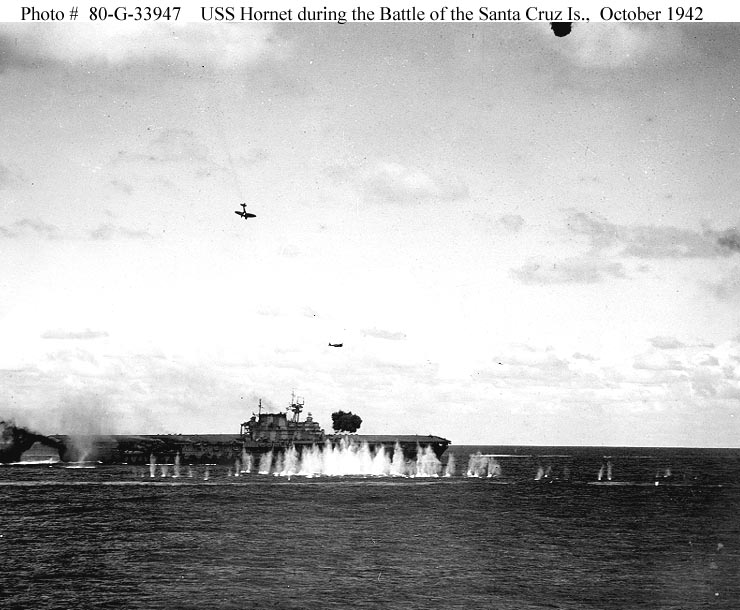
Hornet Under Attack: Note “Val” Dive Bomber about to crash ship

The Enterprise rejoined Hornet following hasty repairs off the New Hebrides Islands on October 24th.  On the 26th they joined battle with a Japanese task force of 4 carriers centered on the veterans Shokaku and Zuikaku. The Hornet’s aircraft attacked and seriously damaged Shokaku even as Japanese torpedo planes and dive bombers launched a well coordinated attack against Hornet. Hornet was hit by three bombs, two torpedoes and had two Vals dive into her with their bombs.  On fire and without power her damage control parties fought to regain control of the ship and extinguish the fires that blazed aboard her.

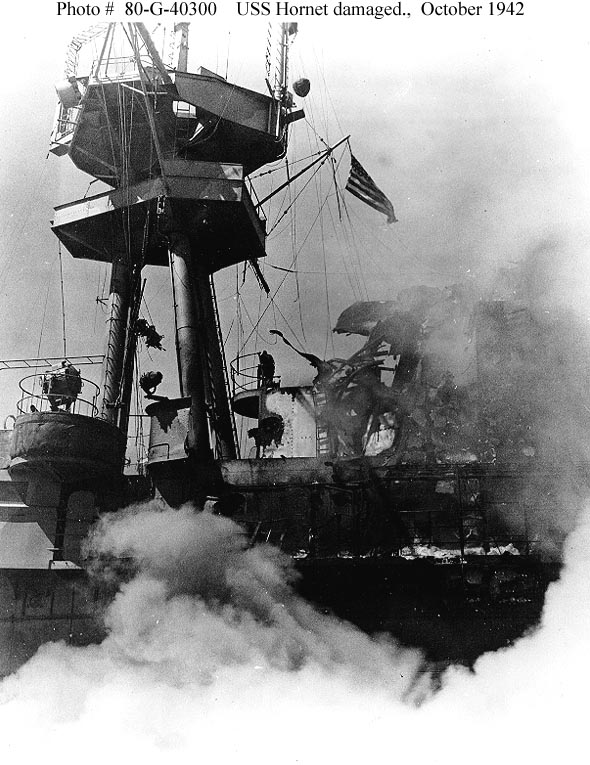
Hornet’s Damaged Island and Main Mast

Assisted by the heavy cruiser Northampton which took her in tow her crew brought the fires under control and were close to restoring power when another Japanese strike group found her and put another torpedo into her.  With this hit Hornet’s list increase and she was abandoned even as she was hit by another bomb.  With Japanese ships in the area it was decided to scuttle the ship. Escorting destroyers hit her with 9 torpedoes and over 400 rounds of 5” shells.  As Hornet blazed in the night her escorts withdrew and Japanese forces after attempting to take her under tow put four of their 24” “Long Lance” torpedoes into the doomed ship at long last sinking her.

Hornet Being Abandoned by Her Crew

In her last fight Hornet’s aircraft along with those of Enterprise mauled the air groups of Shokaku and Zuikaku again inflicting irreplaceable losses among their experienced air crews.  In the battle Hornet was hit by 4 bombs, two aircraft, 16 torpedoes and over 400 rounds of 5” shells, more hits than were sustained by any other US carrier in a single action during the war.  She was stuck from the Navy list on 13 January 1943 and her gallant Torpedo 8 was awarded the Navy Presidential Unit Citation “for extraordinary heroism and distinguished service beyond the call of duty” in the Battle of Midway.  Her name was given to the Essex Class carrier CV-12. The new Hornet served throughout the war and served well into the Cold War.  She now rests as a Museum ship at Alameda California.

The USS Hornet Association website is here:  http://www.usshornetassn.com/

The Museum site is here: http://www.uss-hornet.org/

If you liked this article you might want to also read the following articles on this site:

The Battleships of Pearl Harbor

The Transitional Carriers: USS Ranger CV-4 and USS Wasp CV-7

The First Aircraft Carriers Part One: The First American Flattops- Langley, Lexington and Saratoga

The Treaty Cruisers: A Warship Review

5 Comments

Filed under History, Military, Navy Ships, world war two in the pacific

The First Aircraft Carriers Part One: The First American Flattops- Langley, Lexington and Saratoga

saratoga aircraft approach for landingAircraft over Saratoga

Note: This is the first in a series on the early aircraft carriers.  Two others will follow on the British and Japanese carriers.  My dad was a Chief Petty Officer in Naval Aviation.  As such I grew up around Naval Air Stations, Squadrons and of course Aircraft Carriers.  My dad retired off of the USS Hancock CVA-19 in 1974.  I spent two weeks underway on USS Coral Sea CV-43 as a NJROTC Cadet in the summer of 1976.  It was an experience that I will never forget.  While on the Cruiser USS Hue City CG-66 we deployed with the USS John F Kennedy CV-67 for Operation Enduring Freedom.  There is something about the power and majesty of the modern carriers at the same time there is a sense of timelessness in the first aircraft carriers.  Three of the first four American ships were converted from other platforms.  As a kid, a young adult and even now I am fascinated by all things Navy, especially ships that made history.  Here is my look at the first American Aircraft Carriers.

The United States did not invent the aircraft carrier although Eugene Ely flew an aircraft onto and off of the Armored Cruiser USS Pennsylvania on January 18th 1911.  It was the British Royal Navy which first built and operated aircraft carriers beginning with the HMS Furious which had been converted from a light Battle Cruiser.  The Royal Navy would covert the sister ships of the Furious, the Glorious and Courageous as well as the auxiliary ship the Argus before building their first carrier that was designed from the keel up, the HMS Hermes.     With the British building carriers and the Japanese following suit the United States began a program of aircraft carrier production and operation unmatched in history.

uss langleyUSS Langley CV-1 The “Covered Wagon”

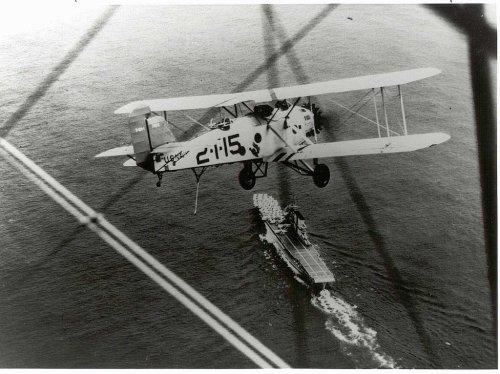
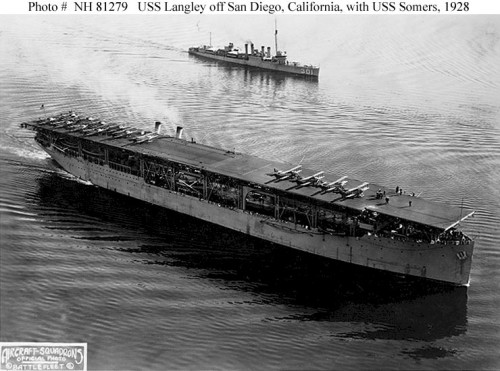
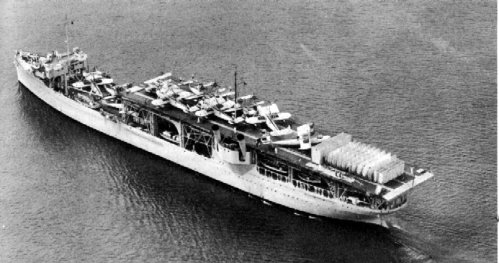
The first US carrier was the USS Langley, CV-1.  Langley was converted from the collier USS Jupiter beginning in July 1919.  She was commissioned as USS Langley CV-1 on 21 April 1920.  Displacing 15,150 tons fully loaded Langley embarked 34 aircraft and had a maximum speed of 15.5 knots.  Langley was primitive but groundbreaking.  She was the first carrier equipped with catapults and on 18 November 1922 achieved the first catapult takeoff by an aircraft.  She served as an invaluable training platform for Naval Aviators and helped provide the fleet with highly skilled flight crews that would operate from the USS Lexington and USS Saratoga.

langley as av-3Langley after conversion to AV-3

Nicknamed the “Covered Wagon” she served initially in the Atlantic until November of 1924 when she was transferred to the Pacific Battle Force.  She served as a carrier in the Pacific until 1936 when she was converted into a Seaplane Tender AV-3 and assigned to the Pacific in September 1939 based in Manila.  She was in the Philippines when the Japanese attacked and was sent south to Australia.  She was assigned to the ABDA forces defending the Netherlands East Indies and was sunk by her escorts after being bombed and disabled by Japanese aircraft while delivering fighter aircraft to Java with the loss of 16 sailors.

uss lexingtonUSS Lexington CV-2

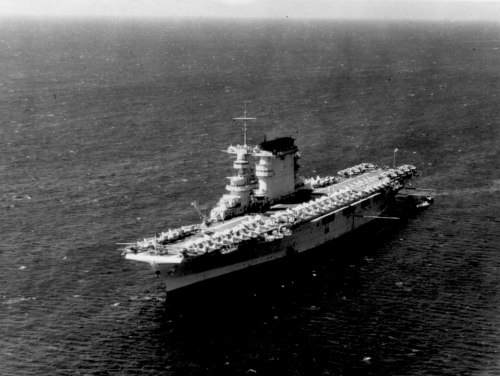
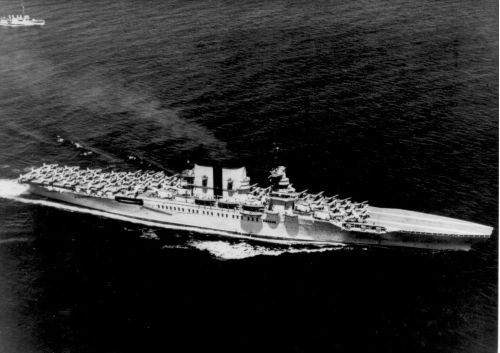
The second two American Aircraft Carriers were also conversions.  Unlike Langley the Lexington and Saratoga were converted from a new class of large and powerful battle cruisers whose construction had been canceled by the restrictions of the Washington Naval Treaty.  Commissioned on December 14th 1927 Lexington was 880 feet long and displaced 38,746 tons.  Saratoga was commissioned on November 16th of the same year and of similar dimensions and displacement.  Both of these ships could steam at 33.25+ knots and had a complement of 90 aircraft.  They were armed with eight 8” guns mounted in 4 turrets at the behest of more traditionally minded officers who felt that the armament might be needed for surface actions.

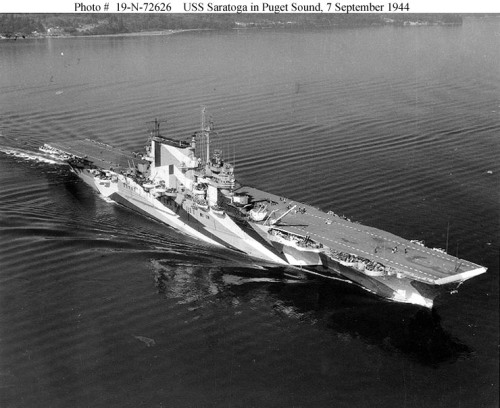
Saratoga underwayUSS Saratoga CV-3

They were the largest American carriers built until the Midway class appeared inin late 1945 and early 1946.  Of other nations pre-war carriers only the Japanese Navy’s Akagi and Kaga, converted from a battle cruiser and battle ship for the same reason as a the Lexington’s were comparable in size, air group capacity, protection and speed. Saratoga’s 8”battery would be replaced by twin 5” 38 caliber mounts in 1942.

lexington sinkingLexington Burning and Sinking

Both ships were used to help develop carrier doctrine and the concept of the carrier task force. Future leaders of Naval Aviation including Marc A. Mitscher trained aboard or flew from these ships.  Of particular note was that during Fleet Problem XIX in 1938 Saratoga launched a surprise air attack on Pearl Harbor from a point 100 miles off Oahu, setting a pattern that the Japanese copied in December 1941.

saratoga 1945Saratoga 1945

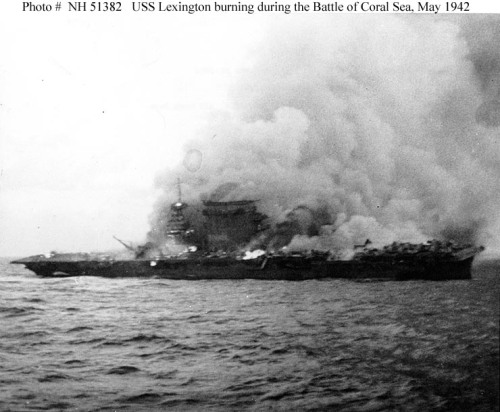
During World War II both helped hold the line after Pearl Harbor along with Enterprise, Yorktown and Hornet. Lexington was the flagship of TF-11 during as series of raids on Japanese outposts in the Solomons.  TF-11 joined Admiral Frank “Jack” Fletcher’s TF-17 at the Battle of Coral Sea, the first Naval Battle fought outside of eyesight of the respective forces. Lexington’s aircraft helped sink the Japanese light carrier Shoho on May 7th 1942 and heavily damage the fleet carrier Shokaku the following day. However aircraft from Shokaku and Zuikaku hit Lexington with two torpedoes and 3 bomb hits which her damage control parties seemed to have under control when vapors from ruptured aviation fuel lines were ignited resulting in a series of explosions which ignited uncontrollable fires. Her crew was evacuated by escorts and she was torpedoed by the destroyer USS Phelps.

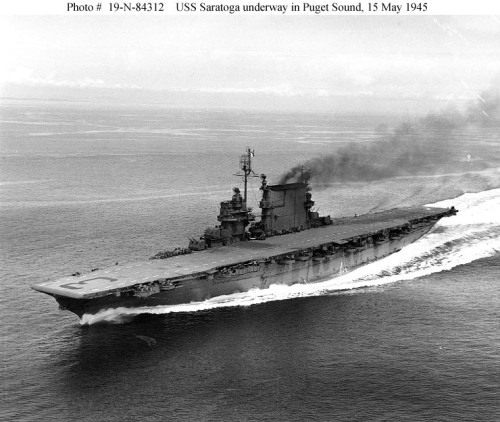
Saratoga served throughout the war. She engaged in patrols after Pearl Harbor and while enroute to joining Enterprise was hit by a torpedo from the Japanese submarine I-16. After repairs she was rushed to Hawaii to join the American Task Forces at Midway but arrived in Hawaii the day after the battle.  Following this Saratoga operated in the Central Pacific in the first offensive at Guadalcanal.  She participated in the landings as the flagship of Admiral Fletcher and then at the Battle of Eastern Solomons sank the Japanese light carrier Ryujo and damaged the seaplane carrier Chitose.  Following this battle she was hit by a torpedo from the I-26. After repairs she again went to the Solomons joined by the light carrier USS Princeton.  On November 5th the two carriers conducted a brilliant strike on Japanese ships and aircraft facilities at Rabaul which were threatening the landings at Bougainville.

saratoga 1944Saratoga September 1943

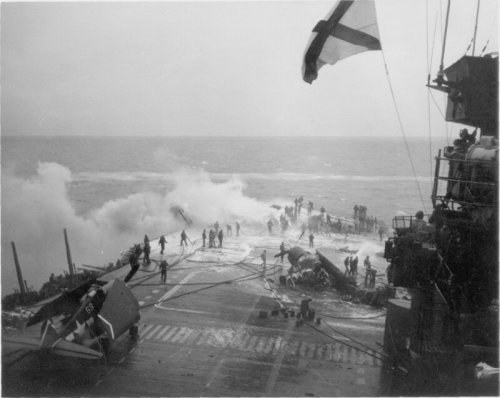
Following these operations Saratoga operated in the Gilberts and then with the British in the Indian Ocean.  She then was used as a training carrier for new pilots and aircrews at Pearl Harbor before being brought to Iwo Jima to operate night fighters against Kamikaze raids.  While conducting these operations she was attacked by Japanese aircraft in which 6 Japanese aircraft score 5 hits on her in 3 minutes.  Her forward flight deck was wrecked and she suffered great damage below decks and she lost 123 sailors.

saratoga kamikaze 2Saratoga burning after Kamikaze hits in 1945

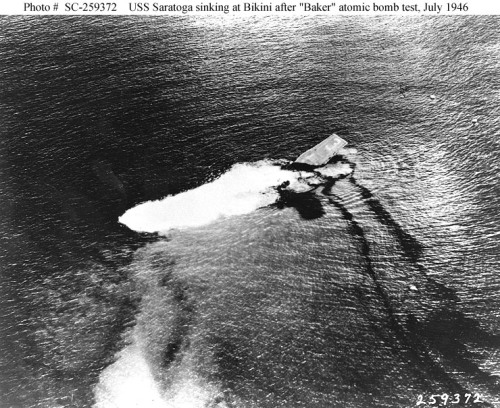
Following repairs she resumed training duties and after the defeat of Japan was involved in Operation Magic Carpet to bring Servicemen back from overseas.  Surplus to Navy needs at the end of the war Saratoga was sunk in Operation Crossroads at Bikini Atoll by an underwater atomic blast in the “Baker” bomb test a mere 500 yards from her position. She sank 7 hours later.

saratoga sinkingThe End of an Era- Saratoga goes down at Bikini

5 Comments

Filed under History, Navy Ships

Turning Points: The Battle of Midway, Randy Johnson Gets his 300th Win and Chief Branum Gets Her Star

Well, here I am finishing day four of a twelve day home stand at the Medical Center.  It has been pretty busy but hopefully in the end it will all be worth it as we care for patients, family and staff, train our Pastoral Care Residents and remember a dear Shipmate.  It is also a day that we remember the gallant few who won the Battle of Midway from 4-7 June 1942.

naval-battle-of-midwaySBD Dauntless Dive Bombers at Midway

Today, for those that are not that familiar with Naval history is the 67th anniversary of the Battle of Midway.  The battle was the point where the U.S. Navy in spite of extremely heavy odds defeated a Japanese fleet far greater than it.  Had the United States lost at Midway the Japanese would have has such an advantage that they could have dictated the terms of an armistice in the Pacific.

The battle was a near run thing for the U.S. Taking the chance that his intelligence service was correct in determining that Midway Island was the target of the anticipated Japanese attack.  Three US aircraft carriers, the Yorktown, Enterprise and Hornet supported by a handful of cruisers and destroyers faced the majority of the Japanese fleet.  Led by the First Carrier Strike Group composed of the carriers Akagi, Kaga, Hiryu and Soryu the Japanese expected to sweep the handful of American ships from the sea. After a strike against Midway Island and turning back abortive American attacks by land based aircraft and the Torpedo Bomber squadrons from the three American flattops it seemed that all was going the Japanese way.  The Americans had suffered heavy casualties.  Most of Midway’s land based fighters were shot down defending the Island.  Land based attack squadrons lost half of their number, and the three American Torpedo Bomber Squadrons from the Yorktown, Enterprise and Hornet were decimated.  Flying underpowered, under armed and under armored TBD Devastator’s they were overwhelmed by the Japanese combat air patrol Mitsubishi A6M2 (Type-21) “Zeros.”  Torpedo-8 from the Hornet lost all 15 aircraft with only one survivor, Ensign George Gay.  Torpedo-3 from Yorktown and Torpedo-6 from Enterprise lost most of their aircraft.  However the sacrifice of the Torpedo squadrons was not in vain.

The Japanese strike group under the command of Admiral Nagumo was confused by scouting reports about the status of American ships in the area.  The confusion led to disorder even as the Japanese were destroying the American Torpedo squadrons.   Finally the Japanese force was ready to start launch against the American task force.  Just as their carriers turned into the wind the American SBD Dauntless Dive Bombers, from the Enterprise and Yorktown Squadrons dove upon the Japanese carriers.  The Japanese combat air patrol was down low mopping up the remnants of the Torpedo squadrons. The Japanese carriers were at their most vulnerable point.  With fully armed and fueled aircraft on their deck and hanger bays and with hastily discarded bombs still on deck the Akagi, Kaga and Soryu received fatal blows.  Admiral Nagumo, stunned by the attack abandoned his dying flagship, the Akagi for the light cruiser Nagara.  Admiral Tamaguchi on Hiryu valiantly continued to fight.  He launched his “Val” Dive Bombers against the Americans.  They found the Yorktown.  Despite grievous losses they scored hits and thought that they had crippled the Yorktown.  The crew valiantly recovered, restored power and propulsion and was back in action.  The Japanese then sent out a squadron of “Kate” Torpedo Bombers in search of the Enterprise and Hornet.  Instead they found a seemingly undamaged Yorktown which they mistook for another ship.  Again despite heavy losses they scored hits and Yorktown was abandoned.  As this played out Diver Bombers from Hornet and Enterprise found Hiryu and hit her with six 500 pound bombs. Fatally hit Hiryu was abandoned.

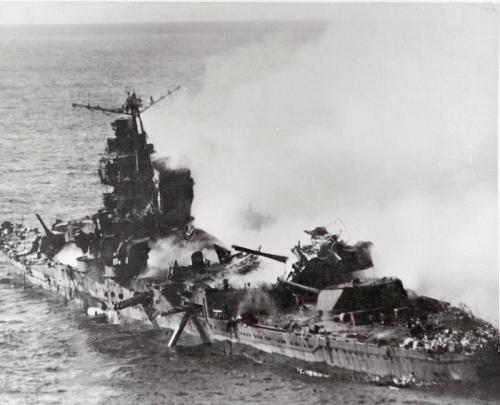
mikuma

Finally the day came to an end.  On the 6th the Japanese Cruiser Mikuma was sunk by American Dive Bombers and on the 7th the Yorktown which had been re-boarded and was being salvaged was sunk along with the Destroyer Hammann was sunk by the Japanese Submarine I-168 while being towed from the battle area.  In  all the Japanese lost 4 of their best carriers, all embarked aircraft and a Heavy Cruiser.  The loss, especially of trained pilots was devastating to the Japanese.  Within two months the Americans were beginning a counter offensive at Guadalcanal.  Midway was what historian Walter Lord called the “Incredible Victory,” and is known by some as the “Miracle at Midway.”  The Battle was a major turning point in the Pacific War.  Despite the losses the Japanese still held a major advantage over the Americans.  The Guadalcanal campaign would grind down Japanese forces.

Midway is important.  It showed what a smaller and less capable fleet could decisively defeat a larger and better trained and equipped force.  It was also the “high water mark” of the Japanese in the Pacific. Today and for the next three days it is important to remember the heroes of the Battle of Midway.

Giants Nationals BaseballRandy Johnson

Today also was the day that Randy Johnson, the “Big Unit” pitched his 300th Major League win, joining only 23 others who have achieved this milestone.  John scored most of his victories with the Mariners and Diamondbacks.   It was interesting for me as a Giants fan as he won his 300th with the Giants.

Finally, an addition to last night:  Chief Hospital Corpsman Pamela Branum who passed away on deployment will be posthumously promoted to Senior Chief Petty Officer having been selected for promotion by the latest board.  She had worked hard for this and deserved it.  Her promotion will be read at her Memorial Service on Tuesday June 9th at Naval Medical Center Portsmouth.  She will be buried with honors at Arlington National Cemetery at a later date.  Senior Chief Branum will be missed by all. I spend most of today with her co-workers and friends.  She was a special person.  I did not know her for long, but both really liked her and was honored to serve with her.  May God bless her and give her peace.

chief branumSenior Chief Hospital Corpsman Pamela Branum

Into your hands, O merciful Savior, we commend your servant Pamela Branum. Acknowledge, we humbly beseech you, a sheep of your own fold, a lamb of your own flock, a sinner of your own redeeming.  Receive her into the arms of your mercy, into the blessed rest of everlasting peace, and into the glorious company of the saints in light.  Amen.

Peace, Steve+

3 Comments

Filed under Baseball, Loose thoughts and musings, Military, Navy Ships