Tag Archives: donald trump supporters

To Stand Up Against Zealots


img_0178

Friends of Padre Steve’s World,

I am not a fan of ideologues or the “fundamentalists” of any point in the political, ideological or religious spectrum. Their lack of courage, stunted intellectualism, and inability to see things from outside their limited field of view does not allow them to face really difficult questions that confront us today.  They claim to hold the keys to the universe but sadly are hold nothing more than the key to their high school gym locker.

The Iranian novelist Salman Rushdie who has been on the run from Iranian fundamentalist ideologues since he wrote the supposedly heretical Satanic Verses once noted:

“The moment you say that any idea system is sacred, whether it’s a religious belief system or a secular ideology, the moment you declare a set of ideas to be immune from criticism, satire, derision, or contempt, freedom of thought becomes impossible.”

I believe that we are at yet another crossroads in Western civilization. This time a crossroads where the classic liberalism that was the basis for democratic societies is being stampeded by zealots of various persuasions who guided by the supposed infallibility of their ideological belief systems, deliberately and without remorse seek to destroy the institutions that are the guardians of liberty.

In my honest opinion I think that the worst of these are the conservative Christian theocrats and their seemingly ideological enemies the Ayn Rand following Social Darwinist “conservative libertarians.” They have no shame, their respective ideologies blind them to truth and turn them into sociopaths that only give a damn about their power and profits and they latched on to President Trump, prostrating themselves and the Republican Party to him in order that they might triumph.

Of course I will be the first to admit that there are some leftists who would be the first to put a bullet in the head of Lady Liberty to further their own cause.  But they are not the danger. They control nothing that would allow them to succeed and most cannot even agree among themselves to work together, they have nothing on Lenin, Stalin, Mao, the Iranian Mullahs, or even Hugo Chavez; may God give rest to his chubby cheeks.

Say what you want about him but President Trump is not an ideologue, he can’t be, he’s too much of a self-absorbed narcissist to be an ideologue. All he wants is the adulation of his audience and the power and wealth that come with it. He may be a sociopath but it is not for the sake of any ideology. If the issue was the President alone we could survive him; but his supporters of the Christian Right and the Ayn Rand Social Darwinists of the GOP are much more dangerous, because they are true believers who actually control many of the apparatuses of government at the local, state, and federal level.

We have seen the results of such movements in history before and each time they succeed in gaining power they have brought disaster to nations, and sometimes the world.

Proponents of ideological purity assume that their ideological bias is equivalent to sacred truth, be it a religious or secular truth. The promoters of such systems promote something more than their opinion, as Hannah Arendt noted: “For an ideology differs from a simple opinion in that it claims to possess either the key to history, or the solution for all the “riddles of the universe,” or the intimate knowledge of the hidden universal laws which are supposed to rule nature and man.”  

As such, ideology is not based on knowledge, but is distinct from it and the enemy of knowledge for it binds the mind in a straitjacket in which all thought must be submitted to the truth of the ideology. As Arendt noted such ideologies must be handled with caution as they “pretend to be keys to history but are actually nothing but desperate efforts to escape responsibility.”  

An ideology protects the true believer from having to think for himself, it allows the insecure to grasp at the protection that it allegedly provides, and allows the believer to deny reality, and to by definition declare everything that contradicts the ideology to be heretical, and opponents to be aligned with the devil himself, allowing the believer to hate the opponent. As Eric Hoffer noted, “Hatred is the most accessible and comprehensive of all the unifying agents. Mass movements can rise and spread without belief in a god, but never without a belief in a devil.” 

As I have mentioned the past couple of days my favorite television character, Raymond Reddington, played by James Spader in The Blacklist once said “I know so many zealots, men and women, who chose a side, an ideology by which to interpret the world. But, to get up every single day and to do the hard work of deciding what to believe. What’s right, today? When to stand up or stand down. That’s courage.” The fact is, no matter how stridently they espouse their beliefs, ideologues are by definition not courageous, because courage takes critical thinking, something that ideologues of any persuasion are incapable of doing.

That is why knowledge and critical thought even when they are uncomfortable and take us out of our comfort zone are so much more powerful and important than ideologies that are followed blindly. My words to the ideologues of the Christian Right and the Ayn Rand followers of so many in the Republican Party is that of Samuel Adams who said:

“If ye love wealth better than liberty, the tranquility of servitude better than the animating contest of freedom, go home from us in peace. We ask not your counsels or arms. Crouch down and lick the hands which feed you. May your chains set lightly upon you, and may posterity forget that ye were our countrymen.” 

It takes no courage to be an ideologue, and once a person surrenders to an ideology as his or her reason for existence, they sacrifice the ability to reason, the ability to think critically, and the capacity to acquire knowledge and in doing so they surrender to tyranny and servitude though they think they will end up on top.

That is the danger of the blind ideologies that are consuming our world today and why as long as anyone who cares about freedom has a breath in them they must be opposed.

Until tomorrow,

Peace

Padre Steve+

2 Comments

Filed under civil rights, ethics, faith, History, News and current events, Political Commentary

“In the Kingdom of the Blind, the One Eyed Man is the King” Musings of a Flawed Man


img_0230-1

Friends of Padre Steve’s World,

Over the past year or so this site has picked up a good number of new subscribers and sadly most of us will never get a chance to sit back and enjoy good intellectual conversation over a good craft or German beer or a nice bottle of wine. So if you would sit back and over whatever your favorite beverage may be take the time to let me wax eloquently about how the writer that you follow here got to be what he is.

I think my favorite character on television is Raymond “Red” Reddington, played by James Spader on the shoe The Blacklist. He is a very complex and troubling character, and the thing is I can understand him. His is a world of gray where he sometimes does the right thing for wrong reasons as well as the wrong thing for right reasons. His loyalties are personal and not ideological, he is a man of contradictions, as am I. Raymond Reddington one said, “Cultural peculiarities notwithstanding, I find cock fighting to be abominable. However, truth be told, I do love fried chicken.” I totally agree with that, sorry Vegan friends.

My regular readers know that I am a complex person as well. I am a Christian, a priest at that, who often doubts. I am also a career military officer who has been to war, come back from war different and hates it. But I also realize that as much of an evil as war is, that there are sometimes worse evils than war itself.  That being said I find the thought of someone, perhaps like President Trump launching the world into a nuclear war with North Korea to be opposed at all costs by anyone with at least half of a functioning brain. My loyalty to the Constitution and the American people far outweigh any need that I might have to ingratiate myself to any would be tyrant.

Likewise I am very liberal and progressive in my political and social beliefs, but I serve in a profoundly conservative institution that is not always welcoming to my beliefs. I wasn’t always this way but it was my experience in Iraq that turned the tide and turned me into a progressive. Usually people get more conservative as they get older, that’s not me. I got liberal, started caring about civil rights for everyone, the growing economic inequity between the richest and everyone else, and rejected the theocratic leanings of some leaders of my former church. At a point in my life where I should by all means have become even more conservative based on my social status, education, and income, I went the opposite direction. I am not alone, I read an article that Tom Ricks wrote in 2014 in which he said very similar things to me. I personally know others who have made the same journey.

But that being said, even though I am a liberal and progressive at heart, my education as a historian and my life experience mitigates against me becoming an ideologue or zealot, and I am certainly not a revolutionary. Thus unlike zealots who I might agree with I tend take the time to wrestle with the issue and not react out of emotion or illogic. Even if I agree with someone I hate it when they through emotion or illogic make stupid arguments that are all to easy to dissect or discredit; not because they are wrong on the issue but because they don’t argue their point well. Let me explain.

I tend to be able to see and appreciate arguments of multiple points of view on almost every issue, and I wrestle with them, doing the best I can to do the right thing. Whether it is for the right reason or not, I don’t pretend to know because I make no pretense of being a saint. Maybe that is one reason I have friends on all sides of the political, religious, and ideological debates that rage about this country and in the world. I live in a world of shades of gray.

I love trying to understand all sides of a position which of course makes me a terrible ideologue, and even worse I love the thrill when I embarrass an ideologue of any kind using reason, logic, and throwing in the appropriate emotional twist to make it sweet. I discovered this as a short, introverted, history nerd in high school and college. I found that in debate classes I could take the opposite side of what I really believed and shred the person advocating for the exact position that I really believed due to my then rather fundamentalist Christian worldview; like my support of pro-life position of being against abortion and for the death penalty at the same time. It was in arguing the opposite side that I discovered how intellectually incoherent those positions were. When I got to seminary after my first active duty tour in the Army I continued my antics in arguing against positions that I actually at the time believed in, with similar results. In fact a number of my fellow students asked me why I wasn’t in law school and it wasn’t a compliment; nonetheless I relished it.

But as always I digress…

In the last episode of season three of The Blacklist, Reddington tells an assistant FBI director who he has been helping solve crimes, “I know so many zealots, men and women, who choose a side, an ideology by which to interpret the world. But, to get up every single day and do the hard work of deciding what to believe. What’s right, today? When to stand up or stand down. That’s courage.” From my experience I believe that to be the truth, and truthfully, I would rather deal with people that wrestle with this difficult world than rather than those whose beliefs are shaped by their ideology first, regardless of facts, divergence of opinions, history, science, reality, and experience.

But what bothers me in what I see going on in this country and around the world is that mass movements of ideologues and zealots of every persuasion, political and religious, those that have seized or are trying to seize power in many nations, and foment revolution. Captivated by ideological purity, they are unwilling to compromise and frequently label anyone that disagrees with them or the leader of their movement, even in the slightest manner as traitors or evil. Many times the zealots take no time to evaluate the quality of the merits of their movement or those that oppose them, their cause is right, their opponents are evil and need to be destroyed. I think the most distressing case is where the Nazis and German Communists worked together to destroy the Weimar Republic in the late 1920s and early 1930s.

Eric Hoffer wrote,  “The quality of ideas seems to play a minor role in mass movement leadership. What counts is the arrogant gesture, the complete disregard of the opinion of others, the singlehanded defiance of the world.” Likewise, Hoffer noted something that I observe almost every day, that the zealots and ideologues of mass movements use anger and hatred to unify their followers. Hoffer noted, “Hatred is the most accessible and comprehensive of all the unifying agents. Mass movements can rise and spread without belief in a god, but never without a belief in a devil.” Believe, me, ask any ideologue of any type, and he or she will tell you who their devil is. But sadly history demonstrates that a mass movements of any type, political, ideological, or religious has achieved power, all opponents, especially those closest to them ideologically or religiously are the enemy, or to use Hoffer’s words “a devil.” The opponents closest to the ideologues ideology have to be destroyed or discredited first, before they can move on to battle their real opposites. Just look at history.

The ideologue cannot lose because he already knows his answer, the classic fundamentalist Christian quote, God said it, I believe it, that settles it”  is very much descriptive of other ideologically driven mass movements be they conservative or liberal. The ideologue’s attitudes are derived from their ideology and are often not subject to facts. I see it every day, especially on social media where partisans of evil persuasion fire broadside after broadside at all opponents, regardless of the facts, or even the fact that there may be more than one equally valid viewpoint on a subject. But then I tend to see everything in various shades of gray and not in black and white absolutes, and ideologues of all types frighten me, even those whose unbending beliefs are sugarcoated with millennial or utopian sentiments of the perfect world that will follow their victory. I know from history that such is not the case, in far too many instances first thing that radical, or self-proclaimed revolutionaries do after achieving absolute power is to kill.

Now as far as the President is concerned he is not a populist, nor an ideologue, and certainly not a revolutionary in the traditional understanding of the term.  The only thing that he believes in is himself; he is certainly a narcissist and he demonstrates daily that he is a paranoid sociopath. His bottom line is himself, everything and everyone else is fungible. He is intellectually lazy and the only time he tells the truth is when he inadvertently reveals who he really is in his Twitter meltdowns.

His most prominent supporters tend to be people who know the truth about the man but through a combination of a lust for temporal power, his conservative Christian base; or greed, the Ayn Rand type libertarian-conservatives whose social-Darwinian greed makes them use him to enrich themselves. The former believe that Trump will help them usher in a theocracy; the latter believe that he will give the government over to them in order to help their profit margin. None of them have any principles and are committed to their respective ideologies as contradictory as they may be. None of them have any courage, and none of them will ever stand for anything.

Maybe that is why I like Raymond Reddington. He’s flawed and so am I. He does bad things. He is a manipulator; but he recognizes his moral and ethical shortcomings and wrestles with his  own shortcomings. He is not always successful but he does make the attempt. I look at his character and I realize that in a different world or maybe an alternate universe I could be him.

All that being said, I really do think that real courage is to wrestle with reality every day and do the hard work of deciding what to believe; and today that may be different then tomorrow, but it will be based on reality and tempered by my often contradictory beliefs. Of course a true political ideologue or religious fundamentalist will condemn me to their version of hell for being that honest, but it is true. That is my uncomfortable reality, it may not be right, and my vision may be skewed and distorted, but it is what it is; and as Reddington said, “In the kingdom of the blind, the one-eyed man is king.”

As for you my readers I do thank you and hope that one day we may sit back and enjoy a drink together, possibly even toasting the “Immortal Lord Nelson.” But until that time thank you for taking time out of your day to read what I write and for your comments.

So until tomorrow,

Peace

Padre Steve+

1 Comment

Filed under ethics, faith, leadership, News and current events, Political Commentary, pro-life anti-abortion

The President’s Pathological Need for Revenge: A Disease that is Eating His Mind and Poisoning His Soul

180103-donald-trump-se-253p_1e0ab4bbfc2b637051d31d044ad52abf.nbcnews-ux-2880-1000

Friends of Padre Steve’s World,

One of my favorite television characters is that of Raymond Reddington played by James Spader in The Blacklist. In the episode Monarch Douglas Bank Reddington tells Milos “Berlin” Kirchoff played by Peter Stormare: “Revenge isn’t a passion. It’s a disease. It eats at your mind and poisons your soul.”

7852066-12185069

That brings me to my subject today and in all honesty this has been a hard article to write and you’ll see why as I develop it.

As I watched and read in silent horror the extended Twitter and subsequent television meltdown of President Trump on Saturday following the release of Michael Wolff’s book Fire and Fury I realized that Reddington’s comment perfectly describes the President, his need for revenge is a disease and it has destroyed his soul. That is frightening because by virtue of his position the President has the power to lead the country and world to oblivion, and he may well do it.

The President’s response included  threatening the publisher with legal action, lashing out at the media, his former adviser, Steven Bannon, as well as other opponents; even as he bragged about how smart he was and stated his desire to see restrictions on the First Amendment protections of freedom of speech and the press. This was on the heels of his careless talk about nuclear war and renewed threats against the Clinton’s and the decision of the FBI to reopen investigations of the Clinton Foundation, which the President had publicly demanded that the Justice Department do for months.

I do not know if this is simply his grossly deformed personality with its unbounded  narcissism and sociopathic lack of empathy in overdrive. Others, including psychiatrists of some note have suggested that the President might be suffering some kind of mental illness, he certainly demonstrates notable paranoia, whether that and others the possibility that he may suffering from a neurological condition such as Alzheimer’s disease or some other form of dementia.

But I am concerned because what is going on with this President is not normal, but of all because of his longstanding testimony of how revenge is a key part of how he views the world. His is an adversarial world where there are no real friends, only opponents, enemies, and those who might someday be enemies. This has been shown in his business life, his relationship with the media, political parties, and since his election how he is undoing and remaking seventy years of American leadership in the world.

Trump on many occasions has given interviewers a perspective on how he deals with those who are not absolutely and unconditionally loyal to him. In his book Think Big the future President wrote:

“When people wrong you, go after those people, because it is a good feeling and because other people will see you doing it. I always get even.”

Since coming to office the President has derided, insulted, and even threatened everyone from ordinary citizens, including Gold Star families; journalists, political opponents, former employees and members of his own White House team, and world leaders. His insecurity and inability to withstand criticism or admit error are pathological and are consuming him before our eyes. Sadly, most congressional Republicans and many prominent pastors and clergy don’t don’t seem to see how troubling it is, in fact many of his defenders say nothing so long as their agenda is fulfilled.

I think the support of prominent Christian clergy is the most troubling aspect of this whole sordid Presidency, because they both debase and contradict the Gospel that they claim to preach. I quoted Trump’s most vocal supporter among Evangelicals, Pastor Robert Jeffress last night in terms of this contradiction and it is worth saying again. Jeffress said:

“You know, I was debating an evangelical professor on NPR, and this professor said, ‘Pastor, don’t you want a candidate who embodies the teaching of Jesus and would govern this country according to the principles found in the Sermon on the Mount?’” Jeffress said. “I said, ‘Heck no.’ I would run from that candidate as far as possible, because the Sermon on the Mount was not given as a governing principle for this nation.”

For a Pastor, who like many other Trump supporters claims to want the nation to be governed by Biblical Law above that of the Constitution the blatant disregard of Jesus’s Sermon on the Mount is astounding. In many of his statements Jeffress is totally committed to bowing the knee to Caesar so long as it is a Caesar he approves; as well as giving in advance to that Caesar support to start a preemptive nuclear war with North Korea; drive out immigrants regardless of their status; deny Constitutionally protected free speech; and suggest denying rights to those who are not Evangelical Christians.

He stands in opposition not only to Scripture itself, but his own Baptist tradition and men like the Virginia Baptist john Leland who I have often written about on this site.  It seems to me that Jeffress, like Trump is totally committed to an ethic of revenge even though he does not outrightly say it.

In opposition to Jeffress I would quote Dietrich Bonhoeffer who stood against the Nazi German versions of Jeffress when it comes to how Christians should respond, and it is not revenge:

“The will of God, to which the law gives expression, is that men should defeat their enemies by loving them.”

As for the President I find the vast majority of his policies abhorrent from the perspective of the Gospel, as well as the Constitution, and simple human rights. I cannot support those programs, policies, nor his behavior which threatens civil liberties and increase the possibility of world war, with the likelihood that the responsibility for that war would make him and the United States a rogue and criminal nation.

I wish no physical harm upon the President or his family though I do believe that his actions need to be scrutinized and investigated with the full force of the law. Even so as much as I dislike the man and oppose his policies he is still in need of the love of God as well as mine, and I do struggle with this. It is not easy to have any kind of compassion for a man who is consumed with hatred, and absent of empathy which is nothing but evil. It is probable that any real love for the President will be met with rejection, but the command of Christ is to love others seeking nothing in return, that is part of the paradox and tension that I am living in today. He may be mentally ill or have a neurological disease, or he may just be evil. I find nothing to love, respect, or admire in the man: but if I and others like me don’t follow the command of Jesus, is there any hope? Of course that is a rhetorical question, we will all answer it differently.

Bonhoeffer wrote:

“Love asks nothing in return, but seeks those who need it. And who needs our love more than those who are consumed with hatred and are utterly devoid of love.”

Even so all of this being said, I fear for the worst  for the country and the world as long as President Trump remains in office and men like Robert Jeffress continue to support him and in the end I probably have more compassion for Trump than Jeffress because Jeffress who has preached hate in the name of Jesus for decades should know better. I don’t think that Trump does.

So until the next time,

Peace

Padre Steve+

2 Comments

Filed under christian life, ethics, faith, History, nazi germany, News and current events, Political Commentary

The Cost of Crawling into Bed with Caesar: Base Meanness, a Pliant Church, and Trump

        Bonhoeffer in Prison

Friends of Padre Steve’s World,

The leader of the Protestant Reformation, Martin Luther noted: “When the Church crawls in to bed with Caesar, Caesar hogs the covers and leaves the Church exposed and naked”

Is that not exactly what is happening today?

The writings of some authors are timeless. This year I have taken to reading a collection of the writings of the German pastor, theologian, and martyr Dietrich Bonhoeffer as my spiritual reading on a daily basis for this year. I’m also doing 365 days of Martin Luther in German as part of my spiritual journey for the year.

Luther is interesting, but Bonhoeffer I think is more relevant to our time. In his book Ethics which was written during the reign of the Hitler regime Bonhoeffer wrote something that strike to the heart of our present crisis in the United States and even more particularly that of the conservative Christian Church and its relationship to President Trump:

“The message of God’s becoming human attacks the heart of an era when contempt for humanity or idolization of humanity is the height of all wisdom, among bad people as well as good. The weaknesses of human nature appear more clearly in a storm than in the quiet flow of calmer times. Among the overwhelming majority of people, anxiety, greed, lack of independence, and brutality show themselves to be the mainspring of behavior in the face of unsuspected chance and threats. At such a time the tyrannical despiser of humanity (in the case of Bonhoeffer, Adolf Hitler) easily makes use of the meanness of the human heart by nourishing it and giving it other names. Anxiety is called responsibility; greed is called industriousness; lack of independence becomes solidarity; brutality becomes masterfulness. By this ingratiating treatment of human weaknesses, what is base and mean is generated and increased ever anew. The basest contempt for humanity carries on its sinister business under the most holy assertions of love for humanity. The meaner the business becomes, the more willing and pliant a tool it is in the hands of a tyrant. The small number of upright people will be smeared with mud. Courage is called revolt, their discipline Pharisaism, their independence arbitrariness, and their masterfulness arrogance.” 

We have seen this in our own day among President Trump, his supporters in Congress and the media, and especially among conservative Christians. The worst aspects of human nature have been elevated to virtues over the past two decades and like Germany in 1933 there was someone waiting in the wings to exploit it and make it his own.


I’ll leave you to mull that over and I will continue to post these theological and ethical criticisms of the church and of the President, and yes I will keep making the connections with the Nazi state and other authoritarian regimes as I do so. But for me this is a matter of faith, and for me that means confronting and battling the Christians who have gotten in bed with the Trump regime; in the long term they are at least as dangerous, perhaps more than the President for they serve as his enablers; as Bonhoeffer noted:

“If I sit next to a madman as he drives a car into a group of innocent bystanders, I can’t, as a Christian, simply wait for the catastrophe, then comfort the wounded and bury the dead. I must try to wrestle the steering wheel out of the hands of the driver.”

Until the next time,

Peace

Padre Steve

1 Comment

Filed under civil rights, faith, History, leadership, nazi germany, News and current events, Political Commentary

Life in the Past, Present, and Future: A Reflection on Life and Faith in the Age of Trump

Matt-Frewer-as-Berlingoff-Rasmussen-TNG-A-Matter-of-Time-7

Friends at Padre Steve’s World,

I tend to become somewhat reflective as the New Year approaches. I am reminded of Peter Benchley, who wrote, “The past always seems better when you look back on it than it did at the time. And the present never looks as good as it will in the future.” Likewise, St Augustine of Hippo once asked “How can the past and future be, when the past no longer is, and the future is not yet?”

Augustine’s question is interesting, but I think that his question is flawed. I think that the past lives in the present much more than we would like to think and that our future, though unwritten can unfold in a multitude of ways and possibilities. We have seen that over the past two years with the campaign and presidency of Donald Trump and how the illusion of a mythical past has driven many ordinary people to support a man who despises them, all because he appeals to certain parts of a shared mythology about the past which sadly is often too racist to imagine. As the conservative writer and historian Max Boot noted today:

“The larger problem of racism in our society was made evident in Donald Trump’s election, despite — or because of — his willingness to dog-whistle toward white nationalists with his pervasive bashing of Mexicans, Muslims, and other minorities. Trump even tried to delegitimize the first African-American president by claiming he wasn’t born in this country, and now he goes after African-American football players who kneel during the playing of the anthem to protest police brutality. (Far from being concerned about police misconduct, which disproportionately targets people of color, Trump actively encourages it.)”

But politics aside, many of us live in the past as if it were today. We, individually and collectively, as individuals and nations live in the past and look to it much more fondly than when it was our present. I think that historian Will Durant possibly said it the best: “The past is not dead. Indeed, it is often not even past.”

As a historian myself I value the past and seek answers and wisdom from it to use in the present because what we do in the present does, for better or worse defines our future. Confucius said “study the past if you would define the future.” He was quite wise, he said to study the past did not say to live in it.

That is something that I have been learning for close to 25 years now when my Clinical Pastoral Education Supervisor, using a Star Trek Next Generation metaphor from the episode A Matter of Time helped me to begin to recognize just how much the past impinged on my own life. In that episode a shadowy visitor claiming to be from the future refuses to help the Captain and crew of the Enterprise, claiming that if he were to help that his “history – would unfold in a way other than it already has.”

Finally Captain Picard is forced to make a decision and confronts the visitor, who turns out to be, not a historian from the future but a con-artist and thief from the past who was using time travel with a stolen space ship to collect technology to enrich himself. Picard refused the mans help and told him:

“A person’s life, their future, hinges on each of a thousand choices. Living is making choices! Now, you ask me to believe that if I make a choice other than the one that appears in your history books, then your past will be irrevocably altered. Well… you know, Professor, perhaps I don’t give a damn about your past, because your past is my future, and as far as I’m concerned, it hasn’t been written yet!”

My residency supervisor suggested to me that my future did not have to be my past, and in doing so opened a door of life and faith that I had never experienced before and which showed me that life was to be boldly lived in the present. While it meant a lot then, it means more now for the past according to William Shakespeare “is prologue.”

We cannot help being influenced by the past. I admit that I am. That being said we should indeed learn from from our past but we cannot remain in the past or try to return to it. Kierkegaard said that “Life can only be understood backwards; but it must be lived forwards.”

Since I am a Christian, at least by profession, my faith in that future is in the God who is eternal, the God of love. Victor Hugo in Les Miserables said “Love is the only future God offers.” That is the future that I want to envision.

Living is making choices and the future hinges on thousands of them. Many of these choices we make automatically without thought simply because we have always done them that way, or because that is how it was done in the past. However, if we want to break the cycle, if we want to live in and envision that future of the God of love then we have to live in the present though the past lives in us.

T.S. Elliot penned this verse:

“For last year’s words belong to last year’s language
And next year’s words await another voice.
And to make an end is to make a beginning.”

Peace

Padre Steve+

1 Comment

Filed under faith, History, News and current events, Political Commentary, star trek

Christmas Eve 2017: Light, Life, and Love in Hell, Kurt Reuber and the Madonna of Stalingrad

Bundeswehr zeigt "Stalingrad"-Ausstellung

Friends of Padre Steve’s World,

It is late on Christmas Eve and I am reflecting about the true meaning of Christmas in a world where hope seems to be dying before our eyes. This morning I preached in my Chapel from the Christmas story in the Gospel of St. Luke, the same passage I preached on a week or so ago with the German NATO contingent. The story of the incarnation, of God coming in the weakness of a tiny baby who would grow up and be crucified not far from where he was born is of profound importance for my faith, because it is not a pie in the sky promise of prosperity and power, but God who can be present in midst of the human made hell of war.

In such an environment I reflect on men who lived in a human made hell, a hell made by hate filled ideologues who launched the world into its bloodiest war, and I wonder, could it happen again? A decade ago I would have said it never could again happen. In December of 2016 after the election of Donald Trump I began to hedge my bets, but a year later I do believe that it can, and very well may happen again. So in such a world I must try to find hope wherever I can find it, especially as I seen the pattern of a descent into authoritarianism which has been so much a part of 20th Century European history developing in the United States. I worry about that because I can see nothing good coming of it, and notice friends, including Christian clergy openly advocating against the safeguards, the checks and balances put forth in our Constitution and laws to ensure that the President has unchecked power; and that means the power to plunge the nation into war.

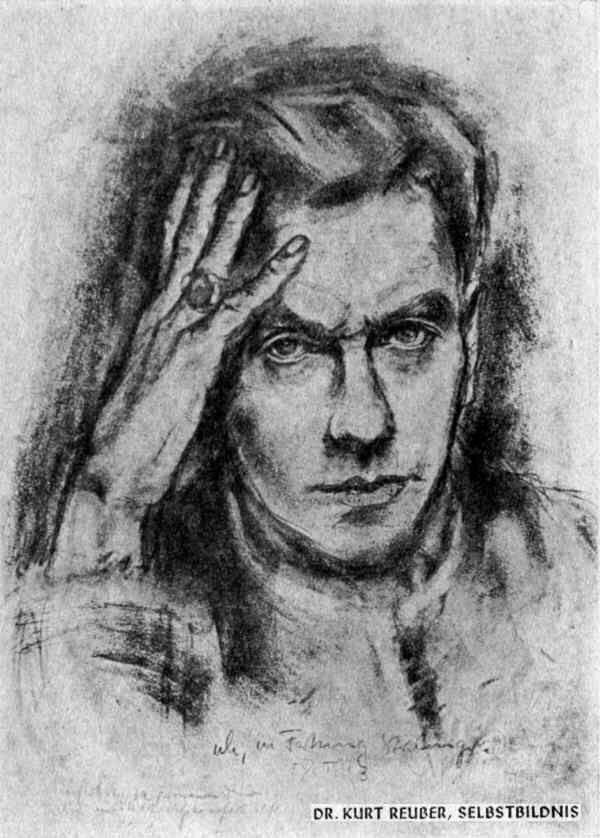
I think most of my readers know that I am a career military officer and have served in peace and war as a chaplain. That service includes a tour in Iraq, a war, which by almost any standard would have been considered unjust and illegal, yet I served there, and came back a changed man. As such the stories of those who served in war, especially those who serve in hopeless battles, and even in evil causes during Christmas have a special place in my heart. One of those men was a German pastor and medical doctor named Kurt Reuber.

k_reuberl

As I said, Reuber was a theologian, pastor and medical doctor, likewise he was an accomplished artist and used that medium to convey his own faith, and doubts. He was a friend of Albert Schweitzer and in 1939 he was conscripted to serve as a physician in the Germany Army. By November 1942 he was a seasoned military physician serving with the 16th Panzer Division, part of the German 6th Army, which had been fighting in the hell of Stalingrad. When his division along with most of 6th Army was surrounded by the Soviets, cut off from most supply and without real hope of relief, he like other physicians continued to serve the soldiers committed to his care.

pg-34-stalingrad-2-getty

However, unlike most physicians, the care Reuber offered care included spiritual matters, as he sought to help his soldiers deal with the hopelessness of their situation. As Reuber reflected on the desperation of the German soldiers in the Stalingrad pocket. He wrote to his family.

“I wondered for a long while what I should paint, and in the end I decided on a Madonna, or mother and child. I have turned my hole in the frozen mud into a studio. The space is too small for me to be able to see the picture properly, so I climb on to a stool and look down at it from above, to get the perspective right. Everything is repeatedly knocked over, and my pencils vanish into the mud. There is nothing to lean my big picture of the Madonna against, except a sloping, home-made table past which I can just manage to squeeze. There are no proper materials and I have used a Russian map for paper. But I wish I could tell you how absorbed I have been painting my Madonna, and how much it means to me.”

“The picture looks like this: the mother’s head and the child’s lean toward each other, and a large cloak enfolds them both. It is intended to symbolize ‘security’ and ‘mother love.’ I remembered the words of St. John: light, life, and love. What more can I add? I wanted to suggest these three things in the homely and common vision of a mother with her child and the security that they represent.”

The picture was drawn on the back of a captured Soviet map and when he finished it he displayed it in his bunker, which became something of a shrine. Reuber wrote:

“When according to ancient custom I opened the Christmas door, the slatted door of our bunker, and the comrades went in, they stood as if entranced, devout and too moved to speak in front of the picture on the clay wall…The entire celebration took place under the influence of the picture, and they thoughtfully read the words: light, life, love…Whether commander or simple soldier, the Madonna was always an object of outward and inward contemplation.”

drkrop

As the brutal siege continued men came to the bunker for both medical care and spiritual solace.  On Christmas Eve Reuber found himself treating a number of men wounded by bombs outside the bunker. Another soldier lay dying, just minutes before the soldier had been in the bunker singing the Christmas hymn O Du Froehliche.  Reuber wrote:

“I spent Christmas evening with the other doctors and the sick. The Commanding Officer had presented the letter with his last bottle of Champagne. We raised our mugs and drank to those we love, but before we had had a chance to taste the wine we had to throw ourselves flat on the ground as a stick of bombs fell outside. I seized my doctor’s bag and ran to the scene of the explosions, where there were dead and wounded. My shelter with its lovely Christmas decorations became a dressing station. One of the dying men had been hit in the head and there was nothing more I could do for him. He had been with us at our celebration, and had only that moment left to go on duty, but before he went he had said: ‘I’ll finish the carol with first. O du Frohliche!” A few moments later he was dead. There was plenty of hard and sad work to do in our Christmas shelter. It is late now, but it is Christmas night still. And so much sadness everywhere.”

On January 9th 1943 with all hope of escape or reinforcement gone Reuber gave the picture to the battalion commander as the officer was too ill to carry on and was one of the last soldiers to be evacuated from the pocket. Reuber’s commander carried the Madonna out of the pocket and returned it delivered it to Reuber’s family, preserving it for all.

Reuber was taken prisoner and survived the harrowing winter march to the Yelabuga prison camp. In late 1943 Reuber wrote his Christmas Letter to a German Wife and Mother – Advent 1943. It was a spiritual reflection but also a reflection on the hope for life after the war, when the Nazi regime would be defeated, and Germany given a new birth.

Reuber wrote:

“The concatenation of guilt and fate has opened our eyes wide to the guilt. You know, perhaps we will be grateful at the end of our present difficult path yet once again that we will be granted true salvation and liberation of the individual and the nation by apparent disappointment of our “anticipation of Advent”, by all of the suffering of last year’s as well as this year’s Christmas. According to ancient tradition, the Advent season is simultaneously the season of self-reflection. So at the very end, facing ruin, in death’s grip – what a revaluation of values has taken place in us! We thus want to use this period of waiting as inner preparation for a meaningful new existence and enterprise in our family, in our vocation, in the nation. The Christmas light of joy is already shining in the midst of our Advent path of death as a celebration of the birth of a new age in which – as hard as it may also be – we want to prove ourselves worthy of the newly given life.”  (Erich Wiegand in Kurt Reuber, Pastor, Physician, Painter, Evangelischer Medienverb. Kassel 2004. )

prisoner's madonna

Reuber did not live to see that day. He died of Typhus on January 20th 1944, not long after writing this and just a few weeks after painting another portrait of the Madonna, this one entitled The Prisoner’s Madonna. He was not alone, of the approximately 95,000 German POWs taken at Stalingrad only about 6,000 returned home.

His paintings survived the war and his family gave The Madonna of Stalingrad to the Kaiser Wilhelm Memorial Church in Berlin after it was restored as a symbol of hope and reconciliation. Copies are also displayed in Coventry Cathedral and the Russian Orthodox Cathedral in Volgograd, the former Stalingrad. A copy of The Prisoner’s Madonna is now displayed at the Church of the Resurrection in Kassel.

I have a print of the Madonna of Stalingrad in my office. It has become one of the most meaningful pictures I have since I returned from Iraq in 2008. To me they are symbols of God’s presence when God seems entirely absent.

I praying for an end to war and likewise that the United States will not fall victim to a lawless authoritarian leader who seems intent on stoking the fires of more wars.

Peace

Padre Steve+

1 Comment

Filed under faith, History, Military, ministry, nazi germany, Pastoral Care, Political Commentary, world war two in europe

Race Hatred and the Comfortable Contemporary American Christian


KKK-Nast

Friends of Padre Steve’s World,

I ran across a blog yesterday that sickened me. It is written by a woman in Louisiana who claims to be a Christian, but based on her own words wonder. Her article was to defend as a martyr a white woman in Texas who killed her daughters when she discovered that her eldest daughter desired to marry a Latino man. It wasn’t enough for the woman to merely punish her daughters but she had to kill them. The woman had long standing mental illness issues and had been denied a permit to own a weapon because of them. But according to this supposedly Christian blogger she killed her daughters because race-mixing is a sin. How the blogger superimposed her racist ideology on the murderer is beyond me. There may be more to the story that I don’t know, if there is, and if the woman that this blogger idealizes as a Christian martyr held those same beliefs the case is even more chilling.

The words of the blogger are chilling. The woman describes herself in these words:

My name is Jennifer Juanita Mayers. I live in Baton Rouge, Louisiana.  I am happily married and a mother to three wonderful daughters.  I enjoy graphic design, interior design, luxury furniture and an overall fashionable lifestyle.

I demand the best things in life because I deserve it.  When you expect the best, you receive the best.

Some people find me and my opinions abrasive but I live for Jesus Christ and every single word that I speak, think, or type is done in His name.  He chose me as his Messenger incarnate when I was a small child.

Few will ever know the pain and suffering of crucifixion.  We share that pain together.  We are ONE.

Without getting into details the woman obviously has some delusions about the Christian faith which are shared by many Christians of our era, but I am not going to dissect that faith today as I have written much about it in the past.

What I want to discuss is her passionate race hatred and her justification of cold-blooded murder in the name of racial purity. Her words reminded me of the Nazi laws on racial purity as well as American laws which forbade inter-racial marriage up until Loving v. Virginia overturned them in 1967. She writes in her article “America’s Martyr: NO Race Mixing:”

Friends, I invite you to ponder the image above.  The beautiful woman is Christy Sheats.  The Texas wife and mother who is being vilified in the media for shooting and killing her teenage daughters.  It makes for a great headline in mainstream media but what goes unsaid is even more powerful.

A devout Republican and gun rights advocate, she no doubt discovered that both of her daughters had been promiscuous and were sleeping with black boys and she took it upon herself to put an end to that cycle.  She was brave enough to stand up and say ENOUGH!  Not in MY house! And she should be lauded.

Race mixing is not only an ungodly thing, it causes such confusion and humiliation.  Not only for the children born of this sin, but for the grandparents who would have to carry this burden. Mrs. Sheats was the picture of elegance and I know she would not want to have to explain to her friends why she was carrying around a yellow mixed baby that her promiscuous daughters had created.

Rather than be forced into this life of depravity and sin, she chose to go down grasping her weapon in the name of God.  As far as I am concerned, she is a martyr for Christ.

 “It would be horribly tragic if my ability to protect myself or my family were to be taken away, but that’s exactly what Democrats are determined to do by banning semi-automatic handguns,” she wrote in March, along with an anti-gun control video.

She was just your typical wife and mother, doing everything she could to protect her children from the promiscuous and sinful life that they had become sucked into.

Before we slander her name or make her out to be a villain, I think we should take a moment of silence and appreciate her bravery and her devout Will to die for Christ.

A martyr indeed, my friends.  And Glory be to God, as always for HE is in control.

xoxo

Jenn

I don’t know about you friend, but what I see in this is absolutely frightening. The fact that this woman argues that a murderer is justified for racial purity and calls the person who does it a martyr when she dies in a shootout with the police is truly either mentally ill herself, or embodies an evil that is unimaginable for most people.

I did some checking around and this woman has a Twitter account which was suspended at least for a while last year. When it was she posted a short blog post saying that it was “a discrimination of my FREE SPEECH that Jesus Christ died in order for me to have. This is a crime against my faith.  Against my beliefs.  This is a crucifixion in the highest order.  President Trump will NEVER stand for this.”

The fact that she is both ignorant of the Constitution and the Christian faith is par for the course nowadays but her screeds put her in a fairly small cloud-cuckoo land that is usually inhabited by a small number of neo-Nazis.

But her blog (in between her tips on how to live a luxurious life) contains even more racist rants than the article I have cited. Her posts read like Julius Streicher’s Der Sturmer. She has other posts including one calling Dr. Martin Luther King Jr. “black trash” on the MLK holiday, writing about “lesser races” and going into anti-Islamic and pro-Muslim ban rants in support of the President. In another she calls abortion as being the only thing worse than being black but approves of it “if the baby is mongoloid.  That is a true burden that I would not carry, nor would I expect any woman to suffer.  It would be an embarrassment to me and my family and I could not allow an imperfection like that in my hone.  And I do not have the time or patience to raise one of those.”

She also writes anti-LGBTQ screeds, and about deporting all blacks from the country. The sad thing is that with the advent of President Trump such thoughts and actions are again in vogue.

I looked through some of the comments on her page and quite a few were supportive of her. I guess that is even more concerning to me. I will not provide the link to her blog, but you can Google her and find it.

Anyway… Try to think some happy thoughts,

Until tomorrow,

Peace

Padre Steve+

7 Comments

Filed under christian life, civil rights, News and current events, Political Commentary

A Bridge Too Far: History, Dissent, and North Korea

51dQcS0yiEL._SX355_

Friends of Padre Steve’s World,

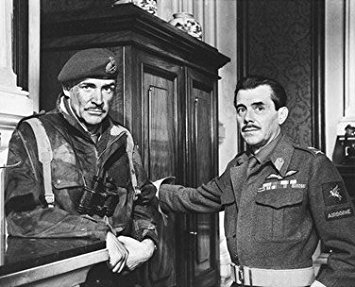
Major General Urquhart: I took 10,000 of our finest troops to Arnhem; I’ve come back with less than 2,000. I don’t feel much like sleeping.

Lt. General Frederick “Boy” Browning: I’ve just been on to Monty. He’s very proud, and pleased.

Major General Urquhart: [incredulous] PLEASED!

Lt. General Frederick “Boy” Browning: According to himself, technically, Market Garden was 90% successful.

Major General Urquhart: But what do YOU think?

Lt. General Frederick “Boy” Browning: Well, as you know, I always felt we tried to go a bridge too far…

Yesterday was our first full day back after our Memorial Day outing to Bethany Beach, a day of work as well as catching up. After our day of taking care of business we went and spent time with our friends at Gordon Biersch and then adoring our Papillon pups, I put on the classic film A Bridge too Far as a belated Memorial Day remembrance. For me as a veteran of Iraq the film conjures up images of heroic sacrifices of men and women who died or became victims of a plan gone wrong.

The film if you haven’t seen it depicts the failed Allied attempt of September 1994 to liberate the Netherlands, cross the Rhine and end World War Two by Christmas. It was a plan that depended much on luck, and ignored the capabilities of the Germans, who the Allies for the most part already believed had been beaten following the campaign in Normandy and the dash across France.

Despite the weakness of the Germans he Allied plan came close to succeeding yet failed and in doing so prolonged the war and inflicted much more suffering on the people of the Netherlands who were not liberated until the end of the war. The failure was one of a failed operational plan that had strategic consequences.

In the past few days I have been become even more concerned about the situation on the Korean Peninsula and the risks of a war that could have worldwide implications, and none of them good. Secretary of Defense Mattis warned of a potential catastrophe, even as the USS Nimitz departed the West Coast to join the USS Carl Vinson and USS Ronald Reagan in the operational area while the North Koreans launched more missiles. The concentration of three carrier battle groups, even for a short time provides the President a massive amount of military power in the region should he decide to launch a preemptive strike as he has more than once spoken about. The fact is that if war breaks out that the casualties will be in the hundreds of thousands if not millions, and that is if the war stays contained to the Korean Peninsula.

I am also concerned that a war with North Korea could be the pretext for the Trump administration to sharply curtail civil liberties at home including the freedom of speech and of political opposition. Be assured that if war breaks out on the Korean Peninsula that these rights will be suppressed and that anyone who opposes the government in  any way whatsoever will be labeled as a defeatist, traitor, or worse. We have seen the same pathology after the 9/11 attacks when those who were not opposed to actions agains Al Qaida were condemned because they opposed the expansion of the war into Iraq. I know this because I was one of those people who condemned these people; and sadly in retrospect in their condemnation of the invasion of Iraq they they were more patriotic than me because I supported it, knowing the dangers.

As far as the Allies were concerned Operation Market Garden was a delay in their plans to invade Germany proper, but for the Germans it was a pyrrhic victory which doomed more of their soldiers, civilians, and their victims to death. The Allied efforts were considered a part of a more righteous cause, while for the most part the German people remained under the spell of Hitler until the end, and even then those who opposed or even were thought to be “defeatists” in Germany were considered to be as bad or worse than the enemies of the Third Reich.

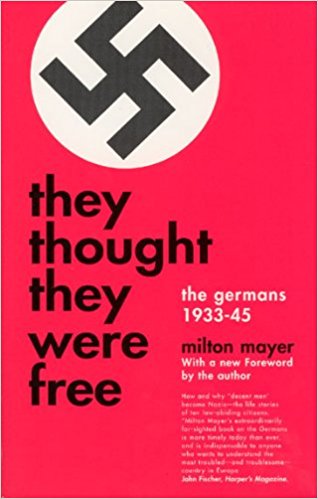
Milton Mayer who wrote the book They Thought They Were Free: The Germans 1933-1945 described the thoughts of a German academic colleague in 1955. Mayer’s friend said:

“Once the war began,” my colleague continued, “resistance, protest, criticism, complaint, all carried with them a multiplied likelihood of the greatest punishment. Mere lack of enthusiasm, or failure to show it in public, was ‘defeatism.’ You assumed that there were lists of those who would be ‘dealt with’ later, after the victory. Goebbels was very clever here, too. He continually promised a ‘victory orgy’ to ‘take care of’ those who thought that their ‘treasonable attitude’ had escaped notice. And he meant it; that was not just propaganda. And that was enough to put an end to all uncertainty.

“Once the war began, the government could do anything ‘necessary’ to win it; so it was with the ‘final solution of the Jewish problem,’ which the Nazis always talked about but never dared undertake, not even the Nazis, until war and its ‘necessities’ gave them the knowledge that they could get away with it. The people abroad who thought that war against Hitler would help the Jews were wrong. And the people in Germany who, once the war had begun, still thought of complaining, protesting, resisting, were betting on Germany’s losing the war. It was a long bet. Not many made it.”

That is something I worry about every day here as the Trump administration, facing failure on so many fronts, and under investigation of things that if any of the rest of us had even been accused of them would be considered treasonous, may embark on a war to save itself and at the same time use the extraordinary nature of such a conflict to consolidate power and crush dissent. That may sound far fetched, but all of his actions and words, as a candidate for President, as the President-Elect, and as President point in that direction and his most faithful followers show that they will even commitment treasonous acts and in some cases even resort to violence and murder to support him.

Trust me I want to be wrong about this more than anyone can imagine, but I cannot get rid of the feeling I have in my gut nor the terrible nightmares I have about this several times a week. I wonder if the Trump administration will gamble on an easy victory to end a very real North Korean threat to the region. If they do there will be no good outcome and we may lose freedoms that we never dreamt possible to lose.

If such an action does not succeed will the President then as he always does that his failure was a success? Will he pronounce like Field Marshal Montgomery that the failed attack was 90% successful or even more? And what of his military advisors? I dare not even attempt to answer that question anymore.

So until tomorrow I must ponder the words of General John Buford played by Sam Elliott in the film Gettysburg: 

“Devin, I’ve led a soldier’s life, and I’ve never seen anything as brutally clear as this. It’s as if I can actually see the blue troops in one long, bloody moment, goin’ up the long slope to the stony top. As if it were already done… already a memory. An odd… set… stony quality to it. As if tomorrow has already happened and there’s nothin’ you can do about it. The way you sometimes feel before an ill-considered attack, knowin’ it’ll fail, but you cannot stop it. You must even take part, and help it fail.”

Like I said, I want more than anything to be wrong about all of this but I fear that I am not and I cannot shake that feeling. So until tomorrow,

Peace

Padre Steve+

1 Comment

Filed under film, History, leadership, Military, nazi germany, News and current events, Political Commentary, world war two in europe

But Then It Was Too Late: An Excerpt from “They Thought They Were Free: The Germans 1933-1945”

they thought they were free

Friends of Padre Steve’s World,

This weekend we took a break from regular life and spent time relaxing with friends and our all of our 10 Papillon dogs. I spent very little time online and had pre-posted all of my articles for the weekend. It was wonderful to spend time with people, and of course enjoy the dogs as the played and cuddled and barked at anything walking down the street. But it was also nice to have little in the way of a scheduled agenda, which gave me some time to really do some reading.

One book that I took with me and finished while on the trip was Milton Mayer’s “They Thought They Were Free: The Germans 1933-1945.” Mayer was a visiting professor at the University of Frankfurt in the 1950s and lived in a small Hessian town near the city. The book is about the relationships that he built with ten ordinary citizens in the town and how they lived under Nazism and how most saw little wrong with it in the end.

The book is well worth the read and very timely when one compares the attitudes of the men who became Mayer’s friends and many people in the United States today. The last few chapters of the book are a reflection of the author’s opinions of the future of Germany at the time of his writing and he was mistaken on how the Germans would eventually become a society that embraced democracy and rejected authoritarianism (at the time he felt that it was very possible that democracy would fail in Germany,) they do not take away anything from the heart of the book and its message about how people adjust to authoritarian rule.

One chapter in particular struck me, it was a conversion that Mayer had with a colleague at the University who also reflected what it was like to live in the Third Reich and how in doing so he compromised himself and lost the opportunity to resist when resistance might have changed the course of events as Germany proceeded down the road to dictatorship and destruction. The chapter is particularly painful to read as the man understood that he should have known better but didn’t recognize the warning signs of the gradual nature of how life was changing with each new law or dictate from the Fuhrer.

In reading the chapter I see parallels in American society today. There are the Trump loyalists, many of who openly call for restrictions of liberty and crushing opposition to the President’s policies using extra-constitutional means including violence. Many are quite extreme while others, persuaded by years of right-wing talk radio, politically charged sermons by their pastors, and the daily dose of Fox News believe everything said by the President even when confronted by facts. Then there are Trump’s opponents, but many of the opponents are divided and cannot get along with each other. Some of these opponents actually helped Trump into office by circulating the Russian anti-Clinton conspiracy theories and falsehoods throughout the campaign. Each of these groups probably composes about 25-30% of the electorate each. The remaining segment are the people who simply go with the flow because life is too busy and crisis laden to get too deeply enmeshed in the political debate, and many have become so cynical that they see no difference in either side and are much more concerned about making it in a still uncertain economy.

So I invite you to read this and draw your own conclusions. Have a great day.

Peace

Padre Steve+

Chapter 13: But Then It Was Too Late

“What no one seemed to notice,” said a colleague of mine, a philologist, “was the ever widening gap, after 1933, between the government and the people. Just think how very wide this gap was to begin with, here in Germany. And it became always wider. You know, it doesn’t make people close to their government to be told that this is a people’s government, a true democracy, or to be enrolled in civilian defense, or even to vote. All this has little, really nothing, to do with knowing one is governing.

“What happened here was the gradual habituation of the people, little by little, to being governed by surprise; to receiving decisions deliberated in secret; to believing that the situation was so complicated that the government had to act on information which the people could not understand, or so dangerous that, even if the people could not understand it, it could not be released because of national security. And their sense of identification with Hitler, their trust in him, made it easier to widen this gap and reassured those who would otherwise have worried about it.

“This separation of government from people, this widening of the gap, took place so gradually and so insensibly, each step disguised (perhaps not even intentionally) as a temporary emergency measure or associated with true patriotic allegiance or with real social purposes. And all the crises and reforms (real reforms, too) so occupied the people that they did not see the slow motion underneath, of the whole process of government growing remoter and remoter.

“You will understand me when I say that my Middle High German was my life. It was all I cared about. I was a scholar, a specialist. Then, suddenly, I was plunged into all the new activity, as the university was drawn into the new situation; meetings, conferences, interviews, ceremonies, and, above all, papers to be filled out, reports, bibliographies, lists, questionnaires. And on top of that were the demands in the community, the things in which one had to, was ‘expected to’ participate that had not been there or had not been important before. It was all rigmarole, of course, but it consumed all one’s energies, coming on top of the work one really wanted to do. You can see how easy it was, then, not to think about fundamental things. One had no time.”

“Those,” I said, “are the words of my friend the baker. ‘One had no time to think. There was so much going on.’”

“Your friend the baker was right,” said my colleague. “The dictatorship, and the whole process of its coming into being, was above all diverting. It provided an excuse not to think for people who did not want to think anyway. I do not speak of your ‘little men,’ your baker and so on; I speak of my colleagues and myself, learned men, mind you. Most of us did not want to think about fundamental things and never had. There was no need to. Nazism gave us some dreadful, fundamental things to think about—we were decent people—and kept us so busy with continuous changes and ‘crises’ and so fascinated, yes, fascinated, by the machinations of the ‘national enemies,’ without and within, that we had no time to think about these dreadful things that were growing, little by little, all around us. Unconsciously, I suppose, we were grateful. Who wants to think?

“To live in this process is absolutely not to be able to notice it—please try to believe me—unless one has a much greater degree of political awareness, acuity, than most of us had ever had occasion to develop. Each step was so small, so inconsequential, so well explained or, on occasion, ‘regretted,’ that, unless one were detached from the whole process from the beginning, unless one understood what the whole thing was in principle, what all these ‘little measures’ that no ‘patriotic German’ could resent must some day lead to, one no more saw it developing from day to day than a farmer in his field sees the corn growing. One day it is over his head.

“How is this to be avoided, among ordinary men, even highly educated ordinary men? Frankly, I do not know. I do not see, even now. Many, many times since it all happened I have pondered that pair of great maxims, Principiis obsta and Finem respice—‘Resist the beginnings’ and ‘Consider the end.’ But one must foresee the end in order to resist, or even see, the beginnings. One must foresee the end clearly and certainly and how is this to be done, by ordinary men or even by extraordinary men? Things might have. And everyone counts on that might.

“Your ‘little men,’ your Nazi friends, were not against National Socialism in principle. Men like me, who were, are the greater offenders, not because we knew better (that would be too much to say) but because we sensed better. Pastor Niemöller spoke for the thousands and thousands of men like me when he spoke (too modestly of himself) and said that, when the Nazis attacked the Communists, he was a little uneasy, but, after all, he was not a Communist, and so he did nothing; and then they attacked the Socialists, and he was a little uneasier, but, still, he was not a Socialist, and he did nothing; and then the schools, the press, the Jews, and so on, and he was always uneasier, but still he did nothing. And then they attacked the Church, and he was a Churchman, and he did something—but then it was too late.”

“Yes,” I said.

“You see,” my colleague went on, “one doesn’t see exactly where or how to move. Believe me, this is true. Each act, each occasion, is worse than the last, but only a little worse. You wait for the next and the next. You wait for one great shocking occasion, thinking that others, when such a shock comes, will join with you in resisting somehow. You don’t want to act, or even talk, alone; you don’t want to ‘go out of your way to make trouble.’ Why not?—Well, you are not in the habit of doing it. And it is not just fear, fear of standing alone, that restrains you; it is also genuine uncertainty.

“Uncertainty is a very important factor, and, instead of decreasing as time goes on, it grows. Outside, in the streets, in the general community, ‘everyone’ is happy. One hears no protest, and certainly sees none. You know, in France or Italy there would be slogans against the government painted on walls and fences; in Germany, outside the great cities, perhaps, there is not even this. In the university community, in your own community, you speak privately to your colleagues, some of whom certainly feel as you do; but what do they say? They say, ‘It’s not so bad’ or ‘You’re seeing things’ or ‘You’re an alarmist.’

“And you are an alarmist. You are saying that this must lead to this, and you can’t prove it. These are the beginnings, yes; but how do you know for sure when you don’t know the end, and how do you know, or even surmise, the end? On the one hand, your enemies, the law, the regime, the Party, intimidate you. On the other, your colleagues pooh-pooh you as pessimistic or even neurotic. You are left with your close friends, who are, naturally, people who have always thought as you have.

“But your friends are fewer now. Some have drifted off somewhere or submerged themselves in their work. You no longer see as many as you did at meetings or gatherings. Informal groups become smaller; attendance drops off in little organizations, and the organizations themselves wither. Now, in small gatherings of your oldest friends, you feel that you are talking to yourselves, that you are isolated from the reality of things. This weakens your confidence still further and serves as a further deterrent to—to what? It is clearer all the time that, if you are going to do anything, you must make an occasion to do it, and then you are obviously a troublemaker. So you wait, and you wait.

“But the one great shocking occasion, when tens or hundreds or thousands will join with you, never comes. That’s the difficulty. If the last and worst act of the whole regime had come immediately after the first and smallest, thousands, yes, millions would have been sufficiently shocked—if, let us say, the gassing of the Jews in ’43 had come immediately after the ‘German Firm’ stickers on the windows of non-Jewish shops in ’33. But of course this isn’t the way it happens. In between come all the hundreds of little steps, some of them imperceptible, each of them preparing you not to be shocked by the next. Step C is not so much worse than Step B, and, if you did not make a stand at Step B, why should you at Step C? And so on to Step D.

“And one day, too late, your principles, if you were ever sensible of them, all rush in upon you. The burden of self-deception has grown too heavy, and some minor incident, in my case my little boy, hardly more than a baby, saying ‘Jewish swine,’ collapses it all at once, and you see that everything, everything, has changed and changed completely under your nose. The world you live in—your nation, your people—is not the world you were born in at all. The forms are all there, all untouched, all reassuring, the houses, the shops, the jobs, the mealtimes, the visits, the concerts, the cinema, the holidays. But the spirit, which you never noticed because you made the lifelong mistake of identifying it with the forms, is changed. Now you live in a world of hate and fear, and the people who hate and fear do not even know it themselves; when everyone is transformed, no one is transformed. Now you live in a system which rules without responsibility even to God. The system itself could not have intended this in the beginning, but in order to sustain itself it was compelled to go all the way.

“You have gone almost all the way yourself. Life is a continuing process, a flow, not a succession of acts and events at all. It has flowed to a new level, carrying you with it, without any effort on your part. On this new level you live, you have been living more comfortably every day, with new morals, new principles. You have accepted things you would not have accepted five years ago, a year ago, things that your father, even in Germany, could not have imagined.

“Suddenly it all comes down, all at once. You see what you are, what you have done, or, more accurately, what you haven’t done (for that was all that was required of most of us: that we do nothing). You remember those early meetings of your department in the university when, if one had stood, others would have stood, perhaps, but no one stood. A small matter, a matter of hiring this man or that, and you hired this one rather than that. You remember everything now, and your heart breaks. Too late. You are compromised beyond repair.

“What then? You must then shoot yourself. A few did. Or ‘adjust’ your principles. Many tried, and some, I suppose, succeeded; not I, however. Or learn to live the rest of your life with your shame. This last is the nearest there is, under the circumstances, to heroism: shame. Many Germans became this poor kind of hero, many more, I think, than the world knows or cares to know.”

I said nothing. I thought of nothing to say.

“I can tell you,” my colleague went on, “of a man in Leipzig, a judge. He was not a Nazi, except nominally, but he certainly wasn’t an anti-Nazi. He was just—a judge. In ’42 or ’43, early ’43, I think it was, a Jew was tried before him in a case involving, but only incidentally, relations with an ‘Aryan’ woman. This was ‘race injury,’ something the Party was especially anxious to punish. In the case at bar, however, the judge had the power to convict the man of a ‘nonracial’ offense and send him to an ordinary prison for a very long term, thus saving him from Party ‘processing’ which would have meant concentration camp or, more probably, deportation and death. But the man was innocent of the ‘nonracial’ charge, in the judge’s opinion, and so, as an honorable judge, he acquitted him. Of course, the Party seized the Jew as soon as he left the courtroom.”

“And the judge?”

“Yes, the judge. He could not get the case off his conscience—a case, mind you, in which he had acquitted an innocent man. He thought that he should have convicted him and saved him from the Party, but how could he have convicted an innocent man? The thing preyed on him more and more, and he had to talk about it, first to his family, then to his friends, and then to acquaintances. (That’s how I heard about it.) After the ’44 Putsch they arrested him. After that, I don’t know.”

I said nothing.

“Once the war began,” my colleague continued, “resistance, protest, criticism, complaint, all carried with them a multiplied likelihood of the greatest punishment. Mere lack of enthusiasm, or failure to show it in public, was ‘defeatism.’ You assumed that there were lists of those who would be ‘dealt with’ later, after the victory. Goebbels was very clever here, too. He continually promised a ‘victory orgy’ to ‘take care of’ those who thought that their ‘treasonable attitude’ had escaped notice. And he meant it; that was not just propaganda. And that was enough to put an end to all uncertainty.

“Once the war began, the government could do anything ‘necessary’ to win it; so it was with the ‘final solution of the Jewish problem,’ which the Nazis always talked about but never dared undertake, not even the Nazis, until war and its ‘necessities’ gave them the knowledge that they could get away with it. The people abroad who thought that war against Hitler would help the Jews were wrong. And the people in Germany who, once the war had begun, still thought of complaining, protesting, resisting, were betting on Germany’s losing the war. It was a long bet. Not many made it.”

Copyright notice: Excerpt from pages 166-73 of They Thought They Were Free: The Germans, 1933-45 by Milton Mayer, published by the University of Chicago Press. ©1955, 1966 by the University of Chicago. All rights reserved. This text may be used and shared in accordance with the fair-use provisions of U.S. copyright law, and it may be archived and redistributed in electronic form, provided that this entire notice, including copyright information, is carried and provided that the University of Chicago Press is notified and no fee is charged for access. Archiving, redistribution, or republication of this text on other terms, in any medium, requires the consent of the University of Chicago Press. (Footnotes and other references included in the book may have been removed from this online version of the text.)

4 Comments

Filed under History, nazi germany, News and current events, Political Commentary

Telling the Truth is Neither Disloyal nor Treasonous 

db_theodore_roosevelt_rough_rider9

Friends of Padre Steve’s World,

I find it both interesting and troubling to listen to many supporters of President Trump castigate anyone for any criticism offered about the President, sometimes going as far to say that critics are being “unfair,” “disrespectful,”or most disturbing, “disloyal” or “treasonous.” Even the President tweets out those kind of accusations on a whim.

Admittedly some forms of criticism cross boundaries and are personally insulting and disrespectful of the President. In my writings I try, even when being very critical of his policies, words, or actions, to refrain from personal insults that could be considered disrespectful to the President because I am still on active duty.  As my readers know I am a historian as well as an theologian/ethicist and when I do write about the actions of the President and his administration I do so based on careful study and comparison with historical, ethical, or legal precedents. My views are likewise informed by my education and and belief in the principles of the Enlightenment, my belief in human rights as set out in the Preamble of the Declaration of Independence, the U.S. Constitution, and the French Rights of Man and the Citizen, as well as my understanding of the Anglican Christian tradition of “Scripture, Tradition, and Reason” being the foundations of faith.

But it is not disloyal or treasonous to offer criticism of policies, legislative proposals, executive orders, or actions and words of the President or his advisers that could endanger the security of the United States, its citizens, and its alliances, or potentially be unlawful.

Even so I am occasionally criticized for offering historical examples that compare the President and his most ardent supporters in an unfair way, some even calling those disrespectful. I find their double standards and lack of appreciation of irony quite fascinating as most of these people have spent the last eight years or more disparaging and disrespecting President Obama with some of the most racist, vile, contemptible, and false accusations ever made against a sitting President, while at the same time condemning others for simply repeating what the President himself has said.

I found out this week that I had a couple of students criticize some of my teaching at Gettysburg when comparing the anti-immigrant Know Nothings of the 1830s-1850s to current anti-immigrant Trump supporters and some Trump Administration Civil Rights proposals to be a throwback to Jim Crow. That is not insulting nor disrespectful, but simply valid historical criticism, but some Trump supporters are so thin-skinned that they cannot abide any criticism.

Theodore Roosevelt had to defend himself in 1918 from such criticism from the supporters of President Woodrow Wilson. Roosevelt was criticizing the Wilson administration because of how badly he thought they were pursuing the war effort against Germany. For this people were castigating him. People said that newspapers should not print what Roosevelt had to say as well as “He should stand by the President” and “He should be stood before a stone wall and shot.” Roosevelt ended up writing an op-ed in the Kansas City Star in which he noted:

“The President is merely the most important among a large number of public servants. He should be supported or opposed exactly to the degree which is warranted by his good conduct or bad conduct, his efficiency or inefficiency in rendering loyal, able, and disinterested service to the Nation as a whole. Therefore it is absolutely necessary that there should be full liberty to tell the truth about his acts, and this means that it is exactly necessary to blame him when he does wrong as to praise him when he does right. Any other attitude in an American citizen is both base and servile. To announce that there must be no criticism of the President, or that we are to stand by the President, right or wrong, is not only unpatriotic and servile, but is morally treasonable to the American public. Nothing but the truth should be spoken about him or any one else. But it is even more important to tell the truth, pleasant or unpleasant, about him than about any one else.” 

This is exactly how I base any criticism I offer of the President, his policies, words, and actions. I heartily agree with the words of Senator Stephen A. Douglas when he battled President James Buchanan over the pro-slavery attempt to have Kansas admitted to the Union as a Slave State in 1858. Douglas said of his encounter with Buchanan: “God forbid,” I said “that I ever surrender my right to differ from a President of the United States for my own choice. I am not a tool of any President!”

Now there is a difference, I am not a Senator or elected Representative, I am an officer and must carry out the orders of the President. However, if I ever come to believe that I cannot in good conscience carry them out, or if I believe that they are un-Constitutional I will retire from the military in order to allow myself the freedom to speak out more openly. General Ludwig Beck resigned as head of the German Army in 1938 over Hitler’s aggression and his plan to attack Czechoslovakia. He noted:

“It is a lack of character and insight, when a soldier in high command sees his duty and mission only in the context of his military orders without realizing that the highest responsibility is to the people of his country.” 

That is my belief as well. So have a great day,

Peace

Padre Steve+

2 Comments

Filed under ethics, faith, History, Military, Political Commentary