Tag Archives: Dwight D Eisenhower

Committing Suicide out of Fear of Death: The Possibility of Preventive War on the Korean Peninsula

Friends of Padre Steve’s World,

Otto von Bismarck, the “Iron Chancellor” of Prussia and Germany once noted that “preventive war is like committing suicide out of fear of death.” Sadly, most Americans, do not seem to understand this, nor the distinctions of what is and is not permissible and how preventive war is different from the concept of pre-emptive actions.

While in Korea this week Secretary of State Rex Tillerson, most likely acting on behest of President Trump spoke of the real possibility that the United States could embark on a preventive war against North Korea. Tillerson said: “Let me be very clear: The policy of strategic patience has ended,” and “We’re exploring a new range of diplomatic, security and economic measures. All options are on the table.” He also said “If they elevate the threat of their weapons program to a level that we believe requires action, that option is on the table.” 

Now let me be clear, the military option is always on the table when dealing with North Korea, but that military option has always been focused on deterrence and the ability to deter, defend, and respond to any North Korean military action, not by the open threat of preventive war. The latter is something that could well push the paranoid regime of Kim Jung Un into actual military action, rather than the provocative actions they make in defiance of the United Nations most of the world. However, that threshold, which successive American administrations have not crossed since the Korean Armistice of 1954 has been crossed.

That being said the North Korean nuclear threat and ability to strike distant targets is growing and may reach a point that it could hit the United States. The question is, when, or if, the North Korean threat justifies either a pre-emptive military strike or launching a preventive war. In the run up to the invasion of Iraq the United States used the supposed threat of Iraqi weapons of mass destruction and connections to Al Qaeda to justify a preventive war against Iraq to eliminate the threat and overthrow Saddam Hussein. That war has been shown to be both in violation of the standards of the Just War Theory and international law concerning preventive war.

Michael Walzer, the foremost expert on Just War Theory today wrote in his book Just and Unjust Wars:

Now, what acts are to count, what acts do count as threats sufficiently serious to justify war? It is not possible to put together a list, because state action, like human action generally, takes on significance from its context. But there are some negative points worth making. The boastful ranting to which political leaders are often prone isn’t in itself threatening; injury must be “offered” in some material sense as well. Nor does the kind of military preparation that is a feature of the classic arms race count as a threat, unless it violates some formally or tacitly agreed-upon limit. What the lawyers call “hostile acts short of war,” even if these involve violence, are not too quickly to be taken as signs of an intent to make war; they may represent an essay in restraint, an offer to quarrel within limits. Finally, provocations are not the same as threats. “Injury and provocation” are commonly linked by Scholastic writers as the two causes of just war. But the Schoolmen were too accepting of contemporary notions about the honor of states and, more importantly, of sovereigns. The moral significance of such ideas is dubious at best. Insults are not occasions for wars, any more than they are (these days) occasions for duels.

For the rest, military alliances, mobilizations, troop movements, border incursions, naval blockade~-all these, with or without verbal menace, sometimes count and sometimes do not count as sufficient indications of hostile intent. But it is, at least, these sorts of actions with which we are concerned. We move along the anticipation spectrum in search, as it were, of enemies: not possible or potential enemies, not merely present ill-wishers, but states and nations that are already, to use a phrase I shall use again with reference to the distinction of combatants and noncombatants, engaged in harming us (and who have already harmed us, by their threats, even if they have not yet inflicted any physical injury). And this search, though it carries us beyond preventive war, clearly brings us up short of Webster’s pre-emption. The line between legitimate and illegitimate first strikes is not going to be drawn at the point of imminent attack but at the point of sufficient threat. That phrase is necessarily vague. I mean it to cover three things: a manifest intent to injure, a degree of active preparation that makes that intent a positive danger, and a general situation in which waiting, or doing anything other than fighting, greatly magnifies the risk. The argument may be made more clear if I compare these criteria to Vattel’s. Instead of previous signs of rapacity and ambition, current and particular signs are required; instead of an “augmentation of power,” actual preparation for war; instead of the refusal of future securities, the intensification of present dangers. Preventive war looks to the past and future, Webster’s reflex action to the immediate moment, while the idea of being under a threat focuses on what we had best call simply the present. I cannot specify a time span; it is a span within which one can still make choices, and within which it is possible to feel straitened.

I know that is a lot to digest, but the fact of the matter it takes a lot to justify pre-emptive military strikes, or a preventive war, and that in doing so we have not simply to look to the present moment but to the past and the as yet unwritten future. President Dwight D. Eisenhower noted that “Preventive war was an invention of Hitler. I would not even listen to anyone seriously that came and talked about such a thing.” But now, it is being talked about, and as surely as the sun will rise tomorrow, Kim Jong Un will raise the ante, and then question will be, then what?

Peace

Padre Steve+
2 Comments

Filed under Foreign Policy, Korean Conflicts, national security, News and current events, Political Commentary

Never Flatline Intellectually 


Friends of Padre Steve’s World,

Just a short note to end the week. Today was the 70th anniversary of the establishment of the Joint Forces Staff College where I teach. It was a very good, but long day with morning and evening ceremonies and activities. Our chief speaker was retired Marine Corps General Anthony Zinni, one of the most distinguished, honest, and outspoken military men of the past generation. Had the Bush administration listened to him we probably would have never ended up in the Iraq and Afghanistan quagmires. But I digress… 

One of General Zinni’s points was that no matter who you are that you must never stop learning. He lives this. At the age of 72 he holds three masters degrees and is working on a doctorate, lugging his books into doctoral seminars at Creighton University. He believes like I do, and history has shown, that when military budgets are cut the last thing that should be sacrificed is education. He noted that the most dangerous military officer is one whose intellectual curiosity has flatlined. General Zinni certainly does not subscribe to the principles that caused Barbara Tuchman to write “learning from experience is experience is a faculty almost never practiced,” and “nothing so comforts the military mind as the maxim of a great but dead general.” 

General Zinni is one of those remarkable people who can speak the truth without being an ideologue and who is a realist. I have always admired him and have had the pleasure of hearing him speak many times. His books “The Battle for Peace: A Frontline Vision of America’s Power and Purpose,” and “Before the First Shots are Fired: How America can Win or Lose off the Battlefield” should be required reading. 

His words reminded me of those spoken by the late Baltimore Orioles manager Earl Weaver, who said “it’s what you learn after you no it all that counts.” Those are words that I live by. I continually read, study and research, and when I finish my current writing projects I will probably begin to work on a doctorate, not because I need it, but because I never want to stop learning. I never want to flatline intellectually. I know too many people, smart and intelligent people who have flatlined, and far too many more whose intellectual quest stalled before they ever got out of the gate. All of them are dangerous because most devolve into mindless ideologues who readily sacrifice truth for a cause and cannot accept anything that challenges their uncritical worldview. 

So until tomorrow have a great night and better morning. 

1 Comment

Filed under History, Military, philosophy

Coming this Week: Midway, D-Day and the Greatest Generation

Friends of Padre Steve’s World

I hope that your week is starting out well. This week promises to be interesting on Padre Steve’s World as I will be doing some writing about  the Battle of Midway and the Normandy landings. I have done a lot on both subjects before but will try to be doing something different with them. The reason why I do this is because both battles are important. Each in their own way was a watershed that helped to change the course of the war.

Now those who know me and probably many who regularly follow my writings know that I don’t readily fit into anyone’s mold. I am a career military officer, chaplain and military historian and I am certainly a liberal-progressive  in most of my politics, at least as defined in the current American political-ideological climate. I am a curious blend of idealist and realist, I like to think the best about my country, but know that we don’t always live up to the ideals enunciated in the Declaration of Independence. This makes me true minority group. But I digress…

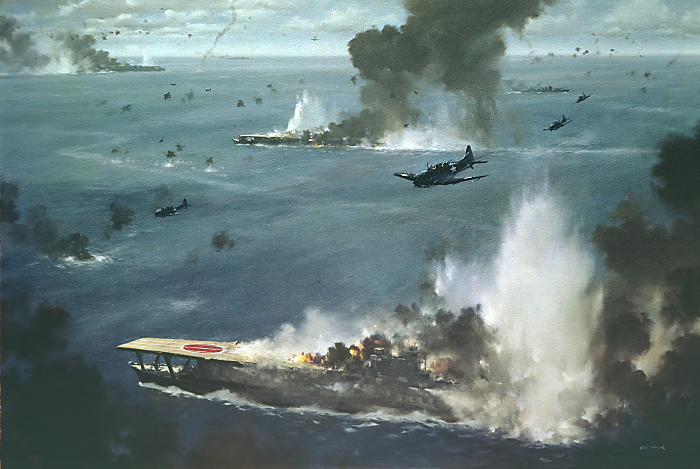
Battle%20of%20Midway%20flat_080817160843

The Battle of Midway, which was fought on June 4-6 1942 turned back the previously undefeated Japanese Imperial Navy by all that the U.S. Navy had left, three aircraft carriers and a handful of surface ships in a classic David versus Goliath encounter. The battle is referred sometimes referred to, with good reason, as the Miracle at Midway or the Incredible Victory. Had the U.S. Navy lost at Midway, the Japanese would have held a dominant position in the Pacific, and though the United States would probably still won the war, it may have taken at least an extra  year, maybe more for that to happen.

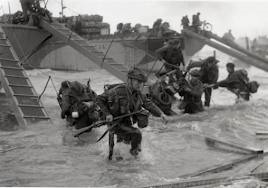
british commandos d-day

The Allied invasion of France on in Normandy was another watershed moment. In June 1944 Nazi Germany still had a stranglehold on much of Europe. Finally, the Allied Expeditionary Force under Dwight D. Eisenhower was ready to attack. It was the greatest amphibious operation ever conducted. Six Allied Infantry divisions and three Airborne Divisions supported by an invasion fleet of 5,000 ships and landing craft and thousands of warplanes were sent against the Germans. Had the invasion failed, the result would have been disastrous. The Germans would have been able to shift troops to the Eastern Front where Josef Stalin’s Soviet Red Army was about to launch its offensive on the German Army Group Center, an event that might have led to stalemate in the East.

Political pressure was already going against Winston Churchill and Franklin Roosevelt as the war continued and a defeat could have brought to power politicians in Britain and the United States willing to make a deal for peace with the Nazis. Such an occurrence would have led to even more genocide in Nazi occupied territories and the possibility of a Nazi atomic bomb, and please remember the Germans were far beyond the United States in building delivery systems, including ballistic missiles for such weapons. The thought of either instance is too horrifying to imagine. Likewise the thought of Imperial Japan continuing to rape China and Indochina, the East Indies and to possibly even to threaten Australia and India is equally horrifying.

These are things that more than seventy years later that we forget, to our detriment,  but they were the reality that our grandparents and great-grandparents who were part of that Greatest Generation faced.

Now, these seventy years later most of the men and women of that generation who defeated the mortal enemies of freedom, and I do not use that term flippantly are passing away. The young ones are in their late eighties, soon most will be gone, and the question has to be asked: Would we find the wherewithal to stand against mortal enemies of freedom, and then when the war was over, help them rebuild their shattered nations and turn former enemies into friends, even while ensuring that war criminals were brought to justice?

I would hope so, but I don’t know. I guess that is why I am a realist.

So until tomorrow I wish you a good night.

Peace

Padre Steve+

Leave a comment

Filed under History, leadership, Military, World War II at Sea, world war two in europe, world war two in the pacific

My Way or the Highway: The Zero Sum Game of American Politics in 2013

img00169-20110726-2126

“Politics is an art and not a science, and what is required for its mastery is not the rationality of the engineer but the wisdom and the moral strength of the statesman”Once upon a time in America there was a time when we had people in government who were statesmen.” Hans J Morgenthau 

These men understood something about the Constitution, representative government. pluralism, tolerance and dare I say compromise. Yet all were men of principle. The honestly believed in and worked toward the goals that they believed best embodied the American body politic as well as their own political, ideological and even religious beliefs. Basically when we cut to the chase the real thing that sets them apart from the legislators of today was that they knew that compromise was actually desirable in many cases. They understood that there were times to “duke it out” on Capitol Hill but that at the end of the day that as Americans we could have different opinions yet still come together for the benefit of all Americans, not just those that we were beholden to for the money needed to keep us in office.

But that was a different era. Men like Edward Dirksen, Scoop Jackson, Harry Truman, Dwight Eisenhower, Tip O’Neill and Ronald Reagan or for that matter even Jack, Bobby or Teddy Kennedy would not survive in the zero-sum politics if 21st Century American. They would be despised by their political “allies” even more so than their opponents.

The sad thing is that in the United States of 2013 it is much easier to be against something than it is to be for something. Likewise it is now more beneficial for politicians of both parties in the gerrymandered congressional districts which ensure the safety of the incumbent to adopt a no-quarter attitude. It has allowed elected leaders to adopt a zero-sum game of no-compromise.

The results are a broken system of government, a deep division of the people almost all of whom distrust and even despise the very people that they elected.

As I watch the current proceedings in Washington I am reminded of what I thought when the “deal” to agree to the sequester was reached. I remembered the words of Thomas Jefferson concerning the Missouri Compromise. I knew back in 2011 that the even the threat of sequester would not change the behavior of those in Congress, particularly the Tea Party faction of the Republicans, a group who have in many cases so wedded the most uncompromising aspects of religion to political ideology that there can be no backing down for them. Politics is an extension of God’s will. It is the extension of the theology of Christian Dominionism which has at its center the takeover of the systems of the world by Christians, the Seven Mountains theology. That is why compromise if there is any in the current situation will by only delay the reckoning.

Jefferson noted: “but this momentous question, like a fire bell in the night, awakened and filled me with terror. I considered it at once as the knell of the Union. it is hushed indeed for the moment. but this is a reprieve only, not a final sentence. a geographical line, coinciding with a marked principle, moral and political, once conceived and held up to the angry passions of men, will never be obliterated; and every new irritation will mark it deeper and deeper.” 

We need a revival of statesmanship in our country but in the current political environment I fear that those who would attempt to be statesmen would not survive. Much like Weimar Germany our politicians, pundits and preachers, the Unholy Trinity are paving the way for something unimaginably terrible when they finally wreck our current system of government. They are doing it and those who do not speak out against them regardless of our politics have to take part of the blame.

Martin Niemoller wrote after the Second World War:

In Germany they first came for the Communists,
and I didn’t speak up because I wasn’t a Communist.
Then they came for the Jews,
and I didn’t speak up because I wasn’t a Jew.
Then they came for the trade unionists,
and I didn’t speak up because I wasn’t a trade unionist.
Then they came for the Catholics,
and I didn’t speak up because I was a Protestant.
Then they came for me –
and by that time no one was left to speak up.

Peace

Padre Steve+

2 Comments

Filed under History, leadership, Loose thoughts and musings, Political Commentary, Religion

D-Day: Brigadier General Theodore “Ted” Roosevelt III Lands at Utah Beach

Theodore Roosevelt Jr4

“Courage, above all things, is the first quality of a warrior.” Carl Von Clausewitz

By the standards of military service on the front line the man was ancient. He was 56 years old, had arthritis and a history of heart problems, but he was his father’s son.

The oldest man to land on the beaches of Normandy was the son of a President, Theodore “Teddy” Roosevelt who had taken leave of his office as Assistant Secretary of the Navy at the outset of the Spanish-American War. With the help of his friend Colonel Leonard Wood, Roosevelt formed the legendary First U.S. Volunteer Cavalry Regiment, the “Rough Riders” and led them in the fight at the Battle of San Juan Hill.

The son of the President entered the business world and then served as a Reserve officer and since he had received prior military training was commissioned as a Major when the United States entered World War One. He volunteered for overseas service and served as a battalion commander and later as commander of the 26th Infantry Regiment of the 1st Infantry Division. Leading from the front he was wounded and gassed at Soissons in 1918. For his service he was awarded the Distinguished Service Cross and the French Chevalier Légion d’honneur.

After the war he helped found the American Legion and entered politics and was elected to the New York State Assembly. However while serving as Assistant Secretary of the Navy in the Harding Administration he was linked to the Teapot Dome Scandal and though cleared of any wrongdoing his name was tarnished. Opposed by his cousin Franklin Delano Roosevelt his political fortunes in elected offices floundered. However he was appointed as Governor of Puerto Rico and later Governor-General of the Philippines a post that he served until 1935 when he returned to the United States and the business world serving as an executive with American Express.

Between the wars “Ted” continued his Army Reserve service attending his annual training periods as well as attending the Infantry Officer Basic and Officer Advanced Courses as well as the Command and General Staff College. When war came to Europe he again volunteered for active service, attended a refresher course and was promoted to Colonel in the Army Reserve. Mobilized in April 1940 he was given command of his old 26th Infantry Regiment assigned to the First Infantry Division and was promoted to Brigadier General in late 1941 becoming the Assistant Division Commander.

Ted_Cane_France

He served well in that role in North Africa and Sicily and earned citations for bravery being constantly on the front lines with his soldiers. However his association with the Division Commander, the unorthodox Terry Allen earned the enmity of George Patton and Omar Bradley. Patton disliked Allen and hated the way both Allen and Roosevelt eschewed “spit and polish” and “dressed down,” often wearing unauthorized uniform items. After Bradley assumed command of 7th Army he relieved both officers, believing that they were guilty of “loving their division too much” something that he admitted was one of the hardest decisions that he made in the war. Roosevelt served as a liaison officer with the Free French Forces in Italy before returning to England to assume duties as Assistant Division Commander of the 4th Infantry Division. Allen would go on to command the 104th Infantry Division in an exemplary manner during the command’s in France and Germany in 1944-45 with even Bradley praising him and his new division as one of the best in Europe.

TeddyJr5-530x414

Roosevelt constantly trained with the troops and asked his commander, Major General Raymond “Tubby” Barton for permission to land with the first wave in the invasion. After being denied twice Roosevelt put his request to Barton in writing:

“The force and skill with which the first elements hit the beach and proceed may determine the ultimate success of the operation…. With troops engaged for the first time, the behavior pattern of all is apt to be set by those first engagements. [It is] considered that accurate information of the existing situation should be available for each succeeding element as it lands. You should have when you get to shore an overall picture in which you can place confidence. I believe I can contribute materially on all of the above by going in with the assault companies. Furthermore I personally know both officers and men of these advance units and believe that it will steady them to know that I am with them.”

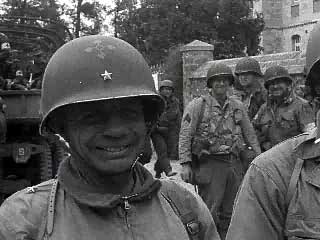
Barton reluctantly approved the request not expecting Roosevelt to survive the landings. Roosevelt was in the first wave of assault troops at Utah Beach. On landing he discovered that the first wave was about a mile off course. Armed with a pistol and supported by a cane Roosevelt led a reconnaissance to find the causeways off the beach. He briefed the battalion commanders and then ordered an attack from where the troops had landed telling his officers “We’ll start the war from right here!” a moment immortalized in the film The Longest Day in which Henry Fonda played Roosevelt.

fon2

Henry Fonda Portrays Brigadier General Theodore “Ted” Roosevelt III in “The Longest Day”

His actions were key in the success of the Utah Beach landings and he was recommended for the Distinguished Service Cross by General Barton. Just over a month after the invasion after continuously leading his troops in Normandy Roosevelt died of a heart attack on July 12th 1944, the very day he had been selected for his second star and promotion to Major General and had orders to take command of the 90th Infantry Division. His award was upgraded to the Congressional Medal of Honor which was posthumously awarded on September 28th 1944. He was buried in the American Cemetery in Normandy, the remains of his younger brother Quentin who had been killed in the First World War were exhumed and interred next to his in 1955.

The Medal of Honor citation reads:

For gallantry and intrepidity at the risk of his life above and beyond the call of duty on 6 June 1944, in France. After 2 verbal requests to accompany the leading assault elements in the Normandy invasion had been denied, Brig. Gen. Roosevelt’s written request for this mission was approved and he landed with the first wave of the forces assaulting the enemy-held beaches. He repeatedly led groups from the beach, over the seawall and established them inland. His valor, courage, and presence in the very front of the attack and his complete unconcern at being under heavy fire inspired the troops to heights of enthusiasm and self-sacrifice. Although the enemy had the beach under constant direct fire, Brig. Gen. Roosevelt moved from one locality to another, rallying men around him, directed and personally led them against the enemy. Under his seasoned, precise, calm, and unfaltering leadership, assault troops reduced beach strong points and rapidly moved inland with minimum casualties. He thus contributed substantially to the successful establishment of the beachhead in France.

Roosevelt’s story is quite amazing. In the modern wars of the late 20th and early 21st Centuries few commanders as senior as Roosevelt would ever be in the first wave of an invasion or offensive operation. The personal courage and example set by Roosevelt in both World Wars, leading from the front and maintaining relationships with the troops that he commanded in combat is something that we talk about a lot in various military leadership classes but often seems to be smothered by business models promoted by think tanks and others with money to be made.

Likewise, a commander suffering from Roosevelt’s infirmities would not be allowed to command troops in combat today. But in the Second World War when many other American Generals failed miserably and often could not be found near the front and were relieved of command for incompetence and cowardice the old, crippled and infirm Roosevelt led from the front. He made decisions on Utah Beach on D-Day that helped ensure that the landings were a success. Bradley, who had fired Roosevelt after the Sicilian Campaign with Allen said that the most heroic act that he had seen in combat was “Ted Roosevelt on Utah Beach.”

Roosevelt was an exception to Clausewitz’s axiom that “boldness becomes rarer, the higher the rank.” I think that even if a General wanted to lead in the manner of Roosevelt today that he would be punished by the institution for risking himself.

Peace

Padre Steve+

Leave a comment

Filed under History, Military, movies, world war two in europe

June 5th 1944 the Eve of D-Day: Rommel Goes Home for a Birthday Party

2

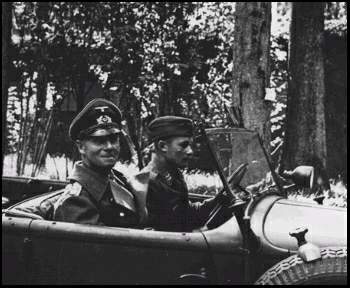
Rommel Inspecting German Positions in Normandy

At Chateau La Roche Guyon on the River Seine Field Marshal Erwin Rommel bid farewell to his staff. The weather was miserable and it looked as if the Allies under General Eisenhower would be forced to postpone any invasion of France for several weeks. Rommel, who had been constantly at war away from his wife Lu and son Manfred for most of the preceding five years decided to take a few days of leave, after all June 6th was Lu’s birthday and he decided that he would spend it with her. He had even purchased a pair of shoes in Paris to give as a gift.

Hans-Speidel

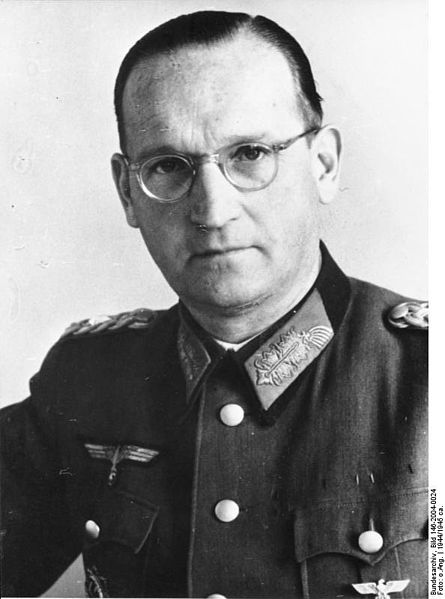
General Hans Speidel

His Chief of Staff, General Hans Speidel bid Rommel, his aide de camp and driver farewell as they drove off in his Horch staff car. Of course it was the correct decision. The weather appeared completely unfavorable to an invasion, however the Germans, deprived on long range weather forecasts for the loss of ships and weather stations in the Atlantic and Greenland did not know that the Allies had discovered that the weather would moderate for about 24 hours beginning the night of the 5th and morning of the 6th. Eisenhower made the decision to invade on the 6th of June. The Germans, continued normal planning and training in anticipation that the long awaited invasion would not occur for two to three weeks. Many other German commanders were either on leave or involved in war games and exercises away from their headquarters.

omaha_3_lg

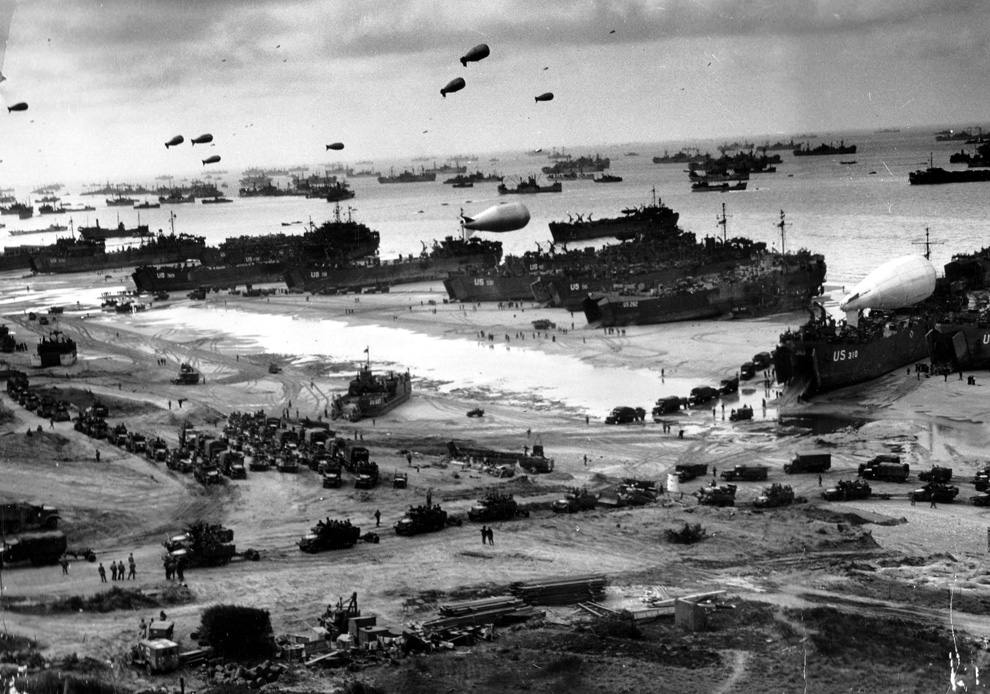
In the early morning hours of June 6th Allied paratroops from three Airborne Divisions, the 1st British and American 82nd and 101st began landing in Normandy. At dawn on June 6th troops from 6 Allied Divisions began amphibious landings at five invasion beaches, Gold, Juno and Sword in the British sector and Omaha and Utah beach in the American sector.

Speidel called Rommel at his home early on the 6th of June to inform him of the landings. Hitler had limited Rommel and other German commander’s ability to respond to an invasion by keeping the authority to commit the German armored reserve to himself. By the time Rommel arrived back at La Roche Guyon on the night of June 6th tens of thousands of Allied troops from six Infantry and three Airborne Divisions were reinforcing their beach heads and supported by overwhelming naval and air forces were driving inland. The forces that Rommel immediately commanded were sufficient to slow the Allied advance but not to throw the invaders back into the English Channel.

r1

The campaign for Normandy would devolve into a war of attrition that would end with the Allied breakout at St Lo in July. That event coincided with Rommel being severely wounded in an Allied air attack on July 17th and the attempt on Hitler’s life July 20th. In the succeeding days with their command structure paralyzed by Hitler’s retribution against those or implicated in the attempt on his life, who included many commanders and staff officers in France fighting the Allies.

images-45

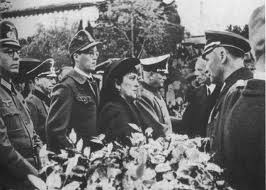
Rommel’s Wife Lucy and Son Manfred at his Funeral

Rommel would also be implicated in the attempt on Hitler’s life and would die at his own hand on October 17th 1944 after being offered the choice between suicide or a trial in which he would be found guilty and his family endangered.

One wonders what might have happened had Rommel been present in Normandy when the Allies landed. Perhaps history would have unfolded in a number of different ways. The results might have been the same, perhaps the Germans under Rommel would have succeeded in throwing the Allied forces back into the sea, and perhaps the victor of Normandy might have been able to help overthrow Hitler and end the war. Of course we will never know.

d23_0p012623

What we do know are the facts. Rommel spent a few hours with his wife on her birthday before having to travel back to Normandy without getting the chance to try to persuade Hitler to change the command arrangements that might have changed the outcome of the invasion. We know that deprived of the ability to control all of the key forces in his operational area, especially the Panzer Divisions and without the Luftwaffe being able even to contest Allied air superiority that Rommel, the legendary Desert Fox was condemned to fight a desperate defensive struggle against an enemy who control the seas, the skies and seemingly had unlimited resources. We also know that he was involved in the plot to kill Hitler and paid with his life for his involvement.

441014 Rommel Family

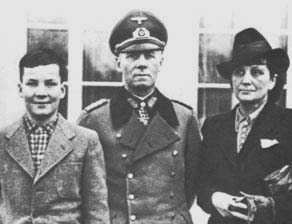
Rommel with his Wife and Son

Rommel is one of those tragic figures in history. A man caught up in the excesses of his era who discovered how the leader that he had sworn a loyalty oath to had betrayed his country and millions of his fellow soldiers. Rommel discovered the lies of his leaders too late. He like many soldiers in so many wars assumed that they could be trusted. When he discovered that they could not he took the chance to oppose them and was murdered by them.

Of course Rommel had flaws. He was an opportunist at times and did not oppose Hitler in the early years. In fact much of his fame was due to the propaganda of Josef Goebbels who exploited Rommel’s military success in Africa. However it was in Africa that Rommel began to see the truth about Hitler, the seeds of which led to his involvement with those who plotted Hitler’s death and lead him to his own death. Rommel, like so many military leaders before and after him had feet of clay.

Disillusionment with the lies of my leaders that took my country to war is something that I experienced between the attacks on September 11th 2001 and my return from Iraq in February 2008. As such, as a man who has spent the bulk of the last 11 1/2 years of war away from his wife who discovered that his leaders lied about wars and their cost, moral, physical and economic I feel a certain kinship with Field Marshal Rommel. I can understand why he took the chance to take a few days of leave to spend it with his wife.

War is a terrible thing.

Peace

Padre Steve+

5 Comments

Filed under History, leadership, Military, world war two in europe

Feet of Clay: The Common Flaw of the Best and Brightest

Charlene and Michel de Carvalho

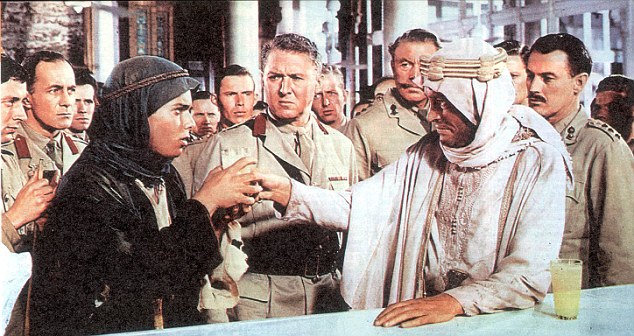
General Allenby: [leafing through Lawrence’s dossier] “Undisciplined… unpunctual… untidy. Knowledge of music… knowledge of literature… knowledge of… knowledge of… you’re an interesting man there’s no doubt about it.” 

Character is a terrible thing to judge. Mostly because those doing the judging also suffer from flaws in their own character.  Yet somehow the temptation is for us to stand as judge, jury and character executioner on those that we find wanting. As a culture we like tearing down those that we at one time built up. It is a rather perverse proclivity that we have as human beings, especially if we can find some kind of religious justification for it.

I think that is part of the complexity of the human condition. As a historian I find that the most exalted heroes, men and women of often great courage both moral and physical, intellect, creativity, humanity and even compassion have feet of clay.

I find that I am attracted to those characters who find themselves off the beaten track. Visionaries often at odds with their superiors, institutions, and sometimes their faith and traditions. Men and women who discovered in themselves visions for what might be and pursued those visions, sometimes at the costs of their families, friends, and in quite a few cases their lives.

Throughout my studies I have been attracted to men as diverse as Peter the Apostle, Martin Luther, T.E. Lawrence, Dietrich Bonhoeffer, Erwin Rommel, Admiral Horatio Nelson, Abraham Lincoln, John F Kennedy, Dwight D Eisenhower, Franklin Roosevelt, Dr Martin Luther King Jr, Jackie Robinson, Teresa of Avila, Nelson Mandela, Vaclav Havel and Emir Feisal Hussein of the Arab Revolt. All had flaws. Some involved fits of temper and violence, others sexual escapades, mistresses, affairs, greed avarice, and maybe some that stretched law and morality in their quest to achieve their goals. But all are considered great men and women.

Feet of clay. Who doesn’t have them? But them I think that I would rather have feet of clay than a heart of stone, an an unchallenged mind, or a lack of courage to do the right thing even if it does not directly benefit me.

Tonight I watched for the first time straight through the cinema classic Lawrence of Arabia. Peter O’Toole plays Lawrence in a most remarkable manner, showing his brilliance, courage, diplomatic ability and understanding of the Arabs with whom he served.

There are many people, leaders and others that we encounter in life or that we study. Even the best of the best are flawed and there is no such thing as a Saint who never sinned. But we love destroying them and their memory when to our “surprise” when we find that their hagiographers built them into an idol.

I am a great believer in redemption and the weight of the whole of a person’s life. Thus I try to put the flaws as they are called in perspective and their impact both positive and negative in history. Studying in this way gives me a greater perspective on what it is to be human and to place my own clay feet in appropriate perspective.

It was an interesting film to watch.

However, speaking of feet of clay I will probably be writing about the Baseball Writers who vote for the inductees for the Hall of Fame. Today for the first time in nearly 4 decades no players were selected for induction, mostly due to the steroid era. But that is a subject for another night.

Peace

Padre Steve+

1 Comment

Filed under faith, film, History