Tag Archives: frederick douglass

With Bible in Hand: Anti-Gay Christians & Religious Tyranny

WCPO_Fort_Thomas_Kim_Davis_rally5_1441659156589_23696760_ver1.0_640_480

Protesters outside Judge Bunning’s Home

Friends of Padre Steve’s World,

As I write this I can almost hear people echoing these words of Reverend Brown in the movie Inherit the Wind being uttered by some of my less than happy readers against me:  “Oh, Lord of the tempest and the thunder, strike down this sinner, as thou did thine enemies of old in the days of the Pharaohs! Let him know the terror of thy sword! Let his soul, for all eternity, writhe in anguish and damnation!”

But then, what’s new? Since I have stopped the hijacking of the site by such commentators that is all they can do. I tolerated their crap for too long, my generosity was treated with contempt, so screw them. I totally agree with the words of Frederick Douglass who wrote:

“Indeed, I can see no reason, but the most deceitful one, for calling the religion of this land Christianity. I look upon it as the climax of all misnomers, the boldest of all frauds, and the grossest of all libels…He who is the religious advocate of marriage robs whole millions of its sacred influence, and leaves them to the ravages of wholesale pollution. The warm defender of the sacredness of the family relation is the same that scatters whole families, — sundering husbands and wives, parents and children, sisters and brothers, — leaving the hut vacant and the heart desolate. “

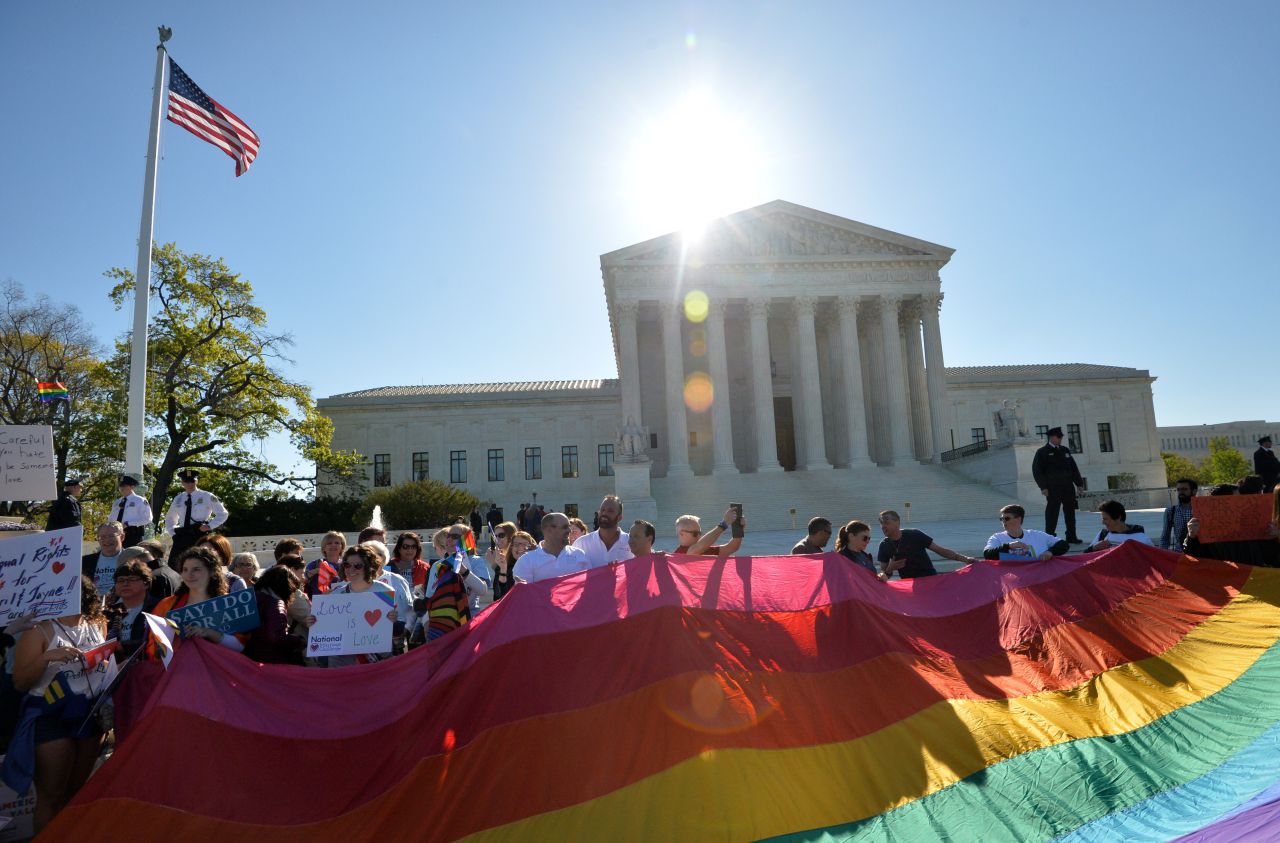
According to some readers I represent and stand alongside a vocal minority that is intent on destroying America, minority that is despised and hated by many people in the name of their God. The group I speak of are homosexuals, and their supporters which include me, as well as those people who actually support the rule of law in this country. The 14th Amendment, which was the basis of the Supreme Court’s majority ruling in the case of Obergfell v. Hodges, the ruling which legalized Marriage Equality in all 50 States says:

“All persons born or naturalized in the United States, and subject to the jurisdiction thereof, are citizens of the United States and of the state wherein they reside. No state shall make or enforce any law which shall abridge the privileges or immunities of citizens of the United States; nor shall any state deprive any person of life, liberty, or property, without due process of law; nor deny to any person within its jurisdiction the equal protection of the laws.”

Sadly, the opponents of Marriage Equality, or for that matter of any kind of civil rights for Gays use the same arguments against the rights of Gays that their Christian ancestors, in both the North and the South did to defend the institution of Southern Slavery. In His book Christianity’s Dangerous Idea, British Evangelical-Anglican theologian Alister McGrath observes how “the arguments used by the pro-slavery lobby represent a fascinating illustration and condemnation of how the Bible may be used to support a notion by reading the text within a rigid interpretive framework that forces predetermined conclusions to the text.” Then he asks a dangerous question, a very important question for modern Christians who might be tempted to support a position using the Bible to deny the rights of others for the same reasons today, “Might not the same mistakes be made all over again, this time over another issue?”

When I see the rabid politicians, preachers and pundits supporting the right of a public official to violate the civil liberties of others in the name of their interpretation of scripture, it is troubling. In this case they support Kim Davis, the Recalcitrant County Clerk of Rowan County Kentucky. Mrs. Davis violated the oaths of office that she took, defied the Governor of Kentucky, as well the rulings of multiple courts including the Supreme Court of the United States and was jailed on contempt of court charges.

integration is a sin

It wasn’t that long ago that people used the Bible for this

Sadly I see disturbing parallels in their arguments to the arguments of Christians in the North and the South before the Civil War regarding slavery, and the disenfranchisement of newly emancipated African Americans following the Civil War, during Reconstruction and during the Jim Crow era.

The supporters of Mrs. Davis view the world through the lens of Manichean dualism. Those who agree with them, agree with God and those who do not, are evil, and deserving of no liberty, nor life. Before the Civil War, Southern theologian James Henley Thornwell presented the conflict between northern evangelical abolitionists and southern evangelical defenders of slavery in Manichean terms. He and many others believed that by arguing for abolition that Christian abolitionists attacked religion itself. It was not just an attack on their belief in validity of the institution of slavery, it was an attack on their faith. Thornwell wrote:

“The “parties in the conflict are not merely abolitionists and slaveholders,…They are atheists, socialists, communists, red republicans, Jacobins, on one side, and friends of order and regulated freedom on the other. In one word, the world is the battle ground – Christianity and Atheism as the combatants; and the progress of humanity at stake.”

Thornwell was joined by Robert Lewis Dabney, a southern Presbyterian pastor who later served as Chief of Staff to Stonewall Jackson in the Valley Campaign and at Seven Pines and who remained a strident defender of slavery, and opponent of civil rights for blacks long after the war was over. Dabney’s words remind me very much of the words of the militants speaking up for Mrs. Davis and condemning all who support the rights of Gays. Dabney wrote:

“we must go before the nation with the Bible as the text and ‘Thus saith the Lord’ as the answer….we know that on the Bible argument the abolition party will be driven to reveal their true infidel tendencies. The Bible being bound to stand on our side, they have to come out and array themselves against the Bible. And then the whole body of sincere believers at the North will have to array themselves, though unwillingly, on our side. They will prefer the Bible to abolitionism.”

But I think one of the most reveling are the words spoken by the Reverend William Leacock of Christ Church, New Orleans declared in his Thanksgiving sermon of 1860:

“Our enemies…have “defamed” our characters, “lacerated” our feelings, “invaded “our rights, “stolen” our property, and let “murderers…loose upon us, stimulated by weak or designing or infidel preachers. With “the deepest and blackest malice,” they have “proscribed” us “as unworthy members… of the society of men and accursed before God.” Unless we sink to “craven” beginning that they “not disturb us,…nothing is now left us but secession.”

The very personal nature of Leacock’s complaint in his sermon about abolitionists following the election of Abraham Lincoln in 1860 is startling when you compare it to the words of so many anti-LBGT politicians, pundits and preachers, some of who even urge civil war and secession if they do not get their way. Mike Huckabee says that Davis being jailed on contempt of court charges “removes all doubt of the criminalization of Christianity in our country.”

The invective against Judge Bunning, a Republican who was appointed to the bench by George W. Bush, and all who support the law is reaching the level where frustrated supporters will resort to violence. It has happened before. In fact, one of the leaders, of the protest outside Judge Bunning’s home yesterday on charges of “violating the law of God” was the Reverend Flip Benham. Benham is no stranger to precipitating violence against those he deems violators of God’s law by stoking the fear and anger of his followers. In 2009 one of those followers, murdered a doctor who performed late term abortions in the man’s church. Likewise, Benham has stalked others and he has defended the murderer of others. If he can motivate people to kill abortion providers, why not gays and their supporters? Thus I have legitimate concerns for the safety of Judge Bunning and anyone who gets in the way of Benham and his followers.

Mrs. Davis was released jail yesterday, and ordered her not to interfere with the issuing of gay marriage licenses. Judge Bunning released her because he was satisfied  that her office is “fulfilling its obligation to issue marriage licenses to all legally eligible couples.” Her supporters will claim this as a victory, but it will not change the law, and I imagine that if she interferes with her subordinates, Judge Bunning says that she will end up back in jail. She and her lawyers and Mike Huckabee exited the jail to the cheers of their supporters. Their words and actions showed a arrogance and defiance of law that only American Christians of our era, as well as the ante-Bellum South, and the Reconstruction and Jim Crow eras seem capable. We will see what happens, I am not optimistic so long there is a dollar and political point to be gained. 

With this “victory” the lawyers who led her down the primrose path to jail will move on and leave Mrs. Davis behind if she complies with Judge Bunning’s order. Their “success” will encourage others to do the same. These politicians, preachers and pundits who led this charge want a conflict, and they need a conflict to legitimize themselves. They also need it to make lots of money donated by their followers without accomplishing anything. They hate Gays, and liberals and make their money playing the victim, when it is they who seek to deny the rights of others. One of their most influential writers, an adviser to Rand and Ron Paul expressly said so:

“The long-term goal of Christians in politics should be to gain exclusive control over the franchise. Those who refuse to submit publicly to the eternal sanctions of God by submitting to His Church’s public marks of the covenant–baptism and holy communion–must be denied citizenship, just as they were in ancient Israel.”

North’s words apply to everyone who stands against his interpretation of Christian Dominionism.

But with Bible in hand they will go forward, and I am reminded of the words of Atticus Finch in To Kill a Mockingbird:

“Sometimes the Bible in the hand of one man is worse than a whiskey bottle in the hand of (another)… There are just some kind of men who – who’re so busy worrying about the next world they’ve never learned to live in this one, and you can look down the street and see the results.”

These people are a scary bunch. Their right to discriminate against others based on their religious beliefs matters more than the Constitution, and matters more than bearing a true witness of God’s love to the world.

Peace

Padre Steve+


3 Comments

Filed under civil rights, faith, laws and legislation, LGBT issues, News and current events, Political Commentary

Faith, Power & Politics: The Death of Good Religion

184062576_1_blog_main_horizontal

Friends of Padre Steve’s World,

Today I just want to share a few subversive thoughts on American Christianity and established religion. I am not talking about organized religion, because we Americans have little in the way of organization to our religion except when it comes to wanting to be in charge of the country, as many on the Christian Right advocate today.

Mark Twain wrote in his classic novel, A Connecticut Yankee in King Arthur’s Court:

“Concentration of power in a political machine is bad; and an Established Church is only a political machine; it was invented for that; it is nursed, cradled, preserved for that; it is an enemy to human liberty, and does no good which it could not better do in a split-up and scattered condition.”

On a more individual level, Atticus Finch, the hero of the book and film To Kill a Mockingbird said, “Sometimes the Bible in the hand of one man is worse than a whisky bottle in the hand of (another)… There are just some kind of men who – who’re so busy worrying about the next world they’ve never learned to live in this one, and you can look down the street and see the results.” In fact I’ll bet most of us know someone just like Atticus described; I know that I do, plenty of them.

I, and probably you, like to believe that religion is a benign or positive influence in the world. As much as I want to believe the positive aspects I have to admit based on the historical and sociological evidence that this is not so, especially during unsettled times of great change. We live in such an era and when it comes to identity, God is the ultimate trump card.

It seems to me that most fanatical individuals and groups on earth, of course not all are tied to religions, whether it is the Islamic State and Al Qaeda, Boko Haram, Hezbollah, Orthodox Jews, radical Hindus and Buddhists, as well as militant Christians. Who can forget that the Holocaust, the African Slave Trade, and even the Rwandan Genocide were predominantly the work of Christians, but I digress… Of course all of these groups have different goals, but their thought and philosophy are quite similar.

Robert Heinlein wrote: “Almost any sect, cult, or religion will legislate its creed into law if it acquires the political power to do so.” Heinlein, author of the classic Starship Troopers was absolutely correct. Just look at any place in any time where any religion, sect or cult has gained control of a government. They are not loving, they are not forgiving and they use the police power of the state to persecute any individual or group that is judged to be in error, or even worse has the gall to question their authority.

Since the Christian groups tend to thrive in the West, they only speak in terms of violence, most, with the exception of Russian Orthodox Christians, do not have a government to translate those words into action, which it does against Evangelical Protestants, Roman Catholics, Moslems, Jews, and every religious group’s favorite enemies, Gays and women.

Many American Christians, especially conservative Catholics and some Evangelical and Charismatic Protestants seem for a long for the day when they can assume control of a theocratic government, and a day where they can sit at the side of the rich and oppress the poor, the alien and the outcast. The amount of public support given to Vlad Putin by conservative Christian leaders in this country is amazing, and some publically state that they would want someone like Vlad the topless male magazine model for a leader.

But this is nothing new. Many American Christians have practiced that type of Christianity for close to two hundred years. In fact American Christianity is little changed since the day Frederick Douglass wrote, “The Christianity of America is a Christianity, of whose votaries it may be as truly said, as it was of the ancient scribes and Pharisees, ‘They bind heavy burdens, and grievous to be borne, and lay them on men’s shoulders, but they themselves will not move them with one of their fingers… “The man who wields the blood-clotted cowskin during the week fills the pulpit on Sunday, and claims to be a minister of the meek and lowly Jesus. The man who robs me of my earnings at the end of each week meets me as a class- leader on Sunday morning, to show me the way of life, and the path of salvation. He who sells my sister, for purposes of prostitution, stands forth as the pious advocate of purity. He who proclaims it a religious duty to read the Bible denies me the right of learning to read the name of the God who made me. He who is the religious advocate of marriage robs whole millions of its sacred influence, and leaves them to the ravages of wholesale pollution. The warm defender of the sacredness of the family relation is the same that scatters whole families,— sundering husbands and wives, parents and children, sisters and brothers,—leaving the hut vacant, and the hearth desolate. We see the thief preaching against theft, and the adulterer against adultery. We have men sold to build churches, women sold to support the gospel, and babes sold to purchase Bibles for the poor heathen! all for the glory of God and the good of souls! … The dealer gives his blood-stained gold to support the pulpit, and the pulpit, in return, covers his infernal business with the garb of Christianity. Here we have religion and robbery the allies of each other—devils dressed in angels’ robes, and hell presenting the semblance of paradise.””

The remarks of Douglass are as pertinent today as he first penned them in relationship to American white acceptance and support of slavery, and while much of his writing was directed against slaveholders and others who profited off of that system, he directed much of his writing against Northern Christians who offered support to that system.

Many American Christians are no different than other religious people, Christian, Moslem, Jewish, Hindu, and in some cases Buddhists as well as countless other religions history. Religions which have more often sworn alliance to governments, rulers, military and economic power to increase their power than to embody the essence of their founders’ teachings. Most of the time this is due to the need of people for an identity that is bigger and more powerful than what they believe they are on their own and sadly this often results in a sometimes unconscious but more often very conscious belief that they are part of an elect that in this life and the next should rule over unbelievers and others.

This is very important to understand, and Samuel Huntington wrote about it in his book The Clash of Civilizations:

“People do not live by reason alone. They cannot calculate and act rationally in pursuit of their self-interest until they define their self. Interest politics presupposes identity. In times of rapid social change established identities dissolve, the self must be redefined, and new identities created. For people facing the need to determine Who am I? Where do I belong? Religion provides compelling answers….In this process people rediscover or create new historical identities. Whatever universalist goals they may have, religions give people identity by positing a basic distinction between believers and non-believers, between a superior in-group and a different and inferior out-group.”

Huntington was right, you see the true believers, those who follow their religion without question and believe that it is superior to all others also believe that their religion entitles them to be atop the food chain, others who don’t believe like them be damned, if not in this life, the next. That is the certitude of the true believer, especially the religious one. Secular or atheistic fanatics could care less about the next life, for this life is all that they have. But the religious “true believers” are not only interested in destroying someone in this life, but ensuring that in the next that they suffer for eternity, unless they believe in the annihilation of the soul after death, which really spoils the whole Dante’s Inferno perspective of the damned in the afterlife.

The great American philosopher Eric Hoffer wrote:

“The impression somehow prevails that the true believer, particularly the religious individual, is a humble person. The truth is the surrendering and humbling of the self bred pride and arrogance. The true believer is apt to see himself as one of the chosen, the salt of the earth, the light of the world, a prince disguised in meekness, who is destined to inherit the earth and the kingdom of heaven too. He who is not of his faith is evil; he who will not listen will perish.”

That is why they, the religious true believers of any faith are capable of such great evil, and why such people can murder innocents in the most brutal manner simply because they do not believe correctly.

Please do not get me wrong. I am a Christian, a priest, a historian and a theologian, but I also know just how insidious those who hold their religion over those of others can be. While I hold faith dear, I know that it can be abused for the claim of some to have God as their final authority is a sort of trump card with which they are able to justify the most obscene and evil acts against others.

One of my heroes of religious liberty is John Leland, a Baptist whose passionate defense of religious freedom prevented Virginia from re-establishing a state church after the American Revolution and whose influence was key in the decision of Madison and Jefferson to amend the Constitution with the Bill of Rights, particularly the First Amendment. In fact, late in life, well after his success in working with Madison and Jefferson Leland wrote:

“The liberty I contend for is more than toleration. The very idea of toleration is despicable; it supposes that some have a pre-eminence above the rest to grant indulgence; whereas all should be equally free, Jews, Turks [Muslims], Pagans and Christians. Test oaths and established creeds should be avoided as the worst of evils.”

Like Leland, I contend for more than tolerance and I contend for acceptance. But that acceptance ends when any person or group is willing to use their religion to enslave, murder, or otherwise dominate other people in the name of their God, not just in this life, but in the next. This is especially true of those who use the police power of the state to enforce their beliefs and hatred on others.  I will do whatever I can to expose them for what they are, regardless of the “faith” they supposedly represent.

I guess that is why I am even more frightened of religious true believers than non-religious true believers. While the non-religious true believer may sacrifice everything for the sake of power and control in this life, and may in fact commit the most heinous crimes against humanity, their hatred is bounded in space and time to this earth. The religious true believer is not content with that; his enemies must be damned and punished not only in this life, but for eternity, without hope of salvation.

That is why I believe that such people are so dangerous; for their hatred is unbounded by time, or space, it lasts for eternity; which I think is a very, very, long time.

With that I wish you a good day.

Peace

Padre Steve+

1 Comment

Filed under christian life, faith, History, Political Commentary, Religion

The Unreconstructed President: Andrew Johnson

Friends of Padre Steve’s World

I am going to be exploring the issue of the abolition of slavery and Reconstruction after the Civil War. Sadly, the effort to integrate society and to ensure that African Americans had the same rights, political, social, legal, economic and educational as whites failed due to a number of factors. The biggest factor was that former Confederates continued the war by other means until they wore down the will of the North and reestablished white supremacy in all areas of Southern life and in the process re-wrote history in the form of the myth of the Lost Cause, something that continues even today with the new Texas history textbooks which promote that myth, minimize slavery and not even talk about Jim Crow. 

Yesterday I received a comment from an officer of the Sons of Confederate Veterans and the Georgia Military Order of the Stars and Bars calling my work revisionism and spouting the lies of the sanitized history presented by such groups.  That has emboldened me to continue my work on this subject. Here is a part of my text dealing with the immediate aftermath of the Civil War and the work of President Andrew Johnson to subvert the efforts of Congress and those who worked to provide African Americans the basics to lift themselves out of the hole dug for them by their White masters before the war. 

So I continue today,

Peace

Padre Steve+

10467FS_DA_090409_worst-johnson

Andrew Johnson

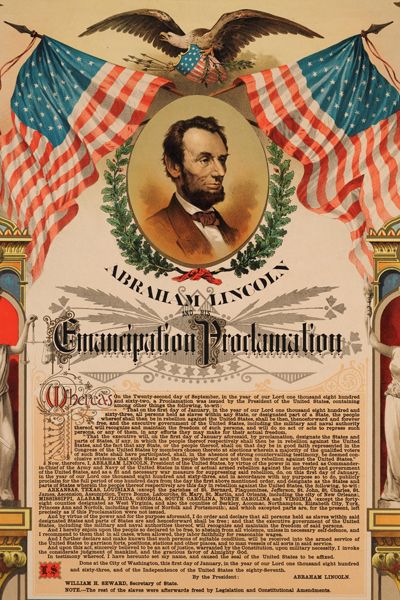
Colin Gray writes that “A successful exercise in peacemaking should persuade the defeated party to accept its defeat.” [1] When the war ended the Confederacy was beaten and most people in the South would have agreed to anything that the North presented regarding peace and return to the Union. The primary political policy goal of Lincoln regarding the war was the reestablishment of the Union and one of the military measures adopted by Lincoln was the emancipation of the South’s slaves who were an important part of the Southern war economy. “During the last two years of the war the abolition of slavery evolved from a means of winning the war to a war aim – from national strategy to national policy.” [2] By Lincoln’s reelection in 1864 that policy included the unconditional surrender of the Confederacy as well as the passage of the Thirteenth Amendment.

That change in policy, the complete abolition of slavery necessitated a remaking of the old South, a culture where economics, social standing and even religion was linked to the “peculiar institution.” In a sense Reconstruction was “what the war was about.” [3] Just two months after Lee’s surrender at Appomattox, Richard Henry Dana, a Federal District Attorney in Boston, declared that “a war is over when its purpose is secured. It is a fatal mistake to hold that this war is over because the fighting has ceased. This war is not over…” [4] As Dana, and Clausewitz understood so well that war is a continuation of policy and politics by other means, and the failure of the President Johnson and others in the North to fully grasp this fact led to over a century of subjugation of emancipated African Americans. The confusion and lack of determined purpose has fueled a continual racial divide in the United States that is still felt today. Defeated on the battlefield Southerners soon turned to political, psychological and violent means to reverse their losses.

Douglass.JPG

Frederick Douglass

Frederick Douglass understood that simple emancipation was not enough, and that the “war and its outcome demanded racial equality.” [5] Despite the that efforts of many in the North this would not happen during Reconstruction and Douglass knew that the failure to accomplish this would be disastrous, “Whether the tremendous war so heroically fought…shall pass into history a miserable failure…or whether on the other hand, we shall, as the rightful reward of victory over treason have a solid nation, entirely delivered from all contradictions and social antagonisms, must be determined one way or another.” [6]

There was a problem with implementing Reconstruction; when John Wilkes Booth assassinated Abraham Lincoln, the political leaders of the North could not agree on how to do this. The new President, Andrew Johnson was probably the worst possible leader to lead the country in the aftermath of war for all practical purposes Johnson was a Democrat who believed in white supremacy, he had been brought onto the ticket for his efforts to keep Kentucky in the Union and to support Unionist elements in Tennessee. While his selection helped Lincoln in parts of the North and the Border States it was a disaster for the post-war era. Johnson’s approach to reconstruction was very simply to “impose minimal demands on the South. He required only minor concessions from the former Confederates before allowing them to resume their political rights and retain their land. As for freedmen, he seemed to think that the needed no further protection beyond the fact of their emancipation.” [7]

Johnson was “a lonely stubborn man with few confidants, who seemed to develop his policies without consulting anyone, then stuck to them inflexibly in the face of any and all criticism. He lacked Lincoln’s ability to conciliate his foes and his capacity for growth, which was best illustrated by Lincoln’s evolving attitude to black suffrage during the Civil War.” [8] In the months after his unexpected accession to the presidency Johnson demonstrated that he had no understanding of Lincoln’s political goals for the South and the desires of the Republican dominated Congress.

By the summer of 1865 Johnson was already demonstrating “that his sympathies were with the Southern white population and that he believed that their interests should be cared for even at the expense of freedmen.” [9] Johnson’s approach to reconstruction was very simply to “impose minimal demands on the South. He required only minor concessions from the former Confederates before allowing them to resume their political rights and retain their land. As for freedmen, he seemed to think that the needed no further protection beyond the fact of their emancipation.” [10] Johnson gave individual pardons to more than thirteen thousand “high-ranking Confederate civil and military officers and wealthy Southerners.” [11] While doing this he minimized political influence the Southern Unionists who had not supported the Confederacy and ensured that freed slaves were excluded from the political process. He issued a number of orders “appointing interim provisional governors and urging the writing of new state constitutions based upon the voter qualifications in force at the time of secession in 1861 – which meant, in large but invisible letters, no blacks.” [12]

When Frederick Douglass led a delegation of blacks to meet with Johnson in February 1866 Johnson preached that it was impossible to give political freedom to blacks. When Douglass attempted to object Johnson became angry and told Douglass “I do not like to be arraigned by some who can get up handsomely-rounded periods and rhetoric, and talk about abstract ideas of liberty, who never periled life, liberty, or property.” [13] When Douglass took his objections to Johnson’s harangue to a Washington newspaper, Johnson railed against Douglass “I know that d—–d Douglass…he’s just like any other nigger & would sooner cut a white man’s throat than not.” [14]

To be continued…

Notes

[1] Ibid. Gray Fighting Talk p.14

[2] Ibid. McPherson The War that Forged a Nation p. 132

[3] Perman, Michael and Murrell Taylor, Amy editors The Civil War and Reconstruction Documents and Essays Third Edition Wadsworth Cengage Learning Boston MA 2011 p.323

[4] Ibid. McPherson The War that Forged a Nation p. 175

[5] Ibid. Goldfield America Aflame p.407

[6] Ibid. Goldfield America Aflame p.407

[7] Ibid. Perman and Taylor The Civil War and Reconstruction Documents and Essays Third Edition p.323

[8] Foner, Eric Forever Free: The Story of Emancipation and Reconstruction Vintage Books a Division of Random House, New York 2005 p.108

[9] Carpenter, John A. Sword and Olive Branch: Oliver Otis Howard Fordham University Press, New York 1999 p.109


[10] Ibid. Perman and Taylor The Civil War and Reconstruction Documents and Essays Third Edition p.323

[11] Ibid. McPherson The War that Forged a Nation p. 177

[12] Ibid. Guelzo Fateful Lightening p.490

[13] Ibid. Guelzo Fateful Lightening p.494

[14] Ibid. Guelzo Fateful Lightening p.494

Leave a comment

Filed under civil rights, civil war, History, Political Commentary

Racism and the Lost Cause

Friends of Padre Steve’s World

During the anniversary of the Battle of Gettysburg I tend to focus on that battle, and the actions of the men who fought it. I anticipate that I will add another article tomorrow from my Civil War and Gettysburg text dealing with a part of that battle, but today because it is so pertinent even 150 years after the war, I will revisit the myth of the Lost Cause and its influence on American history and race relations after the war was over. 

Sadly, the desire of Northern corporations, Southern landowners and those who sought reunion over justice, the rights of African Americans were not only subjugated to those interests but blacks were again degraded and their efforts to achieve their own freedom cast aside as politicians, landowners, academics, businessmen, preachers and even veterans organizations raced to forget what the war was about. 

This post is also part of my Gettysburg text and I do hope that it will cause us all to think about how history and justice can be obscured in the interest of covering over crimes for political, economic and social goals. 

Peace

Padre Steve+

Lost-Cause

Though Edmund Ruffin and his dreams of an independent republic built on slavery and white supremacy was dead, in the coming years, the Southern states would again find themselves under the governance of former secessionists who were unabashed white supremacists. The institution of slavery did not endure “but southerners’ racial beliefs and habits did…. The white ex-Confederate South proved much more successful in guarding this sacred realm” [1] during Reconstruction and after than they did during the war. Former secessionist firebrands who had boldly proclaimed slavery to be the deciding issue during the war changed their story. Instead of slavery being the primary cause of Southern secession and the war, it was “trivialized as the cause of the war in favor of such things as tariff disputes, control of investment banking and the means of wealth, cultural differences, and the conflict between industrial and agricultural societies.” [2]

Alexander Stephens who had authored the infamous Cornerstone Speech in 1861 that “that the negro is not equal to the white man; that slavery — subordination to the superior race — is his natural and normal condition” argued after the war that the war was not about slavery at all. Instead, the former Senator and Confederate Vice President changed his tune and argued that the war:

“had its origins in opposing principles….It was a strife between the principles of Federation, on the one side, and Centralism, or Consolidation on the other.” He concluded “that the American Civil War “represented a struggle between “the friends of Constitutional liberty” and “the Demon of Centralism, Absolutism, [and] Despotism!” [3]

Jefferson Davis, who had masterfully crafted “moderate” language, which radicals in the South used to their advantage regarding the expansion and protection of the rights of slave owners in the late 1850s to mollify Northern Democrats, and who wrote in October 1860 that: “The recent declarations of the Black Republican part…must suffice to convince many who have formerly doubted the purpose to attack the institution of slavery in the states. The undying opposition to slavery in the United States means war upon it where it is, not where it is not” [4] was not above changing his longstanding insistence that the slavery was the heart of the Confederacy’s claim to existence and the reason for secession.

birth_of_a_nation-3

After the war a revisionist Davis wrote:

“The Southern States and Southern people have been sedulously represented as “propagandists” of slavery, and the Northern as the champions of universal freedom…” and “the attentive reader…will already found enough evidence to discern the falsehood of these representations, and to perceive that, to whatever extent the question of slavery may have served as an occasion, it was far from being the cause for the conflict.” [5]

Instead of being about slavery the Confederate cause was mythologized by those promoting the false history of the “Lost Cause” a term coined by William Pollard in 1866, which “touching almost every aspect of the struggle, originated in Southern rationalizations of the war.” [6] By 1877 many southerners were taking as much pride in the “Lost Cause” as Northerners took in Appomattox.[7] Alan Nolen notes: “Leaders of such a catastrophe must account for themselves. Justification is necessary. Those who followed their leaders into the catastrophe required similar rationalization.” [8]

The Lost Cause was elevated by some to the level of a religion. In September 1906, Lawrence Griffith, speaking to a meeting of the United Confederate Veterans, stated that when the Confederates returned home to their devastated lands, “there was born in the South a new religion.” [9] The mentality of the Lost Cause took on “the proportions of a heroic legend, a Southern Götterdämmerung with Robert E. Lee as a latter day Siegfried.” [10]

This new religion that Griffith referenced in his speech was replete with the signs, symbols and ritual of religion:

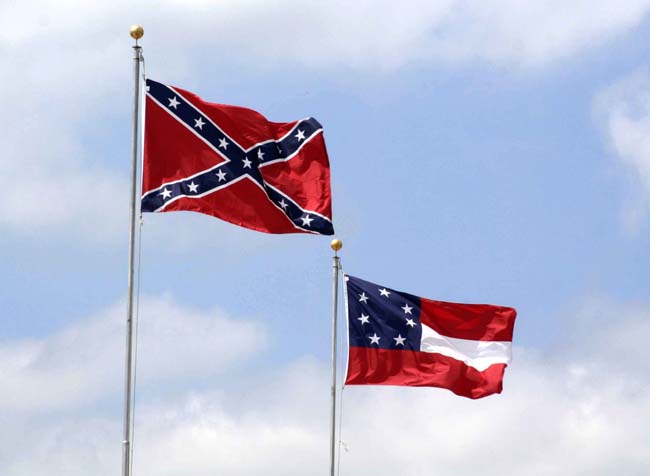
“this worship of the Immortal Confederacy, had its foundation in myth of the Lost Cause. Conceived in the ashes of a defeated and broken Dixie, this powerful, pervasive idea claimed the devotion of countless Confederates and their counterparts. When it reached fruition in the 1880s its votaries not only pledged their allegiance to the Lost Cause, but they also elevated it above the realm of common patriotic impulse, making it perform a clearly religious function….The Stars and Bars, “Dixie,” and the army’s gray jacket became religious emblems, symbolic of a holy cause and of the sacrifices made on its behalf. Confederate heroes also functioned as sacred symbols: Lee and Davis emerged as Christ figures, the common soldier attained sainthood, and Southern women became Marys who guarded the tomb of the Confederacy and heralded its resurrection.” [11]

Jefferson Davis became an incarnational figure for the adherents of this new religion. A Christ figure who Confederates believed “was the sacrifice selected-by the North or by Providence- as the price for Southern atonement. Pastors theologized about his “passion” and described Davis as a “vicarious victim”…who stood mute as Northerners “laid on him the falsely alleged iniquities of us all.” [12] It was a theme that would be repeated by others in the coming decades, instead of a traitor to his nation; Davis became a figure like Jesus Christ, condemned though innocent.

In 1923 a song about Jefferson Davis repeated this theme:

Jefferson Davis! Still we honor thee! Our Lamb victorious, who for us endur’d a cross of martyrdom, a crown of thorns, soul’s Gethsemane, a nation’s hate, A dungeon’s gloom! Another God in chains.” [13]

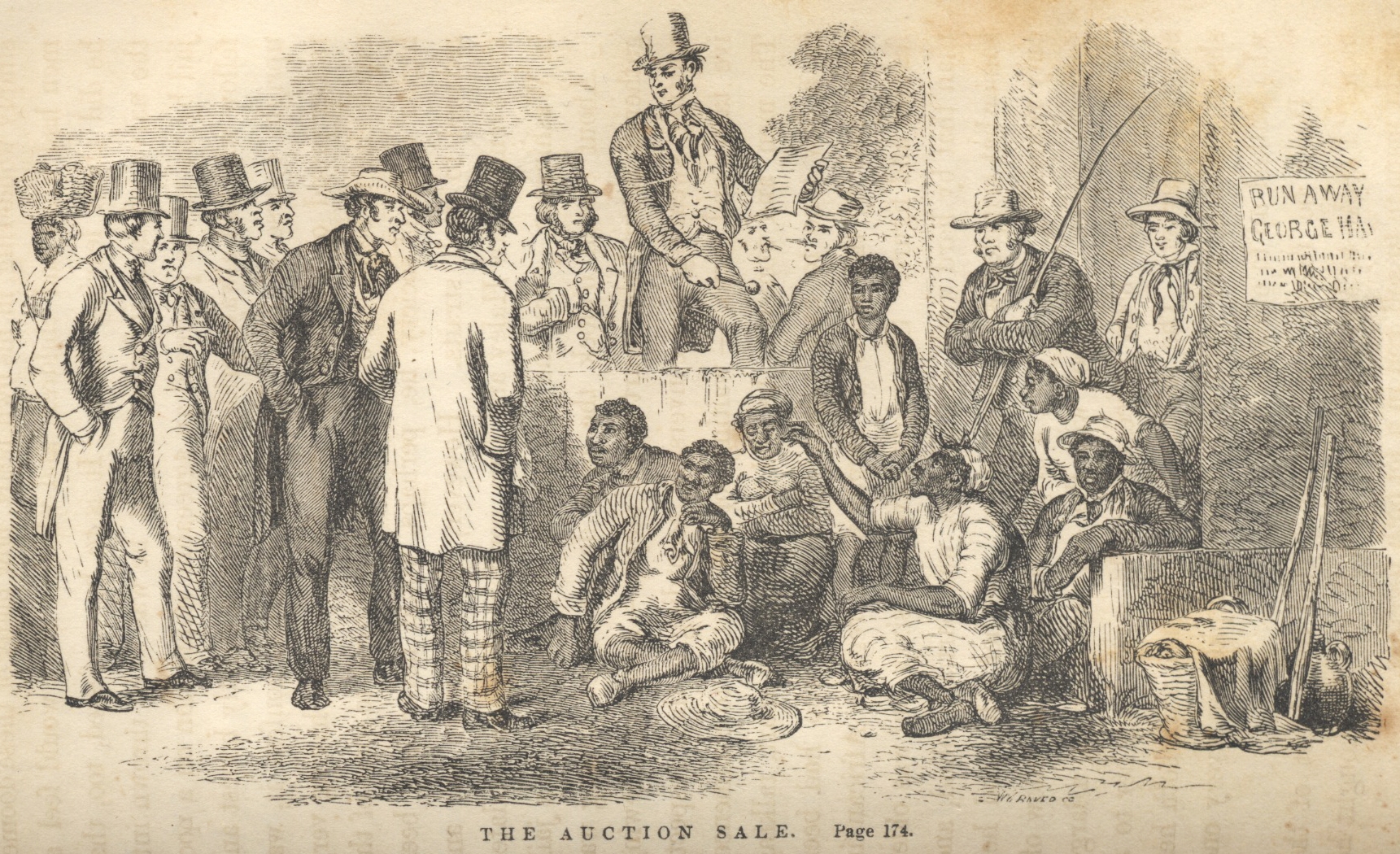
The myth also painted another picture, that of slavery being a benevolent institution which has carried forth into our own time. The contention of Southern politicians, teachers, preachers and journalists, before, during and after the war was that slaves liked their status; they echoed the words of slave owner Hiram Tibbetts to his brother in 1842 “If only the abolitionists could see how happy our people are…..The idea of unhappiness would never enter the mind of any one witnessing their enjoyments” [14] as well as the words of Jefferson Davis who in response to the Lincoln’s Emancipation Proclamation called the slaves “peaceful and contented laborers.” [15]

gone_with_the_wind_b

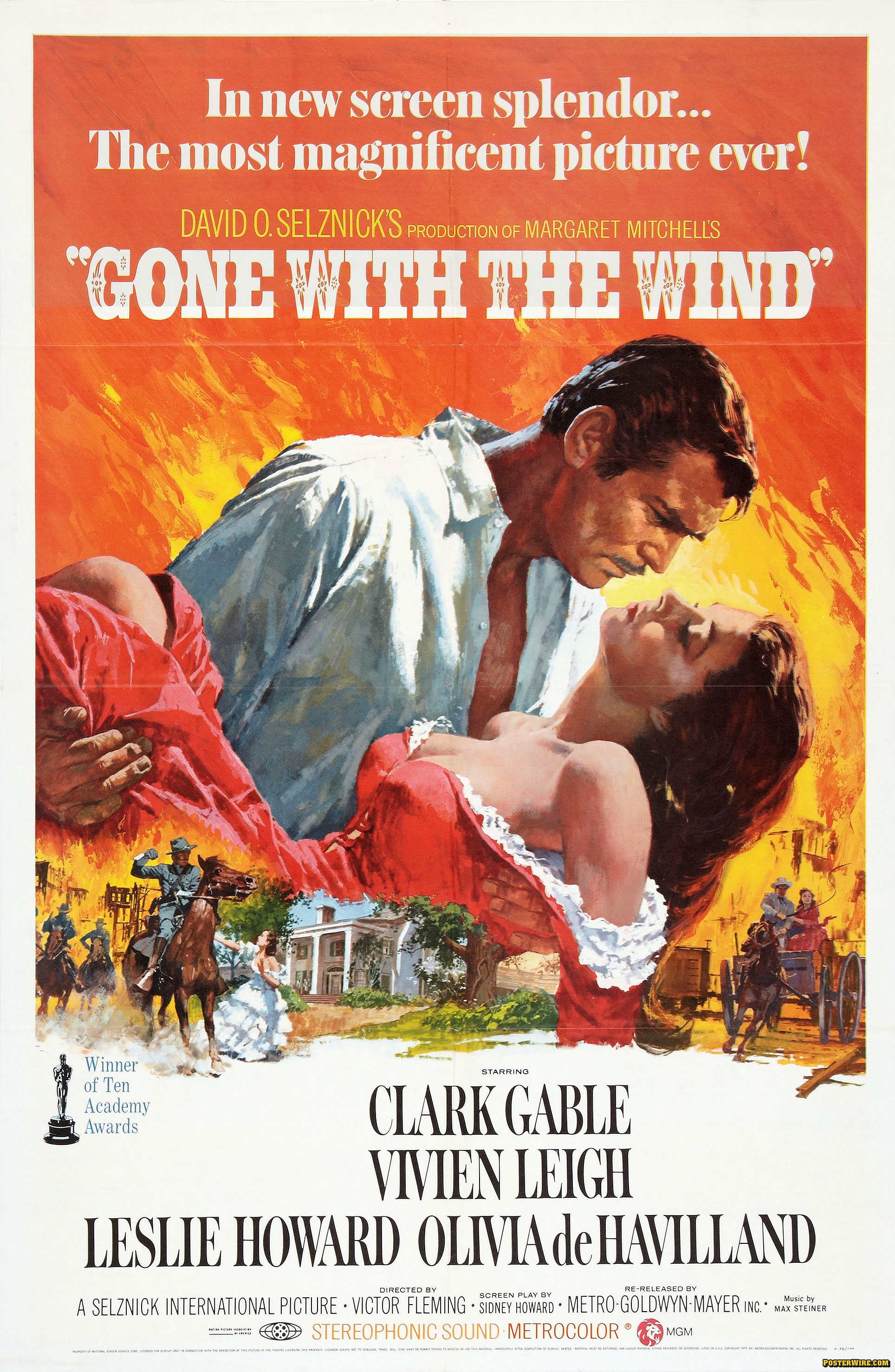
The romantic images of the Lost Cause were conveyed to the American public by numerous writers and Hollywood producers including Thomas Dixon Jr. whose play and novel The Clansman became D.W. Griffith’s The Birth of a Nation; a groundbreaking part of American cinematography which was released in 1915. Margaret Mitchell, who penned the epic Pulitzer Prize winning novel Gone With the Wind, which in its 1939 film form won ten academy awards immortalized the good old days of the old South with images of faithful slaves, a theme which found its way into Walt Disney’s famed 1946 animated Song of the South. Through such films and books the myth of the Lost Cause became part of the national heritage with many people in states outside of the South and even some foreigners coming to believe the myth.

The Lost Cause helped buttress the myths that both comforted and inspired many Southerners following the war. “It defended the old order, including slavery (on the grounds of white supremacy), and in Pollard’s case even predicted that the superior virtues of cause it to rise ineluctably from the ashes of its unworthy defeat.” [16] The myth effectively helped pave the way to nearly a hundred more years of second class citizenship for now free blacks who were often deprived of the vote and forced into “separate but equal” public and private facilities, schools and recreational activities. The Ku Klux Klan and other violent organizations harassed, intimidated, persecuted and used violence against blacks.

When Reconstruction ended Southerners elected officials who turned a blind eye to the activities of the Klan and instituted state laws which denied most civil rights to African Americans, “From the 1880s onward, the post-Reconstruction white governments grew unwilling to rely just on intimidation at the ballot box and themselves in power, and turned instead to systematic legal disenfranchisement.” [17] Lynching was common and even churches were not safe. It would not be until the Civil Rights movement of the 1950s and 1960s that blacks would finally begin to gain the same rights enjoyed by whites in most of the South.

Despite this, many Union veterans to their dying day fought the Lost Causers. Members of the Grand Army of the Republic, the first truly national veteran’s organization, and the first to admit African American soldiers as equals, the predecessor of modern veteran’s groups, continued their fight to keep the public fixed on the reason for war, as well as point out the profound difference between what they believed that they fought for, and what their Confederate opponents fought for during the war.

“The Society of the Army of the Tennessee described the war as a struggle “that involved the life of the Nation, the preservation of the Union, the triumph of liberty and the death of slavery.” They had fought every battle…from the firing on the Union flag Fort Sumter to the surrender of Lee at Appomattox…in the cause of human liberty,” burying “treason and slavery in the Potter’s Field of nations” and “making all our citizens equal before the law, from the gulf to the lakes, and from ocean to ocean.” [18]

At what amounted to the last great Blue and Gray reunion at Gettysburg was held in 1937. The surviving members of the United Confederate Veterans extended an invitation to the GAR to join them there. The members of the GAR’s 71st Encampment from Madison Wisconsin, which included survivors of the immortal Iron Brigade who sacrificed so much of themselves at McPherson’s Ridge on July 1st 1863 adamantly, opposed a display of the Confederate Battle flag. “No Rebel colors,” they shouted. “What sort of compromise is that for Union soldiers but hell and damnation.” [19]

Ruffin outlived Lincoln who was killed by the assassin John Wilkes Booth on April 14th, 1864. However the difference between the two men was marked. In his Second Inaugural Address Lincoln spoke in a complete different manner than did Ruffin. He concluded that address with these thoughts:

“With malice toward none, with charity for all, with firmness in the right as God gives us to see the right, let us strive on to finish the work we are in, to bind up the nation’s wounds, to care for him who shall have borne the battle and for his widow and his orphan, to do all which may achieve and cherish a just and lasting peace among ourselves and with all nations.” [20]

Why this Matters Today

The_Storming_of_Ft_Wagner-lithograph_by_Kurz_and_Allison_1890a

The American Civil War provides a complex drama that political leaders, diplomats and military leaders would be wise to study, and not simply the military aspects and battles. Though the issues may be different in nations where the United States decides to intervene to prevent humanitarian disasters, to prevent local civil wars from becoming regional conflagrations, or to provide stability after a civil war, the conflict provides poignant example after poignant example. If we fail to remember them we will lose who we are as a nation. Sadly, all too often that is what we do.

Ken Burns wrote:

“after the South’s surrender at Appomattox we conspired to cloak the Civil War in bloodless, gallant myth, obscuring its causes and its great ennobling outcome – the survival of the Union and the freeing of four million Americans and their descendants from bondage. We struggled to rewrite our history to emphasize the gallantry of the wars’ top-down heroes, while ignoring the equally important bottom-up stories of privates and slaves. We changed the irredeemable, as the historian Davis Blight argues, into positive, inspiring stories.” [21]

The Union was preserved. Reconciliation was achieved to some degree, albeit in an imperfect manner. The continuance of legal racism and discrimination through the imposition of Jim Crow laws which discriminated against blacks and promoted segregation, poll-taxes and rigged tests to keep blacks from voting stained honor of the nation. The lack of repentance on the part of many of those who shamelessly promoted the Lost Cause and their current defenders continues to this day. Allen Guelzo wrote in the American Interest about the importance of both reconciliation and repentance to Frederick Douglass after the war:

“Douglass wanted the South not only to admit that it had lost, but also that it had deserved to lose. “The South has a past not to be contemplated with pleasure, but with a shudder”, he wrote in 1870. More than a decade later, Douglass was still not satisfied: “Whatever else I may forget, I shall never forget the difference between those who fought to save the Republic and those who fought to destroy it.” [22]

Likewise, that imperfect but reunited Union was all that stood in the way of Nazi Germany in the dark days of early 1942. Had the American republic fragmented during the war, had the South won, as so many kings and dictators of the day either openly or secretly desired, there would have been nothing to stand in the way of Hitler and his legions. Neither there would there be anyone to stand in the way of the modern despots, terrorists and dictatorships such as the Islamic State today.

Religion does matter to peoples, tribes and nations. It is still an important part of both foreign and domestic policy, even if a civilian policy maker or military strategist or operational planner does not believe in God and the effect of it cannot be minimized. Michael Oren notes “the impact of religion in shaping American attitudes and policies toward the Middle East” [23]in his book Power, Faith and Fantasy: America and the Middle East 1776 to the Present. The conflict between largely secular Roman Catholics, Orthodox Christians and Moslems in the Balkans is a glaring example of how people who are basically non-religious will rally around faith as a means of unity against rivals of a different faith, even those who are their long time neighbors.

Likewise, the attempt of former President Bush as well as President Obama to portray the response against Al Qaida and later the invasion of Iraq as “a war against terrorism – not as a war against Arabs, nor, more generally, against Muslims…” [24] has fallen on deaf ears in much of the Moslem world. Many Moslems, see the war as being waged against them and their religion. Many, even moderates have deeply ingrained beliefs similar to the late Osama Bin Laden, or the current leaders of the Al Qaida or the Islamic State for whom “this is a religious war, a war for Islam against infidels, and therefore, inevitably; against the United States, the greatest power of the world of the infidels.” [25]

In our culture of secularization we forget the primal importance of religion to others. Part of what we do not realize is that for people with Fundamentalist religious beliefs, no-matter what religion they belong to that religion is bedrock in times of tumult. When times are tough it is far easier for people to fall back on the more simple and fundamental aspects of their religious beliefs. For Americans this usually plays out in the individual drama of struggle, faith, sin and redemption and salvation. However, even in the United States religion can be, as we have seen from this brief look at the importance of religious faith and ideology in the ante-bellum United States, the Civil War and the aftermath of the war and Reconstruction, be translated into a catalyst and buttress for mass movements and holy war.

confederate-flag-picture

The controversies and conflicts brought on by the ideological, social and religious divides in the Ante-Bellum United States provide current leaders with historical examples. Our Civil War was heavily influenced by religion and the ideologies of the partisans in the North and in the South who were driven by religious motives, be those of the evangelical abolitionists or the proslavery evangelicals. If one is honest, one can see much of the same language, ideology and religious motivation at play in our twenty-first century United States. The issue for the vast majority of Americans, excluding certain neo-Confederate and White Supremacist groups, is no longer slavery; however the religious arguments on both sides of the slavery debate find resonance in our current political debates.

Likewise, for military, foreign policy officials and policy makers the subject of the role of religion can be quite informative. Similar issues are just as present in many the current conflicts in the Middle East, Africa and Eastern Europe which are driven by the religious motives of various sects. The biggest of these conflicts, the divide between Sunni and Shia Moslems, is a conflict that threatens to engulf the region and spread further. In it religion is coupled with the quest for geopolitical and economic power. This conflict in all of its complexity and brutality is a reminder that religion is quite often the ideological foundation of conflict.

These examples, drawn from our own American experience can be instructive to all involved in policy making. These examples show the necessity for policy makers to understand just how intertwined the political, ideological, economic, social and religious seeds of conflict are, and how they cannot be disconnected from each other without severe repercussions.

Samuel Huntington wrote:

“People do not live by reason alone. They cannot calculate and act rationally in pursuit of their self-interest until they define their self. Interest politics presupposes identity. In times of rapid social change established identities dissolve, the self must be redefined, and new identities created. For people facing the need to determine Who am I? Where do I belong? Religion provides compelling answers….In this process people rediscover or create new historical identities. Whatever universalist goals they may have, religions give people identity by positing a basic distinction between believers and non-believers, between a superior in-group and a different and inferior out-group.” [26]

By taking the time to look at our own history as well as our popular mythology; planners, commanders and policy makers can learn lessons if they take the time to learn, will help them understand similar factors in places American troops and their allies might be called to serve, or that we might rather avoid.

Notes 

[1] Ibid. Daly When Slavery Was Called Freedom pp.148-149

[2] Gallagher, Gary W. and Nolan Alan T. editors The Myth of the Lost Cause and Civil War History Indiana University Press, Bloomington and Indianapolis 2000 p.15

[3] Ibid. Dew Apostles of Disunion p.16

[4] Ibid. Catton The Coming Fury p.104

[5] Davis, Jefferson The Rise and Fall of the Confederate Government Volume One of Two, A public Domain Book, Amazon Kindle edition pp.76-77

[6] Ibid. Gallagher and Nolan The Myth of the Lost Cause and Civil War History p.12

[7] Millet Allen R and Maslowski, Peter. For the Common Defense: A Military History of the United States of America The Free Press, a division of McMillan Publishers, New York 1984 p.230

[8] Ibid. Gallagher and Nolan The Myth of the Lost Cause and Civil War History p.12

[9] Hunter, Lloyd The Immortal Confederacy: Another Look at the Lost Cause Religion in Gallagher and Nolan The Myth of the Lost Cause and Civil War p.185

[10] Ibid. McPherson The Battle Cry of Freedom p.854

[11] Ibid. Hunter The Immortal Confederacy Religion in Gallagher and Nolan The Myth of the Lost Cause and Civil War p.186

[12] Ibid. Hunter The Immortal Confederacy Religion in Gallagher and Nolan The Myth of the Lost Cause and Civil War p.198

[13] Ibid. Hunter The Immortal Confederacy Religion in Gallagher and Nolan The Myth of the Lost Cause and Civil War p.198

[14] Ibid. Levine Half Slave and Half Free p.106

[15] Ibid. Gallagher and Nolan The Myth of the Lost Cause and Civil War History p.16

[16] Ibid. Guelzo Fateful Lightening p.525

[17] Ibid. Guelzo Fateful Lightening p.526

[18] Ibid. Guelzo Fateful Lightening p.532

[19] Ibid. Guelzo Fateful Lightening p.532

[20] Ibid. Lincoln Second Inaugural Address

[21] Ibid. Burns A Conflict’s Acoustic Shadows p.102

[22] Guelzo, Allen C. A War Lost and Found in The American Interest September 1st 2011 retrieved 30 October 2014 from http://www.the-american-interest.com/articles/2011/09/01/a-war-lost-and-found/

[23] Oren, Michael Power, Faith and Fantasy: America and the Middle East 1776 to the Present W.W. Norton and Company, New York and London 2007 p.13

[24] Lewis, Bernard The Crisis of Islam: Holy War and Unholy Terror Random House, New York 2003 p.xv

[25] Ibid. Lewis The Crisis of Islam p.xv

[26] Ibid. Huntington The Clash of Civilizations p.97

3 Comments

Filed under civil war, film, Gettysburg, History, Political Commentary

Racism & the Failure of Reconstruction

this-is-a-white-mans-government


Friends of Padre Steve’s World

Some events and attitudes are timeless, one of these is racism. Being white myself, I know that many whites are loath to admit that the scourge of racism still exists, but it does and it runs deep in our history. The more that I work on my Civil War and Gettysburg text, which now appears will morph into at least two and maybe three books when I am done, I find terribly distressing parallels to attitudes and actions of some which mirror the attitudes and actions of our ancestors, Northern and Southern following the Civil War. When the shooting stopped and the South was vanquished, many Southerners continued the war by other means and Northerners, divided after the death of Abraham Lincoln failed to achieve the most important political goal, after the restoration of the Union, that of true freedom for African Americans. Sadly, for some that war is still not over, as was evidenced in the aftermath of the Emanuel A.M.E. Massacre just two weeks ago. Likewise the burnings of six predominantly black churches across the South raises the specter of the racial violence that targeted blacks for a century after the Civil War.

This is another section of my text. I do hope that it challenges you as much as writing it challenged me.

Peace

Padre Steve+


When the war ended the Confederacy was beaten and most people in the South would have agreed to anything that the North presented regarding peace and return to the Union. In a sense Reconstruction was “what the war was about.” [1] Richard Henry Dana, the declared that “a war is over when its purpose is secured. It is a fatal mistake to hold that this war is over because the fighting has ceased. This war is not over…” [2] As Dana, and Clausewitz understood so well that war is a continuation of policy and politics by other means, and the failure of the North to fully grasp this fact led to over a century of subjugation of emancipated African Americans and has fueled a continual racial divide in the United States that is still felt today. Defeated on the battlefield Southerners soon turned to political, psychological and violent means to reverse their losses.

Frederick Douglass understood that simple emancipation was not enough, and that the “war and its outcome demanded racial equality.” [3] Despite the that efforts of many in the North this would not happen during Reconstruction and Douglass knew that the failure to accomplish this would be disastrous, “Whether the tremendous war so heroically fought…shall pass into history a miserable failure…or whether on the other hand, we shall, as the rightful reward of victory over treason have a solid nation, entirely delivered from all contradictions and social antagonisms, must be determined one way or another.” [4]

There was a problem with implementing Reconstruction; when John Wilkes Booth assassinated Abraham Lincoln, the political leaders of the North could not agree on how to do this. The new President, Andrew Johnson was probably the worst possible leader to lead the country in the aftermath of war for all practical purposes Johnson was a Democrat who believed in white supremacy, he had been brought onto the ticket for his efforts to keep Kentucky in the Union and to support Unionist elements in Tennessee. While his selection helped Lincoln in parts of the North and the Border States it was a disaster for the post-war era. Johnson’s approach to reconstruction was very simply to “impose minimal demands on the South. He required only minor concessions from the former Confederates before allowing them to resume their political rights and retain their land. As for freedmen, he seemed to think that the needed no further protection beyond the fact of their emancipation.” [5]

Johnson was “a lonely stubborn man with few confidants, who seemed to develop his policies without consulting anyone, then stuck to them inflexibly in the face of any and all criticism. He lacked Lincoln’s ability to conciliate his foes and his capacity for growth, which was best illustrated by Lincoln’s evolving attitude to black suffrage during the Civil War.” [6] In the months after his unexpected accession to the presidency Johnson demonstrated that he had no understanding of Lincoln’s political goals for the South and the desires of the Republican dominated Congress.

By the summer of 1865 Johnson was already demonstrating “that his sympathies were with the Southern white population and that he believed that their interests should be cared for even at the expense of freedmen.” [7] Johnson’s approach to reconstruction was very simply to “impose minimal demands on the South. He required only minor concessions from the former Confederates before allowing them to resume their political rights and retain their land. As for freedmen, he seemed to think that the needed no further protection beyond the fact of their emancipation.” [8] Johnson gave individual pardons to more than thirteen thousand “high-ranking Confederate civil and military officers and wealthy Southerners.” [9] While doing this he minimized political influence the Southern Unionists who had not supported the Confederacy and ensured that freed slaves were excluded from the political process. He issued a number of orders “appointing interim provisional governors and urging the writing of new state constitutions based upon the voter qualifications in force at the time of secession in 1861 – which meant, in large but invisible letters, no blacks.” [10]

When Frederick Douglass led a delegation of blacks to meet with Johnson in February 1865 Johnson preached that it was impossible to give political freedom to blacks. When Douglass attempted to object Johnson became angry and told Douglass “I do not like to be arraigned by some who can get up handsomely-rounded periods and rhetoric, and talk about abstract ideas of liberty, who never periled life, liberty, or property.” [11] When Douglass took his objections to Johnson’s harangue to a Washington newspaper, Johnson railed against Douglass “I know that d—–d Douglass…he’s just like any other nigger & would sooner cut a white man’s throat than not.” [12]

White Southerners including the newly pardoned Confederates enacted black codes that “codified explicit second-class citizenship for freedpeople.” [13] The legislature of Mississippi refused to ratify the Thirteenth Amendment, and did not do so until 1995. One Southerner noted that “Johnson “held up before us the hope of a ‘white man’s government,’ and this led us to set aside negro suffrage…. It was natural that we should yield to our old prejudices.” [14] Former Confederates, including Alexander Stephens the former Vice President of the Confederacy were elected to high office, Stephens to the United States Senate and the aggrieved Republicans in Congress in turn refused to admit the former Confederates. Many Union veterans were incensed by Johnson’s actions, one New York artilleryman noted “I would not pardon the rebels, especially the leaders, until they should kneel in the dust of humiliation and show their deeds that they sincerely repent.” [15] He was not alone, many Northern Veterans who formed the integrated Grand Army of the Republic veterans maintained a patent disregard, if not hatred of what the old South stood for and felt that their efforts in the war had been betrayed by the government.

Johnson’s restoration of property to the former white owners drove tens of thousands of blacks off lands that they had been farming, or left them as laborers for their former slave masters. Johnson countermanded General William Tecumseh Sherman and Secretary of War Edwin Stanton’s Field Order 15 to “divide abandoned and confiscated lands on the Sea Islands and in a portion of the Low Country coast south of Charleston into forty-acre plots for each black family.” [16] As such many freed blacks were now at the mercy of their former white owners for any hope of economic sustenance. Johnson stridently to frustrate the efforts of the Freedmen’s Bureau headed by Major General Oliver Howard to help freed blacks to become landowners. Johnson vetoed the Civil Rights bill but Congress overrode his veto. Eventually the battled between Johnson and Congress resulted in Johnson’s impeachment and narrow acquittal by one vote in the Senate in 1868.

The various black codes enacted throughout the South:

“passed labor laws that bound blacks to employers almost as tightly as slavery once bound them to their masters. Other codes established patterns of racial segregation that had been impossible under slavery, barred African Americans from serving on juries or offering testimony in court against whites, made “vagrancy,” “insulting gestures,” and “mischief” offenses by blacks punishable by fines or imprisonment, forbade black-white intermarriage, ad banned ownership by blacks of “fire-arms of any kind, or any ammunition, dirk or bowie-knife.” [17]

Likewise within weeks of the end of the violence against blacks began to break out in different parts of the South and it continued to spread as Johnson and Congress battled each other in regard to Reconstruction policy. “In Memphis, Tennessee, in May of 1866, whites on a rampage of murder killed forty-six Negroes, most of them veterans of the Union army, as well as two white sympathizers. Five Negro women were raped. Ninety homes, twelve schools and four churches were burned. In New Orleans in the summer of 1866, another riot against blacks killed thirty-five Negroes and three whites.” [18]

This alienated him from the Republican majority who passed legislation over Johnson’s veto to give black men the right to vote and hold office, and to overturn the white only elections which had propelled so many ex-Confederates into political power. Over Johnson’s opposition congress took power over Reconstruction and “Constitutional amendments were passed, the laws for racial equality were passed, and the black man began to vote and to hold office.” [19] Congress passed measures in 1867 that mandated that the new constitutions written in the South provide for “universal suffrage and for the temporary political disqualification of many ex-Confederates.” [20]   These measures helped elect bi-racial legislatures in the South which for the first time enacted a series of progressive reforms including the creation of public schools. They also ratified the Thirteenth and the Fourteenth Amendments, but these governments, composed of Southern Unionists, Northern Republicans and newly freed blacks were “elicited scorn from the former Confederates and from the South’s political class in general.” [21] Seen as an alien presence by most Southerners the Republican governments in the South faced political and was as violent opposition.

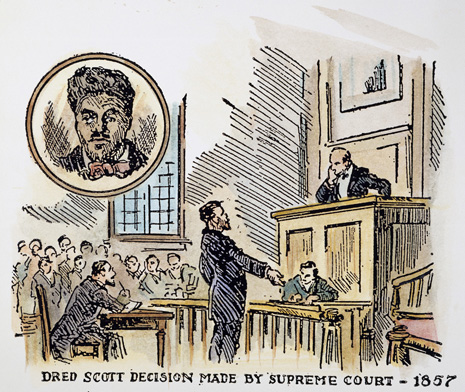
The Fourteenth Amendment was of particular importance for it overturned the Dred Scott decision which denied citizenship to blacks. Johnson opposed the amendment and worked against its passage by campaigning for men who would oppose it in the 1866 elections. His efforts earned him the opposition of former supporters including the influential New York Herald declared that Johnson “forgets that we have passed through a fiery ordeal of a mighty revolution, and the pre-existing order of things is gone and can return no more.” [22]

When passed by Congress the amendment was a watershed which would set Constitutional precedent for future laws to give women the right to votes, end Jim Crow laws, enact the Voting Rights Act of 1965, and most recently to give homosexuals the right to marry. Section one of the amendment read:

“All persons born or naturalized in the United States, and subject to the jurisdiction thereof, are citizens of the United States and of the state wherein they reside. No state shall make or enforce any law which shall abridge the privileges or immunities of citizens of the United States; nor shall any state deprive any person of life, liberty, or property, without due process of law; nor deny to any person within its jurisdiction the equal protection of the laws.” [23]

But these measures provoked even more violence from enraged Southerners who formed a variety of violent racist organizations which turned the violence from sporadic attacks to what amounted to a full-fledged insurgency against the new state governments and African Americans. Organizations like the Ku Klux Klan which engaged in terroristic violence to heavily armed “social clubs” which operated under the aegis of the state Democratic Party leadership in most Southern states. Allegedly organized for self-defense against state militia units composed of freed blacks they named themselves “White Leagues (Louisiana), White Liners or Rifle Clubs (Mississippi), or Red Shirts (South Carolina). They were, in fact, paramilitary organizations that functioned as armed auxiliaries of the Democratic Party in southern states in their drive to “redeem” the South from “black and tan Negro-Carpetbag rule.” [24] These men, mostly Confederate veterans “rode roughshod over the South, terrorizing newly freed slaves, their carpetbagger allies, and anyone who dared to imagine a biracial democracy as the war’s change.” [25] This unrequited violence and hatred set the stage for the continued persecution, murder and violence against blacks and those who supported their efforts to achieve equality in the South for the next century.

Throughout his term in office Johnson appealed to arguments used throughout later American history by “critics of civil rights legislation and affirmative action. He appealed to fiscal conservatism, raised the specter of an immense federal bureaucracy trampling on citizens’ rights, and insisted that self-help, not government handouts, was the path to individual advancement.” [26] While many of his Republican opponents supported these measures, many moderate Republicans could not abandon their support of or and ties to big corporations, and

Ulysses S. Grant succeeded Johnson as President in 1869 but his efforts at Reconstruction were met mostly by failure as well as a weariness on the part of many Northerners to continue to invest any more effort into it. Slowly even proponents of Reconstruction began to retreat from it and Southerners, knowing that they were winning the political battle continued their pressure. Both politically and through the use of terror to demoralize and drive from power anyone who supported it. By 1870 every former Confederate state had been readmitted to the Union, in a sense fulfilling a part Lincoln’s war policy, but at the same time denying what the war was waged for.

Congressman Thaddeus Stevens, one of the most effective leaders of the Radical Republicans died in 1868 in despair that the rights of blacks were being rolled back even as legislation was passed supporting them. The old firebrand asked “to be buried in a segregated cemetery for African American paupers so that “I might illustrate in death the principles which I advocated through a long life, Equality of man before his creator.” [27] Others including Senator Ben Wade, were not returned to office while others including Edwin Stanton, Salmon Chase and Charles Summer all died during Grant’s administration.

While Grant attempted to smash the Ku Klux Klan by military means his administration, heavily made up of economic conservative Republicans who had little interest in the rights of African Americans gave little other support to those fighting for equal rights for blacks. In the end Southern intransigence wore out the political will of Northerners to carry on, even the strongest supporters of equality.

By “1870 Radical Republicanism as a coherent political movement was rapitdl6y disintegrating” [28] and during the early 1870s many of the antislavery activists had left the Republican party either to death or defection, many “no longer felt at home in a party that catered to big business and lacked the resolve to protect black rights.” [29]

In 1872, some former radical Republicans revolted against Grant and the corruption in the Republican Party. Calling themselves “Liberal Republicans” they supported the candidacy of Horace Greeley uniting with Democrats to call for an end to Reconstruction. For many this was not so much because they no longer supported the rights of African Americans, but because for them, like so many, “economic concerns now trumped race relations…. Henry Adams, who shared the views of his father, Charles Francis Adams, remarked that “the day is at hand when corporations far greater than [the] Erie [Railroad]…will ultimately succeed in directing the government itself.” [30] The numbers of Federal troops in the South continued to be reduced to the point where they could offer little or no support to state militia.

Violence now became a means to further politics in the South and carried out in broad daylight and “intended to demoralize black voters and fatally undermine the Republican Party…. They paraded at regular intervals through African American sections of small towns in the rural black majority areas, intimidating the residents and inciting racial confrontations.” [31] These armed bands were highly successful, if they were successful in provoking a racial incident they would then fan out throughout the area to find blacks in order to beat up and kill, hundreds of blacks were killed by them. During the elections of 1876 the White Liners, Red Shirts and others would be seen in threatening positions near Republican rallies and on Election Day swarmed the polls to keep blacks and Republicans out, even seizing ballot boxes. The strategy employed was to use “Lawless and utterly undemocratic means…to secure the desired outcome, which was to win a lawful, democratic election.” [32]

The elected governor of Mississippi, Republican General Adelbert Ames, who was one of the most able and honest of all the Northerners to hold elected office in the South wrote in 1875 about the power of the paramilitary groups, “The “white liners” have gained their point – they have, by killing and wounding, so intimidated the poor Negroes that they can in all human probability prevail over them at the election. I shall try at once to get troops form the general government. Of course it will be a difficult thing to do.” [33] Ames did not get his troops. Grant’s Attorney general wrote “The whole public are tired out with these autumnal outbreaks in the South…and the great majority are now ready to condemn any interference on the part of the government….Preserve the peace by the forces in your own state….” [34] Ames, who had been a strong proponent of emancipation and black suffrage understood that he was being abandoned and in order to prevent more bloodshed gave up the fight. He negotiated a deal with Democrats which resulted in blacks being forced form the polls and the Democrats returning to power in the state.

The White League in Louisiana was particularly brutal and on Easter Sunday massacred blacks in Colfax Louisiana killing at least seventy-one and possibly as many as three-hundred blacks, killing many as they tried to surrender. Another White League detachment southwest of Shreveport “forced six white Republicans to resign their office on pain of death – and then brutally murdered them after they had resigned.” [35]

Reconstruction was officially ended in 1877 by newly elected President Rutherford B. Hayes and all Federal troops assigned to enforce it were withdrawn. Despite this, some people in the South attempted to fight for the rights of African Americans, including men like former Confederate Generals James Longstreet, William Mahone and Wade Hampton. Hampton was elected as the first post-Reconstruction governor of South Carolina in and campaigned against the black codes, and during his term in office even appointed African Americans to political offices in the state and maintained a regiment of African American state militia in Charleston against strident opposition.

While Hampton remained a white supremacist he also was committed to the upholding the law and “promoting the political rights to which freedmen were entitled to under law, and he consistently strove to protect those rights.” [36] This made him anathema to many South Carolina politicians, including Benjamine Tillman who as governor during the 1890s dismantled policies that Hampton had introduced to allow blacks to political patronage appointments. Once he did that Tillman set out to deprive South Carolina’s blacks of almost ever basic civil right, and in 1895 he led “a successful effort to rewrite the South Carolina constitution in such a way as to virtually disenfranchise every black resident of the state.” [37] Longstreet, who had become a Republican was wounded while leading Louisiana militia in an unsuccessful fight against White Leaguers in New Orleans on September 14th 1873.

The legislation which helped provide blacks with some measure of freedom was rolled back after Reconstruction ended. In 1883 “the Civil Rights Act of 1875, outlawing discrimination against Negroes using public facilities, was nullified by the Supreme Court, which said: “individual invasion of individual rights is not the subject-matter of the amendment.” The Fourteenth Amendment, it said, was aimed at state action only. No state shall…” [38]

The actions of the court and alliances between Northern corporations and Southern landowners led to even more discrimination and disenfranchisement for blacks, “From the 1880s onward, the post-Reconstruction white governments grew unwilling to rely just on intimidation at the ballot box and themselves in power, and turned instead to systematic legal disenfranchisement” [39] which furthered the black codes into what we now call the era of Jim Crow.

In 1896 the black codes were upheld by the Supreme Court in the case of Plessy v. Ferguson. That ruling established the “separate but equal” doctrine and ushered in an era of de jure segregation in almost all arenas of life including education, transportation, entertainment and health care. The limited social equity and privileges enjoyed by blacks, not only in the South, but in the entire nation were erased by the stroke of the judicial pen. The justices ruled on the concept that only people’s political rights were protected by the Constitution and that in the social arena that African-Americans could not interact with whites and assumed their racial inferiority.

Associate Justice John Harlan, a former slaveholder who had dissented in Court’s decision to overturn the Civil Rights Act of 1875 insisted “our Constitution is color blind” [40] and wrote in dissent:

“The destinies of two races, in this country are indissolubly linked together, and the interests of both require that the common government of all should not permit the seeds of race hate to be planted under the sanction of law. What can more certainly arouse race hate, what more certainly create and perpetuate a feeling of distrust between these races, than state enactments, which, in fact, proceed on the ground that colored citizens are so inferior and degraded that they cannot be allowed to sit in public coaches occupied by white citizens? That, as all will admit, is the real meaning of such legislation as was enacted in Louisiana.” [41]

These court decisions and legislation strengthened racism and discrimination against blacks, “effectively excluding blacks from public places, from the right to votes, from good public education, and so forth.” [42] The Plessy ruling was followed by “state laws mandating racial segregation in every aspect of life, from schools to hospitals, waiting rooms to toilets, drinking fountains to cemeteries…segregation was part of a complex system of white domination, in which each component – disenfranchisement, unequal economic status, inferior education – reinforced the others.” [43] Violence was used with great effect and between 1880 and 1968 approximately 3,500 people were murdered or lynched throughout the South. The “separate but equal” measures of the Jim Crow era took nearly a century to reverse, and “only began to disappear with Brown v. Board of Education in 1954 and the Civil Rights and Voting Rights Acts of 1964 and 1965.” [44]

The example of Reconstruction’s failure shows that in order to secure peace that military victory must be accompanied by the political will to ensure that the avowed goals of that victory are secured after the war in ensuring a just peace. Southerners may have lost the shooting war, but they did not accept the peace and resorted to all means to reverse their military defeat through political, social, economic and judicial means and “justice was sacrificed for the unjust peace ushered in by “redemption” of the South, a peace marred by Jim Crow, poverty and lynching.” [45] Most Northern leaders failed to appreciate this until far too late, and hindered by President Johnson’s opposition failed to win the peace in the South. They failed to appreciate that even after the shooting is often that “there is a need for further threats, and indeed action, because postwar disorder and even chaos will have to be address, and victorious allies are always likely to squabble over the spoils of victory” [46] as certain was the case in the divided Republican Party of the Reconstruction era.


Notes

[1] Perman, Michael and Murrell Taylor, Amy editors The Civil War and Reconstruction Documents and Essays Third Edition Wadsworth Cengage Learning Boston MA 2011 p.323

[2] Ibid. McPherson The War that Forged a Nation p. 175

[3] Ibid. Goldfield America Aflame p.407

[4] Ibid. Goldfield America Aflame p.407

[5] Ibid. Perman and Taylor The Civil War and Reconstruction Documents and Essays Third Edition p.323

[6] Foner, Eric Forever Free: The Story of Emancipation and Reconstruction Vintage Books a Division of Random House, New York 2005 p.108

[7] Carpenter, John A. Sword and Olive Branch: Oliver Otis Howard Fordham University Press, New York 1999 p.109


[8] Ibid. Perman and Taylor The Civil War and Reconstruction Documents and Essays Third Edition p.323

[9] Ibid. McPherson The War that Forged a Nation p. 177

[10] Ibid. Guelzo Fateful Lightening p.490

[11] Ibid. Guelzo Fateful Lightening p.494

[12] Ibid. Guelzo Fateful Lightening p.494

[13] Ibid. McPherson The War that Forged a Nation p. 177

[14] Ibid. Guelzo Fateful Lightening p.491

[15] Jordan, Brian Matthew. Marching Home: Union Veterans and Their Unending Civil War Liveright Publishing Corporation a Division of W.W. Norton and Company Inc. New York and London 2014 p.119

[16] Ibid. Goldfield America Aflame p.411

[17] Ibid. Guelzo Fateful Lightening p.491

[18] Ibid. Zinn The Other Civil War p.55

[19] Ibid. Zinn The Other Civil War p.54

[20] Ibid. McPherson The War that Forged a Nation p. 178

[21] Perman, Michael Illegitimacy and Insurgency in the Reconstructed South in The Civil War and Reconstruction Documents and Essays Third Edition edited by Michael Perman and Amy Murrell Taylor Wadsworth Cengage Learning Boston MA 2011 p.451

[22] Ibid. Foner Forever Free p.121

[23] _____________ The 14th Amendment to the U.S. Constitution retrieved from https://www.law.cornell.edu/constitution/amendmentxiv 29 June 2015

[24] Ibid. McPherson The War that Forged a Nation p. 178

[25] Ibid. Jordan Marching Home p.118

[26] Ibid. Foner Forever Free p.116

[27] Ibid. Guelzo Fateful Lightening p.504

[28] Ibid. Foner Forever Free p.170

[29] Ibid. Egnal Clash of Extremes p.337

[30] Ibid. Egnal Clash of Extremes p.337

[31] Ibid. Perman Illegitimacy and Insurgency in the Reconstructed South pp.459-460

[32] Ibid. Perman Illegitimacy and Insurgency in the Reconstructed South p.461

[33] Ames, Adelbert Governor Adelbert Ames deplores Violence in Mississippi, September 1875 in The Civil War and Reconstruction Documents and Essays Third Edition edited by Michael Perman and Amy Murrell Taylor Wadsworth Cengage Learning Boston MA 2011 p.434

[34] Ibid. McPherson The War that Forged a Nation p. 190

[35] Ibid. McPherson The War that Forged a Nation p. 185

[36] Longacre, Edward G. Gentleman and Soldier: The Extraordinary Life of General Wade Hampton Rutledge Hill Press, Nashville TN 2003 p.265

[37] Ibid. Longacre Gentleman and Soldier p.274

[38] Ibid. Zinn The Other Civil War p.57

[39] Ibid. Guelzo Fateful Lightening p.526

[40] Ibid. Zinn The Other Civil War p.58

[41] LaMorte, Michael W. School Law: Cases and Concepts 9th Edition 2008 Allyn and Bacon Inc. 2008 p.300

[42] Gonzalez, Justo L. The History of Christianity Volume 2: The Reformation to the Present Day Harper and Row Publishers San Francisco 1985 p.252

[43] Ibid. Foner Forever Free p.208

[44] Ibid. Huntington Who are We? p.54

[45] Ibid. McPherson The War that Forged a Nation p. 191

[46] Ibid. Gray Fighting Talk p.14


2 Comments

Filed under civil rights, civil war, History, laws and legislation, News and current events, Political Commentary

Slavery, Economics & Politics: The Compromise of 1850

Friends of Padre Steve’s World,

I have been sharing parts of my Civil War and Gettysburg Staff Ride text here for some time. We often don’t like to admit it but all to often racism and other forms of prejudice, intolerance and hate line up perfectly with some peoples and groups political and economic agenda. The Compromise of 1850 shows how in American history that confluence of hatred, racism, political power and economic gain  come together to create the perfect storm of oppression. 

We are not alone in this, such has been the case in many other cultures and in many other nations for millennia and continue to be today. 

The lesson of this should be taken to heart as anyone seeks political and economic aggrandizement on the backs of other people and sadly it happens all too often here in the United States and Western Europe. 

I do plan on weighing in on the issue of the Confederate flag either tonight or tomorrow. But until then have a great as well as a thoughtful night.

Peace

Padre Steve+
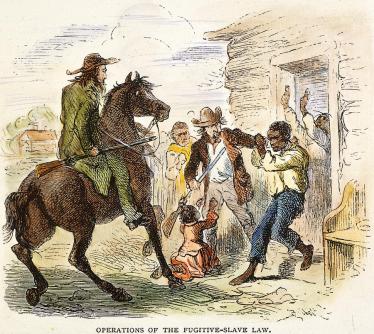
fugitive-slave-act-1850-granger-1

Slavery and National Expansion: The Compromise of 1850

The Ante-Bellum South was an agrarian society that depended on the free labor provided by slaves. In a socio-political sense the South was an oligarchy that offered no freedom to slaves, openly discriminated against free blacks and provided little hope of social or economic advancement for poor and middle class whites. However, despite this, even poor whites supported it. Many Southern Yeoman farmers were willing to tolerate their second class status because they: “feared the fall from independent producer to dependent proletarian, a status he equated with enslavement” [1] more than remaining subservient to planters and plantation owners. In fact, for them slavery was the one institution that kept them above the despised black.

While all Northern states had abolished slavery, or were in the process of gradual abolition in the after independence and the Civil War and had moved to an economic concept of free labor, the South had tied its economy and society to the institution of slavery. The contrast was well said by the members of an Alabama agricultural society, which noted in 1846:

“Our condition is quite different from that of the non-slaveholding section of the United States. With them their only property consists of lands, cattle and planting implements. Their laborers are merely hirelings, while with us our laborers are our property.” [2]

Northerners on the other hand, even in states where the last vestiges of slavery held on, nearly universally ascribed to the understanding that there was a dignity to labor and that free labor was essential if people were to have a better life. It undergirded their understanding of human dignity and that “labor was the source of all value.” [3]

That understanding of the intrinsic value of free labor continued to gain ground in the North in the decades preceding the Civil War and found much of its support in the Calvinist theology that predominated in most Protestant Northern denominations. Labor was intrinsic to one’s calling as a Christian and a human being, slave labor, at least in the eyes of many Northerners undercut that idea. Success in one’s calling glorified God and provided earthly evidence that a person was among the elect. For many Northern Christians, “the pursuit of wealth thus became a way of serving God on earth, and labor, which had been imposed on fallen man as a curse, was transmuted into a religious value, a Christian calling.” [4] Such ideas found their way into Republican political thought even when not directly related to religion. William Evarts said in 1856 “Labor gentlemen, we of the free States acknowledge to be the source of all of our wealth, of all our progress, of all our dignity and value.” [5] Abraham Lincoln noted that “the free labor system…opens the way for all, and energy and progress, and improvement in condition for all,” [6] and noted something inherent in the economic theory of Adam Smith that Labor is prior to, and independent of capital…in fact, capital is the fruit of labor.” [7]

However, the South by the 1830s had completely wedded itself to slavery and southern advocates of slavery deplored the free-labor movement as wage slavery and extolled the virtue of slavery. James H. Hammond condemned the free-labor movement in his King Cotton speech to the Senate in 1858:

“In all social systems there must be a class to do the menial duties, to perform the drudgery of life…. It constitutes the very mudsill of society….Such a class you must have, or you would not have that other that leads to progress, civilization and refinement….Your whole hireling class of manual laborers and ‘operatives,’ as you call them, are essentially slaves. The difference between us is, that our slaves are hired for life and well compensated…yours are hired by the day, not cared for, and scantily compensated.” [8]

Even so, the fact that the slave barons “were forced at every election to solicit the votes of “ignorant, slovenly, white trash in the country” with “frequent treats that disgrace our elections,” [9] rankled and humiliated many members of the Southern aristocracy. It was a marriage of two disparate parties linked by their membership in a superior race, something that only the continued existence of slavery ensured.

Lincoln extolled the virtues of free-labor, noting his own experiences after his election: “I am not ashamed to confess that twenty five years ago I was a hired laborer, mauling rails, at work on a flat boat – just what might happen to any poor man’s son.” [10] Other Northerners lauded free-labor as the basis of upward mobility, and the New York Times noted that “Our paupers to-day, thanks to free labor, are our yeomen and merchants of tomorrow.” [11]

But whites in the South held labor in contempt due to the system of slavery, and the divergent views of each side were noted by Thomas Ewing who noted that labor “is held honorable by all on one side of the line because it is the vocation of freedmen – degrading in the eyes of some on the other side because it is the task of slaves.” [12] Of course with labor being the task of African slaves for southerners, the issue was entwined with race, and “Even if slavery was wrong, its wrongs were cancelled out for nonslaveholders by the more monstrous specter of racial equity.” [13]

Georgia Governor Joseph E. Brown emphasized the threat to whites in that blacks would be their social equals and competitors. The racial component assured poor southern whites that they were superior to blacks and an Alabama lawyer wrote “The privilege of belonging to the superior race and being free was a bond that tied all Southern whites together… and it seemed from a Southern stand-point, to have for its purpose the leveling of all distinctions between the white man and the slave hard by.” [14] But poor white workers who remained in the South “repeatedly complained about having to compete with slaves as well as poorly paid free blacks” [15] leading many to seek a new livelihood in either Free States or the new territories.

For Southern politicians and slaveholders, the expansion of slavery was essential to its continued maintenance in the states where it was already legal. “Because of the need to maintain a balance in the Senate, check unruly slaves, and cultivate fertile soils, many planters and small plantation owners- particularly those living in the southern districts of the cotton states- asserted that their survival depended on new territory.” [16] In those decades “a huge involuntary migration took place. Between 800,000 and 1 million slaves were moved westward….” [17]

The need for slaves caused prices to soar, largely due to the ban on the import of slaves from Africa. This made the interregional trade much more important and linked the upper and lower south as well as the new slave-holding territories into “a regionwide slave market that tied together all of the various slaveowning interests into a common economic concern.” [18] In some older states like Virginia where fewer slaves were required, the exportation of slaves became a major industry:

“male slaves were marched in coffles of forty or fifty, handcuffed to each other in pairs, with a long chain through the handcuffs passing down the column to keep it together, closely guarded by mounted slave traders followed by an equal number of female slaves and their children. Most of them were taken to Wheeling, Virginia, the “busiest slave port” in the United States, and from there they were transported by steamboat to New Orleans, Natchez, and Memphis.” [19]

Economic Effects of the Compromise

The interregional slave trade guaranteed slave owners of a source of slaves even if they were cut off from the international trade and it was an immense part of not just the Southern economy but the American economy. Slave owners “hitched their future to slavery; a single cash crop and fresh land,” [20] and refused to take an interest in manufacturing or diversifying their agricultural production outside of King Cotton. Slave prices tripled between 1800 and 1860 making human property one of the most lucrative markets for investment. The price of a “prime male field hand in New Orleans began at around $500 in 1800 and rose as high as $1,800 by the time of the Civil War.” [21] The result was that slave owners and those who benefitted from the interregional slave trade had a vested interest in not only seeing slavery preserved, but expanded.

This resulted in two significant trends in the South, first was that slave owners grew significantly richer as the value of the slave population increased. Using even a conservative number of $750 dollars as the value of a single slave in 1860 the amount of value in this human property was significantly more than almost any other investment in the nation. It was enormous. Steven Deyle notes that:

“It was roughly three times greater than the total amount of all capital invested in manufacturing in the North and in the South combined, three times the amount invested in railroads, and seven times the amount invested in banks. It was about equal to about seven times the value of all currency in circulation in the country three times the value of the entire livestock population, twelve times the value of the entire U.S. cotton crop, and forty-eight times the expenditures of the federal government that year. ….”by 1860, in fact in the slaveowning states alone, slave property had surpassed the assessed value of real estate.” [22]

The rise in slave values and the increasing wealth of slave owners had a depreciating effect on poor southern whites by ensuring that there was no middle class, which “blocked any hope of social advancement for the mass of poor whites, for it was all but impossible for a non-slaveholder to rise in the southern aristocracy.” [23] The impoverishment of southern whites created some worry for those astute enough to take an interest in such matters. “In 1850, about 40 percent of the South’s white farmers owned real estate at all. There was thus, worried the Southern Cultivator in 1856, “a large number at the South who have no legal right or interest in the soil [and] no homes of their own.” The editor of a South Carolina newspaper that year framed the matter in less sympathetic terms: “There is in this State,” he wrote, “as impoverished and ignorant as white population as can be found in any other in the Union.” [24]

Some Southerners recognized the growing issue that the south was falling behind the north in terms of real economic advancement and that slavery was the culprit. Hinton Helper, a non-slave owning North Carolinian who had made his fortune in the California Gold Rush of 1849 and returned home to become disillusioned with what he saw wrote a book that had a major impact in the North among Republican politicians, but which was either banned or restricted in much of the South. That book “The Impending Crisis of the South: How to Meet It (1857) was “a book on the debilitating impact of slavery on the South in general and on southern whites in particular.” [25] Helper’s attack on the slavery system was as devastating as that of any abolitionist, and since he was a southerner the effects of his words helped further anti-slavery sentiment in the North and would be used by the Republican party in an abridged form as a campaign tool that they printed and distributed during the build up to the election n of 1860. Helper wrote that:

Slavery lies at the root of all the shame, poverty, tyranny and imbecility of the South.” Echoing the free-soil argument Helper maintained that slavery degraded all labor to the level of bond labor. Planters looked down their noses at nonslaveholders and refused to tax themselves to provide a decent school system. “Slavery is hostile to general education…Its very life, is in the ignorance and stolidity of the masses.” [26]

Many southern leaders saw Helper’s book as a danger and worried that should Helper and others like him speak freely long enough “that they will have an Abolition party in the South, of Southern men.” When that happened, “the contest for slavery will no longer be one between the North and the South. It will be in the South between the people of the South.” [27] That was something that the landed gentry of the slave owning oligarchy could never tolerate for if the non-slave holding whites rejected slavery, the institution would die. Thus, Helper, who was no fan of black people and held many violently racist attitudes, was denounced “as a traitor, a renegade, an apostate, a “dishonest, degraded and disgraced man.” [28]

In the years the before the war, the North embraced the Industrial Revolution leading to advances which gave it a marked economic advantage over the South in which through its “commitment to the use of slave labor inhibited economic diversification and industrialization and strengthened the tyranny of King Cotton.” [29] The population of the North also expanded at a clip that far outpaced the South as European immigrants swelled the population.

The divide was not helped by the various compromises worked out between northern and southern legislators. After the Missouri Compromise Thomas Jefferson wrote:

“but this momentous question, like a fire bell in the night, awakened and filled me with terror. I considered it at once as the knell of the Union. It is hushed indeed for the moment, but this is a reprieve only, not a final sentence. A geographical line, coinciding with a marked principle, moral and political, once conceived and held up to the angry passions of men, will never be obliterated; and every new irritation will mark it deeper and deeper.” [30]

The trigger for the increase in tensions was the war with Mexico in which the United States annexed nearly half of Mexico. The new territories were viewed by those who advocated the expansion of slavery as fresh and fertile ground for its spread. Ulysses S Grant, who served in the war, noted the effects of the war with Mexico in his memoirs:

“In taking military possession of Texas after annexation, the army of occupation, under General [Zachary] Taylor, was directed to occupy the disputed territory.  The army did not stop at the Nueces and offer to negotiate for a settlement of the boundary question, but went beyond, apparently in order to force Mexico to initiate war….To us it was an empire and of incalculable value; but it might have been obtained by other means.  The Southern rebellion was largely the outgrowth of the Mexican war.” [31]

Robert Toombs of Georgia was an advocate for the expansion of slavery into the lands conquered during the war. Toombs warned his colleagues in Congress “in the presence of the living God, that if you by your legislation you seek to drive us from the territories of California and New Mexico, purchased by the common blood and treasure of the whole people…thereby attempting to fix a national degradation upon half the states of this Confederacy, I am for disunion.” [32]

The tensions in the aftermath of the war with Mexico escalated over the issue of slavery in the newly conquered territories brought heated calls by some southerners for secession and disunion. To preserve the Union, Henry Clay and Daniel Webster, supported by the new President Millard Fillmore were able to pass the compromise of 1850 solved a number of issues related to the admission of California to the Union and boundary disputes involving Texas and the new territories. But among the bills that were contained in it was the Fugitive Slave Law, or The Fugitive Slave Act of 1850. The act was the device of Henry Clay which was meant to sweeten the deal for southerners. The law would “give slaveholders broader powers to stop the flow of runaway slaves northward to the free states, and offered a final resolution denying that Congress had any authority to regulate the interstate slave trade.” [33]

For all practical purposes the Compromise of 1850 and its associated legislation nationalized the institution of slavery, even in Free States. It did this by forcing all citizens to assist law enforcement in apprehending fugitive slaves. It also voided state laws in Massachusetts, Vermont, Ohio, Connecticut, Pennsylvania and Rhode Island, which barred state officials from aiding in the capture, arrest or imprisonment of fugitive slaves. “Congress’s law had nationalized slavery. No black person was safe on American soil. The old division of free state/slave state had vanished….” [34] If there was any question as to whose “States Rights” the leaders of the South were advocating, it was certainly not those of the states whose laws were voided by the act.

That law required all Federal law enforcement officials, even in non-slave states to arrest fugitive slaves and anyone who assisted them, and threatened law enforcement officials with punishment if they failed to enforce the law. The law stipulated that should “any marshal or deputy marshal refuse to receive such warrant, or other process, when tendered, or to use all proper means diligently to execute the same, he shall, on conviction thereof, be fined in the sum of one thousand dollars.” [35]

Likewise the act compelled citizens in Free states to “aid and assist in the prompt and efficient execution of this law, whenever their services may be required….” [36] Penalties were harsh and financial incentives for compliance attractive.

“Anyone caught providing food and shelter to an escaped slave, assuming northern whites could discern who was a runaway, would be subject to a fine of one thousand dollars and six months in prison. The law also suspended habeas corpus and the right to trial by jury for captured blacks. Judges received a hundred dollars for every slave returned to his or her owner, providing a monetary incentive for jurists to rule in favor of slave catchers.” [37]

The law gave no protection for even black freedmen. The legislation created a new extra-judicial bureaucratic office to decide the fate of blacks. This was the office of Federal Commissioner and it was purposely designed to adjudicate the claims of slaveholders and their agents, and to avoid the normal Federal Court system where often those claims were denied.

When slave owners or their agents went before these commissioners, they needed little in the way of proof to take a black back into captivity. The only proof or evidence other than the sworn statement by of the owner with an “affidavit from a slave-state court or by the testimony of white witnesses” [38] that a black was or had been his property was required to return any black to slavery. Since blacks could not testify on their own behalf and were denied representation the act created an onerous extrajudicial process that defied imagination. Likewise, these commissioners had a strong financial incentive to send blacks back to slavery. “If the commissioner decided against the claimant he would receive a fee of five dollars; if in favor ten. This provision, supposedly justified by the paper work needed to remand a fugitive to the South, became notorious among abolitionists as a bribe to commissioners.” [39] It was a system rigged to ensure that African Americans had no chance, and it imposed on the citizens of free states the legal obligation to participate in a system that many wanted nothing to do with.

Frederick Douglass said:

“By an act of the American Congress…slavery has been nationalized in its most horrible and revolting form. By that act, Mason & Dixon’s line has been obliterated;…and the power to hold, hunt, and sell men, women, and children remains no longer a mere state institution, but is now an institution of the whole United States.” [40]

On his deathbed Henry Clay praised the act, which he wrote “The new fugitive slave law, I believe, kept the South in the Union in ‘fifty and ‘fifty-one. Not only does it deny fugitives trial by jury and the right to testify; it also imposes a fine and imprisonment upon any citizen found guilty of preventing a fugitive’s arrest…” Likewise Clay depreciated the opposition noting “Yes, since the passage of the compromise, the abolitionists and free coloreds of the North have howled in protest and viciously assailed me, and twice in Boston there has been a failure to execute the law, which shocks and astounds me…. But such people belong to the lunatic fringe. The vast majority of Americans, North and South, support our handiwork, the great compromise that pulled the nation back from the brink.” [41]

The compromise had “averted a showdown over who would control the new western territories” [42] but it only delayed disunion. In arguing against the compromise South Carolina Senator John C. Calhoun realized that for Southerners it did not do enough and that it would inspire abolitionists to greater efforts in their cause. He argued for permanent protection of slavery:

“He understood that slavery stood at the heart of southern society, and that without a mechanism to protect it for all time, the Union’s days were numbered.” Almost prophetically he said “I fix its probable [breakup] within twelve years or three presidential terms…. The probability is it will explode in a presidential election.” [43]

Of course it was Calhoun and not the authors of the compromise who proved correct. The leap into the abyss of disunion and civil war had only been temporarily avoided. However, none of the supporters anticipated what would occur in just six years when a “train of unexpected consequences would throw an entirely new light on the popular sovereignty doctrine, and both it and the Compromise of 1850 would be wreaked with the stroke of a single judicial pen.” [44]

Notes

[1] Ibid. McPherson Drawn With Sword p.50

[2] Ibid. Levine Half Slave and Half Free p.19

[3] Foner, Eric Free Soil, Free Labor, Free Men: The Ideology of the Republican Party Before the Civil War Oxford University Press, Oxford and New York 1970 and 1995 p.7

[4] Ibid. Foner Free Soil, Free Labor, Free Men pp.12-13

[5] Ibid. Foner Free Soil, Free Labor, Free Men p.12

[6] McPherson, James. The Battle Cry of Freedom: The Civil War Era Oxford University Press, Oxford and New York 1988 p.28

[7] Ibid. Foner Free Soil, Free Labor, Free Men p.12

[8] Ibid. McPherson The Battle Cry of Freedom p.196

[9] Ibid. Guelzo Fateful Lightening p.38

[10] Ibid. McPherson The Battle Cry of Freedom p.28

[11] Ibid. Foner Free Soil, Free Labor, Free Men p.16

[12] Ibid. Foner Free Soil, Free Labor, Free Men p.16

[13] Ibid. Guelzo Fateful Lightening p.38

[14] Ibid. Guelzo Fateful Lightening p.39

[15] Ibid. Levine Half Slave and Half Free p.44

[16] Ibid. Egnal Clash of Extremes pp.125-126

[17] Korda, Michael. Clouds of Glory: The Life and Legend of Robert E. Lee Harper Collins Publishers, New York 2014 p.203

[18] Deyle, Steven The Domestic Slave Trade in Major Problems in the Civil War and Reconstruction Documents and Essays Third Edition edited by Michael Perman and Amy Murrell Taylor Wadsworth Cengage Learning Boston MA 2011 p.53

[19] Ibid. Korda Clouds of Glory: The Life and Legend of Robert E. Lee p.203

[20] Ibid. Egnal Clash of Extremes p.10

[21] Ibid. Deyle The Domestic Slave Trade p.53 Deyle’s numbers come from the 1860 census.

[22] Ibid. Egnal Clash of Extremes p.54

[23] Ibid. Foner Free Soil, Free Labor, Free Men p.48

[24] Ibid. Levine Half Slave and Half Free p.37

[25] Goldfield, David America Aflame: How the Civil War Created a Nation Bloomsbury Press, New York, London New Delhi and Sidney 2011 p.177

[26] Ibid. McPherson The Battle Cry of Freedom p.199

[27] Ibid. Levine Half Slave and Half Free p.235

[28] Ibid. Potter The Impending Crisis p.397

[29] Ibid. Potter The Impending Crisis p.42

[30] Jefferson, Thomas Letter to John Holmes dated April 22nd 1824 retrieved from http://www.loc.gov/exhibits/jefferson/159.html 24 March 2014

[31] U.S. Grant, Personal Memoirs of U.S. Grant New York 1885 pp.243-245

[32] Ibid. Guelzo Fateful Lightening pp.62-63

[33] Ibid. Guelzo Fateful Lightening p.68

[34] Ibid. Goldfield America Aflame p.71

[35] ______________Fugitive Slave Act of 1850 retrieved from the Avalon Project, Yale School of Law http://avalon.law.yale.edu/19th_century/fugitive.asp 11 December 2014

[36] Ibid. Fugitive Slave Act of 1850

[37] Ibid. Goldfield America Aflame p.71

[38] Ibid. McPherson The Battle Cry of Freedom p.80

[39] Ibid. McPherson The Battle Cry of Freedom p.80

[40] Ibid. Goldfield America Aflame p.72

[41] Ibid. Oates The Approaching Fury p.94

[42] Ibid. Guelzo Fateful Lightening p.71

[43] Ibid. Goldfield America Aflame p.64

[44] Ibid. Guelzo Fateful Lightening p.71

2 Comments

Filed under civil rights, civil war, History, Political Commentary

The Bible on Our Side: Southern Religious Support of Slavery

Friends of Padre Steve’s World,

This week I have been relating religion to civil rights through the lens of the slavery, abolition, and the ante-bellum United States and today I will continue that with another section of my Civil War and Gettysburg Staff Ride text. It comes from the same chapter as my past few posts dealing with the role of religion and ideology in the period and its effect on the antagonists before, during and after the war. 

It is a lens through which we can view other topics that divide us today including the continuing battle against racism, Women’s rights and Gay rights. The fact is that we cannot isolate these issues from the understanding that the defense of liberty for all safeguards liberty for all. Sadly, there are a substantial number of Christians in the United States who do not believe that and through the legislative process seek to limit, role back, or completely deny rights to groups that they despise, especially Gays, but also women, and racial and religious minorities. We cannot get around that fact. It is happening with new instances occurring almost every week, and much of these laws are being passed due to the “sincerely held religious beliefs” of Christians to deny other people’s rights based on their interpretation of Biblical texts.

The words of the current politicians, preachers and pundits who fight to limit the rights of others is strikingly similar to those who defended slavery and attacked those who fought against it.   

This is not new, it has happened many times in our history, but the most notorious and injurious to American society was the defense of the institution of Slavery by American Christians, particularly those in the South. This article discusses that defense of slavery which arose in response to the tiny, but vocal number of Christians who helped lead the abolition movement.

Have a great day,

Peace

Padre Steve+

OTCauction

Southern Religious Support of Slavery

“we must go before the nation with the Bible as the text and ‘Thus saith the Lord’ as the answer….we know that on the Bible argument the abolition party will be driven to reveal their true infidel tendencies. The Bible being bound to stand on our side…” Reverend Robert Lewis Dabney on defending slavery and condemning its critics

In light of the threat posed to slavery by the emerging abolitionist movement, slaveholders were forced to shift their defense of slavery away from it being simply a necessary evil to a positive good. The institution of slavery became “in both secular and religious discourse, the central component of the mission God had designed for the South.” [1] Like in the North where theology was at the heart of many abolitionist arguments, in the South theology was used to enshrine and defend the institution of slavery. British Evangelical-Anglican theologian Alister McGrath notes how “the arguments used by the pro-slavery lobby represent a fascinating illustration and condemnation of how the Bible may be used to support a notion by reading the text within a rigid interpretive framework that forces predetermined conclusions to the text.” [2]

Southern religion was a key component of something bigger than itself and played a role in the development of an ideology much more entrenched in the Southern culture than the abolitionist cause did in the North. This was in large part due to the same Second Great Awakening that brought abolitionism to the fore in the North. “Between 1801 when he Great Revival swept the region and 1831 when the slavery debate began, southern evangelicals achieved cultural dominance in the region. Looking back over the first thirty years of the century, they concluded that God had converted and blessed their region.” [3] The Southern ideology which enshrined slavery as a key component of all areas of life was a complete worldview, a system of values, culture, religion and economics, or to use the more modern German term “Weltanschauung.” The Confederate worldview was the Cause. As Emory Thomas wrote in his book The Confederate Nation:

“it was the result of the secular transubstantiation in which the common elements of Southern life became sanctified in the Southern mind. The South’s ideological cause was more than the sum of its parts, more than the material circumstances and conditions from which it sprang. In the Confederate South the cause was ultimately an affair of the viscera….Questions about the Southern way of life became moral questions, and compromises of Southern life style would become concession of virtue and righteousness.” [4]

Despite the dissent of some, the “dominant position in the South was strongly pro-slavery, and the Bible was used to defend this entrenched position.” [5] This was tied to a strongly Calvinistic theology which saw slavery in context with the spread of the evangelical Protestant faith that had swept through the South as slavery spread. For many, if not most Southern ministers “the very spread of evangelical religion and slave labor in the South was a sign of God’s divine favor. Ministers did not focus on defending slavery in the abstract but rather championed Christian slaveholding as it was practiced in the American South. Though conceding that some forms of slavery might be evil, Southern slavery was not.” [6]

The former Governor of South Carolina, John Henry Hammond, led the religiously based counter argument to the abolitionists. Hammond’s arguments included biblical justification of blacks being biologically inferior to whites and slavery being supported in the Old Testament where the “Hebrews often practiced slavery” and in the New testament where “Christ never denounced servitude.” [7] Hammond warned:

“Without white masters’ paternalistic protection, biologically inferior blacks, loving sleep above all and “sensual excitements of all kinds when awake” would first snooze, then wander, then plunder, then murder, then be exterminated and reenslaved.” [8]

Others in the South, including politicians, pundits and preachers were preaching “that slavery was an institution sanction by God, and that even blacks profited from it, for they had been snatched out of pagan and uncivilized Africa and been given the advantages of the gospel.” [9] The basic understanding was that slavery existed because “God had providential purposes for slavery.” [10]

At the heart of the pro-slavery theological arguments was in the conviction of most Southern preachers of human sinfulness. “Many Southern clergymen found divine sanction for racial subordination in the “truth” that blacks were cursed as “Sons of Ham” and justified bondage by citing Biblical examples.” [11] But simply citing scripture to justify the reality of a system of which they reaped the benefit, is just part of the story. The real issue was far greater than that. The theology that justified slavery also, in the minds of many Christians in the north justified what they considered “the hedonistic aspects of the Southern life style.” [12] This was something that abolitionist preachers continually emphasized, criticizing the greed, sloth and lust inherent in the culture of slavery and plantation life, and was an accusation of which Southern slaveholders, especially evangelicals took umbrage, for in their understanding good men could own slaves. Their defense was rooted in their theology. The hyper-individualistic language of Southern evangelicalism gave “new life to the claim that good men could hold slaves. Slaveholding was a traditional mark of success, and a moral defense of slavery was implicit wherever Americans who considered themselves good Christians held slaves.” [13] The hedonism and fundamentalism that existed in the Southern soul, was the “same conservative faith which inspired John Brown to violence in an attempt to abolish slavery…” [14]

Slave owners frequently expressed hostility to independent black churches and conducted violence against them, and “attacks on clandestine prayer meetings were not arbitrary. They reflected the assumption (as one Mississippi slave put it) “that when colored people were praying [by themselves] it was against them.” [15] But some Southern blacks accepted the basic tenets of slave owner-planter sponsored Christianity. Frederick Douglass later wrote “many good, religious colored people who were under the delusion that God required them to submit to slavery and wear their chains with weakness and humility.” [16]

The political and cultural rift began to affect entire church denominations. The heart of the matter went directly to theology, in this case the interpretation of the Bible in American churches. The American Protestant and Evangelical understanding was rooted in the key theological principle of the Protestant Reformation, that of Sola Scripura, which became an intellectual trap for northerners and southerners of various theological stripes. Southerners believed that they held a “special fidelity to the Bible and relations with God. Southerners thought abolitionists either did not understand the Bible or did not know God’s will, and suspected them of perverting both.” [17]The problem was then, as it is now that:

“Americans favored a commonsense understanding of the Bible that ripped passages out of context and applied them to all people at all times. Sola scriptura both set and limited terms for discussing slavery and gave apologists for the institution great advantages. The patriarchs of the Old Testament had owned slaves, Mosaic Law upheld slavery, Jesus had not condemned slavery, and the apostles had advised slaves to obey their masters – these points summed up and closed the case for many southerners and no small number of northerners.” [18]

In the early decades of the nineteenth century there existed a certain confusion and ambivalence to slavery in most denominations. The Presbyterians exemplified this when in 1818 the “General Assembly of the Presbyterian Church, while opposing slavery against the law of God, also went on record as opposing abolition, and deposed a minister for advocating abolition.” [19] There were arguments by some American Christians including some Catholics, Lutherans, Episcopalians and others to offer alternative ways to “interpreting and applying scripture to the slavery question, but none were convincing or influential enough to force debate” [20] out of the hands of literalists.

However the real schisms between the Northern and Southern branches of the major denominations which began to emerge in the mid to late 1830s continued to grow with the actual breakups of the major denominations coming in the 1840s. The first denomination to split were the Methodists. This occurred in 1844 when “the Methodist General Conference condemned the bishop of Georgia for holding slaves, the church split and the following year saw the birth of the Methodist Episcopal Church.” [21] Not all Methodists in the South agreed with this split and a few Methodist abolitionists in the South “broke away from mainline Methodism to form the Free Methodist Church.” [22]

The Baptists were next, when the Foreign Mission Board “refused to commission a candidate who had been recommended by the Georgia Baptist Convention, on the ground that he owned slaves” [23] resulting in the formation of the Southern Baptist Convention. The Baptist split is interesting because until the early 1800s there existed a fairly strong anti-slavery movement in states such as Kentucky, while in 1790 the General Committee of Virginia “adopted a statement calling slavery “a violent deprivation of the rights of nature, and inconsistent with a republican government; and therefore [we] recommend it to our brethren to make use of every legal measure, to extirpate the horrid evil from the land.” [24]

However, in many parts of the Deep South there existed no such sentiment and in South Carolina, noted Baptist preachers including “Richard Furman, Peter Bainbridge, and Edmund Botsford were among the larger slaveholders.” [25] Furman wrote a defense of slavery in 1822 where he made the argument that “the right of holding slaves is clearly established in the Holy Scriptures by precept and example.” [26] After a number of slave uprisings, including the Nat Turner Revolt in Virginia, pro-slavery voices “tended to silence any remaining antislavery voices in the South.” [27]

These voices grew more ever more strident and in 1835 the Charleston Association “adopted a militant defense of slavery, sternly chastising abolitionists as “mistaken philanthropists, and denuded and mischievous fanatics.” [28] Those who met in Augusta Georgia to found the new Southern Baptist Convention indicated that “the division was “painful” but necessary because” our brethren have pressed upon every inch of our privileges and our sacred rights.” [29] Since the Baptist split was brought about by the refusal of the Triennial Convention to appoint slaveholders as foreign missionaries the new convention emphasized the theological nature of their decision:

“Our objects, then, are the extension of the Messiah’s kingdom, and the glory of God. Not disunion with any of his people; not the upholding of any form of civil rights; but God’s glory, and Messiah’s increasing reign; in the promotion of which, we find no necessity for relinquishing any of our civil rights. We will never interfere with what is Caesar’s. We will not compromit what is God’s.” [30]

Of course, to the Baptists who met at Augusta, “what was Caesar’s” was obviously the institution of slavery.

The last denomination to officially split was the Presbyterians in 1861 who, “reflecting the division of the nation, the Southern presbyteries withdrew from the Presbyterian Church and founded their own denomination.” [31] The split in the Presbyterian Church had been obvious for years despite their outward unity. Some Southern pastors and theologians were at the forefront of battling their northern counterparts for the theological high ground that defined just whose side God was on. James Henley Thornwell presented the conflict between northern evangelical abolitionists and southern evangelical defenders of slavery in Manichean terms. He believed that abolitionists attacked religion itself.

“The “parties in the conflict are not merely abolitionists and slaveholders,…They are atheists, socialists, communists, red republicans, Jacobins, on one side, and friends of order and regulated freedom on the other. In one word, the world is the battle ground – Christianity and Atheism as the combatants; and the progress of humanity at stake.” [32]

Robert Lewis Dabney, a southern Presbyterian pastor who later served as Chief of Staff to Stonewall Jackson in the Valley Campaign and at Seven Pines and who remained a defender of slavery long after the war was over wrote that:

“we must go before the nation with the Bible as the text and ‘Thus saith the Lord’ as the answer….we know that on the Bible argument the abolition party will be driven to reveal their true infidel tendencies. The Bible being bound to stand on our side, they have to come out and array themselves against the Bible. And then the whole body of sincere believers at the North will have to array themselves, though unwillingly, on our side. They will prefer the Bible to abolitionism.” [33]

Southern churches and church leaders were among the most enthusiastic voices for disunion and secession. They labeled their Northern critics, even fellow evangelicals in the abolition movement as “atheists, infidels, communists, free-lovers, Bible-haters, and anti-Christian levelers.” [34] The preachers who had called for separation from their own national denominations years before the war now “summoned their congregations to leave the foul Union and then to cleanse their world.” [35] Thomas R.R. Cobb, a Georgia lawyer, an outspoken advocate of slavery and secession who was killed at the Battle of Fredericksburg, wrote proudly that Secession “has been accomplished mainly by the churches.” [36]

The Reverend William Leacock of Christ Church, New Orleans declared in his Thanksgiving sermon:

“Our enemies…have “defamed” our characters, “lacerated” our feelings, “invaded “our rights, “stolen” our property, and let “murderers…loose upon us, stimulated by weak or designing or infidel preachers. With “the deepest and blackest malice,” they have “proscribed” us “as unworthy members… of the society of men and accursed before God.” Unless we sink to “craven” beginning that they “not disturb us,…nothing is now left us but secession.” [37]

The fact that so many Protestant ministers, intellectuals, and theologians, not only Southerners, but men like “Princeton’s venerable theologian Charles B. Hodge – supported the institution of slavery on biblical grounds, often dismissing abolitionists as liberal progressives who did not take the Bible seriously” leaves a troubling question over those who claim to oppose issues on supposedly Biblical grounds. Such men in the North spoke out for it “in order to protect and promote interests concomitant to slavery, namely biblical traditionalism, and social and theological authority.” [38] The Northern clerical defenders of slavery perceived the spread of abolitionist preaching as a threat, not just to slavery “but also to the very principle of social and ecclesiastical hierarchy.” [39] Alistair McGrath asks a very important question for modern Christians who might be tempted to support a position for the same reasons today, “Might not the same mistakes be made all over again, this time over another issue?” [40]

Notes

[1] Gallagher, Gary W. The Confederate War: How Popular Will, Nationalism and Military Strategy Could not Stave Off Defeat Harvard University Press, Cambridge MA and London 1999 p.67

[2] Ibid. McGrath Christianity’s Dangerous Idea p.324

[3] Ibid. Daly When Slavery Was Called Freedom p.69

[4] Thomas, Emory The Confederate Nation 1861-1865 Harper Perennial, New York and London 1979 p.4

[5] Ibid. McGrath Christianity’s Dangerous Idea p.324

[6] Ibid. Varon Disunion! p.109

[7] Ibid. Freehling The Road to Disunion Volume One p.29

[8] Ibid. Freehling The Road to Disunion Volume One p.29

[9] Gonzalez, Justo L. The History of Christianity Volume 2: The Reformation to the Present Day Harper and Row Publishers San Francisco 1985 p.251

[10] Ibid. Daly When Slavery Was Called Freedom p.54

[11] Ibid. Thomas The Confederate Nation p.22

[12] Ibid. Thomas The Confederate Nation p.22

[13] Ibid. Daly When Slavery Was Called Freedom p.30

[14] Ibid. Thomas The Confederate Nation p.22

[15] Ibid. Levine Half Slave and Half Free p.116

[16] Ibid. Levine Half Slave and Half Free p.116

[17] Ibid. Daly When Slavery Was Called Freedom p.60

[18] Ibid. Rable God’s Almost Chosen Peoples p.14

[19] Ibid. Gonzalez The History of Christianity Volume 2 p.251

[20] Ibid. Rable God’s Almost Chosen Peoples p.14

[21] Ibid. Gonzalez The History of Christianity Volume 2 p.251

[22] Ibid. McGrath Christianity’s Dangerous Idea p.324

[23] Ibid. Gonzalez The History of Christianity Volume 2 p.251

[24] Ibid. McBeth The Baptist Heritage p.383

[25] Ibid. McBeth The Baptist Heritage p.384

[26] Ibid. McBeth The Baptist Heritage p.384

[27] Ibid. McBeth The Baptist Heritage p.384

[28] Ibid. McBeth The Baptist Heritage p.384

[29] Shurden, Walter B Not a Silent People: The Controversies that Have Shaped Southern Baptists Broadman Press, Nashville TN 1972 p.58

[30] Ibid. Shurden Not a Silent People p.58

[31] Ibid. Gonzalez The History of Christianity Volume 2 p.251

[32] Ibid. Rable God’s Almost Chosen Peoples p.13

[33] Ibid. Rable God’s Almost Chosen Peoples p.14

[34] Ibid. Daly When Slavery Was Called Freedom p.97

[35] Freehling, William. The Road to Disunion Volume II: Secessionists Triumphant 1854-1861 Oxford University Press, Oxford and New York 2007 p.460

[36] Ibid. Rable God’s Almost Chosen Peoples p.39

[37] Ibid. Freehling The Road to Disunion Volume II p.462

[38] Ibid. Daly When Slavery Was Called Freedom p.38

[39] Ibid. Varon Disunion! P.108

[40] Ibid. McGrath Christianity’s Dangerous Idea p.324

2 Comments

Filed under christian life, civil rights, civil war, faith, History, LGBT issues, News and current events, Political Commentary

Dred Scott & Obergfell v. Hodges

ROGER B. TANEY (1777-1864).  Roger Taney, Chief Justice of the U.S. Supreme Court, handing down his decision on the Dred Scott case, 1857. American illustration.

ROGER B. TANEY (1777-1864).
Roger Taney, Chief Justice of the U.S. Supreme Court, handing down his decision on the Dred Scott case, 1857. American illustration.

Friends of Padre Steve’s World

Court decisions on Civil Rights matter and sometime soon we will get the Supreme Court decision on the Case of Obergfell v. Hodges, the case that will determine if Marriage Equity will become the law of the land or not. Such cases are important. As I mentioned yesterday freedom for all matters and I completely agree with he words of Abraham Lincoln in regard to liberty that the words of the Declaration of Independence that “all men are created equal” is a universal standard. That it is the “the standard maxim of free society …constantly spreading and deepening its influence,” ultimately applicable “to peoples of all colors everywhere.” This should be true for all, people including the LGBTQ community. 

Supporters of same-sex marriages gather outside the US Supreme Court waiting for its decision on April 28, 2014 in Washington, DC. The US Supreme Court is hearing arguments on whether gay couples have a constitutional right to wed -- a potentially historic decision that could see same-sex marriage recognized nationwide.  AFP PHOTO / MLADEN ANTONOV        (Photo credit should read MLADEN ANTONOV/AFP/Getty Images)

Supporters of same-sex marriages gather outside the US Supreme Court waiting for its decision on April 28, 2014 in Washington, DC. The US Supreme Court is hearing arguments on whether gay couples have a constitutional right to wed — a potentially historic decision that could see same-sex marriage recognized nationwide. AFP PHOTO / MLADEN ANTONOV (Photo credit should read MLADEN ANTONOV/AFP/Getty Images)

Since it matters so much I am posting a section from my Civil War and Gettysburg Staff Ride text on the Dred Scott decision. If you read it you will find just how chilling and similar the arguments of the Chief Justice of the Supreme Court Roger Taney are to those who oppose Marriage Equity and other rights being extended to Gay people. 

Peace

Padre Steve+

As the 1850s wore on, the divisions over slavery became deeper and voices of moderation retreated. The trigger for the worsening of the division was the political battle regarding the expansion of slavery; even the status of free blacks in the north who were previously slaves, over whom their owners asserted their ownership. Southerners considered the network to help fugitive slaves escape to non-slave states, called the Underground Railroad “an affront to the slaveholders pride” and “anyone who helped a man or woman escape bondage was simply a thief” who had robbed them of their property and livelihood, as an “adult field hand could cost as much as $2000, the equivalent of a substantial house.” [1]

In 1856 the Supreme Court, dominated by southern Democrats ruled in favor of southern views in the Dred Scott decision, one pillar of which gave slavery the right to expand by denying to Congress the power to prohibit slavery in Federal territories. Taney’s ruling in the case insisted that “Neither the Declaration of Independence nor the Constitution had been intended to apply to blacks he said. Blacks were “so far inferior that they had no rights which the white man was bound to respect.” Taney did not stop with this but he declared the Missouri Compromise itself unconstitutional for “Congress had exceeded its authority when it forbade slavery in the territories by such legislation as the Missouri Compromise, for slaves were private property protected by the Constitution.” [2]

The decision was momentous, but the judicial fiat of Taney and his court majority was a disaster for the American people. It solved nothing and further divided the nation:

“In the South, for instance, it encouraged southern rights advocates to believe that their utmost demands were legitimatized by constitutional sanction and, therefore, to stiffen their insistence upon their “rights.” In the North, on the other hand, it strengthened a conviction that an aggressive slavocracy was conspiring to impose slavery upon the nation, and that any effort to reach an accommodation with such aggressors was futile. While strengthening the extremists, it cut the ground from under the moderates.” [3]

The decision in the case is frightening when one looks upon its tenor and implications. The majority opinion which was written by Chief Justice Roger Taney was chilling, not only in its views of race, but the fact that blacks were perpetually property without the rights of citizens. Taney wrote:

“Can a negro, whose ancestors were imported into this country, sold as slaves, become a member of the political community formed and brought into existence by the Constitution of the United States, and as such become entitled to all the rights, and privileges, and immunities, guaranteed by that instrument to the citizen?…It is absolutely certain that the African race were not included under the name of citizens of a state…and that they were not included, and were not intended to be included, under the word “citizens” in the Constitution, and therefore claim none of the rights and privileges which that instrument provides for and secures to citizens of the United States. On the contrary, they were at that time considered as a subordinate and inferior class of beings, who had been subjugated by the dominant race, and, whether emancipated or not, yet remain subject to their authority, and had no rights or privileges but those who held the power and the Government might choose to grant them” [4]

The effect of the ruling on individuals and the states was far reaching. “No territorial government in any federally administered territory had the authority to alter the status of a white citizen’s property, much less to take that property out of a citizen’s hands, without due process of law or as punishment for some crime.” [5] Free slaves were no longer safe, even in Free States, from the possibility of being returned to slavery, because they were considered property. The tens of thousands of free blacks in the South were effectively stripped of citizenship, and became vulnerable to either expulsion or re-enslavement, something that the legislatures in Virginia, North Carolina and Missouri debated in 1858. Likewise the decision cast doubt on the free status of every African American regardless of residence.” [6]

But the decision had been influenced by President-Elect James Buchanan’s secret intervention in the Supreme Court deliberations two weeks before his inauguration. Buchanan hoped by working with the Justices that he would save the Union from breaking apart by appeasing slave owners and catering to their agenda. “The president-elect wanted to know not only when, but if the Court would save the new administration and the Union from the issue of slavery in the territories. Would the judges thankfully declare the explosive subject out of bounds, for everyone who exerted federal power? The shattering question need never bother President Buchanan.” [7] In his inaugural address he attempted to camouflage his intervention and “declared that the Court’s decision, whatever it turned out to be, would settle the slavery issue forever.” [8]

But Buchanan was mistaken. The case made the situation even more volatile as it impaired “the power of Congress- a power which had remained intact to this time- to occupy the middle ground.” [9] Taney’s decision held that Congress “never had the right to limit slavery’s expansion, and that the Missouri Compromise had been null and void on the day of its formulation.” [10]

The Court’s decision “that a free negro was not a citizen and the decision that Congress could not exclude slavery from the territories were intensely repugnant to many people in the free states” [11] and it ignited a firestorm in the north where Republicans now led by Abraham Lincoln, decried the decision and southerners basked in their judicial victory. Southerners were exultant, the Richmond Enquirer wrote that the Court had destroyed “the foundation of the theory upon which their warfare has been waged against the institutions of the South.” [12] Northerners now quite rightly feared that an activist court would rule to deny their states the right to forbid slavery. As early as 1854 Lincoln posed the idea that the Declaration of Independence was the standard maxim of free society …constantly spreading and deepening its influence,” ultimately applicable “to peoples of all colors everywhere.” [13]

After the Dred Scott decision Lincoln warned that the Declaration was being cheapened and diluted, he remained insistent on this point, he noted:

“Our Declaration of Independence was held sacred by all, and thought to include all” Lincoln declared, “but now, to aid in making the bondage of the Negro universal and eternal, it is assaulted, and sneered at, and construed, and hawked at, and torn, till, its framers could ride from their graves, they could not recognize it at all.” [14]

Lincoln attacked the decision noting that Taney “insists at great length that negroes were no part of the people who made, or for whom made, the declaration of Independence or the Constitution.” But as Doris Kearns Goodwin notes “in at least five states, black voters action on the ratification of the Constitution and were among the “We the People” by whom the Constitution was ordained and established.” Lincoln acknowledged that the founders “did not declare all men equal in all respects. They did not mean to say that all were equal in color, size, intellect, moral developments, or social capacity.” But they dis declare all men “equal in ‘certain inalienable rights, among which are life, liberty, and the pursuit of happiness.’…They meant simply to declare the right, so the enforcement of it might follow as circumstances permit.” [15]

Not only that, Lincoln asked the logical question regarding Taney’s judicial activism. Lincoln and other Republican leaders “noted that all slavery needed was one more Dred Scott decision that a state could not bar slavery and the objective of Slave Power to nationalize slavery would be accomplished.” [16] How long would it be, asked Abraham Lincoln, before the Court took the next logical step and ruled explicitly that the:

“Constitution of the United States does not permit a state to exclude slavery from its limits?” How far off was the day when “we shall lie down pleasantly thinking that the people of Missouri are on the verge of making their State free; and shall awake to the reality, instead, that the Supreme Court has made Illinois a slave State?” [17]

Lincoln discussed the ramification of the ruling for blacks, both slave and free:

“to aid in making the bondage of the Negro universal and eternal….All the powers of the earth seem rapidly combining against him. Mammon is after him; ambition follows, and philosophy follows, and the theology of the day is fast joining the cry. They have him in his prison house;…One after another they have closed the heavy doors upon him…and they stand musing as to what invention, in all the dominions of mind and matter, can be produced the impossibility of his escape more complete than it is.” [18]

Frederick Douglass noted that “Judge Taney can do many things…but he cannot…change the essential nature of things – making evil good, and good, evil.” [19]

Lincoln was not wrong in his assessment of the potential effects of the Dred Scott decision on Free States. State courts in free-states made decisions on the basis of Dred Scott that bode ill for blacks and cheered slave owners. In newly admitted California the state supreme court ominously “upheld a slaveowner’s right to retain his property contrary to the state’s constitution.” [20]

A similar decision by a New York Court was being used by slave-states to bring that issue to the Taney Court following Dred Scott. “In 1852 a New York judge upheld the freedom of eight slaves who had left their Virginia owner while in New York City on their way to Texas.” [21] The Dred Scott decision brought that case, Lemon v. The People back to the fore and “Virginia decided to take the case to the highest New York court (which upheld the law in 1860) and would have undoubtedly appealed it to Taney’s Supreme Court had not secession intervened.” [22] Even non-Republican parties such as the democrats could see the writing on the wall. The national publication of the Democratic Party, the Washington Union “announced that the clear implication of the Dred Scott decision was that all state laws prohibiting a citizen from another state, either permanently or temporarily, were unconstitutional.” [23]

Notes

[1] Goodheart, Adam. Moses’ Last Exodus in The New York Times: Disunion, 106 Articles from the New York Times Opinionator: Modern Historians Revisit and Reconsider the Civil War from Lincoln’s Election to the Emancipation Proclamation Edited by Ted Widmer, Black Dog and Leventhal Publishers, New York 2013 p.15

[2] Ibid. Goodwin Team of Rivals p. 189

[3] Ibid. Potter The Impending Crisis p.291

[4] Guelzo Allen C. Fateful Lightening: A New History of the Civil War Era and Reconstruction Oxford University Press, Oxford and New York 2012 p.91

[5] Ibid. Guelzo Fateful Lightening pp.91-92

[6] Ibid. Goldfield America Aflame p.142

[7] Freehling, William. The Road to Disunion Volume II: Secessionists Triumphant 1854-1861 Oxford University Press, Oxford and New York 2007 p.115

[8] Ibid. Freehling, The Road to Disunion Volume II: Secessionists Triumphant 1854-1861 p.109

[9] Ibid. Potter The Impending Crisis p.291

[10] Ibid. Levine Half Slave and Half Free p.210

[11] Ibid. Potter The Impending Crisis p.279

[12] Ibid. Goodwin Team of Rivals p. 190

[13] Ibid. Catton Two Roads to Sumter p.139

[14] Ibid. Guelzo Fateful Lightening p.93

[15] Ibid. Goodwin Team of Rivals p. 190

[16] Gienapp, William The Republican Party and Slave Power in The Civil War and Reconstruction Documents and Essays Third Edition edited by Michael Perman and Amy Murrell Taylor Wadsworth Cengage Learning Boston MA 2011 p.81

[17] Ibid. Levine Half Slave and Half Free p.211

[18] Ibid. Catton Two Roads to Sumter p.139

[19] Ibid. Goodwin Team of Rivals p. 190

[20] Ibid. Gienapp The Republican Party and Slave Power p.81

[21] Ibid. McPherson The Battle Cry of Freedom p.181

[22] Ibid. McPherson The Battle Cry of Freedom p.181

[23] Ibid. Gienapp The Republican Party and Slave Power p.82

1 Comment

Filed under civil rights, History, laws and legislation, LGBT issues, News and current events

Fiery Trials: Emancipation & Equality Today

c91f46b3ce5943b9e213e3cd306c6348_f3094

Friends of Padre Steve’s World

Just a coupled of thoughts on this Sunday night. Like yesterday I have been spending a lot of time on my Civil War-Gettysburg Staff Ride text. I have been working on re-writing the chapter on ideology and religion as they related to the causes of the war, its conduct and its aftermath. One thing that caught my attention was something that I think is profoundly important today.

In December of 1862 as he spoke to Congress prior to the the signing of the Emancipation Proclamation Lincoln spoke these profound words:

“Fellow citizens, we cannot escape history….This fiery trial through which we pass, will light us down, in honor or dishonor, to the latest generation….In giving freedom to the slave, we assure freedom to the free – honorable alike in what we give, and what we preserve.”

His words in giving freedom to the slave, we assure freedom to the free are part of an understanding of freedom, especially Lincoln’s radical understanding that the Declaration of Independence actually meant what it said that “all men are created equal.” For Lincoln this meant African Americans, inlacing those that labored as slaves. Lincoln understood the Declaration in its most broad understanding, he saw it as a universal liberty. As early as 1854 Lincoln posed the idea that the Declaration of Independence was the standard maxim of free society …constantly spreading and deepening its influence,” ultimately applicable “to peoples of all colors everywhere.”

Today there are a lot of people, especially the loudly political preachers, pundits and politicians of the Christian right and their allies who are committed to rolling back the rights of blacks, but also of women, and to prevent Gays, Lesbians and others of the LGBTQ community from having any rights commensurate with their status as citizens. In many states we have seen the protections of the Voter’s Rights Act being eroded as state legislatures enact laws to restrict voting rights and make it more difficult for people to exercise their right to vote. State legislatures are enacting laws that allow people to discriminate against others based on “a sincerely held religious belief” and while those laws are targeted against Gays they are in many cases written so broadly that they will protect just about any form of discrimination based on religion, even by public officials in the conduct of their duties as happened in  North Carolina last week. 

That is why what Lincoln said as he was preparing to sign the Emancipation Proclamation matters today. When we give freedom to people, we protect the freedom of everyone, but that my friends is not how many people in the so-called Christian Right see it. For them it is their freedom to discriminate in God’s name, because they like the anointed lords of the Southern Aristocracy believe that it is God’s will for them to do this. Sounding like a Southern planter, preacher or politician of the 1850s the founder of the movement known and Christian Dominionism R.J. Rushdooney wrote: “One faith, one law and one standard of justice did not mean democracy. The heresy of democracy has since then worked havoc in church and state . . . Christianity and democracy are inevitably enemies.”

British Evangelical-Anglican theologian Alister McGrath notes how “the arguments used by the pro-slavery lobby represent a fascinating illustration and condemnation of how the Bible may be used to support a notion by reading the text within a rigid interpretive framework that forces predetermined conclusions to the text.”

That my friends are what we are dealing with today. There is a party of Christians who have tremendous political power who are using it for the most nefarious of purposes, using the law and the police power of the state to deny rights to others while preserving their own while claiming to be the victims of persecution, just as did Southern slaveholders in the 1830s to 1861.

So, that is all for the night. I expect to put out something related to this topic again tomorrow, perhaps a full section of the chapter on religion and ideology from my text.

Peace

Padre Steve+

Leave a comment

Filed under civil rights, civil war, faith, History, laws and legislation, LGBT issues, News and current events, Political Commentary

Soldiers, Spies & Nurses Remarkable Women of the Civil War

women-civil-war-sarah-edmonds-frank-thompson-631

Friends of Padre Steve’s World

I have been doing a lot of work on my Gettysburg and Civil War text and as I was doing so I have been working on my introductory chapter. In my last revision of it I had finally decided to add a section on how the war began the process of changing our society in terms of the rights of women.

Like I said I have been revising that chapter and when I got to the section on women I was unsatisfied. This resulted in me deciding to chase some rabbits and see where they led.

The results were amazing enough that I decided to significantly expand that section of the chapter. As I looked at the lives of these women I decided that the revision needed to include at least some of these remarkable women’s stories. The sad thing is in so many histories the role of women, like that of African Americans and other minorities is so often overlooked, and that is a tragedy because all of these things mattered so much then, but also today.

Right now this is kind of a “wave top” view of these women, and for me there is much more to look into.

I do hope that you enjoy this.

Peace

Padre Steve+

civilwar-07-patient1

Sarah Edmonds as Frank Thompson tending a Mortally Wounded woman fighting as a Man at Antietam

Another development, which in large part is related to the abolition movement was the campaign for women’s rights. “The Civil War uprooted institutions, transformed our politics, influenced social relationships of half a continent, and wrought changes that echo down the generations.” [1]

The Civil War was also revolutionary because it was instrumental in propelling women into positions in American society that they had never before been allowed. The war Some of this was because many women decided to like those who campaigned for the end of slavery and the rights of African Americans to turn the world upside down. The war allowed the women who served, “in uniform or not, war permitted these women to experiment with a series of role reversals in gender,” [2] and in some cases gender and race. These experiments are the beginning of women’s’ equality and to women serving in the military.

William Lloyd Garrison and the leaders of the abolitionist movement came into contact with two southern women who had converted to the abolitionist cause; South Carolina cotton heiresses, Sarah and Angelina Grimke. The two women were passionate as well as eloquent and became popular lecturers on the abolitionist speaking circuit. These women brought Garrison and others in the abolitionist movement into contact with the early leaders of the new women’s rights movement. The leaders of the movement, Elizabeth Cady Stanton, Abby Kelley, and Lydia Maria Child were outspoken in their belief that “a campaign to emancipate slaves could not avert its eyes from the need to emancipate American women from social conventions and legal restraints that prevented them, like the slave, from owning property and voting, and kept them altogether subservient to the interests of white males.” [3] The principals involved in the abolitionist and the women’s movements, those of freedom, emancipation and equality eventually forged a bond between them, and have provided inspiration to others in their quest for political and social equality.

In the 1800s women in the United States were bound by English common law. Single women had few rights while married women had even fewer as:

“marriage very nearly meant the legal annihilation of a woman…once a woman was married all property and property rights were transferred to her husband, and she was permitted to own nothing in her own name. Married women could not make contracts, could not sue, could not buy or sell, except over their husband’s signatures.” [4]

A married woman’s position was as close to being a slave as could be, and only the plight of black female slaves was worse, for they were simply chattel. The few free black women mainly stayed unmarried “in order to maintain what few property rights they were entitled to.” [5] As they also did over blacks, white men ruled over women in all spheres of life.

MTE1ODA0OTcxODA3OTY2NzMz

Sojourner Truth

While the eventual emancipation of blacks provided more rights for black men, those did not help many black women as Sojourner Truth, a pioneering African-American abolitionist who spent forty-years as a slave said toward the end of her long life:

“There is a great stir about colored men getting their rights, but not one word about colored women; and if colored men get their rights, and not colored women theirs, you see colored men will be master over the women, and it will be just as bad as it was before. So I am for keeping the thing going while things are still stirring because if we wait till it is still, it will take a great while to get it going again….I suppose I am the only colored woman that goes on to speak for the rights of the colored women. I want to keep the thing stirring, now that the ice is cracked…” [6]

youngecs

Elizabeth Cady Stanton

Elizabeth Cady Stanton was among the most vocal of women’s rights advocates. She believed that a woman’s place in the home was ultimately destructive and “reflected her subordinate position in society and confined her to domestic duties that served to “destroy her confidence in her own powers, lessen her self respect, and to make her willing to lead a dependent and abject life.” [7] Stanton noted how the condition of women of her day was “more fully identified with the slave than man possibly can be… For while the man is born to do whatever he can, for the woman and the negro the is no such privilege.” [8] It was a key observation and something even today, a state that some politicians, pundits and preachers would like to return women.

Since nearly all of the most “outspoken feminists had been schooled in abolitionist movement” they were “suspect in the South, where society was conservative, patriarchal, and insistence that ladies live in a kind of earthly limbo.” [9] Since the South was turning away from anything closely connected with the abolitionist moment, many there also rejected any form of women’s rights.

But even with the abolition movement there was opposition the women’s rights. In May of 1840 Garrison’s American Anti-Slavery Society split when leading evangelicals led by the Tappan brothers withdrew from it. But that neither stopped Garrison from working with them, nor Frederick Douglass from embracing them. From this rather inauspicious beginning, the women’s rights movement began to infiltrate society, especially in the field of education. In 1848 at Seneca New York there was a convention that launched the modern women’s rights movement. Led by Stanton and Elizabeth Mott the delegates published a “Declaration of Sentiments, modeled on the Declaration of Independence, proclaimed “that all men and women are created equal” and deserved their “inalienable rights” include the right to elective franchise.” [10] The declaration was bold and its denunciation of the place of women in society to be considered revolutionary in character. Part read:

“He has never permitted her to exercise her inalienable right to elective franchise. He has compelled her to submit to laws, in the formation of which she had no voice. He has withheld from her rights which are given to the most ignorant and degraded men – both natives and foreigners… He has made her, if married, in the eye of the law, civilly dead. He has taken from her all right to property, even to the wages that she earns…. After depriving her of all her rights as a married woman, if single, and the owner of property, he has taxed her to support a government which recognizes her only when her property can be made profitable to it. He has monopolized nearly all the profitable employments, and from those she is permitted to follow she receives but a scanty remuneration. He closes against her all the avenues to wealth and distinction which he considers honorable to himself. As a teacher of theology, medicine of the law, she is not known… He has created a false public sentiment by giving the world a different code of morals for men and women, by which moral delinquencies which exclude women from society, are not only tolerated, but deemed of little account in man. He has usurped the prerogative of Jehovah alone, claiming his right to assign for her a sphere of action, when that belongs to her conscience and to her God. He has endeavored, in every way that he could, to destroy her confidence in her own powers, lessen her self-respect, and to make her willing to lead an abject and dependent life.” [11]

The declaration also stated, in words which inflamed many men that: “the history of mankind is a history of repeated injuries and usurpations on the part of man toward woman, having in direct object of an absolute tyranny over her.” [12]

While the movement made modest progress regarding property rights in some states, they made little progress in terms of elective franchise and better wages and working conditions. During the ante-bellum period, women who lobbied for such rights were met with open opposition and scorn. The press “frequently denounced and ridiculed the “strong-minded women…” [13] Despite such attitudes women did make some significant advancements, particularly in lay aspects of the church, such as Bible societies, moral reform organizations, as well as the abolition and temperance movements, which had gained prominence during the Second Great Awakening.

During the ante-bellum period women made great progress in education. By 1850 the United States was the only country where “girls went to elementary school and achieved literacy in virtually the same proportion as boys.” [14] Likewise a few women entered higher education, particularly at women’s seminaries, which were for all practical purposes boarding schools that produced teachers and writers, as well as the Oberlin College, which was founded by Christian abolitionists and welcomed students of both genders as well as of any racial minority. During the three decades prior to the war women made some specific gains, but more important “was the development to their talents for organization, cooperation, leadership, and self expression. It was a time of beginnings and not fulfillment, a time when most women realized and accepted the fact that they lived in a man’s world, a time when a few dedicated but belligerent visionaries were frustrated in their attempt to remake the social order “overnight.” [15]

However, the war would help bring about many more opportunities for women. In 1850 a follow on conference to the Seneca conference, the National Women’s Rights Convention denied the right of anyone to dictate what women could do with their lives:

“The right of any portion of the species to decide for another portion, of any individual to decide for another Individual what is not their “proper sphere”; that the proper sphere for all human beings is the largest and highest to which they are able to attain; what this is, can not be ascertained without complete Liberty of choice; women therefore, ought to choose for herself what sphere she will fill, what education she will seek, and what employment she will follow, and will not be bound to accept, in submission, the rights, the education, and the place which man thinks proper to allow her.” [16]

Of course when war broke out the logical end of this train of though was should women be allowed to serve in the military. Legally and socially it was not possible for women to serve in the military in 1861, but this did not stop women from doing so. Quite a few women on both sides of the conflict chaffed about not being allowed to fight for their countries, their families and their causes, and despite official prohibitions that kept women from serving in any capacity but nursing, a good number of women found their way to go to war. While men in the North and South “were expected to enlist, any woman actively participating in the Civil War was an oddity if not a renegade.” [17] In some cases this involved hundreds of women taking male identities in order to fulfill their desires to serve their countries.

The motives of these women varied. In some cases women wanted gain the economic privileges of full citizenship, and for others the glory reserved to only to men. In our modern parlance those that took male identities would be considered transvestites or possibly transgender, but for them “transvestitism was a private rebellion against public conventions. By taking a male social identity, they secured for themselves male power and independence, as well as full status as citizens of their nation. In essence the Civil War was an opportunity for hundreds of women to escape the confines of their sex.” [18]

Edmonds_inline

Frances Clayton (aka Private Franklin Thompson)

During the war hundreds of women went to war, taking on the identity of men. They enlisted under male names and pretended to be men. Unless they were discovered to be women, or unless they confessed to their wartime service either during or after the war, most of their records were lost. In 1861 Private Franklin Thompson “enlisted in Company F of the 2nd Michigan Infantry…unknown to comrades, Thompson actually was Sarah Emma Edmonds.” [19] Edmonds served in the illustrious Iron Brigade until the disaster at Fredericksburg. Well known for her courage as Franklin Thompson, Edmonds participated in some of the bloodiest combats of the war. At Antietam she was caring for the wounded when she came upon a soldier who had been wounded in the neck. That soldier informed Edmonds that she was dying and after a surgeon came by and confirmed what the soldier said the dying soldier told Edmonds:

“I am not what I seem, but I am female. I enlisted from the purest motives, and I have remained undiscovered and unsuspected. I have neither father, mother nor sister. My only brother was killed today. I closed his eyes about an hour before I was wounded….I am Christian, and have maintained the Christian character ever since I entered the army. I have performed the duties of a soldier faithfully, and am willing to die for the cause of truth and freedom….I wish you to bury me with your own hands, that none may know after my death that I am other than my appearance indicates.” [20]

That unknown woman was not alone, at least nine women, eight Union and one Confederate, fought at Antietam and of those five were casualties. Five women, two Federal and three Confederate took part at Gettysburg. All three Confederate women at Gettysburg were either killed or wounded, or captured, including two women who took part in Pickett’s Charge. [21]

Sarah Edmonds published a book Nurse and Spy in the Union Army while recovering from malaria in 1863. The book, which was published the following year, sold 175,000 copies, the proceeds that she donated to care for sick and wounded Union veterans. After the war, Edmonds attended Oberlin College, married, had three of her own children and adopted two more. She “became a member of the Grand Army of the Potomac, the organization for Union veterans of the Civil War. She applied for, and received, a military pension, and upon her death in 1898 was buried with full military honors.” [22] She was the only women admitted to the Grand Army of the Republic.

Clayton-Francis-L

Frances Clayton 

Another of the women to serve was Frances Louisa Clayton. Fighting for the Union as a member of the Minnesota State Militia Cavalry and 2nd Minnesota Battery, serving under the command of Ulysses S. Grant she was wounded at Fort Donelson. Like many other women soldiers, Clayton mastered the art of behaving as a man. She “became “a capital swordsman,” but also commanded attention with her “masculine stride in walking” and “her erect and soldierly carriage.” [23] After the war she promoted her service becoming a minor celebrity as she told her story.

Albert-Cashier

Albert Cashier (aka Jennie Hodgers)

However, most women were more discreet during and after the war regarding their true sexuality. One of the first true cases of what we would now call transvestism was that of Jennie Hodgers, who became Private Albert Cashier. Jennie/Albert hid her sexuality identity for his entire term of service. He enlisted in August 1862 as a member of the 95th Illinois. Cashier was born in Ireland as a woman, Jennie Hodgers. He fought in forty battles and was discharged with the regiment in August 1865. At Vicksburg he was briefly captured by the Confederates while conducting a reconnaissance “but managed to escape by seizing a gun from one of her guards, knocking him down, and outrunning others. Comrades recalled Private Cashier climbing to the top of their fieldworks to taut the enemy into showing themselves.” [24]

After the war “Albert” returned home and lived as a “farmer and handyman and served as a caretaker in his church. He never married.” In 1890 he applied for and received a military pension and in 1911 the now elderly “man” was struck by a car and suffered a broken leg. The doctor threating him discovered that Albert was not a man, but a woman. But the doctor kept his confidentiality and without revealing “Albert’s” secret had the Union veteran admitted to the local Soldier’s and Sailors’ Home at Quincy, Illinois.” [25] A few years later the elderly “man” began to exhibit erratic behavior and was “committed to a public mental hospital and the word was out.” [26] With her story now sensational front page news and “old comrades in arms came to her defense.” [27] Her comrades had never known that “Albert” was a man during or after the war, while the news was a surprise to them they came to her defense. To combat some of the sensationalism in the media Albert’s fellow soldiers testified “to Albert’s bravery in combat and public good works in later life. Albert/Jennie died at Watertown State Hospital in 1915 at age seventy-one. The local post of the Grand Army of the Republic arranged for her burial. Her headstone reads: “Albert D.J. Cashier, Company G, 95th Illinois Infantry.” [28]

Wartime records are sketchy but as a minimum it is believed that “between 250 and 400 women disguised as men found their way into either the Federal or Confederate armies.” [29] Women known to have served had a “combined casualty rate of 44 percent” including the fact that “eleven percent of women soldiers died in the military.” [30] Some of those women are now well known but many others are lost to history. Most women tried to keep their sexual identities secret, even to the point of their death on the battlefield. Most of the women who served in the armies returned home to resume relatively normal lives after the war.

Cushman_teaser

Pauline Cushman, Union Spy (above) Belle Boyd Confederate Spy (below)

belle-boyd

Other women would serve as spies for both sides, often rendering valuable assistance to their countries. Those who served as spies took their lives into their hands and often provided vital information to the Union or Confederate officers that they served. Pauline Cushman “parlayed her acting talents into a series of elaborate ruses that allowed her to pry information out of admiring and complaisant Confederate officers; Belle Boyd used an equal measure of talent in as a northern Virginia coquette to elide the same kind of information out of Federal officers.[31]

Wright-Rebecca

Rebecca Wright

Even those women who were successful often suffered for their service during and after the war as they learned “that few people completely trusted or respected a spy, not even a “friend.” [32] Many, especially Southern women who spied for the Union were ostracized and persecuted in their communities after the war, and found little support from Northern politicians. Rebecca Wright, a young Quaker schoolteacher in Winchester, Virginia provided information that “enabled him to defeat General Early’s forces” in the Valley of 1864. She lost her job, and her family’s businesses were boycotted by her former friends and neighbors. Rejected for a pension, Sheridan helped Wright obtain “an appointment in a government office, remaining there for the rest of her days.” [33]

0065747

0065747

Elizabeth Van Lew (National Park Service)

Elizabeth Van Lew who was a lifelong resident of Richmond and daughter of a wealthy businessman. She helped Union prisoners escape from Richmond’s notorious Libby prison and when Grant besieged Petersburg, Miss Van Lew “supplied him with a steady stream of information” [34]

01302012_harriet-tubman2-library-of-congress-600

Harriet Tubman

Harriet Tubman, the escaped slave who had done so much before the war to help slaves escape captivity served throughout the war accompanying Union forces and securing vital information even as she worked to set other slaves free. Her “spying activities included convincing slaves to trust the Union invaders,” [35] any of whom would join the ranks of the newly raised regiments of U.S. Colored Troops.

dix

Dorothea Dix

Other women served in various roles caring for the wounded. In the North, “Dorothea Dix organized the Union’s army nurses for four years without pay; Mary Livermore headed the Union’s Sanitary Commission, inspecting army camps and hospitals….Scores of others like Clara Barton, volunteered to be nurses.” [36] All of these women did remarkable service, mostly as volunteers, and many witnessed the carnage of battle close up as the cared for the wounded and the dying which often created ethic concerns for the women nurses:

“Clara Barton described her crisis of conscience when a young man on the verge of death mistook her for his sister May. Unable to bring herself actually to address him as “brother,” she nonetheless kissed his forehead so that, as she explained, “the act had done the falsehood the lips refused to speak.” [37]

Clarabartonwcbbrady

Clara Barton

Of the women that served in the ranks, some were discovered, and many remained protected by their fellow soldiers. Quite a few received promotions and even served as NCOs or junior officers. With women now serving in combat or combat support roles in the U.S. Military since Operation Desert Storm in 1991, the stigma and scandal that these cross-dressing women soldiers of the Civil War has faded and as scholars and the public both “continue probing cultural notions of gender and identity, the reemerging evidence that women historically and successfully engaged in combat has met with less intellectual resistance and has taken on new cultural significance.” [38] As the United States military services examine the issues surrounding further moves to integrate the combat arms we also should attempt to more closely examine the service of the brave and often forgotten women who served on both sides of the Civil War.

Notes

[1] Lowry, Thomas P. The Stories the Soldiers Wouldn’t Tell: Sex in the Civil War Stackpole Books, Mechanicsburg PA 1994 p.176

[2] ibid. Guelzo Fateful Lightening p.395

[3] Ibid. Guelzo Fateful Lightening pp.49-50

[4] Ibid. Guelzo Fateful Lightening p.391

[5] Ibid. Guelzo Fateful Lightening p.391

[6] Ibid. Zinn The Other Civil War pp.53-54

[7] Ibid. Goldfield America Aflame p.74

[8] Ibid. Guelzo Fateful Lightening p.50

[9] Massey, Mary Elizabeth, Women in the Civil War University of Nebraska Press, Lincoln NE 1966 p. 19

[10] Ibid. McPherson Battle Cry of Freedom p.36

[11] Blanton, DeAnne and Cook, Lauren M. They Fought Like Demons: Women Soldiers in the Civil War Vintage a books, a Division of Random House New York 2002 pp.3-4

[12] Ibid. Guelzo Fateful Lightening p.392

[13] Ibid. Massey Women in the Civil War pp.21-22

[14] Ibid. McPherson The Battle Cry of Freedom p.36

[15] Ibid. Massey Women in the Civil War p.23

[16] Ibid. Guelzo Fateful Lightening p.392.

[17] Silvey, Anita I’ll Pass for Your Comrade Clarion Books, New York 2008 p.9

[18] Ibid. Blanton and Cook They Fought Like Demons p.5

[19] Ibid. Lowry The Stories the Soldiers Wouldn’t Tell p.119

[20] Ibid. Silvey I’ll Pass for Your Comrade p.68

[21] Ibid. Blanton and Cook They Fought Like Demons pp. 15-16

[22] Ibid. Silvey I’ll Pass for Your Comrade p.90

[23] Ibid. Blanton and Cook They Fought Like Demons p.58

[24] Ibid. Blanton and Cook They Fought Like Demons pp. 16-17

[25] Ibid. Lowry The Stories the Soldiers Wouldn’t Tell p.121

[26] Ibid. Lowry The Stories the Soldiers Wouldn’t Tell p.121

[27] Ibid. Silvey I’ll Pass for Your Comrade p.90

[28] Ibid. Lowry The Stories the Soldiers Wouldn’t Tell p.121

[29] ibid. Guelzo Fateful Lightening p.394

[30] Ibid. Blanton and Cook They Fought Like Demons pp.206-207

[31] ibid. Guelzo Fateful Lightening p.395

[32] Ibid. Massey Women in the Civil War p.87

[33] Ibid. Massey Women in the Civil War pp. 103-104

[34] Ibid. Massey Women in the Civil War p.102

[35] Sizer, Lyde Cullen Acting Her Part: Narratives of Union Women Spies in Divided Houses: Gender and the Civil War Oxford University Press, New York and Oxford 1992 p.130

[36] Ibid. Silvey I’ll Pass for Your Comrade p.10


[37] Faust, Drew Gilpin, This Republic of Suffering: Death and the American Civil War Vintage Books, a division of Random House, New York 2008 p.12

[38] Ibid. Blanton and Cook They Fought Like Demons p.204


1 Comment

Filed under civil war, History