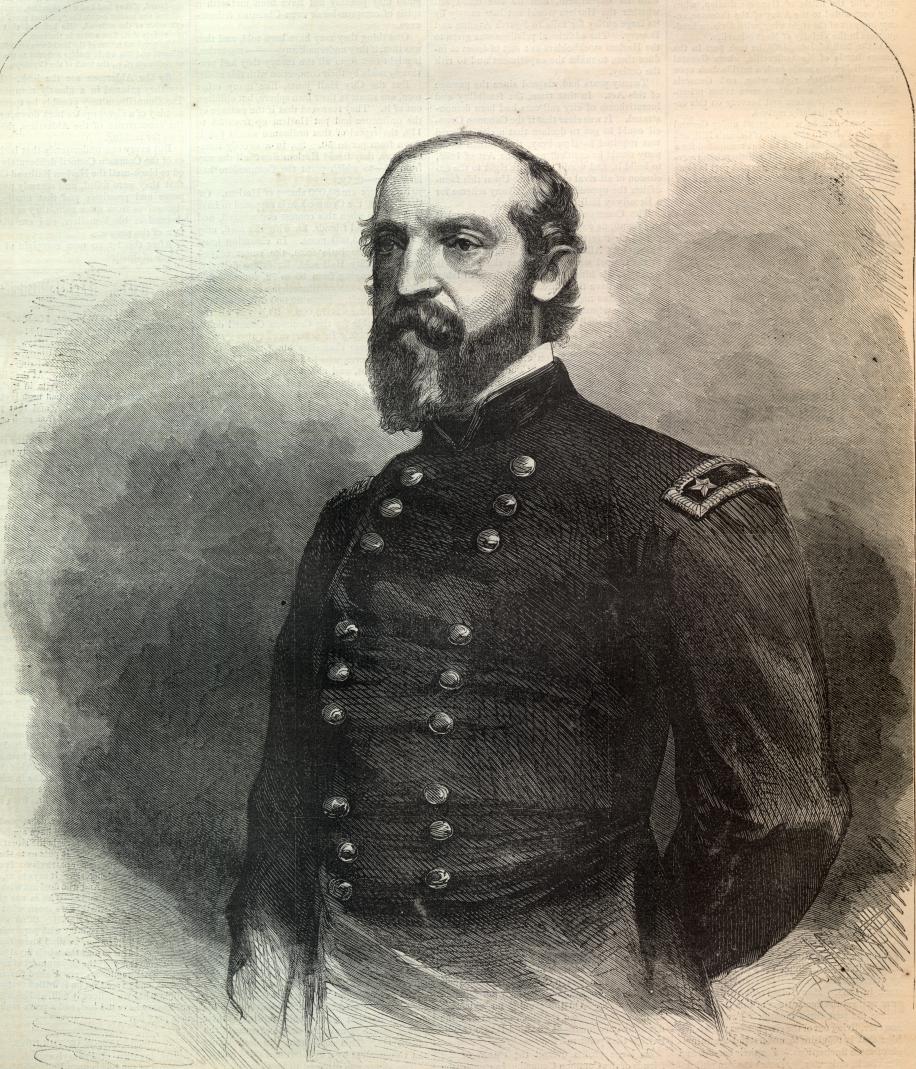
Tag Archives: general george gordon meade

John Reynolds Gives Battle: Gettysburg Day One

IronBrigade10161001

Friends of Padre Steve’s World

This is another section of my text on the Battle of Gettysburg dealing with General John Reynold’s and his decision to give battle as the cavalrymen of John Buford fought a delaying action against the Confederate forces of A.P. Hill and Harry Heth. 

I hope that you enjoy.

Peace

Padre Steve+

On the night of June 30th Reynolds was awash in reports, some of them conflicting and even though he was without Meade’s course of action for the next day “concluded that Lee’s army was close by and in force.” [1] He spent the night at his headquarters “studying the military situation with Howard and keeping in touch with army headquarters.” [2] Howard noted Reynolds anxiety and “received the impression that Reynolds was depressed.” [3] After Howard’s departure Reynolds took the opportunity to get a few hours of fitful sleep before arising again at 4 a.m. on July 1st.

When morning came, Reynolds was awakened by his aide Major William Riddle with Meade’s order to “advance the First and Eleventh Corps to Gettysburg.” [4] Reynolds studied the order and though he expected no battle that morning, expecting “only moving up to be in supporting distance to Buford” [5] took the prudent and reasonable precautions that his Confederate opponents A.P. Hill and Harry Heth refused to take as they prepared to move on Gettysburg.

His troops were in fine spirits that morning even though it had been busy. After a breakfast of hardtack, pork and coffee the troops moved out. An officer of the Iron Brigade noted that the soldiers of that brigade were “all in the highest spirits” while Lieutenant Colonel Rufus Dawes of the “placed the fifes and drums at the head of the Sixth Wisconsin and ordered the colors unfurled” as the proud veterans marched forward into the sound of the raging battle to the tune of “The Campbell’s are Coming.” [6]

Though Reynolds was not expecting a fight he organized his march in a manner that ensured if one did happen that he was fully prepared. The precautionary measures that he took were those that any prudent commander having knowledge that strong enemy forces were nearby would take. Reynolds certainly took to heart the words of Napoleon who said “A General should say to himself many times a day: If the hostile army were to make its appearance in front, on my right, or on my left, what should I do?”[7]

This was a question that A.P. Hill and Harry Heth seemed not to consider on that warm and muggy July morning when Heth was committing Lee’s army to battle on his own authority. Reynolds was also about to commit the Army of the Potomac to battle, but unlike Heth who had no authority to do so, Reynolds “had at least been delegated the authority for making such a decision” [8] by his army commander George Meade. Though Meade was unaware of what was transpiring in the hills beyond Gettysburg he implicitly trusted the judgement of Reynolds, and Meade been with the advanced elements of Reynold’s wing he too “probably would have endorsed any decision he made.” [9]

Reynolds placed himself with the lead division, that of Wadsworth, and “directed Doubleday to bring up the other divisions and guns of the First Corps and had ordered Howard’s Eleventh Corps up from Emmitsburg.” [10] Reynold’s also understood the urgency of the situation and “wanted all the fighting troops to be up front, so he instructed Howard not to intermingle his supply wagons with his infantry. Similar instructions had been given to Abner Doubleday; to ensure that the First Corps wagons would wait until the Eleventh Corps foot soldiers had passed.” [11]

Instead operating in the normal fashion of rotating units on the march, Reynolds opted to save time. Since Wadsworth’s First Division was further advanced than his other First Corps divisions, Reynolds instructed it to move out first with Cutler’s brigade in the lead followed by the Iron Brigade under Brigadier General Solomon Meredith. In doing so Reynolds countermanded the order of the acting corps commander Doubleday who had ordered Wadsworth’s division to allow the other divisions of First Corps to pass his before advancing. Reynolds told Wadsworth that Doubleday’s order “was a mistake and that I should move on directly.” [12]

He went forward with Wadsworth’s division and gave Doubleday his orders for the coming engagement. Doubleday later recalled that when Reynolds arrived to discuss the situation that Reynolds:

“read to me the various dispatches he had received from Meade and Buford, and told me that he should go at once forward with the leading division – that of Wadsworth – to aid the cavalry. He then instructed me to draw in my pickets, assemble the artillery and the remainder of the corps and join him as soon as possible. Having given me these orders, he rode off at the head of the column, and I never saw him again.” [13]

Reynolds ordered Howard’s Eleventh Corps to follow First Corps and according to Doubleday directed an aid of Howard to have Howard “bring his corps forward at once and form them on Cemetery Hill as a reserve.” [14]Howard received the order and since his troops were ready to move out “no time was lost in setting them in motion.” [15] While some writers believe that Reynolds directed Oliver Howard to prepare Cemetery Hill as a fallback position [16] there is more evidence that points to Howard selecting the that commanding hill himself. [17] Regardless of which is correct the result was that both Reynolds and Howard recognized the importance of the position and took action to secure it.

Likewise Reynolds ordered Sickles’ III Corps to come up from Emmitsburg where that corps had bivouacked the previous night. [18] Sickles had heard the guns in the distance that morning and sent his senior aide, Major Henry Tremain to find Reynolds. Reynolds told Tremain “Tell General Sickles I think he had better come up” but the order left Sickles in a quandary. He recalled “he spend an anxious hour deciding what to do” [19] for he had “been ordered by Meade to hold his position at Emmitsburg” [20] and Sickles sent another rider to Reynolds and awaited the response of his wing commander instead of immediately advancing to battle on 1 July and it would not be until after 3 P.M. that he would send his lead division to Gettysburg.

According to Doubleday Reynolds’s intention was “to fight the enemy as soon as I could meet him.” [21] Reynolds rode forward with some of his staff into the town as the infantry of the First Corps and the Eleventh Corps moved advanced. As they rode through the town Reynolds and his party were met by “a fleeing, badly frightened civilian, who gasped out the news that the cavalry was in a fight.” [22] When he came to the Lutheran Seminary he came across Buford. It was a defining moment of the Civil War, a moment that shaped the battle to come. It has been recounted many times and immortalized on screen in the movie Gettysburg, a time “when the entire battle would come down to a matter of minutes getting one place to another.” [23]

As the rough and tumble Kentuckian, Buford, and Reynolds, the dashing Pennsylvanian, discussed the situation they had to know that odd that they were facing. With close to 32,000 rebels from the four divisions of Hill’s and Ewell’s corps closing in from the west and the north and with only about 18,000 men of First Corps, Eleventh Corps and Buford’s cavalry division to meet them, the odds were not in his favor, but unlike other battles that the army of the Potomac faced, this time the army and its commanders were determined not to lose the battle and not to retreat and for the first time John Reynolds “led the advance” and for the first time in the war “might have some say about fighting.” [24]

Reynolds and Buford committed their eighteen thousand men against Lee’s thirty-two thousand in a meeting engagement that develop into a battle that would decide the outcome of Lee’s invasion. Likewise it was a battle for the very existence of the Union. Abner Doubleday noted the incontestable and eternal significance of the encounter to which Buford and Reynolds were committing the Army of the Potomac on July 1st 1863:

“The two armies about to contest on the perilous ridges of Gettysburg the possession of the Northern States, and the ultimate triumph of freedom or slavery….” [25]

Even though they understood that they were outmanned and outgunned by the advancing Confederates, both Buford and Reynolds knew that this was where the battle must be waged. It was here on this spot, for the ground gave them an advantage that they would not have elsewhere; but only if they could hold on long enough for the rest of the army to arrive. As Alan Nolan wrote: “this Pennsylvania ground – was defensible, and behind it, through the town, loomed Cemetery Hill, another natural point of defense if the battle at Seminary Ridge went against the Federals.” [26]
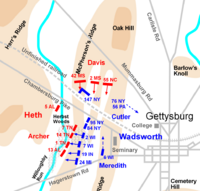
200px-Gettysburg_Day1_1045

Reynolds vs. Heth July 1st

When John Buford saw Reynolds infantry advancing as the Confederates increased the pressure on his outnumbered cavalry, he remarked to a staff member “now we can hold this place.” [27] Buford was not mistaken, when Reynolds rode up to the scene of the battle on Seminary Ridge he greeted Buford, who was in the cupola of the seminary. He called out “What’s the matter John?” to which Buford replied “The devil’s to pay” before he came down to discuss the tactical situation with Reynolds. [28] Buford explained the situation noting that “I have come upon some regiments of infantry…they are in the woods…and I am unable to dislodge them.” [29]

Reynolds needed no other convincing. He asked Buford if he could hold and quickly sent off a number of messages. One officer wrote: “The Genl ordered Genl Buford to hold the enemy in check as long as possible, to keep them from getting into town and at the same time sent orders to Genl Sickles…& Genl Howard to come as fast as possible.” [30]Additionally, Reynolds sent a message to Meade stating: “The enemy are advancing in strong force. I fear they will get to the heights beyond the own before I can. I will fight them inch by inch, and if driven into the town, I will barricade the streets and hold them back as long as possible.” [31] He directed Major Weld of his staff to take it to Meade with all haste as Weld recalled: “with the greatest speed I could, no matter if I killed my horse.” [32] When Meade received the report he was concerned, but with great confidence in Reynolds’s ability he remarked “Good!…That is just like Reynolds; he will hold on to the bitter end.” [33]

After dictating his instructions and sending off his messengers, Reynolds then did what no senior Confederate commander did during the entirety of the battle, he rode back and took personal charge of the movements of his troops to hurry them forward. Unlike Heth who so badly misjudged the tactical situation, he had taken note of the ground and recognized from Buford’s reports that “the Confederates were marching only on that single road and thus would not be able to push their forces to the front any faster than Reynolds could reach the battlefield with his First Corps divisions.”[34] It was a key observation on his part which again allowed him to make appropriate decisions as to how he shaped the battle.

explorepahistory-a0h4p1-a_349

Reynolds leadership at this point might be considered reckless by the standards of our day when senior commanders control battles from miles away with the help of real time intelligence and reporting, including live video feeds, or even the standards of the Second World War. But then in the Civil War a commander in combat could only really control the actions of troops that he could see and because of the time that it took to get messages to subordinate commanders, and the real possibility that verbal orders could be badly misinterpreted in the heat of battle.

Reynolds exercised command directing infantry formations into battle and assisting his artillery battery commanders in the placement of their guns. This was far different than the way that most senior Confederate leaders, including Lee, Longstreet, Hill and Ewell directed their units during the battle of Gettysburg. But such action such action was in keeping with Reynolds’s character, especially in the defense of his home state. Reynolds’ philosophy of command regarding volunteer troops was that they “were better led than driven” [35] and as such he led from the front and Abner Doubleday noted that Reynolds was “inflamed by at seeing the devastation of his native state, was most desirous of getting at the enemy as soon as possible.” [36]

iron brigade forward

“For God’s Sake Forward!” McPherson’s Ridge

John Reynolds recognized that time was of the essence if his forces were to hold the ground west of the town selected a shortcut around the town for First Corps. Those forces were directed across the fields near the Condori farm toward the back side of Seminary Ridge, with Reynolds’ staff helping to remove fences to speed the advance. [37] It was not an easy advance as the troops had to move across the farm fields at an oblique and have to “double-quick for a mile and a quarter in the thick humidity just to reach the seminary.” [38]One member of the corps recalled “I never saw men more willing to fight than they were at Gettysburg.” [39]

Recognizing that “after two full hours of fighting, Buford’s troopers”fighting on McPherson’s Ridge, were “at the limits of their endurance,”Reynolds ordered Wadsworth’s brigades “to bolster the cavalry and oppose the rebel infantry coming at them.” [40]

As troops arrived Reynolds directed them into position. He directed the artillery of Captain James Hall’s 2nd Maine Battery to McPherson’s Ridge instructing Hall “I desire you to damage their artillery to the greatest possible extent, and to keep their fire from our infantry until they are deployed….” [41]

The leading infantry of First Corps was Major General James Wadsworth’s understrength division containing just two brigades, just over 3000 soldiers, its losses from Chancellorsville not being made good and as the result of the loss of regiments discharged because their enlistments had expired. [42] Wadsworth was not a professional soldier, but like many generals on both sides was a political general who despite his lack of military experience was a natural leader of men. Wadsworth was “a vigorous white-haired old man who had been a well-to-do gentleman farmer in New York State before the war” [43] and he “had interrupted his service in the war to run for and lose his state’s governorship the preceding fall.” [44] He ran against the anti-war, anti-administration and frequently pro-Southern Copperhead Horatio Seymour, but he did not leave the army in order return to the state to mount a personal campaign “on the ground that it did not befit a soldier.” [45]

“What the gray haired general lacked in experience and skill, he compensated with a fighting spirit.” [46] Oliver Howard of Eleventh Corps said that Wadsworth was “always generous and a natural soldier” [47]and while Wadsworth was no professional but he performed admirably on July 1st 1863. Wadsworth was beloved by his men because he demonstrated true concern and care for their living conditions and training and on that morning Wadsworth was commanding his division leading it into action with “an old Revolutionary War saber in his hand.” [48] The gallant Wadsworth would be mortally wounded ten months later leading a division of Gouverneur Warren’s Fifth Corps in the opening engagements of the Wilderness. Secretary of the Navy Gideon Welles noted in his diary when Wadsworth died that Wadsworth “should, by right and fair-dealing, have been at this moment Governor of New York…No purer or single-minded patriot than Wadsworth has shown himself in this war. He left home and comforts and wealth to fight the battles of the Union.” [49]

With their gallant commander at their head the division may not have had much in force in the way of numbers, but the units of the division were “good ones,”composed of hardened combat veterans that went into battle with an eye to victory. In the van was Brigadier General Zylander Cutler’s brigade of New Yorkers and Pennsylvanians, the “celebrated Bucktails.” [50] When they were mustered into service the soldiers of the 13th Pennsylvania had adopted a “bucktail” attached to their service caps as a distinctive insignia, a practice that spread to other regiments of the brigade and for which the brigade became known throughout the army.

Cutler had spent much of his early life in Maine working in a number of fields and businesses. He made a fortune several times and lost it, first when his mill burned down, but he rebuilt his businesses and diversified and “as a leading businessman, Cutler was elected to the Maine senate, college trusteeships and a railroad directorship, but he was financially ruined by the panic of 1866 and moved to Milwaukee to start his career over again.” [51] The tough-minded Cutler had some previous military experience fighting Indians as a member of the Maine militia and was made Colonel of the 6th Wisconsin. Cutler was described by one of his soldiers as “being as “rugged as a wolf” and was “a tenacious fighter, a trait that endeared him to the tough-minded Gibbon.” [52] After Antietam Gibbon recommended Cutler for promotion to Brigadier General and command of the Iron Brigade, but Cutler had been wounded at the bloody Battle of Brawner’s Farm and Solomon Meredith gained a promotion and command of that celebrated brigade. However, in on November 29th 1862 having recuperated from his wounds Cutler was promoted to brigadier general and received command of his Bucktails in March of 1863. The brigade saw only minor action at Chancellorsville and Gettysburg would be the fierce brigadier’s first chance since being wounded to command in combat.

This fine brigade was followed by Brigadier General Solomon Meredith’s “Iron Brigade” composed of westerners in their distinctive black “Jefferson Davis” or “Hardie” hats. The brigade had been initially commanded by Major General John Gibbon, now commanding a division in Winfield Scott Hancock’s Second Corps. Gibbon turned the brigade into one of the finest in the army. At the Battle of Turner’s Gap on South Mountain during the Antietam campaign, the brigade earned its name.

After that bloody battle George McClellan exclaimed “They must be made of Iron!” and Hooker replied, “By the Eternal, they are iron! If you had seen them at Bull Run as I did, you would know them to be iron.”[53] In the fierce battle at South Mountain the brigade had lost over a quarter of its strength, but had gained a share of immortality among the ranks of the United States Army. “The Western soldiers immediately seized on this as their title, and the reputation of the brigade and its new name were soon broadcast around Federal campfires.” [54] The regiments of the brigade rivalled many Regular Army units in effectiveness and discipline and “the black hats became their trademark.” [55] Often committed to the fiercest battles the brigade had been decimated, but now along with the Bucktails it advanced up down Seminary Ridge and up the back side of McPherson’s Ridge. A member of an artillery battery who saw the Bucktails and the Iron Brigade advance recalled:

“No one…will ever again see those two brigades of Wadsworth’s Division – Cutler’s and the Iron Brigade – file by as they did that morning. The little creek made a depression in the road, with a gentle ascent on either side, so that from our point of view the column, as it came down the slope and up the other, had the effect of huge blue billows of men topped with a spray of shining steel, and the whole spectacle was calculated to give nerve to a man who never had one before.” [56]

Reynolds directed Cutler’s Bucktails to proceed north of the Cashtown Pike and then “called the Iron Brigade into action on the south side” [57]leading the hearty Westerners himself. Reynolds directed then Wadsworth to take change of the action on the north side of the road while he looked after the left. [58] When Reynolds made that decision he made another. He ordered the 6th Wisconsin of the Iron Brigade into reserve, leaving the Iron Brigade a regiment short but giving him the advantage of having a ready reserve which “permitted them to take full advantage of their interior lines, shift their strength about, and apply it where most needed.” [59]

At about 10:30 the 2nd Wisconsin advanced into the woods Reynolds urged them forward: “Forward men, for God’s sake and drive those fellows out of those woods….” [60] As he looked around toward the seminary to see the progress of reinforcements, Reynolds was struck in the back of the neck by a bullet and fell dead. “Had it come a short time earlier, Reynolds’s death might have thrown the I Corps into fatal confusion.” [61] But Doubleday, who command now fell was up to the task on that sultry July morning.

MenBrooklyn

Cutler’s brigade moved north and engaged Davis’ men near the railroad cut. Here the Cutler’s line was “hardly formed when it was struck by Davis’s Confederate brigade on its front and right flank.” [62] His troops were heavily outnumbered by the advancing Confederates and Davis’ troops initially had the upper hand. In a savage fight they inflicted massive casualties on Cutler’s regiments which outnumbered and being flanked were ordered to withdraw by Wadsworth in order to save them, with the exception of one regiment, the 147th New York nicknamed the Ploughboys which “did not get the order” [63] and though isolated held its ground, “with the support of a fresh six-gun battery whose gunners simply refused to quit.” [64]This was the 2nd Maine Battery under the command of Captain James Hall. Though caught in a cross fire of Rebel artillery and assailed by skirmishers Hall’s artillerymen gamely continued the fight withdrawing by sections, “fighting a close canister range and suffering severely.” [65] The New Yorkers and Hall’s battery battled the Mississippians and the “Ploughboys fell “like autumn leaves; the air was full of lead.” [66]
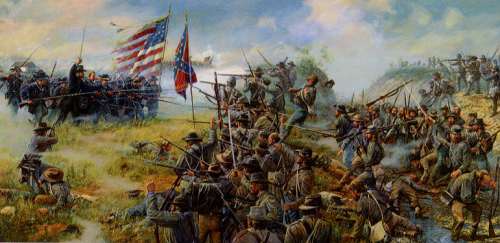
railroad_cut

The inexperienced Davis and his green troops were buoyed by this “gratifying local success” [67] and attempted to exploit it. At this point the Confederates were fatigued by the long march and the fighting and the troops of the 2ndMississippi and 55th North Carolina “were all jumbled together without regiment or company.” [68] Davis attempted to use the unfinished railroad cut “as cover for getting on the enemy’s flank without exposure.” [69]It was a decision that Davis lived to regret. As his troops his units crowed into it, the two regiments of Cutler’s brigade south of the turnpike, the 14th Brooklyn and the 95th New York turned to meet them and were joined by the reserve regiment of the Iron Brigade, the 6nd Wisconsin under Lieutenant Colonel Rufus Dawes. Dawes ordered an immediate advance and called out to Major Edward Pye of the 95th “Let’s go for them Major.” The 6th Wisconsin and the New Yorkers took the Confederates in the flank with enfilade fire, “it was like shooting fish in a barrel.” [70] Dawes’ men slaughtered many of those unfortunate soldiers, and the battle soon became a hand to hand struggle as North Carolinians and Mississippians struggled with the Wisconsin men and New Yorkers.
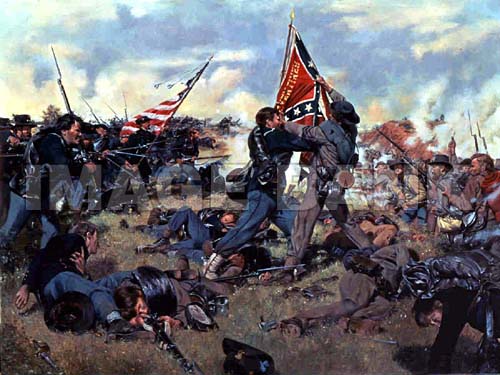
fightforthecolors2la

The melee in and around the cut did not last long:

“for the Confederates were unable to resist their attackers….From the brow of the cut Dawes shouted down to the Confederates below him: “Where is the colonel of this regiment?” A Confederate field officer heard him and replied, “Who are you?” Dawes answered, “I command this regiment. Surrender or I will fire.” [71] Dawes’s men took over 200 prisoners, [72] and the battle flag of the 2ndMississippi. [73]

The charge had last but minutes yet had shattered Joe Davis’s brigade. Davis was wholly unprepared for this reverse and signaled his forces to pull back convinced that “a heavy force was…moving rapidly to our right.” [74] However, the cost to the 6th Wisconsin was great, “Dawes estimated that 160 men of the 6th fell, not including the brigade guard, whose casualties he did not know.” [75]

Brigadier General Solomon Meredith’s Iron Brigade, which had been brought forward by Doubleday hit Archer’s brigade in the front in the woods on McPherson’s Ridge. Meredith was an unmarried North Carolina Quaker who had moved to Indiana in 1840 owning little more than the clothes that he was wearing. He became a farmer but found politics more to his liking and was elected as a county sheriff and to the state legislature. When the war came he was serving as the Clerk of Wayne County. Meredith, like so many volunteer officers on both sides owed much of his advancement in the army to his political connections. In Meredith’s case this was to Meredith’s friend Governor Oliver Morton. Critics of Meredith decried his appointment as Colonel of the 19thIndiana as “a damnable swindle.” [76] Yet Meredith commanded the regiment effectively and received command of the brigade in November 1862. John Gibbon, the regular officer who initially commanded the brigade was critical of Meredith’s appointment but the soldiers appreciated their kind, six-foot seven-inch tall commander who they affectionately knew as “Long Sol.”But despite the carping of his political enemies and the opposition of Gibbon, Meredith like so many others like him who, “extroverted and ambitious by nature, accustomed to asserting themselves, these men did the best that they could, for themselves and their responsibilities, and they somehow sufficed” [77] though they had no formal military training or experience.

As the Iron Brigade advanced toward McPherson’s Ridge and engaged the enemy, Doubleday “urged the men…to hold it all hazards.” Doubleday later wrote that the troops of the brigade, “full of enthusiasm and the memory of their past achievements they said to me proudly, “If we can’t hold it, where will you find men who can?” [78]

Animated by the leadership of Reynolds and now Doubleday they “rushed to the charge, struck successive heavy blows, outflanked and turned the enemy’s right, captured General Archer and a large portion of his brigade, and pursued the remainder across Willoughby Run.”[79] The effect was dramatic as the Iron Brigade overwhelmed Archer’s brigade, whose soldiers now realized they were facing “the first team.” Members of the Iron Brigade recalling the voices of Confederate soldiers exclaiming “Here are those damned black-hat fellers again…’Taint no militia-that’s the Army of the Potomac.” [80] As they attempted to withdraw they piled up at a fence near Willoughby Run and were hit in the flank by “a Michigan regiment that had worked its way around through the woods to the south.” [81] Archer’s Confederates were unable to resist the assault of the Iron Brigade, “Some fled; others threw down their arms and trembling asked where they should go, while others simply dropped their rifles and ducked through the Union formations to the Union rear.”[82]

As for their commander, Archer the ignominy only got worse. “A muscular Irish private in the 2nd Wisconsin ran forward and seized General Archer bodily and made a prisoner of him.” [83] Coddington wrote: “It was a bad moment for the Army of Northern Virginia, and Archer gained the unenviable distinction of being the first of its general officers to be captured after Lee took command.” [84] Doubleday, who knew Archer from the old army, wrote of meeting Archer after that very angry general after had been taken prisoner and roughed up by the aforementioned Private Maloney. Doubleday greeted his old comrade saying: “Archer! I’m glad to see you,” and reached out his hand to greet his friend, to which Archer replied “Well, I’m not glad to see you by a damn sight” and refused to shake Doubleday’s hand. [85]

With the Archer’s brigade whipped and Davis’s in flight Solomon Meredith pulled back the brigade and “was reforming his lines when a shell exploded near him.” [86] Meredith’s horse was killed and fell on him and the tall general was struck in the head by a shell fragment which fractured his skull and rendered him hors d ’combat for the rest of the battle.

Contrary to the reports of many of the Confederates involved, stating that they were outnumbered, some of which have achieved nearly mythic status in some accounts of the battle, the forces engaged were relatively evenly matched. [87]Clifford Dowdey says that the Iron Brigade “heavily outnumbered the one brigade they met. Archer’s….” [88] Such accounts are usually based on the reports of Heth and other confederate commanders. Heth in his after action report wrote that “Archer, encountered heavy masses in his front, and his gallant little brigade, after being almost surrounded by overwhelming forces in front and on both flanks, was forced back….” [89]

However, such was not the case. The reason for this repulse was not that the Union forces had “overwhelming forces” or “greatly superior numbers.” Instead the Archer’s brigade and the Iron Brigade were fairly evenly matched with Archer having about 1,130 men and the Iron Brigade 1,400 while Davis outnumbered Cutler nearly two to one having between 2,400 and 2,600 men in the battle to Cutler’s 1,300. [90]

Following the repulse of Archer and Davis’s brigades by Reynolds’s First Corps, Heth withdrew his badly mauled brigades back to Herr’s Ridge in order to reform them and bring up the brigades of Brockenbrough and Pettigrew before he could resume his attack. In his next assault he would also be supported by Pender’s fresh division which was now coming up.

Coddington notes that the outcome of the opening engagement came down to leadership and “the superior tactical skills of the Northern generals,”who “created a reserve force” with one regiment of the Iron Brigade which “permitted them to take full advantage of their interior lines, shift their strength about, and apply it where most needed.” [91] It was a “calculated risk,” for it assumed that the depleted Iron Brigade could handle Archer’s brigade effectively with only four of their five assigned regiments. [92]Again, even with the loss of Reynolds it was a case of Harry Heth being out-generaled, this time by Abner Doubleday. Heth “had not exercised the close field command by means of which Doubleday had won the brief, furious action.” [93]
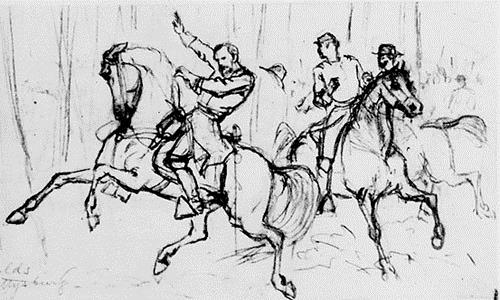
death of reynolds

The Death of Reynolds

Reynolds was dead, but the series of command decisions reached by Reynolds under the pressure of a meeting engagement “where neither side held an immediate advantage” [94] were critical to the army. Likewise, because he had effectively communicated his intent to his subordinate commanders they were able to continue the fight despite his death, and his superiors and successors were able to effectively continue the battle that he had initiated. When he went into action he had “barely a third of his corps available, and confronting a force of unknown size, he had put himself at the head of his troops to lead them in a vigorous attack.” [95]

Though shaken by Reynolds’ loss, the Union troops fought on at McPherson and Seminary Ridge under the command of Doubleday until the assault of Ewell on their left and the arrival of Pender’s fresh division forced them from their positions. However Reynolds’s death was a major blow for the Federal forces for it “removed from the equation the one person with enough vision and sense of purpose to manage this battle.” [96] Despite this Reynolds, by pushing forward with his troops on McPherson’s Ridge ensured that Howard was able to secure Cemetery Hill and Cemetery Ridge, without which Gettysburg would have been lost.

The contrast between Reynolds and his opponents was marked. Hill was ten miles away from the action. Heth was too far to the rear of his troops to direct their advance when they ran into trouble and did not begin to take control until after the brigades of Davis and Archer had staggered “back up the ravine, with Davis’s temporarily wrecked.” [97] In contrast to Heth, Reynolds “hurried to the front, where he was able to inspirit the defense and throw troops into the decisive zone.” [98] At every point in the brief encounter John Reynolds showed himself superior to his opponents as he directed the battle. “Dedicated to an aggressive forward defense in the vanguard of the entire Army of the Potomac, Reynolds, at the cost of his own life had blunted the Rebel thrust and bought valuable time that permitted the balance of Meade’s army to take possession of the coveted high ground….” [99]

Though he paid for his efforts with his life but his sacrifice was not in vain. Reynolds’s tactics “gave the First Corps room for maneuver in front of Gettysburg and upset General Hill’s timetable.” [100] Harry Hunt noted: “…by his promptitude and gallantry he had determined the decisive field of the war, and he opened brilliantly a battle which required three days of hard fighting to close with a victory.” [101]

Notes

[1] Ibid. Pfanz Gettysburg: The First Day p.48

[2] Ibid. Coddington The Gettysburg Campaign: A Study in Command p.261

[3] Ibid. Pfanz Gettysburg: The First Day p.48

[4] Ibid. Coddington The Gettysburg Campaign: A Study in Command, p.261

[5] Ibid. Sears, Gettysburg. p. 158

[6] Nolan, Alan T. The Iron Brigade: A Military History Indiana University Press, Bloomington IN, 1961 and 1994 pp.233-234

[7] Napoleon Bonaparte, Military Maxims of Napoleon in Roots of Strategy: The Five Greatest Military Classics of All Time edited by Phillips, Thomas R Stackpole Books Mechanicsburg PA 1985 p.410

[8] Ibid. Sears, Gettysburg. p. 165

[9] Ibid. Pfanz Gettysburg: The First Day p.49

[10] Ibid. Nolan The Iron Brigade p.233

[11] Trudeau, Noah Andre. Gettysburg: A Testing of Courage, Harper Collins Publishers, New York 2002 p.159

[12] Ibid. Trudeau, Gettysburg: A Testing of Courage p.156

[13] Doubleday, Abner Chancellorsville and Gettysburg: Campaigns of the Civil War VI Charles Scribner’s Sons, Bew York 1882 pp.70-71

[14] Ibid. Doubleday Chancellorsville and Gettysburg p.71

[15] Carpenter, John A. Sword and Olive Branch: Oliver Otis Howard Fordham University Press, New York 1999 p.51

[16] Ibid. Pfanz Gettysburg: The First Day p.76

[17] Green, A. Wilson. From Chancellorsville to Gettysburg: O. O. Howard and Eleventh Corps Leadership in The First Day at Gettysburg edited by Gallagher, Gary W. Kent State University Press, Kent Ohio 1992 p. 70

[18] Ibid. Sears, Gettysburg. p. 158

[19] Keneally, Thomas American Scoundrel: The Life of the Notorious Civil war General Dan Sickles Anchor Books, a Division of Random House, New York 2003 p.275

[20] Swanberg, W.A. Sickles the Incredible Copyright by the author 1958 and 1984 Stan Clark Military Books, Gettysburg PA 1991 p.202

[21] Ibid. Trudeau, Gettysburg: A Testing of Courage p.156

[22] Ibid. Sears, Gettysburg. p. 165

[23] Ibid. Guelzo, Gettysburg: The Last Invasion p.142

[24] Ibid. Nichols Toward Gettysburg p.200

[25] Ibid. Doubleday Chancellorsville and Gettysburg p.68

[26] Ibid. Nolan The Iron Brigade p.235

[27] Ibid. Guelzo, Gettysburg: The Last Invasion p.142

[28] Ibid. Sears, Gettysburg. p. 172

[29] Ibid. Guelzo, Gettysburg: The Last Invasion p.143

[30] Ibid. Trudeau, Gettysburg: A Testing of Courage p.172-173

[31] Schultz, Duane The Most Glorious Fourth: Vicksburg and Gettysburg July 4th 1863. W.W. Norton and Company New York and London, 2002 p.202

[32] Ibid. Trudeau, Gettysburg: A Testing of Courage p.173

[33] Huntington, Tom Searching for George Gordon Meade: The Forgotten Victor of GettysburStackpole Books, Mechanicsburg PA 2013 p.154

[34] Ibid. Sears, Gettysburg. p. 166

[35] Ibid. Coddington The Gettysburg Campaign: A Study in Command, p.277

[36] Doubleday, Abner. Chancellorsville and Gettysburg: Campaigns of the Civil War – VI Charles Scribner’s Sons, New York 1882 p.68

[37] Ibid. Pfanz Gettysburg: The First Day p.75

[38] Ibid. Guelzo, Gettysburg: The Last Invasion p.145

[39] Ibid. Wert The Sword of Lincoln p.275

[40] Foote, Shelby, The Civil War, A Narrative. Volume Two Fredericksburg to Meridian Random House, New York 1963 p.469

[41] Gottfried, Bradley The Artillery of Gettysburg Cumberland House Publishing, Nashville TN 2008 pp.28-29

[42] Ibid. Sears, Gettysburg. p. 34 Sears notes that in between Chancellorsville and Gettysburg, First Division of I Corps had lost a full brigade due to the expiration of enlistments.

[43] Catton, Bruce The Army of the Potomac: Glory Road Doubleday and Company, Garden City New York, 1952 p.270

[44] Ibid. Sears, Gettysburg. p. 34

[45] Ibid. Catton The Army of the Potomac: Glory Road p.271

[46] Ibid. Wert The Sword of Lincoln p.275

[47] Ibid. Howard Autobiography of Oliver Otis Howard 5995 of 9221

[48] Ibid. Catton The Army of the Potomac: Glory Road p.271

[49] Girardi, Robert I. The Civil War Generals: Comrades, Peers, Rivals in Their Own Words Zenith Press, MBI Publishing, Minneapolis MN 2013 p.184

[50] Ibid. Sears, Gettysburg. p. 34

[51] Ibid. Nolan The Iron Brigade p.16

[52] Tagg, Larry The Generals of Gettysburg: The Leaders of America’s Greatest Battle Da Capo Press Cambridge MA 1998 Amazon Kindle Edition p.19

[53] Hebert, Walter H. Fighting Joe Hooker University of Nebraska Press, Lincoln and London 1999. Originally published by Bobbs-Merrill, New York 1944 p.137

[54] Ibid. Nolan The Iron Brigade p.130

[55] Ibid. Nolan The Iron Brigade p. 54

[56] Ibid. Nolan The Iron Brigade p. 234

[57] Ibid. Catton The Army of the Potomac: Glory Road p.271

[58] Ibid. Pfanz Gettysburg: The First Day pp.75-76

[59] Ibid. Coddington The Gettysburg Campaign: A Study in Command, p.275

[60] Ibid. Coddington The Gettysburg Campaign: A Study in Command, p.271

[61] Longacre, Edward G. John Buford: A Military Biography Da Capo Press, Perseus Book Group, Cambridge MA p.194

[62] Ibid. Hunt, The First Day at Gettysburg in Battles and Leaders of the Civil War Volume III, The Tide Shifts p.277
[63] Ibid. Catton The Army of the Potomac: Glory Road p.272

[64] Dowdy, CliffordLee and His Men at Gettysburg: The Death of a Nation Skyhorse Publishing, New York 1986, originally published as Death of a Nation Knopf, New York 1958 p.96

[65] Ibid. Hunt, The First Day at Gettysburg in Battles and Leaders of the Civil War Volume III, The Tide Shifts p.277

[66] Ibid. Pfanz Gettysburg: The First Day p.86

[67] Ibid. Dowdy Lee and His Men at Gettysburg p.96

[68] Ibid. Pfanz Gettysburg: The First Day p.104

[69] Ibid. Dowdy Lee and His Men at Gettysburg p.96

[70] Ibid. Dowdy Lee and His Men at Gettysburg p.97

[71] Ibid. Pfanz Gettysburg: The First Day p.112

[72] Ibid. Guelzo, Gettysburg: The Last Invasion p.153

[73] Ibid. Sears, Gettysburg. p. 178

[74] Ibid. Guelzo, Gettysburg: The Last Invasion p.153

[75] Ibid. Pfanz Gettysburg: The First Day p.109

[76] Ibid. Nolan The Iron Brigade p.20

[77] Ibid. Nolan The Iron Brigade p.173

[78] Ibid. Doubleday Chancellorsville and Gettysburg p.73

[79] Hunt, Henry. The First Day at Gettysburg in Battles and Leaders of the Civil War Volume III, The Tide Shifts. Edited by Robert Underwood Johnson and Clarence Clough Buel Castle, Secaucus NJ p.277

[80] Ibid. Catton The Army of the Potomac: Glory Road p.273

[81] Foote, Shelby, The Civil War, A Narrative. Volume Two Fredericksburg to Meridian Random House, New York 1963 pp.470-471

[82] Ibid. Pfanz Gettysburg: The First Day p.99

[83] Ibid. Catton The Army of the Potomac: Glory Road p.274

[84] Ibid. Coddington The Gettysburg Campaign: A Study in Command, p.271

[85] Ibid. Foote The Civil War, A Narrative. Volume Two Fredericksburg to Meridian p.470

[86] Ibid. Tagg The Generals of Gettysburg p.17

[87] Ibid. Foote The Civil War, A Narrative. Volume Two Fredericksburg to Meridian p.469 Even Foote in his account of Archer’s brigade makes the comment “Staggered by the ambush and outnumbered as they were….”

[88] DowdyLee and His Men at Gettysburg: The Death of a Nation p.95

[89] Luvaas, Jay and Nelson Harold W editors. The U.S. Army War College Guide to the Battle of Gettysburg South Mountain Press, Carlisle PA 1986 p.9

[90] Ibid. Coddington The Gettysburg Campaign: A Study in Command, p.274

[91] Ibid. Coddington The Gettysburg Campaign: A Study in Command, p.274

[92] Ibid. Coddington The Gettysburg Campaign: A Study in Command, p.274

[93] Ibid. Dowdy Lee and His Men at Gettysburg: The Death of a Nation p.97

[94] Ibid. Sears, Gettysburg. p. 168

[95] Ibid. Coddington The Gettysburg Campaign: A Study in Command, p.277

[96] Ibid. Trudeau, Gettysburg: A Testing of Courage p.171

[97] Ibid. DowdyLee and His Men at Gettysburg: The Death of a Nation p.97

[98] Krick, Robert K. Three Confederate Disasters on Oak Ridge: Failures of Brigade Leadership on the First Day of Gettysburg in The First Day at Gettysburg edited by Gallagher, Gary W. Kent State University Press, Kent Ohio 1992 p.113

[99] Ibid. Tagg The Generals of Gettysburg p.12

[100] Ibid. Coddington The Gettysburg Campaign: A Study in Command, p.277

[101] Ibid. Hunt, The First Day at Gettysburg in Battles and Leaders of the Civil War Volume III, The Tide Shifts p.277
1 Comment

Filed under civil war, Gettysburg, History, leadership, Military, us army

“I Will Live and Die under the Flag of the Union.” John Buford, Hero of Gettysburg

Friends of Padre Steve’s World

As I noted yesterday I am going to be posting about the Battle of Gettysburg for the next few days. All of these articles have appeared on my blog before and are part of my text on the Battle of Gettysburg which my agent is shopping to various publishers. This article is about the Union Cavalry commander, General John Buford who would lead a masterful delaying action against Confederate forces far superior to his small division on July 1st 1863. 

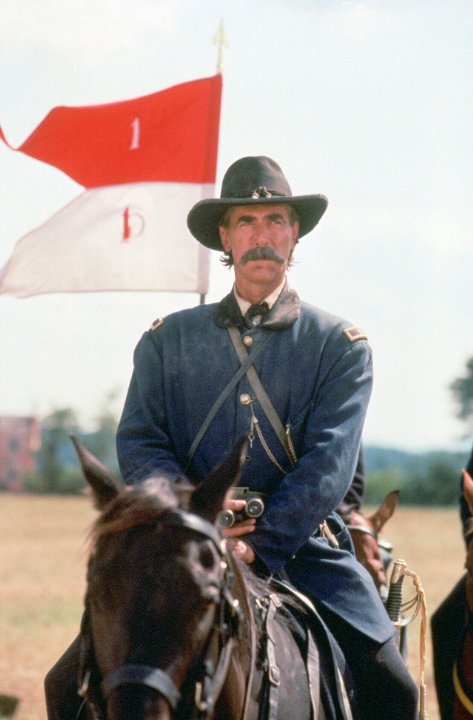
Buford is a fascinating character, played to perfection by Sam Elliott in the movie Gettysburg he was one of the officers whose extraordinary leadership denied Lee a victory at Gettysburg, preserved the Union and led to the defeat of the Confederacy. I hope you enjoy this little piece about a most amazing man. 

Peace

Padre Steve+

buford

“He was decidedly the best cavalry general we had, and was acknowledged as such in the army, though being no friend to newspaper reporters…In many respects he resembled Reynolds, being rough in the exterior, never looking after his own comfort, untiring on the march and in the supervision of all the militia in his command, quiet and unassuming in his manners.” Colonel Charles Wainwright on Buford (Diary of Battle, p.309)

John Buford was born in Kentucky and came from a family with a long military history of military service, including family members who had fought in the Revolutionary War and War of 1812. In fact according to some the family military pedigree reaches back to England’s War of the Roses.

Buford’s family was well off with a spacious plantation near Versailles on which labored forty-five slaves, and his father also established a stage line which carried “passengers and freight between Frankfort and Lexington.”His father divested himself of his property, selling his home, business and slaves and moved to Stephenson Illinois in 1838. [1] The young Buford developed an interest in military life which was enlivened by his half-brother Napoleon Bonaparte Buford who graduated from West Point in 1827, and his brother would be influential in helping John into West Point, which he entered in 1844.

Buford graduated with the class of 1848 which included the distinguished Union artilleryman John Tidball, and the future Confederate brigadier generals “Grumble Jones and “Maryland” Steuart. Among his best friends was Ambrose Burnside of the class of 1847. He did well academically but his conduct marks kept him from graduating in the top quarter of his class.

Upon graduation he was commissioned as a Brevet Second Lieutenant of Dragoons, however too late to serve in Mexico. Instead he was initially assigned to the First United States Dragoons but less than six months after joining was transferred to the Second Dragoons when he was promoted to full Second Lieutenant.

Instead of going to Mexico Buford “spent most of the 1850s tracking and fighting Indians on the Plains.” [2] During this period, the young dragoon served on the Great Plains against the Sioux, where he distinguished himself at the Battle of Ash Creek and on peacekeeping duty in the bitterly divided State of Kansas and in the Utah War of 1858.

His assignments alternated between field and staff assignments and he gained a great deal of tactical and administrative expertise that would serve him well. This was especially true in the realm of the tactics that he would employ so well at Gettysburg and on other battlefields against Confederate infantry and cavalry during the Civil War. Buford took note of the prevailing tactics of the day which still stressed a rigid adherence to outdated Napoleonic tactics which stressed mounted charges and “little cooperation with units of other arms or in the taking and holding of disputed ground.” [3] While he appreciated the shock value of mounted charges against disorganized troops he had no prejudice against “fighting dismounted when the circumstances of the case called for or seemed to justify it.” [4] Buford’s pre-war experience turned him into a modern soldier who appreciated and employed the rapid advances in weaponry, including the repeating rifle with tremendous effect.

Despite moving to Illinois Buford’s family still held Southern sympathies; his father was a Democrat who had opposed Abraham Lincoln. Buford himself was a political moderate and though he had some sympathy for slave owners:

“he despised lawlessness in any form – especially that directed against federal institutions, which he saw as the bulwark of democracy…..He especially abhorred the outspoken belief of some pro-slavery men that the federal government was their sworn enemy.” [5]

After the election of Abraham Lincoln, the officers of Buford’s regiment split on slavery. His regimental commander, Colonel Philip St. George Cooke, a Virginian and the father-in-law of J.E.B. Stewart announced that he would remain loyal to the Union, others like Beverly Robertson who would command a brigade of cavalry during the Gettysburg campaign resigned their commissions.

For many officers, both those who remained loyal to the Union and those who joined the Confederate cause the decision was often difficult, and many anguished over their decisions as they weighed their allegiance to the Union against their loyalty to home and family. Buford was not one of them.

Since Buford’s family had longstanding ties to Kentucky, the pro-secession governor of Kentucky, Beriah Magoffin offered Buford a commission in that states’ militia. At the time Kentucky was still an “undeclared border slave state” and Buford loyal to his oath refused the governor’s offer. He wrote a brief letter to Magoffin and told his comrades that “I sent him word that I was a Captain in the United States Army and I intend to remain one.” [6]Around the same time the new provisional government of the Confederacy “offered Buford a general officer’s commission, which reached him by mail at Fort Crittenden.” [7] According to Buford’s biographer Edward Longacre “a well-known anecdote has him wadding up the letter while angrily announcing that whatever future had in store he would “live and die under the flag of the Union.” [8]

However Buford’s family’s southern ties, and lack of political support from the few remaining loyal Kentucky legislators initially kept him from field command. Instead he received a promotion to Colonel and an assignment to the Inspector General’s Office, although it was not the field assignment that he desired it was of critical importance to the army in those early days of the war as the Union gathered its strength for the war. Buford was assigned to mustering in, and training the new regiments being organized for war. Traveling about the country he evaluated each unit in regard to “unit dress, deportment and discipline, the quality and quantity of weapons, ammunition, equipment, quarters, animals and transportation; the general health of the unit and medical facilities available to it; and the training progress of officers and men.” [9] Buford was a hard and devastatingly honest trainer and evaluator of the new regiments. He was especially so in dealing with commanding officers as well as field and company officers. Additionally he was a stickler regarding supply officers, those he found to be incompetent or less than honest were cashiered.

Buford performed these duties well but desired command. Eventually he got the chance when the politically well-connected but ill-fated Major General John Pope who “could unreservedly vouch for his loyalty wrangled for him command of a brigade of cavalry.” [10] After Pope’s disastrous defeat at Second Bull Run in August 1862 Buford was wounded in the desperate fighting at Second Manassas and returned to staff duties until January 1863 when he was again given a brigade. However, unlike many of the officers who served under Pope, Buford’s reputation as a leader of cavalry and field commander was increased during that campaign.

Buford was given the titular title of “Chief of Cavalry of the Army of the Potomac” by George McClellan, a title which sounded impressive but involved no command during the Antietam campaign. Following that frustrating task he continued in the same position under his old West Point friend Ambrose Burnside during the Fredericksburg campaign. Buford lost confidence in his old friend and was likely “shocked by his friend’s deadly ineptitude, his dogged insistence on turning defeat into nightmare.” [11]

When Burnside was relieved and Fighting Joe Hooker appointed to command the army, Buford’s star began to rise. While he was passed over by Hooker for command of the newly organized First Cavalry division in favor of Alfred Pleasanton who was eleven days his senior, he received command of the elite Reserve Brigade composed of mostly Regular Army cavalry regiments. When Major General George Stoneman was relieved of command following the Chancellorsville campaign, Pleasanton was again promoted over Buford.

In later years Hooker recognized that Buford “would have been a better man for the position of chief” [12] but in retrospect Buford’s pass over was good fortune for the Army of the Potomac on June 30th and July 1st 1863. Despite being passed over for the Cavalry Corps command, Buford, a consummate professional never faltered or became bitter. Despite the Pleasanton’s interference and “lax intelligence-gathering” [13]   During the Gettysburg campaign he led his brigade well at Brandy Station as it battled J.E.B. Stuart’s troopers, after which he was recommended for promotion and given command of the First Cavalry division of the Cavalry Corps. [14]

Following Brandy Station Buford led his troopers aggressively as they battled Stuart’s troopers along the Blue Ridge at the battles of Aldie, Philmont, Middleburg and Upperville. It was at Upperville while fighting a hard action Confederate Brigadier general “Grumble Jones’s brigade that Buford’s troopers provided Hooker with the first visual evidence that Lee’s infantry was moving north into Maryland and Pennsylvania.

burford reynolds monuments

When Hooker was relieved on the night of June 27th and 28th George Meade gave Buford the chance at semi-independent command without Pleasanton looking over his shoulder. Meade appreciated Pleasanton’s administrative and organizational expertise and took him out of direct field command. Meade had his Cavalry Corps commander “pitch his tent next to his own on almost every leg of the trip to Pennsylvania and rarely let him out of sight or earshot.” [15]

One of Meade’s staff officers, Theodore Lyman gave this description of Buford:

“He is one of the best of the officers…and is a singular looking party. Figurez-vous a compactly built man of middle height, with a tawny mustache and a little, triangular gray eye, whose expression is determined, not to say sinister. His ancient corduroys are tucked into a pair of ordinary cowhide boots, his blue blouse is ornamented with holes; from which one pocket thereof peeps a huge pipe, while the other is fat with a tobacco pouch. Notwithstanding this get-up he is a very soldierly looking man. Hype is of a good natured disposition, but is not to be trifled with.” [16]

When he was ordered to screen the army as it moved into Pennsylvania, Buford was confident about his troopers and their ability and he and his men performed their duties admirably. On June 29th Buford’s men skirmished with two of Harry Heth’s regiments near the town of Fairfield, which Buford promptly reported to Meade and John Reynolds after ascertaining their size and composition.

The Battle of Gettysburg would be the zenith of Buford’s career. His masterful delaying action against Harry Heth’s division on July 1st 1863 enabled John Reynold’s wing of the army to arrive in time to keep the Confederates from taking the town and all of the high ground which would have doomed any union assault against them. Following Gettysburg Buford continued to command his cavalry leading his division in a number of engagements. In early November the worn out cavalryman who had been in so many actions over the past year came down with Typhoid. In hopes that he would recover he was told that he would be appointed to command all the cavalry in the West, however his health continued to decline. He was officially promoted to Major General of Volunteers by President Lincoln, over the objection of Secretary of War Stanton who disliked deathbed promotions. “Upon learning of the honor. Buford is supposed to have whispered, “I wish I could have lived now.” [17] He died later that evening, the last words warning his officers “patrol the roads and halt fugitives at the front.” [18]

John Pope wrote of Buford:

“Buford’s coolness, his fine judgment, and his splendid courage were well known of all men who had to do with him… His quiet dignity, covering a fiery spirit and a military sagacity as far reaching as it was accurate made him…one of the best and most trusted officers in the service.” [19]

Sam Elliot as Buford

Buford was buried at West Point and he is immortalized in the monument dedicated to him on McPherson’s Ridge at Gettysburg where he with binoculars in hand looks defiantly west in the direction of the advancing Confederates. The monument is surrounded by the gun tubes of four Union 3” Rifles, three of which were part of Lieutenant John Calef’s Battery which he directed on the fateful morning of July 1st 1863. He was portrayed masterfully portrayed by Sam Elliott in the movie Gettysburg.

Notes

[1] Longacre, Edward G. John Buford: A Military Biography Da Capo Press, Perseus Book Group, Cambridge MA p.17

[2] Ibid. Guelzo. Gettysburg: The Last Invasion p.121

[3] Ibid. Longacre John Buford p.36

[4] Ibid. Longacre John Buford p.36

[5] Ibid. Longacre John Buford p.54

[6] Ibid. Guelzo. Gettysburg: The Last Invasion p.121

[7] Ibid. Longacre John Buford p.70

[8] Ibid. Longacre John Buford p.70

[9] Ibid. Longacre John Buford p.78

[10] Ibid. Guelzo. Gettysburg: The Last Invasion p.121

[11] Ibid. Longacre John Buford p.122

[12] Ibid. Coddington The Gettysburg Campaign, A Study in Command p.44

[13] Ibid. Longacre John Buford p.173

[14] Ibid. Coddington The Gettysburg Campaign, A Study in Command p.64

[15] Longacre, Edward G. The Cavalry at Gettysburg: A Tactical Study of Mounted Operations during the Civil War’s Pivotal Campaign, 9 June-14 July 1863 University of Nebraska Press, Lincoln and London 1986 p.168

[16] Girardi, Robert I. The Civil War Generals: Comrades, Peers, Rivals in Their Own Words Zenith Press, MBI Publishing, Minneapolis MN 2013 p.38

[17] Ibid. Longacre John Buford p.245

[18] Ibid. Longacre John Buford p.246

[19] Ibid. Girardi The Civil War General p.38

2 Comments

Filed under Gettysburg, History, leadership, Military, us army

Controversy and Glory: Dan Sickles Part Six

Daniel_Edgar_Sickles

Friends of Padre Steve’s World,

I am taking a break for the past week or so to read and reflect. As such I am re-posting some articles from my Gettysburg text dealing with a man that I consider one of the most fascinating , salacious, scandalous, heroic, and incredible figures ever to grace and disgrace American history, Congressman, and Civil War General Daniel E. Sickles.

I hope that you enjoy,

Peace

Padre Steve+

LongstreetJ_main

Lieutenant General James Longstreet C.S.A.

President John F. Kennedy paraphrased the words of the Roman Emperor Tacitus after the failed Bay of Pigs invasion, Kennedy told a journalist, “victory has 100 fathers and defeat is an orphan.” The problem in doing a proper analysis of Longstreet’s assault is the fact that many of the men involved on both sides made the battle personal, issuing scathing denunciations of one another, fudging the facts to their advantage, and by making the fight political a political football in the South and in the North.

The Confederate attacks had been badly directed and uncoordinated. In the end though McLaws’ and Hood’s divisions had succeeded in thrashing Sickles’ Third Corps in the exposed salient they were unsuccessful at breaking the Federal line. The disjointed nature of their attacks and the lack of active command and control by Lee and Longstreet had much to do with the outcome. Lee’s presence was needed on the south end of the Confederate line, but he left Longstreet to his own devices.

There was much blame to go around on the Confederate side, Longstreet placed much of the blame for the defeat on Lee, which earned him the everlasting enmity of many Confederates. But Lee’s Warhorse also met with criticism, especially for his performance on July 2nd 1863. Some of the most withering came not years later, but in the days following the battle. The harshest came from Lafayette McLaws, his old friend, who had been a favorite of Longstreet. McLaws blamed his corps commander for the defeat, writing his wife, “I think that the attack was unnecessary and the whole plan of battle a very bad one. Genl Longstreet is to blame for not reconnoitering the ground and for persisting in ordering the assault when his errors were discovered. During the engagement he was very excited [,] giving contrary orders to every one, and exceedingly overbearing. I consider him a humbug – a man of small capacity, very obstinate, not at all chivalrous, exceedingly conceited, and totally selfish….” [1]

One of Longstreet’s biographers wrote “Longstreet’s performance during the morning deserves criticism…. Had he attended to the details that were his responsibility and not allowed his disagreement with Lee to affect his judgment and effort, the afternoon assault would have begun sooner, but not several hours earlier.” [2] That historian believes that had Sickles not moved forward that Longstreet’s attack, even if made earlier would have met success, something echoed by Porter Alexander who wrote, “There seems no doubt that Longstreet’s attack on the 2nd been materially sooner, we would have gained a decided victory.” [3]

Casualties were heavy on both sides but the attack had failed and it had failed because of senior leadership of Lee and his corps commanders. Had Lee “duplicated the active role taken by his counterpart, George Meade, the outcome might have been different.” [4] But this too is speculation born of perfect 20/20 hindsight. One of Lee’s biographer’s wrote “Longstreet was disgruntled, Ewell was inept and Hill was unwell.” [5] To make matters worse, throughout the day, Robert E. Lee did not assert himself and even his most devoted biographer Douglas Southall Freeman would write that on July 2nd 1863 “the Army of Northern Virginia was without a commander.” [6]

general-george-meade

Major General George Meade U.S. Army

On the Federal side most of the controversy has to do with Sickles’ decision to move the Third Corps forward from Cemetery Hill to the Peach Orchard and so it is appropriate to close this chapter discussing Dan Sickles. The matter has been a long subject of controversy, especially because of the way that Sickles politicized his actions in the press and in the Congressional hearings that followed. Many generals on both sides blundered at Gettysburg.

One can speculate that had Sickles remained in the position dictated by Meade that the Confederate assault might have gone down to an even more disastrous defeat. That being said the line that Sickles would have occupied with his 10,600 troops was long and he could not have held it in great strength, even Little Round Top would have been lightly occupied, and Meade might not have been forced to reexamine his line. It is fully possible that “had Longstreet attacked there with the same headlong fury, it is possible that the Confederates would have broken through not merely into Sickles’ rear, but into the entire Union rear and that disaster would have been the result.” [7] However, Sickles, even though he thought he was justified, was wrong in not informing Meade of the move, and leaving his army commander ignorant of the position of his left.

Sickles action, though an error, was something that could have been rationally addressed by him and Meade long before the Confederate attack began. Had the two men “worked in tandem – that is had the line taken by the Third Corps been shared by the Fifth, and had command matters been resolved and fallback plans established – Longstreet’s troops would have been hard pressed to achieve any of their goals.” [8] One historian put the matter of Sickles’s decision and the subsequent controversies into perspective:

“The entire episode has been clouded since 1863 by issues of politics and personality that hinder unbiased analysis. It is time to put aside such extraneous issues. When Sickles’s scandalous prewar behavior, postwar bombast, and special pleading are discounted and the case is considered solely on its merits, the results of the Third Corps advance speak for themselves. Dan Sickles was not perfect on July 2, 1862, but neither was he the military buffoon so often portray.” [9]

In his after action report Meade criticized Sickles and did so again before the Congressional Committee on the Conduct of the War, that latter in regard to comments made by Sickles and his supporters both to the committee and in the press. Meade not only had to deal with the diversions created by Sickles, he also had the real problem of Abraham Lincoln’s disappointment with his failure to catch and destroy the Army of Northern Virginia before it escaped across the Potomac. Dan Sickles did not have to worry about that, and “he could play the role that politicians play best: critic and second guesser.” [10]With the press on his side the former disgraced Congressman was now a one legged war hero, and Sickles attempted to use his redemption and status of a hero “to have Meade removed from command in disgrace.” [11] Many generals on both sides blundered at Gettysburg. Had Sickles taken the high road after the battle rather than attempting to torpedo the name and reputation of George Meade, his action might have provoked less controversy, and “Dan Sickles the historical figure has paid a permanent price for this, overshadowing the laudable work he did as an early force in establishing the Gettysburg National Memorial Park.” [12]

That was most unfortunate, for it has poisoned the discussion of the battle for over 150 years. Unlike Lee, Meade was constantly leading from the front on this long and brutal afternoon. Meade fought a magnificent defensive battle and recovered from the surprise of Sickles movement even as Sickles and his soldiers fought hard greatly impeded the Confederate plan. Sickles was praised in the press and even by long term enemies such as George Templeton Strong, who wrote, “I suppose Sickles… with his one leg, among our best volunteer officers. His recuperative powers are certainly wonderful. Four years ago he was a ruined man in every sense, a pariah whom to know was discreditable.” [13]

“The whole damned field is my memorial”

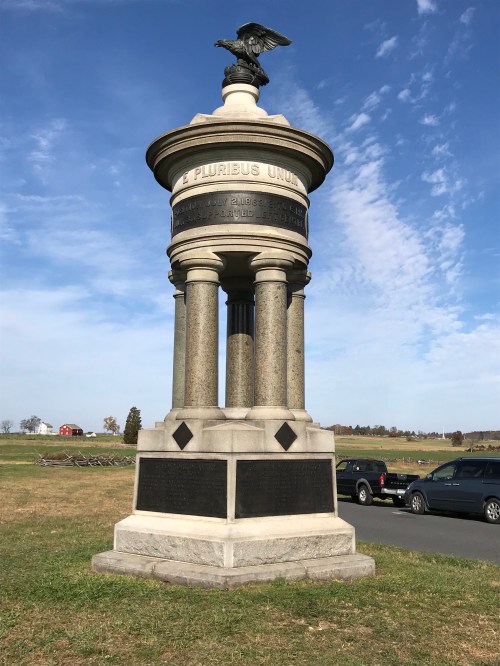
The Excelsior Brigade Monument at Gettysburg

But the continuing controversy which always seemed to swirl around him prevented him from being honored on the battlefield where he lost his leg. Alone of all the Union Corps commanders at Gettysburg Sickles has no memorial on the battlefield. When asked about the lack of a monument, Sickles, in his typical manner is reported to have said that “The whole damned field is my memorial.” [14]Despite the controversy surrounding his life, and those that swirled in the fighting and refighting of the Battle of Gettysburg, in true fashion Dan Sickles went on to further glory and scandal. Ulysses Grant never allowed him to command troops in the field, Sickles commanded the Military Department of South Carolina, the Department of the Carolinas, and the Department of the South, where was a strong proponent of Reconstruction. Teresa died of tuberculosis in 1866

He was retired as a Major General in the Regular Army in 1869 and went on to serve as Minister to Spain where he carried on an affair with the deposed Queen Isabella, a nymphomaniac who long before she ever Sickles had conducted a myriad of high profile affairs. The affair with the former queen was open and offensive to many people, but neither seemed to mind. In a sense they were kindred spirits. A Paris newspaper dubbed the one-legged General “the Yankee King of Spain.” [15]The affair with Isabella eventually burned itself out and Sickles married Senorita Caroline de Creagh, the daughter of a Spanish Minister, who bore him two children. To do this he converted to Roman Catholicism, something that he had never done when Teresa was alive. After his service in Spain was ended Sickles remained in Paris for four years, where he was widely admired and “received the office of Commander of the Legion of Honor.” [16]

Though a Democrat he supported Republican Presidential candidates Ulysses S. Grant and Rutherford Hayes, the latter against a long time Democratic rival from New York. As he got older Gettysburg became an increasing part of his life and in 1892 he ran for Congress in order to spearhead efforts to preserve the battlefield. He was elected and it was in large part due to his efforts that what we now know as the Gettysburg National Military Park exists. In 1893, Sickles met James Longstreet at a Gathering in Gettysburg, and the two men became lifelong friends. Since the war both men had been refighting the battle and the controversies that hung over their decisions that July 2nd like a pall. Longstreet, for his actions on the battlefield, and his decision to become a Republican and serve in the post-war Reconstruction efforts was a pariah in much of the South. That “unpopularity was painful to him, and he was glad to find a sympathetic ally in Sickles. Each of the two generals agreed that the other had moved with blameless skill that day,” [17] and both would defend the other in the succeeding years. As the continuing battle of Gettysburg was fought in the press and in histories written by various participants, Longstreet wrote of Sickles, “I believe it is now conceded that the advanced position at the peach orchard, taken by your Corps and under your orders, saved that battlefield for the Union cause.” [18]

Sickles was awarded the Medal of Honor in 1897, the citation stating, “Displayed most conspicuous gallantry on the field vigorously contesting the advance of the enemy and continuing to encourage his troops after being himself severely wounded.”

Sickles long to outlived George Meade who died in 1872 and all of the other Corps commanders of the Army of the Potomac, not to mention most of his friends and enemies. His father George Sickles died in 1887 leaving Dan an estate of nearly five million dollars. His daughter by Teresa, Laura, whose life had been so scarred by the events of 1859 died alone and estranged from her father. In 1896, disgusted by the nomination of William Jennings Bryant as the Democratic Presidential nominee, the one-legged Sickles went to work with his old Gettysburg comrade, the one-armed Oliver Otis Howard to campaign for the Republican William McKinley. They were quite a pair, the religious Howard, and the libertine Sickles, but they helped McKinley defeat Bryant, and McKinley remained grateful to them until his death by an assassin’s bullet.

In 1913 he attended the fiftieth anniversary ceremonies at Gettysburg where he watched the white haired survivors of Pickett’s Charge hobble across the wide battlefield into the arms of their former opponents on Cemetery Ridge. Helen Longstreet, James Longstreet’s second wife and widow quoted the words of a poet named Horatio King, for the event for a southern newspaper.

I see him on that famous field,

The bravest of the brave,

Where Longstreet’s legions strove to drive

The Third Corps to its grave

The fight was bloody, fierce and long,

And Sickles’ name shall stay

Forever in the hall of fame

As he who saved the day [19]

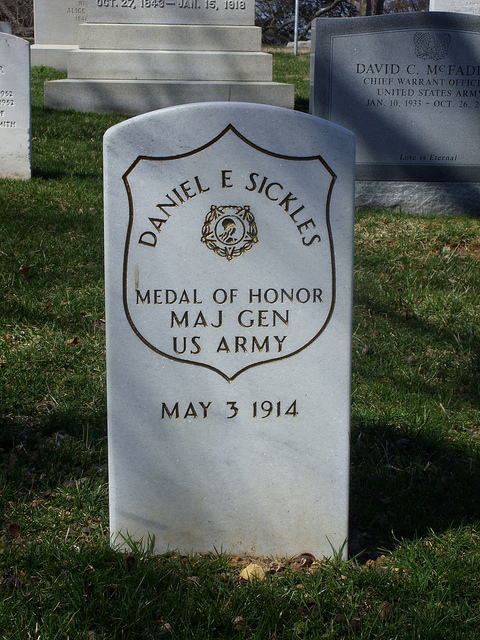
While Helen Longstreet’s claim that Sickles was “forever in the hall of fame” is a tad farfetched, there is no doubt that scoundrel had found redemption. When Sickles died in 1914 at the age of 94, his funeral was held at Saint Patrick’s Cathedral in New York and he was buried at Arlington National Cemetery, with full military honors, his flag-draped casket carried on an artillery caisson accompanied by a rider-less horse and artillery salutes. His funeral, in a military cemetery among other soldiers was “proof that he was no longer an attorney, politician, or even the murderer of Barton Key,” [20] he was a soldier. His tombstone simply reads:

Daniel E. Sickles

Medal of Honor

Maj. Gen. U.S. Army

May 3 1914

sickles grave

The New York Times made a comment that no one, be they an admirer or enemy could deny. “He was a truly adventurous spirit.” [21]

Notes

[1] Ibid. Oeffinger A Soldier’s General p.197

[2] Ibid. Wert General James Longstreet p.279

[3] Ibid. Alexander Fighting for the Confederacy p.278

[4] Ibid. Wert General James Longstreet p.279

[5] Taylor, John M. Duty Faithfully Performed: Robert E Lee and His CriticsBrassey’s, Dulles VA 1999 p.149

[6] Freeman, Douglas S. R.E. Lee volume 3 Charles Scribner’s Sons, New York 1935 p.150

[7] Ibid. Swanberg Sickles the Incredible p.235

[8] Ibid. Trudeau Gettysburg, the Testing of Courage p.421

[9] Robertson, William Glenn The Peach Orchard Revisited: Daniel E. Sickles and the Third Corps on July 2, 1863 in The Second Day at Gettysburg: Essays on Confederate and Union Leadership edited by Gary W. Gallagher, The Kent State University Press, Kent Ohio and London, 1993 p.56

[10] Ibid. Hessler Sickles at Gettysburg p. 244

[11] Ibid. Swanberg Sickles the Incredible p.235

[12] Ibid. Hessler Sickles at Gettysburg p. 401

[13] Ibid. Hessler Sickles at Gettysburg pp.244-245

[14] Ibid. Swanberg Sickles the Incredible p.390

[15] Ibid. Swanberg Sickles the Incredible p.321

[16] Ibid. Keneally American Scoundrel p.339

[17] Ibid. Swanberg Sickles the Incredible p.367

[18] Ibid. Keneally American Scoundrel p.341

[19] Ibid. Keneally American Scoundrel p.353

[20] Ibid. Hessler Sickles at Gettysburg p. 385

[21] Ibid. Swanberg Sickles the Incredible p.390

2 Comments

Filed under civil war, Gettysburg, historic preservation, History, Military

Cavalry in the American Civil War

gallonbuyingtime

Friends of Padre Steve’s World,

Today I am posting a revised part of one of my Civil War texts, this one dealing with the organization, use, and development of cavalry during the war. It’s kind of a history geek thing, I’m re-working on the section on artillery. I hope that you enjoy.

Peace

Padre Steve+

Cavalry in the United States in the ante-bellum period and during the war differed from the massive cavalry arms of European armies. In Europe the major armies had two types of cavalry units, light cavalry which was used for scouting, reconnaissance and screening, and heavy cavalry which was designed to be employed at the decisive moment of the battle in order to break enemy infantry formations through the shock of the massed charge. Napoleon always had a number of reserve cavalry corps to fulfill this mission.

The United States had little in the way of a cavalry tradition. Cavalry was considered by many American political leaders to be too aristocratic for America and as a result this arm of service suffered. In its early years the U.S. Army did not have any sizable mounted formations to call upon.

There were a number of other reasons for the cultural and institutional resistance to a strong were trained and armed cavalry service in the United States Army.

First, the nation as a whole distrusted large standing armies and viewed them as a source of potential tyranny and traditional cavalry was the most aristocratic part of European armies. The struggle between Federalists who desired a standing army and a militia that could be organized under central control and Republicans who wanted nothing of the sort was a constant source of friction in the new republic. Anti-Federalists saw standing armies as despotic, as one anti-federalist publication noted “In despotic governments, as well as in all the monarchies of Europe, standing armies are kept to execute the commands of the prince or magistrate…. By establishing an armed force to execute the laws at the point of the bayonet – a government of all others is the most to be dreaded.” [1]

As such, much of the nation’s military spending was focused on the Navy, which was deemed as less of a domestic threat, and even then the limited budgets meant that many times significant numbers of ships were laid up in ordinary. The Regular Army struggled to maintain its existence from 1787 until the War of 1812 in the face of Republican opposition led by Thomas Jefferson. After the War of 1812 the nation soon lost interest in paying for a standing army and in 1821 against the wishes of Secretary of War John C. Calhoun slashed “the Army’s strength by eliminating regiments and reducing the number of officers.” [2] With appropriations cut to the bone there was no effort to create a cavalry arm for the service as cavalry formations were much more expensive to equip and maintain than infantry.

Even though the Regular Army survived, it was tiny in. Its strength ranged from 3,000 to 6,000 men, the bulk were infantry who for the most part formed a frontier constabulary or manned coastal fortifications. However, in 1796 two companies of Dragoons were authorized, but even so the mounted arm remained a poor stepchild. Likewise, “Doctrinal resistance to battle cavalry was also very strong. The ‘American’ tradition had no place for such an animal….” [3]

Finally as the nation expanded westward the army formed the First Dragoon Regiment in 1833. In 1836 the Second Dragoons were organized. The Dragoons were basically mounted infantry formations and these units were scattered about the expanding western frontiers of the nation were employed “guarding the routes of expansion as far west as the Rocky Mountains and as far south as the Red River.” The army also formed Mounted Infantry units, which like the Dragoons were hybrid formations. Though many thought that such units promised “a double return on the government’s investment, but which did not manage to provide either an efficient force of infantry or an efficient battle force of cavalry.” [4]

The First Dragoons would serve with “distinction in numerous engagements in what was to become California and New Mexico.” [5] The regiment fought well in the War with Mexico but suffered heavy casualties in the process. When the war ended it was again dispersed on the frontier when it was used to protect settlers and fight Native American tribes that resisted the advance of the flood of white settlers.

One of the reasons for the heavy losses sustained by the First Dragoons in Mexico was because “West Point cavalry doctrine was based upon a Napoleonic mania for the massed saber charge.” [6] However, one problem with this was that the United States Army never had sufficient numbers of cavalry, not to mention a death of heavy cavalry needed to make such attacks successful, but in Mexico the limited number of cavalry troops available made such tactics untenable. The tactic had often worked well for Napoleon and massed cavalry charges were used to sweep the field of broken enemy infantry formation. However, the suicidal charge of Marshal Ney’s vaunted Cuirassiers against the Duke of Wellington’s highly disciplined infantry squares at Waterloo had shown that such tactics were destined for extinction unless they were part of an all arms assault. Marshal Ney failed because he used his cavalry in unsupported attacks against the allied infantry squares rather advancing artillery to support the attack or bringing infantry up to force the defenders out of their squares.

It was not until the 1850s that the army organized its first two Cavalry regiments for duty on the frontier. The new cavalry regiments were the equivalent of European light cavalry and during the war primarily served in that role, conducting reconnaissance, raids, and screening the army. Even so the tactical doctrine taught at West Point focused continued to “support the continuing predominance of the offense over the defense, of shock over firepower” [7] which was at odds with the cavalry’s actual capabilities.

Cavalry regiments were usually composed of four to six squadrons, each squadron having two companies. Cavalry regiments could range in size from 660 to nearly 1,200 troopers. Both the Union and the Confederacy grouped their cavalry into brigades and later divisions, but the Confederates were first to establish cavalry brigades and divisions. By 1863 both the Confederate Army of Northern Virginia and the Union Army of the Potomac each formed cavalry corps. Cavalry tactics “complemented conventional infantry assault tactics, emphasizing shock and the role of the saber”; unfortunately both the infantry and the cavalry developed their doctrine independently. U.S. Army Cavalry doctrine was prescribed in Philip St. George Cooke’s Cavalry Tactics which was published in 1861 while a corresponding Confederate manual, Joseph Wheeler’s A Revised System of Cavalry Tactics appeared in 1863.

Before the war American cavalry units tended to operate in small numbers with regiments seldom sending into action more than a few companies at once. At the beginning of the war the Federal government decided to form just five mounted regiments, including two of Dragoons and one of Mounted Infantry. It soon decided to add a sixth but the units were hindered by the fact that many of their officers had gone to the Confederacy, and some of those remaining “would jump to volunteer units to secure higher rank, pay, and prestige.” [8] The result was defeat after defeat at the hands of J.E.B. Stuart’s Confederate cavalry.

Eventually large scale programs to train and equip large numbers of volunteers and the Regulars combined with wartime reorganizations and solid leadership would make the Federal cavalry a force that was able to hold its own and then to sweep Confederate cavalry from the field. But it took time to train cavalry, and early Union commanders like McClellan refused to take that time and a “whole year was lost as a result, during which the cavalry was allowed to indoctrinate itself in the notion that it could never make use of European standards.” [9] While McClellan may have done well in organizing and training the infantry and artillery of the Army of the Potomac, he did little in the way of providing the mounted arm with leaders, training or missions that would increase their effectiveness. Unlike Stuart who combined his troopers with effective horse artillery, McClellan “failed to appreciate the advantage of coordinating the tactical strengths of cavalry with those of infantry and artillery.” [10]

CWP015

J.E.B. Stuart

While the South did struggle at times with its cavalry arm but did have an advantage in that the vast majority of their cavalry troopers owned their mounts and were experienced horsemen, something that could not be said of the many city dwellers who volunteered for duty in the Union cavalry. But the initial Southern superiority in cavalry was also due to the fact that “the principal of massing regiments into brigades and divisions was pursued earlier than by the Federal.” [11] In contrast McClellan “followed the evil course of reducing mounted regiments to their smallest components for operational use.” Likewise, he “wasted cavalry’s potential and depressed its morale by employing it as couriers, bodyguards for his subordinates, pickets for his encampments, and wagon train escorts, instead of as combat troops.” [12] The result as one would expect was that for the first two years of the war “J.E.B. Stuart and his horsemen were able, literally, to run rings around their opponents.” [13]

One Union writer compared the development of the Confederate and Union cavalry arms during the war:

“The habits of the Southern people facilitated the formation of cavalry corps which were comparatively efficient even without instruction; and accordingly we see Stuart, John Morgan, and Forrest riding around with impunity around the Union armies, and destroying or harassing their communications. Late in the war that agency was reversed. The South was exhausted of horses, while the Northern cavalry increased in numbers and efficiency, and acquired the audacity which had characterized the Southern.” [14]

buford

John Buford

As such much of the initial improvement in the Union cavalry arm were due to solid commanders like Brigadier General John Buford to teach new recruits as well as discouraged veterans to become effective cavalrymen.

Cavalry remained a fairly small in comparison to the infantry and artillery branches of service. Even during the wartime expansion the amount of cavalry available was miniscule compared to European armies. On the average only about 8% of the Army of the Potomac was composed of cavalry, compared to Napoleon’s 20 to 25%. [15] Part of this was due to the perceived cost of the cavalry arm which many believed was too expensive to maintain on a large scale: “estimates held that every twelve companies mounted and outfitted at public expense would rob the Treasury of over $300,000 a year merely to cover upkeep on animals, remounts, weapons, and equipment….” [16]

The cost of equipping cavalry was high enough that in the South that troopers had to procure their own mounts. Edwin Coddington noted that the Confederate policy “was a wonderful arrangement for keeping the strength of the cavalry below par, much more than enemy bullets, for it encouraged absenteeism.” [17] The Confederate government paid the own for the use of the horse, and a cash reimbursement if it was lost in combat, but if it was lost in any other manner the soldier had to get another horse if he wanted to remain in the service. Since the Confederates never set up a “centralized replacement service” troopers who lost their mount “had to go home to procure a new horse. If he were a Virginian he needed from thirty to sixty days to accomplish his purpose, and a much longer time should he have to come deeper south.” [18]

Despite the doctrinal predilection to the offense and using the cavalry as a shock unit, the U.S. Army formed no heavy cavalry formations on the order of the famous French Cuirassiers, named after their armored breastplates and metal helmets which were the primary type of cavalry used in Europe for such tactics. As such, during the Civil War both Union and Confederate cavalry formations were primarily assigned to reconnaissance and screening missions normally conducted by light cavalry units in Europe. These larger formations began to be used en masse for the purpose of raiding by both sides “but in the hands of J.E.B Stuart and his friends it became little more than a license to roam off into the enemy’s rear areas looking for plunder and glory.” [19] The cavalry Corps of the Army of the Potomac was used in a similar manner to raid enemy rear areas with often dreadful results which contributed nothing to the overall goal of defeating Lee’s army. A prime example was when Joseph Hooker detached his newly formed Cavalry Corps under George Stoneman to raid Richmond leaving the flank of the army uncovered at Chancellorsville.

Quite often the soldiers assigned to the infantry and artillery had little use for the cavalry who they saw as pampered and contributing little to the war. Many infantrymen held the “cavalry in open contempt. “These cavalry are a positive nuisance,” an officer in the 123rd Illinois wrote. “They won’t fight, and whenever they are around they are always in the way of those who will fight.” [20] Disdainful Confederate infantrymen “greeted their cavaliers with “Here’s your mule!” and “their Federal counterparts would exclaim: “There’d going to be a fight, boy; the cavalry’s running back!” and “Whoever saw a dead cavalryman.” [21]

The lethality of the rifled musket also made the classic Napoleonic cavalry charge against enemy infantry a costly and dangerous enterprise if the enemy infantry still had the means to make organized resistance, and if the cavalry assault was not supported by infantry and cavalry.. An example of this was the ill-fated cavalry attack ordered by Brigadier General Judson Kilpatrick against the men of Lafayette McLaws’s well prepared division on the Confederate right after the failure of Pickett’s Change at Gettysburg.

Cavalry tactics began to change during the war. Both sides used their cavalry for raids, sometimes very large ones, and operations against enemy partisans in their rear areas. In each case the cavalry was typically deployed by itself and even when it accompanied the armies into battle cavalry units were typically employed on the periphery of the battle. As such as Griffith wrote, “Civil War doctrine of raiding… was not only a deliberate turn away from the hope of victory on the battlefield, but it actually removed the means by which victory might have been won at the very moment when those means were at last starting to be properly efficient.” [22] The lack of heavy cavalry of the European model sometimes kept commanders from completing victories, one can only imagine what would have happened had George Meade had a division of heavy cavalry at hand to sweep the Confederates from the battlefield after Pickett’s Charge.

sheridanphiliphbio

Philip Sheridan

Tactics only began to change when General Philip Sheridan took command of Grant’s cavalry. Sheridan kept the cavalry close to the main body of the arm. Sheridan had replaced Major General Alfred Pleasanton as commander of the Cavalry Corps of the Army of the Potomac in early 1864. It is quite possible had he not died in December 1863 that the post would have gone to John Buford, but Sheridan had a vision for the cavalry that foreshadowed modern operational art. Sheridan wanted to organize the Cavalry Corps by concentrating it “into a powerful striking arm. He desired to do this, first, to deal with the Confederate cavalry, on the theory that “with a mass of ten thousand mounted men… I could make it so lively for the enemy’s cavalry that… the flanks and rear of the Army of the Potomac would require little or no defense.” [23] Sheridan was making no idle boast as by now his troops “were not only more numerous, but they had better leaders, tactics, and equipment than before,” [24] especially when it came to the Spencer repeating rifle which was now standard issue for the cavalrymen, and which gave them a tremendous advantage in firepower over Stuart’s now ill-equipped troops.

Sheridan first did this at the beginning of the Wilderness campaign when he took his 10,000 strong corps around the Confederate flank. Sheridan had been quarreling with Meade about the latter’s insistence that Sheridan’s horsemen were clogging the roads that his infantry needed to advance upon. In the heated discussion Sheridan came very close to being insubordinate with Meade. Meade reportedly told Sheridan that “Stuart “will do about how he pleases anyhow” to which Sheridan supposedly replied “Damn Stuart, I can trash hell out of him any day.” [25] Furious, Meade went and reported the matter to Grant. Grant listened and replied “Did Sheridan say that?… He usually knows what he is talking about. Let him go ahead and do it.” [26] At Grant’s request Meade provided Sheridan with new orders to concentrate his cavalry, march south and engage Stuart’s cavalry. Unlike previous raids which sought to avoid battle with Stuart’s troops in order to hit prescribed objectives, above all Sheridan wanted to engage and defeat the legendary Confederate cavalier. He “defined the raid as “a challenge to Stuart for a cavalry duel behind Lee’s lines in his own country.” And the more there were of the gray riders when the showdown was at hand, the better he would like it, since that would mean there were more to be smashed up.” [27]

Sheridan’s column totaled nearly 13,000 men and was nearly 13 miles long as he proceeded at a slow pace around Lee’s army and south towards Richmond. In addition to his horsemen he brought all of his horse artillery batteries. He was well around Lee’s flank before he was discovered and during the march his troops burned a depot and over one hundred railroad cars containing “close to a million rations of meat and better than a half million of bread, along with Lee’s entire reserve of medical stores.” [28]

On May 11th Stuart managed to intercept Sheridan’s column at a place called Yellow Tavern, just south of Ashland and the Ana River, but his corps was outnumbered by at least three to one. Three well trained, experienced, equipped, and superbly led Federal cavalry divisions confronted Stuart. With no hopes of fighting an offensive action, Stuart’s troops fought dismounted and were routed by the superior Bluecoats who continued on to cut the railroad between Lee’s army and Richmond. During the battle Stuart, who had cheated death on a number of occasions was mortally wounded. The Confederate cavalry of the Army of Northern Virginia would never recover, and to Southerners Stuart’s death was a profound psychological blow, only slightly worse than that of Stonewall Jackson a year before. Robert E. Lee, to who Stuart was like a son took the loss harder than he had taken Jackson’s. “I can scarcely think of him without weeping,” he told one of Stuart’s officers.” [29]

As the armies in the East and West dueled throughout 1864, Sheridan and other Federal cavalry officers transformed the Union cavalry into a striking force which could be the spearhead of the army and use new tactics to overcome the problem of combining fire with rapid maneuver which had never been satisfactory applied by the infantry. There were four components in the new tactical mix: “fast operational mobility on horseback out of contact with the enemy; a willingness to take cover and fight on foot when the enemy was close; new repeating carbines to give enhanced firepower; and a mounted reserve to make the sabre charge when the moment was ripe.” [30] Sheridan would apply these tactics in his later campaigns against Jubal Early in the Shenandoah Valley and during the Appomattox campaign and his cavalry, working with infantry and artillery smashed the beleaguered Confederate armies which tried to oppose them. The reorganized cavalry was not the answer to all of the battlefield problems faced by Civil War commanders but it gave Union commanders an impressive weapon in which the speed and firepower of the cavalry could be readily combined with artillery and infantry to achieve decisive results. On the Confederate side, General Joseph Wheeler who commanded the cavalry in the west, Wheeler usually fought dismounted in “skirmish order using field fortification, whether skirmishing independently or in the line…. In the last major action of the war, he dramatically displayed how cavalry had become tactically integrated with infantry. At Bentonville, while fighting his cavalry dismounted, first on the right, then moving around to the left flank, Wheeler constructed a line of breastworks 1,200 yards long.” [31]

European cavalry officers found little to admire in American use of cavalry. Few paid attention to the importance of fighting dismounted and working as part of a combined arms team. In August 1914 their cavalry formations paid severe price for ignoring the realities of modern war, realities which the Americans, both Union and Confederate learned during the Civil War.

Notes

[1] ____________ Anti-Federalists Fear a Large Military “Brutus I.” “To the Citizens of the State of New York” 1787 in Major Problems in American Military History edited by John Whiteclay Chambers II and G. Kurt Piehler, Houghton-Mifflin and Company, Boston and New York 1999 p. 103

[2] Ibid. Millet and Maslowski For the Common Defense: A Military History of the United States p.122

[3] Ibid. Griffith, Battle Tactics of the Civil War p.181

[4] Ibid. Griffith, Battle Tactics of the Civil War p.181

[5] Longacre, Edward G. John Buford: A Military Biography Da Capo Press, Perseus Book Group, Cambridge MA p.33

[6] Thomas, Emory M. Bold Dragoon: The Life of J.E.B. Stuart University of Oklahoma Press, Norman OK 1986 and 1999 p.30

[7] Ibid. Hagerman The American Civil War and the Origins of Modern Warfare p.21

[8] Longacre, Edward G. The Cavalry at Gettysburg: A Tactical Study of Mounted Operations, during the Civil War’s Pivotal Campaign, 9 June- 14 July 1863. University of Nebraska Press, Lincoln and London 1986 p.44

[9] Ibid. Griffith, Battle Tactics of the Civil War p.182

[10] Ibid. Longacre The Cavalry at Gettysburg: A Tactical Study of Mounted Operations, during the Civil War’s Pivotal Campaign, 9 June- 14 July 1863 p.45

[11] Ibid. Griffith, Battle Tactics of the Civil War p.181

[12] Ibid. Longacre The Cavalry at Gettysburg: A Tactical Study of Mounted Operations, during the Civil War’s Pivotal Campaign, 9 June- 14 July 1863 p.45

[13] Ibid. Griffith, Battle Tactics of the Civil War p.183

[14] Buell, Don Carlos. East Tennessee and the Campaign of Perryville in Battles and Leaders of the Civil War Volume III, The Tide Shifts. Edited by Robert Underwood Johnson and Clarence Clough Buel Castle, Secaucus NJ p.51

[15] Ibid. Griffith, Battle Tactics of the Civil War p.181

[16] Ibid. Longacre The Cavalry at Gettysburg: A Tactical Study of Mounted Operations, during the Civil War’s Pivotal Campaign, 9 June- 14 July 1863 p.43

[17] Coddington, Edwin B. The Gettysburg Campaign: A Study in Command, A Touchstone Book, Simon and Schuster New York, 1968 p.17

[18] Ibid. Coddington The Gettysburg Campaign: A Study in Command p.17

[19] Ibid. Griffith, Battle Tactics of the Civil War p.183

[20] Ibid. Robertson Soldiers Blue and Gray p.20

[21] Ibid. Longacre The Cavalry at Gettysburg: A Tactical Study of Mounted Operations, during the Civil War’s Pivotal Campaign, 9 June- 14 July 1863 p.45

[22] Ibid. Griffith, Battle Tactics of the Civil War pp.183-184

[23] Ibid. Weigley A Great Civil War: A Military and Political History 1861-1865 p.369

[24] Ibid. Whelan Bloody Spring: Forty Days that Sealed the Confederacy’s Fate p.181

[25] Ibid. Thomas Bold Dragoon: The Life of J.E.B. Stuart p.288

[26] Catton, Bruce Grant Takes Command Little, Brown, and Company, New York, Toronto, London 1968 and 1969 p.216

[27]Ibid. Foote The Civil War, A Narrative. Volume Three Red River to Appomattox p.564 p.224

[28] Ibid. Foote The Civil War, A Narrative. Volume Three Red River to Appomattox p.564 p.225

[29] Ibid. Korda, Clouds of Glory p.626

[30] Ibid. Griffith, Battle Tactics of the Civil War p.184

[31] Ibid. Hagerman The American Civil War and the Origins of Modern Warfare p.298

4 Comments

Filed under civil war, History, Military

Tragic Heroes: Gouverneur Warren Part Five

Friends of Padre Steve’s World

The last installment of my work on Gouverneur Warren.

Peace

Padre Steve+

warren5-5

A Martyr to no Cause at All: Disgrace and Restoration

Among the people that Warren made enemies with during the campaign was his mentor and friend George Gordon Meade. The issue with Meade was particularly serious as Meade seriously considered relieving Warren due to his insubordinate attitude. Meade wrote a letter which he never sent to Grant’s chief of staff Colonel John Rawlins where he acknowledged Warren’s fine traits but also his problems. Meade wrote:

“No officer in the army exceeds Genl Warren in personal gallantry, in activity, in zeal and in sleepless nights, or in devotion to his duties,” Meade wrote- he suffered from a serious “defect” in which he often questioned orders rather than obey them. Such a serious defect Meade wrote, “strikes at the root of all Military subordination, and is entirely out of question that I can command this Army, if each Corps Commander is to exercise a similar independence of action.” [1]

Another enemy made by Warren was Phillip Sheridan, the new commander of the army’s cavalry. The two men were seemingly destined to clash; they had already clashed at Spotsylvania where Warren complained about Sheridan’s performance.  Sheridan never forgave or ever forgot Warren’s justified criticism of him during that battle, and

But the issue really came down to personality and leadership style. Joshua Chamberlain who testified at his board of inquiry testified at it that “Warren gave the impression of a slow, quiet contemplative sort who could not be rushed into decision making. Whether on the march or in battle, he moved at a deliberate pace, refusing to commit himself or his troops until he had time to analyze the situation.” [2]

Chamberlain observed that to someone who did not know Warren, as Sheridan did not that “General Warren’s temperament is such that he, instead of showing excitement, generally shows an intense concentration in what I call important movements…and those who do not know him might take it for apathy when it is deep, concentrated thought and purpose” [3] much of which was rooted in Warren’s strong desire not to sacrifice his men needlessly taking care “to ensure that they were not thrown in to suicidal situations” and he “looked out for their welfare.” [4]

Warren and Sheridan were different types of people and commanders. Warren was an exceptionally intelligent man, one of the brightest in the army and highly regarded in many ways. He was excellent leader of men and he was beloved by his troops, but that being said the traits that were his strengths hindered him in command. He did command from the front, but “his real interest was in the science of command. Warren believed that leading a corps gave him discretion and leeway in carrying out his duties – which often he performed with the smugness of the righteous. It developed that not everyone would be tolerant of either his manner or his philosophy of command – particularly not U.S. Grant.” [5] Nor did Warren have the kind of single minded vision and killer instinct that made Grant, Sherman and Sheridan such brutally effective battlefield commanders. He was “handicapped by the breadth of his vision,” [6] the trait that made him such an effective staff officer which at Little Round Top served the army so well.

After the war Grant praised Warren’s intelligence, earnestness and perceptiveness, but he found in Warren, what he called a “defect which was beyond his control, that which was very prejudicial to his usefulness…” What was the defect? Grant wrote: “could see every danger at a glance before he encountered it. He would not only make preparations to meet the danger which might occur, but he would inform his commanding officer what others should do while he was executing his move.” [7]

Grant had been apprised of the battlefield by a false report of Warren and his troop’s actual location, news that was hours old “told Sheridan to relieve Warren if he judged the Fifth Corps would “do better” under another commander.” Staff officers of Fifth Corps were shocked, and one wrote “General Grant knew that General Sheridan was not a person to be intrusted with such a weapon and not use it.” [8]

sheridan

Major General Phillip Sheridan

Sheridan did use the power Grant had given. Sheridan was still smarting from a setback incurred the previous day where one of Warren’s infantry divisions had to “extricate Little Phil from difficulties with George Pickett’s Confederates at Dinwiddie Court House on March 31”  [9]  relieved Warren while the latter was in the midst of actual combat. However, neither Sheridan nor Grant wanted to admit was that “Warren did about as well as anyone could have that night getting three divisions of the Fifth Corps to Sheridan’s position.” [10]

Sheridan relieved Warren of command of V Corps following the Battle of Five Forks where Sheridan believed that Warren’s Corps had moved too slowly in the attack. Sheridan’s actions to relieve Warren at the moment of a great victory “would reverberate for the better part of two decades.” [11] Sheridan’s staff had given Warren wrong information about the positions of the Confederate troops and Warren’s own orders to his division commanders were conflicting. Warren had been working to get Crawford’s division into the fight as it had strayed too far north before turning westward and hit the wrong Confederate units and Warren went to rectify the situation and to get Crawford’s troops into the fight.

Since Sheridan did not see Warren at the front he ordered him relieved of command, even though Warren had personally taken over the direction of one of the brigades, led it into action “and under the setting sun, he snatched up his corps flag, shouted to his men – “Now, boys, follow me, this will be the last fight of the war!” – and rode straight toward the rebel line. His horse was shot and killed, and Colonel Hollon Richardson of the Seventh Wisconsin was wounded as he tried to shield his corps commander when he toppled to the ground….”  [12] Not long after this “official orders relieved Warren of his command.” [13] Sadly, had Warren died that day he might have been eulogized as a hero; instead he suffered terribly at the hands of the leaders of the army that he had served so well.

The relief was brutal, Sheridan wrote that “General Warren did not exert himself to get up his corps as rapidly as he might have done, and his manner gave me the impression that he wished the sun to go down before dispositions for the attack could be completed.” [14] This ruined Warren’s career and even hinted at a possible lack of courage on the part of Warren. This Sheridan refused to reconsider, something that “Chamberlain and the officers and men of the Fifth Corps ever forgave him for what they considered an unjust act made cruel by his refusal to reconsider it.” [15] Many, including men who had little love for Warren and who were often critical of him were appalled at the relief. Colonel Charles Wainwright, the commander of Warren’s corps artillery who once wrote to his wife that Warren was “a very loathsome, profane ungentlemanly & disgusting puppy in power” [16] felt that Warren’s “removal at this time, and after the victory had been won, appears to be wrong and cruel.” [17] Porter Alexander wrote after the war of Warren that “no Federal corps commander had a higher personal reputation for courage, enterprise and good judgment.” [18]

Warren was a professional soldier, but he was not perfect. He “possessed all the attributes of a capable, if not excellent corps commander- intelligence, executive ability, training, and personal bravery. But he was a difficult subordinate, whose arrogance and bouts with depression fueled his temper.” [19] Warren took the relief hard. Unfortunately as a topographic engineer he was an outsider to many in the army and not fully appreciated by Grant or Sheridan, who in their haste at Five Forks not only destroyed his career but did nothing to rectify their decision even after others protested. Despite the problems in their relationship Meade “on two occasions suggested to Grant that he reinstate Warren as commander of the V Corps, Grant did not respond.” [20]

William Henry Powell wrote in his history of Fifth Corps:

“With the flush of victory on his brow, with the end of the struggle so near, with the faint Rays of the dawn of peace already gleaming in the sanguinary sky, this noble warrior was brushed aside like a fly from a map and sent into what was an undeniable, if not apparently dishonorable, seclusion.” [21]

After the war Warren resigned his commission as a Major General of Volunteers and returned to his permanent rank as a Major of Engineers. He served another 17 years doing engineering duty and was promoted to Lieutenant Colonel in 1879, but his past always haunted him, even his sleep. The previously noted letter to his wife Emily where Warren stated that “I wish I did not dream so much…” and described symptoms that we might now attribute to some sort of combat stress injury was written during that assignment.

Warren sought a Court of Inquiry to exonerate himself but this was refused until President Grant left office. The Court eventually exonerated him but Warren died three months before the results were published. He reportedly told his wife Emily as he lay dying “Convey me to my grave without pageant or show…I die a disgraced soldier.” [22] His last words reportedly were “The Flag! The Flag!” [23] Embittered by the treatment he had received by the army that he had served so well, Warren was buried “as he directed in his will, in civilian clothes and without military ceremony.” [24] In 1888, veterans of the 5th New York, Duryee Zouaves; Warren’s first command placed a bronze statue of Warren standing on the boulder on Little Round Top, where Warren reportedly stood during the battle.

Warren’s funeral was attended by his friends Winfield Scott Hancock and Samuel Crawford, his oldest army friend and mentor Andrew Humphreys was called away before the service due to the sudden illness of his son. [25] The Washington Post noted that Warren “had gone “where neither the malevolence nor the justice of this world can reach him. He had enough of the former; and denial of the latter not only embittered his closing months of his life, but undoubtedly hastened his end.”  [26]

Despite the later events which ended up in his relief by Sheridan, Warren’s actions on that hot and muggy July 2nd 1863 exemplified the leadership qualities that we as an institution strive to achieve. From a leadership perspective Warren’s actions at Little Round Top demonstrate how the Chairman’s Desired Leader Attributes and the principles of Mission Command: “the ability to operate on intent through trust, empowerment and understanding” should work in a relationship between seniors and subordinates.

However with that being said, during the 1864 campaign in Virginia, Warren was often disconnected from his senior commanders.  During the campaign acted in a manner that did not always contribute to successful mission command, even when events proved him to be correct. During the campaign there were times that his temper, angry outbursts and depression severely hampered his ability to operate on intent, through trust, empowerment and understanding.

In a way the harsh actions of Grant and Sheridan at Five Forks to send a message to the senior leaders of the Army of the Potomac was correct. Unfortunately they directed that action at the wrong man at the wrong time. What Grant and Sheridan did to Warren was without doubt as grave injustice as ever done to any American commander during the prosecution of any war. However, though they were wrong in what they did to Warren “had the same fate been visited upon one or two of the Army of the Potomac’s less-than-stellar corps commanders back in 1862 or 1863, to serve as an indelible lesson to that army’s high command…” [27] much good might have been accomplished and the war in the East brought to an end sooner.  But through their unjust actions General Gouverneur K. Warren “became a martyr to no cause at all.” [28]

Warren’s life also serves to remind us of the ethics of our profession, that it is possible for good officers, even excellent officers and leaders to do things that hinder or even hurt the ability to maintain the sense of trust required by their command or staff position. The conflicting personalities of Warren and Sheridan demonstrate this lack of trust which culminated in Warren’s relief.

Warren was a tragic hero, brilliant, courageous and caring. He was also was likely suffering from psychological wounds of war. It was probably these unseen wounds that caused him to be misunderstood in the moment of perceived crisis by men that neither knew him nor appreciated him. Loomis Langdon, who served as the official recorder for the board of inquiry which exonerated Warren after his death wrote:

“I had never met General Warren till he came before his Court of Inquiry…I learned to value his good opinion – and while I admired him for his great patience, his wonderful energy, habit of concentration, his vast learning and untiring application, I loved him for his tenderness, gentleness and charity, even to those whom he believed had combined to do him a cruel wrong; and I admired him for his nobleness of character and his courage and unselfish patriotism.” [29]

It is easy for military professionals to become totally focused in our profession, especially the details of planning and process to forget the humanity of those that we serve alongside. Warren is one of those complex figures who are not easy to categorize.  His biographer Jordan wrote that:

“Warren was a man with fine intellect, widely read, and of keen sensibilities. He was also an excellent engineer, mapmaker, and scientist. He was a soldier who cared much for the safety and welfare of the men under him, and he was sickened by the appalling carnage of the war in which he took such a prominent part. He was arrogant and proud, and he hesitated hardly at all in putting down those of his colleagues he regarded as inferiors. His mind’s eye took in much beyond what was his immediate concern, but this gift worked against him in the hierarchical realm of military life. Warren was prone to long sieges of depression, and he himself agreed that others found him morose and unsmiling…” [30]

In reading military history is far too easy to isolate and analyze a commander’s actions in battle and ignore the rest of their lives. In the case of Warren where there is so much controversy, this is particularly important. We have to honestly evaluate his strengths and weaknesses and not fall into the trap that many do by isolating a particular event or personality trait, be it good or bad, and using and then using it to turn the person into an icon, or to destroy the subject of our work.

Those that commit this error render a great disservice to the men themselves. In time of war nearly everyone who serves in combat, gives up something of themselves and sometimes the effects last long after the war is over. Sadly there are times when the lives and reputations of heroes like Gouverneur Warren can be destroyed, not only by their personality failings or weaknesses; by the affliction of Combat Stress injuries as well as the actions of people in the institutions that they serve.

This is the challenge for current military leaders, for within the ranks of our military, including those of the officer corps there are men and women who are very much like the troubled hero of Little Round Top, Brigadier General Gouverneur Kemble Warren.

Notes

[1] ibid. Huntington Searching for George Gordon Meade p.305

[2] Ibid. Longacre Joshua Chamberlain: The Soldier and the Man p176

[3] Sears, Stephen W. Controversies and Commanders Mariner Books, Houghton Mifflin Company, Boston and New York 1999 pp.278

[4] Ibid. Jordan Happiness is Not My Companion: The Life of G.K. Warren p.316

[5] Ibid. Sears Controversies and Commanders p.257

[6] Ibid. Jordan Happiness is Not My Companion: The Life of G.K. Warren p.317

[7] Ibid. Sears Controversies and Commanders p.262

[8] Ibid. Sears Controversies and Commanders pp.275-276

[9] Inid. Huntington Searching for George Gordon Meade p.328

[10] Ibid. Sears Controversies and Commanders p.272

[11] Ibid. Sears Controversies and Commanders p.255

[12] Ibid. Jordan Happiness is Not My Companion: The Life of G.K. Warren p.232

[13] Nesbitt, Mark Through Blood and Fire: Selected Civil War Paper of Major General Joshua Chamberlain Stackpole Books, Mechanicsburg PA 1996 Amazon Kindle edition location 2113 of 2800

[14] Ibid. Sears Controversies and Commanders p.278

[15] Ibid. Wallace The Soul of the Lion p.175

[16] Wert, Jeffry D. The Sword of Lincoln: The Army of the Potomac Simon and Schuster, New York 2005 p.374

[17] Ibid. Jordan Happiness is Not My Companion: The Life of G.K. Warren p.236

[18] Alexander, Edward Porter. Fighting for the Confederacy: The Personal Recollections of General Edward Porter Alexander edited by Gary Gallagher University of North Carolina Press, Chapel Hill 1989 p.514

[19] Ibid. Wert The Sword of Lincoln p.402

[20] Ibid. Huntington Searching for George Gordon Meade p.330

[21] Ibid. Huntington Searching for George Gordon Meade p.330

[22] Ibid. Jordan Happiness is Not My Companion: The Life of G.K. Warren p.307

[23] Ibid. LaFantasie Twilight at Little Round Top p.244

[24] Foote Shelby The Civil War, a Narrative, Volume Three: Red River to Appomattox Random House, New York 1974 p.874  

[25] Ibid. Jordan Happiness is Not My Companion: The Life of G.K. Warren p.309

[26] Ibid. Jordan Happiness is Not My Companion: The Life of G.K. Warren p.308

[27] Ibid. Sears Controversies and Commanders p.284

[28] Ibid. Sears Controversies and Commanders p.284

[29] Ibid. Jordan Happiness is Not My Companion: The Life of G.K. Warren p.309

[30] Ibid. Jordan Happiness is Not My Companion: The Life of G.K. Warren preface pp.x-xi

7 Comments

Filed under civil war, ethics, History, leadership, Military

July 2nd at Gettysburg: Tragic Heroes of Little Round Top

vincentdont-give-an-inch-up-5-smaller

Friends of Padre Steve’s World,

I am pre-posting a number of articles to run this Independence Day weekend so I can work on the article that I place on posting July 4th. These are articles from my Gettysburg text that deal with events of July 1st, 2nd, and 3rd 1863 during the Battle of Gettysburg. They have all appeared on this site before in different forms, but the Battle of Gettysburg still matters, what was done there on the behalf of freedom cannot be allowed to be forgotten. .

Have a great weekend.

Peace

Padre Steve+

July 2nd 1863 was to be a pivotal day in the history of the United States, a day of valor, courage and carnage; a day where nearly 20,000 Americans were killed, wounded or missing fighting fellow Americans. It was a day where the fate of the Union and the Confederacy were in the balance. On the afternoon of that day, three volunteers rose to the challenge.

However, when we tell the story of Gettysburg or for that matter any other battle we often neglect the human costs endured by the soldiers as well as their families off the battlefield. In fact, what we know of the heroes of these battles is of their battlefield heroism as well other military or governmental service. The pictures we have of them are often the polished versions of their heroics, sometimes bordering on hagiography, criticism, if any is leveled at all, is confined to battlefield decisions or campaign plans. We mythologize them, we turn them into idols, icons and somehow, even as important and inspiring as the myths may be, we ignore their basic humanity. When we do this we often miss the more important things about their lives; those things that make them much more real, much more human, much more like us.

Sadly, the unvarnished accounts of then lives of heroes often only show up in biographies, and are seldom mentioned in the more popular accounts of battles. But the pain and suffering that these men and their families endured during and after war is sadly neglected, much to the detriment of those who idolize them.

Yes, there were many more heroes on Little Round Top that day; far too many to be covered in depth in any one work. However, these three Colonels, Strong Vincent, Joshua Lawrence Chamberlain and Patrick “Paddy” O’Rorke along with Brigadier General Gouverneur Warren were instrumental in securing the Union victory. They were all unlikely heroes. Of these men only O’Rorke was a professional soldier, albeit a very young one, but all took to soldiering and leading soldiers as if it were second nature. They were men who along with others “who stepped out of themselves for a moment and turned a corner at some inexpressibly right instant.” [1]

Strong_Vincent

Colonel Strong Vincent

I Enlisted to Fight: Strong Vincent

Colonel Strong Vincent was a 26 year old Harvard graduate and lawyer from Erie Pennsylvania. He was born in Waterford and attended school in Erie. Growing up, he worked in his father’s iron foundry, where the work helped make him a man of great physical strength. He studied at Trinity College in Hartford Connecticut and transferred to Harvard. There are various explanations for why he left Trinity, but the most interesting and probably the most credible is that during his sophomore year which was recorded by Trinity alumnus Charles F. Johnson who wrote that:

“He went calling on Miss Elizabeth Carter, a teacher at Miss Porter’s school in Farmington, ten miles west of Hartford. At some point a guard or watchman voiced a comment that impinged the lady’s virtue, and, as Johnson so aptly phrases it, Vincent “responded to the affront with the same gallantry and vigor that he was to display in the Civil War.” McCook’s account indicated that the man was repeatedly pummeled, which effectively rendered him unconscious.” [2]

Long after the war Dr. Edward Gallaudet, the president of Trinity responded to an enquiry of the circumstances leading to Vincent’s early departure from Trinity. Gallaudet responded to the request in a terse manner:

“Replying to yours of yesterday, I must say that I do not think it would be wise to make public the story I told of Strong Vincent’s escapade at Farmington & its consequences. Certainly not in the lifetime of Mrs. Vincent.” [3]

Evidently the incident resulted in Vincent leaving Trinity and the next year he entered Harvard. Vincent graduated from Harvard in 1859, ranking 51st in a class of 92. However, he was not an outstanding student and “earned admonishments on his record for missing chapel and smoking in Harvard Yard.” [4]

Returning home he studied law with a prominent lawyer and within two years had passed the bar, and he was well respected in the community. When war came and the call went out for volunteers, Vincent enlisted in a 30 Day regiment, the Wayne Guards as a private and then was appointed as a 1st Lieutenant and Adjutant of the regiment because of his academic and administrative acumen.

He married Elizabeth, the same woman whose virtue he had defended at Trinity that day. Vincent like many young northerners believed in the cause of the Union undivided, and he wrote his wife shortly after the regiment went to war on the Peninsula:

“Surely the right will prevail. If I live we will rejoice in our country’s success. If I fall, remember you have given your husband to the most righteous cause that ever widowed a woman.” [5]

When the Wayne Guards were disbanded at the end of their enlistment, Vincent helped to raise the 83rd Pennsylvania and was commissioned as a Lieutenant Colonel in it on September 14th 1861. The young officer learned his trade well and was considered a “strict disciplinarian and master of drill.” [6] That being said one enlisted man remarked that “no officer in the army was more thoughtful and considerate of the health and comfort of his men.” [7] Vincent assumed command of the regiment when the commander was killed during the Seven Days in June of 1862 where he learned lessons that he would help impart to his fellow officers as well as subordinates, including Chamberlain. At Fredericksburg any doubters about the young officer’s courage and leadership ability were converted where they observed his poise “with sword in hand” he “stood erect in full view of the enemy’s artillery, and though the shot fell fast on all sides, he never wavered or once changed his position.” [8]

By the time of the Battle of Gettysburg, the 26 year old Vincent was the youngest brigade commander in the army. He was noted for his intelligence, leadership, military acumen and maturity. One friend wrote “As a general thing his companions were older than himself….Among his associates were men of the highest rank. He could adapt himself to all, could talk with the politician on questions of history, with a general officer on military evolutions, or with a sporting man on the relative merits of horses,-and all respected his opinion.” [9]

His promotion was well earned, following a bout with a combination of Malaria and Typhoid, the “Chickahominy Fever” which almost killed him; Vincent took command of the regiment after its commander was killed at Gaines Mill. He commanded the regiment at Fredericksburg and was promoted to command the 3rd Brigade after the Battle of Chancellorsville following the resignation of its commander, Colonel T.W.B. Stockton on May 18th 1863.

Vincent was offered the chance to serve as the Judge Advocate General of the Army of the Potomac by Joseph Hooker in the spring of 1863 after spending three months on court-martial duty. But the feisty Vincent refused the offer in so that he might remain in the fight commanding troops. [10] He told his friends “I enlisted to fight.” [11]

Vincent, like Chamberlain, who admired him greatly had “become a kind of model of the citizen soldier.” [12] As a result of his experience in battle and the tenacity of the Confederate army he became an advocate of the tactics that William Tecumseh Sherman would later employ during his march to the sea in 1864. He wrote his wife before Chancellorsville:

“We must fight them more vindictively, or we shall be foiled at every step.  We must desolate the country as we pass through it, and not leave a trace of a doubtful friend or foe behind us; make them believe that we are in earnest, terribly in earnest; that to break this band in twain is monstrous and impossible; that the life of every man, yea, of every weak woman or child in the entire South, is of no value whatever compared with the integrity of the Union.” [13]

Unlike most other brigade commanders, Vincent was still a Colonel, and he, like many others would in his place hoping for a General’s star. He remarked that his move to save Sickles’ command “will either bring me my stars, or finish my career as a soldier.” [14] On July first, Vincent, a native Pennsylvanian came to Hanover and learning that battle had been joined, ordered “the pipes and drums of the 83rd Pennsylvania to play his brigade through the town and ordered the regiments to uncover their flags again….” [15] As the brigade marched through the town, Vincent “reverently bared his head” and announced to his adjutant, “What death more glorious can any man desire than to die on the soil of old Pennsylvania fighting for that flag?” [16]

Vincent was known for his personal courage and a soldier of the 83rd Pennsylvania observed: “Vincent had a particular penchant for being in the lead….Whenever or wherever his brigade might be in a position to get ahead…, he was sure to be ahead.” [17] That courage and acumen to be in the right place at the right time was in evidence when he led his brigade into battle on that fateful July second.

On July 2nd Barnes’ division of V Corps, which Vincent’s brigade was a part was being deployed to the threat posed by the Confederate attack of McLaws’ division on the Peach Orchard and the Wheat Field to reinforce Sickles’ III Corps. While that division marched toward the Peach Orchard, Vincent’s 3rd Brigade was the trail unit. When Gouverneur Warren’s aide, Lieutenant Randall Mackenzie [18] came toward the unit in search of Barnes, he came across Vincent and his brigade near the George Weikert house on Cemetery Ridge awaiting further orders. [19]

Vincent intercepted him and demanded what his orders were. Upon being told that Sykes’ orders to Barnes were to “send one of his brigades to occupy that hill yonder,” [20] Vincent defied normal protocol assuming that Barnes had hit the bottle and was drunk [21] and told Mackenzie “I will take responsibility of taking my brigade there.” [22] Vincent immediately went into action and ordered Colonel James Rice, his friend and the commander of the 44th New York “to bring the brigade to the hill as quickly as possible,” and then turned on his horse and galloped off toward Little Round Top.” [23]

It was a fortunate thing for the Union that he did. His quick action to get his brigade, clear orders to his subordinate commanders and skilled analysis of the ground were a decisive factor in the Union forces holding Little Round Top. After ordering Colonel Rice to lead the brigade up to the hill, he and his aide went forward to scout positions accompanied by the brigade standards. Rice brought the brigade forward at the double quick “across the field to the road leading up the north shoulder of the hill” with Chamberlain’s 20th Maine in the lead. [24]

Vincent and his orderly made a reconnaissance of the south and east slope of the hill which adjoined a small valley and a rocky outcrop called Devil’s Den, which was occupied by the 124th New York and which was the end of Sickles’ line. Near the summit of the southern aspect of the hill, they came under Confederate artillery fire and told his orderly “They are firing at the flag, go behind the rocks with it.” [25]

Vincent dismounted, leaving his sword secured on his horse, carrying only his riding crop. He continued and “with the skill and precision of a professional had reconnoitered and decided how to best place his slim brigade of 1350 muskets.” [26] He chose a position along a spur of the hill, which now bears his name, running from the northwest to the southeast to place his regiments where they could intercept the Confederate troops of Hood’s division which he could see advancing toward the hill.

What Vincent saw when he arrived was a scene of disaster. Confederate troops had overwhelmed the 124th New York and were moving on Little Round Top, “Devil’s Den was a smoking crater,” and the ravine which separated Devil’s Den from Little Round Top “was a whirling maelstrom.” [27] Seeing the threat Vincent began to deploy his brigade but also sent at messenger back to Barnes telling him “Go tell General Barnes to send reinforcements at once, the enemy are coming against us with an overwhelming force” [28]

The 16th Michigan, the smallest regiment in his brigade with barely 150 soldiers in line [29] was placed on the right flank of the brigade. As it moved forward, its adjutant, Rufus W. Jacklin’s horse was hit by a cannon ball which decapitated that unfortunate animal and left it “a mass of quivering flesh.” [30] A fierce Confederate artillery barrage fell among the advancing Union troops and splintered trees, causing some concern among the soldiers. The 20th Maine’s Chaplain, Luther French, saw the “beheading of Jacklin’s horse and ran to Captain Atherton W. Clark, commanding the 20th’s Company E, babbling about what he had seen. Clark interrupted French abruptly and shouted: “For Christ sake Chaplain, if you have any business attend to it.” [31]

That section of the line was located on massive boulders that placed it high above the valley below, making it nearly impregnable to frontal attack. On the summit Vincent deployed the 83rd Pennsylvania and 44th New York to their left at the request of Rice who told him “In every battle that we have engaged the Eighty-third and Forty-fourth have fought side by side. I wish that it might be so today.” [32] The story is probably apocryphal but the regiments remained side by side with the 16th Michigan on the right and the 20th Maine on the left. The two regiments were deployed below the crest among the large number of boulders; the 83rd was about two-thirds of the way down the way down the slope where it joined the right of the 44th, whose line angled back up the slope to the southeast. A historian of the 83rd Pennsylvania noted that “Each rock”… “was a fortress behind which the soldier[s] instantly took shelter.” [33] The soldiers were determined to do their duty as they now were fighting on home ground.

Vincent deployed the 20th Maine on his extreme left of his line, and in fact the extreme end of the Union line. Vincent knew that if this flank was turned and Chamberlain overrun that it would imperil the entire Union position. Vincent came up to Chamberlain who remembered that Vincent said “in an awed, faraway voice: “I place you here….This is the left of the Union line. You understand. You are to hold this ground at all costs.” [34] Chamberlain acknowledged his understanding of the order and since the regiment lacked field grade officers, Chamberlain “assigned Captain Atherton Clark of company E to command the right wing, and acting Major Ellis Spear the left.” [35]

chamberlain

Colonel Joshua Chamberlain following his Promotion to Brigadier General

The Professor: Joshua Lawrence Chamberlain

While Colonel Joshua Chamberlain’s story is much better known than his brigade commander, Strong Vincent, he was another of the citizen soldiers whose performance and leadership on Little Round Top saved the Union line that hot July evening. Chamberlain was a graduate of Bowdoin College and Bangor Theological Seminary. Fluent in nine languages other than English, he remained at Bowdoin as Professor of Rhetoric and was deeply unhappy at missing the war even as his students left and were commissioned as officers in newly raised regiments.

In June of 1862 Chamberlain wrote to Governor Israel Washburn requesting an appointment in a newly raised Maine Regiment without consulting either the college or his wife Fannie, who was “shocked, hurt, and alarmed by the decision he had made without consulting her…She remonstrated, she raised her voice, and quite possibly wept over the injustice he had done to both by this unilateral act that threatened to send their world careening in all directions.” [36]

As far as Bowdoin went, Chamberlain actually deceived the college by requesting a “scholarly sabbatical when in fact he had applied to the governor of Maine in the new 20th Maine Infantry in the late summer of 1862.” [37] When the faculty of Bowdoin found out of Chamberlain’s action many of them “were livid over what they considered his duplicity, and some shunned him during the brief period that he remained in Brunswick before reporting to training camp. [38]

The letter that Chamberlain wrote to Governor Israel Washburn details Chamberlain’s desire to serve and in some ways shows his considerable political skill in presenting his case to join the army:

“For seven years past I have been Professor in Bowdoin College. I have always been interested in military matters, and what I do not know in that line I know how to learn.

Having been lately elected to a new department here, I am expecting to have leave, at the approaching Commencement, to spend a year or more in Europe, in the service of the College. I am entirely unwilling, however, to accept this offer, if my Country needs my service or example here.

Your Excellency presides over the Educational as well as the military affairs of our State, and, I am well aware, appreciates the importance of sustaining our Institutions of Learning. You will therefore be able to decide where my influence is most needed.

But, I fear, this war, so costly of blood and treasure, will not cease until the men of the North are willing to leave good positions, and sacrifice the dearest personal interests, to rescue our Country from Desolation, and defend the National Existence against treachery at home and jeopardy abroad. This war must be ended, with a swift and strong hand; and every man ought to come forward and ask to be placed at his proper post.

Nearly a hundred of those who have been my pupils, are now officers in our army; but there are many more all over our State, who, I believe, would respond with enthusiasm, if summoned by me, and who would bring forward men enough to fill up a Regiment at once. I can not free myself from my obligations here until the first week in August, but I do not want to be the last in the field, if it can possibly be helped.” [39]

Chamberlain’s pre-war experiences gave no indication that he would emerge as a military hero. His father, a veteran of the War of 1812 had named him after Captain James Lawrence, the commanding officer of the frigate USS Chesapeake in the War of 1812 who uttered the famous words “Don’t give up the ship” as he lay mortally wounded when that ship was defeated by the HMS Shannon off Boston Harbor in 1813. However, Chamberlain’s mother added the name Joshua as his first name in the town’s books. While his father hoped that the young Chamberlain would pursue a military career, his mother earnestly desired that he would pursue a ministerial career. Chamberlain did become a licensed minister but had no desire to become a pastor, and was never ordained. This was reinforced by Fannie, who though the daughter of a minister was “too much a free thinker” and “did not share the devotion her father and Chamberlain held for organized religion.” [40]

Chamberlain debated attending West Point after graduation, a path that his classmate Oliver O. Howard took. Instead he attended Bangor Theological Seminary and following graduation took up his academic career at Bowdoin. It was during this time that he met, fell in love with, pursued, courted and finally married Frances Caroline Adams, who played the organ at the local Congregational Church that he attended. Known by most as “Fannie,” she was the adopted daughter of the eminent Congregationalist minister, Dr. George Adams who served as pastor. Fannie had a strong independent streak and was as an accomplished musician and artist.

The couple was an interesting match. Chamberlain was impressed by Fannie’s “artistic gifts. Fannie had talent not only in music but in poetry and, especially; art…” [41] but he ignored potential areas of conflict that would create difficulties throughout their marriage. However, Fannie was beset by numerous fears, as well as a desire not to be dominated by any man. Chamberlain pursued her with abandon but for a time she resisted, until her widowed father married a woman not much older than herself. She desired to pursue the study of music and went away to New York to do so, but in 1852 she decided that she was in love with him. “Yet she harbored doubts about her ability to return his feelings for her measure for measure.” [42]

Fannie suffered from depression and a constant worry about her eyesight which began failing her and an early age. It was a malady that eventually left her completely blind by then turn of the century. Compounding her struggles was that fact that her new husband struggled with his own doubts and depression, a depression that only seamed to lift during the war years.

“During most of his life, Chamberlain struggled with bouts of deep depression and melancholy. But not during the war years. It was as if the war and soldiering had made a new man out of him.” [43]

Chamberlain was offered command of the 20th Maine but asked Governor Washburn that he was appointed as a Lieutenant Colonel, which he was in August 1862. He fought with the regiment at Fredericksburg and was named commander of it when Colonel Adelbert Ames, his commander was transferred to preform staff duties prior to obtaining a brigade command in Oliver Howard’s XI Corps following the debacle at Chancellorsville.

Chamberlain at his heart, through his association with abolitionists and other prior to the war was a staunch Unionist. Before going into the army he wrote:

“We have this war upon is & we want to stop it. It has cost us already too much precious blood. It has carried stagnation, starvation & grief in to too many villages of our fair land – brought death to too many noble hearts that we could ill afford to lose. But the only way to stop this war, is first to show that we are strongest…I feel that we are fighting for our country – for our flag- not as so many Stars and Stripes, but as the emblem of a good & powerful nation – fighting to settle the question whether we are a nation or a basket of chips. Whether we shall leave our children the country we have inherited – or leave them without a country – without a name – without a citizenship among the great nations of the earth – take the chief city of the rebels. They will have no respect for us unless we whip them & and I say it in all earnestness….” [44]

Like Vincent, Chamberlain was also a quick student or military science and rapidly adapted to being a soldier, officer and commander of troops in combat. He spent as much time studying the art of war under the supervision of Colonel Ames including Henri Jomini’s Art of War which he wrote to Fannie “The Col. & I are going to read it. He to instruct me, as he is kindly doing everything now.” [45] He excelled at his studies under Ames, but since most of the manuals that he studied were based on Napoleonic tactics and had not incorporated the changes brought about by the rifled musket, Chamberlain like so many others would have to learn the lesson of war the hard way.

Chamberlain was with the regiment at Antietam, but it saw no action. He was in the thick of the fighting at Fredericksburg and Burnside’s subsequent “Mud March” which were both disastrous for the army.

He took command of the regiment in late April after Ames left on detached duty before assuming a brigade command. As the new commander of the regiment, Chamberlain and the 20th Maine missed the Battle of Chancellorsville as the regiment had been quarantined due to an epidemic of smallpox, which they had probably received from “poorly prepared serum with which the regiment was vaccinated” [46] in April.

From the regiment’s quarantined location Chamberlain and his men could hear the sound of battle. One of his soldiers wrote “We could hear the firing plain but there we lay in glorious idleness without being able to lift a finger or fire a gun.” [47] In frustration Chamberlain rode to Major General Joseph Hooker’s headquarters and asked Hooker’s Chief of Staff Dan Butterfield for the chance to enter the fight. Refused the chance Chamberlain told Butterfield “If we couldn’t do anything else we would give the rebels the smallpox!” [48] The regiment spent the battle guarding a telegraph line must to Chamberlain and his soldier’s disgust.

On the march up to Gettysburg, Chamberlain was ordered to take a number of veterans of the 2nd Maine who had signed three year, rather than two year enlistment contracts and were angry at remaining in the army when the regiment was mustered out. The men were angry and Chamberlain was given permission by Meade to fire on them “if they refused to do duty. The new colonel realized he had a crisis on his hands.” [49] The soldiers were bitter but Chamberlain treated them graciously and “almost all of them agreed to take up their muskets again the service of the 20th Maine.” [50] Chamberlain later remarked of how these men “we’re afterward among my best men, worthy of the proud fame of the 2nd, and the hard earned laurels of the 20th.” [51]

On receiving his orders from Vincent, Chamberlain deployed his small regiment halfway down the southern slope facing the small valley between Little Round Top and Big Round Top. By the time he arrived at Gettysburg he had become “a great infantry officer, and among his valuable qualities was [understanding] where an attack would come….” [52]

Since Chamberlain’s account is so important I will forgo a discussion of his tactics and instead quote the sections of his after action report that explains his actions. Chamberlain wrote:

“On reaching the field at about 4 p.m. July 2d, Col. Vincent commanding the Brigade, placing me on the left of the Brigade and consequently on the extreme left of our entire line of battle, instructed me that the enemy were expected shortly to make a desperate attempt to turn our left flank, and that the position assigned to me must be held at every hazard.

I established my line on the crest of a small spur of a rocky and wooded hill, and sent out at once a company of skirmishers on my left to guard against surprise on that unprotected flank.

These dispositions were scarcely made when the attack commenced, and the right of the Regt. found itself at once hotly engaged. Almost at the same moment, from a high rock which gave me a full view of the enemy, I perceived a heavy force in rear of their principal line, moving rapidly but stealthily toward our left, with the intention, as I judged, of gaining our rear unperceived. Without betraying our peril to any but one or two officers, I had the right wing move by the left flank, taking intervals of a pace or two, according to the shelter afforded by rocks or trees, extending so as to cover the whole front then engaged; and at the same time moved the left wing to the left and rear, making a large angle at the color, which was now brought to the front where our left had first rested.

This hazardous maneuvre [sic] was so admirably executed by my men that our fire was not materially slackened in front, and the enemy gained no advantage there, while the left wing in the meantime had formed a solid and steady line in a direction to meet the expected assault. We were not a moment too soon; for the enemy having gained their desired point of attack came to a front, and rushed forward with an impetuosity which showed their sanguine expectations.

Their astonishment however was evident, when emerging from their cover, they met instead of an unsuspecting flank, a firm and ready front. A strong fire opened at once from both sides, and with great effect, the enemy still advancing until they came within ten paces of our line, where our steady and telling volleys brought them to a stand. From that moment began a struggle fierce and bloody beyond any that I have witnessed, and which lasted in all its fury, a full hour. The two lines met, and broke and mingled in the shock. At times I saw around me more of the enemy than of my own men. The edge of conflict swayed to and fro -now one and now the other party holding the contested ground. Three times our line was forced back, but only to rally and repulse the enemy. As often as the enemy’s line was broken and routed, a new line was unmasked, which advanced with fresh vigor. Our “sixty rounds” were rapidly reduced; I sent several messengers to the rear for ammunition, and also for reinforcements. In the mean time we seized the opportunity of a momentary lull to gather ammunition and more serviceable arms, from the dead and dying on the field. With these we met the enemy’s last and fiercest assault. Their own rifles and their own bullets were turned against them. In the midst of this struggle, our ammunition utterly failed. The enemy were close upon us with a fresh line, pouring on us a terrible fire. Half the left wing already lay on the field. Although I had brought two companies from the right to its support, it was now scarcely more than a skirmish line. The heroic energy of my officers could avail no more. Our gallant line withered and shrunk before the fire it could not repel. It was too evident that we could maintain the defensive no longer. As a last desperate resort, I ordered a charge. The word “fix bayonets” flew from man to man. The click of the steel seemed to give new zeal to all. The men dashed forward with a shout. The two wings came into one line again, and extending to the left, and at the same time wheeling to the right, the whole Regiment described nearly a half circle, the left passing over the space of half a mile, while the right kept within the support of the 83d Penna. thus leaving no chance of escape to the enemy except to climb the steep side of the mountain or to pass by the whole front of the 83d Penna. The enemy’s first line scarcely tried to run-they stood amazed, threw down their loaded arms and surrendered in whole companies. Those in their rear had more time and gave us more trouble. My skirmishing company threw itself upon the enemy’s flank behind a stone wall, and their effective fire added to the enemy’s confusion. In this charge we captured three hundred and sixty eight prisoners, many of them officers, and took three hundred stand of arms. The prisoners were from four different regiments, and admitted that they had attacked with a Brigade.” [53]

Colonel William Oates of the 15th Alabama gave Chamberlain and his regiment the credit for stopping his attack. Oates wrote: “There have never been harder fighters than the Twentieth Maine and their gallant Colonel. His skill and persistency and the great bravery of his men saved Little Round Top and the Army of the Potomac from defeat.” [54]

As with any firsthand account, aspects of Chamberlain’s accounts are contested by others at the scene. But in another way Chamberlain’s accounts of battle have to be carefully examined, because they often reflect his romanticism, and because he was not always a realist. Unlike others in his command like Major Ellis Spear, who played such an important role on Little Round Top that day, a realist who “saw things plainly and remembered them clearly, in stark, unadorned hues. Joshua Chamberlain was a romanticist; even when describing the horrors of bloodbath his prose could be colorful, lyrical, even poetic.” [55]

There are accounts that differ from Chamberlain’s; Oates wrote that he ordered the retreat and that there were not as many prisoners taken as Chamberlain states. Likewise, one of Chamberlain’s company commanders disputed the account of the Chamberlain’s order of the bayonet charge. But even these accounts take nothing away from what Chamberlain accomplished that day. The fact is that Chamberlain’s regiment was outnumbered nearly two to one by the 4th 15th and 47th Alabama regiments. Chamberlain “offset this superiority with strength of position, iron determination and better tactics.” [56]

While the actions of Chamberlain, Vincent, Warren and others on the Union side, another factor was at play. This was the fatigue of the Confederate soldiers. The regiments attacking Little Round Top and their parent unit, Law’s brigade of Hood’s division, had conducted a grueling 28 mile march to get to the battlefield. By the time that they arrived and made their assault, most soldiers were exhausted and dehydrated. This was something that their commander, Colonel Oates believed was an important factor in what happened. While Oates gives tremendous credit to Chamberlain and the 20th Maine he wrote that the fatigue and dehydration of his soldiers “contributed largely to our failure at Little Round Top.” [57]

Vincent was mortally wounded while leading the defense of the hill. As the men of Robertson’s Texas brigade rushed the hill and threatened to crack “the stout 16th Michigan defense…” [58] Vincent rushed to bolster the defenders. He was standing on a large boulder with a riding crop as the men of the 16th Michigan were beginning to waiver. Fully exposed to enemy fire he attempted to drive the retreating men back into the fight. Brandishing the riding which he cried out: “Don’t yield an inch now men or all is lost,” [59] and moments later was struck by a “minié ball which passed through his left groin and lodged in his left thigh. He fell to the ground and as he was being carried from the field, “This is the fourth or fifth time they have shot at me…and they have hit me at last.” [60]

o'rorke

Colonel Patrick “Paddy” O’Rorke

The Irish Regular: Paddy O’Rorke

To Vincent’s right another hero emerged, Colonel Patrick “Paddy” O’Rorke; the young 27 year old Colonel of the 140th New York. O’Rorke was born in County Cavan, Ireland in 1836. His family immigrated to the United States, settling in Rochester, New York during the great wave of Irish immigration between 1838 and 1844. There the young O’Rorke worked hard to overcome the societal prejudices against Irish Catholics. After he completed his secondary education, he worked as a marble cutter before obtaining an appointment to West Point in 1857. He was the only foreign born member of his class at the academy from which he graduated first in his class in 1861. “Aggressive and bold, there was also something that implied gentility and tenderness…Beneath the mettle of a young professional soldier was a romantic heart that could croon a ballad before wielding the sword.” [61] O’Rorke married his childhood, schoolmate, fellow parishioner and childhood sweetheart, Clarissa Wadsworth Bishop, in the summer of 1862 and shortly thereafter accepted a commission as colonel of the 140th New York Infantry.

At Gettysburg, O’Rorke was with Weed’s brigade when Gouverneur Warren found him as he attempted to get any available troops to the summit of Little Round Top. When Warren found O’Rorke, who had been one of his students at West Point, he ordered him to follow him up the hill, saying “Paddy…give me a regiment.” [62] When O’Rorke said that Weed expected him to be following him, Warren took the responsibility telling O’Rorke “Bring them up on the double quick, and don’t stop for aligning. I’ll take responsibility.” [63] O’Rorke followed with his gallant regiment with the rest of the brigade under Weed following behind them.

The 140th New York’s entrance onto the summit of Little Round Top must have been dramatic. Dressed in new Zouave uniforms that they had been issued in early June “the men were “jaunty but tattered” in baggy blue trousers, red jackets, and fezzes.” [64] O’Rorke’s New Yorkers entered the battle to the right of the Vincent’s 16th Michigan, which was being swarmed by the 4th and 5th Texas and 4th Alabama, who thought that victory was at hand. O’Rorke did not even take time to form his men for battle but drew his sword and yelled, “Down this way boys!” [65] His troops responded magnificently slamming into the surprised Texans and Alabamians and “at once the Confederate assault began to dissolve” [66]

O’Rorke’s troops smashed into the surging Rebel ranks, stopping the Confederate assault in its tracks and taking over two-hundred prisoners. As O’Rorke “valiantly led his men into battle, surging down the hill toward the shelf of rock so recently vacated by the right wing of the 16th Michigan, he paused for a moment to cheer his men on and wave them forward. When he did, he was struck in the neck by an enemy bullet….O’Rorke, killed instantly slumped to the ground.” [67] But his regiment “had the initiative now. More and more men piled into a sloppy line, firing as fast as they could reload. Their dramatic appearance breathed renewed life into the other Union regiments on the hill, which now picked up their firing rates.” [68] The gallant young Irish colonel was dead, but he and his regiment had saved Vincent’s right flank. The regiment had suffered fearfully, “with 183 men killed or wounded, but they had managed to throw back the Texans. The adjutant of the 140th estimated that they came within sixty seconds of losing the top of the hill.” [69] O’Rorke’s soldiers were enraged by the death of their beloved colonel and picked out the Confederate who had killed him. One of the soldiers wrote “that was Johnny’s last shot, for a number of Companies A and G fired instantly.” It was said that this particular Johnny was hit, by actual count, seventeen times.” [70] Now led by company commanders the 140th stayed in the fight and solidified and extended the Federal line in conjunction with the rest of Weed’s brigade to their right.

The actions of Chamberlain’s, Vincent’s, and O’Rorke’s soldiers shattered Hood’s division. “Casualties among the Alabamians, Texans, and Georgians approached or exceeded 2,000. In the Texas Brigade commander Robertson had been wounded, three regimental commanders had fallen killed or wounded, and nearly all of the field officers lay on the ground.” [71]

The badly wounded Strong Vincent was taken to a field hospital at the Weikert farm where he lingered for five days before succumbing to his wounds. In the yard lay the body of Paddy O’Rorke whose regiment had saved his brigade’s right flank. Vincent knew that he was dying and he requested that a message be sent to Elizabeth for her to come to Gettysburg. It did not reach her in time. Though he suffered severe pain he bravely tried not to show it. Eventually he became so weak that he could no longer speak. “On July 7, a telegram from President Lincoln, commissioning Vincent a brigadier general, was read to him, but he could not acknowledge whether he understood that the president had promoted him for bravery in the line of duty.” [72] He died later that day and his body was transported home to Erie for burial. Ten weeks after his death his wife gave birth to a baby girl. The baby would not live a year and was buried next to him.

Colonel Rice, who led the 44th New York up the hill and took command of the brigade on Vincent’s death, memorialized his fallen commander in his general order to the brigade on July 12th:

“The colonel commanding hereby announces to the brigade the death of Brig. Gen. Strong Vincent. He died near Gettysburg, Pa., July 7, 1863, from the effects of a wound received on the 2d instant, and within sight of that field which his bravery had so greatly assisted to win. A day hallowed with all the glory of success is thus sombered by the sorrow of our loss. Wreaths of victory give way to chaplets of mourning, hearts exultant to feelings of grief. A soldier, a scholar, a friend, has fallen. For his country, struggling for its life, he willingly gave his own. Grateful for his services, the State which proudly claims him as her own will give him an honored grave and a costly monument, but he ever will remain buried in our hearts, and our love for his memory will outlast the stone which shall bear the inscription of his bravery, his virtues, and his patriotism.

While we deplore his death, and remember with sorrow our loss, let us emulate the example of his fidelity and patriotism, feeling that he lives but in vain who lives not for his God and his country. “[73]

Vincent’s wife Elizabeth never married again and was taken in by the Vincent family. Vincent’s younger brother became an Episcopal Priest and Bishop and later provided a home for her. She became a tireless worker in the church working with charitable work for young women and children. This led to an interest in sacred art and she wrote two books: Mary, the Mother of Jesus and The Madonna in Legend and in Art. She also translated Delitzch’s Behold the Man and A Day in Capernaum from the German. [74] Elizabeth Vincent passed away in April 1914 and was buried beside her husband and daughter.

After the battle, as the army looked to replace the casualties in the ranks of senior leadership and “when Colonel Rice, in charge of 3rd Brigade after Vincent fell, was promoted to brigadier general and given another command” the new division commander Major General Charles Griffin, “insisted on having Chamberlain, for the 3rd Brigade.” [75]

Chamberlain survived the war to great acclaim being wounded three times, once during the siege of Petersburg the wound was so severe that his survival was in doubt and General Ulysses S. Grant promoted him on the spot. It was the only promotion that Grant gave on the field of battle. Grant wrote:

“He had been several times recommended for a brigadier-generalcy for gallant and meritorious conduct. On this occasion, however, I promoted him on the spot, and forwarded a copy of my order to the War Department, asking that my act might be confirmed without any delay. This was done, and at last a gallant and meritorious officer received partial justice at the hands of his government, which he had served so faithfully and so well.” [76]

He recovered from the wound, and was promoted to Major General commanding a division and awarded the Medal of Honor. He received the surrender of John Gordon’s division of the Army of Northern Virginia at Appomattox on April 9th 1865. When he did he ordered his men to present arms in honor of their defeated foe as those haggard soldiers passed his division. It was an act that helped spur a spirit of reconciliation in many of his former Confederate opponents.

fannychamberlain1

The Hidden Side of the Hero: Post War Struggles

Chamberlain’s accolades were certainly earned but others on that hill have been all too often overlooked by most people. This list includes Gouverneur Warren who was humiliated by Phillip Sheridan at Five Forks, Strong Vincent who died on of wounds suffered on Little Round Top and Paddy O’Rorke, the commander of the 140th New York of Weed’s Brigade on Vincent’s right who was mortally wounded that day.

After the war like most citizen soldiers, Chamberlain returned to civilian life, and a marriage that was in crisis in which neither Joshua nor Fannie seemed able to communicate well enough to mend. The troubled couple “celebrated their tenth wedding anniversary on December 7, 1865. He gave her a double banded gold-and-diamond bracelet from Tiffany’s, an extravagant gift that only temporarily relieved the stresses at work just below the surface of their bland marriage. Wartime separation had perhaps damaged it more than Chamberlain knew.” [77]

When he came home Chamberlain was unsettled. Fannie quite obviously hoped that his return would reunite them and bring about “peaceful hours and the sweet communion of uninterrupted days with the husband that had miraculously survived the slaughter” [78] and who had returned home, but it was not to be. Army life had given him a sense of purpose and meaning that he struggled to find in the civilian world. He was haunted by a prediction made by one of his professors. A prediction that “he would return from war “shattered” & “good for nothing,” [79] Chamberlain began to search for something to give his life meaning. He began to write a history of V Corps and give speeches around the northeast, and “these engagements buoyed his spirit, helping him submerge his tribulations and uncertainties in a warm sea of shared experience. [80] In his travels he remained apart from Fannie, who remained with the children, seldom including her in those efforts. She expressed her heart in a letter in early 1866:

“I have no idea when you will go back to Philadelphia, why dont you let me know about things dear?….I think I will be going towards home soon, but I want to hear from you. What are you doing dear? are you writing for your book? and how was it with your lecture in Brunswick- was it the one at Gettysburg? I look at your picture when ever I am in my room, and I am lonely for you. After all, every thing that is beautiful must be enjoyed with one you love, or it is nothing to you. Dear, dear Lawrence write me one of the old letters…hoping to hear from you soon…I am as in the old times gone bye Your Fannie.” [81]

In those events he poured out his heart in ways that seemed impossible for him to do with Fannie. He accounted those wives, parents, sons and daughters at home who had lost those that they loved, not only to death:

“…the worn and wasted and wounded may recover a measure of their strength, or blessed by your cherishing care live neither useless nor unhappy….A lost limb is not like a brother, an empty sleeve is not like an empty home, a scarred breast is not like a broken heart. No, the world may smile again and repair its losses, but who shall give you back again a father? What husband can replace the chosen of your youth? Who shall restore a son? Where will you find a lover like the high hearted boy you shall see no more?” [82]

Chamberlain set his sights on politics, goal that he saw as important in championing the rights of soldiers and their well treatment by a society, but a life that again interrupted his marriage to Fannie and brought frequent separation. Instead of the one term that Fannie expected, Chamberlain ended up serving four consecutive one year terms as Governor of Maine, and was considered for other political offices. However, the marriage continued to suffer and Fannie’s “protracted absence from the capital bespoke her attitude toward his political ambitions.” [83] Eventually Chamberlain returned home and. “For twelve years following his last term as governor, he served as president of Bowdoin College, his alma mater. [84]

He became a champion of national reconciliation admired by friend and former foe alike, but he returned with bitterness towards some in the Union who he did not believe cared for his comrades or their families, especially those who had lost loved ones in the war. While saluting those who had served in the Christian and Sanitary Commissions during the war, praising veterans, soldiers and their families he noted that they were different than:

Those who can see no good in the soldier of the Union who took upon his breast the blow struck at the Nation’s and only look to our antagonists for examples of heroism- those over magnanimous Christians, who are so anxious to love their enemies that they are willing to hate their friends….I have no patience with the prejudice or the perversity that will not accord justice to the men who have fought and fallen on behalf of us all, but must go round by the way of Fort Pillow, Andersonville and Belle Isle to find a chivalry worthy of praise.” [85]

Chamberlain’s post-war life, save for the times that he was able to revisit the scenes of glory and be with his former comrades was marred by deep personal and professional struggles and much suffering. He struggled with the adjustment to civilian life, which for him was profoundly difficult. He “returned to Bowdoin and the college life which he had sworn he would not again endure. Three years of hard campaigning however, had made a career of college teaching seem less undesirable, while his physical condition made a permanent army career impossible.” [86] The adjustment was more than even he could anticipate, and the return to the sleepy college town and monotony of teaching left much to be desired.

These are not uncommon situations for combat veterans to experience, and Joshua Chamberlain, the hero of Little Round Top who was well acquainted with the carnage of war, suffered immensely. His wounds never fully healed and he was forced to wear what would be considered an early form of a catheter and bag. In 1868 he was awarded a pension of thirty dollars a month for his Petersburg wound which was described as “Bladder very painful and irritable; whole lower part of abdomen tender and sensitive; large urinal fistula at base of penis; suffers constant pain in both hips.” [87] Chamberlain struggled to climb out of “an emotional abyss” in the years after the war. Part was caused by his wounds which included wounds to his sexual organs, shattering his sexuality and caused his marriage to deteriorate.

He wrote to Fannie in 1867 about the “widening gulf between them, one created at least in part by his physical limitations: “There is not much left in me to love. I feel that all too well.” [88] Chamberlain’s inability to readjust to civilian life following the war, and Fanny’s inability to understand what he had gone through during it caused great troubles in their marriage. Chamberlain “felt like hell a lot of the time, morose in mood and racked with pain.” [89] His wounds would require more surgeries, and in “April 1883 he was forced to have extensive surgery on his war wounds, and through the rest of the decade and well into the next he was severely ill on several occasions and close to death once.” [90]

By 1868 the issues were so deep that Fannie threatened him with divorce and was accusing Joshua of domestic abuse, not in court, but among her friends and in town; a charge which he contested. It is unknown if the abuse actually occurred and given Chamberlain’s poor physical condition it is unlikely that he could have done what she claimed, it is actually much more likely, based on her correspondence as well as Fannie’s:

“chronic depression, her sense of being neglected of not abandoned, and her status as an unappreciated appendage to her husband’s celebrated public career caused her to retaliate in a manner calculated to get her husband’s attention while visiting on him some of the misery she had long endured.” [91]

The bitterness in their relationship at the time was shown in his offer to her of a divorce; a condition very similar to what many combat veterans and their families experience today. After he received news of the allegations that Fannie was spreading among their friends around town, Chamberlain wrote to her:

“If it is true (as Mr. Johnson seems to think there is a chance of its being) that you are preparing for an action against me, you need not give yourself all this trouble. I should think we had skill enough to adjust the terms of a separation without the wretchedness to all our family which these low people to whom it would seem that you confide your grievances & plans will certainly bring about.

You never take my advice, I am aware.  But if you do not stop this at once it will end in hell.” [92]

His words certainly seem harsh, especially in our time where divorce, be it contested or uncontested does not have the same social stigma it did then. Willard Wallace writes that the letter “reflects bewilderment, anger, even reproof, but not recrimination; and implicit throughout is an acute concern for Fanny, who did not seem to realize the implications of legal action. The lot of a divorcee in that era in a conservative part of the country was not likely to be a happy one.” [93]This could well be the case, but we do not know for sure his intent. We can say that it speaks to the mutual distress, anger and pain that both Joshua and Fannie were suffering at the time.

The marriage endured a separation which lasted until 1871 when his final term of office expired they reconciled, and the marriage did survive, for nearly forty more years. “Whatever differences may have once occasionally existed between Chamberlain and Fanny, the two had been very close for many years.” [94] The reconciliation could have been for any number of reasons, from simple political expedience, in that he had been rejected by his party to be appointed as Senator, and the realization that “that politics, unlike war, could never stir his soul.” [95] Perhaps he finally recognized just how badly he had hurt her over all the years of his neglect of her needs. But it is just as likely that deep in his heart he really did love her despite his chronic inability for so many years to demonstrate it in a way she could feel. Fannie died in 1905 and Chamberlain, who despite all of their conflicts loved her and grieved her, a grief “tinged with remorse and perhaps also with guilt.” [96] The anguished widower wrote after her death:

“You in my soul I see, faithful watcher, by my cot-side long days and nights together, through the delirium of mortal anguish – steadfast, calm, and sweet as eternal love. We pass now quickly from each other’s sight, but I know full well that where beyond these passing scenes you shall be, there will be heaven!”

Chamberlain made a final trip to Gettysburg in May of 1913. He felt well enough to give a tour to a delegation of federal judges. “One evening, an hour or so before sunset, he trudged, alone, up the overgrown slope of Little Round Top and sat down among the crags. Now in his Gothic imagination, the ghosts of the Little Round Top dead rose up around him….he lingered up the hillside, an old man lost in the sepia world of memory.” [97] He was alone.

Chamberlain died on a bitterly cold day, February 24th 1914 of complications from complications of the ghastly wound that he received at Petersburg in 1864. The Confederate minié ball that had struck him at the Rives’ Salient finally claimed his life just four months shy of 50 years since the Confederate marksman found his target.

Sadly, the story of the marriage of Joshua and Fannie Chamberlain is all too typical of many military marriages and relationships where a spouse returns home changed by their experience of war and struggles to readjust to civilian life. This is something that we need to remember when we encounter those changed by war and the struggles of soldiers as well as their families; for if we have learned nothing from our recent wars it is that the wounds of war extend far beyond the battlefield, often scarring veterans and their families for decades after the last shot of the war has been fired.

The Battle for Little Round Top which is so legendary in our collective history and myth was in the end something more than a decisive engagement in a decisive battle. It was something greater and larger than that, it is the terribly heart wrenching story of ordinary, yet heroic men like Vincent, Chamberlain and O’Rorke and their families who on that day were changed forever. As Chamberlain, ever the romantic, spoke about that day when dedicating the Maine Monument in 1888; about the men who fought that day and what they accomplished:

“In great deeds, something abides. On great fields, something stays. Forms change and pass; bodies disappear; but spirits linger, to consecrate ground for the vision-place of souls… generations that know us not and that we know not of, heart-drawn to see where and by whom great things were suffered and done for them, shall come to this deathless field, to ponder and dream; and lo! the shadow of a mighty presence shall wrap them in its bosom, and the power of the vision pass into their souls.” [98]

Notes

[1] Guelzo, Allen C. Gettysburg: The Last Invasion Vintage Books a Division of Random House, New York 2013 p.462

[2] Nevins, James H. And Styple What Death More Glorious: A Biography of General Strong Vincent Belle Grove Publishing Co, Kearny N.J. 1997 p.16

[3] Ibid. Nevins What Death More Glorious p.17

[4] Ibid. LaFantasie, Glenn W. Twilight at Little Round Top: p.105

[5] ________. Erie County Historical Society http://www.eriecountyhistory.org/wp-content/uploads/2008/10/strongvincent.pdf retrieved 9 June 2014

[6] Golay, Michael. To Gettysburg and Beyond: The Parallel Lives of Joshua Lawrence Chamberlain and Edward Porter Alexander Crown Publishers Inc. New York 1994 p.129

[7] Nevins, James H. and Styple, William B. What Death More Glorious: A Biography of General Strong Vincent Belle Grove Publishing Company, Kearney NJ 1997 p.29

[8] Ibid Guelzo, Gettysburg: The Last Invasion p.262

[9] Ibid. Nevins, What Death More Glorious p.54

[10] Leonardi, Ron Strong Vincent at Gettysburg in the Barringer-Erie Times News retrieved June 9th 2014 from http://history.goerie.com/2013/06/30/strong-vincent-at-gettysburg/

[11] Ibid. Nevins What Death More Glorious p.55

[12] Wallace, Willard. The Soul of the Lion: A Biography of Joshua L. Chamberlain Stan Clark Military Books, Gettysburg PA 1960 p.91

[13] Ibid. Nevins What Death More Glorious p.57

[14] Ibid. Guelzo, Gettysburg: The Last Invasion p.264

[15] Pfanz, Harry F. Gettysburg: The Second Day. University of North Carolina Press, Chapel Hill 1987 p.51

[16] Ibid. Guelzo Gettysburg: The Last Invasion Vintage p.159

[17] Trudeau, Noah Andre. Gettysburg: A Testing of Courage, Harper Collins Publishers, New York 2002 p.305

[18] Some such as Guelzo believe this may have been Captain William Jay of Sykes staff

[19] Ibid. Trudeau, Gettysburg: A Testing of Courage p.327

[20] Ibid. Guelzo Gettysburg: The Last Invasion Vintage p.262

[21] Ibid. Guelzo Gettysburg: The Last Invasion Vintage p.262

[22] Ibid. Trudeau, Gettysburg: A Testing of Courage p.327

[23] Ibid. LaFantasie Twilight at Little Round Top p.108

[24] Coddington, Edwin B. The Gettysburg Campaign: A Study in Command, A Touchstone Book, Simon and Schuster New York, 1968 p.389

[25] Ibid. LaFantasie Twilight at Little Round Top p.109

[26] Ibid. Coddington The Gettysburg Campaign p.390

[27] Ibid. Guelzo Gettysburg: The Last Invasion Vintage p.270

[28] Ibid. Nevins What Death More Glorious p.75

[29] Sears, Stephen W. Gettysburg. Houghton Mifflin Co. Boston and New York 2003 p.292

[30] Ibid. LaFantasie Twilight at Little Round Top p.109

[31] Ibid. LaFantasie Twilight at Little Round Top p.109

[32] Ibid. Pfanz, Gettysburg: The Second Day. p.213

[33] Ibid. LaFantasie Twilight at Little Round Top p.111

[34] Ibid. Golay, To Gettysburg and Beyond p.157

[35] Ibid. LaFantasie Twilight at Little Round Top p.111

[36] Ibid. Longacre Joshua Chamberlain p.52

[37] Ibid. LaFantasie Twilight at Little Round Top pp.44-45

[38] ibid. Longacre Joshua Chamberlain p.52

[39] Chamberlain, Joshua Lawrence Letter From Joshua L. Chamberlain to Governor [Israel] Washburn, Brunswick, July 14, 1862 retrieved from Bowdoin College, Joshua Lawrence Chamberlain Documents http://learn.bowdoin.edu/joshua-lawrence-chamberlain/documents/1862-07-14.html 8 November 2014

[40] Longacre, Edward Joshua Chamberlain: The Soldier and the Man Combined Publishing Conshohocken PA 1999 p.39

[41] Ibid. Longacre, Edward Joshua Chamberlain: The Soldier and the Man p.28

[42] Ibid. Longacre Joshua Chamberlain: The Soldier and the Man p.30

[43] Ibid. LaFantasie Twilight at Little Round Top p.45

[44] Smith, Diane Monroe Fanny and Joshua: The Enigmatic Lives of France’s Caroline Adams and Joshua Lawrence Chamberlain Thomas Publications, Gettysburg PA 1999 p.120

[45] Ibid. Longacre Joshua Chamberlain p.80

[46] Ibid. Wallace The Soul of the Lion p.66

[47] Ibid. Golay, To Gettysburg and Beyond p.132

[48] Ibid. Wallace The Soul of the Lion p.66

[49] Ibid. Longacre Joshua Chamberlain p.116

[50] Ibid. LaFantasie Twilight at Little Round Top p.45

[51] Ibid. Longacre Joshua Chamberlain p.117

[52] Ibid. Wallace The Soul of the Lion p.94

[53] Chamberlain, Joshua Lawrence. Official Narrative of Joshua Chamberlain of July 6th 1863, Maine Military Historical Society, Inc., Augusta, Maine, copyright 1989 U.S. Army Combat Studies Institute Reprint, retrieved from http://usacac.army.mil/cac2/cgsc/carl/download/csipubs/chamberlain.pdf June 15th 2014

[54] Oates, William C. and Haskell, Frank A. Gettysburg Bantam Books edition, New York 1992, originally published in 1905 p.98

[55] Ibid. Longacre Joshua Chamberlain p.94

[56] Ibid. Coddington The Gettysburg Campaign: A Study in Command p.393

[57] Ibid. Oates and Haskell Gettysburg p.87

[58] Ibid. Wallace The Soul of the Lion p.95

[59] Ibid. Guelzo Gettysburg: The Last Invasion Vintage p.272

[60] Ibid. Trudeau, Gettysburg: A Testing of Courage p.361

[61] LaFantasie, Glenn W. Twilight at Little Round Top: July 2, 1863 The Tide Turns at Gettysburg Vintage Books, a Division of Random House, New York 2005 pp.61-62

[62] Ibid. Jordan Happiness is Not My Companion: The Life of G.K. Warren p.93

[63] Ibid. Foote The Civil War, A Narrative. Volume Two Fredericksburg to Meridian p.504

[64] Ibid. Pfanz Gettysburg: The Second Day p.228

[65] Ibid. Pfanz Gettysburg: The Second Day p.228

[66] Ibid. LaFantasie Twilight at Little Round Top p.153

[67] Ibid. LaFantasie Twilight at Little Round Top p.154

[68] Ibid. Trudeau, Gettysburg: A Testing of Courage p.327

[69] Ibid. Jordan Happiness is Not My Companion: The Life of G.K. Warren p.93

[70] Ibid. Sears Gettysburg p.294

[71] Wert, Jeffry D. A Glorious Army: Robert E. Lee’s Triumph 1862-1863 Simon and Schuster, New York and London 2011 p.260

[72] Ibid. LaFantasie Twilight at Little Round Top p.207

[73] Ibid. Nevins What Death More Glorious p.86

[74] Ibid. Nevins What Death More Glorious pp.87-88

[75] Ibid. Wallace The Soul of the Lion p.115

[76] Ibid. Wallace The Soul of the Lion pp.134-135

[77] Ibid. Golay, To Gettysburg and Beyond p.282

[78] Ibid. Smith Fanny and Joshua p.182

[79] Ibid. Smith, Fanny and Joshua p.180

[80] Ibid. Longacre Joshua Chamberlain p.260

[81] Ibid. Smith, Fanny and Joshua pp.178-179

[82] Ibid. Smith, Fanny and Joshua p.181

[83] Ibid. Longacre Joshua Chamberlain p.

[84] Ibid. LaFantasie Twilight at Little Round Top p.245

[85] Ibid. Smith, Fanny and Joshua p.180 It is interesting to note that Chamberlain’s commentary is directed at Northerners who were even just a few years after the war were glorifying Confederate leader’s exploits. Chamberlain instead directs the attention of his audience, and those covering the speech to the atrocities committed at the Fort Pillow massacre of 1864 and to the hellish conditions at the Andersonville and Belle Isle prisoner of war camps run by the Confederacy.

[86] Ibid. Wallace The Soul of the Lion p.203

[87] Ibid. Golay, To Gettysburg and Beyond p.289

[88] Ibid. Longacre Joshua Chamberlain: The Soldier and the Man p.259

[89] Ibid. Golay, To Gettysburg and Beyond p.288

[90] Ibid. Longacre Joshua Chamberlain: The Soldier and the Man p.285

[91] Ibid. Longacre Joshua Chamberlain: The Soldier and the Man p.268

[92] Chamberlain, Joshua L. Letter Joshua L. Chamberlain to “Dear Fanny” [Fanny Chamberlain], Augusta, November 20, 1868 retrieved from Bowdoin College, Joshua Lawrence Chamberlain Documents http://learn.bowdoin.edu/joshua-lawrence-chamberlain/documents/1868-11-20.html 8 November 2014

[93] Ibid. Wallace The Soul of the Lion p.227

[94] Ibid. Wallace The Soul of the Lion p.297

[95] Ibid. Golay To Gettysburg and Beyond p.290

[96] Ibid. Longacre Joshua Chamberlain: The Soldier and the Man p.290

[97] Ibid. Golay To Gettysburg and Beyond PPP.342-343

[98] Chamberlain, Joshua Lawrence. Chamberlain’s Address at the dedication of the Maine Monuments at Gettysburg, October 3rd 1888 retrieved from http://www.joshualawrencechamberlain.com/maineatgettysburg.php 4 June 2014

Leave a comment

Filed under civil war, Gettysburg, History, leadership, Military, PTSD

Gettysburg Day One: Abner Doubleday’s Finest Day

IronBrigade12021001

Friends of Padre Steve’s World,

I am pre-posting a number of articles to run this Independence Day weekend so I can work on the article that I place on posting July 4th. These are articles from my Gettysburg text that deal with events of July 1st, 2nd, and 3rd 1863 during the Battle of Gettysburg. They have all appeared on this site before in different forms, but the Battle of Gettysburg still matters, what was done there on the behalf of freedom cannot be allowed to be forgotten. .

Have a great weekend.

Peace

Padre Steve+

Doubleday Takes Command

As the initial Confederate attacks were driven back by the actions of Reynolds, Doubleday and their subordinate commanders, Harry Heth’s battered brigades fell back and regrouped to prepare for another assault. As Heth reorganized his division he was bolstered by the arrival Major General Dorsey Pender’s Division powerful division.

With John Reynolds dead and Oliver Howard moving his Eleventh Corps into position on Cemetery Hill and to the north of Gettysburg, Major General Abner Doubleday had assumed command of First Corps on McPherson and Seminary Ridge and successfully parried Heth’s initial attacks, in the process shattering the brigades of James Archer and Joseph Davis.

abner-doubleday

Major General Abner Doubleday, United States Army

Doubleday was an experienced soldier but did not enjoy a stellar reputation in the Army of the Potomac, despite the fact that he was the senior division commander in First Corps. Doubleday came from a prominent New York family; his grandfather had fought in the American Revolution and had fought at Bunker Hill. His father served four years in Congress. By the time he was admitted to West Point Doubleday had worked for two years as a civil engineer. Doubleday graduated 24th in a class of 52 in the West Point Class of 1842 along with future Gettysburg commanders “Longstreet, McLaws, Richard Anderson and John Newton.” [1] After his graduation he served a rather uneventful career as an artillery officer, including service in Mexico and on the frontier. Shortly before the war he was transferred to South Carolina where he was second in command at Fort Sumter when the Confederates opened fire on the fort and began the Civil War.

Doubleday was definitely an unusual character by the standards of the ante-bellum army officer corps. The “mustachioed, barrel-chested Doubleday considered himself a thoroughly modern man, unencumbered by the cheap affections of honor and chivalry with which so many officers bedecked themselves.” [2] He had few real friends in the army. He was a rather vocal abolitionist “which endeared him to few of the army’s socially conservative generals” [3] and he allowed his political opinions to infringe on his relationships with other officers. In the days before the war at Fort Sumter “he relished being hissed in the streets as a “Black Republican” when his official duties took him over the water to downtown Charleston.” [4]

Doubleday fired the first shot on the Union side at Fort Sumter, and with the expansion of the army to meet the rebellion he “expected that his anti-slavery credentials would guarantee a rise to the top of Lincoln’s army.” [5] However, he was to be disappointed. While promotion came to him it was not to the top of the army. Doubleday had the “reputation of being a cautious, deliberate plodder,” [6] and the artillery commander of First Corps, the somewhat curmudgeonly but honest, Colonel Charles Wainwright noted “Doubleday knows enough, but he is entirely impractical, and so slow at getting an idea through his head.” [7] Likewise, the new army commander George Meade had formed an unfavorable opinion of Doubleday’s leadership ability, when both served as division commanders in First Corps. Meade considered Doubleday “slow and pedantic.” [8]

Doubleday was somewhat portly and his physical appearance did little to inspire his soldiers or officers, and some of his troops nicknamed him “Old Forty-Eight Hours” for his deliberate, even slothful style.” [9] His promotion in the wartime army was rather typical for a career officer. He was “promoted to Brigadier General in February 1862 and commanded a brigade at Second Bull Run and a division at South Mountain and in later battles.” [10] As a brigade commander his best work was at Brawner’s Farm on the eve of Second Manassas, where Doubleday on his own initiative threw “two of his regiments into line to bolster Brig. Gen. John Gibbon’s brigade against a larger Confederate force…together the fought a superior force to a standstill.” [11] He was promoted to Major General in November 1862 and received command of the First Division Third Division of First Corps. At Antietam Doubleday led the division “into the carnage of the Cornfield and West Woods, and one colonel described him as a “gallant officer…remarkable cool and at the very front of battle.” [12] He led the division again at Fredericksburg, but the division saw little action. After the reorganization of the army following Fredericksburg he was given command of Third Division of First Corps at Chancellorsville, but again saw no action.

At Gettysburg Doubleday went into battle “stiff and pompous, still wearing his laurels as an “old Sumter hero” [13] and complaining about the Henry Slocum to command Twelfth Corps, even though he was senior to Slocum. That being said, Doubleday’s actions in the wake of Reynolds’s death demonstrated that he was capable of quick thinking and leadership from the front and in the next few hours Doubleday “had his best command hours of the war.” [14]

A Brief Lull

After the initial repulse of the Heth’s division, Doubleday continued to organize his defenses. He could see Heth’s division reforming its lines on Herr’s Ridge and Pender’s division as it arrived and deployed to Heth’s left. Doubleday had no directions from Reynolds as to that General’s defensive plan but be believed was that the ridges could be a redoubt and his instinct was “to hold on to the position until ordered to leave it,” an officer of the 149th Pennsylvania heard Doubleday say that “all he could do was fight until he got sufficient information to form his own plan.” [15] Doubleday wrote in his after action report, “to fall back without orders from the commanding general might have inflicted lasting disgrace upon the corps, and as general Reynolds, who was high in the confidence of General Meade, had formed his lines to resist the entrance of the enemy into Gettysburg, I naturally supposed that it was the intention to defend the place.” [16] Wadsworth’s division, bloodied but unbeaten remained in place in McPherson’s woods and across the Cashtown Road where Cutler’s brigade had fought the Confederates to a standstill at the Railroad Cut. During the lull these brigades had their ammunition replenished by his recently arrived ammunition trains.

To counter the Confederate move to his right he deployed his own small Third Division under the acting command of Brigadier General Thomas Rowley. He placed Rowley’s brigade to the left of the Iron Brigade to extend the line to the south and the brigade of Colonel Roy Stone to occupy the area around the McPherson House and Barn which had been left open when Cutler’s brigade advanced to the railroad cut.

When the Second Division under the command of Brigadier General John Cleveland Robinson arrived Doubleday placed it in reserve around the Lutheran Seminary where they and some of John Buford’s dismounted troopers began to set up a hasty “barricade of fence rails and fieldstone on the seminary’s west side.” [17] Doubleday and Wadsworth deployed every artillery piece of that the Corps had available to support their infantry, sometimes over the objections of the Corps artillery commander Colonel Charles Wainwright. Wainwright “had no confidence in Doubleday, and felt that he would be a weak reed to lean upon,[18] and on his own initiative deployed most of his batteries on Seminary Ridge where he believed that they could affect the battle but not be torn to pieces by Confederate artillery or shredded by close range musket fire. Despite the “pleas from infantry officers along the rise, Wainwright would send guns forward only under peremptory orders to do so.” [19] Wainwright was hesitant to risk his guns in exposed positions along McPherson’s Ridge and deployed most of his available artillery near the seminary in good defensive positions and stationed his limbers not far off so in the event of a retreat that he might have the opportunity to save his guns.

About Two o’clock Major General Oliver Howard, commander of the Eleventh Corps who was now the senior officer on the field made his way to seminary ridge where he met with Doubleday. Howard had already been working to support First Corps by ordering Schurz, who was now in acting command of Eleventh Corps to move north of the town to connect with Doubleday’s flank and securing Cemetery Hill as a natural redoubt and fallback position. While little is known what was said between the two commanders it is certain that Howard notified Doubleday of the locations of his corps headquarters and that of his divisions. Howard asked Doubleday “to continue his work of protecting the left of the Union position, while he would take care of the right…..Before leaving, Howard, repeated the instructions he had given Wadsworth, to hold the position as long as he could and then retire.” [20] Doubleday asked Howard for reinforcements, but there were none available, the best that either man could hope was that Henry Slocum’s Twelfth Corps, now about five miles distant could arrive soon. “If Slocum could make Gettysburg in the next hour and a half, Howard could post the 12th Corps on the right flank of his own corps and firm up the defensive arc that now stretched north and west of Gettysburg.” [21] However, despite the repeated requests of Howard, Slocum never came and did not advance toward Gettysburg until about three-thirty in the afternoon. Howard’s aid Captain Daniel Hall who delivered the messages and briefed Slocum on the situation at Gettysburg later stated that Slocum’s “conduct on that occasion was anything but honorable, soldierly, or patriotic.” [22]

With his troops under heavy artillery fire and Heth and Pender’s divisions advancing, a new threat emerged from the north. Messengers from Gamble’s cavalry scouts of Buford’s division to the north of town reported the arrival of Ewell’s Second Corps. To meet the threat Doubleday was obliged to send Robinson’s division north to occupy the extension of Seminary Ridge known as Oak Ridge. His lead brigade was under the command of Brigadier General Henry Baxter, and it advanced to the end of the ridge near the Mummasburg Road where it was joined by Brigadier General Gabriel Paul’s brigade.

Unlike the relatively small brigades of Third Division whose command structures were disrupted by Reynold’s death and Doubleday’s acting command of the corps, these brigades were comparatively large and powerful units and very well led. Their commander, Robinson “an old regular whose flowing beard lent him the look of a biblical prophet, had seen considerable fighting but was yet to be tested as a division commander.” [23] During this battle he more than met the test of an effective division commander. As the advance regiments of the division moved into position on Oak Ridge and the Mummasburg road they were greeted by a few of Gamble’s cavalrymen who told them “You stand alone between the Rebel army and your homes. Fight like hell!” [24] Upon their arrival Robinson refused the line in order to connect to the advance elements of Eleventh Corps which were arriving to the north of Gettysburg.

Enter Second Corps

On June 30th Rodes’ division marched about twenty miles and bivouacked at Heidlersburg where he met with his corps commander Ewell, fellow division commander Jubal Early and Isaac Trimble who was accompanying Second Corps where they puzzled over Lee’s orders as to the movement of Second Corps the following day, which indicated that Ewell should march to Gettysburg or Cashtown “as circumstances may dictate.” [25] Neither Rodes nor Early gave favorable opinions of the order and Ewell asked the rhetorical question “Why can’t a commanding General have someone on his staff who can write an intelligible order?” [26]

Ewell assumed that Cashtown was the desired junction of the army ordered his to march from on the morning of July 1st 1863 toward Cashtown to join with Hill’s corps. His choice of routes was good as it gave him the opportunity to turn south towards Gettysburg “as circumstances” dictated in compliance with Lee’s rather vague order of the day before.[27]

Rodes’s division was at Middletown (modern Biglerville) when Ewell received A.P. Hill’s message that he was moving on Gettysburg between eight and nine in the morning. Ewell immediately directed Rodes onto the “Middletown-Gettysburg road and instructed Early to march directly toward Gettysburg on the Heidlersburg road.” [28] As he did so he sent a note to Lee informing him of the situation and about noon he received Lee’s response that Lee “did not want a general engagement brought on till the rest of the army came up.” [29] But by the time Ewell received that instruction events were beginning to spiral out of control on his front just as they had on Harry Heth front just a few hours before.

robert-rodes

Major General Robert Rodes, C.S.A.

Although Ewell was closer to Rodes than Hill was to Heth at the beginning of the battle, Rodes like Heth was also operating somewhat independently as Ewell “preferred to ride near the tail of his column in his buggy.” [30] Like Heth when confronted with the opportunity for battle, he ignored the instruction “to avoid a general engagement, if practicable.” [31] The operation was Rodes’ first as a Major General and he like his fellow division commanders, Jubal Early and Allegheny Johnston, the young and aggressive Rodes was operating independently “as Ewell preferred” until the corps was reunited in the evening. [32] During the early part of the march to Gettysburg he had performed well but July 1st 1863 “would never be remembered as a great day for Robert Rodes.” [33] As he moved his division south he, like Ewell was unaware that a battle was developing to their front and both were surprised when they heard the sound of artillery about four miles north of the town. Rodes later wrote that “to my surprise, the presence of the enemy there in force was announced by the sound of a sharp cannonade, and instant preparations for battle were made.” [34]

Rodes deployed his infantry brigades and “posted Lt.Col. Thomas H. Carter’s battalion of artillery along the nose of the ridge, where it opened with “fine effect” on the Union line stretched across McPherson’s Ridge.” [35] As Rodes set about deploying his troops for his assault on Oak Ridge, Ewell could see Robinson’s division moving up to Oak Ridge and the Mummasburg road facing his troops. He also observed the advance of the two divisions of Eleventh Corps which Carl Schurz was moving into position north of the town. Seeing the developments to his front and right Ewell considered Lee’s order obsolete and noted that “it was already too late to avoid an engagement without abandoning the position already taken up…and I determined to push the attack vigorously.” [36] Likewise he sent an aide to contact Jubal Early and enjoin that General to move to battle.

Rodes’s Division and His Commanders

Robert Rodes was new to commanding a division. The big, blond and charismatic Rodes was one of the most popular leaders in the Army of Northern Virginia. Rodes had a great ability to inspire his subordinates. This was in large part due to his handsome physical appearance which made him look “as if he had stepped from the pages of Beowulf” [37] but also due to his “bluff personality featuring “blunt speech” and a tincture of “blarney.” [38]

Rodes graduated at the age of 19 from the Virginia Military Institute and remained at the school as an assistant professor for three years. He left VMI when Thomas “Stonewall” Jackson received the full professorship he desired and became a successful civil engineer working with railroads in Alabama. He had just been appointed a full professor at VMI as the war was declared. [39]

His career had been remarkable. Rodes was “tough, disciplined and courageous; he was one of those unusual soldiers who quickly grew into each new assignment.” [40] In just two years he had “risen from captaining a company of “Warrior Guards” in Alabama in 1861 to earning the equivalent of a battlefield promotion to major general for the fight he made at Chancellorsville.” [41] As a brigadier he had shown remarkable leadership on the battlefield and off, taking care of the needs of his soldiers and worked to have “at least one company per regiment to drill on a field gun and to keep up that training from time to time, so that his men could service a cannon in a crisis.” [42]

With the coming of war Rodes abandoned his academic endeavors returned to his recent home of Alabama where he was appointed Colonel of the 5th Alabama regiment of infantry. Early in the war Rodes distinguished himself as the commander of that regiment and later as brigade commander of Ewell’s former brigade, a promotion that Ewell recommended. His brigade was one of the spearheads of Jackson’s attack on Eleventh Corps at Chancellorsville, where he “was a brilliant presence on the field, exhorting his men with mustache flying. Jackson personally congratulated him on his gallant performance.” [43] He took acting command of Major General D. H. Hill’s former division during that battle and handled that unit well. Following Chancellorsville, Rodes was recommended for promotion to Major General and permanent command the division by Stonewall Jackson. The act was one of Jackson’s last acts before his untimely death from pneumonia while recovering from his wounds sustained at Chancellorsville. With his appointment Rodes became the first non-West Point graduate to command a division in the Robert E. Lee’s Army of Northern Virginia.

Rodes’s division was the largest in the army with five brigades and approximately 8,000 soldiers present at Gettysburg, almost as many as the First Corps of the Army of the Potomac. His brigade commanders were a mixed bag, ranging from the excellent to the incompetent. Among the former he had George Doles, Stephen Ramseur and Junius Daniel. However, Rodes was saddled with two commanders of dubious quality, Brigadier General Alfred Iverson, who was hated by his men and Colonel Edward O’Neal, a leading secessionist politician “who had absolutely no military experience before the war” [44] and who had been ineffective as an acting brigade commander when he took over for Rodes at Chancellorsville. However, Lee was forced to leave O’Neal at the head of his brigade for lack of other senior leaders over Rodes’ objections. It would be a mistake that would come to haunt him.

However, Rodes was fortunate to have Brigadier Generals Stephen Ramseur and George Doles in command of two of his brigades. Both had led their units well at Chancellorsville under Rodes direction, and would fight well in Gettysburg and subsequent actions. [45] Brigadier General Junius Daniel, though an experienced West Point graduate with a solid record was new to the Army of Northern Virginia, unfamiliar with his commander, while and his brigade was untested in combat.

Brigadier General George Doles commanded a brigade. Doles was not a professional soldier but a former Georgia militia where he commanded a company, “the Baldwin Blues,” one of the oldest and best-trained military units in the state.” [46] As a Colonel he “had shown fiber and vigor” [47] as commander of the 4th Georgia regiment which he commanded at South Mountain and Antietam. Doles was promoted to Brigadier General after Antietam, and commanded the brigade at Chancellorsville. At Chancellorsville his brigade was part of Jackson’s attack against the Federal XI Corps and in the thick the action throughout the battle. Doles was noted for his leadership and valor. By Gettysburg he had a reputation for “being among the Southern army’s most daring, hard fighting brigadiers.” [48]

Stephen Ramseur was the youngest General in the Army of Northern Virginia, he had graduated from West Point in 1861, immediately resigned to join the Confederate cause and within seven months he would be a Brigadier General. He was elected captain of the Ellis Light Artillery of Raleigh North Carolina, and became colonel of the 49th Alabama in 1862. He led the regiment “with distinction during the Seven Days.” [49] While leading his troops at Malvern Hill he was severely wounded. Ramseur was noted for “being a fighter and for his skill in handling troops in battle.” [50]

The young Colonel was promoted to Brigadier General in November 1862 following the Battle of Antietam. He led a North Carolina brigade with great daring at Chancellorsville where he was wounded in the shin by a shell fragment. Along with his division commander Robert Rodes, the still injured Ramseur was “one of the brightest lights in Lee’s army as it approached the field at Gettysburg.” [51]

Junius Daniel was an 1851 graduate of West Point who served seven years before resigning to run his family plantation in 1858. When war came he Daniel volunteered for service and was appointed commander of the 14th North Carolina. He had much brigade command time but little combat experience, as his brigade had been posted in North Carolina and the Virginia Tidewater, thus, not sharing in the Army of Northern Virginia’s year of glory and slaughter. “Daniel’s brigade joined Rodes division in Virginia as a result of the army’s reorganization after Chancellorsville and in time for it to take part in the invasion of Pennsylvania.” [52] Despite his lack of combat experience Junius Daniel was well respected and “had the essential qualities of a true soldier and successful officer, brave, vigilant, honest…gifted as an organizer and disciplinarian, skilled in handling troops.” [53] At Gettysburg he “proved himself a valiant soldier and capable leader….” [54]

This left Rodes with two brigades under questionable leadership, and both would cause him immense grief on the morning of July 1st 1863.

One North Carolina brigade was commanded by Brigadier General Alfred Iverson. Iverson who was considered a “reliable secession enthusiast” was appointed to command the North Carolina troops whose political steadiness and loyalty was questioned by Richmond. [55] Because of this Iverson became “embroiled in bitter turmoil with his North Carolinians.” [56] Iverson had served in the Mexican War and in the army of the 1850s. However, he owed his appointments in both the U.S. Army and that of the Confederacy to political patronage, his father being a prominent U.S. Senator.

Though Iverson was from Georgia he helped raise the 20th North Carolina regiment of infantry and became its first Colonel. However he was constantly at war with his officers and his regiment never bonded with him. As a regimental commander he did see a fair amount of action but his leadership was always a question mark. After he took command of the brigade Iverson “sent an aide to the camp of his former regiment to arrest all twenty-six of its officers.” [57] Those officers responded in kind and “retained a powerful bevy of counsel including…Colonel William Bynum who would later become a member of the Supreme Court.” [58] Iverson then refused promotions to any officer who had opposed him. One of the aggrieved officers of the 20th North Carolina “wrote an outraged letter home insisting that resistance to Iverson was every reasonable man’s duty and asserting that he would oppose him again “with great pleasure” if the occasion offered.” [59] In his previous action at Chancellorsville Iverson “had not distinguished himself.” [60] After Chancellorsville he had “been stigmatized for his conspicuous absence at the height of the fighting.” [61]

Rodes’s old brigade was in the worst hands all. Due to the lack of qualified officers it was commanded at Gettysburg by its senior regimental commander Colonel Edward A. O’Neal. O’Neal was another political animal, who unlike Iverson had no prior military training and nothing he had done before the war “had prepared him for command at any level.” [62] As an Alabama lawyer O’Neal was however well connected politically which gained him rapid rank and seniority over other officers, this eventually led to his command of the 26th Alabama which was a part of Rodes brigade. Rodes had reservations about O’Neal’s ability to command the brigade and recommended two other officers, John Gordon and John T. Morgan who instead were assigned to command other brigades. [63] The Confederate War Department in Richmond forwarded a commission to Lee for O’Neal to be promoted to Brigadier General before Gettysburg, but Lee, who had serious reservations about O’Neal’s capabilities blocked the promotion. [64]

The Confederate Disaster at Oak Ridge

The arrival of Rodes’s division as on the field in the van of the Confederate Second Corps was decisive in turning the tide of the battle toward the Confederates that afternoon. When Rodes arrived with Ewell, the Federal First Corps was facing west against Heth and Pender’s divisions and its line only extended about a quarter mile north of the Railroad Cut.

The Union First Corps and Buford’s cavalry division had fought Heth’s poorly coordinated and led attacks to a standstill, but when Rodes arrived he found “a golden opportunity spread before him.” [65] From his position at Oak Ridge he saw the opportunity to take the Federal troops opposing Hill in the flank though his position did not “provide him as comprehensive view as he thought.” [66] His desire was to advance south along Oak Ridge using it to screen his movements in order to execute an attack on the Federal right flank. But before he could do this “the First Corps Generals had made preparations to oppose him.” [67] Robinson’s two brigades under Baxter and Paul deployed and “hurried in line stone and wood fences approximately at right angles to Rodes proper line of advance.” [68] Rodes could see the deployment but the fences obscured the exact positions of Robinson’s troops from him. Seeing the advance of the First Corps units as well as the emergence of Schurz’s troops from Eleventh Corps advancing out of the town the aggressive Confederate commander decided to launch an immediate attack.

Carter’s artillery, which had deployed in the open and was had “opened an enfilading fire all along the line to the Fairfield road” [69] now drew the fire of Captain Hubert Dilger’s Battery I First Ohio Artillery from Howard’s XI Corps which had just arrived near Oak Ridge. Dilger commanded one of the best artillery units in the army. He was a German immigrant and professional artilleryman who had served in the Grand Duke of Baden’s Horse Artillery. He came to the United States at beginning of the war at the invitation of a distant uncle, to “practice the war-making he had only previously rehearsed.” [70] Dilger was “blunt and a bit arrogant…loved by his men but not by his superiors.” At Chancellorsville he and his battery had helped save the Federal right “when it used a leapfrogging technique to keep the victorious Confederate infantry at bay.” [71] At Gettysburg Dilger again displayed his talent.

Upon its arrival Dilger’s battery opened “a storm of counter-battery fire” [72] on Carter’s battalion as well as the infantry brigade of O’Neal which was near it. The effect of Dilger’s fire on Carter’s artillery disrupted its operation and was successful in blowing up several caissons and guns causing significant numbers of casualties among the men. [73] Seeing the carnage to one battery that he had not placed, Carter “accosted Rodes and asked, “General, what fool put that battery up yonder?” Only to realize after an “awkward pause and a queer expression on the face of all Rodes’ staffers that Rodes himself had placed it there.” [74] In response, the chastised division commander replied “You had better take it away, Carter.” [75] Throughout the rest of the engagement Dilger’s battery would make itself known, shattering Confederate infantry assaults and damaging Southern artillery batteries.

The young division commander was overconfident as he ordered the attack. Thinking he had an adequate grasp of the situation he did not order a reconnaissance before launching the attack, nor did the commanders of the brigades spearheading the attack put out skirmishers, the normal precaution when advancing in the face of the enemy. [76] Rodes deployed his troops over the rough ground of the ridge as quickly as he could and dashed off a note to Jubal Early stating “I can burst through the enemy in an hour.” [77] He was to be badly mistaken, and “like Heth in the south, he paid in disproportionate blood for the ready aggressiveness which in the past had been the hallmark of the army’s greatest victories, but now seemed mere rashness and the hallmark of defeat.” [78]

Rodes deployed George Doles’ excellent brigade to guard his left against the advancing Eleventh Corps units until Early’s division could arrive, something he expected momentarily. Doles and his brigade conducted this task admirably until the arrival of Jubal Early’s division, which enabled it to join the attack on Eleventh Corps divisions north of the town. Initially the movement of the brigade opened a potentially dangerous gap between Doles brigade and O’Neal’s brigade to its right, but this could not be exploited by the Federals. To hold this gap between Doles and O’Neal Rodes pulled one regiment, the 5th Alabama from O’Neal.

To make his main attack Rodes initially deployed his division on a one brigade front as they arrived on the battlefield in line-of-march. As the leading elements of the division neared the Federal positions Rodes, made what appeared to be a simple change of plan to “attack on a two brigade front, sending in O’Neal’s and Iverson’s men simultaneously, then following up with Daniel’s brigade in echelon on the right.” [79] Ramseur’s brigade was held in close reserve. In theory it was a sound plan, but everything is more complicated when bullets start flying. The execution of this change in plan was “bungled right at the start.” [80] None of “the three brigade commanders was sure what the signal for the advance would be” [81] and since Rodes had made no reconnaissance, and none of the brigades put out skirmishers the direction of the attack was faulty, units were mingled and a gap developed between O’Neal and Iverson. [82] The attack “though vigorous, was a disaster” [83] and the plan floundered due to the stout resistance of Robinson’s troops and the “nicely matched incompetence of O’Neal and Iverson” [84] neither of who advanced with their assaulting troops.

O’Neal’s brigade became disoriented and “went in with only three regiments and at an angle different from that indicated by Rodes. Instead of leading his troops in the attack O’Neal remained in the rear with the Fifth Alabama, a reserve regiment,” [85] the regiment Rodes had left behind to guard the gap between O’Neal and Doles’s brigades. The last regiment, the Third Alabama had been aligned on the flank of Doles’s brigade and since Rodes had moved it “evidently concluded…that it was no longer his to direct.” [86] When Rodes discovered this he had to send a staff officer to ensure that the regiment was properly attached to Daniel’s brigade. That regiment was thus left out of the initial advance. The attack stalled almost immediately when O’Neal’s three attacking regiments were fired upon by Union troops of Robinson’s division who had been hidden by a wall which had obscured them from Rodes’s view.

Striking O’Neal’s advancing troops at the oblique, Robinson’s battle hardened Union troops slaughtered the unsuspecting Confederates. Though they were outnumbered the Union men were solid veterans from Baxter’s brigade who were aided by Dilger’s artillery which delivered “effective canister fire at O’Neal’s brigade.” [87] The combined fire of Baxter’s troops as well as Dilger’s artillery “killed or wounded about half of the advancing men with a series of point blank volleys pumped directly into their flank.” [88] O’Neal’s decision to remain back with his reserve regiment rather than “going forward to direct the advancing regiments” [89] caused further problems because there was no officer on the spot to direct the action of the three regiments.

Rodes noted in his after action report that O’Neal’s three attacking regiments “moved with alacrity (but not in accordance with my orders as to direction)” and that when he ordered the 5th Alabama up to support “I found Colonel O’Neal, instead of personally superintending the movements of his brigade, had chosen to remain with his reserve regiment. The result was that the whole brigade was repulsed quickly and with loss….” [90] As O’Neal’s troops fell back in confusion they exposed Iverson’s brigades flank to the Federal fire.

As Rodes’s continued bad luck would have it, Iverson, like O’Neal on his right did not advance simultaneously with O’Neal or on the same axis, but instead waited to see O’Neal’s advance. [91] When it advanced, the brigade “about 1,450 strong, kept on under artillery fire through the open field “as evenly as if on parade.” Then its alignment became faulty, and without Iverson on hand to correct it, the brigade with strange fatality began to bear left toward the stone wall…” [92] As a result the brigade drifted right it’s exposed left was subject to attack from Baxter’s and Paul’s brigades of Robinson’s division still hidden behind the stone wall.

When the Confederates got within fifty yards of Baxter’s troops they were overwhelmed by a fierce resistance from the concealed Federal troops. The commander of the 83rd New York, the Swiss born lieutenant Colonel Joseph A. Moesch, shouted: “Up men, and fire.” Moesch rode behind his line cheering his men on, but they needed no urging. In the words of one of one, “The men are no longer human, they are demons; a curse from the living here, a moan from the dying there. ‘Give them —- shouts one.’ See them run’ roars another.” [93] The well concealed veterans of Baxter regiments slaughtered them as they had O’Neal’s men just minutes before. “One regiment went down in such a neat row that when its survivors waves shirt tails, or any piece of cloth remotely white, Iverson thought that the whole regiment of live men were surrendering.” [94] As the Confederate attack collapsed some “of the regiments in Robinson’s division changed front again, charged, and captured nearly all the men who were left unhurt in three of Iverson’s regiments.” [95] Official Confederate reports list only 308 missing but that number differs from the Union reports, Robinson reporting 1000 prisoners and three flags and Baxter’s brigade nearly 400. [96] As Robinson’s troops smashed the brigades of O’Neal and Iverson, they were joined by the remnants of Cutler’s brigade which changed its face from west to north to deliver more devastating fire into the Confederates.

Iverson was badly shaken by the slaughter and “went to pieces and became unfit for further command,” [97] after being just close enough to the action to observe it. He panicked and notified Rodes that one of his regiments had surrendered in masse though Iverson later retracted that in claim in his official report where he noted “when I found afterward that 500 of my men were left lying dead and wounded on a line as straight as a dress parade, I exonerated …the survivors.” [98] His brigade had lost over two-thirds of its strength in those few minutes, one regiment the 23rd North Carolina lost 89 percent of those it took into battle, and at the end of the day would “count but 34 men in its ranks.” [99] Iverson’s conduct during the battle was highly criticized by fellow officers after it. Accused of cowardice, drunkenness and hiding during the action he was relieved of his command upon the army’s return to Virginia “for misconduct at Gettysburg” [100] and sent back to Georgia. Some complained after the war that Iverson was helped by politicians once he returned to Richmond and instead of facing trial “got off scot free & and had brigade of reserves given to him in Georgia.” [101]

With the center of his attacking forces crushed the brigades of Junius Daniels and Stephen Ramseur entered the fray to the right of Iverson’s smashed brigade. These capable officers achieved a link up with the battered brigades of Harry Heth at the Railroad cut after Daniel’s brigade had fought a fierce battle with Culter’s and Stone’s brigades in the area [102] and allowed the Confederates of A.P. Hill and Dick Ewell’s Corps to form a unified front from which they were able to resume their attack in even greater numbers against the battered remnants of First Corps.

To the east Doles’s brigade advanced with Jubal Early’s division smashed the outnumbered and badly spread out divisions of Oliver Howard’s Eleventh Corps. The timely arrival of that division coupled with the skillful work of Daniel and Ramseur saved Rodes from even more misfortune on that first day of battle, but Rodes’ plan “to burst through the enemy” with his division had evaporated. [103] By the end of the day his division had lost nearly 3000 of the 8000 that it had begun the afternoon.

The battle at Oak Ridge was a series of tactical debacles within a day of what appeared to be a “Confederate strategic bonanza.” [104] Despite the mistakes Rodes never lost his own self-control. He recovered from each mistake and continued to lead his division. He “kept his men on the ridge driving forward until with Hill, and on the flats left joined Early’s right to form a continuous line into Gettysburg.” [105] It was a hard lesson for the young Major General, but one that he learned from. Rodes continued to serve with distinction as a division commander would be killed in action while leading a counterattack by his division against Philip Sheridan’s army at the Third Battle of Winchester on September 19th 1864.

Abner Doubleday’s Best Performance and Disgraceful Treatment

On the other hand Abner Doubleday proved himself as a capable commander who was able to provide effective leadership during a crisis situation. Although he is one of the most underappreciated Union commanders at Gettysburg he “ably rose to the occasion, as did divisional commanders James Wadsworth and John Robinson.” [106] Though his abilities were suspect, especially by George Meade and Colonel Wainwright, the Corps artillery commander Doubleday managed to hold off superior Confederate forces, and even inflicted a significant defeat on the divisions of Harry Heth and Robert Rodes. During the fighting against ever increasing numbers of Confederates, First Corps inflicted massive casualties on their opponents. “Seven of the ten Southern brigades incurred casualties from 35 to 50 percent, and the total for all brigades came to an estimated 6,300 officers and men, or about 40 percent of their strength.” [107] Doubleday’s troops held on long enough to support the left flank of Eleventh Corps as it was being assaulted by Early’s division.

When Winfield Scott Hancock arrived on Meade’s behest to take command at Gettysburg Oliver Howard informed him that First Corps “had given way at first contact” [108] implicitly blaming Doubleday for the collapse of the Federal line. Hancock delivered the report in a note to Meade which said “Howard says that Doubleday’s command gave way” [109] This false report fixed in Meade’s mind that his doubts about Doubleday’s ability were correct. To Doubleday’s amazement Meade then cancelled his order appointing Doubleday to command First Corps and ordered John Newton, a division commander, far junior to Doubleday in Sedgwick’s Sixth Corps to replace Doubleday. A badly disappointed Doubleday resumed command of his division. In large part Meade’s appointment of Newton over Doubleday was also political. Doubleday’s fellow abolitionist division commander in First Corps, James Wadsworth said that “Meade’s “animosity” toward Doubleday rested in a “past political difference.” [110] Doubleday, the abolitionist Republican was not acceptable to Meade, the conservative Unionist Democrat and ally of Gorge McClellan. The fact that Newton “was not regarded as daring or brilliant” [111] and was regarded by many as a “pet” of Meade, did not matter. Meade’s volcanic temper and temptation to allow politics to cloud his military judgement meant that “Newton was the only other major general he could trust politically.” [112] When Doubleday formally protested to Meade he was dismissed from Army of the Potomac.

He left the Army of the Potomac never held a field command during the war, however, he was brevetted in the Regular Army to both brigadier and major general. Doubleday served in administrative capacities in Washington D.C. until the end of the war and testified against Meade during the politically charged hearings of the Committee on the conduct of the War. Doubleday remained bitter toward Meade and he “was never reconciled to Meade’s relieving him as acting commander of First Corps in Favor of Maj. Gene. John Newton, who was his junior in rank and the reproach that it implied.” [113] After the war Doubled reverted to his rank as a Colonel in the Regular Army and was made Colonel of the 35th U.S. Infantry in San Francisco. From 1871 until his retirement in 1873 Doubleday commanded the African American “Buffalo Soldier” 24th Infantry Regiment in Texas. He died in New York on January 25th 1893, and was buried in Arlington National Cemetery. Among the members of the honor guard at his funeral in New York was a man named Abraham Mills who would play a major role in Doubleday’s future fame.

Baseball_article_large

A Myth and Legend Greater than Gettysburg: Abner Doubleday and Baseball

Interestingly enough Doubleday, who was unappreciated as a general became linked forever to the game known as America’s national pastime and to Cooperstown New York, the home of Baseball’s Hall of Fame. As such he is probably better known to most Americans, particularly baseball fans than any Union general who fought at Gettysburg.

Like the Civil War, Baseball too is filled with myths which connect it to our culture, and one “is the myth that Abner Doubleday invented the sport one fine day in 1839 at the farmer Phinney’s pasture at Cooperstown.” [114] It was early American baseball star Albert G. Spaulding who linked the creation of baseball to the Civil War and in particular to Abner Doubleday by way of an apocryphal story of one of Doubleday’s childhood friends, years after Doubleday’s death. In 1907, Spaulding worked with Abraham G. Mills the fourth President of the National League, the same man who had served in Doubleday’s funeral honor guard to conclude that “that the first scheme for playing it, according to the best evidence obtained to date, was devised at Cooperstown New York, in 1839.” [115] But this is simply myth and the underappreciated hero of the first day of battle at Gettysburg is much better known for something that he did not do.

The ironies of history and myth are fascinating. Interestingly Mills paid homage to Doubleday noting, “in the years to come, in the view of hundreds of thousands of people who are devoted to baseball, Abner Doubleday’s fame will rest evenly, if not quite so much that he was its inventor…as upon his brilliant and distinguished career as an officer in the Federal Army.” [116]

Notes

[1] Pfanz Harry W. Gettysburg: The First Day University of North Carolina Press, Chapel Hill and London 2001 p.121

[2] Goodheart, Adam 1861: The Civil War Awakening Vintage Books a division of Random House, New York 2011 p.5

[3] Wert, Jeffry D. The Sword of Lincoln: The Army of the Potomac Simon and Schuster, New York and London 2005 p.276

[4] Ibid. Goodheart 1861 p.5

[5] Guelzo, Allen C. Gettysburg: The Last Invasion Vintage Books, a Division of Random House, New York 2013 p.30

[6] Sears, Stephen W. Gettysburg. Houghton Mifflin Co. Boston and New York 2003 p.181

[7] Wainwright, Charles S. A Diary of Battle: The Personal Journal of Colonel Charles S. Wainwright 1861-1865 edited by Allan Nevins, Da Capo Press, New York 1998 p.172

[8] Cleaves, Freeman Meade of Gettysburg University of Oklahoma Press, Norman and London 1960 p.143

[9] Tagg, Larry The Generals of Gettysburg: The Leaders of America’s Greatest Battle Da Capo Press Cambridge MA 1998 Amazon Kindle Edition p.25

[10] Ibid. Pfanz Harry Gettysburg: The First Day p.122

[11] Ibid. Tagg The Generals of Gettysburg p.26

[12] Ibid. Tagg The Generals of Gettysburg p.26

[13] Catton, Bruce The Army of the Potomac: Glory Road Doubleday and Company, Garden City New York, 1952 p.273

[14] Ibid. Sears Gettysburg p.181

[15] Ibid. Guelzo Gettysburg: The Last Invasion p.161

[16] Trudeau, Noah Andre. Gettysburg: A Testing of Courage, Harper Collins Publishers, New York 2002 p.206

[17] Ibid. Guelzo Gettysburg: The Last Invasion p.162

[18] Ibid. Wainwright A Diary of Battle p.233

[19] Ibid. Trudeau Gettysburg: A Testing of Courage p.200

[20] Coddington, Edwin B. The Gettysburg Campaign: A Study in Command, A Touchstone Book, Simon and Schuster New York, 1968 p.282

[21] Ibid. Guelzo Gettysburg: The Last Invasion p.162

[22] Melton, Brian C. Sherman’s Forgotten General: Henry W. Slocum University of Missouri Press, Columbia and London 2007 p.121

[23] Ibid. Sears Gettysburg p.34

[24] Ibid. Trudeau Gettysburg: A Testing of Courage p.206

[25] Ibid Pfanz Gettysburg: The First Day p.148

[26] Ibid Pfanz Gettysburg: The First Day p.149

[27] Ibid. Sears Gettysburg p.160

[28] Ibid. Coddington The Gettysburg Campaign: A Study in Command p.281

[29] Gallagher, Gary. Confederate Corps Leadership on the First Day at Gettysburg: A.P. Hill and Richard S. Ewell in a Difficult Debut in The First Day at Gettysburg edited by Gallagher, Gary W. Kent State University Press, Kent Ohio 1992 p.49

[30] Foote, Shelby, The Civil War, A Narrative. Volume Two Fredericksburg to Meridian Random House, New York 1963 p.472

[31] Ibid Freeman, Lee’s Lieutenant’s a Study in Command p.564

[32] Ibid. Foote The Civil War, A Narrative. Volume Twop.472

[33] Ibid. Dowdy Lee and His Men at Gettysburg: The Death of a Nation p.138

[34] Luvaas, Jay and Nelson Harold W editors. The U.S. Army War College Guide to the Battle of Gettysburg South Mountain Press, Carlisle PA 1986 p.35

[35] Pfanz, Donald. Richard S. Ewell: A Soldier’s Life University of North Carolina Press, Chapel Hill and London 1998 p.305 Pfanz credits Ewell for this but nearly every other source lists Rodes as having placed Carter’s artillery battalion on Oak Hill.

[36] Ibid. Pfanz, Donald Richard S. Ewell p.305

[37] Freeman, Douglas Southall, Lee’s Lieutenant’s a Study in Command, One volume abridgement by Stephen W Sears, Scribner, New York 1998 p.39

[38] Krick, Robert K. Three Confederate Disasters on Oak Ridge: Failures of Brigade Leadership on the First Day of Gettysburg in The First Day at Gettysburg edited by Gallagher, Gary W. Kent State University Press, Kent Ohio 1992 p.115

[39] Dowdy, Clifford. Lee and His Men at Gettysburg: The Death of a Nation Skyhorse Publishing, New York 1986, originally published as Death of a Nation Knopf, New York 1958 p.123

[40] Glatthaar, Joseph T. General Lee’s Army from Victory to Collapse The Free Press, Simon and Schuster, New York and London 2008 p.243

[41] Ibid. Sears, Gettysburg p.53

[42] Ibid. Glatthaar General Lee’s Army from Victory to Collapse p.244

[43] Gwynne, Samuel C. Rebel Yell: The Violence, Passion, and Redemption of Stonewall Jackson Scribner, a Division of Simon and Schuster New York 2014 p.537

[44] Ibid. Tagg The Generals of Gettysburg p.299

[45] Ibid. Krick Three Confederate Disasters on Oak Ridge p.117

[46] Ibid. Tagg The Generals of Gettysburg p.287

[47] Ibid. Freeman Lee’s Lieutenants p.386

[48] Ibid. Tagg The Generals of Gettysburg p.288

[49] Ibid. Warner Generals in Gray p.251

[50] Pfanz Harry W. Gettysburg: The First Day University of North Carolina Press, Chapel Hill and London 2001

[51] Ibid. Tagg The Generals of Gettysburg p.290

[52] Ibid. Pfanz Gettysburg: The First Day p.179

[53] Ibid. Tagg The Generals of Gettysburg p.292

[54] Ibid. Coddington The Gettysburg Campaign p.21

[55] Ibid. Guelzo Gettysburg: The Last Invasion p.25

[56] Ibid. Sears Gettysburg p.53

[57] Ibid. Krick Three Confederate Disasters on Oak Ridge p.129

[58] Ibid. Krick Three Confederate Disasters on Oak Ridge p.131

[59] Ibid. Krick Three Confederate Disasters on Oak Ridge p.130-131

[60] Ibid Freeman, Lee’s Lieutenant’s a Study in Command p.564

[61] Ibid. Trudeau, Gettysburg: A Testing of Courage p.145

[62] Ibid. Krick Three Confederate Disasters on Oak Ridge p.120

[63] Ibid. Krick Three Confederate Disasters on Oak Ridge p.123

[64] Ibid. Pfanz Harry Gettysburg: The First Day p.162 Also see Krick pp.123-124 Following Gettysburg Lee continued to block O’Neal’s promotion and that officer went to extraordinary lengths to obtain a General’s commission using every political ally he had in Alabama and in Richmond. Finally Lee settled the matter before the Wilderness campaign writing that he made “more particular inquiries into his capacity to command the brigade and I cannot recommend him to the command.” Krick pp.123-124

[65] Ibid. Foote, Shelby, The Civil War, A Narrative. Volume Two p.472

[66] Ibid. Guelzo Gettysburg: The Last Invasion p.170

[67] Ibid. Coddington The Gettysburg Campaign p.286

[68] Ibid. Krick Three Confederate Disasters on Oak Ridge p.119

[69] Ibid. Coddington The Gettysburg Campaign p.286

[70] Ibid Trudeau, Gettysburg: A Testing of Courage p.208

[71] Gottfried, Bradley The Artillery of Gettysburg Cumberland House Publishing, Nashville TN 2008 pp.59-60 Dilger was awarded the Medal of Honor for his actions at Chancellorsville in 1893, part of the citation stating that Dilger: “fought his guns until the enemy were upon him, then with one gun hauled in the road by hand he formed the rear guard and kept the enemy at bay by the rapidity of his fire and was the last man in the retreat.”

[72] Ibid. Krick Three Confederate Disasters on Oak Ridge p.118

[73] Ibid Trudeau, Gettysburg: A Testing of Courage p.210

[74] Ibid. Guelzo Gettysburg: The Last Invasion p.170

[75] Ibid. Gottfried The Artillery of Gettysburg p.61

[76] Ibid. Guelzo Gettysburg: The Last Invasion p.170

[77] Ibid. Guelzo Gettysburg: The Last Invasion p.170

[78] Ibid. Foote, Shelby, The Civil War, A Narrative. Volume Two p.473

[79] Ibid. Sears Gettysburg p.197

[80] Ibid. Sears Gettysburg p.197

[81] Ibid. Guelzo Gettysburg: The Last Invasion p.170

[82] Ibid Freeman, Lee’s Lieutenant’s a Study in Command p.565

[83] Ibid. Pfanz, Donald Richard S. Ewell p.305

[84] Ibid. Krick Three Confederate Disasters on Oak Ridge p.120

[85] Ibid. Pfanz, Donald Richard S. Ewell p.305

[86] Ibid. Krick Three Confederate Disasters on Oak Ridge p.124

[87] Ibid. Sears Gettysburg p.198

[88] Ibid. Foote, Shelby, The Civil War, A Narrative. Volume Two p.473

[89] Ibid Freeman, Lee’s Lieutenant’s a Study in Command p.565

[90] Ibid Luvaas The U.S. Army War College Guide to the Battle of Gettysburg p.36

[91] Ibid. Krick Three Confederate Disasters on Oak Ridge p.132

[92] Ibid. Coddington The Gettysburg Campaign p.289

[93] Ibid. Pfanz Gettysburg: The First Day p.172

[94] Ibid. Dowdy, Lee and His Men at Gettysburg: The Death of a Nation p.134

[95] Ibid. Coddington The Gettysburg Campaign p.290

[96] Ibid Pfanz Gettysburg: The First Day p.175

[97] Ibid. Coddington The Gettysburg Campaign: A Study in Command p.290

[98] Ibid Luvaas The U.S. Army War College Guide to the Battle of Gettysburg p.37

[99] Ibid. Sears Gettysburg p.201

[100] Ibid. Guelzo Gettysburg: The Last Invasion p.173

[101] Ibid. Krick Three Confederate Disasters on Oak Ridge p.136

[102] Ibid. Coddington, The Gettysburg Campaign: A Study in Command, p.292

[103] Ibid. Guelzo Gettysburg: The Last Invasion p.173

[104] Ibid. Krick Three Confederate Disasters on Oak Ridge p.138

[105] Ibid. Dowdy Lee and His Men at Gettysburg: The Death of a Nation p.138

[106] Ibid. Sears Gettysburg p.245

[107] Ibid. Coddington, The Gettysburg Campaign: A Study in Command, p.307

[108] Ibid. Wert The Sword of Lincoln p.294

[109] Ibid. Guelzo Gettysburg: The Last Invasion p.224

[110] Ibid. Wert The Sword of Lincoln p.294

[111] Ibid. Cleaves Meade of Gettysburg p.143

[112] Ibid. Guelzo Gettysburg: The Last Invasion p.224

[113] Ibid. Pfanz Gettysburg: The First Day p.355

[114] Will, George F Men at Work: The Craft of Baseball Harper Collins Publishers, New York 1990 p.294

[115] Kirsch, George B. Baseball in Blue and Gray: The National Pastime in the Civil War Princeton University Press, Princeton and Oxford, 2003 p.xiii

[116] Ibid.. Kirsch Baseball in Blue and Gray p.xii

4 Comments

Filed under civil war, Gettysburg, History, leadership, Military

Controversy & Redemption: Dan Sickles and July 2nd at Gettysburg

Daniel_Edgar_Sickles

Friends of Padre Steve’s World

For those that have followed my writing for some time you know that I teach military history and ethics at the Joint Forces Staff College. One of the great joys that I have is leading the Gettysburg Staff Ride, which is an optional event for students that want to participate. When I took the position here I took some of my older writings on Gettysburg and put them into a student study guide and text. That was two years ago. Then the text was about 70 pages long. It is now about 925 pages long and eventually I hope to get it published. When and if that happens I expect it to become two, and possibly three books.

This is the sixth of a series of articles that I will be posting potions of a chapter that I have rewritten about the critical battles on the south side of the battlefield on July 2nd 1863, the battle for Devil’s Den, the Wheatfield, the Peach Orchard, and the final repulse on Cemetery Ridge.

As you read this don’t just look at the events, but look at the people, and their reaction to the what they encountered on the battlefield, for that understanding of people is where we come to understand history.

So even if you are not a Civil War buff, or even a history buff, take the time to look at the people, their actions, and the things that made them who they were, and influenced what they did. History is about people.

So please enjoy,

Peace

Padre Steve+

LongstreetJ_main

Lieutenant General James Longstreet C.S.A.

President John F. Kennedy paraphrased the words of the Roman Emperor Tacitus after the failed Bay of Pigs invasion, Kennedy told a journalist, “victory has 100 fathers and defeat is an orphan.” The problem in doing a proper analysis of Longstreet’s assault is the fact that many of the men involved on both sides made the battle personal, issuing scathing denunciations of one another, fudging the facts to their advantage, and by making the fight political a political football in the South and in the North.

The Confederate attacks had been badly directed and uncoordinated. In the end though McLaws’ and Hood’s divisions had succeeded in thrashing Sickles’ Third Corps in the exposed salient they were unsuccessful at breaking the Federal line. The disjointed nature of their attacks and the lack of active command and control by Lee and Longstreet had much to do with the outcome. Lee’s presence was needed on the south end of the Confederate line, but he left Longstreet to his own devices.

There was much blame to go around on the Confederate side, Longstreet placed much of the blame for the defeat on Lee, which earned him the everlasting enmity of many Confederates. But Lee’s Warhorse also met with criticism, especially for his performance on July 2nd 1863. Some of the most withering came not years later, but in the days following the battle. The harshest came from Lafayette McLaws, his old friend, who had been a favorite of Longstreet. McLaws blamed his corps commander for the defeat, writing his wife, “I think that the attack was unnecessary and the whole plan of battle a very bad one. Genl Longstreet is to blame for not reconnoitering the ground and for persisting in ordering the assault when his errors were discovered. During the engagement he was very excited [,] giving contrary orders to every one, and exceedingly overbearing. I consider him a humbug – a man of small capacity, very obstinate, not at all chivalrous, exceedingly conceited, and totally selfish….” [1]

One of Longstreet’s biographers wrote “Longstreet’s performance during the morning deserves criticism…. Had he attended to the details that were his responsibility and not allowed his disagreement with Lee to affect his judgment and effort, the afternoon assault would have begun sooner, but not several hours earlier.” [2] That historian believes that had Sickles not moved forward that Longstreet’s attack, even if made earlier would have met success, something echoed by Porter Alexander who wrote, “There seems no doubt that Longstreet’s attack on the 2nd been materially sooner, we would have gained a decided victory.” [3]

Casualties were heavy on both sides but the attack had failed and it had failed because of senior leadership of Lee and his corps commanders. Had Lee “duplicated the active role taken by his counterpart, George Meade, the outcome might have been different.” [4] But this too is speculation born of perfect 20/20 hindsight. One of Lee’s biographer’s wrote “Longstreet was disgruntled, Ewell was inept and Hill was unwell.” [5] To make matters worse, throughout the day, Robert E. Lee did not assert himself and even his most devoted biographer Douglas Southall Freeman would write that on July 2nd 1863 “the Army of Northern Virginia was without a commander.” [6]

general-george-meade

Major General George Meade U.S. Army

On the Federal side most of the controversy has to do with Sickles’ decision to move the Third Corps forward from Cemetery Hill to the Peach Orchard and so it is appropriate to close this chapter discussing Dan Sickles. The matter has been a long subject of controversy, especially because of the way that Sickles politicized his actions in the press and in the Congressional hearings that followed. Many generals on both sides blundered at Gettysburg.

One can speculate that had Sickles remained in the position dictated by Meade that the Confederate assault might have gone down to an even more disastrous defeat. That being said the line that Sickles would have occupied with his 10,600 troops was long and he could not have held it in great strength, even Little Round Top would have been lightly occupied, and Meade might not have been forced to reexamine his line. It is fully possible that “had Longstreet attacked there with the same headlong fury, it is possible that the Confederates would have broken through not merely into Sickles’ rear, but into the entire Union rear and that disaster would have been the result.” [7] However, Sickles, even though he thought he was justified, was wrong in not informing Meade of the move, and leaving his army commander ignorant of the position of his left.

Sickles action, though an error, was something that could have been rationally addressed by him and Meade long before the Confederate attack began. Had the two men “worked in tandem – that is had the line taken by the Third Corps been shared by the Fifth, and had command matters been resolved and fallback plans established – Longstreet’s troops would have been hard pressed to achieve any of their goals.” [8] One historian put the matter of Sickles’s decision and the subsequent controversies into perspective:

“The entire episode has been clouded since 1863 by issues of politics and personality that hinder unbiased analysis. It is time to put aside such extraneous issues. When Sickles’s scandalous prewar behavior, postwar bombast, and special pleading are discounted and the case is considered solely on its merits, the results of the Third Corps advance speak for themselves. Dan Sickles was not perfect on July 2, 1862, but neither was he the military buffoon so often portray.” [9]

In his after action report Meade criticized Sickles and did so again before the Congressional Committee on the Conduct of the War, that latter in regard to comments made by Sickles and his supporters both to the committee and in the press. Meade not only had to deal with the diversions created by Sickles, he also had the real problem of Abraham Lincoln’s disappointment with his failure to catch and destroy the Army of Northern Virginia before it escaped across the Potomac. Dan Sickles did not have to worry about that, and “he could play the role that politicians play best: critic and second guesser.” [10] With the press on his side the former disgraced Congressman was now a one legged war hero, and Sickles attempted to use his redemption and status of a hero “to have Meade removed from command in disgrace.” [11] Many generals on both sides blundered at Gettysburg. Had Sickles taken the high road after the battle rather than attempting to torpedo the name and reputation of George Meade, his action might have provoked less controversy, and “Dan Sickles the historical figure has paid a permanent price for this, overshadowing the laudable work he did as an early force in establishing the Gettysburg National Memorial Park.” [12]

That was most unfortunate, for it has poisoned the discussion of the battle for over 150 years. Unlike Lee, Meade was constantly leading from the front on this long and brutal afternoon. Meade fought a magnificent defensive battle and recovered from the surprise of Sickles movement even as Sickles and his soldiers fought hard greatly impeded the Confederate plan. Sickles was praised in the press and even by long term enemies such as George Templeton Strong, who wrote, “I suppose Sickles… with his one leg, among our best volunteer officers. His recuperative powers are certainly wonderful. Four years ago he was a ruined man in every sense, a pariah whom to know was discreditable.” [13]

“The whole damned field is my memorial”

But the continuing controversy which always seemed to swirl around him prevented him from being honored on the battlefield where he lost his leg. Alone of all the Union Corps commanders at Gettysburg Sickles has no memorial on the battlefield. When asked about the lack of a monument, Sickles, in his typical manner is reported to have said that “The whole damned field is my memorial.” [14]

Despite the controversy surrounding his life, and those that swirled in the fighting and refighting of the Battle of Gettysburg, in true fashion Dan Sickles went on to further glory and scandal. Ulysses Grant never allowed him to command troops in the field, Sickles commanded the Military Department of South Carolina, the Department of the Carolinas, and the Department of the South, where was a strong proponent of Reconstruction. He was retired as a Major General in the Regular Army in 1869 and went on to serve as Minister to Spain where he carried on an affair with the deposed Queen Isabella, a nymphomaniac who long before she ever Sickles had conducted a myriad of high profile affairs. The affair with the former queen was open and offensive to many people, but neither seemed to mind. In a sense they were kindred spirits. A Paris newspaper dubbed the one-legged General “the Yankee King of Spain.” [15] The affair with Isabella eventually burned itself out and Sickles married Senorita Caroline de Creagh, the daughter of a Spanish Minister, who bore him two children. To do this he converted to Roman Catholicism, something that he had never done when Teresa was alive. After his service in Spain was ended Sickles remained in Paris for four years, where he was widely admired and “received the office of Commander of the Legion of Honor.” [16]

Though a Democrat he supported Republican Presidential candidates Ulysses S. Grant and Rutherford Hayes, the latter against a long time Democratic rival from New York. As he got older Gettysburg became an increasing part of his life and in 1892 he ran for Congress in order to spearhead efforts to preserve the battlefield. He was elected and it was in large part due to his efforts that what we now know as the Gettysburg National Military Park exists. In 1893, Sickles met James Longstreet at a Gathering in Gettysburg, and the two men became lifelong friends. Since the war both men had been refighting the battle and the controversies that hung over their decisions that July 2nd like a pall. Longstreet, for his actions on the battlefield, and his decision to become a Republican and serve in the post-war Reconstruction efforts was a pariah in much of the South. That “unpopularity was painful to him, and he was glad to find a sympathetic ally in Sickles. Each of the two generals agreed that the other had moved with blameless skill that day,” [17] and both would defend the other in the succeeding years. As the continuing battle of Gettysburg was fought in the press and in histories written by various participants, Longstreet wrote of Sickles, “I believe it is now conceded that the advanced position at the peach orchard, taken by your Corps and under your orders, saved that battlefield for the Union cause.” [18]

Sickles was awarded the Medal of Honor in 1897, the citation stating, “Displayed most conspicuous gallantry on the field vigorously contesting the advance of the enemy and continuing to encourage his troops after being himself severely wounded.”

Sickles long to outlived George Meade who died in 1872 and all of the other Corps commanders of the Army of the Potomac, not to mention most of his friends and enemies. His father George Sickles died in 1887 leaving Dan an estate of nearly five million dollars. His daughter by Teresa, Laura, whose life had been so scarred by the events of 1859 died alone and estranged from her father. In 1896, disgusted by the nomination of William Jennings Bryant as the Democratic Presidential nominee, the one-legged Sickles went to work with his old Gettysburg comrade, the one-armed Oliver Otis Howard to campaign for the Republican William McKinley. They were quite a pair, the religious Howard, and the libertine Sickles, but they helped McKinley defeat Bryant, and McKinley remained grateful to them until his death by an assassin’s bullet.

In 1913 he attended the fiftieth anniversary ceremonies at Gettysburg where he watched the white haired survivors of Pickett’s Charge hobble across the wide battlefield into the arms of their former opponents on Cemetery Ridge. Helen Longstreet, James Longstreet’s second wife and widow quoted the words of a poet named Horatio King, for the event for a southern newspaper.

I see him on that famous field,

The bravest of the brave,

Where Longstreet’s legions strove to drive

The Third Corps to its grave

The fight was bloody, fierce and long,

And Sickles’ name shall stay

Forever in the hall of fame

As he who saved the day [19]

While Helen Longstreet’s claim that Sickles was “forever in the hall of fame” is a tad farfetched, there is no doubt that scoundrel had found redemption. When Sickles died in 1914 at the age of 94, his funeral was held at Saint Patrick’s Cathedral in New York and he was buried at Arlington National Cemetery, with full military honors, his flag-draped casket carried on an artillery caisson accompanied by a rider-less horse and artillery salutes. His funeral, in a military cemetery among other soldiers was “proof that he was no longer an attorney, politician, or even the murderer of Barton Key,” [20] he was a soldier. His tombstone simply reads:

Daniel E. Sickles

Medal of Honor

Maj. Gen. U.S. Army

May 3 1914

sickles grave

The New York Times made a comment that no one, be they an admirer or enemy could deny. “He was a truly adventurous spirit.” [21]

Notes

[1] Ibid. Oeffinger A Soldier’s General p.197

[2] Ibid. Wert General James Longstreet p.279

[3] Ibid. Alexander Fighting for the Confederacy p.278

[4] Ibid. Wert General James Longstreet p.279

[5] Taylor, John M. Duty Faithfully Performed: Robert E Lee and His Critics Brassey’s, Dulles VA 1999 p.149

[6] Freeman, Douglas S. R.E. Lee volume 3 Charles Scribner’s Sons, New York 1935 p.150

[7] Ibid. Swanberg Sickles the Incredible p.235

[8] Ibid. Trudeau Gettysburg, the Testing of Courage p.421

[9] Robertson, William Glenn The Peach Orchard Revisited: Daniel E. Sickles and the Third Corps on July 2, 1863 in The Second Day at Gettysburg: Essays on Confederate and Union Leadership edited by Gary W. Gallagher, The Kent State University Press, Kent Ohio and London, 1993 p.56

[10] Ibid. Hessler Sickles at Gettysburg p. 244

[11] Ibid. Swanberg Sickles the Incredible p.235

[12] Ibid. Hessler Sickles at Gettysburg p. 401

[13] Ibid. Hessler Sickles at Gettysburg pp.244-245

[14] Ibid. Swanberg Sickles the Incredible p.390

[15] Ibid. Swanberg Sickles the Incredible p.321

[16] Ibid. Keneally American Scoundrel p.339

[17] Ibid. Swanberg Sickles the Incredible p.367

[18] Ibid. Keneally American Scoundrel p.341

[19] Ibid. Keneally American Scoundrel p.353

[20] Ibid. Hessler Sickles at Gettysburg p. 385

[21] Ibid. Swanberg Sickles the Incredible p.390

5 Comments

Filed under civil war, Gettysburg, History, leadership, Military

The Peach Orchard: July 2nd at Gettysburg Pt.6

1497705_10152329726382059_1343167358_n

Friends of Padre Steve’s World

For those that have followed my writing for some time you know that I teach military history and ethics at the Joint Forces Staff College. One of the great joys that I have is leading the Gettysburg Staff Ride, which is an optional event for students that want to participate. When I took the position here I took some of my older writings on Gettysburg and put them into a student study guide and text. That was two years ago. Then the text was about 70 pages long. It is now about 925 pages long and eventually I hope to get it published. When and if that happens I expect it to become two, and possibly three books.

This is the sixth of a series of articles that I will be posting potions of a chapter that I have rewritten about the critical battles on the south side of the battlefield on July 2nd 1863, the battle for Devil’s Den, the Wheatfield, the Peach Orchard, and the final repulse on Cemetery Ridge.

As you read this don’t just look at the events, but look at the people, and their reaction to the what they encountered on the battlefield, for that understanding of people is where we come to understand history.

So even if you are not a Civil War buff, or even a history buff, take the time to look at the people, their actions, and the things that made them who they were, and influenced what they did. History is about people.

So please enjoy,

Peace

Padre Steve+

It was now time for Longstreet to commit the last brigades of McLaws’ division, the Georgians of William Wofford, and the Mississippians of William Barksdale. These units had been waiting west of the Peach Orchard, and the delay of Barksdale’s brigade getting into the fight had greatly chagrinned Joseph Kershaw when his South Carolinians made their attack without the Mississippi brigade supporting their left. “Longstreet never fully explained how he timed his order for Barksdale’s advance, nor did he specify why he allowed Kershaw to attack without Barksdale’s support.” [1] However, the delay was not easy on McLaws, or his brigade commanders, “particularly William Barksdale, whose thirst for glory was as sharp in Pennsylvania as it had been on his great day at Fredericksburg, where Lee to his delight had let him challenge the entire Yankee army.” [2]During the seemingly endless wait, the aggressive Barksdale plead with both McLaws and Longstreet to be allowed to attack, telling Longstreet, “I wish you would let me go in General!” “Wait a little,” answered Longstreet, “we are all going in presently.” [3] In the acrimonious post-war feud between the Confederate generals, Longstreet blamed McLaws for the delay, and Lafayette McLaws blamed Alexander’s slowness in bringing up his artillery for it, and while Alexander complained of “four partial attacks of two brigades each [in Hood and McLaw’s divisions], requiring each an hour and a half to be gotten into action; where one advance by the eight brigades would have won a quicker victory with far less loss.” [4]

However, McLaws was now ready, and Longstreet gave the order to attack. Porter Alexander’s massed artillery opened the battle for the Peach Orchard opening fire on the Federal troops with fifty-four guns which were drawn up to within five hundred yards of the Federal position. Henry Hunt saw the Confederate build-up and brought up more artillery and by four o’clock and they went “into battery not a minute too soon, the Rebel artillery that Hunt had spied moving into position let loose with a converging fire” [5] against Sickles’ troops. The Confederate artilleryman “hoped, with my 54 guns & close range, to make it short, sharp, and decisive. At close ranges there was less inequality in our guns, & especially in our ammunition, & I thought if I could ever overwhelm & crush them I would do it now.” [6]

The effect the barrage was dramatic as the Confederate guns blasted away at the men of Graham’s brigade of Birney’s division who held the angle of the Federal salient. Even so, Henry Hunt had managed to get “an impressive array of ordnance totaling thirty-two guns ready to take on the looming Confederate attack.” [7] By the time McLaws’s infantry attacked, “the three batteries in the Peach Orchard area had been increased to seven. A virtual solid line of forty Federal guns extended south from the Sherfy house to the Peach Orchard and east from there along the Wheatfield Road to Trostle’s Woods and the stony hill.” [8] Exposed to the massed fire of Alexander’s batteries the Federal artillery replied furiously and with more effects than Alexander or the other Confederate commanders expected. Alexander recalled that “they really surprised me, both in the number of guns that they developed, & the way they stuck to them. I don’t think that there ever in our war a hotter, harder, sharper artillery afternoon than this.” [9] In the artillery slugfest Alexander reported losing 144 men and 116 horses to the Federal batteries, He wrote, “So accurate was the enemy’s fire, that two of my guns were fairly dismounted, and the loss of men so great that I had to ask General Barksdale, whose brigade was lying down close to the wood, for help to handle the heavy 24-pounder howitzers of Moody’s battery.” [10] He noted that it was a higher toll than the artillery had suffered at Antietam during the entire battle. Henry Hunt’s gunners tenaciously held on to their exposed positions and with “waves of gray rolling all around them, some of the batteries in the forefront of the line went under, sucked into the vortex of death and devastation. Yet despite the opposition and the ninety-two-degree heat…other batteries held one stubbornly, hurling single and double charges of canister at their opponents, determined to seal up the holes in Meade’s line created by Dan Sickles’s impetuosity.” [11]

general-barksdale

Leading the assault now was the battle-hardened Mississippi brigade of Brigadier General William Barksdale, a former congressional colleague of Sickles whose time in Congress was not without a journey or two into infamy. Barksdale was born in Smyrna Tennessee in 1822. He was a Mississippi lawyer, newspaper editor and politician. Barksdale served in Mexico as a quartermaster officer of a militia unit, but though he was an administrator he did not shy away from battle. He “frequently appeared at the front during heavy fighting, often coatless and carrying a large sword.” [12]

While most of the former Regular Army Confederate officers supported and defended the institution of slavery and secession, many were less than passionate about either and would have preferred that the Union had been preserved. However, Barksdale was one of the few generals serving in Lee’s Army who in the decade leading up to the war had become “violently pro-slavery and secessionist.” [13] But his views regarding secession had evolved since he had first entered politics. When Barksdale entered Mississippi politics he was not a proponent of secession. In fact he was solidly against it and in one debate remarked that “no occasion for the right of [secession] existed.” [14] However, over time he became a reluctant supporter of secession and eventually “came to passionately embrace the Southern dream of an independent nation.” [15]

Barksdale was a passionate and sometimes violent man. As a state legislator and Congressman Barksdale was involved in a number of violent altercations with political opponents. In an 1853 incident at Vicksburg he was attacked and stabbed a number of times before knocking his assailant, his former commander during the War with Mexico out with one punch.

However, the incident for which Barksdale became most famous was an altercation which occurred when Representative Preston Brooks nearly killed Massachusetts Senator Charles Sumner in the Senate chamber. During that brawl Representative Elihu Washburne of Illinois landed a blow on Barksdale that sent Barksdale and his previously unsuspected wig flying. Someone snatched the wig from the floor and “waved it about like a captured flag.” When Barksdale finally recaptured the hairpiece he “and plopped it on his head wrong side out, the absurdity of the scene giving the combatants pause.” [16] As the scrum broke up Barksdale was left “sputtering about his shame.” [17]

At the outbreak of the war Barksdale volunteered for service and enlisted as a private. Shortly thereafter he was elected Colonel of the 13th Mississippi Infantry Regiment. Barksdale took command of the Mississippi Brigade during the Seven Days Battles at Malvern Hill and he was promoted to Brigadier General in August 1862.

At Antietam, Fredericksburg and Chancellorsville he and his Mississippi brigade were always in the thick of the fight. “He possessed a “thirst for battle glory” wrote one Mississippian….Inspiring by example, Barksdale was a leader who dared to go where many other high-ranking officers would not go in a crisis situation.” [18] He had a strong bond with his soldiers which made them willing to follow him anywhere, one soldier wrote “of the comfort of his men he was most considerate, would tolerate no neglect of denial of their rights, or imposition of anyone.” [19]

The other brigade commander of McLaws’s division final strike was Brigadier General William Wofford. Wofford was the newest of McLaws’ brigade commanders, and in many respects was Barksdale’s opposite in temperament and politics, particularly in regard to secession. Wofford was born in Habersham County, Georgia in 1824. Educated a local schools “he studied law, was elected to the bar, and began a practice in Cassville, Georgia.” [20] In addition to his law practice Wofford served as the editor for the Cassville Standard newspaper, and was a respected leader in his community. Though he had no military education Wofford volunteered to serve during the Mexican War, as a Captain of “a battalion of Georgia mounted volunteers” [21] where he experienced a great deal of fighting.

Wofford was considered a man of “high moral bearing…of the strictest sobriety, and, indeed of irreproachable moral character.” [22] Demonstrating the political tensions of the day Wofford was a “staunch Unionist Democrat” who “opposed secession and voted against it at the Georgia secession convention.” [23]

Despite his opposition to secession, Wofford, like others, considered loyalty to his state a higher ideal than to the Union, and when Georgia seceded he volunteered for service and was “elected colonel of the first Georgia regiment to volunteer for the war.” [24] Despite the contradiction of volunteering to serve his home state, Wofford “was a decided Union man from first to last during the whole war” and saw “with exceptional prescience…the certain fatality” of secession, but once the deed was done, he closed ranks…” [25] This may seem hard to comprehend in our present day, to to men like Wofford it was not. When he went to war Wofford served well as the regimental commander of the 18th Georgia regiment, and served as an acting brigade commander during the Seven Days, Second Manassas, Antietam and Fredericksburg. Now the able and experienced the Georgia Unionist was promoted to the rank of brigadier general in January 1863 and given command of the brigade of Thomas Cobb who had been mortally wounded at Fredericksburg.

These two men would lead Longstreet’s final attack of July 2nd 1863. The fiery Mississippian and the pragmatic Georgian would lead their devoted soldiers in one of the fiercest charges of the war, one which pushed their Federal opponents to the limit before it was repulsed on the southern end of Cemetery Ridge.

When the order to attack was relayed to Barksdale by McLaws’ aide-de-camp, Captain G.B. Lamar reported, when I carried him [Barksdale] the order to advance, his face was radiant with joy. He was in front of his brigade, his hat off, and his long white hair reminded me of ‘the white plume of Navarre.’” [26] Barksdale told his regimental commanders “The line before you must be broken – to do so let every office and man animate his comrades by his personal presence in the front line.” [27]

As McLaws division attacked, Barksdale’s Mississippians broke through Federal salient, “charged straight through a picket fence, knocking it down by sheer impact, and they shot and stabbed a Pennsylvania regiment that was dug in behind it, and after a flurry of hand-to-hand fighting under the shattered peach trees the Union defenders turned and ran and the peach orchard was gone.” [28] Porter Alexander wrote, “McLaws’s division charged past our guns, and the enemy deserted their line in confusion. Then I believed that Providence was indeed “taking the proper view,” and that the war was very nearly over.” [29] But like many that day Alexander’s instinct was wrong.

Barksdale’s Mississippians drove forward through the Peach Orchard, through the men of Graham’s brigade, cheering and making the rebel yell, continuing to Plum Run, driving broken Federal regiments and batteries before them. “The Mississippi brigade drove forward at the double-quick and “literally rushed the goal,” tipping the rebel yell “with the savage courage of baited bulls” [30] Barksdale continued to lead his brigade forward though it had suffered significant casualties and was losing cohesion. Barksdale insisted on continuing to advance and would not stop to take time to reform his lines shouting at one of his regimental commanders “No! Crowd them – we have them on the run. Move your regiments.” [31] General Graham, attempted to rally his men and rode forward where he had his mount shoot out from under him. He then encountered Barksdale’s Mississippians who called on him to surrender. Graham, who had taken his adjutant’s mount replied “I won’t surrender. I’m a Brigadier General, and I won’t surrender.” [32] Undeterred the Mississippians shot his second mount out from under him and took him prisoner. “Graham had followed Sickles from their old days together in New York all the way to the Peach Orchard, and now would spend the next several months in captivity as his reward.” [33] As the Mississippians drove the remnants of Graham’s brigade to the rear, “the shattered line was retreating in separate streams[,] artillerists heroically clinging to their still smoking guns, and brave little infantry squads assisting their endangered cannon over soft ground…” [34]

As the Third Corps line collapsed the Trostle farm where Sickles had made his headquarters became hot to remain in. At about six-thirty P.M. Sickles was riding up to a hill just above the Trostle barn which would allow him a better view of his troops, the General was stuck by a Confederate round shot which stuck him in his right leg while leaving his mount unharmed. Sickles wrote:

“I never knew I was hit. I was riding the lines and was tremendously interested in the terrific fighting which was going on along my front. Suddenly I was conscious of dampness along the lower part of my right leg, and I ran my hand down the leg of my high-top boots and pulling it out I was surprised to see it dripping with blood. Soon I noticed the leg would not perform its usual functions. I lifted it carefully over my horse’s neck and slid to the ground. Then I was conscious of approaching weakness, and the last thing I remembered was designating the surgeons of my staff who should examine the wound and treat it. They found that the knee had been smashed, probably by a piece of shell, and that the leg had been broken above and also below the knee; but while all this damage had been done I had not been unhorsed, and never knew exactly what hurt had been received.” [35]

fig23

Sickles ordered Major Tremain to find General Birney and said “Tell General Birney he must take command.” [36] as a tourniquet was placed on his leg and his soldiers prepared to evacuate him to the rear, thinking that his wound might well be mortal. When the stretcher bearers arrived the wounded general, never missing a chance to build upon his legacy, “had an NCO light his cigar, and that was how he was carried away, cap over his eyes, cigar in mouth, hands folded on chest.” [37] Sickles was taken to the rear by ambulance where his leg was amputated in a field hospital that night. A soldier of the 17th Maine wrote, “Our last sight of him in the field ambulance is one we shall long remember….He was sitting in an ambulance smoking and holding his shattered limb and appeared as cool as though nothing had happened.” [38] His surgeon was using a new method of amputation and he had read that “the Army Medical Museum in Washington was advertising for samples, and so, instead of throwing the limb into a heap, he had it wrapped in a wet blanket and placed in a small coffin for shipment to Washington.” [39] In the years following Sickles paid his leg many visits and it can still be viewed along with a round shot similar to the one that wounded him at National Museum of Health and Medicine in Washington D.C.

The disaster that engulfed Sickles’ Third Corps now threatened the Federal center. Meade and Hancock rushed reinforcements in the form of Fifth Corps and much of Second Corps. The tip of the Sickle’s salient at Sherfy’s Peach Orchard manned by Graham’s brigade of David Birney’s division was overwhelmed and retreated in disorder. Once “the angle had been breached, the lines connecting to it on the east and north were doomed.” [40] This exposed the left of Humphrey’s division and it too was forced to retreat under heavy pressure sustaining heavy casualties. The final collapse of Humphrey’s division a large gap opened in the Federal lines between the elements of Fifth Corps fighting along Devil’s Den and Little Round Top and Second Corps along the central portion of Cemetery Ridge.

The Battle on the Plum Run Line July 2nd

When Meade realized the seriousness of the situation he gave Sickles’ free reign to call for reinforcements from Harry Hunt’s Artillery Reserve as III Corps had only batteries organic to it. Those five batteries were in the thick of the fighting providing invaluable support to Sickles’ hard pressed and outnumbered corps. Firing canister and grapeshot they cut swaths of death and destruction through the massed ranks of wildly cheering Confederates of Kershaw and Semmes and Barksdale’s brigades of McLaws’ division. Kershaw recalled:

“The Federals…opened on these doomed regiments a raking fire of grape and canister, at short distance, which proved most disastrous, and for a time destroyed their usefulness. Hundreds of the bravest and best men of Carolina fell….” [41]

mcgilvery

Lieutenant Colonel Freeman McGilveryThis Fiery Line

The Confederates believed that they had cut the Union line in half and advanced through the Peach Orchard and across the Wheat Field toward Cemetery Ridge. But they were to befall another furiously conducted defense, this by artillery hastily collected along what is known as the Plum Run Line.

Among the artillery called into action was the First Volunteer Brigade under the command of Lieutenant Colonel Freeman McGilvery. McGilvery was a Maine native and a former sea captain who had left the high seas to volunteer to serve the Union cause, and it was fortunate for the Union that this officer, knew how to inspire his artillerymen feats many thought unattainable in combat. On obtaining his commission as a Captain of Maine Volunteers, McGilvery organized and commanded the 6th Battery of the 1st Maine Volunteer artillery in January 1862.

McGilvery commanded that unit with distinction in a number of engagements. At the Battle of Cedar Mountain on August 9th 1863, “During the battery’s baptismal fire, McGilvery and his Maine cannoneers, in one general’s opinion, had “saved the division from being destroyed or taken prisoners.” [42] A few days later, operating without infantry support yet again, “The battery performed spectacularly during the Second Manassas campaign, bringing recognition to its salty commander.” [43] He was promoted to Major in early 1863 and assumed command of the brigade during the Chancellorsville campaign. Following Chancellorsville McGilvery was given command of the newly formed First Volunteer Brigade of the Artillery Reserve. Barley a month later as the Army of the Potomac pursued Lee’s Army through Virginia and into Maryland he was promoted to Lieutenant Colonel.

McGilvery’s battalion was directed by Brigadier general Tyler of the Artillery Reserve to assist Sickles, and Henry Hunt met them on the road and directed them into position. McGilvery’s batteries arrived in the sector between 3:30 and 4:00 p.m. and “he was told by Sickles to examine the ground and pace the guns where he saw fit.” [44] He placed his four batters, some twenty-two guns in the Peach Orchard to support the artillery of Third Corps. Three batteries were placed in the Orchard itself near the Emmitsburg Road, and the fourth, the 9th Massachusetts under the command of Captain John Bigelow was deployed near the Trostle Farm. Without infantry support “It would be their job to hold the road down to the stony ridge by themselves.” [45] “Though hurt by enfilading fire from some of Alexander’s batteries, McGilvery’s guns in company with others from the reserve and the Third Corps had exchanged blow for blow with Confederate artillerymen for about two hours and had broken up the movements of some enemy infantry columns.” [46] These batteries were key in the first repulse of Kershaw and Semmes’ brigades at the stony ridge and which mortally wounded Semmes. McGilvery wrote:

“At about 5 o’clock a heavy column of rebel infantry made its appearance in a grain field, about 850 yards in front, moving at quick time toward the woods on our left, where infantry fighting was going on (front of the Round Tops). A well directed fire from all the batteries was brought to bear on them, which destroyed their order of march and drove many back into the woods on the right… In a few minutes another and larger column appeared, at about 750 yards, presenting a slight left flank to our position. I immediately trained the entire line of guns upon them and opened fire with various kinds of ammunition. The column continued to move on at double quick until it reached a barn and farm house immediately in front of my left battery (Bigelow’s) about n450 years distant. When it came to a halt (a shot had killed its commanding officer) I gave them canister and solid shot with such good effect, that, I am sure that several hundred were put hors du combat in a short time….” [47]

The Union batteries continued a destructive fire against various Confederate regiments and brigades but suffered from Confederate artillery fire and close in infantry assaults. Finally, “the pressure of the rebels became too great, and all of McGilvery’s batteries except Bigelow’s retired from this part of the field.” [48] Bigelow wrote, “No friendly supports of any kind were in sight…but Johnnie Rebs in great numbers. Bullets were coming in to our midst from many directions and a Confederate battery added to our difficulties.” [49]

McGilvery rode into the maelstrom of the retreating Third Corps soldiers and guns broken by Alexander’s withering fire. As he rode to and from each battery his horse was hit four times by enemy fire, but the salty artilleryman remained unwounded despite “exposing himself to enemy missiles on all parts of the field from Cemetery Ridge to the Peach Orchard.” [50] As he surveyed the scene he realized that there was no infantry in the immediate area that could plug the gap in the line. Taking the initiative, McGilvery acted instantly on his own authority to make a decision that in all likelihood saved the Union line.

In the confusion of the Third Corps disintegration, with soldiers fighting their way back to Cemetery Ridge and small groups and batteries attempting to keep their guns from being captured, McGilvery rode up to Bigelow and his 9th Massachusetts battery, which now stood alone at the Trostle farm. McGilvery told Bigelow, who was starting to make preparations to withdraw back to Cemetery Ridge, that he and his battery must “hold at all hazards.” [51]

Bigelow later explained that McGilvery told him that “for 4 or 500 yards in my rear there were no Union troops.” He was then instructed by McGilvery “For heavens [sic] sake hold that line…until he could get some other batteries in position…” [52] In another account Bigelow recorded “Captain Bigelow…there is not an infantryman back of you along the whole line which Sickles moved out; you must remain where you are and hold your position at all hazards, and sacrifice your battery if need be, until at least I can find some batteries to put in position and cover you.” [53]

The order could have been considered suicidal, the 21st Mississippi was nearly upon them and they were but one battery and barely one hundred troops. Bigelow did not hesitate to obey; he brought his guns into line at the Trostle house “facing one section slightly to the southwest and the other two sections directly into the path of the oncoming Confederates.” [54]

Henry Hunt described the action, “Bigelow’s 9th Massachusetts made a stand close by the Trostle house in the corner of the through which he had withdrawn with prolonges fixed. Although already much cut up he was directed by McGilvery to hold that point until a line of artillery could be formed in front of the wood beyond Plum Run; that is, on what we now call the “Plum Run line.” [55]

fig20

Bigelow’s Drawing of the action at Trostle Farm

Bigelow’s artillerymen fought like demons he described the effect of his fire on Kershaw’s South Carolinians “the Battery immediately enfiladed them with a rapid fire of canister, which tore through their ranks and sprinkled the field with their dead and wound, until they disappeared in the woods on our left, apparently a mob.” [56] They poured a merciless stream of fire into the advancing Confederates until “they had exhausted their supply of canister and the enemy began to close in on his flanks.” [57] A German born gunner noted “we mowed them down like grass, but they were thick and rushed up.” [58] A hand to hand fight ensued among the guns but the Massachusetts men escaped losing 28 of its 104 men engaged,[59] their brave commander Bigelow was wounded and nearly captured but one of his men helped him to the rear.

Their sacrifice was not in vain. They bought McGilvery an additional half an hour to set up a new line of guns along Plum Run, it was a masterful exercise of improvisation under incredible pressure. “This line was formed by collecting the serviceable batteries, that were brought off, with which, and with Dow’s Maine battery fresh from the reserve, the pursuit was checked. Finally some twenty-five guns formed a solid mass, which unsupported by infantry held this part of the line, aided General Humprheys’s movements, and covered by its fire the abandoned guns until the could be brought off, as all were, except perhaps one. When, after accomplishing its purpose, all that was left of Bigelow’s battery was withdrawn.” [60] Hunt praised the effort of Bigelow’s men to give McGilvery the necessary time to form his new gun line. “As the battery had sacrificed itself for the safety of the line, its work is specially noticed as typical of the service that artillery is not infrequently called to render, and did render in other instances at Gettysburg besides this one.”[61]

Barksdale’s brigade did not pause and continued in their relentless advance towards Cemetery Ridge, sweeping Union stragglers up as they moved forward led by their irrepressible Colonel. Before them was McGilvery’s new line, hastily cobbled together from any batteries and guns that he could find. Initially the line was composed of about fifteen guns of four different batteries and McGilvery was he was joined by two more batteries. This gave him a total of about twenty-five guns on the new line. Subjected to intense Confederate artillery fire and infantry attacks McGilvery’s batteries held on even as their numbers were reduced until only six guns remained operational. “Expertly directed by McGilvery a few stouthearted artillerymen continued to blaze away and keep the low bushes in front of them clear of lurking sharpshooters. Although they had no infantry supports, they somehow managed to create the illusion that the woods to their rear were filled with them, and they closed the breach until the Union high command could bring up reinforcements.” [62]

However, it was McGilvery who recognized the emergency confronting the line and on his own took responsibility to rectify the situation. He courageously risked “his career in assuming authority beyond his rank” [63] and without his quick action, courage under fire and expert direction of his guns Barksdale’s men might have completed the breakthrough that could have won the battle for General Lee despite all of the mistakes committed by his senior leaders that day.

It was another example of an officer who had the trust of his superiors who did the right thing at the right time. It is an example of an officer used the principles of what we today call Mission Command to decisively impact a battle. McGilvery rose higher in the Federal service and was promoted to Colonel and command of the artillery of Tenth Corps. He was slightly wounded in a finger at the battle of Deep Bottom in August 1864. The wound did not heal properly so surgeons decided to amputate the finger. However, during the operation they administered a lethal dose of chloroform anesthesia to the brave colonel and he died on September 9th 1864. When he died the Union lost one its finest artillerymen. His body was returned to his native Maine and buried. However, he was not forgotten. In 2001 Maine legislature designated the first Saturday in September as Colonel Freeman McGilvery Day.

As Barksdale’s Mississippians advanced, Wofford’s Georgians moved forward on their right. It was the advance of Wofford’s men that caused Crawford’s men to pull back from the stony hill and the Wheatfield. That brigade “drove into the gap between the Peach Orchard and de Trobriand’s old position on Stony Hill. The Georgians were an especially welcome sight to Kershaw’s weary South Carolinians, trying to sort themselves out on Rose’s farm.” [64] The remnants of Kershaw’s brigade joined in the advance to the right of Wofford and forced the survivors of Zook, Kelly, and Sweitzer’s brigades from the stony hill. The Confederates advanced driving the Union troops before them and plunged into the valley at the base of Little Round Top. Here that were met by the fresh division of the Pennsylvania Reserves which launched a counterattack, “driving the Southerners back across the ridge and into the Wheatfield…and the fighting on that section of the battlefield on that section abated into deadly sharpshooting.” [65] Longstreet, knowing that nothing more could be done in the sector ordered his troops back.

Barksdale’s advance also affected the Humphrey’s division which up to this point had not been severely engaged and had acquitted itself well against elements of Richard Anderson’s division of A.P. Hill’s corps. When Sickles was wounded he turned command of the Third Corps over to Birney. In spite of being flanked by Barksdale and pressed by Anderson, Humphreys planned to counter attack, but Birney order him back to Cemetery Ridge. One of Humphreys’ aides recalled the scene, “The crash of artillery and the tearing rattle of our musketry was staggering, and added to the noise on our side, the advancing roar & cheer of the enemy’s masses, coming on like devils incarnate.” [66] Pressed hard, Humphreys pulled his troops back in a delaying action and the division suffered about 1,200 casualties, “but it came out intact with morale sound and still full of fight.” [67]

fig22

The High Water Mark

Led by their exuberant commander the brigade pushed past the Trostle farm and into the Plum Run Valley, continuing to take casualties from the stubborn survivors of Third Corps. Now unsupported Barksdale continued to press forward toward cemetery Ridge, a soldier of the 13th Mississippi “recalled the sight of the mounted Barksdale encouraging the boys onward, yelling, “Forward through the brushes.” [68] Barksdale believed that he and his Mississippians could still wrest victory from defeat and he kept urging his decimated brigade forward in spite of the odds.

However, the tide was about to shift for the last time, as Barksdale’s survivors reached the lower portion of Cemetery Ridge a fresh Federal brigade arrived. Commanded by Colonel George Willard this brigade, struck the Mississippians. Willard’s brigade was seeking redemption having been one of the units forced to surrender at Harpers Ferry the previous September. His troops were fresh and full of fight fell upon the Mississippians. “Taking advantage of the downhill grade, they charged headlong into the right flank of Barksdale’s brigade.” [69] As they did so the New Yorkers shouted, “Remember Harper’s Ferry! Remember Harpers Ferry!” “A short but terrible contest ensured in the bushes in the swale” and the Mississippians; “fire slackened and they began to give back.” As they did, “large numbers of them, staring at “the very points of our bayonets,” surrendered and “lay down in ranks.” [70]

The attack by Willard’s brigade broke the Mississippians who had swept so many others before them, but now Barksdale’s troops were spent and disorganized having reached their culminating point of their attack. When the two sides collided in the swale, “the New Yorkers were at the peak of their frenzy, while the Mississippians had spent theirs.” [71] Barksdale “in his gold-braided roundabout jacket, was “almost frantic with rage” at the repulse of his brigade, and “was riding at the front of his troops” and trying to make his men stand.” [72] He was now a conspicuous target and the men of 125th and 126th New York opened fire on him, hitting him “in the chest, puncturing a lung, and in his left leg fracturing a bone.” [73] The gallant officer fell from his horse, mortally wounded as his troops driven back by the New Yorkers. A party of Union soldiers recovered him and took him to a Federal field hospital where he “told his minders “tell my wife I fought like a man and I will die like one.” [74] The former Congressman died the next “morning, his thirst for glory slaked at last.” [75] His final opponent, Colonel George Willard did not live long to savor the redemption that he and his brigade won that afternoon as he was hit “full in the face by a fragment of a shell and died instantly.” [76]

To the north of the salient Anderson’s division of Hill’s corps made a disjointed and uncoordinated attack at toward Cemetery Ridge. Due to apparently garbled orders from Anderson, neither Carnot Posey’s or “Little Billy” Mahone’s brigades advanced. Ambrose Wright’s troops went forward, but his claims to have breached the Federal line are romantic fiction at best, and David Lang’s tiny Florida brigade made only a desultory advance before retiring. Cadmus Wilcox’s brigade advanced unsupported up to Cemetery Ridge which due to the dispatch of troops to the Peach Orchard was only lightly defended.

When Hancock saw the threat he ordered the 1st Minnesota commanded by Colonel William Covill, all of 262 men to charge the advancing Confederates. Hancock told Covill: “Colonel, do you see those colors?…Then take them.” [77] Second Lieutenant Lochran of the regiment remembered the moment “Every man realized in an instant what that order meant, – death or wounds to us all; the sacrifice of the regiment to gain a few minutes time to save the position, and probably the battlefield…” [78] Covill’s tiny force “of a little over three hundred men tore into Wilcox’s right and stopped it cold.” [79] But the cost to the regiment was high, “Covill and all but three of his officers were killed or wounded, together with 215 of his men.” [80] Covill’s gallant troops bought time for Hancock to bring up Gibbon’s division which forth a heavy fire of musketry and were joined by the artillery which just minutes before had ravaged Barksdale’s Mississippians Wilcox, now staggered Wilcox’s regiments. Having taken a fair number of casualties he saw that he had no help or support from the rest of Anderson’s division, and reluctantly he withdrew his brigade from Cemetery Ridge .He later reported, “With a second supporting line the heights could have been carried. Without support on either my right or my left, my men were withdrawn to prevent their entire destruction or capture.” [81]

By the evening fresh Federal troops directed by Meade, Hancock and Hunt poured into the sector. Dan Sickles’ impetuous gamble was a near disaster for the Army of the Potomac, but the cool determination of his soldiers, the outstanding work of the Federal artillery, and the active leadership provided by Meade, Hancock, Warren, and Hunt enabled the army to repulse the Confederate assault. But it had been “another close call, staving off another Chancellorsville through unscripted decisions and split second timing.” [82] By the end of the day despite sustaining massive casualties the Federal Army held its ground and the Confederates, with the exception of their lodgment at Devil’s Den returned to their start positions.

The fighting around the Peach Orchard, the Wheatfield and Devil’s Den was confusing as units of both sides became mixed up and cohesion was lost. Both sides sustained heavy casualties but Lee’s Army could ill afford to sustain such heavy losses. By the end of the evening both McLaws and Hood’s divisions were spent having lost almost half of their troops as casualties. Hood was severely wounded early in the fight, and many other Confederate commanders were killed or mortally wounded including the irrepressible Barksdale and Paul Semmes of McLaws’ division.

Amid the carnage there were acts of kindness shown towards one another by men who not long before had been mortal enemies. Private John Coxe of the 2nd South Carolina wrote:

“I felt sorry for the wounded enemy, but we could do little to help them. Just before dark I passed a Federal officer sitting on the ground with his back resting against a large oak tree. He called me to him, and when I went he politely asked me to give him some water. There was precious little in my canteen, but I let him empty it. His left leg was crushed just above the ankle, the foot lying on the ground sidewise. He asked me to straighten it up, and as I did so I asked him if the movement hurt him. “There isn’t much feeling in it now,” he replied quietly. Then before leaving him I said, “Isn’t this war awful?” “Yes, yes,” said he, “and all of us should be in a better business….” [83]

That evening the exhausted Confederate troops consolidated their positions on the few places where they had made lodgments in near the Federal line, tending to their wounded and seeking shelter among the rocks, trees and the dead. The Federal troops tended to the wounded around their lines while Henry Hunt’s artillerymen repaired their batteries as the night fell and their generals took counsel.

Notes

[1] Ibid. Hessler Sickles at Gettysburg p.193

[2] Ibid. Foote The Stars in Their Courses p.136

[3] Freeman, Douglas Southall, Lee’s Lieutenant’s a Study in Command, One volume abridgment by Stephen W Sears, Scribner, New York 1998 p.580

[4] Ibid. Hessler Sickles at Gettysburg p.193

[5] Ibid. Longacre The Man Behind the Guns p.165

[6] Ibid. Alexander Fighting for the Confederacy p.239

[7] Ibid. Gottfried The Artillery at Gettysburg p.119

[8] Ibid. Pfanz Gettysburg, the Second Day p. 312

[9] Ibid. Alexander Fighting for the Confederacy p.239

[10] Alexander, Edward Porter. The Great Charge and the Artillery Fighting at Gettysburg, in Battles and Leaders of the Civil War Volume III The Tide Shifts Edited by Robert Underwood Johnson and Clarence Clough Buel Castle, Secaucus NJ p.360

[11] Ibid. Longacre The Man Behind the Guns p.167

[12] Ibid. Tagg The Generals of Gettysburg pp.217-218

[13] Ibid. Dowdy. Lee and His Men at Gettysburg p.217

[14] Tucker, Phillip Thomas. Barksdale’s Charge: The True High Tide of the Confederacy at Gettysburg, July 2nd, 1863 Casemate Publishers, Philadelphia and Oxford 2013 p.14

[15] Ibid. Tucker Barksdale’s Charge p.15

[16] Ibid. Goldfield America Aflame p.144

[17] Freehling, William. The Road to Disunion Volume II: Secessionists Triumphant 1854-1861 Oxford University Press, Oxford and New York 2007 p.140

[18] Ibid. Tucker Barksdale’s Charge p.18

[19] Ibid. Tucker Barksdale’s Charge p.17

[20] Warner, Ezra J. Generals in Gray: Lives of Confederate Commanders Louisiana State University Press, Baton Rouge 1959, 1987 p.343

[21] Ibid. Warner. Generals in Gray p.343

[22] Ibid. Guelzo, Gettysburg: The Last Invasion p.296

[23] Ibid. Tagg The Generals of Gettysburg p.221

[24] Ibid. Guelzo, Gettysburg: The Last Invasion p.297

[25] Ibid. Guelzo, Gettysburg: The Last Invasion pp.296-297

[26] Ibid. Dowdy Lee and His Army at Gettysburg p.221

[27] Ibid. Hessler Sickles at Gettysburg p. 193

[28] Ibid. Catton Glory Road p.295

[29] Ibid. Alexander The Great Charge and the Artillery Fighting at Gettysburg p.360

[30] Ibid. Guelzo Gettysburg, the Last Invasion p.308

[31] Ibid. Trudeau Gettysburg a Testing of Courage p.368

[32] Ibid. Guelzo Gettysburg, the Last Invasion p.310

[33] Ibid. Hessler Sickles at Gettysburg p. 202

[34] Ibid. Trudeau Gettysburg, the Testing of Courage p.368

[35] Ibid. Hessler Sickles at Gettysburg p. 202

[36] Ibid. Swanberg Sickles the Incredible p.217

[37] Ibid. Keneally American Scoundrel p.288

[38] Ibid. Hessler Sickles at Gettysburg p. 207

[39] Ibid. Keneally American Scoundrel p.289

[40] Trudeau, Noah Andre Gettysburg: A Testing of Courage Harper Collins, New York 2002 p.368

[41] Ibid. Kershaw Kershaw’s Brigade at Gettysburg p.335

[42] Ibid. Tucker Barksdale’s Charge p.188

[43] Ibid. Gottfried The Artillery at Gettysburg p.97

[44] Ibid. Gottfried The Artillery at Gettysburg p.97

[45] Ibid. Guelzo Gettysburg p.307

[46] Ibid. Coddington The Gettysburg Campaign a Study in Command p.415

[47] Bigelow, John The Peach Orchard Gettysburg, July 2nd 1863, Explained by Official Reports and Maps. Primary Source edition., Originally published by Kimball-Storer Co. Minneapolis 1910 p.20

[48] Ibid. Coddington The Gettysburg Campaign a Study in Command p.416

[49] Ibid. Trudeau Gettysburg a Testing of Courage p.384

[50] Coco, Gregory A. A Concise Guide to the Artillery at Gettysburg Colecraft Industries, Orrtanna PA 1998 p.31

[51] Hunt, Henry Proceeded to Cemetery Hill in Battles and Leaders of the Civil War Bradford, Ned editor, Meridian Books, New York 1956 p.378

[52] Ibid. Guelzo Gettysburg p.314

[53] Ibid. Trudeau Gettysburg a Testing of Courage p.385

[54] Ibid. Trudeau Gettysburg a Testing of Courage p.385

[55] Hunt, Henry. The Second Day at Gettysburg in Battles and Leaders of the Civil War Volume III, The Tide Shifts. Edited by Robert Underwood Johnson and Clarence Clough Buel Castle, Secaucus NJ p.310

[56] Bigelow, The Peach Orchard, 54; History of the Fifth, 638 retrieved from WE SAVED THE LINE FROM BEING BROKEN: Freeman McGilvery, John Bigelow, Charles Reed and the Battle of Gettysburg by Eric Campbell http://www.nps.gov/history/history/online_books/gett/gettysburg_seminars/5/essay4.htm#52

[57] Ibid. Coddington The Gettysburg Campaign p.416

[58] Ibid. Guelzo Gettysburg the Last Invasion pp.314-315

[59] Ibid. Hunt Proceeded to Cemetery Hill p.379

[60] Ibid. Hunt The Second Day at Gettysburg p.310

[61] Ibid. Hunt Proceeded to Cemetery Hill p.379

[62] Ibid. Coddington The Gettysburg Campaign p.417

[63] Ibid. Coddington The Gettysburg Campaign p.417

[64] Ibid. Sears Gettysburg p.302

[65] Ibid. Wert A Glorious Army p.262

[66] Ibid. Trudeau Gettysburg, the Testing of Courage p.379

[67] Nofi, Albert A. The Gettysburg Campaign June – July 1863 Third Edition Combined Publishing, Conshohocken, PA 1986 p.128

[68] Ibid. Tucker Barksdale’s Charge p.221

[69] Ibid. Coddington The Gettysburg Campaign a Study in Command p.417

[70] Ibid. Guelzo Gettysburg, the Last Invasion p.325

[71] Ibid. Trudeau Gettysburg, the Testing of Courage p.388

[72] Ibid. Guelzo Gettysburg, the Last Invasion p.325

[73] Ibid. Wert A Glorious Army p.262

[74] Ibid. Guelzo Gettysburg, the Last Invasion p.325

[75] Ibid. Foote The Civil War, A Narrative: Fredericksburg to Meridian p.509

[76] Ibid. Tucker Barksdale’s Charge p.231

[77] Ibid. Trudeau Gettysburg, the Testing of Courage p.393

[78] Ibid. Gragg The Illustrated Gettysburg Reader p.222

[79] Ibid. Coddington The Gettysburg Campaign a Study in Command p.423

[80] Ibid. Foote The Civil War, A Narrative: Fredericksburg to Meridian p.509

[81] Ibid. Luvaas and Nelson Guide to the Battle of Gettysburg p.128

[82] Ibid. Guelzo Gettysburg, the Last Invasion p.334

[83] Ibid. Gragg The Illustrated Gettysburg Reader p.205


Leave a comment

Filed under civil war, Gettysburg, History, leadership, Military

A Grand Sight to Witness: July 2nd at Gettysburg Pt. 2

sickles peach orchard

Friends of Padre Steve’s World

For those that have followed my writing for some time you know that I teach military history and ethics at the Joint Forces Staff College. One of the great joys that I have is leading the Gettysburg Staff Ride, which is an optional event for students that want to participate. When I took the position here I took some of my older writings on Gettysburg and put them into a student study guide and text. That was two years ago. Then the text was about 70 pages long. It is now about 925 pages long and eventually I hope to get it published. When and if that happens I expect it to become two, and possibly three books.

This is the second of a series of articles that I will be posting potions of a chapter that I have rewritten about the critical battles on the south side of the battlefield on July 2nd 1863, the battle for Devil’s Den, the Wheatfield, the Peach Orchard, and the final repulse on Cemetery Ridge.

As you read this don’t just look at the events, but look at the people, and their reaction to the what they encountered on the battlefield, for that understanding of people is where we come to understand history.

So even if you are not a Civil War buff, or even a history buff, take the time to look at the people, their actions, and the things that made them who they were, and influenced what they did. History is about people.

So please enjoy,

Peace

Padre Steve+

sickles as brigadier

The Problem of Dan Sickles and Third Corps

In the early morning hours of July 2nd 1863, George Meade had instructed Dan Sickles’ Third Corps “to go into position on the left of the Second corps [so] that his right was to connect with the left of the Second Corps, [and] he was going to prolong the line of that corps occupying the position that general Geary held the night before,” [1] that is the area of South Cemetery Ridge and Little Round Top. However during the night and early morning hours Sickles had not done so. However, Sickles was not comfortable with the position of his corps, especially in relation to the high ground that lay in front of him.

All morning he had been lobbying Meade, through Meade son and Aide-de-Camp Captain George Meade, the Artillery Reserve Commander Henry Hunt, Warren and even Meade himself to adjust the line held by his corps to no avail. Sickles had posted some of Birney’s division to the west of Plum Run near the Peach Orchard as pickets. His left, which should have rested on Little Round Top was located at Devil’s Den while Berdan’s Sharpshooters pushed further west as a skirmish line along with a few regiments of Birney’s division and a few squadrons of cavalry.

Sickles ordered Berdan to lead about one hundred of his sharpshooters into the woods west of the Warfield farm where they engaged part of Cadmus Wilcox’s brigade and noticed “three columns in motion in the rear of the wood, changing direction… by the right flank.” [2] The troops were those of Hood and McLaws divisions moving to their start positions from which they would assault the federal left. Berdan reported the Confederate troop movements to Sickles. Additionally, Sickles was also concerned because John Buford’s Cavalry division which has been deployed on the Federal left, had just “been pulled to the rear to be refitted, but not replaced. The horsemen had been supplying him with vital information about rebel dispositions; with mobile reconnaissance now gone, Sickles felt naked and vulnerable.” [3] He believed that it was absolutely vital that he move troops onto the Peach Orchard, and to a hill known as Stony Hill, Houck’s Ridge, and another known by local children by the sinister name of Devil’s Den.

Sickles decided to voice his concerns to Meade and sent his aide de camp, Major Henry Tremain, to report those concerns at Meade’s headquarters. Tremain explained the positions of the Third Corps, as well as the skirmishers, and reminded Meade “that there were no troops on the left of Third Corps, and told him that Sickles had sent General Graham to bring up the two brigades left at Emmitsburg.” [4] Apparently Meade was not concerned and paid little attention to Sickles concerns. Later in the morning Sickles had Tremain take him to Meade’s headquarters where Sickles complained about the position. He noted that “the Ridge dipped slightly just before meeting Little Round Top,” [5] and that there was higher ground in front. Sickles “spoke of his concerns, the poor position assigned to his corps, the advantages of holding the high ground at the Peach Orchard, and his fear of an assault from his front.” [6] Meade seemed unconcerned and Sickles pressed Meade to see the ground for himself. Meade curtly refused to do so, so Sickles asked if “Meade would at least send his chief engineer, Gouverneur K. Warren? The answer was even more curt: no” [7]

Meade was most concerned about another Confederate assault on his right, and paid little attention to the concerns of the political general. Sickles also asked the army commander “if he was authorized to post his corps in a manner he “should deem the most suitable.” Meade replied, “Certainly, within the limits of the general instructions I have given you; any ground within those limits you choose to occupy I leave to you.” [8] Finally after some discussion Sickles was able to convince Meade to send his artillery chief, Henry Hunt to come with him to examine potential artillery positions for his corps. Had Meade not been so concerned about his right he might have paid more attention to the reports of the Signal Corps station on Little Round Top which as early as noon were reporting the Confederate troop movements being reported by Sickles and Berdan. Scoffing at Sickles Meade allegedly said, “Generals are all apt to look for the attack to be made where they are.” [9]

Hunt accompanied Sickles back to his corps and made a reconnaissance of the ground that Sickles was determined to hold. While Hunt believed that it had some advantages that those advantages were cancelled out by several factors, including the fact that the position would be a salient exposed to enemy attacks from multiple sides, and that the Third Corps “was not strong enough with only two divisions instead of the three possessed by most corps) to hold the new line and also connect Hancock’s flank in the north.”[10] Though Hunt sympathized with Sickles predicament, and recognized the inadequacies along the southern sector of Cemetery Ridge near Little Round Top, he would not authorize the insistent Knickerbocker to advance. He “suggested that Sickles talk further with headquarters, and he now advised Meade to examine the position for himself.” [11] Hunt then left Sickles in order to check on his other artillery dispositions along Cemetery Ridge.

Sickles, who lived with the vision of being ordered off of Hazel Grove by Hooker at Chancellorsville and who had seen what had happened to Howard’s Eleventh Corps when it had its flank rolled up by Jackson, now felt that history was about to repeat itself. Though his requests to Meade and Hunt had been met with a “no,” and while Hunt’s answer might have been more ambiguous, but the answer was still no, unless Meade changed his mind. That did not happen. Hunt made his report to Meade and told Meade that “the proposed line [by Sickles] was a good one in itself; that it offered favorable positions for artillery, but that its relations to other lines were such that I could not advise it, and suggested that he examine it himself before ordering occupation.” [12]

With Hunt gone, and Sickles having heard what he wanted to hear from Meade and the artillery chief, Sickles acted on his own. Sickles was determined not to be victimized a second time by Robert E. Lee and “he was not going to let his men suffer the fate of the Eleventh Corps.” [13] As he continued to get reports from Berdan’s skirmishers of the Confederate build up just to the west of the Peach Orchard, he “took it to mean that the Peach Orchard line that he coveted was about to be occupied by the enemy. At 2:00 P.M., without authorization from Meade, without even informing Meade, he ordered Third Corps forward.” [14]

It was an act of brazen insubordination, but typical of him, and while historians still debate what Sickles did, his action was not entirely without justification. Some of this is directly attributed to George Meade, whose apparent lack of empathy for Sickles’ plight as the commander on the scene, and for “the situation on his front, and so Sickles had taken the bit in his teeth and abandoned the position ordered by General Meade for one that he believed better. He defended his decision and action afterward – aggressively, if not always credibly and honorably – until his dying day, half a century later.” [15] Sickles later wrote: “Impossible to wait any longer without giving the enemy serious advantages in his attack, I advanced my line toward the highest ground to my front, occupying the Emmitsburg Road at the very point where Longstreet hoped to cross it unopposed.” [16] But Sickles, while he certainly believed that he was making the correct move, did not see the second, third, and fourth order effects of his decision on the Union defensive plan. Admittedly, had Meade paid more attention to Sickles’ pleas earlier in the day and not been consumed with concern for the Federal right, the situation might not have come to this. But like in any real world situation the clash between Sickles and Meade was not simply a matter of a disagreement in tactics, but of a profound distrust for one another. Meade, the professional, had little regard for and loathed Sickles the political general, while Sickles, ever the politician, believed that Meade was doing what he could to set him up for failure, and “that Meade had deliberately left him alone in the path of a Confederate landslide, with no cavalry screen and no supports within easy distance.” [17] Some of Sickles’ officers in Third Corps saw the situation in a similar manner. Lieutenant Colonel Rafferty “argued that no attention was paid to Sickles’ concerns and “General Sickles has one sterling quality of a good soldier, – he was equal to an emergency; and left as he was now to the exercise of his own judgement, he was prompt to act.” [18]

About mid-afternoon Sickles advanced Third Corps forward in a “mile long line of battle with waving flags and rumbling batteries rolling west into the afternoon sunlight.” [19] It was a magnificent sight that was inspiring to watch, and perplexing to other commanders Frank Haskell, wrote, “It was magnificent to see those ten or twelve thousand men – the were good men- with their batteries and some squadrons of cavalry upon the left flank, all in battle order in several lines with flags streaming, sweep steadily down the slope, across the valley, and up the next ascent towards their destined position! From our position we could see it all.” [20] Others were equally impressed with the sight that they beheld.

“The eye beheld” wrote an officer of Carr’s brigade, “battery and brigade extended from point to point,” full of “moving columns and gay banners.” It was “a grand sight to witness this little corps of two divisions gallantly move on the advance,” and despite what was taking place on what was after all a battlefield, it all “appeared to be a peaceful review….” [21]

Another wrote, “The sun shone brilliantly on their waving colors, and flashed in scintillating rays from their burnished arms, as with well aligned ranks and even steps they moved proudly across the field. Away to the right, along cemetery Ridge, the soldiers of the Second Corps, leaving their coffee and their cards, where they gazed with soldierly pride and quickened pulse on the stirring scene.” [22] As the troops advanced “the fifteen-piece brass band of the 114th Pennsylvania (Collis’ Zouaves) thumped away to mark the time.” [23] Chaplain Joseph Twitchell who had been with the Excelsior Brigade from the beginning wrote, “with a firm step with colors flying the bravest men in the army marched in the open field. It was a splendid sight.” [24] The sight inspired the men, and it was remember by witnesses long after other memories had faded into time.

Sickles advance confused John Gibbon, who watched in amazement from his vantage point on Cemetery Ridge “commanding Hancock’s Second Division on Cemetery Ridge, looked out in amazement and wondered if a general order to advance upon the enemy had somehow missed him.” [25] Gibbon’s Corps commander Winfield Scott Hancock saw it too and wrote: “I recollect looking on and admiring the spectacle, but I did not know the object of it.” He “quietly” remarked to his staff, “Gentlemen, that is a splendid advance” and “beautiful to look at.” But he could not imagine that Meade had sanction this parade, and he predicted that “those troops will be coming back again very soon.” [26]

The movement to the Peach Orchard placed the Third Corps nearly a mile in front of his previous position, and opened up a significant gap between his corps and Hancock’s Second Corps. Sickles was now attempting to hold a new line that was nearly twice as long as the position that Meade had designated. By advancing Sickles had “put his corps out of alignment with the rest of the army and exposed his flanks.” [27] The line Meade had prosed was essentially a straight line, only about 1,600 yards long with its left flank anchored on Little Round Top and its right tied in to the line of Second Corps on Cemetery Ridge. It was a manageable front for a small corps of less than 11,000 soldiers. The new front which Sickles occupied was some 2,700 yards long and he did not have enough men to fill it out, or extend it to Little Round Top. Instead he had to anchor his left flank on Devil’s Den, some 500 yards to the front of Little Round Top. Sickles “wanted to hold the road and the peach-orchard hill and to bend the rest of the line back to the Round Tops, and he did not have enough men for it.” [28] The line Sickles created formed a salient, which protruded toward the Confederate line, and it “would be dangerously exposed to attack from two directions – the west and the south simultaneously.” [29] Humphrey’s Second Division aligned itself on the Emmitsburg road facing west and northwest, while “Birney’s division crammed the little orchard with men and guns and extended its line back to the southeast.” [30]

He placed Humphrey’s division along the Emmitsburg Road and extended Birney’s division through the Peach Orchard, a wheat field down to Devil’s Den where Birney ran out of troops. Birney had barley 5,000 soldiers to hold the ground assigned, which stretching in an irregular pattern from the east side of the Peach Orchard, down the Stoney Hill, to Houck’s Ridge and Devil’s Den, “Charles Graham’s brigade on the right, at the Orchard, Regis de Trobriand’s in the center, and Hobart Ward’s on the right…. At the literal end of the line – the extreme left of the Army of the Potomac – was Captain James E. Smith’s New York 5th Independent Battery, posted on Houck’s Ridge overlooking devil’s Den.” [31] The position on the ridge was so tight that Smith could only deploy four of his six guns on it and was forced to place the other two in the Plum Run Valley, later known as the “Valley of Death,” between Devil’s Den and Little Round Top. Despite his good intentions, Sickles had formed an exposed and vulnerable salient which was too thinly manned for its length. It was open to attack on three sides, had little depth, no reserves and no place to fall back to as an alternate position.[32]

While Sickles was deploying his Corps, George Meade called for a conference of his corps commanders at the Leister House. Unable to see Sickles movement as his headquarters was behind and below the crest of Cemetery Ridge, Meade was consulting with various staff members and sending messages to Washington regarding his plans. As such Meade was one of the last to find out about Sickles’ advance.

When John Sedgwick’s Sixth Corps arrived Meade sent a message to Halleck informing him “The Sixth Corps is just coming in, very much worn out. I have…awaited the attack of the enemy, I having a strong position for the defensive…. He has been moving on both my flanks apparently. Expecting battle, I have ordered my trains to the rear.” [33] With Sedgwick now on the field, Meade called for a meeting of his corps commanders, sending a circular to each. Sickles received his copy and asked “to be excused, stating that the enemy was in great force on his front and preparing to attack.” [34] Meade refused to let Sickles off the hook and ordered his recalcitrant general to report to the Leister house.

Before Sickles arrived, Gouverneur Warren told Meade that Sickles’ corps was not in position, and the army commander’s volcanic tempter erupted just as Sickles rode up. An engineering officer at the headquarters wrote, “I never saw General Meade so angry if I may call it.” When Meade saw Sickles he ordered him to “retire his line to the position he had been instructed to take.” [35] Meade told Sickles to get back to Third Corps immediately, Sickles recalled that “General Meade met me just outside the headquarters and excused me from dismounting”…. He said that I should return at once and that he would follow soon.” [36] Meade soon followed after he instructed General Sykes of Fifth Corps to shift it “from its reserve position toward the left with all speed, “and hold it at all hazards.” [37] Riding with Warren, the two men saw the empty positions on Cemetery Ridge where Third Corps should have been and saw where Sickles had placed them in front of the line. Warren, most familiar with the section of the line, noted that Third Corps “was very badly disposed on that part of the field,” [38] commented to Meade, “Here is where our line should be,” and “Meade replied grimly, “it is too late now.” [39] Meade later explained, that he was, “wholly unprepared to find it [Sickles’ corps] advanced beyond the line of Second Corps. It’s lines were over a mile and a half out to the front, to the Emmitsburg Road, entirely disconnected with the rest of the army, and beyond supporting distance.” [40]

Meade had been surprised by his subordinate’s unauthorized move, and his “staff served him poorly with respect to the Third corps activities,” [41] the at times crotchety Pennsylvanian did not lose his composure. While Meade went forward to meet Sickles, he sent Warren to check what was happening at Little Round Top and authorized Warren to attend to it and would help save the exposed left flank of the army when he discovered that Little Round Top was undefended.

About the time that Meade arrived at the Peach Orchard, Sickles corps was about to be hit by the full fury and power of Hood’s and McLaws’ divisions of Longstreet’s First Corps. The Confederate infantry was supported by Porter Alexander who had situated 46 well placed artillery pieces in a perfect position to open fire on Birney and Humphrey’s Third Corps divisions in the Peach Orchard Salient. [42]

When he confronted Sickles in the Peach Orchard, George Meade was visibly perturbed. Looking at Sickles’ dispositions, Meade informed the New Yorker, “General I am afraid that you are too far out” [43] as he attempted to control his temper. Sickles disagreed and said that “if supported, the line could be held; and in my judgement it was the best one.” [44] with support he could hold the position because it was higher ground than what he had previously occupied. Meade then pointed out the obvious stating “General Sickles this is in some respects higher ground than that to the rear, but there is still higher in front of you…” [45] As the conversation progressed Meade told Sickles that “this is neutral ground, our guns command it as well as the enemy’s. The reason you cannot hold it applies to them.” [46]

Sickles now offered to withdraw, and reportedly told Meade, “General, I have received no orders. I have made these dispositions to the best of my judgement. Of course I shall be happy to modify them according to your views.” [47] But as he did so the Confederate cannonade began signaling the beginning of Longstreet’s attack. Meade told Sickles “I wish to God you could,” said Meade, “but the enemy won’t let you.” [48] Another account states that Meade told Sickles “You cannot hold this position but the enemy will not let you get away without a fight, & it may begin at any time now.” [49] Meade later wrote about the encounter, “Having found Major-General Sickles, I was explaining to him that he was too far in advance, and discussing with him the propriety of withdrawing, when the enemy opened fire on him with several batteries in his front and on his flank, and immediately brought forward columns of infantry and made a most vigorous assault.” [50] For Sickles and Meade their exchange in the Peach Orchard on the afternoon of July 2nd 1863 would develop into an acrimonious lifelong feud, with both men and their supporters bending the truth, and sometimes repeating outright lies to defend their actions before Congress, and in the press.

Since John Sedgwick’s powerful Sixth Corps had just arrived Meade ordered it into reserve to replace Sykes’ Fifth Corps which he had ordered, along with division of Winfield Scott Hancock’s Second Corps to support Sickles’ Third Corps around the Peach Orchard and Wheat Field. Meade told Sickles, “I will send you the Firth Corps, and you may send for support from the Second Corps.” [51] Meade, acting decisively then told Sickles “if you need more artillery call on the reserve!” [52] Henry Hunt heard the conversation and immediately went to work to get as many guns as possible up to support Sickles. It was an action that very likely saved the day, example of Meade taking control of a bad situation, albeit one that he might have prevented by paying more attention to Sickles, but, even so, preventing it from becoming even worse. General Tyler, commander of the Artillery Reserve, “had already sent up the first two batteries Hunt had ordered; now, on his own initiative, the Reserve commander dispatched McGilvery’s First Volunteer Brigade to the scene; Hunt met it on the road and was extremely relieved by its presence.” [53] The guns that Hunt and Tyler had rushed to the front were about to be put to good use in the impending fight.

To be continued…

Notes

[1] Ibid. Trudeau Gettysburg a Testing of Courage p.294

[2] Ibid. Guelzo, Gettysburg The Last Invasion p.246

[3] Longacre, Edward G. The Man Behind the Guns: A Military Biography of General Henry J. Hunt, Chief of Artillery, Army of the Potomac Da Capo Press, Perseus Book Group, Cambridge MA 2003 p.163

[4] Ibid. Pfanz The Second Day at Gettysburg p.90

[5] Ibid. Cleaves Meade of Gettysburg p.145

[6] Ibid. Pfanz The Second Day at Gettysburg p.93

[7] Ibid. Guelzo, Gettysburg The Last Invasion p.247

[8] Ibid. Sears Gettysburg p.250

[9] Ibid. Guelzo, Gettysburg The Last Invasion p.247

[10] Ibid. Longacre The Man Behind the Guns p.162

[11] Ibid. Cleaves Meade of Gettysburg p.146

[12] Ibid. Hessler Sickles at Gettysburg p.120

[13] Ibid. Coddington The Gettysburg Campaign a Study in Command p.45

[14] Ibid. Sears Gettysburg p.252

[15] Ibid. Pfanz The Second Day at Gettysburg p.103

[16] Ibid. Keneally American Scoundrel p.279

[17] Ibid. Guelzo, Gettysburg The Last Invasion p.246

[18] Ibid. Hessler Sickles at Gettysburg p.132

[19] Ibid. Catton Glory Road p.288

[20] Oates, William C. and Haskell, Frank A. Gettysburg: The Confederate and Union Views of the Most Decisive Battle of the War in One Volume Bantam Books edition, New York 1992, originally published in 1905 p.168

[21] Ibid. Guelzo, Gettysburg The Last Invasion pp.250-251

[22] Ibid. Pfanz The Second Day at Gettysburg p.145

[23] Ibid. Guelzo, Gettysburg The Last Invasion p.250

[24] Ibid. Pfanz The Second Day at Gettysburg p.145

[25] Ibid. Catton Glory Road p.288

[26] Ibid. Guelzo, Gettysburg The Last Invasion p.251

[27] Ibid. Coddington The Gettysburg Campaign a Study in Command p.355

[28] Ibid. Catton Glory Road p.288

[29] Ibid. Hessler Sickles at Gettysburg p.117

[30] Ibid. Catton Glory Road p.288

[31] Ibid. Sears Gettysburg p.265

[32] Ibid. Foote The Civil War, A Narrative: Fredericksburg to Meridian p.496

[33] Ibid. Cleaves Meade of Gettysburg p.147

[34] Ibid. Pfanz The Second Day at Gettysburg p.139

[35] Ibid. Sears Gettysburg p.263

[36] Ibid. Trudeau Gettysburg: A Testing of Courage p.319

[37] Ibid. Sears Gettysburg p.263

[38] Ibid. Jordan Happiness is not My Companion p.90

[39] Ibid. Trudeau Gettysburg: A Testing of Courage p.320

[40] Ibid. Hessler Sickles at Gettysburg p.146

[41] Ibid. Pfanz The Second Day at Gettysburg p.141

[42] Ibid. Catton Glory Road p.289

[43] Ibid. Foote The Civil War, A Narrative: Fredericksburg to Meridian p.496

[44] Ibid. Trudeau Gettysburg: A Testing of Courage p.325

[45] Schultz, Duane The Most Glorious Fourth: Vicksburg and Gettysburg July 4th 1863. W.W. Norton and Company New York and London, 2002 p.251

[46] Ibid. Sears Gettysburg p.263

[47] Ibid. Pfanz The Second Day at Gettysburg p.143

[48] Ibid. Sears Gettysburg p.263

[49] Ibid. Trudeau Gettysburg: A Testing of Courage p.326

[50] Ibid. Hessler Sickles at Gettysburg pp.146-148

[51] Ibid. Guelzo, Gettysburg The Last Invasion p.252

[52] Ibid. Foote The Civil War, A Narrative: Fredericksburg to Meridian p.497

[53] Ibid. Longacre The Man Behind the Guns pp.163-164

1 Comment

Filed under civil war, Gettysburg, History, Military