Tag Archives: History

Drive a Spoke into the Wheel of Injustice: Christ the King Sunday 2017

A Nazi Propaganda Poster Showing the Costs of the Sick and the Disabled

Friends of Padre Steve’s World,

Today I did some substitute preaching at my chapel. For me Thanksgiving weekend can be a challenging time to preach. It always falls on the Solemnity of Christ the King or the First Sunday of Advent, neither one of which works well with the holiday that we call Thanksgiving.

Today was Christ the King Sunday and the Gospel lesson was from Matthew 25 verses 31-46. Believe you me it’s not a lesson that you will hear preached in most of Trumpified Evangelicalism, or anywhere in the Prosperity Gospel movement that has sidled up to Trump and men like Roy Moore. Somehow I can hear the words of Dietrich Bonhoeffer when I read this passage fully understanding that many of my fellow Christians in the United States today have completely abandoned the Gospel message for the raw and shameless pursuit of political power, masking it under the pretense of values that they blatantly; through their lives, actions, and silence, mock. Bonhoeffer wrote:

“Christianity stands or falls with its revolutionary protest against violence, arbitrariness and pride of power and with its plea for the weak. Christians are doing too little to make these points clear rather than too much. Christendom adjusts itself far too easily to the worship of power. Christians should give more offense, shock the world far more, than they are doing now. Christian should take a stronger stand in favor of the weak rather than considering first the possible right of the strong.”

Bonhoeffer’s words like those of the Gospel stand in stark contrast to people who seem intent on pursuing policies that not only are attacks on the poor but on all but the richest of the rich. They stand against the words and actions of Christian people who would in the face of overwhelming evidence would support the actions of men who are serial adulterers, perpetrators of sexual assault, abuse, rape, and even men who force their girlfriends to have abortions all because they support their political agenda. Honestly, if I was not already a Christian there is nothing that these people could say to ever convince me to become one. As Gandhi said: “I like your Christ, I do not like your Christians. Your Christians are so unlike your Christ.”

That being said these are the words of the Gospel in today’s lesson from Matthew 25:

31 “When the Son of Man comes in his glory, and all the angels with him, then he will sit on the throne of his glory. 32 All the nations will be gathered before him, and he will separate people one from another as a shepherd separates the sheep from the goats, 33 and he will put the sheep at his right hand and the goats at the left. 34 Then the king will say to those at his right hand, ‘Come, you that are blessed by my Father, inherit the kingdom prepared for you from the foundation of the world; 35 for I was hungry and you gave me food, I was thirsty and you gave me something to drink, I was a stranger and you welcomed me, 36 I was naked and you gave me clothing, I was sick and you took care of me, I was in prison and you visited me.’ 37 Then the righteous will answer him, ‘Lord, when was it that we saw you hungry and gave you food, or thirsty and gave you something to drink? 38 And when was it that we saw you a stranger and welcomed you, or naked and gave you clothing? 39 And when was it that we saw you sick or in prison and visited you?’ 40 And the king will answer them, ‘Truly I tell you, just as you did it to one of the least of these who are members of my family,[a] you did it to me.’ 41 Then he will say to those at his left hand, ‘You that are accursed, depart from me into the eternal fire prepared for the devil and his angels; 42 for I was hungry and you gave me no food, I was thirsty and you gave me nothing to drink, 43 I was a stranger and you did not welcome me, naked and you did not give me clothing, sick and in prison and you did not visit me.’ 44 Then they also will answer, ‘Lord, when was it that we saw you hungry or thirsty or a stranger or naked or sick or in prison, and did not take care of you?’ 45 Then he will answer them, ‘Truly I tell you, just as you did not do it to one of the least of these, you did not do it to me.’ 46 And these will go away into eternal punishment, but the righteous into eternal life.”

Jesus Christ is a different kind of King. He is not like the Kings of Europe who the founders of the United States rejected. He is not the one who insists on his “divine right to kingship”, nor is he a despot as much as some of the testimony of various church leaders and even biblical writers occasionally make him out to be. He is one who takes up the cause of the poor, the outcast, the sinner, the unbeliever, and yes, even the repentant perpetrator, for because they share his humanity they are all also his brothers and sisters. Juergen Moltmann wrote:

“In the raising and exaltation of Christ, God has chosen the one whom the moral and political powers of this world rejected – the poor, humiliated, suffering and forsaken Christ. God identified himself with him and made him Lord of the new world ….. The God who creates justice for those who suffer violence, the God who exalts the humiliated and executed Christ – that is the God of hope for the new world of righteousness and justice and peace.”

That was the message I preached today in somewhat a truncated form without mentioning any of the names of the politicians, preachers, or pundits that I was critiquing on both sides of the political divide; but the implication was clear. This isn’t just politics it is a matter of faith as my friend Father Kenneth Tanner, a theologically conservative and truly pro-life Priest noted:

“No. It is never OK to turn a blind eye to multiple and credible witnesses against a leader running for public office because utilitarian politics are more important than principles and human decency. It matters not one wit if a presidential agenda or a senate majority or the makeup of the Supreme Court or any other grave moral challenge—like the precious life of the unborn—hangs in the balance.”

I do not know many men like Father Kenneth, but hopefully he and others like him will become that voice that cries out in the wilderness of what calls itself conservative or Evangelical Christianity to bring life to what has become death. Bonhoeffer wrote:

“We are not to simply bandage the wounds of victims beneath the wheels of injustice, we are to drive a spoke into the wheel itself.”

With every breath I take and every word I speak I will endeavor within the scope of my faith, my priesthood, and my office to do exactly that. I never want to have the burden around my neck that Martin Niemoller had around his when he remained silent, and even supported Hitler until too late he recognized his error. His words remind me of how until just ten years ago that I supported men who were willing to turn the Christian faith upside down for the sake of a place at the victor’s table. Niemoller’s words haunt me.

“I hated the growing atheistic movement, which was fostered and promoted by the Social Democrats and the Communists. Their hostility toward the Church made me pin my hopes on Hitler for a while. I am paying for that mistake now; and not me alone, but thousands of other persons like me.”

Thankfully I know a number of Evangelicals with a conscience both inside and outside the military who do not bow the knee to political expediency, not to mention some more moderate, liberal, and progressive Christians who also speak out. That gives me hope to keep speaking and working regardless of the cost because no matter what happens with Donald Trump or Roy Moore I don’t see anything changing the amoral and diabolical political schemes of the Christians that support them. They will simply sell their souls to the next best beast who will satisfy they longing for political and religious power over others, completely disregarding the words of Jesus.

So until tomorrow I wish you a good night,

Peace

Padre Steve+

Leave a comment

Filed under christian life, civil rights, ethics, faith, History, holocaust, News and current events, Political Commentary

Live Big and Keep Writing

Friends of Padre Steve’s World,

My literary agent is working with a number of publishers regarding my first book Mine Eyes Have Seen the Glory: Race, Religion, Ideology, and Politics in the Civil War Era, and I am doing some work on the manuscript after I asked him if he thought it was okay. So I am doing that.

Honestly when I started the manuscript which began as one of my introductory chapters of my Gettysburg Staff Ride text I could never have imagined that the subjects that I had addressed in it would have become such a prominent part of our political landscape. Really, in 2014I could not imagine that the Republican Party would have become the vehicle for a White Supremacist ideologue like Steve Bannon and a slave to a man like Donald Trump. While I thought that the so called Christian Right and the Seven Mountains or Dominionist Christians were a travesty to both Evangelical Christianity and the Constitution I could have never imagined that they would align themselves with a movement that no responsible Christian, or for that matter Republican (which I was for 32 years) would have ever supported.

So I am working my way back through my text, updating and editing it. That is not a bad thing. Since it has been about six months since I last touched the text I find that while I want to make edits, additions, and changes, that it is a pretty good product. Hopefully one of those publishers that my agent is working with will agree and it will be on the road to publication. Because of the subject I hope that it might even get a mention on things like Oprah’s Book Club. Honestly if that happened

I wouldn’t mind being on the New York Times Bestseller list. As Denny Crane said: “Live big.”

What really strikes me is that as I read through the text is that I haven’t finished learning and as I scrub it I find myself drawn to other books, articles, and original documents that I have read or studied at one time or another which add to what I had previously written. That is humbling to me because I realize just how much is still out there that could be including or could help improve what I had already written. Since I can neither stop reading or writing this is my conundrum, knowing when to stop. That being said I realized when I sent my initial draft of this to my agent that it was probably at best a 70% solution. Now that I am working on it again it pleases me that what I have already written is not a waste and in fact is still relevant to modern life and politics.

SomI am going to continue to both live big and write with the intention of being big. Who knows, a couple of best seller books might help me if I ever need to escape Trump and the Christian Right’s America.

So until tomorrow,

Peace

Padre Steve+

2 Comments

Filed under ethics, faith, Loose thoughts and musings, Political Commentary

Some Civil War Reading for those Who Dare Question Trump, Kelly, and Sanders

Friends of Padre Steve’s World,

I am still appalled at the remarks made by President Trump’s Chief of Staff on Laura Ingraham’s Fox News propaganda broadcast the other night. In my view a man whose military career was marked by honorable service has destroyed his reputation over the past month in defending the indefensible words and actions of President Trump. In doing that he also went to where no knowledgeable person should go in his remarks about the Civil War and the traitorous Confederate General Robert E. Lee. According to Kelly the war was simply due to an inability to compromise, disregarding decades of compromise by slavery opponents beginning with the 3/5ths rule which allowed Slave States which had far fewer white citizens than Free States to count their slaves as 3/5ths of a person to increase their representation in the House of Representatives and many other compromises, all of which benefited slave owners, Slave States, and businesses in the South and North who all profited from slavery.

The fact that Kelly also defended Confederate General Robert E. Lee, a man whose life has been baptized in myth for a century and a half, and was backed up by Press Secretary Sarah Huckabee Sanders, and the previous words of the President who called the White Supremacists and Neo-Nazis whose march in Charlottesville resulted in the deaths of one counter-protester and two Virginia State Troopers “good people.”

Like General Kelly I am a military and combat veteran of over 30 years of service, and though I didn’t know him at the time our careers crossed paths in 2000-2001 in the Second Marine Division at Camp LeJeune North Carolina. That being said I have more post-graduate education than the retired General, I am a historian, and I also have completed the same level of Joint Professional Military Education as Kelly. In addition my first book, Mine Eyes Have Seen the Glory: Race, Religion, Ideology, and Politics in the Civil War Era, which hopefully will be published in the next year deals extensively with the subject of slavery and Southerner’s inability to compromise as the chief cause of the Civil War will show that I actually have the gravitas to tell the retired General, the Press Secretary, or the President, that on this subject they should not make idiots of themselves by spouting such moronic and historically unsupportable comments.

But I don’t want my readers to just take my word for it. Here is a reading list of reputable and non-politically ideological historians and their works which demonstrate my points. So here they are in no particular order:

Battlecry of Freedom by James McPherson which is the definite one volume treatment of the era. It is followed by Allen Guelzo’s Fateful Lightning: A New History of the Civil War, and David Goldfield’s America Aflame: How the Civil War Created a Nation. But there are more…

Eric Foner’s “Forever Free: The Story of Emancipation and Reconstruction”, David Blight’s Beyond the Battlefield: Race Memory, and the American Civil War, and Charles Lane’s The Day Freedom Died: The Colfax Massacre, the Supreme Court, and the Betrayal of Reconstruction are equally important in understanding how slavery and racism were paramount issues in what caused the conflict and the events following it. Of course one cannot forget the Autobiography of Frederick Douglass when contemplating the causes of the war in regards to race and slavery. Meanwhile Stephanie McCurry’s Confederate Reckoning: Power and Politics in the Civil War South helps readers to understand the domestic politics of the Confederacy. Likewise, Elizabeth Pryor’s Reading the Man: A Portrait of Robert E. Lee helps bust the myth of Lee using his own words.

But religion in the South had a profound impact on the war, principally because Southern religious leaders were in the forefront of the support of slavery and the push for secession, and Michael Snay’s Gospel of Disunion: Religion and Separatism in the Antebellum South is one of a number of books that demonstrate the importance that pro-slavery and pro-secession leaders ascribed to Religion and their view that God had ordained slavery and created blacks as less than human.

Less known stories are told by Brian Jordan in his book Marching Home: Union Veterans and their Unending Civil War, and Noah Andre Trudeau’s Like Men of War: Black Troops in the Civil War are especially important in light of the vast numbers of books that extol the Confederate Army and its soldiers.

If one wants to read collections of essays from individuals, politicians, and the press regarding the causes of the war and what happened afterward the must read collections include James Lowen’s The Confederate and Neo-Confederate Reader: The “Great Truth” about the “Lost Cause”, William Gienapp’s The Civil War and Reconstruction: A Documentary Collection and the New York Times collection Disunion: Modern Historians Revisit and Reconsider the Civil War From Lincoln’s Election to the Emancipation Proclamation.

I could recommend quite a few more books and collections but I think this is enough for now. Reading books like these helps to discourage ignorance and makes one accountable for what they say about history, especially when people like Kelly, Sanders, and Trump, try to misuse it as a weapon to advance falsehoods and buttress unconscionable and unconstitutional ideas. I do have a draft of an article about Robert E. Lee that I will do some more work with before I publish it here, but honestly, the man is not one that any officer should aspire to be like, despite the myth that surrounds him.

Until tomorrow when I hope to be writing about what has been a great World Series I wish you a great night and day.

Peace,

Padre Steve+

12 Comments

Filed under civil war, History, News and current events, Political Commentary

Tarnished Stars

Friends of Padre Steve’s World,

I was disappointed but not surprised when I read President Trump’s Chief of Staff, retired Marine Corps General John Kelly turn to false narratives of the American Civil War in an interview Fox New’s Femme Ideologue Laura Ingraham. Kelly described Robert E. Lee as an honorable man and said that the war was caused by a lack of compromise. Kelly’s description of both is mind boggling to me as a historian in 2017 because the narrative that he evoked was that of Jim Crow, the noble south, and Confederate revisionist history that began in the years after the war and became for many people the truth about the the war, its causes, and the men who led the Confederate armies in a war that was based on the expansion of slavery and the rejection of decades of compromise in which the Free States continuously surrendered their rights and freedoms to Slave Power.

Kelly’s comments surprised many military men, especially those who have some actual advanced education in history, as well as respected historians of the period who are not political ideologues. I fit in both categories. I am a career military officer and I am a historian. My first book, which hopefully will be published sometime next year, Mine Eyes Have Seen the Glory: Race, Religion, Ideology, and Politics in the Civil War Era, deals extensively with the subject. I found Kelly’s comments coupled with his continued refusal to apologize to a Gold Star Mother, and a Congresswoman who he lied about completely dishonorable and actions which stained his honor as a Marine. I can only imagine what Smedley Butler would say to Kelly, and based on what Butler said in his book War is a Racket I cannot imagine them being sympathetic to Kelly. Butler wrote:

“I spent thirty-three years and four months in active military service as a member of this country’s most agile military force, the Marine Corps. I served in all commissioned ranks from Second Lieutenant to Major-General. And during that period, I spent most of my time being a high class muscle-man for Big Business, for Wall Street and for the Bankers. In short, I was a racketeer, a gangster for capitalism.”

In his defense of President Trump as well as his apology for the traitorous General Lee and the Southern Confederacy which valued slavery and race supremacy over the Union Kelly lost every bit of respect that I had given him. He has surrendered his honor to be a partisan hack for a politician who has shown no respect to the Constitution, the rule of law, or our form of government. Kelly may end up becoming, to paraphrase the words of Butler, a gangster for Trump. When I think of that my heart sinks, and I wonder why more officers cannot heed the words of Butler, or German General Ludwig Beck who said in opposing Hitler:

“It is a lack of character and insight, when a soldier in high command sees his duty and mission only in the context of his military orders without realizing that the highest responsibility is to the people of his country.”

I sign off tonight shaking my head sadly thinking about how John Kelly has forever tarnished his reputation, and if he continues down this path may help destroy the Constitution that with every promotion he has sworn to support and defend.

Peace

Padre Steve+

4 Comments

Filed under civil war, History, Military, News and current events, Political Commentary

The Authoritarian String of Tricks: Learning from History

Friends of Padre Steve’s World,

It has been a bit under ten months since President Trump took the oath of office as President of the United States. Over that time his actions have been similar to other leaders of history who have gravitated towards authoritarian rule. Today I want to share the words of British military theorist and historian B.H. Liddell-Hart on what happens when authoritarian, or would be authoritarian leaders gain control of a government. His words, from his short, but profound book Why Don’t We Learn from History are worth the considered read for anyone with an open mind who can, despite the proliferation of propaganda can still see clearly. Liddell-Hart wrote:

They soon begin to rid themselves of their chief helpers, “discovering” that those who brought about the new order have suddenly become traitors to it.

They suppress criticism on one pretext or another and punish anyone who mentions facts which, however true, are unfavourable to their policy.

They enlist religion on their side, if possible, or, if its leaders are not compliant, foster a new kind of religion subservient to their ends.

They spend public money lavishly on material works of a striking kind, in compensation for the freedom of spirit and thought of which they have robbed the public.

They manipulate the currency to make the economic position of the state appear better than it is in reality.

They ultimately make war on some other state as a means of diverting attention from internal conditions and allowing discontent to explode outward.

They use the rallying cry of patriotism as a means of riveting the chains of their personal authority more firmly on the people.

They expand the superstructure of the state while undermining its foundations by breeding sycophants at the expense of self-respecting collaborators, by appealing to the popular taste for the grandiose and sensational instead of true values, and by fostering a romantic instead of a realistic view, thus ensuring the ultimate collapse, under their successors if not themselves, of what they have created.

This political confidence trick, itself a familiar string of tricks, has been repeated all down the ages. Yet it rarely fails to take in a fresh generation.

Yes it has been nearly ten months and one can see President Trump following the script of authoritarian rulers. So many of the things that the British historian and theorist noted are present in the actions, words, and policy of the President and his administration.

The book is worth the read.

So until tomorrow,

Peace,

Padre Steve+

1 Comment

Filed under History, leadership, News and current events, Political Commentary

Padre Steve’s Reading Rainbow: Some of the Most Important Books in my Life

Friends of Padre Steve’s World,

I think that it important to read, and read, and did I say read?

Barbara Tuchman wrote:

“Books are the carriers of civilization. Without books, history is silent, literature dumb, science crippled, thought and speculation at a standstill. Without books, the development of civilization would have been impossible. They are engines of change (as the poet said), windows on the world and lighthouses erected in the sea of time. They are companions, teachers, magicians, bankers of the treasures of the mind. Books are humanity in print.”

Since I write about a lot of topics and because I am a historian as well as a stand up theologian, I read a lot and I frequently quote from other people in anything that I write. Sometimes I find that those who have gone before me have said things I want to say much better than I could on my own. Thus I am not afraid or ashamed to give attribution to them, after all, it is only fair.

But today I want to share some of the books that I think are important for anyone seeking to understand our world. In a sense, this is my Reading Rainbow moment.

Most of my picks deal with history, military, diplomacy, civil rights, politics, as well as baseball. Despite the fact that I am a priest I don’t have many books on theology, religion, or faith on my list, but then the fact is that I don’t see a lot, including many of the so called classics that hold up over time. So today just some of my reading rainbow.

Here they are in no particular order:

The Guns of August by Barbara Tuchman

Street Without Joy by Bernard Fall

A Savage War of Peace by Alistair Horne

A Bridge Too Far by Cornelius Ryan

Battle Cry of Freedom by James McPherson

The Hot Zone by Richard Preston

The Nanking Massacre by Iris Chang

Seven Pillars of Wisdom by T.E. Lawrence

Hero: A Life of Lawrence of Arabia by Michael Korda

Our Declaration: A Reading of the Declaration of Independence in Defense of Equality by Danielle Allen

A Soldier Once… and Always by Hal Moore

To Kill an Mockingbird by Harper Lee

Meditations by Marcus Aurelius

The Centurions by Jean Larteguy

The True Believer by Eric Hoffer

The Past that Would Not Die by Walter Lord

The Autobiography of Frederick Douglass by Frederick Douglass

The Origins of Totalitarianism by Hannah Arendt

On Tyranny by Timothy Snyder

The Rise and Fall of the Third Reich by William Shirer

The Summer of ’49 by David Halberstam

Men at Work: The Craft of Baseball by George Will

Team of Rivals by Doris Kearns Goodwin

Why Don’t We Learn from History? By B.H. Liddell-Hart

They Thought they Were Free by Milton Mayer

Once an Eagle by Anton Meyer

Conduct Unbecoming: Gays and Lesbians in the U.S. Military by Randy Shilts

The Cost of Discipleship by Dietrich Boenhoffer

Black Earth: the Holocaust as History and Warning by Timothy Snyder

This Republic of Suffering by Drew Gilpin Faust

All Quiet on the Western Front by Erich Maria Remarque

Forever Free: the Story of Emancipation and Reconstruction by Eric Foner

The Caine Mutiny by Herman Wouk

The Wounded Healer by Henri Nouwen

Nuremberg: Infamy on Trial by Joseph Perisco

In the Name of War: King Philip’s War and the Origins of American Identity by Jill Lepore

On Being a Christian by Hans Kung

The Crucified God by Juergen Moltmann

The Mystery of the Cross by Alister McGrath

Drift: The Unmooring of American Military Power by Rachel Maddow

War is a Racket by Smedley Butler

The Iowa Baseball Confederacy by W.P. Kinsella

The Forgotten Soldier by Guy Sajer

The Boys of Summer by Roger Kahn

American Scoundrel: The Life of the Notorious American Civil,War General, Daniel Sickles by Thomas Keneally

Lincoln at Gettysburg by Gary Wills

Ordinary Men by Christopher Browning

Perpetrators Victims Bystanders: The Jewish Catastrophe 1933-1945 by Raul Hilberg

And the Band Played On by Randy Shilts

Lincoln’s Lieutenants: The High Command of the Army of the Potomac by Stephen Sears

The Nazi Doctors by Robert Jay Lifton

Sorry, no descriptions or intros included, but trust me. They are all worth the read. Anyway, those are just some of my favorites on from my Reading Rainbow. Yes, there are plenty more, but that’s all for now.

Have a great day and as always,

Peace,

Padre Steve+

2 Comments

Filed under History, Loose thoughts and musings, philosophy

Embracing “Lawless Disorder”

Friends of Padre Steve’s World,

For nearly two years since President Trump began his presidential campaign in 2015 I have been warning that if elected he would become an authoritarian leader. After seven months in office many of his strongest supporters are beginning to discover that I and others were more accurate than any of us wanted to be. In fact I often said that I hoped more than anything that I was wrong about the President, but nearly every day his words or actions confirm my initial predictions of him becoming a true authoritarian leader.

Following President Trump’s pardon of Sheriff Joe Arpaio the Washington Examiner, one of the most conservative publications in the United States with a history of supporting Donald Trump declared “Trump, once the law and order candidate, embraces lawless disorder with Arpaio pardon.” The editorial went on to mention that “But “law and order,” if the words have any meaning, has to apply to government actors as well. Lawless sheriffs promote disorder, and that’s what Arpaio did to get himself convicted.” They properly understood that what Sheriff Joe did was lawless and that the President’s decision to pardon him outside the normal channel for granting pardons was an act that will cause the rule of law to break down and that in the case of this pardon “it’s clear Trump has abused that power for a friend and political ally.”

Senator John McCain released a statement condemning the President’s action. He wrote:

“No one is above the law and the individuals entrusted with the privilege of being sworn law officers should always seek to be beyond reproach in their commitment to fairly enforcing the laws they swore to uphold. … The President has the authority to make this pardon, but doing so at this time undermines his claim for the respect of rule of law as Mr. Arpaio has shown no remorse for his actions.”

But the abuse of power has been a hallmark of the President and in this case it is ominous because it sends a signal to prosecutors and the courts that if a friend of the President is charged with or convicted of a crime that this President will trample judicial decisions just because he can. In fact it was revealed that months before Arpaio was convicted that Trump pressed Attorney General Jeff Sessions to find a way to drop the prosecution. This is not the action of a man who respects the Constitution, the law, or the separation of powers, it is the action of an authoritarian who has no respect for the law who will use is capriciously to enhance his own power at the expense of the country. The late Christopher Hitchens wrote, “The essence of tyranny is not iron law. It is capricious law.”

The problem is that most people in the United States are still trying to understand the President’s actions and words through the lens of traditional American political norms. Gary Kasparov, the Russian chess champion and political dissident noted the error of this reasoning. He tweeted “People are still trying to see Trump through the framework of democracy. But he doesn’t understand them or care to. This was a display of power.” He went on to note that “dictators & would be autocrats do not ask “Why?” when it comes to using power for their advantage. They ask “why not?”

There are many people who did not believe, despite his words during the campaign about disrupting and destroying the institutions of the country that the President would do little harm, that he would be restrained by the courts and the Congress. While the courts have checked some of his unconstitutional actions, and the Congress has passed very little of his legislative agend, the President shows few signs that he respects the rule of law. In fact he attacks the courts, the Congress, the press, and individual citizens on a daily basis when they oppose him. Likewise he shows no respect for the Constitution that he swore to uphold, proving those who believed that he would act in accordance with our system of law and government wrong.

Yale historian Doctor Timothy Snyder wrote about those who make such assumptions when dealing with authoritarian leaders: “The mistake is to assume that rulers who came to power through institutions cannot change or destroy those very institutions—even when that is exactly what they have announced that they will do.”

When President Trump pardoned Sheriff Arpaio he crossed a political Rubicon. His course is set. I just hope those who know better in his political party finally, if belatedly, show the moral courage to stand against what he is doing to our political system. If they do not he will do lasting damage to our form of government that will long outlive him or his presidency. Former Republican Senator John Danforth has urged responsible Republican leaders to stand. He wrote these words in the Washington Post:

“In honor of our past and in belief in our future, for the sake of our party and our nation, we Republicans must disassociate ourselves from Trump by expressing our opposition to his divisive tactics and by clearly and strongly insisting that he does not represent what it means to be a Republican.”

The President is fast becoming an existential threat to both the party of Lincoln and the Republic. No matter how he and his surrogates try to exhaust his opponents, and to break them by the shear volume of his lies, and actions against so many in this country, to include the leaders of his own party, it is not time to retreat. We must all continue to speak, and we must begin again to that together as Republicans, Democrats, and Independents to hold him accountable and preserve a Rupublic that holds promise for all of us. If we don’t he will slice us up like salami into our little groups to dilute our power.

Until tomorrow,

Peace

Padre Steve+

Leave a comment

Filed under civil rights, ethics, Loose thoughts and musings, News and current events, Political Commentary

Statues With Limitations: Part Three


Friends of Padre Steve’s World,

Today I am continuing my series about statues and monuments which was fueled by the controversy regarding various Confederate monuments and memorials, most which are in the South but many others in states that remained loyal to the Union, were not states at the time of the Civil War, or which were in areas be they North or South which were heavily pro-Union and which sent more soldiers to fight for the Union then they did the Confederacy. 

It is interesting to see how memory and myth cloud history when it comes to monuments, especially those to the Southern Confederacy, a nation that was described by its Vice President, former US Senator Alexander Stephens in these words:

“Our new government is founded upon exactly the opposite idea; its foundations are laid, its corner- stone rests upon the great truth, that the negro is not equal to the white man; that slavery — subordination to the superior race — is his natural and normal condition. [Applause.] This, our new government, is the first, in the history of the world, based upon this great physical, philosophical, and moral truth.” 

Confederate President Jefferson Davis, who so many monuments are dedicated was not happy with his Vice President’s remarks, not because he didn’t believe them not to be true but because their honesty could hurt the cause of the Confederacy abroad. He noted:

“That speech infuriated me, Oh, what Stephens had said was true, perfectly true, but could anything hurt us more abroad than such impolitic remarks? It was the beginning of a fatal falling out between me and that rebellious and vindictive dwarf, who was hell-bent on forming his own policies and disputing mine with niggardly deviousness.” 

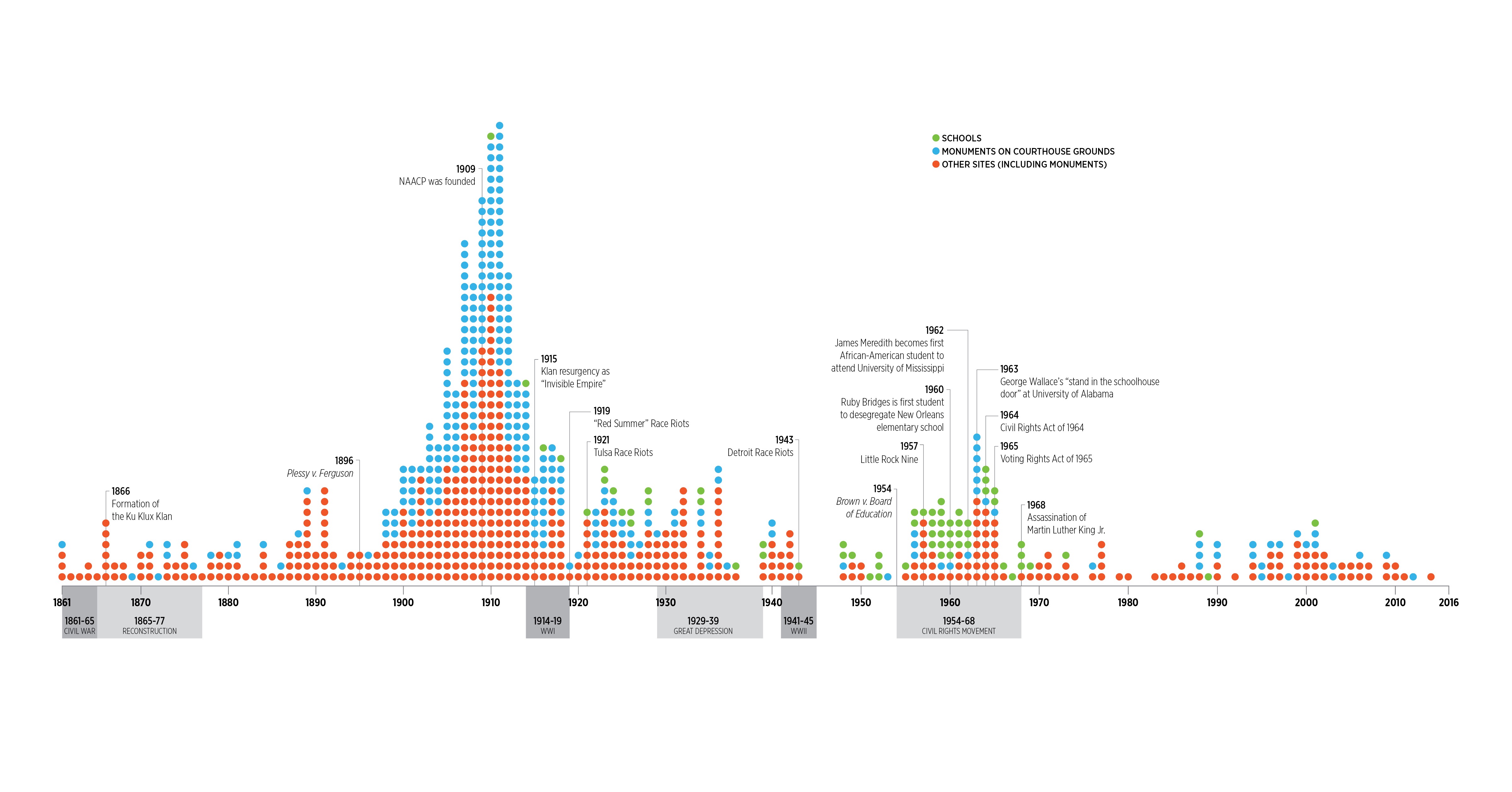
The fact is that the vast majority of the Confederate monuments, be they located in the former eleven Confederate states, or place that were not a part of the Confederacy were not built to honor the several hundred thousand Confederate dead, but to remind Blacks that they were subordinate to Whites wherever the were erected. This can be seen by the periods during which they were constructed. Only a few were built in the first two decades following the war, and some of those, including the monument in Portsmouth, Virginia were built by the wives, mothers, and children of the fallen. Honestly as to those I understand why they are where they are, and while I think that 150 years later, unless the context of their construction and monuments or historical narratives to the victims of the Confederacy and the institution of Souther Slavery are placed alongside, I am hard pressed to explain why they remain in places of honor. 

But honestly, those memorials are but a minority. Most of the Confederate monuments that spark such freak controversy today were erected anywhere from 30 to 150 years after the war. The periods that they were built are interesting of themselves. The biggest spike in construction began in the immediate aftermath of the Plessy v. Ferguson ruling that legalized Jim Crow and the second during the backlash against the Civil Rights Movement beginning around 1948. The chart below provides a good representation of when the Confederate monuments were built. 

As I mentioned in my first two articles of this series I am not of the opinion that the monuments should be destroyed, nor do I think that they should be torn down by protesters. I think that each monument should be examined based on its historical merit. Since the vast majority happen to be from the days of the Confederate resurgence after Plessy and in the height of the Dixiecrat response to the Civil Rights movement beginning after Brown v. Board of Education which overturned Plessy in 1954. So today I am going to use the example of the monuments in Hampton Roads area as a teaching point. 

Virginia where I live has 223 Confederate monuments, the most of any state. That is in a sense understandable due to it being the largest state in the Confederacy as well as the site of its capital. There are three major public monuments located in South Hampton Roads as well as a number of monuments in local cemeteries throughout the area.

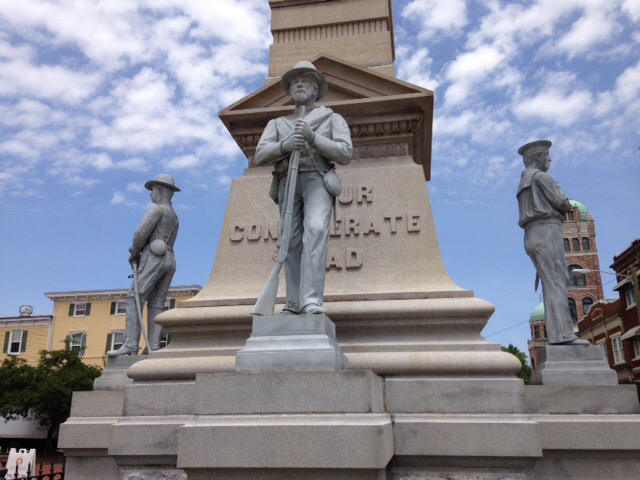
The one located in Portsmouth is the oldest and the most interesting from a historical point of view. Planning and fund raising for it began in the late 1860s shortly after the war and it was dedicated on the site where slaves were whipped and punished in the town square. It was dedicated in 1893. The head of the local Sons of Confederate Veterans chapter say that it was placed there when a church where it was planned to be located backed out. I do not know the veracity of that claim. That being said the location is still problematic, especially since Portsmouth is heavily African American and many of the Black families there trace their roots to the slaves of the city’s ante-bellum times. The monument itself is one of the most interesting monuments that I have seen. It is an imposing sight in the old court square. At its center is an obelisk on which is inscribed To Our Confederate Dead. The obelisk is surrounded by four statues representing an infantryman, a cavalryman, an artillleryman, and a sailor. I think that it would fitting if this monument was moved in its entirety to a cemetery in the city where Confederate war dead are buried. It could be replaced by any number of monuments, perhaps one to the city’s war dead from the World Wars, Korea, Vietnam, the First Gulf War, and the current wars which have been going on since 2001. 


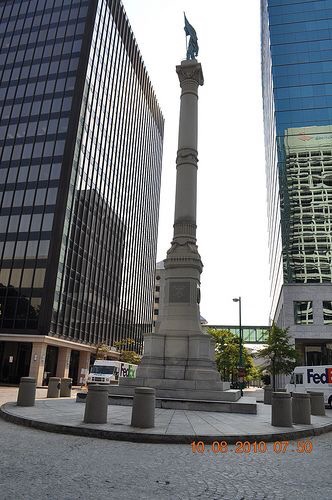
Norfolk’s monument is located within a block of where the slave auctions, the slave jail, the slave infirmary, and a few blocks from the docks where the were shipped to other destinations. This is important because Norfolk was the leading port in the slave trade from about the 1830s until the outbreak of the Civil War. The monument is over 80 feet tall and is capped by the figure of a defiant Confederate soldier holding a sword and the Confederate flag. At its base are engravings of the Confederate Battle Flag and a dedication to Our Confederate Dead. Despite those words this monument can only be described as a monument to White Superority and should be removed and replace with a monument to all of the city’s war dead. The statue adorning the top could go to a museum. 


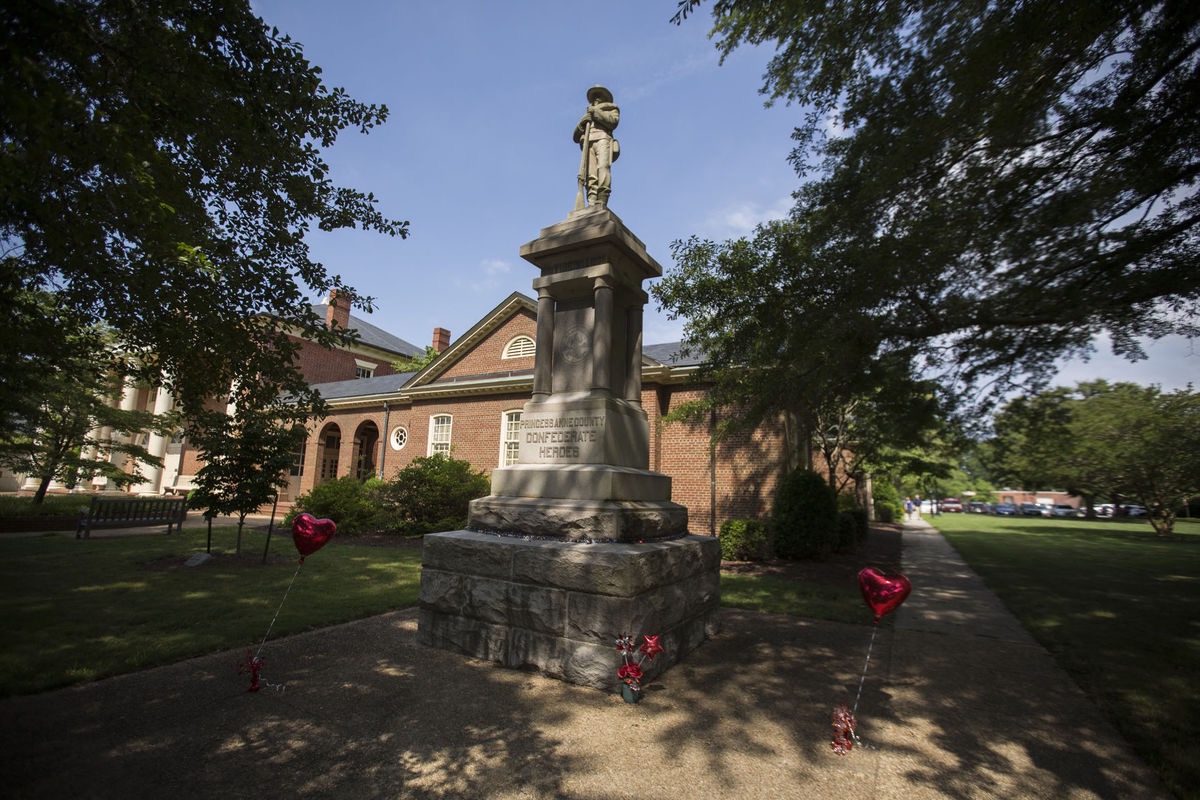
In Virginia Beach the Confederate Monument is outside the old Princess Anne County Courthouse where slave auctions were held, and which is on the grounds of the current Virginia Beach Municipal complex. In older times it would have been seen by all entering the city hall or courts for any reason. It is over 20 feet tall and topped by the statue of a Confederate infantryman. Unlike the other monuments dedicated to the dead, this one is dedicated to Our Confederate Heroes. Now it is in a distinctly less visible location and one has to go out of their way to find it. I think it could remain where it is but only if there was monument to the victims of slavery who were bought and sold there. That would provide context for it. 


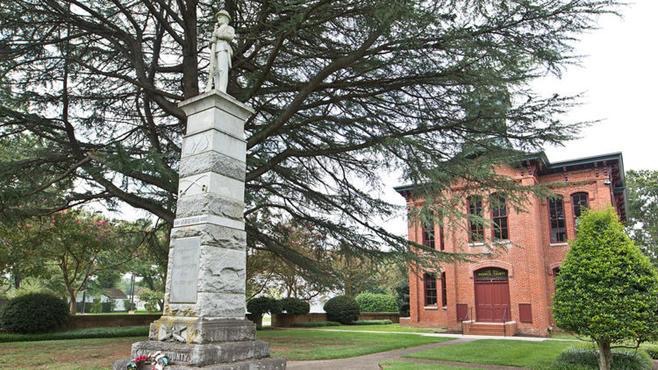
That monument was erected in 1905 during the height of the re-establishment of White Rule and White Sumpremacy after Plessy. One other, in the Denbeigh section of Newport News stands at site of the old Warwick County Courthouse. Denbeigh was named after the Denbeigh Plantation and the county seat was moved to Newport News when Denbeigh and Warwick county consolidated with the independent cit of Newport News in 1958. The courthouse is now a museum and the monument was dedicated in 1909 to the men of Company H, 32nd Virginia Infantry Regiment. The regiment, recruited from the Peninsula in early 1861 had a number of companies farmed out to the artillery was reconstituted as a small, 7 company regiment in 1862. It was decimated at Antietam and served to the end of the war with the Army of Northern Virginia where five officers and forty-two enlisted men surrendered with Robert E. Lee on April 9th 1865. Since this monument is dedicated to a specific unit which distinguished itself in numerous engagements, including Antietam, and Petersburg that relocating it to one of those battlefields would be completely appropriate. 

Admittedly all of these monuments served a twofold purpose, in the case of Portsmouth, from what I have read was that those who began to contribute money for the monument was to honor the fallen. By the time it was built that purpose was also mixed with the political desire of many whites to re-establish White Supremacy. The same is true with the other monuments in the public square. As to monuments located in cemeteries where Confederate soldiers are interred it is only fitting that they remain where they are. 

As to what should be done with each monument there are options, but what can actually be done with them are dictated by State Law which stipulates that localities can erect monuments but cannot “disturb or interfere with any monuments or memorials so erected.” That is a problem for the Virginia legislature to deal with and truthfully I believe that they should amend the law to allow municipalities to remove, alter, or relocate monuments. 

As a historian I think that all can serve as teaching points and that whatever is done with them that their context in relation to slavery, the Civil War, Reconstruction and Jim Crow needs to be clarified as part of teaching history and in the process expunging the myths of the Lost Cause and the Noble South from the historical narrative. 

I want to make a couple of points. First I do not think it is wrong for the relatives and descendants of those who fell in any war to want to remember them. I have traveled throughout Europe and I have seen the monuments in city squares that list the dead from wars dating back to the Napoleonic periods and before. Even if I disagree wth the cause that they fought for I will not forbid their descendants to honor their memory, even if I refuse to honor the military service of my ancestors who rebelled against the Union in 1861. 

I think that the Confederate monuments in Portsmouth, Newport News, Norfolk, and Virginia Beach can serve a purpose greater than for which they were originally constructed. I have described what I think would be best done with each, but I believe that with some modifications that each could remain where they are now so long as there are monuments to those who were the victims of slavery, those who were the unwilling conscripts recruited for that immoral and inhuman cause, and those who opposed that cause, before, during, or after the war. 

The same is true for many other of the Confederate monuments throughout the South. But, at the same time we have to address the monuments to Confederate leaders which built during the same time period as these generic representations of Confederate soldiers. The fact is that the leaders of the Confederate rebellion against the United States are much more responsible for the deaths of three quarters of a million soldiers and the devastation of the South than any ordinary soldier. These leaders include the Confederate President, Jefferson Davis, secessionist politicians like Henry Benning and Alexander Stephens, and military leaders like Robert E. Lee, Stonewall Jackson, and Braxton Bragg. I see little reason for monuments to men who were responsible for such great suffering to remain in places of honor. 

But honestly even this is not enough, for to fully tell the story we have to also honor the Southern Unionists like George Thomas and John Buford who did not forsake their oaths the the country, and men like Robert E. Lee’s lieutenants James Longstreet, Richard Ewell, Billy Mahone, and John Mosby who fully reconciled to the Union, and who were deomonized and then written out of Southern history. 
So anyway, I will deal specifically with monuments to Confederate leaders another time, but I think this is enough for now. That being said, any monuments to the leaders of the Confederacy or those who served during that rebellion need to be held to the bar of history, otherwise we mock all of their victims, and yes, even the sacrifices of the innumerable Johnny Rebs who died in a war that most had little or nothing to gain from. 

Peace 

Padre Steve+

3 Comments

Filed under civil war, historic preservation, History, News and current events, Political Commentary

Statues With Limitations: Part Two


Friends of Padre Steve’s World,

Alexander Pope wrote “Monuments, like men, submit to fate.” 

Two days ago I began a series regarding the Confederate Monument Controversy. I was going to begin today’s article by going directly into what I think should be done with these monuments but think that a little bit more background and context is necessary. That context is best put in the difference between history and memory. History, is made by people because it has real world effects cannot be erased because for good or bad its effects always are with us. Memory on the other hand is often selective and tends toward sentimentally. Because of that, memory often leads to the preservation of things that provide us with a certain sense of comfort, things that buttress our innate sense of superiority. 

Statues and monuments themselves have to be taken in their historical context: especially what they meant to the people that erected them and the era in which they were constructed. From time immemorial people and nations have erected statues and monuments to dieties, empowers, kings, generals, and yes, even philosophers and historians. They have also sought to commemorate the lives of soldiers who died in various wars, in part to honor their dead as did the ancient Athenians at Kerameikos, but more often to build upon a sense of national myth and purpose, to link the sacrifices of yesterday’s leaders, or soldiers to their current generation’s political, social, and even spiritual urges.

Some religions like Judaism and Islam have traditionally frowned upon the erection of statues and images that represented their dieties, their saints, or their leaders, fearing that such images could lead to idolatry. There was even a constroversy in the Christian Church, the Iconoclast Controversy, which dealt with this matter which took more than a hundred years to resolve. 

In Western society, especially since the Romans there has been a conscious attempt by nations to built statues and monuments to their leaders and other men, as women seldom rated such honor, whether they actually deserved honor or not. As such there are monuments in prominent places to men with political, social, hereditary, or economic connections who when compared to their contemporaries, or others, before or after them, have done little to be heirs to such honor. This does not mean that they were necessarily bad people, or even unworthy of the honor of their time, but rather that they are undeserving of perpetual honor in the most public of locations, or in places unconnected with where they made their name. 

Cemeteries and museums are the best places for statues which have past their effective life in the public square. Removing them does nothing to harm history, nor does it write them out of history. I like how the Old Testament writers of the books of the Kings and Chronicles end their discussions of the kings of Israel and Judah. They note that these men’s lives and deeds, good and evil, are written about and where they were buried to be with their ancestors. An example of the is Jesus, one of the kings of Israel in the book of Second Kings: “Now the rest of the acts of Jehu, all that he did, and all his power, are they not written in the Book of the Annals of the Kings of Israel?”

Since the Jews of the Old Testament did not build statues to their leaders for fear of idolatry the ensured through the oral, and later the written tradition that these leaders, the good and the bad, were remembered for their work and contributions. The Islamic tradition is quite similar. 

The ancient Greeks, particularly those of Athens chose to use the cemetery as a place to remember their dead. In dedicating the Mount Auburn Cemetery during the Greek revival, U.S. Supreme Court Justice Joseph Story noted: 

“The Greeks exhausted the resources of their exquisite art in adorning the habitations of the dead. They discouraged internments within the limits of their cities; and consigned their relics to shady groves, in the neighborhood of murmuring streams and merry fountains, close by the favorite resorts of those who were engaged in the study of philosophy and nature, and called them, with the elegant expressiveness of their own beautiful language, cemeteries or “places of repose.”

Cemeteries are always places where the dead can be honored or remembered, where their descendants can find comfort and even sense the presence of their departed ancestors. 

But the public square is another matter. Times change, governments and governmental types change. The statues that the early colonists of the British American colonies erected to King George III had no place in the new republic and were removed. Monuments to Josef Stalin and Vladimir Lenin where removed from their places of prominence in Hungary, Czechoslovakia, Poland, and Romania once those countries escaped Soviet domination. 

Statues in public places dedicated to specific individuals or events tend to have a shelf life which means that they regardless of who they are dedicated to need to be periodically re-examined to see if they should remain in their current place of honor or be moved to a different location. But the United States is a comparatively young country, our oldest monuments are likewise comparatively new, and many pale in comparison to those of Europe, the Middle East, and Asia. In those areas multiple civilizations and empire have risen and fallen, massive monuments have been erected, toppled, or faded away. Many surviving monuments now are in museums, collections of antiquity representing fallen civilizations, or have been moved from places of honor and replaced by ones that more appropriately represent the national culture and experience. 

As we approach the first quarter millenium of our experiment as a republic it is a good time to look at what we have commemorated with monuments and make considered decisions about each of them, and not just Confederate monuments. Obviously many, especially those that deal with our founding as a nation and our founders need to stay, but others should be replaced, or removed to more appropriate venues, or in cases of monuments that memorialize the more shameful parts of our history, maybe leave them and place other monuments and markers to explain the historical context and promote history versus myth. Likewise if we decide to remove them, what replaces them should be well thought out. This actually goes beyond the monuments themselves but has all to do with history, historical preservation, and the narrative that a community wants to communicate about its history, its values, and yes, even its future, for those monuments for good or bad are part of what bind generations together. 

As no point do I think they should be destroyed, even those to men who were evil, or represented evil causes. It think in the cases of truly evil men that their statues should be placed in parks, at eye level with other statues like them. The process then allows people to view them not as exalted figures, but people with feet of clay. A number of Eastern European countries have done this with statues of Stalin, Lenin, and others from the Soviet era. 

The placement or monuments is of more importance than their existence, and their contexts matter. Honore De Balzac noted: “With monuments as with men, position means everything. 

So anyway, tomorrow I will wrap this up by dealing with the Confederate Monument Controversy.

Peace

Padre Steve+

Leave a comment

Filed under culture, historic preservation, History, News and current events

The Past Isn’t Quaint: A Pause to Reflect


Friends of Padre Steve’s World,

I mentioned that I will be continuing my article on the Confederate Statue Controversy when I posted my last two articles. I will be doing that but the date has been pushed back as I have paused to read and reflect a bit more before I publish them here. I have my drafts of what look like another two articles in that series, but I want to do a bit more reading, and reflection before I go final with them. The same goes for my article on General Robert E. Lee. That being said it is interesting to have three drafts in different stages of readiness but not being ready to go with any of them just yet mainly because I want to do my best to cover the subjects as truthfully as possible. 

This is the problem of history. It requires critical thinking and also an argument that is accountable to evidence, as Jill Lapore noted: 

“History is the art of making an argument about the past by telling a story accountable to evidence. In the writing of history, a story without an argument fades into antiquarianism; an argument without a story risks pedantry. Writing history requires empathy, inquiry, and debate. It requires forswearing condescension, cant, and nostalgia. The past isn’t quaint. Much of it, in fact, is bleak.”

The fact is that many of the subjects that I write about are rather bleak, and often exist in places where to be fair one has to be empathetic, inquire, and even seek debate with people who disagree. I believe that what I write must be relatable today, even if it occurred hundreds of years ago. 

Later today I will be watching the solar eclipse and polishing up an article for tomorrow, probably one dealing with the Confederate Statue Controversy. That being said I have much on my mind; friends who have contacted me for guidance or encouragement, the illness of one of the people who work for me, and concern about the sailors injured and missing following the collision of the USS John S. McCain with a civilian tanker near Singapore. If you haven’t served at sea you might not understand that last concern. 

So anyway, until tomorrow,

Peace

Padre Steve+

Leave a comment

Filed under History, Loose thoughts and musings, News and current events, US Navy