Tag Archives: iraq

The Effects of Counter-Insurgency Operations on U.S. and French Forces in Vietnam and Algeria and Implications for Afghanistan

legion indo-china1st Foreign Legion Parachute Regiment in Indo-China

Introduction

The effects of the wars Indo-China, Algeria and Vietnam on the French and American military organizations internally and in relationship to their nations piqued my interest in 2005. The wars in Iraq and Afghanistan forced me to start asking the question of what short and long term effect that these wars might have on the U.S. military.  As such I wondered what historical precedent that there was for the question. My interest was furthered by my deployment with Marine and Army advisors to Iraqi Army and Security forces in 2007-2008.  My search led to the French experiences in Indo-China and Algeria and the American experience in Vietnam.

The counterinsurgency campaigns conducted by the French and American militaries in Vietnam and Algeria had deep and long lasting effects on them.  The effects included developments in organization and tactics, relationship of the military to the government and people, and sociological changes.  The effects were tumultuous and often corrosive.  The French Army in Algeria revolted against the government. The US Army, scarred by Vietnam went through a crisis of leadership and confidence which eventually resulted in end of the draft and formation the all volunteer military.
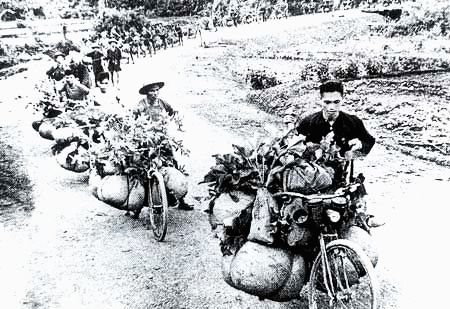
viet minh supplyPrimitive but Effective- Viet Minh Supply Column The French Could Never Stop them

There is a wealth of data regarding these wars. There are several types of materials. The accounts of soldiers, diplomats and reporters who experienced these events contained in memoirs and diaries. The best include David Hackworth’s About Face and Steel My Soldiers Hearts; and General Harold Moore’s We Were Soldiers Once… and Young. French works include Jules Roy’s The Battle of Dien Bein Phu and General Paul Aussaresses’ The Battle of the Casbah. There are innumerable popular accounts written by NCOs and junior officers.  These accounts may contain a wealth of information, but are limited by a number of factors. First, many only saw part of the overall picture and first-hand experience can skew objectivity. Those who have been through the trauma of war interpret war through their own experience.  Physical and psychological wounds can have a major impact on the interpretation of these writers as can their experience and political ideology. Finally few of these writers are trained historians. Despite this they can be a valuable resource for the historian.

Another source is official histories. Often these incorporate unit histories and individual narratives and analyze specific battles and the wider campaigns, but do little in regard to broader conditions that affected operations.  While a good source, many are not as critical of their institutions as they should be. Histories by trained historians and journalists provide another view. The most insightful of the journalist accounts include Bernard Fall’ Street Without Joy and The Siege of Dien Bien Phu: Hell in a Very Small Place. A limitation of all of these is that they are often heavily influenced by the political and societal events. This means that earlier accounts are more likely to be reactive and judgmental versus critical and balanced. Later accounts have the benefit of access to the opposing side and documents not available to earlier writers.  Alistair Horn in A Savage War of Peace provides one of the most informative and balanced accounts of the war in Algeria. Martin Winslow does the same regarding Dien Bien Phu in The Last Valley.
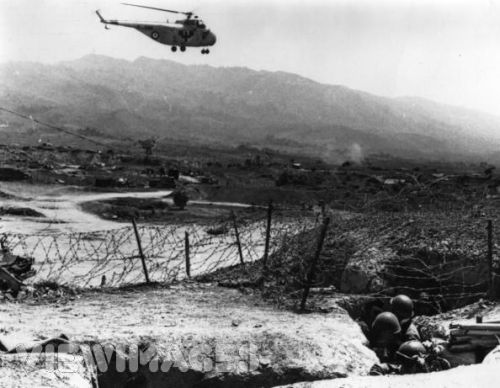
Dien Bien Phu 1Isolated and Besieged Dien Bien Phu

Another source is the writings of participants who critically examine their participation in the wars.  Many of these, French and American provide insights into the minds of leaders who are reflective and critically examine what happened to their military institutions in these wars. The best of these is French Colonel David Galula whose books Pacification in Algeria 1956-1958 and Counterinsurgency Warfare: Theory and Practice provide first-hand accounts of the subject combined with critical reflection. Galula’s works have been important to John Nagl, General David Petreus and others who helped write the U.S. Army and Marine Corps Counterinsurgency manual. Andrew Krepinevich in The Army and Vietnam provides a critical analysis of the U.S. Army in Vietnam.  Other sources, both online and print, such as RAND, provide excellent analysis of selected topics within the scope of this essay, especially COIN.

The ability to dispassionately and critically examine and evaluate these sources over a period of several years was and integrate them with my own experience has been a critical to me.  It has changed the way that I look at sources, and caused me to be much more aware of bias, the limitations of sources and the need to have a multiplicity of sources and points of view.

Effects of Insurgencies on the Armies that Fought Them

The conflicts in French Indo-China, Algeria and Vietnam had major effects on the French and American military institutions. These effects can be classified in a number of ways. First, the manner in which each military waged war, including tactics and weapons systems was changed.  The use of airpower, especially helicopters and use of Riverine forces provided an added dimension of battlefield mobility but did not bring victory. As John Shy and Thomas Collier noted regarding the French in Indo-China: “French mobility and firepower could take them almost anywhere in Vietnam, but they could not stay, and could show only wasted resources and time for their efforts.”[1] The use of intelligence and psychological warfare, including the use of torture became common practice in both the French and American armies.  The wars had an effect on the institutional culture of these armed services; neither completely embraced the idea of counterinsurgency and for the most part fought conventionally. Galula notes how the “legacy of conventional thinking” slowed the implementation of proper counterinsurgency tactics even after most commanders learned that “the population was the objective.”[2] Krepinevich notes that “any changes that might have come about through the service’s experience in Vietnam were effectively short-circuited by Army goals and policies.”[3] Finally the wars had a chilling effect on the relationship between the both militaries and the state, veterans from each nation often felt betrayed or disconnected from their country and people.

legion algeriaForeign Legion in Algeria

The French Army had the misfortune of fighting two major insurgencies back to back.  The French military was handicapped even before it went into these wars. The Army came out of World War II defeated by the Germans, divided by loyalties to Vichy or one of the Free French factions. They were humiliated by the Japanese in Indo-China, while in Algeria France’s crushing defeat was devastating.  “Muslim minds, particularly sensitive to prestige and baraka, the humiliation made a deep impression.”[4] French society was as divided as the Army; the economy in shambles, the government weak and divided.  The Viet-Minh had prepared well making use of time and training to get ready for war.  “Once full-scale hostilities broke out, the French, for budgetary and political reasons could not immediately make the large scale effort to contain the rebellion in the confines of small-scale warfare.”[5]

In both Indo-China and Algeria the French attempted to fight the budding insurgencies in a conventional manner.  This was particularly disastrous in Indo-China when on a number of occasions battalion and regimental combat team sized elements were annihilated by Viet-Minh regulars.  Between October 1st and 17th 1950 every French garrison along the Chinese border was over-run.  The French lost over 6000 troops and enough equipment to outfit “a whole additional Viet-Minh division.” It was their worst colonial defeat since Montcalm at Quebec.[6] In Algeria when the fight began in earnest France’s “ponderous ponderous N.A.T.O forces found themselves at an impossible disadvantage,”[7] unable to have any influence off the main roads.

VIETNAM DIEN BIEN PHUSurrender at Dien Bien Phu

In Vietnam the French did not absorb the lessons of fighting a well established insurgent force. French forces hoped to draw the Viet-Minh main forces into battles of attrition where their superior firepower could be brought to bear. Such was the case at Na San in December 1952 where the French established an “Air ground base” deep in Viet-Minh territory to draw Giap’s forces into open battle.  This worked, but just barely. Giap, short of artillery and not planning on a long battle frittered away his troops in mass charges.  However, the French, because of Na Son assumed they had found the key to victory. In their embrace of the “air ground base concept, French staff officers were following an intellectual tradition that had long been prone to seduction by elegant theories.”[8] The result was the disaster at Dien Bien Phu the following year.  The destruction of the elite Group-mobile 100 near Pleiku in 1954 was the coup de grace. In Indo-China the French made limited use of helicopters, used paratroops widely, and developed Riverine forces. One thing they were critically short of was significant tactical air support.[9]

The most inventive French creation was the GCMA/GMI forces composed of mountain tribesmen led by French NCOs and Junior Officers.  They were designed to provide “permanent guerilla groups rooted in remote areas” to harass and interdict Viet-Minh forces.[10] Trinquier noted that at the time of the Dien Bien Phu defeat that these forces had reached over 20,000 trained and equipped maquis in the Upper Region of Tonkin and Laos. These forces achieved their greatest success retaking Lao Cai and Lai Chau May 1954 as Dien Bien Phu fell.[11] Trinquier stated that “the sudden cessation of hostilities prevented us from exploiting our opportunities in depth.”[12] The GMI units and their French leaders were abandoned fighting on for years after the defeat. One account noted a French NCO two years after the defeat cursing an aircraft patrolling the border “for not dropping them ammunition so they could die like men.”[13] In the end the French left Indo-China and Giap remarked to Jules Roy in 1963 “If you were defeated, you were defeated by yourselves.”[14]

Algeria was different being part of Metropolitan France; there the French had support of European settlers, the pieds-noir. Many French soldiers had come directly from Indo-China. There French made better adaptations to local conditions, and realized that they had to win the population and isolate the insurgents from it and outside support. As Galula said, victory is the destruction of the insurgent’s political and military structures, plus “the permanent isolation from the population, not forced upon the population, but by and with the population.”[15] The lessons learned by the French in both Algerian and Indo-China were lost upon the Americans.

The United States military, especially the Army approached the Vietnam War with a conventional mindset, the “Army concept.” [16] It not only approached the war in this manner, but it trained and organized the South Vietnamese forces, ARVN into the American model. Americans re-organized ARVN into divisions “based upon the U.S. divisional force structure.”[17] ARVN was not structured appropriately for the threat that it faced.”[18] The results were as to be expected. Large numbers of troops poured in, American counterinsurgency was costly.  It was “almost a purely military approach”[19] which ignored political and social realities on the ground. Massive firepower was the means “utilized by the Army to achieve the desired end of the attrition strategy-the body count.”[20] In the end the American defeat was a “failure of understanding and imagination.”[21] The one shining moment was the Marine Corps experimentation with “Combined Action Program” platoons which lived in the villages with militia for long periods of time. This program produced great results “in eliminating local guerillas”[22] but was killed by the Army.

For both the French and Americans these wars tore the heart out of their armies. For the French the defeats inflicted a terrible toll.  In Indo-China many French career soldiers felt that the government’s “lack of interest in the fate of both thousands of missing French prisoners and loyal North Vietnamese…as dishonorable.”[23] Divisions arose between those who served and those who remained in France or Germany and created bitter enmity between soldiers.  France would endure a military coup which involved many who had fought in Vietnam and Algeria. Having militarily won that war, were turned into what Jean Lartenguy called ‘the Centurions” had been turned into liars.”[24] They were forced to abandon those who they had fought for and following the mutiny, tried, imprisoned, exiled or disgraced. Colonial troops who remained loyal to France were left without homes in their “independent” nations.  They saw Dien Bien Phu as the defining moment. “They responded with that terrible cry of pain which pretends to free a man from his sworn duty, and promises such chaos to come: ‘Nous sommes trahis!’-‘We are betrayed.’”[25]
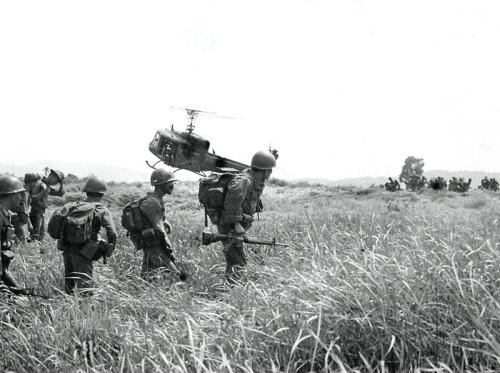
Joint_operation_with_ARVN_112-1Joint US-ARVN Operation

The U.S. Army returned to a country deeply divided and Vietnam veterans remained ostracized until the 1980s.  As Harold Moore recounts “in our time battles were forgotten, our sacrifices were discounted, and both our sanity and suitability for life in polite American society were publically questioned.”[26] The Army endured a massive reorganization that resulted in the formation of the All-Volunteer force, which would redeem itself and emerge from the ashes in the Gulf War. The Americans would not learn the lessons of revolutionary warfare and counterinsurgency until forced to do so in Iraq in 2004-2007.

Conclusions and Possibilities

The effects of these wars on the French and American military establishments were long lasting and often tragic. The acceptance of torture as a means to an end sullied even the hardest French officers. Men like Galula and Marcel Bigeard refused to countenance it, while others like Paul Aussaresses never recanted.  Americans would repeat the tactic at Abu Ghraib rallying the Iraqis against them.

For the Americans, the debacle continued at home. Race riots tore at the force while drug addictions and criminal activities were rampant.  Incompetent leaders kept their jobs and highly successful leaders who became whistle blowers like Hackworth were scorned by the Army institution. It took years before either the French or American veterans again felt a part of their countries.  They ended up going to war, and when it was over; feeling abandoned, their deepest bonds were to their comrades who had fought by their side.

What are the lessons to be learned from these campaigns as well as from the various accounts?  Andrew Krepinevich prophetically noted that the failure to learn the lessons of Vietnam “represents a very dangerous mixture that in the end may see the Army again attempting to fight a conventional war against a very unconventional opponent.”[27] Obviously, there are lessons to be learned, especially in understanding the nature of revolutionary war as well as the culture and history of our opponents. The U.S. has made some improvement in this regard but there is still much to be learned, especially since after the war the Army was “erecting barriers to avoid fighting another Vietnam War.”[28] From these wars we learn that nations and incompetent governments who mismanage wars can alienate themselves from the soldiers that they send to fight, with serious consequences.  As far as historiography we learn that certain historical fallacies are evident when one reads the accounts critically and recognize the bias and limitations of the various sources.

In Iraq the U.S. adapted, albeit belatedly to the nature of the insurgency and took advantage of Al Qaeda Iraq (AQI) over-reach in the manner that they abused the Iraqi people.  The situation turned dramatically in September of 2007 when Al Qaeda killed the most prominent Sunni Sheik outside of Ramadi.  The Sheik had begun to work with Americans on security issues and his death turned much of the Sunni populace in Al Anbar and other provinces against AQI for the first time allying them with the Sh’ia dominated government.  Changing focus the U.S. Forces focused on safeguarding the population and building up the capabilities of Iraqi forces.  Within months because of the increased security and stability in Al Anbar the U.S. Marine trained and Iraqi led forces of the 1st Iraqi Division were able to be moved to Basra where they retook the city from insurgent forces and to Diyala where they helped the government gain the upper hand.  Success in Iraq did not come easy, American forces suffered their greatest losses since the Vietnam War in the cities, villages and countryside of Iraq.  The U.S. is now in the process of drawing down as the Iraqis take over their own security.  The process is not perfect as there still tension between Sunni and Sh’ia factions as well as Kurds and other minority ethnic groups.  However it is still going better than most experts predicted.
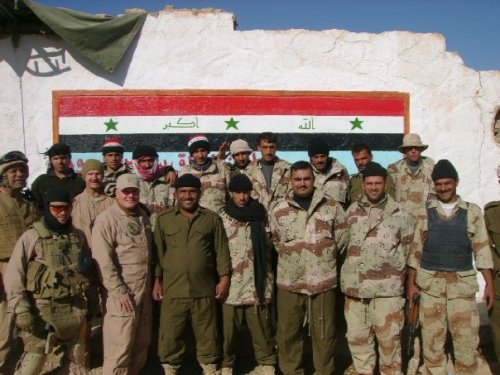
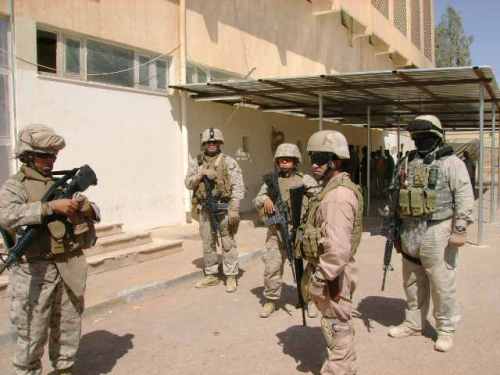
iraqi border troopThe Author and Advisors with Iraqi Border Troops near Syria

Afghanistan is another matter.  After early success in overthrowing the Taliban and isolating Al Qaeda the Americans and NATO pretty ran a status quo operation attempting to legitimize the Karzai government, eliminate the Opium poppy crops and establish government presence and security in outlying areas.  There was a problem in this; both the Taliban and Al Qaeda used border sanctuaries in Pakistan and financial support from worldwide Moslem groups to continue the fight.  As Al Qaeda and the Taliban built themselves up the Afghan government lost support. This loss of support was in large part due to rampant government corruption as well as to the perception of U.S. and NATO forces being occupiers and not liberators.  This perception of the U.S. and NATO forces was in large part because they had ignored the lessons of French Indo-China, Algeria, Vietnam and Iraq.  Isolated from the population the bulk of NATO forces performed in a reactionary manner and often used aircraft and artillery to respond to Taliban forces often killing non-combatants by mistake. Each time this happened, the Al Qaeda and Taliban leaders used the results to further bolster their image and portray the allies as the oppressors.  As the Taliban took back much of the country they also returned to oppressive means to subdue the population by fear and intimidation.
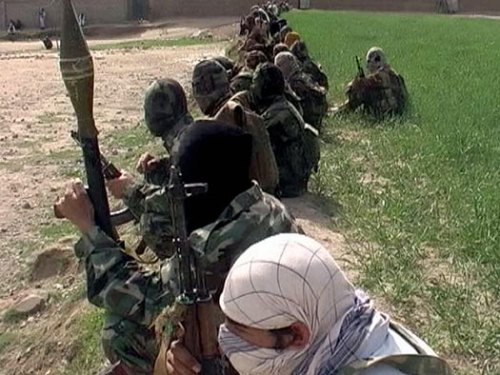
taliban insurgentsTaliban Insurgents

The new American commander, General Stanley McChrystal has asked for more forces in order to run a proper counter-insurgency campaign which focuses on the security of the population to isolate the Taliban and Al Qaeda.  Whether General McChrystal gets his forces and whether they are enough to turn the tide before all political and public support in the U.S. and NATO countries is lost is another matter.  Right now the situation is tenuous at best.  There are means to win this war despite the history of Afghanistan which suggests that this is not possible.  The key is he Afghan population, if they believe that the U.S. and NATO are n their side, that we respect them, their culture, religion and that Al Qaeda and the Taliban are the real oppressors the war can be won.  This requires patience, forethought and deliberate measures to secure the population, build up a government that they can trust and de-legitimatize Al Qaeda and the Taliban.  If that does not happen, the U.S. and NATO run the risk of repeating the story of the French in Indo-China.   Unlike AQI and Iraqi insurgents the Taliban are very capable of running military operations capable of defeating small to medium sized units in isolated locations.  They know the terrain, often have the support of the people, are highly mobile and not dependant on roads and can mass quickly at critical points.  Last year the Taliban launched a large scale assault on an American COP which came close to overrunning it.  They were repelled with heavy casualties but the incident demonstrated a capability that is growing.  What I would be concerned about is the total destruction of an isolated post or a convoy which could be used to demoralize western nations.  While I do not think that the Taliban could pull off the defeat of a major US or NATO base or force as the Viet-Minh did at Dien Bien Phu but the threat should not be minimized.

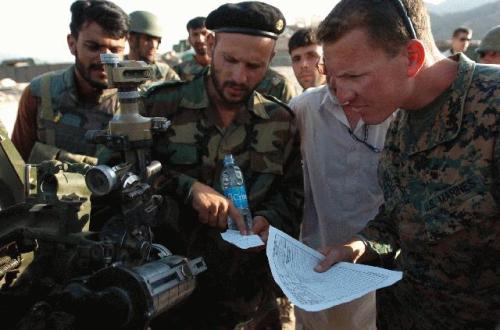
traiining team with afghan armyUSMC Training Team in Afghanistan

How we learn the lessons of past insurgencies and revolutionary wars is important in Afghanistan.  The stakes are higher than most would want to admit. A withdraw would be seen by militants outside of Afghanistan would be emboldened just as the Algerians were by the loss of the French in Indo-China. It would again provide Al Qaeda with a safe haven and secure base of operations.  The stakes are high.  Who knows what will happen?

Bibliography

Aussaresses, Paul, “The Battle of the Casbah: Counter-Terrorism and Torture,” translated by Robert L Miller.  Enigma Books, New York, 2005. Originally published in French under the title of “SERVICES SPECIAUX Algerie 1955-1957” Perrin 2001

Fall, Bernard B. “The Siege of Dien Bien Phu: Hell in a Very Small Place.” Da Capo Press, New York an unabridged reprint of the 1st Edition reprinted in arrangement with Harper and Row Publishers, New York. 1967

Fall, Bernard B. “Street Without Joy: The French Debacle in Indochina.” Stackpole Books, Mechanicsburg PA, 2005, originally published by Stackpole Publications 1961

Galula, David. “Counterinsurgency Warfare: Theory and Practice.” Praeger Security International, Westport CT 1964 and 2006

Galula, David. “Pacification in Algeria 1956-1958.” RAND Corporation, Santa Monica CA 2006. Originally published by RAND 1963

Hackworth, David H. and Sherman, Julie. “About Face: The Odyssey of an American Warrior,” a Touchstone Book published by Simon and Schuster, New York. 1989

Horn, Alistair. “A Savage War of Peace: Algeria 1954-1962,” a New York Review Book published by the New York Review of Books, New York, 1977, 1987, 1996, and 2006

Karnow, Stanley. “Vietnam, a History: The First Complete Account of Vietnam at War,” The Viking Press, New York, 1983

Krepinevich, Andrew F. “The Army and Vietnam,” The Johns Hopkins University Press, Baltimore and London, 1986

Millett, Allan R. and Maslowski, Peter. “For the Common Defense: A Military History of the United States of America.” The Free Press, a division of Macmillian, Inc. New York, 1984

Moore, Harold G and Galloway, Joseph L. “We were Soldiers Once…and Young: Ia Drang: The Battle that Changed Vietnam,” Harper Collins Publishers, New York NY 1992

Nagl, John A. “Learning to East Soup with a Knife: Counterinsurgency Lessons from Malaya and Vietnam,” University of Chicago Press, Chicago and London, 2005

Nolan, Keith William. “The Battle for Hue: Tet 1968,” Presidio Press, Novato CA, 1983

Pottier, Philippe (2005) Articles: GCMA/GMI: A French Experience in Counterinsurgency during the French Indochina War, Small Wars & Insurgencies,16:2,125 — 146 http://dx.doi.org/10.1080/09592310500079874

Roy, Jules. “The Battle of Dien Bien Phu” Carrol and Graf Publishers, New York 1984. Translated from the French by Robert Baldrick. English translation copyright 1965 by Harper and Row Publishers, New York.

Sheehan, Neil. “A Bright and Shining Lie: John Paul Vann and America in Vietnam,” Vintage Books, a division of Random House, New York, 1989

Shy, John and Collier, Thomas W. “Revolutionary War”in Makers of Modern Strategy from Machiavelli to the Nuclear Age,” Peter Paret editor. Princeton University Press, Princeton N.J. 1986

Simpson, Howard K. “Dien Bien Phu: The Epic Battle America Forgot,” Potomac Books Inc. Washington DC 2005, originally published by Brassey’s Inc. 1994

Spector, Ronald H. “After Tet: The Bloodiest Year in Vietnam,” Vintage Press, a division of Random House, New York, 1993

Trinquier, Roger. “Modern Warfare: A French View of Counterinsurgency,” translated from the French by Daniel Lee with an Introduction by Bernard B. Fall. Praeger Security International, Westport CT and London. 1964 and 2006. Originally published under the title “La Guerre Moderne” by Editions Table Ronde.

West, F.J. “The Village,” Pocket Books, a division of Simon and Schuster, New York. 1972.

Windrow, Martin. “The Last Valley: Dien Bien Phu and the French Defeat in Vietnam,” Da Capo Press, Novato, CA 2006, originally published by Weidenfeld and Nicholson, London 2004


[1] Shy, John and Collier, Thomas W. “Revolutionary War” in Makers of Modern Strategy from Machiavelli to the Nuclear Age,” Peter Paret editor. Princeton University Press, Princeton N.J. 1986  p.849

[2] Galula, David. Counterinsurgency in Algeria: 1956-1958. RAND Corporation, Santa Monica, CA. 2006. First published by RAND in 1963. p.244

[3] Krepinevich, Andrew F. “The Army and Vietnam,” The Johns Hopkins University Press, Baltimore and London, 1986 p.213

[4] Horn, Alistair. “A Savage War of Peace: Algeria 1954-1962,” a New York Review Book published by the New York Review of Books, New York, 1977, 1987, 1996, and 2006 p 41

[5] Fall, Bernard B. “Street Without Joy: The French Debacle in Indochina.” Stackpole Books, Mechanicsburg PA, 2005, originally published by Stackpole Publications 1961 p.27

[6] Ibid. p.33

[7] Horn. p.100.

[8] Windrow, Martin. “The Last Valley: Dien Bien Phu and the French Defeat in Vietnam,” Da Capo Press, Novato, CA 2006, originally published by Weidenfeld and Nicholson, London 2004 p.63

[9] Fall, Bernard B. “The Siege of Dien Bien Phu: Hell in a Very Small Place.” Da Capo Press, New York an unabridged reprint of the 1st Edition reprinted in arrangement with Harper and Row Publishers, New York. 1967 pp. 456-457  Fall discusses in depth the lack of French Air support and the antecedents that led to the shortage following World War II.

[10] Pottier, Philippe(2005)’Articles: GCMA/GMI: A French Experience in Counterinsurgency during the French Indochina War’, Small Wars & Insurgencies,16:2,125 — 146 http://dx.doi.org/10.1080/09592310500079874

[11] Simpson, Howard K. “Dien Bien Phu: The Epic Battle America Forgot,” Potomac Books Inc. Washington DC 2005, originally published by Brassey’s Inc. 1994 pp. 170-171

[12] Trinquier, Roger. “Modern Warfare: A French View of Counterinsurgency,” translated from the French by Daniel Lee with an Introduction by Bernard B. Fall. Praeger Security International, Westport CT and London. 1964 and 2006. Originally published under the title “La Guerre Moderne” by Editions Table Ronde. p.87

[13] Windrow. p.652.

[14] Roy, Jules. “The Battle of Dien Bien Phu” Carrol and Graf Publishers, New York 1984. Translated from the French by Robert Baldrick. English translation copyright 1965 by Harper and Row Publishers, New York. p.xxx

[15] Galula, David. “Counterinsurgency Warfare: Theory and Practice.” Praeger Security International, Westport CT 1964 and 2006 p. 54

[16] Krepinevich. p.213

[17] Ibid. p.24

[18] Nagl, John A. “Learning to East Soup with a Knife: Counterinsurgency Lessons from Malaya and Vietnam,” University of Chicago Press, Chicago and London, 2005 p.138

[19] Shy. p.856

[20] Krepinevich. p.202

[21] Spector, Ronald H. “After Tet: The Bloodiest Year in Vietnam,” Vintage Press, a division of Random House, New York, 1993 p.314

[22] Millett, Allan R. and Maslowski, Peter. “For the Common Defense: A Military History of the United States of America.” The Free Press, a division of Macmillian, Inc. New York, 1984 p.555

[23] Windrow. p.655

[24] Ibid. p.657

[25] Ibid.

[26] Moore, Harold G and Galloway, Joseph L. “We were Soldiers Once…and Young: Ia Drang: The Battle that Changed Vietnam,” Harper Collins Publishers, New York NY 1992  p. xx

[27] Krepinevich. p.275

[28] Ibid. p.274

1 Comment

Filed under History, iraq,afghanistan, Military, vietnam

Yet Another Blast from the Past and Padre Steve and House MD experience a bit of healing, but Have a Long Way to Go

It happened again.  No not a PTSD meltdown or anything similar to that but another one of those circumstances where you have to scratch your head and say to yourself “I didn’t see that coming.”  If you have read this site for any time at all you probably have noticed that I tend to bump into people from my past with some regularity, sometimes in unlikely places.  When I run into people it just gets plain unusual.  In fact if I was a Vegas odds maker and I gave odds at some of the people that I met in some of the places I met them I would be one broke odds maker.   Like I’ve met a guy I sat next to in Navy Junior ROTC at Edison High School, Stockton California in West Berlin hadn’t seen each other in years and he recognized me.  I met an Army Major in early August 2007 my transitional tent after arriving in Iraq who had been a 2nd Lieutenant and platoon leader in the last National Guard battalion that I served in 1995.  When presenting the flag at the funeral of a retired Army Master Sergeant in 1989 I was greeted by his daughter who had been in a church singles group that Judy and I worked with.  I’ve bumped across people from my Chaplain Officer Basic course in Iraq, Okinawa and even in the local area. Today was not any different as far as being to unusual for me.

I noted in a recent post I had given the invocation at the kick off for the Norfolk Naval Shipyard.  This prayer sets the stage for a reunion that ranks up with all of the above, maybe even higher because of the sheer improbability of it all. I had an e-mail in my inbox from a man who works as the director of our hospital military blood bank.  I recognized the name as I read the e-mail.  I knew him 23-24 years ago in Germany.  I was the very young company commander of the 557th Medical Company (Ambulance) in Wiesbaden Germany.  I was a total rookie at the command game and the unit was in a time of transition. I was a interim commander as the Group figured out what it was going to do on a permanent commander.  A month or so after taking command I received the first of three new Second Lieutenant Platoon leaders, all fresh out of the Officer Basic Course.  The first on deck was 2nd Lieutenant Ralph Peters.  Ralph was a brainy guy but eager to do well.  When I turned over command he remained and when I went stateside he was still with 557th.  I occasionally think about the officers, NCOs and Soldiers of the company, especially my old Platoon, the Second Platoon. I have stayed in contact with my first XO, Pat Bradley who retired as a Lieutenant Colonel a few years back and still works for the Army as a civilian.  Likewise I have kept in contact with a number of others from our sister units as well as some of the enlisted through Classmates.com and Facebook.  However I was unprepared for today.

I got an e-mail from Ralph; he had seen me at the CFC kickoff.  He let me know that he occasionally thought about me and prayed for me over the years and was pleased to see me as serving as a Navy Chaplain.  I hope to see him sometime tomorrow.  The strange thing is I know I have seen him in the hallway never seeing his name badge.  I occasionally thought when I passed him that he had an uncanny resemblance to Ralph, which considering that he is Ralph this is quite fitting.

Today was also a time of some healing.  I can’t go into any details except it was a good resolution and new start in a relationship that has been troubled lately.  Surprisingly I seemed that God was involved too.  To those who pray for me even without me asking thank you.  This happened to coincide with Doctor House getting thrown in a State Psychiatric hospital.  There have been a few times since I returned from Iraq where I thought that I might be better off locked up so it kind of struck a chord. The turning point was where House decided that he wanted to cooperate and get better something that I badly want. The sleeplessness, nightmares, anxiety and fear of certain situations is draining and now there is no local baseball to see that the minor league season is over I do not have that place of refuge.  I don’t like the feeling of vulnerability that I have is unnerving.  I just want to be better but I don’t think it’s going to happen anytime soon and sometimes that creates a sense of despair and weariness.  At the same time as the Deity Herself seems to show me improbable and even miraculous things sometimes happen.  So until then I will continue to throw myself into my work, try to catch a little baseball on TV do some writing and register for my comprehensive exams to finish the Masters Degree in Military History before Christmas. If nothing else I’ll stay active to cover what I can’t fix.  Someone reminded me today that I am no longer in Iraq, but was quick enough to add that part of me still was there.  I hate being in two places at once.  Pray for me a sinner.

Peace,

Steve+

Leave a comment

Filed under iraq,afghanistan, PTSD

PTSD²: Learning to Live Together When Both of You Have PTSD

Judy and Steve[1]_edited-1The Abbess and Me

The Abbess and I have been married 26 years.  We have dealt with PTSD for all of that time. Now we did not always know this was the case, not until she received the diagnosis back in 1989 and even then we did not really appreciate the effect that it was having on her and us.  She has written a wonderful piece over at her place, the Abbey Normal Abbess’s Blog entitled “The Abbess talks about a household with PTSDwhich I have linked here:  http://abbeynormalabbess.wordpress.com/2009/09/18/the-abbess-talks-about-a-household-with-ptsd/

Any regular reader of this website knows that the host, Padre Steve deals with PTSD, a gift that he brought home with him from Iraq.  There are a decent number of articles here that reference my struggles in coming to grips with this, how it affects me and how I am working with Elmer the Shrink to figure this surreal, confusing, illogical and sometimes frightening mess out.

Now before I came home with PTSD and actually figured out what the hell was going on with me and why I was falling apart I had little understanding of what the Abbess was going through.  She suffers from childhood PTSD, abusive father, generally un-protective mother who probably had her own childhood abuse issues going on and a sister who physically abused her.  She also was traumatized when she was between two and three years old when a Doctor removed a cyst from her face without anesthesia, that is one of her earliest memories and for many years caused her to fear going to the doctor.  When we started dating the family was probably in one of their more peaceful states but there were plenty of times where I saw some scary shit going on.  At the same time the Judy that I knew was the confident young college student, gifted artist and President of the Delta College German Club with a vibrant faith.  There were hints back then that she was damaged by her family of origin but I just took it as something that she would simply grow out of.  I had read about PTSD in Vietnam veterans but kind of brushed that aside and had no idea that someone who had not been to war could suffer from PTSD.

After she was diagnosed with childhood PTSD neither of us really knew what to do with it and most of her therapists did not deal with it and instead focused on depression and one even tried to diagnose her and turn her into a sufferer of Dissociative Identity Disorder the diagnosis formerly known as Multiple Personality Disorder.  That was a fiasco brought on by “Christian” therapists who tried to find demons in everything.  Of course if there were demons involved or Satanic ritual abuse that made it easy, you didn’t need to deal with the PTSD or any of the psychological components to what was going on.  I think that these therapists, one of who is now famous for his diagnoses of former NFL star Hershel Walker did great harm to Judy and others in making a psychological diagnosis based on unsupportable “spiritual” causes.  These spiritual “causes” were not based on fact, but rather the therapist’s suppositions which were based on conspiracy theories   usually involving how police worked with satanic groups to conduct satanic rituals and then return the victims to their homes.  If we know what we had known now we would have made a malpractice suit against the therapists and pastoral counselor involved in Judy’s treatment at the time.

It was not until I was on active duty in the Navy that a therapist began to work with Judy’s PTSD.  Even still with her getting treatment I was still learning how to grapple with all the reactions that I had seen for years because to me they were still not logical.  I am a methodical and logical person and if you know anything about PTSD you quickly find that much of what happens to a person has nothing to do with logic, but what the brain and the nervous system are doing and not how a person is deciding to act at a given point.  So when Judy would startle or have some kind of meltdown I would try to counter with logic.  This to my surprise never worked and I was always left frustrated.  Over the years I became a bit more understanding but still would have trouble with the severe startle reflex as well as the occasional meltdowns which over the past couple of years have gotten to be less severe because of a conscious effort to help her work through her PTSD symptoms and become more aware of what was happening and triggers.

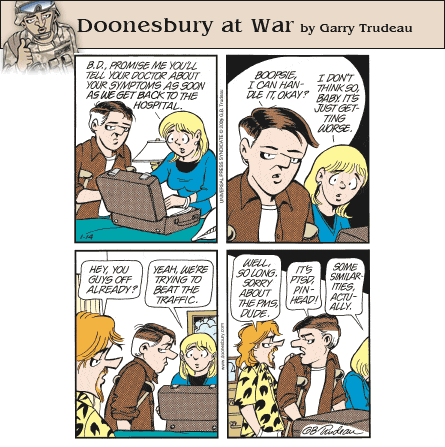
Doonesbury ptsd-pmsPMS -PTSD Judy’s Best friend said to me “You’re a girl now”
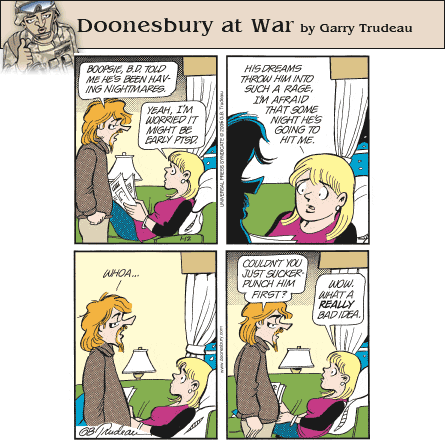
Then I went to Iraq and came back with PTSD with all the trimmings.  I think that she started figuring it before me so when I finally crashed on June 16th 2008, I do remember the date well, she was not surprised when I came back and told her that the doctors thought that I had PTSD and were referring me for treatment.  The good thing for me was that they did not refer to the Psychology or Psychiatry clinic but to the Deployment Health Office where I met and began to work with Elmer the Shrink.  My first visit to his office I got a copy of the Doonesbury book dealing with coming home from war and PTSD.  I laughed and cried all the way through the book.  Until I went to Iraq I had never been a big fan of Doonesbury but I really appreciate it now.  Military.com has a link to the Doonesbury at War series which I find quite nice to have.

http://www.military.com/warfighters

I appreciate the help and understanding of people that I work with.  That helps; I don’t have the sense of abandonment and isolation that I experienced the first 8 months that I was back from Iraq.  I think that my medications are getting managed a bit better as well.  One thing that is hard to understand when you first start getting treatment is that you are kind of an experiment in progress as the doctor’s figure out what works and what doesn’t work.  This I think can be very frustrating to people who want “fixed” right now.

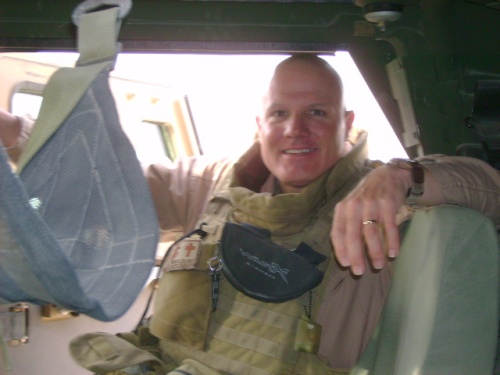
doonesbury ptsd onsetSome of my dreams get pretty physical

Before I went to Iraq she was the more observant one of us.  Now I am the more observant. The one value of PTSD that I don’t really want to lose is my awareness of what it happening around me.  It has I’m sure been more help than hindrance getting me out of dangerous situations quickly because in many cases I sense things even before I see or hear them.  As I have pointed out in other posts this has come in handy especially in our nutty Hampton Roads traffic and the “kill or be killed” mindset that you have to have to survive on I-64 or I-264.  While I like the ability to do this the startle response that I have now is really annoying.  We have a phone in our house that the ringer sends me into orbit.  If I am sitting in the living room when it goes off it scares the absolute shit out of me as it does Judy.  It is interesting to see both of us almost jump through our asses when that damned thing goes off. Inevitably it is the damned Rite Aide Pharmacy automated line or a equally damned telemarketer that does this.  Other loud noises get me.  I was driving to work and there was a vintage Chevy Camaro just ahead of me and in the adjacent lane to my right. It was still in that morning twilight when the Camaro started backfiring out of its twin exhaust pipes.  The backfire sounded like a burst of semi automatic weapons fire close up and the flashes from the pipes looked like muzzle flashes.  Other unexpected loud noises get me as does the sound of helicopters, especially at night.  I don’t do crowds well unless they are at a baseball game.  I went to do the invocation yesterday at the Norfolk Naval Shipyard to kick off the annual Combined Federal Campaign.  I was expecting a small rather sedate event.  It was nothing of the sort.  There were at least a couple of hundred people in a relatively small auditorium, a band, reports and photographers, a color guard and drill team from a local ROTC unit even balloons and banners.  The noise and light, many moving pieces gave the event a pep rally feel which drove up my anxiety level pretty bad. I was able to keep from having a panic attack or a meltdown, but it took work not to fall apart especially with the week that I had had and the fact that in the previous 31 hours I had only 3.5 hours of sleep.  I don’t like my outbursts of anger which can border on rage depending on the sense of danger that I feel although some expressions that I have come up with in these events are pretty funny as I question the parentage and oedipal tendencies of some people.  Anxiety, tremors, muscle tension, insomnia and nightmares are no fun either.

I guess for me that the war is not over and I know that if I was to go back I would do just fine. I almost think that another deployment to either Iraq of Afghanistan would help me in some ways. I guess I might get another shot at it as things continue to develop over there.  Personally I think I need it to close the loop and one day when peace comes to Iraq to go back there to visit some of the Iraqis that I got to know while there.

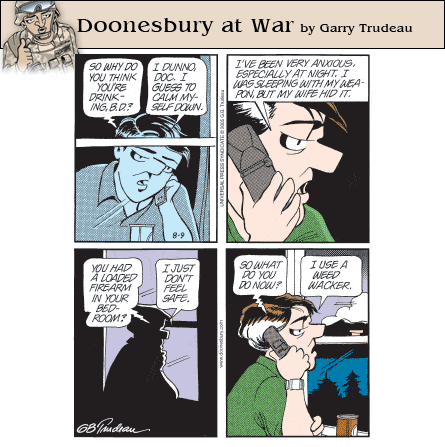
Dundas at HitSomehow I was More Relaxed in Iraq than I am Here
So now I am much more understanding of what Judy has lived with since childhood.  She has been a help to me in understanding my struggle as well and what I have experienced has helped me have a lot more compassion and understanding for her.  The only one without PTSD is our little dog Molly so it does make for interesting living around our little household.

Peace,

Padre Steve+

Leave a comment

Filed under iraq,afghanistan, PTSD

The Art and Science of Staying Awake and Going to Sleep When You Have PTSD

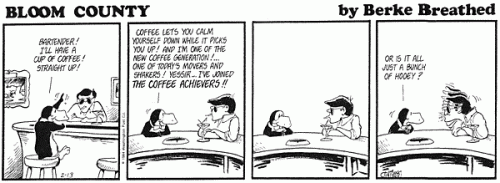
“The blood level in my caffeine is getting too high” Woody Paige on ESPN’s Around the Horn

opus coffeeToday: 3 24 Ounce Cups of Southern Pecan Coffee with French Vanilla Creamer and Splenda
Which came first the chicken or the Egg McMuffin?  That is the type of life I have when it comes to a little thing that you never notice until you can’t do it…something called sleep.  Today is one of those days where the inner Chinese kids, Yin and Yang are trying to get themselves into some kind of equilibrium, or maybe even equilibriumnumnum after a pretty rough week and a night on call at the medical center.  As usual my insomnia and anxiety have joined their ever loving hands together to ensure that I have had less than optimal sleep.  Yesterday’s on call duty and that of last night was fairly relaxed.  I had my new residents with me getting oriented to pulling duty and I have to say they are a fun bunch. We have two Americans and two Canadians all with great senses of humor and all who have had some kind of combat tour.   I actually like being around them which I cannot say of everyone that I have worked with in 28 plus years in the military.  They are a joy.  Likewise I love being around the hospital staff doing my rounds at night and to top things off there were no tragedies.

This being said I still could not get to sleep last night which kind of tops off a week of crappy or too little sleep.  Love them or leave them crappy or insufficient sleep over a long period of time beat the hell out of you.  I know, it has me and to make an astute observation it makes me tired.

My battles with insomnia began about a third of the way into my Iraq tour. When we came back from a mission I would go to my “Can” and just sit awake either reading, playing chess on my computer or going out and watching the Dustoff helicopters coming in and out of the Surgical Shock Trauma Platoon helipad or looking off to the perimeter to see illumination rounds lighting up the night sky and hearing occasional gunfire and explosions.  It was incredibly hard to get to sleep no matter how tired I was.  That continued the whole tour and got worse.  Part was the late night flights that we so often took, part the danger that we faced and part the conditions that we slept in. At one FOB in Ramadi we stayed in an old trailer that we could hear the rats chewing on the ceiling. When we had to stay in Al Asad to catch a morning flight after having flown in our tents were near the flight line and F-18s flying in and out all night do not make for a quiet and restful night’s rest.  In some of the more remote FOBs the isolation and vulnerability made it hard to rest.  I think that it was about two-thirds of the way through that the dreams and nightmares started.

Doonesbury-082108Too True I can Relate

Having talked to others with PTSD or other combat related injuries of the brain and nervous system I find that I am not alone and most of us are mid-grade to senior career officers.  It’s kind of weird because when you are young in the military you are taught just to “suck it up” and as you go through your career you tell others the same thing until it happens to you. Thus for us old guys I think PTSD is actually harder than for young people because it destroys our world view and our tough personas which most up us have cultivated over a long period of time.  My friends and I share the same or similar experience and we all are trying some way of managing it.  All of us have some drugs, the legal kind of course to help us with anxiety, panic, depression and insomnia.  However there are times when the drugs don’t work as well as they should, or they need to be adjusted or changed.  In those times you still have to find ways of getting to sleep and for the times where you can’t sleep ways of keeping sharp so you can stay in the game and not screw anything up.

bean church 1Staying Awake

Some guys I know have added to the mix other kinds of over the counter drugs and supplements.  I don’t do that, not that there’s anything wrong with it, but I guess I never grew up.  I like my medicine whenever possible to taste good.  Thus my self-medication is limited to caffeine and really good beer.   My choice in caffeine is coffee which I have been drinking since I was 12 and I believe that by my junior year of high school Navy Junior ROTC my index finger was beginning to mould itself into the shape of a coffee cup handle.  With caffeine there is little moderation because since I don’t sleep I need to stay awake.  My alcohol consumption is moderate and I don’t drink hard liquor.  I always try to maintain the Yin and Yang of the blood to medicine to caffeine and alcohol at some kind of balance so I can get to sleep and then not be exhausted the next day.  I make sure that I don’t mix alcohol with my meds since I don’t want to do the Karen Anne Quinlan thing and end up in a coma, and end up in a broccolitative or asperagative state (I don’t do just any vegetables thank you).  However I know guys who have a lot heavier load of meds than I do who have no problem ingesting them and alcohol close together and most of these guys don’t just drink limited amounts of beer.  I’m quite happy not to be there and mixing meds and alcohol.  So for me the equation looks like this.  Please note I am a historian and not a mathematician and that since this is a new field of study for me that it does not yet factor in sleep quality:

Drugs- caffeine² ± beer÷ “defensive factor” (anxiety+ hyper-vigilance) + normal work and life stress ÷ spirituality factor² = sleep

Now also since I am a Priest and Chaplain there is the spirituality factor which is hard to quantify but can be stated very simply “Please God let me sleep + have I been to a baseball game.”  This is hard to quantify but I have given it a numeric value for the sake of argument. Now I’m not a mathematician by any means but this seems to work somehow.

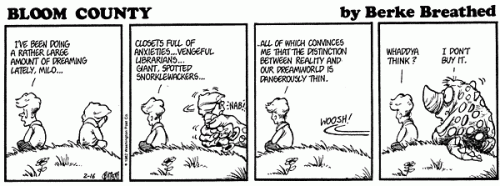
axieties and dreamsYep…Them Iraqi Snorklewackers Show up Often

Now back to me and the guys I know who struggle with this.  Pretty much to a man we all still manage to do our jobs.  In fact we all love what we are called to do which probably helps us as far as the management of our situation.  Many of the folks I know are like me and if we had the chance would go back to the fight.  You put us together with men and women who have similar experiences in combat and we are in our element, there is a shared brotherhood because of the real dangers that we faced.  However that is not necessarily true of others that we serve alongside who have not been, as is oft said “in the shit.” Within that category there are those who are people that help us and care for us, they are appreciated even if they have not been in our shoes.  The often exude a kindness and love that helps us make it when we have bad days.  But there are also those that don’t always seem to have our interests at heart or who would appear by their words and sometimes their actions to use our injury against us.

garfield show me the coffeeAmen!

So this whole deal gets weird when you can’t sleep due to anxiety or insomnia and have to maintain your ability to do your job.  Now this is where the art and science of self medication come together. You have to be able to figure out how things balance out. Medications are set by prescription unless you throw in a wild card of over the counter meds and supplements.  Thus for me they are a relatively stable factor.  Then you factor in the caffeine factor.  This may vary but in my case I drink 24-72 ounces a day of coffee which is usually spread over a 4-8 hour period, and maybe 12-24 ounces of Diet Coke, Coke Zero or Diet Dr Pepper later in the day.  My caffeine level is variable based on how tired I am. If I am well rested the amount consumed goes down.  Today I was maxing out the caffeine factor because my ass was whipped and it was all I could do to get through the day.  Today I was so wiped that I added in the Skittles factor to get the quickie sugar rush.  I hate skittles, when we were poor in seminary it was the only candy we got because the church food bank gave them out.  Skittles, Boston Baked Beans, Swee Tarts and Smarties are all great instant energy, the problem with them is that they are like lighting the afterburner; they are only good for short spurts.  Beer varies but if I am home I might have two beers at dinner.  I have stopped any late night drinks.  Then there is the “defensive factor” which for me includes my anxiety and hyper-arousal levels.  This is combined with normal life and stress and divided by the spirituality factor to get a night’s sleep.  That is the science.  The art is how to make the adjustments to the factors that are variable fit the current life situation and find those illusive Chinese kids, Yin and Yang.

pub1

So the week is coming to a close, I have now been up 36 of the last 40 hours and have worked every day since last Monday, though Saturday and Sunday were just a few hours each despite having the duty pagers. I am tired I had a decent meal complete with vegetables, several portions of fruit and other healthy things.   As soon as the Orioles game is over I plan on heading to bed and hoping my meds and my general sense of exhaustion will overcome any anxiety or insomnia that might join hands to interfere with me.  I think I have managed to bring old Yin and Yang into balance for the evening and if I didn’t I I do hope that the Deity Herself will assist this effort tonight.

Peace, Padre Steve+

1 Comment

Filed under iraq,afghanistan, PTSD

Survival on the Home Front: Dealing with Other People’s Reactions to My PTSD

081

Being in Iraq  was in Many Ways Less Frightening than Being in the USA

I find it interesting and sometimes painful to see how institutions and some people within the institution will label those of us who have gone to war and came back as gooned up with PTSD.  The biggest tension and issue, and I admit it as my own is that we get stereotyped and sometimes viewed as “broken.”  I admit that I have issues, in fact a lot of frickin’ issues and I have a pretty good awareness of them.  I see Elmer the Shrink to help me through the rough spots but there are times when I bump across those that appear to use my condition as a weapon against me.  Whether it is intentional or not, it is not fun to deal with.  I’ve had it happen a few times since I have started getting help last year and every one of the people involved were people who have not been to combat to use a pejorative term from Vietnam they are REMFs .

I know several others who have experienced this mentality.  We all feel really vulnerable because all of us have opened up to people, or to use the Star Trek analogy to “drop our deflector shields.”  Pulling down shields makes you vulnerable, if you do it because you think you are in a safe area.  When you take “friendly fire” is really sucks. It is actually easier in theater.  If I was sent to Iraq or Afghanistan today I would be back in my element and probably suffer little from PTSD symptoms.  Sometimes I wonder if the Navy would be better off to ship me over again.  Admittedly with the health of my parents and a position at my medical center that is important for me to remain in for the time being, there is something that says at some point I need to go back, maybe not now but later.  See out there the PTSD defensive reactions fit.  There are bad guys and good guys, friend and foe and the body and brains’ reaction to real or perceived danger are natural.  I am wary of people until I figure out if they are friend or foe. When I make a mistake in my IFF it usually bodes ill for me.

When you come back out of that environment you find that even though you are “home” that you have changed and nothing is the same as it was before.  Your body and brain have divided the world into two camps, friend and foe or safe or unsafe or maybe even secure versus dangerous.  In my life I notice this with people as well as situations such as being on the road in our nutty Hampton Roads traffic which by the way even if you don’t have PTSD is quite the adventure I have become a very offensively minded defensive driver with faster reflexes and reaction time than I had before I went to Iraq.  I have to say that I am now a very aware person to perceived threats and actually that is not a bad thing of itself.  In Iraq I was probably operating at a 9 or 10 of ten on my perceptions of and reactions to real and perceived danger.  Since I have returned and gotten some therapy I probably operate at a 3.5 to 4 most of the time and depending on the situation move up higher sometimes being very aware of possible danger and hyper-vigilant .  Before I went to Iraq I probably operated at about a 1-2 on the scale of 10, pretty oblivious to danger and not too worried about it either.  Truthfully I am happy at an increased level of the 3.5-4 and maybe on occasion 5.  I don’t like getting up above 7-8 because it really makes a mess of my nerves and general requires that I take my docile pills.  Recently I’ve had a few of those days.  Trust me it is no fun to have a nervous tremor.  When that happens I feel like Gene Wilder’s character in Blazing Saddle’s Jim the Waco Kid response when Sherriff Bart (Cleavon Little) questions him:

Jim: Look at my hand.
[raises hand and holds it level]
Bart: Steady as a rock.
Jim: [raises his other hand, which is violently trembling] Yeah, but I shoot with this one.

Although I can occasionally find some morbid humor in what is going on with me I can’t say that it is any fun.

There is a perception by some, which I think is often systemic in parts of the military that people with PTSD are “broken.” Some in the system as well as others who have been granted the privilege of knowing your vulnerability consciously or unconsciously sometimes use it against you, I personally think it is intentional when this happens but I try to give the benefit of the doubt to the offender.  Like I said before this has happened to my on a number of occasions and in every instance I have felt attacked, devalued and re-traumatized and I don’t like that feeling and it takes me a while to get back through all the crap.  When it happens to me I get angry, defensive and now as opposed to my pre-Iraq life will shoot back.  I’ve stopped rolling over and letting people get away with this behavior and when I see it happen to others I get equally pissed.  Unfortunately I have a number of friends who have had similar experiences and as we share our stories we realize that some people or even the system in general will write you off as damaged goods.  What is the bad thing is that the worst comes from people who have not been in harm’s way.  Likewise, if they went to a combat zone never left one of the big FOBs and never had to deal with the danger of being outside the wire. Nor have they experienced what many medical personnel who remained on the big FOBs experienced in dealing with never ending trauma of dealing with the death, wounding and suffering of young Marines, Sailors, Soldiers and Airmen.  Another group are the men and women who perform the tasks of getting the fallen back home.  One of my Chaplain friends had this job in Kuwait and had to meet every aircraft with the bodies of the dead leaving theater performing memorials and conducting honors all the time caring for those who cared for the bodies of these Americans and came back in pretty bad shape.

What saddens me is that this still attitude of men and women dealing with PTSD being “broken” or as one called me a “shipwreck” happens even though we have been making the conscious effort since Vietnam to treat people traumatized by war.  The end result is that those who are traumatized are again and again re-traumatized by the system as well as individuals in it.  I have seen enough of this to make me throw up. Thankfully the Navy as a whole does better in this than the Army, Marines or Air Force but there is a lot to be done.   When I have a REMF screw with me or my friends it does get to me and I can say that I get angry and the person moves out of my “circle of trust.”

Likewise I get discouraged and when I see my countrymen from both of the major political parties, elected officials and regular party members tearing themselves and the country apart because of the hatred that they have for each other and each other’s positions on the issues that face our nation.   I came home at the beginning of the 2008 primary season and within a short time became quite disheartened by what I saw on both sides of the line.  There is no civility in the land and no peace at home for those of us coming home from war.  We come back and see our brothers and sisters, fellow Americans all saying and doing things doing things that can only in the long run further divide and destroy the nation.  I can understand the anger that the returning German soldiers and sailors of the First World War came home to in 1918-1919.  It seems that the only thing that we lack to be like Weimar Germany is for right and left wing militias begin fighting in the streets, killing each other and trying to take over power by force.  As it is these are fighting at political rallies and raising the invective to frightening levels.  In the case of one protest men brought semi-automatic assault weapons to protest outside of a venue the President was speaking at.  They said it was a Second Amendment rights protest but all that is needed is for one deranged individual to act on a homicidal urge to blow the whole damned place up.  I have seen the results of such folly in both the Middle East and the Balkans and I just don’t get it, it is frightening to me and the extremists on both sides of the political spectrum seem like they are doing their damnedest to destroy the country that I love so much and went to war to serve. Regardless of what extreme they are on I just say a pox on them all.

I have been asked a number of times why I would open myself up and show my vulnerability on this website.  It is certainly not for fun when I deal with this subject because I am really wound up in it.  When I write I often have to live the experience again. While many times this is emotionally draining it is something is something that I know that I have to do.  I know so many vets from the current wars and Vietnam who struggle with some of the very things that I do and often a lot more but do not have the ability to really share their stories.  The Marines who fought at Hue City are a group that I still have contact with as are people from my last base chapel job, the Vietnam Veterans of America men who man the beer stand at the Church of Baseball Harbor Park Parish, Wayne the Army Chaplain and decorated Vietnam infantry scout who dealt with his own PTSD and helped me in my discernment process to become a Chaplain.  Likewise I have this connection with my brothers and sisters who have served in Iraq and or Afghanistan.  In a sense what I want to do in my articles about PTSD as well as those about my tour in Iraq is to help people who have not been or not experienced this to get some understanding of what happened to me and to many others.  I don’t want guys to fall through the crack like in Vietnam and I think that educating the public is the best way of raising the issue and helping people care for us.  So I guess this is my “cause” and maybe even a crusade.  I hope and pray that those who love and care for our combat veterans who read this will take the time to learn, take the time to care and take the time to be with us as we walk through the often dark places that we walk.

Today was not a good day for me it was very painful but at least I was able in this post to use it to help explain what we who deal with our return from war go through.  I guess that the Deity Herself knew what she was doing today.  Pray for all of us who live in the surreal world of PTSD as we pray for you and our nation.  Pray for me a sinner.

not a happy camper

Peace,

Steve+

4 Comments

Filed under iraq,afghanistan, Military, PTSD

Going to War: Tripping into Ta Qaddum

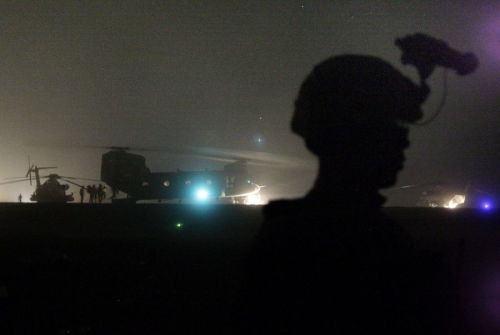
helos at nightCH-53s and CH-47s

Our interlude in Fallujah over we waited in a tent outside the helicopter terminal operations building after RP1 Roland dropped us off.  Roland was good and helped hook us up with some of the Marines to get the Gator to put our ton of gear on to get it out to the helicopter.  I looked around and noted that both here and a Camp Victory most passengers had a significant amount less gear than us of course all had deployed with units and not as individuals thus the load that had to pack on their person was not exorbitant.  I thought of all we had been issued as individuals and the fact that I did not take everything that they wanted me to take and thought crap…what is wrong with this picture?  Of course whining about it does no good and if my lot was to suffer dragging all of this around then I would try to do so in good humor.  I pondered this and began to think of the movie Kelly’s Heroes and how the character played by Don Rickles Staff Sergeant “Crapgame.” I kind of chuckled as I thought of how he complained to “Kelly” played by Clint Eastwood and  Master Sergeant “Big Joe” played by Telly Savalis when after their vehicles were destroyed by American aircraft when saddled with a .30 caliber machine gun and its associated ammunition.

I looked in one tent which was full and eventually found another we a couple of open seats for us.  I sat my ass down on the wooden bench grounded the gear that I had with me, a back pack, and two briefcases now with 3 computers. My Mass kit was packed in my rucksack and all of my personal gear that could be placed on my flak vest was there including two knives…I was not allowed to pack a weapon but figured that these were simply to keep my fingernails clean and shave when I had nothing else to shave with.  Nelson of course was loaded for bear, dual armed he had an M-16A2 and a Beretta 9mm pistol and packed a significant amount of loaded clips of 5.56 and 9mm rounds in his ammo pouch. He sported two K-Bar fighting knives.  He also had his “game face on, the same look of determination that he sports when he fights.  Having an assistant who actually could kill someone to protect me was comforting.  There are some that I have met in both the Army and Navy that would have been as capable as Barney Fife if they were in a combat zone.  Of course Nelson and I knowing that we would be out in isolated areas with small teams of Americans had worked out a deal.  If were got into a bad situation he would toss me the 9 mil and we would defend ourselves and the people on our team figuring that since I was a chaplain that if I was captured that I would be used for propaganda purposes and executed on TV.  The plan was that if this happened that he would get credit for anything that I hit and no one would ever know that I did it.  I would not be like a few chaplains in the 2003 invasion of Iraq who carried and fought and then put it on their web sites, I figured that if this happened I would go to confession and ask for forgiveness rather than having to explain to Judy why I was dead.

The time passed slowly though it was only a couple of hours it felt like forever.  The tent was stuffy with a good number of people in it, Nelson found a corner and threw his gear down laid down comfortable.  I was a bit on the hyper-aroused side of life despite being tired so I got up and took a walk outside in moonlight.  The night air though still pretty warm felt better than that of the tent, as sweat dripped down my face I took a drink out of the liter bottle of water that I had pulled out of a cooler in the tent.  The airfield was busy, pairs of helicopters, 46’s, 53’s, and Army MH-60s and CH-47s landed and took off staying just long enough to disgorge their passengers and cargo and then pick up their next load before lifting off.  I watched in fascination as Marines and other passengers were led by ground crew staff to and from the aircraft, their shadowy figures blending into the illumination provided by the moon.  A couple of AH-1 attack choppers sat down for a few minutes and then took off.  I wondered if they would find targets or be called to respond to attacks on Marines or Soldiers in the area.  As I walked back to the tent I heard the boom of our artillery in the distance.

After a while they called for our flight.  We gathered up the gear that we had and Nelson got with the Marines to make sure that we were on the same flight as the “gator” was taking our gear to.  When we flew our “ticket” to get on a flight was the two letter code for our destination with the number of the flight such as 26 or 54 or whatever the mission or route number was.  In our case it was “TQ” and the number was either 54 or 56 which was from HMH 463 flying CH-53-Ds out of Al Asad.  Their flights were known as Kahuna followed by the number.  This was written on our left hand with a black marker.  As passengers we staged by our flight by young Marines with flashlights shaded by red cones.  We got in a line with about 30 other passengers, Marines, Sailors, Soldiers and civilians and moved out for the 53 which had just landed coming in from the east.  The companion bird was forward of ours.  The Gator move alongside of us and reached the helicopter just before we did.  Amid the din of the rotor blades and engines the Marine on the Gator got off and called out “Is the Chaplain that this gear belongs to here.”  I called out that I was and Nelson and I moved to the Gator and began the off load of four “super sized” suitcase shaped canvas sea bags and two flight bags. To get an idea how big our bags were you have to think of something about a third bigger than the biggest suitcases that you can buy only soft sided with no wheels.  No they did have straps that you could try to carry them with, but they were not the greatest.  Also note that we had a full deployment worth of gear in those bags and were expected to lug them across Iraq and you can see that this was a less than fun evolution and why I thought of Staff Sergeant Crapgame.  We dragged our gear aboard the aircraft moving toward the center of the bird placing it on the deck under the rotor blades where we took our places in jump seats and strapped ourselves in.  I felt something warm dripping on me and looked up, it was hydraulic fluid coming from the transmission of the bird which was located above me.  There is an old joke among those who fly in Marine Corps helicopters:  “How do you know when a Marine Helicopter is low on hydraulic fluid?  When it stops leaking.” I thought of the joke but this time it wasn’t funny.  I’ve never been a big fan of rotary wing flight and the fact that I was exhausted, sweaty and sitting in a cramped hot, leaky, dark and heavily loaded helicopter in a combat zone made the experience less than fun.

It was about 0200 when we lifted off into the night on what we understood to be a short flight to TQ.  Admittedly it was, if you only count the flight time from Fallujah to TQ itself.  As we flew in I could see the sprawling airbase below but we flew off to what looked like the other side of the airfield.  As we flew in I thought of the Army bird that had gone down earlier in the day.  I wondered what had caused it to crash and my pucker factor went up just a bit higher as I wiped more hydraulic fluid from my face.

When we landed we told to exit the bird without our gear.  We released ourselves from our seats and stumbled over our gear and that of the rest of the passengers that was in the middle of the deck.  We exited out the rear of the aircraft down the ramp into the rotor wash.  Turning left we moved off about 70 yards from the fifty-three and looked around.  A few crew members and ground crew personnel moved in and out of the bird.  At first I wondered if we had been moved off to refuel but there was no fuel in view.  We waited for about 25 minutes in the dark as Marines moved in and out of the fifty-three.  Finally a crew member came over to us, and motioned us to follow him back into the aircraft.  Once again we negotiated the gear and found our seats.  Once we were back in the fifty-three lifted off and flew a short distance across the airfield where were instructed to exit the bird with our gear.  For most of the passengers this was a fairly easy evolution, for us it was not so easy.  We had to take one bag at a time down the ramp and get each a decent distance from the bird before returning for the others.  We got our gear off the bird and found that the rest of the passengers were already being herded the 200-300 yard hike to the paved area near the terminal.  Nelson and I each packed one of the large bags on our back and began to pull the other bags behind us as another group of Marines walked out to the fifty-three.  Eventually about a third of the way to the terminal a Marine on the ground crew came and asked if we needed assistance.  I replied that it would be appreciated.  He instructed us to wait where we were and about three minutes later a forklift with a large plywood box on the forks.  The Marine who had asked if we needed help instructed us to place the gear in the box and proceed in the direction of the terminal with another member of the ground crew.  As the birds lifted off behind us we set off for the terminal area.  When we got there we had to wait again.  A Marine collected our ID cards and walked in the building telling us to remain where we were.

About this time, our gear on the ground again with us there with our helmets off and sweat pouring down our faces a female petty officer came up to us.  It was the 2nd Marline Logistics Group senior RP.  Nelson knew her from Afghanistan so our welcome was pleasant.  The RP had a Chevy SUV in front of the terminal.  The Marine came back with our ID cards, I grabbed a bottle of water and the three of us began to move the gear to the truck which was about 50 years away via the closed route through the terminal. After loading the gear she drove us about 10 minutes to the other side of the base where the billeting area was.  She got the truck as close as she could and once again we lugged the gear about 100 yards to our new homes which were called “cans.”  These are like a storage container with a window and linoleum floors.  Unlike some of the places I had been recently this also had a small wall unit air conditioner that worked.  It was now about 0315 and I stank to low hell.  I dug through my bags, found my shower gear and towel and got a shower.  Finally about 45 days after we detached from EOD with stops in Norfolk, Fort Jackson, Kuwait, Baghdad and Fallujah we could get to work.  On my return to my new home I did the office of Compline from the Book of Common Prayer, laid down on the bed and passed out.

Leave a comment

Filed under History, iraq,afghanistan, Military, Tour in Iraq

The most dangerous assignment: 4 More Advisers Die In Afghanistan

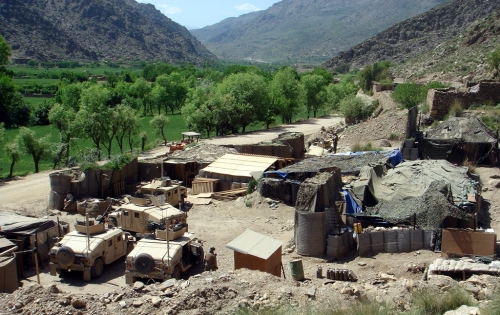
training team baseIsolated Embedded Training Team Base

Once know and relatively unglamorous group of American military men have suffered multiple casualties in a single engagement.  These men belong to are small units that do not have a lot of organic firepower.  They usually operate in remote areas far from immediate assistance if they get in trouble.  When one of these units suffers casualties, especially where they lose 3-5 men in one engagement they might have lost 20-25% of their unit.

On September 8th a team of these men was ambushed while on foot going to an Afghan with Afghan soldiers to meet tribal leaders with the intent of establishing a government presence in a hostile area.  In the ambush four were killed, three U.S. Marines and one U.S. Navy Hospital Corpsman attached to them.  On Tuesday the 8th Gunnery Sgt. Edwin W. Johnson Jr., 31, of Columbus, Ga., 1st Lt. Michael E. Johnson, 25, of Virginia Beach, Va., Staff Sgt. Aaron M. Kenefick, 30, of Roswell, Ga. and Petty Officer 3rd Class James R. Layton, 22, of Riverbank, Calif., were while working as trainers to Afghan soldiers on a mission to search for weapons and then meet village elders under an agreement to establish government authority there.  They were killed in “a complex attack according to a U.S. Military spokesman.  According to McClatchy news service who had a reporter that accompanied the mission, insurgents had set up positions in the village and in the mountains on both sides and apparently attacked as the men neared the village. 1st LT Johnson was wounded and while being attended Navy Hospital Corpsman Third Class James R. Layton when they both came under attack.  Both were killed.  Another Marine told the McClatchy reporter that they’d found the wrappings of bandages and other medical gear strewn around Layton and Johnson.  Eight Afghan troops and police and the Marine commander’s Afghan interpreter also died in the ambush and the subsequent battle that raged from dawn until 2 p.m. around the remote hamlet of Ganjgal in eastern Kunar province, close to the Pakistan border.

traiining team with afghan armyUSMC Advisers with Afghan Counterparts

The McClatchy reporter said: “We walked into a trap, a killing zone of relentless gunfire and rocket barrages from Afghan insurgents hidden in the mountainsides and in a fortress-like village where women and children were replenishing their ammunition.”  The reporter said that “U.S. commanders, citing new rules to avoid civilian casualties, rejected repeated calls to unleash artillery rounds at attackers dug into the slopes and tree lines — despite being told repeatedly that they weren’t near the village.”

The battle must have been intense.  I have been on foot patrols in areas crowded with Iraqis far away from significant support where if an insurgent group had attacked us we would have easily been overwhelmed. This is part of the world of the U.S. Military in the embedded training teams which work closely with Afghan and Iraqi soldiers.  I spent a lot of time with the advisers to Iraqi Army. Border and Port of Entry troops, Police and Highway Patrol spread across the entirety of Al Anbar Province.  These men and women are seldom thought of or mentioned by the press or even the military. . They come from all branches of the military and serve as advisers, trainers and mentors to these nations’ security forces.  The duty is dangerous.  The advisers, be they to the military, police, or civil administrations often work in the most isolated places in these countries and are stationed in small teams with the Iraqis and Afghans that they advise.  They are often far from the “big battalions” that have lots of firepower available and often operate out of larger and more secure bases with air support close at hand. Earlier in the year there were a number of incidents where advisers were killed by renegade soldiers or police, or by infiltrators posing as security personnel.  Two soldiers were working with an Iraqi unit in doing humanitarian work in a village when attacked and killed by someone who had infiltrated the Iraqi security forces.  . On March 27th Navy LT Florence Choe and LTJG Francis Toner IV were killed by an Afghan insurgent posing as an Afghan Army soldier. All of these events triggered anxiety in me as I remembered how many times I was incredibly exposed to danger conducting similar operations.

This incident was especially chilling as I read the reporter’s account of the ambush.  “Dashing from boulder to boulder, diving into trenches and ducking behind stone walls as the insurgents maneuvered to outflank us, we waited more than an hour for U.S. helicopters to arrive, despite earlier assurances that air cover would be five minutes away.”  According to the reporter Marine Maj. Kevin Williams” the commander of the team said: “We are pinned down. We are running low on ammo. We have no air. We’ve lost today, through his translator to his Afghan counterpart, responding to the latter’s repeated demands for helicopters.”  When I read this my mind flashed back to being in the middle of a massive crowd at the border crossing of Waleed on the Iraqi-Jordanian border.  There were about nine of us, of which only 8 were armed as I am not allowed by the U.S. interpretation of the law of war to carry a weapon.  There were thousands of Iraqis and others around us, very few border troops or port-of-entry police anywhere near us.  The port of entry had been the scene of numerous attempts to smuggle weapons, materials, and other supplies, drugs and to Iraq insurgents and Al Qaida.  Very few US troops were stationed there and many of these were dispatched off of the base at any given time.

The advisers are drawn from all services.  They are all Individual Augments that come from both the Active and Reserve components.  They do not deploy with their own units, which means that they go to war with people that they might have trained alongside getting ready for the mission, but otherwise have not served with.  When they come home they go back to their old assignments or new orders and are separated from the men and women that they served alongside for 7 to 15 months.  In other words they are isolated when they return home and go back to places where the majority of personnel, even those who have been “in country” have no earthly idea or appreciation of the conditions that they served in and dangers that they faced.  This happened to me when I returned and I went through an emotional collapse as the PTSD that I did not know I had kicked my ass.  Sights, smells, noises, crowds, airports and in fact almost everything but baseball diamonds caused me to melt down as they all brought the danger back to me. Don’t get me wrong, my tour in Iraq was the highlight of 27 plus years in the military, the part of which I am the most proud.

I have a special place for these men and women.  I served with them in Iraq’s Al Anbar Province as the first Navy Chaplain, and one of the first chaplains of any service to be assigned to cover these teams since Vietnam.  My assistant, RP2 Nelson Lebron and I deployed together from out unit.  I had prepared well.  I had been on the bubble to deploy for months.  My background in military history and past service with both the Army and Marines helped me. Likewise my military and civilian education helped me.  Shortly before we were notified of the deployment I went to the Jordanian Army Peace Operations Training Center course on Iraqi culture, religion and society.  I had served as a chaplain in the trauma department of one of the largest trauma centers in the country.  RP2 Lebron had deployed multiple times to Iraq, Beirut and Afghanistan where he was awarded the Defense Meritorious Service Medal (no small feat for an E-5).  He is also an incredibly gifted boxer, kick boxer and martial artist who has fought on Team USA and holds more title belts than I can count.  He most recently won the Arnold Schwarzenegger Classic. I had served with him before and he knew that his mission was to keep me safe.  I don’t want to sound arrogant, but the Chief of Staff of the Iraq Assistance Group said that we were “the best ministry team he had seen in 28 years in the Army.”

When we went to Al Anbar we were sent out with the Marines and Soldiers advising the 1st and 7th Iraqi Army Divisions, The Iraqi Police, Highway Patrol, the 2nd Border Forces Brigade and Port of Entry Police.  We operated in a area the size of the state of Oregon.  In some cases it would take us 2 days by air and convoy to reach isolated teams on the Syrian border.  When you travel by air in Iraq you are always at the mercy of the weather and aircraft availability. I had the rare privilege as a Lieutenant Commander to be able to arrange all of my own air transportation.  Most people, including people higher ranking than me had to depend on others to do this for them.  We worked with our advisers to get out to them.  We would be out 5-12 days at a time with anywhere from 4 to 7 days between missions.  In our 7 months we traveled over 4500 air miles and 1500 ground miles.  Almost all of our air travel was rotor wing. We flew in CH-46, CH-47 and MH-53s and the MV-22 Osprey.  Our convoys were usually not larger than 3 American HUMMVs and sometimes a few Iraqi vehicles.  Our biggest guns were .50 cal or M240B machine guns.

Dinner with Geneal SabahDinner with General Sabah in Ramadi

Many places we served were in places that had no large forces in position to help us if we got in trouble.  Even on the bases we were isolated.  Our teams were with the Iraqis in almost all cases.  We often ate in Iraqi chow halls and used Iraqi shower trailers.  Our advisers had us meeting their Iraqi counterparts.  We met and dined with Iraqi Generals, had ch’ai (tea) with small groups of Americans and Iraqis and got out with the Bedouins. We were in a number of particularly sensitive and dangerous situations with our advisers; one which I cannot go into great detail involved a senior advisor having to inform a new Iraqi Brigade Commander that a member of his staff was engaged in illegal activities and who had put out contracts to kill the American officer.  The bad Iraqi officer was confronted and relieved in a tense meeting where both Nelson and I were with that Colonel and two other advisors as they made the confrontation in the Iraq C.O.’s office, a confrontation that got quite heated until the Iraqi C.O. shut him up. At one point the cashiered officer appealed to the American “Imam” that he was a faithful Moslem, to whit the American Colonel and I asked him how a person who was living a good Moslem life could steal from his own countrymen and supply his county’s enemies with what they needed.

Waleed trip 006Team at Waleed on the “secure” side of the Port of Entry
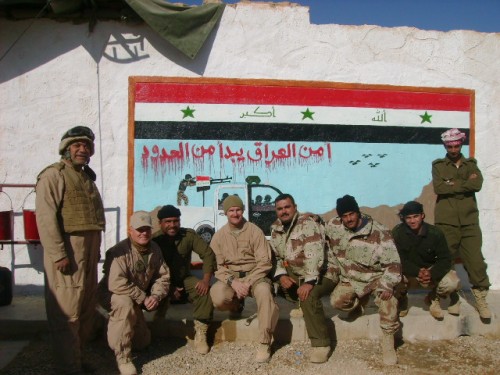
It was an incredible, once in a lifetime tour serving with some of the greatest Americans and Iraqis around. Iraqi soldiers in with our convoys would ask me to bless their trucks with Holy Water like I was doing with the American trucks.  I came to admire many of the professional Iraqi officers that I came to know and pray for the people of Iraq, that God would grant them peace. They are wonderfully hospitable and gracious.  We were often treated to food and tea by Iraqi soldiers, and civilians.  After nearly 30 years of nearly continuous war, dictatorship and terrorism, they deserve peace and security.

Me BTT CO and Iraqi LeadersAdvisers and Iraqi Border Troops near Syria
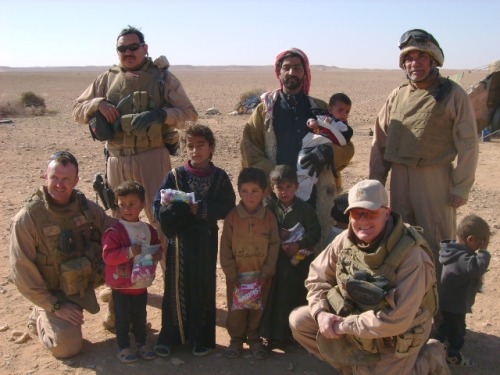
I had one Iraqi operations officer, a Sunni Muslim tell me that he wished that his Army had Christian priests because they would take care of his soldiers and had no political axe to grind. He said that the Army did not trust most Imams or Mullahs because they had compromised themselves during the civil war.  Another officer, a Shia Muslim came to me to thank me for being there to take care of our Marines.  He said that he, an Iraqi Shia Arab, hoped that if they had any problems from the Persians (Iranians), that we would help them.  These is little truth to what is floated that Iraqi and Iranian Shia like each other.  The memories of the past die hard in the Middle East.  When Persia ruled Iraq they treated the Arabs like dirt. Likewise the memories of the Iran-Iraq war are still alive.  Iraqi Arabs, Sunni, Shia and even Christian have little love for the “Persians.”  General Sabah of the 7th Division had us to his quarters for dinner. We had a wonderful and friendly discussion about similarities and differences in Christianity and Islam. We departed friends. The last time I saw him ws in the Ramadi heliport.  He saw me, ran up to me in from of his staff and Americans in the little terminal and gave me a bear hug, telling all that I was his friend. Another Iraqi General told me just before we left to come back as a tourist in 5 years because everything would be better.  I honestly think that he is right.  I hope to go back someday.  It would be a privilege to see my Iraqi friends again.

Me and BTT with Bedouin KidsWith a Bedouin Family

At the same time Afghanistan is a different animal. Iraq was not as easy of place for Al Qaida to work in and the Iraqis have a much more developed national identity which they trace back to the Babylonians and Chaldeans.  They also have adopted a lot of western ways.  Insurgents there once they had lost the confidence of the Iraqis lost traction.  In Afghanistan there is no real collective national identity and the form of Islam is much more severe than almost all Iraqi variants.  The Afghans insurgents have also due to the terrain; climate and inability of invaders to gain the confidence of the population have used the inability of invaders against them as they bring the population back under their control, sometimes quite peacefully.  The Taliban have secure bases on the Pakistani side of the border as did the North Vietnamese and they have the support of much of the population due to the unpopularity and corruption of the Afghan government.  The Taliban have begun to operate in larger better organized units and last year a battalion sized element attempted to overrun a small NATO base.  They did this with the Russians as well.  One troubling comment was reported about something overhead on the Taliban radio: “We will do to you what we did to the Russians,” the insurgent’s leader boasted over the radio, referring to the failure of Soviet troops to capture Ganjgal during the 1979-89 Soviet occupation.”  They also have outlasted or defeated a host of powerful empires.  The war in Afghanistan has much more in common with Vietnam than it does with Iraq. Counter Insurgency techniques learned in Iraq will be helpful but because of the terrain, climate and nature of the opposition will be tougher to execute and in order to have any chance of getting out of Afghanistan having accomplished the mission we will end of taking more casualties, especially in the teams of advisers.  Iraq was different, despite the problems and having to be rebuilt the Iraqi Army has a long history and tradition dating back to the Ottoman Empire, they led the way to westernizing Iraq and helping build an Iraqi identity, this is not the case in Afghanistan.  What happened to this team could easily happen to others and it looks to me like someone set them up to be hit, probably a Taliban sympathizer in the Afghan security forces or government. Afghanistan is much more treacherous than Iraq and in my view will be much more difficult.

What happened at Ganjgal is being investigated and in our area it is front page news as 1st Lt Johnson was from Virginia Beach.  The Taliban want to use events like this to break down the American home front and 8 years after the attacks of 9-11 2001 with that a fading memory they may well do this.  If they do Afghanistan will become Vietnam in the mountains.  We will be forced to withdraw and and the NATO alliance will be severely tested.  A defeat would have wide ranging consequences beginning in Afghanistan as it would fall back into the medieval world of Taliban rule, and would likely spread to Pakistan which which is already under severe strain.  This could threaten the Pakistani nuclear weapons.

Our advisers build bridges between peoples of different history and culture.  They are the unsung heroes of these wars and will likely never get credit for all that they have done.  Operating in isolation they are exposed to more danger that the average unit. They have my highest admiration and I hope that if you know one of these men or women that you will thank them.  I pray that they will all come home safe and be blessed with success.  I would certainly serve with them again at any time and in any place.

Please keep the families of the most recent casualties in your prayers. Peace, Steve+

1 Comment

Filed under iraq,afghanistan, Tour in Iraq

Going to War: Interlude in Fallujah Reunions, Redirection and a Stay at the Ramadan Inn

marine 155s in fallujahUSMC 155mm Howitzer firing on Insurgents at Fallujah in 2007
Note: This is the latest installment of my “Going to War” Series.  Other postings in this series are located in the Subjects section under “Tour In Iraq.” The series chronicles the tour of Religious Support Team-2 of the Iraq Assistance Group in MNF-West from July 2007-February 2008. We were the first Navy Chaplain and Assistant to work supporting advisers since the Vietnam War.

We woke up to the sound of more outgoing artillery fire.  The sun was shining outside as I look out my window at the sky above the California Barrier that protected our “suite” in the south wing of the Ramadan Inn.  Climbing out of the decrepit Iraqi bed with the fresh sheets I stumbled over my two tons of gear to look at the time while Nelson slept like a baby in his equally decrepit Iraqi bed.   My ever trusty alarm clock showed that it was about 0830, which meant we had gotten maybe 5 hours sleep and missed breakfast. Thankfully I had stockpiled a few pop-tarts and granola bars from the Camp Victory chow-hall the day before.   Opening the door and peering out into the hallway I saw it empty and walked across the hall to the head, shower and laundry room to do my morning business.   Despite being a Baath Party playground the suites at the Ramadan Inn were not furnished with their own toilet or shower, just a small sink and mirror.

ramadan innRamadan Inn

Though the Ramadan Inn had seen better days it was certainly, despite being the playground of Uday and Qusay Hussein it was not exactly a palace like those of their father Saddam.  It was somewhat reminiscent of an old and run down motel along Route 666.  The floor was a marble type tile and the sand painted concrete building with a flat roof.  I strolled over to the head in my PT-sleep clothes and was relieved to be able to relieve myself in a facility that had actual porcelain shitters which flushed using real water.  If you have been to Iraq or Afghanistan you know that this is not always the case.  The showers were passable being a more European design and the water was hot.  I guess even the cold water was hot in Fallujah with temps in the 120s.  Once I had gotten up I awakened Nelson, the sleeping beauty. He then went through his morning ritual to make himself presentable to the world.  Those who know nelson know that if he can he will take care of his personal hygiene.  I ate one of my Strawberry Filled frosted Pop Tarts washed done with water and when Nelson was ready we walked over to the Chaplain office.  It was like a maze to get there. We walked across the way a bit, took a right, made a left and went through the normal transient quarters area, took a right went up a block or two, took a left, made another left, wound our way past a decorative lake, took a right, went past a number of buildings before passing a final bank of green porta-johns finding the MEF- Forward Chaplain Office to our right.  The sun shone brightly and though not a long walk was relatively warm and by the time we got to the Chaplain Office I was sweating.

fallujah pondPond at Fallujah

The Chaplain office was like every other facility and was protected by California Barriers or Hesco’s. We were met by RP1 Roland and the Deputy MEF-FWD Chaplain CDR J.P. Hedges.  They were most hospitable and offered us water as well as coffee, which my caffeine deprived brain needed badly.  After introductions Nelson got together with RP1 Roland and I met with Chaplain Hedges doing the usual butt-sniffing that military professionals engage in when meeting someone for the first time.  This ritual usually consists of learning who our mutual friends are, where and with whom we had served in the Navy, where we went to school, something about our families and for Chaplains our faith tradition or denominational affiliation.  This is a customary act for chaplains as it is for other communities and specialties in the Navy.  On the positive side it is a way of making connection with each other and building relationships.  It is also a way or self preservation within the system as sometime there are people that do not have your best interests at heart. However for J.P. and I the meeting was very friendly. We d a lot of shared experiences in the types of duties we had done and we had mutual friends.  While we enjoyed conversation he began to introduce me to some of the things that had been going on in country the last few months.  After about 30 minutes Chaplain Mike Langston came in.  It was Mike who had worked with Peter Dissmore and the Corps Chaplain to bring us out to the west to cover the Marine and Army advisors in Al Anbar Province.

Mike had a couple of orders of business to take care of before he brought Nelson and I into his office and had our reunion. Nelson and I had both worked with Chaplain Langston.  It was good to see him again.  Nelson had worked for him in Afghanistan and I had been with him at 2nd Marine Division in 2000-2001.  He and Chaplain John Kaul arranged for me to take over Headquarters Battalion upon my return to work in a quasi-regimental billet with oversight of the independent battalions Religious Ministry Teams, though not the actual supervision of them. In addition to my regular duties counseling Marines, doing suicide interventions, conducting classes and supporting field exercises they used me, because of my experience to assist and evaluate chaplains who had been fired or relieved of their duties.  I got each one for 30-60 days to see if they could be recovered for further service or not.  In a sense this transformed me from a relief pitcher to a pitching coach.  Chaplain Langston was at a school when 9-11 occurred and during this time I was used as the Deputy Division Chaplain looking at readiness, training and potential deployment of our religious ministry teams with their units.  Both Nelson and I had experienced Chaplain Langston as a tough but fair chaplain.  What he did expect was that we would be out doing our job and keeping him or his office in the loop on our operations and issues facing us.  He did not attempt to micro-manage us.

bunkers_everywhere.jpg.w300h225Bunkers to Protect Against Indirect Fire at Camp Fallujah

Mike Langston is a prior Marine Corps Infantry Officer who had been a been a Company Commander and battalion staff officer as well as instructor at “The Basic Course” which is the leveling field for all Marine Corps officers regardless of their commissioning source.  He played football in college and still has the physique of a defensive lineman.  He left active duty and went to seminary and when he was ordained and graduated from seminary entered the Navy Chaplain Corps. He had since risen to the pinnacle of a career for most chaplains having been promoted to Captain, the same as a Colonel for the other services and assigned as the 2nd Marine Division Chaplain.  He is a no-nonsense kind of guy and kind with a high level of energy and emotion.  He explained the current situation in the Province was, the locations of the various Marine Regimental Combat Teams (RCT-2 and RCT-6) as well as the one Army Brigade Combat Team, 3rd Brigade, 4th Infantry Division as well as the 1st Light Armor Reconnaissance Battalion and the MEF Aviation and logistics assets were located.  He then got down to the specifics of our mission which were pretty simple and suited to our personality as a ministry team. Basically he expected us to manage our own operations in the MEF area of operations. He expected that we coordinate our operations with the teams that we would support and keep his office informed of where we were going and what our general plan of operation was.  Since he had worked with both of us and we were both known and trusted quantities he gave us a tremendous amount of operational freedom to do our job.  His expectation was that we would be active and get out to the remotest places that we had training and assistance teams of advisors.  He told us about an Army team that had been based in Ramadi to do the job with the advisors.  He confirmed what Peter Dissmore had told us about this team.   They had never left the base in 4 months and basically hung out at the Ramadi main chapel. They managed to get their orders curtailed and left theater never once having contacted or visited any advisory teams.

ega fallujahMonument in the Traffic Circle at Camp Fallujah

We were also told of a change to our projected base of operations.  Our original plan of operations had us working out of the former British and Iraqi base at Habbinyah the location of the headquarters of the 1st Iraqi Division and the Advisors assigned to it.  Instead the Colonel in charge of those teams made the call that he could not support the operations of a Chaplain from his location. He held firm on this and the plan was changed so that we would operate from Ta’Qaddum a large air and logistic  hub about equidistant between Fallujah and Ramadi.  Ta’Qaddum is adjacent to Habbinyah on the south side of the Euphrates. It sits atop an escarpment overlooking the town to the north and Lake Habbinyah in the South.  In 1941 it was the site of a siege when the Iraqi military launched a revolt against the British who occupied the country despite it being given independence at the end of World War One.  The British we besieged in Habbinyah and the Iraq forces had the high ground atop the escarpment.  Unfortunately for the Iraqis and fortunately for the British the British forces had support from the Royal Air Force and the Iraqis had no logistics ability to support their units atop the escarpment.  The Iraqi forces were pounded and eventually a relief force arrived from Jordon to break the siege.  At TQ as it is known by most Americans we would be housed and taken care of by the 2nd Marine Logistics Group Chaplain, Commander Pat McLaughlin and his team.  We were instructed to make coordination to plan work with the teams supporting the 7th Iraqi Division, the 2nd Border Brigade, Iraqi Highway Patrol and the Provincial Police forces while working to build a bridge to the teams of the 1st Iraqi Division. The change was momentarily upsetting but ultimately it opened the door to the entire province where if we had been co-located with the 1st Division we may not have gotten out of its operational area.

Following the briefing, he, J.P, RP1 Roland, Nelson and I went to lunch at one of the two major chow halls on the camp where I met up with an old friend.  The friend was Captain Luke Fabiunke with whom I had served for 2 years at Marine Security Forces Battalion.  Luke was our S-6 and the Communications officer at Security Forces.  He was always fun to hang out with and was very supportive of my work as a chaplain there.  Luke was in the G-3 Operations shop t the MEF and specifically was working with the section that dealt with the training and advisory teams in the province.  It was good to see him and he immediately upon learning our mission asked how he could help.  This hook up was one that paid off in spades in the next 6 months.  It is a lesson that Chaplains need to build relationships with other staff officers in order to be successful, not just in their current assignment but in many cases later in their careers when they need assistance the most.  For me it helped meet my mission of finding and making contact with advisory teams of all types as soon as we hit the ground rather than operating blindly trying to figure our way around the labyrinth that was the operational setting for these teams.  I think that I owe Luke a beer or two for his assistance.

Following lunch we got to work.  Helped by Chaplain Hedges and RP1 Roland we were issued flight suits and Nelson a couple of sets of Marine Pattern Camouflage uniforms and I was issued two elderly Panasonic Tough Book laptops. One was set up for regular unclassified traffic and the other for classified work dealing with intelligence reports, weather and planning and submitting air movement requests.  Despite being a highly technological military when one gets into a combat zone technology assets for oddball teams like ours are sometimes scarce.  In fact I understood from Peter back at IAG that most of the Army teams had to share assets with others just to communicate.  Chaplain Langston and his staff ensured that we had freedom to be able to do our job without having to inconvenience others to do it.  They laptops may have been elderly but they worked.  Chaplain Hedges taught me the ins and outs of planning and coordinating the air support from Marine, Army and Air Force aviation assets and helped get us set up to do this.  Once again we got what we needed to do our mission.

We spent another three days in Fallujah preparing for the mission and making coordination with staff sections and others that we might have to call upon.  We also had a number of reunions with others that both of us had served with. I met Major Andy Niebel and Lieutenant Colonel Dave Ottignon who I had served with a Second Combat Engineer Battalion. They were good friends then and are men for whom I have a tremendous amount of respect.  I also met a number of Chaplain with whom I had previously served or knew from other duty stations. One of these was LT Joe Buenviaje, who had been my RP at 1st Battalion 8th Marines when I had done my relief pitching job there.  Joe had cross-rated from being a Boiler Technician to the RP rating not long before I had met him.  We had qualified for the old FMF qualification together and I was able to help him begin his journey to be a Navy Chaplain.  I was also blessed and honored to baptize his children at Camp LeJuene.  Joe has a heart of gold and did well in Iraq.  He got out with his Marines a lot, once almost getting blown up by an explosive device which blew up a highway overpass where they had just been conducting services. With them was a Catholic priest who had likewise just celebrated Mass.  They were leaving the site when the explosion hit and following the attack helped to take care of the wounded.

Having a cross on your uniform in a chow hall can lead to interesting situations as well as ministry.  Some people will automatically avoid you when they see the cross as if faith and religion was some sort of communicable disease.  I admit that there are some religious people and groups across the faith continuum that I think are toxic so I understand this.  Likewise there are people have been used, abused or burned by religious leaders or groups and thus want nothing to do with organized or even disorganized religion.   There are other people who are afraid that if they say something wrong that the chaplain might come down on them.  There are still others who when they see that you are a chaplain ensure that they get together with you and some will even pray for you. Regardless of the situation I always try to be friendly to those around me in a chow hall despite my preference for my introversion.  In fact I will attempt to start up conversations with anyone around me if nothing else to let them know that I know that they are there and that they can talk with me.

Some of the people that we supped or dined with were Religious Programs specialists like Nelson….well actually not so much like Nelson.  Nelson is one of those one of a kind animals that the Deity Herself cracked the mold when he was out of the oven.  These young men and women had been in country various lengths of time and were having as happens in almost every case good or bad experiences working with their chaplain.  There are unfortunately a few bad apples that mistreat their RPs and give the rest of us a bad name. Likewise there are bad RPs in the force.  Some actually set new lows for military conduct and discipline and give a bad name to the good sailors in the rating.  I had one that stole from the offering in Okinawa, forged offering forms, leave papers and burned up a new pickup truck to try to get the insurance money. I had another who tested positive for cocaine upon arriving to my ship and yet another who pretty much stayed one step ahead of the law.  I guess it is human nature that we get such folks and unfortunately because there are people like this who serve as Chaplains and RPs there is kind of a guilt by association.  As such RPs question the RPs that they know  as to how their chaplains treat them and are often wary of a chaplain that they do not know.  Nelson assured them that I was “cool” and we had a couple of interesting meals together.

There were a number of times in Fallujah where young sailors or Marines approached me about spiritual issues, family problems or prayer requests. There were even some young men and women who were interesting in becoming chaplains.  It was neat to be able to be there in those moments where our lives intersected, maybe for the one and only time.

We spent our last day in Fallujah getting ready for our flight, another really late flight.  During the day we heard that an Army CH-47 Chinook had crashed at TQ killing the crew and that the cause was undetermined as to whether it was due to hostile fire or a mechanical problem.  Such incidents raise your pucker factor especially when you will be flying into the same place that they crashed.  With this in mind we picked up our laundry had some chow, made some final coordination, called and e-mailed our families, did some PT and settled in for the evening waiting for RP1 Roland to pick us up. While outgoing artillery boomed in the distance we sat back in our room at the Ramadan Inn and discussed our plans, as well as wondered out loud what was in store for us.

3 Comments

Filed under History, iraq,afghanistan, Military, Pastoral Care, Tour in Iraq

Star Trek the Next Generation: Captain Jean-Luc Picard Deals with PTSD

Counselor Deanna Troi: Interesting.
Captain Jean-Luc Picard: Counselor…
Counselor Deanna Troi: I just find it interesting. Captain Jean-Luc Picard, the man who couldn’t be pried out of his seat for a vacation for three years!
Captain Jean-Luc Picard: It’s Earth. It’s home. Do I need another reason?
Counselor Deanna Troi: I don’t know, what do you think?
Captain Jean-Luc Picard: Your help has been invaluable during my recovery, but…look, I’m, uh…I’m better! The injuries are healing.
Counselor Deanna Troi: Those you can see in the mirror.
Captain Jean-Luc Picard: The nightmares have ended. All I need now is a little time to myself.
Counselor Deanna Troi: I agree. In fact, I’m delighted you’re going. It’s just that…the choice of where you’re going could stand some scrutiny.
Captain Jean-Luc Picard: If you wish to believe my going home is a direct result of being held captive by the Borg, be my guest.
Counselor Deanna Troi: Is that what you believe?
Captain Jean-Luc Picard: I hate it when you do that.
Counselor Deanna Troi: Captain, you do need time. You cannot achieve complete recovery so quickly. And it’s perfectly normal after what you’ve been through, to spend a great deal of time trying to find yourself again.
Captain Jean-Luc Picard: And what better place to find oneself than on the streets of one’s home village.
Counselor Deanna Troi: Interesting.

I have always found the Star Trek TNG episode Family quite compelling.  The episode (Season 4 Episode 2) deals with Captain Jean Luc Picard’s return home following his capture and assimilation by the race known as the Borg during The Best of Both World’s Part 1 and II (Season 3 Episode 26 and Season 4 episode 1.)

The story is interesting because it deals with some of the issues that people traumatized in combat deal with as they try to find themselves again.  In the story Captain Picard, in a very typical manner of someone traumatized by combat believes that his injuries are healing.  His counselor, Deanna Troi who serves as the Ship’s “Counselor” challenges him on his belief that he has recovered and his choice of where he wants to go to find himself again.

I saw the episode when I was in Seminary not long after completing the Chaplain Officer Basic Course and then saw it again when I was going through my Clinical Pastoral Education Residency.  It was during that process, one in which I was trying to find and define what “home” was, that it really caught me.  I was Captain Picard, the brother who left home to explore and travel while serving in the military.   My brother Jeff was Picard’s brother Robert.  He is the one who stayed home and minded family business.  The parallels then got me and even more so now.  My Residency Supervisor used this to good effect during that time in dealing with the issues of home, but the post combat and PTSD part was yet to come.

Back in the days of my residency I struggled with another of issues related to being a military brat and having begun a career in the Army.  In a sense I was a nomad.  I had lived a lot of places but none were really home, even where I had spent all of junior and senior high school.  Like Picard my eyes were set on far horizons of exploration and adventure of military life.  My brother Jeff on the other hand like Picard’s brother was content at staying at home, being near our parents, getting established in the school district and taking care of his family.   We both chose our own paths and both were right for us.  I still long for adventure and exploration but have begun to settle down.

When it came to the placement of the PTSD in this picture it was after Iraq that I had a crisis in a number of areas in my life and every time I thought that I was doing better and maybe even “getting well” that there was always something that could trigger the memories, bring back the dreams and keep me from sleep.  I can say that a year and a half after my return from Iraq I am doing better in a lot of ways but still having struggles with anxiety insomnia and hyper-vigilance.  I did find out that there is one thing that does not evoke a startle reflex is a foul ball that comes back against the screen in from of me in Section 102 at the Church of Baseball Harbor Park Parish.  Last night while taking pictures right up against the screen I had several balls that hit within a couple of feet of me, one of which hit my camera and knocked it out of my hand.  Anywhere else loud noise, unexpected crashes, things flying past me sends me into a hyper-alert status.

picard familyPicard Meets His Family after Many Years and Wounds Away

When Picard goes home it is not the confident Starship Captain who returns, but a man unsure of himself and where he fits in life.  His encounter with the Borg has changed him and he contrary to assurances to Counselor Troi is still wounded.  When I returned from Iraq I wondered where I fit, I felt like I had abandoned my advisers in Al Anbar when I returned because my relief had to be sent elsewhere do to circumstances beyond my control.  I did not feel a part of my own unit as nothing was the same when I came back.  I felt weak, useless and at the end of my rope after having completed incredible tour in combat of my then 26 years in the military.  Physically I was falling apart; I had several nagging injuries from Iraq that caused chronic pain.  I was flashing back with every moment, fires burning in the Great Dismal Swamp had turned our air the color of an Iraq sand storm while the smell was like that of the ever present burn pits, both military and Iraqi.  Walking out the door one morning with my neighborhood shrouded in smoke I began to melt down.  That day we had a seminar done by a nationally known speaker dealing with trauma and combat with the associated feelings and emotions.  At the end of the day I was a wreck.  My Unit Doctor, Chris Rogan looked at me and said “Chaplain you don’t look good, are you okay?”  I said “no I’m not, I’m losing it and I’m scared.”  That was the place where I finally began to get help.  It has been about 14 months since I started and it is still a process.  We made a trip home that summer and I did not do well.  It was painful and I had great difficulty both in the travel as well as the visit.  When I hear fellow vets talking about the surreal and often painful times that they experience I can understand.  The fact is that you can be with a hundred friends and family members and be totally alone when you return home because it is something that you cannot really share and that they usually don’t understand.  Once again I have been fortunate.  My little brother actually listens to me and lets me vent when I need to.  Of course dealing with our family’s stuff this is a two way street.

not a happy camperVisiting Home and not Doing Well

In the story Picard is offered a chance to leave Starfleet and go to work on a project under the ocean on Earth.  He is sorely tempted to take it but before he can he has an encounter with his brother who challenges his decision.  They exchange words and Captain Picard feeling picked on starts a fight.  During the fight he breaks down about his experiences sobbing in his brother’s arms.  “His brother then said: So – my brother is a human being after all. This is going to be with you a long time, Jean-Luc. A long time. You’ll have to learn to live with it. You have a simple choice now. Live with it below the sea with Louis, or above the clouds with the Enterprise.”

In a sense that is something that all of us who serve after having been traumatized by the experience of wart have to deal with, the physical as well as the psychological and spiritual wounds.  For me it was the realization that I was human after all and the slow realization that this will be with me a long time.  The choice is how I choose to live my life and where I do so.

In the series and subsequent Star Trek: The Next Generation films Picard is forced to deal with his psychological wounds from the encounter with the Borg culminating in the second of those films Star Trek: First Contact. In it Starfleet Command leave Picard and the Enterprise out of the battle leading to this exchange between Picard and his First Officer which deals with the stigma associated with such an injury.

Cmdr. William Riker: Captain, why we are we out here chasing comets?
Captain Jean-Luc Picard: Let’s just say Starfleet has every confidence in the Enterprise and her crew – they’re just not sure about her Captain. They believe that a man who was once captured and assimilated by the Borg should not be put in a situation where he would face them again. To do so would introduce “an unstable element to a critical situation.”
Cmdr. William Riker: That’s ridiculous. Your experience with the Borg makes you the perfect man to lead this fight.
Captain Jean-Luc Picard: Admiral Hayes disagrees.

The stigma associated with psychological injuries is far greater than that of physical injuries.  The unseen injuries are not as well understood and those who suffer them often are broken down by the system as they try to get help and many simply go underground and self medicate.  Last year two Army Generals opened up about their struggles with PTSD. I was fortunate to have people come alongside of me when I went down hard.  People who did not give up on me and kept faith by caring about me when I was and still get down.

See the article at: http://edition.cnn.com/2009/HEALTH/03/06/generals.ptsd/

Despite this and the efforts of many in the Military to help those with PTSD and other “unseen” injuries, to include medical conditions brought on by exposure to toxins in the combat zone, there is still the stigma.  As the young officer suffering from a rare and eventually fatal pulmonary condition acquired in Iraq as well as yet untreated PTSD “I squarely wish I had lost my legs then than the lung function that I have lost!”

Captain Picard’s story of course is fictional, but it demonstrates to some degree what those who experience the psychological and spiritual wounds of war face when they “come home.”  This stuff doesn’t go away.  Here are some of the comments that I have had from readers who deal with their own or a family members PTSD.

Australian Vietnam Veteran who wrote me said:  “As an Australian Vietnam Veteran with PTSD, I find these articles fascinating. I long wondered why the world had to be such a hostile mongrel place. Then 30 years later I was diagnosed with PTSD and I can now relate to why I have the condition but the world has not changed and medication is of limited use. There are many of us who are still very isolated and have to limit our social contacts. I recently started a Vietnam Veterans group, for members of our small unit, on the web and I found men who were relieved to be part of something and someone they could relate to as they had all but withdrawn from society. Sadly a few of them refuse to take any medication for their medical conditions as they see that as prolonging their miserable existence.”

A family member of a WWII veteran said: “thank you. It’s really needed for women to read articles/memoirs like that. It’s easy to say someone has PTSD, but another to live with and love who has it. I come from a family with rich military history and this is an everyday issue. Never goes away, even after 40 – 60 years.”

A USMC Vietnam Vet that I know wrote: “It’s a bitch at times, and the sleep, or lack of will eventually come, although it will never be a fully restful sleep. The Hyper vigilance seems never to go away. Yes it could be good, but eventually it can be bad…. well do I know both.”

An Army Chaplain from Iraq noted: “I too am a chaplain who felt that he and his assistant were the best equipped to handle the horrors of war – just to find out after being home for about a year just how much I had changed. I was sitting with my daughter in my lap one weekend afternoon when she asked, “Daddy, why don’t you play and laugh with us like you use to before you went to Iraq?” It was the key event that brought everything to a point where I could get help. In the months since there have been good days and definitely bad days – however, my faith remains strong….”

I run into people like this every day in the course at work who deal with this and sometimes it spills over into my stuff.  However I am glad to know that I am not alone.  To those who have helped me since I have be back, Chris, Two Feathers, Limey, Greg, Jesse, Jeff, Elmer, my longsuffering wife the Abbess of the Abbey Normal Judy and my brother Jeff, Colonel P and Janet, the folks I work with, the people at Harbor Park, especially Ray, Charlie and the Vietnam Veterans of America who man the beer stand on the concourse behind home plate and all the others who have come alongside I am grateful.  It is my sincere wish and prayer that all veterans will have such fine people there for them when they hit the wall.

Peace, Steve+

Leave a comment

Filed under iraq,afghanistan, PTSD, star trek

Leave no Soldier Behind? I think not…A letter from an IOF Vet and Reader

Note: This is the sanitized version of an e-mail that I received last night from a OIF 05 and OIF 07 Veteran Army Officer who has been awarded two Bronze Star Medals for his service in Iraq and was Medivac’d out of Iraq during his second tour when he was diagnosed with an exceptionally rare incurable and eventually  fatal lung disorder that he contracted in Iraq with two separate Brigade Combat Teams.  Since then he has developed other medical conditions brought on by his lack of pulmonary function.   He is in process of being medically boarded out of the Army and is despairing to the point of having suicidal thoughts and ideations, wondering if it would be better for him to die on active duty so his wife and child would have a better financial support than if he waited to die a few years from now as a medical retiree.  I was able to contact this officer to listen to him at length this morning and afternoon. He has agreed to get help for these thoughts and I have given him the means to contact me any time and he has contracted with me to get help, I suggested a trip to his local medical facility Emergency Room.  He has given me permission to share this as he no longer feels protected enough by the Army to say it on his blog.  Please pray for this man and take care of the Combat Veterans, active duty, disabled or retired that you know.   His letter follows.

Peace,

Steve+

Dear Padre Steve,

This is why I am not posting on line…(I would say things like the following…)

I really do not know how much more I can take! I am beaten down, first by my own body and the diseases that are exacting a high price; second by the fight waged to receive some kind of medical care; third by the callus medical care provided; fourth by the institution of the Army attitude and treatment of “broken” people; by how the institution seeks to downplay and disregard the sacrifices of those who have sacrificed so much–by trivializing the toll of the disease–especially when not clearly visible.

Without a thirteen round prize fight the Army will throw me off the back of metaphoric  5-ton and act like they are doing me a favor by slowing down to 55 mph! “Look, you worthless scum-bag, we are doing you a favor by slowing down. Don’t, worry, you should be OK…we will try and get you off to the side so the tank does not role over you…”

The system, and the people within it, constantly questions your “worthiness” of any consideration. Then if you insist  on getting help for things that you know are wrong with you they double and triple question as if there is no way you could be telling the truth.

It is easy to say that I am at my wits end with all of what is going on in my life lately. The constant fight to receive what is necessary right is darning. I have been dealing with this callused indifference since being Medivac’d in the middle of my second Iraq tour. The system seems to be designed to wear you down so that rather than continuing to fight for the care that you need, just take what little the Army is willing to give.  I found out this week that after I am med-boarded out of the service that I will have to fight the Army all over again to be able to keep my Army benefits when I apply to the VA.  This is happening despite the fact that the Congress recently allowed for this compensation for veterans.

Will justice EVER be given? At what price?

Does the “Army” GIVE A DAMN!? The short answer is NO! There may be some individuals who do. What is experienced is the Teflon affect. Not many, if any, are willing to get dirty and fight for or on behalf on another. People end up getting treated as paper and numbers–not the individual they are, or for the sacrifices they have made. The individual is trivialized through the bureaucratic process that most involved in processing hide behind to separate them from the reality and often pain experienced by those suffering in the system.

I have recently started trying to get help from my PTSD.  A board certified Army physician that I wrote a consult for me to see someone.  I was contacted and told that the people who run the program here no longer take appointments or consults and that I would have to be “triaged” by a medical or psych tech to get an appointment that might be 3 months from now?  I might be dead by then. I don’t feel safe.

People may listen, but they usual will not, cannot, or do not know what to do. So trying to get help is like trying to find a particular molecule of water in the ocean.

This process SUCKS. It is worse than my first, very trauma filled, combat tour in Iraq (OIF 05-07). It is demoralizing. I squarely wish I had lost my legs them the lung function that I have lost!

I am an officer with TWO BRONZE STARS for my Iraq service.  I gave all that I had and my honesty, integrity and faith in the Army that I joined is being called into question.  If it is happening to me, what is happening to junior personnel? Who is their advocate? Is it any wonder that soldiers are committing suicide and unheard of rates?  Shit I have even counted up the money and figured that my family would be better off if I died on active duty than after my medical retirement.  What the hell is up with that? Why should I have to die for the Army to take care of my family?

What do I have to do to be heard? Does God even care? I’m just asking. Thanks for listening.

Sincerely,

Joe Smith (a pseudonym)

1 Comment

Filed under healthcare, iraq,afghanistan, leadership, Military