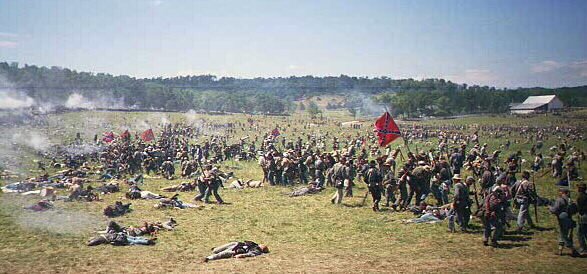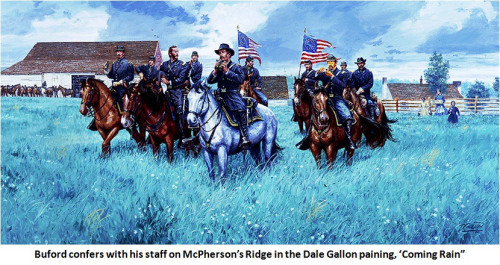
Tag Archives: john brockenbrough

“Our Army Would be Invincible if…” The Problem of Senior Leadership in the Army of Northern Virginia Part Two, The Third Corps

leeindex1omas

This is the second part of an article that I posted yesterday which is part of my Gettysburg series. This focuses on the Third Corps commanded by Lieutenant General A.P. Hill. The link to the first article is here: https://padresteve.com/2014/07/28/our-army-would-be-invincible-if-the-problem-of-senior-leadership-in-the-army-of-northern-virginia-june-1863-part-one-first-and-second-corps/

The newly created Third Corps under Lieutenant General A.P. Hill was thought to be in good hands. Hill had commanded his large; six brigade “Light Division” with distinction, though having serious conflicts with both Longstreet and Jackson. At Antietam Hill’s hard marching from Harpers Ferry had saved the Army of Northern Virginia from destruction. Hill was a graduate of West Point who had served in the topographic engineers most of his U.S. Army career. He had an earned reputation as a brilliant division commander, and despite his clashes with Longstreet and Hill Lee recommended him to take command of Third Corps who sang his praise to Jefferson Davis “the best soldier of his grade with me.” [1] Hill was a “nervous wiry man with a persistent chip of underappreciation on his shoulders and a bevy of chronic illnesses when under stress.” [2] Hill detested Jackson, who he referred to as “that old Presbyterian fool” [3] and his poor relations with Jackson’s confidants at Second Corps ensured that Ewell took Second Corps. Lee appointed Hill to command Third Corps of which “half of the troops had been with him all along” [4] in the Light Division. Lee liked Hill’s aggressiveness and command instincts, something that he hoped would translate into success at the corps level, and promoted him over the head of D.H. Hill and Lafayette McLaws who were both senior to him. Regarding the promotion of Hill and Ewell Lee wrote to Davis:

“I wish to take advantage of every circumstance to inspire and encourage…the officers and men to believe that their labors are appreciated, and that when vacancies occur that they will receive the advantages of promotion….I do not know where to get better men than those I have named.” [5]

But the decision to promote the Ewell and Hill, both Virginians stirred some dissent among those that believed that Lee was “favoring Virginians over officers from other states. The promotion of A.P. Hill, as previous noted was “made over the head of two Major Generals more senior than Hill- North Carolinian D.H. Hill and Georgian Lafayette McLaws.” [6]

Hill’s corps, like those of Longstreet and Ewell was composed of three divisions, and even more so than Ewell his division suffered a want of senior leaders who had served at the grade they were now expected to serve.

The most stable division in Third Corps was Richard Anderson’s, transferred from First Corps. Under Longstreet the division and its commander had served well. Lee considered Anderson a “capable officer”…and had marked him for future higher command.” [7] Anderson was noted for his modesty and unselfishness, “his easy going ways, combined with his competence and professionalism made him one of the most well liked officers in the Army of Northern Virginia.” [8] However, there was an incalculable thrown into the equation. Hill had not yet established his methods of operation as a corps commander, and Anderson, used to “Longstreet’s methodical insistence that everything be just so before he would venture into action” contrasted with Hill’s “tendency to leap before he looked.” [9]

Anderson’s division was composed of five brigades commanded by a mixed lot of commanders, none of whom were professionals.

Brigadier General Cadmus Wilcox was a no-nonsense graduate of West Point; he served in the Mexican War and taught tactics for five years at West Point. He had served with distinction as a brigade commander, but Wilcox was disgruntled, he “is restless, sore, and disposed to go to another Confederate army where he will have a chance.” [10] Wilcox had been passed over for promotion to Major General in favor of George Pickett and requested transfer from Lee’s army, which was refused for lack of qualified leaders. At Chancellorsville the delaying action of his brigade at Salem’s Church had helped save the army.

Brigadier General William Mahone was a graduate of VMI and was superintendent of the new Norfolk and Petersburg Railroad when the war Virginia seceded from the Union and served with reasonable effectiveness before Gettysburg. As a brigadier “he is not lacking in diligence, but he is not without special distinction.” [11] He fought competently at Chancellorsville and by Gettysburg had established himself as a “competent and experienced brigade leader.” [12]

Brigadier General Ransom Wright had no military training or experience prior to the war, but was a successful lawyer and by Gettysburg he “was considered a well-tested combat veteran.” [13] He had Unionist sentiments, was a no-nonsense individual and though he had no military was named colonel of the 3rd Georgia in 1861 and became a brigade commander during the Seven Days.

Brigadier General Carnot Posey was a highly successful plantation planter and lawyer who had served as a “lieutenant under Col. Jefferson Davis, and suffered a slight wound at the Battle of Buena Vista” [14] in the Mexican War, after which he returned home as was appointed as a United States District Attorney by President Buchanan. Posey commanded the 16th Mississippi and was promoted to brigade command prior to Chancellorsville where he gave a strong performance under fire.

Colonel David Lang commanded the Florida Brigade the smallest in the army. Just twenty-five years old, the graduate of the Georgia Military Institute inherited brigade command when Brigadier General Edward Perry came down with typhoid fever after Chancellorsville. He had only fought in three battles, two as a captain “and he had never led a brigade in combat.” [15]

Hill’s old Light Division was divided into two divisions. Major General William Dorsey Pender commanded the old Light Division which now consisted of four rather than six brigades. Pender was only 29 years old, the “youngest of that rank in the army.” [16] Pender was “only seven years out of West Point” [17] and was deeply loyal to Powell Hill and a partisan of the Light Division. However, he had risen “on first rate ability, steadfast ambition and a headlong personal leadership in battle which gave a driving force to his brigade” [18] which he considered “the best brigade of the best division” [19] in the army. Lee praised him as “a most gallant officer” and was deeply sensitive about keeping Pender with the troops that found him so inspiring noting “I fear the effect upon men of passing him over in favour of another not so identified with them.” [20] Pender was an “intelligent, reflective man, deeply religious and guided by a strong sense of duty.” [21]

Pender’s four veteran brigades were commanded by three experienced officers and one new to brigade command.

Colonel Abner Perrin from South Carolina was the least experienced. He was a successful lawyer who had served as a lieutenant in the Regular army in Mexico, served as a company commander in the 14th South Carolina which he took command of after Fredericksburg. He led the regiment at Chancellorsville and took command of the brigade when the brigade commander was wounded. Despite his inexperience he remained in command of the veteran South Carolina brigade, “whose leadership had been decimated” and had “devolved to lieutenant colonels, majors and captains.” [22]

Brigadier General James Lane was an academic. He graduated second in his class at VMI in 1854 and received a degree in science from the University of Virginia three years later. He returned to VMI as an assistant professor then became a professor of natural philosophy at the North Carolina Military Institute. [23] He was commissioned as a major in the 1st North Carolina and took command of it in September 1861 and promoted to brigade command after Antietam. Lane proved himself an able commander at Fredericksburg and Chancellorsville, at the latter his brigade led Jackson’s assault against the Union right, suffering 909 casualties and had the misfortune of when one of his units mortally wounded Jackson on the night of May 2nd 1863. Despite this “he and his men could be counted on to do the right thing when the bullets started to fly.” [24]

Brigadier General Edward Thomas was a plantation owner from Georgia who had served as a lieutenant in the Mexican War. Offered a commission in the Regular army he turned it down and returned home. He became colonel of the 35th Georgia Infantry in October 1861 and led it as part of Pettigrew’s brigade and after Pettigrew was wounded at Seven Pines the brigade was shifted to Joseph Anderson’s brigade of the Light Division, assuming command of that brigade when Anderson was wounded at Frayser’s Farm. He commanded it in the thick of the fighting at Second Manassas and at Fredericksburg helped stop Meade’s advance with a fierce counterattack, and commanded it again at Chancellorsville. Thomas could always be counted on to deliver “a solid, if unspectacular performance.” [25]

Brigadier General Alfred Scales was new to brigade command. A “forty-five year old humorless politician” [26] who had served in the U.S. House of Representatives with no military experience Scales enlisted as a private when North Carolina seceded. He was elected to a captaincy in Pender’s regiment and when Pender was transferred Scales succeeded him in command of the 13th North Carolina. He commanded that regiment on the Peninsula and during the Seven Days, served as acting commander of the brigade when Pender was wounded at Fredericksburg and distinguished himself with the 13th at Chancellorsville. Scales service with Pender’s brigade “had been one of consistent stout service.” [27] When Pender was promoted to division command “it was a forgone conclusion that his replacement in brigade command would be Scales.” [28] He had served with the brigade, was known to its soldiers and though inexperienced as a brigade commander he “and the brigade were one, for he had shared its fortunes, was proud of it, and was confident of victory as he led it to Gettysburg.” [29]

Hill’s remaining division was commanded by the newly minted Major General Harry Heth. It was composed of the two remaining brigades of the Light Division and two brigades recently joined to the army for the offensive.

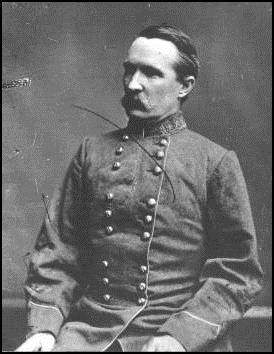
Harry Heth was a graduate of West Point who has a “high reputation personally and professionally” [30] in the army, despite finishing 38th in a 45 member class at West Point. Lee had a high regard for Heth and considered him a friend and somewhat a protégé, however his regard “cannot be based on any substantive achievements by Heth, whose antebellum career and war experience had been similarly unremarkable.” [31] Heth was an example of a “soundly trained soldier of perennial promise. Always seemingly on the verge of becoming truly outstanding” but “never lived up to the army’s expectations.” [32] Heth became a brigade commander in Hill’s division prior to Chancellorsville after having served in Western Virginia and in the West. Hill was new to command of a newly formed division and had the weakest collection of brigade commanders in the army at Gettysburg.

Newest to the division was Johnston Pettigrew whose North Carolina brigade was one of the largest in the army. This was one of the new brigades provided to Lee by Davis, Pettigrew was a renaissance man, and was a graduate of the University of North Carolina he was “proficient in French, German, Italian and Spanish, with a reading knowledge of Greek, Hebrew and Arabic.” [33] Pettigrew had spent a good amount of time abroad on diplomatic service before returning to his law practice in Charleston. He had “even spent time as a volunteer aid with the French and Italian forces against the Austrians in 1859.” [34] Elected to the state legislature in 1856 he “sensed the oncoming of hostilities and was named colonel of the 1st Regiment of Rifles, a Charleston militia outfit.” [35] Pettigrew was “one of those natural leaders of a privileged background who, without military ambitions, had been advanced on the application of native intelligence and contagious courage.” [36]

Brigadier General Joseph Davis, the nephew of President Jefferson Davis commanded a newly raised Mississippi brigade. Davis owed his appointment to his relationship with the President. He was “entirely without combat experience.[37] Most of the war he had spent on his uncle’s staff in Richmond and in his new appointment he was not with officers of any experience as “No one serving on Joe Davis’s staff showed strong signs of having the background, experience, and ability that might help the brigadier meet his responsibilities.” [38] Likewise the nine field officers assigned to his regiments were similarly ill-equipped.

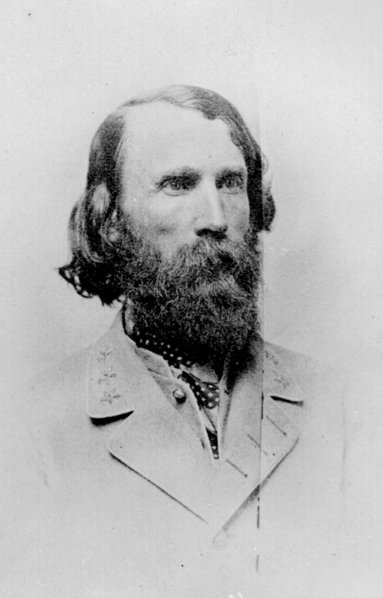
Heth did have the experienced mixed Alabama-Tennessee brigade of Brigadier General James Archer. Despite its experience and “fine reputation” [39] the brigade was seriously understrength after seeing heavy combat at Chancellorsville. The brigade commander Archer was a graduate of the University of Maryland who practiced law before entering the Regular army as a Captain during the Mexican War where he was breveted for gallantry at the Battle of Chapultapec. He left the army after the war and then returned to it in 1855. He commanded the 5th Texas Regiment and took command of a Tennessee brigade at Seven Pines. Initially Archer was not well liked by any of his commands, the Texans considered him a tyrant and he was “very non-communicative, the bearing and extreme reserve of the old army officer made him, for a time, one of the most hated of men.” [40]After being joined to the Light Division Archer transformed his reputation among his men and had “won the hearts of his men by his wonderful judgment and conduct on the field.” [41]

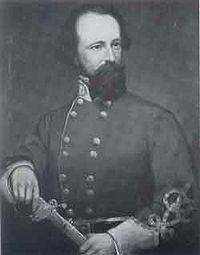
The last brigade of Heth’s division was the small Virginia brigade of the “plodding, uninspiring” [42] Colonel John Brockenbrough. Brockenbrough was an 1850 graduate of VMI and “entered service as colonel of the 40th [Virginia Infantry] in May 1861.” [43] The brigade when it had been commanded by Charles Field had been considered one of the best in the army. Brockenbrough took command of it in 1862 when Field was wounded and “had never managed the brigade well, especially at Fredericksburg, and Lee returned him to regimental command.” [44] He reassumed the command of the brigade after Chancellorsville when Heth was promoted. Like Archer’s brigade it was “sadly reduced in numbers” and in morale…” [45]

Lee’s Army of Northern Virginia would go into the Gettysburg Campaign with two new and untried corps commanders. Of nine infantry division commanders three were new to command and another who had never commanded a division in combat. Of the infantry brigade commanders First Corps was in the best shape with ten of eleven assigned commanders having experience in command at that level, and most were of sound reputation. Second Corps was worse off, with six of thirteen assigned brigade commanders new to command, and two of the experienced brigade commanders were not competent to command at that level. Third Corps had nine of its thirteen commanders who had experience as brigade commanders; however, one of them, Brockenbrough was of little value despite being experienced.

Had the army had more time to exercise the new commanders before going into action Lee might have had a better result, but as he told Hood “this army would be invincible if….” As we know, if is the biggest two letter word in the English language, and these men, as Barbara Tuchman noted would be “made bold by the moment, some irresolute, some carefully judicious, some paralyzed and powerless to act.”

Peace,

Padre Steve+

Notes

[1] Ibid. Freeman Lee’s Lieutenants p.526

[2] Ibid. Guelzo, Gettysburg: The Last Invasion p.22

[3] Ibid. Guelzo, Gettysburg: The Last Invasion p.22

[4] Foote, Shelby, The Civil War, A Narrative. Volume Two Fredericksburg to Meridian Random House, New York 1963 p.434


[5] Ibid. Freeman Lee’s Lieutenants p.526

[6] Ibid. Taylor, John Duty Faithfully Performed p.290

[7] Ibid. Dowdy. Lee and His Men at Gettysburg p.86

[8] Ibid. Tagg The Generals of Gettysburg p.306

[9] Ibid. Dowdy. Lee and His Men at Gettysburg pp.86-87

[10] Ibid. Freeman Lee’s Lieutenants p.46

[11] Ibid. Freeman Lee’s Lieutenants p.48

[12] Ibid. Tagg The Generals of Gettysburg p.315

[13] Ibid. Tagg The Generals of Gettysburg p.317

[14] Ibid. Tagg The Generals of Gettysburg p.319

[15] ibid. Tagg The Generals of Gettysburg p.322

[16] Ibid. Sears Gettysburg p.47

[17] Ibid. Dowdy. Lee and His Men at Gettysburg p.85

[18] Ibid. Dowdy. Lee and His Men at Gettysburg p.85

[19] Ibid. Freeman Lee’s Lieutenants p.45

[20] Ibid. Sears Gettysburg p.47

[21] Ibid. Dowdy. Lee and His Men at Gettysburg p.85

[22] Ibid. Tagg The Generals of Gettysburg p.331

[23] Ibid. Tagg The Generals of Gettysburg pp.332-333

[24] Ibid. Tagg The Generals of Gettysburg p.334

[25] Ibid. Tagg The Generals of Gettysburg p.337

[26] Ibid. Tagg The Generals of Gettysburg p.338

[27] Ibid. Freeman Lee’s Lieutenants p.421

[28] Ibid. Tagg The Generals of Gettysburg p.338

[29] Ibid. Pfanz Gettysburg: The First Day p.306

[30] Ibid. Freeman Lee’s Lieutenants p.46

[31] Krick, Robert K. Three Confederate Disasters on Oak Ridge: Failures of Brigade Leadership on the First Day of Gettysburg in The First Day at Gettysburg edited by Gallagher, Gary W. Kent State University Press, Kent Ohio 1992 p.96

[32] Ibid. Dowdy. Lee and His Men at Gettysburg p.87

[33] Ibid. Tagg The Generals of Gettysburg p.343

[34] Ibid. Guelzo, Gettysburg: The Last Invasion p.129

[35] Ibid. Tagg The Generals of Gettysburg p.343

[36] Ibid. Dowdy. Lee and His Men at Gettysburg p.78

[37] Ibid. Freeman Lee’s Lieutenants p.553

[38] Ibid. Krick Three Confederate Disasters on Oak Ridge p.101

[39] Ibid. Dowdy. Lee and His Men at Gettysburg p.87

[40] Ibid. Tagg The Generals of Gettysburg p.349

[41] Ibid. Tagg The Generals of Gettysburg p.350

[42] Ibid. Sears Gettysburg p.55

[43] Ibid. Pfanz Gettysburg: The First Day p.118

[44] Ibid. Guelzo, Gettysburg: The Last Invasion p.134

[45] Ibid. Guelzo, Gettysburg: The Last Invasion p.134

Leave a comment

Filed under civil war, History, leadership, Military

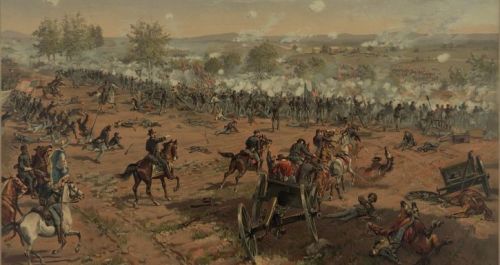
“A Glittering Forrest of Bayonets” Pickett’s Charge

picketss-charge

“Danger is part of the friction of war. Without an accurate conception of danger we cannot understand war. That is why I have dealt with it here.” Carl Von Clausewitz [1]

When commanders send their troops into battle to execute the plans of their staff, they cannot forget that as Clausewitz noted that War is the province of danger and that:

“In the dreadful presence of suffering and danger, emotion can easily overwhelm intellectual conviction, and in the psychological fog it is so hard to form clear and complete insights that changes in view become more understandable and excusable….No degree of calm can provide enough protection: new impressions are too powerful, too vivid, and always assault the emotions as well as the intellect.” [2]

To re-engage our understanding of this issue is important, especially in the application of Mission Command where as General Martin Dempsey noted that “Understanding equips decision makers at all levels with the insight and foresight to make effective decisions, to manage the associated risks, and to consider second and subsequent order effects.” [3] The current and recent wars fought by the United States and its NATO and coalition allies have shielded many military professionals from this aspect of war, but it is still present and we should not ignore it. As noted in the 2006 edition of the Armed Forces Officer:

“The same technology that yields unparalleled success on the battlefield can also detach the warrior from the traditional ethos of the profession by insulating him or her from many of the human realities of war.” [4]

“The nature of the warrior leader is driven by the requirements of combat” [5]and courage, both “courage in the face of the danger, and the courage to accept responsibility” [6] are of paramount importance. In an era where the numbers of soldiers that actually experience combat or served in true combat conditions where the element of danger is ever present is shrinking, we can at least gain part of that understanding through the study of history, campaigns and battles and by actually walking the battlefields, and considering the effects of terrain, weather, exhaustion and the imagining danger faced in confronting an enemy on the field of battle. As such the Battle of Gettysburg and the climactic event of Pickett’s Charge on July 3rd is a good place to reimagine the element of danger.

Porter Alexander’s artillery had begun it’s bombardment at 1:07 p.m. and as it did and the Union artillery commenced a deliberate counter-fire the Confederate infantry behind Seminary Ridge began to take a beating. Unlike the Confederate barrage which had mainly sailed over the Union troops on Cemetery Ridge causing few causalities, “a large proportion” of the Union “long shots landed squarely in the ranks of the gray soldiers drawn up to await the order to advance.” [7] Estimates vary but the waiting Confederates lost between 300-500 killed and wounded, the most affected was Kemper’s brigade of Pickett’s division which lost about 250 men, or 15% of its strength. [8] Other units lost significant numbers, with those inflicted on Pettigrew’s brigades further depleting their already sparse numbers.

Composed of Pickett’s fresh division from First Corps, Heth’s battered division now under Pettigrew which had already taken close to 40% casualties. Of the two brigades of Pender’s division now commanded by Trimble, Lane’s which was fresh but Scales brigade, now under command of Colonel William Lowrence had suffered greatly on July 1st; its “casualty rate was 63% and it had lost its commander and no fewer than fifty-five field and company grade officers.” [9] And now, these battered the units began to take casualties from well directed Federal fire. George Stewart wrote: “In most armies, such a battered unit would have been sent to the rear for reorganization, but here it was being selected for a climactic attack!” [10]

“The Confederate losses mounted at an alarming rate. The psychological impact of artillery casualties was great, for the big guns not only killed but mangled bodies, tore them apart, or disintegrated them.” [11] A survivor wrote his wife days later: “If the crash of worlds and all things combustible had been coming in collision with each other, it could not have surpassed it seemingly. To me it was like the “Magazine of Vengeance” blown up.” [12] A soldier of Kemper’s brigade recalled “The atmosphere was rent and broken by the rust and crash of projectiles…The sun, but a few minutes before so brilliant, was now darkened. Through this smoky darkness came the missiles of death…the scene beggars description…Many a fellow thought his time had come…Great big, stout hearted men prayed, loudly too….” [13] Colonel Joseph Mayo of the 3rd Virginia regiment was heavily hit, one of its survivors wrote “when the line rose up to charge…it appeared that as many were left dead and wounded as got up.” [14]

On the opposite ridge Union forces were experiencing the same kind of intense artillery fire. But these effects were minimized due to the prevalent overshooting of the Confederate artillery as well as the poor quality of ammunition. This resulted in few infantry casualties with the worst damage being taken by a few batteries of artillery at the angle. Soldiers behind the lines took the worst beating, but “the routing of these non-combatants was of no military significance,” [15] This did create some problems for the Federals as Meade was forced to abandon their headquarters and the Artillery Reserve was forced to relocate “a little over a half mile to the rear.” [16] The effects of this on operations were minimal as Brigadier General Robert Tyler commanding the Artillery Reserve “posted couriers at the abandoned position, should Hunt want to get in touch with him.” [17]

Despite the fusillade Meade maintained his humor and as some members of his staff tried to find cover on the far side of the little farmhouse quipped:

“Gentlemen, are you trying to find a safe place?…You remind me of the man who drove the oxen team which took ammunition for the heavy guns to the field at Palo Alto. Finding himself in range, he tipped up his cart and hid behind it. Just then General Taylor came along and shouted “You damned fool, don’t you know you are no safer there than anywhere else?” The driver responded, “I don’t suppose I am general, but it kind of feels so.” [18]

Despite the unparalleled bombardment, the likes which not had been seen on the American continent, the Confederate artillery had little actual effect on the charge. The Prussian observer travelling with Lee’s headquarters “dismissed the barrage as a Pulververschwindung,”…a waste of powder. [19] The Federal infantry remained in place and ready to meet the assault, Hunt replaced his damaged batteries and even more importantly Lieutenant Colonel Freeman McGilvery’s massive battery was lying undetected where it could deliver devastating enfilade fire as were Rittenhouse’s batteries on Little Round Top and Osborne’s on Cemetery Hill. These guns, unaffected by the Confederate bombardment were poised to wreak destruction on the men of the three Confederate divisions.

Unlike the Federal Army which had its large pool of artillery battalions in the Artillery Reserve with which to replace batteries that had taken casualties or were running low on ammunition, and “soon the drivers of the caissons found that the heavy fire had exhausted their supply of shot and shell, and the had to go even farther to get it from the reserve train. As a result some of the guns remained mute and their gunners stood helpless during the cannonade and charge, for Alexander had no batteries in reserve to replace them.” [20] The reason for this was that the Confederates had reorganized their artillery before Chancellorsville with all batteries assigned directly to the three infantry corps leaving the army without a reserve, and because Brigadier General William Pendleton had relocated the artillery trains further to the rear without informing Alexander or Longstreet. He had also ordered the eight guns of the Richardson’s artillery away without notifying anyone, guns which Alexander was counting on to support the attack. At about 2:20 p.m. Alexander, knowing that he was running short of ammunition sent a note to Picket and Pettigrew advising them:

“General: If you are to advance at all, you must come at once or we will not be able to support you as we ought. But the enemy’s fire has not slackened and there are still 18 guns firing from the cemetery.” [21]
469px-Picketts-Charge

About twenty minutes later Alexander saw some of the guns along Cemetery Ridge begin to limber up and depart, and noticed a considerable drop off in Federal fire. Now confident that his guns had broken the Federal resistance, at 2:40 sent word to Pickett “For God’s sake come quick or my ammunition will not let me support you.” [22] However, what Alexander did not realize was that to conserve ammunition for the Confederate infantry charge Henry Hunt had ordered those batteries to withdraw and was replacing them with fresh batteries and had ordered an “immediate cessation and preparation for the assault to follow.” [23]

The message reached Pickett and Pickett immediately rode off to confer with Longstreet. Pickett gave the message to Longstreet who read it “and said nothing. Pickett said, “General, shall I advance!” Longstreet, knowing it had to be, but unwilling to give the word, turned his face away. Pickett saluted and said “I am going to move forward, sir” galloped off to his division and immediately put it in motion.” [24]

A few minutes later Longstreet rode to find Alexander. Meeting him at 2:45 and Alexander informed him of the shortage of ammunition, which upset him enough that he “seemed momentarily stunned” [25] by this news Longstreet told Alexander, “Stop Pickett immediately and replenish your ammunition.” [26] But Alexander now had to give Longstreet even worse news telling him “I explained that it would take too long, and the enemy would recover from the effect of our fire was then having, and too that we had, moreover, very little to replenish it with.” [27] Longstreet continued to ride with Alexander and again eyed the Federal positions on Cemetery Ridge with his binoculars and said I don’t want to make this attack,” pausing between sentences as if thinking aloud. “I believe it will fail- I do not know how it can succeed- I would not make it even now, but Gen. Lee has ordered it and expects it.” [28] Alexander, who as a battalion commander now in charge of First Corps artillery was uncomfortable, he later wrote:

“I had the feeling that he was on the verge of stopping the charge, & that with even slight encouragement he would do it. But that very feeling kept me from saying a word, or either assent I would not willingly take any responsibility in so grave a matter & I had almost a morbid fear of causing any loss of time. So I stood by, & looked on, in silence almost embarrassing.” [29]

While Longstreet was still speaking Pickett’s division swept out of the woods to begin the assault, Alexander knew that “the battle was lost if we stopped. Ammunition was too low to try anything else, for we had been fighting for three days. There was a chance, and it was not my part to interfere.” [30]

Despite this Pickett and many of his soldiers were confident of success, and “no officer reflected the men’s confidence better than George Pickett. There was no fatalism in him. Believing that his hour of destiny had come and expecting to take fortune at its flood, he rode down the slop like a knight in a tournament.” [31] Pickett was “an unforgettable man at first sight” [32] Pickett was exceptionally undistinguished in the West Point class of 1846, graduating last in the class, but “fought valiantly in a number of battles” [33] during the Mexican War alongside James Longstreet. Like many he officers he resigned his commission in 1861 and received a colonelcy in the new Confederate army. During the Seven Days battles he commanded a brigade, which was now commanded by Richard Garnett and was wounded at Gaines Mill. Promoted to Major General in the summer of 1862 Pickett received command of the division formerly commanded by David R. Jones. The division was sent to peripheral areas and took no part in the battles of late 1862 or Chancellorsville. Reduced from its five brigade strength due to the insistence of Jefferson Davis to leave forces to protect Richmond the division was built around the brigades of James Kemper, Lewis Armistead and Richard Garnett.

When Pickett’s division as well as those of Pettigrew and Trimble swept out of the wood to begin the attack the last chance to stop it ended. As Pickett’s brigades moved out he encouraged them shouting “Remember Old Virginia!” or to Garnett’s men “Up, men, and to your posts! Don’t forget today that you are from Old Virginia!” [34] But when Garnett asked if there were any final instructions Pickett was told “I advise you to make the best kind of time in crossing the valley; it’s a hell of an ugly looking place over yonder.” [35] Armistead called out to his soldiers, “Men, remember who you are fighting for! Your homes, your firesides, and your sweethearts! Follow Me!” [36]Armistead’s example had a major impact on his brigade, men were inspired, as one later wrote “They saw his determination, and they were resolved to follow their heroic leader until the enemy’s bullets stopped them.” [37] about 500 yards to Pickett’s left Pettigrew exhorted his men “for the honor of the good old North State, forward.” [38]

Pickett’s division “showed the full length of its long gray ranks and shining bayonets, as grand as a sight as ever a man looked on.” [39] The sight was impressive on both sides of the line, a Confederate Captain recalling the “glittering forest of bayonets” the two half mile wide formations bearing down “in superb alignment.” [40] even impressing the Federals. Colonel Philippe Regis de Trobriand, a veteran of many battles in Europe and the United States recalled “it was a splendid sight,” [41] and another recalled that the Confederate line ‘gave their line an appearance of being irresistible.” [42]

But the Federals were confident. Having withstood the Confederates for two days and having survived the artillery bombardment the Union men eagerly awaited the advancing Confederates. Directly facing the Confederate advance in the center of the Union line was the division of John Gibbon. The cry went out “Here they come! Here they come! Here comes the infantry!” [43] To the left of Gibbon Alexander Hays called to his men “Now boys look out…now you will see some fun!” [44]

The Confederates faced difficulties as they advanced, and not just from the Union artillery which now was already taking a terrible toll on the advancing Confederates. Stuck by the massed enfilade fire coming from Cemetery Hill and Little Round Top continued their steady grim advance. Carl Schurz from his vantage point on Cemetery Hill recalled:

“Through our field-glasses we could distinctly see the gaps torn in their ranks, the grass dotted with dark spots- their dead and wounded….But the brave rebels promptly filled the gaps from behind or by closing up on their colors, and unasked and unhesitatingly they continued with their onward march.” [45]

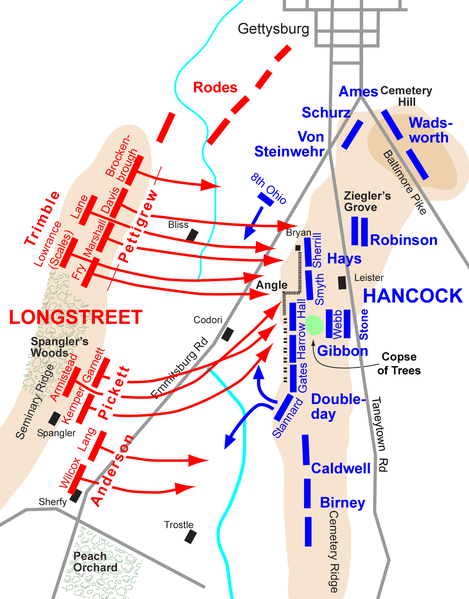
Pettigrew’s division was met by fire which enveloped them obliquely from Osborne’s 39 guns on Cemetery Hill. On the left flank a small regiment, the 8th Ohio lay in wait. Seeing an opportunity the commander Lieutenant Colonel Franklin Sawyer deployed his 160 men in a single line, took aim at Brockenbrough’s Virginia brigade some two hundred yards ahead of the Emmitsburg Road, and opened a devastating fire. “Above the boiling clouds the Union men could see a ghastly debris of guns, knapsacks, blanket rolls, severed human heads, and arms and legs and parts of bodies tossed into the air by the impact of the shot.” [46] So sudden and unexpected was this that the Confederates panicked and “fled in confusion…” to the rear where they created more chaos in Trimble’s advancing lines as one observed they “Came tearing through our ranks, which caused many men to break.” [47] The effect on Confederate morale was very important, for “the Army of Northern Virginia was not used to seeing a brigade, even a small one, go streaming off to the rear, with all its flags….Even Pickett’s men sensed that something disastrous had happened on the left….” [48]

In one fell swoop Pettigrew was minus four regiments. Brockenbrough was singularly ineffective in leading his men, he “was a nonentity who did not know how to control his recalcitrant rank and file; nor did he have the presence to impress his subordinate officers and encourage them to do his bidding.” [49] The disaster that had overtaken Brockenbrough’s brigade now threated “another important component of Lee’s plan-the protection so necessary for the left flank of the advancing line had collapsed.

Pettigrew’s division continued its advance after Brockenbrough’s brigade collapsed, but the Confederate left was already beginning to crumble. “Sawyer changed front, putting his men behind a fence, and the regiment began firing into the Confederate flank.” [50] with Davis’s brigade now taking the brunt of the storm of artillery shells from Osborne’s guns. This brigade had suffered terribly at the railroad cut on July 1st, especially in terms of field and company grade officers was virtually leaderless, and “the inexperienced Joe Davis was helpless to control them.” [51] To escape the devastating fire Davis ordered his brigade to advance at the double quick which brought them across the Emmitsburg Road ahead of the rest of the division, where they were confronted by enfilade canister fire from Woodruff’s battery to its left, as well as several regiments of Federal infantry and from the 12th New Jersey directly in their front. A New Jersey soldier recalled “We opened on them and they fell like grain before the reaper, which nearly annihilated them.” [52] Davis noted that the enemy’s fire “commanded our front and left with fatal effect.” [53] Davis saw that further continuing was hopeless and ordered his decimated brigade “to retire to the position originally held.” [54]

Pettigrew’s remain two brigades continued grimly on to the Emmitsburg Road, now completely devoid of support on their left flank. Under converging fire from Hay’s Federal troops the remaining troops of Pettigrew’s command were slaughtered. Hay’s recalled “As soon as the enemy got within range we poured into them and the cannon opened with grape and canister [, and] we mowed them down in heaps.” [55] The combination of shot, shell, canister and massed musket fire “simply erased the North Carolinian’s ranks.” [56] Pettigrew was wounded, Colonel Charles Marshall killed 50 yards from the stone wall and “only remnants of companies and regiments remained unscathed.” [57] Soon the assault of Pettigrew’s division was broken:

“Suddenly Pettigrew’s men passed the limit of human endurance and the lines broke apart and the hillside covered with men running for cover, and the Federal gunners burned the ground with shell and canister. On the field, among the dead and wounded, prostrate men could be seen holding up handkerchiefs in sign of surrender.” [58]

Trimble’s two brigades fared no better. Scales brigade, now under the command of Colonel W. Lee Lowrence “never crossed the Emmitsburg Road but instead took position along it to fire at the enemy on the hill. The soldiers from North Carolina who two days before had marched without flinching into the maw of Wainwright’s cannon on Seminary Ridge could not repeat the performance.” [59] Trimble was severely wounded in the leg and sent a message to Lane to take command of the division. The order written in the third person added a compliment to his troops: “He also directs me to say that if the troops he had the honor to command today for the first time couldn’t take that position, all hell can’t take it.” [60] Lane attempted to rally the troops for one last charge when one of his regimental commanders exploded telling him “My God, General, do you intend rushing your men into such a place unsupported, when the troops on the right are falling back?” [61] Lane looked at the broken remains of Pettigrew’s division retiring from the field and ordered a retreat. Seeing the broken remnants of the command retreating, an aide asked Trimble if the troops should be rallied. Trimble nearly faint from loss of blood replied: “No Charley the best these brave fellows can do is to get out of this,” so “let them get out of this, it’s all over.” [62] The charge was over on the Confederate left.

The concentrated Federal fire was just as effective and deadly on the Confederate right. Kemper’s brigade, on the right of Pickett’s advance was mauled by the artillery of Rittenhouse on Little Round Top, which “tracked their victims with cruel precision of marksmen in a monstrous shooting gallery” and the overs “landed their shots on Garnett’s ranks “with fearful effect.” [63]

As the Confederates advanced Pickett was forced to attempt to shift his division to the left to cover the gap between his and Pettigrew’s division. The move involved a forty-five degree oblique and the fences, which had been discounted by Lee as an obstacle which along the Emmitsburg Road “virtually stopped all forward movement as men climbed over them or crowed through the few openings.” [64] Pickett’s division’s oblique movements to join with Pettigrew’s had presented the flank of his division to McGilvery’s massed battery. The movement itself had been masterful, the execution of it under heavy fire impressive; however it meant the slaughter of his men who were without support on their right flank.

As Pickett’s division advanced into the Plum Run Valley they were met by the artillery of Freeman McGilvery, who wrote that the “execution of the fire must have been terrible, as it was over a level plain, and the effect was plain to be seen. In a few minutes, instead of a well-ordered line of battle, there were broken and confused masses, and fugitives fleeing in every direction.” [65]

Kemper’s brigade which had the furthest to go and the most complicated maneuvering to do under the massed artillery fire suffered more damage. The swale created by Plum Run was a “natural bowling alley for the projectiles fired by Rittenhouse and McGilvery.” [66] was now flanked by Federal infantry as it passed the Condori farm. The Federal troops were those of the Vermont brigade commanded by Brigadier General George Stannard. These troops were nine month volunteers recruited in the fall of 1862 and due to muster our in a few days. They were new to combat, but one of the largest brigades in the army and 13th Vermont “had performed with veteran like precision the day before” [67] leading Hancock to use them to assault the Confederate right. The Vermonters were positioned to pour fire into the Confederate flank, adding to the carnage created by the artillery, and the 13th and 16th Vermont “pivoted ninety degrees to the right and fired a succession of volleys at pistol range on the right of Pickett’s flank.” [68]

Kemper had not expected this, assuming that the Brigades of Wilcox and Perry would be providing support on the flank. As he asked a wounded officer of Garnett’s brigade if his wound was serious, the officer replied that he soon expected to be a prisoner and asked Kemper “Don’t you see those flanking columns the enemy are throwing on our right to sweep the field?” [69] Kemper was stunned but ordered his troops to rush federal guns, but “they were torn to pieces first by the artillery and then by the successive musketry of three and a half brigades of Yankee infantry.” [70] Kemper was fearfully wounded in the groin, no longer capable of command. His brigade was decimated and parts of two regiments had to refuse their line to protect the flank, and those that continued to advance had hardly any strength left with which to succeed, the Confederate left was no for all intents and purposes out of the fight.

Now that fight was left in the hands of Armistead and Garnett’s brigades, and at this moment in the battle, the survivors of those units approached the stone wall and the angle where they outnumbered the Federal defenders, one regiment of which, the 71st Pennsylvania had bolted to the rear.

The survivors of Garnett’s brigade, led by their courageous but injured commander, riding fully exposed to Federal fire on his horse crossed the Emmitsburg Road and pushed forward overwhelming the few Federals remaining at the wall. They reached the outer area of the angle “which had been abandoned by the 71st Pennsylvania” and some of his men “stood on the stones yelling triumphantly at their foes.” [71] Armistead, leap over the wall shouting to his men “Come on boys! Give them the cold steel”…and holding his saber high, still with the black hat balanced on its tip for a guidon, he stepped over the wall yelling as he did so: “Follow me!” [72]

However, their triumph was short lived; the 72nd Pennsylvania was rushed into the gap by the brigade commander Brigadier General Alexander Webb. The climax of the battle was now at hand and “the next few minutes would tell the story, and what that story would be would all depend on whether these blue-coated soldiers really meant it…. Right here there were more Confederates than Federals, and every man was firing in a wild, feverish haste, with smoke settling down thicker and thicker.” [73] The 69th Pennsylvania, an Irish regiment under Colonel Dennis O’Kane stood fast and their fire slaughtered many Confederates. Other Federal regiments poured into the fight, famous veteran regiments the 19th and 20th Massachusetts, the 7th Michigan and the remnants of the 1st Minnesota who had helped stop the final Confederate assault on July 2nd at such fearful cost.

Dick Garnett, still leading his troops “muffled in his dark overcoat, cheered his troops, waving a black hat with a silver cord” [74] when he was shot down, his frightened horse running alone off the battlefield, a symbol of the disaster which had befallen Pickett’s division. Armistead reached Cushing’s guns where he was hit by several bullets and collapsed mortally wounded. “Armistead had been the driving force behind the last effort, there was no one else on hand to take the initiative. Almost as quickly as it had come crashing in, the Rebel tide inside the outer angle ebbed back to the wall.” [75]

For a time the Confederate survivors engaged Webb’s men in a battle at the wall itself in a stubborn contest. A Federal regimental commander wrote “The opposing lines were standing as if rooted, dealing death into each other.” [76] The Federals launched a local counterattack and many Confederates elected to surrender rather than face the prospect of retiring across the battlefield that was still swept by Federal fire.

Webb had performed brilliantly in repulsing the final Confederate charge and “gained for himself an undying reputation. Faced with defeat, he accepted the challenge and held his men together through great personal exertion and a willingness to risk his life.” [77] For his efforts he was belatedly awarded the Medal of Honor.

Webb, like John Buford on July 1st, Strong Vincent, Freeman McGilvery and George Sears Greene on July 2nd, was instrumental in the Union victory. Hancock said of Webb “In every battle and on every important field there is one spot to which every army [officer] would wish to be assigned- the spot upon which centers the fortunes of the field. There was but one such spot at Gettysburg and it fell to the lot of Gen’l Webb to have it and to hold it and for holding it he must receive the credit due him.” [78]

The survivors of Pickett, Pettigrew and Trimble’s shattered divisions began to retreat, Lee did not yet understand that his great assault had been defeated, but Longstreet, who was in a position to observe the horror was. He was approached by Lieutenant Colonel Arthur Fremantle, a British observer from the Coldstream Guards. Fremantle did not realize that the attack had been repulsed, having just seen one of Longstreet’s regiments “advancing through the woods in good order” and unwisely bubbled “I would not have missed this for anything.” [79] Longstreet replied with a sarcastic laugh “The devil you wouldn’t” barked Longstreet. “I would have liked to have missed this very much; we’ve attacked and been repulsed. Look there.” [80] Fremantle looked out and “for the first time I then had a view of the open space between the two positions, and saw it covered with Confederates slowly and sulkily returning towards us in small broken parties, under a heavy fire of artillery.” [81] Henry Owen of the 18th Virginia wrote that the retreating men “without distinction of rank, officers and privates side by side, pushed, poured and rushed in a continuous stream, throwing away guns, blankets, and haversacks as they hurried on in confusion to the rear.” [82]

It was a vision of utter defeat. Pickett, who had seen his division destroyed and had been unable to get it additional support was distraught. An aide noted that Pickett was “greatly affected and to some extent unnerved” [83] by the defeat. “He found Longstreet and poured out his heart in “terrible agony”: “General, I am ruined; my division is gone- it is destroyed.” [84] Lee had come up by now and attempted to comfort Pickett grasping his hand and telling him: “General, your men have done all that they could do, the fault is entirely my own” and instructed him that he “should place his division in the rear of this hill, and be ready to repel the advance of the enemy should they follow up their advantage.” [85] The anguished Pickett replied, “General Lee, I have no division now. Armistead is down, Garnett is down and Kemper is mortally wounded.” [86]

picketts charge1

Pickett’s charge was over, and with it the campaign that Lee had hoped would secure the independence of the Confederacy was effectively over, and the Battle of Gettysburg lost. “Lee’s plan was almost Burnside-like in its simplicity, and it produced a Fredericksburg with the roles reversed.” [87]

It was more than a military defeat, but a political one as well for with it went the slightest hope remaining of foreign intervention. As J.F.C. Fuller wrote “It began as a political move and it had ended in a political fiasco.” [88]


[1] Clausewitz, Carl von. On War Indexed edition, edited and translated by Michael Howard and Peter Paret, Princeton University Press, Princeton NJ 1976 p.114

[2] Ibid. Clausewitz On War p.108

[3] Dempsey, Martin Mission Command White Paper 3 April 2012 p.5 retrieved ( July 2014 from http://www.dtic.mil/doctrine/concepts/white_papers/cjcs_wp_missioncommand.pdf

[4] ___________. The Armed forces OfficerU.S. Department of Defense Publication, Washington DC. January 2006 p.18

[5] Ibid. The Armed Forces Officer p.18

[6] Ibid. Clausewitz On War p.101

[7] Foote, Shelby, The Civil War, A Narrative. Volume Two Fredericksburg to Meridian Random House, New York 1963 p.548

[8] Gottfried, Bradley The Artillery of Gettysburg Cumberland House Publishing, Nashville TN 2008 p.

[9] Sears, Stephen W. Gettysburg. Houghton Mifflin Co. Boston and New York 2003 p.387

[10] Stewart, George R. Pickett’s Charge: A Micro-History of the Final Attack at Gettysburg, July 3rd 1863Houghton Mifflin Company Boston 1959

[11] Hess, Earl J. Picketts Charge: The Last Attack at Gettysburg University of North Carolina Press, Chapel Hill and London 2001 p.153

[12]Wert, Jeffery D. Gettysburg Day Three A Touchstone Book, New York 2001 p.181

[13] Dowdy, Clifford. Lee and His Men at Gettysburg: The Death of a Nation Skyhorse Publishing, New York 1986, originally published as Death of a Nation Knopf, New York 1958 p.294

[14] Ibid. Wert Gettysburg Day Three p.179

[15] Ibid. Stewart Pickett’s Charge p.132

[16] Coddington, Edwin B. The Gettysburg Campaign: A Study in Command, A Touchstone Book, Simon and Schuster New York, 1968 p.496

[17] Ibid. Coddington The Gettysburg Campaign p.496

[18] Huntington, Tom Searching for George Gordon Meade: The Forgotten Victor of GettysburgStackpole Books, Mechanicsburg PA 2013 p.171

[19] Ibid. Hess Pickett’s Charge p.163

[20] Ibid. Coddington The Gettysburg Campaign p.499

[21] Trudeau, Noah Andre. Gettysburg: A Testing of Courage, Harper Collins Publishers, New York 2002 p.459

[22] Ibid. Coddington The Gettysburg Campaign p.500

[23] Hunt, Henry The Third Day at Gettysburg in Battles and Leaders of the Civil Waredited by Bradford, Neil Meridian Press, New York 1989 p.374

[24] Alexander, Edwin Porter. The Great Charge and the Artillery Fighting at Gettysburg, in Battles and Leaders of the Civil Waredited by Bradford, Neil Meridian Press, New York 1989 p.364

[25] Ibid. Coddington The Gettysburg Campaign p.501

[26] Ibid. Alexander The Great Charge and the Artillery Fighting at Gettysburg p.365

[27] Ibid. Alexander The Great Charge and the Artillery Fighting at Gettysburg p.365

[28] Ibid. Trudeau. Gettysburg: A Testing of Courage pp.474-475

[29] Ibid. Alexander The Great Charge and the Artillery Fighting at Gettysburg p.365

[30] Alexander, Edward Porter. Fighting for the Confederacy: The Personal Recollections of General Edward Porter Alexander edited by Gary Gallagher University of North Carolina Press, Chapel Hill 1989 p.261

[31] Ibid. Dowdy Lee and His Men at Gettysburg p.313

[32] Ibid. Wert Gettysburg Day Three p.109

[33] Ibid. Hess Pickett’s Charge p.37

[34] Guelzo, Allen C. Gettysburg: The Last InvasionVintage Books a Division of Random House, New York 2013 p.408

[35] Ibid. Hess Pickett’s Charge p.166

[36] Ibid. Hess Pickett’s Charge p.167

[37] Ibid. Hess Pickett’s Charge p.167

[38] Ibid. Trudeau. Gettysburg: A Testing of Courage p.483

[39] Ibid. Alexander The Great Charge and the Artillery Fighting at Gettysburg p.365

[40] Ibid. Foote The Civil War, A Narrative. Volume Two p.553

[41] Ibid. Guelzo Gettysburg: The Last Invasion p.407

[42] Ibid. Hess Pickett’s Charge p.193

[43] Ibid. Hess Pickett’s Charge p.193

[44] Ibid. Guelzo Gettysburg: The Last Invasion p.411

[45] Ibid. Sears Gettysburg p.422

[46] Catton, Bruce The Army of the Potomac: Glory Road Doubleday and Company, Garden City New York, 1952 p.318

[47] Ibid. Sears Gettysburg p.423

[48] Ibid. Stewart Pickett’s Charge: A Micro-History of the Final Attack at Gettysburg pp.193-194

[49] Ibid. Hess Pickett’s Charge p.187

[50] Ibid. Stewart Pickett’s Charge: A Micro-History of the Final Attack at Gettysburg p.193

[51] Ibid. Dowdy Lee and His Men at Gettysburg p.311

[52] Ibid. Trudeau. Gettysburg: A Testing of Courage p.494

[53] Ibid. Sears Gettysburg p.425

[54] Ibid. Trudeau. Gettysburg: A Testing of Courage p.494

[55] Ibid. Trudeau. Gettysburg: A Testing of Courage p.502

[56] Ibid. Wert Gettysburg Day Three p.216

[57] Ibid. Wert Gettysburg Day Three p.218

[58] Ibid. Catton The Army of the Potomac: Glory Road p.318

[59] Ibid. Trudeau. Gettysburg: A Testing of Courage p.504

[60] Ibid. Stewart Pickett’s Charge: A Micro-History of the Final Attack at Gettysburg pp.238-239

[61] Ibid. Trudeau. Gettysburg: A Testing of Courage p.504

[62] Ibid. Guelzo Gettysburg: The Last Invasion p.425

[63] Ibid. Foote The Civil War, A Narrative. Volume Two p.555

[64] Ibid. Coddington The Gettysburg Campaign p.503

[65] Ibid. Gottfried The Artillery of Gettysburg p.217

[66] Ibid. Hess Pickett’s Charge p.220

[67] Ibid. Coddington The Gettysburg Campaign p.515

[68] Ibid. Coddington The Gettysburg Campaign p.515

[69] Ibid. Trudeau. Gettysburg: A Testing of Courage p.502

[70] Ibid. Sears Gettysburg p.448

[71] Ibid. Trudeau. Gettysburg: A Testing of Courage p.505

[72] Ibid. Foote The Civil War, A Narrative. Volume Two p.562

[73] Ibid. Catton The Army of the Potomac: Glory Road p.319

[74] Ibid. Dowdy Lee and His Men at Gettysburg p.317

[75] Ibid. Trudeau Gettysburg p.508

[76] Ibid. Sears Gettysburg p.451

[77] Ibid. Coddington The Gettysburg Campaign p.528

[78] Ibid. Coddington The Gettysburg Campaign p.528

[79] Fremantle, Arthur Three Months in the Southern States, April- June 1863 William Blackwood and Sons, Edinburgh and London 1863 Amazon Kindle edition p.285

[80] Wert, Jeffry D. General James Longstreet The Confederacy’s Most Controversial Soldier, A Touchstone Book, Simon and Schuster, New York and London 1993 p.292

[81] Ibid. Fremantle Three Months in the Southern States p.287

[82] Ibid. Sears Gettysburg p.456

[83] bid. Hess Pickett’s Charge p.326

[84] Ibid. Guelzo Gettysburg: The Last Invasion p.428

[85] Ibid. Guelzo Gettysburg: The Last Invasion p.428

[86] Ibid. Hess Pickett’s Charge p.326

[87] Millet, Allan R. and Maslowski, Peter, For the Common Defense: A Military History of the United States The Free Press a Division of Macmillan Inc. New York, 1984 p.206

[88] Fuller, J.F.C. Grant and Lee: A Study in Personality and Generalship, Indiana University Press, Bloomington IN 1957 pp.200-201

 

Leave a comment

Filed under civil war, History, leadership, Military

Gettysburg Day One: Inexperience and Hubris Meets Calculating Experience; Harry Heth Blunders into Battle against John Buford

burford june 30th

Despite the warnings of Johnston Pettigrew, Major General Harry Heth with the approval and blessing of his corps commander Lieutenant General A.P. Hill arose on the morning of July 1st 1863 and formed his division for its march to Gettysburg. But it was an inauspicious start to a very bad day for Heth and his division. Somehow orders had not gotten to his units to begin the advance at 5 a.m. and “there was haste to the early morning’s preparations that caught some off guard” even regimental commanders. [1]

During the night Of June 30th 1863 the actions of A.P. Hill show a commander who confused and uncertain. The confidence that he and Heth showed in rejecting Pettigrew and Young’s reports of Federal troops in Gettysburg left “most, if not all the commanding officers in Hill’s corps…unprepared for what happened.” [2] Lieutenant Lewis Young wrote “I doubt if any of the commanders of brigades, except General Pettigrew, believed that we were marching to battle, a weakness on their part which rendered them unprepared for what was about to happen.” [3]

Hill sent a message to Ewell of Second Corps telling that officer that “I intended to advance the next morning and discover what was in my front” [4] and sent word of Pettigrew’s discovery of Union cavalry to Lee’s headquarters, but his warning apparently gave Lee little cause for concern. Porter Alexander noted that on the night of June 30th that he visited Lee’s headquarters and found conversation to be “unusually careless & jolly. Certainly there was no premonition that the next morning was to open a great battle of the campaign.” [5] Hill also sent a courier to Anderson instructing him to bring up his division on Jul 1st and instructed Heth that “Pender’s division also would be ordered through Cashtown as a reserve to be available if Heth ran into serious trouble.” [6]

Since a reconnaissance is normally conducted by small elements, the fact that Hill committed his two divisions present to such a mission demonstrated his confusion of both the nature of what he might face and to the intentions of Robert E. Lee. One has to remember that Lee, like his corps commanders was operating blind, in part due to Stuart’s absence but also due to the poor employment of the cavalry that should have been available to them. Hill and Heth had no idea what they faced at Gettysburg and disregarded the warnings of his own people. Thus it is hard to believe that Hill did not expect the possibility of action. Likewise it is distinctly possible that Heth, despite his orders “may have had more on his mind than shoes and information when he made his advance towards Gettysburg.” [7]

Several critics have made this point, among them Major John Mosby the Confederate cavalry leader and guerrilla fighter who wrote: “Hill and Heth in their reports, to save themselves from censure, call the first day’s action a reconnaissance; this is all an afterthought….They wanted to conceal their responsibility for the defeat.” [8] A more contemporary writer, Jennings Wise noted that Hill’s orders “were specific not to bring on an action, but his thirst for battle was unquenchable, and…he rushed on, and…took the control of the situation out of the hands of his commander-in-chief.” [9] Heth in later years made an unsubstantiated claim that “A courier came from Gen. Lee, with a dispatch ordering me to get those shoes even if I encountered some resistance.” [10] That appears unlikely as Mosby noted that no one ordered Hill to advance and Lee “would never have sanctioned it.” [11] Neither Lee or any of his staff collaborate Heth’s claim and the judicious Porter Alexander who had been in Lee’s headquarters the night of June 30th wrote that “Hill’s movement to Gettysburg was made on his own accord, and with knowledge that he would find the enemy’s cavalry in possession.” [12]

The advance to contact was marred by Heth’s inexperience compounded by the illness of A.P. Hill who on the morning of July 1st had “awakened feeling very ill, too sick to mount his horse…although no diagnosis was made, he was probably suffering from overstrained nerves.” [13] Hill’s absence left Heth, an inexperienced division commander “without any sage counsel” [14] and Heth began to commit a series of costly errors. Heth understood from Hill that his mission was a job that normally would be assigned to cavalry: “to ascertain what force was at Gettysburg, and if he found infantry opposed to him, to report the fact immediately, without forcing an engagement.” [15]

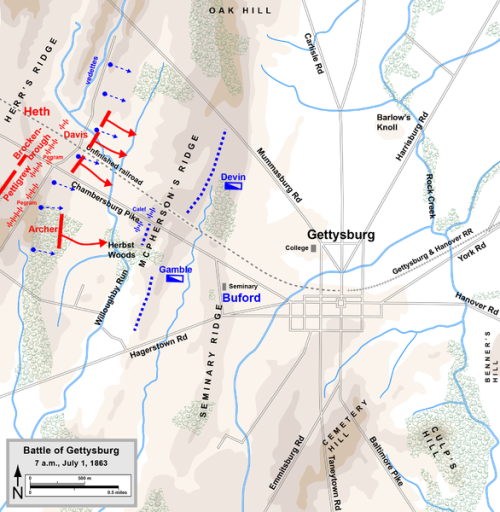
Heth advanced without the caution of a commander who had been told that enemy forces were likely opposing him. Even though he disbelieved the reports some amount of judicious caution should have been indicated. Instead, for reasons unknown Heth had his men advance as if they were conducting a routine movement. He led his advance with his assigned artillery battalion commanded by Major William Pegram. He followed with Archer’s veteran but depleted brigade and Davis’s inexperienced brigade. To compound Davis’s situation that commander led his movement with his new and untested regiments the 42nd Mississippi and 55th North Carolina leaving his veteran regiments the 2nd and 11th Mississippi in the rear guarding army stores. [16] It was a curious order of march for it left Johnston’s Pettigrew’s brigade behind both Archer and Davis’s brigades despite the fact that it was closer to Gettysburg than any other brigade and had recent eyes on contact with the enemy and knew the ground and what was ahead of them. Pettigrew’s brigade was followed by Colonel John Brockenbrough’s Virginia brigade. It is hard to know why Heth did this but one can speculate that it might have been because of Pettigrew’s insistence of the type of Federal forces in their front the previous day which caused Heth to do this.

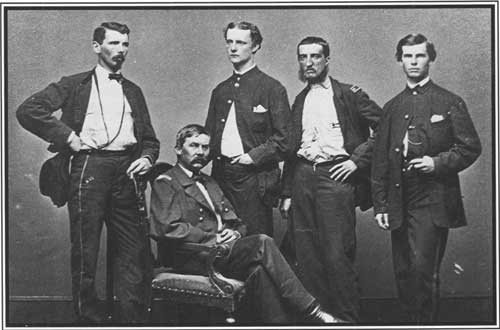
buford and staff

Buford and His Staff

As Heth’s troops advanced to Marsh Creek they encountered the cavalry videttes or pickets of the 8th Illinois Cavalry posted on the high ground just east of the creek. [17] The discovery of these forces was unanticipated by the Confederates leading the column. One of Pegram’s gunners recalled: “We moved forward leisurely smoking and chatting as we rode along, not dreaming of the proximity of the enemy.” [18] Most assumed that the movement “was simply one more part of the army’s concentration of forces” and Brockenbrough told the commander of the 55th Virginia that “we might meet some of Ewell’s command or Stuarts.” [19] Pettigrew had attempted to warn Archer prior to the march of the topography of the area and “a certain road which the Yankees might use to hit his flank, and the dangers of McPherson’s Ridge. Archer listened, believed not, marched on unprepared…” [20] Heth, who should have better anticipated the situation based on Pettigrew’s reports of the previous day demonstrated why one author called him “an intellectual lightweight.” [21] Heth told an officer from the Army of the Potomac after the war “I did not know any of your people were north of the Potomac.” [22]

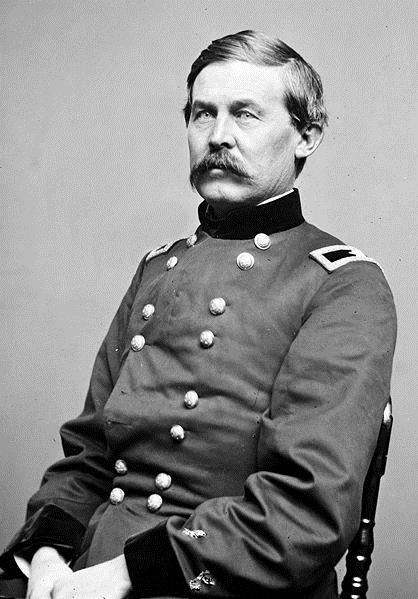
If Heth was inexperienced and knew little of the Federal forces arrayed before him and what forces were moving towards Gettysburg, his opponent, Brigadier General John Buford was his opposite in nearly every respect. Buford was born in Kentucky and came from a long line of family who had fought in both the Revolutionary War and War of 1812. He was an 1848 graduate of West Point who was commissioned in the Dragoons but too late to serve in Mexico. Instead he served on the Great Plains against the Sioux and on peacekeeping duty in the bitterly divided State if Kansas. Later he served in the Utah War in 1858. His family held Southern sympathies; his father was a Democrat who had opposed Abraham Lincoln.

buford

At the beginning of the war, the governor of Kentucky offered Buford a commission in that states’ militia. At the time Kentucky was still an “undeclared border slave state” and Buford loyal to his oath refused and wrote later “I sent him word that I was a Captain in the United States Army and I intend to remain one.” [23] However his southern ties kept him from field command until the politically well connected by ill-fated, Major General John Pope “could unreservedly vouch for his loyalty wrangled for him command of a brigade of cavalry.” [24] After Pope’s defeat at Second Bull Run in August 1862 Buford returned to staff duties until January 1863 when he was again given a brigade.

Buford was passed over by Hooker for command of the new cavalry corps in favor of Alfred Pleasanton who was eleven days his senior when Hooker reorganized the army before Chancellorsville. In later years Hooker agreed that Buford “would have been a better man for the position of chief” [25] for the Cavalry Corps, but in retrospect Buford’s passover for corps command was good fortune for the Army of the Potomac on June 30th and July 1st 1863. Despite being passed over, Buford a consummate professional, fought well at Brandy Station for which he was recommended for promotion and command of his division. [26]

On the night of June 30th Buford prepared for battle. Unlike Hill and Heth he understood exactly what he was facing. He met with “reliable men” most likely from the Bureau of Military Intelligence operated by David McConaughy as to the composition of Lee’s forces. [27] Buford knew his business; he took the time to reconnoiter the ridges west of Gettysburg and posted videttes as far was as Marsh Creek. He deployed one brigade under Colonel Thomas Devin to the north and west of the town, Colonel William Gamble’s brigade was deployed to the west, its main line being on McPherson’s ridge. Buford planned “a defense in depth, fighting his men dismounted, using the series of ridgelines west of Gettysburg to hamper and delay the Rebel infantry he was certain would come “booming along” the Chambersburg Pike in the morning.” [28]

Noting that the ground was favorable to defense and giving battle Buford sent messages to Reynolds as to the situation. He warned Reynolds that “A.P. Hill’s corps is massed just back of Cashtown, about 9 miles from this place.” He also noted the location of Confederate pickets only four miles west of Gettysburg.” [29] Devin’s troops also identified elements of Ewell’s corps north of the town. Buford had accurately informed his superiors of what was before him, information that they needed for the day of battle.

gburg delaying action

According to his signals officer, Buford spent the night “anxious, more so than I ever saw him” [30] He discussed the situation with Devin who did not believe that the Confederates would move on Gettysburg in the morning. Devin thought if there were any threats that “he could handle anything that could come up in the next 24 hours.” [31] Buford rejected Devin’s argument and told him “No you won’t…. They will attack you in the morning and they will come booming – skirmishers three deep. You will have to fight like the devil to hold your own.” [32]

Reynolds, seeing the importance of the position elected to fight. He “ordered Buford to hold onto it to the last” believing that if Buford could “buy enough time, he might get his infantry into line “before the enemy should seize the point.” [33]

As Archer and Davis’s troops advanced in the early hours of July 1st their march was uneventful until they reached Marsh Creek. There they encountered the men of the 8th Illinois, one of whom, Lieutenant Marcellus Jones, took a carbine from one of his sergeants saying “Hold on George, give me the honor of opening this ball” and at about 7:30 a.m. Jones fired the first shot of the battle of Gettysburg. [34]

Heth had wanted to advance in column as long as possible “but the Yankee cavalry’s stiff resistance had ended that hope.” [35] Heth rode forward and ordered Archer and Davis’s troops to advance skirmishers with the support of Pegram’s artillery. This slowed the Confederate advance considerably. Heth wrote in his after action report that “it became evident that there were infantry, cavalry and artillery in and around the town.” [36] But instead of “feeling out the enemy” as directed by Hill, Heth “ordered Archer and Davis “to move forward and occupy the town.” [37] A chaplain in Brockenbrough’s brigade reported that one of Heth’s aide’s came up and reported “General Heth is ordered to move on Gettysburg, and fight or not as he wishes.” The chaplain heard one of the officers near him say “We must fight them; no division general will turn back with such orders.” [38]

The fight that Harry Heth and A.P. Hill had been directed not to precipitate was now on. Heth’s inexperience more than matched by the cunning and brilliant Buford, whose troopers now fought a masterful delaying action which enabled Reynolds to come up.
Notes

[1] Tredeau, Noah Andre. Gettysburg: A Testing of Courage, Harper Collins Publishers, New York 2002 p.153

[2] Coddinton, Edwin B. The Gettysburg Campaign, A Study in Command A Touchstone Book, Simon and Shuster New York 1968 p.264

[3] Pfanz Harry W. Gettysburg: The First Day University of North Carolina Press, Chapel Hill and London 2001 p.51

[4] Gallagher, Gary. Confederate Corps Leadership on the First Day at Gettysburg: A.P. Hill and Richard S. Ewell in a Difficult Debut in The First Day at Gettysburg edited by Gallagher, Gary W. Kent State University Press, Kent Ohio 1992 p.44

[5] Ibid. Coddington The Gettysburg Campaign, A Study in Command p.264

[6] Dowdy, Clifford. Lee and His Men at Gettysburg: The Death of a Nation Skyhorse Publishing, New York 1986, originally published as Death of a Nation Knopf, New York 1958 pp. 92

[7] Ibid. Coddington The Gettysburg Campaign, A Study in Command p.274

[8] Ibid. Gallagher Confederate Corps Leadership on the First Day at Gettysburg p.32

[9] Ibid. Gallagher Confederate Corps Leadership on the First Day at Gettysburg p.32

[10] Ibid. Tredeau Gettysburg: A Testing of Courage, p.153

[11] Ibid. Gallagher Confederate Corps Leadership on the First Day at Gettysburg p.32

[12] Alexander, Edward Porter Military Memoirs of a Confederate: A Critical Narrative 1907 republished 2013 by Pickle Partners Publishing, Amazon Kindle Edition location 7342 of 12968

[13] Dowdy.Lee and His Men at Gettysburg: The Death of a Nation pp.91-92

[14] Ibid. Tredeau Gettysburg: A Testing of Courage, p.153

[15] Guelzo, Allen C. Gettysburg: The Last Invasion Vintage Books a Division of Random House, New York 2013 p.131

[16] Ibid. Tredeau Gettysburg: A Testing of Courage, p.156

[17] Pfanz. Gettysburg: The First Day p.53

[18] Sears, Stephen W. Gettysburg. Houghton Mifflin Co. Boston and New York 2003 p. 162

[19] Ibid. Guelzo. Gettysburg: The Last Invasion p.134

[20] Ibid. Coddington The Gettysburg Campaign, A Study in Command p.264

[21] Ibid. Guelzo. Gettysburg: The Last Invasion p.134

[22] Ibid. Sears Gettysburg p. 162

[23] Ibid. Guelzo. Gettysburg: The Last Invasion p.121

[24] Ibid. Guelzo. Gettysburg: The Last Invasion p.121

[25] Ibid. Coddington The Gettysburg Campaign, A Study in Command p.44

[26] Ibid. Coddington The Gettysburg Campaign, A Study in Command p.64

[27] Ibid. Tredeau Gettysburg: A Testing of Courage, p.141

[28] Ibid. Sears Gettysburg p. 157

[29] Ibid. Guelzo. Gettysburg: The Last Invasion p.122

[30] Ibid. Sears Gettysburg p. 157

[31] Catton, Bruce The Army of the Potomac: Glory Road Doubleday and Company, Garden City New York, 1952 p.266

[32] Ibid. Guelzo. Gettysburg: The Last Invasion p.123

[33] Ibid. Guelzo. Gettysburg: The Last Invasion pp.122-123

[34] Pfanz. Gettysburg: The First Day p.53

[35] Ibid. Sears Gettysburg p. 163

[36] Luvaas, Jay and Nelson Harold W editors. The U.S. Army War College Guide to the Battle of Gettysburg South Mountain Press, Carlisle PA 1986 p.7

[37] Ibid. Sears Gettysburg p. 165

[38] Ibid. Tredeau Gettysburg: A Testing of Courage, p.163

Leave a comment

Filed under civil war, History, leadership, Military

“A Spirit of Unbelief”: A.P. Hill, Harry Heth and the Prelude to the Battle of Gettysburg

Hill.28135413_stdLieutenant General A.P. Hill

Note: One of the most important things to understand about the Battle of Gettysburg or for that matter any battle or campaign is leadership as well as organizational structure and climate of command. The study of A.P. Hill’s Third Corps is important to understanding how the battle unfolds and what happens at Gettysburg particularly on July 1st. In our understanding “Successful mission command demands that subordinate leaders at all echelons exercise disciplined initiative, acting aggressively and independently to accomplish the mission. Essential to mission command is the thorough knowledge and understanding of the commander’s intent at every level of command.”

While the leaders at Gettysburg on both sides would be unaware of our present definition they certainly would have been acquainted with the maxims of Napoleon, who many studied under Dennis Hart Mahan at the West Point. Napoleon noted: “What are the conditions that make for the superiority of an army? Its internal organization, military habits in officers and men, the confidence of each in themselves; that is to say, bravery, patience, and all that is contained in the idea of moral means.”

Likewise in a maxim that has direct application to the Confederate campaign in Pennsylvania Napoleon noted “To operate upon lines remote from each other and without communications between them, is a fault which ordinarily occasions a second. The detached column has orders only for the first day. Its operations for the second day depend on what has happened to the main body. Thus according to circumstances, the column wastes its time in waiting for orders or it acts at random….” [1]

I have spent more time in this chapter developing the issues of organization, leadership, climate of command and relationships between leaders because of their importance to the campaign. From these students should be able to draw lessons that would be applicable to leadership, organization and campaigning at the operational level of war.

As the Army of Northern Virginia began to concentrate near Cashtown after the reports that the Army of the Potomac was in Maryland it was Lieutenant General A.P. Hill’s Third Corps that was nearest to Gettysburg. Major General Harry Heth’s division led the corps and arrived on June 29th followed by Major General Dorsey Pender’s division on the 30th. Hill ordered his last division under the command of Major General Richard Anderson to remain behind and join the corps on July 1st. [2]

On the 30th Harry Heth sent Johnston Pettigrew’s Brigade to Gettysburg to “search the town for army supplies (shoes especially), and to return the same day.” [3] It was the first in a series of miscalculations that brought Lee’s army into a general engagement that he wished to avoid.

The Confederate Third Corps commanded by Lieutenant General Ambrose Powell (A.P.) Hill had been formed as part of the reorganization of the army following Stonewall Jackson’s death after the Battle of Chancellorsville. Hill had a stellar reputation as a division commander; his “Light Division” had distinguished itself on numerous occasions, especially at Antietam where its timely arrival after a hard forced march from Harper’s Ferry helped save Lee’s army late in the battle. At Chancellorsville Hill briefly succeeded Jackson until he too was wounded.

But that being said Hill was no stranger to controversy, beginning with a clash with James Longstreet during the Seven Days battles in which time Longstreet placed Hill under arrest and Hill challenged Longstreet to a duel. Lee quickly reassigned Hill to Jackson’s command as Jackson was operating in a semi-independent assignment. [4] Hill was in an intractable controversy with Stonewall Jackson for nearly a year until Jackson succumbed to his wounds. Jackson at one point during the invasion of Maryland prior to Antietam had Hill placed under arrest for the number of stragglers that he observed in Hill’s hard marching division as well as other errors that Jackson believed Hill had made. The dispute continued and the animosity deepened between the two men and in January 1863 Hill asked Lee for a trial by courts-martial on charges preferred against him by Jackson. Lee refused this and wrote to Hill: “Upon examining the charges in question, I am of the opinion that the interests of the service do not require that they be tried, and therefore, returned them to General Jackson with an indorsement to that effect….” [5] Just before Chancellorsville Jackson wrote to Lee “I respectfully request that Genl. Hill be relieved of duty in my Corps.” This time Lee simply ignored the request and though the two generals remained at loggerheads they also remained at their commands at Chancellorsville. [6]

Hill was recommended for promotion to Lieutenant General and command of the new Third Corps by Lee on May 24th and was promoted over the heads of Harvey Hill and Lafayette McLaws. The move displeased Longstreet who considered McLaws “better qualified for the job” and but who felt that the command should have gone to Harvey Hill whose “record was as good as that of Stonewall Jackson…but, not being a Virginian, he was not so well advertised.” [7]

Hill was slightly built and high strung. “Intense about everything” Hill was “one of the army’s intense disbelievers in slavery.” [8] Hill was an 1847 graduate of West Point and briefly served in Mexico but saw no combat. He spent some time in the Seminole wars and in garrison duty along the East Coast, spending 1855-1860 in the Coastal Survey and resigned his commission before Virginia’s secession. At the outbreak of the war he “received his commission as colonel, and soon trained one of Johnston’s best regiments in the Valley.” [9] He commanded a brigade under Longstreet on the Peninsula and was promoted to Major General and command of a division in May 1862. He was plagued by health problems which had even delayed his graduation from West Point, health issues that would arise on the first day at Gettysburg.

Hill’s Third Corps was emblematic of the “makeshift nature of the reorganization of the whole army.” [10] It was composed of three divisions; the most experienced being that of the recently promoted and hard fighting Major General Dorsey Pender. Pender’s division, was built around four excellent brigades from Hill’s old “Light Division” one of which Pender had commanded before his promotion. Hill strongly recommended Pender’s promotion which was accepted by Lee. Pender found the command to be a heavy burden. He was “an intelligent, reflective man, deeply religious and guided by a strong sense of duty….” [11]

Hill’s second experienced division was that of Major General Richard Anderson, transferred from Longstreet’s First Corps, something else which failed to endear Hill to Longstreet. [12] The unassuming Anderson had distinguished himself as a brigade and division commander in Longstreet’s corps, but in “an army of prima donnas, he was a self-effacing man, neither seeking praise for himself nor winning support by bestowing it on others.” [13] At Chancellorsville he fought admirably and Lee wrote that Anderson was “distinguished for the promptness, courage and skill with which he and his division executed every order.” [14] With four seasoned brigades under excellent commanders it was a good addition to the corps, although the transition from Longstreet’s stolid and cautious style of command to Hill’s impetuous style introduced “another incalculable of the reshuffled army.” [15]

heth

Major General Harry Heth

Major General Harry Heth’s division was the final infantry division assigned to the corps. This division was recently formed from two brigades of Hill’s old Light Division and “the two new brigades that Jefferson Davis had forced on an already disrupted army organization.” [16] The organization of this division as well as its leadership would be problematic in the days to come, especially on June 30th and July 1st 1863.

Heth like Pender was also newly promoted to his grade and the action at Gettysburg would be his first test in division command. Heth was a native Virginian, well connected politically who through his social charm had “many friends and bound new acquaintances to him” readily. [17] Heth was a West Point graduate who had an undistinguished academic career graduating last in the class of 1847. His career in the ante-bellum army was typical of many officers, he served “credibly in an 1855 fight with Sioux Indians” but his real claim to fame was in authoring the army’s marksmanship manual which was published in 1858. [18]

Heth’s career with the Confederate army serving in western Virginia was undistinguished but he was a protégé of Robert E. Lee who recommended him as a brigade commander to Jackson before Chancellorsville. Tradition states that of all his generals that Heth was the only one “whom Lee called by his first name.” [19] A.P. Hill when writing Lee about the choice of a successor for the Light Division noted that Heth was “a most excellent officer and gallant soldier” but in the coming campaign “my division under him, will not be half as effective as under Pender.” [20] Douglas Southall Freeman noted that Heth was “doomed to be one of those good soldiers…who consistently have bad luck.” [21]

Heth’s division was composed of two depleted brigades from the Light Division which had taken heavy casualties at Chancellorsville. The brigade commanded by James Archer from Alabama and Mississippi was “well led and had a fine combat reputation.” But the second brigade was more problematic. A Virginia brigade it had once been considered one of the best in the army had deteriorated in quality following the wounding of its first commander Brigadier General Charles Field. Heth took command of it at Chancellorsville and both he and the brigade performed well, but when Heth was promoted the lack of qualified officers left it under the command of its senior colonel, John Brockenbrough. [22] His third brigade came from Mississippi and North Carolina and was commanded by Brigadier General Joe Davis whose uncle was President Jefferson Davis. Davis had served on his uncle’s staff for months and had no combat experience. [23] One author noted that Davis’s promotion to Brigadier General “as unadulterated an instance of nepotism as the record of the Confederacy offers.” [24] His subordinate commanders were no better, one William Magruder was so bad that J.E.B. Stuart suggested that “he have his commission revoked” and only one of the nine field grade officers in his brigade had military training, and that from the Naval Academy. [25]

pettigrew

Brigadier General Johnston Pettigrew

Heth’s largest brigade was new to the army. Commanded by the North Carolina academic Johnston Pettigrew it had no combat experience though Pettigrew was considered a strong leader, badly wounded at Seven Pines and thinking his wound mortal “he refused to permit his men to leave the ranks to carry him to the rear” [26] and was captured but later paroled and returned to the army later in the year.

Hill was under the impression that Meade’s army was still miles away, having just come from meeting Lee who assured him that “the enemy are still at Middleburg,” (Maryland) “and have not yet struck their tents.” [27] With that assurance Heth decided to use June 30th to send Pettigrew’s brigade on the foraging expedition to Gettysburg. An officer present noted that Heth instructed Pettigrew “to go to Gettysburg with three of his regiments present…and a number of wagons for the purpose of collecting commissary and quartermaster stores for the use of the army.” [28]

However Heth did instruct Pettigrew in no uncertain terms not to “precipitate a fight” should he encounter “organized troops” of the Army of the Potomac. [29] Heth was specific in his report that “It was told to Pettigrew that he might find in the town in possession of a home guard,…but if, contrary to expectations, he should find any organized troops capable of making resistance., or any part of the Army of the Potomac, he should not attack it.” [30]

That in mind one has to ask the question as to why Heth would employ “so many men on a long, tiring march, especially as without a cavalry escort he took the risk of sending them into a trap” when his “objects hardly justified” using such a large force. [31] Likewise it has to be asked why the next day in light of Lee’s standing orders not to provoke an engagement that Hill would send two divisions, two thirds of his corps on a reconnaissance mission. Some have said that Hill would have had to move to Gettysburg on July 1st anyway due to forage needs of the army, [32] but this is not indicated in any of Hill or Heth’s reports.

As his troops neared Gettysburg Pettigrew observed the Federal cavalry of Buford’s 1st Cavalry Division as they neared the town. He received another report “indicating that drumming could be heard in the distance – which might mean infantry nearby, since generally cavalry generally used only bugles.” [33] He then prudently and in accordance with his orders not to precipitate a fight “elected to withdraw rather than risk battle with a foe of unknown size and composition.” [34] His troops began their retrograde at 11 a.m. leaving Buford’s cavalry to occupy the town at ridges. On Confederate wrote “in coming in contact with the enemy, had quite a little brush, but being under orders not to bring a general engagement fell back, followed by the enemy.” [35]

Upon returning Pettigrew told Hill and Heth that “he was sure that the force occupying Gettysburg was a part of the Army of the Potomac” but Hill and Heth discounted Pettigrew’s report. [36] “Heth did not think highly of such wariness” and “Hill agreed with Heth” [37] Hill believed that nothing was in Gettysburg “except possibly a cavalry vidette.” [38] Hill was not persuaded by Pettigrew or Pettigrew’s aide Lieutenant Louis Young who had previously served under Hill and Pender who reported that the “troops that he saw were veterans rather than Home Guards.” [39] Hill reiterated that he did not believe “that any portion of the Army of the Potomac was up” but then according to Young Hill “expressed the hope that it was, as this was the place he wanted it to be.” [40] The West Point Graduates Hill and Heth may have manifested an often typical “distain for citizen soldiers…a professional questioning a talented amateur’s observations” [41] If so it was a distain that would cost the Confederacy dearly in the days to come.

Pettigrew was “aghast at Hill’s nonchalant attitude” [42] and Young was dismayed and later recalled that “a spirit of unbelief” seemed to cloud their thinking. [43] In later years he wrote “blindness in part seems to have come over our commanders, who slow to believe in the presence of an organized army of the enemy, thought that there must be a mistake in the report taken back by General Pettigrew.” [44]

Heth then asked Hill since neither believed Pettigrew’s report “whether Hill would have any objection to taking his division to Gettysburg again to get those shoes. Hill replied “none in the world.” [45] Douglas Southall Freeman wrote “On those four words fate hung” [46] and then, in “that incautious spirit, Hill launched Harry Heth’s division down the Chambersburg Pike and into battle at Gettysburg.” [47]

Notes

[1] Napoleon Bonaparte, Military Maxims of Napoleon in Roots of Strategy: The Five Greatest Military Classics of All Time edited by Phillips, Thomas R Stackpole Books Mechanicsburg PA 1985 p.410

[2] Coddinton, Edwin B. The Gettysburg Campaign, A Study in Command A Touchstone Book, Simon and Shuster New York 1968 p.194

[3] Ibid. Coddinton, The Gettysburg Campaign, A Study in Command p. 263

[4] Dowdy, Clifford. Lee and His Men at Gettysburg: The Death of a Nation Skyhorse Publishing, New York 1986, originally published as Death of a NationKnopf, New York 1958 p.81

[5] Freeman, Douglas Southall, Lee’s Lieutenant’s a Study in Command, One volume abridgement by Stephen W Sears, Scribner, New York 1998 p.460

[6] Sears, Stephen W. Chancellorsville A Mariner Book, Houghton and Mifflin Company, Boston and New York 1996 p.51

[7] Foote, Shelby, The Civil War, A Narrative. Volume Two Fredericksburg to Meridian Random House, New York 1963 p.453

[8] Ibid. Dowdy, Lee and His Men at Gettysburg: The Death of a Nation p.79

[9] Ibid. Freeman Lee’s Lieutenant’s a Study in Command p.109

[10] Ibid. Dowdy, Lee and His Men at Gettysburg: The Death of a Nation p.88

[11] Ibid. Dowdy, Lee and His Men at Gettysburg: The Death of a Nation p.85

[12] Ibid. Dowdy, Lee and His Men at Gettysburg: The Death of a Nation p.86

[13] Ibid. Dowdy, Lee and His Men at Gettysburg: The Death of a Nation p.86

[14] Ibid. Freeman Lee’s Lieutenant’s a Study in Command p.512

[15] Ibid. Dowdy, Lee and His Men at Gettysburg: The Death of a Nation p.86

[16] Ibid. Dowdy, Lee and His Men at Gettysburg: The Death of a Nation p.87

[17] Ibid. Freeman Lee’s Lieutenant’s a Study in Command p.527

[18] Krick, Robert K. Three Confederate Disasters on Oak Ridge: Failures of Brigade Leadership on the First Day of Gettysburg in The First Day at Gettysburg edited by Gallagher, Gary W. Kent State University Press, Kent Ohio 1992 p.96

[19] Ibid. Krick. Three Confederate Disasters on Oak Ridge p.96

[20] Ibid. Freeman Lee’s Lieutenant’s a Study in Command p.527

[21] Ibid. Freeman Lee’s Lieutenant’s a Study in Command p.46

[22] Ibid. Dowdy, Lee and His Men at Gettysburg: The Death of a Nation p.87

[23] Ibid. Freeman Lee’s Lieutenant’s a Study in Command p.533

[24] Ibid. Krick. Three Confederate Disasters on Oak Ridge p.99

[25] Ibid. Krick. Three Confederate Disasters on Oak Ridge p.101

[26] Ibid. Freeman Lee’s Lieutenant’s a Study in Command p.136

[27] Guelzo, Allen C. Gettysburg: The Last Invasion Vintage Books a Division of Random House, New York 2013 p.131

[28] Tredeau, Noah Andre. Gettysburg: A Testing of Courage, Harper Collins Publishers, New York 2002 p.128

[29] Sears, Stephen W. Gettysburg. Houghton Mifflin Co. Boston and New York 2003 p.136

[30] Ibid. Tredeau Gettysburg: A Testing of Courage, p.129

[31] Ibid. Coddinton,. The Gettysburg Campaign, A Study in Command p. 263

[32] Ibid. Guelzo. Gettysburg: The Last Invasion p.131 This argument does have merit based on the considerations Guelzo lists but neither Hill, Heth or Lee make any mention of that need in their post battle reports.

[33] Ibid. Tredeau Gettysburg: A Testing of Courage, p.130

[34] Gallagher, Gary. Confederate Corps Leadership on the First Day at Gettysburg: A.P. Hill and Richard S. Ewell in a Difficult Debut in The First Day at Gettysburg edited by Gallagher, Gary W. Kent State University Press, Kent Ohio 1992 p.42

[35] Ibid. Tredeau Gettysburg: A Testing of Courage, p.135

[36] Ibid. Coddinton, The Gettysburg Campaign, A Study in Command pp. 263-264

[37] Foote, Shelby, The Civil War, A Narrative. Volume Two Fredericksburg to Meridian Random House, New York 1963 p.465

[38] Pfanz Harry W. Gettysburg: The First Day University of North Carolina Press, Chapel Hill and London 2001 p.27

[39] Ibid. Gallagher, Gary. Confederate Corps Leadership on the First Day at Gettysburg p.42

[40] Ibid. Pfanz. Gettysburg: The First Day p.27

[41] Ibid. Gallagher, Gary. Confederate Corps Leadership on the First Day at Gettysburg p.42

[42] Ibid. Guelzo. Gettysburg: The Last Invasion p.131

[43] Ibid. Coddinton, The Gettysburg Campaign, A Study in Command p. 264

[44] Ibid Pfanz Gettysburg: The First Day p.27

[45] Ibid. Coddinton, The Gettysburg Campaign, A Study in Command p. 264

[46] Ibid. Freeman Lee’s Lieutenant’s a Study in Command p. 563

[47] Ibid. Krick. Three Confederate Disasters on Oak Ridge p.94

1 Comment

Filed under civil war, History, leadership, Military