Tag Archives: racism

Killing Freedom: The Colfax Massacre

Friends of Padre Steve’s World,

Those who invoke the argument that the Confederate Battle Flag is about “heritage and not hate” often overlook the heritage that the flag symbolizes. They often limit it to the four-year period of the Civil War itself, playing down slavery as a cause of the war and lamenting Reconstruction as an “unfortunate era” where blacks ravaged the South.

However, the fact is that the heritage cannot be separated from the cause of White Supremacy as I have argued in many articles. This article is a section of my Civil War and Gettysburg Staff Ride text and deals with one of the most despicable acts ever committed in the name of that heritage.

Have a good and thoughtful night.

Peace

Padre Steve+

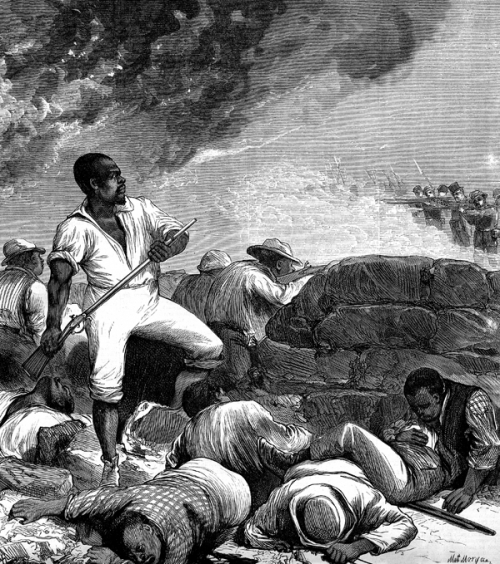
blacks at colfax

Freed Blacks attempting to Defend Colfax Court House

The violence against Southern blacks escalated in the wake of the passage of the Fourteenth and Fifteenth Amendments and with the increasing number of blacks being elected to office in some Southern states during the elections of 1872. In Louisiana a Federal court ruled in favor of Republican Reconstruction candidates following a Democrat campaign to interfere with the vote which included attacks on polling sites and the theft of ballot boxes. As a result the Louisiana Democrats “established a shadow government and organized paramilitary unit known as the White League to intimidate and attack black and white Republicans.” [1]

The White League in Louisiana was particularly brutal in its use of violence. he worst massacre committed by the White League occurred Easter Sunday 1873 when it massacred blacks in Colfax, Louisiana. Colfax was an isolated nondescript hamlet about three hundred fifty miles northwest of New Orleans, it sat on the grounds of a former plantation whose owner, William Calhoun worked with the former slaves who were now freedmen. The town itself “composed of only a few hundred white and black votes” [2] was located in the newly established Grant Parish. The “parish totaled about 4,500, of whom about 2,400 were Negroes living on the lowlands along the east bank of the Red.” [3] Between 1869 and 1873 the town and the parish were the scene of numerous violent incidents and following the 1872 elections, the whites of the parish were out for blood.

White leaders in Grant Parish “retaliated by unleashing a reign of terror in rural districts, forcing blacks to flee to Colfax for protection.” [4] The blacks of parish fled to the court house seeking protection from a violent white mob following the brutal murder of a black farmer and his family on the outskirts of town. The people, protected by just a few armed black militiamen and citizens deputized by the sheriff took shelter in the courthouse knowing an attack was coming. As the White League force assembled one of its leaders told his men what the day was about. He said, “Boys, this is a struggle for white supremacy….There are one hundred-sixty-five of us to go into Colfax this morning. God only knows who will come out. Those who do will probably be prosecuted for treason, and the punishment for treason is death.” [5] The attack by over 150 heavily armed men of the White League, most of whom were former Confederate soldiers, killed at least seventy-one and possibly as many as three-hundred blacks. Most of the victims were killed as they tried to surrender. The people, protected by just a few armed men were butchered or burned alive by the armed terrorist marauders. It was “the bloodiest peacetime massacre in nineteenth-century America.” [6]

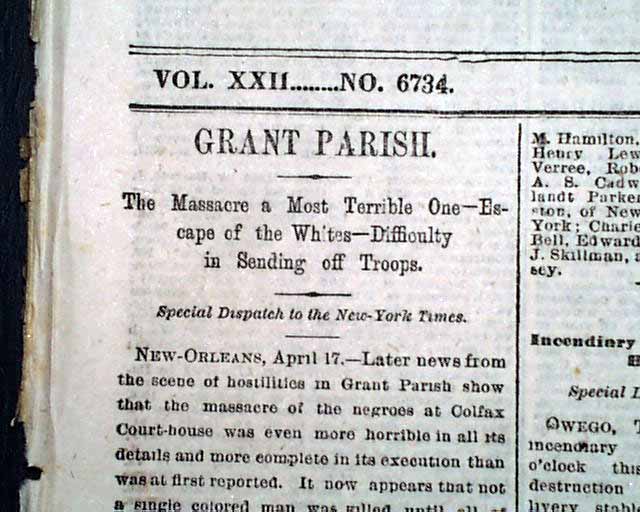
colfax newspaper

The instigators of the attack claimed that they acted in self-defense. They claimed that “armed Negroes, stirred up by white Radical Republicans, seized the courthouse, throwing out the rightful officeholders: the white judge and sheriff” and they claimed that the blacks had openly proclaimed “their intention to kill all the white men, they boasted they would use white women to breed a new race.” [7] The claims were completely fabricated, after sending veteran former army officers who were serving in the Secret Service to investigate, the U.S. Attorney for Louisiana, J.R. Beckwith sent an urgent telegram to the Attorney General:

“The Democrats (White) of Grant Parish attempted to oust the incumbent parish officers by force and failed, the sheriff protecting the officers with a colored posse. Several days afterward recruits from other parishes, to the number of 300, came to the assistance of the assailants, when they demanded the surrender of the colored people. This was refused. An attack was made and the Negroes were driven into the courthouse. The courthouse was fired and the Negroes slaughtered as they left the burning building, after resistance ceased. Sixty-five Negroes terribly mutilated were found dead near the ruins of the courthouse. Thirty, known to have been taken prisoners, are said to have been shot after the surrender, and thrown into the river. Two of the assailants were wounded. The slaughter is greater than the riot of 1866 in this city. Will send report by mail.” [8]

Nine white men were arrested by Federal authorities in the wake of the massacre and three were “convicted of violating the Enforcement Act of 1871.” [9] white Democrats appealed the convictions and using the best lawyers they could get with nearly unlimited financial backing the appeal reached the Supreme Court.

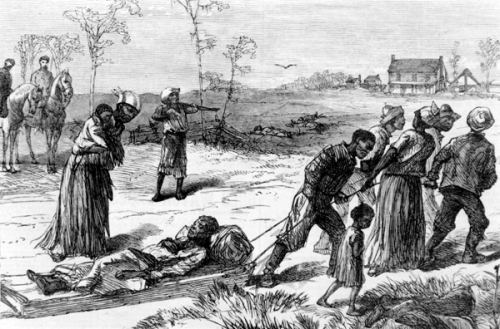
colfax-the-louisiana-murders--1288

Colfax Blacks recovering their Dead and wounded

The attack, and the court cases which followed, notably United States v. Cruickshank which dealt with the men responsible for the Colfax Massacre led to a “narrowing of Federal law enforcement authority” and were “milestones on the road to a “solid” Democratic South.” [10] The decision of the court in United States v. Cruikshank was particularly perverse in its interpretation of constitutional rights and protections. The court ruled in favor of the terrorists and declared that “the right of the black victims at Colfax to assemble hand not been guaranteed because they were neither petitioning Congress nor protesting a federal law. Assembling for any other cause was not protected.” [11] The Cruikshank decision amounted to a Supreme Court endorsement of violence against blacks, and made it “impossible for the federal government to prosecute crimes against blacks unless they were perpetrated by a state and unless it could prove a racial motive unequivocally.” [12]

Other massacres followed across the South, aimed at both blacks and their white Republican allies. Another White League detachment southwest of Shreveport “forced six white Republicans to resign their office on pain of death – and then brutally murdered them after they had resigned.” [13] The violence, now protected by the courts ensured that neither would last long in the post-Reconstruction South and that the freedom of African Americans in those states would amount to a cruel illusion.

Notes

[1] Ibid. Foner Forever Free p.151

[2] Ibid. Langguth After Lincoln p.312

[3] Ibid. Lane The Day Freedom Died p.42

[4] Ibid. Goldfield America Aflame p.493

[5] Ibid. Lane The Day Freedom Died p.91

[6] Ibid. Goldfield America Aflame p.493

[7] Ibid. Lane The Day Freedom Died p.11

[8] Ibid. Lane The Day Freedom Died p.22

[9] Ibid. Goldfield America Aflame p.494

[10] Ibid. Lane The Day Freedom Died p.251

[11] Ibid. Langguth After Lincoln p.314

[12] Ibid. Goldfield American Aflame p.494

[13] Ibid. McPherson The War that Forged a Nation p. 185

4 Comments

Filed under civil rights, civil war, History, Political Commentary

The Revolutionary & Important 14th Amendment

Friends of Padre Steve’s World

As I work on my Civil War and Gettysburg text I continue to write about truth, and truth can be very uncomfortable. Today is a section of my text that deals with the Black Codes that were enacted in Southern States in the immediate aftermath of the Civil War. They sprang up because Abraham Lincoln’s successor, Andrew Johnson was a unregenerate racist who encouraged such measures.  In the next few days I will be posting more sections of the text dealing with specific aspects of Reconstruction and the more often than not heavily racist opposition to rights of any kind being granted to blacks in the North and the South. 

Sadly, there are people today, people who were expensive suits, walk the halls of Congress, speak in our largest churches and travel in high style accompanied by the media who continue to fight against the rights of not only blacks, but of immigrants, the LGBTQ community, women and Moslems.

The fact is that the Fourteenth Amendment is hated by many who call themselves “conservatives.” Many suggest that it be repealed, in fact if you go to Google images and type in Fourteenth Amendment you will find a myriad of pictures, bumper stickers and comments by these “conservatives” who despise the amendment. But sadly, that has become the nature of conservatism in the United States, many of who do not even understand why it had to be enacted in the first place, and if they do, agree with the people who opposed it for racist reasons in 1866. That may sound harsh, but I spent the better part of my adult life in the this conservative world and thankfully, I am free. 

Have a great night,

Peace

Padre Steve+

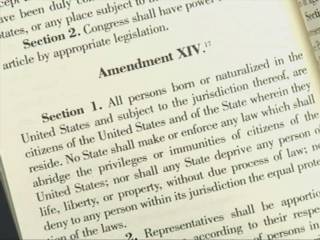
14-amendment

The situation for newly emancipated blacks in the South continued to deteriorate as the governors appointed by President Johnson supervised elections which elected new governors and all-white legislatures composed chiefly of former Confederate leaders. Freedom may have been achieved, but the question as to what it meant was still to be decided, “What is freedom?” James A. Garfield later asked. “Is it the bare privilege of not being chained?… If this is all, then freedom is a bitter mockery, a cruel delusion.” [1] The attitude of the newly elected legislatures and the new governors toward emancipated blacks was shown by Mississippi’s new governor, Benjamin G. Humphreys, a former Confederate general who was pardoned by Andrew Johnson in order to take office. In his message to the legislature Humphreys declared:

“Under the pressure of federal bayonets, urged on by the misdirected sympathies of the world, the people of Mississippi have abolished the institution of slavery. The Negro is free, whether we like it or not; we must realize that fact now and forever. To be free does not make him a citizen, or entitle him to social or political equality with the white man.” [2]

Johnson’s continued defiance of Congress alienated him from the Republican majority who passed legislation over Johnson’s veto to give black men the right to vote and hold office, and to overturn the white only elections which had propelled so many ex-Confederates into political power. Over Johnson’s opposition Congress took power over Reconstruction and “Constitutional amendments were passed, the laws for racial equality were passed, and the black man began to vote and to hold office.” [3] Congress passed measures in 1867 that mandated that the new constitutions written in the South provide for “universal suffrage and for the temporary political disqualification of many ex-Confederates.” [4] As such many of the men elected to office in 1865 were removed from power, including Governor Humphreys who was deposed in 1868.

These measures helped elect bi-racial legislatures in the South which for the first time enacted a series of progressive reforms including the creation of public schools. “The creation of tax-supported public school systems in every state of the South stood as one of Reconstruction’s most enduring accomplishments.” [5] By 1875 approximately half of all children in the South, white and black were in school. While the public schools were usually segregated and higher education in tradition White colleges was restricted, the thirst for education became a hallmark of free African Americans across the county. In response to discrimination black colleges and universities opened the doors of higher education to many blacks. Sadly, the public primary school systems which were created during Reconstruct were rapidly defunded by Southern states after the end of Reconstruction.

They also ratified the Thirteenth and the Fourteenth Amendments, but these governments, composed of Southern Unionists, Northern Republicans and newly freed blacks were “elicited scorn from the former Confederates and from the South’s political class in general.” [6] Seen as an alien presence by most Southerners the Republican governments in the South faced political and was as violent opposition.

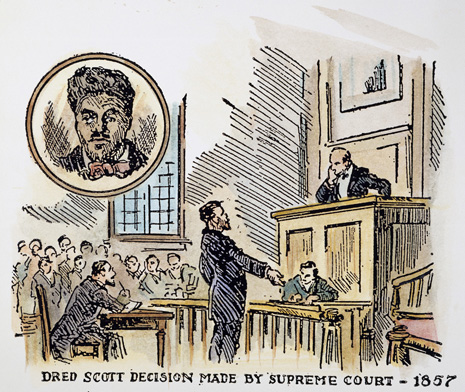
ROGER B. TANEY (1777-1864).  Roger Taney, Chief Justice of the U.S. Supreme Court, handing down his decision on the Dred Scott case, 1857. American illustration.

ROGER B. TANEY (1777-1864).
Roger Taney, Chief Justice of the U.S. Supreme Court, handing down his decision on the Dred Scott case, 1857. American illustration.

The Fourteenth Amendment was of particular importance for it overturned the Dred Scott decision which denied citizenship to blacks. Johnson opposed the amendment and worked against its passage by campaigning for men who would oppose it in the 1866 elections. His efforts earned him the opposition of former supporters including the influential New York Herald declared that Johnson “forgets that we have passed through a fiery ordeal of a mighty revolution, and the pre-existing order of things is gone and can return no more.” [7]

Johnson signed the Amendment but never recanted his views on the inferiority of non-white races. In his final message to Congress he wrote that even “if a state constitution” gave Negroes the right to vote, “it is well-known that a large portion of the electorate in all the States, if not a majority of them, do not believe in or accept the political equality of Indians, Mongolians, or Negroes with the race to which they belong.” [8]

When passed by Congress the amendment was a watershed which would set Constitutional precedent for future laws. These would include giving both women and Native Americans women the right to vote. It would also be used by the Supreme Court in the 1954 Brown v. Board of Education decision which ended the use of “separate but equal” and overturned many other Jim Crow laws. It helped lead to the passage of the Voting Rights Act of 1964 and the Civil Rights Act of 1965, and most recently was the basis of the Supreme Court decision in Obergfell v. Hodges which give homosexuals the right to marry. Section one of the amendment read:

“All persons born or naturalized in the United States, and subject to the jurisdiction thereof, are citizens of the United States and of the state wherein they reside. No state shall make or enforce any law which shall abridge the privileges or immunities of citizens of the United States; nor shall any state deprive any person of life, liberty, or property, without due process of law; nor deny to any person within its jurisdiction the equal protection of the laws.” [9]

Even so, for most white Southerners freedom for African Americans was not the same as freedom for whites, as while whites might grant the black man freedom, they had no intention of allowing him the same legal rights as white men.” [10] As soon as planters returned to their lands they “sought to impose on blacks their definition of freedom. In contrast to African Americans’ understanding of freedom as a open ended ideal based on equality and autonomy, white southerners clung to the antebellum view that freedom meant mastery and hierarchy; it was a privilege, not a universal right, a judicial status, not a promise of equality.” [11] In their systematic efforts to deny true freedom for African Americans these Southerners ensured that blacks would remain a lesser order of citizen, enduring poverty, discrimination, segregation and disenfranchisement for the next century.

Notes

[1] Ibid. Foner A Short History of Reconstruction p.30

[2] Ibid. Lord The Past that Would Not Die pp.11-12

[3] Ibid. Zinn The Other Civil War p.54

[4] Ibid. McPherson The War that Forged a Nation p. 178

[5] Ibid. Foner Forever Free p.162

[6] Perman, Michael Illegitimacy and Insurgency in the Reconstructed South in The Civil War and Reconstruction Documents and Essays Third Edition edited by Michael Perman and Amy Murrell Taylor Wadsworth Cengage Learning Boston MA 2011 p.451

[7] Ibid. Foner Forever Free p.121

[8] Ibid. Langguth After Lincoln p.232

[9] _____________ The 14th Amendment to the U.S. Constitution retrieved from https://www.law.cornell.edu/constitution/amendmentxiv 29 June 2015

[10] Ibid. Carpenter Sword and Olive Branch p.93

[11] Ibid. Foner Forever Free p.92


Leave a comment

Filed under civil rights, civil war, History, Political Commentary

Ulysses Grant’s Fight Against the KKK

Friends of Padre Steve’s World

This is another article excerpted from my Civil War and Gettysburg texts, this dealing with the fight against the Ku Klux Klan and other racist terrorist groups operating in the South. Unlike his predecessor, Andre Johnson, Ulysses S. Grant believed in freedom and equality for African Americans and was willing to use to the military and police power of the Federal Government to crush violent terrorist groups. In the end his effort failed, however among U.S. Presidents after Abraham Lincoln, Grant was most committed to ending racism and promoting equality in the United States.

Sadly, while the Klan and other groups like operate only on the margins of society, only popping up for Confederate Flag rallies, a protest here or there and of course the occasional mass killing; there are millions of others who harbor many of the same attitudes held by the Klan against African Americans, other minority groups, immigrants, and non-Christian religions. These people just maintain a tidier act. They wear expensive suits, Hang out with presidential candidates and popular preachers. They get interviewed on cable news to spread fear and loathing of those that they hate, and then capitalizing on that fear they use political action and the courts to push their agenda. Interestingly enough these well to do hatemongers almost never criticize or condemn the attitudes and action of Klan members or other white supremacists. If they do they brush it off as an “isolated” incident unconnected to their own ideology. 

The fact is they don’t condemn them because they share the same goal; a racially pure white supposedly Christian country. That my friends is why this still matters and why I admire that great General and far too under appreciated, President, Ulysses S Grant.

Have a great and thoughtful day,

Peace

Padre Steve+

ulysses-s-grant-book

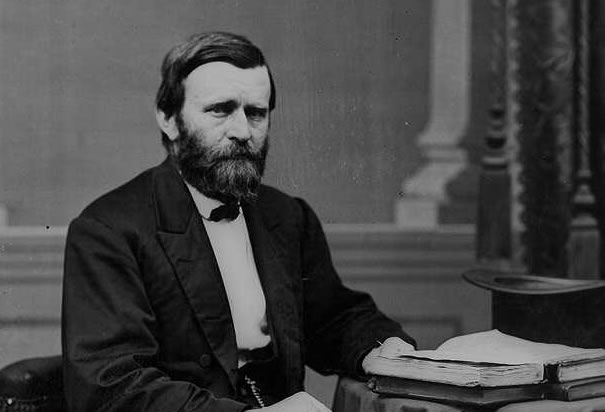
President Ulysses S. Grant

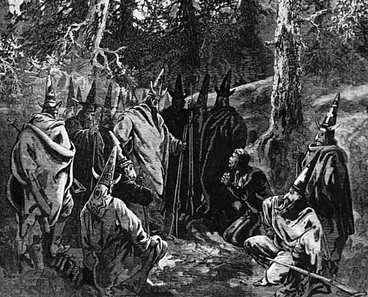
The passage of the Fourteenth and Fifteenth Amendments provoked even more violence from enraged Southerners. Thousands of Southerners, many former Confederate soldiers, formed a variety of violent racist organizations which turned the violence from sporadic attacks to what amounted to a full-fledged insurgency against the new Reconstructionist state governments and African Americans. Organizations like the Ku Klux Klan which engaged in terroristic violence while heavily armed so called  “social clubs” that operated under the aegis of the state Democratic Party leadership in most Southern states did the same. Under the leadership of former Confederate general Nathan Bedford Forrest whose troops had conducted the Fort Pillow massacre, the Klan’s membership throughout the South “was estimated at five hundred thousand” [1] and the majority were former Confederate soldiers. As the shadowy organization grew it became bolder and more violent in its attacks on African Americans, Republican members of the Reconstruction governments, and even Southern Jews.

64982-004-E91C3D02

Early KKK Gathering

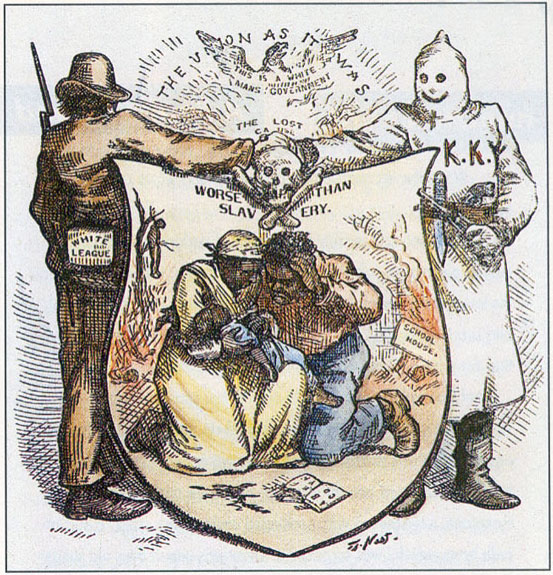
Allegedly organized for self-defense against state militia units composed of freed blacks they named themselves “White Leagues (Louisiana), White Liners or Rifle Clubs (Mississippi), or Red Shirts (South Carolina). They were, in fact, paramilitary organizations that functioned as armed auxiliaries of the Democratic Party in southern states in their drive to “redeem” the South from “black and tan Negro-Carpetbag rule.” [2] These men, mostly Confederate veterans “rode roughshod over the South, terrorizing newly freed slaves, their carpetbagger allies, and anyone who dared to imagine a biracial democracy as the war’s change.” [3] This unrequited violence and hatred set the stage for the continued persecution, murder and violence against blacks and those who supported their efforts to achieve equality in the South for the next century.

Throughout his term in office Johnson appealed to arguments used throughout later American history by “critics of civil rights legislation and affirmative action. He appealed to fiscal conservatism, raised the specter of an immense federal bureaucracy trampling on citizens’ rights, and insisted that self-help, not government handouts, was the path to individual advancement.” [4]

black-voter-threatening

White League Members Intimidating Blacks at the Polls

Ulysses S. Grant succeeded Johnson as President in 1869. “For Grant, freedom and equal rights were matters of principle, not symbolism.” [5] Grant used his political capital to fight for the passage of the Fifteenth Amendment which gave black men the right to vote. It was one of the things that he remained most proud of in his life, he noted, “A measure which makes at once four million people voter who were heretofore declared by the highest tribunal in the land to be not citizens of the United States, nor eligible to become so…is indeed a measure of grander importance than any other act of the kind from the foundation of our free government to the present day.” [6] Grant ordered his generals in the South to enforce the Reconstruction Act and when the Ku Klux Klan attempted to stop blacks from voting Grant got Congress to pass the “enforcement Act, which made racist terrorism a federal offense.” [7] He created the Justice Department to deal with crimes against Federal law and in 1871 pushed Congress to pass a law known as the Ku Klux Klan Act and sent in the army and federal agents to enforce the law.

KKK-Nast

White League and KKK Poster

Grant’s efforts using the military as well as agents of the Justice Department and the Secret Service against the Klan were hugely successful, thousands were arrested, hundreds of Klansmen were convicted and others were either driven underground or disbanded their groups. The 1872 election, was the first and last in which blacks were nearly unencumbered as they voted until the passage of the 1964 Civil Rights Act and 1965 Voting Rights Act.

However, Grant’s actions triggered a political backlash which doomed reconstruction. The seminal moment in this came 1873 when General Philip Sheridan working in Louisiana, asked Grant for “permission to arrest leaders of the White League and try them by courts-martial” [8] for their violent acts against blacks and their seizure of the New Orleans City Hall in a brazen coup attempt. The leak of Sheridan’s request sparked outrage and even northern papers condemned the president’s actions in the harshest of terms.

Apart from the effort to support voting rights for African Americans Grant’s efforts at Reconstruction were met mostly by failure. Part of this was due to a weariness on the part of many Northerners to continue to invest any more effort into the effort. Slowly even proponents of Reconstruction began to retreat from it, some like Carl Schurz were afraid that the use of the military against the Klan in the South could set precedent to use it elsewhere. Others, embraced an understanding of Social Darwinism which stood against all types of government interference what they called the “natural” workings of society, especially misguided efforts to uplift those at the bottom of the social order…and African Americans were consigned by nature to occupy the lowest rungs of the social ladder.” [9]

Southerners knew that they were winning the political battle and continued their pressure in Congress and in the media to demonize supporters of Reconstruction as well as African Americans. Southerners worked to rig the political and judicial process through the use of terror to demoralize and drive from power anyone, black or white, who supported Reconstruction. By 1870 every former Confederate state had been readmitted to the Union, in a sense fulfilling a part Lincoln’s war policy, but at the same time denying what the war was waged for.

To be continued….

Notes

[1] Ibid. Lane The Day Freedom Died p.230

[2] Ibid. McPherson The War that Forged a Nation p. 178

[3] Ibid. Jordan Marching Home p.118

[4] Ibid. Foner Forever Free p.116

[5] Ibid. Lane The Day Freedom Died: p.2

[6] Flood, Charles Bracelen, Grant’s Final Victory: Ulysses S. Grant’s Heroic Last Year DaCapo Press, Boston 2011 pp.78-79

[7] Ibid. Lane The Day Freedom Died p.4

[8] Ibid. Langguth, A.J. After Lincoln p.314

[9] Ibid. Foner Forever Free pp.192-193

3 Comments

Filed under civil rights, civil war, History, Political Commentary

The Sanitized History of the Lost Cause

Friends of Padre Steve’s World,

I am out tilting at windmills again and this one needs to be tilted at…

confederate-flag-picture

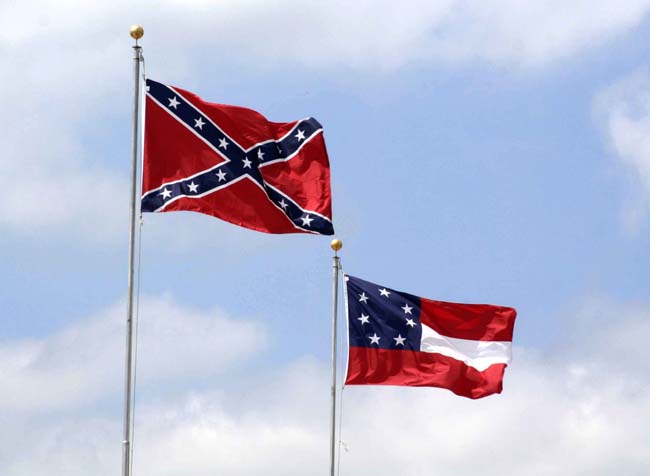
It seems that the organization known as the Sons of Confederate Veterans is not happy with the fact that the most prominent symbol of the Confederacy is coming down. This has been very apparent at the group’s convention in Richmond this week. Their anger is not only directed at the removal of the Confederate flag from the South Carolina State House, but at Supreme Court siding with Texas not to issue license plates with the Confederate flag on them, the decision of Virginia to eliminate the sons of Confederate Veteran plate which displays the battle flag, and moves to change the name of U.S. Highway One, known as the Jefferson Davis Highway to something other than that of the President of the Confederacy.

Frank Earnest, the former commander of the SCV’s Virginia division displayed the ignorance of years of sanitized history by telling the Richmond Times Dispatch that the removal of the flag and stripping highways of the names of Confederate leaders “It’s cultural genocide, everything about a four-year period where Virginia and other Southern states fought for their rights, we’re gonna eradicate any of that. That is something that’s done in dictatorial countries, not in the United States of America.”

For Earnest and those who think like him the war, and the sacrifice can be separated from the root cause of the war, which was White Supremacy and the expansion of slavery as well as the violence actions committed by the thousands of former Confederate soldiers who spearheaded the formation of terrorist groups such as the Ku Klux Klan, the White Leagues, the White Liners and the Red Shirts. Sadly, to millions of school children brought up in the South from the end of the war and in some cases even today, these issues are ignored. It is sanitized history which denies that slavery was the major cause of the war, it denies the systematic racism of those who founded the Confederacy, it denies the fight of White Supremacists throughout the South for the century following the war and beyond used systematic violence to terrorize, kill, disenfranchise and impoverish African Americans throughout the South. In fact the new Texas history books do exactly that.

While it is not as systematized as it was there are still thousands across the South and even the rest of the country who believe that telling the truth about history is cultural genocide and this my friends needs to be confronted every day and every time that men like Earnest make these bold faced lies about history. Jefferson Davis does not deserve a highway named after him, nor does Henry Benning, the pro-slavery, pro-secession firebrand who worked to persuade other states to secede does not deserve Fort Benning George to be named after him. Perhaps it should be renamed for Confederate Lieutenant General James Longstreet, another Georgian who after Appomattox recanted his Confederate views, swore his loyalty to the Federal government, tried to stem violence against blacks during Reconstruct and who is treated like Judas Iscariot by the Sons of Confederate Veterans and other proponents of the Lost Cause.

My God, I am going to be writing more on this subject, but will pause for now.

Have a wonderful and thoughtful night,

Peace

Padre Steve+

5 Comments

Filed under civil rights, civil war, leadership, Political Commentary

A New Birth of Freedom

gburg address

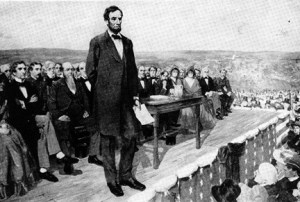
Friends of Padre Steve’s World. Yesterday we celebrated the 239th anniversary of American independence and the revolutionary document we know as the Declaration of Independence. I wrote about that yesterday and discussed the context of it as well as the contradiction to it posed by the institution of slavery. I talked about Abraham Lincoln and how for him the Declaration was the real heart of the American nation. In Novwmber of 1863 after nearly three years of bloody Civil War and about 10 months following the Emancipation Proclamation, Lincoln was invited to say a few words at the dedication of the Soldeirs Cemetary at Gettysburg. 

In those few words Lincoln redefined forever the concept of Liberty found in the Declaration, he universalized it. Though of practice of it often falls short, it is the high bar for which we must strive. If we do not we will return to the days when freedom was only for the few, and sadly there are many on the political right who not only believe that Liberty is reserved for the few but labor incessantly to prevent people from the full excercuse of the rights of citizenship and wherever possible to roll them back. 

I hope that you enjoy this.

Peace

Padre Steve+

I am always humbled when I travel to Gettysburg as I about to do again early next month. It is hard to believe in that now peaceful pastoral setting that over 157,000 Americans, almost 82,000 Union and 75,000 Confederates met in a three-day battle. In those three days over 28,000 Confederates and 23,000 Union soldiers were killed, wounded, missing or captured. It was the greatest number of casualties inflicted in one battle on American soil in history.

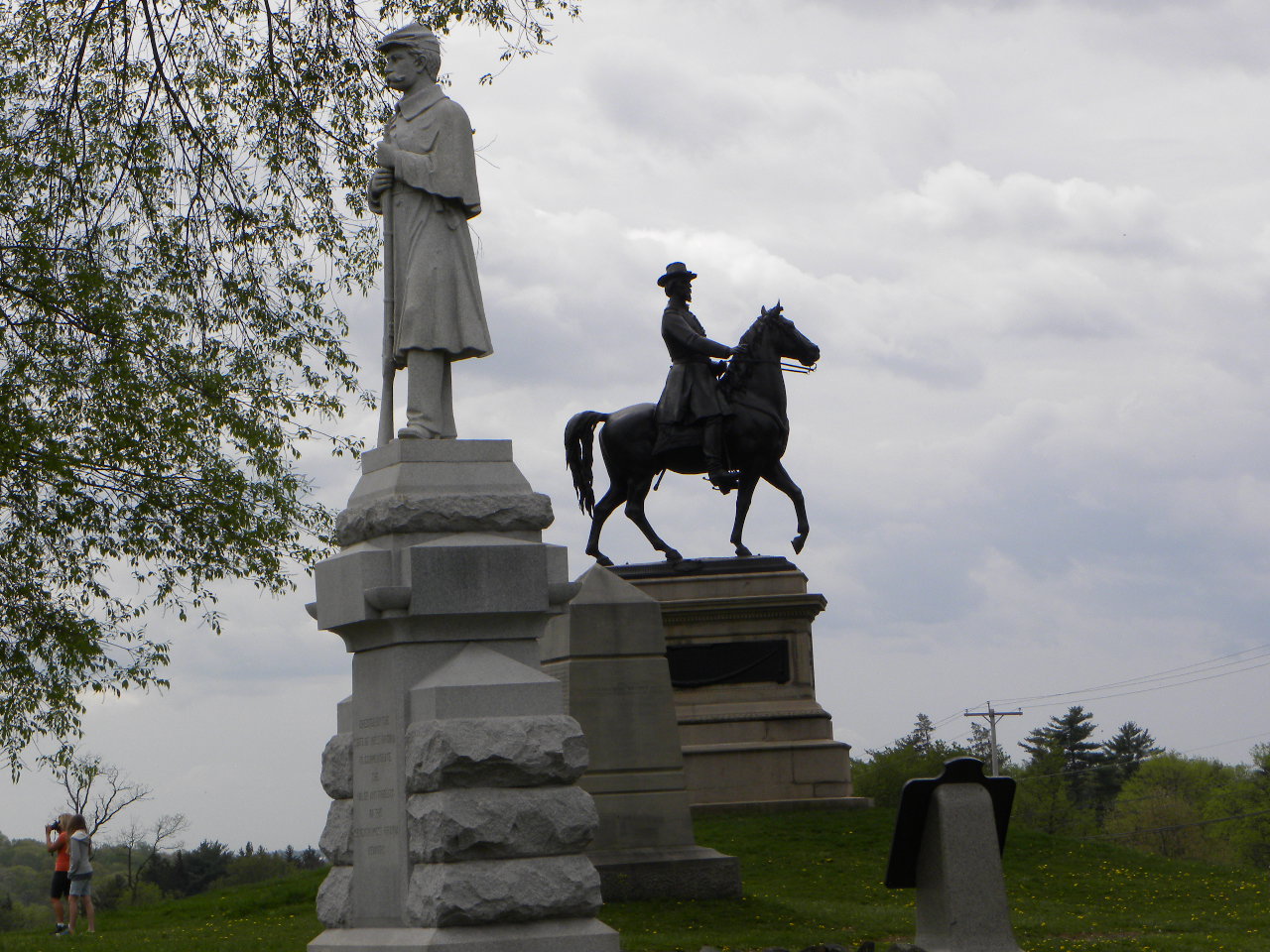
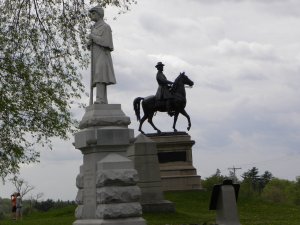
The places that the battle was fought have become legendary, for they are “hallowed ground” as President Abraham Lincoln so eloquently put it. The places, McPherson’s and Herr’s Ridge, Seminary Ridge, the Railroad Cut, Barlow’s Knoll, Cemetery Hill, Culp’s Hill, The Wheat Field, Devil’s Den, the Peach Orchard, Little Round Top, Cemetery Ridge, the Apse of Trees, the Angle and the High Water Mark are in a sense holy, or hallowed ground. Those who struggled there, those who lived and those who gave the last full measure of devotion to their country consecrated them more than any of us could ever do. When I take my students there I always finish at the Soldier’s Cemetery where Abraham Lincoln delivered the Gettysburg Address.

I think about those men of both sides, fully convinced of the rightness of their cause who fought valiantly in the struggle. That being said when I go to Gettysburg my heart, my mind and my soul are with the men who remained loyal to the Union and those who answered the call of Abraham Lincoln to serve in a cause greater than their own interests, the great and the small alike. This is despite the fact that my family predominantly fought for the Confederacy.

Lincoln was a masterful orator who managed to rally the Union and bring hundreds of thousands of men to volunteer to serve before Gettysburg. These men volunteered for an ideal, an ideal for which Lincoln’s oratory was probably the most effective means at articulating in an ideal that men would volunteer to suffer hardship, fight and die to bring about. It was well put in the movie Gettysburg where Colonel Joshua Chamberlain, played by Jeff Daniels said:

“This is a different kind of army. If you look at history you’ll see men fight for pay, or women, or some other kind of loot. They fight for land, or because a king makes them, or just because they like killing. But we’re here for something new. This has not happened much, in the history of the world: We are an army out to set other men free. America should be free ground, all of it, from here to the Pacific Ocean. No man has to bow, no man born to royalty. Here we judge you by what you do, not by who your father was. Here you can be something. Here is the place to build a home. But it’s not the land. There’s always more land. It’s the idea that we all have value, you and me. What we’re fighting for, in the end… we’re fighting for each other…” [1]

On November 19th 1863 Lincoln delivered a “few words” at Gettysburg which were in all practical aspects a benediction at the dedication of the battlefield cemetery. Lincoln was the second speaker at the ceremony following former Pennsylvania Congressman Edward Everett who spoke for more than two hours, a typical speech from the period.

Everett was one of the leading orators of his day. Everett was “a scholar and Ivy-League diplomat who could hold mass audiences in thrall. His voice, diction, and gestures were successfully dramatic, and he always performed his carefully written text, no matter how long, from memory.” [2]

The 270 words of Lincoln’s address are perhaps the most important of any speech or document in American history save the Declaration of Independence and the Constitution of the United States, in those words “Lincoln, nevertheless managed to justify the ways of democracy more than anyone, then or now.” [3]

The speech was so powerful that Everett wrote Lincoln the next day:

“Permit me also to express my great admiration of the thoughts expressed by you, with such eloquent simplicity & appropriateness, at the consecration of the Cemetery. I should be glad, if I could flatter myself that I came as near to the central idea of the occasion, in two hours, as you did in two minutes.” [4]

The speech is short, but its eloquence is unmatched. Lincoln wrapped ideas, concepts and ideals that men have written volumes about into a speech so powerful that many have memorized it.

But few realize the context that it must be placed. Though the Union had defeated Lee’s Army at Gettysburg and Grant had taken Vicksburg to cut the Confederacy in half the North was growing war weary. During the fall of 1863 after a series of inconclusive battles in northern Virginia both Lee and Meade’s armies had sent significant numbers of troops to the west, to support operations in eastern Tennessee.

Lee sent Longstreet’s First Corps, which took part in the bloody battle of Chickamauga, which “is a Cherokee word meaning “river of death.” [5] where on September 19th and 20th the Federal Army of the Cumberland under General Rosecrans “were soundly whipped at …and driven back into the strategic point of Chattanooga.” [6] The number of casualties on both sides, over 16,000 Federal and 18,000 Confederate, a “combined total of 34,634 was exceeded only the three day slaughter at Gettysburg and by the week-long series of five battles known collectively as the Seven Days.” [7] Despite the number of casualties it was one of the biggest Confederate victories of the war. A clerk in Richmond wrote “The whole South will be filled again with patriotic fervor, and in the North there will be a corresponding depression.” [8] That changed rapidly when the Union reacted quickly and reversed the strategic situation. One action taken was to deploy Oliver Howard’s XI Corps and Henry Slocum’s XII Corps west, where “they would be commanded by Joe Hooker, who was conveniently at hand and unemployed.” [9]

In the east during the following weeks “Lee and Meade, like two wounded, spent gladiators, sparred listlessly along the Rapidan. It seemed to Northerners that the fruits of Gettysburg had been thrown away.” [10] Lee sensed an opportunity to go back on the offensive against Meade’s weakened army, but his offensive was stopped on October 14th when “the Union Second Corps shattered a reckless attack by A.P. Hill’s corps at Bristoe Station, five miles south of Manassas.[11]

There was a faction in the North, the Copperheads, who were willing even after Gettysburg and Vicksburg to end the war on terms favorable to the Confederacy, even allowing for Confederate independence and the continuation of slavery. They “clamored for negotiations with the Confederacy to restore the Union on the basis of status quo antebellum and, until the closing months of the war charged that as long as the antislavery party remained in power the restoration of the Union could not be achieved.” [12] They believed that the war was a failure and that military action could not be achieved by force of arms.

The leading Copperheads included Clement Vanlandingham of Ohio and George W. Woodward of Pennsylvania were typical, both opposed the use of force against Confederate secession; Woodward had written in 1860 that “Slavery was intended as a special blessing to the people of the United States,” that “Secession is not disloyalty” and “I cannot condemn the South for withdrawing….I wish Pennsylvania could go with them.” [13] The efforts of the Copperheads to gain governorships in Ohio and Pennsylvania met defeat in November 1863, as the Union victories at Gettysburg and Vicksburg “undercut their theme of the war’s failure.” [14] Their efforts would persist through the 1864 Presidential election, but instead of preaching the war’s failure they would concentrate on defeating emancipation. The Copperheads, “labeled all Republicans, including Lincoln, as radicals bent upon destroying the Union and undermining the Constitution.” [15]

However, the anti-abolitionist and racist views espoused by the northern Democrat Copperheads had begun to lose their potency in the North after July of 1863 with the onset of “the New York draft riot, which shocked many northerners into a backlash against the consequences of virulent racism” [16] and the sacrifice of the African American 54th Massachusetts Infantry when it assaulted Fort Wagner outside of Charleston South Carolina, which occurred “just after the Democratic rioters in New York had lynched black people and burned the Colored Orphan Asylum. Few Republican newspapers failed to point the moral: black men who fought for the Union deserved more respect than white men who fought against it.” [17]

It is also important to understand how Lincoln’s address at Gettysburg is reflective of the various intellectual and philosophical movements of the time. Even the location of the cemetery and the burial plots within it was significant. A Gettysburg lawyer, David Wills proposed to “Governor Andrew Curtain of Pennsylvania the establishment of a soldiers’ cemetery where the Union dead could be reburied with dignity and honor.” [18] The place was then outside the city, a plot of 17 acres purchased by Wills adjacent to the existing town cemetery on Cemetery Hill. That was significant culturally, for the Gettysburg Cemetery was part of a movement called the Rural Cemetery movement. The movement was part of the Greek revival in the United States and connected with the Transcendentalist movement.

The Rural Cemetery movement was launched at Cambridge’s Mount Auburn Cemetery, and Edward Everett was a key figure in it. Mount Auburn “took Athens’s Kerameikos as its model, since that ancient burial ground existed outside the city proper, near the groves of the Akademy, in what was still countryside.” [19] In his speech at Mount Auburn’s dedication, U.S. Supreme Court Justice Joseph Story noted:

“The Greeks exhausted the resources of their exquisite art in adorning the habitations of the dead. They discouraged internments within the limits of their cities; and consigned their relics to shady groves, in the neighborhood of murmuring streams and merry fountains, close by the favorite resorts of those who were engaged in the study of philosophy and nature, and called them, with the elegant expressiveness of their own beautiful language, cemeteries or “places of repose.” [20]

He further noted:

“Our cemeteries, rightly selected and properly arranged, may be made subservient to some of the highest purposes of religion and human duty. They may preach lessons to which none may refuse to listen and which all that live must hear. Truths may there be felt and taught, in the silence of our meditations, more persuasive and more enduring than ever flowed from human lips.” [21]

Everett in his Gettysburg oration linked what they were doing at the Soldiers’ Cemetery with the Greek tradition:

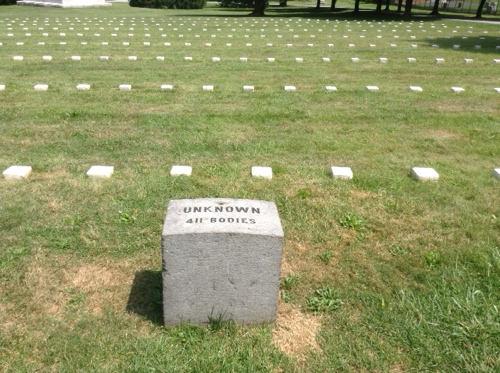
“It was appointed by law in Athens, that the obsequies of the citizens who fell in battle should be performed at the public expense, and in the most honorable manner. Their bones were carefully gathered up from the funeral pyre where their bodies were consumed, and brought home to the city. There, for three days before the interment, they lay in state, beneath tents of honor, to receive the votive offerings of friends and relatives,–flowers, weapons, precious ornaments, painted vases (wonders of art, which after two thousand years adorn the museums of modern Europe),–the last tributes of surviving affection. Ten coffins of funereal cypress received the honorable deposit, one for each of the tribes of the city, and an eleventh in memory of the unrecognized, but not therefore unhonored, dead, and of those whose remains could not be recovered….” [22]

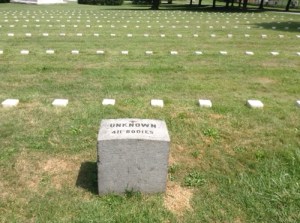
The layout of the cemetery, and the manner in which the dead were buried was also significant when one considers the messages of both Everett and Lincoln that day. “The cemetery at Gettysburg was arranged so that every grave was of equal importance; William Saunders’s design, like Lincoln’s speech, affirmed that every dead soldier mattered equally regardless of rank or station.” [23] In this place “some 3,577 Union soldiers (half of them unknown) from eighteen states are buried.” [24]

The speeches of Everett and Lincoln are deeply connected with Romanticism, the Greek revival and the Transcendentalist movement in the United States. Both were children of the enlightenment, and Everett, a former President of Harvard was well versed in these subjects and Lincoln, though a politician who appealed to the tenets of the Enlightenment, the Declaration of Independence and the Constitution. Lincoln appealed to the “sacred principles of the laws of nature,” and hailed “the constitution and laws” as “hewn from the solid quarry of sober reason.” For Lincoln, the war was a test of the practical worth of liberalism.” [25]

Everett had been a mentor to some of the leading Transcendentalist thinkers of his era including Ralph Waldo Emerson who found that the experience of “Everett’s classroom gave him an entirely new direction in life.” Emerson wrote:

“Germany had created [literary] criticism in vain for us until 1820, when Edward Everett returned from his five years in Europe, and brought to Cambridge his rich results, which no one was so fitted by natural grace and splendor of his rhetoric to introduce and recommend…. The novelty of the learning lost northing in the skill and genius of its interpreter, and the rudest undergraduate found a new morning opening to him in the lecture room at Harvard.” [26]

Everett, who had previously dedicated battlefields at Bunker Hill, as well as Lexington and Concord, was at his best when dedicating battlefields and cemeteries. He spent weeks preparing his speech. Everett had studied the battle and knew it well from official reports and talks with those who fought it. Everett painted a vivid picture of the battle for his audience and connected the sacrifice of those who fought and died to preserve the Union form antiquity and from those who founded the nation. He noted why they had gathered:

“We have assembled, friends, fellow-citizens, at the invitation of the Executive of the great central State of Pennsylvania, seconded by the Governors of seventeen other loyal States of the Union, to pay the last tribute of respect to the brave men who, in the hard-fought battles of the first, second, and third days of July last, laid down their lives for the country on these hillsides and the plains before us, and whose remains have been gathered into the cemetery which we consecrate this day. As my eye ranges over the fields whose sods were so lately moistened by the blood of gallant and loyal men, I feel, as never before, how truly it was said of old that it is sweet and becoming to die for one’s country. I feel, as never before, how justly, from the dawn of history to the present time, men have paid the homage of their gratitude and admiration to the memory of those who nobly sacrifice their lives, that their fellow-men may live in safety and in honor. And if this tribute were ever due, to whom could it be more justly paid than to those whose last resting-place we this day commend to the blessing of Heaven and of men?” [27]

In his narrative Everett aspired to more than mere accuracy. Along “with Bancroft and other romantic historians of his time, he meant to create a tradition that would inspire as well as inform. Like the Attic orators- and dramatists- he knew the power of symbols to create a people’s political identity.” [28]
DSCN9741

Lincoln was sick when he delivered the address having what was mostly likely a mild form of Smallpox when he gave the address. Thus the tenor, simplicity and philosophical depth of the address are even more remarkable. It is a speech given in the manner of Winston Churchill’s “Blood sweat toil and tears” address to Parliament upon being appoint Prime Minister in 1940. Likewise it echoes the Transcendentalist understanding of the Declaration of Independence as a “test for all other things.”

Many in the United States and Europe did not agree and argued that no nation found on such principles could long survive. The more reactionary European subscribers of Romanticism ridiculed the “idea that a nation could be founded on a proposition….and they were not reluctant to point to the Civil War as proof that attempting to build a government around something as bloodless and logical as a proposition was futile.” [29]

But Lincoln disagreed. He believed that the “sacrifices of Gettysburg, Shiloh, Murfreesboro, Chancellorsville, and a hundred other places demonstrated otherwise, that men would die rather than to lose hold of that proposition. Reflecting on that dedication, the living should themselves experience a new birth of freedom, a determination- and he drove his point home with a deliberate evocation of the great Whig orator Daniel Webster- “that government of the people, by the people, for the people, shall not perish from the earth.” [30]

The Unitarian pastor and leading Transcendentalist Theodore Parker wrote:

“Our national ideal out-travels our experience, and all experience. We began our national career by setting all history at defiance- for that said, “A republic on a large scale cannot exist.” Our progress since that has shown that we were right in refusing to be limited by the past. The practical ideas of the nation are transcendent, not empirical. Human history could not justify the Declaration of Independence and its large statements of the new idea: the nation went beyond human history and appealed to human nature.” [31]

Likewise Lincoln’s address echoes the thought of George Bancroft who wrote of the Declaration:

“The bill of rights which it promulgates is of rights that are older than human institutions, and spring from the eternal justice…. The heart of Jefferson in writing the Declaration, and of Congress in adopting it, beat for all humanity; the assertion of right was made for the entire world of mankind and all coming generations, without any exceptions whatsoever.” [32]

Parker’s words also prefigured an idea that Lincoln used in his address, that being: The American Revolution, with American history since, is an attempt to prove by experience this transcendental proposition, to organize the transcendental idea of politics. The ideal demands for its organization a democracy- a government of all, for all, and by all…” [33]

Lincoln delivered these words on that November afternoon:

Four score and seven years ago our fathers brought forth on this continent, a new nation, conceived in Liberty, and dedicated to the proposition that all men are created equal.

Now we are engaged in a great civil war, testing whether that nation, or any nation so conceived and so dedicated, can long endure. We are met on a great battle-field of that war. We have come to dedicate a portion of that field, as a final resting place for those who here gave their lives that that nation might live. It is altogether fitting and proper that we should do this.

But, in a larger sense, we cannot dedicate — we can not consecrate — we can not hallow — this ground. The brave men, living and dead, who struggled here, have consecrated it, far above our poor power to add or detract. The world will little note, nor long remember what we say here, but it can never forget what they did here. It is for us the living, rather, to be dedicated here to the unfinished work which they who fought here have thus far so nobly advanced. It is rather for us to be here dedicated to the great task remaining before us — that from these honored dead we take increased devotion to that cause for which they gave the last full measure of devotion — that we here highly resolve that these dead shall not have died in vain — that this nation, under God, shall have a new birth of freedom — and that government of the people, by the people, for the people, shall not perish from the earth.[34]

In a time where many are wearied by the foibles and follies of our politicians, even wondering about our form of government can survive Lincoln’s words matter. Dr. Allen Guelzo, Professor of Civil War Studies at Gettysburg College wrote in the New York Times:

“The genius of the address thus lay not in its language or in its brevity (virtues though these were), but in the new birth it gave to those who had become discouraged and wearied by democracy’s follies, and in the reminder that democracy’s survival rested ultimately in the hands of citizens who saw something in democracy worth dying for. We could use that reminder again today.” [35]

Dr. Guelzo is quite correct. Many people in this country and around the world are having grave doubts about our democracy. I wonder myself, but I am an optimist. I do believe that we will recover because for the life of me I see no nation anywhere else with our resiliency and ability to overcome the stupidity of politicians, pundits and preachers.

The amazing thing was that in spite of everything the Union survived. Lincoln was a big part of that but it was the men who left lives of comfort and security like Joshua Chamberlain and so many others who brought about that victory. Throughout the war, even to the end Southern political leaders failed to understand that Union men would fight and die for an ideal, something greater than themselves, the preservation of the Union and the freedom of an enslaved race. For those men that volunteered to serve, the war was not about personal gain, loot or land, it was about something greater. It was about freedom, and when we realize this fact “then we can contemplate the real meaning of “that cause for which they gave the last full measure of devotion.” [36]
Gettysburg_Unknowns.JPG

Now I for one do not think that we are currently living up to the ideals enunciated by Lincoln that day at Gettysburg. I can understand the cynicism disillusionment of Americans as well as those around the world who have for over 200 years looked to us and our system as a “city set on a hill.” That being said, when I read these words and walk that hallowed ground I am again a believer. I believe that we can realize the ideal, even in our lifetime should we desire.

Notes

[1] Shaara, Michael. The Killer Angels, Ballantine Books, New York. 1974 p.28

[2] Wills, Garry. Lincoln at Gettysburg: The Words that Remade America Simon and Schuster Paperbacks, New York 1992 p.25

[3] Guelzo Allen C. Fateful Lightening: A New History of the Civil War Era and Reconstruction Oxford University Press, Oxford and New York 2012 p.407

[4] Everett, Edward Letter from Edward Everett to Abraham Lincoln, (Transcription) 20 November 1863 retrieved from http://www.in.gov/judiciary/citc/files/everett-to-lincoln.pdf July 18th 2014

[5] Ibid. Guelzo Fateful Lighteningp.352

[6] Hebert, Walter H. Fighting Joe Hooker University of Nebraska Press, Lincoln and London 1999. Originally published by Bobbs-Merrill, New York 1944

[7] Foote, Shelby, The Civil War, A Narrative. Volume Two Fredericksburg to Meridian Random House, New York 1963 p.758

[8] Ibid. Foote The Civil War, A Narrative. Volume Two p.757

[9] Ibid. Foote The Civil War, A Narrative. Volume Two p.764

[10] Sears, Stephen W. Gettysburg Mariner Books, Houghton Mifflin Company Boston, New York 2004 p.513

[11] McPherson, James M. Tried by War: Abraham Lincoln as Commander in Chief Penguin Books, New York and London 2008 p.200

[12] Harris, William C. With Charity for All: Lincoln and the Restoration of the Union The University Press of Kentucky, Lexington KY 1997 p.7

[13] McPherson, James. The Battle Cry of Freedom: The Civil War Era Oxford University Press, Oxford and New York 1988 p.685

[14] Ibid. McPherson The Battle Cry of Freedom p.685

[15] Ibid. Harris With Charity for All p.7

[16] Ibid. McPherson The Battle Cry of Freedom p.686

[17] Ibid. McPherson The Battle Cry of Freedom p.687

[18] McPherson, James M. This Hallowed Ground Crown Publishers, New York 2003 p.137

[19] Ibid. Wills. Lincoln at Gettysburg p.63

[20] Ibid. Wills. Lincoln at Gettysburg p.64

[21] Ibid. Wills. Lincoln at Gettysburg p.65

[22] Everett, Edward Gettysburg Address retrieved from http://voicesofdemocracy.umd.edu/everett-gettysburg-address-speech-text/ 21 August 2014

[23] Faust, Drew Gilpin, This Republic of Suffering: Death and the American Civil War Vintage Books, a division of Random House, New York 2008 p.100

[24] Ibid. McPherson This Hallowed Ground p.137

[25] Ibid. Guelzo. Fateful Lightening pp.406-407

[26] Ibid. Wills. Lincoln at Gettysburg p.45

[27] Ibid. Everett Gettysburg Address

[28] Ibid. Wills. Lincoln at Gettysburg p.51

[29] Ibid. Guelzo. Fateful Lightening p.409

[30] Ibid. Guelzo. Fateful Lightening p.408

[31] Ibid. Wills. Lincoln at Gettysburg p.110

[32] Ibid. Wills. Lincoln at Gettysburg p.105

[33] Ibid. Wills. Lincoln at Gettysburg p.105

[34] Lincoln, Abraham The Gettysburg Address the Bliss Copy retrieved from http://www.abrahamlincolnonline.org/lincoln/speeches/gettysburg.htm

[35] Guelzo, Allen C. Lincoln’s Sound Bite: Have Faith in Democracy New York Time Opinionator, November 17th 2013 retrieved from http://opinionator.blogs.nytimes.com/2013/11/17/lincolns-sound-bite-have-faith-in-democracy/?_php=true&_type=blogs&_r=0 July 18th 2014

[36] Ibid. McPherson This Hallowed Ground p.138

1 Comment

Filed under civil rights, civil war, Gettysburg, History, Political Commentary

Racism & the Failure of Reconstruction

this-is-a-white-mans-government


Friends of Padre Steve’s World

Some events and attitudes are timeless, one of these is racism. Being white myself, I know that many whites are loath to admit that the scourge of racism still exists, but it does and it runs deep in our history. The more that I work on my Civil War and Gettysburg text, which now appears will morph into at least two and maybe three books when I am done, I find terribly distressing parallels to attitudes and actions of some which mirror the attitudes and actions of our ancestors, Northern and Southern following the Civil War. When the shooting stopped and the South was vanquished, many Southerners continued the war by other means and Northerners, divided after the death of Abraham Lincoln failed to achieve the most important political goal, after the restoration of the Union, that of true freedom for African Americans. Sadly, for some that war is still not over, as was evidenced in the aftermath of the Emanuel A.M.E. Massacre just two weeks ago. Likewise the burnings of six predominantly black churches across the South raises the specter of the racial violence that targeted blacks for a century after the Civil War.

This is another section of my text. I do hope that it challenges you as much as writing it challenged me.

Peace

Padre Steve+


When the war ended the Confederacy was beaten and most people in the South would have agreed to anything that the North presented regarding peace and return to the Union. In a sense Reconstruction was “what the war was about.” [1] Richard Henry Dana, the declared that “a war is over when its purpose is secured. It is a fatal mistake to hold that this war is over because the fighting has ceased. This war is not over…” [2] As Dana, and Clausewitz understood so well that war is a continuation of policy and politics by other means, and the failure of the North to fully grasp this fact led to over a century of subjugation of emancipated African Americans and has fueled a continual racial divide in the United States that is still felt today. Defeated on the battlefield Southerners soon turned to political, psychological and violent means to reverse their losses.

Frederick Douglass understood that simple emancipation was not enough, and that the “war and its outcome demanded racial equality.” [3] Despite the that efforts of many in the North this would not happen during Reconstruction and Douglass knew that the failure to accomplish this would be disastrous, “Whether the tremendous war so heroically fought…shall pass into history a miserable failure…or whether on the other hand, we shall, as the rightful reward of victory over treason have a solid nation, entirely delivered from all contradictions and social antagonisms, must be determined one way or another.” [4]

There was a problem with implementing Reconstruction; when John Wilkes Booth assassinated Abraham Lincoln, the political leaders of the North could not agree on how to do this. The new President, Andrew Johnson was probably the worst possible leader to lead the country in the aftermath of war for all practical purposes Johnson was a Democrat who believed in white supremacy, he had been brought onto the ticket for his efforts to keep Kentucky in the Union and to support Unionist elements in Tennessee. While his selection helped Lincoln in parts of the North and the Border States it was a disaster for the post-war era. Johnson’s approach to reconstruction was very simply to “impose minimal demands on the South. He required only minor concessions from the former Confederates before allowing them to resume their political rights and retain their land. As for freedmen, he seemed to think that the needed no further protection beyond the fact of their emancipation.” [5]

Johnson was “a lonely stubborn man with few confidants, who seemed to develop his policies without consulting anyone, then stuck to them inflexibly in the face of any and all criticism. He lacked Lincoln’s ability to conciliate his foes and his capacity for growth, which was best illustrated by Lincoln’s evolving attitude to black suffrage during the Civil War.” [6] In the months after his unexpected accession to the presidency Johnson demonstrated that he had no understanding of Lincoln’s political goals for the South and the desires of the Republican dominated Congress.

By the summer of 1865 Johnson was already demonstrating “that his sympathies were with the Southern white population and that he believed that their interests should be cared for even at the expense of freedmen.” [7] Johnson’s approach to reconstruction was very simply to “impose minimal demands on the South. He required only minor concessions from the former Confederates before allowing them to resume their political rights and retain their land. As for freedmen, he seemed to think that the needed no further protection beyond the fact of their emancipation.” [8] Johnson gave individual pardons to more than thirteen thousand “high-ranking Confederate civil and military officers and wealthy Southerners.” [9] While doing this he minimized political influence the Southern Unionists who had not supported the Confederacy and ensured that freed slaves were excluded from the political process. He issued a number of orders “appointing interim provisional governors and urging the writing of new state constitutions based upon the voter qualifications in force at the time of secession in 1861 – which meant, in large but invisible letters, no blacks.” [10]

When Frederick Douglass led a delegation of blacks to meet with Johnson in February 1865 Johnson preached that it was impossible to give political freedom to blacks. When Douglass attempted to object Johnson became angry and told Douglass “I do not like to be arraigned by some who can get up handsomely-rounded periods and rhetoric, and talk about abstract ideas of liberty, who never periled life, liberty, or property.” [11] When Douglass took his objections to Johnson’s harangue to a Washington newspaper, Johnson railed against Douglass “I know that d—–d Douglass…he’s just like any other nigger & would sooner cut a white man’s throat than not.” [12]

White Southerners including the newly pardoned Confederates enacted black codes that “codified explicit second-class citizenship for freedpeople.” [13] The legislature of Mississippi refused to ratify the Thirteenth Amendment, and did not do so until 1995. One Southerner noted that “Johnson “held up before us the hope of a ‘white man’s government,’ and this led us to set aside negro suffrage…. It was natural that we should yield to our old prejudices.” [14] Former Confederates, including Alexander Stephens the former Vice President of the Confederacy were elected to high office, Stephens to the United States Senate and the aggrieved Republicans in Congress in turn refused to admit the former Confederates. Many Union veterans were incensed by Johnson’s actions, one New York artilleryman noted “I would not pardon the rebels, especially the leaders, until they should kneel in the dust of humiliation and show their deeds that they sincerely repent.” [15] He was not alone, many Northern Veterans who formed the integrated Grand Army of the Republic veterans maintained a patent disregard, if not hatred of what the old South stood for and felt that their efforts in the war had been betrayed by the government.

Johnson’s restoration of property to the former white owners drove tens of thousands of blacks off lands that they had been farming, or left them as laborers for their former slave masters. Johnson countermanded General William Tecumseh Sherman and Secretary of War Edwin Stanton’s Field Order 15 to “divide abandoned and confiscated lands on the Sea Islands and in a portion of the Low Country coast south of Charleston into forty-acre plots for each black family.” [16] As such many freed blacks were now at the mercy of their former white owners for any hope of economic sustenance. Johnson stridently to frustrate the efforts of the Freedmen’s Bureau headed by Major General Oliver Howard to help freed blacks to become landowners. Johnson vetoed the Civil Rights bill but Congress overrode his veto. Eventually the battled between Johnson and Congress resulted in Johnson’s impeachment and narrow acquittal by one vote in the Senate in 1868.

The various black codes enacted throughout the South:

“passed labor laws that bound blacks to employers almost as tightly as slavery once bound them to their masters. Other codes established patterns of racial segregation that had been impossible under slavery, barred African Americans from serving on juries or offering testimony in court against whites, made “vagrancy,” “insulting gestures,” and “mischief” offenses by blacks punishable by fines or imprisonment, forbade black-white intermarriage, ad banned ownership by blacks of “fire-arms of any kind, or any ammunition, dirk or bowie-knife.” [17]

Likewise within weeks of the end of the violence against blacks began to break out in different parts of the South and it continued to spread as Johnson and Congress battled each other in regard to Reconstruction policy. “In Memphis, Tennessee, in May of 1866, whites on a rampage of murder killed forty-six Negroes, most of them veterans of the Union army, as well as two white sympathizers. Five Negro women were raped. Ninety homes, twelve schools and four churches were burned. In New Orleans in the summer of 1866, another riot against blacks killed thirty-five Negroes and three whites.” [18]

This alienated him from the Republican majority who passed legislation over Johnson’s veto to give black men the right to vote and hold office, and to overturn the white only elections which had propelled so many ex-Confederates into political power. Over Johnson’s opposition congress took power over Reconstruction and “Constitutional amendments were passed, the laws for racial equality were passed, and the black man began to vote and to hold office.” [19] Congress passed measures in 1867 that mandated that the new constitutions written in the South provide for “universal suffrage and for the temporary political disqualification of many ex-Confederates.” [20]   These measures helped elect bi-racial legislatures in the South which for the first time enacted a series of progressive reforms including the creation of public schools. They also ratified the Thirteenth and the Fourteenth Amendments, but these governments, composed of Southern Unionists, Northern Republicans and newly freed blacks were “elicited scorn from the former Confederates and from the South’s political class in general.” [21] Seen as an alien presence by most Southerners the Republican governments in the South faced political and was as violent opposition.

The Fourteenth Amendment was of particular importance for it overturned the Dred Scott decision which denied citizenship to blacks. Johnson opposed the amendment and worked against its passage by campaigning for men who would oppose it in the 1866 elections. His efforts earned him the opposition of former supporters including the influential New York Herald declared that Johnson “forgets that we have passed through a fiery ordeal of a mighty revolution, and the pre-existing order of things is gone and can return no more.” [22]

When passed by Congress the amendment was a watershed which would set Constitutional precedent for future laws to give women the right to votes, end Jim Crow laws, enact the Voting Rights Act of 1965, and most recently to give homosexuals the right to marry. Section one of the amendment read:

“All persons born or naturalized in the United States, and subject to the jurisdiction thereof, are citizens of the United States and of the state wherein they reside. No state shall make or enforce any law which shall abridge the privileges or immunities of citizens of the United States; nor shall any state deprive any person of life, liberty, or property, without due process of law; nor deny to any person within its jurisdiction the equal protection of the laws.” [23]

But these measures provoked even more violence from enraged Southerners who formed a variety of violent racist organizations which turned the violence from sporadic attacks to what amounted to a full-fledged insurgency against the new state governments and African Americans. Organizations like the Ku Klux Klan which engaged in terroristic violence to heavily armed “social clubs” which operated under the aegis of the state Democratic Party leadership in most Southern states. Allegedly organized for self-defense against state militia units composed of freed blacks they named themselves “White Leagues (Louisiana), White Liners or Rifle Clubs (Mississippi), or Red Shirts (South Carolina). They were, in fact, paramilitary organizations that functioned as armed auxiliaries of the Democratic Party in southern states in their drive to “redeem” the South from “black and tan Negro-Carpetbag rule.” [24] These men, mostly Confederate veterans “rode roughshod over the South, terrorizing newly freed slaves, their carpetbagger allies, and anyone who dared to imagine a biracial democracy as the war’s change.” [25] This unrequited violence and hatred set the stage for the continued persecution, murder and violence against blacks and those who supported their efforts to achieve equality in the South for the next century.

Throughout his term in office Johnson appealed to arguments used throughout later American history by “critics of civil rights legislation and affirmative action. He appealed to fiscal conservatism, raised the specter of an immense federal bureaucracy trampling on citizens’ rights, and insisted that self-help, not government handouts, was the path to individual advancement.” [26] While many of his Republican opponents supported these measures, many moderate Republicans could not abandon their support of or and ties to big corporations, and

Ulysses S. Grant succeeded Johnson as President in 1869 but his efforts at Reconstruction were met mostly by failure as well as a weariness on the part of many Northerners to continue to invest any more effort into it. Slowly even proponents of Reconstruction began to retreat from it and Southerners, knowing that they were winning the political battle continued their pressure. Both politically and through the use of terror to demoralize and drive from power anyone who supported it. By 1870 every former Confederate state had been readmitted to the Union, in a sense fulfilling a part Lincoln’s war policy, but at the same time denying what the war was waged for.

Congressman Thaddeus Stevens, one of the most effective leaders of the Radical Republicans died in 1868 in despair that the rights of blacks were being rolled back even as legislation was passed supporting them. The old firebrand asked “to be buried in a segregated cemetery for African American paupers so that “I might illustrate in death the principles which I advocated through a long life, Equality of man before his creator.” [27] Others including Senator Ben Wade, were not returned to office while others including Edwin Stanton, Salmon Chase and Charles Summer all died during Grant’s administration.

While Grant attempted to smash the Ku Klux Klan by military means his administration, heavily made up of economic conservative Republicans who had little interest in the rights of African Americans gave little other support to those fighting for equal rights for blacks. In the end Southern intransigence wore out the political will of Northerners to carry on, even the strongest supporters of equality.

By “1870 Radical Republicanism as a coherent political movement was rapitdl6y disintegrating” [28] and during the early 1870s many of the antislavery activists had left the Republican party either to death or defection, many “no longer felt at home in a party that catered to big business and lacked the resolve to protect black rights.” [29]

In 1872, some former radical Republicans revolted against Grant and the corruption in the Republican Party. Calling themselves “Liberal Republicans” they supported the candidacy of Horace Greeley uniting with Democrats to call for an end to Reconstruction. For many this was not so much because they no longer supported the rights of African Americans, but because for them, like so many, “economic concerns now trumped race relations…. Henry Adams, who shared the views of his father, Charles Francis Adams, remarked that “the day is at hand when corporations far greater than [the] Erie [Railroad]…will ultimately succeed in directing the government itself.” [30] The numbers of Federal troops in the South continued to be reduced to the point where they could offer little or no support to state militia.

Violence now became a means to further politics in the South and carried out in broad daylight and “intended to demoralize black voters and fatally undermine the Republican Party…. They paraded at regular intervals through African American sections of small towns in the rural black majority areas, intimidating the residents and inciting racial confrontations.” [31] These armed bands were highly successful, if they were successful in provoking a racial incident they would then fan out throughout the area to find blacks in order to beat up and kill, hundreds of blacks were killed by them. During the elections of 1876 the White Liners, Red Shirts and others would be seen in threatening positions near Republican rallies and on Election Day swarmed the polls to keep blacks and Republicans out, even seizing ballot boxes. The strategy employed was to use “Lawless and utterly undemocratic means…to secure the desired outcome, which was to win a lawful, democratic election.” [32]

The elected governor of Mississippi, Republican General Adelbert Ames, who was one of the most able and honest of all the Northerners to hold elected office in the South wrote in 1875 about the power of the paramilitary groups, “The “white liners” have gained their point – they have, by killing and wounding, so intimidated the poor Negroes that they can in all human probability prevail over them at the election. I shall try at once to get troops form the general government. Of course it will be a difficult thing to do.” [33] Ames did not get his troops. Grant’s Attorney general wrote “The whole public are tired out with these autumnal outbreaks in the South…and the great majority are now ready to condemn any interference on the part of the government….Preserve the peace by the forces in your own state….” [34] Ames, who had been a strong proponent of emancipation and black suffrage understood that he was being abandoned and in order to prevent more bloodshed gave up the fight. He negotiated a deal with Democrats which resulted in blacks being forced form the polls and the Democrats returning to power in the state.

The White League in Louisiana was particularly brutal and on Easter Sunday massacred blacks in Colfax Louisiana killing at least seventy-one and possibly as many as three-hundred blacks, killing many as they tried to surrender. Another White League detachment southwest of Shreveport “forced six white Republicans to resign their office on pain of death – and then brutally murdered them after they had resigned.” [35]

Reconstruction was officially ended in 1877 by newly elected President Rutherford B. Hayes and all Federal troops assigned to enforce it were withdrawn. Despite this, some people in the South attempted to fight for the rights of African Americans, including men like former Confederate Generals James Longstreet, William Mahone and Wade Hampton. Hampton was elected as the first post-Reconstruction governor of South Carolina in and campaigned against the black codes, and during his term in office even appointed African Americans to political offices in the state and maintained a regiment of African American state militia in Charleston against strident opposition.

While Hampton remained a white supremacist he also was committed to the upholding the law and “promoting the political rights to which freedmen were entitled to under law, and he consistently strove to protect those rights.” [36] This made him anathema to many South Carolina politicians, including Benjamine Tillman who as governor during the 1890s dismantled policies that Hampton had introduced to allow blacks to political patronage appointments. Once he did that Tillman set out to deprive South Carolina’s blacks of almost ever basic civil right, and in 1895 he led “a successful effort to rewrite the South Carolina constitution in such a way as to virtually disenfranchise every black resident of the state.” [37] Longstreet, who had become a Republican was wounded while leading Louisiana militia in an unsuccessful fight against White Leaguers in New Orleans on September 14th 1873.

The legislation which helped provide blacks with some measure of freedom was rolled back after Reconstruction ended. In 1883 “the Civil Rights Act of 1875, outlawing discrimination against Negroes using public facilities, was nullified by the Supreme Court, which said: “individual invasion of individual rights is not the subject-matter of the amendment.” The Fourteenth Amendment, it said, was aimed at state action only. No state shall…” [38]

The actions of the court and alliances between Northern corporations and Southern landowners led to even more discrimination and disenfranchisement for blacks, “From the 1880s onward, the post-Reconstruction white governments grew unwilling to rely just on intimidation at the ballot box and themselves in power, and turned instead to systematic legal disenfranchisement” [39] which furthered the black codes into what we now call the era of Jim Crow.

In 1896 the black codes were upheld by the Supreme Court in the case of Plessy v. Ferguson. That ruling established the “separate but equal” doctrine and ushered in an era of de jure segregation in almost all arenas of life including education, transportation, entertainment and health care. The limited social equity and privileges enjoyed by blacks, not only in the South, but in the entire nation were erased by the stroke of the judicial pen. The justices ruled on the concept that only people’s political rights were protected by the Constitution and that in the social arena that African-Americans could not interact with whites and assumed their racial inferiority.

Associate Justice John Harlan, a former slaveholder who had dissented in Court’s decision to overturn the Civil Rights Act of 1875 insisted “our Constitution is color blind” [40] and wrote in dissent:

“The destinies of two races, in this country are indissolubly linked together, and the interests of both require that the common government of all should not permit the seeds of race hate to be planted under the sanction of law. What can more certainly arouse race hate, what more certainly create and perpetuate a feeling of distrust between these races, than state enactments, which, in fact, proceed on the ground that colored citizens are so inferior and degraded that they cannot be allowed to sit in public coaches occupied by white citizens? That, as all will admit, is the real meaning of such legislation as was enacted in Louisiana.” [41]

These court decisions and legislation strengthened racism and discrimination against blacks, “effectively excluding blacks from public places, from the right to votes, from good public education, and so forth.” [42] The Plessy ruling was followed by “state laws mandating racial segregation in every aspect of life, from schools to hospitals, waiting rooms to toilets, drinking fountains to cemeteries…segregation was part of a complex system of white domination, in which each component – disenfranchisement, unequal economic status, inferior education – reinforced the others.” [43] Violence was used with great effect and between 1880 and 1968 approximately 3,500 people were murdered or lynched throughout the South. The “separate but equal” measures of the Jim Crow era took nearly a century to reverse, and “only began to disappear with Brown v. Board of Education in 1954 and the Civil Rights and Voting Rights Acts of 1964 and 1965.” [44]

The example of Reconstruction’s failure shows that in order to secure peace that military victory must be accompanied by the political will to ensure that the avowed goals of that victory are secured after the war in ensuring a just peace. Southerners may have lost the shooting war, but they did not accept the peace and resorted to all means to reverse their military defeat through political, social, economic and judicial means and “justice was sacrificed for the unjust peace ushered in by “redemption” of the South, a peace marred by Jim Crow, poverty and lynching.” [45] Most Northern leaders failed to appreciate this until far too late, and hindered by President Johnson’s opposition failed to win the peace in the South. They failed to appreciate that even after the shooting is often that “there is a need for further threats, and indeed action, because postwar disorder and even chaos will have to be address, and victorious allies are always likely to squabble over the spoils of victory” [46] as certain was the case in the divided Republican Party of the Reconstruction era.


Notes

[1] Perman, Michael and Murrell Taylor, Amy editors The Civil War and Reconstruction Documents and Essays Third Edition Wadsworth Cengage Learning Boston MA 2011 p.323

[2] Ibid. McPherson The War that Forged a Nation p. 175

[3] Ibid. Goldfield America Aflame p.407

[4] Ibid. Goldfield America Aflame p.407

[5] Ibid. Perman and Taylor The Civil War and Reconstruction Documents and Essays Third Edition p.323

[6] Foner, Eric Forever Free: The Story of Emancipation and Reconstruction Vintage Books a Division of Random House, New York 2005 p.108

[7] Carpenter, John A. Sword and Olive Branch: Oliver Otis Howard Fordham University Press, New York 1999 p.109


[8] Ibid. Perman and Taylor The Civil War and Reconstruction Documents and Essays Third Edition p.323

[9] Ibid. McPherson The War that Forged a Nation p. 177

[10] Ibid. Guelzo Fateful Lightening p.490

[11] Ibid. Guelzo Fateful Lightening p.494

[12] Ibid. Guelzo Fateful Lightening p.494

[13] Ibid. McPherson The War that Forged a Nation p. 177

[14] Ibid. Guelzo Fateful Lightening p.491

[15] Jordan, Brian Matthew. Marching Home: Union Veterans and Their Unending Civil War Liveright Publishing Corporation a Division of W.W. Norton and Company Inc. New York and London 2014 p.119

[16] Ibid. Goldfield America Aflame p.411

[17] Ibid. Guelzo Fateful Lightening p.491

[18] Ibid. Zinn The Other Civil War p.55

[19] Ibid. Zinn The Other Civil War p.54

[20] Ibid. McPherson The War that Forged a Nation p. 178

[21] Perman, Michael Illegitimacy and Insurgency in the Reconstructed South in The Civil War and Reconstruction Documents and Essays Third Edition edited by Michael Perman and Amy Murrell Taylor Wadsworth Cengage Learning Boston MA 2011 p.451

[22] Ibid. Foner Forever Free p.121

[23] _____________ The 14th Amendment to the U.S. Constitution retrieved from https://www.law.cornell.edu/constitution/amendmentxiv 29 June 2015

[24] Ibid. McPherson The War that Forged a Nation p. 178

[25] Ibid. Jordan Marching Home p.118

[26] Ibid. Foner Forever Free p.116

[27] Ibid. Guelzo Fateful Lightening p.504

[28] Ibid. Foner Forever Free p.170

[29] Ibid. Egnal Clash of Extremes p.337

[30] Ibid. Egnal Clash of Extremes p.337

[31] Ibid. Perman Illegitimacy and Insurgency in the Reconstructed South pp.459-460

[32] Ibid. Perman Illegitimacy and Insurgency in the Reconstructed South p.461

[33] Ames, Adelbert Governor Adelbert Ames deplores Violence in Mississippi, September 1875 in The Civil War and Reconstruction Documents and Essays Third Edition edited by Michael Perman and Amy Murrell Taylor Wadsworth Cengage Learning Boston MA 2011 p.434

[34] Ibid. McPherson The War that Forged a Nation p. 190

[35] Ibid. McPherson The War that Forged a Nation p. 185

[36] Longacre, Edward G. Gentleman and Soldier: The Extraordinary Life of General Wade Hampton Rutledge Hill Press, Nashville TN 2003 p.265

[37] Ibid. Longacre Gentleman and Soldier p.274

[38] Ibid. Zinn The Other Civil War p.57

[39] Ibid. Guelzo Fateful Lightening p.526

[40] Ibid. Zinn The Other Civil War p.58

[41] LaMorte, Michael W. School Law: Cases and Concepts 9th Edition 2008 Allyn and Bacon Inc. 2008 p.300

[42] Gonzalez, Justo L. The History of Christianity Volume 2: The Reformation to the Present Day Harper and Row Publishers San Francisco 1985 p.252

[43] Ibid. Foner Forever Free p.208

[44] Ibid. Huntington Who are We? p.54

[45] Ibid. McPherson The War that Forged a Nation p. 191

[46] Ibid. Gray Fighting Talk p.14


2 Comments

Filed under civil rights, civil war, History, laws and legislation, News and current events, Political Commentary

Time for It to Come Down

confederate-flag-picture

It has been 150 years since the revolt of the Confederate States of America officially ended. However, the flag of that revolt still flies over on the grounds of the South Carolina capitol, remains part of the state flags of a number of former Confederate states, and is displayed in many fashions by people with various motives. Some belief, even genuinely that in displaying it they are honoring the men who fought under it. For others it is a symbol of continued defiance against a government that they hate, while for others it is a potent symbol of their hatred of African Americans and their earnest longing for a racist past that they believe were the good times.

That flag in its various guises, the Confederate Battle Flag, the Confederate Naval Ensign, or the National Flag of the Confederacy, sometimes called the Stars and Bars is an important part of American history. As such it cannot be completely done away with, it should remain as a part of history and as such confined to museums and things like reenactments of the battles. That being said, it has no place being flown over statehouses and should also be removed from the state flags that still retain it.

That flag is a part of my family’s history. If I wanted to I could join the Son’s of Confederate Veterans in a heartbeat. I have ancestors on both sides of my family who volunteered to serve the Confederacy even as their neighbors were declaring for the Union in what was then the western part of Virginia, what is now West Virginia. They were small time slave owners as well as yeoman farmers and they chose to serve a regime that despised them almost as much as it did the blacks. As members of the 8th Virginia Cavalry they fought until 1865 and following the war, some were reconciled to the Union while others refused to be and continued their revolt in other ways. Only one thing could have caused them to fight for a flag that offered them so little and that was they, like so many Southerners of similar means believed that keeping the black down ensured that they were superior to someone. If that meant enslaving blacks and fighting for a regime that did so, so be it. In fact after the war the patriarch of my paternal side refused to sign the loyalty oath to the United States and lost his family’s lands and plantation in addition to the slaves that he had already lost.

There was a time when I was young and desiring some kind of American military heritage to be proud of took a type of pride in the purely military side of the family, no matter what it was, Revolutionary War, Civil War (North and South), the World Wars as well as the service of my own father in Vietnam. As such I turned a blind eye to the cause that my ancestors who served the South fought and in some cases died to not only defend but to expand, if need be by the overthrow of the Union through force of arms. That cause was slavery, and while so many want to clothe secession and the term “states rights” the one right for which the South seceded was the right to enslave blacks and to expand that institution to non-slave territories, and even force anti-slavery Northerners to cooperate with through laws such as the Fugitive Slave Act of 1850, the Kansas-Nebraska Act and the Dred Scott Decision.

But this is not surprising, the revisionist historians of the Lost Cause triumphed in telling the story of the Civil War where force of arms failed. These people, including some historians managed to shift the focus of the war to the stories of the great soldiers who fought in the war, and to the lie that the war was about “constitutional” issues when in fact the South was winning almost every court and congressional battle regarding slavery in the decade and a half before secession. The South’s over-reaction to the election of Abraham Lincoln, an election that they sabotaged for their cause by splitting their electoral votes between the candidacies of Stephen Douglas and John C. Breckenridge is to this day lost on them.

The fact is that the Confederate Flag in all of its forms is not a symbol of freedom, it is not a symbol of a heritage that any person, even descendants of Southern veterans should take pride in.

Instead it is a symbol of treason. It is the symbol of men who sworn to uphold the Constitution that Senators, Congressmen, military officers, and other Federal officers and officials callously abandoned when their side did not win an election.

It is a flag of a republic which Alexander Stephens its Vice President described in his Cornerstone Speech:

Our new government is founded upon exactly the opposite idea; its foundations are laid, its corner- stone rests upon the great truth, that the negro is not equal to the white man; that slavery — subordination to the superior race — is his natural and normal condition. [Applause.] This, our new government, is the first, in the history of the world, based upon this great physical, philosophical, and moral truth.”

It is the symbol of a rebellion that brought about a war that cost between 650,000 and 750,000 military deaths, many more wounded and billions of dollars of damage to the country.

It is the symbol of men who after they regained control of their states passed innumerable laws to prescribe slavery in all but name through “Black” and “Jim Crow” laws.

It is the symbol of the original American terrorist organization, the Ku Klux Klan that used violence and murder to oppress and kill blacks and their supporters for a hundred years after Appomattox.

It is the symbol that neo-Confederates, White Supremacists, neo-Nazis and other racist and hate-groups rally around.

It has also found a home in some parts of the Tea Party Movement and the current Republican Party.

Some Southerners and others have defended it and fought to keep it flying on various state capitol grounds, war memorials and state parks. It is flown or displayed by individuals over homes and on vehicles, even in states that shed thousands of lives to end the Confederate rebellion.

As for me, a career military officer and descendent of Confederate veterans I find the Confederate flags in all of its forms hateful, divisive and treasonous. When I see it displayed outside of museums and reenactments my blood boils, especially when I see it displayed as a political statement against a government and Constitution that I have committed my life to defend.

I believe that all Americans should oppose its display, especially on the grounds of government facilities. I find it little different in substance than the Swastika banner of the Nazi Party, which became the national flag of Germany. Both flags were the symbols of regimes that were based on the belief in a superior “master race” and which desired to expand their racial views to other lands. While there was a difference that the Nazis believed in exterminating as well as enslaving those that they deemed to be “sub-human” the ultimate goal of the Confederacy was to perpetuate slavery and expand it over a people that they also believed to be sub-human.

Now I do believe that the Confederate flag does have a place, and the proper place for it is in museums and historical reenactments. I think that it also can be legitimately displayed on the graves of men who fought under it. As for the men who died for that flag, despite their cause I have a measure of sympathy as one who has served in war. They were valiant and brave soldiers even if the cause that they served was evil. I agree with Ulysses S. Grant who at Appomattox stopped the cheers of his soldiers noting:

I felt…sad and depressed, at the downfall of a foe who had fought so long and valiantly, and had suffered so much for a cause, though that cause was, I believe, one of the worst for which a people has fought.” He later noted: “The Confederates were now our countrymen, and we did not want to exult over their downfall.”

Apart from that I believe that displays of this flag only serve to show either historical ignorance or to display racist or anti-government attitudes that serve no constructive purpose and which only serve to encourage totalitarian enemies of freedom.

Thankfully, for the first time prominent Republican politicians beginning with Mitt Romney but now including South Carolina Governor Nikki Haley and South Carolina Senator Lindsey Graham are calling for the removal of the flag from the grounds of the South Carolina State Capitol. Others need to as well. It is about time that the Confederate flag, and the racist ideology that it stands for comes down for good.

Peace

Padre Steve+

1 Comment

Filed under civil war, History, News and current events, Political Commentary

Silence and Shame after Charleston

Tea_party_flags.PNG

Friends of Padre Steve’s World

I have been amazed over the past couple of days following the terrorist attack committed by Dylann Roof on the pastor and parishioners of Emmanuel African Methodist Episcopal Church. What has amazed me is the number of prominent Republican politicians, including a number running for president who are in full denial mode about the motivation of this young man. Not only that, anyone now asserting the truth that this was a racially motivated terrorist attack committed by a White Supremacist who evidently wrote a manifesto on a White Supremacist website, who told his victims “You rape our women and you’re taking over our country. And you have to go.” He confessed to the killings and even said that he almost didn’t go through with them because the people were so nice to him.

Even so prominent Republicans, Jeb Bush, Lindsey Graham, Mike Huckabee, Rick Perry and Rick Santorum can’t admit that the motivation was race hatred. It is mind boggling and disgusting. I’m sorry these men are no better than the German citizens and politicians of non-Nazi conservative political parties who turned a blind eye as Nazi thugs harassed and murdered Jews even before the Nazi takeover, who then turned a blind eye as Hitler passed his anti-Semetic laws. They may not have committed the act but their silence makes them complicit in the continuing racism that infects our country. They should be ashamed and they should be shamed by all of us for their silent complicity in the face of evil.

However, by saying this, I am now guilty of the latest attempt to silence those who condemn the abject racism which still exists in this country, white shaming. In fact someone accused me of that last night on a social media site. I had never heard of it, so I had to look it up. I was amazed be because of how disingenuous the argument is. If you are honest and speak up you are yourself racist, and if you are white you are suffering from white guilt syndrome. The people who posit this remind me of Reverend William Leacock of Christ Church New Orleans who said in 1860:

“Our enemies…have “defamed” our characters, “lacerated” our feelings, “invaded “our rights, “stolen” our property, and let “murderers…loose upon us, stimulated by weak or designing or infidel preachers. With “the deepest and blackest malice,” they have “proscribed” us “as unworthy members… of the society of men and accursed before God.” Unless we sink to “craven” beginning that they “not disturb us,…nothing is now left us but secession.”

I’m sorry but we American whites have a lot to be ashamed of in our history; slavery, the extermination of the Native Americans and their subsequent de-facto incarceration on reservations, the war with Mexico where we forced Mexico to cede 40% of its territory to us, the exploitation of the Chinese immigrants who helped build the transcontinental railroad and other projects, the Jim Crow laws, the Tuskegee medical experiments on African Americans, the incarceration of Japanese Americans in our own concentration camps in World War Two, the exploitation of Mexican immigrants who labor illegally for American agribusiness and construction firms doing the work Americans will not do all the while treating them with contempt. 

We don’t even hide it, the use of racist terms of nigger, gook, wetback, chink, jap, slope, flip, rag head, camel-jockey and so many others to describe people racial and ethnic minorities are still prevalent in parts of white society. You see them on social media, blogs, and occasionally some political, pundit, preacher, or celebrity gets outed as a racist when they slip up and say those words. I have had people that I know come up and show me supposed “jokes” and cartoons the content of which is racist bile and they don’t even think twice about it.

I could go on and on and on but I would be beating the dead horse that will not die. But then maybe we need more than a little white shaming, after all our history is full of things that we should be ashamed about.

If this is offensive to anyone I dare say that I am not sorry. As a historian I am committed to the truth, and sometimes the truth is unpopular and it matters. It is my first duty. As Marcus Aurelius said:

“If someone is able to show me that what I think or do is not right, I will happily change, for I seek the truth, by which no one was ever truly harmed. It is the person who continues in his self-deception and ignorance who is harmed.” 

Have a great day,

Peace

Padre Steve+

8 Comments

Filed under civil rights, ethics, History, News and current events, Political Commentary

Call it Terrorism: Massacre at Emmanuel AME

Dylann-Storm-Roof

“You rape our women and you’re taking over our country. And you have to go.” Dylann Storm Roof

Last night a young man who the Charleston Police have identified as Dylann Storm Roof, walked into the historic Emanuel Africa Methodist Episcopal Church in Charleston South Carolina. He sat next to the pastor, Reverend Clementa Pinckney, who also served as a State Senator for an hour before taking out a gun and opening fire as the meeting broke up. According to survivors he stated that he was at the church to kill black people and he did so, killing nine of the 13 people present including Reverend Pinckney. During the attack a survivor noted that he reloaded his gun five times.

usa-charleston-shooting

Reverend Clementa Pinckney

Like many people I am shocked by this but I am not surprised. For decades the mainstream Right Wing media have been chumming the water with enough hatred directed against African Americans, other racial minorities, Moslems and Gays. Such people have been blamed by the Right, and not just the nutty fringe for every evil in our society for so long that it was only a matter of time before an act of terror like the one in this church was committed. Some of those people are already on the air today explaining this away not as an act of racially motivate terrorism, but as another attack on Christians.

However, that was not the case. Yes, these men and women killed by Dylann Roof were Christians, but he killed them because they were black. That is the cold hard fact that no one can get around in this case. He murdered these men and women simply because they were black and they represented a threat to the “White America” that he and other White Supremacists and defend.

The Emanuel African Methodist Episcopal Church is the oldest AME church in the South. Nine people died in a hate crime shooting on June 17, 2015.

The Emanuel African Methodist Episcopal Church is the oldest AME church in the South. Nine people died in a hate crime shooting on June 17, 2015.


Had Roof simply wanted to kill Christians to really make a point he could have gone to any church. There are plenty of the in Charleston, my God it is known as The Holy City because of the vast number of churches. But instead he went to a church which has a long history of standing up for the civil, social and political rights of blacks dating back to 1816. It was the hub of anti-slavery activism and where Denmark Vesey and others plotted a slave revolt which was ruthlessly crushed by South Carolina’s militia. South Carolina’s government burned the church, scattered the congregation and banned blacks from meeting in organized congregations until after South Carolina was liberated by General William Tecumseh Sherman’s Union Army.

We don’t know much about Roof, and I’m sure that we will. However, one thing that I noted was that in one picture Roof was wearing a jacket which had the flag of the old Apartheid South African State and the flag of the also the flag apartheid Rhodesia sewn over the right breast pocket. His car had a decorative Confederate States of America license plate in front. A friend from high school said

“I never heard him say anything, but just he had that kind of Southern pride, I guess some would say. Strong conservative beliefs,” he said. “He made a lot of racist jokes, but you don’t really take them seriously like that. You don’t really think of it like that.” But now, “the things he said were kind of not joking,”

When Roof was captured he appeared to be headed for the Blue Ridge Mountains in Western North Carolina of Eastern Tennessee. Eastern Tennessee, Western North Carolina and Southwestern Virginia are the home of numerous KKK, Neo Nazi and other White Supremacist groups.

article-suspect-0618

So today even on Fox news, that bastion of balance hosts are scrambling to call this anything but racially motivated terrorism called it a crime against Christians which fits into their ideological content more than the truth that this was racially motivate terrorism. However this was the same kind of terrorism as the notorious KKK sponsored Birmingham Church bombing of September 1963, or the burnings and bombings of black churches in the South before and after that.

Mark my word by this evening some of the more prominent Right Wing radio and internet pundits are going to be blaming this on everything but racism and terrorism. Imagine though if the shooter was a Moslem what they would say. They would have been all over the air labeling all Moslems as jihadist’s intent on killing Christians and demanding action against all Moslems based through guilt by association. That my friends is a fact and it is not in dispute.

In the coming days we are going to find out more about this and it will not be pleasant reading. We are going to find a young man whose heart has been poisoned by hate propagated by both mainstream Right Wing media as well as extremist White Supremacist and Neo-Nazi groups.

SixteenthStBaptistBomb05

We want to think that we have progressed, but sadly despite a veneer of progress, there still remains a lot of racism and other hatred that lurk beneath the veneer of the post-racial society. Michael Savage who has one of the most popular right wing radio programs in the country described inner-city children as “ghetto slime,” Ann Coulter said in 2013 “Perhaps, someday, blacks will win the right to be treated like volitional human beings. But not yet.” Rush Limbaugh too many too mention, and sadly there are some who call themselves Christian commentators who say even worse and not just about blacks.

Let us call this crime what it is. Racially motivated terrorism.

Peace,

Padre Steve+

5 Comments

Filed under civil rights, News and current events, Political Commentary

A Stillness in Baltimore

no fans

Yesterday the Baltimore Orioles defeated the Chicago White Sox by a score of 8-2 at Baltimore’s Camden Yards “Oriole Park.” Normally an afternoon game in April would pass nearly unnoticed except for the fans of the teams involved and those who just love the game. But this game was remarkable, for the first time in over 140 years of Major League Baseball, no fans were in attendance. The ballpark stood empty as the teams played a game that is probably more associated with the connection that fans feel towards players and teams than any other sport. Home runs were hit and the only sound was the crack of the bat sound of the ball landing in the stands. Players could hear the raidio and television announcers as they gave their play by play and the pitchers in the bullpens could hear every word spoken by the outfielders. It was surreal and somewhat symbolic. 

But the silence and emptiness at Oriole Park was emblematic of the plight of the people who live in the decaying inner cities of America, and a clarion call for us as a nation to address the root causes of what happened in Baltimore, what happened in Ferguson and what will happen in other cities if we do not take action to deal with the root causes.

The reason for this was the rioting and violence that followed in the wake of the death of Freddie Gray, a young African-American who had been arrested, and severely injured while in police custody and not given immediate or adequate medical attention for a spinal injury from which he subsequently died. What was Freddie Gray’s crime? He ran from the police, as far as I know he was engaged in no criminal activity and from what I understand, running from the police is not a crime.

As always there are conflicting accounts of the incident and the official State Police report has not been completed, and will probably not be made immediately available leaving his grieving family to wonder what happened and to suspicions of another cover-up. But the key thing is that we do not yet know what happened. In order to be fair I want am placing a link to the press conference of the Baltimore Mayor and Police regarding the arrest and the timeline of what happened to Freddie Gray in the police van:

http://www.baltimoresun.com/news/maryland/crime/blog/bs-md-ci-freddie-gray-arrest-documents-20150420-story.html

riots

The riots caused much property damage and many people were injured and arrested. The Baltimore Police and the Mayor were overwhelmed and allowed the rioting to get out of hand before requesting that the National Guard assist. President Obama called those who rioted and looted calling them “a handful of people taking advantage of the situation for their own purposes,” who should “be treated as criminals.” The President also said “We have seen too many instances of what appears to be police officers interacting with individuals, primarily African-American, often poor, in ways that raise troubling questions,” and noted that “This has been a slow-rolling crisis. This has been going on for a long time. This is not new, and we shouldn’t pretend that it’s new.” He sought balance though and expressed a measure of sympathy for police who have to “do the dirty work of containing the problems that arise” in broken urban communities where fathers are absent, drugs dominate and education, jobs and opportunities are nonexistent.

President Obama has been criticized by those who think he has not done enough to address the numerous accounts of police violence, and those on the political right like Senator Cruz who blame him for “inflaming racial tensions.” Frankly President Obama’s plight reminds me much of the tensions that Abraham Lincoln had to deal with in dealing with the various political factions in the North during the Civil War. The issues are not the same, but the political climate is quite similar. Lincoln was somehow able to navigate through the various crisis including some that involved his closest advisors and even political allies.

American conservatives today, especially those on the “Religious Right” are quick to blame the problems on the disintegration of the family unit, there may be some truth in this but is certainly not at the heart of the problem, otherwise all the white kids from broken families would be out doing the same thing.

But the difference is that many, if not most of those white kids, even those from broken families have educational, economic and social advantages that kids in the inner city ghettos, be they African American, Mexican American or Hispanic, or any other racial or ethnic minority trapped in the hellholes of the inner cities; hellholes that were not created by them but by decades of neglect and intentional political and social policies that served to marginalize Blacks and other minorities, leaving them without hope. As such I think there is a measure of racism in the argument of American conservatives in attributing the riots to the collapse of the family unit in Black communities, which they cannot admit, but secretly harbor.

This has been going on since the 1960s at least and there are historical examples of other Americans trapped in similar situations who resorted to rioting as well, notably the 1863 New York Draft Riots which mainly involved the poor Irish immigrants who were shouldering much of the burden of the war and were trapped in similar social and economic conditions in the Irish ghettos of New York. Those riots cost many lives and because the New York Police could not control them Federal troops, fresh from their victory at Gettysburg were sent to New York to restore order.

The simplistic “answers” of the conservative pundits, politicians and preachers who seek to blame this on the demise of the family unit are wrong. As I mentioned the issue is not broken families, it is the lack of opportunity that we as a white dominated society have sentenced those who inhabit our inner cities to, a lack of opportunity that has bred a culture of despair, a culture where hope is absent and dreams die, and after seeing incident after incident of what looks like police brutality and the seeming abuse of power by white dominated police forces, people are taking matters into their own hands and are venting years of pent up anger and frustration.

freddie gray

Back in 1967 Dr. Martin Luther King Jr. spoke about the rioting and violence that were occurring in his day. They are words that we need to heed today, because things really haven’t changed that much for those who are trapped in the inner cities. He said:

“Urban riots must now be recognized as durable social phenomena. They may be deplored, but they are there and should be understood. Urban riots are a special form of violence. They are not insurrections. The rioters are not seeking to seize territory or to attain control of institutions. They are mainly intended to shock the white community. They are a distorted form of social protest. The looting which is their principal feature serves many functions. It enables the most enraged and deprived Negro to take hold of consumer goods with the ease the white man does by using his purse. Often the Negro does not even want what he takes; he wants the experience of taking. But most of all, alienated from society and knowing that this society cherishes property above people, he is shocking it by abusing property rights. There are thus elements of emotional catharsis in the violent act. This may explain why most cities in which riots have occurred have not had a repetition, even though the causative conditions remain. It is also noteworthy that the amount of physical harm done to white people other than police is infinitesimal and in Detroit whites and Negroes looted in unity.

A profound judgment of today’s riots was expressed by Victor Hugo a century ago. He said, ‘If a soul is left in the darkness, sins will be committed. The guilty one is not he who commits the sin, but he who causes the darkness.’

The policymakers of the white society have caused the darkness; they create discrimination; they structured slums; and they perpetuate unemployment, ignorance and poverty. It is incontestable and deplorable that Negroes have committed crimes; but they are derivative crimes. They are born of the greater crimes of the white society. When we ask Negroes to abide by the law, let us also demand that the white man abide by law in the ghettos. Day-in and day-out he violates welfare laws to deprive the poor of their meager allotments; he flagrantly violates building codes and regulations; his police make a mockery of law; and he violates laws on equal employment and education and the provisions for civic services. The slums are the handiwork of a vicious system of the white society; Negroes live in them but do not make them any more than a prisoner makes a prison. Let us say boldly that if the violations of law by the white man in the slums over the years were calculated and compared with the law-breaking of a few days of riots, the hardened criminal would be the white man. These are often difficult things to say but I have come to see more and more that it is necessary to utter the truth in order to deal with the great problems that we face in our society.”

We as a society, as Americans need to deal with this. We cannot go on as a society if we fail to address the legitimate claims of those trapped by our neglect, our social policies, and our economic policies which have doomed millions of Americans to live without hope.

I pray that somehow something good will come out of this and that the silence at Camden Yards will echo across this nation and open our eyes to see our collective responsibility to address these issues, something that our political, social and business leaders seem so want to do. If we do not, what does that say about us as a nation?

Peace

Padre Steve+

1 Comment

Filed under Baseball, civil rights, News and current events, Political Commentary