Tag Archives: racism

Fighting for the Proposition that “All Men are Created Equal” Reflections on the Gettysburg Address

lincolngettysburg

Friends of Padre Steve’s World,

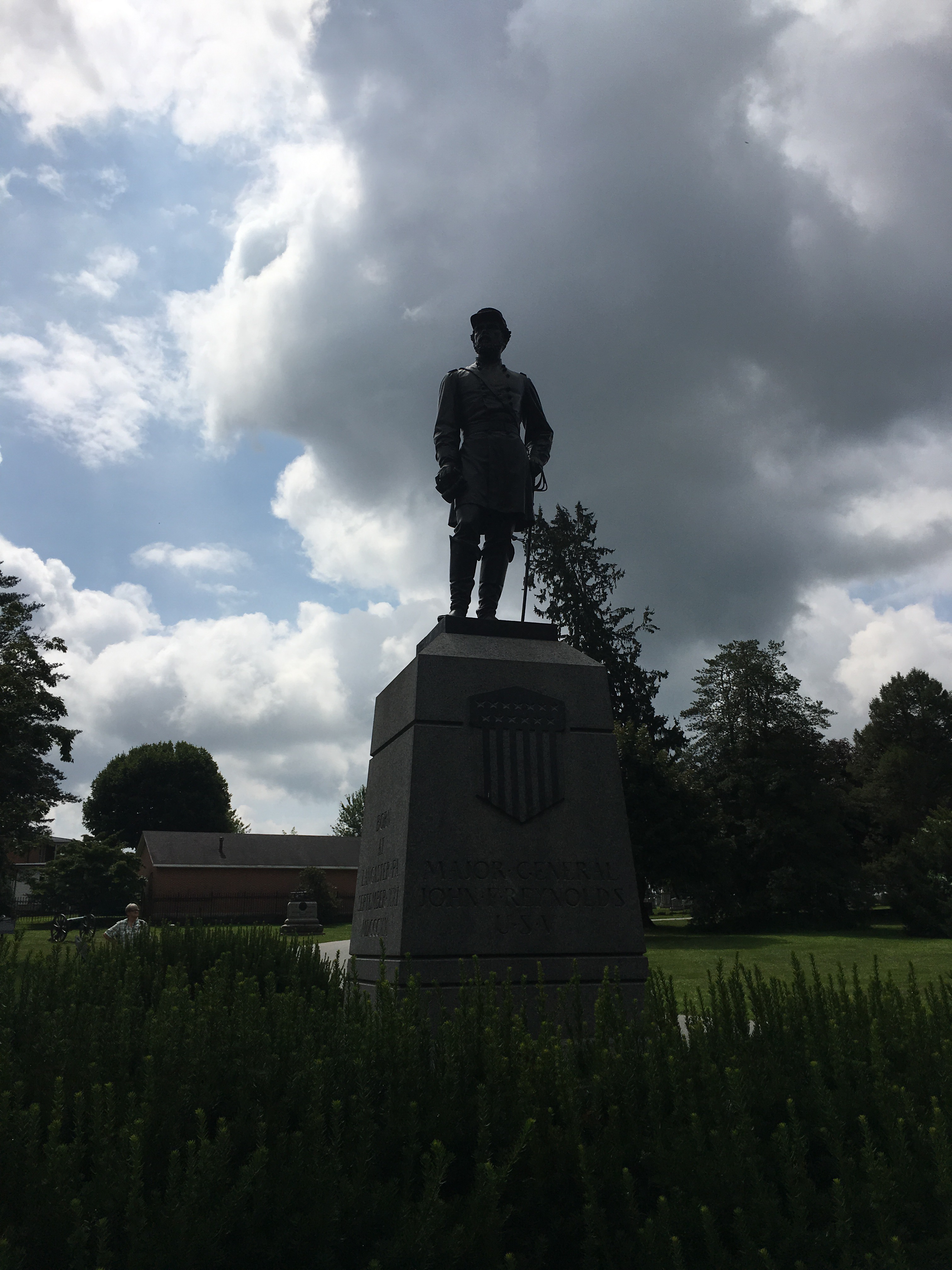
One hundred and sixty three years ago Abraham Lincoln delivered a few short words at the dedication of the Soldier’s Cemetery in Gettysburg, Pennsylvania.

Those words, along with the Preamble of the Declaration of Independence are the American equivalent of secular scripture. Even more than the Constitution they define the ideal of what the United States can and should be.

Lincoln understood that ideal even during the midst of a war which devastated the nation and claimed the lives of nearly three quarters of a million American soldiers and sailors, from the North and the South. At Gettysburg, where just three and a half months earlier over 150,000 soldiers battled for three days, leaving about 50,000 dead, wounded, and missing on the battlefield. When Lincoln gave his remarks the cemetery, which now contains the remains of 3,577 Union soldiers, half unknown, was not yet half-full. Men were still engaged in the gruesome task of recovering the decaying remains from hasty graves all around the battlefield, as well as recovering and attempting to identify those who fell and remained where they died.

Lincoln understood that the sacrifice had to have a greater meaning, and he went back to that sacred proposition in the Preamble of the Declaration, the proposition that “all men are created equal.” It was a proposition that many in Europe mocked as impossible, and which many Americans believed only applied to white, male, property owners. But Lincoln saw beyond that and in his speech he began to universalize the proposition, and spoke of bringing forth “a new birth of freedom” and that Americans, both those gathered around him, and those who read the speech would “highly resolve that these dead shall not have died in vain — that this nation, under God, shall have a new birth of freedom — and that government of the people, by the people, for the people, shall not perish from the earth.” 

I am ever the optimist that we will see that new birth of freedom, but I do expect in the coming years that we will again see many of those freedoms rolled back or curtailed as they were in the years following the re-establishment of white rule in the South, and the extension of Jim Crow to many places outside of the former Confederate States. Sadly, even the symbols of the Confederacy are on the rise, the Confederate Battle Flag is showing up in places that it never flew during the American Civil War.

I do believe that the ideals of Lincoln’s words are immortal, and are worth fighting for even when they are not popular, and even when the majority decides to crush the rights of the minorities that they despise, be they racial, religious, political, ideological, or even gender related. I do believe that we are at a crossroads, a crossroads where we will have to choose to fight for the rights of the weak in our legislatures and courts, and by our actions.

The Compromise of 1850 included the Fugitive Slave Act, a law designed to help slave owners recover their “property” anywhere in the country. It was a law that benefited slave states and overthrew the laws of Free States which were ordered to assist agents of the slave owners recover their human property. Many Northerners, even non-abolitionists were horrified by the new law and worked to protect African Americans in their communities. Southerners were infuriated and claimed to be the victims of Northern aggression and militant “Godless” abolitionists.

I expect that in the coming months that laws will be passed to discriminate against minorities of all kinds and that many of these laws will contradict individual state laws and protections. We are seeing White Nationalists like Stephen Bannon and Jefferson Beauregard Sessions as chief White House Counselor and Attorney General nominee. Neither have had any regard for the rights of racial minorities and may be setting civil rights policy. If those policies discriminate or roll back the rights of people they will have to be opposed.

Like the abolitionists we will have to make a choice, a moral choice and do what we can to mitigate those laws and protect those that they harm until the time comes when the people who passed them lose political power.

img_2708

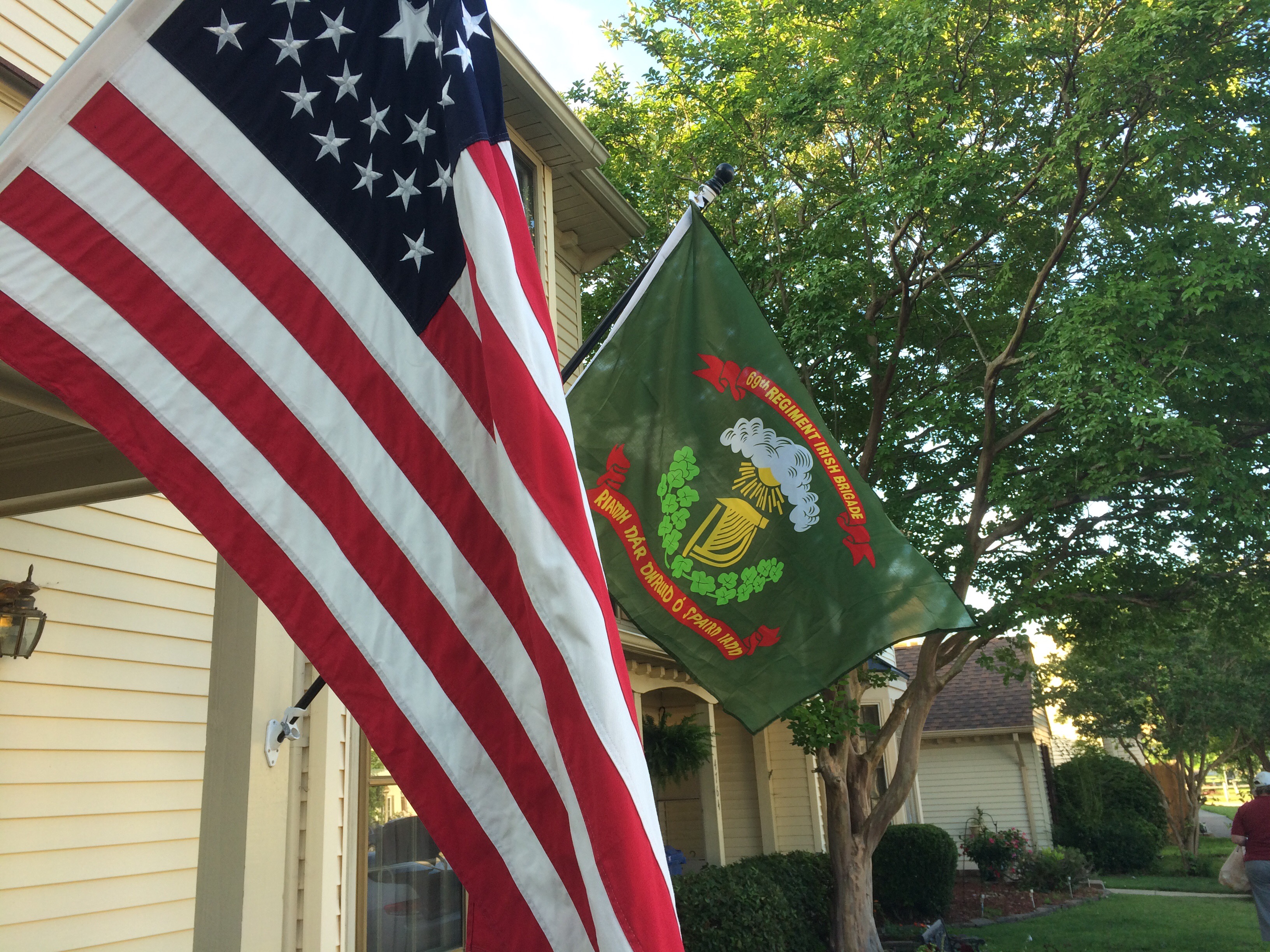
Outside of my house I fly the 34 “Circle Star” Flag of the Union as well as the flag of the 69th New York Volunteer Infantry of the immortal Irish Brigade. They are symbols of my opposition to the neo-Confederate racism and xenophobia that is arising in the country. I will remain true to the Constitution, and I will never stop believing in or fighting for the proposition that all men are created equal, and that we shall indeed have a new birth of freedom — and that government of the people, by the people, for the people, shall not perish from the earth.

Peace

Padre Steve+

Leave a comment

Filed under civil rights, civil war, ethics, History, News and current events, Political Commentary

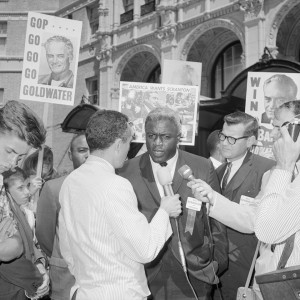
Jackie Robinson and the Freedom Summer

Jackie Robinson Speaking with the Press

Friends of Padre Steve’s World,

I am still on vacation and will posting some new material have brought an older article out of the vault. I think it is important because it covers a watershed moment in American politics, a moment that started the Republican Party down the path that has culminated today. It is about the Freedom Summer of 1964 and baseball icon and civil rights pioneer Jackie Robinson’s trip to the 1964 Republican National Convention. Though the events happened some fifty-two years ago, they are not ancient history, and the spirit and ideology that characterized them is all to present today, especially in the modern Republican Party. 

So have a great day. 

Peace

Padre Steve+
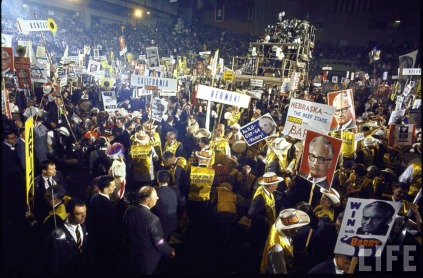
republican-national-convention-delegates_1964

“A new breed of Republicans had taken over the GOP. As I watched this steamroller operation in San Francisco, I had a better understanding of how it must have felt to be a Jew in Hitler’s Germany.” Jackie Robinson on his observations of the 1964 Republican National Convention

Jackie Robinson was a Republican. So was I for 32 years and for much of that time I considered myself a “conservative” whatever that means, though I thought it meant freedom, limited government and opportunity for all regardless of race, color, religion or any other trait or belief. I also believed and still do in a strong defense, but I can no longer consider myself a man that blesses American intervention in other people’s wars unless there is a clear and present danger to the United States, not simply our so called “interests” which may not be those of the nation at all but of multi-national corporations which were originally American businesses but not only need our military, diplomatic and intelligence resources to increase their profits.

My parents were Kennedy type Democrats, but in the 1970s, torn by the extremism of the 1972 Democratic Convention in Chicago and feeling the hatred of people for those in the military, including a Sunday School teacher who told me that my dad, then serving in Vietnam was “baby killer” I at the age of 12 decided that I would be a Republican. I was a Republican until I returned from Iraq in 2008, fully aware of the lies that took us into that war and seeing the cost both to American servicemen and the people of Iraq.

fsms1

I have been doing a lot of reading lately on a period of history that as a historian I had pretty much skipped over. That is the period of the Civil Rights movement of the early to mid-1960s. I guess I skipped over it because I was more interested in the glory of war and patriotism wrapped in historic myth than in the experiences of fellow citizens who had been killed, abused, tormented and persecuted by people like me simply because of the color of their skin. I had not yet begun to appreciate the concept of justice at home being interconnected to our deepest held principles and how we embody them in our foreign policy.

For many years I echoed the point made by some conservatives that it was the GOP that helped make the Voter’s Rights Act of 1964 and Civil Rights Act of 1965 passed into law. That is true. Most Republicans voted for them, with a notable exception, Barry Goldwater. However, what is also true is that the Republicans that voted for the 1964 act were considered “liberals” and treated shamefully at the 1964 convention, whose delegates voted down a part of the platform that would have supported that act. Of the Democrats that voted against those bills almost all came from the Deep South, a region which within a decade become a Republican stronghold and a key part of the Southern Strategy of every GOP Presidential Candidate since Richard Nixon. A Republican aide at the 1964 convention told a reporter that “the nigger issue was sure to put Goldwater in the White House.” (See Freedom Summer by Bruce Watson p.163)

However as a life long baseball fan there is one thing that I know, that if there had been no Branch Rickey and Jackie Robinson we might not have gotten Rosa Parks or the Reverend Martin Luther King Jr.
$(KGrHqF,!qEF!GdOTlS(BQOjfQWE0w~~60_57

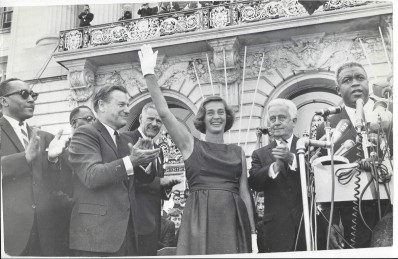
Robinson was appointed as a special delegate to New York Governor Nelson Rockefeller who was running against Goldwater and attended the convention. He had given up his job as a spokesman for and Vice President of the Chock Full O’Nuts Coffee Company to assist Rockefeller’s campaign in 1964.

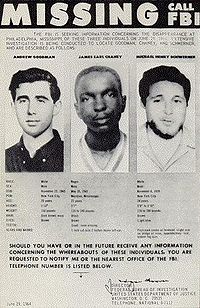
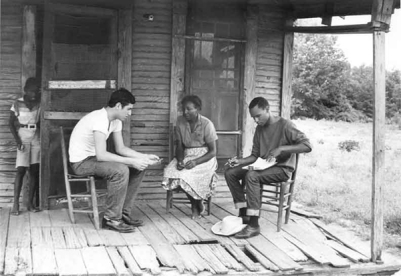
Robinson knew what it was like to be the “point man” in the integration of baseball and in his career was threatened with physical violence and death on many occasions. Some teammates circulated petitions that they would not play for a team that had a “black” on it. Robinson, encouraged by Rickey persevered and became an icon in baseball, the Civil Rights movement and the history of the United States. However, not even 10 years after his retirement from baseball and 2 years after he was elected to the Hall of Fame he once again discovered just how deep racism still ran in this country. As he attended the convention FBI agents and other Federal authorities attempted to find the bodies of three young Voting Rights staff who were part of the 1964 Freedom Summer campaign in Mississippi. Eventually, later in the summer the bodies of James Chaney, Andrew Goodman and Michael Schwerner would be discovered buried in the base of a dam near Philadelphia Mississippi. Their killers were local law enforcement officers and members of the Ku Klux Klan.
200px-AndrewGoodman-JamesChaney-MichaelSchwerner

Maybe I lived in my own fantasy world. My experience growing up was on the West Coast living in a military family in small towns and big cities. I am proud to be part of the first class that attended high school in my home town when the courts ordered desegregation in our schools. That experience at Edison High School of Stockton California from 1975-78 changed me, as did having a black roommate in college.

However, that being said it took me a long time to realize that things really haven’t changed that much from 1964 in many parts of the country, especially since I have lived most of my adult live in the historic States that comprised the Confederacy. I can say from practical observation and knowledge that racism and other forms of more acceptable prejudice live on in this country. There is not a day that goes by that I do not run into the vestiges of the hate that lived during the Freedom Summer of 1964. It is more subtle in some cases, but other times is so blatant that is sickening. I never expected that I would ever be called a “nigger lover” or “wigger” until I had people make those comments on this website in response to articles that had nothing to do with race relations or civil rights, nor did I expect physical threats from people who call themselves “Christian.” Those were learning experiences that I won’t soon forget.
G21767P

Robinson wrote of his experience at the 1964 Convention:

“I wasn’t altogether caught of guard by the victory of the reactionary forces in the Republican party, but I was appalled by the tactics they used to stifle their liberal opposition. I was a special delegate to the convention through an arrangement made by the Rockefeller office. That convention was one of the most unforgettable and frightening experiences of my life. The hatred I saw was unique to me because it was hatred directed against a white man. It embodied a revulsion for all he stood for, including his enlightened attitude toward black people.

A new breed of Republicans had taken over the GOP. As I watched this steamroller operation in San Francisco, I had a better understanding of how it must have felt to be a Jew in Hitler’s Germany.

The same high-handed methods had been there.

The same belief in the superiority of one religious or racial group over another was here. Liberals who fought so hard and so vainly were afraid not only of what would happen to the GOP but of what would happen to America. The Goldwaterites were afraid – afraid not to hew strictly to the line they had been spoon-fed, afraid to listen to logic and reason if it was not in their script.

I will never forget the fantastic scene of Governor Rockefeller’s ordeal as he endured what must have been three minutes of hysterical abuse and booing which interrupted his fighting statement which the convention managers had managed to delay until the wee hours of the morning. Since the telecast was coming from the West Coast, that meant that many people in other sections of the country, because of the time differential, would be in their beds. I don’t think he has ever stood taller than that night when he refused to be silenced until he had had his say.

It was a terrible hour for the relatively few black delegates who were present. Distinguished in their communities, identified with the cause of Republicanism, an extremely unpopular cause among blacks, they had been served notice that the party they had fought for considered them just another bunch of “niggers”. They had no real standing in the convention, no clout. They were unimportant and ignored. One bigot from one of the Deep South states actually threw acid on a black delegate’s suit jacket and burned it. Another one, from the Alabama delegation where I was standing at the time of the Rockefeller speech, turned on me menacingly while I was shouting “C’mon Rocky” as the governor stood his ground. He started up in his seat as if to come after me. His wife grabbed his arm and pulled him back.

“Turn him loose, lady, turn him loose,” I shouted.

I was ready for him. I wanted him badly, but luckily for him he obeyed his wife…” From Jackie Robinson “I Never Had it Made” Chapter XV On Being Black Among the Republicans
1*HLP1tcduxglV4VtdWHUI0Q

Belva Davis, then a young journalist wrote of her experiences at that convention:

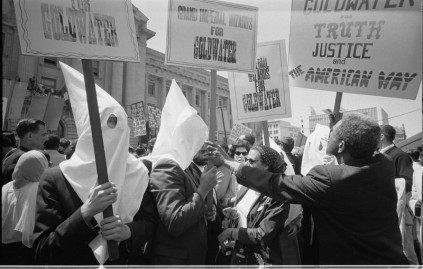
While the Goldwater organization tried to keep its delegates in check on the floor, snarling Goldwater fans in the galleries around us were off the leash. The mood turned unmistakably menacing…

Suddenly Louis and I heard a voice yell, “Hey, look at those two up there!” The accuser pointed us out, and several spectators swarmed beneath us. “Hey niggers!” they yelled. “What the hell are you niggers doing in here?’”

I could feel the hair rising on the back of my neck as I looked into faces turned scarlet and sweaty by heat and hostility. Louis, in suit and tie and perpetually dignified, turned to me and said with all the nonchalance he could muster, “Well, I think that’s enough for today.” Methodically we began wrapping up our equipment into suitcases.

As we began our descent down the ramps of the Cow Palace, a self-appointed posse dangled over the railings, taunting. “Niggers!” “Get out of here, boy!” “You too, nigger bitch!” “Go on, get out!” “I’m gonna kill your ass!”

I stared straight ahead, putting one foot in front of the other like a soldier who would not be deterred from a mission. The throng began tossing garbage at us: wadded up convention programs, mustard-soaked hot dogs, half-eaten Snickers bars. My goal was to appear deceptively serene, mastering the mask of dispassion I had perfected since childhood to steel myself against any insults the outside world hurled my way.

Then a glass soda bottle whizzed within inches of my skull. I heard it whack against the concrete and shatter. I didn’t look back, but I glanced sideways at Louis and felt my lower lip began to quiver. He was determined we would give our tormentors no satisfaction.

“If you start to cry,” he muttered, “I’ll break your leg.” ( Belva Davis “Never in My Wildest Dreams: A Black Woman’s Life in Journalism)

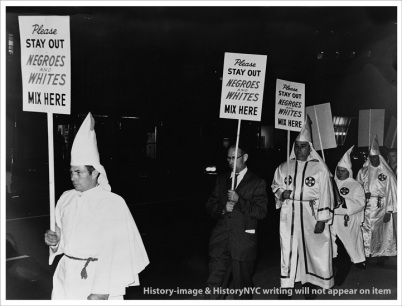
The sad thing is that in many states the new GOP has taken a page out of the past and has been either passing legislation or attempting to pass legislation that makes it harder for Blacks and other minorities to vote. Groups have shown up armed at heavily black polling sites in recent elections and efforts have been made to ensure that minorities cannot vote. They have also challenged the 1964 Voter’s Rights Act in Court and have a friend in Justice Antonine Scalia who called it a “racial entitlement” and violation of State sovereignty.
8399w

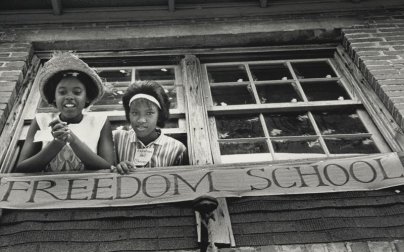
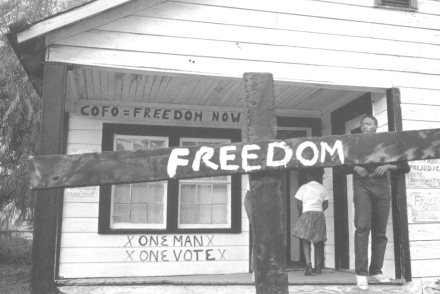
The tactics are quite similar to those used in the Deep South prior to 1964 which made it virtually impossible for a Black man or woman to cast a vote, and if they tried even to register to vote did so at the peril of their lives or families. The opponents of integration, voter’s rights and equal rights used some of the same lines used today against those that support these rights. “Communists sympathizers, Socialists, Atheists, Anti-Christian, Anti-American, Anti-Constitution,” you name it the same labels are being applied to those that simply want to be at the table. The sad thing that many of the most vicious users of such untruths are my fellow Christians.
ae-eop-freedom-school_tx700

These are hard things to look at and it is far easier to believe myth than it is to actually seek truth. A few years back I cannot every in a million years having written this article. However the threats to minorities be they racial, religious or even gender have become part an parcel of the new GOP, the GOP that I could not remain a part of when I returned from Iraq.

I guess that I am becoming a Civil Rights advocate, or then, maybe it’s that I’m actually becoming more of a Christian. Branch Rickey said “I may not be able to do something about racism in every field, but I can sure do something about it in baseball.” Oh well, I amy not be able to do something about racism and other prejudice everywhere but I can do it here and wherever I work or preach.
freedom_cross1

Oh well whatever, it really doesn’t matter so long as I can live with myself. Besides, I’ll get labeled anyway so what does it matter? I would rather be in the same camp as someone like Jackie Robinson and Branch Rickey than Antonine Scalia or those that seek to keep people down simply because they are different anyway.

Martin Niemoller once said:

First they came for the , communist
and I didn’t speak out because I wasn’t a communist.

Then they came for the socialists,
and I didn’t speak out because I wasn’t a socialist.

Then they came for the trade unionists,
and I didn’t speak out because I wasn’t a trade unionist.

Then they came for me,
and there was no one left to speak for me.

Friends, it is all too important that we not forget this, even as Donald Trump and many of his supporters who include most of the White Supremacists, Klansmen, and Neo-Nazis in this country offer the same threats against blacks, other minorities, and political moderates and liberals. Make no mistake, what is happening now is nothing more than a resurgence of the hatred and violence that was unleashed against those who fought for civil rights fifty years ago.


Leave a comment

Filed under civil rights, History, Political Commentary

Rebels and Racism in Gettysburg 


Friends of Padre Steve’s World,

Gettysburg is hallowed ground for all who love this country. It is the site of a defeat which ended any hope for a Confederate military victory, and at which Abraham Lincoln spoke of a new birth of freedom. It is a place that veterans of both sides began to gather both to remember their service and comrades but also to promote reconciliation between the North and the South. 

But it has also become a place in recent years for neo-Confederates to gather, not to remember the new birth of freedom, but to arrogantly defile the site by spewing hate, proclaiming racism, while openly speaking of their hatred of the United States and love of the late Confederacy. Some drive around town and in front of the Soldier’s Cemetery in large and loud pickup trucks, sometimes blaring their horns, while flying large 3′ x 5′ Confederate Battle Flags flying as if to mock the Union soldiers buried there. 

It is also interesting to note that many of these openly racist people are not from the South, nor do they have southern roots. They simply tend to be racist and anti-government and gather around the flag of the Confederacy.  I remember having a beer with a man from upstate New York in a bar a year or so ago who said he was the chaplain for a Confederate reenactment unit (in uniform) and went on to discuss his hatred for the United States, as well as African Americans, and other non-white American citizens. Likewise on another visit an older couple who said they were from Georgia listened to me talk with my students in the Soldier’s Cemetery, and when I was finished with reading the Gettysburg Address, the man made sure that he told me that all people were not created equal. 

But let me be clear, there are also Southerners who love this country very much, who when they come to Gettysburg to remember their fallen ancestors, do so with a reverence which is perfectly in keeping with the desire for reconciliation of the Southern veterans as who returned to Gettysburg in the decades after the war. 

I was walking by one of the gift shops in town and noticed a t-shirt on display. The shirt was adorned with the Confederate Battle Flag and and the words “I will not be reconstructed and I don’t give a damn!” 

To some that may seem like a simple snarky statement. However, when you understand what the phase really means it should leave you cold. In 1866 it became part of the lyrics of a song called Oh, I’m a Good ole Rebel, a song that has been recorded numerous times in the years since it was written. 

It was a phase used by Southerners after the Civil War who opposed the process of reconstruction, opposed all civil rights for blacks, and pushed for the return of white rule, which they achieved in 1877 when Reconstruction ended. At that point nearly every hard fought for right of African Americans was reversed, suppressed, or made so difficult to use as to be effectively revoked. Those rights would not begin to be restored until 1954 when the Supreme Court issued the Brown v. Board of Education decision which overturned the  Plessy v. Ferguson ruling of 1894. This ruling declared that the segregation laws and Black Codes of the Jim Crow era were unconstitutional. It took another ten years for Congress in the face of heated opposition to pass the Voting Rights Act of 1964 and the Civil Rights Act of 1965. 

But among segregationists those rulings were reviled. Governors fought to keep African Americans from entering segregated public schools and universities, civil rights workers were attacked and sometimes killed, civil rights leaders like Dr. Martin Luther King Jr were assassinated. Alabama governor George Wallace, who in his 1963 governor’s inauguration address proclaimed “segregation now, segregation tomorrow, segregation forever!” ran on a segregationist platform in the 1968 election and won 13.53% of the popular vote. He won Georgia, Alabama, Mississippi, Louisiana, and Arkansas, while collecting 45 electoral votes. Interestingly enough, the demographics of Wallace’s supporters, heavily white male and lesser educated, were very much like those of current GOP nominee Donald Trump. 

But I digress, yet the fact of the matter is that the open proclamation of the phrase I will not be reconstructed on a shirt displaying the flag of the republic that Confederate Vice President Alexander said, was founded on the superiority of the white race and subordination of the negro as slaves. They are the words of the KKK, the Red Shirts, and the White Leagues who used violence and terrorism to intimidate blacks and any of their white supporters. 

So a a historian I will not attempt to silence those people’s free speech rights, as repugnant as I find them to be. But have to call their words what they are, a call for the return to Jim Crow and worse. They are meant to intimidate people, and I find that message evil, in fact it goes against everything that makes America great. Maybe those who say they will “make America great again” should take heed to the Declaration of Independence, the Bill of Rights, and Lincoln’s Gettysburg Address and realize what really makes America great instead of spewing the hate of those who fought the propositions of life, liberty, and the pursuit of happiness at every turn, even to begin a bloody civil war. 

So until tomorrow have a great Monday.

Peace,

Padre Steve+


2 Comments

Filed under civil rights, Political Commentary

A Cyclorama, a Cornerstone, and a Proposition


Friends of Padre Steve’s World

I have been at Gettysburg this weekend and yesterday was spent doing the Staff Ride on the battlefield. Normally we get all of the first two days of the battle done and conclude at Culp’s Hill and East Cemetery Hill before retiring to dinner. Yesterday, the weather got in the way. Thunderstorms came through and while we were able to finish the final assault of the Confederates on Cemetery Ridge, the storms became worse, so I altered the plan. Instead of pushing on and ensuring that my students would be too wet and miserable to learn anything I changed the plan on the fly and took them to the Visitors Center, where we normally begin our Sunday.


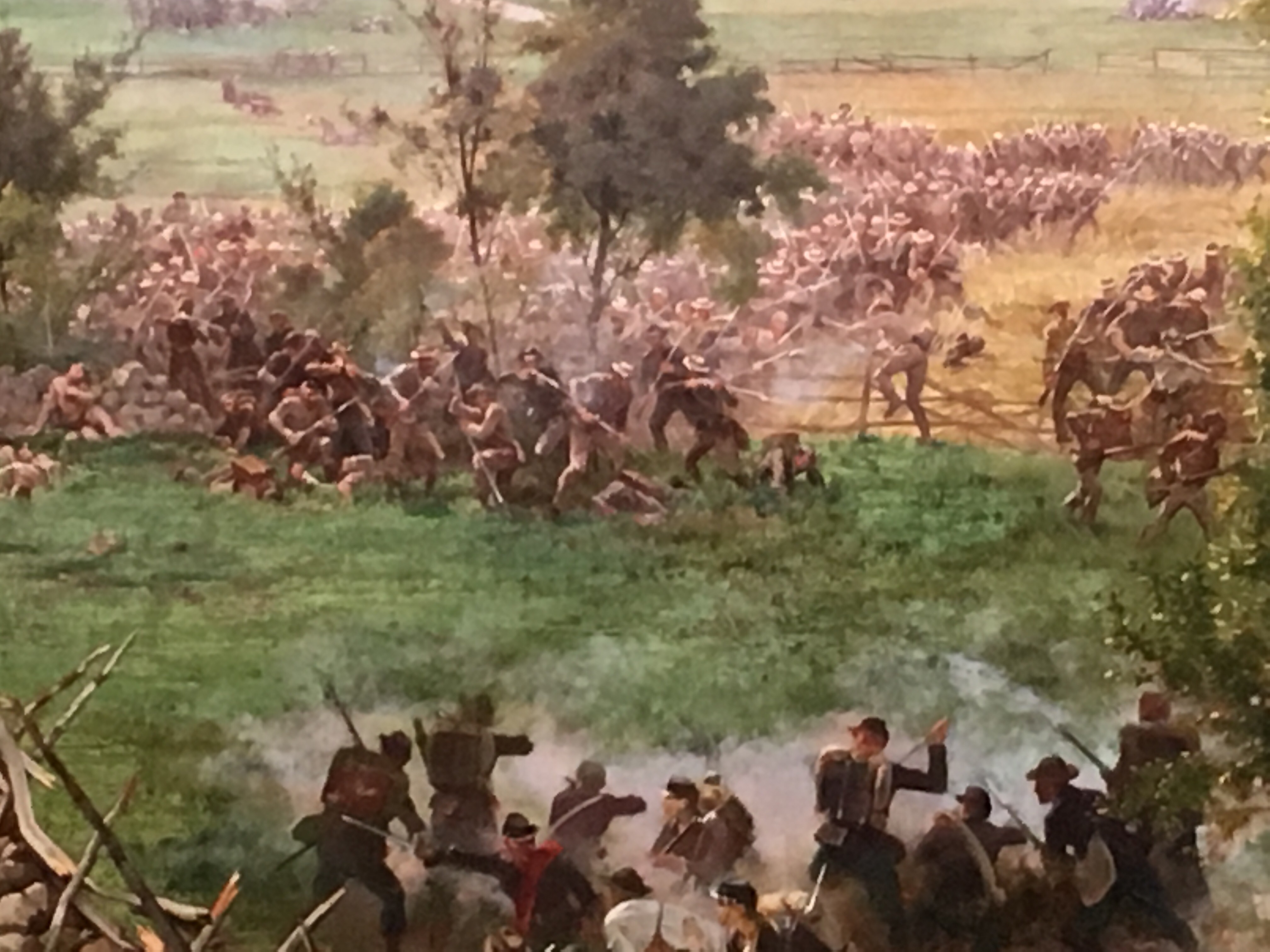
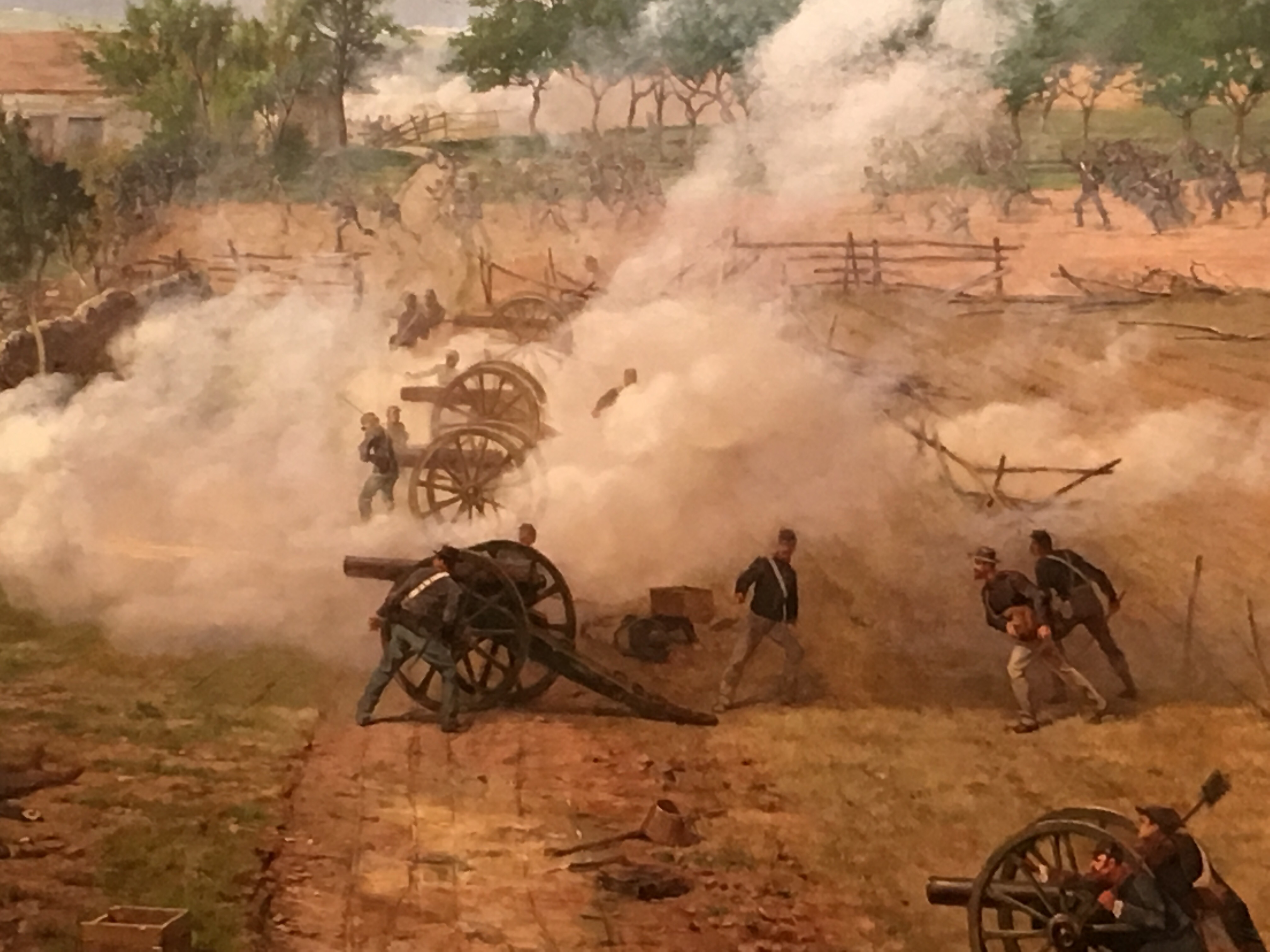
This was a good choice because it also got them more time there than if we had done it today. While there I went the the Cyclorama of Pickett’s Charge, which I had not visited since 1997. The cyclorama is the largest oil and canvas painting in the United States. It give a 360 degree view of the battle. Painted in 1883 by Paul Phillipotaux it is 42 feet high and 377 feet in circumference. It was restored between 2005 and 2008 when it was placed in the new Visitors Center. In all of my trips since then I had not re-visited it. Yesterday I did and it was spectacular, far better than it used to be. 

I also spent time in the museum. One of the displays was a video display of Northern and Southern leaders comments about slavery and abolition in the years leading up to the war and shortly after secession. I stopped and watched and listened, as the words of speeches that I had only read were spoken. One of the statements was that of Confederate Vice President Alexander Stephens in his “Cornerstone Speech” of March 1861. In it Stephens laid out the what he called the “cornerstone” of the Confederacy, that it was a nation conceived on the superiority of the white race, the subordination of the black race, and the error of the founders of the United States in the proposition that “all men are created equal.” 

This was an assertion that Stephens to believed was in error, and he noted that the new Confederacy was “founded on exactly the opposite idea; its foundations are laid, its cornerstone rests, upon the great truth that the negro is not equal to the white man; that slavery, subornation to the superior race, is his natural and normal condition…” 

Now I have read that speech many times and it always sends a tremor of revulsion through me. But yesterday was different. I heard an actor speaking those words, and not only did that tremor of revulsion go through me, but I had an emotional reaction, terms filled my eyes in sadness and anger such as I had not experienced when simply reading the words. To hear a voice utter them was to make them real, because I hear all too similar expressions of the racial superiority of the white race from many supporters of Donald Trump, to included prominent White Supremacists, like David Duke and Pat Buchanan as well as many others including the KKK and bro-Nazis. 

 Likewise, it struck me because many people I know who call themselves conservative Evangelical or Catholic Christians use similar terminology not just to describe their racial superiority, but their religious superiority over others. Hearing those words spoken, reminded me of the fact that those who proclaim them are in fact attacking the very foundation, the very e proposition that the founders stated, and which Abraham Lincoln reiterated and universalized, “the proposition that all men are created equal.” 

That proposition is at the heart of the Bill of Rights and if we say that this is wrong, and we attempt to marginalize, disenfranchise, and otherwise discriminate against people based on their race, nationality, skim color, religion, gender, or sexual orientation, then we have forgotten the most important part of who we are as Americans. Thankfully, a number of rooms later I entered a room which dealt with the Gettysburg Address. In it there was a display of that text, with the voice of an actor portraying Abraham Lincoln speaking it. I paused, listened and reflected on the difference of Lincoln’s words and those of Stephens. Truthfully, hearing the words of Stephens and Lincoln being spoke felt like how I reacted the differences between the Trump convention, and the Democratic National Convention. 

The fact is that the United States was founded on that simple proposition that all men are created equal. While we haven’t always practiced it, in this country or abroad, it does not take away the power that simple truth to set people free. In this country it has been an at times grueling task to bring freedom to slaves, to women, to other immigrants, and to the LGBTQ community. It has been 240 years and there are still people trying to roll back the rights of those they think are inferior, or who they believe that their religion condemns. That my friends is not an American concept, it a throwback to the old world, a world which only exists in the Cloud-Cukoo land of ideologues.


So today we finished up the Staff Ride going to Culp’s Hill and East Cemetery Hill prior to retracing the route take by Pickett’s troops as they made their ill-fated charge into the center of the Federal line. The last past is particularly powerful as I quote from the words of the soldiers who observed the attack and the human carnage inflicted by the Federal guns and infantry. As much as I despised the cause of those brave soldiers, I cannot help but to admire their courage in making that attack, call it the common humanity and compassion that I feel towards soldiers who are ordered to do the impossible. When we got to the Angle where Lieutenant William Cushing was killed firing his last rounds of canister at the advancing Confederates, and where the Irishmen of the 69th Pennsylvania joined with others to drive the Confedates back, I am equally amazed by the courage of those Union men.


As always we finished up at the Soldier’s Cemetery where we talked about the human cost of war, and the moves on to talk about the importance of the Gettysburg Address, in particular its relationship to the Declaration of Indpendence and that proposition that is the heart and soul of what makes America different than any other country. The proposition that all men are created equal, and that we are not a nation founded on race, ethnicity, or religion, but on a proposition that most of the world envies, and which we ourselves so often neglect out of fear, of others, much to our detriment. 

So I will write more later to post tomorrow. But for now I am yours.

Peace,

Padre Steve+ 

Leave a comment

Filed under civil rights, civil war, Gettysburg, History, News and current events, Political Commentary

Slavery in a Different Form: The Collapse of Northern Support for Reconstruction

ulysses-s-grant-book

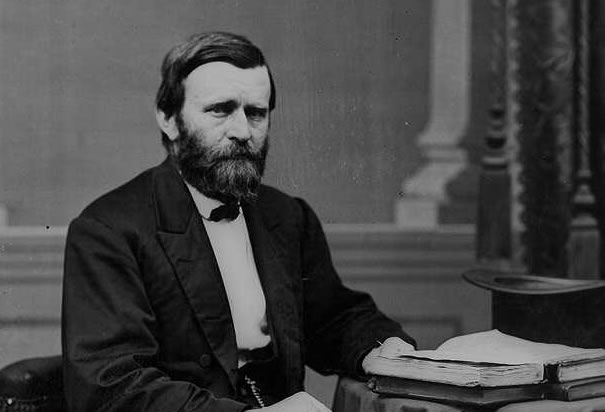
Ulysses Grant

Friends of Padre Steve’s World,

Since I am not doing anything really new this weekend unless something really big happens, here is a part of my Civil War text. Since I have posted a number of articles recently from it dealing with the Reconstruction and Jim Crow eras, I thought that this would be interesting. Have a great weekend.

Peace

Padre Steve+

It is all too easy to simply blame recalcitrant Southerners for the collapse of Reconstruction. However, it is impossible not to explore this without addressing responsibility of many leaders and citizens in the North for the failure of Reconstruction and the return of “White Man’s Rule” to the South. Like today, people faced with economic difficulties sought out scapegoats. When the country entered an economic depression in 1873 it was all too easy for Northern whites, many of who were willing to concede “freedom” to turn on blacks. Racism was still heavily entrenched in the North and for many, economic considerations trumped justice as the North tried to move away from Reconstruction and on to new conquests, including joining European powers in attempts to gain overseas colonies and territories.

As Southern extremists turned the Federal effort at Reconstruction into a violent quagmire that seemed to have no end, many Northerners increasingly turned against the effort and against Blacks themselves. Like so many victorious peoples they did not have the political or moral capacity to remain committed to a cause for which so many had sacrificed and they began to abandon the effort after two short years of congressionally mandated Radical Reconstruction.

Likewise, the men who had so nobly began the effort to enfranchise African Americans failed to understand the social and political reality of the South. To the average Southerner of the era “political equality automatically led to social equality, which in turn automatically led to race-mixing. It was inevitable and unthinkable. To a people brought up to believe that Negroes were genetically inferior – after all, that was why they were slaves – the mere hint of “mongrelization” was appalling.” [1] This was something that most Northerners, even those committed to the political equality of African Americans could not comprehend, and the ignorance of this fact would be a major reason for the collapse of Northern political and social support for Reconstruction.

Congressman Thaddeus Stevens, one of the most effective leaders of the Radical Republicans died in 1868 in despair that the rights of blacks were being rolled back even as legislation was passed supporting them. A few weeks before his death Stevens told a friend “My life has been a failure…I see little hope for the republic.” [2] The old firebrand asked “to be buried in a segregated cemetery for African American paupers so that “I might illustrate in death the principles which I advocated through a long life, Equality of man before his creator.” [3] Others including Senator Ben Wade, were not returned to office while others including Edwin Stanton, Salmon Chase and Charles Summer all died during Grant’s administration.

While Grant attempted to smash the Ku Klux Klan by military means, both his administration and Congress were of little help. He faced increased opposition from economic conservative Republicans who had little interest in the rights of African Americans and who gave little support to those fighting for equal rights for blacks. The situation was further complicated by the “financial panic which hit the stock market in 1873 produced an economic downturn that soon worsened into a depression, which continued for the rest of the decade.” [4] The result was that Republicans lost their majorities in the House and in many states, even in the North.

It was clear that “1870 Radical Republicanism as a coherent political movement was rapidly disintegrating” [5] and during the early 1870s many of the antislavery activists had left the Republican party either to death or defection, many “no longer felt at home in a party that catered to big business and lacked the resolve to protect black rights.” [6]

In 1872, some former radical Republicans revolted against Grant and the corruption in the Republican Party. Calling themselves “Liberal Republicans” they supported the candidacy of Horace Greeley uniting with Democrats to call for an end to Reconstruction. For many this was not so much because they no longer supported the rights of African Americans, but because for them, like so many, “economic concerns now trumped race relations…. Henry Adams, who shared the views of his father, Charles Francis Adams, remarked that “the day is at hand when corporations far greater than [the] Erie [Railroad]…will ultimately succeed in directing the government itself.” [7] The numbers of Federal troops in the South continued to be reduced to the point where they could offer little or no support to state militia.

The combination of all of these factors, political, racial, economic, and judicial doomed Grant’s continued efforts at Reconstruction by executive means. Despite the hard fought battle to provide all the rights of citizenship and the vote to African Americans racism remained heavily entrenched in all regions of the country. In the North and the South the economic crisis of 1873 caused people to look for scapegoats, and blacks were easy targets. With economics easily trumping the cause of justice, “racism increasingly asserted its hold on northern thought and behavior.” [8] The Northern press and politicians, including former abolitionists increasingly took the side of Southerners, condemning Freedmen as lazy and slothful usurpers of white civilization.

Likewise the growing problem of labor unrest in the North brought about by the economic depression made “many white northerners more sympathetic to white southern complaints about Reconstruction. Racial and class prejudices reinforced one another, as increasing numbers of middle-class northerners identified what they considered the illegitimate demands of workers and farmers in their own society with the alleged misconduct of the former slaves in the South.” [9]

The depression hit Freedmen in the South with a vengeance and unable to pay their bills and mortgages many lost everything. This left them at the mercy of their former white masters who were able to force them into long term employment contacts which for practical purposes reenslaved them. Those whites who were still working for Reconstruction in the South were increasingly marginalized, stigmatized and victimized by a systematized campaign of propaganda which labeled them Carpetbaggers and Scalawags who had gained power through the votes of blacks and who were profiting by looting Southern Whites. In the end Southern intransigence wore out the political will of Northerners to carry on, even that of strongest supporters of emancipation and equality.

Violence now became a means to further politics in the South and carried out in broad daylight and “intended to demoralize black voters and fatally undermine the Republican Party…. They paraded at regular intervals through African American sections of small towns in the rural black majority areas, intimidating the residents and inciting racial confrontations.” [10] These armed bands were highly successful, if they were successful in provoking a racial incident they would then fan out throughout the area to find blacks in order to beat up and kill, hundreds of blacks were killed by them.

During the elections of 1876 the White Liners, Red Shirts, White League and others would be seen in threatening positions near Republican rallies and on Election Day swarmed the polls to keep blacks and Republicans out, even seizing ballot boxes either destroying them or counting the votes for Democrats. The strategy employed by the Democrats and their paramilitary supporters was to use “Lawless and utterly undemocratic means…to secure the desired outcome, which was to win a lawful, democratic election.” [11]

The pressure was too much for most Republicans in the South, and many who did not leave the South “crossed over to the Democratic fold; only a few stood by the helpless mass of Negroes….” [12] Of those in the North who did nothing to confront the resurgence of neo-Confederate mythology and who had worked against equal rights for African Americans during the Reconstruction era, “many embraced racism in the form of imperialism, Social Darwinism and eugenics.” [13]

The elected governor of Mississippi, Republican General Adelbert Ames, who was one of the most able and honest of all the Northerners to hold elected office in the South wrote in 1875 about the power of the paramilitary groups, “The “white liners” have gained their point – they have, by killing and wounding, so intimidated the poor Negroes that they can in all human probability prevail over them at the election. I shall try at once to get troops form the general government. Of course it will be a difficult thing to do.” [14] Ames requested Federal troops “to restore peace and supervise the coming elections” [15] but did not get them due to the subterfuge of Attorney General Edwards Pierrepont.

Grant told Pierrepont, a former Democrat who was critical of Grant’s insistence on the rights of African Americans that he must issue a proclamation for the use of Federal troops if Ames’s local forces could not keep order. He told Pierrepont “the proclamation must be issued; and if it is I shall instruct the commander of the forces to have no child’s play.” [16] Instead, Pierrepont altered Grant’s words and told Ames, “The whole public are tired out with these autumnal outbreaks in the South…and the great majority are now ready to condemn any interference on the part of the government….Preserve the peace by the forces in your own state….” [17] Ames, who had been a strong proponent of emancipation and black suffrage understood that he was being abandoned by Pierrepont and in order to prevent more bloodshed gave up the fight, negotiating a peace with the White League. Sadly, he like Grant realized that most of the country “had never been for Negro civil rights in the first place. Freedom, yes; but that didn’t mean all the privileges of citizenship.”  [18]  Ames’s deal with the Democrats and the White League resulted in blacks being forced from the polls and the Democrats returning to power in the state.  When Ames left the state, the discouraged veteran of so many battles including Gettysburg wrote, “A revolution has taken place – by force of arms – and a race disenfranchised – they are to be returned to a condition of serfdom – an era of second slavery.” [19]

Notes

[1] Ibid. Lord The Past the Would Not Die p.11

[2] Ibid. Langguth, A.J. After Lincoln p.233

[3] Ibid. Guelzo Fateful Lightening p.504

[4] Ibid. Perman Illegitimacy and Insurgency in the Reconstructed South p.458

[5] Ibid. Foner Forever Free p.170

[6] Ibid. Egnal Clash of Extremes p.337

[7] Ibid. Egnal Clash of Extremes p.337

[8] Ibid. Foner Forever Free p.192

[9] Ibid. Foner Forever Free p.191

[10] Ibid. Perman Illegitimacy and Insurgency in the Reconstructed South pp.459-460

[11] Ibid. Perman Illegitimacy and Insurgency in the Reconstructed South p.461

[12] Ibid. Lord The Past the Would Not Die p.15

[13] Loewen, James W. and Sebesta, Edward H. Editors The  Confederate and Neo-Confederate Reader: The “Great Truth” about the “Lost Cause” University Press of Mississippi, Jackson 2010 Amazon Kindle edition location 5258 of 8647

[14] Ames, Adelbert Governor Adelbert Ames deplores Violence in Mississippi, September 1875 in The Civil War and Reconstruction Documents and Essays Third Edition edited by Michael Perman and Amy Murrell Taylor Wadsworth Cengage Learning Boston MA 2011 p.434

[15] Ibid. Lord The Past the Would Not Die p.17

[16] Ibid. Lane The Day Freedom Died p.243

[17] Ibid. McPherson The War that Forged a Nation p. 190

[18] Ibid. Lord The Past that Wouldn’t Die p.17

[19] Watson, Bruce Freedom Summer: The Savage Summer of 1964 that Made Mississippi Burn and Made America a Democracy Viking Press, the Penguin Group New York and London 2010 p.41

Leave a comment

Filed under civil rights, civil war, history

Friday Thoughts

img_2503

Friends of Padre Steve’s World,

I have a few loose thoughts today and am kind of taking a break to again read and ponder different subjects, but first I want to thank those folks who took the time to send warm wishes, thoughts and prayers our way following my wife’s procedure to get some Kidney Stones blasted to smithereens. She is recovering well.

I was really happy to hear that Harriet Tubman, the great former slave and heroine of the Underground Railroad will replace Andrew Jackson on the $20 bill. I think it is long overdue, Tubman was a hero who put her life on the line time after time to help slaves escape before and during the war. She helped lead the Combanhee River Riad in June of 1863 which freed over 750 raids. Of course the announcement was cricized by the retired neurosurgeon and failed presidential candidate Ben Carson. 

I was absolutely shocked and saddened to hear about the passing of the iconic and brilliant musician Prince yesterday. He was an amazing musician, incredible performer, and so versatile. While his music will remain a part of our lives and culture, he died far too young at the age of 57.

I was sad to see that Chicago Cubs outfielder Jason Heyward had to deal with racist taunts on his first trip back to St. Louis on Monday. I hoped that we had gotten past that kind of idiocy and hatred, but maybe not. Some things seem to never change, Jackie Robison got the same treatment in St. Louis when he broke the color barrier.

Speaking of the Cubs, Jake Arrieta pitched the second no-hitter of his career last night, defeating the Cincinnati Reds. Having watched and gotten to know Jake at the Orioles Triple A affiliate, the Norfolk Tides, I am always happy to hear of his success. 

Since I have been doing a lot of reading lately, I want to remind folks of the great Barbara Tuchman’s comment about the importance of books. She said, “Books are … companions, teachers, magicians, bankers of the treasures of mind. Books are humanity in print.”

With that I shall wish you a wonderful weekend because I do plan on having one.

Peace

Padre Steve+

Leave a comment

Filed under Loose thoughts and musings, News and current events

Breaking Barriers: Jackie Robinson

jackie-robinson stealing home

Friends of Padre Steve’s World,

Today I am remembering the immortal Jackie Robinson, one of the most remarkable Americans who ever lived, not to mention that played baseball. Former American League President Gene Budig noted: He led America by example. He reminded our people of what was right and he reminded them of what was wrong. I think it can be safely said today that Jackie Robinson made the United States a better nation.”

April 15th 2016 was the 69th anniversary of Jackie Robinson’s first game in the Major Leagues with the Brooklyn Dodgers.  When he stepped onto the field, Jim Crow was very alive and well when Jackie stepped onto the field that day and no matter how much we want to distance ourselves from those days there are still some in this country who want to go back to that kind of society.

Jackie had experienced the full force of Jim Crow while serving as an Army Officer in the Second World War. While at Fort Hood Texas serving with the 761st Armored Battalion Robinson boarded an army bus and was ordered to the back of the bus by the driver. Robinson refused to comply as the army busses were not segregated, but the drive reported him to the Military Police. He was arrested and charged with a number of crimes and was tried by a Court Martial which acquitted him, however, it did prevent him from going to war with the 761st, which was the first African-American ground-combat unit to see action, and played a part in his determination to succeed.

Robinson’s first game with the Dodgers came a full year before President Truman integrated the military, a move which infuriated many in the South.  Likewise it occurred a full seven years before the Supreme Court ruled school segregation unconstitutional in the Brown vs Board of Education decision.  It came a full 17 years before Congress passed the Voters Rights Act in 1964.

When Jackie Robinson stepped onto the field it was a watershed moment in Civil Rights for African Americans and paved the way for a change in American society that has continued since his Major League debut. Blacks had struggled for years against Jim Crow laws, discrimination in voting rights and even simple human decencies like where they could use a rest room, sit on a bus or what hotel they could stay in.

In baseball many white fans were upset that blacks were allowed to see Robinson in stadiums that they would not have been allowed in before.  Players from other teams heckled Robinson, he received hate mail, people sent made death threats, he was spiked and spit on.  But Jackie Robinson kept his pledge to Dodgers owner Branch Rickey not to lash out at his tormentors, as Rickey told him that he needed a man “with enough guts not to strike back.”

Jackie Robinson played the game with passion and even anger.  He took the advice of Hank Greenberg who as a Jew suffered continual racial epithets throughout his career “the best ways to combat slurs from the opposing dugout is to beat them on the field.” He would be honored as Rookie of the Year in 1947. He was a MVP and played in six World Series and six All Star Games.  He had a career .311 batting average, .409 on base percentage and .474 Slugging percentage. He was elected to Baseball’s Hall of Fame in 1962.

In 1964 Robinson again experienced the hatred of racists when he was a delegate for Nelson Rockefeller at the 1964 GOP Convention. It was yet another reminder of the racism that Robinson had fought all of his live to end. He wrote in his autobiography of the experience:

“I wasn’t altogether caught of guard by the victory of the reactionary forces in the Republican party, but I was appalled by the tactics they used to stifle their liberal opposition.  I was a special delegate to the convention through an arrangement made by the Rockefeller office. That convention was one of the most unforgettable and frightening experiences of my life. The hatred I saw was unique to me because it was hatred directed against a white man.  It embodied a revulsion for all he stood for, including his enlightened attitude toward black people.

A new breed of Republicans had taken over the GOP.  As I watched this steamroller operation in San Francisco, I had a better understanding of how it must have felt to be a Jew in Hitler’s Germany.

The same high-handed methods had been there.

The same belief in the superiority of one religious or racial group over another was here.  Liberals who fought so hard and so vainly were afraid not only of what would happen to the GOP but of what would happen to America.  The Goldwaterites were afraid – afraid not to hew strictly to the line they had been spoon-fed, afraid to listen to logic and reason if it was not in their script.

I will never forget the fantastic scene of Governor Rockefeller’s ordeal as he endured what must have been three minutes of hysterical abuse and booing which interrupted his fighting statement which the convention managers had managed to delay until the wee hours of the morning.  Since the telecast was coming from the West Coast, that meant that many people in other sections of the country, because of the time differential, would be in their beds.  I don’t think he has ever stood taller than that night when he refused to be silenced until he had had his say. 

It was a terrible hour for the relatively few black delegates who were present.  Distinguished in their communities, identified with the cause of Republicanism, an extremely unpopular cause among blacks, they had been served notice that the party they had fought for considered them just another bunch of “niggers”.  They had no real standing in the convention, no clout.  They were unimportant and ignored.  One bigot from one of the Deep South states actually threw acid on a black delegate’s suit jacket and burned it.  Another one, from the Alabama delegation where I was standing at the time of the Rockefeller speech, turned on me menacingly while I was shouting “C’mon Rocky” as the governor stood his ground.  He started up in his seat as if to come after me.  His wife grabbed his arm and pulled him back.

“Turn him loose, lady, turn him loose,” I shouted.

 I was ready for him.  I wanted him badly, but luckily for him he obeyed his wife…” (From Jackie Robinson “I Never Had it Made” Chapter XV On Being Black Among the Republicans)

Today Jackie Robinson’s life, and his feat of breaking the color barrier in baseball is history, but it should not be forgotten.  He was a pioneer who made it possible for others to move forward.  He would be followed by players like Roy Campinella, Satchel Paige, Don Larson, Larry Dobie and   Willie Mays.  His breakthrough had an effect not just on baseball but on society.

Jackie Robinson would have an effect on my life.  In 1975 the Stockton Unified School District voted to desegregate.  I was in the 9th grade and preparing for high school.  As the school board wrestled with the decision anger boiled throughout the town, especially in the more affluent areas.  Vicious letters were sent to the school board and to the Stockton Record by parents as well as other opponents of the move.  Threats of violence and predictions failure were commonplace.  In the summer of 1975 those who went out for the football team, both the sophomore and varsity squads began to practice.  Black, White, Mexican and Asian, we bonded as a team, the Edison Vikings.  By the time the first buses pulled up to the bus stops throughout town on the first day of school, the sense of foreboding ended.  Students of all races discovered common interests and goals.  New friends became guests in each others homes, and all of us became “Soul Vikes.”

30 years later the Class of 1978, the first class to be desegregated from start to finish graduated from Edison held a reunion.  Our class always had a special feel about it.  Looking back we too were pioneers, like Jackie Robinson we were far ahead of our time.  When I look at my friends on Facebook from Edison I see the same faces that I played ball, rode the bus and went to class with.   Things have changed.  Even 30 years ago none of us imagined an African American President, we believed in each other and we saw potential, but I don’t think that anyone believed that we would see this in our day.

I think that Jackie Robinson prepared the way for other pioneers of Civil Rights including Dr. Martin Luther King.  Today, some 69 years later Jackie Robinson looms large in American History; not only in baseball, but for the impact of his life and actions on America.

His number “42” is now retired from baseball. The last player to wear it was Mariano Rivera of the Yankees. Rivera had been granted an exemption to wear it until he retired. At least the last Major League ball player to honor the number was a class act who will certainly be in the Hall of Fame.

Robinson said something that still resonates with me: “Life is not a spectator sport. If you’re going to spend your whole life in the grandstand just watching what goes on, in my opinion you’re wasting your life.” It is something that I take into account every day of my life.

May we not forget and always forge ahead in the constant struggle for civil rights and equality, even as many in our nation sink back into the old ways of apathy, and the toleration of injustice and inequity, even seeking to reverse the hard gotten gains that we all have been blessed to see.

So here’s to you Jackie Robinson, thank you and all the other pioneers who have and who continue to fight for the rights of all people.

Peace,

Padre Steve+

3 Comments

Filed under Baseball, civil rights, History, Political Commentary

Who is Guilty? Racism & the Birmingham Church Bombing

SixteenthStBaptistBomb05

Friends of Padre Steve’s World

On September 16th 1963 a young Southern White lawyer in Birmingham Alabama spoke these words after a black church was bombed and the police attacked peaceful protesters:

“from anger and despair, from frustration and empathy. And from years of hopes, hopes that were shattered and crumbled with the steps of that Negro Baptist Church.”

Most Americans will not recognize the names and I would dare say that many do not even know about what happened in Birmingham Alabama 52 years ago today. At 10:22 in the morning on September 15th 1963 a bomb exploded during the worship service at the 16th Street Baptist Church. It was one of the most brazen attacks against a church in the modern era, and men who claimed to be “Christians” committed it.

MCNAIR ROBERTSON COLLINS WESLEY

Four young girls, three 14 year olds and one 13 year old were killed. Addie Mae Collins, Denise McNair, Carole Robertson and Cynthia Wesley lost their lives that day. Twenty-two other church members were wounded in an attack, which was carried out by members of the KKK and tacitly approved of by many political leaders including Alabama Governor George Wallace. Why were they killed and why were the others wounded? For the crime of being black and the crime of their church serving as a focal point of the Civil Rights movement.

Likewise, most people, including many blacks do not know that before that beginning in 1955 there had been 19 other bombings of black churches and the homes of black leaders in Birmingham before this one. But even before that outbreak of violence, Birmingham had become known as “Bombingham” because over 50 bombing attacks against blacks, black churches and black institutions in the years after the First World War.

The church had served as a focal point of the Freedom Summer where Civil Rights activists and students from around the country had met, trained and organized to register blacks to vote. This made it a prominent target for violence.

1179981

Early in the morning of September 15th four members of the United Klans of America Frank Bobby Cherry, Thomas Blanton, Herman Cash and Robert Chambliss placed a box of 10 sticks of dynamite under the church steps near the basement. A time delay detonator was set o ensure that the church was filled when the bomb went off. The blast occurred as children were entering the to listen to a sermon, ironically entitled “The Love that Forgives.”

The attack was a heinous crime and an act of cold-blooded premeditated murder that maybe a number of years before might not have made the news in much of the country. But this was 1963 and over the preceding months of the Freedom Summer opened the eyes of people across the nation to what was happening in the South. The brutal attacks on many blacks, civil rights workers and student volunteers during that time raised the profile of the Civil Rights Movement and shown the ugly hatred towards blacks held by many Southerners hidden underneath the veneer of polite Southern hospitality.

315

Blacks protested and were met with a massive police response coordinated by Governor Wallace that brought about more violence, and more dead blacks. A day later a young white lawyer, Charles Morgan Jr.; a true Southerner by right and heritage spoke to the White Businessman’s club of Birmingham. His words were forceful and to the point. Instead of simply asking why, the young man began his speech with this poignant remark:

“Four little girls were killed in Birmingham yesterday. A mad, remorseful worried community asks, “Who did it? Who threw that bomb? Was it a Negro or a white?” The answer should be, “We all did it.” Every last one of us is condemned for that crime and the bombing before it and a decade ago. We all did it.”

He continued, A short time later, white policemen kill a Negro and wound another. A few hours later, two young men on a motorbike shoot and kill a Negro child. Fires break out, and, in Montgomery, white youths assault Negroes. And all across Alabama, an angry, guilty people cry out their mocking shouts of indignity and say they wonder, “Why?” “Who?” Everyone then “deplores” the “dastardly” act. But you know the “who” of “Who did it” is really rather simple.”

Not only was the attack heinous, but, the response of many in law enforcement at the local level and even at the office of FBI Director J. Edgar Hoover was criminal. Hoover refused to investigate, and although a witness identified Chambliss, he was not charged with the bombing; instead he was charged for having a case of dynamite without a permit. He was fined $100 and given a six-month jail sentence.

765026275

Thought FBI agents had investigated the crime and discovered evidence against all four men, Hoover ordered the evidence not be provided to local or Federal prosecutors. So for eight years the crime was covered up.

However in 1971 Bill Baxley was elected Attorney General of Alabama. Baxley re-opened the case and requested the FBI files, which had been suppressed by Hoover, who had died in 1972. In 1977 Chambliss was indicted and convicted of first degree murder, he died in prison. Blanton was tried in 2001, convicted of four counts of murder and sentenced to life in prison. Cash died in 1994 with ever having been charged with a crime and Cherry was convicted in 2002, sentenced to life in prison and died in 2004.

The attack and the deaths of the four girls served as a catalyst in the Civil Rights Movement. In 1964 President Lyndon Johnson signed the Civil Rights Act. However it did not end the fight for equality, and others would die in its aftermath, including Dr. Martin Luther King Jr. who died at the hands of an assassin’s bullet less than 4 years later.

Since the passage of the Civil Rights Act of 1964 and the Voters Rights Act of 1965 many blacks have been elected to local, state and federal offices or served in some of the highest ranks of the military, judiciary, and at the Cabinet level. Two, Colin Powell and Condoleezza Rice have served as Secretary of State, two, Eric Holder and Loretta Lynch, as Attorney General of the United States; one, Clarence Thomas, as a Justice of the Supreme Court; and one, Barak Obama elected as President of the United States. Black sports stars, actors and singers are celebrated as heroes among much of society.

But despite these advances, racism is still quite prevalent. One of my former co-workers from Georgia, a white Southern Baptist minister and retired military chaplain noted that many whites may not be explicitly racists in interpersonal relationships with blacks, but have an attitude that blacks still need “to stay in their place.” He noted that he thinks that quite a few believe that many whites believe that this is a large part of the reason that President Obama is opposed and even hated by so many whites. It is not just politics or ideology. While politics may play a role the root of the hatred is racism because I cannot for the life of me imagining any white Democrat, including Hilary Clinton getting this kind of treatment.

But the sad truth is there still is an undercurrent of unrepentant racism in the country and not just the South. In fact many places in the South have seen greater advances in racial relations than other parts of the country. That is not to say that there are those who would attempt to disenfranchise blacks, some of the voting laws recently passed are designed to ensure that significant parts of the black population, specifically the elderly and students living away from home have greater difficulty voting. It is actually a more insidious method than past Jim Crow laws because the drafters of these laws hope to keep just enough black and other poor or minority voters from voting to ensure that they maintain power. Some of those who drafted or supported these state laws designed to disenfranchise voters have openly admitted that fact.

Not only is racial prejudice experienced by blacks, it is experienced by many Americans of Hispanic origins, some of Asian descent but also by those of Middle Eastern, Iranian, Pakistani or Indian descent. And yes, people of all races, including racial, ethnic and religious minorities can be as racist and violent as the men who bombed the 16th Street Baptist Church 52 years ago. Racism is an ugly part of our human condition and no matter whom it is targeted against, and who does the targeting, it is wrong and needs to be fought.
The Southern Poverty Law Center http://www.splcenter.org lists 784 active hate groups of all types operating across the country, including neo-Nazis, Klansmen, white nationalists, neo-Confederates, racist skinheads, black separatists, border vigilantes and others. (See the Hate Map here https://www.splcenter.org/hate-map) The number is down from recent because a number of more the virulent White Supremacist and militia groups have gone underground, shut down websites and social media pages.

Too many people have died in this struggle to stop now. If today you read this before or after going to church, remember those four little girls who died at the hands of four murdering, racist Klansmen. Likewise remember that there are others out there full of hate who would not hesitate to do the same again and others who would actively support those efforts. Sometimes even in the name of God.

As for me I will fight it no matter whom it is against.

Charles Morgan Jr. closed the speech which brought about death threats against him and his family and forced him to leave Birmingham with these words.

“And who is really guilty? Each of us. Each citizen who has not consciously attempted to bring about peaceful compliance with the decisions of the Supreme Court of the United States, every citizen who has ever said “they ought to kill that nigger,” every citizen who votes for the candidate with the bloody flag, every citizen and every school board member and schoolteacher and principal and businessman and judge and lawyer who has corrupted the minds of our youth; every person in this community who has in any way contributed during the past several years to the popularity of hatred, is at least as guilty, or more so, than the demented fool who threw that bomb.”

10morgan01-190

Charles Morgan Jr.

Charles Morgan died in 2009, but after he left Birmingham he went on to lead a remarkable life, especially in his commitment to Civil Rights and Justice. The New York Times obituary noted:

“Among his many cases as a civil rights lawyer, Mr. Morgan sued to desegregate his alma mater, the University of Alabama; forced a new election in Greene County, Ala., that led to the election of six black candidates for local offices in 1969; and successfully challenged racially segregated juries and prisons. After the civil rights movement began to subside, Mr. Morgan, as a leader of the American Civil Liberties Union, fought three celebrated court cases involving protests against the Vietnam War.

He represented Muhammad Ali in his successful court fight to avoid being drafted. He represented the civil rights activist Julian Bond in the early stages of an ultimately successful lawsuit after Mr. Bond had been denied a seat in the Georgia legislature because of his antiwar views. And he defended an officer when he was court-martialed for refusing to help instruct Green Berets headed for Vietnam.”

We cannot ever let ourselves forget that it was supposedly Christian men who bombed a church and killed those four little girls, and that as long as all of us fail to live up to our responsibilities such things will happen again. If we do not, we are as guilty as those who throw the bombs, shoot the bullets, and those preachers, pundits and politicians who deny the fact that these things are still commonplace.

Yes, my friends, we will be at least as guilty as the brazen killers who continue to try to kill the dreams of those who are not like them. As for me, I hope that I will be as committed to stand for the rights of the oppressed and for justice as did Charles Morgan.

Peace

Padre Steve+

1 Comment

Filed under christian life, civil rights, crime, History, Political Commentary

Some are More Equal than Others: The Hatred that Will not Die

John_Lewis_t580

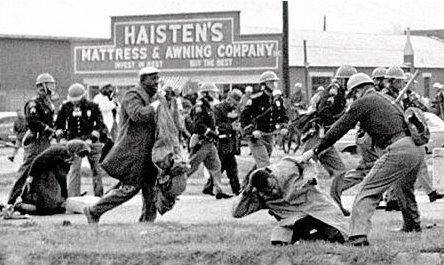
Bloody Sunday

Friends of Padre Steve’s World

I am back from Gettysburg and recuperating from the trip. I took my wife Judy to get the staples removed from her abdomen following her surgery and things are looking really good. She will be monitored and tested regularly every three months for the next two years to ensure that the cancer has not returned but the odds are it will not.

Anyway, while I while I was at Gettysburg something happened that took me aback. It was not anything from any of my students who were absolutely awesome, but it was something else.

I always end the staff ride by taking the students to the National Soldier’s Cemetery. There we talk about terrible human cost of the battle and I introduce them to a number important topics related to the cemetery. I talk about the rural cemetery movement and the Greek revival in America in the 1820s, which is culturally important to us. Then I move on the dedication of the Soldier’s Cemetery. I discuss the layout of the cemetery and how it was designed so that the grave of every soldier is of equal importance and then I read some of the comments of the keynote speaker, Edward Everett. Following this I discuss the writing of the Gettysburg Address, the way Lincoln used it to universalize the Declaration of Independence and then I recite it, and remind my students, especially my American officer students why this is so important to us as we remember our oath of office and our duty.

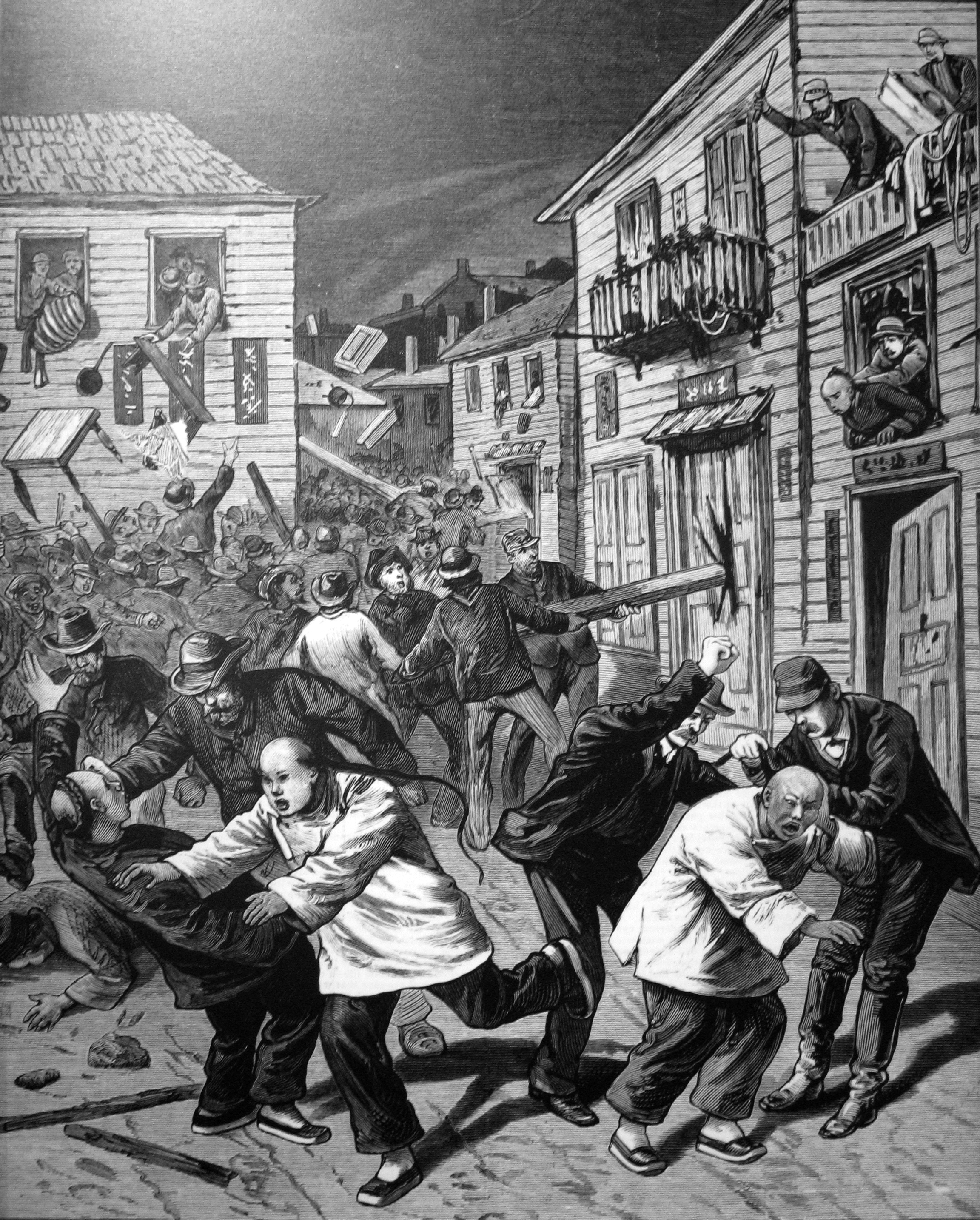
1880_Anti-Chinese_Riot_in_Denver_anagoria

Violence Against Chinese Immigrants in Denver 1880s

While we were gathering near the spot where Lincoln gave his address, an elderly white couple, which appeared to be in their early eighties, was on a bench where my students gathered. I invited them to stay if they wanted and let them know why we were there. They were very attentive as were my students and when we concluded and my students began to head back to our vans or to their own vehicles for the trip back to Norfolk, the man approached me and asked directions on how to get to the Chambersburg Road which I gladly gave him; and then he said: “You know that when they say that “all men are created equal” that some are more equal than others.”

9587864_orig

I was stunned and attempted to deflect the man’s obvious racist comment with humor, referring to the rivalry of UCLA where I did my Army ROTC training about thirty-three years ago with that of the University of Southern California. The man looked at me and said that he was from Georgia and wished that California would just drop off into the ocean, and then walked away.

I thought to myself: “you corpulent old racist bastard.” I was really tempted to follow him and confront him, but I backed off. I realized based on his age, and that he probably opposed everything about the civil rights movement and supported Jim Crow and that there was nothing that could change his mind. He was old enough that he may have actually taken part in some of the anti-civil rights actions of the 1950s and 1960s. I don’t know, but it is possible.

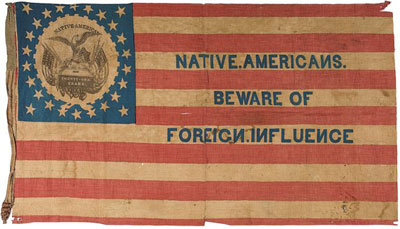
know-nothing_flag

The Flag of the Know Nothing Party

Sadly, there are a lot of people in this country who believe exactly what that man voiced. Some are racist, and not just towards African Americans but to Latinos, Native Americans, Asians, Arabs and others. There are those who believe that women and gays are not equal. Many of these people are leading politicians at the federal, state and local levels, media personalities and corporate leaders who have significant political and economic clout and if they ever had complete power would overturn or nullify every law that protects the civil rights of those they believe are less than equal, in some extreme case even less than human.

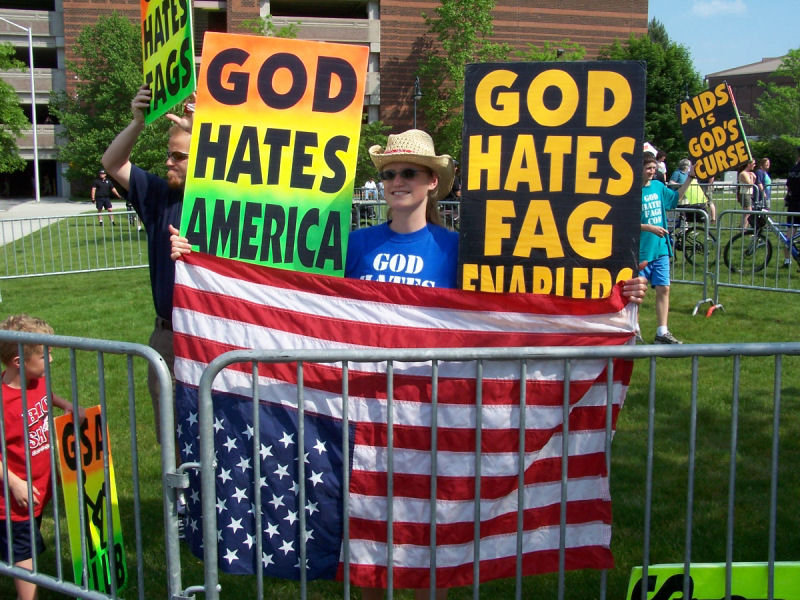
GodHatesFags-TsongasArena043

There are many reasons that people use to justify these attitudes; some pseudo-scientific, some religious, some economic, and many based on a crude Social Darwinism emphasizing the “survival of the fittest.” I heard someone else in a restaurant this weekend say exactly that when they were talking about the poor. Again, lest we want to simply use this to beat on Southerners, this is not simply an attitude confined to the South; it is all over the country, and that was the often the case throughout our American history.

It really does grieve me when I see this. The ghosts of our past intrude on so many parts of our national life, condemning the living to have to relive them in our own time. Historian George Santayana said it so well: “Those who cannot remember the past are condemned to repeat it.”

Have a good night.

Peace

Padre Steve+

2 Comments

Filed under civil rights, Gettysburg, History, Political Commentary

The Klan, the Courts & White Rule: The End of Freedom

Friends of Padre Steve’s World

Today I am completing, for now anyway, my series on what happened after the Civil War which is taken from my Gettysburg Staff Ride and Civil War text. Of course this included the passage of three incredibly revolutionary Constitutional amendments, an attempt to equalize the playing field for African Americans and a conservative backlash against these attempts. It was a time when the freedom for all was trumped by racism, social Darwinism as well as ruthless and corrupt capitalism which caused some of the greatest economic depressions in United States history.

This article deals with that time and why it matters today. Sadly, this period is again being deliberately written out of our history books by conservative pseudo-historians as well as state boards of education, like that of Texas which has written this out of our history. That my friends will be disastrous, as historian George Santayana wrote “Those who cannot remember the past are doomed to repeat it.” That is a reason, even in spite of some criticism that I write.  

Tomorrow I plan on writing an article about why I write. 

Have a great weekend and a very reflective day.

Peace

Padre Steve+

voting

The legislation enacted by Congress to declare African Americans free and end slavery, the Thirteenth Amendment; to recognize them as citizens, the Fourteenth Amendment; and to give African American men the right to vote, the Fifteenth Amendment were revolutionary documents. Taken together the three constitutional amendments promised equality to African Americans, but that equality under the Constitution was soon erased.

After Reconstruction officially ended in 1877 Democratic politicians in every state in the South worked to roll back these rights. They did so with the active support of conservative Northern businessmen and politicians and through the quiet apathy of most Northerners who simply wanted to move along and forget the Civil War and Reconstruction in the name of reconciliation and Manifest Destiny which now included join ing ranks with European colonial powers. The political and business leaders of South and North worked to roll back the new rights which had been granted to African Americans, and this ensured that the “resurrected South would look a great deal like the Old South, a restored regime of white supremacy, patriarchy, and states’ rights. This political and cultural principles became holy tenants, dissent from which threatened redemption.” [1] The means used to regain this in included state legislation against blacks, violence committed by people associated with racist terrorist groups such as the Ku Klux Klan, and the actions of Federal Courts including the Supreme Court to regulate those rights out of existence.

blog-crow-copy

Reconstruction was officially ended in 1877 by newly elected President Rutherford B. Hayes and all Federal troops assigned to enforce it were withdrawn. Despite this, some people in the South attempted to fight for the rights of African Americans, including men like former Confederate Generals James Longstreet, William Mahone and Wade Hampton. Their motives varied and all were vilified by political opponents and in the press, the attacks on Longstreet were particularly vicious and in the Myth of the Lost Cause he is painted as a man worse than Judas Iscariot. Hampton was elected as the first post-Reconstruction governor of South Carolina in and campaigned against the black codes, and during his term in office even appointed African Americans to political offices in the state and maintained a regiment of African American state militia in Charleston against strident opposition.

While Hampton remained a white supremacist and used the Red Shirt militia to help in his election as Governor of South Carolina, he disappointed many of his white supremacist supporters.  Hampton, despite his past, was also was committed to the upholding the law and “promoting the political rights to which freedmen were entitled to under law, and he consistently strove to protect those rights.” [2] This made Hampton anathema for many South Carolina politicians, including Benjamine Tillman who as governor during the 1890s dismantled policies that Hampton had introduced to allow blacks to political patronage appointments. Once he did that Tillman set out to deprive South Carolina’s blacks of almost every basic civil right, and in 1895 he led “a successful effort to rewrite the South Carolina constitution in such a way as to virtually disenfranchise every black resident of the state.” [3] Longstreet, who had become a Republican was wounded while leading Louisiana militia in an unsuccessful fight against White Leaguers in New Orleans on September 14th 1873.

HW1866P321569-2

The legislation which helped provide blacks with some measure of freedom was rolled back after Reconstruction ended. In 1883 “the Civil Rights Act of 1875, outlawing discrimination against Negroes using public facilities, was nullified by the Supreme Court, which said: “individual invasion of individual rights is not the subject-matter of the amendment.” The Fourteenth Amendment, it said, was aimed at state action only. No state shall…” [4]

The actions of the court and alliances between Northern corporations and Southern landowners led to even more discrimination and disenfranchisement for blacks, “From the 1880s onward, the post-Reconstruction white governments grew unwilling to rely just on intimidation at the ballot box and themselves in power, and turned instead to systematic legal disenfranchisement” [5] which furthered the black codes into what we now call the era of Jim Crow.

black-voter-threatening

For years after the Supreme Court’s Cruikshank decision blacks throughout the South attempted to vote despite intense opposition from Southern whites and armed bands of thugs. But with White Democrats now in charge of local government and “in control of the state and local vote-counting apparatus, resistance to black voting increasingly took the form of fraud as well as overt violence and intimidation. Men of color who cast Republican votes often found later that they had been counted for the party of white supremacy.” [6]

In 1896 the black codes were upheld by the Supreme Court in the case of Plessy v. Ferguson. That ruling established the “separate but equal” doctrine and ushered in an era of de jure segregation in almost all arenas of life including education, transportation, entertainment and health care. The limited social equity and privileges enjoyed by blacks, not only in the South, but in the entire nation were erased by the stroke of the judicial pen. The justices ruled on the concept that only people’s political rights were protected by the Constitution and that in the social arena that African-Americans could not interact with whites and assumed their racial inferiority.

101111-national-civil-rights-act-1875.jpg

Not all on the Court agreed with these rulings. One of them was Associate Justice John Harlan, who was a former slaveholder. Harlan dissented in Court’s decision to overturn the Civil Rights Act of 1875 and also in Plessy v. Ferguson. In the case of the Civil Rights Act ruling Harlan insisted that “our Constitution is color blind” [7] and wrote a strongly worded opinion:

“The destinies of two races, in this country are indissolubly linked together, and the interests of both require that the common government of all should not permit the seeds of race hate to be planted under the sanction of law. What can more certainly arouse race hate, what more certainly create and perpetuate a feeling of distrust between these races, than state enactments, which, in fact, proceed on the ground that colored citizens are so inferior and degraded that they cannot be allowed to sit in public coaches occupied by white citizens? That, as all will admit, is the real meaning of such legislation as was enacted in Louisiana.” [8]

The “separate but equal” measures of the Jim Crow era took nearly a century to reverse, and “only began to disappear with Brown v. Board of Education in 1954 and the Civil Rights and Voting Rights Acts of 1964 and 1965.” [9]

These court decisions and legislation strengthened racism and discrimination against blacks, “effectively excluding blacks from public places, from the right to votes, from good public education, and so forth.” [10] The Plessy ruling was a watershed. Southern legislators, now unencumbered by Federal interference passed “state laws mandating racial segregation in every aspect of life, from schools to hospitals, waiting rooms to toilets, drinking fountains to cemeteries…segregation was part of a complex system of white domination, in which each component – disenfranchisement, unequal economic status, inferior education – reinforced the others.” [11] For decades future courts would cite Plessy and Cruikshank as well as other decisions as precedent in deny rights to blacks. It would not be until 1954 when the Supreme Court overturned Plessy and the “Separate but Equal” Jim Crow laws in Brown v. Board of Education. Brown was a watershed for it deemed that separate schools were “inherently unequal.” The reaction across the South, especially Mississippi was stunned shock, disbelief and anger. “A Mississippi judge bemoaned “black Monday” and across the South “Citizen’s Councils” sprung up to fight the ruling. [12]

Mississippi led the way in disenfranchising black voters through the use of voter qualifications that would eliminate most blacks from the rolls of voters. In 1895 the state legislature passed a measure that would “technically apply to everybody but actually eliminate the Negro without touching the white.” [13] The move was in open defiance of the Fifteenth Amendment and resulted in tens of thousands of black voters being dropped from the rolls, in most cases under 5% of black voters who had been eligible to vote in 1885 remained eligible in 1896. Mississippi was rewarded in 1898 when the Supreme Court in Williams v. Mississippi that “there was no reason to suppose that the state’s new voting qualification were aimed specifically at Negroes.” [14] “In 1900 blacks comprised 62 percent of Mississippi, the highest percentage in the nation. Yet the state had not one black elected official.” [15]

henry_smith

Violence was used with great effect and between 1880 and 1968 approximately 3,500 people were murdered or lynched throughout the South. This had become a far easier task and far less dangerous for the perpetrators of violence against blacks as Supreme Court “interpreted black people’s other constitutional rights almost out of existence.” [16] Since the court had “limited the federal government’s role in punishing violations of Negro rights” this duty fell to the states, which seldom occurred, and when “those officials refused to act, blacks were left unprotected.” [17]

One of these was the case of United States v. Harris where the federal prosecutors had indicted “twenty members of a Tennessee lynch mob for violating section two of the enforcement Act, which outlawed conspiracies to deprive anyone of “equal protection of the laws.” However the Court struck down section 2 because the “lynching was not a federal matter, the Court said, because the mob consisted only of private individuals.” [18]

This remained the case until the 1960s when during the Freedom Rides when Mississippi again became a battleground in the Civil Rights movement. As students and educators came to the state to help register blacks to vote in 1964. This brought generations of barely concealed hatred to the surface. Bruce Watson in his book Freedom Summer wrote:

“In Mississippi’s most remote hamlets, small “klaverns” of ruthless men met in secret to discuss the “nigger-communist invasion of Mississippi.” They stockpiled kerosene, shotguns, and dynamite, then singled out targets – niggers, Jews, “nigger-lovers.” One warm April night, their secret burst into flames. In some sixty counties, blazing crosses lit up courthouse lawns, town squares, and open fields. The Klan was rising again in Mississippi. Like “White Knights” as their splinter group was named, the Klan planned a holy war against the “dedicated agents of Satan…determined to destroy Christian civilization.” The Klan would take care of your business, a recruiting poster said. “Get you Bible out and PRAY! You will hear from us.” [19]

FBI_Poster_of_Missing_Civil_Rights_Workers

Eventual the violence of these people led to the killings of three of the organizers, Michael Schwerner, James Cheney and Andrew Goldman were killed by a group of Klansmen led by members of the Neshoba County Sheriff’s Department on June 21st 1964. The resultant search for their bodies and the subsequent investigation transfixed the nation and led to the passage of the Civil Rights and Voting Rights Acts in 1964 and 1965.

The example of Reconstruction’s failure shows that in order to secure peace that military victory must be accompanied by the political will to ensure that the avowed goals of that victory are secured after the war in ensuring a just peace. Southerners may have lost the shooting war, but they did not accept the peace. Southerners resorted to all means to reverse their military defeat through political, social, economic and judicial means and “justice was sacrificed for the unjust peace ushered in by “redemption” of the South, a peace marred by Jim Crow, poverty and lynching.” [20] Most Northern leaders failed to appreciate this until it was far too late, and hindered by President Johnson’s opposition failed to win the peace in the South when they had the best chance. They failed to appreciate that even after the shooting is often that “there is a need for further threats, and indeed action, because postwar disorder and even chaos will have to be address, and victorious allies are always likely to squabble over the spoils of victory” [21] as certain was the case in the divided Republican Party of the Reconstruction era.

Notes

[1] Ibid. Goldfield American Aflame p.403

[2] Longacre, Edward G. Gentleman and Soldier: The Extraordinary Life of General Wade Hampton Rutledge Hill Press, Nashville TN 2003 p.265

[3] Ibid. Longacre Gentleman and Soldier p.274

[4] Ibid. Zinn The Other Civil War p.57

[5] Ibid. Guelzo Fateful Lightening p.526

[6] Ibid. Lane The day Freedom Died p.251

[7] Ibid. Zinn The Other Civil War p.58

[8] LaMorte, Michael W. School Law: Cases and Concepts 9th Edition 2008 Allyn and Bacon Inc. 2008 p.300

[9] Ibid. Huntington Who are We? p.54

[10] Gonzalez, Justo L. The History of Christianity Volume 2: The Reformation to the Present Day Harper and Row Publishers San Francisco 1985 p.252

[11] Ibid. Foner Forever Free p.208

[12] Ibid. Watson Freedom Summer p.46

[13] Ibid. Lord The Past that Wouldn’t Die p.22

[14] Ibid. Lord The Past that Wouldn’t Die p.23

[15] Ibid. Watson Freedom Summer p.41

[16] Ibid. Lane The day Freedom Died p.253

[17] Ibid. Langguth After Lincoln p.338

[18] Ibid. Lane The day Freedom Died p.253

[19] Ibid. Watson Freedom Summer p.12

[20] Ibid. McPherson The War that Forged a Nation p. 191

[21] Ibid. Gray Fighting Talk p.14

1 Comment

Filed under civil rights, civil war, History, Political Commentary