Monthly Archives: November 2013

Happy 238th Birthday Marines! The Proud Tradition of the United States Marine Corps Continues

Happy 238th Birthday Marines!

padresteve's avatarThe Inglorius Padre Steve's World

Resolved, that two Battalions of Marines be raised consisting of one Colonel, two Lieutenant Colonels, two Majors & Officers as usual in other regiments, that they consist of an equal number of privates with other battalions; that particular care be taken that no persons be appointed to office or enlisted into said Battalions, but such as are good seamen, or so acquainted with maritime affairs as to be able to serve to advantage by sea, when required. That they be enlisted and commissioned for and during the present war with Great Britain and the colonies, unless dismissed by Congress. That they be distinguished by the names of the first & second battalions of American Marines, and that they be considered a part of the number, which the continental Army before Boston is ordered to consist of.
—Resolution of the Continental Congress on 10 November 1775

Today is the 238th

View original post 1,472 more words

Leave a comment

Filed under Loose thoughts and musings

Kristallnacht 75 Years Later

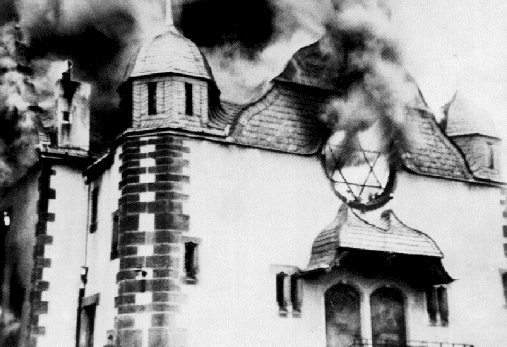
1938_progrome_synag_696724gNW

“One of the men grabbed my father by the shoulder and spit in his face. They tore his World War I medals from his shirt and stomped them into the ground. They started beating my father. Furniture started flying through the windows. My mother was screaming: ‘Let’s get out of here. They are killing us.’ We slipped out a back street, hoping the men would be finished soon and we could go back home.” Alex Liebenstein Kristallnacht survivor. (Jewish Weekly.com 12 November 2004) 
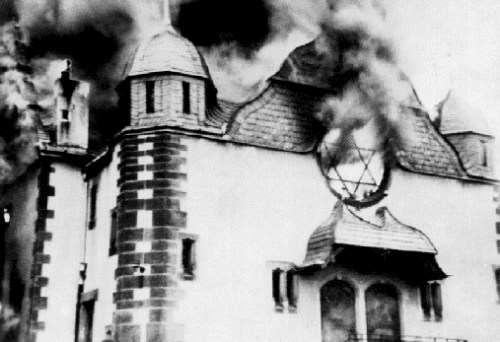
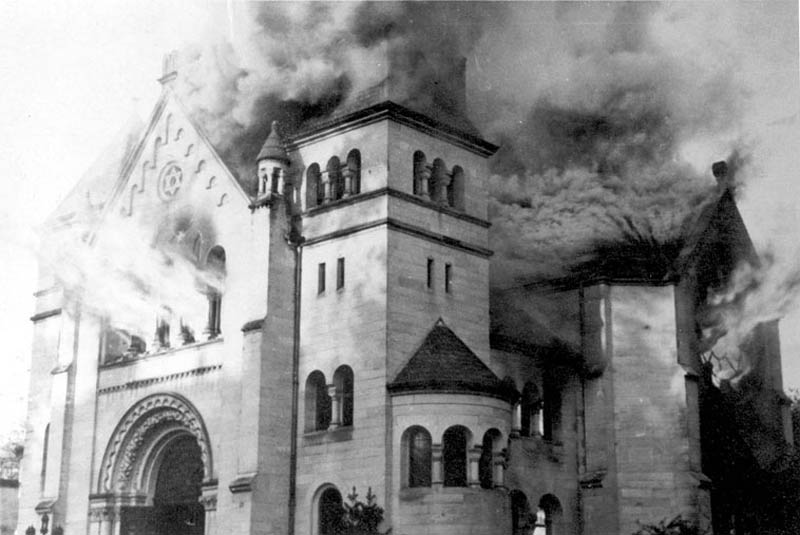
Burning_Synagoge_Kristallnacht_1938

It is still hard for me to believe that a civilized people can be incited into mob violence against a minority, even one that is already being persecuted. Unfortunately has happened all too often. The atrocities committed by the Nazi regime 75 years ago on the 9th and 10th of November 1938 reverberate to today as we see a resurgence of a anti-Semitism around the world.
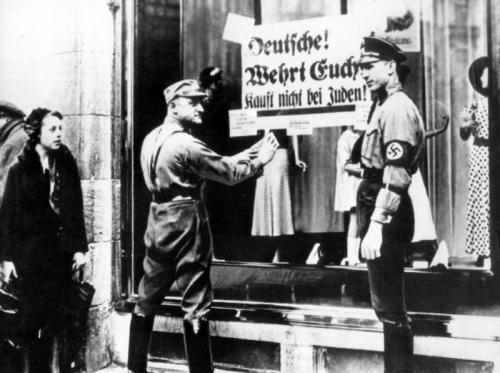
LzcZh7MM

The catalyst for the event was the assassination of a German diplomat in Paris by the teenage son of a Polish Jewish immigrant who had recently been expelled from his home. However the death of the diplomat was a mere pretext for actions that the more radical National Socialists desired and had been building up to the previous five years.

ART_goebbels_110405

Josef Goebbels 

Preparations for the action were already underway when death of the diplomat Ernst was delivered at a meeting commemorating the Beer Hall Putsch. Ironically Von Rath was an anti-Nazi under suspicion and being watched by the Gestapo.

After the message was delivered, Goebbels who was in disgrace with Hitler after the discovery of an affair between him and an actress took the opportunity to regain favor with Hitler. He stirred up the assembled Nazis and reported that there were reports of anti-Jewish demonstrations and the burning of synagogues and that Hitler `has decided that such demonstrations are not to be prepared or organized by the party, but so far as they originate spontaneously, they are not to be discouraged either.’ Taking his exhortation as an order many Gauleiters ran to phones to begin the action in their districts.

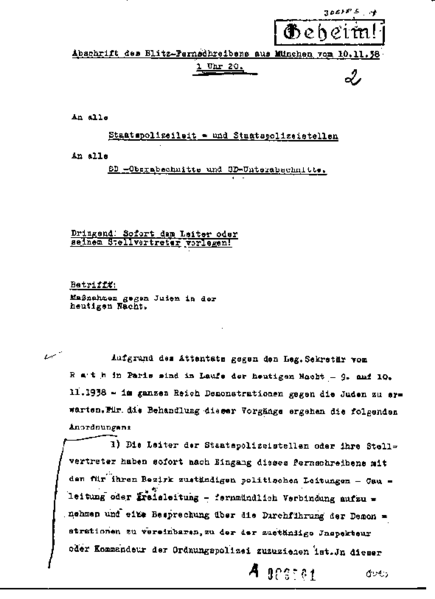
But the fact was the pogrom was already planned. SS Gruppenfuhrer Reinhard Heydrich sent the following order out the day before.

Reinhard Heydrich

Reinhard Heydrich

TO ALL REGIONAL AND SUB-REGIONAL GESTAPO OFFICES 1:20AM, November 8, 1938

SUBJECT: MEASURES AGAINST THE JEWS THIS NIGHT
That only such measures were to be taken that would not endanger German lives or property  Businesses and residences of Jews may be damaged but not looted. Particular care is to be paid in business sections and surrounding streets. Non-Jewish businesses are to be protected from damage under all circumstances. Police are to seize all archives from synagogues and offices of community organizations, this refers to material of historical significance. Archives are to be handed over to the SS. As soon as possible, officials are to arrest as many Jews especially wealthy ones – in all districts as can be accommodated in existing cells. For the time being, only healthy male Jews of not too advanced age are to be arrested.
Reinhard Heydrich, SS Gruppenführer

435px-Kristallnacht_rh_telegram_pg1

Heydrich’s Order

By two to three in the morning mobs were roaming the streets of German and Austrian cities. British Journalist Hugh Carlton Greene of the Daily Telegraph wrote:

“Mob law ruled in Berlin throughout the afternoon and evening and hordes of hooligans indulged in an orgy of destruction. I have seen several anti-Jewish outbreaks in Germany during the last five years, but never anything as nauseating as this. Racial hatred and hysteria seemed to have taken complete hold of otherwise decent people. I saw fashionably dressed women clapping their hands and screaming with glee, while respectable middle-class mothers held up their babies to see the “fun”.” 

Magdeburg, zerstörtes jüdisches Geschäft

The banned Social Democratic Party reported:

“When the Jewish Synagogue was burning…a large number of women could be heard saying, That’s the right way to do it—it’s a pity there aren’t any more Jews inside, that would be the best way to smoke out the whole lousy lot of them. No one dared to take a stand against these sentiments….”

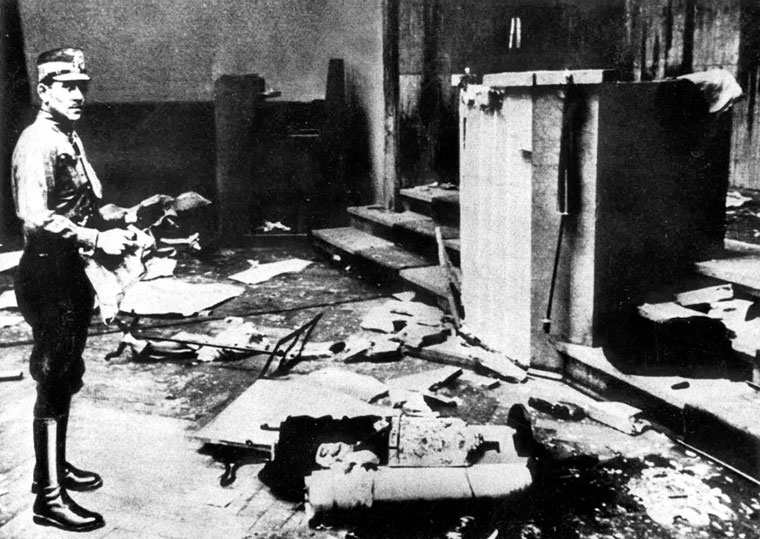
photo02

Though horrified by the reports coming out of Germany the world did nothing to help the Jews. No country stepped up to allow increased immigration including the United States where anti-semitism was at its historic peak. Public condemnations of the Nazis by world leaders were at best muted. Likewise the passivity of many Germans to Kristallnacht encouraged the most radical parts of the party to enact even more restrictive and punishing laws and regulations on the Jews.

Goebbels was ecstatic and wrote in his diary: 10 November 1938 I reported to the Fuehrer and he decides: the demonstrations should be allowed to continue. The police should retreat. Let the Jews get a taste of popular anger. He is right. I immediately instructed the party and police accordingly. Then I gave a short speech along these lines to the Party leadership. Loud applause. Everybody goes to the telephones. Now the people is going to act…. I wish to return to my hotel, and see a glow as red as blood. The synagogue is burning.… We only put out the fires when they endanger adjacent buildings. If not, they should be burned to the ground.… Reports come from all over the Reich. 50 synagogues, then 70 are on fire. The Fuehrer ordered 20-30 thousand Jews to be arrested.… Public anger is running wild.… They have to be given the possibility to vent their rage.… Driving to the hotel, windows are being smashed. Bravo, bravo. The synagogues burn like big old huts. There is no danger to German property. For the time being there is nothing more to be done.… (Der Spiegel 1992)

Magdeburg, zerstörtes jüdisches Geschäft

Heydrich’s preliminary report stated:

The extent of the destruction of Jewish shops and houses cannot yet be verified by figures … 815 shops destroyed, 171 dwelling houses set on fire or destroyed only indicate a fraction of the actual damage so far as arson is concerned … 119 synagogues were set on fire, and another 76 completely destroyed … 20,000 Jews were arrested. 36 deaths were reported and those seriously injured were also numbered at 36. Those killed and injured are Jews.”

The Nazis even found a way to make money off of their persecution of the Jews. Hermann Goering convened a meeting of leaders on the 12th and discussed the economic implications of the action. The minutes of the meeting recorded his thoughts.

article-2389725-01CB755F0000044D-690_306x403

Hermann Goering

“Since the problem is mainly an economic one, it is from the economic angle it shall have to be tackled. Because, gentlemen, I have had enough of these demonstrations! They don’t harm the Jew but me, who is the final authority for coordinating the German economy. `If today a Jewish shop is destroyed, if goods are thrown into the street, the insurance companies will pay for the damages; and, furthermore, consumer goods belonging to the people are destroyed. If in the future, demonstrations which are necessary occur, then, I pray, that they be directed so as not to hurt us.” 

Accordingly those at the meeting decided that the Jews were to blame for the action and determined that the Jews be fined 1 Billion Reichsmarks for the slaying of Von Rath and 6 million for the damage to property. The money was taken from the insurance payments that Jewish business and property owners would have received.  The banality of Goering was typical of many Nazi leaders. He stated “We must agree on a clear action that shall be profitable to the Reich. … Anyway, the Jew must be evicted pretty fast from the German economy.”

kristallnacht-night-of-broken-glass1

Goebbels made the announcement of the official party line that the riots and destruction were “a spontaneous wave of righteous indignation throughout Germany as a result of the cowardly Jewish murder of Third Secretary vom Rath.” Goebbels lied to foreign reporters saying “Not a Jew has had a hair disturbed.” 

But the truth was different. 91 Jews died as a direct result of the action while it is estimated several hundred more committed suicide during or just after Kristallnacht. Another two to three thousand of those arrested and sent to concentration camps died in those camps before the majority were released on the promise that they would leave Germany.

Roll_Call_Buchenwald_after_Kristallnacht

Jewish Prisoners after Kristallnacht

The events of Kristallnacht and the decisions afterwards marked a distinct watershed in the annals of the Holocaust. They had already been stripped of citizenship and most rights but from this point they became the target of any petty bureaucrat or party official. Kristallnacht foreshadowed the future for the Jews of Germany and Nazi occupied Europe.

In the next year over 100,000 Jews would immigrate from Germany mainly to other European countries where many would again face the horrors of Nazi persecution as the Nazis implemented the Final Solution.

In hope of peace,

Padre Steve+


1 Comment

Filed under History, nazi germany

Remembering Armistice Day: A Day of Conscience

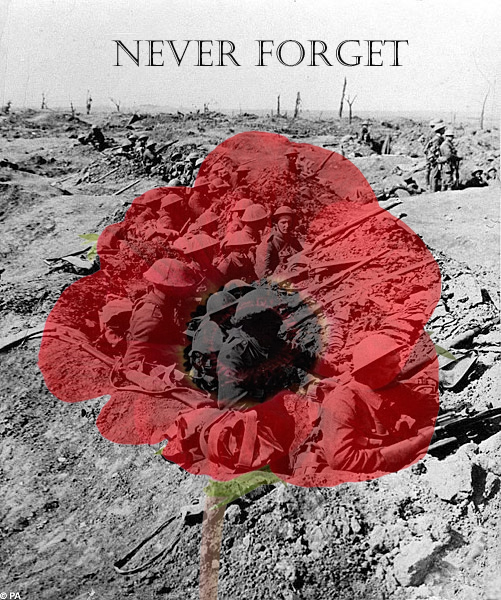
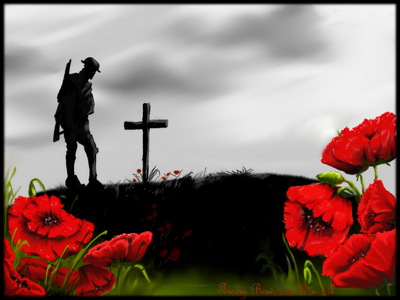
remembrance_day___poppy_day_by_daliscar-1

“Tomorrow is our day of conscience. For although it is a monument to victory, it is also a symbol of failure. Just as it honors the dead, so must it humble the living. Armistice Day is a constant reminder that we won a war and lost a peace…” General Omar Bradley November 10th 1948, Boston Massachusetts. 

It was the “War to End All War” or so thought President Woodrow Wilson and other American idealists. However that war to end all wars birthed a series of wars which made the losses of the First World War fade into insignificance as wars of ideology replaced wars for the preservation of the state.

In the First World War there were over 22 million casualties including over 5 million dead of which over 116,000 were Americans. President Woodrow Wilson established what we know now as Veteran’s Day as Armistice Day in November 1919, a year after the guns went silent.

Wilson wrote: “To us in America, the reflections of Armistice Day will be filled with solemn pride in the heroism of those who died in the country’s service and with gratitude for the victory, both because of the thing from which it has freed us and because of the opportunity it has given America to show her sympathy with peace and justice in the councils of the nations…

That initial proclamation was followed nearly 40 years later by one of President Dwight D. Eisenhower. Eisenhower signed into law what we now know as Veteran’s Day in 1954. In a sense I wish we had two holidays, one for Veterans from all wars in general and this one which we should never forget. It seems that in combining them we have lost some of the sacredness of the original. As Kurt Vonnegut wrote: “I don’t want to throw away any sacred things.” I will remember all who served this weekend but I will not forget why we do so.

All that being said for many in the United States and Western Europe the experience of  or even the thoughts of such a bloodletting is unimaginable. Yet to those of us who have gone to war and studied past wars the end result is not so distant. It is a part of our lives even today.

This weekend marks the 95th anniversary of the end in World War One.  For the United States the cost in the short time that its forces went into action and the armistice it was costly, though not nearly as costly as it was for the nations of Europe. From the time United States forces went into action in 1917 116,516 Americans were killed, 204,002 wounded, and 4,500 missing; 7.1% of the force of 4,355,000 the nation mobilized for war. (PBS the Great War UNC TV http://www.pbs.org/greatwar/resources/casdeath_pop.html)

However our costs pale in comparison with the European nations who had for over four years bled themselves dry.  If one wonders why Europeans seem to have so little desire for involvement in war one only needs to see how the concentrated killing of the First World War decimated the best and brightest of that generation. Out of nearly 8.5 million Frenchmen mobilized lost 1,357,000 killed, 4,266,000 wounded and 537,000 missing, 6,160,000 casualties or 73.3% of its forces. Other nations has similar casualty figures.

The human costs were horrifying. In all over over 65 million men served under arms in the war. Over 8.5 million were killed, over 21 million wounded, 7.75 million missing or prisoners or almost 37.5 million casualties. That total would be roughly equivalent to every citizen of the 30 largest American cities being killed, wounded or missing.

Much of Europe was devastated, mass numbers of refugees the dissolution of previously stable empires, civil wars, border conflicts between new states with deep seated ethnic hatreds, economic disasters and the rise of totalitarian regimes which spawned another even more costly world war and a 40 year cold war. The bitter results of the First World War are still felt today as conflicts in the Middle East in part fueled by the decisions of Britain and France at the end of the war rage on.

The epic war poem In Flanders Fields written by Canadian Lieutenant Colonel John McCrea symbolizes the cost of that war and the feelings of the warriors who endured its hell.

In Flanders fields the poppies blow
Between the crosses, row on row,
That mark our place; and in the sky
The larks, still bravely singing, fly
Scarce heard amid the guns below.

We are the Dead. Short days ago
We lived, felt dawn, saw sunset glow,
Loved and were loved, and now we lie
In Flanders fields.

Take up our quarrel with the foe:
To you from failing hands we throw
The torch; be yours to hold it high.
If ye break faith with us who die
We shall not sleep, though poppies grow
In Flanders fields.

Yes there are always consequences to actions. This weekend as we remember what we now call Veteran’s Day, or Remembrance Day in Britain let us not forget that the genus of these holidays was the blood shed by so many in places like Verdun, Gallipoli, Caporetto, Passchendaele, the Marne, the Argonne, Tannenberg, Galicia and on Flanders Fields.

flanders field

President John F Kennedy said: “As we express our gratitude, we must never forget that the highest appreciation is not to utter words, but to live by them.”

In the hope of peace and an end to war.

Peace,

Padre Steve+
Leave a comment

Filed under History, Military

The War to End All Wars….and a Peace to end all Peace

Friends of Padre Steve’s World….On November 11th 1918 the Great War ended, but a peace was imposed which gave birth to a hundred years of new wars, not just in Europe but in the Middle East, Africa and Asia. These conflicts redound to our generation today. May one day all of us live in peace. Padre Steve+

padresteve's avatarThe Inglorius Padre Steve's World

It was the War to end all war

On the 11th hour of the 11th day of the 11th month the guns fell silent across Western Europe and the war which had killed 16 million soldiers, sailors and civilians and wounded another 21 million more came to an end. It had begun as a conflict in the Balkans which rapidly drew in all of Europe’s major powers.  The central focus of the war was the Western Front where the armies of Germany battled those of Britain, France, Belgium and later the United States.  Battles with names such as the Marne, Passchendaele, the Somme, Verdun, Ypres, Chateau Thierry, Belleau Wood, Vimy Ridge, Cambrai, the Aisne, represented the pinnacle of killing as soldiers battled in the mud of massive trench systems and Generals sacrificing thousands of men in a day for the gain of a few hundred yards of…

View original post 930 more words

Leave a comment

Filed under Loose thoughts and musings

Letter to a New Military Chaplain Part VI: Collegiality and Relationships

262_29132452058_529_n

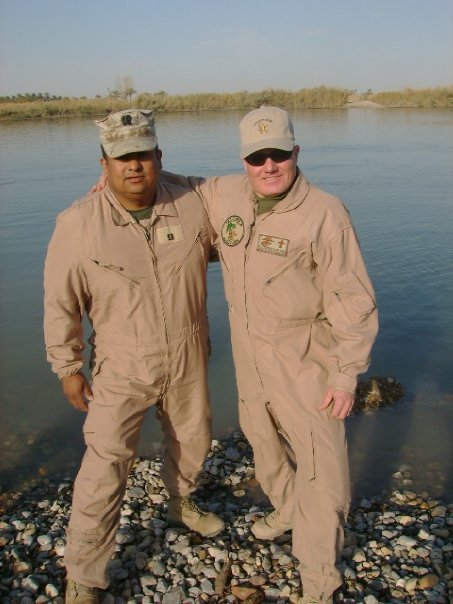
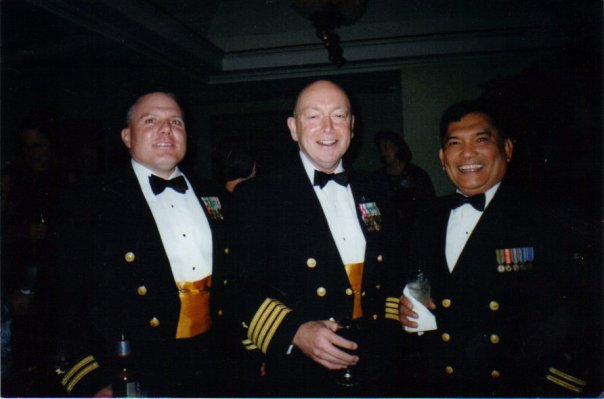
With my Friend Fr Jose Bautista at  Habbaniyah Iraq 2007 

“A free theologian works in communication with other theologians…He waits for them and asks them to wait for him. Our sadly lacking yet indispensable theological co-operation depends directly or indirectly on whether or not we are willing to wait for one another, perhaps lamenting, yet smiling with tears in our eyes.” ― Karl Barth, The Humanity of God

This is fifth part of a response to a question I had from a new Navy Chaplain. I have decided to post it here without any identification of the chaplain because I know that many men and women who are new to the military chaplaincy or who are exploring the possibilities of becoming a chaplain have the same questions. I was fortunate to have had a number of chaplains who at various points in my decision process and formation as a minister, Priest and Chaplain in both the Army and the Navy help me with many of these questions. Likewise I learned far too much the hard way and blew myself up on some of the “land mines” that almost all who serve as chaplains experience in their careers. This is the fifth of several parts to the letter and is my attempt to systematically explain my understanding of what it is to be a Chaplain serving in the military and in particularly the Navy. As I wrote this tonight I thought of one more installment so I expect soon that I will write it, but not tonight. The first three parts are linked here:

Letter to a New Military Chaplain: Part One

Letter to a New Military Chaplain: Part Two The Minefields of the Heart 

Letter to a New Military Chaplain Part Three: The Minefields of the Soul: Power and Arrogance

Letter to a New Military Chaplain Part IV: The Minefields of the Flesh, Sex, Alcohol and Money

Letter to A New Military Chaplain Part V: Count it All Joy

Karl Barth’s words about how free theologians work in communication or community with other theologians is equally true for those men and women who serve in the secular and pluralistic ministry of the chaplaincy, particularly the military chaplaincy.

This was something that I learned early in my theological education in seminary as well as my more practical ministry lessons at the Army Chaplain School and during my Clinical Pastoral Education Residency.

652_55560577058_1525_n-1

Army Chaplain Officer Basic Course with LTC Rich Whaley (C) and CPT Bill Blackie (L)

Collegiality and relationships cannot be over-valued. In fact they are vital if we are to care for the people that are entrusted to us, men and women who volunteer to serve our nation in time of war and peace. Unfortunately they are probably harder to do now than they were when I first became a chaplain back in 1992. Harder but certainly not impossible.

I think part of this is due to how theological education has changed in the last 20 years. For better or worse for many people it is hard to attend seminary in residence. I did and it was painful. I would never want to do it again but it was important in my formation and I think indispensable. However many seminaries have placed much of their theological education, even the Master of Divinity online or via other distance education formats. The result is that many theological students do their seminary education isolated from collegial relationships with professors and other students. This isolation is often compounded in churches, especially mega-churches which have little use for seminary students who will leave them in order to become chaplains.

2334_63993192058_3194_n

With CAPT John Kaul and LT Romeo Biala at Camp LeJeune 1999

Another issue is the fact that the Chaplain Corps of the various services are not as reflective of the religious population of the services as they used to be. Part of this is because the mainline Protestant denominations in their cultural opposition to war and in some cases the military itself stopped sending as many chaplains as they once had done. Likewise due to the continuing clergy crisis in the Roman Catholic Church that institution has seen a marked decline in number of serving chaplains. On the other side of the coin many conservative denominations and independent churches increased their numbers of chaplains. The number of Jewish chaplains has declined and there are just a smattering of Islamic or Buddhist chaplains.

While the demographics of the Chaplain Corps have changed there has also been a shift in the religious demographic of the military population have shifted the fastest growing group being the “no religious preference” demographic. Of course I have found that in many cases that “no religious preference”  is not that they have no faith but that they go to church but are not terribly concerned about the denominational label. That being said there are lot more servicemen and women who are atheists, agnostics, free thinkers, Pagans, Wiccans or members of other groups traditionally overlooked.

295_27076762058_7573_n-2

In this setting the collegial relationships that chaplains maintain with one another irregardless of our denominational or religious traditions in order to serve and care for those men and women who volunteer to serve our country.

In my now rather lengthly career in the military as well as my time growing up as a Navy “Brat” I can say that I have been blessed by friendships and relationships with chaplains who have cared for me. Likewise I have had the chance to be there for chaplains when they needed someone to be there for them.

295_27076792058_8966_n-1

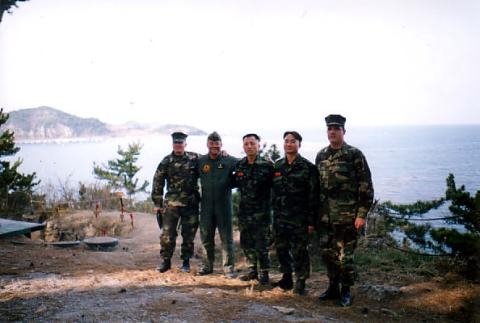
With Korean and American Chaplains 2001

The way this has worked has been fascinating. My best friends in Army Chaplain school when I was in an independent evangelical church were Roman Catholic, Orthodox and Episcopal Priests. One, Father Jim Bowman saved my ass when I was having a major meltdown and ripping my rank off after a near altercation with a numbskull in the Chaplain Officer Basic Course. Likewise the course director, Chaplain Rich Whaley an LDS (Mormon) Chaplain was there for me on more than one occasion and probably was the man that ensured that I was not tossed from the program. I stay in contact years later with these men.

As a Army Chaplain in the National Guard, Reserves and as a mobilized Reservist it was Lutherans, Catholics and Episcopalians who were there for me. As I became more seasoned and was promoted to Major and placed in supervisory billets I enjoyed good relationships with junior and senior chaplains across the denominational spectrum. Two of my enlisted assistants, one Army and one Navy both went on to become chaplains, both are much more conservative than me but stay in contact.

In the Navy due to our often very isolated duty in independent billets this is harder to do. There is a certain community that you have when you serve in the Army or as a Navy Chaplain serving with a Marine Division, or expeditionary force. However many Navy billets are stand alone billets on ships. Once again this is not impossible to do in the Navy, it is just harder.

The Chaplain Corps is a small community thus when you have good relationships with others, take the time to build friendships and care for people who are not like you there is a payback. That payback comes in the form of maintaining those relationships throughout a career. I constantly run into Navy Chaplains who I became friends with while serving in my first tour with Second Marine Division. Those guys tend to be like brothers to me and it is a good thing. Likewise some of my supervisory chaplains, men like Father John Kaul a now retired Catholic Priest and Navy Captain have been more than supervisors but mentors and friends.

As a practical matter the collegial relationships we build with other chaplains are important for a number of reasons.

First it is about caring for our people and when you have the relationships with other chaplains who are not like you you have a ready referral source. If I have a Mormon Sailor or Marine come to me I know Mormon Chaplains. If I have a Roman Catholic or Orthodox service member come to me seeking a type a Sacrament that has to come from their church I can contact people I know to help them.

In another way it is about having relationships with people who are safe to talk to and believe me this is important. I have a lot of chaplains who confide in me because they know that I am safe, that I will listen and care irrespective of any theological or even political difference. I have a number of Chaplains that I can do this with myself and it does help. There have been times where due to the isolation of my assignment or the inability to be around some of these guys that I have suffered. When I came back from Iraq and in the midst of a PTSD induced spiritual and psychological crisis I didn’t have this, in fact at that time the first person who asked me how I was doing spiritually was my first shrink. When I was able to re-connect with some of my older friends, my “go to” guys they shared similar experiences.

1905_50393032058_2131_n

Now I do work hard to build these collegial relationships. They matter to me.

Collegiality and friendship are at the heart of the military chaplain ministry. Without them we become the promoters of our agenda often at the expense of those that we serve or serve alongside. Since our Constitutional reason for being in the military is to provide for the religious and spiritual needs of our people regardless of their religious affiliation and perform the rites or sacraments of our own religious traditions it is imperative that we build these collegial relationships and friendships with any chaplain that we can.

Peace

Padre Steve+
Leave a comment

Filed under christian life, faith, Loose thoughts and musings, Military, ministry, Religion, US Navy

Letter to A New Military Chaplain Part V: Count it All Joy

20130822-235225.jpg

“The theologian who labors without joy is not a theologian at all. Sulky faces, morose thoughts and boring ways of speaking are intolerable in this field.” ― Karl Barth

This is fifth part of a response to a question I had from a new Navy Chaplain. I have decided to post it here without any identification of the chaplain because I know that many men and women who are new to the military chaplaincy or who are exploring the possibilities of becoming a chaplain have the same questions. I was fortunate to have had a number of chaplains who at various points in my decision process and formation as a minister, Priest and Chaplain in both the Army and the Navy help me with many of these questions. Likewise I learned far too much the hard way and blew myself up on some of the “land mines” that almost all who serve as chaplains experience in their careers. This is the fifth of several parts to the letter and is my attempt to systematically explain my understanding of what it is to be a Chaplain serving in the military and in particularly the Navy. As I wrote this tonight I thought of one more installment so I expect soon that I will write it, but not tonight. The first three parts are linked here:

Letter to a New Military Chaplain: Part One

Letter to a New Military Chaplain: Part Two The Minefields of the Heart 

Letter to a New Military Chaplain Part Three: The Minefields of the Soul: Power and Arrogance

Letter to a New Military Chaplain Part IV: The Minefields of the Flesh, Sex, Alcohol and Money

It has been a while since I started this series so tonight I figured that I would quickly finish what I started. The young Chaplain who I wrote this for is about to report to his new assignment and I do wish him well and pray that he will do well in it. If things go as I expect and he does well he should still be serving as a chaplain at least 15 years after I retire.

Thus for me this series is in a sense about passing the torch. I figure that in five or six years I will finally retire from the Navy Chaplain Corps. Of course that could change because I’m not God and so until I actually retire I will keep my head in the game. There is always a new generation and those of us who have labored need to be there for and be ready to do all we can to help, encourage and mentor those who follow us.

One of the things that I have learned over the course of 32 years in the military and 21 years as a military chaplain is that one must keep a sense of humor and not take oneself too seriously. In that time I have ran into many a chaplain and minister who lived their lives bereft of a sense of humor, had no ability to laugh at themselves and who were positively gloomy people. Saint Teresa of Avila made the comment “God save us from gloomy saints!” I think that she was right and she did take fire from people in the church because of her joyous spirit.

Now I have my times where I am not a happy camper. I can be morose and moody and sometimes even a bit cynical. However, that being said I try not to live my life that way and certainly do my best to keep a sense of humor, laugh at myself and even when things are not going well to try to find a silver lining in the otherwise dark clouds.

Chaplains have a unique ministry. We are not cloistered in parishes or trying to build churches. We serve in a secular institution with people who volunteer to serve their nation in often dangerous, lonely and arduous manners. Those who serve alongside of us on our ships, or in our units we in the Navy call “shipmate” and that transcends differences in religious beliefs, politics or philosophy. As the chaplain it is our duty in this secular institution to care for the people who we serve alongside. They are our parish whether they be believers or not. Pastoral care in this setting is about caring for and loving people who many times don’t believe like us (no matter what our religious tradition) respecting their faith or beliefs and treating them with the same dignity that we would want others to treat us, our families or our friends.

For me this is a joyful life. I like working outside the brick and mortar of the church because it suits my personality and way of doing life. I was a Navy “Brat” growing up. Had it not been for a Roman Catholic Navy Chaplain who helped care for my family when my dad was in Vietnam and a civilian church of our denomination made us unwelcome. I trace my calling back to that man. He was not about pushing his denominational or personal agenda, he simply cared about a military family who needed it.

I think that approaching life and ministry as a chaplain with joy is paramount. It is I think a reflection of the grace of God. As Karl Barth said: “Grace creates liberated laughter. The grace of God…is beautiful, and it radiates joy and awakens humor.”

In our military careers we chaplains will find many opportunities to lose our joy, to become graceless and to become consumed with our own status, promotion and even power. It is a temptation and danger of any kind of institutional ministry where there is an “up or out” promotion system.  Thus we must be careful to keep our focus on caring for others, doing our best in all things, build collegial relationships and real friendships with others and trust God with how everything else works out.

Joy is essential if we are to be living sacraments or vehicles of God’s grace and we have to chose joy. As Henri J. M. Nouwen said: “Joy does not simply happen to us. We have to choose joy and keep choosing it every day.”

So count it all joy.

Peace

Padre Steve+

1 Comment

Filed under christian life, faith, Military, ministry, US Navy

Jesus and the Top 40

Jesus_is_Just_Alright

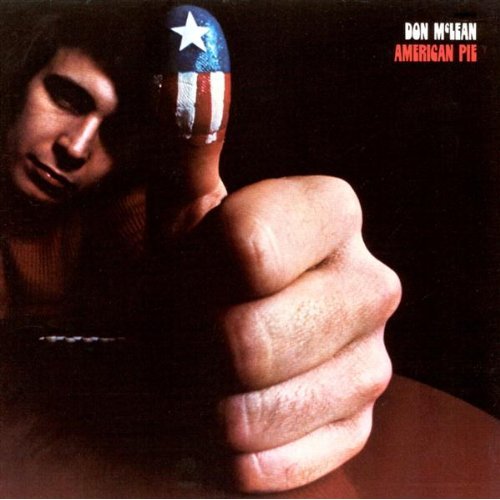
“And the three men I admire most, The Father, Son and the Holy Ghost, They caught the last train for the coast The day the music died” Don McLean American Pie 

Back in the 1960s to the early 1980s God was not absent from the Top 40. In fact back then it seemed that even non-believers were okay with Jesus. However by the late 1980s and early 1990s much of that good feeling had died away. Few artists would take up songs with spiritual or religious themes, especially those of Western Christianity after that, unless they were artists who cloistered themselves in the self licking ice cream cone and ghetto of the Contemporary Christian Music industry. That is sad because many of these artists are quite talented but through the separatist tendencies of many churches and “Christian” publishers these artists seldom ever break out. Some like Amy Grant have, but she is a rare exception and she has been rejected by many in the church who in her early years were devotees.

I guess that some of the reasons are that many artists had little religious background and for many of those who did their religious experience was negative. This is an indictment of the church if you ask me, both mainline churches and Evangelical churches. Part I am sure was that many churches, be they “liberal” mainline churches or “conservative” or “fundamental” churches lost any real sense of a God that transcended severely political, ideological or doctrinal beliefs that regular people could relate to. As Pope Francis noted about “ideological Christians:

“And when a Christian becomes a disciple of the ideology, he has lost the faith: he is no longer a disciple of Jesus, he is a disciple of this attitude of thought… For this reason Jesus said to them: ‘You have taken away the key of knowledge.’ The knowledge of Jesus is transformed into an ideological and also moralistic knowledge, because these close the door with many requirements.”

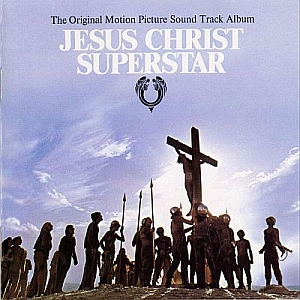
jesus-christ-superstar-1974-film-soundtrack

But back in the 1960s to early 1980s quite a few artists included references to God and Jesus in their music. In fact even if they were not believers themselves they were at least aware of the ideas, concepts and traditions of faith and included them in often unique ways in their “secular” music.

31Z399212AL

Here are some of those songs.

Doobie Brothers: Jesus is Just Alright http://www.youtube.com/watch?v=SwbGjzF3mB0

Kris Kristofferson: Why Me Lord http://www.youtube.com/watch?v=mtQOY-0sViQ

Norman Greenbaum: Spirit in the Sky http://www.youtube.com/watch?v=-cXrEPNvRO8

Ray Stevens: Everything is Beautiful http://www.youtube.com/watch?v=mlwfGh-SVXw

Petula Clark: I Don’t Know How to Love Him http://www.youtube.com/watch?v=aiBmvy0nR8g

ZZ Top: Jesus Just Left Chicago https://www.youtube.com/watch?v=pN69GC2amTg&feature=player_embedded

Jesus Christ Superstar: http://www.youtube.com/watch?v=BGYi1qJkb0M

Don McLean: American Pie http://www.youtube.com/watch?v=Y0Y_XRiJsCI

Simon and Garfunkel: Bridge over Troubled Water http://www.youtube.com/watch?v=C-PNun-Pfb4 and Sound of Silence http://www.youtube.com/watch?v=dTCNwgzM2rQ

David Bowie: Word on a Wing http://www.youtube.com/watch?v=q-ojMnEEmU4

Sister Janet Meade: The Lord’s Prayer http://www.youtube.com/watch?v=Bd4iJkNCaZ8

Godspell: Day By Day http://www.youtube.com/watch?v=P3PjfBQjJT8

Cat Stevens: Morning has Broken http://www.youtube.com/watch?v=1TWd3skb-Rw

Ocean: Put Your Hand in the Hand: https://www.youtube.com/watch?v=JI1DiddWCKs&feature=player_embedded

Paul Stookey: The Wedding Song (There is Love) http://www.youtube.com/watch?v=A1v84WKC6Pg

Bob Dylan: Gotta Serve Somebody http://www.youtube.com/watch?v=4cJhIu8PUFI

Some of these songs are true hymns or Gospel songs, others based at least loosely on the life of Jesus or scripture. Others are the artists interpretation of faith or of something that was a part of their experience of God and faith. This doesn’t mean that the theology in all of these songs was good, but it does show that faith regardless of its lack of perfection can still be an important part of life in the public square.

don-mclean-2

My hope is that new artists whether they are believers or not will rediscover the more transcendent and eternal dimensions of life and faith. I hope that they will be able to separate the knowledge of Jesus from the more ideological and moralistic aspects of faith and re-imagine the transcendent parts of life which have over the last 30 years or so for the most part disappeared from popular music.

Why me Lord, what have I ever done, To deserve even one, Of the pleasures I’ve known

Tell me Lord, what did I ever do, That was worth loving you, Or the kindness you’ve shown… Kris Kristofferson “Why” 

Enjoy and hopefully be inspired.

Peace

Padre Steve+
Leave a comment

Filed under faith, music, Religion

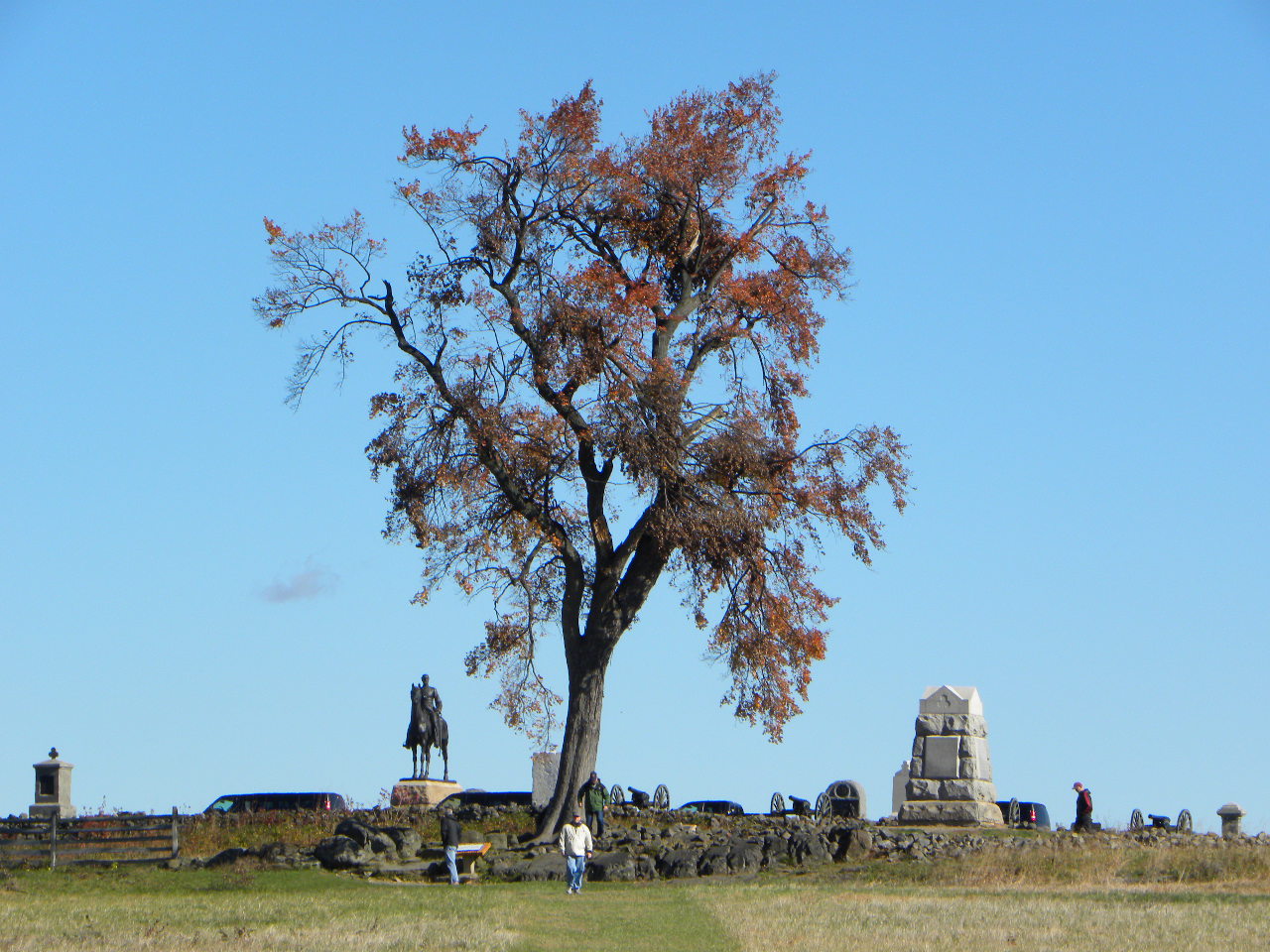
Images of Gettysburg

DSCN8811

“In great deeds something abides. On great fields something stays. Forms change and pass; bodies disappear, but spirits linger, to consecrate ground for the vision-place of souls. And reverent men and women from afar, and generations that know us not and that we know not of, heart-drawn to see where and by whom great things were suffered and done for them, shall come to this deathless field to ponder and dream; And lo! the shadow of a mighty presence shall wrap them in its bosom, and the power of the vision pass into their souls.” Joshua Chamberlain speaking at the dedication of the Monument to the 20th Maine October 3, 1889, Gettysburg, PA


I took a class trip this weekend to Gettysburg. The trip was what we in the military term as a Staff Ride which is an event that takes the participants to a battle site to see first hand, discuss and analyze the battle. The value of such events is that it takes them from simple book learning to getting a chance to walk the same ground, put “eyes on target” and actually get a feel for what it was like for those that fought the battle. 

Gettysburg is one of the more remarkable battles in American history if for nothing else its size and what was at stake. In June of 1863 the Army of Northern Virginia commanded by General Robert E. Lee invaded the North.  Lee’s Army crossed the Potomac River into Maryland and then deep into Pennsylvania pursued by the Federal Army of the Potomac initially commanded by Major General Joe Hooker and then by Major General George Meade.

The armies met in what can be best described in a meeting engagement at the town of Gettysburg. Neither army had planned to fight there but through a series of events both armies entered into a fight that in combination with the defeat of the Confederate Army at Vicksburg Mississippi doomed the Confederacy and ensured that the Union would survive.

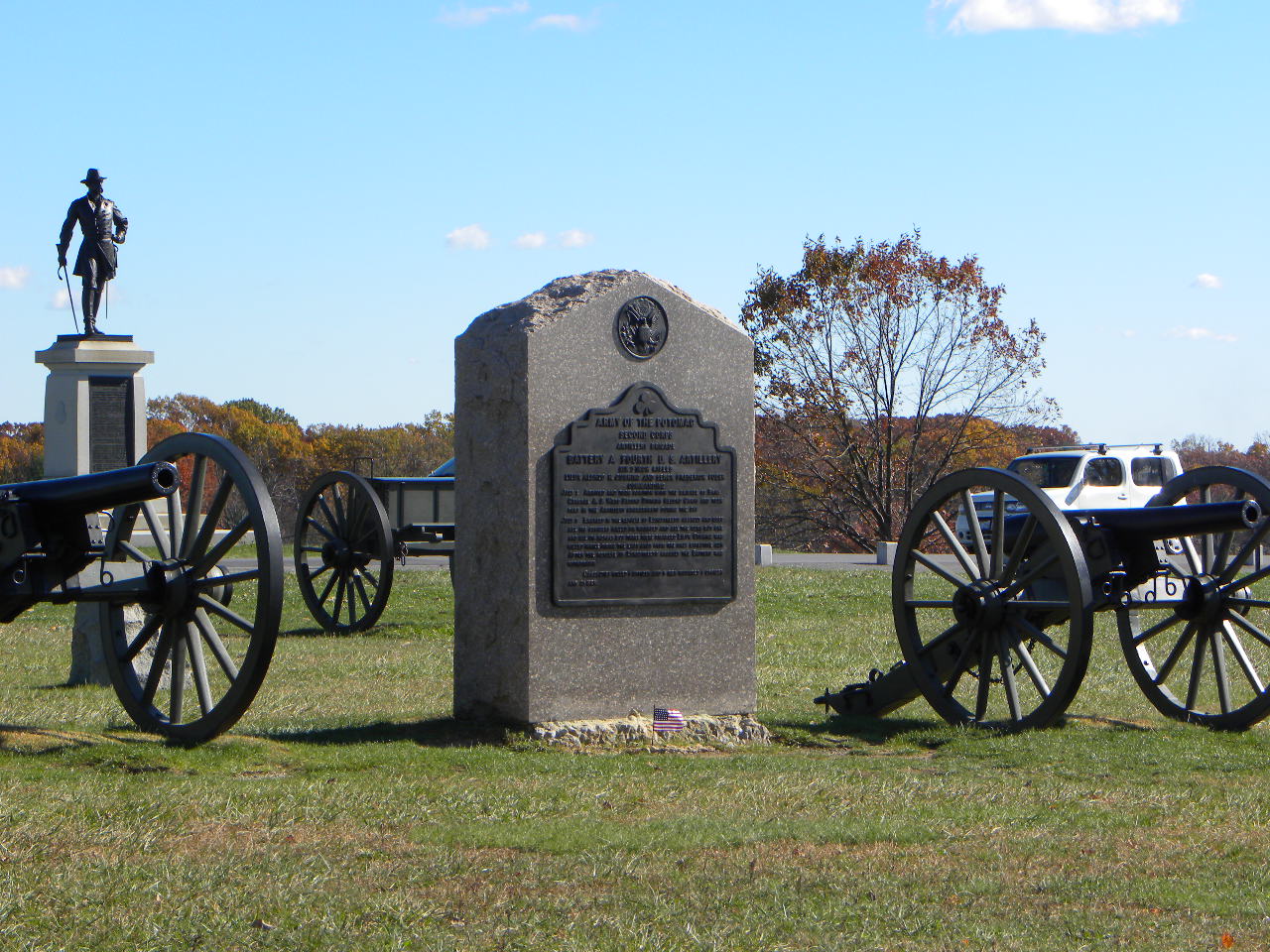
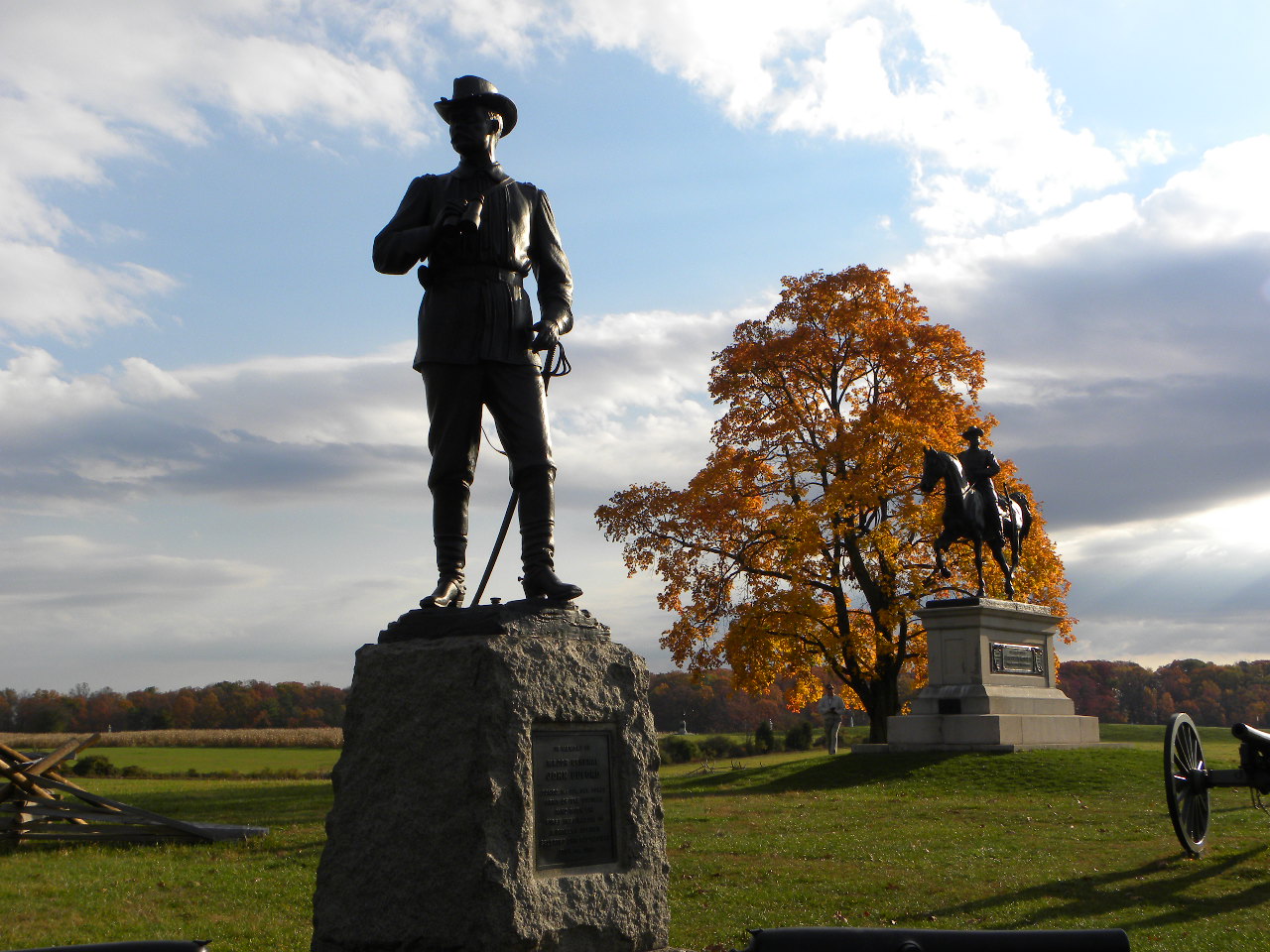
Gettysburg is marked by many monuments to units that fought at the battle as well as individuals. The National Park Service does a wonderful job there and is constantly working within the constraints of space, time and the encroachment of more people in the area to restore the battlefield to conditions of the time.

As for the monuments themselves most were placed by States, towns and Veteran’s groups over the last 150 years. Placed with love and admiration by the soldiers of both sides and those who knew them.

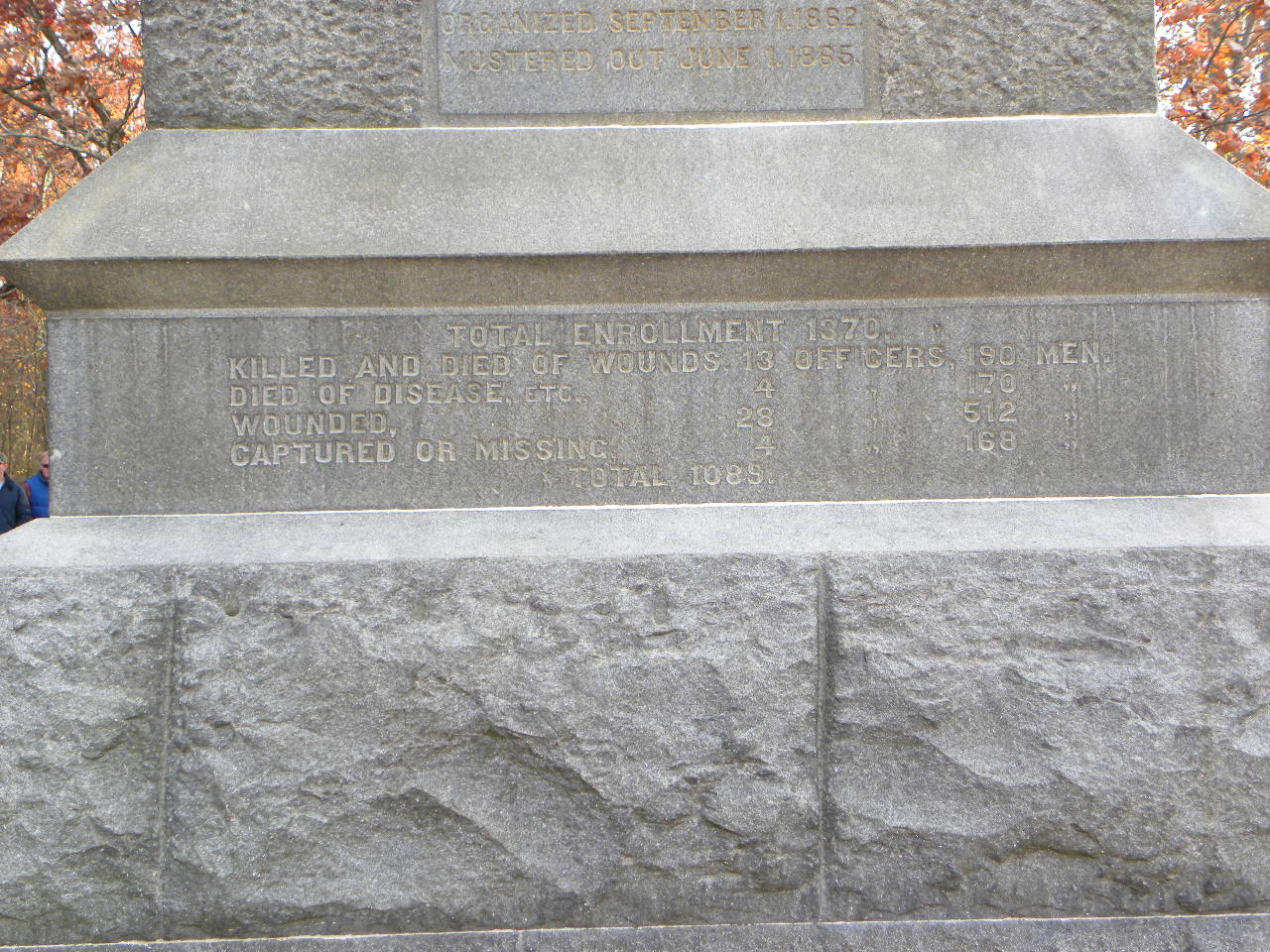
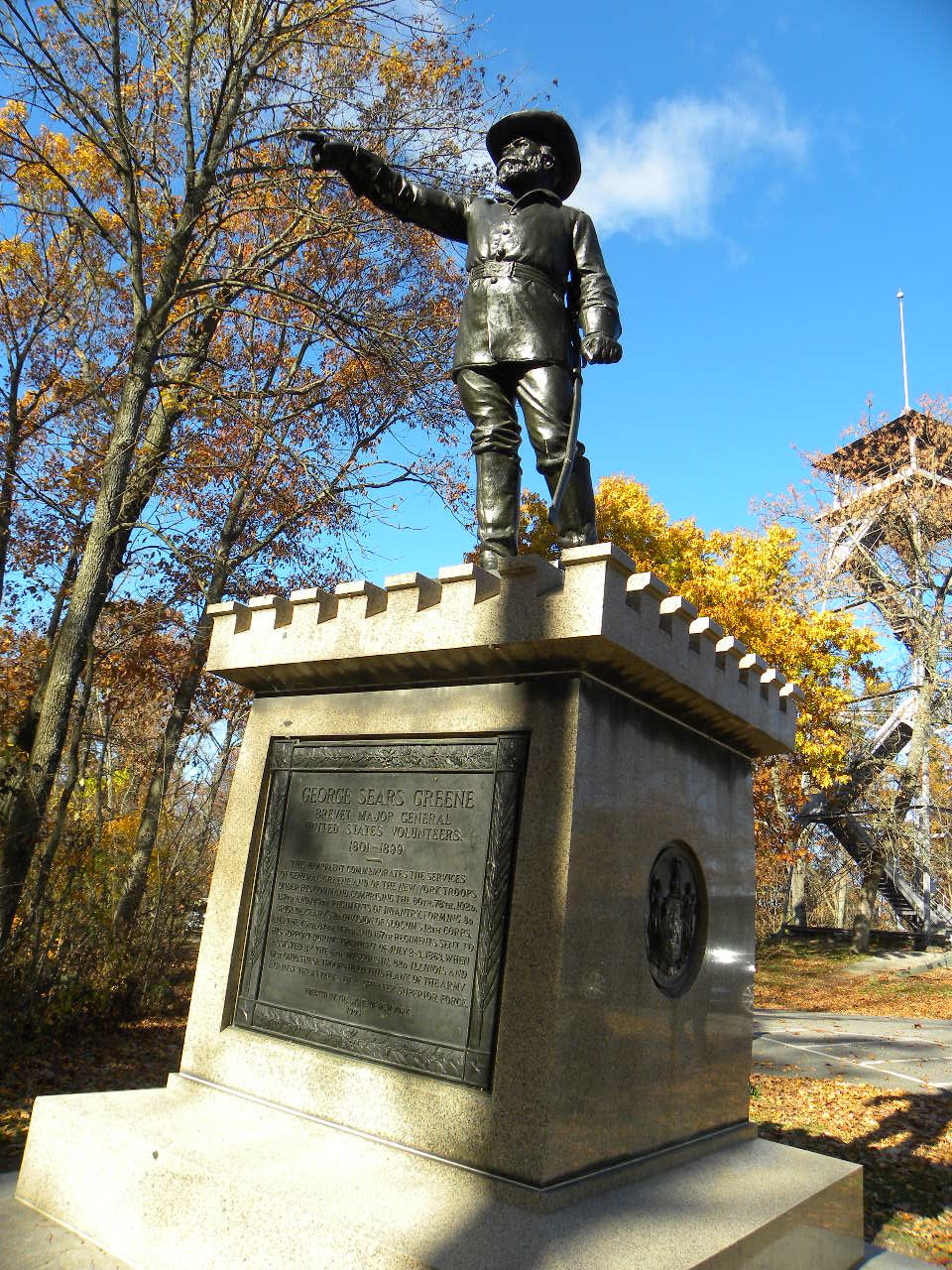
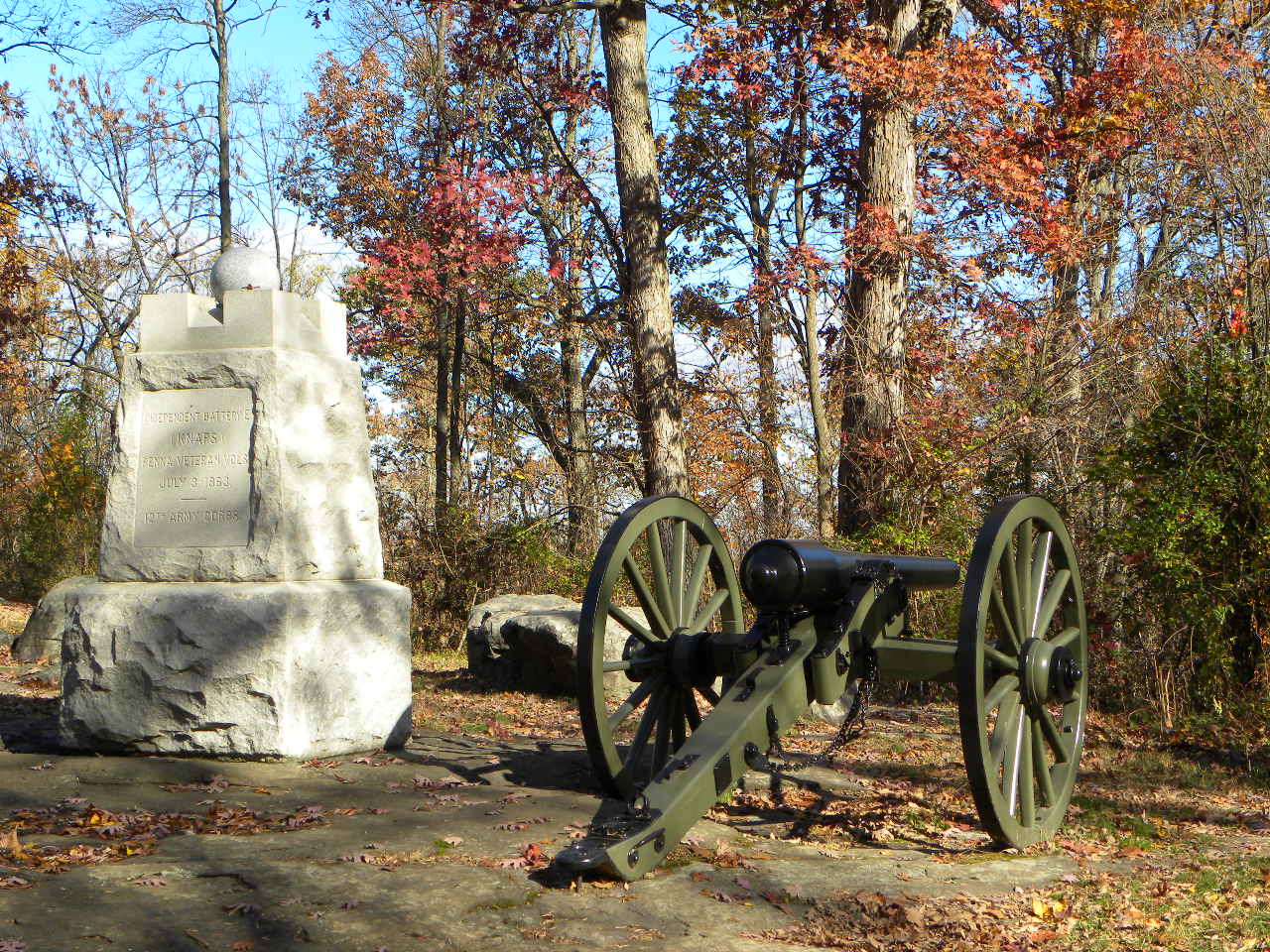
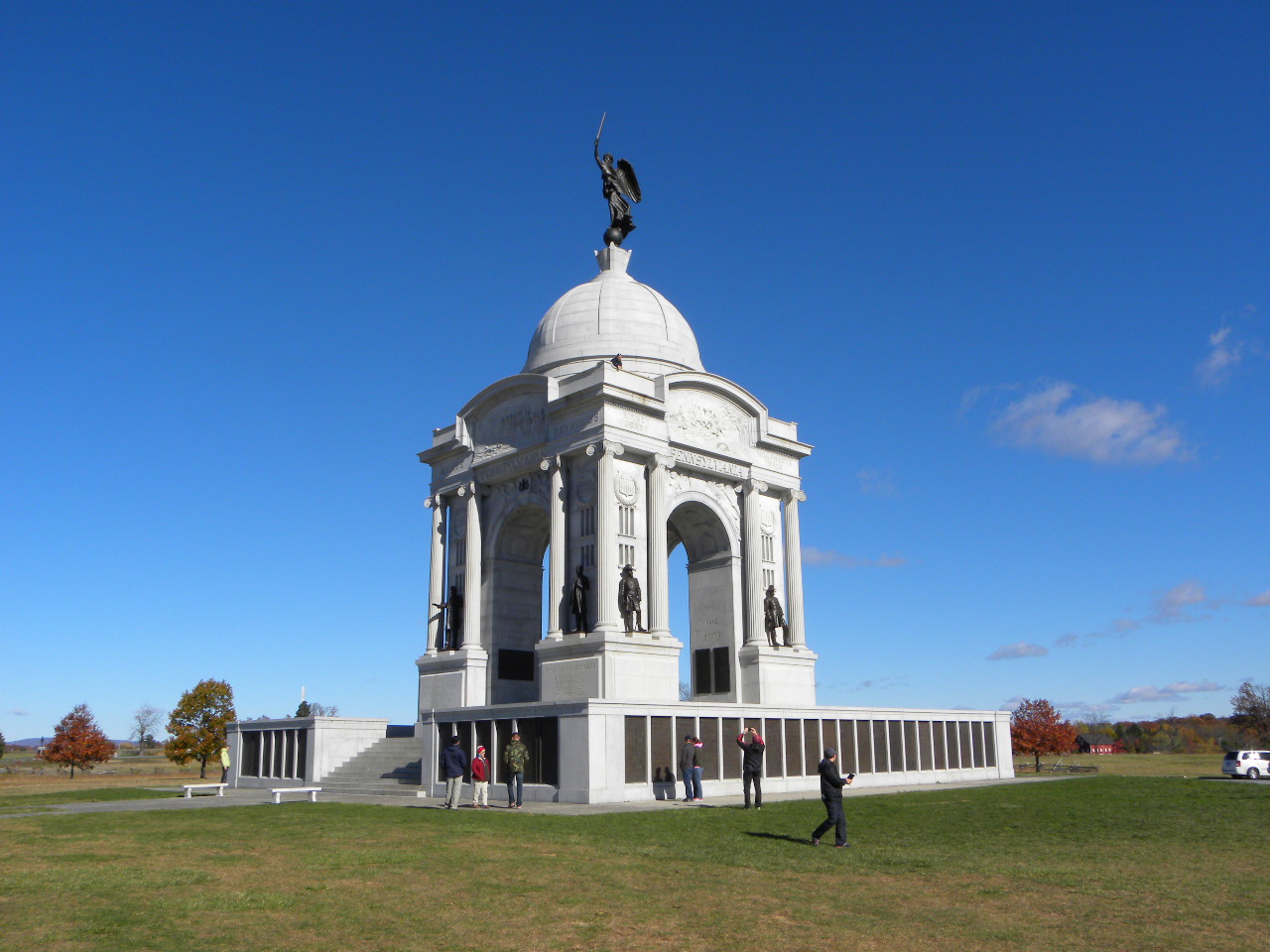
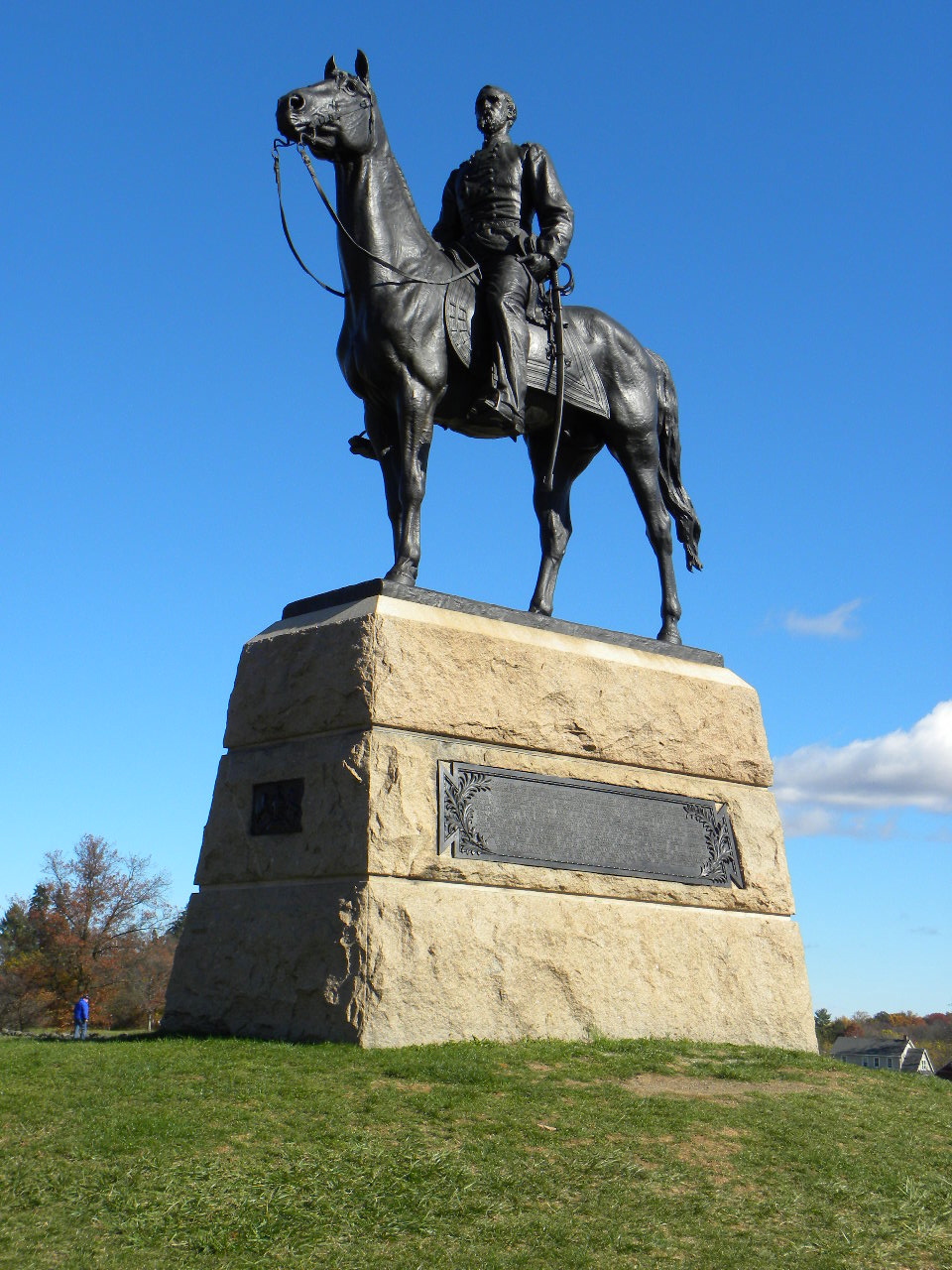
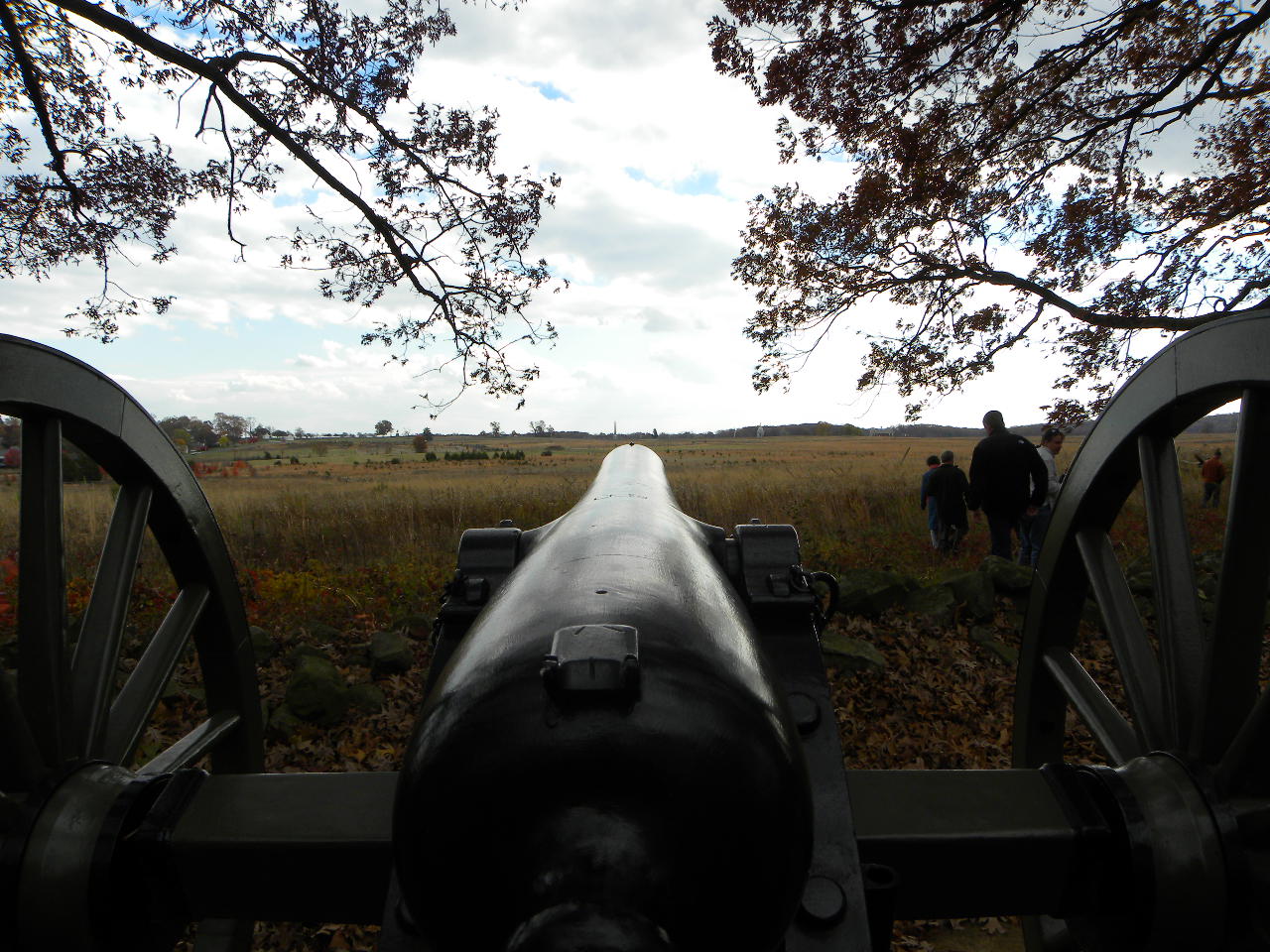
Here are some photos that I took of the battlefield this weekend.

DSCN8774

Monuments to General’s Burford and Reynolds on McPherson’s Ridge

DSCN8783Confederate canon on Seminary Ridge racing Federal lines

DSCN8792Monument to Colonel Ellis and 124th New York at Devil’s Den

DSCN8799Monument to 148th Pennsylvania at the Wheat Field

DSCN8806

Gouverneur Warren Monument Little Round Top

DSCN8818Brigadier General George Greene Monument Culp’s Hill

DSCN8819Pennsylvania Independent Artillery Battery E Monument at Culp’s Hill

DSCN8826Monument to 1st Minnesota at Cemetery Ridge

DSCN8828Pennsylvania Monument Cemetery Ridge

DSCN8831DSCN8832Two views of Monument to General George Meade

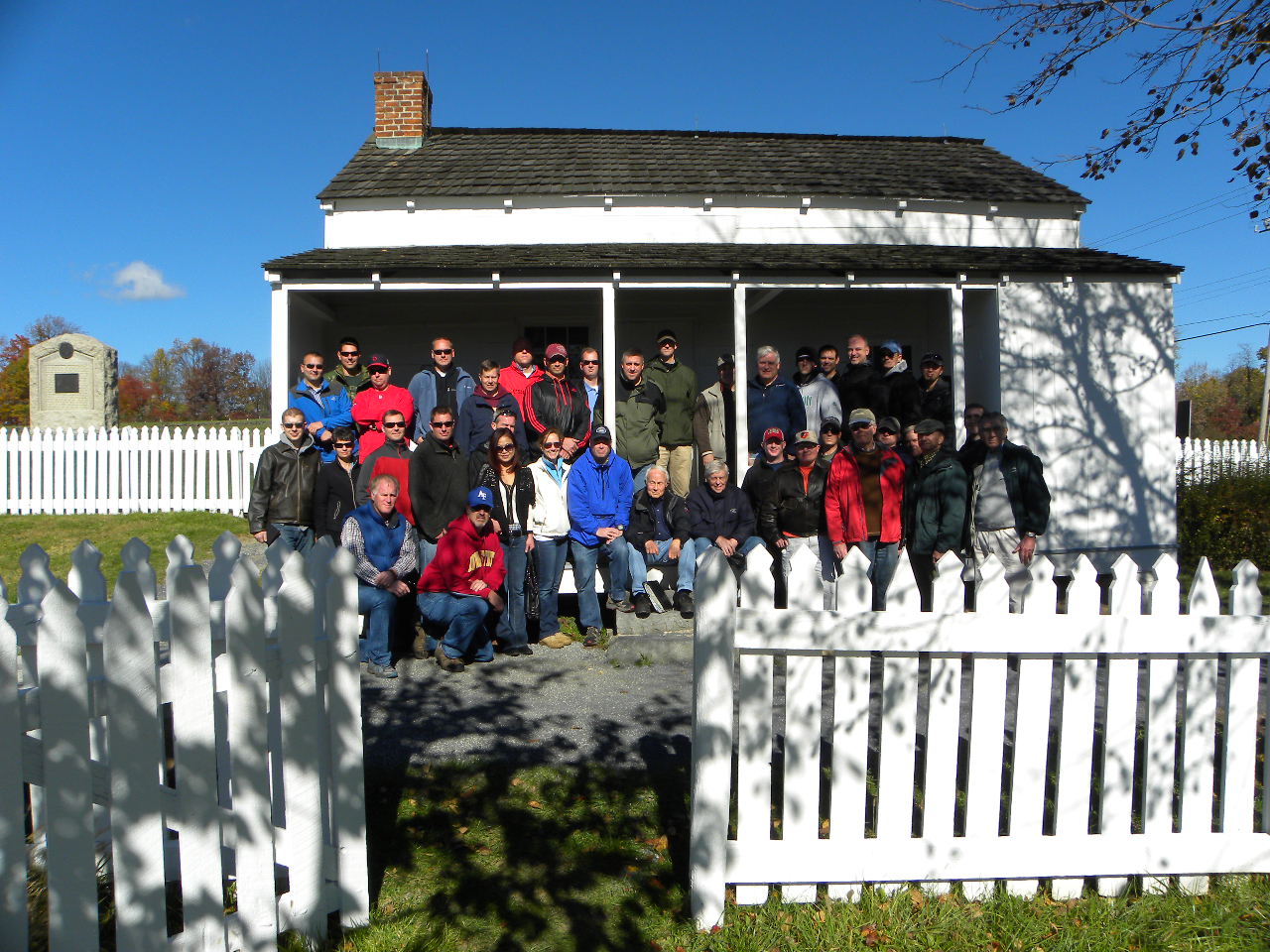
DSCN8834My Class and group at General Meade’s Headquarters east of Cemetery Ridge

DSCN8842Monument to Pennsylvania Cavalry Cemetery Ridge

DSCN8843Virginia Monument on Seminary Ridge near start point for Pickett’s Charge

DSCN8830The Copse of Trees, target of Pickett’s Charge

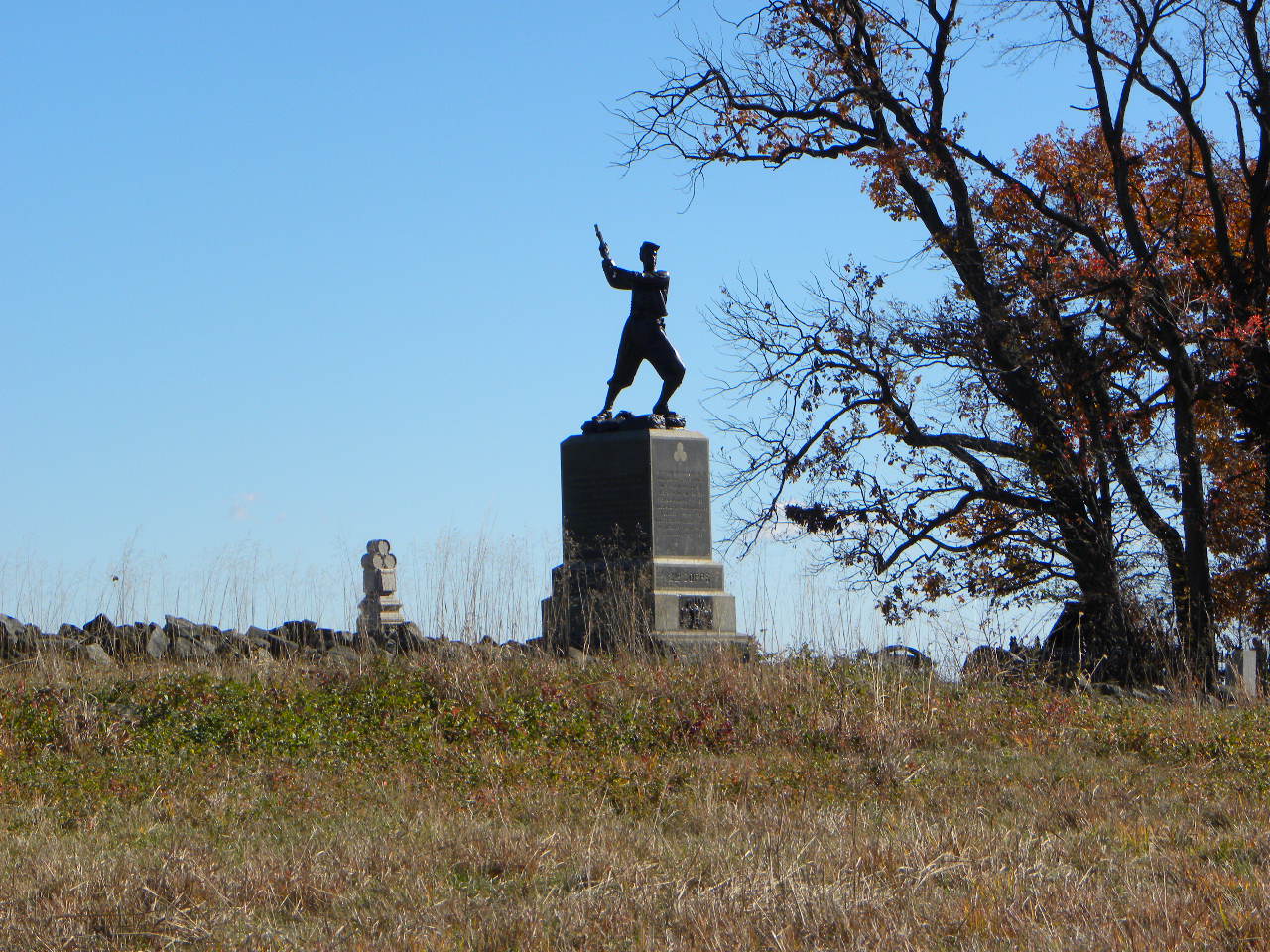
DSCN8854Monument to a Federal Infantry Regiment near the Copse of Trees on Cemetery Ridge

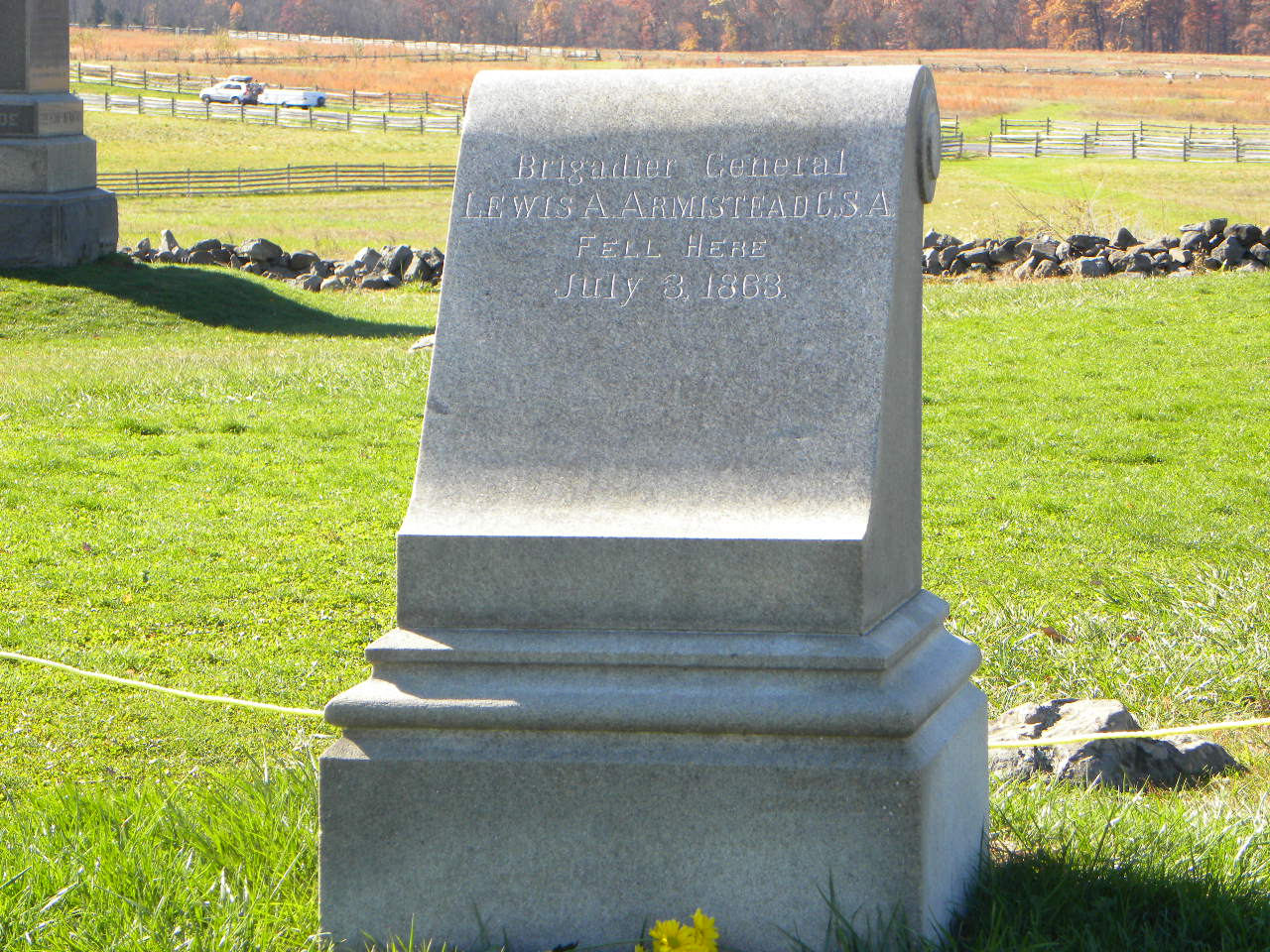
DSCN8856Monument to General Lewis Armistead CSA at the High Water Mark of the Confederacy

DSCN8851DSCN8855Monuments at the Angle on Cemetery Ridge

In a few short weeks our nation will commemorate the 150th anniversary of President Lincoln’s Gettysburg Address. His words, brief yet eloquent sum up the meaning and symbolism in the monuments that mark this hallowed ground.

Four score and seven years ago our fathers brought forth on this continent, a new nation, conceived in Liberty, and dedicated to the proposition that all men are created equal.

Now we are engaged in a great civil war, testing whether that nation, or any nation so conceived and so dedicated, can long endure. We are met on a great battle-field of that war. We have come to dedicate a portion of that field, as a final resting place for those who here gave their lives that that nation might live. It is altogether fitting and proper that we should do this.

But, in a larger sense, we can not dedicate — we can not consecrate — we can not hallow — this ground. The brave men, living and dead, who struggled here, have consecrated it, far above our poor power to add or detract. The world will little note, nor long remember what we say here, but it can never forget what they did here. It is for us the living, rather, to be dedicated here to the unfinished work which they who fought here have thus far so nobly advanced. It is rather for us to be here dedicated to the great task remaining before us — that from these honored dead we take increased devotion to that cause for which they gave the last full measure of devotion — that we here highly resolve that these dead shall not have died in vain — that this nation, under God, shall have a new birth of freedom — and that government of the people, by the people, for the people, shall not perish from the earth.

That is why these reminders of the past matter so much today.

Peace

Padre Steve+


Leave a comment

Filed under civil war, History

Gettysburg Day Two: The Engineer and the Professors on the Hill, Major General Gouverneur Warren and Colonels Strong Vincent and Joshua Chamberlain

Since I have been taking part in a Staff Ride at Gettysburg this weekend, which today finished at Little Round Top I am re-posting an article about three men that I admire, all academics who were instrumental in driving off the Confederate assault and probably saving the Union.
Peace
Padre Steve+
Leave a comment

Filed under Loose thoughts and musings

A Trip to Gettysburg

mkholrt

“In great deeds, something abides. On great fields something stays. Forms change and pass; bodies disappear, but spirits linger, to consecrate the ground for the vision-place of souls. And reverent men and women from afar, and generations that know us not and that we know not of, heart-drawn to see where and by whom great things were suffered and done for them….” Joshua Lawrence Chamberlain 

I am in Gettysburg this weekend as part of a Staff Ride with members of my Joint Forces Staff College course. I have been to Gettysburg many times but each time I go my appreciation for what occurred there 150 years ago grows. As I muse about the battle, as well as the entire war my thoughts are often drawn to the words of Joshua Lawrence Chamberlain, Colonel of the 20th Maine at Little Round Top.

In a few weeks the nation will mark the 150th anniversary of President Abraham Lincoln’s Gettysburg Address and I am staying not far from where Lincoln delivered the speech.

On Saturday and Sunday we will tour the battlefield and discuss the battle. I will be taking a good number of photos and probably do some writing about what I see and my thoughts on the events of the battle over the next few days.

However even though I will be thinking about the battle, I will also be thinking of the sacrifice made there to preserve the Union and defeat a rebellion that at its heart was based on maintaining a social and economic system that enslaved a race of people and treated them as less than human. If course the defenders of that revolt point to it being about “states rights” but those rights were fundamentally about preserving and expanding the practice of slavery and subjugating the black race in order to maintain the economic and political power of slave owners and traders.

images-61

Until then I will leave you with the immortal words of President Lincoln.

Four score and seven years ago our fathers brought forth on this continent, a new nation, conceived in Liberty, and dedicated to the proposition that all men are created equal.

Now we are engaged in a great civil war, testing whether that nation, or any nation so conceived and so dedicated, can long endure. We are met on a great battle-field of that war. We have come to dedicate a portion of that field, as a final resting place for those who here gave their lives that that nation might live. It is altogether fitting and proper that we should do this.

But, in a larger sense, we can not dedicate — we can not consecrate — we can not hallow — this ground. The brave men, living and dead, who struggled here, have consecrated it, far above our poor power to add or detract. The world will little note, nor long remember what we say here, but it can never forget what they did here. It is for us the living, rather, to be dedicated here to the unfinished work which they who fought here have thus far so nobly advanced. It is rather for us to be here dedicated to the great task remaining before us — that from these honored dead we take increased devotion to that cause for which they gave the last full measure of devotion — that we here highly resolve that these dead shall not have died in vain — that this nation, under God, shall have a new birth of freedom — and that government of the people, by the people, for the people, shall not perish from the earth.

Peace

Padre Steve+
Leave a comment

Filed under civil war, History