Monthly Archives: January 2015

Our Army Would be Invincible if…” Confederate Leadership Pt.1

Friends of Padre Steve’s World

This is the first part of a chapter that I am revising for my Gettysburg text. It deals with the problems faced by Robert E. Lee as he attempted to reorganize the Army of Northern Virginia following his victory at Chancellorsville and the death of Stonewall Jackson. 

Over the next few days I will be posting sections on each of the Confederate army corps and J.E.B. Stuart’s Cavalry Division. The later sections will be largely biographic sketches of the leaders of the Confederate Corps, Divisions and Brigades. Eventually I will have a similar chapter on the leadership of the Army of the Potomac.

Have a great night.

Peace,

Padre Steve+  

Lee1

General Robert E. Lee C.S.A.

An issue faced by armies that are forced to expand to meet the demands of war is the promotion and selection of competent leaders at all levels of command. It has been an issue throughout American military history including during our recent wars in Iraq and Afghanistan. The expansion of forces, the creation of new units, combined with the operational demands to employ those units often creates a leadership vacuum that must be filled. Sometimes this results in officers being promoted, being given field command or critical senior staff positions, who have critical deficiencies of leadership, character, intellect, experience or lack the necessary skill sets to do the job.

We may not see this as often in a long term professional military which has been at war for a significant amount of time, but during the Civil War it was something that both sides had to wrestle with, even for high level commanders. The nature of the armies involved, the high proportion of volunteer officers and political appointees coupled with the dearth of officers who had commanded anything larger than a company or widely scattered regiment made this a necessary evil.

To be fair, some officers of limited experience or training do rise to the occasion and perform in an exemplary manner. Others do not. Those leaders that do not are quite often weeded out over the course of time but often not before their lack of experience, or incompetence proves disastrous on the battlefield. As Barbara Tuchman so eloquently put it:

“When the moment of live ammunition approaches, the moment to which all his professional training has been directed, when the lives of the men under him, the issue of the combat, even the fate of a campaign may depend upon his decision at a given moment, what happens inside the heart and vitals of a commander? Some are made bold by the moment, some irresolute, some carefully judicious, some paralyzed and powerless to act.” [1]

Of course the selection of competent and experienced leaders is essential to the planning and execution of all aspects of Joint Planning and Mission Command, as is the proper supervision and command and control on the battlefield. As was noted in Infantry in Battle:

“Of course, a leader cannot be everywhere, but he can and should weigh the capabilities and limitations of his subordinates, determine the critical point or time of the action, and lend the weight and authority of personal supervision where it is most needed.” [2]

The Death of Stonewall Jackson and the Reorganization of the Army of Northern Virginia

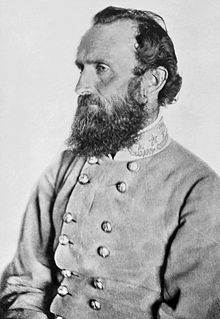
Stonewall_Jackson

Lieutenant General Thomas “Stonewall” Jackson C.S.A

Stonewall Jackson was dead, and with his death after the Pyrrhic victory at Chancellorsville, General Robert E. Lee was faced with the necessity of reorganizing the Army of Northern Virginia. Jackson’s loss was disastrous for Lee, for he lost the one man who understood him and his method of command more than anyone, someone for whom he had a deep and abiding affection. Months before Jackson’s death Lee said of him: “Such an executive officer the sun has never shown on, I have but to show him my design, and I know that it if it can be done it will be done.” [3]

Jackson’s loss loomed large over the Army and the Confederate nation. Jefferson Davis told his wife Varina at Jackson’s funeral “saw a tear escape her husband’s eye and land on Jackson’s face. “You must excuse me,” Davis said later after silently ignoring a fellow mourner’s conversation. “I am still staggered from such a dreadful blow. I cannot think.” [4] Davis telegraphed Lee and described Jackson’s death “A great national calamity has befallen us.” [5] Lee was devastated, but stoic. When he told his Chief of artillery, Brigadier General William Pendleton of Jackson’s death he wept. Lee told his son Custis “It is a terrible loss. I do not know how to replace him. Any victory would be dear at such a cost. But God’s will be done.” [6]

Jackson’s loss was felt throughout the Confederacy, and not just from a military point of view. Southerners saw the war “as a spiritual and religious crusade, a test of the superiority of their devoutness and culture.” [7] As such victory was seen as part of God’s blessing and defeat or loss of Divine punishment. Jackson was a part of that, his legendary piety, valor and success on the battlefield had imbued the spiritual dimension of the Confederate cause with proof of God’s favor. He had been sent by God, and even in death his memory inspired Confederates, one poet “described Jackson as the Confederate Moses who would not get to the Promised Land” [8] although others most certainly would. In a war where death had become more pervasive and affected almost everyone in the South in a personal way, through the loss of family, friends, or home it was easy to lose sight of “basic values and transcending causes. Jackson’s death brought those values and causes to the fore. To what end remained unclear. The certitude of a holy cause that greeted the war’s onset slid into doubt….” [9] After the war soldiers, journalists and civilians pointed to Jackson’s death as “a premonition of their coming defeat.” One wrote “The melancholy news affected the Confederates in the same way that various omens predicted, before Troy could be captured affected the city’s defenders.” [10]

A forlorn Southern woman wrote: “He was the nation’s idol, not a breath even from a foe has ever been breathed against his fame. His very enemies reverenced him. God has taken him away from us that we may lean more upon Him, feel that he can raise up to Himself instruments to work His Divine Will.” [11] An officer in the Army of Northern Virginia wrote: “One of the greatest heroes of the war has been called from us by an all-wise Providence, no doubt as a punishment for ascribing to a mere man praises due to God for giving us Jackson with the virtues and talents he possessed.” [12] Seeing Jackson’s death in light of the defeat at Gettysburg and other major Confederate reverses in the summer of 1863 Virginia Presbyterians decided that Jackson’s “Untimely” death marked a “further chastisement for sins, especially ingratitude, pride, and dependency on an arm of the flesh.” [13]

After Jackson’s loss Lee said “I had such implicit confidence in Jackson’s skill and energy that I never troubled myself to give him detailed instructions. The most general suggestions were all that he needed.” [14] Lee met the loss with “resignation and deep perplexity,” his words displayed that sense of loss, as well as his sense of faith and trust in God’s providence “I know not how to replace him. God’s will be done. I trust He will raise someone up in his place…” [15] In losing Jackson Lee lost a commander who had the ability to make his most imaginative plans come to life and find fulfillment and despite his efforts he never succeeded in finding a suitable replacement. Jackson was not a great tactician, but unlike any other Confederate commander he could implement Lee’s plans through his:

“single-mindedness of purpose, his unbending devotion to duty, his relentlessness as a foe, and his burning desire at whatever cost, for victory….He possessed an unmatched ability to impose his will on recalcitrant subordinates and on his enemies.” [16]

In addition to the loss of Jackson, Lee was desperately short of qualified senior and mid-level officers and Lee “understood how the diminishing numbers of quality officers impacted the army’s effectiveness.” [17] The problem was serious throughout the army, even though Lee had been victories in many battles, was that it suffered badly from high casualty counts, not just in the aggregate number of troops lost, but in leaders. “From the Seven Days to Chancellorsville, few if any regiments had not lost multiple field grade officers. Casualties among colonels, lieutenant colonels and majors surpassed 300 in total in all of the engagements.” [18]

A major part of Lee’s problem was organizational. In 1862 Lee inherited an army that was a “hodgepodge of forces” [19] which was organized in an “unwieldy divisional command system, where green commanders out of necessity were given considerable independence.” [20] That organization was tested and found wanting during the Seven Days campaign where on numerous occasions division commanders failed to coordinate their actions with those of adjacent divisions or failed to effectively control their own troops during movement to contact or combat.

Shortly after the Seven Days Lee reorganized the army, working with the material that he had. He divided the army into two wings since “Confederate law still did not allow for corps commands” [21] under Jackson and James Longstreet. Each wing was composed of four divisions and consisted of about 30,000 troops apiece. Both would be appointed Lieutenant Generals and their command’s recognized officially as the First Corps and the Second Corps in October 1862. These were massive forces, each nearly three times the size of a Union Corps in the Army of the Potomac.

While both Longstreet and Jackson were technically equals, and Longstreet Jackson’s senior by one day, it was Jackson to whom Lee relied on for the most daring tasks, and whom he truly considered his closest confidant and his “executive officer.” The relationship between Lee and Jackson was one of the most remarkable collaborations in military history and Lee owed much of his battlefield success to Jackson, and as J.F.C Fuller wrote: “Without Jackson, Lee was a one armed pugilist. Jackson possessed that brutality essential in war; Lee did not” [22]

The organization worked well at Second Manassas, Fredericksburg and Chancellorsville, although Longstreet’s corps was detached from the army at the time of the latter. When Jackson was wounded at Chancellorsville on the first night of that battle neither A.P. Hill nor J.E.B. Stuart were able effectively commanded Second Corps during the remainder of the battle.

The temperament and personalities of Longstreet and Jackson served to balance each other, and each enjoyed the trust of Lee. Lee’s biographer Michael Korda calls them the:

“yin and yang of subordinates. Jackson was superb at guessing from a few words exactly what Lee wanted done, and setting out to do it immediately without argument or further instructions; Longstreet was as good a soldier, but he was an instinctive contrarian and stubbornly insisted on making Lee think twice, and to separate what was possible from what was not.” [23]

Both men had been instrumental to Lee’s battlefield success and both played indispensable roles in Lee’s ability to command the army.

Likewise, the sheer size of Lee’s formations posed problems both in moment and combat, as Lee noted “Some of our divisions exceed the army Genl Scott entered Mexico with, & our brigades are larger than divisions”…that created stupendous headaches in “causing orders & req[uisitions] to be obeyed.” [24] Lee wrote to Jefferson Davis on May 20th “I have for the past year felt that the corps of the army were too large for one commander. Nothing prevented my proposing to you to reduce their size and increase their number but my inability to recommend commanders.” [25]

In the hands of Longstreet and Jackson these massive corps were in the good hands of leaders who could effectively handle them, “but in anyone else’s hands, a corps the size of Jackson’s or Longstreet’s might prove so big as to become clumsy, or even worse, might call for a degree of micromanagement that Lee and his diminutive staff might not be able to deliver.” [26] Lee recognized this and did not try to replace Jackson. Instead he wrote Jefferson Davis and explained the reasons for creating a new corps:

“Each corps contains in fighting condition about 30,000 men. These are more than one man can handle & keep under his eye in battle….They are always beyond the range and vision & frequently beyond his reach. The loss of Jackson from the command of one half of the army seems to me a good opportunity to remedy this evil.” [27]

Instead of appointing one man to command Second Corps, Lee reorganized the army and created two corps from it. He stripped a division of Longstreet’s First Corps, that of Richard Anderson, to join the new Third Corps. He also divided the large “Light” Division, which under Hill’s “intelligent administration probably is the best in the army” [28] into two divisions, one commanded by Dorsey Pender and the other by Harry Heth.

The problem for Lee was just who to place in command of the new corps and divisions that he was creating. Lee was deeply aware of this problem, and wrote to John Bell Hood that the army would be “invincible if it could be properly organized and officered. There never were such men in an Army before. The will go anywhere and do anything if properly led. But there is the difficulty-proper commanders- where can they be obtained?” [29] Lee sought the best commanders possible for his army, but the lack of depth in the ranks of season, experienced commanders, as well as the need to placate political leaders made some choices necessary evils.

To be continued…

Notes

[1] Tuchman, Barbara The Guns of August Ballantine Books, New York 1962 Amazon Kindle edition location 2946

[2] _________. Infantry In Battle The Infantry Journal Incorporated, Washington DC 1939, reprinted by the USACGSC with the permission of the Association of the United States Army p.195

[3] Taylor, John M. Duty Faithfully Performed: Robert E Lee and His Critics Brassey’s, Dulles VA 1999 p.128

[4] Davis, William C. Jefferson Davis: The Man and His Hour Harper Collins Publishers New York 1991 p.501

[5] Freeman, Douglas Southall, Lee’s Lieutenant’s a Study in Command, One volume abridgement by Stephen W Sears, Scribner, New York 1998 p.524

[6] Wert, Jeffry D. A Glorious Army: Robert E. Lee’s Triumph 1862-1863 Simon and Schuster, New York and London 2011 p.208

[7] Pryor, Elizabeth Brown. Reading the Man: A Portrait of Robert E. Lee Through His Private Letters Penguin Books, New York and London 2007 p.235

[8] Rable, George C. God’s Almost Chosen Peoples: A Religious History of the American Civil War University of North Carolina Press, Chapel Hill 2010 p.261


[9] Goldfield, David. America Aflame: How the Civil War Created a Nation Bloomsbury Press, New York 2011 p.279

[10] Royster, Charles The destructive War: William Tecumseh Sherman, Stonewall Jackson, and the Americans Alfred A. Knopf, New York 1991 p.227

[11] Glatthaar, Joseph T. General Lee’s Army from Victory to Collapse The Free Press, Simon and Schuster, New York and London 2008 p.255

[12] Ibid. Pryor Reading the Man p.236

[13] Ibid. Rable God’s Almost Chosen Peoples p.261

[14] Dowdy, Clifford. Lee and His Men at Gettysburg: The Death of a Nation Skyhorse Publishing, New York 1986, originally published as Death of a Nation Knopf, New York 1958 p.30

[15] Ibid. Freeman Lee’s Lieutenant’s p.524

[16] Ibid. Wert A Glorious Army p.209

[17] Ibid. Wert A Glorious Army p.217

[18] Ibid. Wert A Glorious Army p.217

[19] Ibid. Dowdy. Lee and His Men at Gettysburg p.30

[20] Hagerman, Edward. The American Civil War and the Origins of Modern Warfare. Midland Book Editions, Indiana University Press. Bloomington IN. 1992 p.110

[21] Ibid. Glatthaar General Lee p.157

[22] Fuller, J.F.C. Grant and Lee: A Study in Personality and Generalship, Indiana University Press, Bloomington IN 1957

[23] Korda, Michael. Clouds of Glory: The Life and Legend of Robert E. Lee Harper Collins Publishers, New York 2014 p.527

[24] Guelzo, Allen C. Gettysburg: The Last Invasion Vintage Books a Division of Random House, New York 2013 pp.20-21

[25] Wert, Jeffry D. General James Longstreet The Confederacy’s Most Controversial Soldier, A Touchstone Book, Simon and Schuster, New York and London 1993 p.248

[26] Ibid. Guelzo, Gettysburg: The Last Invasion pp.20-21

[27] Thomas, Emory Robert E. Lee W.W. Norton and Company, New York and London 1995 p.289

[28] Ibid. Freeman Lee’s Lieutenants p.35

[29] Coddington, Edwin B. The Gettysburg Campaign: A Study in Command, A Touchstone Book, Simon and Schuster New York, 1968 p.12

1 Comment

Filed under civil war, History, leadership, Military

The Civil War and the Transformation of Naval Warfare

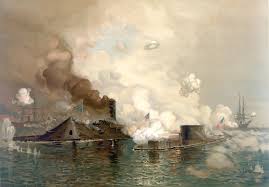
battleofhamptonroads

Friends of Padre Steve’s World

For the past month I have been doing a lot of work on my Civil War and Gettysburg text. As I looked at the first chapter which deals with the Civil War being the first truly modern war, I realized that the text was entirely land-centric. Part of this was because no naval forces were involved at Gettysburg, but they did have a significant and even a pivotal role in the defeat of the South. The technical developments at sea during the Civil War still affect us today. Since many of my students are Naval officers and our Staff College focuses on joint operations I thought it wise to include a brief introduction to those transformational developments of the Civil War.

Peace

Padre Steve+

Another aspect of the American Civil War that made it the first modern war was the naval war. There are several components of which we should take note. The first of which are the major technical advances in naval warship design, particularly in the matter of armor protection and steam propulsion. While both armor protection and steam propulsion were not new. Steam power had been introduced in the United States Navy in 1814 when Robert Fulton’s USS Demologos was launched. That ship was innovative but saw little service. The U.S. Navy commissioned a number of steam frigates, first paddle-wheel steamers and later screw-frigates in the 1830s, 1840s and 1850s. However during the ante-bellum era only seventeen of fifty-seven major ships (ships of the line, frigates and first rate sloops of war) were steam powered. By the end of the war most ships were steam powered or had sails just to supplement their steam plants.

The second major technical innovation was the use of iron in shipbuilding, particularly armor plating for protection. What had changed was that the French and British navies had adopted explosive shell in the 1830s. The first use of them by the Russians against the Turks at the Battle of Sinope in 1853 proved devastating to the Turks and convinced both the British and the French that something had to be done to counter the threat. The result was the ironclad.

During the Crimean War the French built ironclad floating batteries as well as “three small purpose built…gunboats…whose ironclad hulls proved equally impervious to solid shot and explosive shell.” [1] The French commissioned their first ironclad shell firing battleship, the Gloire in 1859. The British Royal Navy commissioned their first ironclad, the HMS Warrior in 1860. Though she did not have the rotating turrets and maintained sails as an auxiliary source of propulsion, Warrior was “rightly regarded as the first battleship of the modern age. Warrior was steam-propelled, shell firing, iron in construction from keel to bulwarks and heavily armored as well.” [2]

But it was in America that the steam powered ironclads changed naval warfare in a dramatic fashion. The Confederacy led the way in the development of ironclads largely out of necessity to break the Union blockade. As necessity is the mother of invention the Confederates were most creative in attempting to answer the Union blockade, which was tightening significantly by 1862 as Union Naval and Army forces conducted amphibious operations along the Confederate Coast seizing six of the nine ports with rail connections to the southern interior, while blockading the remaining ports. The “blockade reduced the South’s seaborne trade to less than a third of normal,” [3] which included imports of vital war materials as well as the export of the South’s only real commodity, cotton.

The blockade had a devastating effect on the southern economy and war effort: “by bringing about serious shortages in strategic items, not only added to the inflationary trends but also frustrated efforts to maintain the transportation network and to increase industrial output.” [4] A southern naval officer “conceded after the war that the blockade “shut the Confederacy out from the world, deprived it of supplies, weakened its military and naval strength.” [5] It also contributed to the decline in the southern standard of living, weakening the political will of the southern people by “accentuating the hardships of war by reducing the southern standard of living and denying consumers enough of many of the imports, such as coffee, which they valued. This was a cost of war which northerners did not have to bear.” [6]

The blockade and Union amphibious operations soon deprived the Confederacy of its major naval facilities and forced the confederate Navy to rely on small shipyards in often isolated locations. The isolation meant that the often paltry amount of supplies such as iron, wood, and weapons, could not get to these facilities, hindering the construction of warships. But the Confederate Navy also suffered from its secondary status to the Army and since “Davis favored the army, the navy received inadequate funding.” [7]

the-css-virginia-in-drydock

CSS Virginia in drydock

Despite this, southern naval personnel were decidedly inventive in attempting to find creative ways to defend their harbors as well as break the blockade. First was in the development of ironclad ships armed with large rifled cannons which fired the explosive shells which were so devastating against wooden ships. The first operational Confederate Ironclad the CSS Manassas was destroyed at New Orleans by Admiral Farragut’s fleet, but the most famous Confederate Ironclad had a decided effect on the war. This was the CSS Virginia formerly the Federal steam frigate USS Merrimac which had been burned at Norfolk to prevent her from falling into Confederate hands. The ship had burned to the waterline but its hull was intact. Likewise its engines, which even before the sinking were seriously in need of replacement, were intact.

Confederate Secretary of the Navy Stephen Mallory realized that innovation was the key to Confederate hopes at sea and he told the Naval Affairs committee in the new Confederate Congress “I regard the possession of an iron-plated ship as a matter of first necessity.” [8] Mallory sent agents to Europe to contract with French and British yards to build such ships but those efforts fell through when both countries decided to enforce their neutrality laws which forbade them from producing warships for a belligerent nation.

This caused Mallory to embark on converting the Merrimac into a large ironclad ram. In 1861, not long after the seizure of Norfolk and the Gosport Naval Shipyard, Mallory’s Chief of Ordnance and Hydrography, Lieutenant John M. Brooke, “had drawn up a design for transforming Merrimac’s hull into the iron plated CSS Virginia.” [9] The ship was cut down to the waterline and rebuilt with a “170 foot long casemate sloped at an angle of 36 degrees” [10]bolted onto the hull. Construction was agonizingly slow despite the efforts of officers on the scene. The ship’s executive officer, Lieutenant Catesby ap R. Jones “pressed the workmen to labor overtime, seven days a week” [11] but despite their efforts the ship was completed nearly four months after its projected completion date of November 1861. This was largely due to issues that would plague the Confederate shipbuilding industry throughout the war; “shortages of iron, congestion on the railroads hauling materials, and the necessity of retooling the Tredegar Iron works[12] to roll the armor plate slowed her construction.

The ship’s casemate had a four inch layer of armor plate, and the hull below was given a one inch armored belt extending to three feet below the waterline. Armed with six 9 inch Dahlgren smoothbore naval guns on the broadside, two 7 inch rifles forward and two 6.4 inch rifles aft and equipped with a seven foot iron ram on her bow, when complete, the new Virginia was unlike anything seen before. [13]

During construction Union spies leaked the plans to the North which catapulted the Lincoln and his Secretary of the Navy Gideon Welles into action. “When Welles learned of enemy plans for Merrimac, he appointed an Ironclad Board to study the problem. It recommended that the Navy Department let contracts for three experimental ironclads, one of them designed by John Ericsson and known as the Monitor.[14]

MMUSSM01

Ericsson, a Swede, was the inventor of the screw propeller and designer of the first U.S. Navy Screw Frigate the USS Princeton. The Monitor too was like nothing ever seen on the ocean. Described by some as a “cheese box on a raft” the small ship had all of her machinery located below the waterline on a completely iron hull that only drew 11 feet of water. The hull was protected by armor plate, but the most notable and innovative feature was a heavily armored revolving turret with eight inches of armor, mounted two massive 11 inch Dahlgren smoothbore guns which “could fire a 170-pound shot or 136-pound shell in any direction except straight ahead, where the pilot house sheathed in nine inches of armor was located.” [15] Future ships remedied this defect. Ericcson’s ship was mocked around the navy and by naval designers, but he and it would prove them wrong.

Monitor was completed two weeks before Virginia, but the Confederates elected to strike quickly. On March 8th 1862 the Virginia sailed under the Command of Franklin Buchanan, a veteran officer who had left the U.S. Navy to confront the Federal blockade force off Hampton Roads. During the battle she rammed and sank the large sailing Sloop of War USS Cumberland and shelled the sailing Frigate USS Congress, one of the Navy’s original six frigates until that ship caught fire and exploded during the night. The steam Frigate Minnesota, a sister ship of Merrimac and the flagship of the blockade force had run aground attempting to come to the aid of the two doomed ship and was at the mercy of Virginia. But tides and darkness caused Buchanan to withdraw for the night. March 8th was the “worst day in the history of the U.S. Navy. The Virginia sank two proud ships within a few hours – a feat no other enemy would accomplish until 1941. At least 240 bluejackets had been killed, including the Captain of the Congress – more than the navy suffered on any day of the war.”[16]

That night the tiny Monitor arrived and when Virginia steamed out on March 9th to complete the work she had begun the previous day, her crew saw a strange craft laying aside Minnesota. They did not realize that this was the new Union ironclad. As the Virginia approached Minnesota to finisher her off, the Monitor went into action. The ships fought a fierce engagement for several hours. The engagement was a draw and never fought again as neither side wanted to risk their only operational ironclad. Virginia had to be scuttled to avoid capture when Union forces captured Norfolk in May of 1862. However, the encounter had revolutionized naval warfare and doomed the graceful wooden wall of the sailing ships of the line and frigates. When the news of the action reached London the effect was shattering. The London Times commented:

“Whereas we had available for immediate purposes one hundred and forty-nine first class warships, we now have two, these being the Warrior and her sister Ironside. There is not now a ship in the English Navy apart from these two that it would not be madness to trust to an engagement with that little Monitor.” [17]

Designers on both sides experimented with various designs of ironclad warships. The Confederacy focused on building ironclad rams based on the Virginia, which featured a central armored casemate where all the ships guns were mounted. Eventually they completed twenty-one more such vessels which were used mostly in harbor defense activities. All of these ships faced construction challenges largely due to the shortage of iron plating, adequate propulsion systems and weapons. Some ships had armor plating consisting of railroad tracks which were bolted onto wooden casemates.

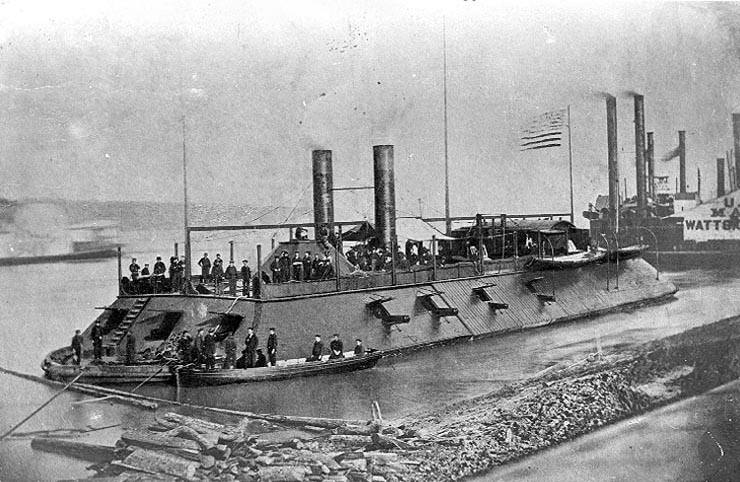
098604506

The U.S. Navy, with more shipyards and resources had a number of designs including the Eads river ironclads, the ironclad frigate USS New Ironsides and various types of “Monitors” featuring heavily armored revolving turrets designed by John Ericcson. Other designs were rejected for various reasons. While ironclads were the preferred type of ship, neither navy had the ability to build completely ironclad fleets and wooden ships still had a decided speed advantage over ironclads. Thus field-expedient protection was devised used which resulted in ships being protected by lumber, cotton and tin. However, by the end of the war the United States Navy had 58 monitors in operation. In addition to the monitor fleet another dozen or so ironclads of various types served in the U.S. Navy.

When the Ironclad Board of the United States Navy prioritized the types of ship to construct to meet the demands of the war, they rightly recognized that first priority had to be given to what we now call “the Brown Water Navy.” The Board determined that:

“Our immediate demands seem to require, first, so far as practicable, vessels invulnerable to shot, of light draught of water to penetrate our shoals, rivers, and bayous. We therefore favor the construction of this class vessels before going into a more perfect system of large iron-clad sea-going vessels of war.” [18]

Uss_Cairo_h61568

The new designs which featured steam propulsion and armor protection instantly made all previous ships obsolete and by the 1880s these features would be incorporated in warship design by navies around the world. The effect was immediate in England where “After 1865 all the Royal Navy’s new ships were built of iron; the most modern of the old were cut down and iron clad.[19] France and Russia followed, but the United States, in its post war draw down allowed its fleet to crumble and it would not be until the 1880s that the first steel ships would be built to replace the now obsolete monitors and the remaining wooden steam frigates.

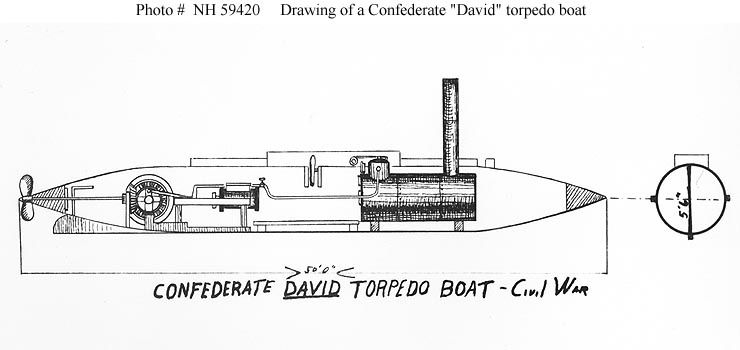
892512_com_h59420

Two other naval developments from the Civil War still play an important role in naval warfare and strategy. Two were related to the modern submarine. The first that of a semi-submersible “torpedo boats” known as Davids, one of which disabled the massive USS New Ironsides, hitting the ironclad with a 60 pound charge on the tip of a spar torpedo mounted on its bow off of Charleston on October 5th 1863. The fifty foot long craft and two of her crew returned it to a heroes’ welcome. A Union torpedo boat under the command of Lieutenant William Barker Cushing, brother of Army Lieutenant Alonzo Cushing, a hero of “the Angle” at Pickett’s Charge, sank the ironclad CSS Albemarle on the Roanoke River with a spar mounted torpedo on October 27th 1864.

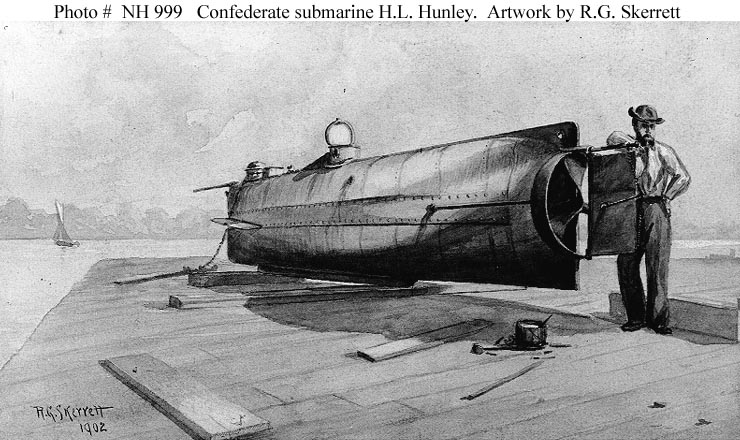
On February 17th the fully submersible CSS Hunley exploded a spar torpedo on the side of the USS Housatonic a steam sloop anchored off Charleston. The torpedo sank Housatonic and swamped the tiny Hunley taking her and her nine man crew to their watery grave. These early Confederate innovations spurred the development of submarines, something that the U.S. Navy pioneered and still leads the world in many ways. In many ways the submarine is the most deadly naval and strategic weapon system in the world today, and they trace their roots to the humble CSS Hunley, the first to sink a warship in combat.

hunley1lg

The Hunley and Monitor remain today the most famous ships of the Civil War, each of which irrevocably changed the character of naval warfare for generations to come.

The last development was the development of what were then called torpedoes, but are now known as mines by the Confederate Navy. Authorized by the ever innovative Secretary of the Navy Stephen Mallory, these weapons were used to protect blockaded ports from Union Naval forces and by the end of the war these “infernal devices” had sunk or damaged forty-three Union warships.” [20]

The lessons learned from the battles along America’s Littorals demonstrate the importance of being able to conduct both blue water as well as actions along contested shorelines and inland waterways. Likewise they demonstrate to naval strategists the importance of not ignoring any means that a weaker opponent can use to defend his coastline. The surprise attack on the guided missile destroyer USS Cole by terrorists with an explosive laden craft on October 12th 2000 demonstrate the vulnerability of even the most modern warships to technology not much different than that used against New Ironsides, Housatonic and Albemarle in the Civil War.

Notes

[1] Keegan, John The Price of Admiralty: The Evolution of Naval Warfare Penguin Books, New York and London 1988 p.110

[2] Ibid. Keegan The Price of Admiralty pp.110-111

[3] Ibid. McPherson. The Battle Cry of Freedom p.382

[4] Currant, Richard N. God and the Strongest Battalions in Why the North Won the Civil War edited by Donald, David Herbert A Touchstone Book, Simon and Schuster New York 1996 p.33

[5] Ibid. McPherson. The Battle Cry of Freedom p.381

[6] Jones, Archer. Military Means, Political Ends in Why the Confederacy Lost edited by Boritt, Gabor, Oxford University Press, Oxford and New York 1992 p. 75

[7] Millet, Allan R. and Maslowski Peter For the Common Defense: A Military History of the United States, Revised and Expanded Edition The Free Press, New York 1994 p.220

[8] McPherson, James War on the Waters: The Union & Confederate Navies 1861-1865 p.96

[9] Ibid. Thomas, The Confederate Nation pp.129-130

[10] Ibid. McPherson War on the Waters p.97

[11] Ibid. Thomas, The Confederate Nation p.130

[12] Ibid. McPherson War on the Waters p.97

[13] Ibid. McPherson War on the Waters p.97

[14] Ibid. Millet and Maslowski For the Common Defense Revised and Expanded edition p.221

[15] Ibid. McPherson War on the Waters p.99

[16] Ibid. McPherson. The Battle Cry of Freedom p.376

[17] Ibid. McPherson. The Battle Cry of Freedom p.377

[18] _____________ The Daybook: Civil War Navy Special Edition – Technology U.S. Navy Naval History and Heritage Center retrieved from http://www.history.navy.mil/content/dam/nhhc/browse-by-topic/War%20and%20Conflict/civil-war/cwsetech.pdf 16 January 2015 p.9

[19] Ibid. Keegan The Price of Admiralty p.111

[20] Ibid. McPherson Battle Cry of Freedom p.314

Leave a comment

Filed under Loose thoughts and musings

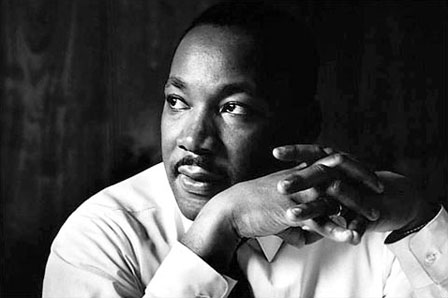
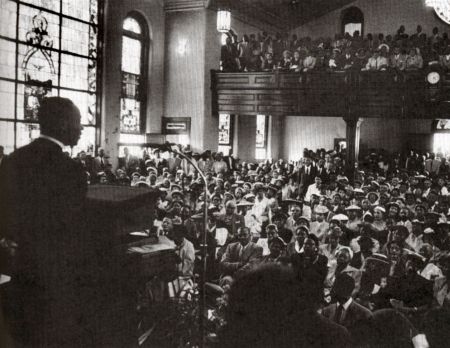
Martin Luther King Jr’s Dream that Cannot be Allowed to Die

index

“Let us rise up tonight with a greater readiness. Let us stand with a greater determination. And let us move on in these powerful days, these days of challenge to make America what it ought to be. We have an opportunity to make America a better nation.”

Over the past week I have been pondering the importance of the life and work of Dr. Martin Luther King Jr. It is important to not forget this man and what he stood for, his life and sacrifice.

You see King, like many Black clergy of his day could have played it safe. Many pastors, for good reason remained quiet about the conditions of segregation and the racism of the day. Many just hoped to see things slowly improve without rocking the boat and without endangering themselves or their families. They had seen what happened to blacks who spoke up or confronted the evil, lynchings, cross burnings, threats and murder. They had contented themselves with just trying to get along. Many pastors did not support or gave only lukewarm support to King, Andrew Young, Fred Shuttlesworth and Ralph Abernathy. going into 1963.

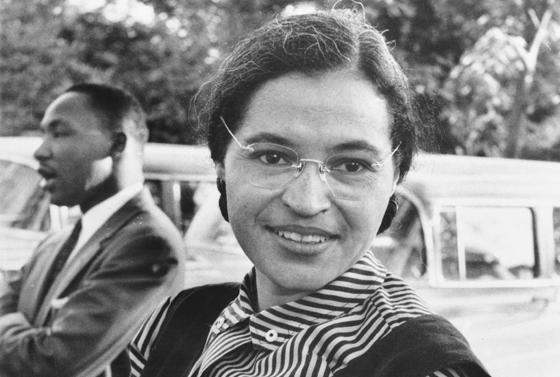
lossless-page1-560px-Rosa_Parks_(detail).tiff

King did not start out to become a Civil Rights leader. However, he was inspired to actively join the movement through the example of Rosa Parks, who defiance of the law for blacks to sit “in the back of the bus” in 1955. He led the Montgomery Bus Boycott which last 385 days. Reaction among segregationists against King was violent, his house was bombed and his life threatened.

The leadership of the boycott brought the young pastor to national prominence. However, by 1963 much of the Civil Rights movement and the African American community was despairing of the lack of progress. Many had become disenchanted with King, not considering him bold enough despite his rhetorical abilities.

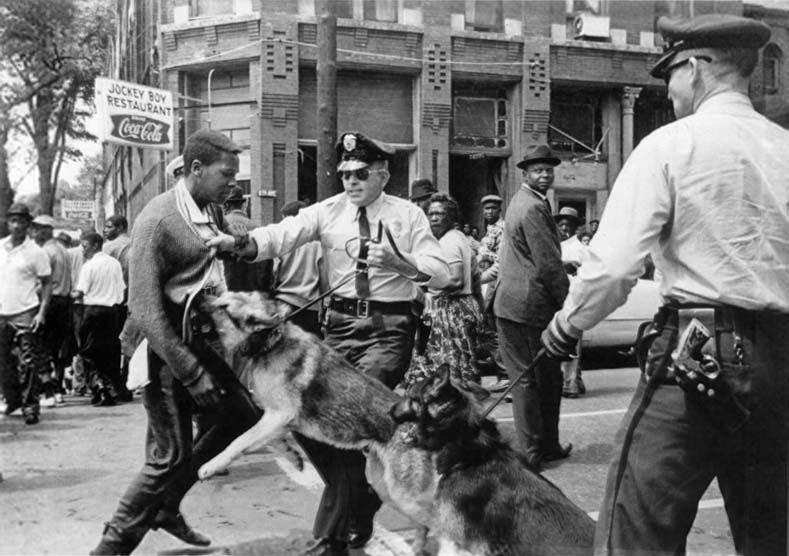
Birmingham_campaign_dogs

But in April 1963, working with other Civil Rights leaders in Birmingham Alabama King relit the fires of the movement. Montgomery Police Chief “Bull” Conner used his force to violently attack the demonstrators, unleashing dogs and using high pressure water cannon on them, including women, children and the elderly. The violent reaction to the protests shocked much of America and the world.

King was arrested and in the Birmingham jail composed one of his most famous works, the Letter from the Birmingham Jail.  The letter was a social, political and theological masterpiece. It it some of his harshest criticism was of white, as well as black moderates:

“I have almost reached the regrettable conclusion that the Negro’s great stumbling block in his stride toward freedom is not the White Citizen’s Councilor or the Ku Klux Klanner, but the white moderate, who is more devoted to “order” than to justice; who prefers a negative peace which is the absence of tension to a positive peace which is the presence of justice; who constantly says: “I agree with you in the goal you seek, but I cannot agree with your methods of direct action”; who paternalistically believes he can set the timetable for another man’s freedom; who lives by a mythical concept of time and who constantly advises the Negro to wait for a “more convenient season”

gty_march_on_washington_martin_luther_king_ll_130819_16x9_992

King continued his activism until his assassination. In August 1963 he led the March on Washington for Jobs and Freedom, where before a crowd of an estimated 200,000-300,000 he gave his I Have a Dream Speech.

http://www.americanrhetoric.com/speeches/mlkihaveadream.htm

The crescendo of the speech was remarkable and is perhaps one of the most remembered speeches in American history.

Let us not wallow in the valley of despair, I say to you today, my friends.

And so even though we face the difficulties of today and tomorrow, I still have a dream. It is a dream deeply rooted in the American dream.

I have a dream that one day this nation will rise up and live out the true meaning of its creed: “We hold these truths to be self-evident, that all men are created equal.”

I have a dream that one day on the red hills of Georgia, the sons of former slaves and the sons of former slave owners will be able to sit down together at the table of brotherhood.

I have a dream that one day even the state of Mississippi, a state sweltering with the heat of injustice, sweltering with the heat of oppression, will be transformed into an oasis of freedom and justice.

I have a dream that my four little children will one day live in a nation where they will not be judged by the color of their skin but by the content of their character.

I have a dream today!

I have a dream that one day, down in Alabama, with its vicious racists, with its governor having his lips dripping with the words of “interposition” and “nullification” — one day right there in Alabama little black boys and black girls will be able to join hands with little white boys and white girls as sisters and brothers.

I have a dream today!

I have a dream that one day every valley shall be exalted, and every hill and mountain shall be made low, the rough places will be made plain, and the crooked places will be made straight; “and the glory of the Lord shall be revealed and all flesh shall see it together.”2

This is our hope, and this is the faith that I go back to the South with.

With this faith, we will be able to hew out of the mountain of despair a stone of hope. With this faith, we will be able to transform the jangling discords of our nation into a beautiful symphony of brotherhood. With this faith, we will be able to work together, to pray together, to struggle together, to go to jail together, to stand up for freedom together, knowing that we will be free one day.

And this will be the day — this will be the day when all of God’s children will be able to sing with new meaning:

My country ’tis of thee, sweet land of liberty, of thee I sing.

Land where my fathers died, land of the Pilgrim’s pride,

From every mountainside, let freedom ring!

And if America is to be a great nation, this must become true.

And so let freedom ring from the prodigious hilltops of New Hampshire.

Let freedom ring from the mighty mountains of New York.

Let freedom ring from the heightening Alleghenies of Pennsylvania.

Let freedom ring from the snow-capped Rockies of Colorado.

Let freedom ring from the curvaceous slopes of California.

But not only that:

Let freedom ring from Stone Mountain of Georgia.

Let freedom ring from Lookout Mountain of Tennessee.

Let freedom ring from every hill and molehill of Mississippi.

From every mountainside, let freedom ring.

And when this happens, and when we allow freedom ring, when we let it ring from every village and every hamlet, from every state and every city, we will be able to speed up that day when all of God’s children, black men and white men, Jews and Gentiles, Protestants and Catholics, will be able to join hands and sing in the words of the old Negro spiritual:

                Free at last! Free at last!

                Thank God Almighty, we are free at last!

King knew the dangers and the risks of appealing to a strategy of non-violence based on love of his enemies. King spoke to the world when he accepted the Nobel Peace Prize in 1964:

“Here and there an individual or group dares to love, and rises to the majestic heights of moral maturity. So in a real sense this is a great time to be alive. Therefore, I am not yet discouraged about the future. Granted that the easygoing optimism of yesterday is impossible. Granted that those who pioneer in the struggle for peace and freedom will still face uncomfortable jail terms, painful threats of death; they will still be battered by the storms of persecution, leading them to the nagging feeling that they can no longer bear such a heavy burden, and the temptation of wanting to retreat to a more quiet and serene life. Granted that we face a world crisis which leaves us standing so often amid the surging murmur of life’s restless sea. But every crisis has both its dangers and its opportunities. It can spell either salvation or doom. In a dark confused world the kingdom of God may yet reign in the hearts of men.”  http://www.nobelprize.org/nobel_prizes/peace/laureates/1964/king-lecture.html 

Dr. King understood how easy hatred could consume people and movements and urged  people not to follow the course of hate, he wrote:

“Returning hate for hate multiplies hate, adding deeper darkness to a night already devoid of stars. Darkness cannot drive out darkness; only light can do that. Hate cannot drive out hate; only love can do that. Hate multiplies hate, violence multiplies violence, and toughness multiplies toughness in a descending spiral of destruction.”

King_Last_Sermon

The day before his assassination in Memphis, Dr. King still recognized what he might face. His “I have been to the Mountaintop” speech http://www.americanrhetoric.com/speeches/mlkivebeentothemountaintop.htm recounted many of the things that he had encountered, including an assassination attempt in 1958 which had come close to killing him. It was an amazing speech and one wonders if having lived under threat so long that he almost had a premonition of his death the next day.

And then I got into Memphis. And some began to say the threats, or talk about the threats that were out. What would happen to me from some of our sick white brothers?

Well, I don’t know what will happen now. We’ve got some difficult days ahead. But it really doesn’t matter with me now, because I’ve been to the mountaintop.

And I don’t mind.

Like anybody, I would like to live a long life. Longevity has its place. But I’m not concerned about that now. I just want to do God’s will. And He’s allowed me to go up to the mountain. And I’ve looked over. And I’ve seen the Promised Land. I may not get there with you. But I want you to know tonight, that we, as a people, will get to the promised land!

Dr. King’s dream is not dead and we who live today cannot allow it to die. There is still much work to see justice done for all Americans as well as those suffering from violence, persecution, discrimination and poverty around the world.

It is 2015. It has been 52 years since Dr. King sat in the Birmingham jail. Sadly, there are some who long for a return to the day of Jim Crow. In some states there have been and there are ongoing attempts to return it by stealth, especially through restrictions on voting that predominantly impact African Americans and the poor. Racism is not dead, nor are so many other “isms.”

Dr. King and many of the leaders of the Civil Rights Movement have passed on. Likewise, many people today are complacent about the injustices present in our society, injustices experienced by many people. We need a generation of new men and women with hearts like Dr. King’s, who will be the conscience of the nation and confront these injustices.

John_Lewis_t580

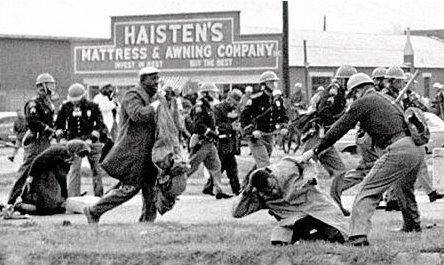
John Lewis (right front) being beaten by an Alabama State Trooper at Selma

Representative John Lewis, one of the original Freedom Riders was beaten numerous times during those protests. When leading the march across the Pettus Bridge in Selma, Lewis had his skull fractured by a State Trooper when he stopped to pray.  Lewis’s words call us to action today:

“If not us, then who? If not now, then when?” 

We cannot let Dr. King’s dream die.

Peace

Padre Steve+

1 Comment

Filed under civil rights, History, News and current events, Political Commentary

Emancipation and the U.S. Military: the Civil War and After

 HD_4USCinfantryDetail.preview

Friends of Padre Steve’s World

Tomorrow is the holiday where we remember the birth of Dr. Martin Luther King Jr. So I felt it appropriate to put out a revised section of my Civil War and Gettysburg text dealing with Emancipation and beginnings of African Americans being allowed to take their place in serving their country.  Sadly, a country that so often, both before, and after emancipation, treated them as either something less than human, or as second class citizens. But the sacrifice of these pioneers helped pave the way for the civil rights of others: women, other ethnic minorities, and most recently the LGBT community. Without blacks, who certainly endured the most odious treatment under slavery than any other group in this country, the long and slow progress others have made would not have been possible. This is certainly not to say that our system, nor our treatment of minorities, immigrants, women and gays is completely fair and equitable. It is not, there are many flaws, and still much discrimination, prejudice and fear mongering which demonizes certain groups as well as seeks to roll back the gains that individuals belonging to these groups have made to be accepted into American society. Thus we continue to strive for “a more perfect Union.” 

Peace

Padre Steve+

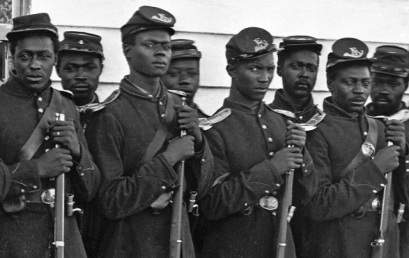
The war brought about another change to warfare in America. This was a societal and political change that has shaped American military history, culture and life ever since. The Emancipation Proclamation gave African Americans, both Freedmen and recently freed slaves the opportunity to serve in the Union Army. The change of policy instituted by Lincoln was revolutionary as well as controversial and it had strategic implications for the war effort. There were many doubters in the north whose attitudes towards African Americans were not much different than Southerners, especially among the Copperheads.

Prior to the Emancipation some Union commanders in occupied Confederate territory “had unofficially recruited black soldiers in Kansas and in occupied portions of South Carolina and Louisiana in 1862. But the administration had not sanctioned these activities.” [1] But as the war continued on, consuming vast numbers of lives the attitude of Lincoln and the administration began to change.

Lincoln and the closest members of his cabinet were beginning to understand that the “North could not win the war without mobilizing all of its resources and striking against Southern resources used to sustain the Confederate war effort.” [2]

Lincoln’s Secretary of War, Edwin Stanton; who was a passionate believer in the justice of emancipation “Instantly grasped the military value of the proclamation. Having spent more time than any of his colleagues contemplating the logistical problems facing the army, he understood the tremendous advantage to be gained if the massive workforce of slaves could be transferred from the Confederacy to the Union.” [3]
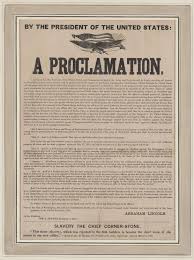
emancipation

Lincoln emphasized the “military necessity” of emancipation and “justified the step as a “fit and necessary war measure for suppressing the rebellion.” [4] The process of emancipation now became not only a moral crusade, but now became a key part of national strategy. Lincoln wrote to his future Vice President, Andrew Johnson, then the military governor of occupied Tennessee that “The colored population is the great available and yet unavailed of, force for restoration of the Union.” [5] The idea of simply mollifying the border states was dropped and policy changed that of “depriving the Confederacy of slave labor. Mobilizing that manpower for the Union- as soldiers as well as laborers- was a natural corollary.” [6] Reflecting President Lincoln’s and Stanton’s argument for the military necessity of emancipation, General Henry Halleck wrote to Ulysses Grant that:

“the character of the war has very much changed within the past year. There is now no possibility of reconciliation with the rebels… We must conquer the rebels or be conquered by them….Every slave withdrawn from the enemy is the equivalent of a white man put hors de combat.” [7]

Grant concurred with the decision. Grant wrote to in a letter to Lincoln after the assault on Battery Wagner “by arming the negro we have added a powerful ally. They will make good soldiers and taking them from the enemy weakens him in the same proportion as it strengthens us.” [8] Lincoln wrote after the Emancipation Proclamation that “the emancipation policy, and the use of colored troops, constitute the heaviest blow yet dealt to the rebellion.” [9] The change was a watershed in both American history as well as the future of the U.S. Military services.

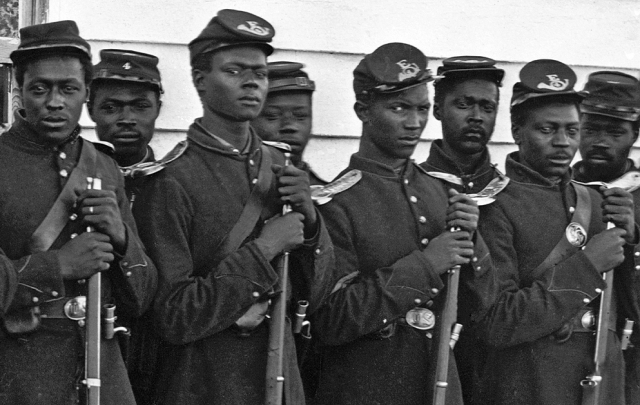
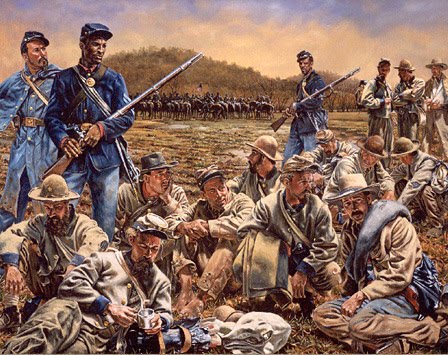
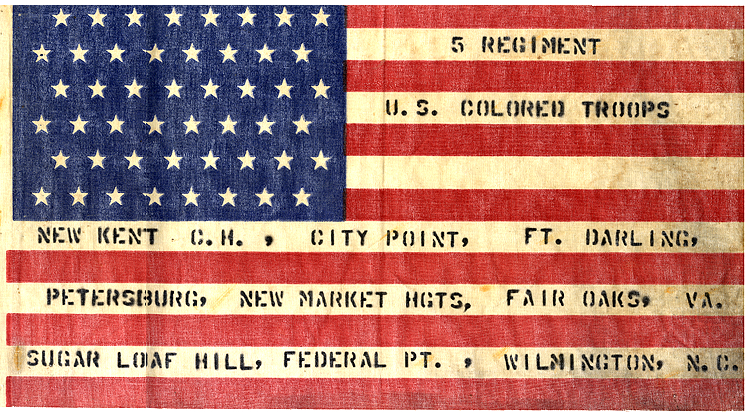
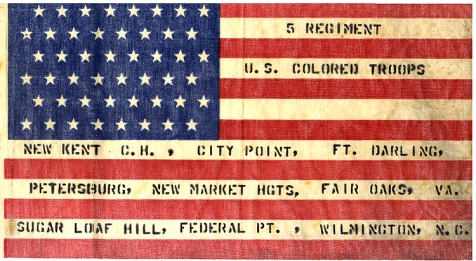
Emancipation allowed for the formation of regiments of United States Colored Troops (USCT), mustered directly into Federal service, which in numbers soon dwarfed the few state raised Black Regiments. However, it was the inspiration provided by those first state raised regiments as well as the violence directed against Blacks in the draft riots helped to provoke “many northerners into a backlash against the consequences of violent racism.” [10] The valor of the state regiments, as well as the USCT units that managed to get into action was remarkable, especially in regard to the amount of discrimination levied at them by some northerners, and the very real threat of death that they faced of captured by Confederates.

In May of 1863 Major General Nathaniel Banks dared to send the First and Third Regiments of “Louisiana Native Home Guard regiments on a series of attacks on Confederate positions at Port Hudson, Louisiana” [11] where they received their baptism of fire. They suffered heavy losses and “of the 1080 men in the ranks, 271 were hit, or one out of every four.” [12] Banks said of them in his after action report: “They answered every expectation…In many respects their conduct was heroic…The severe test to which they were subjected, and the determined manner in which they encountered the enemy, leave upon my mind no doubt of their ultimate success.” [13]
william_carney

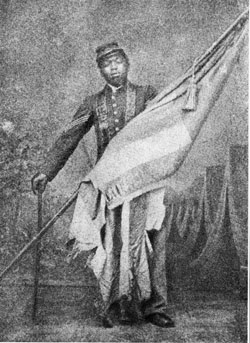
Sergeant William H. Carney of the 54th Massachusetts, Medal of Honor

But the most famous African American volunteer regiment was the 54th Massachusetts, commanded by Colonel Robert Gould Shaw, the “North’s showcase black regiment.” [14] Raised in Boston and officered by many men who were the sons of Boston’s blue blood abolitionist elite, the regiment was authorized in March 1863. Since there was still opposition to the formation of units made up of African Americans, Massachusetts Governor John Andrew authorized the formation of the 54th under the command of white officers, a practice that with few exceptions, became standard in the U.S. military until President Truman desegregated the armed forces in 1948. Governor Andrew was determined to ensure that the officers of the 54th were men of “firm antislavery principles…superior to a vulgar contempt for color.” [15]

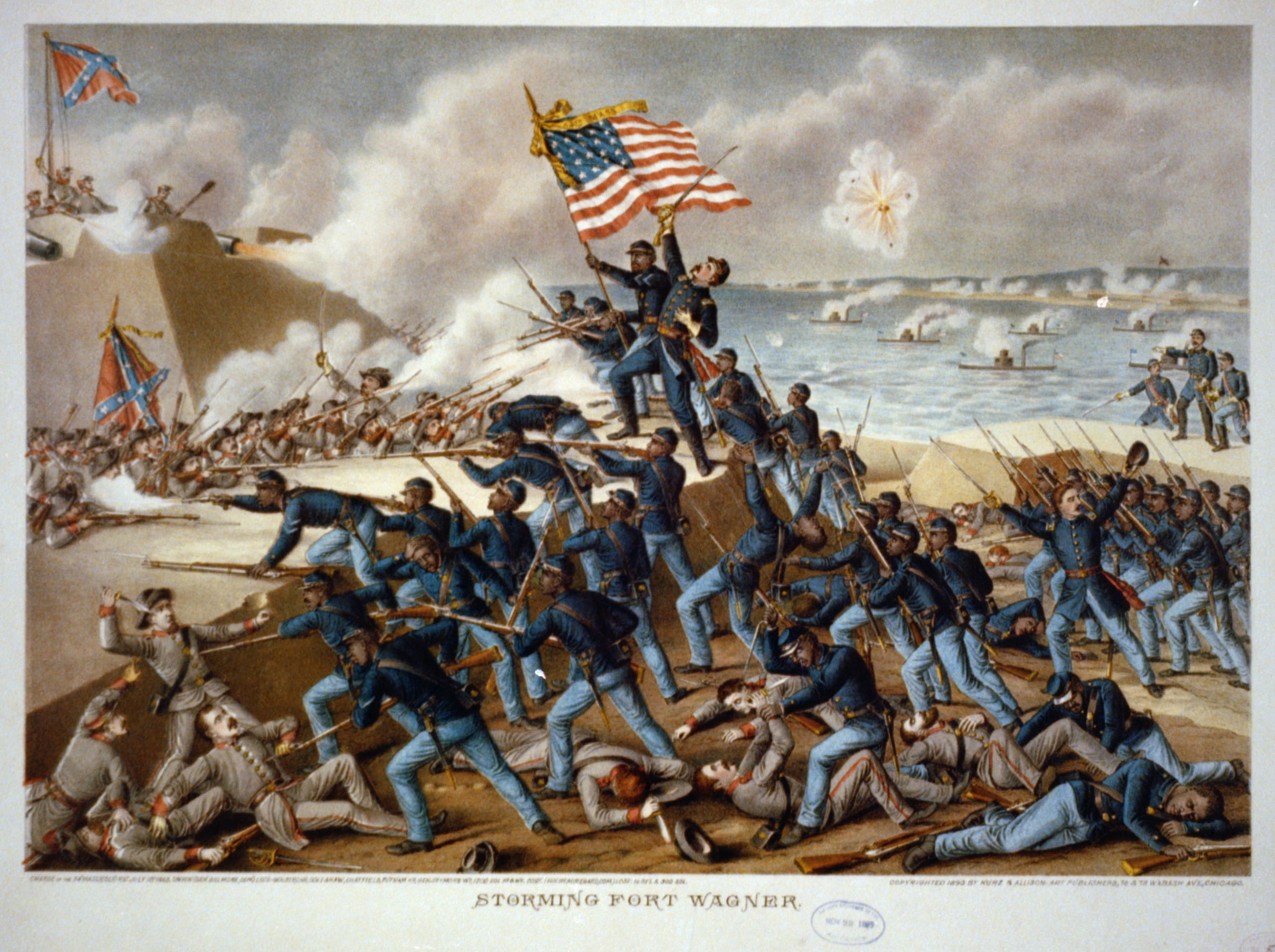
The 54th saw action first in early June and at Gould’s urging sent into battle against the Confederate positions at Fort Wagner on July 18th 1863. Leading the attack the 54th lost nearly half its men, “including Colonel Shaw with a bullet through his heart. Black soldiers gained Wagner’s parapet and held it for an hour before falling back.” [16] Though they tried to hold on they were pushed back after a stubborn fight to secure a breach in the fort’s defenses. “Sergeant William H Carney staggered back from the fort with wounds in his chest and right arm, but with the regiment’s Stars and Stripes securely in his grasp. “The old flag never touched the ground, boys,” Carney gasped as he collapsed at the first field hospital he could find.” [17] Shaw was buried with his men by the Confederates and when Union commanders asked for the return of his body were told “We have buried him with his niggers,” Shaw’s father quelled a northern effort to recover his son’s body with these words: We hold that a soldier’s most appropriate burial-place is on the field where he has fallen.” [18] As with so many frontal attacks on prepared positions throughout the war, valor alone could not overcome a well dug in enemy. “Negro troops proved that they could stop bullets and shell fragments as good as white men, but that was about all.” [19]

Despite the setback, the regiment went on to further actions where it continued to distinguish itself. The Northern press, particularly abolitionists papers brought about a change in the way that many Americans in the North, civilians as well as soldiers, saw blacks. The Atlantic Monthly noted “Through the cannon smoke of that dark night, the manhood of the colored race shines before many eyes that would not see.” [20]

Frederick Douglass, who had two sons serving in the 54th Massachusetts, understood the importance of African Americans taking up arms against those that had enslaved them in order to win their freedom:

“Once let a black man get upon his person the brass letters U.S… let him get an eagle on his button, and a musket on his shoulder and bullets in his pockets, and there is no power on earth which can deny he has won the right to citizenship in the United States.” [21]
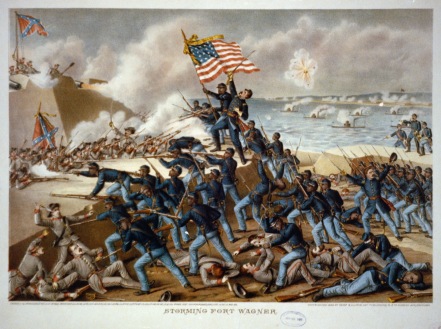
The_Storming_of_Ft_Wagner-lithograph_by_Kurz_and_Allison_1890a

Other African American units less famous than the illustrious 54th Massachusetts distinguished themselves in action against Confederate forces. Two regiments of newly recruited blacks were encamped at Milliken’s Bend Louisiana when they were attacked by a Confederate brigade attempting to relieve the Vicksburg Garrison. The troops were untrained and ill-armed but held on against a determined enemy:

“Untrained and armed with old muskets, most of the black troops nevertheless fought desperately. With the aid of two gunboats they finally drove off the enemy. For raw troops, wrote Grant, the freedmen “behaved well.” Assistant Secretary of War Dana, still with Grant’s army, spoke with more enthusiasm. “The bravery of the blacks,” he declared, “completely revolutionized the sentiment in the army with regard to the employment of negro troops. I heard prominent officers who had formerly in private had sneered at the idea of negroes fighting express after that as heartily in favor of it.” [22]

By the end of the war 179,000 African American Soldiers, commanded by 7,000 white officers served in the Union armies. For a number of reasons most of these units were confined to rear area duties or working with logistics and transportation operations. The policies to regulate USCT regiments to supporting tasks in non-combat roles “frustrated many African American soldiers who wanted a chance to prove themselves in battle.” [23] Many of the soldiers and their white officers argued to be let into the fight as they felt that “only by proving themselves in combat could blacks overcome stereotypes of inferiority and prove their “manhood.” [24] Even so in many places in the army the USCT and state regiments made up of blacks were scorned:

“A young officer who left his place in a white regiment to become colonel of a colored regiment was frankly told by a staff officer that “we don’t want any nigger soldiers in the Army of the Potomac,” and his general took him aside to say: “I’m sorry to have you leave my command, and am still more sorry that you are going to serve with Negroes. I think that it is a disgrace to the army to make soldiers of them.” The general added that he felt this way because he was sure that colored soldiers just would not fight.” [25]

The general of course, was wrong. In the engagements where USCT units were allowed to fight, they did so with varying success most often attributable to the direction of their senior officers. When given the chance they almost always fought well, even when badly commanded. This was true as well when they were thrown into hopeless situations. One such instance was when Ferrero’s Division, comprised of colored troops were thrown into the Battle of the Crater at Petersburg when “that battle lost beyond all recall.” [26] The troops advanced in good order singing as they went, while their commander, General Ferrero took cover in a dugout and started drinking; but the Confederate defenders had been reinforced and “Unsupported, subjected to a galling fire from batteries on the flanks, and from infantry fire in front and partly on the flank,” a witness write, “they broke up in disorder and fell back into the crater.” [27] Pressed into the carnage of the crater where white troops from the three divisions already savaged by the fighting had taken cover, the “black troops fought with desperation, uncertain of their fate if captured.” [28] In the battle the division lost 1327 of just under 4000 men. [29]

When captured by Confederates, black soldiers and their white officers received no quarter from many Confederate opponents. General Edmund Kirby Smith who held overall command of Confederate forces west of the Mississippi instructed General Richard Taylor to simply execute black soldiers and their white officers: “I hope…that your subordinates who may have been in command of capturing parties may have recognized the propriety of giving no quarter to armed negroes and their officers. In this way we may be relieved from a disagreeable dilemma.” [30] This was not only a local policy, but echoed at the highest levels of the Confederate government. In 1862 the Confederate government issued an order that threatened white officers commanding blacks: “any commissioned officer employed in the drilling, organizing or instructing slaves with their view to armed service in this war…as outlaws” would be “held in close confinement for execution as a felon.” [31]

On April 12th 1864 at Fort Pillow, troops under the command of General Nathan Bedford Forrest massacred the bulk of over 231 Union most of them black as they tried to surrender. While it is fairly clear that Forrest did not order the massacre and even attempted to stop it, it was clear that he had lost control of his troops. His soldiers fought with the fury of men possessed by hatred of an enemy that they considered ‘a lesser race’ slaughtered the Union troops as they either tried to surrender or flee; but he was not displeased with the result. Ulysses Grant wrote that:

“These troops fought bravely, but were overpowered I will leave Forrest in his dispatches to tell what he did with them.

“The river was dyed,” he says, “with the blood of the slaughtered for up to 200 years. The approximate loss was upward of five hundred killed; but few of the officers escaped. My loss was about twenty killed. It is hoped that these facts will demonstrate to the Northern people that negro soldiers cannot cope with Southerners.” Subsequently Forrest made a report in which he left out the part that shocks humanity to read.” [32]

”The bulk of the killing was directed at the black soldiers of the 6th U.S. Colored Heavy Artillery, which composed over a third of the garrison. “Of the 262 Negro members of the garrison, only 58- just over 20 percent- were marched away as prisoners; while of the 295 whites, 168- just under sixty percent were taken.” [33] A white survivor of the 13th West Tennessee Cavalry, a Union unit at the fort wrote: “We all threw down our arms and gave tokens of surrender, asking for quarter…but no quarter was given….I saw 4 white men and at least 25 negroes shot while begging for mercy….These were all soldiers. There were also 2 negro women and 3 little children standing within 25 steps of me, when a rebel stepped up to them and said, “Yes, God damn you, you thought you were free, did you?” and shot them all. They all fell but one child, when he knocked it in the head with the breech of his gun.” [34]A Confederate Sergeant wrote home a week after the massacre: “the poor deluded negroes would run up to our men, fall upon their knees and with uplifted hands scream for mercy, but were ordered to their feet and shot down.” [35]
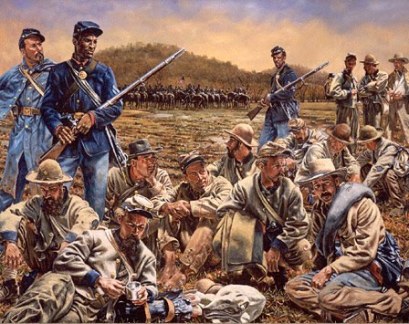
pride_over_prejudice-reeves-b-of-nashville

African American soldiers proved themselves during the war and their efforts paved the way for Lincoln and others to begin considering the full equality of blacks as citizens. If they could fight and die for the country, how could they be denied the right to votes, be elected to office, serve on juries or go to public schools? Under political pressure to end the war during the stalemate before Petersburg and Atlanta in the summer of 1864, Lincoln reacted angrily to Copperheads as well as wavering Republicans on the issue of emancipation:

“But no human power can subdue this rebellion without using the Emancipation lever as I have done.” More than 100,000 black soldiers were fighting for the Union and their efforts were crucial to northern victory. They would not continue fighting if they thought the North intended to betray them….If they stake their lives for us they must be prompted by the strongest motive…the promise of freedom. And the promise being made, must be kept…There have been men who proposed to me to return to slavery the black warriors. “I should be damned in time & in eternity for so doing. The world shall know that I will keep my faith to friends & enemies, come what will.” [36]

Despite this, even in the North during and after the war, blacks, including former soldiers would be discriminated against, sometimes by the white men that they served alongside. Those rights would be fought for another century and what began in 1863 with the brave service and sacrifice of these African American soldiers began a process of increased civil rights that is still going on today. It would not be until after the war that some blacks were commissioned as officers in the Army. When Governor John Andrew, the man who had raised the 54th Massachusetts attempted to:

“issue a state commission to Sergeant Stephen Swails of the 54th…the Bureau of Colored Troops obstinately refused to issue Swails a discharge from his sergeant’s rank, and Swails promotion was held up until after the end of the war. “How can we hope for success to our arms or God’s blessing,” raged the white colonel of the 54th, Edward Hallowell, “while we as a people are so blind to justice?” [37]

The Southern Debate about Emancipation and Black Soldiers

In the South, politicians and many senior Confederate Officers fought against any allowance for blacks to serve, for they knew if they allowed this, that slavery itself must be swept away. Despite this, a few such as General Patrick Cleburne, an Irish immigrant and a division commander in the Army of Tennessee demonstrated the capacity for forward thinking in terms of race: Cleburne advocated that blacks serve as soldiers should be emancipated.

Cleburne, known as “the Stonewall Jackson of the West” was a bold fighter who put together a comprehensive plan. He noted that the Confederacy was losing the war because it did not have soldiers, the supplies or resources; and most significantly that “slavery, from being one of our chief sources of strength at the beginning of the war, has now become in a military point of view, one of our chief sources of weakness.” [38] Cleburne recommended that “we immediately commence training a large reserve of the most courageous of our slaves, and further that we guarantee freedom within a reasonable time to every slave in the South who shall remain to the confederacy in this war.” [39]

His proposal was radical. He was asking more from his fellow Southerners than they could risk. He was “asking them to surrender the cornerstone of white racism to preserve their nation” [40] and he presented it in stark terms that few could stomach “As between the loss of independence and the loss of slavery, we can assume that every patriot will freely give up the latter- give up the Negro slave rather than be a slave himself.” [41]

In January 1864 General W.H.T Walker obtained a copy of Cleburne’s proposal and sent it to Davis. Walker opposed it and expressed his outrage over it. Cleburne’s proposal went from being a military matter to a political matter and Davis intervened to quash the proposal. “Convinced that the “propagation of such opinions” would cause “discouragements, distraction, and dissension” in the army, Jefferson Davis ordered the Generals to stop discussing the matter…The only consequence of Cleburne’s action seemed to be the denial of promotion to this ablest of the army’s division commanders, who was killed ten months later at the Battle of Franklin.” [42] In fact Cleburne was “passed over for command of an army corps and promotion to lieutenant general” three times in the next eight months, and in “each care less distinguished, less controversial men received the honors.” [43] All copies of Cleburne’s proposal were destroyed by the order of Davis.

Cleburne was not the only military man to advocate the formation of Negro units or even emancipation. Robert E. Lee was one of the chief proponents of this. Lee said after the war that he had told Davis “often and early in the war that the slaves should be emancipated, that it was the only way to remove a weakness at home and to get sympathy abroad, and divide our enemies, but Davis would not hear of it.” [44]

Ten months later Davis raised the issue of arming slaves as he now believed that military necessity left him little choice. He was opposed by some of his closest political allies including Howell Cobb who warned “The day that you make soldiers of them is the beginning of the end of the revolution. If slaves will make good soldiers our whole theory of slavery is wrong.” [45] Lee wrote to a member of Virginia’s legislature “we must decide whether slavery shall be extinguished by our enemies and the slaves used against us, or use them ourselves at the risk of the effects which may be produced on our social institutions…” and he pointed out that “any act for the enrolling of slaves as soldiers must contain a “well digested plan of gradual and general emancipation”: the slaves could not be expected to fight well if their service was not rewarded with freedom.” [46]

The debate began in earnest in the fall of 1864 and revealed a sharp divide in the Confederacy between those who supported the measure and those against it. Cabinet members such as Judah Benjamin and a few governors “generally supported arming the slaves.” [47] They were opposed by the powerful governors of Georgia and North Carolina, Joe Brown and Zebulon Vance as well as President pro-tem of the Confederate Senate R.M.T. Hunter, who forcibly opposed the measure. Led by Governor “Extra Billy” Smith, Virginia’s General Assembly voted “to permit the arming of slaves but included no provision for emancipation, either before or after military service.” [48]

Finally in March of 1865 the Confederate Congress passed by one vote a watered down measure to allow for the recruitment of slaves. It stipulated that “the recruits must all be volunteers” [49] and those who volunteered must also have “the approbation of his master by a written instrument conferring, as far as he may, the rights of a freed man.” [50] While this in itself was a radical proposition for a nation which had went to war to maintain slavery, the fact was that the slave’s service and freedom were granted not by the government, but by his owner, and even at this stage of the war, few owners were willing to part with their property. It was understood by many that giving freedom to a few was a means of saving the “particular institution.” The Richmond Sentinel noted during the November debate: “If the emancipation of a part is the means of saving the rest, this partial emancipation is eminently a pro-slavery measure.” [51] Thus the law made “no mention of emancipation as a reward of military service” [52] and in deference to “state’s rights, the bill did not mandate freedom for slave soldiers.” [53]

But even the watered down measure was opposed by diehards. Robert Kean, who headed the Bureau of War and should have understood the stark reality of the Confederacy’s strategic situation, note in his diary, that the law:

“was passed by a panic in the Congress and the Virginia Legislature, under all the pressure the President indirectly, and General Lee directly, could bring to bear. My own judgment of the whole thing is that it is a colossal blunder, a dislocation of the foundations of society from which no practical results will be reaped by us.” [54]

It was Lee’s prestige alone that allowed the measure to pass, but even that caused some to question Lee’s patriotism. The Richmond Examiner dared to express a doubt whether Lee was “a ‘good Southerner’: that is, whether he is thoroughly satisfied of the justice and beneficence of negro slavery.” [55] Robert Toombs of Georgia stated that “the worst calamity that could befall us would be to gain our independence by the valor of our slaves” [56] and a Mississippi congressman stated that “Victory itself would be robbed of its glory if shared with slaves.” [57] On March 23rd 1865 the War Office issued General Order Number 14, which authorized the call up and recruitment of slaves to the Confederate cause and on March 25th two companies were formed for drill in Richmond’s Capitol Square and as they did so to the sounds of fifes and drums, “Small boys jeered and threw rocks” [58] at them. None of those few volunteers would see action as within a week the Confederate government had fled Richmond.

But some would see that history was moving, and attitudes were beginning to change. It took time, and the process is still ongoing. As imperfect as emancipation was and though discrimination and racism remained, African Americans had reached “levels that none had ever dreamed possible before the war.” [59] In April 1865 as Jefferson Davis and his government fled Richmond, with Davis proclaiming “again and again we shall return, until the baffled and exhausted enemy shall abandon in despair his endless and impossible task of making slaves of a people resolved to be free.” [60]

The irony in Davis’s empty vow was stunning. Within a week Lee had surrendered and in a month Davis himself would be in a Federal prison. The Federal troops who led the army into Richmond came from General Godfrey Weitzel’s Twenty-fifth Corps, of Ord’s Army of the James. The Every black regiment in the Army of the James was consolidated in Weitzel’s Corps, along with Ferrero’s former division which had suffered so badly at the Battle of the Crater. “Two years earlier in New Orleans, Weitzel had protested that he did not believe in colored troops and did not want to command them, and now he sat at the gates of Richmond in command of many thousands of them, and when the citadel fell he would lead them in and share with them the glory of occupying the Rebel capital.” [61] were regiments of black “cavalrymen and infantrymen. Many were former slaves; their presence showed their resolve to be free.” [62]

The Post War Experience of Blacks in the U.S. Army

Some of those early African American soldiers went on to distinguish themselves on the prairie as the immortal Buffalo Soldiers. Other Blacks would fight in Cuba and the Philippines during the Spanish American War. In the First World War, despite there being some instances of racial harmony, blacks, including officers faced discrimination and met with violent acts. “Refusals to arrest white soldiers who physically assaulted black soldiers accompanied by the tendency to rescind unpopular racial orders and to discourage black officers from demanding salutes from white soldiers” [63] was common.

Most of the Regular Army “Buffalo Soldier” units were not allowed to fight in the First World War. Instead they were left on the frontier and a new generation of draftees and volunteers became the nucleus of two infantry divisions, the 92nd and 93rd. However, at the beginning they were regulated to labor service units. The protests of organizations such as the NAACP and men like W.E.B. DuBois, and Phillip Randolph forced the War Department to reconsider the second class status of these men and to form them into combat units.

Despite this, the leadership of the AEF, or the American Expeditionary Force, refused to allow these divisions to serve under American command. Instead they were broken up and the regiments of the 93rd Division were attached to French divisions. The 369th “Harlem Hellfighters” were assigned to the French 16th Division and then to the 161st Division. The 370th “Black Devils” were attached to the French 26th Division, while the 371st and 372nd were assigned to the French 157th (Colonial) Division, which was also known as the Red Hand Division. The 157th Division had suffered badly during the war and been decimated in the unrelenting assaults in the trench warfare of the Western Front. It was reconstituted in 1918 with one French Regiment and the two African American regiments. Both fought exceptionally well and were cited by the French government for their efforts. The 371st was awarded the French Croix de Guerre and Légion d’honeur. Corporal Freddie Stowers of the 1st Battalion 371st was the only African American awarded the Congressional Medal of Honor in the First World War. The 372nd was also awarded the Croix de Guerre and Légion d’honeur for its service with the 157th Division.
41_090_lg

While many white American soldiers depreciated their French hosts and attempted to sow the seeds of their own racial prejudice against the black soldiers among the French, Southerners in particular warned the French of “black rapist beasts.” However the French experience of American blacks was far different than the often scornful treatment that they received from white American soldiers.

“Soldiers from the four regiments that served directly with the French Army attested to the willingness of the French to let men fight and to honor them for their achievements. Social interactions with French civilians- and white southern soldiers’ reactions to them- also highlighted crucial differences between the two societies. Unlike white soldiers, African Americans did not complain about high prices in French stores. Instead they focused on the fact that “they were welcomed” by every shopkeeper that they encountered.” [64]

Official and unofficial efforts by those in the Army command and individual soldiers to stigmatize them and to try to force the French into applying Jim Crow to laws and attitudes backfired. Villages now expressed a preference for black over white American troops. “Take back these soldiers and send us some real Americans, black Americans,” wrote one village mayor after a group of rowdy white Americans disrupted the town.” [65]

Even after President Truman desegregated the armed forces in 1948, African Americans, as well as other racial minorities, women and gays have faced very real discrimination. The military continues to make great strides, and while overt racist acts and other types of discrimination are outlawed, racism still remains a part of American life.

Today things have changed, and that in large part is due to the unselfish sacrifice in the face of hatred and discrimination of the men of the USCT and the State Black Regiments like the 54th Massachusetts and the Louisiana Home Guards who blazed a way to freedom for so many. Those who followed them as Buffalo Soldiers and volunteers during the World Wars continued to be trail blazers in the struggle for equal rights. A white soldier who served with the 49th Massachusetts wrote “all honor to our negro soldiers. They deserve citizenship. They will secure it! There would be much suffering in what he termed “the transition state” but a “nation is not born without pangs.” [66]

Those birth pangs helped to bring about a new birth of freedom for the United States.

Notes

[1] McPherson, James M. Tried by War: Abraham Lincoln as Commander in Chief Penguin Books, New York and London 2008

[2] McPherson, James M. Drawn With the Sword: Reflections on the American Civil War Oxford University Press, Oxford and New York 1996 p.101

[3] Godwin, Doris Kearns Team of Rivals: The Political Genius of Abraham Lincoln Simon and Shuster, New York and London 2005

[4] Egnal, Marc Clash of Extremes: The Economic Origins of the Civil War Hill and Wang a division of Farrar, Straus and Giroux New York 2009 p.318

[5] Ibid. McPherson Tried by War p.159

[6] Ibid. McPherson Drawn With the Sword p.159

[7] McPherson, James M. Abraham Lincoln and the Second American Revolution Oxford University Press, New York and Oxford 1991 p.35

[8] Ibid. Guelzo Fateful Lighteningp.381

[9] Ibid. McPherson Abraham Lincoln and the Second American Revolution p.35

[10] Ibid. McPherson. The Battle Cry of Freedom p.686

[11] Ibid. Guelzo Fateful Lightening p.379

[12] Ibid. Foote , The Civil War, A Narrative. Volume Two p.398

[13] Ibid. Guelzo Fateful Lightening p.379

[14] Ibid. McPherson. The Battle Cry of Freedom p.686

[15] Ibid. McPherson Drawn With the Sword p.101

[16] Ibid. McPherson. The Battle Cry of Freedom p.686

[17] Ibid. Guelzo Fateful Lightening pp. 380-381

[18] Ibid. McPherson. The Battle Cry of Freedom pp.686-687

[19] Ibid. Foote , The Civil War, A Narrative. Volume Two p.697

[20] Ibid. McPherson. The Battle Cry of Freedom p.686

[21] Ibid. Guelzo Fateful Lightening p. 381

[22] Ibid. McPherson. The Battle Cry of Freedom p.634

[23] Gallagher, Gary W. The Union War Harvard University Press, Cambridge MA and London 2011

[24] Ibid. McPherson Drawn With the Sword p.89

[25] Catton, Bruce. A Stillness at Appomattox Doubleday and Company Garden City, New York 1953 p.227

[26] Ibid. Catton A Stillness at Appomattox p.249

[27] Foote, Shelby, The Civil War, A Narrative. Volume Three Red River to Appomattox Random House, New York 1974 p.537

[28] Wert, Jeffry D. The Sword of Lincoln: The Army of the Potomac Simon and Schuster, New York and London 2005 pp.384-385

[29] Ibid. Foote The Civil War, A Narrative. Volume Three p.537

[30] Ibid. Guelzo Fateful Lightening p. 377

[31] Ibid. Guelzo Fateful Lightening p. 377

[32] Grant, Ulysses S. Preparing for the Campaigns of ’64 in Battles and Leaders of the Civil War Volume IV, Retreat With Honor Edited by Robert Underwood Johnson and Clarence Clough Buel Castle, Secaucus NJ pp.107-108

[33] Ibid. Foote The Civil War, A Narrative. Volume Three p.111

[34] Ibid. Guelzo Fateful Lightening p. 378

[35] Ibid. Foote The Civil War, A Narrative. Volume Three p.112

[36] Ibid. McPherson Abraham Lincoln and the Second American Revolution p.89

[37] Ibid. Guelzo Fateful Lightening p. 376

[38] Ibid. Thomas, The Confederate Nation p.262

[39] Ibid. Thomas, The Confederate Nation p.262

[40] Ibid. Guelzo Fateful Lightening p. 370

[41] Ibid. Thomas, The Confederate Nation p.262

[42] Ibid. McPherson. The Battle Cry of Freedom p.833

[43] Ibid. Thomas, The Confederate Nation p.262

[44] Ibid. Gallagher The Confederate War p.47.

[45] Ibid. Guelzo Fateful Lightening p. 370

[46] Korda, Michael. Clouds of Glory: The Life and Legend of Robert E. Lee Harper Collins Publishers, New York 2014 p.643

[47] Ibid. Thomas, The Confederate Nation p.293

[48] Ibid. Foote. The Civil War, A Narrative. Volume Three pp.754-755

[49] Ibid. Foote. The Civil War, A Narrative. Volume Three p. 755

[50] Ibid. Thomas, The Confederate Nation p.296

[51] Ibid. McPherson. The Battle Cry of Freedom p.836

[52] Ibid. Foote. The Civil War, A Narrative. Volume Three p.755

[53] Ibid. McPherson. The Battle Cry of Freedom p.837

[54] Ibid. Foote. The Civil War, A Narrative. Volume Three p.860

[55] Ibid. McPherson. The Battle Cry of Freedom p.837

[56] Ibid. Foote. The Civil War, A Narrative. Volume Three p.860

[57] Ibid. McPherson. The Battle Cry of Freedom p.835

[58] Ibid. Foote. The Civil War, A Narrative. Volume Three p.860

[59] Ibid. Guelzo Fateful Lightening p. 386

[60] Levine, Bruce Half Slave and Half Free: The Roots of the Civil War Revised Edition, Hill and Wang, a division of Farrar, Strauss and Giroux, New York 1992 and 1995 p.241

[61] Catton, Bruce Grant Takes Command Little, Brown and Company Boston, Toronto and London 1968 p.411

[62] Ibid. Levine Half Slave and Half Free pp.241-242

[63] Keene, Jennifer D. Doughboys, the Great War, and the Remaking of America The Johns Hopkins University Press, Baltimore and London 2001 p.88

[64] Ibid. Keane Doughboys, the Great War, and the Remaking of America p.128

[65] Ibid. Keane Doughboys, the Great War, and the Remaking of America p.129

[66] Ibid Gallagher The Union War p.113

1 Comment

Filed under civil rights, civil war, History, Military

The Unbelief of Fundamentalism: Distant Origin

“Man no longer lives in the beginning–he has lost the beginning. Now he finds he is in the middle, knowing neither the end nor the beginning, and yet knowing that he is in the middle, coming from the beginning and going towards the end. He sees that his life is determined by these two facets, of which he knows only that he does not know them”  Dietrich Bonhoeffer

I have had a number of instances recently where I have brushed off some rather rude comments of Fundamentalist Christians on both my Facebook and Twitter accounts. I am always amazed with the certitude of how they judge those with whom they disagree. Such certitude mystifies me because it is usually based on some form of circular logic about the Bible, an example being “the Bible is true because God said it is, and God said it in the Bible, thus it is true. It is a fallacious argument, but one that is very commonly held in Fundamentalist Christian circles but also in other religions and sometimes even in Atheism. What is funny, for the most intensely fundamentalist people is the amount they have to chose to disbelieve in order to believe in what they say. Eric Hoffer noted: “It is startling to realize how much unbelief is necessary to make belief possible.”

There is an episode of Star Trek Voyager called Distant Origin where this topic is explored. A scientist of a race in the Delta Quadrant believes that genetic evidence indicated that their race originated on Earth. His thesis is challenged the doctrine of his species and he was accused of “heresy against Doctrine” for positing something different than his people believed. He ends up being persecuted and punished for his beliefs.

Now I want to be diplomatic about this. I am not someone who simply is contrary to established doctrines, be they theological, scientific or even military theories. That being said I think it is only right to question our presuppositions, as Anselm of Canterbury did through faith seeking understanding.

That understanding as a Christian is based on the totality of the message of the Christian faith. Hans Kung said it well:

“Christians are confident that there is a living God and that in the future of this God will also maintain their believing community in life and in truth. Their confidence is based on the promise given with Jesus of Nazareth: he himself is the promise in which God’s fidelity to his people can be read.” 

What we have to admit is that our belief is rooted in our faith, faith which is given to us through the witness of very imperfect people influenced by their own culture, history and traditions. Even scripture does not make the claim to be inerrant, and the Bible cannot be understood like the Koran or other texts which make the claim to be the infallible compendium of faith delivered by an angel or dictated by God himself. It is a Divine-human collaboration so symbolic of the relationship that God has with his people, often confusing and contradictory yet inspiring.

There is a certain sense of relationship between God and humanity within scripture and that relationship creates certain tensions between God and those people. The interesting thing is that Scripture is a collection of texts which record often in terrible honesty the lack of perfection of both the writers and their subjects. They likewise record the sometimes unpredictable and seemingly contradictory behavior of God toward humanity in the Old Testament. They bear witness to the weaknesses, limitations and lack of understanding of the people of God of the message of God but even in that those limitations and weaknesses that God is still faithful to humanity in the life death and resurrection of Jesus of Nazareth.

The real fact of the matter is that fixed doctrines are much more comfortable than difficult questions than honestly examining the contradictions that exist within Scripture, history and tradition. The fact is this makes many people uncomfortable and thus the retreat into the fortress of fixed and immutable doctrine found in the various incarnations of Fundamentalism.

The fact is the world is not a safe place, and our best knowledge is always being challenged by new discoveries many of which make people nervous and uncomfortable, especially people who need the safety of certitude. So in reaction the true believers become even more strident and sometimes, in the case of some forms of Islam and Hinduism violent.

Christianity cannot get away unscathed by such criticism. At various points in our history we have had individuals, churches and Church controlled governments persecute and kill those that have challenged their particular orthodoxy. Since Christian fundamentalists are human they like others have the capacity for violence if they feel threatened, or the cause is “holy” enough. Our history is full of sordid tales of the ignorance of some Christians masquerading as absolute truth and crushing any opposition. It is as Eric Hoffer wrote:

“A doctrine insulates the devout not only against the realities around them but also against their own selves. The fanatical believer is not conscious of his envy, malice, pettiness and dishonesty. There is a wall of words between his consciousness and his real self.”

This is the magnetic attraction of fundamentalism in all of its forms, not just Christian fundamentalism.  Yet for me there is a comfort in knowing that no matter how hard and fast we want to be certain of our doctrines, that God has the last say in the matter in the beginning and the end. We live in the uncomfortable middle but I have hope in the faith that God was in the beginning. Besides as Bonhoeffer well noted “A God who let us prove his existence would be an idol” 

But there some Christians who now faced with the eloquence of men like Neil DeGrasse Tyson and Bill Nye who make legitimate challenges respond in the most uncouth and ignorant manners. The sad thing is that their response reveals more about them and their uncertainty than it does the faith that they boldly proclaim. As Hoffer wrote: “We can be absolutely certain only about things we do not understand.”

Our doctrines, the way we interpret Scripture and the way we understand God are limited by our humanity and the fact that no matter how clever we think we are that our doctrines are expressions of faith. This is because we were not in the beginning as was God and we will not be at the end, at least in this state. We live in the uncomfortable middle, faith is not science, nor is it proof, that is why it is called faith, even in our scriptures.

We are to always seek clarity and understanding but know that it is possible that such understanding and the seeking of truth, be it spiritual, historical, scientific or ethical could well upset our doctrines, but not God himself. As Henri Nouwen wrote: “Theological formation is the gradual and often painful discovery of God’s incomprehensibility. You can be competent in many things, but you cannot be competent in God.” Is that not the point of the various interactions of Jesus with the religious leaders of his day? Men who knew that they knew the truth and even punished people who had been healed by Jesus such as the man born blind in the 9th Chapter of John’s Gospel.

“You are that man’s disciple; we are disciples of Moses! We know that God spoke to Moses, but we do not know where this one is from.” The man answered and said to them, “This is what is so amazing, that you do not know where he is from, yet he opened my eyes. We know that God does not listen to sinners, but if one is devout and does his will, he listens to him. It is unheard of that anyone ever opened the eyes of a person born blind. If this man were not from God, he would not be able to do anything.” They answered and said to him, “You were born totally in sin, and are you trying to teach us?” Then they threw him out.”

The interchange between the religious leaders and the man is not an indictment on Judaism, but rather on religious certitude in any time or place. The fact is that the Pharisees are no different than those who ran the Inquisition, or those who conducted Witch Trials or those who attempt to crush anyone who questions their immutable doctrine no matter what their religion. They were and are true believers.

In the episode of Star Trek the Next Generation called The Drumhead Captain Picard counsels Lieutenant Worf after their encounter with a special investigator who turned an investigation into a witch hunt on the Enterprise. Picard told Worf, who had initially been taken in by the investigator:

“But she, or someone like her, will always be with us, waiting for the right climate in which to flourish, spreading fear in the name of righteousness. Vigilance, Mister Worf – that is the price we have to continually pay.”

And that is true.

Peace

Padre Steve+

1 Comment

Filed under christian life, faith, philosophy, Religion

Beginnings of Women’s Equality and the Civil War

senecafalls-womanspeaking

Seneca Falls Convention

Friends of Padre Steve’s World

This is a newly written section of my introductory chapter for my Civil War and Gettysburg text. In that introductory chapter I dealt with many of the tactical, technological, doctrinal and military sociological changes which occurred in the Civil War. In later revisions I added a section on emancipation and the role of African American soldiers during the war. However, I realized when doing my research that in the years leading to the war and during the war that the modern women’s movement really began, in large part due to the role of women in Abolitionist circles. Thus as a coda to the section on emancipation and African American soldiers I added this small section.

Have a blessed weekend,

Peace

Padre Steve+ 


Garrison and the leaders of the abolitionist movement came into contact with two southern women who had converted to the abolitionist cause; South Carolina cotton heiresses, Sarah and Angelina Grimke. The two women were passionate as well as eloquent and became popular lecturers on the abolitionist speaking circuit. These women brought Garrison into contact with the early leaders of the new women’s rights movement. The leaders of the movement, Elizabeth Cady Stanton, Abby Kelley, and Lydia Maria Child were outspoken in their belief that “a campaign to emancipate slaves could not avert its eyes from the need to emancipate American women from social conventions and legal restraints that prevented them, like the slave, from owning property and voting, and kept them altogether subservient to the interests of white males.” [1]

Women in the United States were bound by English common law, and “marriage very nearly meant the legal annihilation of a woman…once a woman was married all property and property rights were transferred to her husband, and she was permitted to own nothing in her own name. Married women could not make contracts, could not sue, could not buy or sell, except over their husband’s signatures.” [2] A married woman’s position was as close to being a slave as could be, and only the plight of black female slaves was worse, for they were simply chattel. The few free black women mainly stayed unmarried “in order to maintain what few property rights they were entitled to.” [3] As they also did over blacks, white men ruled over women in all spheres of life.

Stanton was among the most vocal of women’s rights advocates. She believed that a woman’s place in the home “reflected her subordinate position in society and confined her to domestic duties that served to “destroy her confidence in her own powers, lessen her self respect, and to make her willing to lead a dependent and abject life.” [4] She noted that women were “more fully identified with the slave than man possibly can be… For while the man is born to do whatever he can, for the woman and the negro the is no such privilege.” [5] Since nearly all of the most “outspoken feminists had been schooled in abolitionist movement” they were “suspect in the South, where society was conservative, patriarchal, and insistence that ladies live in a kind of earthly limbo.” [6] Since the South was turning away from anything closely connected with the abolitionist moment, many there also rejected any form of women’s rights.

But even with the abolition movement there was opposition the women’s rights. In May of 1840 Garrison’s American Anti-Slavery Society split when leading evangelicals led by the Tappan brothers withdrew from it. But that neither stopped Garrison from working with them, nor Frederick Douglass from embracing them. From this rather inauspicious beginning, the women’s rights movement began to infiltrate society, especially in the field of education. In 1848 at Seneca New York there was a convention which launched the modern women’s rights movement. Led by Stanton and Elizabeth Mott the delegates published a “Declaration of Sentiments, modeled on the Declaration of Independence, proclaimed “that all men and women are created equal” and deserved their “inalienable rights” include the right to elective franchise.” [7] The declaration was bold and its denunciation of the place of women in society to be considered revolutionary in character. Part read:

“He has never permitted her to exercise her inalienable right to elective franchise. He has compelled her to submit to laws, in the formation of which she had no voice. He has withheld from her rights which are given to the most ignorant and degraded men – both natives and foreigners… He has made her, if married, in the eye of the law, civilly dead. He has taken from her all right to property, even to the wages that she earns…. After depriving her of all her rights as a married woman, if single, and the owner of property, he has taxed her to support a government which recognizes her only when her property can be made profitable to it. He has monopolized nearly all the profitable employments, and from those she is permitted to follow she receives but a scanty remuneration. He closes against her all the avenues to wealth and distinction which he considers honorable to himself. As a teacher of theology, medicine of the law, she is not known… He has created a false public sentiment by giving the world a different code of morals for men and women, by which moral delinquencies which exclude women from society, are not only tolerated, but deemed of little account in man. He has usurped the prerogative of Jehovah alone, claiming his right to assign for her a sphere of action, when that belongs to her conscience and to her God. He has endeavored, in every way that he could, to destroy her confidence in her own powers, lessen her self-respect, and to make her willing to lead an abject and dependent life.” [8]

The declaration also stated, in words which inflamed many men that :“the history of mankind is a history of repeated injuries and usurpations on the part of man toward woman, having in direct object of an absolute tyranny over her.” [9]

While the movement made modest progress regarding property rights in some states, they made little progress in terms of elective franchise and better wages and working conditions. During the ante-bellum period, women who lobbied for such rights were met with open opposition and scorn. The press “frequently denounced and ridiculed the “strong-minded women…” [10] Despite such attitudes women did make some significant advancements, particularly in lay aspects of the church, such as Bible societies, moral reform organizations, as well as the abolition and temperance movements, which had gained prominence during the Second Great Awakening.

Educationally women made great progress. By 1850 the United States was the only country where “girls went to elementary school and achieved literacy in virtually the same proportion as boys.” [11] Likewise a few women entered higher education, particularly at women’s seminaries, which were for all practical purposes boarding schools which produced teachers and writers, as well as the Oberlin College which was founded by Christian abolitionists and welcomed students of both genders as well as of any racial minority. During the three decades prior to the war women made some specific gains, but more important “was the development to their talents for organization, cooperation, leadership, and self expression. It was a time of beginnings and not fulfillment, a time when most women realized and accepted the fact that they lived in a man’s world, a time when a few dedicated but belligerent visionaries were frustrated in their attempt to remake the social order “overnight.” [12]

However, the war would help bring about many more opportunities for women. In 1850 a follow on conference to the Seneca conference, the National Women’s Rights Convention denied the right of anyone to dictate what women could do with their lives:

“The right of any portion of the species to decide for another portion, of any individual to decide for another Individual what is not their “proper sphere”; that the proper sphere for all human beings is the largest and highest to which they are able to attain; what this is, can not be ascertained without complete Liberty of choice; women therefore, ought to choose for herself what sphere she will fill, what education she will seek, and what employment she will follow, and will not be bound to accept, in submission, the rights, the education, and the place which man thinks proper to allow her.” [13]

sarah_seelye

Of course when war broke out the logical end of this train of though was should women be allowed to serve in the military. Quite a few women on both sides of the conflict chaffed about not being allowed to fight for their countries. However, despite official prohibitions that kept women from serving in any capacity but nursing, a good number of women found their way to war, taking male identities in order to gain the economic privileges, and in the case of war, the glory reserved to men. In our modern parlance they would be called transvestites, but their “transvestitism was a private rebellion against public conventions. By taking a male social identity, they secured for themselves male power and independence, as well as full status as citizens of their nation. In essence the Civil War was an opportunity for hundreds of women to escape the confines of their sex.” [14]

During the war hundreds of women went to war, taking on the identity of men. They enlisted under male names and pretended to be men. Unless they were discovered to be women, or unless they confessed to their wartime service either during or after the war, most of their records are lost. At least five women, two Federal and three Confederate took part at Gettysburg. All three Confederates were either killed or wounded, or captured, including two women who took part in Pickett’s Charge.

Wartime records are sketchy but as a minimum it is believed that “between 250 and 400 women disguised as men found their way into either the Federal or Confederate armies.” [15] Women known to have served had a “combined casualty rate of 44 percent” including the fact that “eleven percent of women soldiers died in the military.” [16]

Other women would serve as spies or nurses and some of those discovered remained protected by fellow soldiers. Many received promotions and even served as NCOs or junior officers. With women now serving in combat or combat support roles in the U.S. Military since Operation Desert Storm in 1991, the stigma and scandal that these cross-dressing women soldiers of the Civil War has faded and as scholars and the public both “continue probing cultural notions of gender and identity, the reemerging evidence that women historically and successfully engaged in combat has met with less intellectual resistance and has taken on new cultural significance.” [17] As the United States military services examine the issues surrounding further moves to integrate the combat arms we also should attempt to more closely examine the service of the brave and often forgotten women who served on both sides of the Civil War.

Notes

[1] Ibid. Guelzo Fateful Lightening pp.49-50

[2] Ibid. Guelzo Fateful Lightening p.391

[3] Ibid. Guelzo Fateful Lightening p.391

[4] Ibid. Goldfield America Aflame p.74

[5] Ibid. Guelzo Fateful Lightening p.50

[6] Massey, Mary Elizabeth, Women in the Civil War University of Nebraska Press, Lincoln NE 1966 p. 19

[7] Ibid. McPherson Battle Cry of Freedom p.36

[8] Blanton, DeAnne and Cook, Lauren M. They Fought Like Demons: Women Soldiers in the Civil War Vintage a books, a Division of Random House New York 2002 pp.3-4

[9] Ibid. Guelzo Fateful Lightening p.392

[10] Ibid. Massey Women in the Civil War pp.21-22

[11] Ibid. McPherson The Battle Cry of Freedom p.36

[12] Ibid. Massey Women in the Civil War p.23

[13] Ibid. Guelzo Fateful Lightening p.392.

[14] Ibid. Blanton and Cook They Fought Like Demons p.5

[15] ibid. Guelzo Fateful Lightening p.394

[16] Ibid. Blanton and Cook They Fought Like Demons pp.206-207

[17] Ibid. Blanton and Cook They Fought Like Demons p.204

1 Comment

Filed under civil rights, civil war, History, Military, Political Commentary

“Tho’ all the world betray thee” The Minstrel Boy

lastmass2

The Minstrel Boy (Thomas Moore)

The minstrel boy to the war is gone,
In the ranks of death ye will find him;
His father’s sword he hath girded on,
And his wild harp slung behind him;
“Land of Song!” said the warrior bard,
“Tho’ all the world betray thee,
One sword, at least, thy rights shall guard,
One faithful harp shall praise thee!”

The Minstrel fell! But the foeman’s chain
Could not bring his proud soul under;
The harp he lov’d ne’er spoke again,
For he tore its chords asunder;
And said “No chains shall sully thee,
Thou soul of love and bravery!
Thy songs were made for the pure and free
They shall never sound in slavery!”

The Minstrel Boy will return we pray
When we hear the news we all will cheer it,
The minstrel boy will return one day,
Torn perhaps in body, not in spirit.
Then may he play on his harp in peace,
In a world such as heaven intended,
For all the bitterness of man must cease,
And ev’ry battle must be ended.

(Last verse anonymous Civil War)

Seven years ago I was in the process of returning home from Iraq spending my last couple of days in country before flying out to Kuwait and then the United States. I was already in a rather melancholy state knowing that the Chaplain incoming higher headquarters had turned off my relief for Al Anbar Province after I had paved the way for him with all of the teams of advisors that I had worked with during my time serving them. My relief a personal friend was diverted to the Army advisors with a different Iraqi Division in the north of the country. I felt that the incoming senior chaplain had betrayed and abandoned the men that I worked so hard to care for. Later I heard that he had disregarded my heavily detailed after action reports and told at least one senior chaplain that he “had heard that I was out there but didn’t know if I had done anything.”

It was at that point that I realized that you could do your job and sacrifice yourself to complete a mission only to have someone with their own agenda do what they could to discredit you.  I felt betrayed and still do. I was asked by my therapist about this and frankly, though I have tried to forgive the feelings always come back.

Where the senior Chaplain that I worked for did all that he could to support my team’s mission and see that we were properly recognized at Multi-National Corps Iraq in Baghdad his successor dismissed our work. It was the first time in my Navy career that I had experienced that.  I think it was the fact that I worked for a non-traditional billet working for an Army led joint command outside the normal Navy-Marine Corps chain was a big part of this. Inter-service rivalries and the distain of those bound by conventional thinking are not new and those that have done such non-conventional work have frequently been treated in a similar manner.

I think that is why the line in the song “Tho’ all the world betray thee” means so much to me and w.a big reason why the song touches me in the way it does. It is a song of men changed by war.

Looking back there are some songs which are particularly meaningful to me after my time in Iraq that send a chill up my spine when I hear them. One of these is the patriotic Irish song The Minstrel Boy written by Thomas Moore while a student in honor of friends killed in the Irish Rebellion of 1798.  The song was very popular among soldiers of Irish descent in the American Civil War as well as soldiers fighting in Irish Regiments in World War One and World War Two.

The song is powerful when you hear it for it speaks of the reality of war, war that changes those, even those that return home are not unchanged by it.  It speaks of the sacrifices required by those that go to war and even the effects on the community, the loss of young people.  The final verse added by an anonymous author during the American Civil War in a sense is a prayer, a prayer of return as well as reconciliation. It has been recorded a number of times including an instrumental during the film Blackhawk Down. Another rendition is in the telvision mini-series Rough Riders about the 1st U.S. Volunteer Cavalry at the Battle of San Juan Hill and one in the movie Gettysburg as Father Corby blesses the Irish Brigade.

william_corby_reformat

My life has been changed and faith challenged. When I went to Iraq I still maintained a sense of idealism.   After Iraq and having to deal with PTSD and a psychological, spiritual and physical breakdown as well as a profound sense of abandonment by some senior chaplains, my former church and even God I am a different person. My faith which had been shattered to the point of being a practical agnostic for nearly two years has returned and even now seven years later I struggle with belief, unbelief and faith in general, but I don’t think that is a bad thing. If we are not changed by what God allows or by what life brings I don’t think that we grow. As a Priest I wonder if I could work in the environment that I work without having gone through what I did.

hqdefault1

I see many of the “minstrel boys” and girls of our era and having also been to war and come back changed the last lines of the final verse is a prayer that I echo. One of the versions that I particularly like is the one sung in the Star Trek the Next Generation episode “The Wounded.” While it is only the first verse it deals with the lives of two officers whose lives are forever changed by war. http://www.youtube.com/watch?v=RJudJ9S579A

This is dedicated to all those who have served who have gone through the pain of war and return until war shall be no more.

Peace

Padre Steve+

Leave a comment

Filed under civil war, History, Military, movies, music, PTSD, Tour in Iraq

The Fever and the Fear: Conservative American Christians and Judgment at Nuremberg

Friends of Padre Steve’s World
I am going to be out tonight spending some time with a friend who needs to download and when I come home I want to spend the remaining part of the evening just visiting with my wife Judy and playing with our dogs. But I digress…
At work I am editing and re-writing another chapter of by Gettysburg text, you’ll get a look at it probably sometime next week. I am working on a project with my brother and just completed an article on the value of music to depression, anxiety and those traumatized by war for a church music publication. But again I digress…
In light of all that I decided to re-post something that I wrote just before the 2014 election. I think that it is still pretty relevant because after the election the leaders of the Christian Right have gotten even louder and more vicious in their crusade against all they despise. Thus I think it timely that since pre-season for the 2016 primaries and election has already began, at least for them that I publish this as a reminder about what happens when people allow their fear and hate to do what they should know not to do.
Have a good night,
Peace
Padre Steve+

padresteve's avatarThe Inglorius Padre Steve's World

IMG_0493.JPG

http://movieclips.com/FkTn-judgment-at-nuremberg-movie-dr-janning-explains-his-actions/

Yesterday I wrote about the lack of empathy among conservative American Christians and I drew some comparisons to the German Christians of the 1920s and 1930s who despite their reservations supported ultra-right wing parties and later the Nazi Party. As I mentioned yesterday this was brought about by the fear and hate propagated by those who had lost their favored status after the collapse of the Kaiser Reich, and especially the fear of what many Christians believed was the threat of atheistic Socialists and Communists. Their brief experiment with democracy which was devastated by political battles amid the 1919-1920 Weimar Inflation which destroyed the financial security of most Germans as well as the Stock Market Crash of 1929 which brought about the Great Depression made many receptive to the “Nazi Gospel.”

I think that conservative American Christians are going the same direction as they get swept up in the…

View original post 1,635 more words

Leave a comment

Filed under Loose thoughts and musings

Carl Long, A Pioneer of Civil Rights and Basaeball Passes Away

carl long

Me with Carl Long at Grainger Stadium, Kinston NC, 2011

I lost a friend yesterday. Carl Long, a former Negro League player and member of the Negro League Hall of Fame passed away yesterday. He had suffered a series of strokes in November and sadly never recovered. I got to know Carl in Kinston North Carolina, when I was stationed at Camp Lejeune. I met him in June, the day after I found out that one of my former Marines had been killed in Afghanistan. I had cried myself to sleep that night and badly needed the solace of baseball, which as Annie Savoy said in the movie Bull Durham for me is “the only church that truly feeds the soul, day in, day out, is the Church of Baseball.”  

Over the course of the 2011 season, which was the Kinston Indian’s final season in that town I spent good amount of time with Carl.  Gregarious, friendly and always will to share I treasure those times. Through Carl I got to know some of the other dwindling number of former Negro League players including James “Spot” King, Hubert “Big Daddy” Wooten who both played for the Indianapolis Clowns, and Dennis “Bose” Biddle who played for the Chicago American Giants in 1953 and 1954.  He was in the process of having his contract purchased by the Chicago Cubs when he suffered a devastating injury to his leg and ankle going hard into Second Base.

carl long night

Carl Long Night: L-R  James “Spot”King, Hubert “Big Daddy” Wooten, Dennis “Bose” Biddle and Carl Long  at Historic Grainger Stadium, Kinston NC June 2011

Carl Long played with the Birmingham Black Barons alongside Willie Mays and Country and Western singer Charlie Pride. He played against Hank Aaron and spent time in the minors with Willie McCovey and Roberto Clemente.  He was the first black to play in the Carolina League and still holds the record for the most RBIs in a season in Kinston which has also seen such sluggers as Jim Thome, Alex White and Manny Ramirez.

Carl was a pioneer, but he did not have a long baseball career. He injured his shoulder and then met his wife of over 50 years Ella, a local Kinston girl. She stole his hear and he never left his adopted home town. In Kinston he became the first black commercial bus driver in the state, the first black Deputy Sheriff in North Carolina, and first black Detective on the Kinston Police Department. After he retired he toured with other Negro League players and often spoke to school children about the need for education and overcoming life’s difficulties.

The truth of the matter is that Carl and the other players of the Negro Leagues were torch bearers in our society.  The men and women of the Negro Leagues barnstormed and played against white teams when baseball was still segregated.  When Branch Rickey signed Jackie Robinson it was a seismic event with great social connotations.  A barrier had been broken and I dare say that without the men of the Negro Leagues that the work of other Civil Rights leaders including Dr. Martin Luther King Jr. would have had a less fertile audience in White America and probably a even less friendly reception than they had as they worked to fulfill the vision of a better America where men and women of every race, color and creed could aspire to great things.

I count myself blessed that in an hour of crisis that Carl, as well as my other friends from Grainger Stadium was there for me. I will miss him.

May Carl and all the departed rest in peace, and may God grant comfort to his widow Ella.

Peace

Padre Steve+

Leave a comment

Filed under Baseball, civil rights, remembering friends

I wish I did not dream that much: PTSD and Memories of Terrorism

947188_10151670056587059_1172426886_n

Those who are new to what I write on this site may not know a lot about me, nor my struggles with PTSD, Moral Injury, depression and anxiety.

The past week I have been writing about my support of LBGT rights and planned on dealing with some other social issues leading up to the Martin Luther King Jr. holiday next week.

But that was before the attack on Charlie Hebdo. That attack triggered some very unpleasant memories from Iraq and before, and since that attack I have had very little sleep. I actually dread the night.

As a historian and chronicler of the Battle of Gettysburg ands the men who fought there I find many connections with those men and what they wrote. One of them, Major General Gouverneur Warren wrote his wife after the war was over:

“I wish I did not dream that much. They make me sometimes dread to go to sleep. Scenes from the war, are so constantly recalled, with bitter feelings I wish to never experience again. Lies, vanity, treachery, and carnage.”

I feel that kind of angst, and those terrible feelings about the Iraq War, so well said by Warren, come back to the fore in January and February. For me these two months are normally the most difficult of the year as they mark my transition and return back to the United States from Iraq and since my new therapist is walking me through them again and I am in a sense reliving that trauma. It is like having the scar over a deep and unhealed wound ripped away.

January is also the anniversary of the suicide of Captain Tom Sitsch, my last Commodore at EOD Group Two. He was one of the first people to ask me where I as a chaplain would go to to get help for PTSD. Sadly, this man, a true hero died by his own hand just over a year ago suffering from so many after effects of PTSD and Traumatic Brain Injury.

Ever since returning from Iraq in February 2008 I have had a terrible time coping during those months. The reality of PTSD, Moral Injury and possibly Traumatic Brain Injury, which I will be evaluated for in the coming weeks, make sleep nearly impossible. Nightmares, terrors and anxiety are the norm for me and I can completely understand what Guy Sager, who wrote the book The Forgotten Soldier wrote:

“Only happy people have nightmares, from overeating. For those who live a nightmare reality, sleep is a black hole, lost in time, like death.

So when there is a trigger event like the Charlie Hebdo attack, things get that much worse.

This year was really no different than any since 2008, even before the attack on Charlie Hebdo, I was already struggling but all the thoughts, feelings and memories from Iraq have flooded and often overloaded my senses since the Charlie Hebdo attack. What I felt in Iraq came back full force last week as I read about the massacre of the cartoonists and writers of Charlie Hebdo. I have not had a good night sleep since that attack. I talked with this in depth with my therapist today and that discussion brought back other memories.

When I read about the slaughter of the Charlie Hebdo staff in their offices brought back strong memories of an encounter in a remote border post in Iraq in 2007 where I was the only unarmed person in a meeting where everyone had their finger on the trigger of their weapon and even the Iraqi commander did not know who was loyal. We all knew that things could go bad very quickly and the memories of that event are deeply etched in my memory. I have written about it before, but I might need to again. 

Thinking of the men and women murdered in Paris my thoughts went to that room at Al Waleed in late August or early September 2007. What happened to them, to be gunned down in a place where there was no help and no escape reminded me of what well could have happened at Al Waleed in 2007.

20130415-232418


Aftermath of the Frankfurt PX Bombing and Frankfurt Airport Bombing in 1985

mqdefault

The memories buried in my subconscious have connected with other memories, about narrowly avoiding terrorist attacks by the Red Brigades and Baader Meinhof Gang in Germany at the Frankfurt PX and Airport in 1985. I fear going through the gates of military installations and breathe a sigh of relief when I get through without a bomb, improvised explosive device or other terrorist attack. I feel terribly vulnerable and I am very scared about going to places that are soft targets, especially the Main Navy Exchange at Norfolk which is off base. In such places my head is constantly “on a swivel” as we say in the military. A am hyper-vigelent and pretty likely to stay that way so long as I do not feel safe. 

So anyway, I need to stop for the night. I found out that former Negro League player, and member of the Negro League Hall of Fame, Carl Long who I knew well from my time in North Carolina passed away today. He was an amazing man and I will write about him tomorrow.

Likewise, I will  write more about my struggle soon because I know there are other veterans who like me, dread the night.

Peace

Padre Steve+

1 Comment

Filed under mental health, Military, PTSD, Tour in Iraq