Monthly Archives: April 2015

The Lost Cause Lives in Texas

confederate_flag_memorial

Over the past few years there has been an increase in Neo-Confederate propaganda, talk of secession and civil war coming from people who for the most part call themselves Christians. To be honest there is a reason for this, and that reason is because a Black Man was elected as President and all the underlying pent-up racism that never died despite the great advances that we have seen since the dawn of the Civil Rights Era. Doctor King may have a Holiday, but racism is not dead and often it is cloaked in the myth of the Lost Cause.

Over the past few weeks down in Orange Texas, the Local Sons of the Confederate Veterans chapter have decided to spruce up the monument to the Texas Confederate dead. Now I have lived throughout the South and in most of the former Confederate states there are monuments to the Confederate war dead, and it seems that almost every town has one. They are a part of history and those I vehemently disagree with what those men fought for and would have fought against them, such monument are a part of our history. Monuments to fallen soldiers are part of every almost every western culture and a way for families and communities to remember those who died.

However, the kerfuffle in Orange is a bit different. The monument has been there a long time and truthfully, the Sons of Confederate Veterans own it and the land that it is on. It not on public property actually, if the monument has fallen into disrepair I have no problem with them doing that. However, what they are doing is different. They are erecting flagpoles for 32 Confederate flags. Eight of them are various renditions of the flags of the Confederacy itself and twenty-four are going to be replicas of the flags of Texas Regiments that fought in the war.

Now I do understand that those flags do have some historical meaning and significance, at the same time that historical meaning and significance is connected to a cause that was about the rights of states to promote White Supremacy and slavery. The supporters of the Confederate flag project in Orange are saying that this was not the case.

“David Moore, Lieutenant Division Commander of the Texas Sons of Confederate Veterans, told The Post that Southern states did not fight the Civil War to defend slavery, but instead to defend state’s rights after they were “invaded by Northern troops.” He said the monument in Orange honors the ancestors of the 2,600 members of Texas Sons of Confederate Veterans.” [1]

My feeling is if the Sons of Confederate Veterans wanted to honor their ancestors and remember the military organizations they could place plaques with the regimental histories and the names of those killed in action. They could actually try to make it somewhat reverent and at the same time educational, but this, the display of so many flags looks more like a display designed to incite division and make current the Lost Cause.

A couple of years ago washed up rocker, draft dodger and professional muckraker Ted Nugent made the comment that he wondered if it would have been better that the South had won the Civil War. Nugent’s statements, like those of the Sons of Confederate Veterans in Texas are blatant examples of the enduring influence of the Lost Cause Myth, and show the revisionism and dishonest “scholarship” of the Neo-Confederates. The dishonesty and lack of truth in this quote, which is typical of the movement finds its genus in the discredited myth of the Lost Cause.

Sadly, a lot of the proponents of this are leaders in the radical, theocratic movement known as Christian Dominionism. This movement and its leaders believe that it is the duty of Christians to claim all of culture, politics and economics for God, and to disenfranchise or even kill those who do not agree. Many times their rhetoric is tinged with violence, racism, xenophobia and frankly paranoid and conspiratorial views of anyone that does not agree with them. Leaders of this movement are closely connected to, and often are advisers to prominent current and former Republican elected officials including Rand and Ron Paul, Ted Cruz, Sarah Palin, Michelle Bachmann, Rick Perry, Bobby Jindal and Sam Brownback.

One of the most troubling things about this movement is its growing ties to and sympathy for neo-Confederate movements and the myth of the Lost Cause.

I have written about the ideological and religious roots of the American Civil War. While I was researching that article I began to see just who closely the language of this allegedly Christian movement parallels that of those who led the South to disaster in the Civil War and then to cover their crimes and to justify their actions.

These people are part of a growing fringe movement which advocates all the ideas espoused by the leaders of the Confederacy: secession, nullification, White Supremacy and some advocate violence and insurrection. Many of these despise Abraham Lincoln; they use state legislatures to pass Jim Crow like voting restrictions that particularly impact the poor, the elderly and minorities, and they use the cover of their religious rights to establish laws that allow the open discrimination against Gays. They favor an oligarchy of the rich and corporations that is very similar in its philosophy and ideology to that of the Southern elites and the plantation owners. People who not only enslaved blacks, but used their economic power to keep poor whites in their place.

Some of the Dominionists echo the words of the defenders of slavery. Douglas Wilson, a pastor in the Presbyterian Church of America in Idaho and apologist for Confederate views wrote: “slavery produced in the South a genuine affection between the races that we believe we can say has never existed in any nation before the War or since.” Wilson also wrote that “There has never been, a multi-racial society that has existed with such mutual intimacy and harmony in the history of the world.” Of course there is no truth in that statement whatsoever as any actual student of the ante-bellum South would know. It is fiction and lies being propertied as truth by a Christian pastor in an established denomination.

The cause of the Civil War to the Christian neo-Confederates was not slavery, not economics or even Constitutional issues or anything else that real historians debate but rather a theological myth, as Steven Wilkins explained: “the cause of the Civil War was theological incompatibility between North and South, the former having ‘rejected Biblical Calvinism…“there was radical hatred of Scripture and the old theology [and] Northern radicals were trying to throw off this Biblical culture and turn the country in a different direction….” 

These thoughts are reiterated in many parts of the Dominionist movement in the writings of its godfather R. J. Rushdoony who through his own writings and the continued work of his son-in-law Gary North influence both Ron and his son U.S. Senator and now Republican Presidential Candidate Rand Paul as well as many others in the so called “Christian Right.”

So I have decided to post just a bit of my research on the Lost Cause here, just to show some of the similarities of thought.

As the Southern States seceded, the Reverend William Leacock of Christ Church, New Orleans declared in his Thanksgiving sermon in December of 1860: “Our enemies…have “defamed” our characters, “lacerated” our feelings, “invaded “our rights, “stolen” our property, and let “murderers…loose upon us, stimulated by weak or designing or infidel preachers. With “the deepest and blackest malice,” they have “proscribed” us “as unworthy members… of the society of men and accursed before God.” Unless we sink to “craven” beginning that they “not disturb us,…nothing is now left us but secession.” [2]

The people who drove the nation to war incited secession, not for just any “state’s rights” but for White Supremacy and slavery. Henry Benning of Georgia was a strong Separatist, as proponents of secession were known in Georgia. He led the debate for secession at the Georgia convention, and spoke as a representative at the Virginia secession debate. At both debates the fiery justice proclaimed the disaster that would befall the South under Republican rule: In Virginia he presented a nearly apocalyptic vision of Republican rule:

“On the “not distant” day when the South contains “the only slave States,” climaxed Benning, “The North will have the power to amend the Constitution” and declare “slavery…abolished.” Then the master who “refuses to yield” will doubtless be hung.” Race “war will break out everywhere, like hidden fire from the earth. Eventually “our men will be compelled to wander like vagabonds.” And “as far as our women, the horrors of their state we cannot contemplate.” [3]

He closed his speech with the prediction that under Lincoln and the “Black Republicans” that: “We will be completely exterminated…and the land will be left in the possession of the blacks…” [4]

When you read the words of many of the Dominionist and the Christian neo-Confederate leaders you see a similar cry of victimhood and an apocalyptic vision that is best described as paranoia run rampant. This is only a sample, my research on the Lost Cause, the ante-Bellum South and the contemporary Neo-Confederate Christians connection with the Dominionists continues. What follows here is just a sample of the research that his going into my Civil War and Gettysburg texts plus some additional commentary.

When Edmund Ruffin pulled the lanyard of the cannon that fired the first shot at Fort Sumter it marked the end of an era and despite Ruffin, Stephens and Davis’ plans gave birth to what Lincoln would describe as “a new birth of freedom.”

When the war ended with the Confederacy defeated and the south in ruins, Ruffin still could not abide the result. In a carefully crafted suicide note he sent to his son the bitter and hate filled old man wrote on June 14th 1865:

“I here declare my unmitigated hatred to Yankee rule- to all political, social and business connections with the Yankees and to the Yankee race. Would that I could impress these sentiments, in their full force, on every living Southerner and bequeath them to every one yet to be born! May such sentiments be held universally in the outraged and down trodden South, though in silence and stillness, until the now far-distant day shall arrive for just retribution for Yankee usurpation, oppression and outrages, and for deliverance and vengeance for the now ruined, subjugated and enslaved Southern States! … And now with my latest writing and utterance, and with what will be near my last breath, I here repeat and would willingly proclaim my unmitigated hatred to Yankee rule — to all political, social and business connections with Yankees, and the perfidious, malignant and vile Yankee race.” [5]

Though Ruffin was dead in the coming years the southern states would again find themselves under the governance of former secessionists who were unabashed white supremacists. Former secessionist firebrands who had boldly proclaimed slavery to be the deciding issue when the war changed their story. Instead of slavery being the primary cause of Southern secession and the war, it was “trivialized as the cause of the war in favor of such things as tariff disputes, control of investment banking and the means of wealth, cultural differences, and the conflict between industrial and agricultural societies.” [6]

Alexander Stephens who had authored the infamous1861 Cornerstone Speech that “that the negro is not equal to the white man; that slavery — subordination to the superior race — is his natural and normal condition” argued after the war that the war was not about slavery at all, that it:

“had its origins in opposing principles….It was a strife between the principles of Federation, on the one side, and Centralism, or Consolidation on the other.” He concluded “that the American Civil War “represented a struggle between “the friends of Constitutional liberty” and “the Demon of Centralism, Absolutism, [and] Despotism!” [7]

Jefferson Davis, who had masterfully crafted “moderate” language which radicals in the South used to their advantage regarding the expansion and protection of the rights of slave owners in the late 1850s to mollify Northern Democrats, and who wrote in October 1860 that: “The recent declarations of the Black Republican party…must suffice to convince many who have formerly doubted the purpose to attack the institution of slavery in the states. The undying opposition to slavery in the United States means war upon it where it is, not where it is not.” [8]

After the war a revisionist Davis wrote:

“The Southern States and Southern people have been sedulously represented as “propagandists” of slavery, and the Northern as the champions of universal freedom…” and “the attentive reader…will already found enough evidence to discern the falsehood of these representations, and to perceive that, to whatever extent the question of slavery may have served as an occasion, it was far from being the cause for the conflict.” [9]

Instead of being about slavery the Confederate cause was mythologized by those promoting the false history of the “Lost Cause” a term coined by William Pollard in 1866, which “touching almost every aspect of the struggle, originated in Southern rationalizations of the war.” [10] By 1877 many southerners were taking as much pride in the “Lost Cause” as Northerners took in Appomattox. [11] Alan Nolen notes: “Leaders of such a catastrophe must account for themselves. Justification is necessary. Those who followed their leaders into the catastrophe required similar rationalization.” [12]

The Lost Cause was elevated by some to the level of a religion. In September 1906, Lawrence Griffith speaking to a meeting of the United Confederate Veterans stated that when the Confederates returned home to their devastated lands, “there was born in the South a new religion.” [13] The mentality of the Lost Cause took on “the proportions of a heroic legend, a Southern Götterdämmerung with Robert E. Lee as a latter day Siegfried.” [14]

This new religion that Griffith referenced was replete with signs, symbols and ritual:

“this worship of the Immortal Confederacy, had its foundation in myth of the Lost Cause. Conceived in the ashes of a defeated and broken Dixie, this powerful, pervasive idea claimed the devotion of countless Confederates and their counterparts. When it reached fruition in the 1880s its votaries not only pledged their allegiance to the Lost Cause, but they also elevated it above the realm of common patriotic impulse, making it perform a clearly religious function….The Stars and Bars, “Dixie,” and the army’s gray jacket became religious emblems, symbolic of a holy cause and of the sacrifices made on its behalf. Confederate heroes also functioned as sacred symbols: Lee and Davis emerged as Christ figures, the common soldier attained sainthood, and Southern women became Marys who guarded the tomb of the Confederacy and heralded its resurrection.” [15]

Jefferson Davis became an incarnational figure for the adherents of this new religion. A Christ figure who Confederates believed “was the sacrifice selected-by the North or by Providence- as the price for Southern atonement. Pastors theologized about his “passion” and described Davis as a “vicarious victim”…who stood mute as Northerners “laid on him the falsely alleged iniquities of us all.” [16]

In 1923 a song about Davis repeated this theme:

Jefferson Davis! Still we honor thee! Our Lamb victorious, who for us endur’d A cross of martyrdom, a crown of thorns, soul’s Gethsemane, a nation’s hate, A dungeon’s gloom! Another God in chains!” [17]

The myth also painted another picture, that of slavery being a benevolent institution which has carried forth into our own time. The contention of Southern politicians, teachers, preachers and journalists was that slaves liked their status; they echoed the words of slave owner Hiram Tibbetts to his brother in 1842 “If only the abolitionists could see how happy our people are…..The idea of unhappiness would never enter the mind of any one witnessing their enjoyments” [18] as well as Jefferson Davis who in response to the Emancipation Proclamation called the slaves “peaceful and contented laborers.” [19]

The images of the Lost Cause, was conveyed by numerous writers and Hollywood producers including Thomas Dixon Jr. whose play and novel The Clansman became D.W. Griffith’s The Birth of a Nation, a groundbreaking part of American cinematography which was released in 1915; Margaret Mitchell who penned the epic Pulitzer Prize winning novel Gone With the Wind which in its 1939 film form won ten academy awards immortalized the good old days of the old South with images of faithful slaves, a theme which found its way into Walt Disney’s famed 1946 animated Song of the South.

The Lost Cause helped buttress the myths that both comforted and inspired many Southerners following the war. “It defended the old order, including slavery (on the grounds of white supremacy), and in Pollard’s case even predicted that the superior virtues of cause it to rise ineluctably from the ashes of its unworthy defeat.” [20] The myth helped pave the way to nearly a hundred more years of effective second class citizenship for now free blacks who were often deprived of the vote and forced into “separate but equal” public and private facilities, schools and recreational activities. The Ku Klux Klan and other violent organizations harassed, intimidated, persecuted and used violence against blacks.

“From the 1880s onward, the post-Reconstruction white governments grew unwilling to rely just on intimidation at the ballot box and themselves in power, and turned instead to systematic legal disenfranchisement.” [21] Lynching was common and even churches were not safe. It would not be until the Civil Rights movement of the 1950s and 1960s that blacks would finally begin to gain the same rights enjoyed by whites in most of the South.

That radical thought is still out there. The League of the South posted this on its website:

This 14th of April will mark the 150th anniversary of John Wilkes Booth’s execution of the tyrant Abraham Lincoln. The League will, in some form or fashion, celebrate this event. We remember Booth’s diary entry: “Our country owed all her troubles to him, and God simply made me the instrument of his punishment.” A century and a half after the fact, The League of the South thanks Mr. Booth for his service to the South and to humanity. [22]

Michael Hill, the co-founder of this organization wrote:

“As a traditional Christian Southerner, I want no part of “America.” I’m not talking about a particular piece of land in the western hemisphere; rather, I am talking about an idea, a proposition, a regime, a way of life. I am a Southerner, an old-fashioned Christian. The status of “American” is my antithesis.

Now before you tell me to “Love it or leave it” and pack up and move somewhere else, let me explain. The South, Alabama in particular, is my home. It is also a captive colony of this American monstrosity. Yes, many of our citizens have, wittingly or unwittingly, embraced Americanism for either survival or profit. I have not, and I intend to convince my fellow Southerners to join my side. I do not intend to leave Alabama or the South. Nor do I intend to leave them in the clutches of America. I intend to fight, and if necessary kill and die, for their survival, well-being, and independence.” [23]

William Ruffin outlived Lincoln who was killed by the assassin John Wilkes Booth on April 14th 1864. However the difference between the two men was marked. In his Second Inaugural Address Lincoln spoke in a different manner than Ruffin. He concluded that address with these thoughts:

“With malice toward none, with charity for all, with firmness in the right as God gives us to see the right, let us strive on to finish the work we are in, to bind up the nation’s wounds, to care for him who shall have borne the battle and for his widow and his orphan, to do all which may achieve and cherish a just and lasting peace among ourselves and with all nations.” [24]

I have ancestors on both sides of my family who fought for the Confederacy. While they are my ancestors I cannot subscribe to or honor the cause for which they fought, and for which at least one died. The Confederate flag, though a part of American history is a symbol of White Supremacy, hatred and rebellion. The only reason that I can think that any group would want to fly thirty-two of them is to proclaim that their cause still lives and that they have not abandoned the ideology and beliefs of their ancestors. This is not about displaying history. It is all about promoting White-Christian Supremacy and to again elevate the myth of the Lost Cause as truth.

For me, the words and actions as well as the symbols of the old and new Confederates stand in stark contrast to those support and defend. I sincerely hope that they and their cause eventually fade away to insignificance without again bringing us to civil war.

Peace

Padre Steve+

Notes

[1] Holley, Peter These Texas rebels say the American flag is more racist than the Confederate flag Washington Post 8 April 2015 retrieved 10 April 2015 from http://www.washingtonpost.com/news/morning-mix/wp/2015/04/08/these-texas-rebels-say-the-american-flag-is-more-racist-than-the-confederate-flag/?tid=sm_fb


[2] Freehling, William. The Road to Disunion Volume II: Secessionists Triumphant 1854-1861 Oxford University Press, Oxford and New York 2007 p.511

[3] Ibid. Freehling The Road to Disunion Volume II p.511

[4] Dew, Charles B. Apostles of Disunion: Southern Secession Commissioners and the Causes of the Civil War University Press of Virginia, Charlottesville and London 2001 p.67

[5] Edmund Ruffin (1794-1865). Diary entry, June 18, 1865. Manuscript Division, Library of Congress Retrieved from http://blogs.loc.gov/civil-war-voices/about/edmund-ruffin/ 24 March 2014

[6] Gallagher, Gary W. and Nolan Alan T. editors The Myth of the Lost Cause and Civil War History Indiana University Press, Bloomington and Indianapolis 2000 p.15

[7] Dew, Charles Apostles of Disunion p.16

[8] Catton, Bruce The Coming Fury p.104

[9] Davis, Jefferson The Rise and Fall of the Confederate Government Volume One of Two, A public Domain Book, Amazon Kindle edition pp.76-77


[10] Gallagher, Gary and Nolan, Alan The Myth of the Lost Cause and Civil War History p.12

[11] Millet Allen R and Maslowski, Peter. For the Common Defense: A Military History of the United States of America The Free Press, a division of McMillan Publishers, New York 1984 p.230

[12] Ibid. Gallagher and Nolan The Myth of the Lost Cause and Civil War History p.12

[13] Hunter, Lloyd The Immortal Confederacy: Another Look at the Lost Cause Religion in Gallagher and Nolan The Myth of the Lost Cause and Civil War p.185

[14] McPherson, James The Battle Cry of Freedom p.854

[15] Ibid. Hunter The Immortal Confederacy Religion in Gallagher and Nolan The Myth of the Lost Cause and Civil War p.186

[16] Ibid. Hunter The Immortal Confederacy Religion in Gallagher and Nolan The Myth of the Lost Cause and Civil War p.198

[17] Ibid. Hunter The Immortal Confederacy Religion in Gallagher and Nolan The Myth of the Lost Cause and Civil War p.198

[18] Levine, Bruce Half Slave and Half Free p.106

[19] Ibid. Gallagher and Nolan The Myth of the Lost Cause and Civil War History p.16

[20] Guelzo, Allen Fateful Lightening p.525

[21] Ibid. Guelzo Fateful Lightening p.526

[22] Hill, Michael Honoring John Wilkes Booth League of the South Website http://leagueofthesouth.com/honoring-john-wilkes-booth569/ retrieved 10 April 2015

[23] Hill, Michael. Why I am Not an American League of the South Website http://leagueofthesouth.com/why-i-am-not-an-american-566/ retrieved 10 April 2015

[24] Ibid. Lincoln Second Inaugural Address
 

2 Comments

Filed under civil rights, civil war, History, News and current events, Political Commentary

“We Are All Americans” Surrender at Appomattox

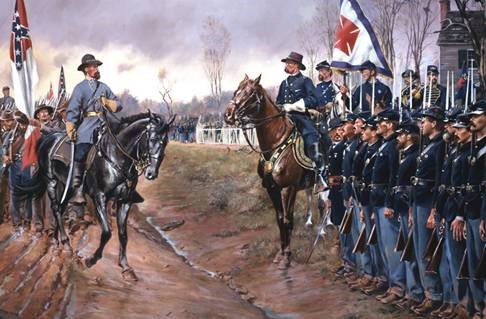
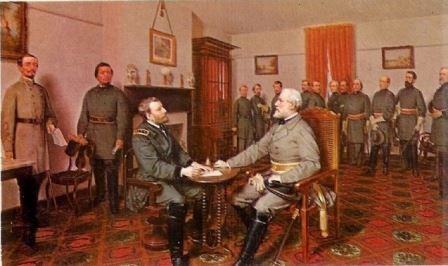
appomattox surrender

One hundred and fifty years ago on the 9th and 10th of April 1865, four men, Ulysses S Grant, Robert E. Lee, Joshua Lawrence Chamberlain and Ely Parker, taught succeeding generations the value of mutual respect and reconciliation. They would do so after a bitter and bloody war that had cost the lives of over 600,000 Americans which had left hundreds of thousands others maimed, shattered or without a place to live, and seen vast swaths of the country ravaged by war and its attendant plagues.

The men were all very different, Lee was a Southern aristocrat and career army officer, Grant, the officer of humble means who had struggled with alcoholism and failed in his civilian life before returning to the army when war began. Chamberlain, was the professor of rhetoric and natural and revealed religion, the hero of Little Round Top, who helped exemplify the importance of citizen soldiers in peace and war. Finally there was Parker, a full-blooded Seneca Indian; a professional engineer, a man who was barred from being an attorney because as a Native American he was never considered a citizen. Although he had been rejected from serving in the army for the same reason, his friend Grant had obtained him a commission and kept him on his staff.

On the morning of the 9th Confederate General Robert E. Lee replied to an entreaty of Lieutenant General Ulysses S. Grant requesting that he and his Army of Northern Virginia be allowed to surrender. Lee wrote to Grant:

HEADQUARTERS ARMY OF NORTHERN VIRGINIA, APRIL 9, 1865

Lieut. Gen. U.S. GRANT:

I received your note of this morning on the picket-line, whither I had come to meet you and ascertain definitely what terms were embraced in your proposal of yesterday with reference to the surrender of this army. I now ask an interview in accordance with the offer contained in your letter of yesterday for that purpose.

R.E. LEE, General.

The once mighty Army of Northern Virginia which had won so many victories was now a haggard but proud force of about 15,000 soldiers. For Lee to continue the war now would mean that they face hopeless odds against a vastly superior enemy. Grant recognized this and wrote Lee:

I am equally anxious for peace with yourself, and the whole North entertains the same feeling. The terms upon which peace can be had are well understood. By the South laying down their arms they will hasten that most desirable event, save thousands of human lives, and hundreds of millions of property not yet destroyed. Seriously hoping that all our difficulties may be set-tied without the loss of another life, I subscribe myself, &c.,

Since the high water mark at Gettysburg, Lee’s army had been on the defensive. His ill-fated offensive into Pennsylvania being one of the two climactic events that sealed the doom of the Confederacy. The other was Grant’s victory at Vicksburg which fell to him a day after Pickett’s Charge.

The bloody defensive struggle lasted through 1864 as Grant bled the Confederates dry during the Overland Campaign, leading to the long siege of Petersburg. Likewise the armies of William Tecumseh Sherman had cut a swath through the Deep South and were moving toward Virginia from the Carolinas.

With each battle following Gettysburg the Army of Northern Virginia became weaker and finally after the nine month long siege of Petersburg ended with a Union victory there was little else to do. On the morning of April 9th a final attempt to break through the Union lines by John Gordon’s division was turned back by vastly superior Union forces.

grant 1

Lieutenant General Ulysses S. Grant, United States Army

On April 7th Grant wrote a letter to Lee which began the process of ending the war in Virginia. He wrote:

General R. E. LEE:

The result of the last week must convince you of the hopelessness of further resistance on the part of the Army of Northern Virginia in this struggle. I feel that it is so, and regard it as my duty to shift from myself the responsibility of any further effusion of blood, by asking of you the surrender of that portion of the C. S. Army known as the Army of Northern Virginia.

U.S. GRANT, Lieutenant-General

Lee was hesitant to surrender knowing Grant’s reputation for insisting on unconditional surrender, terms that Lee could not accept. He replied to Grant:

HEADQUARTERS ARMY OF NORTHERN VIRGINIA, APRIL 7, 1865 Lieut. Gen. U.S. GRANT:

I have received your note of this date. Though not entertaining the opinion you express on the hopelessness of further resistance on the part of the Army of Northern Virginia, I reciprocate your desire to avoid useless effusion of blood, and therefore, before considering your proposition, ask the terms you will offer on condition of its surrender.

R.E. LEE, General.

The correspondence continued over the next day even as the Confederates hoped to fight their way out of the trap that they were in. But now Robert E. Lee, who had through his efforts extended the war for at least six months knew that he could no longer continue. Even so some of his younger subordinates wanted to continue the fight. When his artillery chief Porter Alexander recommended that the Army be released, “take to the woods and report to their state governors” Lee replied:

“We have simply now to face the fact that the Confederacy has failed. And as Christian men, Gen. Alexander, you & I have no right to think for one moment of our personal feelings or affairs. We must consider only the effect which our action will have upon the country at large.”

Lee continued:

“Already [the country] is demoralized by the four years of war. If I took your advice, the men would be without rations and under no control of their officers. They would be compelled to rob and steal in order to live…. We would bring on a state of affairs it would take the country years to recover from… You young fellows might go bushwhacking, but the only dignified course for me would be to go to General Grant and surrender myself and take the consequences of my acts.”

Alexander was so humbled at Lee’s reply he later wrote “I was so ashamed of having proposed such a foolish and wild cat scheme that I felt like begging him to forget he had ever heard it.” When Alexander saw the gracious terms of the surrender he was particularly impressed with how non-vindictive the terms were, especially in terms of parole and amnesty for the surrendered soldiers.

Abraham Lincoln had already set the tone for the surrender in his Second Inaugural Address given just over a month before the surrender of Lee’s army. Lincoln closed that speech with these words of reconciliation:
“With malice toward none, with charity for all, with firmness in the right as God gives us to see the right, let us strive on to finish the work we are in, to bind up the nation’s wounds, to care for him who shall have borne the battle and for his widow and his orphan, to do all which may achieve and cherish a just and lasting peace among ourselves and with all nations.”

Lee1

General Robert E. Lee, CSA

Lee met Grant at the house of Wilmer McLean, who had moved to Appomattox in 1861 after his home near Manassas had been used as a Confederate headquarters and was damaged by artillery fire. Lee was dressed in his finest uniform complete with sash, while Grant was dressed in a mud splattered uniform and overcoat only distinguished from his soldiers by the three stars on his should boards. Grant’s dress uniforms were far to the rear in the baggage trains and Grant was afraid that his slovenly appearance would insult Lee, but it did not. It was a friendly meeting, before getting down to business the two reminisced about the Mexican War.

Grant provided his vanquished foe very generous surrender terms:

“In accordance with the substance of my letter to you of the 8th inst., I propose to receive the surrender of the Army of N. Va. on the following terms, to wit: Rolls of all the officers and men to be made in duplicate. One copy to be given to an officer designated by me, the other to be retained by such officer or officers as you may designate. The officers to give their individual paroles not to take up arms against the Government of the United States until properly exchanged, and each company or regimental commander sign a like parole for the men of their commands. The arms, artillery and public property to be parked and stacked, and turned over to the officer appointed by me to receive them. This will not embrace the side-arms of the officers, nor their private horses or baggage. This done, each officer and man will be allowed to return to their homes, not to be disturbed by United States authority so long as they observe their paroles and the laws in force where they may reside.”

When Lee left the building Federal troops began cheering but Grant ordered them to stop. Grant felt a sense of melancholy and wrote “I felt…sad and depressed, at the downfall of a foe who had fought so long and valiantly, and had suffered so much for a cause, though that cause was, I believe, one of the worst for which a people has fought.” He later noted: “The Confederates were now our countrymen, and we did not want to exult over their downfall.”

In the hours before and after the signing of the surrender documents old friends and classmates, separated by four long years of war gathered on the porch or around the house. Grant and others were gracious to their now defeated friends and the bitterness of war began to melt away. Some Union officers offered money to help their Confederate friends get through the coming months. It was an emotional reunion, especially for the former West Point classmates gathered there:

“It had never been in their hearts to hate the classmates they were fighting. Their lives and affections for one another had been indelibly framed and inextricably intertwined in their academy days. No adversity, war, killing, or political estrangement could undo that. Now, meeting together when the guns were quiet, they yearned to know that they would never hear their thunder or be ordered to take up arms against one another again.”

Grant also sent 25,000 rations to the starving Confederate army waiting to surrender. The gesture meant much to the defeated Confederate soldiers who had had little to eat ever since the retreat began.

The surrender itself was accomplished with a recognition that soldiers who have given the full measure of devotion can know when confronting a defeated enemy. Major General Joshua Lawrence Chamberlain, the heroic victor of Little Round Top was directed by Grant to receive the final surrender of the defeated Confederate infantry on the morning of April 12th.

It was a rainy and gloomy morning as the beaten Confederates marched to the surrender grounds. As the initial units under the command of John Gordon passed him, Chamberlain was moved with emotion he ordered his soldiers to salute the defeated enemy for whose cause he had no sympathy, Chamberlain honored the defeated Rebel army by bringing his division to present arms.

chamberlian gordon appomattox

John Gordon, who was “riding with heavy spirit and downcast face,” looked up, surveyed the scene, wheeled about on his horse, and “with profound salutation returned the gesture by lowering his saber to the toe of his boot. The Georgian then ordered each following brigade to carry arms as they passed third brigade, “honor answering honor.”

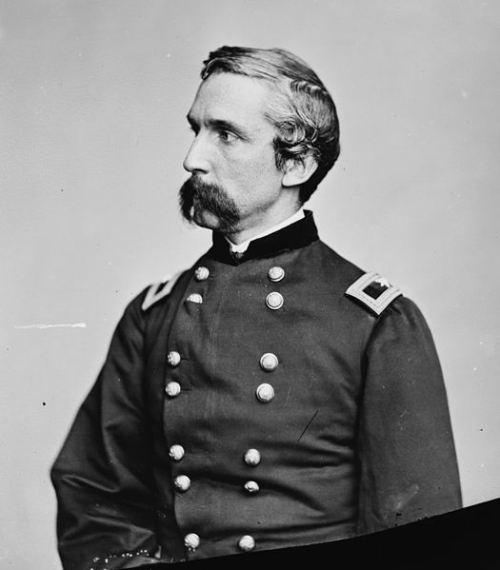
joshua_chamberlain_-_brady-handy

Major General Joshua Lawrence Chamberlain, U.S. Army

Chamberlain was not just a soldier, but before the war had been Professor of Natural and Revealed Religions at Bowdoin College, and a student of theology before the war. He could not help to see the significance of the occasion. He understood that he would be criticized by some for offering the salute. However, Chamberlain, unlike some, understood the value of reconciliation. Chamberlain was a staunch abolitionist and Unionist who had nearly died on more than one occasion fighting the defeated Confederate Army, and he understood that no true peace could transpire unless the enemies became reconciled to one another.

He noted that his chief reason for doing so:

“The momentous meaning of this occasion impressed me deeply. I resolved to mark it by some token of recognition, which could be no other than a salute of arms. Well aware of the responsibility assumed, and of the criticisms that would follow, as the sequel proved, nothing of that kind could move me in the least. The act could be defended, if needful, by the suggestion that such a salute was not to the cause for which the flag of the Confederacy stood, but to its going down before the flag of the Union. My main reason, however, was one for which I sought no authority nor asked forgiveness. Before us in proud humiliation stood the embodiment of manhood: men whom neither toils and sufferings, nor the fact of death, nor disaster, nor hopelessness could bend from their resolve; standing before us now, thin, worn, and famished, but erect, and with eyes looking level into ours, waking memories that bound us together as no other bond;—was not such manhood to be welcomed back into a Union so tested and assured? Instructions had been given; and when the head of each division column comes opposite our group, our bugle sounds the signal and instantly our whole line from right to left, regiment by regiment in succession, gives the soldier’s salutation, from the “order arms” to the old “carry”—the marching salute. Gordon at the head of the column, riding with heavy spirit and downcast face, catches the sound of shifting arms, looks up, and, taking the meaning, wheels superbly, making with himself and his horse one uplifted figure, with profound salutation as he drops the point of his sword to the boot toe; then facing to his own command, gives word for his successive brigades to pass us with the same position of the manual,—honor answering honor. On our part not a sound of trumpet more, nor roll of drum; not a cheer, nor word nor whisper of vain-glorying, nor motion of man standing again at the order, but an awed stillness rather, and breath-holding, as if it were the passing of the dead!”

The next day Robert E Lee addressed his soldiers for the last time. Lee’s final order to his loyal troops was published the day after the surrender. It was a gracious letter of thanks to men that had served their beloved commander well in the course of the three years since he assumed command of them outside Richmond in 1862.

General Order
No. 9

After four years of arduous service marked by unsurpassed courage and fortitude, the Army of Northern Virginia has been compelled to yield to overwhelming numbers and resources.

I need not tell the survivors of so many hard fought battles, who have remained steadfast to the last, that I have consented to the result from no distrust of them.

But feeling that valour and devotion could accomplish nothing that could compensate for the loss that must have attended the continuance of the contest, I have determined to avoid the useless sacrifice of those whose past services have endeared them to their countrymen.

By the terms of the agreement, officers and men can return to their homes and remain until exchanged. You will take with you the satisfaction that proceeds from the consciousness of duty faithfully performed, and I earnestly pray that a merciful God will extend to you his blessing and protection.

With an unceasing admiration of your constancy and devotion to your Country, and a grateful remembrance of your kind and generous consideration for myself, I bid you an affectionate farewell. — R. E. Lee, General

The surrender was the beginning of the end. Other Confederate forces continued to resist for several weeks, but with the surrender of the Army of Northern Virginia led by the man that nearly all Southerners saw as the embodiment of their nation the war was effectively over.

Lee had fought hard and after the war was still under the charge of treason, but he understood the significance of defeat and the necessity of moving forward as one nation. In August 1865 Lee wrote to the trustees of Washington College of which he was now President:

“I think it is the duty of every citizen, in the present condition of the Country, to do all in his power to aid the restoration of peace and harmony… It is particularly incumbent upon those charged with the instruction of the young to set them an example of submission to authority.

It is a lesson that all of us in our terribly divided land need to learn regardless of or political affiliation or ideology. After he had signed the surrender document, Lee learned that Grant’s Aide-de-Camp Colonel Ely Parker, was a full-blooded Seneca Indian. He stared at Parker’s dark features and said: “It is good to have one real American here.”

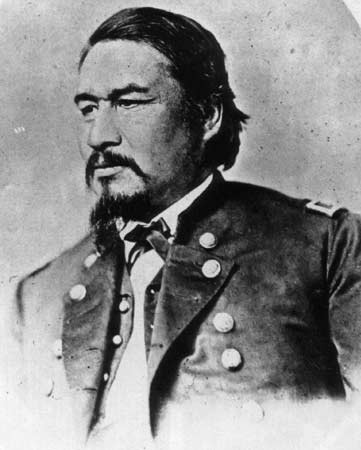
eparker05-966-g

Brigadier General Ely Parker, United States Army

Parker, a man whose people had known the brutality of the white man, a man who was not considered a citizen and would never gain the right to vote, replied, “Sir, we are all Americans.” That afternoon Parker would receive a commission as a Brevet Brigadier General of Volunteers, making him the first Native American to hold that rank in the United States Army. He would later be made a Brigadier General in the Regular Army.

I don’t know what Lee thought of that. His reaction is not recorded and he never wrote about it after the war, but it might have been in some way led to Lee’s letter to the trustees of Washington College. I think with our land so divided, ands that is time again that we learn the lessons so evidenced in the actions and words of Ely Parker, Ulysses Grant, Robert E. Lee and Joshua Chamberlain, for we are all Americans.

Sadly, I think that there is a portion of the population who will not heed these words and will continue to agitate for policies and laws similar to those that led to the Civil War, and which those the could not reconcile defeat instituted again during the Post-Reconstruction and Jim Crow eras.

But I still maintain hope that in spite of everything, that we can overcome.

Peace

Padre Steve+


1 Comment

Filed under civil war, History, leadership, Military, Political Commentary

Wednesday Wanderings: Coming this Week


163017_10150113444907059_3944470_n

Well my friends,

It is this week, actually the middle of this week  and kind of a down day but not in a bad way. Currently I have our two Papillons , Minnie and Izzy having a war on the love seat next to me and I am watching some X-Files on DVD. I love that series, I have always loved agent Scully.

This week has been busy. We have a new class in at the Staff College and I am getting ready to take full charge of our Ethics elective dealing with ethics and war and the next iteration of the Gettysburg Staff Ride. Both of these efforts include a lot of research and writing. Tomorrow will be very busy as I have a couple of extra tasks dealing with a meeting for community service and a spouses orientation.

I am also getting ready for a trip to Houston to go to my church’s annual chaplain training symposium next week.

In the mean time baseball is back and I am happy. Hopefully until the last game of the World Series I will be wearing short pants and baseball jerseys and t-shirts whenever I am not in uniform. The other even more cool than baseball and short pants is the fact that I won my local Gordon Biersch Brewery College Hoops Bracket Challenge and came in tenth nationally. If I had just not believed the UNC would upset Wisconsin and Wisconsin would defeat Kentucky I might have won it all. However, I am content with my prize $200 of Biersch gift cards. Since it is the first time I have ever picked the winner of the NCAA tournament in bracket that I am happy. Thank you Duke Blue Devils who won it all. I had the gut feeling that you would.

But anyway I do digress…

I have a few things in the pipeline this week. I do hope that you liked the series about the Roman Centurion during Holy Week and we challenged by the articles about the Christian Right and the Unreconstructed Rebel, Jubal Early.

So in the next few days you will get an article about the surrender of Robert E. Lee and his army to Ulysses S. Grant at Appomattox which I will publish tomorrow. That really is an interesting story and something that I think all of us who are Americans, no matter what our political, ideological or religious leanings can learn from. It is a story about reconciliation evidenced in the lives of four men, Robert E. Lee, Ulysses Grant, Joshua Lawrence Chamberlain and Ely Parker.

I have an article on Confederate general Richard Ewell which should appear soon and a number of other articles related to the Civil War and Gettysburg, Expect something on baseball and of course on Jackie Robinson and Branch Rickey.

Anyway, there will be other articles as well depending on what is going on in the world or what strikes me as needing to be written about.

Have a great night,

Peace

Padre Steve+


1 Comment

Filed under Loose thoughts and musings

Jubal Early: The Unreconstructed Rebel

??????????????????????????????????????????????????????????????????????????????????????????????

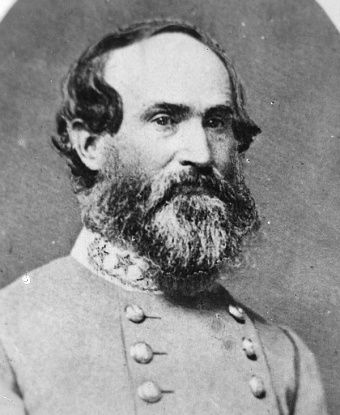
Lieutenant General Jubal Early, the Propagandist of the Lost Cause

Friends of Padre Steve’s World

There are some people in history who have a major and sometimes malevolent impact on history who are little known to most people. One of these men is Confederate Lieutenant General Jubal A. Early. You may not have ever heard of him but his influence is still strong today in certain parts of the Republican Party, the Tea Party, the Christian Right and neo-Confederate organizations. Early is a complex, brilliant but malevolent character whose post Civil War activities, and writings influenced how generations of Americans embraced the myth of the Lost Cause as historic truth and why so  many people today support an ideology that is little more than a re-baptized Lost Cause in their fight against supposed liberals, progressives, gays, and minority groups. People who they believe threaten their place in society. 

This article is part of one of the chapters of my Gettysburg which I will continue to periodically publish here. Have a great night.

Peace

Padre Steve+ 

Jubal Early was an unusual character. He is described similarly by many to Dick Ewell in his gruffness and eccentrics. Unlike his corps commander, Ewell, who was modest and charitable, Early was “ambitious, critical, and outspoken to the point of insubordination. Under certain circumstances he could be devious and malevolent.” [1] James Longstreet’s aide Moxey Sorrel wrote of him: “Jubal Early….was one of the ablest soldiers in the army. Intellectually he was perhaps the peer of the best for strategic combinations, but he lacked the ability to handle troops effectively in the field….His irritable disposition and biting tongue made him anything but popular.” [2] Despite this, Early had proved himself as a brigade commander and acting division commander and Lee referred to him affectionately as “my bad old man.” [3]

Early was the son of a tobacco planter in Franklin County Virginia. He was born in 1816 who had served in the Virginia legislature and was a Colonel of militia. Growing up he had an aptitude for science and mathematics. He was accepted into West Point in 1833 at the age of seventeen. He was a good student, but had poor marks for conduct and graduated in the eighteenth of fifty cadets in the class of 1837. His fellow students included Joe Hooker, John Sedgwick, Braxton Bragg, and John Pemberton, later, the doomed defender of Vicksburg. Also in the class was Lewis Armistead, with whom the young Early had an altercation that led to Armistead breaking a plate over his head in the mess hall. For the offense Armistead was dismissed from the academy.

He was commissioned into the artillery on graduation in 1837. However, after experiencing life in the active duty army, including service in the in the Seminole War, Early left the army and became a highly successful lawyer and active Whig politician. He served in the Mexican war as a Major with Virginia volunteers. Unlike some of his classmates, and later contemporaries in the Civil War, Early, and his men did not see combat, instead, serving on occupation duty. In Mexico Zachary Taylor made Early the “military governor of Monterrey, a post that he relished and filled with distinction.” [4]

After his service in Mexico, Early returned to Virginia where he returned to his legal practice, serving as a prosecuting attorney. He also entered local politics where he served as a Whig in the Virginia legislature.

During his time in Mexico, Early contracted rheumatic fever, which left him with painful rheumatoid arthritis for the rest of his life. Due to it he “stooped badly and seemed so much older than his years that his soldiers promptly dubbed him “Old Jube” or Old Jubilee.” [5]

Jubal Early was “notoriously a bachelor and at heart a lonely man.” Unlike many Confederate officers he had “no powerful family connections, and by a somewhat bitter tongue and rasping wit” isolated himself from his peers.[6]

Likewise, in an army dominated by those with deep religious convictions, Early was avowedly irreligious and profane, though he did understand the importance of “the value of religion in keeping his soldiers’ spirits up” and as commander of the Army of the Valley, issued orders for a stricter keeping of the Sabbath. [7] Lee’s adjutant Walter Taylor wrote of him “I feared our friend Early wd not accomplish much because he is such a Godless man. He is a man who utterly sets at defiance all moral laws & such a one heaven cannot favor.” [8] That being said Porter Alexander praised Early and noted that his “greatest quality perhaps was the fearlessness with which he fought against all odds & discouragements.” [9]

Early was a Whig, and a stalwart Unionist who opposed Virginia’s secession, voting against it because he found it “exceedingly difficult to surrender the attachment of a lifetime to that Union which…I have been accustomed to look upon (in the language of Washington) as the palladium of the political safety and prosperity of the country.” [10] Nonetheless, like so many others he volunteered for service after Lincoln called for 75,000 volunteers to crush the rebellion.

Robert E. Lee “appreciated Early’s talents as a soldier and displayed personal fondness for his cantankerous and profane Lieutenant …who only Stonewall Jackson received more difficult assignments from Lee.” [11] Early was the most influential of Ewell’s division commanders, and his “record in battle prior to Gettysburg was unsurpassed.” [12]

After Gettysburg Early remained in command of his division and when Dick Ewell was relieved in 1864 assumed command of the Second Corps. With the corps he conducted operations in the Shenandoah Valley as well as a raid which briefly threatened Washington D.C. in 1864. Early became “a much maligned figure in the Confederacy after his army suffered utter defeat against Philip H. Sheridan’s forces in the Shenandoah Valley during the fall and winter of 1864-65.” [13] The clamor for his relief was so great that Lee relieved Early of command on March 30th 1865, “and sent him home to await orders.” [14] However Lee handled the matter with gentleness that made ensured Early’s undying devotion. Lee wrote:

“while my own confidence in your ability, zeal, and devotion to the cause in unimpaired…I nevertheless felt that I could not oppose what seems to be the current opinion, without injustice to your reputation and injury to the service.” [15]

After the war Early went into voluntary exile until 1869, unable to reconcile life in the United States following defeat. Travelling from Cuba to Mexico and on to Canada his bitterness grew, and for the embittered General it was about honor. For Early, who had fought so hard against secession, now took the opposing view. For him, “honor resided intact in the defeated cause of Southern independence. It was now distilled, for him, in the issue of states’ rights and white supremacy.” [16]

In his efforts Early sought to “elevate Lee above any other Civil War chieftains, and to promote the idea that the South had not been defeated, only compelled to surrender against overwhelming odds.” [17] Early’s hatred for anything to do with the North was demonstrated when he “refused even to donate funds to a monument to Robert E. Lee in Richmond when he learned that the pedestal would be carved from Maine granite.” [18]

Early’s hatred a blacks grew as he got older, and “became particularly virulent when they were involved in anything connected to the war on the Confederacy.” [19] While serving as Governor, James Kemper, who was so grievously wounded during Pickett’s Charge found Early’s views so dangerous that he begged Early not to attend the unveiling of a monument to Stonewall Jackson in 1875. He wrote to Early, “for the sake of public peace and harmony, I beg, beseech and implore you, for God’s sake stay at home.” [20]

Upon his return from his voluntary exile he was sought after by Lee to help in preparation of a memoir that would explain his decisions during the war. In addition to championing Lee and writing polemics against any former Confederate officer who dared to criticize his chief. As such those writing their own memoirs were usually careful to avoid anything that might provoke Early’s wrath, or submitted their work for his imprimatur before going to publication. He shameless attacked James Longstreet and William Mahone for their post war reconciliation with the hated Yankees, as well as Longstreet’s criticism of Lee.

Early was very intelligent and he knew that the controversy surrounding his defeat in the Valley did not enhance his own reputation, so instead “It was on Lee’s credibility that Early built his postwar career.” [21] Over the course of:

“the last twenty-five years of his life the bitter General sought to get his impressions of the war on record. He took an active role in publishing the Southern Historical Papers….and achieved as a leading arbiter of questions concerning relating to Confederate military history.” [22]

Early was immensely successful in this long term effort. The results of Early’s efforts was the successful propagation of the myth of the Lost Cause and its prominence throughout many of the books, journals and other publications published after the war, even Winston Churchill’s history of the Civil War is filled with Early like lost cause images and language in his works. Referring to Southern honor, that concept that Early held so dear Churchill, echoing Early wrote “The South knew they had lost the war, and would be conquered and flattened. It is one of the enduring glories of the American nation that this made no difference to the Confederate resistance.” [23] The idea that Churchill espoused, that Confederate “honor” was one of the enduring glories of  the American nation” is nothing more than myth which promotes everything wrong with the Confederacy.

In February 1894 Lee’s “old bad man” took a fall on the way out of the Lynchburg Post Office. He resisted treatment though he appeared to be in shock and was both mentally and physically unwell. He attempted to continue his business but got worse and he died in Lynchburg on March 2nd 1894.

Sadly, Early’s ideas live on in the minds of many Americans, who like him have not reconciled with the results of the war and who are susceptible to his message. Early set the example for them:

“Like an Old testament prophet, Jubal supported the message by his own extreme example – his “constancy” and intransigence, his unremitting hatred for Grant (even after Jefferson Davis had forgiven the Illinoisan), his refusal to be pardoned or reconstructed or to regard the North, at least in the abstract, as anything but an evil empire.” [24]

Jubal Early’s words and actions read almost as if they come out of current Republican and Christian Right talking points. Instead of Lincoln and the Black Republicans, the enemy is Obama and the Black, Gay and Liberal Democrats. I find it chilling to read about Early and his transformation for an anti-secession Whig to an unreconstructed Rebel whose nearly pathological hatred for the Union that he had once served reminds me of people I know.

Peace

Padre Steve+

Notes

[1] Ibid. Pfanz Richard S. Ewell p.268

[2] Ibid. Girardi. The Civil War Generals p.206

[3] Ibid. Wert A Glorious Army p.155

[4] Ibid. Osborne Jubal p.28

[5] Ibid. Freeman Lee’s Lieutenants p.83

[6] Ibid. Freeman Lee’s Lieutenants p.33

[7] Ibid. Osborne Jubal p.385

[8] Ibid. Girardi. The Civil War Generals p.207

[9] Alexander, Edward Porter. Fighting for the Confederacy: The Personal Recollections of General Edward Porter Alexander edited by Gary Gallagher University of North Carolina Press, Chapel Hill 1989 p.397

[10] Ibid. Osborne Jubal p.50

[11] Gallagher, Gary W. Jubal A. Early, the Lost Cause, and Civil War History: A Persistent Legacy; Frank L Klement Lecture, Alternate Views of the Sectional Conflict Marquette University Press Marquette WI 2003 p.11

[12] Ibid. Tagg The Generals of Gettysburg p.256

[13] Ibid. Gallagher Jubal A. Early, the Lost Cause, and Civil War History p.8

[14] Ibid. Freeman Lee’s Lieutenants p.769

[15] Ibid. Gallagher Jubal A. Early, the Lost Cause, and Civil War History p.11

[16] Ibid. Osborne Jubal p.416

[17] Ibid. Pryor Reading the Man p.469

[18] Guelzo Allen C. Fateful Lightening: A New History of the Civil War Era and Reconstruction Oxford University Press, Oxford and New York 2012 p.526

[19] Ibid. Osborne Jubal p.418

[20] Ibid. Osborne Jubal p.418

[21] Ibid. Osborne Jubal p.476

[22] Ibid. Gallagher Jubal A. Early, the Lost Cause, and Civil War History p.15

[23] Ibid. Gallagher Jubal A. Early, the Lost Cause, and Civil War History p.15

[24] Ibid. Osborne Jubal p.476

Leave a comment

Filed under civil rights, civil war, Gettysburg, History, Military, Political Commentary

Post Easter Thoughts on Christian Right Paranoia

religious-beliefs-350

Easter was weird for me this year. While I rediscovered the joy of celebrating Eucharist thanks to three Lebanese Christian officers who were in our last class at the Staff College, I struggled. I mentioned last week that it wasn’t my post-Iraq agnosticism, but rather a reaction to the power hungry preachers, politicians and pundits of the Christian Right.

These are people who though they hold most of the levers of power in the Republican Party, have a stranglehold on over half of the state legislatures and state houses as well as have the majority in both the House of Representatives and Senate live in a paranoid dream world. It is a cloud-cookoo-land were they honestly continue to spread the lie that they are the only group that it is legal to discriminate against. It is a world where they pass laws to discriminate against groups of people that they hate and then say that they are being discriminated against.

The positively Orwellian attitude, words and actions of these people are responsible for the rapid decline of people who call themselves Christians and the rapid expansion of people who no longer believe. The reason is born out by the polls of the Barna Group, Pew Religion Research and many other polls. They all agree. It is not Jesus that people reject, it is his most ardent followers, who are now described as Hypocritical, anti-homosexual, insincere, sheltered and too political.

Another Barna poll recorded that young people were leaving the church because “Christians demonize everything outside of the church,” that “God seems missing from my experience of church,” that “Christians are too confident they know all the answers and that churches are out of step with the scientific world we live in,” that “churches are afraid of the beliefs of other faiths” and “church is like a country club, only for insiders,” and finally that young people are unable to ask their “most pressing life questions in church,” that they have “significant intellectual doubts about their faith,” and that the church “does not help with depression or other emotional problems.”

Despite these self-inflicted wounds the Christian Right and their allies blame everyone else for the demise of the Christian church in the United States. Instead of making a genuine attempt to witness of the grace, love and mercy of Jesus embodied in the message of reconciliation so wonderfully stated in Second Corinthians chapter five:

All this is from God, who reconciled us to himself through Christ and gave us the ministry of reconciliation:  that God was reconciling the world to himself in Christ, not counting people’s sins against them. And he has committed to us the message of reconciliation.” 

Note that in this there is no command to judge or take political control over the world, it is a message of reconciliation seldom practiced by Christians now or sadly throughout much of history, especially after the Church became the Imperial Church under Constantine.

The words of the Christian Right and their allies, especially regrading homosexuals have reached such a point of ridiculousness that it is hard to know whether to laugh or cry. Cries by Mike Huckabee that “It won’t stop until there are no more churches, until there are no more people who are spreading the Gospel, and I’m talking now about the unabridged, unapologetic Gospel that is really God’s truth.” 

Others repeatedly invoke the specter of Nazi Germany, persecution of Christians and even concentration camps and martyrdom, even though they are the ones passing the laws and using the government to legislate against homosexuals. But they say that they are the victims of homosexual hatred and liberal intolerance.

To me it is reminiscent of the scare tactics used by the Souther proponents of secession and slavery in the months leading to the Civil War. Henry Benning of Georgia told the Virginia Secession conference:

“I fear that the day is not distant when the Cotton States, as they are called, will be the only slave States. When that time comes, the time will have arrived when the North will have the power to amend the Constitution, and say that slavery shall be abolished, and if the master refuses to yield to this policy, he shall doubtless be hung for his disobedience…we will be overpowered and our men will be compelled to wander like vagabonds all over the earth; and as for our women, the horrors of their state we cannot contemplate in imagination. That is the fate which Abolition will bring upon the white race…But that is not all of the Abolition war. We will be completely exterminated, and the land will be left in the possession of the blacks…”

The message of the Christian Right and their allies is laden with similar statements, not about blacks, at least openly, but mostly in regard to Gays and the LGBT community.  None of these words or actions can be in the slightest construed with an authentic Christian message. Robert Henlein wrote:

“Almost any sect, cult, or religion will legislate its creed into law if it acquires the political power to do so.”

This is what Conservative American Christians of the Christian Right, especially the leaders who subscribe to Christian Dominionism are doing every day. That my friends is why the church in the United States is dying and why people are fleeing it in record numbers, and why non-believers want nothing to do with it. It is why I struggle. 

But there is an antidote to this, a message that wonderfully contradicts everything that the Christian Right and their allies stand for, and that is a message of love.

In his last Bishop Blackie Ryan novel, the late Father Andrew Greeley used the example of a fictional Spanish Cardinal to his people. It is the message that needs to be preached here and now in this country:

“So many of our lay people believe that ours is a Church of rules, that being Catholic consists of keeping rules. They do not find an institution which is like that very appealing. Nor should they.

In fact, we are a Church of love. Our message from the Lord himself even today is the message that God is Love and that we are those who are trying, however badly, to reflect that love in the world. I find that in my own city that notion astonishes many people. How we came to misrepresent that which we should be preaching above all else is perhaps the subject for many doctoral dissertations.

More important for us today, however, is the reaffirmation that we exist to preach a God of love, we try to be people of love, and we want our church to be, insofar as we poor humans can make it, a Church of radiant love.

Does such a Church have a future? How could it not?”

Greeley wrote more than fiction, he was a socialist and a historian. He noted something about a time when Christians were actually the subject of real persecution before Constantine:

“People came into the Church in the Roman Empire because the Church was so good — Catholics were so good to one another, and they were so good to pagans, too. High-pressure evangelization strikes me as an attempt to deprive people of their freedom of choice.”

But now the problem is more than high pressure evangelism, it is the high pressure political machine that the Christian Right is an integral part. That my friends is what is destroying the witness of the church, not gay rights or same-sex marriage. It isn’t the liberals, or the media, it is a woefully short-sighted belief that Christians must subdue those who they disagree with and disapprove of and that they must work to use the law of the state to establish their view as law, and enforce that law on others.  Eric Hoffer noted that:

“Hatred is the most accessible and comprehensive of all the unifying agents. Mass movements can rise and spread without belief in a god, but never without a belief in a devil.” 

The Christian Right has found multiple devils to demonize: gays, women, liberals and anyone else they want to make the enemy of their God. As Hoffer said: “religions give people identity by positing a basic distinction between believers and non-believers, between a superior in-group and a different and inferior out-group.”

I thought about this subject over the past week in the context of my own struggle and the series of articles that I wrote about the Roman Centurion during Holy Week. Despite my own struggle I realize it is better to struggle with faith than to subscribe to the absolute falsehood and heresy of the hatred and judgment used by the Christian Right and their allies.

Anyway, I am tired and need to take a break.

Peace

Padre Steve+

Leave a comment

Filed under christian life, ethics, faith, LGBT issues, ministry, Religion

A Centurion’s Troubles: Empty Tombs & Politics

rubensresurrection1

Friends of Padre Steve’s World

Those who follow my writings know that I struggle with faith. Since my return from Iraq in 2008 I have found a certain kinship with soldiers who have been assigned the unthankful and trying tasks of dealing with occupation  duties or fighting insurgencies. 

In the case of the story of Easter it is all too common that writers, theologians and others focus on the story of Jesus and his disciples, or conversely, if they explore anyone else, they  focus on the Jewish religious leaders of of the time. 

After Iraq I had a harder time relating to Jesus and his followers, or the religious leaders of Jerusalem. That being said, coming home from Iraq, struggling to believe, I find a tremendous affinity with the officers of the Roman Legions serving in Judea and Samaria in the 1st Century A.D. 

This is the final chapter of a series that I have been writing about the Roman Centurion known as Longinus, who according to tradition, was at the cross when Jesus was crucified. I have tried to weave other characters from the Gospel narratives, including the Centurion whose “beloved servant” was healed by Jesus an account mentioned in both Matthew and Luke, where the Greek word for servant “Pais” is only found in these accounts and is different from the word commonly used in the New Testament “Doulos.” The difference leads to some interesting and potentially powerful understandings about the people that Jesus interacted during his earthly ministry.

The reason I am doing this is because I believe that many Christians cannot imagine what it must have felt like to be the Roman occupiers of Judea in a time where they were hated and deep divisions, religious, cultural and political complicated the lives of Roman officers like the Centurion known as Longinus.

I do hope that you enjoyed the series and that it and the Gospel narratives challenged you whether you are a Christian or not. I know from my time in Iraq serving with our advisors to the Iraqi forces that what the Roman officers dealt with was more difficult than any of us could imagine, unless you have been a soldier or officer of an occupying power, which I have been.

Peace and Happy Easter…

Padre Steve+

The pounding on his door awakened Longinus before he expected on this day after the Jewish Passover. He was hoping perhaps beyond hope that the worst was over and that in a few days he could take his soldiers back to the confines of Caesarea and away from the troubled city of Jerusalem. He was tired of this duty and longed for service with a real Legion with real Roman soldiers.

The pounding continued and the weary centurion wiped the sleep from his eyes, rolled out of his bed and went to the door of his quarters in Fortress Antonia. He opened the door to find his Optimo, or second in command Decius standing there, his fist ready to continue pounding, with a look of near panic on his face.

Startled, Longinus asked the young officer to come into his quarters and take a seat at his table. They like the other officers had seen events that they could barely explain over the past week, and some of those events had troubled Longinus in a manner in which he was not accustomed to, or prepared for.

Longinus took a wineskin and poured the contents into two cups. He asked Decius what was so urgent and frightening that he had to be at his quarters well before the duty day began. The young man took off his helmet to reveal a crop of blondish brown hair common to the Tyrol in the northern part of Italy.

The young officer took the cup of wine and downed it in one motion. Longinus, pureed and another as the young Tyrollean told an almost unbelievable story. Wiping his brow and taking a drink from the cup he explained that there was trouble at the tomb of the itinerant preacher named Jesus.

Longinus listened to his report:

The two guards from Longinus’s unit who had relieved the previous watch at the tomb had evidently fallen asleep. While they were asleep there had been a break in. The soldiers  claimed that they had been overcome when some kind of angelic being descended in front of them. They reported that  some of the women who had been at the execution site previously had been near the tomb. They said that when they awakened the body of this Jesus was no longer in the tomb.

The story seemed preposterous, but Longinus could not believe that his soldiers  had fallen asleep on duty, as such an act could be punished by a death sentence. Adding to the confusion was a report that two of the preacher’s “disciples” had reportedly entered the tomb and claimed that the body was gone as had some of the women that had been there at the crucifixion.

Longinus took a drink from his cup of wine and thought for a moment. He had to admit that the story was unbelievable, but yet in light of the strangeness of the man and the events surrounding his execution Longinus, was no longer surprised at anything. Longinus looked at his young executive officer and said:

“Optimo, there has to be a logical explanation for what happened, and we need to find the truth. I do not like to think that our soldiers were asleep on duty, and I don’t think that the High Priest would not attempt to use this against us. Please have the soldiers and the Sergeant of the Guard report to me.”

Longinus had Decius bring the two soldiers to him along with the Sergeant of the Guard to explain what had happened.

The two soldiers, one a Samaritan and the other a Greek had good reputations in the unit. Neither had given him cause for concern and the terrified expression on their faces as they explained what happened at the tomb gave Longinus reason to believe them. Yes, it was possible that they were lying but Longinus believed their story because in spite of his threats they stuck to it. He threatened them with death if they had fallen asleep and were lying. When that did not produce results he promised a light punishment if they only told the truth, but despite his efforts to get them to testify to something rational they stuck with this outrageous story.

Longinus was not much of a believer in miracles angels or any sort of magic hocus pocus purveyed by seers, magicians or fortune tellers. He did not believe in the state “gods” of Rome and likewise had little respect for the Jewish God, not so much because he understood the theology of the Jews, or even might believe in some sort of all-powerful being, but because he was disgusted by their use of their god for their political purposes.

All that being said Longinus was inclined to believe his solders. When his friend Flavius had told him about his servant being healed by the Jesus fellow he found it hard to accept. That being the case here he was believing this outlandish story. It was preposterous, but he could not accept the alternative. To disbelieve his men would mean that there was a serious breakdown of discipline by two outstanding soldiers. Longinus had some soldiers that he wouldn’t believe for an Athenian minute if they told him such a tale, but he believed these men. The terror on their face as they told the story led Longinus to believe that they had to be telling the truth as improbable as it was.

Longinus again thought of his words as the darkness enfolded the city and the earth quaked preacher hung dying on the cross on that evil hill just two days before. He dismissed the soldiers and as they left he prepared himself to tell the scheming governor they latest “good news.” If only Rome had let these people stew in their own mess. Longinus shook his head as he wondered about the wisdom of attempting to police such fouled up lands.

After he washed and put on his uniform, Longinus went to Pilate’s headquarters where he and the other Centurions, including his friend Flavius participated in a meeting with Pilate and his staff, the Jewish High Priest and his representatives and two of Herod’s people.

The meeting reminded Longinus  of a meeting of criminals. The High Priest and his representatives were livid at the report he delivered and demanded that Pilate take immediate action to solve their problem. Herod’s henchmen voiced their displeasure regarding the lapse of the Roman soldiers that allowed this to happen.

Longinus spoke up for his men and said that as improbable as the story was, that he believed his men. That only made the non-Romans angrier and they began not only calling for punishing the soldiers, but Longinus as well. Longinus  thought that they were engaging Pilate in yet another histrionic episode in order to force Pilate to do their bidding, if not today, in the future.

The High Priest and Herod’s men  insisted that Longinus’ soldiers had to have fallen asleep and or that they had conspired with the preacher’s followers to remove the body from the tomb. This angered Longinus to the point that he interrupted their ranting to defend his men’s honor. Pilate finally ordered Longinus and the High Priest to be silent. He asked the non-Romans to step outside while he conferred with Longinus and the other Centurions. The High Priest objected, but decided not to press the point and left the room.

Pilate explained his dilemma. He was afraid that if he sent the High Priest away by supporting his soldiers that there would be a revolt in the streets. He had seen the tumult on the streets by the supporters of the High Priest when he tried to release the “King of the Jews” and felt that this would be worse for security. He advised the Centurions that while he had no reason to doubt them or their men that he had to placate the High Priest and Herod in order to avoid chaos, chaos that could lose him his job if he wasn’t careful. Likewise he did not feel that he had the military manpower in the city to handle a full-fledged revolt and that he would have to call for reinforcements from the Legions based in Syria. Pilate was loath to do as this as it would get back to the Emperor, and the Emperor did not take kindly to governors who could not manage their provinces.

Longinus thought back to the day of the execution. Pilate had agreed to place a guard at the tomb at the urging of the High Council. Longinus had argued against placing any soldiers at the tomb as he felt that since the “King of the Jews” was the problem of the Jews and since man that he had called the so called  “son of God” was dead that Rome’s obligation was over. Let the Jews handle their own problems.

The whole thing reeked of politics and Longinus did not like it, But but on Friday he had been overruled by Pilate. Then Pilate explained that Roman soldiers needed to guard the tomb because the High Priest  insisted that Jesus’ followers would attempt to steal the body and then claim that he this Jesus had been raised from the dead. That insisted the High Priest would lead a revolt against the Jewish council and eventually Rome itself.

the-high-priests-before-pilate-1311.jpg!xlMedium

Another actor who added to the Judean witches’ cauldron was the Herod Antipas, the corpulent and corrupt “King” of Judea. If Longinus detested Pilate and the Jewish High Priest he hated Herod and all that he stood for even more. The presence of Herod made Longinus wonder why Roman lives and treasure were spent to solve the problems of this God-forsaken land; a land that Longinus believed would still be trouble two millennia from now if the world lasted that long.

Longinus believed that as long as Rome allowed the High Council and Herod to rule the region by proxy that the troubles would never end. He believed that it was only a matter of time before these people, mobilized by the passion of the Zealots would revolt as they had against the Seleucids nearly 200 years before. He knew if that happened that Rome would mobilize more the  enough legions to crush the revolt, and when they were done would not leave as much as a house standing. Longinus hated this occupation and all that it stood for, especially when he saw a good and innocent man like this Jesus fellow killed for no good reason other than the politics of it all. It sickened him.

When Pilate was done explaining his decision to Longinus and the other Centurions Pilate called the quite irate non-Romans back into the proceedings. He told the High Priest and Herod’s men that he would discipline the soldiers involved. He also explained that he would assist them in finding just what parties removed the body from the tomb. In the mean time he would suppress any stories coming from the soldiers about this supposed “resurrection” of this Jesus character from the dead.

The High Priest and Herod’s men agreed that this would suffice and thanked Pilate for his time and effort. Longinus and the other Centurions quietly seethed as this took place. When the non-Roman parties had left Pilate, knowing how his officers hated his decision called them to him. He told the officers that no action would be taken against the men and that he would not actively assist the Jews in trying to find the perpetrators of the event. He had in fact deceived the High Priest an Herod’s men.

Pilate then let the officers know that they and their units would remain in Jerusalem for another week to allow the multitude of pilgrims to leave the city. Once the Jewish festivities were over and the people had departed, they would return to Caesarea. Longinus thought about it and for a brief moment he admired Pilate’s duplicity. Pilate the consummate politician had again found a way to defuse the situation, deceive the local leaders and protect his soldiers, and as much as Longinus and the other Centurions despised the deal it was better than trying to deal with a full fledged rebellion with so few troops available in Jerusalem.

Longinus left with the others and met Decius and Flavius when he stepped into the court of the fortress. He was very unhappy with the deal that Pilate made with the High Priest and Herod even though he understood the reality of the politics behind it. Longinus felt that he had dishonored his soldiers and the unit for the sake of political expediency. He felt ashamed of the Empire for what Pilate had done in cooperating with these people from beginning to end during this affair. He would not forget.

centurioncross_1

When Longinus returned to his quarters he again looked at his blood stained lance and thought about the man who was put to such an ignominious death for such putrid reasons. Surely something had to be different about him and there had to be some purpose to this injustice. Longinus again mused quietly, “truly this was the Son of God…”

Whatever that meant…

Peace,

Padre Steve+

Leave a comment

Filed under Loose thoughts and musings

A Centurion’s Troubling Morning After 

centurioncross_1

Friends of Padre Steve’s World

This is another installment of my series on Longinus the Centurion looking at Holy Week through the eyes of a Roman officer in occupied Judea. It was originally written in 2011 but I have done some more work on it. The soldier is not a believer in either the Roman gods or the Jewish God, and he has little patience or understanding with those who use religion for political gain. But he is placed in a position where he is surrounded by religion coupled with blatant power politics. I hope you enjoy.

Peace

Padre Steve+

The horrible day was passed and a new morning greeted Longinus as he arose. The sun rising over the escarpment in the east that overlooked the Jordan River cast a warm red and yellow glow as its rays infiltrated the window overlooking the courtyard of Fortress Antonia. It seemed an eternity since he watched the sun rise as Pilate debated what to do with that Jesus fellow.

Longinus and his fellow officers Flavius and Decius had spent much of the previous evening in the tavern following the executions. It was not a typical night for them. There was little frivolity, few jokes and none talked much about the events of the day, which had begun for Longinus not long after midnight. Flavius, whose servant had been healed by Jesus in Capernaum had briefly discussed the meaning of Longinus’s comments as the Galilean preacher died upon the cross. Longinus pondered the words again. “Surely this man is the son of God” or something to that effect. He didn’t remember his exact words and he couldn’t even remember why he had said them, but then the day was long and the events struck a nerve. He had seen or taken part in many executions as well as difficult battles. He disliked executions in general but until now he had managed to keep his soul protected from from what he felt on Golgotha by the wall that he had built around his heart.

Longinus looked out the window and then at his desk. He would need to call his officers together soon. He was sure that even though it was the sabbath that those that plotted against Roman rule, as well as the various factions at work in Jerusalem were still plotting, scheming and at work. He wondered how in such a climate anyone could call the day “holy.”

He did not like what had happened the previous day. When Pilate gave in to the Jewish leaders in regard to killing the Galilean he very uneasy. Pilate should have damned the whole politics of the situation and let the man go. The events still bothered him. The man was innocent. Pilate knew it, Longinus knew, hell they all knew and yet all of them had aided and abetted those that wanted the man named Jesus dead. Longinus felt a shame that in all of his years of soldiering he had never before felt. Pilate was able to wash his hands of responsibility. Longinus wished he could do so for himself, but the blood of the innocent man which still stained the tip of the lance that Longinus had plunged into his side would not let him. He shook his head in disgust.

Just then Decius knocked and entered with the news that Pilate had ordered a guard set at the tomb of Jesus. Supposedly the Jesus fellow had said that he would rise from the dead and the Jews wanted to make sure that no one tried to make off with the body of Jesus.

Longinus was not surprised, somehow as strange as the week had been it make perfect sense. Set a guard over the tomb of a man who was betrayed by one one his own, denied by others and abandoned by all but one? It was ridiculous, people don’t rise from the dead. Dead is dead. Longinus thought rather cynically that it was a waste of his troops time and effort. If the Jews were so concerned why didn’t they send their Temple Police to guard the tomb. But then he realized that such duties were beneath the Temple establishment. Get the infidel Romans to do the dirty work, that way if something went wrong they could take the blame. It figured.

roman-soldiers-guard-james-tissot-1

He ordered Decius to set the guard. As he did this he received a report that two of his Samaritan soldiers had been brought in by a patrol dead drunk late in the evening. He would have to discipline them later, that was the lot of a commanding officer. How he wished that he was commanding a unit of Italians in a home province or on a campaign rather than these Samaritan and Syrian cast offs in this God forsaken backwater of the Empire. At least he had a number of good officers under his command, perhaps if he remained in Palestine he could organize a transfer of he and his officers to the Italian Cohort stationed in Caesarea where his friend commanded one of the units. Though he too was based in Caesarea it was much better to be assigned to that Italian unit rather than the locally recruited units.

Flavius joined them as they set down to eat breakfast. Outside Quentin and other sergeants mustered the men, and proceeded to carry out the order of the day. Patrols were dispatched to remind any Zealots or sicarii that even if they had gotten Pilate to do their bidding regarding the Galilean that Rome was still in charge of their capital.

The officers discussed details of the planned movement that would take them back to Caesarea in the next couple of days, whenever Pilate decided that the situation in Jerusalem was calm enough to leave. That would be a day or two at least as the multitudes who had come to observe Passover from the diaspora returned to their homes about the Empire and beyond.

The sun now shown brightly through the window. Pilate looked at the still menacing hill known as Golgotha, now devoid of crosses. He thought about that final scene yesterday amid the gloom as the tree men including the Galilean hung suspended between the heavens and earth. It was a sight that he would not soon forget.

Flavius and Longinus hoped for an uneventful couple of days in order to prepare for the always dangerous trip through Judea. The Zealots, sicarii and other insurgents lying in wait to kill a Roman. Tonight, the Gods willing they would meet over a cup of ale in the tavern and maybe things would begin to return normal, whatever that meant in this place.

Peace

Padre Steve+

Leave a comment

Filed under faith, History, Religion

A Centurion’s Long Good Friday

img_0643-726257

This is a re-do of my original “Long Good Friday of Longinus the Centurion.” Since I first wrote that piece three years ago I have wrote a prequel which I published last year and with minor changes again this year. Like George Lucas I felt the need to change and improve the original. Unlike Lucas who simply tweeked Star Wars I have chosen to spend my time completely re-writing the original in light of the prequel series dealing with the events leading up to Good Friday that I did this week. I don’t know about you but I like to imagine events as they might have actually happened. As an Iraq veteran who served with our advisors to the Iraqis I do understand the plight of soldiers from an occupying power serving far away from home where their presence is barely tolerated, much less welcomed. I have always felt a special affinity for the soldiers that have interactions with Jesus, who are treated very sympathetically by the writers of the Gospels as well as Luke in the Book of Acts.

Longinus had finally decided to try to get a bit of rest. After his rather morose meeting with Flavius and Decius he and Decius went back to check on the preparations for the executions scheduled for the next day. Quentin his Tesserarius had been working with the squad chosen to to conduct the actual crucifixions of the prisoners, Bar-Abbas the insurgent as well as the common criminals and murderers Dismas and Gestas who he had met in the hell hole of a jail in the dungeon of Fortress Antonia after Pilate had assigned him the task of conducting the executions.

Longinus was certain of his unit’s ability to carry out the mission, though he would have rather had a unit from Italy than his unit of Syrian and Samaritan troops. There was one positive aspect, his Samaritans and Syrians had no love for the Jews and would have no qualms whatsoever in disposing of the criminals.

He thought for a moment about the prisoners. That Bar-Abbas fellow, he would be glad that he or any other Roman would have to deal with him again once the crucifixion was over. As for the common criminals he felt that everyone would be better off with Gestus dead although he hoped that Pilate might take pity on the repentant thief named Dismas. However, despite his feelings he also knew that the law was the law and repentant or not that Dismas was guilty of the crimes and the sentence was just. As he had realized earlier in the day while talking with Flavius it was important not to become emotionally involved with the locals, especially prisoners. Maintaining an emotional distance ensured that he would not flinch in times when ice rather than blood needed to flow through one’s veins. He was proud that he could do this but envied the humanity that his comrade and friend Flavius still maintained in spite of everything.

He was just about to prepare for bed when a messenger from Pilate knocked on his door. It was late, too late and Longinus wondered just what was going on.
“Come.” He said, the weariness in his voice obvious in the way he answered.

The messenger, a relatively young Italian soldier assigned to Pilate’s bodyguard entered, came to attention and saluted.

Longinus looked at the young man, like him far from home and asked “what am I needed for now?”

“Centurion, the Governor has requested your presence” the soldier replied.

“May I ask what for?” A now increasingly irritated Longinus asked.

“Sir, I do not have the details but it is a pressing matter regarding the Jews and that Galilean preacher.” The young man was obviously uncomfortable in having to request a career officer like Longinus, a veteran of real battles and campaigns appear before Pilate for what was not much more than a religious dispute among an occupied people.

“Pressing matter?” Asked Longinus.

“Yes Centurion. I was told that it was urgent that you come to Governor Pilate now and alert your unit as at least some of your men may be needed if things get out of hand.”
“Can you please tell me just what is going on?” Longinus asked as he pulled his armored breastplate over his shoulders.

“I’m sorry Centurion, I have no more information. You are to report to the Governor within the half hour. The Governor wants your unit ready within the hour.” When he finished he came to attention, saluted and exited the room.

Longinus hated how leaders sent young men to be their messengers and would not give them all of the relevant information.

He then sat back down in his chair where he had been sitting and discussing the situation with Flavius and Decius. He wondered to himself what could be so pressing that Pilate needed him now.

After briefing Decius and Quentin, instructing them to wake the men and be ready for action Longinus took a squad and went to Pilate’s headquarters. When he arrived Pilate greeted him.

“Centurion, I hate to have bothered you at this hour in light of how busy you and your men will be in the morning but a situation has arisen.” Longinus looked around the room and then heard some commotion on the area called “the Pavement.”

“What is happening my Lord?”

“Longinus, these Jews have brought that Jesus fellow here and are accusing him of fomenting a rebellion against the Emperor.”

“A rebellion sir?”

“That is what they say Centurion. They claim that one of his closest associates had turned him in and after a trial of their own that they found him guilty of claiming to be a king and God that will overthrow the Emperor.” Pilate could not hide his discomfort.

“Do you actually believe them sir? After all we had heard this morning that this Judas Iscariot fellow had betrayed him for 30 pieces of silver.”

“I know Centurion, I know.” Pilate looked at Longinus then back out at the crowd gathered outside in the dark. He was afraid and Longinus could sense that fear, fear that if he made the wrong move that a real rebellion could break out and that Pilate as the Governor would take the blame and bear the punishment and wrath of Caesar.

“Centurion, I tried to placate these people be questioning this Jesus fellow myself.” Pilate paused. “I must say that he is a rather unusual man and truthfully I could not find anything that under Roman law that I could find him guilty of doing. Not a thing Centurion, nothing but their leaders kept pressing me.” Pilate’s gaze seemed to be almost pleading with Longinus to help him escape this decision. Longinus knew at that moment that his day was about to get worse. Pilate continued “It seems to be a religious squabble of some kind so in order to deal with it and to try to keep us out of it I sent Jesus to Herod since Herod is the ruler of Galilee.”

“So Herod will certainly deal with the situation, will he not Governor?”

“Centurion, I thought that that corpulent bastard Herod would deal with it but I just got word that Herod too could find no crime. The Jewish leaders and of their Temple Police are supposedly bringing him back to me to render judgment. They are leaving it to me.”

“Judgment for what?”

“Sedition, treason, blasphemy, proclaiming himself a king.” Pilate paused, his face flushed. “My God I’m surprised that they haven’t accused the man of fathering the High Priest’s daughter.” The sarcasm and bitterness was evident in his voice.

“So what do you intend to do.”

“I intend to try to get us out of this with as little trouble or guilt as possible. When they return him to me I will ask a few more questions and set him free as is my prerogative, certainly they wouldn’t want to release a real murderer like Bar-Abbas back into society, I do give them more credit than to stoop that low.”

“I do hope that you are right governor, but from what I understand it seems that they are intent on ridding themselves of the fellow once and for all. I think that their leaders see the Galilean as more of a threat than a man like Bar-Abbas.”

Pilate said nothing and during the silence Longinus’s troops under the direction of Decius entered the perimeter of the court adding an additional security cordon as the crowd grew and got more boisterous. As they took up position the Temple Police and members of the High Priest’s entourage approached the court with the Galilean in custody. Quentin with four soldiers met them and took custody of the obviously tired and already abused man. They delivered Jesus to Pilate and stood back. Longinus watched as it happened. As he did so Flavius entered the room with his servant. The servant appeared unsteady and full of emotion when he saw the man who had healed him two years before. Flavius stood by his face not betraying any feelings except deep seated rage that was boiling as he saw this travesty of justice take place.

jesus before pilate

Pilate attempted every trick in the book to garner a way to save the life of the man standing before him. He asked him questions and Jesus clothed in a purple robe that Herod had mockingly placed upon him said nothing. Finally in desperation Pilate asked Jesus if he was a king. The answer both fascinated and terrified Pilate and caused him to wish that he had never come to the city. As he deliberated earlier and debated the members of the Sanhedrin his wife again urged him to “have nothing to do with that innocent man.”

But the answer of Jesus to the question of his kingship troubled Pilate. Had he thought the man insane he would have scourged him, declared him mad and been done with the affair.

“My kingdom is not of this world, if it were my followers would be fighting to ensue that you did not hand me over to the Jewish leaders.” Jesus looked into Pilate’s eyes, the look sent a chill through Pilate’s soul and so he restated the question “so you are a king?”

Jesus replied solemnly “You say I am a king. I was born for this and it is why I came to this world, to testify to the truth. Everyone who belongs to the truth listens to me.”

Pilate appeared stunned and both Longinus and Flavius knew that he was beaten. They listened as Pilate asked “what is truth?” The question was one of a man who had long ago sold his soul to gain the world, it was the question of a deeply cynical man who had long determined that truth was only in the eye of the beholder and to be used as needed to acquire power. At the same time they could see a touch of genuineness in the question as Pilate, desperate for an answer that would enable him to please everyone and spare the life of the man before him wrestled with the question of truth for the first time in years.

Scourging-at-the-pilar-pros

They watched as Pilate attempted to bargain for the life of Jesus only to be shouted down by the increasingly riotous crowd who demanded that Bar-Abbas be released. Again attempting to assuage the mob he had Jesus scourged with a barbed whip. The soldier who did that brutal work was a Syrian, big and burley without a trace of feeling in his eyes or face. The servant of Flavius begged him to intervene but Flavius now knew that the things happening to Jesus could no longer be influenced by sentimentality and stories of the goodness of Jesus. He had seen this type of Justice before, and though he despised it, he earnestly hoped that it would be enough to deliver Jesus.

After the scourging, soldiers assigned to Longinus jammed a crown of thorns down on the blood covered Jesus and placed the purple cloak over him. Jesus’s body trembled. Pilate again approached the mob and tried to decline the odious responsibility thrust into his hands. The mob led by the Chief Priests and joined by man of their rivals, the Pharisees cried out for Jesus to be crucified.

They heard Pilate plead with Jesus, again noting that he had power over the life and death of Jesus to which Jesus replied that Pilate “had no power over him that had not been given by God.” Finally he pleaded with the Jews one more time to take Bar-Abbas for execution and to spare the Galilean. The leaders shouted him down again and cried out that Pilate would be “a traitor to Caesar” if he let a man who claimed to be a king live.

Defeated By the mob and by his own weakness of character Pilate asked for a ceremonial washing basin full of water. When it came in the hands of a court member he placed his hands in it and proclaimed “I am innocent of this man’s blood.” He then ordered the soldiers to take Jesus to be crucified even as the prisoners Dismas and Gestus were led from the dungeon for execution and a profoundly perplexed Bar-Abbas was released by the jailer.

Longinus looked at Flavius and whispered to him “wash my hands of his blood? My God, he knows that he is as guilty at them.” Flavius looked on and simply said “I know my friend, we all are.”

The detail of soldiers assigned to the crucifixion detail was commanded by Quentin, a man who had fought many battles and like Longinus and Flavius felt that these executions of helpless prisoners were unworthy of soldiers like himself. The soldiers of Flavius’s unit had responsibility for helping to clear a way down the narrow street called by the Romans Via Delarosa. The street of suffering. It was the street that all the condemned travelled to the hill of execution so fittingly called the place of the Skull. Longinus had seen others walk this path but in the past he had been able to shield his person from their suffering, but today was different.

Anon, contemporary, 8

Longinus’s own execution squad led by Quentin led Jesus and the others along, forcing them to carry their crosses. About halfway down the street Jesus collapsed under the weight if his cross and grabbed a bystander, a man from Cyrene to carry the cross while the soldiers prodded the bloody body of Jesus down the street and out of the city to the place of execution. People jeered at the condemned as they did at very execution as for most this was no different than any other crucifixion and most of those present knew little about any of the condemned men and even those that were familiar with Jesus probably did not recognize the bloody man stumbling down the street. Of course there were others present who did know Jesus and watched in horror as their friend, teacher and for one woman her son struggled to the execution site. Longinus wondered about his own elderly mother and thought of her as he saw the mother of Jesus. He quickly tried to chase her image from his mind, he needed to be strong and hard if he was to keep his objectivity and conduct the mission as distasteful as he found it.

When the macabre parade arrived at the hill, the prisoners were stripped, placed on the crosses and nailed to them. Their screams as Quentin hammered the large iron nails home through their already abused flesh echoed for all to hear. Thankfully Quentin knew what he was doing and this part of the execution process happened quickly. Then the crosses were raised, but just before this a messenger from Pilate arrived with the placards that denoted the charges. He handed them to Longinus who noted what was written on the one for Jesus. It said “The King of the Jews.”

The placards were placed and with a thud the crosses were placed in the holes on the hill. The suffering of the prisoners was great, the crowds jeered and mocked them while those that loved them stood at a distance. Soldiers stood guard to ensure that no one interfered with them in any way. There was a bit of banter between the real criminals one of whom, the unpleasant one named Gestus joined in the mocking of Jesus only to be put in his place by the other one named Dismas.

Longinus, Flavius, Decius and a few other officers watched as their soldiers from the crucifixion detail divided the paltry worldly possession of the men between themselves. The men argued over a one piece tunic worn by Jesus, Not wanting to destroy it they cast lots for it. A trooper from Tyre won the tunic. Longinus and Flavius looked at each other and realized how little most of their men earned and neither begrudged the men the few items that they gathered from the men being executed.

The skies which had began the day with bright sunshine now became dark and foreboding. Lightening appeared in the distance and occasionally Jesus would address his mother or one man, Flavius believed him to be a disciple who stood by the cross. Jesus even promised the Dismas character that “he would be with him in paradise” and told others, Longinus thought the soldiers but he wasn’t sure “forgive them they know not what they do.” As it approached the ninth hour Jesus cried out in Aramaic “my God, my God, why have you forsaken me!”

A cold rain began to fall.

Quentin approached him with a sponge on a pole which was soaked in a sour wine. It touched Jesus’s lips and Jesus said “Father into your hands I commit my spirit” and then “it is finished.”

With that last dying remark the head of Jesus fell to his chest and his body, bloody and mangled hung limp. As the men looked on the ground began to tremble and as the ground shook and the officers looked about amid the gloom and confusion as the onlookers took flight Longinus exclaimed “surely this man was the son of God.” Flavius looked at his fellow Centurion in astonishment. Longinus, the man who had closed his heart in a fortress was echoing what he had believed since Jesus had healed his servant, the young man who was more than a servant to him.

As the crowds dispersed Longinus received the message that the executions had to be concluded before the Jews began their Passover. With that he sent Quentin to break the legs of the prisoners to hasten their deaths. When Quentin reached Jesus he called for Longinus.

“Centurion, I believe that this man is already dead. Do you still want me to break his legs?”

jesus-christ-crucifixion-375

Longinus looked up at the bloody corpse and then at his subordinate and said “no I must do this myself.” He had a soldier bring him his lance, a ceremonial lance that denoted his seniority as the senior Centurion in the Legion. He looked at the lance and plunged it into the side of Jesus into his heart. Jesus did not move but from the wound blood mixed with what looked like water poured out of the wound and down his side.

“Quentin, he is dead, you may take him down.” Other soldiers pulled down the dead bodies of the thieves. As they did this a man approached Longinus and Flavius.

“Gentlemen. I am Joseph, I am a member of the Sanhedrin. I have come to take responsibility for the body of Jesus of Nazareth.”

Longinus replied in a businesslike manner “by whose authority?” He had a hard time believing that a member of the Sanhedrin would claim this body.

With that Joseph produced a letter from Pilate. Longinus looked the letter over and handed it back to Joseph without comment. Joseph then motioned to several men with him to take the body as Longinus, Flavius and the others looked on. Longinus thought to himself that it was good that a man of some means and influence would at least take the time to give this innocent man a decent burial.

old-master-drawing-DELACROIX_Eugene_Christ_on_the_Cross_sketch_2

As Quentin took charge of the cleanup Longinus instructed Decius to prepare the troops to return to Fortress Antonia. Flavius instructed his optimo to do the same. The last thing that any of them wanted to be was on the streets when the Jews began their Passover, as always they decided that it was unwise to stir up any more animosity than was needed. Today was a near run thing with e demonstration outside Pilate’s headquarters and none of them wanted any more excitement this evening.

When the clean up was completed and the bodies removed Longinus and Flavius ordered their soldiers back to Fortress Antonia. When they arrived the Centurions went to Pilate to inform him that the mission was complete. Pilate was glad the ordeal was over but was obviously still disturbed by the events of the day. Longinus, now exhausted was glad to leave Pilate’s presence. He still loathed politicians and wondered if had Pilate been a soldier if he would have had the courage to tell the leaders of the Sanhedrin to “pound sand” and keep Jesus alive. But then he knew that had Pilate done something that only a diplomat could do, he kept the peace. Had he been in charge the man named Jesus might have lived but hundreds maybe even thousands of others might have died.

After he dismissed his soldiers he went to his room, doffed his gear and went to the tavern in the fortress. Flavius joined him about 15 minutes later. They sat at the table as the barkeeper brought them each an ale. They looked at each other and Flavius asked “What did you mean by surely this man was the son of God?”
Longinus shook his head. “My friend I do not really know.” He paused and took a drink from his cup. “Until today I simply figured that he was a good man, but after today, after what I witnessed I just don’t know.”

“If you ask me my friend I think that he must be a God, if not somehow connected to the greatest of Gods, the God of the Jews.”

“Perhaps Flavius you are right. All I know is that I can no longer see the world, the Empire or my life in the same light as I did just a week ago.”
Flavius nodded his understanding as Decius entered the tavern. The younger officer reported to his seniors. They acknowledged his entrance and Longinus asked the younger officer to sit with them.

“What do you know Decius?”

The younger officer spoke. “Sir, I do not know if you heard the latest about the man that betrayed Jesus.”

Longinus asked sarcastically “did they elect him High Priest?”

The younger man caught the sarcasm and replied “if only that we’re the case. He was found dead, hanging from a tree in the Potter’s Field.”

Flavius answered “So the traitor couldn’t handle his own act of duplicity?”

Longinus replied, “evidently not, serves the bastard right.” He took a drink from his cup and motioned for the barkeep to get Decius a cup of ale too. The three men continued to drink silently and wondered what else could happen…

Peace

Padre Steve+

1 Comment

Filed under faith, History, Religion

Duplicity, Politics & Betrayal: A Centurion in Jerusalem

HA_Roman_Soldiers_by_HistoriaAntiqua

This is the final part of my Holy Week prequel for my series on Longinus the Centurion. It deals with the night that Christians now refer to as Holy Thursday or Maundy Thursday. 

Longinus continued to think about the various intrigues that he saw in Jerusalem but he could not imagine what he was soon to learn about. The morning had started normally until the corpulent and corrupt Herod Antipas, the appointed “Jewish” ruler of Galilee and son of Herod the Great arrived in Jerusalem with his entourage.

Longinus knew that there was no love lost between Pilate and Herod, nor between the Pharisees and Herod. Herod chafed knowing that he only ruled a portion of the land his father had ruled especially that he did not rule in Jerusalem. His father had rebuilt and restored the Temple after it was desecrated by the Seleucids, something that the Pharisees and the Priestly class in the city seemed to not give his father enough credit for doing. The fact that Herod was coming to observe the Passover in the city could only add to the tensions that were simmering.

Pilate called Longinus and the other senior officers, including the Centurion Flavius to his headquarters to be part of his official greeting party. Pilate may have despised Herod, but he was the representative of the Empire and Herod, like any proxy ruler needed Pilate’s support.

judas-30-pieces-of-silver

The meeting at the court referred to as “the Pavement” was filled with ceremonial pleasantries as Pilate, Herod and their staff members and court followers conducted the business of the day. Nothing of much importance was discussed, Pilate decided not to bring up anything about the Galilean preacher despite the uproar of Sunday that accompanied his arrival. Pilate thought it amusing that a poor preach from Herod’s own province would be greeted as a king while the population hardly acknowledged Herod, apart from the rathe sullen looks that greeted his arrival.

After Herod departed Longinus, Flavius and the other officers were dismissed, yet another morning that they would never get back. But again that was part of life as an officer in a Godforsaken backwater like Judea. Such meetings of course were a necessary evil for them to attend and sometimes one could find out information that could be useful. Though nothing important was shared in the meeting Longinus noted that no Jewish religious leaders were in attendance. He thought that odd until he arrived back in his quarters where he was doffing his more ceremonial dress uniform items for the more practical daily kit.

After Herod departed Longinus, Flavius and the other officers were dismissed, yet another morning that they would never get back. But again that was part of life as an officer in a Godforsaken backwater like Judea. Such meetings of course were a necessary evil for them to attend and sometimes one could find out information that could be useful. Though nothing important was shared in the meeting Longinus noted that no Jewish religious leaders were in attendance. He thought that odd until he arrived back in his quarters where he was doffing his more ceremonial dress uniform items for the more practical daily kit.

As he changed his second in command, Decius knocked on the door.

“Come.” Longinus said and his subordinate entered. Decius came to attention and saluted.

“Be at ease my friend, what news do you bring?”

“Centurion I have some rather interesting news from our Jewish spy regarding this Jesus fellow.”

“Is that so?” Longinus inquired.

“Yes sir. He said that one of Jesus’s own men, one of his 12 closest followers went to the ruling elders this morning and offered to betray him.” The words coming from his subordinate were stunning.

“Tell me more.” Longinus said, his voice now full of curiosity.

“Sir, our man said that a man named Judas Iscariot, who is trusted by Jesus enough that he carries the money bag and pays whatever expenses that Jesus and his men incur.” Decius paused while Longinus pondered this unexpected turn of events.

After a few moments of silence Longinus asked his Tesserarius, Quentin to fetch Flavius and asked Decius to sit at his desk. Flavius arrived within a couple of minutes and joined Longinus and Decius at the desk.”

Longinus began the discussion.

“Flavius, we have news about your friend the Galilean preacher, it seems that one of his merry band is a traitor.”

If Longinus’s reaction to the news was surprise and maybe even amusement with the duplicity of these Jews the reaction of Flavius was one of stunned disbelief and horror.

“You can’t be serious?” He stammered.

“Well that is what Decius says my Jewish insider at the Sanhedrin has reported just a little while ago.” He looked at Flavius as Flavius asked “do you know which one of his men has done this.”

“A certain Judas Iscariot. That is the correct name isn’t it Decius.”

“Yes Centurion, Judas Iscariot.”

Flavius looked at Decius and Longinus and said “Iscariot.”

“You know of him.” Inquired Longinus.

“Yes I do know of him. Before he joined with Jesus he was reported to be linked to a group of assassins called the sicarii.”

“The sicarii?” Longinus asked , hardly believing what Flavius said. The sicarii were a particularly violent group, known to kill Romans and people that they suspected of being collaborators. They armed themselves with a particularly nasty dagger that they carried beneath their tunics. If this was true it could be a particularly disturbing turn of events.

“Yes my friend. You see many people followed this Jesus not because of his goodness or any thought of benevolence, but because they believed that he would overthrow the Jewish regime and drive us out of this land.”

“I had no idea. I thought they were all a bunch of do gooders. In fact until Jesus took a whip to all the merchants in the Temple the other day I didn’t think that he had a violent bone in his body.”

He looked at Decius and asked “What does our spy say about this Judas fellows motive?”

The younger officer replied “our man said that He overheard Judas talking before he went into the chambers of the Sanhedrin with some Priests sympathetic with the Zealot party of the Jews.”

“Continue.”

“What he said is that evidently Judas told these men that he was disappointed by the fact that Jesus did not appear to be seeking to overthrow us.”

“That would not be surprising for a member of the sicarii.” Added Flavius, his expression changing from disbelief to anger and after a moment’s reflection he slammed his fist down on the table and added “I could kill that miserable bugger myself…the man Jesus has done nothing wrong.” As Flavius spoke his voice rose in intensity. Longinus knew his friend was upset.

“Flavius, I can understand, this seems a vile thing but there are even larger issues than your friendship with this man and what he did for your servant.” Longinus hoped that his outward calm and acknowledgment of his friend’s feelings would help calm the anger.

“Longinus my friend, I know how you feel about these people and I hoped for better, I wanted to believe that they were a cut above us with their One God, but I see that even a people as devout as the Jews are as capable of evil as the worst Greek, Egyptian, Cretin or Arab.” He paused. “Do you have wine? I could use a drink about now.”

“Of course, my friend. Decius, please pour each of us each a cup of wine.”

As the younger officer got the wine Longinus looked at his angry and downcast friend. He felt a certain amount of sympathy for Flavius, but he had long ago learned not to let the sufferings of occupied people touch him deeply. He had built a fortress at impregnable as Fortress Antonia around his own heart years ago. It was the only way to survive. The being said he recognized a certain amount of humanity in his friend that was absent from so many of his comrades. In a way he envied Flavius. As he thought these things he realized that he needed to move the subject from Flavius’s emotional response to this situation to the practical consequences of this development. About that time Decius brought the wine and placing three cups on the table poured the wine.

“Thank you my friend.” Flavius said as he lifted the cup to his lips.

Both men raised their cups and took a drink. As he set his cup down Longinus continued. “I know that you hoped for better from these people, but you know I have found that some of the most religious people are also the most violent and intolerant.”

Flavius looked at his friend who continued “it seems to me that when someone, you know true believers, know that they have any deity at their disposal they are inclined to be less tolerant of others.” He paused and took a sip of wine. “I think that it is a testament to the Empire that we have so many religions and that in the name of law and order that violent ones are suppressed. That is why throughout most of the Empire we have peace.”

Flavius interrupted his friend. “But we enforce the religion of Caesar, a man, who we claim as God on our citizens.”

“True, but none of us really believe he is a real God anyway, it is a way to keep order. The state makes a religion of itself, it keeps the really dangerous types at bay. So long as people put Caesar first, even if it means burning a bit of incense to a man that they do not believe is God it serves a purpose doesn’t it?”

Flavius looked at his friend and quietly replied “I guess until I met this Jesus fellow I would have agreed completely, but now I don’t know.”

Longinus listened to his friend and could see the sincerity in his face. He continued saying softly “I really believe my friend that the second that any religion that proclaims something different arises and gains control of the Empire you can be assured that the peace that we know will be gone.”

“But that is no substitute for belief in a real God.” Answered Flavius.

“That may be so my friend but it helps keep the peace and is why we don’t have problems throughout the Empire like those that beset us here.”
A curious silence descended in the room as the two friends pondered the situation. Finally Flavius broke the silence. “I just hope that what this man has done stays a Jewish problem for their leaders. I would hate for us Romans to have to become involved in it.”

“As do I my friend, I can drink to that.”

The three men sat silently continuing to drink their wine as they pondered the position that they found themselves…. It was nearly sunset.

Peace

Padre Steve+

1 Comment

Filed under faith, History, Religion

A Centurion Meets a Terrorist

barabbas

This is the third chapter of a prequel to my series on Longinus the Centurion, who according to tradition was the Centurion in charge of the execution of Jesus. Today is how I imagine that the Centurion would deal with receiving orders to prepare for the execution of a condemned terrorist.

The next morning a messenger knocked on the door to Longinus’s quarters in Fortress Antonia. He told Longinus that Pilate wanted to speak to him and to report as soon as possible to Pilate’s headquarters in the fortress.

Longinus, who had been discussing the day with Decius in order to ensure his soldiers were ready for any contingency but also conduct some training was bothered by the request. He had discussed the situation in the city and about Jesus in particular the previous afternoon with Pilate and figured that unless there was some sort of incident that he would meet again later in the day to discuss the latest events.

Instead Longinus, was being ordered to report to Pilate again and it was interfering with his conduct of military business. Longinus hated dealing with politicians and diplomats and though he respected Pilate who he felt to be as decent of man as any politically appointed diplomat as any Pilate was still not a military man. He did not always understand military matters.

Longinus looked at the messenger and asked: “Tell me. what would the Governor need of me at this hour?”

“Centurion,” the messenger replied. I was only told to have you report as soon as possible.”

Bothered by the lack of detail Longinus told the messenger to go and tell Pilate that he would be there shortly. He then looked at Decius, and shook his head. “My friend, I am afraid that I will be delayed. Take care to conduct today’s training and be ready in case any trouble arises.” With that he put on his armored breastplate and cape and left the room.

When he arrived at Pilate’s headquarters the Governor greeted him cheerfully. “Centurion, it is good to see you.”

“Likewise sir…” Pilate stopped him before he could continue.

“I don’t suppose that you know why I called you here do you?” Pilate asked, irritating Longinus who feeling even more irritated by Pilate’s levity kept his feelings to his self and simple replied: “No my Lord, your messenger only told me to report here, he did not give me a reason.”

Pilate smiled. “It was with good reason, had he done so I am sure that you, like any other Centurion in the province would have found some “pressing military duty,” isn’t that what you call it? to avoid coming here.”  He paused for just a moment and before Longinus could respond continued: “Of course I know the answer, you need not say anything and I suppose if I was in your position that I would feel the same way.”

Longinus knew this was the case and had no answer to Pilate who continued.

“Centurion, this week will unfortunately be a week where we must conduct some rather unpleasant business, less than soldierly business but necessary.” Pilate paused again and motioned for Longinus to take a seat at his desk and Longinus did so, looking about the room and noticing Pilate’s civilian staff and several soldiers assigned as his personal bodyguard.

Longinus, decided to hasten the length of the visit and asked: “My Lord, may I ask why I am here? After all I do have pressing military business to attend to.”

Pilate immediately caught the sarcasm in Longinus’s words and smiled. “Centurion, you amuse me, because I know how you military types think. You see I may not have served with a Legion, but I have served with enough officers to know that you would rather be fighting the enemies of the Empire than doing police work, but we are in Palestine, not the Teutonic Forrest.”

Longinus stared back at Pilate and said nothing.

“Centurion, this week we will dispense justice to three Jewish prisoners. Men of your unit will conduct the crucifixions this Friday.”

“Yes my Lord.” Longinus’s muted response spoke more than any protest could.

Pilate continued. “Centurion, I want you to see the prisoners and in doing so know in your heart why this must be done. These men are violent criminals, and one of them is the infamous Bar-Abbas.”  Longinus looked at Pilate, and asked “the insurgent who has attacked and killed our soldiers and officials?”

Pilate nodded and replied “so you know why this is important, in an environment as volatile as Judea we cannot let a man like this remain unpunished, it would only encourage more men to rise up like him.” Pilate smiled and continued. “We cannot forget how the Jews rose up and overthrew the Seleucid rulers underestimated these Jews when that Judas Maccabee fellow led that bloody revolt.”

Longinus replied “No we could not let that happen on our watch.”

Pilate nodded in agreement and continued. “So you understand Centurion, it is an unpleasant duty, but mind you history will thank us for it, as will any God that you believe in.” Pilate finished by telling Longinus to visit the prison for himself and begin to choose his soldiers for the crucifixion detail with care.

Longinus rose and saluted Pilate, turned and left the room without another word. He was not happy but proceeded to the dungeon where he met the Jailer of the Fortress, a rather obese and dirty looking man named Alexander, a Roman citizen of Greek origin hailing from Antioch.

When Longinus reached the dungeon he immediately noticed the stench and again realized why he was a Legionnaire and not a policeman. The prison was dark, and by Palestinian standards dank and moist smelling of human excrement and body odor.

“Well Centurion, welcome to my kingdom” said Alexander, a smile pressing through his grimy face.

“Thank you Alexander, where are the condemned?” asked Longinus icily.

They are in the cells to your left. Bar-Abbas is in the first and the other two, neither as notorious as he are in the next cell.”

“What are their names?”

“Dismas and Gestas, they are violent criminals of their own accord, but they were only out for personal gain. I think that one feels some remorse, but the other seems to be a rather hardened and unrepentant man.” The words came effortlessly to the unkempt jailer

“Thank you warden, I will see them now” said Longinus as he turned to look over these men as quickly as possible so he could return to his unit.

He walked past Bar-Abbas without making eye contact and went to the second cell. The two prisoners could not appear more different. One, seemed to accept his fate while the other looked at Longinus without remorse. After about a minute Longinus asked their names. The remorseful looking one answered, “I am Dismas, I stand condemned for robbery and murder. I accept my fate Centurion.” The other prisoner glared at his mate and with hatred in his voice and eyes said to Longinus “I am Gestas, and I am not sorry for anything that I did you Roman swine.”

Longinus stared back saying nothing, his continued lack of respect for such people seemed vindicated. He turned to the other cell and looked at the burly prisoner in it. “So you are Bar-Abbas?”

The prisoner snarled “So what is it to you Roman?”

Longinus began to feel better about his mission. “Well, Bar-Abbas, it seems that you have killed one too many of my comrades and it is I who will get to exact justice on you.”

Bar-Abbas smiled an evil smile and said, “The Roman that can kill me has not been born.” He laughed at Longinus who stood silently for a moment. Then, quietly Longinus replied, “We’ll see about that.” With that Longinus motioned to Alexander the Jailer to let him out. The jailer unlocked the door and Longinus walked up the steps and into the courtyard of the fortress where his unit was practicing battle drills.

Calling Decius to his side, he said. “We have a second mission this week, the mission of executing some dangerous prisoners, including Bar-Abbas the insurgent.”

“Bar-Abbas sir?” replied the junior officer.

“The same, but we have to wait until Friday. It seems that our governor wants to make a show if his generosity to the people here. If it was up to me I would have killed them in the dungeon and been done with it, we could have said that they died of the plague.” Longinus looked at his assistant and then continued “Of course that is not how we Romans do things, they will be executed in public to show these Jews that they cannot engage in such conduct, but it will only build more resentment.”

“Sir, are you saying that our methods are wrong?” asked Decius.

“Young man, look around you. You know the history of these people. They will continue to rise up until they regain their independence or we kill them all.” He paused. “That is their history and they can do no other. After all, if they were occupying our homes, establishing their God in cities and forcing our people to serve them how would we respond?”

Decius nodded his understanding and looked at the Legionnaires practicing close combat tactics that might be necessary in a pitched battle if the city was to erupt in revolt.

Longinus continued “Decius, choose a squad of men as the execution team and another as the escort. The rest of the Century is to be trained to maintain a secure perimeter and ensure that no Jews attempt to interfere with our mission.

“Sir, where is the execution to take place?” asked Decius.

Longinus motioned to a hill visible just outside the city walls. “Over there, that barren hill. The locals call it Golgotha.” He paused. “Fitting name, the place of the Skull. I perfect place to kill people that don’t want us here wouldn’t you say?” He chuckled and continued, “don’t answer, it is a rhetorical question.”

His assistant nodded and Longinus gave the order “Carry on with training, let me know which men you think should be on the execution team later tonight.”

Longinus turned and walked away wondering what else might happen, after all, the best laid plans of men sometimes don’t work out. He silently cursed under his breath the day that he was assigned to this place, which despite its history and splendor seemed forsaken by the Gods.

Peace

Padre Steve+

1 Comment

Filed under faith, History, Religion