Monthly Archives: January 2016

History is made by Feet of Clay

lawrence-3

Friends of Padre Steve’s World,

Character is a terrible thing to judge. Mostly because those doing the judging also suffer from flaws in their own character and truthfully I don’t think that any of us are exempt from doing this, at least sometimes. Dietrich Bonhoeffer noted: “Nothing that we despise in other men is inherently absent from ourselves.” I think is somewhat freeing to realize that, thus to grasp this is to be united with humanity, as well as loose ourselves from the shackles that would inhibit us from achieving what we are capable.

Yet somehow the temptation is for us to stand as judge, jury and character executioner on those that we find wanting. As a culture we like tearing down those that we at one time built up, in fact we have industries that exist in order to build up and then destroy people.

It is a rather perverse proclivity that we have as human beings, especially if we can find some kind of religious justification for it.

I think that is part of the complexity of the human condition. As a historian I find that the most exalted heroes, men and women of often-great courage both moral and physical, intellect, creativity, humanity and even compassion have feet of clay.

I find that I am attracted to those characters that find themselves off the beaten track; the visionaries often at odds with their superiors, institutions, and sometimes their faith and traditions. Men and women who discovered in themselves visions for what might be and pursued those visions, sometimes at the costs of their families, friends, and in quite a few cases their lives.

Throughout my studies I have been attracted to men as diverse as Peter the Apostle, Martin Luther, Thomas Aquinas, T.E. Lawrence, Dietrich Bonhoeffer, Erwin Rommel, Admiral Horatio Nelson, Abraham Lincoln, John F Kennedy, Dwight D Eisenhower, Franklin Roosevelt, Dr. Martin Luther King Jr., Jackie Robinson, Teresa of Avila, Golda Meir, Nelson Mandela, Vaclav Havel, and Emir Feisal Hussein of the Arab Revolt. All had flaws and the list could go on and on and on.

Some of these men and women, saints and sinners alike had fits of temper and violence, others sexual escapades, mistresses, affairs, greed, avarice, and a host of other unseemly characteristics.  Some of them stretched law and morality in their quest to achieve their goals. But all are considered great men and women.

They all had feet of clay, and who among us doesn’t have them? But them I think that I would rather have feet of clay than a heart of stone, an unchallenged mind, or a lack of courage to do the right thing even when it does not directly benefit me.

I love the cinema classic Lawrence of Arabia. Peter O’Toole plays Lawrence in a most remarkable manner, showing his brilliance, courage, diplomatic ability and understanding of the Arabs with whom he served. In the film, Jack Hawkins who played General Allenby, perhaps the best British General of the war looked at Lawrence’s dossier and said “Undisciplined… unpunctual… untidy. Knowledge of music… knowledge of literature… knowledge of… knowledge of… you’re an interesting man there’s no doubt about it.” 

There are many people, leaders and others that we encounter in life or that we study. Even the best of the best are flawed and there is no such thing as a Saint who never sinned. But we love destroying them and their memory when to our “surprise” when we find that their hagiographers built them into an idol.

I am a great believer in redemption and the weight of the whole of a person’s life. Thus I try to put the flaws, as they are called in perspective and their impact both positive and negative in history. Studying in this way gives me a greater perspective on what it is to be human and to place my own clay feet in appropriate perspective.

As Lawrence said, “Immorality, I know. Immortality, I cannot judge.”

Peace

Padre Steve+

Leave a comment

Filed under faith, History, leadership, philosophy

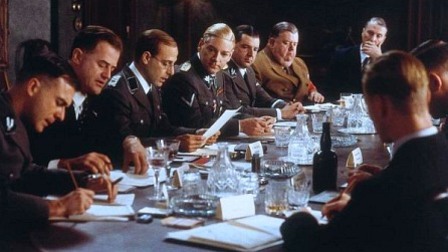
Wansee: Implementing the Final Solution

conspiracy

Friends of Padre Steve’s World,

Primo Levi wrote, “Monsters exist, but they are too few in number to be truly dangerous. More dangerous are the common men, the functionaries ready to believe and to act without asking questions.” 

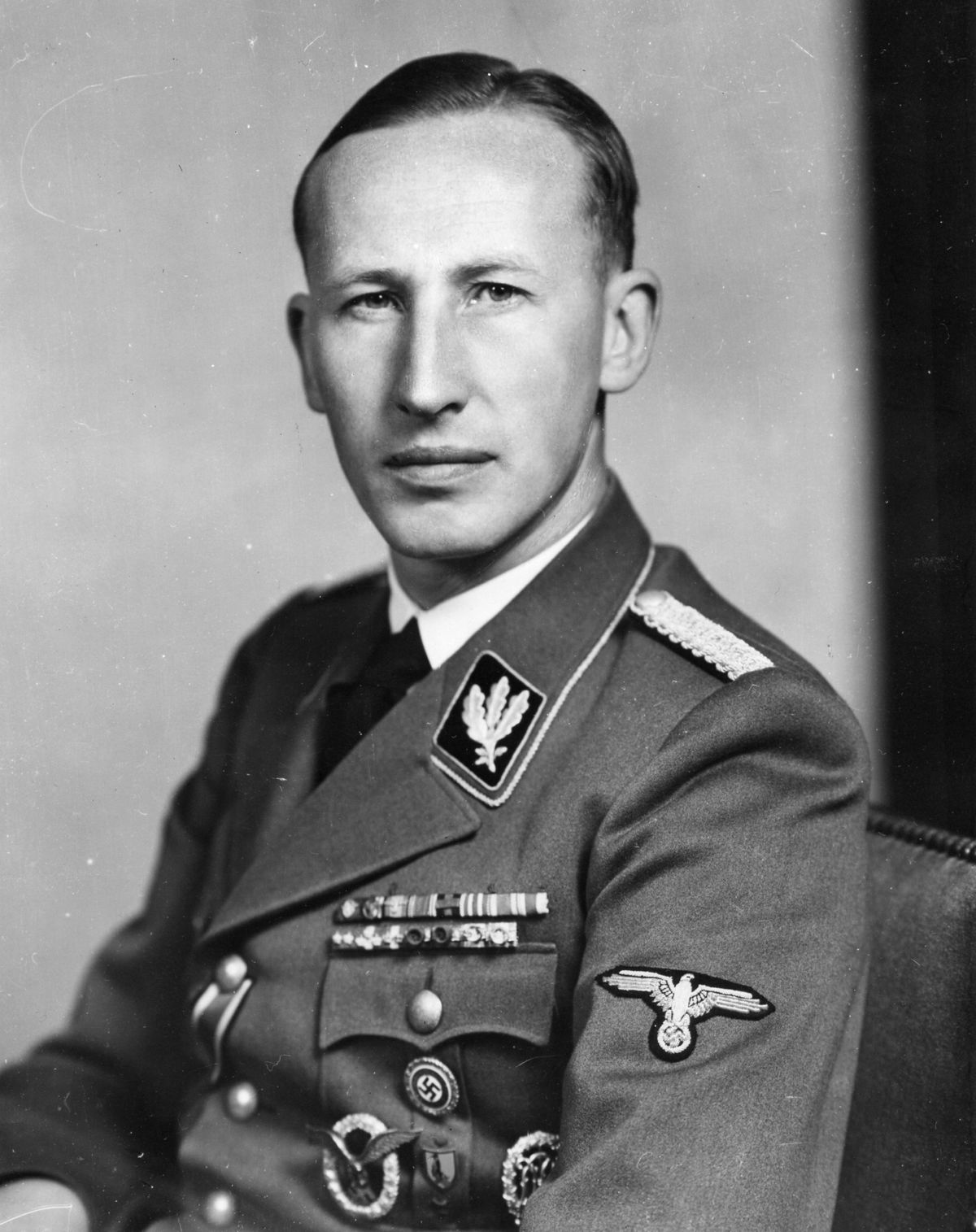
Seventy-four years ago today a group of 15 relatively common men of various German government, police, and party agencies sat around a table and discussed the implementation of what is called the Final Solution. The meeting was chaired by SS Lieutenant General Reinhard Heydrich, who had been charged with the task of solving Germany’s “Jewish Problem” shortly after the German invasion of the Soviet Union. Hermann Goering, the number two man in the Nazi Reich sent Heydrich the following message:

Berlin, July 31st 1941

To: Gruppenfuhrer Heydrich

Supplementing the task assigned to you by the decree of January 24th 1939, to solve the Jewish problem by means of evacuation and emigration in the best possible way by according to present conditions, I hereby charge you to carry out preparations as regards organizational, financial, and material matters for a total solution (Gesamtlosung) of the Jewish question in all the territories of Europe under German occupation.

Where the competency of other organizations touches on this matter, the organizations are to collaborate. 

I charge you further to submit to me as soon as possible a general plan of the administrative material and financial measures necessary for the carrying out the desired final solution (Endlosung) of the Jewish question.”

Goering

1200x-1

Heydrich

When Goering wrote Heydrich, the head of the Reichssiecherhiethauptampt (RSHA) or Reich Security Main Office, in July 1941 it seemed that Nazi victory in Europe was all but assured. Goering’s words were businesslike. Early measures taken by Heydrich to rid Germany and annexed Austria had been reasonably successful to rid those areas of their Jews through emigration and evacuation. These were not benign measures, people were forced to leave their homes, businesses, communities, and had most of their belongings taken from them in order to leave the Reich. However with the occupation of most of Europe following the Nazi military success and the looming occupation and subjugation of the Soviet Union the process of giving the Jews a chance to emigrate to lands outside Nazi control had come to an end. In fact the Nazis occupied the countries that may Jews had found refuge.

Less than six months after he received the directive from Goering, on January 20th 1942 Heydrich summoned representatives from various Reich agencies were called for what turned out to be a brief, two hour meeting which decided the fate of the Jews. The meeting was held at an estate located in the suburbs of Berlin, called Wansee. Organized by Heydrich’s deputy Adolph Eichmann, involved Heydrich, Eichmann and 13 mid level representatives from various economic, governmental, justice and police entities.

At the conference Heydrich established his authority through Goering’s directive to overcome the bureaucratic and personal attempts of various attendees to take control of the Final Solution process. Despite objections from some attendees who favored sterilization and the use of Jews in the war armaments industries, Heydrich made it clear that the Final Solution would be a campaign of extermination. He was quite clear:

“Approximately 11 million Jews will be involved…in large single sex labor columns, Jews fit to work will work their way eastward constructing roads. Doubtless the large majority will be eliminated through natural causes. Any final remnant that survives will doubtlessly consist of the most resistant elements. They will have to be dealt with appropriately, because otherwise by natural selection, they would form the germ cell of a new Jewish revival.”

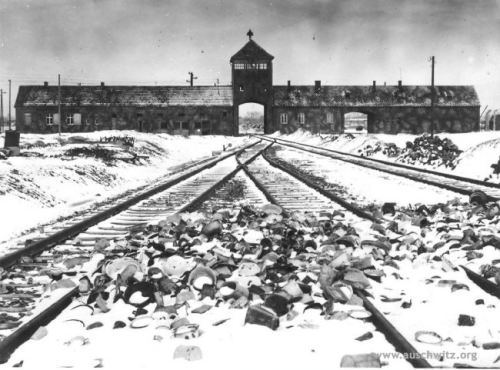
brama_birkenau-2

The Nazi leadership decided that its race war against the Jews needed to forge ahead. Within days of Wansee the orders went out and SS commanders at various concentration camps began devising more efficient means to exterminate Jews and other “sub-humans.” It was a matter of pride and efficiency for them. As Rudolph Hoess the Commandant of Auschwitz said at Nuremberg “the camp commandant at Treblinka told me that he had liquidated 80,000 in the course of one half year. He was principally concerned with liquidating all the Jews from the Warsaw Ghetto. He used monoxide gas, and I did not think that his methods were very efficient. So when I set up the extermination building at Auschwitz, I used Zyclon B….” Hoess estimated that some 2.5 million people were exterminated at Auschwitz at rates as high as 10,000 a day.

einsatzgruppen-nazi-death-squads-ww2-german-brutal-002_thumb

Einsatzgruppen in Action

In the Soviet Union four Einsatzgruppen followed each of the German Army Groups and systematically began to massacre the Jews of every city and village which German soldiers captured. The Einsatzgruppen, Ordungspolizei battalions, Army Security Divisions and locally recruited units in fewer than six months, killed over a million and a half Soviet Jews, and the slaughter would continue unabated until the dying days of the Reich.

Heinrich Himmler, Heydrich’s friend and superior told a gathering of senior SS leaders:

“I also want to mention a very difficult subject before you here, completely openly. It should be discussed among us, and yet, nevertheless, we will never speak about it in public…I am talking about the “Jewish evacuation” the extermination of the Jewish people.” 

It is One of the things that is easily said. “The Jewish people is being exterminated,” every Party member will tell you, “perfectly clear, it’s part of our plans, we’re eliminating the Jews, exterminating them, ha!, a small matter.” 

But then along they all come, all the decent upright Germans and each has his decent Jew. They all say: the others are all swine, but here is a first class Jew. And none of them has seen it, has endured it. Most of you will know what it means when 100 bodies lie together, or when there are 500 or 1000. And to have seen this through, and –with the exception of human weaknesses– to have remained decent, has made us hard and is a page of glory never mentioned and never to be mentioned….”

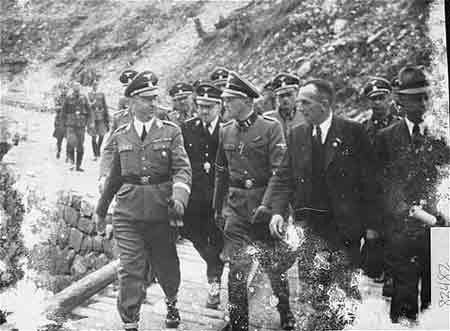
himmlervisit

Himmler and his entourage 

Whether the words are those of Goering, Heydrich, Hoess or Himmler, there is a certain businesslike banality to them. But these men, and many others like them orchestrated a campaign of genocide and race hatred unmatched in history. Yes, there have been other genocides, the Turks killing the Armenians during the First World War and the Hutu and Tutsi slaughter in Rwanda but neither they or the politically motivated campaigns of mass slaughter conducted by the Soviets, the Chinese Communists and the Khamer Rouge killing fields can match the systematized extermination campaign waged by the Nazis against the Jews.

The truly terrifying thing about the Nazi perpetrators of the Holocaust to me is that most of the men at Wansee, men that commanded the Concentration camps and the Einsatzgruppen were very ordinary men who simply believed that they were doing their jobs. Very few could be described as psychopathic killers by nature. They were lawyers, doctors, career police officials, businessmen, and bureaucrats who carried out an extermination campaign that killed by their own numbers between 5.5 and 6 million Jews, not to mention others deemed to be subhuman including the handicapped, the mentally ill, homosexuals, and other non-Jewish minorities like the Gypsies not to mention the wide variety of those considered political enemies. But it was the Jews that bore the most tragic fate.

arbeitmachtfrei

It is something that we must never forget.

Peace

Padre Steve+

Leave a comment

Filed under History, holocaust, world war two in europe

Jackie Robinson & the 1964 GOP Convention: Power, Politics & Racism

republican-national-convention-delegates_1964

Friends of Padre Steve’s World

As I watch the antics of Donald Trump and his campaign, especially when I see people of color being thrown out of campaign rallies, and sometimes physically and verbally abused in the process my mind goes back to the 1964 Republican Convention. That was fifty-two years ago, and it was frighteningly similar to some of the things happening today.

The convention took place on the heels of the passage of the Voting Rights Act of 1964 and during the Freedom Summer. Dr. Martin Luther King Jr. had given his I Have a Dream Speech a year before; it seemed that in much of the land that Abraham Lincoln’s New Birth of Freedom was actually becoming a reality. But somehow instead of welcoming that progress, the GOP rejected the tenants of Lincoln, rejected the efforts of Grant, and turned its back on the men who had given their lives to end slavery, and bring about emancipation and equality for African Americans.

$(KGrHqF,!qEF!GdOTlS(BQOjfQWE0w~~60_57

The delegates of the convention rejected their leaders who had supported the Voting Rights Act and turned to the dark world overt, and covert neo-Confederate racism and turned to conservative Senator Barry Goldwater as their standard bearer. They courted the support of Southern Democrats who opposed voting rights and civil rights for Blacks and that “Southern strategy” would be fully implemented by the 1972 Nixon Campaign and is the regional bedrock of the GOP today. The delegates voted down a provision in the party platform that pledged support for the Voting Rights act and full civil rights for blacks. Commenting on the Freedom Summer and the civil rights movement, a Republican aide at the 1964 convention told a reporter, “the nigger issue was sure to put Goldwater in the White House.”

One of the delegates at the convention was baseball legend and civil rights pioneer Jackie Robinson. Robinson had retired from the game a few years before and was a supporter of the progressive, New York Governor, Nelson Rockefeller who was battling Goldwater for the nomination. Robinson had been a Republican for many years and he had given up his job as a spokesman for and Vice President of the Chock Full O’Nuts Coffee Company to assist Rockefeller’s campaign in 1964.

Robinson knew what it was like to be the “point man” in the integration of baseball and in his career was threatened with physical violence and death on many occasions. Some teammates circulated petitions that they would not play for a team that had a “black” on it. Robinson, encouraged by Rickey persevered and became an icon in baseball, the Civil Rights movement and the history of the United States. However, not even 10 years after his retirement from baseball and 2 years after he was elected to the Hall of Fame he once again discovered just how deep racism still ran in this country.  As he attended the convention FBI agents and other Federal authorities attempted to find the bodies of three young voting rights staff that were part of the 1964 Freedom Summer campaign in Mississippi. Eventually, later in the summer the bodies of James Chaney, Andrew Goodman and Michael Schwerner would be discovered buried in the base of a dam near Philadelphia Mississippi. Their killers were local law enforcement officers and members of the Ku Klux Klan.

Robinson wrote of his experience at the 1964 Convention:

“I wasn’t altogether caught of guard by the victory of the reactionary forces in the Republican party, but I was appalled by the tactics they used to stifle their liberal opposition.  I was a special delegate to the convention through an arrangement made by the Rockefeller office. That convention was one of the most unforgettable and frightening experiences of my life. The hatred I saw was unique to me because it was hatred directed against a white man.  It embodied a revulsion for all he stood for, including his enlightened attitude toward black people.

A new breed of Republicans had taken over the GOP.  As I watched this steamroller operation in San Francisco, I had a better understanding of how it must have felt to be a Jew in Hitler’s Germany.

The same high-handed methods had been there.

The same belief in the superiority of one religious or racial group over another was here.  Liberals who fought so hard and so vainly were afraid not only of what would happen to the GOP but of what would happen to America.  The Goldwaterites were afraid – afraid not to hew strictly to the line they had been spoon-fed, afraid to listen to logic and reason if it was not in their script.

I will never forget the fantastic scene of Governor Rockefeller’s ordeal as he endured what must have been three minutes of hysterical abuse and booing which interrupted his fighting statement which the convention managers had managed to delay until the wee hours of the morning.  Since the telecast was coming from the West Coast, that meant that many people in other sections of the country, because of the time differential, would be in their beds.  I don’t think he has ever stood taller than that night when he refused to be silenced until he had had his say. 

It was a terrible hour for the relatively few black delegates who were present.  Distinguished in their communities, identified with the cause of Republicanism, an extremely unpopular cause among blacks, they had been served notice that the party they had fought for considered them just another bunch of “niggers”.  They had no real standing in the convention, no clout.  They were unimportant and ignored.  One bigot from one of the Deep South states actually threw acid on a black delegate’s suit jacket and burned it.  Another one, from the Alabama delegation where I was standing at the time of the Rockefeller speech, turned on me menacingly while I was shouting “C’mon Rocky” as the governor stood his ground.  He started up in his seat as if to come after me.  His wife grabbed his arm and pulled him back.

“Turn him loose, lady, turn him loose,” I shouted.

 I was ready for him.  I wanted him badly, but luckily for him he obeyed his wife…” (From Jackie Robinson “I Never Had it Made” Chapter XV On Being Black Among the Republicans)

http://www.c-span.org/video/?c3807346/governor-nelson-rockefeller-addresses-64-convention

During his speech to insert pro-civil rights language into the party platform, which was interrupted many times by Goldwater supporters, Rockefeller spoke words that were eerily prophetic:

“The Republican party is in real danger of subversion by a radical, well-financed and highly disciplined minority.” At that time I pointed out that the purpose of this minority were “wholly alien to the sound and honest conservatism that has firmly based the Republican party in the best of a century’s traditions, wholly alien to the sound and honest Republican liberalism that has kept the party abreast of human needs in a changing world, wholly alien to the broad middle course that accommodates the mainstream of Republican principles.” (The full text is here: http://www.rockarch.org/inownwords/nar1964text.php )

Pioneering African American journalist and news anchor Belva Davis, who then a young journalist wrote of her experiences at that convention:

While the Goldwater organization tried to keep its delegates in check on the floor, snarling Goldwater fans in the galleries around us were off the leash. The mood turned unmistakably menacing…

Suddenly Louis and I heard a voice yell, “Hey, look at those two up there!” The accuser pointed us out, and several spectators swarmed beneath us. “Hey niggers!” they yelled. “What the hell are you niggers doing in here?’”

I could feel the hair rising on the back of my neck as I looked into faces turned scarlet and sweaty by heat and hostility. Louis, in suit and tie and perpetually dignified, turned to me and said with all the nonchalance he could muster, “Well, I think that’s enough for today.” Methodically we began wrapping up our equipment into suitcases.

As we began our descent down the ramps of the Cow Palace, a self-appointed posse dangled over the railings, taunting. “Niggers!” “Get out of here, boy!” “You too, nigger bitch!” “Go on, get out!” “I’m gonna kill your ass!”

I stared straight ahead, putting one foot in front of the other like a soldier who would not be deterred from a mission. The throng began tossing garbage at us: wadded up convention programs, mustard-soaked hot dogs, half-eaten Snickers bars. My goal was to appear deceptively serene, mastering the mask of dispassion I had perfected since childhood to steel myself against any insults the outside world hurled my way.

Then a glass soda bottle whizzed within inches of my skull. I heard it whack against the concrete and shatter. I didn’t look back, but I glanced sideways at Louis and felt my lower lip began to quiver. He was determined we would give our tormentors no satisfaction.

“If you start to cry,” he muttered, “I’ll break your leg.” (Belva Davis “Never in My Wildest Dreams: A Black Woman’s Life in Journalism) 

The sad thing is that in many states the new GOP has taken a page out of the past and has been either passing legislation or attempting to pass legislation that makes it harder for Blacks and other minorities to vote. Groups have shown up armed at heavily black polling sites in recent elections and efforts have been made to ensure that minorities cannot vote. They have also challenged the 1964 Voter’s Rights Act in Court and have a friend in Justice Antonine Scalia who called the act a “racial entitlement” and violation of State sovereignty.

The tactics used are quite similar to those used in the Deep South prior to 1964 that made it virtually impossible for a Black man or woman to cast a vote, and if they tried even to register to vote did so at the peril of their lives or families. The opponents of integration, voter’s rights, and equal rights used of the same lines currently used today against those that support these rights. Support civil rights for unpopular groups and you are labeled as a Communists sympathizer, Socialist, Atheist, or that you are Anti-Christian, Anti-American, Anti-Constitution. The sad thing is that many of the most vicious users of such untruths are supposedly conservative “Christian” politicians, pundits, and preachers.

I don’t think that Jackie Robinson would be surprised, now some 52 years later that racial attitudes in much of America have changed so little.

These are hard things to look at and it is far easier to believe myth than it is to actually seek truth. A few years back I cannot every in a million years having written this article. However the threats to minorities be they racial, religious or even gender have become part an parcel of the new GOP, the GOP that I could not remain a part of when I returned from Iraq.

I guess that I am becoming a Civil Rights advocate, or then, maybe it’s that I’m actually becoming more of a Christian. Branch Rickey said “I may not be able to do something about racism in every field, but I can sure do something about it in baseball.”  I may not be able to do something about racism and other prejudice everywhere but I can do it here and wherever I work or preach.

For me it doesn’t really doesn’t matter so long as I can live with myself. I would rather be in the same camp as people like Jackie Robinson, Branch Rickey, and Nelson Rockefeller, than Trump, Scalia or the others that seek to keep people down simply because of their ethnicity, race, religion, or sexual orientation. I have an obligation to speak out for the rights of African Americans as well as every American whose rights are being threatened. As Martin Niemoller said:

First they came for the communists and I didn’t speak out because I wasn’t a communist. Then they came for the socialists, and I didn’t speak out because I wasn’t a socialist. Then they came for the trade unionists, and I didn’t speak out because I wasn’t a trade unionist. Then they came for me, and there was no one left to speak for me.

Peace

Padre Steve+

1 Comment

Filed under civil rights, History, News and current events, Political Commentary

The Dream: Remembering Dr. Martin Luther King Jr.

index

Friends of Padre Steve’s World,

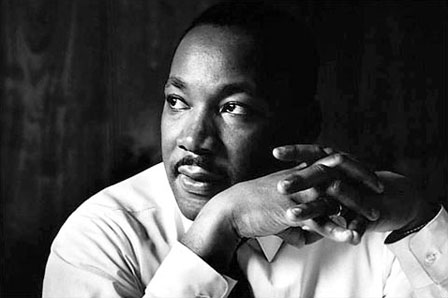
Dr. Martin Luther King Jr. has always been one of my heroes. This time of year I always ponder the importance of his life and work for civil rights, and I wonder what might have been had this man of peace not been cut down in cold blood at the young age of 39 by James Earl Ray on April 4th 1968. He was an amazing and courageous man whose memory should not be let to one day a year. We have to ensure, though our words and actions that it is not allowed to die.

King was a man of courage, a man of honor, a man of conviction. But he came of age in a time when many people were willing to maintain the status quo and play things safe, like many clergy, even African-American clergy. Many pastors of the era, remained quiet about the conditions of segregation, and the racism of the day. Their lack of action did not mean they were bad people, they just understood that if they spoke up, their lives, and the lives of their families and congregations could be in danger. As such many pastors just hoped to see things slowly improve, without rocking the boat, and without endangering themselves or their families. They had seen what happened to blacks who spoke up or confronted the evil, lynching’s, cross burnings, threats and murder. They had contented themselves with just trying to get along. At the beginning of the movement, many pastors did not support or gave only lukewarm support to Dr. King, Andrew Young, Fred Shuttlesworth, and Ralph Abernathy going into that critical year of 1963.

lossless-page1-560px-Rosa_Parks_(detail).tiff

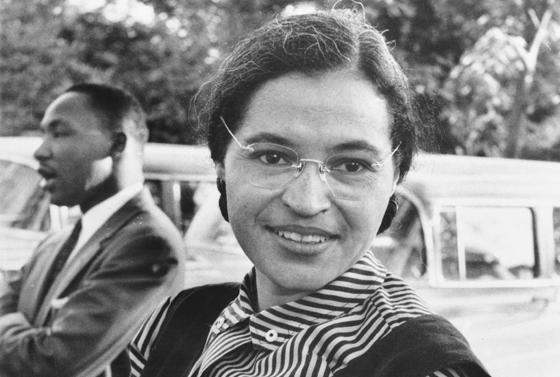
King did not start out to become a Civil Rights leader. However, he was inspired to actively join the movement through the example of Rosa Parks, who defiance of the law for blacks to sit “in the back of the bus” in 1955. He led the Montgomery Bus Boycott which lasted for 385 days. The reaction among segregationists to King and his protest was against violent. King’s house was bombed, and his life threatened. But he refused to stand down.

King’s leadership of the boycott brought the young pastor to national prominence. However, by 1963 much of the Civil Rights movement and the African American community was despairing of the lack of progress. Many people had become disenchanted with King, not considering him bold enough despite his rhetorical abilities.

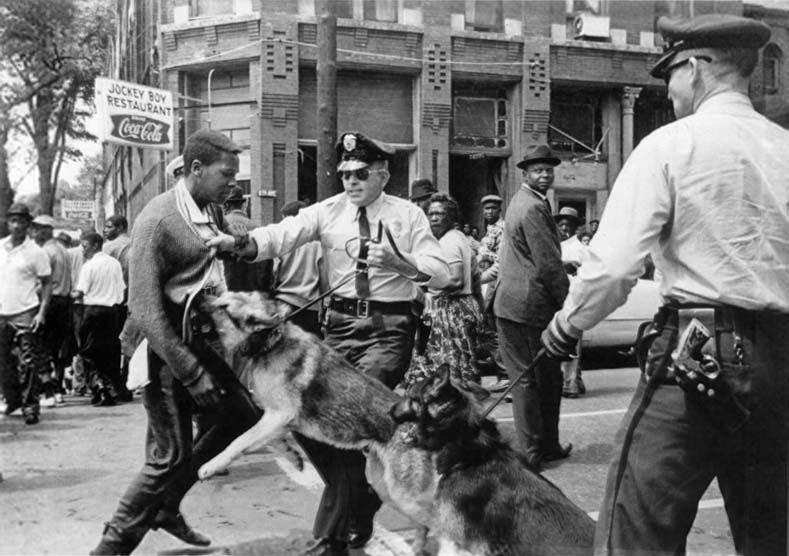
But in April 1963, working with other Civil Rights leaders in Birmingham Alabama King relit the fires of the movement. Montgomery Police Chief “Bull” Conner used his police force to violently attack the demonstrators. Conner ordered his men to unleash their police dogs on the protestors, and used high pressure water cannon against them, including women, children and the elderly. The violent reaction to the protests shocked much of America and the world.

King was arrested and in the Birmingham jail composed one of his most famous works, the Letter from the Birmingham Jail.  The letter was a social, political and theological masterpiece. It was some of his harshest criticism was of white liberals, as well as black moderates:

“I have almost reached the regrettable conclusion that the Negro’s great stumbling block in his stride toward freedom is not the White Citizen’s Councilor or the Ku Klux Klanner, but the white moderate, who is more devoted to “order” than to justice; who prefers a negative peace which is the absence of tension to a positive peace which is the presence of justice; who constantly says: “I agree with you in the goal you seek, but I cannot agree with your methods of direct action”; who paternalistically believes he can set the timetable for another man’s freedom; who lives by a mythical concept of time and who constantly advises the Negro to wait for a “more convenient season”

King continued his activism until his assassination. In August 1963 he led the March on Washington for Jobs and Freedom, where before a crowd of an estimated 200,000-300,000 he gave his I Have a Dream Speech.

http://www.americanrhetoric.com/speeches/mlkihaveadream.htm

The crescendo of the speech was remarkable and is perhaps one of the most remembered speeches in American history.

Let us not wallow in the valley of despair, I say to you today, my friends.

And so even though we face the difficulties of today and tomorrow, I still have a dream. It is a dream deeply rooted in the American dream.

I have a dream that one day this nation will rise up and live out the true meaning of its creed: “We hold these truths to be self-evident, that all men are created equal.”

I have a dream that one day on the red hills of Georgia, the sons of former slaves and the sons of former slave owners will be able to sit down together at the table of brotherhood.

I have a dream that one day even the state of Mississippi, a state sweltering with the heat of injustice, sweltering with the heat of oppression, will be transformed into an oasis of freedom and justice.

I have a dream that my four little children will one day live in a nation where they will not be judged by the color of their skin but by the content of their character.

I have a dream today!

I have a dream that one day, down in Alabama, with its vicious racists, with its governor having his lips dripping with the words of “interposition” and “nullification” — one day right there in Alabama little black boys and black girls will be able to join hands with little white boys and white girls as sisters and brothers.

I have a dream today!

I have a dream that one day every valley shall be exalted, and every hill and mountain shall be made low, the rough places will be made plain, and the crooked places will be made straight; “and the glory of the Lord shall be revealed and all flesh shall see it together.”2

This is our hope, and this is the faith that I go back to the South with.

With this faith, we will be able to hew out of the mountain of despair a stone of hope. With this faith, we will be able to transform the jangling discords of our nation into a beautiful symphony of brotherhood. With this faith, we will be able to work together, to pray together, to struggle together, to go to jail together, to stand up for freedom together, knowing that we will be free one day.

And this will be the day — this will be the day when all of God’s children will be able to sing with new meaning:

My country ’tis of thee, sweet land of liberty, of thee I sing.

Land where my fathers died, land of the Pilgrim’s pride,

From every mountainside, let freedom ring!

And if America is to be a great nation, this must become true.

And so let freedom ring from the prodigious hilltops of New Hampshire.

Let freedom ring from the mighty mountains of New York.

Let freedom ring from the heightening Alleghenies of Pennsylvania.

Let freedom ring from the snow-capped Rockies of Colorado.

Let freedom ring from the curvaceous slopes of California.

But not only that:

Let freedom ring from Stone Mountain of Georgia.

Let freedom ring from Lookout Mountain of Tennessee.

Let freedom ring from every hill and molehill of Mississippi.

From every mountainside, let freedom ring.

And when this happens, and when we allow freedom ring, when we let it ring from every village and every hamlet, from every state and every city, we will be able to speed up that day when all of God’s children, black men and white men, Jews and Gentiles, Protestants and Catholics, will be able to join hands and sing in the words of the old Negro spiritual:

                Free at last! Free at last!

                Thank God Almighty, we are free at last!

King knew the dangers and the risks of appealing to a strategy of non-violence based on love of his enemies. King spoke to the world when he accepted the Nobel Peace Prize in 1964:

“Here and there an individual or group dares to love, and rises to the majestic heights of moral maturity. So in a real sense this is a great time to be alive. Therefore, I am not yet discouraged about the future. Granted that the easygoing optimism of yesterday is impossible. Granted that those who pioneer in the struggle for peace and freedom will still face uncomfortable jail terms, painful threats of death; they will still be battered by the storms of persecution, leading them to the nagging feeling that they can no longer bear such a heavy burden, and the temptation of wanting to retreat to a more quiet and serene life. Granted that we face a world crisis which leaves us standing so often amid the surging murmur of life’s restless sea. But every crisis has both its dangers and its opportunities. It can spell either salvation or doom. In a dark confused world the kingdom of God may yet reign in the hearts of men.”  http://www.nobelprize.org/nobel_prizes/peace/laureates/1964/king-lecture.html 

Dr. King understood how easy hatred could consume people and movements and urged  people not to follow the course of hate, he wrote:

“Returning hate for hate multiplies hate, adding deeper darkness to a night already devoid of stars. Darkness cannot drive out darkness; only light can do that. Hate cannot drive out hate; only love can do that. Hate multiplies hate, violence multiplies violence, and toughness multiplies toughness in a descending spiral of destruction.”

https://www.youtube.com/watch?v=IDl84vusXos

The day before his assassination in Memphis, Dr. King still recognized what he might face. His “I have been to the Mountaintop” speech http://www.americanrhetoric.com/speeches/mlkivebeentothemountaintop.htm recounted many of the things that he had encountered, including an assassination attempt in 1958 which had come close to killing him. It was an amazing speech and one wonders if having lived under threat so long that he almost had a premonition of his death the next day.

And then I got into Memphis. And some began to say the threats, or talk about the threats that were out. What would happen to me from some of our sick white brothers?

Well, I don’t know what will happen now. We’ve got some difficult days ahead. But it really doesn’t matter with me now, because I’ve been to the mountaintop.

And I don’t mind.

Like anybody, I would like to live a long life. Longevity has its place. But I’m not concerned about that now. I just want to do God’s will. And He’s allowed me to go up to the mountain. And I’ve looked over. And I’ve seen the Promised Land. I may not get there with you. But I want you to know tonight, that we, as a people, will get to the promised land!

Dr. King’s dream is not dead and we who live today cannot allow it to die. There is still much work to see justice done for all Americans as well as those suffering from violence, persecution, discrimination and poverty around the world.

It is 2016. It has been 53 years since Dr. King sat in the Birmingham jail. Sadly, there are some who long for a return to the day of Jim Crow. In some states there have been and there are ongoing attempts to return it by stealth, especially through restrictions on voting that predominantly impact African Americans and the poor. Racism is not dead, nor are so many other “isms.” As Dr. King told us, “Now is the time to make real the promises of democracy,” and “It would be fatal for the nation to overlook the urgency of the moment.”

Dr. King and many of the leaders of the Civil Rights Movement have passed on. Likewise, many people today are complacent about the injustices present in our society, injustices experienced by many people. We need a generation of new men and women with hearts like Dr. King’s, who will be the conscience of the nation and confront these injustices.

Birmingham_campaign_dogs

Representative John Lewis, one of the original Freedom Riders was beaten numerous times during those protests. When leading the march across the Pettus Bridge in Selma, Lewis had his skull fractured by a State Trooper when he stopped to pray.  Lewis’s words call us to action today:

“If not us, then who? If not now, then when?” 

We cannot let Dr. King’s dream die.

Peace

Padre Steve+

Leave a comment

Filed under civil rights, laws and legislation, Political Commentary

The Buffalo Soldier & the Red Tail Benjamin O. Davis Senior and Junior

495px-Benjamin_o_davis

Friends of Padre Steve’s World,

As we observe the life of Dr. Martin Luther King Jr. we have to remember that American History would not be the same without his life, work and prophetic ministry, we also remember the pioneers who came before him.

Dr. King was born in a time when most of the country was segregated when “separate by equal” was simply façade to cover the lie that in no way did African Americans have equal rights or privileges in the United States.

Dr. King was born less than 60 years after the secession of the Southern states from the Union and the beginning of the American Civil War. Though that blood conflict had freed the slaves it had not freed African Americans from prejudice, violence and discrimination.  When Dr. King began his ministry and was thrust upon the national stage as the strongest voice for equal rights and protections for blacks the discrimination and violence directed towards blacks was a very real and present reality in much of the United States.

However there were cracks beginning to appear in the great wall of segregation in the years preceding Dr. King’s ascent to leadership as the moral voice of the country in the matter of racial equality. In baseball Jackie Robinson became the first African American player in Major League Baseball opening a door for others who would become legends of the game as well as help white America begin its slow acceptance of blacks in sports and the workplace.

Likewise the contributions of a father and son Brigadier General Benjamin O. Davis Sr. and General Benjamin O. Davis Jr. advanced the cause of blacks in the military, which eventually led to the desegregation of the military in 1948.  The impact of these two men cannot be underestimated for they were trailblazers who by their lives, professionalism and character blazed a trail for African Americans in the military as well as society.

benjaminodavisjr02

Benjamin O. Davis Sr. was a student at Howard University when the USS Maine exploded and sank in Havana Harbor.  He volunteered for service and was commissioned as a temporary 1st Lieutenant in the 8th United States Volunteer Infantry. He was mustered out of service in 1899 but enlisted as a private in the 9th United States Cavalry one of the original Buffalo Soldiers regiments.  He enlisted as the unit clerk of I troop of 3rd Squadron and was promoted to be the squadron Sergeant Major.

Davis was commissioned while the unit was deployed to the Philippines and assigned to the 10th Cavalry.  He was assigned in various positions throughout his career including command, staff and instruction duties including as Professor of Military Science and Tactics in various ROTC programs.  He reached the rank of rank of temporary Lieutenant Colonel and Squadron Commander of 3rd and later 1st Squadron 9th Cavalry from 1917-1920 in the Philippines before reverting to the rank of Captain on his return as part of the post-World War I reduction in force.

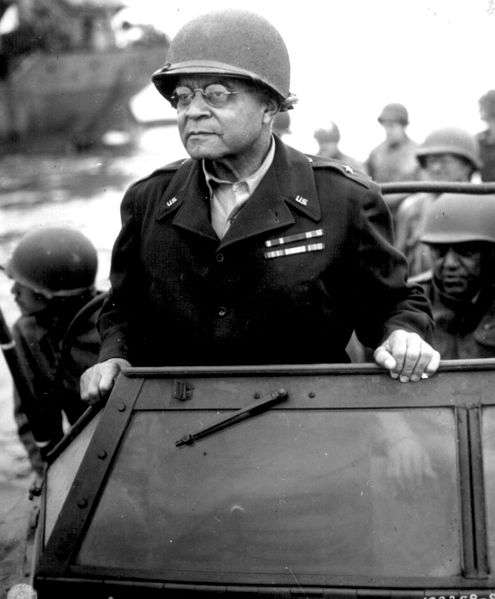
Davis continued to serve during the inter-war years and assumed command of the 369th Infantry Regiment New York National Guard in 1938. He was promoted to Brigadier General on 25 October 1940 becoming the first African American elevated to that rank in the United States Army and was assigned as Commander 4th Brigade 2nd Cavalry Division. He later served in various staff positions at the War Department and in France and was instrumental in the integration of the U.S. Military. He retired after 50 years’ service in 1948 in a public ceremony with President Harry S. Truman presiding. He was a member of the American Battle Monuments Commission from 1953-1961 and died in 1970.

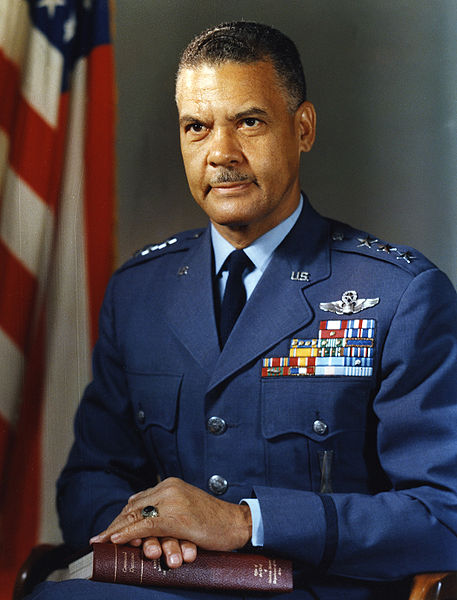
His son Benjamin O. Davis Jr. was appointed to West Point in 1932.  He graduated and was commissioned in 1936 graduating 35 out of 278, the fourth African American graduate of West Point. During his time at the Academy most of his classmates shunned him and he never had a roommate.  Despite this he maintained a dogged determination to succeed.  The Academy yearbook made this comment about him:

“The courage, tenacity, and intelligence with which he conquered a problem incomparably more difficult than plebe year won for him the sincere admiration of his classmates, and his single-minded determination to continue in his chosen career cannot fail to inspire respect wherever fortune may lead him.”

He was denied entrance to the Army Air Corps because of his race and assigned to the Infantry first to the all lack 24th Infantry Regiment at Ft Benning where he was not allowed in the Officers Club due to his race. Upon his commissioning the Regular Army had just 2 African American Line Officers, 2nd Lieutenant Davis and his father Colonel Davis.

After completion of Infantry School he was assigned as an instructor of Military Science and Tactics and the Tuskegee Institute.  In 1941 the Roosevelt Administration moved to create a black flying unit and Captain Davis was assigned to the first black class at the Tuskegee Army Air Field and in March 1942 one his wings as one of the first 5 African Americans to complete flight training.

In July 1942 he was assigned as Commanding Officer of the 99th Pursuit Squadron which served in North Africa and Sicily flying Curtiss P-40 Warhawks. He was recalled to the United States in September 1943 to command the 332nd Fighter Group. However some senior officers attempted to prevent other black squadrons from serving in combat alleging that the 99th had performed poorly in combat. Davis defended his squadron and General George Marshall ordered an inquiry which showed that the 99th was comparable to white squadrons in combat and during a 2 day period over the Anzio beachhead the pilots of the 99th shot down 12 German aircraft.

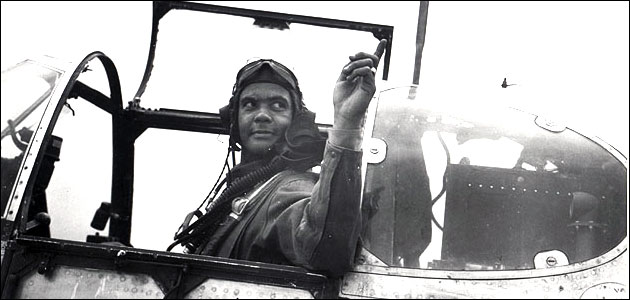
Davis took the 332nd to Italy where they transitioned to P-47 Thunderbolts and in July 1944 to the P-51 Mustang which were marked with a signature red tail. During the war, the units commanded by Davis flew more than 15,000 sorties, shot down 111 enemy planes, and destroyed or damaged 273 on the ground at a cost of 66 of their own planes.

Their record against the Luftwaffe was outstanding and their protection of the bombers that they escorted was superb with very few bombers lost while escorted by them men that the Luftwaffe nicknamed the Schwarze Vogelmenschen and the Allies the Red-Tailed Angels or simply the Redtails. Davis led his Tuskegee Airmen to glory in the war and their performance in combat helped break the color barrier in the U.S. Military which was ended in 1948 when President Truman signed an executive order to end the segregation of the military. Colonel Davis helped draft the Air Force plan and the Air Force was the first of the services to fully desegregate.

Colonel Davis transitioned to jets and let the 51st Fighter Interceptor Wing against Chinese Communist MIGs in the Korean War.  He was promoted to Brigadier General in 1954 and served in numerous command and staff positions. He retired in 1970 with the rank of Lieutenant General and was advanced to General while retired by President Clinton in 1998.  He died in 2002 at the age of 89.

ltgen Benjamindavis

The legacy of Benjamin O. Davis Senior and Benjamin O. Davis Junior is a testament to their character, courage and devotion to the United States of America. They helped pioneer the way for officers such as General Colin Powell and helped change this country for the better.  During times when discrimination was legal they overcame obstacles that would have challenged lesser men.  Benjamin O. Davis Junior remarked:

“My own opinion was that blacks could best overcome racist attitudes through achievements, even though those achievements had to take place within the hateful environment of segregation.”

Such men epitomize the selfless service of so many other African Americans who served the country faithfully and “by the content of their character” triumphed over the evil of racism and helped make the United States a more perfect union.

Peace

Padre Steve+

1 Comment

Filed under civil rights, leadership, Military

Birth Pangs of Freedom: Blacks in the U.S. Military

negro-regiment-54th-ma

Friends of Padre Steve’s World,

This is a section of my Civil War and Gettysburg text, and I think it is important in light of our remembrance of the life and work of Dr. Martin Luther King Jr. As Dr. King noted in his I Have a Dream speech, “Five score years ago, a great American, in whose symbolic shadow we stand today, signed the Emancipation Proclamation. This momentous decree came as a great beacon light of hope to millions of Negro slaves who had been seared in the flames of withering injustice. It came as a joyous daybreak to end the long night of their captivity.” That Emancipation Proclamation began a slow and often tedious path towards freedom for African Americans, a path that was often paved with the toil, service, and blood of African Americans who served as Soldiers and Sailors, and later Airmen and Marines, who served even as their relatives and friends suffered under Jim Crow, and violence at home. Their sacrifices and service helped pave the way for Dr. King and the pursuit of civil rights in this country. This is part of their story.

Peace

Padre Steve+

Emancipation and the U.S. Military

The war brought about another change to warfare in America. This was a societal and political change that has shaped American military history, culture and life ever since. The Emancipation Proclamation gave African Americans, both Freedmen and recently freed slaves the opportunity to serve in the Union Army. The change of policy instituted by Lincoln was revolutionary as well as controversial and it had strategic implications for the war effort. There were many doubters in the north whose attitudes towards African Americans were not much different than Southerners, especially among the Copperheads.

Prior to the Emancipation some Union commanders in occupied Confederate territory “had unofficially recruited black soldiers in Kansas and in occupied portions of South Carolina and Louisiana in 1862. But the administration had not sanctioned these activities.” [1] The issue for Lincoln in 1861 and 1862 was the necessity of keeping the Border-Slave Sates of Kentucky, Missouri and Maryland, which had not seceded from the Union. Lincoln repudiated the orders of General John Fremont, in Missouri, and his friend General David Hunter, who commanded the Department of the South regarding emancipation, not because he was in complete disagreement, but because he felt that the officers had overstepped their authority.

Lincoln understood that this might hurt him with the abolitionist wing of the Republican Party. While Lincoln was certainly sympathetic to their cause, he insisted that such decisions were not within the prevue of local commanders, but that any such proclamations had to come from him, as Commander-in-Chief. He told Treasure Secretary Salmon Chase, who supported the measures of Hunter and Fremont, “No commanding general shall do such a thing, upon my responsibility, without consulting me.” [2] Lincoln’s decision to reverse and repudiate the decisions of local commanders infuriated some in his cabinet and in the Congress. But Lincoln remained firm in that conviction due to the need to ensure the cooperation of the Border States the continued loyalty of which were absolutely vital to winning the war, without which no meaningful emancipation would be possible.

However, Lincoln did support the efforts of General Benjamin Butler. Butler commanded the Federal forces at Fort Monroe in Hampton Roads. Butler had been a former pro-slavery Democrat who learned that the Confederates were using slaves to construct fortifications and to support their army on the Peninsula. In May 1862 twenty-three slaves escaped to his lines and their owner, a Confederate Colonel, “demanded the return of his property under the Fugitive Slave Law! With as deadpan expression as possible (given his cocked eye), Butler informed him that since Virginia claimed to have left the Union, the Fugitive Slave Law no longer applied.” [3] Butler then declared that since the escaped slaves had worked for the Confederate Army that they were “contraband of war – enemy property subject to seizure.” [4] It was a solid argument, since Southerners themselves referred to African American slaves as property was subject to seizure. Lincoln and Secretary of War Cameron approved of Butler’s action and “eventually, the Congress passed a confiscation law ending the rights of masters over fugitive slaves used to support Confederate troops.” [5]

Salmon Chase and other strong abolitionists opposed Lincoln vehemently for this, but it would not be long until Lincoln made the decision for emancipation. This was first accomplished by the Emancipation Proclamation, a military order that only applied to the states that had seceded. However, Lincoln would follow this by pushing for a constitutional amendment to end slavery. The latter occurred when Congress passed the Thirteenth Amendment was passed in January 1865. This amendment abolished slavery in the United States.

Lincoln had already decided upon emancipation in the spring of 1862, however, following the defeat of McClellan on the Peninsula he decided to postpone announcing it, Secretary of State Seward recommended against it until “until you can give it to the country supported by military success.” Otherwise the world might view it as an incitement for slave insurrections, “as the last measure of an exhausted government, a cry for help…our last shriek, on the retreat.” [6] The wisdom of Seward’s advice was profound, and Lincoln put off the announcement until after the Battle of Antietam.

McClellan, true to form opposed any such policy. When Lincoln visited him after his withdraw from the Peninsula, the defeated but still arrogant General handed Lincoln a memorandum on what McClellan viewed as the “proper conduct of the war.” McClellan advised Lincoln that the war “should not be a war looking to the subjugation of any State in any event…but against armed forces and political organizations. Neither confiscation of property, political executions of persons, the territorial organization of States, or the forcible abolition of slavery should be contemplated for a moment.” [7]

Lincoln was not seeking advice from his recalcitrant commander and put the letter in his pocket and simply told McClellan, “All right.” Interestingly enough just a few months earlier Lincoln would have agreed with McClellan’s views on the conduct of the war. However, with the passage of time and the realization that the Confederacy was fully committed to its independence as well as the continuance and even the expansion of slavery had come to the view that fighting a limited war with limited aims was foolish. He told another Unionist Democrat a few days after McClellan offered his advice that the war could not be fought:

“with elder-stalk squirts, charged with rose water….This government cannot much longer play a game in which it stakes all, and its enemies stake nothing. Those enemies must understand that they cannot experiment for ten years trying to destroy this government, and if they fail still come back into the Union unhurt.” [8]

But as the war continued on, consuming vast numbers of lives the attitude of Lincoln and his administration began to change. After a year and a half of war, Lincoln and the closest members of his cabinet were beginning to understand that the “North could not win the war without mobilizing all of its resources and striking against Southern resources used to sustain the Confederate war effort.” [9] Slave labor was essential to the Confederate war effort, not only did slaves still work the plantations, they were impressed into service in war industries as well as in the Confederate Army.

Lieutenant Colonel Arthur Freemantle, a British observer who was with Lee’s army at Gettysburg noted, “in the rear of each regiment were from twenty to thirty negro slaves.” [10] The fact is that the slaves who accompanied the army remained slaves, they were not the mythical thousands of black soldiers who rallied to the Confederate cause, nor were they employees. “Tens of thousands of slaves accompanied their owners to army camps as servants or were impressed into service to construct fortifications and do other work for the Confederate army.” [11] This fact attested to by Colonel William Allan, one of Stonewall Jackson’s staff members who wrote “there were no employees in the Confederate army.” [12] slaves served in a number of capacities to free up white soldiers for combat duties, “from driving wagons to unloading trains and other conveyances. In hospitals they could perform work as nurses and laborers to ease the burdens of patients.” [13] An English-born artilleryman in Lee’s army wrote in 1863 that “in our whole army there must be at least thirty thousand colored servants….” [14] When Lee marched to Gettysburg he did so with somewhere between ten and thirty-thousand slaves in support roles and during the advance into Virginia Confederate troops rounded up and re-enslaved as many blacks as they could, including Freedmen.

emancipation

Lincoln’s Secretary of War, Edwin Stanton; who was a passionate believer in the justice of emancipation was on of the first to grasp the importance of slave labor to the Confederate armies and how emancipation was of decided military necessity. Stanton, “Instantly grasped the military value of the proclamation. Having spent more time than any of his colleagues contemplating the logistical problems facing the army, he understood the tremendous advantage to be gained if the massive workforce of slaves could be transferred from the Confederacy to the Union.” [15]

Lincoln emphasized the “military necessity” of emancipation and “justified the step as a “fit and necessary war measure for suppressing the rebellion.” [16] The process of emancipation now became not only a moral crusade, but now became a key part of national strategy, not just in a military means, but politically, economically and diplomatically as Lincoln “also calculated that making slavery a target of the war would counteract the rising clamor in Britain for recognition of the Confederacy.” [17]

Lincoln wrote to his future Vice President, Andrew Johnson, then the military governor of occupied Tennessee that “The colored population is the great available and yet unavailed of, force for restoration of the Union.” [18] The idea of simply mollifying the border states was dropped and policy changed that of “depriving the Confederacy of slave labor. Mobilizing that manpower for the Union- as soldiers as well as laborers- was a natural corollary.” [19] Reflecting President Lincoln’s and Stanton’s argument for the military necessity of emancipation, General Henry Halleck wrote to Ulysses Grant that:

“the character of the war has very much changed within the past year. There is now no possibility of reconciliation with the rebels… We must conquer the rebels or be conquered by them….Every slave withdrawn from the enemy is the equivalent of a white man put hors de combat.” [20]

Grant concurred with the decision. Grant wrote to in a letter to Lincoln after the assault on Battery Wagner “by arming the negro we have added a powerful ally. They will make good soldiers and taking them from the enemy weakens him in the same proportion as it strengthens us.” [21] Lincoln wrote after the Emancipation Proclamation that “the emancipation policy, and the use of colored troops, constitute the heaviest blow yet dealt to the rebellion.” [22] The change was a watershed in both American history as well as the future of the U.S. Military services.

“Once the Lincoln administration broke the color barrier of the army, blacks stepped forward in large numbers. Service in the army offered to blacks the opportunity to strike a decisive blow for freedom….” [23] Emancipation allowed for the formation of regiments of United States Colored Troops (USCT), mustered directly into Federal service, which in numbers soon dwarfed the few state raised Black Regiments. However, it was the inspiration provided by those first state raised regiments, the heroic accounts of those units reported in Northern newspapers, as well as the unprovoked violence directed against Blacks in the 1863 draft riots that helped to provoke “many northerners into a backlash against the consequences of violent racism.” [24]

Despite the hurdles that blacks faced even in the North, Henry Gooding, an black sergeant from Massachusetts wrote the editor of the New Bedford Mercury urging fellow blacks to enlist despite the dangers, “As one of the race, I beseech you not to trust a fancied security, laying in your minds, that our condition will be bettered because slavery must die…[If we] allow that slavery will die without the aid of our race to kill it – language cannot depict the indignity, the scorn, and perhaps the violence that will be heaped upon us.” [25]

The valor of the state regiments, as well as the USCT units that managed to get into action was remarkable, especially in regard to the amount of discrimination levied at them by some northerners, and the very real threat of death that they faced of captured by Confederates.

In May of 1863 Major General Nathaniel Banks dared to send the First and Third Regiments of “Louisiana Native Home Guard regiments on a series of attacks on Confederate positions at Port Hudson, Louisiana” [26] where they received their baptism of fire. They suffered heavy losses and “of the 1080 men in the ranks, 271 were hit, or one out of every four.” [27] Banks said of them in his after action report: “They answered every expectation…In many respects their conduct was heroic…The severe test to which they were subjected, and the determined manner in which they encountered the enemy, leave upon my mind no doubt of their ultimate success.” [28]

220px-WilliamCarney

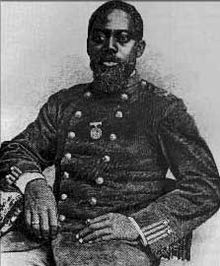
Sergeant William H. Carney of the 54th Massachusetts, Medal of Honor

But the most famous African American volunteer regiment was the 54th Massachusetts, commanded by Colonel Robert Gould Shaw, the “North’s showcase black regiment.” [29] Raised in Boston and officered by many men who were the sons of Boston’s blue blood abolitionist elite, the regiment was authorized in March 1863. Since there was still opposition to the formation of units made up of African Americans, Massachusetts Governor John Andrew authorized the formation of the 54th under the command of white officers, a practice that with few exceptions, became standard in the U.S. military until President Truman desegregated the armed forces in 1948. Governor Andrew was determined to ensure that the officers of the 54th were men of “firm antislavery principles…superior to a vulgar contempt for color.” [30]

The_Storming_of_Ft_Wagner-lithograph_by_Kurz_and_Allison_1890a

The 54th Massachusetts first saw action in early June 1863 and at Shaw’s urging were sent into battle against the Confederate positions at Fort Wagner on July 18th 1863. Leading the attack the 54th lost nearly half its men, “including Colonel Shaw with a bullet through his heart. Black soldiers gained Wagner’s parapet and held it for an hour before falling back.” [31] Though they tried to hold on they were pushed back after a stubborn fight to secure a breach in the fort’s defenses. “Sergeant William H Carney staggered back from the fort with wounds in his chest and right arm, but with the regiment’s Stars and Stripes securely in his grasp. “The old flag never touched the ground, boys,” Carney gasped as he collapsed at the first field hospital he could find.” [32] Shaw was buried with his men by the Confederates and when Union commanders asked for the return of his body were told “We have buried him with his niggers,” Shaw’s father quelled a northern effort to recover his son’s body with these words: We hold that a soldier’s most appropriate burial-place is on the field where he has fallen.” [33] As with so many frontal attacks on prepared positions throughout the war, valor alone could not overcome a well dug in enemy. “Negro troops proved that they could stop bullets and shell fragments as good as white men, but that was about all.” [34]

Despite the setback, the regiment went on to further actions where it continued to distinguish itself. The Northern press, particularly abolitionist newspapers brought about a change in the way that many Americans in the North, civilians as well as soldiers, saw blacks. The Atlantic Monthly noted, “Through the cannon smoke of that dark night, the manhood of the colored race shines before many eyes that would not see.” [35]

Frederick Douglass, who had two sons serving in the 54th Massachusetts, understood the importance of African Americans taking up arms against those that had enslaved them in order to win their freedom:

“Once let a black man get upon his person the brass letters U.S… let him get an eagle on his button, and a musket on his shoulder and bullets in his pockets, and there is no power on earth which can deny he has won the right to citizenship in the United States.” [36]

Other African American units less famous than the illustrious 54th Massachusetts distinguished themselves in action against Confederate forces. Two regiments of newly recruited blacks were encamped at Milliken’s Bend Louisiana when a Confederate brigade attempting to relieve the Vicksburg Garrison attacked them. The troops were untrained and ill-armed but held on against a determined enemy:

“Untrained and armed with old muskets, most of the black troops nevertheless fought desperately. With the aid of two gunboats they finally drove off the enemy. For raw troops, wrote Grant, the freedmen “behaved well.” Assistant Secretary of War Dana, still with Grant’s army, spoke with more enthusiasm. “The bravery of the blacks,” he declared, “completely revolutionized the sentiment in the army with regard to the employment of negro troops. I heard prominent officers who had formerly in private had sneered at the idea of negroes fighting express after that as heartily in favor of it.” [37]
pride_over_prejudice-reeves-b-of-nashville

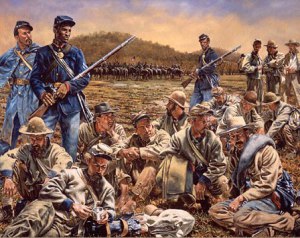
By the end of the war over 179,000 African American Soldiers, commanded by 7,000 white officers served in the Union armies. For a number of reasons most of these units were confined to rear area duties or working with logistics and transportation operations. The policies to regulate USCT regiments to supporting tasks in non-combat roles “frustrated many African American soldiers who wanted a chance to prove themselves in battle.” [38] Many of the soldiers and their white officers argued to be let into the fight as they felt that “only by proving themselves in combat could blacks overcome stereotypes of inferiority and prove their “manhood.” [39] Even so in many places in the army the USCT and state regiments made up of blacks were scorned:

“A young officer who left his place in a white regiment to become colonel of a colored regiment was frankly told by a staff officer that “we don’t want any nigger soldiers in the Army of the Potomac,” and his general took him aside to say: “I’m sorry to have you leave my command, and am still more sorry that you are going to serve with Negroes. I think that it is a disgrace to the army to make soldiers of them.” The general added that he felt this way because he was sure that colored soldiers just would not fight.” [40]

The general of course, was wrong. In the engagements where USCT units were allowed to fight, they did so with varying success most often attributable to the direction of their senior officers. When given the chance they almost always fought well, even when badly commanded. This was true as well when they were thrown into hopeless situations. One such instance was when Ferrero’s Division, comprised of colored troops were thrown into the Battle of the Crater at Petersburg when “that battle lost beyond all recall.” [41] The troops advanced in good order singing as they went, while their commander, General Ferrero took cover in a dugout and started drinking; but the Confederate defenders had been reinforced and “Unsupported, subjected to a galling fire from batteries on the flanks, and from infantry fire in front and partly on the flank,” a witness write, “they broke up in disorder and fell back into the crater.” [42] Pressed into the carnage of the crater where white troops from the three divisions already savaged by the fighting had taken cover, the “black troops fought with desperation, uncertain of their fate if captured.” [43] In the battle Ferrero’s division lost 1327 of the approximately 4000 men who made the attack. [44]

Major General Benjamin Butler railed to his wife in a letter against those who questioned the courage of African American soldiers seeing the gallantry of black troops assaulting the defenses of Petersburg in September 1864: The man who says that the negro will not fight is a coward….His soul is blacker than then dead faces of these dead negroes, upturned to heaven in solemn protest against him and his prejudices.” [45]

When captured by Confederates, black soldiers and their white officers received no quarter from many Confederate opponents. General Edmund Kirby Smith who held overall command of Confederate forces west of the Mississippi instructed General Richard Taylor to simply execute black soldiers and their white officers: “I hope…that your subordinates who may have been in command of capturing parties may have recognized the propriety of giving no quarter to armed negroes and their officers. In this way we may be relieved from a disagreeable dilemma.” [46] This was not only a local policy, but echoed at the highest levels of the Confederate government. In 1862 the Confederate government issued an order that threatened white officers commanding blacks: “any commissioned officer employed in the drilling, organizing or instructing slaves with their view to armed service in this war…as outlaws” would be “held in close confinement for execution as a felon.” [47] After the assault of the 54th Massachusetts at Fort Wagner a Georgia soldier “reported with satisfaction that the prisoners were “literally shot down while on their knees begging for quarter and mercy.” [48]

On April 12th 1864 at Fort Pillow, troops under the command of General Nathan Bedford Forrest massacred the bulk of over 231 Union most of them black as they tried to surrender. While it is fairly clear that Forrest did not order the massacre and even attempted to stop it, it was clear that he had lost control of his troops. Forrest’s soldiers fought with the fury of men possessed by hatred of an enemy that they considered ‘a lesser race’ and slaughtered the Union troops as they either tried to surrender or flee; but while Forrest did not order the massacre, he certainly was not displeased with the result. Ulysses Grant wrote that:

“These troops fought bravely, but were overpowered I will leave Forrest in his dispatches to tell what he did with them.

“The river was dyed,” he says, “with the blood of the slaughtered for up to 200 years. The approximate loss was upward of five hundred killed; but few of the officers escaped. My loss was about twenty killed. It is hoped that these facts will demonstrate to the Northern people that negro soldiers cannot cope with Southerners.” Subsequently Forrest made a report in which he left out the part that shocks humanity to read.” [49]

The bulk of the killing was directed at the black soldiers of the 6th U.S. Colored Heavy Artillery, which composed over a third of the garrison. “Of the 262 Negro members of the garrison, only 58- just over 20 percent- were marched away as prisoners; while of the 295 whites, 168- just under sixty percent were taken.” [50] A white survivor of the 13th West Tennessee Cavalry, a Union unit at the fort wrote:

We all threw down our arms and gave tokens of surrender, asking for quarter…but no quarter was given….I saw 4 white men and at least 25 negroes shot while begging for mercy….These were all soldiers. There were also 2 negro women and 3 little children standing within 25 steps of me, when a rebel stepped up to them and said, “Yes, God damn you, you thought you were free, did you?” and shot them all. They all fell but one child, when he knocked it in the head with the breech of his gun.” [51]

A Confederate Sergeant who was at Fort Pillow wrote home a week after the massacre: “the poor deluded negroes would run up to our men, fall upon their knees and with uplifted hands scream for mercy, but were ordered to their feet and shot down.” [52]

African American soldiers proved themselves during the war and their efforts paved the way for Lincoln and others to begin considering the full equality of blacks as citizens. If they could fight and die for the country, how could they be denied the right to votes, be elected to office, serve on juries or go to public schools? Under political pressure to end the war during the stalemate before Petersburg and Atlanta in the summer of 1864, Lincoln reacted angrily to Copperheads as well as wavering Republicans on the issue of emancipation:

“But no human power can subdue this rebellion without using the Emancipation lever as I have done.” More than 100,000 black soldiers were fighting for the Union and their efforts were crucial to northern victory. They would not continue fighting if they thought the North intended to betray them….If they stake their lives for us they must be prompted by the strongest motive…the promise of freedom. And the promise being made, must be kept…There have been men who proposed to me to return to slavery the black warriors. “I should be damned in time & in eternity for so doing. The world shall know that I will keep my faith to friends & enemies, come what will.” [53]

The importance of African Americans cannot be minimized, without them the war could have dragged on much longer or even ended in stalemate, which would have been a Confederate victory. Lincoln wrote about their importance in 1864:

“Any different policy in regard to the colored man, deprives us of his help, and this is more than we can bear. We can not spare the hundred and forty or hundred and fifty thousand now serving us as soldiers, seamen, and laborers. This is not a question of sentiment or taste, but one of physical force which may be measured and estimated as horse-power and Steam-power are measured and estimated. Keep it and you save the Union. Throw it away, and the Union goes with it.” [54]

Despite this, even in the North during and after the war, blacks, including former soldiers faced discrimination, sometimes that of the white men that they served alongside, but more often from those who did not support the war effort. Lincoln noted after the war:

“there will there will be some black men who can remember that, with silent tongue, the clenched teeth, the steady eye, the well poised bayonet, they have helped mankind on to this great consummation; while, I fear, there will be some white ones, unable to forget that, with malignant heart, and deceitful speech, they have strove to hinder it.” [55]

Those rights would be fought for another century and what began in 1863 with the brave service and sacrifice of these African American soldiers began a process of increased civil rights that is still going on today. It would not be until after the war that some blacks were commissioned as officers in the Army. When Governor John Andrew, the man who had raised the 54th Massachusetts attempted to:

“issue a state commission to Sergeant Stephen Swails of the 54th…the Bureau of Colored Troops obstinately refused to issue Swails a discharge from his sergeant’s rank, and Swails promotion was held up until after the end of the war. “How can we hope for success to our arms or God’s blessing,” raged the white colonel of the 54th, Edward Hallowell, “while we as a people are so blind to justice?” [56]

The families of the free blacks who volunteered also suffered, especially those who still had families enslaved in Confederate occupied areas or Union States which still allowed slavery. One women in Missouri wrote her husband begging him to come home “I have had nothing but trouble since you left….They abuse me because you went & say they will not take care of our children & do nothing but quarrel with me all the time and beat me scandalously the day before yesterday.” [57]

However, the Emancipation Proclamation transformed the war, and even jaded White Union soldiers who had been against emancipation and who were deeply prejudiced against blacks began to change their outlook as the armies marched into the South and saw the horrors of slavery. Russell Weigley wrote that Union soldiers:

“confronting the scarred bodies and crippled souls of African Americans as they marched into the South experienced a strong motivation to become anti-slavery men…Men do not need to play a role long, furthermore, until the role grows to seem natural and customary to them. That of liberators was sufficiently fulfilling to their pride that soldiers found themselves growing more accustomed to it all the more readily.” [58]

At peak one in eight Union troops were African American, and Black troops made an immense contribution to the Union victory. “Black troops fought on 41 major battlefields and in 449 minor engagements. Sixteen soldiers and seven sailors received Medals of Honor for valor. 37,000 blacks in army uniform gave their lives and untold sailors did, too.” [59]

After the war many of the African American soldiers became leaders in the African American community and no less than 130 held elected office including the U.S. Congress and various state legislatures. Sadly the nation has forgotten the efforts of the Free Black Soldiers and Sailors who fought for freedom, but even so the “contribution of black soldiers to Union victory remained a point of pride in black communities. “They say,” an Alabama planter reported in 1867, “the Yankees never could have whipped the South without the aid of the Negroes.” Well into the twentieth century, black families throughout the United States would recall with pride that their fathers and grandfathers had fought for freedom.” [60]

The Southern Debate about Emancipation and Black Soldiers

In the South, politicians and many senior Confederate Officers fought against any allowance for blacks to serve, for they knew if they allowed this, that slavery itself must be swept away. Despite this, a few such as General Patrick Cleburne, an Irish immigrant and a division commander in the Army of Tennessee demonstrated the capacity for forward thinking in terms of race: Cleburne advocated that blacks serve as soldiers should be emancipated.

fig25

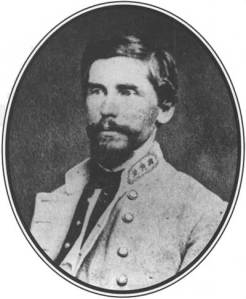
General Patrick Cleburne CSA

Cleburne, known as “the Stonewall Jackson of the West” was a bold fighter who put together a comprehensive plan. He noted that the Confederacy was losing the war because it did not have soldiers, the supplies or resources; and most significantly that “slavery, from being one of our chief sources of strength at the beginning of the war, has now become in a military point of view, one of our chief sources of weakness.” [61] Cleburne recommended that “we immediately commence training a large reserve of the most courageous of our slaves, and further that we guarantee freedom within a reasonable time to every slave in the South who shall remain to the confederacy in this war.” [62]

Cleburne’s realism came through in his appeal:

“Ever since the agitation of the subject of slavery commenced the negro has been dreaming of freedom and his vivid imagination has surrounded the condition with so many gratifications that it has become the paradise of his hopes.” It was also shrewd politically: “The measure we propose,” he added, “will strike dead all John Brown fanaticism, and will compel the enemy to draw off altogether or in the eyes of the world to swallow the Declaration of Independence without the sauce and disguise of philanthropy.” [63]

The Irishman’s “logic was military, the goal more men in uniform, but the political vision was radical indeed.” [64] He was asking more from his fellow Southerners than they could risk. He was “asking them to surrender the cornerstone of white racism to preserve their nation” [65] and he presented it in stark terms that few could stomach “As between the loss of independence and the loss of slavery, we can assume that every patriot will freely give up the latter- give up the Negro slave rather than be a slave himself.” [66] Cleburne’s words were those of a heretic, he noted “When we make soldiers of them we must make free men of them beyond all question…and thus enlist their sympathies also.” [67]

In January 1864 General W.H.T Walker obtained a copy of Cleburne’s proposal and sent it to Davis. Walker opposed it and expressed his outrage over it. Cleburne’s proposal went from being a military matter to a political matter and Davis intervened to quash the proposal. “Convinced that the “propagation of such opinions” would cause “discouragements, distraction, and dissension” in the army, Jefferson Davis ordered the Generals to stop discussing the matter…The only consequence of Cleburne’s action seemed to be the denial of promotion to this ablest of the army’s division commanders, who was killed ten months later at the Battle of Franklin.” [68] In fact Cleburne was “passed over for command of an army corps and promotion to lieutenant general” three times in the next eight months, and in “each care less distinguished, less controversial men received the honors.” [69] All copies of Cleburne’s proposal were destroyed by the order of Davis.

Cleburne was not the only military man to advocate the formation of Negro units or even emancipation. Richard Ewell suggested to Jefferson Davis the idea of arming the slaves and offering them emancipation as early as 1861, and Ewell went as far as “volunteering to “command a brigade of Negroes.” [70] During the war Robert E. Lee became one of the chief proponents of this. Lee said after the war that he had told Davis “often and early in the war that the slaves should be emancipated, that it was the only way to remove a weakness at home and to get sympathy abroad, and divide our enemies, but Davis would not hear of it.” [71]

Ten months later Davis raised the issue of arming slaves, as he now believed that military necessity left him little choice. On November 7th 1864 he made his views known to the Confederate Congress, and they were a radical departure from the hitherto political orthodoxy of slavery. In light of the manpower needs of the South as well as the inability to achieve foreign recognition Davis asked their “consideration…of a radical modification in the theory of law” of slavery…” and he noted that the Confederacy “might have to hold out “his emancipation …as a reward for faithful service.” [72]

This drew the opposition of previously faithful supporters. Davis was now opposed by some of his closest political allies including Howell Cobb who warned “The day that you make soldiers of them is the beginning of the end of the revolution. If slaves will make good soldiers our whole theory of slavery is wrong.” [73] Brigadier General Clement H. Stevens of South Carolina declared “I do not want independence if it is to be won by the help of the Negro.” [74]

Robert E. Lee began to be a formidable voice in the political debate going on in the Confederacy regarding the issue of blacks serving as soldiers and emancipation. He wrote to a member of Virginia’s legislature:

“we must decide whether slavery shall be extinguished by our enemies and the slaves used against us, or use them ourselves at the risk of the effects which may be produced on our social institutions…” and he pointed out that “any act for the enrolling of slaves as soldiers must contain a “well digested plan of gradual and general emancipation”: the slaves could not be expected to fight well if their service was not rewarded with freedom.” [75]

When Howell Cobb heard of Lee’s support for black soldiers and emancipation he fired of a letter to Secretary of War Seddon, “I think that the proposition to make soldiers of our slaves is the most pernicious idea that has ever been suggested since the war began. It is to me a source of deep mortification and regret to see the name of that good and great man and soldier, General R. E. Le, given as authority for such policy.” [76]

The debate began in earnest in the fall of 1864 and revealed a sharp divide in the Confederacy between those who supported the measure and those against it. Cabinet members such as Judah Benjamin and a few governors “generally supported arming the slaves.” [77] The Southern proponents of limited emancipation were opposed by the powerful governors of Georgia and North Carolina, Joe Brown and Zebulon Vance, and by the President pro-tem of the Confederate Senate R.M.T. Hunter, who forcibly opposed the measure. Robert Toombs of Georgia declared “the day that the army of Virginia allows a negro regiment to enter their lines as soldiers the will be degraded, ruined, and disgraced…” [78]

Much of the Southern press added its voice to the opposition. Newspapers in North Carolina declared the proposal “farcical” – “all this was done for the preservation and the perpetuation of slavery,” and if “sober men…are willing to enquire if the South is willing to abolish slavery as a condition of carrying on the war, why may it not be done, as a condition of ending the war?” [79] The Charleston Mercury considered the proposal apostasy and proclaimed “Assert the right in the Confederate government to emancipate slaves, and it is stone dead…” [80]

Some states in the Confederacy began to realize that slaves were needed in the ranks, but did not support emancipation. Led by Governor “Extra Billy” Smith, Virginia’s General Assembly finally approved a law in 1865 “to permit the arming of slaves but included no provision for emancipation, either before or after military service.” [81] Smith declared that without slavery the South “would no longer have a motive to fight.” [82]

Many Confederate soldiers displayed the attitude that would later propel them into the ranks of the Ku Klux Klan, the Red Shirts, the White League and the White Liners after the war. A North Carolina soldier wrote, “I did not volunteer to fight for a free negroes country… I do not think I love my country well enough to fight with black soldiers.” [83]

Finally in March of 1865 the Confederate Congress passed by one vote a watered down measure to allow for the recruitment of slaves. It stipulated that “the recruits must all be volunteers” [84] and those who volunteered must also have “the approbation of his master by a written instrument conferring, as far as he may, the rights of a freed man.” [85] While this in itself was a radical proposition for a nation which had went to war to maintain slavery, the fact was that the slave’s service and freedom were granted not by the government, but by his owner, and even at this stage of the war, few owners were willing to part with their property. It was understood by many that giving freedom to a few was a means of saving the “particular institution.” The Richmond Sentinel noted during the November debate: “If the emancipation of a part is the means of saving the rest, this partial emancipation is eminently a pro-slavery measure.” [86] Thus the law made “no mention of emancipation as a reward of military service” [87] and in deference to “state’s rights, the bill did not mandate freedom for slave soldiers.” [88]

But diehards opposed even the watered down measure. Robert Kean, who headed the Bureau of War and should have understood the stark reality of the Confederacy’s strategic situation, note in his diary, that the law:

“was passed by a panic in the Congress and the Virginia Legislature, under all the pressure the President indirectly, and General Lee directly, could bring to bear. My own judgment of the whole thing is that it is a colossal blunder, a dislocation of the foundations of society from which no practical results will be reaped by us.” [89]

It was Lee’s prestige alone that allowed the measure to pass, but even that caused some to question Lee’s patriotism. The Richmond Examiner dared to express a doubt whether Lee was “a ‘good Southerner’: that is, whether he is thoroughly satisfied of the justice and beneficence of negro slavery.” [90] Robert Toombs of Georgia stated that “the worst calamity that could befall us would be to gain our independence by the valor of our slaves” [91] and a Mississippi congressman stated, “Victory itself would be robbed of its glory if shared with slaves.” [92]

On March 23rd 1865 the War Office issued General Order Number 14, which authorized the call up and recruitment of slaves to the Confederate cause. The order read in part: “In order to provide additional forces to repel invasion…the President be, and he is hereby authorized to ask for and to accept from the owners of slaves, the services of such able-bodied negro men as he may deem expedient, for and during the war, to perform military service in whatever capacity he may direct…” While the order authorized that black soldiers “receive the same rations, clothing and compensation as are allowed to other troops in the same branch of service,” it did not provide for the emancipation of any of the black soldiers that might volunteer. Instead it ended “That nothing in this act shall be construed to authorize a change in the relation which the said slaves shall bear to their owners, except by the consent of the owners and of the States which they may reside….” [93]

Twelve days after the approval of the act, on March 25th two companies of blacks were formed for drill in Richmond’s Capitol Square. As the mobilized slaves assembled to the sounds of fifes and drums they were met with derision and violence as even “Small boys jeered and threw rocks” [94] at them. None of those few volunteers would see action as within a week the Confederate government had fled Richmond.

But some would see that history was moving, and attitudes were beginning to change. It took time, and the process is still ongoing. As imperfect as emancipation was and though discrimination and racism remained, African Americans had reached “levels that none had ever dreamed possible before the war.” [95] In April 1865 as Jefferson Davis and his government fled Richmond, with Davis proclaiming, “again and again we shall return, until the baffled and exhausted enemy shall abandon in despair his endless and impossible task of making slaves of a people resolved to be free.” [96]

The irony in Davis’s empty vow was stunning. Within a week Lee had surrendered and in a month Davis himself would be in a Federal prison. The Federal troops who led the army into Richmond came from General Godfrey Weitzel’s Twenty-fifth Corps, of Ord’s Army of the James. The Every black regiment in the Army of the James was consolidated in Weitzel’s Corps, along with Ferrero’s former division that had suffered so badly at the Battle of the Crater. “Two years earlier in New Orleans, Weitzel had protested that he did not believe in colored troops and did not want to command them, and now he sat at the gates of Richmond in command of many thousands of them, and when the citadel fell he would lead them in and share with them the glory of occupying the Rebel capital.” [97] Among Weitzel’s units were regiments of black “cavalrymen and infantrymen. Many were former slaves; their presence showed their resolve to be free.” [98]

The Post War Experience of Blacks in the U.S. Army

Some of those early African American soldiers went on to distinguish themselves on the prairie as the immortal Buffalo Soldiers. Other African Americans would fight in Cuba and the Philippines during the Spanish American War, however after the war the “contributions of black soldiers to the war were generally ignored, white Southern soldiers were hailed for their valor” [99] as part of a campaign to reintegrate the South into the life of the nation.

la-yosemite-buffalo-soldiers-slated-for-nation-001

Buffalo Soldiers

In the First World War, despite there being some instances of racial harmony, blacks, including officers faced discrimination and met with violent acts. “Refusals to arrest white soldiers who physically assaulted black soldiers accompanied by the tendency to rescind unpopular racial orders and to discourage black officers from demanding salutes from white soldiers” [100] was common.

Most of the Regular Army “Buffalo Soldier” units were not allowed to fight in the First World War. Instead they were left on the frontier and a new generation of draftees and volunteers became the nucleus of two infantry divisions, the 92nd and 93rd. However, at the beginning they were regulated to labor service units. The protests of organizations such as the NAACP and men like W.E.B. DuBois, and Phillip Randolph forced the War Department to reconsider the second-class status of these men and to form them into combat units.

Harlem_Hell_Fighters

Despite this, the leadership of the AEF, or the American Expeditionary Force, refused to allow these divisions to serve under American command. Instead they were broken up and the regiments of the 93rd Division were attached to French divisions. The 369th “Harlem Hellfighters” were assigned to the French 16th Division and then to the 161st Division. The 370th “Black Devils” were attached to the French 26th Division, while the 371st and 372nd were assigned to the French 157th (Colonial) Division, which was also known as the Red Hand Division. The 157th Division had suffered badly during the war and been decimated in the unrelenting assaults in the trench warfare of the Western Front. It was reconstituted in 1918 with one French Regiment and the two African American regiments. Both fought exceptionally well and were cited by the French government for their efforts. The 371st was awarded the French Croix de Guerre and Légion d’honeur. Corporal Freddie Stowers of the 1st Battalion 371st was the only African American awarded the Congressional Medal of Honor in the First World War. The 372nd was also awarded the Croix de Guerre and Légion d’honeur for its service with the 157th Division.

While many white American soldiers depreciated their French hosts and attempted to sow the seeds of their own racial prejudice against the black soldiers among the French, Southerners in particular warned the French of “black rapist beasts.” However the French experience of American blacks was far different than the often-scornful treatment that they received from white American soldiers.

“Soldiers from the four regiments that served directly with the French Army attested to the willingness of the French to let men fight and to honor them for their achievements. Social interactions with French civilians- and white southern soldiers’ reactions to them- also highlighted crucial differences between the two societies. Unlike white soldiers, African Americans did not complain about high prices in French stores. Instead they focused on the fact that “they were welcomed” by every shopkeeper that they encountered.” [101]

Official and unofficial efforts by those in the Army command and individual soldiers to stigmatize them and to try to force the French into applying Jim Crow to laws and attitudes backfired. Villages now expressed a preference for black over white American troops. “Take back these soldiers and send us some real Americans, black Americans,” wrote one village mayor after a group of rowdy white Americans disrupted the town.” [102]

761st-Tank-Bn

Even after President Truman desegregated the armed forces in 1948, African Americans, as well as other racial minorities, women and gays have faced very real discrimination. The military continues to make great strides, and while overt racist acts and other types of discrimination are outlawed, racism still remains a part of American life.
colin powell

General Colin Powell at the Buffalo Soldier Monument

Today things have changed, and that in large part is due to the unselfish sacrifice in the face of hatred and discrimination of the men of the USCT and the State Black Regiments like the 54th Massachusetts and the Louisiana Home Guards who blazed a way to freedom for so many. Those who followed them as Buffalo Soldiers and volunteers during the World Wars continued to be trailblazers in the struggle for equal rights. A white soldier who served with the 49th Massachusetts wrote, “all honor to our negro soldiers. They deserve citizenship. They will secure it! There would be much suffering in what he termed “the transition state” but a “nation is not born without pangs.” [103]

Those birth pangs helped to bring about a new birth of freedom for the United States, and not just for African Americans, but Women and  Gays as well.

Notes

[1] McPherson, James M. Tried by War: Abraham Lincoln as Commander in Chief Penguin Books, New York and London 2008

[2] Ibid. Goodwin Team of Rivals p.435

[3] Ibid. McPherson Tried by War p.58

[4] Ibid. McPherson Tried by War p.58

[5] Ibid. Goodwin Team of Rivals p.369

[6] Ibid. McPherson Tried by War p.109

[7] Ibid. Foote, The Civil War, A Narrative Volume Two p.531

[8] Ibid. McPherson. The Battle Cry of Freedom p.503

[9] Ibid. McPherson Drawn With the Sword: Reflections on the American Civil War p.101

[10] Ibid. Guelzo Gettysburg: The Last Invasion p.160

[11] Foner, Eric Forever Free: The Story of Emancipation and Reconstruction Vintage Books a Division of Random House, New York 2005 p.45

[12] Ibid. Guelzo Gettysburg: The Last Invasion p.160

[13] Ibid. Glatthaar General Lee’s Army from Victory to Collapse p.313

[14] Ibid. Guelzo Gettysburg: The Last Invasion p.160

[15] Ibid. Goodwin Team of Rivals p.465

[16] Egnal, Marc Clash of Extremes: The Economic Origins of the Civil War Hill and Wang a division of Farrar, Straus and Giroux New York 2009 p.318

[17] Ibid. Foner Forever Free p.48

[18] Ibid. McPherson Tried by War p.159

[19] Ibid. McPherson Drawn With the Sword p.159

[20] McPherson, James M. Abraham Lincoln and the Second American Revolution Oxford University Press, New York and Oxford 1991 p.35

[21] Ibid. Guelzo Fateful Lighteningp.381

[22] Ibid. McPherson Abraham Lincoln and the Second American Revolution p.35

[23] Glatthaar, Joseph T. Black Glory: The African American Role in Union Victory in Why the Confederacy Lost edited by Gabor S. Boritt Oxford University Press, Oxford and New York 1992

[24] Ibid. McPherson. The Battle Cry of Freedom p.686

[25] Ibid. Goldfield America Aflame p.282

[26] Ibid. Guelzo Fateful Lightening p.379

[27] Ibid. Foote The Civil War, A Narrative Volume Two p.398

[28] Ibid. Guelzo Fateful Lightening p.379

[29] Ibid. McPherson. The Battle Cry of Freedom p.686

[30] Ibid. McPherson Drawn With the Sword p.101

[31] Ibid. McPherson. The Battle Cry of Freedom p.686

[32] Ibid. Guelzo Fateful Lightening pp. 380-381

[33] Ibid. McPherson. The Battle Cry of Freedom pp.686-687

[34] Ibid. Foote, The Civil War, A Narrative Volume Two p.697

[35] Ibid. McPherson. The Battle Cry of Freedom p.686

[36] Ibid. Guelzo Fateful Lightening p. 381

[37] Ibid. McPherson. The Battle Cry of Freedom p.634

[38] Gallagher, Gary W. The Union War Harvard University Press, Cambridge MA and London 2011

[39] Ibid. McPherson Drawn With the Sword p.89

[40] Catton, Bruce. A Stillness at Appomattox Doubleday and Company Garden City, New York 1953 p.227

[41] Ibid. Catton A Stillness at Appomattox p.249

[42] Foote, Shelby, The Civil War, A Narrative. Volume Three Red River to Appomattox Random House, New York 1974 p.537

[43] Wert, Jeffry D. The Sword of Lincoln: The Army of the Potomac Simon and Schuster, New York and London 2005 pp.384-385

[44] Ibid. Foote The Civil War, A Narrative Volume Three p.537

[45] Ibid. Robertson Soldiers Blue and Gray p.34

[46] Ibid. Guelzo Fateful Lightening p. 377

[47] Ibid. Guelzo Fateful Lightening p. 377

[48] Ibid. Goldfield America Aflame p.281

[49] Grant, Ulysses S. Preparing for the Campaigns of ’64 in Battles and Leaders of the Civil War Volume IV, Retreat With Honor Edited by Robert Underwood Johnson and Clarence Clough Buel Castle, Secaucus NJ pp.107-108

[50] Ibid. Foote The Civil War, A Narrative Volume Three p.111

[51] Ibid. Guelzo Fateful Lightening p. 378

[52] Ibid. Foote The Civil War, A Narrative Volume Three p.112

[53] Ibid. McPherson Abraham Lincoln and the Second American Revolution p.89

[54] Ibid. Glatthaar Black Glory: The African American Role in Union Victory p.138

[55] Ibid. McPherson The War that Forged a Nation p. 113

[56] Ibid. Guelzo Fateful Lightening p. 376

[57] Ibid. Goldfield America Aflame p.282

[58] Ibid. Weigley A Great Civil War p.192

[59] Gallagher, Gary, Engle, Stephen, Krick, Robert K. and Glatthaar editors The American Civil War: The Mighty Scourge of War Osprey Publishing, Oxford UK 2003 p.296

[60] Ibid. Foner Forever Free p.55

[61] Ibid. Thomas, The Confederate Nation p.262

[62] Ibid. Thomas, The Confederate Nation p.262

[63] Winik, Jay April 1865: The Month that Saved America Perennial an Imprint of Harper Collins Publishers New York 2002 p.53

[64] Ibid. McCurry Confederate Reckoning p.327

[65] Ibid. Guelzo Fateful Lightening p. 370

[66] Ibid. Thomas, The Confederate Nation p.262

[67] Ibid. McCurry Confederate Reckoning p.327

[68] Ibid. McPherson. The Battle Cry of Freedom p.833

[69] Ibid. Thomas, The Confederate Nation p.262

[70] Ibid. Guelzo Fateful Lightening p. 370

[71] Ibid. Gallagher The Confederate War p.47

[72] Ibid. McCurry Confederate Reckoning p.335

[73] Ibid. Guelzo Fateful Lightening p. 370

[74] Ibid. Foner Forever Free p.55

[75] Korda, Michael. Clouds of Glory: The Life and Legend of Robert E. Lee Harper Collins Publishers, New York 2014 p.643

[76] Cobb, Howell Letter to James A. Seddon, Secretary of War, January 8, 1865 in the Confederate and Neo-Confederate Reader: The “Great Truth” about the “Lost Cause” Loewen, James W. and Sebesta, Edward H. Editors, University Press of Mississippi, Jackson 2010 Amazon Kindle edition location 4221 of 8647  

[77] Ibid. Thomas, The Confederate Nation p.293

[78] Ibid. McPherson. The Battle Cry of Freedom p.835

[79] Ibid. Guelzo Fateful Lightening p. 370

[80] Ibid. McCurry Confederate Reckoning p.337

[81] Ibid. Foote. The Civil War, A Narrative Volume Three pp.754-755

[82] Ibid. Guelzo Fateful Lightening p. 370

[83] Ibid. Guelzo Fateful Lightening p. 370

[84] Ibid. Foote. The Civil War, A Narrative Volume Three p. 755

[85] Ibid. Thomas, The Confederate Nation p.296

[86] Ibid. McPherson. The Battle Cry of Freedom p.836

[87] Ibid. Foote. The Civil War, A Narrative Volume Three p.755

[88] Ibid. McPherson. The Battle Cry of Freedom p.837

[89] Ibid. Foote. The Civil War, A Narrative Volume Three p.860

[90] Ibid. McPherson. The Battle Cry of Freedom p.837

[91] Ibid. Foote. The Civil War, A Narrative Volume Three p.860

[92] Ibid. McPherson. The Battle Cry of Freedom p.835

[93] Confederate Congress General Orders, No. 14, An Act to Increase the Military Force of the Confederate States, Approved March 13, 1865 in the Confederate and Neo-Confederate Reader: The “Great Truth” about the “Lost Cause” Loewen, James W. and Sebesta, Edward H. Editors, University Press of Mississippi, Jackson 2010 Amazon Kindle edition location4348 of 8647

[94] Ibid. Foote. The Civil War, A Narrative Volume Three p.860

[95] Ibid. Guelzo Fateful Lightening p. 386

[96] Levine, Bruce Half Slave and Half Free: The Roots of the Civil War Revised Edition, Hill and Wang, a division of Farrar, Strauss and Giroux, New York 1992 and 1995 p.241

[97] Catton, Bruce Grant Takes Command Little, Brown and Company Boston, Toronto and London 1968 p.411

[98] Ibid. Levine Half Slave and Half Free pp.241-242

[99] Huntington, Samuel P. Who Are We? America’s Great Debate The Free Press, Simon and Schuster Europe, London 2004 p.124

[100] Keene, Jennifer D. Doughboys, the Great War, and the Remaking of America The Johns Hopkins University Press, Baltimore and London 2001 p.88

[101] Ibid. Keane Doughboys, the Great War, and the Remaking of America p.128

[102] Ibid. Keane Doughboys, the Great War, and the Remaking of America p.129

[103] Ibid Gallagher The Union War p.113

1 Comment

Filed under civil rights, civil war, History, Loose thoughts and musings

The Road to Gettysburg: Lee is Puzzled as Meade Acts

Lee1

General Robert E. Lee

Friends of Padre Steve’s World

For those that have followed my writing for some time you know that I teach military history and ethics at the Joint Forces Staff College. One of the great joys that I have is leading the Gettysburg Staff Ride, which is an optional event for students that want to participate. When I took the position here I took some of my older writings on Gettysburg and put them into a student study guide and text. That was two years ago. Then the text was about 70 pages long. It is now about 870 pages long and eventually I hope to get it published. When and if that happens I expect it to become two, and possibly three books.

This is the third of a series of articles that I will be posting potions of a chapter that I have rewritten about the surprises that various commanders experienced on June 28th 1863. The lessons for today are that war, any war, is the realm of chance, as such, surprises always happen. It is said that no plan survives first contact with the enemy, but some plans don’t survive that long. As you read this don’t just look at the events, but look at the people, and their reaction to the surprises that they encountered, for that is where we come to understand history.

So even if you are not a Civil War buff, or even a history buff, take the time to look at the people, their actions, and the things that made them who they were, and influenced what they did. History is about people.

So please enjoy,

Peace

Padre Steve+

Any commander that embarks on a high risk offensive operation in enemy territory must do so with great care, especially in regard to command and control of his forces. This is especially true regarding reconnaissance. By June 28th Lee had been operating blind for well over a week, and this was in large part his own fault.

There are two reasons for this. The first of these was his decision regarding Stuart’s cavalry. The orders that Lee issued were so vague that Stuart was free to interpret them in any way that suited him. The result was that Stuart and the cavalry that Lee was counting on to screen his own army and keep tabs on the Federal army was well to the east and completely useless to Lee. Now Lee was reaping the fruit of his carelessness and overconfidence as he bemoaned his lack of contact with Stuart.

The second reason is that Lee failed to wisely employ the cavalry that he did have available, which by all means should have been enough to provide what Lee needed. After all, Lee still had three brigades of Stuart’s Cavalry Division available, but none were in a position to assist his reconnaissance needs. Some of this is Stuart’s fault, and some the fault of the commander of the forces left behind to screen Lee, but at least some of the blame for this has to be laid at the feet of Lee. Robertson’s and Jones’ brigades were still deep in Virginia guarding Snicker’s and Ashby’s Gap. Imboden’s Brigade was to the west at Hancock Maryland. Jenkins’ brigade, which was not a part of Stuart’s division, was far to the front with Ewell’s Corps.

Had Robertson followed Stuart’s orders “Lee would not have felt the want of adequate cavalry support” [1] but since Robertson had remained stationary Lee had nothing available when he needed it and made no effort to bring these units up to help.

In selecting Jones’ and Robertson’s brigades for the mission of screening Lee, Stuart made a critical mistake. Jones and Robertson both had serious deficiencies as leaders and proved that neither had Lee’s “confidence or understood his expectations…and Stuart badly misread the amount of personal connection his superior required.” [2] Jones was actually the better officer, but was junior to Robertson who failed miserably.

While Lee’s orders to Stuart allowed him to go off on his mission, Lee still had plenty of cavalry available had he employed it well. However, Lee employed it in a woeful manner and did not take the steps necessary to ensure that the commanders assigned understood his expectations. This was another critical mistake made by Lee. Alan T. Nolan wrote: “There seems to be no excuse for Lee’s finding himself at Chambersburg on the 28th without a single regiment of cavalry” [3] The tragic thing for the Confederacy was that Lee would make this same mistake in failing to communicate his intent with other subordinates throughout the campaign.

Late on the night of June 28th Lieutenant General James Longstreet “was woken by someone banging on his tent pole.” [4] It was his assistant Inspector General, Major John W. Fairfax. Fairfax had with him a man claiming to have information on the movement and location of the Army of the Potomac. The man’s name was Henry Thomas or “Harry” Harrison and he was an actor. Longstreet hired him as a “scout” or what we would now term a spy during the Suffolk campaign. Longstreet paid Harrison in U.S. dollars versus Confederate money, something that Moxey Sorrel said was worth it because he “always brought us true information.” [5]

Harrison was described as an “altogether an extraordinary character” [6] by Sorrel, and was one of those mysterious figures that occasionally show up in the context of a historical event and make it even more interesting. Very few senior Confederate commanders employed spies, “but Longstreet, with his usual care for detail, saw that his spies were well chosen and diligent.” [7] On this expedition Longstreet paid Harrison in gold and instructed him “to travel to Washington and secure any information he could obtain.” [8] He gave the spy a long leash and told him “I did not care to see him again till he could bring me information of importance.” [9]

Harrison arrived at Longstreet’s headquarters having been detained by men of Pickett’s division “dirt-stained, travel-worn, and very broken down.” [10] The spy brought Longstreet the first information about the whereabouts and situation of the Army of the Potomac that the army had since before Brandy Station.

Harrison brought news of Hooker’s relief and replacement by Meade as well as the location of the Federal army. He noted the location of John Buford’s Cavalry division as well as the location of five of the Army of the Potomac’s seven army corps, all of which were too close for comfort. Though his information was now almost two days old it was shocking. While Lee and his subordinates believed that the Army of the Potomac was still south of the Potomac, Harrison reported that “Hooker’s army had begun crossing the river three days before and was now well up into Maryland.” [11] The information was

Questioned by Longstreet about the location and activities of Stuart, Harrison could give no information, but the news that he brought was electrifying, and Longstreet immediately sent Harrison accompanied either by Sorrel or Fairfax to Lee’s headquarters.

Lee’s aide Walter Taylor noted “Great was his surprise and annoyance, therefore, when on June 28th he received information from one of the scouts to the effect that the Federal army had crossed the Potomac…” [12] Lee distrusted spies and did not employ them, but when whichever aide was present “vouchsafed for Longstreet’s confidence in him” [13] Lee “listened to Harrison’s report with “great composure and minuteness.” [14] The “contents, timing, and source of the spy’s report bothered Lee.” It was upsetting, especially since it “was brought by a person unknown to him whose word had to be taken on faith” [15] rather than from Stuart who he implicitly trusted.

However, Lee was “very reluctant to make a move without confirmation of his cavalry.” [16] Lee was skeptical of the report given by Harrison, especially because Stuart had not reported anything. He told Fairfax “I do not know what to do….I cannot hear from General Stuart, the eye of the army. What do you think of Harrison? I have no confidence in any scout, but General Longstreet thinks a good deal of Harrison.” [17]

Lee’s puzzlement at finding the federal army across the Potomac is curious. As early as June 23rd he had known of the pontoon bridge being built over the Potomac. However, Lee decision making process seemed paralyzed by the absence of Stuart. The surprise of the Union Army being concentrated so near him took away Lee’s ability to retain the initiative of a campaign of maneuver.

Because his army was so scattered he was now in danger of being hit and defeated in detail by the Federal army, “Meade, in short, might be able to do what he had planned to do to Hooker- defeat him in detail.” [18] It was a dangerous position for him to be in and he knew it. In a sense he was fortunate that on June 28th the Army of the Potomac was in the midst of changing command and thus unable to strike while his army was so vulnerable.

With the knowledge that the Federal army was near Lee acted with alacrity to concentrate his army in the Cashtown and Gettysburg area. “Within eight hours of Harrison’s report to Lee” [19] Lee had set in motion orders to all commands of his scattered army. Lee still had “no idea of the whereabouts of the enemy’s forces beyond what Longstreet’s spy had just told him- information that was already twenty-four hours old,” and he did have “any idea of how to remedy this intelligence gathering void.” [20]

Lee knew precious little other than the fact that “Hooker’s army, now under Meade, was across the mountain from him and that it was Stuart who was still in Virginia.” [21] He had learned the latter information from Captain James Power Smith who informed Lee that he had met two troopers of Stuart’s division who:

“casually told him that on the preceding day (Saturday the 27th) that they had left the main body of cavalry under Stuart in Prince William County back in northern Virginia. When Smith passed on this information, General Lee, he said, “was evidently surprised and disturbed.” [22]

Another consequence of his lack of available cavalry was that he had to leave Pickett’s division to guard the rear until Imboden’s cavalry could arrive to take up the task. Imboden’s troops had been far to the west completely away from the army when Lee discovered their location. Because of this Pickett’s division was detained to guard the army’s trains far to the rear of the march. This would be another unfortunate consequence of Stuart’s absence that would plague Lee during the battle, especially on July 2nd, when Longstreet’s corps would be without Pickett’s troops as they assaulted the Federal left.

On the afternoon of June 29th Lee met with a number of officers and his outward calm was still present. He told them “Tomorrow, gentlemen, we will not move to Harrisburg, as we expected, but will go over to Gettysburg and see what General Meade is after.” [23] When questioned by his subordinates about the relief of Hooker, and by his replacement by Lee’s former subordinate, Meade, Lee noted “General Meade will commit no blunder in my front, and if I make one he will make haste to take advantage of it.” [24]

Despite his surprise Lee was still confident. He had not fully appreciated Harrison’s information. He believed that instead of concentrating for battle that “the Army of the Potomac was shaking itself into pieces that Lee could turn upon and beat one by one, with the all the odds in his favor.” [25] Likewise he was confident that Meade would be so cautious as to not seek out an engagement, or would if forced by Washington attack him on ground of his choosing.

Implicit in Lee’s orders to concentrate east of the South Mountain range near Gettysburg was “his deliberate challenge to the enemy.” [26] Rather than waiting for the Federals to come after him he would seek them out. When John Bell Hood visited Lee, Lee remarked “Ah! General, the enemy is a long time in finding us….If he does not succeed soon, we must go in search of him.” [27] In moving his army east, “he gave away his exact location….By June 29th the approach of the Confederate army was evident to the people of Gettysburg.” [28]

Meade too had recognized the importance of Gettysburg and began to move his forces toward the town even as Lee tried to concentrate his army. On the evening of June 29th Meade sent the 1st Cavalry Division under the command of Brigadier General John Buford, a seasoned Indian fighter ahead to Gettysburg. In Buford Meade had something that Lee currently was missing, an outstanding cavalry officer in the time and place that he needed one. “Buford was a supremely confident and tenacious soldier” [29] who would provide Meade with the information that he needed to enter the battle, while Lee was practically blind due to the absence of Stuart and the mishandling of the cavalry that he should have had available.

While Lee’s army was still greatly scattered and few divisions in a place that they could provide support to each other, Meade was concentrating his army. After ordering Buford to Gettysburg he stopped the advance towards the Susquehanna and “redirected the 1st, 3rd and 11th Corps north toward Emmitsburg and the Pennsylvania state line, and the 2nd, 5th, 6th and 12th Corps to the northeast toward Pipe Creek and Taneytown.” [30]

Buford arrived and survey the ground around Gettysburg. He reconnoitered all the ridges to the front as well as Cemetery Hill and Ridge and there was nothing that his trained eye missed. Noting how the Schoolhouse Ridge, Herr’s Ridge, McPherson’s Ridge and Seminary Ridge offered successive lines of good ground for defense, and that Cemetery Hill provided a rally point he thought his plan through. He realized that the Confederates would have to come up to Gettysburg along the Cashtown Pike and that even a small force such as his could delay the enemy advance.

With that in mind, Buford made his decision. He convinced himself that “he could pull off something never achieved in this war: a defense in depth by dismounted cavalry against a large force of foot soldiers with artillery support.” [31] He also took into account the approach of Ewell’s troops from the north, and deployed one of his brigades to watch it. It was a calculated risk, if the Federal infantry did not come up to support him in time, it would risk the annihilation of his division, but if successful it would ensure that Meade’s army would hold excellent defensive ground.

Buford had a keen eye for terrain and instantly recognized that the area around Gettysburg was favorable ground. He also through the hard work of his troops surmised that Hill’s Third Corps with the divisions of Heth, Anderson and Pender would approach from the west, while Ewell’s Second Corps with the divisions of Rodes, Early and Johnson would come to Gettysburg from the north and east and provided that information to Reynolds and Meade. He again proved his “reputation as an expert gather of intelligence.” As one historian observed “this was cavalry scouting and reporting at their best, a model of precision and accuracy, with fact carefully separated from rumor.” [32]

On the morning of June 30th, Buford detected the Confederate infantry of Pettigrew’s brigade to the west of the town. Buford knew that the battle was to be there and sent word back to John Reynolds, commander of I Corps:

“Have Occupied Gettysburg. Contacted large force of Reb infantry. I think they are coming this way. Expect they will be here in force in the morning.”[33]

Notes

[1] Ibid. The Gettysburg Campaign, A Study in Command p.184

[2] Ibid. Trudeau Gettysburg, A Testing of Courage. p.69

[3] Nolan, Alan T. R.E. Lee and July 1 at Gettysburg in The First Day at Gettysburg, Gallagher, Gary W. Editor, Kent State University Press, Kent Ohio 1992 p. 20

[4] Korda, Michael. Clouds of Glory: The Life and Legend of Robert E. Lee Harper Collins Publishers, New York 2014 p.542

[5] Wert, Jeffry D. General James Longstreet: The Confederacy’s Most Controversial Soldier, A Touchstone Book, Simon and Schuster, New York and London 1993 p.237

[6] Ibid. Wert General James Longstreet p.237

[7] Ibid. Freeman Lee’s Lieutenants p.551

[8] Ibid. Wert General James Longstreet p.254

[9] Ibid. Guelzo Gettysburg: The Last Invasion p.113

[10] Ibid. Wert General James Longstreet p.237

[11] Ibid Sears. Gettysburg. p.124

[12] Taylor, Walter. General Lee: His campaigns in Virginia 1861-1865 With Personal Reminiscences University of Nebraska Press, Lincoln Nebraska and London, 1994 previously published 1906 p.184

[13] Ibid. Wert General James Longstreet p.255

[14] Ibid. Guelzo Gettysburg: The Last Invasion p.113

[15] Ibid. Coddington The Gettysburg Campaign, A Study in Command p.181

[16] Ibid. Wert A Glorious Army p.237

[17] Ibid. Freeman Lee p.320

[18] Ibid. Foote The Civil War, A Narrative. Volume Two pp.462-463

[19] Ibid. Foote The Civil War, A Narrative. Volume Two p. 463

[20] Ibid. Sears Gettysburg p.124

[21] Dowdy, Clifford. Lee and His Men at Gettysburg: The Death of a Nation Skyhorse Publishing, New York 1986, originally published as Death of a Nation Knopf, New York 1958 p.49

[22] Ibid. Dowdy Lee and His Men at Gettysburg p.48

[23] Ibid. Freeman Lee p.321

[24] Ibid. Freeman Lee p.321

[25] Ibid. Guelzo Gettysburg: The Last Invasion p.114

[26] Ibid. Sears Gettysburg p.133

[27] Ibid. Sears Gettysburg p.114

[28] Ibid. Coddington The Gettysburg Campaign, A Study in Command p.195

[29] Ibid. Korda Clouds of Glory p.544

[30] Ibid. Guelzo Gettysburg: The Last Invasion pp.115-116

[31] Longacre, Edward G. John Buford: A Military Biography Da Capo Press, Perseus Book Group, Cambridge MA p.185

[32] Ibid. Longacre John Buford p.187

[33] Shaara, Michael. The Killer Angels. Ballantine Books, New York. 1974 p.40


Leave a comment

Filed under civil war, Gettysburg, History, leadership, Military

The Road to Gettysburg: Meade Takes Command

general-george-meade

Major General George Gordon Meade

Friends of Padre Steve’s World

For those that have followed my writing for some time you know that I teach military history and ethics at the Joint Forces Staff College. One of the great joys that I have is leading the Gettysburg Staff Ride, which is an optional event for students that want to participate. When I took the position here I took some of my older writings on Gettysburg and put them into a student study guide and text. That was two years ago. Then the text was about 70 pages long. It is now about 870 pages long and eventually I hope to get it published. When and if that happens I expect it to become two, and possibly three books.

This is the second of a series of articles that I will be posting potions of a chapter that I have rewritten about the surprises that various commanders experienced on June 28th 1863. The lessons for today are that war, any war, is the realm of chance, as such, surprises always happen. It is said that no plan survives first contact with the enemy, but some plans don’t survive that long. As you read this don’t just look at the events, but look at the people, and their reaction to the surprises that they encountered, for that is where we come to understand history.

So even if you are not a Civil War buff, or even a history buff, take the time to look at the people, their actions, and the things that made them who they were, and influenced what they did. History is about people.

So please enjoy,

Peace

Padre Steve+

About the time that Lee was confidently discussing the campaign with Isaac Trimble Major General George Meade, commander of V Corps the night of June 27th George Meade was simply one of seven Corps Commanders in the Army of the Potomac, but before the night was over he would be its commander on the eve of the most decisive battle of the war in the east.

George Gordon Meade was the son of an American merchant who served as the naval agent for the U.S. government in that country until 1817. Meade was born in Cadiz on December 31st 1815 and grew up in Pennsylvania and Maryland. His father had been ruined financially in Spain when supporting the Spanish government by loaning it over $375,000 in the Peninsular War against Napoleon. Meade’s father remained in Spain to try to recover his lost fortune he sent his wife and children back to the United States where the family lived on the margins of poverty. The money should have been reimbursed to him under the terms of the Treaty of Florida “which obligated the American government to assume any Spanish obligations to American citizens.” However “the U.S. government discovered loopholes that it allowed it to dodge all responsibility to an increasingly bitter and disappointed Richard Meade.” [1] It was a crushing blow to the elder Meade.

Meade’s father returned to the U.S. and the family moved from Philadelphia to Washington D.C. were Richard Meade, “worn down physically and mentally by his struggles” [2] died in 1828 when George was just 12 years old and attending “a boarding-school at Mount Airy, a few miles from Philadelphia, known as the American Classical and Military Lyceum.” [3] It was here that Meade got his first taste of military discipline as the school was modeled after West Point and in addition to their studies the students participated in military drill.

At the Lyceum, Meade was known for being “an amiable boy, full of life, but rather disposed to avoid the rough-and-tumble frolics of youths his age; quick at his lessons, and popular with both teachers and scholars.” [4] The family ran out of money to keep him at the school and he returned to Baltimore where he was enrolled in the Mount Hope School in Baltimore as his mother sought to gain him an appointment at West Point. At Mount Hope he studied Latin, English composition and mathematics. A certificate from the headmaster of the school obtained by his mother discussed Meade’s academic acumen.

“The knowledge he has gained…is far greater than is usually acquired by young men of his age in a single year. He possesses an uncommon quickness of perception and is, therefore, capable of acquiring knowledge with great rapidity….” [5]

Meade entered West Point in 1831 when he was just sixteen years old after being nominated by Andrew Jackson. The financial condition of his family was mostly responsible for this as “West Point was the one place where the young Meade could obtain a free college education.” [6] At West Point Meade did not excel in his studies and due to “his lack of attention to details of dress and equipment and apparent disinterest in drill, demerits began to pile up in his third year.” [7] While he graduated in the top half of his class his performance in some subjects such as military engineering gave no indication of how he would excel later in life. He graduated nineteenth of fifty-six in the class of 1835.

Unlike many classes which were crowded with men destined for greatness, there were few notables in this class. Other than Meade there was Lincoln’s Postmaster General Montgomery Blair, Brigadier General Herman Haupt, who directed the transportation system of the Union army in the East during the war and John Pemberton, who as a Confederate general would surrender Vicksburg to Grant as Meade was defeating Lee.

Meade was commissioned as a Brevet Second Lieutenant and assigned to the artillery. He spent most of that year in Florida where he was sick and assigned less demanding duties. He resigned his commission after serving his one year obligation and entered civilian life as a topographic engineer. Such was not an unusual occurrence in the tiny army of that era, as “over the previous two years more than a hundred West Point graduates had left the army.[8]

He found civilian employment with the Bureau of Topographical Engineers and over the next five years took part in surveying the Texas-Louisiana boundary line, followed by an assignment on the Mississippi River Delta. He finally worked on the survey of the Canadian-United States boundary, an area of perpetual dispute from the time of American independence.

It was during his time of civilian work with the Bureau that he met and married his wife Margaret Sergeant Wise, the daughter of Congressman John Sergeant, who had been the running mate of Henry Clay in the 1832 presidential election. The young woman was well educated and “developed a wide range of cultural interests including facility in four languages and proficiency at the piano.” [9] They had had seven children together, three sons and four daughters and through much of his career was forced to raise the children alone. Despite this, the marriage appeared to be happy and would last until his death in 1872.

In 1842 Congress passed a measure which limited topographic survey to officers of the Topographic Engineer Corps. For Meade this was a godsend, for with the assistance of Margaret’s brother-in-law Congressman Henry A. Wise of Virginia Meade was reappointed as a Second Lieutenant in the Topographic Engineers on May 19th 1842. He had lost nearly six years of seniority, but “he had fairly earned his rank of Second Lieutenant of Topographic Engineers.” [10] His first assignments included surveying the Aroostook River in Maine and the design and construction of a lighthouse for Brandywine Shoals, Delaware.

In 1845 with a war with Mexico looming due to the annexation of Texas, Lieutenant Meade reported to the headquarters of General Zachary Taylor in Corpus Christi. Here he conducted surveys of the Nueces River and other inland waterways. Meade accompanied Taylor to the disputed border area around between the Nueces and the Rio Grande where some of the first actions of the war took place in 1846. During the war he served in Mexico “principally with Taylor’s army, where he won a brevet for gallantry at Monterrey.” [11] During his time in Texas and Mexico Meade became disgusted with the political machinations that surrounded the war and in a letter home he wrote “the mighty engine of influence, that curse of our country, which forces party politics into everything.” [12]

Meade was transferred to the army of Winfield Scott where he was no longer the senior Topographic Engineer but the junior. He chafed at his inactivity with Scott and complained about it. Major Turnbull, the senior Topographic Engineer told Scott that Meade was “Meade was unexpectedly with the army and that he had quite enough officers without him.” [13] In light of this Scott sent Meade back, where he returned to building lighthouses missing the bulk of the campaign. That assignment was cut short in 1849 when Meade was ordered to Florida “amid an outbreak of violence by the Seminoles.” [14] In Florida he survey a line of forts and upon completion returned to lighthouse work at Brandywine Shoals and then in Key Largo.

When the Army established the Lighthouse Board, Meade was appointed t the Seventh District where he continued his work in Florida. Among the lighthouses that he built was the Sand Key lighthouse at Key West which stands to this day. Meade was still just a First Lieutenant but he was rising in terms of the work that he was doing and was “promoted to superintendent of the Seventh Lighthouse District.” [15] He took over the Fourth District as well when its superintendent was transferred to the West Coast. In this work Meade prospered. The most impressive monument to Meade’s work is the 163 foot tall Barnegat Bay Light in New Jersey. Meade was justifiably proud of his accomplishments and after the war noted that “I have always thought my services in the construction of lighthouses, and subsequently on the Lake Survey were of considerable importance.” [16]

In 1856 Meade was promoted to Captain and given charge over the vast Great Lakes survey. In Meade’s words he work involved:

“the delineation of the shores, and bottom of the lakes, bringing to light the hidden dangers; obtaining the evidence and capacity and depth of water in all the harbors and rivers and consequently the most practical mode of improving them; furnishing the evidence of the wants of navigation in reference to lighthouses, beacons and buoys and the proper sites for same.” [17]

Meade had to lobby Congress for funding and expanded the number of officers and personnel involved until by 1860 he had ten teams, some working on land and some aboard ships with a budget which he expanded from $25,000 to $75,000 in three years. It was a remarkable job, but then Meade had matured as an officer and as a leader.

Meade was still involved with this mission when Fort Sumter was attacked. To the consternation of local leaders in Detroit, he and his officers refused to be part of a mass meeting where the locals were insisting the Federal officers publically renew their oaths. This decision was part of Meade’s innate conservatism. Meade felt that doing so without the order of the War Department was not within his prevue.

Meade was not a firebrand, conservative and logical thought that the best course would for both sides to step back and catch their breath. He was “dismayed at the arrogance of the fire-eaters, to whom Southern secession seemed like a simple riot which would be suppressed by the mere appearance of Federal troops.” [18] The decision angered Senator Zach Chandler who had organized the event and Chandler would remain an opponent of Meade throughout the war.

He had never been a political officer and was determined to avoid becoming one, he wrote “as a soldier, holding a commission, it has always been my judgement that duty required that I should disregard all political questions, and obey orders.” [19] Thus he avoided some of the more overtly political displays in Michigan but wrote:

“I have ever held it to be my duty…to uphold and maintain the Constitution and resist the disruption of this Government. With this opinion I hold the other side responsible for this existing condition of affairs.” [20]

He was viewed with suspicion by Radical Republicans as “another politically unreliable McClellan Democrat” and William Lloyd Garrison’s The Liberator noted that his look “reveals a character that never yet efficiently and consistently served a liberal cause.” [21]

He immediately volunteered for field duty, but it his request was not answered due to resistance in the Corps of Topographic Engineers. It was not until after the debacle at Bull Run when he would be appointed a Brigadier General of Volunteers, even as he was preparing to resign his commission to take command of a Michigan Regiment.

Meade was appointed to command a brigade of the Pennsylvania Reserves and saw much action at the head of his brigade on the Peninsula, serving alongside his friend John Reynolds who commanded another brigade in the division. Meade exhibited a coolness under fire that earned the respect of his soldiers and officers. His fearless nature had “resulted in his being wounded twice by bullets almost simultaneously at the Battle of Glendale on the Peninsula” [22] and incurring other wounds and close calls at South Mountain, Antietam and Fredericksburg.

In September 1862 he was promoted to command the division and after Fredericksburg he was promoted to command Fifth Corps. His promotions “from brigade commander in the Pennsylvania Reserve Division to corps command had been earned on battlefields.” [23] Serving in almost all of the army’s campaigns in the East Meade “gained increasing distinction as a highly competent and skillful officer. At Fredericksburg his division was the only unit to achieve any kind of success in a battle that otherwise was known as the worst fiasco in the history of the Army of the Potomac.” [24]

Like many of the commanders at Gettysburg Meade’s personality, temperament and character were complex, leading to people who met him or served with him to different conclusions. He possessed little flair for the dramatic or the theatrical. He was quietly religious and modest and “he usually kept aloof and made no effort to make himself popular” especially with reporters and “they exacted a toll for this treatment, and as a result Meade’s reputation suffered from a poor press.” [25]

He did not fit the stereotype of a commanding general of an army, he possessed none of McClellan’s style, Hooker’s dash or Reynold’s handsomeness. Some of his critics in the ranks referred to him as “a damned old goggle-eyed snapping turtle” while others called him “Old Four Eye” based on the glasses that he wore.[26] Meade handled such comments well for he had few delusions about himself, he remarked to an officer “I know they call me a damned old snapping turtle.” [27] As for his physical appearance a reporter noted that Meade “is colorless, being of a ghostly pale,” and “his nose of the antique bend.” [28] Another noted that he looked more like “a learned pundit than a soldier” [29] while his attire did not help, an aide noted “as for clothes, General Meade was nowhere.” Another officer remarked, “it would be rather hard to make him look well dressed.” [30]

Meade was sharp minded and quick tempered, “irritable and touchy in camp, possessed of a famous temper and imperfect means of controlling it.” [31] His temper was rooted in his sense of perfectionism and truthfulness. Theodore Lyman wrote that “I never saw a man in my life who was so characterized by straightforward truthfulness as he is.” [32] But Meade’s often volcanic temper and abject truthfulness were that of a logical man who could not abide “stupidity, negligence or laziness.” [33] Lyman observed “I don’t know any thin old gentleman, with a hooked nose and cold blue eye, who, when he is wrathy, exercises less of Christian charity than my well-beloved Chief!” [34]

Unlike some leaders whose temper led them to make unwise decisions with the lives of their troops, “in matters involving the safety of the army or the lives of thousands of men he exercised self-control and showed great moral courage in his decisions.” [35] At the same time he was a man who if after an angry outburst was full of regret, and as introspective as he was had “a cordial desire, if he had been wrong to make amends.” [36]

He was a man who in the war did not lose his humanity either towards the soldiers that he commanded or the victims of war. He was moved to acts of compassion when he saw suffering women and children whose lives had been upended by war. During the campaign of 1864 Meade:

“happened upon a poorly dressed woman fringed by several crying children – a family which the cavalry had robbed – he pulled out a five-dollar bill and also saw that food was provided for the day’s neediest. “The soft-hearted General…though of his own small children,” Colonel Lyman reflected. “He is a tender hearted man.” [37]

It was this complex man, a modest, conservative perfectionist, prone to volcanic eruptions of temper, but possessing of a strong sense of honesty even in regard to himself, who in the early morning hours of June 28th 1863 would have the fate of the Union thrust upon his shoulders.

“I Bring You Trouble” Meade Takes Command

As Trimble left and Lee settled in for the night, Meade, Commander of V Corps, was at his new headquarters located at Robert McGill’s farm outside of Frederick. Meade was asleep in his tent, was unaware that Colonel James A. Hardie, Halleck’s Assistant Adjutant General, was on a train from Washington with orders that would change the course of the war. Hardie arrived in Fredericksburg after midnight and instead of remaining for the night rented a carriage and made his way directly to Meade’s headquarters, bearing in his hand “General Orders 194…relieving General Hooker as commander of the Army of the Potomac and appointing General Meade in his place.” [38]

Meade, though he desired the appointment as commander of the Army did not expect it. Meade, a career soldier “possessed ambition but had never allowed it to consume him as Joseph Hooker had.” [39] Meade believed that if Hooker was relieved of command that John Reynolds of First Corps or another would receive it. Meade was outranked by his fellow Corps commanders Reynolds and John Sedgwick of VI Corps, and he felt that Reynolds was the ideal man to command the army.

Meade wrote to his wife the reasons he believed that he would not get command a few days before: “because I have no friends, political or others, who press or advance my claims or pretentions.” [40] The latter was not because Meade did not have friends, but because unlike Hooker, Sickles and so many others he stayed out of the various political cabals in the army and their constant intrigues. Meade, though on bad terms with Hooker was not one of the Generals who conspired against Hooker in the weeks following Chancellorsville. He told Governor Andrew Curtain of Pennsylvania that “I should be very sorry to see him removed, unless a decidedly better man is substituted.” [41]

On June 25th Meade had written his wife Margaret, who was uneasy with the rumors that her husband might be named head of the army. Earlier in the month when it was rumored that he might be offered command she “reacted to the news with vigor and urgency: “Do not accept it!” She was convinced that it would ruin his career.” [42] Reiterating his belief that he did not have the necessary political connections, and that there were others at least as competent or more to lead the army, he wrote:

“For these reasons I have never indulged in any dreams of ambition, contented to await events, and do my duty in the sphere it pleases God to place me in…and I really think that it would be well for you to take the same philosophical view; but do you know, I think your ambition is being roused and that you are beginning to be bitten with the dazzling prospect of having for a husband a commanding general of an army. How is this?” [43]

At 3:00 A.M. Hardie arrived. “Led to Meade’s tent, Hardie greeted the suddenly awakened general by saying he brought “trouble.” [44] Meade wrote his wife:

“At 3:00 A.M. I was roused from my sleep by an officer from Washington entering my tent…and after waking me up, saying he had come to give me trouble. At first I thought that it was to either relieve or arrest me, and promptly replied to him, that my conscience was clear, void of offense towards any man; I was prepared for his bad news. He then handed me a communication to read: which I found was an order relieving Hooker from the command and assigning me to it.” [45]

Meade was “given a brief order from Lincoln assigning him the high command, and a detailed message outlining his course. The army was to cover Washington and Baltimore; Harpers Ferry and its garrison would come under Meade’s own jurisdiction, etc.” and Halleck noted that “the transfer was being made at a critical time.” [46]

Meade agitatedly stated his objections to Hardie, again reiterating his belief that Reynolds should command the army but Hardie explained that the decision had been made and that Meade had no choice but to obey his orders or resign. Hardie provided Meade a letter from Halleck which said “Considering the circumstances…no one ever received a more important command; and I cannot doubt that you will firmly justify the confidence that the Government has reposed in you.” [47]

The order gave Meade command of the troops at Harper’s Ferry which had been denied to Hooker just days before. It also gave him freedom of command. It read: “You will not be hampered by any minute instructions from these headquarters” and “you are free to act as you deem proper under the circumstances as they arise.” [48] Likewise Meade was authorized to take command General Couch’s forces along the Susquehanna. A further power given to Meade which had not been given to previous commanders of the Army of the Potomac was the authority to relieve from command and dismiss officers from the army, or appoint to command officers regardless of seniority as he saw fit. It was a power that during the tumult of battle that he would use well in the coming days.

Meade went by horseback with Hardie and his son Captain George Meade to Hooker’s headquarters at Prospect Hall.

The previous night Hooker, who after hearing nothing after Halleck’s terse response to his request to be relieved “had convinced himself that the ensuing silence meant that he had beaten Halleck.” [49] But now, Hooker, aware that Hardie was in the camp, correctly assumed that he was through as the commander of the Army of the Potomac. Hooker greeted his visitors in his full dress uniform and with “much effort he tried to hide his feelings and by extreme courtesy to relieve the situation of embarrassment.” [50]

Meade had not seen Hooker in two weeks and had no idea how scattered the army was. When Hooker and Dan Butterfield his Chief of Staff briefed Meade, and Meade learned of the army’s disposition he “unguardedly expressed himself.” Hooker “retorted with feeling.[51] There was also disagreement on what the two generals believed Lee’s intentions were regarding crossing the Susquehanna. Hooker insisted that since Lee had no bridging equipment that he would not cross the river or threaten Harrisburg. Instead Hooker believed that Lee would proceed down the right bank of the river towards Baltimore and Washington. Meade disagreed that “the enemy would not attempt to cross at low water. In point of fact, Lee had already issued orders to move,” [52] while Dick Ewell was already preparing for a river crossing and assault on the weakly held Pennsylvania Capital.

Despite the uncomfortableness of the situation Hooker and Meade were able to successfully pass command of the army and Hooker issued General Order 66 in which “he praised his successor and asked the army to extend the hearty support it had given him. He added:

“Impressed with the ability that my usefulness as the commander of the Army of the Potomac is impaired I part from it; yet not without the deepest emotion.

The sorrow of parting with comrades of so many battles is relieved by the conviction that the courage and devotion of this army will never cease to fail.” [53]

Meade’s words in his General Order 67 are indicative of his feelings on assuming command of the army:

“By direction of the President of the United States, I hereby assume command of the Army of the Potomac…. As a soldier obeying this order- an order totally unexpected and unsolicited- I have no promises to make.”

‘The country looks to this army to relieve it from the devastation and disgrace of a foreign invasion. Whatever fatigues and sacrifices we may be called to undergo, let us have in view, constantly the magnitude of the interests involved, and let each man determine to do his duty, leaving to an all-controlling Providence the decision of the contest.

“It is with great diffidence that I relieve in the command of this army an eminent and accomplished soldier, whose name must appear conspicuous in the history of its achievements; but I rely on the hearty support of my companions in arms to assist me in the discharge of the duties of the important trust which has been confided to me.” [54]

That afternoon Meade sent a note to Halleck telling him he had received “the order placing me in command of this army” and that “as a soldier, I obey it.” [55] When Lincoln saw the letter which also outlined Meade’s initial plans to give battle, he was overheard to say “I tell you I think a lot of that fine fellow Meade.” [56]

Reynolds was among the first corps commanders to pay his respects to Meade, and Meade “grabbed him by the arm and earnestly told him he wished Reynolds had received the assignment. Reynolds replied that Meade was the right choice and that he would do whatever was necessary to support him.” [57] John Gibbon greeted Meade’s appointment “with a sigh of relief” and Reynold’s artillery commander wrote “For my part, I think that we have got the best man of the two, much as I think of Reynolds….” [58]

Meade had good reason to wish that Reynolds or another had been appointed and certainly welcomed his friend Reynolds’ support. Meade knew that he was not Lincoln’s first choice for the job, partly because of being associated with George McClellan, as well as his own political ties as a Democrat, and the opposition of leading Republicans to his appointment to any command. He had run afoul of the Northern abolitionist “fire eaters” in Detroit when Fort Sumter was fired on, and was distrustful of politicians and politically inclined soldiers.

The new commander of the army was fully aware ware of the fate of other officers who had a similar political bent. One of these officers, Fitz-John Porter, his predecessor at V Corps, was “court-martialed, cashiered and disgraced” [59] after being falsely accused of “disobedience of orders during the Second Battle of Bull Run” [60] by John Pope who had brought about that disaster.

With that in mind Meade understood the political danger that his appointment entailed:

“If he was successful in protecting Washington and Baltimore or if he somehow defeated Lee and drove the Confederates back across the Potomac, he would receive precious little credit from the Lincoln administration; if he failed, even for the most plainly military reasons, he expected to be pilloried without mercy as a halfheart and traitor.” [61]

The appointment of Meade was met with relief by most of his fellow Corps commanders. He was respected by them, despite having “a cold, even irascible, edge to him, particularly when occupied with army business. He was demanding of himself and of aids and subordinates,” [62] but what mattered to them was that Meade “was a thorough soldier, and a “mighty clear headed man”, with “extraordinary courage.” [63] A future staff officer noted that Meade “will pitch himself in a moment, if he thinks he has done wrong; and woe to those, no matter who they are, who do not do right.” [64]

He was viewed as a truthful, honest and caring commander who after a blow- up would do what he could to reconcile. He was passionate about the lives of his troops and whenever possible avoided battles that he believed their sacrifice would be in vain. He knew his trade, paid close attention to detail and knew and understood his troops and commanders. He had earned respect throughout his career and during the battles on the Peninsula, Antietam, Fredericksburg and Chancellorsville proved that he was an excellent leader and commander of troops.

All that being said Meade was virtually “an unknown quantity outside of his corps.” [65] Many in the rank and file wondered about the change of commanders in the middle of the campaign, “What’s Meade ever done?” was a common response among the men- those outside his corps at least- when they heard that he was their new commander. The general himself had few delusions on this score. “I know they call me a damned old snapping turtle….” [66] These soldiers had seen good and bad commanders and seen how Washington had dealt with each one, but by now “their training in the school of hard knocks under fumbling leaders had toughened the soldiers to a flinty self-reliance that left many indifferent to the identity of their commander. [67] On the eve of battle they had a new commanding general and “they were almost within rifleshot of a supremely aggressive enemy…whatever happened during the next week, the one certainty was now that the soldiers themselves would run this next battle. The most that could be expected of Meade was that he would make no ruinous mistakes.” [68] It not only was an army with a new leader, but in its soul, the Army of the Potomac was a different army than Lee had ever faced.

Meade had an immense task to accomplish. When he went to bed on the night of the 27th as commander of V Corps he was unaware of the locations of the bulk of the Federal Army and knew that Lee was already deep in Pennsylvania. Now, Meade was determined to bring Lee to battle, but was cautious as he did not want to take a chance of his forces being split up and defeated in detail, which in fact was what Lee hoped to do to the Army of the Potomac.

With his assumption of command Meade had to make some organizational changes. Against the advice of some Meade kept General Daniel Butterfield as his Chief of Staff despite his personal aversion for him and for Butterfield’s close association with Hooker and his political cabal. He appointed Major General George Sykes to command his old V Corps and wired Halleck with an “unheard of request: to promote in one jump three brilliant young officers from the rank of captain to that of brigadier general. They were Elon J. Farnsworth of the 8th Illinois Cavalry, George A Custer of the 5th United States Cavalry and Wesley Merritt of the 2nd United States Cavalry.” [69] Each was appointed to command brigades in Pleasanton’s Cavalry Corps which was being reorganized that day.

Meade had another great advantage over Lee in in his access to information and intelligence. Colonel George Sharpe of the Bureau of Military Information had provided him with the information that “the enemy force does not exceed 80,000 men and 275 guns,” as well as “a remarkably accurate outline of Lee’s movements.” [70] The information allowed Meade to begin his pursuit of Lee in earnest the following morning.

One thing that Meade understood was that if he was to defeat Lee he had to concentrate his combat power, he could not allow Lee’s forces to engage elements of the army and defeat them in detail. All too often Federal forces had not concentrated or taken advantage of their superiority in men and artillery. Meade wired Halleck that he would “move toward the Susquehanna keeping Baltimore and Washington well covered, and if the enemy is checked in his attempt to cross the Susquehanna or if he turns toward Baltimore, to give him battle.” [71] Meade wrote discussed his intent, noting, “my object being at all hazards to compel him to loose his hold on the Susquehanna and to meet me in battle at some point. It was my firm determination…to give battle wherever and as soon as I could possibly find the enemy.” [72]

Wisely, Meade also prepared a fallback position along Pipe Creek on the Pennsylvania-Maryland border. Knowing that it was possible that a corps could become isolated and face superior forces Meade gave his Corps commanders permission to withdraw back to the Pipe Creek line if they felt threatened by a larger Confederate force.

With his orders given and preparations underway, Meade’s Army of the Potomac began to march north on the morning of June 29th into Pennsylvania where it was fated to do battle with its old nemesis, the Army of Northern Virginia.

Notes

[1] Huntington, Tom Searching for George Gordon Meade: The Forgotten Victor of Gettysburg Stackpole Books, Mechanicsburg PA 2013 p.12

[2] Ibid. Huntington Searching for George Gordon Meade p.12

[3] Meade, George edited by George Gordon Meade The Life and Letters of George Gordon Meade, Major General United States Army Volume I Big Byte Books Amazon Kindle Edition 2014 originally published 1913 location 185 of 7307

[4] Ibid. Huntington Searching for George Gordon Meade p.12

[5] Cleaves, Freeman Meade of Gettysburg University of Oklahoma Press, Norman and London 1960 p.10

[6] Sears, Stephen W. Gettysburg. Houghton Mifflin Co. Boston and New York 2003 p.85

[7] Ibid. Cleaves Meade of Gettysburg p.11

[8] Ibid. Huntington Searching for George Gordon Meade p.13

[9] Wilson Robert and Clair, Carl They Also Served: Wives of Civil War Generals Xlibris Corporation 2006 p.27

[10] Ibid. Cleaves Meade of Gettysburg p.18

[11] Pfanz Harry W. Gettysburg: The First Day University of North Carolina Press, Chapel Hill and London 2001 p.43

[12] Ibid. Huntington Searching for George Gordon Meade p.29

[13] Ibid. Cleaves Meade of Gettysburg p.43

[14] Ibid. Huntington Searching for George Gordon Meade p.31

[15] Ibid. Cleaves Meade of Gettysburg p.49

[16] Ibid. Huntington Searching for George Gordon Meade p.32

[17] Ibid. Cleaves Meade of Gettysburg p.50

[18] Ibid. Catton The Army of the Potomac: Glory Roadp.257

[19] Ibid. Huntington Searching for George Gordon Meade p.39

[20] Ibid. Cleaves Meade of Gettysburg p.52

[21] Ibid. Guelzo Gettysburg: The Last Invasion p.88

[22] Tagg, Larry The Generals of Gettysburg: The Leaders of America’s Greatest Battle Da Capo Press Cambridge MA 1998 Amazon Kindle Edition p.2

[23] Ibid. Wert A Glorious Army p.267

[24] Ibid. Coddington The Gettysburg Campaign pp.213-214

[25] Ibid. Coddington The Gettysburg Campaign p.213

[26] Ibid. Guelzo Gettysburg: The Last Invasion p.87

[27] Ibid. Foote The Civil War, A Narrative. Volume Two p.454

[28] Wert, Jeffry D. The Sword of Lincoln: The Army of the Potomac Simon and Schuster, New York and London 2005 p.268

[29] Ibid. Foote The Civil War, A Narrative. Volume Two p.454

[30] Ibid. Wert The Sword of Lincoln p.268

[31] Ibid. Catton The Army of the Potomac: Glory Roadp.257

[32] Ibid. Coddington The Gettysburg Campaign p.211

[33] Ibid. Coddington The Gettysburg Campaign p.211

[34] Ibid Sears. Gettysburg. Pp.125-126

[35] Ibid. Coddington The Gettysburg Campaign p.211

[36] Ibid. Coddington The Gettysburg Campaign p.212

[37] Ibid. Cleaves Meade of Gettysburg p.247

[38] Ibid Sears. Gettysburg. p.123

[39] Ibid. Wert The Sword of Lincoln p.267

[40] Ibid. Foote The Civil War, A Narrative. Volume Two p.446

[41] Ibid. Huntington Searching for George Gordon Meade p.145

[42] Ibid. Wilson and Clair They Also Served p.28

[43] Ibid. Huntington Searching for George Gordon Meade p.147

[44] Ibid. Wert The Sword of Lincoln p.266

[45] Trudeau, Noah Andre. Gettysburg, A Testing of Courage Harper Collins, New York, 2003. p.102

[46] Ibid. Cleaves Meade of Gettysburg p.125

[47] Ibid. Huntington Searching for George Gordon Meade p.148

[48] Ibid. Foote The Civil War, A Narrative. Volume Two p.451

[49] Ibid. Guelzo Gettysburg: The Last Invasion p.89

[50] Hebert, Walter H. Fighting Joe Hooker University of Nebraska Press, Lincoln and London 1999. Originally published by Bobbs-Merrill, New York 1944 p. 246

[51] Ibid. Huntington Searching for George Gordon Meade p.149

[52] Ibid. Cleaves Meade of Gettysburg p.125

[53] Ibid. Hebert Fighting Joe Hooker p.246

[54] Ibid. Huntington Searching for George Gordon Meade p.150

[55] Ibid. Guelzo Gettysburg: The Last Invasion p.89

[56] Ibid. Cleaves Meade of Gettysburg p.126

[57] Ibid. Huntington Searching for George Gordon Meade p.149

[58] Ibid. Huntington Searching for George Gordon Meade p.150

[59] Ibid. Guelzo Gettysburg: The Last Invasion p.90

[60] Ibid. Wert The Sword of Lincoln p.185

[61] Ibid. Guelzo Gettysburg: The Last Invasion p.90

[62] Ibid. Wert The Sword of Lincoln p.267

[63] Ibid. Wert The Sword of Lincoln p.268

[64] Ibid. Wert The Sword of Lincoln p.267

[65] McPherson, James. The Battle Cry of Freedom: The Civil War Era Oxford University Press, Oxford and New York 1988 p.652

[66] Ibid. Foote The Civil War, A Narrative. Volume Two p.454

[67] Ibid. McPherson The Battle Cry of Freedom p.652

[68] Ibid. Catton The Army of the Potomac p.259

[69] Ibid. Coddington p.220

[70] Ibid. Trudeau Gettysburg, A Testing of Courage p.106

[71] Ibid. Coddington The Gettysburg Campaign, A Study in Command pp. 219-220

[72] Ibid. Trudeau Gettysburg, A Testing of Courage p.112

1 Comment

Filed under civil war, Gettysburg, History, leadership, Military

The Road to Gettysburg: An Army Confident But Blind

on-to-gettysburg-900L

Lee Confers with his Commanders en-route to Gettysburg 

Friends of Padre Steve’s World

For those that have followed my writing for some time you know that I teach military history and ethics at the Joint Forces Staff College. One of the great joys that I have is leading the Gettysburg Staff Ride, which is an optional event for students that want to participate. When I took the position here I took some of my older writings on Gettysburg and put them into a student study guide and text. That was two years ago. Then the text was about 70 pages long. It is now about 870 pages long and eventually I hope to get it published. When and if that happens I expect it to become two, and possibly three books.

Over the next few days I will be posting potions of a chapter that I have rewritten about the surprises that various commanders experienced on June 28th 1863. The lessons for today are that war, any war, is the realm of chance, as such, surprises always happen. It is said that no plan survives first contact with the enemy, but some plans don’t survive that long. As you read this don’t just look at the events, but look at the people, and their reaction to the surprises that they encountered, for that is where we come to understand history.

So even if you are not a Civil War buff, or even a history buff, take the time to look at the people, their actions, and the things that made them who they were, and influenced what they did. History is about people.

So please enjoy,

Peace

Padre Steve+

If you were an ordinary soldier in either the Army of the Potomac or Army of Northern Virginia June 28th 1863 would not have been much different than any of the previous days. In fact the day was relatively “uneventful for men in the ranks.” [1] By now, both armies had been on the march for over three weeks, the soldiers enduring blazing summer heat, as well as torrential rains as the moved north. While there had been cavalry clashes at Brandy Station and along the Blue Ridge, and Ewell had successfully overrun and Milroy’s command at Winchester, the vast bulk of the men in either army had yet to engage in combat.

By the evening of June 27th both the Confederate and Union armies were across the Potomac. Robert E. Lee’s Army of Northern Virginia was now mostly in Pennsylvania. Dick Ewell’s Second Corps was preparing to attack Harrisburg, A.P. Hill’s Third Corps was near Cashtown and James Longstreet’s First Corps was gathering in the vicinity of Chambersburg.

As the Confederate troops advanced into Pennsylvania morale was high, one soldier wrote “Never did soldiers appear more buoyant and cheerful than Lee’s army.” [2] Dorsey Pender commanding a division in Hill’s Third Corps wrote his wife “I never saw troops march as ours do; they will go 15 or 20 miles a day without leaving a straggler and hoop and yell on occasions.” [3]

Unit Quartermasters, acting under Lee’s orders to forage “scoured the countryside in search of foodstuffs, livestock and anything usable.” [4] That bounty was considerable, and “included twenty-six thousand cattle and twenty-thousand sheep” [5] which were promptly driven back to Virginia. In addition to “officially” sanctioned foraging soldiers and officers did some of their own. Some of Dick Ewell’s staff took the opportunity to purchase items hard to come by in the South for their families, one bought “china buttons, calico dress patterns, soaps, and spices for his mother and sister.” [6] In spite of Lee’s prohibition of looting many soldiers took the opportunity to plunder, one soldier wrote “We press every thing that we think that will be beneficial to our cause and cuntry.” [7]

With Lee in Pennsylvania the bulk of the Army of the Potomac, still under the command of Joe Hooker was concentrated in the vicinity of Frederick, Maryland. Despite a slow start and his disagreement with Lincoln and Halleck regarding an attack across the Rappahannock into Lee’s rear, Hooker had handled the army skillfully in its pursuit of Lee. One decision that he made early, based on the recommendation of Major General Henry Slocum, commander of XII Corps, was to pre-stage pontoon bridges near the Potomac in case he had to cross that river. So swift was his movement and he had “completed its crossing only twenty-four hours after the last of Lee’s infantry had crossed, and the whole of it was in Maryland before either Stuart or Lee knew that the crossing had even begun.” [8]

The morale of the soldiers of the Army of Northern Virginia was high, and reflected Lee’s own attitude toward the campaign. One officer recalled that “Lee’s army was never in better spirits than in the days leading up to Gettysburg.” [9] Colonel Eppa Hunton of the 8th Virginia recalled that Lee told him that “the invasion of Pennsylvania would be a great success, and if so, it would end the war, or we would have rest for some time to come.” Hunton added, “General Lee was so enthusiastic about the movement that I threw away my doubts and became as enthusiastic as he was.” [10]

Like its commander the Army of Northern Virginia was superbly confident as it marched north. A Virginian observing the army as it marched through Maryland recalled: “The health of the troops was never better and above all the morale of the army was never more favorable for offensive or defensive operations….Victory will inevitably attend our arms in any collision with the enemy.” [11] Another soldier later recalled “no one ever admitted the possibility of defeat across the Potomac.” [12]

Lee was uneasy regarding his lack of knowledge of the location of the Army of the Potomac or Hooker’s intentions, but he was not overly concerned. Though he had not heard anything from J.E.B. Stuart since June 23rd, when Stuart had begun his ride, Lee was still confident in the success of his operation and the prospects of battle. John Bell Hood, Lee’s companion from his days in Texas visited Lee at Chambersburg and “found the commanding general in “buoyant spirits.” Lee told his former Lieutenant “Ah! General, the enemy is a long time in finding us; if he does not succeed soon, we must go in search of him.” [13] On the night of June 27th Lee “still assumed that the mounted forces were doing their full duty and that all was well; but there was uneasiness, almost exasperation, over the failure of the cavalry to send in any information of the enemy’s movements.” [14]

Not knowing the location of the Federal army Lee met with Major General Isaac Trimble on the evening of June 27th at his headquarters near Chambersburg. Though Trimble had been slated to command to division now commanded by Allegheny Johnson, he had been slow to recover from a leg wound incurred in 1862 and could not take command. A supernumerary Major General without a command, Trimble had caught up with the army as it moved north into Maryland. Trimble told Lee that he “could recruit a division of troops from the ranks of his native Marylanders.” [15] as Lee did not want to lose “the services of so hard a fighter as this veteran of all the Second Corps victories from First through Second Manassas.” [16] That being said Trimble soon became a nuisance to Lee and “after just two days Lee sent him on to Ewell.” [17]

However, Trimble recorded the atmosphere in Lee’s headquarters and just how confident Lee appeared in spite of not knowing the location or the intent of the Army of the Potomac:

“Our army is in good spirits, not overly fatigued, and can be concentrated on any point in twenty-four hours or less. I have not yet heard that the enemy have crossed the Potomac, and I am waiting to hear from General Stuart….They will come up, probably through Frederick, broken down with hunger and hard marching….I shall throw up an overwhelming force on their advance, crush it, follow up the success, [and] drive one corps back on another…create a panic and virtually destroy the enemy.” [18]

Trimble noted that he was “stirred” by Lee’s words and that told Lee that he did “not doubt of the outcome of such a confrontation, especially because the moral of the Army of Northern Virginia had never been higher than it was now.” [19] Lee agreed and “as Trimble rose to go, Lee laid his hand on the map and pointed to a little town east of the mountains, Gettysburg by name, from which roads radiated like so many spikes. “Hereabout,” he said, “we shall probably meet the army and fight a great battle, and if God gives us the victory, the war will be over and we shall achieve the recognition of our independence.” [20]

Notes

[1] Coddington, Edwin B. The Gettysburg Campaign, A Study in Command A Touchstone Book, Simon and Shuster New York 1968 p. 180

[2] Wert, Jeffry D. A Glorious Army: Robert E. Lee’s Triumph 1862-1863 Simon and Schuster, New York and London 2011 p.229

[3] Robertson, James I. Jr. General A.P. Hill: The Story of a Confederate Warrior Random House, New York 1987 p.204

[4] Glatthaar, Joseph T. General Lee’s Army from Victory to Collapse The Free Press, Simon and Schuster, New York and London 2008 p.271

[5] Goldfield, David. America Aflame: How the Civil War Created a Nation Bloomsbury Press, New York 2011 p.284

[6] Pfanz, Donald. Richard S. Ewell: A Soldier’s Life University of North Carolina Press, Chapel Hill and London 1998 p.298

[7] Ibid. Glatthaar General Lee’s Army from Victory to Collapse p.272

[8] Catton, Bruce The Army of the Potomac: Glory Road Doubleday and Company, Garden City New York, 1952 p.255

[9] Taylor, John M. Duty Faithfully Performed: Robert E Lee and His Critics Brassey’s, Dulles VA 1999 p.139

[10] Ibid. Wert A Glorious Army p.226

[11] Guelzo, Allen C. Gettysburg: The Last Invasion Vintage Books a Division of Random House, New York 2013 p.67

[12] Foote, Shelby, The Civil War, A Narrative. Volume Two Fredericksburg to Meridian Random House, New York 1963 p.455

[13] Ibid. Wert A Glorious Army p.230

[14] Freeman, Douglas Southall, Lee’s Lieutenant’s a Study in Command, One volume abridgement by Stephen W Sears, Scribner, New York 1998 p.551

[15] Ibid. Pfanz Richard S. Ewell p.300

[16] Ibid. Foote The Civil War, A Narrative. Volume Two p.445

[17] Ibid. Pfanz Richard S. Ewell pp.300-301

[18] Taylor, John M. Duty Faithfully Performed: Robert E Lee and His Critics Brassey’s, Dulles VA 1999 p.140

[19] Ibid. Foote The Civil War, A Narrative. Volume Two p.446

[20] Freeman, Douglas Southall, Lee an abridgment by Richard Harwell, Touchstone Books, New York 1997 p.320

Leave a comment

Filed under civil war, Gettysburg, History

People, History, and Truth

gettysburgpickettscharge

Friends of Padre Steve’s World,

English historian and military theorist Colin Gray noted that “people matter most” when we deal with history, policy, or politics, but especially in the matter of war.

I think one of the sad things about history is that many authors, especially in military history, but other areas as well, seem to treat the participants as bit players in a series of events, rather than a prism from which to understand and view history.

I cannot tell you how many times I have had students, and even colleagues tell me that history is dry, boring and uninteresting to them. I will not condemn them, for certainly if it is that is case, it is not their fault, but rather those who write and teach history. If all history is, is arbitrary dates, lists of disconnected events and names of people, without any context to their lives, why should they care about it?

When I first began to study history I was much more concerned about events than people. However, over the past couple of years I have began to develop what I call my philosophy of history. That has come about through my study of the events leading to the American Civil War and in particular my study of the Battle of Gettysburg, but also in other historical events such as the Arab Revolt of 1917, and the French adventures in Indochina and Algeria.

In doing all of my research I have read a large number of books, articles and primary sources on these subjects and my personal library appears to be growing at an exponential rate. I have noticed that much of what I have read deals very little with the people involved, unless I am reading a biography, and even some of the biographies seem to be event heavy, and person light and sometimes it seems that the subjects of the biography are often one dimensional, and almost caricatures of who they really were. Some of the alleged biographies that I read would be better described as hagiography, to make the subjects appear saintlike, the type of writing used by religious writers to make saints a lot less human. There are others who go to the opposite extreme and do all they can to demonize their subject. In either case the method is less than honest, but for many people, profit and propaganda value mean more than truth. Of course either type of writing appeals to the masses who do not care about nuance, or for that matter truth.

But such is not history. Neither are “histories” which are designed to support a particular ideology, be it political, religious, or economic. Such works are not history, but propaganda. When I see people, in this country forbidding the teaching of history because it is not patriotic enough I want to scream. It is like I am watching the propagandists of Stalin’s Soviet Union, Hitler’s Third Reich, or any of many other nations that used ideology or religion to supress history that didn’t meet their definition of “patriotic.” But then I digress…

My gut feeling says that such artificial divisions between history and biography do a disservice to the reader. I take a tremendous pleasure in writing, and I like to try to communicate and interpret facts, which is indeed the vocation of the historian, in a manner that makes them interesting. What I am finding is that when telling the stories of events we must also tell the stories of the people who make these events.

Without such a connection there is little to interest most readers. People tend to be interested in people because there is a connection. The human being is still the human being, no matter what age, country, culture, religion that they belong to. I learned a lot of this from reading the works of Barbara Tuchman who in her writings about events, never forgot importance of people, and refused to turn them in to one dimensional caricatures.

In my writing now I attempt to bring the prism of the biography into the events that I write about.

I had a fellow faculty member note that he liked what I wrote about Gettysburg because it was more than just the events, it was the personal connection he felt to the people.

People matter because they have so many layers. I guess one of the things that makes my writing approach a bit different is that while I am a historian, I am also trained in philosophy, pastoral care and psychology, all of which deal with existential matters.In the next few days you will be seeing some of my Gettysburg work, and hopefully as you read it you will notice that I attempt to find that nuance in the various men, on both sides of the conflict, who are part of the story.

Image found that the complexities and contradictions of the subjects of history, the people help me understand the events more than anything. I think my epiphanies came in reading about the lives, as well at writings of men like T.E. Lawrence and Gouvereur Warren whose triumphs, struggles, weaknesses and injuries mirror my own. In learning about these men as people, in the context of what they accomplished helps me to understand their history and the era that they lived far more than simply recounting how they influenced a battle.

I find that the lives, beliefs, motivations, relationships, and experiences of people to be paramount to understanding events. People are complex, multi-layers and often contradictory. All of my heroes all have feet of clay, which in a sense makes their stories even richer, and the events that they helped bring about more fascinating, because then I gain a holistic perspective and develop an empathy for them. Even good and honorable people who find themselves due to race, religion, or nationality fighting for an evil cause, or evil people fighting for a good cause. If you are trapped by ideological or religious certitude that may confuse or even offend you, but it is a part of the human condition. That my friends is history.

Barbara Tuchman noted “that if the historian needs to submit himself to his or her material instead of trying to impose himself on his material, then the material will ultimately speak to him and supply the answers.”

This is very important, because when we do this we discover the answers to the why questions, especially the why questions that are so very uncomfortable, are necessary if we want to discover truth.

I know that I can find connections in the strengths as well as their weaknesses of people that I admire. Thus when I see ordinary people taking part in events, for good or for evil,I can say that given the same set of circumstances that that could be me. Context matters, nuance matters, people matter. If we do not understand that, history becomes nothing more than a set of manipulated facts, devoid of context that can be used to buttress the most evil intentions.

I do plan on developing these thoughts over the coming weeks and months, but for now it will suffice to say that when I write about history, that people matter. That is why I write.

Peace

Padre Steve+

5 Comments

Filed under History, philosophy