Yearly Archives: 2018

“We Have to Show the World That Not All of Us are Like Him…” Resistance or Acquiescence?

tresckow

Major General Henning Von Tresckow 

Friends of Padre Steve’s World,

I wasn’t planning on writing anything new until sometime next week, but after President Trump’s off the cuff decision to meet with the North Korean dictator Kim Jung Un and the speech that he gave in Pennsylvania on Saturday night I must share a couple of thoughts.

Last night (Saturday) I watched the movie Valkyrie which is about the July 20th 1944 attempt to kill Adolf Hitler, and tonight the movie Conspiracy which is about the bureaucratic workings of the decision to eradicate the Jews from earth by the Nazis in the decision now known as The Final Solution. 

It is interesting the the British actor Kenneth Branagh stars in both. In Valkyrie he plays Major General Henning von Tresckow, a key member of the the anti-Hitler movement; and in Conspiracy he plays SS General Reinhardt Heydrich who helped engineer the Final Solution against the Jews.

In the past few days I have thought of the words of Von Tresckow, Heydrich, and General Ludwig Beck, another of the conspirators who attempted to kill Hitler and lost his life in the process.

Heydrich was the ultimate opportunist, who had he not been assassinated two months after the Wansee Conference might well have been a participant in the anti-Hitler conspiracy; not because of any ethical or ideological purity, but for the sake of his own power and survival. Heydrich was not an ideologue but a pragmatist, and many historians think that he would have joined a movement against Hitler in order to preserve his ideal of Germany. In Valkyrie Branagh played Major General Henning von Tresckow who was a Christian and opponent of the Hitler regime. Branagh played both parts very well, and was believable.

Ever the pragmatist Heydrich told a young SS Major at the Wansee Conference: “Politics is a nasty game. I think soldiering requires the discipline to do the unthinkable and politics requires the skill to get someone else to do the unthinkable for you.” Sadly I have to admit that he was correct. Since I have served in the military for nearly 37 years I can understand the comment, thankfully I have never been a politician so I cannot imagine having the skill to do the unthinkable for me.

That being said I have taken to hear the words of General Ludwig Beck who resigned from his position as the head of the German Army in 1938 over the planned invasion of Czechoslovakia and lost his life in the attempt to overthrow Hitler:

“It is a lack of character and insight, when a soldier in high command sees his duty and mission only in the context of his military orders without realizing that the highest responsibility is to the people of his country.” 

Von Tresckow would note in words that I would hope that Americans would heed today in terms of the current President: “We have to show the world that not all of us are like him. Otherwise, this will always be Hitler’s Germany.”

The question is: Will Americans simply roll over and do the unthinkable or will they decide to show the world that we are not like him?

That is the question. How we answer it is another matter.

Until tomorrow and my third installment of the six part series on Dan Sickles,

Peace

Padre Steve+


1 Comment

Filed under civil rights, ethics, faith, film, History, holocaust, leadership, Military, ministry, nazi germany, News and current events, Political Commentary

Dan Sickles Part Three: “The Whole Country Turned Jury”

Friends of Padre Steve’s World,

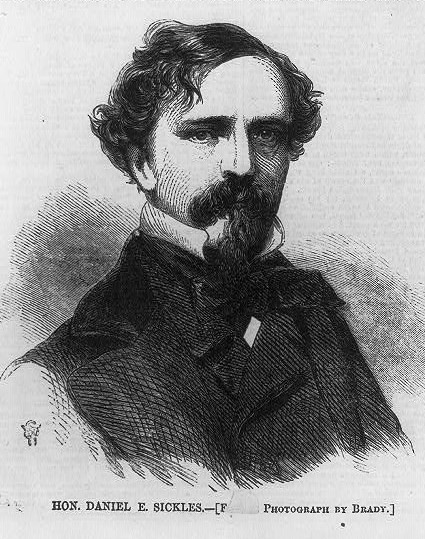
I am taking a break for a while to read and reflect and as such I and am re-posting some articles from my Gettysburg text dealing with a man that I consider one of the most fascinating , salacious, scandalous, heroic, and incredible figures ever to grace and disgrace American history, Congressman, and Civil War General Daniel E. Sickles.

I hope that you enjoy,

Peace

Padre Steve+

HD_TrialofDanielSickles1859.preview

The Sickles Trial

The stage was now set for the one of the most unbelievable and storied trials in American history, a trial that would have been much more suited to the era of 24/7 cable news coverage and the Internet than the era of the telegraph and newspaper, but even so it was sensational by any standard and it riveted the attention of the public in every part of the nation, from the largest cities to the smallest towns.

Almost immediately swarms of journalists were camped outside the prison and Sickles’ house where distraught Teresa sought a way to gain Dan’s forgiveness having received his broken wedding band which he sent to her from the jail. Witnesses to her dalliances with Key at the 15th Street house and other venues were brought to the Stockton Mansion to identify her. “She was the meat in the market, the ogre at the carnival. A little way across the square, souvenir hunters were cutting fragments of wood out of the tree by which Key had fallen, and artists from the illustrated papers set up their easels and began sketching every aspect of the area – the railings, the Stockton Mansion, the Clubhouse.” [1] A Presbyterian pastor who knew the couple found her obsessed by the shame that she had brought upon herself and her daughter, and he “found her in such mental agony that he feared for her sanity and even felt that she might try to take her life.” [2]

It was a credit to her own emotional strength that Teresa survived the ordeal that she had helped to bring about, and which she found herself blamed for, even by her father, who felt that she had dishonored the Bagioli family name. Antonio Bagioli wrote to Dan in prison, “You have heaped on my child affection, kindness, devotion, generosity. You have been a good son, a true friend, and a devoted, kind, loving husband and father.” [3] Of all the commentators, it was the eminent historian and diplomat George Bancroft who seemed to have any “sense of Teresa’s pain: “Poor child, what a cruel thing to deprive her of her sole stay and support. Key was the only man she could look to for sympathy and protection.” [4]

After Barton Key’s lifeless body was borne off in a mahogany casket to the Presbyterian cemetery in Baltimore and buried in the grave of his dead wife, and his children placed in the care of his family, his effects, what they amounted to, including his resplendent Montgomery Guards uniform were “sold off to a morbid, bargain-hunting, souvenir-hounding crowd.” [5] It was an ignoble end to the scandalous story of the son of Francis Scott Key, a story that soon with all of its salacious detail would be revealed to the public.

Meanwhile, inside the jail her husband, alternating between fits of rage and calm was visited by Washington’s Mayor James Barret, Sam Butterworth, Attorney General Black, Vice President John C. Breckinridge, and Speaker of the House, James Orr. He was comforted by the many expressions of support and sympathy found in scores of letters from people around the country, one of the first “a kindly note from the President,” [6] and others from total strangers. He was also joined by friends and allies from New York and Washington. “James Topham Brady, John Graham, and Thomas Francis Meagher, able lawyers all, arrived post haste to defend their rash ally” [7] as well as his father who before offering encouragement to his son offered a sharp chastisement, “You hot-headed fool! That’s no way to settle things! No woman’s worth it! No matter how you come out of this, you’ve killed your career – White House and everything else.” [8]Undeterred and calm Dan told his father that he understood and that if he had to he would do it again, after which, his father began to discuss the organization of his son’s defense with this legal team.

rerl_02_img0122

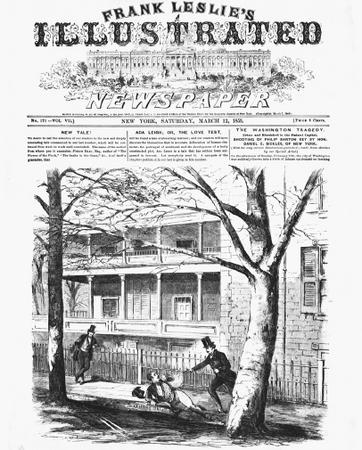
The case was front page news in all the major newspapers, which provided “extensive coverage of the “Sickles Tragedy.” Sickles’ murder of his friend Key in broad daylight in view of the White House had all of the scandalous elements that have thrilled Americans then and even today: “adultery, politics, celebrity, and a handsome corpse,” [9] not to mention a beautiful young woman who even more than her husband who had killed a man, stood accused in the eye of the public.

Despite the notoriety of the case, many people found sympathy with Sickles and believed that no jury would convict him of murder or manslaughter, after all, Teresa was the one who committed adultery with Key. The New York Herald “doubted that a grand jury would indict him. Even if he were indicted, Harper’s Weekly presumed that no jury would convict him of manslaughter if the adultery charge were proven, which it considered a foregone conclusion.” [10] The New York Times noted well before the trial opened, “there appears to be no second opinion as to the certainty of Mr. Sickles acquittal” but “national interest” arose from “the general desire to see the whole case fairly put, and the million scandals of mystery laid to rest by the plain facts.”[11]Newspapers like the New York Evening Post, his political arch-enemy found the murder an excellent opportunity to attack Sickles, “That wretched man, Daniel E. Sickles, has in his career reached the stage of assassination, and dipped his hands in human blood… It is certain that a man… who in his own practice, regards adultery as a joke and the matrimonial bond as no barrier against the utmost caprice of licentiousness – has little right to complain when the mischief which he carriers without scruple into other families enters his own.” [12] But such commentary was the exception, and it came from the organ of a political enemy. It is an interesting comment on the era, that a woman’s adultery, even when committed by the wife of an adulterous male who had killed her lover, was consider more of a social stigma and crime than murder.

Within days Sickles had assembled one of the most formidable defense teams ever to dominate an American court. Brady, who was considered to be the ablest criminal defense lawyer of his day became the lead attorney for the defense team, and was joined by Sickles’ New York friends, Graham and Meagher. Brady was an excellent choice, he “was admired and even loved by society in general, but on top of that, though his legal repertoire was wide, he had been involved successfully in more than fifty murder cases.” And he “had also made a special study of pleas of insanity,” [13] something that would figure greatly in the trial.

Additionally, President Buchanan helped recruit one of the finest attorneys in the country, the future Secretary of War, Edwin Stanton to the team. They were joined by four lesser known, yet high-powered attorneys; Samuel Chilton a Virginian who later represented John Brown, and his partner Allen Magruder, Daniel Ratcliffe, and Philip Phillips, a former Alabama Congressman and member of Washington’s Jewish community. Additionally, Reverdy Johnson, one of the most respected attorneys of the day served as an occasional advisor. “The Washington Evening Star observed that Sickles was collecting a lot of lawyers for a man whose defenders did not expect to leave their box before acquitting him.” [14]

Sickles’ defense team was a nineteenth century legal Dream Team against which the government deployed but one attorney, Key’s former assistant District Attorney Robert Ould. Ould, described by one of Sickles’ biographers as “a dull bull of a man, at one time a Baptist parson,” [15] had been named acting District Attorney by President Buchanan when Key was killed. It was an odd place for Ould, as he was serving to prosecute his former boss’s killer, at the behest of the President, who happened to be one of the defendant’s best friends. Ould, the former parson “was placed by inference in the unhappy position of defending adultery – something that he indignantly denied, insisting that he was merely prosecuting a killer….” [16] but to many people, the murderer of an adulterer by an aggrieved husband was complete justified. Ould was totally outclassed by the defense team, and Key’s family paid to have John Carlisle a respected Washington attorney to aid Ould in the case, but the trial would prove them appear incompetent and not up to the task of convicting Sickles.

HarpersMagazineTeresaConfession

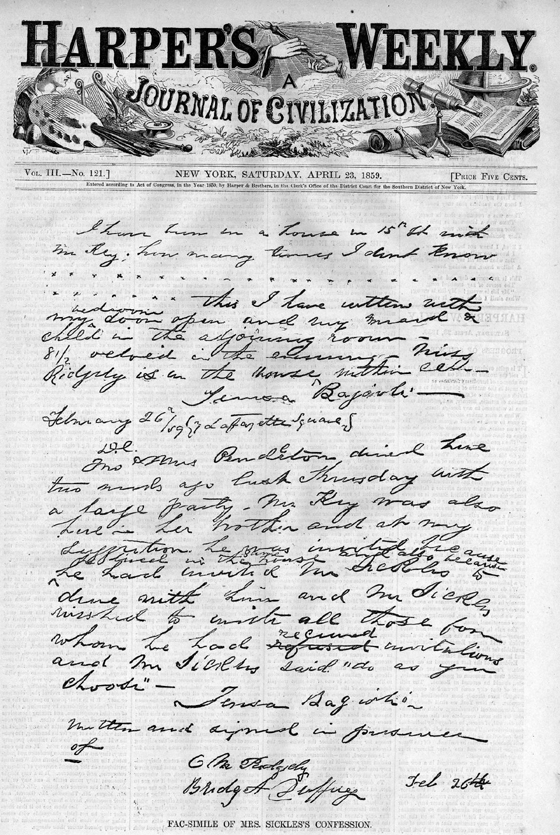
Teresa Sickles Confession on the Front Page of Harper’s Weekly

The defense pushed for a speedy trial and decided, as many lawyers do today, to try the case in the newspapers, which in light of the lurid nature of the story hung on every word coming out of Washington. The defense team pursued the strategy of “entirely reversing the roles of Sickles and Key by putting the dead man on trial for having made a victim of the defendant, and the New York Press prepared the public for just such an emotional appeal.” [17] The news stories printed by papers that supported Sickles as well as those of his detractors helped inflame the public as the newspapers across the country “wherever wires ran, were front-paging the story under screaming headlines and, in larger cities, rushing out extras every hour or two, as fresh details came to hand.” [18] The private affairs of Dan and Teresa Sickles became known around the nation, and even though the judge in the case refused to admit the confessions Sickles had forced from Teresa into evidence they found their way into the papers, some like Harper’s not only ran the text but reproduced the confession in enlarged facsimile form. The question in many people’s mind “was Dan Sickles justified in slaying the man who had betrayed his confidence and seduced his wife?… As a consequence the whole country turned jury.” [19]

The trial began on April 4th, just over a month after the killing and barely a week after the indictment was handed down. The first three days involved jury selection, a task that the defense turned over to Philip Phillips, who sparred with the prosecutor Ould over the twelve men who would eventually sit in judgment of Dan Sickles. Ould attempted to gain a favorable jury by introducing the property qualifications of jurors, he “ruled out jurors who did not meet the requirement of owning property valued at $800. Since this $800 property limit had not been imposed in similar cases, Ould’s insistence on it would attract much scorn from Dan’s lawyers…”[20]Sickles’ team fought back embarrassing Ould in the process, but not getting the judge to change his narrow application of the law to help the defense. Over two hundred potential jurors were examined before twelve unbiased jurors could be found, and a “great majority of those dismissed confess strong prejudice in favor of the prisoner.” [21] When the jury was seated it was composed of twelve men, two farmers, four grocers, a merchant, a tinner, a coach maker, a men’s clothing salesman, a shoemaker, and a cabinetmaker, “but not a single “gentleman” in the occupational sense.” [22]

Ould opened his case, “ponderously, powerfully, in the blackest of terms,” [23] he drew a picture of the killing. He delivered an “emotionally charged argument that Sickles, “a walking magazine,” had taken deliberate care in arming himself against Key, who only had “a poor and feeble opera-glass.” [24] Ould argued “that homicide with a deadly weapon, perpetrated by a party who has all the advantage on his side and with all the deliberate cruelty and vindictiveness, is murder, no matter what the antecedent provocation in the case.”[25]He then called twenty-eight witnesses, the majority of whom had actually witnessed the shooting, but he did not call upon Butterworth, Teresa, or the young White House page boy who had told President Buchanan and been sent away. Likewise he had not established intent, a key factor in any murder trial, nor had he introduced evidence that he had obtained regarding Sickles’ own affairs with women in Philadelphia, Baltimore, and elsewhere. The presentation of the physical evidence of Barton Key’s clothing and the bullet that supposedly killed Key was botched, the bullet that the prosecution claimed to have killed key did not fit either the Derringer, or the Colt revolver. Thus Ould left open for the defense the chance to explore all the salacious details of the case to put Key on trial, and to establish exculpatory reasons why Sickles had killed Key. Ould’s presentation of his case was brief, and so futile “that it seemed that Key was on trial for seduction, not that Sickles was on trial for murder.” [26]

sickles in the box

Sickles in the Prisoner’s Dock

The defense team made mincemeat of the prosecution. John Graham’s opening statement was a work of oratory genius that “would massively outshine Robert Ould’s more cumbersome opening.” [27]Weaving allusions from Shakespeare and other literary greats into his statement, he painted Sickles as the victim of a adulterous rogue who had on a Sunday, a day when he should have “sent his aspirations heavenward,” had instead besieged “that castle where for security and repose the law had placed the wife and children of his neighbor.” [28] Casting Sickles as the aggrieved and temporarily insane victim he also asked if it was a “crime for a husband to defend his family altar.” From there he proceeded to use quotes from Shakespeare’s Othello he inveighs against the adulterer as the supreme criminal, piling up quotation upon quotation from the Old Testament and Roman law to show that in wiser days the punishment invariably was death’” [29] to paint the picture of Sickles’ agony as he saw the man who had defiled his wife prowling outside of his home. Graham then went to provocation and argued that due the circumstance of the crime, a friend and confidant attempting to defile Sickles’ wife on a Sunday that the prosecution “needed to prove Dan’s sanity at the time of the act. And they could not do that, because there was not enough in the case “to melt the heart that is not cut from the unwedgeable gnarled oak.” [30] It was a masterful performance.

Over the next two weeks, Brady, Stanton, and Graham would continue to hammer the prosecution case. The defense proved that Key’s family had tampered with evidence, including testimony from a locksmith who had changed the locks at the 15th Street house at the direction of Key’s family. Witness after witness was introduced to undermine the prosecution and support the defense’s claim that Sickles’ was indeed in a state of uncontrollable madness, and the defense deftly parried the prosecutor’s rebuttal witnesses. When Ould attempted to keep African American witnesses from testifying Stanton, thundered and“accused the prosecution of a “monstrous” attempt to suppress evidence in its zeal of the defendant’s blood,” [31] and argued from North Carolina precedent that the prosecution was not willing to grant Sickles the same right as a slave. As his lawyers argued his case and witnesses gave testimony Sickles maintained his composure except for a number of times when he broke down and had to be excused from the proceedings. “Whether the courtroom histrionics were real or an award-winning performance, the jury witnessed firsthand a husband who was mentally unable to bear his wife with another man.” [32] On the Friday the 22nd of April Judge Crawford declared the testimony closed and the next day began the closing arguments.

Saturday April 23rd dawned with a violent gale, but that did not prevent crowds of people from trying to gain admittance to the courtroom. Edwin Stanton began the defense closing arguments in a manner that was calm and precise. He brought up that justifiable homicide included that which was “committed in defense of family chastity, the sanctity of the marriage bed, the matron’s honor, the virgin’s purity.” [33] Since the prosecution had never brought into evidence Sickles’ own violation of these covenants his attacks on Key and the prosecution case hit home. As he continued his voice rose to a roar, sounding like a prophet of ancient Israel “Who seeing this thin, would not exclaim to the unhappy husband, “Hasten, hasten, to save the mother of your child! And may the Lord who watches over the home and family guide the bullets and direct the stroke!” [34] When Stanton finished the court erupted in a frenzy as spectators as well as supporters of Sickles applauded his closing.

Next up was Brady who went on for three hours, captivating the audience which hung on every word. “When Daniel Sickles realized how he had been betrayed, all the emotions of his nature changed into a single impulse; every throb of his heart brought before him the sense of his great injuries; every drop of his blood was burdened with a sense of shame; he was crushed by inexorable agony in the loss of his wife, in the dishonor that he had come upon his child, in the knowledge that the future – which had opened to him so full of brilliancy – had now been enshrouded in eternal gloom by one who, contrawise, should have invoked form the eternal God his greatest effulgence on the path of his friend….” [35]

The closing had been masterful, emotional, and dramatic. In response Ould attempted to recover, but his arguments were weak, he agreed with the defense about the crime of adultery, and attempted to redirect the jury’s attention that it was Sickles who was on trial for murder and not Key for adultery, but he had already lost that argument. He called the defense of temporary insanity a ploy and “mentioned how easily, and readily a man on trial for his life might pretend to be deranged if he were on trial for his life.” But it was too little, too late. Since there was no psychiatric profession to weigh in on the matter, the argument of temporary insanity fell back on the “tradition of male marital dominance” and “that argument played well among men who rarely wore collars on their shirts…” [36] the very kind of men seated in the jury booth.

When the jury recessed to deliberate Sickles’ fate on the 26th it took them less than an hour to return their verdict, and few were surprised when it came back “not guilty.” Stanton “was so excited that he did a jig in the courtroom, the hoarsely called for three cheers.” [37]As he did “Pandemonium and cheers broke out in the courtroom.” [38]People crowded around to congratulate Sickles and the crush was so great that Sickles had to be escorted for the courtroom. President Buchanan on hearing the verdict was delighted, later in the evening, though he sought rest, Sickles was taken by Brady to a gala in his honor attended by nearly 1500 supporters and well-wishers. The trial was over but the trials of Dan Sickles were not.

Notes

[1] Ibid. Keneally American Scoundrel p.142

[2] Ibid. Swanberg Sickles the Incredible p.63

[3] Ibid. Keneally American Scoundrel p.146

[4] Ibid. Keneally American Scoundrel p.147

[5] Ibid. Pinchon Dan Sickles p.117

[6] Ibid. Pinchon Dan Sickles p.117

[7] Ibid. Swanberg Sickles the Incredible pp.62-63

[8] Ibid. Pinchon Dan Sickles p.116

[9] Ibid. Hessler Sickles at Gettysburg p.12

[10] Marvel, William Lincoln’s Autocrat: The Life of Edwin Stanton University of North Carolina Press, Chapel Hill 2015 p.103

[11] Ibid. Hessler Sickles at Gettysburg pp.12-13

[12] Ibid. Swanberg Sickles the Incredible p.63

[13] Ibid. Keneally American Scoundrel p.151

[14] Ibid. Marvel Lincoln’s Autocrat p.103

[15] Ibid. Pinchon Dan Sickles p.121

[16] Ibid. Swanberg Sickles the Incredible p.64

[17] Ibid. Marvel Lincoln’s Autocrat p.104

[18] Ibid. Pinchon Dan Sickles p.118

[19] Ibid. Pinchon Dan Sickles pp.118-119

[20] Ibid. Keneally American Scoundrel p.162

[21] Ibid. Pinchon Dan Sickles p.120

[22] Ibid. Marvel Lincoln’s Autocrat p.105

[23] Ibid. Pinchon Dan Sickles p.122

[24] Ibid. Hessler Sickles at Gettysburg p.14

[25] Ibid. Pinchon Dan Sickles p.122

[26] Ibid. Swanberg Sickles the Incredible p.65

[27] Ibid. Keneally American Scoundrel p.173

[28] Ibid. Keneally American Scoundrel p.173

[29] Ibid. Pinchon Dan Sickles p.124

[30] Ibid. Keneally American Scoundrel p.175

[31] Ibid. Marvel Lincoln’s Autocrat p.107

[32] Ibid. Hessler Sickles at Gettysburg p.15

[33] Ibid. Pinchon Dan Sickles p.127

[34] Ibid. Pinchon Dan Sickles p.128

[35] Ibid. Pinchon Dan Sickles p.129

[36] Ibid. Marvel Lincoln’s Autocrat p.110

[37] Ibid. Swanberg Sickles the Incredible p.66

[38] Ibid. Hessler Sickles at Gettysburg p.17

Leave a comment

Filed under crime, History, Loose thoughts and musings

Murder in Lafayette Square, Dan Sickles: Part Two

Friends of Padre Steve’s World,

I am taking a break over the next few to read and reflect I am re-posting some articles from my Gettysburg text dealing with a man that I consider one of the most fascinating , salacious, scandalous, heroic, and incredible figures ever to grace and disgrace American history: Congressman, and Civil War General Daniel E. Sickles.

I hope that you enjoy,

Peace

Padre Steve+

philip-barton-key-granger


Within a year of his assignment Sickles returned to the United States to help prepare the Democratic nomination for his friend Buchanan who had long desired the office, and return to his lucrative post in New York. In the spring of 1856 Sickles began to work on Buchanan’s nomination for the Presidency and while doing so began his own campaign for New York’s Third District’s Congressional seat. Buchanan won the election of 1856 against an opposition divided between the Know Nothing candidacy of former President Millard Fillmore and the candidate of the new Republican Party, John C. Fremont.

In the election of 1856, Sickles carried the district easily. For Sickles it was a triumph, he was “riding a flood tide of political fortune that might carry him far,” [1] and like any wife Teresa too was delighted with the result. Even so, Teresa must have wondered if her husband would mend his ways now that he was on the national spotlight, or if he would continue his extramarital romps around the nation’s capital. Following the election Dan and Teresa moved to Washington D.C. where they took up a fashionable residence, the Stockton Mansion, on Lafayette Square, not far from the White House and Sickles friend, James Buchanan.

Once he was established in Washington Sickles was in his element, politics at its grandest. It was a different style than of politics than Tammany, where brass knuckled force often ruled, but it suited Sickles, who was “a fixer who knew all the tricks of Tammany at its crookedest but who seems not to have taken graft himself. He had his sights fixed on the presidency, and he was making about as much progress in that direction as a Tammany man can,” [2]   until a strange combination of unrequited love, infidelity, the personal betrayal of a friend, and a murder intervened.

HarpersMagazineMrs.Sickles

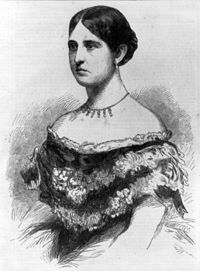
Teresa Sickles

While her husband politicked along the Potomac, the new congressman’s wife was adapting to her life in Washington D.C. The wives were expected to entertain and host parties on a regular basis at their residences, but they also knew their share of loneliness and neglect. Since legislators routinely were “busy with night sessions, committee meetings, and plain nocturnal politicking over whiskey punch, that their wives either accepted other escorts or spent lonely evenings at home with fancywork or a book.” thus it was not surprising that Teresa, “should seek the gayety of the capital in her first year there.” [3] In the absence of their husbands it “was not uncommon for available bachelors to act as escorts for married women when their husbands were unavailable.” [4] Since Dan Sickles was frequently unavailable and since Teresa probably still suspected that Dan was still engaged in extramarital affairs, it is not surprising that the young Mediterranean beauty found comfort in another man.

The years of 1857 and 1858 would be a tumultuous time for the nation as well as the Sickles. Buchanan had been elected because of his stability and moderation in an age of pro and anti-slavery radicalism. However, over the next year his presidency, and his would be overwhelmed by events and Buchanan’s decisions supporting the expansion of slavery. While Sickles was neither a slave owner, nor himself fond of the institution, it was part of life, and many of his friends in Washington D.C. and in Congress were slave holders. Buchanan had schemed before his inauguration with Chief Justice of the Supreme Court Roger Taney in the Dred Scott decision, which was handed down in the days following Buchanan’s inauguration, followed by the fiasco over the Lecompton constitution and the attempted admission of Kansas as a Slave State, an event which split the Democratic party in the 1860 election, ensuring Abraham Lincoln’s defeat of Buchanan’s Lecompton foe in the Senate, Senator Stephen A. Douglas who would have been the prohibitive favorite in the election had the split not occurred.

Likewise, Sickles and his beautiful young wife would become part of one of the most sensational trials of American history, rivaling the Lindbergh kidnapping trial, the trial of O.J. Simpson, the Scopes Monkey Trial, and the Impeachment of President Bill Clinton in its captivation of America. As in London, Teresa became popular and she and Dan were much sought after and their home “became the scene of a gradual number of and entertainments,” [5]and even as Sickles continued his robust politicking and philandering Teresa became the object of another’s affection, the District of Attorney for the District of Columbia, Philip Barton Key, the son Francis Scott key, the writer of the Star Spangled Banner. Interestingly enough it was Sickles who had helped Key the troubled man to be reappointed to his office in early 1857 after Key had helped Sickles overcome legal and financial difficulties to secure Sickles in the Stockton Mansion and the two men developed a warm friendship.

Philip Key was extraordinarily handsome, especially when outfitted in his green and gold militia uniform of the Montgomery Guards, and was considered one of the most desirable men in Washington. An accomplished horsemen he rode about town on his “horse Lucifer – a nobly bred, dapple gray hunter.”[6] When he gained Sickles’ friendship many of his well to do political and society friends became frequent visitors to the Sickles household. After Sickles had helped Key to be reappointed to his office, Key was instrumental in helping make the arrangements for Sickles to rent the Stockton Mansion.

During his first term in office Key was not known for being a particularly good District Attorney and spent much time away from the office complaining about his allegedly poor health. But his health did not keep him away from Washington’s party scene and “One hostess called him “the handsomest man in all Washington… he was a prominent figure at all the principle functions; a graceful dancer, her was a favorite of every hostess of the day.” [7] When he met Teresa, the dashing bachelor took an intense interest in the wife of the man who had helped him retain his job. The two were soon attending many functions together that Sickles, due to his work schedule could seldom attend.

Within weeks Key became a frequent guest at the Sickles home and few were surprised at this, as most observers knew that Sickles was responsible for Key’s reappointment. With Sickles now fully engaged in the dramatic political battles of late 1857, Teresa and Key began to spend much more time together. The two were seen together at the “theater, at teas, at hops. But most of all they went riding together.” [8] The frequency of these visits was noted and became the source of much gossip but Sickles was unaware of it and entertained no suspicions that his new friend was becoming deeply involved with his wife, and that Key had rented a room where the two could intimate.

That was until a young man equally smitten by Teresa had a few drinks with a colleague and the colleague shared the information with a loyal Sickles ally who then told Sickles. Sickles was shocked and called for a meeting with Key, however, after a brief conversation, Key convinced Sickles that there was nothing to the rumors, and Sickles was satisfied.

Though Sickles had been satisfied by the explanation, “despite his own well-publicized moral lapses, Daniel Sickles was a man of intense personal pride who would not countenance the breath of scandal attaching to his wife.” [9] He took the time to warn her to make sure that she was not involved in any other indiscretions, and left the subject. However, Key and Teresa continued to see each other, and “she and Barton thought that they were taking more care, and being less observed by people than they were.” [10] Yet as they pursued one another their affair became increasingly public, and seen by too many people not to go unnoticed. The two were seen together in at the Congressional Cemetery, and frequently at a house at “385 15th Street where he would enter the by the front door – and she the back.” [11] When a mutual friend expressed his concerns, Key shrugged off the warning, and “with the bravado of a proud weakling, he still held his course. And Teresa, ductile, enamored, blindly followed his lead.” [12] Another friend of Key suggested to him that he could be in danger, but Key “bridled and patted the breast of his coat. “I am prepared for any emergency,” he snapped. Key was a crack pistol shot and his friend believed that Key was preparing for a possible confrontation. [13]

Like so many people young spouses who find their needs unfulfilled at home, and who suspect their spouse of infidelity, , “Teresa did not see this love affair as tragic and dangerous. She lived within it as a secret fantasy, as in a virtual and time-consuming experience that lacked any power to inflict damage on other areas of her life.” [14] She became less discreet, Key would signal to her from across the street to confirm their dalliances and despite their insipidly inept attempt to hide the affair it became clear to Sickles’ coachman and household maids that the two were engaged in sexual encounters in the Sickles carriage and in the Stockton Mansion itself.

The situation finally came to a head in February 1859 following Sickles reelection and return to Washington. “Made more reckless than ever by their recent separation, Barton and Teresa now again were seen everywhere together.” [15] The couple were now making clandestine liaisons on a nearly daily basis, and eventually, one of the observers decided to tell Sickles. The anonymous source, using the initials of R.P.G. sent Sickles a letter detailing the affair. Sickles received the letter from a butler on the night of Thursday February 24th as he was leaving the usual dinner party at his house for the traditional hop that followed at the Willard Hotel.

Sickles did not read the letter until after the couple returned home and Teresa had gone to bed. Sickles was stunned and at first did not believe the contents as he placed little stock in anonymous messages. So he had George Wooldridge, a longtime friend and congressional clerk investigate, and on Saturday February 26th Wooldridge confirmed Sickles worst fears. That evening at their home Sickles confronted Teresa about the letter and as he stormed about angrily in their bedroom she confessed, after which Sickles had her write out her confession detailing everything. He may have been desolate and angry, but he was a lawyer, and he got his written proof.

But scandal was the last thing that Sickles wanted, as he had higher aspirations in politics, so he immediately called his friends for counsel and by Sunday morning several, including Wooldridge and Samuel Butterworth were at the Stockton Mansion with Sickles. As always, Sickles’ “first thoughts were for himself, and he melodramatically”[16] exclaimed to Butterworth, “I am a dishonored and ruined man…I cannot look you in the face.” [17]

4P8V9475

Murder

His friends “were profoundly touched by the depth of his feeling, and were convinced that he needed to be saved from a severe derangement of his senses; from lunacy, that is.” [18] his friends attempts to calm him, Sickles was beside himself with anger, and his anger now swirled around his marriage and what he believed was the scandal that would cost hi his career. That afternoon, Key again tempted fate, this time, for the last time. He had been tipped off by an anonymous letter that the affair was public, but he was determined to see Teresa. He made several passes by the house, each time signaling with a handkerchief, until Sickles observed him. Sickles called out to Butterworth “That villain has just passed my house! My God, this is horrible!” [19]

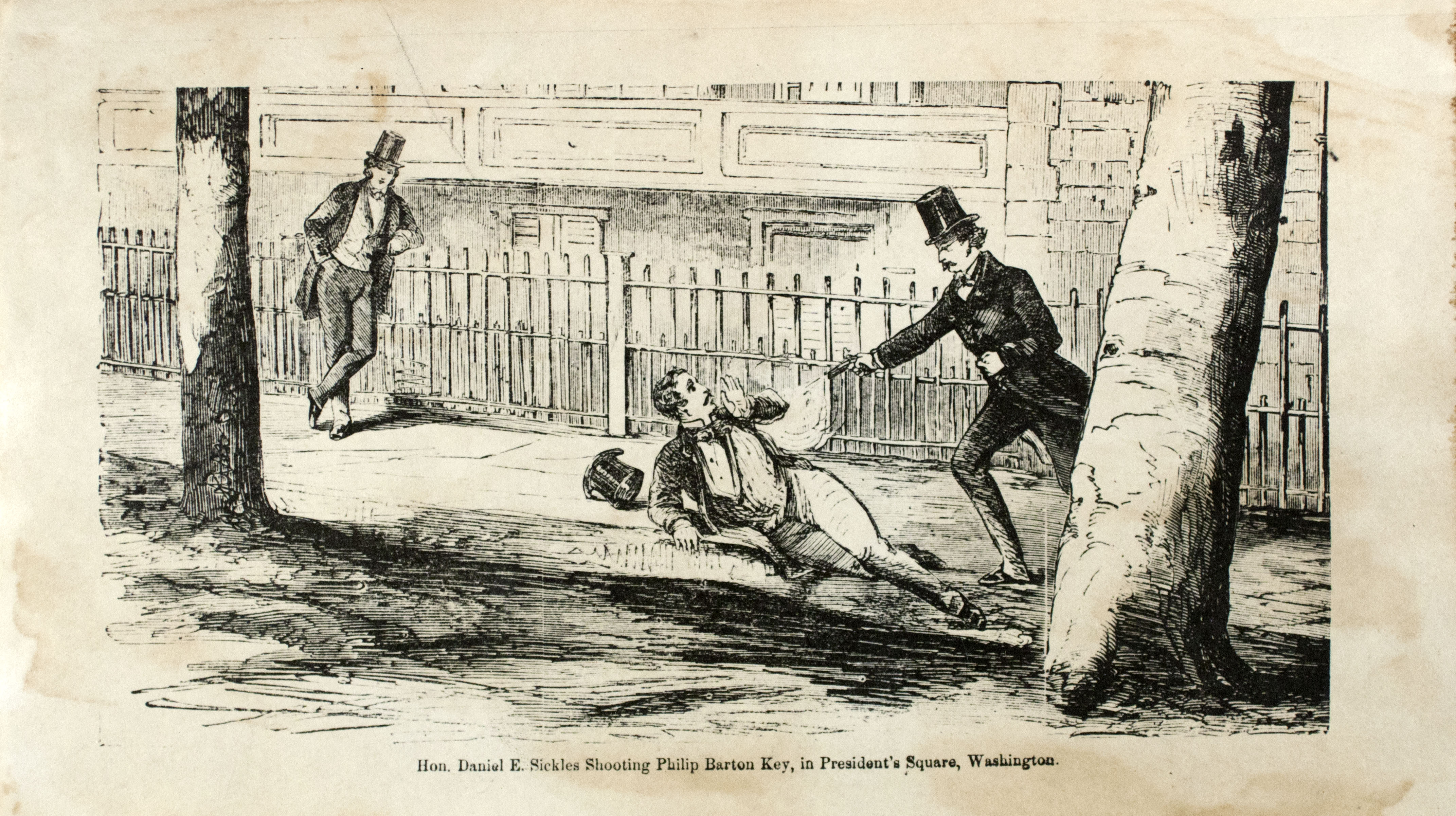
Butterworth left the house first and met Key at the southeast corner of Lafayette Square across from the White House. Allegedly not knowing Sickles intended any harm, Butterworth walked with Key to for a few minutes and then left. The exchange delayed Key and gave Sickles, who had armed himself with a single shot large caliber Derringer, and a muzzle-loading Colt revolver, enough time to catch up with Key near the Club House on Madison on the east side of the square. Sickles was raving but Dan’s fury transcended reality,” [20] as at least a dozen witnesses were nearby as he screamed, “Key, you scoundrel, … you have dishonored my bed – and you must die!” [21] Sickles pulled out the revolver, the first shot from which grazed Key, and the second which misfired. A brief scuffle ensued as Key lunged at his assailant, but Sickles flung him to the ground, and drew the Derringer as Key threw the opera glasses that he viewed Teresa at Dan. A third shot hit Key in the groin and he slumped to the ground screaming “Murder! Murder!… Don’t shoot!” [22]

If there was a chance for Sickles to prove that he acted in self-defense it was now, but he could not control himself. He fired the revolver yet again and it misfired. He placed the weapon in his pocket and drew the Derringer, and fired a shot which hit Key in the Liver. As Key writhed on the ground Sickles tossed the Derringer to the ground and he again drew the Colt. As the stunned witnesses to the attack looked on, Sickles advanced toward the fallen Key and placed the gun at his head and pulled the trigger, but again the weapon misfired. As Sickles attempted to place another cap in the pistol, a number of witnesses began to intervene. One man, “a member of the club, running up, stopped him. Mr. sickles – for God’s sake!” And Butterworth, coming forward, took Dan by the arm. Without a word, they walked away together.” [23] Witnesses took the mortally wounded Key away to the Club, where he expired.

President Buchanan was almost immediately told of the murder by a White House page boy, was aware of the implications of the scandal, Sickles was a friend and political ally with much promise. Buchanan told the boy leave town and gave him a sum of money to facilitate his departure. Soon after Sickles and Butterworth went by carriage “to the home of Attorney General Black, where the Congressman formally surrenders himself to the silver-haired Cabinet member who had regarded him as a protégé.” [24]He declined bail in favor of a speedy trial, was allowed to go home where he told Teresa that he had killed her lover, retrieved some personal items and then went to the District jail, “a foul hole, swarming with vermin, destitute of sewage, bath, water, ventilation, and so inadequate to its purpose that often a dozen or more prisoners were herded into a single narrow cell.” [25] When he arrived he reportedly asked the jailer if they were the best accommodations available, to which the jailer responded “this is the best place you members of Congress have afforded us.” [26] Dejected, but undeterred Sickles sent a message to the public, “In doing what I had to do I have broken the law. Therefore I place myself behind bars. It is for you to set me free.” [27] The stage was now set for the one of the most unbelievable and storied trials in American history.

Notes

[1] Ibid. Swanberg Sickles the Incredible p.4

[2] Ibid. Catton The Army of the Potomac: Glory Road p.151

[3] Ibid. Swanberg Sickles the Incredible p.15

[4] Ibid. Hessler Sickles at Gettysburg p.8

[5] Ibid. Swanberg Sickles the Incredible p.16

[6] Ibid. Pinchon Dan Sickles p.74

[7] Ibid. Hessler Sickles at Gettysburg p.9

[8] ibid. Swanberg Sickles the Incredible p.20

[9] Ibid. Swanberg Sickles the Incredible p.25

[10] Ibid. Keneally American Scoundrel p.92

[11] Ibid. Wilson and Clair They Also Served p.99

[12] Ibid. Pinchon Dan Sickles p.94

[13] Ibid. Swanberg Sickles the Incredible p.44

[14] Ibid. Keneally American Scoundrel p.92

[15] Ibid. Pinchon Dan Sickles p.93

[16] Ibid. Hessler Sickles at Gettysburg p.10

[17] Ibid. Swanberg Sickles the Incredible p.53

[18] Ibid Keneally American Scoundrel p.121

[19] Ibid. Hessler Sickles at Gettysburg p.10

[20] Ibid. Keneally American Scoundrel p.127

[21] Ibid. Swanberg Sickles the Incredible p.54

[22] Ibid. Hessler Sickles at Gettysburg p.11

[23] Ibid. Pinchon Dan Sickles p.112

[24] Ibid. Swanberg Sickles the Incredible p.55

[25] Ibid. Pinchon Dan Sickles p.114

[26] Ibid. Keneally American Scoundrel p.135

[27] Ibid. Swanberg Sickles the Incredible p.114

1 Comment

Filed under civil war, crime, History, laws and legislation

Dan Sickles, the Incredible Scoundrel and Patriot: Part One

Friends of Padre Steve’s World,

I am taking a break over the next week or so to catch up on some reading and reflection, and I am re-posting some articles from my Gettysburg text.  These deal with a man that I consider one of the most fascinating , salacious, scandalous, heroic, and incredible figures ever to grace and disgrace American history, Congressman, and Civil War General Daniel E. Sickles.

I hope that you enjoy,

Peace

Padre Steve+


6517740_orig


George Meade had made his dispositions on July 2nd 1863 with care, but there was one notable problem, the commander of III Corps, Major General Dan Sickles did not like the position assigned to his corps on the south end of Cemetery Ridge. But before discussing that it is worth chasing the rabbit so to speak and spend some time on the life of a man referred to by one by one biographer as an American Scoundrel and another as Sickles the Incredible. The interesting thing is that lie most complex characters in history that Dan Sickles was both and, “he might have had more faults than virtues, but everything about him was perfectly genuine.” [1] That is one of the reason that he is so fascinating.

Sickles was certainly a scoundrel and at the same time incredible, charming yet terribly vain and often insincere. “He was quick-witted, willful, brash, and ambitious, with pliable moral principles.” [2] But he was also incredibly brilliant, far sighted, patriotic, and civic minded. He was a political general, “flamboyant, impulsive, and brave, some would wonder about his discipline and military judgement.” [3] His notoriety and unpopularity among the West Point trained professional officers in the Army of the Potomac, as well as his tactical decision to move his corps on the afternoon of July 2nd 1863, and his subsequent political machinations ensured that he would be the only corps commander of that army not commemorated with a monument at Gettysburg.

Dan Sickles was one of the most colorful, controversial, and perhaps the most scandalous officer ever to command a corps in the history of the United States Army. While he lacked professional training he had done a fair amount of study of the military arts in his spare time, and he “made up for his lack of military training by acting on the battlefield with reckless courage, and was much admired for it by his men.” [4]

After having served as a brigade and division commander Sickles was promoted to corps command. “Sickles owed his elevation to corps command to the patronage of his friend Joseph Hooker…. And while man of the West Point officer….regarded Sickles military acumen with the greatest skepticism, many in the volunteer ranks were of a different mind. “Sickles is a great favorite in this corps,” asserted Private John Haley of the 17th Maine. “The men worship him. He is every inch a soldier and looking like a game cock. No one questions his bravery or patriotism.” [5] General Alpheus Williams who commanded a division in the Union Twelfth Corps despised Sickles, and after Chancellorsville Williams wrote “A Sickles’ would beat Napoleon in winning glory not earned,,, He is a hero without a heroic deed! Literally made by scribblers.” [6] Likewise, Sickles, the political general was no favorite of George Gordon Meade.

On July 2nd 1863 Sickles would be responsible for an act that threw George Meade’s defensive plan into chaos, and according to most historians and analysts nearly lost the battle, however, there are some who defend his actions and give him credit for upsetting Lee’s plan of attack. However, the truth lays somewhat in the middle as both observations are correct. Sickles’ decision created a massive controversy in the months following the battle as public hearings in Congress, where Sickles, a former congressman from New York had many friends, as well as enemies, sought a political advantage from a near military disaster.

Sickles was a mercurial, vain and scandal plagued man who “wore notoriety like a cloak” and “whether he was drinking, fighting, wenching or plotting, he was always operating with the throttle wide open.” [7]Sickles was born in New York to George and Susan Marsh Sickles in late 1819, though a number of sources, including Sickles himself cite dates ranging from 1819 through 1825. “There is little reliable information about Sickles’ early days,” [8] and he did not talk much about them, especially after the war, when Gettysburg and the Civil War became his main subjects of conversation. His father, a sixth generation American whose family were early Dutch settlers in Manhattan became wealthy through real estate speculation, “and he passed on to his son a pride in being a congenital Knickerbocker,” charming, witty, and clever, in whom “hardheadedness and impulsiveness were combined.” [9]

The young Sickles was an impetuous child and his father’s wealth ensured that Dan Sickles had “the finest of tutors…. And an unceasing bankroll of funding for lascivious escapades.” [10] To get their son special tutoring to prepare him for college, his parents “arranged for him to live in the scholarly house of the Da Pont family…. It was a household like few others in that hardheaded, mercantile city, at a time when New York had little of the Italian character it would later take on.”[11]The home was a place of learning, culture, and unusual relationships. The head of the house was Lorenzo L. Da Pont, a Professor at Columbia, as well as a practicing attorney. Also living in the home was Da Pont’s father, the ninety-year-old Professor Lorenzo Da Pont, who “had been the librettist for three of Mozart’s operas” [12] and “held the chair of Italian and Columbia University” [13] Additionally, the elder Da Pont’s “adopted daughter Maria and her husband, Antonio Bagioli, a successful composer and music teacher” [14] lived under the same roof.

Maria was only about twenty-years-old when Sickles moved in. By this time she and Bagioli already had a child of their own, a three year old daughter named Teresa, which Sickles would eventually marry. While the elder Da Pont claimed Maria as an adopted daughter, it was “widely believed that she was his “natural child” … from an American liaison conducted when he was near the age of seventy.” [15] This spawned rumors, even at the time of Gettysburg that the young Sickles “and his future mother-in-law had a sexual affair.” [16]

Whether the liaison with Maria Bagioli occurred is a matter of innuendo and conjecture, but it would not be out of character for Sickles, who, to put it mildly, had a wild proclivity for the opposite sex. As a young man he frequented brothels, and as his social and political status increased, he moved from the brothels frequented by the middle class to those which catered to the more socially well to do. One of his affairs was with the a prostitute named Fanny White, a woman who was smart, pretty, and upwardly mobile who ran her own bordello. His affair with Fanny was well publicized, but did not prevent him from being elected to the state legislature in 1847. She and Sickles would continue their relationship for years with her asking nothing more than expensive gifts, and there are inklings that Fanny help to fund Sickles’ early political campaigns. There is also speculation that in 1854 following his marriage, that Fanny spent time with him in London while he was working with James Buchanan and that that he “may have brought Fanny to one of the Queens’s receptions and introducing the prostitute to Her Majesty.” [17] But Fanny eventually moved on to a man older and richer than Sickles. Eventually she retired from her business and married another New York lawyer but died of complications of tuberculosis and possibly syphilis in 1860. Her property at the time of her death was conservatively “estimated at $50,000 to $100,000”[18] a considerable fortune for a woman of her day and age.

While he lived with the Da Pont family, Sickles gained an appreciation for foreign languages, as well as theater and opera. The elder Professor Da Pont was a major part of his academic life and quite possibly in the development of Sickles liberal education and his rather libertine morality. Lorenzo had been a Catholic Priest and theologian in Italy, but like his young American admirer had quite the attraction for women, and was a connoisseur of erotic literature and poetry. His activities resulted in him being expelled from his teaching position in the seminary, after which he became fast friends with a man whose name is synonymous with smooth talking, suave, amorous men, Giacomo Casanova, and in Europe “his affairs with women had been almost as notorious as those of his good friend.” [19] Certainly the elder Lorenzo’s tales “of Casanova, the fabled prince of Priapus, did nothing to quell Dan’s adolescent sexual appetite.” [20]

Noted Civil War and Gettysburg historian Allen Guelzo describes the Sickles in even less flattering terms, “Sickles was from the beginning, a spoiled brat, and he matured from there into a suave, charming, pathological liar, not unlike certain characters in Mozart operas.”[21]

Following the deaths of both the elder and younger Professor Da Pont, Sickles was stricken with grief. At the funeral of the younger Professor Da Pont Sickles “raved and tore up and down the graveyard shrieking,” [22] forcing other mourners to take him away by force. Soon after, Sickles left New York University and began to work in the law office of the very formidable New York lawyer and former U.S. Attorney General, Benjamin F. Butler.

While he was studying for the bar under Butler, he was joined by his father who would also become an attorney. It was under the influence of his father, who was now a wealthy Wall Street investor, and the Democrats of Tammany Hall that the incredibly talented Sickles was groomed for political leadership. Tammany was a rough and tumble world of hardnosed politics, backroom deals, corruption and graft.

He passed the bar in 1843 and soon was making a name for himself in the legal world, and in politics, despite his well-known questionable ethics and morality. His political career began in 1844 when “he wrote a campaign paper for James Polk and became involved in the Tammany Hall political machine.” [23] The ever ambitious Sickles “clambered up the city’s Democratic party ladder, on the way collecting allies and enemies with utter disregard for the consequences, attending the typically unruly Tammany meetings armed with bowie knife and pistol.” [24]

Like many of his fellow New York Democrats he was a proponent of “Manifest Destiny, and the right of the United States to acquire and hold Texas, New Mexico, California, perhaps the isthmus of Central American, and certainly Cuba.” [25] He was also a political ally of many states rights Southern Democrats and “largely opposed anti-slavery legislation.” [26] This was in large part due to the commercial interests of New York, which between banking and commercial shipping interests profited from the South’s slave economy.

He was elected to the New York State legislature in 1847 and his political star continued to rise even as his personal reputation sank among many of his peers. An attorney who knew him described Sickles as “one of the bigger bubbles in the scum of the profession, swollen, and windy, and puffed out with fetid gas.” [27] Sickles rivals any American politician, before or since in his ability to rise even as the slime ran down his body, the term “Teflon”applied to politicians like Presidents Ronald Reagan and Bill Clinton comes to mind when one studies Sickles’ career. New York lawyer and diarist George Templeton Strong wrote, “One might as well try to spoil a rotten egg as to damage Dan’s career.” [28]

But there was no denying that Sickles was a brilliant lawyer, politician, and debater. One observed that Sickles was “a lawyer by intuition – careful in reaching his conclusions, but quick and bold in pushing them.” [29]New York Governor “William Marcy grudgingly said that as a debater Sickles excelled any man of his years, and the astute Henry Raymond declared that as a parliamentary leader he was unsurpassed.” [30] Soon Sickles was a delegate to the 1848 Democratic Convention where he helped nominate Franklin Pierce for his unsuccessful run at the democratic nomination. The convention enabled Sickles to enter the world of national politics making friends with many influential politicians and financiers, including Pierce, the Van Burens, and James Buchanan. On his return to New York he received an appointed as a Major in the New York Militia.

Even as Sickles rose in the tumultuous world of American law and politics, and chased Fanny White he became enamored with the now teenage daughter of Antonio and Maria Bagioli, Miss Teresa Bagioli who though only fifteen was beautiful, wise beyond her years, fluent in French and Italian, devoted to the arts, and entirely besotted by Dan Sickles. Both the parents of Sickles and Teresa opposed the relationship, but both were madly in love, and Teresa was as headstrong as Dan regarding the relationship. Though such a relationship would be considered completely scandalous today, such marriages were not uncommon then, though they were certainly less common in the upper society of New York. Sickles “was enchanted by her” and “courted her with the sensibility of being a friend of her parents and he must have suspected that he loved her with a fated and exclusive love.” [31] When she was just sixteen Teresa quit school and married the thirty-three year-old assemblyman in a civil ceremony officiated by New York Mayor Ambrose Kingsland on September 27th1852. Six months later, the two were married in the Catholic Church by Archbishop John Hughes, in a “gala and largely attended affair.” [32]Just three months after the church wedding their daughter, Laura, was born. Though there can be no doubt that Sickles loved Teresa, and she him, it did not stop him from other extramarital affairs, nor did it take much away from his political machinations at Tammany Hall.

Following the 1852 Democratic convention where he again supported Franklin Pierce, Sickles hard fighting and influence at in the Wigwam of was rewarded with political plum prize of being appointed “corporation counsel of New York City, a post that paid a flattering salary with extra emoluments and also left room for profitable legal work on the side.” [33] His political and social acumen were again demonstrated as he convinced the state legislature, through personal force of will, to enable the New York City Corporation “to go ahead with creating a great central park,”[34] a park that we now know today as Central Park. He also helped push forward a proposal to create New York’s first mass transportation system, that of horse drawn omnibuses.

Later in the year Sickles was appointed as secretary of the American legation to the Court of St. James n London, headed by former Secretary of State James Buchanan. The position paid a pittance of what Sickles was earning in New York, but he realized that the serving overseas in such a position could not but help him on the national political stage. Though Buchanan and Pierce wanted Sickles, the new Secretary of State, the former New York Governor William Marcy refused to sign Sickles’ commission for the post. Eventually, Pierce prevailed and Sickles got the job.

As their baby, Laura, was still very young and sea travel still quite hazardous, Teresa remained at home, and joined her husband in London the following year. However, when she arrived in London, the teenage wife of Dan Sickles charmed Americans and Britons alike. Aided by her multilingual gifts, which “were rare among American diplomats’ wives,” [35] she became a great success and the unmarried Buchanan appointed her as hostess for the legation. She rapidly became a celebrity due to her stunning beauty and charm, and like he had Fanny, Sickles had Teresa introduced to the Queen. Her celebrity status evoked different responses from those that observed her. “One contemporary described Teresa as an Italian beauty, warm, openhearted, and unselfish. Another described her as being “… without shame or brain and [having] a lust for men.” [36] That “lust for men” coupled with the neglect of her husband may well have been the catalyst for the scandal which overwhelmed them in Dan’s congressional career.

It was during his service in London with Buchanan that Sickles became embroiled in one of the most embarrassing diplomatic incidents in American history. The proponents of Manifest Destiny and American expansion had long desired to take Cuba from Spain through diplomacy, or if needed force. Following a failed attempt by American “Filibusters” to seize the island in 1852 which ended in the execution of fifty Americans, including the son of U.S. Attorney General John Crittenden by Spanish authorities, and in 1854 President Franklin Pierce authorized Buchanan to attempt to negotiate the acquisition of Cuba.

Pierce authorized Buchanan to meet with James Mason, the United States Ambassador to France and Pierre Soule, the United States Ambassador to Spain secretly in order to draft “a statement on the future of Cuba and the proposed role of the United States.” [37] Soule dominated the meeting and the statement, which was in large part drafted by Dan Sickles, was highly inflammatory. Despite this the statement was released to the press in defiance of the order to maintain the strictest secrecy and it resulted in a diplomatic disaster for the Pierce Administration.

The document was prepared by Soule and Sickles and endorsed by Buchanan and Mason was known as the Ostend Manifesto, and it “was one of the most truly American, and at the same time most undiplomatic, documents every devised.” [38] The manifesto prepared by Soule and Sickles proclaimed that “Cuba is as necessary to the North American Republic as any of its present members, and that it belongs naturally to the great family of states of which the Union is the Providential Nursery.” [39] The authors of the manifesto also threatened Spain should the Spanish fail to accede to American demands. The authors declared that if the United States “decided its sovereignty depended on acquiring Cuba, and if Spain would not pass on sovereignty in the island to the United States by peaceful means, including sale, then, “by every law, human and Divine, we shall be justified in wresting it from Spain.” [40]

The Ostend Manifesto “sent shivers through the chancelleries of Europe, provoked hurried conversations between the heads of the French and British admiralties.” [41] European diplomats and leaders reacted harshly to the statement and Secretary of State William Marcy who had previously supported the ideas in the document immediately distance himself and official American policy from it and the authors. Marcy then “forced Soule’s resignation by repudiating the whole thing, but the damage was done.” For months the Pierce administration was on the defensive, and was condemned “as the advocate of a policy of “shame and dishonor,” the supporter of a “buccaneering document,” a “highwayman’s plea.” American diplomacy, said the London Times, was given to “the habitual pursuit of dishonorable object by clandestine means.”[42] The incident ended official and unofficial attempts by Americans to obtain Cuba by legal or extralegal means until the Spanish American War in 1898.

To be continued…

Notes

[1] Catton, Bruce The Army of the Potomac: Glory Road Doubleday and Company, Garden City New York, 1952 p.151

[2] Wert, Jeffry D. The Sword of Lincoln: The Army of the Potomac Simon and Schuster, New York and London 2005 p.222

[3] Ibid. Coddington The Gettysburg Campaign a Study in Command p.45

[4] Sears, Stephen W. Chancellorsville Houghton Mifflin Co. Boston and New York 1996 p.65

[5] Ibid. Trudeau Gettysburg a Testing of Courage p.110

[6] Ibid. Sears Gettysburg p.35

[7] Ibid. Catton The Army of the Potomac: Glory Road pp.150-151

[8] Hessler, James A. Sickles at Gettysburg Savas Beatie New York and El Dorado Hills CA, 2009, 2010 p.1

[9] Keneally, Thomas American Scoundrel: The Life of the Notorious Civil War General Dan Sickles Anchor Books, a Division of Random House, New York 2003 p.7

[10] Ibid. Guelzo, Gettysburg The Last Invasion p.243

[11] Ibid. Keneally American Scoundrel p.3

[12] Ibid. Hessler Sickles at Gettysburg p.2

[13] Ibid. Keneally American Scoundrel p.3

[14] Ibid. Hessler Sickles at Gettysburg p.3

[15] Ibid. Keneally American Scoundrel p.4

[16] Ibid. Hessler Sickles at Gettysburg p.3

[17] Ibid. Hessler Sickles at Gettysburg p.6

[18] Ibid. Keneally American Scoundrel p.215

[19] Swanberg, W.A. Sickles the Incredible copyright by the author 1958 and 1984 Stan Clark Military Books, Gettysburg PA 1991 p.79

[20] Ibid. Swanberg Sickles the Incredible p.80

[21] Ibid. Guelzo, Gettysburg The Last Invasion p.243

[22] Ibid. Swanberg Sickles the Incredible p.81

[23] Ibid. Hessler Sickles at Gettysburg p.4

[24] Sears, Stephen W. Controversies and Commanders Mariner Books, Houghton-Mifflin Company, Boston and New York 1999 p.198

[25] Ibid. Keneally American Scoundrel p.12

[26] Ibid. Swanberg Sickles the Incredible p.82

[27] Ibid. Wert The Sword of Lincoln p.222

[28] Ibid. Hessler Sickles at Gettysburg p.4

[29] Ibid. Swanberg Sickles the Incredible p.84

[30] Ibid. Swanberg Sickles the Incredible p.84

[31] Ibid. Keneally American Scoundrel p.21

[32] Wilson Robert and Clair, Carl They Also Served: Wives of Civil War Generals Xlibris Corporation 2006 p.98

[33] Ibid. Swanberg Sickles the Incredible p.88

[34] Ibid. Keneally American Scoundrel p.21

[35] Ibid. Keneally American Scoundrel p.39

[36] Ibid. Wilson and Clair They Also Served p.98

[37] Ibid. Keneally American Scoundrel p.44

[38] Pinchon, Edgcumb Dan Sickles: Hero of Gettysburg and “Yankee King of Spain” Doubleday, Doran and Company Inc. Garden City NY 1945 p.48

[39] Ibid. Potter The Impending Crisis p.190

[40] Ibid. Keneally American Scoundrel p.45

[41] Ibid. Pinchon Dan Sickles p.48

[42] Potter, David M. The Impending Crisis: America before the Civil War 1848-1861 completed and edited by Don E. Fehrenbacher Harper Collins Publishers, New York 1976 p.193

1 Comment

Filed under civil war, ethics, History, leadership

The Clash of the Ironclads: The Battle of Hampton Roads

800px-the_monitor_and_merrimac1

Friends of Padre Steve’s World

Today marks the 156th anniversary of an event which changed naval warfare forever. It was a watershed event which ended the reign of the great wooden ships which plied the oceans of the world under massive fields of canvas sails. 

It took place just a few miles from my office, if it happened today I would certainly be able to watch it from beach any of the beaches were I work at Joint Base Little Creek – Fort Story.  

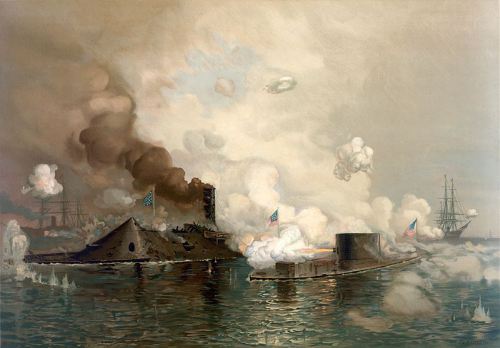
On that day, two very strange looking ships joined in battle. This is the story of the Battle of Hanpton Roads and the USS Monitor and CSS Virginia. 

Peace

Padre Steve+ 

On the morning of March 8th 1862 the CSS Virginia steamed slowly from her base at Portsmouth Virginia into Hampton Roads at the mouth of the Chesapeake Bay. Awaiting her was a US Navy squadron of wooden warships including the steam Frigate USS Minnesota, the Sloop of War USS Cumberland and Frigate USS Congress and a number of smaller vessels. The Virginia was an armored ram built from the salvaged remains of the large steam frigate USS Merrimack which had been burned at Gosport (Now Norfolk) Naval Shipyard. Her plans had been leaked to the US Navy which was also in the process of constructing a number of ironclad ships of different types. The first of these ships to be ready was the USS Monitor, a small ship mounting a single heavily armored turret mounting two powerful 11” Dalghren smoothbore guns was still steaming to Hampton Roads when Virginia came out for battle.

CSSVirginia1862.2.ws

During the ensuing fight of March 8th Virginia rammed and sank Cumberland which though fatally wounded disabled two of Virginia’s 9” in guns. She destroyed Congress by gunfire which burned and blew up and appeared to be in position to destroy Minnesota the following day as that ship had run hard aground. The losses aboard Cumberland and Congress were severe and included the Captain of the Congress and Chaplain John L. Lenhart of Cumberland, the first US Navy Chaplain to die in battle. During the battle Virginia had several men wounded including her Captain Franklin Buchanan.

Cumberland_rammed_by_Merrimac

Due to the coming of darkness and a falling tide the acting commander of Virginia, Lieutenant Catsby Ap Roger Jones her executive officer took her in for the night. During the night Monitor, under the command of Lieutenant John Worden arrived and took up station to defend Minnesota.

603px-Battle_of_Hampton_Roads_Map

The next morning Virginia again ventured out and was intercepted by the Monitor. The ships fought for over three hours, with Monitor using her superior speed and maneuverability to great effect. During the battle Monitor suffered a hit on her small pilothouse near her bow blinding her Captain. Monitor’s executive officer, Lieutenant Dana Greene, the son of Union Brigadier General George Sears Greene, the hero of Culp’s Hill at Gettysburg took command. Neither side suffered much damage but the smokestack of Virginia was pierced in several places affecting her already poor engine performance.  Jones broke off the action and returned to Gosport for repairs and Monitor remained on station.

Secretary of the Navy Gideon Welles wrote after the battle:

“the performance, power, and capabilities of the Monitor, must effect a radical change in naval warfare.”

USSMonitor1862.3.ws

It did. The battle showed the world the vulnerability of wooden warships against the new ironclads. Monitor in particular revolutionized naval warfare and warship construction. Her defining mark was the use of the armored gun turret which over the succeeding decades became the standard manner for large ships guns to be mounted. Turrets like the warships they were mounted upon grew in size and power reaching their apex during the Second World War.

arizon-main-battery2

Both Virginia and Monitor reached less than glorious ends. Virginia had to be destroyed by her crew to prevent her capture just over two months after the battle on May 11th 1862. Monitor survived until January 31st 1862 when she sank during a heavy storm off Cape Hatteras North Carolina with the loss of 16 of her 62 man crew. The remains of two of those men, recovered during the salvage of Monitor’s engines, turret, guns and anchor were interred at Arlington National Cemetery on March 8th 2012. The relics from Monitor and some from Virginia are displayed at the Mariners Museum in Newport News (http://www.marinersmuseum.org )while one of Virginia’s anchors resides on the lawn of the Museum of the Confederacy in Richmond.

Those early ironclads and the brave men who served aboard them revolutionized naval warfare and their work should never be forgotten.

Peace

Padre Steve+

1 Comment

Filed under civil war, History, Military, Navy Ships, US Navy

Read, Observe, or Pee on the Electric Fence

Friends of Padre Steve’s World,

The great American humorist Will Rogers once said, “There are three kinds of men. The one that learns by reading. The few who learn by observation. The rest of them have to pee on the electric fence for themselves.”

I wish that more people would take time to read and reflect than to allow themselves to be force fed by their televisions. Timothy Snyder in his book On Tyranny:

“More than half a century ago, the classic novels of totalitarianism warned of the domination of screens, the suppression of books, the narrowing of vocabularies, and the associated difficulties of thought. In Ray Bradbury’s Fahrenheit 451, published in 1953, firemen find and burn books while most citizens watch interactive television. In George Orwell’s 1984, published in 1949, books are banned and television is two-way, allowing the government to observe citizens at all times. In 1984, the language of visual media is highly constrained, to starve the public of the concepts needed to think about the present, remember the past, and consider the future. One of the regime’s projects is to limit the language further by eliminating ever more words with each edition of the official dictionary.”

I am slowing down my writing for the next few days to spend more time thinking, reflecting, reading and observing. I have been writing a lot on the Civil War, Civil Rights and Reconstruction, as well as the Nazi era, totalitarianism and their importance today. I will continue to do that but I am going to slow down a bit, and for the next week or so the articles here will be slightly edited posts from the archives so I can catch up on some reading and do some reflecting. Of course if something really notable happens I will probably at least comment on it, but for now I want to pull back a bit and read.

I do this because as a historian I known that for all of our great advances, especially in the form of technology that the character of people, the nature of humanity remains fairly constant. Technology may change the way we look the world, how we gather information, how and what we produce, how we fight wars, and even how we relate to each other, but humanity remains the same. Our forms of government and even religious faith may evolve, but the character of humanity is the one constant.

There has been a lot going on in this country and around the world and the one thing that I notice is that few seem to be taking the time to observe and seem to be more interested in immediately framing the events of the day into their particular ideology. This tendency is not limited to any one segment the population and goes across ideological divides.  We live in a time of great political and social upheaval and drastic change and if we are to ride out the storm we must continue to learn and not be satisfied with the banal and insipid sound bites that the Unholy Trinity of pundits, politicians and preachers spew out as wisdom.  The pundits, politicians and preachers who cite history usually do so completely out of context and do so in the form of bad analogies rather than by using any semblance of deductive or inductive reasoning.

Our culture has for the most part abandoned any serious attempt at learning. Schools teach to standardized tests, state school boards ensure that textbooks include nothing too controversial; universities sacrifice faculty and academic programs to prop up bloated administration and non-academic programs. We are consumers of corporate owned news networks that consider their programing entertainment and value market share more than truth. American philosopher Eric Hoffer quite rightly said, “In a time of drastic change it is the learners who inherit the future. The learned usually find themselves equipped to live in a world that no longer exists.” But sadly many people, including learned people who should know better and who have great responsibility in political, economic and even education, are content to live in a world that no longer exists.  

Over the past few months I have plowed through a number of books including David Halberstam’s The Best and the Brightest, H.R. McMaster’s Dereliction of Duty, Deborah Lipstadt’s Denying the Holocaust,  Mark Bowden’s Hue 1968, and Volker Ullrich’s Hitler: Ascent 1889-1939.  All are very substantial volumes. Additionally I am almost finished reading German historian Paul Carrel’s Unternehem Barbarossa im Bild (Operation Barbarossa in Pictures) in which the text is in German. I am also about sixty percent of the way through Max Boot’s The Toad Not Taken: Edward Lansdale an the American Tragedy in Vietnam.  My goal over the next week or so is to finish reading the last two books and to take on Ron Chernow’s massive biography of Ulysses S. Grant, and David Frum’s Trumpocracy: The Corruption of the American Republic. 

Learning comes from reading, observation and experience. Otto Von Bismarck, one of the most remarkable statesmen that ever lived said, “only a fool learns from his own mistakes, a wise man from the mistakes of others,” while Arthur Wellesley, the First Duke of Wellington and victor of Waterloo wrote, “Wise people learn when they can; fools learn when they must.”

I for one would rather not be one of those that learn by the last named method.  Learning from my mistakes has never been enjoyable and has usually been quite painful, but then as the late Baltimore Orioles Manager Earl Weaver said, “It’s what you learn after you know it all that counts.”

While I know I will make mistakes and hope to learn from them when I do I would much rather learn from the mistakes of others. Let’s hope that our leaders decide to actually pay attention and learn instead of making us pay for their mistakes. Sadly, I think that most people, especially those who claim to be leaders would rather pee on the electric fence themselves.

Anyway, it is time to do some reading and reflecting.

Peace

Padre Steve+

1 Comment

Filed under History, Loose thoughts and musings, philosophy

“The First Duty of Every Officer is to the Truth”

Friends of Padre Steve’s World,

Most of my readers know that in addition to being a Priest and Navy Chaplain that I am a historian and have taught both ethics and Gettysburg as a faculty member at a Staff College. Many of the men and women that I taught will lead our military as commanders, planners and staff officers. I stay in contact with a number of my former students, including two from South Korea. Now I still write even as I lead the staff at one of the Navy’s largest and most active Chapel programs.

Since I figure that this will be my last duty station before I retire my goal is to help guide those who work with me to success in the military and set them up for success when they leave the military. They are a great group, I could not ask for better and when I have a bad day or seem to be off in some way I have given them permission to ask how I am doing and to ask me hard questions. I give them permission to tell me the truth. A lot of leaders won’t do that, but I try to be transparent and honest with them because I know that they have my back and we do a pretty good job at caring for people and doing the right thing.

As such my first duty, whether it is in teaching, writing or in ministry is to the truth. In fact I quoted Captain Jean Luc Picard, played by Sir Patrick Stewart in Star Trek the Next Generation: “the first duty of every Starfleet officer is to the truth, whether it’s scientific truth, historical truth or personnel truth…” I am not a Starfleet Officer but as an officer nonetheless I have always believed that the truth matters, but sadly I, like so many of us have turned the other way and not spoken out. But the older I get the more I realize that I cannot be silent about subjects that at one time I turned a blind eye to because they were uncomfortable, unpopular or might hurt my career either in the church or in the military.

I have been writing a lot over the past few months about subjects that many people are controversial and as such many people are uncomfortable with those topics. Whether the issue is civil rights, racism, Gay rights and marriage equality, voting rights, religious freedom and religious intolerance, and even xenophobia, or the connection of symbols such as the Confederate Battle Flag to a heritage that goes to a hatred that extends far beyond the battlefields of the Civil War; I am speaking out. Now I am fully aware of that many of these subjects are controversial. I have been asked in comments on this site and on my various social media accounts, particularly Facebook, why I keep bringing up the uncomfortable past. But I have to, I have a duty to the truth and as Oscar Wilde noted “The truth is rarely pure and never simple.”

The late Howard Zinn, a brilliant historian whose work at one time I discounted, said: “But I suppose the most revolutionary act one can engage in is… to tell the truth.” Who would think that telling the truth could or would be a revolutionary act? However, when one lives in a society where the truth is bent, run over and shredded by politicians, preachers and pundits, what I call the Trinity of Evil; when state school boards whitewash history and force their religious views on children in public schools; where corporations and advertisers use the most crass means to deceive customers; and where established science is not met with denial under the guise of “skepticism;” telling the truth is a revolutionary affair.

The honest truth is that I never expected to be a revolutionary in terms of what so much of society, especially the conservative Christian movement that I spent much of my life in expects. Truthfully, upholding tradition, and for that matter defending myth, is much easier when backed by the certitude of an unbending theology and political is much easier than asking the hard questions. Barbara Tuchman once wrote: “The reality of a question is inevitably more complicated than we would like to suppose.” I guess that is why so many people would rather be content with myth than to ask the really hard questions; be they about history, religion, and science or for that matter anything. One of the must uncomfortable things to admit is that truth is always evolving as we learn more, it is dynamic, not static and to attempt to force people to live by the “truth” of our ancestors is disingenuous, dishonest and denies the reality of the universe that we live. Thomas Jefferson recognized this and wrote:

“I know also, that laws and institutions must go hand in hand with the progress of the human mind. As that becomes more developed, more enlightened, as new discoveries are made, new truths disclosed, and manners and opinions change with the change of circumstances, institutions must advance also, and keep pace with the times. We might as well require a man to wear still the coat which fitted him when a boy, as civilized society to remain ever under the regimen of their barbarous ancestors.” 

So why do I write? I write so that we never forget or push aside the great evils that human beings are capable of committing: The Holocaust, slavery and Jim Crow, the extermination of Native Americans by the millions in the name of God and Manifest Destiny, the enslavement, exploitation, and sometimes the extermination of whole peoples by colonialism; the witch trials, the religious wars of the Reformation, the Inquisition, the Chinese Cultural Revolution, Stalin’s purges, the Tuskegee experiments, the Japanese barbarity in the Rape of Nanking and other places in Asia, the Srebrenica genocide and the Rwandan genocide, just to name a few.

All too often the perpetrators of those events and their descendants as all too willing to last the past lie dormant. But at what cost do we do so? Do we sacrifice justice on the altar of prosperity and peace; do we sacrifice uncomfortable truth in order to remain undisturbed and comforted by myth? Do we condemn our descendants to live under the myths of our ancestors? Would we sacrifice the truth and justice in order to ensure obedience? Howard Zinn correctly observed, “Historically, the most terrible things – war, genocide, and slavery – have resulted not from disobedience, but from obedience.”

President John F Kennedy spoke these words at Yale in 1962: “The great enemy of truth is very often not the lie–deliberate, contrived and dishonest–but the myth–persistent, persuasive and unrealistic. Too often we hold fast to the cliches of our forebears. We subject all facts to a prefabricated set of interpretations. We enjoy the comfort of opinion without the discomfort of thought.”

Personally I would rather ask the questions and confront the past so we might have a better future, because though I am a realist, I also believe in my heart that humanity is capable of overcoming hatred, prejudice and ignorance. The problem is that times get difficult those attitudes can overcome our better nature. As Spencer Tracy’s character in the movie Judgment at Nuremberg said:

“But this trial has shown that under a national crisis, ordinary – even able and extraordinary – men can delude themselves into the commission of crimes so vast and heinous that they beggar the imagination. No one who has sat through the trial can ever forget them: men sterilized because of political belief; a mockery made of friendship and faith; the murder of children. How easily it can happen. There are those in our own country too who today speak of the “protection of country” – of ‘survival’. A decision must be made in the life of every nation at the very moment when the grasp of the enemy is at its throat. Then, it seems that the only way to survive is to use the means of the enemy, to rest survival upon what is expedient – to look the other way. Well, the answer to that is ‘survival as what’? A country isn’t a rock. It’s not an extension of one’s self. It’s what it stands for. It’s what it stands for when standing for something is the most difficult! Before the people of the world, let it now be noted that here, in our decision, this is what we stand for: justice, truth, and the value of a single human being.”

That my friends, is why I write: for justice, truth, and the value of a single human life.

Peace

Padre Steve+

1 Comment

Filed under ethics, faith, film, History, News and current events, Political Commentary

Manstein’s Counter Stroke: Turning Certain Defeat into Victory

Friends of Padre Steve’s World,

I’m pullings something out of my archives today. It’s actually a paper I wrote for one of my Masters Degree Classes back in 2009 that I decided to post on the site. I have been reading Paul Carrell’s Unternehem Barbarossa Im Bild (Operation Barbarossa in Pictures) in German I decided to repost it today.  I could probably do more with it but except for more biographical work on Von Manstein I don’t expect that I will. For me character matters more than battlefield brilliance.

The article deals with the crisis that the German armies faced following Stalingrad and how Field Marshal Erich von Manstein succeeded in talking Adolf Hitler out of certain defeat and inflicting a massive defeat on the now overconfident and over extended Soviet armies.

Von Manstein was a brilliant strategist, his bold plan to conquer France in 1940 was a masterpiece, and his conduct of combat operations on the Eastern Front until his relief in March of 1944 for withdrawing (and saving) his armies from Soviet destruction without Hitler’s approval. Von Manstein was a brilliant commander at the operational level of war, but he also gave his approval and support to war crimes committed by the SS Einsatzgruppen against the Jews and others in his area of operations. He believed that Bolshevism and the Jews were linked, thus in his codicil to Von Reichenau’s Severity Order in November 1941 stated:

“Jewish Bolshevik system must be wiped out once and for all and should never again be allowed to invade our European living space … It is the same Jewish class of beings who have done so much damage to our own Fatherland by virtue of their activities against the nation and civilisation, and who promote anti-German tendencies throughout the world, and who will be the harbingers of revenge. Their extermination is a dictate of our own survival.”

He is a complex character, he defended German Jews in the Reichswehr yet went on to cooperate in the deaths of hundreds of thousands of Jews in Russia. There is a decent possibility that he had some Jewish ancestry, he opposed the Aryan Paragraph which banned Jews from serving in the German armed forces telling General Ludwig Beck that anyone who had volunteered to serve had already proved their worth. Though tried and convicted of war crimes he was given an early release from prison at the behest of Winston Churchill, Konrad Adenauer and other notables; and went on to advise the German government on the organization of the new Bundeswehr. His post war writings were highly critical of Hitler and for the most part he succeeded in rehabilitating himself. When he died in 1973 at the age of 85 he was the last surviving German Field Marshal and was buried with full military honors .

He was a brilliant commander and strategist, but he aided and abetted one of the most criminal regimes in history. The German magazine Der Spiegel wrote of him: “He assisted in the march to catastrophe—misled by a blind sense of duty.”

My concern today is if American Generals will be misled by their blind sense of duty and assist in a march to catastrophe.

Until tomorrow,

Peace,

Padre Steve+

Introduction

After Stalingrad the Soviets followed up on their success and attempted to entrap the rest of Army Group South. Field Marshall von Manstein attempted to save the Army Group and perhaps prevent the Soviets from collapsing the entire German front.
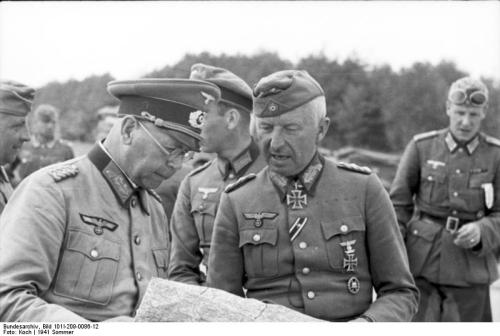
Bild 101I-209-0086-12Manstein (center) planning at the front

Chaos and Peril in the South

As 6th Army died at Stalingrad field Marshall von Manstein was faced with one of the most challenging situations faced by any commander in modern times.  He faced strategic and operational “problems of a magnitude and complexity seldom paralleled in history.”[i] Manstein had to deal with a complex military situation where he had minimal forces to counter the moves of a superior enemy force that was threatening to entrap all German forces in southern Russia. Additionally Manstein had to deal with the “Hitler’s obstinate opposition to a maneuver defense and a Red Army flushed with the victory of Stalingrad.”[ii]Facing him were the six Russian armies of the Voronezh and Southwestern Front’s led by Mobile Group Popov[iii]. These Armies had broken through the Hungarian and Italian armies “making a breach 200 miles wide between the Donetz and Voronezh, and were sweeping westward past Manstein’s flank.”[iv]
flak in caucasus

The most dangerous threat that Manstein faced was to Army Group A in the Caucasus. This Army Group “found itself in danger of being cut off, forcing an immediate withdraw.”[v] Disaster was averted by the desperate holding actions of Manstein’s meager forces, Army detachment’s Fretter-Pico and Hollidt, and winter conditions that made “offensive operations extraordinarily difficult, even for the hardiest Soviet troops.”[vi] A smart withdraw executed by General von Kleist managed to extricate the Army group “just as the Stalingrad forces collapsed.”[vii] To parry the Soviet thrusts the Germans lacked forces to “establish a deeply echeloned defense” and “instead combined maneuver… with stubborn positional defense to give artificial depth to the battlefield.  In this way the Germans were able to break major Soviet attacks, preventing catastrophic breakthroughs….”[viii] The timely introduction of a battalion of Tiger tanks prevented the Russians from breaking through to Rostov and “cutting the rail and road lines on which First Panzer Army’s retreat depended.”[ix] Even so the escape of the Army Group was narrow. “In terms of time, space, force, and weather conditions it was an astonishing performance-for which Kleist was made a field-marshal.”[x] With the Russians only 70 kilometers from Rostov and his own forces 650 kilometers from that city Kleist executed a withdraw “which had appeared hardly possible to achieve.”[xi] The divisions extricated by Kleist would be instrumental in the coming weeks as Manstein moved to counter the Soviet offensive.

Ostfront, Adolf Hitler, Erich v. Manstein

Hitler and Manstein

Despite the successful withdraw the situation was still precarious in early February, Manstein had no effective contact with his left wing, the bulk of which was tied to Kharkov, The Russians had “virtually complete freedom of action across a fifty-mile stretch of the Donetz on either side of Izyum.”[xii] Manstein was hard pressed to “halt the raids of Mobile Group Popov and other exploiting Soviet tank corps in Operation Gallop.”[xiii] Manstein’s forces in the eastern sector had been divided by Russian penetrations, which threatened 1st Panzer Army’s western flank and blocked the Army Group’s main railway line.[xiv] On 15 February “the SS Panzer Corps withdrew from Kharkov-in spite of orders from Hitler…that the city was to be held to the last.”[xv] SS General Paul Hausser, the corps commander realized that the order to hold Kharkov was impossible and requested permission to withdraw. This was was refused by General Lanz. Under pressure from encircling Russian forces outside and from partisans inside the city, Hausser disobeyed the order and extricated his troops,[xvi] thereby saving thousands of German soldiers and preserved the SS Panzer Corps as a fighting unit.[xvii] Lanz was relieved by Hitler for the loss of Kharkov and although Hausser would escape immediate censure, “Hitler did see it as a black mark against his name.”[xviii] With Kharkov in Soviet hands the gap between Manstein’s army group and Field Marshal von Kluge’s Army Group Center increased to over 100 miles.[xix] It appeared that the entire German southern flank was disintegrating.  Manstein estimated the ratio of German to Soviet forces in his area at 1:8.[xx] He believed that the Soviets could advance and subsequently “block the approaches to the Crimea and the Dnieper crossing at Kherson” which would “result in the encirclement of the entire German southern wing.”[xxi] Popov’s Mobile Group crossed the Donets and reached Krasnoarmeiskaia by 12 February. Vatutin committed two additional fresh tank corps toward Zaporozhe, a critical transport node which was also the location of Manstein’s headquarters.[xxii]
SS-Tiger-LSAH-01Tiger Tanks assigned to 1st SS Panzer Division

Hitler arrived to consult with Manstein on 17 February and remained for three days with Soviet forces perilously close.  Manstein only had some flak units and the Army Group Headquarters Company between him and Popov’s advanced elements. On Hitler’s last day “some T-34’s approached to within gun range of the airfield.”[xxiii]

The conference of Hitler with Manstein at Zaporozhe as well as a previous conference at the Wolfsschanze on 6 February was critical to the development of Manstein’s plan to restore the front. Manstein had now gotten both the 1st and 4th Panzer Armies across the Don, and “with this striking force, he felt confident of smashing the Russian offensive if he was given a free hand to withdraw from the line of the Donetz, evacuate Rostov and take up a much shorter front along the Mius river.”[xxiv] The conference on the 6th was one of the “rare moments in the war where Hitler authorized a strategic withdraw on a major scale.”[xxv] Yet as the Russians continued to advance Hitler became concerned and came to Zaporozhe.  At first Hitler would not concede to Manstein, as he wanted to assemble the SS Panzer Corps for an attack to recapture Kharkov.[xxvi]Manstein explained the need for a counter stroke and through much explanation was able to convince Hitler that the capture of Kharkov was not possible unless “we first removed the danger of the Army Group being cut off from its rear communications.”[xxvii]
T34_Stalingrad-Offensive-px800Soviet formations advance

The Russian aim was now obvious[xxviii] and Manstein had correctly discerned their strategy.  Manstein knew that his Army Group had to hold the line on the Mius and then quickly defeat the enemy between 1st Panzer Army and Army Detachment Kempf[xxix] in “order to prevent its own isolation from the Dnieper crossings.”[xxx] The Soviets had outrun their logistics support and had suffered heavy losses of their own and had serious equipment shortages.[xxxi] Manstein explained to Hitler the opportunity offered as it was now the Russians who “were worn out” and far from their supply dumps as the Germans had been in November 1942.  Manstein “foresaw an opportunity to seize the operational initiative with a counter offensive of his own.  Manstein’s target was the Soviet armored spearheads, still careening southwestward between Kharkov and Stalino.”[xxxii] Manstein believed that when the Russian “spearhead lunged, as it must toward the crossings on the upper Dnieper,” then Hoth’s Army would be let loose again.  The three SS Panzer divisions could then “play their rightful role as avengers, and strike southeast to meet 4th Panzer Army, catching the Russian armour in a noose.”[xxxiii] Hitler agreed to Manstein’s plan and Manstein shifted 4th Panzer Army to assume control of the SS Panzer Corps, now reinforced by 3rd SS Panzergrenadier Division “Totenkopf.” Hitler reinforced Manstein and released 7 battle worn Panzer and motorized divisions for his attack.[xxxiv]

Soviet Miscalculation

It was now Stalin’s time to miscalculate. He and his subordinates “continued to believe that they were on the verge of a great victory. German defenses in southern Russia appeared to be crumbling and the Stavka sought to expand that victory to include Army Group Center.”[xxxv] To this end they diverted armies to the north and launched attacks in that direction.  However German defenses were stiff and the plan was “predicated on the assumption of continued offensive success further south.”[xxxvi] Reinforcements from Stalingrad failed to deploy and “Army Group Center’s defenses, prepared for the past year and a half proved formidable.”[xxxvii]

In the south Stalin saw the Dnieper and almost “heedlessly drove his armies towards what he thought would be the decisive victory on the banks of this huge Russian river,”[xxxviii] but, Soviet “ambitions exceeded their available resources and the skill of their commanders.”[xxxix] The SS Panzer Corps withdraw from Kharkov “further heightened the Soviet’s intoxication with victory”[xl] and confirmed their beliefs that the Germans were withdrawing.  Stalin believed that “it was inconceivable that Hitler’s Praetorian Guard would abandon Kharkov except as part of a general order to retreat.”[xli] He believed that the encirclement of Army Group South would lead to a chain reaction and quick way to victory over German forces in the east.  Believing that there was no way for the Germans to recover and establish a solid front on the Mius,[xlii] Stalin continued to drive his forces to attack, yet the Russian offensive in the south had reached what Clausewitz had called the “culminating point” and Stalin’s armies were now extremely vulnerable. “The weather, the devastated communications, and their own inexperience in maintaining the traffic density required to support a deep penetration on a narrow front had combined to force a dangerous dispersal of effort on the Russian advance which had broken down into four separate groups.”[xliii]

panzer ivfPanzers assembling to attack

The Soviet forces were now in a dangerous predicament being spread out across the entire south of Russia.  One group, composed of the 69th Army and 3rd Tank Army pushed against Army detachment Kempf west of Kharkov.  To the south the badly depleted 6th Army and 1st Guards Army were now “strung out down a long corridor they had opened between Izyum and Pavlograd,”[xliv] Mobile Group Popov was lagging further east near Krasnoarmeiskaia.   Additional units were isolated behind the front of Army Detachment Fretter-Pico and near Matveyev.  Soviet commanders believed that the Germans were in worse shape and that “the risks of dispersal were justified.”[xlv] They had not anticipated or made allowance for Manstein’s coolness under pressure and actions to preserve his armor while thinning his front “well past the accepted danger limit.”[xlvi]Likewise the Soviets did not know that the Germans had cracked the code used by the Southwest front and from 12 February on “were now privy to Popov’s and Vatutin’s thoughts,” now knowing precisely where the Russians would attack.[xlvii] Manstein had withstood temptation and Hitler’s pressure to use his reserves “for a direct defense of the Dnieper line.”[xlviii] As such he was prepared to launch a devastating counter-stroke against the dispersed and weakened Russian armies which were still advancing into the trap he planned for them. He had managed to “save his counteroffensive plan from Hitler’s shrill demands that the new reserves be thrown into battle piecemeal to prevent further territorial losses.”[xlix] The stage was now set for a two classic mobile operations.[l]

The Destruction of Mobile Group Popov, 6th Army and 1st Guards Army

Manstein launched his counter-stroke on 21 February against Popov’s Mobile Group using XL Panzer Corps under the command of General Henrici composed of the 7th and 11th Panzer Divisions and SS Motorized Division Viking. Popov’s Group was exposed. Popov had “succeed in cutting the railway from Dnepropetrovsk to Stalino and was itching to push further south to Mariupol on the Sea of Azov.”[li] The Soviets once again had failed to discern German intentions, believing that the Germans were retreating.[lii] Likewise the Soviet high command did not fully understand Popov’s situation. His force was weak in tanks and low on fuel and his Mobile Group was defeated in detail by the German Corps.  Popov’s immobilized tank and motorized rifle formations resisted desperately but were bypassed by the panzers.  The 330th Infantry Division mopped up the remnants of these formations.[liii] The key battles took place around the town of Krasnoarmeiskaia and the battle became a running battle between that town and the Donets River.[liv] Popov requested permission to retreat, but still believing the Germans to be retreating Vatutin gave a categorical “no.” The terrain in the area was “almost completely open”[lv] and “Popov’s proud Armoured Group was cut up like a cake.”[lvi] Popov extricated some of his units but “only after serious losses in manpower and equipment.”[lvii] Despite this it would not be until the 24th that Vatutin would order a halt to offensive operations.[lviii]

kharkovSS Panzers in Kharkov

As Popov sought to get his units out of the German scythe Manstein set his sights on 6th Army, 1st Guards Army and 25th Tank Corps which was approaching Zaporozhe.[lix] He assigned the task to Hoth’s 4th Panzer Army and its XLVIII Panzer Corps under General Knobelsdorf composed of the 6th and 17th Panzer Divisions and the SS Panzer Corps comprising SS Divisions LiebstandarteDas Reich and Totenkopf.[lx] Manstein gave Hoth a brief but explicit order: “The Soviet Sixth Army, now racing towards Dnepropetrovsk through the gap between First Panzer Army and Army Detachment Kempf, is to be eliminated.”[lxi] The XLVIII Panzer Corps and SS Panzer Corps were unleashed against the exposed flank of the 6th Army and 1st Guards Army.   XLVIII Panzer Corps quickly “seized bridgeheads over the Samara River, and prepared to move north into the rear of the exhausted Soviet Sixth Army.”[lxii] The two Panzer Corps then made a coordinated concentric attack northwest which “came as a complete surprise to the Russians.”[lxiii] Das Reich thrust deep into the flank of 6th Army supported by Stukas from Richthofen’s 4th Air Fleet.  This attack dislodged one Soviet Rifle Corps and destroyed another allowing the division to capture Pavlograd while XLVIII Panzer Corps led by 17th Panzer Division pushed from the south linking up with the SS Corps. This cut off the Soviet 25th Tank Corps and threatened 6thArmy.[lxiv] What followed was a disaster for the Russians.        Despite overwhelming evidence to the contrary the Stavka and Front commanders still believed that the Germans were retreating.  6th Army was ordered to continue its advance by the front commander who believed that the two German Panzer Corps were withdrawing.[lxv] In a few days the 17th Panzer Division “gained the Izyum-Protoponovka sector on the Donetz River, while the SS Panzer Corps took Losovaya and established contact with Army Detachment Kempf, which had joined the attack from the west.”[lxvi] XL Panzer Corps with the 3rd and 7thPanzer Divisions and 333rd Infantry Division joined in the attack on Popov’s remaining forces completing their destruction.[lxvii] As Hoth and Hausser converged on Pavlograd, Das Reich and Totenkopf “swung left to the east and then wheeled back north again running parallel to the Russian divisions fleeing from Forty-eighth Panzer Corps. What ensured was a turkey shoot.”[lxviii]Fleeing Russian forces on the open steppe were visible and engaged at long range.[lxix] Leibstandarte helped by holding the left flank against Russian counter attacks from the units now isolated in the west,[lxx] and Totenkopf’sgrenadiers fanned out supported by Stukas to “kill or capture as many Russians as possible.”[lxxi] By 1 March the Russian penetrations had been eliminated. Popov’s Mobile Group was smashed, 6th Army and 1st Guards Army badly mauled. 25th Tank Corps and three Rifle divisions had to be completely written off and numerous other corps and divisions took heavy casualties.  Two additional corps, encircled before the offensive began were eliminated by German forces.[lxxii] The Germans counted 23,000 Russian dead on the battlefield, and Manstein noted that “the booty included 615 tanks, 354 field pieces, 69 anti-aircraft guns and large numbers of machine guns and mortars.”[lxxiii] The Germans only took 9,000 prisoners as they were too weak, especially in infantry to seal off the encircled Soviet forces.[lxxiv] Yet the forces that escaped they were in no condition to “block the continued progress of the Panzers and SS.”[lxxv] Now there was a 100 mile gap in the Russian lines with nothing no troops to fill it and only “General Mud” could stop the Germans.[lxxvi] Manstein was not yet finished and the next phase of his operation against the Soviet formations west of Kharkov and that city were about to commence.

The Destruction of 3rd Tank Army

With the immediate threat to his Army Group eliminated and having regained the initiative, Manstein and Army Group South now “proceeded to deliver the stroke against the ‘Voronezh Front’– i.e. the forces located in the Kharkov area.”[lxxvii] But the Russians had not been idle. In order to attempt to assist 6thArmy 3rd Tank Army moved two tank corps and three Rifle divisions south and these ran into Manstein’s advancing panzers.[lxxviii] Manstein’ noted his objective now was “not the possession of Kharkov but the defeat-and if possible the destruction of the enemy units located there.”[lxxix] Between March 1st and 5th his forces advanced on Kharkov. Not knowing the Germans dispositions[lxxx]3rd Tank Army made the mistake of moving between the Leibstandarte’s defensive positions and the attacking divisions of the SS Panzer Corps. Hausser wheeled Totenkopf around and completed an encirclement of these units near Bereka on 3 March.[lxxxi] The Russians made futile attempts to break out but the SS Divisions tightened the noose around them and they were eliminated by the SS Panzer Corps which “engaged in concentric attacks during the three days of hard fighting.”[lxxxii] Even Regimental commanders like Heinz Harmel of Das Reich’s Der Fuhrer regiment became engaged in close combat with the Russians.[lxxxiii] The battle was fought in “snowstorms whose intensity caused the SS severe privations.”[lxxxiv] Totenkopf and Das Reich slammed the Russians “back against the Tiger tanks and assault guns of the Leibstandarte.”[lxxxv] The elimination of these units netted another 12,000 Russians killed,[lxxxvi] knocking “out the last remaining obstacle between the Germans and Kharkov.”[lxxxvii]

Return to Kharkov and Controversy

Manstein turned his attention to Kharkov, supported by Richthofen’s 4th Air Fleet which for the last time in Russia “provided undisputed air superiority for a major German mechanized operation.”[lxxxviii] He decided to “roll up the enemy from the flank and force him away from Kharkov in the process.”[lxxxix]He ordered a “pincer on the town, sending Grossdeutschland around to the north with a reinforced Kempf detachment and the combined force of Hoth and the SS to attack the town from the south and rear.”[xc] Manstein planned to make a wide envelopment to avoid embroiling his panzers in costly urban combat stating “that at all costs the Army Group wished to avoid Kharkov’s becoming a second Stalingrad in which our assault forces might become irretrievably committed.”[xci] To this end he sent Das Reich and Totenkopfapproaching from the south to west of the city[xcii] while XLVIII Panzer Corps swung east toward the Donetz.[xciii] As Hoth’s forces came up from the south to envelope the city, Grossdeutschland and the XI and LI Corps fought the Russians to the north and west,[xciv] eventually moving up to Belgorod.  By 8 March lead elements of the SS Panzer Corps were on the outskirts of the city.

At this point there is some controversy as to German actions. As noted Manstein wished to avoid urban combat and desired to surround the city and force its surrender.  According to one writer Hoth ordered Hausser “to seal off the city from the west and north and to take any opportunity to seize it.”[xcv] Others including Glantz and House and Murray and Millett state that Hausser “ignored a direct order” and attacked into the city.[xcvi] Manstein does not explicitly say that there was a direct order but notes that the Army Group “had to intervene vigorously on more than one occasion to ensure that the corps did not launch a frontal attack on Kharkov.”[xcvii] Sydnor states that Hausser ignored a direct order by Hoth on the 11th by detailing a battalion of Totenkopf to assist Das Reich and Leibstandarte in retaking Kharkov by direct assault. The order entailed pulling Das Reich out of the city and taking it to the east.[xcviii] Lucas adds that this order came in the midst of hard fighting in the city and could not be carried out by the division.[xcix]Carell notes that on 9 March Hoth instructed Hausser that “opportunities to seize the city by a coup are to be utilized,”[c] and goes into detail regarding how Hoth’s 11 March order applied to Das Reich. It was to be pulled out of action and brought east, but division was heavily engaged and in the process of breaking through Soviet defenses “quicker in fact than if he had pulled “Das Reich” out of the operation and led it all the way round the city along those terrible muddy and time wasting roads.”[ci] In the end the SS took Kharkov, Manstein said that the city “fell without difficulty”[cii] while others note the difficulty of the action and the casualties suffered by the SS.  Kharkov’s capture; the defeat of Rokossovsky’s campaign against Orel and the beginning of the spring Rasutitsa ended the winter campaign and stabilized the front.

Analysis

The Russian winter offensive following Stalingrad had great potential.  Manstein said: “the successes attained on the Soviet side, the magnitude of which is incontestable.”[ciii] The greatest Soviet shortcomings were inexperience in conducting deep mobile operations and the inability of their logistics system to keep up with their advance.  Clark notes that this was their “first experience of an offensive war of movement on a large scale.[civ] Glantz and House are not alone in noting that the “Stavka continued to undertake operations that were beyond its resources.”[cv] Murray and Millett state that they “lacked the operational focus that had marked the Stalingrad offensive.”[cvi] Had they had the resources and ability to execute their plans they might have destroyed all German forces in the south.  They misread German intentions based on their own over-optimistic expectations opened their forces to Manstein’s devastating counter stroke.  Von Mellenthin, possibly showing some prejudice commented that the Russian soldier “when confronted by surprise and unforeseen situations he is an easy prey to panic.”[cvii]

The Germans snatched victory out of what appeared to be certain defeat aided by Russian mistakes and operational shortcomings.  Manstein refused to panic and conserved his forces for his counterattack.[cviii] Kleist brought his Army Group out of what might have been encirclement worse than Stalingrad.  Hitler for the most part gave Manstein operational freedom which he had not provided other commanders.  German Panzer forces conducted mobile operations against superior enemy armored forces and bested them.  Landsers held their own in at critical junctures, especially on the Mius and gave Manstein the opportunity to employ the panzers in the mobile defense.[cix] The Luftwaffe recovered its balance and the coordinated operations between it and German ground forces gave them an edge at a point where the Red Air Force was unable to support the Red Army.[cx] Above all the Germans still maintained the edge in both overall quality of generalship, especially that of Manstein and Kleist, but not to exclude Hoth, Hausser and lower level commanders.  Additionally the average German soldier still maintained an edge over his Soviet adversary in the confusion of mobile operations in open terrain.   Manstein and his forces gave Hitler breathing room on the eastern front.[cxi] As Clark notes: “few periods in World War II show a more complete and dramatic reversal of fortune than the fortnight in February and the first in March 1943…it repaired its front, shattered the hopes of the Allies, nipped the Russian spearhead. Above all it recovered its moral ascendancy.”[cxii]

Notes 


[i] Von Mellenthin, F.W. Panzer Battles: A Study of the Employment of Armor in the Second World War. Translated by H. Betzler, Ballantine Books, New York, NY, 1971. Originally Published University of Oklahoma Press, 1956. p245

[ii] Glantz, David M. and House, Jonathan. When Titans Clashed: How the Red Army Stopped Hitler. University Press of Kansas, Lawrence, KS. 1995. p.143

[iii] Ibid. Glantz. P.143. These units include 3rd Tank Army, 1st and 3rd Guards Armies and the 6th, 40th and 69th Armies.

[iv] Liddell-Hart. B.H. Strategy.  A Signet Book, the New American Library, New York, NY 1974, first published by Faber and Faber Ltd. London, 1954 and 1967. p.253

[v] Raus, Erhard. Panzer Operation: The Eastern Front Memoir of General Raus, 1941-1945. Compiled and Translated by Steven H Newton. Da Capo Press a member of the Perseus Book Group, Cambridge, MA 2003. p.185

[vi] Murray, Williamson and Millett, Allan R. A War to Be Won: Fighting the Second World War, The Belknap Press of Harvard University Press, Cambridge MA. 2000. pp.291-292

[vii] Liddell-Hart, B.H. History of the Second World War. G.P. Putnam’s Son’s, New York, NY. 1970  p.478

[viii] Wray, Timothy A. Standing Fast: German Defensive Doctrine on the Russian Front in World War II, Prewar to March 1943. U.S. Army Command and General Staff College, Fort Leavenworth, KS. 1986. p.161

[ix] Ibid. Murray and Millett. p.292

[x] Ibid. Liddell-Hart, Second World War. p.479

[xi] Liddell-Hart, B.H. The German Generals Talk. Quill Publishing, New York, NY. 1979. Copyright 1948 by B.H. Liddell-Hart. pp.211-212.

[xii] Clark, Alan. Barbarossa: The Russian-German Conflict, 1941-45.Perennial, an Imprint of Harper Collins Books, New York, NY 2002. Originally published by William Morrow, New York, NY 1965. pp.299-300

[xiii] Glantz, David M and House, Jonathan. The Battle of Kursk.  University Press of Kansas, Lawrence, KS. 1999. p.11

[xiv] Manstein, Erich von. Lost Victories. Translated by Anthony G. Powell, Zenith Press, an imprint of MBI Publishing Company, St Paul, MN. 2004. First Published as Verlorene Siege Athenaum-Verlag, Bonn, GE 1955, English edition Methuen & Company Ltd. 1958  p.417

[xv] Ibid. Clark. p.300

[xvi] Carell, Paul. Scorched Earth: The Russian German War 1943-1944. Translated by Ewald Osers, Ballantine Books, New York, NY 1971, published in arrangement with Little-Brown and Company. pp.196-199

[xvii] Lucas, James. Das Reich: The Military History of the 2nd SS Division.Cassell Military Paperbacks, London, UK, 1999. First published by Arms and Armour, 1991. p.91  Glantz and House criticize Hausser saying that the SS Panzer Corps Staff lacked the experience to perform its mission.  (Titans Clashed p.144) Most other commentators agree with the necessity of his withdraw.

[xviii] Messenger, Charles. Sepp Dietrich: Hitler’s Gladiator. Brassey’s Defence Publishers, London, 1988. p.113

[xix] Ibid. Clark. p.300

[xx] Ibid. Manstein. p.419

[xxi] Ibid. Manstein. pp.418-419

[xxii] Ibid. Glantz and House. When Titans Clashed. p.144

[xxiii] Ibid. Clark. p.300

[xxiv] Ibid. Von Mellenthin. p.251

[xxv] Ibid. Carell. p.191

[xxvi] Ibid. Manstein. p.424.

[xxvii] Ibid. Manstein. p.428

[xxviii] Ibid. Liddell-Hart. Second World War. p.481

[xxix] This had previously been Army Detachment Lanz, but Lanz had bee relieved over the loss of Kharkov.

[xxx] Ibid. Manstein. p.429

[xxxi] Ibid. Murray and Millet. p.292

[xxxii] Ibid. Wray. p.162

[xxxiii] Ibid. Clark. p.302.

[xxxiv] Ibid. Glantz and House. When Titans Clashed. p.145

[xxxv] Ibid. Glantz and House. When Titans Clashed . pp.144-145

[xxxvi] Ibid. Glantz and House. When Titans Clashed. p.146

[xxxvii] Ibid. Murray and Millett. p.293

[xxxviii] Ibid. Carell. p.191

[xxxix] Ibid. Murray and Millett. p.292

[xl] Ibid. Carell. p.199

[xli] Ibid. Carell. p.199

[xlii] Ibid. Carell. p.193

[xliii] Ibid. Clark. p.303

[xliv] Ibid. Clark. p.304

[xlv] Ibid. Clark. p.304

[xlvi] Ibid. Clark. p.304

[xlvii] Ibid. Carell. p.210

[xlviii] Ibid. Liddell-Hart. Strategy p.253

[xlix] Ibid. Wray. p.163

[l] Ibid. Glantz and House. When Titans Clashed. p.147. Note comments by Glantz and House in footnote 31 on relative strengths of forces involved, especially the weakness of German forces.

[li] Butler, Rupert. SS Wiking: The History of the Fifth SS Division 1941-45.Casemate, Havertown, PA. 2002. p.93

[lii] Ibid. Carell. p.211

[liii] Ibid. Carell. p.210

[liv] Ibid. Glantz and House. When Titans Clashed. p.147

[lv] Ibid. von Mellenthin. p.253

[lvi] Ibid. Carell. p.210

[lvii] Ibid. Murray and Millett. p.293

[lviii] Ibid. Carell. p.213

[lix] Ibid. Glantz and House. When Titans Clashed. p.147

[lx] There is difference in various accounts as to which units composed these Panzer Corps. Von Mellenthin adds 11th Panzer to the XLVIII Panzer Corps and some accounts do not list the Liebstandarte as part of the SS Panzer Corps.

[lxi] Ibid. Carell. p.211

[lxii] Sydnor, Charles W. Soldiers of Destruction: The SS Death’s Head Division 1933-1945. Princeton University Press, Princeton NJ. 1977. p.268

[lxiii] Ibid. Von Mellenthin. p.252

[lxiv] Ibid. Carell. p.212

[lxv] Ibid. Carell. p.212

[lxvi] Ibid. Von Mellenthin. p.252

[lxvii] Ibid. Carell. p.213

[lxviii] Ibid. Sydnor. pp.268-269

[lxix] Ibid. Von Mellenthin. p.253

[lxx] Meyer, Kurt. Grenadiers. Translated by Michael Mende and Robert J. Edwards. J.J. Fedorowicz Publishing Inc. Winnipeg, Manitoba. Canada. 2001. pp.180-181

[lxxi] Ibid. Sydnor. p.269

[lxxii] Ibid. Manstein. p.433

[lxxiii] Ibid. Manstein. p.433. Sydnor lists an addition 600 anti-tank guns and notes that the tanks were almost all T-34s. (Sydnor. p.269)

[lxxiv] Ibid. Glantz and House. When Titans Clashed. p.147

[lxxv] Ibid. Clark. p.306

[lxxvi] Ibid. Carell. p.216

[lxxvii] Ibid. Manstein. p.433

[lxxviii] Ibid. Glantz and House. When Titans Clashed. p.187

[lxxix] Ibid. Manstein. p.433

[lxxx] Ibid. Meyer. p.181

[lxxxi] Ibid. Carell. p.216

[lxxxii] Ibid. Meyer. pp.181-182

[lxxxiii] Ibid. Lucas. p.95

[lxxxiv] Ibid. Lucas. p.95

[lxxxv] Ibid. Sydnor. p.277

[lxxxvi] Ibid. Manstein. p.434

[lxxxvii] Ibid. Sydnor. p.277

[lxxxviii] Ibid. Glantz and House. Kursk. p.13

[lxxxix] Ibid. Manstein. p.435

[xc] Ibid. Clark. p.306

[xci] Ibid. Manstein. p.435

[xcii] Ibid. Sydnor. p.278

[xciii] Weingartner, James. J. Leibstandarte SS Adolf Hitler: A Military History, 1933-45. Battery Press, Nashville, TN.(no publication date listed)  p.75

[xciv] Ibid. Raus. pp.189-192

[xcv] Ibid. Messenger. p.114

[xcvi] See Glantz and House p.187 and Murray and Millett p.293

[xcvii] Ibid. Manstein. p.436

[xcviii] Ibid. Sydnor. p.278

[xcix] Ibid. Lucas. p.96

[c] Ibid. Carell. p.216

[ci] Ibid. Carell. p.219

[cii] Ibid. Manstein. p.436

[ciii] Ibid. Manstein. p.437

[civ] Ibid. Clark. p.303

[cv] Ibid. Glantz and House. p.143

[cvi] Ibid. Murray and Millett. p.292

[cvii] Ibid. Von Mellenthin. p.254

[cviii] A comment by Von Mellenthin commenting on Manstein’s coolness in the conduct of his operations compares him to Robert E. Lee. “To find another example of defensive strategy of this caliber we must go back to Lee’s campaign in Virginia in the summer of 1864. (Von Mellenthin. p.245)

[cix] For some additional comments along these lines see vn Mellenthin who notes four points in regard to the counter stroke: 1. High level commanders did not restrict the moves of armored formations, but gave them long range tasks. 2. Armored formations had no worries about their flanks because the High Command had a moderate infantry force available for counterattacks. 3. All commanders of armored formations, including corps, conducted operations not from the rear, but from the front. 4. The attack came as a surprise regarding the time and place. (Von Mellenthin p.254)

[cx] Ibid. Murray and Millett. p.293

[cxi] Despite his success Hitler was not happy with Manstein in regard to giving up ground for operational purposes and Manstein would lose much of the freedom that he enjoyed by March. Wray has a discussion of this.  See Wray. pp.162-163.  The Nazi hierarchy actively promoted the exploits of the SS Panzer Corps and its leaders, especially the commander of the Leibstandarte Sepp Dietrich. (see Weingartner pp. 76-77) The recognition of Hausser would be delayed, some speculate as a result of his disobedience in giving up Kharkov in February.

[cxii] Ibid. Clark. p.306

Bibliography

Butler, Rupert. SS Wiking: The History of the Fifth SS Division 1941-45.Casemate, Havertown, PA. 2002

Carell, Paul. Scorched Earth: The Russian German War 1943-1944. Translated by Ewald Osers, Ballantine Books, New York, NY 1971, published in arrangement with Little-Brown and Company

Clark, Alan. Barbarossa: The Russian-German Conflict, 1941-45. Perennial, an Imprint of Harper Collins Books, New York, NY 2002. Originally published by William Morrow, New York, NY 1965

Glantz, David M and House, Jonathan. The Battle of Kursk.  University Press of Kansas, Lawrence, KS. 1999

Glantz, David M. and House, Jonathan. When Titans Clashed: How the Red Army Stopped Hitler. University Press of Kansas, Lawrence, KS. 1995

Liddell-Hart, B.H. The German Generals Talk. Quill Publishing, New York, NY. 1979. Copyright 1948 by B.H. Liddell-Hart.

Liddell-Hart, B.H. History of the Second World War. G.P. Putnam’s Son’s, New York, NY.

Liddell-Hart. B.H. Strategy.  A Signet Book, the New American Library, New York, NY 1974, first published by Faber and Faber Ltd. London, 1954 and 1967

Lucas, James. Das Reich: The Military History of the 2nd SS Division. Cassell Military Paperbacks, London, UK, 1999. First published by Arms and Armour, 1991

Manstein, Erich von. Lost Victories. Translated by Anthony G. Powell, Zenith Press, an imprint of MBI Publishing Company, St Paul, MN. 2004. First Published as Verlorene Siege Athenaum-Verlag, Bonn, GE 1955, English edition Methuen & Company Ltd. 1958

Messenger, Charles. Sepp Dietrich: Hitler’s Gladiator. Brassey’s Defence Publishers, London, 1988

Meyer, Kurt. Grenadiers. Translated by Michael Mende and Robert J. Edwards. J.J. Fedorowicz Publishing Inc. Winnipeg, Manitoba. Canada. 2001

Raus, Erhard. Panzer Operation: The Eastern Front Memoir of General Raus, 1941-1945. Compiled and Translated by Steven H Newton. Da Capo Press a member of the Perseus Book Group, Cambridge, MA 2003

Sydnor, Charles W. Soldiers of Destruction: The SS Death’s Head Division 1933-1945. Princeton University Press, Princeton NJ. 1977

Von Mellenthin, F.W. Panzer Battles: A Study of the Employment of Armor in the Second World War. Translated by H. Betzler, Ballantine Books, New York, NY, 1971. Originally Published University of Oklahoma Press, 1956

Weingartner, James. J. Leibstandarte SS Adolf Hitler: A Military History, 1933-45. Battery Press, Nashville, TN.(no publication date listed)

Wray, Timothy A. Standing Fast: German Defensive Doctrine on the Russian Front in World War II, Prewar to March 1943. U.S. Army Command and General Staff College, Fort Leavenworth, KS. 1986

3 Comments

Filed under History, leadership, Military, nazi germany, war crimes, world war two in europe

“Afraid of Words and Thoughts” Panic Engulfs the Trump Administration

Friends of Padre Steve’s World,

It seems like nearly every day we are treated to a new round of manic midnight tweeting by our President, usually because he has been criticized by someone or has went into a rage over after watching the conspiracy theorists and propagandists who support him.

He lashes out like a trapped animal the rage barely concealed by the power of his office. Even his official photograph looks like he is about to scream and rip someone’s head off. I have seen the official photos or portraits of every American President and while some show some sense of serious strength, none exude the anger that drips from the pixels of his photo.

In the past thirteen months I have observed that it is criticism of any kind that gets the President most worked up, it is as if his skin is so thin that any criticism will make him bleed. He shows all the signs of being a narcissistic personality, and seems to revel in his role as the enfant terribles of the Western World.

His response to criticism is that of the quintessential bully, or the abusive husband or father who cannot be criticized without fear of punishment. Now his temper is moved beyond attacking perceived enemies at home to threatening nuclear war in Korea, launching a trade war with our closest allies under the guise of national security, and protecting Vladimir Putin and Russia, foreign power that not only has set out to divide us, interfere with our elections, but which threatens us with new nuclear weapons.

He doesn’t fear power or institutions, he has done his best to undermine all three branches of government and has no respect for the Constitution.  He attacks and Yet at the same time he demonstrates a profound fear of words and ideas that he cannot control, thus his constant attempts to shut down debate, discredit democratic institutions, the institutions of government, the press, and even private citizens. Of course there is his unusual penchant for going after very same critics who have no power other than their ideas and the words that they speak.

I am reminded of Winston Churchill’s who wrote:

“You see these dictators on their pedestals, surrounded by the bayonets of their soldiers and the truncheons of their police … yet in their hearts there is unspoken fear. They are afraid of words and thoughts: words spoken abroad, thoughts stirring at home — all the more powerful because forbidden — terrify them. A little mouse of thought appears in the room, and even the mightiest potentates are thrown into panic.” 

That is what I believe we are seeing from our President and those closest to him. They have power, real power that with the exception of the courts, neither the Congress nor much of bureaucracy has not seen fit to check. Even so one after another they have resigned, been fired, or come under investigation. Reputations have been ruined by mere association with the President and others are imploding. Former associates are speaking with Special Prosecutor Muller, and he still lashed out berating and humiliating those

These are not the actions of a leader committed to the democratic ideals of our Republic nor the constraints of the Constitution, law, precedent, and tradition.

This is frightening to watch as the President more isolated than ever flails against enemies real and imagined while bringing the nation and world closer to a Götterdämmerung of the President and his party’s making, provided words do not fell him before he can.

Until tomorrow,

Peace

Padre Steve+

1 Comment

Filed under History, News and current events, Political Commentary

Adjusting to the Worship of Power: Evangelicalism in 2018

Dietrich Bonhoeffer 

Friends of Padre Steve’s World,

One of the most frightening things to me as a historian who happens of claim to be a Christian is the propensity for the Church and its leaders to be attracted to the worship of power and all of its folly. This has been the case since Constantine made Christianity the State religion of the Roman Empire. Leaders of the church in every place and clime as well as almost every denomination have cozied up to rulers in the pursuit of power almost always to the detriment the Church and sometimes their nation. The hierarchies of different churches were in the forefront of the extermination of supposed “heretics,” the persecution of non-state favored religions, the slave trade, the conquest, subjugation, and extermination of indigenous peoples in the Americas, Africa, parts of Asia; they were often the supporters of disastrous wars, and at home used their place of power to wealthy beyond all measure.

Conversely, on the occasions where the Church and its leaders have advocated for the poor, the marginalized, and others who had no earthly power it lead to advances in human rights and liberty. The abolition of slavery in Great Britain was led by William Wilberforce against heated opposition in Parliament and even the Church of England that spanned decades. During the period of the Industrial Revolution, some churches and Christians made a determined effort to end child labor, support workers’ rights, and advocate for the poor, but many others feasted upon the wealth that their rich benefactors lavished upon them and remained silent. Dr. Martin Luther King Jr. and other African American church leaders helped lead the Civil Rights movement and were joined by some white religious leaders, but many others, including men who were early leaders of the Christian Right opposed the Civil rights movement and used their pulpits to advocate for segregation. Many other just remained silent, just as their forbears had from Constantine one. Silence and the acquiescence to injustice has been a hallmark of the Christian church.

The German martyr Dietrich Bonhoeffer saw the disastrous effects of the German church’s subservience to the Nazi regime and before that to the Kaiser. He wrote:

“Christianity stands or falls with its revolutionary protest against violence, arbitrariness and pride of power and with its plea for the weak. Christians are doing too little to make these points clear rather than too much. Christendom adjusts itself far too easily to the worship of power. Christians should give more offense, shock the world far more, than they are doing now. Christian should take a stronger stand in favor of the weak rather than considering first the possible right of the strong.”

Sophie Scholl (Center)

Bonhoeffer spoke those words in a 1934 sermon, just a bit over a year following the Nazi takeover as Hitler was still consolidating his power and before he and his regime began their war of conquest and extermination. Some German Christians did take the chance to stand up for those oppressed by the Nazis, both in Germany in in the areas the Nazis conquered. Many of those who did would pay for their opposition with either their freedom or their lives, but most of the church was silent. One of the young Christians who opposed the Nazis was Sophie Scholl, a 22 year old student at the University of Munich. She and a number of fellow students formed a group called the White Rose to distribute anti-Nazi materials and to speak out against the crimes of the regime. She wanted those Christians of her day that silence was not an option. She wrote:

“The real damage is done by those millions who want to ‘survive.’ The honest men who just want to be left in peace. Those who don’t want their little lives disturbed by anything bigger than themselves. Those with no sides and no causes. Those who won’t take measure of their own strength, for fear of antagonizing their own weakness. Those who don’t like to make waves—or enemies. Those for whom freedom, honor, truth, and principles are only literature. Those who live small, mate small, die small. It’s the reductionist approach to life: if you keep it small, you’ll keep it under control. If you don’t make any noise, the bogeyman won’t find you. But it’s all an illusion, because they die too, those people who roll up their spirits into tiny little balls so as to be safe. Safe?! From what? Life is always on the edge of death; narrow streets lead to the same place as wide avenues, and a little candle burns itself out just like a flaming torch does. I choose my own way to burn.”

The same is true today in the United States. The vast majority of Evangelical Christians who support the policies of the Trump presidency in order to be at the table of temporal power have cast the church into the pigsty of lies. Likewise they vocally support polices that crush the lives of people who have no power and in doing so mock the words of Jesus. I can only shake my head that it has come to this.

img_0476

There is a choice to be made by anyone who claims the mantle of Jesus the Christ or claims to follow him. Will we do better than our ancestors or will we to silently slide down the road to perdition?

Sadly, I think that most Evangelical Christians have made that choice and that it is not the one that Bonhoeffer and Scholl made.

With that I will end for the day. Until tomorrow,

Peace

Padre Steve+

10 Comments

Filed under christian life, civil rights, ethics, faith, History, News and current events, philosophy, Political Commentary, Religion