Monthly Archives: January 2020

“The laws of war are not a one-way street.” Benjamin Ferencz, Telford Taylor, and the Primacy of Law over Acts of War

Friends of Padre Steve’s World,

Last night I got a form of the crud going around, I did not sleep well, and woke up coughing, a bit of a sore throat, a terrible sinus headache and wondered if I was getting the Flu. So I called in to work, took some maximum strength Theraflu, went back to bed and didn’t wake up until almost 3:00 PM when a friend sent me a text. That stuff knocked me out for almost seven hours. My sinuses were clear, I was no longer coughing and the headache was gone. After I got up, had some coffee, soup, and Earl Grey Tea, and re-watched the biographical documentary of Benjamin Ferencz, who at the age of 27 served as the chief prosecutor at theNuremberg Einsatzgruppen Trials in 1947, on Netflix.

The title is Prosecuting Evil: the Extraordinary World Of Ben Ferencz. It is well worth the time to watch. Ferencz is now 98 years old and has been a driving force in the prosecution of war crimes. Probably more than any other American took to heart the message of Justice Robert Jackson:

If certain acts of violation of treaties are crimes, they are crimes whether the United States does them or whether Germany does them, and we are not prepared to lay down a rule of criminal conduct against others which we would not be willing to have invoked against us.”

Ferencz, took, and still takes that seriously. He fought long and hard for the establishment of the International Criminal Court and delivered the closing argument in its first prosecution of a war criminal, Thomas Lubanga Dyilo, for his use of child soldiers in the Democratic Republic Of the Congo, the Trial ended in 2006, with Dyilo’s conviction.

Ferencz was brought into the Nuremberg process because of his experience investigating Concentration Camps during and shortly after the war while still in the Army, by Colonel, Later General Telford Taylor, who was appointed to direct the 12 trials that followed the trial of the Major War Criminals. Ferencz discovered the evidence of the crimes of the Einsatzgruppen while doing investigations for Taylor, and he volunteered to take the lead in prosecuting the highest ranking of those killers. Taylor said:

“The laws of war do not apply only to the suspected criminals of vanquished nations. There is no moral or legal basis for immunizing victorious nations from scrutiny. The laws of war are not a one-way street.

Ferencz understood that, and ever since Nuremberg has been a consistent force in the conscience of the nation and international law. I had read about him many times, as well as the Einsatzgruppen Trials. As I watched the documentary about him, which included many interviews with him, I was amazed by how much he was like my history professor at California State University, Northridge, Dr. Helmut Haeussler in the pursuit of truth and justice, who served as an interpreter at Nuremberg and introduced me to victims of the Holocaust, people who survived Auschwitz.

Since that time, as a historian I have been devoted to telling the truth about the Holocaust and bearing witness, even as I confront Holocaust deniers, anti-semites, and Neo-Nazis.

Ferencz made history, and by his continued witness, and at the age of 98 still makes history and inspires men like me to want to make a difference after I retire from the Navy by bearing witness when all of the survivors are gone. Benjamin Ferencz never retired in his quest for justice. He noted:

“Nuremberg taught me that creating a world of tolerance and compassion would be a long and arduous task. And I also learned that if we did not devote ourselves to developing effective world law, the same cruel mentality that made the Holocaust possible might one day destroy the entire human race.”

I agree with him and no matter how long I live I will travel, research, write, and testify on behalf of the victims of the Holocaust and other genocides so that they won’t happen again.

Ferencz spoke out against the Invasion of Iraq in 2003, about American War Crimes in Vietnam, and in what we call The War on Terror. To be sure he labels those who attacked us in 2001 as War Criminals based on the Nuremberg statutes, but he has also been critical of the United States.

Ferencz said: “A true patriot will support his country when it is right but will have the courage to speak out when it’s wrong and try to set it right.”

I want to devote the remaining part of my life to making sure that the truth is told and such events of mass murder never happen again. I will do my best to live according to the ethos of Ben Ferencz as well as that of Robert Jackson.

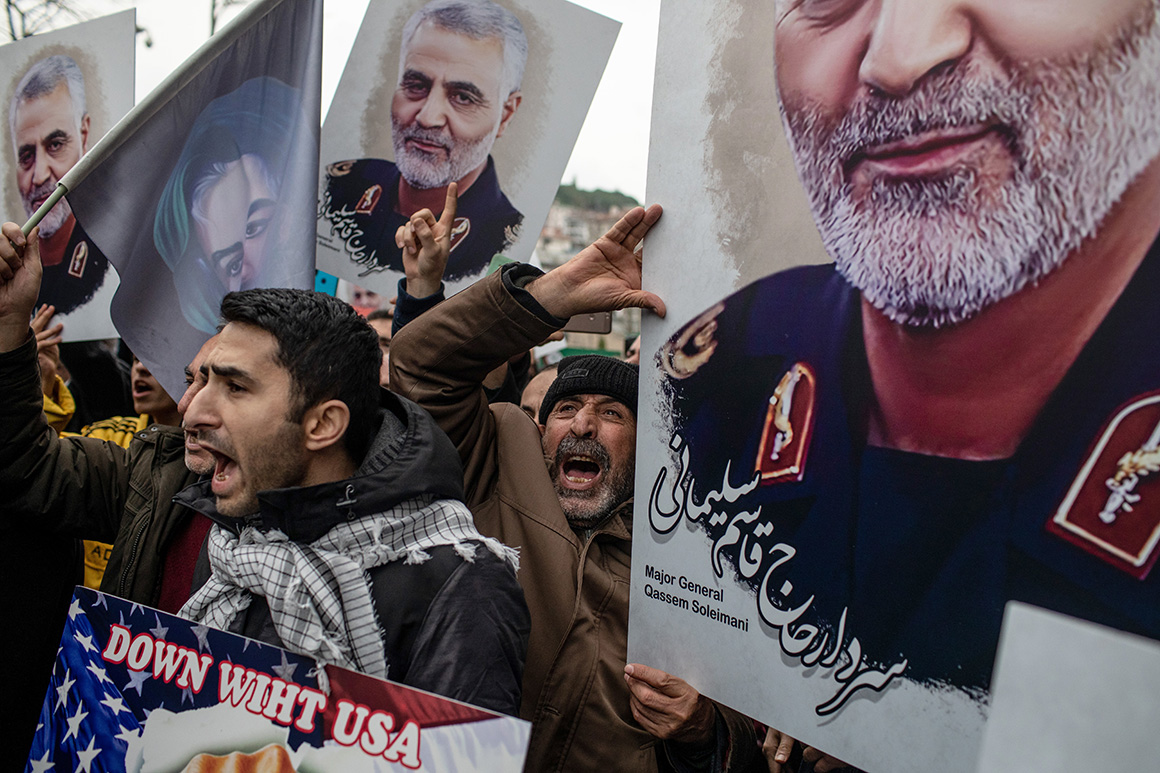
Part of that requires being honest about current conflicts in which the United States finds itself in today. Which brings me to the assassination of the Iranian Revolutionary Guards Al Quds Force, General Qassem Suleimani, a man who is as much of a war criminal as has been seen in decades, within his own country and throughout the region by sponsoring terrorist organizations, sowing civil wars that have cost hundreds of thousands of lives and  disrupted millions of others.

I shed no tears for Suleimani, but the case the administration used to kill him goes against the international law that the United States helped establish at Nuremberg and which cumulated in the Rome Accords and the Establishment of the International Criminal Court which the United States, though a signatory, has yet to ratify.

Specifically, it is the claim of preemptive action, preemptive killing, preemptive war. It was one of the defenses of the Nazi War Criminals, as well as the Japanese War Criminals. The United States claimed that rationale to kill Suleimani, on the scantiest evidence, none of which was produced. That is an unwise strategy, for it invites such actions against Americans, especially military, and diplomatic personnel, as well as political leaders.

My argument does not let Iran off the hook; however, to paraphrase Ferencz, is that we have to move away from war, and move towards using established international law against men like Suleimani, and nations like Iran. Of course opponents of the United States could easily make the same argument against us. But to quote Taylor, “the laws of war are not a one way street.”

My purpose tonight is not to excuse or defend Suleimani or Iran, it is to to say that unless the United States stands for law and justice, other nations, or non-state actors can and will use the same rational in order to assassinate Americans. The President’s actions have not made the United States any safer, instead it has made us even more of a target. I don’t want American leaders, even President Trump, assassinated by agents of foreign powers, or even Americans seeking extra judicial justice. Such organizations or people may think that such action is justified, but without a basis in law they are not, they just continue the cycle of violence, war, and injustice.

Until tomorrow,

Peace,

Padre Steve+

4 Comments

Filed under crime, ethics, film, History, holocaust, laws and legislation, leadership, nazi germany, News and current events, Political Commentary

A Man’s Got to Know His Strategic Limitations: President Trump and the Current Middle Eastern Crisis

        Turkish Protestors in Istanbul 

Friends of Padre Steve’s World,

As I watch the crisis between the United States, or shall I better say President Trump and Iran unfold, and have talked with various friends about it in person and on social media I am reminded of a couple of different definitions of patriotism. Now since I have served the United States as a military enlisted man, and officer in both the Army and Navy in Peace and War, I think that I love my country and should be considered a patriot. I am not blind to our shortcomings, nor things that have been done in the name of the United States that go against the will of our Founders, the ideals of the Declaration of Independence, and the law embodied in our Constitution. Liberal or not, I am a realist. I don’t like to us to lose unnecessary wars.

Likewise, as my favorite theologian Harry Callahan said in Magnum Force: “A man’s got to know his limitations.”  Our President, nor his Cult  do not understand reality. Despite the comparative easy Assassination of the Iranian Revolutionary Guard General Qassim Suleimani, regardless of how bad of man he was, the President has opened a potentially apocalyptic Pandora’s Box which will bring about worse for the United United States, the region and the world.

None of our allies anywhere in the world, including the Israelis, who hate Iran, have officially offered us their support. The Iraqi Parliament has passed a resolution asking the government to order the United States military forces to leave the country. That may not happen, but it will place our very limited and scattered forces in Iraq at the mercy of Iraqi Militias supported by Iran, and quite possibly regular Iraqi and Iranian forces. It could be a death trap for the 5,500 or so American troops in Iraq, not to mention those in Kuwait, those based in Syria, Bahrain, and Qatar, or on ships in the Arabian/Persian Gulf.

American military power is not what it used to be and the President has not considered the second, third, fourth, fifth, or more effects of this strike. Our military readiness is not good, our ability to project power and sustain our forces is worse than it was in 2003, and now we have no allied support. Likewise there is no telling what the Russians, Chinese, North Koreans, or other competitors/enemies will do.

The Iranians have announced that they will not abide by the nuclear accords reached with the West during the Obama Administration, which they abided by even after President Trump renounced that accord. Likewise they have promised vengeance against American military targets and a eulogist at Suleimani’s funeral put an 80 million dollar contract for anyone who kills President Trump.

I neither want a wider war or for that matter for the Iranians to succeed in assassinating President Trump. As much as I oppose the President’s policies and think of him as a dangerous man, his death would only serve to make things worse. He would be succeeded by Vice President Pence, and his cult would demand its own vengeance, regardless of the military, diplomatic, and economic cost.

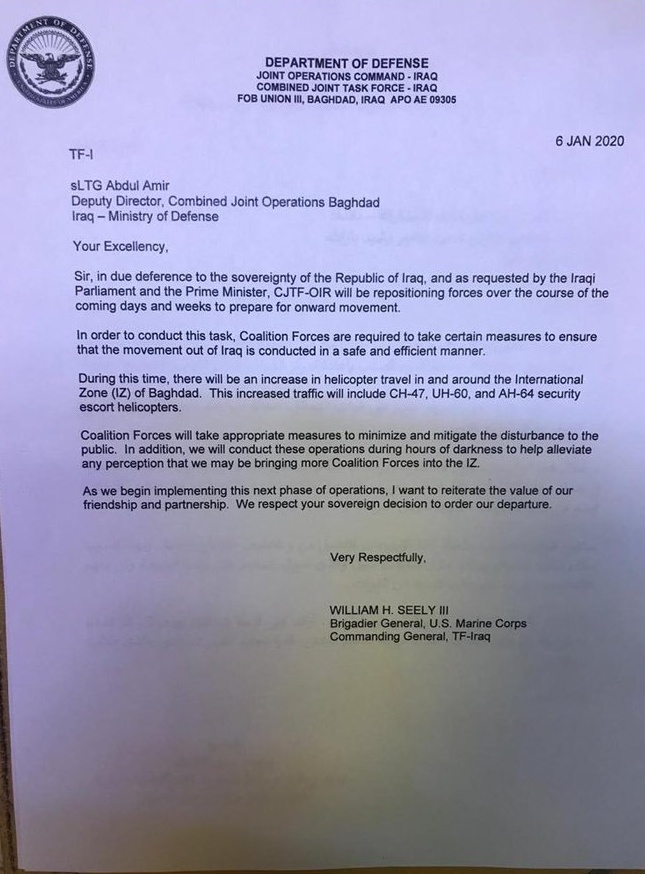
The “Mistake” Letter

Today the situation continued to escalate as the Iraqi Parliament continued to press for the removal of American and foreign forces from Iraq, backed now by the Iraqi President. President Trump threatened to attack religious and cultural sites in Iran, in violation of treaties we have signed and if carried out would be war crimes. He was countermanded by Mark Esper, the Secretary of Defense.Trump continued to reiterate his threat about 52 targets in Iran based on the number of hostages taken by Iranians during the takeover of the American Embassy in 1979, to which the Iranian President reminded the United States of the 290 passengers lost when the USS Vincennes misidentified and shot down IR-655, an Iranian passenger plane on a scheduled flight in 1988. In response the the Iraqi Parliament vote Trump ordered the administration to draft  sanctions against Iraq. During the day a draft of a withdraw letter was mistakenly released by the commander of American Forces, which was almost immediately denied as a mistake by the Chairman of the Joint Chiefs and Secretary of Defense.

If you ask me, things seem to be spiraling out of control, and nobody seems to be at the helm of the ship of state. This is not a good position to be in.

But now the dice have been thrown, the wager has been made, and the outcome is at best an uncertain gamble. I fear for our soldiers, sailors, marines, and airmen in Iraq and the Gulf. The Iranians can easily shut down the Straits of Hormuz, their Yemeni allies can threaten the Bab El Mendeb, the other major maritime choke point in the region. Likewise, in defiance of Trump the Iraqis could cut off supplies from the American troops scattered across the country if they do not withdraw or some kind of accord is reached for them to stay. Likewise, the Iranians, while not the military equal of the United States do have enough power to endanger every American facility in the Persian Gulf, kill tens of thousands of Americans, and seriously disrupt the world economy, yet leaving the Russians, and Chinese greatly strengthened.

I do not know what will happen over the next few days or weeks, but the President has backed us into a corner with little room for maneuver, diplomatically or militarily. Even long term allies like the Israelis, British, and Australians have not offered support. Neither have the Saudis, the mortal Sunni enemies of the Shia Iranians. Certain pundits have, but not their governments.

This is a watershed moment, things that Americans and the world trusted to remain as they were will no longer be the same, and we will not be the better for it. Things will not get better and they will very likely get worse and very possibly bring about the Armageddon that many of Trump’s followers, as well as certain groups of Sunni and Shia Muslims, and others fervently pray for.

Until tomorrow,

Peace,

Padre Steve+


3 Comments

Filed under ethics, Foreign Policy, History, iraq,afghanistan, middle east, Military, national security, News and current events, Political Commentary

“Anyone Could Do It; It Required No Brains at All. It Merely Required No Character” Trump’s Evangelical Allies

Catch-22 (1970) Alan Arkin Mike Nichols 24

Friends of Padre Steve’s World,

When I see the political-religious leaders of the Christian Right defend the indefensible actions of President Trump I am reminded of the words of Joseph Heller in his classic novel Catch 22  who wrote about the Chaplain:

“The chaplain had mastered, in a moment of divine intuition, the handy technique of protective rationalization, and he was exhilarated by his discovery. It was miraculous. It was almost no trick at all, he saw, to turn vice into virtue and slander into truth, impotence into abstinence, arrogance into humility, plunder into philanthropy, thievery into honor, blasphemy into wisdom, brutality into patriotism, and sadism into justice. Anybody could do it; it required no brains at all. It merely required no character.” 

As much as I doubt I am still a Christian, even if I wasn’t already a Christian I couldn’t think of a single reason to follow the false God of men like Pat Robertson, Jerry Falwell Jr., Franklin Graham, Tony Perkins, or any of the host of big name Evangelical Christian preachers who excuse the behaviors of President Trump and his decadently despicable defenders, including people that I once thought that I knew.

I used to think that most people like to believe that religion is a benign or positive influence in the world. As much as I want to believe the positive aspects I have to admit based on the historical and sociological evidence that this is not so, especially during unsettled times of great change. We live in such an era and when it comes to identity, God is the ultimate trump card.

If one wonders why the most fanatical individuals and groups on earth are tied to religions, whether it is the Islamic State and Al Qaeda, Boko Haram, Hezbollah, Orthodox Jews, radical Hindus and Buddhists as well as militant Christians. Of course all of these groups have different goals, but their thought and philosophy are quite similar.

Robert Heinlein wrote:

“Almost any sect, cult, or religion will legislate its creed into law if it acquires the political power to do so.”

Heinlein, the author of the classic Starship Troopers was absolutely correct. Just look at any place in any time where any religion, sect or cult has gained control of a government. They are not loving, they are not forgiving and they use the police power of the state to persecute any individual or group that is judged to be in error, or even worse has the gall to question their authority.

Since the Christian groups tend to thrive in the West, they only speak in terms of violence, most, with the exception of Russian Orthodox Christians, do not have a government to translation of those words into action. Many, especially conservative Catholics and some Evangelical and Charismatic Protestants seem for a long for the day when they can assume control of a theocratic government.

Samuel Huntington wrote in his book The Clash of Civilizations:

“People do not live by reason alone. They cannot calculate and act rationally in pursuit of their self-interest until they define their self. Interest politics presupposes identity. In times of rapid social change established identities dissolve, the self must be redefined, and new identities created. For people facing the need to determine Who am I? Where do I belong? Religion provides compelling answers….In this process people rediscover or create new historical identities. Whatever universalist goals they may have, religions give people identity by positing a basic distinction between believers and non-believers, between a superior in-group and a different and inferior out-group.”

Huntington was right, you see the true believers, those who follow their religion without question and believe that it is superior to all others also believe that their religion entitles them to be atop the food chain, others who don’t believe like them be damned, if not in this life, the next. That is the certitude of the true believer, especially the religious one. Secular or atheistic fanatics could care less about the next life, for this life is all that they have. But the religious “true believers” are not only interested in destroying someone in this life, but ensuring that in the next that they suffer for eternity, unless they believe in the annihilation of the soul after death, which really spoils the whole Dante’s Inferno perspective of the damned in the afterlife.

The great American philosopher, Eric Hoffer wrote:

“The impression somehow prevails that the true believer, particularly the religious individual, is a humble person. The truth is the surrendering and humbling of the self breed pride and arrogance. The true believer is apt to see himself as one of the chosen, the salt of the earth, the light of the world, a prince disguised in meekness, who is destined to inherit the earth and the kingdom of heaven too. He who is not of his faith is evil; he who will not listen will perish.”

That is why they, the religious true believers of any faith are capable of such great evil, and why such people can murder innocents in the most brutal manner simply because they do not believe correctly. In fact today when I see the words and actions of these supposed Conservative Christians.

Please do not get me wrong. I am a Christian, a priest, a historian and a theologian, but I also know just how insidious those who hold their religion over those of others can be. While I hold faith dear, I know that it can be abused for the claim of some to have God as their final authority is a sort of trump card with which they are able to justify the most obscene and evil acts against others.

Likewise I struggle with faith every day. If you have read this blog from the beginning you will see chronicle my struggles with faith and its practice, especially in life and politics.

I guess that is why I am even more frightened of religious true believers than non-religious true believers. While the non-religious true believer may sacrifice everything for the sake of power and control in this life, and may in fact commit the most heinous crimes against humanity, their hatred is bounded in space and time to this earth. The religious true believer is not content with that; their enemies must be damned and punished in this life, but for eternity, without hope of salvation.

When they look at people like me or Yossarian they believe as Heller wrote:

“Morale was deteriorating and it was all Yossarian’s fault. The country was in peril; he was jeopardizing his traditional rights of freedom and independence by daring to exercise them.” 

With that I wish you a good day.

Peace,

Padre Steve+

3 Comments

Filed under christian life, civil rights, ethics, faith, History, Loose thoughts and musings, ministry, Political Commentary

An Act of War: Trump Has Iranian General Assassinated

Friends of Padre Steve’s World,

The great Prussian military strategist Carl Von Clausewitz wrote:

“No one starts a war–or rather, no one in his sense ought to do so–without first being clear in his mind what he intends to achieve by the war and how he intends to conduct it.”

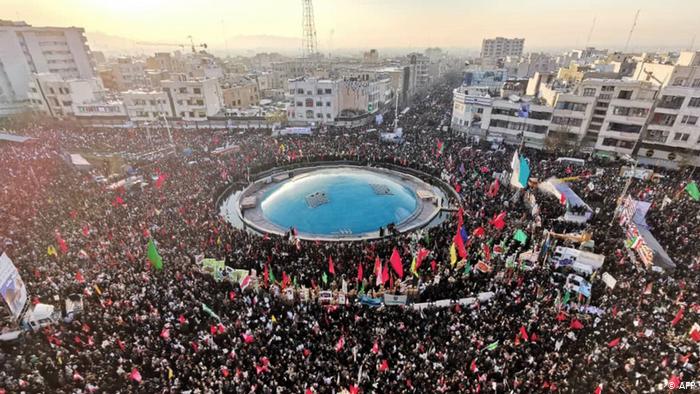
Late Thursday night I saw that the commander of the Iranian Revolutionary Guards Corps “Al Quds” division, General Qasem Soleimani was assassinated by an American Air Force Drone strike, which killed the leader of many of Iraq’s Iranian allied Shia militiamen. This was a day after the Shia militia withdrew after attacking the American Embassy in Baghdad’s Green Zone.

Rather than maintaining a policy of plausible deniability like the Israelis, Russians, Chinese or North Koreans, President Trump had the Defense Department almost immediately claim credit for the strike. Don’t get me wrong, I shed no tears for Qasem Soleimani.

He was responsible for the deaths of hundreds, if not more than a thousand American troops in Iraq, by supplying completed and equipment used to make Improvised Explosive Devices to Shia militants. Thousands of others were wounded, and throughout Iraq, Yemen, Syria, Lebanon, the Gulf States, Saudi Arabia, and even Israel. Militias that he supplied and that are allied with Iran have killed countless Sunni, Kurdish, Sufi, and Christian Arabs. Quite simply, there is no love between the Persians and the Arabs, it is a hatred that preceded the foundation of Islam, or Christianity for that matter. The Persians have always treated the Arabs as inferiors regardless of religion, one reason that some of the most powerful Iraqi Shia leaders remain Iraqi nationalists.

The smart thing to do would have been to use locally manufactured weapons, or those common in the region from Russia, China, North Korea, and European nations, to kill him, and then say nothing. That is how intelligent nations assassinate their opponents, by maintaining plausible deniability. Pardon my less than Christian interpretation of such actions, but beating your chest after such an action as President Trump did today only serves to embolden one’s opponents.

Iran was in the midst of disintegration, protests and deteriorating economic conditions were making it ripe for revolution, but every authoritarian government knows, the easiest way to unify a divided country is war, especially when a longstanding enemy launches a surprise attack that kills a man not only considered a military leader but an national icon. Likewise, the killing of Soleimani will do nothing to change the course of Iran or its policies anywhere. His successor is the man who has been his deputy since the late 1990s. Rather than dividing Iran, this will unify it, against the United States.

One should expect attacks by Iran’s allied militias in Syria, Iraq, Lebanon, the Persian Gulf, and Yemen against American, western, Israeli, and Saudi interests. Likewise one can not calculate the actions of the Russians, Chinese, North Koreans, or others, even friends will be. We could easily find ourselves fighting on multiple fronts without allies or support.

This is uncharted territory. The President did not seek the advice and consent of Congress for  an action that was a functional declaration of war, neither sanctioned by international law, nor in any way covered by the 2001 Authorization for Use of Force sought by the Bush Administration to take action against Al Qaida and Afghanistan; a document used by every succeeding administration for use of force around the world, whether connected with Al Qaida or not. At no point has Congress asserted its authority to declare war. In fact it hasn’t been since President Roosevelt asked for and got a declaration of war against Japan on December 8th 1941, and Germany and its allies when they declared war against the United States a few days later. Since then Congress has yielded to the executive branch and President in every subsequent occasion. Even the War Powers Act, enacted after Vietnam has done little to curtail the actions of each succeeding Presidency. As such this is not just a foreign policy and potential war action, but yet another assault on the Constitution; but then the Constitution hasn’t mattered to most Americans in decades, especially when it comes to military action.

Sun Tzu wrote: “If you know the enemy and know yourself, you need not fear the result of a hundred battles. If you know yourself but not the enemy, for every victory gained you will also suffer a defeat. If you know neither the enemy nor yourself, you will succumb in every battle.”

I feel that Americans by and large neither know ourselves, or our enemies, and that this is most exemplified by the example of President Trump. that my friends saddens me.

We believe that our military is the strongest and most capable in the world, which it would be if it had not been gutted by 18 years of war, which despite the vast sums spent on it is now less capable of projecting military power than it was in 2001. Likewise, massive debt of the country impedes the overall economy, the President’s attacks on the nation’s intelligence and free press have harmed our ability to gain information as well as use information to our advantage, and finally the gutting of the State Department has devastated our ability to use diplomacy rather than force to solve problems.

Every instrument of what American diplomats and strategists have called the DIME, the Diplomatic, Information, Military, and Economic pillars of national power are crumbling and neither the President or Congress has the honesty to say so, even though unclassified reports of all of the above are readily available for anyone to see. But many, if not most Americans prefer ignorance of the law, the Constitution, and facts to reality.

Expect cyber attacks, terrorist attacks on Americans overseas and quite possibly attacks in the United States itself. War could easily consume most of the Middle East and world. While the United States military would probably destroy most of Iran’s conventional military, and infrastructure, it will be a great cost. American losses will be more than OIF and OEF combined. The videos of American Warships burning and sinking from saturation attacks by Iran’s vast number of surface to surface anti-ship missiles, swarm attacks by Iran’s missile and torpedo boats, and speedboats laden with explosives piloted by suicide crews will be hard to fathom. Iranian attacks on U.S. bases in Bahrain, the UAE, Qatar, Kuwait, and Saudi Arabia with ballistic and cruise missiles will also overwhelm available missile defenses.

This may sound like a bleak estimate, but I study, I read, and I know.

I don’t know how to end this article but it just seams to me that the President has sown the wind, leaving his military and people to reap the whirlwind. I sincerely hope that I am wrong. But as Admiral Josh Painter, played by the late actor and Senator Fred Thompson said in the Hunt for Red October: “This business will get out of control. It will get out of control and we’ll be lucky to live through it.” 

In 1920 T. E. Lawrence wrote of the continuing British intervention and occupation of Iraq: “The people of England have been led in Mesopotamia into a trap from which it will be hard to escape with dignity and honour. They have been tricked into it by a steady withholding of information. The Bagdad communiqués are belated, insincere, incomplete. Things have been far worse than we have been told, our administration more bloody and inefficient than the public knows. It is a disgrace to our imperial record, and may soon be too inflamed for any ordinary cure. We are to-day not far from a disaster.” 
I feel much as Lawrence did at this moment in time, and I so want to be wrong.

It is very late and I am tired. Likewise I only think that things will get much worse before they get better.

Until tomorrow,

Peace,

Padre Steve+

3 Comments

Filed under ethics, Foreign Policy, History, iraq, iraq,afghanistan, middle east, Military, national security, News and current events, Political Commentary, Religion, terrorism, War on Terrorism

2020: Time For Reading, Reflecting, Writing, and Action to Help our Neighbors

Friends of Padre Steve’s World,

Welcome to 2019. I know, we’re all still a bit hung over from last night, but welcome to the New Year. Admittedly it doesn’t yet feel a lot different than 2018, but I really expect that 2019 will mark an epochal change in our history. Since I wrote about that yesterday I won’t go back for more.

That being said there is one resolution that I think that all people, the great and the small, should do, and that is not to cry boo who, but read like our lives depended on it, which in a sense they do. By reading, I don’t mean just the news, commentary, or opinion sections of print or online news services, but get real books, especially works of history, biography, philosophy, and the classics.

Barbara Tuchman wrote:

“Books are the carriers of civilization. Without books, history is silent, literature dumb, science crippled, thought and speculation at a standstill. Without books, the development of civilization would have been impossible. They are engines of change (as the poet said), windows on the world and lighthouses erected in the sea of time. They are companions, teachers, magicians, bankers of the treasures of the mind. Books are humanity in print.”

Likewise, the French philosopher Voltaire hit the nail on the head when he said:

“Despite the enormous quantity of books, how few people read! And if one reads profitably, one would realize how much stupid stuff the vulgar herd is content to swallow every day.”

That my friends is fact. If you want to be able to better distinguish fact from fake, read.

Last year I committed to read more, even as I stayed current on the news, analysis of it, and commentary, even as I continued to write. My office at work is crammed with books, as is much of our home. I think that we follow well the advice of Dr. Seuss who wrote:

“Fill your house with stacks of books, in all the crannies and all the nooks.”

So I read, and I read, until my eyes they turned red. I read with those eyes that had turned red, in bed and even in the head.

I read as I eat, and eat as I read, because somewhere in my soul I have this great need, which I ever did cede I would be a great deal poorer indeed.

The pages they turned and as my eyes burned I knew I could never be through so long as my fingers don’t turn blue. I read and read with voices sounding through my head I, but I will not stress even though I digress…

I continually read and I try to update my readers on the latest series of books that I have read and every few months try to let my readers know what I have been up to in my Reading Rainbow.

Since I have tried to keep my readers up with throughout the year I will concentrate on my most recent reads of the past few months. As usual many deal with human behavior in war, particularly in regard to to war crimes; perpetrators, victims, and bystanders. Most of my study of this field have focused on the Nazi Regime, its crimes, and the justice handed out to it, as well as American Slavery and racism. I have also read about crimes that Europeans enacted in their colonies, the Americans in the American West, Mexico, has Vietnam, Iraq, and Afghanistan, the Balkan wars of the 1990s, the Armenian genocide, and the Rwandan genocide.

But one of my readers challenged me to look at the war crimes of the Japanese War Crimes in Asia. I have written about the Rape of Nanking, writing about it specifically and also in more generic articles about human nature, conduct, and genocide. But, other than that at some cursory reads about how the Japanese treated POWs, conquered people’s, and units such as Unit 731; but those were all wave top looks, I never took the deep dive until after we got back from Germany in October.

Since then I have made the deep dive. It has opened my eyes to myths that I believed about Emperor Hirohito and the actions of of his government, and those of the supposedly honorable Imperial Japanese Navy, whose war crimes at sea and ashore rate their own article. In fact one of the books I read was Slaughter at Sea: The Story of Japan’s Naval War Crimes by Mark Felton.

Likewise, I learned of the American complicity at the highest levels in rigging the Tokyo trials to ensure that the Emperor, the bankers, business leaders, most politicians, civil servants, police officials and organizations, the members of Unit 731, which was involved in biological warfare and human experimentation similar to that of the Nazis. This is well documented in Robert P. Bix’s Pulitzer Prize winning biography Hirohito and the Making of Modern Japan and The Other Nuremberg: the Untold Story of the Tokyo War Crimes Trials by Arnold Brackman.

Both books, in excoriating detail not only deal with the Japanese War Crimes and criminals, but deal with the inclusion of the actions of President Truman and General MacArthur to protect certain war criminals, including the Emperor, and deflect responsibility to others such as General and Prime Minister Tojo. The Tokyo Trials took more than twice the time of the Nuremberg Trials, and allowed most of the highest order of war criminals to go free, while unlike Nuremberg exempting lower order war criminals and functionaries off the hook, because of the Cold War. That too, is another article.

I also read Lord Russell of Liverpool’s classic The Knights of Bushido: a Short (Over 300 pages) History of Japanese War Crimes and Showa: Chronicles of a Fallen God by Paul-Yanic Lequerre, another biography of Hirohito. I also re-read War Without Mercy: Race and Power in the Pacific War by John Dower, as well as John Toland’s Rising Sun: the Decline and Fall of the Japanese Empire 1936-1945; Infamy: Pearl Harbor and its Aftermath; and But Not In Shame: The Six Months After Pearl Harbor, as well as Max Hastings Retribution: The Battle for Japan 1944-1945. Then I re-read Iris Chang’s The Rape of Nanking and The Nanking Massacre: History Of China, Japan, and the Events Surrounding the Nanking Massacre by Mukuro Mori. Finally, For the first time I read Japan’s Infamous Unit 731: Firsthand Accounts of Japan’s Wartime Human Experimentation Program by Hal Gold.

All of these first or second time reads added a dimension to the Japanese atrocities that I had managed to cover with Cold War ideology and the myth that Emperor Hirohito was simply a figurehead leader with no responsibility for the war. He knew of the plans of his Army, he studied them, and criticized his military, but he always, even when military and civilian advisers urged him to seek peace, and that went on even after the atomic bombs were dropped. I’ll deal with that in another article.

I also re-read some of my Nazi War Crime books, but I won’t list them here and now. Likewise I have a good number of books to read in the coming weeks and months. As far as my writing I plan on blogging about the aspects of the Japanese War crimes and American complicity to cover them up after the war, as well as the book I started working on last year Lest We Forget: Walk, Remember, Bear Witness; Bearing Witness as the Last Witnesses to the Holocaust Pass Away.

So, I think that is enough for the day. However, our New Year’s Eve was nice. We went to our favorite German Restaurant for dinner, then went home, spent time with our dogs and binged watched episodes of Star Trek Deep Space Nine until about a half an hour before the new year, then we switched to CNN and Anderson Cooper counting down to 2020 in New York. We toasted with a German Rose Sekt (Champagne), stayed up a while longer then went to bed. We got up late, Judy and the dogs watched the Rose Parade, while between doing laundry and taking naps I spent the day until we went out to dinner at our favorite Mexican restaurant came home, and then help our next door neighbor who had collapsed on her porch from low blood sugar. Thanks to the prompt work of the EMS and our neighbor Larry she was able to treated in the ambulance. Judy and I helped with her dogs, and Judy helped her when the EMS released her and didn’t take her to the hospital once they got her blood sugar to a normal range. She stayed with her until she got her insulin and we will make sure she will be okay today. We care about our neighbors.

So, until tomorrow.

Peace

Padre Steve+


2 Comments

Filed under civil rights, crime, Foreign Policy, History, imperial japan, laws and legislation, leadership, Military, Political Commentary, star trek, war crimes, War on Terrorism, world war two in the pacific

 “Sound the loud timbrel o’er Egypt’s dark sea, Jehovah hath triumphed, his people are free.” The Emancipation Proclamation

Friends of Padre Steve’s World

Today is the 156th  anniversary of the Emancipation Proclamation. The proclamation made by Abraham Lincoln when the outcome of the rebellion of the Southern slave states against the Union was still up in the air was a watershed for civil rights in the United States. Though it was a military order that only affected slaves in the rebellious states, it also set the stage for the 13th, 14th, and 15th Amendments and other legal rulings that affected not only African Americans and former slaves, but also Native Americans, Women, other racial minorities and LGBTQ people. It is something that in our era when so many civil rights are under threat that we must remember and continue to fight for in the coming years. Freedom is never free.

As you read this compare the words of Lincoln with those of his Copperheads, or Peace Democrat opponents it would seem that the modern Republicans led by President Trump, have become the new day Copperheads, a party of White Supremacy, willing to destroy the country in order to do so. Thus the fight goes on.

This article is a part of my hopefully soon to be published book “Mine Eyes Have Seen the Glory!” Race, Religion, Ideology, and Politics in the civil War Era. 

Peace

Padre Steve+

From the beginning of the war many Northerners, especially abolitionists and radical Republicans believed that “as the “cornerstone” of the confederacy (the oft-cited description by the South’s vice-president, Alexander H. Stephens) slavery must become a military target.” [1]When some Union generals made their own attempts at issuing emancipation orders, Lincoln countermanded them for exceeding their authority. Lincoln resisted the early calls of the abolitionists to make that a primary war goal for very practical reasons, he had to first ensure that the Border Slave States did not secede, something that would have certainly ensured that the Union would not survived. As a result in the first year of the war, Lincoln “maneuvered to hold Border South neutrals in the Union and to lure Union supporters from the Confederacy’s Middle South white belts. He succeeded on both scores. His double success with southern whites gave the Union greater manpower, a stronger economy, and a larger domain. These slave state resources boosted free labor states’ capacity to should the Union’s heavier Civil War burden.” [2] His success in doing this was instrumental in enabling him to turn to emancipation in 1862.

Finally, some twenty months after Fort Sumter fell and after nearly two years of unrelenting slaughter culminating in the bloody battle of Antietam, Abraham Lincoln published the Emancipation Proclamation. Emancipation was a tricky legal issue for Lincoln as “an executive order of emancipation would be beyond the powers of the president, but not, Lincoln concluded, if such an order were issued as furtherance of the executive’s war powers.” [3] Lincoln had desired to issue the order during the summer and sounded out elected officials and soldiers as to his plan.

Lincoln discussed his views with General George McClellan during a visit to the latter’s headquarters. McClellan stated his strident opposition to them in writing. McClellan did not admire slavery but he despised abolitionists and he wrote one of his political backers “Help me to dodge the nigger – we want nothing to do with him. I am fighting for the Union…. To gain that end we cannot afford to mix up the negro question.”  [4]

Lincoln then called border state Congressmen to sound them out on the subject on July 12th 1862 only to be met with opposition. Such opposition caused Lincoln “to give up trying to conciliate conservatives. From then on the president tilted toward the radical position, though this would not become publicly apparent for more than two months.” [5]

Lincoln’s cabinet met to discuss the proclamation on July 22nd 1862 and after some debate decided that it should be issued, although it was opposed by Postmaster General Montgomery Blair who believed that “the Democrats would capitalize on the unpopularity of such a measure in the border states and parts of the North to gain control of the House in the fall elections.” [6] Wisely, Lincoln heeded the advice of Secretary of State Seward to delay the announcement until military victories ensured that people did not see it as a measure of desperation. Seward noted: “I approve of the proclamation, but I question the expediency of its issue at this juncture. The depression of the public mind, consequent on our repeated reverses, is so great I fear…it may be viewed as the last measure of an exhausted government, a cry for help…our last shriek on the retreat.” Seward suggested that Lincoln wait “until the eagle of victory takes his flight,” and buoyed by military success, “hang your proclamation about his neck.” [7]

After the Battle of Antietam, President Lincoln issued the Preliminary Emancipation Proclamation. This document served as a warning to the leaders of the South, and insisted that there was much more at stake in their rebellion unless they surrendered; their slaves, the very “property” for which the seceded. The document “warned that unless the South laid down its arms by the end of 1862, he would emancipate the slaves.” [8] This was something that they could not and would not do, even as their cities burned and Confederacy collapsed around them in 1864.

The proclamation was a military order in which Lincoln ordered the emancipation of slaves located in the Rebel states and areas of those states occupied by Union troops. It was not designed to change law, which would have to wait until Lincoln felt he could have Congress amend the Constitution.  Instead of law it was “the doctrine of military necessity justified Lincoln’s action.” [9] The concept emanated from Boston lawyer William Whiting who argued “the laws of war “give the President full belligerent rights” as commander and chief to seize enemy property (in this case slaves) being used to wage war against the United States.” [10] There was a legitimate military necessity in the action as Confederate armies used slaves as teamsters, laborers, cooks, and other non-combatant roles to free up white soldiers for combat duty, and because slaves were an important part of the Southern war economy which could not function without them. The proclamation gave inspiration to many slaves throughout the South to desert to the Union cause or to labor less efficiently for their Confederate masters. A South Carolina planter wrote in 1865:

“the conduct of the Negro in the late crisis of our affairs has convinced me that we were all laboring under a delusion….I believed that these people were content, happy, and attached to their masters, But events and reflection have caused me to change these positions….If they were content, happy and attached to their masters, why did they desert him in the moment of need and flocked to the enemy, whom they did not know….” [11]

The proclamation authorized that freed blacks be recruited into the Federal army and it ensured that freed slaves would not again be surrendered back into slavery. As Montgomery Blair had warned Lincoln and the Republicans suffered sharp electoral reverses as “Democrats made opposition to emancipation the centerpiece of their campaign, warning that the North would be “Africanized” – inundated by freed slaves competing for jobs and seeking to marry white women.”  [12]

Lincoln’s response was to continue on despite the opposition and issue the Proclamation in spite of electoral reverses and political resistance. The vehemence of some Northern Democrats came close to matching that of white Southerners. The “white Southerner’s view of Lincoln as a despot, hell-bent on achieving some unnatural vision of “equality,” was shared by Northern Democrats, some of whom thought the president was now possessed by a “religious fanaticism.” [13] But Lincoln was not deterred and he understood “that he was sending the war and the country down a very different road than people thought they would go.” [14] He noted in December 1862:

“Fellow citizens, we cannot escape history….This fiery trial through which we pass, will light us down, in honor or dishonor, to the latest generation….In giving freedom to the slave, we assure freedom to the free – honorable alike in what we give, and what we preserve.”[15]

For Lincoln the Emancipation Proclamation was something that he believed was something that he had to do, and he believed that it would be the one thing that he did in life that would be remembered. He had long been convicted of the need for it, but timing mattered, even six months before it might have created a political backlash in the North which would have fractured support for the war effort, and in this case timing and how he made the proclamation mattered.

The Emancipation Proclamation had military, domestic political, and diplomatic implications, as well as moral implications for the conduct of the war.
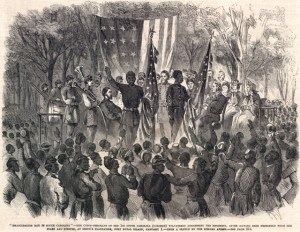
 Soldiers of the 1st South Carolina (colored) Infantry announcing emancipation near Port Royal S.C on January 1st 1863 

The military implication would take some time to achieve but were twofold. First, Lincoln hoped that the Emancipation Proclamation would encourage former slaves, as well as already free blacks in the North to join the Union cause and enlist to serve in the Federal Army. The act would vest African Americans in the Union’s cause as little else could, and at the same time begin to choke-off the agricultural labor force that provided the backbone of the Confederate economy. Frederick Douglass eloquently made the case for African Americans to serve in July 1863, telling a crowd in Philadelphia:

 “Do not flatter yourself, my friends, that you are more important to the Government than the Government is to you. You stand but as a plank to the ship. This rebellion can be put down without your help. Slavery can be abolished by white men: but Liberty so won for the black man, while it may leave him an object of pity, can never make him an object of respect…. Young men of Philadelphia, you are without excuse. The hour has arrived, and your place is in the Union army. Remember that the musket – the United States musket with its bayonet of steel – is better than all the parchment guarantees of Liberty. In you hands the musket means Liberty…” [16] By the end of the war over 180,000 African American men would serve as volunteers in the United States Army.

                                                    Frederick Douglass
Politically the proclamation would the diplomatic purpose by isolating the Confederacy from European assistance. This it did, after the proclamation public sentiment, especially among Europe’s working classes turned solidly against the Confederacy. Domestically it would break-ground for the Thirteenth Amendment, which Lincoln, the pragmatic lawyer was needed to actually abolish slavery. Morally, it  would serve as the guarantee of The United States Government’s public, irrevocable pledge of freedom to African Americans if the North won the war.

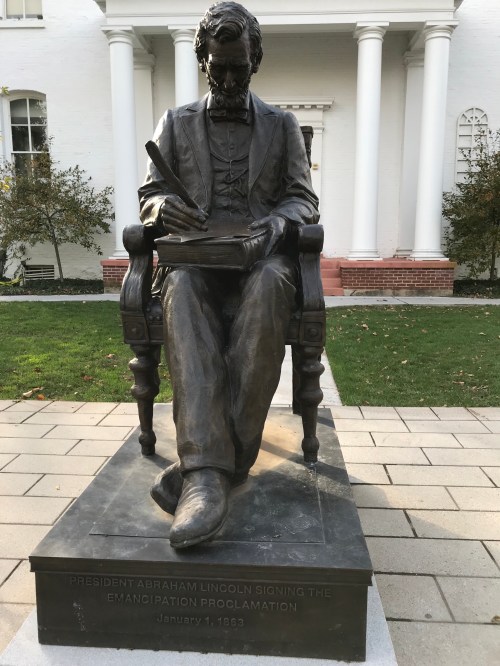
Lincoln signed the order on January 1st 1863. As he got ready to sign the document he paused and put down the pen, speaking to Seward he said “I never, in my life, felt more certain that I was doing right, than I do now in signing this paper….If my name ever goes down in history it will be for signing this act, and my whole soul is in it.” [17] The opening paragraph read:

“That on the first day of January, in the year of our Lord one thousand eight hundred and sixty-three, all persons held as slaves within any State or designated part of a State, the people whereof shall then be in rebellion against the United States, shall be then, thenceforward, and forever free; and the Executive Government of the United States, including the military and naval authority thereof, will recognize and maintain the freedom of such persons, and will do no act or acts to repress such persons, or any of them, in any efforts they may make for their actual freedom.” [18]

At the ends of the proclamation he added the words suggested by his devoutly Christian Secretary of the Treasury Salmon Chase: “And upon this act, sincerely believed to be an act of justice, warranted by the Constitution, upon military necessity, I invoke the considerate judgment of mankind, and the gracious favor of Almighty God.” [19]

The response throughout the North was euphoric as celebrations took place throughout the North. In some cities one hundred gun salutes were fired. At Boston’s Tremont Temple people broke out singing a hymn “Sound the loud timbrel o’er Egypt’s dark sea, Jehovah hath triumphed, his people are free.” [20] The Boston Daily Evening Telegraph predicted, “Slavery from this hour ceases to be a political power in this country…such a righteous revolution as it inaugurates never goes backward.” [21]

Frederick Douglass wrote about his reactions to the Emancipation proclamation as he had nearly despaired wondering if the Lincoln administration would actually take up the fight for emancipation:

“The fourth of July was great, but the first of January, when we consider it in all of its relations and bearings in incomparably greater. The one we respect to the mere political birth to a nation, the last concerns national life and character, and is to determine whether that life and character shall be radiantly and glorious with all high and noble virtues, or infamously blackened, forevermore, with all the hell-darkened crimes and horrors which we attach to Slavery.” [22]

The proclamation was not all some had hoped for and it was certainly provoked a negative response in the South and among many Northern Democrats. Southerners accused Lincoln of inciting racial warfare and Jefferson Davis responded “The day is not so distant when the old Union will be restored with slavery nationally declared to be the proper condition of all of African descent.” [23]

But the proclamation did something that politicians, lawyers did not comprehend, that “the details of the emancipation decree were less significant than the fact that there was an emancipation decree, and while the proclamation read like a dull legal brief, filled with qualifying clauses and exceptions, it was not language made for this, finally, a moral document. It was its existence, its title, its arrival into this world, its challenge to the accepted order, and from that there was no turning back. In this sense it was a revolutionary statement, like the Declaration itself, and nearly as significant.” [24]

 That the proclamation most certainly was and it was a watershed from which there was no stepping back. “It irrevocably committed the government of the United States to the termination of slavery. It was an act of political courage, take at the right time, in the right way.” [25]

However, it would take another two years, with the Confederacy crumbling under the combined Federal military onslaught before Lincoln was able to secure passage of the Thirteenth Amendment to the Constitution in January 1865.  The amendment abolished slavery and involuntary servitude throughout the country, as well as nullified the fugitive slave clause and the Three-Fifths Compromise. It would be followed after Lincoln’s death by the Fourteenth Amendment which reversed the result of the Dred Scott decision and declared that all people born in the United States were citizens and entitled to the rights of citizenship. During the Grant administration the Fifteenth Amendment was passed, and this finally extended to African American men, the right to vote in every state.

Though limited in scope, the Emancipation Proclamation had more than a domestic military, social and political effect. It also had an effect on foreign policy which ensured that Britain, and thereby France would not intervene in the war on behalf of the Southern Confederacy. It stopped all British support for the Rebels to include seizing warships that had been contracted for by Confederate agents that were building or being fitted out in British Yards. Likewise the British rejected various proposals of Emperor Napoleon III to intervene in the war in late 1862 and during the summer of 1863.

Effects of the Emancipation Proclamation on Military Law

The Emancipation Proclamation and the elimination of slavery also impacted the Union war effort in terms of law, law that eventually had an impact around the world as nations began to adapt to the changing character of war. It was important because for the first time slavery was accounted for in the laws of war. The “Instructions for the Government of Armies of the United States in the Field, General Orders No. 100 by President Lincoln, April 24, 1863; Prepared by Francis Lieber, LLD noted in Article 42 of that Code:

“Slavery, complicating and confounding the ideas of property, (that is of a thing,) and of personality, (that is of humanity,) exists according to municipal or local law only. The law of nature and nations has never acknowledged it. The digest of the Roman law enacts the early dictum of the pagan jurist, that “so far as the law of nature is concerned, all men are equal.” Fugitives escaping from a country in which they were slaves, villains, or serfs, into another country, have, for centuries past, been held free and acknowledged free by judicial decisions of European countries, even though the municipal law of the country in which the slave had taken refuge acknowledged slavery within its own dominions.” [26]

It continued in Article 43:

“Therefore, in a war between the United States and a belligerent which admits of slavery, if a person held in bondage by that belligerent be captured by or come as a fugitive under the protection of the military forces of the United States, such person is immediately entitled to the rights and privileges of a freeman To return such person into slavery would amount to enslaving a free person, and neither the United States nor any officer under their authority can enslave any human being. Moreover, a person so made free by the law of war is under the shield of the law of nations, and the former owner or State can have, by the law of postliminy, no belligerent lien or claim of service.” [27]

The Continued Fight for Emancipation: Dealing with the Copperheads and the Passage of the Thirteenth Amendment

But there were still legitimate concerns that slavery might survive as the war continued. Lincoln knew that in issuing the Emancipation Proclamation raised the stakes of the war far higher than they had been. He noted, “We shall nobly save, or meanly lose, the last best hope on earth.” [28] The threat of the destruction of the Union and the continuance of slavery in either the states of the Confederacy, the new western states, territories, or the maintenance of the Union without emancipation was too great for some; notably, the American Freedmen’s Commission to contemplate. With Grant’s army stalled outside Richmond the Copperheads and the peace party gained influence and threatened to bring about a peace that allowed Confederate independence and the continuance of slavery; members of that caucus they Edwin Stanton in the spring of 1864:

“In such a state of feeling, under such a state of things, can we doubt the inevitable results? Shall we escape border raids after fleeing fugitives? No man will expect it. Are we to suffer these? We are disgraced! Are we to repel them? It is a renewal of hostilities!…In the case of a foreign war…can we suppose that they will refrain from seeking their own advantage by an alliance with the enemy?”[29]

The effort of the Copperheads and the peace party to was soon crushed under the military successes of William Tecumseh Sherman’s armies in Georgia. This was especially true of the capture of Atlanta, which was followed by Sherman’s march to the sea and the Carolinas. Additionally the naval victory of David Farragut’s fleet at the Battle of Mobile Bay served to break the stranglehold that the Copperheads were beginning to wield in Northern politics.  These efforts helped secure Lincoln’s reelection by a large margin in the 1864 presidential election over a divided Democratic opposition, whose presidential nominee McClellan could not even endorse his party’s platform.

In his Second Inaugural Address, Abraham Lincoln discussed the issue of slavery as the chief cause of the war. In it, Lincoln noted that slavery was the chief cause of the war in no uncertain terms and talked in a language of faith that was difficult for many, especially Christians, who “believed weighty political issues could be parsed into good or evil. Lincoln’s words offered a complexity that many found difficult to accept,” for the war had devastated the playground of evangelical politics, and it had “thrashed the certitude of evangelical Protestantism” [30] as much as the First World War shattered Classic European Protestant Liberalism.  Lincoln’s confrontation of the role that people of faith brought to the war in both the North and the South is both illuminating and a devastating critique of the religious attitudes that so stoked the fires of hatred.  His realism in confronting facts was masterful, and badly needed.  He spoke of “American slavery” as a single offense ascribed to the whole nation.” [31]

“One-eighth of the whole population were colored slaves, not distributed generally over the Union, but localized in the southern part of it. These slaves constituted a peculiar and powerful interest. All knew that this interest was somehow the cause of the war. To strengthen, perpetuate, and extend this interest was the object for which the insurgents would rend the Union even by war, while the Government claimed no right to do more than to restrict the territorial enlargement of it. Neither party expected for the war the magnitude or the duration which it has already attained. Neither anticipated that the cause of the conflict might cease with or even before the conflict itself should cease. Each looked for an easier triumph, and a result less fundamental and astounding. Both read the same Bible and pray to the same God, and each invokes His aid against the other. It may seem strange that any men should dare to ask a just God’s assistance in wringing their bread from the sweat of other men’s faces, but let us judge not, that we be not judged. The prayers of both could not be answered. That of neither has been answered fully. The Almighty has His own purposes. “Woe unto the world because of offenses; for it must needs be that offenses come, but woe to that man by whom the offense cometh.” If we shall suppose that American slavery is one of those offenses which, in the providence of God, must needs come, but which, having continued through His appointed time, He now wills to remove, and that He gives to both North and South this terrible war as the woe due to those by whom the offense came, shall we discern therein any departure from those divine attributes which the believers in a living God always ascribe to Him? Fondly do we hope, fervently do we pray, that this mighty scourge of war may speedily pass away. Yet, if God wills that it continue until all the wealth piled by the bondsman’s two hundred and fifty years of unrequited toil shall be sunk, and until every drop of blood drawn with the lash shall be paid by another drawn with the sword, as was said three thousand years ago, so still it must be said “the judgments of the Lord are true and righteous altogether.” [32]

Notes 

[1] Ibid. Foner Forever Free: The Story of Emancipation and Reconstruction p.42

[2] Ibid. Freehling The South vs. The South p.47

[3] Brewster, Todd. Lincoln’s Gamble: The Tumultuous Six Months that Gave America the Emancipation Proclamation and Changed the Course of the Civil War Scribner a Division of Simon and Schuster, New York and London p.59

[4] Ibid. McPherson The Battle Cry of Freedom p.364

[5] Ibid. McPherson The Battle Cry of Freedom p.504

[6] McPherson, James M. Tried by War: Abraham Lincoln as Commander in Chief Penguin Books, New York and London 2008 p.109

[7] Ibid. Goodwin Team of Rivals p. 468

[8] Ibid. Foner Forever Free p.49

[9] McGovern, George Abraham Lincoln Times Books, Henry Holt and Company, New York 2009 p.70

[10] Ibid. McPherson Tried by War: p.108

[11] Ibid. Zinn The Other Civil War p.39

[12] Ibid. Foner Forever Free p.49

[13] Ibid. Brewster Lincoln’s Gamble p.169

[14] Ibid. Guelzo Fateful Lightning p.184

[15] Ibid. Foner Forever Free p.49

[16] Douglass, Frederick. Philadelphia Speech of July 6th 1863 recorded in the Liberator in The Civil War and Reconstruction: A Documentary Collection edited by William E. Gienapp, W.W. Norton and Company, New York and London 2001 p.221

[17] Ibid. Goodwin Team of Rivals p. 499

[18] Lincoln, Abraham The Emancipation Proclamation The National Archives & Records Administration retrieved from http://www.archives.gov/exhibits/featured_documents/emancipation_proclamation/transcript.html 14 June 2014

[19] Ibid. Lincoln The Emancipation Proclamation

[20] Ibid. Brewster Lincoln’s Gamble p.244

[21] Ibid. McPherson The Battle Cry of Freedom p.501

[22] Ibid. Guelzo Fateful Lightning pp. 180-181

[23] Ibid. Goldfield America Aflame p.263

[24] Ibid. Brewster Lincoln’s Gamble p.245

[25] Ibid. McGovern Abraham Lincoln p.78

[26] Reichberg, Gregory M, Syse Henrik, and Begby, Endre The Ethics of War: Classic and Contemporary Readings Blackwell Publishing Ltd, Malden, MA and Oxford UK 2006 p.570

[27] Ibid. Reichberg et al. The Ethics of War p.570

[28] Ibid. Goldfield America Aflame p.263

[29] Ibid. Guelzo Fateful Lightning p.534

[30] Ibid. Goldfield  America Aflame p.358

[31] Ibid. Wills Lincoln at Gettysburg p.186

[32] Lincoln, Abraham Second Inaugural Address March 4th 1865 retrieved from www.bartleby.com/124/pres32.html 24 March 2014

Leave a comment

Filed under civil rights, civil war, History, laws and legislation, leadership, Military, News and current events, Political Commentary, White nationalism