Author Archives: padresteve

padresteve's avatar

About padresteve

I'm a Navy Chaplain and Old Catholic Priest

The American Civil War and the Continuum of History, Humanity, and War

Friends Of Padre Steve’s World,

Barbara Tuchman wrote:

“No one is so sure of his premises as the man who knows too little.”

Finite human beings find themselves bound by time and space, we live in the present, but not the present alone, but rather three worlds: one that is, one that was, and one that will be. The German historian Ernst Breisach wrote, “In theory we know these three worlds as separate concepts but we experience as inextricably linked and influencing each other in many ways. Every new and important discovery about the past changes how we think about the present and what we expect of the future; on the other hand every change in the conditions of the present and in the expectations of the future revises our perception of the past. In this complex context history is born ostensibly as reflection of the past; a reflection which is never isolated from the present and the future. History deals with human life as it “flows” through time.”

Richard Evans wrote something in the preface to his book The Third Reich in History and Memory that those who study military history often forget. He noted: “Military history, as this volume shows, can be illuminating in itself, but also needs to be situated in a larger economic and cultural context. Wherever we look, at decision-making at the top, or at the inventiveness and enterprise of second rank figures, wider contextual factors remained vital.” Thus while this work is an examination of the American Civil War it is important to understand the various issues that were formative for the men who directed and fought the battle, as well as the vast continuum of often distant and seemingly unrelated events that come together at one time in the lives of the participants in any historic event.

This is important and it goes to a broader view of history and education rather that many people are comfortable with. We live in an age where much of education, even higher educations has been transformed into training for a particular skill to gain, or with which to enter the workforce, rather than teaching us to think critically. The social sciences, the liberal arts, philosophy, history are often considered by politicians and business leaders as skills which do not help people get jobs and have been the subjects of cuts in many public university systems.

Andy Chan, Vice President for Personal and Career Development at Wake Forest University wrote: “The prevailing argument is that students should study or major in something “employable,” something that is directly correlated to a job in a high paying career field. This view is espoused by many parents and national leaders, including politicians on both sides of the aisle. Many have called for additional STEM majors as well as eliminating funding for “softer” disciplines.” Like it or not such efforts impact the serious study of history and minimize the exsposure of students in the STEM disciplines to the broader aspects of intellectual study that happen provide them with a moral, ethical, and historic foundation for their disciplines. Giles Lauren in his introduction to B. H. Liddell-Hart’s classic Why Don’t We Learn from History?, wrote:

“Education, no longer liberal, has largely become a question of training in a skill for gain rather than teaching us how to think so as to find our own way. ‘It is strange how people assume that no training is needed in the pursuit of truth.’ We must learn to test and judge the information that comes before us. After all: ‘Whoever habitually suppresses the truth … will produce a deformity from the womb of his thought.’”

Liddell-Hart expressed the importance of a wide view of history as well as the importance of being able to dig deep into particular aspects of it, bit of which are important if we want to come as close to the truth as we can. He wrote:
“The benefit of history depends, however, on a broad view. And that depends on a wide study of it. To dig deep into one patch is a valuable and necessary training. It is the only way to learn the method of historical research. But when digging deep, it is equally important to get one’s bearings by a wide survey. That is essential to appreciate the significance of what one finds, otherwise one is likely “to miss the forest for the trees.””

This can be a particular problem for those who write about specific aspects of the American Civil War, especially about particular battles, technical developments, or individuals. Many writers dig deep into a particular subject, but despite their good work, miss important aspects because they have not done the groundwork of trying to put those subjects into the broader historical, as well as sociological context.

One cannot understand the determination the determination of Robert E. Lee to maintain the offensive without understanding his devotion to Napoleon, or his view of the war and the battles his men fought without understanding and taking into account his view of Divine Providence which was a part of his religious experience. One cannot understand the dogged persistence of Joshua Chamberlain or Strong Vincent to hold Little Round Top, without understanding their patriotic idealism and the nearly spiritual significance of the Union to them. One cannot understand William Tecumseh Sherman without understanding the often cold realism that shaped his world view. The same is true for any of the men, and women, soldier or civilian, slave, or free, who had some part, great or small in the war.

Thus it is important when digging deep, to also attempt to understand the broader perspective of history, and how factors outside their direct military training and experience, such as culture, politics, economics, religion, sociology, ideology, life experience, and all of those factors shaped these men and their actions. By such means we get closer to the truth and by doing so avoid the myths which even after a century and a half, still clutter the works of many people who write about the Civil War.

Likewise, in order to understand the context of the battles of the Civil War, or for that matter the battles in any war, one has to understand the events, ever distant events which play a role in the battle. All too often those that delve into military history, or a particular battle see that as separate event, often disconnected from other historical events. But as historian Edward Steers Jr. correctly notes, history “does not exist in a series of isolated events like so many sound bites in a newscast. It is a continuum of seemingly unrelated and distant events that so often come together in one momentous collision of time.”

To explain this in a different way, let us look at the Battle of Gettysburg as a case in point, but needless to say that no-matter what battle we study there are other factors, that influence it. In the case of the Battle of Gettysburg events like Lincoln’s publication of the Emancipation Proclamation, are important, as it resets the political and diplomatic narrative of the war in a way that influences both domestic politics, and diplomacy.

Diplomacy is another aspect that must be considered, and the incompetence of Confederate diplomats was a major factor. These men were unsuccessful in bringing France or Great Britain into the war, nor could they persuade any European power to recognize the Confederacy. Both of these failures were brought about by their provincialism and by their lack of understanding of the domestic politics of France and England. Both nations had abolished slavery, banned the slave trade, and had populations that were overwhelmingly against slavery.

On the military front, the failures of the Confederate armies in the West to maintain their hold on the Mississippi River, played a crucial role in Robert E. Lee’s ill-advised decision to launch an invasion of Pennsylvania, as did the failing Confederate economy. None of these events can be disconnected from it without doing violence to the historical narrative and thereby misunderstanding why the battle was important.

Another element that must be connected in order to understand the American Civil War is the part that policy, strategy, war aims, as well as operational doctrine, tactics, and technology played in every campaign of the war. When we examine those dimensions of the war and of specific campaigns we go back to the human factor: the people whose ideas, character, and personalities, influenced the conduct of the war and how it was waged.

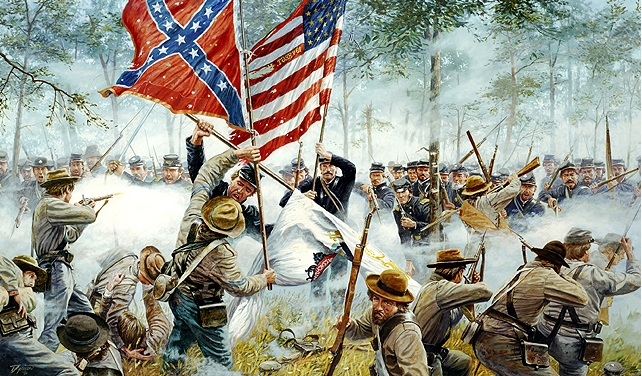
Finally, events such as the battles of Antietam, Chancellorsville, Gettysburg, Vicksburg, and Atlanta, or the Overland Campaign or Sherman’s March to the Sea cannot be looked at as a stand-alone events for their military value only. The clash at Gettysburg as the armies of the Confederacy battled the Army of the Potomac, and surged and then ebbed back from their “high water mark,” is important. What happened there influences the rest of the war. However, it does not take place in isolation from other battles and events. While the war would go on for nearly two more years, the Union victory at Gettysburg coupled with the victory of Grant at Vicksburg ensured that the Confederacy, no matter how hard it tried would not be able to gain its independence through military means. It was no longer the master of its fate, it needed the Northern “Peace” Democrats to successfully win the election of 1864, and it needed intervention from Europe, neither which was forthcoming.

Maybe even more importantly the story of the Civil War is its continued influence today. The American Civil War was America’s greatest crisis. It was a crisis that “has cast such a shadow over the relations between the North and the South that the nation’s identity and its subsequent history have been considerably influenced by it.” One cannot underestimate its importance, it was the completion of the American Revolution and the birth of a modern nation. The successes and failures, the victories and defeats, and the scars that remain resonate in American cultural, political, and social divide, be it in the minds and hearts of the descendants of freed slaves, Southerners weaned on the myth of the Lost Cause, or the progeny of the Irish and German immigrants who fought for a country where they were despised and discriminated against by the adherents of the anti-immigrant Know Nothing movement. The remains of three-quarters of a million Union and Confederate soldiers interred in cemeteries across the North and South, the monuments devoted to them in town squares, the preserved battlefields with their now silent cannon are a constant reminder of this war that made a nation.

Many people pore over the accounts of the battles of the war, while the legions of devoted Civil War historians, re-enactors, military history buffs, and members of organizations such as the Sons of Confederate Veterans testify to the war’s continued hold on Americans and their fascination with it. The military struggle was important, but we always have to keep it in the context of why the war was fought and why so many of the issues that it was fought over remain issues today, as Ted Widmer noted; “What Lincoln called a “new birth of freedom” felt like a straitjacket to those who opposed it, and their legacy is still felt, in the many forms of opposition to the federal writ that we witness on a daily basis.”
It is important to understand how the war was fought, but it even more important to understand the relationship of how it was fought with why it was fought and in some ways is still being fought, as was evidenced by the vast numbers of Confederate battle flags proudly displayed outside of the historic Confederacy during much of the 2016 Presidential campaign.
Historian David Blight wrote:

“The boundaries of military history are fluid; they connect with a broader social, cultural, and political history in a myriad of ways. In the long run, the meanings embedded in those epic fights are what should command our greatest attention. The “war of ideas” as Douglass aptly called it, has never completely faded from our nation’s social condition or historical memory. Suppress it as we may, it still sits in our midst, an eternal postlude playing for all who deal seriously with America’s past and our enduring predicaments with race, pluralism and equality.”

The battles of the American Civil War are enshrined in American history and myth, and are woven deeply into the story of the nation. In this story the Battle of Gettysburg is often viewed different ways depending on one’s perspective. For many in the North the battle is viewed as a victory that helps brings an end to the institution of slavery, and with it freedom for enslaved African-Americans, and the preservation of the Union. In the South it is often part of the myth of the Noble Confederacy and the Lost Cause where the South was defeated by the Northern superiority in men and war making ability. At Gettysburg there is a certain irony that in the shadow of the cemetery where over 3,500 Union soldiers lay in hallowed repose and where Abraham Lincoln gave the Gettysburg Address that Confederate memorabilia vastly outsells that of the side that won the battle. People wearing t-shirts emblazoned with the image of the Confederate battle flag, and sayings like “I Will Not be Reconstructed” are bought at local gift shops, and their wearers parade past the graves of the Union soldiers who lie just a few hundred yards up the slope of West Cemetery Hill.

Yet in both cases, the truth is not so simple; in fact it is much more complex, and the truth is we are still in the process of learning from and interpreting the historical records of the events that led to the American Civil War, the war itself, and the aftermath. They are all connected and for that matter still influence Americans today more than any other era of our history. In fact James McPherson who is one of the nation’s preeminent scholars on the Civil War and Reconstruction wrote:

“I became convinced that I could not fully understand the issues of my own time unless I learned about their roots in the era of the Civil War: slavery and its abolition; the conflict between North and South; the struggle between state sovereignty and the federal government; the role of the government in social change and resistance to both government and social change. These issues are as salient and controversial today as they were in the 1960s, not to mention the 1860s.”

The prolific American military historian Russell Weigley wrote of how the war, and in particular how the Battle of Gettysburg changed the American Republic.
“The Great Civil War gave birth to a new and different American Republic, whose nature is to be discovered less in the Declaration of Independence than in the Address Delivered at the Dedication of the National Cemetery at Gettysburg. The powerful new Republic shaped by the bayonets of the Union Army of the Civil War wears a badge less benign aspect than the older, original American Republic. But it also carries a larger potential to do good for “the proposition that all men are created equal” both at home and around the world.”

Thus it is important for Americans to learn about the American Civil War, but not solely for its military significance, nor for clear-cut answers or solutions. The lessons go far deeper than that and span the spectrum of the world that we live in today. The fact is that “situations in history may resemble contemporary ones, but they are never exactly alike, and it is a foolish person who tries blindly to approach a purely historical solution to a contemporary problem. Wars resemble each other more than they resemble other human activities, but similarities can be exaggerated.”

British military historian Michael Howard warned, “the differences brought about between one war and another by social or technological changes are immense, and an unintelligent study of military history which does not take into account these changes may quite easily be more dangerous than no study at all. Like the statesman, the soldier has to steer between the dangers of repeating the errors of the past because his is ignorant that they have been made, and of remaining bound by theories deduced from past history although changes in conditions have rendered these theories obsolete.” The ideal that we reach for is to understand the battles of the American Civil War in context, which includes understanding what led to the war as well as the period of Reconstruction, and the post-Reconstruction era and the continued reverberations today.

The American Civil War determined much of the history that followed, not only in the United State, but around the world both in its military advances which transformed war into a mechanized conflict that continues to grow more deadly, and in terms of politics, and social development.

The lessons of this period go far beyond military and leadership lessons gained in studying the battles themselves. They go to our understanding of who we are as a people. They are social, religious, political, economic, diplomatic, and informational. From a strategist’s perspective they certainly help inform the modern policy maker of the DIME, the diplomatic, informational, military, and economic elements of national power, but they are even more than that; the period provides lessons that inform citizens as to the importance of liberty, responsibility, and the importance of both fighting for and defending the rights of the weak and the oppressed.

They also deal with the lives of people, and throughout this volume you will find biographical portraits of some of the key people woven into the story for without them, there really is no story. The one constant in human history are real human beings, some driven by passion, ideology, religion, wealth, or power. There are others who in their quest for knowledge discover things that change the world, invent machinery that alters history, and create weapons which make killing easier. There are men and women who fight for truth, and seek justice for the oppressed. There are the honest and the hucksters, those with character and those that are charlatans. Then to are those who live in fantasy words, cloud-cuckoo lands of unreality that cause them to believe in and pursue causes that can only end in tragedy for them and in many cases others, and finally there are the realists who recognize situations for what they are and are willing to do the hard thing, to speak truth and to act upon it.

All of these types of people can be found in this great war in what was undoubtedly a revolutionary age of change, an age which has influenced the life of this nation, our people, and the world for over a century and a half. Its ghosts haunt our laws and institutions, the sacrifices of soldiers, and the actions of men like Abraham Lincoln have inspired people in this country and around the world.
In writing this volume I attempt to draw lessons from the Civil War era and the people who helped create the world in which we live. Even so I try to do so without making the mistake of assuming that what we learn and know about them is immutable and thus not subject to change; for the past influences the present, even as the present and future will influence how we view and interpret the past.

Until tomorrow,

Peace,

Padre Steve+

← Back

Thank you for your response. ✨

Leave a comment

Filed under civil rights, civil war, Gettysburg, History, Military

From Limited to Total War: The American Civil War as a Watershed

Friends of Padre Steve’s World,

As always I continue to revise my Gettysburg and Civil War texts. I am posting the second half of a majorly revised section dealing the the nature of the war, and how it changed from a limited war to a total war. This subject may be uncomfortable to many readers, and I admit that. Truthfully I abhor war but I am a realist when it comes to human nature, politics, economics, ideology, religion, and even racism and race hatred play in the world.

Truthfully, if the North had continued the war with limited force, and goals, the Confederacy would have either become independent, or it would have been re-admitted to the Union with slavery intact, and the Thirteenth, Fourteenth, and Fifteenth Ammendments would have never been passed, and any concept of civil rights destroyed. You can be sure that with Southern States re-admitted without change that other things would not have occurred; Women’s sufferage, Native American citizenship, citizenship and civil rights for Asian immigrants, and most recently, LGBTQ people are directly tied to the constitutional amendments that the Union victory made possible.  Sometimes, as distasteful and repugnant as that may sound, a hard war is necessary to prevent an unjust peace. 

From a point of realpolitik,  the fact is that leaders in the South and the North, like so many other leaders in history and even today, failed to understand what the war that they helped unleash would bring about. War is not to be entered into lightly without connecting the dots between the act of policy that guides the war, as well as having the policy’s ends supported by the ways and means necessary to fulfill it, and not all of those are military. Diplomacy, economic power, and  information all play a part. 

Abraham Lincoln and his advisors came to understand this, maybe better than any presidential administration in United States history. Sadly, Lincoln was assassinated before he could guide the country through reunion, and Andrew Johnson was not up to the task. By the time Ulysses Grant became President, the opportune moment for reunion had passed. Though the South succeeded in rolling back civil rights for another century, they never were able to repeal those three critical amendments. That is why the hard war pursued by the Lincoln administration still matters for everyone with a stake in civil rights. Today, under the Trump Administration, the GOP Senate, and the GOP State majorities those civil rights stand endangered. The fight is not over.

Think about that, and have a great weekend,

Peace

Padre Steve+

gburg dead1

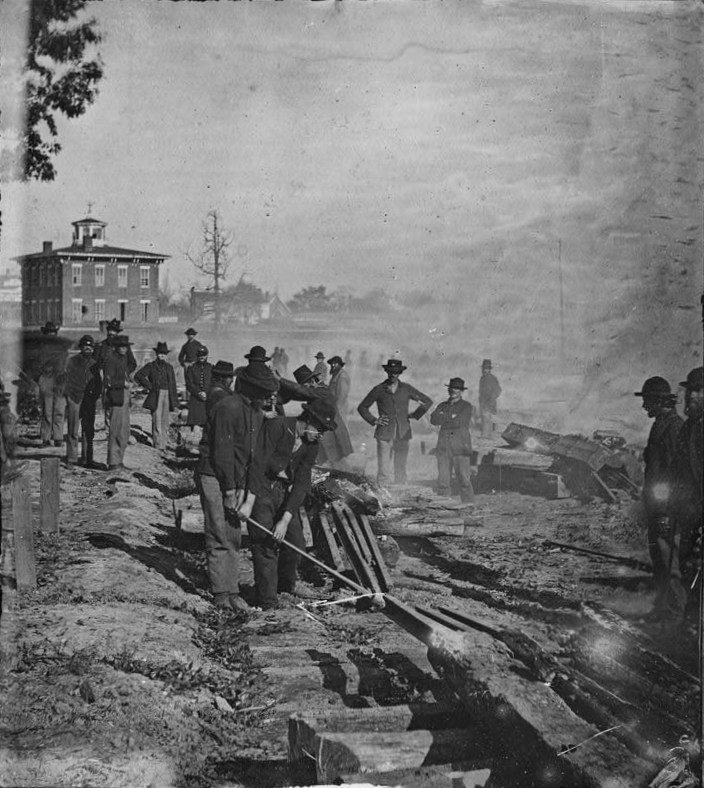
While the nature of war remained unchanged, the American Civil war changed the character of war, as it had been known for centuries, since the Peace of Westphalia, and the end of the Thirty Years War changed dramatically. In the American Civil War the character of war changed from the emphasis of the limited wars of the 18th Century and the Napoleonic era where opposing armies dueled each other into a war that encompassed the entire population. It also challenged a generation of military officers who had grown up with Henri Jomini’s principles of war and his emphasis on limited war.

The leading catalyst that convinced Lincoln and other Northern leaders of the need to abandon the strategy of limited war was the fact that the Confederates had:

 “blurred the distinction between combatants and noncombatants in the parts of the Confederacy and border states occupied by Union forces. The crops and livestock of Southern civilians were feeding and clothing Confederate armies. Their slaves were the principle labor force in the Confederate War economy. Thousands of Southern civilians became guerillas who roamed behind Union lines destroying supplies and ambushing unarmed as well as armed Unionists.” [1]

The Union reaction to the Confederate actions would portend a change in the war. And soon, the war bordered on Clausewitz’s definition of absolute or total war, especially in Sherman’s march through the South, and in the actions of Confederate irregulars who used terror against Unionist civilians and free Blacks. The actions of irregular Confederate forces to attack his troops and supply lines caused William Tecumseh Sherman, who earlier in the war had taken a conciliatory attitude to Southern civilians, to change his views.

To Sherman, the Confederates had blurred the lines between combatants and non-combatants, he noted that the Union army must act

 “on the proper rule that all in the South are enemies of all in the North….. The whole country is full of guerilla bands…. The entire South, man woman, and child, is against us, armed and determined.” [2]

In response Henry Halleck, now backed with the legal authority of General Order 100, also known as The Lieber Code, which for the first time in American history defined the differences between partisans acting in the capacity as soldiers of the enemy army, and those who were not a part of a military unit, but rather men who blended back into the population after conducting armed attacks, [3] wrote to Sherman,

“I am fully of opinion that the nature of your position, the character of the war, the conduct of the enemy (and especially of non-combatants and women of the territory we have heretofore conquered and occupied), will justify you in gathering up all the forage and provisions which your army will require, both for a siege of Atlanta and for your supply in your march farther into the enemy’s country. Let the disloyal families of the country, thus stripped, go to their husbands, fathers, and natural protectors, in the rebel ranks; we have tried three years of conciliation and kindness without any reciprocation; on the contrary, those thus treated have acted as spies and guerillas in our rear and within our lines…. We have fed this class of people long enough. Let them go with their husbands and fathers in the rebel ranks; and if they won’t go, we must send them to their friends and protectors. I would destroy every mill and factory within reach which I did not want for my own use…..” [4]

The strategy of Sherman was to ensure that the Confederate heartland of the Deep South could no longer help to sustain Confederate armies in the field, it was military, economic, political, and diplomatic. He explained:

“I propose to act in such a manner against the material resources of the South as utterly to negate Davis’ boasted …promises of protection. If we can march a well-appointed army right through hiss territory, it is a demonstration to the world, foreign and domestic, that we have a power which Davis cannot resist.” [5]

in addition, Sherman was a pioneer of psychological warfare, he was convinced that the crushing will of White Confederate citizens was paramount to victory. He was

 “convinced that not only economic resources but also the will of Southern civilians sustained the Confederate War effort…. Sherman was well aware of the fear that his soldiers inspired among Southern whites. This terror “was a power,” he wrote, “and I intend to utilize it… to humble their pride, to follow them to their innermost recesses, and to make them dread and fear us…” [6]

When Confederate General John Bell Hood elected to fortify Atlanta, the largest and most important industrial city in the Confederacy against a Union attack, thereby making the population of the city a target, Sherman wrote to the Mayor of Atlanta to warn him of the consequences of allowing this:

“The use of Atlanta for warlike purposes is inconsistent with its character as a home for families. There will be no manufactures, commerce, or agriculture here, for the maintenance of families, and sooner or later want will compel the inhabitants to go…. You cannot qualify war in any harsher terms than I will. War is cruelty, and you cannot refine it; and those who brought war into our country deserve all the curses and maledictions a people can pour out…. You might as well appeal against the thunder-storm as against these terrible hardships of war. They are inevitable…” [7]

Sherman’s strategy worked, “it deprived Confederate armies of desperately needed supplies; it also crippled morale both at home front and in the army,” [8] His armies did more than destroy factories and farms in its path, wherever they went “they broke the power of the secessionist government, the slaveholder’s social order, and most of whatever fighting spirit remained among Confederate partisans.” [9]

Jefferson Davis understood the effect that Sherman’s army was having, he wrote, “Sherman’s campaign has produced a bad effect on our people, success against his future operations is needed to restore public confidence.” [10] Mary Boykin Chesnut saw the clouds of doom approaching and confided in her diary, “Since Atlanta I have felt as if all were dead in me, forever,” she wrote. “we are going to be wiped off the map.” [11]

The effects of Sherman’s march through Georgia and the Carolinas were felt in the Confederate armies at the front as just as he had predicted. Lee’s artillery chief, Brigadier General Porter Alexander wrote:

“The condition of the country at large was one of almost as great deprivation & suffering as that of the army itself; & in many localities even of much greater. North Carolina, South Carolina, & Georgia had been over-run by Sherman’s army carrying off many of the Negroes & most of the stock & destroying all accumulation of provisions which they could not use, & often burning barns & dwellings & all implements of agriculture…. Naturally, the wives & mothers left at home wrote longingly for the return of the husbands & sons who were in the ranks in Virginia. And, naturally, many of them could not resist these appeals, & deserted in order to return & care for their families.” [12]

A member of the 20th Maine noted the effect on Lee’s troops opposing them at Petersburg wrote, “Since Sherman’s victories… we see the affect it is having on Lee’s Army.” They were deserting in groups, “not only privates, but many officers with them.” [13] Lee was so frustrated and angry with the desertion problem that he resorted to summary executions of the men, occasionally without hearing their appeals.

The war was revolutionary in other ways, and brought about a host of social, philosophical, economic, and political changes which continue to impact the lives of people in the United States and around the world even today. Some of these, especially those regarding the abolition of slavery and emancipation, as well as the beginnings of the Women’s Rights movement have had a ripple effect in matters of political and social equality for other previously disenfranchised groups of citizens. One writer noted in regard to the social impacts that “The Civil War uprooted institutions, transformed our politics, influenced social relationships of half a continent, and wrought changes that echo down the generations.” 

 Mark Twain wrote in 1873 that the war “uprooted institutions that were centuries old, changed the politics of a people …and wrought so profoundly upon the national character that cannot be measured short of two or three generations.” [15]

In a sense, when Abraham Lincoln proclaimed  “a new birth of freedom” in his Gettysburg address it served as a watershed moment in American history because it brought to the forefront the understanding of Jefferson and the other signers of the Declaration of Independence that all men are created equal.

That statement, flowing from the Declaration was key to Lincoln’s understanding of human rights and dignity, and from it came the Emancipation Proclamation and the Thirteenth Amendment, which abolished slavery. Those would be followed by the Republican Congresses’ passage of the Fourteenth Amendment, which overturned the Dred Scott Decision, which denied all citizenship to blacks across the country, and by Ulysses S. Grant’s Fifteenth Amendment, which gave African American men to right to vote. These were all revolutionary ideas, and there was a counterrevolutionary backlash after the war “overthrew the fledgling experiment in racial equality” but “did not fully restore the old order. Slavery was not reinstated. The Fourteenth and Fifteenth Amendments were not repealed.” [16]  That is the human and political context by which we have to understand the American Civil War.

Thus it is important to study the Gettysburg campaign in the context of the Civil War because the campaign of 1863 in the east cannot be divorced from what was happening in the west at Vicksburg, nor the Union blockade, nor the diplomatic, economic and informational aspects of the war.  Likewise the Gettysburg campaign cannot be separated from its relationship to the broader understanding of the nature and character of war. To do this one must examine the connection between them and policies made by political leaders; to include the relationship of political to military leaders, diplomats, the leaders of business and industry and not to be forgotten, the press and the people. Likewise we must understand the various contexts of war, to include the social, political, ideological and even the religious components of war, how they impacted Civil War leaders and why civilian policy makers and military leaders must understand them today.

While the essential nature of war remains constant, wars and the manner in which they are fought have changed in their character throughout history, and this distinction matters not only for military professionals, but also policy makers.

The changing character of war was something that military leaders as well as policy makers struggled with during the American Civil War much as today’s military leaders and policy makers seek to understand the character of warfare today. British military theorist Colin Gray wrote:

 “Since the character of every war is unique in the details of its contexts (political, social-cultural, economic, technological, military strategic, geographical, and historical), the policymaker most probably will struggle of the warfare that is unleashed.” [17]

That was not just an issue for Abraham Lincoln and Jefferson Davis, both of whom struggled with the nature of the war which had been unleashed, but it is an issue for our present and future political leaders, who as civilian politicians are “likely to be challenged by a deficient grasp of both the nature of war as well as its contemporary context-specific character.” [18] 

This is actually very important in our present context as since “the end of the Cold War, the tendency among civilians – with President Bush as a prime example – has been to confuse strategy with ideology. The president’s freedom agenda, which supposedly provided a blueprint for how to prosecute the global war on terror, expressed grandiose aspirations without serious effort to assess the means required to achieve them.” [19] Likewise, it is something that President Obama did not fully understand, and President Trump, is flailing and failing at, not because he has a strategy or a coherent ideology, but because everything revolves around him.

Strategy is hard and mostly ignored until there is a crisis, “soldiers focus on their professional military duties, while politicians exercise their skill in policymaking. The strategy bridge between the two worlds, the two cultures, generally is left poorly guarded, if it is guarded at all.” [20] In the American Civil War, Abraham Lincoln and his administration as well as military advisers came to develop a realistic strategy to match his political goals, Lincoln understood the contexts of the war far better than his Confederate counterpart Jefferson Davis, whose administration and military leadership was never able to devise a coherent strategy because they did not fully grasp the contexts of the war, never seriously considered the ends, ways, and means to victory.

In addition to being the first modern war, or maybe I should say, the first war of the Industrial Age, the Civil War prefigured the idea of total war written about by Clausewitz that occurred in the World Wars of the Twentieth Century. The war combined a massive number of technological advances, which both preceded and occurred during it, in which the philosophical nature of the Industrial Revolution came to the fore.

Likewise, the enmity of the two sides for one another had been fostered by a half century of relentless and violent propaganda that ushered from the mouths of politicians, the press and even from the pulpit brought the element of hatred to the fore of the conflict; as Clausewitz correctly observed, “Even the most civilized of peoples, in short, can be filled with passionate hatred for each other.”  [21]

As the war went on the feelings of animosity and hatred often boiled over and were reflected in the words and sometimes the actions of the soldiers. A Confederate Captain wrote his wife to teach his children to have

 “a bitter and unrelenting hatred of the Yankee race” that had “invaded our country and devastated it… [and] murdered our best citizens…. If any luckless Yank should unfortunately come my way he need not petition for mercy. If he does I will give him lead.” 

A soldier from a Wisconsin regiment wrote to his fiancée after the assault on Resaca, Georgia that his unit had captured twenty-three Confederates and

 “our boys asked if they remembered Fort Pillow and killed them all. Where there is no officer with us, we take no prisoners…. We want revenge for our brother soldiers and will have it…. Some of the [rebels] say they will fight as long as there is one of them left. We tell them that is what we want. We want to kill them all off and cleanse the country.” [22]

While this was hatred was not universal and many times the combatants behaved with great chivalry on the battlefield, and Northern and Southern veterans led efforts at reconciliation after the war; such hatred was something that had not been a part of the American military experience.  The deep rooted enmity, especially in the South, would remain a constant over the next one hundred years. “White southerners who retained Confederate loyalties against Federal soldiers and northerners in general…. Confederates defiantly refused to forgive enemies who had inflicted such pain on their society.” [23]Likewise, many Union veterans felt that in their sacrifices to defeat the Confederacy and end slavery would be forgotten as time slipped by and the memory of the war subsided.

This very real hatred meant that there were many times when the American Civil War came close to Clausewitz’s understanding of absolute war in its in character, and it prefigured the great ideological wars of the twentieth century. J.F.C. Fuller noted “for the first time in modern history the aim of war became not only the destruction of the enemy’s armed forces, but also of their foundations- his entire political, social and economic order.” [24] It was the first war where at least some of the commanders, especially Ulysses S. Grant and William Tecumseh Sherman were men of the Industrial Age, in their thought and in the way that they waged war, in strategy, tactics even more importantly, psychologically. Fuller wrote:

“Spiritually and morally they belonged to the age of the Industrial Revolution. Their guiding principle was that of the machine which was fashioning them, namely, efficiency. And as efficiency is governed by a single end- that every means is justified- no moral or spiritual conceptions of traditional behavior must stand in its way.” [25]

President Lincoln, as well as Grant and Sherman realized in early 1864 that “the South was indeed a nation in arms and that the common European practice of having standing armies engaged each other in set-piece battles to determine the outcome of a war was not enough to win this struggle.” [26] Though none was a student of Clausewitz, their method of waging war was in agreement with the Prussian who wrote that

 “the fighting forces must be destroyed; that is, they must be put in such a position that they can no longer carry on the fight” but also that “the animosity and the reciprocal effects of hostile elements, cannot be considered to have ended so long as the enemy’s will has not been broken.”  [27]

Sherman told the mayor of Atlanta after ordering the civilian population expelled that “we are not only fighting hostile armies, but a hostile people, and must make the old and young, the rich and poor, feel the hard hand of war.” [28]Sherman was one of the first American military leaders to understand that a civil war could not be waged according to the limited war doctrines most American officers had been taught. He not only “carried on war against the enemy’s resources more extensively and systematically than anyone else had done, but he developed also a deliberate strategy of terror directed against the enemy’s minds.” [29] While some might find this troubling, the fact remains that it was Sherman’s Southern sweep of all that lay before him that broke the back of the Confederacy.

But Sherman and Grant were not alone in understanding the problem of fighting a limited war against the Confederacy. In the fall of 1862 a twenty-five year volunteer officer, Colonel Strong Vincent serving with McClellan’s army in Virginia understood what had to happen if the Union were to overcome the rebellion of the Confederacy. Vincent who would be instrumental in throwing back Hood’s assault on Little Round Top, and die leading the defense of that edifice, wrote to his wife about the need for harder measures.

“We must fight them more vindictively, or we shall be foiled at every step.  We must desolate the country as we pass through it, and not leave a trace of a doubtful friend or foe behind us; make them believe that we are in earnest, terribly in earnest; that to break this band in twain is monstrous and impossible; that the life of every man, yea, of every weak woman or child in the entire South, is of no value whatever compared with the integrity of the Union.” [30]

Abraham Lincoln came to embrace the eternal nature of war as well as the change in the character of the war over time. Lincoln had gone to war for the preservation of the Union, something that for him was almost spiritual in nature, as is evidenced by the language he used in both of his inaugural addresses and the Gettysburg Address.

Instead of a war to re-unite the Union with the Emancipation Proclamation the war became a war for the liberation of enslaved African Americans, After January 1st 1863 when the Emancipation Proclamation went into effect, Lincoln “told an official of the Interior Department, “the character of the war will be changed. It will be one of subjugation…The [old] South is to be destroyed and replaced by new propositions and ideas.” [31] That too was a modern understanding of war.

Of course, the revolution in military affairs that characterized the Civil War took time, but it was the political and military leaders of the North who better adapted themselves and their nation to the kind of war that was being fought. “Lincoln’s remarkable abilities gave him a wide edge over Davis as a war leader, while in Grant and Sherman the North acquired commanders with a concept of total war and the determination to make it succeed.” [32]

At the beginning of the war the leaders and populace of both sides still held a romantic idea of war. The belief that the war would be over in a few months and that would be settled by a few decisive battles was held by most, including many military officers on both sides. There were some naysayers like the venerable and rather corpulent General Winfield Scott, but politicians and the press mocked Scott and those who even suggested that the war would be long, hard, and bloody. Of course those who predicted a short, easy, and relatively bloodless war who were proven wrong, and the war became the bloodiest war ever waged by Americans, and it was against other Americans. In many ways it has yet to have ended.

Notes 

[1] Ibid. McPherson The War that Forged a Nation: Why the Civil War Still Matters p.35

[2] Ibid. McPherson Drawn With the Sword: Reflections on the American Civil War p.81

[3] Lieber noted in Article 82 of the code that “Men, or squads of men, who commit hostilities, whether by fighting, or inroads for destruction or plunder, or by raids of any kind, without commission, without being part and portion of the organized hostile army, and without sharing continuously in the war, but who do so with intermitting returns to their homes and avocations, or with the occasional assumption of the semblance of peaceful pursuits, divesting themselves of the character or appearance of soldiers – such men, or squads of men, are not public enemies, and, therefore, if captured, are not entitled to the privileges of prisoners of war, but shall be treated summarily as highway robbers or pirates.” And in Article 85 that, “War-rebels are persons within an occupied territory who rise in arms against the occupying or conquering army, or against the authorities established by the same. If captured, they may suffer death, whether they rise singly, in small or large bands, and whether called upon to do so by their own, but expelled, government or not. They are not prisoners of war; nor are they if discovered and secured before their conspiracy has matured to an actual rising or armed violence.” Lieber, Francis, General Orders No. 100 : The Lieber Code INSTRUCTIONS FOR THE GOVERNMENT OF ARMIES OF THE UNITED STATES IN THE FIELD 24 April 1863 Retrieved from The Yale Law School, Lillian Goldman Law Library, The Avalon Project Documents in Law, History and Diplomacy http://avalon.law.yale.edu/19th_century/lieber.asp#sec4 1 June 2016

[4] Ibid. Weigley The American Way of War: A History of United States Military History and Policy p.148

[5] Guelzo Allen C. Fateful Lightening: A New History of the Civil War Era and Reconstruction Oxford University Press, Oxford and New York 2012 p.445

[6] Ibid. McPherson Drawn With the Sword: Reflections on the American Civil War p.82

[7] Sherman, William Tecumseh, Letter to James M. Calhoun, Mayor of Atlanta September 12, 1864 in Perman, Michael and Murrell Taylor, Amy editors The Civil War and Reconstruction Documents and Essays Third Edition Wadsworth Cengage Learning Boston MA 2011 pp.147-148

[8] Ibid. McPherson Drawn With the Sword: Reflections on the American Civil War p.83

[9] Levine, Bruce The Fall of the House of Dixie: The Civil War and the Social Revolution that Transformed the South Random House, New York 2013 p.233

[10] Goldfield, David. America Aflame: How the Civil War Created a Nation Bloomsbury Press, New York 2011 p.348

[11] McPherson, James. The Battle Cry of Freedom: The Civil War Era Oxford University Press, Oxford and New York 1988 p.775

[12] Alexander, Edward Porter. Fighting for the Confederacy: The Personal Recollections of General Edward Porter Alexander edited by Gary Gallagher University of North Carolina Press, Chapel Hill 1989 pp.508-509

[13] Ibid. Guelzo Fateful Lightening p.469

[14] Lowry, Thomas P. The Stories the Soldiers Wouldn’t Tell: Sex in the Civil War Stackpole Books, Mechanicsburg PA 1994 p.176

[15] Ibid. McPherson The War that Forged a Nation: Why the Civil War Still Matters p.48

[16] McPherson, James. The Second American Revolution in Perman, Michael and Murrell Taylor, Amy editors The Civil War and Reconstruction Documents and Essays Third Edition Wadsworth Cengage Learning Boston MA 2011 p.14

[17] Gray, Colin S. Fighting Talk: Forty Maxims on War, Peace, and Strategy Potomac Book, Dulles VA 2009 p.36

[18] Ibid. Gray Fighting Talk p.36

[19] Bacevich, Andrew J. The Limits of Power: The End of American Exceptionalism (The American Empire Project) Metropolitan Books, Henry Holt and Company, New York 2008 Amazon Kindle Edition, Location 2375 of 3875

[20] Ibid. Gray Fighting Talk p.49

[21] Ibid. Clausewitz On War p.76

[22] Ibid. McPherson The War that Forged a Nation pp.49-50

[23] Gallagher, Gary W. The Confederate War: How Popular Will, Nationalism and Military Strategy Could not Stave Off Defeat Harvard University Press, Cambridge MA and London 1999 p.34

[24] Fuller, J.F.C. A Military History of the Modern World, Volume Three: From the Seven Days Battle, 1862,  to the Battle of Leyte Gulf, 1944  Minerva Press 1956 p.88

[25] Ibid. Fuller  A Military History of the Modern World, Volume Three p.88

[26] Flood, Charles Bracelen, Grant and Sherman: The Friendship that Won the War, Harper Perennial, New York 2005 p.238

[27] Ibid. Clausewitz p.90

[28] Ibid. McPherson The Battle Cry of Freedom: The Civil War Era  p.809

[29] Ibid. Weigley  The American Way of War: A History of United States Military History and Policy  p.149

[30]Nevins, James H. and Styple, William B. What death More Glorious: A Biography of General Strong Vincent Belle Grove Publishing Company, Kearney NJ 1997 p.57

[31] Ibid. McPherson The Battle Cry of Freedom p.558

[32] Ibid. McPherson The Battle Cry of Freedom p.857

2 Comments

Filed under civil rights, civil war, Gettysburg, History, Military, national security, Political Commentary

The Civil War’s Transgender Soldiers


Friends of Padre Steve’s World

Today in the Supreme Court President Trump and his theocratic supporters of the Christian Right won a victory on one of their fronts to suppress the civil rights of Court overturned stays issued by lower courts and appeals courts to Trump’s order of 2017 to remove transgender military personnel from the service and prevent others from serving. This in an era when the services are failing to meet recruiting and retention goals because the vast majority of young Americans cannot meet the physical, psychological, or legal requirements to serve in the military. So what does the administration do to satisfy its theocratic supporters, it moves to throw out an estimated 14,000 honorable soldiers, sailors, marines, and airmen; highly trained, experienced, personnel, and many combat veterans.

So, today I am posting an article about the women soldiers of the Civil War, many of who based on their personal narratives would be considered transgender today. It is a section in one of my yet to be published books on the Civil War. I hope that you enjoy.

Peace

Padre Steve+

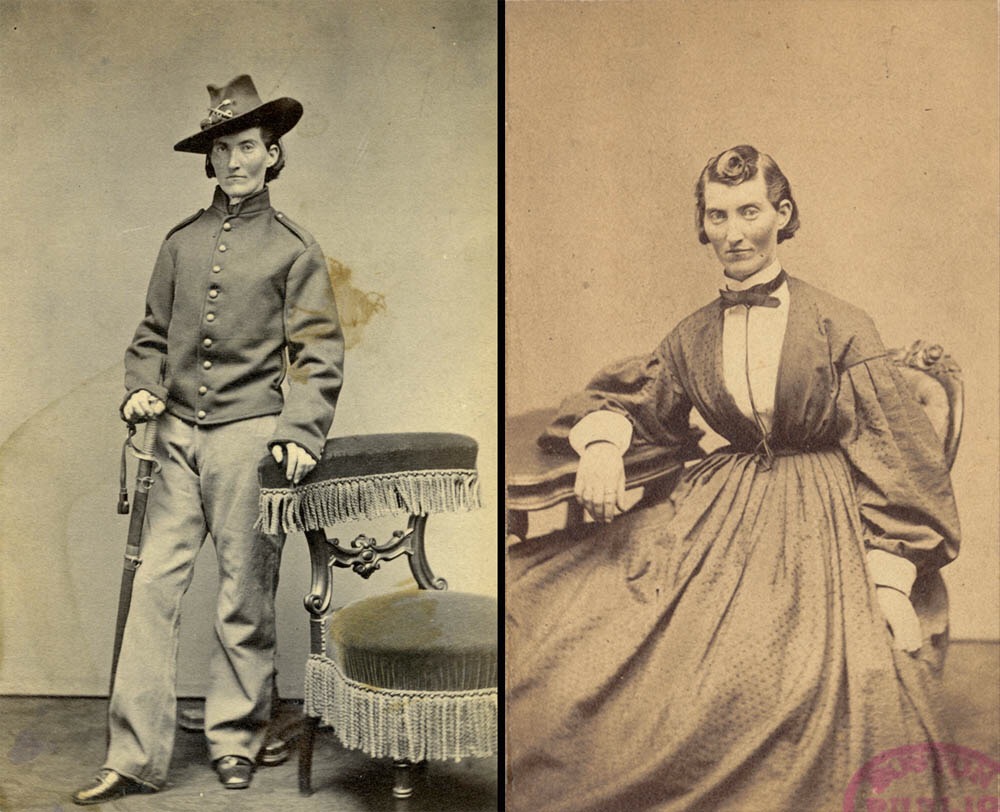
Of course when the Civil War broke out the logical end of this train of though was that should women be allowed to serve in the military. Legally and socially it was not possible for women to serve in the military in 1861, but this did not stop women in the Union or the Confederacy from doing so. Quite a few women on both sides of the conflict chaffed about not being allowed to fight for their countries, their families and their causes, and despite official prohibitions that kept women from serving in any capacity but nursing, a good number of women found their way to go to war. While men in the North and South “were expected to enlist, any woman actively participating in the Civil War was an oddity if not a renegade.” In some cases this involved hundreds of women taking male identities in order to fulfill their desires to serve their countries.

The motives of these women varied. In some cases women wanted gain the economic privileges of full citizenship, and for others the glory reserved to only to men. In our modern parlance those that took male identities would be considered transvestites or possibly transgender, but for them “transvestitism was a private rebellion against public conventions. By taking a male social identity, they secured for themselves male power and independence, as well as full status as citizens of their nation. In essence the Civil War was an opportunity for hundreds of women to escape the confines of their sex.” 

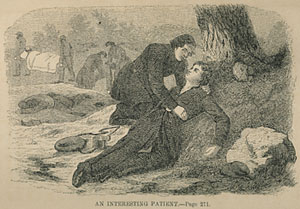
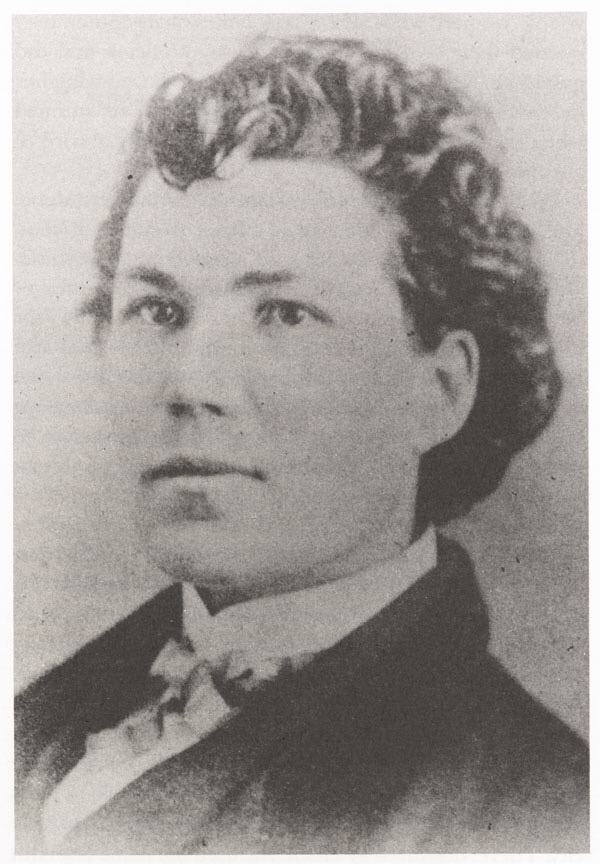
During the war hundreds of women went to war, taking on the identity of men. They enlisted under male names and pretended to be men. Unless they were discovered to be women, or unless they confessed to their wartime service either during or after the war, most women managed to serve without being caught. Sadly, most of their service records were lost. In 1861 Private Franklin Thompson “enlisted in Company F of the 2nd Michigan Infantry…unknown to comrades, Thompson actually was Sarah Emma Edmonds.” Edmonds served in the illustrious Iron Brigade until the disaster at Fredericksburg. Well known for her courage as Franklin Thompson, Edmonds participated in some of the bloodiest combats of the war. At Antietam she was caring for the wounded when she came upon a soldier who had been wounded in the neck. That soldier informed Edmonds that she was dying and after a surgeon came by and confirmed what the soldier said the dying soldier told Edmonds:

“I am not what I seem, but I am female. I enlisted from the purest motives, and I have remained undiscovered and unsuspected. I have neither father, mother nor sister. My only brother was killed today. I closed his eyes about an hour before I was wounded….I am Christian, and have maintained the Christian character ever since I entered the army. I have performed the duties of a soldier faithfully, and am willing to die for the cause of truth and freedom….I wish you to bury me with your own hands, that none may know after my death that I am other than my appearance indicates.”

That unknown woman was not alone, at least nine women, eight Union and one Confederate, fought at Antietam and of those five were casualties. Five women, two Federal and three Confederate took part at Gettysburg. All three Confederate women at Gettysburg were either killed or wounded, or captured, including two women who took part in Pickett’s Charge.


Sarah Edmonds published a book Nurse and Spy in the Union Army while recovering from malaria in 1863. The book, which was published the following year, sold 175,000 copies, the proceeds that she donated to care for sick and wounded Union veterans. After the war, Edmonds attended Oberlin College, married, had three of her own children and adopted two more. She “became a member of the Grand Army of the Potomac, the organization for Union veterans of the Civil War. She applied for, and received, a military pension, and upon her death in 1898 was buried with full military honors.” She was the only women admitted to the Grand Army of the Republic.


Another of the women to serve was Frances Louisa Clayton. Fighting for the Union as a member of the Minnesota State Militia Cavalry and 2nd Minnesota Battery, serving under the command of Ulysses S. Grant she was wounded at Fort Donelson. Like many other women soldiers, Clayton mastered the art of behaving as a man. She “became “a capital swordsman,” but also commanded attention with her “masculine stride in walking” and “her erect and soldierly carriage.” After the war she promoted her service in a book.


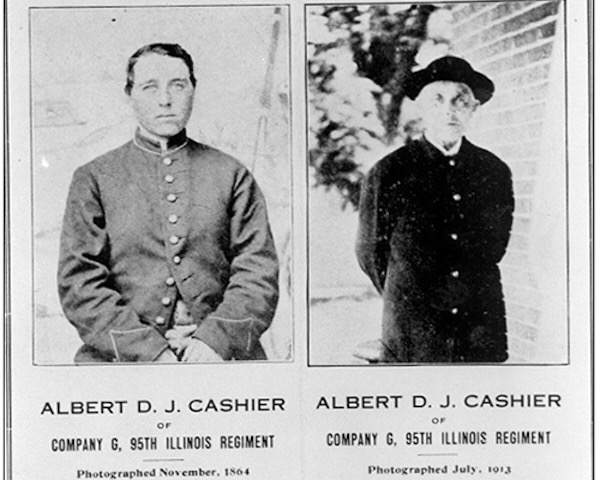
However, most women were more discreet during and after the war regarding their true sexuality. Private Albert Cashier hid his sexuality identity for his entire term of service. He enlisted in August 1862 as a member of the 95th Illinois. Cashier was born in Ireland as a woman, Jennie Hodgers. He fought in forty battles and was discharged with the regiment in August 1865. At Vicksburg he was briefly captured by the Confederates while conducting a reconnaissance “but managed to escape by seizing a gun from one of her guards, knocking him down, and outrunning others. Comrades recalled Private Cashier climbing to the top of their fieldworks to taut the enemy into showing themselves.”

After the war “Albert” returned home and lived as a “farmer and handyman and served as a caretaker in his church. He never married.” In 1890 he applied for and received a military pension and in 1911 the now elderly “man” was struck by a car and suffered a broken leg. The doctor threating him discovered that Albert was not a man, but a woman. But the doctor kept his confidentiality and without revealing “Albert’s” secret had the Union veteran admitted to the local Soldier’s and Sailors’ Home at Quincy, Illinois.” A few years later the elderly “man” began to exhibit erratic behavior and was “committed to a public mental hospital and the word was out.” With her story now sensational front page news and “old comrades in arms came to her defense.” Her comrades had never known that “Albert” was a man during or after the war, while the news was a surprise to them they came to her defense. To combat some of the sensationalism in the media Albert’s fellow soldiers testified “to Albert’s bravery in combat and public good works in later life. Albert/Jennie died at Watertown State Hospital in 1915 at age seventy-one. The local post of the Grand Army of the Republic arranged for her burial. Her headstone reads: “Albert D.J. Cashier, Company G, 95th Illinois Infantry.”

Wartime records are sketchy but as a minimum it is believed that “between 250 and 400 women disguised as men found their way into either the Federal or Confederate armies.” Women known to have served had a “combined casualty rate of 44 percent” including the fact that “eleven percent of women soldiers died in the military.”  Some of those women are now well known but many others are lost to history. Most women tried to keep their sexual identities secret, even to the point of their death on the battlefield. Most of the women who served in the armies returned home to resume relatively normal lives after the war.

Of the women that served in the ranks, some were discovered, and many remained protected by their fellow soldiers. Quite a few received promotions and even served as NCOs or junior officers. With women now serving in combat or combat support roles in the U.S. Military since Operation Desert Storm in 1991, the stigma and scandal that these cross-dressing women soldiers of the Civil War has faded and as scholars and the public both “continue probing cultural notions of gender and identity, the reemerging evidence that women historically and successfully engaged in combat has met with less intellectual resistance and has taken on new cultural significance.” As the United States military services examine the issues surrounding further moves to integrate the combat arms we also should attempt to more closely examine the service of the brave and often forgotten women who served on both sides of the Civil War

4 Comments

Filed under civil rights, civil war, History, LGBT issues, Loose thoughts and musings, Military, national security, News and current events, Political Commentary, us army, US Marine Corps, US Navy

“We Must Fight them More Vindictively” The American Civil War: From Limited War to a People’s War

Friends of Padre Steve’s World

Here is another reworked section of my Civil War and Gettysburg text. It deals with how the how the American Civil War changed from being a limited war to a people’s war, driven by a mutual hatred and hostility. It has been a while since I did any real work on the article which is a part of one of my Civil War book drafts.

The American Civil War was the first war which came close to approximating Clausewitz’s definition of total war, and though it was ignored by world military leaders as an aberration over for fifty years, it prefigured the Wold Wars, as well as the civil wars of the 20th Century. It demonstrates that once the genie of war is out of the bottle, and the passionate hatreds of people are unleashed, that policy will adjust itself. Most wars can and should be averted if leaders work to control the fear and passions of their people and not as so often the case stoke the fires of those fears and passions into an uncontrollable rage directed against the intended target. This is especially true in civil wars which are often waged with a ruthlessness unseat in most wars conducted by nation states against other nation states, unless those wars are driven by religion, ideology, or ethnic hatred.

The fact is as Ulysses Grant so well noted: There are no fixed laws of war which are not subject to the conditions of the country, the climate and the habits of the people. The laws of successful war in one generation would ensure the defeat in another.” 

We would be well to heed these lessons today, because they are not contained to civil wars but the same passionate hatreds fuel every people’s war or total war. Don’t make the mistake of so many who don’t believe such things can happen.

So I hope that you find this interesting and informative.

Peace,

Padre Steve+

The Beginning: Limited War

At the beginning of the war President Lincoln attempted a strategy of conciliation in order to attempt to coax seceding states back into the Union and by conciliation to keep those considering seceding from doing so. However, Lincoln’s attempts were met with outright rejection, before, during, and after the secession crisis.

Lincoln spoke directly to the Southern states in his First Inaugural Address, saying “We are not enemies, but friends,” [1] only to be accused of deliberately lying to the South by pledging to maintain control of Federal installations and forts in the South, like Fort Sumter which was now surrounded by massed batteries of Confederate artillery and demands that it surrender. Jefferson Davis wrote, “The Lincoln Administration deliberately lied to us, baiting us with false promises and pacific pledges all the while it was planning for war. Never in history has a government behaved with such malicious deceit and bad faith.” [2]

When the troops of South Carolina opened fire on Fort Sumter the die was cast, and Lincoln chose the path of war in order to restore the Union, “not because he wanted to, but because the South forced his hand.” [3] His proclamation calling for troops to suppress the rebellion described the kind of war that he foresaw, “the utmost care will be observed… to avoid any devastation, any destruction of, or interference with, property, or any disturbance of peaceful citizens in any part of the country.” [4]

Though he pursued the option of war to restore the Union, Lincoln initially adopted a soft-war strategy in which Confederate armies were the target. This was in large part due to the efforts of Secretary of State Henry Seward and General-in-Chief Winfield Scott. Though he adopted a strategy that required the North to conquest the South, initially he did so with the expectation that after battlefield defeats the Confederates would eventually return to the Union. It was a limited war strategy, “based on an assumption that a majority of the southern people were loyal to the Union and that eleven states had been swept into secession by the passions of the moment.” [5] In fact it was hardly a military strategy at all, “but more of a police action to quell a rather large riot.” [6]

After the defeat at First Bull Run, Congress passed a resolution defining Union war aims. It is notable in terms of how soft and its deference to the feelings of Southerners. Introduced by Senator John J. Crittenden of Kentucky, a key border John popethat had not seceded but had declared its neutrality, the resolution stated:

“Resolved by the House of Representatives of the Congress of the United States, That the present deplorable civil war has been forced upon us by the disunionists of the Southern States now in revolt against the constitutional Government and in arms around the capital; that in this national emergency Congress, banishing all feelings of mere passion or resentment, will recollect only its duty to the whole country; that this war is not waged upon our part in any spirit of oppression, nor for any purpose of conquest or subjugation, nor purpose of overthrowing or interfering with the rights and institutions of those States, but to defend and maintain the supremacy of the Constitution and to preserve the Union, with all the dignity, equality, and rights of the several States unimpaired; and that as soon as these objects are accomplished that the war ought to cease.” [7]

It was an incredibly weak statement of war aims based on the notion that most Southerners were actually Unionists and would come back to the Union. The feeling was increased by some early victories, particularly those of McClellan to secure West Virginia, and Grant and Flag Officer Foote in by the west in their capture of Forts Henry and Donaldson. For a brief time these victories seemed to confirm the validity of such an approach.

Winfield Scott

But the issue was not just with the politicians. Many early Union commanders raised in the niceties of Jominian limited war, and sometimes restrained by their religious upbringings were averse to taking casualties. Winfield Scott believed that only a thin line separated war from murder, and before Bull Run the elderly general noted, “No Christian nation… can be justified in waging war in such a way as shall destroy five hundred and one lives, when the object of the war can be attained at the cost of five hundred. Every man killed beyond the number absolutely required is murdered.” [8]

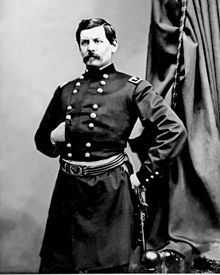
George McClellan was also casualty averse, he told his soldiers that he would watch over them “as a parent over his children…. It shall be my care, as it ever has been, to gain success with the least possible loss…” [9] But McClellan’s “fixation with avoiding casualties, revealed a deep sensitivity of nature admirable in most of life’s pursuits but crippling in war. Battle evokes the cruelest probing of the general in command: young men will die and be maimed, win or lose; and the hard choice must be made when opportunity offers, which may (or may not) save many more lives in the long run than will be lost in a day.” [10]

Even George Gordon Meade who would command the Army of the Potomac during Gettysburg, which was the bloodiest battle of the war, and who under Grant would be involved in other costly battles “believed that to ensure minimal losses on both sides, the North should prosecute the war “like an afflicted parent who is compelled to chastise his erring child, and who performs the duty with a sad heart.” [11] The lack of resolve of many overly cautious generals, especially in the east to fight a hard war against the Confederates would lead to several bungled opportunities to destroy the Army of Northern Virginia, outside the gates of Richmond, at Antietam, and during the pursuit from Gettysburg.

But after series of defeats in the East in 1862 at the hands of a revitalized Confederate Army of Northern Virginia under the command of General Robert E. Lee served notice on Lincoln that the war would be more difficult than previously imagined, and that a hard war strategy was needed.

War, Statecraft and Strategy 

George McClellan

The strategies and operational methods employed by commanders such as Robert E. Lee, Stonewall Jackson, and George McClellan embraces the tenants of Henri Jomini, the French military theorist and exponent of limited war, McClellan in his fixation with geographic places, Lee and Jackson in their love of the offensive. Each “failed to grasp the vital relationship between war and statecraft…. They might win victories – Lee won a series of spectacular ones – but they lacked the vision to win a mighty struggle between two societies.” [12] McClellan, told Lincoln “Woe to the general…who trusts in modern inventions, and neglects the principles of strategy.” But modern inventions, the railroad and the rifle, had conspired with mass citizen armies, themselves reflecting the ideologies of democratic society, to undermine the principles he espoused.” [13] McClellan, who had so deeply imbibed of the theories of Jomini, could not see that war had changed and the principles of Jomini could not win the war against the Confederacy, but others in the North would begin to see this.

But public sentiment in the North was beginning to shift, while there were still a good number of politicians willing to either let the South go its own way or to allow it to return with little substantive change, others were beginning to realize that the people of the South were serious about secession and were irreconcilable in their view that the break between them and the North was final. The New York Times which represented the views of moderate Republicans including Lincoln editorialized, “The country is tired of trifling…. We have been afraid of wounding rebel feelings, afraid of injuring rebel property, afraid of using, or under any circumstance, of freeing rebel slaves. Some of our Generals have fought the rebels – if fighting be it called – with their kid gloves on…” [14]

Lincoln was the political leader who first understood the connection, but militarily it was not until the “emergence of Grant and Sherman did Civil War military leadership break free of Jominian shackles to anticipate modern warfare.” [15] British military historian and theorist J.F.C. Fuller likened the change in the war to be a “return to barbarism,” and noted that “the more stubborn and indecisive became the fighting, and the more the outcome of the war was prolonged, the intenser grew the hatred, until frustration awakened a spirit of vengeance in the hearts of the Federals against the entire population of the South.” [16] Of course the hatred of the Confederacy came late as compared to much of the early nearly pathological and religious hatred of the Union by the radical secessionist, fire-eaters in Southern states even before the war began Thus, compared to the South, the hatred came slow, but when it boiled over the people of the South felt the pain of war as much as their armies did in the field.

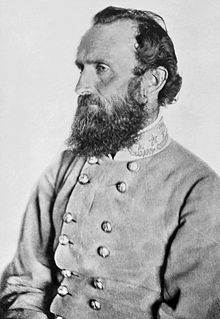
Thomas “Stonewall” Jackson 

From Limited War to a Modern War 

While those who planned for a limited war like Winfield Scott and his Anaconda plan failed to understand the changing character of war, it did provide “both an education for Lincoln, and a firm foundation for the Union’s strategic thinking.” [17] The hard experience of war would point others in the same direction, including both Ulysses S. Grant and William Tecumseh Sherman, and it would be these men who along with Lincoln provided developed a grand strategy that would defeat the Confederacy. It was a strategy which was in line with the political goals of the North, and which marshaled the might of the Union military, diplomatic, economic, industrial and informational strengths, against the Confederacy.

In the South one of the few proponents of this new type of warfare was a former Regular Army officer and professor at the Virginia Military Institute, General Thomas “Stonewall” Jackson. In May of 1861 he moved across the Potomac to occupy the heights that surrounded Harper’s Ferry. Chastised by Lee, then serving as Jefferson Davis’s military adviser, Jackson proposed a strategy of invading the North and “burning Baltimore and Philadelphia and making Northerners understand on a visceral level what the war was going to cost them.” Likewise, he explained to Virginia Governor John Letcher a “black flag” strategy in which meant all Union prisoners of war would be summarily executed. [18]

Later Jackson had the chance to expound on his strategy to another general and suggested that he be given an army to cross the Potomac to “cut of the communications with Washington, force the Federal government to abandon the capital… destroy industrial establishments wherever we found them, break up the lines of interior intercourse, close the coal mines, seize and if necessary, destroy the manufactories of Philadelphia and of other large cities within our reach…. Subsist mainly on the country we traverse, and making unrelenting war amidst their home, force the people of the North to understand what it will cost them to hold the South in the Union at the bayonet’s point.” [19]

The fact that his plan was unrealistic based on the South’s actual military situation and capabilities, as well as opposed by Jefferson Davis as well as Robert E. Lee, takes nothing away from its similarity to the strategy later developed by Grant and Sherman. The problem was as Jefferson Davis wrote in July 1862, “The time and place for invasion has been a question not of will but power,” and then proceeded to recount a conversation with an unnamed Brigadier General the previous fall that appears whose plans did not match the reality of the number of troops available for such an operation. [20] From this meeting Davis got “the not altogether inaccurate idea that Jackson was an offense crazed fanatic.” [21] However, it shows that the desire to take the war to the enemy citizenry was not confined to the North and had the South had the military means that it many have attempted a similar strategy to that later employed by Grant and Sherman.

Grant, who had scored impressive victories at Forts Donaldson and Henry changed his view on how the war should be pursued after being roughly handled in the near disaster at Shiloh. After that battle, Grant gave up on the idea of limited war. He now believed that it was necessary to seize or destroy any property or resources that could be used to sustain the Confederate war effort. Before the Confederate counteroffensive at Shiloh Grant had said that he had been “carful to “protect the property of the citizens whose territory was invaded;” and afterwards his policy became to “consume everything that could be used to support or supply armies.” [22]

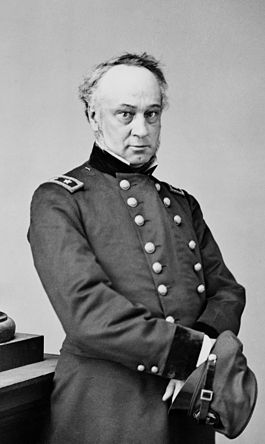
Harry Wager Halleck 

Henry Wager Halleck, who had long been a proponent of Jominian limited war in late 1862 under the influence of Francis Lieber. When Halleck heard complaints that General Horatio G. Wright was pursuing too soft of policy toward rebels in Kentucky, Halleck did not intervene, but offered strong advice to Wright. “Domestic traitors, who seek the overthrow of our Government, are not entitled to its protection and should be made to feel its power…. Make them suffer in their persons and property for their crimes and the suffering they have caused to others…. Let them feel that you have an iron hand; that you know how to apply it when necessary. Don’t be influenced by old political grannies.” [23]

Halleck also backed up Grant in August 1862 when Grant was beginning to pursue the hard war policy in the west by ordering Grant to “Take up all active [rebel] sympathizers… and hold them as prisoners or put them beyond our lines. Handle that class without gloves, and take their property for public use…. It is time that they should begin to feel the presence of the war.” [24]

As the war went on it became apparent to many people in the North, and in the armies on the front lines that harder measures were required, especially with the escalation of guerrilla attacks behind Union lines, as well as the involvement of Southern civilians in attacking Union troops in occupied areas of the South. “Senator John Sherman wrote his brother William of a growing sentiment “that we must treat these Rebels as bitter enemies to be subdued – conquered – by confiscation – by the employment of their slaves – by terror – energy – audacity – rather than by conciliation.” [25]

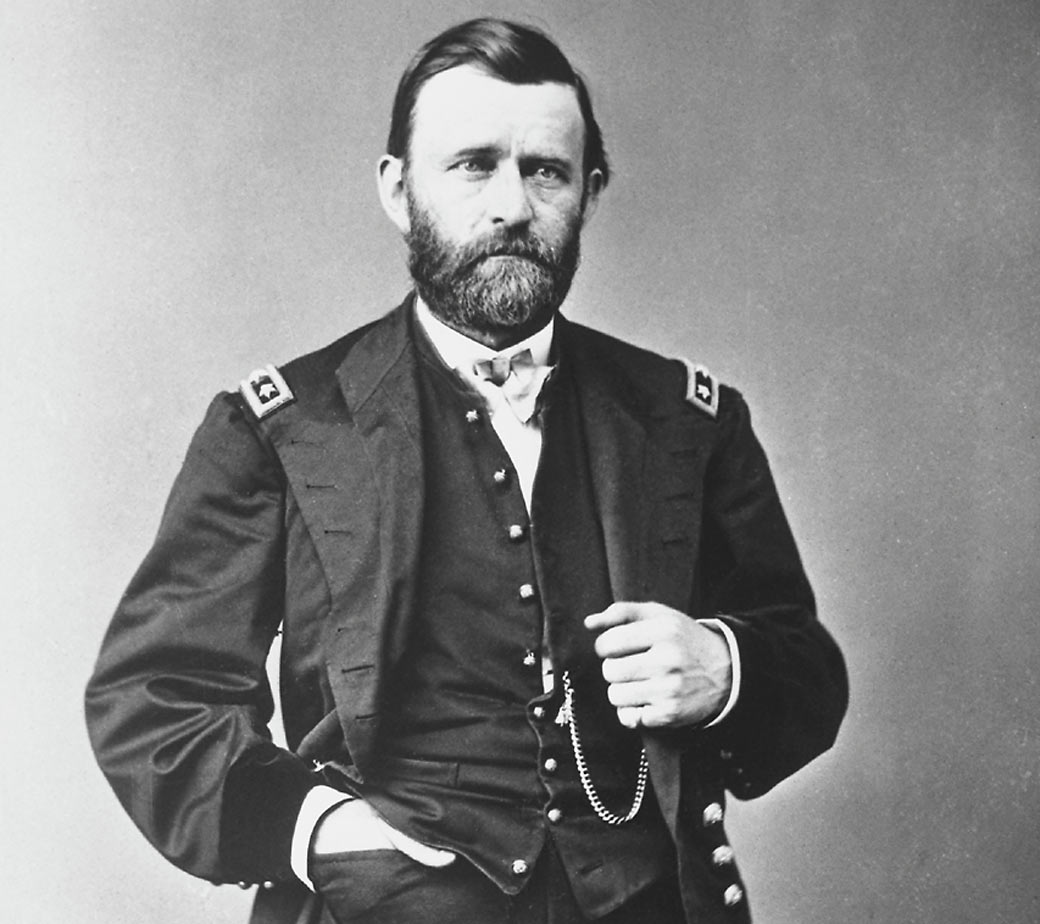
Ulysses S. Grant 

By early 1863 Grant was fully on board with the policy of the Union government, especially emancipation, and the need for the war to be carried through to a conclusion that would completely subjugate the Confederacy. He wrote to one of his generals, “Rebellion has assumed that shape now that it can only be terminated by the complete subjugation of the South or the overthrow of the Government. It is our duty, therefore, to use every means to weaken the enemy, by destroying their means of subsistence, withdrawing their means of cultivating their fields, and in every other way possible.” [26] Some Union military commanders other than Grant became early exponents of a hard and brutal war, among them was Major General John Pope, who as commander of the Army of Virginia issued a “series of orders authorizing his officers to seize Confederate property without compensation, to execute captive guerrillas who had fired on Union troops, and to expel from occupied territory any civilians who had sheltered guerrillas or who had refused to take an oath of allegiance to the United States.” [27] Jackson, who himself had once proposed the “black flag” strategy against the North and its soldiers “considered Pope’s orders “cruel and utterly barbarous.” [28]

Henry Halleck wrote to Grant in April 1863 that “the character of the war has changed very much…. There is now no possible hope of reconciliation with the rebels. The Union party in the South is virtually destroyed. There can be no peace but that which is forced upon it.” In May he wrote another general in Memphis, “We must live upon the enemy’s country as much as possible, and destroy his supplies. This is cruel warfare, but the enemy has brought it on himself by his own conduct.” [29]

As late as 1862 there were some in the North, especially in the Democratic Party fought against any move toward a harder war strategy. One of these was Major General George McClellan who in a brazen attempt to be named General-in-Chief after his failed Peninsular campaign attempted to school President Lincoln in the ways of politics and strategy.

“The time has come when the Government must determine upon a civil and military policy, covering the whole ground of our national trouble…. This rebellion has assumed the character of a war: as such it must be regarded; and should be conducted upon the highest principles known to Christian Civilization. It should not be a War looking to the subjugation of the people of any state, in any event. It should not be, at all, a War upon the population; but against armed forces and political organizations. Neither a confiscation of property, political executions of person, territorial organization of states or forcible abolition of slavery should be contemplated for a moment.” [30]

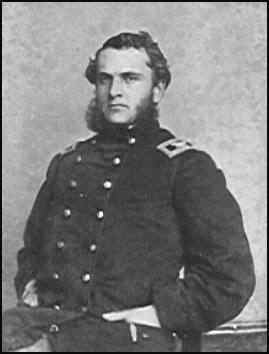
Strong Vincent 

McClellan’s Judge Advocate General, Colonel Strong Vincent, who would later play an important part in repulsing the Confederate assault on Little Round Top, was of the opposite opinion, Vincent wrote his wife after Chancellorsville:

“We must fight them more vindictively, or we shall be foiled at every step. We must desolate the country as we pass through it, and not leave a trace of a doubtful friend or foe behind us; make them believe that we are in earnest, terribly in earnest; that to break this band in twain is monstrous and impossible; that the life of every man, yea, of every weak woman or child in the entire South, is of no value whatever compared with the integrity of the Union.” [31]

Lincoln read McClellan’s letter in his presence and refused to comment upon it. One historian described Lincoln’s reaction to McClellan’s suggestion, “That policy had been pursued for over a year and Lincoln was convinced that it had failed. He was ready to move on.” [32] Instead of complying with McClellan’s demands Lincoln infuriated McClellan by naming Henry Halleck as General-in-Chief, calling for more troops, and deciding on a strategy in which emancipation would play a key role. Since the leaders of the Confederacy to its dying day refused to countenance emancipation, these decisions would change the character of the war from a limited war to bring about political reunion to a war that would drastically change American politics, economics, and society.

While the nature of war remained unchanged, the American Civil war dramatically changed the character of war, as it had been known for centuries, since the Peace of Westphalia, and the end of the Thirty Years War. In the American Civil War the character of war changed from the emphasis of the limited wars of the 18th Century and the Napoleonic era where opposing armies dueled each other into a war that encompassed the entire population. The changes challenged a generation of military officers who had grown up with Jomini’s principles of war and his emphasis on limited war including McClellan and Lee, but Grant, who had never read Jomini and denied the validity of general principles of war that were valid in all times wrote, “There are no fixed laws of war which are not subject to the conditions of the country, the climate and the habits of the people. The laws of successful war in one generation would ensure the defeat in another.” [33]

The leading catalyst that convinced Lincoln and other Northern leaders of the need to abandon the strategy of limited war was the fact that the Confederates had “blurred the distinction between combatants and non-combatants in the parts of the Confederacy and border states occupied by Union forces. The crops and livestock of Southern civilians were feeding and clothing Confederate armies. Their slaves were the principal labor force in the Confederate War economy. Thousands of Southern civilians became guerrillas who roamed behind Union lines destroying supplies and ambushing unarmed as well as armed Unionists.” [34]

William Tecumseh Sherman

The Union reaction to the Confederate actions would portent a change in the war. And soon, the war bordered on Clausewitz’s definition of absolute or total war, especially in Sherman’s march through Georgia and the Carolinas, and in the actions of Confederate irregulars who used terror against Unionist civilians. The actions of irregular Confederate forces to attack his troops and supply lines caused Sherman, who earlier in the war had taken a conciliatory attitude to Southern civilians, to change his views.

Sherman tried to warn his Southern friends that the war they so fervently sought would lead them to disaster:

“You people speak so lightly of war. You don’t know what you are talking about. . . . You mistake . . . the people of the North. They . . . are not going to let this country be destroyed without a mighty effort to save it. . . . The North can make a steam-engine, locomotive or railway car; hardly a yard of cloth or shoes can you [the South] make. You are rushing into war with one of the most powerful, ingeniously mechanical and determined people on earth—right at your doors. . . . Only in your spirit and determination are you prepared for war. In all else you are totally unprepared, with a bad cause to start with . . . in the end you will surely fail.” [35]

The Confederates themselves had blurred the lines between combatants and non-combatants. Sherman noted that the Union army must act “on the proper rule that all in the South are enemies of all in the North….. The whole country is full of guerrilla bands…. The entire South, man woman, and child, is against us, armed and determined.” [36]

Notes 

[1] Weigley, Russell F. The American Way of War: A History of United States Military History and Policy University of Indiana Press, Bloomington IN, 1973 p.133

[2] Davis, Jefferson in Oates, Stephen B. The Approaching Fury: Voices of the Storm 1820-1861 University of Nebraska Press. Lincoln and London, 1997 p.413

[3] Stoker, Donald The Grand Design: Strategy and the U.S. Civil War Oxford University Press, Oxford and New York 2010 p.18

[4] Ibid. Weigley The American Way of War: A History of United States Military History and Policy p.133

[5] Ibid. McPherson Abraham Lincoln and the Second American Revolution p.75

[6] Ibid. McPherson Abraham Lincoln and the Second American Revolution p.75

[7] U.S. Congress The Crittenden Resolution of July 22, 1861 in The Civil War and Reconstruction: A Documentary Collection edited by William E. Gienapp, W.W. Norton and Company, New York and London 2001 p.117

[8] Faust, Drew Gilpin, This Republic of Suffering: Death and the American Civil War Vintage Books, a division of Random House, New York 2008 p.34

[9] Sears, Stephen W. To the Gates of Richmond: The Peninsula Campaign Houghton Mifflin Company, Boston and New York, 1992 p.21

[10] Sears, Stephen W. Landscape Turned Red: The Battle of Antietam Houghton-Mifflin Company, Boston and New York 1983 p.32

[11] Ibid. Faust This Republic of Suffering: Death and the American Civil War p.34

[12] Gallagher, Gary W. “Upon Their Success Hang Momentous Interests”: Generals in Why the Confederacy Lost edited by Gabor S. Boritt, Oxford University Press, New York and Oxford 1992 p.86

[13] Strachan, Hew European Armies and the Conduct of War George Allen and Unwin Publishers, Ltd. London 1983 p.73

[14] McPherson, James M. Tried by War: Abraham Lincoln as Commander in Chief Penguin Books, New York and London 2008 p.105

[15] Ibid. Gallagher “Upon Their Success Hang Momentous Interests” p.86

[16] Fuller, J.F.C. A Military History of the Modern World, Volume Three: From the Seven Days Battle, 1862, to the Battle of Leyte Gulf, 1944 Minerva Press 1956 p.107

[17] Ibid. Stoker The Grand Design: Strategy and the U.S. Civil War p.411

[18] Gwynne, Samuel C. Rebel Yell: The Violence, Passion, and Redemption of Stonewall Jackson Scribner, a Division of Simon and Schuster New York 2014 p.45

[19] Ibid. Gwynne Rebel Yell: The Violence, Passion, and Redemption of Stonewall Jackson p.173

[20] Davis, Jefferson, Letter to John Forsyth July 18th 1862 in Major Problems in American Military History edited by John Whiteclay Chambers II and G. Kurt Piehler, Houghton-Mifflin and Company, Boston and New York 1999 pp.159-160

[21] Ibid. Gwynne Rebel Yell: The Violence, Passion, and Redemption of Stonewall Jackson p.172

[22] McPherson, James M. Drawn With the Sword: Reflections on the American Civil War Oxford University Press, Oxford and New York 1996 p.76

[23] Marszalek, John F. Commander of All of Lincoln’s Armies: A Life of General Henry W. Halleck The Belknap Press of Harvard University Press, Cambridge MA and London 2004 p.168

[24] Ibid. McPherson Drawn With the Sword: Reflections on the American Civil War p.79

[25] Ibid. McPherson Tried by War: Abraham Lincoln as Commander in Chief p.103

[26] Catton, Bruce. Grant Moves South Castle Books, New York, 2000, originally published by Little Brown and Company, New York 1960 p.402

[27] Ibid. McPherson Drawn With the Sword: Reflections on the American Civil War p.79

[28] Ibid. Gwynne Rebel Yell: The Violence, Passion, and Redemption of Stonewall Jackson p.396

[29] Ambrose, Stephen E. Halleck: Lincoln’s Chief of Staff Louisiana State University Press, Baton Rouge and London 1960 and 1992 p.119

[30] McClellan, George B. Letter to Abraham Lincoln July 7, 1862 in Perman, Michael and Murrell Taylor, Amy editors Major Problems in the Civil War and Reconstruction: Documents and Essays Third Edition Wadsworth Cengage Learning Boston MA 2011 p.140

[31] Nevins, James H. and Styple, William B. What Death More Glorious: A Biography of General Strong Vincent Belle Grove Publishing Company, Kearney NJ 1997 p.57

[32] Gallagher, Gary W. The 1862 Richmond Campaign as a Watershed in Major Problems in the Civil War and Reconstruction: Documents and Essays Third Edition Wadsworth Cengage Learning Boston MA 2011 p.157

[33] Ibid. Strachan European Armies and the Conduct of War p.73

[34] Ibid. McPherson The War that Forged a Nation: Why the Civil War Still Matters p.35

[35] McDonough, James Lee. William Tecumseh Sherman: In the Service of My Country: A Life, W.W. Norton and Company, New York, 2016, p. 233

[36] Ibid. McPherson Drawn With the Sword: Reflections on the American Civil War p.81

Leave a comment

Filed under civil war, History, leadership, Military, us army

Dr. King’s Letter From a Birmingham Jail

primary-source-mlk-birmingham-jail-497fe198

Friends of Padre Steve’s World,

Not long ago I posted an article about Dr. Martin Luther King Jr.’s Letter from a Birmingham Jail. 

I included the link to the letter in my article, but I realize that most people, unlike me we not follow a link to get to the original source of the information supplied.

For those that don’t understand, my position as a Priest, if I am actually to be faithful to my vows requires that I be faithful to the Gospel. Sometimes that vow requires stating things that some in denial of their own faith would condemn as partisan politics. But this is not partisan, it echoes both the Christian and American propositions that all men are created equal.

With that in mind here is the full text of King’s letter. It is worthy of your full consideration and contemplation, and for that reason I make no editorial comments, although I did find Vice President Mike Pence’s comparison of President Trump to Dr. King abhorrent, insulting, and damnable.

On this day where we as a nation remember Dr. King it is fitting to read his unedited words from a Birmingham jail. Sadly, they are as applicable today as when he penned them.

Peace,

Padre Steve+

16 April 1963

My Dear Fellow Clergymen:

While confined here in the Birmingham city jail, I came across your recent statement calling my present activities “unwise and untimely.” Seldom do I pause to answer criticism of my work and ideas. If I sought to answer all the criticisms that cross my desk, my secretaries would have little time for anything other than such correspondence in the course of the day, and I would have no time for constructive work. But since I feel that you are men of genuine good will and that your criticisms are sincerely set forth, I want to try to answer your statement in what I hope will be patient and reasonable terms.

I think I should indicate why I am here in Birmingham, since you have been influenced by the view which argues against “outsiders coming in.” I have the honor of serving as president of the Southern Christian Leadership Conference, an organization operating in every southern state, with headquarters in Atlanta, Georgia. We have some eighty five affiliated organizations across the South, and one of them is the Alabama Christian Movement for Human Rights. Frequently we share staff, educational and financial resources with our affiliates. Several months ago the affiliate here in Birmingham asked us to be on call to engage in a nonviolent direct action program if such were deemed necessary. We readily consented, and when the hour came we lived up to our promise. So I, along with several members of my staff, am here because I was invited here. I am here because I have organizational ties here.

But more basically, I am in Birmingham because injustice is here. Just as the prophets of the eighth century B.C. left their villages and carried their “thus saith the Lord” far beyond the boundaries of their home towns, and just as the Apostle Paul left his village of Tarsus and carried the gospel of Jesus Christ to the far corners of the Greco Roman world, so am I compelled to carry the gospel of freedom beyond my own home town. Like Paul, I must constantly respond to the Macedonian call for aid.

Moreover, I am cognizant of the interrelatedness of all communities and states. I cannot sit idly by in Atlanta and not be concerned about what happens in Birmingham. Injustice anywhere is a threat to justice everywhere. We are caught in an inescapable network of mutuality, tied in a single garment of destiny. Whatever affects one directly, affects all indirectly. Never again can we afford to live with the narrow, provincial “outside agitator” idea. Anyone who lives inside the United States can never be considered an outsider anywhere within its bounds.

You deplore the demonstrations taking place in Birmingham. But your statement, I am sorry to say, fails to express a similar concern for the conditions that brought about the demonstrations. I am sure that none of you would want to rest content with the superficial kind of social analysis that deals merely with effects and does not grapple with underlying causes. It is unfortunate that demonstrations are taking place in Birmingham, but it is even more unfortunate that the city’s white power structure left the Negro community with no alternative.

In any nonviolent campaign there are four basic steps: collection of the facts to determine whether injustices exist; negotiation; self purification; and direct action. We have gone through all these steps in Birmingham. There can be no gainsaying the fact that racial injustice engulfs this community. Birmingham is probably the most thoroughly segregated city in the United States. Its ugly record of brutality is widely known. Negroes have experienced grossly unjust treatment in the courts. There have been more unsolved bombings of Negro homes and churches in Birmingham than in any other city in the nation. These are the hard, brutal facts of the case. On the basis of these conditions, Negro leaders sought to negotiate with the city fathers. But the latter consistently refused to engage in good faith negotiation.

Then, last September, came the opportunity to talk with leaders of Birmingham’s economic community. In the course of the negotiations, certain promises were made by the merchants–for example, to remove the stores’ humiliating racial signs. On the basis of these promises, the Reverend Fred Shuttlesworth and the leaders of the Alabama Christian Movement for Human Rights agreed to a moratorium on all demonstrations. As the weeks and months went by, we realized that we were the victims of a broken promise. A few signs, briefly removed, returned; the others remained. As in so many past experiences, our hopes had been blasted, and the shadow of deep disappointment settled upon us. We had no alternative except to prepare for direct action, whereby we would present our very bodies as a means of laying our case before the conscience of the local and the national community. Mindful of the difficulties involved, we decided to undertake a process of self purification. We began a series of workshops on nonviolence, and we repeatedly asked ourselves: “Are you able to accept blows without retaliating?” “Are you able to endure the ordeal of jail?” We decided to schedule our direct action program for the Easter season, realizing that except for Christmas, this is the main shopping period of the year. Knowing that a strong economic-withdrawal program would be the by product of direct action, we felt that this would be the best time to bring pressure to bear on the merchants for the needed change.

Then it occurred to us that Birmingham’s mayoral election was coming up in March, and we speedily decided to postpone action until after election day. When we discovered that the Commissioner of Public Safety, Eugene “Bull” Connor, had piled up enough votes to be in the run off, we decided again to postpone action until the day after the run off so that the demonstrations could not be used to cloud the issues. Like many others, we waited to see Mr. Connor defeated, and to this end we endured postponement after postponement. Having aided in this community need, we felt that our direct action program could be delayed no longer.

You may well ask: “Why direct action? Why sit ins, marches and so forth? Isn’t negotiation a better path?” You are quite right in calling for negotiation. Indeed, this is the very purpose of direct action. Nonviolent direct action seeks to create such a crisis and foster such a tension that a community which has constantly refused to negotiate is forced to confront the issue. It seeks so to dramatize the issue that it can no longer be ignored. My citing the creation of tension as part of the work of the nonviolent resister may sound rather shocking. But I must confess that I am not afraid of the word “tension.” I have earnestly opposed violent tension, but there is a type of constructive, nonviolent tension which is necessary for growth. Just as Socrates felt that it was necessary to create a tension in the mind so that individuals could rise from the bondage of myths and half truths to the unfettered realm of creative analysis and objective appraisal, so must we see the need for nonviolent gadflies to create the kind of tension in society that will help men rise from the dark depths of prejudice and racism to the majestic heights of understanding and brotherhood. The purpose of our direct action program is to create a situation so crisis packed that it will inevitably open the door to negotiation. I therefore concur with you in your call for negotiation. Too long has our beloved Southland been bogged down in a tragic effort to live in monologue rather than dialogue.

One of the basic points in your statement is that the action that I and my associates have taken in Birmingham is untimely. Some have asked: “Why didn’t you give the new city administration time to act?” The only answer that I can give to this query is that the new Birmingham administration must be prodded about as much as the outgoing one, before it will act. We are sadly mistaken if we feel that the election of Albert Boutwell as mayor will bring the millennium to Birmingham. While Mr. Boutwell is a much more gentle person than Mr. Connor, they are both segregationists, dedicated to maintenance of the status quo. I have hope that Mr. Boutwell will be reasonable enough to see the futility of massive resistance to desegregation. But he will not see this without pressure from devotees of civil rights. My friends, I must say to you that we have not made a single gain in civil rights without determined legal and nonviolent pressure. Lamentably, it is an historical fact that privileged groups seldom give up their privileges voluntarily. Individuals may see the moral light and voluntarily give up their unjust posture; but, as Reinhold Niebuhr has reminded us, groups tend to be more immoral than individuals.

We know through painful experience that freedom is never voluntarily given by the oppressor; it must be demanded by the oppressed. Frankly, I have yet to engage in a direct action campaign that was “well timed” in the view of those who have not suffered unduly from the disease of segregation. For years now I have heard the word “Wait!” It rings in the ear of every Negro with piercing familiarity. This “Wait” has almost always meant “Never.” We must come to see, with one of our distinguished jurists, that “justice too long delayed is justice denied.”

We have waited for more than 340 years for our constitutional and God given rights. The nations of Asia and Africa are moving with jetlike speed toward gaining political independence, but we still creep at horse and buggy pace toward gaining a cup of coffee at a lunch counter. Perhaps it is easy for those who have never felt the stinging darts of segregation to say, “Wait.” But when you have seen vicious mobs lynch your mothers and fathers at will and drown your sisters and brothers at whim; when you have seen hate filled policemen curse, kick and even kill your black brothers and sisters; when you see the vast majority of your twenty million Negro brothers smothering in an airtight cage of poverty in the midst of an affluent society; when you suddenly find your tongue twisted and your speech stammering as you seek to explain to your six year old daughter why she can’t go to the public amusement park that has just been advertised on television, and see tears welling up in her eyes when she is told that Funtown is closed to colored children, and see ominous clouds of inferiority beginning to form in her little mental sky, and see her beginning to distort her personality by developing an unconscious bitterness toward white people; when you have to concoct an answer for a five year old son who is asking: “Daddy, why do white people treat colored people so mean?”; when you take a cross county drive and find it necessary to sleep night after night in the uncomfortable corners of your automobile because no motel will accept you; when you are humiliated day in and day out by nagging signs reading “white” and “colored”; when your first name becomes “nigger,” your middle name becomes “boy” (however old you are) and your last name becomes “John,” and your wife and mother are never given the respected title “Mrs.”; when you are harried by day and haunted by night by the fact that you are a Negro, living constantly at tiptoe stance, never quite knowing what to expect next, and are plagued with inner fears and outer resentments; when you are forever fighting a degenerating sense of “nobodiness”–then you will understand why we find it difficult to wait. There comes a time when the cup of endurance runs over, and men are no longer willing to be plunged into the abyss of despair. I hope, sirs, you can understand our legitimate and unavoidable impatience. You express a great deal of anxiety over our willingness to break laws. This is certainly a legitimate concern. Since we so diligently urge people to obey the Supreme Court’s decision of 1954 outlawing segregation in the public schools, at first glance it may seem rather paradoxical for us consciously to break laws. One may well ask: “How can you advocate breaking some laws and obeying others?” The answer lies in the fact that there are two types of laws: just and unjust. I would be the first to advocate obeying just laws. One has not only a legal but a moral responsibility to obey just laws. Conversely, one has a moral responsibility to disobey unjust laws. I would agree with St. Augustine that “an unjust law is no law at all.”

Now, what is the difference between the two? How does one determine whether a law is just or unjust? A just law is a man made code that squares with the moral law or the law of God. An unjust law is a code that is out of harmony with the moral law. To put it in the terms of St. Thomas Aquinas: An unjust law is a human law that is not rooted in eternal law and natural law. Any law that uplifts human personality is just. Any law that degrades human personality is unjust. All segregation statutes are unjust because segregation distorts the soul and damages the personality. It gives the segregator a false sense of superiority and the segregated a false sense of inferiority. Segregation, to use the terminology of the Jewish philosopher Martin Buber, substitutes an “I it” relationship for an “I thou” relationship and ends up relegating persons to the status of things. Hence segregation is not only politically, economically and sociologically unsound, it is morally wrong and sinful. Paul Tillich has said that sin is separation. Is not segregation an existential expression of man’s tragic separation, his awful estrangement, his terrible sinfulness? Thus it is that I can urge men to obey the 1954 decision of the Supreme Court, for it is morally right; and I can urge them to disobey segregation ordinances, for they are morally wrong.

Let us consider a more concrete example of just and unjust laws. An unjust law is a code that a numerical or power majority group compels a minority group to obey but does not make binding on itself. This is difference made legal. By the same token, a just law is a code that a majority compels a minority to follow and that it is willing to follow itself. This is sameness made legal. Let me give another explanation. A law is unjust if it is inflicted on a minority that, as a result of being denied the right to vote, had no part in enacting or devising the law. Who can say that the legislature of Alabama which set up that state’s segregation laws was democratically elected? Throughout Alabama all sorts of devious methods are used to prevent Negroes from becoming registered voters, and there are some counties in which, even though Negroes constitute a majority of the population, not a single Negro is registered. Can any law enacted under such circumstances be considered democratically structured?

Sometimes a law is just on its face and unjust in its application. For instance, I have been arrested on a charge of parading without a permit. Now, there is nothing wrong in having an ordinance which requires a permit for a parade. But such an ordinance becomes unjust when it is used to maintain segregation and to deny citizens the First-Amendment privilege of peaceful assembly and protest.

I hope you are able to see the distinction I am trying to point out. In no sense do I advocate evading or defying the law, as would the rabid segregationist. That would lead to anarchy. One who breaks an unjust law must do so openly, lovingly, and with a willingness to accept the penalty. I submit that an individual who breaks a law that conscience tells him is unjust, and who willingly accepts the penalty of imprisonment in order to arouse the conscience of the community over its injustice, is in reality expressing the highest respect for law.

Of course, there is nothing new about this kind of civil disobedience. It was evidenced sublimely in the refusal of Shadrach, Meshach and Abednego to obey the laws of Nebuchadnezzar, on the ground that a higher moral law was at stake. It was practiced superbly by the early Christians, who were willing to face hungry lions and the excruciating pain of chopping blocks rather than submit to certain unjust laws of the Roman Empire. To a degree, academic freedom is a reality today because Socrates practiced civil disobedience. In our own nation, the Boston Tea Party represented a massive act of civil disobedience.

We should never forget that everything Adolf Hitler did in Germany was “legal” and everything the Hungarian freedom fighters did in Hungary was “illegal.” It was “illegal” to aid and comfort a Jew in Hitler’s Germany. Even so, I am sure that, had I lived in Germany at the time, I would have aided and comforted my Jewish brothers. If today I lived in a Communist country where certain principles dear to the Christian faith are suppressed, I would openly advocate disobeying that country’s antireligious laws.

I must make two honest confessions to you, my Christian and Jewish brothers. First, I must confess that over the past few years I have been gravely disappointed with the white moderate. I have almost reached the regrettable conclusion that the Negro’s great stumbling block in his stride toward freedom is not the White Citizen’s Counciler or the Ku Klux Klanner, but the white moderate, who is more devoted to “order” than to justice; who prefers a negative peace which is the absence of tension to a positive peace which is the presence of justice; who constantly says: “I agree with you in the goal you seek, but I cannot agree with your methods of direct action”; who paternalistically believes he can set the timetable for another man’s freedom; who lives by a mythical concept of time and who constantly advises the Negro to wait for a “more convenient season.” Shallow understanding from people of good will is more frustrating than absolute misunderstanding from people of ill will. Lukewarm acceptance is much more bewildering than outright rejection.

I had hoped that the white moderate would understand that law and order exist for the purpose of establishing justice and that when they fail in this purpose they become the dangerously structured dams that block the flow of social progress. I had hoped that the white moderate would understand that the present tension in the South is a necessary phase of the transition from an obnoxious negative peace, in which the Negro passively accepted his unjust plight, to a substantive and positive peace, in which all men will respect the dignity and worth of human personality. Actually, we who engage in nonviolent direct action are not the creators of tension. We merely bring to the surface the hidden tension that is already alive. We bring it out in the open, where it can be seen and dealt with. Like a boil that can never be cured so long as it is covered up but must be opened with all its ugliness to the natural medicines of air and light, injustice must be exposed, with all the tension its exposure creates, to the light of human conscience and the air of national opinion before it can be cured.

In your statement you assert that our actions, even though peaceful, must be condemned because they precipitate violence. But is this a logical assertion? Isn’t this like condemning a robbed man because his possession of money precipitated the evil act of robbery? Isn’t this like condemning Socrates because his unswerving commitment to truth and his philosophical inquiries precipitated the act by the misguided populace in which they made him drink hemlock? Isn’t this like condemning Jesus because his unique God consciousness and never ceasing devotion to God’s will precipitated the evil act of crucifixion? We must come to see that, as the federal courts have consistently affirmed, it is wrong to urge an individual to cease his efforts to gain his basic constitutional rights because the quest may precipitate violence. Society must protect the robbed and punish the robber. I had also hoped that the white moderate would reject the myth concerning time in relation to the struggle for freedom. I have just received a letter from a white brother in Texas. He writes: “All Christians know that the colored people will receive equal rights eventually, but it is possible that you are in too great a religious hurry. It has taken Christianity almost two thousand years to accomplish what it has. The teachings of Christ take time to come to earth.” Such an attitude stems from a tragic misconception of time, from the strangely irrational notion that there is something in the very flow of time that will inevitably cure all ills. Actually, time itself is neutral; it can be used either destructively or constructively. More and more I feel that the people of ill will have used time much more effectively than have the people of good will. We will have to repent in this generation not merely for the hateful words and actions of the bad people but for the appalling silence of the good people. Human progress never rolls in on wheels of inevitability; it comes through the tireless efforts of men willing to be co workers with God, and without this hard work, time itself becomes an ally of the forces of social stagnation. We must use time creatively, in the knowledge that the time is always ripe to do right. Now is the time to make real the promise of democracy and transform our pending national elegy into a creative psalm of brotherhood. Now is the time to lift our national policy from the quicksand of racial injustice to the solid rock of human dignity.

You speak of our activity in Birmingham as extreme. At first I was rather disappointed that fellow clergymen would see my nonviolent efforts as those of an extremist. I began thinking about the fact that I stand in the middle of two opposing forces in the Negro community. One is a force of complacency, made up in part of Negroes who, as a result of long years of oppression, are so drained of self respect and a sense of “somebodiness” that they have adjusted to segregation; and in part of a few middle-class Negroes who, because of a degree of academic and economic security and because in some ways they profit by segregation, have become insensitive to the problems of the masses. The other force is one of bitterness and hatred, and it comes perilously close to advocating violence. It is expressed in the various black nationalist groups that are springing up across the nation, the largest and best known being Elijah Muhammad’s Muslim movement. Nourished by the Negro’s frustration over the continued existence of racial discrimination, this movement is made up of people who have lost faith in America, who have absolutely repudiated Christianity, and who have concluded that the white man is an incorrigible “devil.”

I have tried to stand between these two forces, saying that we need emulate neither the “do nothingism” of the complacent nor the hatred and despair of the black nationalist. For there is the more excellent way of love and nonviolent protest. I am grateful to God that, through the influence of the Negro church, the way of nonviolence became an integral part of our struggle. If this philosophy had not emerged, by now many streets of the South would, I am convinced, be flowing with blood. And I am further convinced that if our white brothers dismiss as “rabble rousers” and “outside agitators” those of us who employ nonviolent direct action, and if they refuse to support our nonviolent efforts, millions of Negroes will, out of frustration and despair, seek solace and security in black nationalist ideologies–a development that would inevitably lead to a frightening racial nightmare.

Oppressed people cannot remain oppressed forever. The yearning for freedom eventually manifests itself, and that is what has happened to the American Negro. Something within has reminded him of his birthright of freedom, and something without has reminded him that it can be gained. Consciously or unconsciously, he has been caught up by the Zeitgeist, and with his black brothers of Africa and his brown and yellow brothers of Asia, South America and the Caribbean, the United States Negro is moving with a sense of great urgency toward the promised land of racial justice. If one recognizes this vital urge that has engulfed the Negro community, one should readily understand why public demonstrations are taking place. The Negro has many pent up resentments and latent frustrations, and he must release them. So let him march; let him make prayer pilgrimages to the city hall; let him go on freedom rides -and try to understand why he must do so. If his repressed emotions are not released in nonviolent ways, they will seek expression through violence; this is not a threat but a fact of history. So I have not said to my people: “Get rid of your discontent.” Rather, I have tried to say that this normal and healthy discontent can be channeled into the creative outlet of nonviolent direct action. And now this approach is being termed extremist. But though I was initially disappointed at being categorized as an extremist, as I continued to think about the matter I gradually gained a measure of satisfaction from the label. Was not Jesus an extremist for love: “Love your enemies, bless them that curse you, do good to them that hate you, and pray for them which despitefully use you, and persecute you.” Was not Amos an extremist for justice: “Let justice roll down like waters and righteousness like an ever flowing stream.” Was not Paul an extremist for the Christian gospel: “I bear in my body the marks of the Lord Jesus.” Was not Martin Luther an extremist: “Here I stand; I cannot do otherwise, so help me God.” And John Bunyan: “I will stay in jail to the end of my days before I make a butchery of my conscience.” And Abraham Lincoln: “This nation cannot survive half slave and half free.” And Thomas Jefferson: “We hold these truths to be self evident, that all men are created equal . . .” So the question is not whether we will be extremists, but what kind of extremists we will be. Will we be extremists for hate or for love? Will we be extremists for the preservation of injustice or for the extension of justice? In that dramatic scene on Calvary’s hill three men were crucified. We must never forget that all three were crucified for the same crime–the crime of extremism. Two were extremists for immorality, and thus fell below their environment. The other, Jesus Christ, was an extremist for love, truth and goodness, and thereby rose above his environment. Perhaps the South, the nation and the world are in dire need of creative extremists.

I had hoped that the white moderate would see this need. Perhaps I was too optimistic; perhaps I expected too much. I suppose I should have realized that few members of the oppressor race can understand the deep groans and passionate yearnings of the oppressed race, and still fewer have the vision to see that injustice must be rooted out by strong, persistent and determined action. I am thankful, however, that some of our white brothers in the South have grasped the meaning of this social revolution and committed themselves to it. They are still all too few in quantity, but they are big in quality. Some -such as Ralph McGill, Lillian Smith, Harry Golden, James McBride Dabbs, Ann Braden and Sarah Patton Boyle–have written about our struggle in eloquent and prophetic terms. Others have marched with us down nameless streets of the South. They have languished in filthy, roach infested jails, suffering the abuse and brutality of policemen who view them as “dirty nigger-lovers.” Unlike so many of their moderate brothers and sisters, they have recognized the urgency of the moment and sensed the need for powerful “action” antidotes to combat the disease of segregation. Let me take note of my other major disappointment. I have been so greatly disappointed with the white church and its leadership. Of course, there are some notable exceptions. I am not unmindful of the fact that each of you has taken some significant stands on this issue. I commend you, Reverend Stallings, for your Christian stand on this past Sunday, in welcoming Negroes to your worship service on a nonsegregated basis. I commend the Catholic leaders of this state for integrating Spring Hill College several years ago.

But despite these notable exceptions, I must honestly reiterate that I have been disappointed with the church. I do not say this as one of those negative critics who can always find something wrong with the church. I say this as a minister of the gospel, who loves the church; who was nurtured in its bosom; who has been sustained by its spiritual blessings and who will remain true to it as long as the cord of life shall lengthen.

When I was suddenly catapulted into the leadership of the bus protest in Montgomery, Alabama, a few years ago, I felt we would be supported by the white church. I felt that the white ministers, priests and rabbis of the South would be among our strongest allies. Instead, some have been outright opponents, refusing to understand the freedom movement and misrepresenting its leaders; all too many others have been more cautious than courageous and have remained silent behind the anesthetizing security of stained glass windows.

In spite of my shattered dreams, I came to Birmingham with the hope that the white religious leadership of this community would see the justice of our cause and, with deep moral concern, would serve as the channel through which our just grievances could reach the power structure. I had hoped that each of you would understand. But again I have been disappointed.

I have heard numerous southern religious leaders admonish their worshipers to comply with a desegregation decision because it is the law, but I have longed to hear white ministers declare: “Follow this decree because integration is morally right and because the Negro is your brother.” In the midst of blatant injustices inflicted upon the Negro, I have watched white churchmen stand on the sideline and mouth pious irrelevancies and sanctimonious trivialities. In the midst of a mighty struggle to rid our nation of racial and economic injustice, I have heard many ministers say: “Those are social issues, with which the gospel has no real concern.” And I have watched many churches commit themselves to a completely other worldly religion which makes a strange, un-Biblical distinction between body and soul, between the sacred and the secular.

I have traveled the length and breadth of Alabama, Mississippi and all the other southern states. On sweltering summer days and crisp autumn mornings I have looked at the South’s beautiful churches with their lofty spires pointing heavenward. I have beheld the impressive outlines of her massive religious education buildings. Over and over I have found myself asking: “What kind of people worship here? Who is their God? Where were their voices when the lips of Governor Barnett dripped with words of interposition and nullification? Where were they when Governor Wallace gave a clarion call for defiance and hatred? Where were their voices of support when bruised and weary Negro men and women decided to rise from the dark dungeons of complacency to the bright hills of creative protest?”

Yes, these questions are still in my mind. In deep disappointment I have wept over the laxity of the church. But be assured that my tears have been tears of love. There can be no deep disappointment where there is not deep love. Yes, I love the church. How could I do otherwise? I am in the rather unique position of being the son, the grandson and the great grandson of preachers. Yes, I see the church as the body of Christ. But, oh! How we have blemished and scarred that body through social neglect and through fear of being nonconformists.

There was a time when the church was very powerful–in the time when the early Christians rejoiced at being deemed worthy to suffer for what they believed. In those days the church was not merely a thermometer that recorded the ideas and principles of popular opinion; it was a thermostat that transformed the mores of society. Whenever the early Christians entered a town, the people in power became disturbed and immediately sought to convict the Christians for being “disturbers of the peace” and “outside agitators.”‘ But the Christians pressed on, in the conviction that they were “a colony of heaven,” called to obey God rather than man. Small in number, they were big in commitment. They were too God-intoxicated to be “astronomically intimidated.” By their effort and example they brought an end to such ancient evils as infanticide and gladiatorial contests. Things are different now. So often the contemporary church is a weak, ineffectual voice with an uncertain sound. So often it is an archdefender of the status quo. Far from being disturbed by the presence of the church, the power structure of the average community is consoled by the church’s silent–and often even vocal–sanction of things as they are.

But the judgment of God is upon the church as never before. If today’s church does not recapture the sacrificial spirit of the early church, it will lose its authenticity, forfeit the loyalty of millions, and be dismissed as an irrelevant social club with no meaning for the twentieth century. Every day I meet young people whose disappointment with the church has turned into outright disgust.

Perhaps I have once again been too optimistic. Is organized religion too inextricably bound to the status quo to save our nation and the world? Perhaps I must turn my faith to the inner spiritual church, the church within the church, as the true ekklesia and the hope of the world. But again I am thankful to God that some noble souls from the ranks of organized religion have broken loose from the paralyzing chains of conformity and joined us as active partners in the struggle for freedom. They have left their secure congregations and walked the streets of Albany, Georgia, with us. They have gone down the highways of the South on tortuous rides for freedom. Yes, they have gone to jail with us. Some have been dismissed from their churches, have lost the support of their bishops and fellow ministers. But they have acted in the faith that right defeated is stronger than evil triumphant. Their witness has been the spiritual salt that has preserved the true meaning of the gospel in these troubled times. They have carved a tunnel of hope through the dark mountain of disappointment. I hope the church as a whole will meet the challenge of this decisive hour. But even if the church does not come to the aid of justice, I have no despair about the future. I have no fear about the outcome of our struggle in Birmingham, even if our motives are at present misunderstood. We will reach the goal of freedom in Birmingham and all over the nation, because the goal of America is freedom. Abused and scorned though we may be, our destiny is tied up with America’s destiny. Before the pilgrims landed at Plymouth, we were here. Before the pen of Jefferson etched the majestic words of the Declaration of Independence across the pages of history, we were here. For more than two centuries our forebears labored in this country without wages; they made cotton king; they built the homes of their masters while suffering gross injustice and shameful humiliation -and yet out of a bottomless vitality they continued to thrive and develop. If the inexpressible cruelties of slavery could not stop us, the opposition we now face will surely fail. We will win our freedom because the sacred heritage of our nation and the eternal will of God are embodied in our echoing demands. Before closing I feel impelled to mention one other point in your statement that has troubled me profoundly. You warmly commended the Birmingham police force for keeping “order” and “preventing violence.” I doubt that you would have so warmly commended the police force if you had seen its dogs sinking their teeth into unarmed, nonviolent Negroes. I doubt that you would so quickly commend the policemen if you were to observe their ugly and inhumane treatment of Negroes here in the city jail; if you were to watch them push and curse old Negro women and young Negro girls; if you were to see them slap and kick old Negro men and young boys; if you were to observe them, as they did on two occasions, refuse to give us food because we wanted to sing our grace together. I cannot join you in your praise of the Birmingham police department.

It is true that the police have exercised a degree of discipline in handling the demonstrators. In this sense they have conducted themselves rather “nonviolently” in public. But for what purpose? To preserve the evil system of segregation. Over the past few years I have consistently preached that nonviolence demands that the means we use must be as pure as the ends we seek. I have tried to make clear that it is wrong to use immoral means to attain moral ends. But now I must affirm that it is just as wrong, or perhaps even more so, to use moral means to preserve immoral ends. Perhaps Mr. Connor and his policemen have been rather nonviolent in public, as was Chief Pritchett in Albany, Georgia, but they have used the moral means of nonviolence to maintain the immoral end of racial injustice. As T. S. Eliot has said: “The last temptation is the greatest treason: To do the right deed for the wrong reason.”

I wish you had commended the Negro sit inners and demonstrators of Birmingham for their sublime courage, their willingness to suffer and their amazing discipline in the midst of great provocation. One day the South will recognize its real heroes. They will be the James Merediths, with the noble sense of purpose that enables them to face jeering and hostile mobs, and with the agonizing loneliness that characterizes the life of the pioneer. They will be old, oppressed, battered Negro women, symbolized in a seventy two year old woman in Montgomery, Alabama, who rose up with a sense of dignity and with her people decided not to ride segregated buses, and who responded with ungrammatical profundity to one who inquired about her weariness: “My feets is tired, but my soul is at rest.” They will be the young high school and college students, the young ministers of the gospel and a host of their elders, courageously and nonviolently sitting in at lunch counters and willingly going to jail for conscience’ sake. One day the South will know that when these disinherited children of God sat down at lunch counters, they were in reality standing up for what is best in the American dream and for the most sacred values in our Judaeo Christian heritage, thereby bringing our nation back to those great wells of democracy which were dug deep by the founding fathers in their formulation of the Constitution and the Declaration of Independence.

Never before have I written so long a letter. I’m afraid it is much too long to take your precious time. I can assure you that it would have been much shorter if I had been writing from a comfortable desk, but what else can one do when he is alone in a narrow jail cell, other than write long letters, think long thoughts and pray long prayers?

If I have said anything in this letter that overstates the truth and indicates an unreasonable impatience, I beg you to forgive me. If I have said anything that understates the truth and indicates my having a patience that allows me to settle for anything less than brotherhood, I beg God to forgive me.

I hope this letter finds you strong in the faith. I also hope that circumstances will soon make it possible for me to meet each of you, not as an integrationist or a civil-rights leader but as a fellow clergyman and a Christian brother. Let us all hope that the dark clouds of racial prejudice will soon pass away and the deep fog of misunderstanding will be lifted from our fear drenched communities, and in some not too distant tomorrow the radiant stars of love and brotherhood will shine over our great nation with all their scintillating beauty.

Yours for the cause of Peace and Brotherhood, 

Martin Luther King, Jr.

3 Comments

Filed under civil rights, ethics, faith, History, Loose thoughts and musings, News and current events

So Far Yet to Go, Overt Racism on Display Yet Again: Catholic Youth Accost Native American at the Lincoln Memorial

Friends of Padre Steve’s World,

Tomorrow is the official observance of the birthday of Dr. Martin Luther King Jr. In the past I have been content to post variations on the theme of Dr. King’s I Have a Dream speech. In some of those I have also mentioned Dr. King’s Letter from a Birmingham Jail. I will address his I have a dream speech in a future post, probably near the anniversary of his assassination.

Today I decided to read the Letter from a Birmingham Jail again  and contemplate Dr. King’s words in the light of the overt racism that has become fashionable in Donald Trump’s America. Today I saw videos of a gang of white male Catholic High School students from Covington Kentucky accosting Native America Vietnam Veteran Nathan Phillips at the Lincoln Memorial. The students were in Washington DC for the annual March for life, but clad in Trump’s Make America Great Again hats and shirts they had surrounded and were shouting at the man and a few other Native Americans gathered there. One young man stood directly in front of Mr. Phillips giving him a mocking and menacing look. It was like watching Hitler Youth mock Jews in the 1930s, and they call themselves Christians, and I knew that I would not take much to turn these young men into killers. Historian Timothy Snyder wrote:

“The European history of the twentieth century shows us that societies can break, democracies can fall, ethics can collapse, and ordinary men can find themselves standing over death pits with guns in their hands. It would serve us well today to understand why.”

The actions of such people are so far out of the prophetic tradition of the Christian church and its ancestors the great Jewish prophets of the Old Testament that it makes my mind spin. I could see them in time standing over death pits with guns in their hands.

I wonder what they are learning from their parents and the school that they attend. While I was already planning on writing about Dr. King I realized just how far we have to go to see his dream come true.

The fact is that as much as anyone would like to deny it, the American President not only is a paranoid and narcissistic sociopath, but also a racist as well. He is all too much like the men and their supposedly Christian supporters who did all that they could to stop the civil rights movement and to fight against every evil cause that Dr. King stood to oppose. The sad thing is that as banal and abhorrent as the racism of President Trump is, that of his defenders is far worse, for they, at least his Christian supporters should know better.

The fact is that instead of speaking a few well meaning yet conscience salving platitudes about Dr. King we really have to remember who he really was and what his message spoke to, and no it was not his acknowledgement of American Exceptionalism. That being said he embodied all that was good about the ideal of the United States of America and the message of Jesus and the prophets; and he was killed for it. Dr. King understood the implications of following Jesus, the depths of Christian theology and the its prophetic past. When I hear and read Dr. King’s words I am reminded of the Sermon on the Mount as well as the messages of Jeremiah and the other great Old Testament prophets.

A year after I returned from Iraq I struggled with what I was becoming. Before Iraq I had always considered myself to be a conservative, but though I was already on the path to becoming a liberal and progressive I could not identify myself as such, so I called myself a “passionate moderate” and the site “Musings of a Passionate Moderate.” A few years ago I owned the fact that I am a liberal and progressive, but also a realist. I came to realize that while moderation is an important part of civic life, it is not redemptive if it stands in silent opposition to justice in the name of order. As my journey continued I began to understand the words of Dietrich Bonhoeffer who wrote:

“Christianity stands or falls with its revolutionary protest against violence, arbitrariness and pride of power and with its plea for the weak. Christians are doing too little to make these points clear rather than too much. Christendom adjusts itself far too easily to the worship of power. Christians should give more offense, shock the world far more, than they are doing now. Christian should take a stronger stand in favor of the weak rather than considering first the possible right of the strong.”

Dr. King wrote in his Letter from a Birmingham Jail: 

“I must make two honest confessions to you, my Christian and Jewish brothers. First, I must confess that over the past few years I have been gravely disappointed with the white moderate. I have almost reached the regrettable conclusion that the Negro’s great stumbling block in his stride toward freedom is not the White Citizen’s Counciler or the Ku Klux Klanner, but the white moderate, who is more devoted to “order” than to justice; who prefers a negative peace which is the absence of tension to a positive peace which is the presence of justice; who constantly says: “I agree with you in the goal you seek, but I cannot agree with your methods of direct action”; who paternalistically believes he can set the timetable for another man’s freedom; who lives by a mythical concept of time and who constantly advises the Negro to wait for a “more convenient season.” Shallow understanding from people of good will is more frustrating than absolute misunderstanding from people of ill will. Lukewarm acceptance is much more bewildering than outright rejection.” 

Dr. King’s words in that letter are timeless and their implications should be contemplated by anyone who truly believes in that proposition in the Declaration of Independence that “all men are created equal.” That is something that Dr. King certainly believed, but like those who sat on the fence in his day so many today choose to believe, but not to act upon. That is why that I continue to make my stand in the name of Jesus the Christ, the Gospel, and yes, the proposition of the Declaration that all men are created equal. If the President and his Christian supporters don’t get that then there is no hope for them as long as they continue down that path, but as I wrote yesterday, I still believe that people can have epiphanies.

I encourage all of my readers to read Dr. King’s letter. You can read it here:

https://www.africa.upenn.edu/Articles_Gen/Letter_Birmingham.html

So until tomorrow,

Peace

Padre Steve+

4 Comments

Filed under christian life, civil rights, ethics, History, Loose thoughts and musings, nazi germany, News and current events, Political Commentary

Babylon Berlin: An Amazing Series, Excellent History, and Lessons for Today

Friends of Padre Steve’s World,

I have just finished watching the German historical crime series Babylon Berlin for the second time. I watch it on Netflix and it is worth watching.

Set in 1929 Berlin it is a story that involves a criminal inspector from Cologne going to Berlin to solve a case. In it he works with the Vice and Homicide squads in Berlin. The series accurately depicts the social, economic, and political situation that existed in the latter part of the Weimar Republic.

Since very few people understand much about the complexity of life in Weimar Germany, this is not a bad place to start. From it they can go into the social and political complexities covered books such as Weimar Culture by Peter Gay, The Reichswehr and the Politics by F. L. Carsten, Hindenburg and the Weimar Republic by Andreas Dortpalen, and The Coming of the Third Reich by Richard Evans.

The series is dubbed into English from the German and also subtitled in English. The settings and equipment including trains, cars, weapons, aircraft and trucks are exceptionally matched to the period. Likewise, the director and producers show a social and political setting that is unmatched in accuracy for any television production that I have seen.

The protagonist in the series is Cologne detective Gereon Rath played by Volker Bruch. His mission is to find incriminating evidence of sexual depravity against his father, but ends up in a Byzantine world of libertine excess, Right and Left Wing extremism, and Soviet interference to destroy the Republic in order to set up a Soviet State. Of course parts the right Wing wanted to restore the monarchy, while Hitler and his Nazis wanted a Fascist State. The Monarchist and conservative Army was willing to work with the Soviet Union to obtain the weapons that it was forbidden by the Treat Of Versailles. The perverse and often incestuous world of those trying to overthrow the Republic from the Left and Right are met with the opposition of a few police officials and civil servants who are simply trying to do their job and uphold the law, while being attacked and vilified by Right and Left Wing extremists, all who will resort to violence to achieve their goals.

The female lead Charlotte Ritter, a poor woman who finds temporary work with the Berlin Police while working as an escort, entertainer, and prostitute at one of Berlin’s premier nightclubs is played by Liv Lisa Fries. Her story is one of the many threads that make this series such a powerful drama.

Rath’s partner, Bruno Wolter, a former army comrade is played to a tee by Peter Kurth. I think that one of the most fascinating characters is played by Mattias Brandt, who plays the head of the Criminal Police, August Brenda.

The webs of intrigue and betrayal in this show kept me on the edge of my seat both times that I watched it, and I am a student of the period.

However, the lessons to be learned are still pertinent. While the Weimar Republic was still in its infancy and the American Republic is now over 240 years old, they are torn by similar passions and attacked by similar parties, foreign and domestic, including Russia. In the middle there are imperfect men and women who serve cognizant of their oath to the Constitution and be the target of all, even when it would be easier to side with any particular party.

Mark Twain quipped: “History doesn’t repeat itself, but it often rhymes.” Babylon Berlin shows that, and the shades of gray that it portrays can shed lite on our current world.

I really do recommend this series, and I won’t give away spoilers. It is worth watching.

Peace,

Padre Steve+

2 Comments

Filed under film, History, Loose thoughts and musings, movies

Reading and Reflecting amid the Maladies of Age

Friends of Padre Steve’s World,

Mickey Mantle once quipped: “If I knew I was going to live this long, I’d have taken better care of myself.”

But 50 plus years of athletics and military service have take their toll. Not long ago I was walking and running 5 to 12 miles a day. Today on the way out of my subdivision to see one of my orthopedic, sports medicine surgeons I saw a man running, I was jealous, and I mused upon the signal sent by the elderly HMS Rodney sent to new HMS King George V during the chase for the German Battleship Bismarck: “I think your 22 knots is faster than mine.”

But, there are blessings as well. While today was a day of doctors appointments and waiting in pharmacies, I got a chance to read. Days like this allow me to energize my reading. Of course I followed the news of the day, but I was able to finish historian Eric Foner’s collection of essays; Battles for Freedom: the Use and Abuse Of American History, as well as re-read in its entirety the late Eric Hoffer’s Classic The True Believer: Thoughts on the Nature Of Mass Movements.

I have read many of Foner’s books dealing with American Slavery, the Civil War, Reconstruction, Jim Crow and the Civil Rights Movement in my own studies. He is one of the best at dealing with those subjects and if you are a serious student of that period, you need to read his works.

Likewise, Hoffer’s book is a classic and sadly people often quote him out of context, knowing nothing of him, his times, or his life. The True Believer is often quoted in order to justify hatreds against others, be they foreigners, the establishment, racial or religious minorities, or simply whatever political order they despise. This can be from the Left or the Right. Hoffer understood it well, he had lived through the World Wars and the Cold War. He had seen dictatorships arise from different points of the political spectrum, but each shared common characteristics.

The True Believer is an uncomfortable read for those who are not simply trying to find quotes to support their ideology. I think that I was much more uncomfortable with it today than I ever was in the past.

When I first read the book I was trying to understand religious fanaticism, hatred, and terrorism. It was quite good for that purpose but I did not go back and look at how I could in Hoffer’s book. That came to me today as I read it with a different eye in a different time. So I wrote a review of it on Amazon and Goodreads and my takeaway is that any of us can become A True Believer.

Last week I finished reading Peter Hart’s book on the Somme Campaign of 1916. It is a massive book that in addition to explaining the strategy and tactics behind this brutal and bloody battle, contains many first hand accounts of the soldiers who fought in it. If you have been to war, if you have seen its devastation, the vivid written accounts of these soldiers, who describe carnage that few, if any modern soldiers have ever experienced are terrifying. If you haven’t been to war, just read it and think about the battle scenes in movies like Saving Private Ryan, We Were Soldiers, Gallipoli, Stalingrad (the German Version), or series like Band Of Brothers or The Pacific; the more graphic the better. Unfortunately, you won’t experience the olfactory ambiance of death, or experience any discomforts of heat, cold, mud, swarms of flies, and physical and mental exhaustion,which complete the experience. The Alsatian German Guy Sager wrote in his book The Forgotten Soldier:

“Too many people learn about war with no inconvenience to themselves. They read about Verdun or Stalingrad without comprehension, sitting in a comfortable armchair, with their feet beside the fire, preparing to go about their business the next day, as usual.

One should really read such accounts under compulsion, in discomfort, considering oneself fortunate not to be describing the events in a letter home, writing from a hole in the mud. One should read about war in the worst circumstances, when everything is going badly, remembering that the torments of peace are trivial, and not worth any white hairs. Nothing is really serious in the tranquility of peace; only an idiot could be really disturbed by a question of salary.

One should read about war standing up, late at night, when one is tired, as I am writing about it now, at dawn, while my asthma attack wears off. And even now, in my sleepless exhaustion, how gentle and easy peace seems!”

But I digress…

I have not done nearly as much interaction on social media over the past couple of days. I find reading or watching films or series that make me think or laugh, or maybe both, or discussing the matters with Judy or my dogs. Minnie is quite the conversationalist, and Pierre is becoming one too. Izzy, remains the incredibly sweet but somewhat serious security officer. For her it’s just the facts.

Anyway, my life will be filled with various medical appointments, surgical procedures, physical therapy, sleep management, orthopedic and dermatology consults or follow ups. It’s kind of like the old children’s song Heads, Shoulders, Knees and Toes, Eyes and Ears, and Mouth and Nose; except that my teeth and toes are fine, all the rest has gone to shit. Besides waiting on two knee procedures, hip and shoulder evaluations, having to walk with a cane, carrying my wallet, phone, iPad, and keys in my old replica German Medical bag, which is kind of a man purse. All the while I am recovering from a treatment to burn off pre-cancerous cells off of my scalp and face which have left me looking like the rusted wreck of the USS Utah at Pearl Harbor, but apart from that I am just fine.

Now I will get through this, unless one of my physically active dreams or nightmares results in another injury. My veteran readers know that I have had two emergency room visits when I crashed into my nightstand breaking my nose, or the floor, as like happened last week when I landed on the kneecap of the knee that I am to have platelet rich plasma treatments two weeks from now. Thankfully, I didn’t fracture it, or at least I assume that I didn’t because the surgeon hasn’t called me about it.

So, I persevere with the ear worms of the theme from Rocky III, The Eye Of the Tiger, and Gloria Gaynor’s I Will Survive blending into the constant ringing of my Tinnitus ravaged ears while walking like Dr. House, without the Vicodin.

Until tomorrow,

Peace,

Padre Steve+

Leave a comment

Filed under books, healthcare, Loose thoughts and musings, Military

Dwight D. Eisenhower’s Farewell Speech: The Speech Of the Anti-Trump

Friends of Padre Steve’s World,

Fifty-eight years ago today President Dwight D. Eisenhower, a man far different than President Trump gave his farewell address to the nation. While most people only quote his warning about the military industrial complex, certainly well worth noting, most Americans have never read or watched the speech in its entirety.

Now Eisenhower was no saint. He did not always make the right choices, and he made mistakes. At the same time he retained a decided sense of humanity, goodness, and humility that make him a far better President than some would credit him.

Eisenhower served his country for half a century in peace and war, he combined a military career of over forty years with eight years as President during an immense time of change and crisis. He was born before the first flight of the Wright Brothers, and by the time he left office would see super-sonic jets, inter-continental ballistic missiles, and hydrogen bombs.

When he was born the United States was not yet a world power and had only just emerged from the Civil War, failed Reconstruction, and a soon to be an officially racist, and White Supremacist separate but equal law of the land. By the time he left office he had sent Federal troops to ensure that African American Children could attend formerly segregated public schools, the Supreme Court had decided that separate but equal was unconstitutional, and the Civil Rights movement was beginning to make inroads into the heartland of the United States.

Eisenhower knew the tragedy, heartache, and bloodshed that went along with isolationism and political philosophies that declared America First. He represented a different America than the crude Social Darwinism of Trump and his most willing enablers, Evangelical Christians. Eisenhower was neither.

I ask my readers to take the time to either watch or read Eisenhower’s speech. The text is posted below in its entirety.

My fellow Americans:

Three days from now, after half a century in the service of our country, I shall lay down the responsibilities of office as, in traditional and solemn ceremony, the authority of the Presidency is vested in my successor.

This evening I come to you with a message of leave-taking and farewell, and to share a few final thoughts with you, my countrymen.

Like every other citizen, I wish the new President, and all who will labor with him, Godspeed. I pray that the coming years will be blessed with peace and prosperity for all.

Our people expect their President and the Congress to find essential agreement on issues of great moment, the wise resolution of which will better shape the future of the Nation.

My own relations with the Congress, which began on a remote and tenuous basis when, long ago, a member of the Senate appointed me to West Point, have since ranged to the intimate during the war and immediate post-war period, and, finally, to the mutually interdependent during these past eight years.

In this final relationship, the Congress and the Administration have, on most vital issues, cooperated well, to serve the national good rather than mere partisanship, and so have assured that the business of the Nation should go forward. So, my official relationship with the Congress ends in a feeling, on my part, of gratitude that we have been able to do so much together.

II

We now stand ten years past the midpoint of a century that has witnessed four major wars among great nations. Three of these involved our own country. Despite these holocausts America is today the strongest, the most influential and most productive nation in the world. Understandably proud of this pre-eminence, we yet realize that America’s leadership and prestige depend, not merely upon our unmatched material progress, riches and military strength, but on how we use our power in the interests of world peace and human betterment.

III

Throughout America’s adventure in free government, our basic purposes have been to keep the peace; to foster progress in human achievement, and to enhance liberty, dignity and integrity among people and among nations. To strive for less would be unworthy of a free and religious people. Any failure traceable to arrogance, or our lack of comprehension or readiness to sacrifice would inflict upon us grievous hurt both at home and abroad.

Progress toward these noble goals is persistently threatened by the conflict now engulfing the world. It commands our whole attention, absorbs our very beings. We face a hostile ideology-global in scope, atheistic in character, ruthless in purpose, and insidious in method. Unhappily the danger it poses promises to be of indefinite duration. To meet it successfully, there is called for, not so much the emotional and transitory sacrifices of crisis, but rather those which enable us to carry forward steadily, surely, and without complaint the burdens of a prolonged and complex struggle-with liberty at stake. Only thus shall we remain, despite every provocation, on our charted course toward permanent peace and human betterment.

Crises there will continue to be. In meeting them, whether foreign or domestic, great or small,there is a recurring temptation to feel that some spectacular and costly action could become the miraculous solution to all current difficulties. A huge increase in newer elements of our defense; development of unrealistic programs to cure every ill in agriculture; a dramatic expansion in basic and applied research-these and many other possibilities, each possibly promising in itself, may be suggested as the only way to the road we which to travel.

But each proposal must be weighed in the light of a broader consideration: the need to maintain balance in and among national programs-balance between the private and the public economy, balance between cost and hoped for advantage-balance between the clearly necessary and the comfortably desirable; balance between our essential requirements as a nation and the duties imposed by the nation upon the individual; balance between action of the moment and the national welfare of the future. Good judgment seeks balance and progress; lack of it eventually finds imbalance and frustration.

The record of many decades stands as proof that our people and their government have, in the main, understood these truths and have responded to them well, in the face of stress and threat. But threats, new in kind or degree, constantly arise. I mention two only.

IV

A vital element in keeping the peace is our military establishment. Our arms must be mighty, ready for instant action, so that no potential aggressor may be tempted to risk his own destruction.

Our military organization today bears little relation to that known by any of my predecessors in peace time, or indeed by the fighting men of World War II or Korea.

Until the latest of our world conflicts, the United States had no armaments industry. American makers of plowshares could, with time and as required, make swords as well. But now we can no longer risk emergency improvisation of national defense; we have been compelled to create a permanent armaments industry of vast proportions. Added to this, three and a half million men and women are directly engaged in the defense establishment. We annually spend on military security more than the net income of all United State corporations.

This conjunction of an immense military establishment and a large arms industry is new in the American experience. The total influence-economic, political, even spiritual-is felt in every city, every state house, every office of the Federal government. We recognize the imperative need for this development. Yet we must not fail to comprehend its grave implications. Our toil, resources and livelihood are all involved; so is the very structure of our society.

In the councils of government, we must guard against the acquisition of unwarranted influence, whether sought or unsought, by the military-industrial complex. The potential for the disastrous rise of misplaced power exists and will persist.

We must never let the weight of this combination endanger our liberties or democratic processes. We should take nothing for granted only an alert and knowledgeable citizenry can compel the proper meshing of huge industrial and military machinery of defense with our peaceful methods and goals, so that security and liberty may prosper together.

Akin to, and largely responsible for the sweeping changes in our industrial-military posture, has been the technological revolution during recent decades.

In this revolution, research has become central; it also becomes more formalized, complex, and costly. A steadily increasing share is conducted for, by, or at the direction of, the Federal government.

Today, the solitary inventor, tinkering in his shop, has been over shadowed by task forces of scientists in laboratories and testing fields. In the same fashion, the free university, historically the fountainhead of free ideas and scientific discovery, has experienced a revolution in the conduct of research. Partly because of the huge costs involved, a government contract becomes virtually a substitute for intellectual curiosity. For every old blackboard there are now hundreds of new electronic computers.

The prospect of domination of the nation’s scholars by Federal employment, project allocations, and the power of money is ever present and is gravely to be regarded.

Yet, in holding scientific research and discovery in respect, as we should, we must also be alert to the equal and opposite danger that public policy could itself become the captive of a scientific-technological elite.

It is the task of statesmanship to mold, to balance, and to integrate these and other forces, new and old, within the principles of our democratic system-ever aiming toward the supreme goals of our free society.

V

Another factor in maintaining balance involves the element of time. As we peer into society’s future, we-you and I, and our government-must avoid the impulse to live only for today, plundering, for our own ease and convenience, the precious resources of tomorrow. We cannot mortgage the material assets of our grandchildren without risking the loss also of their political and spiritual heritage. We want democracy to survive for all generations to come, not to become the insolvent phantom of tomorrow.

VI

Down the long lane of the history yet to be written America knows that this world of ours, ever growing smaller, must avoid becoming a community of dreadful fear and hate, and be, instead, a proud confederation of mutual trust and respect.

Such a confederation must be one of equals. The weakest must come to the conference table with the same confidence as do we, protected as we are by our moral, economic, and military strength. That table, though scarred by many past frustrations, cannot be abandoned for the certain agony of the battlefield.

Disarmament, with mutual honor and confidence, is a continuing imperative. Together we must learn how to compose difference, not with arms, but with intellect and decent purpose. Because this need is so sharp and apparent I confess that I lay down my official responsibilities in this field with a definite sense of disappointment. As one who has witnessed the horror and the lingering sadness of war-as one who knows that another war could utterly destroy this civilization which has been so slowly and painfully built over thousands of years-I wish I could say tonight that a lasting peace is in sight.

Happily, I can say that war has been avoided. Steady progress toward our ultimate goal has been made. But, so much remains to be done. As a private citizen, I shall never cease to do what little I can to help the world advance along that road.

VII

So-in this my last good night to you as your President-I thank you for the many opportunities you have given me for public service in war and peace. I trust that in that service you find somethings worthy; as for the rest of it, I know you will find ways to improve performance in the future.

You and I-my fellow citizens-need to be strong in our faith that all nations, under God, will reach the goal of peace with justice. May we be ever unswerving in devotion to principle, confident but humble with power, diligent in pursuit of the Nation’s great goals.

To all the peoples of the world, I once more give expression to America’s prayerful and continuing inspiration:

We pray that peoples of all faiths, all races, all nations, may have their great human needs satisfied; that those now denied opportunity shall come to enjoy it to the full; that all who yearn for freedom may experience its spiritual blessings; that those who have freedom will understand, also, its heavy responsibilities; that all who are insensitive to the needs of others will learn charity; that the scourges of poverty, disease and ignorance will be made to disappear from the earth, and that, in the goodness of time, all peoples will come to live together in a peace guaranteed by the binding force of mutual respect and love.

It is a speech that calls to mind the best ideals of the American tradition; ideals that now lay trampled in the gutter by Trump and his Cult.

Until tomorrow,

Peace,

Padre Steve+

2 Comments

Filed under civil rights, History, leadership, national security, News and current events, Political Commentary

“Our Civil Rights Have no Dependency on Our Religious Opinions…” Celebrating the 233rd Anniversary of the Virginia Statute for Religious Liberty

Friends of Padre Steve’s World,

On this day, 233 years ago, the the legislature of the Commonwealth Of Virginia ratified a law written by Thomas Jefferson. It was the precursor to the Establishment and the Free Exercise Clauses Of the First Amendment to the Constitution of the United States.

It is the antithesis of, and the antidote to all theocratic movements, to include contemporary Christian Nationalism and it’s close cousin Christian Dominionism, or as it is sometimes called Seven Mountains Theology.

Jefferson, James Madison, and their Virginia Baptist ally, John Leland understood the threat to a republic such as ours posed by religious theocrats of any type, to include Christians.

The Virginia statute was necessitated by militant Anglicans who desired to re-establish themselves as the state religion in Virginia and had gone about using physical violence against various dissenters, especially Virginia’s Baptist minority. It is fascinating, in a frightening and grotesque sense of the word to see Virginia Baptists like Jerry Falwell Jr., and other Evangelical leaders of the Free Church tradition interpreting Religious Freedom in a manner similar to the Anglicans of Virginia in the 1780s, or in the manner of all Christians who follow the path of Constantine.

Such was the warning of the great Southern Baptist Pastor and seminary president George Truett, who wrote:

“Constantine, the Emperor, saw something in the religion of Christ’s people which awakened his interest, and now we see him uniting religion to the state and marching up the marble steps of the Emperor’s palace, with the church robed in purple. Thus and there was begun the most baneful misalliance that ever fettered and cursed a suffering world…. When … Constantine crowned the union of church and state, the church was stamped with the spirit of the Caesars…. The long blighting record of the medieval ages is simply the working out of that idea.”

The Virginia Statute stood in complete opposition to theocratic minded Americans then, and now. The statute which I post below in its entirety is must reading for anyone who thinks that they understand what the founders of the United States believed about religious liberty:

An Act for establishing religious Freedom

Whereas, Almighty God hath created the mind free;

That all attempts to influence it by temporal punishments or burthens, or by civil incapacitations tend only to beget habits of hypocrisy and meanness, and therefore are a departure from the plan of the holy author of our religion, who being Lord, both of body and mind yet chose not to propagate it by coercions on either, as was in his Almighty power to do,

That the impious presumption of legislators and rulers, civil as well as ecclesiastical, who, being themselves but fallible and uninspired men have assumed dominion over the faith of others, setting up their own opinions and modes of thinking as the only true and infallible, and as such endeavouring to impose them on others, hath established and maintained false religions over the greatest part of the world and through all time;

That to compel a man to furnish contributions of money for the propagation of opinions, which he disbelieves is sinful and tyrannical;

That even the forcing him to support this or that teacher of his own religious persuasion is depriving him of the comfortable liberty of giving his contributions to the particular pastor, whose morals he would make his pattern, and whose powers he feels most persuasive to righteousness, and is withdrawing from the Ministry those temporary rewards, which, proceeding from an approbation of their personal conduct are an additional incitement to earnest and unremitting labours for the instruction of mankind;

That our civil rights have no dependence on our religious opinions any more than our opinions in physics or geometry,

That therefore the proscribing any citizen as unworthy the public confidence, by laying upon him an incapacity of being called to offices of trust and emolument, unless he profess or renounce this or that religious opinion, is depriving him injuriously of those privileges and advantages, to which, in common with his fellow citizens, he has a natural right,

That it tends only to corrupt the principles of that very Religion it is meant to encourage, by bribing with a monopoly of worldly honours and emoluments those who will externally profess and conform to it;

That though indeed, these are criminal who do not withstand such temptation, yet neither are those innocent who lay the bait in their way;

That to suffer the civil magistrate to intrude his powers into the field of opinion and to restrain the profession or propagation of principles on supposition of their ill tendency is a dangerous fallacy which at once destroys all religious liberty because he being of course judge of that tendency will make his opinions the rule of judgment and approve or condemn the sentiments of others only as they shall square with or differ from his own;

That it is time enough for the rightful purposes of civil government, for its officers to interfere when principles break out into overt acts against peace and good order;

And finally, that Truth is great, and will prevail if left to herself, that she is the proper and sufficient antagonist to error, and has nothing to fear from the conflict, unless by human interposition disarmed of her natural weapons free argument and debate, errors ceasing to be dangerous when it is permitted freely to contradict them:

Be it enacted by General Assembly that no man shall be compelled to frequent or support any religious worship, place, or ministry whatsoever, nor shall be enforced, restrained, molested, or burthened in his body or goods, nor shall otherwise suffer on account of his religious opinions or belief, but that all men shall be free to profess, and by argument to maintain, their opinions in matters of Religion, and that the same shall in no wise diminish, enlarge or affect their civil capacities. And though we well know that this Assembly elected by the people for the ordinary purposes of Legislation only, have no power to restrain the acts of succeeding Assemblies constituted with powers equal to our own, and that therefore to declare this act irrevocable would be of no effect in law; yet we are free to declare, and do declare that the rights hereby asserted, are of the natural rights of mankind, and that if any act shall be hereafter passed to repeal the present or to narrow its operation, such act will be an infringement of natural right.

Please, take some time to let those words sink in, especially if you think that religious liberty is only for people of your favorite religion, or the one that you belong to. The fact is, that those who established religious liberty in the United States, many of them like John Leland, professing Christians, did not think that religious liberty was for the powerful, or those who wanted to dominate others on the basis of religion wedded to government and political power.

Leland wrote:

“The notion of a Christian commonwealth should be exploded forever. … Government should protect every man in thinking and speaking freely, and see that one does not abuse another. The liberty I contend for is more than toleration. The very idea of toleration is despicable; it supposes that some have a pre-eminence above the rest to grant indulgence, whereas all should be equally free, Jews, Turks, Pagans and Christians.”

With that I bid you a good night.

Until tomorrow and another day of Trump’s Evangelical supported Shutdown,

Peace,

Padre Steve+
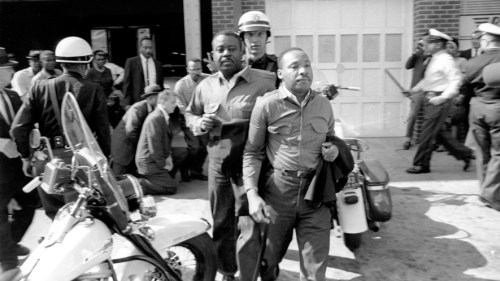
4 Comments

Filed under christian life, civil rights, faith, History, laws and legislation, Loose thoughts and musings, News and current events, Political Commentary, Religion