Category Archives: civil war

The Gettysburg Campaign: Change, Uncertainty, and Prelude to Battle

army of the potomac

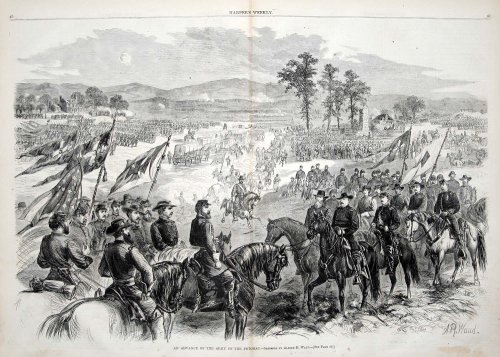
The Army of the Potomac on the Move

Friends of Padre Steve’s World,

If you were an ordinary soldier in either the Army of the Potomac or Army of Northern Virginia June 28th 1863 would not have been much different than any of the previous days, in fact it was “uneventful for men in the ranks.” [1] Both armies had been on the march for over three weeks, and now both armies were across the Potomac, Lee’s was now mostly in Pennsylvania and Hooker’s following in Maryland. With the exception of the cavalry engagements at Brandy Station, Aldie, Middleburg and Upperville, and Ewell’s easy victory over Milroy at Winchester, the main body of either army had been engaged.

The morale of the soldiers of the Army of Northern Virginia was high, and reflected by Lee’s own attitude toward the campaign. Colonel Eppa Hunton of the 8th Virginia recalled that Lee told him that “the invasion of Pennsylvania would be a great success, and if so, it would end the war, or we would have rest for some time to come.” Hunton added, “General Lee was so enthusiastic about the movement that I threw away my doubts and became as enthusiastic as he was.”[2] Like its commander the army was superbly confident as it marched north. A Virginian observing the army as it marched through Maryland recalled: “The health of the troops was never better and above all the morale of the army was never more favorable for offensive or defensive operations….Victory will inevitably attend our arms in any collision with the enemy.” [3] Another soldier later recalled “no one ever admitted the possibility of defeat across the Potomac.” [4]
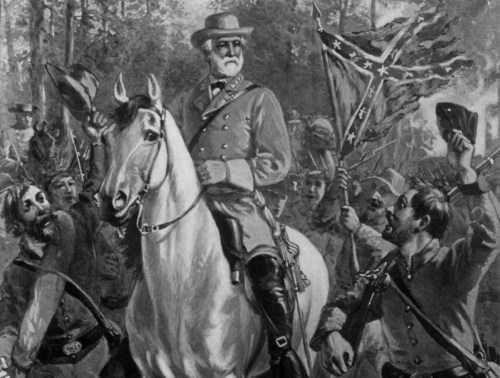
Robert E. Lee

However, Robert E. Lee was uneasy, but not overly concerned. Though he had not heard anything from J.E.B. Stuart since June 23rd, when Stuart had begun his ride, he was still confident. Not knowing the location of the Federal army, Lee met with Major General Isaac Trimble on the evening of June 27th at his headquarters near Chambersburg. Though he had been slated to command to division now commanded by Allegheny Johnson, he had been slow to recover from a leg wound incurred in 1862 and could not take command. Though he did not have a command, Trimble had accompanied the army north, as Lee did not want to lose “the services of so hard a fighter as this veteran of all the Second Corps victories from First through Second Manassas.” [5] Trimble recalled the words of a very confident commander:

“Our army is in good spirits, not overly fatigued, and can be concentrated on any point in twenty-four hours or less. I have not yet heard that the enemy have crossed the Potomac, and I am waiting to hear from General Stuart….They will come up, probably through Frederick, broken down with hunger and hard marching….I shall throw up an overwhelming force on their advance, crush it, follow up the success, [and] drive one corps back on another…create a panic and virtually destroy the enemy.” [6]

Trimble was “stirred” by Lee’s words and told Lee that he did “not doubt of the outcome of such a confrontation, especially because the moral of the Army of Northern Virginia had never been higher than it was now.” [7] Lee agreed and “as Trimble rose to go, Lee laid his hand on the map and pointed to a little town east of the mountains, Gettysburg by name, from which roads radiated like so many spikes. “Hereabout,” he said, “we shall probably meet the army and fight a great battle, and if God gives us the victory, the war will be over and we shall achieve the recognition of our independence.” [8]
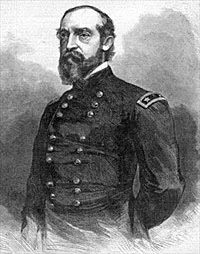
George Gordon Meade

On the night of June 27th Major General George Gordon Meade was simply one of seven Corps Commanders in the Army of the Potomac. As Trimble left and Lee settled in for the night, Meade, Commander of V Corps, was at his new headquarters located at Robert McGill’s farm outside of Frederick. Meade was asleep in his tent, was unaware that Colonel James A. Hardie, Halleck’s Assistant Adjutant General, was on a train from Washington with orders that would change the course of the war. Hardie arrived in Fredericksburg after midnight and instead of remaining for the night rented a carriage and made his way directly to Meade’s headquarters, bearing in his hand “General Orders 194…relieving General Hooker as commander of the Army of the Potomac and appointing General Meade in his place.” [9]

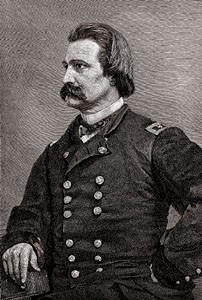
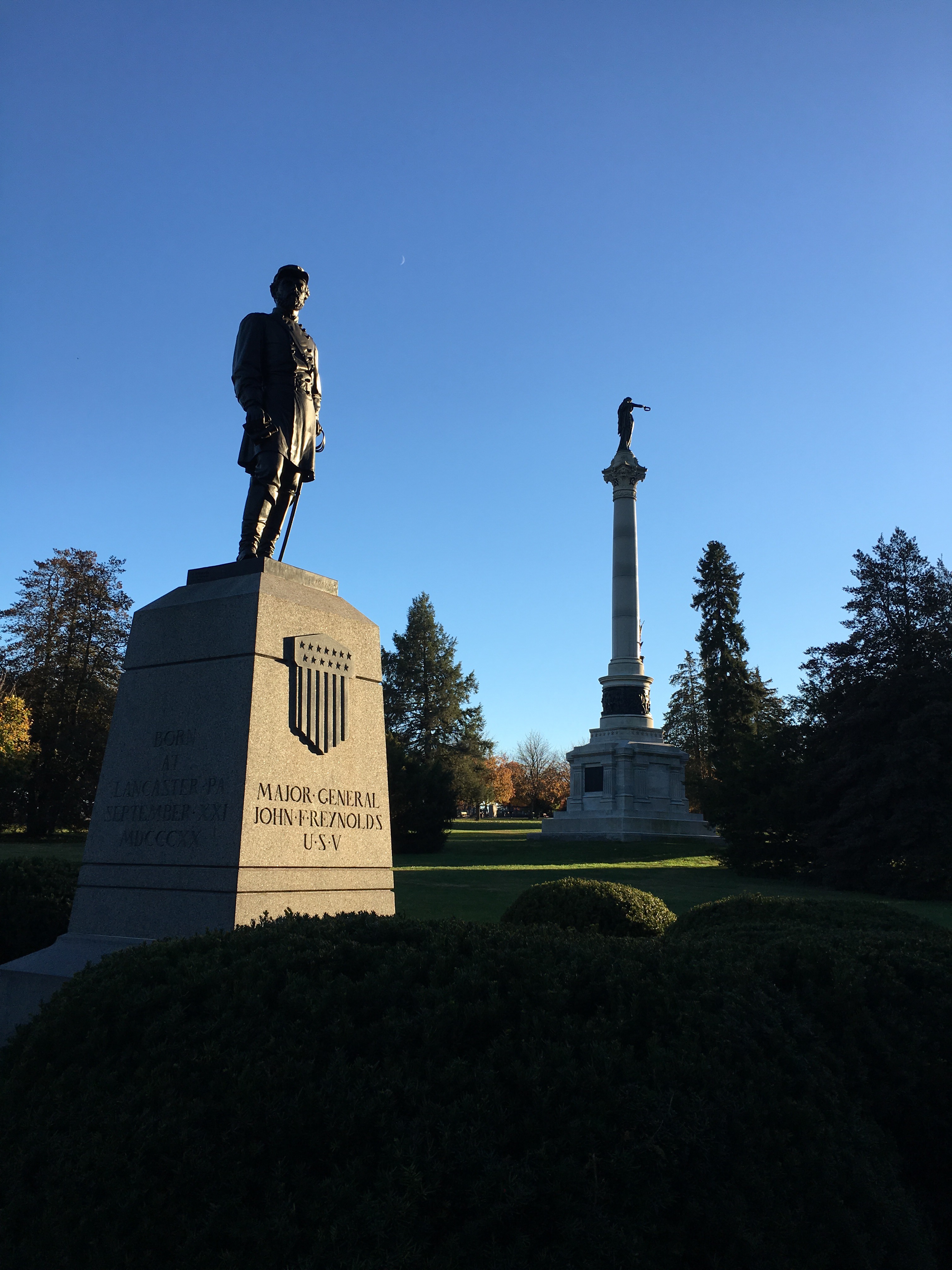
Meade, desired the appointment as commander of the Army did not expect it. Meade, a career soldier “possessed ambition but had never allowed it to consume him as Joseph Hooker had.” [10] Meade believed that if Hooker was relieved of command that John Reynolds of First Corps or another would receive it. Meade was outranked by his fellow Corps commanders Reynolds and John Sedgwick of VI Corps, and he felt that Reynolds was the ideal man to command the army.

Meade wrote to his wife the reasons he believed that he would not get command a few days before: “because I have no friends, political or others, who press or advance my claims or pretentions.” [11] The latter was not because Meade did not have friends, but because unlike Hooker, Sickles and so many others he stayed out of the various political cabals in the army and their constant intrigues. Meade, though on bad terms with Hooker was not one of the Generals who conspired against Hooker in the weeks following Chancellorsville. He told Governor Andrew Curtain of Pennsylvania that “I should be very sorry to see him removed, unless a decidedly better man is substituted.”[12]

On June 25th Meade had written his wife Margaret, who was uneasy with the rumors that her husband might be named head of the army. Reiterating his belief that he did not have the necessary political connections, and that there were others at least as competent or more to lead the army, he wrote:

“For these reasons I have never indulged in any dreams of ambition, contented to await events, and do my duty in the sphere it pleases God to place me in…and I really think that it would be well for you to take the same philosophical view; but do you know, I think your ambition is being roused and that you are beginning to be bitten with the dazzling prospect of having for a husband a commanding general of an army. How is this?” [13]

At 3:00 A.M. Hardie arrived. “Led to Meade’s tent, Hardie greeted the suddenly awakened general by saying he brought “trouble.” [14]Meade wrote his wife:

“At 3:00 A.M. I was roused from my sleep by an officer from Washington entering my tent…and after waking me up, saying he had come to give me trouble. At first I thought that it was to either relieve or arrest me, and promptly replied to him, that my conscience was clear, void of offense towards any man; I was prepared for his bad news. He then handed me a communication to read: which I found was an order relieving Hooker from the command and assigning me to it.” [15]

Meade stated his objections to Hardie, again reiterating his belief that Reynolds should command the army but Hardie explained that the decision had been made-Meade had no choice but to obey his orders or resign. Hardie provided Meade a letter from Halleck which said “Considering the circumstances…no one ever received a more important command; and I cannot doubt that you will firmly justify the confidence that the Government has reposed in you.” [16]

The order gave Meade command of the troops at Harper’s Ferry which had been denied to Hooker just days before. It also gave him freedom of command. It read: “You will not be hampered by any minute instructions from these headquarters” and “you are free to act as you deem proper under the circumstances as they arise.” [17] Likewise Meade was authorized to take command General Couch’s forces along the Susquehanna. A further power given to Meade which had not been given to previous commanders of the Army of the Potomac was the authority to relieve from command and dismiss officers from the army, or appoint to command officers regardless of seniority as he saw fit. It was a power that during the tumult of battle that he would use well in the coming days.

Meade went by horseback with Hardie and his son Captain George Meade to Hooker’s headquarters at Prospect Hall. The previous night Hooker who after hearing nothing after Halleck’s terse response to his request to be relieved “had convinced himself that the ensuing silence meant that he had beaten Halleck.” [18] But now, Hooker, aware that Hardie was in the camp, and obviously correctly assumed that he was through as the commander of the Army of the Potomac. Hooker greeted his visitors in his dress uniform and with “much effort he tried to hide his feelings and by extreme courtesy to relieve the situation of embarrassment.” [19]

Meade had not seen Hooker in two weeks and had no idea how scattered the army was. When Hooker and Dan Butterfield his Chief of Staff briefed Meade, and Meade learned of the army’s disposition he “unguardedly expressed himself.” Hooker “retorted with feeling. [20] Despite the uncomfortableness of the situation Hooker and Meade were able to successfully pass command of the army and Hooker issued General Order 66 in which “he praised his successor and asked the army to extend the hearty support it had given him. He added: 

“Impressed with the ability that my usefulness as the commander of the Army of the Potomac is impaired I part from it; yet not without the deepest emotion.

The sorrow of parting with comrades of so many battles is relieved by the conviction that the courage and devotion of this army will never cease to fail.” [21]

Meade’s words in his General Order 67 are indicative of his feelings on assuming command of the army:

“By direction of the President of the United States, I hereby assume command of the Army of the Potomac…. As a soldier obeying this order- an order totally unexpected and unsolicited- I have no promises to make.”

‘The country looks to this army to relieve it from the devastation and disgrace of a foreign invasion. Whatever fatigues and sacrifices we may be called to undergo, let us have in view, constantly the magnitude of the interests involved, and let each man determine to do his duty, leaving to an all-controlling Providence the decision of the contest.

“It is with great diffidence that I relieve in the command of this army an eminent and accomplished soldier, whose name must appear conspicuous in the history of its achievements; but I rely on the hearty support of my companions in arms to assist me in the discharge of the duties of the important trust which has been confided to me.” [22]

That afternoon Meade sent a note to Halleck telling him he had received “the order placing me in command of this army” and that “as a soldier, I obey it.” [23] Reynolds was among the first corps commanders to pay his respects to Meade, and Meade “grabbed him by the arm and earnestly told him he wished Reynolds had received the assignment. Reynolds replied that Meade was the right choice and that he would do whatever was necessary to support him.” [24]John Gibbon greeted Meade’s appointment “with a sigh of relief” and Reynold’s artillery commander wrote “For my part, I think that we have got the best man of the two, much as I think of Reynolds….” [25]

Meade had good reason to wish that Reynolds or another had been appointed and certainly welcomed his friend Reynolds’ support. Meade knew that he was not Lincoln’s first choice for the job, partly because of being associated with George McClellan, as well as his own political ties as a Democrat, and the opposition of leading Republicans to his appointment to any command. He had run afoul of the Northern abolitionist “fire eaters” in Detroit when Fort Sumter was fired on, and “while he was a staunch Unionist he was dismayed by the arrogance of the fire-eaters, to whom Southern secession looked like a simple riot which would be suppressed by the mere appearance of Federal troops.” [26] William Lloyd Garrison’s abolitionist newspaper The Liberator had early on tired Meade and found him to be wanting in abolitionist sentiment: “There seems to be a marked deficiency of benevolence, and a dainty, aristocratic look, which…reveals a character that never efficiently and consistently served a liberal cause.” [27]

Aware of the fate of other officers who had a similar political bent, such as Fitz-John Porter who was “court-martialed, cashiered and disgraced” [28] after being falsely accused of “disobedience of orders during the Second Battle of Bull Run” [29] by John Pope who had brought about the disaster. Thus with that in mind Meade understood the political danger that his appointment entailed. “If he was successful in protecting Washington and Baltimore or if he somehow defeated Lee and drove the Confederates back across the Potomac, he would receive precious little credit from the Lincoln administration; if he failed, even for the most plainly military reasons, he expected to be pilloried without mercy as a halfheart and traitor.” [30]

The appointment of Meade was met with relief by most of his fellow Corps commanders. He was respected by them, despite having “a cold, even irascible, edge to him, particularly when occupied with army business. He was demanding of himself and of aids and subordinates,” [31] but what mattered to them was that Meade “was a thorough soldier, and a “mighty clear headed man”, with “extraordinary courage.” [32] A future staff officer noted that Meade “will pitch himself in a moment, if he thinks he has done wrong; and woe to those, no matter who they are, who do not do right.” [33]

He was viewed as a truthful, honest and caring commander who after a blow- up would do what he could to reconcile. He was passionate about the lives of his troops and whenever possible avoided battles that he believed their sacrifice would be in vain. He knew his trade, paid close attention to detail and knew and understood his troops and commanders. He had earned respect throughout his career and during the battles on the Peninsula, Antietam, Fredericksburg and Chancellorsville proved that he was an excellent leader and commander of troops.

All that being said Meade was virtually “an unknown quantity outside of his corps.” [34] Many in the rank and file wondered about the change of commanders in the middle of the campaign, “What’s Meade ever done?” was a common response among the men- those outside his corps at least- when they heard that he was their new commander. The general himself had few delusions on this score. “I know they call me a damned old snapping turtle….” [35] These soldiers had seen good and bad commanders and seen how Washington had dealt with each one, but by now “their training in the school of hard knocks under fumbling leaders had toughened the soldiers to a flinty self-reliance that left many indifferent to the identity of their commander. [36]On the eve of battle they had a new commanding general and “they were almost within rifleshot of a supremely aggressive enemy…whatever happened during the next week, the one certainty was now that the soldiers themselves would run this next battle. The most that could be expected of Meade was that he would make no ruinous mistakes.” [37]It not only was an army with a new leader, but in its soul, the Army of the Potomac was a different army than Lee had ever faced. In fact, though Lee won the Battle Of Chancellorsville, with the possible exception of some units of Howard’s XI Corps, the rank and file and many leaders of the Army Of the Potomac did not accept the defeat and wanted another chance at Lee.

Meade had an immense task to accomplish. When he went to bed on the night of the 27th he was unaware of the locations of the bulk of the Federal Army and knew that Lee was already deep in Pennsylvania. Meade was determined to bring Lee to battle was cautious as he did not want to take a chance of his forces being split up and defeated in detail.

With his assumption of command Meade had to make some organizational changes. Against the advice of some Meade kept General Daniel Butterfield as his Chief of Staff despite Butterfield’s close association with Hooker and his political cabal.  He appointed Major General George Sykes to command his old V Corps and wired Halleck with an “unheard of request: to promote in one jump three brilliant young officers from the rank of captain to that of brigadier general. They were Elon J. Farnsworth of the 8th Illinois Cavalry, George A Custer of the 5th United States Cavalry and Wesley Merritt of the 2nd United States Cavalry.” [38] Each was appointed to command brigades in Pleasanton’s Cavalry Corps which was being reorganized that day.

Meade had a great advantage over Lee in that Colonel George Sharpe of the Bureau of Military Information had provided him with the information that “the enemy force does not exceed 80,000 men and 275 guns,” as well as “a remarkably accurate outline of Lee’s movements.” [39] The information allowed Meade to begin his pursuit of Lee in earnest the following morning.

Meade knew that if he was to defeat Lee he had to concentrate his combat power. He wired Halleck that he would “move toward the Susquehanna keeping Baltimore and Washington well covered, and if the enemy is checked in his attempt to cross the Susquehanna or if he turns toward Baltimore, to give him battle.” [40] He prepared a fallback position along Pipe Creek and gave his Corps commanders permission to withdraw back to the Pipe Creek line outside Taneytown Maryland if they felt threatened by a larger Confederate force, and on the morning of June 29th the Army of the Potomac began to march north where it was fated to do battle with its old nemesis.

Any commander that embarks on a high risk offensive operation in enemy territory must do so with great care, especially in regard to command and control of his forces. This is especially true regarding reconnaissance, and intelligence. Lee had been operating blind for well over a week and this was his fault. Because Lee had issued such vague orders to his Cavalry Corps Commander, J.E.B. Stuart, Stuart was well to the east conducting a ride around the Federal army. Stuart was now completely useless to Lee, who needed the intelligence alone Stuart could provide, and without a Cavalry screen on his right flank. Now Lee was reaping the results of his carelessness in planning, order writing, and overconfidence. 

Though Lee still had three brigades of Stuart’s Cavalry Division available, none were in a position to assist his reconnaissance needs. Again blame for this has to be laid at the feet of Lee. Robertson’s and Jones’ brigades were still deep in Virginia guarding Snicker’s and Ashby’s Gap. Iboden’s Brigade was to the west at Hancock Maryland. Jenkins’ brigade, which was not a part of Stuart’s division, was far to the front with Ewell’s Corps. Had Robertson followed Stuart’s orders “Lee would not have felt the want of adequate cavalry support” [41] but since Robertson had remained stationary Lee had nothing available when he needed it.

In the case of the selection of Jones’ and Robertson’s brigades for the mission of screening Lee, Stuart made a critical mistake. Jones and Robertson both had serious deficiencies as leaders and proved that neither had Lee’s “confidence or understood his expectations…and Stuart badly misread the amount of personal connection his superior required.” [42] While Lee’s orders to Stuart allowed him to go off on his mission, Lee had plenty of cavalry available. However, he employed it in a woeful manner and did not take the steps necessary to ensure that the commanders assigned understood his expectations. This was another critical mistake made by Lee and as Alan T. Nolan wrote: “There seems to be no excuse for Lee’s finding himself at Chambersburg on the 28th without a single regiment of cavalry” [43] The tragic thing for the Confederacy was that Lee would make this same mistake in failing to communicate his intent with other subordinates throughout the campaign.
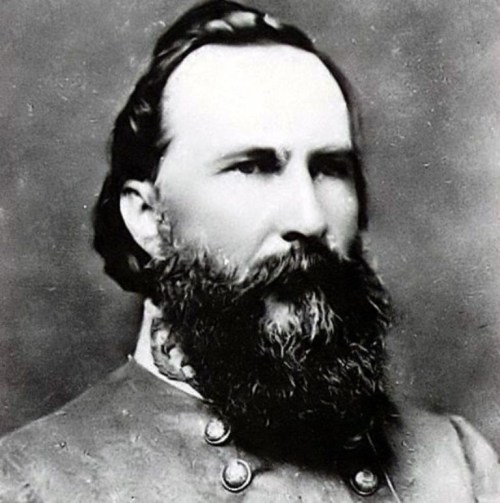
James Longstreet

Late on the night of June 28th Lieutenant General James Longstreet “was woken by someone banging on his tent pole.” [44] It was the assistant Inspector General, Major John W. Fairfax who had with him a man claiming to have information on the movement and location of the Army of the Potomac. The man’s name was Harrison and he was an actor, employed by Longstreet as a “scout.” Harrison was one of those mysterious figures that occasionally show up in the context of a historical event and make it even more interesting.

Harrison brought word to Longstreet the news Hooker’s relief and replacement by Meade as well as the location of Federal Cavalry as well as the location of five of the Army of the Potomac’s seven army corps, all too close for comfort. Questioned about the location and activities of Stuart, Harrison could give no information. The news was electrifying and Longstreet immediately sent Fairfax with Harrison to Lee’s headquarters. Lee distrusted spies and was “very reluctant to make a move without confirmation of his cavalry.” [45] Lee was skeptical of the news and told Fairfax “I do not know what to do….I cannot hear from General Stuart, the eye of the army. What do you think of Harrison? I have no confidence in any scout, but General Longstreet thinks a good deal of Harrison.” [46]

Lee’s puzzlement at finding the federal army across the Potomac is curious as he had known as early as June 23rd of the pontoon bridge being built over the Potomac, but he seemed paralyzed by the absence of Stuart. The surprise of the Union Army being concentrated so near him took away Lee’s ability to retain the initiative of a campaign of maneuver. Because his army was so scattered he was now in danger of being hit and defeated in detail by the Federal army, “Meade, in short, might be able to do what he had planned to do to Hooker- defeat him in detail.” [47]It was a dangerous position for him to be in and he knew it. In a sense he was fortunate that on June 28th  the Army of the Potomac was changing command and unable to strike while he was so vulnerable.

With the knowledge that the Federal army was near Lee acted with alacrity to concentrate his army in the Cashtown and Gettysburg area. “Within eight hours of Harrison’s report to Lee” [48] Lee had set in motion orders to all commands of his scattered army.  Lee still had “no idea of the whereabouts of the enemy’s forces beyond what Longstreet’s spy had just told him- information that was already twenty-four hours old,” and did have “any idea of how to remedy this intelligence gathering void.” [49] He knew precious little other than the fact that “Hooker’s army, now under Meade, was across the mountain from him and that it was Stuart who was still in Virginia,” [50] a fact he had learned from Captain James Power Smith who informed Lee that he had met two troopers of Stuart’s division who “casually told him that on the preceding day (Saturday the 27th) that they had left the main body of cavalry under Stuart in Prince William County back in northern Virginia. When Smith passed on this information, General Lee, he said, “was evidently surprised and disturbed.” [51]

Another consequence of his lack of available cavalry was that he had to leave Pickett’s division to guard the rear until Imboden’s cavalry could arrive to take up the task. The detention of Pickett’s division would be another unfortunate consequence of Stuart’s absence that would plague Lee during the battle, especially on July 2nd when Longstreet’s corps would be without Pickett’s troops as they assaulted the Federal left.

On the afternoon of June 29th Lee met with a number of officers and his outward calm was still present. He told them “Tomorrow, gentlemen, we will not move to Harrisburg, as we expected, but will go over to Gettysburg and see what General Meade is after.” [52] When questioned by his subordinates about the relief of Hooker, and by his replacement by Lee’s former subordinate, Meade, Lee noted “General Meade will commit no blunder in my front, and if I make one he will make haste to take advantage of it.” [53]
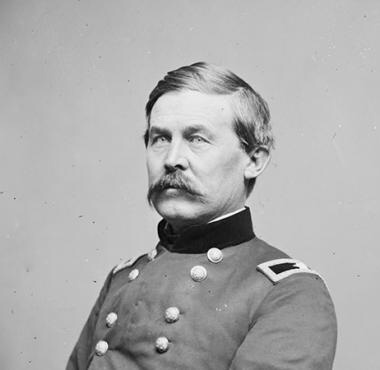
John Buford

Meade too had recognized the importance of Gettysburg and began to move his forces toward the town even as Lee gathered his army. He sent the evening of the 30th the 1st Cavalry Division under the command of Brigadier General John Buford, a seasoned Indian fighter and brigade commander conducting his first battle commanding a division ahead to Gettysburg. Meade then  “redirected the 1st, 3rd and 11th Corps north toward Emmitsburg and the Pennsylvania state line, and the 2nd, 5th, 6th, and 12th Corps to the northeast toward Pipe Creek and Taneytown.” [54]

On the morning of June 30th, Buford detected Confederate infantry to the west of the town. Buford had a keen eye for terrain and instantly recognized that the area around Gettysburg was favorable ground. He knew that the battle was to be there and sent word back to John Reynolds, commander of I Corps:

“Have Occupied Gettysburg. Contacted large force of Reb infantry. I think they are coming this way. Expect they will be here in force in the morning.”[55]

[1] Coddington, Edwin B. The Gettysburg Campaign, A Study in Command A Touchstone Book, Simon and Shuster New York 1968 p. 180

[2] Wert, Jeffry D. A Glorious Army: Robert E. Lee’s Triumph 1862-1863 Simon and Schuster, New York and London 2011 p.226

[3] Guelzo, Allen C. Gettysburg: The Last Invasion Vintage Books a Division of Random House, New York 2013 p.67

[4] Foote, Shelby, The Civil War, A Narrative. Volume Two Fredericksburg to Meridian Random House, New York 1963 p.455

[5] Ibid. Foote The Civil War, A Narrative. Volume Two p.445

[6] Taylor, John M. Duty Faithfully Performed: Robert E Lee and His Critics Brassey’s, Dulles VA 1999 p.140

[7] Ibid. Foote The Civil War, A Narrative. Volume Two p.446

[8] Freeman, Douglas Southall, Lee an abridgment by Richard Harwell, Touchstone Books, New York 1997 p.320

[9] Sears, Stephen W. Gettysburg. Houghton Mifflin Co. Boston and New York 2003 p.123

[10] Wert, Jeffry D. The Sword of Lincoln: The Army of the Potomac Simon and Schuster, New York and London 2005 p.267

[11] Ibid. Foote The Civil War, A Narrative. Volume Two p.446

[12] Huntington, Tom Searching for George Gordon Meade: The Forgotten Victor of Gettysburg Stackpole Books, Mechanicsburg PA 2013 p.145

[13] Ibid. Huntington Searching for George Gordon Meade p.147

[14] Ibid. Wert The Sword of Lincoln p.266

[15] Trudeau, Noah Andre. Gettysburg, A Testing of Courage Harper Collins, New York, 2003. p.102

[16] Ibid. Huntington Searching for George Gordon Meade p.148

[17] Ibid. Foote The Civil War, A Narrative. Volume Two p.451

[18] Ibid. Guelzo Gettysburg: The Last Invasion p.89

[19] Hebert, Walter H. Fighting Joe Hooker University of Nebraska Press, Lincoln and London 1999. Originally published by Bobbs-Merrill, New York 1944 p. 24

[20] Ibid. Huntington Searching for George Gordon Meade p.149

[21] Ibid. Hebert Fighting Joe Hooker p.246

[22] Ibid. Huntington Searching for George Gordon Meade p.150

[23] Ibid. Guelzo Gettysburg: The Last Invasion p.89

[24] Ibid. Huntington Searching for George Gordon Meade p.149

[25] Ibid. Huntington Searching for George Gordon Meade p.150

[26] Catton, Bruce The Army of the Potomac: Glory RoadDoubleday and Company, Garden City New York, 1952 p.257

[27] Ibid. Guelzo Gettysburg: The Last Invasion p.88

[28] Ibid. Guelzo Gettysburg: The Last Invasion p.90

[29] Ibid. Wert The Sword of Lincoln p.185

[30] Ibid. Guelzo Gettysburg: The Last Invasion p.90

[31] Ibid. Wert The Sword of Lincoln p.267

[32] Ibid. Wert The Sword of Lincoln p.268

[33] Ibid. Wert The Sword of Lincoln p.267

[34] McPherson, James. The Battle Cry of Freedom: The Civil War Era Oxford University Press, Oxford and New York 1988 p.652

[35] Ibid. Foote The Civil War, A Narrative. Volume Two p.454

[36] Ibid. McPherson The Battle Cry of Freedom p.652

[37] Ibid. Catton The Army of the Potomac p.259

[38] Ibid. Coddington p.220

[39] Ibid. Trudeau Gettysburg, A Testing of Courage p.106

[40] Ibid. Coddington The Gettysburg Campaign, A Study in Command pp. 219-220

[41] Ibid. The Gettysburg Campaign, A Study in Command p.184

[42] Ibid. Trudeau Gettysburg, A Testing of Courage. p.69

[43] Nolan, Alan T. R.E. Lee and July 1 at Gettysburg in The First Day at Gettysburg, Gallagher, Gary W. Editor, Kent State University Press, Kent Ohio 1992 p. 20

[44] Korda, Michael. Clouds of Glory: The Life and Legend of Robert E. Lee Harper Collins Publishers, New York 2014 p.542

[45] Ibid. Wert A Glorious Army p.231

[46] Ibid. Freeman Lee p.320

[47] Ibid. Foote The Civil War, A Narrative. Volume Two pp.462-463

[48] Ibid. Foote The Civil War, A Narrative. Volume Two p. 463

[49] Ibid. Sears Gettysburg p.124

[50] Dowdy, Clifford. Lee and His Men at Gettysburg: The Death of a Nation Skyhorse Publishing, New York 1986, originally published as Death of a Nation Knopf, New York 1958 p.49

[51] Ibid. Dowdy Lee and His Men at Gettysburg p.48

[52] Ibid. Freeman Lee p.321

[53] Ibid. Freeman Lee p.321

[54] Ibid. Guelzo Gettysburg: The Last Invasion pp.115-116

[55] Shaara, Michael. The Killer Angels. Ballantine Books, New York. 1974 p.4
Leave a comment

Filed under civil war, Gettysburg, History, leadership, Military, us army

The Gettysburg Campaign: Lee’s Advance and the Relief Of “Fighting Joe” Hooker

rebel-potomac

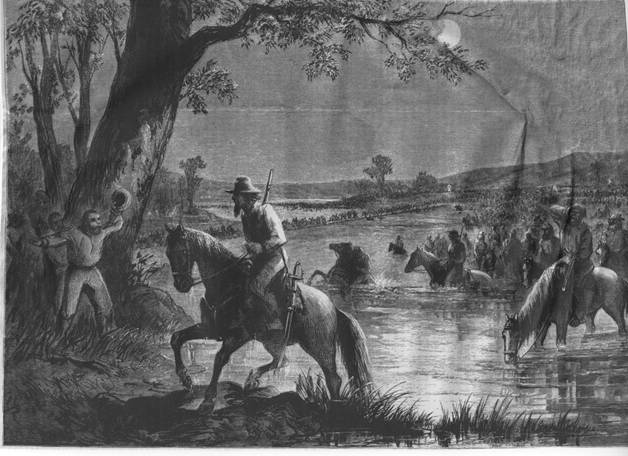
Ewell’s Corps crossing the Potomac

This is a continuation of the article that I posted last night. It is a continuation of my Gettysburg series. Tomorrow I will finish the chapter on Lee’s movement north by talking about Stuart’s Ride and the Confederate operations in Pennsylvania and Union pursuit up to June 30th. On footnotes please refer to part one because I did not want to go back and re-type each note.

The action at Brandy Station delayed Lee’s movement by a day. However, Stuart’s repulse of Pleasanton’s force did enable Lee’s Army to make its northward movement undetected by Hooker who was still trying to divine what Lee was up to and was “slow, even reluctant, to react to Lee’s advance.” (1) Lee’s initial move to break contact with the Federal Army and keep his movements and intentions secret was an excellent example of deception.

ewell

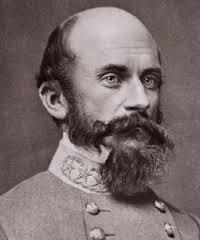
Lieutenant General Richard Ewell

Ewell’s Corps led the march of the army north on the morning of June 10th and joined by Jenkins’ cavalry brigade entered the Shenandoah Valley by way of the Chester Gap on June 12th. In two days of marching his “columns covered over forty-five miles.” (2) On the 13th Ewell was near Winchester where 6,000 soldiers under the command of Major General Robert Milroy were garrisoned. Ewell’s advanced troops skirmished with them on the 13th and on the 14th Ewell concentrated his corps to attack. As he did so Lincoln and Halleck attempted to get Hooker to do something to relieve Milroy. Hooker was “troubled by indecision” (3) and did nothing. The attack commenced at about 5:00 PM. The battle, now known as the Second Battle of Winchester the battle was a complete rout. Hit by Ewell’s forces “which swiftly and effectively broke through his outer lines,” (4) That evening Milroy attempted to retreat “northwestward in the darkness, only to be intercepted at dawn by Johnson.” (5) The Second Corps captured “captured 23 cannon, 300 wagons loaded with supplies and ammunition, and nearly 4,000 prisoners.” (6) Milroy and his survivors retreated to Harper’s Ferry where he was “presently removed from command by Lincoln, but that was a superfluous gesture, since practically all of his command had been removed from him by Ewell.” (7) Ewell’s forces lost just 50 killed and 236 wounded.

Ewell’s decisive victory at Winchester “was one of the most swift, total, and bloodless Confederate victories of the war.” (8) The victory “cleared the lower Shenandoah Valley of most Federal forces and paved the way for Lee’s army to march north into Maryland and then into Pennsylvania.” (9) Ewell had been brilliant to this point, the victory at Second Winchester and the skill with which he had conducted his operations “removed lingering doubts about his ability to carry on the tradition of “Stonewall” Jackson, as well as about his physical capacity, after the loss of a leg, to endure the rigors of campaigning.” (10) The Richmond Daily Dispatch that Ewell “has indeed caught the mantle of the ascended Jackson. Brilliantly has he re-enacted the scenes of the spring of ’62, on the same theatre.” (11)

Ewell did not waste time lingering at Winchester. The next day he sent Jenkins across the Potomac to Chambersburg Pennsylvania. Rodes division crossed the Potomac on the 16th “for a crossing at Williamsport where a halt was called to allow the other two divisions to catch up for a combined advance into Pennsylvania.” (12)

Longstreet’s First Corps moved next and advanced east of the Blue Ridge in conjunction with Stuart’s cavalry division screening the rest of the army from Hooker. Longstreet “set out for Ashby’s and Snicker’s Gaps with the bulk of Stuart’s cavalry covering his right flank.” (13) By the 17th of June Longstreet’s and Stuart’s troops had cleared the Blue Ridge. “Lee’s army was now stretched out from Hagerstown to Culpepper, a distance of seventy-five miles; yet Hooker did nothing.”(14) Lincoln realized that the dispersed Confederate army was vulnerable and telegraphed Hooker “if the head of Lee’s army is at Martinsburg and the tail of it on the Plank road between Fredericksburg and Chancellorsville, the animal must be very slim somewhere. Could you not break him?”(15)

hooker

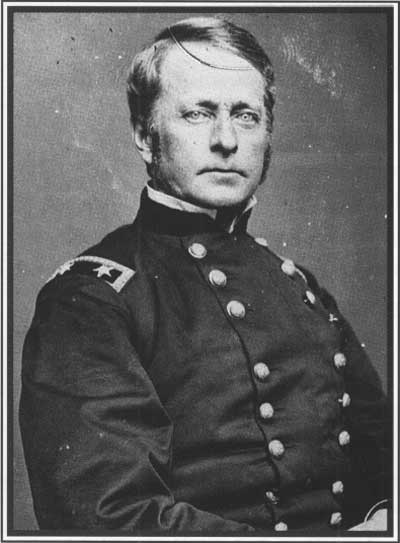
Major General Joseph “Fighting Joe” Hooker

Hooker was slow to appreciate what Lee was doing and the “concealing topography of the region greatly favored Lee’s offensive operations…and Lee was planning on using both the Shenandoah and Loudoun valleys to conceal his forces and confuse his enemies.” (16) In this Lee had succeeded admirably. Finally on June 13th Hooker prodded by Lincoln and Halleck finally moved the Army of the Potomac to a position “near the Orange and Alexandria Railroad near Washington” (17) where it could defend Washington in case Lee was to make a thrust at the Federal capitol. The march from Fredericksburg was ordeal for his soldiers. “It had not rained for more than a month, thick clouds of dust enveloped the columns as the sun burned the air. Men drained their canteens, and water was scarce. Hundreds collapsed from sunstroke.” (18)

Hooker now informed Lincoln and Halleck that from now on his operations “would be governed by the movements of the enemy.” In doing so he “admitted his loss of initiative to Lee and his reluctance or inability to suggest any effective countermoves to the enemy’s plan.” (19)

As the army gathered near Dumfries on June 17th, Hooker who was completely lost as to Lee’s intentions and completely clearly out of his league was also engaged in a personal battle with Halleck and Lincoln. His Chief of Staff, General Dan Butterfield, a staunch supporter, remarked “We cannot go boggling around until we know what we are going after.” (20) The Provost Marshall of the Army of the Potomac Brigadier General Marsena Patrick was quite critical of his chief, noting that “Hancock is running the Marching and Hooker has the role of a subordinate- He acts like a man without a plan and is entirely at loss at what to do, or how to match the enemy, or counteract his movements.” (21)

Henry_Halleck_by_Scholten,_c1865

Major General Henry Halleck

During the march Hooker continued his feud with Halleck and Lincoln, oblivious to the fact that “his contretemps with Washington was costing him respect and credibility.” (22) Navy Secretary Gideon Welles after talking with Lincoln wrote in his diary, “I came away from the War Department painfully impressed. After recent events, Hooker cannot have the confidence which is essential to success, and which is all-important to the commander in the field.” (23) Hooker however, continued to make matters worse for himself and wrote to Lincoln, a thinly veiled attempt to have Halleck relieved, on June 16th :

“You have been aware, Mr. President” he telegraphed, “that I have not enjoyed the confidence of the major-general commanding the army, and I can assure you so long as this continues we may look in vain for success, especially as future operations will require our relations to be more dependent on each other than heretofore.” (24)

Lincoln was not to be trifled with by his demanding yet befuddled subordinate. He sent a telegraph to Hooker at 10:00 PM on the 16th which rankled Hooker even the more:

“To remove all misunderstanding I now place you in the strict military relation to General Halleck of a commander of one of the armies to the general-in-chief of all of the armies. I have not intended differently, but as it seems to be differently understood I shall direct him to give you orders and for you to obey him.” (25)

While the drama between Hooker, Halleck and Lincoln played on there were a series of fierce cavalry clashes west of Washington between June 17th and June 21st as Pleasanton’s troops kept assailing the Confederate flank in order to ascertain what Lee’s army was doing. As they probed the gaps in the Blue Ridge they confronted Stuart’s cavalry. At Aldie on June 17th, Middleburg on June 19th and Upperville on June 21st Stuart’s and Pleasanton’s troopers engaged “in a series of mounted charges and dismounted fighting. The Yankees showed the same grit and valor as they had at Brandy Station, pressing their attacks against the Rebels.” (26)

custer@aldieAt Upperville Pleasanton’s troopers “pressed Stuart’s cavalry so hard that Lee ordered McLaws’ division of Longstreet’s Corps to hold Ashby’s Gap, and he momentarily halted Major General Richard Anderson’s division of Hill’s corps on its way to Shepherdstown.” (27) Stuart’s men were successful in protecting the gaps and ensuring that the Federal troopers did not penetrate them, but “Pleasanton learned, however, from prisoners and local citizens, “The main body of the rebel infantry is in the Shenandoah Valley.” (28)

Pleasanton for some unexplained reason thought that this meant that the Confederates were heading toward Pittsburgh. Hooker “viewed it as a raid” and again proposed an overland advance against Richmond, which was once again rejected by Lincoln. The President ordered  Hooker: “If he comes toward the Upper Potomac, follow on his flank and on his inside track, shortening your line whilst he lengthens his. Fight him too when the opportunity offers. If he stays where he is, fret him, fret him and fret him.” (29)

As the series of clashes occurred on the Confederate flank Ewell’s Second Corps, followed by Hill’s Third Corps advanced into Pennsylvania. A general panic ensued in many places with cries going out for Lincoln to call up militia to defend the state. The panic was fueled by Confederate actions. Jenkins’ troops in occupied Chambersburg they rounded up any blacks that remained in the city, and “Some fifty blacks were formed into a coffle and marched south to be sold into bondage.” (30)

By June 23rd the head of the Bureau of Military Information Colonel George Sharpe had deduced that all of Ewell’s corps was in Pennsylvania marching north and that Hill’s corps was across the Potomac, and “in one of those sudden moments of brutal clarity, George Sharpe realized that everything pointed to the conclusion that Lee’s entire army, or most of it, was north of the Potomac.” (31) Now Sharpe did not realize that Longstreet’s corps was still helping to hold and scree the gaps, but he had correctly deduced Lee’s intentions.

It took time but Hooker belatedly on June 24th Hooker began to move his army to Frederick. As the Army of the Potomac crossed its namesake river between June 25th and 27th over a vast pontoon bridge, Hooker made one last attempt to salvage his reputation. He had already been successful in getting Halleck to give him nearly 15,000 troops as reinforcements drawn from the District of Washington, drawing the ire of its commander Major General Samuel Heintzelman, but that was not enough for Hooker.

Hooker also demanded that he be given command and control over the garrison at Harper’s Ferry, allegedly to use in an operation to cut off Lee’s line of supply and communication in Western Maryland. This was refused by Halleck who had seen the request coming. Halleck told Hooker “that the fortified heights at Harper’s Ferry…”have always been regarded as an important point by to be held by us…I cannot approve their abandonment, except in the case of absolute necessity”(32) and directed the Major General William H. French, the commanding officer of the Harper’s Ferry garrison “Pay no attention to Hooker’s orders.” (33)

The highly volatile Hooker was furious and in his anger Hooker “told Herman Haupt during the railroad coordinator’s visit that he would do nothing to oppose Lee’s invasion without specific orders. He also continued to tell Halleck, Stanton, and Lincoln that he wanted Lee to go north so he could go after Richmond.” (34)

The order to French was Halleck’s way of bating Hooker figuring that Hooker would consider it the last straw, which the impulsive Hooker did. Hooker then played his last card and wired Halleck an ultimatum:

“My original instructions require me to cover Harper’s Ferry and Washington. I have now imposed on me, in addition to an enemy in my front more than my number. I beg to be understood, respectfully, but firmly that I am unable to comply with this condition with the means at my disposal, and earnestly request that I be relieved from the position I occupy.” (35)

Halleck replied to Hooker  with a brief message; simply stating “Your dispatch has been duly referred to the executive for action.” (36) Halleck then took the letter to Stanton and Lincoln and Lincoln wasted little time in relieving Hooker, though he was not happy about having to do so in the middle of a campaign. Lincoln had two choices, “he could send him into battle with his self-doubts and suspicions intact, or he could accept it and risk the political and military consequences that would accompany an abrupt change in leadership.” (37)

In the end, late in the night on June 27th 1863 Lincoln chose the latter, relieved Hooker and appointed Major General George Gordon Meade, commanding officer of V Corps as the new commander of the Army of the Potomac.

Notes

1 Ibid. Wert General James Longstreet p.251
2 Ibid. Coddington The Gettysburg Campaign p.73
3 Ibid. Coddington The Gettysburg Campaign p.81
4 Ibid. Coddington The Gettysburg Campaign p.88
5 Ibid. Foote The Civil War, A Narrative. Volume Two p.440
6 Ibid. Wert A Glorious Army p.222
7 Ibid. Foote The Civil War, A Narrative. Volume Two p.440
8 Ibid. Guelzo Gettysburg: The Last Invasion p.62
9 Ibid. Petruzzi and Stanley The Gettysburg Campaign in Numbers and Losses p.20
10 Ibid. Coddington The Gettysburg Campaign p.89
11 Ibid. Guelzo Gettysburg: The Last Invasion p.62
12 Ibid. Foote The Civil War, A Narrative. Volume Two p.440
13 Ibid. Fuller Decisive Battles of the U.S.A. 1776-1918 p.224
14 Ibid. Fuller Decisive Battles of the U.S.A. 1776-1918 p.224
15 Ibid. Guelzo Gettysburg: The Last Invasion pp.64-65
16 Ibid. Sears Gettysburg p.85
17 Ibid. Coddington The Gettysburg Campaign p.71
18 Ibid. Wert The Sword of Lincoln p.263
19 Ibid. Coddington The Gettysburg Campaign p.71
20 Ibid. Wert The Sword of Lincoln p.264
21 Ibid. Trudeau Gettysburg a Testing of Courage pp. 53-54
22 Ibid. Trudeau Gettysburg a Testing of Courage p.53
23 Ibid. Sears Gettysburg p.88
24 Ibid. Sears Gettysburg p.88
25 Ibid. Trudeau Gettysburg a Testing of Courage p.54
26 Ibid. Wert The Sword of Lincoln p.264
27 Ibid. Coddington The Gettysburg Campaign p.79
28 Ibid. Wert A Glorious Army p.224
29 Ibid. Wert A Glorious Army p.224
30 Ibid. Sears Gettysburg p.82
31 Ibid. Trudeau Gettysburg a Testing of Courage p.66
32 Ibid. Trudeau Gettysburg a Testing of Courage p.93
33 Ibid. Guelzo Gettysburg: The Last Invasion p.84
34 Marszalek, John F. Commander of All of Lincoln’s Armies: A Life of General Henry W. Halleck The Belknap Press of Harvard University Press, Cambridge MA and London 2004 p.175
35 Ibid. Marsalek Commander of All of Lincoln’s Armies p.175
36 Ibid. Sears Gettysburg p.1233
37 Ibid. Trudeau Gettysburg a Testing of Courage p.98

Leave a comment

Filed under civil war, Gettysburg, History, leadership, Loose thoughts and musings, Military

Vague Orders, Vanity, and the Need for Redemption: JEB Stuart’s Ride at Gettysburg

Friends of Padre Steve’s World

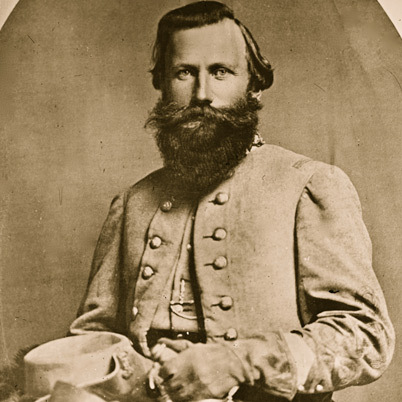
Today I am going back to the archives and re-posting an edited version of something that is part of my unpublished Gettysburg Campaign text. James Ewell Brown (J.E.B.) Stuart is legendary in American military history. A young cavalry officer from Virginia he was like a son to Robert E. Lee and was a man whose military accomplishments were matched by his unbridled vanity, which during the most critical moment in the history of the Confederacy led him to embark on an operation that left his commander in the lurch and helped doom the Confederacy. The story picks up following Stuart being surprised by Federal Cavalry at the Battle of Brandy Station in June of 1863 as Lee’s Army of Northern Virginia was moving north in an attempt to bring the Army of the Potomac to Battle, destroy it, and end the war. Both Stuart and Lee had much to do with the failure of this plan, but I hope that you enjoy this account. 

Peace

Padre Steve+

While the embattled “Fighting Joe” Hooker slowly pursued Lee with the Army of the Potomac, a drama of major significance to the battle Robert E. Lee’s own making was beginning to engulf his operations and leave him blind to the movements of the Federal Army. It involved Lee and his Cavalry commander, J.E.B. Stuart and would be the first of a number of mistakes that would characterize Lee’s campaign. All of these failures dealt with Lee’s singular inability to get his commanders to understand his intent for the campaign and his inability to clearly communicate his wishes.

The necessity of subordinate commanders understanding the intent of their superior is essential to the success of any military operation. During the Gettysburg campaign Lee failed miserably to communicate his operational plan and desire to his commanders. The episode with Stuart was one of several that paint a portrait of Lee not being as good of General as the myth surrounding him.

After the surprise at Brandy Station Stuart’s troopers screened the right flank of the army as it moved north, defending the gaps in the Blue Ridge to keep Alfred Pleasanton’s Federal Cavalry Corps from interdicting the march of the Army of Northern Virginia, or discovering the location of Lee’s three infantry corps which were moving north behind the cover of the Blue Ridge.

In this Stuart was successful, but frustrated. Between June 17th and June 21st his troopers fought a series of engagements against the aggressive Federal Cavalry at Ashby’s Gap, Middleburg and Upperville in Northern Virginia. While Stuart’s troopers had held off Pleasanton’s confident troopers the “running combats were taking a toll on the Southern mounted arm, however. Stuart had already suffered several hundred casualties defending gaps and passes.” [1] Much to their dismay the Confederates noted the improvements in the Federal cavalry during these battles. Captain William Blackford, who served as an engineer on Stuart’s staff noted:

“the improvement of enemy cavalry was enormous, mainly in the heavy fire from long range carbines, and horse artillery that was a match for Stuart’s own These cavalrymen fought as if they had been taken from infantry regiments, for they knew how to fight with horses left behind.” [2]

Unlike the rest of the Army of Northern Virginia that was marching like victors into Pennsylvania and Maryland, Stuart’s Cavalry Division had little cause to rejoice. They had been surprised at Brandy Station and Stuart had been humiliated in the Southern press. The Federal cavalry under Pleasanton gave him no opportunity to redeem himself. While Pleasanton’s troopers never broke through Stuart’s screen, they had pressed him hard, and his division was “really fought out during those two weeks from June 9 until the misty morning of June 22…. Not only had Stuart’s cavalry been pressed on the defensive as never before, but also they had not been able to gain a spot of information about the enemy.” [3] Pleasanton’s troopers and proven that the days of “easy Confederate cavalry triumphs were gone,” [4] and Stuart, now “smarting over the cuts to his ego, refused to read the portents” [5] of future disaster.

Stuart had been fighting defensively the entire campaign, but desperately wanted to go on the offensive. As his troops battled at Aldie, Middleburg and Upperville, Stuart formulated a plan that he submitted to Lee. Stuart reasoned since now that “all the infantry were west of the Blue Ridge…that it would be possible to leave one or two brigades of cavalry to defend the gaps and with the remaining three to descend on the enemy and harass Hooker in any advance into Pennsylvania.” [6] For him the plan was designed for personal glory and redemption after the embarrassment at Brandy Station.

On the morning of the 22nd of June Stuart noticed that the Federal cavalry that had engaged him at Upperville the previous day was no longer present. That morning he also received an order from Lee; an order that was the first of a series of vague, poorly written and contradictory orders that was to plague Lee throughout the campaign.

Unlike his new infantry corps commanders, Ewell and Hill, Stuart was very familiar with Robert E. Lee’s method of command, and Lee had “so much faith in Stuart’s judgment and ability to make the right moves that after indicating his wishes he gave him considerable latitude in carrying them out. His orders were more suggestions than commands….” [7] However well that may have worked for Lee in the past with Jackson and Stuart, the nature of Lee’s orders to Stuart, being conditional, needed to clearly address “the conditions upon which they are based.” [8] This Lee did not do. His order read:

“I judge the efforts of the enemy yesterday were to arrest our progress and ascertain our whereabouts. Perhaps he is satisfied. Do you know where he is and what he is doing? I fear he will steal a march on us and get across the Potomac before we are aware. If you find that he is moving northward and that two brigades can guard the Blue Ridge and take care of your rear, you can move with the other three into Maryland and take position on General Ewell’s right, place yourself in communication with him, guard his flank, keep him informed of the enemy’s movements and collect all the supplies you can….” [9]

James Longstreet, commander of the Confederate First Corps who Stuart was cooperating with on the northward march, added his own comments to Lee’s instructions which even further clouded the order:

General Lee has enclosed this letter for you, to be forwarded to you, provided you can be spared from my front, and provided I think that you can move across the Potomac without disclosing our plans. He speaks of your leaving via the Hopewell Gap and passing by the rear of the enemy. If you can get through by that route I think that you will be less likely to indicate what our plans are than if you should be passing to our rear. I forward the letter of instructions with these suggestions. Please advise me of the condition of affairs before you leave, and order General Hampton, whom I suppose will leave here in command, to report to me at Millwood, either by letter or in person, as may be most agreeable to him.” [10]  

But even without an order from Lee, Stuart was already planning his offensive that he believed would restore his glory. He had sent Major John Mosby with a small detachment of troops to reconnoiter behind the Union lines. Mosby reported the location of all the infantry corps of the Army of the Potomac. Mosby reported to Stuart on June 23rd that the Federal corps were stationary and “were so widely separated…that a column of cavalry could easily get between them.” [11] It was news that Stuart was delighted to hear. Mosby painted a glowing picture of how an operation using the Hopewell Gap could create havoc in the Federal rear and cause panic in Washington as he could “severe communications between Hooker and Pleasanton, destroy a “large portion” of Hooker’s transportation, and take some of the pressure off Lee by creating a diversion for the Union cavalry.” [12]

The inactivity of the Federal army reported by Mosby was exactly the news Stuart wanted to hear, and he asked Lee for permission to plunge into the Federal rear, and in his after action report wrote:

“I submitted to the commanding general the plan of leaving a brigade or so in my present front, and passing through Hopewell, or some other gap in Bull Run Mountain, attaining the enemy’s rear, and passing between his main body and Washington, to cross into Maryland and joining our army north of the Potomac.” [13]

Lee was rather cryptic in his after action report and wrote “Upon the suggestion of the former officer (General Stuart) that he could damage the enemy and delay his passage of the river by getting to his rear, he was authorized to do so.” [14] In that same report of the campaign Lee wrote:

“General Stuart was left to guard the passes of the mountains and observe the movements of the enemy, whom he was instructed to impede and harass as much as possible, should he attempt to cross the Potomac. In that event, General Stuart was directed to move into Maryland, crossing the Potomac east or west of the Blue Ridge, as, in his judgment, should be best, and take position on the right of our column as it advanced.” [15]

That night, during a heavy rainstorm Stuart’s chief of staff Major McClellan received Lee’s reply to his superior’s request. When he received it he immediately delivered to Stuart. Lee’s instruction stated:

“If General Hooker’s army remains inactive, you can leave two brigades to watch him, and withdraw with three others, but should he not appear to be moving northward, I think you had better withdraw this side of the mountains tomorrow night, cross as Shepherdstown next day, and move over to Frederickstown.

You will, however, be able to judge whether you can pass around their army without hindrance, doing them all the damage you can, and cross the river east of the mountains. In either case, after crossing the river, you must move on and feel the right of Ewell’s troops, collecting information, provisions, etc.” [16]

However, Stuart does not deserve the entirety of the blame for what happened. The orders or suggestions that he received from Lee and Longstreet gave Stuart were “so badly worded that it is difficult to make sense of them.” [17] Lee implicitly trusted Stuart but he was wrong in assuming that the young officer should be able to divine his intent after Brandy Station without taking into account the effect the negative press of that battle had on his subordinate. Lee should have “established that Stuart’s most important task was to guard Ewell’s right and report on the direction of Hooker’s advance once Lee crossed the Potomac.” [18] This he did not do. Instead, Stuart was given several conflicting instructions. Lee directed that Stuart maintain contact with Ewell, screen the Blue Ridge gaps, collect information, “raiding around the rear of Hooker’s forces” [19] damaging the enemy and collecting supplies. Stuart could have done any of these tasks, but not all of them, and the smorgasbord offered by Lee played directly into Stuart’s need to redeem himself after the beating that he took in the Confederate Press after Brandy Station.

Specifically, Lee’s lack of clarity and vagueness allowed to Stuart interpret the order in a manner that benefited him. The order could easily be interpreted as getting Stuart and his men into Pennsylvania as quickly as possible to guard Ewell’s flank and discern the intentions of the enemy, which in hindsight appears to be Lee’s intent, or as permission to conduct a raid “roam in the enemy’s rear for an unpredictable period of time, raising havoc with his communications, supplies, and isolated commands” and then “seek out Ewell’s corps and use it as a place of refuge from an aroused enemy.” [20]

The fact is that as they are today that different standards apply to each course of action laid out by a commander and that orders must be clear, otherwise subordinates may interpret them in a far different manner that intended. Such vague orders can have far reaching effects, often contrary to the intent of the commander who issued them; this was the case here.

By giving Stuart the latitude to go around the Federal army Lee undercut his own preference that Stuart cross into Maryland via Shepherdstown and Frederick on June 24th. Lee had provided Stuart an opportunity for something that “Longstreet half-apologetically called “something better than the drudgery of a march around our flank.” [21] It was a critical mistake, which was then further compounded by Stuart and the movement of the Army of the Potomac.

Stung by the criticism of his conduct of the Battle of Brandy Station in the Southern press and frustrated by Pleasanton’s constant thrusts at his troopers screening Lee’s flank on the Blue Ridge Stuart interpreted the orders in the manner that appealed to Stuart’s sense of glory. He would repeat his triumph of the previous year when he rode around the Army of the Potomac. For Stuart this was a chance to regain the limelight and add to his luster. Stuart “summed up his interpretation of his orders when he said later: …it was deemed practicable to move entirely in the enemy’s rear, intercepting his communications with his base (Washington), and, inflicting damage upon his rear, to rejoin the army in Pennsylvania in time to participate in its actual conflicts.”[22]

Historians have long wondered why Lee was not more explicit in his orders to Stuart and why Stuart conducted an operation that left Lee blind and had no obvious advantages, except to allow Stuart to recover his tarnished reputation. Stephen Sears noted in his book Gettysburg that: “The very concept of Stuart’s expedition was fueled by overconfidence and misjudgment at the highest command level.” [23] In a sense the decision harkens back to the hubris of Lee and others about the superiority of his army, and Lee’s distain for the capabilities of Army of the Potomac and Federal troops in general.

In organizing his movement around the Army of the Potomac, Stuart decided to take his three best cavalry brigades with him, and leave the brigades of “Grumble” Jones and Beverly Robertson to defend gaps and screen the rear of the army. The choice was unfortunate; Robertson was unpredictable but was “senior to the dependable Jones” [24] who was considered the “best outpost officer in his command.” [25] The choice ridded Stuart of Robertson, who he did not trust in battle and Jones “whose antipathy for Stuart at least equaled Stuart’s for him.” [26] The intent was that Robertson would screen the army and follow it into Maryland, in fact Stuart gave Robertson “explicit instructions” [27] to do so, but instead “the two brigades would remain fixed, as if planted there, in an inanition of command which immobilized the men for whom Lee in Pennsylvania was anxiously watching.” [28] Longstreet had requested the industrious and dependable Hampton command the remainder of the cavalry, but Stuart disregarded his counsel and took Hampton with him.

Stuart set off with his three best brigades, Wade Hampton’s, Fitzhugh Lee’s, and Rooney Lee’s, the latter now with Rooney Lee having been wounded was under the command of Colonel John R. Chambliss. Chambliss was another former West Pointer who had retired from the old army but had responded to the call to secession.

Almost immediately after setting off Stuart and his brigades encountered a situation that should have immediately stopped movement to the Federal rear and instead brought Stuart to move back to the west of the Blue Ridge. Moving through Glasscock’s Gap Stuart’s troopers  “bumped unexpectedly into “an immense wagon train,” which happened to be the tail end of Winfield Hancock’s 2nd Corps, blocking the road in exactly the fashion Lee had described as a hindrance.” [29] Instead of going back when he had the chance Stuart elected to continue with his “plan to go around the Federal army. It was a crucial decision, for he still could have turned back without losing any more time.” [30] Even so, Stuart had to spend a day grazing his horses since he had no grain with him, delaying his advance north and east, placing him a day behind schedule. Though Stuart and his brigades made better time on the 26th, advancing twenty-five miles, he had to again stop to graze his horses at the Occoquan River. It had “taken forty-eight hours to march thirty-five miles.” [31]

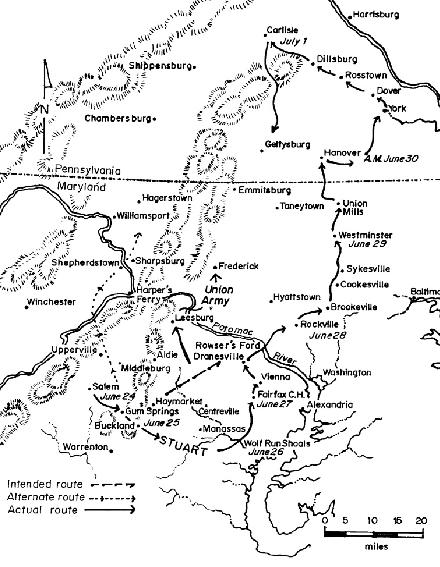
Stuart continued on past the outskirts of Washington on June 27th and was again delayed when attempting to cross the Potomac at Rowser’s Ford where the “water level was two feet higher than normal.” [32] Upon crossing the river he then encountered a large Federal wagon train not far from Washington capturing over 100 wagons and 600 mules. He reveled in that feat and boasted that “he had taken more than one hundred and twenty-five best United States model wagons and splendid teams and gay caparisons,” containing “foodstuffs, oats, hay…bacon, ham, crackers and bread” but his progress was slowed by his enormous wagon train of captured supplies…” [33] He and briefly wondered “whether it might be worth “our entering Washington City” [34] before determining that the effort might be too costly.

On June 28th Stuart received word that Joe Hooker and the Army of the Potomac were across the Potomac. Likewise, Stuart “knew nothing of Lee’s position,” [35] and instead of abandoning the wagon train he sacrificed the speed and mobility of his brigades to keep it. This was a direct consequence of how badly Lee had written his order to Stuart. Now, “far from guarding Ewell’s right, he was now moving away from Ewell, with no idea where Hooker’s army might be and no communication with Lee, who frequently inquiring of his aides, “Can you tell me where General Stuart is?” [36]

On the wrong side of the federal army, encumbered by the captured wagon train, “Stuart would have to make a half circle of more than fifty miles around Gettysburg before arriving there about noon on the second day of battle with most of his troopers, his artillery, and his wagon train lumbering far behind him.” [37] On June 30th his men were engaged by Judson Kilpatrick’s Federal near cavalry division near Hanover, and “his men never fought more poorly…and General Stuart and his staff were nearly captured.” [38] By the time Stuart’s troopers arrived in Gettysburg, the once proud outfit was “exhausted and too late to be of any service.” [39] His arrival at Gettysburg was not a moment of triumph, but was humiliating. Instead of reporting to his commander with information that Lee needed, it was Lee who informed him of the position of his own army and the Army of the Potomac. Lee’s words to his much beloved subordinate were painful. He asked him “General Stuart, where have you been?” [40] Stuart seemed to wilt at his mentor’s words, and attempted to put the best face forward, and told Lee “I have brought you 125 wagons and their teams, General,” to which Lee replied “Yes, General, but they are an impediment to me now.” [41]

Stuart’s raid was disastrous for Lee. Until July 2nd, Lee was blind and had no idea where the Federal army was. He learned some when he told of the location of the Army of the Potomac by Longstreet’s scout Harrison on June 28th, but even then he had no clear idea of the Federal Army’s location, strength, or intentions until the second day of the Battle of Gettysburg. Stuart’s ride was “an act of folly – ill-planned, badly conducted, and (until the very end) executed with an almost total disregard for anything for any interest other than the self-promotion of J.E.B. Stuart.” [42]

To be clear, a number of important military factors important to those involved in planning campaigns are clear: Deception, commander’s intent, and unity of command. Lee successfully used deception to prevent the Federals from discerning his purposes, but that initial success was compromised by his lack of clarity in communicating his intent for the campaign to Stuart, and by Stuart’s careless disregard of any other consideration but his own reputation and vanity.

Both Stuart and Lee share culpability for the failure of the Confederate campaign at the operational and tactical level. Of course they were not the only ones, Longstreet, Ewell, A.P. Hill, Harry Heth, and Jubal Early and many others had a share in the defeat, but Lee in his orders, and his protégé Stuart in trying to redeem his reputation were most culpable in the defeat at Gettysburg.

Notes

[1] Petruzzi, J. David and Stanley, Steven The Gettysburg Campaign in Numbers and Losses: Synopses, Orders of Battle, Strengths, Casualties and Maps, June 9 – July 1, 1863 Savas Beatie LLC, El Dorado Hills CA 2012 p.41

[2] Davis, Burke J.E.B. Stuart: The Last Cavalier Random House, New York 1957 pp.319-320

[3] Dowdy, CliffordLee and His Men at Gettysburg: The Death of a Nation Skyhorse Publishing, New York 1986, originally published as Death of a Nation Knopf, New York 1958 p.57

[4] Freeman, Douglas Southall, Lee’s Lieutenant’s a Study in Command, One volume abridgement by Stephen W Sears, Scribner, New York 1998 p.553

[5] Ibid. Dowdy Lee and His Men at Gettysburg p.57

[6] Ibid. Freeman Lee’s Lieutenants p.553

[7] Coddington, Edwin B. The Gettysburg Campaign: A Study in Command, A Touchstone Book, Simon and Schuster New York, 1968 p.108

[8] Ibid. Coddington The Gettysburg Campaign p.108

[9] Ibid. Davis J.E.B. Stuart: The Last Cavalier p.321

[10] Oates, Willam C. and Haskell, Frank A. Gettysburg: The Confederate and Union Views of the Most Decisive Battle of the War in One Volume Bantam Books edition, New York 1992, originally published in 1905 p.61

[11] Ibid. Coddington The Gettysburg Campaign p.109

[12] Ibid. Coddington The Gettysburg Campaign p.109

[13] McClellan, Henry Brainerd The Life and Campaigns of Major General J.E.B. Stuart Commander of the Cavalry of the Army of Northern Virginia 1885. Digital edition copyright 2011 Strait Gate Publications, Charlotte NC Location 6087

[14] Ibid. McClellan The Life and Campaigns of Major General J.E.B. Stuart location 6106

[15] Lee, Robert E. Reports of Robert E Lee, C.S. Army, Commanding Army of Northern Virginia Campaign Report Dated January 20th 1864. Amazon Kindle Edition location 285

[16] Ibid. Davis J.E.B. Stuart: The Last Cavalier p.324

[17] Fuller, J.F.C. Decisive Battles of the U.S.A. 1776-1918 University of Nebraska Press, Lincoln 2007 copyright 1942 The Royal Society for the Prevention of Cruelty to Animals p.226

[18] Korda, Michael. Clouds of Glory: The Life and Legend of Robert E. Lee Harper Collins Publishers, New York 2014 p.540

[19] Ibid Korda Clouds of Glory p.540

[20] Ibid. Coddington The Gettysburg Campaign p.110

[21] Guelzo, Allen C. Gettysburg: The Last Invasion Vintage Books a Division of Random House, New York 2013 p.96

[22] Ibid. Freeman Lee’s Lieutenants p.555

[23] Sears, Stephen W. Gettysburg, Mariner Books, Houghton Mifflin Company, Boston and New York, 2003 p.106

[24] Ibid. Dowdy Lee and His Men at Gettysburg p.63

[25] Ibid. Davis J.E.B. Stuart: The Last Cavalier p.324

[26] Ibid. Dowdy Lee and His Men at Gettysburg p.63

[27] Ibid. Coddington The Gettysburg Campaign p.112

[28] Ibid. Dowdy Lee and His Men at Gettysburg p.63

[29] Ibid. Guelzo Gettysburg: The Last Invasion p.96

[30] Ibid. Coddington The Gettysburg Campaign p.112

[31] Ibid. Davis J.E.B. Stuart: The Last Cavalier p.325

[32] Ibid. Coddington The Gettysburg Campaign p.112

[33] Ibid Korda Clouds of Glory p.541

[34] Ibid. Guelzo Gettysburg: The Last Invasion p.98

[35] Ibid. Davis J.E.B. Stuart: The Last Cavalier p.325

[36] Ibid Korda Clouds of Glory p.541

[37] Ibid Korda Clouds of Glory p.541

[38] Ibid. Dowdy Lee and His Men at Gettysburg p.73

[39] Ibid. Fuller Decisive Battles of the U.S.A. 1776-1918 p.227

[40] Ibid. Davis J.E.B. Stuart: The Last Cavalier p.334

[41] Ibid. Davis J.E.B. Stuart: The Last Cavalier p.334

[42] Ibid. Guelzo Gettysburg: The Last Invasion p.98

Leave a comment

Filed under civil war, Gettysburg, History, Military, us army

The Largest Cavalry Battle in North America: The Battle Of Brandy Station

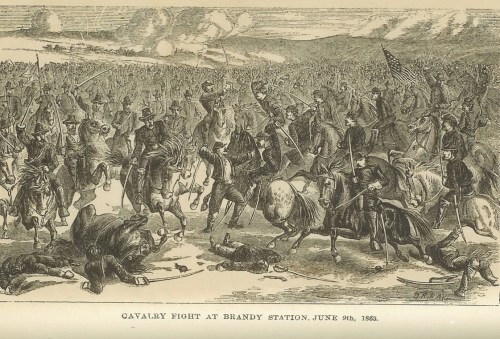
Cav Fight at Brandy Station

Friends of Padre Steve’s World,

Today I continue my rest so I can read and relax. take a look back at the battle of Brandy Station, the largest cavalry battle every fought on the North American continent. This is a section of my draft Gettysburg campaign text.

Have a great day,

Peace

Padre Steve+

Movement to attain operational reach and maneuver are two critical factors in joint operations. In the time since the American Civil War the distances that forces move to engage the enemy, or maneuver to employ fires to destroy his forces have greatly increased. Movement may be part of an existing Campaign Plan or Contingency Plan developed at Phase 0; it also may be part of a crisis action plan developed in the midst of a campaign. Lee’s movement to get to Gettysburg serves as an example of the former, however, since his forces were already in contact with the Army of the Potomac along the Rappahannock and he was reacting to what he felt was a strategic situation that could not be changed but by going on the offensive that it has the feel of a Crisis Action Plan. Within either context other factors come into play: clarity of communications and orders, security, intelligence, logistics and even more importantly the connection between operational movement and maneuver; the Center of Gravity of the enemy, and national strategy. Since we have already discussed how Lee and the national command authority of the Confederacy got to this point we will now discuss the how that decision played in the operational and tactical decisions of Lee and his commanders as the Army of Northern Virginia began the summer campaign and the corresponding actions of Joseph Hooker and the his superiors in Washington.

“One of the fine arts of the military craft is disengaging one’s army from a guarding army without striking sparks and igniting battle.” [1] On June 3rd 1863 Robert E. Lee began to move his units west, away from Fredericksburg to begin his campaign to take the war to the North. He began his exfiltration moving Second Corps under Richard Ewell and First Corps under James Longstreet west “up the south bank of the Rappahannock to Culpepper, near which Hood and Pickett had been halted on their return from Suffolk.” [2]Rodes’ division of Second Corps followed on June 4th with Anderson and Early on June 5th. Lee left the three divisions of A.P. Hill’s Third Corps at Fredericksburg to guard against any sudden advance by Hooker’s Army of the Potomac toward Richmond. Lee instructed Hill to “do everything possible “to deceive the enemy, and keep him in ignorance of any change in the disposition of the army.” [3]

The army was tremendously confident as it marched away from the war ravaged, dreary and desolate battlefields along the Rappahannock “A Captain in the 1st Virginia averred, “Never before has the army been in such a fine condition, so well disciplined and under such complete control.” [4]Porter Alexander wrote that he felt “pride and confidence…in my splendid battalion, as it filed out of the field into the road, with every chest & and ammunition wagon filled, & and every horse in fair order, & every detail fit for a campaign.” [5] Another officer wrote to his father, “I believe there is a general feeling of gratification in the army at the prospect of active operations.” [6]

Lee’s plan was to “shift two-thirds of his army to the northwest and past Hooker’s flank, while A.P. Hill’s Third Corps remained entrenched at Fredericksburg to observe Hooker and perhaps fix him in place long enough for the army to gain several marches on the Federals.” [7] In an organizational and operational sense that Lee’s army after as major of battle as Chancellorsville “was able to embark on such an ambitious flanking march to the west and north around the right of the army of the Potomac….” [8]

However, Lee’s movement did not go unnoticed; Hooker’s aerial observers in their hot air balloons “were up and apparently spotted the movement.” [9] But Hooker was unsure what it meant. He initially suspected that “Lee intended to turn the right flank of the Union army as he had done in the Second Bull Run Campaign, either by interposing his army between Washington and the Federals or by crossing the Potomac River.” [10] Lee halted at Culpepper from which he “could either march westward over the Blue Ridge or, if Hooker moved, recontract at the Rappahannock River.” [11]

Hooker telegraphed Lincoln and Halleck on June 5th and requested permission to advance cross the river and told Lincoln that “I am of opinion that it is my duty to pitch into his rear” [12]possibly threatening Richmond. Lincoln ordered Hooker to put the matter to Halleck, with whom Hooker was on the worst possible terms. Hooker “pressed Halleck to allow him to cross the Rappahannock in force, overwhelming whatever rebel force had been left at Fredericksburg, and then lunging down the line of the Virginia Central toward an almost undefended Richmond.” [13] On the morning of June 6th Hooker ordered pontoon bridges thrown across the river and sent a division of Sedgwick’s VI Corps to conduct a reconnaissance in force against Hill.

Lincoln and Halleck immediately rejected Hooker’s request. Lincoln “saw the flaw in Hooker’s plan at once” [14] and replied in a very blunt manner: “In one word,” he wrote “I would not take any risk of being entangled upon the river, like an ox jumped half over a fence and liable to be torn by dogs front and rear, without a fair chance to gore one way or kick another.” [15] Halleck replied to Hooker shortly after Lincoln that it would “seem perilous to permit Lee’s main force to move upon the Potomac [River] while your army is attacking an intrenched position on the other side of the Rappahannock.” [16] Lincoln, demonstrating a keen regard for the actual center of gravity of the campaign, told Hooker plainly that “I think Lee’s army and not Richmond, is your objective point.” [17]

The fears of Lincoln and Halleck were well founded. In stopping at Culpepper Lee retained the option of continuing his march to the Shenandoah and the Potomac, or he could rapidly “recall his advanced columns, hammer at Hooker’s right flank, and very possibly administer another defeat even more demoralizing than the one he suffered at Chancellorsville.” [18] Hooker heeded the order and while Hooker maintained his bridgehead over the Rappahannock he made no further move against Hill’s well dug in divisions.

Meanwhile, J.E.B. Stuart and his Cavalry Corps had been at Brandy Station near Culpepper for two weeks. Culpepper in June was a paradise for the cavalry, and with nearly 10,000 troopers gathered Stuart ordered a celebration, many dignitaries were invited and on June 4th Stuart hosted a grand ball in the county courthouse. On the 5th Stuart staged a grand review of five of his brigades. Bands played as each regiment passed in review and one soldier wrote that it was “One grand magnificent pageant, inspiring enough to make even an old woman feel fightish.” [19] The review ended with a mock charge by the cavalry against the guns of the horse artillery which were firing blank rounds. According to witnesses it was a spectacular event, so realistic and grand that during the final charge that “several ladies fainted, or pretended to faint, in the grandstand which Jeb Stuart had had set up for them along one side of the field.” [20]That was followed by an outdoor ball “lit by soft moonlight and bright bonfires.” [21] Stuart gave an encore performance when Lee arrived on June 8th, minus the grand finale and afterward Lee wrote to his wife that “Stuart was in all his glory.” [22]

Hooker received word from the always vigilant John Buford, of the First Cavalry Division on the night of June 6th that “Lee’s “movable column” was located near Culpepper Court House and that it consisted of Stuart’s three brigades heavily reinforced by Robertson’s, “Grumble” Jones’s, and Jenkins’ brigades.” [23] Hooker digested the information and believed that Stuart’s intent was to raid his own rear areas to disrupt the Army of the Potomac’s logistics and communications. The next day Hooker ordered his newly appointed Cavalry Corps Commander, Major General Alfred Pleasanton to attack Stuart.

After Chancellorsville, Hooker had reorganized the Union cavalry under Pleasanton into three divisions and under three aggressive division commanders, all West Pointers, Brigadier General John Buford, Brigadier General David Gregg and Brigadier General Judson Kilpatrick. While Stuart conducted his second grand review for Lee Pleasanton quietly massed his cavalry “opposite Beverly Ford and Kelly’s Ford so as to cross the river in the early morning hours of June 9th and carry out Hooker’s crisp orders “to disperse and destroy” the rebel cavalry reported to be “assembled in the vicinity of Culpepper….”[24] Pleasanton’s cavalry was joined by two mixed brigades of infantry “who had the reputation of being among the best marchers and fighters in the army.” [25] One brigade, commanded by Brigadier General Adelbert Ames consisted of five regiments drawn from XI Corps, XII Corps, and III Corps was attached to Buford’s division. The other brigade, under the command of Brigadier General David Russell was composed of seven regiments drawn from I Corps, II Corps and VI Corps. [26]

Stuart’s orders for June 9th were to “lead his cavalry division across the Rappahannock to screen the northward march of the infantry.” [27] The last thing that Stuart expected was to be surprised by the Federal cavalry which he had grown to treat with distain. Stuart who was at his headquarters “woke to the sound of fighting” [28] as Pleasanton’s divisions crossed the river and moved against the unsuspecting Confederate cavalry brigades.

The resultant action was the largest cavalry engagement of the war. Over 20,000 troopers engaged in an inconclusive see-saw battle that lasted most of the day. Though a draw “the rebels might have been swept from the field had Colonel Alfred N. Duffie, at the head of the Second Division acted aggressively and moved to the sounds of battle.” [29] The “Yankees came with a newfound grit and gave as good as they took.” [30]Porter Alexander wrote that Pleasanton’s troopers “but for bad luck in the killing of Col. Davis, leading the advance, would have probably surprised and captured most of Stuart’s artillery.” [31]Stuart had lost “over 500 men, including two colonels dead,” [32] and a brigade commander, Fitzhugh “Rooney” Lee, General Lee’s son, badly wounded. While recuperating at his wife’s home a few weeks later Lee “was captured by the enemy.” [33]Stuart claimed victory as he lost fewer troops and had taken close to 500 prisoners and maintained control of the battlefield.

But even Confederate officers were critical. Lafayette McLaws of First Corps wrote “our cavalry were surprised yesterday by the enemy and had to do some desperate fighting to retrieve the day… As you will perceive from General Lee’s dispatch that the enemy were driven across the river again. All this is not true because the enemy retired at their leisure, having accomplished what I suppose what they intended.” [34] Captain Charles Blackford of Longtreet’s staff wrote: “The fight at Brandy Station can hardly be called a victory. Stuart was certainly surprised, but for the supreme gallantry of his subordinate officers and men… it would have been a day of disaster and disgrace….” The Chief of the Bureau of War in Richmond, Robert H.G. Kean wrote “Stuart is so conceited that he got careless- his officers were having a frolic…” [35] Brigadier General Wade Hampton had the never to criticize his chief in his after action report and after the war recalled “Stuart managed badly that day, but I would not say so publicly.” [36]

The Confederate press was even more damning in its criticism of Stuart papers called it “a disastrous fight,” a “needless slaughter,” [37]and the Richmond Examiner scolded Stuart in words that cut deeply into Stuart’s pride and vanity:

The more the circumstances of the late affair at Brandy Station are considered, the less pleasant do they appear. If this was an isolated case, it might be excused under the convenient head of accident or chance. But the puffed up cavalry of the Army of Northern Virginia has twice, if not three times, surprised since the battles of December, and such repeated accidents can be regarded as nothing but the necessary consequences of negligence and bad management. If the war was a tournament, invented and supported for the pleasure of a few vain and weak-headed officers, these disasters might be dismissed with compassion, But the country pays dearly for the blunders which encourage the enemy to overrun and devastate the land, with a cavalry which is daily learning to despise the mounted troops of the Confederacy…” [38]

But the battle was more significant than the number of casualties inflicted or who controlled the battlefield at the end of the day. Stuart had been surprised by an aggressively led Union Cavalry force. The Union troopers fought a stubborn and fierce battle and retired in good order. Stuart did not appreciate it but the battle was a watershed, it ended the previous dominance of the Confederate Cavalry arm. It was something that in less than a years’ time would cost him his life.

Notes 

[1] Sears, Stephen W. Gettysburg, Mariner Books, Houghton Mifflin Company, Boston and New York, 2003 p.59

[2] Foote, Shelby, The Civil War, A Narrative. Volume Two Fredericksburg to Meridian Random House, New York 1963 p.436

[3] Trudeau, Noah Andre. Gettysburg: A Testing of Courage, Harper Collins Publishers, New York 2002 p.25

[4] Wert, Jeffry D. A Glorious Army: Robert E. Lee’s Triumph 1862-1863 Simon and Schuster, New York and London 2011 p.218

[5] Alexander, Edward Porter. Fighting for the Confederacy: The Personal Recollections of General Edward Porter Alexander edited by Gary Gallagher University of North Carolina Press, Chapel Hill 1989 p.221

[6] Ibid. Wert A Glorious Army p.219

[7] Ibid. Sears Gettysburg p.60

[8] Korda, Michael. Clouds of Glory: The Life and Legend of Robert E. Lee Harper Collins Publishers, New York 2014 p.530

[9] Ibid. Foote The Civil War, A Narrative. Volume Two p.436

[10] Wert, Jeffry D. The Sword of Lincoln: The Army of the Potomac Simon and Schuster, New York and London 2005 p.260

[11] Dowdy, Clifford. Lee and His Men at Gettysburg: The Death of a Nation Skyhorse Publishing, New York 1986, originally published as Death of a Nation Knopf, New York 1958 p.37

[12] Ibid. Sears Gettysburg p.61

[13] Guelzo, Allen C. Gettysburg: The Last Invasion Vintage Books a Division of Random House, New York 2013 p.50

[14] Ibid. Wert The Sword of Lincoln p.260

[15] Fuller, J.F.C. Decisive Battles of the U.S.A. 1776-1918 University of Nebraska Press, Lincoln 2007 copyright 1942 The Royal Society for the Prevention of Cruelty to Animals p.223

[16] Ibid Trudeau Gettysburg a Testing of Courage p.26

[17] Ibid. Guelzo Gettysburg: The Last Invasion p.50

[18] Coddington, Edwin B. The Gettysburg Campaign: A Study in Command, A Touchstone Book, Simon and Schuster New York, 1968 p.53

[19] Davis, Burke J.E.B. Stuart: The Last Cavalier Random House, New York 1957 p.304

[20] Ibid. Foote The Civil War, A Narrative. Volume Two p.437

[21] Ibid. Sears Gettysburg p.63

[22] Ibid. Wert A Glorious Army p.221

[23] Ibid. Coddington The Gettysburg Campaign p.54

[24] Ibid. Sears Gettysburg p.64

[25] Ibid. Coddington The Gettysburg Campaign p.54

[26] Petruzzi, J. David and Stanley, Steven The Gettysburg Campaign in Numbers and Losses: Synopses, Orders of Battle, Strengths, Casualties and Maps, June 9 – July 1, 1863 Savas Beatie LLC, El Dorado Hills CA 2012 p.7

[27] Ibid. Sears Gettysburg p.64

[28] Ibid. Davis JEB Stuart p.306

[29] Ibid. Wert The Sword of Lincoln p.261

[30] Wert, Jeffry D. General James Longstreet The Confederacy’s Most Controversial Soldier, A Touchstone Book, Simon and Schuster, New York and London 1993 p. 251

[31] Ibid. Alexander Fighting for the Confederacy p.223

[32] Ibid. Davis JEB Stuart p.310

[33] Ibid. Wert A Glorious Army p.221

[34] Ibid. Coddington The Gettysburg Campaign p.59

[35] Ibid. Davis JEB Stuart p.310

[36] Ibid. Coddington The Gettysburg Campaign p.60

[37] Ibid. Guelzo Gettysburg: The Last Invasion p.57

[38] Ibid. Davis JEB Stuart p.311-312

Leave a comment

Filed under civil war, Gettysburg, History, Loose thoughts and musings, Military, us army

Despite the Foreboding Feelings I Have, I Will Fight “We have to show the world that not all of us are like him. Otherwise, this will always be Hitler’s Germany.”

img_3414

Friends of Padre Steve’s World,

Hannah Arendt wrote: “When evil is allowed to compete with good, evil has an emotional populist appeal that wins out unless good men and women stand as a vanguard against abuse.”

She was right. We are seeing a populist appeal that is embracing evil and it is happening before our very eyes.

I cannot shake the deep sense of foreboding I have regarding the country and the world after President Trump’s repeated attacks on NATO, his shredding of the Paris Climate accord, and the threat of war on the Korean Peninsula are enough to concern any right thinking person. Likewise, the swirl of allegations concerning what appears to be treasonous activities by his closest advisers and his apparent attempts to have them covered up by the FBI and various intelligence agencies. There is something very wrong going on and it almost feels that I can see the disaster unfolding before it happens.

If it was Trump alone it would be an anomaly, but most of the Republican Party has decided to support his unconstitutional abuses of power and his base, which is made up mainly of Evangelical or other Conservative Christians have anointed Trump’s Presidency as ordained by God, and opponents as not only opponents of Trump, but also of God. That my friends is as toxic of political combination as is humanly possible.

I am not the only one to notice, leading conservative writers, foreign policy experts, and constitutional scholars have pointed out the same things that I have been saying for over a year. I do try to be positive and to believe that things will work out for the best, but the more I observe the more my confidence in our leaders and for that purpose many of our people to do the right thing is diminished.

That being said I do not give in to the feelings of foreboding or intend give up without a fight. I want my country to live up to its ideals, I am concerned about the real world, our alliances, our environment, and the real threat to freedom.  I believe in a particular universal ideal enunciated in the Preamble of the Declaration of Independence that All men are created equal, and as such that I must continually stand for what is right, what is true, and what is enduring.

I am worried about our democracy and I agree with Timothy Snyder who wrote:

“Democracy failed in Europe in the 1920s, ’30s, and ’40s, and it is failing not only in much of Europe but in many parts of the world today. It is that history and experience that reveals to us the dark range of our possible futures. A nationalist will say that “it can’t happen here,” which is the first step toward disaster. A patriot says that it could happen here, but that we will stop it.”  

It can happen here, and if we are patriots and not simply nationalists we must stand for principle and work for a new birth of freedom even as it seems that freedom itself is in danger. So as I write about some of the notable events of our history that we commemorate over the coming days please know that I take inspiration from them as I hope you will.  I am a patriot, and in my heart I believe we must stop it. As the German General and resistance leader against Hitler said:

“We have to show the world that not all of us are like him. Otherwise, this will always be Hitler’s Germany.”

We must stand together, or this will always be Trump’s America, and we will hang separately. A word of warning to dissident Republicans, and Democrats or Progressives who if their candidate is not the Democratic Nominee threaten to sit out the election or vote third party. Such a choice is suicidal, it only helps Trump. If he is re-elected Civil rights and free speech will be rolled back, the Constitution itself be trampled, and the United States, however imperfectly imagined by our founders will pass into the dustbin of history, to be replaced with a racist and authoritarian theocracy, which will last than the 12 years of Hitler’s 1000 year Reich.

That my friends is the hard Cold truth, from a historian, military combat veteran, and a man who spent 32 years supporting the Republican Party and its candidates.

Peace

Padre Steve+

3 Comments

Filed under civil war, History, holocaust, national security, News and current events, Political Commentary

Lest We Forget: Memorial Day 2019

Friends of Padre Steve’s World,

After the end of the American Civil War, the poet Walt Whitman reflected on the human cost of it. Whitman wrote,

“Ashes of soldiers South or North,

As I muse retrospective murmuring a chant in thought, The war resumes, again to my sense your shapes, And again the advance of the armies.

Noiseless as mists and vapors, From their graves in the trenches ascending, From cemeteries all through Virginia and Tennessee, From every point of the compass out of the countless graves,

In wafted clouds, in myriads large, or squads of twos or threes or single ones they come, And silently gather round me…”

Memorial Day is always an emotional time for me, especially since I returned from Iraq in 2008, and this weekend I have been thinking about the men and women that I knew who died in action or died after they left the service, some at their own hand, unable to bear the burdens and trauma that they suffered while at war. I was reminded of them again at the memorial service that we conducted for the sailors and soldiers from our base who have died in action since September 11th 2001. In an age where less than one percent of Americans serve in the military, I think that it is important that we take the time to remember and reflect on the human cost of wars.

I think of the battlefields that I have served on in Al Anbar Province, the one my father served on at An Loc, Vietnam, or the battlefields and the graveyards I have been to, Verdun, the Somme, Paschendaele, Waterloo, Arnhem, Normandy, Belleau Wood, Luxembourg, the Shuri Line, the Naktong River, Yorktown, Chancellorsville, Antietam, Stone’s River, Bentonville, Gettysburg, the wrecks of the USS Arizona and USS Utah at Pearl Harbor, and so many more, I think about the men and women who never returned. To me all of these places are hallowed ground, ground that none of us can hallow, the sacrifices of the men who gave their last full measure of devotion have done that better than we can ever do.

There are some songs that are haunting yet comfort me when I reflect on the terrible costs of war, even those wars that were truly just; and yes there are such wars, even if politicians and ideologues demanding revenge or vengeance manage to mangle the peace following them. Of course there are wars that are not just in any manner of speaking and in which the costs far outweigh any moral, legal, or ethical considerations, but I digress…

Joshua Lawrence Chamberlain, the hero of the Battle of Little Round Top at Gettysburg wrote something that talks about the importance and even the transcendence of the deeds of those who lost their lives in those wars fought and died to achieve.

In great deeds, something abides. On great fields, something stays. Forms change and pass; bodies disappear; but spirits linger, to consecrate ground for the vision-place of souls… generations that know us not and that we know not of, heart-drawn to see where and by whom great things were suffered and done for them, shall come to this deathless field, to ponder and dream; and lo! the shadow of a mighty presence shall wrap them in its bosom, and the power of the vision pass into their souls.”

Elton John wrote and performed this song, Oceans Away on the centenary of the First World War. It speaks of the men that never came home, and he related it to those who continue to go off to war today.

I hung out with the old folks

In the hope that I’d get wise

I was trying to

bridge the gap

Between the great divide

Hung on every recollection

In the theater of their eyes

Picking up on this and that

In the few that still survive


Call em up

Dust em off

Let em shine

The ones who hold onto the ones,

they had to leave behind

Those that flew, those that fell,

The ones that had to stay,

Beneath a little wooden cross, Oceans away


They bend like trees in winter

These shuffling old grey lions

Those snow-white stars still gather

Like the belt around Orion

Just to touch the faded lightning

Of their powerful design

Of a generation gathering

For maybe the last time

Oceans away

Where the green grass sways

And the cool wind blows

Across the shadow of their graves.

Shoulder to shoulder back in the day

Sleeping bones to rest in earth, oceans away

Call em up

Dust em off

Let em shine

The ones who hold onto the ones,

they had to leave behind

Those that flew, those that fell,

The ones that had to stay,

Beneath a little wooden cross

Oceans away

Elton John “Oceans Away”


Likewise I find myself thinking about all those times alone overseas, and realize that many did not come home. The song I’m Dreaming of Home or Hymne des Fraternisés from the film Joyeux Noel which was adapted by French composer Philippe Rombi from the poem by Lori Barth I think speaks for all of us that served so far away, both those who returned and those who still remain oceans away.

I hear the mountain birds

The sound of rivers singing

A song I’ve often heard

It flows through me now

So clear and so loud

I stand where I am

And forever I’m dreaming of home

I feel so alone, I’m dreaming of home


It’s carried in the air

The breeze of early morning

I see the land so fair

My heart opens wide

There’s sadness inside

I stand where I am

And forever I’m dreaming of home

I feel so alone, I’m dreaming of home


This is no foreign sky

I see no foreign light

But far away am I

From some peaceful land

I’m longing to stand

A hand in my hand

… forever I’m dreaming of home

I feel so alone, I’m dreaming of home.


I close with the words of John McCrea’s immortal poem, In Flanders Fields: 

In Flanders fields the poppies blow
Between the crosses, row on row,
    That mark our place; and in the sky
    The larks, still bravely singing, fly
Scarce heard amid the guns below.
We are the Dead. Short days ago
We lived, felt dawn, saw sunset glow,
    Loved and were loved, and now we lie,
        In Flanders fields.
Take up our quarrel with the foe:
To you from failing hands we throw
    The torch; be yours to hold it high.
    If ye break faith with us who die
We shall not sleep, though poppies grow
        In Flanders fields.

The 20th Century was the bloodiest in human history. If we and our leaders are not careful, the peace and international institutions that guarded that peace will be destroyed in a cataclysm of Nationalism, Racism, and renewed wars over contested living space. In short, the 21st Century is setting up to be every bit as bloody as the 20th.

Please take the time to remember those who whose spirits still dream of home, oceans away.

Until tomorrow,

Peace,

Padre Steve+

9 Comments

Filed under civil war, History, iraq,afghanistan, Military, movies, music, News and current events, Political Commentary, remembering friends, Tour in Iraq, vietnam, War on Terrorism, World War II at Sea, world war one, world war two in europe, world war two in the pacific

“Their soldier lives were the reveille of freedom to a race in chains, and their deaths the tattoo of rebellious tyranny in arms“ Memorial Day 1868

Major General John Logan

Friends of Padre Steve’s World,

I detest the overly recreational and commercialized hype of how we Americans “celebrate” Memorial Day. It is a time for contemplation and remembering those who have given their last full measure of devotion to our country. It should also be remembered that the original Memorial Day Order propagated by the Union Veterans Association known as The Grand Army Of the Republic understood what the Union men who sacrificed their lives had done so for, it was for the freedom of an enslaved race and defeating a “Rebellious Tyranny in Arms.” While we now remember all of our fallen, one cannot forget the intention of the Union Veterans who founded the observance we mark this weekend, especially when a strident minority of Americans, represented by the President himself, are more in love and enamored by the principles of the “rebellious tranny” represented by the Confederacy, than with the ideals of the Declaration and the subsequent 13th, 14th, 15th, and 19th Amendments, or the Voting Rights Act Of 1964 and Civil Rights Act Of 1965. 

Abraham Lincoln summed the spirit of Memorial Day up well in his conclusion of the Gettysburg Address:

“It is rather for us to be here dedicated to the great task remaining before us — that from these honored dead we take increased devotion to that cause for which they gave the last full measure of devotion — that we here highly resolve that these dead shall not have died in vain — that this nation, under God, shall have a new birth of freedom — and that government of the people, by the people, for the people, shall not perish from the earth.”

As we contemplate the importance of Memorial Day and remember the men and women who gave their lives for this country it is important to remember why we do this. Memorial Day grew out of local observances following the Civil War, a war that claimed the lives of over 620,000 American Soldiers from the Union and the Confederacy. New demographic studies by historians estimate the losses at closer to 750,000. Hundreds of thousands of other people had they lives shattered by the war, killed, wounded, maimed, crippled, and shattered in mind and spirit, the country in many places devastated by war’s destruction. If we use the 620,000 number as our yardstick, it would have meant that 2.5% of the population of the country died in the war. People needed to make sense of the terrible losses that often wiped out the younger male populations of the small towns and communities from which most of these men, and a few women hailed.

To put this in perspective, if the same number of Americans were to die today in a way the total would be over seven million people, seven million my friends. The war reached into every home in some way, and sadly or perhaps thankfully we have no concept of such losses today.

In 1868, Major General John Logan who had been an excellent corps commander during the war was serving as the Commander of the nation’s first true Veterans organization, the Grand Army of the Republic which gave those veterans a place of refuge in a country that was leaving them behind and forgetting their sacrifice in the name of westward expansion and a growing economy. Let’s face it, money has almost always been more important to Americans than the troops who sacrificed their lives for the nation, but I digress…

Anyway General Logan issued this order on May 5th 1868:

HEADQUARTERS GRAND ARMY OF THE REPUBLIC, General Orders No.11, WASHINGTON, D.C., May 5, 1868

  1. The 30th day of May, 1868, is designated for the purpose of strewing with flowers or otherwise decorating the graves of comrades who died in defense of their country during the late rebellion, and whose bodies now lie in almost every city, village, and hamlet church-yard in the land. In this observance no form of ceremony is prescribed, but posts and comrades will in their own way arrange such fitting services and testimonials of respect as circumstances may permit.

We are organized, comrades, as our regulations tell us, for the purpose among other things, “of preserving and strengthening those kind and fraternal feelings which have bound together the soldiers, sailors, and marines who united to suppress the late rebellion.” What can aid more to assure this result than cherishing tenderly the memory of our heroic dead, who made their breasts a barricade between our country and its foes? Their soldier lives were the reveille of freedom to a race in chains, and their deaths the tattoo of rebellious tyranny in arms. We should guard their graves with sacred vigilance. All that the consecrated wealth and taste of the nation can add to their adornment and security is but a fitting tribute to the memory of her slain defenders. Let no wanton foot tread rudely on such hallowed grounds. Let pleasant paths invite the coming and going of reverent visitors and fond mourners. Let no vandalism of avarice or neglect, no ravages of time testify to the present or to the coming generations that we have forgotten as a people the cost of a free and undivided republic.

If our eyes grow dull, other hands slack, and other hearts cold in the solemn trust, ours shall keep it well as long as the light and warmth of life remain to us.

Let us, then, at the time appointed gather around their sacred remains and garland the passionless mounds above them with the choicest flowers of spring-time; let us raise above them the dear old flag they saved from dishonor; let us in this solemn presence renew our pledges to aid and assist those whom they have left among us a sacred charge upon a nation’s gratitude, the soldier’s and sailor’s widow and orphan.

  1. It is the purpose of the Commander-in-Chief to inaugurate this observance with the hope that it will be kept up from year to year, while a survivor of the war remains to honor the memory of his departed comrades. He earnestly desires the public press to lend its friendly aid in bringing to the notice of comrades in all parts of the country in time for simultaneous compliance therewith.

III. Department commanders will use efforts to make this order effective.

By order of

JOHN A. LOGAN, Commander-in-Chief

N.P. CHIPMAN, Adjutant General

Official: WM. T. COLLINS, A.A.G.

General Logan’s order is remarkable in its frankness and the understanding of the war in the immediate context of its conclusion. In 1868 the day would be observed at 183 cemeteries in 27 States and the following year over 300 cemeteries. Michigan was the first state to make the day a holiday and by 1890 all states in the North had made it so. In the South there were similar observances but the meaning attributed to the events and the sacrifices of the Soldiers of both sides was interpreted quite differently. In the North the Veterans overwhelmingly saw themselves as the saviors of the Union and the liberators of the Slaves. In South it was about the sacrifices of Confederate soldiers in what became known as the “Lost Cause.” But in both regions and all states, the surviving Soldiers, family members and communities honored their dead.

Oliver Wendell Holmes Jr.

In 1884 Oliver Wendell Holmes Jr. and Frederick Douglass both spoke about the meaning of the sacrifice made by so many.

Holmes, a veteran of the war who had been wounded at Antietam ended his Decoration Day 1884 speech:

“But grief is not the end of all…Our dead brothers still live for us, and bid us think of life, not death, — of life to which in their youth they lent the passion and glory of the spring. As I listen, the great chorus of life and joy begins again, and amid the awful orchestra of seen and unseen powers and destinies of good and evil our trumpets sound once more a note of daring, hope, and will.”

Frederick Douglass

Douglass, the former slave and abolitionist who lobbied Lincoln for emancipation and to give Blacks the chance to serve their country had two of his sons serve in the war spoke these wars:

“Dark and sad will be the hour to this nation when it forgets to pay grateful homage to its greatest benefactors. The offering we bring to-day is due alike to the patriot soldiers dead and their noble comrades who still live; for, whether living or dead, whether in time or eternity, the loyal soldiers who imperiled all for country and freedom are one and inseparable.”

It is important for the country not to forget those who served and the cost of those who have given the last full measure of devotion to duty and those who still carry the scars of war on their bodies and in their minds and spirits. I am one of the latter and I have known too many of the former.  Maybe that is why am so distrustful of those who advocate for war but have no skin in the game.

An Alsatian-German Soldier named Guy Sajer wrote in his book The Forgotten Soldier: 

“Too many people learn about war with no inconvenience to themselves. They read about Verdun or Stalingrad without comprehension, sitting in a comfortable armchair, with their feet beside the fire, preparing to go about their business the next day, as usual…One should read about war standing up, late at night, when one is tired, as I am writing about it now, at dawn, while my asthma attack wears off. And even now, in my sleepless exhaustion, how gentle and easy peace seems!”

I agree with him and pray that those who direct the course of this nation will take the words of General Logan, Oliver Wendell Holmes Jr., Frederick Douglass and Guy Sajer to heart before they embark on war, and when they remember those that have served.

May we never forget the sacrifices made by these men and women and those who continue to fight and sometimes die today.

Peace

Padre Steve+

5 Comments

Filed under civil rights, civil war, Gettysburg, History, Military, Political Commentary, us army

Remembering the First Memorial Day

decoration-day1

Friends of Padre Steve’s World,

This is Memorial Day weekend and for the vast majority of Americans, even those who loudly claim to “support the troops” the weekend is little more than an opportunity to start the summer. There will be ball games and picnics, parties and concerts, as well as road trips, and some will even honor the military personnel that are currently serving; however, that is not why we observe Memorial Day.

Memorial Day is observed to honor the lives and sacrifice of those men and women who died in the service of the country. Its roots go back to May 1865 when newly freed Blacks in Charleston South Carolina took the time to honor the fallen Union soldiers by dedicating a cemetery to them. I’ll go back to that in a bit.

Frederick Douglass discussed the meaning of Memorial Day in 1884:

“Dark and sad will be the hour to this nation when it forgets to pay grateful homage to its greatest benefactors. The offering we bring to-day is due alike to the patriot soldiers dead and their noble comrades who still live; for, whether living or dead, whether in time or eternity, the loyal soldiers who imperiled all for country and freedom are one and inseparable.”

Memorial Day, at one time known as Decoration Day is one of our most sacred civil holidays that we observe in the United States, or at least it should be. It was a holiday born out of the shedding of the blood of about 750,000 American soldiers, from the North and the South in the Civil War, a singular event that still echoes in our history and in some sense defines who we are and it is important that we come to understand its meaning and history.

racecourse_t600

The Racecourse Cemetery

The first observance of what we now know as Memorial Day is fascinating and it needs to be remembered. Frederick Douglass was absolutely right when he spoke the words that I began this article, and we need to remember the humble beginnings of this day which was first marked by recently freed slaves in Charleston South Carolina on May 1st 1865. They did so barely two weeks after Abraham Lincoln was assassinated and three weeks after Robert E. Lee surrendered the Army of Northern Virginia at Appomattox Court House.

The acrid smell of smoke of the last battles of the American Civil War was still lingering over many towns and cities in the South on May 1st 1865. Charleston, the hotbed of secession was particularly hard hit during the war. In 1861 Cadets of the Citadel and South Carolina militia forces began the war with the bombardment of Fort Sumter. Union Forces laid siege to the city in late 1863, a siege which ended with the city’s surrender to Union forces under the command of William Tecumseh Sherman on 18 February 1865. The day of the surrender was somewhat ironic. Charleston, the city most associated with the opening of the conflict surrendered to Union forces on the fourth anniversary of the inauguration of Jefferson Davis as President of the Confederacy. By the time of its surrender much of the city had been destroyed by Union siege artillery and naval forces.

As a Confederate stronghold Charleston had also been the home of three of the Prisoner of War Camps. One was located in the Charleston City Jail and the other at Castle Pinckney which had been one of the ante-bellum U.S. Army installations in the city. A third camp was erected on the site of the Washington Race Course and Jockey Club in 1864. This was an open air camp and Yale Historian David Blight wrote that “Union soldiers were kept in horrible conditions in the interior of the track; at least 257 died of exposure and disease and were hastily buried in a mass grave behind the grandstand.”

By the end of the war most of the white population of the city had left and most of those remaining were recently freed slaves. After their liberation and the city’s occupation by Federal forces, which included the famous 54th Massachusetts as well as the 20th, 35th and 104th US Colored Troops Regiments; about 28 recently liberated Black men went to work and properly reinterred the 257 Union dead on the raceway and built a high fence around it. They inscribed “Martyrs of the Race Course” on an arch above the cemetery entrance.

6a01b8d0781960970c01b7c7901048970b-320wi

On May 1st over 10,000 Black Charlestonians gathered at the site to honor the fallen. Psalms, Scriptures and prayers were said, hymns were sung and many brought flowers. A parade of 2800 children covered the burial ground with flowers. They were followed by members of the Patriotic Association of Colored Men and the Mutual Aid Society. This society’s members provided relief supplies to Freedmen and provided aid to bury those Blacks who were too poor to afford burial. More citizens followed many laying flower bouquets on the graves. Children then led the singing of The Star Spangled Banner, America and Rally around the Flag. The Brigade composed of the 54th Massachusetts and the 35th and 104th Colored Regiments marched in honor of their fallen comrades. Following the formalities many remained behind for a picnic.

Other communities established their own Memorial Day observances in the years following the war, but the event in Charleston was the first. The first “Official” commemoration was on 30 May 1868 when Union General John Logan who headed the veteran’s organization called The Grand Army of the Republic appealed to communities to honor the dead by holding ceremonies and decorating the graves of the fallen.

In the South three different days served a similar purpose. In Virginia people commemorated the day on June 3rd, the birthday of Confederate President Jefferson Davis, the Carolinas marked the day on 10 May, the birthday of General Thomas “Stonewall” Jackson. In much of the Deep South the event was conducted April 26th, the anniversary of the surrender of General Joseph Johnson’s Army to General William Tecumseh Sherman. For many in the South, still attempting to come to grips with their defeat the day would become about “The Lost Cause” or “the defense of Liberty” or “States Rights” and the war was often referred to as the “War of Northern Aggression.”

The “Martyrs of the Racecourse” cemetery is no longer there. The site is now a park honoring the fascinatingly complex Confederate General and post-Reconstruction Governor of South Carolina Wade Hampton. An oval track remains in the park and is used to run or walk by the local population and cadets from the Citadel. Thankfully, at long last in 2010, one hundred and forty-five years after the dedication of that cemetery a marker was placed in that park commemorating the cemetery and the event that we now recognize as the first Memorial Day.

First-Memorial-Day-honoring-257-Union-soldier-martyrs-10000-freedmen-march-led-by-3000-children-05011865

African American Children saluting the Union Dead years later

The Union dead who had been so beautifully honored by the Black population were moved to the National Cemetery at Beaufort South Carolina by the 1880s. Some state that the reason for this was that the cemetery had fallen into neglect, and this may be the case, but the event and their memory conveniently erased from memory of Charlestonians.

I do not think that this would have happened had the people who had the bodies moved simply restored and maintained the cemetery. Had not historian David Blight found the documentation we probably still would not know of this touching act by former slaves who honored those that fought the battles, and gave their lives to win their freedom. Blight wrote in 2011 in the 1870s Charleston “had no place for the former slaves’ march on their masters’ racecourse.”

The African American population of Charleston understood the bonds of slavery and oppression. They understood the tyranny of prejudice in which they only counted as 3/5ths of a person. They understood and saw the suffering of those that were taken prisoner while attempting to liberate them from the tyranny of slavery. They stand as an example for us today.

But their suffering was not over. Within little more than a decade Blacks in the South would be subject to Jim Crow and again treated by many whites as something less than human. The struggle of they and their descendants against the tyranny of racial prejudice, discrimination and violence over the next 100 years would finally bear fruit in the Civil Rights movement, some of whose leaders, like the Reverend Doctor Martin Luther King Jr. would also become martyrs. Unfortunately that struggle is not over.

Frederick Douglass spoke to Union Veterans on Memorial Day 1878. His words, particularly in light of the war and the struggles of African Americans since and the understanding of what those who were enslaved understood liberation to be are most significant to our time. It was not merely a war based on sectionalism or even “States rights,” it was a war of ideas, a war of diametrically opposed ideologies. He said:

“But the sectional character of this war was merely accidental and its least significant feature. It was a war of ideas, a battle of principles and ideas which united one section and divided the other; a war between the old and new, slavery and freedom, barbarism and civilization; between a government based upon the broadest and grandest declaration of human rights the world ever heard or read, and another pretended government, based upon an open, bold and shocking denial of all rights, except the right of the strongest.”

Douglass’s words were powerful then and they resonate today as many of the same ideas that were the cause of the Civil War and were continued during Jim Crow are still alive. Unfortunately there are those in our society who labor daily to establish the “rights” of the strongest over the weak, the poor, the powerless and minorities of all kinds. Of course such actions, often wrapped in the flag, patriotism and buttressed with cherry picked quotes (many of which are fake, changed or taken out of context) from some of our founders are designed to re-establish the oligarchy of the power of the few, much like the men who owned the lives of the slaves and poor whites in the ante-bellum American South. Such actions do nothing but demean and trample the sacrifice of those who fought for freedom and the only remedy is to fight them with the full knowledge of truth.

american-flag

I do hope that today we will observe Memorial Day in a fitting manner. Let us honor those Americans who died that others might be free. Let us look back at what freedom actually means and not forget the sacrifices of those that gave, and still give their lives in the “last full measure of devotion to duty” that others might live. This is especially true in an era where the racial and religious hatred and prejudice of Southern Slave Power, and Northern Know Nothings, that enslaved African Americans, exterminated Native American, invaded and Mexico, and treated Irish, German, Asian, and other immigrants, Roman Catholics, and Jews as enemies is raising its head as White Supremacists take their cue from the President that such behavior is acceptable.

Take a moment on Monday at noon to pause what you are doing and go silent for at least one minute, and remember.

Peace

Padre Steve+

Leave a comment

Filed under civil war, culture, History, Military, News and current events

The Battle Of Puebla: Cinco De Mayo, a Great Day for Mexico that Helped the United States

The Battle of Puebla

Friends of Padre Steve’s World,

I just wanted to wish all my readers a happy Cinco de Mayo. This holiday, which is not a Federal holiday in Mexico, and has nothing to due with Mexican Independence Day is very important to both Mexico and the United States. It celebrates the defeat of a French Army by Mexican forces at the Battle of Puebla on May 5th 1862.

Mexico had already been independent for nearly forty years when this took place. The French had led an intervention in Mexico, and members of the conservative Mexican aristocracy asked Archduke Maximilian of Austria to be the emperor of a new Imperial Mexico, and he agreed, but instead of glory found death.

Before Maximilian took over, the French first had to conquer the Mexican Republic, something that most Mexicans rather liked. At Puebla the French commander, General Charles Latrille de Lorencez underestimated the Mexican will to resist and ordered an attack on the city which was repulsed with heavy casualties. The French made an uphill frontal attack on well motivated and dug in Mexican regulars, back up by whatever militia troops and volunteers could be found. The French discovered what Americans would learn in the Civil War and Europeans would learn in the First World War: frontal charges against dug in troops were often suicidal. After several failed assaults, the Mexican Commander, General Ignacio Zaragoza unleashed his cavalry on the French flanks persuading the French Commander to withdraw.

The battle did not end the war in Mexico, but it helped inspired Mexicans opposed to Maximilian and the Empire to continue the struggle, in which they eventually prevailed. But, in a broader sense, more important to Americans it prevented French Emperor Napoleon III, the nephew of Napoleon faulted his father for the sale of French colonial lands to the United States during the Louisiana Purchase, and hoped to use the chaos of the American Civil War to regain some or all of that territory. As such he was willing to help the Confederacy in order to negate the power of a unified United States.

Had the Mexicans not been victorious at Puebla and captured Mexican City in May of 1862 there was a strong possibility that Napoleon would have recognized the Confederacy and quite possibly convinced the English to do the same. At the time General McClellan was withdrawing from his abortive Peninsular Campaign, and resistance to the war in the North was growing. However, the defeat at Puebla, coupled with the Union capture of New Orleans, followed by the Union defeat of Lee’s invasion of Maryland at Antietam in September, and the announcement of the Preliminary Emancipation Proclamation, and by exceptional Union diplomacy nipped Napoleon’s plans in the bud.

Since people around the world expected the French to have an easy time of it the victory was stunning, and it inspired the Mexican people to fight on. Now the war went on for some time. Eventually, the French succeeded in capturing Mexico City on May 17th 1863 and installed Maximilian as Emperor of Mexico upon his arrival in Veracruz on May 21st 1864.

Emperor Maximilian

Although the French had had succeeded in installing Maximillian, the war was not over. President Benito Juarez and his Mexican Republic troops continued to resist and in 1865, aided by weapons, arms and money from the United States which now that its Civil War was over, was able to help Mexico, the Mexican Republican Forces issued a series of defeats on French Forces. Emperor Napoleon III of France, who had conjured up this mess now decided that the price of supporting Emperor Maximilian was too high, and belatedly chose better relations with the United States over the hapless Maximilian and his Mexican forces.

President Benito Juarez

The French withdrew, but Emperor Max chose to fight on. He was captured by Republican forces and was tried, and sentenced to death. At his execution he paid the firing squad in gold not to shoot him in the head so his mother could see his face. The remnants of his government surrendered in Mexico City on June 20th 1867, the day after his execution.

Despite Cinco de Mayo not being an official Mexican holiday, we Americans and people in a number of other countries do celebrate it, ostensibly as a day to remember Mexican heritage, but more often as an excuse to party, eat Mexican food, and drink lots of beer, margaritas, and tequila shots.

Have a great day, and viva la Mexico!

Peace

Padre Steve+

Leave a comment

Filed under civil war, History, Loose thoughts and musings, Military, national security

“Better to Die Glorious than to Die Infamous” the Assassination Of Abraham Lincoln

Friends of Padre Steve’s World,

Today may be Palm or Passion Sunday, but due to the nature of the of the Christian Liturgical calendar, 154 years ago April 14th was Good Friday, and the most tragic Good Friday in American history.

Good Friday is somber day, and I think that there was none more somber than Good Friday 1865. Shortly after 10 P.M. at Ford’s theater a handsome and well known actor walked into the booth occupied by President Lincoln at Washington’s Ford’s Theater. The President was there with his wife Mary Todd Lincoln and another couple after a very full day of business to watch the play Our American Cousin a farcical look at the visit of an American visiting his English relatives when going to settle the family estate.

Lincoln was looking forward to the play. Though the war continued the surrender of Robert E. Lee’s Army of Northern Virginia to Ulysses S. Grant on April 9th for all intents and purposes had placed the final nail in the Confederacy’s malevolent coffin, and it was if a burden have been removed from Lincoln’s shoulders. His task now what the reintegration of the rebellious states back into the Union, a task that he believed needed to be accomplished without malice while still seeking justice. He made this clear in his Second Inaugural Address just over a month before:

“With malice toward none, with charity for all, with firmness in the right as God gives us to see the right, let us strive on to finish the work we are in, to bind up the nation’s wounds, to care for him who shall have borne the battle and for his widow and his orphan, to do all which may achieve and cherish a just and lasting peace among ourselves and with all nations.”

Just three days before Lincoln had given his last public speech at the White House. It was a practical speech dealing with the nuts and bolts reuniting the country including announcing his support for Negro Suffrage. He said:

“By these recent successes the re-inauguration of the national authority — reconstruction — which has had a large share of thought from the first, is pressed much more closely upon our attention. It is fraught with great difficulty. Unlike a case of a war between independent nations, there is no authorized organ for us to treat with. No one man has authority to give up the rebellion for any other man. We simply must begin with, and mould from, disorganized and discordant elements. Nor is it a small additional embarrassment that we, the loyal people, differ among ourselves as to the mode, manner, and means of reconstruction.”

In the speech Lincoln discussed the issues related to the new government of Louisiana and its dealings with African Americans, which did not go far enough for Lincoln, who was intent on extending the franchise to vote for all blacks, even if it took time to make it so. John Wilkes Booth was in attendance that day and as he listened he became ever angrier and he vowed to a fellow conspirator Lewis Powell, “That is the last speech he will make” and Booth was going to ensure this himself.

Lincoln had been troubled for some time by terrible insomnia and dreams, both bizarre and ghoulish. A few days before he had told Mary and others sharing dinner with them of a troubling dream which he described in detail, Mary and those at the table so accustomed to Lincoln’s customary wit and humor were stunned as Lincoln spoke. He closed the description with these words:

“Determined to find the cause of a state of things so mysterious and shocking, I kept on until I entered the East Room, which I entered. There I was met with a sickening surprise. Before me was a catafalque, on which rested a corpse wrapped in funeral vestments. Around it were stationed soldiers who were acting as guards; and a throng of people, some gazing mournfully at the corpse, whose face was covered, others weeping pitifully: ‘Who is dead in the White House?’ I demanded of one of the soldiers. ‘The President’ was the answer; ‘he was killed by an assassin!’ “Then came a loud burst of grief from the crowd…” 

Mary and the others were so upset, particularly with the large number of death threats Lincoln had received throughout the war. However, Lincoln told them all not to worry as “it was only a dream.”

On that Good Friday Lincoln was determined not to mourn, instead of attending Good Friday services or contemplating the war, or reconstruction, he simply wanted to laugh and chose to attend the play, wanting General Grant and his wife to attend. However Grant needed to travel to New Jersey and declined the offer.

Despite this Lincoln was in a cheerful mood, looking forward to the future and discussing all the things that he wanted to see and do after his term in office. Mary was startled by his cheerfulness and Lincoln told her “I have never felt better in my life.” Lincoln and his party arrived late to the cheers of the cast and took their seats in the box about 8:30 to the strains of Hail to the Chief. As the play resumed Lincoln’s bodyguard slipped away to get a drink and about twelve minutes after ten Booth slipped into the box where Lincoln sat watching the play. As the crowd roared its delight at a particularly funny scene a shot rang out and Lincoln’s arm jerked up and he slumped over. Booth then jumped to the stage from the box, injuring his leg and shouting “Sic semper tyrannis” or thus always to tyrants. It was the beginning of a series of attempted assassinations designed to decapitate the Federal government, Secretary of State Seward was badly wounded by Lewis Payne, a third assassin backed out at the last minute and failed to attack Vice President Johnson.

Though physicians sought to save the President the wound was mortal, the bullet having ender the back of his head, and dug deep into his brain, lodging behind his left eye. At 7:22 A.M. Abraham Lincoln was dead. It was a disaster for the nation as the new President, Andrew Johnson was a political enemy of Lincoln and not in line with Lincoln’s understanding of reconstruction and reconciliation. A poor Southerner from Tennessee, Johnson hated the Southern plantation aristocracy and would act as a punisher, while radical reconstructionist members of the cabinet and Congress would act in such a way that reconstruction would never achieve all that Lincoln believed that it could.

While radical Confederates rejoiced in Lincoln’s death others were more circumspect. Jefferson Davis who was fleeing and hoping to continue the war realized that the South would not fare as well under Johnson as Lincoln. In fact Johnson’s lack of understanding of the nuances of northern politics as well as his loathing of blacks, his “beliefs, prejudices, personality traits were a recipe for disaster at a time when an unprecedented national crisis put a premium on the capacity to think in new and creative ways.”

The Army of the Potomac learned of Lincoln’s assassination on Easter Sunday. Joshua Chamberlain told a woman whose mansion was at the center of his division’s camp when she asked what disturbed him “It is bad news for the South.” When the woman asked if it was Lee or Davis Chamberlain told her that it was Lincoln and said “The South has lost its best friend, Madam.” 

Chamberlain ordered chaplain to conduct a field memorial for the fallen President. The division chaplain a Catholic Priest, Father Egan spoke and roused the men, and Egan ended his service “Better so, Better to die glorious, than live infamous. Better to be buried beneath a nation’s tears, than to walk the earth guilty of the nation’s blood.”

During the war Lincoln had endeared himself to his soldiers and they responded with great emotion. One burst into tears and sobbed “He was our best friend. God bless him,” another wrote home “What a hold Old Abe had on the hearts of the soldiers of the army could only be told by the way they showed their mourning for him.” Admiral David Dixon Porter wrote “The United States has lost the greatest man she ever produced.” 

The bullet fired by John Wilkes Booth was a disaster for the country. Sadly, there are some today, in particular the White Supremacist group The League of the South are choosing to celebrate the assassination of the man that they so hate, and honor the assassin as a hero. However, I have to agree with Admiral Porter, there has never been a President before or after who was anything like this man, and I dedicate myself to the quest for equality of all people and for a reconciliation. I will continue to work for that “new birth of freedom” that Lincoln so believed in.

Maybe too, they are words our current President reflect should upon and take to heart, but since he has no heart or interest in history he will not. Lincoln died in glory, Trump, will live and die in infamy.

Until tomorrow,

Peace

Padre Steve+

8 Comments

Filed under civil rights, civil war, History, News and current events, Political Commentary