Category Archives: civil war

The Notorious Black Codes 

  
Friends of Padre Steve’s World

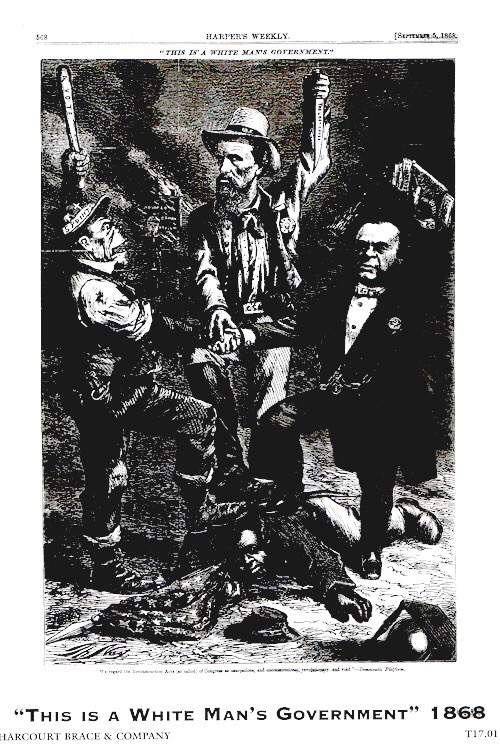
As I work on my Civil War and Gettysburg text I continue to write about truth, and truth can be very uncomfortable. Today is a section of my text that deals with the Black Codes that were enacted in Southern States in the immediate aftermath of the Civil War. They sprang up because Abraham Lincoln’s successor, Andrew Johnson was a unregenerate racist who encouraged such measures.  In the next few days I will be posting more sections of the text dealing with specific aspects of Reconstruction and the more often than not heavily racist opposition to rights of any kind being granted to blacks in the North and the South. 

Sadly, there are people today, people who were expensive suits, walk the halls of Congress, speak in our largest churches and travel in high style accompanied by the media who continue to fight against the rights of not only blacks, but of immigrants, the LGBTQ community, women and Moslems.

Have a great night,

Peace

Padre Steve+

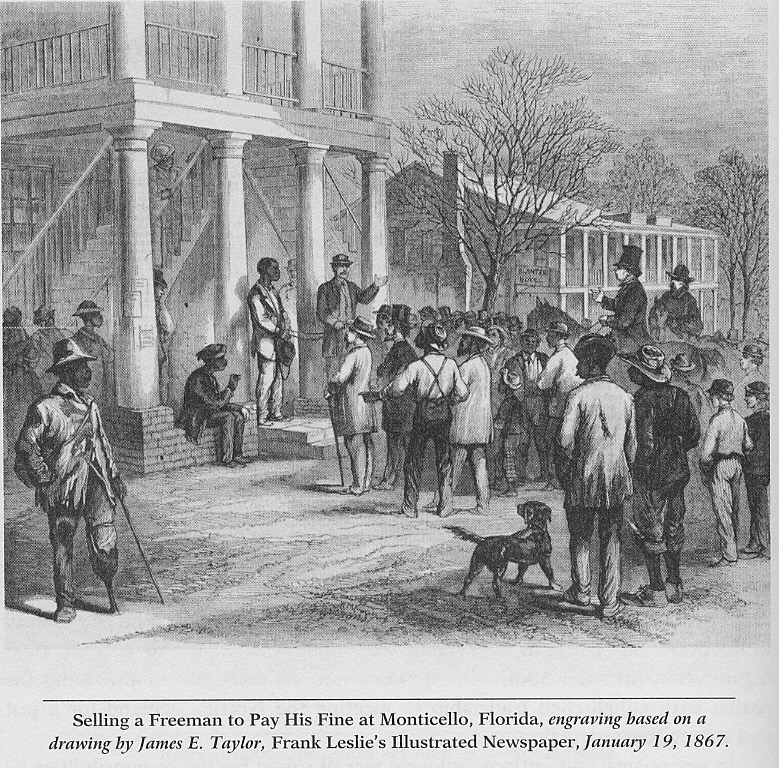
White Southerners including the newly pardoned Confederates enacted black codes that “codified explicit second-class citizenship for freedpeople.” [1] The legislature of Mississippi refused to ratify the Thirteenth Amendment, and did not do so until 1995. One Southerner noted that “Johnson “held up before us the hope of a ‘white man’s government,’ and this led us to set aside negro suffrage…. It was natural that we should yield to our old prejudices.” [2] Former Confederates, including Alexander Stephens the former Vice President of the Confederacy were elected to high office, Stephens to the United States Senate and the aggrieved Republicans in Congress in turn refused to admit the former Confederates. Many Union veterans were incensed by Johnson’s actions, one New York artilleryman noted “I would not pardon the rebels, especially the leaders, until they should kneel in the dust of humiliation and show their deeds that they sincerely repent.” [3] He was not alone, many Northern Veterans who formed the integrated Grand Army of the Republic veterans maintained a patent disregard, if not hatred of what the old South stood for and felt that their efforts in the war had been betrayed by the government.

  
Johnson’s restoration of property to the former white owners drove tens of thousands of blacks off lands that they had been farming, or left them as laborers for their former slave masters. Johnson countermanded General William Tecumseh Sherman and Secretary of War Edwin Stanton’s Field Order 15 to “divide abandoned and confiscated lands on the Sea Islands and in a portion of the Low Country coast south of Charleston into forty-acre plots for each black family.” [4] As such many freed blacks were now at the mercy of their former white owners for any hope of economic sustenance.

  
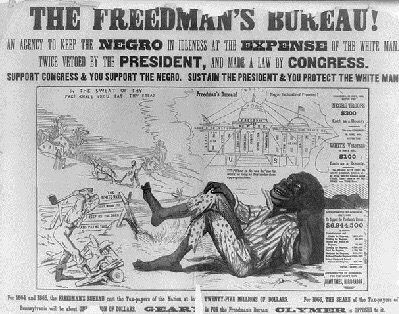
Johnson worked stridently, and often successfully to frustrate the efforts of the Freedmen’s Bureau headed by Major General Oliver Howard to help freed blacks to become landowners and to protect their legal rights. In immediate post-war South states organized all white police forces and state militias composed primarily of confederate veterans, many still wearing their gray or butternut uniforms. In such a climate blacks had few rights, and officers of the Freedmen’s Bureau lamented the situation. In Georgia one officer wrote that no jury would “convict a white man for killing a freedman,” or “fail to hang” a black man who killed a white in self-defense. Blacks commented another agent, “would be just as well off with no law at all or no Government,” as with the legal system established in the South under Andrew Johnson. “If you call this Freedom,” wrote one black veteran, “what do you call slavery?” [5]

  
The struggle between Johnson Congress intensified when Johnson vetoed the Civil Rights Bill. Congress responded by overriding his veto. Eventually the battle between Johnson and Congress climaxed when Johnson was impeached when he tried to remove Secretary of War Stanton from office. Johnson barely survived the impeachment proceedings and was acquitted by one vote in the Senate in 1868.

The various black codes enacted throughout the South were draconian measures to codify and institutionalize racism and White Supremacy:

“passed labor laws that bound blacks to employers almost as tightly as slavery once bound them to their masters. Other codes established patterns of racial segregation that had been impossible under slavery, barred African Americans from serving on juries or offering testimony in court against whites, made “vagrancy,” “insulting gestures,” and “mischief” offenses by blacks punishable by fines or imprisonment, forbade black-white intermarriage, ad banned ownership by blacks of “fire-arms of any kind, or any ammunition, dirk or bowie-knife.” [6]

The black codes which were condoned and supported by President Johnson recognized minimal elements of black freedom but their provisions confirmed the observations of one journalist who wrote “the whites seem wholly unable to comprehend that freedom for the negro means the same thing as freedom for them. They readily admit that the Government has made him free, but appear to believe that the have the right to exercise the old control.” [7]

Likewise within weeks of the end of the war, violence against blacks began to break out in different parts of the South and it continued to spread as Johnson and Congress battled each other in regard to Reconstruction policy:

“In Memphis, Tennessee, in May of 1866, whites on a rampage of murder killed forty-six Negroes, most of them veterans of the Union army, as well as two white sympathizers. Five Negro women were raped. Ninety homes, twelve schools and four churches were burned. In New Orleans in the summer of 1866, another riot against blacks killed thirty-five Negroes and three whites.” [8]

Colonel Samuel Thomas, the director of the Freedmen’s Bureau in Mississippi noted the attitudes that he saw in many whites toward the newly emancipated African Americans. He wrote that white public sentiment had not progressed and that whites had not “come to the attitude in which it can conceive of the negro having any rights at all. Men, who are honorable in their dealings with their white neighbors, without feeling a single twinge of honor….And however much they confess that the President’s proclamation broke up the relation of the individual slave to their owners, the still have the ingrained feeling that the black people at large belong to whites at large.” [9] Sadly, the attitude reported by Colonel Thomas not only remained but grew more violent with each passing month.

Notes

[1] Ibid. McPherson The War that Forged a Nation p. 177

[2] Ibid. Guelzo Fateful Lightening p.491

[3] Jordan, Brian Matthew. Marching Home: Union Veterans and Their Unending Civil War Liveright Publishing Corporation a Division of W.W. Norton and Company Inc. New York and London 2014 p.119

[4] Ibid. Goldfield America Aflame p.411

[5] Ibid. Foner Forever Free p.96

[6] Ibid. Guelzo Fateful Lightening p.491

[7] Ibid. Foner Forever Free pp.93-94

[8] Ibid. Zinn The Other Civil War p.55

[9] Ibid. Foner Forever Free p.92

1 Comment

Filed under civil rights, civil war, History, Political Commentary

Ulysses Grant’s Fight Against the KKK

Friends of Padre Steve’s World

This is another article excerpted from my Civil War and Gettysburg texts, this dealing with the fight against the Ku Klux Klan and other racist terrorist groups operating in the South. Unlike his predecessor, Andre Johnson, Ulysses S. Grant believed in freedom and equality for African Americans and was willing to use to the military and police power of the Federal Government to crush violent terrorist groups. In the end his effort failed, however among U.S. Presidents after Abraham Lincoln, Grant was most committed to ending racism and promoting equality in the United States.

Sadly, while the Klan and other groups like operate only on the margins of society, only popping up for Confederate Flag rallies, a protest here or there and of course the occasional mass killing; there are millions of others who harbor many of the same attitudes held by the Klan against African Americans, other minority groups, immigrants, and non-Christian religions. These people just maintain a tidier act. They wear expensive suits, Hang out with presidential candidates and popular preachers. They get interviewed on cable news to spread fear and loathing of those that they hate, and then capitalizing on that fear they use political action and the courts to push their agenda. Interestingly enough these well to do hatemongers almost never criticize or condemn the attitudes and action of Klan members or other white supremacists. If they do they brush it off as an “isolated” incident unconnected to their own ideology. 

The fact is they don’t condemn them because they share the same goal; a racially pure white supposedly Christian country. That my friends is why this still matters and why I admire that great General and far too under appreciated, President, Ulysses S Grant.

Have a great and thoughtful day,

Peace

Padre Steve+

ulysses-s-grant-book

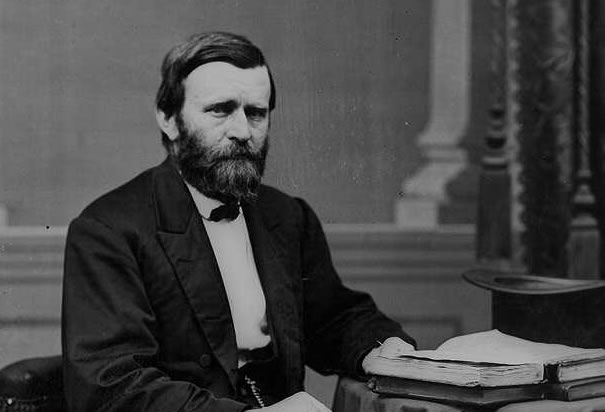
President Ulysses S. Grant

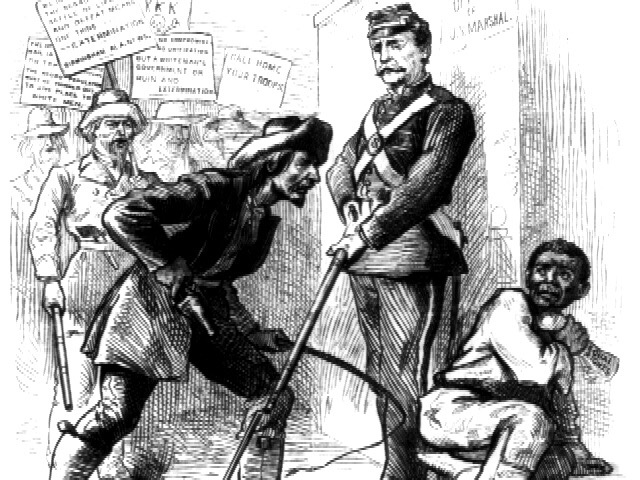
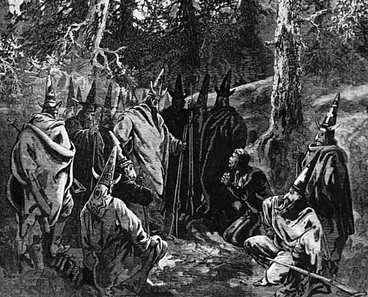
The passage of the Fourteenth and Fifteenth Amendments provoked even more violence from enraged Southerners. Thousands of Southerners, many former Confederate soldiers, formed a variety of violent racist organizations which turned the violence from sporadic attacks to what amounted to a full-fledged insurgency against the new Reconstructionist state governments and African Americans. Organizations like the Ku Klux Klan which engaged in terroristic violence while heavily armed so called  “social clubs” that operated under the aegis of the state Democratic Party leadership in most Southern states did the same. Under the leadership of former Confederate general Nathan Bedford Forrest whose troops had conducted the Fort Pillow massacre, the Klan’s membership throughout the South “was estimated at five hundred thousand” [1] and the majority were former Confederate soldiers. As the shadowy organization grew it became bolder and more violent in its attacks on African Americans, Republican members of the Reconstruction governments, and even Southern Jews.

64982-004-E91C3D02

Early KKK Gathering

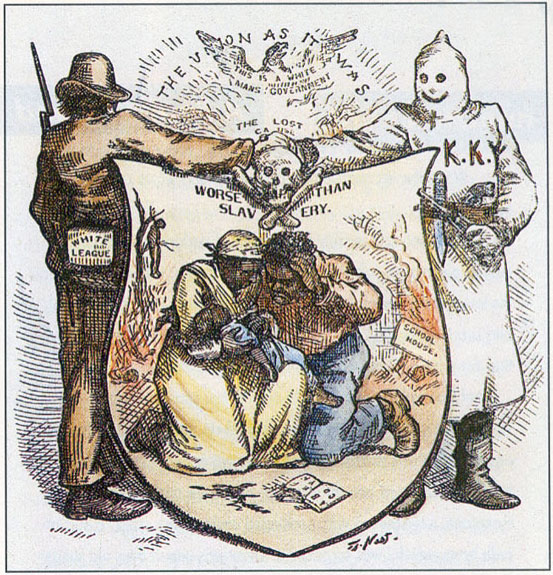
Allegedly organized for self-defense against state militia units composed of freed blacks they named themselves “White Leagues (Louisiana), White Liners or Rifle Clubs (Mississippi), or Red Shirts (South Carolina). They were, in fact, paramilitary organizations that functioned as armed auxiliaries of the Democratic Party in southern states in their drive to “redeem” the South from “black and tan Negro-Carpetbag rule.” [2] These men, mostly Confederate veterans “rode roughshod over the South, terrorizing newly freed slaves, their carpetbagger allies, and anyone who dared to imagine a biracial democracy as the war’s change.” [3] This unrequited violence and hatred set the stage for the continued persecution, murder and violence against blacks and those who supported their efforts to achieve equality in the South for the next century.

Throughout his term in office Johnson appealed to arguments used throughout later American history by “critics of civil rights legislation and affirmative action. He appealed to fiscal conservatism, raised the specter of an immense federal bureaucracy trampling on citizens’ rights, and insisted that self-help, not government handouts, was the path to individual advancement.” [4]

black-voter-threatening

White League Members Intimidating Blacks at the Polls

Ulysses S. Grant succeeded Johnson as President in 1869. “For Grant, freedom and equal rights were matters of principle, not symbolism.” [5] Grant used his political capital to fight for the passage of the Fifteenth Amendment which gave black men the right to vote. It was one of the things that he remained most proud of in his life, he noted, “A measure which makes at once four million people voter who were heretofore declared by the highest tribunal in the land to be not citizens of the United States, nor eligible to become so…is indeed a measure of grander importance than any other act of the kind from the foundation of our free government to the present day.” [6] Grant ordered his generals in the South to enforce the Reconstruction Act and when the Ku Klux Klan attempted to stop blacks from voting Grant got Congress to pass the “enforcement Act, which made racist terrorism a federal offense.” [7] He created the Justice Department to deal with crimes against Federal law and in 1871 pushed Congress to pass a law known as the Ku Klux Klan Act and sent in the army and federal agents to enforce the law.

KKK-Nast

White League and KKK Poster

Grant’s efforts using the military as well as agents of the Justice Department and the Secret Service against the Klan were hugely successful, thousands were arrested, hundreds of Klansmen were convicted and others were either driven underground or disbanded their groups. The 1872 election, was the first and last in which blacks were nearly unencumbered as they voted until the passage of the 1964 Civil Rights Act and 1965 Voting Rights Act.

However, Grant’s actions triggered a political backlash which doomed reconstruction. The seminal moment in this came 1873 when General Philip Sheridan working in Louisiana, asked Grant for “permission to arrest leaders of the White League and try them by courts-martial” [8] for their violent acts against blacks and their seizure of the New Orleans City Hall in a brazen coup attempt. The leak of Sheridan’s request sparked outrage and even northern papers condemned the president’s actions in the harshest of terms.

Apart from the effort to support voting rights for African Americans Grant’s efforts at Reconstruction were met mostly by failure. Part of this was due to a weariness on the part of many Northerners to continue to invest any more effort into the effort. Slowly even proponents of Reconstruction began to retreat from it, some like Carl Schurz were afraid that the use of the military against the Klan in the South could set precedent to use it elsewhere. Others, embraced an understanding of Social Darwinism which stood against all types of government interference what they called the “natural” workings of society, especially misguided efforts to uplift those at the bottom of the social order…and African Americans were consigned by nature to occupy the lowest rungs of the social ladder.” [9]

Southerners knew that they were winning the political battle and continued their pressure in Congress and in the media to demonize supporters of Reconstruction as well as African Americans. Southerners worked to rig the political and judicial process through the use of terror to demoralize and drive from power anyone, black or white, who supported Reconstruction. By 1870 every former Confederate state had been readmitted to the Union, in a sense fulfilling a part Lincoln’s war policy, but at the same time denying what the war was waged for.

To be continued….

Notes

[1] Ibid. Lane The Day Freedom Died p.230

[2] Ibid. McPherson The War that Forged a Nation p. 178

[3] Ibid. Jordan Marching Home p.118

[4] Ibid. Foner Forever Free p.116

[5] Ibid. Lane The Day Freedom Died: p.2

[6] Flood, Charles Bracelen, Grant’s Final Victory: Ulysses S. Grant’s Heroic Last Year DaCapo Press, Boston 2011 pp.78-79

[7] Ibid. Lane The Day Freedom Died p.4

[8] Ibid. Langguth, A.J. After Lincoln p.314

[9] Ibid. Foner Forever Free pp.192-193

3 Comments

Filed under civil rights, civil war, History, Political Commentary

The Unreconstructed President: Andrew Johnson

Friends of Padre Steve’s World

I am going to be exploring the issue of the abolition of slavery and Reconstruction after the Civil War. Sadly, the effort to integrate society and to ensure that African Americans had the same rights, political, social, legal, economic and educational as whites failed due to a number of factors. The biggest factor was that former Confederates continued the war by other means until they wore down the will of the North and reestablished white supremacy in all areas of Southern life and in the process re-wrote history in the form of the myth of the Lost Cause, something that continues even today with the new Texas history textbooks which promote that myth, minimize slavery and not even talk about Jim Crow. 

Yesterday I received a comment from an officer of the Sons of Confederate Veterans and the Georgia Military Order of the Stars and Bars calling my work revisionism and spouting the lies of the sanitized history presented by such groups.  That has emboldened me to continue my work on this subject. Here is a part of my text dealing with the immediate aftermath of the Civil War and the work of President Andrew Johnson to subvert the efforts of Congress and those who worked to provide African Americans the basics to lift themselves out of the hole dug for them by their White masters before the war. 

So I continue today,

Peace

Padre Steve+

10467FS_DA_090409_worst-johnson

Andrew Johnson

Colin Gray writes that “A successful exercise in peacemaking should persuade the defeated party to accept its defeat.” [1] When the war ended the Confederacy was beaten and most people in the South would have agreed to anything that the North presented regarding peace and return to the Union. The primary political policy goal of Lincoln regarding the war was the reestablishment of the Union and one of the military measures adopted by Lincoln was the emancipation of the South’s slaves who were an important part of the Southern war economy. “During the last two years of the war the abolition of slavery evolved from a means of winning the war to a war aim – from national strategy to national policy.” [2] By Lincoln’s reelection in 1864 that policy included the unconditional surrender of the Confederacy as well as the passage of the Thirteenth Amendment.

That change in policy, the complete abolition of slavery necessitated a remaking of the old South, a culture where economics, social standing and even religion was linked to the “peculiar institution.” In a sense Reconstruction was “what the war was about.” [3] Just two months after Lee’s surrender at Appomattox, Richard Henry Dana, a Federal District Attorney in Boston, declared that “a war is over when its purpose is secured. It is a fatal mistake to hold that this war is over because the fighting has ceased. This war is not over…” [4] As Dana, and Clausewitz understood so well that war is a continuation of policy and politics by other means, and the failure of the President Johnson and others in the North to fully grasp this fact led to over a century of subjugation of emancipated African Americans. The confusion and lack of determined purpose has fueled a continual racial divide in the United States that is still felt today. Defeated on the battlefield Southerners soon turned to political, psychological and violent means to reverse their losses.

Douglass.JPG

Frederick Douglass

Frederick Douglass understood that simple emancipation was not enough, and that the “war and its outcome demanded racial equality.” [5] Despite the that efforts of many in the North this would not happen during Reconstruction and Douglass knew that the failure to accomplish this would be disastrous, “Whether the tremendous war so heroically fought…shall pass into history a miserable failure…or whether on the other hand, we shall, as the rightful reward of victory over treason have a solid nation, entirely delivered from all contradictions and social antagonisms, must be determined one way or another.” [6]

There was a problem with implementing Reconstruction; when John Wilkes Booth assassinated Abraham Lincoln, the political leaders of the North could not agree on how to do this. The new President, Andrew Johnson was probably the worst possible leader to lead the country in the aftermath of war for all practical purposes Johnson was a Democrat who believed in white supremacy, he had been brought onto the ticket for his efforts to keep Kentucky in the Union and to support Unionist elements in Tennessee. While his selection helped Lincoln in parts of the North and the Border States it was a disaster for the post-war era. Johnson’s approach to reconstruction was very simply to “impose minimal demands on the South. He required only minor concessions from the former Confederates before allowing them to resume their political rights and retain their land. As for freedmen, he seemed to think that the needed no further protection beyond the fact of their emancipation.” [7]

Johnson was “a lonely stubborn man with few confidants, who seemed to develop his policies without consulting anyone, then stuck to them inflexibly in the face of any and all criticism. He lacked Lincoln’s ability to conciliate his foes and his capacity for growth, which was best illustrated by Lincoln’s evolving attitude to black suffrage during the Civil War.” [8] In the months after his unexpected accession to the presidency Johnson demonstrated that he had no understanding of Lincoln’s political goals for the South and the desires of the Republican dominated Congress.

By the summer of 1865 Johnson was already demonstrating “that his sympathies were with the Southern white population and that he believed that their interests should be cared for even at the expense of freedmen.” [9] Johnson’s approach to reconstruction was very simply to “impose minimal demands on the South. He required only minor concessions from the former Confederates before allowing them to resume their political rights and retain their land. As for freedmen, he seemed to think that the needed no further protection beyond the fact of their emancipation.” [10] Johnson gave individual pardons to more than thirteen thousand “high-ranking Confederate civil and military officers and wealthy Southerners.” [11] While doing this he minimized political influence the Southern Unionists who had not supported the Confederacy and ensured that freed slaves were excluded from the political process. He issued a number of orders “appointing interim provisional governors and urging the writing of new state constitutions based upon the voter qualifications in force at the time of secession in 1861 – which meant, in large but invisible letters, no blacks.” [12]

When Frederick Douglass led a delegation of blacks to meet with Johnson in February 1866 Johnson preached that it was impossible to give political freedom to blacks. When Douglass attempted to object Johnson became angry and told Douglass “I do not like to be arraigned by some who can get up handsomely-rounded periods and rhetoric, and talk about abstract ideas of liberty, who never periled life, liberty, or property.” [13] When Douglass took his objections to Johnson’s harangue to a Washington newspaper, Johnson railed against Douglass “I know that d—–d Douglass…he’s just like any other nigger & would sooner cut a white man’s throat than not.” [14]

To be continued…

Notes

[1] Ibid. Gray Fighting Talk p.14

[2] Ibid. McPherson The War that Forged a Nation p. 132

[3] Perman, Michael and Murrell Taylor, Amy editors The Civil War and Reconstruction Documents and Essays Third Edition Wadsworth Cengage Learning Boston MA 2011 p.323

[4] Ibid. McPherson The War that Forged a Nation p. 175

[5] Ibid. Goldfield America Aflame p.407

[6] Ibid. Goldfield America Aflame p.407

[7] Ibid. Perman and Taylor The Civil War and Reconstruction Documents and Essays Third Edition p.323

[8] Foner, Eric Forever Free: The Story of Emancipation and Reconstruction Vintage Books a Division of Random House, New York 2005 p.108

[9] Carpenter, John A. Sword and Olive Branch: Oliver Otis Howard Fordham University Press, New York 1999 p.109


[10] Ibid. Perman and Taylor The Civil War and Reconstruction Documents and Essays Third Edition p.323

[11] Ibid. McPherson The War that Forged a Nation p. 177

[12] Ibid. Guelzo Fateful Lightening p.490

[13] Ibid. Guelzo Fateful Lightening p.494

[14] Ibid. Guelzo Fateful Lightening p.494

Leave a comment

Filed under civil rights, civil war, History, Political Commentary

Yes it Was About Slavery

slavescars

Friends of Padre Steve’s World

I have began to write about racism in regard to the Confederate Flag controversy and what I call the “sanitized history” of organizations such as the Sons of Confederate Veterans which in their revisionist history seek to divorce the actions of Confederate soldiers from the cause for which they fought. As a disclaimer, I could be a member of the Sons of Confederate Veterans based on the service of members of both sides of my family in the Confederate army. Likewise, if I was a real white Supremacist I could boast of my family’s slave owning past in the western part of Virginia, the land now known as West Virginia. Yes, my family were slave owners who fought for the Confederacy. At one time in my young life I was proud of that. but as a historian who is all for “unsanitized” history I have to admit that the sanitized history of the Lost Cause is not history, it is at best a romantic myth, but more correctly a bold faced lie. 

So tonight I post a section of my Civil War and Gettysburg text. I hope that it is both challenging and thought provoking. You can expect a number of posts dealing with this issue in the coming days.

Have a nice and thoughtful night,

Peace

Padre Steve+

If we are to really understand the Civil War we have to understand the ideological clash between Abolitionists in the North, and Southern proponents of slavery. Both the ideologies of the Abolitionists who believed that African Americans were created by God and had the same rights as whites, as well as the arguments of Southern political leaders that blacks were inferior and slavery was a positive good, were buttressed by profoundly religious arguments which were related directly to a divergence in values. These diverging values crept into every aspect of life and as such it was this “conflict of values, rather than a conflict of interests or a conflict of cultures, lay at the root of the sectional schism.” [1]

Slavery was the key issue that permeated all aspects of the Civil War to include the cultural, the economic and the ideological. David M. Potter summed up this understanding of the connection between the ideological, cultural and economic aspects of the conflict and just how the issue of slavery connected all three realms in the American Civil War:

“These three explanations – cultural, economic and ideological – have long been the standard formulas for explaining the sectional conflict. Each has been defended as though it were necessarily incompatible with the other two. But culture, economic interest, and values may all reflect the same fundamental forces at work in a society, in which case each will appear as an aspect of the other. Diversity of culture may produce both diversity of interests and diversity of values. Further, the differences between a slaveholding and a nonslaveholding society would be reflected in all three aspects. Slavery represented an inescapable ethical question which precipitated a sharp conflict of values.” [2]

Sadly this is something that those who study the war from a purely military perspective tend to miss, or even willingly gloss over in order make the war more palatable to their own prejudice tend to “blur the reality that slavery was at the heart of the matter, ignore the baser realities of the brutal fighting, romanticize our own home-grown terrorist organization, the Ku Klux Klan, and distort the consequences of the Civil War that still intrude on our national life.” [3] For many people it is far easier not to deal with the harsh reality that slavery and racism was at the heart of the issue and escape to the bloodless romanticism which even ignores the human cost of the war, approximately 750,000 military dead alone. If we extrapolate the percentage of the population that that 750,000 represents and compared it to today’s census that number would be the equivalent of 7.5 million Americans dead. This is a fact that many Civil War buffs tend to ignore.

The political ends of the Civil War grew out of the growing cultural, economic, ideological and religious differences between the North and South that had been widening since the 1830s. However, slavery was the one issue which helped produce this conflict in values and it was “basic to the cultural divergence of the North and South, because it was inextricably fused into the key elements of southern life – the staple crop of the plantation system, the social and political ascendency of the planter class, the authoritarian system of social control.” [4] Without slavery and the Southern commitment to an economy based on slave labor, the southern economy would have most likely undergone a similar transformation as what happened in the North; thus the economic divergence between North and South would “been less clear cut, and would have not met in such head-on collision.” [5] But slavery was much more than an economic policy for Southerners; it was a key component of their religious, racial and philosophic worldview.

The issue of slavery even divided the ante-bellum United States on what the words freedom and liberty meant. The dispute can be seen in the writings of many before the war, with each side emphasizing their particular understanding of these concepts. In the South, freedom was reserved for those who occupied the positions of economic power; slavery was key to that from not only an economic point of view but as a social philosophy. The concept of human equality, which was so much a part of the Declaration of Independence was downplayed George Fitzhugh, a planter and slave owner in eastern Virginia commented that that concept “is practically impossible, and directly conflicts with all government, all separate property, and all social existence.” [6]

The political philosophy such as Fitzhugh’s, which was quite common, was buttressed by a profound religious belief that it was the South’s God ordained mission to maintain and expand slavery. One Methodist preacher in his justification of slavery wrote, “God as he is infinitely wise, just and holy never could authorize the practice of moral evil. But God has authorized the practice of slavery, not only by bare permission of his providence, but by the express permission of his word.” [7] Buttressed by such scriptural arguments Southerners increasingly felt that they were the only people following God. The Northern abolitionists as well as those who advocated for the concept of human equality and free labor were heretics to be damned. As such the “South’s ideological isolation within an increasingly antislavery world was not a stigma or a source of guilt but a badge of righteousness and a foundation for national identity and pride.” [8]

Speaking of the necessity for slavery, as well as limitations on the equality of human beings no matter what their race or sex, Fitzhugh penned words that explained that human relationships were not to be seen in terms of individual liberty, “but in relations of strict domination and subordination. Successful societies were those whose members acknowledged their places within that hierarchy.” [9]

Fitzhugh was quite caustic when he discussed the real implications of his philosophy:

“We conclude that about nineteen out of twenty individuals have “a natural and inalienable right” to be taken care of and protected, to have guardians, trustees, husbands or masters; in other words they have a natural and inalienable right to be slaves. The one in twenty are clearly born or educated in some way fitted for command and liberty.” [10]

Fitzhugh’s chilling conclusion was summarized in the words “Liberty for the few – slavery in every form, for the mass.” [11]

But many Southerners, including many poor whites, especially the Yeoman farmers who were the backbone of the Southern populace did not see or understand the limitations that were placed on their own liberty by the slavery system and instead saw slavery as the guarantee of their economic freedom. John C. Calhoun said to the Senate in 1848 that “With us, the two great divisions of society are not the rich and poor, but white and black; and all of the former, the poor as well as the rich, belong to the upper class, and are respected and treated as equals.” [12] Calhoun’s racial distinction is important if we are to understand why poor whites would fight and die for a social and economic idea that did not benefit them or their families.

But it was Abraham Lincoln, who cut to the heart of the matter when he noted the difference between his understanding of liberty and that of Calhoun and others in the South who defended slavery and the privileges of the Southern oligarchs:

“We all declare for liberty” but “in using the same word we do not all mean the same thing. With some the word liberty may mean for each man to do as he pleases with himself and the product of his labor; while with others the same word may mean for some men to do as they please with other men and the product of other men’s labor.” [13]

The growing economic disparity between the Slave and Free states became more about the expansion of slavery in federal territories as disunion and war approached; for a number of often competing reasons. These differences, amplified by the issue of slavery led to the substitution of stereotypes of each other and had the “effect of changing men’s attitudes toward the disagreements which are always certain to arise in politics: ordinary, resolvable disputes were converted into questions of principle, involving rigid, unnegotiable dogma.” [14] The Charleston Mercury noted in 1858 “on the subject of slavery…the North and the South…are not only two peoples, but they are rival, hostile peoples.” [15]

This was driven both by the South’s insistence on both maintaining slavery where it was already legal and expanding it into new territories which was set against the vocal abolitionist movement. But Southern exponents of expanding slavery were fighting an even more powerful enemy than the abolitionists, who despite their vocal protests were not yet in a position to influence policy. They were now fighting Northern industrialists who were not as idealistic as the abolitionists who were much more concerned with “economic policy designed to secure Northern domination of Western lands than the initial step in a broad plan to end slavery.” [16]

This competition between the regions not only affected politics, it affected religion and culture. In the South it produced a growing culture of victimhood, which was manifest in the words of Robert Toombs who authored Georgia’s declaration of causes for secession:

“For twenty years past, the Abolitionists and their allies in the Northern states, have been engaged in constant efforts to subvert our institutions, and to excite insurrection and servile war among us…” whose “avowed purpose is to subject our society, subject us, not only to the loss of our property but the destruction of ourselves, our wives and our children, and the dissolution of our homes, our altars, and our firesides.” [17]

As the social, economic, cultural and religious differences between the two regions grew wider and the people of the South became ever more closed off from the North. “More than other Americans, Southerners developed a sectional identity outside the national mainstream. The Southern life style tended to contradict the national norm in ways that life styles of other sections did not.” [18]

The complex relationship of Southern society where “Southern bodies social, economic, intellectual, and political were decidedly commingled” [19] came to embrace the need for slavery and its importance to Southern society. This occurred despite the fact that the system did not benefit poor whites in the South and actually harmed them economically. The Southern: “system of subordination reached out still further to require a certain kind of society, one in which certain questions were not publically discussed. It must give blacks no hope of cultivating dissention among the whites. It must commit non slaveholders to the unquestioning support of racial subordination…. In short, the South became increasingly a closed society, distrustful of isms from outside and unsympathetic to dissenters. Such were the pervasive consequences of giving top priority to the maintenance of a system of racial subordination.” [20]

Southern planters declared war on all critics of their “particular institution” beginning in the 1820s. As Northern abolitionists like William Lloyd Garrison and his newspaper The Liberator grew in its distribution and began to appear in the South various elected officials throughout the South “suppressed antislavery books, newspapers, lectures, and sermons and strove generally to deny critics of bondage access to any public forum.[21] Despite this resistance, abolitionists continued to use the U.S. Mail service to send their literature south provoking even more drastic action from Southern legislators.

In response to the proliferation of abolitionist literature in the South, John C. Calhoun proposed that Congress pass a law to prosecute “any postmaster who would “knowingly receive or put into the mail any pamphlet, newspaper, handbill, or any printed, written, or pictorial representation touching the subject of slavery.” [22] Calhoun was not alone as other members of Congress as well as state legislatures worked to restrict the import of what they considered subversive and dangerous literature.

Beginning in 1836 the House of Representatives, led by Southern members of Congress passed a “gag rule” for its members which “banned all petitions, memorials, resolutions, propositions, or papers related in any way or to any extent whatever to the subject of slavery.” [23] Former President John Quincy Adams challenged the gag-rule in 1842, as did a number of others. The pressure was such that finally in 1844 the House voted to rescind it.

However, Southern politicians were unhappy with this measure and “began to spout demands that the federal government and the Northern states issue assurances that the abolitionists would never be allowed to tamper with what John Calhoun had described as the South’s “peculiar domestic institution.” [24] As tensions grew between the regions, the issue of slavery more than any other issue “transformed political action from a process of accommodation to a mode of combat.” [25]

Around the same time as the gag rule was played out in Congress the Supreme Court had ruled that the Federal government alone “had jurisdiction where escaped slaves were concerned” which resulted in several states enacting “personal liberty laws” to “forbid their own elected officials from those pursuing fugitives.” Southern politicians at the federal and state levels reacted strongly to these moves, which they believed to be an assault on their institutions and their rights to their human property. Virginia legislators said these laws were a “disgusting and revolting exhibition of faithless and unconstitutional legislation.” [26]

The issue of slavery shaped political debate and “structured and polarized many random, unoriented points of conflict on which sectional interest diverged.” [27] As the divide grew leaders and people in both the North and the South began to react to the most distorted images of each other imaginable- “the North to an image of a southern world of lascivious and sadistic slave drivers; the South to the image of a northern world of cunning Yankee traders and radical abolitionists plotting slave insurrections.” [28]

Notes

[1] Potter, David M. The Impending Crisis: America before the Civil War 1848-1861 completed and edited by Don E. Fehrenbacher Harper Collins Publishers, New York 1976 p.41

[2] Ibid. Potter The Impending Crisis p.41

[3] Burns, Ken A Conflict’s Acoustic Shadows in The New York Times Disunion: Modern Historians Revisit and Reconsider the Civil War from Lincoln’s Election to the Emancipation Proclamation Black Dog and Leventhal Publishing, New York 2013 p.102

[4] Ibid. Potter The Impending Crisis p.42

[5] Ibid. Potter The Impending Crisis p.42

[6] Levine, Bruce Half Slave and Half Free: The Roots of the Civil War Revised Edition, Hill and Wang, a division of Farrar, Strauss and Giroux, New York 1992 and 1995 p.140

[7] Daly, John Patrick When Slavery Was Called Freedom: Evangelicalism, Proslavery, and the Causes of the Civil War The University Press of Kentucky, Lexington KY 2002 pp.63-64

[8] Faust, Drew Gilpin The Creation of Confederate Nationalism: Ideology and Identity in the Civil War South Louisiana State University Press, Baton Rouge and London p.61

[9] Ibid. Levin Half Slave and Half Free p.140

[10] Ibid. Levin Half Slave and Half Free p.140

[11] Ibid. Levin Half Slave and Half Free p.141

[12] McPherson, James M. Drawn With the Sword: Reflections on the American Civil War Oxford University Press, Oxford and New York 1996 p.50

[13] Ibid. Levin Half Slave and Half Free p.122

[14] Ibid. Potter The Impending Crisis p.43

[15] Ibid. McPherson Drawn With the Sword p.16

[16] Egnal, Marc Clash of Extremes: The Economic Origins of the Civil War Hill and Wang a division of Farrar, Straus and Giroux New York 2009 p.6

[17] Dew, Charles B. Apostles of Disunion: Southern Secession Commissioners and the Causes of the Civil War University Press of Virginia, Charlottesville and London 2001 p.12

[18] Thomas, Emory The Confederate Nation 1861-1865 Harper Perennial, New York and London 1979 p.5

[19] Ibid. Thomas The Confederate Nation p.5

[20] Ibid. Potter The Impending Crisis pp.457-458

[21] Ibid. Levine Half Slave and Half Free p.166

[22] Ibid. Guelzo Fateful Lightening pp.50-51

[23] Ibid. Levine Half Slave and Half Free pp.169-170

[24] Ibid. Guelzo Fateful Lightening pp.51-52

[25] Ibid. Potter The Impending Crisis p.43

[26] Ibid. Levine Half Slave and Half Free pp.169-170

[27] Ibid. Potter The Impending Crisis p.43

[28] Ibid. Potter The Impending Crisis p.43

5 Comments

Filed under civil rights, civil war, History, Political Commentary

The Sanitized History of the Lost Cause

Friends of Padre Steve’s World,

I am out tilting at windmills again and this one needs to be tilted at…

confederate-flag-picture

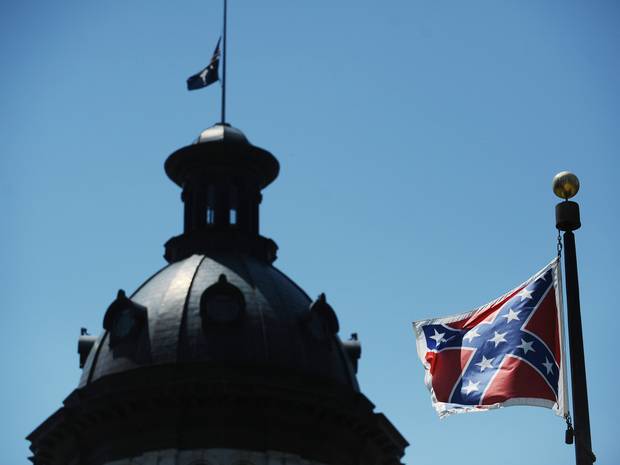
It seems that the organization known as the Sons of Confederate Veterans is not happy with the fact that the most prominent symbol of the Confederacy is coming down. This has been very apparent at the group’s convention in Richmond this week. Their anger is not only directed at the removal of the Confederate flag from the South Carolina State House, but at Supreme Court siding with Texas not to issue license plates with the Confederate flag on them, the decision of Virginia to eliminate the sons of Confederate Veteran plate which displays the battle flag, and moves to change the name of U.S. Highway One, known as the Jefferson Davis Highway to something other than that of the President of the Confederacy.

Frank Earnest, the former commander of the SCV’s Virginia division displayed the ignorance of years of sanitized history by telling the Richmond Times Dispatch that the removal of the flag and stripping highways of the names of Confederate leaders “It’s cultural genocide, everything about a four-year period where Virginia and other Southern states fought for their rights, we’re gonna eradicate any of that. That is something that’s done in dictatorial countries, not in the United States of America.”

For Earnest and those who think like him the war, and the sacrifice can be separated from the root cause of the war, which was White Supremacy and the expansion of slavery as well as the violence actions committed by the thousands of former Confederate soldiers who spearheaded the formation of terrorist groups such as the Ku Klux Klan, the White Leagues, the White Liners and the Red Shirts. Sadly, to millions of school children brought up in the South from the end of the war and in some cases even today, these issues are ignored. It is sanitized history which denies that slavery was the major cause of the war, it denies the systematic racism of those who founded the Confederacy, it denies the fight of White Supremacists throughout the South for the century following the war and beyond used systematic violence to terrorize, kill, disenfranchise and impoverish African Americans throughout the South. In fact the new Texas history books do exactly that.

While it is not as systematized as it was there are still thousands across the South and even the rest of the country who believe that telling the truth about history is cultural genocide and this my friends needs to be confronted every day and every time that men like Earnest make these bold faced lies about history. Jefferson Davis does not deserve a highway named after him, nor does Henry Benning, the pro-slavery, pro-secession firebrand who worked to persuade other states to secede does not deserve Fort Benning George to be named after him. Perhaps it should be renamed for Confederate Lieutenant General James Longstreet, another Georgian who after Appomattox recanted his Confederate views, swore his loyalty to the Federal government, tried to stem violence against blacks during Reconstruct and who is treated like Judas Iscariot by the Sons of Confederate Veterans and other proponents of the Lost Cause.

My God, I am going to be writing more on this subject, but will pause for now.

Have a wonderful and thoughtful night,

Peace

Padre Steve+

5 Comments

Filed under civil rights, civil war, leadership, Political Commentary

Truth and Un-sanitized History

10570298_10152872503382059_5058681841617456899_n

Friends of Padre Steve’s World,

I have spent the last couple of days introducing to new readers to things that I have come to believe. Since I am a historian I will continue to do that today.

I have a passion for truth, especially in the realm of historical thought, in fact over the past few years this passion has deepened to a level of profoundness that I never dreamed. In fact for me this passion has become a duty, a duty to truth; an un-sanitized, warts and all examination of subjects attempting to strip away the veneer of myth in order to find truth. This is not easy, but it is what my life has become, knowing that in the long run I will not discover all truth, but hopefully point others to examine history, the sciences, philosophy and even theology to find truth. The process can be uncomfortable, especially when confronted by facts, documents, scientific and archeological data which shows what we used to think was truth, as either incomplete, romantic myth, or even complete lies, untruths and fabrication. Oscar Wilde once wrote,“The truth is rarely pure and never simple.”

Barbara Tuchman once wrote: “The reality of a question is inevitably more complicated than we would like to suppose.” That is the nature of truth. It does not matter if it is truth about history, biography, philosophy and religion, science, politics, economics or any part of life. To actively seek truth means that one must open up themselves to the possibility of doubting, as Rene Descartes wrote: “If you would be a real seeker after truth, it is necessary that at least once in your life you doubt, as far as possible, all things.” I admit that this is not comfortable, but it is necessary.

As a historian I have a tremendous passion for truth, and for unsanitized history and for me this means looking at what we know with a critical eye, to compare and examine sources to question what we or others knew before. Far too often what we believe about our own history is often more preserving myth more than by asking hard questions and applying reasoned critical study. To do this is dangerous, because to do so we have to admit that what we know today could be proven wrong at some time in the future when new facts, documents, archeological finds or other historical or scientific are discovered. To those content with half-truth, partial truth or even myth this is disconcerting, and those of us who attempt to unravel myth from fact and present things in a new way are called “revisionists” as if that is somehow a bad thing. The sad thing is we are having to revise in many cases, supposed history that was revised by people who needed to propagate myth, such as with those who promoted the myth of the Lost Cause, the romantic, noble Confederacy which for well over a half century was propagated as historical truth. This myth was sold to the American public in such in film, television and books, fiction and non-fiction alike, to the point that much of white America, even outside the South accepted the myth of the Lost Cause as truth. Films like Birth of a Nation, Gone with the Wind and even Disney’s Song of the South, helped ingrain the myth as truth, and even today when so much more is known, many people hold on to the myth and attack those who differ. 

A lot of my readers may wonder why I write so much about the American Civil War as well as the ante-bellum and Reconstruction eras of American history. For me they are very important for a couple of reasons; first they are eras, that for good and bad define us as a nation and people. Second, they still have relevance to what happens today, especially in the understanding of liberty, civil rights and race relations.

I have a passion for this. The American Civil War and the Battle of Gettysburg are intrinsic parts of who we are as Americans today. The events of that war and this battle continue to reverberate in many aspects of our political, social and national life. Thus for me teaching about this event and what happened on the “hallowed ground” of Gettysburg, as Abraham Lincoln called it, and even 150 years later it matters far more than most of us realize.

Civil War hero Joshua Chamberlain is an icon of the Civil War and American history. A professor of Rhetoric and Natural and Revealed Religions at Bowdoin College he volunteered to serve with the 20th Maine Infantry, his military career in the Civil War has been depicted in movies such as Gettysburg and Gods and Generals and written about in biographies and even historical fiction. Chamberlain was one of the heroes of Gettysburg, and his story has a myth like quality, but he too was a complex, contradictory and sometimes flawed character. However, Chamberlain attached a great importance to passing down the stories of people who did noble deeds and who lived exemplary lives. He wrote, “The power of noble deeds is to be preserved and passed on to the future.”

I sincerely believe what Chamberlain said and I am getting ready to lead another Staff Ride for students from our Staff College to Gettysburg next month.  I do beleive that the power of noble deeds needs to be preserved and passed on to the future.  Even the deeds of less than perfect, often contradictory and sometimes even scandalous  individuals. That is part of the task of the historian. I do this in what I teach and what I write, both in the academic setting as well as on this website.

We live in a time of great cynicism, some of which I can understand. We also live in a time where many people and our institutions operate in a “zero defect” culture, those who fail in any way are shunted aside, punished or even chastised or ostracized. However, when I look at the men who fought at Gettysburg, or for that matter almost any individual who has accomplished great things, none are perfect people and many have great flaws in character, or supported causes or ideologies that were evil. That being said, even less than perfect people can rise to do great deeds, deeds that need to be remembered, passed down and told to succeeding generations.

Many great leaders, or other men and women that we consider today to be great, influential or important were or are quite fallible. Even those who did great things often made gross mistakes, had great flaws in their character, and some lived scandalous lives. Such deeds may tarnish their legacy or take some of the luster away from their accomplishments. But I think that these flaws are often as important as their successes for they demonstrate the amazing capacity of imperfect people to accomplish great things, as well as the incredible complexity of who we are as people. No one is perfect. There are degrees of goodness and even evil in all of us. It is part of the human condition. That is the beauty of un-sanitized history, that is the beauty of stripping away myth to discover the humanity of people, and to recognize who they are, who we are, the good, the bad and even the ugly.

When I look at the perfection that imperfect people expect of others I am reminded of something that William Tecumseh Sherman said about his relationship with Ulysses Grant. These were flawed men, but they were in large part responsible for the Union victory in the Civil War. However, to be honest, neither man would never reach the level of command that they rose to in our current military culture, nor would they rise to the top in corporate America. They are too flawed. Sherman said it well, “Grant stood by me when I was crazy, and I stood by him when he was drunk, and now we stand by each other.” 

That is a part of my passion about Gettysburg and my appreciation and admiration of the brave men who fought in that battle. As I continue to write about that battle and about those men I hope that my readers will gain a new appreciation of their complex and contradictory natures, as well as think about what that means to us today, as individuals and as a society, for it is only when we strip away the myth and seek the truth. Marcus Aurelius wrote:

“If someone is able to show me that what I think or do is not right, I will happily change, for I seek the truth, by which no one was ever truly harmed. It is the person who continues in his self-deception and ignorance who is harmed.”

Those truths can be scientific, they can be historical or literary, and quite often the truth can also be quite personal.

As John F Kennedy said at Yale in 1962: “The great enemy of truth is very often not the lie–deliberate, contrived and dishonest–but the myth–persistent, persuasive and unrealistic. Too often we hold fast to the cliches of our forebears. We subject all facts to a prefabricated set of interpretations. We enjoy the comfort of opinion without the discomfort of thought.”

So until tomorrow, have a thoughtful night.

Peace

Padre Steve+


1 Comment

Filed under civil war, History, philosophy

Confederate Sunset in South Carolina 

confederate-flag

Friends of Padre Steve’s World

Historian George Santayana said “Loyalty to our ancestors does not include loyalty to their mistakes.” Today it appears that at least one legislature and governor has agreed with him.

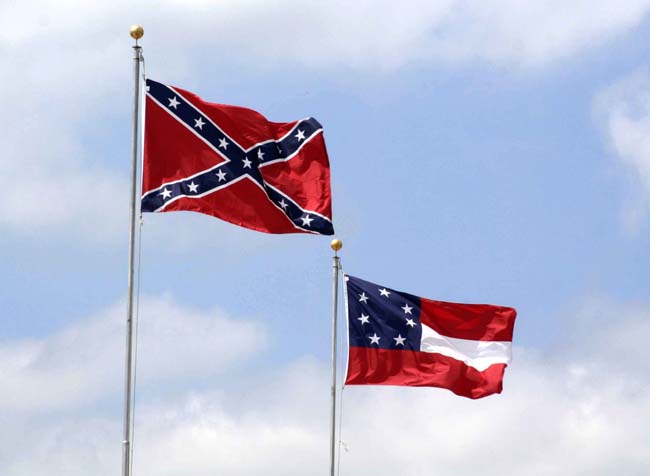
This afternoon South Carolina Governor Nikki Haley signed a bill passed by overwhelming majorities in the South Carolina Senate and House to remove the Confederate Battle flag from grounds of the South Carolina State Capital. The ceremonial lowering will occur at 10 AM tomorrow, July 10th 2015, when it is lowered it will be transferred to a museum, which is an appropriate place. 

This is important, I did not imagine that it would occur in my lifetime, and I expect to live a fair number of years. The sad thing is that it took the murder of nine innocent African American church members at Emmanuel African American Episcopal Church in Charleston by a young man named Dylan Roof, who harbored White Supremacist dreams of a race war to bring this about. It took the abject horror of people being murdered in church to do make people begin to realize that maybe, just maybe that continuing to display this symbol of the Confederacy on state grounds was not a good idea.

I know that there are many who defend that flag. I am not among them, although I once was as members of both sides of my family fought under it during the Confederate rebellion against the United States. But it does belong to history and what it stood for, not what it stands for in myth, but what it stood for the men who raised it in rebellion in order to defend and expand what they referred to as the “peculiar institution,” the political, social, religious and economic system known as slavery.  That is a fact, simply read Confederate Vice President Alexander Stephen’s Cornerstone Speech of 1861 where he said:

“Our new government is founded upon exactly the opposite idea; its foundations are laid, its corner- stone rests upon the great truth, that the negro is not equal to the white man; that slavery — subordination to the superior race — is his natural and normal condition. [Applause.] This, our new government, is the first, in the history of the world, based upon this great physical, philosophical, and moral truth.”

In fact if you read every declaration of secession issued by the various states of the Confederacy, all insist that slavery was the main issue for which they seceded and for which they went to war. That did not change during the war and after the fighting was over, the flag of the Confederacy became the standard of White Supremacists throughout the South as they worked in the legislatures and in the courts to roll back the rights of blacks, using violence, intimidation and fraud to do so.

However, it was not until April 11th 1961 during the early days of the Civil Rights movement that the legislature of South Carolina voted to fly the Confederate Battle Flag over the state house in Columbia. This coincided with the centennial of the beginning of the Civil War when South Carolina troops on the orders of President Jefferson Davis opened fire on Fort Sumter. Ten years ago the flag was moved from the dome of the state house to a monument to Confederate veterans on the grounds of that complex.

Tomorrow morning that flag will come down, and I think that is a good thing for I do not believe that this symbol of rebellion and sadly white supremacy and racism should fly from any government building or complex. That being said if an individual chooses to fly the flag they should not be forbidden from doing so. I may object to that but I can only hope that with time and exposure to the truth that even these displays will come down. As to the people that fly these banners in order to display their racism, their hatred of other Americans and their desire for yet another rebellion, I am glad that they fly it so that I will know who they are, after all I favor truth in advertising and if I see this flag flying from a business I am sure that I will not spend my money in  those establishments.

As far as the people who honestly believe that in flying the flag they are honoring their heritage or ancestors, I can offer a measure of sympathy, but I encourage them not to sanitize history from facts. The fact is that the sacrifice and “heritage” our our ancestors, and I do include mine cannot be separated from the cause for which they fought, slavery, and for which those that came after them worked to ensure; racism, discrimination and even murder.

As gallant and even as chivalrous soldiers as many Confederate soldiers were, their sacrifice cannot be separated from the cause for which they fought, just like any other “honorable” soldiers who fought for evil causes. There are many such people that I admire for their soldierly qualities, while not espousing their cause.

Like Ulysses S. Grant I can mourn their sacrifice and admire the gallantry of soldiers even while acknowledging the injustice of the Confederate cause. After Lee’s surrender at Appomattox Grant wrote, “I felt…sad and depressed, at the downfall of a foe who had fought so long and valiantly, and had suffered so much for a cause, though that cause was, I believe, one of the worst for which a people has fought.” He later noted: “The Confederates were now our countrymen, and we did not want to exult over their downfall.”

It is time for this symbol of the Confederacy to come down forever and for the war that three quarters of a million American soldiers, Union and Confederates died, and for which millions of African Americans were enslaved and after the war thousands of freed blacks murdered or lynched, even as millions more were legally disenfranchised and discriminated against under Jim Crow. It is time for that to end, here and now. As far as me, I may honor my ancestors, but I will not honor the cause for which they fought.

Peace

Padre Steve+


Leave a comment

Filed under civil rights, civil war, History, News and current events, Political Commentary

Early American Military Theorists: Mahan & Halleck

Friends of Padre Steve’s World

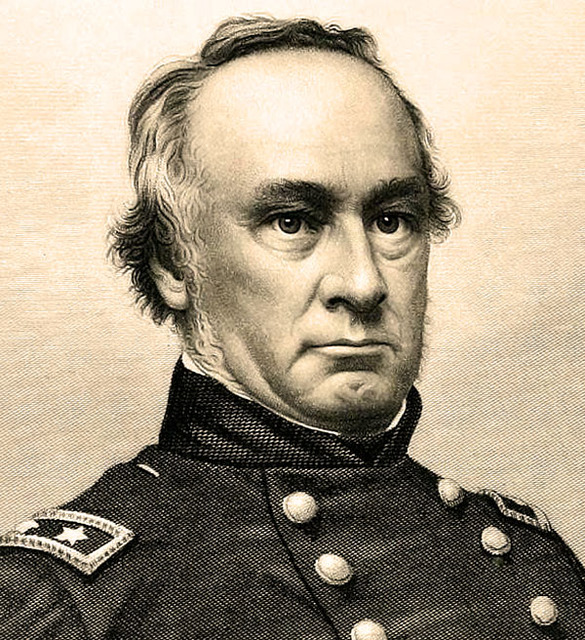
Something a bit different. Again this is a part of one of the chapters of my Gettysburg and Civil War text, but this time dealing with two men who were the first American military theorists, Dennis Hart Mahan, the father of Alfred Thayer Mahan the great naval strategist and Henry Wager Hillock. Both men contributed to American military thought for over a century until they and their French-Swiss mentor Henri Jomini’s theories were overtaken by those of the Prussian Carl von Clausewitz. 

They both are interesting characters and both had an influence on American history today ion large part due to their influence on the education of most of the generals who conducted the Civil War, and in the case of Halleck in advising Abraham Lincoln during the war. 

I hope that you enjoy

Peace

Padre Steve+

West_Point

Background 

As we continue to examine the Civil War as the first modern war we have to see it as a time of great transition and change for military and political leaders. As such we have to look at the education, culture and experience of the men who fought the war, as well as the various advances in technology and how that technology changed tactics, which in turn influenced the operational and strategic choices that defined the characteristics of the Civil War and wars to come.

The leaders who organized the vast armies that fought during the war were influenced more than military factors. Social, political, economic, scientific and even religious factors influenced their conduct of the war. The officers that commanded the armies on both sides grew up during the Jacksonian opposition to professional militaries, and for that matter even somewhat trained militias. The Jacksonian period impacted how officers were appointed and advanced. Samuel Huntington wrote:

“West Point was the principle target of Jacksonian hostility, the criticism centering not on the curriculum and methods of the Academy but rather upon the manner of how cadets were appointed and the extent to which Academy graduates preempted junior officer positions in the Army. In Jacksonian eyes, not only was specialized skill unnecessary for a military officer, but every man had the right to pursue the vocation of his choice….Jackson himself had an undisguised antipathy for the Academy which symbolized such a different conception of officership from that which he himself embodied. During his administration disciple faltered at West Point, and eventually Sylvanus Thayer, the superintendent and molder of the West Point educational methods, resigned in disgust at the intrusion of the spoils system.” [1]

This is particularly important because of how many officers who served in the Civil War were products of the Jacksonian system and what followed over the next two decades. Under the Jackson administration many more officers were appointed directly from civilian sources than from West Point, often based on political connections. “In 1836 when four additional regiments of dragoons were formed, thirty officers were appointed from civilian life and four from West Point graduates.” [2]

While this in itself was a problem, it was made worse by a promotion system based on seniority, not merit. There was no retirement system so officers who did not return to the civilian world hung on to their careers until they quite literally died with their boots on. The turnover in the highest ranks was quite low, “as late as 1860, 20 of the 32 men at or above the rank of full colonel held commissions in the war of 1812.” [3] This held up the advancement of outstanding junior officers who merited promotion and created a system where “able officers spent decades in the lower ranks, and all officers who had normal or supernormal longevity were assured of reaching higher the higher ranks.” [4]

Robert E. Lee was typical of many officers who stayed in the Army. Despite his success Lee was constantly haunted by his lack of advancement. While he was still serving in Mexico having gained great laurels, including a brevet promotion to Lieutenant Colonel, the “intrigues, pettiness and politics…provoked Lee to question his career.” He wrote, “I wish I was out of the Army myself.” [5]

In 1860 on the brink of the war, Lee was “a fifty-three year-old man and felt he had little to show for it, and small hope for promotion.” [6] Lee’s discouragement was not unwarranted, for despite his exemplary service, there was little hope for promotion and to add to it, Lee knew that “of the Army’s thirty-seven generals from 1802 to 1861, not one was a West Pointer.” [7]

The careers of other exemplary officers including Winfield Scott Hancock, James Longstreet, and John Reynolds languished with long waits between promotions between the Mexican War and the Civil War. The long waits for promotion and the duty in often-desolate duty stations on the western frontier, coupled with family separations caused many officers to leave the Army. A good number of these men would volunteer for service in 1861 a go on to become prominent leaders in both the Union and Confederate armies. Among these officers were such notables as Thomas “Stonewall” Jackson, Ulysses S. Grant, William Tecumseh Sherman, Henry Halleck, George McClellan and Jubal Early.

The military education of these officers at West Point was based very technical and focused on engineering, civil, and topographic, disciplines that had a direct contribution to the expanding American nation. What little in the way of formal higher level military education West Point cadets received was focused the Napoleonic tactics and methods espoused by Henri Jomini as Clausewitz’s works had yet to make their way to America. Dennis Hart Mahan taught most military theory and tactics courses being taught at the academy in the formative years of so many of the men who would lead the armies that fought the American Civil War.

Many Americans looked on the French, who had been the allies of the United States in the American Revolution, favorably during the ante-bellum period. This was especially true of the fledgling United States Army, which had just fought a second war with Great Britain between 1812 and 1815, and “outstanding Academy graduates in the first half of the nineteenth century, such as Halleck and Mahan, were sent to France and Prussia to continue their education. Jomini was consider as the final word on the larger aspects of military operations, and American infantry, cavalry, and artillery tactics imitated those of the French Army.” [8]
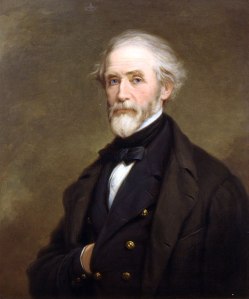
Dennis_Hart_Mahan

Respected but Never Loved: Dennis Hart Mahan

Mahan, who graduated at the top of the West Point class of 1824 was recognized as having a brilliant mind very early in his career, as a third classman that “he was appointed an acting assistant professor of mathematics.” [9] Following his graduation the brilliant young officer was sent by the army to France, where he spent four years as a student and observer at the “School of Engineering and Artillery at Metz” [10] before returning to the academy where “he was appointed professor of military and civil engineering and of the science of war.” [11] It was a position that the young professor excelled as subjected “the cadets…to his unparalleled knowledge and acid disposition.” [12]

Mahan spent nearly fifty years of his life at West Point, including nearly forty years as a faculty member he could not imagine living life without it. Thus he became “morbid when the Academy’s Board of Visitors recommended his mandatory retirement from the West Point Faculty” and on September 16th 1871 the elderly Mahan “committed suicide by leaping into the paddlewheel of a Hudson River steamer.” [13]

While he was in France Mahan studied the prevailing orthodoxy of Henri Jomini who along with Clausewitz was the foremost interpreter of Napoleon and Napoleon’s former Chief of Staff Marshal Ney. When we look at Mahan’s body of work in his years at West Point, Jomini’s influence cannot be underestimated. Some have noted, and correctly so, that “Napoleon was the god of war and Jomini was his prophet” [14] and in America the prophet found a new voice in that of Dennis Hart Mahan.

Thus, if one wants to understand the underlying issues of military strategy and tactics employed by the leaders of the Civil War armies, the professional soldiers, as well as those who learned their trade on the battlefield of America, one has to understand Jomini and his American interpreter Mahan.

Unlike the Prussian Clausewitz, whose writings were still unknown in America, Jomini saw the conduct of war apart from its human element and controlled by certain scientific principles. The focus in principles versus the human element is one of the great weaknesses of traditional Jominian thought.

The basic elements of Jominian orthodoxy were that: “Strategy is the key to warfare; That all strategy is controlled by invariable scientific principles; and That these principles prescribe offensive action to mass forces against weaker enemy forces at some defensive point if strategy is to lead to victory.” [15] Like Clausewitz, Jomini interpreted “the Napoleonic era as the beginning of a new method of all out wars between nations, he recognized that future wars would be total wars in every sense of the word.” [16] In his thesis Jomini laid out a number of principles of war including elements that we know well today: operations on interior and exterior lines, bases of operations, and lines of operation. Jomini understood the importance of logistics in war, envisioned the future of amphibious operations and his thought would be taken to a new level by Alfred Thayer Mahan, the son of Dennis Hart Mahan in his book The Influence of Sea Power on History.

To be fair, Jomini foresaw the horrific nature of the coming wars, but he could not embrace them, nor the concepts that his Prussian counterpart Carl von Clausewitz regarding the base human elements that made up war. “Born in 1779, Jomini missed the fervor of the Revolutionary generation and the romantic world view that inspired its greatest theorist, Jacques Antoine Guibert. He came to intellectual maturity during a period of codification and quest for stability in all spheres of life, including the waging of war.” [17] Jomini expressed his revulsion for the revolutionary aspects of war, and his desire to return to the limited wars of the eighteenth century:

“I acknowledge that my prejudices are in favor of the good old times when the French and English guards courteously invited each other to fire first as at Fontenoy, preferring them to the frightful epoch when priests, women. And children throughout Spain plotted the murder of individual soldiers.” [18]

Jomini’s influence was great throughout Europe and was brought back to the United States by Mahan who principally “transmitted French interpretations of Napoleonic war” [19] especially the interpretation given to it by Henri Jomini. However, when Mahan returned from France he was somewhat dissatisfied with some of what he learned. This is because he understood that much of what he learned was impractical in the United States where a tiny professional army and the vast expenses of territory were nothing like European conditions in which Napoleon waged war and Jomini developed his doctrine of war.

It was Mahan’s belief that the prevailing military doctrine as espoused by Jomini:

“was acceptable for a professional army on the European model, organized and fighting under European conditions. But for the United States, which in case of war would have to depend upon a civilian army held together by a small professional nucleus, the French tactical system was unrealistic.” [20]

Mahan set about rectifying this immediately upon his return to West Point, and though he was now steeped in French thought, he was acutely sensitive to the American conditions that in his lectures and later writings had to find a home. As a result he modified Jominian orthodoxy by rejecting one of its central tenants-primary reliance on offensive assault tactics.” [21] Mahan wrote, “If the offensive is attempted against a strongly positioned enemy… it should be an offensive not of direct assault but of the indirect approach, of maneuver and deception. Victories should not be purchased by the sacrifice of one’s own army….To do the greatest damage to our enemy with the least exposure of ourselves,” said Mahan, “is a military axiom lost sight of only by ignorance to the true ends of victory.” [22]

However, Mahan had to contend with the aura of Napoleon, which affected the beliefs of many of his students and those who later served with him at West Point, including Robert E. Lee. “So strong was the attraction of Napoleon to nineteenth-century soldiers that American military experience, including the generalship of Washington, was almost ignored in military studies here.” [23] It was something that many American soldiers, Union and Confederate would pay with their lives as commanders steeped in Napoleon and Jomini threw them into attacks against well positioned and dug in opponents well supported by artillery. Lee’s assault on Cemetery Ridge on July 3rd 1863 showed how little he had learned from Mahan regarding the futility of such attacks, and instead trusted in his own interpretation of Napoleon’s dictums of the offense.

Thus there was a tension in American military thought between the followers of Jomini and Mahan. The conservative Jominian interpretation of Napoleonic warfare predominated much of the officer corps of the Army, and within the army “Mahan’s decrees failed to win universal applause.” [24] However, much of this may have been due in part to the large number of officers accessed directly from civilian life into the army during the Jacksonian period. Despite this, it was Dennis Hart Mahan who more than any other man “taught the professional soldiers who became the generals of the Civil War most of what they knew through the systematic study of war.” [25]

When Mahan returned from France and took up his professorship he became what Samuel Huntington the “American Military Enlightenment” and he “expounded the gospel of professionalism to successive generations of cadets for forty years.” [26]Some historians have described Mahan by the “star professor” of the Military Academy during the ante-bellum era. [27] Mahan’s influence on the future leaders of the Union and Confederate armies went beyond the formal classroom setting. Mahan established the “Napoleon Club,” a military round table at West Point.[28] In addition to his writing and teaching, Mahan was one of the preeminent influences on the development of the army and army leadership during the ante-bellum period.

However, Mahan and those who followed him such as Henry Halleck, Emory Upton and John Bigelow who were the intellectual leaders of the army had to contend with an army culture which evidenced “a distain for overt intellectual activities by its officers for much of the nineteenth and twentieth centuries….Hard fighting, hard riding, and hard drinking elicited far more appreciation from an officer’s peers that the perusal of books.” [29]

Mahan dominated the academy in many ways. For the most part Mahan ran the academic board, an institution that ran the academy, and “no one was more influential than Mahan in the transition of officership from a craft into a profession.” [30] Mahan was a unique presence at West Point who all students had to face in their final year before they could graduate and become a commissioned officer. “His Engineering and Science of War course was the seedbed of strategy and tactics for scores of cadets who later became Civil War Generals.” [31] That being said most of what Mahan taught was the science of engineering related to war and he “went heavy on the military engineering and light on strategy” [32] relying primarily on Jomini’s work with his modifications for the latter.

The prickly professor was “respected by his students but never loved.” One student described him as “the most particular, crabbed, exacting man that I ever saw. He is a slim little skeleton of a man and is always nervous and cross.” [33] As a teacher Mahan was exceptional, but he was exceptionally demanding of his students. Those cadets who had survived the first three years at the academy were confronted by this “irritable, erudite, captious soldier-professional who had never seen combat” yet who was “America’s leading military mind.” [34]

Mahan was “aloof and relentlessly demanding, he detested sloppy thinking, sloppy posture, and a sloppy attitude toward duty…Mahan would demand that they not only learn engineering and tactics, but that every manner and habit that characterizes an officer- gentlemanly deportment, strict integrity, devotion to duty, chivalric honor, and genuine loyalty- be pounded into them. His aim was to “rear soldiers worthy of the Republic.” [35]

Mahan was one of the first American military professionals to stress the importance of military history to the military profession. He wrote that without: “historical knowledge of the rise and progress” of the military art…it is impossible to get even “tolerably clear elementary notions” beyond “those furnished by the mere technical language….It is in military history that we are to look for the source of all military science.” [36]

Mahan’s greatest contributions in for American military doctrine were his development of the active defense and emphasis on victory through maneuver. Mahan stressed “swiftness of movement, maneuver, and use of interior lines of operation. He emphasized the capture of strategic points instead of the destruction of enemy armies,” [37] while he emphasized the use of “maneuver to occupy the enemy’s territory or strategic points.” [38]

Key to Mahan’s thought was the use of maneuver and the avoidance of direct attacks on prepared positions. Mahan cautioned that the offensive against prepared positions “should be an offensive not of direct assaults but of the indirect approach, of maneuver and deception. Victories should not be purchased at the sacrifice of one’s own army….” It was a lesson that Robert E. Lee learned too late. As such Mahan prefigured future theorists such as B.H. Liddell Hart in propagating the doctrine of the indirect approach. Mahan warned: “To do the greatest damage to our enemy with the least exposure to ourselves,… is a military axiom lost sight of only by ignorance to the true ends of victory.” [39]

His emphasis on “military history led Mahan to abandon the prevailing distinction between strategy and tactics in terms of the scale of operations. He came to see that strategy, involving fundamental, invariable principles, embodied what was permanent in military science, while tactics concerned what was temporary.” Mahan believed that “History was essential to a mastery of strategy, but it had no relevance to tactics.” [40]

Mahan emphasized that “study and experience alone produce the successful general” noting “Let no man be so rash as to suppose that, in donning a general’s uniform, he is forthwith competent to perform a general’s function; as reasonably he might assume that in putting on robes of a judge he was ready to decide any point of the law.” [41] Here, Mahan’s advice is timeless and still applies today, especially in an era when many armchair generals, most without any military experience or training, especially pundits and politicians pontificate their expertise on every cable news channel twenty-four hours a day.

Mahan certainly admired Napoleon and was schooled in Jomini. Mahan believed in the principles that Jomini preached but he was not an absolutist. He believed that officers needed to think for themselves on the battlefield. Mahan preached that celerity and reason were the pillars of military success, and that “no two things in his military credo were more important than the speed of movement- celerity, that secret of success- or the use of reason. Mahan preached these twin virtues so vehemently and so often through his chronic nasal infection that the cadets called him “Old Cobbon Sense.” [42]
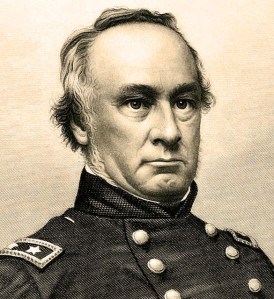
HD_halleckHW4.preview

Old Brains: Henry Wager Halleck 

Mahan’s teaching was both amplified and modified by the work of his star pupil Henry Wager Halleck. During his time as a cadet Halleck “achieved “a kind of strategic protégé status, even becoming part of the faculty while still a cadet.” [43] Halleck wrote the first American textbook on military theory Elements of Military Art and Science. Halleck’s book was published in 1846 and though it was not a standard text at West Point “it was probably the most read book among contemporary officers.” [44] The text was based on a series of twelve lectures Halleck had given the Lowell Institute in 1845, as at the time Halleck was considered one of America’s premier scholars as he remained for many years.

Like Mahan, Halleck was heavily influenced by the writings of Jomini, and the Halleck admitted that his book “was essentially a compilation of other author’s writings,” [45] including those of Jomini and Mahan; and he “changed none of Mahan’s and Jomini’s dogmas.” [46] In addition to his own book, Halleck also “translated Jomini’s Life of Napoleon” from the French. [47]

Halleck, like his mentor Mahan “recognized that the defense was outpacing the attack” [48] in regard to how technology was beginning to change war. As such, “five of the fifteen chapters in Halleck’s Elements are devoted to fortification; a sixth chapter is given over to the history and importance of military engineers.” [49] Halleck’s Elements became one of the most influential texts on American military thought during the nineteenth century, and “had a major influence on American military thought.” [50] Mahan’s book was read by many military leaders before, during and after the war, and some civilians, most notably Abraham Lincoln who upon entering officer sought to learn all that he could about military affairs, and whom Halleck would serve as Lincoln’s primary military advisor.

Halleck believed in and espoused Mahan’s enlightenment too, and he fought against the Jacksonian wave of populism. He eloquently spoke out for a more professional military against the Jacksonian critics of professional military institutions. Halleck advocated his case for a more professional military against the Jacksonian critics and pled “for a body of men who shall devote themselves to the cultivation of military science” and the substitution of Prussian methods of education and advancement for the twin evils of politics and seniority.” [51]

Notes

[1] Huntington, Samuel P. The Soldier and the State: The Theory and Politics of Civil-Military Relations, The Belknap Press of Harvard University Press, Cambridge MA and London 1957 pp.204-205

[2] Ibid. Huntington The Soldier and the State p.206

[3] Skelton, William B. An Officer Corps Responds to an Undisciplined Society by Disciplined Professionalism in Major Problems in American Military History: Documents and Essays edited by John Whiteclay Chambers II and G. Kurt Piehler Houghton Mifflin Company, Boston and New York 1999 p. 132

[4] Ibid. Huntington The Soldier and the State p.207

[5] Thomas, Emory Robert E. Lee W.W. Norton and Company, New York and London 1995 p.139

[6] Korda, Michael. Clouds of Glory: The Life and Legend of Robert E. Lee Harper Collins Publishers, New York 2014 p.213

[7] Ibid. Huntington The Soldier and the State p.207

[8] Ibid. Huntington The Soldier and the State p.197

[9] Waugh, John C. The Class of 1846: From West Point to Appomattox, Stonewall Jackson, George McClellan and their Brothers Ballantine Books, New York 1994 p.65

[10] Hagerman, Edward. The American Civil War and the Origins of Modern Warfare Midland Book Editions, Indiana University Press. Bloomington IN. 1992. p.7

[11] Ibid. Hagerman The American Civil War and the Origins of Modern Warfare p.7

[12] Ibid. Waugh The Class of 1846 p.65

[13] Millet, Allan R. and Maslowski, Peter, For the Common Defense: A Military History of the United States The Free Press a Division of Macmillan Inc. New York, 1984 p.126

[14] Hittle, J.D. editor Jomini and His Summary of the Art of War a condensed version in Roots of Strategy, Book 2 Stackpole Books, Harrisburg PA 1987 p. 429

[15] Shy, John Jomini in Makers of Modern Strategy, from Machiavelli to the Nuclear Age edited by Paret, Peter, Princeton University Press, Princeton New Jersey 1986 p.146

[16] Ibid. Hittle, Jomini and His Summary of the Art of War p. 428

[17] Ibid. Hagerman The American Civil War and the Origins of Modern Warfare p.4

[18] Ibid. Hittle Jomini p.429

[19] Ibid. Shy Jomini p.414

[20] Ibid. Hagerman The American Civil War and the Origins of Modern Warfare p.7

[21] Ibid. Hagerman The American Civil War and the Origins of Modern Warfare p.9

[22] Ibid. Weigley The American Way of War p.88

[23] Ibid. Shy Jomini p.414

[24] Ibid. Hagerman The American Civil War and the Origins of Modern Warfare p.13

[25] Ibid. Shy Jomini p.414

[26] Ibid. Huntington The Soldier and the State pp. 217-218

[27] Robertson, James I. Jr. General A.P. Hill: The Story of a Confederate Warrior Random House, New York 1987 p.8

[28] Hagerman also notes the contributions of Henry Halleck and his Elements of Military Art and Science published in 1846 (p.14) and his influence on many American Officers.  Weigley in his essay in Peter Paret’s Makers of Modern Strategy would disagree with Hagerman who notes that in Halleck’s own words that his work was a “compendium of contemporary ideas, with no attempt at originality.” (p.14) Weigley taking exception gives credit to Halleck for “his efforts to deal in his own book with particularly American military issues.” Paret, Peter editor. Makers of Modern Strategy: For Machiavelli to the Nuclear Age Princeton University Press, Princeton NJ 1986 p.416.

[29] Van Riper, Paul The relevance of history to the military profession: An American Marine’s View in The Past as Prologue: The Importance of History to the Military Profession edited by Williamson Murray and Richard Hart Sinnreich Cambridge University Press, Cambridge and New York 2006 p.35

[30] Ibid. Millet and Maslowski For the Common Defensep.126

[31] Ibid. Robertson General A.P. Hill p.8

[32] O’Connell Robert L. Fierce Patriot: The Tangled Lives of William Tecumseh Sherman Random House, New York 2013 p.6

[33] Pfanz, Donald. Richard S. Ewell: A Soldier’s Life University of North Carolina Press, Chapel Hill and London 1998 pp.25-26

[34] Ibid. Waugh, p.64

[35] Ibid Waugh The Class of 1846, pp.63-64

[36] Ibid. Huntington The Soldier and the State p.220

[37] Wert, Jeffry D. General James Longstreet The Confederacy’s Most Controversial Soldier, A Touchstone Book, Simon and Schuster, New York and London 1993 p.30

[38] Ibid. Hagerman The American Civil War and the Origins of Modern Warfare p.14

[39] Ibid. Weigley The American Way of War p.88

[40] Ibid. Huntington The Soldier and the State p.220

[41] Ibid. Huntington The Soldier and the State pp.221

[42] Ibid. Waugh The Class of 1846 p.64

[43] Ibid. O’Connell Fierce Patriot p.11

[44] Ibid. Hagerman The American Civil War and the Origins of Modern Warfare p.14

[45] Marszalek, John F. Commander of All of Lincoln’s Armies: A Life of General Henry W. Halleck The Belknap Press of Harvard University Press, Cambridge MA and London 2004 p.42

[46] Ambrose, Stephen E. Halleck: Lincoln’s Chief of Staff Louisiana State University Press, Baton Rouge and London 1962 p.6

[47] Weigley, Russell F. American Strategy from Its Beginnings through the First World War. In Makers of Modern Strategy, from Machiavelli to the Nuclear Age edited by Paret, Peter, Princeton University Press, Princeton New Jersey 1986 p.416

[48] Ibid. Hagerman The American Civil War and the Origins of Modern Warfare p.14

[49] Ibid. Weigley, American Strategy from Its Beginnings through the First World War. In Makers of Modern Strategy, from Machiavelli to the Nuclear Age p.417

[50] Ibid. Ambrose Halleck p.7

[51] Ibid. Huntington The Soldier and the State p.221


2 Comments

Filed under civil war, History, Military

Primordial Hatred: Insurgency in the Civil War

Friends of Padre Steve’s World

Sometime we look aghast at atrocities committed by people in other nations fighting civil wars or nations fighting various insurgents. Sadly, we usually fail to appreciate the nature of war, which in our sanitized brains we cannot comprehend. In all of our romanticism, especially that of the nobility of the Confederacy, and the Myth of the Lost Cause we forget the the American Civil War was profoundly ideological, heavily religious and fought with a ferocity that we cannot imagine. British military historian and theorist J.F.C. Fuller noted that “was preceded by years of violent propaganda, which long before the war had obliterated all sense of moderation, and awakened in the contending parties the primitive spirit of tribal fanaticism.”  Clausewitz said it best when he noted that war “As a total phenomenon its dominant tendencies always make war a paradoxical trinity–composed of primordial violence, hatred, and enmity…”

The American Civil War teaches us about this, and it shows us that we as Americans can be just as vicious, bloodthirsty and savage in our methods of war as anyone else.

As a side note I expect to be writing some about the Confederate Flag and something that I saw yesterday, a church that held a ceremony hoisting the “Christian Flag” over the American flag. I have very strong feelings about both of these subjects but those will wait.

Have a great day, and think on these things.

Peace

Padre Steve+

lawrencebattle1863

The Destruction of Lawrence Kansas by Quantrill’s Raiders 1863


Perhaps the most vicious and bloodthirsty part of the American Civil War as the part played by the men leading irregular campaigns in the border states and on the peripheries of the major campaigns. In the South these units were called “partisan rangers” and “With a guerrilla tradition dating from the Revolution and an exaggerated notion of the romanticism associated with guerrilla operations, southerners formed dozens of ranger units.” [1] The guerrilla and counter-guerrilla campaigns of these units prefigured the insurgencies and counter insurgencies of future wars including those in fought by the French in Indochina and Algeria, the United States in Vietnam, Iraq and Afghanistan. These actions actually began before the war, as early as 1854 in Kansas and continued on into the war. Sadly, these campaigns are ignored in all recent major works on counterinsurgency, including the American Army and Marine Corps Counterinsurgency Manual.

These irregular campaigns in the Border States, especially Missouri were “ugly, vicious, no-holds-barred bushwhacking that came close to total war” [2] and they “came to epitomize and carry to some of the worst excesses of violence of the Civil War mainly because of the failure of rational strategy and control was even more marked there than elsewhere.[3] At the beginning of the War the Union lacked the troops to maintain peace in the area and as such Confederate guerrillas and insurgents gained a large foothold in Missouri. Union troops under the command of Major General David Hunter and John Schofield, the later commander of American Forces in Cuba during the Cuba campaign of the Spanish American War “nearly ruined their careers with repeated failures.” In operations much like later operations of the French and Americans in Indochina, Algeria and Iraq “They tried building forts in guerrilla infested areas, but local partisans struck when they discovered the soldiers at a disadvantage.” [4]

The Confederate insurgency campaigns in Missouri and Kansas were by men like William Clarke Quantrill, “Bloody” Bill Anderson, and other pathological killers. Anderson “rode with enemy scalps dangling from his horse’s bridle, and Coleman Younger and Frank and Jesse James displayed the thuggery that made them postwar outlaws.” [5] James McPherson wrote:

“In contrapuntal disharmony the guerrillas and Jayhawkers plundered and pillaged their way across the state, taking no prisoners, killing in cold blood, terrorizing the civilian population, and leaving large parts of Missouri a scorched earth. In August 1863 Quantrill’s band rode into Lawrence, Kansas, and killed all the adult males they found there – more than 150 in all. A year later Bloody Bill Anderson’s gang took twenty four unarmed Union soldiers travelling home on furlough train, shot them in the head, then turned on a posse of pursuing militia and slaughtered 127 of them, including the wounded and captured.” [6]

At Lawrence, Quantrill issued orders to kill “every man big enough to carry a gun.” The brutality and atrocities committed by Quantrill’s gang were perhaps some of the worst seen during the war. On their trek to Lawrence, Quantrill “force Kansas farmers to act as guides and then executed them.” [7] They arrived under the cover of night and devastated the town, when they departed they left behind “80 new widows and 250 fatherless children weeping in the ruins of the town. Nearly 200 buildings had been wrecked or burned, including all three newspaper offices and most of the business district, for a property loss amounting to two million dollars.” [8] After the raid Quantrill directed his men to resume their disguises as farmers, merchants and professed Unionists.

The Confederates did not have a monopoly on this type of behavior, “Unionist “Jayhawkers” such as James H. Lane, Charles R. Jennison, and James Montgomery matched them atrocity for atrocity.” [9] The admission of West Virginia as a Free State “threw up yet another guerrilla conflict wracking West Virginia as much as the similar guerrilla conflict, similarly precipitated, devastated Missouri.” [10] A Union Captain from Ohio “serving with West Virginia soldiers was astonished by this “passion, this desire for revenge….Hate rankled in their breasts.” [11] Many West Virginia Unionists in the interior of the State were forced to flee their homes to cities along the Ohio where they could be protected by Union troops.

In light of the fact that many civilians were actively aiding Quantrill’s Confederate insurgents Brigadier General Thomas Ewing Jr. to evacuate the worst offenders, men and unmarried women alike to a colony in Arkansas, though he made allowance for them to be provisioned by Union forces and to take clothing and household goods as necessary. After Quantrill’s massacre of the men of Lawrence General Ewing issued General Orders number 11. The order directed “the forcible removal of all persons, male or female, child or adult, loyal or disloyal, who lived more than a mile from a Federal post in the in the four Missouri counties south of the Missouri River and adjacent to the border.” [12]

The evacuation involved to carry out the order affected an estimated 20,000 inhabitants of “Bates, Cass, and Jackson Counties and the northern half of Vernon County, which were supposed to have sustained Quantrill’s raiders…. Those who could persuade the commander of the nearest military post of their Unionism might be issued certificates permitting them to remain in the state if they moved to military posts. The rest had to go. Hay and grain found in the area after evacuation would be destroyed or taken to military posts and credited to Unionists.” [13] In a sense the order prefigured future counterinsurgency or anti-partisan strategies employed by the Germans, the French and later the Americans in the Twentieth and Twenty-first centuries.

While these campaigns often were part of local hatred “Confederate irregular forces were intended to be an adjunct to the conventional field armies” and they “developed into a powerful tool for the Confederate war effort.” [14] The best and most disciplined of these forces were those commanded by John Singleton Mosby who operated in conjunction with Robert E. Lee’s Army of Northern Virginia. Nicknamed the “Gray Ghost” by his Union opponents, Mosby “kept his men under military discipline and bedeviled the Yankee invaders.” [15] His troops would accompany J.E.B. Stuart’s cavalry during the Gettysburg campaign conducting reconnaissance operations behind the Union lines during the opening phases of the campaign.

The violence and the problems caused by Confederate guerrillas and irregulars brought about changes to the rules of warfare. Lincoln approved the orders of Major General John Pope “to hold civilians responsible for shooting at Union soldiers from their houses, to execute captured guerrillas who fired on Union troops, to expel from occupied territory any civilians who refused to take an oath of allegiance to the United States, and to treat them as spies if they returned.” [16] General Order 100 written by Franz Lieber for the War Department and signed by Abraham Lincoln in 1863. Several articles of this document specifically addressed the guerrilla threat, beginning with Article 82, which stated:

“Men, or squads of men, who commit hostilities, whether by fighting, or inroads for destruction or plunder, or by raids of any kind, without commission, without being part and portion of the organized hostile army, and without sharing continuously in the war, but who do so with intermitting returns to their homes and avocations, or with the occasional assumption of the semblance of peaceful pursuits, divesting themselves of the character or appearance of soldiers – such men, or squads of men, are not public enemies, and, therefore, if captured, are not entitled to the privileges of prisoners of war, but shall be treated summarily as highway robbers or pirates.” [17]

Despite the efforts of the Confederate guerrillas and insurgents who tied down many Union troops, the vigorous action of Union leaders, political as well as military kept the key Border States in the Union. The heavy handed but necessary actions of General Ewing and others deprived Quantrill and other insurgent leaders of safe havens and helped to secure the region from further attacks and the insurgents were forced to move to other areas. These Union measures deprived the Confederates of the chance to become independent by controlling the Ohio Valley and the Mississippi.

Notes

[1] Millet, Allan R. and Maslowski Peter For the Common Defense: A Military History of the United States, Revised and Expanded Edition The Free Press, New York 1994 p.180

[2] Ibid. McPherson The War that Forged a Nation p. 50

[3] Ibid. Weigley A Great Civil War p.44

[4] Gallagher, Gary, Engle, Stephen, Krick, Robert K. and Glatthaar The American Civil War: The Mighty Scourge of War Osprey Publishing, Oxford UK 2003 p.251

[5] Ibid. Millet and Maslowski Peter For the Common Defense: A Military History of the United States, Revised and Expanded Edition p.181

[6] Ibid. McPherson The War that Forged a Nation p. 52

[7] Ibid. Gallagher et al The American Civil War: The Mighty Scourge of War p.252

[8] Ibid. Foote The Civil War: A Narrative Volume Two p.705

[9] Ibid. Millet and Maslowski For the Common Defense: A Military History of the United States, Revised and Expanded Edition p.181

[10] Ibid. Weigley A Great Civil War p.55

[11] Ibid. McPherson The War that Forged a Nation p. 50

[12] Ibid. Foote The Civil War: A Narrative Volume Two p.705

[13] Ibid. Weigley A Great Civil War p.45

[14] Ibid. McPherson The War that Forged a Nation p. 52

[15] Ibid. Millet and Maslowski For the Common Defense: A Military History of the United States, Revised and Expanded Edition p.181

[16] Ibid. McPherson The War that Forged a Nation pp.36-37

[17] Lieber, Francis Instructions for the Government of Armies of the United States in the Field, prepared by Francis Lieber, LL.D., Originally Issued as General Orders No. 100, Adjutant General’s Office, 1863, Washington 1898: Government Printing Office. Retrieved from http://avalon.law.yale.edu/19th_century/lieber.asp 6 May 2014

2 Comments

Filed under civil war, History, Military