Category Archives: ethics

Genocide in the Name of God: a Universal Truth About True Believers

Friends of Padre Steve’s World,

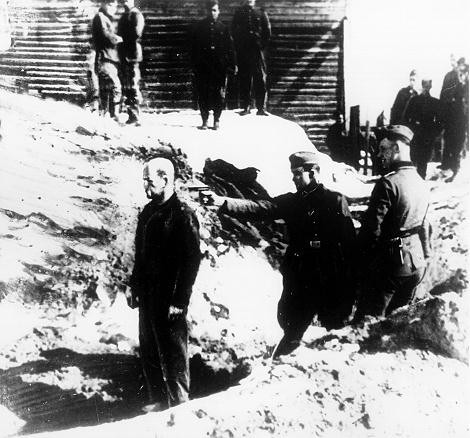
Seventy-nine years ago the members of Heinrich Himmler’s Einsatzgruppen were following the German Army into Poland. These forces were intended to do one thing, to eliminate any Poles capable of resisting the Reich and to round up and kill Jews. The sad thing is that while the Genocide committed by the Nazis is in a league of its own, the propensity for others to write about, urge, and promote genocidal practices is not unique.

One of the most troubling aspects of genocide is the degree to which people will go to rationalize and justify it, especially if it is supposedly commanded by their “God.” This includes people who exalt their human leader’s pronouncements to that of a god.

Eric Hoffer wrote:

“The impression somehow prevails that the true believer, particularly the religious individual, is a humble person. The truth is the surrendering and humbling of the self breed pride and arrogance. The true believer is apt to see himself as one of the chosen, the salt of the earth, the light of the world, a prince disguised in meekness, who is destined to inherit the earth and the kingdom of heaven too. He who is not of his faith is evil; he who will not listen will perish.”

Thus, today’s article is difficult to write. I realize that some people will be offended because to those that cannot see the nuance that any criticism of their beliefs is akin to an attack on God. That is not my intent at all, there are too many people of faith in all religions who work against the extremists who claim to speak evil in the name of their God. Likewise I am not  attempting by any stretch of the imagination to broad brush or demonize people of faith. That being said, there are people of every faith and ideology who are capable of planning and committing genocide.

Yes there are extremists, but there are also many ordinary people who obey without questioning, and if ordered by a high enough authority will commit unspeakable acts. As Primo Levi noted, “Monsters exist, but they are too few in numbers to be truly dangerous. More dangerous are…the functionaries ready to believe and act without asking questions.”

But my purpose today, in fact the sole intent of this article is to point out some of the questions and issues that people of faith need to ask when they faced with the killing of innocents or defenseless people in the name of God, or of a political leader. The fact that the Trump administration has already began rounding up people including American citizens and separating them from their families in what amount to concentration camps. (And yes, I do know the difference between a concentration camp like Dachau and a death camp like Treblinka, or Auschwitz so don’t even go there Mr. Trump Cultist.) But the fact is that once you go down the path that the Trump administration has elected to trod there is not much more to overcome before the killing begins.

Historian Timothy Snyder wrote:

“The European history of the twentieth century shows us that societies can break, democracies can fall, ethics can collapse, and ordinary men can find themselves standing over death pits with guns in their hands. It would serve us well today to understand why.”

Thus, one only has to look at history and the words or actions of people who live among us to realize that the seeds of genocide are always being sown by those who find others less than human. The men and women who sow the seeds of future genocide can do so in the name of their God, their religion, their religious or secular political ideological, or their views on the superiority of their race. The Nazis provide us a road map of the twisted logic used by the perpetrators of such actions, but they are not alone in history, and people like them exist today, some peddling their hatred in the name of God and religion, but not always.

When one reads the speeches, the after action reports, and the post-war testimony of those who orchestrated and conducted the worst terror of the Nazi regime against the Jews and others that they considered to be less than human, or in the case of the handicapped and the mentally ill, “life unworthy of life” they are stunning, and troubling.

During his Posen speech of October 1943 SS Reichsfuhrer Heinrich Himmler was quite clear about the aims of the Nazis, and their goals regarding the Jews and other Untermenschen (Sub humans) including infants and children. Himmler said:

“We came to the question: what to do with the women and children? I decided to find a clear solution here as well. I did not consider myself justified to exterminate the men – that is, to kill them or have them killed – and allow the avengers of our sons and grandsons in the form of their children to grow up. The difficult decision had to be taken to make this people disappear from the earth…”

One would think that killing babies, any babies, but in the particular case Jewish babies to prevent them from growing up to avenge the deaths of their parents would be repulsive, especially to Jews. For most Jews it is, but like every religion Judaism has its share of extremists. One of them is the controversial Rabbi Yitzhak Shapira, the dean of the Od Yosef Hai Yeshiva near Nablus in Israel. In a chapter in his book Torat ha-Melekh [The King’s Teaching] entitled “Deliberate harm to innocents,” which provides numerous justifications to kill gentiles, even babies, Shapira wrote:

“In any situation in which a non-Jew’s presence endangers Jewish lives, the non-Jew may be killed even if he is a righteous Gentile and not at all guilty for the situation that has been created… Hindrances—babies are found many times in this situation. They block the way to rescue by their presence and do so completely by force. Nevertheless, they may be killed because their presence aids murder. There is justification for killing babies if it is clear that they will grow up to harm us, and in such a situation they may be harmed deliberately, and not only during combat with adults.”

The Rabbi’s followers have engaged in frequent violence against Palestinians and Jews who do not hold his radical views. In 2006 he was detained for questioning after writing an article in which he said that all Palestinian males from age 13 and up should be killed or expelled from the West Bank. The rabbi condemns any moderation by the Israeli Defense Forces, and he criticizes Israel’s legal system and judiciary when its rulings conflict with his uncompromising views. To be sure his book was condemned by other Rabbis, especially of the Reformed School, but some Orthodox Rabbis supported it.

Those views are not unlike the stated views of the leaders of the so-called Islamic State when it comes to the killing of non-believers. In that organization’s 2013 Declaration of War those leaders stated:

“If you can kill a disbelieving American or European – especially the spiteful and filthy French – or an Australian, or a Canadian, or any other disbeliever from the disbelievers waging war, including the citizens of the countries that entered into a coalition against the Islamic State, then rely upon Allah, and kill him in any manner or way however it may be. Do not ask for anyone’s advice and do not seek anyone’s verdict. Kill the disbeliever whether he is civilian or military, for they have the same ruling. Both of them are disbelievers. Both of them are considered to be waging war [the civilian by belonging to a state waging war against the Muslims]. Both of their blood and wealth is legal for you to destroy, for blood does not become illegal or legal to spill by the clothes being worn.”

Many Imam’s and Mufti’s around the world and in the Middle East have issued Fatwah’s against the Islamic State and condemned its teachings. But many of these clerics, who often represent their tribal or government leaders, are considered to be disbelievers and “defenders of Israel” by the Islamic State. As such, many Moslem clerics, and large numbers the vast oppressed masses of impoverished, and often disenfranchised Arab Moslems are attracted to that ideology, especially that directed against the Jews, who are seen as the ultimate enemy.

There are Christians too that find theological justification for killing children, and their reasons are chillingly like those of Himmler: The author of an article on the blog Rational Christianity wrote:

“Why were the children killed, if they weren’t guilty? Apparently, they were considered as morally neutral, since they weren’t yet old enough to be held accountable or to have done much right or wrong. While not as corrupt as their parents, they were part of the society that was judged, and shared its earthly (though not its eternal) fate.”

Another author, a man named Wayne Jackson of Apologetics Press writes of the children of the Canaanites, “Would it not have been infinitely worse, in view of eternity, had these children grown to maturity and adopted the same pagan practices as their parents?”

William Lane Craig, a frequent apologist wrote in the Reasonable faith website a comment that sounds like it could have come from the lips of Himmler in dealing with the effect of the mass murders of Jews and others on the troops of the Einsatzgruppen. Craig wrote:

“So whom does God wrong in commanding the destruction of the Canaanites? Not the Canaanite adults, for they were corrupt and deserving of judgment. Not the children, for they inherit eternal life. So who is wronged? Ironically, I think the most difficult part of this whole debate is the apparent wrong done to the Israeli soldiers themselves. Can you imagine what it would be like to have to break into some house and kill a terrified woman and her children? The brutalising effect on these Israeli soldiers is disturbing.”

However, Craig has no qualms about what the Israelites did, simply because the genocide was commanded by God.

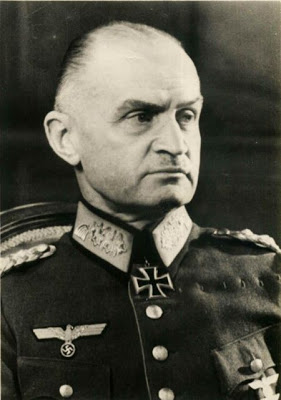
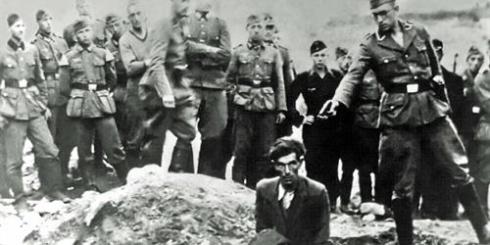
If one substitutes “Hitler” for “God” one sees a similar rationalization used members of the Einsatzgruppen. Colonel Walter Blume, a Police Colonel at Vitebsk who tried to “care” for his troops during a mass execution of Jews. He wrote:

“If I am now asked about my inner attitude which I then held, I can only say that it was absolutely split. On the one hand there was the strict order of my superior… and as a soldier I had to obey. On the other hand I considered the execution of this order cruel and humanly impossible. My very presence at this execution convinced me of this in a final manner. I still know that I wanted to make the situation easier for my men who were certainly moved by the same feelings. When ten men were shot there was always a pause until the next had been brought in. During these pauses I let my men sit down and rest and I joined them. I still know what I said exactly the following words to them at this time: “As much as it is no job for German men and soldiers to shoot defenseless people but the Fuhrer has ordered these shootings because he is convinced that these men would otherwise shoot at us as partisans or would shoot our comrades and our women and children were to be protected if we undertake these executions. This we would have to remember when we carry out this order.” Furthermore, I tried talking about neutral subjects to make the difficult spiritual situation easier and to overcome it.”

That is the troubling issue for me. Genocide is genocide and evil, no matter who commands it. We can try to wiggle around and avoid the subject by saying that whatever God we have is above normal law, or that our secular leader’s commands are above the law, but we cannot escape the fact that genocide is immoral and an immutable evil; even if we do it in the name of our God.

I think that is the problem that I have with people who follow their leaders down the path to genocide, even those who they believe are speaking for God. Likewise, I am very much concerned when people seem to care more about the emotional and spiritual effects of mass murders on the perpetrators than on the victims.

But then, the victims are dead and have no one left to speak for them.

Until tomorrow,

Peace,

Padre Steve+

8 Comments

Filed under civil rights, ethics, faith, History, holocaust, national security, nazi germany, News and current events, Political Commentary, world war two in europe

“On History’s Clock it was Sunset” a Reflection on the Funeral of Senator John McCain

Friends of Padre Steve’s World,

Senator John McCain’s memorial service in the Capitol, his funeral at rites at Washington’s National Cathedral, and his burial at the United States Naval Academy in Annapolis marked the end of an age that he symbolized. McCain had an outsized influence around the world for a United States Senator. As Senators go it is hard to find one with his moral, and political influence around the world. I think that maybe we would have to go back to Senator Henry “Scoop” Jackson to find one with his influence abroad.

Likewise, one has to go back far longer to find a Senator who could oppose a malignant President of his own political party as did McCain oppose Donald Trump. Barry Goldwater facing off with Richard Nixon in 1974 is one, but I think the most similar comparison with with Senator Stephen Douglas who stood up to James Buchanan in 1857 and 1858.

Though McCain was a flawed man, something that he readily acknowledged, he was an honorable man. Like Abraham Lincoln, McCain believed that the soul of America, its found in the principles of the Declaration of Independence. This was a document that both men based their lives in understanding the full meaning: those principles were not just limited to white male property owners as was the case in 1776, but extended beyond that, to every American, and for that matter every human being.

We hold these truths to be self evident, that all men are created equal, that they are endowed by their Creator with certain unalienable Rights, that among these are Life, Liberty and the pursuit of Happiness.–That to secure these rights, Governments are instituted among Men, deriving their just powers from the consent of the governed…

McCain understood that in terms of human rights, the environment, civil rights, and a respect for the underlying philosophical, religious, and legal principles that are the foundation of free societies everywhere. But now, in the United States and around the world those foundational principles are under attack from power hungry autocrats. Sadly they are led by the man whose name was unmentioned at his funeral but whose malignant presence was felt overwhelming by many who were there or who watched it, President Donald Trump.

Some attendees and others recorded that they momentarily felt that perhaps what has been lost will be recovered. But within hours most realized that this was not just a funeral for John McCain, it was a funeral for what America was and will likely never be again regardless of how the Trump presidency ends. The malevolent forces that he has unleashed were already there in the United States and in many other countries, but they were held in check until a leader unbound by the principles of the Declaration, without respect for law, without appreciation for the unwritten codes of morality, political, and civil behavior that are essential for the maintenance of a republic like ours became President.

In a sense the election of Donald Trump opened wide the gates of Hell, to the worst aspects of human behavior. If Donald Trump was to choke on a chicken wing while raving at a cable news host while tweeting and die, the damage would not only be done, but it would continue until those who would “support him even if he killed someone on 5th Avenue” are defeated at the polls, driven from power, and shamed into a sense of normalcy as were the Germans after Hitler’s Thousand Year Reich was overthrown. America will survive, we may even return to our founding principles, but it will not be without much pain, much sacrifice, and the loss of many things that we currently hold dear.

Thus when I read a column today that mentioned that McCain’s funeral was also a funeral for what we have lost I began to think about the opening chapter of Barbara Tuchman’s classic work The Guns of August. In that chapter Tuchman recounted the funeral of Britain’s King Edward VII in 1910, four years before the beginning of the First World War. She wrote:

SO GORGEOUS WAS THE SPECTACLE on the May morning of 1910 when nine kings rode in the funeral of Edward VII of England that the crowd waiting in hushed and black-clad awe, could not keep back gasps of admiration. In scarlet and blue and green and purple, three by three the sovereigns rode through the palace gates, with plumed helmets, gold braid, crimson sashes, and jeweled orders flashing in the sun. After them came five heirs apparent, forty more imperial or royal highnesses, seven queens—four dowager and three regnant—and a scattering of special ambassadors from uncrowned countries. Together they represented seventy nations in the greatest assemblage of royalty and rank ever gathered in one place and of its kind the last. The muffled tongue of Big Ben tolled nine by the clock as the cortege left the palace, but on history’s clock it was sunset, and the sun of the old world was setting.

At the end of the chapter Tuchman wrote:

Along Whitehall, the Mall, Piccadilly, and the Park to Paddington Station, where the body was to go by train to Windsor for burial, the long procession moved. The Royal Horse Guards’ band played the “Dead March” from Saul. People felt a finality in the slow tread of the marchers and in the solemn music. Lord Esher wrote in his diary after the funeral: “There never was such a break-up. All the old buoys which have marked the channel of our lives seem to have been swept away.”

Until tomorrow,

Peace,

Padre Steve+

1 Comment

Filed under culture, ethics, faith, History, leadership, News and current events, Political Commentary

The Importance of Labor and Labor Day

Friends of Padre Steve’s World,

Today is Labor Day and sadly many people don’t really understand its significance. For decades organized labor has been demonized by the descendants of people who died to secure decent working conditions, wages, and benefits for regular hard working people. The attacks on labor and workers have become much more pronounced under the Trump Administration than any prior administration since that of Herbert Hoover.

But most of the people lucky enough not to have to work on Labor Day really don’t know why it it matters, and whips in spite of those who despise labor and care not a whit about working people, who simply to use business terminology are simply human capital or resources. I actually despise those terms because they dehumanize people by turning them into impersonal economic units of measure.

So today I am digging into the vault to explore why Labor Day and what it represents matters to us now. This article is one that I have taken the time to edit and update.

Until tomorrow,

Peace,

Padre Steve+

Abraham Lincoln, who was perhaps our only President who was a real working man once said, “If any man tells you he loves America, yet hates labor, he is a liar. If any man tells you he trusts America, yet fears labor, he is a fool.” 

It seems that nothing about humanity ever changes, even so it is hard to believe that at one time American workers had no rights and I am not talking about African American slaves who as slaves didn’t even count as human beings. No I’m talking about the people Mel Brooks called in Blazing Saddles: “the white God fearing citizens of Rock Ridge” and for that matter every place and every race in America.

It was not until the mid-1800s in the United States and Europe that workers began to organize and protest for the right to decent wages and working conditions. But this came at a cost; the loss of jobs, homes, property, prison, deportation, deportation, and death.

There were many instances when this cost workers and labor organizers their lives. Employers, often backed by heavily armed private security contractors like the Pinkerton Agency, used deadly force to break up peaceful strikes. In the days of the Robber Barons, when business ran the government at almost every level, employers frequently called in local and state law enforcement, as well as the National Guard, and occasionally Federal troops to break strikes. They played various ethnic and racial groups off of each in order to divide the labor movement. There are hundreds of instances of such violence being used against workers, in some strikes the dead numbered in the hundreds.

Troops Putting Down the Pullman Strike 

Some of these attacks on workers occurred in major cities, others at isolated work sites and factories. Some are famous, the Haymarket Massacre of May 4th 1886 in Chicago, the Pullman Strike Massacre of 1894, the Homestead Strike and Massacre of 1892, the Latimer Massacre of 1897, the Ludlow Massacre of 1914, and the Columbine Mine Massacre of 1927.

Others less so, but there was more. In the Bisbee Deportation of 1917 1300 striking miners and their families were deported from their homes in Bisbee Arizona by 2000 armed deputies, put in box cars and transported 200 miles to the New Mexico desert, where without food, water or money they were left. There was the Triangle Shirtwaist Factory Fire where managers locked the doors in order to ensure that the fleeing women workers did not put anything unauthorized in their purses. One hundred forty-four workers, mostly young women died, many jumping from the burning building to their death.

Police and other Onlookers Looking up at the burning Triangle Shirt Factory with the bodies of Women Workers who jumped from it at Their Feet

Early labor organizations such as the Knights of Labor led the effort to bring about better conditions. For doing so they were labeled subversive and even called communists. Their meetings were often attacked and the leaders jailed and some lynched.

Eugene Debs

The sacrifices of those early workers, and organizers are why we have Labor Day. One of the early American labor leaders was a man named Eugene Debs. Debs eventually became a Socialist, but he said something remarkable which still is as timely as when he uttered the words:

“I am opposing a social order in which it is possible for one man who does absolutely nothing that is useful to amass a fortune of hundreds of millions of dollars, while millions of men and women who work all the days of their lives secure barely enough for a wretched existence.”

I wish that wasn’t true but it is. The Social Darwinists who follow Ayn Rand as if she were the Prophet and who populate Wall Street boardrooms and every major school of business ensure that it is. The disparity between wage laborers and CEOs is higher than it has ever been. But I digress…

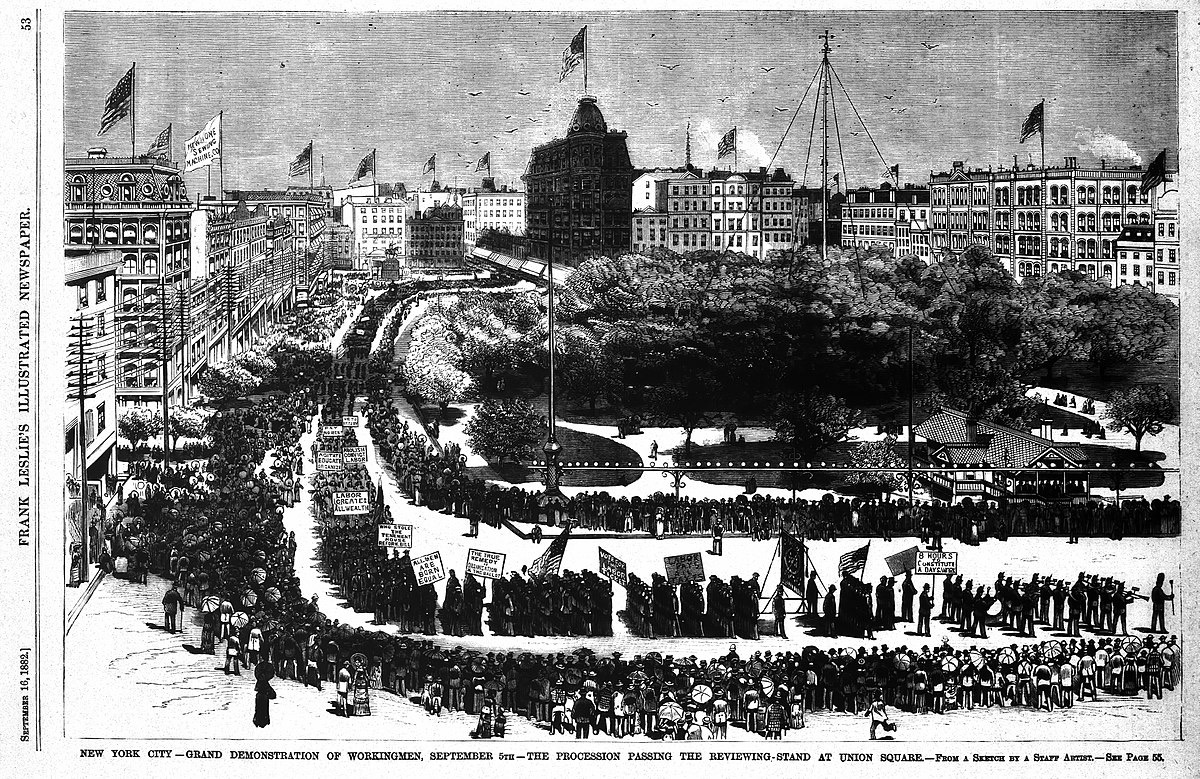
On September 5th 1882 the first Labor Day was observed when members of several Unions in New York City organized the first Labor Day parade. The police came armed and ready to intervene if the workers got out of hand, but the parade was peaceful. It ended and the marchers moved over to Wendell’s Elm Park where they had a party. Twenty-five thousand Union men and their families celebrated, with hundreds of kegs of lager beer.

Within a few years many states began to institute Labor days of their own. In 1894, just days after the violent end of the Pullman strike in which Federal troops and Marshalls killed 30 workers and wounded 57 more, Congress and President Grover Cleveland rushed through legislation to establish a Federal Labor Day.

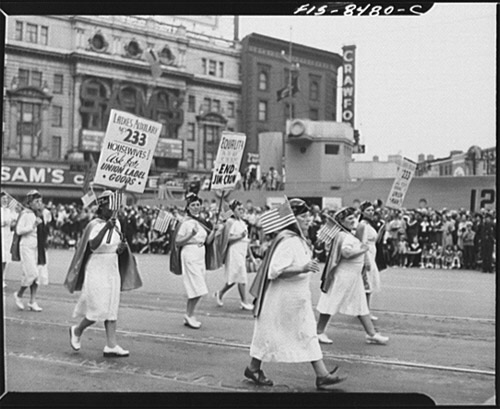
My Great Aunt Goldie Dundas was a labor organizer for the International Ladies Garment Worker’s Union in West Virginia in the 1920s – 1950s. I wish I had gotten to really know her, but she died when I was about 8 or 9 years old. Sadly the workers represented by that Union have had almost all of their jobs in the textile industry outsourced to China, India, Pakistan, the Caribbean, and Bangladesh where cheaply made garments are produced, and workers abused. The examples of mass deaths due to safety issues and fires in Bangladeshi factories are too numerous to list. But then who cares? The fact is you can drive through many parts of the South and see the poverty created by the exodus of these Union employers, the textile industry, which was part of the fabric of the South is gone. Empty factories and poverty stricken towns dot the countryside. I saw a lot of them living in Eastern North Carolina, towns that once thrived are ghost towns, riddled with crime, unemployment and no hope, unless Wal-Mart opens a store in town. Ironically it sells the clothing made overseas that used to be manufactured by the parents, grandparents and great-grandparents of the people who live there today.

Adam Smith, the father of Capitalism understood it in a very different manner than those who claim to be Capitalists today. He wrote in his magnum opus, The Wealth of All Nations:

“In regards to the price of commodities, the rise of wages operates as simple interest does, the rise of profit operates like compound interest. Our merchants and masters complain much of the bad effects of high wages in raising the price and lessening the sale of goods. They say nothing concerning the bad effects of high profits. They are silent with regard to the pernicious effects of their own gains. They complain only of those of other people.”

The fact is that today, labor is under threat. Unions have been demonized by politicians and pundits and their power and influence much reduced. Some of this was due to their own success in improving conditions from workers, and not just Union workers. When my dad retired from the Navy in 1974, he went to work at one of the few non-Union warehouses of the John Deere Company in Stockton, California. While they were not union, the workers received every benefit won by the majority of the workers in the company who were members of the United Auto Workers Union. Due to that my dad had high wages, excellent working conditions and benefits. The company had a program for the children of workers, which allowed them to work in the summer in the warehouse and receive incredibly high pay and benefits while in college. I did that for two years, and it helped pay for much of my college. I was not a union member but I benefited because Union men and leaders did the hard work to make that job happen.

However, in many places, Unions and labor are under attack, sometimes not just by corporations, but also by state governments. Job security and stability for most American workers is a thing of the past. Federal and State agencies charged with protecting those rights, including safety in the workplace are being cut in the mad rush to reduce government power. Corporations are offshoring and outsourcing jobs without regard to American workers or the country itself. Part of that is due to globalization and I understand that, but these companies frequently relocate jobs to places where they can exploit workers, deny them benefits, pay them less, and suffer no penalty for ignoring safety procedures or harming the environment. It seems to me that we are returning to the days of the Robber Barons. I wonder when violence against workers and those who support them will be condoned or simply ignored.

Pope Leo XIII wrote in his encyclical Renum Novarum:

“The following duties . . . concern rich men and employers: Workers are not to be treated as slaves; justice demands that the dignity of human personality be respected in them, … gainful occupations are not a mark of shame to man, but rather of respect, as they provide him with an honorable means of supporting life. It is shameful and inhuman, however, to use men as things for gain and to put no more value on them than what they are worth in muscle and energy.”

He also wrote:

“Equity therefore commands that public authority show proper concern for the worker so that from what he contributes to the common good he may receive what will enable him, housed, clothed, and secure, to live his life without hardship. Whence, it follows that all those measures ought to be favored which seem in any way capable of benefiting the condition of workers. Such solicitude is so far from injuring anyone, that it is destined rather to benefit all, because it is of absolute interest to the State that those citizens should not be miserable in every respect from whom such necessary goods proceed.”

But sadly there are far too few church leaders of any denomination who will take the side of workers or the poor, and when they do they are either condemned by the disciples of Ayn Rand or politely thanked and ignored by politicians and corporate leaders.

So please, when you celebrate Labor Day, do not forget that it is important, and that we should not forget why we celebrate it. If we forget that, it will become a meaningless holiday and our children may have to make the same sacrifices of our ancestors.

Labor Day is a day to remember the men and women, some of them former soldiers, workers, labor organizers, and leaders; some of whom were killed by National Guard and Federal troops for their effort, who paved the way for workers today. We cannot forget that. So when you see a politician attacking Labor and seeking to diminish workers rights or benefits ask them what Abraham Lincoln or Adam Smith would think. If they can’t answer, turn your backs on them and start fighting for what is right.

WASHINGTON, : US civil rights leader Martin Luther King,Jr. (3rd from L) walks with supporters during the “March on Washington” 28 August, 1963 after which, King delivered the “I Have a Dream” speech from the steps of the LIncoln Memorial. 28 August, 2003 marks the 40th anniversary of the famous speech, which is credited with mobilizing supporters of desegregation and prompted the 1964 Civil Rights Act. King was assassinated on 04 April 1968 in Memphis, Tennessee. James Earl Ray confessed to shooting King and was sentenced to 99 years in prison. AFP PHOTO/FILES (Photo credit should read AFP/AFP/Getty Images)

Dr. Martin Luther King Jr., who always stood for the rights of workers no-matter what their race, creed, or color, said:

“We must rapidly begin the shift from a “thing-oriented” society to a “person-oriented” society. When machines and computers, profit motives and property rights are considered more important than people, the giant triplets of racism, materialism, and militarism are incapable of being conquered.” 

Likewise, one cannot forget that Dr. King was assassinated when he went to Memphis to support the Memphis Sanitation Worker strike.

This my friends is why Labor and the protection of working people from those who abase them, mistreat them, and exploit them is so important.

3 Comments

Filed under civil rights, ethics, faith, History, labor, laws and legislation, News and current events, Political Commentary

Mass Murder and Genocide up Close and Personal: The Einsatzgrüppen and Ordungs Polizei in Poland 1939-1940

einsatz1

Friends  of Padre Steve’s World,

I am a bit late posting today as we have a niece, nephew and their children visiting for the Labor Day holiday. Since I posted a new article about Hitler’s attack on Poland yesterday I am following it up with an older article dealing with Hitler’s use of the Einzastzg

Another section of the article dealing with the campaign of mass murder and genocide conducted by Hitler’s legions in Eastern Europe. This section deals with the actions of the Einsatzgrüppen in during the Polish campaign and occupation in 1939 and 1940. In it you will see that the while most of the killing was done by the SS that the German military high command was not guiltless. Some commanders attempted to stop SS actions, but they were the minority.  Most simply turned a blind eye to what was going on and a few would lend their assistance to the Einsatzgrüppen.

Please note, that all of this took place before the first extermination camps began operations. This killing was done up close and personal by  the men of the Einsatzgruppen and the Police battalions, sometimes with the direct support and approval of the Wehrmacht. In all just a few thousand troops massacred hundreds of thousands of Polish Jews as well as the Polish gentile elites.

It is terribly uncomfortable, for as I always say, these men were little different than most of us, they were terribly ordinary.

Peace

Padre Steve+

himmler1

Heinrich Himmler

The Polish campaign was a precursor to the Russian campaign and was not totally race driven. It contained elements of Germany’s perception of the injustice of Versailles which gave Poland the Danzig corridor and Germany’s desire to reconnect East Prussia to the Reich, as well as the perceived necessity to remove a potential enemy from its rear as it faced France, yet it was a campaign steeped in Nazi racial ideology. Poland resisted German efforts to ally itself with Germany in 1939, thus Hitler determined it “would be crushed first.” 80

Meeting with military leaders on 23 May 1939 Hitler “made it plain that the real issue was not Danzig, but securing of Germany’s Lebensraum….” 81 On 22 August Hitler enjoined the generals to “Close your hearts to pity! Act brutally! Eighty million people must obtain what is their right.” 82

Even so, most military leaders failed to appreciate what Hitler was calling on them to do; Erich von Manstein would later note that “what Hitler had to say about an eventual war with Poland, could not, in my opinion, be interpreted as a policy of annihilation.” 83

generaloberst johannes blaskowitz

General Johannes Blaskowitz

Others such as Abwehr director Wilhelm Canaris was “utterly horrified.” As he read his notes to his closest colleagues “His voice trembled as he read, Canaris was acutely aware that he had witnessed something monstrous.” 84 General Johannes Blaskowitz, the controversial commander of the German 8th Army who would become the military commander in Poland did not leave any notes about the meeting. However, his biographer noted that Blaskowitz “may have naively attached a military meaning to these terms since he was busy with military matters and soon to begin operations.” 85 As was noted before this was also the interpretation of Erich Manstein gave Hitler’s words, but one has to wonder as to the veracity of his statements. 86 Field Marshal Keitel noted that the speech was “delivered in the finest sense of psychological timing and application,” with Hitler molding “his words and phrases to suit his audience.” 87

In light of the mixed interpretations by military leaders, it is possible that many misinterpreted Hitler’s intent and did not fully appreciated his ideology as they went into Poland, carefully secluding themselves in the narrow confines of their military world. While such an explanation is plausible for some, it is also true that many others in light of subsequent actions were in full agreement with Hitler. One author notes that “no man who participated in the FührerConferences….and there were present the highest ranking officers of the three services, could thereafter plead ignorance of the fact that Hitler had laid bare his every depth of infamy before them, and they had raised no voice in protest either then or later.” 88 In July, General Wagner, the Quartermaster General issued orders that “authorized German soldiers to take and execute hostages in the event of attacks by snipers or irregulars.” 89

Regardless of the meaning ascribed to Hitler’s speech by his generals, Hitler had already laid plans to destroy the Jews in Poland and decimate the Polish intelligentsia and leadership.   Hitler gave Himmler the task of forming Einsatzgrüppen to follow the German troops as they advanced into Poland and liquidate Poland’s upper class wherever it was to be found.” 90 While senior party leaders remained at Hitler’s side following the conference, Himmler worked to coordinate his troops, including the reinforced Totenkopf battalions and Einsatzgrüppen with the Army. 91

Himmler began planning in early May and the Army, working in close collaboration with the SS decided to “use SS and police units to augment their own forces for security tasks.” 92 Himmler established “five Einsatzgrüppen to accompany each of the numbered German armies at the start of the campaign.” 93 Placed under the aegis of Reinhard Heydrich the groups were broken down into smaller units of 100-150 men and allotted to army corps. All senior posts were occupied by officers of the SD, the Sicherhietsdienst. 94

Two additional Einsatzgrüppen were formed shortly after the invasion. 95Additionally three regiments of the SS Totenkopfverbandeunder the direction of SS General Theodore Eicke were deployed in the rear areas of the advancing armies. These regiments were formed from the Concentration Camp guard units and eventually became the nucleus of the 3rd SS Panzer Division Totenkopf. 96 The SS carefully shielded the real purpose of these units from the Army in the planning stages, while the Army might countenance anti-guerrilla operations and cooperate in arresting people who might lead resistance in Poland, the SS was not yet sure that the Army would support or countenance mass murder. 97 That being said, Heydrich worked with the Army to develop lists of up to 30,000 Poles to be arrested following the invasion including intellectuals, political leaders and clergy. 98

To eliminate the Polish elites without disturbing the Army, Himmler and Heydrich gave the Army “only the bare minimum of information” as to their ultimate intent99 The deception was initially successful and many Wehrmacht commanders welcomed the assistance of the SS units for rear area security missions. Blaskowitz’s 8th Army defined the mission of the Einsatzgrüppen in the traditional doctrinal terms of the Ettapen, noting their mission as “the suppression of all anti-Reich and anti- German elements in the rear of the “fighting troops, in particular, counter espionage arrests of  politically unreliable persons, confiscation of weapons, safeguarding of important counter- espionage materials etc…” 100 General Wagner, the Quartermaster General issued orders in July 1939 that “authorized German soldiers to take and execute hostages in the event of attacks by snipers or irregulars.” Despite the deception, there was no way to disguise the murder of Polish intelligentsia and Jews once it began, and had the Army had the political acumen and moral courage it could have considerably restricted or even halted the terror campaign. 101

The ensuing campaign in Poland demonstrated Hitler’s true intent. Heydrich openly discussed “murdering the Polish ruling class” of the aristocracy, Catholic clergy, communists and Jews at a meeting on September 7th, barely a week after the beginning of the invasion. 102 As the German armies advanced into Poland slicing through the badly deployed and inadequately equipped Polish Army the Einsatzgruppen and the Totenkopf Verbande followed in their wake, conducting mass arrests and executions of those Poles deemed to be a threat.

Many army leaders were worried about Polish soldiers left behind in rear areas as the armies advanced. In some cases that concern became a paranoid mindset and some generals believed that a “brutal guerrilla campaign has broken out everywhere and we are ruthlessly stamping it out.” 103

ordungspolizei

Ordungspolizei Battalion preparing for Mass Murder

Yet some of the actions by Einsatzgruppen and Totenkopf Verbandeagainst the Polish elites and the Jews drew Army reactions. The unit commanded by SS General Woyrsch “behaved with such unparalleled bestiality that it was thrown out of the operational area” by General List of 14th Army.” 104 Another unit, the Totenkopfverbande Brandenburg came to Army attention when its commander remarked that the “SSVT would not obey Army orders.” The conclusion drawn by the Army General was that “the SSVT commander was following orders from some non-military authority to terrorize the local Jews.” 105

These atrocities as well as those of other Waffen-SS units were hard to hide and brought reactions out of army commanders who sought to punish the offenders. Blaskowitz and a few other commanders attempted to put a halt to SS actions against Poles and Jews, 106 but most officers turned a blind eye to the atrocities or outright condoned them. It is believed that General Walter Model and many other senior officers “not only knew what was occurring in Poland but actually took part in what Colonel General Franz Halder himself described in October as “this devilish plan.”” 107

It appears that many of the officers who objected were not motivated so much by humanitarian, moral or legal considerations, but rather by the effect on good order and discipline of their soldiers. 108 Likewise it is clear that many officers, even if they did not participate in the actions probably approved of them. Many of the early biographies and histories of this period were written by authors who were influenced by surviving German officers. Many of these men were being rehabilitated and helping the Americans and British meet the threat of the Soviet Union, made no or little mention of the Army’s part in these actions.

Both Himmler and Heydrich were sensitive to the perception of the Army and resented the fact that the Army believed them to be responsible for actions that they were carrying out under the direction and orders of Hitler himself, They also resented that their troops were characterized as “undisciplined gangs of murderers” by many Army officers. 109

After crushing the Polish armies and dividing Poland with the help of the Red Army, the Germans established what became known as the Government General, which was headed by Hans Frank. The new civilian administration came into conflict with the military governor, General Blaskowitz. Appalled by the actions of the SS, Police and the Nazi administration. Blaskowitz made an “elaborate report on the atrocities of the SS,” 110 expressing concern about his “extreme alarm about illegal executions, his worries about maintaining troop discipline under those circumstances, the failure of discussions with the SD and Gestapo and their assertions that they were only following SS Orders.” 111

While it is unclear if the memorandum made it to Hitler, it is clear that Hitler did know about the protest and Blaskowitz fell into disfavor and was reassigned after a period of continued conflict with the Nazi administration. Hitler was not impressed by the less than ruthless attitudes of Blaskowitz and other commanders. His reaction to Army objections regarding the methods of the SS and police units was characteristically acidic. Hitler’s military adjutant recalled that Hitler accused the Army’s leaders of using “Salvation Army” methods, and called their ideas regarding the occupation as “childish.” 112

Following the reassignment of Blaskowitz, other officers that objected were also relieved of their commands or reassigned. General Georg von Külcher was relieved of command for protesting SS and police atrocities. 113

07102014-461733515

At the beginning of the campaign the SS units and their commanders fell under military justice, and a number of SS officers and their troops were convicted by Army courts-martial for their actions. But soon, SS Officers convicted by Army courts-martial were given amnesty by Hitler and Hitler “removed SS units from the jurisdiction of military courts,” on October 4th 1939. 114 While the army remained, it was no longer in charge and would actively assist the SS and Police in combat and further atrocities against civilians. In November 1939, One German officer, who later was a conspirator in the July 20th plot, remarked, “was ashamed to be German! The minority are dragging our good through the mud by murdering, looting and torching houses will bring disaster on the whole German people if we do not stop it soon…” 115

poland murders

The Army was soon relieved of responsibility for policing Poland which fell on the Ordungspolizei battalions and Gendarmerie. Many officers were pleased as they could now turn their backs on the situation there and begin to prepare for the campaign in the West.

The Ordungspolizei battalions and the Gendarmerie units were composed of mobilized city police and rural constabulary police. These men would soon wreak their own devastation on Poland in the coming months and years. 116Poland was also be the first use of mass evacuations of civilian populations to make room for German settlers, in the newly acquired Lebensraum. Poles were driven into the newly formed Government General and ethnic Germans moved into previously Polish occupied territories. By 1941 over 1,200,000 Poles and 300,000 Jews had been expelled and 497,000 ethnic Germans brought into provinces German had lost in 1919. 117

Prior to the war about 3.3 million Jews lived in Poland. The actions of the Einsatzgruppen and the Police brought a reign of terror to Poland’s Jews. The Jews were rounded up and sent to Ghettos from which they would be dispatched to the death camps following the decision to implement the “Final Solution.”After the war only some 50-70,000 Jews were found to have survived in Poland, the Polish Army and camps in Germany. A further 180,000 were repatriated from the Soviet Union. 118

To be continued….

Notes

80 Ibid. Weinberg. Visions of Victory p.8
81 Ibid. Goerlitz, History of the German General Staff p.346
82 Höhne, Heinze. The Order of the Death’s Head: The Story of Hitler’s SS. Translated by Richard Barry. PenguinBooks, New York and London, 2000. First English edition published by Martin Secker and Warburg Ltd. London 1969. Originally published as Der Orden unter dem Totenkopf, Verlag Der Spiegel, Hamburg 1966 p.259

83 Manstein, Erich von. Forward by B.H. Liddle Hart, Introduction by Martin Blumenson. Lost victories: The War Memoirs of Hitler’s Most Brilliant General. Zenith Press, St Paul MN 2004. First Published 1955 as Verlorene Siege, English Translation 1958 by Methuen Company p.29

84 Ibid. Hohne. Canaris p.347

85 Giziowski, Richard. The Enigma of General Blaskowitz. Hppocrene Books, New York 1997 p.119

86 Ibid. Manstein. Lost Victories p.29

87 Ibid. Goerlitz. The Memoirs of Field Marshal Keitel p.87

88 Wheeler-Bennett, John. The Nemesis of Power: The German Army in Politics 1918-1945. St. Martin’s Press Inc. New York, NY 1954 p.448

89 Ibid. Megargee. War of Annihilation p.13

90 Ibid. Höhne The Order of the Death’s Head p.297

91 Padfield, Peter. Himmler. MJF Books, New York 1990 p.264

92 Ibid. Megargee. War of Annihilation p.13

93 Ibid. Westermann. Hitler’s Police Battalions p.127

94 Ibid. Höhne The Order of the Death’s Head p.297 95 Ibid. Westermann. Hitler’s Police Battalions p.127 96 Ibid. Sydnor Soldiers of Destruction p.37

97 Ibid. Giziowski Blaskowitz p.120

98 Ibid. Witte. The Wehrmacht p.100

99 Ibid. Höhne The Order of the Death’s Head pp. 297-298

100 Ibid. Giziowski Blaskowitz p.120

101 Ibid. Höhne The Order of the Death’s Head p.298

102 Ibid. Witte. The Wehrmacht p.100

103 Newton, Steven H. Hitler’s Commander: Field Marshal Walter Model-Hitler’s Favorite General Da Capo Press a division of Perseus Books Group, Cambridge MA 2005. p.74

104 Ibid. Giziowski. The Enigma of General Blaskowitz pp.165-166

105 Ibid. Sydnor, Soldiers of Destruction pp. 42-43 Note SSVT is the common abbreviation for Verfügungstruppe which was the early designation of the SS Totenkopf Verbande and some other Waffen SS Units.

106 Ibid. Goerlitz. History of the German General Staff p.359

107 Ibid. Newton. Hitler’s Commander p.78

108 Ibid. Witte The Wehrmacht p.102

109 Ibid. Höhne The Order of the Death’s Head p.298

110 Ibid. Goerlitz. History of the German General Staff .p.359 111 Ibid. Giziowski. The Enigma of General Blaskowitz p.173 112 Ibid. Giziowski. TheEnigma of General Blaskowitz p.173

113 Ibid. Witte The Wehrmacht p.102

114 Burleigh, Michael and Wippermann, Wolfgang. The Racial State: Germany 1933-1945 Cambridge University Press, New York NY and Cambridge UK 1991. p.100

115 Ibid. Witte The Wehrmacht p.102

116 For a good account of one of the Police Battalions see Ordinary Men: Reserve Police Battalion 101 and the Final Solution in Poland by Christopher Browning Harper Perennial Publishers, San Francisco CA 1992

117 Reitlinger, Gerald. The SS: Alibi of a Nation. The Viking Press, New York, 1957. Republished by Da Capo Press, New York, NY p.131

118 Ibid. Davidowicz The War Against the Jews pp.395-397

1 Comment

Filed under crime, ethics, History, holocaust, Military, nazi germany, Political Commentary, world war two in europe

PTSD, Medical Records, Malfeasant Malpractice, and the Minstrel Boy: Surprises You Discover by Seeing Your Actual Medical Records

Friends of Padre Steve’s World,

I was going through some of the 1000 pages of my electronic medical records and close to 500 pages of hard medical copy records. My God, they are a treasure trove of information. I am beginning to organize them for my meetings with Disabled American Veterans and Veteran’s Administration for my military disability claim. According from one of my friends, a retired Navy Physician who now works for the VA in dealing with claims I should have an 80-100% disability rating from the VA due to all that is goofed up with me. I’d settle for 80-90%, 100% sounds too extreme. But severe chronic PTSD, Traumatic Brain Injury, chronic insomnia, night terrors, injuries sustained in physically acted out nightmares, severe Sleep Apnea, hearing loss, Tinnitus, speech comprehension at the 3rd percentile, not to mention numerous injuries to my legs, knees, hips, ankles, shoulders and wrists incurred through years of physical abuse in and out of combat environments.

These do not include many of my psychiatric and psychological records which are in a different system, nor the hard copy records from my time in the Army which I still have, but they are impressive and full of surprises.

For me this included an obviously punitive diagnosis made by a Psychiatry Resident four years ago who had only met me for 15 minutes. During that time she treated with such contempt and disrespect that I issued a formal complaint about her. My complaint actually helped get me a competent therapist, but this physician attempted to harm me by diagnosing me with a disorder than cannot be made in such a short time of clinical observation. The fact is that I was dealing with PTSD and combat trauma while she was still in high school, and that was before it happened to me. As a result I am going to seek some kind of sanctions on that doctor through the military or through her accrediting body.

If it wasn’t for the restrictions of the Feres Doctrine I would immediately sue the Navy because how badly that encounter effected me then. I do actually plan on exploring ways to punish that doctor for what she did because the diagnosis was made purely to poison the relationship that any future Navy (Military or Civilian) therapist might have with me, but I digress because I went all of this to write about a Star Trek the Next Generation episode which I just watched as part of my current binge watching of Star Trek TNG seasons. The episode was called The Wounded and dealt with PTSD, combat trauma, loss, and the unwillingness of some to let wars end. It has always been one of my favorite episodes of that franchise, long before I ever went to Iraq or came back with PTSD and TBI.

One of the quotes from the episode was uttered by Captain Jean Luc Picard, played by Sir Patrick Stewart. He made a comment about people who could not get over their anger, that is especially applicable to those who went to war or lost friends or family in war:

“I think, when one has been angry for a very long time, one gets used to it. And it becomes comfortable like…like old leather. And finally… it becomes so familiar that one can’t remember feeling any other way.

I understand that. I still have a lot of anger. Not at the Iraqis, but the men and women who sent us into Iraq. Trust me, I have no lingering sympathy for Saddam Hussein and his thuggish dictatorship, but that being said the justification to go to war was so unjust that had our leaders been in the dock at Nuremberg they would have been found guilty of at least two counts on those charges. No honest person who looks at history or international law can say otherwise, especially it because it was an American, Justice Robert Jackson who organized the trials and who noted before they began:

“If certain acts of violation of treaties are crimes, they are crimes whether the United States does them or whether Germany does them, and we are not prepared to lay down a rule of criminal conduct against others which we would not be willing to have invoked against us.”

Once again I digress, because what brought all about my post tonight was that Star Trek TNG episode that I first saw some 27 years ago. When the episode comes to it’s conclusion Chief Miles O’Brien played by Colm Meaney tells his former Captain, Benjamin Maxwell played by the noted character actor Bob Gunton that the war is over. He then reminds him of the Irish song The Minstrel Boy which they begin to sing:

The Minstrel Boy (Thomas Moore)

The minstrel boy to the war is gone, In the ranks of death ye will find him; His father’s sword he hath girded on, And his wild harp slung behind him; “Land of Song!” said the warrior bard, “Tho’ all the world betray thee, One sword, at least, thy rights shall guard,One faithful harp shall praise thee!”

The Minstrel fell! But the foeman’s chain Could not bring his proud soul under; The harp he lov’d ne’er spoke again, For he tore its chords asunder; And said “No chains shall sully thee, Thou soul of love and bravery! Thy songs were made for the pure and free They shall never sound in slavery!”

The Minstrel Boy will return we pray When we hear the news we all will cheer it, The minstrel boy will return one day, Torn perhaps in body, not in spirit. Then may he play on his harp in peace, In a world such as heaven intended, For all the bitterness of man must cease, And ev’ry battle must be ended.

It is a breakthrough, a new war is averted, a former enemy warned of that future activities would be watched, and the possibility of peace and understanding between old enemies. Honestly, that is what I want to see in life. I have written about that many times.

I have meandered too much tonight, so I wish you a good night and a happy Labor Day Weekend.

Peace

Padre Steve+

2 Comments

Filed under ethics, iraq, mental health, Military, PTSD

“Our Nation Aches for Truth Tellers” Rest In Peace Senator John S. McCain

gettyimages-829707042

Friends of Padre Steve’s World,

Today the United States and the world lost a voice of honor, decency, and courage. Senator John McCain died today after a gallant yet futile battle with an aggressive brain cancer, the same cancer that took the life of his friend Senator Ted Kennedy a decade ago. Senator Ben Sasse remarked: “Our nation aches for truth-tellers. This man will be greatly missed.”

I have always admired Senator McCain for his military service. This included his courage in one of the most frightening and dreadful things a sailor can experience, a fire at sea; in his case the disastrous fire aboard the USS Forrestal which killed over 150 of his shipmates and left him injured. Then his courage under fire and his indefatigable spirit while a prisoner of the North Vietnamese for five years. As a Senator he hewed his own path, while loyal to his party he did not hesitate to oppose it when its policies went against his sense of honor, dignity, or humanity.

I could go on but it is very late. I have been working in my house all day to get ready for laying more flooring in the morning. In fact I didn’t sit down until One A.M. While I was working Judy told me that Senator McCain had died. A few hours later I have to say that Senator Chuck Schumer, who certainly disagreed with McCain more often than not during their time in the Senate said it best:

“As you go through life, you meet few truly great people. John McCain was one of them. His dedication to his country and the military were unsurpassed, and maybe most of all, he was a truth teller — never afraid to speak truth to power in an era where that has become all too rare. The Senate, the United States, and the world are lesser places without John McCain.”

I will take some time to process his death and what it means. But for tonight I will just remember his remarkable life and hope that we as Americans can again rise to the ideals of our country that he tried hard to embody, even when he acknowledged that he had failed to do.

He was a rare man. I think that his defiance of President Trump was very much like that of Senator Stephen A. Douglas against President James Buchanan in the 1858 confrontation regarding the LeCompton Constitution. Like Douglas, McCain was demonized by the President and his supporters in his Party. But honestly I could hear Senator McCain echoing Douglas’s words against Buchanan and his administration:

“After the Christmas recess, the Administration unleashed its heavy horsemen: Davis, Slidell, Hunter, Toombs, and Hammond, all southerners. They damned me as a traitor and demanded that I be stripped of my chairmanship of the Committee on Territories and read out of the Democratic party. Let the fucking bastards threaten, proscribe, and do their worst, I told my followers; it would not cause any honest man to falter. If my course divided the Democratic party, it would not be my fault. We were engaged in a great struggle for principle, I said, and we would defy the Administration to the bitter end.”

Regardless of whether one agreed or disagreed with Senator McCain on the issues, one could never dispute the fact that he tried to operated and stand on principle, especially over the last two years of his life and career where like Douglas he had to stand on principle against an unprincipled President and his equally unprincipled supporters. I only wish that McCain had lived to see his principles overcome the malevolent machinations of President Trump, his unprincipled administration, and his cult like supporters.

Until tomorrow,

Peace

Padre Steve+

2 Comments

Filed under ethics, History, leadership, Military, News and current events, Political Commentary

Raymond Reddington, Me, and the Forgiveness of Sins

7852066-12185069

Friends of Padre Steve’s World,

In spite of being very busy working in the house and going  back to work to deal with the crisis d’jour I have been very reflective about all I have been through over the past few months. Unlike past times of reflection this has been a rather uplifting experience of grace and not a de-evolution into a morbid state of moroseness.

As I wrote on Saturday I drafted and sent up my retirement letter today for my Commanding Officer’s endorsement. I also let my detailer, the officer who manages officer assignments know that I was putting in my papers so he can plan to replace me. I also let the men and . It was a strange but very freeing. I will have much to do to get ready for that day about a year from now but knowing that I can begin working on everything that I need to accomplish. There is much to do but I am at peace and really looking forward to what comes next, whatever it may be.

Due to a situation dealing with my Catholic congregation  I am having to do a town hall meeting to explain howe things work to all of my faith group leaders and contractors on Sunday afternoon. Thus I will be going in to the chapel on Sunday and I will make an appearance before my Protestant congregation to discuss my feelings about the member that tried to get me sent to court martial. I have finally been able to deal with the anger from that experience but the pain is still there. At least I am in a better place to talk about it and know now that I won’t do anything to blow the situation up.

This experience has taught me something about grace, forgiveness, and trust, but I digress…

The fact is that I have a tremendous ability to dwell upon injustices and I have a terrible time with forgiveness. I do really love the concept and as a Christian I have no idea of how Jesus managed to forgive nor the great saints of every faith who managed to live lives full of grace and forgiveness have managed to do so. It probably goes back to my Irish-Scottish DNA, the DNA that can make one a hilarious hoot one minute and a brooding bore the next regardless of whether or not alcohol is involved.

But there is something that I have learned recently: forgiveness doesn’t require me to be dishonest about how I feel about something. I learned that from Raymond Reddington, and yes I have been binge-watching The Blacklist of late and I find Reddington’s grip on philosophy, religion, and the human condition to be quite fascinating. Reddington observed:

“Sins should be buried like the dead. Not that they may be forgotten but we may them and find our way forward nonetheless.”

Truthfully I don’t believe in the forgive and forget bullshit, it’s a nice thought, but our brains don’t work that way. We can forgive someone every day, but the memories will still be there. That’s what makes it so hard. That is why the Christian understanding of the forgiveness of since is so important and so difficult. It wasn’t meant to be easy or painless, but it might make a difference, as Reddington noted:

“A friend told me recently that forgiveness won’t change the past but could very well change their future. Apparently, everything is forgivable.” 

So that’s all for tonight. Yes I know there are many things going on that I can write about but right now I need to stay in this place for a moment.

Peace,

Padre Steve+


3 Comments

Filed under christian life, ethics, faith, life, ministry, philosophy

Hiroshima and Nagasaki: “We Had Adopted an Ethical Standard Common to the Barbarians of the Dark Ages”

7A_Nagasaki_Bomb_Cloud

Friends of Padre Steve’s World,

Sorry for the delay in posting. I have been so busy working in the house with our repairs and renovations that I missed my deadline for publishing this article. I think that it is important, I actually started in Wednesday evening but was too tired to make it work. So after a long day of work in which I walked over nine miles moving stuff around, making trips to Lowe’s and Home Depot, working with the contractors, and preparing for tomorrow which is actually now today.  So later this morning, after I go to bed and wake up I will be working with a friend to lay down new flooring while the contractors do the final touches with their work. But it will be worth it and I do digress…  

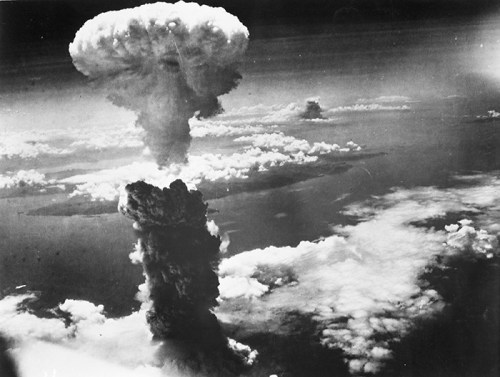
Yesterday was the anniversary of the second and hopefully last nuclear weapon used in war, the bomb called the Fat Man which was dropped on the Japanese city of Nagasaki. Three days before the city of Hiroshima had been destroyed by the first atomic bomb used in combat. It is a decision that forever changed the consequences of waging total war. It was a decision that still haunts humanity and which policy makers and military strategists wrestle with in an age where at nine nations have deployable nuclear weapons and a number of other nations are developing or trying to obtain.

It is also the subject that is wrestled with by students of major military staff colleges and universities. I know, I taught the ethics elective at the Joint Forces Staff College. In each of our classes at least one brave officer did a presentation detailing the ethical issues involved the decision and the implications today. For those not familiar with the military the truth is that most officers are quite circumspect and much more grown up about the subject than the average citizen, politician, or even the current President or National Security Advisor. But then there are probably some some who would be like Colonel Paul Tibbets who flew the B-29 bomber Enola Gay which dropped said these words in an interview in 1989:

“I made up my mind then that the morality of dropping that bomb was not my business. I was instructed to perform a military mission to drop the bomb. That was the thing that I was going to do the best of my ability. Morality, there is no such thing in warfare. I don’t care whether you are dropping atom bombs, or 100-pound bombs, or shooting a rifle. You have got to leave the moral issue out of it.”

Tibbets, like Truman justified his position based on his view of the bestiality of the crimes committed by the Japanese during the war. It was quite a common point of view.

It was a decision made by President Truman one reason was purely pragmatic. It was a wonder weapon that promised to end the war with a minimum of American casualties. He noted in 1952:

“I gave careful thought to what my advisors had counseled. I wanted to weigh all the possibilities and implications… General Marshall said in Potsdam that if the bomb worked we would save a quarter of a million American lives and probably save millions of Japanese… I did not like the weapon… but I had no qualms if in the long run millions of lives could be saved.”

But Truman’s decision was also based on the factor of revenge and viewing the Japanese as animals.  In response to a telegram from the Reverend Samuel McCrea Cavert, the General Secretary of the Federal Council of The Churches of Christ in America, the predecessor of the National Council of Churches. Reverend Cavert was a Presbyterian minister. Cavert’s telegram stated:

“Many Christians deeply disturbed over use of atomic bombs against Japanese cities because of their necessarily indiscriminate destructive efforts and because their use sets extremely dangerous precedent for future of mankind. Bishop Oxnam, President of the Council, and John Foster Dules, Chairman of its Commission on a just and durable peace are preparing statement for probable release tomorrow urging that atomic bombs be regarded as trust for humanity and that Japanese nation be given genuine opportunity and time to verify facts about new bomb and to accept surrender terms. Respectfully urge that ample opportunity be given Japan to reconsider ultimatum before any further devastation by atomic bomb is visited upon her people.”

Truman’s response to the telegram revealed the darker side of his decision to use the bomb.

My dear Mr. Cavert:

I appreciated very much your telegram of August ninth.

Nobody is more disturbed over the use of Atomic bombs than I am but I was greatly disturbed over the unwarranted attack by the Japanese on Pearl Harbor and their murder of our prisoners of war. The only language they seem to understand is the one we have been using to bombard them.

When you have to deal with a beast you have to treat him as a beast. It is most regrettable but nevertheless true.

The President’s senior military advisors were certainly of a different point of view about the use of the weapons. Admiral William Leahy who served as Chief of Staff to the Commander in Chief and was the senior Naval Officer in service disagreed and told Stimson of his misgivings about using the atomic bomb at this particular point in the war. In his memoirs which were released in 1949 he wrote:

General Dwight D. Eisenhower disagreed with the use of the atomic bomb and recorded his interaction with Stimson:

“In 1945 Secretary of War Stimson, visiting my headquarters in Germany, informed me that our government was preparing to drop an atomic bomb on Japan. I was one of those who felt that there were a number of cogent reasons to question the wisdom of such an act. During his recitation of the relevant facts, I had been conscious of a feeling of depression and so I voiced to him my grave misgivings, first on the basis of my belief that Japan was already defeated and that dropping the bomb was completely unnecessary, and secondly because I thought that our country should avoid shocking world opinion by the use of a weapon whose employment was, I thought, no longer mandatory as a measure to save American lives.”

Stimson did not agree with the Eisenhower, he would later recall words that echoed those of Truman in 1952, not his words to Revered Cavert immediately after the event.

“My chief purpose was to end the war in victory with the least possible cost in the lives of the men in the armies which I had helped to raise. In the light of the alternatives which, on a fair estimate, were open to us I believe that no man, in our position and subject to our responsibilities, holding in his hands a weapon of such possibilities for accomplishing this purpose and saving those lives, could have failed to use it and afterwards looked his countrymen in the face.”

Admiral William Leahy who served as Chief of Staff to the Commander in Chief and was the senior Naval Officer in service disagreed and told Stimson of his misgivings about using the atomic bomb at this particular point in the war. In his memoirs which were released in 1949 he wrote:

“Once it had been tested, President Truman faced the decision as to whether to use it. He did not like the idea, but he was persuaded that it would shorten the war against Japan and save American lives. It is my opinion that the use of this barbarous weapon at Hiroshima and Nagasaki was of no material assistance in our war against Japan. The Japanese were already defeated and ready to surrender because of the effective sea blockade and the successful bombing with conventional weapons… My own feeling was that in being the first to use it, we had adopted an ethical standard common to the barbarians of the Dark Ages. I was not taught to make wars in that fashion, and that wars cannot be won by destroying women and children.”

General Hap Arnold, the Commander of the Army Air Forces noted: “It always appeared to us that, atomic bomb or no atomic bomb, the Japanese were already on the verge of collapse.” 

Those who questioned the decision would be vindicated by the U.S. Strategic Bombing Survey study published in 1946. That study laid out the facts in stark terms:

“Certainly prior to 31 December 1945, and in all probability prior to 1 November 1945, Japan would have surrendered even if the atomic bombs had not been dropped, even if Russia had not entered the war, and even if no invasion had been planned or contemplated.” 

Later, Dr. J. Samuel Walker, the Chief Historian of the Nuclear Regulatory Commission wrote:

“Careful scholarly treatment of the records and manuscripts opened over the past few years has greatly enhanced our understanding of why Truman administration used atomic weapons against Japan. Experts continue to disagree on some issues, but critical questions have been answered. The consensus among scholars is the that the bomb was not needed to avoid an invasion of Japan. It is clear that alternatives to the bomb existed and that Truman and his advisers knew it.” 

Thus the moral question remains and perhaps is best answered by the words of Dr. Leó Szilárd who first proposed building atomic weapons. In 1960 he noted to U.S. News and World Reports:

Suppose Germany had developed two bombs before we had any bombs. And suppose Germany had dropped one bomb, say, on Rochester and the other on Buffalo, and then having run out of bombs she would have lost the war. Can anyone doubt that we would then have defined the dropping of atomic bombs on cities as a war crime, and that we would have sentenced the Germans who were guilty of this crime to death at Nuremberg and hanged them? 

But, again, don’t misunderstand me. The only conclusion we can draw is that governments acting in a crisis are guided by questions of expediency, and moral considerations are given very little weight, and that America is no different from any other nation in this respect.

I think now some 73 years later we need to ponder that question before it can happen again.

Peace

Padre Steve+


Leave a comment

Filed under ethics, Foreign Policy, History, Military, national security, Political Commentary, world war two in the pacific

No Sympathy for Sarah

Friends of Padre Steve’s World,

Over the past number of years I have had my life threatened by Nazis, White Supremacists, and supposedly Christian zealots. Likewise I had to the real threat to my freedom and career by a Trump supporter in my chapel who tried to have me tried by Court Martial because he disagreed with the administration’s policies on imprisoning children and separating the for their families and recalling from scripture, Christian tradition, and history the duty of Christians to confront evil policies. I was exonerated but I still have legal fees to pay.

Over the past week or so I have had a number of friends and acquaintances when learning of what I went through tell me how sorry they felt for White House Press Secretary Sarah Huckabee Sanders. I had to be blunt and tell them that I feel no sympathy for her. It surprised them.

I told them both that I had no sympathy for someone who works for and lies for the man who supports and encourages the people the very people who have threatened me in such dire ways. I have no sympathy for a person who uses her position to first and foremost blatantly lie on a daily basis.

If that wasn’t enough I have no sympathy for a person serving as the White House Press Secretary speaking against the rights to free speech, the freedom, of the press, and freedom of association guaranteed by the First Amendment.

Likewise, I have no sympathy for a person for a person who uses the position of White House Press Secretary to deride, mock, and impugn the integrity of journalists and to give aid and comfort to those who threaten the lives of those journalists.

Finally, I have no sympathy for any government official who when confronted about the actions of their boss which encourage violence against all opponents and give aid and comfort to those who have and will again commit violence by whining about how she has been disrespected.

I have no sympathy for this spawn of Mike Huckabee. She has enjoyed a life of privilege and power as the daughter of a powerful preacher who became a powerful politician and pundit.

She, like her father and her boss is a sociopath and narcissist. As such she has no capacity for empathy or receiving any kind of criticism. I do not believe that she is a good person for a good person with a good heart could not do what she is doing. To me she is no better that Joseph Goebbels. I believe that if she was ever given the kind of political and governmental power that Goebbels was given by Hitler that she would joyfully exercise it.

Thus, I have no sympathy for Sarah, even less than I have for her boss. She made the decision to serve him and has willingly carried out his desires with the energy of a Nazi propagandist.

Maybe if she grows a conscience and realizes the evil that she has steadfastly defended and encouraged and decides to speak the truth from the James Brady Press Room I might change my mind. But until she decides to honor her Christian faith and obey the Constitution I have no sympathy for Sarah, and neither should you. She has made her bed and one day she will have to answer for her actions.

So until tomorrow,

Peace,

Padre Steve+

8 Comments

Filed under christian life, ethics, faith, History, nazi germany, News and current events, Political Commentary

Dealing With “Christian” Political Extremists: My Recent Experience

img_0535

Friends of Padre Steve’s World,

Last night I wrote about Attorney General Jeff Sessions and his newly formed Religious Tyranny Task Force. The goal of that task force is to make sure that white conservative Christians can impose their beliefs on other and suffer no recriminations from discriminating against Gays and others that they do not want to serve or care for, even if their religious rights trump the civil rights of others. It is perhaps one of the most incestuous and dangerous displays of marriage of the Church and the police power of the state in the history of the United States.

Likewise, last month I wrote an article about having been accused by a chapel congregation member of conduct unbecoming an officer and contempt towards the President of the United States. I wrote the article after I was cleared of the charges during the preliminary inquiry. But it left me with many questions about the people of my congregation; questions that I have been wrestling for the better part of the month.

Since I am the senior supervisory chaplain on my base and come from a tiny denomination of the Old Catholic tradition that is stuck in the middle between Roman Catholicism and Protestantism I am an odd fit. My denomination is orthodox in its theology of God and Christ but very much a part of the the understandings of the Protestant Social Gospel of the early 1900s, the social teachings that came out of the Roman Catholic Church during Vatican II, and the Civil Rights Movement. I am also informed by being a trained historian.  This includes having a strong understanding of influence of the early Baptists in the United States on religious liberty as it came to be written into the Bill of Rights. The Baptists of that period were highly persecuted, in Europe and in the North American colonies by state churches. As a result they were much more progressive and tolerant of the rights of all religious minorities and even non-believers.

These men included Roger Williams who founded the colony of Rhode Island as a colony with no state religion and Virginia Baptist John Leland who was the inspiration for James Madison drafting the Bill of Rights.

I do my best to support the congregation and my junior chaplains regardless of their theological beliefs or political viewpoints. As such I try to allow my junior chaplains the chance to do good by pastoring the congregation while I support by them substituting every four to six weeks so they can get a full weekend off once in a while. In fact my policy is that I will not police their sermon content or how they do ministry so long as they care about the people, are not abusive, do not violate the rights of others, or commit crimes. So if a congregation member were to complain to me about their sermon I would tell that congregant to talk to them and if they could not work it out to contact that chaplains church or religious organization. I cannot police the beliefs

Since the accusations were leveled and I was told that I was exonerated I have been thinking of how next to approach the congregation, and today I got a copy of the investigation. I was heartened by some of the statements given by members of the congregation, while others troubled me. In the investigation was a copy of the letter the complainant sent to my commander. The difference between his letter and even the even the most prejudiced other congregant was amazing for even those somewhat critical of the sermon admitted their prejudices and gave me some benefit of doubt. In fact his letter was over the top and in opposition to what everyone of the others said that the investigating officer decided not to get a statement from him. But I could never believe that someone could make up such venomous lies in an attempt to destroy my name, reputation and career in such a despicable manner.

My review of the investigation and the statements has made me even more concerned about going before the congregation again. Knowing the attitudes of many it feels like by doing so I will be exposing myself to other charges from people who are little different than the Gestapo, Stasi, and KGB informants who routinely denounced priests and pastors. Sadly, with the Justice Department now behind them such people will have free reign to denounce people simply based on their often quite shallow and narrow theological understandings which are far more informed by their right wing politics than by Scripture, Tradition, or Reason.

So in the next few weeks I have a decision to make on how I will deal with this. I have a few ideas and I discuss them with my Protestant pastors who are much more conservative than me are incredibly supportive. I also am thinking and praying about what to do. Whatever I do I will script my remarks and have at least one of my other chaplains in attendance. I may even record it because I don’t want to give any of these Trump cultists to make up anything that cannot be refuted.

The sad thing is that I even have to be concerned about this. I never in a million years could have imagined being denounced by retired military officer for my sermon content. That gives me pause and frankly makes me very concerned. The experience has embittered me.  Don’t get me wrong. There are a few people in the congregation who have stood behind me and encouraged me, but most have either turned their backs on me or remained bystanders.

So I ask for your prayers, thoughts, encouragement, or wisdom in what I should do next. I am struggling with anger while trying to love and forgive the people who hurt me that God still loves and who Christ died to save.

However, there is one thing that I do know. It is something that both Dr. Martin Luther King Jr. and Dietrich Bonhoeffer understood. Dr. King said: “Our lives begin to end the day we become silent about things that matter.”  While Bonhoeffer wrote: “Silence in the face of evil is itself evil: God will not hold us guiltless. Not to speak is to speak. Not to act is to act.” 

So I know I cannot remain silent because what is happening in the church in the United States not to mention the country is a manifestation of evil.

Until tomorrow,

Peace,

Padre Steve+


21 Comments

Filed under christian life, civil rights, culture, ethics, faith, History, leadership, LGBT issues, Military, ministry, nazi germany, Political Commentary, Religion, US Navy