Category Archives: History

Understanding the Actions Ordinary Men: Perpetrators of Genocide

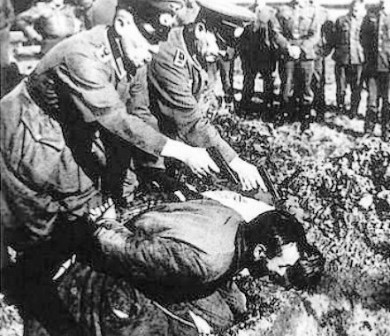
Ordungspolizei Executing Jews in Poland

Friends of Padre Steve’s World,

The great American theologian and philosopher Reinhold Niebuhr wrote: “Ultimately evil is done not so much by evil people, but by good people who do not know themselves and who do not probe deeply.”

I just finished re-reading Christopher Browning’s classic book on an often overlooked part of the Holocaust in Poland, Ordinary Men: Reserve Police Battalion 101 and the Final Solution  in Poland. As I read it I was reminded of Niebuhr’s words. The book details the actions of the men of a police unit that one would have expected to be the most unlikely perpetrators of violence and mass killing. Most of the unit’s men were not ardent Nazis or even party members, many were too old to have been drafted into the military, and most came of age long before the Nazis took control of the education system.  They were mostly from Hamburg, one of the least Nazified of all major German cities, and included was a contingent from Luxembourg, a country that was not part of Germany.

In their actions in Poland an estimated ten to twenty percent refused to take part in the mass killings of Jews. Unlike the people who manned the factory like death camps such as Treblinka and Auschwitz, these men killed their victims in an exceedingly personal manner. They stood at close range and fired pistol or rifle shots into the back of the skulls of their victims, who mostly were kneeling over pits or prostrate on the ground. The members of the unit killed a minimum of 38,000 Jews in this manner, and were instrumental in the deportations of about 45,000 more to the death camps. Very few were prosecuted for their crimes. Most went home, and some resumed successful careers in the police.

These men were very ordinary, and that is what makes what they did so troubling. One of the problems with human nature is that people in any time or place can participate in the very kinds of evil that the men of Reserve Police Battalion 101 and other units like it did. We have to understand what allows normal people to take part in evil. As Timothy Snyder wrote in his book Bloodlands: Europe Between Hitler and Stalin:

“It is easy to sanctify policies or identities by the deaths of victims. It is less appealing, but morally more urgent, to understand the actions of the perpetrators. The moral danger, after all, is never that one might become a victim but that one might be a perpetrator or a bystander.”

It is never easy to examine and understand the actions of the perpetrators. To understand them is not to justify them, but to ensure that we do not become like them, as Yehuda Bauer wrote:

“The horror of the Holocaust is not that it deviated from human norms; the horror is that it didn’t. What happened may happen again, to others not necessarily Jews, perpetrated by others, not necessarily Germans. We are all possible victims, possible perpetrators, possible bystanders.”

Until tomorrow,

Peace

Padre Steve+

2 Comments

Filed under History, holocaust, leadership, Political Commentary

Infallibility, Narcissism, and Paranoia

Friends of Padre Steve’s World,

Once again  just a short thought to ponder. Hannah Arendt wrote: “The chief qualification of a mass leader has become unending infallibility; he can never admit an error.”

This statement is undeniably true. Hitler, Stalin, Mao, Castro, the Ayatollahs, and Pol Pot are just some examples. More troubling is that such personalities are not absent today, Vladimir Putin, Marianne LePen, and our own President display this tendency, and their most devoted followers embrace it as well.

In the case of President Trump, presidential power means never having to say your sorry, or made a mistake. Failures are blamed on others, Congressional leaders, former President’s Obama and Bush, journalists, and even advisors who have outlasted their usefulness, case in point, Michael Flynn.

The inability to admit error is dangerous, but it also points to other potentially severe psychological issues. It is one of the characteristics of a paranoid personality, as well as a narcissistic personality. Richard Hofstadter wrote:

“The idea of the paranoid style as a force in politics would have little contemporary relevance or historical value if it were applied only to men with profoundly disturbed minds. It is the use of paranoid modes of expression by more or less normal people that makes the phenomenon significant.”

Likewise, even if those characteristics do not reach the point of becoming an actual psychological disorder, they can be severe enough to impair sound judgment as a leader, and lead to potentially terrible decisions. History shows us this all too often. These kinds of leaders see the world as a threatening place, full of enemies, real and imagined. The destruction of their enemies is of the first importance to such leaders, even when it is detrimental to the nations that they lead.

So until tomorrow,

Peace

Padre Steve+


2 Comments

Filed under History, leadership, Political Commentary

Fragile and Unpredictable: Auschwitz and Human Behavior in the Crisis

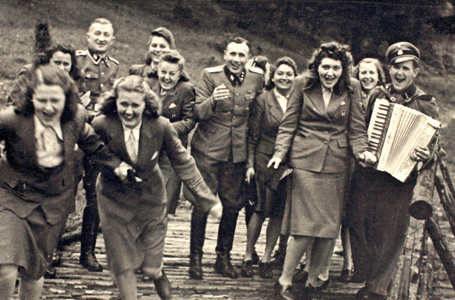
Auschwitz Staff at Play 

Friends of Padre Steve’s World,

In his book Auschwitz: A New History, Laurence Rees noted something that is important about how human beings act in crisis. After interviewing many of perpetrators, victims, and bystanders who were at Auschwitz and other parts of the Nazi death machine he wrote this:

“…human behavior is fragile and unpredictable and often at the mercy of the situation. Every individual still, of course, has a choice as to how to behave, it’s just that for many people the situation is the key determinate in that choice.”

I think that it is a comment worth reflection. One of the things that Rees explored was how people who in one situation can be the best of neighbors, the most conscientious and ethical of businessmen, the most dedicated civil servants can seemingly become something totally different when placed in situations that test who they are.

Selecting those to Die 

This is one of the scary things about human nature itself, while there were many people who were sadistic and enjoyed the evil that they did, there were many more who could not decide to be good or evil, instead they went with the flow and took the path of least resistance. Hannah Arendt wrote of Adolf Eichmann, who was the instrument of destruction for much the Jewish population of Europe:

“The trouble with Eichmann was precisely that so many were like him, and that the many were neither perverted nor sadistic, that they were, and still are, terribly and terrifyingly normal. From the viewpoint of our legal institutions and of our moral standards of judgment, this normality was much more terrifying than all the atrocities put together.” 

In times of great change, in times of crisis, in times of uncertainty demagogues manipulate people through fear, particularly fear of the other, both the other within their society, and those far away. When they do this they dehumanize people who seem different from us, be it in their race, color, religion, politics, gender, or sexual identity. When they succeed in doing this, it is the ordinary people who turn the other way, or collaborate in the persecution of the victims.

We are in a precarious situation and it would not take much for our nation to slide into a totalitarian dictatorship, and if the circumstance were right, if the crisis large enough, most people would probably surrender their freedom for the supposed security offered by a dictator. As Timothy Snyder wrote:

“The European history of the twentieth century shows us that societies can break, democracies can fall, ethics can collapse, and ordinary men can find themselves standing over death pits with guns in their hands. It would serve us well today to understand why.”

That is why we must not only understand history, but at the same time we must be determined to recognize how it informs us today, and how we can prevent such things from ever happening again.

That’s all for today,

Peace

Padre Steve+

3 Comments

Filed under ethics, History, holocaust, laws and legislation, nazi germany, Political Commentary

The Doolittle Raid at 75: And Then There Was One

Lieutenant Colonel Dick Cole

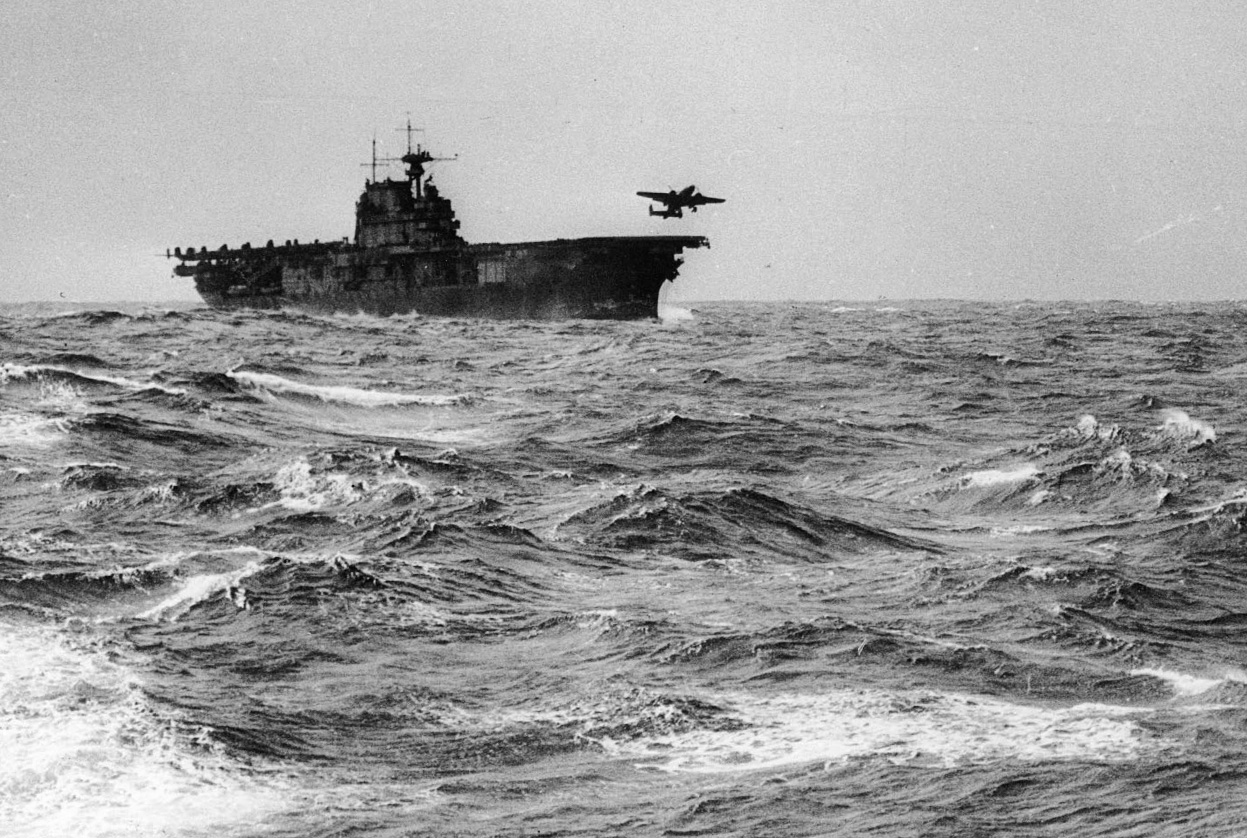
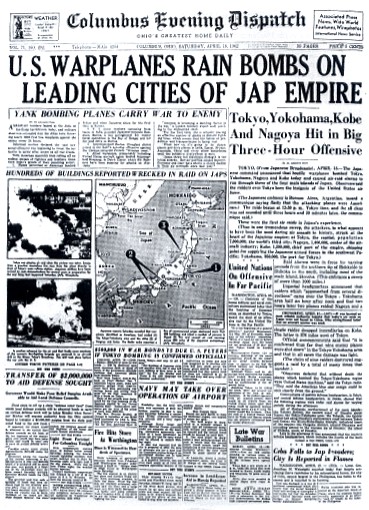
Today marks the 75th anniversary of the Doolittle Raid on Tokyo. 80 US Army Air Corps flyers manning 16 B-25 Mitchell bombers conducted a mission from the deck of the USS Hornet CV-8 which though it caused little damage changed the course of World War Two in the Pacific.

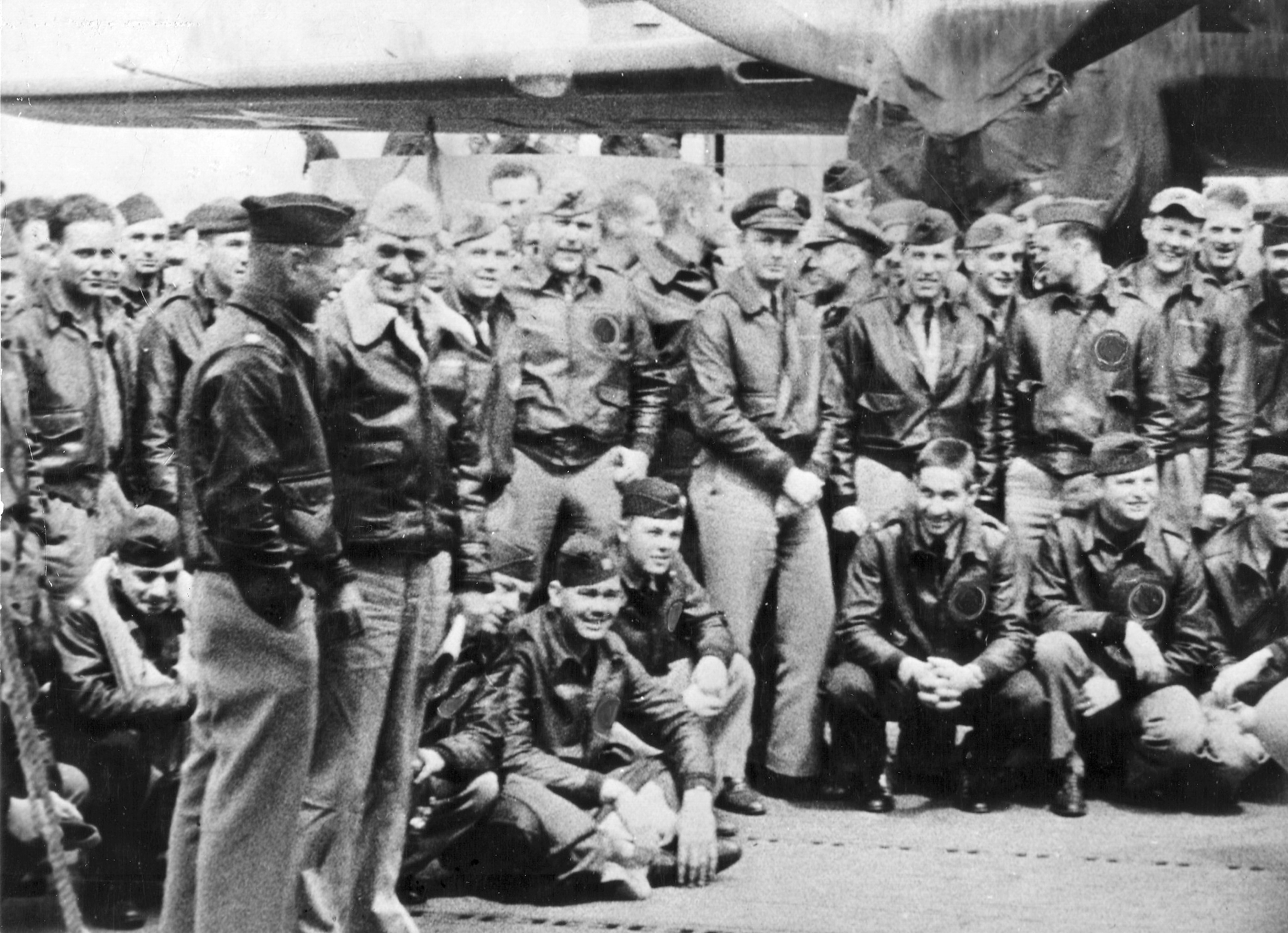
Doolittle and his Airmen with Hornet’s C.O. Captain Marc Mitscher 

The genus of the strike came from the desire of President Franklin Roosevelt to bomb Japan as soon as possible during a meeting just prior to Christmas 1941. Various aircraft types were considered and in the end the military chose the B-25 because it had the requisite range and had the best characteristics. Aircraft and their crews from the 17th Bomb Group which had the most experience with the aircraft were modified to meet the mission requirements. Lieutenant Colonel Jimmy Doolittle was selected to lead the mission.

Once the aircraft were ready they and their crews reported to Eglin Field for an intensive three week period of training. Supervised by a Navy pilot the crews practiced simulated carrier take offs, low level flying and bombing, night flying and over water navigation. When the training was complete the aircraft and crews and support personnel flew to McClellan Field for final modifications and then to NAS Alameda California where they were embarked on the Hornet Hornet’s air group had to be stowed on the ships hanger deck since the 16 B-25s had to remain of the flight deck. Each bomber was loaded with 4 specially modified 500 lb. bombs, three high explosive and one incendiary.

Departing Alameda on April 2nd the Hornet and her escorts, Hornet’s Task Force 18 rendezvoused with the Admiral William “Bull” Halsey’s Task Force 16 built around the USS Enterprise CV-6. task Force 16 provided escort and air cover during the mission. The carriers, escorted by 4 cruisers, 8 destroyers and accompanied by two oilers hoped to get close enough to the Japanese home islands so that the raiders could reach bases in allied China.

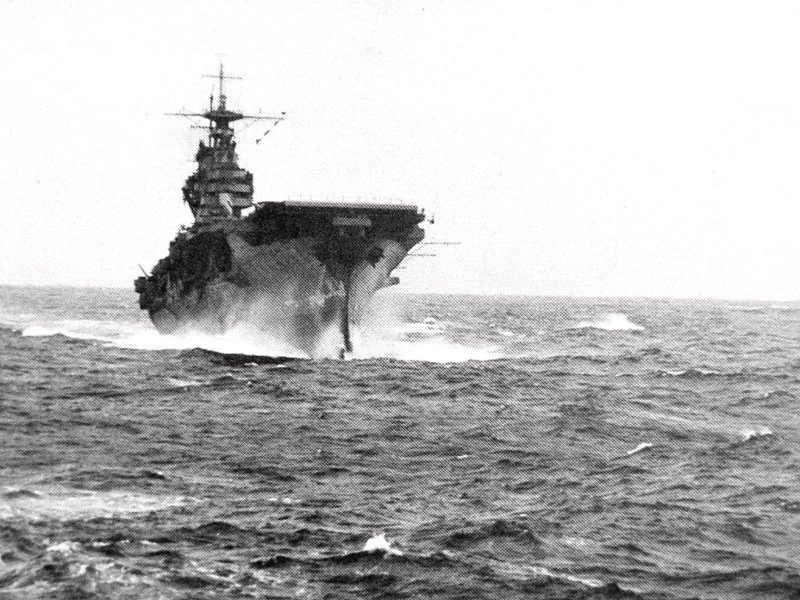
Hornet in Heavy Seas while launching the Raiders

The destroyers and slow oilers broke off on the evening of the 17th after refueling the carriers and cruisers. The two carriers and the cruisers then commenced a high speed run to get into range. However early in the morning of April 18th the ships were sighted by a Japanese patrol boat, the #23 Nitto Maru which was quickly sunk by the USS Nashville but not before it got off a radio message alerting the Japanese command. However the Japanese knowing that carrier aircraft had a relatively short range did not expect an attack. However, realizing the danger that the sighting brought, Mitscher elected to launch immediately, even though it meant that bombers would have to ditch their aircraft or attempt to land well short of the friendly Chinese airfields. The launch was 10 hours earlier and about 170 miles farther out from the Chinese bases than planned.

B-25 Launching from Hornet

Flying in groups of two to four aircraft the raiders struck the Japanese cities of Tokyo, Yokohama, Yokosuka, Nagoya, Kobe and Osaka. Minimal damage was done and only one aircraft was damaged. However they needed to fly nearly 1500 more miles to get to areas of China unoccupied by Japanese forces. Miraculously most of the aircraft and crews managed to find refuge in China. 69 of the 80 pilots and crew members avoided death or capture. Two flyers drowned, one died when parachuting from his aircraft. Eight men were captured. Of those captured by the Japanese three, Lieutenants William Farrow, Dean Hallmark and Corporal Harold Spatz were tried and executed for “war crimes” on October 15th 1942.

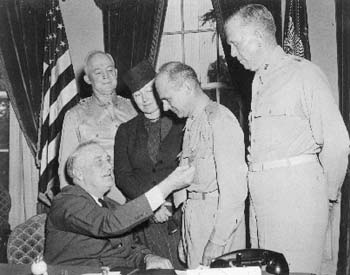
Many of the surviving flyers continued to serve in China while others continued to serve in North Africa and Europe, another 11 died in action following the raid. Doolittle felt that with the loss of all aircraft and no appreciable damage that he would be tried by courts-martial. Instead since the raid had so bolstered American morale he was awarded the Medal of Honor, promoted to Brigadier General and would go on to command the 12th Air Force, the 15th Air Force and finally the 8th Air Force.

The raid shook the Japanese, especially the leadership of the Imperial Navy who had allowed American aircraft to strike the Japanese homeland. The attack helped convince Admiral Isoroku Yamamoto that an attack on Midway was needed in order to destroy the American Carriers and the threat to the home islands.

When asked by a reporter about where the attack was launched from, President Roosevelt quipped “Shangri-La” the fictional location of perpetual youth in the Himalayas’ made famous in the popular book and movie Lost Horizon.

The raid in terms of actual damage and losses to the attacking forces was a failure, but in terms of its impact a major victory of the United States. The attack was psychologically devastating to Japanese leaders, including Prime Minister Hideki Tojo, whose personal aircraft was nearly hit by one of the raiders and Admiral Isoroku Yamamoto, who felt personally humiliated and dishonored by the fact that bombers launched from American carriers.

Likewise the raid gave the people of the United States a huge morale boost at a time when very little was going right. It forced the Japanese Navy to launch the attack on Midway that turned out to be a disaster, decimating the best of the Japanese Naval Air Forces and the loss of four aircraft carriers and enabled the US Navy to take the offensive two months later at Guadalcanal.

Franklin Roosevelt Awards Medal of Honor to Jimmy Doolittle 

In the years after the war the survivors would meet. Today only one survivor of the raid remain alive. One hundred and one year old Lt.Col. Richard “Dick” Cole, Doolittle’s co-pilot will attend the ceremony today.

It will not be long before he too is gone and it is up to us to never forget the heroism, sacrifice and service in a mission the likes of which had never before been attempted, and which would in its own way help change the course of the Second World War.

Peace

Padre Steve+

1 Comment

Filed under History, Navy Ships, World War II at Sea, world war two in the pacific

Titanic: A Monument and Warning to Human Presumption

Friends of Padre Steve’s World,

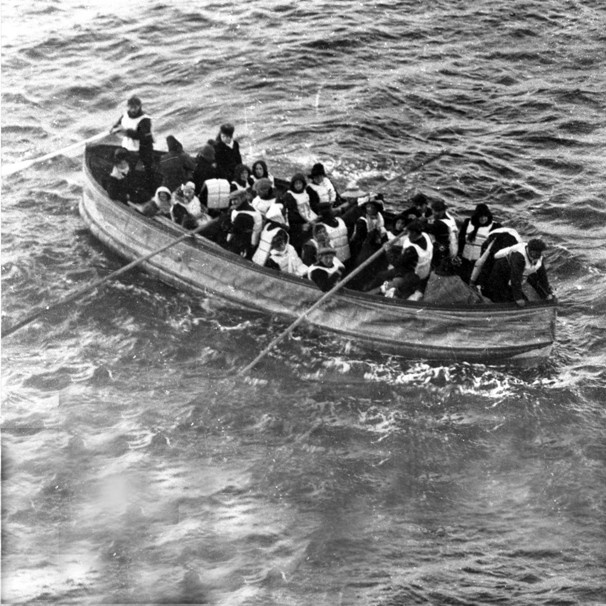
In 1912 the Bishop of Winchester said these words in a sermon marking the end of the R.M.S. Titanic: “Titanic, name and thing, will stand as a monument and warning to human presumption,” as well it should. Sadly, it seems that that Trump administration is doing its best to strip away vital safety, health, and environmental regulations that protect people from even worse disasters than that which befell the great ship 105 years ago today.

The story of the Titanic has been told many times, and it should be a cautionary tale for those who in the name of profit and glory seek to dismantle safety and environmental standards. I remember reading Walter Lord’s classic treatment of the story, A Night to Remember back in 7th Grade. It made a tremendous impact on me, and every so often I will go back and read it again.

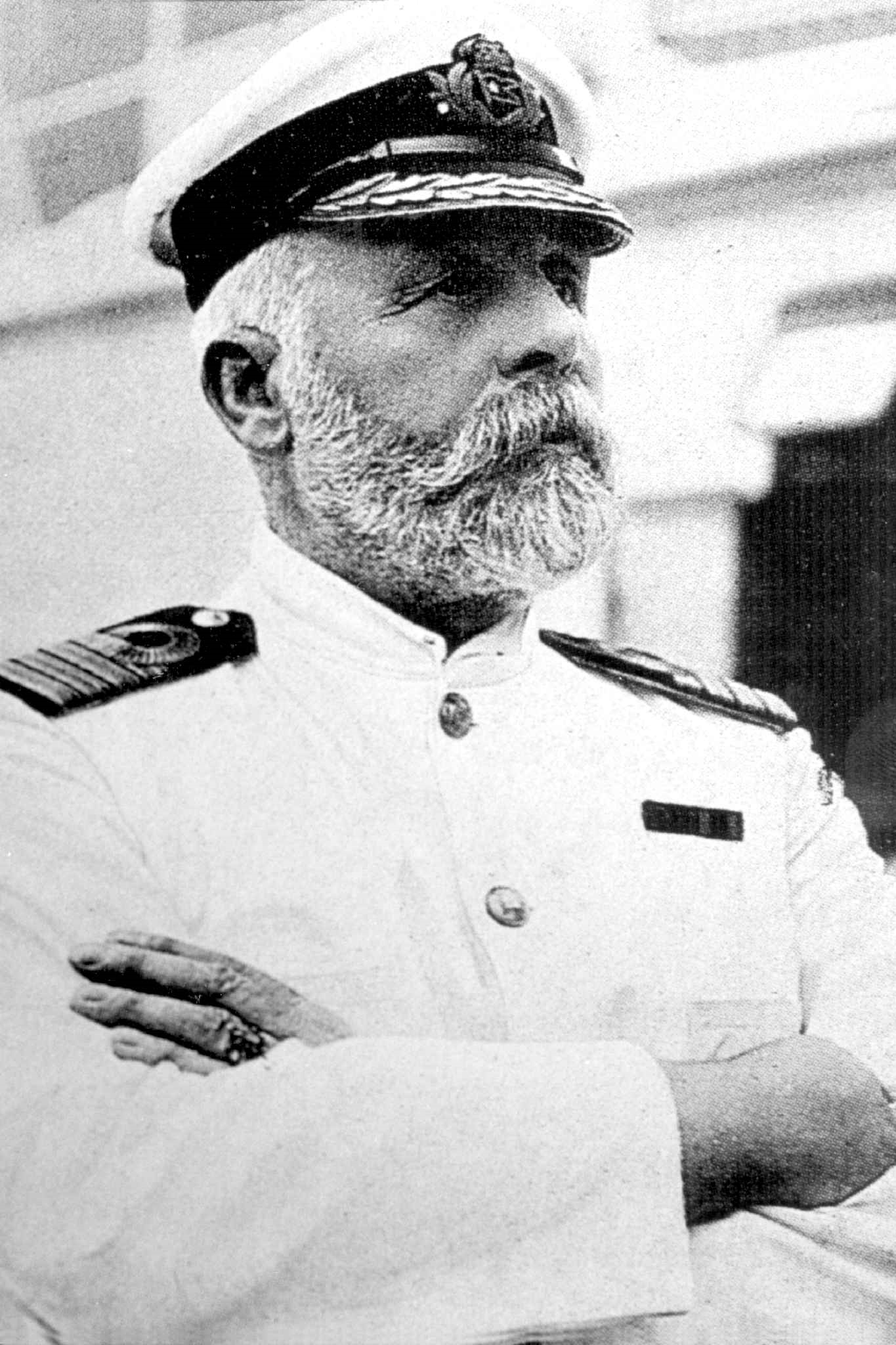
The Titanic’s Captain, Edward Smith, her was blinded by his faith in shipbuilding technology and had said about the Adriatic which he commanded previously, “I cannot imagine any condition which would cause a ship to founder. I cannot conceive of any vital disaster happening to this vessel. Modern ship building has gone beyond that.” A Senator Said during the hearings about the sinking of her captain, “Overconfidence seems to have dulled the faculties usually so alert.”

The story of what happened to the great ship is as hard to believe now as it was then, but then incredible tragedies be they the loss of ships, aircraft, buildings or bridges, and even spacecraft always invoke such feelings. When I was told about the Space Shuttle Challenger blowing up in 1986 I remarked to the young soldier who brought me the news “don’t be silly Space Shuttles don’t blow up.”  Walter Lord, who was probably the most prolific historian and author of the Titanic disaster used to talk of the “if onlys” that haunted him about the sinking of Titanic: If only, so many if onlys. If only she had enough lifeboats. If only the watertight compartments had been higher. If only she had paid attention to the ice that night. If only the Californian did come…” 

Bruce Ismay

The word “if” probably the biggest two letter word that plagues human history, looms large in the tragedy of Titanic. The great ship, which was the largest ship and one of the fastest ocean liners of her time was the victim of her owner and operators hubris as much as she was that of the iceberg which sank her. The ship was heralded by Bruce Ismay, the Chairman and Managing Director of the White Star Line as unsinkable, a claim that was echoed in the press.

Her builders had no such illusions and protested the claims. Thomas Andrews the Managing Director of Harland and Wolff Shipyards where she was built commented “The press is calling these ships unsinkable and Ismay’s leadin’ the chorus. It’s just not true.” 

Titanic was designed with the latest shipbuilding innovations, watertight compartments, a double bottom and equipped with wireless. She was billed as “unsinkable” by her owners but those innovations as advanced as they were for her day were insufficient to save her when her Captain and owners chose to charge through a known ice field at full speed.  Her watertight compartments did not extent far enough up the hull to prevent water from going over them.  Likewise it was never imagined that so many watertight compartments could be compromised.

Thomas Andrews

As far as lifeboats, the great ship carried far too few. Thomas Andrews, her builder wanted 64 had his arm twisted to bring the number to 32 and Titanic sailed with only 20 of which 4 were collapsible boats smaller than smaller lifeboats. Justifying himself under antiquated regulations (which were written for ships of 10,000 tons) which allowed just 16 boats J. Bruce Ismay the Director of White Star Line told Andrews:

“Control your Irish passions, Thomas. Your uncle here tells me you proposed 64 lifeboats and he had to pull your arm to get you down to 32. Now, I will remind you just as I reminded him these are my ships. And, according to our contract, I have final say on the design. I’ll not have so many little boats, as you call them, cluttering up my decks and putting fear into my passengers.” 

If only the Californian had come. Californian was the nearest vessel to Titanic and in easy wireless range. However her wireless was unmanned, she did not have enough operators to man it 24 hours a day.  Her lookouts saw Titanic but despite flares being fired from Titanic she never assumed Titanic to be in extremis. The next nearest ship, Carpathia heard the call and made a valiant attempt to reach Titanic but was too late.

If only…so many “if onlys” and so many traceable to one man, the Director of White Star Line J. Bruce Ismay.  Thomas Andrews would go down with the ship but Ismay ensured his own survival. Ismay is symbolic of men who allow their own hubris, vanity and power to destroy the lives of many.  He is so much like those that helped bring about the various economic crises that have wracked the United States and Western Europe and so many other tragedies.

After the disaster the tragedy was investigated by the United States Senate, as well as the British Board of Trade. However, the inquiry of the latter was condemned by the White Star Line’s Archivist, Paul Louden-Brown. He noted: “I think the enquiry is a complete whitewash. You have the [British] Board of Trade in effect enquiring into a disaster that’s largely of its own making.”

Ismay and Titanic are symbols of men guided only by their quest for riches and glory who revel in their power and scorn wise counsel or regulation, government or otherwise. They often believe that rules don’t apply to them. It is a cautionary tale for us today as corporations, lobbyists, and politicians seek to dismantle sensible and reasonable safety and environmental regulations for the sake of their unmitigated profit. Today we are seeing the Trump administration doing all that it can to strip away important safety, workplace, and environmental regulations in order to maximize profits.

But the warning goes far beyond that, it applies to any of us who adopt the mindset, “this cannot happen to us.” After all, there are times when we all end up as victims of our own hubris, such is the human condition.

Until tomorrow,

Peace

Padre Steve+

1 Comment

Filed under History, News and current events, Political Commentary

America’s Terrible Good Friday: The Assassination of Abraham Lincoln

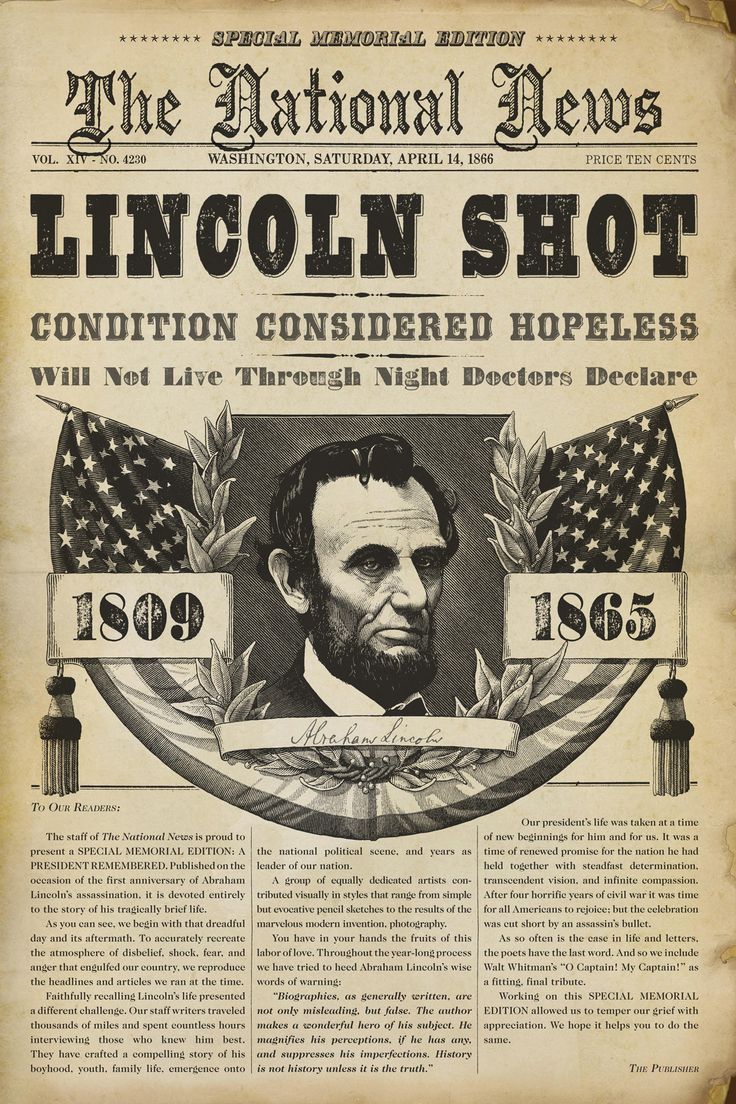
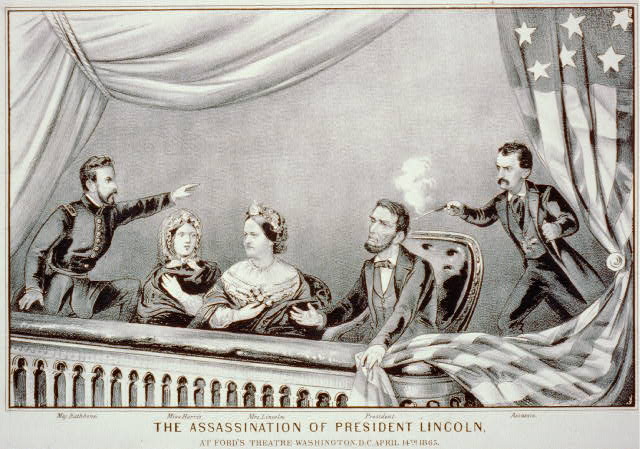
Good Friday is somber day, and I think that there was none more somber than Good Friday 1865. Shortly after 10 P.M. at Ford’s theater a handsome and well known actor walked into the booth occupied by President Lincoln at Washington’s Ford’s Theater. The President was there with his wife Mary Todd Lincoln and another couple after a very full day of business to watch the play Our American Cousin a farcical look at the visit of an American visiting his English relatives when going to settle the family estate.

Lincoln was looking forward to the play. Though the war continued the surrender of Robert E. Lee’s Army of Northern Virginia to Ulysses S. Grant on April 9th for all intents and purposes had placed the final nail in the Confederacy’s malevolent coffin, and it was if a burden have been removed from Lincoln’s shoulders. His task now what the reintegration of the rebellious states back into the Union, a task that he believed needed to be accomplished without malice while still seeking justice. He made this clear in his Second Inaugural Address just over a month before:

“With malice toward none, with charity for all, with firmness in the right as God gives us to see the right, let us strive on to finish the work we are in, to bind up the nation’s wounds, to care for him who shall have borne the battle and for his widow and his orphan, to do all which may achieve and cherish a just and lasting peace among ourselves and with all nations.”

Just three days before Lincoln had given his last public speech at the White House. It was a practical speech dealing with the nuts and bolts reuniting the country including announcing his support for Negro Suffrage. He said:

“By these recent successes the re-inauguration of the national authority — reconstruction — which has had a large share of thought from the first, is pressed much more closely upon our attention. It is fraught with great difficulty. Unlike a case of a war between independent nations, there is no authorized organ for us to treat with. No one man has authority to give up the rebellion for any other man. We simply must begin with, and mould from, disorganized and discordant elements. Nor is it a small additional embarrassment that we, the loyal people, differ among ourselves as to the mode, manner, and means of reconstruction.”

In the speech Lincoln discussed the issues related to the new government of Louisiana and its dealings with African Americans, which did not go far enough for Lincoln, who was intent on extending the franchise to vote for all blacks, even if it took time to make it so. John Wilkes Booth was in attendance that day and as he listened he became ever angrier and he vowed to a fellow conspirator Lewis Powell, “That is the last speech he will make” and Booth was going to ensure this himself.

Lincoln had been troubled for some time by terrible insomnia and dreams, both bizarre and ghoulish. A few days before he had told Mary and others sharing dinner with them of a troubling dream which he described in detail, Mary and those at the table so accustomed to Lincoln’s customary wit and humor were stunned as Lincoln spoke. He closed the description with these words:

“Determined to find the cause of a state of things so mysterious and shocking, I kept on until I entered the East Room, which I entered. There I was met with a sickening surprise. Before me was a catafalque, on which rested a corpse wrapped in funeral vestments. Around it were stationed soldiers who were acting as guards; and a throng of people, some gazing mournfully at the corpse, whose face was covered, others weeping pitifully: ‘Who is dead in the White House?’ I demanded of one of the soldiers. ‘The President’ was the answer; ‘he was killed by an assassin!’ “Then came a loud burst of grief from the crowd…” 

Mary and the others were so upset, particularly with the large number of death threats Lincoln had received throughout the war. However, Lincoln told them all not to worry as “it was only a dream.”

On that Good Friday Lincoln was determined not to mourn, instead of attending Good Friday services or contemplating the war, or reconstruction, he simply wanted to laugh and chose to attend the play, wanting General Grant and his wife to attend. However Grant needed to travel to New Jersey and declined the offer.

Despite this Lincoln was in a cheerful mood, looking forward to the future and discussing all the things that he wanted to see and do after his term in office. Mary was startled by his cheerfulness and Lincoln told her “I have never felt better in my life.” Lincoln and his party arrived late to the cheers of the cast and took their seats in the box about 8:30 to the strains of Hail to the Chief. As the play resumed Lincoln’s bodyguard slipped away to get a drink and about twelve minutes after ten Booth slipped into the box where Lincoln sat watching the play. As the crowd roared its delight at a particularly funny scene a shot rang out and Lincoln’s arm jerked up and he slumped over. Booth then jumped to the stage from the box, injuring his leg and shouting “Sic semper tyrannis” or thus always to tyrants. It was the beginning of a series of attempted assassinations designed to decapitate the Federal government, Secretary of State Seward was badly wounded by Lewis Payne, a third assassin backed out at the last minute and failed to attack Vice President Johnson.

Though physicians sought to save the President the wound was mortal, the bullet having ender the back of his head, and dug deep into his brain, lodging behind his left eye. At 7:22 A.M. Abraham Lincoln was dead. It was a disaster for the nation as the new President, Andrew Johnson was a political enemy of Lincoln and not in line with Lincoln’s understanding of reconstruction and reconciliation. A poor Southerner from Tennessee, Johnson hated the Southern plantation aristocracy and would act as a punisher, while radical reconstructionist members of the cabinet and Congress would act in such a way that reconstruction would never achieve all that Lincoln believed that it could.

While radical Confederates rejoiced in Lincoln’s death others were more circumspect. Jefferson Davis who was fleeing and hoping to continue the war realized that the South would not fare as well under Johnson as Lincoln. In fact Johnson’s lack of understanding of the nuances of northern politics as well as his loathing of blacks, his “beliefs, prejudices, personality traits were a recipe for disaster at a time when an unprecedented national crisis put a premium on the capacity to think in new and creative ways.”

The Army of the Potomac learned of Lincoln’s assassination on Easter Sunday. Joshua Chamberlain told a woman whose mansion was at the center of his division’s camp when she asked what disturbed him “It is bad news for the South.” When the woman asked if it was Lee or Davis Chamberlain told her that it was Lincoln and said “The South has lost its best friend, Madam.” 

Chamberlain ordered chaplain to conduct a field memorial for the fallen President. The division chaplain a Catholic Priest, Father Egan spoke and roused the men, and Egan ended his service “Better so, Better to die glorious, than live infamous. Better to be buried beneath a nation’s tears, than to walk the earth guilty of the nation’s blood.”

During the war Lincoln had endeared himself to his soldiers and they responded with great emotion. One burst into tears and sobbed “He was our best friend. God bless him,” another wrote home “What a hold Old Abe had on the hearts of the soldiers of the army could only be told by the way they showed their mourning for him.” Admiral David Dixon Porter wrote “The United States has lost the greatest man she ever produced.” 

The bullet fired by John Wilkes Booth was a disaster for the country. Sadly, there are some today, in particular the White Supremacist group The League of the South are choosing to celebrate the assassination of the man that they so hate, and honor the assassin as a hero. However, I have to agree with Admiral Porter, there has never been a President before or after who was anything like this man, and I dedicate myself to the quest for equality of all people and for a reconciliation. I will continue to work for that “new birth of freedom” that Lincoln so believed in.

Peace

Padre Steve+

1 Comment

Filed under civil war, History

The Day Freedom Died: The Colfax Massacre

Friends of Padre Steve’s World,

One hundred and forty-four years ago today one of the worst acts of terrorism against Americans by Americans was conducted by members of the White Leagues, a violent white supremacist group in Louisiana. This is from one of my Civil war texts and it is something not to forget in an age where violence against racial and religious minorities is again raising its head.

Have a good day,

Peace

Padre Steve+

The violence against Southern blacks escalated in the wake of the passage of the Fourteenth and Fifteenth Amendments and with the increasing number of blacks being elected to office in some Southern states during the elections of 1872. In Louisiana a Federal court ruled in favor of Republican Reconstruction candidates following a Democrat campaign to interfere with the vote, which included attacks on polling sites and the theft of ballot boxes. As a result the Louisiana Democrats “established a shadow government and organized paramilitary unit known as the White League to intimidate and attack black and white Republicans.” [1]

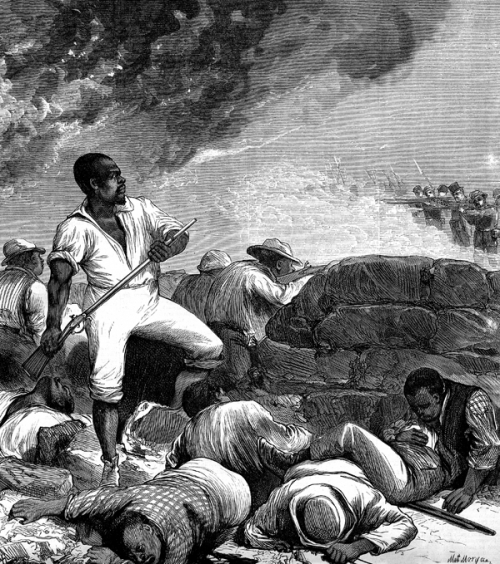
The White League in Louisiana was particularly brutal in its use of violence. The worst massacre committed by the White League occurred Easter Sunday 1873 when it massacred blacks in Colfax, Louisiana. Colfax was an isolated nondescript hamlet about three hundred fifty miles northwest of New Orleans. It sat on the grounds of a former plantation whose owner, William Calhoun, who worked with the former slaves who were now freedmen. The town itself “composed of only a few hundred white and black votes” [2] was located in the newly established Grant Parish. The “parish totaled about 4,500, of whom about 2,400 were Negroes living on the lowlands along the east bank of the Red.” [3] Between 1869 and 1873 the town and the parish were the scene of numerous violent incidents and following the 1872 elections, the whites of the parish were out for blood.

White leaders in Grant Parish “retaliated by unleashing a reign of terror in rural districts, forcing blacks to flee to Colfax for protection.” [4] The blacks of parish fled to the courthouse seeking protection from a violent white mob following the brutal murder of a black farmer and his family on the outskirts of town. The people of Colfax, protected by just a few armed black militiamen and citizens deputized by the sheriff took shelter in the courthouse knowing an attack by the White Supremacists was coming.  As the White League force assembled one of its leaders told his men what the day was about. He said, “Boys, this is a struggle for white supremacy….There are one hundred-sixty-five of us to go into Colfax this morning. God only knows who will come out. Those who do will probably be prosecuted for treason, and the punishment for treason is death.” [5] The attack by over 150 heavily armed men of the White League, most of whom were former Confederate soldiers, killed at least seventy-one and possibly as many as three-hundred blacks. Most of the victims were killed as they tried to surrender. The people, protected by just a few armed men were butchered or burned alive by the armed terrorist marauders. It was “the bloodiest peacetime massacre in nineteenth-century America.” [6]

The instigators of the attack claimed that they acted in self-defense. They claimed that “armed Negroes, stirred up by white Radical Republicans, seized the courthouse, throwing out the rightful officeholders: the white judge and sheriff” and they claimed that the blacks had openly proclaimed “their intention to kill all the white men, they boasted they would use white women to breed a new race.” [7] The claims were completely fabricated, after sending veteran former army officers who were serving in the Secret Service to investigate, the U.S. Attorney for Louisiana, J.R. Beckwith sent an urgent telegram to the Attorney General:

“The Democrats (White) of Grant Parish attempted to oust the incumbent parish officers by force and failed, the sheriff protecting the officers with a colored posse. Several days afterward recruits from other parishes, to the number of 300, came to the assistance of the assailants, when they demanded the surrender of the colored people. This was refused. An attack was made and the Negroes were driven into the courthouse. The courthouse was fired and the Negroes slaughtered as they left the burning building, after resistance ceased. Sixty-five Negroes terribly mutilated were found dead near the ruins of the courthouse. Thirty, known to have been taken prisoners, are said to have been shot after the surrender, and thrown into the river. Two of the assailants were wounded. The slaughter is greater than the riot of 1866 in this city. Will send report by mail.” [8]

Federal authorities arrested nine white men in the wake of the massacre and after two trials in which white majority juries were afraid to go against public opinion, three were “convicted of violating the Enforcement Act of 1871.” [9] None were convicted of murder despite the overwhelming evidence against them and even the lesser convictions enraged the White Supremacists in Louisiana who had employed the best lawyers possible and provided them and the defendants with unlimited financial backing. Assisted by the ruling of Supreme Court Associate Justice Joseph Bradley, who had a long history of neglecting Southern racism, white Democrats appealed the convictions to the Supreme Court.

The attack, and the court cases which followed, notably the judgment of the Supreme Court in United States v. Cruickshank which dealt with the appeal of the men responsible for the Colfax Massacre led to a “narrowing of Federal law enforcement authority” and were “milestones on the road to a “solid” Democratic South.” [10] The decision of the court in United States v. Cruikshank was particularly perverse in its interpretation of constitutional rights and protections. The court ruled in favor of the terrorists and declared that “the right of the black victims at Colfax to assemble hand not been guaranteed because they were neither petitioning Congress nor protesting a federal law. Assembling for any other cause was not protected.” [11] The Cruikshank decision amounted to a Supreme Court endorsement of violence against blacks, and made it “impossible for the federal government to prosecute crimes against blacks unless they were perpetrated by a state and unless it could prove a racial motive unequivocally.” [12] Northern politicians and newspapers, reeling under the effects of the stock market crash of 1873, which had denounced the massacre just a year before now ran from the story and from support of African Americans. A Republican office holder wrote, “The truth is, our people are tired out with this worn cry of ‘Southern outrages…. Hard times and heavy taxes make them wish the ‘nigger,’ the ‘everlasting nigger,’ were in hell or Africa.” [13] Racism and race hatred was not exclusively the parlance of the South.

In the wake of Justice Bradley’s reversal of the Colfax convictions whites in Grant Parish engaged in brutal reprisals against blacks, leading to many murders and lynching’s, crimes which law enforcement, even that favorable to the rights of African Americans were afraid to prosecute for fear of their own lives. Louisiana’s Republican Governor, William Pitt Kellogg wrote Attorney General Williams blaming the violence on Bradley’s ruling, which he wrote, “was regarded as establishing the principle that hereafter no white man could be punished for killing a negro, and as virtually wiping the Ku Klux laws of the statute books.” He added that with the Army leaving the state that his government and other Reconstruction governments would fall, “if Louisiana goes,” Kellogg wrote, “Mississippi will inevitably follow and, that end attained, all the results of the war so far as the colored people are concerned will be neutralized, all the reconstruction acts of Congress will be of no more value than so much waste paper and the colored people, though free in name, will be practically remitted back to servitude.” [14] Governor Kellogg could not have been more correct.

In the years that followed many of the men involved in the massacre and other murders before and after were hailed as heroes, some, including the leader of the attackers, Christopher Columbus Nash were again appointed to office in Colfax and Grant Parish and blacks were reminded every day of just what they had lost. On April 13th 1921 the men who committed the massacre were honored with a memorial in the Colfax cemetery honoring them as “Heroes… who fell in the Colfax Riot fighting for White Supremacy.” In 1951 the State of Louisiana Department of Commerce and Industry dedicated a marker outside the Courthouse which read: “On the site occurred the Colfax Riot in which three White men and 150 Negroes were slain, this event on April 13, 1873 marked the end of Carpetbag misrule in the South.” [15] That marker still stands, there is no marker commemorating the victims.

Other massacres followed across the South, aimed at both blacks and their white Republican allies. In Louisiana the White League had some 14,000 men under arms, in many cases drilling as military units led by former Confederate officers. A White League detachment southwest of Shreveport “forced six white Republicans to resign their office on pain of death – and then brutally murdered them after they had resigned.” [16] This became known as the Coushatta Massacre and it was a watershed because for the first time the White League targeted whites as well as African Americans. The violence, now protected by the courts ensured that neither would last long in the post-Reconstruction South and that the freedom of African Americans in those states would amount to a cruel illusion.

In 1875, President Ulysses S. Grant including comments about the Colfax massacre and the subsequent court decisions in his message to Congress. Grant was angry and wrote: “Fierce denunciations ring through the country about office-holding and election matters in Louisiana…while every one of the Colfax miscreants goes unwhipped of justice, and no way can be found in this boasted land of civilization and Christianity to punish the perpetrators of this bloody and monstrous crime.” [17] President Grant, the man who so wanted to help African Americans attain the full measure of freedom, was unable to do more as the Congress and Courts took sides with the Southern insurgents.

Notes

[1] Ibid. Foner Forever Free p.151

[2] Ibid. Langguth After Lincoln p.312

[3] Ibid. Lane The Day Freedom Died p.42

[4] Ibid. Goldfield America Aflame p.493

[5] Ibid. Lane The Day Freedom Died p.91

[6] Ibid. Goldfield America Aflame p.493

[7] Ibid. Lane The Day Freedom Died p.11

[8] Ibid. Lane The Day Freedom Died p.22

[9] Ibid. Goldfield America Aflame p.494

[10] Ibid. Lane The Day Freedom Died p.251

[11] Ibid. Langguth After Lincoln p.314

[12] Ibid. Goldfield American Aflame p.494

[13] Ibid. Lane The Day Freedom Died p.213

[14] Ibid. Lane The Day Freedom Died p.217

[15] Ibid. Lane The Day Freedom Died pp.261-262

[16] Ibid. McPherson The War that Forged a Nation p. 185

[17] Ibid. Lane The Day Freedom Died p.228

4 Comments

Filed under civil rights, civil war, History, Political Commentary

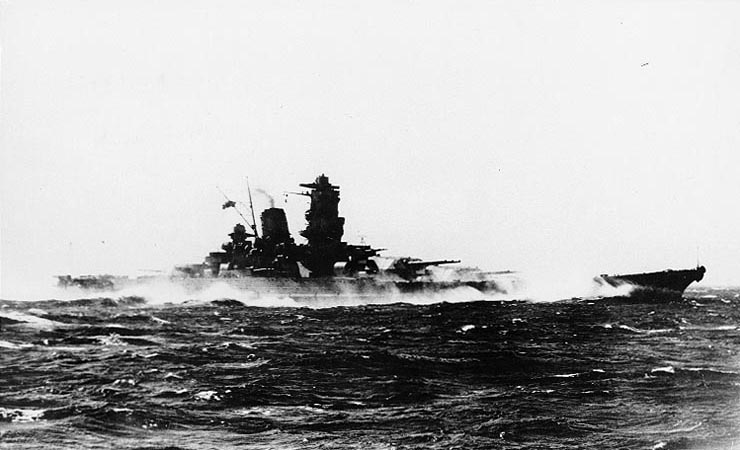
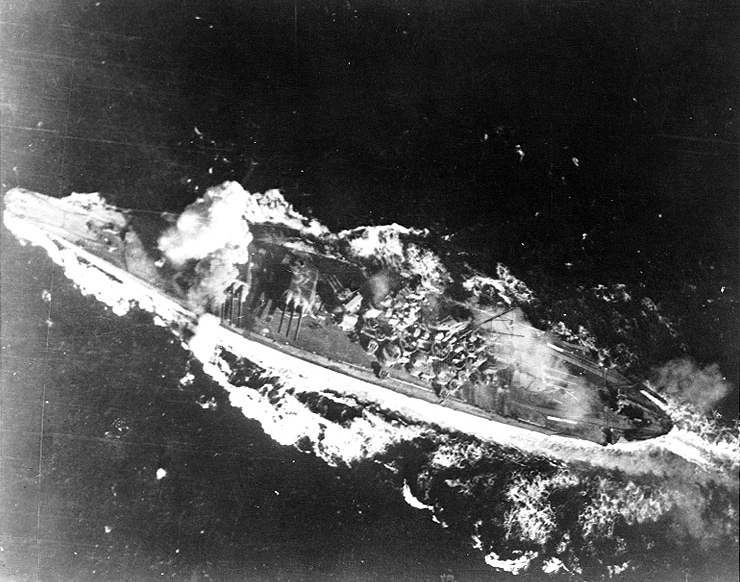
The Futile Sacrifice of a Naval Leviathan: The Sinking of the Yamato

Friends of Padre Steve’s World,

Those who have read my site since the beginning know that I have written much in terms of Naval History. One of the things that I am drawn to are the great ships that were sacrificed with the crews in futile attempts of salvage victory from defeat, or which were sacrificed in order to save others. Regardless of the circumstance I have a soft spot in my heart for sailors of any nation who pay with their lives when their ships are sunk. This is the story of the IJN Yamato, who along with her sister ship, the Musashi were the largest battleship ever constructed.

As dawn broke on April 7th 1945 the great Super-Battleship Yamato, the pride of the Japanese Imperial Navy and nine escorts steamed toward Okinawa on a suicide mission. It was literally the end of empire and the end of a navy. What had begun on December 7th 1941 was now winding down as the Imperial Navy launched its last offensive operation against the United States Navy.

The Imperial Navy was already at the end of its tether. Following the disasters at the Battle of the Philippine Sea which decimated the carrier air arm of the Imperial Navy; the subsequent losses in the defense of Formosa which used up the majority of any remaining carrier aircraft and crews; and the Battle of Leyte Gulf which decimated the surface forces of the navy what remained was a pitiful remnant of a once dominant fleet.

The great battleship Yamato and her sister ship Musashi were the largest warships ever built until the advent of the USS Enterprise CVN-65. Displacing over 72,000 tons 863 feet long and 127 feet in beam these ships mounted the largest artillery battery ever placed on a warship. Their nine 18.1” guns mounted in three triple turrets each weighing over 2500 tons weighed as much or more than the largest destroyers of the time. They could fire their massive shells 26 miles and had the capability of firing a special anti-aircraft shell known as the Sanshiki or beehive round.

Musashi was sunk during the Battle of the Sibuyan Sea at Leyte Gulf on October 24th 1944 after being hit by 19 aerial torpedoes and 17 bombs. Yamato engaged the American Escort Carriers and destroyers of Taffy-3 at the Battle off Samar the following day but was prevented by the audacity of the inferior American destroyers and timidity of the Japanese commander Vice Admiral Takeo Kurita from achieving any notable success.

The remains of the Imperial Navy were hampered by a lack of fuel, air power and training time. When the United States attacked Iwo Jima in February 1945, barely 700 miles from the home islands of Japan not a single Japanese surface ship sortied to challenge the American Navy.

However when the American attacked Okinawa on April 1st the Navy launched Operation Ten-Go. In spite of overwhelming American superiority in both naval air and surface forces the tiny task force was to fight its way to Okinawa, beach their ships and once the ships were destroyed the crews were to join Japanese Army forces on the island.

The doomed sortie was in part due to the insistence of the Imperial Army which derided the Imperial Navy for its failures at Philippine Sea and Leyte Gulf and pressure from Emperor Hirohito who asked “But what about the Navy? What are they doing to assist in defending Okinawa? Have we no more ships?” In response the Naval High command devised what amounted to a suicide mission for Yamato and her escorts. The plan was opposed by many in the Navy and leaders of the task force who saw it as a futile mission. Only the insistence of Admiral Kusaka who told the reticent commanders that the Emperor expected the Navy to make its best effort to defend Okinawa persuaded the Captains of the doomed force to accept the mission.

At about 1600 on April 6th the ships of the task force weighed anchor and departed their anchorage at Tokuyama hoping to take advantage of approaching darkness to mask their departure. They were detected and shadowed by American submarines which provided real time information on the course and speed of the Japanese ships to the American leadership.

The next morning the task force was spotted by patrol planes and its position relayed to the American fleet commander, Admiral Raymond Spruance, the victor of Midway. Spruance ordered the six fast battleships, accompanied by two battlecruisers, seven cruisers and 21 destroyers engaged in shore bombardment to intercept the Japanese force. However, Admiral Marc Mitscher of Task Force 58, the fast carriers launched a massive air strike of over 400 aircraft against the Japanese.

At 1232 the first wave of American aircraft began their attacks on the doomed Japanese force. As the succeeding waves of American aircraft attacked Yamato was hit by 15 bombs and at least 8 torpedoes, almost all of which struck her port side created an imminent risk of capsizing. The damage control teams’ counter flooded the starboard engine and boiler rooms which kept the ship from turning turtle, but which also further reduced her speed.

By 1405 the great ship was dead in the water and just minutes before her commander had ordered the crew to abandon ship. At 1420 she capsized and began to sink and at 1423 she blew apart in a massive explosion that was reportedly heard and seen 120 miles away and created a mushroom cloud that reached 20,000 feet.

Captain Tameichi Hara of the light cruiser Yahagi which had already sank described the demise of the great ship in his book Japanese Destroyer Captain:

“We looked and saw Yamato, still moving. What a beautiful sight. Suddenly smoke belched from her waterline. We both groaned as white smoke billowed out until it covered the great battleship, giving her the appearance of a snow-capped Mount Fuji. Next came black smoke mingled with the white, forming to a huge cloud which climbed to 2000 meters. As it drifted away we looked to the surface of the sea again and there was nothing. Yamato had vanished. Tremendous detonations at 1423 of that seventh day of April signaled the end of this “unsinkable” symbol of the Imperial Navy.”

Only 280 men of the estimated 3000 crew members were rescued by the surviving escorts. Of her escorts, the Yahagi and four destroyers were also sunk. The Americans lost a total of ten aircraft and 12 men. Never again would the surface forces of the Imperial Navy threaten U.S. forces or take any meaningful part in the war.

The sacrifice of Yamato and her escorts was a futile was of lives and though many in Japan revere their sacrifice as noble it served no purpose. The loss of Yamato, named after the ancient Yamato province in a sense was symbolic of the demise of the Japanese Empire.

I cannot help but think of gallantry of the doomed crews of these ships, sacrificed for the “honor” of leaders that did not really value their sacrifice.

It is a commentary that is timeless.

Peace

Padre Steve+

1 Comment

Filed under History, Military, Navy Ships, World War II at Sea

The Importance of not Letting Political Problems become Military Problems: The Example of George Marshall and Omar Bradley

George Marshall 

Friends of Padre Steve’s World,

A short thought for this Sunday. General Omar Bradley said, “Wars can be prevented just as surely as they can be provoked, and we who fail to prevent them, must share the guilt for the dead.”

I wrote yesterday about my concerns with the leaders of the major world powers in relation to the crises in Syria and North Korea, in which the military option seems to be spoken of more often than any other. But ultimately these are political problems that will require much more than a military solution, for an ill-thought out through military action almost always results in worse problems. If these political problems in Syria and North Korea are not addressed as that, they will end by opening a Pandora’s Box of unintended consequences that will most likely be worse than we could imagine. If military action is necessary, it must be thought through and done in conjunction with a plan to not only win the war, but to win the peace as well. General George Marshall, whose guiding hand helped the Allies win the Second World War, and whose leadership as Secretary of State helped Europe recover from that war, paving the way to decades of peace and prosperity so correctly noted: “A political problem thought of in military terms eventually becomes a military problem.” It is kind of like Abraham Maslow’s “law of the instrument” in which he noted “I suppose it is tempting, if the only tool you have is a hammer, to treat everything as if it were a nail.”

So far the words coming out of the mouth of President Trump and his Secretary of State are all about the military option, and the President’s proposed cuts to the State Department and other agencies of “soft power” will ensure that when push comes to shove that the only tool he will have will be that of the military.

Until Tomorrow

Peace

Padre Steve+


1 Comment

Filed under Foreign Policy, History, Military, national security, Political Commentary

Nuclear Giants and Ethical Infants: Do Dodging the Hard Alternatives

Friends of Padre Steve’s World,

General Omar Bradley once said: “Ours is a world of nuclear giants and ethical infants. We know more about war that we know about peace, more about killing that we know about living.”

As I hear President Trump rattling the saber in Asia and the Middle East, as I look at his incoherent and dangerous policy of “America First,” and his almost total disregard for the importance of diplomacy and soft power I began to think about the possibility of nuclear, chemical, or biological war. While the Sword of Damocles represented by the massive stocks of already existing nuclear, chemical, and biological weapons, has hung over our heads for decades, the current era seems more dangerous.

We have seen the persistent use of chemical weapons, including Sarin nerve agent in Syria by the regime of Bashir Al Assad, and the growing advancement of nuclear weapons technology, combined with bellicose rhetoric threatening the use of such weapons coming from North Korea’s leader, Kim Jong Un.

The problem is with both of these situations is that there are no easy or even good answers. The branches and sequels to any military action, the possibilities of a limited military action escalating into a regional or even worldwide conflict are all too real. It is in times like these that one wishes for cool heads and steady leadership, especially among the great powers. But I fear that that might not be the case today. The saber rattling, and the quest for regional dominance by Russia in Eastern Europe, and China in Asia are unnerving their neighbors, and becoming more dangerous with every passing year. But even more important is the dangerous attitude of the Russians in backing the Assad regime and the Chinese not doing much to control North Korea that are very concerning, not to mention the Trump administration’s lack of any coherent foreign policy or military strategy.

During the Cuban Missile Crisis of 1963 President John F. Kennedy and Soviet Premier Nikita Khrushchev were able to pull back from the brink of nuclear war. During the height of the Cold War President Ronald Reagan and Soviet Premier Mikhail Gorbachev were able to begin the process of reducing nuclear weapons and the numbers of intermediate range nuclear missiles.

I don’t know if President Trump, President Putin, or Chinese President Xi Jinping are able to curb their own sense of nationalism, nor the actors using or threatening to use these terrible weapons. There are hard choices to be made, but all too often leaders throughout history have shown a decided inability to make them. As Barbara Tuchman noted:  “One constant among the elements of 1914—as of any era—was the disposition of everyone on all sides not to prepare for the harder alternative, not to act upon what they suspected to be true.” 

It feels as if we are sliding into an abyss, I just hope that one or all of these leaders acts with a measure of prudence and wisdom to keep us from sliding in to it.

The President’s decision to remove Steve Bannon from the NSC was a good start, and hopefully men like General McMasters and Secretary of Defense Mattis prove to be men like George C. Marshall, Omar Bradley, and Dwight Eisenhower, men who understand the precious nature of peace and the tragedy of war.

Until tomorrow,

Peace

Padre Steve+

1 Comment

Filed under Foreign Policy, History, national security, Political Commentary