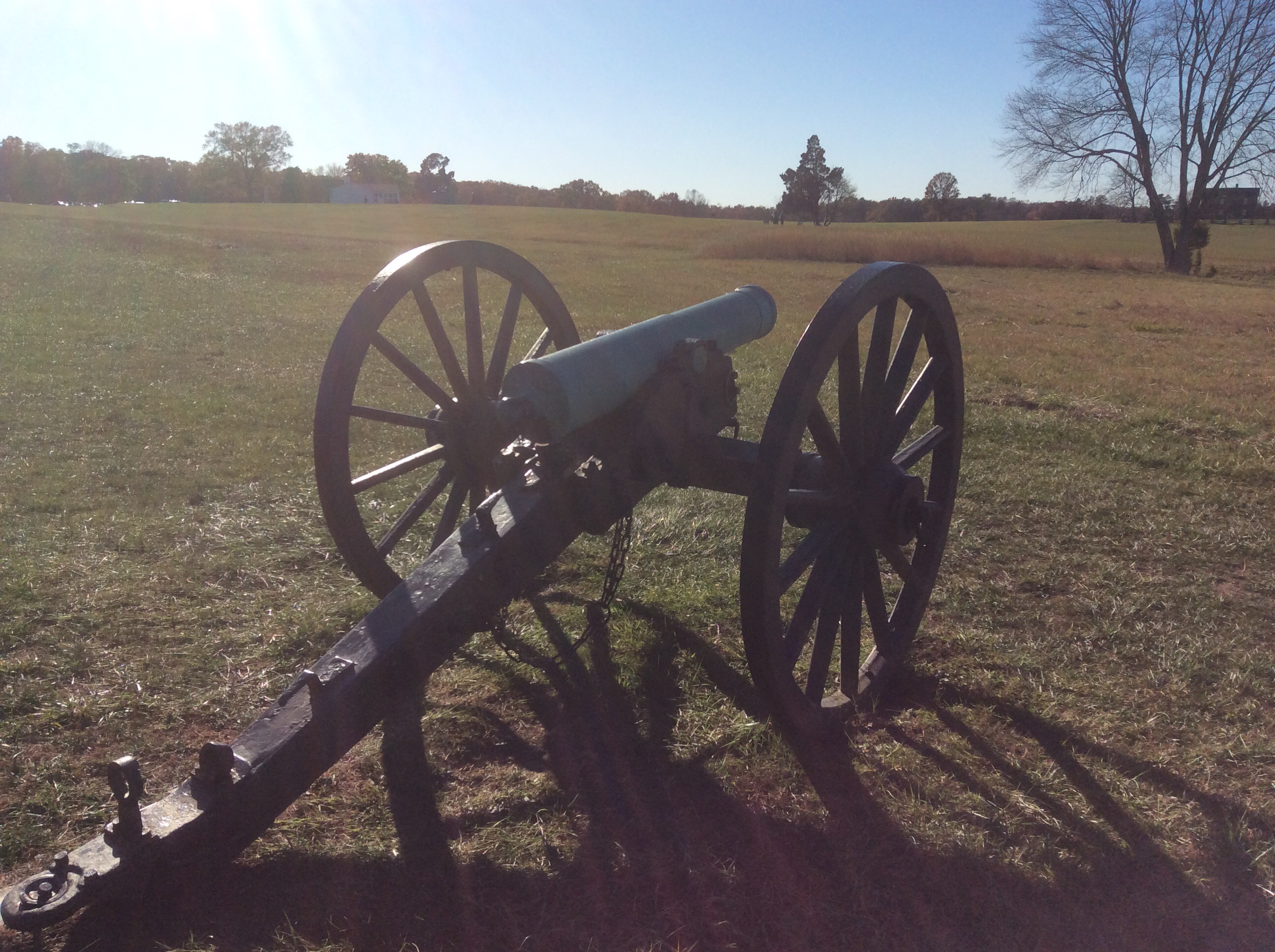
As I mentioned yesterday we have been on the outskirts of Washington DC attending a get together of Papillon dogs and their loyal human companions. Since the meeting was breaking up today and since we are remaining until the morning to see another friend in the area, I took a trip to the Manassas Battlefield National Park.
The First Battle of Manassas, or Bull Run was the first major battle of the American Civil War. At the time it was the largest and bloodiest battle fought on the North American continent. The combined strength of both armies was close to 70,000 men, although both sides only committed about have of their men to the battle. On the day of battle about 850 Union and Confederate troops were killed and another 2600 wounded. The armies and their commanders were inexperienced and but for the stand of the brigade of General Thomas Jackson the affair may have led to a Union victory. But instead it was a Union defeat. Even so the battle showed the leaders of both sides that the war would neither be short, nor bloodless.
It was a wake up call to both and though the number of casualties shocked the Union and the Confederacy, the number of casualties would pale in comparison with so many later battles.
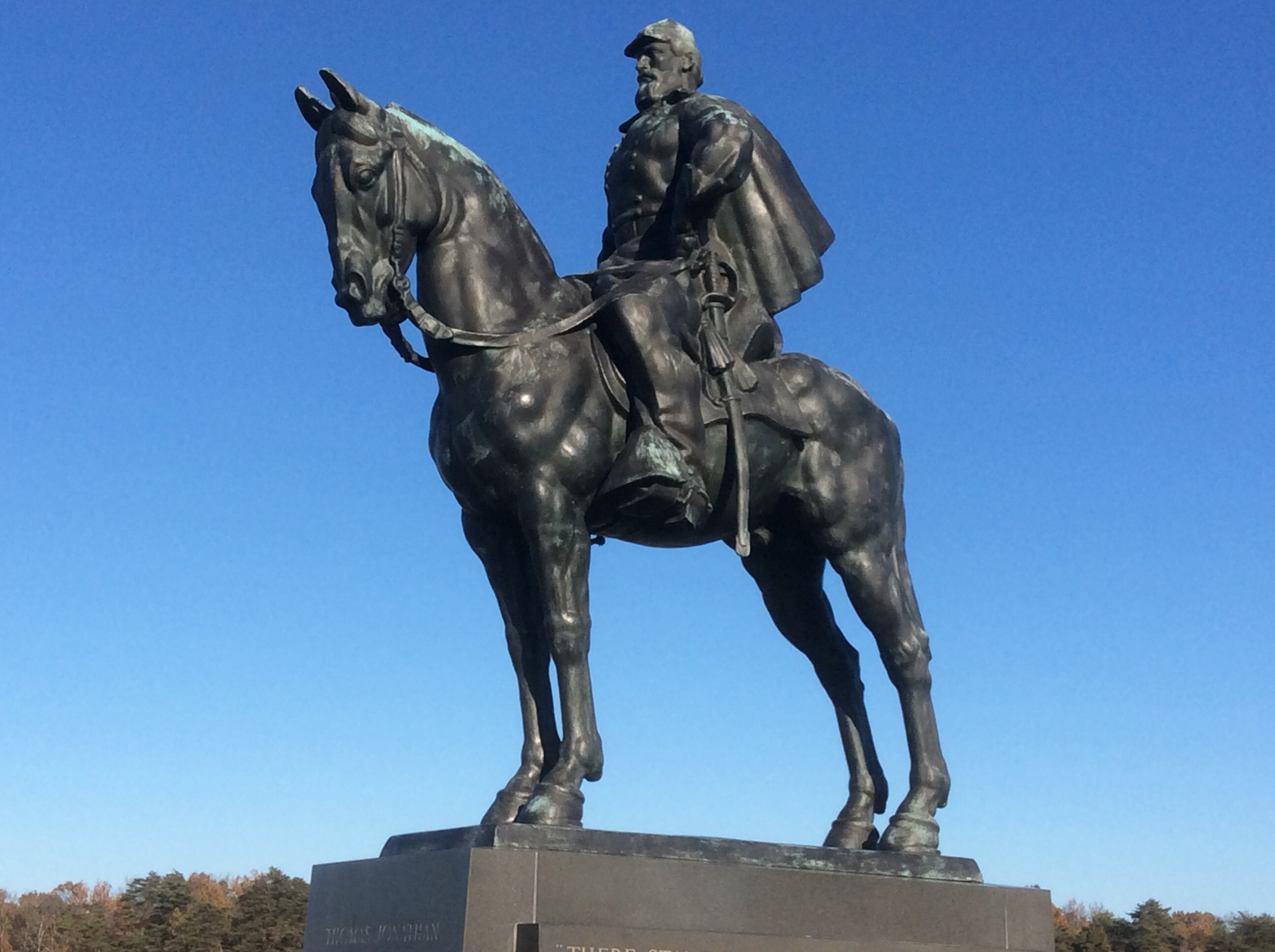
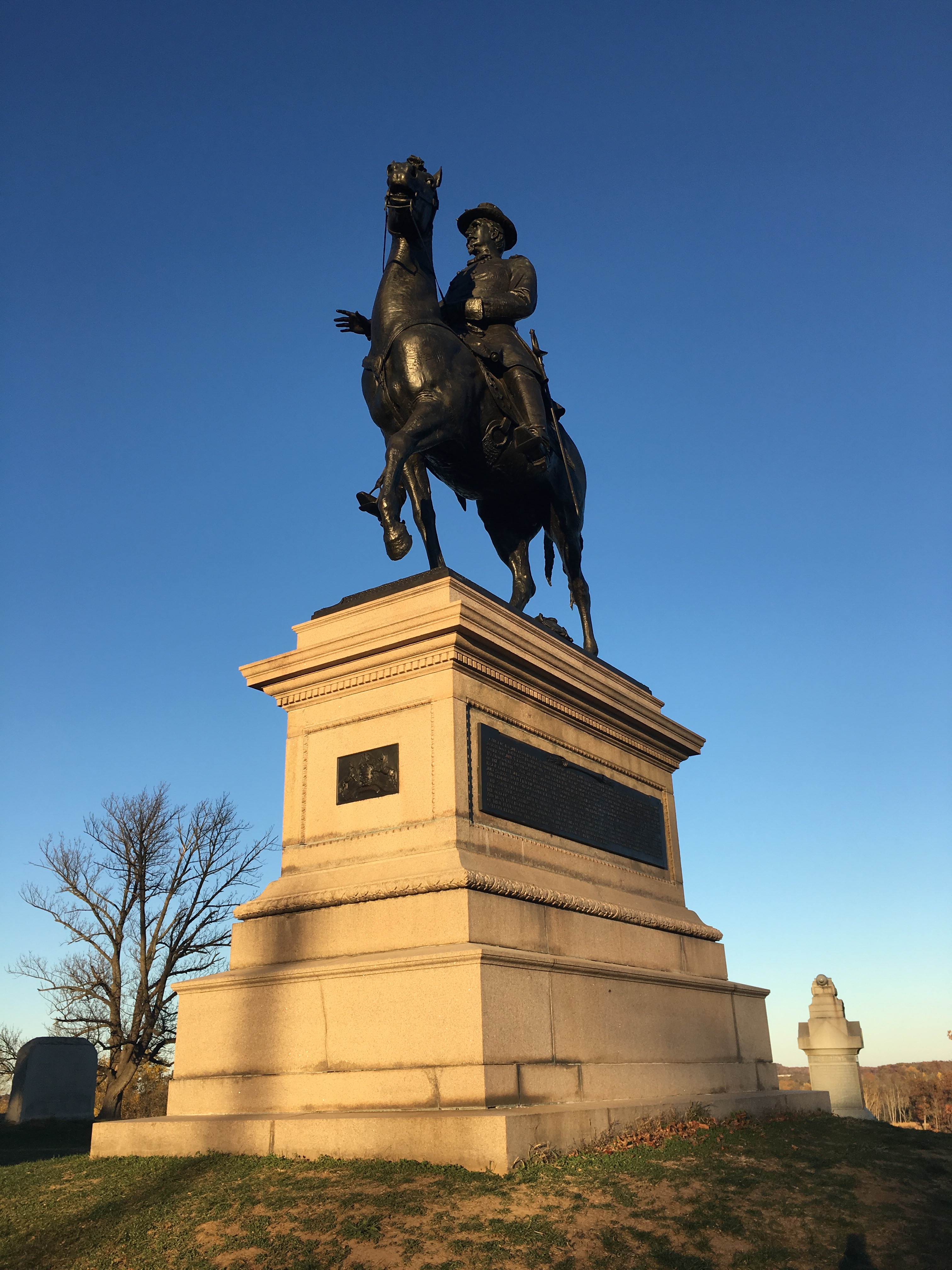
Compared to Gettysburg or Antietam the battlefield is relatively devoid of markers or memorials and most of the ones here commemorate Confederates. But then the battlefield is in Virginia and these were all built by the state of Virginia or Confederate veteran organizations. Even so the number of monuments is tiny compared to Gettysburg or Antietam, and the largest was errected in 1938 and dedicated to Stonewall Jackson, and compared to monuments on other battlefields seems almost looks like a superhero rather than a real flesh and blood person. But then such is the myth of Stonewall Jackson, to many people then and to others even today, the myth overshadows reality.
As I walked around I spent most of my time reflecting about the Civil War and what our country is going through now. I read a statement by the leadership of the League of the South after the election of Donald Trump which read like the speeches of secessionist leaders in early 1861. I will take the the time later to post those statements so you can compare them, just not now. They make fascinating, if not frightening reading when you read them and realize that 166 years have past and the League of the South, the KKK, and other White Supremacist groups have not altered their thinking since before Bull Run.
I wonder what will happen if Donald Trump does not reign in his most ardently deplorable White Supremacist supporters, or if he miscalculated the effect his words word actually have on people and he won’t be able to dial things back. I am beginning to believe that he is not nearly as prejudiced or hate filled as many of the White Supremacists who rallied to his banner. That remains to be seen, but all over the nation there are violent incidents by people claiming to be Trump supporters against minorities of all kinds. I just hope that the many more people who voted for Trump because he was not Hillary, or because he was a supposed outsider will not stand by silently like the vast majority of Germans who said nothing and did less when the Nazis launched their persecution of the Jews, other ethnic minorities, and political opponents during the Third Reich. I honestly don’t think that the majority of those that voted for Trump are racists, yet ther are a significant number that are and that fact cannot be ignored.
So there was a lot to think about at I walked that seven mile long loop around the battlefield. These are things that I will continue to ponder and write about as we enter the Trump era.
Ninety-eight years ago the war that was supposed to end all wars came to an end. Barely two years later, T.E. Lawrence wrote of its end:
We were fond together because of the sweep of open places, the taste of wide winds, the sunlight, and the hopes in which we worked. The morning freshness of the world-to-be intoxicated us. We were wrought up with ideas inexpressible and vaporous, but to be fought for. We lived many lives in those whirling campaigns, never sparing ourselves: yet when we achieved and the new world dawned, the old men came out again and took our victory to remake in the likeness of the former world they knew. Youth could win, but had not learned to keep, and was pitiably weak against age. We stammered that we had worked for a new heaven and a new earth, and they thanked us kindly and made their peace.”
That seems to be the way that it always is.
In November 1914 millions of soldiers were fighting in horrible conditions throughout Europe. From the English Channel to Serbia, Poland and Galicia; French, British, German, Austro-Hungarian, Serbian and Russian troops engaged each other in bloody and often pointless battles. Often commanded by old men who did not understand how the character of war had changed, millions were killed, wounded, maimed or died of disease.
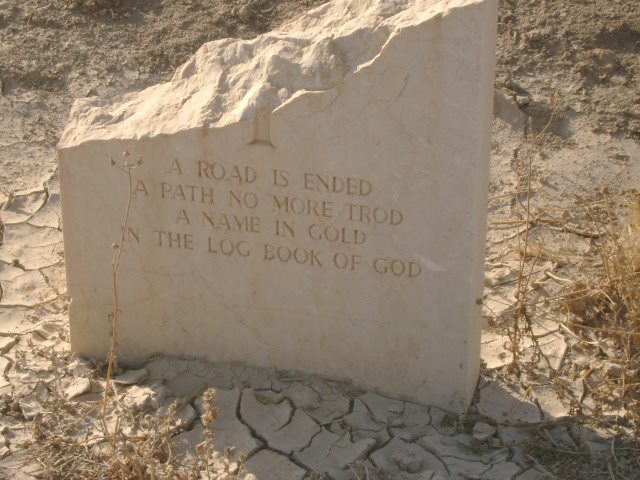
Grave of a British Airman in Habbinyah Iraq
After four years, with the Empires that were at the heart of the war’s outbreak collapsing one after the other there was an armistice. On the eleventh hour, of the eleventh day, of the eleventh month the shooting stopped and the front lines quieted. By then over 20 million people, soldiers and civilians alike had died. Millions more had been wounded, captured, seen their homes and lands devastated or been driven from there ancestral homelands, never to return.
The human cost of that war was horrific. Over 65 million soldiers were called up on all sides of the conflict, of which nearly 37.5 million became casualties, some 57.5% of all soldiers involved. Some countries saw the flower of their manhood, a generation decimated. Russia sustained over 9 million casualties of the 12 million men they committed to the war, a casualty rate of over 76%. The other Allied powers suffered as well. France lost 6.4 million of 8.5 million, or 73%, Great Britain 3.1 million of nearly 9 million, 35%; Italy 2.2 million of 5.6 million, 39%. Their opponents, Germany, Austria-Hungary and the Ottoman Empire suffered greatly. Germany sustained 7.1 million casualties of 11 million men called up, or nearly 65%, Austria 7 million of 7.8 million, 90% and the Ottoman Empire 975,000 of 2.8 million or 34% of the soldiers that they sent to war.
T.E. Lawrence
It was supposed to be the War to end all War…but it wasn’t, it was the mother of countless wars, wars which continue to this day in the vast expanses of desert where Lawrence served.
It has been a century since that bleak November of 1914, and ninety-six years since the time where for a brief moment, people around the world, but especially in Europe dared to hope for a lasting and just peace. But that would not be the case…
The victors imposed humiliating peace terms on the vanquished, be it the Germans on the Russians, or the Allies on Germany and her partners. The victors divided up nations, drew up borders without regard to historic, ethnic, tribal or religious sensibilities. But then, it was about the victors imposing themselves and their quest for domination, expanding colonial empires and controlling natural resources rather than seeking a just and lasting peace. The current war against the Islamic State is one of the wars spawned by the Sykes-Picot agreement which divided the Middle East between the French and the British at the end of the war. It was a war that keeps on giving.
Of course we have known the disastrous results of their hubris, a hubris still carried on by those who love and profit by war…war without end which continues seemingly with no end in sight.
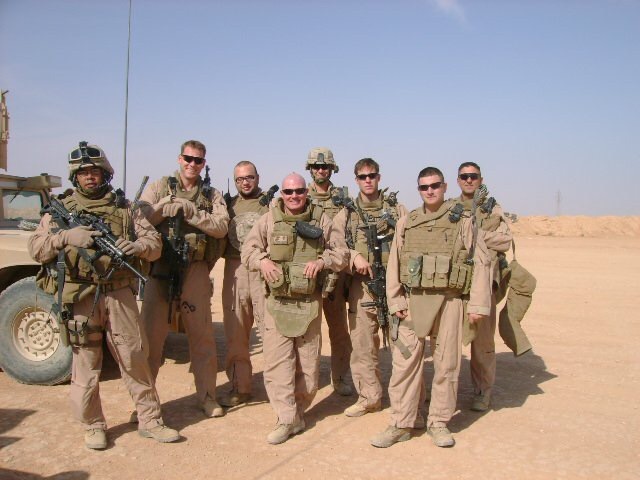
I am a veteran of Iraq and Operation Enduring Freedom, as well as the Bosnia mission and the Cold War. My dad was a Vietnam veteran who enlisted during the Korean War. I serve because it is the right thing to do, not because I find war romantic or desirable. It is as General William Tecumseh Sherman said “Hell.” If called to go back to Iraq, where I left so much of my soul, I would in a heartbeat.
Today we pay our day of homage to our honor veterans, especially in the United States, Great Britain, Canada and France. But sometimes it seems so hollow, for in all of our countries those that serve are a tiny minority of those eligible to serve, who are much of the time ignored or even scorned by those that feel that providing for them after they have served is too much of a burden on the wealthy who make their profits on the backs of these soldiers, sailors, marines and airmen.
I have walked about since returning from Iraq often in a fog, trying to comprehend how a country can be at war for so long, and there is such a gap between the few who serve and the vast majority for whom war is an abstract concept happening to someone else, in places far away, and whose experience of war is its glorification in video games. Personally I find that obscene, and feel that I live in a foreign world. Erich Maria Remarque wrote in All Quiet on the Western Front:
“I imagined leave would be different from this. Indeed, it was different a year ago. It is I of course that have changed in the interval. There lies a gulf between that time and today. At that time I still knew nothing about the war, we had been only in quiet sectors. But now I see that I have been crushed without knowing it. I find I do not belong here any more, it is a foreign world.”
Similarly Guy Sager wrote in his classic The Forgotten Soldier:
“In the train, rolling through the sunny French countryside, my head knocked against the wooden back of the seat. Other people, who seemed to belong to a different world, were laughing. I couldn’t laugh and couldn’t forget.”
Major General Gouverneur Warren wrote to his wife two years after the American Civil War:
“I wish I did not dream that much. They make me sometimes dread to go to sleep. Scenes from the war, are so constantly recalled, with bitter feelings I wish to never experience again. Lies, vanity, treachery, and carnage.”
Sometimes I find it obscene that retailers and other corporations have turned this solemnity into another opportunity to profit. But then why should I expect different? Such profiteers have been around from the beginning of time, but then maybe I still am foolish enough to hope for something different. Please don’t get me wrong, I do appreciate the fact that some businesses attempt in at least some small way to thank veterans. I also know there are many businesses and business owners who do more than offer up tokens once a year, by putting their money where their mouth is to support returning veterans with decent jobs and career opportunities; but for too many others the day is just another day to increase profits while appearing to “support the troops.”
As Marine Corps legend and two time Medal of Honor winner Major General Smedley Butler Wrote:
“What is the cost of war? what is the bill? “This bill renders a horrible accounting. Newly placed gravestones. Mangled bodies. Shattered minds. Broken hearts and homes. Economic instability. Depression and all of its attendant miseries. Back -breaking taxation for generations and generations. For a great many years as a soldier I had a suspicion that war was a racket; not only until I retired to civilian life did I fully realize it….”
But the marketers of war do not mind, almost Orwellian language is used to lessen its barbarity. Dave Grossman wrote in his book On Killing:
“Even the language of men at war is the full denial of the enormity of what they have done. Most solders do not “kill,” instead the enemy was knocked over, wasted, greased, taken out, and mopped up. The enemy is hosed, zapped, probed, and fired on. The enemy’s humanity is denied, and he becomes a strange beast called a Jap, Reb, Yank, dink, slant, or slope. Even the weapons of war receive benign names- Puff the Magic Dragon, Walleye, TOW, Fat Boy, Thin Man- and the killing weapon of the individual soldier becomes a piece or a hog, and a bullet becomes a round.”
There is even a cottage industry of war buffs, some of who are veterans seeking some kind of camaraderie after their service, but most of whom have little or know skin in the real game, and at no inconvenience to themselves. As far as the veterans I understand, but as for the others I can fully understand the words of Guy Sager, who wrote:
“Too many people learn about war with no inconvenience to themselves. They read about Verdun or Stalingrad without comprehension, sitting in a comfortable armchair, with their feet beside the fire, preparing to go about their business the next day, as usual…One should read about war standing up, late at night, when one is tired, as I am writing about it now, at dawn, while my asthma attack wears off. And even now, in my sleepless exhaustion, how gentle and easy peace seems!”
It was to be the War to end all war” but I would venture that it was the war that birthed countless wars, worse tyrannies and genocides; That war, which we mark the end of today, is in a very real and tragic sense, the mother of the wars that have followed. War without end…Amen.
As so to my friends, my comrades and all that served I honor you, especially those that I served alongside. We are a band of brothers, no matter what the war profiteers do, no matter how minuscule our number as compared to those who do not know what we do, and those who never will. We share a timeless bond and no-one can take that away.
I close with the words of a German General from the television mini-series Band of Brothers which kind of sums up how I feel today. The American troops who have fought so long and hard are watching the general address his troops after their surrender. An American soldier of German-Jewish descent translates for his comrades the words spoken by the German commander, and it as if the German is speaking for each of them as well.
Men, it’s been a long war, it’s been a tough war. You’ve fought bravely, proudly for your country. You’re a special group. You’ve found in one another a bond that exists only in combat, among brothers. You’ve shared foxholes, held each other in dire moments. You’ve seen death and suffered together. I’m proud to have served with each and every one of you. You all deserve long and happy lives in peace.
Tonight a break from politics and everything else to wish all United States Marines a Happy 241st Birthday.
Honestly, after all that we have been through as a country this year, today is one of these days where I just want to wish people well. Those men and women are those of the United States Marine Corps, with whom I have have spent almost ten years of my thirty-five year military career assigned to or in support of as a chaplain. Today is the 241st anniversary of the establishment of the Marine Corps and its founding at Tun Tavern, in Philadelphia. Tonight I wish all those who have served past, present and future, especially those who I have served alongside a happy birthday.
On November 10th 1775 the Continental Congress passed a resolution that stated:
Resolved, that two Battalions of Marines be raised consisting of one Colonel, two Lieutenant Colonels, two Majors & Officers as usual in other regiments, that they consist of an equal number of privates with other battalions; that particular care be taken that no persons be appointed to office or enlisted into said Battalions, but such as are good seamen, or so acquainted with maritime affairs as to be able to serve to advantage by sea, when required. That they be enlisted and commissioned for and during the present war with Great Britain and the colonies, unless dismissed by Congress. That they be distinguished by the names of the first & second battalions of American Marines, and that they be considered a part of the number, which the continental Army before Boston is ordered to consist of.
The history of the Marine Corps is one of the most fascinating of any armed service in the world. Starting out as a tiny force attached to Navy ships and shipyards the Corps has gained prominence as one of the premier fighting forces ever assembled. Flexible and deployable anywhere in the world on short notice the Marine Corps has seen action in “every place and clime”and continues to serve around the world.
In 1775 a committee of the Continental Congress met at Philadelphia’s Tun Tavern to draft a resolution calling for two battalions of Marines able to fight for independence at sea and on shore. The resolution was approved on November 10, 1775, officially forming the Continental Marines. The first order of business was to appoint Samuel Nicholas as the Commandant of the newly formed Marines.
Robert Mullan the owner and proprietor of the said Tun Tavern became Nicholson’s first captain and recruiter. They began gathering support and were ready for action by early 1776. They served throughout the War for Independence and like the Navy they were disbanded in April 1783 and reconstituted as the Marine Corps in 1798.
The Marines served on the ships of the Navy in the Quasi-war with France, against the Barbary Pirates where a small group of 8 Marines and 500 Arabs under Lieutenant Presley O’Bannon made a march of 500 miles across the Libyan Desert to lay siege Tripoli but only reached Derna. The action is immortalized in the Marine Hymn as well as the design of the Marine Officer’s “Mameluke” Sword. They served in the War of 1812, the Seminole Wars and in the Mexican-American War where in the storming of the on Chapultepec Palace they continued to build and enduring legacy. In the months leading up to the Civil War they played a key role at home and abroad. In October 1859 Colonel Robert E. Lee led Marines from the Marine Barracks Washington DC to capture John Brown and his followers who had captured the Federal Armory at Harper’s Ferry.
The Corps would serve through the Civil War and on into the age of American Expansion serving in the Spanish American War in the Philippines, Puerto Rico and Cuba where they seized Guantanamo Bay at the battle of Cuzco Wells. The would serve in China and be a key component of the international force that defended foreign diplomats during the Boxer Revolt as well as the international force that would relieve the diplomatic compound in Peking (Beijing). In World War One the Marines stopped the German advance at Chateau Thierry and cemented their reputation as an elite fighting force at Belleau Wood where legend has it that the Germans nicknamed them Teufelhunden or Devil Dogs, a name that they Marines have appropriated with great aplomb.
During the inter-war years the Marines were quite active in the Caribbean and Asia and also developed amphibious tactics and doctrine that would be put to use in the Pacific Campaign. During the war the Marines served in all theaters but won enduring fame at Wake Island, Guadalcanal, Tarawa, Iwo Jima, Okinawa and numerous other battles in the Pacific war. Marine Aviators flew in some the most desperate actions in the war to support the Navy and amphibious operations ashore.
After the war the Truman Administration sought to eliminate the Marine Corps but the Corps was saved by the efforts of Americans across the country and Marine supporters in Congress. That was a good thing because the Marines were instrumental in keeping the North Koreans from overrunning the South during the Korean War on the Pusan Perimeter, turned the tide at Inchon and helped decimate Communist Chinese forces at the Chosin Reservoir. After Korea the Marines would serve around the World in the Caribbean and Lebanon and in Vietnam where at Da Nang Keh Sanh, Hue City, Con Thien fighting the North Vietnamese and their Viet Cong allies. The Marines took the initiative to implement innovative counter insurgency measures such as the Combined Action Platoons which enjoyed tremendous success until they were shut down by the Army high command. These lessons would serve the Marines well in the new millennium during the Anbar Awakening in Iraq which changed the course of that insurgency and war.
The Marines would again be involved around the World after Vietnam serving in the Cold War, in Lebanon and the First Gulf War which was followed by actions in Somalia, the Balkans and Haiti. After the attacks of September 11th 2001 the Marines were among the first into Afghanistan helping to drive the Taliban from power. In the Iraq Campaign the Marines had a leading role both in the invasion and in the campaign in Al Anbar Province. After their withdraw from Iraq the Marines became a central player in Afghanistan where until last month they were engaged around Khandahar and in Helmand Province.
The Marines are elite among world military organizations and continue to “fight our nations battles on the air and land and sea.” The Corps under General John LeJeune institutionalized the celebration of the Marine Corps Birthday and their establishment at Tun Tavern. General LeJeune issued this order which is still read at every Marine Corps Birthday Ball or observance:
MARINE CORPS ORDER No. 47 (Series 1921)
HEADQUARTERS
U.S. MARINE CORPS Washington, November 1, 1921
The following will be read to the command on the 10th of November, 1921, and hereafter on the 10th of November of every year. Should the order not be received by the 10th of November, 1921, it will be read upon receipt.
On November 10, 1775, a Corps of Marines was created by a resolution of Continental Congress. Since that date many thousand men have borne the name “Marine”. In memory of them it is fitting that we who are Marines should commemorate the birthday of our corps by calling to mind the glories of its long and illustrious history.
The record of our corps is one which will bear comparison with that of the most famous military organizations in the world’s history. During 90 of the 146 years of its existence the Marine Corps has been in action against the Nation’s foes. From the Battle of Trenton to the Argonne, Marines have won foremost honors in war, and in the long eras of tranquility at home, generation after generation of Marines have grown gray in war in both hemispheres and in every corner of the seven seas, that our country and its citizens might enjoy peace and security.
In every battle and skirmish since the birth of our corps, Marines have acquitted themselves with the greatest distinction, winning new honors on each occasion until the term “Marine” has come to signify all that is highest in military efficiency and soldierly virtue.
This high name of distinction and soldierly repute we who are Marines today have received from those who preceded us in the corps. With it we have also received from them the eternal spirit which has animated our corps from generation to generation and has been the distinguishing mark of the Marines in every age. So long as that spirit continues to flourish Marines will be found equal to every emergency in the future as they have been in the past, and the men of our Nation will regard us as worthy successors to the long line of illustrious men who have served as “Soldiers of the Sea” since the founding of the Corps.
JOHN A. LEJEUNE,
Major General
Commandant
Today I gave the invocation at the Marine Corps Birthday ceremony at the Staff College. As always it was an honor. I have had the privilege to have served with the Marines directly or indirectly for nearly ten of the thirty-five years that I have served in the military. I have been able to celebrate the Marine Corps Birthday with Marines in places like Ramadi and Guantanamo Bay. For me it is an honor to have served with so many great Americans.
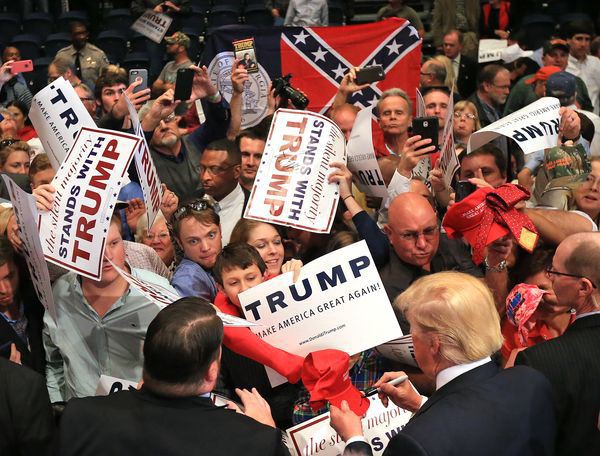
I came back from my trip to Gettysburg yesterday pondering the future of the country and I find little solace in history right now. It seems to me that no-matter what the outcome, whether Donald Trump loses, or by some chance wins, that the country will have been changed for the worse and that no-matter the outcome that the results of this election will continue to divide the country. The seething hatred which has been building for years through conservative talk radio, political preachers, and a Republican Party so devoid of ideas that it has to cow-tow to the raging racists of the Alt Right, Neo-Nazis, the KKK, and paranoid preachers of doom to support Donald Trump is a genie that won’t go back into poisonous bottle from which it came without a fight.
If Trump wins we will have elected an authoritarian with no respect for any virtue other than might and money make right. We will have elected a man who has promised during his campaign to crush the very liberties enshrined in the Declaration of Independence and the Constitution; a man who has promised to jail, prosecute, or sue political opponents and critics; a man who has promised to rule through race and religion not the principle that “all men are created equal.”
Trump has brought out the worst in many Americans and he cultivates hatred and fear. He exemplifies what the late Richard Hofstadter called “The Paranoid Style in American Politics.” Trump demonstrates a profound sense of ignorance, rabid paranoia, wrapped in narcissism, and bathed in privileged self-pity never seen in a major party nominee for President in this country. Bit his followers don’t seem to mind.
But then he has tapped into and attracted people who have been immersed in the paranoia of the religious right and the devotees of conservative talk-radio, Fox News, and the histrionic bevy conservative media websites and organizations, especially the Drudge Report, Breitbart News, and World Net Daily. These media organs have long prepared and sowed both anger and hatred toward any and all political opponents which made Trump’s rise a given. This is a group of people who have no sense of the Constitution or the merits of Republican government and democracy. What they want they want now, and they prefer an authoritarian leader who will trample the institutions of government that Americans have preserved for 241 years and endured a bloody civil war in order to protect.
Hofstadter, a historian who died far to0 young wrote:
“All this is the more maddening, as Edward Shils has pointed out, in a populistic culture which has always set a premium on government by the common man and through the common judgement and which believes deeply in the sacred character of publicity. Here the politician expresses what a large part of the public feels. The citizen cannot cease to need or to be at the mercy of experts, but he can achieve a kind of revenge by ridiculing the wild-eyed professor, the irresponsible brain truster, or the mad scientist, and by applauding the politicians as the pursue the subversive teacher, the suspect scientist, or the allegedly treacherous foreign-policy adviser. There has always been in our national experience a type of mind which elevates hatred to a kind of creed; for this mind, group hatreds take a place in politics similar to the class struggle in some other modern societies. Filled with obscure and ill-directed grievances and frustrations, with elaborate hallucinations about secrets and conspiracies, groups of malcontents have found scapegoats at various times in Masons or abolitionists, Catholics, Mormons, or Jews, Negroes, or immigrants, the liquor interests or the international bankers. In the succession of scapegoats chosen by the followers of this tradition of Know-Nothingism, the intelligentsia have at last in our time found a place.”
As far as their leader, Trump himself, Hofstadter writing over fifty years ago wrote:
“As a member of the avant-garde who is capable of perceiving the conspiracy before it is fully obvious to an as yet unaroused public, the paranoid is a militant leader. He does not see social conflict as something to be mediated and compromised, in the manner of the working politician. Since what is at stake is always a conflict between absolute good and absolute evil, what is necessary is not compromise but the will to fight things out to a finish. Since the enemy is thought of as being totally evil and totally unappeasable, he must be totally eliminated–if not from the world, at least from the theatre of operations to which the paranoid directs his attention. This demand for total triumph leads to the formulation of hopelessly unrealistic goals, and since these goals are not even remotely attainable, failure constantly heightens the paranoid’s sense of frustration. Even partial success leaves him with the same feeling of powerlessness with which he began, and this in turn only strengthens his awareness of the vast and terrifying quality of the enemy he opposes.”
The style is that of despots worldwide, Trump’s rhetorical devices are much like those of Adolf Hitler. The message of Trump, in his own words is “I alone can fix it.”
Tuesday, November 8th will be a watershed election, but as I said at the beginning of the article, no-matter what happens with Donald Trump, is that the paranoia and hatred that he has brought into mainstream will not go away quietly, and most likely will get worse, for in victory he and his supporters will take revenge on their opponents using the police power of the government that many so despise; while if he loses, the most frustrated and deluded of his supporters may turn to violence.
Neither is good for our nation, and I would very much like to be proven wrong in my assessment; but that being said and we must be vigilant if our Republic is to survive.
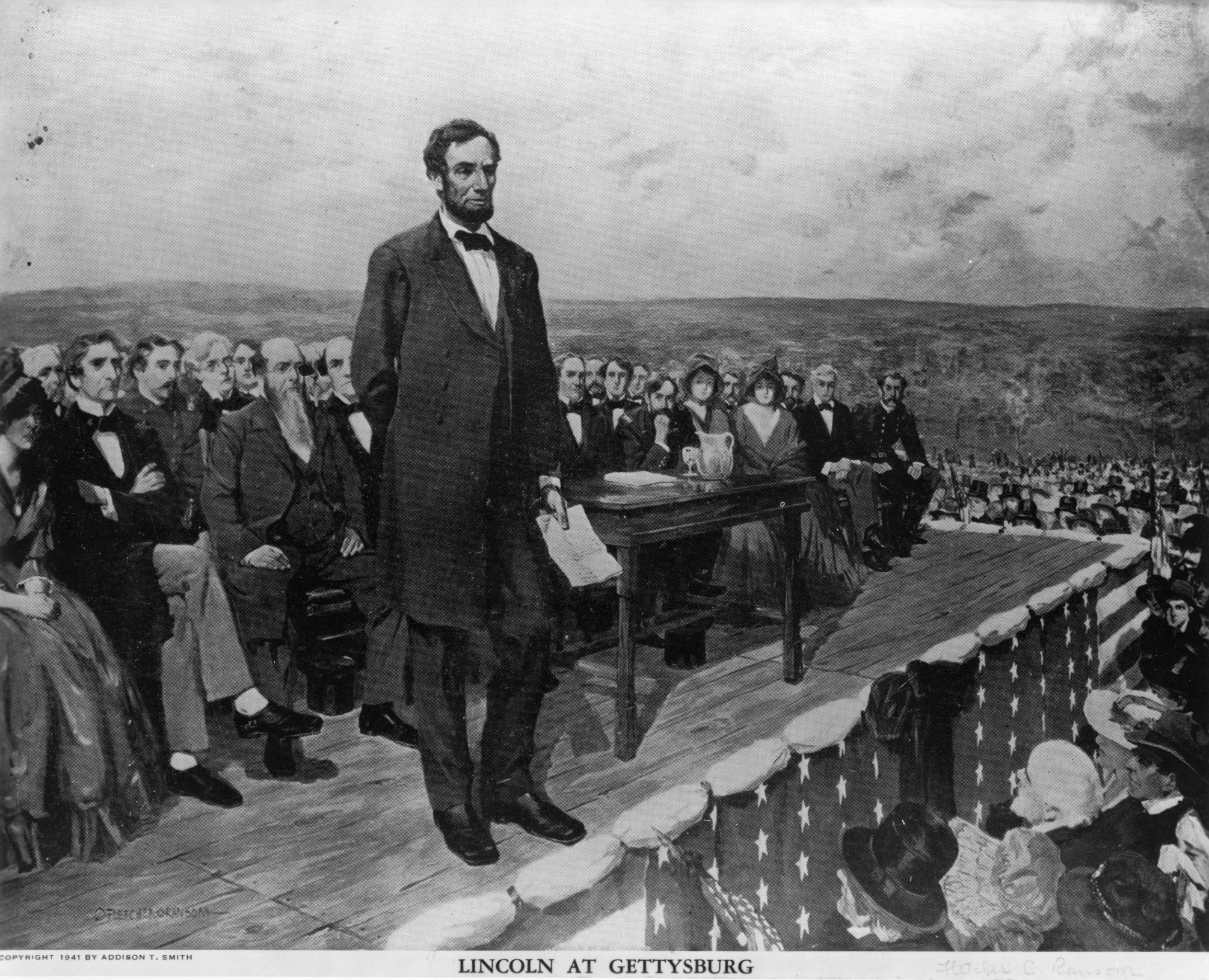
I am at Gettysburg with my students this weekend and today we finish our Staff Ride concluding at the Soldier’s Cemetery where Abraham Lincoln gave the Gettysburg Address. I usual close the staff ride by reading his address. I always get a bit choked up because I realize just how important what he said was then, and still is today.
I expect with our democracy under assault from Donald Trump and his supporters that I will choke up, for I know not what I will wake up to on November 9th. If Trump wins, and his supporters on the Alt-Right have their way, our system of government will be destroyed, the civil liberties that the men who died here to establish will be curtailed or even rolled back. I fear that possibility and honestly if Trump were to win I cannot imagine what this country will devolve into.
In November of 1863 Abraham Lincoln was sick when when he traveled by train from Washington DC to Gettysburg. When Lincoln delivered the address having what was mostly likely a mild form of Smallpox. Thus the tenor, simplicity and philosophical depth of the address are even more remarkable. It is a speech given in the manner of Winston Churchill’s “Blood sweat toil and tears” address to Parliament upon being appoint Prime Minister in 1940. Likewise it echoes the Transcendentalist understanding of the Declaration of Independence as a “test for all other things.”
Many in the United States and Europe did not agree and argued that no nation found on such principles could long survive. The more reactionary European subscribers of Romanticism ridiculed the “idea that a nation could be founded on a proposition….and they were not reluctant to point to the Civil War as proof that attempting to build a government around something as bloodless and logical as a proposition was futile.”[1]
But Lincoln disagreed. He believed that the “sacrifices of Gettysburg, Shiloh, Murfreesboro, Chancellorsville, and a hundred other places demonstrated otherwise, that men would die rather than to lose hold of that proposition. Reflecting on that dedication, the living should themselves experience a new birth of freedom, a determination- and he drove his point home with a deliberate evocation of the great Whig orator Daniel Webster- “that government of the people, by the people, for the people, shall not perish from the earth.”[2]
The Unitarian pastor and leading Transcendentalist Theodore Parker wrote:
“Our national ideal out-travels our experience, and all experience. We began our national career by setting all history at defiance – for that said, “A republic on a large scale cannot exist.” Our progress since that has shown that we were right in refusing to be limited by the past. The practical ideas of the nation are transcendent, not empirical. Human history could not justify the Declaration of Independence and its large statements of the new idea: the nation went beyond human history and appealed to human nature.”[3]
Likewise Lincoln’s address echoes the thought of George Bancroft who wrote of the Declaration:
“The bill of rights which it promulgates is of rights that are older than human institutions, and spring from the eternal justice…. The heart of Jefferson in writing the Declaration, and of Congress in adopting it, beat for all humanity; the assertion of right was made for the entire world of mankind and all coming generations, without any exceptions whatsoever.”[4]
Theodore Parker’s words also prefigured an idea that Lincoln used in his address, that being: “the American Revolution, with American history since, is an attempt to prove by experience this transcendental proposition, to organize the transcendental idea of politics. The ideal demands for its organization a democracy- a government of all, for all, and by all…”[5]
Lincoln delivered these immortal words on that November afternoon:
Four score and seven years ago our fathers brought forth on this continent, a new nation, conceived in Liberty, and dedicated to the proposition that all men are created equal.
Now we are engaged in a great civil war, testing whether that nation, or any nation so conceived and so dedicated, can long endure. We are met on a great battle-field of that war. We have come to dedicate a portion of that field, as a final resting place for those who here gave their lives that that nation might live. It is altogether fitting and proper that we should do this.
But, in a larger sense, we cannot dedicate — we can not consecrate — we can not hallow — this ground. The brave men, living and dead, who struggled here, have consecrated it, far above our poor power to add or detract. The world will little note, nor long remember what we say here, but it can never forget what they did here. It is for us the living, rather, to be dedicated here to the unfinished work which they who fought here have thus far so nobly advanced. It is rather for us to be here dedicated to the great task remaining before us — that from these honored dead we take increased devotion to that cause for which they gave the last full measure of devotion — that we here highly resolve that these dead shall not have died in vain — that this nation, under God, shall have a new birth of freedom — and that government of the people, by the people, for the people, shall not perish from the earth.[6]
In a time where many are wearied by the foibles and follies of our politicians, especially a man as singularity ill-equipped and ill-tempered as Donald Trump and his supporters, many of whom are White Nationalists and authoritarian types unseen since secession could possibly take power; one has to wonder if our very form of government can survive, or if Lincoln’s words still matter.
But they do. Dr. Allen Guelzo, Professor of Civil War Studies at Gettysburg College wrote in the New York Times:
“The genius of the address thus lay not in its language or in its brevity (virtues though these were), but in the new birth it gave to those who had become discouraged and wearied by democracy’s follies, and in the reminder that democracy’s survival rested ultimately in the hands of citizens who saw something in democracy worth dying for. We could use that reminder again today.”[7]
Dr. Guelzo is quite correct. Many people in this country and around the world are having grave doubts about our democracy. I wonder myself, but I am an optimist. I do believe that we will eventually recover because for the life of me I see no nation anywhere else with our resiliency and ability to overcome the stupidity of politicians, pundits and preachers and the hate filled message of Donald Trump and his White Supremacist supporters, especially supposedly “conservative ” Christians.
The amazing thing during the Civil War was that in spite of everything the Union survived. Lincoln was a big part of that but it was the men who left lives of comfort and security like Joshua Chamberlain and so many others who brought about that victory. Throughout the war, even to the end Southern political leaders failed to understand that Union men would fight and die for an ideal, something greater than themselves, the preservation of the Union and the freedom of an enslaved race. For those men that volunteered to serve, the war was not about personal gain, loot or land, it was about something greater. It was about freedom, and when we realize this fact “then we can contemplate the real meaning of “that cause for which they gave the last full measure of devotion.” [8]
Now I for one do not think that we are currently living up to the ideals enunciated by Lincoln that day at Gettysburg. I can understand the cynicism disillusionment of Americans as well as those around the world who have for over 200 years looked to us and our system as a “city set on a hill.” That being said, when I read these words and walk that hallowed ground I am again a believer. I believe that we can realize the ideal, even in our lifetime should we desire. That being said I cannot imagine what will happen to our country if Donald Trump is elected to the presidency.
Have a great day and please stop to think about how important Lincoln’s words remain as we wait to see who will be our next President.
I am at Gettysburg this weekend so I am just posting just a short meditation and some words written by Walt Whitman.
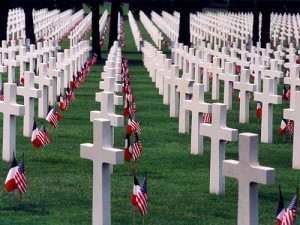
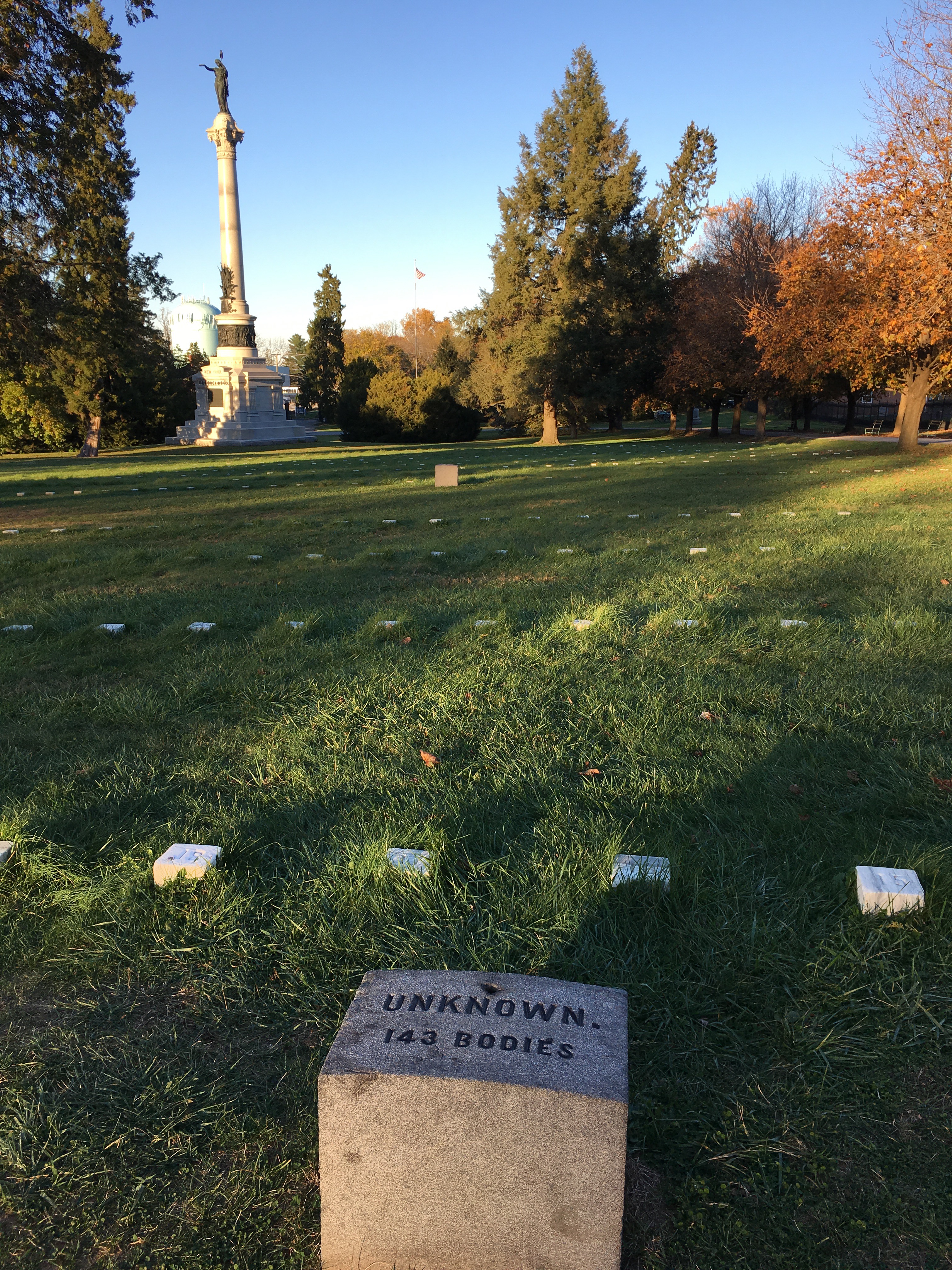
Yesterday afternoon I wandered around the Soldier’s Cemetery as well as East Cemetery Hill. It was a beautiful evening with the fall foliage in full display under a a blue sky with the sun setting in the west. As I walked about the graves of the 3577 Union Soldiers buried here, over half who are unknowns, I felt such powerful presence and was reminded of the importance of what they did here. There are sections where of the cemetery where unknown soldiers are buried, rank upon rank, with only a small marble marker with a number to identify them.
Each was a son, maybe a husband, father, or brother, or a friend, and most certainly, a comrade in arms. Each has a name, even if we don’t know it; and all of them, and many more gave the last full measure of devotion to duty to preserve this country against an enemy. But unlike other enemies, the soldiers that these men battled were from of an enemy that has raised itself up from within the country; men, no matter how good they might have been, took up arms against the United States. These included men who took up arms and fought against friends who they had served alongside in peace and war.
While men of my family fought for the Confederacy I cannot succumb to the lie that their cause was just. Thus when I stand among the ranks of these fallen Union men I honor their memory in ways I cannot fully do for their opponents in Confederate gray. Do not get me wrong, I weep for those who fought and died on both sides of the American Civil War, and each soldier needs to be remembered, even those who fought for a cause that was evil, the cause of slavery. As a military man myself I cannot walk these battlefields and not have a sense of compassion and even empathy for the Southerners who died here, even while rightly condemning the government and the cause that sent them to their deaths.
Walt Whitman wrote the poem Ashes of Dead Soldeirs after the war was over. Whitman knew the terrible cost borne by soldiers as he volunteered to help the wounded in Federal hospitals during the war. His words speak to me.
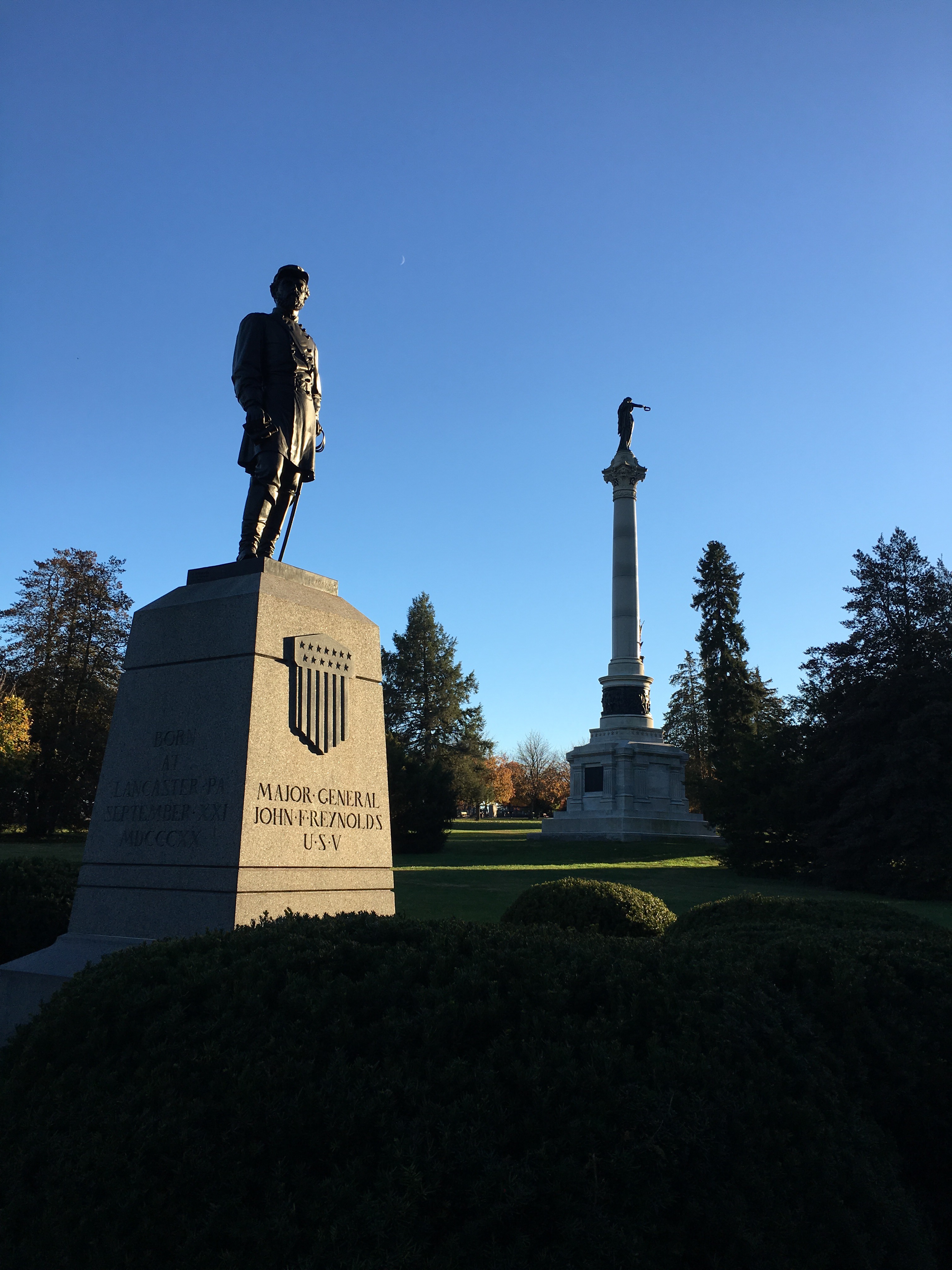
When I come here I can sense their presence, the great and the small, John Reynolds, Lewis Armistead, Paddy O’Rorke, Dick Garnett, Alonzo Cushing, and Stong Vincent. The men of the Iron Brigade and the Irish Brigade, Dan Sickles’s Excelsior Brigade, Augustus Van Horne Ellis’s 124th New York “Orange Blossoms,”the men of George Pickett’s doomed division, the 1st Minnesota, the 20th Maine, and so many more.
Whitman penned these words:
“Ashes of soldiers South or North,
As I muse retrospective murmuring a chant in thought,
The war resumes, again to my sense your shapes,
And again the advance of the armies.
Noiseless as mists and vapors,
From their graves in the trenches ascending,
From cemeteries all through Virginia and Tennessee,
From every point of the compass out of the countless graves,
In wafted clouds, in myriads large, or squads of twos or threes or
single ones they come,
And silently gather round me…”
I am taking a group of my students to Gettysburg this weekend and the timing is good for me as it will take me to a place that helps me put things in perspective, especially as this election goes into its last few days.
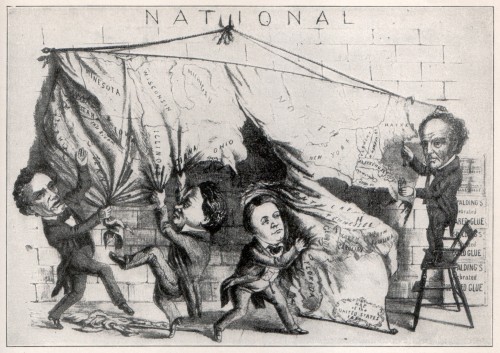
Even so I have a sense, a sense of dread that our country is soon to head into an abyss of violence no-matter who wins the election. The solid and reasonable center seems to have disappeared, moderates of all types are derided. Trump and his supporters have repeatedly called the election rigged and say that they may not accept the results, unless they win. Throughout the campaign Trump and his surrogates have hinted at violence, they have whipped up their supporter’s emotions into a virtual tempest of rage that is threatening to explode into real violence. In 1860 it was the Southern political and religious leadership which said that they would not abide the results of the election of Abraham Lincoln, ignoring Democrat Stephen Douglas who said:
“It is apprehended that the policy of Mr. Lincoln and the principles of his party endanger the peace of the slaveholding states. Is that apprehension founded? No, it is not. Mr. Lincoln and his party lack the power, even if they had the disposition, to disturb or impair the rights and institutions of the South. They certainly cannot harm the South under existing laws. Will they have the power to repeal or change these laws, or to enact others? It is well known that they will be a minority in both houses of Congress, with the Supreme Court against them. Hence no bill can pass either house of Congress impairing or disturbing these rights or institutions of the southern people in any manner whatever, unless a portion of southern senators and representatives absent themselves so as to give an abolition majority in consequence of their actions.
In short, the President will be utterly powerless to do evil…. Four years shall soon pass, when the ballot box will furnish a peaceful, legal, and constitutional remedy for the evils and grievances with which the country might be afflicted.”
Georgia Senator and future Confederate Vice President Alexander Stephens had the greatest faith in the checks and balances provided in the Constitution and he pleaded with his fellow Georgians at the state capital of Milledgeville noting that the checks and balances “would render Lincoln “powerless to do any great mischief,” and he warned that “the dissolution of the Union would endanger this “Eden of the world,” that “instead of becoming gods, we shall become demons, and no distant day commence cutting one another’s throats…”
Louisiana Senator and future Confederate Secretary of the Treasury Judah Benjamin noted: “The prudent and conservative men South… were not able to stem the wild torrent of passion which is carrying everything before it…. It is a revolution…of the most intense character…and it can no more be checked by human effort, for the time, than a prairie fire by a gardener’s watering pot.”
Today reasonable people, including many Conservatives and Republicans are making similar observations about the dangers of Trump and how little people have to fear a Clinton presidency. But it will be for naught if the new fire-breathers that Trump has awakened respond as Southern did in 1860, responding not through reason but through blind fear and ideological hatred. Sadly, that kind of visceral response has not changed since Alexander Stephens and Judah Benjamin caved into the demands of the fire-eaters for secession and war, despite knowing that it would be a disaster. This is exactly how most supposedly responsible and moderate conservative Republicans are acting today. They too will be held responsible by history for not having the moral courage of Stephen Douglas to put the country and the constitution ahead of sectional interests.
Northern abolitionist newspaper editor William Lloyd Garrison correctly judged the mood of the South when he wrote:
“Never had the truth of the ancient proverb “Whom the gods intend to destroy, they first make mad” been more signally illustrated than in the condition of southern slaveholders following Lincoln’s election. They were insane from their fears, their guilty forebodings, their lust for power and rule, hatred of free institutions, their merited consciousness of merited judgments; so that they may be properly classed as the inmates of a lunatic asylum. Their dread of Mr. Lincoln, of his Administration, of the Republican Party, demonstrated their insanity. In vain did Mr. Lincoln tell them, “I do not stand pledged to the abolition of slavery where it already exists.” They raved just as fiercely as though he were another John Brown, armed for southern invasion and universal emancipation! In vain did the Republican party present one point of antagonism to slavery – to wit, no more territorial expansion. In vain did that party exhibit the utmost caution not to give offense to any other direction – and make itself hoarse in uttering professions of loyalty to the Constitution and the Union. The South protested that its designs were infernal, and for them was “sleep no more!” Were these not the signs of a demented people?”
I feel that madness is true today of many of Trump’s supporters, his enablers in the GOP and media, and maybe of the man himself.
I am finishing up a series of posts about the Battle of Leyte Gulf. This one is about the Battle of Cape Engano in which a force of Japanese carriers with very few aircraft were used to lure the main part of the American Third Fleet under Admiral William “Bull” Halsey away from the vulnerable troop transports and supply ships supporting the invasion. Eventually I will write something about the epic Battle off Samar to conclude the series properly but that will have to wait.
Have a great day,
Peace
Padre Steve+
“TURKEY TROTS TO WATER GG FROM CINCPAC ACTION COM THIRD FLEET INFO COMINCH CTF SEVENTY-SEVEN X WHERE IS RPT WHERE IS TASK FORCE THIRTY FOUR RR THE WORLD WONDERS.” Admiral Nimitz to Admiral Halsey
After Admiral William “Bull” Halsey felt that he had heavily damaged the Japanese Center Force during the Battle of the Sibuyan Sea he withdrew the Fast Battleships of Task Force 34 from the San Bernardino Strait in order to use them in a surface engagement against Admiral Jisaburo Ozawa’s Northern Force. Halsey assumed that Ozawa’s carriers were the main threat to the American invasion forces. However he did not know that Ozawa’s carriers had very few aircraft embarked and that the Northern force was in fact a decoy, designed to draw him away from Vice Admiral Takeo Kurita’s Center and the two task forces of the Southern force.
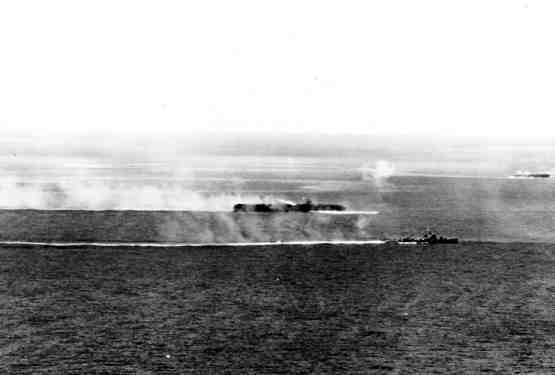
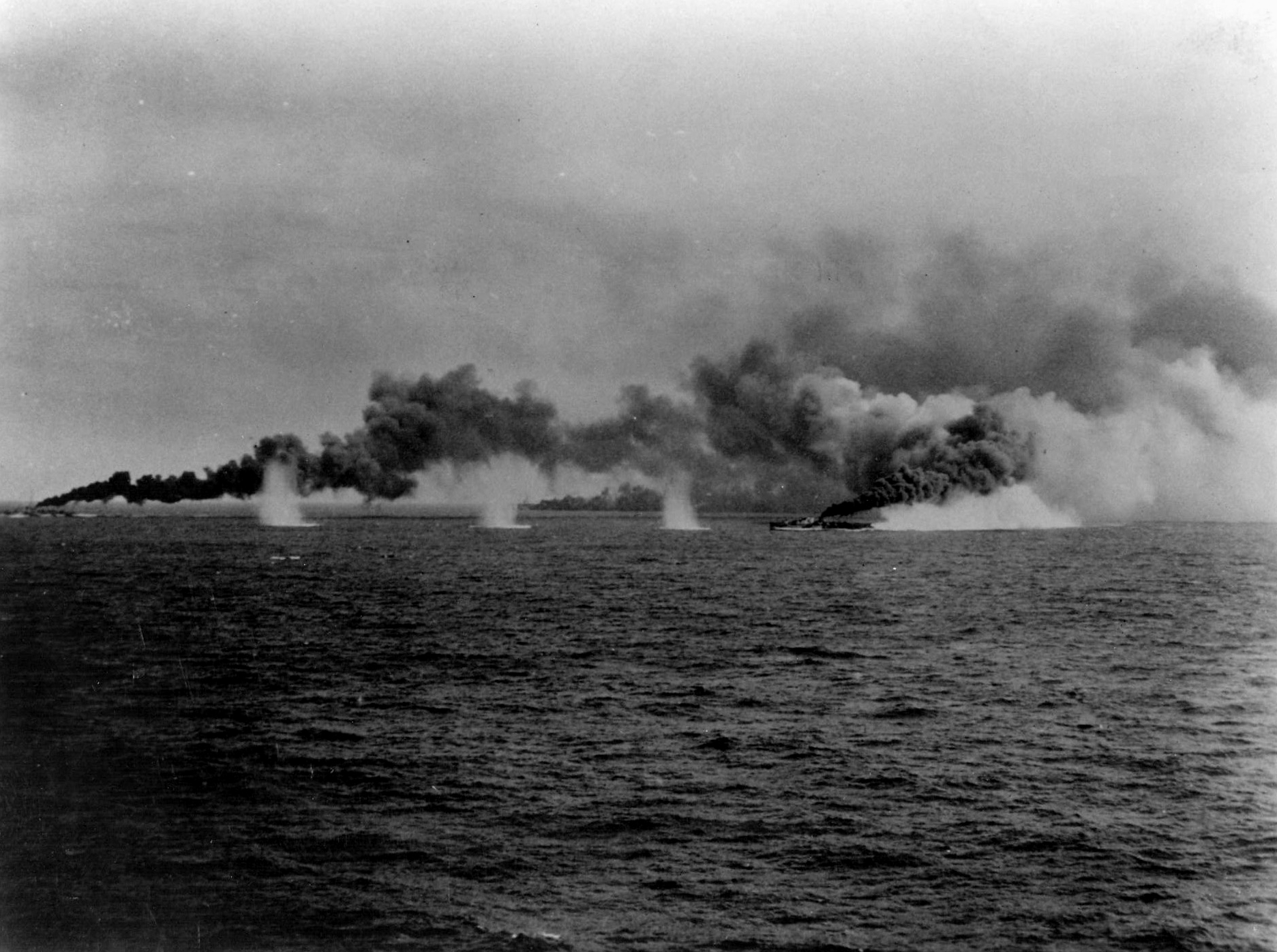
The Zuikaku under attack at Cape Engano
When Halsey’s aircraft reported the Center force withdrawing he believed that the threat had been removed. He wrote in his memoirs “I believed that the Center Force had been so heavily damaged in the Sibuyan Sea that it could no longer be considered a serious menace to Seventh Fleet.” Thus he moved with haste to intercept, engage and destroy the Northern force and its carriers and battleships. Halsey believed that his engagement against the Northern force would culminate when his fast battleships destroyed whatever Japanese surface forces remained.
It was not a bad assumption. Ever since the early days of the Pacific war the truly decisive engagements had been decided by carriers. Unfortunately for the American sailors of Taffy-3, the group of Escort Carriers, destroyers and destroyer escorts which encountered Kurita’s Center force which had doubled back overnight and passed through the San Bernardino Strait surprising Rear Admiral Thomas Kinkaid’s task group of “Jeep” Carriers.
The Battle off Samar
The unequal battle that ensued off Samar was a near run thing for the Americans. Had Kurita not been confused about what forces he was facing and pressed his attacks he may have inflicted painful damage on the actual invasion forces. However after a morning of battle, in which Taffy-3’s destroyers, destroyer escorts, aircraft and even the Jeep carriers themselves inflicted heavy damage on the Japanese force Kurita withdrew.
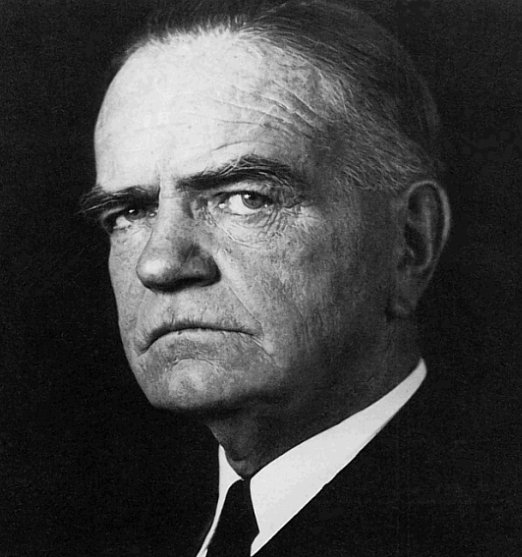
Admiral William “Bull” Halsey
However as Taffy-3 battled for its life against Kurita’s battleships, cruisers and destroyers Halsey’s carrier air groups were pounding Ozawa’s hapless carriers and their escorts. About 0800 on the 25th Kinkaid’s desperate messages began to reach Nimitz and Halsey. However since Halsey did not believe just how serious the situation was he continued to pursue Ozawa’s force. When he received Nimitz’s message he was incensed. The message “TURKEY TROTS TO WATER GG FROM CINCPAC ACTION COM THIRD FLEET INFO COMINCH CTF SEVENTY-SEVEN X WHERE IS RPT WHERE IS TASK FORCE THIRTY FOUR RR THE WORLD WONDERS was composed of three parts. The preface “Turkey trots to water” was padding, as was the last part “the world wonders.”
Light Carrier Zuiho under attack
However the communications officer on Halsey’s flagship only removed the first section leaving “Where is Third Fleet, the world wonders.” Halsey was flabbergasted and though the battleships of Task Force 34 were almost in range of the Japanese force he sent them south to relieve Kinkaid’s beleaguered force. However by the time Vice Admiral Willis Lee’s battle line arrived Kurita had withdrawn, losing 3 heavy cruisers sunk, three heavy cruisers and one destroyer heavily damaged.
Zuikaku being abandoned
All the Japanese carriers were sunk along with a light cruiser and a number of destroyers, but Kurita’s heavy forces escaped. Among the Japanese losses was the carrier Zuikaku the last surviving carrier of the Pearl Harbor attack. Naval historian Samuel Elliott Morrison wrote:
“If TF 34 had been detached a few hours earlier, after Kinkaid’s first urgent request for help, and had left the destroyers behind, since their fueling caused a delay of over two and a half hours, a powerful battle line of six modern battleships under the command of Admiral Lee, the most experienced battle squadron commander in the Navy, would have arrived off the San Bernardino Strait in time to have clashed with Kurita’s Center Force… Apart from the accidents common in naval warfare, there is every reason to suppose that Lee would have “crossed the T” and completed the destruction of Center Force.”
The Battle of Cape Engano closed the epic extended battle of Leyte Gulf. The victory of the US Navy was decisive even without the final destruction of Kurita’s forces. The remnants of the Japanese forces would never mount a serious offensive threat again. The survivors would be hunted down over the next 9 months, some sunk by submarines, other in surface engagements, still more to air attacks at Okinawa and in Japanese ports.
Halsey received much criticism for his decision to withdraw TF 34 from San Bernardino Strait. However in his defense the action exposed one of the key problems in any kind of warfare, the problem of seams. Kinkaid’s escort carriers belonged to 7th Fleet which came under the operational control of Douglas MacArthur’s Southwest Pacific Region while Halsey commanded 3rd Fleet fell under Admiral Nimitz’s Central Pacific region. This created a situation where two fleets belonging to two regions under two separate commanders were attempting to fight a single battle. The principle of unity of command and unity of effort was violated with nearly disastrous results.
Again I am taking some time off the Presidential campaign and am posting some articles on the Battle of Leyte Gulf. This deals with the first use of Kamikaze aircraft whose pilots would attempt to dive into Allied warships, committing suicide rather than attempting to bomb a ship and return home.
In an age where suicide bombers and attackers do such things it is important to remember that this is not new. I hope you enjoy.
Peace
Padre Steve+
“In my opinion, there is only one way of assuring that our meager strength will be effective to a maximum degree. That is to organize suicide attack units composed of A6M Zero fighters armed with 250-kilogram bombs, with each plane to crash-dive into an enemy carrier…” Admiral Takijirō Ōnishi
It was a tactic born of desperation but one that fit in well with the philosophy of Bushido. After the Battle of the Philippine Sea, the “Marianas Turkey Shoot” in June 1944 and the slaughter of land based Japanese Naval and Army air forces based in Formosa in September of that year Japanese leaders began to look to a tactics born of desperation but which fit their Bushido based ethos of sacrifice.
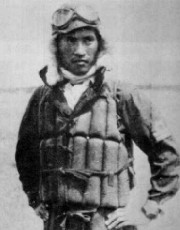
Lt. Yukio Seki
Suicide attacks were nothing new to the Japanese, but until October 1944 they were tactics decided on by individuals who saw no alternative to the choice. In October 1944 that calculus changed, instead of individuals or isolated units which had no hope of victory conducting suicide attacks, commanders decided to employ suicide attackers as a matter of course.
When the American forces invaded the Philippines Admiral Takijirō Ōnishi was commander of the First Air Fleet based in the Northern Philippines. He was not a fan of Kamikaze tactics and viewed them as heresy. However after the slaughter of the reconstituted Naval Air Force at the Battle of the Philippine Sea he reluctantly changed his mind. I say reluctantly based on his previous views and because after he committed ritual suicide following the Japanese surrender he apologized to the estimated 4000 pilots that he sent to their death and their families.
Admiral Ōnishi
But in October 1944 with Japan reeling from defeats in the Pacific and its supply route for oil and other raw materials threatened desperation was the order of the day.
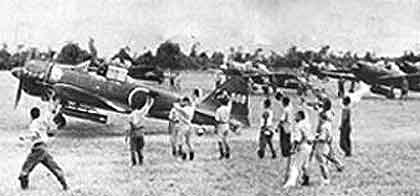
The 201st Navy Flying Corps based out of Clark Field near Manila was the major land based Japanese Naval Air Force unit in the Philippines. Among its pilots was a young Naval Officer and Aviator named Lt. Yukio Seki. Seki was a graduate of the Japanese Naval Academy at Eta Jima and was recently married. He was not an ideologue or believer in suicide attacks. When questioned by a reporter before his squadron launched the first Kamikaze attacks he remarked to Masashi Onoda, a War Correspondent :“Japan’s future is bleak if it is forced to kill one of its best pilots. I am not going on this mission for the Emperor or for the Empire… I am going because I was ordered to!”
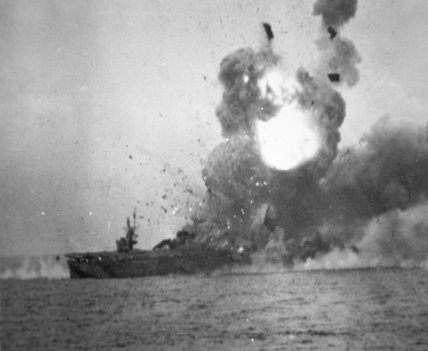
On October 25th 1944 Seki led his group of 5 A6M2-5 Zero fighters, each carrying a 550 pound bomb took off and attacked the Escort Carriers of Rear Admiral Clifton Sprague’s “Taffy-3.” The five pilots all died in their attacks but two damaged the USS Kalinin Bay and USS Kitkun Bay while two aircraft, one believed to be Seki’s hit the USS St Lo causing mortal damage which sank that ship in less than half an hour with the loss of over 140 sailors.
The attacks of Seki’s small squadron were a harbinger of what was to come. Over the next 10 months over 4000 Japanese pilots would die in Kamikaze attacks against US Navy and Allied Naval units. Numbers of ships destroyed or damaged by Kamikazes are debated by some historians believe that 70 US and Allied ships were sunk or damaged beyond repair and close to 300 more damaged. 2525 Imperial Japanese Navy pilots and 1387 Imperial Army pilots died in Kamikaze attacks killing almost 5000 sailors and wounding over 5000 more.
Admiral Ōnishi who made the decision to make Kamikazes a part of Japan’s offensive strategy in 1944 appeared to regret that decision. In his suicide note he urged young Japanese to rebuild the country and seek peace with all people and offered his death a penance for the nearly 4000 pilots he sent to their deaths. Accordingly when he committed ritual suicide (seppuku) he did so alone, with a second to finish the job and died over 15 hours after disemboweling himself.
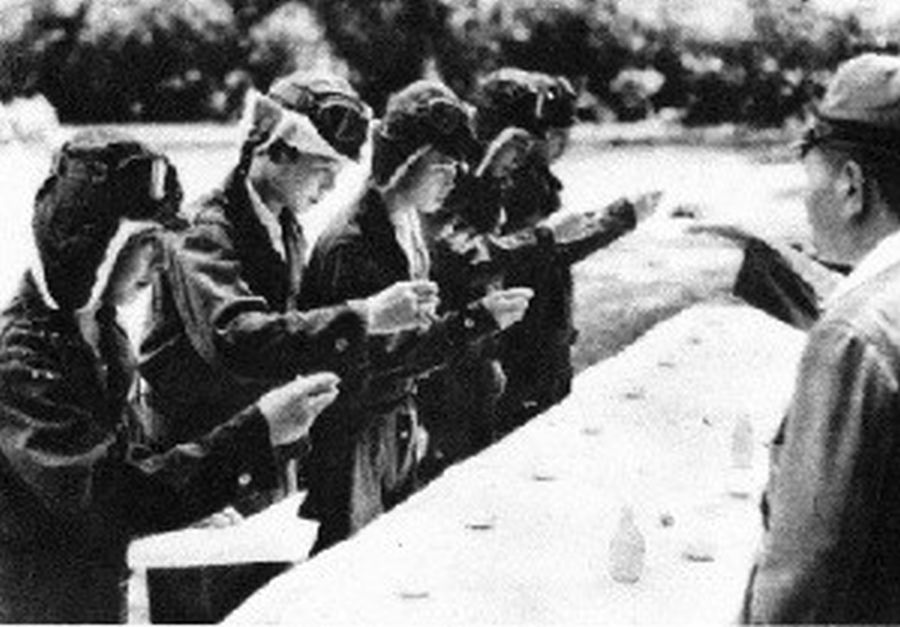
A Final Toast
The Kamikaze campaign did not alter the course of the war, but it did introduce a new dimension of terror and misguided sacrifice. I do pray that one day war will be no more and that even though I expect war to remain part of our world until longer after my death that nations, peoples or revolutionary groups will no longer send their best and brightest to certain death.
I am still taking some time off from writing about the Presidential race and so today I am posting the third article of a series on the Battle of Leyte Gulf. This article discusses the Battle of Surigao Strait which ended in the near annihilation of most of the of the Japanese Southern Force. The battle was the last ever where battleships engaged each other in a surface action.
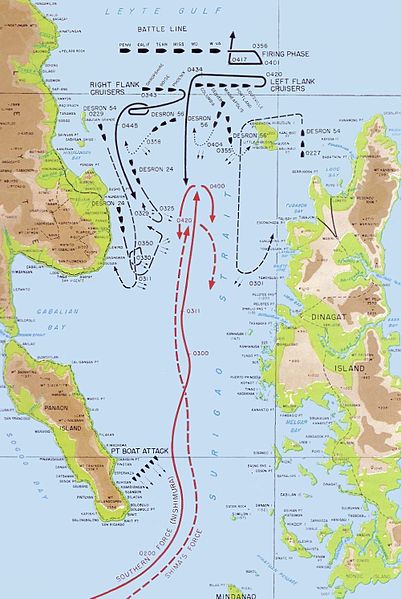
The two task groups of the Japanese Southern Force passed the daylight hours of 24 October relatively unscathed despite an air attack that caused minor damage. The group commanded by Vice Admiral Shoji Nishimura comprised of the elderly Battleships Yamashiro and Fuso the Heavy Cruiser Mogami and four destroyers was leading the charge and was followed by that commanded by Vice Admiral Kiyohide Shima with the Heavy Cruisers Nachi and Ashigara, Light Cruiser Abukuma and four destroyers.
The mission of these two groups which were unable to coordinate their actions due to orders to maintain strict radio silence was to fight their way through the Surigao Strait to assist the Central Force in destroying the US invasion force in Leyte Gulf. The mission was for all practical purposes a suicide mission, a naval “Charge of the Light Brigade” as they sailed into the Valley of Death against the Battle Line of the US 7th Fleet.
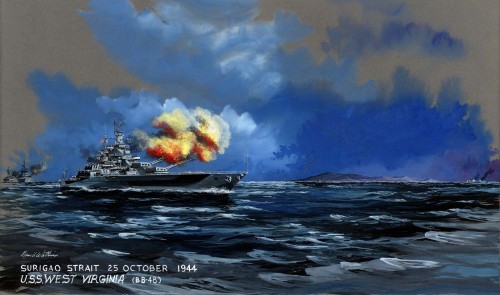
USS West Virginia at Surigao
The Japanese Battleships had spent the majority of the war in home waters and had seen little action. They had not been part of any of the great Japanese victories in 1941 and 1942 and they had not been blooded in the Solomons. Instead the two elderly battlewagons passed the war conducting training in the inland sea. They were no longer first line ships but the Japanese were desperate. During the afternoon Admiral Nishimura received an accurate report from one of Mogami’s scout planes telling him exactly what he was up against yet he pushed on in the manner of a Samurai.
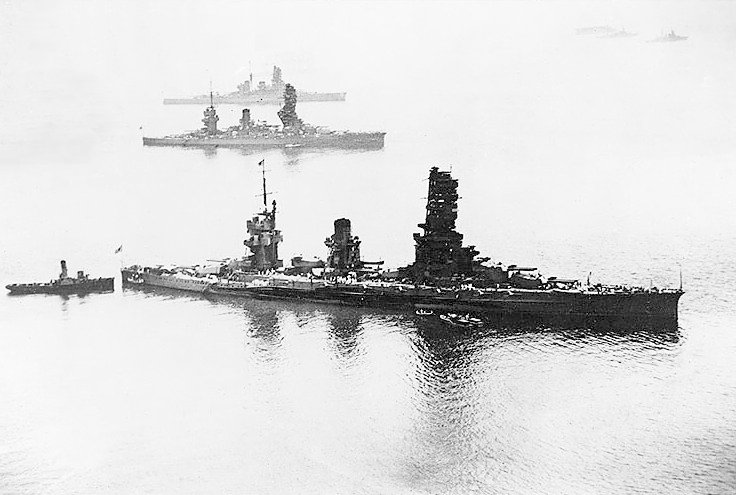
Yamashiro and Fuso
Facing him was a force built around the 6 old Battleships of Vice Admiral Jesse Oldendorf’s 7th Fleet Battle Line. The Americans heavily outnumbered the Japanese, the Battleships West Virginia, California and Tennessee were the heart of the force. Fully modernized after Pearl Harbor they no longer resembled the ships that they were before the war. Equipped with the latest Mark 8 Fire Control radar they had the ability to put their 16” and 14” shells on target at ranges farther than anything that the Japanese could counter. Joined by the less fully modernized Maryland, Mississippi and Pennsylvania, 4 Heavy Cruisers, 4 Light Cruisers, 28 Destroyers and 39 PT Boats the outnumbered the combined Japanese forces with sixteen 16” and forty eight 14” guns to twenty 14” guns on the antiquated Yamashiro and Fuso. The disparity in lesser guns was just as stark, thirty five against twenty six 8” guns, and fifty one 6” guns against six 5.5 inch guns. This massive imbalance didn’t count the nearly one hundred fifty 5” guns on the US destroyers and as well as nearly 200 torpedo tubes.
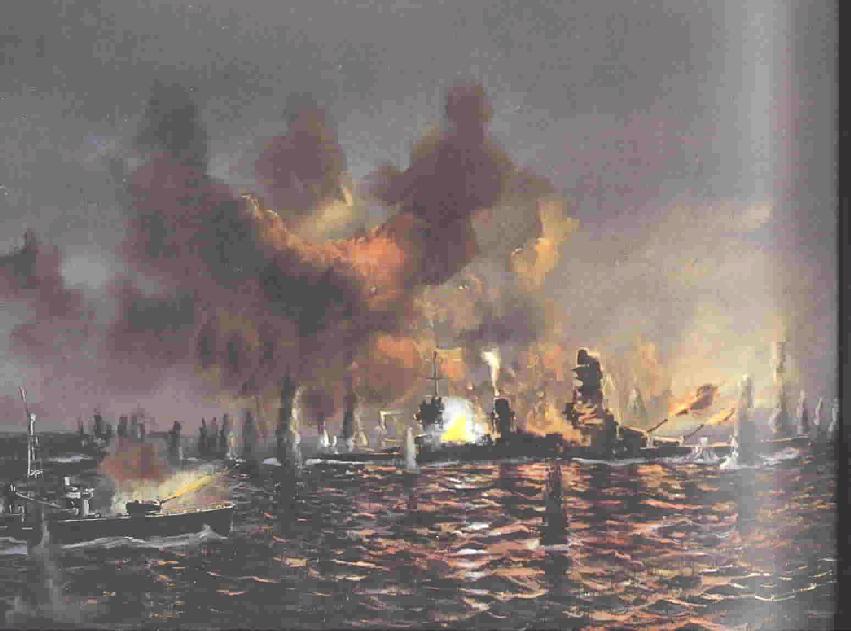
Yamashiro and Shigure ride into the Valley of death
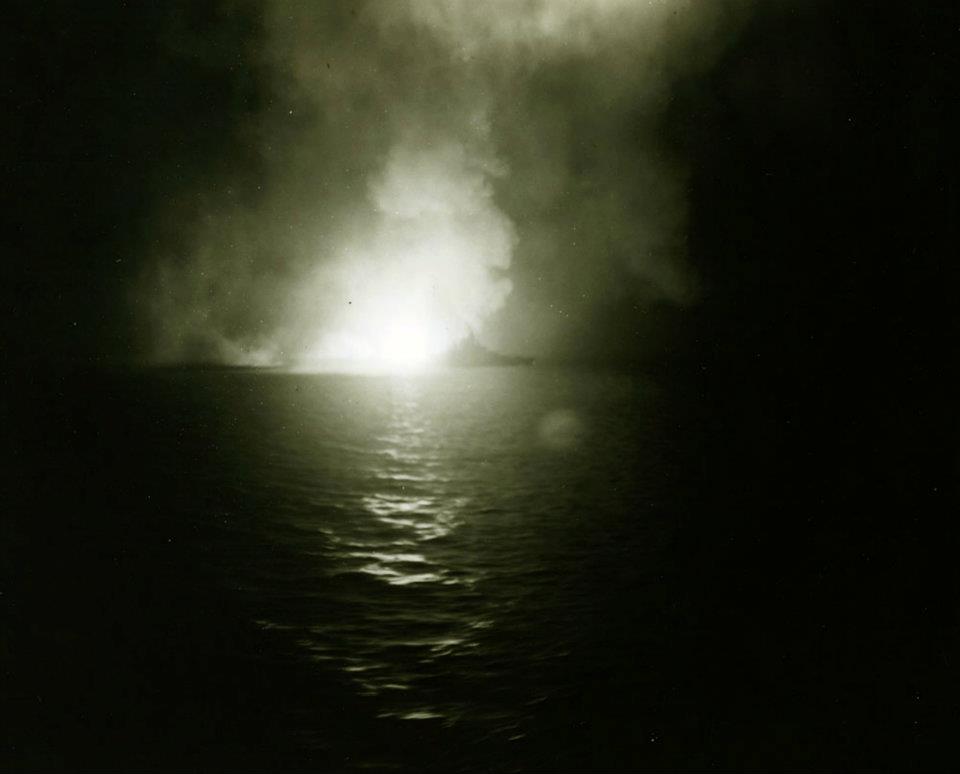
Nishimura’s force entered the southern entrance to Surigao Strait and was discovered by the American PT Boats at about 2236. Though the PTs scored no hits they provided critical updates on the Japanese to Oldendorff. At 0300 the American destroyers began a devastating series of attacks on the Japanese flanks. They sank two destroyers and damaged another which had to turn back, but the real damage occurred when both Fuso and Yamashiro were hit. Fuso took two torpedoes fired by the destroyer USS Melvin. She slowed and then blew up and broke in two sinking with all hands. This account has been contested in recent years but many find the new version less believable than the first. Key in the evidence was the rescue and capture of Yamashiro’s Executive Officer in the north end of the strait and the surviving logs of the other Japanese ships which reported the sinking. Yamashiro though hit continued north with Mogami and the last destroyer Shigure. At 0353 West Virginia opened fire and score hits on her first salvo. She was joined by California and Tennessee at 0355, the other battleships with their Mark 3 fire direction radars were slow to open up. Maryland got off six full salvos by ranging in on the splashes of West Virginia, California and Tennessee.Mississippi logged the final salvo of the battle and Pennsylvania got no shots off. West Virginia fired 16 salvos, 96 round of 16”armor piercing shells, Tennessee got off 69 rounds and California 63 each of 14” armor piercing shells, while Maryland added another forty eight 16” rounds.
The Yamashiro and Mogami sailed into the maelstrom absorbing hit after hit and gamely fought back. Yamashiro hit the destroyer Albert W Grant which was also hit by friendly fire badly damaging her. Finally both ships ablaze they turned back down the strait with Yamashiro sinking with few survivors at 0420. Shima’s force entered the fray and the Light Cruiser Abukuma was damaged by a torpedo fired by PT-137 and fell out of the formation. She was sunk on 26 October by Army Air Force B-24s. As Shima came up the strait his force entered the battered remnants of Nishimura’s force, the burning halves of Fuso and the retreating Mogami and Shigure. Assuming the halves of Fuso to be the wreckage of both battleships Shima beat a hasty retreat but in the process his flagship Nachi collided with Mogami flooding Mogami’s steering engine room and leaving her crippled. She was attacked again by American cruisers and aircraft and as abandoned at 1047 and scuttled a torpedo from the destroyer Akebono sinking at 1307 on 25 October.
Nachi Under Air Attack
The battle was one of the most lopsided surface engagements of the war. When it was over only one of Nishimura’s ships had survived the “lucky” Shigure. Shima’s force survived the night but most of his ships were sunk in the following by war’s end. Nachi was sunk in Manila Bay on 5 November by aircraft from the USS Lexington with a loss of over 800 sailors while Shima was in a conference ashore.
With the exception of Albert W Grant and a PT Boat the American force was unscathed the old Battlewagons dredged from the mud of Peal Harbor had led the fleet to a decisive victory in the last duel between Dreadnaughts ever fought. The Japanese died as Samurai trying to complete a hopeless mission against a far superior force.
Friends of Padre Steve's World
I welcome comments, even those which disagree with my positions and articles. I have done this for years, but recently I have been worn out by some people.
I have just a couple of rules for comments. First, be respectful of me and other commentators. If you are polite and respectful' even if I disagree with you your comment will be posted and I will respond accordingly.
That being said I will not allow people to hijack the comment section to push their religious or ideological views. Unless the comment deals with the meat of the article, don't expect me to allow you to preach, especially if you are a racist, anti-Semetic, or are a homophobe.
Nor will I allow spam comments. Most of those are automatically blocked by Wordpress but some do get through, and deal with them accordingly.
Peace
Padre Steve+
















 The Inglorius Padre Steve's World