Category Archives: History

Dan Sickles Part Four: The Pariah

Friends of Padre Steve’s World,

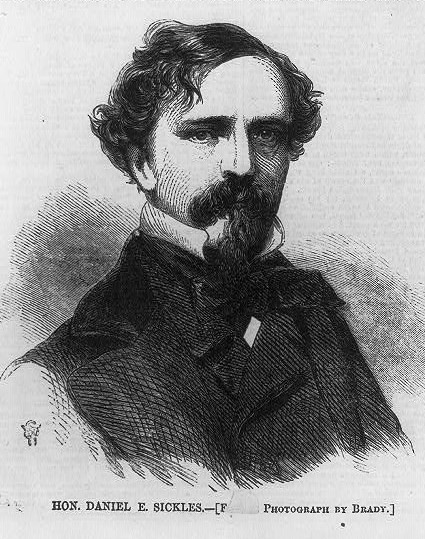
I am taking a break over this Thanksgiving weekend and am re-posting some articles from my Gettysburg text dealing with a man that I consider one of the most fascinating , salacious, scandalous, heroic, and incredible figures ever to grace and disgrace American history, Congressman, and Civil War General Daniel E. Sickles.

I hope that you enjoy,

Peace

Padre Steve+

dan-sickle-teresa-key


After a brief absence, Sickles returned to Congress and to Teresa, who was now even a worse social pariah than her husband. After the murder and for the duration of the trial, Teresa remained at one of the family homes in the New York countryside under the care of her parents. She followed the trial and occasionally wrote to Dan in jail, and over time he began to write back. Teresa was thrilled with the verdict and she honestly believed that the marriage and her reputation could be rehabilitated, and that she could be restored to a normal wife. The normal family values system of the time would have now involved Sickles divorcing his tarnished wife. That would have been “the predictable and conservative course.” [1] But despite his own continuing excursions into infidelity and his rage over hers, Sickles still loved her, and could not fathom divorcing her. His father George and Teresa’s father Antonio “were stricken with the same delusion as Teresa – that reconciliation would be tolerated by society.” [2]

Had the recently celebrated Congressman done divorced Teresa, his political career, while crippled, might have resumed its previous upward trajectory. But the ever unpredictable Dan Sickles “shocked everyone by forgiving Teresa and resuming their former relationship.” [3]

It was a characteristic of the time, and in some place even today in that maintained the belief that an adulterous wife knew no forgiveness, and Sickles “put himself beyond the pale by the simple act of forgiving his wife and restoring her to his bosom.” [4] Murder could be forgiven, a man’s indiscretions as well, but forgiving an adulterous women, especially a wife and mother was unforgivable. All the better people had already assigned the appropriate scarlet letter to the fallen woman, and they were shocked into paroxysms of moral outrage when Sickles apparently forgave her transgression.” [5] Sickles action was totally “out of kilter with an age that neatly divided women into “saintly mothers,” “pure virgins,” and “fallen women.” [6] Frankly the action was shocking to New York and Washington society, and both Dan and Teresa paid the price, but the price paid by Teresa would be greater, and ultimately contribute to her death, a death that occurred far too early.

Sickles was flailed in the papers, the New York Dispatch noted “His warmest personal and political friends bitterly denounce his course.” While the Sunday Courier wrote, “His political aspirations, his career in life, once so full of encouraging brightness, and his business prospects, have all been blasted by this act.” [7]

The Sunday Mercury put their condemnation published a biting bit of poetry lampooning both Dan and Teresa:

Hail matchless pair! United once again, In newborn bliss forget your bygone pain…

What the world may say, “with hands all red Yon bridegroom steals to a dishonored bed”

And friends, estranged, exclaim on every side: “Behold! Adultery couched with Homicide! [8]

Even long time friends were like James Topham Brady who had defended him at his trial were livid. Interestingly enough it was Sickles old foe Horace Greeley who “flew in the face of convention by commending Sickles for his forgiveness.” [9] But Greeley was an exception, and in the face of the critics sent a letter to the New York Herald in which he fired a broadside:

“Referring to the forgiveness which my sense of duty and my feelings impelled me to extend to an earring and repentant wife… I am prepared to defend what I have done before the only tribunal I recognize as having the slightest claim to jurisdiction over the subject – my own conscience and the bar of Heaven. I am not aware of any statute or code of morals which makes it infamous to forgive a woman… And I cannot allow even all the world combined to dictate to me the repudiation of my wife, when I think it right to forgive her and restore her to my confidence and protection. If I have ever failed to comprehend the utterly desolate position of an offending though penitent woman – the hopeless future, with its dark possibilities of danger, to which she is proscribed as an outcast – I can now see plainly in the in the almost universal howl of denunciation with which she is followed to my threshold…” [10]

Dan Sickles the sinner had struck back at his Pharisaical accusers with the aplomb of Christ himself, who had forgiven the adulteress woman, but it did little to change public perception. Teresa would always be the adulteress, abandoned by friends and scorned by society at large. Dan, who even with the scandal of the Key murder behind him and who would have been forgiven had he denounced and divorced his wife, was now a pariah, even among his peers and colleagues. Mary Boykin Chesnut, wife of a renowned senator, and prolific diarist from South Carolina “sat in the House gallery one day and saw Sickles deliberately, and totally ostracized. He was sitting all alone, like Catiline, every other member careful not to come near him – “left to himself as if he had the smallpox.” [11] When Chesnut asked a friend why he was shunned, the friend noted that the murder of Key “was all right… It was because he condoned his wife’s profligacy and took her back… Unsavory subject.” [12]

But for Teresa it was worse. She was “socially exiled, shunned even by humble neighbors, compelled to keep the house by day or face the sneers and hoots of such street trash as recognized her, cut off from her cherished riding and walking, coped up with a loving but over emotional mother, a penurious, egocentric father, Teresa, torn between grief for the dead, contrition for the living, began to fail…” [13] Despite his defense of her and officially taking her back, he spent little time with her and she never again accompanied him in any of his assignments, in the military, or after the war. But his policy of leaving her behind was not due to cruelty or neglect, as Dan and Teresa were “merely accepting an accomplished social fact, knowing Teresa would forever be an outcast and forever be an outcast and would be exposed to endless snubs and torment were she be so rash as to essay a new entrance into society.” [14] In his own way Dan loved her, but neither could change the attitude of a society where Puritanical morality still reigned, and the granddaughter of Giacomo Casanova’s friend could never be forgiven, and whose relationship with her husband would always be haunted by the ghost of Barton Key. Nothing could change that, and soon Teresa lost the will to live though she was not even twenty-five years old. “Sleepless, she took refuge in opiates….She sank slowly from frailty to invalidism.” [15] She contracted tuberculosis, and though she attempted to maintain her household she suffered from severe depression, and again took up her family’s Catholic faith. Catholic rosaries, missals, holy cards, and other items filled her bedroom. Eventually, she died unexpectedly in January of 1867, with most people thinking that she would yet recover. She was only thirty-one years old. Dan, now serving as military governor in South Carolina was stunned. Her pallbearers include James Topham Brady, and four U.S. Army generals including Sickles former comrade Alfred Pleasanton and his Gettysburg aide Henry Tremain. In death she finally found a measure of public sympathy, the funeral Mass was attended by many mourners, and as Sickles and his now teenage daughter Laura followed Teresa’s casket out of the church, “His feelings now broke forth and he wept, and the large congregation rushed tumultuously from the building after him, testifying to the hold he held on their hearts, and the extent to which they shared his affliction.” [16] In light of the prevailing morality of the day can wonder if most of the mourners had more sympathy for Sickles than his now dead wife. Unlike the adulteress of the Gospels, Teresa Sickles had no one to

Notes

[1] Ibid. Sears Controversies and Commanders p.200

[2] Ibid. Keneally American Scoundrel p.202

[3] Ibid. Wilson and Clair They Also Served p.100

[4] Ibid. Catton Glory Road p.152

[5] Ibid. Sears Controversies and Commanders p.200

[6] Ibid. Pinchon Dan Sickles p.136

[7] Ibid. Swanberg Sickles the Incredible p.72

[8] Ibid. Keneally American Scoundrel p.203

[9] Ibid. Swanberg Sickles the Incredible p.73

[10] Ibid. Swanberg Sickles the Incredible p.74

[11] Ibid. Catton Glory Road p. 152 Catiline was a counsel of Ancient Rome is best known for two attempts to overthrow the Roman Republic in 62 BC. His plot was exposed before the Senate by Cicero and he is famously depicted in Cesare Macari’s painting sitting alone in with his head down as Cicero denounces him before the Senate.

[12] Ibid. Hessler Sickles at Gettysburg p.20

[13] Ibid. Pinchon Dan Sickles p.136

[14] Ibid. Swanberg Sickles the Incredible p.282

[15] Ibid. Pinchon Dan Sickles p.137

[16] Ibid. Keneally American Scoundrel p.329

Leave a comment

Filed under crime, culture, History, marriage and relationships

Dan Sickles Part Three: Trial of the Century

Friends of Padre Steve’s World,

I am taking a break over this Thanksgiving weekend and am re-posting some articles from my Gettysburg text dealing with a man that I consider one of the most fascinating , salacious, scandalous, heroic, and incredible figures ever to grace and disgrace American history, Congressman, and Civil War General Daniel E. Sickles.

I hope that you enjoy,

Peace

Padre Steve+

HD_TrialofDanielSickles1859.preview

The Sickles Trial


The stage was now set for the one of the most unbelievable and storied trials in American history, a trial that would have been much more suited to the era of 24/7 cable news coverage and the Internet than the era of the telegraph and newspaper, but even so it was sensational by any standard and it riveted the attention of the public in every part of the nation, from the largest cities to the smallest towns.

Almost immediately swarms of journalists were camped outside the prison and Sickles’ house where distraught Teresa sought a way to gain Dan’s forgiveness having received his broken wedding band which he sent to her from the jail. Witnesses to her dalliances with Key at the 15th Street house and other venues were brought to the Stockton Mansion to identify her. “She was the meat in the market, the ogre at the carnival. A little way across the square, souvenir hunters were cutting fragments of wood out of the tree by which Key had fallen, and artists from the illustrated papers set up their easels and began sketching every aspect of the area – the railings, the Stockton Mansion, the Clubhouse.” [1] A Presbyterian pastor who knew the couple found her obsessed by the shame that she had brought upon herself and her daughter, and he “found her in such mental agony that he feared for her sanity and even felt that she might try to take her life.” [2]

It was a credit to her own emotional strength that Teresa survived the ordeal that she had helped to bring about, and which she found herself blamed for, even by her father, who felt that she had dishonored the Bagioli family name. Antonio Bagioli wrote to Dan in prison, “You have heaped on my child affection, kindness, devotion, generosity. You have been a good son, a true friend, and a devoted, kind, loving husband and father.” [3] Of all the commentators, it was the eminent historian and diplomat George Bancroft who seemed to have any “sense of Teresa’s pain: “Poor child, what a cruel thing to deprive her of her sole stay and support. Key was the only man she could look to for sympathy and protection.” [4]

After Barton Key’s lifeless body was borne off in a mahogany casket to the Presbyterian cemetery in Baltimore and buried in the grave of his dead wife, and his children placed in the care of his family, his effects, what they amounted to, including his resplendent Montgomery Guards uniform were “sold off to a morbid, bargain-hunting, souvenir-hounding crowd.” [5] It was an ignoble end to the scandalous story of the son of Francis Scott Key, a story that soon with all of its salacious detail would be revealed to the public.

Meanwhile, inside the jail her husband, alternating between fits of rage and calm was visited by Washington’s Mayor James Barret, Sam Butterworth, Attorney General Black, Vice President John C. Breckinridge, and Speaker of the House, James Orr. He was comforted by the many expressions of support and sympathy found in scores of letters from people around the country, one of the first “a kindly note from the President,” [6] and others from total strangers. He was also joined by friends and allies from New York and Washington. “James Topham Brady, John Graham, and Thomas Francis Meagher, able lawyers all, arrived post haste to defend their rash ally” [7] as well as his father who before offering encouragement to his son offered a sharp chastisement, “You hot-headed fool! That’s no way to settle things! No woman’s worth it! No matter how you come out of this, you’ve killed your career – White House and everything else.” [8]Undeterred and calm Dan told his father that he understood and that if he had to he would do it again, after which, his father began to discuss the organization of his son’s defense with this legal team.

rerl_02_img0122

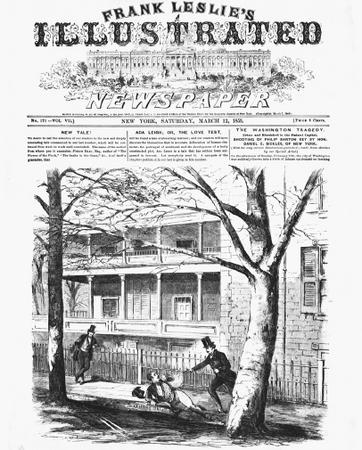
The case was front page news in all the major newspapers, which provided “extensive coverage of the “Sickles Tragedy.” Sickles’ murder of his friend Key in broad daylight in view of the White House had all of the scandalous elements that have thrilled Americans then and even today: “adultery, politics, celebrity, and a handsome corpse,” [9] not to mention a beautiful young woman who even more than her husband who had killed a man, stood accused in the eye of the public.

Despite the notoriety of the case, many people found sympathy with Sickles and believed that no jury would convict him of murder or manslaughter, after all, Teresa was the one who committed adultery with Key. The New York Herald “doubted that a grand jury would indict him. Even if he were indicted, Harper’s Weekly presumed that no jury would convict him of manslaughter if the adultery charge were proven, which it considered a foregone conclusion.” [10] The New York Times noted well before the trial opened, “there appears to be no second opinion as to the certainty of Mr. Sickles acquittal” but “national interest” arose from “the general desire to see the whole case fairly put, and the million scandals of mystery laid to rest by the plain facts.” [11]Newspapers like the New York Evening Post, his political arch-enemy found the murder an excellent opportunity to attack Sickles, “That wretched man, Daniel E. Sickles, has in his career reached the stage of assassination, and dipped his hands in human blood… It is certain that a man… who in his own practice, regards adultery as a joke and the matrimonial bond as no barrier against the utmost caprice of licentiousness – has little right to complain when the mischief which he carriers without scruple into other families enters his own.” [12] But such commentary was the exception, and it came from the organ of a political enemy. It is an interesting comment on the era, that a woman’s adultery, even when committed by the wife of an adulterous male who had killed her lover, was consider more of a social stigma and crime than murder.

Within days Sickles had assembled one of the most formidable defense teams ever to dominate an American court. Brady, who was considered to be the ablest criminal defense lawyer of his day became the lead attorney for the defense team, and was joined by Sickles’ New York friends, Graham and Meagher. Brady was an excellent choice, he “was admired and even loved by society in general, but on top of that, though his legal repertoire was wide, he had been involved successfully in more than fifty murder cases.” And he “had also made a special study of pleas of insanity,” [13] something that would figure greatly in the trial.

Additionally, President Buchanan helped recruit one of the finest attorneys in the country, the future Secretary of War, Edwin Stanton to the team. They were joined by four lesser known, yet high-powered attorneys; Samuel Chilton a Virginian who later represented John Brown, and his partner Allen Magruder, Daniel Ratcliffe, and Philip Phillips, a former Alabama Congressman and member of Washington’s Jewish community. Additionally, Reverdy Johnson, one of the most respected attorneys of the day served as an occasional advisor. “The Washington Evening Star observed that Sickles was collecting a lot of lawyers for a man whose defenders did not expect to leave their box before acquitting him.” [14]

Sickles’ defense team was a nineteenth century legal Dream Team against which the government deployed but one attorney, Key’s former assistant District Attorney Robert Ould. Ould, described by one of Sickles’ biographers as “a dull bull of a man, at one time a Baptist parson,” [15] had been named acting District Attorney by President Buchanan when Key was killed. It was an odd place for Ould, as he was serving to prosecute his former boss’s killer, at the behest of the President, who happened to be one of the defendant’s best friends. Ould, the former parson “was placed by inference in the unhappy position of defending adultery – something that he indignantly denied, insisting that he was merely prosecuting a killer….” [16] but to many people, the murderer of an adulterer by an aggrieved husband was complete justified. Ould was totally outclassed by the defense team, and Key’s family paid to have John Carlisle a respected Washington attorney to aid Ould in the case, but the trial would prove them appear incompetent and not up to the task of convicting Sickles.

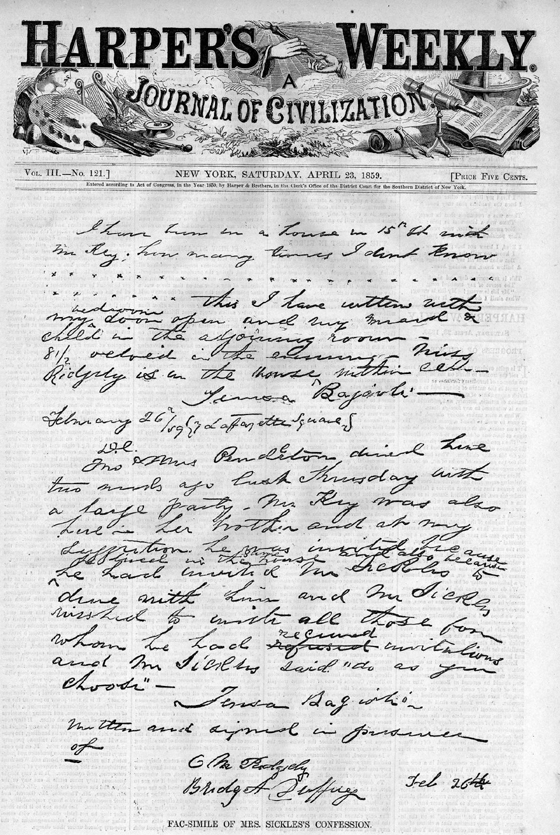
HarpersMagazineTeresaConfession

Teresa Sickles Confession on the Front Page of Harper’s Weekly

The defense pushed for a speedy trial and decided, as many lawyers do today, to try the case in the newspapers, which in light of the lurid nature of the story hung on every word coming out of Washington. The defense team pursued the strategy of “entirely reversing the roles of Sickles and Key by putting the dead man on trial for having made a victim of the defendant, and the New York Press prepared the public for just such an emotional appeal.” [17] The news stories printed by papers that supported Sickles as well as those of his detractors helped inflame the public as the newspapers across the country “wherever wires ran, were front-paging the story under screaming headlines and, in larger cities, rushing out extras every hour or two, as fresh details came to hand.” [18] The private affairs of Dan and Teresa Sickles became known around the nation, and even though the judge in the case refused to admit the confessions Sickles had forced from Teresa into evidence they found their way into the papers, some like Harper’s not only ran the text but reproduced the confession in enlarged facsimile form. The question in many people’s mind “was Dan Sickles justified in slaying the man who had betrayed his confidence and seduced his wife?… As a consequence the whole country turned jury.” [19]

The trial began on April 4th, just over a month after the killing and barely a week after the indictment was handed down. The first three days involved jury selection, a task that the defense turned over to Philip Phillips, who sparred with the prosecutor Ould over the twelve men who would eventually sit in judgment of Dan Sickles. Ould attempted to gain a favorable jury by introducing the property qualifications of jurors, he “ruled out jurors who did not meet the requirement of owning property valued at $800. Since this $800 property limit had not been imposed in similar cases, Ould’s insistence on it would attract much scorn from Dan’s lawyers…”[20] Sickles’ team fought back embarrassing Ould in the process, but not getting the judge to change his narrow application of the law to help the defense. Over two hundred potential jurors were examined before twelve unbiased jurors could be found, and a “great majority of those dismissed confess strong prejudice in favor of the prisoner.” [21] When the jury was seated it was composed of twelve men, two farmers, four grocers, a merchant, a tinner, a coach maker, a men’s clothing salesman, a shoemaker, and a cabinetmaker, “but not a single “gentleman” in the occupational sense.” [22]

Ould opened his case, “ponderously, powerfully, in the blackest of terms,” [23] he drew a picture of the killing. He delivered an “emotionally charged argument that Sickles, “a walking magazine,” had taken deliberate care in arming himself against Key, who only had “a poor and feeble opera-glass.” [24] Ould argued “that homicide with a deadly weapon, perpetrated by a party who has all the advantage on his side and with all the deliberate cruelty and vindictiveness, is murder, no matter what the antecedent provocation in the case.”[25] He then called twenty-eight witnesses, the majority of whom had actually witnessed the shooting, but he did not call upon Butterworth, Teresa, or the young White House page boy who had told President Buchanan and been sent away. Likewise he had not established intent, a key factor in any murder trial, nor had he introduced evidence that he had obtained regarding Sickles’ own affairs with women in Philadelphia, Baltimore, and elsewhere. The presentation of the physical evidence of Barton Key’s clothing and the bullet that supposedly killed Key was botched, the bullet that the prosecution claimed to have killed key did not fit either the Derringer, or the Colt revolver. Thus Ould left open for the defense the chance to explore all the salacious details of the case to put Key on trial, and to establish exculpatory reasons why Sickles had killed Key. Ould’s presentation of his case was brief, and so futile “that it seemed that Key was on trial for seduction, not that Sickles was on trial for murder.” [26]

sickles in the box

Sickles in the Prisoner’s Dock

The defense team made mincemeat of the prosecution. John Graham’s opening statement was a work of oratory genius that “would massively outshine Robert Ould’s more cumbersome opening.” [27]Weaving allusions from Shakespeare and other literary greats into his statement, he painted Sickles as the victim of a adulterous rogue who had on a Sunday, a day when he should have “sent his aspirations heavenward,” had instead besieged “that castle where for security and repose the law had placed the wife and children of his neighbor.” [28] Casting Sickles as the aggrieved and temporarily insane victim he also asked if it was a “crime for a husband to defend his family altar.” From there he proceeded to use quotes from Shakespeare’s Othello he inveighs against the adulterer as the supreme criminal, piling up quotation upon quotation from the Old Testament and Roman law to show that in wiser days the punishment invariably was death’” [29] to paint the picture of Sickles’ agony as he saw the man who had defiled his wife prowling outside of his home. Graham then went to provocation and argued that due the circumstance of the crime, a friend and confidant attempting to defile Sickles’ wife on a Sunday that the prosecution “needed to prove Dan’s sanity at the time of the act. And they could not do that, because there was not enough in the case “to melt the heart that is not cut from the unwedgeable gnarled oak.” [30] It was a masterful performance.

Over the next two weeks, Brady, Stanton, and Graham would continue to hammer the prosecution case. The defense proved that Key’s family had tampered with evidence, including testimony from a locksmith who had changed the locks at the 15th Street house at the direction of Key’s family. Witness after witness was introduced to undermine the prosecution and support the defense’s claim that Sickles’ was indeed in a state of uncontrollable madness, and the defense deftly parried the prosecutor’s rebuttal witnesses. When Ould attempted to keep African American witnesses from testifying Stanton, thundered and“accused the prosecution of a “monstrous” attempt to suppress evidence in its zeal of the defendant’s blood,” [31] and argued from North Carolina precedent that the prosecution was not willing to grant Sickles the same right as a slave. As his lawyers argued his case and witnesses gave testimony Sickles maintained his composure except for a number of times when he broke down and had to be excused from the proceedings. “Whether the courtroom histrionics were real or an award-winning performance, the jury witnessed firsthand a husband who was mentally unable to bear his wife with another man.” [32] On the Friday the 22nd of April Judge Crawford declared the testimony closed and the next day began the closing arguments.

Saturday April 23rd dawned with a violent gale, but that did not prevent crowds of people from trying to gain admittance to the courtroom. Edwin Stanton began the defense closing arguments in a manner that was calm and precise. He brought up that justifiable homicide included that which was “committed in defense of family chastity, the sanctity of the marriage bed, the matron’s honor, the virgin’s purity.” [33] Since the prosecution had never brought into evidence Sickles’ own violation of these covenants his attacks on Key and the prosecution case hit home. As he continued his voice rose to a roar, sounding like a prophet of ancient Israel “Who seeing this thin, would not exclaim to the unhappy husband, “Hasten, hasten, to save the mother of your child! And may the Lord who watches over the home and family guide the bullets and direct the stroke!” [34] When Stanton finished the court erupted in a frenzy as spectators as well as supporters of Sickles applauded his closing.

Next up was Brady who went on for three hours, captivating the audience which hung on every word. “When Daniel Sickles realized how he had been betrayed, all the emotions of his nature changed into a single impulse; every throb of his heart brought before him the sense of his great injuries; every drop of his blood was burdened with a sense of shame; he was crushed by inexorable agony in the loss of his wife, in the dishonor that he had come upon his child, in the knowledge that the future – which had opened to him so full of brilliancy – had now been enshrouded in eternal gloom by one who, contrawise, should have invoked form the eternal God his greatest effulgence on the path of his friend….” [35]

The closing had been masterful, emotional, and dramatic. In response Ould attempted to recover, but his arguments were weak, he agreed with the defense about the crime of adultery, and attempted to redirect the jury’s attention that it was Sickles who was on trial for murder and not Key for adultery, but he had already lost that argument. He called the defense of temporary insanity a ploy and “mentioned how easily, and readily a man on trial for his life might pretend to be deranged if he were on trial for his life.” But it was too little, too late. Since there was no psychiatric profession to weigh in on the matter, the argument of temporary insanity fell back on the “tradition of male marital dominance” and “that argument played well among men who rarely wore collars on their shirts…” [36] the very kind of men seated in the jury booth. When the jury recessed to deliberate Sickles’ fate on the 26th it took them less than an hour to return their verdict, and few were surprised when it came back “not guilty.” Stanton “was so excited that he did a jig in the courtroom, the hoarsely called for three cheers.” [37] As he did “Pandemonium and cheers broke out in the courtroom.” [38]People crowded around to congratulate Sickles and the crush was so great that Sickles had to be escorted for the courtroom. President Buchanan on hearing the verdict was delighted, later in the evening, though he sought rest, Sickles was taken by Brady to a gala in his honor attended by nearly 1500 supporters and well-wishers. The trial was over but the trials of Dan Sickles were not.

Notes

[1] Ibid. Keneally American Scoundrel p.142

[2] Ibid. Swanberg Sickles the Incredible p.63

[3] Ibid. Keneally American Scoundrel p.146

[4] Ibid. Keneally American Scoundrel p.147

[5] Ibid. Pinchon Dan Sickles p.117

[6] Ibid. Pinchon Dan Sickles p.117

[7] Ibid. Swanberg Sickles the Incredible pp.62-63

[8] Ibid. Pinchon Dan Sickles p.116

[9] Ibid. Hessler Sickles at Gettysburg p.12

[10] Marvel, William Lincoln’s Autocrat: The Life of Edwin Stanton University of North Carolina Press, Chapel Hill 2015 p.103

[11] Ibid. Hessler Sickles at Gettysburg pp.12-13

[12] Ibid. Swanberg Sickles the Incredible p.63

[13] Ibid. Keneally American Scoundrel p.151

[14] Ibid. Marvel Lincoln’s Autocrat p.103

[15] Ibid. Pinchon Dan Sickles p.121

[16] Ibid. Swanberg Sickles the Incredible p.64

[17] Ibid. Marvel Lincoln’s Autocrat p.104

[18] Ibid. Pinchon Dan Sickles p.118

[19] Ibid. Pinchon Dan Sickles pp.118-119

[20] Ibid. Keneally American Scoundrel p.162

[21] Ibid. Pinchon Dan Sickles p.120

[22] Ibid. Marvel Lincoln’s Autocrat p.105

[23] Ibid. Pinchon Dan Sickles p.122

[24] Ibid. Hessler Sickles at Gettysburg p.14

[25] Ibid. Pinchon Dan Sickles p.122

[26] Ibid. Swanberg Sickles the Incredible p.65

[27] Ibid. Keneally American Scoundrel p.173

[28] Ibid. Keneally American Scoundrel p.173

[29] Ibid. Pinchon Dan Sickles p.124

[30] Ibid. Keneally American Scoundrel p.175

[31] Ibid. Marvel Lincoln’s Autocrat p.107

[32] Ibid. Hessler Sickles at Gettysburg p.15

[33] Ibid. Pinchon Dan Sickles p.127

[34] Ibid. Pinchon Dan Sickles p.128

[35] Ibid. Pinchon Dan Sickles p.129

[36] Ibid. Marvel Lincoln’s Autocrat p.110

[37] Ibid. Swanberg Sickles the Incredible p.66

[38] Ibid. Hessler Sickles at Gettysburg p.17

Leave a comment

Filed under crime, History, laws and legislation

Dan Sickles Part Two: Murder in Lafayette Square

Friends of Padre Steve’s World,

I am taking a break over this Thanksgiving weekend and am re-posting some articles from my Gettysburg text dealing with a man that I consider one of the most fascinating , salacious, scandalous, heroic, and incredible figures ever to grace and disgrace American history, Congressman, and Civil War General Daniel E. Sickles.

I hope that you enjoy,

Peace

Padre Steve+

philip-barton-key-granger


Within a year of his assignment Sickles returned to the United States to help prepare the Democratic nomination for his friend Buchanan who had long desired the office, and return to his lucrative post in New York. In the spring of 1856 Sickles began to work on Buchanan’s nomination for the Presidency and while doing so began his own campaign for New York’s Third District’s Congressional seat. Buchanan won the election of 1856 against an opposition divided between the Know Nothing candidacy of former President Millard Fillmore and the candidate of the new Republican Party, John C. Fremont.

In the election of 1856, Sickles carried the district easily. For Sickles it was a triumph, he was “riding a flood tide of political fortune that might carry him far,” [1] and like any wife Teresa too was delighted with the result. Even so, Teresa must have wondered if her husband would mend his ways now that he was on the national spotlight, or if he would continue his extramarital romps around the nation’s capital. Following the election Dan and Teresa moved to Washington D.C. where they took up a fashionable residence, the Stockton Mansion, on Lafayette Square, not far from the White House and Sickles friend, James Buchanan.

Once he was established in Washington Sickles was in his element, politics at its grandest. It was a different style than of politics than Tammany, where brass knuckled force often ruled, but it suited Sickles, who was “a fixer who knew all the tricks of Tammany at its crookedest but who seems not to have taken graft himself. He had his sights fixed on the presidency, and he was making about as much progress in that direction as a Tammany man can,” [2]   until a strange combination of unrequited love, infidelity, the personal betrayal of a friend, and a murder intervened.

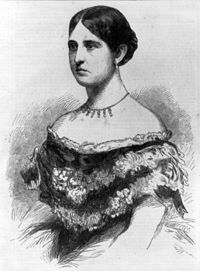
HarpersMagazineMrs.Sickles

Teresa Sickles

While her husband politicked along the Potomac, the new congressman’s wife was adapting to her life in Washington D.C. The wives were expected to entertain and host parties on a regular basis at their residences, but they also knew their share of loneliness and neglect. Since legislators routinely were “busy with night sessions, committee meetings, and plain nocturnal politicking over whiskey punch, that their wives either accepted other escorts or spent lonely evenings at home with fancywork or a book.” thus it was not surprising that Teresa, “should seek the gayety of the capital in her first year there.” [3] In the absence of their husbands it “was not uncommon for available bachelors to act as escorts for married women when their husbands were unavailable.” [4] Since Dan Sickles was frequently unavailable and since Teresa probably still suspected that Dan was still engaged in extramarital affairs, it is not surprising that the young Mediterranean beauty found comfort in another man.

The years of 1857 and 1858 would be a tumultuous time for the nation as well as the Sickles. Buchanan had been elected because of his stability and moderation in an age of pro and anti-slavery radicalism. However, over the next year his presidency, and his would be overwhelmed by events and Buchanan’s decisions supporting the expansion of slavery. While Sickles was neither a slave owner, nor himself fond of the institution, it was part of life, and many of his friends in Washington D.C. and in Congress were slave holders. Buchanan had schemed before his inauguration with Chief Justice of the Supreme Court Roger Taney in the Dred Scott decision, which was handed down in the days following Buchanan’s inauguration, followed by the fiasco over the Lecompton constitution and the attempted admission of Kansas as a Slave State, an event which split the Democratic party in the 1860 election, ensuring Abraham Lincoln’s defeat of Buchanan’s Lecompton foe in the Senate, Senator Stephen A. Douglas who would have been the prohibitive favorite in the election had the split not occurred.

Likewise, Sickles and his beautiful young wife would become part of one of the most sensational trials of American history, rivaling the Lindbergh kidnapping trial, the trial of O.J. Simpson, the Scopes Monkey Trial, and the Impeachment of President Bill Clinton in its captivation of America. As in London, Teresa became popular and she and Dan were much sought after and their home “became the scene of a gradual number of and entertainments,” [5] and even as Sickles continued his robust politicking and philandering Teresa became the object of another’s affection, the District of Attorney for the District of Columbia, Philip Barton Key, the son Francis Scott key, the writer of the Star Spangled Banner. Interestingly enough it was Sickles who had helped Key the troubled man to be reappointed to his office in early 1857 after Key had helped Sickles overcome legal and financial difficulties to secure Sickles in the Stockton Mansion and the two men developed a warm friendship.

Philip Key was extraordinarily handsome, especially when outfitted in his green and gold militia uniform of the Montgomery Guards, and was considered one of the most desirable men in Washington. An accomplished horsemen he rode about town on his “horse Lucifer – a nobly bred, dapple gray hunter.”[6] When he gained Sickles’ friendship many of his well to do political and society friends became frequent visitors to the Sickles household. After Sickles had helped Key to be reappointed to his office, Key was instrumental in helping make the arrangements for Sickles to rent the Stockton Mansion.

During his first term in office Key was not known for being a particularly good District Attorney and spent much time away from the office complaining about his allegedly poor health. But his health did not keep him away from Washington’s party scene and “One hostess called him “the handsomest man in all Washington… he was a prominent figure at all the principle functions; a graceful dancer, her was a favorite of every hostess of the day.” [7] When he met Teresa, the dashing bachelor took an intense interest in the wife of the man who had helped him retain his job. The two were soon attending many functions together that Sickles, due to his work schedule could seldom attend.

Within weeks Key became a frequent guest at the Sickles home and few were surprised at this, as most observers knew that Sickles was responsible for Key’s reappointment. With Sickles now fully engaged in the dramatic political battles of late 1857, Teresa and Key began to spend much more time together. The two were seen together at the “theater, at teas, at hops. But most of all they went riding together.” [8] The frequency of these visits was noted and became the source of much gossip but Sickles was unaware of it and entertained no suspicions that his new friend was becoming deeply involved with his wife, and that Key had rented a room where the two could intimate.

That was until a young man equally smitten by Teresa had a few drinks with a colleague and the colleague shared the information with a loyal Sickles ally who then told Sickles. Sickles was shocked and called for a meeting with Key, however, after a brief conversation, Key convinced Sickles that there was nothing to the rumors, and Sickles was satisfied.

Though Sickles had been satisfied by the explanation, “despite his own well-publicized moral lapses, Daniel Sickles was a man of intense personal pride who would not countenance the breath of scandal attaching to his wife.” [9] He took the time to warn her to make sure that she was not involved in any other indiscretions, and left the subject. However, Key and Teresa continued to see each other, and “she and Barton thought that they were taking more care, and being less observed by people than they were.” [10] Yet as they pursued one another their affair became increasingly public, and seen by too many people not to go unnoticed. The two were seen together in at the Congressional Cemetery, and frequently at a house at “385 15th Street where he would enter the by the front door – and she the back.” [11] When a mutual friend expressed his concerns, Key shrugged off the warning, and “with the bravado of a proud weakling, he still held his course. And Teresa, ductile, enamored, blindly followed his lead.” [12] Another friend of Key suggested to him that he could be in danger, but Key “bridled and patted the breast of his coat. “I am prepared for any emergency,” he snapped. Key was a crack pistol shot and his friend believed that Key was preparing for a possible confrontation. [13]

Like so many people young spouses who find their needs unfulfilled at home, and who suspect their spouse of infidelity, , “Teresa did not see this love affair as tragic and dangerous. She lived within it as a secret fantasy, as in a virtual and time-consuming experience that lacked any power to inflict damage on other areas of her life.” [14] She became less discreet, Key would signal to her from across the street to confirm their dalliances and despite their insipidly inept attempt to hide the affair it became clear to Sickles’ coachman and household maids that the two were engaged in sexual encounters in the Sickles carriage and in the Stockton Mansion itself.

The situation finally came to a head in February 1859 following Sickles reelection and return to Washington. “Made more reckless than ever by their recent separation, Barton and Teresa now again were seen everywhere together.” [15] The couple were now making clandestine liaisons on a nearly daily basis, and eventually, one of the observers decided to tell Sickles. The anonymous source, using the initials of R.P.G. sent Sickles a letter detailing the affair. Sickles received the letter from a butler on the night of Thursday February 24th as he was leaving the usual dinner party at his house for the traditional hop that followed at the Willard Hotel.

Sickles did not read the letter until after the couple returned home and Teresa had gone to bed. Sickles was stunned and at first did not believe the contents as he placed little stock in anonymous messages. So he had George Wooldridge, a longtime friend and congressional clerk investigate, and on Saturday February 26th Wooldridge confirmed Sickles worst fears. That evening at their home Sickles confronted Teresa about the letter and as he stormed about angrily in their bedroom she confessed, after which Sickles had her write out her confession detailing everything. He may have been desolate and angry, but he was a lawyer, and he got his written proof.

But scandal was the last thing that Sickles wanted, as he had higher aspirations in politics, so he immediately called his friends for counsel and by Sunday morning several, including Wooldridge and Samuel Butterworth were at the Stockton Mansion with Sickles. As always, Sickles’ “first thoughts were for himself, and he melodramatically”[16] exclaimed to Butterworth, “I am a dishonored and ruined man…I cannot look you in the face.” [17]

4P8V9475

Murder

His friends “were profoundly touched by the depth of his feeling, and were convinced that he needed to be saved from a severe derangement of his senses; from lunacy, that is.” [18] his friends attempts to calm him, Sickles was beside himself with anger, and his anger now swirled around his marriage and what he believed was the scandal that would cost hi his career. That afternoon, Key again tempted fate, this time, for the last time. He had been tipped off by an anonymous letter that the affair was public, but he was determined to see Teresa. He made several passes by the house, each time signaling with a handkerchief, until Sickles observed him. Sickles called out to Butterworth “That villain has just passed my house! My God, this is horrible!” [19]

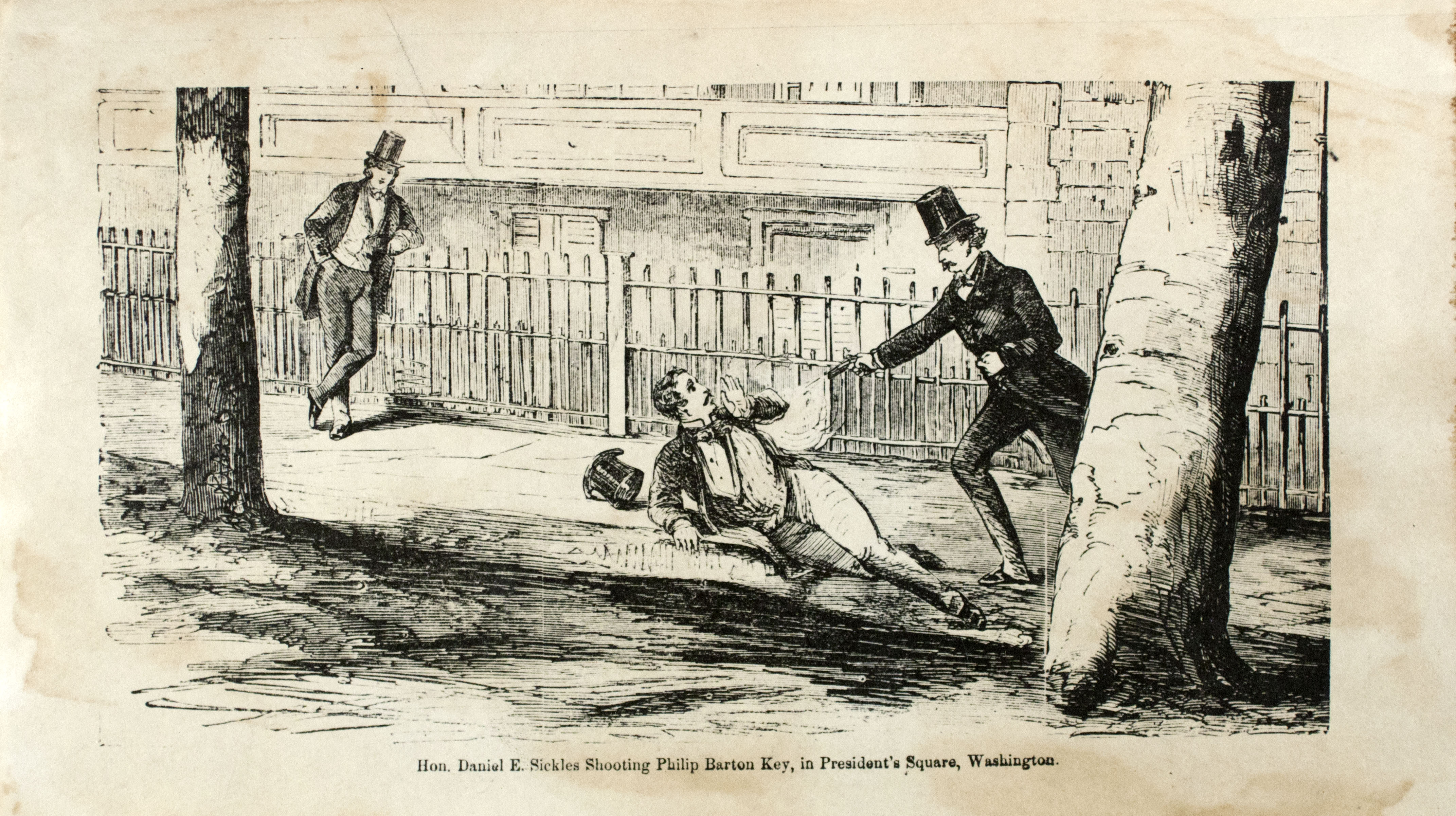
Butterworth left the house first and met Key at the southeast corner of Lafayette Square across from the White House. Allegedly not knowing Sickles intended any harm, Butterworth walked with Key to for a few minutes and then left. The exchange delayed Key and gave Sickles, who had armed himself with a single shot large caliber Derringer, and a muzzle-loading Colt revolver, enough time to catch up with Key near the Club House on Madison on the east side of the square. Sickles was raving but Dan’s fury transcended reality,” [20] as at least a dozen witnesses were nearby as he screamed, “Key, you scoundrel, … you have dishonored my bed – and you must die!” [21] Sickles pulled out the revolver, the first shot from which grazed Key, and the second which misfired. A brief scuffle ensued as Key lunged at his assailant, but Sickles flung him to the ground, and drew the Derringer as Key threw the opera glasses that he viewed Teresa at Dan. A third shot hit Key in the groin and he slumped to the ground screaming “Murder! Murder!… Don’t shoot!” [22]

If there was a chance for Sickles to prove that he acted in self-defense it was now, but he could not control himself. He fired the revolver yet again and it misfired. He placed the weapon in his pocket and drew the Derringer, and fired a shot which hit Key in the Liver. As Key writhed on the ground Sickles tossed the Derringer to the ground and he again drew the Colt. As the stunned witnesses to the attack looked on, Sickles advanced toward the fallen Key and placed the gun at his head and pulled the trigger, but again the weapon misfired. As Sickles attempted to place another cap in the pistol, a number of witnesses began to intervene. One man, “a member of the club, running up, stopped him. Mr. sickles – for God’s sake!” And Butterworth, coming forward, took Dan by the arm. Without a word, they walked away together.” [23] Witnesses took the mortally wounded Key away to the Club, where he expired.

President Buchanan was almost immediately told of the murder by a White House page boy, was aware of the implications of the scandal, Sickles was a friend and political ally with much promise. Buchanan told the boy leave town and gave him a sum of money to facilitate his departure. Soon after Sickles and Butterworth went by carriage “to the home of Attorney General Black, where the Congressman formally surrenders himself to the silver-haired Cabinet member who had regarded him as a protégé.” [24]He declined bail in favor of a speedy trial, was allowed to go home where he told Teresa that he had killed her lover, retrieved some personal items and then went to the District jail, “a foul hole, swarming with vermin, destitute of sewage, bath, water, ventilation, and so inadequate to its purpose that often a dozen or more prisoners were herded into a single narrow cell.” [25] When he arrived he reportedly asked the jailer if they were the best accommodations available, to which the jailer responded “this is the best place you members of Congress have afforded us.” [26] Dejected, but undeterred Sickles sent a message to the public, “In doing what I had to do I have broken the law. Therefore I place myself behind bars. It is for you to set me free.” [27] The stage was now set for the one of the most unbelievable and storied trials in American history.

Notes

[1] Ibid. Swanberg Sickles the Incredible p.4

[2] Ibid. Catton The Army of the Potomac: Glory Road p.151

[3] Ibid. Swanberg Sickles the Incredible p.15

[4] Ibid. Hessler Sickles at Gettysburg p.8

[5] Ibid. Swanberg Sickles the Incredible p.16

[6] Ibid. Pinchon Dan Sickles p.74

[7] Ibid. Hessler Sickles at Gettysburg p.9

[8] ibid. Swanberg Sickles the Incredible p.20

[9] Ibid. Swanberg Sickles the Incredible p.25

[10] Ibid. Keneally American Scoundrel p.92

[11] Ibid. Wilson and Clair They Also Served p.99

[12] Ibid. Pinchon Dan Sickles p.94

[13] Ibid. Swanberg Sickles the Incredible p.44

[14] Ibid. Keneally American Scoundrel p.92

[15] Ibid. Pinchon Dan Sickles p.93

[16] Ibid. Hessler Sickles at Gettysburg p.10

[17] Ibid. Swanberg Sickles the Incredible p.53

[18] Ibid Keneally American Scoundrel p.121

[19] Ibid. Hessler Sickles at Gettysburg p.10

[20] Ibid. Keneally American Scoundrel p.127

[21] Ibid. Swanberg Sickles the Incredible p.54

[22] Ibid. Hessler Sickles at Gettysburg p.11

[23] Ibid. Pinchon Dan Sickles p.112

[24] Ibid. Swanberg Sickles the Incredible p.55

[25] Ibid. Pinchon Dan Sickles p.114

[26] Ibid. Keneally American Scoundrel p.135

[27] Ibid. Swanberg Sickles the Incredible p.114

Leave a comment

Filed under crime, History, laws and legislation

Dan Sickles the Incredible Scoundrel and Patriot Part One

Friends of Padre Steve’s World,

I am taking a break over this Thanksgiving weekend and am re-posting some articles from my Gettysburg text dealing with a man that I consider one of the most fascinating , salacious, scandalous, heroic, and incredible figures ever to grace and disgrace American history, Congressman, and Civil War General Daniel E. Sickles.

I hope that you enjoy,

Peace

Padre Steve+

6517740_orig


George Meade had made his dispositions on July 2nd 1863 with care, but there was one notable problem, the commander of III Corps, Major General Dan Sickles did not like the position assigned to his corps on the south end of Cemetery Ridge. But before discussing that it is worth chasing the rabbit so to speak and spend some time on the life of a man referred to by one by one biographer as an American Scoundrel and another as Sickles the Incredible. The interesting thing is that lie most complex characters in history that Dan Sickles was both and, “he might have had more faults than virtues, but everything about him was perfectly genuine.” [1] That is one of the reason that he is so fascinating.

Sickles was certainly a scoundrel and at the same time incredible, charming yet terribly vain and often insincere. “He was quick-witted, willful, brash, and ambitious, with pliable moral principles.” [2] But he was also incredibly brilliant, far sighted, patriotic, and civic minded. He was a political general, “flamboyant, impulsive, and brave, some would wonder about his discipline and military judgement.” [3] His notoriety and unpopularity among the West Point trained professional officers in the Army of the Potomac, as well as his tactical decision to move his corps on the afternoon of July 2nd 1863, and his subsequent political machinations ensured that he would be the only corps commander of that army not commemorated with a monument at Gettysburg.

Dan Sickles was one of the most colorful, controversial, and perhaps the most scandalous officer ever to command a corps in the history of the United States Army. While he lacked professional training he had done a fair amount of study of the military arts in his spare time, and he “made up for his lack of military training by acting on the battlefield with reckless courage, and was much admired for it by his men.” [4]

After having served as a brigade and division commander Sickles was promoted to corps command. “Sickles owed his elevation to corps command to the patronage of his friend Joseph Hooker…. And while man of the West Point officer….regarded Sickles military acumen with the greatest skepticism, many in the volunteer ranks were of a different mind. “Sickles is a great favorite in this corps,” asserted Private John Haley of the 17th Maine. “The men worship him. He is every inch a soldier and looking like a game cock. No one questions his bravery or patriotism.” [5] General Alpheus Williams who commanded a division in the Union Twelfth Corps despised Sickles, and after Chancellorsville Williams wrote “A Sickles’ would beat Napoleon in winning glory not earned,,, He is a hero without a heroic deed! Literally made by scribblers.” [6] Likewise, Sickles, the political general was no favorite of George Gordon Meade.

On July 2nd 1863 Sickles would be responsible for an act that threw George Meade’s defensive plan into chaos, and according to most historians and analysts nearly lost the battle, however, there are some who defend his actions and give him credit for upsetting Lee’s plan of attack. However, the truth lays somewhat in the middle as both observations are correct. Sickles’ decision created a massive controversy in the months following the battle as public hearings in Congress, where Sickles, a former congressman from New York had many friends, as well as enemies, sought a political advantage from a near military disaster.

Sickles was a mercurial, vain and scandal plagued man who “wore notoriety like a cloak” and “whether he was drinking, fighting, wenching or plotting, he was always operating with the throttle wide open.” [7]Sickles was born in New York to George and Susan Marsh Sickles in late 1819, though a number of sources, including Sickles himself cite dates ranging from 1819 through 1825. “There is little reliable information about Sickles’ early days,” [8] and he did not talk much about them, especially after the war, when Gettysburg and the Civil War became his main subjects of conversation. His father, a sixth generation American whose family were early Dutch settlers in Manhattan became wealthy through real estate speculation, “and he passed on to his son a pride in being a congenital Knickerbocker,” charming, witty, and clever, in whom “hardheadedness and impulsiveness were combined.” [9]

The young Sickles was an impetuous child and his father’s wealth ensured that Dan Sickles had “the finest of tutors…. And an unceasing bankroll of funding for lascivious escapades.” [10] To get their son special tutoring to prepare him for college, his parents “arranged for him to live in the scholarly house of the Da Pont family…. It was a household like few others in that hardheaded, mercantile city, at a time when New York had little of the Italian character it would later take on.” [11]The home was a place of learning, culture, and unusual relationships. The head of the house was Lorenzo L. Da Pont, a Professor at Columbia, as well as a practicing attorney. Also living in the home was Da Pont’s father, the ninety-year-old Professor Lorenzo Da Pont, who “had been the librettist for three of Mozart’s operas” [12] and “held the chair of Italian and Columbia University” [13] Additionally, the elder Da Pont’s “adopted daughter Maria and her husband, Antonio Bagioli, a successful composer and music teacher” [14] lived under the same roof.

Maria was only about twenty-years-old when Sickles moved in. By this time she and Bagioli already had a child of their own, a three year old daughter named Teresa, which Sickles would eventually marry. While the elder Da Pont claimed Maria as an adopted daughter, it was “widely believed that she was his “natural child” … from an American liaison conducted when he was near the age of seventy.” [15] This spawned rumors, even at the time of Gettysburg that the young Sickles “and his future mother-in-law had a sexual affair.” [16]

Whether the liaison with Maria Bagioli occurred is a matter of innuendo and conjecture, but it would not be out of character for Sickles, who, to put it mildly, had a wild proclivity for the opposite sex. As a young man he frequented brothels, and as his social and political status increased, he moved from the brothels frequented by the middle class to those which catered to the more socially well to do. One of his affairs was with the a prostitute named Fanny White, a woman who was smart, pretty, and upwardly mobile who ran her own bordello. His affair with Fanny was well publicized, but did not prevent him from being elected to the state legislature in 1847. She and Sickles would continue their relationship for years with her asking nothing more than expensive gifts, and there are inklings that Fanny help to fund Sickles’ early political campaigns. There is also speculation that in 1854 following his marriage, that Fanny spent time with him in London while he was working with James Buchanan and that that he “may have brought Fanny to one of the Queens’s receptions and introducing the prostitute to Her Majesty.” [17] But Fanny eventually moved on to a man older and richer than Sickles. Eventually she retired from her business and married another New York lawyer but died of complications of tuberculosis and possibly syphilis in 1860. Her property at the time of her death was conservatively “estimated at $50,000 to $100,000”[18] a considerable fortune for a woman of her day and age.

While he lived with the Da Pont family, Sickles gained an appreciation for foreign languages, as well as theater and opera. The elder Professor Da Pont was a major part of his academic life and quite possibly in the development of Sickles liberal education and his rather libertine morality. Lorenzo had been a Catholic Priest and theologian in Italy, but like his young American admirer had quite the attraction for women, and was a connoisseur of erotic literature and poetry. His activities resulted in him being expelled from his teaching position in the seminary, after which he became fast friends with a man whose name is synonymous with smooth talking, suave, amorous men, Giacomo Casanova, and in Europe “his affairs with women had been almost as notorious as those of his good friend.” [19] Certainly the elder Lorenzo’s tales “of Casanova, the fabled prince of Priapus, did nothing to quell Dan’s adolescent sexual appetite.” [20]

Noted Civil War and Gettysburg historian Allen Guelzo describes the Sickles in even less flattering terms, “Sickles was from the beginning, a spoiled brat, and he matured from there into a suave, charming, pathological liar, not unlike certain characters in Mozart operas.”[21]

Following the deaths of both the elder and younger Professor Da Pont, Sickles was stricken with grief. At the funeral of the younger Professor Da Pont Sickles “raved and tore up and down the graveyard shrieking,” [22] forcing other mourners to take him away by force. Soon after, Sickles left New York University and began to work in the law office of the very formidable New York lawyer and former U.S. Attorney General, Benjamin F. Butler.

While he was studying for the bar under Butler, he was joined by his father who would also become an attorney. It was under the influence of his father, who was now a wealthy Wall Street investor, and the Democrats of Tammany Hall that the incredibly talented Sickles was groomed for political leadership. Tammany was a rough and tumble world of hardnosed politics, backroom deals, corruption and graft.

He passed the bar in 1843 and soon was making a name for himself in the legal world, and in politics, despite his well-known questionable ethics and morality. His political career began in 1844 when “he wrote a campaign paper for James Polk and became involved in the Tammany Hall political machine.” [23] The ever ambitious Sickles “clambered up the city’s Democratic party ladder, on the way collecting allies and enemies with utter disregard for the consequences, attending the typically unruly Tammany meetings armed with bowie knife and pistol.” [24]

Like many of his fellow New York Democrats he was a proponent of “Manifest Destiny, and the right of the United States to acquire and hold Texas, New Mexico, California, perhaps the isthmus of Central American, and certainly Cuba.” [25] He was also a political ally of many states rights Southern Democrats and “largely opposed anti-slavery legislation.” [26] This was in large part due to the commercial interests of New York, which between banking and commercial shipping interests profited from the South’s slave economy.

He was elected to the New York State legislature in 1847 and his political star continued to rise even as his personal reputation sank among many of his peers. An attorney who knew him described Sickles as “one of the bigger bubbles in the scum of the profession, swollen, and windy, and puffed out with fetid gas.” [27] Sickles rivals any American politician, before or since in his ability to rise even as the slime ran down his body, the term “Teflon” applied to politicians like Presidents Ronald Reagan and Bill Clinton comes to mind when one studies Sickles’ career. New York lawyer and diarist George Templeton Strong wrote, “One might as well try to spoil a rotten egg as to damage Dan’s career.” [28]

But there was no denying that Sickles was a brilliant lawyer, politician, and debater. One observed that Sickles was “a lawyer by intuition – careful in reaching his conclusions, but quick and bold in pushing them.” [29]New York Governor “William Marcy grudgingly said that as a debater Sickles excelled any man of his years, and the astute Henry Raymond declared that as a parliamentary leader he was unsurpassed.” [30] Soon Sickles was a delegate to the 1848 Democratic Convention where he helped nominate Franklin Pierce for his unsuccessful run at the democratic nomination. The convention enabled Sickles to enter the world of national politics making friends with many influential politicians and financiers, including Pierce, the Van Burens, and James Buchanan. On his return to New York he received an appointed as a Major in the New York Militia.

Even as Sickles rose in the tumultuous world of American law and politics, and chased Fanny White he became enamored with the now teenage daughter of Antonio and Maria Bagioli, Miss Teresa Bagioli who though only fifteen was beautiful, wise beyond her years, fluent in French and Italian, devoted to the arts, and entirely besotted by Dan Sickles. Both the parents of Sickles and Teresa opposed the relationship, but both were madly in love, and Teresa was as headstrong as Dan regarding the relationship. Though such a relationship would be considered completely scandalous today, such marriages were not uncommon then, though they were certainly less common in the upper society of New York. Sickles “was enchanted by her” and “courted her with the sensibility of being a friend of her parents and he must have suspected that he loved her with a fated and exclusive love.” [31] When she was just sixteen Teresa quit school and married the thirty-three year-old assemblyman in a civil ceremony officiated by New York Mayor Ambrose Kingsland on September 27th1852. Six months later, the two were married in the Catholic Church by Archbishop John Hughes, in a “gala and largely attended affair.” [32] Just three months after the church wedding their daughter, Laura, was born. Though there can be no doubt that Sickles loved Teresa, and she him, it did not stop him from other extramarital affairs, nor did it take much away from his political machinations at Tammany Hall.

Following the 1852 Democratic convention where he again supported Franklin Pierce, Sickles hard fighting and influence at in the Wigwam of was rewarded with political plum prize of being appointed “corporation counsel of New York City, a post that paid a flattering salary with extra emoluments and also left room for profitable legal work on the side.” [33] His political and social acumen were again demonstrated as he convinced the state legislature, through personal force of will, to enable the New York City Corporation “to go ahead with creating a great central park,”[34] a park that we now know today as Central Park. He also helped push forward a proposal to create New York’s first mass transportation system, that of horse drawn omnibuses.

Later in the year Sickles was appointed as secretary of the American legation to the Court of St. James n London, headed by former Secretary of State James Buchanan. The position paid a pittance of what Sickles was earning in New York, but he realized that the serving overseas in such a position could not but help him on the national political stage. Though Buchanan and Pierce wanted Sickles, the new Secretary of State, the former New York Governor William Marcy refused to sign Sickles’ commission for the post. Eventually, Pierce prevailed and Sickles got the job.

As their baby, Laura, was still very young and sea travel still quite hazardous, Teresa remained at home, and joined her husband in London the following year. However, when she arrived in London, the teenage wife of Dan Sickles charmed Americans and Britons alike. Aided by her multilingual gifts, which “were rare among American diplomats’ wives,” [35] she became a great success and the unmarried Buchanan appointed her as hostess for the legation. She rapidly became a celebrity due to her stunning beauty and charm, and like he had Fanny, Sickles had Teresa introduced to the Queen. Her celebrity status evoked different responses from those that observed her. “One contemporary described Teresa as an Italian beauty, warm, openhearted, and unselfish. Another described her as being “… without shame or brain and [having] a lust for men.” [36] That “lust for men” coupled with the neglect of her husband may well have been the catalyst for the scandal which overwhelmed them in Dan’s congressional career.

It was during his service in London with Buchanan that Sickles became embroiled in one of the most embarrassing diplomatic incidents in American history. The proponents of Manifest Destiny and American expansion had long desired to take Cuba from Spain through diplomacy, or if needed force. Following a failed attempt by American “Filibusters” to seize the island in 1852 which ended in the execution of fifty Americans, including the son of U.S. Attorney General John Crittenden by Spanish authorities, and in 1854 President Franklin Pierce authorized Buchanan to attempt to negotiate the acquisition of Cuba.

Pierce authorized Buchanan to meet with James Mason, the United States Ambassador to France and Pierre Soule, the United States Ambassador to Spain secretly in order to draft “a statement on the future of Cuba and the proposed role of the United States.” [37] Soule dominated the meeting and the statement, which was in large part drafted by Dan Sickles, was highly inflammatory. Despite this the statement was released to the press in defiance of the order to maintain the strictest secrecy and it resulted in a diplomatic disaster for the Pierce Administration.

The document was prepared by Soule and Sickles and endorsed by Buchanan and Mason was known as the Ostend Manifesto, and it “was one of the most truly American, and at the same time most undiplomatic, documents every devised.” [38] The manifesto prepared by Soule and Sickles proclaimed that “Cuba is as necessary to the North American Republic as any of its present members, and that it belongs naturally to the great family of states of which the Union is the Providential Nursery.” [39] The authors of the manifesto also threatened Spain should the Spanish fail to accede to American demands. The authors declared that if the United States “decided its sovereignty depended on acquiring Cuba, and if Spain would not pass on sovereignty in the island to the United States by peaceful means, including sale, then, “by every law, human and Divine, we shall be justified in wresting it from Spain.” [40]

The Ostend Manifesto “sent shivers through the chancelleries of Europe, provoked hurried conversations between the heads of the French and British admiralties.” [41] European diplomats and leaders reacted harshly to the statement and Secretary of State William Marcy who had previously supported the ideas in the document immediately distance himself and official American policy from it and the authors. Marcy then “forced Soule’s resignation by repudiating the whole thing, but the damage was done.” For months the Pierce administration was on the defensive, and was condemned “as the advocate of a policy of “shame and dishonor,” the supporter of a “buccaneering document,” a “highwayman’s plea.” American diplomacy, said the London Times, was given to “the habitual pursuit of dishonorable object by clandestine means.”[42] The incident ended official and unofficial attempts by Americans to obtain Cuba by legal or extralegal means until the Spanish American War in 1898.

To be continued…

Notes

[1] Catton, Bruce The Army of the Potomac: Glory Road Doubleday and Company, Garden City New York, 1952 p.151

[2] Wert, Jeffry D. The Sword of Lincoln: The Army of the Potomac Simon and Schuster, New York and London 2005 p.222

[3] Ibid. Coddington The Gettysburg Campaign a Study in Command p.45

[4] Sears, Stephen W. Chancellorsville Houghton Mifflin Co. Boston and New York 1996 p.65

[5] Ibid. Trudeau Gettysburg a Testing of Courage p.110

[6] Ibid. Sears Gettysburg p.35

[7] Ibid. Catton The Army of the Potomac: Glory Road pp.150-151

[8] Hessler, James A. Sickles at Gettysburg Savas Beatie New York and El Dorado Hills CA, 2009, 2010 p.1

[9] Keneally, Thomas American Scoundrel: The Life of the Notorious Civil War General Dan Sickles Anchor Books, a Division of Random House, New York 2003 p.7

[10] Ibid. Guelzo, Gettysburg The Last Invasion p.243

[11] Ibid. Keneally American Scoundrel p.3

[12] Ibid. Hessler Sickles at Gettysburg p.2

[13] Ibid. Keneally American Scoundrel p.3

[14] Ibid. Hessler Sickles at Gettysburg p.3

[15] Ibid. Keneally American Scoundrel p.4

[16] Ibid. Hessler Sickles at Gettysburg p.3

[17] Ibid. Hessler Sickles at Gettysburg p.6

[18] Ibid. Keneally American Scoundrel p.215

[19] Swanberg, W.A. Sickles the Incredible copyright by the author 1958 and 1984 Stan Clark Military Books, Gettysburg PA 1991 p.79

[20] Ibid. Swanberg Sickles the Incredible p.80

[21] Ibid. Guelzo, Gettysburg The Last Invasion p.243

[22] Ibid. Swanberg Sickles the Incredible p.81

[23] Ibid. Hessler Sickles at Gettysburg p.4

[24] Sears, Stephen W. Controversies and Commanders Mariner Books, Houghton-Mifflin Company, Boston and New York 1999 p.198

[25] Ibid. Keneally American Scoundrel p.12

[26] Ibid. Swanberg Sickles the Incredible p.82

[27] Ibid. Wert The Sword of Lincoln p.222

[28] Ibid. Hessler Sickles at Gettysburg p.4

[29] Ibid. Swanberg Sickles the Incredible p.84

[30] Ibid. Swanberg Sickles the Incredible p.84

[31] Ibid. Keneally American Scoundrel p.21

[32] Wilson Robert and Clair, Carl They Also Served: Wives of Civil War Generals Xlibris Corporation 2006 p.98

[33] Ibid. Swanberg Sickles the Incredible p.88

[34] Ibid. Keneally American Scoundrel p.21

[35] Ibid. Keneally American Scoundrel p.39

[36] Ibid. Wilson and Clair They Also Served p.98

[37] Ibid. Keneally American Scoundrel p.44

[38] Pinchon, Edgcumb Dan Sickles: Hero of Gettysburg and “Yankee King of Spain” Doubleday, Doran and Company Inc. Garden City NY 1945 p.48

[39] Ibid. Potter The Impending Crisis p.190

[40] Ibid. Keneally American Scoundrel p.45

[41] Ibid. Pinchon Dan Sickles p.48

[42] Potter, David M. The Impending Crisis: America before the Civil War 1848-1861 completed and edited by Don E. Fehrenbacher Harper Collins Publishers, New York 1976 p.193

Leave a comment

Filed under civil war, ethics, History, leadership

John F. Kennedy and Civility

Friends of Padre Steve’s World,

Fifty-three years ago President John F. Kennedy was assassinated by Lee Harvey Oswald in Dallas Texas. Despite his many flaws he was an inspiring American hero. Today I am taking the time to remember something that he said that is so lacking in our political discourse today.

Peace

Padre Steve+

John F. Kennedy said:“So let us begin a new remembering on both sides that civility is not a sign of weakness, and sincerity is always subject to proof. Let us never negotiate out of fear. But let us never fear to negotiate.”

Some fifty-six years ago a young, handsome Irish Catholic from Massachusetts took the oath of office of the President of the United States. President John F. Kennedy had won an exceptionally close Presidential Race against Republican Voce President Richard M. Nixon, a race that some believe was decided by votes of the dead in places like Chicago and West Virginia. Despite the contested nature of the election Nixon was gracious and conceded the race to avoid deeper division.

Fifty years ago today that young President was gunned down in Dealey Plaza in Dallas Texas by Lee Harvey Oswald. It was an event that shattered our nation which helped in many ways to foment the deep and abiding cynicism that is the hallmark of our recent political landscape.

The Kennedy administration had a wonderful vision but was not always successful. In fact there were time its policies and actions were in the case of the Bay of Pigs Invasion were mired in controversy. Decisions made by Kennedy to send more advisors to Vietnam would be followed by the Johnson Administration sending combat troops. Kennedy played a high stakes game of chess with Nikita Khrushchev during the Cuban Missile Crisis where the world came perilously close to nuclear war.

That being said he also inspired and energized Americans and our Allies to greatness. Kennedy’s speech at the Berlin Wall where he identified himself with the city saying “Ich bin Ein Berliner” inspired many in Germany who realized that in Kennedy they had a friend who would not abandon them.

Kennedy challenged us as Americans to put a man on the moon by 1970. He  supported NASA as they began to develop the Apollo program which did achieve that lofty goal when Apollo 11 landed on the Moon on July 11th 1969.

Kennedy was a visionary. He supported the establishment the Army Special Forces, or the Green Berets.  He helped to found and promote the Peace Corps.  His economic policies were fiscally conservative but did not ignore the poor. He pushed for equal rights for African Americans against a much divided nation.

jfkptfloat

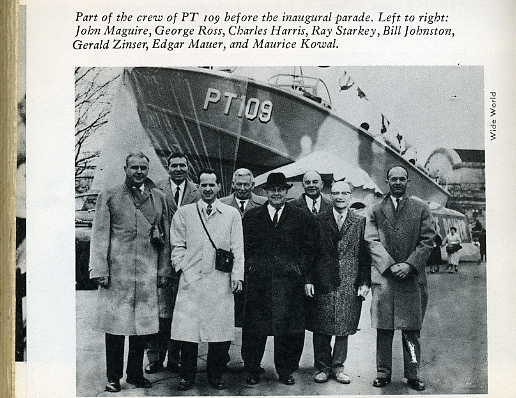
As I said, Kennedy was a flawed man. A deeply flawed man. I have written about that before. He was not known for his sexual morality and the stories of him with various mistresses including Marilyn Monroe abound. At the same time he was a hero. He volunteered to serve on PT Boats in the Second World War when his political connections would have ensured him a billet in a non-combat area and his physical condition would have exempted him from any military service.

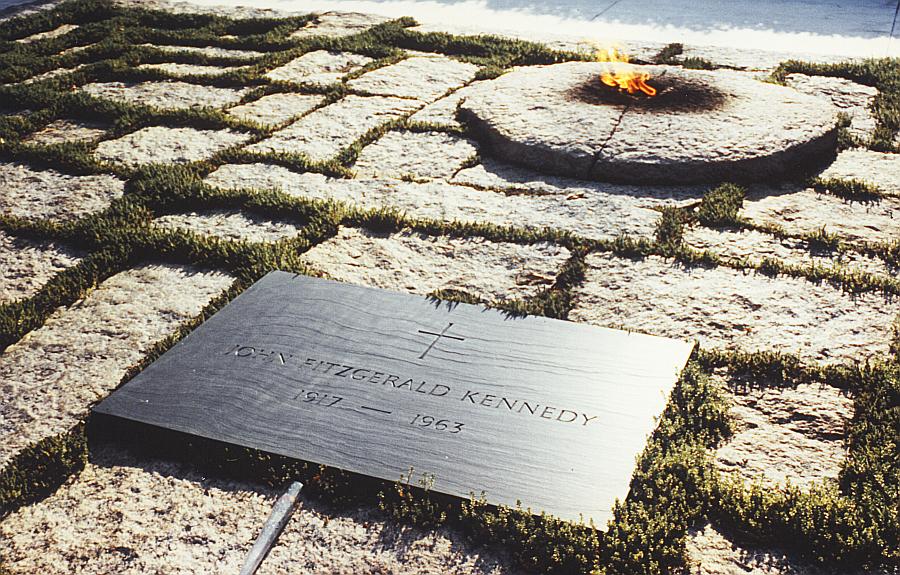
Kennedy died 50 years ago today. He was the victim of an assassin’s bullet in Dealey Plaza in Dallas Texas with his wife Jackie at his side. His death stunned the nation and in a sense ended our innocence.  Since that time American politics has been on a slow but steady descent into darkness which both parties have aided and abetted to the point that they view each other as mortal enemies and along with it have devastated our body politic.

JOHN F KENNEDY FUNERAL

In our divided state it seems that the nation has become nothing more than a collection of special interest groups. Each group is driven by their own wants and needs above that of others goaded into a frenzy by politicians who cater to those needs whether they be tax breaks, entitlements or “pork barrel” projects which only benefit the political benefactors of the politicians. I know that American politics has always had such elements but I don’t think that my parents or those other young people who heard and responded to this speech ever imagined that we would come to this.

While Kennedy still has critics and was a flawed man I find him still to be a great and compelling President. He is one of my favorite Presidents in large part because he understood that “civility is not a sign of weakness.” In our current poisonous political environment this is something that all of us need to take to heart, especially people of faith who so often seem to be the least civil and most hateful in our society.

Kennedy was one of those rare leaders who called us to better as individuals and as a nation. Today we remember his life and the tragedy of his death.

But today I think about his inaugural address. It is a speech that in my opinion calls us as Americans to higher and better ideals. It is a speech that if we actually listen to it can still help point us away from the abyss which we are staring into. I have posted the text of the speech as well as a link to the video of it here.

In the hope that we can learn at home and abroad from John F Kennedy.

Vice President Johnson, Mr. Speaker, Mr. Chief Justice, President Eisenhower, Vice President Nixon, President Truman, Reverend Clergy, fellow citizens:

We observe today not a victory of party but a celebration of freedom, symbolizing an end as well as a beginning, signifying renewal as well as change. For I have sworn before you and Almighty God the same solemn oath our forbears prescribed nearly a century and three-quarters ago.

The world is very different now. For man holds in his mortal hands the power to abolish all forms of human poverty and all forms of human life. And yet the same revolutionary beliefs for which our forebears fought are still at issue around the globe – the belief that the rights of man come not from the generosity of the state but from the hand of God.

We dare not forget today that we are the heirs of that first revolution. Let the word go forth from this time and place, to friend and foe alike, that the torch has been passed to a new generation of Americans, born in this century, tempered by war, disciplined by a hard and bitter peace, proud of our ancient heritage, and unwilling to witness or permit the slow undoing of those human rights to which this nation has always been committed, and to which we are committed today at home and around the world.

Let every nation know, whether it wishes us well or ill, that we shall pay any price, bear any burden, meet any hardship, support any friend, oppose any foe to assure the survival and the success of liberty.

This much we pledge – and more.

To those old allies whose cultural and spiritual origins we share, we pledge the loyalty of faithful friends. United there is little we cannot do in a host of cooperative ventures. Divided there is little we can do; for we dare not meet a powerful challenge at odds and split asunder.

To those new states whom we welcome to the ranks of the free, we pledge our word that one form of colonial control shall not have passed away merely to be replaced by a far more iron tyranny. We shall not always expect to find them supporting our view. But we shall always hope to find them strongly supporting their own freedom; and to remember that, in the past, those who foolishly sought power by riding the back of the tiger ended up inside.

To those people in the huts and villages of half the globe struggling to break the bonds of mass misery, we pledge our best efforts to help them help themselves, for whatever period is required – not because the communists may be doing it, not because we seek their votes, but because it is right. If a free society cannot help the many who are poor, it cannot save the few who are rich.

To our sister republics south of our border, we offer a special pledge: to convert our good words into good deeds in a new alliance for progress; to assist free men and free governments in casting off the chains of poverty. But this peaceful revolution of hope cannot become the prey of hostile powers. Let all our neighbors know that we shall join with them to oppose aggression or subversion anywhere in the Americas. And let every other power know that this Hemisphere intends to remain the master of its own house.

To that world assembly of sovereign states, the United Nations, our last best hope in an age where the instruments of war have far outpaced the instruments of peace, we renew our pledge of support, to prevent it from becoming merely a forum for invective, to strengthen its shield of the new and the weak, and to enlarge the area in which its writ may run.

Finally, to those nations who would make themselves our adversary, we offer not a pledge but a request: that both sides begin anew the quest for peace, before the dark powers of destruction unleashed by science engulf all humanity in planned or accidental self-destruction.

We dare not tempt them with weakness. For only when our arms are sufficient beyond doubt can we be certain beyond doubt that they will never be employed.

But neither can two great and powerful groups of nations take comfort from our present course – both sides overburdened by the cost of modern weapons, both rightly alarmed by the steady spread of the deadly atom, yet both racing to alter that uncertain balance of terror that stays the hand of mankind’s final war.

So let us begin a new remembering on both sides that civility is not a sign of weakness, and sincerity is always subject to proof. Let us never negotiate out of fear. But let us never fear to negotiate.

Let both sides explore what problems unite us instead of belaboring those problems which divide us.

Let both sides, for the first time, formulate serious and precise proposals for the inspection and control of arms – and bring the absolute power to destroy other nations under the absolute control of all nations.

Let both sides seek to invoke the wonders of science instead of its terrors. Together let us explore the stars, conquer the deserts, eradicate disease, tap the ocean depths and encourage the arts and commerce.

Let both sides unite to heed in all corners of the Earth the command of Isaiah to “undo the heavy burdens . . . (and) let the oppressed go free.”

And if a beachhead of cooperation may push back the jungle of suspicion, let both sides join in creating a new endeavor, not a new balance of power, but a new world of law, where the strong are just and the weak secure and the peace preserved.

All this will not be finished in the first one hundred days. Nor will it be finished in the first one thousand days, nor in the life of this Administration, nor even perhaps in our lifetime on this planet. But let us begin.

In your hands, my fellow citizens, more than mine, will rest the final success or failure of our course. Since this country was founded, each generation of Americans has been summoned to give testimony to its national loyalty. The graves of young Americans who answered the call to service surround the globe.

Now the trumpet summons us again; not as a call to bear arms, though arms we need; not as a call to battle, though embattled we are; but a call to bear the burden of a long twilight struggle, year in and year out, “rejoicing in hope, patient in tribulation” – a struggle against the common enemies of man: tyranny, poverty, disease and war itself.

Can we forge against these enemies a grand and global alliance, North and South, East and West, that can assure a more fruitful life for all mankind? Will you join in that historic effort?

In the long history of the world, only a few generations have been granted the role of defending freedom in its hour of maximum danger. I do not shrink from this responsibility; I welcome it. I do not believe that any of us would exchange places with any other people or any other generation. The energy, the faith, the devotion which we bring to this endeavor will light our country and all who serve it – and the glow from that fire can truly light the world.

And so, my fellow Americans: ask not what your country can do for you – ask what you can do for your country.

My fellow citizens of the world: ask not what America will do for you, but what together we can do for the freedom of man.

Finally, whether you are citizens of America or citizens of the world, ask of us here the same high standards of strength and sacrifice which we ask of you. With a good conscience our only sure reward, with history the final judge of our deeds, let us go forth to lead the land we love, asking His blessing and His help, but knowing that here on Earth God’s work must truly be our own.

Kennedy03290905

I do hope that we can after a half a century finally learn something from John F Kennedy.

Leave a comment

Filed under History, leadership, Political Commentary

Bloody Tarawa: One Square Mile of Hell

Friends of Padre Steve’s World,

There are some things that should not be forgotten, unfortunately many of them are lost to history. One of these events was the American assault against the Japanese fortress on Tarawa Atoll in November 1943. The battle was one of the bloodiest encounters of the Second World War and was waged for the control of a tiny coral atoll that only occupied one square mile of the earth’s s surface. Dug in on that atoll were about 4,000 Japanese defenders.

I hope that this small attempt to detail that battle helps you understand the sacrifice of the men who fought there.

Peace

Padre Steve+

The Decision: Operation Galvanic
USMC-M-Tarawa-3The Target: Betio Island at Tarawa Atoll

Following Guadalcanal and the shift of significant naval forces from the Solomons the focus of the US shifted to the thrust across the Central Pacific.  Unlike the Solomons which were initially a Navy and Marine Corps Operation and shifted to the Army under MacArthur as the campaign shifted to Borneo, the operations here would be an almost total Navy and Marine Corps operation. Operation Galvanic, the first offensive operation in the Central Pacific, came about as a result of the Joint U.S. Strategic Committee decision in April 1943 to favor an advance in the Central Pacific while maintaining the offensive in the South Pacific.[i] The driving force behind this strategy was Admiral King who fought for the plan and “insisted that any campaign should focus on the destruction of Japan’s overseas resources, which meant an offensive directed only toward the Western Pacific sea lanes.”[ii] The Joint Chiefs believed that a simultaneous attack by Nimitz in the Central Pacific and MacArthur in the South Pacific would “keep the Japanese guessing.”[iii] The decision was presented to the British at the TRIDENT meetings in May 1943 and though the British resisted the American plans a compromise was reached allowing the Americans to “simultaneously…maintain and extend unremitting pressure against Japan….”[iv]
japanese emplacing gunJapanese Emplacing 8″ Vickers Gun

The decision to begin operations in the Central Pacific meant that MacArthur’s priority in logistics and personnel would be reduced in order to launch the Central Pacific operation.  MacArthur protested, to no avail and the Joint Chief’s stood firm in their decision that the Central Pacific operation “would make it easier to isolate Japan from her domain in the south.”[v] MacArthur was allowed to continue OPERATION CARTWHEEL while Nimitz seized the Marshall and Caroline islands.[vi] Nimitz’s staff began preparations and decided on a conservative course to capture the Gilberts first before taking the more heavily defended Marshalls.[vii] This was in part due to the “need to minimize the risks to his untried amphibious forces against such heavily fortified enemy bases out of reach of air cover.”[viii]
japanese conducting firing exerciseJapanese conducting Live Fire Range prior to the Assault

Several factors were considered by Nimitz and his planners considerations in this choice.  Nimitz did not have enough troops to capture all of the vital heavily defended locations in the Marshalls without dividing his forces.[ix] Additionally the Gilbert operation could be supported by land based bombers.[x] A final consideration was the Joint Chief’s decision to allow MacArthur to retain control of 1st Marine Division which Nimitz had hoped would be available for operations in the Central Pacific.[xi] CINCPAC did a thorough photo reconnaissance of the Gilbert’s convinced the Joint Chiefs that Tarawa and Makin needed to be taken to provide air bases for the assault on the Marshalls.  Finally the order for Galvanic was issued on 20 July 1943 with its execution planned for November 1943.[xii]

Japanese Preparations
shibasakiAdmiral Shibasaki boasted that it would take a million men a thousand years to take Betio

The Japanese did little to prepare against potential American offensive operations against the Gilbert’s until Makin Island was raided by elements of 2ndRaider Battalion in August 1942.  The Makin raid shook the Japanese and at which time they reinforced Makin and occupied Betio.[xiii] The Japanese occupied Betio with the Yokosuka 6th Special Landing Force, essentially Naval Infantry or Marines[xiv] and the 111th Construction Battalion on 15 September 1942, over nine months after they attacked Pearl Harbor.[xv] These forces were commanded by Admiral Tomanari, who at once began to fortify Betio. Recognizing his need for more troops  Tomanari asked Tokyo for reinforcements.  The reinforcements came in the form of Commander Sugai’s 7thSasebo Special Naval Landing Force, which landed on 14 March.[xvi]Commander Sugai’s troops were the Rikusentai, the best of the Japanese Navy’s land forces.
USMC-M-Tarawa-p6Japanese Conducting Gunnery Exercises

The fortification of Betio proceeded slowly until the arrival of Rear Admiral Shibasaki, who relieved Tomanari who returned to Japan.[xvii] Shibasaki, a tough veteran of service at sea and ashore including 19 months as a Rikusentai[xviii] officer in China was chosen by Admiral Koga to instill a better fighting spirit on the island.  The Imperial General Headquarters “New Operations Plan” ordered the outer defensive islands, such as Tarawa, to “hold up any American advance while an inner line of fortresses was constructed….”[xix] Shibasaki drove the garrison hard, inspiring them to “extraordinary heights of labor that resulted in Betio’s superb defenses.”[xx]Betio mounted four 8” Naval guns[xxi], four 14 cm guns, four dual mount 5.5” dual purpose guns[xxii] six 80 mm anti-boat guns, eight 75 mm dual purpose guns, ten 75 mm mountain guns, six 70 mm guns and nine 37 mm anti-tank guns, numerous machine guns and light AA guns and 14 light tanks.[xxiii] These weapons were mounted in well camouflaged armored or reinforced pillboxes.[xxiv] In accordance with the directives of the high command Shibasaki ordered his troops “to defend to the last man all vital areas and destroy the enemy at the waters’ edge.”[xxv] The Japanese records note that Shibasaki “immediately began to strengthen morale and carried out advanced training, and as a result…the garrison remarkably enhanced its fighting capability and they were full of confidence.”[xxvi] Even the service troops were thoroughly trained to fight from their superb defensive positions.[xxvii] Shibasaki reportedly told his men that it would take a million men a thousand years to take Betio.

American Preparations
lvtLVT Amphibious Tractor

Nimitz organized his forces into three major commands, the 5th Fleet, commanded by Admiral Raymond Spruance, the 5th Amphibious Force under Admiral Richmond “Kelly” Turner and the V Amphibious Corps under Major General Holland “Howlin’ Mad” Smith, USMC.[xxviii] The 2nd Marine Division which would make the assault at Tarawa was commanded by Major General Julian Smith. The force that sustained in this operation and subsequent amphibious operations was the Service Force Pacific Fleet.[xxix] This was a collection of ships whose mission it was to sustain the fleet in mobile operations,[xxx] which greatly “increased the range and power of the Navy in amphibious operations.”[xxxi] The planned assault called for the Army’s 27th Division take Makin and the veteran 2nd Marine Division which had been blooded at Guadalcanal to take Tarawa supported by the carriers and battleships of 5thFleet.

This was the first application of new amphibious tactics developed for the Pacific war.[xxxii] Air and sea bombardment would precede the actual assault. The Marines would be transported ashore in a new vehicle called an LVT (Landing Vehicle Tracked) and other amphibious ships and craft including the LSD (Landing Ship Dock), LCM (Landing Craft Mechanized) and LCVP (Landing Craft Vehicle Personnel).  The LVTs were absolutely vital, nicknamed “Amtracks” or “Amphtracks” they were essentially a tracked amphibious personnel carrier. They were developed from a commercial vehicle used by U.S. Forrest Service Rangers in the Florida Everglades and were capable of crossing coral reefs that would cause other craft to go aground.  The early LVTs had retrofitted armor and mounted a .50 cal. machine gun.  At Tarawa the Marines deployed 75 LVT-1s[xxxiii] and 50 LVT-2s. 93 LVTs would be part of the first wave of the Marine assault.[xxxiv] The LVTs were transported to Tarawa aboard LSTs (Landing Ship Tanks.)  Other innovations included the assignment of Naval Gunfire Support teams to the Marine Regiments and some battalions,[xxxv] and the first use of the M4 Sherman tank by the Marines.[xxxvi] Tarawa was a proving ground for the tactics and equipment which would be improved on and used in every subsequent amphibious operation in the Pacific.  Tarawa would also mark the last major use of rubber landing craft by the Marine Corps in an opposed landing.[xxxvii]

There were limitations to American preparations. First the size of the force meant that it could not be assembled in one place for rehearsals or to train as a team.[xxxviii] A second problem for the Americans was the assumption that high and low tides would be sufficient to get their landing craft across the reef in spite of warnings to the contrary.[xxxix] Likewise the Americans failed to completely anticipate the scope to which the Japanese had fortified the island. This was despite good intelligence that they had done so. In particular aerial photos taken by the air force and ULTRA intercepts provided good information on the Japanese units on the island and the layout of the defenses.[xl] Additionally some equipment shortages were not remedied. The Marine Bazooka’s did not arrive, and neither the 6th or 8th Marines had made an actual amphibious assault.  At Guadalcanal they made an administrative landing and few field-grade officers remained from the 2nd Marine Regiment who had landed at Tulagi.[xli] They were far from “amphibious experts” that they would become.[xlii] However, they made up for their lack of experience by their cohesiveness, high morale and esprit, being well armed and equipped, in top physical condition and knowing the basic tools of their trade: “weapons proficiency and field firing, close combat techniques, fire and maneuver, tactical leadership, fire discipline.”[xliii]
tarawa 8 inch gun8 Inch Gun Emplacement

The most critical aspect of the operation was to get across the reef onto the island.  There were few good landing sites and it was decided to make the landings from inside the atoll’s lagoon onto the Betio’s north shore.  This decision meant that transports embarking the Marines would unload outside of the lagoon and that the landing craft would have to make a 10 mile trip.[xliv]There was only one entrance into the lagoon and it was not deep enough for heavy ships to enter.[xlv]This meant that heavy ships such as battleships and cruisers would not be able to have direct fire on the Japanese positions best situated to disrupt the Marines.

The execution of the plan involved land based bomber strikes beginning on D minus 7. Carrier aircraft would begin their operations on D minus 2.  Cruisers and destroyers joined the cacophony of destruction on D minus 1 and the battleships on D Day itself.[xlvi] On D-Day itself Navy planned to bombard the island with 3,000 tons of shells in 2 ½ hours.[xlvii] The Navy was confident in the bombardment plans. Rear Admiral Kingman commanding the fire support group declared “We will not neutralize; we will not destroy; we will obliterate the defenses on Betio!”[xlviii] Four battalions of Marines would land in the first wave, the three battalions of the 2nd Marines and 2nd Battalion 8th Marines all commanded by Colonel David Shoup. Colonel Shoup who would win the Medal of Honor on Betio and later became the Commandant of the Marine Corps assumed command of 2nd Marines when its Regimental commander fell ill on the journey to Efate.[xlix] The division reserve was the remaining 8th Marine Regiment battalions. The 6th Marine Regiment served as the corps reserve.[l]The assault units would be reinforced by tanks and the 1st and 2nd Battalions 18thMarine Regiment, the division’s combat engineers.

Invasion: Day One
landing craft going to beachGoing Ashore

The naval gunfire bombardment commenced at 0542 on 20 November, and the assault waves began their trek to the beaches.  The transports were out of range of Japanese guns but ththat ensured boats would have to make a 10 mile trip.[li]At this point things began to go wrong.
lcm sinking at tarawaNavy LCT Sinking after Being Hit By Japanese Fire

The Navy had “badly miscalculated the amount of softening-up that could be done in two and a half daylight hours bombardment.” Although major coast defense guns were silenced not enough damage was done to the Japanese defenses.[lii] The Japanese helped the Marines by firing their larger guns at warships, identifying their positions to Navy gunners.[liii] The bombardment lifted to allow an attack by carrier based aircraft. However the aircraft were late to arrive and the ships did not resume fire, allowing the Japanese to emerge and re-train their weapons.[liv] Likewise the destroyers Ringgold and Dashiell inside the lagoon had to cease fire, knowing the Japanese gunners along the shore were still active.[lv] Some believe that an extra half hour of direct fire from the destroyers would have saved many lives.[lvi] The LVTs in the first three waves were delayed by heavy chop and did not make landfall until 0913 throwing off the landing schedule.[lvii] The expect and planned for rise in tides did not materialize and they remained unpredictably low for the first 48 hours. No landing boats could cross the reef and the Marines were forced to wade ashore from 600 to 1000 yards.[lviii]
marines wade ashore at tarawaMarines Wading Ashore

Shoup’s Marines landed on three beaches.  Red one and two lay to the west of a 500 yard long pier and Red three lay to the east.  3/2 landed on Red-1, 2/2 on Red-2, 2/8 on Red-3, elements of 1/18 and the scout snipers on the pier, with 1/2 in reserve to land behind the battalion making the best progress.[lix] As soon as the Amtracks hit the reef the Japanese began firing.  Every “working weapon along the north and west shorelines….blazed forth in fierce, interlocking fields of fire.”[lx] As they watched the Amtracks craw over the reef that Japanese knew they were in for a tough fight, one of Warrant Officer Ota’s men exclaimed “Heavens! The God of Death has come!”[lxi] The Marines of 3/2 on Red-1 received enfilade fire from Japanese guns emplaced in a U around the beach.  Before the Marines landed they began to take causalities, Amtracks were hit in the lagoon and most that were not sunk or destroyed were unfit for further use.[lxii] The 2000 Marines who landed in the first hour were badly disorganized, the commanding officer’s of 2/2 and the Amtracks were killed, 3/2’s commander was isolated on the reef and only 2/8’s commander was with his troops. 2/8 was the only battalion being to reach the shore relatively intact.[lxiii] 3/2 was down to 65% of its strength and K/3/2 had taken over 50% casualties.[lxiv] The Marines in the fourth to sixth waves were struggling to wade ashore from the reef. Landing craft “ran aground or milled about helplessly outside the reef, which was swept by crossfire from behind the beaches and from a grounded hulk northwest of the pier.”[lxv] Most of the tanks were put out of action either through accurate fire by Japanese guns or by sinking in deep areas of the lagoon, the Tank battalion commander was blown out of his Amtrack, wounded and survived 24 hours by clinging to a pile of dead bodies to keep from drowning.[lxvi]
Col_Shoup_on_TarawaColonel Shoup Directing Operations on Tarawa

Shoup himself landed at Red-2 and began directing operations on the beach.  He knew that he had to get more troops ashore to exploit the minimal gains his Marines had made.  The news from Red-1 and Two was bad; he decided to bring 1/2 in at Red-2 thought that 3/8 should go in at Red-3.[lxvii] At 1018 General Julian Smith ordered the 8th Marines to dispatch 3/8 to Red-3.[lxviii] 3/8 had to make their way across 700 yards through the water to get to the beach.  It was a slaughter, only 30 percent of the first wave got ashore, in the second less and the third “were practically wiped out.”[lxix]
taraw close combatClose Combat on Betio

As his Marines struggled ashore those who had gotten ashore engaged the Japanese at point blank range.  Lt. Hawkins of the 2nd Marine Scout and Sniper platoon and 5 of his men engaged the Japanese on the pier in vicious hand to hand fighting,[lxx] Sergeant Bordelon of the Engineers on Red-2 though grievously wounded knocked out four gun positions, some by lobbing dynamite charges into them and galvanizing survivors into action, finally being killed while taking on a Japanese position alone.  He would be awarded the Medal of Honor.[lxxi]
HD-SN-99-02572Wounded Marines Being Evacuated by Rubber Raft

By afternoon Julian Smith realized that he needed more troops, his last battalion, 1/8 waited to go ashore.[lxxii] Smith asked for the 6th Marines and had Admiral Hill send a message to Admiral Turner stating “Issue in doubt. I concur.” This sent a chill through the listening Naval Staff.[lxxiii] Ashore Shoup brought howitzers from 1st Battalion 10th Marines on surviving Amtracks to the eastern edge of Red-2 near the pier,[lxxiv] which landed in the early evening.[lxxv] He sent Lieutenant Colonel Carlson to make a personal report to General Smith that he would hold his beachhead no matter what happened. Shoup ordered his Catholic Chaplain to lay out a cemetery and begin burying the dead who were already decomposing in the tropical heat.[lxxvi] As this transpired 2/8 got two 37mm anti-tank guns into position to drive off Japanese tanks approaching the beachhead.[lxxvii] The Division Band assisted corpsmen in bringing back wounded Marines.[lxxviii] The rest of the day the Marines continued to eke out a beachhead; Shoup’s Marines on Red-2 and Red-3 managed to advance about halfway across the island, 3/2 and elements 1/2 and 2/2 was isolated and Major Ryan of Lima Company pulled them back to meet an expected Japanese counter-attack.[lxxix] The Marines had taken over 1500 casualties of 5000 men landed the first day.[lxxx] There is no evidence that Shoup considered withdraw that night.[lxxxi] No counterattack occurred due to Japanese command and control problems, Admiral Shibasaki and his staff were killed while shifting headquarters during the afternoon,[lxxxii] and their communications were in shambles. A counterattack would have been disastrous in their condition,[lxxxiii] yet they assembled over 1000 men to oppose the Marines on day two.[lxxxiv] Had Shibasaki lived and communications survived a counterattack might have had ramifications far beyond Tarawa.[lxxxv]

Day Two: D+1
marines advancingMarines Advancing

The second day began with 1/8 landing on Red-2 and the 6th Marines began to land on Green Beach at the far western tip of Betio.  1/8’s landing turned into a bloodbath, the tide fell even lower than the previous day and as they hit the reef and waded ashore drifted into some of the heaviest Japanese defenses. Japanese guns, including the dual 5.5” guns took direct aim at the boats, and Marines ashore watched helplessly, and correspondent Robert Sherrod noted: “This is worse, far worse than it was yesterday.”[lxxxvi] Only half of 1/8 reached the beach with none of their heavy weapons or equipment.  Shoup ordered the remnants of the battalion into line on his western flank in preparation for an advance inland.[lxxxvii] During five hours of landings on day two, the “Marine casualties reached a higher rate than that sustained on the first morning.”[lxxxviii]

Meanwhile, Shoup ordered Ryan’s “orphans” to make an attack down the right flank of the Japanese positions on Green beach and the “ultimate American victory at Betio evolved from the attack during one intense hour the second morning.”[lxxxix] Taking every available Marine, two surviving Shermans and some mortars, Ryan gathered his force and coordinated Naval Gunfire support.  The area contained a number of heavy guns including two of the 8” mounts.  A destroyer blanked the Japanese positions with 5” shells and fire from her light AA guns.[xc] Attacking behind the beach, Ryan’s Marines isolated and destroyed everyone and everything that looked hostile.[xci] Against minimal opposition Ryan’s Marines quickly seized the gun positions and the western end of the airfield.  Within an hour his Marines occupied the entire western side of Betio up to a 200 yard depth by 1200 and he radioed to let Shoup know the good news and that he intended to advance east against the airfield.[xcii] The attack allowed the Marines to be able to land intact battalions with supporting arms for the first time battle.[xciii]

To the east behind Red-2 and Red-3 The 8th Marines and survivors of 1/2 and 2/2 attacked against fierce Japanese opposition near Shibasaki’s former command bunker and two other large bunkers which were mutually supporting.  The attack by the 2nd Marine survivors eventually succeeded in getting completely across the south side of the island.[xciv] During the attack Lt. Hawkins of the Scout Snipers was mortally wounded.  He too would win the Medal of Honor.  The attack cut the island in two but the Japanese launched a counterattack on the Marine positions which was beaten back.[xcv] The 8thMarines faced a more difficult task going against what was now the heart of the Japanese defense, as its defenders had been reinforced by Lt. Minami and his third company of the 7th Special Naval Landing Force.  Vicious fighting ensued and by nightfall “the Marines had little to show for their heavy losses,[xcvi] but they did make significant inroads against the Japanese to warrant optimism for D+2.[xcvii] By evening the Marines on Red-1 and Red-2 had consolidated their beachhead so that reinforcements were landing, including jeeps, artillery and heavy equipment, and other Marines noted that Japanese defenders were beginning to commit suicide and they began to feel that Japanese morale had broken.  By late afternoon Shoup transmitted the message: “Casualties many. Percentage of dead unknown. Combat efficiency-We are winning.”[xcviii] By late afternoon Major Jones’ 1/6 landed on Green beach in their rubber boats, reinforcing Ryan’s orphans, it was the first of the 7 battalions landed to get ashore intact and the two officers coordinated their units for a night defense and an early attack the next morning.[xcix] 2/6 cleared the nearby island of Bairiki allowing 2/10 to land its howitzers on the island.  This in effect cut off any line of retreat for the defenders of Betio.[c] Colonel Edson came ashore during the evening to relieve Shoup[ci], who remained ashore to help coordinate the next day’s attack.  Again there were no coordinated Japanese counterattacks, the only senior officer, Sugai was isolated in the pocket between the Red and Green beaches and no senior officer could coordinate any attacks.[cii]

Day Three and Four: D+2 and D+3
tarawa wreckageWrecked LVY’s and Bodies on the Beach: The Marines Released Photos to Get the Public to Understand the Cost of the Battle

Day three began with attacks against Japanese strong points and the arrival of more reinforcements including 3/6 which landed on Green beach and three light tank platoons which landed on Red-2.[ciii] The Marines attacked off of Green beach sweeping east to join the 2nd Marines who had cut the island in two the day before.  The 8th Marines continued to attack the heavily fortified bunker complex eventually taking these heavily fortified and defended positions.  During the assault Lt Sandy Bonnyman of 1/18 won the Medal of Honor for leading the assault on these positions.[civ] Fighting remained fierce throughout the day and General Smith arrived to take command on shore.  The Marines attacked supported by tanks, artillery and naval gunfire.  By the evening they were established at the east end of the airfield.  The Japanese launched a series of Banzai charges which beginning about 1930 hours and ending about 0400 when the Marines annihilated the last attack with the assistance of artillery.[cv] The attack, which could have succeeded the first or early the second day, now aided the Marines by sacrificing strength that might have been used to exact a higher price for the tail of the island.[cvi] The next morning the Marines pushed forward and eliminated the last Japanese defenders and by 1200 Betio was secured.  Of about 5000 defenders only 17 Japanese and some Korean laborers were taken prisoner.[cvii] The Marines lost over 1000 killed and 2300 wounded.[cviii]
Tarawa prisonerOne of the 17 Japanese Who Survived the Battle being Interrogated by Marines, only one Chief Warrant Officer Ota was an Officer

Epilogue

The Marines paid a heavy price for Betio, but it was not to be a useless sacrifice, though it was a source of great controversy especially among politicians.[cix]Spector wonders if waiting for better tides or a full moon would have saved lives.[cx] Holland Smith later argued that Tarawa should have been bypassed, but Nimitz’s biographer Potter notes “if the lessons of the amphibious assault had not been learned at Tarawa, they would have to be learned elsewhere, probably at greater cost.”[cxi]The lessons learned alone aided all future amphibious operations in the Central Pacific and elsewhere.  Timing and coordination of naval gunfire support, air strikes and combat loading of transports were all refined in future operations. Large numbers of armored and up-gunned Amtracks would be part of every future operation.[cxii] Intelligence was emphasized and replicas of the Japanese fortifications were built and tested to determine the best way of destroying them.[cxiii] The Marines shocked the public by releasing photos and films of the carnage on Tarawa to awaken them to the challenges ahead.[cxiv]

Today the battle is remembered annually by the 2nd Marine Division at Camp LeJeune, an ever shrinking number of veterans of the battle attend the ceremonies.  Samuel Eliot Morison put it best: “All honor, then, to the fighting heart of the United States Marine. Let the battle for that small stretch of coral sand called Betio of Tarawa be remembered as terrible indeed, but glorious, and the seedbed for victory in 1945.”[cxv]

Appendix: Leaders on Tarawa
smith and smith at tarawaLieutenant General Holland Smith and Major General Julian Smith on Betio

General Holland M. “Howling Mad” Smith USMC: (1882-1967) Lieutenant General Holland M. Smith command V Amphibious Corps during the Gilberts operation.  Prior to the war he had worked extensively on amphibious warfare doctrine for both the Marine Corps and Navy. Unlike many senior officers Smith was not a Academy graduate having matriculated from the Alabama Polytechnic Institute (now Auburn University) in 1903 and law school in 1903.  Smith served as Adjutant of the 4th Marine Brigade in the First World War and served in Panama and the Dominican Republic in addition to other Marine tours afloat and ashore.  He served well and had many key assignments between the wars culminating in as the Assistant Commandant of the Marine Corps.  Subsequent to the Gilbert campaign he served as Commanding General of the Fleet Marine Force, Pacific and later commanded the Marines at Iwo Jima.  He retired in 1946.

Major General Julian Smith USMC: (1885-1975) Major General Julian Smith served as Commanding General 2nd Marine Division at Tarawa.  He graduated from the University of Delaware and was commissioned as a Second Lieutenant in 1909.  He served in Haiti, Santo Domingo and the Vera Cruz expedition. During the First World War he served as an instructor in the Marine Officer training camps at Quantico. After the war he served in Cuba, Nicaragua and various command and staff posts including the Army Command and General Staff College.  He commanded 5th Marines in 1938 and in 1942 was promoted the Major General serving as director of Fleet Marine Force Schools, New River, NC.  He took command of 2nd Marine Division in May 1943 and served there until April 1944 when he became Commanding General, Expeditionary Troops, Third Fleet and in December 1944 took command of the Military Department of the Pacific.  He retired in 1946.
shoupColonel Shoup After the Battle

Colonel David Shoup USMC: (1904-1983) Colonel David Shoup commanded the 2nd Marines at Tarawa, being appointed as commander when its commander fell ill.  Shoup won the Congressional Medal of Honor for his actions on Tarawa.  A 1926 graduate of DePauw University, Shoup was commissioned a Second Lieutenant through the ROTC program that year.  He served in various assignments to include service in China, at sea on the battleship Maryland and Marine Barracks Puget Sound Navy Yard. He joined the staff of 6th Marines in October 1940 and assumed command of 2/6 in February 1942.  He was assigned as the Assistant Operations Officer for 2nd Marine Division in July 1942 and promoted the Lieutenant Colonel.   He went with the Division to New Zealand where he became the G-3 and from which he was fleeted up to command 2ndMarines at Tarawa.  After Tarawa he served as the Division Chief of Staff at Saipan and Tinian.  After the war Shoup continued to be assigned in key billets at the Pentagon and as commanding General, 1st Marine Division and then the Third Marine Division.  He became Chief of Staff, HQMC in 1958 and was appointed as the 22nd Commandant of the Marine Corps by President Eisenhower, a post that he retained until his retirement in 1963.

Admiral Tomanari Sachiro IJN: (1887-?) Commander of Tarawa garrison until relieved by Rear Admiral Shibasaki.   Graduate Naval Academy 1910, initially a communications officer he held various commands including Heavy Cruiser Haguro and Battleship Kirishima and two smaller ships.  Assigned to Tarawa in February 1943 he helped design and supervised the initial construction of Tarawa Defenses until relieved by Admiral Shibasaki on 20 July1943.  He returned to Japan and served the remainder of the war on Navy Division of Imperial General Headquarters.  Tomonari survived the war though nothing is mentioned as to his postwar fate.

Rear Admiral Shibasaki Keiji IJN: (1894-1943) Commanded Tarawa Garrison until his death during the battle.  He graduated from the Naval Academy in 1915 and he was a skilled navigator and instructor.  Prior to the war he had served afloat and ashore and ashore and had commanded a ship and naval station and served as a naval attaché to a member of the Imperial Family.  Among his assignments was 19 month combat tour with the special Naval Landing Forces in China, where he served as Chief of Staff of Shanghai Special Naval Landing Force.  Shibasaki’s leadership helped the garrison improve their defensive capabilities and combat skills as he inspired them to great heights and executed an intense training program. He was killed in the battle.

A Personal Note

I have not been to Tarawa but feel that I know it well.  I served in Second Marine Division from April 1999 through December 2001.  Due to my prior service experience I was used to fill gaps where chaplains were needed and ended up serving in four different battalions.  I served in 2nd Combat Engineer Battalion, the descendant of 1/18, the combat engineers.  We had a WWII Bulldozer outside our command post named after Sergeant Bordelon, the Medal of Honor Citations for Bordelon and Boonyman were prominently displayed.  I also served in 1/8 and 3/8.  I knew the accounts of the slaughter of these Marines as they attempted to land but as I re-read the accounts I was moved by their courage under fire.  The CPs of these battalions are also adorned with citations of their heroes lost at Tarawa.  Veterans would visit our units during Tarawa Days at Camp LeJeune, worn by the battle and the years they always made an impression. There is almost a mystical connection between the Second Marine Division and the Marines of Tarawa; it was a crucible that defined the division, whose motto is the same as the Army Infantry School. “Follow Me!”

Semper Fidelis,

Padre Steve


[i] Spector, Ronald H. Eagle Against the Sun: The American War with Japan.  The Free Press, New York, NY 1985. p.253

[ii] Murray, Williamson and Millett, Allan R. A War to Be Won: Fighting the Second World War, The Belknap Press of Harvard University Press, Cambridge, MA 2000. p.338

[iii] Ibid. Spector. p.253

[iv] Ibid. p.255 The conference also set a date for the invasion of France.

[v] Toland, John. The Rising Sun: The Decline and Fall of the Japanese Empire, 1936-1945. Random House, Inc. New York, NY 1970. p.468

[vi] Ibid. Spector. p.255

[vii] Costello, John. The Pacific War 1941-1945. Quill Publishing, New York, NY 1982. p.430

[viii] Ibid.

[ix] Potter, E.B. Nimitz. Naval Institute Press, Annapolis, MD, 1976, Third Printing with Revisions 1979. p.243. Nimitz’s forces would have had to seize 5 major Japanese bases and his staff was not sure that the Pacific carrier force would be strong or experienced enough to provide the necessary air cover for the operation.

[x] Ibid.

[xi] Ibid. pp.243-245

[xii] Morison, Samuel Elliott. The Two Ocean War: A Short History of the United States Navy in the Second World War. Little Brown and Company, Boston and Toronto, 1963. p.296.

[xiii] Hammell, Eric and Lane, John E. Bloody Tarawa: The 2nd Marine Division, November 20-23, 1943. The Zenith Press, St. Paul MN 2006.  Text copyright 1998 Eric Hammell and John E. Lane. p.4

[xiv] See Alexander, Joseph H. Utmost Savagery: The Three Days of Tarawa.Ivy Books, published by Ballantine Books, New York, NY. 1995. pp. 39-40.  This unit became the Third Special Base Unit on its deployment and was joined by the 111th Construction Battalion.

[xv] Ibid. Hammell. p.4

[xvi] See Alexander pp.39-40. This unit was basically a reinforced infantry battalion with 3 rifle companies, a weapons battery, anti-aircraft battery, a light tank company and support units numbering about1600 men.

[xvii] Ibid. Alexander. p.43

[xviii] Alexander p.27 The Rikusentai was the Japanese equivalent of Marines, who numbered about 50,000 men.  The officers attended Army schools and qualified enlisted men attended additional Army specialist training.

[xix] Ibid. Costello. p.431

[xx] Ibid. Hammell. p.22

[xxi] See Alexander p.77. While most writers say that these guns were brought from Singapore, Alexander notes that British writer William H Bartsch submitted proof (serial numbers) that the guns were sold by Vickers to Japan in 1905 as a legitimate business transaction.

[xxii] These are the same guns (127mm) mounted as the secondary armament of Nachi and Takao Class Heavy Cruisers and later mounted on light cruisers to replace the main battery with a more effective anti-aircraft armament.

[xxiii] Ibid. Hammell. p.22

[xxiv] Hammell notes that many of these bunkers and pillboxes were so well concealed that they could not be seen.

[xxv] Ibid. Toland. p.469.

[xxvi] Ibid. Alexander. p.43.

[xxvii] Ibid. Hammell. p.28

[xxviii] Ibid. Morison. p.297

[xxix] Ibid. Costello. p.429

[xxx] At this point the force could provide everything except major permanent repairs to warships.

[xxxi] Liddell-Hart, B.H.  History of the Second World War. G.P. Putnam’s Sons, New York, NY 1970. p.511

[xxxii] Ibid. Costello. p.431

[xxxiii] The older LVT-1s had boiler plate armor added as a field modification and were given a heavy machine gun. Prior to this they were unarmored and had two light machine guns.

[xxxiv] Ibid. Morison. p.303

[xxxv] Hammell includes a by name list of these officers in Appendix B.  Of note for today, each MEUSOC (Marine Expeditionary Unit, Special Operations Capable) has an assigned Naval Gunfire Support Team.

[xxxvi] Ibid. Alexander. pp. 61-62.  The Shermans had to be transported aboard pre-loaded LCM-3s carried in the well decks of the LSDs.

[xxxvii] Ibid. Alexander. pp.58-59

[xxxviii] Ibid. Morison. p.297.  As a sidebar discussion it should be noted that Galvanic helped provide the model for the organization of all further Marine Corps amphibious doctrine now known by the acronym PERMA; Planning, Embarkation, Rehearsal, Movement and Assault, which describes the 5 phases of a amphibious assault.

[xxxix] Ibid. Hammell details the intricacies of the particular tides seen at Tarawa and the knowledge that the Marines had from the former Resident Commissioner of the Island, Major Frank Holland who warned the division staff that he knew that there would not be enough water over the reef to get landing craft across it. (pp.18-20)

[xl] Ibid. Alexander. pp.75-77

[xli] Ibid. Alexander. pp.67-68.

[xlii] Ibid. p.70

[xliii] Ibid. p.71

[xliv] Ibid. Morison. p.302

[xlv] Ibid. Hammell. p.16

[xlvi] Johnston, Richard W. Follow Me! The Story of the Second Marine Division in world War II.  Copyright 1948 by the Second Marine Division History Board and published by Random House Publishers, New York, NY 1948. p.106

[xlvii] Ibid. Liddell-Hart. p.511  Johnson says 2,700 tons. (p.106)

[xlviii] Ibid. Johnston. p.106

[xlix] Ibid. Hammell. p.17

[l] Ibid.

[li] Ibid.. Hammell. 46-47

[lii] Ibid. Morison. p.303

[liii] Ibid. Alexander. p.113.  Alexander notes that the Japanese would have been better served by using these guns on the stalled out landing craft.

[liv] Ibid. Hammell. p.47.

[lv] Ibid. Hammell. p.58

[lvi] Ibid.

[lvii] Ibid. Morison. p.303

[lviii] Ibid. Alexander. p.79

[lix] Ibid. Hammell. p.17

[lx] Ibid. Alexander. p.121

[lxi] Wukovits, John. One Square Mile of Hell: The Battle for Tarawa. NAL Caliber, published by New American Library, a division of Penguin Group USA, New York NY, 2006. p.112

[lxii] Ibid. Johnston. p.116

[lxiii] Ibid.

[lxiv] Ibid. Wukovits. P.119  Other companies suffered as grievously, K/3/2 was not alone in its suffering.

[lxv] Ibid. Spector. pp.263-264

[lxvi] Ibid. Alexander. pp.136-138

[lxvii] Ibid. Hammell. p.90

[lxviii] Ibid. p.95

[lxix] Ibid. Spector. p.264

[lxx] Ibid. Wukovits. p.114

[lxxi] Ibid. Alexander. pp.139-140

[lxxii] 1/8 did not arrive on the beach due to botched communications until D plus 1.

[lxxiii] Ibid. p.150  The last time this signal had been sent it was by Major Devereaux at Wake Isalnd

[lxxiv] Ibid. p.151

[lxxv] Ibid. Johnston. p.132

[lxxvi] Ibid. Hammell. p.112

[lxxvii] Ibid. p.130

[lxxviii] Ibid. Johnston. p.122

[lxxix] Ibid. Johnston. p.122

[lxxx] Ibid. Costello. p.436

[lxxxi] Ibid. Alexander. p.163

[lxxxii] Ibid. Alexander. pp.157-158  Hammell notes that Shibasaski was most likely killed by fire from Ringgold or Dashiell.

[lxxxiii] Ibid. Hammell.pp.139-140

[lxxxiv] Ibid. Alexander. p.162

[lxxxv] Ibid.  Wukovits. p.176. Wukovits notes how this could have affected the planning for the Normandy invasion.

[lxxxvi] Ibid. Alexander. p.173

[lxxxvii] Ibid. Hammell. p.160

[lxxxviii] Ibid. Costello. p.437

[lxxxix] Ibid. Alexander. p.170

[xc] Ibid. Hammell. p.163

[xci] Ibid. Hammell. p.166

[xcii] Ibid. Wukovits. p.178

[xciii] Ibid. Alexander. p.170 Ryan would be awarded the Navy Cross for his efforts.

[xciv] Ibid. Hammell. p.172

[xcv] Ibid. Alexander. p.179

[xcvi] Ibid. Alexander. p.181

[xcvii] Ibid. Hammell. p.178

[xcviii] Ibid.. Wukovits. p.194

[xcix] Ibid. Hammell. p.202

[c] Ibid. Hammell. p.212

[ci] Shoup would be awarded the Medal of Honor and eventually go on to be the Commandant of the Marine Corps.

[cii] Ibid. Alexander. pp.191-192

[ciii] Ibid. Johnston. p.134  2 platoons landed on Red-2 and one on Green Beach.

[civ] Ibid. Alexander. pp.202-205

[cv] Ibid. Johnston. pp.145-146

[cvi] Ibid. Johnston. p.147

[cvii] Ibid. Toland. p.470

[cviii] Ibid. Murray and Millett. p.345

[cix] Ibid. Liddell-Hart. p.511

[cx] Ibid. Spector. p.266

[cxi] Ibid. Potter. P.264

[cxii] Ibid. Murray and Millett. p.347  The Amtrack in improved forms has been part of the Marines ever since. The current model serves in a traditional amphibious role as well as a Armored Personnel Carrier for Marines involved in ground combat operations ashore.

[cxiii] Ibid. Costello. p.439. The method found to work best was long range plunging fire by heavy guns found on battleships and heavy cruisers.

[cxiv] Ibid. Murray and Millett. p.346

[cxv] Ibid. Morison. p.306

Bibilography

Alexander, Joseph H. Utmost Savagery: The Three Days of Tarawa. Ivy Books, published by Ballantine Books, New York, NY. 1995.

Costello, John. The Pacific War 1941-1945. Quill Publishing, New York, NY 1982

Morison, Samuel Elliott. The Two Ocean War: A Short History of the United States Navy in the Second World War. Little Brown and Company, Boston and Toronto, 1963

Hammell, Eric and Lane, John E. Bloody Tarawa: The 2nd Marine Division, November 20-23, 1943. The Zenith Press, St. Paul MN 2006.

Johnston, Richard W. Follow Me! The Story of the Second Marine Division in world War II.  Copyright 1948 by the Second Marine Division History Board and published by Random House Publishers, New York, NY 1948

Murray, Williamson and Millett, Allan R. A War to Be Won: Fighting the Second World War, The Belknap Press of Harvard University Press, Cambridge, MA 2000

Potter, E.B. Nimitz. Naval Institute Press, Annapolis, MD, 1976, Third Printing with Revisions 1979

Spector, Ronald H. Eagle Against the Sun: The American War with Japan.  The Free Press, New York, NY 1985 Toland, John. The Rising Sun: The Decline and Fall of the Japanese Empire, 1936-1945. Random House, Inc. New York, NY 1970

Leave a comment

Filed under History, Military, world war two in the pacific

A Grave Responsibility to Remember and Remind: The 71st Anniversary of the Opening of the Nuremberg Trails

Friends of Padre Steve’s World,

Today is the 71st anniversary of the opening of the Nuremberg Trials. I write about this a lot and I know some people, even so-called progressives have told me that they know the Nazis were evil and that they don’t want to hear it, while alleged conservatives vehemently object because they do not believe that such things can happen again.

However that is not the point. The reason I post things like this is because the players in the drama are representative of humanity, and humanity is the one constant in all history. Human beings and their propensity for good as well as evil is what these posts are about, and the fact is that any human being is capable of committing such crimes or turning a blind eye to them, to simply go along with the system and not to make waves. That is part of human nature, we value liberty, but that liberty lies in our hearts, and when it dies there, it dies. As the great American jurist Learned Hand said:

“I often wonder whether we do not rest our hopes too much upon constitutions, upon law and upon courts. These are false hopes, believe me, these are false hopes. Liberty lies in the hearts of men and women; when it dies there, no constitution, no law, no court can save it; no constitution, no law, no court can even do much to help it. The spirit of liberty is the spirit which is not too sure that it is right; the spirit of liberty is the spirit which seeks to understand the minds of other men and women; the spirit of liberty is the spirit which weighs their interests alongside its own without bias.” 

When that spirit of liberty is lost, when that sensitivity to the rights and needs of others trampled, when a desire for revenge and getting even displaces civility and compassion; there is nothing than stop evil, for evil will find ways to justify their evil deeds under the cloak of legality. That is what Germany did in the 1930s and what I believe may happen in the United States and other Western nations as the wave of populism and xenophobic racism sweeps the globe. Robert Jackson said, “The most odious of all oppressions are those which mask as justice.”

That is why it is so important to remember the evil that we as human beings are capable of and not to run roughshod over the rights of those with whom we disagree. Since the election of Donald Trump I have seen many comments of his supporters and the well documented writings and opinions of three of first appointees, Stephen Bannon, Michael Flynn, and Jeff Sessions. All have extensive writings and comments which advocate policies designed to limit freedom and excise whole groups from the United States. His supporters are condemning all forms of protest or opinions that disagree with theirs, and the President Elect jumps to his Twitter account to blast anyone who insults or criticizes him. Nothing in American history is comparable to the thin-skinned inability to tolerate dissent that is happening now.

In our country we have seldom had to fear that the outcome of an election could erase liberty, but it is possible now. Jackson noted, “One’s right to life, liberty, and property depends on the outcome of no election.” But it seems that this election may test that premise, the premise that Jackson so eruditely enunciated:

“The very purpose of a Bill of Rights was to withdraw certain subjects from the vicissitudes of political controversy. One’s right to life, liberty and property, to free speech, a free press, freedom of worship and assembly may not be submitted to vote; they depend on no elections.”

I do fear for what the future holds because of the many statements made by Donald Trump and his supporters during the campaign and even after. While I am willing to give the new President the benefit of the doubt, and hope that he will rise to the occasion, I wonder if that will happen, and for now I wait, and I send up warnings from history.

Until tomorrow,

Peace

Padre Steve+


Leave a comment

Filed under History, laws and legislation, News and current events, Political Commentary

Fighting for the Proposition that “All Men are Created Equal” Reflections on the Gettysburg Address

lincolngettysburg

Friends of Padre Steve’s World,

One hundred and sixty three years ago Abraham Lincoln delivered a few short words at the dedication of the Soldier’s Cemetery in Gettysburg, Pennsylvania.

Those words, along with the Preamble of the Declaration of Independence are the American equivalent of secular scripture. Even more than the Constitution they define the ideal of what the United States can and should be.

Lincoln understood that ideal even during the midst of a war which devastated the nation and claimed the lives of nearly three quarters of a million American soldiers and sailors, from the North and the South. At Gettysburg, where just three and a half months earlier over 150,000 soldiers battled for three days, leaving about 50,000 dead, wounded, and missing on the battlefield. When Lincoln gave his remarks the cemetery, which now contains the remains of 3,577 Union soldiers, half unknown, was not yet half-full. Men were still engaged in the gruesome task of recovering the decaying remains from hasty graves all around the battlefield, as well as recovering and attempting to identify those who fell and remained where they died.

Lincoln understood that the sacrifice had to have a greater meaning, and he went back to that sacred proposition in the Preamble of the Declaration, the proposition that “all men are created equal.” It was a proposition that many in Europe mocked as impossible, and which many Americans believed only applied to white, male, property owners. But Lincoln saw beyond that and in his speech he began to universalize the proposition, and spoke of bringing forth “a new birth of freedom” and that Americans, both those gathered around him, and those who read the speech would “highly resolve that these dead shall not have died in vain — that this nation, under God, shall have a new birth of freedom — and that government of the people, by the people, for the people, shall not perish from the earth.” 

I am ever the optimist that we will see that new birth of freedom, but I do expect in the coming years that we will again see many of those freedoms rolled back or curtailed as they were in the years following the re-establishment of white rule in the South, and the extension of Jim Crow to many places outside of the former Confederate States. Sadly, even the symbols of the Confederacy are on the rise, the Confederate Battle Flag is showing up in places that it never flew during the American Civil War.

I do believe that the ideals of Lincoln’s words are immortal, and are worth fighting for even when they are not popular, and even when the majority decides to crush the rights of the minorities that they despise, be they racial, religious, political, ideological, or even gender related. I do believe that we are at a crossroads, a crossroads where we will have to choose to fight for the rights of the weak in our legislatures and courts, and by our actions.

The Compromise of 1850 included the Fugitive Slave Act, a law designed to help slave owners recover their “property” anywhere in the country. It was a law that benefited slave states and overthrew the laws of Free States which were ordered to assist agents of the slave owners recover their human property. Many Northerners, even non-abolitionists were horrified by the new law and worked to protect African Americans in their communities. Southerners were infuriated and claimed to be the victims of Northern aggression and militant “Godless” abolitionists.

I expect that in the coming months that laws will be passed to discriminate against minorities of all kinds and that many of these laws will contradict individual state laws and protections. We are seeing White Nationalists like Stephen Bannon and Jefferson Beauregard Sessions as chief White House Counselor and Attorney General nominee. Neither have had any regard for the rights of racial minorities and may be setting civil rights policy. If those policies discriminate or roll back the rights of people they will have to be opposed.

Like the abolitionists we will have to make a choice, a moral choice and do what we can to mitigate those laws and protect those that they harm until the time comes when the people who passed them lose political power.

img_2708

Outside of my house I fly the 34 “Circle Star” Flag of the Union as well as the flag of the 69th New York Volunteer Infantry of the immortal Irish Brigade. They are symbols of my opposition to the neo-Confederate racism and xenophobia that is arising in the country. I will remain true to the Constitution, and I will never stop believing in or fighting for the proposition that all men are created equal, and that we shall indeed have a new birth of freedom — and that government of the people, by the people, for the people, shall not perish from the earth.

Peace

Padre Steve+

Leave a comment

Filed under civil rights, civil war, ethics, History, News and current events, Political Commentary

An Uncertain and Foreboding Future: Steve Bannon and the Alt-Right in Government

church-vandalism-2

Greenville MS 

Friends of Padre Steve’s World,

In the days leading up to and following the election of Donald Trump as President there have been an increasing number of physical attacks, violence, and intimidation by Trump supporters against all kinds of opponents. A Black Baptist church in Mississippi was burned and marked with pro-Trump graffiti; a sign at an Episcopal church in Maryland which advertised a Spanish language service was defaced by the words “Trump Nation Whites Only.” Another Episcopal Church was vandalized with the words “fag church” and “Heil Trump” and a Swastika. In addition there have been numerous unprovoked acts of violence against individuals across the nation. The KKK is planning victory marches, while leaders of the neo-Nazi, White Nationalists and other components of what is being called by their leaders as “the Alt-Right” are rejoicing at Trump’s victory and his appointment of former Breitbart Media chief Stephen Bannon as his chief strategist and counsel. Bannon’s methods at Breitbart can best be described as similar to Joseph Gobbels, they are not journalism; they are propaganda, not much better than the propaganda of Julius Streicher’s Der Sturmer.

church-vanalism-1

Silver Spring Maryland

While Trump pointedly told those committing such actions to stop during his 60 Minutes interview Sunday night, the attacks and harassment continue.

Unlike Hitler who believed what he said about the Jews and others that he considered sub-human, as well as his political opponents, I really doubt the Mr. Trump does, despite having encouraged violence at his rallies during the campaign. I could well be wrong, he may really believe such things, but regardless of his motivation, his words during the campaign have emboldened a segment of the population that most people consider a fringe movement. To some extent they are, but now their thought is becoming mainstreamed on the political right through Breitbart and other outlets.

bean-blossom-church-vandali

Bean Blossom Indiana 

As I have mentioned before, I do not know what will happen in the coming months. My hope is that Mr. Trump will back off of some of his more extreme positions and also do what he can to stop the violence before it gets out of hand. However, his appointment of Bannon sent a chill down my spine. Bannon’s words of the past several years make everything that Mr. Trump has said on the campaign trail seem positively tame. Bannon admits his connection to and encouragement of the Alt-Right, but he refers to them as “patriots who want their country back.” But that is not true, Bannon himself is all about destroying the United States government and he has said so, and so do many of his followers. So let’s stop being polite and call the Alt-Right what it really is, a bunch of Nazis and White Supremacists who are not patriots.

michael-hill

Michael Hill 

As far as Bannon and the neo-Nazis and Klansmen go I know what to expect. They are emboldened and looking for revenge. The day after Trump’s victory, Michael Hill, the head of the League of the South, a White Nationalist organization wrote:

“Once the globalist-progressive coalition of Jews, minorities, and anti-white whites stops reeling in confusion from the results of yesterday’s election, we can expect them to start striking back with trickery and violence. Thus, we as Southern nationalists face both danger and opportunity.

Now, more than ever, we need tight organization and numbers to help drive a stake through Dracula’s heart and keep him from rising once again to menace our people and civilization. No mercy should be shown to the enemies of our God, our Folk, and our civilization….”

Later that day Hill wrote:

“In the immediate aftermath of his victory, Donald Trump offered that olive branch to the left. Let’s hope he’s not serious.

So here is my warning to the victors: do not go back to sleep and think all is well. If you don’t finish the job by routing your enemies and driving them into the sea while you have the chance, they will re-group and be back at your throats in no time! You have been given a reprieve by God (probably undeservedly so); do not give your enemies and His a reprieve….”

A day later he wrote:

“If Trump is smart, he will listen to nationalists in various camps throughout America and then act on their ideas. They are the ideas of the future in the US, Europe, and the entire white world: true nations, based on the organic reality of race and ethnicity, kith and kin, blood and soil. They are the ideas that will permit greatness to re-emerge because of the unleashed genius and capability of the white race….

My advice to President-elect Trump is simple: don’t negotiate with serpents; you’ll get bitten. Listen to the truth, sir: your enemies, if given the chance, will destroy you and everything you purport to represent. Treat them like the danger they are. Serve those who put you where you are.”

I certainly hope and pray that President Trump rejects this “advice” out of hand, but with the appointment of Bannon who embodies exactly Hill and others as his chief strategist and counsel, all bets are off. I expect that between now and President Trump’s inauguration that the violence will continue to rise as racial minorities, religious minorities, LGBTQ people, and liberals are targeted. I have been dealing with their tactics of intimidation as well as death threats for years.

I guess this is what I fear about a Trump presidency, not Trump himself, but those who will use their new found status and positions in government to persecute their opponents in ways never seen in this country. But then there is something else that I fear, maybe even more than the overt racists and authoritarians; the silence of people who should know better. Hannah Arendt said, “The sad truth is that most evil is done by people who never make up their minds to be good or evil.”

The attitude of those who should have known better in Hitler’s Germany was dramatized by Burt Lancaster in the classic film Judgment at Nuremberg. Lancaster’s character, a prominent German jurist, Emil Janning noted:

“There was a fever over the land. A fever of disgrace, of indignity, of hunger. We had a democracy, yes, but it was torn by elements within. Above all, there was fear. Fear of today, fear of tomorrow, fear of our neighbors, and fear of ourselves. Only when you understand that – can you understand what Hitler meant to us. Because he said to us: ‘Lift your heads! Be proud to be German! There are devils among us. Communists, Liberals, Jews, Gypsies! Once these devils will be destroyed, your misery will be destroyed.  It was the old, old story of the sacrificial lamb. What about those of us who knew better? We who knew the words were lies and worse than lies? Why did we sit silent? Why did we take part? Because we loved our country! What difference does it make if a few political extremists lose their rights? What difference does it make if a few racial minorities lose their rights? It is only a passing phase. It is only a stage we are going through. It will be discarded sooner or later. Hitler himself will be discarded… sooner or later. The country is in danger. We will march out of the shadows. We will go forward. Forward is the great password. “

I just wonder if the unorganized attacks and intimidation by the White Nationalists and neo-Nazis of the Alt-Right become part of government policy once Trump takes office. That has to be asked, because we don’t know. Will most people go silent or even give their support if immigrants, Muslims, Jews, Gays, and liberals are targeted using the levers of government, or will they speak up. The haunting words of Pastor Martin Niemoller must be always on our mind as we give the new president the benefit of the doubt and wish him success, even as we have legitimate concerns about the role that Steve Bannon will play in the new administration and the potential influence of people like Michael Hill.

This is uncharted territory for us, and I do pray that Mr. Trump rises to the occasion and does not allow his administration to become the servant of the Alt-Right, and I think that there is a good chance that he will back off his more extreme statements and not let them take over, but I could be wrong, but I hope not. 

But those that supported him, especially the huge number that do not share the ideology of the Alt-Right must take time to reflect on what they will do if things get worse. Niemoller, who had initially supported Hitler wrote something that is good to reflect upon:

First they came for the Socialists, and I did not speak out because I was not a Socialist. 

Then they came for the Trade Unionists, and I did not speak out because I was not a Trade Unionist.

Then they came for the Jews, and I did not speak out because I was not a Jew. 

Then they came for me, and there was no one left to speak for me. 

Have a great day,

Peace

Padre Steve+

1 Comment

Filed under crime, History, News and current events, Political Commentary

Eugene Ely and the Birth of Naval Aviation

458px-Eugene_Ely

Eugene Ely

Friends of Padre Steve’s World

I am back from our trip to Washing DC and my excursion to the Manassas battlefield yesterday. However today I remembered that something very important happened not far from where I live back in 1910.

First_airplane_takeoff_from_a_warship

Ely taking off from USS Birmingham

On a blustery November 14th in the year 1910 a young civilian pilot hailing from Williamsport Iowa became the first man to fly an aircraft off the deck of a ship.  Eugene Ely was just 24 years old and had taught himself to fly barely 7 months before. With the wind whipping about the entrance to Chesapeake Bay, Ely readied himself and his Curtis biplane aboard the Cruiser USS Birmingham anchored just south of Fort Monroe in Hampton Roads.

Washington_Irving_Chambers

Captain Washington Irving Chambers 

Ely was there because he was discovered by Navy Captain Washington Irving Chambers.  Chambers had been tasked with exploring how aircraft might become part of Naval Operations. Chambers had no budget or authority for his seemingly thankless task nor any trained Navy aviators. But when he heard that a German steamship might launch and aircraft from a ship Chambers hustled to find a way to stake a claim for the U.S. Navy to be the first in flight.

The weather was bad that day as is so typical for Hampton Roads in November. Between rain squalls Ely decided to launch even though Birmingham did not have steam up to get underway to assist the launch.  Ely gunned the engine and his biplane rumbled down the 57 foot ramp and as he left the deck the aircraft nosed down and actually make contact with the water splintering the propeller. The damage to his aircraft forced Ely to cut the flight short and land on Willoughby Spit about 2 ½ miles away. This is not far from the southern entrance to the modern Hampton Roads Bridge Tunnel.

USS_Pennsylvania_-_First_airplane_landing

Chambers then talked Ely into making the first landing on a Navy ship the Armored Cruiser USS Pennsylvania in San Francisco Bay on January 18th 1911. In this flight his aircraft was modified and equipped with an arrestor hook, a standard feature on carrier aircraft since the early days of US Navy aviation.

ELY-Eugene-B.-before-taking-off-from-USS-Pannsylvania-18-January-1911

Ely desired employment in the Navy but the Navy Air Arm, but since it had not yet been established he continued his exhibition flying around the country. Sadly, Ely died in a crash while performing at the Georgia State Fairgrounds on October 11th 1911 less than a year after his historic flight off the deck of the Birmingham.

Ely would not be forgotten. Though he was a civilian he was posthumously awarded the Distinguished Flying Cross by Congress in 1933. The citation read in part: “for extraordinary achievement as a pioneer civilian aviator and for his significant contribution to the development of aviation in the United States Navy.”

It is hard to believe that Naval Aviation traces its heritage back to this humble beginning. However the next time you see an aircraft taking off and landing from a modern super carrier, remember the brave soul named Eugene Ely who 106 years ago today gunned his frail aircraft down that short ramp aboard the USS Birmingham. Tonight let us raise a glass to Eugene Ely and all the men and women who would follow him as Naval Aviators.

Peace

Padre Steve+

Leave a comment

Filed under aircraft, History, Military, US Navy