Category Archives: History

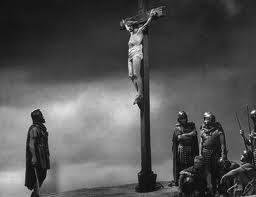
The Morning after a Crucifixion: A Centurion Reflects on a Days Work

The horrible day was over and the night had passed. The sun rose over the escarpment overlooking the Jordan River casting a red glow in the east as the city awoke to the Sabbath morning.  Longinus rose as always when his adjutant arrived at his quarters in Fortress Antonia with his breakfast.  He preferred a private breakfast and this was typical for the area, a cup of the local tea, a plate of figs a loaf of bread with honey and since they were in a major city a portion of mutton procured from a local butcher who was more interested in earning a living than completely avoiding contact with the gentile Roman legionnaires.  Longinus invited the young officer to sit on a small chair beside the table which served both as his dining table and office desk.

They discussed the impending return to Caesarea and the needs of the soldiers as well as the case of a soldier caught drunk and disorderly stumbling around the outer court of the Temple. The Temple Police apprehended the man and returned him to the watch officer of the fortress. It was embarrassing but not atypical of the locally recruited Samaritans.  Sometimes Longinus wished that he was back with an Italian Cohort or even with the elite Imperial Guard, but even in those units individual soldiers would still do stupid things.  After discussing the matters he dismissed the officer and rose from his chair.  Longinus took the cup of tea and a piece of the bread and walked to the small window which looked out across the city and he could see the rocky crag called Golgotha now devoid of crucifixes where he supervised the executions of the two criminals and the man called by Pilate “the King of the Jews.”

It was the last that bothered him; while Longinus had seen or supervised numerous crucifixions he never enjoyed them as did some of his brother officers.   Occupation duty anywhere but especially here was difficult on soldiers.  The troops were not the elite of the Empire, many of the officers were cast offs from the Legions and the duty itself drained officers and men alike. They knew that the Jews hated them their Caesar and their taxes.  Violence against soldiers posted to remote outposts was not uncommon; the Jews of the Zealot party had no compunction about killing Roman infidels and felt that dying to free their land was an honorable thing to do. They could be brutal both to the Romans as well as other Jews that they suspected of collaborating with the hated occupiers.  Longinus hated them and treated them as terrorists whenever he encountered them, they were not soldiers and they had no honor He hated them and their land, he longed for the culture and peace of the home provinces of the Empire.

There was something unusual about the man that Pilate called “the King of the Jews.” Longinus took a sip of his tea and took another bite from the honey covered bread and shook his head. He had no idea why a man who did not seem to be violent whose followers melted away the moment this “King” was arrested by the Temple Police.  He gazed upon the sunrise as the sky began to lighten. He thought about the women and the young man who stood nearby the cross the day before. He thought about the blood and the water and his remark to his men as the man died “truly this man was the son of God.”  He hadn’t thought about it much until now. He knew that he would have to think some more on this subject but he had too much to accomplish today. There was still the possibility of violence in the city and one never knew what the Zealots were up to.  Yes he would be busy. He took another sip from his tea and dressed for his meeting with Pilate and the other Centurions.

Peace,

Padre Steve+

4 Comments

Filed under faith, History, Religion

The Long Good Friday: The Story of Longinus the Centurion

It was another ignominious day in the life of Longinus the Centurion. Posted to the troubled outpost of Judea he commanded a unit composed of locally recruited troops mostly Samaritans and some Syrians. How he wished that he commanded elite troops of the Italian Cohort or any of the European Legions stationed in nearby Syria.  Normally he and his men were posted to the Roman capital of Judea Caesarea on the Mediterranean coast of Judea, though his troops were not elite the location was not bad so far as amenities, especially for Judea.

However, today’s mission was another distasteful assignment away from Caesarea back to the always troublesome city of Jerusalem.  Since the Jewish Passover was coming and with it thousands of Jewish pilgrims from around the world were in the city and in there was always the potential for trouble. Longinus had heard around the headquarters that tensions in Jerusalem were increasing due to the presence of some itinerant preacher from up in Galilee which according to the agents and spies in the city allegedly had healed the sick, raised the dead and restored sight to the blind. Evidently he had even stirred things up on a previous visit by chasing money changers out of the Temple. Longinus had to admire that, this Jesus was pretty ballsy. Since the worldly and seasoned Longinus didn’t think much of religious zealots, Jewish or otherwise he could only chuckle when thinking of some bumpkin raising hell in the Temple and pissing off the religious elite.

He led his unit as part of the mixed Cohort which provided security for the Imperial Legate, Pontius Pilate. He remembered a previous mission where Pilate had posted the Imperial Standards with the Image of Caesar as God outside the Fortress Antonia very close to the Jewish Temple caused a riot and Pilate had the Standards returned to Caesarea under heavy escort the next day.  This time there was a rebel named Barabbas who had been causing no end of trouble and Pilate had sentenced him to death.  But then the Jewish High Council brought Pilate another case, the case of this itinerant preacher, Jesus of Nazareth. It seemed to Longinus and the other Centurions present that the case was a simple religious disagreement that the Romans should not get involved in. However Pilate took the case fearful of the threat to his job if he allowed another “king” to live.  Yet Pilate had found this Jesus innocent but caved to the pressure of the mob, even ignoring the pleas of his wife Claudia to spare the preacher.  Pilate was a typical politician and cut a deal which allowed King Herod, the Sanhedrin and himself to meet the demands of their various constituencies or in the case of Pilate his boss to end this Jesus of Nazareth problem once and for all.

On the day before the Passover one of the preacher’s own men turned him in to the Council for the paltry sum of 30 pieces of silver. That alone proved to Longinus that this Jesus was no threat to anyone. The Temple Police brought Jesus to the Sanhedrin which condemned him to death, but since they were not authorized by the Roman administration to carry out the death sentence they took the case to Pilate. Longinus saw Pilate use every trick that he could to make the decision the responsibility of someone else and if Longinus had been Pilate he would have told those religious types to pound sand and get the hell out of his headquarters, but he was a soldier not a politician with greater aspirations like the legate.

Instead Pilate complicated his life and those of his fellow Roman officers in charge of their local troops. One Centurion had the duty of supervision the torture of this Jesus. The troops were brutal, Samaritans and Syrians they hated the Jews and torturing a Jew for any offense was just too much fun, but for the Roman officers it was unseemly and lacked the honor of a true battle against other soldiers. After the brutal scourging with a barbed whip those soldiers placed a rough hewn “crown” of thorns on the unfortunate man’s head and robed him in purple to mock his claims to be a “king.” Longinus felt that the whole exercise was a cruel joke but the order had been given and by Roman law had to be carried out. After the scouring Pilate tried one last time to get out of killing this man offering to spare him for the life of Barabbas, a man who was a legitimate terrorist threat to the Empire’s interests in Judea. Instead the weak willed Pilate caved and spared the life of the terrorist for a man who couldn’t even control his own people. It was sad what was done in the name of the Emperor.

When final sentence was pronounced Longinus was assigned to the crucifixion detail.  Normally with such inflamed passions he would have assigned much of his unit to the task of the execution and related security measures. However it seemed that the usually surly population had little interest in stopping this execution of one of their own. With that in mind Longinus took just four soldiers with him to conduct the execution, security did not seem to be a problem. After a rather tumultuous parade through Jerusalem where the condemned man was heckled and abused they arrived at a hill just outside of the city called Golgotha, the place of the Skull. Longinus felt that the place was grotesque but it did work for the execution. Any visitor to the city would see the condemned man as well as two common thieves who were being executed at the same time.

His men performed the execution in the prescribed manner and he allowed the men to divide the condemned man’s clothing among them. For three hours the men along with a number of observers those that were obviously mourning the scene including a woman that appeared to be the itinerant preacher’s mother and a young man who he might be one of his followers. They were balanced out by a group of hecklers who mocked the condemned men, especially the preacher. Even one of the common thieves joined in the heckling. Yet in spite of this the preacher responded with grace and love to those who mocked him in his dying hours offering forgiveness to his men and promising eternal life to one of the condemned men who hung on either side of him.  The only real trouble came when some of the Council members noticed that the placard above the preacher said “The King of the Jews.” They immediately send men to Pilate to change the wording but Pilate finally told them to pack sand saying “I have written what I have written.” Longinus kept his silence when he heard this he and the other Centurions arrived back in Caesarea and had a chance to share drinks and a meal in a local pub.

It was an unusual day, the skies grew black as noon approached and the preacher made a number of chilling statements from his place on the cross the most poignant being where he cried out “my God my God why have you forsaken me?” That struck Longinus, this man was not really guilty of anything in Roman Law but was being killed and Longinus was part of the process.  A tear came to his eye when the preacher cried out “it is finished” and died.  Without thinking he called out to his men and to those remaining at the site “truly this man was the Son of God” drawing the ire of those cheering the execution and the bewilderment of those that appeared to be there to support this man. So when a runner came from Pilate came to order the deaths be speeded up to accommodate the religious traditions of the Jews he was relieved. His men broke the legs of the men on either side of the preacher but when they came to the limp body of the preacher they found that he was dead. Just to ensure that this was the case he had a soldier drive a spear into the side of the man. Blood and water flowed from the wound. The man was dead and the job was complete. Another Centurion came with a detail of soldiers to remove the bodies and to ensure the security of the preacher’s tomb, yet another concession to the religious people.

Longinus was glad that the day was done. He cast a glance at a number of women and one young man that remained. They obviously were his friends and the older women might have even been the preacher’s mother. He shook his head marched his troops back into the city and reported that the mission was complete when he reached Fortress Antonia.  He felt hollow inside and hoped beyond hope that time could be altered to allow him to save the many before it ever got to this point.

Arriving at Antonia he joined a number of fellow officers and as they chatted about the day he felt his anger and frustration rise. That preacher didn’t deserve to die and it was too bad that he could not be restored to life. But the Centurion in change of the Tomb Guard detail reported that the body had disappeared from the tomb. Longinus was tired. He hoped that it might be true. He asked the bartender for another drink and wondered just what was going on in this hellhole called Judea and he thought again “truly this man was the Son of God.”

Peace

Padre Steve+

Note: Longinus is the name attributed to the Centurion at the Cross during the crucifixion by early church tradition. Likewise this is true of Claudia the wife of Pilate. This story is simply my versions of what might have happened that fateful Friday when a Centurion named Longinus became an actor in a play that he could not imagine.

5 Comments

Filed under faith, History, Religion

Surrendering Religious Liberty to the State for Money: The Example of Florida I n 2011

“To suffer the civil magistrate to intrude his powers into the field of opinion and to restrain the profession or propagation of principles on supposition of their ill tendency is a dangerous fallacy which at once destroys all religious liberty, because he being of course judge of that tendency will make his opinions the rule of judgment and approve or condemn the sentiments of others only as they shall square with or differ from his own.” Thomas Jefferson – Statute for Religious Freedom, 1779

“Religious Freedom; Proposes an amendment to the State Constitution to provide that an individual may not be barred from participating in any public program because of choosing to use public benefits at a religious provider and to delete a prohibition against using public revenues in aid of any church, sect, or religious denomination or any sectarian institution.” Summary Statement of Florida SJR 1218

Thomas Jefferson was one of the wisest of our Founding Fathers in understanding how religious liberty can be threatened by the State especially when religious people think that they can use the state for their own bidding. This is happening today in the State of Florida where the House and Senate seem to be hell bent on obliterating the wall of separation of Church and State in the Florida Constitution which has been in existence for 127 years. The legislation Senate Joint Resolution 1218 sponsored by Senator Thad Altman(R) District 24 changes the heart of Article I “Declaration of Rights” which begins with

SECTION 3. Religious freedom.—There shall be no law respecting the establishment of religion or prohibiting or penalizing the free exercise thereof. Religious freedom shall not justify practices inconsistent with public morals, peace or safety.

The Florida State Senate then strikes this language from the State Constitution:

No revenue of the state or any political subdivision or agency thereof shall ever be taken from the public treasury directly or indirectly in aid of any church, sect, or religious denomination or in aid of any sectarian institution.”

That language is replaced with this statement:

“An individual may not be barred from participating in any public program because that individual has freely chosen to use his or her program benefits at a religious provider.”

See full text of legislation: http://www.flsenate.gov/Session/Bill/2011/1218/BillText/Filed/HTML

Senator Altman is very nondescript in his religious views simply listing himself as a “Christian” on his Florida Senate information page. Likewise he has the lowest rating of the Christian Coalition of any Florida Republican. He is a building contractor by trade and he gets the bulk of his political funding from various business interests the top 7 groups being:

$36,520 – Lawyers & Lobbyists
$25,050 – Health Professionals
$23,200 – Insurance
$17,801 – Real Estate
$17,700 – Crop Production & Basic Processing
$11,500  – Hospitals & Nursing Homes
$10,500 – Telecom Services & Equipment

He is not a favorite of the Tea Party which leads me to believe that this measure, which many religious conservatives will certainly support, is political opportunism at its rawest and most unseemly form. Senator Altman would strike down 127 years of Florida law to try to shore up his support with religious conservatives and at the State level turn the Constitution of the United States on its head and for what? I’ll tell you what, his political power.

The legislation destroys protections granted to religious institutions and opens the way for the most numerous and powerful religious institutions to use taxpayer money for their own ends.  Of course once such a law is passed the State is given the right to decide which religious groups receive taxpayer funding opening the way to the establishment of a de-facto State religion of the most powerful and financially influential Churches while at the same time opening the door to the persecution of minority denominations or religions.  I’ll bet those that came to this land fleeing such Church-State tyrannies are spinning in their graves at this legislation.

Since the founders are much better in speaking to this than I am I think I will close with the text of a letter from James Madison to Edward Livingston back in 1822:

“Notwithstanding the general progress made within the two last centuries in favour of this branch of liberty, and the full establishment of it in some parts of our country, there remains in others a strong bias towards the old error, that without some sort of alliance or coalition between Government and Religion neither can be duly supported. Such, indeed, is the tendency to such a coalition, and such its corrupting influence on both the parties, that the danger cannot be too carefully guarded against. And in a Government of opinion like ours, the only effectual guard must be found in the soundness and stability of the general opinion on the subject. Every new and successful example, therefore, of a perfect separation between the ecclesiastical and civil matters, is of importance; and I have no doubt that every new example will succeed, as every past one has done, in showing that religion and Government will both exist in greater purity the less they are mixed together. It was the belief of all sects at one time that the establishment of Religion by law was right and necessary; that the true religion ought to be established in exclusion of every other; and that the only question to be decided was, which was the true religion. The example of Holland proved that a toleration of sects dissenting from the established sect was safe, and even useful. The example of the colonies, now States, which rejected religious establishments altogether, proved that all sects might be safely and even advantageously put on a footing of equal and entire freedom; and a continuance of their example since the Declaration of Independence has shown that its success in Colonies was not to be ascribed to their connection with the parent country. if a further confirmation of the truth could be wanted, it is to be found in the examples furnished by the States which had abolished their religious establishments. I cannot speak particularly of any of the cases excepting that of Virginia, where it is impossible to deny that religion prevails with more zeal and a more exemplary priesthood than it ever did when established and patronized by public authority. We are teaching the world the great truth, that Governments do better without kings and nobles than with them. The merit will be doubled by the other lesson: the Religion flourishes in greater purity without, than with the aid of Government.” (Letter to Edward Livingston, July 10, 1822)

Those that support such statutes be they at the local, state or federal level such be scrutinized because at the heart of all such actions their lies the evil of political power and monetary corruption which would make Churches and religious institutions the unwitting servants of the State, something that our founders rejected and should be rejected today. Such laws invariably lead to persecution and the curtailment of religious liberty.

William Butler Yeats said “Once you attempt legislation upon religious grounds, you open the way for every kind of intolerance and religious persecution.”

Florida legislators and voters need to be aware of this before they commit themselves to the rejection of such a core belief of our nation and until now the State of Florida.

Peace

Padre Steve+

1 Comment

Filed under History, philosophy, Political Commentary, Religion

Blazing Saddles and Contemporary American Life and Politics

 The affairs of state

http://www.youtube.com/watch?v=BiF0M4uOhgI&feature=related

What’s a dazzling urbanite like you doing in a rustic setting like this?

Sometimes a film can capture the spirit of a society. If there is an iconic film that captures the spirit of America it has to be Mel Brooks’ classic Western spoof Blazing Saddles.  It debuted back in 1974 when the nation was bitterly divided facing political crisis in the wake of the Watergate break-in cover-up which was soon to usher President Richard Nixon out of office and an economic crisis including a spike in oil and gas prices brought about by Middle East tensions.  Americans also faced the end of a disastrous war in Vietnam the military threat of the Soviet Union, dissent among our Allies and the rise of a new economic power Japan.

It is at times like this that our political leaders almost always fail to rise to the occasion and take every opportunity to preserve their power and political offices catering to their own interest groups at the expense of everyone else.  Blazing Saddles captures the moment quite well when upon learning of chaos in the town of Rock Ridge Governor LePetomane played by Mel Brooks reacts as almost all politicians do when a crisis arises.

“Holy underwear! Sheriff murdered! Innocent women and children blown to bits! We have to protect our phony baloney jobs here, gentlemen! We must do something about this immediately! Immediately! Immediately! Harrumph! Harrumph! Harrumph!”

Unfortunately when I look at our political, economic and social landscape I am frequently taken back to this bit of the film.  Sometimes I think that Governor LePetomane is much more reflective of the men and women that we elect at every level of government than it is not. I think that the only time that politicians get concerned about something that really matters is when their “phony baloney jobs” are at stake. Come to think of it I don’t think it matters if they are Republicans, Democrats, Libertarians, Tea Partiers or even Commies the only time that 99.61872% of politicians give a damn about an issue is if it threatens their re-election bids or aspirations to a higher office.  Then and only then do they at least pretend to care, well at least until they are re-elected.  My number might actually be lower than reality but you get the idea.  But of course the affairs of state must take precedence over the affairs of state and the business of government really hasn’t changed.

http://www.youtube.com/watch?v=P-cje17OGnQ&feature=related

Attorney Generla Hedley Lamar (Harvey Korman): Under the provisions of this bill we would snatch 200,000 acres of Indian Territory, which we have deemed unsafe for their use at this time. They’re such children.
Governor LePeotomane: 200,000 acres? 200,000 acres? What will it cost, man? What will it cost?
Headley Lamar: A box of these (box of paddle balls).
LePetomane: Are you crazy? They’ll never go for it, and then again they might. Little red devils! They love toys!

Lamar then has Governor LePetomane sign another bill to “convert the state hospital for the insane into the William J. Le Petomane Memorial Gambling Casino for the Insane.”

In such times many people take refuge in their faith and the people of Rock Ridge were no exception. Since I am well versed in almost every Mel Brooks movie song I immediately thought of the following verse from the song The Ballad of Rock Ridge.

Now is a time of great decision

http://www.youtube.com/watch?v=9v0OLW3Qhc8

“Now is a time of great decision, are we to stand up or to quit? There’s no avoiding this conclusion, our town is turning into shit.”

In such a climate citizens have to ask the question so aptly put in The Ballad of Rock Ridge. What will citizens do?

http://www.youtube.com/watch?v=9v0OLW3Qhc8

Some like the preacher, Reverend Johnson want to leave “Now I don’t have to tell you good folks what’s been happening in our beloved little town. Sheriff murdered, crops burned, stores looted, people stampeded, and cattle raped. The time has come to act, and act fast. I’m leaving.”


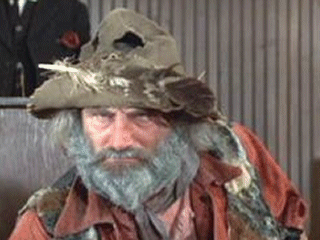
But the town drunk Gabby Johnson tells the reverend exactly what he thinks:

“You get back here you pious candy-ass sidewinder. Ain’t no way that nobody is gonna’ to leave this town. Hell, I was born here, an’ I was raished here, an’ dad gum it, I am gonna die here, an no sidewindin bushwhackin, hornswaglin, cracker croaker is gonna ruin my biscuit cutter.”

Gabby manages to inspire his fellow townspeople into staying as Olson Johnson played by David Huddleston rallies the town “What are we made of? Our fathers came across the prairie, fought Indians, fought drought, fought locusts, fought Dix – remember when Richard Dix came in here and tried to take over this town? Well, we didn’t give up then, and by gum, we’re not gonna give up now.”

I think is that if we want the country to get better we can’t give up no matter how nutty the extremists on both sides of the political divide get. Of course those on the extremes who all believe that they are the mainstream seem to constantly multiply by exponential exponents. This means of course, mathematically speaking that there are a lot more of the extremists than there have ever been before and we moderates will soon be an endangered species no matter which bunch of extremists eventually wins though at the present time it seems that the political right is setting the agenda but back to the film and its application in today’s world.

I saw an article about a Republican leader of the Orange County Tea Party named Marilyn Davenport who had sent out a very racist and ugly e-mail to friends and supporters that like so many e-mails happen to get forwarded to people that don’t see the humor.  The e-mail showed an image, posed like a family portrait, of chimpanzee parents and child, with Obama’s face artificially superimposed on the child. Text beneath the photo reads, “Now you know why no birth certificate.”

I am depressed

Unfortunately beyond the matters of policy, eligibility or political ideology that some on the right have with President Obama and the Democrats there is also a racist element that just hates the fact that we have a black man in the White House. Mr. Taggart played by Slim Pickins made this comment on being introduced to a very black Sheriff Bart played by Cleavon Little  “Well, if that don’t beat all. Here we take the good time and trouble to slaughter every last Indian in the West, and for what? So they can appoint a sheriff that’s blacker than any Indian. I am depressed.”  Having been threatened by White Supremacists on this website I know that there is an undercurrent of racism involved in this. Policy disagreements are one thing, as far as I’m concerned on policy issues there is nothing off limits whether I agree or disagree. That is political free speech which I will die to defend. However vitriolic racial hatred masquerading as “internet humor” as Mrs. Davenport called it is unacceptable. It may be free speech but we have to call it what it is, racial hatred.  Now people on the political left often flippantly refer to Conservatives of all varieties as “Nazis” and have their own fair share of hateful e-mails and prejudices so this cuts both ways.

However I grew up in the 1960s and 1970s when lynching’s still occurred in the South and even in Northern California adults, contemporaries of my parents produced some of the most racially insensitive and prejudiced comments when our schools in Stockton were desegregated.  The comments were made in school district meetings and in the opinion page of the Stockton Record and they were quite ugly. I was part of the first High School classes to go through my entire high school years in a desegregated school, Edison High School in Stockton California. Somehow the “Soul Vikes” made it work and of our class which was about 25% black, 25% white, 25% Mexican American and 25% Asian along with a further 8% that no-one could place are still close and care about each other.  We have we attended reunions and hundreds of us are friends on Facebook. We defied the “experts” who said that there would be violence and that the “social experiment” could not work.  We are conservatives and liberals, Republicans, Democrats, Libertarians and Tea Partiers, straight and gay, black, white, Hispanic and Asian, Fundamental Christians, Progressive Christians, traditionalists, non-traditionalists, Buddhists, Jews, maybe even a Moslem or two and certainly some free tinkers, agnostics and Atheists too, but we share something very special. While we may disagree on some very important matters we still care about each other and respect each other.

What bothers me about the present racism is that some of the worst offenders claim to be Christians or if they do not claim to be Christians often seek the support of conservative Christians for their political agendas.  Somehow I think that Jesus would not approve.  Racism has no place in our society no matter what race does it especially for people who claim to be followers of Jesus.

The sad truth is that in his time Mel Brooks took a bolder stand against racism than most Christians. Using the Old West and humor he mocked racism and showed its ugliness in a way that Middle America got.  Maybe we should take a mass dandelion break and grab a copy of Blazing Saddle’s put it in our DVD, Blue-Ray or computer and reflect back on what might be. Maybe like Sheriff Bart we can ride into the sunset knowing that our job is done.

http://www.youtube.com/watch?v=MySGAaB0A9k

Bart: Work here is done. I’m needed elsewhere now. I’m needed wherever outlaws rule the West, wherever innocent women and children are afraid to walk the streets, wherever a man cannot live in simple dignity, wherever a people cry out for justice.
The Townspeople: (in unison) Bullshit!
Bart: All right, you caught me. Speaking the plain truth is getting pretty damn dull around here.


Dull can be good but anyway I digress….however there are times that I feel like Mongo…”Mongo not know Mongo only pawn in game of life.”

Peace

Padre Steve+

2 Comments

Filed under faith, History, movies, philosophy, Political Commentary, Religion

The Current American Crisis and Drawing Comparisons from the End of the Imperial Germany

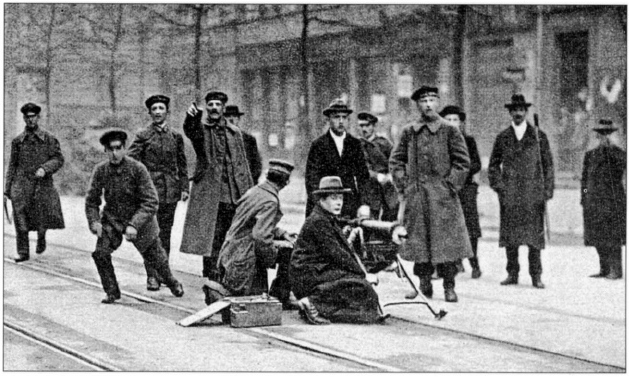
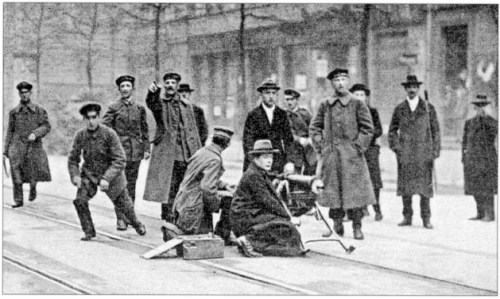
Revolution: Members of the Spartacists Bund in Berlin

Introduction

There are times when great nations face catastrophe. It is something that has befallen every world power at one time or another. Therefore it should not be a surprise if the United States despite the claims of those supporting American Exceptionalism succumbs to some great crisis which fundamentally changes it.  While I do not proclaim the end of the United States it does appear that we are experiencing events which have the potential of reducing our status as a great power and plunge the nation into political and economic chaos.  Some including California Governor Jerry Brown have compared the current state of the country to the division of the country in the American Civil War.

Likewise since there are some leaders of the loud and influential Tea Party movement who openly talk about revolution it is important to know what can happen if there is a political or economic collapse that leads to revolution at home while troops are still in combat. All of this happened in Germany in 1918.  In our current time such a possibility is higher than at any time in American History. Thus I feel we are in a potentially perilous time where long standing institutions are in crisis even while wars rage around the world.

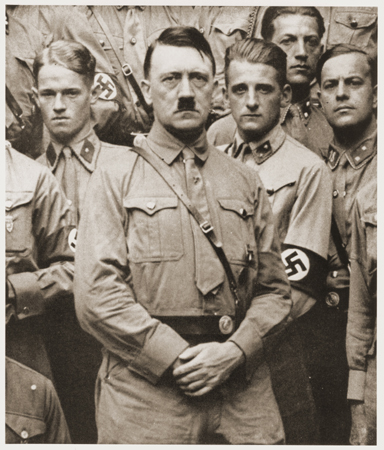
However I do not, for all the vitriol spent believe that our current crisis is comparable to the Civil War except the absolute contempt that the opposing sides hold each other. The Civil War was a war which pitted region against region and our divisions know few geographic boundaries and even the “Red State versus Blue State” divide is deceiving.  It is my belief that what we are experiencing is much more similar to the crisis faced by Imperial Germany at the end of the First World War.  Then Germany was about to concede the loss of the war despite having known enormous battlefield success that lasted until the summer of 1918 when the tide of the war turned irreversibly against them as Allies collapsed and pulled out of the war was coupled with battlefield defeats, economic ruin and massive political and social unrest. The result of the collapse of Imperial Germany was a civil war and the foundation of the ill-fated Weimar Republic which eventually succumbed to the extremism and dictatorship of Adolf Hitler and his National Socialist Party of Germany, the Nazis.

The German Revolution of 1919 and civil war is important for those who study highly developed states when they enter a period of social and political upheaval usually following military defeat that causes the society to question or even overthrow the established order.  The end of Imperial Germany and the establishment of the Weimar Republic on November 9th 1918 is a prime example.   This paper concerns the first years of the Republic, and the dependency of the Majority Socialist leadership to the General Staff and their use of Freikorps to quell revolutionary chaos and avert the establishment of a Soviet State.

Members of the Leftist “People’s Naval Division” occupied the government quarter and terrorized Berlin

This study begins with the establishment of the Republic and concludes with the Kapp Putsch.  This is an era that is seldom referenced by political or military leaders in western states and historians themselves are often divided in their interpretation of the subject.  The study of this period is vital to those who study politically polarized societies which are either war weary or have suffered the shock of military defeat coupled with a government which is blamed for the events.  Thus, it is important to study the relationship of the military to the government and in particular the military’s relationship to politicians who have little connection to or affinity for the military, its traditions and culture and the often adversarial relationship of these politicians to military leadership which often sees them as adversaries.  The period also shows how actions of those who in their antipathy to the military create a climate where the military loathes the civilian leadership and the government.  The results of such conditions can endanger the society as a whole and ultimately usher in periods of great tragedy.  This occurred in Weimar Germany with the result that the military in the later years of the Republic neither the military nor the Majority Socialists could not work together against the Nazi takeover of the state.  However, the first years of the relationship set the tone and foredoomed the Republic.

The Complexity of the Situation

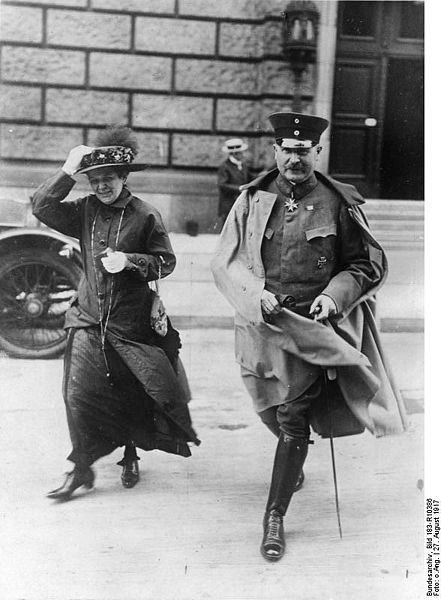
General Wilhelm Groener convinced Kaiser Wilhelm II to abdicate and helped forge an alliance between the Majority Socialists and the Army to head off a Soviet style Revolution

The history of Weimar, particularly that of the military and Freikorps in their relationship to the Republic is complex.  Not only is the relationship between the military and government complex, but the Freikorps themselves, their organization, leadership and political affiliation were not monolithic as is sometimes maintained,[i] nor were the Freikorps the direct ancestors of the Nazi SS/SA organizations despite often similar ideology,[ii] nor can they dismissed by saying that they were composed of “former soldiers and officers ill-disposed to return to civilian life.”[iii] The Freikorps’ association with the Army and Republic is more complex than some historians assert.  Despite the right wing leanings of many of units and fighters and future association of some to the Nazis, the blanket claim that the Freikorps were forerunners of the Nazi movement is not supportable.[iv]

It is true that without Freikorps support in Munich, along with support of the Thule Society, business leaders and others “that the transition of the DAP into the Hitler party could not have taken place.”[v] It is also true that elements of the Freikorps branded too revolutionary and unruly for service in the Army continued as secret societies and affiliated themselves with various right-wing political groups.[vi] Likewise a case can be made that the fierceness of many Freikorps veterans, younger leaders of the Army helped lay the foundation for the brutality of both the Army and Waffen SS as they prosecuted the Second World War.[vii] Yet simply because certain aspects of a subject are true does not make for a broader “truth.”  Heinz Höhne argues the reverse of what some have written in regard to the relationship of the Freikorps and Reichswehr to the Nazis, that in fact the Nazis did not issue from the Freikorps, but rather that many former members of the Freikorps, Imperial Army or the Reichswehr were attracted to the Nazis, particularly to the SS by its “philosophy of “hardness” and its attitude of bellicosity per se, basically unconnected with ideology.”[viii] Others historians state similar views especially those that study the relationship of the Reichswehr leadership to the Freikorps.  Thus the thesis of this paper is that the historiography like the period itself is complex; that the composition, leadership and motivations of the Freikorps were not monolithic, nor were they beloved by the Reichswehr, nor were they the “trailblazers” for the Nazi movement.  The focus of this paper is on the relationship of the Reichswehr and the Freikorps to the Republic to the Kapp Putsch and the dangers of a relationship built on necessity without mutual trust.  Such a relationship is dangerous and can lead to unintended consequences.   This paper will explore the first years of the Weimar Republic and specifically look at several key events that were pivotal in the relationship between the Army and Freikorps and the Majority Socialists.

The Supporting Literature

The literature covering this period includes both well written academic histories and popular works which attempt to present a particular view. Additionally there are biographical works which shed some light on the subject. The Reichswehr and the German Republic 1919-1926 by Harold Gordon Jr. is perhaps the best study of the Freikorps and their relationship to the state and the army.  Gordon’s work is exceptional in documenting the numbers, types, political affiliation, action and ultimate disposition of the Freikorps.  The History of the German General Staff by Walter Goerlitz; The Nemesis of Power: The German Army in Politics 1918-1945 by John Wheeler-Bennett, The Reichswehr and Politics 1918-1933 by F.L. Carsten and The Politics of the Prussian Army: 1640-1945 by Gordon A. Craig are all extremely valuable in exploring the relationship between the military and the Republic.  The best of the general histories of the period, which focus on the National Socialist state are The German Dictatorship by Karl Dietrich Bracher, and Richard Evans’ The Coming of the Third Reich. Richard Watt’s The Kings Depart is one of the best for telling the story of the fall of the Empire and the revolution in Germany.  Watt’s account is well written and documented work and touches on other factors affecting the new republic including Versailles and Allied political actions. The final chapter of Holger Herwig’s The First World War: Germany and Austria-Hungary 1914-1918 gives a good account of the Army’s role in the end of the Empire and beginning of the Republic.  Andreas Dorpalen’s Hindenburg and the Weimar Republic adds an interesting dimension of Hindenburg’s role in the republic’s formation and negotiations between Groener, Noske and Ebert. Steven Ozments’ A Mighty Fortress is superficial in its treatment of the period.  Nigel Jones’ Birth of the Nazis: How the Freikorps Blazed a Trail for Hitler is an interesting and somewhat entertaining but not very well documented tending to “broad brush” in a sensational way the Freikorps having none of the detail or nuance of Gordon, Craig, or Carsten on the Freikorps, nor the depth of Goerlitz or Wheeler-Bennett on the Republic’s relationship with the Army, or the attitude of the Reichswehr leadership to the Freikorps.  William Shirer’s The Rise and Fall of the Third Reich, Gerald Reitlinger’s The SS: Alibi of a Nation 1922-1945 and Heinz Höhne’s The Order of the Death’s Head all add some information which details early Nazi involvement in the period, but are less useful to this early period most of their work focuses on later events.  Of other works, Kenneth Macksey’s Why the Germans Lose at War has an insightful but short chapter dealing with this period and Wolfram Wette’s The Wehrmacht: History, Myth, Reality offers an interesting and at times provocative look at anti-Semitism in the German military in the years following the First World War.  Carlos Caballero Jurado’s The German Freikorps 1918-1923 is a short but very detailed study of those organizations and their actions.  B.H. Liddell-Hart who has a small chapter on General Hans Von Seeckt in The German Generals Talk which though it does not deal with the events in this paper make for interesting commentary on later actions of former Reichswehr officers who served the Nazi state.

A number of biographies touch on actions of German Officers who played key roles in World War Two.[ix] Most auto-biographies gloss over the Weimar period; however Admiral Erich Reader’s memoir Grand Admiral offers the insight of a naval officer with some direct observation of the revolution and the Kapp Putsch.  General Heinz Guderian in Panzer Leader omits his service in the Baltic “Iron Division.”  Field Marshal Albert Kesselring’s memoirs has a brief section covering the period, but one comment is typical attitude toward of many officers throughout its existence:

“My cup of bitterness was full when I saw my devoted work rewarded by a warrant for my arrest for an alleged putsch against the socialist-influenced command of my III Bavarian Army Corps. Notwithstanding the degrading episodes during my imprisonment after 1945, I do not hesitate to describe this as the most humiliating moment of my life.”[x]

One thing that has to be noted about all the memoirs is that each of the writers was writing after the German Defeat and their imprisonment. Many times their words mask other actions and attitudes that are  not mentioned, thus while an important source one also has to have some suspicions when using them even the unintentional errors that come from time as well as the human tendency to have a somewhat selective memory.

Analysis
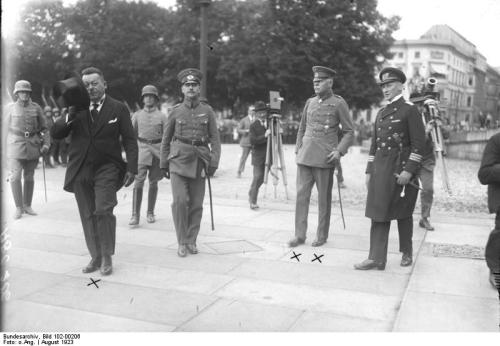
President Friedrich Ebert and his military commanders including General Hans Von Seeckt (2nd from right)

This paper will first examine the formation of the Freikorps by the Army and the Ebert government in response to uprisings by armed groups of leftists and the effectiveness of the Freikorps in putting down the various uprisings.   We will then address the relationship of the Army with the Majority Socialists and then move on to the crisis engendered by the Kapp Putsch.

The relationship of the Republic to the Army was born in the moment of crisis of the abdication of Kaiser Wilhelm II and the armistice discussions with the Allies.  Beset by revolts in key naval bases and mutinies aboard ships of the High Seas Fleet and unrelenting Allied pressure on the German armies in the west the situation continued to deteriorate as the “red flag was flying in all the principle cities, soldiers behind the front were electing soldiers councils Russian fashion.”[xi] Revolutionary and defeatist propaganda spread by the radical left wing of the Independent Socialists and Spartacus League spread through the country and even affected combat units,[xii] while the “Majority Socialists had found out that the militant factions of the Independents had secretly armed themselves out of funds supplied by the Soviet ambassador and adopted the slogan “all or nothing.””[xiii] The situation had deteriorated so badly that Karl Liebknecht, leader of the Spartacus League “was announcing the establishment of a Soviet regime from the steps of the Imperial Palace.”[xiv]

Under these dire conditions, General Wilhelm Groener who had succeeded General Ludendorff as Quartermaster General called an emergency meeting of fifty “of his most senior army commanders.”[xv] In response to his question of whether the troops would follow the Kaiser and oppose the revolts only one answered in the affirmative, and eight responded that “there was no hope of using regular Army units to quell unrest at home.”[xvi] On November 9th Groener went to the Kaiser on behalf of the Supreme Command and in response to a suggestion that the Kaiser lead the Army back and suppress the revolts boldly stated “The Army will march home in peace and under its leaders and commanding generals, but not under the command of Your Majesty, for it stands no longer behind Your Majesty.”[xvii] The Emperor abdicated fleeing to Holland and Friedrich Ebert leader of the Majority Socialists was named Chancellor on November 9th and upon hearing the news, Philipp Scheidemann, without consulting Ebert announced that Ebert was Chancellor and “Long live the great German Republic!”[xviii] The mobs were not placated by the announcement and far left organizations with the Independents “had no intention of letting the revolution stop there.”[xix] In the streets of Berlin soldiers sold their weapons and vehicles officers were attacked by crowds on the streets and whenever “crowds found an Army officer; they tore off his epaulettes and medals.”[xx] Everywhere mutual recrimination was in the air, soldiers “blamed revolutionaries for the betrayal and stab-in-the back while revolutionaries blamed officers for all the costs and losses of the war.”[xxi]

Groener called Ebert promising the Army’s support of the new government in return for the government’s assistance to the Army in the maintenance of discipline and supply.[xxii] He also drafted a letter signed by Hindenburg pledging the Army’s loyalty and telling him that “the destiny of the German people is in your hands….”[xxiii]One source notes: “Thus, in half a dozen sentences over a telephone line a pact was concluded between a defeated army and a tottering semi-revolutionary regime; a pact destined to save both parties from the extreme elements of revolution but, as a result of which the Weimar Republic was doomed at birth.”[xxiv]

The High Command was able to bring the Army home in good order following the armistice but upon arriving most units “melted away like snow under a summer sun,”[xxv] those which remained were often shells of their former selves beset by soldier’s councils and leftist revolutionaries.  To support the government the High Command issued a directive stating that it “put itself as the disposal of the present government led by Ebert without any reservation.”[xxvi] Yet in December delegates of the National Assembly continued to sow resentment in the military by military discipline be placed in the hands of soldiers’ councils, that all badges of rank be removed with all decorations of insignia and honor.[xxvii] Reaction was heated,[xxviii] but despite this Groener, Colonel Walter Reinhardt, the Prussian Minister of War and the Republic’s Defense Minister, Gustav Noske endeavored to find forces to combat the growing revolution and rebellious military units.  The choice was not hard, the Army was of no use, so called “democratic forces” were in most cases both unreliable and ineffective, while only the Freikorps “provided suitable material for the immediate creation of an efficient, combat-ready army.”[xxix] Thus the Freikorps became the instrument of necessity to ensure that the government was not swept away by a Soviet style revolution.

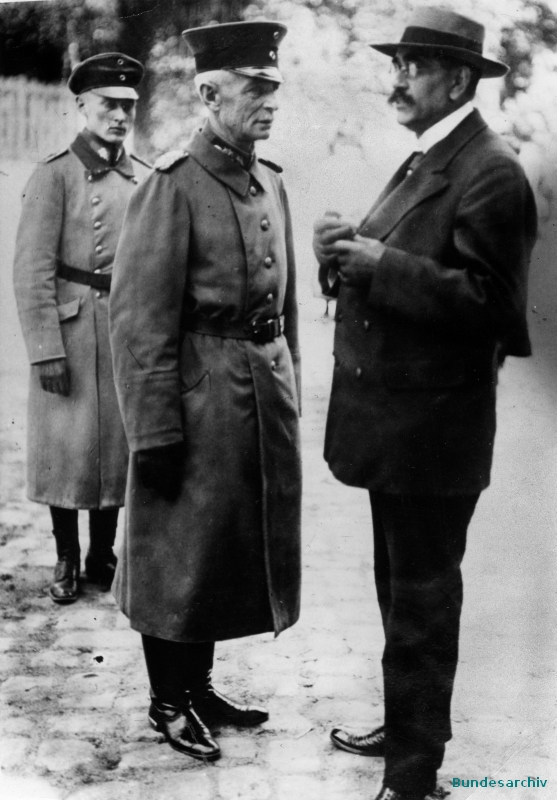
Gustav Noske and General Von Luttwitz. Luttwitz would lead the Reichswehr and Freikorps units that participated in the Kapp Putsch

Gustav Noske, of the Majority Socialist party “saw himself as a patriot, a man of action…who had no time for theories…and was one of the few Socialists that the Supreme Command trusted.”[xxx] He had already distinguished himself by helping to bring under control the sailors revolts in Kiel by forming a loyal “Naval Brigade”[xxxi] and he  “realized that the government must have a dependable military force behind it if it was to survive and rule Germany” and the “old Officer Corps must be the backbone of any such force.”[xxxii] The Army had melted away and units of the workers and soldiers councils were poorly trained, organized and led “”fought against the government as often as for it” and “were of little practical value to either the government or the rebels.”[xxxiii] In the chaos of a Spartacus, now called the German Communist Party uprising and vacuum of political leadership of January 1st 1919 agreed to become defense minister stating “Someone must be the bloodhound, I won’t shirk the responsibility!”[xxxiv]
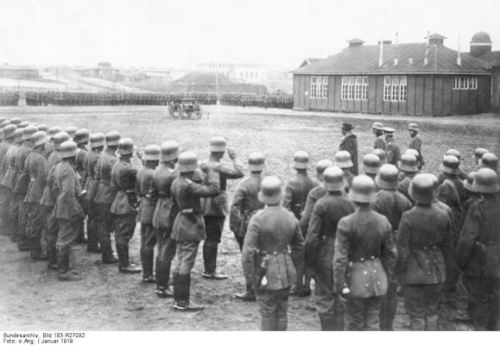
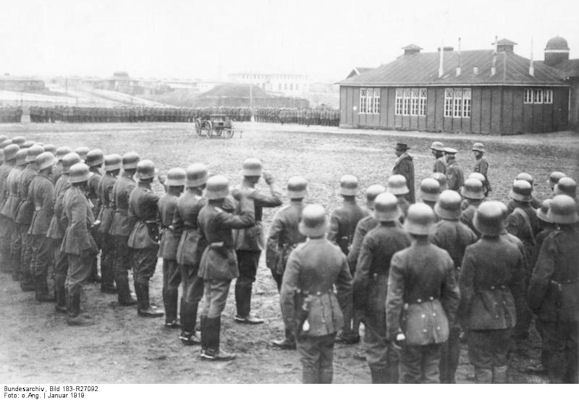
Noske reviewing Freikorps Hulsen. Many of the Freikorps were composed of professional soldiers and brought into the Reichswehr

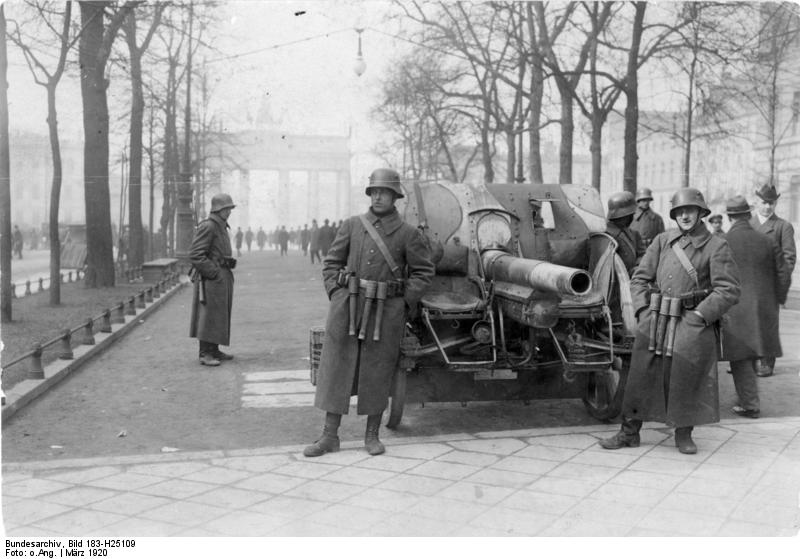
Noske helped by the High Command helped organize volunteer units led by officers and NCOs composed of reliable veterans.  Freikorps varied in size from divisions to companies and were led by Generals down to Sergeants and even a Private First Class.  Their greatest success was in early 1919 when the Republic was beset by “Red” revolutions in many major cities.  Without the use of the Freikorps by the government it is unlikely that the Republic would have survived.[xxxv] On January 4th Ebert and Noske reviewed the troops of General Maercker’s Freiwillege Landesjaegerkorps and Maercker informed them that every volunteer had pledged loyalty to the government, seeing the discipline and order Noske told Ebert “Don’t worry. Everything going to turn out all right now.”[xxxvi] On January 5th 1919 mobs attacked the Chancellery and the officers of the Socialist Vörwarts newspaper and Noske led the Freikorps[xxxvii] to regain control of the city[xxxviii] and crush the revolt during which “Karl Liebknecht and Rosa Luxemburg were lynched by the officers of the Guards Cavalry Rifle Division.”[xxxix] In March after a period of uneasy calm the Freikorps, now reinforced by the 2nd Naval Brigade, or Ehrhardt Brigade[xl] were called upon to put down the revolt of the “People’s Naval Division.”[xli] Making liberal use of heavy weapons including tanks the Freikorps inflicted heavy losses on the leftists with over 1500 dead and 12,000 wounded in the uprising.[xlii] Other revolts were crushed and the Freikorps reached their zenith in Württemberg where Freikorps led by Lieutenant Hahn, a Social Democrat put down leftist revolts[xliii] and in Bavaria where Independents and Communists had taken the city with their “Bavarian Red Army which numbered nearly 25,000 men[xliv] on April 7th. After failed attempts by the Socialist government to retake Munich, they asked for Berlin’s help.  Violence and massacres of citizens by the various leftist groups inflamed the Freikorps, including the Ehrhardt Brigade and the revolt was crushed by May 2nd.[xlv] Dorpalen calls the Freikorps ruthlessness “completely unwarranted in view of the weakness of the opposing forces” and noted though they broke the leftist powers they deepened the nations’ cleavages”[xlvi] while Macksey writes that “where Freikorps’ brutality stained the pages of history there was invariably a forgoing or simultaneous record of excess by their sworn opponents.”[xlvii]
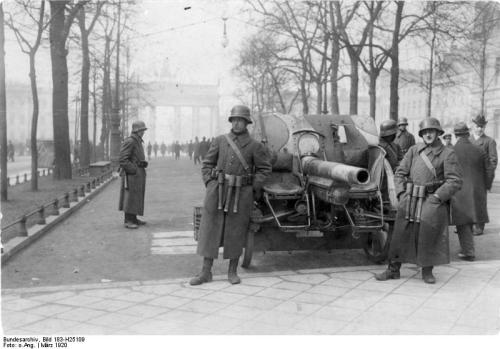
The Erhardt Brigade in Berlin during the Kapp Putsch

The Provisional Reichswehr was established on March 6th 1919 and the High Command began to assemble it from the Freikorps, remaining Army units and Republican defense forces.  Some Freikorps were brought into the new Army in total, but the tumult had not yet ceased.  There was a great distrust between many in the Army, the remaining Freikorps and the Socialists.  The crisis was precipitated by the signing of the Treaty of Versailles, Noske and others threatened resignation over the war guilt clauses, but Groener warned that if the treaty was rejected the Army could not win against the Allies if hostilities were renewed.[xlviii] The treaty imposed harsh limitations on the German Army which many bitterly resented, however, Seeckt, the Chief of Staff of the Army felt that it was “more important to keep the Army in being and preserve the possibility of a military resurrection.”[xlix] Yet the government had lost the support of the Officer Corps and many looked to General Walther von Lüttwitz, the Reichswehr’s senior commander for leadership.[l]

Korvettenkapitan (Lieutenant Commander) Erhardt commander of the 2nd Naval Brigade whose announced demobilization triggered the Kapp Putsch. Erhardt would have to flee after the Nazi takeover. Even revolutionaries become victims as revolutions end

Other right-wing groups and individuals made plans to overthrow the government.  They favored revolt against the government, but “their political aims were hazy.”[li] Seeckt and Reinhardt felt it necessary to demobilize Freikorps who’s ill-discipline and political radicalism was a “danger to the consolidation desired by the army command.”[lii] This movement climaxed with the alliance of Lüttwitz to Wolfgang Kapp and was triggered by the orders disbanding the 2nd and 3rd Naval Brigades in compliance with Versailles and due to their radical views.[liii] In spite of the opposition of his chief of staff Von Lüttwitz began planning a coup to save Germany.[liv] The conspirators showed “little regard for coordination of effort and a quite amazing ability to work at cross purposes.”[lv] On March 12th without consulting Kapp, Lüttwitz and Ehrhardt launched the Putsch and Ehrhardt’s brigade in full battle dress entered Berlin. At this point the Reichswehr command froze; officers refused to condone the putsch but at the same time refused to support Noske and Reinhardt who demanded armed opposition,[lvi] while Navy officers openly supported it.[lvii] Seeckt declared that “Troops do not fire upon troops!” and “When at occurs, then the true catastrophe, which was avoided with so much difficulty on November 9, 1918 will really occur.”[lviii] The coup died amid massive strike by workers and lack of popular support but the damage was done.  Noske resigned, many officers in were discredited[lix] and dismissed including Lüttwitz and Admiral Von Trotha, who openly supported the coup,[lx] though Raeder says that Von Trotha and the Navy staff only” thought of anything of complete loyalty to the government.”[lxi] The relationship which had endured the dire days of the Republic was ended.  The Reichswehr would emerge a lean and highly trained organization and remain a power broker in the Republic but the animosity between the Army and the Socialists that they could not stand together against the Nazis despite a mutual interest in doing so.[lxii]

Conclusion

The end of Weimar and the beginning of a nightmare

The period was a critical and complex and should be studied by anyone living in a state with a powerful military tradition and institutions in crisis.  Unlike popular notions, the Freikorps were diverse and not the seed-bed of the Nazi movement and though many former members would become Nazis.  Several, including Ehrhardt narrowly escaped death at Nazi hands.[lxiii] Freikorps were viewed by Army leadership as an expedient force that could not remain in the service once the Army was functional.

Key lessons include that the military cannot become a “state within a state,” and that both military and civilian leaders must seek to bridge any gulf that separates them in times of crisis.  In Weimar both the military and the Socialists thoroughly distrusted one another with the result that they eventually, despite early success[lxiv] worked against each other in later years.  Actions by both Socialists and the military ultimately subverted the Republic and ensured its demise and Seeckt’s policy of separation from politics “tended toward a renunciation of the soldier’s potential restraining influence on adventurous statesmen.”[lxv] Such is the fateful lesson for today.


[i] Jones, Nigel. The Birth of the Nazis: How the Freikorps Blazed a Trail for Hitler. Constable and Robinson Ltd. London, U.K. 1987 and 2004.  This is Jones assertion and he attempts to make the tie using careers of some individuals who served both in Freikorps and either in the Nazi Party or Military and attitudes common in many Freikorps with similar attitudes found in the Nazi movement.  The 2004 edition of his work includes an introduction by Michael Burleigh echoing his sentiments.

[ii] Evans, Richard J. The Coming of the Third Reich. Penguin Group. London, U.K. and New York, NY. 2003. pp.227-229.  Evans discusses the fact that the Nazis did have a number of Freikorps veterans but at no point makes the connection that the Freikorps are a direct ancestor.

[iii] Ozment, Steven. A Mighty Fortress: A New History of the German People. Harper-Collins Publishers, New York, NY 2004 p.246

[iv] Gordon, Harold J. Jr. The Reichswehr and the German Republic 1919-1926. Princeton University Press, Princeton NJ 1957.  Gordon’s work is perhaps the most detailed study involving the Freikorps and the Reichswehr. He is exceptional in discussing the relationship of both with the various political parties including the Nazis.  He refutes this assertion throughout the book.

[v] Bracher, Karl Dietrich. The German Dictatorship. Translated by Jean Steinberg. Praeger Publications, New York, NY 1970. Originally published as Die Deutsche Diktatur: Enstehung, Struktur, Folgen des Nationalsozialismus. Verlag Kiepenheuer & Witsch, Koln und Berlin. 1969. p.101

[vi] Wheeler-Bennett, John W. The Nemesis of Power: The German Army in Politics 1918-1945. St. Martin’s Press, New York, NY 1954 pp. 91-92

[vii] Shepherd, Ben. War in the Wild East: The German Army and Soviet Partisans. Harvard University Press, Cambridge, MA and London, U.K. 2004. p.28

[viii] Höhne, Heinz. The Order of the Death’s Head: The Story of Hitler’s SS. The Penguin Group, London U.K. and New York, NY 1969. Translated by Richard Barry. Originally Published as Der Ordnung unter dem Totenkopf. Verlag der Spiegel, Hamburg, 1966. p.54.

[ix] These include Macksey’s biographies of Kesselring and Guderian , Richard Giziowski’s The Enigma of General Blaskowitz. Peter Padfield’s Dönitz: the Last Führer, David Fraser’s biography of Field Marshal Rommel Knight’s Cross, Messenger’s work on Von Rundsedt, The Last Prussian, and Höhne’s Canaris: Hitler’s Master Spy all provide brief but interesting views of the actions and attitudes of these officers during the revolution and during the  Weimar period.

[x] Kesselring, Albrecht. The Memoirs of Field Marshal Kesselring with a new introduction by Kenneth Macksey. Greenhill Books, London UK. 1997. Translated from the German by William Kimber Ltd. Originally published as Soldat bis zum letzen Tag. Athenaum, Bonn, Germany 1953 pp.18-19

[xi] Goerlitz, Walter. History of the German General Staff 1657-1945. Translated by Brian Battershaw. Westview Press. Boulder CO and London. 1985 Originally published as Der Deutsche Generalstab, Verlag der Fankfurter Hefte, Frankfurt am Main.  First U.S. publication in 1953 by Preager Publishers. p.200

[xii] Gordon, Harold Jr. The Reichswehr and the German Republic 1919-1926. Princeton University Press, Princeton, NJ 1957 pp.4-5 Gordon recounts the story of an entire replacement train revolting when it reached the front which had to be disarmed by a shock battalion.

[xiii] Watt, Richard M.  The Kings Depart: The Tragedy of Germany: Versailles and the German Revolution. Simon and Schuster, New York, NY 1968. p.186

[xiv] Wheeler-Bennett, John W. The Nemesis of Power: The German Army in Politics 1918-1945. St. Martin’s Press, New York, NY 1954. p.18

[xv] Herwig, Holger H. The First World War: Germany and Austria Hungary 1914-1918. Arnold Press a member of the Hodder-Headline Group, London, UK and New York NY 1997 p.445

[xvi] Ibid. Herwig. p.445

[xvii] Carsten, F.L. The Reichswehr and Politics 1918-1933. Oxford University Press, Oxford, UK 1966 p.6.  It is noted by a number of author’s that Groener did this, to maintain the unity of Germany and prevent its division.

[xviii] Ibid. Watt. p.196  Watt notes Ebert’s reaction as being enraged as the proclamation of the Republic technically “invalidated the existing constitution; Germany was now technically without a government.” (p.197)

[xix] Ibid. Watt. p.197

[xx] Ibid. Watt. p.197

[xxi]Giziowski, Richard. The Enigma of General Blaskowitz Hippocrene Books Inc. New York NY, 1997. p.65

[xxii] Craig, Gordon A. The Politics of the Prussian Army 1640-1945. Oxford University Press, Oxford, UK 1955 pp.347-348.  Craig gives an interesting account noting the Groener’s call to Ebert shows recognition of the legitimacy of the new government and notes that the offer was somewhat conditional.

[xxiii] Dorpalen, Andreas. Hindenburg and the Weimar Republic. Princeton University Press, Princeton, NJ. 1964 p.26

[xxiv] Ibid. Wheeler-Bennett. p.21

[xxv] Ibid. Gordon. p.15

[xxvi] Ibid. Carsten. p.11. This was of critical importance as Carsten later notes that the Army realized that the government could not survive without its support.  Groener was perhaps the officer who most recognized the situation and endeavored to ensure that “the best and the strongest element of the old Prussia, was saved for the new Germany, in spite of the revolution.” (p.12)

[xxvii] Ibid. Carsten. p.18 Carsten produces the bulk of the English translation of these points and notes that the anti-military feeling had become widespread.

[xxviii] Ibid. Giziowski. p.66  Giziowski recounts the speech of Hermann Goering in response to the announcement. This shows how such treatment can breed anger and resentment in a military that feels it has been betrayed after serving its country in a long and difficult war: For four long years we officers did our duty and risked all for the Fatherland. Now we have come home, and how do they treat us? The spit on us and deprive us of what we gloried in wearing. I will tell you that the people are not to blame for such conduct. The people were are comrades…for four long years.  No, the ones who have stirred up the people, who have stabbed this glorious army in the back…. I ask everyone here tonight to cherish a hatred, a deep and abiding hatred, for these swine who have outraged the German people and our traditions.  The day is coming when we will drive them out of our Germany.”

[xxix] Ibid. Gordon. p.15

[xxx] Ibid. Watt. p.168

[xxxi] Ibid. Gordon. pp. 19 and 24.  This was the 1st Marine Brigade, or Brigade Von Roden of which elements would later serve in under the command of other Freikorps such as the Guards Calvary Rifle Division.

[xxxii] Ibid. Gordon. p.14

[xxxiii] Ibid. Gordon. p.18

[xxxiv] Ibid. Watt. p.239

[xxxv] Ibid. Gordon. p.426

[xxxvi] Ibid. Watt. p.247

[xxxvii] Thee forces included the Landesjaegerkorps and Guards Cavalry Rifle division.

[xxxviii] Ibid. Gordon. p.30

[xxxix] Ibid. Wheeler-Bennett. p.36

[xl] This was one of two additional Naval Brigades formed by Noske after the success of Naval Brigade Von Roden.  It was one of the most combat effective but unfortunately violent and radical of the Freikorps, it would as we will see be a key unit in the Kapp Putsch but would not be absorbed into the Reichswehr.

[xli] This unit was not a Navy unit at all but was composed of many who were criminals and other rabble. See Gordon, Carsten and Watt.

[xlii] Jurado, Carlos Caballero. The German Freikorps 1918-23. Illustrated by Ramiro Bujeiro. Osprey Publishing, Oxford, UK 2001 p.12

[xliii] Ibid. Gordon. p.42  His units were known as Security Companies.

[xliv] Ibid. Jurado. p.13

[xlv] Ibid. Gordon. pp.47-49. An estimated 550 people including 200 innocent bystanders were killed in the fighting.

[xlvi] Ibid. Dorpalen. p.29

[xlvii] Macksey, Kenneth. Guderian: Creator of the Blitzkrieg. Stein and Day Publishing, New York, NY 1975 p.45

[xlviii] Ibid. Wheeler-Bennett. pp.57-59

[xlix] Ibid. Goerlitz. p.216

[l] Ibid. Wheeler-Bennett. p.61

[li] Ibid. Carsten. p.74

[lii] Ibid. Carsten. pp.74-75

[liii] Ibid. Carsten. p.76  Another consideration is that Noske, Reinhardt and Seeckt all were seeking to retire Lüttwitz.

[liv] Ibid. Gordon. p.97

[lv] Ibid. Craig. p.376

[lvi] Ibid. Carsten. pp.78-79

[lvii] Höhne, Heinz. Canaris: Hitler’s Master Spy. Cooper Square Press, New York, NY 1979 and 1999. Translated from the German by J. Maxwell Brownjohn, Originally published in Germany by C. Bertelsmann Verlag Gmbh, München. 1976. p. 78.  Canaris also had been suspected of complicity in the murders of Rosa Luxemburg and Karl Liebknecht but was acquitted. (pp.56-71)

[lviii] Ibid. Gordon. pp.114-115

[lix] Among them Maercker who had been such a strong supporter of the Republic in the early days.

[lx] Ibid. Carsten. p.98

[lxi] Raeder, Erich. Grand Admiral. Translated from the German by Henry W. Drexell. United States Naval Institute, Annapolis MD, 1960. Da Capo Press edition published 2001. p.111. This is interesting as almost all histories implicate the Navy High Command of either some complicity or at least agreement with the Putsch participants.

[lxii] The final part in the drama would come when General Kurt Von Schleicher became the last Chancellor before Hitler.  Schleicher had assisted Groener and Noske in the early days of the Republic and often attempted to use the Army’s influence in politics. He was fatally short sighted and was a victim of the SS “night of Long Knives” which was directed against the SA.

[lxiii] Ibid. Jones. p.266  Others such as Gerhard Rossbach had similar experiences.  Korvettenkapitän Löwenfeld of the 3rd Naval Brigade became an Admiral, Wilhelm Canaris , who was implicated in the Kapp Putsch but kept his career would later head the Abwehr and die in a concentration camp.

[lxiv] Ibid. Gordon. p.426  Gordon has a good discussion of this topic in his conclusion.

65 Liddell-Hart, B.H. The German Generals Talk. Published 1948 B.H. Liddell-Hart, Quill Publications, New York, NY. 1979. p.18 Liddell-Hart’s analysis of the results of the Reichswehr’s disconnection from the larger society and political process is remarkable due to current trends in the American military which like the Reichswehr has become somewhat more conservative and disconnected from society, exceptionally technically proficient but not adept in politics or grand-strategy.


Works Cited


Bracher, Karl Dietrich. The German Dictatorship: The Origins, Structure and Effects of National Socialism. Translated from the German by Jean Steinberg with an introduction by Peter Gay.  Praeger Publishers, New York, NY. 1970 Originally published in Germany as Die deutsche Diktator: Entstehung, Struktur, Folgen den Nationalsozialismus by Verlag Kiepenheuer und Witsch. Koln und Berlin.


Carsten, F.L. The Reichswehr and Politics 1918-1933. Oxford University Press, Oxford, UK 1966


Craig, Gordon A. The Politics of the Prussian Army 1640-1945. Oxford University Press, Oxford, UK 1955


Dorpalen, Andreas. Hindenburg and the Weimar Republic. Princeton University Press, Princeton, NJ. 1964


Evans, Richard J. The Coming of the Third Reich. Penguin Books, New York, NY and London, UK. 2003


Giziowski, Richard. The Enigma of General Blaskowitz Hippocrene Books Inc. New York NY, 1997


Goerlitz, Walter. History of the German General Staff 1657-1945. Translated by Brian Battershaw. Westview Press. Boulder CO and London. 1985 Originally published as Der Deutsche Generalstab, Verlag der Fankfurter Hefte, Frankfurt am Main.  First U.S. publication in 1953 by Preager Publishers


Gordon, Harold Jr. The Reichswehr and the German Republic 1919-1926. Princeton University Press, Princeton, NJ 1957


Guderian, Heinz. Panzer Leader. (abridged) Translated from the German by Constantine Fitzgibbon, Ballantine Books, New York 1957


Herwig, Holger H. The First World War: Germany and Austria Hungary 1914-1918. Arnold Press a member of the Hodder-Headline Group, London, UK and New York NY 1997


Höhne, Heinz. Canaris: Hitler’s Master Spy. Cooper Square Press, New York, NY 1979 and 1999. Translated from the German by J. Maxwell Brownjohn, Originally published in Germany by C. Bertelsmann Verlag Gmbh, München. 1976.


Höhne, Heinz. The Order of the Death’s Head: The Story of Hitler’s SS. The Penguin Group, London U.K. and New York, NY 1969. Translated by Richard Barry. Originally Published as Der Ordnung unter dem Totenkopf. Verlag der Spiegel, Hamburg, 1966.


Jones, Nigel. The Birth of the Nazis: How the Freikorps Blazed the Way for Hitler. Constable and Robinson Ltd. London, UK 1987


Jurado, Carlos Caballero. The German Freikorps 1918-23. Illustrated by Ramiro Bujeiro. Osprey Publishing, Oxford, UK 2001


Kesselring, Albrecht. The Memoirs of Field Marshal Kesselring with a new introduction by Kenneth Macksey. Greenhill Books, London UK. 1997. Translated from the German by William Kimber Ltd. Originally published as Soldat bis zum letzen Tag. Athenaum, Bonn, Germany 1953.


Liddell-Hart, B.H. The German Generals Talk. Published 1948 B.H. Liddell-Hart, Quill Publications, New York, NY. 1979


Macksey, Kenneth. Guderian: Creator of the Blitzkrieg. Stein and Day Publishing, New York, NY 1975


Macksey, Kenneth. Kesselring: The German Master Strategist of the Second World War. Greenhill Books, London, UK 2000.


Ozment, Steven. A Mighty Fortress: A New History of the German People. Harper-Collins Publishers, New York, NY 2004


Shepherd, Ben. War in the Wild East: The German Army and Soviet Partisans. Harvard University Press, Cambridge, MA and London, U.K. 2004


Wheeler-Bennett, John W. The Nemesis of Power: The German Army in Politics 1918-1945. St. Martin’s Press, New York, NY 1954


Watt, Richard M.  The Kings Depart: The Tragedy of Germany: Versailles and the German Revolution. Simon and Schuster, New York, NY 1968


Wette, Wolfram. The Wehrmacht: History, Myth, Reality. Harvard University Press, Cambridge, MA and London, UK  2006. Translated from the German by Deborah Lucas Schneider. Originally published as Die Wehrmacht: Feindbilder, Vernichtungskrieg, Legenden. S. Fischer Verlag Gmbh, Frankfurt am Main, Germany 2002


1 Comment

Filed under History, Military, national security, Political Commentary

An Unnecessary Condition of Affairs

“The war… was an unnecessary condition of affairs, and might have been avoided if forbearance and wisdom had been practiced on both sides.” Robert E. Lee

I am always attracted to military leaders with a tragic and honorable history, men who maintain honor and humanity even when the nations that they serve was on the wrong side of history.  There have been such men in almost every war and I admire them even in defeat more than I do those that win victories at all costs and in the process lose their souls. This puts me in a select minority and minorities are not always appreciated we tend to make people uncomfortable just by existing. Since I have been threatened by threatened by Neo-Nazis, called weak, a heretic, apostate and sometimes worse by fellow Christians even being tossed from my former church for now being “too liberal” I am now officially used to this even when it comes from friends Romans and countrymen and the occasional nutty European, Asian or Islamist from abroad.

Today we stand at a political divide not seen since the days leading up to the American Civil War but it didn’t have to come to this had our political and corporate leadership been responsible and acted with wisdom the past 40 years or so. Robert E Lee a man unquestioned integrity was torn by his desire to see the Union preserved and his allegiance to it and his loyalty to his own family and the Commonwealth of Virginia.  Lee is a tragic figure a true man of courage, faith and decency, a man of moderation who maintained a profound respect and love for the United States even while leading the Confederate Army of Northern Virginia.  He had his flaws as well but on the whole he was one of the truly great men in American history. When the war was lost he was an advocate of reconciliation between the deeply divided North and the conquered South.

In an age of bitterness brought about by defeat and the repression of the draconian measures of Reconstruction Lee was a man that understood that as Americans it was necessary to put aside bitterness.  After the defeat he was accosted by a woman professing her hatred of the North. His reply to her would be a good start for all of those today who hate their fellow Americans be they Republicans, Democrats, Libertarians or Tea Partiers on the basis of political ideology and the raw quest for power.  Lee said to this woman “Madam, don’t bring up your sons to detest the United States Government. Recollect that we form one country now. Abandon all these local animosities, and make your sons Americans.”

Unfortunately among certain parts of the electorate the Government of the United States is detested and some even call for revolution if not at the ballot box if need be by violence.  The rhetoric is certainly pointing that direction as conservatives and liberals alike turn up the heat on this witches cauldron that our country has become. Compromise is considered anathema by both sides especially by the Tea Party movement and the fact is that we are at war with ourselves the national fabric is broken even worse than or economic state or moral state.  We may not be shooting at each other yet but unless we see some kind of national decision by all Americans to stop the political fratricide and work together to solve the problems that have been festering for decades it may come to down to bullets and the tragedy will be worse than that of the Civil War because despite the tragedy of it some good did come, the end of slavery and an understanding of being Americans rather than simply New Yorkers or Virginians. Lee writing about the war said “What a cruel thing is war: to separate and destroy families and friends, and mar the purest joys and happiness God has granted us in this world; to fill our hearts with hatred instead of love for our neighbors, and to devastate the fair face of this beautiful world.”

This political fratricide is in large part due to the manner in which our politicians, political parties and even religious institutions are the servants of multinational corporations and financial groups. When everything comes down to it all of these institutions are deeply subservient to the whims of special interests especially multinational corporations and financial institutions.  It is no wonder that leaders as diverse as Thomas Jefferson, Theodore Roosevelt and Napoleon Bonaparte recognized the threat that they pose to nations and in the case of the United States to democracy itself. Jefferson wrote “The end of democracy and the defeat of the American Revolution will occur when government falls into the hands of lending institutions and moneyed incorporations.”

Roosevelt noted quite rightly, much to the chagrin of his fellow Republicans “Behind the ostensible government sits enthroned an invisible government owing no allegiance and acknowledging no responsibility to the people. To destroy this invisible government, to befoul the unholy alliance between corrupt business and corrupt politics is the first task of the statesmanship of today.” While Napoleon cut to the heart of the matter when he wrote “When a government is dependent upon bankers for money, they and not the leaders of the government control the situation, since the hand that gives is above the hand that takes. Money has no motherland; financiers are without patriotism and without decency; their sole object is gain.”

Yet in the midst of our political fratricide there seems to be one special interest group above all which always seems to win even when the people of the country suffer. That group is the multinational corporations and financial institutions.  It doesn’t matter what party is in power they somehow come out with a big fat profit margin and get treatment that regular people could never hope to get. Now since the Supreme Court has ruled that big corporations (and labor too) now have no limits on what they can contribute to political campaigns you can bet your ass that politicians of all ilk’s will be suckling lucrative money milk from the tits of these corporations which will dispense billions of dollars to political campaigns in the coming year and a half leading up to the 2012 election.  We expect this of Republicans and Democrat but rest assured my friends that even Tea Party candidates will line up for their turn in order suckle at this tit to keep their newly acquired offices or gain more in the coming election. Such is the nature of politics in our fair country.

Meanwhile both parties dither about a budget that if they had been doing their jobs would have been completed months ago had Nancy Pelosi bothered to submit a budget for 2011 while Speaker of the House.  Now about three months into the new Congress both parties are posturing on the next year’s budget all the while the government lurches toward a shutdown of unpredictable consequences.

Yes we have to deal with the mess that these same people of both parties aided and abetted by their special interest group supporters have made over years to get us in this mess. Administration after administration and Congress after Congress have kicked this can down the road and now they have kicked it and the country into the ditch. Now something has to be done and Democrats seem loathe to step up to the plate and take political risks  while Republicans, particularly the Tea Party leadership are acting like the Jacobins during the French Revolution even threatening even their own party leadership if they don’t get everything that they want. All seem to ignore the fact that the vast majority of the country just wants both sides to figure the damned thing out and fix the problem for real even if it means personal sacrifice rather than seeing these people pursue the policy of mutually assured destruction.

Why does this seem so personal to me? Let me tell you. When I came back from Iraq after seeing the results of unbridled hatred in that country and having travelled in the Balkans after the Yugoslav Civil War I became frightened when I saw politicians of both parties speaking with the same invective as I saw in those countries. Nothing like seeing the effects of a real live shooting civil war to give one pause when political enemies threaten to cross that same line in this country.  Don’t dismiss this out of hand. For years certain pundits, politicians and preachers on both sides of the political chasm have been dehumanizing their opponents and once people are no longer seen as human it is very easy to resort to violence against them. Just take a look at the ordinary Germans who took part in the extermination of the Jews under the Hitler regime.

Am I forgetting something here? Yes I almost forgot, in 2008 we saw the housing crisis in which the very institutions caused the crisis were bailed out by both President Bush and President Obama with Congress willing and lovingly joining in to approve billions and billions of dollars for them. This included huge amounts of money which went to foreign financial institutions. Meanwhile regular people had their home value and credit slashed even as unemployment skyrocketed and in the following years we have seen the same banks seizing the foreclosed homes in record numbers while millions of others now owe far more on their loans than their homes are worth. It’s a great deal for the banks. Approve loans for people who will have a hard time repaying them, crash the economy have the government bail you out and then take the homes and sell them while still collecting the cash from the unfortunate former owners. Well to quote a great line from the Roman Empire segment of Mel Brooks’ classic comedy History of the World Part One

Leader of Senate: All fellow members of the Roman senate hear me. Shall we continue to build palace after palace for the rich? Or shall we aspire to a more noble purpose and build decent housing for the poor? How does the senate vote?
Entire Senate: F*** THE POOR!

It’s funny how a comedy from the late 1970s offers such remarkable political and social insights for us today. But then Teddy Roosevelt said of the Roman Republic as a warning to us back in 1903 “The death-knell of the republic had rung as soon as the active power became lodged in the hands of those who sought, not to do justice to all citizens, rich and poor alike, but to stand for one special class and for its interests as opposed to the interests of others.”

Well if these present rulers don’t get their act together parts of the government will shut down and your military which is currently involved in four wars, Iraq, Afghanistan, Libya and the nearly forgotten War on Terrorism in lots of places that the media doesn’t mention will not get paid. Ain’t that a hoot?  But mind you as military personnel try to salvage the wars that our politicians have plunged us into we still serve even if we won’t get paid.  Yet when push comes to shove we are cast aside by the political ruling class for their short term political gain.  I remember a quote of Robert E Lee which speaks volumes on this subject. Lee was besieged at Petersburg, his haggard and outnumbered Army deprived of food, ammunition and replacements was dying in the cold mud of the trenches when he went to seek help from the Confederate Congress. After his visit he remarked “I have been up to see the Congress and they do not seem to be able to do anything except to eat peanuts and chew tobacco, while my army is starving.”

Seems that nothing really changes, does it? This unnecessary condition of affairs, and might have been avoided if forbearance and wisdom had been practiced on both sides. When will we ever learn?

God help us all,

Peace

Padre Steve+


3 Comments

Filed under History, laws and legislation, leadership, Military, philosophy, Political Commentary

The Unchristian Christianity of Modern America

I cannot and will not recant

We live in an era where religion and politics especially in conservative circles have become one just as they were in the days following Constantine’s granting of religious freedom to all in the Empire while making the Catholic Church the State religion which went from a persecuted Church to an Imperial Church overnight. The Church in the coming centuries became an arm of the State something that until the enlightenment it remained in many nations. Most of the English Colonies that became the United States had State Religions even after the Bill of Rights the last to disestablish its state religion being the Commonwealth of Massachusetts in 1833.  Most European State Churches remained until the fall of the Empires after the First World War but many countries in Europe still have State Churches which are not very vibrant now days.

The curious thing is that until the 18th and 19th Centuries the powers of State Churches were great and heavily benefited greatly through their allegiance to the State.  To disobey the Church was to disobey the State and to disobey the State was often tantamount to disobeying God since the State and the rulers thereof were not simply ordained by God but in fact God’s instruments. Unfortunately this led to many abuses of power by those in the Church as well as the State and thankfully we in the United States were able to for the most part break with that tradition which was and is repugnant to the Gospel as well as human freedom.

In fact the United States has been the foremost proponent of religious freedom and tolerance of any nation in history. It was something that we enshrined, the right of all people to worship according to their faith. Now we haven’t been perfect practitioners of our ideal as there have been plenty of religious based prejudice and persecution in this country dating to colonial times, especially of religions outside the mainstream of Protestant Christianity, it took nearly 150 years for Catholics to become part of mainstream America and longer for others especially religions outside of the Judeo-Christian tradition. Despite those instances our experiment of religious liberty has been an amazing success in which many denominations have prospered.

All that being said I fear we are entering a stage where authoritarian religious groups closely allied with the rich and the powerful are on the ascendant in the United States just as radicals in other religions, particularly Islam but not limited to Islam are on the rise. Frankly I expect that people who are either living in a culture that still believes that the world is like it was back in the 13th Century and those that have become fantastically rich and enamored with the technology of the West to be that way. Let us face facts most of the counties in the Middle East lack the centuries of related social, political, philosophic or religious development that is part of Western culture and we still screw things up. The Islamic World has not experienced anything like the Renaissance, Reformation or Enlightenment. There is a chance that it might amid the pro-democracy and freedom protests that are occurring throughout the Middle East even as radical Islamists dream of a new Caliphate, something that seems to be anathema to many of the young protestors in Egypt and other Arab Nations.

In the United States the movement to religious authoritarian systems closely allied with politicians and the State to do their bidding comes from conservative circles, particularly conservative and fundamental Evangelical Christian churches and the Roman Catholic Church which since the reforms of Vatican Two has retreated into its old Ultramontanistic self.

That being said I figure I should go ahead and continue to dig my grave with my conservative brethren who view anyone to the left of them as a wild eyed raving liberal and quite possibly a Socialist.  I am a moderate and I might be classed as a liberal conservative or conservative liberal.  Thus I and people like me stand in the uncomfortable middle of a deeply polarized society where most to our left or right despise us for actually deviating from the established dogmas of the left or the right.

To the extreme right I might be a raving liberal, and the far left an intolerant conservative but the I choose to live in the tension between the two, although I think that in today’s Tea Party charged environment I would be called a liberal.  But I am a moderate and I will not give up the middle ground simply because others have adopted a scorched earth policy in faith and politics where “if you ain’t for us you’re against us” is the norm. In fact I think that Jesus stood against that kind of thought process, if you don’t believe me look at Mark 9:38-40 where Jesus says something different when the disciples confront him about others casting out demons in his name “he who is not against us is for us.”

As a passionate moderate who is also a Priest and Christian my goal in life is to get along, find common ground among disparate groups and care for God’s people.  I do this by acknowledging and maintaining the tensions that are inherent in a pluralistic society and not simply going along what whatever is popular or expedient. This takes a lot of effort and does not exclude being prophetic.  However that prophetic role comes in relationship with others where there is mutual respect, civility and care for each other even when we do not agree. It does not come from being angry or acting disrespectfully just because I can.  The prophetic role does not come from the outside looking in railing at your opponents.  That only increases your isolation, eventually to the point that you are no longer a player in the debate, simply an annoying pest with absolutely no say in anything.  It takes more courage to be open and dialogue with people respectfully than it does to rail against them.  Anyone can be a critic and anyone can be a wrecking ball.  That’s easy.  There is little personal risk in doing so, because you don’t have to open you self up to the possibility that there may be some merit in your opponent’s view and once you have a relationship with someone it is hard to demonize or dehumanize them.  Unfortunately that is what is happening across the religious and political divide in our society.

Despite the rancor on the extremes I think that there are more people out there like me than not. My belief is that voices like ours are drowned out by drumbeat of competing demagogues on the far right and the far left.  Since I am a priest my focus will be on the dangers that I see in the current climate and the captivity that churches have unwittingly placed themselves in making political alliances.  These alliances, particularly those of conservative Christians have become so incestuous and so intertwined that they are seen as one with supposed political conservatives. As such these churches and Christian leaders have become the religious voice of political movements fighting a cultural war in which only one side can win and in which there is no room for compromise or dialogue.

In doing so these religious leaders have compromised themselves so that only their followers give any credence to what they are saying.  They are so to speak “preaching to the choir” and not reaching out to or even caring about the welfare of their opponents, they are in a sense like the Taliban. They frequently demonize their opponents or for that matter anyone, even other Christians that might disagree with their understanding of the Christian faith.

That is why I say that many have become like the Taliban. If you do not agree with them on their social-religious agenda you are a heretic regardless of how orthodox you are in your actual theology.  Theology and belief is no longer the test, the test is if you agree with a social-political-religious agenda which often is at odds with the Christian faith proclaimed by Jesus.  This is like the Taliban because the goal is to gain control of the government and use the government to impose a social-religious theocracy where the church uses the “police power of the government” to achieve its goals.  Such a message is anathema to the Gospel and its redemptive message that “God was in Christ reconciling the world to himself, not counting men’s sins against them.” What many churches and Christian leaders have done is to for practical purposes discard any real attempts to engage people with the message of the Gospel in favor of using political power to coerce non-believers into compliance through the police power of the government.  This in stark opposition to the early Church which was martyred for their faith in Christ versus their opposition to government policy or social ills, of which there were plenty that they could have protested.

Early in his “Reforming” days the young Martin Luther wrote a book entitled “The Babylonian Captivity of the Church.” It was a severe critique of abuses in the Roman Catholic Church of his era.  I think churches today have become captive to various political parties, social and economic theories, movements and ideas.  These are not necessarily Christian even though any churches have “baptized” them so to speak.  Capitalism for instance is has many benefits, however unbridled capitalism which is not moderated with true concern for the least, the lost and the lonely, is nothing more that economic social Darwinism.  It is the survival of the fittest with little concern or regard for real people.  People in the world of baptized unbridled capitalism are not people, but consumers and economic units.  In the United States we can see this in practical terms where historically US corporations which at one time employed millions of Americans and produced actual good that were in turn exported to the world have outsourced so many jobs and industries to other nations.

This was done in order to increase corporate profits by paying foreign workers almost nothing and not having to abide by US environmental laws or tax codes.  This may bring cheaper goods in the marketplace but it has endangered our economic and even strategic military security. Economic power is one of the key elements of national security.  In the military we call this the DIME:  Diplomatic, Intelligence, Military and Economic power and unless your economy can keep up you will fail.  Just ask the Soviet Union.  It is interesting to see many Christian leaders and churches talk of capitalism as if came down from heaven even using the Bible to try to bolster their argument.  This is just one of many areas where the church is not longer a prophetic voice, but a willing captive mouthpiece for political and economic institutions which at their heart could care less about the Christian faith and wouldn’t mind it going away.

On the left many churches have embraced social reform, the civil rights movement, women’s liberation as well as left leaning and even socialistic economic models and a demonstrated preference for the Democratic Party.  While none of these goals of themselves are anti-Christian the linkage to the causes often over the Gospel has hurt progressive Christianity.

On the right conservative churches beginning in the 1970s in reaction to the social revolutions of the 1960s moved lock, stock and barrel to the Republican Party. They were led by men such as Jerry Falwell who founded the Moral Majority in 1979, Pat Robertson who founded the Christian Coalition and Dr D. James Kennedy who founded the now defunct “Center for Reclaiming America for Christ.”  Ronald Reagan was the political spokesman and was an outspoken advocate of the role of America’s Judeo-Christian heritage. Conservative religious leaders solidified that relationship in the 1990s during the presidency of Bill Clinton, whose sexual proclivities did nothing to help his cause with Christians despite him signing the Defense of Marriage Act.  The 1994 “Republican Revolution” and “Contract for America” helped solidify Christian conservatives as a central component of the Republican Party and by that point there was a clear alliance between Christian conservatives and the Republican Party.  It was also during this time that politically conservative talk radio became a force in American politics and many on the Christian Right gravitated to broadcasters such as Rush Limbaugh and later Sean Hannity.  Conservative Christians now stand at the center of the Tea Party movement and are a force that no Republican politician can ignore if he or she wants to keep their job.

Despite what I have said I am not saying that people’s faith should not play an important part of their political viewpoint.  Churches and influential pastors have been an important part of American life and has contributed to many advances in our society including the civil rights movement, which could not have succeeded without the efforts of the Reverend Martin Luther King Jr. and many other clergymen and women, from across the denominational and racial spectrum.

Other examples of where churches spoke to societal wrongs included slavery and child labor.  Now this was not a unified front as many churches especially regarding slavery and civil rights opposed these measures.  This included the major denominations that split into northern and southern factions over the issue of slavery prior to the Civil War.  The Southern Baptist Church is a product of this split.  Other churches such as the Methodists and Presbyterians eventually came back together, the Presbyterian Church USA doing so in 1982, 117 years after the Civil War…better late than never I guess.  This will not happen with the Southern and American Baptist Convention’s as they are now theologically poles apart.

There has been a trend over the last 20 years or so by many clergy and laity in both liberal and conservative churches to be uncritical in their relationships with political parties. In my view this has emasculated the witness of the church.  I have experienced this on both the left and the right. When I was a kid my dad, a career Navy Chief Petty Officer was serving in Vietnam. New to the area we went to a church of the denomination that my parents had grown up in and in which I had been baptized.  This was a mainline Protestant church, the name I will not mention because it is irrelevant to the discussion.  The minister constantly preached against the war and the military probably assuming that he had no military families in the congregation.  At that church I had a Sunday school teacher tell me that my dad was a “baby killer” when I told her that my dad was serving in Vietnam.  If it had not been for the Roman Catholic chaplain at the little Navy base in town who showed my family the love of God when that happened, caring for our Protestant family without trying to make us Catholic I would have probably never reconciled with the church.

I trace my vocation as a priest and chaplain to that man. Since I have spent more of my life in conservative churches in the days since I have seen a growing and ever more strident move to the political right in conservative churches.  I think this has less to do with the actual churches but the influence of conservative talk radio which has catered to conservatives, especially social conservative Christians.  Conservative Christians are a key part of this demographic and it is not unusual to hear ministers as well as lay people simply parroting what these broadcasters are saying. I often hear my fellow Christians on the right talk more vociferously about free markets capitalism, the war on terror and justifying the other conservative causes which are general less than central to the faith in public forums like Facebook.  Some of what is written is scary.  People who pray for the government to fail, pray for the President to be killed, call anyone who disagrees with them pretty horrible names or prays the “imprecatory Psalms” against their opponents.  I saw an active duty Army Chaplain call the President “that reject.” The words of a lot of these folks are much more like Sean Hannity than the Apostle Paul.  When I have challenged conservative Christian friends on what I think are inconsistencies I have in some cases been attacked and pretty nastily if I might add.

I see this in stark contrast to the witness of the early church.  Pliny’s letter to the Emperor Trajan sums up how Christians responded to real, not imagined persecution for their Christian faith, not social-political cause.

“They stated that the sum of their guilt or error amounted to this, that they used to gather on a stated day before dawn and sing to Christ as if he were a god, and that they took an oath not to involve themselves in villainy, but rather to commit no theft, no fraud, no adultery; not to break faith, nor to deny money placed with them in trust. Once these things were done, it was their custom to part and return later to eat a meal together, innocently, although they stopped this after my edict, in which I, following your mandate, forbade all secret societies.”

Pliny was perplexed because although he thought their religion to be “fanatical superstitions” he could find no other fault in their lives; they even obeyed his order to stop meeting together.  My view is that Christians some on the left but especially on the right lost any prophetic voice not only in society, in their respective political party alliances.  They have become special interest groups who compete with other special interest groups, which politicians of both parties treat as their loyal servants.  This is what I mean by captivity.  I think that the church has to be able to speak her mind and be a witness of the redemption and reconciliation message of the Gospel and hold politicians, political parties and other power structures accountable for their treatment of the least, the lost and the lonely; caring for those that to those who seek to maintain political and economic control, merely numbers.  The church has to maintain her independence or lose submit to slavery.  There are many examples we can look to in this just a couple of relatively modern examples being William Wilberforce and Dr. Martin Luther King Jr.  We can find many others throughout Church history. These men were not apolitical, but they and their ministries were both prophetic and redemptive.  They maintained peaceful dialogue with their opponents and helped bring about justice.  Billy Graham never gave in to the temptation to endorse any political party.  Instead he had a voice and relationship with every US President during his active ministry, be they Republican or Democrat.

It is incumbent on Christians and other people of faith seek to embody this witness in our divided and dangerous world.  Christians especially cannot allow themselves to be ghettoized in any political party, or political faction where they are just another interest group even an important one. Nor can they allow their public witness to be absorbed and consumed by the promotion of political agendas or causes, even if those causes are worthy of support.  It is a matter of keeping priorities causes can never take precedence over the message of God’s love and reconciliation in Christ.  Unfortunately this is too often the case.

My view is that if you build relationships with people by loving them, caring for them and treating them with the same respect that you would want for yourself; even with those that you have major differences, then you will have a place at the table and your voice will be heard.  If we on the other hand cauterize ourselves from relationships and dialogue we will be relegated, and rightly so to the margins of the social and political process of our nation.  In effect we will ensure that people will stop listening to us not only on the social and political issues, but more importantly in our proclamation of the faith in the Kingdom of God which was proclaimed by Jesus which that comes to us from the Apostles.

Unfortunately I believe that Christians thinking that they are more influential than they are have marginalized themselves.  This is because many have compromised the faith by allowing extremists to be the public face of the Christian church in public debates on social, morale and political issues.  I hope someday we will rebuild our credibility as people who actually care about the life of our fellow citizens and our country and not just those who agree with us.  God have mercy on us all.

Peace, Steve+


9 Comments

Filed under christian life, faith, History, philosophy, Religion

A Return to God in the Empty Places

Three years and some change have passed since I returned from Iraq. I originally wrote this article for my former church immediately after returning home. At the time that I wrote it I was well on the way to my psychological and spiritual crash due to PTSD which at the time of writing this I clueless about despite lots of warning signs. Now well into recovery of my life and faith albeit in a different faith community as I was asked to leave my former church last September because I was now “too liberal” I have decided to repost it without any new edits or additions. I do this because for me it is a touch point in relation to being a chaplain serving with military professionals, volunteers fighting a series of unpopular wars. My problem and I think why I keep ending up here is that I was not always a Chaplain. I was not always a Chaplain but I am also a historian and more specifically a military historian and to some degree theorist. Additionally I have served as an enlisted man in the Army National Guard and as a line officer in the Army in command and staff positions before I became a Chaplain first in the Army and then in the Navy, taking a reduction in rank from a senior Army Major to a no time in grade Navy Lieutenant to enter the Navy in February 1999. As such a lot of what I study is military history and the social-political dimension of it.  I graduated from Marine Corps Command and Staff College and was about halfway through my Masters in Military History program of study when I was alerted that I was to be sent to Iraq in the Spring of 2007. As part of both the Command and Staff College and the degree program I spent a lot of time studying counterinsurgency campaigns, especially those of the French in Indo-China and Algeria and I saw many parallels between the professional French soldiers and officers who served in the Paratroops, Foreign Legion and Colonials (Marines) and our military in relation to society and politics in both countries As I point out in the article professional our all volunteer professional military is far different than the men of the Greatest Generation who were for the most part draftees as well as the military that fought in Vietnam the bulk of which were draftees.  This comment is in no way to cast dispersion on the brave men who fought so bravely in both wars, it is just a statement of fact as our military culture is different than it was then as is our political culture. In the middle of this are we happy few, we band of brothers who serve together in very unpopular wars. Tonight I post it again after my first public interview dealing with my struggles to acknowledge all of those that serve today as well as our brothers of the Vietnam era, French Indo-China and Algeria, and the British soldiers who served in so many crummy wars.

Today our Soldiers, Marines, Sailors and Airmen are engaged in three wars in the Middle East, are providing humanitarian relief to the people of Japan as well as other nations and are deployed in many other hot spots that could easily become war zones.  I don’t want anyone to forget them or their sacrifices. Anyway I digress; this is my return to God in the Empty Places.

I have been doing a lot of reflecting on ministry and history over the past few months. While both have been part of my life for many years, they have taken on a new dimension after serving in Iraq. I can’t really explain it; I guess I am trying to integrate my theological and academic disciplines with my military, life and faith experience since my return.

The Chaplain ministry is unlike civilian ministry in many ways. As Chaplains we never lose the calling of being priests, and as priests in uniform, we are also professional officers and go where our nations send us to serve our Soldiers, Sailors, Marines and Airmen. There is always a tension, especially when the wars that we are sent to are unpopular at home and seem to drag on without the benefit of a nice clear victory such as VE or VJ Day in World War II or the homecoming after Desert Shield and Desert Storm.

It is my belief that when things go well and we have easy victories that it is easy for us to give the credit to the Lord and equally easy for others to give the credit to superior strategy, weaponry or tactics to the point of denying the possibility that God might have been involved. Such is the case in almost every war and Americans since World War Two have loved the technology of war seeing it as a way to easy and “bloodless” victory. In such an environment ministry can take on an almost “cheer-leading” dimension. It is hard to get around it, because it is a heady experience to be on a winning Army in a popular cause. The challenge here is to keep our ministry of reconciliation in focus, by caring for the least, the lost and the lonely, and in our case, to never forget the victims of war, especially the innocent among the vanquished, as well as our own wounded, killed and their families.

French Paratroop Corpsmen treating wounded at Dien Bien Phu

But there are other wars, many like the current conflict less popular and not easily finished. The task of chaplains in the current war, and similar wars fought by other nations is different. In these wars, sometimes called counter-insurgency operations, guerilla wars or peace keeping operations, there is no easily discernable victory. These types of wars can drag on and on, sometimes with no end in sight. Since they are fought by volunteers and professionals, much of the population acts as if there is no war since it does often not affect them, while others oppose the war.

Likewise, there are supporters of war who seem more interested in political points of victory for their particular political party than for the welfare of those that are sent to fight the wars. This has been the case in about every war fought by the US since World War II. It is not a new phenomenon. Only the cast members have changed.

This is not only the case with the United States. I think that we can find parallels in other militaries. I think particularly of the French professional soldiers, the paratroops and Foreign Legion who bore the brunt of the fighting in Indo-China, placed in a difficult situation by their government and alienated from their own people. In particular I think of the Chaplains, all Catholic priests save one Protestant, at the Battle of Dien Bien Phu, the epic defeat of the French forces that sealed the end of their rule in Vietnam. The Chaplains there went in with the Legion and Paras. They endured all that their soldiers went through while ministering the Sacraments and helping to alleviate the suffering of the wounded and dying. Their service is mentioned in nearly every account of the battle. During the campaign which lasted 6 months from November 1953 to May 1954 these men observed most of the major feasts from Advent through the first few weeks of Easter with their soldiers in what one author called “Hell in a Very Small Place.”

Another author describes Easter 1954: “In all Christendom, in Hanoi Cathedral as in the churches of Europe the first hallelujahs were being sung. At Dienbeinphu, where the men went to confession and communion in little groups, Chaplain Trinquant, who was celebrating Mass in a shelter near the hospital, uttered that cry of liturgical joy with a heart steeped in sadness; it was not victory that was approaching but death.” A battalion commander went to another priest and told him “we are heading toward disaster.” (The Battle of Dienbeinphu, Jules Roy, Carroll and Graf Publishers, New York, 1984 p.239)

Of course one can find examples in American military history such as Bataan, Corregidor, and certain battles of the Korean War to understand that our ministry can bear fruit even in tragic defeat. At Khe Sahn in our Vietnam War we almost experienced a defeat on the order of Dien Bien Phu. It was the tenacity of the Marines and tremendous air-support that kept our forces from being overrun.

You probably wonder where I am going with this. I wonder a little bit too. But here is where I think I am going. It is the most difficult of times; especially when units we are with take casualties and our troops’ sacrifice is not fully appreciated by a nation absorbed with its own issues.

For the French the events and sacrifices of their soldiers during Easter 1954 was page five news in a nation that was more focused on the coming summer. This is very similar to our circumstances today because it often seems that own people are more concerned about economic considerations and the latest in entertainment news than what is going on in Iraq or Afghanistan. The French soldiers in Indo-china were professionals and volunteers, much like our own troops today. Their institutional culture and experience of war was not truly appreciated by their own people, or by their government which sent them into a war against an opponent that would sacrifice anything and take as many years as needed to secure their aim, while their own countrymen were unwilling to make the sacrifice and in fact had already given up their cause as lost. Their sacrifice would be lost on their own people and their experience ignored by the United States when we sent major combat formations to Vietnam in the 1960s. In a way the French professional soldiers of that era have as well as British colonial troops before them have more in common with our force than the citizen soldier heroes of the “Greatest Generation.” Most of them were citizen soldiers who did their service in an epic war and then went home to build a better country as civilians. We are now a professional military and that makes our service a bit different than those who went before us.

Yet it is in this very world that we minister, a world of volunteers who serve with the highest ideals. We go where we are sent, even when it is unpopular. It is here that we make our mark; it is here that we serve our Soldiers, Sailors, Marines and Airmen. Our duty is to bring God’s grace, mercy and reconciliation to men and women, and their families who may not see it anywhere else. Likewise we are always to be a prophetic voice within the ranks.

When my dad was serving in Vietnam in 1972 I had a Sunday school teacher tell me that he was a “Baby Killer.” It was a Catholic Priest and Navy Chaplain who showed me and my family the love of God when others didn’t. In the current election year anticipate that people from all parts of the political spectrum will offer criticism or support to our troops. Our duty is to be there as priests, not be discouraged in caring for our men and women and their families because most churches, even those supportive of our people really don’t understand the nature of our service or the culture that we represent. We live in a culture where the military professional is in a distinct minority group upholding values of honor, courage, sacrifice and duty which are foreign to most Americans. We are called to that ministry in victory and if it happens someday, defeat. In such circumstances we must always remain faithful.

For those interested in the French campaign in Indo-China it has much to teach us. Good books on the subject include The Last Valley by Martin Windrow, Hell in a Very Small Place by Bernard Fall; The Battle of Dienbeinphu by Jules Roy; and The Battle of Dien Bien Phu- The Battle America Forgot by Howard Simpson. For a history of the whole campaign, read Street Without Joy by Bernard Fall. I always find Fall’s work poignant, he served as a member of the French Resistance in the Second World War and soldier later and then became a journalist covering the Nurnberg Trials and both the French and American wars in Vietnam and was killed by what was then known as a “booby-trap” while covering a platoon of U.S. Marines.

There is a picture that has become quite meaningful to me called the Madonna of Stalingrad. It was drawn by a German chaplain-physician named Kurt Reuber at Stalingrad at Christmas 1942 during that siege. He drew it for the wounded in his field aid station, for most of whom it would be their last Christmas. The priest would die in Soviet captivity and the picture was given to one of the last officers to be evacuated from the doomed garrison. It was drawn on the back of a Soviet map and now hangs in the Kaiser Wilhelm Memorial Church in Berlin where it is displayed with the Cross of Nails from Coventry Cathedral as a symbol of reconciliation. I have had it with me since before I went to Iraq. The words around it say: “Christmas in the Cauldron 1942, Fortress Stalingrad, Light, Life, Love.” I am always touched by it, and it is symbolic of God’s care even in the midst of the worst of war’s suffering and tragedy.

Peace

Padre Steve+


2 Comments

Filed under christian life, faith, History, iraq,afghanistan, Military, Tour in Iraq

Padre Steve’s Primer on the Muddle East

“When you are up to your arse in alligators it is hard to remember that your mission is to drain the swamp.” Old British Colonial Saying

During the dark days of World War Two when Field Marshal Erwin Rommel was making fools of a series of British commanders in North Africa people including senior British military and government leaders sometimes referred to the theater of operations as “the Muddle East.” Some things never seem to change. The Muddle East today is quite frankly speaking in a real muddled state if there ever was one with world leaders and regional leaders muddling about as if they were the New York Mets.

A large part of the muddle goes back to the fall of the Ottoman Empire at the close of the First World War when the victorious Allied Powers redrew the map of the Middle East and made alliances with various local tribal sheiks who many times were crowned king over other tribes who didn’t necessarily want them as king. This along with heavy handed European military actions such as the British using poison gas dropped from aircraft in Iraq and a real lack of effort to better the lives of the newly “liberated” peoples of the region was just the start. Add to the cesspool a bunch of oil presided over by major oil companies, the anti-colonial movements that flourished in the years after World War Two when the French, British and Italians had to divest themselves of their Middle Eastern holdings. The French had to fight a real war in Algeria but finally withdrew leaving Algeria’s new rulers to goof up the country and oppress their people for decades to come.  In the coming years many of these newly independent nations found that life still sucked so in a number of countries military officers overthrew the despised monarchs promising reforms but oppressing their people while blaming all their problems on the Israelis.  They got their asses kicked by the Israelis in a series of wars which did a number of things that made the Middle East Muddle even worse.

First it ensured that Palestinian Arabs ended up under Israeli rule and were used with great aplomb by the Middle Eastern despots to prop up support for their regimes while doing nothing to help the Palestinians other than to put them in camps in Lebanon.  Even when the Egyptians made a peace deal with Israel most of the Arab World ostracized them.  Then in 1979 the Shah of Iran was sent packing by a bunch of Mullahs and in 1981 Saddam Hussein’s Iraq attacked Iran in one of the bloodier wars of the late 20th Century which finally ended in 1988. Of course the United States was pissed at the Mullahs so Saddam became our favorite Arab despot for a while.  Add to the mix the Soviet Union and the United States arming their favorite Arab dictators who were given carte blanche to continue oppressing their people so long as it didn’t interfere with their support of either party or the oil supply. Finally the Soviets went Tango Uniform in 1989 not long after being forced out of Afghanistan by the U.S. supplied, Pakistani supported and Saudi Arabian fundamentalist financed Mujahedeen.

With the Soviets Tango Uniform and the Warsaw Pact nations trying to get into NATO the United States was now the uncontested Numero Uno country in the world Saddam presumed upon his late supporters and invaded Kuwait, albeit after thinking that the U.S. Ambassador to Iraq said that we wouldn’t mind. Well he was wrong we did mind and got a lot of countries from NATO and including a bunch of Arab countries like Egypt, Syria and Saudi Arabia to get on board on a mission to get Saddam’s troops out of Kuwait. It was a kick ass mission and since the United Nations didn’t authorize removing Saddam and because President George H.W. Bush was smart enough to not to drive on Baghdad to kick him out preferring the depot we knew to a quagmire despite Saddam’s crimes against his own people who thought we would help them.  So we stationed ground and air forces around the Gulf to keep Saddam and Iran in check and even put them in Saudi Arabia which a large number of radicals such as Osama Bin Laden equated to letting the Devil play in Allah’s Holy Sandbox.  So Osama went and set up a base with the Medieval bunch of Pashtun known as the Taliban in Afghanistan stirred up a bunch of shit killing Americans and blowing up stuff including the World Trade Center in 1993, the Khobar Towers barracks complex in 1996, the USS Cole in 2000 and then 2001 another attack on the World Trade Center which took down the towers with hijacked aircraft and also struck the Pentagon triggered an American response against Bin Laden and his Taliban hosts.  The United States then invaded in Iraq in 2003 and succeeded in taking out Saddam but also succeeded in alienating a good many Iraqis who greeted us with open arms because we goofed up the occupation and pissed a lot of them off by dissolving the Army, Police and Civil Service and letting thugs and opportunists take over. Unfortunately since we didn’t go in with enough troops to secure all the Iraqi bases, their weapons depots and actually take control of surrendering Iraqi units these newly unemployed and dishonored people launched an insurgency bolstered by Al Qaeda and other foreign fighters even as Sunni and Shi’a Moslems began to settle scores with each other. Insurgency and civil war, two great tastes that go great together, but what the heck right?

Of course it took years to get control of the situation on the ground and thankfully the United States forces in Iraq were helped when the Sunni Moslems in Al Anbar Province realized that these foreign fighters were a worse enemy than the United States and switched sides. This turned the tables in Iraq and the insurgency was brought under control and an elected government managed to start to get their stuff together and allow us to begin withdrawing from Iraq. Of course the focus on Iraq gave the Taliban a chance to regroup as the Afghani Government proved itself corrupt, incompetent and not to give a shit about the Afghani people. So the Taliban who had been hated made a comeback and made our lives much harder so that now almost 10 years into the fight we are having a really hard time.  Well enough about us there was plenty more going on in the Muddle East besides the Iraq and Afghanistan wars.

Let’s see….there was the law of unintended consequences in that by taking Saddam Down and weakening Iraq we took away Iran’s natural enemy and the key to the balance of power in the region. Iran was strengthened and began a nuclear program that everyone with half a brain knows in intended for military use and expanded its influence in Lebanon where the Iranian backed Hezbollah took power last year.  Now Hezbollah which actually has an experienced military force and probably owns 40,000 or so rockets and missiles a good number of which can hit deep in Israel seems to be ready for war especially because they fought the Israelis to a stalemate in 2008, the first time an Arab military ever did that.

Then was the effect that the wars in those countries made things harder for us in many other friendly Arab nations.  Of course there is the problem of a nuclear armed Pakistan which is about as stable as a Japanese nuclear reactor after getting hit by a tsunami and plays both sides of the street in the war on terror.  The Palestinians and Israelis continued their love affair and since Fatah which ran Palestinian Authority was so corrupt and gooned up a more militant group, Hamas took power in the Gaza strip. Hamas is a pretty bloodthirsty lot too but not the same level of threat as Hezbollah to the Israelis.  Of course the Israelis have done little to help the situation by their often heavy handed treatment of Palestinians and Israeli Arabs.

The witches’ cauldron of the Muddle East is getting even more muddled on a daily basis as young Arabs throughout the Muddle East are rising up against their despotic rulers and it doesn’t seem that any are safe, those allied with the United States and the West as well as those that have been a thorn in the side of the United States and the West. It just seems that despots and tyrants are no longer in vogue. The uprisings began in Iran after a disputed election where reformers were cheated of power and the revolt crushed by the Revolutionary Guard and other thugs of the Iranian regime. But then in December 2010 the people of Tunisia rose up and overthrew their President for Life Ben Ali in a peaceful uprising followed shortly after by the Egyptians who tossed out long term President and U.S. ally Hosni Mubarak.

This brought about spontaneous uprisings all over the Middle East with Libya and the long time pain in the ass Muammar Gaddafi being the current center of the action. However Yemen and Bahrain both are in trouble, Algeria, Jordan and Syria have or are experiencing demonstrations which look to be revolts in the making and even Saudi Arabia is trying to head off a potential popular uprising.

Yes my friends this is a mess and almost everybody that is anybody in the military and economic power houses of the world doesn’t have their handprints all over at least some part of this mess. All of these own some of the blame for what is going on, both the rulers of the nations in the region as well as world powers who all try to influence the nations and peoples for their own diplomatic, intelligence, military or economic gain. Almost no one is unsoiled by their involvement in the Muddle East over the past 90 years or so and so in a way all of world powers, as well as the despots who ran these countries are to blame.

The region is more volatile than at any time in recent history and events there could easily ignite a regional war with worldwide implications.  That is why the region has been called the Muddle East for decades.  We all hope and pray for the best and that somehow all of this will bring about a peaceful and democratic “Arab Spring” but there are better than even odds that things get way worse before they get better. There are just too many wild cards in this deck and the swamp is full of hungry alligators.

May God help us all and bring about peaceful change, or as my Iraqi friends simply say “Inshallah, God willing.”

Peace

Padre Steve+

4 Comments

Filed under Foreign Policy, History, middle east, national security

Putting the World back in Order: Baseball Movies Tonight

“Baseball is reassuring. It makes me feel as if the world is not going to blow up.” Sharon Olds

“Don’t tell me about the world. Not today. It’s springtime and they’re knocking baseball around fields where the grass is damp and green in the morning and the kids are trying to hit the curve ball” Pete Hamill

“I see great things in baseball. It’s our game – the American game. It will take our people out-of-doors, fill them with oxygen, give them a larger physical stoicism. Tend to relieve us from being a nervous, dyspeptic set. Repair these losses, and be a blessing to us.” Walt Whitman

At long last I have my DVD player hooked up and the news is not on in my island hermitage. The past few weeks we have seen the world going crazy. Earthquakes, tsunami, nuclear crises, wars and revolutions, political and economic instability are driving me fricking crazy.  I’m sorry but I don’t know about you but this constant torrent of bad news is really getting old fast and it probably isn’t going to get any better any time soon. That my friends is reality and reality can suck like a Hoover, or what the hell a Dyson or Kirby for all I care, it sucks.

But guess what friends we have seen times and events like this before, hell the 1920s, 30s and 40s were as bad or worse. That my friends is reality and it sucked then too. And you know something somehow we as a people got through it. We dealt with the collapse of Empires, revolutions, Communism, Fascism, Nazism, the Great Depression, World fricking Wars, natural disasters, Hitler, Stalin, Mussolini and Tojo and then to top it all off the beginning of the nuclear era and the Cold War with the ever present threat of Mutually Assured Destruction between the United States and the Soviet Union. But somehow the world survived, don’t ask me how but it did, not without a hell of a lot of pain, suffering and distress mostly brought on by people but occasionally nature but it still survived despite our best attempts to blow it all up.

Somehow as insanely sucky as things are right now with all the hate, turmoil and catastrophe unless the Cubs win the World Series in 2012 the apocalyptic asses prophesying doom and the end of the world in 2012 be it secular, religious or some convoluted theory about why the world will end because the Mayans ran out of rock for their calendar I don’t buy it. Now if the Cubbies win the 2012 World Series all bets are off and you better look to the east because there is a good chance that Jesus is coming. Now was that a hell of a run on sentence or what. That was almost as good as a German theologian.

So we are bombarded with bad news at a cyclic rate and yes it needs to be reported and it is probably good that we stay informed. However all that we do is tune in to the news 24 hours a day or giving three hours a day every day to some radio talk show host or for that matter never turn our radio dials away from them we will not have peace. If all we do is listen, read and watch what all of them stir up every day anxiety then it is no wonder that we are so anxiety ridden and hate each other so much.

I know what constant exposure to this can do for a person, because before Iraq I was consumed by this insanity. However, I came back from Iraq and reprioritized when I found that I could no longer do three hours a day every day or for that matter three minutes with any of these monsters of the airwaves.

Let’s face it Americans have come to loathe each other because all we focus on is how bad everything is and how it is someone else’s fault be they a liberal, a conservative, a Socialist, a Tea Party Patriot, a Christian, Moslem, Jew, Atheist, Republican, Democrat, Libertarian or God forbid a Dodgers’ fan. We’ve divided ourselves in ways that haven’t been seen since the days before the Civil War, only now those visceral emotions are transmitted instantly through the television, radio and internet. Something has to draw us back to who we are as a people.

Unfortunately many can’t even find our peace in their faith because nutty extremists with all sorts of agendas from across the political spectrum have hijacked them so that preachers often have messages little different than pundits or politicians. As such we have become cynical, bitter and have lost faith in our political, social, economic and religious institutions and given them all into the hands of those whose chief desire is power.

So all that being said I am enjoying the hell out of two baseball movies tonight. The first was Mr. Baseball starring Tom Selleck as a New York Yankee slugger who is cut from the team and gets picked up by a Japanese team.  It’s a great flick and really shows some of the differences in the way Americans and Japanese approach this beloved game and how despite the different approaches how deeply it is ingrained in both cultures. Japan has suffered great calamity and we seem to teeter on the edge of our own calamities consumed in angst and for some anger.

The other movie that I am watching even as I write this little article is Field of Dreams a fantasy and allegory of baseball and life. It is a story that always gets me a story of redemption, second chances and hope, a hope that says “if you build it he will come.” We need to start building again; we have been tearing each other down for so long that we have left a tangled mess for our children.

I know for me that baseball is one constant that even when I experienced a loss of faith that left me a practical agnostic for two years after I returned from Iraq that brought peace to my troubled soul. The Church of Baseball, Harbor Park Parish was one of the only places that I could regain a sense of balance and life.

Yes there is a lot of tragedy and crisis in the world but in nine days it is opening day and the “Boys of Summer” will again step onto the lush green diamonds as the regular season begins. It is not a moment too soon. As Terrance Mann, played by James Earl Jones said so eloquently to Ray Kinsella played by Kevin Costner in Field of Dreams:

“Ray, people will come Ray. They’ll come to Iowa for reasons they can’t even fathom. They’ll turn up your driveway not knowing for sure why they’re doing it. They’ll arrive at your door as innocent as children, longing for the past. Of course, we won’t mind if you look around, you’ll say. It’s only $20 per person. They’ll pass over the money without even thinking about it: for it is money they have and peace they lack. And they’ll walk out to the bleachers; sit in shirtsleeves on a perfect afternoon. They’ll find they have reserved seats somewhere along one of the baselines, where they sat when they were children and cheered their heroes. And they’ll watch the game and it’ll be as if they dipped themselves in magic waters. The memories will be so thick they’ll have to brush them away from their faces. People will come Ray. The one constant through all the years has been baseball. America has rolled by like an army of steamrollers. It’s been erased like a blackboard, rebuilt, and erased again. But baseball has marked the time. This field, this game, is a part of our past. It reminds us of all that once was good, and what could be again.”

Things can be good again, we just need to pull together and persevere and believe again. I think that baseball, this wonderful game that has bridged the gap between East and West, this game that is timeless in an age of real and imagined deadlines, this game that still inspires millions around the world, this game that allows us to gain dip in the magic waters of hope and life can be as Walt Whitman said:

“I see great things in baseball. It’s our game – the American game. It will take our people out-of-doors, fill them with oxygen, give them a larger physical stoicism. Tend to relieve us from being a nervous, dyspeptic set. Repair these losses, and be a blessing to us.”

We need to “hear the voice” again see what can be, we need to find our Field of Dreams and make it real.

Well the movie is ending and I have tears in my eyes, tears of joy as I watch Ray Kinsella “have a catch” with his father John on that magical diamond and long for the day I can do so with my father who is somewhere in that cornfield waiting to come out and play ball.

Peace

Padre Steve+

3 Comments

Filed under Baseball, faith, History, movies, philosophy, Political Commentary, Religion