Category Archives: History

Surrender at Appomattox, the Birth and Death Of a Better America, Remembering the Words Of Ely Parker

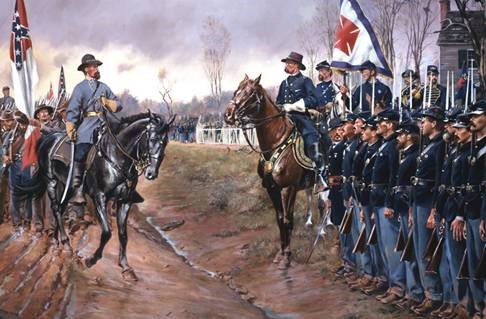
chamberlian gordon appomattox

Joshua Chamberlain Receives the Surrender of John Gordon at Appomattox

Friends of Padre Steve’s World,

 One hundred and fifty four years ago on the 9th and 10th of April 1865, four men, Ulysses S Grant, Robert E. Lee, Joshua Lawrence Chamberlain and Ely Parker, taught succeeding generations of Americans the value of mutual respect and reconciliation. The four men, each very different, would do so after a bitter and bloody war that had cost the lives of over 600,000 Americans which had left hundreds of thousands others maimed, shattered or without a place to live, and seen vast swaths of the country ravaged by war and its attendant plagues.

The differences in the men, their upbringing, and their views about life seemed to be insurmountable. The Confederate commander, General Robert E. Lee was the epitome of a Southern aristocrat and career army officer. Lieutenant General Ulysses S. Grant, like Lee was a West Point graduate and veteran of the War with Mexico, but there the similarities ended. Grant was an officer of humble means who had struggled with alcoholism and failed in his civilian life after he left the army, before returning to it as a volunteer when war began. Major General Joshua Lawrence Chamberlain had been a professor of rhetoric and natural and revealed religion from Bowdoin College until 1862 when he volunteered to serve. He was a hero of Little Round Top at the Battle of Gettysburg, who helped exemplify the importance of citizen soldiers in peace and war. Finally there was Colonel Ely Parker, a full-blooded Seneca Indian; a professional engineer by trade, a man who was barred from being an attorney because as a Native American he was never considered a citizen. Although he had been rejected from serving in the army for the same reason, his friend Grant had obtained him a commission and kept him on his staff.
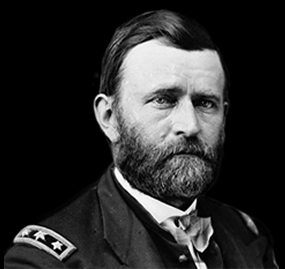
grant 1

General Ulysses S. Grant

A few days bef0ore the Confederate line around the fortress of Petersburg was shattered at the battle of Five Forks, and to save the last vestiges of his army Lee attempted to withdraw to the west. Within a few days the once magnificent Army of Northern Virginia was trapped near the town of Appomattox. On the morning of April 9th 1865 Lee replied to an entreaty of Lieutenant General Ulysses S. Grant requesting that he and his Army of Northern Virginia be allowed to surrender. Lee wrote to Grant:

HEADQUARTERS ARMY OF NORTHERN VIRGINIA, APRIL 9, 1865

Lieut. Gen. U.S. GRANT:

I received your note of this morning on the picket-line, whither I had come to meet you and ascertain definitely what terms were embraced in your proposal of yesterday with reference to the surrender of this army. I now ask an interview in accordance with the offer contained in your letter of yesterday for that purpose.

R.E. LEE, General.

The once mighty Army of Northern Virginia, which had won so many victories, and which at its peak numbered nearly 80,000 men, was now a haggard and emaciated, but still proud force of about 15,000 soldiers. For Lee to continue the war now would mean that they would have to face hopeless odds against a vastly superior enemy. Grant recognized this and wrote Lee:

I am equally anxious for peace with yourself, and the whole North entertains the same feeling. The terms upon which peace can be had are well understood. By the South laying down their arms they will hasten that most desirable event, save thousands of human lives, and hundreds of millions of property not yet destroyed. Seriously hoping that all our difficulties may be set-tied without the loss of another life, I subscribe myself, &c.,

Since the high water mark at Gettysburg, Lee’s army had been on the defensive. Lee’s ill-fated offensive into Pennsylvania was one of the two climactic events that sealed the doom of the Confederacy. The other was Grant’s victory at Vicksburg which fell to him a day after Pickett’s Charge, and which cut the Confederacy in half.
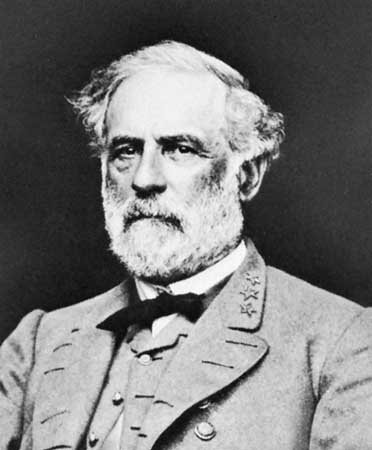
ileerob001p1

General Robert E. Lee

The bloody defensive struggle lasted through 1864 as Grant bled the Confederates dry during the Overland Campaign, leading to the long siege of Petersburg. Likewise the armies of William Tecumseh Sherman had cut a swath through the Deep South and were moving toward Virginia from the Carolinas.

With each battle following Gettysburg the Army of Northern Virginia became weaker and finally after the nine month long siege of Petersburg ended with a Union victory there was little else to do. On the morning of April 9th a final attempt to break through the Union lines by John Gordon’s division was turned back by vastly superior Union forces.

On April 7th Grant wrote a letter to Lee, which began the process of ending the war in Virginia. He wrote:

General R. E. LEE:

The result of the last week must convince you of the hopelessness of further resistance on the part of the Army of Northern Virginia in this struggle. I feel that it is so, and regard it as my duty to shift from myself the responsibility of any further effusion of blood, by asking of you the surrender of that portion of the C. S. Army known as the Army of Northern Virginia.

U.S. GRANT, Lieutenant-General

Lee was hesitant to surrender knowing Grant’s reputation for insisting on unconditional surrender, terms that Lee could not accept. He replied to Grant:

HEADQUARTERS ARMY OF NORTHERN VIRGINIA, APRIL 7, 1865 Lieut. Gen. U.S. GRANT:

I have received your note of this date. Though not entertaining the opinion you express on the hopelessness of further resistance on the part of the Army of Northern Virginia, I reciprocate your desire to avoid useless effusion of blood, and therefore, before considering your proposition, ask the terms you will offer on condition of its surrender.

R.E. LEE, General.

The correspondence continued over the next day even as the Confederates hoped to fight their way out of the trap that they were in. But now Robert E. Lee, who had through his efforts extended the war for at least six months, knew that he could no longer continue. Even so some of his younger subordinates wanted to continue the fight. When his artillery chief Porter Alexander recommended that the Army be released, “take to the woods and report to their state governors” Lee replied:

“We have simply now to face the fact that the Confederacy has failed. And as Christian men, Gen. Alexander, you & I have no right to think for one moment of our personal feelings or affairs. We must consider only the effect which our action will have upon the country at large.”

Lee continued:

“Already [the country] is demoralized by the four years of war. If I took your advice, the men would be without rations and under no control of their officers. They would be compelled to rob and steal in order to live…. We would bring on a state of affairs it would take the country years to recover from… You young fellows might go bushwhacking, but the only dignified course for me would be to go to General Grant and surrender myself and take the consequences of my acts.”

Alexander was so humbled at Lee’s reply he later wrote “I was so ashamed of having proposed such a foolish and wild cat scheme that I felt like begging him to forget he had ever heard it.” When Alexander saw the gracious terms of the surrender he was particularly impressed with how non-vindictive the terms were, especially in terms of parole and amnesty for the surrendered soldiers.

Abraham Lincoln had already set the tone for the surrender in his Second Inaugural Address given just over a month before the surrender of Lee’s army. Lincoln closed that speech with these words of reconciliation.

“With malice toward none, with charity for all, with firmness in the right as God gives us to see the right, let us strive on to finish the work we are in, to bind up the nation’s wounds, to care for him who shall have borne the battle and for his widow and his orphan, to do all which may achieve and cherish a just and lasting peace among ourselves and with all nations.”
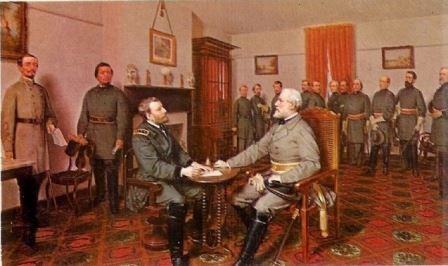
appomattox surrender

Lee met Grant at the house of Wilmer McLean, who had moved to Appomattox in 1861 after his home near Manassas had been used as a Confederate headquarters and was damaged by artillery fire. Lee was dressed in his finest uniform complete with sash, while Grant was dressed in a mud splattered uniform and overcoat only distinguished from his soldiers by the three stars on his should boards. Grant’s dress uniforms were far to the rear in the baggage trains and Grant was afraid that his slovenly appearance would insult Lee, but it did not. It was a friendly meeting, before getting down to business the two reminisced about the Mexican War.

Grant provided his vanquished foe very generous surrender terms:

“In accordance with the substance of my letter to you of the 8th inst., I propose to receive the surrender of the Army of N. Va. on the following terms, to wit: Rolls of all the officers and men to be made in duplicate. One copy to be given to an officer designated by me, the other to be retained by such officer or officers as you may designate. The officers to give their individual paroles not to take up arms against the Government of the United States until properly exchanged, and each company or regimental commander sign a like parole for the men of their commands. The arms, artillery and public property to be parked and stacked, and turned over to the officer appointed by me to receive them. This will not embrace the side-arms of the officers, nor their private horses or baggage. This done, each officer and man will be allowed to return to their homes, not to be disturbed by United States authority so long as they observe their paroles and the laws in force where they may reside.”

When Lee left the building Federal troops began cheering but Grant ordered them to stop. Grant felt a sense of melancholy and wrote “I felt…sad and depressed, at the downfall of a foe who had fought so long and valiantly, and had suffered so much for a cause, though that cause was, I believe, one of the worst for which a people has fought.” He later noted: “The Confederates were now our countrymen, and we did not want to exult over their downfall.”

In the hours before and after the signing of the surrender documents old friends and classmates, separated by four long years of war gathered on the porch or around the house. Grant and others were gracious to their now defeated friends and the bitterness of war began to melt away. Some Union officers offered money to help their Confederate friends get through the coming months. It was an emotional reunion, especially for the former West Point classmates gathered there.

“It had never been in their hearts to hate the classmates they were fighting. Their lives and affections for one another had been indelibly framed and inextricably intertwined in their academy days. No adversity, war, killing, or political estrangement could undo that. Now, meeting together when the guns were quiet, they yearned to know that they would never hear their thunder or be ordered to take up arms against one another again.”

Grant also sent 25,000 rations to the starving Confederate army waiting to surrender. The gesture meant much to the defeated Confederate soldiers who had had little to eat ever since the retreat began.

The surrender itself was accomplished with a recognition that soldiers who have given the full measure of devotion can know when confronting a defeated enemy. Major General Joshua Lawrence Chamberlain, the heroic victor of Little Round Top was directed by Grant to receive the final surrender of the defeated Confederate infantry on the morning of April 12th.

It was a rainy and gloomy morning as the beaten Confederates marched to the surrender grounds. As the initial units under the command of John Gordon passed him, Chamberlain was moved with emotion he ordered his soldiers to salute the defeated enemy for whose cause he had no sympathy, Chamberlain honored the defeated Rebel army by bringing his division to present arms.

John Gordon, who was “riding with heavy spirit and downcast face,” looked up, surveyed the scene, wheeled about on his horse, and “with profound salutation returned the gesture by lowering his saber to the toe of his boot. The Georgian then ordered each following brigade to carry arms as they passed third brigade, “honor answering honor.”
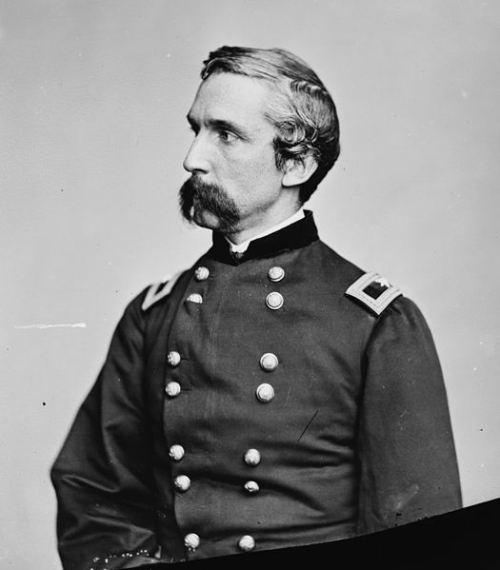
joshua_chamberlain_-_brady-handy

Joshua Lawrence Chamberlain

Chamberlain was not just a soldier, but before the war had been Professor of Natural and Revealed Religions at Bowdoin College, and a student of theology before the war. He could not help to see the significance of the occasion. He understood that some people would criticize him for saluting the surrendered enemy. However, Chamberlain, unlike others, understood the value of reconciliation. Chamberlain was a staunch abolitionist and Unionist who had nearly died on more than one occasion fighting the defeated Confederate Army, and he understood that no true peace could transpire unless the enemies became reconciled to one another.

He noted that his chief reason for doing so:

“The momentous meaning of this occasion impressed me deeply. I resolved to mark it by some token of recognition, which could be no other than a salute of arms. Well aware of the responsibility assumed, and of the criticisms that would follow, as the sequel proved, nothing of that kind could move me in the least. The act could be defended, if needful, by the suggestion that such a salute was not to the cause for which the flag of the Confederacy stood, but to its going down before the flag of the Union. My main reason, however, was one for which I sought no authority nor asked forgiveness. Before us in proud humiliation stood the embodiment of manhood: men whom neither toils and sufferings, nor the fact of death, nor disaster, nor hopelessness could bend from their resolve; standing before us now, thin, worn, and famished, but erect, and with eyes looking level into ours, waking memories that bound us together as no other bond;—was not such manhood to be welcomed back into a Union so tested and assured? Instructions had been given; and when the head of each division column comes opposite our group, our bugle sounds the signal and instantly our whole line from right to left, regiment by regiment in succession, gives the soldier’s salutation, from the “order arms” to the old “carry”—the marching salute. Gordon at the head of the column, riding with heavy spirit and downcast face, catches the sound of shifting arms, looks up, and, taking the meaning, wheels superbly, making with himself and his horse one uplifted figure, with profound salutation as he drops the point of his sword to the boot toe; then facing to his own command, gives word for his successive brigades to pass us with the same position of the manual,—honor answering honor. On our part not a sound of trumpet more, nor roll of drum; not a cheer, nor word nor whisper of vain-glorying, nor motion of man standing again at the order, but an awed stillness rather, and breath-holding, as if it were the passing of the dead!”

The next day Robert E Lee addressed his soldiers for the last time. Lee’s final order to his loyal troops was published the day after the surrender. It was a gracious letter of thanks to men that had served their beloved commander well in the course of the three years since he assumed command of them outside Richmond in 1862.

General Order
No. 9

After four years of arduous service marked by unsurpassed courage and fortitude, the Army of Northern Virginia has been compelled to yield to overwhelming numbers and resources.

I need not tell the survivors of so many hard fought battles, who have remained steadfast to the last, that I have consented to the result from no distrust of them.

But feeling that valour and devotion could accomplish nothing that could compensate for the loss that must have attended the continuance of the contest, I have determined to avoid the useless sacrifice of those whose past services have endeared them to their countrymen.

By the terms of the agreement, officers and men can return to their homes and remain until exchanged. You will take with you the satisfaction that proceeds from the consciousness of duty faithfully performed, and I earnestly pray that a merciful God will extend to you his blessing and protection.

With an unceasing admiration of your constancy and devotion to your Country, and a grateful remembrance of your kind and generous consideration for myself, I bid you an affectionate farewell. — R. E. Lee, General

The surrender was the beginning of the end. Other Confederate forces continued to resist for several weeks, but with the surrender of the Army of Northern Virginia led by the man that nearly all Southerners saw as the embodiment of their nation the war was effectively over.

Lee had fought hard and after the war was still under the charge of treason, but he understood the significance of defeat and the necessity of moving forward as one nation. In August 1865 Lee wrote to the trustees of Washington College of which he was now President:

“I think it is the duty of every citizen, in the present condition of the Country, to do all in his power to aid the restoration of peace and harmony… It is particularly incumbent upon those charged with the instruction of the young to set them an example of submission to authority.

eparker05-966-g

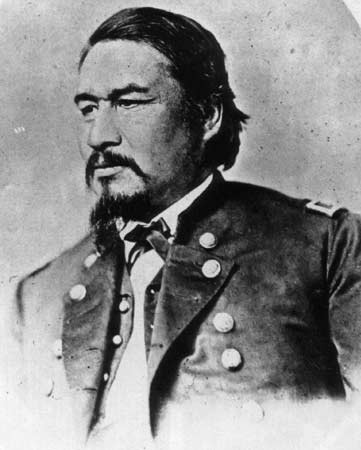
Brigadier General Ely Parker

It is a lesson that all of us in our terribly divided land need to learn regardless of or political affiliation or ideology. After he had signed the surrender document, Lee learned that Grant’s Aide-de-Camp Colonel Ely Parker, was a full-blooded Seneca Indian. He stared at Parker’s dark features and said: “It is good to have one real American here.”

Parker, a man whose people had known the brutality of the white man, a man who was not considered a citizen and would never gain the right to vote, replied, “Sir, we are all Americans.” That afternoon Parker would receive a commission as a Brevet Brigadier General of Volunteers, making him the first Native American to hold that rank in the United States Army. He would later be made a Brigadier General in the Regular Army.

I don’t know what Lee thought of that. His reaction is not recorded and he never wrote about it after the war, but it might have been in some way led to Lee’s letter to the trustees of Washington College. I think with our land so divided, ands that is time again that we learn the lessons so evidenced in the actions and words of Ely Parker, Ulysses Grant, Robert E. Lee and Joshua Chamberlain, for we are all Americans.

Sadly, I think that there is a portion of the American population who will not heed these words and will continue to agitate for policies and laws similar to those that led to the Civil War, and which those the could not reconcile defeat instituted again during the Post-Reconstruction and Jim Crow eras. For me such behavior and attitudes are incompressible, but they are all too real, and all too present in our divided nation.

But I still maintain hope that in spite of everything that divides us, in spite of the intolerance and hatred of some, that we can overcome. I think that the magnanimity of Grant in victory, the humility of Lee in defeat, the graciousness of Chamberlain in honoring the defeated foe, and the stark bluntness of Parker, the Native American, in reminding Lee, that “we are all Americans,” is something that is worth remembering, and yes, even emulating.

That is where we need to be in the age of President Trump. Robert E. Lee, could admit defeat, and though still at heart a racist, could still advocate for the end of a rebellion that he supported and reconciliation with a government which he had committed high treason against. Ulysses S. Grant and Joshua Chamberlain embodied the men of the Union who had fought for the Union, Emancipation, and against the Rebellion hat Lee supported to the end.

But even more so we need to remember the words of the only man whose DNA and genealogy did not make him a European transplant, the man who Lee refereed to as the only true American at Appomattox, General Ely Parker, the Native American who fought for a nation that not acknowledge him as a citizen until long after he was dead.

In the perverted, unrequited racist age of President Donald Trump we have to stop the bullshit, and take to heart the words of Ely Parker. “We are all Americans.” If we don’t get that there is no hope for our country. No amount of military or economic might can save us if we cannot understand Parker’s words, or the words of the Declaration: “We hold these truths to be self evident, that all men are created equal…” Really, it does not matter if our relatives were second sons of European Gentry, religious dissidents, refugees of repressive regimes, African Slaves, Asians seeking a new life in a new country, or Mexican citizens who turned on their own country to become citizens of a new Republic, men like Mariano Vallejo, the Mexican governor of El Norte and one of the First U.S. Senators from California.

Let us never forget Ely Parker’ words at Appomattox, “We are all Americans.”

Sadly, there are not just more than a few Americans, and many with no familial or other connection to the Confederacy and the South than deeply held racism who would rather see another bloody civil war because they hate the equality of Blacks, Women, immigrants, and LGBTQ Americans more than they love the Declaration of Independence and the Constitution of the United States.

That is why Parker’s words to Lee still matter so much and why we must never give up the fight for equality for all Americans. Likewise, whether one likes it or not, Robert E. Lee broke his sacred oath to the Constitution as a commissioned officer refused to free the slaves entrusted to his care by his Father in Law in 1859, who refused to support his Confederate President’s plan to emancipate and free African American slaves who were willing to fight for the Confederacy until February 1865.

Lee the Myth is still greater than Lee the man in much of this country. Lee the man is responsible for the deaths for more Americans than the leaders of Imperial Germany, Imperial Japan, Nazi Germany, or any other foreign power. He even cast aside such loyalists as George Pickett, whose division he destroyed in a suicidal attack at Gettysburg on July 3rd 1863, and then continued to damn Pickett for mistakes which were his own until the end of the war.

Both sides of my family fought for the Confederacy as officers and members of the 8th Virginia Cavalry. Most reconciled, but others didn’t, including the patriarch of my paternal side of the family. His decision ended up costing the family millions of dollars in the following years. The maternal side was smart enough to reconcile after the war and to later engage in the profoundly libertarian practice of bootlegging until the end of prohibition. I don’t know if any members of either side of my family were Kan supporters, but if they were I wouldn’t doubt it. They lost what they had during the war by fighting on the wrong sided and refusing to reconcile with the United States, and they deserved it. Even Robert E. Lee refused to completely admit his crime of treason. He used the language of reconciliation without fully embracing it.

That my friends is the crime of those who today speak of freedom and reconciliation, but refused to apply it to themselves or their families. I guess that makes me different, and I’m okay I’m okay with that. I have to admit, that the person that I was in my early 20s, or the person that I am now could not have embraced secession or slavery. There is no moral reason that any Christian person could have fully embraced secession and civilly war to defend slavery, but people on both sides of my family did even as their neighbors embraced the Union.

So for me April 9th is very personal. I have served my country for nearly 38 years. I cannot abide men and women who treat the men and women that I have served with in the defense of this county as less than human or fully entitled to the rights that are mine, more to my birth and race than today than any of my inherent talents or abilities. That includes my ancestors who fought for the Confederacy on both sides of my family. Ancestors or not, they were traitors to everything that I believe in and hold dear.

As for me, principles and equality trump all forms of racism, racist ideology, and injustice, even when the President himself advocates for them. I am a Union man, despite my Southern ancestry, and I will support the rights of people my ancestors would never support, Blacks, Hispanics, Women, LTBTQ, and other racial, religious, or gender minorities. But then, I am a Unionist. I am a supporter of Equal rights for African Americans, I am a women’s rights advocate, including their reproductive rights, and I am a supporter of LGBTQ people and their rights, most of which are opposed by the Evangelical Christians who I grew up with. I also will not hesitate to criticize the elected President of the United States when he pisses on the preface of the Declaration of Independence, the United States Constitution, attacks the bedrock principles of the Bill of Rights

How can I be silent?

Dietrich Bonhoeffer notes:

“The messengers of Jesus will be hated to the end of time. They will be blamed for all the division which rend cities and homes. Jesus and his disciples will be condemned on all sides for undermining family life, and for leading the nation astray; they will be called crazy fanatics and disturbers of the peace. The disciples will be sorely tempted to desert their Lord. But the end is also near, and they must hold on and persevere until it comes. Only he will be blessed who remains loyal to Jesus and his word until the end.”

Trump certainly hates those who hold fast to the worlds of Jesus. So I will stand fast on this anniversary of Appomattox and echoes the words of Eli Parker to President Trump himself: “Sir, we are all Americans.” He may not understand it, but I certainly do.

Until tomorrow,

Peace

Padre Steve+
6 Comments

Filed under civil rights, civil war, History, leadership, LGBT issues, Loose thoughts and musings, Military, Political Commentary

All the Drowned Sailors: The Sacrifice Of the Yamato, at Okinawa and the Myth Of Trump’s #MAGA

Friends of Padre Steve’s World,

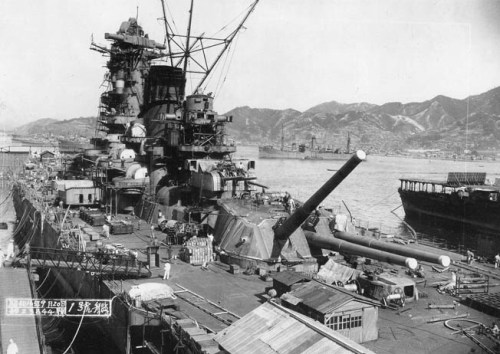
Those who have read my site since the beginning know that I have written much in terms of Naval History. One of the things that I am drawn to are the great ships that were sacrificed with the crews in futile attempts of salvage victory from defeat, or which were sacrificed in order to save others. Regardless of the circumstance I have a soft spot in my heart for sailors of any nation who pay with their lives when their ships are sunk. This is the story of the IJN Yamato who along with her sister ship, the Musashi were the largest battleships ever constructed.

As dawn broke on April 7th 1945 the great Super-Battleship Yamato, the pride of the Japanese Imperial Navy and nine escorts steamed toward Okinawa on a suicide mission. It was literally the end of empire and the end of a navy. What had begun on December 7th 1941 was now winding down as the Imperial Navy launched its last offensive operation against the United States Navy.

The Imperial Navy was already at the end of its tether. Following the disasters at the Battle of the Philippine Sea which decimated the carrier air arm of the Imperial Navy; the subsequent losses in the defense of Formosa which used up the majority of any remaining carrier aircraft and crews; and the Battle of Leyte Gulf which decimated the surface forces of the navy what remained was a pitiful remnant of a once dominant fleet.

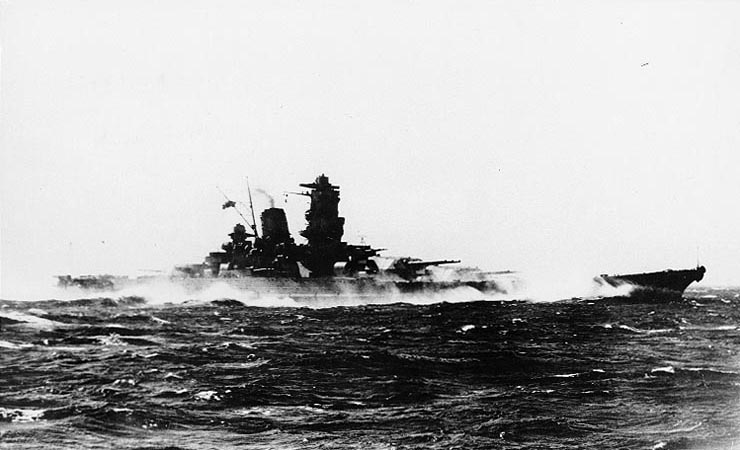
The great battleship Yamato and her sister ship Musashi were the largest warships ever built until the advent of the USS Enterprise CVN-65. Displacing over 72,000 tons 863 feet long and 127 feet in beam these ships mounted the heaviest artillery battery ever placed on a warship. Their nine 18.1” guns mounted in three triple turrets each weighing over 2500 tons weighed as much or more than the largest destroyers of the time. They could fire their massive shells 26 miles and even had the capability of firing a special anti-aircraft shell known as the Sanshiki or beehive round.the largest anti-aircraft shell ever developed.

Musashi was sunk during the Battle of the Sibuyan Sea at Leyte Gulf on October 24th 1944 after being hit by 19 aerial torpedoes and 17 bombs. Yamato engaged the American Escort Carriers and destroyers of Taffy-3 at the Battle off Samar the following day but was prevented by the audacity of the inferior American destroyers and timidity of the Japanese commander Vice Admiral Takeo Kurita from achieving any notable success.

The remains of the Imperial Navy were hampered by a lack of fuel, air power and training time. When the United States attacked Iwo Jima in February 1945, barely 700 miles from the home islands of Japan not a single Japanese surface ship sortied to challenge the American Navy.

However when the American attacked Okinawa on April 1st 1945 the Imperial Navy launched Operation Ten-Go. In spite of overwhelming American superiority in both naval air and surface forces the tiny task force was to fight its way to Okinawa, beach their ships and once the ships were destroyed the crews were to join Japanese Army forces on the island.

The doomed sortie was in part due to the insistence of the Imperial Army which derided the Imperial Navy for its failures at Philippine Sea and Leyte Gulf and pressure from Emperor Hirohito who asked “But what about the Navy? What are they doing to assist in defending Okinawa? Have we no more ships?” In response the Naval High command devised what amounted to a suicide mission for Yamato and her escorts. The plan was opposed by many in the Navy and leaders of the task force who saw it as a futile mission. Only the insistence of Admiral Kusaka who told the reticent commanders that the Emperor expected the Navy to make its best effort to defend Okinawa persuaded the Captains of the doomed force to accept the mission. Honor now matter more than lives.

At about 1600 on April 6th the ships of the task force weighed anchor and departed their anchorage at Tokuyama hoping to take advantage of approaching darkness to mask their departure. They were detected and shadowed by American submarines which provided real time information on the course and speed of the Japanese ships to the American leadership.

The next morning the task force was spotted by patrol planes and its position relayed to the American fleet commander, Admiral Raymond Spruance, the victor of Midway. Spruance ordered the six fast battleships, accompanied by two battlecruisers, seven cruisers and 21 destroyers engaged in shore bombardment to intercept the Japanese force. However, Admiral Marc Mitscher of Task Force 58, the fast carriers launched a massive air strike of over 400 aircraft against the Japanese.

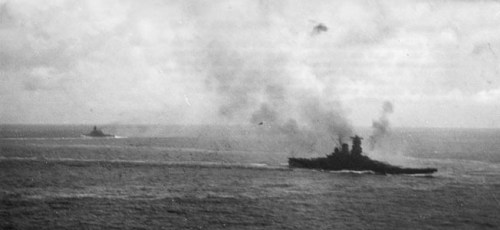
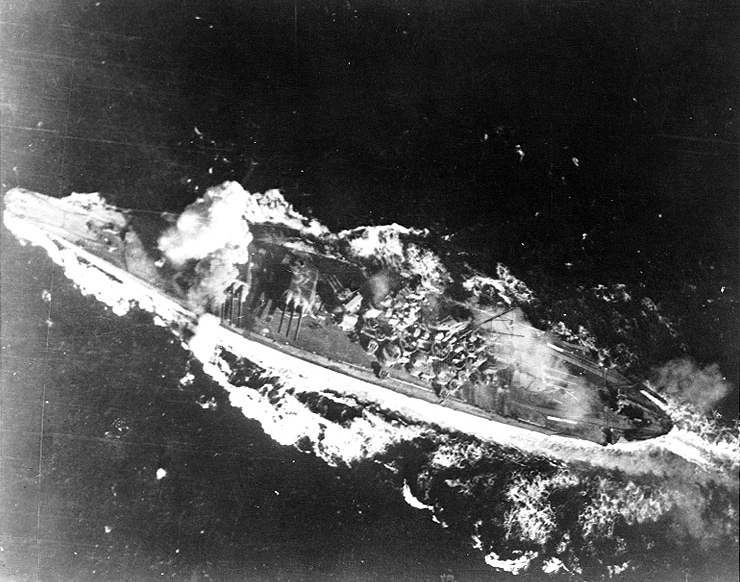
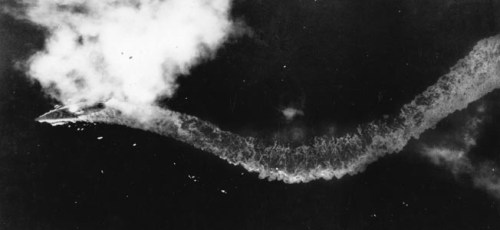
At 1232 the first wave of American aircraft began their attacks on the doomed Japanese force. As the succeeding waves of American aircraft attacked Yamato was hit by 15 bombs and at least 8 torpedoes, almost all of which struck her port side created an imminent risk of capsizing. The damage control teams’ counter flooded the starboard engine and boiler rooms which kept the ship from turning turtle, but which also further reduced her speed.

By 1405 the great ship was dead in the water with a heavy list, just minutes before her commander had ordered the crew to abandon ship. At 1420 Yamato capsized and began to sink and at 1423 she blew apart in a massive explosion that was reportedly heard and seen 120 miles away and created a mushroom cloud that reached 20,000 feet.

Captain Tameichi Hara of the light cruiser Yahagi which had already sank described the demise of the great ship in his book Japanese Destroyer Captain:

“We looked and saw Yamato, still moving. What a beautiful sight. Suddenly smoke belched from her waterline. We both groaned as white smoke billowed out until it covered the great battleship, giving her the appearance of a snow-capped Mount Fuji. Next came black smoke mingled with the white, forming to a huge cloud which climbed to 2000 meters. As it drifted away we looked to the surface of the sea again and there was nothing. Yamato had vanished. Tremendous detonations at 1423 of that seventh day of April signaled the end of this “unsinkable” symbol of the Imperial Navy.”

Only 280 men of the estimated 3000 crew members aboard Yamato were rescued by the surviving escorts. Of her escorts, the Yahagi and four destroyers were also sunk. The Americans lost a total of ten aircraft and 12 men. Never again would the surface forces of the Imperial Navy threaten U.S. forces or take any meaningful part in the war.

https://youtu.be/4ZcfU0cGAP0

The sacrifice of Yamato and her escorts was a futile was of lives and though many in Japan revere their sacrifice as noble it served no purpose. The loss of Yamato, named after the ancient Yamato province in a sense was symbolic of the demise of the Japanese Empire.

I cannot help but think of gallantry of the doomed crews of these ships, sacrificed for the “honor” of leaders that did not really value their sacrifice. Likewise, I regret the fact that Naval engineers, and maritime archeologists never got to examine this great ship while still afloat, or even to see how she would have faired as a target ship in the Bikini Atoll Nuclear tests.

I regret that so many sailors died in what was a senseless, and useless from an operation operation of any tactical, operational, or strategic point of view. Likewise I regret that a relatively intact Yamato was never fully examined by non-Japanese maritime engineers and ship designers to examine and learn lessons from. If Yamato had survived the war, been thoroughly examined and the. Been expended as a target ship at Bikini, which in light of the examples of the USS Nevada, USS New York, the DKM Prinz Eugen, and other ships might have assisted Naval engineers even today.

I am a career military man, and sailor. I am a humanist who abhors the indiscriminate and nonsensical sacrifice of lives for so called National Honor or pride. I am also a military and naval historical historian who believes that the preservation and study of such instruments of war save lives.

It is a commentary that is timeless. The useless sacrifice of over 2,800 human beings and the ultimate battleship ever built into, to do nothing more than commiserate over the lives that had not been so sacrificed, and the lessons that might prevent the loss of life in future conflicts.

I wonder if another Naval power, perhaps not the Japanese, but maybe the Americans, Russians, English, Indian, or Chinese aircraft carrier will be the latest to succumb to the myth of the great and allegedly indestructible capital ship.

It is a question worth asking as the United States Navy struggles to regain pure-eminence in the Pacific against the Chinese, in the Arctic against Chinese and the Russians, and against less than peer competitors in the Persian Gulf and the Mediterranean. When Yamato was sunk the Japanese were no longer under the illusion that they were the greatest sea power ever; if a United States Navy Aircraft were to be sunk in the North Atlantic, the Northeast Pacific, the Persian Gulf, or the Mediterranean it would be more than a military defeat, it would be a national catastrophe. Trust me, I have played the war games at the Joint Forces Staff College. I cannot go into detail about the war game scenarios, but the were favorable to the United States and its allies.

If any of our Nimitz class carriers were sunk along with the majority of their escorts it would be a crisis like we have not experienced since Pearl Harbor. Thus, Yamato, and her escorts serve as a lesson for all who believe in the myth of American Naval and Military superiority. In January of 1019, this year the Chinese boasted that they could not just sink one, but two Nimitz Class carriers in the South China Sea https://www.thesun.co.uk/news/8098177/chinese-admiral-south-china-sea-sink-us-aircraft-carriers/

That possibility has to be acknowledged, and even if one were sunk or seriously damaged it would be a disaster for United States Strategic interests; not Just in the South China Sea, but also Northeast Asia, the Persian Gulf, the Mediterranean, or the North Atlantic. The United States has not experienced such Naval disasters since 1941 and 1942 at the hands of the Japanese Imperial Navy, trust me; I have serve for almost 38 years in the Army and the Navy and I am a historian. If we to experience such losses it would be a strategic disaster that would collapse the confidence of an American public in the myth of American military superiority. There is no amount of #MAGA that can change that. The economy would collapse and the dream world that Americans have lived I would be destroyed. We would have to start again from scratch, like the Japanese in 1945 or the Chinese in 1274 and 1281, or more recently the defeat of the Russian Fleet, operation far from home at Tsushima in 1905 by Admiral Togo and his Japanese Fleet.

This my friends is history, and this is reality when a nation is led by a man with the stupidity of Czar Nicholas, the hubris of Kaiser Wilhelm II, and the racist, non-historical, and not strategically grounded ideology of Adolf Hitler, and their present day manifestations in President Donald Trump.

Until tomorrow

Peace

Padre Steve+

2 Comments

Filed under History, leadership, Military, nazi germany, News and current events, US Navy, White nationalism, World War II at Sea, world war two in the pacific

“Together, There is no Other Way” Lyndon Johnson at Gettysburg and a Challenge to Democrats Today

Friends of Padre Steve’s World,

I am about to finish Historian John Meacham’s inspiring history United States politics and the leadership of different Presidents, The Soul of America: The Battle for Our Better Angels. I have to say that in light of Meacham’s remarks at the Funeral of the late President George H.W. Bush, Meacham’s book has inspired me and encouraged me in the dark era of President Trump and his supporting cast of Angels of Darkness, men and women who, to paraphrase historian Timothy Snyder tell us we are the best while encouraging us to be our worst.

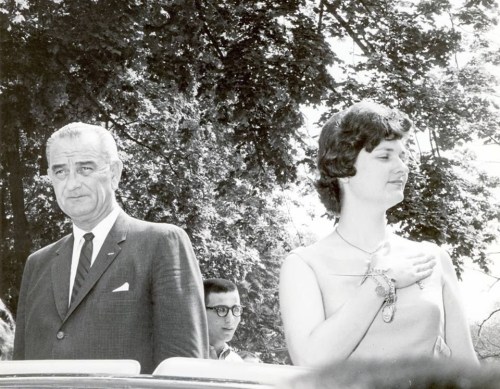
While reading Meacham’s book over the weekend I read about the Civil Rights crusade of President Lyndon Baines Johnson, who had he not gone into Vietnam would probably be considered one of the greatest President’s who ever lived. Johnson would have been considered by many to be an unlikely champion of Civil Rights, though he supported Franklin Roosevelt’s New Deal would not have been considered a pioneering Civil Rights advocate.

Those who read this blog know my attachment to Gettysburg, the Battle Of Gettysburg, and President Abraham Lincoln and his Gettysburg Address. Until I read Meacham’s book I had never known that as Vice President, Lyndon Johnson also spoke at Gettysburg. His words came on Memorial Day 1963, and in part they were an answer to Dr Martin Luther King Jr.’s “Letter from a Birmingham Jail.” It was an incredible and courageous speech. Johnson was a Southerner, a Democrat, and many Southern Democrats were fighting President Kennedy on Civil Rights issues. Kennedy was much too understanding and polite to hold their ball to the fire, but Johnson for all of his other flaws wasn’t and he used his Gettysburg speech to remind the nation of the unfinished legacy of Gettysburg and the still unfulfilled “new birth of freedom” that Lincoln so eloquently spoke in his few remarks at the dedication of the Gettysburg National Military Cemetery.

Johnson spoke these words:

On this hallowed ground, heroic deeds were performed and eloquent words were spoken a century ago. We, the living, have not forgotten–and the world will never forget–the deeds or the words of Gettysburg. We honor them now as we join on this Memorial Day of 1963 in a prayer for permanent peace of the world and fulfillment of our hopes for universal freedom and justice.

We are called to honor our own words of reverent prayer with resolution in the deeds we must perform to preserve peace and the hope of freedom. We keep a vigil of peace around the world. Until the world knows no aggressors, until the arms of tyranny have been laid down, until freedom has risen up in every land, we shall maintain our vigil to make sure our sons who died on foreign fields shall not have died in vain.

As we maintain the vigil of peace, we must remember that justice is a vigil, too–a vigil we must keep in our own streets and schools and among the lives of all our people–so that those who died here on their native soil shall not have died in vain.

One hundred years ago, the slave was freed. One hundred years later, the Negro remains in bondage to the color of his skin. The Negro today asks justice. We do not answer him–we do not answer those who lie beneath this soil–when we reply to the Negro by asking, “Patience.”

It is empty to plead that the solution to the dilemmas of the present rests on the hands of the clock. The solution is in our hands. Unless we are willing to yield up our destiny of greatness among the civilizations of history, Americans — white and Negro together–must be about the business of resolving the challenge which confronts us now.

Our nation found its soul in honor on these fields of Gettysburg one hundred years ago. We must not lose that soul in dishonor now on the fields of hate. To ask for patience from the Negro is to ask him to give more of what he has already given enough. But to fail to ask of him–and of all Americans–perseverance within the processes of a free and responsible society would be to fail to ask what the national interest requires of all its citizens.

The law cannot save those who deny it but neither can the law serve any who do not use it. The history of injustice and inequality is a history of disuse of the law. Law has not failed–and is not failing. We as a nation have failed ourselves by not trusting the law and by not using the law to gain sooner the ends of justice which law alone serves.

If the white over-estimates what he has done for the Negro without the law, the Negro may under-estimate what he is doing and can do for himself with the law. If it is empty to ask Negro or white for patience, it is not empty–it is merely honest–to ask perseverance. Men may build barricades–and others may hurl themselves against those barricades–but what would happen at the barricades would yield no answers. The answers will only be wrought by our perseverance together. It is deceit to promise more as it would be cowardice to demand less.

In this hour, it is not our respective races which are at stake–it is our nation. Let those who care for their country come forward, North and South, white and Negro, to lead the way through this moment of challenge and decision. The Negro says, “Now.” Others say, “Never.” The voice of responsible Americans — the voice of those who died here and the great man who spoke here–their voices say, “Together.” There is no other way.

Until justice is blind to color, until education is unaware of race, until opportunity is unconcerned with the color of men’s skins, emancipation will be a proclamation but not a fact. To the extent that the proclamation of emancipation is not fulfilled in fact, to that extent we shall have fallen short of assuring freedom to the free.

If Johnson was alive today in the age of Trump, and in the fighting form that enabled him to go against fellow Southerners to get the Civil Rights Act Of 1964 and the since emasculated Voting Rights Act Of 1965 passed by overwhelming bi-partisan majorities, and to pass other bills that benefited all Americans, he would not be silent. He would be adding his voice to those of Blacks, Latinos, Arab Americans, Asians, Women, LGBTQ people, and non-Christian Religious minorities whose constitutional rights are under threat by a President whose despises those rights, and a Party which was reborn when the segregationists Democrats Of Johnson’s time became Republicans in 1964 under the white supremacist campaign of Barry Goldwater and the 1968 Southern Strategy Of Richard Nixon. In those years the Democratic Party became the true successors of Lincoln, Grant and the early Republican Party Vision of freedom, while the Republicans under the direction of men like Goldwater, Nixon, Pat Buchanan, Roger Ailes, and a host of others including former Democrats and Dixiecrats like Strong Thurman became the Party of the Lost Cause, the Noble Confederacy, and Jim Crow. Under President Trump the pathetic rump of that once great party, predominantly made of Conservative Christians and a growing violent White Supremacist movement attempt to claim to be the Party of Lincoln and Theodore Roosevelt, but are the Party of Jefferson Davis and the later Dixiecrats.

If he were alive today Lyndon Johnson would be using his legislative expertise to push forward responsible but unpopular policies.

I can only ask, who among today’s Democrats will do that? I honestly don’t know, but I believe that such a man or woman much come forth to challenge Trump and his Cult for the Presidency in 2020. To quote Johnson:

“In this hour, it is not our respective races which are at stake–it is our nation. Let those who care for their country come forward, North and South, white and Negro, to lead the way through this moment of challenge and decision.

The Negro says, “Now.” Others say, “Never.” The voice of responsible Americans–the voice of those who died here and the great man who spoke here–their voices say, “Together.” There is no other way.”

Until tomorrow,

Peace,

Padre Steve+

Leave a comment

Filed under civil rights, civil war, Gettysburg, History, laws and legislation, leadership, LGBT issues, News and current events, Political Commentary, White nationalism

“In This Difficult Time for the United States, it’s Perhaps Well to Ask What kind of a Nation We Are…” Bobby Kennedy’s Words on the Assassination Of Dr. Martin Luther King Jr.

20130404-203529.jpg

Friends of Padre Steve’s World,

Fifty-one years ago yesterday a bullet killed Dr. Martin Luther King Jr. while he was in Memphis supporting Sanitation Workers who were being subjected to unsafe working conditions without the same rights, protections, pay, or benefits of white Sanitation workers. As always there were threats on King’s life and he knew that he was a target. The night before his assassination Dr. King spoke at Mason Temple the international headquarters of the Church of God in Christ, the largest historically Black denomination in the United States.

That speech is now known as the “I have been to the mountaintop” speech. Dr. King had flown into Memphis earlier in the day, on a flight delayed by a bomb threat. King like many Civil Rights leaders of his day lived under the constant threat of physical violence, intimidation and assassination. After the heady days of the great march in Washington and the I Have a Dream speech and the award of the Nobel Prize his positions on social and economic justice and his opposition to the Vietnam War had made him a pariah of sorts, even in the Black community. He had place himself in the gunsights of his opponents as he pressed on in spite of the opposition.

Life was precious to him, but he like many others understood that it could be cut short at any moment for simply speaking the truth about racial discrimination, prejudice and violence. King himself had been accosted at different times and spent time in jail for “breaking” laws that enforced and enabled institutions and individuals to discriminate against Blacks with no consequences whatsoever. He was called a radical, a Communist and anti-American by those that opposed any changes to the status quo. He knew that his life was always in danger.

In that speech Dr. King seemed to understand the threat but he was determined to go on and to do God’s will. Dr. King understood that the Christian faith required more than intellectual assent to a doctrine. He understood the words of the German martyr Dietrich Bonhoeffer: We are not to simply bandage the wounds of victims beneath the wheels of injustice, we are to drive a spoke into the wheel itself.”

At Mason Temple Dr King proclaimed:

“And then I got to Memphis. And some began to say the threats…or talk about the threats that were out… What would happen to me from some of our sick white brothers? Well I don’t know what will happen now. We’ve got some difficult days ahead. but it doesn’t matter with me now. Because I been to the mountaintop. And I don’t mind. Like anybody, I would like to live a long life. Longevity has its place. But I’m not concerned about that now. I just want to do God’s will. And He’s allowed me to go up to the mountain. And I’ve looked over.and I have seen the promised land. I may not get there with you. But I want you to know tonight, that we, as a people, will get to the promised land! And so I am happy, tonight. I’m not worried about anything. I am not fearing any man. Mine eyes have seen the glory of the coming of The Lord.”

It was April 4th 1968. The United States was divided by the Vietnam War and numerous social crises. President Lyndon Johnson had just done the unthinkable, he had announced that he was withdrawing from his reelection bid. In many places despite the integration of the Armed Forces, Baseball, the repeal of many Jim Crow laws and the passage of the 1964 Voter’s Rights Act African Americans still felt the sting of individual and institutional racial prejudice. In Vietnam the effects of the Tet Offensive still lingered even as American cities burned.

His speech at Mason Temple was almost prophetic in its message. The words of the thirty-nine year old Baptist Preacher from Atlanta echoed through the sanctuary of the church to the applause of those present even as a heavy spring thunderstorm rocked the city.

The following evening, King with a number of other Civil Rights leaders including Ralph Abernathy, Andrew Young, and Jessie Jackson were at the Lorraine Motel, where King often stayed. King was standing on the balcony outside of his room, Room 306 when at 6:01 PM he was cut down and mortally wounded by a single shot fired from a Remington 760 rifle. The bullet struck him in the right cheek, traveled down his spine and severed his jugular vein and several major arteries before it came to rest in his shoulder. He still had a heartbeat when the ambulance arrived and on his arrival at St Joseph’s Hospital. Efforts to revive him by opening his chest and attempting cardiac massage were unsuccessful and at 7:05 PM Dr King was pronounced dead.

20130404-221100.jpg

20130404-221225.jpg

Witnesses reported a man named James Earl Ray fleeing the area after the shooting. The Remington rifle and a pair of binoculars with Ray’s fingerprints were found at the scene. Ray was apprehended at London’s Heathrow Airport two months later. Ray was tried and convicted of Dr King’s murder. He was sentenced to 99 years in prison and died in 1998. During the trial Ray recanted his confession, implicated an unknown man named “Raul” who he had supposedly met in Montreal as being involved and said that “he personally did not kill” Dr King hinting at a conspiracy. Ray plead guilty to avoid the death penalty.

Other theories were postulated about the murder and Lloyd Jowers who owned a restaurant across from the Lorraine Motel claimed in a 1993 interview that the US Government and the Mafia were complicit in the killing, that Ray was a scapegoat and that Memphis Police Lieutenant Earl Clark was the shooter.

Jowers’ story is disputed but it was believed by King’s widow Coretta Scott King.  She filed a wrongful death lawsuit in which a jury found that Jowers and others including government agencies were guilty of the plot to kill Dr King on December 8th 1998. Though Jowers’ story was contradicted by much of his own testimony during the trial the results have caused a divide in who experts believe killed Dr King. As for the King family they reconciled with Ray before his death.

20130404-221809.jpg

Regardless of who killed Dr King the result was a shock to much of the nation and in many places riots broke out despite the pleadings of most Civil Rights leaders to continue in Dr King’s path of non-violence.

20130404-230118.jpg

Senator Robert F Kennedy, then running for the Democratic Party nomination for President learned of Dr King’s shooting just before flying to Indianapolis for a campaign rally. On his arrival he learned of Dr King’s death. Warned by police that he could be in danger he made an impromptu speech from the back of a flat bed truck. The speech was short, under 5 minutes but its message is applicable even today.

“Ladies and Gentlemen,

I’m only going to talk to you just for a minute or so this evening, because I have some — some very sad news for all of you — Could you lower those signs, please? — I have some very sad news for all of you, and, I think, sad news for all of our fellow citizens, and people who love peace all over the world; and that is that Martin Luther King was shot and was killed tonight in Memphis, Tennessee.

Martin Luther King dedicated his life to love and to justice between fellow human beings. He died in the cause of that effort. In this difficult day, in this difficult time for the United States, it’s perhaps well to ask what kind of a nation we are and what direction we want to move in. For those of you who are black — considering the evidence evidently is that there were white people who were responsible — you can be filled with bitterness, and with hatred, and a desire for revenge.

We can move in that direction as a country, in greater polarization — black people amongst blacks, and white amongst whites, filled with hatred toward one another. Or we can make an effort, as Martin Luther King did, to understand, and to comprehend, and replace that violence, that stain of bloodshed that has spread across our land, with an effort to understand, compassion, and love.

For those of you who are black and are tempted to fill with — be filled with hatred and mistrust of the injustice of such an act, against all white people, I would only say that I can also feel in my own heart the same kind of feeling. I had a member of my family killed, but he was killed by a white man.

But we have to make an effort in the United States. We have to make an effort to understand, to get beyond, or go beyond these rather difficult times.

My favorite poem, my — my favorite poet was Aeschylus. And he once wrote:

Even in our sleep, pain which cannot forget falls drop by drop upon the heart, until, in our own despair, against our will, comes wisdom through the awful grace of God.

What we need in the United States is not division; what we need in the United States is not hatred; what we need in the United States is not violence and lawlessness, but is love, and wisdom, and compassion toward one another, and a feeling of justice toward those who still suffer within our country, whether they be white or whether they be black.

So I ask you tonight to return home, to say a prayer for the family of Martin Luther King — yeah, it’s true — but more importantly to say a prayer for our own country, which all of us love — a prayer for understanding and that compassion of which I spoke.

We can do well in this country. We will have difficult times. We’ve had difficult times in the past, but we — and we will have difficult times in the future. It is not the end of violence; it is not the end of lawlessness; and it’s not the end of disorder.

But the vast majority of white people and the vast majority of black people in this country want to live together, want to improve the quality of our life, and want justice for all human beings that abide in our land.

And let’s dedicate ourselves to what the Greeks wrote so many years ago: to tame the savageness of man and make gentle the life of this world. Let us dedicate ourselves to that, and say a prayer for our country and for our people.

Thank you very much.”

Two months later Kennedy was shot and mortally wounded by Sirhan Sirhan after winning the California Primary.

The loss of Dr King and later Senator Kennedy was profound. So tonight take the time to remember and pray that we all will be able to go to the mountain and see the promised land where in a more perfect Union we will heal the wounds that so divide our country.

20130405-004046.jpg

Today the rights that Dr. King and so many others fought for dating back to the days of Frederick Douglass are being rolled back at the local, state and Federal level. The administration of President Trump and Republican led statehouses have been working overtime to silence dissent, discredit opposition, and through unjust laws and policies upend the civil rights not only of Blacks, but other people of color, immigrants, women, LGBTQ people, and Muslims. These are dark days when it comes to civil rights and freedom.

Dr. King noted the night before he was slain that “we’ve got some difficult days ahead” but as he told his staff in January 1968 “Hope is the final refusal to give up.” But we also must take seriously the words of Bobby Kennedy, it’s perhaps well to ask what kind of a nation we are and what direction we want to move in.

I think that we really need to ask and answer that question before all those things that Dr. King and Senator Kennedy fought for are taken away by leaders who do not respect the principles of the Declaration, the Constitution, or the institutions and laws they were elected or appointed to uphold.

Peace

Padre Stave+

3 Comments

Filed under civil rights, crime, faith, History, leadership, Loose thoughts and musings, News and current events, Political Commentary

Just Gods and a Good Life: Marcus Aurelius and St. Paul for today

Friends of Padre Steve’s World,

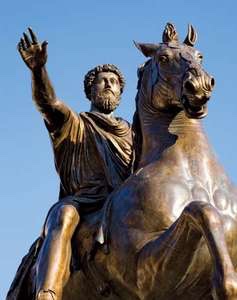
Tonight, just a short thought from the great Roman Statesman, Emperor, and Philosopher, Marcus Aurelius:

“Live a good life. If there are gods and they are just, then they will not care how devout you have been, but will welcome you based on the virtues you have lived by. If there are gods, but unjust, then you should not want to worship them. If there are no gods, then you will be gone, but will have lived a noble life that will live on in the memories of your loved ones.”

I try to live my life in that manner as. Christian. St. Paul himself said “And if Christ has not been raised, our preaching is useless and so is your faith.” So by some chance if we as Christians are wrong, we should always look back to the words of Marcus Aurelius.

I’m not going anywhere else with this tonight,

So Peace,

Padre Steve+

Leave a comment

Filed under ethics, faith, History, Loose thoughts and musings, philosophy, Political Commentary, Religion

We Could Use a Man (or Woman) Like Franklin Roosevelt Again

Friends of Padre Steve’s World,

If I had to place myself on the political spectrum it would be in the area occupied by Franklin Delano Roosevelt. I am definitely a liberal, I can no longer claim to be a conservative by any means of the imagination, but as a historian I am very careful in embracing the extremes of left, or right wing populism, the very things which are driving much of the political division in our country. In 1932 Franklin Roosevelt was wise enough to state:

“Say that civilization is a tree which, as it grows, continually produces rot and dead wood. The radical says: “Cut it down.” The conservative says: “Don’t touch it.” The liberal compromises: “Let’s prune, so that we lose neither the old trunk nor the new branches.” This campaign is waged to teach the country to march upon its appointed course, the way of change, in an orderly march, avoiding alike the revolution of radicalism and the revolution of conservatism.”

Of course there were quite a few conservatives and progressives of his time who loathes and attempted to obstruct, hamper, or defeat Roosevelt’s New Deal. But what many didn’t understand was that Roosevelt was willing to risk failure so long as he learned from it and succeeded in the end.

As Historian John Meacham wrote:

“Disappointed liberals lobbied the president to move more quickly on social and economic issues. “You’ll never be a good politician,” FDR once told Eleanor, who frequently presented such pleas to her husband. “You are too impatient.” At a White House meeting, Roosevelt parried a questioner with a lesson in practical politics. Lincoln, Roosevelt said, “was a sad man because he couldn’t get it all at once. And nobody can. Maybe you would make a much better President than I have. Maybe you will, someday. If you ever sit here, you will learn that you cannot, just by shouting from the housetops, get what you want all the time.” He sometimes turned to sports to make his point. “I have no expectation of making a hit every time I come to bat,” Roosevelt remarked. “What I seek is the highest possible batting average.”

Likewise, Meacham noted:

“He argued that leadership, even his own, was imperfect. A wise public, Roosevelt believed, would give a well-meaning, forward-leaning president the benefit of the doubt. “The country needs and, unless I mistake its temper, the country demands bold, persistent experimentation,” Roosevelt said in 1932. “It is common sense to take a method and try it: If it fails, admit it frankly and try another. But above all, try something…. We need enthusiasm, imagination and the ability to face facts, even unpleasant ones, bravely.”

The situation confronting Roosevelt is little different than we face today. There are political forces on the extreme left and right that have little regard for what has been accomplished in the American experiment, and who as Roosevelt noted either want to cut it down completely, or change nothing, as if two and a half-centuries have not passed. As Thomas Jefferson wrote:

“I am not an advocate for frequent changes in laws and Constitutions. But laws and institutions must go hand in hand with the progress of the human mind. As that becomes more developed, more enlightened, as new discoveries are made, new truths discovered and manners and opinions change, with the change of circumstances, institutions must advance also to keep pace with the times. We might as well require a man to wear still the coat which fitted him when a boy as civilized society to remain ever under the regimen of their barbarous ancestors.”

Meacham noted of Roosevelt:

Sustained by this view of progress, Roosevelt urged the nation onward. “We shall strive for perfection,” Roosevelt said. “We shall not achieve it immediately—but we still shall strive. We may make mistakes—but they must never be mistakes which result from faintness of heart or abandonment of moral principle…. Our Constitution of 1787 was not a perfect instrument; it is not perfect yet. But it provided a firm base upon which all manner of men, of all races and colors and creeds, could build our solid structure of democracy.”

Abraham Lincoln understood this when in the Gettysburg Address he noted:

“Fourscore and seven years ago our fathers brought forth, on this continent, a new nation, conceived in liberty, and dedicated to the proposition that all men are created equal. Now we are engaged in a great civil war, testing whether that nation, or any nation so conceived, and so dedicated, can long endure. We are met on a great battle-field of that war. We have come to dedicate a portion of that field, as a final resting-place for those who here gave their lives, that that nation might live. It is altogether fitting and proper that we should do this. But, in a larger sense, we cannot dedicate, we cannot consecrate—we cannot hallow—this ground. The brave men, living and dead, who struggled here, have consecrated it far above our poor power to add or detract. The world will little note, nor long remember what we say here, but it can never forget what they did here. It is for us the living, rather, to be dedicated here to the unfinished work which they who fought here have thus far so nobly advanced. It is rather for us to be here dedicated to the great task remaining before us—that from these honored dead we take increased devotion to that cause for which they here gave the last full measure of devotion—that we here highly resolve that these dead shall not have died in vain—that this nation, under God, shall have a new birth of freedom, and that government of the people, by the people, for the people, shall not perish from the earth.”

Roosevelt understood, just as Lincoln did that our system, form, and institutions were under attack from many sides, thus we all must take increased devotion… that this nation, under, God, shall have a new birth of freedom, and that government of the people, by the people, and for the people, shall not perish from thee earth.”

I am going to stop for now. I am about two-thirds of the way through Meacham’s book and about 1/3 of the way through Doris Kearns Goodwin’s Leadership in Turbulent Times, which looks at the lives, failures, and ultimate successes of the leadership styles of Abraham Lincoln, Theodore Roosevelt, Franklin Roosevelt, and Lyndon Baines Johnson.

It seams that now regardless of what party or ideology we espouse, we want absolute doctrinal purity. Certainly that was not what our founders thought, nor men like Franklin Roosevelt. Our Republic can be destroyed by the radicalism of the Right and Left, but also the complacency of the Center, which by ignoring the the crisis engulfing the country only make the crisis worse. Hannah Arendt noted:

“The ideal subject of totalitarian rule is not the convinced Nazi or the convinced Communist, but people for whom the distinction between fact and fiction (i.e., the reality of experience) and the distinction between true and false (i.e., the standards of thought) no longer exist.”

I am a liberal, a progressive, and a Democrat, but I am as much as of a realist as Franklin Roosevelt. Our Union is imperfect, but just because it is so it should not be cut down and destroyed, nor ignored and uncultivated by progress. The grafting of new branches onto the old stock is not a travesty, or a threat. It is the ideal that motivated the Founders was not that they were achieving perfection in the moment, but that they were planting ideals that would ultimately be universal. “We hold these truths to be self-evident, that all men are created equal and are endowed by their creator with certain unalienable rights, among them being life, liberty, and the pursuit of happiness.”

Such thoughts are now part of the Constitutions of other countries and the United Nations. If we want to look into the imaginary future they are included as part of the Constitution of the United Federation of Planets.

We live in a nation whose past is far from perfect, a nation that has deviated from its foundational principles all too many times, that being said, Franklin Roosevelt, understood this as fact. He did not try to mythologize our past. He sought the best from that ancient trunk and grafted on, as Abraham Lincoln, and Theodore Roosevelt before him, as well as Harry Truman, Dwight Eisenhower, John Kennedy, and Lyndon Johnson did after him, ideas that expanded liberty for all, without which the radicals of the right or left fail to appreciate.

Roosevelt spoke during his nomination speech at the 1932 Democratic Party Convention:

“Wild radicalism has made few converts, and the greatest tribute that I can pay to my countrymen is that in these days of crushing want there persists an orderly and hopeful spirit on the part of the millions of our people who have suffered so much,” Roosevelt said. “To fail to offer them a new chance is not only to betray their hopes but to misunderstand their patience.

The forces of progress, Roosevelt believed, were not to cower or to lash out, but to engage. “To meet by reaction that danger of radicalism is to invite disaster,” he said. “Reaction is no barrier to the radical. It is a challenge, a provocation. The way to meet that danger is to offer a workable program of reconstruction, and the party to offer it is the party with clean hands.

He then introduced a crucial phrase: “I pledge you, I pledge myself,” FDR said, “to a New Deal for the American people.” The crisis was existential. “His impulse,” Winston Churchill wrote of FDR in the mid-1930s, “is one which makes toward the fuller life of the masses of the people in every land, and which, as it glows the brighter, may well eclipse both the lurid flames of German Nordic self-assertion and the baleful unnatural lights which are diffused from Soviet Russia.”

That is how I view the situation today. As far as it goes, those who consider themselves to be Democratic Socialists are little more than Franklin Roosevelt, Harry Truman, John F Kennedy, or Lyndon Baines Johnson Democrats. They believe in the New Deal, Civil Rights, and the Great Society. They also believe in the realities of science and Climate Change and seek answers that work with our economic and scientific realities, like their predecessors they believe in the instruments of the future. In the past it was fossile fuels and nuclear power; now it is wind power, and solar energy, combined with the cleanest and most efficient forms of past energy. None of those ideas are radical, they are progressive, economically sound, job producing, and environmentally friendly policies that could help reverse the scourge of global warming, sea rise, and climate change.

Likewise, Franklin Roosevelt realized the dangers of Stalinist Communism and Hitlerian Fascism, which he saw as a threat to the United States in the 1930s, but in the short term he realized that the Nazi threat was the greatest threat, and allied with Britain, the Soviet Union, Free France, and China to defeat Germany first, Japan next, and then deal with the Soviet Union using the full power of the nation; Diplomatic, Informational, Military, and Economic to achieve the overthrow of the Soviet Union. That did not happen until 1990, but when it did a plethora of Soviet dominated regimes fell in Eastern Europe. Since that time the Bush, Clinton, Bush, Obama, and Trump administrations have surrendered many of those gains and allowed a New expansionist, Soviet Union, albeit without the Soviet Name to be reestablished in Russia under Vladimir Putin.

I won’t go into the other overseas threats, but he would recognize the danger of President Trump’s “America First” policy which is little different from the America Firsters of his era. He looked forward, they looked back. He looked at a world that might overwhelm the United States, the threats of Naziism, Fascism, and Stalinist Communism, and in spite of resistance from his own party and the Republican isolationists who adopted the America First ideology of men like Charles Lindberg which would have surrendered all of Europe, including Great Britain to the Nazis because it was nothing more than an intra-racial struggle and not one against inferior races. Even after Hitler overran Poland and Western Europe Lindberg argued:

“for leaving the Old World to its own devices. “Now that war has broken out again, we in America have a decision to make on which the destiny of our nation depends,” Lindbergh said, adding: “In making our decision, this point should be clear: these wars in Europe are not wars in which our civilization is defending itself against some Asiatic intruder. There is no Genghis Khan or Xerxes marching against our Western nations. This is not a question of banding together to defend the White race against foreign invasion. This is simply one more of those age-old quarrels within our own family of nations.”

Roosevelt knew that was nonsense. He worked patiently with congress on both sides of the aisle, building his case in spite of resistance until Hitler attacked Poland, and overran most of Western Europe, Roosevelt’s policy ideas were ratified into policy. When Japan attacked at Pearl Harbor and Hitler declared war on the United States he was able to act.

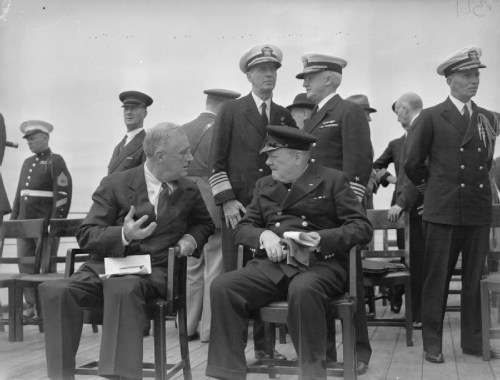
Roosevelt brought the country together. He helped to maintain at disparate alliance between Britain, the United States, and the Soviet Union. It was courageous, as Meacham noted:

” A man of courage, Churchill appreciated it when he detected courage in others, and he had seen it, intimately, in Franklin Roosevelt. “It was a marvel that he bore up against it through all the many years of tumult and storm,” Churchill said of FDR’s paralysis. “Not one man in ten millions, stricken and crippled as he was, would have attempted to plunge into a life of physical and mental exertion and of hard, ceaseless political controversy. Not one in ten millions would have tried, not one in a generation would have succeeded, not only in entering this sphere, not only in acting vehemently in it, but in becoming indisputable master of the scene.”

We need a leader like Franklin Roosevelt now. Personally, I am not sure if any of the challengers to Donald Trump has the gravitas, courage, or determination to go where Roosevelt went. He was willing to risk failure, admit it and try again. I don’t know if our political culture, at least the political culture of the Democratic Party would allow it. The Republicans don’t seem to care as is obvious by their continued support of Donald Trump, and his policies which are nothing short of Lindberg’s America First campaign, Hitler’s racial politics, and American Jim Crow laws.

Roosevelt began the domestic and international policies that Donald Trump fights against on a daily basis. I don’t know what Democratic candidate that will be, but it has to someone has to fully embrace the Roosevelt legacy and push it to the future. As Roosevelt showed this has to me more than about sound bites; it has to be about truth, integrity, and the willingness to engage with and even at times compromise with domestic political rivals in order to preserve the Republic against all enemies, foreign and domestic. But none of the Democratic Party candidates have yet to show me that they have the moral, or physical courage of Roosevelt who battled polio which deprived him of much of his mobility and physical abilities when he was 39 years old. Maybe if Senator Tammy Duckworth would enter the race I might see a candidate with that kind of courage. If she would enter the race, win the nomination, and the presidency, she would be the first female, combat vet and wounded warrior to serve as president.

I would like that very much.

But, until tomorrow we have what we have.

Peace,

Padre Steve+

4 Comments

Filed under History, national security, nazi germany, News and current events, Political Commentary, world war two in europe

A Meditation On Resistance For Today From General Henning Von Tresckow

Friends of Padre Steve’s World,

There are times that resistance seems almost hopeless. I was talking with one of my friends who is very discouraged about the situation. He is an idealist. I spent much of the evening trying to buck him up.

British Historian Laurence Rees wrote:

“human behavior is fragile and unpredictable and often at the mercy of the situation. Every individual still, of course, has a choice as to how to behave, it’s just that for many people the situation is the key determinate in that choice.” 

One of the problems is that throughout history, resisters frequently fail to unify in the face of their primary adversary and instead look for the faults among their own potential leaders. That my friends is the way to failure. So tonight, or as it is early this morning I will leave you with a few thoughts of one of the key German resistance leaders against Hitler during the Second World War. That man was Major General Henning Von Tresckow, a key member of the plot to assassinate Adolf Hitler.

Tresckow said a number of things that I will quote in the way he said or wrote them. But for every time Tresckow writes or says Hitler, substitute Trump, and when he says Germany, substitute the United States.

In reality that is now where we find ourselves. We are on the verge of a dictatorship of a man who can barely be called sane. Yet, he has a core Cult, of committed followers who will through their own willful avoidance of the truth would support him even if he overthrew the Constitution, and proclaimed dictatorial powers, and unleashed violence against every domestic opponent. He routinely makes those kinds of threats, to the cheers of his Cult. In one of his speeches from March 14th of this year Trump declared:

“I can tell you I have the support of the police, the support of the military, the support of the Bikers for Trump – I have the tough people, but they don’t play it tough — until they go to a certain point, and then it would be very bad, very bad,”

That is not a comfortable thought, but it is the new normal, especially among his supposedly Christian supporters, who include some of the most powerful religious leaders in the country.

Tresckow noted:

“I cannot understand how people can still call themselves Christians and not be furious adversaries of Hitler’s regime.”

I feel the same way about Trump, whose most fervent and loyal supporters are conservative or Evangelical Christians. Honestly, when I read their writing, hear the speeches, and listen to their defense of Trump I see little difference in them and the German Christian movement that turned the Churches into a key part Hitler’s political base. Honestly, I cannot understand how any Christian cannot be a furious adversary of the Trump regime. This is not based on politics at all, but the demands of the Gospel itself. As Jesus taught in Matthew 24:24:

“For false messiahs and false prophets will appear and produce great signs and omens, to lead astray, if possible, even the elect.”

Trump is an unbeliever in the greatest sense of the word. Though he presents himself as a defender of Christianity; in thought, word, and deed has made himself a cult-like messiah figure to conservative and Evangelical Christians. He has played on their fears, their racism, their misogyny, their homophobia, and their fear of something that they call socialism. Of course the early church was much more or a practitioner ethics that bordered on socialism, though the term was not yet in use, than the post-Nicea imperial church that has been the face of Christianity in most “Christian” countries since Constantine. This Trump Cult is not Christian: it is an anti-Christian, and anti-humanity personality cult.

Unlike the Third Reich, the situation has not reached the point for any resistier to resort to political violence in response to Trump or his Cult. Instead we must speak the truth and seek to win elections, and not build cult like followings of any of our candidates, and destroy any sense of unity. We have to win with ideas and truth. Even so there is a possibility that we could fail, that is a possibility, and that failure would be the certain end of our Republic, its institutions, and its Constitution as we know it.

Tresckow also said:

“It is almost certain that we will fail. But how will future history judge the German people, if not even a handful of men had the courage to put an end to that criminal?”

We have to put an end to the Trump regime at the ballot box, and even that may not cause him give up without a physical fight. His former attorney, Michael Cohen has said exactly that. Trump is destroying the hard work of Americans and our allies to build a better would, and in almost every country, Trump is destroying the image of the United States, like Tresckow said in his time:

“We have to show the world that not all of us are like him. Otherwise, this will always be Hitler’s Germany.”

Those are import words, but just substitute the name Trump for Hitler. Tresckow was no socialist or liberal, but he believed in freedom. In fact he wrote regarding the Prussian political tradition and how it could be subverted to support evil:

“The idea of freedom can never be disassociated from real Prussia. The real Prussian spirit means a synthesis between restraint and freedom, between voluntary subordination and conscientious leadership, between pride in oneself and consideration for others, between rigor and compassion. Unless a balance is kept between these qualities, the Prussian spirit is in danger of degenerating into soulless routine and narrow-minded dogmatism.”

Truthfully that is a spirit much like the United States that which is engulfing the United States today, soulless routine and narrow minded dogmatism. The tension that exists in the key ideal of the Declaration of Independence and the United States Constitution, and the words of Trump and his supporters men who desire to rule by fiat and by extra-Constitutional means, cannot be more marked than it is today.

In the movie adaptation of the plot to kill Hitler Valkyrie: Tresckow is quoted:

“God promised Abraham that he would not destroy Sodom if he could find ten righteous men… I have a feeling that for Germany it may come down to one.”

To be sure, Trump is no Hitler, though his words sound more and more Hitlerian every day. I will not call the President a Nazi, though he has give tacit support to Neo-Nazi and White Supremacist groups and frequently engages in racist diatribes. He is certainly acting as any authoritarian leader would, and we have to heed the warning of Russian dissident Gary Kasparov:

“dictators & would be autocrats do not ask “Why?” when it comes to using power for their advantage. They ask “why not?”

To go back to the words of Tresckow in Valkyrie, in noting it may come down to the actions of one man or woman, my friends, that “one” may come down to you or me. We cannot sit silently by as more and more actions that would have been considered as criminal are perpetrated by the President and his followers.

So until tomorrow,

Peace,

Padre Steve+

8 Comments

Filed under civil rights, ethics, faith, History, holocaust, Loose thoughts and musings, nazi germany, News and current events, Political Commentary, White nationalism

Life Unworthy Of Life: The Rational of the Trump Budget

Friends of Padre Steve’s World,

In a previous era a government through its laws, decrees, and policies deemed certain people to be “life unworthy of life.” That government was the Nazi regime of Adolf Hitler. The life that was unworthy of life included the physically and mentally handicapped or disabled, those with Downs Syndrome, Cerebral Palsy, Polio, and people with other neurological conditions. Likewise the mentally ill, those suffering clinical depression, schizophrenia, and other mental illnesses were considered to be life unworthy of life. Even the deaf were included, and veterans suffering from what we would now call PTSD or Traumatic Brain Injury. Also included were people labeled as “asocial” a very loose definition that could include almost any metal disorder or criminal act.

Tens of thousands were liquidated at the T-4 Euthanasia centers, most located in hospitals or sanitariums. Mostly gassed with carbon monoxide gas from the exhaust of trucks or Diesel engines, their remains were cremated. Others, especially children were either starved to death or given a lethal injection while they slept. The next of kin of each victim was sent a standard form letter telling them that their relative had died of influenza, typhus, or some other disease. They were given the option of paying for an urn that may or may not have contained the ashes of their loved ones for inurnment near their home town. If they could not afford it the ashes were disposed of in the cemetery where they were killed.

Despite the Nazis attempts to disguise their crime they could not be hidden, and after over 70,000 Germans were Euthanized the official T-4 Euthanasia program was ended in German. The gas chambers and cremation ovens and facilities were disassembled and sent east to Poland, where they and their experienced technicians became key components of the Holocaust of the Jews.

But the Euthanasia program didn’t stop, it simply moved eastward as the SS Einsatzgruppen killed the patients at every mental hospital, sanitarium, old folks home, or orphanage they came across. Inside Germany at the four T4 centers over 80,000 were gassed. At Hartheim in Austria a Party was held on the gassing of the 10,000th victim. Richard Evans wrote:

“At Hartheim the staff held a party to celebrate their ten-thousandth cremation, assembling in the crematorium around the naked body of a recently gassed victim, which was laid out on a stretcher and covered with flowers. One staff member dressed as a clergyman and performed a short ceremony, then beer was distributed to all present. Eventually no fewer than 20,000 were gassed at Hartheim, the same at Sonnenstein, 20,000 at Brandenburg and Bernburg, and another 20,000 at Grafeneck and Hadamar, making a total of 80,000 altogether.”

The tolls in Poland, the Baltic States, and the Soviet Union were much higher, but outside of the T4 program which “officially” ended in 1941.

Now in the United States the laws guaranteeing health care to people are being challenged, the Secretary of Education has removed funding from the Department’s funding request for the Special Olympics, programs for the physically and mentally disabled under the SSI are being cut to the bone, and even care for disabled veterans is being threatened as not being economical because none of them are economically valuable to an administration for which profit is the bottom line, and supposedly pro-life Christians have no problems in cutting such programs because many have bought into the materialistic Prosperity Gospel, whose fawning preachers have anointed President Trump if he were King Cyrus. Criticism of the President cannot be tolerated, and the sick, weak, weak, infirm, or mentally ill, who are not productive have no place in society. Inside the womb they are a political issue, outside the womb they might as well be dead if you listen to Trump’s clique of Reichsbishofs those who cannot produce for the economy should not eat, get medical care, or live. They are life unworthy of life.

You see, in the authoritarian world where an uninhibited and unhinged executive backed by profit minded billionaires, and equally greedy preachers, such lives; the old and infirm, the disabled, the mentally ill, the young but physically disabled, those with neurological issues, and birth defects stand in the way of profit, stand in the way of a “perfect” society. Such people may not advocate euthanasia per say, gas chambers, or firing squads, but starving them, depriving them of medical care, turning them out of care facilities knowing that their families lack the capability of caring for them, and if they have any capacity for work, work them until they die, so long as they Confess Christ before they die.

How do we know that life does not matter to them? One way is to note the many times that pharmaceutical corporations have increased the costs of previously inexpensive yet vital life saving medicines by thousands of dollars a dose all for profit with little to no pushback from the White House, or the FDA, much less the Senate GOP majority, or the Evangelical supporters of Trump.

Please understand, this dystopian future need not happen if people of any faith, or no faith at all make a stand against a twisted idea of dictatorship backed up by billionaires and corporate entities that suck billions of dollars from the taxpayer and pay almost nothing themselves. Of course they couldn’t do it on their own in not supported by a de facto State Media, and a cult like legion of followers who would follow Trump even if he shot someone on 5th Avenue. His words, not mine.

As I turn 59 today, this does bother me enough to speak out. As a senior military officer facing the end of his career and retirement amid multiple physical and emotional issues, it does matter. I keep two things in mind today. First is that of my own responsibility. In that I am reminded of the words of German General Ludwig Beck who wrote:

“It is a lack of character and insight, when a soldier in high command sees his duty and mission only in the context of his military orders without realizing that the highest responsibility is to the people of his country.”

And his compatriot, Major General Henning Von Tresckow stated: “We have to show the world that not all of us are like him. Otherwise, this will always be Hitler’s Germany.”

Historian Timothy Snyder reminds of a certain truth, which should we forget, as I imagine a large number of Trump supporters have:

“The European history of the twentieth century shows us that societies can break, democracies can fall, ethics can collapse, and ordinary men can find themselves standing over death pits with guns in their hands. It would serve us well today to understand why.”

Those all are hard truths to comprehend. As Americans we always presume that we are the good guys, when in fact many times we have acted in means contrary to the ideals of the Declaration as well as the Constitution, and other laws enacted by Congress. But our republic and its institutions are both resilient and fragile. History has proven this, we have even survived a civil war, but we may not survive an increasingly vindictive and unstable President, his compliant majority in the Senate, and the 35-40% of voters who are in effect no longer Republicans, but the Trump Cult which is largely buttressed by Conservative Evangelical Churches, and inspired by a President who uses force, legal, and extralegal alike to secure his rule.

We live in extraordinary times which call for extraordinary strength if our Republic is to continue in any form that resembles the intentions of the founders and their liberal enlightenment beliefs.

If we do not want to see the return of a full fledged government and industrial sponsored campaign to eradicate life unworthy of life, we have to fight. It is a fight that we did not chose, but if the Republic is to survive without becoming a criminal dictatorship we must speak up.

As Yehuda Bauer said: “Thou shall not be a perpetrator, thou shall not be a victim, and thou shall never, but never, be a bystander.”

The choice is ours.

Until tomorrow, or maybe later tonight,

Peace,

Padre Steve+

3 Comments

Filed under ethics, faith, History, holocaust, nazi germany, News and current events, Political Commentary

“You can take our lives and our freedom, but you cannot take our honour. We are defenseless but not honourless.” Remembering the Resistors to the Enabling Act Of 1933

Otto Wels

Friends of Padre Steve’s World,

I will not be talking about the Mueller report until we know what is actually contained in it. So I will continue to discuss historical events that are relevant in our time.

One of the most relevant as this country and others lurch toward legally elected authoritarian governments is the example of the Hitler’s Enabling Act, or by its full title Gesetz zur Behebung der Not von Volk und Reich (“Law to Remedy the Distress of People and Reich”) came on the heels of the Reichstag Fire Decree and though very short had tremendous repercussions for the German Republic and in effect made Hitler and his administration a dictatorship. The legislative branch, the Reichstag was limited to nothing more than a rubber stamp for the executive, as was the judicial branch, the Reichsrat. It supposedly protected the rights of the President, the Reichstag, and judiciary, but it made Hitler the the sole decider of domestic and social laws, as well as all foreign policy decisions.

The law stated:

The Reichstag has enacted the following law, which is hereby proclaimed with the assent of the Reichsrat, it having been established that the requirements for a constitutional amendment have been fulfilled:

Article One

In addition to the procedure prescribed by the constitution, laws of the Reich may also be enacted by the government of the Reich. This includes the laws referred to by Articles 85 Paragraph 2 and Article 87 of the constitution. (Article 85 and 87 dealt with the budgetary process and allocation of funds for advertisement.)

Article Two

Laws enacted by the government of the Reich may deviate from the constitution as long as they do not affect the institutions of the Reichstag and the Reichsrat. The rights of the President remain unaffected.

Article Three:

Laws enacted by the Reich government shall be issued by the Chancellor and announced in the Reich Gazette. They shall take effect on the day following the announcement, unless they prescribe a different date. Articles 68 to 77 of the Constitution do not apply to laws enacted by the Reich government. (These Articles dealt with the legislative process in which the Reichstag, Government, Reichsrat, and President all had specific responsibilities which limited the power of the government to rush laws into force without due process and deliberation, and if needed the approval of the electorate)

Article Four

Treaties of the Reich with foreign states, which relate to matters of Reich legislation, shall for the duration of the validity of these laws not require the consent of the legislative authorities. The Reich government shall enact the legislation necessary to implement these agreements. (This removed the requirement of the Reichstag to approve treaties)

Article Five

This law enters into force on the day of its proclamation. It expires on April 1, 1937; it expires furthermore if the present Reich government is replaced by another.

When the legislation was introduced the debate was muted. While the Communist Party was yet to be banned, deputies of the Communist Party could not attend the session, many had already been arrested and many more were in hiding or had fled the country. Hermann Goering adjusted the rules for a quorum in order to compensate for the lack of members in attendance. Deputies of the Social Democratic Party were also terrorized, hounded, and some arrested, but 94 attended, outnumbered they did not buckle under the Nazi threats, which included the chamber being ringed by armed members of the SA and SS.

The non-Nazi Protestant based conservative parties provided no resistance, but the Catholic Center Party was torn by concerns that the legislation could limit the rights of the Catholic Church. However, they had been outmaneuvered by Hitler who had already negotiated a Concordant with the Vatican. The result was to ensure that the Catholic Center Party would vote for the measure, which passed with a mere 94 deputies opposing it, all members of the Social Democratic Party.

The only member of the Reichstag to speak against the measure was the head of the Social Democrats, Otto Wels. In defiance of Hitler, Goering, the Nazi Deputies, and the threatening SA and SS men uttered words that every resistor in every country threatened by authoritarian leaders who despise the rule of law and the Constitutions that they used to gain power need to hear and proclaim, because the truth can never be silenced:

“You can take our lives and our freedom, but you cannot take our honour. We are defenseless but not honourless.”

Otto Wels died as an exile in France. Many Social Democrats were placed in Concentration Camps and died, likewise some Communists. The Catholic Center Party would find itself betrayed, and many of its leaders would be killed, jailed, or placed in Concentration Camps, and Hitler would persecute opposition members of the Catholic Church as if no Concordat had ever been negotiated.

But eventually the Nazis would be driven from power. Their descendants today must be confronted at all costs. Democracy, and Constitutional republics based on the principles of the Declaration of Independence, which recognizes that all men are created equal, and the Constitution of the United States which was the first to checks and balances between the Executive, Legislative, and Judicial branches of government in which the Legislative branch was assumed to be the most important.

We have reached a point in the history of the United States where the Executive Branch, over a period of decades has assumed the powers of dictatorship as the Legislative branch over the corresponding time has surrendered its prerogatives and powers, while the judicial branch had become the domain of politically appointed judges and justices,

One does not know what will happen next, but anyone who values the primary principles of the Declaration and the Constitution must ne willing to take a stand like Otto Wels when confronted with a dictatorship in the making. Even if the President unleashes the power of the police and his own heavily armed supporters against opponents, we must remember like Otto Wels, they can “take our lives and freedom, but they cannot take our honor…”

This is something that anyone committed to the principles of the Declaration and Constitution must take seriously over the next 19 months leading to the next Presidential election. If we fail, the effects will be felt for at least a generation, and the institutions of our government will be transformed in ways that the founders could only imagine in their worst dreams.

Democrats and Never Trump conservatives must keep this in mind. Nothing is guaranteed right now, it is quite possible that Trump and his cult like supporters in Congress and the courts could enact something like the Enabling Act if we are not careful, regardless of the findings of the Mueller investigation or anything else, and we must be careful to watch for the major terrorist attack, or war that could lead to the implementation of already legislated laws, or executive orders that give nearly dictatorial powers to the executive, and which would be supported by a majority of Americans.

So until tomorrow.

Peace,

Padre Steve+

Leave a comment

Filed under ethics, History, laws and legislation, nazi germany, News and current events, philosophy, Political Commentary, Religion

“We do not Foolishly Suppose that Victory on the Battlefield will Gaurentee Democracy at Home: Rabbi Roland Gittlesohn’s Sermon at the Dedication of the Cemetery on Iwo Jima

39GittelsonIwoJima2

Rabbi Roland Gittelson, Chaplain Corps U.S. Navy

Friends of Padre Steve’s World,

I have been serving in the military for almost 38 years between the Army and the Navy, and I have been a chaplain for almost 27 of those years. Over six of those years as a Navy Chaplain were spent serving with the Marine Corps. During that time I have gotten to know, respect, and become with Jewish Rabbis serving in the Chaplan Corps. There are not many of them currently serving, and like so much of American religion, they are divided into different denominations, Orthodox, Conservative, and Reformed. Like all current military personnel they are volunteers. The Rabbis I have served with are primarily Reformed or Conservative, and all have done what they could to care for the spiritual needs of all who come to them. They serve in the highest tradition of the Chaplain Corps, and fight for and preserve the religious freedoms of  all personnel.

Like them, Rabbi Roland Gittelson volunteered to serve as a Navy Chaplain in the Second World War and like many Navy Chaplains he was assigned to serve with the Marines. He was the first Rabbi to serve with the Marines.

He went ashore with the 5th Marine Division at Iwo Jima. The battle was one of the most brutal ever fought by the Marines. In the month long battle for the 8.1 square mile island the Marines and Navy suffered nearly 7,000 men killed and 19,000 wounded. Over 18,000 of the island’s Japanese defenders died. On March 21st 1945 the Rabbi was one of the Chaplains to dedicate the cemetery for the fallen. The prejudice was such that many of his Christian colleagues wanted nothing to do with him and nothing to do with any service that he conducted. Though the division Chaplain had wanted him to conduct the main service to commemorate all of the fallen: Protestant, Catholic, Jewish, White, Black, and Mexican because no one else would conduct an ecumenical service, but both realized that the push back would be too much, so Gittelsohn conducted the Jewish service, expecting little to come of it except for the spiritual impact that it might have on his Jewish Marines, but unbeknownst to him a few Protestant Chaplains watched the service and then distributed it throughout the division and back to home.

Rabbi Gittelsohn’s message is one of the most remarkable that I have heard or read by any Chaplain and is very similar to the message of Abraham Lincoln’s Gettysburg Address. It is a message that needs to be heard today. That is why I am posting it here.

Have a great weekend,

Peace

Padre Steve+
This is perhaps the grimmest and surely the holiest task we have faced since D-day. Here before us lie the bodies of comrades and friends. Men who until yesterday or last week laughed with us, joked with us, trained with us. Men who were on the same ships with us and went over the sides with us, as we prepared to hit the beaches of this island. Men who fought with us and feared with us. Somewhere in this plot of ground there may lie the man who could have discovered the cure for cancer. Under one of these Christian crosses, or beneath a Jewish Star of David, there may rest now a man who was destined to be a great prophet—to find the way, perhaps, for all to live in plenty, with poverty and hardship for none. Now they lie here silently in this sacred soil, and we gather to consecrate this earth in their memory.

It is not easy to do so. Some of us have buried our closest friends here. We saw these men killed before our very eyes. Any one of us might have died in their places. Indeed, some of us are alive and breathing at this very moment only because men who lie here beneath us had the courage and strength to give their lives for ours. To speak in memory of such men as these is not easy. Of them, too, can it be said with utter truth: “The world will little note nor long remember what we say here. It can never forget what they did here.”

No, our poor power of speech can add nothing to what these men and the other dead of our division who are not here have already done. All that we can even hope to do is follow their example. To show the same selfless courage in peace that they did in war. To swear that, by the grace of God and the stubborn strength and power of human will, their sons and ours shall never suffer these pains again. These men have done their job well. They have paid the ghastly price of freedom. If that freedom be once again lost, as it was after the last war, the unforgivable blame will be ours, not theirs. So it is the living who are here to be dedicated and consecrated.

We dedicate ourselves, first, to live together in peace the way they fought and are buried in war. Here lie men who loved America because their ancestors, generations ago, helped in her founding, and other men who loved her with equal passion because they themselves or their own fathers escaped from oppression to her blessed shores. Here lie officers and men, Negroes and whites, rich men and poor—together. Here are Protestants, Catholics, and Jews—together. Here no man prefers another because of his faith or despises him because of his color. Here there are no quotas of how many from each group are admitted or allowed. Among these men there is no discrimination. No prejudice. No hatred. Theirs is the highest and purest democracy.

Any man among us the living who fails to understand that will thereby betray those who lie here dead. Whoever of us lifts his hand in hate against a brother, or thinks himself superior to those who happen to be in the minority, makes of this ceremony and of the bloody sacrifice it commemorates, an empty, hollow mockery. To this, them, as our solemn, sacred duty, do we the living now dedicate ourselves: to the right of Protestants, Catholics and Jews, of white men and Negroes alike, to enjoy the democracy for which all of them have here paid the price.

To one thing more do we consecrate ourselves in memory of those who sleep beneath these crosses and stars. We shall not foolishly suppose, as did the last generation of America’s fighting men, that victory on the battlefield will automatically guarantee the triumph of democracy at home. This war, with all its frightful heartache and suffering, is but the beginning of our generation’s struggle for democracy. When the last battle has been won, there will be those at home, as there were last time, who will want us to turn our backs in selfish isolation on the rest of organized humanity, and thus to sabotage the very peace for which we fight. We promise you who lie here; we will not do that! We will join hands with Britain, China, Russia—in peace, even as we have in war, to build the kind of world for which you died.

When the last shot has been fired, there will still be those whose eyes are turned backward not forward, who will be satisfied with those wide extremes of poverty and wealth in which the seeds of another war can breed. We promise you, our departed comrades: this, too, we will not permit. This war has been fought by the common man; its fruits of peace must be enjoyed by the common man! We promise, by all that is sacred and holy, that your sons, the sons of miners and millers, the sons of farmers and workers, will inherit from your death the right to a living that is decent and secure.

When the final cross has been placed in the last cemetery, once again there will be those to whom profit is more important than peace, who will insist with the voice of sweet reasonableness and appeasement that it is better to trade with the enemies of mankind than, by crushing them, to lose their profit. To you who sleep here silently, we give our promise: we will not listen! We will not forget that some of you were burnt with oil that came from American wells, that many of you were killed by shells fashioned from American steel. We promise that when once again men seek profit at your expense, we shall remember how you looked when we placed you reverently, lovingly, in the ground.

This do we memorialize those who, having ceased living with us, now live within us. Thus do we consecrate ourselves, the living, to carry on the struggle they began. Too much blood has gone into this soil for us to let it lie barren. Too much pain and heartache have fertilized the earth on which we stand. We here solemnly swear: this shall not be in vain! Out of this, and from the suffering and sorrow of those who mourn this, will come—we promise—the birth of a new freedom for the sons of men everywhere.

Amen.

1 Comment

Filed under faith, History, Military, Religion, US Marine Corps, US Navy, world war two in the pacific