Category Archives: laws and legislation

Racism & the Failure of Reconstruction

this-is-a-white-mans-government


Friends of Padre Steve’s World

Some events and attitudes are timeless, one of these is racism. Being white myself, I know that many whites are loath to admit that the scourge of racism still exists, but it does and it runs deep in our history. The more that I work on my Civil War and Gettysburg text, which now appears will morph into at least two and maybe three books when I am done, I find terribly distressing parallels to attitudes and actions of some which mirror the attitudes and actions of our ancestors, Northern and Southern following the Civil War. When the shooting stopped and the South was vanquished, many Southerners continued the war by other means and Northerners, divided after the death of Abraham Lincoln failed to achieve the most important political goal, after the restoration of the Union, that of true freedom for African Americans. Sadly, for some that war is still not over, as was evidenced in the aftermath of the Emanuel A.M.E. Massacre just two weeks ago. Likewise the burnings of six predominantly black churches across the South raises the specter of the racial violence that targeted blacks for a century after the Civil War.

This is another section of my text. I do hope that it challenges you as much as writing it challenged me.

Peace

Padre Steve+


When the war ended the Confederacy was beaten and most people in the South would have agreed to anything that the North presented regarding peace and return to the Union. In a sense Reconstruction was “what the war was about.” [1] Richard Henry Dana, the declared that “a war is over when its purpose is secured. It is a fatal mistake to hold that this war is over because the fighting has ceased. This war is not over…” [2] As Dana, and Clausewitz understood so well that war is a continuation of policy and politics by other means, and the failure of the North to fully grasp this fact led to over a century of subjugation of emancipated African Americans and has fueled a continual racial divide in the United States that is still felt today. Defeated on the battlefield Southerners soon turned to political, psychological and violent means to reverse their losses.

Frederick Douglass understood that simple emancipation was not enough, and that the “war and its outcome demanded racial equality.” [3] Despite the that efforts of many in the North this would not happen during Reconstruction and Douglass knew that the failure to accomplish this would be disastrous, “Whether the tremendous war so heroically fought…shall pass into history a miserable failure…or whether on the other hand, we shall, as the rightful reward of victory over treason have a solid nation, entirely delivered from all contradictions and social antagonisms, must be determined one way or another.” [4]

There was a problem with implementing Reconstruction; when John Wilkes Booth assassinated Abraham Lincoln, the political leaders of the North could not agree on how to do this. The new President, Andrew Johnson was probably the worst possible leader to lead the country in the aftermath of war for all practical purposes Johnson was a Democrat who believed in white supremacy, he had been brought onto the ticket for his efforts to keep Kentucky in the Union and to support Unionist elements in Tennessee. While his selection helped Lincoln in parts of the North and the Border States it was a disaster for the post-war era. Johnson’s approach to reconstruction was very simply to “impose minimal demands on the South. He required only minor concessions from the former Confederates before allowing them to resume their political rights and retain their land. As for freedmen, he seemed to think that the needed no further protection beyond the fact of their emancipation.” [5]

Johnson was “a lonely stubborn man with few confidants, who seemed to develop his policies without consulting anyone, then stuck to them inflexibly in the face of any and all criticism. He lacked Lincoln’s ability to conciliate his foes and his capacity for growth, which was best illustrated by Lincoln’s evolving attitude to black suffrage during the Civil War.” [6] In the months after his unexpected accession to the presidency Johnson demonstrated that he had no understanding of Lincoln’s political goals for the South and the desires of the Republican dominated Congress.

By the summer of 1865 Johnson was already demonstrating “that his sympathies were with the Southern white population and that he believed that their interests should be cared for even at the expense of freedmen.” [7] Johnson’s approach to reconstruction was very simply to “impose minimal demands on the South. He required only minor concessions from the former Confederates before allowing them to resume their political rights and retain their land. As for freedmen, he seemed to think that the needed no further protection beyond the fact of their emancipation.” [8] Johnson gave individual pardons to more than thirteen thousand “high-ranking Confederate civil and military officers and wealthy Southerners.” [9] While doing this he minimized political influence the Southern Unionists who had not supported the Confederacy and ensured that freed slaves were excluded from the political process. He issued a number of orders “appointing interim provisional governors and urging the writing of new state constitutions based upon the voter qualifications in force at the time of secession in 1861 – which meant, in large but invisible letters, no blacks.” [10]

When Frederick Douglass led a delegation of blacks to meet with Johnson in February 1865 Johnson preached that it was impossible to give political freedom to blacks. When Douglass attempted to object Johnson became angry and told Douglass “I do not like to be arraigned by some who can get up handsomely-rounded periods and rhetoric, and talk about abstract ideas of liberty, who never periled life, liberty, or property.” [11] When Douglass took his objections to Johnson’s harangue to a Washington newspaper, Johnson railed against Douglass “I know that d—–d Douglass…he’s just like any other nigger & would sooner cut a white man’s throat than not.” [12]

White Southerners including the newly pardoned Confederates enacted black codes that “codified explicit second-class citizenship for freedpeople.” [13] The legislature of Mississippi refused to ratify the Thirteenth Amendment, and did not do so until 1995. One Southerner noted that “Johnson “held up before us the hope of a ‘white man’s government,’ and this led us to set aside negro suffrage…. It was natural that we should yield to our old prejudices.” [14] Former Confederates, including Alexander Stephens the former Vice President of the Confederacy were elected to high office, Stephens to the United States Senate and the aggrieved Republicans in Congress in turn refused to admit the former Confederates. Many Union veterans were incensed by Johnson’s actions, one New York artilleryman noted “I would not pardon the rebels, especially the leaders, until they should kneel in the dust of humiliation and show their deeds that they sincerely repent.” [15] He was not alone, many Northern Veterans who formed the integrated Grand Army of the Republic veterans maintained a patent disregard, if not hatred of what the old South stood for and felt that their efforts in the war had been betrayed by the government.

Johnson’s restoration of property to the former white owners drove tens of thousands of blacks off lands that they had been farming, or left them as laborers for their former slave masters. Johnson countermanded General William Tecumseh Sherman and Secretary of War Edwin Stanton’s Field Order 15 to “divide abandoned and confiscated lands on the Sea Islands and in a portion of the Low Country coast south of Charleston into forty-acre plots for each black family.” [16] As such many freed blacks were now at the mercy of their former white owners for any hope of economic sustenance. Johnson stridently to frustrate the efforts of the Freedmen’s Bureau headed by Major General Oliver Howard to help freed blacks to become landowners. Johnson vetoed the Civil Rights bill but Congress overrode his veto. Eventually the battled between Johnson and Congress resulted in Johnson’s impeachment and narrow acquittal by one vote in the Senate in 1868.

The various black codes enacted throughout the South:

“passed labor laws that bound blacks to employers almost as tightly as slavery once bound them to their masters. Other codes established patterns of racial segregation that had been impossible under slavery, barred African Americans from serving on juries or offering testimony in court against whites, made “vagrancy,” “insulting gestures,” and “mischief” offenses by blacks punishable by fines or imprisonment, forbade black-white intermarriage, ad banned ownership by blacks of “fire-arms of any kind, or any ammunition, dirk or bowie-knife.” [17]

Likewise within weeks of the end of the violence against blacks began to break out in different parts of the South and it continued to spread as Johnson and Congress battled each other in regard to Reconstruction policy. “In Memphis, Tennessee, in May of 1866, whites on a rampage of murder killed forty-six Negroes, most of them veterans of the Union army, as well as two white sympathizers. Five Negro women were raped. Ninety homes, twelve schools and four churches were burned. In New Orleans in the summer of 1866, another riot against blacks killed thirty-five Negroes and three whites.” [18]

This alienated him from the Republican majority who passed legislation over Johnson’s veto to give black men the right to vote and hold office, and to overturn the white only elections which had propelled so many ex-Confederates into political power. Over Johnson’s opposition congress took power over Reconstruction and “Constitutional amendments were passed, the laws for racial equality were passed, and the black man began to vote and to hold office.” [19] Congress passed measures in 1867 that mandated that the new constitutions written in the South provide for “universal suffrage and for the temporary political disqualification of many ex-Confederates.” [20]   These measures helped elect bi-racial legislatures in the South which for the first time enacted a series of progressive reforms including the creation of public schools. They also ratified the Thirteenth and the Fourteenth Amendments, but these governments, composed of Southern Unionists, Northern Republicans and newly freed blacks were “elicited scorn from the former Confederates and from the South’s political class in general.” [21] Seen as an alien presence by most Southerners the Republican governments in the South faced political and was as violent opposition.

The Fourteenth Amendment was of particular importance for it overturned the Dred Scott decision which denied citizenship to blacks. Johnson opposed the amendment and worked against its passage by campaigning for men who would oppose it in the 1866 elections. His efforts earned him the opposition of former supporters including the influential New York Herald declared that Johnson “forgets that we have passed through a fiery ordeal of a mighty revolution, and the pre-existing order of things is gone and can return no more.” [22]

When passed by Congress the amendment was a watershed which would set Constitutional precedent for future laws to give women the right to votes, end Jim Crow laws, enact the Voting Rights Act of 1965, and most recently to give homosexuals the right to marry. Section one of the amendment read:

“All persons born or naturalized in the United States, and subject to the jurisdiction thereof, are citizens of the United States and of the state wherein they reside. No state shall make or enforce any law which shall abridge the privileges or immunities of citizens of the United States; nor shall any state deprive any person of life, liberty, or property, without due process of law; nor deny to any person within its jurisdiction the equal protection of the laws.” [23]

But these measures provoked even more violence from enraged Southerners who formed a variety of violent racist organizations which turned the violence from sporadic attacks to what amounted to a full-fledged insurgency against the new state governments and African Americans. Organizations like the Ku Klux Klan which engaged in terroristic violence to heavily armed “social clubs” which operated under the aegis of the state Democratic Party leadership in most Southern states. Allegedly organized for self-defense against state militia units composed of freed blacks they named themselves “White Leagues (Louisiana), White Liners or Rifle Clubs (Mississippi), or Red Shirts (South Carolina). They were, in fact, paramilitary organizations that functioned as armed auxiliaries of the Democratic Party in southern states in their drive to “redeem” the South from “black and tan Negro-Carpetbag rule.” [24] These men, mostly Confederate veterans “rode roughshod over the South, terrorizing newly freed slaves, their carpetbagger allies, and anyone who dared to imagine a biracial democracy as the war’s change.” [25] This unrequited violence and hatred set the stage for the continued persecution, murder and violence against blacks and those who supported their efforts to achieve equality in the South for the next century.

Throughout his term in office Johnson appealed to arguments used throughout later American history by “critics of civil rights legislation and affirmative action. He appealed to fiscal conservatism, raised the specter of an immense federal bureaucracy trampling on citizens’ rights, and insisted that self-help, not government handouts, was the path to individual advancement.” [26] While many of his Republican opponents supported these measures, many moderate Republicans could not abandon their support of or and ties to big corporations, and

Ulysses S. Grant succeeded Johnson as President in 1869 but his efforts at Reconstruction were met mostly by failure as well as a weariness on the part of many Northerners to continue to invest any more effort into it. Slowly even proponents of Reconstruction began to retreat from it and Southerners, knowing that they were winning the political battle continued their pressure. Both politically and through the use of terror to demoralize and drive from power anyone who supported it. By 1870 every former Confederate state had been readmitted to the Union, in a sense fulfilling a part Lincoln’s war policy, but at the same time denying what the war was waged for.

Congressman Thaddeus Stevens, one of the most effective leaders of the Radical Republicans died in 1868 in despair that the rights of blacks were being rolled back even as legislation was passed supporting them. The old firebrand asked “to be buried in a segregated cemetery for African American paupers so that “I might illustrate in death the principles which I advocated through a long life, Equality of man before his creator.” [27] Others including Senator Ben Wade, were not returned to office while others including Edwin Stanton, Salmon Chase and Charles Summer all died during Grant’s administration.

While Grant attempted to smash the Ku Klux Klan by military means his administration, heavily made up of economic conservative Republicans who had little interest in the rights of African Americans gave little other support to those fighting for equal rights for blacks. In the end Southern intransigence wore out the political will of Northerners to carry on, even the strongest supporters of equality.

By “1870 Radical Republicanism as a coherent political movement was rapitdl6y disintegrating” [28] and during the early 1870s many of the antislavery activists had left the Republican party either to death or defection, many “no longer felt at home in a party that catered to big business and lacked the resolve to protect black rights.” [29]

In 1872, some former radical Republicans revolted against Grant and the corruption in the Republican Party. Calling themselves “Liberal Republicans” they supported the candidacy of Horace Greeley uniting with Democrats to call for an end to Reconstruction. For many this was not so much because they no longer supported the rights of African Americans, but because for them, like so many, “economic concerns now trumped race relations…. Henry Adams, who shared the views of his father, Charles Francis Adams, remarked that “the day is at hand when corporations far greater than [the] Erie [Railroad]…will ultimately succeed in directing the government itself.” [30] The numbers of Federal troops in the South continued to be reduced to the point where they could offer little or no support to state militia.

Violence now became a means to further politics in the South and carried out in broad daylight and “intended to demoralize black voters and fatally undermine the Republican Party…. They paraded at regular intervals through African American sections of small towns in the rural black majority areas, intimidating the residents and inciting racial confrontations.” [31] These armed bands were highly successful, if they were successful in provoking a racial incident they would then fan out throughout the area to find blacks in order to beat up and kill, hundreds of blacks were killed by them. During the elections of 1876 the White Liners, Red Shirts and others would be seen in threatening positions near Republican rallies and on Election Day swarmed the polls to keep blacks and Republicans out, even seizing ballot boxes. The strategy employed was to use “Lawless and utterly undemocratic means…to secure the desired outcome, which was to win a lawful, democratic election.” [32]

The elected governor of Mississippi, Republican General Adelbert Ames, who was one of the most able and honest of all the Northerners to hold elected office in the South wrote in 1875 about the power of the paramilitary groups, “The “white liners” have gained their point – they have, by killing and wounding, so intimidated the poor Negroes that they can in all human probability prevail over them at the election. I shall try at once to get troops form the general government. Of course it will be a difficult thing to do.” [33] Ames did not get his troops. Grant’s Attorney general wrote “The whole public are tired out with these autumnal outbreaks in the South…and the great majority are now ready to condemn any interference on the part of the government….Preserve the peace by the forces in your own state….” [34] Ames, who had been a strong proponent of emancipation and black suffrage understood that he was being abandoned and in order to prevent more bloodshed gave up the fight. He negotiated a deal with Democrats which resulted in blacks being forced form the polls and the Democrats returning to power in the state.

The White League in Louisiana was particularly brutal and on Easter Sunday massacred blacks in Colfax Louisiana killing at least seventy-one and possibly as many as three-hundred blacks, killing many as they tried to surrender. Another White League detachment southwest of Shreveport “forced six white Republicans to resign their office on pain of death – and then brutally murdered them after they had resigned.” [35]

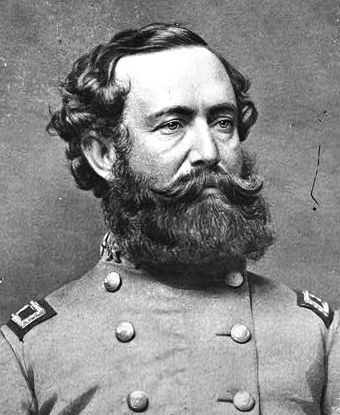
Reconstruction was officially ended in 1877 by newly elected President Rutherford B. Hayes and all Federal troops assigned to enforce it were withdrawn. Despite this, some people in the South attempted to fight for the rights of African Americans, including men like former Confederate Generals James Longstreet, William Mahone and Wade Hampton. Hampton was elected as the first post-Reconstruction governor of South Carolina in and campaigned against the black codes, and during his term in office even appointed African Americans to political offices in the state and maintained a regiment of African American state militia in Charleston against strident opposition.

While Hampton remained a white supremacist he also was committed to the upholding the law and “promoting the political rights to which freedmen were entitled to under law, and he consistently strove to protect those rights.” [36] This made him anathema to many South Carolina politicians, including Benjamine Tillman who as governor during the 1890s dismantled policies that Hampton had introduced to allow blacks to political patronage appointments. Once he did that Tillman set out to deprive South Carolina’s blacks of almost ever basic civil right, and in 1895 he led “a successful effort to rewrite the South Carolina constitution in such a way as to virtually disenfranchise every black resident of the state.” [37] Longstreet, who had become a Republican was wounded while leading Louisiana militia in an unsuccessful fight against White Leaguers in New Orleans on September 14th 1873.

The legislation which helped provide blacks with some measure of freedom was rolled back after Reconstruction ended. In 1883 “the Civil Rights Act of 1875, outlawing discrimination against Negroes using public facilities, was nullified by the Supreme Court, which said: “individual invasion of individual rights is not the subject-matter of the amendment.” The Fourteenth Amendment, it said, was aimed at state action only. No state shall…” [38]

The actions of the court and alliances between Northern corporations and Southern landowners led to even more discrimination and disenfranchisement for blacks, “From the 1880s onward, the post-Reconstruction white governments grew unwilling to rely just on intimidation at the ballot box and themselves in power, and turned instead to systematic legal disenfranchisement” [39] which furthered the black codes into what we now call the era of Jim Crow.

In 1896 the black codes were upheld by the Supreme Court in the case of Plessy v. Ferguson. That ruling established the “separate but equal” doctrine and ushered in an era of de jure segregation in almost all arenas of life including education, transportation, entertainment and health care. The limited social equity and privileges enjoyed by blacks, not only in the South, but in the entire nation were erased by the stroke of the judicial pen. The justices ruled on the concept that only people’s political rights were protected by the Constitution and that in the social arena that African-Americans could not interact with whites and assumed their racial inferiority.

Associate Justice John Harlan, a former slaveholder who had dissented in Court’s decision to overturn the Civil Rights Act of 1875 insisted “our Constitution is color blind” [40] and wrote in dissent:

“The destinies of two races, in this country are indissolubly linked together, and the interests of both require that the common government of all should not permit the seeds of race hate to be planted under the sanction of law. What can more certainly arouse race hate, what more certainly create and perpetuate a feeling of distrust between these races, than state enactments, which, in fact, proceed on the ground that colored citizens are so inferior and degraded that they cannot be allowed to sit in public coaches occupied by white citizens? That, as all will admit, is the real meaning of such legislation as was enacted in Louisiana.” [41]

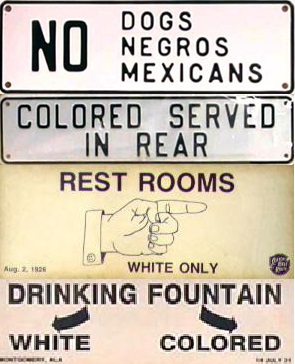
These court decisions and legislation strengthened racism and discrimination against blacks, “effectively excluding blacks from public places, from the right to votes, from good public education, and so forth.” [42] The Plessy ruling was followed by “state laws mandating racial segregation in every aspect of life, from schools to hospitals, waiting rooms to toilets, drinking fountains to cemeteries…segregation was part of a complex system of white domination, in which each component – disenfranchisement, unequal economic status, inferior education – reinforced the others.” [43] Violence was used with great effect and between 1880 and 1968 approximately 3,500 people were murdered or lynched throughout the South. The “separate but equal” measures of the Jim Crow era took nearly a century to reverse, and “only began to disappear with Brown v. Board of Education in 1954 and the Civil Rights and Voting Rights Acts of 1964 and 1965.” [44]

The example of Reconstruction’s failure shows that in order to secure peace that military victory must be accompanied by the political will to ensure that the avowed goals of that victory are secured after the war in ensuring a just peace. Southerners may have lost the shooting war, but they did not accept the peace and resorted to all means to reverse their military defeat through political, social, economic and judicial means and “justice was sacrificed for the unjust peace ushered in by “redemption” of the South, a peace marred by Jim Crow, poverty and lynching.” [45] Most Northern leaders failed to appreciate this until far too late, and hindered by President Johnson’s opposition failed to win the peace in the South. They failed to appreciate that even after the shooting is often that “there is a need for further threats, and indeed action, because postwar disorder and even chaos will have to be address, and victorious allies are always likely to squabble over the spoils of victory” [46] as certain was the case in the divided Republican Party of the Reconstruction era.


Notes

[1] Perman, Michael and Murrell Taylor, Amy editors The Civil War and Reconstruction Documents and Essays Third Edition Wadsworth Cengage Learning Boston MA 2011 p.323

[2] Ibid. McPherson The War that Forged a Nation p. 175

[3] Ibid. Goldfield America Aflame p.407

[4] Ibid. Goldfield America Aflame p.407

[5] Ibid. Perman and Taylor The Civil War and Reconstruction Documents and Essays Third Edition p.323

[6] Foner, Eric Forever Free: The Story of Emancipation and Reconstruction Vintage Books a Division of Random House, New York 2005 p.108

[7] Carpenter, John A. Sword and Olive Branch: Oliver Otis Howard Fordham University Press, New York 1999 p.109


[8] Ibid. Perman and Taylor The Civil War and Reconstruction Documents and Essays Third Edition p.323

[9] Ibid. McPherson The War that Forged a Nation p. 177

[10] Ibid. Guelzo Fateful Lightening p.490

[11] Ibid. Guelzo Fateful Lightening p.494

[12] Ibid. Guelzo Fateful Lightening p.494

[13] Ibid. McPherson The War that Forged a Nation p. 177

[14] Ibid. Guelzo Fateful Lightening p.491

[15] Jordan, Brian Matthew. Marching Home: Union Veterans and Their Unending Civil War Liveright Publishing Corporation a Division of W.W. Norton and Company Inc. New York and London 2014 p.119

[16] Ibid. Goldfield America Aflame p.411

[17] Ibid. Guelzo Fateful Lightening p.491

[18] Ibid. Zinn The Other Civil War p.55

[19] Ibid. Zinn The Other Civil War p.54

[20] Ibid. McPherson The War that Forged a Nation p. 178

[21] Perman, Michael Illegitimacy and Insurgency in the Reconstructed South in The Civil War and Reconstruction Documents and Essays Third Edition edited by Michael Perman and Amy Murrell Taylor Wadsworth Cengage Learning Boston MA 2011 p.451

[22] Ibid. Foner Forever Free p.121

[23] _____________ The 14th Amendment to the U.S. Constitution retrieved from https://www.law.cornell.edu/constitution/amendmentxiv 29 June 2015

[24] Ibid. McPherson The War that Forged a Nation p. 178

[25] Ibid. Jordan Marching Home p.118

[26] Ibid. Foner Forever Free p.116

[27] Ibid. Guelzo Fateful Lightening p.504

[28] Ibid. Foner Forever Free p.170

[29] Ibid. Egnal Clash of Extremes p.337

[30] Ibid. Egnal Clash of Extremes p.337

[31] Ibid. Perman Illegitimacy and Insurgency in the Reconstructed South pp.459-460

[32] Ibid. Perman Illegitimacy and Insurgency in the Reconstructed South p.461

[33] Ames, Adelbert Governor Adelbert Ames deplores Violence in Mississippi, September 1875 in The Civil War and Reconstruction Documents and Essays Third Edition edited by Michael Perman and Amy Murrell Taylor Wadsworth Cengage Learning Boston MA 2011 p.434

[34] Ibid. McPherson The War that Forged a Nation p. 190

[35] Ibid. McPherson The War that Forged a Nation p. 185

[36] Longacre, Edward G. Gentleman and Soldier: The Extraordinary Life of General Wade Hampton Rutledge Hill Press, Nashville TN 2003 p.265

[37] Ibid. Longacre Gentleman and Soldier p.274

[38] Ibid. Zinn The Other Civil War p.57

[39] Ibid. Guelzo Fateful Lightening p.526

[40] Ibid. Zinn The Other Civil War p.58

[41] LaMorte, Michael W. School Law: Cases and Concepts 9th Edition 2008 Allyn and Bacon Inc. 2008 p.300

[42] Gonzalez, Justo L. The History of Christianity Volume 2: The Reformation to the Present Day Harper and Row Publishers San Francisco 1985 p.252

[43] Ibid. Foner Forever Free p.208

[44] Ibid. Huntington Who are We? p.54

[45] Ibid. McPherson The War that Forged a Nation p. 191

[46] Ibid. Gray Fighting Talk p.14
 

2 Comments

Filed under civil rights, civil war, History, laws and legislation, News and current events, Political Commentary

The Religious Right Unhinged: The Aftermath of Obergfell v. Hodges

313-1qRzQm.AuSt.55

Friends of Padre Steve’s World

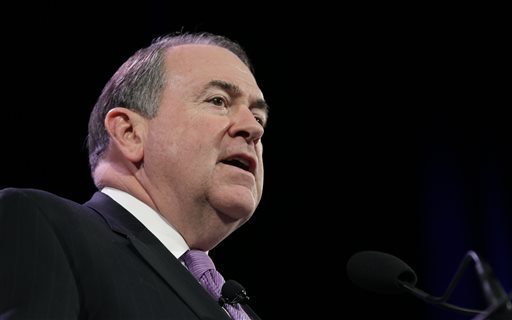
In the past coupled of days since the Supreme Court ruling legalizing Gay marriage and Marriage Equality for all, many conservative Christian leaders, especially those with lofty political aspirations have nearly come unhinged in their responses. Mike Huckabee, the Baptist preacher, seminary dropout and former Governor of Arkansas was perhaps the most ludicrous say that if need be he would call fire down from heaven in his opposition to the ruling. Others like Rick Perry and Rick Santorum have stated that they would work to overturn the decision, Ted Cruz encouraged Texas magistrates, justice of the peace, judges and others who hold government office defy the law if it violates their Christian religion; and Bobby Jindal suggested eliminating the Supreme Court. Funny how that last one works as the Supreme Court is established as one of the three branches of Government in the Constitution and Bobby, Mike, the Ricks and Ted never had a problem with 5-4 decisions that aided conservatives, but I digress…

The sad thing is that none of these men’s arguments come at all from any sense of Christian mission, but rather the raw exercise of hatred directed at a group of people they loath covered in theological gibberish.

Atticus Finch, the hero of the book and film To Kill a Mockingbird said: 

“Sometimes the Bible in the hand of one man is worse than a whisky bottle in the hand of (another)… There are just some kind of men who – who’re so busy worrying about the next world they’ve never learned to live in this one, and you can look down the street and see the results.”

Eric Hoffer wrote, “Hatred is the most accessible and comprehensive of all the unifying agents. Mass movements can rise and spread without belief in a god, but never without a belief in a devil.” We like to believe that religion is a benign or positive influence in the world. As much as I want to believe the positive aspects I have to admit based on the historical and sociological evidence that this is not so, especially during unsettled times of great change. We live in such an era and when it comes to identity and supremacy, God is the ultimate trump card and hatred in the name of God is something that many religious groups and people specialize.

This has been especially true in the lead up to and the aftermath of the Obergfell v. Hodges case that was argued at the Supreme Court regarding Gay marriage. The religious opponents of Gay marriage, in particular conservative Christians have many times resorted to the most unmitigated hatred masked in insipidly shallow theology to condemn the gays and anyone that supports them. Of course the final argument they posit is that God will punish the United States for Gay marriage.

That is fascinating. Ted Cruz called the ruling the “darkest time of American history.” Others proclaimed that God would judge the United States for this and others suggested that Christians flee the country, or that the South should again secede from the United States to form a Christian country.

Really? The darkest time Ted? I guess real oppression committed against American citizens by supposedly Christian citizens doesn’t count.

God will punish the United States for Gay marriage but not for waging unjust, illegal and immoral wars? God will punish the United States for Gay marriage, but not for the way we treat the poor? God will punish the United States for Gay marriage, but not for unabashed materialistic greed that is so condemned throughout the Christian Bible? God will judge the United States for Gay marriage but not the extermination of Native Americans and the enslavement of African Americans? God will punish the United States for Gay marriage, but not the unmitigated quest for material wealth and power that so defines the most popular churches and pastors in the country? God will punish the United States for Gay Marriage but excuse everything else?

I’m sorry these radical supposedly “Christian” politicians, pundits and preachers are the ultimate hypocrites whose hatred is only surpassed by their desire for the temporal power, which if they got it would use against any and all that oppose their theocratic tyranny.

Truthfully I find it stunning that of all the things a supposedly vengeful and just God could punish us for, that Gay marriage is the tipping point. But such is the unhinged message of the preachers, pundits and politicians of the Christian Right who believe in a capricious “God” who coincidently just happens to hate the same people that they hate, which is very convenient. But then as Annie Lamott said: “You can safely assume you’ve created God in your own image when it turns out that God hates all the same people you do.”

Of course they are not alone. In fact the most fanatical individuals and groups on earth are almost all tied to religions, whether it is the Islamic State and Al Qaeda, Boko Haram, Hezbollah, Orthodox Jews, radical Hindus and Buddhists as well as militant Christians. Of course all of these groups have different goals, but their thought and philosophy are quite similar. The fact is that for all of the, God is their trump card, end of argument as one commenter on this blog wrote yesterday “It is finished” a true heretical and blasphemous bastardization of the words of Jesus on the Cross to end his argument that God was against Gay marriage.

Robert Heinlein wrote: “Almost any sect, cult, or religion will legislate its creed into law if it acquires the political power to do so.” Heinlein, the author of the classic Starship Troopers was absolutely correct. Just look at any place in any time where any religion, sect or cult has gained control of a government. They are not loving, they are not forgiving and they use the police power of the state to persecute any individual or group that is judged to be in error, or even worse has the gall to question their authority.

Since the Christian groups tend to thrive in the West, they only speak in terms of violence, most, with the exception of Russian Orthodox Christians in Putin’s Russia do not have a government to translate those words into action. Many, especially conservative Catholics and some Evangelical and Charismatic Protestants seem for a long for the day when they can assume control of a theocratic government.

Samuel Huntington wrote in his book The Clash of Civilizations:

“People do not live by reason alone. They cannot calculate and act rationally in pursuit of their self-interest until they define their self. Interest politics presupposes identity. In times of rapid social change established identities dissolve, the self must be redefined, and new identities created. For people facing the need to determine Who am I? Where do I belong? Religion provides compelling answers….In this process people rediscover or create new historical identities. Whatever universalist goals they may have, religions give people identity by positing a basic distinction between believers and non-believers, between a superior in-group and a different and inferior out-group.”

Huntington was right, you see the true believers, those who follow their religion without question and believe that it is superior to all others also believe that their religion entitles them to be atop the food chain, others who don’t believe like them be damned, if not in this life, the next. That is the certitude of the true believer, especially the religious one. Secular or atheistic fanatics could care less about the next life, for this life is all that they have. But the religious “true believers” are not only interested in destroying someone in this life, but ensuring that in the next that they suffer for eternity, unless they believe in the annihilation of the soul after death, which really spoils the whole Dante’s Inferno perspective of the damned in the afterlife.

Eric Hoffer wrote:

“The impression somehow prevails that the true believer, particularly the religious individual, is a humble person. The truth is the surrendering and humbling of the self breed pride and arrogance. The true believer is apt to see himself as one of the chosen, the salt of the earth, the light of the world, a prince disguised in meekness, who is destined to inherit the earth and the kingdom of heaven too. He who is not of his faith is evil; he who will not listen will perish.”

That is why they, the religious true believers of any faith are capable of such great evil, and why such people can murder innocents in the most brutal manner simply because they do not believe correctly.

Please do not get me wrong. I am a Christian, a priest, a historian and a theologian, but I also know just how insidious those who hold their religion over those of others can be. While I hold faith dear, I know that it can be abused for the claim of some to have God as their final authority is a sort of trump card with which they are able to justify the most obscene and evil acts against others.

One of my heroes of religious liberty is John Leland, a Baptist whose passionate defense of religious freedom prevented Virginia from re-establishing a state church after the American Revolution and whose influence was key in the decision of Madison and Jefferson to amend the Constitution with the Bill of Rights, particularly the First Amendment. In fact, late in life, well after his success in working with Madison and Jefferson Leland wrote:

“The liberty I contend for is more than toleration. The very idea of toleration is despicable; it supposes that some have a pre-eminence above the rest to grant indulgence; whereas all should be equally free, Jews, Turks [Muslims], Pagans and Christians. Test oaths and established creeds should be avoided as the worst of evils.”

Like Leland, I contend for more than tolerance and I contend for acceptance. But that acceptance ends when any person or group is willing to use their religion to enslave, murder, or otherwise dominate other people in the name of their God, not just in this life, but in the next. This is especially true of those who use the police power of the state to enforce their beliefs and hatred on others.  I will do whatever I can to expose them for what they are, regardless of the “faith” they supposedly represent.

I guess that is why I am even more frightened of religious true believers than non-religious true believers. While the non-religious true believer may sacrifice everything for the sake of power and control in this life, and may in fact commit the most heinous crimes against humanity, their hatred is bounded in space and time to this earth. The religious true believer is not content with that; their enemies must be damned and punished in this life, but for eternity, without hope of salvation.

That is why men like Huckabee, Santorum, Jindal, Cruz, Perry and so many others like them are so dangerous for their hatred is unbounded by time, or space, it lasts for eternity, and eternity my friends is a very long time.

With that I wish you a good day, a thoughtful day and try to love someone.

Peace

Padre Steve+

6 Comments

Filed under christian life, civil rights, ethics, faith, History, laws and legislation, leadership, News and current events, Political Commentary, Religion

Liberty & Those who Oppose It: the Aftermath of Obergfell v. Hodges

instagram_0428_obergefell-hodges

Friends of Padre Steve’s World,

I rejoiced yesterday when majority of the Supreme Court ruled in favor of marriage equality throughout the country. I believe that this was an important continuation in or understanding of ever expanding liberty found in the Declaration of Independence that Abraham Lincoln said in 1854 was the standard maxim of free society …constantly spreading and deepening its influence,” ultimately applicable “to peoples of all colors everywhere.” 

Thomas Jefferson wrote a letter to Samuel Kercheval in 1816 that we should take to heart when we look at changes in laws that religious traditionalists oppose so vehemently:

“I know also, that laws and institutions must go hand in hand with the progress of the human mind. As that becomes more developed, more enlightened, as new discoveries are made, new truths disclosed, and manners and opinions change with the change of circumstances, institutions must advance also, and keep pace with the times. We might as well require a man to wear still the coat which fitted him when a boy, as civilized society to remain ever under the regimen of their barbarous ancestors.” 

When Justice Anthony Kennedy wrote the majority opinion in the case of Obergfell v. Hodges he made a comment that echoed the words of Thomas Jefferson when he wrote:

Changes, such as the decline of arranged marriages and the abandonment of the law of coverture, have worked deep transformations in the structure of marriage, affecting aspects of marriage once viewed as essential. These new insights have strengthened, not weakened, the institution. Changed understandings of marriage are characteristic of a Nation where new dimensions of freedom become apparent to new generations.

In the aftermath of Obergfell v. Hodges these people are scrambling to carve out exemptions to the law in order to ensure that the prejudices ingrained in their “sincerely held religious belief” can remain. Of course for churches that is not an issue, churches can grant or deny the sacraments or ordinances of their faith to anyone they chose to and this they routinely do. If you desire to get married in a church you must follow the rules for that church, and the clergy of that church are free to deny sacraments, including marriage to anyone. If you are not a Roman Catholic in good standing you are not permitted to receive the Eucharist, you may not be married in the church, and other churches including many Baptists and other “free” churches have similar prohibitions that no court has dared to overturn. This even includes rules that discriminate against women who cannot be ordained clergy. So when I hear pastors screaming that somehow they will be prosecuted or jailed for refusing to marry gays I have to throw the bullshit flag.

Now this may not apply to the “ministers” who set up their own so called marriage chapels where unconnected to any church they operate as for profit businesses. Sometimes courts do find in favor of litigants in civil proceedings when such businesses use their prejudice to deny services to people, especially gays.

While I am a historian and should know better, I am amazed to see many American Christians doing all they can in the name of protecting their Religious Liberty to deny rights to those that they disapprove. I shouldn’t be surprised, Thomas Jefferson wrote of what happens when preachers and priests lead political movements. Jefferson so rightly noted:

“History, I believe, furnishes no example of a priest-ridden people maintaining a free civil government. This marks the lowest grade of ignorance, of which their civil as well as religious leaders will always avail themselves for their own purposes.”

James Madison, who crafted the Bill of Rights, including the First Amendment wrote:

“Who does not see that the same authority which can establish Christianity, in exclusion of all other religions, may establish with the same ease any particular sect of Christians, in exclusion of all other sects?”

Currently this is the case with the Republican Party, a party that I remind you that I belonged for over three decades, beginning with my work for the Ford campaign as a high school student. I left the GOP in 2008 after years of disillusionment, and lies when I returned from Iraq.

Barry Goldwater, a conservative if there ever was one, a man that would be driven out of today’s GOP spoke on the Senate floor in the early 1980s at the beginning of the Reagan Revolution and the commandeering of the party by politically minded preachers like Jerry Falwell, James Robertson, Dr. D. James Kennedy, James Dobson and of course our local Tidewater Taliban Mullah, Pat Robertson. Goldwater so wisely noted:

“Mark my word, if and when these preachers get control of the [Republican] party, and they’re sure trying to do so, it’s going to be a terrible damn problem. Frankly, these people frighten me. Politics and governing demand compromise. But these Christians believe they are acting in the name of God, so they can’t and won’t compromise. I know, I’ve tried to deal with them.”

Well, now the preachers have control of that party. Every declared candidate for the GOP presidential nomination kowtows to these religious leaders and nearly every one of them has come out to announce their opposition to the Supreme Court ruling.

Some are suggesting that thousands of preachers run for office in the GOP in order to foist their agenda on the rest of the population. Right now Conservative Christians for all intents and purposes run many state legislatures. In the ones that they have controlled for the past number of years they have been enacting all sorts of discriminatory laws against those they find offensive, and have attempted to shackle the study of science, history, and roll back voting rights for minorities.

This is particularly true of the conservative Christian, antipathy towards Gays, Lesbians and others in the LGBT community. In the past number of weeks I have seen proposed legislation in several states that would allow people to discriminate against anyone simply based on a sincerely held religious belief.

Other laws passed within the six moths at the state level in Arkansas and West Virginia to nullify any city or county ordinances banning discrimination against gays. In other words, religious zealots in control of state houses are imposing heir beliefs on cities, towns and counties that are more progressive in regard to the treatment of gays.

The irony is that the people who complain about Federal laws which trump state law are doing the same thing that they object to in order to ensure that citizens of their states are treated less than equal.

The target of these laws are gays and the LGBT community, but anyone with half a brain knows that once they are on the books they provide ample room for religious zealots of any kind to discriminate and even persecute those that they despise.

They may start with the gays, but be assured, those who pass these laws will extend them to apply to anyone to whom they believe harms or interferes with their sincerely held religious beliefs. Jefferson also noted “In every country and in every age, the priest has been hostile to liberty. He is always in alliance with the despot, abetting his abuses in return for protection to his own.”

It is something that our founders wisely chose to avoid, not wanting this nation to become like the European nations whose state churches had denied rights, persecuted and killed those that they deemed heretical. While the proponents of these new laws to “protect” religious liberty claim that they are done with no intent to discriminate, there is only one reason to enact them, that to give legal protection to people who want to discriminate. Is this not what is happening throughout the Middle East as Islamic fundamentalists of various sects impose similar laws on Christians as well as others including Moslems of rival sects?

Now just imagine for one moment living in such a society, a society where someone who was not of the right race, or belief did not enjoy the same freedoms of other citizens. Imagine a society where those that started with laws to supposedly defend their religious liberty, or rights then supported other more far reaching laws, laws which deprived those that they demonized and refused to serve of citizenship, freedom of association, freedom of movement, and robbed them of their homes and businesses, banished them to ghettos and eventually exterminated them. While the Nazis primarily went after the Jews, they also went after the gays.

Of course the Nazis did this in the years leading up to World War Two in their actions against loyal German Jews who simply wanted to fit in, and well we Americans, let’s not even go there… but the let’s go there. We have the extermination and the ghettoization of our Native American population, we have the African slave trade and the institution of slavery, we have the human trafficking and exploitation of Chinese workers in the 1800s, the Jim Crow Laws, and yes the incarceration of Japanese Americans in what we called “internment camps” in World War Two.

Now for one minute tell me that those that propose such barbarous laws now to be used against the gays, simply because Christians want to have a law that allows them to discriminate against those they hate and condemn to hell are that much different than those Christians, be they American or German who justified their actions with law based on their deeply and sincerely held religious beliefs? I think not. In fact the whole proposition that we enact such laws flies in the face of the wars that these same people want to send in the ground troops to fight Islamic State over. Heck, the Islamic State is actually acting out the fantasies of the most extreme American Christian anti-gay preachers. They are killing gays, throwing them off the roofs of tall buildings. Sadly, many American Christians so consumed by the hate and paranoia being preached in their churches and by right-wing political groups which pose, as Christian ministries don’t see that their actions are simply a different breed of the same animal. Right now, the difference is just a matter of degree.

I think that is why Thomas Jefferson wrote this very pertinent warning to us who might want to return to the barbarous ways of our ancestors:

“I know also, that laws and institutions must go hand in hand with the progress of the human mind. As that becomes more developed, more enlightened, as new discoveries are made, new truths disclosed, and manners and opinions change with the change of circumstances, institutions must advance also, and keep pace with the times. We might as well require a man to wear still the coat which fitted him when a boy, as civilized society to remain ever under the regimen of their barbarous ancestors.” 

I personally do not want to live under the laws of our barbarous ancestors, and I will fight for the rights of those who are being targeted, primarily the LGBT community, but anyone else, by the lawmakers and supporters of such laws.

That my friends is why I rejoice in the Supreme Court ruling in Obergfell v. Hodges. It is a step to moving forward in liberty and progress and away from barbarism.

So have a great and thoughtful Saturday,

Peace

Padre Steve+

13 Comments

Filed under civil rights, faith, History, laws and legislation, LGBT issues, News and current events, Political Commentary

A Great Day for Liberty for All

Mini-Stonewall

Friends of Padre Steve’s World

Today is a good day for freedom. It has been to long coming. The Supreme Court, citing the Fourteenth Amendment ruled in favor of Marriage Equality for Gays Lesbians and others in the LGBTQ community in the case of Obergfell v. Hodges. I am quite happy for my Gay and Lesbian friends  for this.

As historian and who has and continues to study the American Civil War, especially the fight for the abolition of slavery, the emancipation of African Americans and the extension of the the full benefits of citizenship and liberty.

As early as 1854 Lincoln posed the idea that the Declaration of Independence was the standard maxim of free society …constantly spreading and deepening its influence,” ultimately applicable “to peoples of all colors everywhere.” 

The understanding that the liberties enunciated in the Declaration extend to first to African-Americans was made part of the Constitution in the Thirteenth, Fourteenth and Fifteenth Amendments to the Constitution. The precedent of Fourteenth Amendment has been used to grant Suffrage to Women, to end Jim Crow laws, Black Codes and Separate but Equal laws. Today it was correctly used to ensure that all people have the freedom to marry.

The ruling was about liberty, it was about equality, it was about due process, and today the Court’s majority noted:

The history of marriage as a union between two persons of the opposite sex marks the beginning of these cases. To the respond- ents, it would demean a timeless institution if marriage were extend- ed to same-sex couples. But the petitioners, far from seeking to devalue marriage, seek it for themselves because of their respect—and need—for its privileges and responsibilities, as illustrated by the petitioners’ own experiences.

The history of marriage is one of both continuity and change.

Changes, such as the decline of arranged marriages and the abandonment of the law of coverture, have worked deep transformations in the structure of marriage, affecting aspects of marriage once viewed as essential. These new insights have strengthened, not weakened, the institution. Changed understandings of marriage are characteristic of a Nation where new dimensions of freedom become apparent to new generations.

They also added:

The fundamental liberties protected by the Fourteenth Amendment’s Due Process Clause extend to certain personal choices central to individual dignity and autonomy, including intimate choic- es defining personal identity and beliefs.

Most of the opposition to Gay marriage and for that matter to all Gay Rights has been from conservative Christians. Sadly it was conservative Christians who have been in the forefront of denying liberty to people in the country since the beginning of the abolition movement in the 1830s. They labeled fellow evangelicals in the abolition movement as “atheists, infidels, communists, free-lovers, Bible-haters, and anti-Christian levelers.” 

This was not limited to Southern  conservative Christians.

The fact that so many Protestant ministers, intellectuals, and theologians, not only Southerners, but men like “Princeton’s venerable theologian Charles B. Hodge – supported the institution of slavery on biblical grounds, often dismissing abolitionists as liberal progressives who did not take the Bible seriously” leaves a troubling question over those who claim to oppose issues on supposedly Biblical grounds. Such men in the North spoke out for it “in order to protect and promote interests concomitant to slavery, namely biblical traditionalism, and social and theological authority.” [1] The Northern clerical defenders of slavery perceived the spread of abolitionist preaching as a threat, not just to slavery “but also to the very principle of social and ecclesiastical hierarchy.” [2]Alistair McGrath asks a very important question for modern Christians who might be tempted to support a position for the same reasons today, “Might not the same mistakes be made all over again, this time over another issue?” [3]

Throughout American history conservative Christians have often espoused a concept of limited liberty, liberty for the few and the powerful. This happened as I have noted during the fight against emancipation, but also Women’s Suffrage and the various Jim Crow laws and rights for other groups. This is happening again today with anti-Gay Christians attacking the ruling and like those who fought abolition proclaiming in apocalyptic language that Christians will be persecuted and that God will judge the United States for allowing Gays to marry.

However, the fact is that very little will change in the country, most people will move along. Christian conservatives will not be persecuted, religious liberties will not be violated they will be enhanced as churches who allow Gays to marry will be able to extend this rite of their churches to their parishioners and others.

Today, despite the cries of many on the American Religious Right liberty has been protected. as Lincoln said: the declaration’s promise of equality was “a beacon to guide” not only “the whole race of man then living” but “their children and their children’s children, and the countless myriads of generations who should inhabit the earth in other ages.” [4]

Marriage-Equality-104371316011_xlarge

I am happy for my Gay friends who have labored for this for so long enduring hatred, violence and social, political, religious and economic discrimination for so many years.

Have a great night,

Peace

Padre Steve+

[1] Ibid. Daly When Slavery Was Called Freedom p.38

[2] Ibid. Varon Disunion! P.108

[3] Ibid. McGrath Christianity’s Dangerous Idea p.324

[4] Ibid. Goodwin Team of Rivals p. 203

3 Comments

Filed under civil rights, ethics, faith, History, laws and legislation, LGBT issues, News and current events, Political Commentary, Religion

Dred Scott & Obergfell v. Hodges

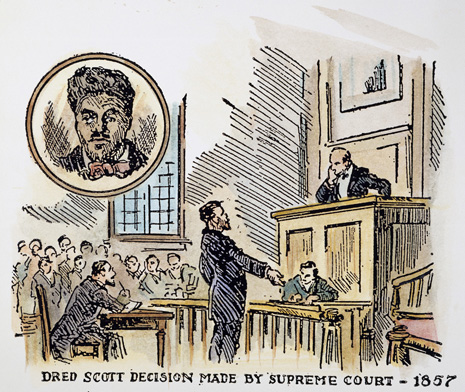
ROGER B. TANEY (1777-1864).  Roger Taney, Chief Justice of the U.S. Supreme Court, handing down his decision on the Dred Scott case, 1857. American illustration.

ROGER B. TANEY (1777-1864).
Roger Taney, Chief Justice of the U.S. Supreme Court, handing down his decision on the Dred Scott case, 1857. American illustration.

Friends of Padre Steve’s World

Court decisions on Civil Rights matter and sometime soon we will get the Supreme Court decision on the Case of Obergfell v. Hodges, the case that will determine if Marriage Equity will become the law of the land or not. Such cases are important. As I mentioned yesterday freedom for all matters and I completely agree with he words of Abraham Lincoln in regard to liberty that the words of the Declaration of Independence that “all men are created equal” is a universal standard. That it is the “the standard maxim of free society …constantly spreading and deepening its influence,” ultimately applicable “to peoples of all colors everywhere.” This should be true for all, people including the LGBTQ community. 

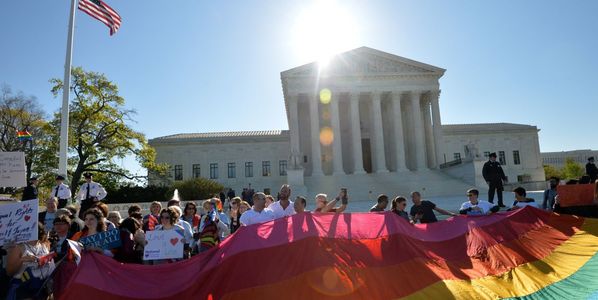
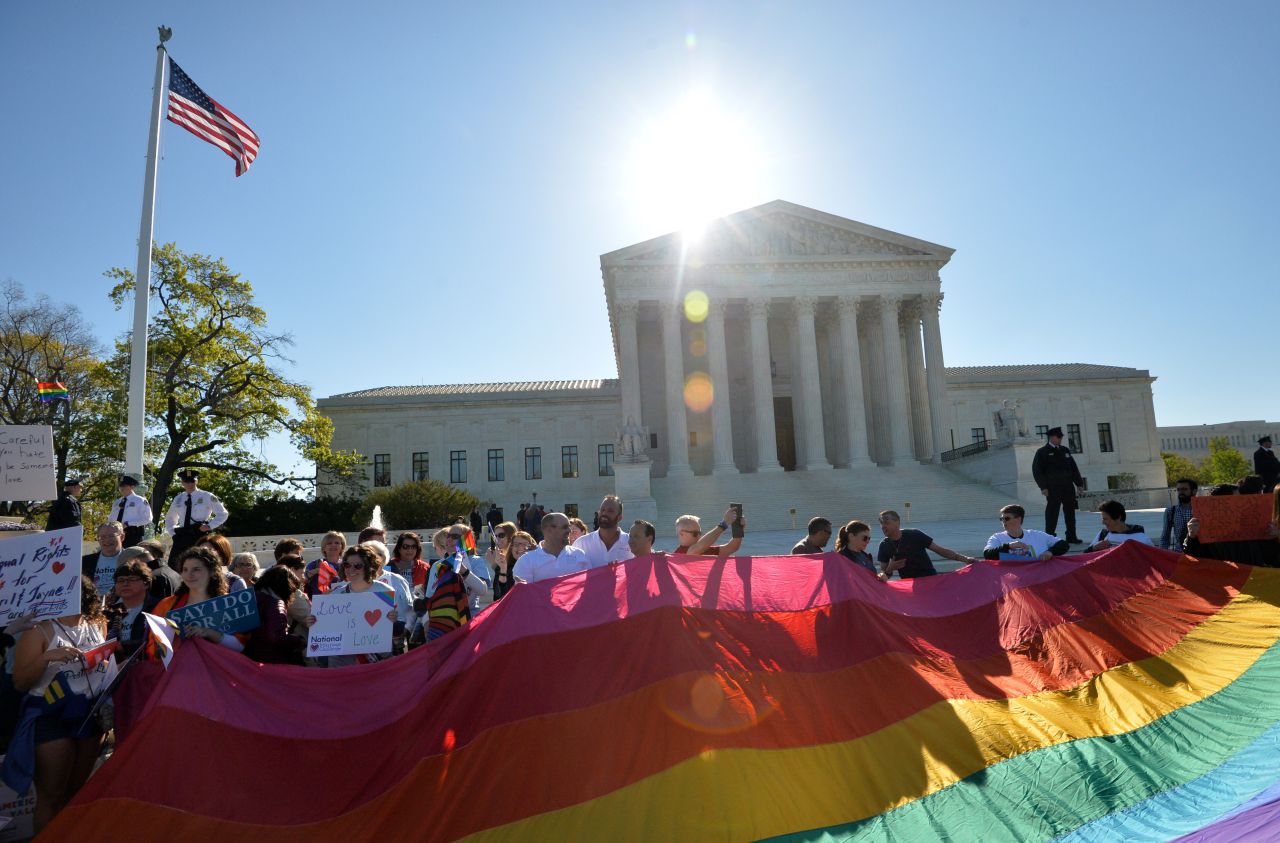
Supporters of same-sex marriages gather outside the US Supreme Court waiting for its decision on April 28, 2014 in Washington, DC. The US Supreme Court is hearing arguments on whether gay couples have a constitutional right to wed -- a potentially historic decision that could see same-sex marriage recognized nationwide.  AFP PHOTO / MLADEN ANTONOV        (Photo credit should read MLADEN ANTONOV/AFP/Getty Images)

Supporters of same-sex marriages gather outside the US Supreme Court waiting for its decision on April 28, 2014 in Washington, DC. The US Supreme Court is hearing arguments on whether gay couples have a constitutional right to wed — a potentially historic decision that could see same-sex marriage recognized nationwide. AFP PHOTO / MLADEN ANTONOV (Photo credit should read MLADEN ANTONOV/AFP/Getty Images)

Since it matters so much I am posting a section from my Civil War and Gettysburg Staff Ride text on the Dred Scott decision. If you read it you will find just how chilling and similar the arguments of the Chief Justice of the Supreme Court Roger Taney are to those who oppose Marriage Equity and other rights being extended to Gay people. 

Peace

Padre Steve+

As the 1850s wore on, the divisions over slavery became deeper and voices of moderation retreated. The trigger for the worsening of the division was the political battle regarding the expansion of slavery; even the status of free blacks in the north who were previously slaves, over whom their owners asserted their ownership. Southerners considered the network to help fugitive slaves escape to non-slave states, called the Underground Railroad “an affront to the slaveholders pride” and “anyone who helped a man or woman escape bondage was simply a thief” who had robbed them of their property and livelihood, as an “adult field hand could cost as much as $2000, the equivalent of a substantial house.” [1]

In 1856 the Supreme Court, dominated by southern Democrats ruled in favor of southern views in the Dred Scott decision, one pillar of which gave slavery the right to expand by denying to Congress the power to prohibit slavery in Federal territories. Taney’s ruling in the case insisted that “Neither the Declaration of Independence nor the Constitution had been intended to apply to blacks he said. Blacks were “so far inferior that they had no rights which the white man was bound to respect.” Taney did not stop with this but he declared the Missouri Compromise itself unconstitutional for “Congress had exceeded its authority when it forbade slavery in the territories by such legislation as the Missouri Compromise, for slaves were private property protected by the Constitution.” [2]

The decision was momentous, but the judicial fiat of Taney and his court majority was a disaster for the American people. It solved nothing and further divided the nation:

“In the South, for instance, it encouraged southern rights advocates to believe that their utmost demands were legitimatized by constitutional sanction and, therefore, to stiffen their insistence upon their “rights.” In the North, on the other hand, it strengthened a conviction that an aggressive slavocracy was conspiring to impose slavery upon the nation, and that any effort to reach an accommodation with such aggressors was futile. While strengthening the extremists, it cut the ground from under the moderates.” [3]

The decision in the case is frightening when one looks upon its tenor and implications. The majority opinion which was written by Chief Justice Roger Taney was chilling, not only in its views of race, but the fact that blacks were perpetually property without the rights of citizens. Taney wrote:

“Can a negro, whose ancestors were imported into this country, sold as slaves, become a member of the political community formed and brought into existence by the Constitution of the United States, and as such become entitled to all the rights, and privileges, and immunities, guaranteed by that instrument to the citizen?…It is absolutely certain that the African race were not included under the name of citizens of a state…and that they were not included, and were not intended to be included, under the word “citizens” in the Constitution, and therefore claim none of the rights and privileges which that instrument provides for and secures to citizens of the United States. On the contrary, they were at that time considered as a subordinate and inferior class of beings, who had been subjugated by the dominant race, and, whether emancipated or not, yet remain subject to their authority, and had no rights or privileges but those who held the power and the Government might choose to grant them” [4]

The effect of the ruling on individuals and the states was far reaching. “No territorial government in any federally administered territory had the authority to alter the status of a white citizen’s property, much less to take that property out of a citizen’s hands, without due process of law or as punishment for some crime.” [5] Free slaves were no longer safe, even in Free States, from the possibility of being returned to slavery, because they were considered property. The tens of thousands of free blacks in the South were effectively stripped of citizenship, and became vulnerable to either expulsion or re-enslavement, something that the legislatures in Virginia, North Carolina and Missouri debated in 1858. Likewise the decision cast doubt on the free status of every African American regardless of residence.” [6]

But the decision had been influenced by President-Elect James Buchanan’s secret intervention in the Supreme Court deliberations two weeks before his inauguration. Buchanan hoped by working with the Justices that he would save the Union from breaking apart by appeasing slave owners and catering to their agenda. “The president-elect wanted to know not only when, but if the Court would save the new administration and the Union from the issue of slavery in the territories. Would the judges thankfully declare the explosive subject out of bounds, for everyone who exerted federal power? The shattering question need never bother President Buchanan.” [7] In his inaugural address he attempted to camouflage his intervention and “declared that the Court’s decision, whatever it turned out to be, would settle the slavery issue forever.” [8]

But Buchanan was mistaken. The case made the situation even more volatile as it impaired “the power of Congress- a power which had remained intact to this time- to occupy the middle ground.” [9] Taney’s decision held that Congress “never had the right to limit slavery’s expansion, and that the Missouri Compromise had been null and void on the day of its formulation.” [10]

The Court’s decision “that a free negro was not a citizen and the decision that Congress could not exclude slavery from the territories were intensely repugnant to many people in the free states” [11] and it ignited a firestorm in the north where Republicans now led by Abraham Lincoln, decried the decision and southerners basked in their judicial victory. Southerners were exultant, the Richmond Enquirer wrote that the Court had destroyed “the foundation of the theory upon which their warfare has been waged against the institutions of the South.” [12] Northerners now quite rightly feared that an activist court would rule to deny their states the right to forbid slavery. As early as 1854 Lincoln posed the idea that the Declaration of Independence was the standard maxim of free society …constantly spreading and deepening its influence,” ultimately applicable “to peoples of all colors everywhere.” [13]

After the Dred Scott decision Lincoln warned that the Declaration was being cheapened and diluted, he remained insistent on this point, he noted:

“Our Declaration of Independence was held sacred by all, and thought to include all” Lincoln declared, “but now, to aid in making the bondage of the Negro universal and eternal, it is assaulted, and sneered at, and construed, and hawked at, and torn, till, its framers could ride from their graves, they could not recognize it at all.” [14]

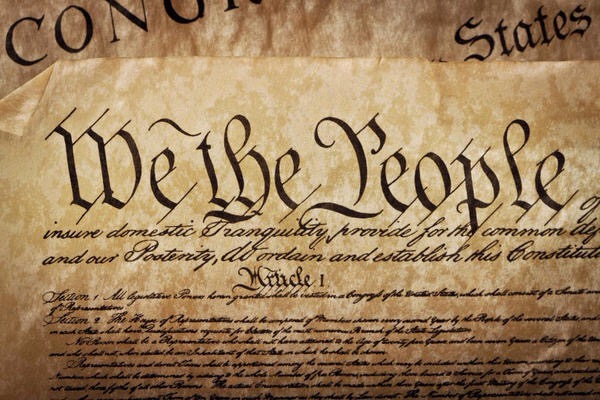
Lincoln attacked the decision noting that Taney “insists at great length that negroes were no part of the people who made, or for whom made, the declaration of Independence or the Constitution.” But as Doris Kearns Goodwin notes “in at least five states, black voters action on the ratification of the Constitution and were among the “We the People” by whom the Constitution was ordained and established.” Lincoln acknowledged that the founders “did not declare all men equal in all respects. They did not mean to say that all were equal in color, size, intellect, moral developments, or social capacity.” But they dis declare all men “equal in ‘certain inalienable rights, among which are life, liberty, and the pursuit of happiness.’…They meant simply to declare the right, so the enforcement of it might follow as circumstances permit.” [15]

Not only that, Lincoln asked the logical question regarding Taney’s judicial activism. Lincoln and other Republican leaders “noted that all slavery needed was one more Dred Scott decision that a state could not bar slavery and the objective of Slave Power to nationalize slavery would be accomplished.” [16] How long would it be, asked Abraham Lincoln, before the Court took the next logical step and ruled explicitly that the:

“Constitution of the United States does not permit a state to exclude slavery from its limits?” How far off was the day when “we shall lie down pleasantly thinking that the people of Missouri are on the verge of making their State free; and shall awake to the reality, instead, that the Supreme Court has made Illinois a slave State?” [17]

Lincoln discussed the ramification of the ruling for blacks, both slave and free:

“to aid in making the bondage of the Negro universal and eternal….All the powers of the earth seem rapidly combining against him. Mammon is after him; ambition follows, and philosophy follows, and the theology of the day is fast joining the cry. They have him in his prison house;…One after another they have closed the heavy doors upon him…and they stand musing as to what invention, in all the dominions of mind and matter, can be produced the impossibility of his escape more complete than it is.” [18]

Frederick Douglass noted that “Judge Taney can do many things…but he cannot…change the essential nature of things – making evil good, and good, evil.” [19]

Lincoln was not wrong in his assessment of the potential effects of the Dred Scott decision on Free States. State courts in free-states made decisions on the basis of Dred Scott that bode ill for blacks and cheered slave owners. In newly admitted California the state supreme court ominously “upheld a slaveowner’s right to retain his property contrary to the state’s constitution.” [20]

A similar decision by a New York Court was being used by slave-states to bring that issue to the Taney Court following Dred Scott. “In 1852 a New York judge upheld the freedom of eight slaves who had left their Virginia owner while in New York City on their way to Texas.” [21] The Dred Scott decision brought that case, Lemon v. The People back to the fore and “Virginia decided to take the case to the highest New York court (which upheld the law in 1860) and would have undoubtedly appealed it to Taney’s Supreme Court had not secession intervened.” [22] Even non-Republican parties such as the democrats could see the writing on the wall. The national publication of the Democratic Party, the Washington Union “announced that the clear implication of the Dred Scott decision was that all state laws prohibiting a citizen from another state, either permanently or temporarily, were unconstitutional.” [23]

Notes

[1] Goodheart, Adam. Moses’ Last Exodus in The New York Times: Disunion, 106 Articles from the New York Times Opinionator: Modern Historians Revisit and Reconsider the Civil War from Lincoln’s Election to the Emancipation Proclamation Edited by Ted Widmer, Black Dog and Leventhal Publishers, New York 2013 p.15

[2] Ibid. Goodwin Team of Rivals p. 189

[3] Ibid. Potter The Impending Crisis p.291

[4] Guelzo Allen C. Fateful Lightening: A New History of the Civil War Era and Reconstruction Oxford University Press, Oxford and New York 2012 p.91

[5] Ibid. Guelzo Fateful Lightening pp.91-92

[6] Ibid. Goldfield America Aflame p.142

[7] Freehling, William. The Road to Disunion Volume II: Secessionists Triumphant 1854-1861 Oxford University Press, Oxford and New York 2007 p.115

[8] Ibid. Freehling, The Road to Disunion Volume II: Secessionists Triumphant 1854-1861 p.109

[9] Ibid. Potter The Impending Crisis p.291

[10] Ibid. Levine Half Slave and Half Free p.210

[11] Ibid. Potter The Impending Crisis p.279

[12] Ibid. Goodwin Team of Rivals p. 190

[13] Ibid. Catton Two Roads to Sumter p.139

[14] Ibid. Guelzo Fateful Lightening p.93

[15] Ibid. Goodwin Team of Rivals p. 190

[16] Gienapp, William The Republican Party and Slave Power in The Civil War and Reconstruction Documents and Essays Third Edition edited by Michael Perman and Amy Murrell Taylor Wadsworth Cengage Learning Boston MA 2011 p.81

[17] Ibid. Levine Half Slave and Half Free p.211

[18] Ibid. Catton Two Roads to Sumter p.139

[19] Ibid. Goodwin Team of Rivals p. 190

[20] Ibid. Gienapp The Republican Party and Slave Power p.81

[21] Ibid. McPherson The Battle Cry of Freedom p.181

[22] Ibid. McPherson The Battle Cry of Freedom p.181

[23] Ibid. Gienapp The Republican Party and Slave Power p.82

1 Comment

Filed under civil rights, History, laws and legislation, LGBT issues, News and current events

Fiery Trials: Emancipation & Equality Today

c91f46b3ce5943b9e213e3cd306c6348_f3094

Friends of Padre Steve’s World

Just a coupled of thoughts on this Sunday night. Like yesterday I have been spending a lot of time on my Civil War-Gettysburg Staff Ride text. I have been working on re-writing the chapter on ideology and religion as they related to the causes of the war, its conduct and its aftermath. One thing that caught my attention was something that I think is profoundly important today.

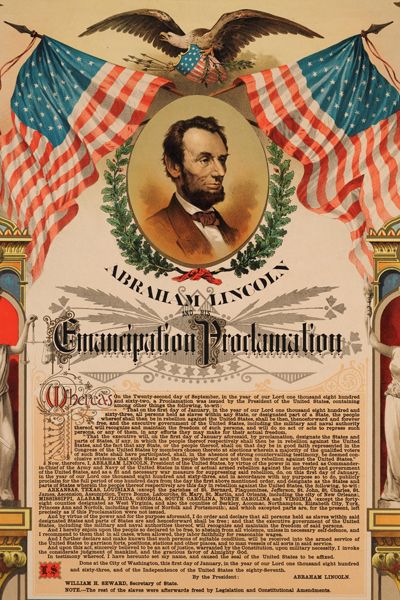
In December of 1862 as he spoke to Congress prior to the the signing of the Emancipation Proclamation Lincoln spoke these profound words:

“Fellow citizens, we cannot escape history….This fiery trial through which we pass, will light us down, in honor or dishonor, to the latest generation….In giving freedom to the slave, we assure freedom to the free – honorable alike in what we give, and what we preserve.”

His words in giving freedom to the slave, we assure freedom to the free are part of an understanding of freedom, especially Lincoln’s radical understanding that the Declaration of Independence actually meant what it said that “all men are created equal.” For Lincoln this meant African Americans, inlacing those that labored as slaves. Lincoln understood the Declaration in its most broad understanding, he saw it as a universal liberty. As early as 1854 Lincoln posed the idea that the Declaration of Independence was the standard maxim of free society …constantly spreading and deepening its influence,” ultimately applicable “to peoples of all colors everywhere.”

Today there are a lot of people, especially the loudly political preachers, pundits and politicians of the Christian right and their allies who are committed to rolling back the rights of blacks, but also of women, and to prevent Gays, Lesbians and others of the LGBTQ community from having any rights commensurate with their status as citizens. In many states we have seen the protections of the Voter’s Rights Act being eroded as state legislatures enact laws to restrict voting rights and make it more difficult for people to exercise their right to vote. State legislatures are enacting laws that allow people to discriminate against others based on “a sincerely held religious belief” and while those laws are targeted against Gays they are in many cases written so broadly that they will protect just about any form of discrimination based on religion, even by public officials in the conduct of their duties as happened in  North Carolina last week. 

That is why what Lincoln said as he was preparing to sign the Emancipation Proclamation matters today. When we give freedom to people, we protect the freedom of everyone, but that my friends is not how many people in the so-called Christian Right see it. For them it is their freedom to discriminate in God’s name, because they like the anointed lords of the Southern Aristocracy believe that it is God’s will for them to do this. Sounding like a Southern planter, preacher or politician of the 1850s the founder of the movement known and Christian Dominionism R.J. Rushdooney wrote: “One faith, one law and one standard of justice did not mean democracy. The heresy of democracy has since then worked havoc in church and state . . . Christianity and democracy are inevitably enemies.”

British Evangelical-Anglican theologian Alister McGrath notes how “the arguments used by the pro-slavery lobby represent a fascinating illustration and condemnation of how the Bible may be used to support a notion by reading the text within a rigid interpretive framework that forces predetermined conclusions to the text.”

That my friends are what we are dealing with today. There is a party of Christians who have tremendous political power who are using it for the most nefarious of purposes, using the law and the police power of the state to deny rights to others while preserving their own while claiming to be the victims of persecution, just as did Southern slaveholders in the 1830s to 1861.

So, that is all for the night. I expect to put out something related to this topic again tomorrow, perhaps a full section of the chapter on religion and ideology from my text.

Peace

Padre Steve+

Leave a comment

Filed under civil rights, civil war, faith, History, laws and legislation, LGBT issues, News and current events, Political Commentary

Mr. Jefferson BUILD UP THAT WALL! 

  
I don’t know about you but I am sick and tired of people, no matter what their religious belief in this country who use the Constitutionally protections extended to religious freedom in manners that the founders of our country never would have imagined. The fact that those basic religious freedoms are not in danger in any way is irrelevant to true believers  who in their insecurity need to create new laws specifically crafted to allow them to discriminate against others based on their supposedly sincere religious beliefs. Sadly, and I say this as a Christian, the vast majority of people doing this are people that claim to be Christians. 

Thomas Jefferson in his wonderful letter to the Virginia Baptist Association in 1808, in a letter the echoed his letter to the Danbury Baptist Association of of 1802 in which he referred that the legislature in enacting the dual provisions of religious liberty in the Constitution had built up “a wall of separation between Church and State” noted: 

“Because religious belief, or non belief, is such an important part of every person’s life, freedom of religion affects every individual. Religious institutions that use government power to support themselves and force their views of other faiths, or no faith, undermine all our civil rights. Morever, state support of an established religion tends to make the clergy unresponsive to their own people, and leads to corruption in religion itself. Erecting the “wall of separation between church and state,” therefore, is absolutely essential in a free society.” 

You see my friends, Jeferson and the other courageous men who so carefully crafted this wall of separation had real experience with the abuses by church-state and the incestuous clergy who used state power to prop up themselves and their churches and to persecution those that refused to submit to their control. Likewise there were religious groups in the recently independent former colonies like the Baptists who in Virginia and other states, as well as the Quakers in Massachusetts who were victims of such persecution, and they were determined not to let it happen here through the marriage of church and state. 

In fact Jefferson was was convinced that no specific God or religion be established, and not only in the Constitution of the United States, but in his own home state, the Commonwealth of Virginia. There Jefferson authored the Virginia a religious liberty bill which was passed, but which met with considerable opposition from faithful Christians. Reflecting on that legislation Jefferson wrote this in 1821:

“[When] the [Virginia] bill for the establishment of religious freedom…was finally passed,…a singular proposition proved that it’s protection of opinion was meant to be universal. Where the preamble declares that coercion is a departure from the holy author of our religion, an ammendment was proposed, by inserting “Jesus Christ,” so that it should read “a departure from the plan of Jesus Christ, the holy author of our religion.” The insertion was rejected by a great majority, in proof tha they meant to comprehend within the mantle of its protection the Jew and the Gentile, the Christian and the Mahamoten, the Hindoo and the infidel of every denomination.”

Sadly, jefferson’s words are twisted, rejected and even despised by the authors of the Religious Liberty Resoration Acts being enacted in state houses around the country. Not only are the state legislatures enacting laws meant only to provide Christians the  protection and the police power of the state to discriminate against any person, or group based on religious belief. Our founders, especially Jefferson and Madison who have found that incomprehensible, but then they would certainly not be surprised because they had seen it and lived under it during the English Adminstration of the colonies. They also understood human nature very well. 

Thus I think that we should applaud Thomas Jefferson and like Christopher Hitchens exclaim “Mr. Jefferson. BUILD UP THAT WALL!” 

However that wall is being torn down by the descendants of Christians who longed to be free from the coercion and evil wrought by the marriage of church and state, a marriage which Jefferson so wisely noted harmed the church as much as the state. 

I have spent the better part of my adult life as a military chaplain defending and protecting the rights of others to their free exercise of reglion whether or not I agreed with them. I held and still hold that to be a sacred duty of my commission and office. I can also state that even most people who did not agree with regarding my beliefs respected me and still consult me because first they knew that I cared about them and secondly that they knew that I would do all within my power to protect their freedom the excercise their religion, or to have no religion and not to be penalized for it. 

But that being said I have found that I am increasingly isolated by the fervent relionists who have highjacked the understanding of religious freedom to mean theirs and only theirs and who use the battering ram of the legislature to destroy Mr. Jefferson’s “Wall.” Sadly they are to blind to see that their actions are a two-edged sword which once precedence has been established can be turned on them with a vengeance. 

Last night I was watching one of my favorite television series, Boston Legal. My favorite character in the show is the lawyer played by James Spader, one Alan Shore. In the episode Whose God is it Anyway  Spader’s character is defending a friend form charges or religious discrimination in the workplace, and his character, Alan Shore delivers this remarkable closing, which because of the unrelenting actions of many of my Christian Brothers and Sisters in putting their rights and privileges as Christians over those of other citizens. That my friends is profoundly dangerous. 

By doing so they through their intense hubris not only harm others as they attempt to control them by the police power of the state but damage their own credibility and the religious liberty of Americans yet to be born. It is no wonder that this generation of American Christianity is shedding members at a rate never seen in this country before, and driving those who they might want to bring to faith away. But I digress…

In that episode of Boston Legal something that I wish I had thought of and said years ago and which I am certain that if  Jefferson, Madison and so many of our founders would agree with if they had lived to see the depths of dishonesty of Christian individuals, businesses and legislatures have sunk in their abuse of others through their unremitting pursuit of their religious freedom. That is not just at home where they enact laws allowing them to discriminate, but through their apocalyptic machinations to bring the world to war killing billions of people just so Jesus will come back. Though they would deny it, their ultimate goals, albeit in the name of a different  God, are little different than that the Islamic State, Al Qaida, the Iranian Mullahs or Hezbollah. That my friends should scare the living shit out of any rational person. 

So here is that closing:

“I don’t know about you but I’m getting a little tired of the religious freedom thing. When did religion get such a good name anyway. Be it the Crusades, the reformation genocides, the troubles in Northern Ireland, the Middle East, mass slaughters in the name of Allah, the obligatory reciprocal retributions. Hundreds of millions have died in religious conflicts. Hitler did his business in the name of his creator. Religious extremism, it’s our greatest threat today, a holy jihad. If we’re not ready to strip religion of its sacred cow status, how about we at least scale back on the Constitutoional dogma exalting it as all get out….

Everyone should get to believe in his God, pray to his God, worship his God of course. But to impose him on others, to victimize others in his name?  The founding fathers set out to prevent persecution, not license it…

At a certain point we have to say “enough with this freedom of religion crap. Yuck, yuck, yuck. I know, I’ll get letters….” 

To that I can only say “Amen!” 

So with that I bid you a good day.

Peace

Padre Steve+ 

Leave a comment

Filed under civil rights, laws and legislation, LGBT issues, News and current events, Religion

God Bless My People, Black and White: The Complex Life of General Wade Hampton

Hampton_inline

Lieutenant General Wade Hampton, C.S.A.

Friends of Padre Steve’s World 

I will be taking my students to Gettysburg this weekend and likewise I am continuing to periodically intersperse and publish short articles about various commanders at Gettysburg on the site. These all are drawn from my student text and may become a book in their own right.  The reason is I am going to do this is because I have found that readers are often more drawn to the lives of people than they are events. As I have noted before that people matter, even deeply flawed people, and we can learn from them.

Today’s article is about Lieutenant General Hade Hampton who commanded one of J.E.B. Stuart’s cavalry brigades at Gettysburg. Hampton is one of the most fascinating men I think of the entire Civil War period. Before the war he was one of the richest planters and largest owners of slaves in the South and after the war was a stalwart supporter of the rights of African Americans in South Carolina where he served as the first post-Reconstruction governor of that state. He was not a professional soldier but became one of the finest commanders of cavalry on either side during the war. Tomorrow I will be posting a completely revised, expanded and updated chapter of my text on the opening of the Battle of Gettysburg when Major General John Buford’s Cavalry conducted a heroic delaying action against the vastly superior numbers of Confederate Major General Heth’s division as it attempted to advance into Gettysburg on the morning of July 1st 1863. 

I do hope that you enjoy this.

Peace

Padre Steve+

Brigadier General Wade Hampton is one of the fascinating and complex characters in either army who served at Gettysburg. He defies a one dimensional treatment or stereotype. His complexities, contradictions and character make him one of the most interesting men that I have written about during my study of this battle.

Wade Hampton III was born in Charleston, South Carolina in 1828. He one of the richest, if not the richest man in the Confederacy when the war broke out. Hampton inherited his family’s expansive plantation and many slaves and studied law at the College of South Carolina.

As a slave owner, he expressed an aversion for the institution and ensured that his slaves were well cared for by the standards of his day, including medical care. He never condemned slavery or worked for the abolition of a system that had made him and his family quite prosperous. He served in the South Carolina legislature and Senate, where he took an “active and prominent role in the public debate on many issues. He was vocal not only on the perils of reopening the African slave trade but also on whether and how his state should seek redress of wrongs, real and imagined, by the federal government.” [1]

As a state senator, Hampton was pragmatic, and while he defended the South’s economic interests in slavery, Hampton cautioned against the rhetoric of secessionist fire-breathers. His argument was about “the preservation of the South’s political power and her social and economic institutions, now threatened by the short sighted policies of otherwise good and decent men.” [2] He did not wish to do anything that would lead to the destruction of the South, and he felt that the “only viable course was moderation, conciliation, compromise….” [3]

Hampton was a classic rich “Southern moderate He had opposed secession, and the fire eaters repulsed him.” [4] However, when Lincoln called for volunteers Hampton volunteered to serve in a war that he did not want, which would cost him dearly, and change him from a moderate to a vociferous opponent of most Reconstructionist policies.

Volunteering at the age of forty-three, Hampton had no prior military training. However, he had great organizational skill, leadership ability and a tremendous care and compassion for those who served under his command. Using his own money Hampton organized what would now be called a combined arms unit, the Hampton Legion, which comprised eight companies of infantry, four of cavalry and a battery of light artillery. He was careful in the appointment of the Legion’s officers choosing the best he could find.

Hampton rapidly rose to prominence as a respected officer and commander despite his lack of military training or experience. His soldiers fought well and took over command of an infantry brigade on the Peninsula, and was promoted to Brigadier General in May of 1862 and given command of a cavalry brigade serving under J.E.B. Stuart in July. Hampton “became Stuart’s finest subordinate.” [5] The contrast between the two men was remarkable. “Hampton and Stuart forged a professional relationship but not a friendship. They shared an adherence to duty and to the cause. But the contrasts between them in style and personality were undeniable.” [6] Stuart’s flamboyance, love of pageantry, and ambition clashed with Hampton’s simplicity and calm self-assurance. Serving as a brigade, and later division commander, Hampton had “little fondness or respect for Stuart. He regularly criticized Stuart for pampering the Virginia regiments and assigning his South Carolinians to the more arduous tasks.” [7]

During the war he was wounded several times, including at             Gettysburg where he took two saber cuts to the head. Eventually, he took command of the Cavalry Corps after Stuart was killed in action. This was something that Stuart in life would not have abided. When Stuart was scheming to get a promotion to Lieutenant General in another military department, he wrote that if he was to serve elsewhere he did not want Hampton to Command. In a curious post-script to a letter to Custis Lee Stuart wrote:

“Hampton is not the man for such a command, and I know he will not suit Gen’l Lee, nor the particular requirements of such a station. Hampton is a gallant officer, a nice Gentleman, and has done meritorious service, but there you must stop.” [8]

He fought in nearly every cavalry engagement under Stuart and led his own raids deep into Union territory. He fought well, but “hated the war.” In October 1862 he wrote home: “My heart has grown sick of the war, & I long for peace.” [9] Hampton’s Confederate service was unusual, especially for an officer of Lee’s Army of Northern Virginia which favored those who had prior service, especially West Point graduates. As such Hampton was “one of only three civilians to attain the rank of Lieutenant General in Confederate service.” [10] At Petersburg, his son Preston was mortally wounded and died in his arms even as his other son Wade IV was wounded while coming to Preston’s aid. Douglass Southall Freeman wrote of Hampton:

“Untrained in arms and abhorring war, the South Carolina planter had proved himself the peer of any professional soldier commanding within the same bounds and opportunities. He may not have possessed military genius, but he had the nearest approach to it.” [11]

The war that he opposed cost him the life of his brother, one of his sons and his livelihood. “His property destroyed, many of his slaves gone, and deep in debt from which he would never recover, Hampton faced the future with $1.75 in his pocket.” [12] The war changed the former moderate into a man who sought vindication in some ways, but reconciliation with the black population.

Hampton again entered politics and became the first post-Reconstruction Governor of South Carolina when President Rutherford Hayes withdrew the Federal troops which had supported the Reconstructionist governor. Initially he was “hailed as a redeemer by white constituents desperate to throw off the yoke of Reconstruction” [13] yet Hampton stood stalwartly against White Supremacy and White Supremacists. He acted on the belief that whites and African Americans could live, work and prosper together.

During his campaign and during his terms as Governor, Hampton “opposed the South’s imposition of so-called “black codes” which so restricted the freedom of former slaves as virtually to return them to civility.” [14] Unlike many in the post-reconstruction South, Hampton won the thanks of African Americans for condemning whites that would vote for him if they thought that he would “stand between him and the law, or grant him any privileges or immunities that shall not be granted to the colored man.” [15] Over his term, the former slave owner “extended more political benefits to African Americans than any other Democratic governor in the post-war South.” [16]

Hampton came to dominate South Carolina politics for fifteen years. After two terms as Governor, he served as a U.S. Senator until 1891 when a political enemy won the governorship and forced him from the Senate. When he died on April 11th 1902 his final words were “God bless my people, black and white.” [17]

Like so many leaders of so many tumultuous eras, Hampton was complex, contradictory and cannot be easily classified. He was certainly not perfect, but in war and in peace gave of himself to his state and community.

Notes

[1] Ibid. Longacre, Gentleman and Soldier pp.26-27

[2] Ibid. Longacre, Gentleman and Soldier p.28

[3] Ibid. Longacre, Gentleman and Soldier p.28

[4] Goldfield, David. America Aflame: How the Civil War Created a Nation Bloomsbury Press, New York 2011 p.399

[5] Ibid. Wert A Glorious Army p.64

[6] Ibid. Wert Cavalryman of the Lost Cause p.116

[7] Ibid. Glatthaar, General Lee’s Army p.352

[8] Ibid. Wert Cavalryman of the Lost Cause p.333

[9] Ibid. Goldfield, America Aflame p.399

[10] Ibid. Warner Generals in Gray p.123

[11] Ibid. Freeman Lee’s Lieutenants p.770

[12] Ibid. Goldfield, America Aflame p.399

[13] Ibid. Longacre, Gentleman and Soldier p.xv

[14] Ibid. Longacre, Gentleman and Soldier p.265

[15] Ibid. Longacre, Gentleman and Soldier p.265

[16] Ibid. Longacre, Gentleman and Soldier p.xv

[17] Ibid. Longacre, Gentleman and Soldier p.276


Leave a comment

Filed under civil rights, civil war, History, laws and legislation, leadership, Military

Why I Fight for Gay Rights

IMG_0535

Friends of Padre Steve’s World,

I think that the question “why?” is important, and it is important for my readers to know just why I would be spending so much time to defending the rights of Gays and the LGBTQ community. Those who have been reading for this site the past few days know that I have been very passionately speaking out on the behalf of Gays and Lesbians.

“Why?” is an important question my friends, one that far too many people fail to ask of those who set or influence policy. I would love to see the media ask any supposedly Conservative politician “why” they are against gay rights. I mean seriously ask why, and then ask hard follow-up questions.

I am sure that there are some Christians that marvel that another Christian, and a Navy Chaplain with a strong conservative pedigree to boot would defend the rights of Gays, Lesbians and others that they disapprove. However, at this point in my life I can do no other.

I am a historian who also happens to be a priest and senior Navy Chaplain. I know too much, and if I do not speak up I would be culpable of the same crimes that German Christians, clergy and military officers did when they said nothing when the Jews, Gays and others were persecuted, imprisoned and murdered by the Nazi regime.

In the early 1900s the Jews of Germany were making progress, gaining entrance into government, the military and the political process. Germany in those days was a haven for Jews, especially Eastern European Jews who had to live with open persecution and pogroms sanctioned by Czarist Russia and other eastern European states. German Jews in that era were preeminent scientists, physicians and had entered the government and military. The Germany Armaments Minister Walther Rathenau who helped keep the German military in the war through his immense talents was Jewish, as was the commanding officer who recommended the young Corporal Adolf Hitler for the award of the Iron Cross First Class in 1918. However, when Germany was defeated in the First World War, Jews took much of the blame, and conservative German Christians were at the forefront well before anyone knew the name of Adolf Hitler.

Of course, they were a minority, and many were Socialists and in the search for villains after the defeat and the abdication of Kaiser Wilhelm II, the Jews were high on the hit list, especially for conservative Christians of both the Protestant and Catholic faiths who saw their dreams die at the end of the war.

Much is the same for the LGBT community in the United States. Conservative Christians blame Gays for all the social ills and maladies that German Christians did the Jews, Socialists and yes, German homosexuals did in the 1920s. If you actually bother to read the writing of the German right wing and conservatives of that era you will find language that is startlingly similar to the language used by conservative American Christians use today against Gays, liberal Jews, progressives and yes Moslems as well. It is an amazing study if you have the integrity and interest to bother to read it instead of listening to the pundits, politicians and especially the political preachers of the American right. However, if you don’t it matters not, because after all “God hates the gays” so why shouldn’t you?

But then wasn’t that what the German Christians who allied themselves to Hitler did concerning the Jews? After all the Jews were “Christ killers.” Hitler, Goering, Goebbels and all the leading Nazis said so. But today if there is a natural disaster in the United States who is to blame? The Gays of course, and almost every conservative political preacher in America agrees. Pat Robertson, Franklin Graham, Robert Jeffress, James Robison, John Hagee and even soon to be repeat presidential candidate Mike Huckabee all agree that it is all the Gays fault. Just like Hitler, Goering, Goebbels and others said of the Jews in Germany. Get rid of the Gays and voila, problem solved.

Since most of these preachers, pundits and politicians believe that Gays are destined for Hell and are the enemies of God, it is only a matter of time before they not only endorse legal restrictions and persecution, but endorse genocide. If fact some have, Scott Lively and others have actually went to Africa and campaigned for “Kill the Gays” bills in Uganda. They actually promote legislation in other countries that would make it legal not just to ensure that Gays have second or third rate citizenship, but to imprison and execute them. Given the chance they would do so here.

You see, every mass movement of religious and nationalist hate needs a scapegoat. For the German right it was the Jews, for the modern American right it is the Gays. As Eric Hoffer wrote: “Hatred is the most accessible and comprehensive of all the unifying agents. Mass movements can rise and spread without belief in a god, but never without a belief in a devil.” To the German Right in the 1920s and 1930s the Jews were the Devil, to many conservative American Christians the Gays are the Devil.

You see it is just a short jump from thoughts, to words to actions. Those who embrace the hatred of Gays, just as those who embraced the hatred of the Jews are just a little ways from thoughts, to words to actions. Believe me, with a Congress that now has a sizable number of people who honestly believe that the Gays are the enemy, not just of them but of God that actions may well follow. One only has to look at the anti-gay measures in Russia, some parts of Eastern Europe, the Middle East and in particular Africa, where aided by anti-Gay American Christians nations like Uganda are criminalizing homosexuality and even speaking up for gays as a heterosexual.

That being said I think that the tide of history is going the other direction, but that does not mean that such people are not dangerous should they ever be in a place to enforce their religious and ideological beliefs on others.

Mahatma Gandhi wrote:

“Your beliefs become your thoughts, Your thoughts become your words, Your words become your actions, Your actions become your habits, Your habits become your values, Your values become your destiny.”

That is why as a white, male, Christian, Navy Chaplain and priest I must speak out against such hatred and support the rights of the LGBT community. I have to speak out, as do other Christians. As Martin Niemoller, a naval hero of the First World War and conservative German pastor who initially supported Hitler noted:

In Germany they first came for the Communists, and I didn’t speak up because I wasn’t a Communist. Then they came for the Jews, and I didn’t speak up because I wasn’t a Jew. Then they came for the trade unionists, and I didn’t speak up because I wasn’t a trade unionist. Then they came for the Catholics, and I didn’t speak up because I was a Protestant. Then they came for me – and by that time no one was left to speak up.

Sadly, today, most conservative American Christians don’t understand this profound political philosophy. Likewise, they, like Martin Niemoller and others throughout history, will find that some of the people that they support will turn on them once they no longer need their votes or political support.

That my friends is a fact and why anyone should beware of any religious leader or politician who turns any minority group into a Devil should be feared, because they do mean business, and their ruthlessness is only concealed by the veneer of religion and law.

That my friends is why I write, why I speak, and why I fight.

Peace

Padre Steve+

Leave a comment

Filed under civil rights, ethics, faith, History, laws and legislation, LGBT issues

Jim Crow and the Anti-Gay Laws

jimcrowsignsorig

Friends of Padre Steve’s World

Yesterday I wrote about the case of Obergfell v. Hodges which will be argued in the Supreme Court tomorrow. I compared that case with the infamous Dred Scott decision of 1856 and commented on its importance to the LGBTQ community in terms of basic civil rights. Thomas Jefferson wrote in the Declaration of Independence something that is the heart and soul of the American experiment.

“We hold these truths to be self-evident, that all men are created equal, that they are endowed by their Creator with certain unalienable Rights, that among these are Life, Liberty and the pursuit of Happiness.–That to secure these rights, Governments are instituted among Men…” 

It is a concept that has always been practiced imperfectly in the nation, Blacks, Women and others have not always enjoyed the same rights as others, and the same is true for the Gay community today. Sadly, even when civil rights of people who are the targets of legal discrimination are advanced and legislated at the national level, opponents often attempt to use local and state laws to legalize discrimination banned at the federal level.

This was done frequently in the post-Reconstruction era, when so called “Black laws” or “Jim Crow” laws were enacted throughout the South. These laws paid lip-service to the Federal law but legalized almost every form of discrimination imaginable and established a culture of legal lawlessness where Blacks were the targets of discrimination, harassment, segregation and violence.

“From the 1880s onward, the post-Reconstruction white governments grew unwilling to rely just on intimidation at the ballot box and themselves in power, and turned instead to systematic legal disenfranchisement.” (1)

In 1896 these codes were upheld by the Supreme Court in the case of Plessy v. Ferguson. That ruling established the “separate but equal” doctrine and ushered in an era of de jure segregation in almost all arenas of life including education, transportation, entertainment and health care. What limited social equity and privileges enjoyed by Blacks were erased with the stroke of the judicial pen. The justices ruled on the concept that only peoples political rights were protected by the Constitution and that in the social arena that African-Americans could not interact with whites and assumed their racial inferiority.

Associate Justice Harlan wrote in dissent:

“The destinies of two races, in this country are indissolubly linked together, and the interests of both require that the common government of all should not permit the seeds of race hate to be planted under the sanction of law. What can more certainly arouse race hate, what more certainly create and perpetuate a feeling of distrust between these races, than state enactments, which, in fact, proceed on the ground that colored citizens are so inferior and degraded that they cannot be allowed to sit in public coaches occupied by white citizens? That, as all will admit, is the real meaning of such legislation as was enacted in Louisiana.” (2)

While the case of 1955 Supreme Court ruling in the case of Brown v. Board of Education swept away most of the effects of Plessy v. Ferguson, the underlying attitudes and actions of those who support legal discrimination are still with us. Prejudice and discrimination, not only towards African Americans and other people of color, but also women and even more so the LGBTQ community  has come back with a vengeance in the decades following Brown v. Board of Education.  Opponents of equality hate the sweeping civil rights advances made in the 1960s and 1970s, and more recently the advances made on behalf of the Gay community in the past decade. The end of the Defense of Marriage Act or DOMA, a law which mush like the Black Codes set up legal barriers for gays to marry and enjoy other civil rights brought forth a plethora of new anti-Gay legislation, especially at the local and state levels. Most of these laws are cloaked in the concept of “Religious Liberty” and permit people to discriminate against Gays in almost any arena of life: to refuse to serve them at their place of business, to deny them service in local government offices and even to deny them health care, should the provider determine that he or she will not serve someone who is gay, all based on the amorphous concept that the providers “sincerely held religious beliefs are at stake.”

These laws are being set up with the full knowledge that Obergfell v. Hodges will likely legalize Gay marriage throughout the country. Knowing that the opponents are raising the specter of Christians being put in concentration camps for opposing Gay marriage, and other equally apocalyptic and patently untrue statements, many coming from leading Republican presidential candidates and their backers in the Christian Right. Justice Harlan was correct about the intent of the Jim Crow laws and correct about the intent of the new anti-Gay laws. The seeds of hate cannot be allowed to be planted under the sanction of law. 

These are the new Jim Crow laws, and they must be fought at every turn even if the Supreme Court affirms the legality of Gay marriage in its ruling in Obergfell v. Hodges.

Opponents of Gay marriage should remember the words of Thomas Jefferson who wrote:

“I know also, that laws and institutions must go hand in hand with the progress of the human mind. As that becomes more developed, more enlightened, as new discoveries are made, new truths disclosed, and manners and opinions change with the change of circumstances, institutions must advance also, and keep pace with the times. We might as well require a man to wear still the coat which fitted him when a boy, as civilized society to remain ever under the regimen of their barbarous ancestors.” 

We must move forward.

Peace

Padre Steve+

1. Guelzo Allen C. Fateful Lightening: A New History of the Civil War Era and Reconstruction Oxford University Press, Oxford and New York 2012 p.526

2. LaMorte, Michael W. School Law: Cases and Concepts 9th Edition 2008 p.300

Leave a comment

Filed under civil rights, History, laws and legislation, LGBT issues, News and current events, Political Commentary