Category Archives: Loose thoughts and musings

Prelude to the Final Solution: Hermann Goering’s Order to Reinhard Heydrich, July 31st 1941

Herman Goering 

Friends of Padre Steve’s World,

On July 31st 1941, barely over a month into the Nazi invasion of Russia, which at the time looked to be a sure win in the Nazi column. The Red Army had suffered immense losses. Hitler and the German High Command could sense victory in the offing, and on that day Hermann Goering, Hitler’s deputy sent a message to the head of the Reichs Security Main Office, SS Lieutenant General Reinhard Heydrich giving him express orders to plan for what the Nazis referred to as the Endlösung, or the final/total solution to what they called the Jewish problem. 

Georing wrote:

“Supplementing the task assigned to you by the decree of January 24th 1939, to solve the Jewish problem by means of evacuation and emigration in the best possible way by according to present conditions, I hereby charge you to carry out preparations as regards organizational, financial, and material matters for a total solution (Gesamtlosung) of the Jewish question in all the territories of Europe under German occupation.

Where the competency of other organizations touches on this matter, the organizations are to collaborate. 

I charge you further to submit to me as soon as possible a general plan of the administrative material and financial measures necessary for the carrying out the desired final solution (Endlosung) of the Jewish question.”

It was an order that Heydrich and his successors following his assassination by Czech partisans in 1942 would follow with deadly consequences to the Jews of Europe.

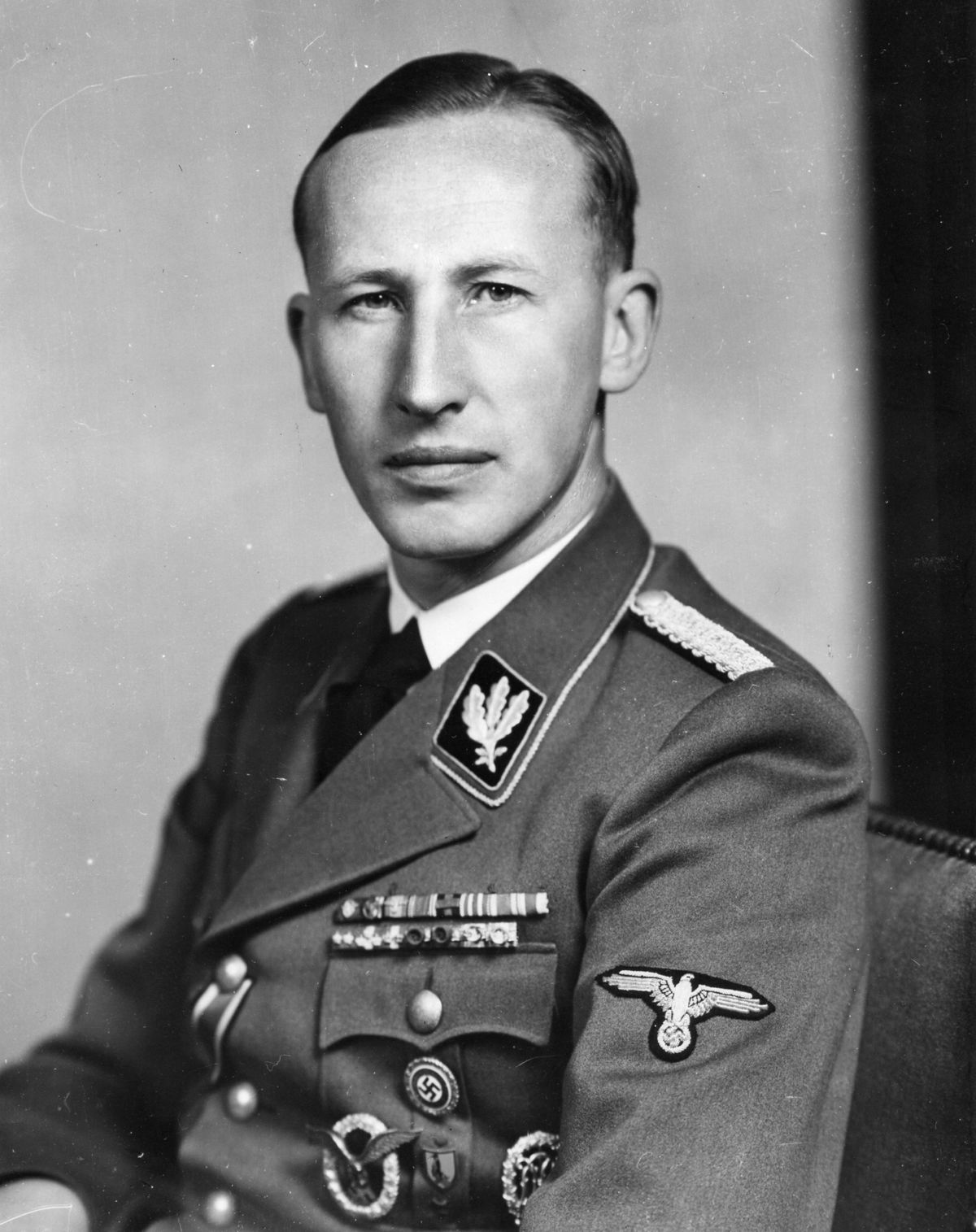
Reinhardt Heydrich 

But the reality was set many years before when Adolf Hitler and other anti-Semites declared the Jews to be vermin, and sub-human. The German word is more sinister sounding, untermenschen. They simply refused to admit the Jews were fully human, and instead believed that the Jews were an alien subspecies, an infestation that had to be eradicated. In fact the very same kind of language that President Trump and many of his followers use to describe racial and religious minorities today: American blacks, Mexican Americans, Asians, Arabs of all religious beliefs, even Jews when they desire. They also use such language to describe political opponents.

The late Christopher Hitchens wrote:

“Die Judenfrage,’ it used to be called, even by Jews. ‘The Jewish Question.’ I find I quite like this interrogative formulation, since the question—as Gertrude Stein once famously if terminally put it—may be more absorbing than the answer. Of course one is flirting with calamity in phrasing things this way, as I learned in school when the Irish question was discussed by some masters as the Irish ‘problem.’ Again, the word ‘solution’ can be as neutral as the words ‘question’ or ‘problem,’ but once one has defined a people or a nation as such, the search for a resolution can become a yearning for the conclusive. Endlösung: the final solution.”

Hitchens, an Atheist was absolutely correct, when so many modern Christians, and other religionists of various types fail to see the danger. In fact, many of Trump’s most devoted religious followers, especially conservative Christians blissfully embrace that ideology. So much for their insistence on being pro-life. 

The fact is that once a people, be they Germans, Americans, English, Russians, Chinese, Japanese, Turks, Persians, or so many others throughout history determine that any racial, religious, or political group, is less than human, that in time words will express their thoughts, and direct their actions. That my friends is a historic, religious, psychological, and sociological truth.

I hate to keep shouting this warning, of Yehuda Bauer who wrote:

“The horror of the Holocaust is not that it deviated from human norms; the horror is that it didn’t. What happened may happen again, to others not necessarily Jews, perpetrated by others, not necessarily Germans. We are all possible victims, possible perpetrators, possible bystanders.” 

With every, tweet and every statement the American President continues to stoke the fires of race hatred, and his followers seem to feed on it. I will not ever be a perpetrator, or a bystander, but it is possible that for speaking my views, I may someday be a victim, but I will go down fighting.

Until tomorrow,

Peace,

Padre Steve+

1 Comment

Filed under Loose thoughts and musings

Colonel Robert Gould Shaw Of the 54th Massachusetts who Fought for “men and women whose poetry is not yet written but which will presently be as enviable and as renowned as any.”


Friends of Padre Steve’s World,

This is an older article, but as the President and his supporters invoke more and more racist words and actions, it is worth the repeat. The principles of the Declaration of Independence must be continually fought for, otherwise, as our founders fully understood, they can be trampled under by tyrants. 

Until tomorrow,

Peace,

Padre Steve+

When it learned that the Federal Government was recruiting African Americans, both free men and former slaves as soldiers the Confederate Congress issued this proclamation:

“Any negro taken in arms against the Confederacy will immediately be returned to a state of slavery. Any negro taken in Federal uniform will be summarily put to death. Any white officer taken in command of negro troops shall be deemed as inciting servile insurrection and shall likewise be put to death.” 

Those who doubt that the leaders of the Confederacy fought the war for any “state right” other than the maintenance and expansion of slavery needs to look at the actions and words of that racist republic.

All of the various ordinances of secession of the Confederate States included verbiage which directly stated White Supremacy and the racial inferiority of Blacks. A sample is that of Texas, in which there were very few slaves or Slave holders compared to the bulk of the Confederate States:

“We hold as undeniable truths that the governments of the various States, and of the confederacy itself, were established exclusively by the white race, for themselves and their posterity; that the African race had no agency in their establishment; that they were rightfully held and regarded as an inferior and dependent race, and in that condition only could their existence in this country be rendered beneficial or tolerable.”

Colonel Robert Gould Shaw 

One hundred and fifty-four years ago today one of those African American regiments went into action against the Confederate works at Battery Wagner, outside of Charleston, South Carolina. The 54th was raised in Boston and Frederick Douglass was instrumental in recruiting men to serve in it, two of which were his sons, and another the grandson of Sojourner Truth. The regimental commander, Colonel Robert Gould Shaw was the son of wealth abolitionists. When the call for volunteers was made in 1861 joined the 7th New York, and later commissioned in the 2nd Massachusetts Volunteer Infantry, with which he fought at the battle of Antietam. After that battle he was offered the command of a black regiment then being raised in Boston. He initially declined the offer but on second thought decided to take it.

Later tonight I will probably watch the film Glory about that regiment, the 54th Massachusetts Volunteer Infantry. It was one of the first African American Regiments raised for service in the Civil War. I have seen the movie a number of times, and it never fails to bring tears to my eyes. Of course I have written a number of articles about the 54th and other African American units in the Civil War, the later “Buffalo Soldiers” and African American military pioneers, but I cannot forget the 54th. These were men who volunteered and remained in service knowing that the Confederate Congress had condemned them to death should they ever be captured. They also endured the mocking of some White Union soldiers as well as pay inequity with whites, for doing the same dangerous job as infantrymen.

When it was decided that an attack would be made on Battery Wagner the 54th was chosen for the mission. General Thomas Seymour provided this rational for leading the attack the the 54th: they “were in any respect as efficient as any other body of men; and as one of the strongest and best officered, there seemed to be no good reason why it should not be selected for the advance”


During their attack on the night of July 18th 1863, 272 members of the 600 men of the 54th who made the attack including their commander, the twenty-six year-old Colonel Shaw were killed or wounded in a bloody but unsuccessful assault on Battery Wagner. Following the assault, “Sergeant William H Carney staggered back from the fort with wounds in his chest and right arm, but with the regiment’s Stars and Stripes securely in his grasp. “The old flag never touched the ground, boys,” Carney gasped as he collapsed at the first field hospital he could find.” He would be awarded the Medal of Honor for his actions.


Thinking that it was an insult the Confederates stripped Shaw’s body of his uniform and robbed him of his possessions, including his sword. They threw Colonel Shaw’s body in a mass grave with his African American soldiers. When Union commanders asked for the return of his body were told by Confederate commander General Johnson Hagood:

“Had he been in command of white troops, I should have given him an honorable burial; as it is, I shall bury him in the common trench with the niggers that fell with him.”

Union officers sought to have his remains returned but Shaw’s father wrote to implore them not to continue the effort. He wrote to the regimental surgeon:

“We would not have his body removed from where it lies surrounded by his brave and devoted soldiers….We can imagine no holier place than that in which he lies, among his brave and devoted followers, nor wish for him better company. – what a body-guard he has!”

When Shaw first went to war he wrote to his mother words that should be in all of our hearts when we fight for the rights of others, especially those who are despised due to their race, national origin, color, religion or lack thereof,  gender, or sexual orientation:

“We fight for men and women whose poetry is not yet written but which will presently be as enviable and as renowned as any.”

That is what we fight for when we stand for the civil rights of others. That is why it is important to remember the example of the men of the 54th Massachusetts Volunteer Infantry.

Peace

Padre Steve+

Leave a comment

Filed under Loose thoughts and musings

Reflecting on the Best Of American Sports Teams

Friends of Padre Steve’s World,

The United States Women’s National Team, was simply the best and I continue to be in love with them.

They were derided before the tournament, mostly by male commentators. Their one of a kind outspoken veteran star player and co-Captain was viciously attacked in public statements by the President Of the United States, and they were criticized by others for their dominance and love of the game and love of team. I have never seen any winning team in any sport so derided for their unity, their dominance, and their ability to win against some of the best teams in the world, including Sweden, France, and England. In the final they defeated the Netherlands team which had played brilliantly the entire tournament, never trailing in a game until Megan Rapinoe scored on a penalty kick in the 61st minute of the championship game.

Their victory today was more than a victory for their team it was a victory for the proposition in the Declaration Of Independence that all people are created equal. In addition to winning they forced the hand of FIFA to increase the financial aspects of the game to women, doubling and then quadrupling the amount of money dedicated to the women’s tournament.

Beyond that, these women, and the members of the team over the past quarter of a century have blazed a trail of excellence that is hard to match. Forget about the men’s Olympic Basketball “Dream Teams”, made up of the best players in the NBA, no one cared when they ran up scores, dominated, and celebrated their wins. Forget the United States men’s Baseball team who cannot win or come close to winning an international tournament because the MLB owners won’t let their best players compete, or the U.S. Men’s Soccer team which has never gotten past the semifinals in the World Cup despite more funding and higher salaries than those of the USNWT.

The U.S. Women speak for more than sports. They speak for the equality of the Declaration, and the rights of women (and men) everywhere who are discriminated against because of gender, race, or religion. By the way when I speak of gender I don’t just talk male and female, but also of my LGBTQ friends, brothers and sisters.

This was a special team. They had a lot of detractors, including former teammates, but they showed their metal and won, in a convincing manner. They scored the most goals ever by a women’s treat in World Cup history and only allowed three goals against them in seven games. They defeated three of the highest rated teams in the world just to get to the final. They dealt with age and injuries, and still showed a joy for the game, love of team, and yes, patriotism, even the kind of which is unpopular and makes authoritarians uncomfortable and angry.

In that, Megan Rapinoe, the object of so much of President Trump’s disdain, won both the tournament’s Golden Boot for the most goals and assists, as well as the Golden Ball as best player of the tournament. As a patriot who believes and hopes for the best that our country has to offer, I hope that she and the team refuse any invitation to Trump’s White House. They fought for too much to surrender those victories to a man who would use them for a photo op and then continue to speak badly of them.

Congratulations to the American Women who won the Women’s World Cup and so much more, this year, as well as in 1995, 1999, and 2015. They all deserve our respect, appreciation, and admiration; but especially this team, for they are the face of ALL United States Soccer. They are the people who have inspired American women and men to compete at the highest levels of soccer worldwide.

So until tomorrow,

Peace,

Padre Steve+

Leave a comment

Filed under civil rights, leadership, LGBT issues, Loose thoughts and musings, News and current events, soccer, sports and life

The Immigrant Hero Of Little Round Top: Colonel Paddy O’Rorke

o'rorke

                                   The Irish Regular: Paddy O’Rorke

Friends of Padre Steve’s World,

This is another of my articles from one of my yet to be published books on the Battle of Gettysburg.

To Vincent’s right another hero emerged, Colonel Patrick “Paddy” O’Rorke; the young 27 year old Colonel of the 140th New York. O’Rorke was born in County Cavan, Ireland in 1836. His family immigrated to the United States, settling in Rochester, New York during the great wave of Irish immigration between 1838 and 1844. There the young O’Rorke worked hard to overcome the societal prejudices against Irish Catholics. After he completed his secondary education, he worked as a marble cutter before obtaining an appointment to West Point in 1857.  He was the only foreign born member of his class at the academy from which he graduated first in his class in 1861. “Aggressive and bold, there was also something that implied gentility and tenderness…Beneath the mettle of a young professional soldier was a romantic heart that could croon a ballad before wielding the sword.” [1] O’Rorke married his childhood, schoolmate, fellow parishioner and childhood sweetheart, Clarissa Wadsworth Bishop, in the summer of 1862 and shortly thereafter accepted a commission as colonel of the 140th New York Infantry.

At Gettysburg, O’Rorke was with Weed’s brigade when Gouverneur Warren found him as he attempted to get any available troops to the summit of Little Round Top. When Warren found O’Rorke, who had been one of his students at West Point, he ordered him to follow him up the hill, saying “Paddy…give me a regiment.” [2] When O’Rorke said that Weed expected him to be following him, Warren took the responsibility telling O’Rorke “Bring them up on the double quick, and don’t stop for aligning. I’ll take responsibility.” [3]O’Rorke followed with his gallant regiment with the rest of the brigade under Weed following behind them.

The 140th New York’s entrance onto the summit of Little Round Top must have been dramatic. Dressed in new Zouave uniforms that they had been issued in early June “the men were “jaunty but tattered” in baggy blue trousers, red jackets, and fezzes.” [4] O’Rorke’s New Yorkers entered the battle to the right of the Vincent’s 16th Michigan, which was being swarmed by the 4th and 5th Texas and 4th Alabama, who thought that victory was at hand. O’Rorke did not even take time to form his men for battle but drew his sword and yelled, “Down this way boys!” [5] His troops responded magnificently slamming into the surprised Texans and Alabamians and “at once the Confederate assault began to dissolve” [6]

O’Rorke’s troops smashed into the surging Rebel ranks, stopping the Confederate assault in its tracks and taking over two-hundred prisoners. As O’Rorke “valiantly led his men into battle, surging down the hill toward the shelf of rock so recently vacated by the right wing of the 16th Michigan, he paused for a moment to cheer his men on and wave them forward. When he did, he was struck in the neck by an enemy bullet….O’Rorke, killed instantly slumped to the ground.” [7]But his regiment “had the initiative now. More and more men piled into a sloppy line, firing as fast as they could reload. Their dramatic appearance breathed renewed life into the other Union regiments on the hill, which now picked up their firing rates.” [8] The gallant young Irish colonel was dead, but he and his regiment had saved Vincent’s right flank. The regiment had suffered fearfully, “with 183 men killed or wounded, but they had managed to throw back the Texans. The adjutant of the 140th estimated that they came within sixty seconds of losing the top of the hill.” [9] O’Rorke’s soldiers were enraged by the death of their beloved colonel and picked out the Confederate who had killed him. One of the soldiers wrote “that was Johnny’s last shot, for a number of Companies A and G fired instantly.” It was said that this particular Johnny was hit, by actual count, seventeen times.” [10]Now led by company commanders the 140th stayed in the fight and solidified and extended the Federal line in conjunction with the rest of Weed’s brigade to their right.

The actions of Chamberlain’s, Vincent’s, and O’Rorke’s soldiers shattered Hood’s division. “Casualties among the Alabamians, Texans, and Georgians approached or exceeded 2,000. In the Texas Brigade commander Robertson had been wounded, three regimental commanders had fallen killed or wounded, and nearly all of the field officers lay on the ground.” [11]

The badly wounded Strong Vincent was taken to a field hospital at the Weikert farm where he lingered for five days before succumbing to his wounds. In the yard lay the body of Paddy O’Rorke whose regiment had saved his brigade’s right flank. Vincent knew that he was dying and he requested that a message be sent to Elizabeth for her to come to Gettysburg. It did not reach her in time. Though he suffered severe pain he bravely tried not to show it. Eventually he became so weak that he could no longer speak. “On July 7, a telegram from President Lincoln, commissioning Vincent a brigadier general, was read to him, but he could not acknowledge whether he understood that the president had promoted him for bravery in the line of duty.” [12] He died later that day and his body was transported home to Erie for burial. Ten weeks after his death his wife gave birth to a baby girl. The baby would not live a year and was buried next to him.

Colonel Rice, who led the 44th New York up the hill and took command of the brigade on Vincent’s death, memorialized his fallen commander in his general order to the brigade on July 12th:

“The colonel commanding hereby announces to the brigade the death of Brig. Gen. Strong Vincent. He died near Gettysburg, Pa., July 7, 1863, from the effects of a wound received on the 2d instant, and within sight of that field which his bravery had so greatly assisted to win. A day hallowed with all the glory of success is thus sombered by the sorrow of our loss. Wreaths of victory give way to chaplets of mourning, hearts exultant to feelings of grief. A soldier, a scholar, a friend, has fallen. For his country, struggling for its life, he willingly gave his own. Grateful for his services, the State which proudly claims him as her own will give him an honored grave and a costly monument, but he ever will remain buried in our hearts, and our love for his memory will outlast the stone which shall bear the inscription of his bravery, his virtues, and his patriotism.

While we deplore his death, and remember with sorrow our loss, let us emulate the example of his fidelity and patriotism, feeling that he lives but in vain who lives not for his God and his country. “[13]

Rice would be killed during the Battle of the Wilderness just ten months later. Vincent’s wife Elizabeth never married again and was taken in by the Vincent family. Vincent’s younger brother became an Episcopal Priest and Bishop and later provided a home for her. She became a tireless worker in the church working with charitable work for young women and children. This led to an interest in sacred art and she wrote two books: Mary, the Mother of Jesus and The Madonna in Legend and in Art. She also translated Delitzch’s Behold the Man and A Day in Capernaum from the German. [14]Elizabeth Vincent passed away in April 1914 and was buried beside her husband and daughter.

After the battle, as the army looked to replace the casualties in the ranks of senior leadership and “when Colonel Rice, in charge of 3rd Brigade after Vincent fell, was promoted to brigadier general and given another command” the new division commander Major General Charles Griffin, “insisted on having Chamberlain, for the 3rd Brigade.” [15]

Chamberlain survived the war to great acclaim being wounded three times, once during the siege of Petersburg the wound was so severe that his survival was in doubt and General Ulysses S. Grant promoted him on the spot. It was the only promotion that Grant gave on the field of battle. Grant wrote:

“He had been several times recommended for a brigadier-generalcy for gallant and meritorious conduct. On this occasion, however, I promoted him on the spot, and forwarded a copy of my order to the War Department, asking that my act might be confirmed without any delay. This was done, and at last a gallant and meritorious officer received partial justice at the hands of his government, which he had served so faithfully and so well.” [16]

He recovered from the wound, and was promoted to Major General commanding a division and awarded the Medal of Honor. He received the surrender of John Gordon’s division of the Army of Northern Virginia at Appomattox on April 9th 1865. When he did he ordered his men to present arms in honor of their defeated foe as those haggard soldiers passed his division. It was an act that helped spur a spirit of reconciliation in many of his former Confederate opponents.

To be continued…

                                                            Notes 

[1] LaFantasie, Glenn W. Twilight at Little Round Top: July 2, 1863 The Tide Turns at Gettysburg Vintage Books, a Division of Random House, New York 2005 pp.61-62

[2] Ibid. Jordan Happiness is Not My Companion: The Life of G.K. Warren p.93

[3] Ibid. Foote The Civil War, A Narrative. Volume Two Fredericksburg to Meridian p.504

[4] Ibid. Pfanz Gettysburg: The Second Day p.228

[5] Ibid. Pfanz Gettysburg: The Second Day p.228

[6] Ibid. LaFantasie Twilight at Little Round Top p.153

[7] Ibid. LaFantasie Twilight at Little Round Top p.154

[8] Ibid. Trudeau, Gettysburg: A Testing of Courage p.327

[9] Ibid. Jordan Happiness is Not My Companion: The Life of G.K. Warren p.93

[10] Ibid. Sears Gettysburg p.294

[11] Wert, Jeffry D. A Glorious Army: Robert E. Lee’s Triumph 1862-1863 Simon and Schuster, New York and London 2011 p.260

[12] Ibid. LaFantasie Twilight at Little Round Top p.207

[13] Ibid. Nevins What Death More Glorious p.86

[14] Ibid. Nevins What Death More Glorious pp.87-88

[15] Ibid. Wallace The Soul of the Lion p.115

[16] Ibid. Wallace The Soul of the Lion pp.134-135

Leave a comment

Filed under Loose thoughts and musings

The Gettysburg Campaign: Lee’s Advance and the Relief Of “Fighting Joe” Hooker

rebel-potomac

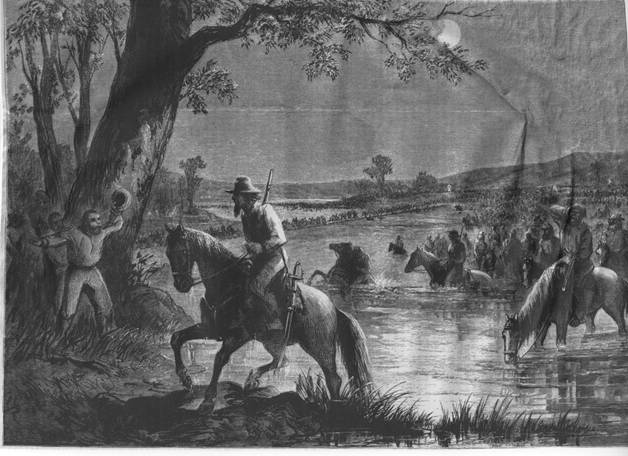
Ewell’s Corps crossing the Potomac

This is a continuation of the article that I posted last night. It is a continuation of my Gettysburg series. Tomorrow I will finish the chapter on Lee’s movement north by talking about Stuart’s Ride and the Confederate operations in Pennsylvania and Union pursuit up to June 30th. On footnotes please refer to part one because I did not want to go back and re-type each note.

The action at Brandy Station delayed Lee’s movement by a day. However, Stuart’s repulse of Pleasanton’s force did enable Lee’s Army to make its northward movement undetected by Hooker who was still trying to divine what Lee was up to and was “slow, even reluctant, to react to Lee’s advance.” (1) Lee’s initial move to break contact with the Federal Army and keep his movements and intentions secret was an excellent example of deception.

ewell

Lieutenant General Richard Ewell

Ewell’s Corps led the march of the army north on the morning of June 10th and joined by Jenkins’ cavalry brigade entered the Shenandoah Valley by way of the Chester Gap on June 12th. In two days of marching his “columns covered over forty-five miles.” (2) On the 13th Ewell was near Winchester where 6,000 soldiers under the command of Major General Robert Milroy were garrisoned. Ewell’s advanced troops skirmished with them on the 13th and on the 14th Ewell concentrated his corps to attack. As he did so Lincoln and Halleck attempted to get Hooker to do something to relieve Milroy. Hooker was “troubled by indecision” (3) and did nothing. The attack commenced at about 5:00 PM. The battle, now known as the Second Battle of Winchester the battle was a complete rout. Hit by Ewell’s forces “which swiftly and effectively broke through his outer lines,” (4) That evening Milroy attempted to retreat “northwestward in the darkness, only to be intercepted at dawn by Johnson.” (5) The Second Corps captured “captured 23 cannon, 300 wagons loaded with supplies and ammunition, and nearly 4,000 prisoners.” (6) Milroy and his survivors retreated to Harper’s Ferry where he was “presently removed from command by Lincoln, but that was a superfluous gesture, since practically all of his command had been removed from him by Ewell.” (7) Ewell’s forces lost just 50 killed and 236 wounded.

Ewell’s decisive victory at Winchester “was one of the most swift, total, and bloodless Confederate victories of the war.” (8) The victory “cleared the lower Shenandoah Valley of most Federal forces and paved the way for Lee’s army to march north into Maryland and then into Pennsylvania.” (9) Ewell had been brilliant to this point, the victory at Second Winchester and the skill with which he had conducted his operations “removed lingering doubts about his ability to carry on the tradition of “Stonewall” Jackson, as well as about his physical capacity, after the loss of a leg, to endure the rigors of campaigning.” (10) The Richmond Daily Dispatch that Ewell “has indeed caught the mantle of the ascended Jackson. Brilliantly has he re-enacted the scenes of the spring of ’62, on the same theatre.” (11)

Ewell did not waste time lingering at Winchester. The next day he sent Jenkins across the Potomac to Chambersburg Pennsylvania. Rodes division crossed the Potomac on the 16th “for a crossing at Williamsport where a halt was called to allow the other two divisions to catch up for a combined advance into Pennsylvania.” (12)

Longstreet’s First Corps moved next and advanced east of the Blue Ridge in conjunction with Stuart’s cavalry division screening the rest of the army from Hooker. Longstreet “set out for Ashby’s and Snicker’s Gaps with the bulk of Stuart’s cavalry covering his right flank.” (13) By the 17th of June Longstreet’s and Stuart’s troops had cleared the Blue Ridge. “Lee’s army was now stretched out from Hagerstown to Culpepper, a distance of seventy-five miles; yet Hooker did nothing.”(14) Lincoln realized that the dispersed Confederate army was vulnerable and telegraphed Hooker “if the head of Lee’s army is at Martinsburg and the tail of it on the Plank road between Fredericksburg and Chancellorsville, the animal must be very slim somewhere. Could you not break him?”(15)

hooker

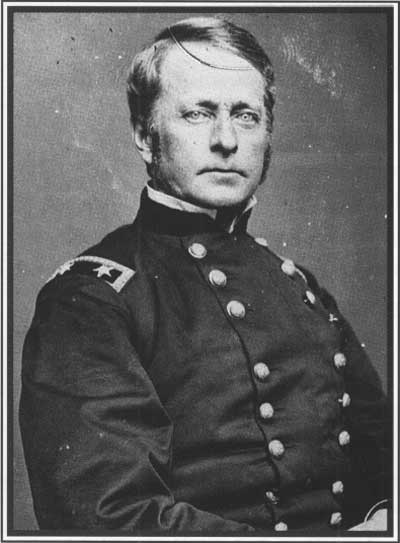
Major General Joseph “Fighting Joe” Hooker

Hooker was slow to appreciate what Lee was doing and the “concealing topography of the region greatly favored Lee’s offensive operations…and Lee was planning on using both the Shenandoah and Loudoun valleys to conceal his forces and confuse his enemies.” (16) In this Lee had succeeded admirably. Finally on June 13th Hooker prodded by Lincoln and Halleck finally moved the Army of the Potomac to a position “near the Orange and Alexandria Railroad near Washington” (17) where it could defend Washington in case Lee was to make a thrust at the Federal capitol. The march from Fredericksburg was ordeal for his soldiers. “It had not rained for more than a month, thick clouds of dust enveloped the columns as the sun burned the air. Men drained their canteens, and water was scarce. Hundreds collapsed from sunstroke.” (18)

Hooker now informed Lincoln and Halleck that from now on his operations “would be governed by the movements of the enemy.” In doing so he “admitted his loss of initiative to Lee and his reluctance or inability to suggest any effective countermoves to the enemy’s plan.” (19)

As the army gathered near Dumfries on June 17th, Hooker who was completely lost as to Lee’s intentions and completely clearly out of his league was also engaged in a personal battle with Halleck and Lincoln. His Chief of Staff, General Dan Butterfield, a staunch supporter, remarked “We cannot go boggling around until we know what we are going after.” (20) The Provost Marshall of the Army of the Potomac Brigadier General Marsena Patrick was quite critical of his chief, noting that “Hancock is running the Marching and Hooker has the role of a subordinate- He acts like a man without a plan and is entirely at loss at what to do, or how to match the enemy, or counteract his movements.” (21)

Henry_Halleck_by_Scholten,_c1865

Major General Henry Halleck

During the march Hooker continued his feud with Halleck and Lincoln, oblivious to the fact that “his contretemps with Washington was costing him respect and credibility.” (22) Navy Secretary Gideon Welles after talking with Lincoln wrote in his diary, “I came away from the War Department painfully impressed. After recent events, Hooker cannot have the confidence which is essential to success, and which is all-important to the commander in the field.” (23) Hooker however, continued to make matters worse for himself and wrote to Lincoln, a thinly veiled attempt to have Halleck relieved, on June 16th :

“You have been aware, Mr. President” he telegraphed, “that I have not enjoyed the confidence of the major-general commanding the army, and I can assure you so long as this continues we may look in vain for success, especially as future operations will require our relations to be more dependent on each other than heretofore.” (24)

Lincoln was not to be trifled with by his demanding yet befuddled subordinate. He sent a telegraph to Hooker at 10:00 PM on the 16th which rankled Hooker even the more:

“To remove all misunderstanding I now place you in the strict military relation to General Halleck of a commander of one of the armies to the general-in-chief of all of the armies. I have not intended differently, but as it seems to be differently understood I shall direct him to give you orders and for you to obey him.” (25)

While the drama between Hooker, Halleck and Lincoln played on there were a series of fierce cavalry clashes west of Washington between June 17th and June 21st as Pleasanton’s troops kept assailing the Confederate flank in order to ascertain what Lee’s army was doing. As they probed the gaps in the Blue Ridge they confronted Stuart’s cavalry. At Aldie on June 17th, Middleburg on June 19th and Upperville on June 21st Stuart’s and Pleasanton’s troopers engaged “in a series of mounted charges and dismounted fighting. The Yankees showed the same grit and valor as they had at Brandy Station, pressing their attacks against the Rebels.” (26)

custer@aldieAt Upperville Pleasanton’s troopers “pressed Stuart’s cavalry so hard that Lee ordered McLaws’ division of Longstreet’s Corps to hold Ashby’s Gap, and he momentarily halted Major General Richard Anderson’s division of Hill’s corps on its way to Shepherdstown.” (27) Stuart’s men were successful in protecting the gaps and ensuring that the Federal troopers did not penetrate them, but “Pleasanton learned, however, from prisoners and local citizens, “The main body of the rebel infantry is in the Shenandoah Valley.” (28)

Pleasanton for some unexplained reason thought that this meant that the Confederates were heading toward Pittsburgh. Hooker “viewed it as a raid” and again proposed an overland advance against Richmond, which was once again rejected by Lincoln. The President ordered  Hooker: “If he comes toward the Upper Potomac, follow on his flank and on his inside track, shortening your line whilst he lengthens his. Fight him too when the opportunity offers. If he stays where he is, fret him, fret him and fret him.” (29)

As the series of clashes occurred on the Confederate flank Ewell’s Second Corps, followed by Hill’s Third Corps advanced into Pennsylvania. A general panic ensued in many places with cries going out for Lincoln to call up militia to defend the state. The panic was fueled by Confederate actions. Jenkins’ troops in occupied Chambersburg they rounded up any blacks that remained in the city, and “Some fifty blacks were formed into a coffle and marched south to be sold into bondage.” (30)

By June 23rd the head of the Bureau of Military Information Colonel George Sharpe had deduced that all of Ewell’s corps was in Pennsylvania marching north and that Hill’s corps was across the Potomac, and “in one of those sudden moments of brutal clarity, George Sharpe realized that everything pointed to the conclusion that Lee’s entire army, or most of it, was north of the Potomac.” (31) Now Sharpe did not realize that Longstreet’s corps was still helping to hold and scree the gaps, but he had correctly deduced Lee’s intentions.

It took time but Hooker belatedly on June 24th Hooker began to move his army to Frederick. As the Army of the Potomac crossed its namesake river between June 25th and 27th over a vast pontoon bridge, Hooker made one last attempt to salvage his reputation. He had already been successful in getting Halleck to give him nearly 15,000 troops as reinforcements drawn from the District of Washington, drawing the ire of its commander Major General Samuel Heintzelman, but that was not enough for Hooker.

Hooker also demanded that he be given command and control over the garrison at Harper’s Ferry, allegedly to use in an operation to cut off Lee’s line of supply and communication in Western Maryland. This was refused by Halleck who had seen the request coming. Halleck told Hooker “that the fortified heights at Harper’s Ferry…”have always been regarded as an important point by to be held by us…I cannot approve their abandonment, except in the case of absolute necessity”(32) and directed the Major General William H. French, the commanding officer of the Harper’s Ferry garrison “Pay no attention to Hooker’s orders.” (33)

The highly volatile Hooker was furious and in his anger Hooker “told Herman Haupt during the railroad coordinator’s visit that he would do nothing to oppose Lee’s invasion without specific orders. He also continued to tell Halleck, Stanton, and Lincoln that he wanted Lee to go north so he could go after Richmond.” (34)

The order to French was Halleck’s way of bating Hooker figuring that Hooker would consider it the last straw, which the impulsive Hooker did. Hooker then played his last card and wired Halleck an ultimatum:

“My original instructions require me to cover Harper’s Ferry and Washington. I have now imposed on me, in addition to an enemy in my front more than my number. I beg to be understood, respectfully, but firmly that I am unable to comply with this condition with the means at my disposal, and earnestly request that I be relieved from the position I occupy.” (35)

Halleck replied to Hooker  with a brief message; simply stating “Your dispatch has been duly referred to the executive for action.” (36) Halleck then took the letter to Stanton and Lincoln and Lincoln wasted little time in relieving Hooker, though he was not happy about having to do so in the middle of a campaign. Lincoln had two choices, “he could send him into battle with his self-doubts and suspicions intact, or he could accept it and risk the political and military consequences that would accompany an abrupt change in leadership.” (37)

In the end, late in the night on June 27th 1863 Lincoln chose the latter, relieved Hooker and appointed Major General George Gordon Meade, commanding officer of V Corps as the new commander of the Army of the Potomac.

Notes

1 Ibid. Wert General James Longstreet p.251
2 Ibid. Coddington The Gettysburg Campaign p.73
3 Ibid. Coddington The Gettysburg Campaign p.81
4 Ibid. Coddington The Gettysburg Campaign p.88
5 Ibid. Foote The Civil War, A Narrative. Volume Two p.440
6 Ibid. Wert A Glorious Army p.222
7 Ibid. Foote The Civil War, A Narrative. Volume Two p.440
8 Ibid. Guelzo Gettysburg: The Last Invasion p.62
9 Ibid. Petruzzi and Stanley The Gettysburg Campaign in Numbers and Losses p.20
10 Ibid. Coddington The Gettysburg Campaign p.89
11 Ibid. Guelzo Gettysburg: The Last Invasion p.62
12 Ibid. Foote The Civil War, A Narrative. Volume Two p.440
13 Ibid. Fuller Decisive Battles of the U.S.A. 1776-1918 p.224
14 Ibid. Fuller Decisive Battles of the U.S.A. 1776-1918 p.224
15 Ibid. Guelzo Gettysburg: The Last Invasion pp.64-65
16 Ibid. Sears Gettysburg p.85
17 Ibid. Coddington The Gettysburg Campaign p.71
18 Ibid. Wert The Sword of Lincoln p.263
19 Ibid. Coddington The Gettysburg Campaign p.71
20 Ibid. Wert The Sword of Lincoln p.264
21 Ibid. Trudeau Gettysburg a Testing of Courage pp. 53-54
22 Ibid. Trudeau Gettysburg a Testing of Courage p.53
23 Ibid. Sears Gettysburg p.88
24 Ibid. Sears Gettysburg p.88
25 Ibid. Trudeau Gettysburg a Testing of Courage p.54
26 Ibid. Wert The Sword of Lincoln p.264
27 Ibid. Coddington The Gettysburg Campaign p.79
28 Ibid. Wert A Glorious Army p.224
29 Ibid. Wert A Glorious Army p.224
30 Ibid. Sears Gettysburg p.82
31 Ibid. Trudeau Gettysburg a Testing of Courage p.66
32 Ibid. Trudeau Gettysburg a Testing of Courage p.93
33 Ibid. Guelzo Gettysburg: The Last Invasion p.84
34 Marszalek, John F. Commander of All of Lincoln’s Armies: A Life of General Henry W. Halleck The Belknap Press of Harvard University Press, Cambridge MA and London 2004 p.175
35 Ibid. Marsalek Commander of All of Lincoln’s Armies p.175
36 Ibid. Sears Gettysburg p.1233
37 Ibid. Trudeau Gettysburg a Testing of Courage p.98

Leave a comment

Filed under civil war, Gettysburg, History, leadership, Loose thoughts and musings, Military

Perchance to Dream: A Sleep Study and the Paths Not Chosen


Friends of Padre Steve’s World,

After about a week of writing about politics, history, and the very disturbing presidency of Donald Trump, I need to take a break, not that there isn’t a lot of politics, foreign policy, and other serious subjects I could write about. But honestly I need to take a break from that, at least for tonight because I am already hooked up and waiting for my official bedtime in the Sleep Lab at Portsmouth Naval Medical Center.

I will be hooked up to a CPAP because I am already diagnosed with pretty severe sleep apnea, but tonight it different, they are going to observe my REM sleep disorder, where in my dreams, nightmares, and night terrors my body acts out those dreams. This condition has sent me to the ER or the medical clinic on more than one occasion and I have a concussion in 2014 and a broken nose in 2016 to show for it. Things get a bit sporting in my hi-definition nightmares and night terrors. My dreams have still been pretty vivid as of late but a combination of medicines seem to have lessened the physical acting out in them, according to my wife Judy. However, tonight, in a strange bed and with none of the medicines I get to try to sleep. It should be interesting. I cannot even take my customary shot of single malt Scotch or Irish Whiskey for my knee pain.

So today I write something a bit more introspective, which I think is a good question for all of us who seek the truth and take the time to examine our lives in light of all that happens to us. Since I am stuck here this is as good of time as any to do so.

In the series the X-Files, Agent Dana Scully played by Gillian Anderson made this observation: 

“Time passes in moments… moments which, rushing past, define the path of a life, just as surely as they lead towards its end. How rarely do we stop to examine that path, to see the reasons why all things happen, to consider whether the path we take in life is our own making, or simply one into which we drift with eyes closed. But what if we could stop, pause to take stock of each precious moment before it passes? Might we then see the endless forks in the road that have shaped a life? And, seeing those choices, choose another path?”

I actually think that it is a very good question and truthfully I wonder. I wonder what my life might have been had I, or others made different decisions. How would my life be different? Or would it? I don’t know, and frankly, I don’t really care.

One thing I do know is that whatever my alternate paths might have taken that I am happy. I have been able to fulfill many dreams and I do take the time to ponder all the forks in the road that have shaped my life. When I do I realize that the alternative possibilities are almost endless. Then when I think of the possibilities of alternate universes I wonder, not that there is anything wrong with that. But even so, I don’t think I would want to be on any other path, for since I was a child all that I could imagine ever being happy doing in life was serving my country in the military.  In early 1861, Ellen Boyle Ewing Sherman, the wife of William Tecumseh Sherman told Sherman “You will never be happy in this world unless you go in the army again.”  Ellen had never approved of Sherman’s previous service and in fact hated ever moment of it, but after six years of seeing her husband in civilian life, she knew that he had to return to the army. 

Twenty years ago I made a decision to volunteer to serve as a mobilized Army reservist during the Bosnia crisis. It was a decision that changed my life. I had left active duty in 1988 to attend seminary while remaining in the National Guard and the Reserves, and when I was mobilized I lost my civilian employment, and two and a half years later when I was offered the chance to go on active duty in the Navy, even though it meant a reduction in rank, I did it. 

When I think of all the things that transpired to get me when I am today I really am astounded, and for the life of me I don’t see how I could have chosen another path. It has been twenty years since I volunteered to support the Bosnia operation, and almost thirty-five years since I first enlisted in the army, and like Sherman, I cannot have imagined doing anything different. As for my wife Judy, she, like Ellen Sherman was with her husband has been long suffering in staying with me all these years, and I wouldn’t trade her for anyone. April 1 of 2020 I will be retiring from the Navy, unless the President gets us into a war and the military declares a “stop loss.” One never knows these days, I have known people in 1990 and again in 2001 and 2003 who got caught in such events, or were extended after their mandatory retirements.

But, when I look at my life in total, there are many things that I might have wanted to change or do differently, but if I had, or for that matter,mad someone else made a different decision concerning my life, the tapestry that has been my life would be very different and I might not even recognize me if any of those paths had been chosen, by me, or by others. 

Agent Scully’s words got me thinking and pondering, and that my friends is a good thing. 

So until the next fork in the road….

Peace

Padre Steve+

Leave a comment

Filed under History, life, Loose thoughts and musings, Military

An Anniversary Pause

Friends of Padre Steve’s World,

I won’t be writing anything tomorrow, it is our 36th Wedding Anniversary. I’m taking a day of leave, and have some surprises planned for Judy in addition to going out for breakfast and then dinner at our favorite German Restaurant in Portsmouth.

I will catch you on the rebound on Wednesday.

Peace,

Padre Steve+

14 Comments

Filed under Loose thoughts and musings

Thoughts on 36 Years of Commissioned Service

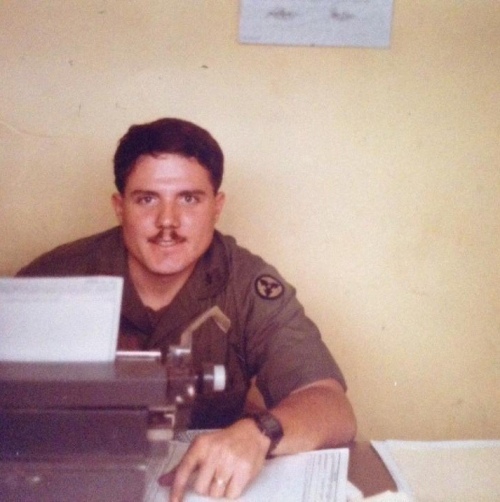
Second Lieutenant Dundas, 1984, Neubrücke Germany

Friends of Padre Steve’s World,

Thirty-six years ago, on the 19th Of June 1983, about 15 of my Army ROTC classmates and I were commissioned as Second Lieutenants in the Active Duty Army, the Army Reserve, or National Guard. Now, thirty-six years later I am the last one on active duty. A number still serve in DOD civilian status, others have retired from the military, and others transitioned to civilian life sometime during the intervening time.

My life since I was commissioned has being as a Medical Service Corps active duty platoon leader, motor maintenance officer, NBC Defense officer, Company Executive Officer and Commander, before becoming a Medical Personnel officer at a Medical Group and later the Adjutant for the Academy Brigade, Academy of Health Sciences, at Fort Sam Houston, Texas. While there I helped write the Army’s personnel policies on personnel infected with HIV and AIDS, which helped change my views on those infected with this horrible disease, and my acceptance and support for LGBTQ people, not just in the military.

Back in 1983 I took an oath which I still abide by:

I, [name], do solemnly swear (or affirm) that I will support and defend the Constitution of the United States against all enemies, foreign and domestic; that I will bear true faith and allegiance to the same; that I take this obligation freely, without any mental reservation or purpose of evasion; and that I will well and faithfully discharge the duties of the office on which I am about to enter. So help me God.

When I left active duty to attend seminary in the fall of 1988 I entered the Texas Army National Guard, still,serving as a personnel officer, but with a branch transfer to the Armor Branch. Later the State Chaplain found that a seminary student was serving as an Armor officer and had me transferred to the Staff Specialist Branch, for Chaplain Candidates, for which there is no paper trail in existence even though I attended the Chaplain Officer Basic Course the following summer. Until I became a Chaplain in October 1992 I was officially listed as a Medical Service Corps or Armor officer.

I continued on as a Chaplain in the Texas Army National Guard, then Virginia before being promoted to Major and transferred to the Army Reserve in West Virginia in December 1995. In June 1996 I was mobilized to support the Bosnia operation, OPERATION JOINT ENDEAVOR. I supported the operation from Germany, filling in for forward deployed Chaplains at the Würzburg Army Medical Center, the 4th Battalion, 3rd Air Defence Artillery, and as the base chaplain at Leighton Barracks in Kitzingen, before returning home to find that my contract position at a local hospital had been terminated when I was deployed and a man I had trained had been hired as a full time permanent employee.

Within two weeks of my release from my mobilized service I was activated to serve as the Garrison Chaplain for Fort Indiantown Gap, Pennsylvania, about 18 miles east of Harrisburg. The Gap was on the Base Realignment and closure list for 1998 and I was the last Federal Chaplain before it was transferred to the Pennsylvania National Guard. When we shut it down my tour ended, but I had been able with the support of my Commanding Officer, the Active Duty Army, and the Pennsylvania Army National Guard to keep the chapel program going. When done I went back to be the Group Chaplain for the 38th Ordnance Group, in Cross Lanes, West Virginia. However, without a civilian job to go home to it was difficult as we lived off of savings and drill pay.

Just before Christmas of 1998 I got a call from my former bishop in my former church that the Navy had hit a recruiting crisis for Chaplains and was willing to deal. Since I was a Major, a controlled grade, the the Army wouldn’t take me back into active duty. However, the Navy allowed me to resign my Army commission and enter the Navy the same day, with a reduction in rank. I was commissioned as a Navy Chaplain on 9 February 1999 and before the end of the month was on active duty.

After Chaplain School I was assigned to the 2nd Marine Division where served with the Second Combat Engineer Battalion, the 1st and 3rd Battalions, 8th Marine Regiment, and finally Headquarters Battalion, 2nd Marine Division. I was the Division Chaplain’s “relief pitcher.” When a Chaplain got in trouble and was removed, or when one was transferred unexpectedly, I got sent in. I was a Headquarters Battalion on September 11th 2001 following a deployment to the Western Pacific with 3rd Battalion 8th Marines. In December I was transferred to the USS Hue City and shortly thereafter deployed in support of Operation Enduring Freedom. Following that deployment, in which I served as an “advisor” on a boarding team and participated in 75 missions on interred tankers and merchant ships found in violation of U.N. Sanctions against Iraq.

When I transferred to Marine Security Forces in Norfolk in October 2003 my battalion commander put me on the road one to three weeks a month to Europe, the Middle East, Asia, and various locations stateside in support of Marine Security Forces. During that tour I was Promotes to Lieutenant Commander, and then assigned to Navy EOD Group Two, from which I was deployed with my assistant to Iraq in July 2007 in support of American advisors to Iraqi Forces In Al Anbar Province. That was a life changing experience. Suffering from severe PTSD and mild TBI I returned to the States in a mess. My next assignment after EOD was at the Naval Medical Center Portsmouth. I found that I was working 60-80 hours a week, and occasionally more in our ICUs and as the one call Chaplain to try to make my PTSD better. It didn’t work. I fell apart. My PTSD as well as physical injuries took a toll on me. Though I was selected for Commander the day after I found out that my dad had died of Alzheimer’s disease, things were never the same. Despite that, during those tours I had completed the Marine Corps Command and Staff College, earned my qualification as a Fleet Marine Force Officer, and completed a Masters Degree in Military History.

I had decided to speak up about my struggles with PTSD, and questions with the church I was then ordained by, I found that I was pretty much abandoned by my old church and the Chaplain Corps. I was short toured at Portsmouth and sent on a geographic bachelor assignment as the department head of the Pastoral Care Department at Camp LeJeune, Naval Hospital where I spent three years. The economic cost was great and the emotional cost to Judy and me greater.

I a rare stroke of fortune my detailed got me assigned to my dream assignment as an instructor and chaplain at the Joint Forces Staff College. If I couldn’t be operational and out with the troops at least I was instructing, teaching, researching, and back in academia. I spent 3 and 1/2 years there teaching Ethics and leading the Gettysburg Staff Ride.

After I left the Staff College I have struggled. I was assigned as the Command Chaplain and Joint Expeditionary Base Little Creek Fort Story. I have found that despite the massive budget increases in DOD that the base, Medical, and support side of the house are being gutted. My billet used to be an O-6, or Navy Captain billet. There were more Chaplains, more enlisted support staff, and contract personnel, and that is not just on the religious ministries side of the house. We are short of critical staff and security measures across the board. After almost two decades of war the Navy is attempting to sharpen the point of the spear but the shaft is rotten and about to fall apart.

I have good people to work with, quality Chaplains and enlisted personnel and contractors who do a great job, but I expect unless something radically changes that my work, and the work of Chaplains decades before me will be for naught. Supposedly there are more deep cuts coming, despite the increases in the overall Defense Budget. My friends in Navy Medicine confirm that more deep cuts are probably coming to Navy Medicine.

As for me, I have been assured that by the time I retire next April that my knees will be fixed. So I will be able to retire, and once I figure out what my retirement pay + disability + VA benefits + post retirement earnings then Judy and I can plan on selling our current townhome and getting a ranch house that won’t fuck with our knees, and allow us to have an office for me, an art studio for her and a guest room.

Commander Dundas, Joint Forces Staff College, 2016

By this time next year, unless the President gets us in a war and triggers a stop loss I will be retired, and back in the civilian and academic world full time, and with that ranch house with enough room to be able to enjoy it, with our puppies. By the way if you want a nice, good sized townhouse with great neighbors in Virginia Beach, let me know.

By the way, it takes a lot of really good people to get someone like me through such a long and often difficult career. First among them is my wife Judy, who was and still is there every step of the way. Likewise all the men and women that I have served alongside, either as a subordinate, equal, or superior during my career.

To all of you who have walked this path with me on the blog the past decade, thank you.

Until tomorrow,

Peace,

Padre Steve+

Leave a comment

Filed under Loose thoughts and musings, Military

The Largest Cavalry Battle in North America: The Battle Of Brandy Station

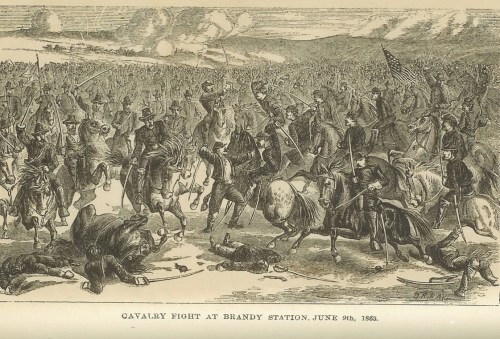
Cav Fight at Brandy Station

Friends of Padre Steve’s World,

Today I continue my rest so I can read and relax. take a look back at the battle of Brandy Station, the largest cavalry battle every fought on the North American continent. This is a section of my draft Gettysburg campaign text.

Have a great day,

Peace

Padre Steve+

Movement to attain operational reach and maneuver are two critical factors in joint operations. In the time since the American Civil War the distances that forces move to engage the enemy, or maneuver to employ fires to destroy his forces have greatly increased. Movement may be part of an existing Campaign Plan or Contingency Plan developed at Phase 0; it also may be part of a crisis action plan developed in the midst of a campaign. Lee’s movement to get to Gettysburg serves as an example of the former, however, since his forces were already in contact with the Army of the Potomac along the Rappahannock and he was reacting to what he felt was a strategic situation that could not be changed but by going on the offensive that it has the feel of a Crisis Action Plan. Within either context other factors come into play: clarity of communications and orders, security, intelligence, logistics and even more importantly the connection between operational movement and maneuver; the Center of Gravity of the enemy, and national strategy. Since we have already discussed how Lee and the national command authority of the Confederacy got to this point we will now discuss the how that decision played in the operational and tactical decisions of Lee and his commanders as the Army of Northern Virginia began the summer campaign and the corresponding actions of Joseph Hooker and the his superiors in Washington.

“One of the fine arts of the military craft is disengaging one’s army from a guarding army without striking sparks and igniting battle.” [1] On June 3rd 1863 Robert E. Lee began to move his units west, away from Fredericksburg to begin his campaign to take the war to the North. He began his exfiltration moving Second Corps under Richard Ewell and First Corps under James Longstreet west “up the south bank of the Rappahannock to Culpepper, near which Hood and Pickett had been halted on their return from Suffolk.” [2]Rodes’ division of Second Corps followed on June 4th with Anderson and Early on June 5th. Lee left the three divisions of A.P. Hill’s Third Corps at Fredericksburg to guard against any sudden advance by Hooker’s Army of the Potomac toward Richmond. Lee instructed Hill to “do everything possible “to deceive the enemy, and keep him in ignorance of any change in the disposition of the army.” [3]

The army was tremendously confident as it marched away from the war ravaged, dreary and desolate battlefields along the Rappahannock “A Captain in the 1st Virginia averred, “Never before has the army been in such a fine condition, so well disciplined and under such complete control.” [4]Porter Alexander wrote that he felt “pride and confidence…in my splendid battalion, as it filed out of the field into the road, with every chest & and ammunition wagon filled, & and every horse in fair order, & every detail fit for a campaign.” [5] Another officer wrote to his father, “I believe there is a general feeling of gratification in the army at the prospect of active operations.” [6]

Lee’s plan was to “shift two-thirds of his army to the northwest and past Hooker’s flank, while A.P. Hill’s Third Corps remained entrenched at Fredericksburg to observe Hooker and perhaps fix him in place long enough for the army to gain several marches on the Federals.” [7] In an organizational and operational sense that Lee’s army after as major of battle as Chancellorsville “was able to embark on such an ambitious flanking march to the west and north around the right of the army of the Potomac….” [8]

However, Lee’s movement did not go unnoticed; Hooker’s aerial observers in their hot air balloons “were up and apparently spotted the movement.” [9] But Hooker was unsure what it meant. He initially suspected that “Lee intended to turn the right flank of the Union army as he had done in the Second Bull Run Campaign, either by interposing his army between Washington and the Federals or by crossing the Potomac River.” [10] Lee halted at Culpepper from which he “could either march westward over the Blue Ridge or, if Hooker moved, recontract at the Rappahannock River.” [11]

Hooker telegraphed Lincoln and Halleck on June 5th and requested permission to advance cross the river and told Lincoln that “I am of opinion that it is my duty to pitch into his rear” [12]possibly threatening Richmond. Lincoln ordered Hooker to put the matter to Halleck, with whom Hooker was on the worst possible terms. Hooker “pressed Halleck to allow him to cross the Rappahannock in force, overwhelming whatever rebel force had been left at Fredericksburg, and then lunging down the line of the Virginia Central toward an almost undefended Richmond.” [13] On the morning of June 6th Hooker ordered pontoon bridges thrown across the river and sent a division of Sedgwick’s VI Corps to conduct a reconnaissance in force against Hill.

Lincoln and Halleck immediately rejected Hooker’s request. Lincoln “saw the flaw in Hooker’s plan at once” [14] and replied in a very blunt manner: “In one word,” he wrote “I would not take any risk of being entangled upon the river, like an ox jumped half over a fence and liable to be torn by dogs front and rear, without a fair chance to gore one way or kick another.” [15] Halleck replied to Hooker shortly after Lincoln that it would “seem perilous to permit Lee’s main force to move upon the Potomac [River] while your army is attacking an intrenched position on the other side of the Rappahannock.” [16] Lincoln, demonstrating a keen regard for the actual center of gravity of the campaign, told Hooker plainly that “I think Lee’s army and not Richmond, is your objective point.” [17]

The fears of Lincoln and Halleck were well founded. In stopping at Culpepper Lee retained the option of continuing his march to the Shenandoah and the Potomac, or he could rapidly “recall his advanced columns, hammer at Hooker’s right flank, and very possibly administer another defeat even more demoralizing than the one he suffered at Chancellorsville.” [18] Hooker heeded the order and while Hooker maintained his bridgehead over the Rappahannock he made no further move against Hill’s well dug in divisions.

Meanwhile, J.E.B. Stuart and his Cavalry Corps had been at Brandy Station near Culpepper for two weeks. Culpepper in June was a paradise for the cavalry, and with nearly 10,000 troopers gathered Stuart ordered a celebration, many dignitaries were invited and on June 4th Stuart hosted a grand ball in the county courthouse. On the 5th Stuart staged a grand review of five of his brigades. Bands played as each regiment passed in review and one soldier wrote that it was “One grand magnificent pageant, inspiring enough to make even an old woman feel fightish.” [19] The review ended with a mock charge by the cavalry against the guns of the horse artillery which were firing blank rounds. According to witnesses it was a spectacular event, so realistic and grand that during the final charge that “several ladies fainted, or pretended to faint, in the grandstand which Jeb Stuart had had set up for them along one side of the field.” [20]That was followed by an outdoor ball “lit by soft moonlight and bright bonfires.” [21] Stuart gave an encore performance when Lee arrived on June 8th, minus the grand finale and afterward Lee wrote to his wife that “Stuart was in all his glory.” [22]

Hooker received word from the always vigilant John Buford, of the First Cavalry Division on the night of June 6th that “Lee’s “movable column” was located near Culpepper Court House and that it consisted of Stuart’s three brigades heavily reinforced by Robertson’s, “Grumble” Jones’s, and Jenkins’ brigades.” [23] Hooker digested the information and believed that Stuart’s intent was to raid his own rear areas to disrupt the Army of the Potomac’s logistics and communications. The next day Hooker ordered his newly appointed Cavalry Corps Commander, Major General Alfred Pleasanton to attack Stuart.

After Chancellorsville, Hooker had reorganized the Union cavalry under Pleasanton into three divisions and under three aggressive division commanders, all West Pointers, Brigadier General John Buford, Brigadier General David Gregg and Brigadier General Judson Kilpatrick. While Stuart conducted his second grand review for Lee Pleasanton quietly massed his cavalry “opposite Beverly Ford and Kelly’s Ford so as to cross the river in the early morning hours of June 9th and carry out Hooker’s crisp orders “to disperse and destroy” the rebel cavalry reported to be “assembled in the vicinity of Culpepper….”[24] Pleasanton’s cavalry was joined by two mixed brigades of infantry “who had the reputation of being among the best marchers and fighters in the army.” [25] One brigade, commanded by Brigadier General Adelbert Ames consisted of five regiments drawn from XI Corps, XII Corps, and III Corps was attached to Buford’s division. The other brigade, under the command of Brigadier General David Russell was composed of seven regiments drawn from I Corps, II Corps and VI Corps. [26]

Stuart’s orders for June 9th were to “lead his cavalry division across the Rappahannock to screen the northward march of the infantry.” [27] The last thing that Stuart expected was to be surprised by the Federal cavalry which he had grown to treat with distain. Stuart who was at his headquarters “woke to the sound of fighting” [28] as Pleasanton’s divisions crossed the river and moved against the unsuspecting Confederate cavalry brigades.

The resultant action was the largest cavalry engagement of the war. Over 20,000 troopers engaged in an inconclusive see-saw battle that lasted most of the day. Though a draw “the rebels might have been swept from the field had Colonel Alfred N. Duffie, at the head of the Second Division acted aggressively and moved to the sounds of battle.” [29] The “Yankees came with a newfound grit and gave as good as they took.” [30]Porter Alexander wrote that Pleasanton’s troopers “but for bad luck in the killing of Col. Davis, leading the advance, would have probably surprised and captured most of Stuart’s artillery.” [31]Stuart had lost “over 500 men, including two colonels dead,” [32] and a brigade commander, Fitzhugh “Rooney” Lee, General Lee’s son, badly wounded. While recuperating at his wife’s home a few weeks later Lee “was captured by the enemy.” [33]Stuart claimed victory as he lost fewer troops and had taken close to 500 prisoners and maintained control of the battlefield.

But even Confederate officers were critical. Lafayette McLaws of First Corps wrote “our cavalry were surprised yesterday by the enemy and had to do some desperate fighting to retrieve the day… As you will perceive from General Lee’s dispatch that the enemy were driven across the river again. All this is not true because the enemy retired at their leisure, having accomplished what I suppose what they intended.” [34] Captain Charles Blackford of Longtreet’s staff wrote: “The fight at Brandy Station can hardly be called a victory. Stuart was certainly surprised, but for the supreme gallantry of his subordinate officers and men… it would have been a day of disaster and disgrace….” The Chief of the Bureau of War in Richmond, Robert H.G. Kean wrote “Stuart is so conceited that he got careless- his officers were having a frolic…” [35] Brigadier General Wade Hampton had the never to criticize his chief in his after action report and after the war recalled “Stuart managed badly that day, but I would not say so publicly.” [36]

The Confederate press was even more damning in its criticism of Stuart papers called it “a disastrous fight,” a “needless slaughter,” [37]and the Richmond Examiner scolded Stuart in words that cut deeply into Stuart’s pride and vanity:

The more the circumstances of the late affair at Brandy Station are considered, the less pleasant do they appear. If this was an isolated case, it might be excused under the convenient head of accident or chance. But the puffed up cavalry of the Army of Northern Virginia has twice, if not three times, surprised since the battles of December, and such repeated accidents can be regarded as nothing but the necessary consequences of negligence and bad management. If the war was a tournament, invented and supported for the pleasure of a few vain and weak-headed officers, these disasters might be dismissed with compassion, But the country pays dearly for the blunders which encourage the enemy to overrun and devastate the land, with a cavalry which is daily learning to despise the mounted troops of the Confederacy…” [38]

But the battle was more significant than the number of casualties inflicted or who controlled the battlefield at the end of the day. Stuart had been surprised by an aggressively led Union Cavalry force. The Union troopers fought a stubborn and fierce battle and retired in good order. Stuart did not appreciate it but the battle was a watershed, it ended the previous dominance of the Confederate Cavalry arm. It was something that in less than a years’ time would cost him his life.

Notes 

[1] Sears, Stephen W. Gettysburg, Mariner Books, Houghton Mifflin Company, Boston and New York, 2003 p.59

[2] Foote, Shelby, The Civil War, A Narrative. Volume Two Fredericksburg to Meridian Random House, New York 1963 p.436

[3] Trudeau, Noah Andre. Gettysburg: A Testing of Courage, Harper Collins Publishers, New York 2002 p.25

[4] Wert, Jeffry D. A Glorious Army: Robert E. Lee’s Triumph 1862-1863 Simon and Schuster, New York and London 2011 p.218

[5] Alexander, Edward Porter. Fighting for the Confederacy: The Personal Recollections of General Edward Porter Alexander edited by Gary Gallagher University of North Carolina Press, Chapel Hill 1989 p.221

[6] Ibid. Wert A Glorious Army p.219

[7] Ibid. Sears Gettysburg p.60

[8] Korda, Michael. Clouds of Glory: The Life and Legend of Robert E. Lee Harper Collins Publishers, New York 2014 p.530

[9] Ibid. Foote The Civil War, A Narrative. Volume Two p.436

[10] Wert, Jeffry D. The Sword of Lincoln: The Army of the Potomac Simon and Schuster, New York and London 2005 p.260

[11] Dowdy, Clifford. Lee and His Men at Gettysburg: The Death of a Nation Skyhorse Publishing, New York 1986, originally published as Death of a Nation Knopf, New York 1958 p.37

[12] Ibid. Sears Gettysburg p.61

[13] Guelzo, Allen C. Gettysburg: The Last Invasion Vintage Books a Division of Random House, New York 2013 p.50

[14] Ibid. Wert The Sword of Lincoln p.260

[15] Fuller, J.F.C. Decisive Battles of the U.S.A. 1776-1918 University of Nebraska Press, Lincoln 2007 copyright 1942 The Royal Society for the Prevention of Cruelty to Animals p.223

[16] Ibid Trudeau Gettysburg a Testing of Courage p.26

[17] Ibid. Guelzo Gettysburg: The Last Invasion p.50

[18] Coddington, Edwin B. The Gettysburg Campaign: A Study in Command, A Touchstone Book, Simon and Schuster New York, 1968 p.53

[19] Davis, Burke J.E.B. Stuart: The Last Cavalier Random House, New York 1957 p.304

[20] Ibid. Foote The Civil War, A Narrative. Volume Two p.437

[21] Ibid. Sears Gettysburg p.63

[22] Ibid. Wert A Glorious Army p.221

[23] Ibid. Coddington The Gettysburg Campaign p.54

[24] Ibid. Sears Gettysburg p.64

[25] Ibid. Coddington The Gettysburg Campaign p.54

[26] Petruzzi, J. David and Stanley, Steven The Gettysburg Campaign in Numbers and Losses: Synopses, Orders of Battle, Strengths, Casualties and Maps, June 9 – July 1, 1863 Savas Beatie LLC, El Dorado Hills CA 2012 p.7

[27] Ibid. Sears Gettysburg p.64

[28] Ibid. Davis JEB Stuart p.306

[29] Ibid. Wert The Sword of Lincoln p.261

[30] Wert, Jeffry D. General James Longstreet The Confederacy’s Most Controversial Soldier, A Touchstone Book, Simon and Schuster, New York and London 1993 p. 251

[31] Ibid. Alexander Fighting for the Confederacy p.223

[32] Ibid. Davis JEB Stuart p.310

[33] Ibid. Wert A Glorious Army p.221

[34] Ibid. Coddington The Gettysburg Campaign p.59

[35] Ibid. Davis JEB Stuart p.310

[36] Ibid. Coddington The Gettysburg Campaign p.60

[37] Ibid. Guelzo Gettysburg: The Last Invasion p.57

[38] Ibid. Davis JEB Stuart p.311-312

Leave a comment

Filed under civil war, Gettysburg, History, Loose thoughts and musings, Military, us army

“He Deserves Our Respect…” Remembering the Resistance, Honor, Integrity, and Murder Of Erwin Rommel

rommel

Friends of Padre Steve’s World,

Some seventy-five years ago in Ulm Germany that a car pulled up to the residence of Field Marshal Erwin Rommel. In the car was the driver and two Generals dispatched by Hitler who had orders to give the hero of Germany a choice, death by suicide or a trial before the kangaroo “People’s Court” of judge Roland Freisler.  Rommel was recuperating following being severely wounded in an air attack in Normandy on July 17th 1944.

Rommel had been awarded the Pour le Merite, Imperial Germany’s highest award for valor in the First World War. He was never an official member of the Nazi Party, but like many Germans he believed Hitler’s promises and propaganda. As Hitler rose to power he like many others was carried away by early Nazi successes, the bloodless conquests of the Rhineland, Austria, Czechoslovakia, and the spectacle of the Olympics.

Like most other officers he would serve the regime as it spread its dark pall over Europe, and unlike so many others when he suffered a crisis in conscience about the Nazi leadership and their policies he refused to obey orders that he knew were illegal and immoral and then risked his life by joining the conspiracy to kill Hitler.

After years of stalled promotion, Hitler’s expansion of the military allowed Rommel to be promoted, and when Germany went to war he was commander of the unit which guarded Hitler’s headquarters train when he went into Poland. Rommel received command of the 7th  Panzer Division after Poland and as a division commander in France he led his troops on some of the most epic advances of the French campaign.

He was then given command of the troops sent to bail out Mussolini’s failed African adventure. His small force and always ill-supplied force, which became known as the Afrika Korps scored impressive victories against British forces. In Africa, Rommel gained fame and earned rapid promotion. Though Africa was a sideshow in the Nazi war effort, Rommel became a poster-child for Joseph Goebbels’ propaganda machine. His fame also earned the resentment of many fellow officers who because he was not an officer of the General Staff regarded him with jealous envy and distain. Even so, Rommel was a soldier’s soldier. He believed in sharing in the suffering of his troops. He once said:

“Be an example to your men in your duty and in private life. Never spare yourself, and let the troops see that you don’t in your endurance of fatigue and privation. Always be tactful and well-mannered, and teach your subordinates to be the same. Avoid excessive sharpness or harshness of voice, which usually indicates the man who has shortcomings of his own to hide.”

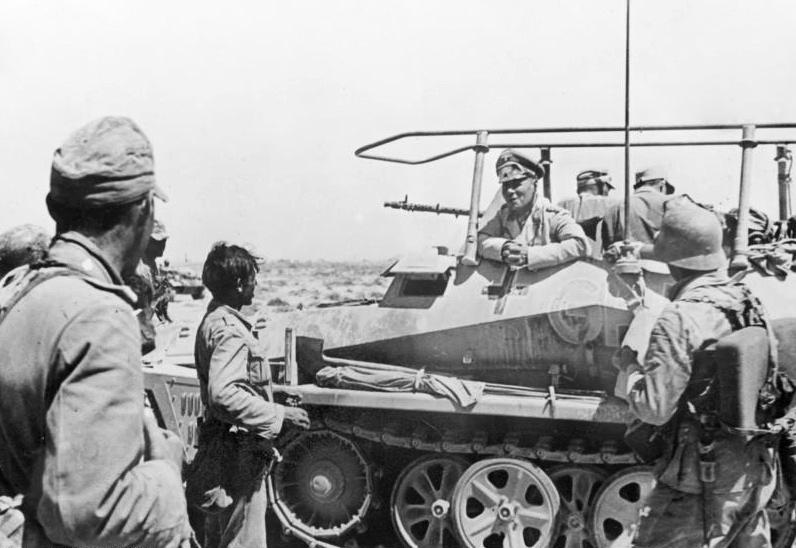
bundesarchiv_bild_146-1991-031-25a_nordafrika_vor_tobruk_rommel

In Arica Rommel showed himself to be a remarkable tactician and field commander. Likewise, unlike many other German (and sadly Allied) commanders had the ability to recognize the valor and soldierly virtues of his opponents, even those who were not white. A captured South African officer pleaded with Rommel to spare him being imprisoned with Black troops under his command. Rommel told him:

“For me, soldiers are all equal. Those black people wore your same uniform, fought on your side, and so you will be in the same jail.”

That was not until Rommel discovered the reality of Hitler’s promises as the troops of the Afrika Corps were hollow that he began to understand the man he had sworn his allegiance. He and his gallant German and Italian soldiers found themselves subjected to constant privation from lack of supply, air support and reinforcements. As commander of the Afrika Corps and later the Panzer Armee Arfika he and his troops achieved amazing success against an enemy that was always better supplied and equipped and which had air and sea superiority. Battling the British as well as the political machinations of Mussolini and Germany’s Italian Allies as well as opponents in the German government such as Hermann Goering, Rommel saw his troops crushed under the press of the British as well as the Americans who landed in French North Africa. Eventually, sick and worn out, Rommel was sent back to Germany to recuperate.

While visiting Hitler’s headquarters during that leave Rommel was struck by the atmosphere and made this observation:

“During the conference I realised that the atmosphere in the Fuehrer’s H.Q,. was extremely optimistic. Goering in particular was inclined to minimise our difficulties. When I said that British fighter-bombers had shot up my tanks with 4O-mm. shells, the Reichsmarschall, who felt himself touched by this, said: ” That’s completely impossible. The Americans only know how to make razor blades.” I replied: “We could do with some of those razor blades, Herr Reichsmarschall.”

rommel-with-soldier

Rommel had a sense of honor and humanity that many other German generals lacked. He refused to allow anti-Jewish measures in areas occupied by German troops in North Africa, ensuring that the approximately 425,000 Jews living in Libya, Tunisia, Algeria, and Morocco were spared the fate of the Holocaust. He refused to execute Jewish POWs, and refused to follow the notorious “commando order.” In June of 1994 he protested the massacre of the people of the village of Oradour-sur-Glane by units of the 2nd SS Panzer Division directly to Hitler and asked for the authority to punish those responsible, but was his protest was refused.

In late 1943 and early 1944 Rommel began to learn of the mass killings being orchestrated by Himmler’s SS. His son Manfred asked his father’s permission to join the Waffen SS, which Rommel insisted that he not do, the younger Rommel recounted:

“While, he said, he perfectly well recognised the quality of the S.S. troops, under no circumstances did he want me to be under the command of a man who, according to his information, was carrying out mass killings. ” Do you mean Himmler? ” I asked. ” Yes,” he answered, and instructed me to maintain absolute silence about the whole affair. The war was not going at all well and he had heard that people like Himmler were trying, by actions of this kind, to burn the bridges of the German people behind them. I think he was not at all certain at that time whether Hitler knew anything about what was going on, for no mention of the mass executions had ever been made at the Fuehrer’s H.Q. And perhaps he would never have brought himself to the decision to end the war -by a revolt if necessary -if he had not received further information in the early months of 1944 which confirmed these crimes and gave some idea of their extent. From that moment on, all my father’s inner allegiance to Adolf Hitler, whom he had once admired, was destroyed, and he brought himself, from his knowledge of the Fuehrer’s crimes, to act against him.” 

Rommel’s honest assessments of the chances of the Germans winning the war which he spoke candidly to Hitler and the High Command made him persona non grata in Berlin and Berchtesgaden. In the time before he was posted to France in late 1943 he became a part of the plot to end the war and overthrow Hitler. Rommel’s Chief of Staff at OB West, General Hans Speidel, was a key man in the conspiracy and Rommel had contacts with a number of key conspirators. He believed that the war was lost unless his forces could repel the coming Allied invasion on the beaches and worked feverishly to bolster the beach fortifications. He recommended that the Panzer Divisions be deployed near the coast where they could immediately counterattack Allied invasion forces while they were still vulnerable. But his advice was not taken. He was given command of the Army Group but was not given control of most of the Panzer Divisions, which Hitler kept under his direct control.

When the invasion came Rommel was away from Normandy visiting his wife. On learning of the invasion he sped back to Normandy. When he arrived he fought a desperate battle against the Allied forces. His outnumbered forces were under constant assault from the land, sea and air received paltry reinforcements compared to the Allies. Even so, German troops inflicted many local defeats and exacted a heavy price in allied blood in Normandy but were ground to dust. Even so, many American and British infantry regiments suffered 100% casualties but remained in action because of a continuous stream of replacements. Rommel urged Hitler and the High Command to withdraw German forces from Normandy before the allies broke through his front. By doing so he found that he was now considered a defeatist.

Rommel was severely wounded in an air attack on his vehicle by a just days before the attempt on Hitler’s life. Hitler survived the attempted assassination and exacted a terrible revenge on anyone connected with the plot. Show trials and public hangings of officers who had served valiantly at the front were common. Thousands were killed and thousands more imprisoned.

Eventually, other conspirator’s testimony exposed that Rommel was part of the plot. He was recommended by the “Court of Military Honor” to be expelled from the military and tried by the “People’s Court” of Judge Roland Freisler. During the purge that followed the attempt on Hitler’s life, many noted German military commanders were hauled before this court and humiliated by Freisler before they were sent to their deaths. Freisler, a fanatic Nazi judge has been part of the infamous Wansee Conference which planned the details of the Final Solution was killed when his courtroom was bombed in February 1945.

Because of his fame and popularity in Germany Hitler was decided to offer Rommel a choice of being tried by the People’s Court or committing suicide and ensuring his family’s safety. Hitler dispatched two generals from Berlin to personally deliver the message.

492px-Erwin_rommel_death

Rommel suspected that he would be identified and killed and told that to his friends and family in the days leading up to the arrival of Generals Wilhelm Burgorf and Ernst Maisel from OKW with the ultimatum. They met with Rommel for a short time before giving him the opportunity to say goodbye to his family. Rommel told them of his choice and left his home for the last time. 15 minutes later the Generals called his wife to say that he had died of a heart attack. Rommel was given a state funeral and the German people were lied to about his cause of his death.

Winston Churchill wrote of Rommel:

“He also deserves our respect because, although a loyal German soldier, he came to hate Hitler and all his works, and took part in the conspiracy to rescue Germany by displacing the maniac and tyrant. For this, he paid the forfeit of his life. In the sombre wars of modern democracy, chivalry finds no place … Still, I do not regret or retract the tribute I paid to Rommel, unfashionable though it was judged.”

Rommel was just 52 years old when he died. I find in the story of Rommel some commonality in my own life. Before Rommel went to Africa he believed that Germany would win the war, during his command there he discovered that what he believed was lies and that Hitler had little regard for him or his troops. Before I went to Iraq in 2007 I believed much of the political propaganda promoted by the Bush administration and right wing news media and pundits about that war.

The example of Erwin Rommel is a cautionary tale of what can happen when a brilliant and honorable man comes under the spell of a demagogue. Rommel believed Hitler and blindly followed him until he ran into the hard face of reality in Africa at which point he had the moral courage to do the right thing, but many didn’t.

The fact is that it is hard for most Americans to imagine what it would be to,serve in the military, law enforcement, intelligence, or justice departments of a totalitarian regime, but we are fast approaching that point.

Sadly there are otherwise honorable men and women in the current United States military who are blindly supporting a delusional and quite probably criminal President;  a man who promises to order soldiers to commit war crimes, who threatens to jail political opponents, who condemns whole races of people and religions, a man who has no respect for the courts, the law, or the Constitution.  Personally as a historian I cannot understand that kind of blind loyalty especially when the the leader in question has no loyalty to anyone other than himself. Not long before he was killed Rommel told his son:

“one thing is quite clear, it’s intolerable that the fate and welfare of a whole nation should depend on the whim of a small group. There must be some limit, otherwise, the most fantastic things can happen without anyone noticing.”

Rommel refused to obey the criminal orders that so many other German Generals and Officers obeyed. He lost his life because of his honor and personal integrity, and willingness to oppose a criminal regime. The question is, if President Trump and his administration cross that line, will American military leaders emulate Rommel or the officers who obeyed their orders, aided and abetted War Crimes and Crimes Against Humanity, and in many cases lied about the activities after the war in order to secure lucrative employment advising the Western Allies on the tactics and operational methods of the Soviets while writing their memoirs, which coincidentally omitted or denied their cooperation with Hitler’s most criminal orders.

Others, who were captured by the Soviets and worked for the Army or Security and Intelligence Services Of East Germany never admitted their roles in Hitler’s crimes. It was like they all sought to erase history, but the archives don’t lie, whether they worked for NATO or the Soviets.

The frightening thing is that almost all had served many of their formative years in the service of the Kaiser, or the Weimar Republic. They were not products of the Hitler Youth or Nazi education. They knew better. We should too, but that is no guarantee that we will not devolve as they did.

I hope that own better angels prevail.

Peace,

Padre Steve+

6 Comments

Filed under ethics, History, holocaust, Loose thoughts and musings, Military, nazi germany, Political Commentary, world war two in europe