Category Archives: Loose thoughts and musings

The Bandit is Dead, Long Live the Bandit: the Passing of Burt Reynolds

Friends of Padre Steve’e World,

I came of age in the late 1970s and early 1980s and back then Burt Reynolds ruled the box office. I think that I saw every move that he made between 1974 and 1985. My favorites were his comedies like Smokey and the Bandit, The End, The Cannonball Run, Starting Over, Best Little Whorehouse in Texas, and so many others. I did really like his serious films like  Sharkey’s Machine, Deliverance, and his part as “Mr. Burt” in the X-Files episode Improbable which was aired in 2002. But it was his comedies that I continually go back to when I need a laugh. I’m doing that tonight.

One of the movies that I will watch this weekend is The End where he plays a man diagnosed with cancer who tries to kill himself and gets locked up with Dom DeLouise, who then takes it upon himself to help Reynolds try to kill himself. At the end of the film Reynold’s character decides that he wants to live after swimming out into the ocean to drown himself. In a panic he begins to bargain with God:

Oh, God! Let me live, and I promise to obey every one of the Ten Commandments. I shall not kill… I shall not commit adultery… I shall not… I… uh… I’ll  learn the Ten Commandments, and then I’ll obey every fucking one of them!

I love that line.

But for me Burt Reynolds was an icon and it is hard to believe that he has passed away. I heard about his death as my iPhone news notifications started going off for close to an hour, even overwhelming important news going on in the Kavanaugh confirmation hearings. All I can think about Judge Kavanaugh and his lack of truthfulness and character is a quote from Reynolds’s character in Best Little Whorehouse in Texas, Sheriff Ed Earl Dodd: “Boys, I got myself a pretty good bullshit detector, and I can tell when somebody’s peeing on my boots and telling me it’s a rainstorm.” But I digress…

The fact is that I am going to miss Burt Reynolds. I was looking forward to him possibly being in Quentin  Tarantino’s next film Once Upon a Time in Hollywood; I am sure that he would have been great in it.

Reynolds was more than a sum of his acting parts, he was also a very reflective and appreciate man as he aged. He appreciated his friends. When he friend and frequent co-star Dom DeLuise  passed away he said:

As you get older, and start to lose people you love, you think about it more, and I was dreading this moment. Dom always made you feel better when he was around and there will never be another like him. I never heard him say an unkind word about anyone. I will miss him very much…. 

He was able to recognize his failures in life, relationships, and even in the choices of some films that he made. That being said he was able to express his appreciation for those who stood by him, supported him, and told him the truth during his good and bad times.

He also said something that I can relate to despite not being an actor. Instead of acting I have tried to teach and help younger military personnel, officers, and especially chaplains. In doing so I often make fun of myself and the mistakes that I have made. I can laugh at myself, except when I can’t. As I look at retiring from the military next year after some 38 years of service I know that my legacy will not be the sum of my personal accomplishments, it will be the young men and women that I have been able to teach and mentor over the years. Reynolds said:

I’ve had a tremendous amount of fun making fun of myself! As to my legacy, it’s the kids that I have taught. I love this business so very much that I want to share my knowledge about it. The young actors that I have taught, I hope they think of me as a good teacher like Charles Nelson Reilly. Being a good teacher. I’ll take that over being a good actor any day!

With that I will go back to my Burt Reynolds movie binge watching weekend.

Peace

Padre Steve+

1 Comment

Filed under film, life, Loose thoughts and musings, movies

The Revenge of Wun Hung Lo: Never Violate Your Personal Prime Directive

Friends of Padre Steve’s world,

After a really long day Sunday working in the house, ripping up carpet and moving furniture I was tired. We had to sleep in the couches in the living room since the bedroom was in a state of disarray. About midnight I got hungry. I rummaged around the fridge and since there was little else there found a leftover egg roll from the Chinese takeout place that Judy likes and some sweet and sour sauce. I have appropriated the nickname given to a Chinese takeout place in our home town by her late father as my nickname for this place: Wun Hung Lo.

Now, honestly I never eat Chinese food. If i pick up take out for her I walk a couple of doors down to my favorite Mexican restaurant to get me something. My aversion to Chinese food goes way back to my high school graduation banquet when a spider crawled out from the inside of the pot of my Green Tea. At that point I made the decision that if I could see a spider crawling out of my tea that I couldn’t trust what might be in the food that was not so clear.

Judy has always considered that to be a bit extreme but when we lived in Huntington, West Virginia here favorite Chinese place there, the Happy Dragon by the health department because the chicken was actually cat. As I noted, “the cat’s in the ladle with the silver spoon.” Judy’s response was “tastes like chicken.”

Needless to say this phobia of mine was still in place, but since we didn’t have much else to eat having been so busy that we didn’t make a grocery run for over a week, I asked myself, “it’s only an egg roll, what could happen?”

I tell you what happened. About 6:00 A.M. I was dashing to the the great white throne to hurl the offending egg roll remnants and the still recognizable sweet and sour sauce into the pristine basin of my new toilet in our freshly renovated bathroom. I pain for violating my personal Prime Directive. I paid all morning for it until I passed out on the recliner until about 7:30 P.M.

While I was crashing and burning my dear friend Bill Quinn came to the house and finished installing the flooring and in our bedroom. Good friends are rare and the work he did would have taken me twice or three times as long and not looked professional at all.

Anyway. I finally held down some chicken noodle soup about 8:00 P.M. I have been drinking Gatorade and water most of the day. I’m still not feeling very good and I’m going to take the morning off from work before checking in during the afternoon on the way to a doctors appointment on base.

I could write more and certainly in more descriptive language, but I am really tired and it would probably gross you out. So I will schedule this to post just after midnight by which time I hope to be asleep.

However, I tell you the truth. I have learned my lesson at the hands of Wun Hung Lo, and after having looked at common ingredients found in egg rolls I can only say, nevermore.

Until tomorrow,

Peace,

Padre Steve+

1 Comment

Filed under life, Loose thoughts and musings

What a Long Strange Trip it’s Been: This Navy Chaplain’s Work Becomes Part of an Army Operational Manual

Friends of Padre Steve’s World,

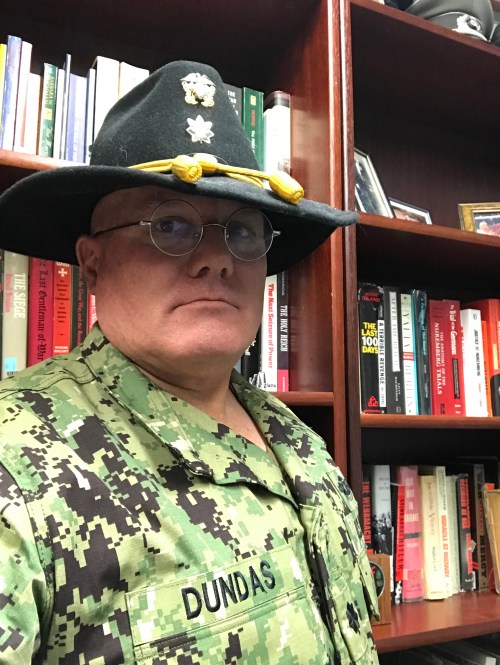
I received word yesterday of something that I think is really cool. I was asked by the Army Combined Arms Directorate at Fort Leavenworth for permission to include an adaptation of a portion of my Gettysburg text as a one page vignette for the new edition of Army Doctrine Publication 5-0, The Operations Process. This will be published in January 2019 and gives the Army permission to use it in this as well as other Army and Joint publications for twenty years.

This is kind of a big thing for me. Now it will not generate any royalties, but it will get my work out to a much larger audience than I have ever reached before. The publication of this vignette in the publication may end up in getting my Gettysburg trilogy in print of other publishers and actually published. The trilogy is very different than most accounts of the battle due to its focus on biography as well as overall operational and tactical decision making within the scope of the battle narrative.

You might wonder what difference of a vignette like this in such a publication makes on the readers who in this case are the current and future leaders of the Army. Let me tell you. When I was a new Army Lieutenant in 1983 the Army published FM 22-100, Military Leadership. For a field manual it was one of the best ever written. In it there was a vignette about Colonel Joshua Lawrence Chamberlain at Little Round Top during the Battle of Gettysburg.

The vignette captured my imagination and it was hard to believe that some thirty years later as a Navy Chaplain and historian that I would be leading the Gettysburg Staff Ride at the Joint Forces Staff College. It inspired me to take seriously the human dynamic in war and in history. Anyone who has read this blog for any length of time can attest to how serious I take the human factor whether it be in military history, politics, religion, civil rights, and even baseball.

The new edition of ADP 100-5 will be standard reading for NCOs, as well as junior and senior officers, and operational planners. Because of the Army’s oversize role in producing doctrine for the Joint force it will likely be a part of Marine Corps and Joint planning manuals and courses. For a Navy Chaplain and historian at the end of a 38 year military career which included 17 1/2 years in the Army, National Guard, and Army Reserve this is a big honor. In the words of Jerry Garcia and the Grateful Dead in their classic song Truckin’ “What a long strange trip it’s been.”

The vignette as written will include segments of my text that I published on this blog. According to the Army the vignette will read like this:

Collaboration: Meade’s Council of War

In June 1863, General Robert E. Lee prepared the Army of Northern Virginia for a second invasion of the North. Moving through the Shenandoah Valley and north toward Harrisburg, Lee’s Army made contact with the Army of the Potomac near the town of Gettysburg on July 1, 1863. Day one of the battle saw initial Confederate success. By the afternoon of day two, Major General George Meade (who had just recently assumed command of the Army of the Potomac) had moved the bulk of his force into defensive positions on the high ground south of the city. The battlefield was set.   

Late in the afternoon of July 2, Lee launched heavy assaults on both the Union’s left and right flanks. Fierce fighting raged at Little Round Top, the Wheatfield, Devil’s Den, Culp’s Hill, and Cemetery Hill. Despite heavy losses, the Army of the Potomac held their lines. That evening, Meade reported back to General-in-Chief Henry Halleck, “The enemy attacked me about 4 P.M. this day…and after one of the severest contests of the war was repulsed at all points.” Meade ended his message: “I shall remain in my present position to-morrow, but am not prepared to say until better advised of the condition of the army, whether operations will be of an offensive or a defensive character.” Having essentially made his decision, Meade summoned his corps commanders and chief of intelligence to assess the condition of the army and to hear from his commanders on courses of action for the next day.

The meeting began around 9 P.M. in which Brigadier General John Gibbon noted, “was at first very informal and in the shape of a conversation.” The meeting lasted about two hours as General Meade listened intently to his subordinates’ discussion.  The tradition in such meetings or council of war is a discussion and then a vote by the officers on the course of action. Meade’s Chief of Staff Major General Butterfield posed three questions:

 “Under existing circumstances, is it advisable for this army to remain in its present position, or retire to another nearer its base of supplies?

 It being determined to remain in present position, shall the army attack or wait the attack of the enemy?

 If we wait attack, how long?”

Meade’s commanders responded from junior to senior in rank. All wanted to remain on the field another day, but none favored to attack. When the discussion concluded Meade decided that the question was settled and the troops would remain in position.  The two-hour discussion and vote formed consensus of the commanders and improved their confidence, resulting in the outcome Meade was seeking-to stay and fight.

What I have stressed in my text and teaching about Gettysburg is just how George Gordon Meade actively sought the input and collaboration of his Generals while Confederate General Robert E. Lee did nothing of the sort at Gettysburg. I think that at every level of leadership that Union leaders were much more involved and able to adapt to a rapidly changing situation which any leadership failure could had led to an epic battlefield disaster. George Meade, who had just taken command of the Army of the Potomac on June 28th set the tone for his commanders.

Sadly, among many students of the battle and Civil War history buffs, Meade gets little recognition. But without his leadership and active direction of the battle and trust in his subordinates the battle of Gettysburg might likely become a great defeat for the Union. I do not think that it would have led to a Confederate victory in the war, but it would have complicated the Union War effort.

If you are interested in reading more from the articles used in this vignette please go to the following link on this blog.

“A Council of War: Meade and His Generals Decide to Stay and Fight at Gettysburg July 2nd 1863.” Padre Steve’s World. https://padresteve.com/2014/04/25/a-council-of-war-meade-and-his-generals-decide-to-stay-and-fight-at-gettysburg-july-2nd-1863/

Have a great night,

Peace,

Padre Steve+

2 Comments

Filed under civil war, Gettysburg, History, leadership, life, Loose thoughts and musings, Military, us army

The Men of the Negro Leagues: Carl Long Day 2011

Friends of Padre Steve’s World,

For tonight a reposting of an old article dealing with my friends from the Negro Leagues. These men were heroes, they played ball in the face of prejudice and discrimination and were a part of the Civil Rights movement. They were peers of Jackie Robison, Willie Mays, Satchel Paige, and Larry Doby.

This article is from 2011, my friend, Negro League Hall of Famer Carl Long passed away in 2015. I do miss him.

Until tomorrow,

Peace,

Padre Steve+

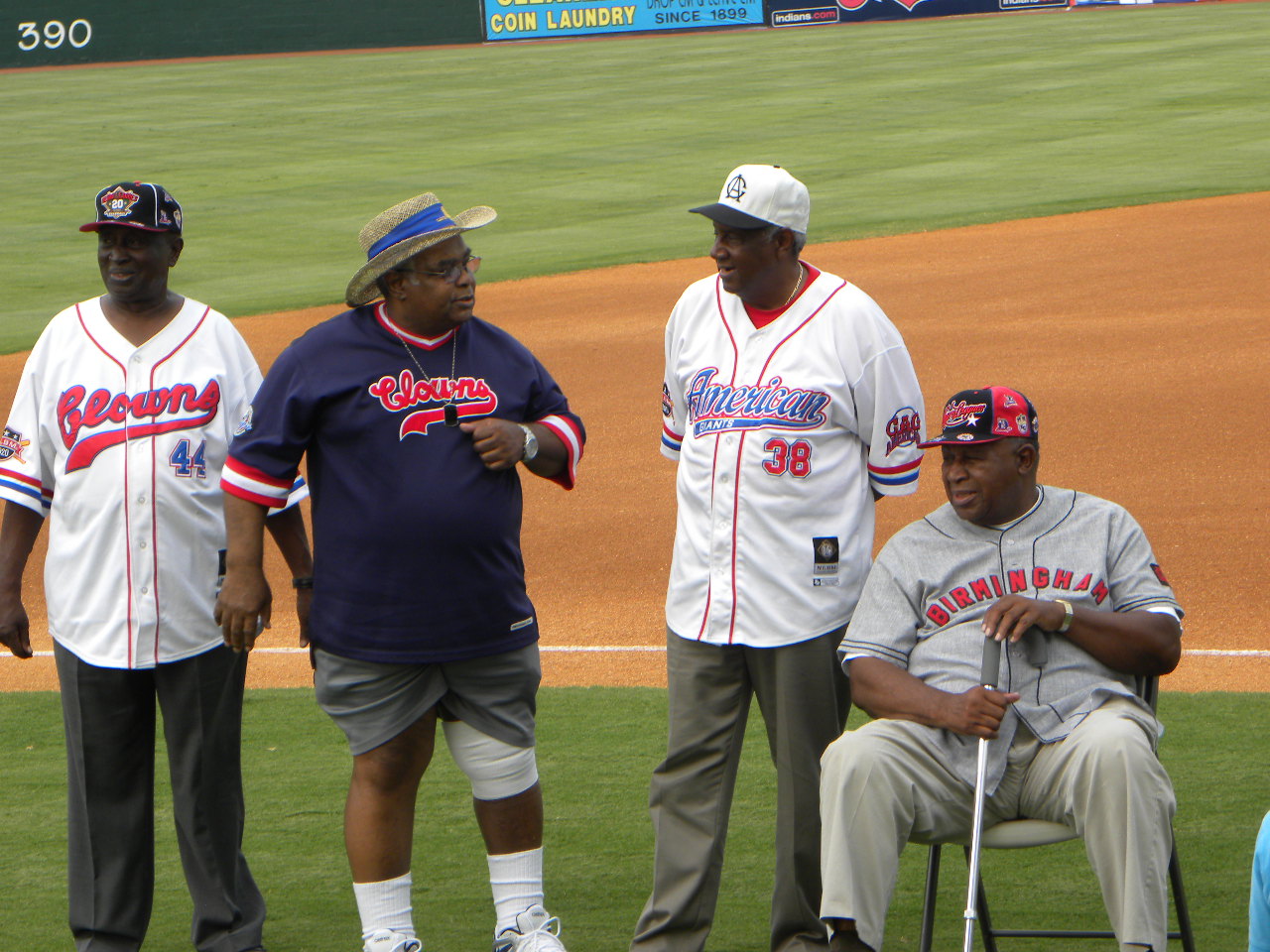
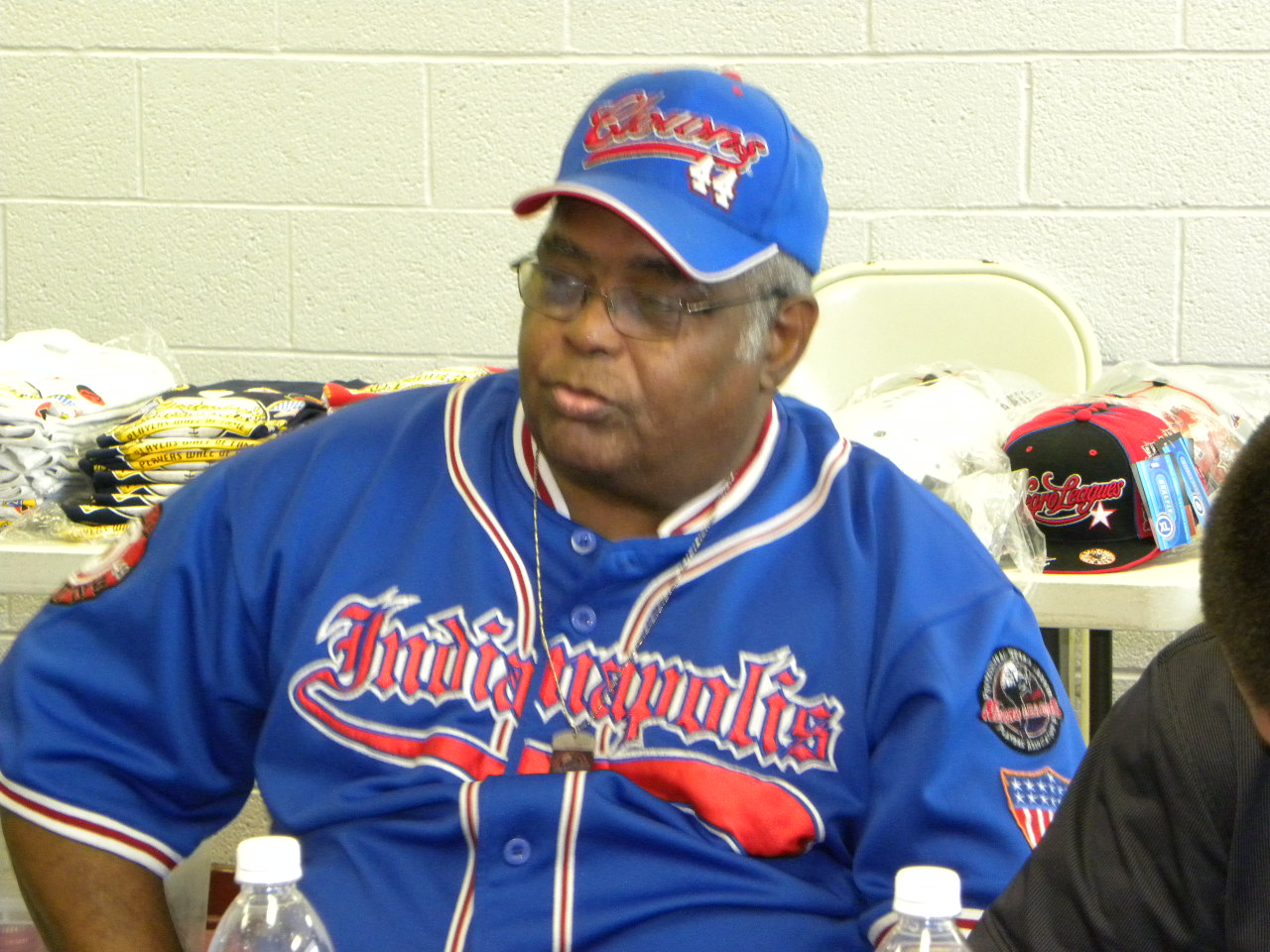
Carl Long Night: L-R  James “Spot”King, Hubert “Big Daddy”Wooten, Dennis “Bose”Biddle and Carl Long  at Historical Grainger Stadium

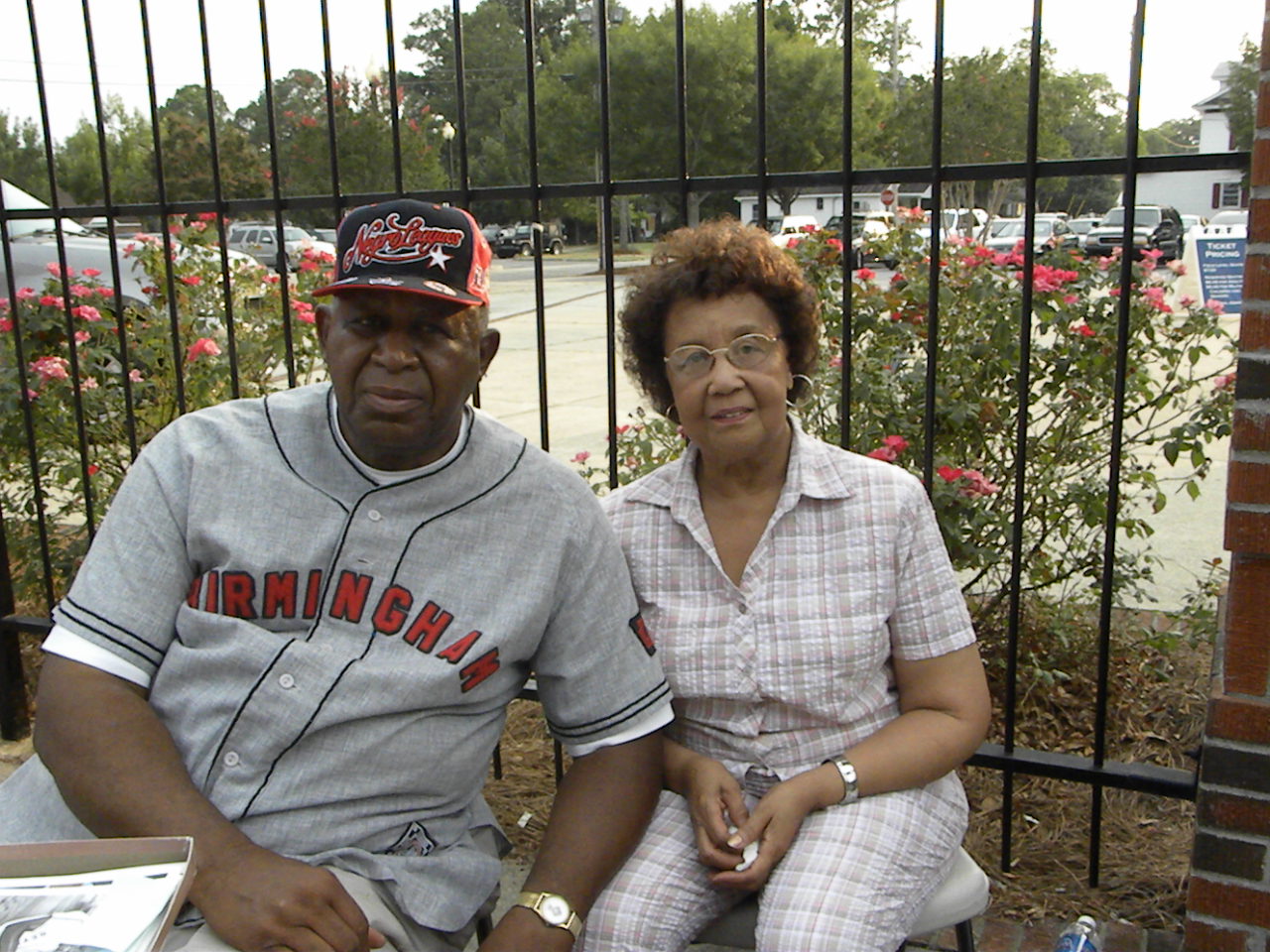
Friday I had the privilege of being invited to spend a portion of the day a number of former Negro League players, Minor League players and a couple of former Major Leaguers including one veteran of the 2004 Boston Red Sox World Series Championship team, Trot Nixon.  In addition to the ballplayers I met Carl’s lovely wife Ella as well city officials from the City of Kinston and regular folks, baseball fans and parents with their children.

Carl and Ella

It was a day to honor one of the few remaining veterans of the Negro Leagues.  Carl Long played with the Birmingham Black Barons alongside Willie Mays and Country and Western singer Charlie Pride. He played against Hank Aaron and spent time in the minors with Willie McCovey and Roberto Clemente.  He was the first black to play in the Carolina League and still holds the record for the most RBIs in a season inKinstonwhich has also seen such sluggers as Jim Thome, Alex White and Manny Ramirez play at Historic Grainger Stadium.  Carl did not have a long baseball career, he injured his shoulder and his wife of over 50 years Ella, a local Kinston girl stole his heart.  In Kinston he became the first black commercial bus driver in the state, the first black Deputy Sheriff in North Carolina, and first black Detective on the Kinston Police Department. Carl was presented with a certificate from the Mayor of Kinston during the

That evening the Kinston Indians hosted Carl Long Appreciation night.  Carl as well as Dennis, James “Spot” King and Hubert “Big Daddy” Wooten and a number of local Negro League era players took the field near along the third base line as their names were announced.  A local television station filmed the event and Carl made sure the members of the “Field of Dreams” Little League team each got a copy of his signed baseball card. It was a night of emotion, appreciation and history.

Carl broke barriers wherever he went and credits his father with ensuring that he got his education, a mantra that he repeats to every young person that he meets.  I met Carl earlier in the season and knew that I was in the presence of a pioneer and a great American.  When I am in Kinston there is nothing that I enjoy more that listening to Carl’s stories of life in the Negro Leagues and breaking the baseball’s color barrier in the Deep South.

Hubert “Big Daddy”Wooten” 

It is hard to imagine now just how deep the poisonous river of racism ran in 1940’s, 50’s and 60’s America.  Then it was a fact that segregation was not only acceptable but widely practiced in much of this country.  Institutionalized racism was normal and violence against blacks and whites that befriended them was commonplace.  We like to think that we have overcome racism in this country but unfortunately there is a segment of the population that still practices and promotes this evil.  Even this week there was a Ku Klux Klan attack on the home of a black pastor in the South.  His offense….supporting a white candidate for county sheriff.  While we have overcome much there is still much work to be done.  I think this is why I believe it is so important to remember the men and women of the Negro Leagues.

One of the men at today’s events was Dennis “Bose” Biddle who played for the Chicago American Giants in 1953 and 1954.  He was in the process of having his contract purchased by the Chicago Cubs when he suffered a devastating injury to his leg and ankle going hard into Second Base.  When he couldn’t play in the Majors he went to college and became a Social Worker.  Dennis said to me “you know that “take out” sign at restaurants? We started it” referring to how black players would have to get their food at the back of a restaurant or eat in the kitchen out of sight of white customers.

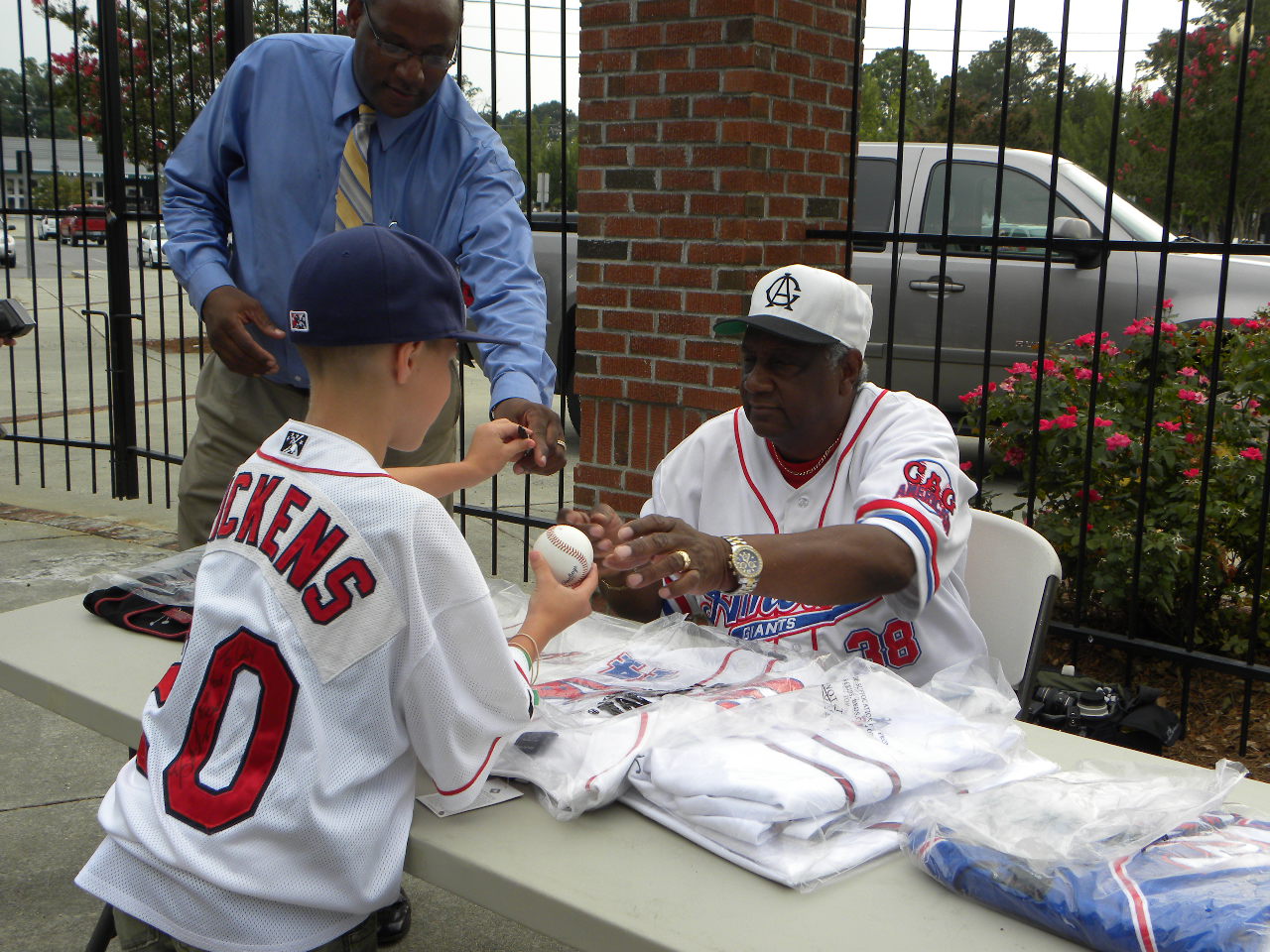
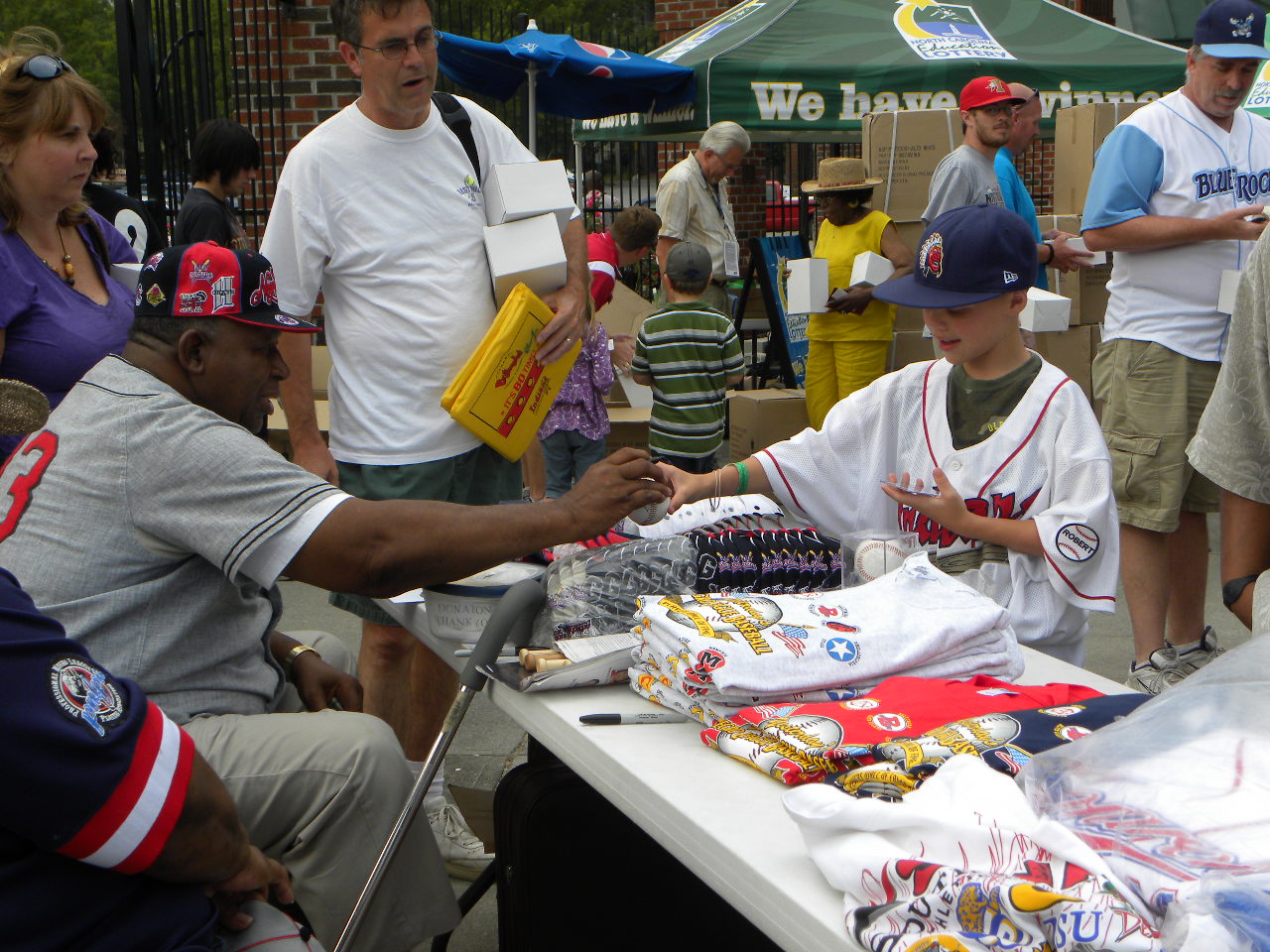
Dennis “Bose”Biddle autographing a baseball 

The truth of the matter is that the players of the Negro Leagues were torch bearers in our society.  The men and women of the Negro Leagues barnstormed and played against white teams when baseball was still segregated.  When Branch Rickey signed Jackie Robinson it was a seismic event with great social connotations.  A barrier had been broken and I dare say that without the men of the Negro Leagues that the work of other Civil Rights leaders including Dr. Martin Luther King Jr. would have had a less fertile audience in White America and probably a even less friendly reception than they had as they worked to fulfill the vision of a better America where men and women of every race, color and creed could aspire to great things.

Carl Long giving a baseball and good advice to a young fan

Men like Carl Long are responsible for this.  Some made their impact at a national level while others like Carl and Dennis on a local and regional level.  Like the men and women of the “Greatest Generation” this fellowship grows smaller with each passing year. Hubert “Daddy” Wooten was one of the last Negro League players; he played for and later managed the Indianapolis Clowns in the years where they barnstormed.  During that time he managed the legendary Satchel Paige. “Big Daddy” Wooten  is the youngest of the he surviving Negro League players a mere 65 years old.  Most are in their mid-70s or in their 80s.  It is important that their friends and neighbors write down their stories so they are not forgotten.

Baseball in particular the Negro League Hall of Fame and Museum has done a credible job of trying to preserve the contributions of these men to baseball and the American experience. Yet many more stories are still to be told.  I hope that as I continue to visit with Carl, Sam Allen in Norfolk and other players that I will be able to help them tell more of those stories.

Peace

Padre Steve+

1 Comment

Filed under Baseball, civil rights, History, Loose thoughts and musings

Remembering My Friendship with Carl Long, Negro League Hall of Famer and Civil Rights Pioneer

Friends of Padre Steve’s World,

Today was a day of recovery from a long week with little sleep, lots of work, contractors in the house doing renovations, and a lot of stress. Last night it took me forever to get to sleep even though I went to bed early I could not get to sleep until about four AM. I big part of the problem was that I had my sleep meds lapse as there was a problem between my military provider, the military pharmacy, and the civilian pharmacy that my meds get transferred to. I put on my CPAP and with the lights off I laid in bed for almost four hours before I finally went to sleep. I slept until two PM. I did go out and pick up some melatonin and Advil PM to try to help me sleep tonight. We did get a bit more work done in the house today but not nearly what I hoped to get accomplished.

This evening I had a twitter exchange with a few people including the President of the Negro Leagues Hall of Fame in Kansas City. One of the people encouraged me to write down my memories of the Negro League players that became my friends. The best was the late Carl Long who is in the Negro League Hall of Fame. So tonight I am reposting an article about the beginning of my friendship with him. I will post another tomorrow night.

So until then,

Peace

Padre Steve+

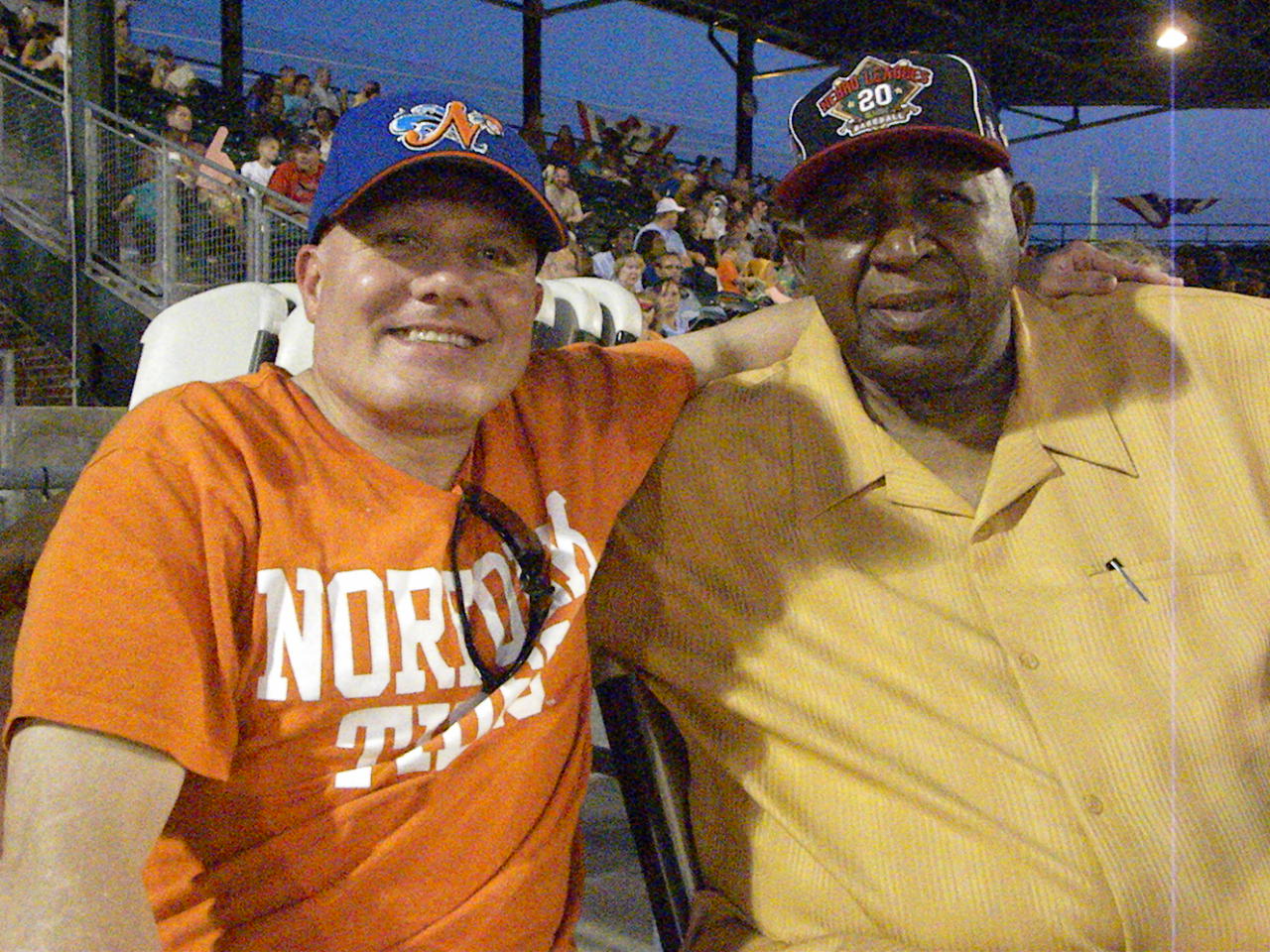
Me with Carl Long

On Friday, after a long and stressful week at work I decided to head to Kinston to see a ball game.  It was a rough week, my staff and I dealt with the death of an 11 year old girl that came through our ER on Monday morning.  I found that a Marine that I had served with while serving with 3rd Battalion 8th Marines in 2000-2001.  Staff Sergeant Ergin Osman was killed around Memorial Day with 7 of his fellow soldiers in Afghanistan. His death hit me hard.  I remembered the great Marine and wonderful young man that I knew back then.  That night I went out and sat in the light of the half moon and cried. Some other things went on and I finished work Friday caring for a family that lost their unborn baby and knowing that I was going to have to come in during the early morning hours Saturday for another still-birth.  I needed something and for me that “something” is baseball.

So when I was done with work I loaded up my trusty 2001 Honda CR-V and drove from LeJeune to Kinston. The trip across rural Eastern North Carolina was relaxing, there was little traffic and despite a passing thunder shower was uneventful, not even a driver doing well less than the speed limit in a no-passing zone to annoy the spit out of me. Eastern North Carolina has its own charm, small towns and settlements dot the farm fields and forests of the area. It is not uncommon to drive by a former plantation or to pass gas stations and country stores that seem to have stopped in time.

Kinston is one of those towns that have seen better times, the outsourcing of the garment industry to Central America and Asia has hit the town hard.  While a budding aviation industry promises better times many of the poorer and less educated people in the city have little opportunity.  While there are some very nice areas in town the central part of the city, especially downtown shows the real effect of what economic damage has been done to our country by the actions of industries to relocate overseas and actions by successive administrations and congresses to help them abandon Americans in order to increase profits.

However Kinston has had a team in the Carolina League for years and Minor League Baseball has been in the city continuously since 1937, with a four year break between 1958 and 1962 when the Kinston Eagles became part of the Coastal Plains League.  Grainger Stadium was built in 1946. The team became part of the Carolina League in 1956. Over the years the Kinston team has had various affiliations with Major League teams as well as various names.  The Team was called the Eagles until 1982 when they became the Blue Jays until 1986 when they again became the Eagles. Then in 1986 they became the affiliate of the Cleveland Indians, a relationship that they maintain until this day. Before the 2011 season it was announced that the team had been sold and was being moved to Zebulon North Carolina to replace the Carolina Mudcats which are moving to Pensacola Florida. The team owner is seeking to bring another team to Kinston in time for the 2012 season.  It will be a sad day if a team cannot be found to bring to Kinston which has one of the nicest parks in Class “A” ball.

I got to the game and was able to relax talking with new friends and moving around the ballpark to take pictures. When I moved back to the first base line I saw a man that I had watched a game with earlier in the year in his season ticket box. John is a retired Navy Supply Corps Officer and really nice to spend time with. This particular evening he was sitting beside a heavy set older African American man wearing a Negro League cap.  I came up and John invited me to sit with them and I got to meet the man, Carl Long.

Carl had played ball in the Negro Leagues with the Birmingham Barons and played with Willie Mays and for legendary manager Buck O’Neal and he was the first black player in the Carolina League playing with the Kinston Eagles when they were with the Pittsburgh Pirate organization.  In 1956 he led the team in home runs with 18, hit .299 and had 111 RBIs a season record that still stands in Kinston.

It was really nice just to be able to listen and to spend time with one of those great men of the Negro Leagues and pioneers of baseball integration. He played with Mays, McCovey, Clemente and against Aaron and even country and western singer Charlie Pride.  He played on a number of minor league teams until the end of 1957.  He was 22 years old and had a lot of good years left in him but he had married the woman of his dreams and he elected to settle in Kinston with her.  They are still married and went on to become the first black deputy Sheriff and first black Detective on the Kinston Police Department and even the first black commercial bus driver.

Carl is part of the Living Legends of surviving Negro League players and makes many appearances, the most recent at Rickwood Field in Birmingham the oldest ballpark in the country and home of the Barons.  He will be honored on July 22ndin Kinston with other Negro League players, including Sam Allen who I know from Norfolk.

I plan on visiting more with Carl as I enjoyed the man immensely. When he found my interesting in baseball history and the Negro Leagues he gave me an autographed baseball card.

I drove home through the night feeling much better even knowing that I would be called in to deal with sad situations at the hospital, but once again I was blessed to have the opportunity to spend time with Carl and John and to meet some other really nice people.

Thank God for baseball and the Church of Baseball, Grainger Stadium Parish.

Peace

Padre Steve+


2 Comments

Filed under Baseball, civil rights, History, Loose thoughts and musings

Principiis obsta, Finem respice—Resist the beginnings, Consider the end: A Name Change at Padre Steve’s World

Friends of Padre Steve’s World,

img_0027

I have been so busy working in the house the last couple of day, Monday in fact until about 10 PM that I didn’t get much in the way of writing done. Our contractor came today and began work in the house and I have about done almost everything to complete work in the most heavily damaged section of our home. I still have a bit more to do in that room as we get it in shape to be Judy’s art work room and a secondary library and overflow guest room.

I am happy with my work. Tomorrow we should be able to start moving her art supplies, materials, and equipment into it. I will also finally be able to take a crack at our personal belongings that were damaged when our air conditioning condensation pan drains got plugged while we were on leave back in May. We finally got the money from the insurance to begin the repairs and because I am doing much of the work myself have been able to use the much of what I saved to be able to do some badly needed renovations. It has been stressful but in the end it our home will gain a lot in value, but I digress…

Late last night I decided to change the title of this website. I actually did it twice and finally settled on this tonight:

Padre Steve’s World: Resist the beginnings, Consider the end. 

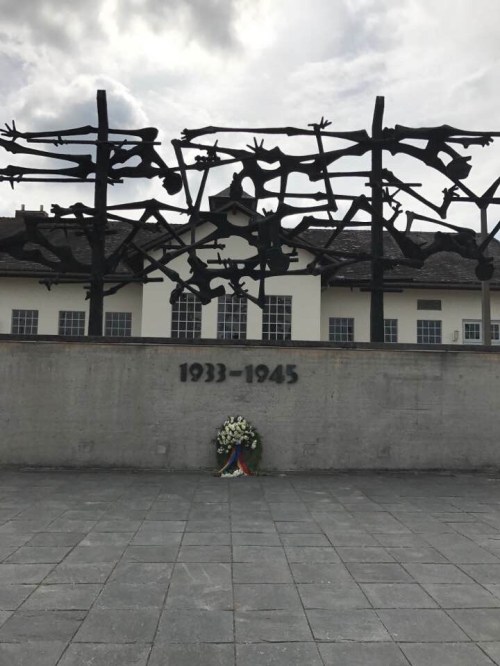
I think it is more appropriate than what I first came up with which was “The Best Little Blog You Never Heard of ” I decided that was a little too pompous despite the fact that I actually do put a lot of research and reflection into almost everything that I post here. The fact is that the twin phrases Principiis obsta and Finem respice, the first from the Roman philosopher Ovid, and the latter most likely from the Book of Ecclesiastes and the writings of the early Christian apologist Tertullian. The were quoted to American Jewish Professor Milton Mayer by a German colleague after the Second World War as a warning of what happens when otherwise good people say nothing and fail to resist evil.

So anyway. I am very tired and need to get some decent sleep since I got so little last night.

Until tomorrow,

Peace

Padre Steve+


Leave a comment

Filed under christian life, History, holocaust, Loose thoughts and musings, philosophy, Political Commentary

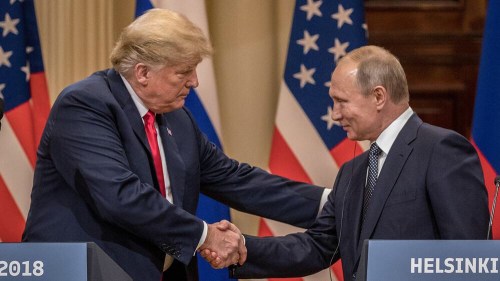
Adhering to or Aiding the Enemy: the President and Putin at Helsinki

Friends of Padre Steve’s World,

I am more concerned than ever about the fate of our country and the world. I have written much about the public statements, tweets, and policies of President Trump. I have written much about his lack of character, his relentless lying, his cruel policies, his unrequited racism, his penchant for preferring dictators to democrats (not the American political party but those who abide by its principles) his distain for the Constitution, the Bill of Rights, and the fundamental premise of the Declaration that “All men are created equal.”

I began writing about my concerns in 2015 not long after he announced his candidacy. I have not stopped doing so even though after his inauguration I really did hope that realization of the gravity of his office would at least provoke a bit of change in him. However, that did not happen, instead the power of the office emboldened him to allow his very worst character traits to become even more corrosive and toxic.

If this was merely an argument between Democrats and Republicans on matters of policy, even hard fought and divisive policies it would be one thing, but this is different. It is a blatant denial of his oath of office and by its very nature involves the very real possibility that the President is committing treason before our very eyes. This isn’t about policy or party politics; it is about the President of the United States openly siding with the leader of a hostile power. A leader whose military intelligence agency, the GRU has been identified by every United States intelligence agency and the FBI as being behind multiple attacks at multiple levels on the United States election system. In fact these attacks are ongoing even today and the President defended Putin and attacked U.S. intelligence services as well as Special Prosecutor Robert Muller who last Friday added the indictments of another dozen Russian GRU officers to his tally, which is now up to 26 Russian officers. When questioned about a tweet in which he blamed the United States and especially the Muller investigation for the poor relationship with Russia in which the President said:

Our relationship with Russia has NEVER been worse thanks to many years of U.S. foolishness and stupidity and now, the Rigged Witch Hunt!

President claimed that Miller’s investigation was “is a disaster for our country.”

Shortly after the President’s defense of Russian President Putin and attacks on U.S. intelligence and law enforcement agencies, the free press, and his domestic political opponents the Director of National Intelligence, Dan Coats a Republican and former Senator from Indiana who had briefed the President about this before the summit issued the following statement:

“The role of the Intelligence Community is to provide the best information and fact-based assessments possible for the President and policymakers. We have been clear in our assessments of Russian meddling in the 2016 election and their ongoing, pervasive efforts to undermine our democracy, and we will continue to provide unvarnished and objective intelligence in support of our national security.” https://www.dni.gov/index.php/newsroom/press-releases/itemlist/category/285-press-releases-2018

Former CIA Director John Brennen tweeted today:

“Donald Trump’s press conference performance in Helsinki rises to & exceeds the threshold of “high crimes & misdemeanors.” It was nothing short of treasonous. Not only were Trump’s comments imbecilic, he is wholly in the pocket of Putin…”

He is correct. The U.S. Constitution, Article III, Section 3 states: “Treason against the United States, shall consist only in levying war against them, or in adhering to their enemies, giving them aid and comfort.”

The U.S. Code amplifies Article III. It states:

18 U.S. Code § 2381 – “Whoever, owing allegiance to the United States, levies war against them or adheres to their enemies, giving them aid and comfort within the United States or elsewhere, is guilty of treason and shall suffer death, or shall be imprisoned not less than five years and fined under this title but not less than $10,000; and shall be incapable of holding any office under the United States.”

It could not be clearer. The President’s actions and words over the past two years regarding Russian attack on our election system have left all Americans a choice. By all measures the President is either a completely self-absorbed imbecile who incapable of dealing with facts and in doing so inadvertently aiding the Russians; or he has something to hide and is knowingly working with the and for Russians who he has previously admitted were behind the attacks on our election system.

I don’t know which it is, or even if it is a combination of all of that. All I know as an old Cold Warrior is that the Russians are not our friends and that trampling American institutions and allies to cozy up to them is very close to the definition of treason as it it defined in the Constitution and the U.S. Code. I would say the same of any President who did as this President has done and I wouldn’t give a damn about what party they belonged.

This is very serious and cannot be swept under the rug of the next scandal or diversion by The Administration. It is the responsibility of Congress and the Courts to retrain an unchecked Executive who appears to likely to be committing treason regardless of if it is intentional or not. If they do not they are complicit in that crime and history will judge them accordingly.

General Ludwig Beck who resigned his office as the head of the German Army over Hitler’s plan to invade Czechoslovakia in 1938 and who died in the failed attempt to kill Hitler on July 20th 1944 said:

“It is a lack of character and insight, when a soldier in high command sees his duty and mission only in the context of his military orders without realizing that the highest responsibility is to the people of his country.”

I will leave you with that. Until tomorrow,

Peace,

Padre Steve+

Leave a comment

Filed under Foreign Policy, History, Loose thoughts and musings, News and current events, Political Commentary

“Liberty for the few – slavery in every form, for the mass” American Slavery

Friends of Padre Steve’s World,

This is the second post from some of my yet to be published book “Mine Eyes Have Seen the Glory” Race, Religion, Ideology and Politics in the Civil War Era which deals with the uncomfortable subject of American slavery that I will post this week. Though it is uncomfortable to some it must be understood if we are to appreciate the struggle of African-Americans for equality, and why the struggle is not over, even today. Another section of this will come out tomorrow.

Peace,

Padre Steve+
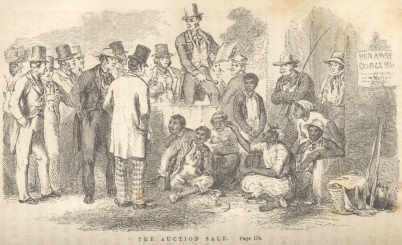
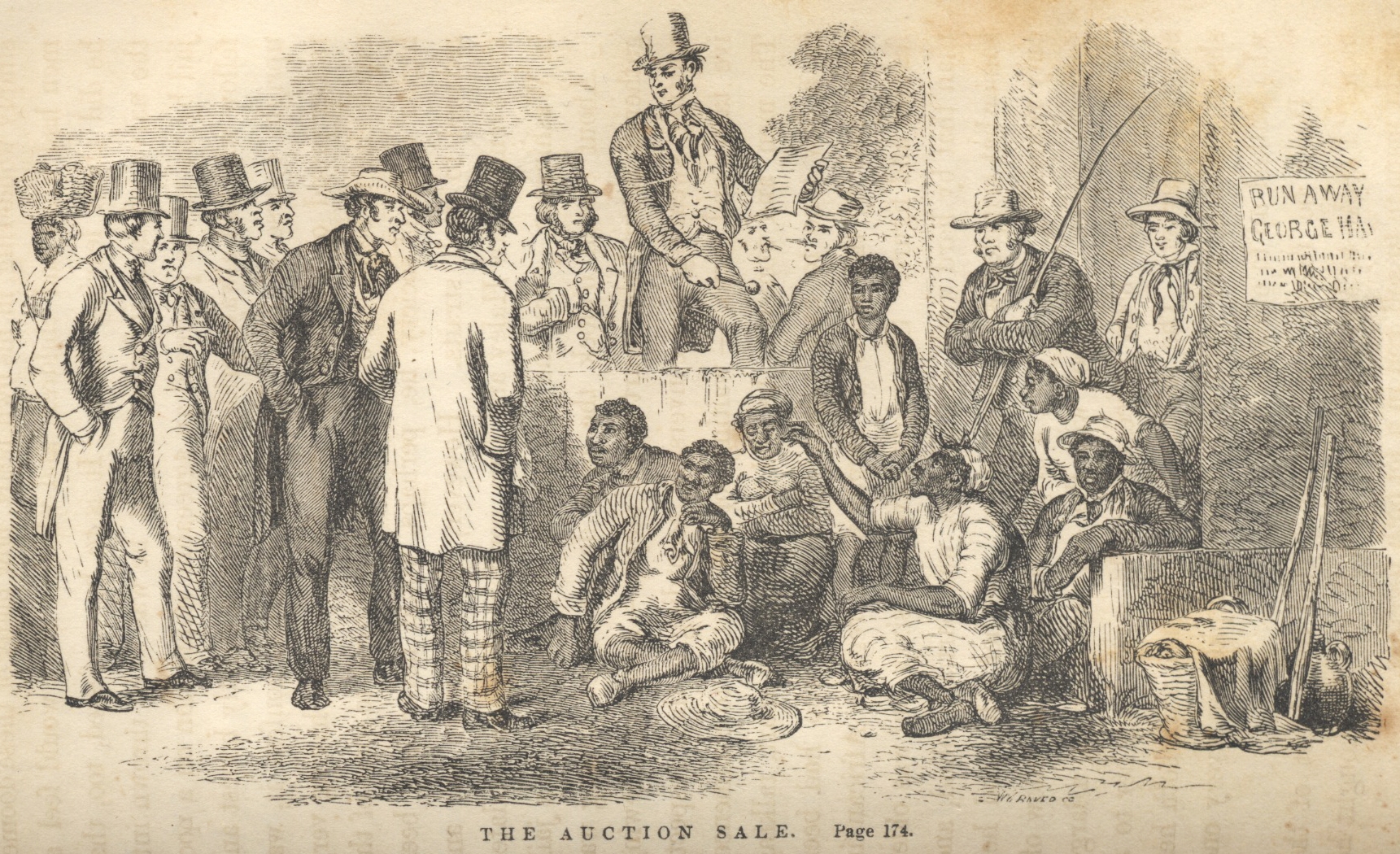
OTCauction

Abolition versus Slave Power

The conflicting ideologies of the Abolitionists who believed that African Americans were created by God and had the same rights as whites, as well as the arguments of Southern political leaders that blacks were inferior and slavery was a positive good, were buttressed by profoundly religious arguments which were related directly to a divergence in values. These diverging values crept into every aspect of life and as such it was this “conflict of values, rather than a conflict of interests or a conflict of cultures, lay at the root of the sectional schism.” [1]   The support of the church in Europe and the Americas was key to the religious and moral belief in the rightness of slavery.

Slavery was the key issue that permeated all aspects of the Civil War to include the cultural, the economic and the ideological. David M. Potter summed up this understanding of the connection between the ideological, cultural and economic aspects of the conflict and just how the issue of slavery connected all three realms in the American Civil War:

“These three explanations – cultural, economic and ideological – have long been the standard formulas for explaining the sectional conflict. Each has been defended as though it were necessarily incompatible with the other two. But culture, economic interest, and values may all reflect the same fundamental forces at work in a society, in which case each will appear as an aspect of the other. Diversity of culture may produce both diversity of interests and diversity of values. Further, the differences between a slaveholding and a nonslaveholding society would be reflected in all three aspects. Slavery represented an inescapable ethical question which precipitated a sharp conflict of values.” [2]

Sadly this is something that those who study the war from a purely military perspective tend to miss, or even willingly gloss over in order make the war more palatable to their own prejudice tend to “blur the reality that slavery was at the heart of the matter, ignore the baser realities of the brutal fighting, romanticize our own home-grown terrorist organization, the Ku Klux Klan, and distort the consequences of the Civil War that still intrude on our national life.” [3] For many people it is far easier not to deal with the harsh reality that slavery and racism was at the heart of the issue and escape to the bloodless romanticism which even ignores the human cost of the war, approximately 750,000 military dead alone. If we extrapolate the percentage of the population that that 750,000 represents and compared it to today’s census that number would be the equivalent of 7.5 million Americans dead. This is a fact that many Civil War buffs tend to ignore.

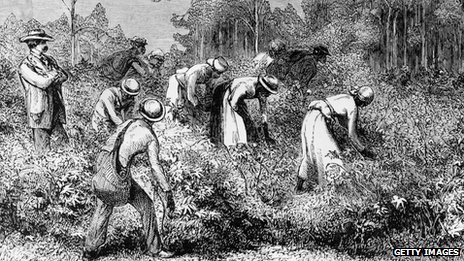
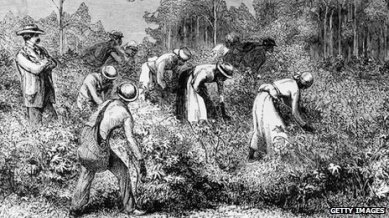
The political ends of the Civil War grew out of the growing cultural, economic, ideological and religious differences between the North and South that had been widening since the 1830s. However, slavery was the one issue which helped produce this conflict in values and it was “basic to the cultural divergence of the North and South, because it was inextricably fused into the key elements of southern life – the staple crop of the plantation system, the social and political ascendency of the planter class, the authoritarian system of social control.” [4] Without slavery and the Southern commitment to an economy based on slave labor, the southern economy would have most likely undergone a similar transformation as what happened in the North; thus the economic divergence between North and South would “been less clear cut, and would have not met in such head-on collision.” [5] But slavery was much more than an economic policy for Southerners; it was a key component of their religious, racial and philosophic worldview.
_65344344_cottonpickers1875_getty

The issue of slavery even divided the ante-bellum United States on what the words freedom and liberty meant. The dispute can be seen in the writings of many before the war, with each side emphasizing their particular understanding of these concepts. In the South, freedom was reserved for those who occupied the positions of economic power; slavery was key to that from not only an economic point of view but as a social philosophy. The concept of human equality, which was so much a part of the Declaration of Independence was downplayed George Fitzhugh, a planter and slave owner in eastern Virginia commented that that concept “is practically impossible, and directly conflicts with all government, all separate property, and all social existence.” [6] Fitzhugh was very critical of the founder’s philosophy of natural liberty and human equality which he found repugnant and error ridden. He wrote:

“We must combat the doctrines of natural liberty and human equality, and the social contract as taught by Locke and the American sages of 1776. Under the spell of Locke and the Enlightenment, Jefferson and other misguided patriots ruined the splendid political edifice they erected by espousing dangerous abstractions – the crazy notions of liberty and equality that they wrote into the Declaration of Independence and the Virginia Bill of Rights. No wonder the abolitionists loved to quote the Declaration of Independence! Its precepts are wholly at war with slavery and equally at war with all government, all subordination, all order. It is full if mendacity and error. Consider its verbose, newborn, false and unmeaning preamble…. There is, finally, no such thing as inalienable rights. Life and liberty are not inalienable…. Jefferson in sum, was the architect of ruin, the inaugurator of anarchy. As his Declaration of Independence Stands, it deserves the appropriate epithets which Major Lee somewhere applies to the thought of Mr. Jefferson, it is “exuberantly false, and absurdly fallacious.”   ” [7]

The political philosophy such as Fitzhugh’s, which was quite common in the South, and was buttressed by a profound religious belief that it was the South’s God ordained mission to maintain and expand slavery. One Methodist preacher in his justification of slavery wrote, “God as he is infinitely wise, just and holy never could authorize the practice of moral evil. But God has authorized the practice of slavery, not only by bare permission of his providence, but by the express permission of his word.” [8]Buttressed by such scriptural arguments Southerners increasingly felt that they were the only people following God. The Northern abolitionists as well as those who advocated for the concept of human equality and free labor were heretics to be damned. As such the “South’s ideological isolation within an increasingly antislavery world was not a stigma or a source of guilt but a badge of righteousness and a foundation for national identity and pride.” [9]

Speaking of the necessity for slavery, as well as limitations on the equality of human beings no matter what their race or sex; Fitzhugh penned words that explained that human relationships were not to be seen in terms of individual liberty, “but in relations of strict domination and subordination. Successful societies were those whose members acknowledged their places within that hierarchy.” [10]

Fitzhugh was quite caustic when he discussed the real implications of his philosophy:

“We conclude that about nineteen out of twenty individuals have “a natural and inalienable right” to be taken care of and protected, to have guardians, trustees, husbands or masters; in other words they have a natural and inalienable right to be slaves. The one in twenty are clearly born or educated in some way fitted for command and liberty.” [11]

Fitzhugh’s chilling conclusion was summarized in the words “Liberty for the few – slavery in every form, for the mass.” [12]

But many Southerners, including many poor whites, especially the Yeoman farmers who were the backbone of the Southern populace did not see or understand the limitations that were placed on their own liberty by the slavery system and instead saw slavery as the guarantee of their economic freedom. John C. Calhoun said to the Senate in 1848 that “With us, the two great divisions of society are not the rich and poor, but white and black; and all of the former, the poor as well as the rich, belong to the upper class, and are respected and treated as equals.” [13] Calhoun’s racial distinction is important if we are to understand why poor whites would fight and die for a social and economic idea that did not benefit them or their families.

But it was Abraham Lincoln, who cut to the heart of the matter when he noted the difference between his understanding of liberty and that of Calhoun and others in the South who defended slavery and the privileges of the Southern oligarchs:

“We all declare for liberty” but “in using the same word we do not all mean the same thing. With some the word liberty may mean for each man to do as he pleases with himself and the product of his labor; while with others the same word may mean for some men to do as they please with other men and the product of other men’s labor.” [14]

The growing economic disparity between the Slave and Free states became more about the expansion of slavery in federal territories as disunion and war approached; for a number of often competing reasons. These differences, amplified by the issue of slavery led to the substitution of stereotypes of each other and had the “effect of changing men’s attitudes toward the disagreements which are always certain to arise in politics: ordinary, resolvable disputes were converted into questions of principle, involving rigid, unnegotiable dogma.” [15] The Charleston Mercury noted in 1858 “on the subject of slavery…the North and the South…are not only two peoples, but they are rival, hostile peoples.”[16]

This was driven both by the South’s insistence on both maintaining slavery where it was already legal and expanding it into new territories which was set against the vocal abolitionist movement. But Southern exponents of expanding slavery were fighting an even more powerful enemy than the abolitionists, who despite their vocal protests were not yet in a position to influence policy. They were now fighting Northern industrialists who were not as idealistic as the abolitionists who were much more concerned with “economic policy designed to secure Northern domination of Western lands than the initial step in a broad plan to end slavery.” [17]

This competition between the regions not only affected politics, it affected religion and culture. In the South it produced a growing culture of victimhood, which was manifest in the words of Robert Toombs who authored Georgia’s declaration of causes for secession:

“For twenty years past, the Abolitionists and their allies in the Northern states, have been engaged in constant efforts to subvert our institutions, and to excite insurrection and servile war among us…” whose “avowed purpose is to subject our society, subject us, not only to the loss of our property but the destruction of ourselves, our wives and our children, and the dissolution of our homes, our altars, and our firesides.” [18]

As the social, economic, cultural and religious differences between the two regions grew wider and the people of the South became ever more closed off from the North. “More than other Americans, Southerners developed a sectional identity outside the national mainstream. The Southern life style tended to contradict the national norm in ways that life styles of other sections did not.” [19]

The complex relationship of Southern society where “Southern bodies social, economic, intellectual, and political were decidedly commingled” [20] came to embrace the need for slavery and its importance to Southern society. This occurred despite the fact that the system did not benefit poor whites in the South and actually harmed them economically. The Southern: “system of subordination reached out still further to require a certain kind of society, one in which certain questions were not publically discussed. It must give blacks no hope of cultivating dissention among the whites. It must commit non slaveholders to the unquestioning support of racial subordination…. In short, the South became increasingly a closed society, distrustful of isms from outside and unsympathetic to dissenters. Such were the pervasive consequences of giving top priority to the maintenance of a system of racial subordination.” [21]

A number of slave revolts, and planned slave revolts which were caught before they could erupt serve to heighten the fear and paranoia of Southerners living in the “Black belts” where slaves outnumbered whites by great margins. “In thickly enslaved areas, fancied dangers united white classes and sexes. Whites in black belts shared horror images about freed blacks as rioters, rapists, arsonists, and cannibals. The whites characteristically thought that using slavery to control alleged barbarians meant saving civilization.” [22]

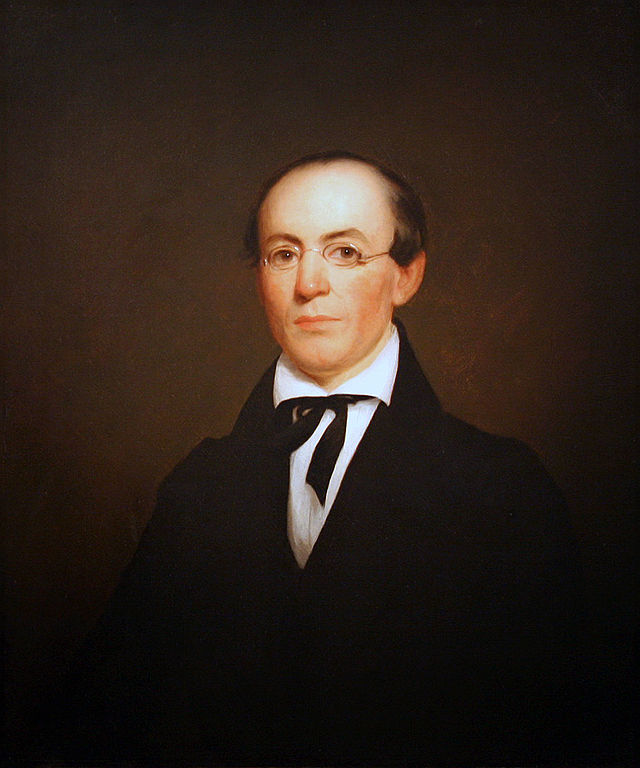
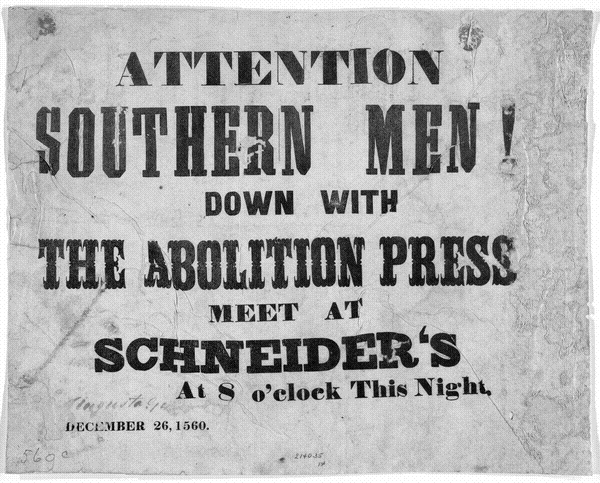
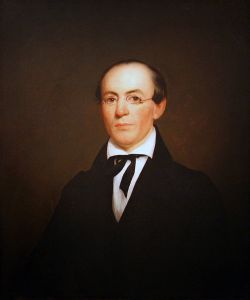
Even before the abolitionist movement took any recognizable form in the North,“with an intensity that escalated through the Civil War, planters declared war on all open criticism of the peculiar institution.” [23]As Northern abolitionists like William Lloyd Garrison and his newspaper The Liberator grew in its distribution and began to appear in the South various elected officials throughout the South “suppressed antislavery books, newspapers, lectures, and sermons and strove generally to deny critics of bondage access to any public forum.” [24] Despite this resistance, abolitionists continued to use the U.S. Mail service to send their literature south provoking even more drastic action from Southern legislators.
garrison by jocelyn 1833

William Lloyd Garrison 

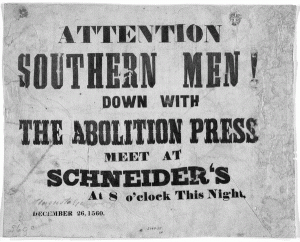
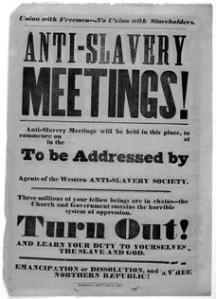
But Garrison and the more radical abolitionists did not have a great following even in the North, most Northerners who even leaned toward abolition were supporters of a very gradual emancipation and not supportive of the immediate emancipation demanded by Garrison and his allies. In fact in the North, Garrison and his followers were not popular, they were “a small and often despised group.” [25] This was born out by facts that Garrison understood all too well, which made him even more uncompromising in his message. “In 1840, support for Garrison extremism peaked at around 2 percent of the northern voting population. The other 98 percent of northern citizens considered immediate abolition to be too extreme to be American, too problack to be tolerable, too keen on seizing property to be capitalistic, and too antisouthern to be safe for the Union.” [26]Garrison despised his northern opponents and wrote that he found among them “contempt more bitter, opposition more active, detraction more relentless, prejudice more stubborn, and apathy more frozen, than among slave owners themselves.” [27] Opponents broke up his meetings and on one occasion paraded Garrison “through the streets of Boston with a rope around his neck.” [28]

But Southerners, particularly those in the black belts were too outraged by Garrison and his follower’s incendiary words and “almost pornographic diatribes,” which they felt had assaulted their “self-respect and sense of honor.” [29] In response to the proliferation of abolitionist literature in the South which was being sent through the mail, Senator John C. Calhoun proposed that Congress pass a law to prosecute “any postmaster who would “knowingly receive or put into the mail any pamphlet, newspaper, handbill, or any printed, written, or pictorial representation touching the subject of slavery.” [30] Calhoun was not alone as other members of Congress as well as state legislatures worked to restrict the import of what they considered subversive and dangerous literature. The condescending attitude of the radical abolitionists provoked an “emotional wildfire” [31] in the South, which united slave owners and poor whites in the heavily black slave majority regions and served to increase their fear and loathing of Yankees who they believed wanted to destroy them and their way of life. Had they really understood just how united much of the North was with them they may not have pushed as hard to force Northern allies to accept laws that eventually offended the sensibilities of even non-abolitionists Northerners.
attention-southern-men

But Southern fears of real and imagined slave revolts, and hatred of radicals like Garrison brought about a host of new problems as Southerners attempted to crush the rights of free speech in the north and to blot out any mention of slavery in the House of Representatives. Beginning in 1836 the House of Representatives, led by Southern members of Congress passed a “gag rule” for its members. The “Gag Rule” “banned all petitions, memorials, resolutions, propositions, or papers related in any way or to any extent whatever to the subject of slavery.” [32] Former President John Quincy Adams continually challenged the gag-rule beginning in 1842, as did a number of others. The pressure was such that finally in 1844 the House voted to rescind it.
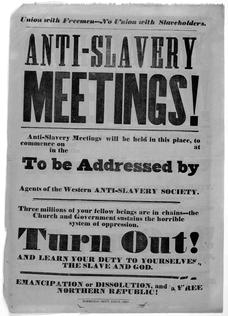
anti-slavery-meetings

However, Southern politicians were unhappy with the recension of the Gag Rule and “began to spout demands that the federal government and the Northern states issue assurances that the abolitionists would never be allowed to tamper with what John Calhoun had described as the South’s “peculiar domestic institution.” [33] As tensions grew between the regions; the issue of slavery more than any other issue, “transformed political action from a process of accommodation to a mode of combat.” [34]

Around the same time as the gag rule was played out in Congress the Supreme Court had ruled that the Federal government alone “had jurisdiction where escaped slaves were concerned” which resulted in several states enacting “personal liberty laws” to “forbid their own elected officials from those pursuing fugitives.” Southern politicians at the federal and state levels reacted strongly to these moves, which they believed to be an assault on their institutions and their rights to their human property. Virginia legislators said these laws were a “disgusting and revolting exhibition of faithless and unconstitutional legislation.” [35]

The issue of slavery shaped political debate and “structured and polarized many random, unoriented points of conflict on which sectional interest diverged.” [36] As the divide grew leaders and people in both the North and the South began to react to the most distorted images of each other imaginable- “the North to an image of a southern world of lascivious and sadistic slave drivers; the South to the image of a northern world of cunning Yankee traders and radical abolitionists plotting slave insurrections.” [37]

To be continued…

Notes

[1] Potter, David M. The Impending Crisis: America before the Civil War 1848-1861 completed and edited by Don E. Fehrenbacher Harper Collins Publishers, New York 1976 p.41

[2] Ibid. Potter The Impending Crisis p.41

[3] Burns, Ken A Conflict’s Acoustic Shadows in The New York Times Disunion: Modern Historians Revisit and Reconsider the Civil War from Lincoln’s Election to the Emancipation Proclamation Black Dog and Leventhal Publishing, New York 2013 p.102

[4] Ibid. Potter The Impending Crisis p.42

[5] Ibid. Potter The Impending Crisis p.42

[6] Ibid. Levine Half Slave and Half Free: The Roots of the Civil War Revised Edition p.140

[7] Fitzhugh, George. New Haven Lecture 1855, in The Approaching Fury: Voices From the Storm, 1820-1861 Stephen B. Oates, Editor, University of Nebraska Press, Lincoln and London 1997 p.135

[8] Ibid. Daly When Slavery Was Called Freedom: Evangelicalism, Proslavery, and the Causes of the Civil War pp.63-64

[9] Ibid. Faust, Drew The Creation of Confederate Nationalism: Ideology and Identity in the Civil War South p.61

[10] Ibid. Levin Half Slave and Half Free p.140

[11] Ibid. Levin Half Slave and Half Free p.140

[12] Ibid. Levin Half Slave and Half Free p.141

[13] McPherson, James M. Drawn With the Sword: Reflections on the American Civil War Oxford University Press, Oxford and New York 1996 p.50

[14] Ibid. Levin Half Slave and Half Free p.122

[15] Ibid. Potter The Impending Crisis p.43

[16] Ibid. McPherson Drawn With the Sword p.16

[17] Egnal, Marc Clash of Extremes: The Economic Origins of the Civil War Hill and Wang a division of Farrar, Straus and Giroux New York 2009 p.6

[18] Dew, Charles B. Apostles of Disunion: Southern Secession Commissioners and the Causes of the Civil War University Press of Virginia, Charlottesville and London 2001 p.12

[19] Thomas, Emory The Confederate Nation 1861-1865 Harper Perennial, New York and London 1979 p.5

[20] Ibid. Thomas The Confederate Nation p.5

[21] Ibid. Potter The Impending Crisis pp.457-458

[22] Freehling, William W. The South vs. The South: How Anti-Confederate Southerners Shaped the Course of the Civil War Oxford University Press, Oxford and New York 2001 p.20

[23] Ibid. Levine Half Slave and Half Free p.166

[24] Ibid. Levine Half Slave and Half Free p.166

[25] Ibid. Goldfield America Aflame: How the Civil War Created a Nation p.27

[26] Ibid. Freehling The South vs. The South p. 34

[27] Ibid. Varon Disunion! The Coming of the American Civil War 1789-1858pp.70-71

[28] Ibid. Goldfield America Aflame p.27

[29] Ibid. Freehling The South vs. The South p.22

[30] Ibid. Guelzo Fateful Lightning pp.50-51

[31] Ibid. Freehling The South vs. The South p.22

[32] Ibid. Levine Half Slave and Half Free pp.169-170

[33] Ibid. Guelzo Fateful Lightning pp.51-52

[34] Ibid. Potter The Impending Crisis p.43

[35] Ibid. Levine Half Slave and Half Free pp.169-170

[36] Ibid. Potter The Impending Crisis p.43

[37] Ibid. Potter The Impending Crisis p.43

Leave a comment

Filed under civil rights, civil war, economics and financial policy, ethics, faith, History, labor, Loose thoughts and musings, Political Commentary

“Sometimes the Bible in the Hand of One Man is Worse than a Whiskey Bottle in the Hand of Another” The Evangelical Responsibility for Trump

mock


Friends of Padre Steve’s World

One of my favorite films is To Kill a Mockingbird. I am a convinced that many people that call themselves “conservative Christians,” are so busy protecting their place and power in society that they despise anyone not like them. For decades before and now a year and a half after the election of Donald Trump the same collection of conservative Christian Supremacists have played fast and loose with the truth, scammed billions of dollars from desperate followers, and drove almost every moderate there ever was out of the Republican Party with their ideology of Christian Dominionism.

I have written about this before. In light of my experience with them I imagine that some of these folks will, now that they have help a man that they belief will fully support their agenda, “kill the Mockingbird” in order to ensure that they keep their privileged position in society. Traditionally the Mockingbirds are those people that they have condemned to social inferiority and discrimination and eternal punishment simply because they are different. To today’s theocrats, the most frequent targets of their wrath are gays and the LGBT community, as well as Muslims, other non-white immigrants, women, and the disabled. The fact that just because someone else gets equal rights doesn’t mean that they lose any rights equality before the law, except to persecute them, seems to be beyond their capability to understand.

This is especially the case of the preachers, pundits and politicians that crowd the airwaves and internet with their pronouncements against Gays, immigrants, Arabs, poor blacks, political liberals, progressive Christians, and for that matter anyone who simply wants the same rights enjoyed by these Christians. This makes me fear them more far more than I fear Donald Trump. They represent a majority of the Republican House caucus and there quite a few in the Senate. Jefferson Beauregard Sessions, whose racist sentiments were so reprehensible that kept him from appointment as a Federal Judge during the Reagan administration is the Attorney General is also one. He has been acting with draconian ruthlessness to weaken civil rights statutes, voting rights laws, protections for refugees and others. Sarah Huckabee Sanders is the daughter of the preacher turned politician turned pundit Mike Huckabee who no problem with habitually lying to cover the misdeeds of the President and while she is at it engage in demonizing the press and any opponent of the President.  Education Secretary Betsy De Vos is trampling the line between Church and State in regard to education and uses her power to reverse long standing affirmative action regulations that help the poor, minorities, women, the disabled and others get education. Former EPA Secretary Scott Pruitt used his Biblical beliefs to dismantle environmental protections even while enriching himself and his family by breaking one ethical rule after another. I could go on and on and on. but the fact is that these men and women are proving on a daily basis what the great Republican conservative Barry Goldwater said:

“Mark my word, if and when these preachers get control of the [Republican] party, and they’re sure trying to do so, it’s going to be a terrible damn problem. Frankly, these people frighten me. Politics and governing demand compromise. But these Christians believe they are acting in the name of God, so they can’t and won’t compromise. I know, I’ve tried to deal with them.” 

In the book and film To Kill a Mockingbird there is a line spoken by Miss Maudie Atkinson, a neighbor of Atticus Finch and his children. She says to Atticus’s daughter Scout:

“Sometimes the Bible in the hand of one man is worse than a whiskey bottle in the hand of another… There are just some kind of men who – who’re so busy worrying about the next world they’ve never learned to live in this one, and you can look down the street and see the results.”

As I survey the world of Christian conservatives I become surer of this every day. I’ve often wrote about my own fears in regard to dealing with such people as well as the troubling trends that I see. Those are not unfounded, I had a recent experience with one that I cannot share publicly but which posed a threat to my career and freedom.

Over the years I have written articles on the trends that I see in the church, trends toward greed, political power, social isolation and the active campaign of some to deny basic civil rights to people that they hate on purely religious grounds.

The language of some like Matt Staver of Liberty Counsel, Tony Perkins of the American Family Association and a host of others describe actions of governments and courts to ensure equal treatment of all people under the law as threats to Christians, affronts to them and of course to God. Their words are chilling.

Before the Obergfell v. Hodges decision, Matt Staver that if the Supreme Court upheld marriage equity for gays that it would be like the Dred Scott decision. Of course that is one of the most Orwellian statements I have heard in a while, for the Dred Scott decision rolled back the few rights that blacks had anywhere in the country and crushed the rights of non-slave states.

These men are now pushing to ensure that President Trump does their will, and a few have pledged to turn against him if he doesn’t fully support their every demand. So far he has shown little need to do that because they are his most faithful supporters. They are the ones who embody what he said during the early days of his campaign “that my supporters would support me even if I shot someone on 5th Avenue.” They will be the ones that would follow him to hell if need be as they sold their souls for political power long before Trump ever emerged on the political landscape.

Back in 1981 Barry Goldwater said on the Senate Floor “The religious factions that are growing throughout our land are not using their religious clout with wisdom. They are trying to force government leaders into following their position 100 percent.”

Again, as a reminder to readers, especially those new to the site, I spent a large amount of my adult Christian life in that conservative Evangelical cocoon. I worked for a prominent television evangelist for several years, a man who has become an extreme spokesman for the religious political right. I know what goes on in such ministries, I know what goes on in such churches. I know the intolerance and the cold hearted political nature of the beast.

Years ago I knew and went to church with Randall Terry, the former head Operation Rescue. He once said: “Let a wave of intolerance wash over you. I want you to let a wave of hatred wash over you. Yes, hate is good…” I have walked in those shoes, and at one time I was as whipped into a frenzy of hate by those preachers, and their colleagues in right wing talk radio. That was before I went to and returned from Iraq. Thus I fully understand them and now I reject them and their intolerant creeds.

As Atticus Finch told his children:

“You never really understand a person until you consider things from his point of view… Until you climb inside of his skin and walk around in it.”

Thus I total reject the message of such people now, not out of ignorance, but because I have walked in their shoes. At times I supported their causes, not to any extreme, but all too often my crime was simply said nothing when I knew that what they preached, taught and lived was not at all Christian, but from the pits of Hell.

As far as them being entitled to hold whatever opinion they want, even if I disagree, yes that is their right. But as Atticus said:

“People are certainly entitled to think that I’m wrong, and they are entitled to full respect for their opinions. But before I can live with other folks I’ve got to live with myself. The only thing that doesn’t abide by majority rule is a person’s conscience.”

My conscience will not allow me to be silent when I see men like Staver, Perkins, Franklin Graham and so many others preach hatred towards those who are different than them. In 2010 that caused me to be thrown out of a church I had served faithfully from over 14 years as a priest and chaplain. These people are viscous and need to be opposed at all costs. It is a Christian duty to do so. Dietrich Bonhoeffer wrote:

“If I sit next to a madman as he drives a car into a group of innocent bystanders, I can’t, as a Christian, simply wait for the catastrophe, then comfort the wounded and bury the dead. I must try to wrestle the steering wheel out of the hands of the driver.”

In the movie and the book the Mockingbird was Tom Robinson, the black man falsely accused of rape and assault and Boo Radley; a shy recluse feared by his neighbors, a man who stories were made up about; stories that turned a simple man into a monster in the eyes of people who did not know him. Today they are others who fit the Mockingbird role, people who just want to get along and live in peace, but who endure discrimination and damnation from those who call themselves Christians as well as the President who is unconstrained by his party which has abandoned every principle for they once stood.

Jem Finch, the son of Atticus asks his sister a question in the book and the film:

“If there’s just one kind of folks, why can’t they get along with each other? If they’re all alike, why do they go out of their way to despise each other?”

I ask the same question on a daily basis and I wonder how it can happen again and again.

Peace

Padre Steve

7 Comments

Filed under Loose thoughts and musings

The Ring-Bolt to the Chain of Our Nation’s Destiny: The Declaration of Independence at 242 Years

The Thirty Three Star Fort Sumter Flag

Friends of Padre Steve’s World,

It is July 4th and the 241st anniversary of the declaration by the leaders of 13 colonies of their independence from Britain and the founding on a new nation. It was a nation founded on a principle of the Enlightenment, the principle that all men are created equal, and as their Declaration of Independence noted that as such are “endowed by their creator with certain unalienable rights, among which are life, liberty, and the pursuit of happiness.” 

Seventy-six years later the darkness of 1852 not long after the passage of the Compromise of 1850 which included an enhanced Fugitive Slave Act, it would be Frederick Douglass, the foremost Black abolitionist leader and himself an escaped slave would speak. The laws dictated that Northerners had to cooperate in the recapture and re-enslavement of blacks residing in their own states, regardless of their own state and local laws. While the Southern majority that crafted these laws always played the part of the aggrieved minority whose “states rights” were being threatened. But the reverse was true, with their majorities in the House and Senate which also included some Northern Congressmen and Senators, an always compliant White House, and a majority on the Supreme Court the Southerners used the threat of secession and civil war to enforce their mandates on the Free States.

On July 5th 1852 Douglass spoke these words these words to people who at the time were refused citizenship and who were enslaved:

“I have said that the Declaration of Independence is the ring-bolt to the chain of your nation’s destiny; so, indeed, I regard it. The principles contained in that instrument are saving principles. Stand by those principles, be true to them on all occasions, in all places, against all foes, and at whatever cost.”

Douglass understood this far better than many Americans in the South or the North. It would take a great and bloody war for most Americans to realize just how important the Declaration was to the destiny of the nation.  It would take far longer for the principle of an ever expanding understanding of liberty that included Blacks who were considered in law and statute as less than fully human.

One of the most notable of the apologists for White Supremacy was George Fitzhugh, a major Southern slaveholder and apologist for not only slavery but the inequality of poor whites and women. Fitzhugh spoke for many when he wrote against the principles of the Declaration:

“We must combat the doctrines of natural liberty and human equality, and the social contract as taught by Locke and the American sages of 1776. Under the spell of Locke and the Enlightenment, Jefferson and other misguided patriots ruined the splendid political edifice they erected by espousing dangerous abstractions – the crazy notions of liberty and equality that they wrote into the Declaration of Independence and the Virginia Bill of Rights. No wonder the abolitionists loved to quote the Declaration of Independence! Its precepts are wholly at war with slavery and equally at war with all government, all subordination, all order. It is full if mendacity and error. Consider its verbose, newborn, false and unmeaning preamble…. There is, finally, no such thing as inalienable rights. Life and liberty are not inalienable…. Jefferson in sum, was the architect of ruin, the inaugurator of anarchy. As his Declaration of Independence Stands, it deserves the appropriate epithets which Major Lee somewhere applies to the thought of Mr. Jefferson, it is “exuberantly false, and absurdly fallacious.

Fitzhugh also wrote:

“We conclude that about nineteen out of twenty individuals have “a natural and inalienable right” to be taken care of and protected, to have guardians, trustees, husbands or masters; in other words they have a natural and inalienable right to be slaves. The one in twenty are clearly born or educated in some way fitted for command and liberty.

A greater contrast of views regarding the Declaration is hard to be found. Abraham Lincoln would say about the contrasting views of liberty at a speech in Baltimore on April 18th 1864:

“The world has never had a good definition of the word liberty, and the American people, just now, are much in want of one. We all declare for liberty; but in using the same word we do not all mean the same thing. With some the word liberty may mean for each man to do as he pleases with himself, and the product of his labor; while with others the same word may mean for some men to do as they please with other men, and the product of other men’s labor. Here are two, not only different, but incompatible things, called by the same name, liberty. And it follows that each of the things is, by the respective parties, called by two different and incompatible names–liberty and tyranny.” 

Unfortunately these starkly contrasting views of liberty are still on display today. The President called Mexican and Central American refugees an “infestation” using a word that would to describe rats, insects or other disease carrying species. Members of his administration, Republican Congressmen and State Representatives, and members of various “conservative” media outlets, including their allies in the Alt-Right use the same language as Fitzhugh to declare for the superiority of the White race, to dehumanize Blacks, Mexicans, Arabs, and various dark skinned Asians and argue that darker skinned people are less than human and not entitled to liberty, equality and justice. A constant barrage of what quite literally amounts to state sponsored propaganda demonizes minorities, women, gays, the media, long term allies and alliances, and any potential political opponent.

Our Republic, its institutions and our freedom hinge on what Douglass called “the rig-bolt to the chains of our nation’s destiny,” and its principles “saving principles.” We must be dedicated to the proposition that “all men are created equal” or submit to tyranny.

The proposition in the Declaration that all men are created equal is essential to understanding or appreciating liberty. If we view others as below us, as even less than human then we cannot say that we believe in liberty. If we decide to limit the right of citizens to speak out because of their color, their national origin, their race, their religion, their gender, or sexual identity then we are not for liberty, we are no better than George Fitzhugh or others, even the Nazis, who enslaved, imprisoned, and exterminated others in the name of their power, and their right.

If our concept of liberty is so limited by our ideology that we cannot accept others having it or being equal to us then we stand against the very proposition that the United States was founded and we should bury the American experiment and stop lying about a proposition that we no longer believe in. The eminent American jurist wrote these words, which for me are like the Declaration, the Preamble of the Constitution, the Gettysburg Address, Lincoln’s Second Inaugural Address, and Dr. Martin Luther King Jr.’s I Have a Dream speech are secular scripture that are sacred to my understanding of being an American, and something that I will never yield. Judge Hand said:

“Liberty lies in the hearts of men and women; when it dies there, no constitution, no law, no court can even do much to help it. The spirit of Liberty is the spirit which is not too sure that it is right; the spirit of Liberty is the spirit which seeks to understand the minds of other men and women; the spirit of Liberty is that which weighs their interests alongside its own without bias.”

With that my friends I wish you a happy Independence Day,

Peace

Padre Steve+

Leave a comment

Filed under civil rights, civil war, History, Loose thoughts and musings, News and current events, Political Commentary