Category Archives: middle east

Who Were the Victims? Does Anybody Care? The Holocaust and War Crimes Today

Friends of Padre Steve’s World,

Tonight I write about the victims of the Holocaust, and other Nazi Crimes Against Humanity. At the heart of the Nazi crimes was the genocide committed against the Jews, but the Nazi crimes extended far beyond them; the systemic extermination of the handicapped, mentally ill, chronically sick, and others deemed to be Life Unworthy of Life. Likewise there was the killing of possible political political opponents in the Reich and conquered territories; the intentional starvation of Poles and Russians, the use of slave labor, and the indiscriminate killing of civilians.

In the film Judgement at Nuremberg the American Prosecutor at the Judges Trial played by Richard Widmark asked a question when showing a film of the victims of the Nazis when the Concentration Camps were liberated by American and British troops in the spring of 1945. His question in the face of films of massed piles of bodies being bulldozed into mass graves at Bergen-Belsen, of the cremated remains, shrunken skulls, and lampshades made of human skin at Buchenwald, gas chambers, medical experiments, the emaciated bodies of still living victims; little more than skin and bones, elbows, hips, and knees bulging over the shrunken remains of their bodies, eyes sunken in to the skulls.

Who were they?

The Nazis specifically targeted the Jews for extermination. According to Hitler, his hnchemen, and other German nationalists, the Jews were less than human, they worked hand in hand with the Bolsheviks, and thus deserved their fate. Likewise, there were those crippled in body or mind who were euthanized, political opponents, religious and racial minorities, populations of conquered nations, who died at the hands of the German military, or who were gunned down in mass graves by the Einsatzgruppen, intentionally starved to death, or who were worked to death as Slave laborers in the Nazi work camps.

To the average German of the time they were subhuman, and even those not fully in agreement with the Nazis seldom cared, and simply turned their backs. There were the perpetrators and the bystanders, who seldom if ever thought about their victims. In a way very much like most of us don’t even blink when we are confronted with war crimes committed by our own soldiers, and their victims, or innocent women and children killed during air or drone strikes where perhaps one or two at best terrorists or insurgents were reportedly located.

we have a lot to learn from the past.

The victims of the Nazis, like so many others who have committed crimes against humanity, including us, were men and women, wives and husbands, sons and daughters. They spanned the spectrum from infants to the aged. Too many times multiple generations of families went to death together. Examples of the Nazi crimes are so numerous that they must never be forgotten. That is why I write tonight, that we never forget, so we do not repeat them ourselves. Human nature is human nature, and as much as we think we have progressed, the darkness still resides in us, and we must fight to do right.

However, some witnesses to the Nazi crimes were appalled and when the Nazi regime finally was crushed testified to those crimes.

One of them was Hermann Graebe, a civilian employed to help build roads for the Wehrmacht came across one of the many massacres committed up close and personal by SS Men on October 5th 1943 at Dubno, Ukraine. At Nuremberg he testified:

Moennikes and I went direct to the pits. Nobody bothered us. Now I heard rifle shots in quick succession, from behind one of the earth mounds. The people who had got off the trucks—men, women and children of all ages—had to undress upon the orders of an SS-man, who carried a riding or dog whip.

They had to put down their clothes in fixed places, sorted according to shoes, top clothing and underclothing. I saw a heap of shoes of about 800 to 1,000 pairs, great piles of underlinen and clothing. Without screaming or weeping these people undressed, stood around in family groups, kissed each other, said farewells and waited for a sign from another SS-man, who stood near the pit, also with a whip in his hand.

During the 15 minutes that I stood near the pit I heard no complaint or plea for mercy. I watched a family of about 8 persons, a man and woman, both about 50 with their children of about 1, 8 and 10, and two grown up daughters of about 20 to 24. An old woman with snow-white hair was holding the one year old child in her arms and singing to it, and tickling it. The child was cooing with delight. The couple were looking on with tears in their eyes. The father was holding the hand of a boy about 10 years old and speaking to him softly; the boy was fighting his tears. The father pointed toward the sky, stroked his head, and seemed to explain something to him. At that moment the SS-man at the pit shouted something to his comrade.

I looked into the pit and saw that the bodies were twitching or the heads lying already motionless on top of the bodies that lay before them. Blood was running from their necks.

I was surprised that I was not ordered away, but I saw that there were two or three postmen in uniform nearby. The next batch was approaching already.

These victims were not just numbers and statistics. They were living breathing human beings whose lives were snuffed out by the Nazis and their allies. They had been abandoned by most of the world. Anything of value that they possessed was appropriated by the men who exterminated them; their businesses, homes, farms, clothes, shoes, currency, jewelry, wedding rings, artwork, furniture, and even their gold fillings, and yes, their hair, and even their skin.

Whole towns were exterminated, millions of people killed and millions of other people displaced, never to return to their homes. At Babi Yar outside of Kiev 33,771 Jews were exterminated by the members of Sonderkommando 4b of Einsatzgruppen C as well as Police battalions. About 10,000 others, mainly Communist Officials and Gypsies were rounded up and killed in the same operation. The victims were stripped of all of their belongings taken to a ravine and shot. The German Army provided logistic support as well as security for the murder squads.

Fritz Hoefer, a SS man serving as a truck driver with the Sonderkommando said these words at the Einsatzgruppen Trial:

One day I was ordered to drive my truck out of town. I had a Ukrainian with me. It was about 10 a.m. On our way, we passed Jews marching in columns in the same direction, we were going. They were carrying their belongings. There were whole families. The farther we drove away from the town, the more people we saw in the columns. There were piles of clothes in a wide open field. My job was to fetch them.   

I stopped the engine nearby, and the Ukrainians standing around started loading the car with this stuff. From where I was, I saw other Ukrainians meeting the Jews who arrived, men, women and children, and directing them to the place where, one after another, they were supposed to remove their belongings, coats, shoes, outer garments and even their underwear.

They were supposed to put all their belongings together in a pile. Everything happened very quickly, the Ukrainians hurried those who hesitated by kicking and pushing them. I think it took less than a minute from the moment a person took off his coat before he was standing completely naked.

No distinction was made between men, women and children. The Jews who were arriving could have turned back when they saw those who had come earlier taking off their clothes. Even today I cannot understand why they didn’t run.


Columns of Jews march past a corpse in Kiev

Naked Jews were led to a ravine about 150 metres long, 30 metres wide and 15 metres deep. The Jews went down into the ravine through two or three narrow paths. When they got closer to the edge of the ravine, members of the Schutzpolizei (Germans) grabbed them and made them lie down over the corpses of the Jews who had already been shot.

It took no time. The corpses were carefully laid down in rows. As soon as a Jew lay down, a Schutzpolizist came along with a sub-machine gun and shot him in the back of the head.The Jews who descended into the ravine were so frightened by this terrible scene that they completely lost their will. You could even see some of them lying down in the row on their own and waiting for the shot to come.

Only two members of the Schutzpolizei did the shooting. One of them was working at one of the ravine, the other started at the other end. I saw them standing on the bodies and shooting one person after another.

Walking over the corpses toward a new victim who had already laid down, the machine gunner shot him on the spot. It was an extermination machine that made no distinction between men, women and children.Children were kept with their mothers and shot with them. I did not watch for long. When I approached the edge, I was so frightened of what I that I could not look at it for a long time.
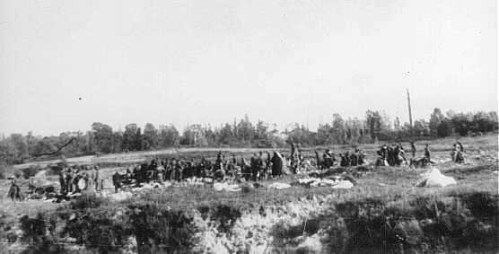
 

German Einsatzgruppen & Police force groups of Jews to hand over their possessions and undress before being shot in the ravine at Babi Yar

I saw dead bodies at the bottom laid across in three rows, each of which was approximately 60 metres long. I could not see how many layers were there. It was beyond my comprehension to see bodies twitching in convulsions and covered with blood, so I could not make sense of the details.Apart from the two machine gunners, there were two other members of the Schutzpolizei standing near each passage into the ravine.

They made each victim lie down on the corpses, so that the machine gunner could shoot while he walked by. When victims descended into the ravine and saw this terrible scene at the last moment, they let out a cry of terror. But they were grabbed by the waiting Schutzpolizei right away and hurled down onto the others.

Those who followed them could not see the terrible scene because it was obstructed by the edge of the ravine. While some people were getting undressed and most of the others were waiting their turn, there was a lot of noise. The Ukrainians paid no attention to the noise and just kept forcing people through the passages into the ravine.

You could not see the ravine from the site where people were taking off their clothes, because it was situated about 150 metres away from the first pile of clothes. Besides, a strong wind was blowing and it was very cold. You couldn’t hear the shooting in the ravine.
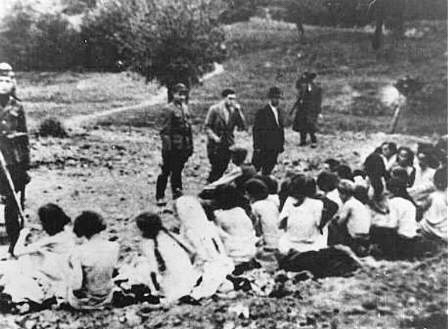
Jews at Babi Yar waiting to be murdered

So I concluded that the Jews had no idea what was actually happening. Even today I wonder why the Jews did nothing to challenge what was going on. Masses of people were coming from town and they did not seem to suspect anything.

They thought they were just being relocated.              

The men who were the leaders of the mobile Einsatzgruppen which conducted these up close and personal killings of nearly a million and a half Jews and others were not common thugs. Most were very educated and accomplished men.

General Telford Taylor, an American lawyer who served as a prosecutor at the Einsatzgruppen Trial explained:

“These defendants are not German peasants or artisans drafted into the Wehrmacht. They are not uneducated juveniles. They are lawyers, teachers, artists, and a former clergyman. They are, in short, men of education, who were in full possession of their faculties and who fully understood the grave and sinister significance of the program they embarked upon. They were part of the hard core of the SS. They did not give mere lip service to Himmler’s atrocious racial doctrines; they were chosen for this terrible assignment because they were thought to be men of sufficient ruthlessness to carry them out. They are hand-picked fanatics; every one of them was an officer of the SS … They are not unhappy victims, unwillingly pushed into crime by the tyranny of the Third Reich; these men, above all others, themselves, spread the Nazi doctrine with fire and sword.”

The men who ran the death camps might not have been from the same “elite” stock as the commanders of the Einsatzgruppen but they carried out their duties in calculating and businesslike manner. Rudolf Hoess who commanded Auschwitz gave this statement to the International Military Tribunal:

On 1 December 1943 1 became Chief of Amt 1 in Amt Group D of the WVHA, and in that office was responsible for co-ordinating all matters arising between RSHA and concentration camps under the administration of WVHA. I held this position until the end of the war. Pohl, as Chief of WVHA, and Kaltenbrunner, as Chief of RSHA, often conferred personally and frequently communicated orally and in writing concerning concentration camps. . . .

The ‘final solution’ of the Jewish question meant the complete extermination of all Jews in Europe. I was ordered to establish extermination facilities at Auschwitz in June 1941. At that time, there were already in the General Government three other extermination camps: Belzek, Treblinka, and Wolzek. These camps were under the Einsatzkommando of the Security Police and SD. I visited Treblinka to find out how they carried out their exterminations. The camp commandant at Treblinka told me that he had liquidated 80,000 in the course of one-half year. He was principally concerned with liquidating all the Jews from the Warsaw Ghetto. He used monoxide gas, and I did not think that his methods were very efficient. So when I set up the extermination building at Auschwitz, I used Cyklon B, which was a crystallized prussic acid which we dropped into the death chamber from a small opening. It took from 3 to 15 minutes to kill the people in the death chamber, depending upon climatic conditions. We knew when the people were dead because their screaming stopped. We usually waited about one-half hour before we opened the doors and removed the bodies. After the bodies were removed our special Kommandos took off the rings and extracted the gold from the teeth of the corpses.

When he was asked specifics, Hoess stated: This gold was melted down and brought to the Chief Medical Office of the SS at Berlin.

He continued with some pride during cross examination:

Another improvement we made over Treblinka was that we built our gas chamber to accommodate 2,000 people at one time whereas at Treblinka their 10 gas chambers only accommodated 200 people each. The way we selected our victims was as follows: We had two SS doctors on duty at Auschwitz to examine the incoming transports of prisoners. The prisoners would be marched by one of the doctors who would make spot decisions as they walked by. Those who were fit for work were sent into the camp. Others were sent immediately to the extermination plants. Children of tender years were invariably exterminated since by reason of their youth they were unable to work. Still another improvement we made over Treblinka was that at Treblinka the victims almost always knew that they were to be exterminated and at Auschwitz we endeavored to fool the victims into thinking that they were to go through a delousing process. Of course, frequently they realized our true intentions and we sometimes had riots and difficulties due to that fact. Very frequently women would hide their children under the clothes, but of course when we found them we would send the children in to be exterminated. We were required to carry out these exterminations in secrecy but of course the foul and nauseating stench from the continuous burning of bodies permeated the entire area and all of the people living in the surrounding communities knew that exterminations were going on at Auschwitz.

But the bodies…

Jews and Gentiles from every nation in Europe as well as the Americas, Africa, and Asia ended up dying at the hands of the Nazis, either in their Death Camps, Concentration/ Labor Camps, or up close and personal at the hands of the Einsatzgruppen, the Waffen SS, or the Wehrmacht.

Every one of those bodies, the cold statistics of the Nazi machine were people like you and me. In April of 2018 I visited the United States Holocaust Museum while visiting friends in Washington D. C.

I think that the one that hit me the hardest was the pictorial Tower of Faces from the Polish shtetl of Ejszyszki. That town was home to some 4,000 Jews and the pictures had been taken over the preceding decade by local photographers. They were pictures of everyday family and community life; men, women, children at work, at play, at rest. Worshipping, working, studying, the old and the young, the well off and the poor, the religious and those not as religious at all phase of life captured in photos for eternity. For 3500 of them their lives ended on September 21st 1941 when the Nazis rounded up the Jews at their Synagogues on the eve of Yom Kippur and executed them by firing squad in mass graves at the town’s Christian and Jewish cemeteries. Only 29 of those who survived that day lived through the war. That Jewish community had existed for 900 years and was exterminated in a matter of hours.

          The Tower of Faces at the United States Holocaust Museum 

I looked at those pictures and I could not get over all of those innocent lives cut short. Each face was the picture of an individual or individuals, families, friends, schoolmates. They were not abstract numbers or statistics but real flesh and blood people like you and me. They had hopes and dreams, but because they were Jews they were exterminated, like nearly six million other Jews who also were real people with hopes and dreams that would be destroyed by the Nazi racial war. Of course the Nazis targeted others, but none with the relentless anti-Semitic racial hatred propagated by Nazi ideology. Thus they condoned and executed by people who would have ordinarily have been considered upstanding and moral citizens. The late Christopher Hitchens wrote:

“We should not at all allow ourselves to forget the millions of non-Jewish citizens of Belarus, Russia, Ukraine, and other Slav territories who were also massacred. But for me the salient fact remains that anti-Semitism was the regnant, essential, organizing principle of all the other National Socialist race theories. It is thus not to be thought of as just one prejudice among many.” 

The Jewish-Italian Philosopher and Auschwitz survivor Primo Levi wrote:

Then for the first time we became aware that our language lacks words to express this offence, the demolition of a man. In a moment, with almost prophetic intuition, the reality was revealed to us: we had reached the bottom. It is not possible to sink lower than this; no human condition is more miserable than this, nor could it conceivably be so. Nothing belongs to us any more; they have taken away our clothes, our shoes, even our hair; if we speak, they will not listen to us, and if they listen, they will not understand. They will even take away our name: and if we want to keep it, we ill have to find ourselves the strength to do so, to manage somehow so that behind the name something of us, of us as we were, still remains.
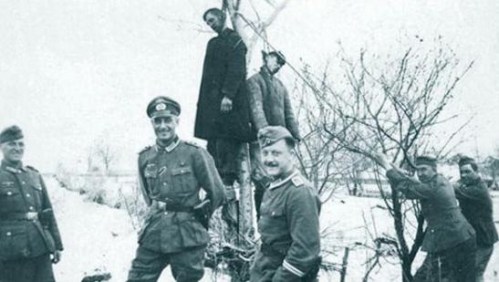
               Wehrmacht Troops Pose With Jews that They Hanged 

I write because the remaining witnesses to the Nazi Crimes are dying off and deniers are becoming ever more numerous. In researching this article I came across a man, an American of all people, who is denying the mass murder at Babi Yar. I have to shake my head, but the fact is that such people have become emboldened by the Presidency of Donald Trump, a man who has pardoned and praised convicted American War Criminals. They see in him a kindred spirit. Such does not bode well for the future, and the lives who will stand behind the faces and names of the future crimes against humanity.

Until tomorrow,

Peace,

Padre Steve+

2 Comments

Filed under crime, ethics, film, Foreign Policy, germany, History, holocaust, imperial japan, laws and legislation, leadership, middle east, Military, national security, nazi germany, News and current events, Political Commentary, racism, war crimes, War on Terrorism, world war two in europe

Armistice Day at 101 Years

Friends of Padre Steve’s World,

Forty years after the guns went silent in on November 11th 1918, General Omar Bradley, spoke these words on the eve of Armistice Day, 1948:

Tomorrow is our day of conscience. For although it is a monument to victory, it is also a symbol of failure. Just as it honors the dead, so must it humble the living. Armistice Day is a constant reminder that we won a war and lost a peace…”

It was supposed to be the “War to end all war,” or so thought President Woodrow Wilson and other American idealists. However, the war to end all war birthed a series of wars which far exceeded the losses of the First World War as ideological wars, exponentially more powerful weapons, and systematized mass murder and genocide birthed new horrors.

Winston Churchill wrote:

“The Great War differed from all ancient wars in the immense power of the combatants and their fearful agencies of destruction, and from all modern wars in the utter ruthlessness with which it was fought. … Europe and large parts of Asia and Africa became one vast battlefield on which after years of struggle not armies but nations broke and ran. When all was over, Torture and Cannibalism were the only two expedients that the civilized, scientific, Christian States had been able to deny themselves: and they were of doubtful utility.”

In the First World War there were over 22 million military casualties including over 8 million dead of which over 126,000 were Americans. Close to 20 million civilians also were casualties of the war.

President Woodrow Wilson established what we know now as Veteran’s Day as Armistice Day in November 1919, a year after the guns went silent.

Wilson wrote:

To us in America, the reflections of Armistice Day will be filled with solemn pride in the heroism of those who died in the country’s service and with gratitude for the victory, both because of the thing from which it has freed us and because of the opportunity it has given America to show her sympathy with peace and justice in the councils of the nations…

That initial proclamation was followed 45 years later by one of President Dwight D. Eisenhower. Eisenhower signed into law what we now know as Veteran’s Day in 1954.

In a sense I wish we had two holidays, one for Veterans from all wars in general and this one which we should never forget. It seems that in combining them we have lost some of the sacredness of the original. As Kurt Vonnegut wrote: “I don’t want to throw away any sacred things.” 

Because of that, I will remember all who served tomorrow as we observe Veterans Day, but I will not forget Armistice Day.

It is important not to forget the horrors and results of the First World War because both it and the Second World War, have faded from memory. Most people today cannot fathom killing on such a large scale, the overthrow of powerful nations and dynasties, the creation of new nations built from diverse, and often rival ethnic and religious groups such as Czechoslovakia and Yugoslavia, or the re-establishment of ancient nations such as Poland.

Yet to those of us who have gone to war and studied past wars the end result is not so distant. It is a part of our lives even today. Edmond Taylor accurately noted in his book, The Fall of the Dynasties: The Collapse of the Old Order, 1905-1922:

“The First World War killed fewer victims than the Second World War, destroyed fewer buildings, and uprooted millions instead of tens of millions – but in many ways it left even deeper scars both on the mind and on the map of Europe. The old world never recovered from the shock.”

The cost in human lives alone is incomprehensible. In the short time that United States forces went into action in late 1917 on the western front and the armistice, 126,000 Americans were killed, 234,000 wounded, and 4,500 missing; 8.2% of the force of 4,355,000 the nation mobilized for war. More Americans were killed in the First World War than Korea, Vietnam, the Gulf War, Iraq, and Afghanistan combined.

But American losses were small in comparison with the European nations who had for over four years bled themselves dry.  If one wonders why Europeans seem to have so little desire for involvement in war, one only needs to see how the concentrated killing of the First World War decimated the best and brightest of that generation. Out of the nearly 8.5 million Frenchmen mobilized lost 1,357,000 killed, 4,266,000 wounded and 537,000 missing, 6,160,000 casualties or 73.3% of its forces. The Russians also lost over 73% of 12 million, Romania 71% of 750,000, Germany 65% of 11 million, Serbia 47% of 707,000, tiny Montenegro 40% of 50,000, Italy 39.9% of 5.6 million, Great Britain 36% of almost 9 million, the Ottoman Empire 34% of 8.5 million. But the dual monarchy of Austria-Hungary which began the war in response to the assassination of Archduke Franz Ferdinand lost 90% of the 7.8 million men that it sent to war.

The human costs were horrifying. In all over over 65 million men served under arms in the war. Over 8.5 million were killed, over 21 million wounded, 7.75 million missing or prisoners or almost 37.5 million military casualties alone. That total would be roughly equivalent to every citizen of the 30 largest American cities being killed, wounded or missing.

Much of Europe was devastated and in the following months and years, mass numbers of refugees the dissolution of previously stable empires were displaced. A Civil War in Russia killed many more people and led to the establishment of the Soviet Union. Germany too was torn apart by civil war that left it bitterly divided and planted the seeds of Hitler’s Nazi regime. Border conflicts between new states with deep seated ethnic hatreds broke out. A flu pandemic spread around the world killing millions more. Economic disasters culminating in the Great Depression and social instability led to the rise of totalitarian regimes which spawned another, even more costly World War and a 40 year Cold War. The bitter results of the First World War are still felt today as conflicts in the Middle East in part fueled by the decisions of Britain and France at the end of the war rage on.

T. E. Lawrence, Lawrence of Arabia, who gained fame during the Arab revolt looked at the results of the war with a great deal of melancholy. He wrote:

“We were fond together because of the sweep of open places, the taste of wide winds, the sunlight, and the hopes in which we worked. The morning freshness of the world-to-be intoxicated us. We were wrought up with ideas inexpressible and vaporous, but to be fought for. We lived many lives in those whirling campaigns, never sparing ourselves: yet when we achieved and the new world dawned, the old men came out again and took our victory to remake in the likeness of the former world they knew. Youth could win, but had not learned to keep, and was pitiably weak against age. We stammered that we had worked for a new heaven and a new earth, and they thanked us kindly and made their peace.”

The his epic war poem, In Flanders Fields, Canadian Lieutenant Colonel John McCrea symbolized the cost of that war and the feelings of the warriors who endured its hell.

In Flanders fields the poppies blow
Between the crosses, row on row,
That mark our place; and in the sky
The larks, still bravely singing, fly
Scarce heard amid the guns below.

We are the Dead. Short days ago
We lived, felt dawn, saw sunset glow,
Loved and were loved, and now we lie
In Flanders fields.

Take up our quarrel with the foe:
To you from failing hands we throw
The torch; be yours to hold it high.
If ye break faith with us who die
We shall not sleep, though poppies grow
In Flanders fields.

Yes there are always consequences to actions. This weekend as we remember what we Americans now call Veteran’s Day, and the British refer to as Remembrance Day let us blood shed by so on the battlefields of Verdun, Gallipoli, Caporetto, Passchendaele, the Marne, the Argonne, Tannenberg, the Somme, Galicia, the Balkans, Flanders Fields, at sea and in the air.

President John F. Kennedy said: “As we express our gratitude, we must never forget that the highest appreciation is not to utter words, but to live by them.”

Kennedy was right, that our appreciation is not just to utter words, but to live by them. Sadly, the current American President has no understanding of such nuances. He continued thump his chest and spit in the face of allies while, courting nations hostile to the very ideals of the United States. Likewise, the President, a man who never served in the military, and spent the Vietnam War avoiding service and dodging the draft while later comparing avoiding sexuality transmitted diseases to combat again dishonored the men who spilt their blood in the First World War. Donald Trump does not understand anything about history, war, courage, or honor. Sadly, he is all too representative of a generation that neither knows or cares about those things. He and others like him will be the ones that lead the world into another disaster.

“Strong prejudices in an ill-formed mind are hazardous to government, and when combined with a position of power even more so.”

I write in the hope of peace and an end to war. I will write about Veteran’s Day later today.

Peace,

Padre Steve+

1 Comment

Filed under History, middle east, Military, Political Commentary, us army, US Marine Corps, world war one

A Cautionary Tale for Military Leaders that Give Obedience to a Tyrant: the Story of Erwin Rommel, the Legendary Desert Fox


rommel

Friends of Padre Steve’s World,

Just over 75 years ago in Ulm Germany a car pulled up to the residence of Field Marshal Erwin Rommel. In the car was the driver and two Generals dispatched by Hitler.  Rommel was recuperating following being severely wounded in an air attack in Normandy on July 17th 1944.

Rommel had been awarded the Pour le Merite, sometimes known as the Blue Max, Imperial Germany’s highest award for valor in the First World War. He was never an official member of the Nazi Party, but like many Germans he believed Hitler’s promises and propaganda. As Hitler really ose to power he like many others was carried away by early Nazi successes, the bloodless conquests of the Rhineland, Austria, Czechoslovakia, and the spectacle of the Olympics.

He was also an opportunist. With the rise of the Nazis came the expansion of the German military. Rommel was already well known due to his exploits as a platoon and company commander during the First World War in France, Romania, and Italy. In Italy he captured an entire Italian infantry division during the Battle of Mount Cosna, which was part of the Caporetto in October 1917. His company of 150 troops, exploited terrain and weather to surprise and capture 9,000 soldiers and 81 artillery pieces at the cost of 6 men killed and 30 wounded. Rommel used infiltration tactics, flanking maneuvers, and even disobeyed the orders of his superiors during the battle. Less than two weeks later at Langarone using the same tactics, his company surprised the 1st Italian Infantry which thinking it surrounded by superior forces surrendered to Rommel. For these actions Rommel was awarded the coveted Blue Max. 

Rommel was retained in the 100,000 man Reichswehr, but he had refused to attend the course that would have made him part of the elite General Staff. As such he was not assigned to the critical billets that would normally lead to high command. Instead he served in company command and as an instructor at the Infantry School in Dresden. While assigned to the school he wrote a manual of infantry tactics and training based on his experience. The book, Infantrie Greift an, or Infantry Attacks is still considered a classic book on infantry tactics and leadership, and was highly influential in his rise to high command. He was promoted to Major after serving 14 years as a Captain in 1932. In October 1933 he was assigned to command the 3rd Jaeger Battalion of the 17th Infantry Regiment where he first met Hitler when the latter reviewed his troops on an inspection visit.

Rommel, like many officers was caught in the thrall of Hitler. His wife, Lucy was caught up in the moment and was an avid Hitler supporter. Rommel was never a Nazi party member, but that did not keep him from supporting the overtly nationalist and militarist actions of the Hitler regime. In 1935 he was assigned to the Military Academy at Potsdam where as a Lieutenant Colonel he published Infantrie Greift an. In 1937 Hitler appointed Rommel as the liaison officer from the War Ministry to the Hitler Youth. Rommel clashed with the head of the Hitler Jugend, Baldur von Schirach and twiced proposed removing the organization from the Party to the War Ministry.

The conflict resulted in Rommel being quietly reposted from that assignment, promoted to Colonel and assigned to command the former Austrian Theresian Military Academy  in Wiener Neustadt. He was then selected by Hitler to command the Führer-Begleit-Battalion (Escort battalion) which served as the force protection unit for Hitler’s headquarters during the Polish campaign.

Following that campaign, Rommel, now a Major General was appointed to command the newly formed 7th Panzer Division which he commanded with great distinction during the Battle of France, 1940. When the campaign ended the division was placed in reserve where it readied to become part of the planned invasion of Britain, Operation Sea Lion. When that operation was postponed due to the defeat of the Luftwaffe during the Battle of Britain, and Mussolini’s Italian army in North Africa was routed by the small British Western Desert Force, Rommel was assigned to command the Deutsches Afrika Korps, composed of the 5th Light Division, which would soon be re-designated as the 21st Panzer Division and the 15th Panzer Division.

Over the next two years in North Africa built a reputation as an energetic and often risk taking commander who fought against long odds in a campaign which his own high command gave little support. The isolation of North Africa and its purely military significance in supporting a weak ally made it a different war from the concurrent, racially driven German invasion of the Soviet Union. Fighting the British and later the Americans, Rommel built a reputation of being a noble and chivalrous opponent. Unlike most of Europe and especially in Russian there was little to no influence of the SS in theater and the Jewish population of Libya, Tunisia, and Algeria suffered little under Nazi occupation, which many North African Jews attributed to Rommel.

During the North African campaign Rommel soared to the heights of international fame due to his exploits. The Nazi Propaganda Minister, Josef Goebbels sent one of his aides, Lieutenant Alfred Berndt to serve on Rommel’s Staff.  Berndt sent reports to the Propaganda Ministry which became the staple of Nazi propaganda to build Rommel into a German hero. Despite serving in a remote theater and commanding a relatively small number of troops, Rommel became the poster child for Goebbels’s propaganda machine. He was revered by the German people, and at the same time despised by many of his Army contemporaries and superiors.

His fame also earned the resentment of many fellow officers who because he was not an officer of the General Staff regarded him with jealous envy and distain. Even so, Rommel was a soldier’s soldier. He believed in sharing in the suffering of his troops. He once said: 

“Be an example to your men in your duty and in private life. Never spare yourself, and let the troops see that you don’t in your endurance of fatigue and privation. Always be tactful and well-mannered, and teach your subordinates to be the same. Avoid excessive sharpness or harshness of voice, which usually indicates the man who has shortcomings of his own to hide.”

Rommel basked in the praise of Hitler but as time wore on in Africa he became disillusioned by the course of the war, and while maintaining faith in Hitler, he openly despised many of the Nazi elite and his own High Command. While in Africa, Rommel was promoted to Field Marshal but denied the troops and supplies that he needed to successfully hold out in Africa. He opposed efforts to send more troops to Africa and recommended withdrawing his German and Italian soldiers before the Allies closed the door on withdraw across the Mediterranean.

As his troops were being chewed to pieces at El Alamein he requested permission to withdraw to the west. The request was refused and Hitler issued and order to stand in place and not withdraw. Rommel’s words are revealing for a man who had previously trusted Hitler and taken every opportunity from the dictator to advance his career.

“The order demanded the impossible. Even the most devoted soldier can be killed by a bomb. In spite of our unvarnished situation reports, it was apparently still not realized at the Fuehrer’s H.Q. how matters really stood in Africa.  Arms, petrol, and aircraft could have helped us, but not orders. We were completely stunned, and for the first time during the Africa campaign I did not know what to do. A kind of apathy took hold of us as we issued orders for the existing positions to be held on instructions from highest authority. I forced myself to this action, as I had always demanded unconditional obedience from others and, consequently, wished to apply the principle to myself. Had I known what was to come I should have acted differently, because from that time on, we had continually to circumvent orders from the Fuehrer or Duce in order to save the army from destruction. But this first instance of interference by higher authority in the tactical conduct of the African war came as a considerable shock.”

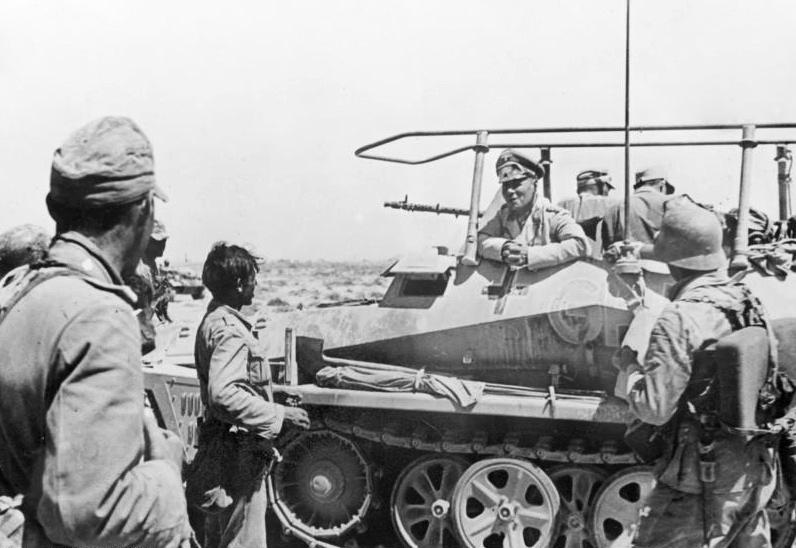
Like most other officers Rommel had served the Hitler regime as it spread its dark pall over Europe without protest. Yet, unlike so many other officers when he suffered a crisis in conscience about the Nazi leadership and their policies, he refused to obey orders that he knew were both illegal and immoral, and then risked his life by joining the conspiracy to kill Hitler.bundesarchiv_bild_146-1991-031-25a_nordafrika_vor_tobruk_rommel

It was at El Alamein that Rommel discovered the emptiness of Hitler’s promises as the troops of the Afrika Corps found themselves subjected to constant privation from lack of supply, air support and reinforcements. As commander of the Afrika Corps and later the Panzer Armee Afrika he and his troops achieved amazing success against an enemy that was always better supplied, equipped and which always had air and sea superiority. Battling the British as well as the political machinations of Mussolini and Germany’s Italian Allies as well as opponents in the German government such as Hermann Goering, Rommel saw his troops crushed under the press of the British as well as the Americans who landed in French North Africa. Eventually, sick and worn out, Rommel was sent back to Germany to recuperate.

rommel-with-soldier

Rommel had a sense of honor and humanity that many other German generals lacked. He refused to allow anti-Jewish measures in areas occupied by German troops in North Africa, ensuring that the approximately 425,000 Jews living in Libya, Tunisia, Algeria, and Morocco were spared the fate of the Holocaust. He refused to execute Jewish POWs, including members of the Jewish Battalion serving with the British 8th Army. Likewise, Rommel refused to follow the notorious “commando order.” In June of 1944 he protested the massacre of the people of the village of Oradour-sur-Glane by units of the 2nd SS Panzer Division directly to Hitler and asked for the authority to punish those responsible, but was refused.

After his return from Africa, Rommel’s honest and open assessments of the chances of the Germans winning the war made him persona non grata in Berlin and Berchtesgaden. He was posted to France in early 1944 according to some accounts he became a part of the plot to end the war and overthrow Hitler. Rommel’s Chief of Staff at OB West, General Hans Speidel, was a key man in the conspiracy and Rommel had contacts with a number of key conspirators. There are arguments about Rommel’s connections and activities in regard to the anti-Hitler plot among respected historians.

When the invasion came Rommel was away from Normandy visiting his wife. On learning of the invasion he sped back to Normandy. When he arrived he fought a desperate battle against the Allied forces. His outnumbered forces were under constant assault from the land, sea and air received paltry reinforcements compared to the Allies. Even so, German troops inflicted many local defeats and exacted a heavy price in allied blood in Normandy but were ground to dust. Even so, many American and British infantry regiments suffered 100% casualties but remained in action because of a continuous stream of replacements. Rommel urged Hitler and the High Command to withdraw German forces from Normandy before the allies broke through his front. By doing so he found that he was now considered a defeatist.

If Rommel had joined the plot to topple Hitler, he did not stop working to defend Germany against the coming Allied invasion. He believed that the war was lost if his forces failed to repel the Allies on the beaches of France, and he worked feverishly to bolster the beach fortifications. He recommended that the Panzer Divisions be deployed near the coast where they could immediately counterattack Allied invasion forces while they were still vulnerable. But his advice was not taken. He was given command of the Army Group but was not given control of most of the Panzer Divisions, which Hitler kept under his direct control. Neither did he approve of an assassination attempt but realizing that his front was about to collapse he was in favor of independent peace negotiations with the Allies on the Western Front.

Many commanders in the west, including Waffen SS commanders were in agreement Rommel was severely wounded in an air attack on his vehicle by a just days before the attempt on Hitler’s life. Hitler survived the attempted assassination and exacted a terrible revenge on anyone connected with the plot. Show trials and public hangings of officers who had served valiantly at the front were common. Thousands were killed and thousands more imprisoned. Many of those arrested, imprisoned, or killed, were those who knew Rommel’s views on ending the war.

Various conspirator’s testimony exposed Rommel as part of the plot. Leading Nazis, including Martin Bormann, and Heinrich Himmler urged Hitler to deal with Rommel. Likewise, some in the High Command, including Heinz Guderian turned upon Rommel. After a secret hearing it was recommended by the “Court of Military Honor” that Rommel be expelled from the military and tried by the “People’s Court” of Judge Roland Freisler. During the purge that followed the attempt on Hitler’s life, many noted German military commanders were hauled before this court and humiliated by Freisler before they were sent to their deaths. Freisler, a fanatic Nazi judge was a participant at the infamous Wannsee Conference which planned the details of the Final Solution was killed when his courtroom was bombed in February 1945.

On 27 September, Martin Bormann submitted to Hitler a memorandum which claimed that “the late General Stülpnagel, Colonel von Hofacker, Kluge’s nephew who has been executed, Lieutenant Colonel Rathgens, and several … living defendants have testified that Field Marshal Rommel was perfectly in the picture about the assassination plan and has promised to be at the disposal of the New Government.”

Rommel’s fate was sealed, but because of his fame and popularity in Germany Hitler decided to offer Rommel a choice of being tried by the People’s Court or committing suicide. Goebbels who had spent so much time building up the Rommel legend, turned against him. The latter with an offer to ensure his family’s safety, which he would not guarantee if Rommel choose to defend himself in open court. Hitler dispatched Generals Wilhelm Burgdorf and Ernst Maisel from Berlin to personally deliver the message. Burgdorf was the last Army Chief of Staff and killed himself following Hitler’s suicide.

492px-Erwin_rommel_death

Rommel suspected that he would be identified and killed and told that to his friends and family in the days leading up to the arrival of Generals Wilhelm Burgorf and Ernst Maisel from OKW with the ultimatum. They met with Rommel for a short time before giving him the opportunity to say goodbye to his family. Rommel told them of his choice and left his home for the last time. 15 minutes later the Generals called his wife to say that he had died of a heart attack. Rommel was given a state funeral and the German people were lied to about his cause of his death.

Winston Churchill wrote of Rommel:

“He also deserves our respect because, although a loyal German soldier he came to hate Hitler and all his works, and took part in the conspiracy to rescue Germany by displacing the maniac and tyrant. For this, he paid the forfeit of his life. In the sombre wars of modern democracy, chivalry finds no place … Still, I do not regret or retract the tribute I paid to Rommel, unfashionable though it was judged.”

Rommel was just 52 years old when he died. I find in the story of Rommel some commonality in my own life. Before Rommel went to Africa he believed that Germany would win the war, during his command there he discovered that what he believed was lies and that Hitler had little regard for him or his troops.

Rommel is a complex character. His attitudes towards Hitler waxed and waned. He was no Nazi. He conducted his battles in an honorable manner and displayed much chivalry towards his opponents. His views on race were not at all Nazi like. In North Africa he faced down a White South African commander who did not want to be imprisoned with his Black troops. Rommel told the officer: “For me, soldiers are all equal. Those black people wore your same uniform, fought on your side, and so you will be in the same jail.”

But from the beginning he willingly served Hitler’s regime and basked in the fame that he enjoyed due to Goebbels’s propaganda machine. At the same time while he was according to the Chief of the German Navy in the West, Admiral Friedrich Ruge, as well as his Rommel’s letters to his wife, indicated that Rommel’s mood fluctuated wildly regarding Hitler: while he showed disgust towards the atrocities and disappointment towards the overall military and strategic situation, he was overjoyed to welcome a visit or praise from Hitler, only to return to depression the next day when faced with reality.

The example of Erwin Rommel is a cautionary tale of what can happen when a brilliant and honorable man comes under the spell of a demagogue. Rommel believed Hitler and blindly followed him until he ran into the hard face of reality in Africa at which point he had the moral courage to do the right thing, but many others didn’t.

Sadly there are otherwise honorable men and women in the current United States military that blindly support a delusional madman who happens to be the President: a man who promises to order soldiers to commit war crimes, who threatens to jail political opponents, who condemns whole races of people and religions, who incites violence against his opponents, a man who has no respect for the courts, the law, or the Constitution to which they are sworn to defend.

But I think that we also have to remember the men like Rommel who though not a true believer in the Nazi cause and polices, not only willingly served the Reich, but basked in the adulation lavished on him by friends and foes alike.

To me this is not about partisan politics but something that is bigger than politics, bigger than temporary political advantage, bigger than any single political issue, for which in our country, at least for the moment, that there are many ways to express dissent which were not available to most Germans of Rommel’s era. It is about the Constitution, the rule of law, and the foundational principles of the Declaration of Independence.

Personally, as a historian I cannot understand the blind obedience in the face of the evidence; but then I blindly followed President George Bush into the ill-advised and criminal invasion of Iraq. It was in the desert of Iraq’s Al Anbar Province that I had my own revelation that the man I supported had led the country into a war that could not be won. Like Rommel at El Alamein, it opened my eyes to things that I had never seen before.

Now, in light of President Trump’s immoral, unconstitutional, and foolhardy policies and decisions I wonder why so few high ranking military officers, active or retired have the courage to oppose them. Surely, some must, like Rommel, Ludwig Beck, Henning Von Tresckow, Erich von Witzleben, Hans Oster, Claus von Stauffenberg and others like them realize the abyss that the President is leading the nation to, and far to few are willing to tell the truth when most needed. It took far more courage for the German officers to oppose Hitler than it does American officers to tell the truth about Trump’s policies. Maybe we have become so insulated from political realities that we make excuses for ourselves, and our actions.

Maybe we as officers need to remember the works of General Ludwig Beck:

“It is a lack of character and insight, when a soldier in high command sees his duty and mission only in the context of his military orders without realizing that the highest responsibility is to the people of his country.”

Until tomorrow,

Peace,

Padre Steve+

2 Comments

Filed under ethics, History, holocaust, leadership, middle east, Military, nazi germany, Political Commentary, war crimes, world war two in europe

I’ve Got those Yellowstain Blues: Watching as the President Snatches Defeat from Victory and Sends the Middle East into a Major Conflict


Friends of Padre Steve’s World,

The stain on whatever honor the United States has left continued to grow this weekend as President Yellow Stain abandons another ally, throws the NATO alliance into peril, and lights wick on the powder keg that is the Middle East.

Every time he speaks regarding foreign policy I am reminded of the song from the novel and film The Caine Mutiny, “The Yellowstain Blues.”  The President is man who dodged the draft in Vietnam; a man who bragged on The Howard Stearin Show about avoiding sexually transmitted diseases as his Vietnam, and who has constantly maligned combat veterans and respected military and diplomatic leaders. He routinely supports despotic leaders who oppose every ideal espoused in the Declaration of Independence, scoffs at the Constitution of the United States, and attacks the laws, foundations, and institutions of our Republic.

The words of the song Yellowstain Blues from The Caine Mutiny seem apt to describe President Trump.

I’ve got those yellow stain blues,
From my head down to my shoes,
When someone fires a shot,
It’s always there I am not.
Those yellow stain blues

I’ve got those yellow stain blues,
Those old yellow stain blues,
Well you sh
ould see strong men quail,
If he should spy a shirt tail
Those yellow stain blues

Those old yellow stain blues

Sadly, the words from the movie which were directed at Captain Queeg, played by Humphrey Bogart in the film were directed at a man who was cracking up under the strain of war, not a President who has spent his life avoiding military service and deriding far better men than himself.

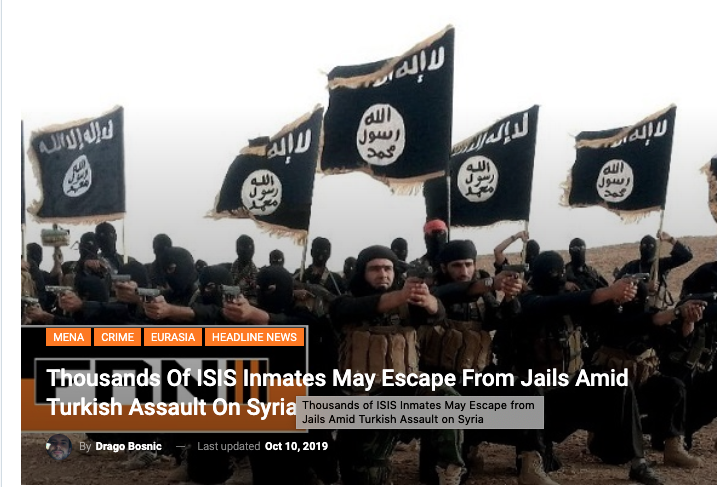
The Syrian regime of Bashir Assad is sending troops to defend the Kurds as President Trump hastily withdraws our military personnel from the danger zone. Once the Syrians commit their troops the Iranians will not be far behind since they have tens of thousands of their Revolutionary Guard Corps in Syria. Likewise their allies in Hezbollah will move against the Turks, even as thousands of Islamic State captives escape to re-enter combat against the United States, and anyone else that opposes them. Because of the chicken-hearted actions of the President one has to hope that the actions of the Syrians, Iranians, and Hezbollah will both protect the Kurds and counter the victory that President Trump has given the Islamic State.

However, this won’t be the end. Soon the Saudis, the Israelis, the Gulf States, and the ever fragile government of Iraq will be involved. This war will will spiral out of control because of President Yellowstain, and the victims will include many U.S. Military personnel and God knows how many others.

Sadly, this can only get worse, and it will be the fault of the U.S. President and his cult-like supporters. He could have made a principled decision based on facts , but instead he has emboldened the Turkish dictator, who is both an Islamist and a Nationalist. Soon, Erdogan will take Turkey out of NATO, unleash 3.5 million Syrian refugees on the European Union, and openly ally himself with Russia, the traditional enemy of the Turks.

A wider and far more costly war will follow, and we will only have President Yellowstain to blame.

God help us all,

Peace,

Padre Steve+ 


1 Comment

Filed under ethics, History, iraq,afghanistan, leadership, middle east, Military, national security, News and current events, Political Commentary, war crimes

The Turkish Invasion and the Immoral and Criminal Support of it by the American President

Friends of Padre Steve’s World,

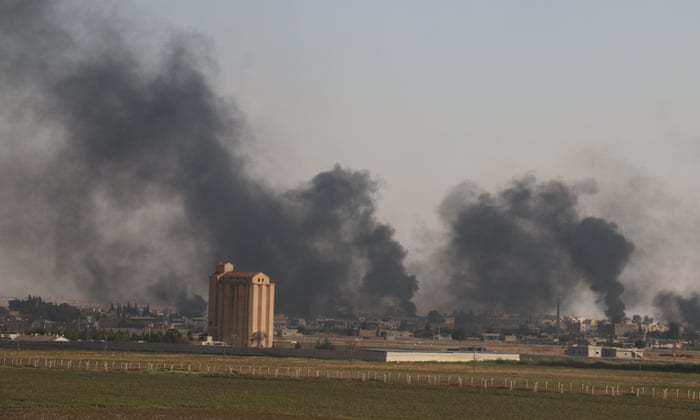
It is a sad day to be an American, especially one who serves in the military. I saw another officer comment on his Twitter feed that for the first time in his career that he did not feel pride in putting on his uniform. A Turkish friend I know here  was angry at his home country, and he served in the Turkish Army in his younger days. As I watch the brutal attacks on the Kurds of northern Syria by the Turkish military I have to angry with them. President Trump has abandoned our most stalwart and effective ally in the region and the fight against the Islamic State to the democratically elected dictator of Turkey, Recip Erdogan.

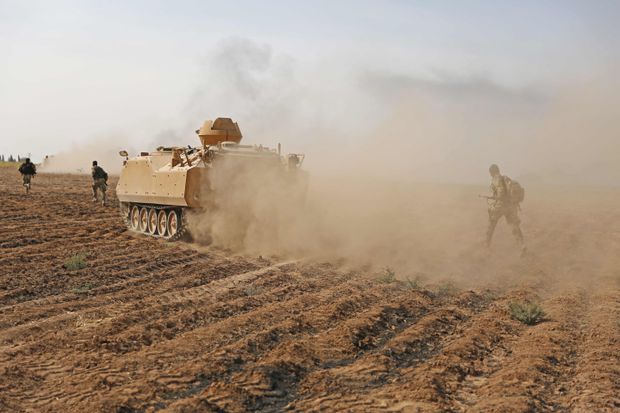
The President claimed to be doing this as fulfilling a campaign promise to withdraw American troops from Syria, but he didn’t do that. He simply moved them aside to allow the Turks to attack the Kurds, but the troops are still in Syria. Additionally, reports indicate that U.S. intelligence sources provided the Turks aerial and satellite imagery to help them target Kurdish positions. Kurdish fighters are resisting, but against the massive armored, and mechanized invasion, backed by strong air support their defeat is a foregone conclusion unless the United States changes its policy and decides that the Kurds are worth helping.

The leaders of the United States military have requested that the Turks end their invasion and withdraw, but that will not happen. President Trump has given the game away. Turkish President Erdogan has threatened the European Union with dumping three and a half million Syrian refugees on them if they so much as dare to criticize him. Of course his motive is blackmail, and should he dump the refugees his goal will be  to destabilize the E.U. and help Right Wing Racist parties into power, with the ultimate goal of destroying the E.U. Sadly, President Trump encourages this by treating the E.U. and our NATO allies as poor allies and enemies, at times threatening them and also punishing them with frankly insane tariffs that that only serve to tear apart the most successful military, political, and economic alliance in history. In doing so he encourages our real enemies and drives off real friends.

These actions will have drastic repercussions. America’s word will not be trusted.  Friends will seek alternative security, political, and economic options, and those who desire the downfall of the United States, the E.U., and our military-political alliances will rejoice.

Trump cozies up to age old enemies, excuses their crimes, while abandoning the pillars of the alliances that have helped make us the strongest and previously the most respected country in the world.

All I can say now is that it is very hard to be proud of my country and support the actions of this President. I have served under six Presidents, 4 Republicans and 2 Democrats. Until Trump I found some redeeming qualities, even if I disagreed with their policies and actions.

In under six months I will be retired from the military with a total of 38 years and seven months service on active duty in the Army and Navy, as well as time spent in the Army National Guard and Army Reserve. I have no breaks in service. I have been to war, and I suffer both physically, psychologically, and spiritually from that service.  Now, with the actions of Trump around the world and in our country, it is hard to be proud of my service.

To paraphrase the comments of General Henning von Tresckow, an opponent of Hitler who died for his beliefs:

“We have to show the world that not all of us are like him. Otherwise, this will always be Trump’s America.”

Until tomorrow,

Padre Steve+


10 Comments

Filed under ethics, History, leadership, middle east, Military, Political Commentary

Trump Sets Stage for Turkish Offensive and Genocide Against Syrian Kurds


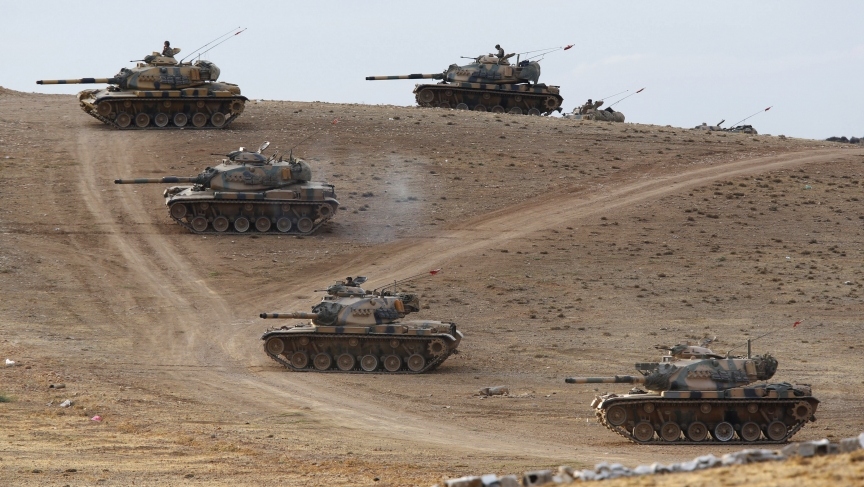
Awaiting Orders, Turkish Armor on Syrian Border

Friends of Padre Steve’s World,

I was stunned to find out Sunday that President Trump announced that U.S. advisors and other troops backing the Kurds in Syria were going to be pulled out in order to aid a Turkish offensive against them. It was an announcement evoked strong bi-partisan condemnations in Congress, but it appears that the President will not make down.

       U.S. Troops Pulling Out to Make Way for Turkish Offensive 

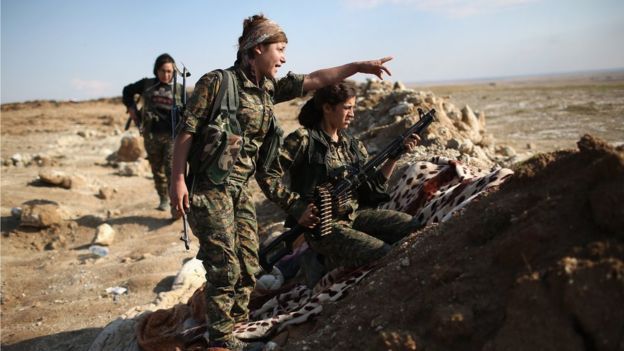
During the war against ISIS, or the Islamic State, it was the Kurds who were our most effective and and loyal ally. It was mostly due to their military prowess and sacrifice, that we achieved a large measure of success in defeating ISIS on the battlefields of Syria and Iraq. For the most part they did the dying for us and still are doing so. The Kurds were also responsible for clearing ISIS from much of northern Iraq.

Kurdish Forces in Action 

While crippled, ISIS is not yet defeated, its key leaders remain alive and the Kurds are necessary to ensure their final defeat. Our military commitment inside Syria has been minimal and achieved greater success than our substantially greater efforts in Iraq or Afghanistan. The Joint operations with the Kurds in Syrian and northwestern Iraq have arguably been our most successful operations in the Middle East since we invaded Afghanistan eighteen years ago.

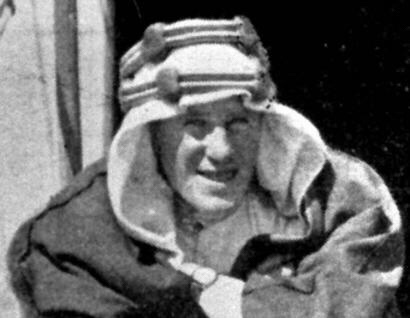
Over a hundred years ago T. E. Lawrence provides the template for success that we have used with the Kurds. While we have given them important help, it has been their war to win or lose. Lawrence wrote his superiors:

“Do not try to do too much with your own hands. Better the Arabs do it tolerably than that you do it perfectly. It is their war, and you are to help them, not to win it for them. Actually, also, under the very odd conditions of Arabia, your practical work will not be as good as, perhaps, you think it is.”

We could keep doing that if we didn’t have a President who is willing to cut and run, and abandon the Kurds to the Turks under their leader Recep Erdogan. Erdogan is not just a Turk Nationalist, he is an Islamist. He and for that matter many generations of Turks have desired to crush the Kurds, a people left without a state when the borders of the former Ottoman Empire were redrawn after World War One. They live in Iraq, Syrian, and eastern Turkey. They are a distinct ethnic group who only want freedom and to be left in peace.

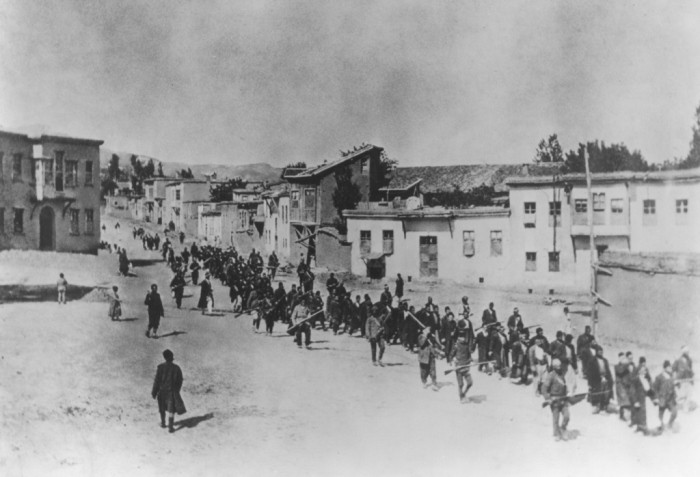
Now all the success against ISIS is in doubt and the Turks will have a free hand to exterminate the Kurds. History shows that they are quite good at genocide. The Armenian genocide was bloody and brutal. Between 700,000 and 1.5 million  Armenians were killed, others used as Slave Labor, placed in Concentration Camps, subjected to poison gas, infected with Typhus, in some cases pushed out to sea in overloaded unseaworthy small boats in condition that left them to drown.  Still others driven into the Syrian desert. The genocide began in 1915 and continued after the war, however, over the preceding decades they had been subjected to smaller yet brutal pogroms. At the same time the Turks conducted similar operations against ethnic Greeks and Abyssinians.

Now, the American President is presenting Turkey its long delayed chance to eliminate the Kurds. Sadly, with his emigration policies, those men and women who have fought alongside of us for the better part of a decade will not be afforded asylum and left to the bloody designs of the Turks, and the revenge of ISIS.

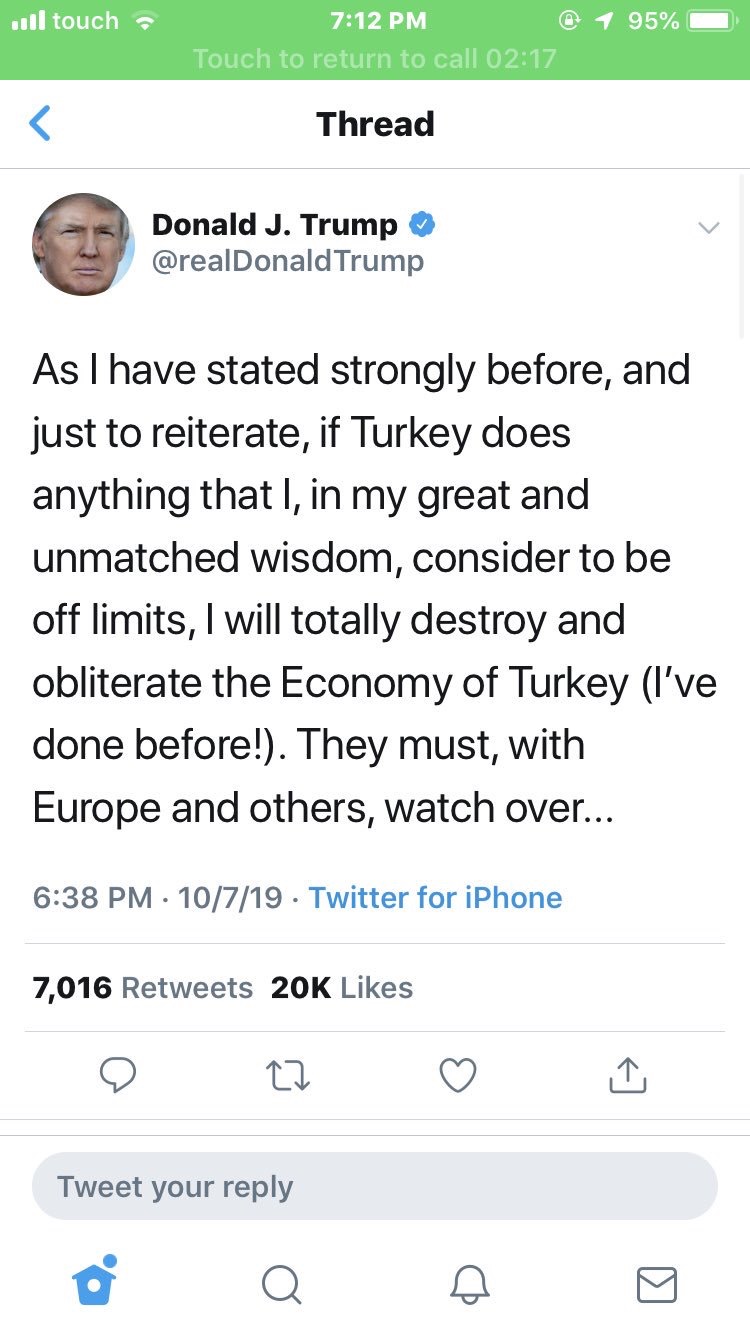
In response to his critics the President tweeted something so incredibly inane that I cannot begin to fathom it:

If he really believes this he should be removed from office under the 25th Amendment. Anyone who says that they have Great and Unmatched Wisdom” as they threaten to destroy the economy of another country with good options for support, such as Russia and China, our economic and military competitors is a loon.

At this point I can only imagine the worst, unless Congress votes to overturn his unilateral action. The blood of the Kurds will be on our hands, and we will be saddled with the reputation of being an unreliable ally that cannot be trusted. That is already happening across the globe as long time allies explore non-U.S. based options for their security. In such a case no amount of military might can save us. We will be alone, but then that is what Trump wants. He thinks an omnipotent military, a tightly controlled police state, and economic isolation through tariff after tariff, including against allies will Make America Great? 

Although all of this is connected I digress. We are watching the President melt down before our eyes. His actions are erratic and setting us, all of us, his supporters and opponents alike up for disaster, economic, and possibly military. In his desperation to save his Presidency with impeachment looming, it is highly likely that he will become more unstable and devolve further.

But right now I expect the worst for the Kurds.

Anyway, until tomorrow,

Peace,

Padre Steve+


2 Comments

Filed under Foreign Policy, History, middle east, Military, national security, Political Commentary, War on Terrorism

A Heap Of Swords Piled as Delicately as Jackstraws: One Cannot Be Pulled Out Without Moving the Others: The Middle East 2019

Friends of Padre Steve’s World,

I have been watching the events unfolding in Saudi Arabia and the Middle East with a fair amount of apprehension. Seldom has a region been so similar to Barbara Tuchman’s words in her epic work The Guns Of August:

Europe was a heap of swords piled as delicately as jackstraws; one could not be pulled out without moving the others.

Armed to the teeth the militaries of Iran, Saudi Arabia, the Gulf States, Israel, vast numbers of powerful Sunni and Shia militias: the Islamic State, Hezbollah, Houthi, and so many more, scattered from Yemen, to Lebanon, Iraq, Gaza, and Syria, not to mention the vast power of the United States, its now somewhat recalcitrant allies, as well as elements of Russian, Turkish, and even Chinese military power prowl the region on the land, sea and air.

Ancient hatreds and rivalries, Sunni versus Shia, Persian versus Arab, Muslim versus Christian, Jew versus Muslim, Turk versus Arab, and even Christian versus Jew. Ancient hatreds that go beyond mere religious quarrels; not to say that wars of religion have been some of the most bloody and malevolent in history.

These ancient hatreds and rivalries have been aided directly by the United States and Europe following the World Wars. The Sykes-Picot Agreement, the triumph of the British Indian Office over the British Foreign Ministry which allowed the House Of Saud to conquer most of the Arabian Peninsula and drive out the House Of Faisal Hussein which were relegated to Jordan and Iraq after helping the British defeat the Ottoman Turks in the Middle East.

I fear that the President Trump’s unjustified and highly questionable support of Saudi Crown Prince Mohammed Bin Salman bin Saud, who ordered the murder of an Saudi Arabian Journalist and resident of the United States, Jamal  Khashoggi, and for who all purposes seems to be of a business partner of, than the President of the United States.

T.E. Lawrence wrote during the early phases of the British occupation of Mesopotamia (Iraq) less than two years after the war:

“The people of England have been led in Mesopotamia into a trap from which it will be hard to escape with dignity and honour. They have been tricked into it by a steady withholding of information. The Bagdad communiqués are belated, insincere, incomplete. Things have been far worse than we have been told, our administration more bloody and inefficient than the public knows. It is a disgrace to our imperial record, and may soon be too inflamed for any ordinary cure. We are to-day not far from a disaster.”

Lawrence’s words could be applied to the United States since 1990 and thereafter, especially beginning in 2003 during the invasion and occupation of Iraq. Now we have a President threatening to go to war by Tweet with Iran at the behest and on the word of his Saudi business partner without consulting Congress. At least the administration’s Of George H. W. Bush and Bill Clinton worked within the confines of the United Nations and Congressional authorizations before committing the military in Harm’s way. Even George W. Bush when rebuffed by the U.N. in Iraq, got Congressional authorization for his actions, but we now have a President threatening a major war that could result in catastrophic harm to the world, including the men and women of the U.S. Military, by tweet.

Please don’t get me wrong. I no longer trust the words of any of the players involved, including the Iranians, Saudis, Israelis, Turks, Russians, and everyone else involved, and yes, even the Trump administration. What is scary is that many of Trump’s most ardent supporters are all in favor or bringing on the apocalypse.

I fear that war is coming, and there are too many players with swords in the pile to avoid it. Including an impulsive, unstable, habitual liar. Even if he doesn’t want war he may well lead us into it. Let the reader understand.

Until tomorrow,

Peace,

Padre Steve+


Leave a comment

Filed under Foreign Policy, History, iraq,afghanistan, middle east, Military, national security, News and current events, Political Commentary, Religion

“I Imagined it Would Be Different” Passing the Baton on my Last 9-11 on Active Duty and Reflecting on All We Have Lost

flight_175_photo

Friends of Padre Steve’s World,

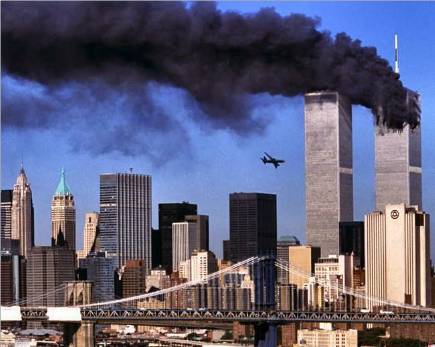
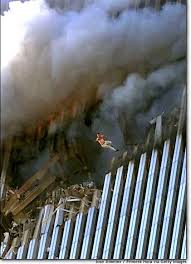
September 11th is a day that always makes me more introspective. It brings back so many memories, some that I wish I could forget; but I cannot get the images of that day out of my mind. The burning towers, the people jumping to their deaths to escape the flames, and the scenes of devastation. I knew one of the victims in the attack on the Pentagon, an Army Lieutenant Colonel, Karen Wagner who commanded a Medical training company at Fort Sam Houston where I was serving as the Brigade Adjutant in 1987 and 1988. She was a very nice person, very gracious and decent, admired by everyone who knew her; I was shocked to see her name on the casualty list after the attack.

The emotions that I feel on the anniversary of these terrorist attacks which claimed the lives of so many innocent people, and which devastated so many families, still haunts me, and my subsequent service, especially in Iraq has changed me. Years after he returned from his time in the Middle East, T.E. Lawrence; the immortal Lawrence of Arabia wrote to a friend, “You wonder what I am doing? Well, so do I, in truth. Days seem to dawn, suns to shine, evenings to follow, and then I sleep. What I have done, what I am doing, what I am going to do, puzzle and bewilder me. Have you ever been a leaf and fallen from your tree in autumn and been really puzzled about it? That’s the feeling.” I often feel that way.

Eighteen years ago I was getting ready to go to the French Creek Gym at Camp Le Jeune North Carolina where I was serving as the Chaplain of Headquarters Battalion 2nd Marine Division. I had returned from a deployment to Okinawa, Mainland Japan and Korea just two months before and was preparing to transfer to the USS Hue City, a guided missile cruiser stationed in Mayport, Florida.

At the time of the attack I had already been in the military for over 20 years and I had actually taken a reduction in rank to transfer from the Army, where I was a Major in the reserves, to the Navy to serve on active duty. In those previous 20 years I had served overseas during the Cold War along the Fulda Gap. I had been mobilized to support the Bosnia mission in 1996, and I had just missed being mobilized for Operation Desert Storm as my unit was awaiting its mobilization orders when the war ended. I had done other missions as well as the deployment to the Far East that returned from in July 2001; but nothing prepared me for that day. Like other career military officers I expected that we would be at war again and thought it might be back in the Middle East, and probably a result of some fool’s miscalculations; but like the American officers who were serving at the time of the Pearl Harbor attack, I never expected what happened that morning.

Tuesday, September 11th 2001 had started like so many days in my career. Routine office work, a couple of counseling cases and what I thought would be a good PT session. I was about to close out my computer browser when I saw a little headline on Yahoo News that a plane had crashed into the World Trade Center. I paid little attention and figured that a private plane, something like a Cessna piloted by an incompetent had inadvertently flown into the building.

9-11 jumpers

That delusion lasted about two minutes. I got in my car and the radio, tuned to an AM talk station had a host calling the play by play. He started screaming “oh my God another airliner flew into the other tower.” Seeking to see what was happening I went to the gym where there were many televisions. I got there and saw the towers burning, with stunned Marines and Sailors watching silently, some in tears. I went back out, drove to my office and got into uniform. After checking in with my colonel a made a quick trip to my house for my sea bags and some extra underwear, and personal hygiene items. When I got back the headquarters we went into a meeting, and the base went on lock down mode. The gates were closed and additional checkpoints, and roadblocks established on base. Marines in full battle-rattle patrolled the perimeter and along the waterfront. I did not leave the base until the night of the 15th when things began to settle down and we all went into contingency planning mode for any military response to the attacks.

My wife, who as waiting for a doctor’s appointment with a friend saw the attacks on live television and knew when the first plane struck she told her friend that it was terrorism. Her friend responded “that damned Saddam Hussein.” Like so many of us who initially thought this, my wife’s friend was wrong. my friend Fregattenkapitäne Micheal Hufnagel, then the  First Officer Of the German Guided Missile Destroyer Lutjens was among the first to express support for the United States. Steaming next to the USS Winston Churchill helped put up a banner that said We Stand By You. It was an iconic moment. Eight months later I met Michael and we became fast friends, to this day.

LutjensHonors

Those were tumultuous days, so much fear; so much paranoia; and so much bad information as to who committed the attacks and what was going to happen next.

hue city boarding party


Honestly, I didn’t expect the war to go on for more than a few months, but months became years, and years became decades. I guess I was a lot like the German military officers who in the wake of the dramatic success of the Wehrmacht in the west and the initial phases of Operation Barbarossa  the German victory was so certain that resistance was futile and the best course was to follow orders, believing that victory over the subhuman Taliban and Al Qaeda was just around the corner. In the beginning I was little different than your average Wehrmacht officer, but by the time I left Iraq I realized just how wrong I was in supporting that misbegotten invasion.

I was so spellbound by Operation Desert Storm and operations in the Balkans that I ignored history. I knew the results of the Soviet invasion of Afghanistan, the British, Indian, and Macedonian adventures there, but we were the United States. We would win. Then the Bush Administration forgot Afghanistan and went into a war with Iraq, which was doomed from the start, and which met every standard of the war crimes that we tried the Nazis for at Nuremberg. As the American Chief Prosecutor at Nuremberg, Justice Robert Jackson noted before those trials:

“If certain acts of violation of treaties are crimes, they are crimes whether the United States does them or whether Germany does them, and we are not prepared to lay down a rule of criminal conduct against others which we would not be willing to have invoked against us.” Justice Robert Jackson International Conference on Military Trials, London, 1945, Dept. of State Pub.No. 3080 (1949), p.330.

A few months later I deployed aboard Hue City to the Middle East where we supported the air operations in Afghanistan, anti-terrorist operations off the Horn of Africa and in Operation Southern Watch and the U.N. Oil Embargo against Iraq. I then did three years with Marine Security Forces, traveling around the world to support Marine Fleet Anti-Terrorism Security Team companies. For three years I was on the road one to three weeks a month traveling to the Middle East, Europe, the Pacific and many parts of the United States. Then I was promoted and transferred to Explosive Ordnance Disposal Group Two, from which I was deployed with my assistant to Iraq, where we served as members of the Iraq Assistance Group in all Al Anbar Province supporting small teams of Marine Corps, Army and Joint Force adviser teams to the Iraqi Army, Border troops, Port of Entry police, police and highway patrol.

with-mtt-3-7-ronin


When I returned from Iraq I was a changed man and while I am proud of my service I am haunted by my experiences. One cannot go to war, see its devastation, see the wounded and dead, as well as the innocents traumatized by it. One cannot get shot at, or be in enclosed rooms, meeting with people that might be friends, or might be enemies, and while everyone else is armed, you are not.

War changed me, and my homecoming was more difficult than I could have imagined. I never felt so cut off from my country, my society, my church, or even other chaplains. My experience is not uncommon among those who have served in Iraq or Afghanistan, or for that matter those who have served in almost any modern war. Erich Maria Remarque in his classic All Quite on the Western Front wrote:

“I imagined leave would be different from this. Indeed, it was different a year ago. It is I of course that have changed in the interval. There lies a gulf between that time and today. At that time I still knew nothing about the war, we had been only in quiet sectors. But now I see that I have been crushed without knowing it. I find I do not belong here any more, it is a foreign world.”

That being said I would not trade my experience for anything. The experience of PTSD and other war related afflictions has been a blessing as well as a curse. They have changed my world view and made me much more emphatic to the suffering and afflictions of others, as well when they are abused, mistreated, terrorized and discriminated against. These experiences along with my training as a historian, theologian, and hospital chaplain clinician before and after my tour have given me a lot bigger perspective than I had before.

But I have to live with all of the memories. Guy Sajer wrote in his book The Forgotten Soldier“Only happy people have nightmares, from overeating. For those who live a nightmare reality, sleep is a black hole, lost in time, like death.” General Gouverneur Warren, a hero of many Civil War battles including Gettysburg wrote to his wife after the war “I wish I did not dream so much. They make me sometimes to dread to go to sleep. Scenes from the war, are so constantly recalled, with bitter feelings I wish never to experience again. Lies, vanity, treachery, and carnage.”

As hard as this has been these are good things, and as I go on I wonder what will happen next. I do not think that the wars and conflicts which have followed in the wake of the 9-11 attacks will be over for years, maybe even decades. I pray for peace, but too many people, some even in this country seem to live for the bloodlust of war. One can only hope and as my Iraqi friends say, Inshallah, (إن شاء الله) God willing…

I wonder too, if the words of T.E. Lawrence reflecting on his service in the Arab Revolt are not as applicable to me and others who came back from Iraq, “We had been hopelessly labouring to plough waste lands; to make nationality grow in a place full of the certainty of God… Among the tribes our creed could be only like the desert grass – a beautiful swift seeming of spring; which, after a day’s heat, fell dusty.” I have lost too many friends in these wars, including men who could not readjust to home, many like me. I have seen the men and women, broken in body, mind and spirit and I wonder if any of it was worth it, and if in some of our response, especially the invasion of Iraq has not made a bad situation even worse, and turned the war into a generational conflict.

As for me, I am now an old guy by military standards. I recently celebrated 38 years of service and will, God willing, retire next year. Sadly, I know all too well that those who I have worked with, and those who are yet to enlist will be continuing to fight a war which seems to be without end long after I retire, despite the efforts of President Trump to make a deal with the Taliban.

Tomorrow there were and will be many ceremonies and services to remember the victims of the attacks. I think that is fitting, Lest We forget. However, I don’t think any should be used as platform to promote war without end. We will be conducting a 9-11 Remembrance Ceremony in the morning. I am having my brand new junior chaplain do invocation and benediction. I have helped him and given him guidance, but he has produced a good result that didn’t need much of my guidance to be something that honored the victims of 9-11, the U.S. military, and our allies since, as well as the innocent victims in Iraq, Afghanistan, Syria, and so many other places this unending war has touched. It is time for me to step aside and let the young men and women who were children when this began to be up front. My goal now is to help the young folks get recognized for good work and train them to represent the best in the Chaplaincy and to be guardians of the First Amendment, not religious theocrats.

So please, have a good day and whatever you do do not forget those whose lives were forever changed by those dastardly attacks and all that has transpired in the years since. Honestly I did not think that we would still be at war today. It is hard for me to believe that we still are at war and that there is no end in sight.

As Erich Maria Remarque wrote “I imagined that it would be different…”

At the same time I do hope that things will get better and that some semblance of peace will return to the world.

Inshallah, (إن شاء الله) God willing…

Peace

Padre Steve+
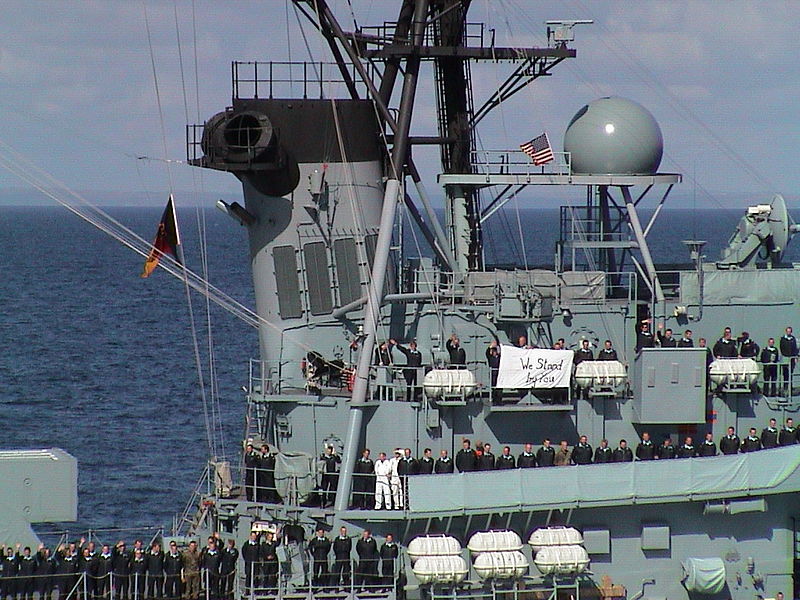
3 Comments

Filed under afghanistan, counterinsurency in afghanistan, crime, ethics, Foreign Policy, History, iraq,afghanistan, middle east, Military, national security, News and current events, Political Commentary, terrorism

“So it Goes” Remembering the Day Before 9-11-2001 and the Beginning Of War Without End

The twin Towers, September 10th 2001 

Friends of Padre Steve’s World,

After 18 years of unending war, terrorism, and the paranoia that come with it, I almost find it hard to remember what things were like on September 10th 2001.

I had been in the military over 20 years by then, but having resigned my commission as a Major in the Army Reserve in order to return to active duty as a Navy Chaplain serving with the 2nd Marine Division at a lower rank, I try to think about Monday, September 10th once in a while.

Despite coming close to a ground war in Kosovo in 1999, we had settled into the norms of peacetime training and preparation for whatever the next crisis might be. I had participated in the preparations for the Kosovo campaign, which thankfully we were prevented from going into a ground war over due to Serbian President Slobodan Miloševićat blinking at the last minute and agreeing to a ceasefire and withdraw from Kosovo, which could have led to a wider war in the Balkans and with Russia.

On the night of September 10th 2001 my mind was as far from war and terror as it could be. I was much more interested in the MLB Pennant Race than I was anything going on in the world, after all the only issues we faced were occasional, if deadly terrorist attacks on foreign installations and deployed ships like the USS Cole.  But as to the security of the Continental United States, or as it has been referred to by some since 9-11 as “the Homeland” I wasn’t concerned. Somehow, despite my knowledge, understanding and study of terrorist groups I just never thought anyone could pull off an attack of this magnitude.  The next morning I discovered just how wrong I was as the first reports came in while I was on my way to a late PT session at Camp LeJeune North Carolina where I was serving with the Second Marine Division, but that is a story for tomorrow night.

September 10th was a normal and pretty much a typical September day in America. The Denver Broncos beat the New York Giants in Denver that night. The Seattle Mariners won their 104th game of the season, defeating the Anaheim Angels 5-1.

But the next morning changed all of our lives and ushered in what is now 18 years of war which has cost the United States military almost 80,000 casualties including over 7,000 dead or died of wounds. Of course that does not count non-DOD agency casualties, or those of the contractors who have been a big part of the war effort, nor does it count the number of friendly Afghans, Iraqis, and others who have to use the antiseptic and dehumanizing term collateral damage, who have been killed, maimed, or displaced by nearly two decades of war.

Eighteen years after 9-11-2001 we are not only still at war, but it is becoming a war without end. President Trump tried and failed using ham handed tactics to make a deal with the Taliban, including a meeting that was to occur yesterday at Camp David to allegedly secure a peace deal that would net him the Nobel Peace Prize. That didn’t happen after Taliban fighters killed yet another American soldier in combat last week. Of course the deaths of over a dozen other Americans since January, not to mention hundreds of Afghan soldiers, police and civilians who have died at the hands of the Taliban and the descendants of the original Al Qaida. Those lives didn’t matter as long as the President thought he could get a deal to end the war, then with Taliban representatives at his doorstep he called the talks off. Personally I don’t think the President really cared about any of those lives, he hasn’t mentioned any of them over the past year, nor gone to their funerals, or met their remains at Andrews Air Force Base, so what happened had to be about him, otherwise why invite Taliban leaders to meet with him of the week of the anniversary of the 9-11-2001? If not to get a deal.

Eighteen years ago, I figured that after a few months Al Qaeda would be no more, and the war that they had unleashed upon us would be over. however I was wrong. Now now, many of the sailors, soldiers, marines, and airmen I deal with were just children or not even born when the attacks happened.

In just over six months I will be retired from the military, and as Kurt Vonnegut wrote in Slaughterhouse Five: “So it goes…” 

Have a good night, until tomorrow,

Peace

2 Comments

Filed under crime, History, iraq,afghanistan, middle east, national security, News and current events, Political Commentary, terrorism, War on Terrorism

“Nothing is Easier than to Denounce an Evil Doer; Nothing is more Important than to Understand Him” The Uncomfortable Necessity of Understanding Evil

Friends of Padre Steve’s World,

Fyodor Dostoyevsky wrote, “Nothing is easier than to denounce the evildoer; nothing is more difficult than to understand him.”

I think one of our problems is that we want to believe that evil is simply done be evil people. That is why when we see a Hitler, Stalin, Pol Pot, or the monsters of the so-called Islamic State, we are often strangely comforted. This is often  because we can point to a single person with a wicked ideology and say “they are evil,” all the while forgetting that they are, or were, like us, also human. Aleksandr Solzhenitsyn reminds us of the folly of that type of thinking:

“If only it were all so simple! If only there were evil people somewhere insidiously committing evil deeds, and it were necessary only to separate them from the rest of us and destroy them. But the line dividing good and evil cuts through the heart of every human being. And who is willing to destroy a piece of his own heart?”

A few years ago I took a break from my Gettysburg studies and writing and dusted off an old academic paper dealing with the one of the more uncomfortable aspects of the Nazi Holocaust against the Jews. I did that because I felt that I needed to reexamine the nature of evil in the modern world. Since that time I have gone back, done more study, more writing, and made more visits to locations of Nazi evil. I will be doing more of that in the next few weeks as we go back to Germany for an eighteen day visit.

When I ponder the evil committed by supposedly civilized men and women of Germany, I realize that they are little different than others who share the culture of the West. These people were the products of a culture of learning, and of science. They were part of a culture formed by the Christian tradition, the Renaissance, the Reformation, and the Enlightenment, the age of Reason. As I pondered this I came to remember something said by the late Iris Chang, “civilization is tissue thin.”

Omaha_courthouse_lynching

                                    Lynching in the American South

That series of articles about the Einsatzgruppen dealt with the ordinary men, and the bureaucratic systems that implemented an ideology so twisted and evil that it is unimaginable to most people. In fact even in the Nazi system the majority of the genocide was not committed in the death camps, but up close and personal by men standing over pits with pistols, rifles, and machine guns.

While most people in the United States know a little about the Holocaust, most do not fully comprehend how devilish and insidious the crimes of the Nazis were. More frightening is the fact that in a 2015 survey 46% of people worldwide have never heard of the Holocaust, and of the 54% who are aware of it some 32% think it is a myth or has been greatly exaggerated. The numbers will only get worse as we become farther removed from these events and the survivors, witnesses, and perpetrators die off. The same is true for other genocidal acts.

We typically know about the extermination camps like Auschwitz, but the lesser known dark side of the Holocaust, perhaps the scariest part, is the story of the men of the Einsatzgruppen. The Einsatzgruppen and affiliated units, including those of the Wehrmacht, the Waffen SS, the mobilized battalions of the Order Police, and locally recruited units, rounded up massive numbers of people and killed them up close and personal. In all these units murdered over two million people, about 1.3 million of whom were Jews.

My study of the Holocaust began in college as an undergraduate. My primary professor at California State University at Northridge, Dr. Helmut Haeussler had been an interpreter and interrogator at the Nuremberg trials. I was able to take a number of lecture classes from him a large amount of research and independent study courses in a year of graduate work while finishing my Army ROTC program at UCLA. It was an immersion in the history, sociology, and the psychology of evil, during which I was able to meet and talk with Jewish survivors of the Holocaust.

mass killing einsatzgruppen

                       Einsatzgruppen and Ordungspolizei in Russia

Since then I have continued to read and study. I lived in Germany for over four years, and made many other visits, during which I went to a number of Concentration Camp sites. I visited the rebuilt synagogue in Worms which had been destroyed during the infamous Kristallnacht, and other museums and Holocaust memorial sites in Germany. I visited the Zeppelin field, the site of Hitler’s massive Nazi Party rallies in Nuremburg, as well as the graveyards which contain the victims of other Nazi crimes, including the Nacht und Nebel or night and fog actions, where people simply disappeared and were murdered by the Gestapo.

For me, those visits were sobering, maybe even more so because I understood exactly what happened in those sites. These are uncomfortable places to visit, and I can understand why many people would not want to visit them, or even study them.

The darkness that they remind us of  is a part of our human condition. Traces of the evil on display in those places is present in every human being. Frankly, most people cannot bear looking into that abyss, for fear that they might be swallowed by it.

nankino-masakra-1

                                                            Nankingnanking_massacre_1

I can understand that and I have to admit that it is hard to do so. I am a historian as well as a clinician with much experience dealing with death and trauma. With my training I do a pretty good job of keeping my emotional distance to maintain objectivity when confronted with evil. However, it is hard for me not to have some emotional reaction when visiting these places, or reading about the events and people, and in writing about them.

Likewise, I am very troubled by the growing lack or awareness or denial of the Holocaust. It is very hard for me not to have a virulent reaction when I see books and websites dedicated to Holocaust denial, or that minimize other well documented genocides, and crimes against humanity.

tzd8ftsn-1390907543

                                      Soviet Mass Killings in Ukraine

My sensitivity to human suffering and the terrible indifference of people in this country to it was greatly increased by my experience of war, and my post-war struggles with PTSD, depression, anxiety, which at points left me very close to committing suicide. A non-chaplain friend, a now retired Navy Command Master Chief Petty Officer that I served with at my last duty station recently remarked that I am a tremendously empathic person, and that I have a large capacity to feel the pain and suffering of others. This capacity for empathy and the ability to feel the suffering of others is part of who I am. It is a good thing, but it makes my work studying and writing about the Holocaust, other genocides, crimes against humanity, and subjects like American slavery, racism, and Jim Crow a sometimes difficult and often very emotionally consuming task. This sometimes leaves me even more sleepless and anxious than normal; especially when I see the indifference of so many people to the suffering of others today.

CambodiaExhibitMassgrave-x1

                                                  The Killing Fields

It is that indifference which motivates me to write; because if these events are not recalled and retold, they, like any part of history will be ignored and then forgotten. The statistics bear this out. There are people today, who say that we should stop talking about these events, that they are old news, and they cannot happen again; but history tells us different, and not just the Holocaust, but indeed every genocide. Then there are those who shamelessly use the Holocaust imagery to spread fear among their followers even as they openly demonize minority groups and religions as the Nazis did to the Jews.

I have to agree with Elie Wiesel who said, “Indifference to me, is the epitome of all evil.”

The late Iris Chang, who wrote The Rape of Nanking: The Forgotten Holocaust of World War II wrote something that is pertinent to almost every modern episode of genocide, or other crime against humanity. It is the ability of leaders, be they political, military, or religious to convince people to rationalize actions that they normally would find repulsive.

“After reading several file cabinets’ worth of documents on Japanese war crimes as well as accounts of ancient atrocities from the pantheon of world history, I would have to conclude that Japan’s behavior during World War II was less a product of dangerous people than of a dangerous government, in a vulnerable culture, in dangerous times, able to sell dangerous rationalizations to those whose human instincts told them otherwise.”

There are many other such events that we could note; the American decimation and genocide committed against native American tribes that spanned close to two centuries, the 1915 Turkish genocide of Armenians, the Rwandan genocide of 1994, the Serbian atrocities in Bosnia and Kosovo, the Chinese Communist “Great Leap Forward,” the actions of the Islamic State in Iraq and Syria, and the more recent but seldom discussed action of the Myanmar government and military against its Rohingya Muslim minority.

                        Rwandan Genocide

What we call civilization, to use the words of Iris Chang, is tissue thin. That is why we must never forget these terrible events of history, and that part of human nature, and in a sense part of every one of us, that makes them so easy to repeat. That is why we must periodically take the time to remember and reflect on the Holocaust, other genocides and crimes against humanity.

It is even more important now with the rise of fascist, nationalist, and racist regimes around the world. Even in the United States these demons of the past, racism, nationalism, and fascism have come out into the open as those who believe in them have become emboldened by the words of President Trump and members of his administration.

In fact in trying to clean up his inaction after the violence committed by neo-Nazis and KKK sympathizers in Charlottesville the President first equated the Nazis and Klansmen with the people that they attacked and under pressure made a speech condemning the Nazis and Klansmen. According to Bob Woodward, when a Fox News correspondent said that was an admission that he was almost an admission that he was wrong.” The President exploded at Rob Porter, the aide who convinced him to make the speech: “That was the biggest fucking mistake I’ve made,” the President told Porter. “You never make those concessions. You never apologize. I didn’t do anything wrong in the first place. Why look weak?” A few days later the President returned to the subject and again made the argument of moral equivalence.

Coupled with so many of the President’s words and policies directed against Blacks, Mexicans and Central Americans, Arabs, Africans, and others; as well as his attacks on the First Amendment and his praise and defense of cold blooded dictators around the world one has to take it more seriously.

This is not an issue that simply lurks in the past, it is a very real part of the present. Historian Timothy Snyder wrote:

“The European history of the twentieth century shows us that societies can break, democracies can fall, ethics can collapse, and ordinary men can find themselves standing over death pits with guns in their hands. It would serve us well today to understand why.”


Yes, these are terribly uncomfortable subjects, but we cannot allow this generation to allow them to be forgotten, lest they be repeated. That is why that I must continue to write about them and do my best to make sure that they are not forgotten as we cannot afford to let them happen again.

Peace

Padre Steve+
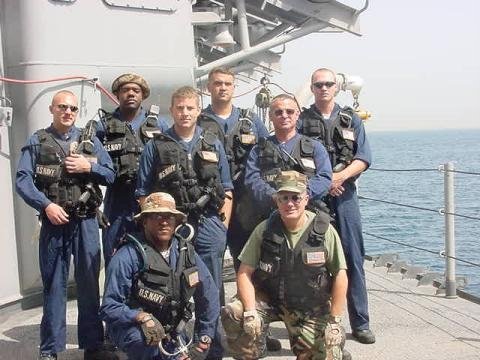
2 Comments

Filed under History, holocaust, iraq,afghanistan, middle east, nazi germany, Political Commentary, racism, world war two in europe