Category Archives: middle east

Einsatzgruppen and Ordinary Men: Religion, Ideology, and True Believers, Now

Friends of Padre Steve’s World,

this is a follow up to yesterday’s article about the Einsatzgruppen  and Ordungspolizei action in Poland from 1939 to early 1942, the period before Hitler and his minions made the decision to enact the Endlosung, the Final Solution to what they referred to in academic and clinical terms of the Jewish Problem. 

I cannot think for you, but the social and political climate of the United States and many other Western Democracies, what happened then is not simply an academic question that we can leave in the past, unless we are to submit ourselves to repeat that tragedy, that Holocaust. 

Eighty years ago the members of Heinrich Himmler’s Einsatzgruppen were following the German Army into Poland. These forces were intended to do one thing, to eliminate any Poles capable of resisting the Reich and to round up and kill Jews. The sad thing is that while the Genocide committed by the Nazis is in a league of its own, the propensity for others to write about, urge, and promote genocidal practices is not unique.
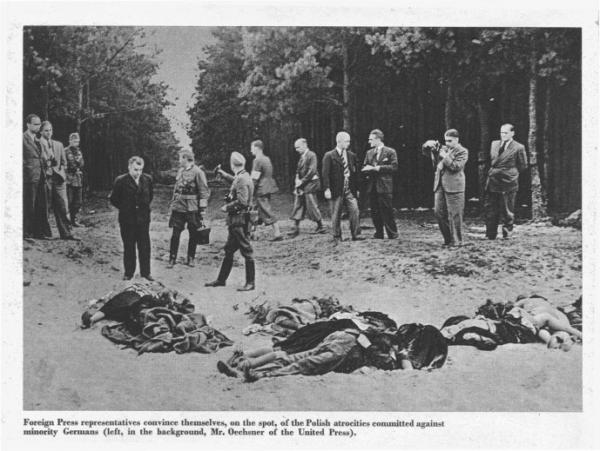
One of the most troubling aspects of genocide is the degree to which people will go to rationalize and justify it, especially if it is supposedly commanded by their “God.” This includes people who exalt their human leader’s pronouncements to that of a god.

Eric Hoffer wrote:

“The impression somehow prevails that the true believer, particularly the religious individual, is a humble person. The truth is the surrendering and humbling of the self breed pride and arrogance. The true believer is apt to see himself as one of the chosen, the salt of the earth, the light of the world, a prince disguised in meekness, who is destined to inherit the earth and the kingdom of heaven too. He who is not of his faith is evil; he who will not listen will perish.”

Thus, today’s article is difficult to write. I realize that some people will be offended because to those that cannot see the nuance that any criticism of their beliefs is akin to an attack on God. That is not my intent at all, there are too many people of faith in all religions who work against the extremists who claim to speak evil in the name of their God. Likewise I am not  attempting by any stretch of the imagination to broad brush or demonize people of faith. That being said, there are people of every faith and ideology who are capable of planning and committing genocide.

Yes there are extremists, but there are also many ordinary people who obey without questioning, and if ordered by a high enough authority will commit unspeakable acts. As Primo Levi noted, “Monsters exist, but they are too few in numbers to be truly dangerous. More dangerous are…the functionaries ready to believe and act without asking questions.”

But my purpose today, in fact the sole intent of this article is to point out some of the questions and issues that people of faith need to ask when they faced with the killing of innocents or defenseless people in the name of God, or of a political leader. The fact that the Trump administration has already began rounding up people including American citizens and separating them from their families in what amount to concentration camps. (And yes, I do know the difference between a concentration camp like Dachau and a death camp like Treblinka, or Auschwitz so don’t even go there Mr. Trump Cultist.) But the fact is that once you go down the path that the Trump administration has elected to trod there is not much more to overcome before the killing begins.

Historian Timothy Snyder wrote:

“The European history of the twentieth century shows us that societies can break, democracies can fall, ethics can collapse, and ordinary men can find themselves standing over death pits with guns in their hands. It would serve us well today to understand why.”

Thus, one only has to look at history and the words or actions of people who live among us to realize that the seeds of genocide are always being sown by those who find others less than human. The men and women who sow the seeds of future genocide can do so in the name of their God, their religion, their religious or secular political ideological, or their views on the superiority of their race. The Nazis provide us a road map of the twisted logic used by the perpetrators of such actions, but they are not alone in history, and people like them exist today, some peddling their hatred in the name of God and religion, but not always.

When one reads the speeches, the after action reports, and the post-war testimony of those who orchestrated and conducted the worst terror of the Nazi regime against the Jews and others that they considered to be less than human, or in the case of the handicapped and the mentally ill, “life unworthy of life” they are stunning, and troubling. I just finished reading Horst Bieshold’s Crying Hands: Eugenics and Deaf People in Nazi Germany, and I am currently reading Christopher Browning’s The Origins Of the Holocaust: The Evolution Of Nazi Jewish Policy, September 1939 – March 1942. 
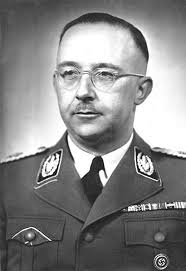
During his Posen speech of October 1943 SS Reichsfuhrer Heinrich Himmler was quite clear about the aims of the Nazis, and their goals regarding the Jews and other Untermenschen (Sub humans) including infants and children. Himmler said:

“We came to the question: what to do with the women and children? I decided to find a clear solution here as well. I did not consider myself justified to exterminate the men – that is, to kill them or have them killed – and allow the avengers of our sons and grandsons in the form of their children to grow up. The difficult decision had to be taken to make this people disappear from the earth…”

One would think that killing babies, any babies, but in the particular case Jewish babies to prevent them from growing up to avenge the deaths of their parents would be repulsive, especially to Jews. For most Jews it is, but like every religion Judaism has its share of extremists.

One of them is the controversial Rabbi Yitzhak Shapira, the dean of the Od Yosef Hai Yeshiva near Nablus in Israel. In a chapter in his book Torat ha-Melekh [The King’s Teaching] entitled “Deliberate harm to innocents,” which provides numerous justifications to kill gentiles, even babies, Shapira wrote:

“In any situation in which a non-Jew’s presence endangers Jewish lives, the non-Jew may be killed even if he is a righteous Gentile and not at all guilty for the situation that has been created… Hindrances—babies are found many times in this situation. They block the way to rescue by their presence and do so completely by force. Nevertheless, they may be killed because their presence aids murder. There is justification for killing babies if it is clear that they will grow up to harm us, and in such a situation they may be harmed deliberately, and not only during combat with adults.”

The Rabbi’s followers have engaged in frequent violence against Palestinians and Jews who do not hold his radical views. In 2006 he was detained for questioning after writing an article in which he said that all Palestinian males from age 13 and up should be killed or expelled from the West Bank. The rabbi condemns any moderation by the Israeli Defense Forces, and he criticizes Israel’s legal system and judiciary when its rulings conflict with his uncompromising views. To be sure his book was condemned by other Rabbis, especially of the Reformed School, but some Orthodox Rabbis supported it.

Those views are not unlike the stated views of the leaders of the so-called Islamic State when it comes to the killing of non-believers. In that organization’s 2013 Declaration of War those leaders stated:

“If you can kill a disbelieving American or European – especially the spiteful and filthy French – or an Australian, or a Canadian, or any other disbeliever from the disbelievers waging war, including the citizens of the countries that entered into a coalition against the Islamic State, then rely upon Allah, and kill him in any manner or way however it may be. Do not ask for anyone’s advice and do not seek anyone’s verdict. Kill the disbeliever whether he is civilian or military, for they have the same ruling. Both of them are disbelievers. Both of them are considered to be waging war [the civilian by belonging to a state waging war against the Muslims]. Both of their blood and wealth is legal for you to destroy, for blood does not become illegal or legal to spill by the clothes being worn.”

Many Imam’s and Mufti’s around the world and in the Middle East have issued Fatwah’s against the Islamic State and condemned its teachings. But many of these clerics, who often represent their tribal or government leaders, are considered to be disbelievers and “defenders of Israel” by the Islamic State. As such, many Moslem clerics, and large numbers the vast oppressed masses of impoverished, and often disenfranchised Arab Moslems are attracted to that ideology, especially that directed against the Jews, who are seen as the ultimate enemy.

There are Christians too that find theological justification for killing children, and their reasons are chillingly like those of Himmler: The author of an article on the blog Rational Christianity wrote:

“Why were the children killed, if they weren’t guilty? Apparently, they were considered as morally neutral, since they weren’t yet old enough to be held accountable or to have done much right or wrong. While not as corrupt as their parents, they were part of the society that was judged, and shared its earthly (though not its eternal) fate.”

Another author, a man named Wayne Jackson of Apologetics Press writes of the children of the Canaanites, “Would it not have been infinitely worse, in view of eternity, had these children grown to maturity and adopted the same pagan practices as their parents?”

William Lane Craig, a frequent apologist wrote in the Reasonable faith website a comment that sounds like it could have come from the lips of Himmler in dealing with the effect of the mass murders of Jews and others on the troops of the Einsatzgruppen. Craig wrote:

“So whom does God wrong in commanding the destruction of the Canaanites? Not the Canaanite adults, for they were corrupt and deserving of judgment. Not the children, for they inherit eternal life. So who is wronged? Ironically, I think the most difficult part of this whole debate is the apparent wrong done to the Israeli soldiers themselves. Can you imagine what it would be like to have to break into some house and kill a terrified woman and her children? The brutalising effect on these Israeli soldiers is disturbing.”

However, Craig has no qualms about what the Israelites did, simply because the genocide was commanded by God.

If one substitutes “Hitler” for “God” one sees a similar rationalization used members of the Einsatzgruppen. Colonel Walter Blume, a Police Colonel at Vitebsk who tried to “care” for his troops during a mass execution of Jews. He wrote:

“If I am now asked about my inner attitude which I then held, I can only say that it was absolutely split. On the one hand there was the strict order of my superior… and as a soldier I had to obey. On the other hand I considered the execution of this order cruel and humanly impossible. My very presence at this execution convinced me of this in a final manner. I still know that I wanted to make the situation easier for my men who were certainly moved by the same feelings. When ten men were shot there was always a pause until the next had been brought in. During these pauses I let my men sit down and rest and I joined them. I still know what I said exactly the following words to them at this time: “As much as it is no job for German men and soldiers to shoot defenseless people but the Fuhrer has ordered these shootings because he is convinced that these men would otherwise shoot at us as partisans or would shoot our comrades and our women and children were to be protected if we undertake these executions. This we would have to remember when we carry out this order.” Furthermore, I tried talking about neutral subjects to make the difficult spiritual situation easier and to overcome it.”

That is the troubling issue for me. Genocide is genocide and evil, no matter who commands it. We can try to wiggle around and avoid the subject by saying that whatever God we have is above normal law, or that our secular leader’s commands are above the law, but we cannot escape the fact that genocide is immoral and an immutable evil; even if we do it in the name of our God.

I think that is the problem that I have with people who follow their leaders down the path to genocide, even those who they believe are speaking for God. Likewise, I am very much concerned when people seem to care more about the emotional and spiritual effects of mass murders on the perpetrators than on the victims.

But then, the victims are dead and have no one left to speak for them, unless we do. Never forget.

Until tomorrow,

Peace,

Padre Steve+
Leave a comment

Filed under ethics, faith, Foreign Policy, History, holocaust, leadership, middle east, nazi germany, Political Commentary, war crimes, world war two in europe

“I am Death, the Destroyer Of Worlds” Hiroshima and the Genie that Will Not go Back in the Bottle at 74 years


Friends of Padre Steve’s World,

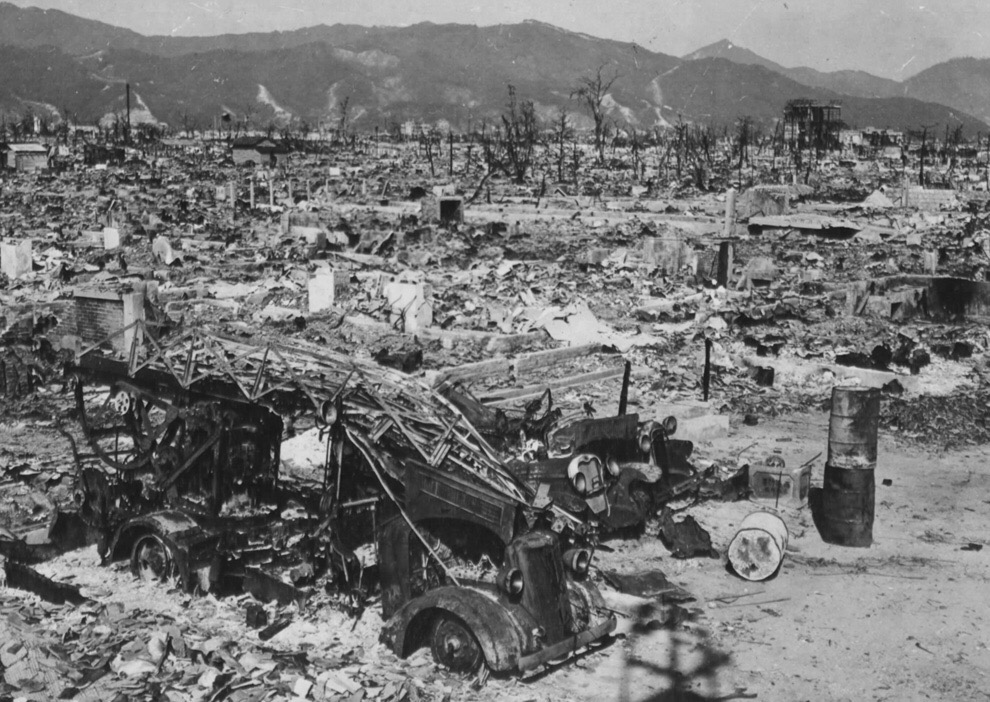
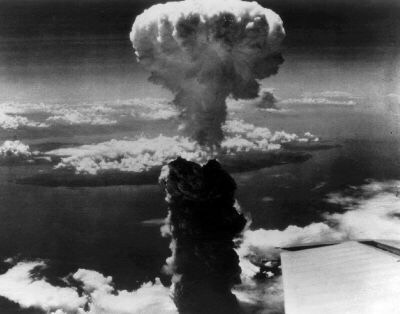
Seventy-four years ago the world changed. A remarkably destructive weapon was introduced in combat, a single bomb that annihilated the city of Hiroshima Japan. The effects were immediate, 70,000 to 100,000 people were killed, tens of thousands of others wounded, many of whom would suffer from the effects of radiation and radiation burns the rest of their lives. Within days a second bomb was dropped on Nagasaki with similar results, and Japan sued for peace. The Second World War was over and a new world was born, a world under the shadow of nuclear weapons.

The anniversary of that event today is something that all of us should ponder with great trepidation as the world seems to lurch towards a day when such a weapon will be used again. The question should not be one of mere military or tactical expediency, but must consider the moral dimension of the use of these weapons as well as the whole concept of total war.

In his book Hiroshima, John Hershey wrote:

“The crux of the matter is whether total war in its present form is justifiable, even when it serves a just purpose. Does it not have material and spiritual evil as its consequences which far exceed whatever good might result? When will our moralists give us an answer to this question?” 

His question is worth considering. It is no wonder that Robert Oppenheimer one of the members of the team that developed the bomb quoted a verse from the Bhagavad-Gita after he witnessed the test explosion “Trinity” on July 16th 1945: “Now, I am become Death, the destroyer of worlds.” 

Up until April of 2017 I spend the last three and a half years teaching the ethics of war to senior military officers at a major U.S. Military Staff College. One of the things that we do in the class is to have the officers do presentations on different historical, or potential ethical problems faced by national policy makers, military commanders and planners. The goal was to have these men and women dig deep and examine the issues, and think about the implications of what they will do when they go back out to serve as commanders, staff officers, advisors to civilian leaders and planners. Sadly, in the gutting of that institution after I departed the Ethics elective and all other electives were eliminated. They also cut back the number of seminars from 13 to five and limited the students to O-5s and O-6s, with command experience, directly contravening the intentions of the Goldwater-Nichols Act which was designed to prevent repeats of Vietnam, the failed Iran hostage rescue attempt, and the invasion of Grenada. The intent of the legislation was to better coordinate the efforts of the services and inculturation of younger officers to understand the capabilities of their sister services, as well as teach history, strategy, and ethics to rising leaders in the Defense Department, State Department, CIA, DIA, and other agencies charged with our national security.

In each class that I taught, at least one student dealt with the use of the Atomic bombs.  Most were Air Force or Navy officers who have served with nuclear forces. Unlike the depiction in the classic movie Dr. Strangelove or other depictions that show officers in these forces as madmen, the fact is that I was always impressed with the thoughtfulness and introspective nature of these men and women. They sincerely wrestle with the implications of the use of these weapons, and many are critical of the use of them at Hiroshima and Nagasaki. It is comforting to me to know that at least in the U.S. military that there are many who can reflect and do try to look at things not just from a purely military standpoint. Of course since I know humanity I figure that there are others in our ranks who are not so reflective or sensitive to the moral implications of the use of these weapons, among whom is our current President. The fact that President Trump acts on impulse and seems to have no moral compass, strategic sense, or anything apart than what benefits him causes me to shudder, especially when he has to actually confront North Korea on their ICBM and nuclear programs, not to mention the use of weapons of mass destruction by a terrorist group. As Barbara Tuchman wrote: “Strong prejudices and an ill-informed mind are hazardous to government, and when combined with a position of power even more so.”

I am no stranger to what these weapons, as well as chemical and biological weapons can do. Thirty-five years ago when I was a young Army Medical Service Corps lieutenant I was trained as a Nuclear, Chemical and Biological Defense Officer. I learned the physical effects of exposure to these weapons, how many Rads of radiation a person could receive before they became sick and died. I learned what radiation exposure does to people at each stage. We trained with maps to chart fallout patterns, and the maps had the cities and towns that we lived in, this was Cold War Germany and yes both NATO and the Warsaw Pact expected that tactical nuclear weapons and chemical weapons would be used and we had to be able to operate in contaminated environments. We operated under the idea of Mutual Assured Destruction or MAD as a deterrent to war. It was chilling and made me realize that the use of these weapons today would be suicidal. When Chernobyl melted down we were in the fallout zone and were given instructions on what we could and could not do in order to minimize any possible exposure to radiation poisoning.

So when it comes to the first use of the Atomic bomb I am quite reflective. As a historian, military officer, chaplain and priest who has been trained on what these weapons can do I have a fairly unique perspective. Honestly, as a historian I can understand the reasons that President Truman ordered its use, and I can understand the objections of some of the bomb’s designers on why it should not be used. I’ve done the math and the estimates of casualties had there been an invasion of the Japanese home islands is in the millions, most of which would have been Japanese civilians.


My inner lawyer can argue either point well, that being said the manner in which it was used at Hiroshima and Nagasaki troubles me. Hiroshima did have military targets, but a big part of the choice was its location, surrounded by hills, which created a bowl that would focus the explosion and maximized its effect. Many of the larger military and industrial targets lay outside the kill zone. The designers and officers on the committee wanted to show the Japanese, as well as the world the destructive power of the weapon. Those who opposed its use hoped that it would convince the leaders of nations that war itself needed to be prevented. These men wrestled with the issue even as they prepared the first bombs for deployment against Japan. The recommendations of the committee can be found here:

http://www.atomicarchive.com/Docs/ManhattanProject/Interim.shtml
Of the 150 scientists who were part of the bomb’s design team only 15% recommended the military use without a demonstration to show the Japanese the destructive power of the bomb and a chance to end the war. The poll of the scientists can be found here:

http://www.atomicarchive.com/Docs/ManhattanProject/Poll.shtml
Leo Szilard wrote a letter to Edward Teller seeking his support in sending a petition to President Truman regarding his opposition to the use of the weapon based on purely moral considerations. Szilard wrote:

“However small the chance might be that our petition may influence the course of events, I personally feel that it would be a matter of importance if a large number of scientists who have worked in this field want clearly and unmistakably on record as to their opposition on moral grounds to the use of these bombs in the present phase of the war.

Many of us are inclined to say that individual Germans share the guilt for the acts which Germany committed during this war because they did not raise their voices in protest against those acts, Their defense that their protest would have been of no avail hardly seems acceptable even though these Germans could not have protested without running risks to life and liberty. We are in a position to raise our voices without incurring any such risks even though we might incur the displeasure of some of those who are at present in charge of controlling the work on “atomic power.”

The entire text of Szilard’s letter can be found here:

http://www.atomicarchive.com/Docs/ManhattanProject/SzilardTeller1.shtml
The two petitions of the scientists to the President are here, the second letter concludes with this recommendation:

“If after the war a situation is allowed to develop in the world which permits rival powers to be in uncontrolled possession of these new means of destruction, the cities of the United States as well as the cities of other nations will be continuous danger of sudden annihilation. All the resources of the United States, moral and material, may have to be mobilized to prevent the advent of such a world situation. Its prevention is at present the solemn responsibility of the United States–singled out by virtue of her lead in the field of atomic power.

The added material strength which this lead gives to the United States brings with it the obligation of restraint and if we were to violate this obligation our moral position would be weakened in the eyes of the world and in our own eyes. It would then be more difficult for us to live up to our responsibility of bringing the unloosened forces of destruction under control.

In view of the foregoing, we, the undersigned, respectfully petition: first, that you exercise your power as Commander-in-Chief to rule that the United States shall not resort to the use of atomic bombs in this war unless the terms which will be imposed upon Japan have been made public in detail and Japan knowing these terms has refused to surrender; second, that in such an event the question whether or not to use atomic bombs be decided by you in the light of the consideration presented in this petition as well as all the other moral responsibilities which are involved.”

http://www.atomicarchive.com/Docs/ManhattanProject/SzilardPetition.shtml

http://www.atomicarchive.com/Docs/ManhattanProject/Petition.shtml

Ralph Bard, Undersecretary of the Navy wrote to Secretary of War Stimson his opinion on July 17th 1945:

“Ever since I have been in touch with this program I have had a feeling that before the bomb is actually used against Japan that Japan should have some preliminary warning for say two or three days in advance of use. The position of the United States as a great humanitarian nation and the fair play attitude of our people generally is responsible in the main for this feeling.”

I think that those who debate the history of this need to look at the entire picture and read the letters, the documents and take into account everything. My hope is that leaders, policy makers, legislators and we the people continue to work to eliminate nuclear weapons. It is true that the nuclear stockpiles of the United States and Russia are significantly smaller than when the Cold War ended, but even so what remain are more than enough to extinguish human life on the planet. Add to these the Chinese, French, British, Indian, Pakistani and the hundreds of undeclared weapons of Israel the fact is that there remains the possibility that they could be used. Likewise there are nuclear programs in other nations, especially North Korea, which given enough time or believing them necessary could produce weapons. But the North Koreans are not alone, they could easily be joined by others including Iran and Saudi Arabia. Add to this the possibility of a terrorist group producing or acquiring a weapon the world is still a very dangerous place.

That is the world that we live in and the world in which policy makers, legislators and educated people who care about the world must attempt to make safe. If you asked me I would say outlaw them, but that will never happen. Edward Teller wrote Leon Szilard:

“First of all let me say that I have no hope of clearing my conscience. The things we are working on are so terrible that no amount of protesting or fiddling with politics will save our souls…. Our only hope is in getting the facts of our results before the people. This might help to convince everybody that the next war would be fatal. For this purpose actual combat use might even be the best thing…. But I feel that I should do the wrong thing if I tried to say how to tie the little toe of the ghost to the bottle from which we just helped it to escape…”

We are on the brink again. India and Pakistan are once again girding themselves up for nuclear war over Kashmir. Iran, after having ceased its production of enriched uranium, has resumed it following the Trump Administration voiding the nuclear nonproliferation agreement signed during the Obama administration. Despite its promises to President Trump, North Korea still seems intent on developing nuclear weapons and delivery systems. The Russians are developing hypersonic missiles and torpedoes which could deliver nuclear warheads against American targets, and the Chinese are increasing their nuclear capability. The United States is now embarked on a plan to modernize its nuclear arsenal and under the Trump administration loosen the restraints on the use of nuclear weapons.

The ghost is out of the bottle, and nothing can ever get it back in. We can only hope and pray that reasonable people prevent any of these weapons from ever being used and that war itself would end. But then, General Of the Army Omar Bradley said in 1948:

“Ours is a world of nuclear giants and ethical infants. We know more about war than we know about peace, more about killing than we know about living. If we continue to develop our technology without wisdom or prudence, our servant may prove to be our executioner.”

I think that the “soldier’s General” was correct. Too many people just don’t care about life, Ethics, or peace.

So, until tomorrow, I leave you with that less than cheerful thought.

Peace

Padre Steve+

2 Comments

Filed under ethics, faith, Foreign Policy, History, leadership, middle east, Military, national security, News and current events, Political Commentary, world war two in the pacific

PTSD, Madness; to Perchance to Dream and Yet Live: Iraq Twelve Years Later

Friends of Padre Steve’s World,

Guy Sajer wrote in his book The Forgotten Soldier these words:

“Only happy people have nightmares, from overeating. For those who live a nightmare reality, sleep is a black hole, lost in time, like death.” 

I am exhausted tonight and I will be going to bed early for me. Hopefully I will get some restful sleep. I will be posting this article to post shortly after midnight by which time I hope not only to be in bed but asleep.

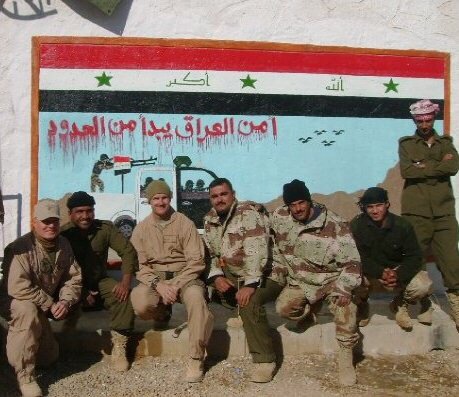
I have suffered a week of violent nightmares taking me back to my worst fears when I was serving in the badlands of Iraq’s Al Anbar Province in 2007 and 2008 supporting U.S. Advisors to Iraqi Army, Border Forces, Police, Highway Patrol, and Provincial Reconstruction teams. I rolled out of bed in a nightmare and cut my arm, and I woke up screaming and reaching for the pistol of an Iraqi insurgent who was about to shoot me, scaring the absolute shit out of our oldest Papillon dog Minnie, whose terrified Yelp woke me up.

I do not often write about it because I have been doing better, but I suffer from severe and chronic PTSD related to my experiences at war. The images are seared into my brain and sometimes the memories, and my deepest fears from my time there as an unarmed Chaplain working for the most part with very small groups of Americans and our Iraqis far away from the help of the big battalions if we got into serious trouble. I have written about those experiences and my struggles after my return many times on this blog. Likewise, I have had my story told on the front pages of the Jacksonville Daily News and the Washington Times. A video of my story is on the Department of Defense Real Warriors Campaign website, and is a large part of a chapter of Pulitzer Prize winning War Correspondent David Wood’s book  What Have We Done: The Moral Injury of America’s Longest Wars.  

Since Iraq, my nightmares are very vivid and often involve much physical acting out. The physical acting out is unusual and I have actually injured myself badly enough to require trips to the emergency room after crashing hard throwing myself out of bed combatting imaginary enemies. Likewise, other have been violent and physical enough to wake Judy up.

This is nothing new. In another nightmare a year or so ago I was being attacked by an Iraqi insurgent. Our advisor team had been attacked as we were stopped in the dark to determine if an Improvised Explosive Device had been laid in the road in front of us. This was just a few miles from the Iraq-Syrian border between Al Qaim and COP South, the base of the advisor team which was working with the 3rd Battalion of the 3rd Brigade of the Iraqi 7th Division.

The part about being stopped in the desert in the dark while examining a potential IED actually happened. The attack did not happen but at the time I fully expected something like it to happen. We were sitting ducks on a two lane highway in the middle of the desert. But the attack never happened and we continued to COP South, which would become a part of many of my future missions.

But in my nightmare it happened and as the fighting devolved into close quarters hand to hand combat I found myself grappling an insurgent who was attacking me with a large knife. I managed to roll on top of him and knock the knife from his hand when I was awakened. I was on top of Judy and she was afraid that I was going to strangle her. My hands had not gotten to her throat but she woke me and told me what had happen. I dropped back to my side of the bed in a cold sweat. I could not believe what had happened and that terrifies me. I have set up an appointment prior to my regularly scheduled one with my shrink to talk about this.

Since I my day had been quite good and I have been much more relaxed at work since putting in my retirement papers the event came as a huge surprise. In trying to figure out what triggered it I was at loss until I remembered that I had had dinner last night with a retired Navy EOD Captain who had been my Chief Staff Officer at EOD Group Two and running partner before I went to Iraq. He was sent there not long after me and we met at Camp Victory in Baghdad not long before I left Iraq on the way to Kuwait and home in 2008. We enjoyed a wonderful dinner last night and we did talk about all manner of things including our time in Iraq and those men that we had served alongside.

I saw my sleep doctor yesterday regarding my latest sleep study. Without my sleep Medical Tinos I did not enter in to REM sleep, or dream sleep. In addition to prescribing me a different CPAP machine and increasing the pressure , he referring me to a neurologist colleague of his in the sleep clinic. Honestly, I don’t know what god it will do, but I hope that he can find some kind of answer.

But trying to explain my trying to explain nightmares and night terrors is is not really helpful, they are now part of who I am. I think that Stephen King said it best:

“Nightmares exist outside of logic, and there’s little fun to be had in explanations; they’re antithetical to the poetry of fear.” 

Yes,  I can still try to logically deduce my nightmares and night terrors, but the poetry of fear as Stephen King so rightly calls it cannot be fully explained. For those of us who deal with the memories of combat, of having been shot at and have seen the human cost of war, the dead, the wounded, the destruction, and the aftermath of war, they are all too real and they never completely leave us.

Christmas on the Syrian border

Over eleven years after I returned from Iraq I still find that much of me is still there. In fact, deep down I miss Iraq and the Iraqis that I was honored to know and to serve alongside and I still pray for them and for their future. Maybe someday I will get back. I would love that.

For all that remains with me about Iraq, I left a good part of me there, with my advisors and Iraqis. It was the best of times, and the worst of times, but it is a major part of who I am now, and why I want to continue to live.

So until tomorrow, Inshallah, إن شاء الله

Peace

Padre Steve+

5 Comments

Filed under History, iraq, middle east, Military, ministry, News and current events, to iraq and back, Tour in Iraq, us army, US Marine Corps, US Navy

Speak Softly and Carry a Big Stick: Words Of Wisdom too often Ignored

Friends of Padre Steve’s World,

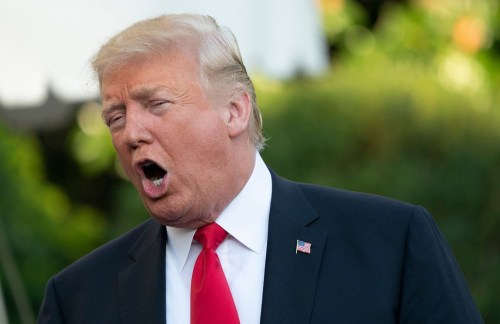
I am a frequent critic of President Trump, but last Friday when I awoke to the news that he had called off military strikes on Iran at the last minute, I was pleased. His closest cabinet level advisors, including John Bolton, one of the principle authors of the invasion of Iraq were pushing him to launch. There is controversy as to when the President learned the potential casualties of the initial strike, but I am less concerned about that than that he did the right thing, and at the same time began to quiet his language toward the Islamic Republic.

Whether this is enough to take us off the path the war is yet unseen. Iran’s Supreme Leader Ayatollah Ali Khamenei, does not seem to be deterred or encouraged by anything Trump does. Much of this is due to the fact that the previous actions of the President and his administration have backed Iran and the United States into a corner that it will take overwhelming political and moral courage to avoid war. The pressure on both men is pushing them towards war, and Trump has the additional pressure of the Saudis and Israelis to do their dirty work regarding Iran for them, much as Israel and many of the same advisors did to President Bush during the run up to the attack on Iraq in 2003. For the moment, President Trump has resisted pulling the trigger that very probably would unleashed a devastating regional war with world wide ramifications. I hope that he continues to do so but he is not the only actor in this play, too many other actors, including Khamenei, the leaders of Iran’s Revolutionary Guard, the Saudi Leadership, Benjamin Netanyahu of Israel, the Gulf States, the Russians, Chinese, North Koreans, as well as various Sunni and Shia surrogates all have a hand in this Hexenkessel of potential war and death.

I have too many friends and shipmates currently stationed in the Gulf to want war there. Likewise, I am still on active duty and my nephew is graduating from Marine Corps Boot Camp this week are still on active duty. A war would be very personal for me and my family. I hope that the President is graced with the moral fortitude, something he has not demonstrated much during his life in order to both preserve peace and American/Western interests in the region. The world cannot endure a war of the kind that will certainly escalate in ways that will engulf the region and possibly the world.

President Trump’s bluster combined with his inaction and accommodation with leaders such as Putin and Kim Jong Un, his unfulfilled rhetoric of regime change in Venezuela, and his continued attacks on American allies do not help his situation right now. He suffers a distinct lack of credibility both domestically and internationally, mostly because of his words, tweets, and outright lies. That does not mean that I want him to fail. In fact I hope that he exceeds my expectations of him. The stakes are too great for him to screw this up.

That does not mean that I will excuse his domestic policies or resist when I see him overreaching his Constitutional authority, or attempt to silence his political, media, or social opponents. But, as Commander in Chief in this volatile and dangerous situation I pray that he doesn’t fuck it up. Of course, the President acts on instinct more than logic, and the adulation of his Cult-like followers over reason. Everything he does is a gamble, I hope that since he is a gambler he knows to know when to hold them and know when to fold them. If he doesn’t tens of thousands, maybe millions of lives may be lost and a true world war begun. An attack an Iran could bring Russian action against American NATO allies in Europe, North Korean actions, or Chinese actions in the South China Sea. That doesn’t include Hezbollah attacks on Israel, or Iranian sleeper agent attacks in the United States.

I pray that the President has the sense to find a way to make a real deal with Iran. For me this is not partisan politics, it is about the country, our institutions, and our future as a nation. A war with Iran will destroy all of those institutions, we will become an autocracy, and Trump might be a tool of others far worse than him.

It is something to think about. Whether I am right or wrong, true patriotism can be complicated and extend to agreements and disagreements on policies and actions.

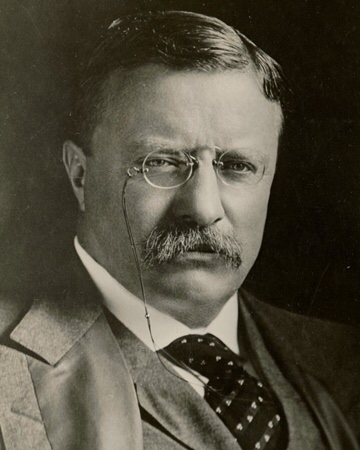
Theodore Roosevelt wrote:

Patriotism means to stand by the country. It does not mean to stand by the president or any other public official, save exactly to the degree in which he himself stands by the country. It is patriotic to support him insofar as he efficiently serves the country. It is unpatriotic not to oppose him to the exact extent that by inefficiency or otherwise he fails in his duty to stand by the country. In either event, it is unpatriotic not to tell the truth, whether about the president or anyone else.

Regardless I choose to tell the truth. War with Iran would would be disastrous. Our nation is neither prepared for it or unified, likewise the state of readiness of the U.S. military is abyssal, despite all of the defense budget increases. Most of those are not increasing the readiness of deplorable units or the base structures that support them. The are benefiting defense contractors and their shareholders. Marine Corps General and two time awardee Of the Medal Of Honor wrote in his book War is a Racket:

War is a racket. It is the only one international in scope. It is the only one in which the profits are reckoned in dollars and the losses in lives.

The President would be wise to heed Theodore Roosevelt’s warning, in word, deed, and tweet. Speak Softly and carry a big stick.

So until tomorrow,

Peace,

Padre Steve+

4 Comments

Filed under Foreign Policy, History, iraq,afghanistan, middle east, Military, national security, News and current events, Political Commentary

Why this, Why now? The Attacks on Tankers in the Gulf of Oman

Friends of Padre Steve’s World,

Over the past few weeks I have been watching the situation building in the Persian Gulf, between Iran and its allies, the United States, Saudi Arabia, the various Gulf States, and Israel.

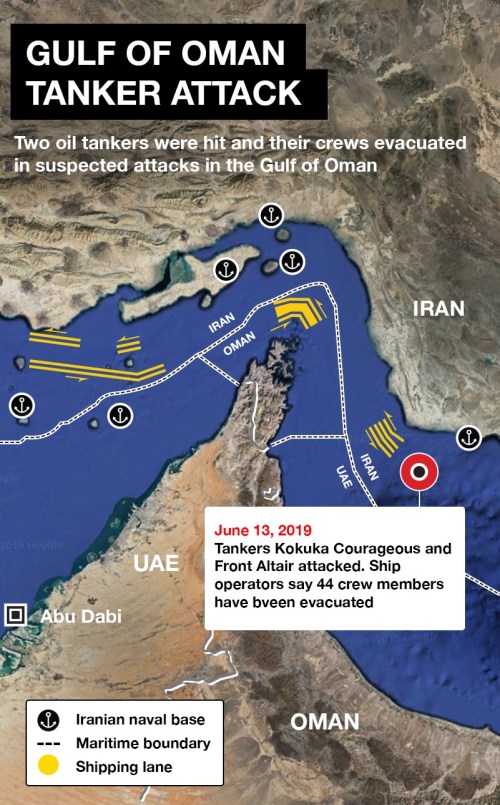
The situation has grown more tense through the threats of the Trump Administration, its increasingly punishing sanctions on Iran, and its deployment of additional Naval and Air Force units. Iran’s economy is on the verge of collapse, and over the past few weeks there have been attacks on tankers in the waters in the Gulf of Oman, which lays just outside the Straits of Hormuz, the vital passage through which passes much of the oil produced in the Middle East for the world markets, especially Asian markets.

I am a naturally suspicious person. When things like this happen I ask “why this, why these people, and why now?” Or in the cases when someone is telling me a story, “why this, why me, why now?” People lie to preachers and priests all,the time, nations and leaders of nations lie all the time. All the characters involved in this drama spin events and intelligence to shape the narrative they want others to believe. That includes the Mullahs of Iran, the Saudi Royal Family, the leaders of the Gulf States, Benjamin Netanyahu Of Israel, and President Trump, and his often conflicted and contradictory administration.

The United States has accused Iran of the attacks on these tankers, there is some evidence that points that way. The Iranians are protesting that their Gulf rivals are conducting these operations in order to frame them. Either, or both explanations are possible. The first two attacks involved very small explosive charges which did minor damage to the first two tankers, most likely placed by divers on the hills of the ships while at anchor. The second set of attacks did significant damage to two tankers. The United States Central Command produced a video of what might be an Iranian Revolutionary Guard Naval Corps boat removing something from one of the recently attacked ships.

But the theory offered by the United States, that these two ships were approached by Iranian craft which placed limpet mines on them, without reporting close encounters with Iranian craft. That would be highly unusual. The explanation by CENTCOM that the craft on the video was removing an unexplored limpet mine from the ship also seems unlikely. The Iranians knew that U.S. warships, equipped with helicopters were near the ships, such a move would be unusual for the Iranians, even the Revolutionary Guards, especially since one of the ships was Japanese owned and the head of the shipping line that owned the ship said that the crew reported an object flying at it. That could have been a rocket, missile, or even an armed drone.

Of course the Iranians could have done any of those things, as could have the Saudis, the Gulf States, the Israelis, or even the Americans.

The rapidity that Secretary of State Pompeo and President Trump labeled the Iranians as the attackers under such opaque circumstances has inadvertently backed the United States into a corner. We now have to prove our allegations. Regardless of who actually conducted the attacks, the refusal of the United States to wait for more forensic evidence of who committed the attack, the quick finger pointing at Iran was unwise. The release of a video which cannot actually identify what was removed from the tanker further obfuscates the situation.

The fact is that in the current situation, it is better to wait for conclusive evidence rather than further ratcheting up the tensions with yet unprovable allegations. There are other parties quite willing to drag the United States and Iran into war to suit their strategic aims.

When I see something like this I think of the Gulf of Tonkin incident which led to a massive escalation of the United States military involvement in Vietnam. But my question is, who is behind it?

I cannot answer that question, however, I can predict that this situation will escalate with very unpredictable and probably tragic consequences. I do hope that I am wrong, but on thing that I know from history, is that leaders in trouble at home, frequently instigate crisis abroad to divert attention from their domestic problems. If that is the case all of the possible subjects, with the possible exception of the Iranians have something to gain from this.

That doesn’t mean that I don’t think that the Iranians couldn’t be behind these attacks, but they would be low on my motivational index, unless the Revolutionary Guard has chosen to act independently of the Iranian government.

Right now I see more questions than answers, and a war brewing that shouldn’t happen. A war that will bring many changes to our world, and very likely to the life we now know in the United States.

Until tomorrow,

Peace,

Padre Steve+
10 Comments

Filed under Foreign Policy, History, middle east, Military, national security, News and current events, Political Commentary

Musing on Potential War With Iran

Friends of Padre Steve’s World,

I am a veteran of Iraq, and have participated in maritime operations in the Arabian/Persian Gulf.

I am not comfortable with the steps the administration is taking with Iran, not that I am any fan of the Ayatollahs and their aggressive theocratic-religious-military-dictatorship. While I had always dreamed of a military career it was the failure of the attempt to rescue the hostages taken by the Iranians in April 1980, Operation Eagle Claw that was the tipping point for me to explore my options about joining the military. 1980 was the year I transferred to California State University, albeit to study history, but mostly because Judy, my girlfriend was going there. Once I got there I started checking out the various ROTC programs and enlisted as a simultaneous membership program between Army ROTC and the California Army National Guard in 1981.

I thought back then at sometime we would go to war with Iran but as years passed I thought that maybe both sides would find a way to peacefully co-exist, at least within limits, especially after my experiences in the Gulf where the regular Iranian Navy chased Iraqi Oil Smugglers into our hands. Of course there was the time some Revolutionary Guard patrol boats harassed our squadron Flagship, an Australian Special Forces Support ship and we sped to her assistance at full speed with guns and missiles armed and ready to go to war. They withdrew and nothing came out of it, but for about an hour it appeared that we would be the first U.S. Navy ship to engage the Iranians since the Tanker Wars Of the late 1980s. The fact is that the Revolutionary Guard Naval Corps operates in a different world from the regular Iranian Navy.

If we go to war, now I know two things about the Arabian/Persian Gulf and the Iranians have built up a formidable asymmetric naval and capability. A large number small submarines, not high tech, but in large numbers hard to kill. Likewise, would deploy large numbers of fast attack boats and craft armed with a variety of missiles and guns for swarm attacks on otherwise better armed and more capable warships. We prepared for those back in 2002, but the lethality of the Iranians has increased, as has their number of anti-ship missile batteries his increased exponentially, as has their number of short and medium range ballistic missiles. While their AirPower is antiquated by American standards they have better and more advanced air defense systems, supplied by Russia. They are also supported by Shia Muslim militants in Iraq, Syria, Yemen, and even in Bahrain, headquarters of the U.S. 5th Fleet.

The Iranians have the capability of shutting down the Straits of Hormuz, and their allies in Yemen have showed the capability to attack shipping in the Bab El Mendeb, the Southern entrance to the Red Sea and a vital shipping lane in its own right.

Unfortunately, the Trump administration has severely weakened our ties with key allies that routinely contribute Naval and air forces to the security of the Gulf.

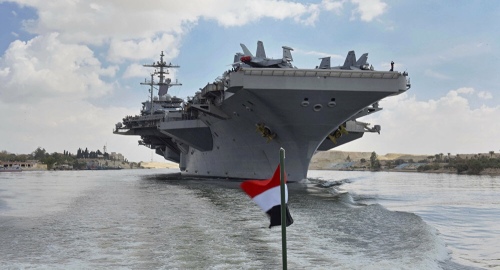
Over the past few weeks an otherwise routine deployment to the region by the Abraham Lincoln Carrier Strike Group, was sped up, B-52 bombers were deployed, and a proposal to send 120,000 troops to the Gulf was revealed. Four merchant ships were allegedly damaged by saboteurs, but no hard evidence points to Iran, and the damage to all the ships was minimal. The embassy staff in Baghdad was reduced over alleged threat increases that the American Commander in Iraq denies. The threats were reported by Israeli sources, much like the evidence that led us into war with Iraq in 2003.

I cannot put my finger finger on it, but something is not right about this situation. We are in no way ready for a major war with Iran, not with the possibility a potential war with North Korea, a trade war with China, and Russian threats to NATO allies or friendly nations in Eastern Europe.

This does not feel right to me. I’ve been around and seen and know too much. Maybe it’s my education military history, and high level Joint Operations education. Maybe it is my nearly 38 years serving in both the Army and Navy, including about 7 years with the Marines. Maybe it’s my long experience working with allies. I don’t know. All I know is that when domestic troubles embroil a national leader, the solution is often found in war. War allows leaders to do things impossible under peacetime constraints.

I can only speculate what is going on, but my hermeneutic os suspicion says to ask “why this administration, why Iran, why now?”

I wish I had the answer, but something doesn’t seem right, and I am worried for the many friends I have serving in the Gulf.

Until tomorrow,

Peace

Padre Steve+

6 Comments

Filed under Foreign Policy, History, iraq, middle east, Military, national security, US Navy, War on Terrorism

Americans should Always “Choose a President Wise, Well Read in History and Exceedingly Slow to Draw the Sword” Wise Words from the Late General Hal Moore in the Trump Era

29f03605f6b48a52887c2b51a20b5382

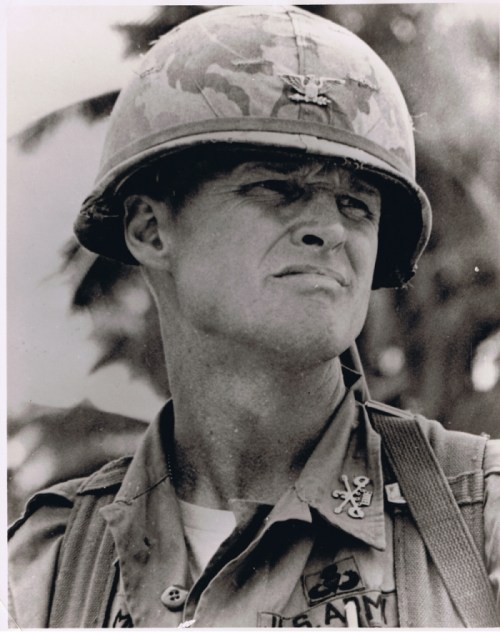
LTG Hal Moore as a Colonel in Vietnam

Friends of Padre Steve’s World,

Even since I was a child I was an avid reader of history, especially military history and biography. I idolized the military men that I read about and many of the things that they said and did, and almost always skewed them into an almost perverse form of patriotism. After the attacks of 9-11-2001 and during the run up to the invasion of Iraq I got into a internet argument with a man who later became the Presiding Bishop of my former denomination. He was and still is a very honorable man. He opposed the war on good historical, social, and moral grounds.

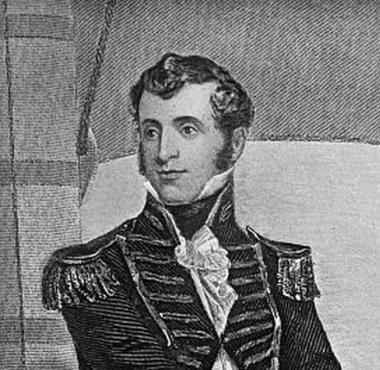
While he was very conservative theologically he had a strong sense of social justice and having come to adulthood during Vietnam war era he had a certain sense of distrust about military adventurism that I, an officer who at that time had some twenty years of military service did not fully appreciate. I responded to one of his comments with a quote from one of my favorite American Naval heroes, Captain Stephen Decatur who once remarked:

“Our Country! In her intercourse with foreign nations may she always be in the right; but right or wrong, our country!”

decatur 2 sqaure

There is some truth in what Decatur said, but his words should not be used to justify imperialistic nationalism, racism, or militarism. Sadly back then that was exactly how I used it to attempt to shut down the arguments of an honorable man. If he ever reads this I hope that Bishop Craig Bates accepts my heartfelt apology for how I treated him back then.

It took me two combat tours, one at sea where I was a member of a boarding team, and the other in Iraq’s Al Anbar Province, and a lot more military and historical education that I realized how wrong that I was in doing this. Using patriotic quotes to buttress immoral, illegal, unconstitutional, and un-Christian policies is damnable. G. K. Chesterton noted: “‘My country, right or wrong,’ is a thing that no patriot would think of saying. It is like saying, ‘My mother, drunk or sober.’”

But, I am afraid that my former understanding of patriotism is exactly what many Americans follow today, regardless of their political affiliation or ideology seem to automatically defer to the decisions of the President, no matter what his party in launching military strikes. This has been largely true since the end of Second World War until now with the exception of the latter stages of the Vietnam War when the bankruptcy of American policy became evident.

No one wants to be “against the troops” and I am still one of those troops, but opposing nationalism, imperialism, and militarism is not the same as “supporting the troops.” The late Army Lieutenant General Hal Moore, who led his battalion into the Battle of the Ia Drang in 1965 and was memorialized in the film We Were Soldiers told West Point Cadets in 2005:

“The war in Iraq, I said, is not worth the life of even one American soldier. As for Secretary Rumsfeld, I told them, I never thought I would live long enough to see someone chosen to preside over the Pentagon who made Vietnam-era Defense Secretary Robert McNamara look good by comparison. The cadets sat in stunned silence; their professors were astonished. Some of these cadets would be leading young soldiers in combat in a matter of a few months. They deserved a straight answer.

The expensive lessons learned in Vietnam have been forgotten and a new generation of young American soldiers and Marines are paying the price today, following the orders of civilian political leaders as they are sworn to do. The soldiers and those who lead them will never fail to do their duty. They never have in our history. This is their burden. But there is another duty, another burden, that rests squarely on the shoulders of the American people. They should, by their vote, always choose a commander in chief who is wise, well read in history, thoughtful, and slow-exceedingly slow-to draw the sword and send young men and women out to fight and die for their country. We should not choose for so powerful an office someone who merely looks good on a television screen, speaks and thinks in sixty-second sound bites, and is adept at raising money for a campaign.

If we can’t get that part right then there will never be an end to the insanity that is war and the unending suffering that follows in war’s wake-and we must get it right if we are to survive and prosper as free Americans in this land a million Americans gave their lives to protect and defend.”

I remember reading General Moore’s back words then and despite my respect for him I didn’t see their truth, I still believed the lies of Donald Rumsfeld, the Bush Administration, and the Right wing media. I was wrong, and within two and a half years I would discover just how right that he was.

Today, some eleven years after I returned from Iraq I find that we now have a President whose historical, ethical, and policy blindness is subjected to his narcissistic and paranoid personality. He is a man who dodged the draft, avoided military service, condemned men and women wounded. killed, or captured in combat as losers while bragging that avoiding sexually transmitted diseases in the 1980s was his Vietnam. Even now he is rushing a Carrier Strike Group and heavy bombers to challenge Iran for as of yet undisclosed threats to American interests in the Middle East, as well as suggesting military options to deal with the failing and flailing government of Venezuelan President Maduro.

War is a great way to distract from other real concerns, especially if it gives the President, any President, a chance to divert attention from his own malfeasance and criminality. Our Republic is in danger and I do not think that the danger will soon pass. I only wish that it would. Sadly, Hal Moore passed away in February of 2017. If he were alive today I am sure that he would be sounding the alarm.

So until tomorrow,

Peace

Padre Steve+

Leave a comment

Filed under Foreign Policy, History, leadership, middle east, Military, national security, News and current events

A Return to My Tipperary

Friends of Padre Steve’s World,

Today I am a bit tired and going to post so,etching that basically is a rerun. Ten years ago today I stepped off a plane with the man who had been my body guard and assistant for the past seven months in Iraq. War had changed me more than I had every imagined that it would. Even though I was physically home I wasn’t and over the next decade the war remained with me, and in some ways it still does.

I have written about my struggles with what I sometimes describe as the “Demons of PTSD” and while I am doing much better now than even two years ago I still suffer from it. But being a historian has allowed me to find connections to other men who have suffered from their experience of war, came home changed, and struggled for their existence in the world that they came home to.

The words of those men have helped me to frame my experience even in the darkest times often in ways that my faith did not. One of the things that I struggled with the most and still do is sleep. When I was conducting my research on the Battle of Gettysburg I got to know through biographies and their own writings a good number of the men who fought that battle who are now remembered as heroes. One of these was Major General Gouveneur Warren who has shattered by his experiences during the war. He wrote to his wife after the war: “I wish I did not dream that much. They make me sometimes dread to go to sleep. Scenes from the war, are so constantly recalled, with bitter feelings I wish to never experience again. Lies, vanity, treachery, and carnage.” 

About every year around this time I feel a sense of melancholy as I reflect on war and my return from it. Today I was reading a number of George Santayana’s Soliloquies in England, in particular one entitled Tipperary which he wrote in the time shortly after the war. I think that the first time that I heard the song was when I saw a Charlie Brown special where Snoopy as the World War One Flying Ace alternates between happiness and tears as Schroeder plays the song on his piano.

In Santayana’s soliloquy he comments on the wounded officers that he sees singing the song in a coffee house and he wonders if they understand how different the world is now. I love the song, the chorus is below.

It’s a long way to Tipperary
it’s a long was to go
It’s a long way to Tipperary
to the sweetest gal I know
farewell to Piccadilly
so long Leister Square
It’s a long way to Tipperary
but my heart lies there

Santayana wrote:

“It had been indeed a long, long way to Tipperary. But they had trudged on and had come round full circle; they were in Tipperary at last.

I wonder what they think Tipperary means for this is a mystical song. Probably they are willing to leave it vague, as they do their notions of honour or happiness or heaven. Their soldiering is over; they remember, with a strange proud grief, their comrades who died to make this day possible, hardly believing that it ever would come ; they are overjoyed, yet half ashamed, to be safe themselves ; they forget their wounds ; they see a green vista before them, a jolly, busy, sporting, loving life in the old familiar places. Everything will go on, they fancy, as if nothing had happened…

So long as the world goes round we shall see Tipperary only, as it were, out of the window of our troop-train. Your heart and mine may remain there, but it s a long, long way that the world has to go.” 

In the same work Santayana mused on the nature of humanity and war, making one of his most famous observation “only the dead have seen the end of war.”

In the United States we live in a world where war is an abstraction and the vast majority of people have no clue about it or its cost. When I hear the American President make wild threats of war and the cavalier attitude of his sycophants toward it I realize that Santayana was right, only the dead have seen the end of war.

When I returned to the United States in 2008 it was incredibly hard to readjust to life in a country that knew not war and I was reminded of the words of Guy Sajer in his book The Forgotten Soldier. Sajer was a French Alsacian of German descent who spent nearly four years fighting as an ordinary infantry soldier on the Eastern Front. When he returned home he struggled and he wrote:

“In the train, rolling through the sunny French countryside, my head knocked against the wooden back of the seat. Other people, who seemed to belong to a different world, were laughing. I couldn’t laugh and couldn’t forget.”

A similar reflection was made by Erich Maria Remarque in All Quite on the Western Front:

“I imagined leave would be different from this. Indeed, it was different a year ago. It is I of course that have changed in the interval. There lies a gulf between that time and today. At that time I still knew nothing about the war, we had been only in quiet sectors. But now I see that I have been crushed without knowing it. I find I do not belong here any more, it is a foreign world.”

I have to admit that for the better part of the past decade when I get out of my safe spaces I often feel the same way. I don’t like crowed places, confined area, and other places that I don’t feel safe in. When I am out I always am on alert, and while I don’t have quite the hyper-arousal and hyper-vigilance that I once lived with, I am much more aware of my surroundings and always plan an escape route from any public venue that I happen to find myself. Likewise, I still deal with terribly physical nightmares and night terrors, more than one in the past month.

As I read and re-read Santayana words I came back to his observation of the officers that he saw in the coffee house and I could see myself in them:

“I suddenly heard a once familiar strain, now long despised and out of favour, the old tune of Tipperary. In a coffee-house frequented at that hour some wounded officers from the hospital at Somerville were singing it, standing near the bar; they were breaking all rules, both of surgeons and of epicures, and were having champagne in the morning. And good reason they had for it. They were reprieved, they should never have to go back to the front, their friends such as were left could all come home alive. Instinctively the old grumbling, good-natured, sentimental song, which they used to sing when they first joined, came again into their minds.

It had been indeed a long, long way to Tipperary. But they had trudged on and had come round full circle; they were in Tipperary at last.” 

I too am now in my own Tipperary on this side of the Atlantic. I have been reprieved, at least temporarily,  but as Santayana noted  “it s a long, long way that the world has to go.” 

Until tomorrow,

Peace

Padre Steve

1 Comment

Filed under faith, History, iraq, middle east, Military, remembering friends, shipmates and veterans, to iraq and back, Tour in Iraq

2019: The Coming Disorder and a Spark that Cannot be Extinguished

Friends of Padre Steve’s World,

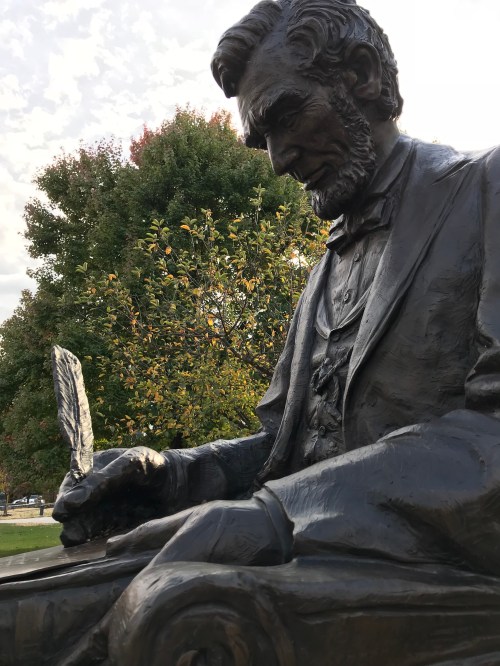
Abraham Lincoln noted:

“The best thing about the future is that it comes one day at a time.”

It is good to remember Lincoln’s words in times of turmoils. I do, and they bring me great motivation to work, believe, and fight for justice, truth, and the belief in a spark of goodness in humanity which enables me to believe the words of the Declaration of Independence:

“We hold these truths to be self-evident, that that all men are created equal, that they are endowed by their Creator with certain unalienable Rights, that among these are Life, Liberty and the pursuit of Happiness.”

The fact that those words come from a time of tumult, yet in a time where men were beginning to wrestle with and proclaim principles of the Enlightenment matters much to me, especially in times like we live today, where that principle is being attacked and undermined by the American President.

That being said, I believe that 2019 will be remembered in history as a time great turmoil, upheaval, and probably usher in a new epoch of war, economic, and ecological disaster. We may again be witnesses to genocide that leaders of governments fail to take the necessary actions to stop.

I don’t want to sound like a pessimist, but as a historian I to look at the world through how human beings, governments, and businesses behave in times of crisis. In fact, human beings are the singular constant in history and in crisis human beings don’t always live up to our ideals.

When major powers and international systems of order break down, or collapse for whatever reason, instability, disorder, and primordial hatreds based on nationalism, religion, and racism rise. A vacuum is created, filled by other powers, but not without some element of travail. Edmond Taylor wrote in his classic “The Fall of the Dynasties: The Collapse of the Order, 1905-1922:

“The collapse of the great supranational — or at least supraparochial — authorities and the dissolution of long-accepted Imperial bonds released upon Europe a fearsome flood of conflicting national ambitions, of inflamed minority particularisms, of historic (sometimes almost prehistoric) irredentisms, of irreconcilable social aspirations and of rival political fanaticisms.

The impending collapse of the old order today can be seen in a return to a more isolationist policy by the United States, rising populist, nationalist, and ethnocentric movements in Europe which are threatening the existence of the European Union. Those include Brexit, ethnic nationalism mixed with a bit of Fascism in Hungary, Italy, Poland, and great strains in France and Germany between right and left wing populist movements.

The common thread is the center which was the key to so much social progress, democracy, economic growth and stability, scientific advancement, and international security is giving way. There are many reasons for this, on the American side going back to the imperialist overreach of the George W. Bush administration, the inconsistent and detached method of the Obama administration towards the Middle East, especially Syria and Iraq, following that, and now the decidedly inconsistent, often irresponsible, and irreconcilable policies of isolationism and militarism.

A rejuvenated Russia is rushing to fill the void in the Middle East as well as working to destabilize its neighbors, Europe, and even the United States. The Chinese are attempting to make gains in other areas and to drive the United States out of Asia by using every element of national power: diplomacy, information, military might, and economics, while the United States following the Trump Administration’s withdraw from the Trans Pacific Partnership, and subsequent punishing tariffs that are hurting allies and Americans more than China the United States is now at a decided disadvantage in Asia.

I could go on, and could go into details on the causes of the current situation but they are many. What we are seeing now is the beginning of the collapse of an order that we have known most of our lives. While many people might be uneasy, most don’t view things in terms of history, in many cases because the events that led to the establishment of the current order are too distant and the witnesses to those times are few, and dying off. People today seldom study history, and even worse no longer know people, including family members who remember what happened to remind them of it.

That was quite similar to the situation in 1914. Europe had been at relative peace for a century. With the exception of the French Republic, most of Europe was still ruled by monarchies with rather limited democratic participation, if any. Barbara Tuchman wrote in her book The Proud Tower: A Portrait Of the World Before the War, 1890-1914:

“The proud tower built up through the great age of European civilization was an edifice of grandeur and passion, of riches and beauty and dark cellars. Its inhabitants lived, as compared to a later time, with more self-reliance, more confidence, more hope; greater magnificence, extravagance and elegance; more careless ease, more gaiety, more pleasure in each other’s company and conversation, more injustice and hypocrisy, more misery and want, more sentiment including false sentiment, less sufferance of mediocrity, more dignity in work, more delight in nature, more zest. The Old World had much that has since been lost, whatever may have been gained. Looking back on it from 1915, Emile Verhaeren, the Belgian Socialist poet, dedicated his pages, “With emotion, to the man I used to be.”

I believe that 2019 will the a year of multiple crises and the further erosion, if not collapse of the old order. What will come I do not know, but I expect that at the minimum it will be unsettling and disruptive, if not catastrophic. That doesn’t mean that I am a pessimist, it means that I study history. Provided that humanity does not find a way to destroy itself, we will recover. It may not be pretty and it certainly will not be the same as it was, but we will recover.

Walter Lord wrote about this his book on American in the early Twentieth Century The Good Years: 1900-1914. In the book he wrote about how things changed for Americans as Europe plunged into war. The effects of the war were soon felt in the United States though it would not enter the war until 1917. Lord wrote:

Economics were only part of the story. Almost overnight, Americans lost a happy, easygoing, confident way of looking at things. Gone was the bright lilt of “When You Wore a Tulip”; already it was the sadly nostalgic, “There’s a Long, Long Trail a-Winding,” or the grimly suggestive, “I Didn’t Raise My Boy to Be a Soldier.” A mounting crescendo of screaming headlines… atrocity stories… U-boat sinkings… charges and counter-charges shocked the nation, jarred its faith, left a residue of doubt and dismay.

Nothing seemed simple any more. Nothing was black and white. Nothing was “right” or “wrong,” the way Theodore Roosevelt used to describe things. And as the simple problems vanished, so did the simple solutions. Trust-busting, direct primaries, arbitration treaties and all the rest. They somehow lost their glamour as exciting panaceas, and nothing took their place. But the problems grew and grew —preparedness… taxes… war… Bolshevism… disillusionment… depression… Fascism… Moscow… fallout… space… more taxes.

So the old life slipped away, never to return again, and wise men sensed it almost at once. Men like Henry White, the immensely urbane diplomat who had served the country so well. “He instinctively felt,” according to his biographer Allan Nevins, “that his world —the world of constant travel, cosmopolitan intercourse, secure comfort and culture —would never be the same again.” The Philadelphia North American felt the same way, but in blunter words: “What does this mean but that our boasted civilization has broken down?”

Perhaps it was just as well. There was much that was wrong with this old way of living —its injustices, its naivete, its waste, its smug self-assurance. Men would come along to fix all that. New laws, controls, regulations, forms filled out in triplicate would keep anybody from getting too much or too little. And swarms of consultants, researchers, special assistants, and executive committees would make sure that great men always said and did the right thing.

There would be great gains. But after all the gains had been counted, it would turn out that something was also lost —a touch of optimism, confidence, exuberance, and hope. The spirit of an era can’t be blocked out and measured, but it is there nonetheless. And in these brief, buoyant years it was a spark that somehow gave extra promise to life. By the light of this spark, men and women saw themselves as heroes shaping the world, rather than victims struggling through it.

Actually, this was nothing unique. People had seen the spark before, would surely do so again. For it can never die as long as men breathe. But sometimes it burns low, leaving men uncertain in the shadows; other times it glows bright, catching the eye with breath-taking visions of the future.

The truth is, even in the midst of crises that the spark that enables people to believe, to hope, and to labor for a better future where the possibilities of peace, justice, freedom, and progress can be realized.

2019 will likely be a very difficult year, a year of change and turbulence, and truthfully it will probably be just the beginning; but unless finds a way to destroy itself, it will not be the end.

So, unless I get a hair up my ass to write something else before midnight, I wish you a Happy New Year, and all the best.

Peace,

Padre Steve+

1 Comment

Filed under ethics, faith, History, leadership, life, middle east, Military, national security, News and current events, Political Commentary, Religion

”For Hate is Strong and Mocks the Song Of Peace on Earth Goodwill to Men” Henry Wordsworth Longfellow and Christmas 2018


Friends of Padre Steve’s World,

I could be writing about the travails being inflicted on the country and the world by President Donald Trump, but I do enough of that. Christmas is coming and even when I don’t explicitly write about Teump, the message of the season stands against him and against all that he stands.

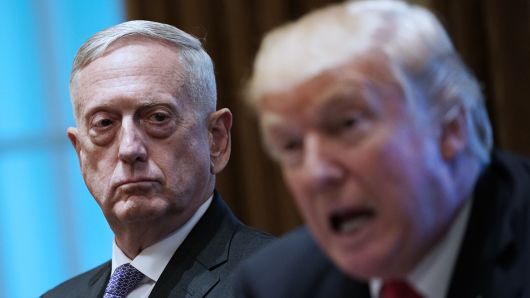
Looking at the news of the week; the resignation on principle by Secretary of Defense James Mattis, the abandonment of the Kurds in Syria to the Turks, Russia, as ISIS, the crashing stock markets, and the completely preventable partial government shutdown brought about President Trump and his most fanatical followers, it is easy to despair. Frankly, there are many times that I do, and Inhave to remember how people before us went through great trials and tribulations.

The great American poet Henry Wadsworth Longfellow penned these words of hope on Christmas Day, 1863:

“God is not dead, nor doth He sleep; The wrong shall fail, the right prevail With peace on earth, good will to men.”

Christmas is coming and I feel that Longfellow’s words are as pertinent today as when he first penned them. The thought of what is to come in the next few years, in the United States and in many other liberal democracies bodes ill for our future as authoritarian and often xenophobic leaders rise to power. The world that we grew up is is passing away, and what comes in its place, a dystopian world where hope will be a rare commodity beckons.

Longfellow’s words became the heart of the song I Heard the Bells on Christmas Day.  I have heard it a number of times in the past few days and each time it really touches me.

The song has been recorded in a number of versions by different artists over the years. However, the words of the song go back to the American Civil War. It began as a poem written by Henry Wadsworth Longfellow on Christmas Day 1863 following the serious wounding of his son Charles, a Lieutenant in the Union Army at the Battle of New Hope Church, and the death of his wife in a fire two years before. Longfellow had much to despair about, but he maintained a faith in God, as well as the founding principles of the United States.

His words are haunting. Probably because they demonstrate the profound tension that lies at the heart of the Incarnation, which is the heart of Christmas and the Christian faith. the tension, played out so well in the song is the existence of a message of peace and reconciliation in a world where war and hatred of many kinds rip human beings apart coupled with the tragic inability of Christendom, especially American Conservative Evangelicalism to even come close to the message of Christmas.

I heard the bells on Christmas day

Their old familiar carols play,

And wild and sweet the words repeat

Of peace on earth, good will to men.

I thought how, as the day had come,

The belfries of all Christendom

Had rolled along th’ unbroken song

Of peace on earth, good will to men.

gburg dead2

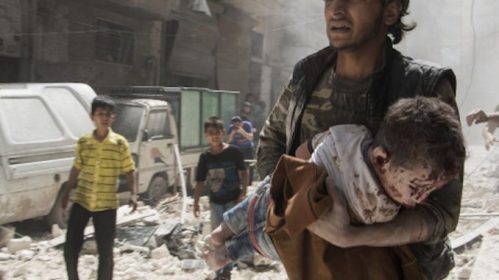
The reality of this is seen in the third verse. It is a verse that echoes throughout history and seems to be true even today, in fact it seems to be the most real as we deal with war, hatred, terrorism, killing in the name of God, and political fratricide.

And in despair I bowed my head

“There is no peace on earth,” I said,

“For hate is strong and mocks the song

Of peace on earth, good will to men.”

syria-war-holocaust-unicef-678x381

The interesting part about the songs as opposed to the poem is that they omit three of Longfellow’s verses that admittedly in a reunited country would not help record sales. Those verses speak to the heart of the Civil War.

Till ringing, singing on its way,
The world revolved from night to day,

A voice, a chime,

A chant sublime

Of peace on earth, good-will to men!

Then from each black, accursed mouth
The cannon thundered in the South,

And with the sound

The carols drowned

Of peace on earth, good-will to men!

It was as if an earthquake rent
The hearth-stones of a continent,

And made forlorn

The households born

Of peace on earth, good-will to men!

But Longfellow hears in the bells something more powerful. It is the message of Christmas and the incarnation. The message that justice and peace will finally embrace.

Then pealed the bells more loud and deep:

“God is not dead, nor doth He sleep;

The wrong shall fail, the right prevail

With peace on earth, good will to men.”

Till ringing, singing on its way

The world revolved from night to day,

A voice, a chime, a chant sublime

Of peace on earth, good will to men.

The song has been recorded many times by many artists. I like the version sung by Frank Sinatra, which the music was composed by Johnny Marks, composer of Rudolph the Red Nosed Reindeer. Another earlier version composed by John Baptiste Calkin has been recorded by Elvis Presley and Johnny Cash among others.


As wars rage in the Middle East, tensions rise in Asia, Africa and even Eastern Europe while the Unholy Trinity of Politicians, Pundits and Preachers, led by the American President rage as we go into another, and even more perilous year with the possibility of nuclear war more probably than not, people still look for hope.

Longfellow, who lost so much in a short time in the midst of a terrible Civil War, reminds us that in such times, “God is not dead, nor doth He sleep; The wrong shall fail, the right prevail With peace on earth, good will to men.”

In a time like this when the world led by the American President seems to be hurtling into the abyss, it is important to remember Longfellow’s words and the message of Christ and the Incarnation. The child born as an outcast in a manger would die as a criminal, crucified by an occupying power with the full support of the leaders of the occupied country. As the German theologian Jurgen Moltmann wrote:

“He humbles himself and takes upon himself the eternal death of the godless and the godforsaken, so that all the godless and the godforsaken can experience communion with him.” 

Yes, the wrong shall fail, and the right prevail, but it in the age of Trump it will certainly involve much travail. As for the travail, it is just beginning.

Until tomorrow,

Peace

Padre Steve+

3 Comments

Filed under christian life, civil war, faith, Foreign Policy, History, middle east, music, Political Commentary