Category Archives: Military

Back in the Fight

Friends of Padre Steve’s World,

So, it has been just over 50 hours since I returned from our trip to Germany and I am back in the game and ready to fight.

My travel overseas gave me time to clear my head and take stock of my life right now, personally and professionally. It was what I needed.

I have many challenges where I work. I won’t go into details here but they do not involve my staff. In 10 and 1/2 months I will be retired from the Navy after a combined 38 years of enlisted and officer service, active and reserve in the Army, Army Reserve, Army National Guard, and the Navy.

That being said for the past year I have been depressed about work, so much so that I hated to get up in the morning to go there. The work I did to support the congregations of my chapels despite lack of funding, loss of personnel, and other factors that I cannot go into now made things almost unbearable had it not been for the support of my staff. I can only be thankful for them.

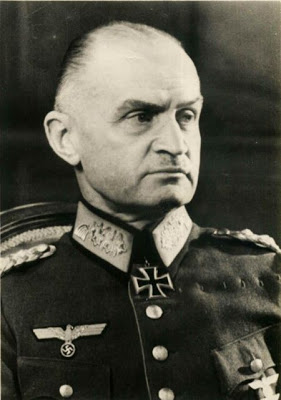
Likewise, I came to realize again that actions mean more than words in many if not most aspects of life. Standing at the graves of Sophie and Hans Scholl, the site where Clause Con Stauffenberg, General Ludwig Beck and others were executed, and were Martin Luther nailed his 95 Thesis’s to the door of the Schlosskirche in Wittenberg gave me new life to fight for what I believe in.

Anyway, I will write more about this tomorrow.

Until then,

Peace,

Padre Steve+

Leave a comment

Filed under christian life, faith, History, holocaust, Military, Political Commentary

Back in the USA

Friends of Padre Steve’s World,

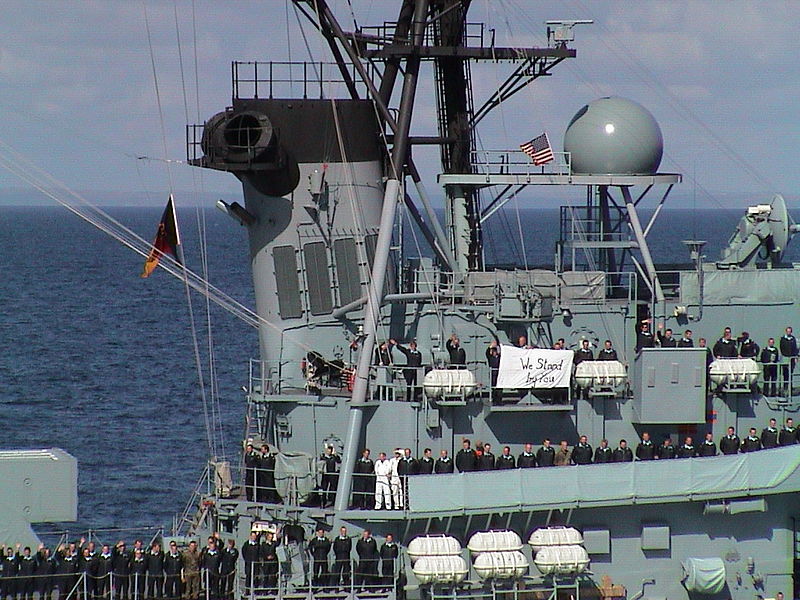
After 18 days of traveling in Germany and the Alsace Region of Eastern France we returned to the United States today.

We have a very good time visiting friends, seeing many historical sites, and getting a chance to clear our heads and refresh ourselves as we go into what promises to be a very busy and stressful time as I go back to work while preparing to retire from the Navy next year. For me that will include managing a religious program while losing most of my enlisted support staff without replacements. That will make things difficult and hard choices may have to be made in terms of what we can support. In such a situation I have to keep my head in the game in order not to let people who depend on my leadership down.

I will also be doing all of the things that have to be done in order to retire, the biggest of which are the medical requirements, making sure that everything is ready for my assessment regarding my VA disability rating which should be pretty high, my GI Bill education benefits, and the beginning of a job search that enables me to make up any difference between what I make on active duty and my retirement/disability income.

In addition within the next couple of months Judy should be having the first of two knee replacement surgeries even as we try to finish up the work we have been doing in our house which we will have to squeeze into whatever time we have.

Over the next week or so I am going to publish articles about our trip and that I haven’t had time to do just yet, some are even in draft form already.

By the way, I have to shave the beard off Wednesday morning before I go to work, but this will be my post retirement look and I will have more time than 18 days to grow it out. Fear the beard.

So until tomorrow,

Peace,

Padre Steve+

Leave a comment

Filed under Loose thoughts and musings, Military, Travel

Mobilizing the Armies of the Civil War: Regulars, Volunteers, and Conscripts

Friends of Padre Steve’s World

I am pre-posting this article because we will be traveling to Germany today. If I get a chance I will post one of a number of articles I have been working on or thinking about over the past few days.

This is another part of my Civil War and Gettysburg text on the formation of the armies that fought the Civil War. 

When one thinks of our all-volunteer force today it is hard to imagine forming armies of this size and scope around such small regular forces. The story of how North and South raised their armies, and the stories of the volunteers of the first part of the war is amazing. I hope that you enjoy.

Peace

Padre Steve+

MenBrooklyn


The Secession Crisis, Mobilization, and Volunteer Armies

The American Civil War was the first American war fought by massed armies of mobilized citizens. All previous wars had been fought by small numbers of Regular Army troops supported by various numbers of mobilized State Militia formations or volunteer formations raised for the particular war; “The fighting force of the 1860s was a conglomerate of diverse units, each with its own degree of importance, pride, proficiency, and jealousy. Whether of North or South, an army began as little more than a loosely organized mob actuated by more enthusiasm than by experience. Its composition ran the full gauntlet of humankind.” [1]

In 1860 the Regular Army numbered 16,000 troops at the beginning of the war. These included some 1105 officers, and were organized into “ten regiments of infantry, four of artillery, and five of cavalry (including dragoons and mounted riflemen)” [2] These regiments were broken up into small units and they and their soldiers were scattered about in far flung isolated posts around the country and in the new western territories. The units primarily fought Indians and performed what best could be described as constabulary duties. Others, mostly from artillery units manned the coastal defense fortifications that protected American’s key ports and entrances to key waterways along the eastern seaboard. Even so, after the War with Mexico “three quarters army’s artillery had been scrapped” and most of the army’s artillerymen and their units were “made to serve as infantry or cavalry, thus destroying almost completely their efficacy as artillery.” [3]

The secession crisis and the outbreak of the war fractured the army, particularly the officer corps. The officer corps was heavily Southern and many Northern officers had some sympathy with their Southern brothers in arms. It has to be said that of the men holding positions of high command from 1849 to 1861 that many were Southerners:

“all of the secretaries of war were Southerners, as were the general in chief, two of the three brigadier generals, all but one of the army’s geographical departments on the eve of the Civil War, the authors of the two manuals on infantry tactics, and the artillery manual used at West Point, and the professor who taught tactics and strategy at the military academy.” [4]

Most of the Army remained loyal to the Union, “except for 313 officers who resigned their commissions.” [5] Those who remained loyal to the Union included the General in Chief, Winfield Scott, as well as the professor who had taught so many of those now leaving to serve the Confederacy, Dennis Hart Mahan. However, of the others brigadier generals William Harney, David Twiggs and Joseph E. Johnston, Brevet Brigadier General Albert Sidney Johnston, and the army’s Adjutant General, Colonel Samuel Cooper, and the newly promoted Colonel Robert E. Lee all went south. “Even so, 40 to 50 per cent of the Southern West Point graduates on active duty in 1860 held to their posts and remained loyal to the Union.” [6]

A Political Backlash against West Point and the Officer Corps

The exodus of these officers created a backlash against West Point and the professional officers who remained in service of the Union, especially those who were Democrats and to radical Republicans were soft on slavery. Some Republican members of Congress including Senator Ben Wade of Ohio, “figured that political apostasy had been taught at West Point as well, and he didn’t know which sin was worse – it or treason.” [7]The fact that the leaders of the Union forces defeated at Bull run were West Point graduates added incompetence to the list of the crimes, real and imagined committed by the officers of the Regular Army. When Congress reconvened in 1861 Wade said:

I cannot help thinking…that there is something wrong with this whole institution. I do not believe that in the history of the world you can find so many men who have proved themselves utterly faithless to their oaths, ungrateful to the Government that supported them, guilty of treason and a deliberate intention to overthrow that Government which educated them and given them support, as have emanated from this institution…I believe from the idleness of these military educated gentlemen this great treason was hatched.” [8]

Wade did not mention in his blanket his condemnation of the “traitors” that many “West Pointers from the Southern States – 162 of them – had withstood the pull of birth and kin to remain with the Union.” [9]

Wade’s fellow radical Senator Zachariah Chandler of Michigan urged Congress to dissolve the Military Academy. The academy, he said “has produced more traitors within the last fifty years than all the institutions of learning and education that have existed since Judas Iscariot’s time.” [10] Despite the words and accusations of the radical fire-eaters like Wade and Chandler and other like them, more level headed men prevailed and reminded the nation that there had been many other traitors. Senator James Nesmith of Oregon said: “Treason was hatched and incubated at these very decks around me.” [11]

Politicians and Professionals: Building Volunteer Armies

20110930-poster.png_

Many of the officers who left the army to serve the Confederacy were among the Army’s best and brightest, and many of them later rose to prominence and fame in their service to the Confederacy. In contrast to the officers who remained loyal to the Union, those that many in Congress despised and “pushed aside and passed over” in favor of “officers called back into service or directly appointed from civil life, the “South welcomed its professionals and capitalized on their talents. Sixty-four per cent of the Regular Army officers who went South became generals; less than 30 per cent of those who stayed with the Union achieved that rank.” [12]

The Union had a small Regular Army, which did undergo a significant expansion during the war, and the Confederacy did not even have that. During the war the “Confederacy established a regular army that attained an authorized strength of 15,000” [13] but few men ever enlisted in it. This was in large part due to the same distrust of the central government in Richmond that had been exhibited to Washington before the war.

Thus both sides fell back on the British tradition of calling up volunteers. The British had “invented volunteer system during the Napoleonic Wars, also to save themselves from the expense of permanent expansions of their army, and the United States had taken over the example in the Mexican War…” [14] The volunteer system was different from the militias which were completely under the control of their State and only given to the service of the national government for very limited amounts of time. The volunteers were makeshift organizations operating in a place somewhere between the Regular Army and the State militias and like the British system they saved “Congress the expense of permanently commissioning officers and mustering men into a dramatically expanded Federal service.”[15] As such the volunteer regiments that were raised by the States “were recruited by the states, marched under state-appointed officers carrying their state flag as well as the Stars and Stripes.” [16]

President Lincoln’s call for volunteers appealed “to all loyal citizens to favor, facilitate and aid this effort to maintain the honor, the integrity, and the existence of our Northern Union, and the perpetuity of the popular government; and to redress the wrongs already long enough endured.” [17] The Boston Herald proclaimed “In order to preserve this glorious heritage, vouchsafed to us by the fathers of the Republic, it is essential that every man perform his whole duty in a crisis like the present.” [18] The legislature of the State of Mississippi sated its arguments a bit differently and asserted, “Our position is thoroughly identified with the institution of slavery – the greatest material interest in the world.” Texas explained that it had joined the Union “as a commonwealth holding, maintaining and protecting the institution known as negro slavery – the servitude of the African to the white race within her limits.” [19] A newspaper correspondent wrote:

“All, all of every name and every age to arms! To arms! My father go, my son go, my brother go, your country calls you.” He called out to Southern women as well, “mothers, wives and daughters buckle on the armor of loved ones, the correspondent urged, “bid them with Roman fairness, advance and never return until victory perches on their banner.” [20]

Those who went off to war left their homes and families. Young Rhode Island volunteer Robert Hunt Rhodes wrote that is mother told him “in the spirit worth of a Spartan mother of old said: “My son, other mothers must make sacrifices and why should not I?” [21] The bulk of the soldiers that enlisted on both sides in 1861 were single their median age “was twenty-four. Only one in seven enlistees that first year was eighteen or younger, and fewer than a third were twenty-one or younger.” [22]

Illustrious regiments such as the 1st Minnesota Volunteers, the 20th Maine Volunteers, the 69th New York Volunteer Infantry, and the African American 54thMassachusetts Volunteer Infantry were just a few of the many regiments mustered into Union service under this system. As the war went on and the initial regiments were decimated by losses in combat and to disease, Northern governors “preferred to organize new regiments rather than to replenish old ones whittled down by battle and sickness. Fresh units swelled a state’s contributions, and the provided governors an opportunity to win more political favors by appointing more regimental officers.” [23] This practice produced “an army of shadow units” as “it was up to the regimental commanding officer to keep up a supply of new enlistments from back home for his own regiment, but most commanders could ill afford to detail their precious supply of junior officers for recruiting duty behind the lines.” [24]

Even before secession many Southern states began to prepare for war by building up their militias, both in numbers as well as by sending agents to arms suppliers in the North, as was done by Georgia Governor Joseph E. Brown who “sent an official north to purchase arms, ammunition and accouterments.” [25] After the bombardment of Fort Sumter both sides raced to build up their militaries. Jefferson Davis, the new President of the Confederacy who was a West Point graduate and former Secretary of War called for volunteers. On March 6th 1861 the new Provisional Confederate Congress in Montgomery authorized Davis to “call out the militia for six months and to accept 100,000 twelve-month volunteers.” [26] Within weeks they had passed additional legislation allowing for the calling up of volunteers for six months, twelve months and long-term volunteers up to any length of time. “Virginia’s troops were mustered en masse on July 1, 1861, by which time the state had 41,885 volunteers on its payroll.” [27]

poster

With the legislation in hand Davis rapidly called up over 60,000 troops to the Confederate Cause, and this was before Virginia and North Carolina seceded from the Union. A mixture of former Regular Army officers commanded these men, most of whom occupied the senior leadership positions in the army, volunteer officers, made up the bulk of the Confederate officer corps. “Well over 700 former students at Virginia Military Institute served as officers in the war, most in the Virginia Theater….” [28]Among these men was Robert Rodes who became one of Robert E. Lee’s finest division commanders.

In the North Abraham Lincoln was in a quandary. Congress was out of session, so relying on the Militia Act of 1795 called out 75,000 three-month militiamen to support the Union cause. The legislatures of the Northern States so well that the over-recruited and in this first call up the government “accepted 9,816 men, but governors clamored for the War Department to take still more troops.” [29] Dan Sickles, a rather infamous Democrat politician was one of these men. Sickles had been a Democratic Congressman representing the district of New York City that was in the control of Tammany Hall. In 1859 Sickles stood trial for the murder of Barton Key, the District Attorney for Washington D.C. and the nephew of Francis Scott Key. Key had been conducting an affair with Sickles’ young wife Maria and in a fit of anger Sickles confronted Key, who had been spotted attempting a liaison with Maria and shot him dead near Lafayette Square and the White House. Sickles was acquitted on the basis of temporary insanity becoming the first man in the United States to have that distinction.

The ambitious Sickles, “almost overnight, using flag-waving oratory, organizational skills, and promissory notes, had his regiment, the 70th New York Volunteers, well in hand.” [30] Not content with a regiment and knowing that a brigade would bring him his star as a brigadier general, he quickly the Excelsior Brigade in New York.

Daniel_Edgar_Sickles

Major General Dan Sickles

Within weeks Sickles had raised over 3000 men, a full forty companies and the New York Newspapers praised Sickles’ efforts. But partisan politics was at play. To Governor Edward Morgan, the fact that a Tammany Hall Democrat “was getting too far out ahead in the state’s race to supply manpower to the endangered Union” [31] was embarrassing and the Governor ordered Sickles to “disband all but eight of his forty companies.” [32] The incredulous, yet ambitious Sickles, knowing that Lincoln needed Democratic support to prosecute the war, traveled to Washington where after seeking an audience with the President. Lincoln was hesitant to infringe on any governor’s control of state units, but he was loath to lose the services of any soldiers. Lincoln discussed the matter with Secretary of War Simon Cameron and they ordered that Sickles “keep his men together until they could be inducted by United States officers.” [33] That process took two moths but in July Sickles was able to have the brigade sworn into service as a brigade of United States Volunteers.

For Sickles and most officers, volunteer and regular alike a regiment was a large military formation Likewise, a brigade massive and for most of these men divisions and corps on the scale of those found in Europe were almost unthinkable, but war was changing and this would be the scope of the coming war.

More troops were needed and with Congress out of session, President Lincoln acted “without legal authority…and increased the Regular Army by 22,714 men and the Navy by 18,000 and called for 42,034 three-year volunteers.” [34] On July 4th 1861 Lincoln “asked sanction for his extralegal action and for authority to raise at least another 400,000 three-year volunteers.” [35] Congress approved both of the President’s requests, retroactively, and in fact, “greatly expanded the numbers of volunteer recruitments, up to a million men – nothing more than the 1795 statute authorized either of these follow-up calls, and Lincoln would later have to justify his actions on the admittedly rather vague basis of the “war powers of the government.” [36]

In the North “the war department was staggered by the task of finding competent officers for an already numbering nearly half a million.” [37] There were so few professional officers available to either side that vast numbers of volunteer officers of often dubious character and ability were appointed to command the large number of volunteer regiments and brigades which were being rapidly mustered into service. Within months of the secession crisis the Regular Army of the United States, minus the officers who resigned to serve the Confederacy, “was swamped by a Union war army that reached about 500,000 within four months of the firing on Fort Sumter.” [38]

The Regular Army officers who remained loyal to the Union as well as those who left the army and joined the newly formed Confederacy were joined by a host of volunteer officers. Some of these officers, men like Ulysses Grant, William Tecumseh Sherman, George McClellan, Braxton Bragg, Thomas “Stonewall” Jackson, Jubal Early, and many others had left the army for any number of reasons only to return to the colors of the Union or the Confederacy during the secession crisis or at the outbreak of the war. Some of these men like George Sears Greene and Isaac Trimble Many were West Point graduates who had left the army decades before the war and almost to a man “nearly all of them displayed an old regular’s distrust of any general who had risen by political means.” [39] The hold of West Point and the teachings of Dennis Hart Mahan regarding professionalism had left a lasting imprint on these men.

2nd michigan

Another issue faced by all of the officers now commanding large formations in the Civil War was their inexperience in dealing with such large numbers of troops. When the war began, the officers educated at West Point, as well as others who had been directly appointed had previously only commanded small units. Even regimental commanders such as Joseph Johnston, Albert Sidney Johnston, and Robert E. Lee seldom had more than a few companies of their regiments with them at any given time for any given operation. Likewise, the men who had campaigned and fought in Mexico who had some experience in handling larger formations had for the most part left the service. The senior officers who had served in Mexico and that remained on active duty were handicapped because the Mexican war was still very much a limited Napoleonic War fought with Napoleonic era weapons against a more numerous but poorly equipped and trained enemy.

Other volunteer officers had little or no military experience or training and owed their appointments as officers to their political connections, business acumen or their ability to raise troops. It was not atypical for a volunteer officer to gain his rank and appointment based on the number of that he brought into the army, “if he recruited a regiment he became a colonel, while if he brought in a brigade he was rewarded with the shining star of a brigadier general.” [40] This led to a type of general “appointed for their political influence or – at least in the North with its more heterogeneous population – their leadership of ethnic groups.” [41] Despite the dangers of their inexperience, both Abraham Lincoln and Jefferson Davis had to appoint such men in order to maintain political support for the war.

Some of these men proved disastrous as commanders and their ineptness cost many lives. Henry Wager Halleck, wrote “It seems but little better than murder to give important commands to such men as Banks, Butler, McClernand, Sigel, and Lew Wallace…yet it seems impossible to prevent it.” [42] That being said some of the volunteer politically appointed generals proved to be exceptional learners of the art of war and impressive commanders in the own right.

Among the officers appointed for political considerations by Abraham Lincoln were the prominent Democratic politicians “Benjamin F. Butler, Daniel E. Sickles, John A. McClernand, John A. Logan.” [43] Among those commissioned to enlist immigrant support were Major General Carl Schurz and Brigadier General Alexander Schimmelpfennig who helped mobilize German immigrants to the Union cause. Both men were refugees from the failed revolution of 1848. Likewise, Brigadier General Thomas Francis Meagher, a survivor of the 1848 revolt in Ireland, who had escaped imprisonment in Australia helped to recruit and then commanded the famous Irish Brigade, whose regiments of Irish immigrants marched under the colors of the United States and the Green flag with the Harp of Erin.

corby

The Irish and the German soldiers volunteered in large part because they saw the Union as the hope of their people that had given them refuge from tyranny in Europe. The Irish, under the religious, political and economic thumb of Britain fled to the United States, many the victims of famine. The Irish were not sympathetic as a whole to the plight of slave and many sympathized with the South, their desire to save the Union was greater and they volunteered in overwhelming numbers. One Irish Sergeant wrote his family in Ireland who did not understand why he fought for the Union:

“Destroy this republic and her hopes are blasted If Irland is ever ever [sic] free the means to accomplish it must come from the shore of America…When we are fighting for America we are fighting for the intrest of Irland striking a double blow cutting with a two edged sword For while we strike in defense of the rights of Irishmen here we are striking a blow at Irlands enemy and oppressor England hates this country because of its growing power and greatness She hates it for its republican liberty and she hates it because Irishmen have a home and government here and a voice in the counsels of the nation that is growing stronger every day which bodes no good for her.” [44]

Thus for many Irishmen fighting for the Union had a twofold purpose, seeing the war as Americans as well as Irishmen, they were fighting for Ireland as much as they were fighting for the Union. Some too believed that the war would be a training ground for Irishmen who would someday return home to drive the English from their homeland. Thomas Meagher the commander of the Irish Brigade explained,

“It is a moral certainty that many of our countrymen who enlist in this struggle for the maintenance of the Union will fall in the contest. But, even so; I hold that if only one in ten of us come back when this war is over, the military experience gained by that one will be of more service in the fight for Ireland’s freedom than would that of the entire ten as they are now.” [45]

Many Germans and others were driven from their homeland in the wake of the failed revolutions of 1848. Having been long under autocratic and oligarchic rule in the old country many of the German, Polish and other volunteers who fled after the failed revolutions of 1848 “felt that not only was the safety of the great Republic, the home of their exiled race, at stake, but also the great principle of democracy were at issue with the aristocratic doctrines of monarchism. Should the latter prevail, there was no longer any hope for the struggling nationalities of the Old World.”[46] These immigrant soldiers saw the preservation of the Union in a profoundly universal way, as the last hope of the oppressed everywhere. Eventually the Germans became “the most numerous foreign nationality in the Union armies. Some 200,000 of them wore the blue. The 9th Wisconsin was an all-German regiment. The 46th New York was one of ten Empire State units almost totally German in makeup.” [47]

In the North a parallel system “composed of three kinds of military organizations” developed as calls for “militia, volunteers and an expanded regular army” went out. [48] A number of regular army officers were allowed to command State regiments or brigades formed of State units, but this was the exception rather than the rule. One of these men was John Gibbon who commanded the legendary Iron Brigade at the beginning of its existence through its first year of combat.

In the South too men without little or no military training and experience raised companies and regiments for the Confederate cause. Like Lincoln Jefferson Davis had to satisfy political faction as well as some prominent politicians aspirations for military glory. Thus Davis “named such men as Robert A. Toombs of Georgia and John B. Floyd and Henry A. Wise of Virginia as generals.” [49] These men were not alone; many more politicians would receive appointments from Davis and the Confederate Congress.

Some of these men were gifted in recruiting but were sadly deficient as commanders. Men like John Brockenbrough and Edward O’Neal were capable of raising troops but in combat proved to be so inept that they got their men slaughtered and were removed from the army of Northern Virginia by Robert E. Lee. But others including South Carolina’s Wade Hampton, Georgia’s John Gordon and Virginia’s William “Little Billy” Mahone, none of who had any appreciable military experience proved to be among the best division commanders in Lee’s army. By 1864 Gordon was serving as an acting Corps commander and Hampton had succeeded the legendary J.E.B. Stuart as commander of the Cavalry Corps of the Army of Northern Virginia.

Lower ranking officers in the regiments formed by the states on both sides of the Mason-Dixon Line, were most often elected by their units. During the war, some of these lower ranking officers rapidly progressed up the ranks and rose to command regiments and brigades, mostly due to their natural leadership abilities. That being said the volunteer system in which units elected their officers often to be fraught with problems. “Officers who might be popular as good fellows but who knew neither how to give orders and to get them obeyed nor even what kind of orders to give….At his worst, the volunteer officer could be as fully ignorant and irresponsible as the men he was supposed to command.” [50] Such officers proved to be a source of repeated concern for the professional officers who served alongside them.

John Reynolds, fresh from his assignment as Commandant of Cadets at West Point noted of the Pennsylvania volunteers that he commanded, “They do not any of them, officers or men, seem to have the least idea of the solemn duty they have imposed on themselves in becoming soldiers. Soldiers they are not in any sense of the word.” [51] In time both the Federal and Confederate armies instituted systems of qualifying exams for commissioned officers in order to weed out the worst of the incompetent officers.

Given the limitations of the volunteer officers who made up the bulk of the men commanding companies, battalions and regiments, “for the average soldier was that drill became his training for the realities of actual battlefield fighting.” This was helpful in getting “large and unwieldy bodies of men to the battlefield itself, but it generally turned out to be useless one the shooting started, especially as units lost cohesion and started to take casualties.” [52] This was much in evidence on the first day of the Battle of Gettysburg when Brigadier General Joseph Davis’s untested brigade got caught in the Railroad Cut and was decimated by Union troops.

These men, the regulars and the volunteers, were now faced with the task of organizing, training and employing large armies made up primarily of militia units and volunteers. Most had little experience commanding such units and their experience with militia and volunteer formations during the Mexican War did not increase the appreciation of Regulars for them or for their leaders. J.F.C Fuller noted that at the beginning of the war “the Federal soldier was semiregular and the Confederate semiguerilla. The one strove after discipline, the other unleashed initiative. In battle the Confederate fought like a berserker, but out of battle he ceased to be a soldier.”[53] Both required certain kinds of leadership and Regular officers serving in both the Union and Confederate armies “embedded with the volunteers to give them some professional stiffening privately regarded them as uncontrollable adolescents who kicked off every back-home restraint the moment they were on campaign.” [54] Over the course of time this did change as the units of both armies learned to be professional soldiers.

At the beginning of the war General George McClellan successful fought the break-up of the Regular United States Army, “which some argued should be split up to train volunteer brigades” [55] as had his predecessor General Winfield Scott. He and Scott helped keep it separate from the militia units organized by the States, “keeping it intact as the nucleus of an expandable army.” [56] This preserved a professional core in a time where the new volunteer units were learning their craft, but McClellan did approve of a measure to have regular officers command some of the new volunteer brigades.

Regular Army units were formed for the duration of the war and were exclusively under the control of the Federal government. While comparatively few in number, they often held the line and kept the Army of the Potomac intact during some early battles where volunteer units collapsed. Volunteer regiments, often officered by regulars or former regulars “remained state-based, and they signed up for two- or three- year periods, after which they returned to civilian life and their evaporated without any further fiscal obligations.” [57] Some of the volunteer regiments were formed from various state militia units, but since few states had effective militia systems, militia units “were usually employed only on emergency rear-echelon duties, to free up the volunteers and regulars.” [58]

railroad_cut

The Confederacy faced a similar situation to the Union, but it did not have a Regular Army and all of its units were raised by the various states. “In early 1861 the Confederate Congress authorized the creation of a provisional army of 100,000 men. To get these troops [the first Confederate Secretary of War Leroy Pope] Walker asked state governors to raise regiments and transfer them to the national army. The War Office provided generals and staff officers and, in theory at least, could employ the troops and their officers in any way it pleased once they mustered the provisional army.” [59] Some states were quite cooperative but others were not and the tension between the central government in Richmond in regard to military policy and some states would continue throughout the war. The quality of these units varied widely, mostly based on the leadership provided by their officers. That being said, many of the regiments mustered into service early in the war proved tough and resilient serving with distinction throughout the war.

Like the Federal forces, Southern units were officered by a collection of professionals from the ante-bellum Army, militia officers, political appointees or anyone with enough money to raise a unit. However command of divisional sized units and above was nearly always reserved to former professional soldiers from the old Army, most being graduates of West Point. At Gettysburg only one officer commanding a division or above in the Army of Northern Virginia was a non-academy graduate. This was the young and dashing Robert Rodes, who was a graduate of VMI. The quality of these officers varied greatly, as some of the old regulars failed miserably in combat and some of the volunteers such as John Gordon were remarkably successful as leaders of troops in combat.

As in the North, Southern militia and home guard units remained to free up the volunteer regiments and brigades fighting with the field armies. However, due to the South was always wrestling with the intense independence of every state government, each of which often held back units from service with the field armies in order to ensure their own states’ defense.

The withholding of troops and manpower by the states hindered Confederate war efforts, even though “the draft had been “eminently successful” in Virginia, North Carolina and South Carolina, but less so in Georgia, Mississippi, Alabama and Florida.” [60] In the latter states, especially Georgia some Confederate Governors used militia appointments to protect men from the draft, classifying them as key civil servants in defiance of the needs of Richmond and the field armies for troops to fight the war.

The Changing Character of the Armies and SocietyFrom All-Volunteer to Conscription: The Beginning of the Draft

Gettysburg was the last battle where the original volunteer armies predominated as the nature of both armies was changed by the war. Initially both sides sought to fight the war with volunteers but the increasingly costly battles which consumed vast numbers of men necessitated conscription and the creation of draft laws and bureaus.

The in April 1862 Confederate Congress passed the Conscription Act of 1862 which stated that “all persons residing in the Confederate States, between the ages of 18 and 35 years, and rightfully subject to military duty, shall be held to be in the military service of the Confederate States, and that a plain and simple method be adopted for their prompt enrollment and organization.” [61] The act was highly controversial, often resisted and the Confederate Congress issued a large number of class exemptions. Despite the exemptions “many Southerners resisted the draft or assisted evasion by others” [62] The main purpose of the conscription act was “to stimulate volunteering rather than by its actual use” [63] and while it did help increase the number of soldiers in Confederate service by the end of 1862 it was decidedly unpopular among soldiers, chafing at an exemption for “owners or overseers of twenty or more slaves” [64] who referred to the war as a “rich man’s war but a poor man’s fight.” [65]

Some governors who espoused state’s rights viewpoints “utilized their state forces to challenge Richmond’s centralized authority, hindering efficient manpower mobilization.” [66] Some, most notably Georgia’s governor Joseph Brown “denounced the draft as “a most dangerous usurpation by Congress of the rights of the States…at war with all principles for which Georgia entered the revolution.” [67] Governor Brown and a number of other governors, including Zebulon Vance of North Carolina fought the law in the courts but when overruled resisted it through the many exemption loopholes, especially that which they could grant to civil servants.

In Georgia, Governor Brown “insisted that militia officers were included in this category, and proceeded to appoint hundreds of new officers.” [68] Due to the problems with the Conscription Act of 1862 and the abuses by the governors, Jefferson Davis lobbied Congress to pass the Conscription Act of 1864. This act was designed to correct problems related to exemptions and “severely limited the number of draft exemption categories and expanded military age limits from eighteen to forty-five and seventeen to fifty. The most significant feature of the new act, however, was the vast prerogatives it gave to the President and War Department to control the South’s labor pool.” [69] Despite these problems the Confederacy eventually “mobilized 75 to 80 percent of its available draft age military population.” [70]

The Congress of the United States authorized conscription in 1863 as the Union Army had reached an impasse as in terms of the vast number of men motivated to serve “for patriotic reasons or peer group pressure were already in the army” while “War weariness and the grim realities of army life discouraged further volunteering” and “the booming war economy had shrunk the number of unemployed men to the vanishing point.”[71] Like the Confederate legislation it was also tremendously unpopular and ridden with exemptions and abuses. The Federal draft was conducted by lottery in each congressional district with each district being assigned a quota to meet by the War Department. Under one third of the men drafted actually were inducted into the army, “more than one-fifth (161,000 of 776,000) “failed to report” and about 300,000 “were exempted for physical or mental disability or because they convinced the inducting officer that they were the sole means of support for a widow, an orphan sibling, a motherless child, or an indigent parent.” [72]

There was also a provision in the Federal draft law that allowed well off men to purchase a substitute who they would pay other men to take their place. Some 26,000 men paid for this privilege, including future President Grover Cleveland. Another “50,000 Northerners escaped service by another provision in the Enrollment Act known as “commutation,” which allowed draftees to bay $300 as an exemption fee to escape the draft.” [73]Many people found the notion that the rich could buy their way out of war found the provision repulsive to the point that violence ensued in a number of large cities.

The Union draft law provoked great resentment, not because people were unwilling to serve, but from the way that it was administered, for it “brought the naked power of military government into play on the home front and went much against the national grain.” [74] Open clashes and violence erupted in several cities and President Lincoln was forced to use Union Soldiers, recently victorious at Gettysburg to end the rioting and violence taking place in New York where protestors involved in a three day riot, many of whom were Irish immigrants urged on by Democratic Tammany Hall politicians, “soon degenerated into violence for its own sake” [75] wrecking the draft office, seizing the Second Avenue armory, attacking police and soldiers on the streets. Soon “the mob had undisputed control of the city.” [76]These rioters also took out their anger on blacks, and during their rampage the rioters “had lynched black people and burned the Colored Orphan Asylum.” [77] The newly arrived veteran Union troops quickly and violently put down the insurrection and “poured volleys into the ranks of protestors with the same deadly effect they had produced against the rebels at Gettysburg two weeks earlier.” [78] Republican newspapers which supported abolition and emancipation were quick to point out the moral of the riots; “that black men who fought for the Union deserved more respect than white men who fought against it.” [79]

Notes

[1] Ibid. Robertson Soldiers Blue and Gray p.19

[2] Ibid. Guelzo Fateful Lighteningp.141

[3] Ibid. Guelzo Fateful Lightening p.141

[4] McPherson, James M. Drawn With the Sword: Reflections on the American Civil War Oxford University Press, Oxford and New York 1996 pp.17-18

[5] Ibid. Weigley, American Strategy from Its Beginnings through the First World War in Makers of Modern Strategy, from Machiavelli to the Nuclear Agep.419

[6] Ibid. Huntington The Soldier and the State p.213

[7] Ibid Waugh The Class of 1846, p. 513

[8] Ibid Waugh The Class of 1846, pp. 512-513

[9] Ibid Waugh The Class of 1846, p. 513

[10] Ibid Waugh The Class of 1846, p. 513

[11] Ibid Waugh The Class of 1846, p. 513

[12] Ibid. Huntington The Soldier and the State p.213

[13] Millet, Allan R. and Maslowski, Peter For the Common Defense: A Military History of the United States of America, revised and expanded edition The Free Press, New York 1994 p.175

[14] Ibid. Guelzo Fateful Lightening p.143

[15] Ibid. Guelzo Fateful Lightening p.143

[16] Ibid. Guelzo Fateful Lightening p.142

[17] Moe, Richard The Last Full Measure: The Life and Death of the 1stMinnesota Volunteers Minnesota Historical Society Press, St Paul MN 1993 p.13

[18] Ibid. Robertson Soldiers Blue and Gray p.6

[19] Glatthaar, Joseph T. General Lee’s Army from Victory to Collapse The Free Press, Simon and Schuster, New York and London 2008 p.15

[20] McCurry, Stephanie Confederate Reckoning: Power and Politics in the Civil War South Harvard University Press, Cambridge and London 2010 pp. 82-83

[21] Rhodes, Robert Hunt ed. All for the Union: The Civil War Diaries and Letters of Elisha Hunt Rhodes, Vintage Civil War Library, Vintage Books a Division of Random House, New York 1985 p.4

[22] Ibid. Glatthaar General Lee’s Army from Victory to Collapse p.18

[23] Ibid. Robertson Soldiers Blue and Gray p.24

[24] Ibid. Guelzo Fateful Lightening p.263

[25] Ibid. Glatthaar General Lee’s Army from Victory to Collapse p.15

[26] Ibid. Millet and Maslowski For the Common Defensep.165

[27] Sheehan-Dean, Aaron Confederate Enlistment in Civil War Virginia in Major Problems in the Civil War and Reconstruction, Third Edition edited by Michael Perman and Amy Murrell Taylor Wadsworth Cengage Learning Boston MA 2011 p.189

[28] Ibid. Glatthaar General Lee’s Army from Victory to Collapse p.26

[29] Ibid. Millet and Maslowski For the Common Defensep.165

[30] Sears, Stephen W. Controversies and Commanders Mariner Books, Houghton-Mifflin Company, Boston and New York 1999 p.201

[31] Ibid. Sears Controversies and Commanders p.201

[32] Swanberg, W.A. Sickles the Incredible copyright by the author 1958 and 1984 Stan Clark Military Books, Gettysburg PA 1991 p.117

[33] Keneally, Thomas American Scoundrel: The Life of the Notorious Civil War General Dan Sickles Anchor Books a Division of Random House 2003 p.222

[34] Ibid. Millet and Maslowski For the Common Defensep.165

[35] Ibid. Millet and Maslowski For the Common Defensep.165

[36] Ibid. Guelzo Fateful Lightening p.142

[37] Nichols, Edward J. Toward Gettysburg: A Biography of John Fulton Reynolds Pennsylvania State University Press, Philadelphia 1958. Reprinted by Old Soldier Books, Gaithersburg MD 1987 p.78

[38] Ibid. Weigley, American Strategy from Its Beginnings through the First World War in Makers of Modern Strategy, from Machiavelli to the Nuclear Agep.419

[39] Ibid. Sears Controversies and Commanders p.202

[40] Ibid. Swanberg, Sickles the Incredible p.117

[41] Ibid. Millet and Maslowski For the Common Defensep.172

[42] Ibid. McPherson The Battle Cry of Freedom p.328

[43] Ibid. McPherson The Battle Cry of Freedom p.328

[44] Bruce, Susannah Ural The Harp and the Flag: Irish American Volunteers and the Union Army, 1861-1865 New York University Press, New York and London 2006 pp.54-55

[45] Ibid. Bruce The Harp and the Flag p55

[46] Gallagher, Gary W. The Union War Harvard University Press, Cambridge MA and London 2011

[47] Ibid. Robertson Soldiers Blue and Gray p.28

[48] Ibid. Guelzo Fateful Lighteningp.143

[49] Ibid. McPherson The Battle Cry of Freedom p.328

[50] Ibid. Guelzo Fateful Lightening p.245

[51] Ibid. Nichols Toward Gettysburg p.79

[52] Ibid. Guelzo Fateful Lightening p.246

[53] Fuller, J.F.C. Decisive Battles of the U.S.A. 1776-1918 University of Nebraska Press, Lincoln 2007 copyright 1942 The Royal Society for the Prevention of Cruelty to Animals p.182

[54] Guelzo, Allen C. Gettysburg: The Last Invasion Vintage Books a Division of Random House, New York 2013 p.12

[55] Ibid. Hagerman The American Civil War and the Origins of Modern Warfare p.37

[56] Ibid. Hagerman The American Civil War and the Origins of Modern Warfare p.38

[57] Ibid. Guelzo Fateful Lightening p.143

[58] Ibid. Guelzo Fateful Lightening p.143

[59] Thomas, Emory The Confederate Nation 1861-1865 Harper Perennial, New York and London 1979 p.74

[60] Gallagher, Gary W. The Confederate War: How Popular Will, Nationalism and Military Strategy Could not Stave Off Defeat Harvard University Press, Cambridge MA and London 1999 p.34

[61] Ibid. Thomas, The Confederate Nation p.152

[62] Ibid. Thomas, The Confederate Nation p.152

[63] Ibid. McPherson. The Battle Cry of Freedom p. 432

[64] Ibid. Thomas, The Confederate Nation p.154

[65] Ibid. McPherson. The Battle Cry of Freedom p.431

[66] Millet, Allan R. and Maslowski, Peter, For the Common Defense: A Military History of the United States The Free Press a Division of Macmillan Inc. New York, 1984 p.166

[67] Ibid. McPherson. The Battle Cry of Freedom p.433

[68] Ibid. McPherson. The Battle Cry of Freedom p.431

[69] Ibid. Thomas, The Confederate Nation p.261

[70] Ibid. Gallagher The Confederate War p.28

[71] Ibid. McPherson. The Battle Cry of Freedom p.600

[72] Ibid. McPherson. The Battle Cry of Freedom p.601

[73] Ibid. Guelzo Fateful Lightening p.460

[74] Ibid. Foote. The Civil War, A Narrative Volume Two p.635

[75] Ibid. Foote. The Civil War, A Narrative. Volume Two p.636

[76] Ibid. Foote. The Civil War, A Narrative. Volume Two p.637

[77] Ibid. McPherson. The Battle Cry of Freedom p.687

[78] Ibid. McPherson. The Battle Cry of Freedom p.610

[79] Ibid. McPherson. The Battle Cry of Freedom p.687

Leave a comment

Filed under civil war, History, leadership, Military, us army

Union and Confederate Infantry Tactics at the Beginning of the Civil War

2nd michigan

Friends of Padre Steve’s World,

We are beginning our trip to Germany in the morning and because we are busy I am pre-posting this section of one of my Civil War texts. 

Peace,

Padre Steve+

The heart of the Civil War armies was the infantry, of which the key unit was the infantry regiment. The U.S. Army had ten Regular Army infantry regiments that the outbreak of the war, most of which were scattered about the country in small garrisons especially in the west, where they were engaged in providing security in the newly acquired territories and states. The few Regular Army units of the United States Army were expanded during the war, and more importantly were joined by hundreds of volunteer regiments during the war.

The Confederacy, lacking a regular army also raised hundreds of volunteer infantry regiments.  The regiment was built around the infantry company that was composed of sixty to one hundred soldiers commanded by a Captain. Most companies, in the case of the volunteer regiments came from the same town, county or neighborhood. The infantry regiment was composed of ten companies. Union infantry regiments “maximum strength was fixed at 39 officers and 986 men. A Confederate regiment was larger: 49 officers and 1,340 men maximum.”  [1] However, in practice these guidelines were not rigidly adhered to, depending on recruiting efforts some regiments have fewer men than their authorized strength when organized and others from more populous areas had more.

However, most regiments were rarely at their authorized strength after their muster into service and this got far worse for units after they had been on campaign and in battle. Federal statistics show that, “by April 1862, an average regiment had 560 men; by July 1863, it would number only 375 soldiers.” [2] These were average numbers, at Gettysburg, some regiments like the 8th Ohio Volunteer Infantry, which on July 3rd decimated the men of John Brockenbrough and Joseph Davis’s brigades on the left flank during Pickett’s Charge had just 209 men in its the ranks. The 124th New York Volunteer Infantry had just 18 officers and 220 men in its ranks when Hood’s brigades of Texans, Georgians and Arkansas men hit them at Devil’s Den on July 2nd 1863 at Gettysburg. [3]

Prior to the war regiments tended to be scarred about the nation in small garrisons or on the frontier, and the brigade was the largest unit within the army, and then only put together for combat or expeditionary operations. A brigade was typically composed of two to five regiments. In theory brigades were commanded by Brigadier Generals but many times commanded by Colonels. In addition to their organic infantry brigades usually had their “own quartermaster, commissary, and ammunition trains. Medical teams and sometimes artillery, were assigned to brigades.” [4] With the attachments the brigade could function as an independent unit.

With the expansion of the armies divisions of infantry were formed. Composed of two or more brigades divisions could operate independently or banded together as part of an army corps. Corps were composed of two or more divisions. Two or more corps would compose an army.

Infantry formations on both sides relied on Napoleonic infantry tactics which when they were formulated worked well due to the types of weapons used by opposing armies. Depending on the tactical situation, infantry regiments, brigades and divisions advanced into battle in either column formation or line shoulder to shoulder.

The column formation, a tactic borrowed from the French, but also used by other armies was used to move quickly into battle. It involved “massing troops on a narrow front, like a swinging a ram, could smash into, and disrupt, an enemy infantry formation and make it run for its life.”[5] During the Napoleonic Era the French often used to charge in the offense as it could provide weight of numbers at the point of attack. The drawback to this formation was that the attacking units were extremely vulnerable to enemy artillery fire, particularly Solid Shot cannonballs “which could do hideous damage to a tightly packed column with just a few well-placed rounds” [6] if the enemy artillery was not sufficiently disrupted or destroyed before they came into range.

Columns could be formed from battalion level up. At Waterloo Napoleon deployed a Corps in column, to gain a better understanding it is best to look at the battalion or regiment in column. Typically a column would be one to two companies wide making a front of 30 to 60 soldiers. Thus a full strength regiment deployed in a two company front column would have about 17 ranks.

The line formation was adopted from the British although the French and Prussians used it as well. The line formation was designed to maximize the fire of regiments by placing the men in a formation of “two or three lines which allowed the full play of musket fire along its front.” [7] Since the rate of fire of muzzle loading muskets, rifled or not was much slower in battle conditions, the tactic enabled infantry regiments to maintain a good volume of fire against enemy units, in the offense or in the defense. However the line was an “extremely fragile formation. Attempting to march a line forward across anything except the smoothest parade ground led to disorder. Men straggled, stumbled, wavered, and the line would soon lose all cohesion.” [8] Confederate General D.H. Hill “later in life once asked, rhetorically but memorably: ‘Whoever saw a Confederate line advancing that was not crooked as a ram’s horn? Each ragged rebel yelling on his own hook and aligning on himself.’” [9]

The great virtue of the line formation was “its ability to deliver musket fire by volley and its relative immunity to artillery fire,” [10] at least fire delivered from the front as it presented a small target. However if enemy artillery was able to get in position to deliver enfilade fire, or fire from the flank as happened to the Confederate troops who made Pickett’s Charge, the effect could be devastating.  Unlike the column formation, the line formation took a great deal of time to deploy in line of battle and to maneuver swiftly as a unit once formed and it was vulnerable to cavalry if caught in the open.

The first American infantry drill manual was issued in 1779 when General Von Steuben was given the task of training the Continental Army. The books was based on the tactics of the Prussian Army under Frederick the Great. However, over time, Americans came to favor French drill manuals. In 1835 General Winfield Scott translated the revised French drill manual and issued it as Infantry Tactics and Rules for the Exercise and Manoeuvers of the United States Infantry. The Army that Scott led into Mexico in 1846 used the manual with success and it remained in publican until 1861, and “its general structure remained the heart of all the civil War drill manuals.” [11] As tacticians began to appreciate the impact of the rifled musket infantry tactics saw some adjustments in order to “increase the speed and mobility of tactical movement.” [12]

Scott’s manual was superseded by the volume produced by William J. Hardee who later became a Confederate general. Hardee’s work, Rifle and Light Infantry Tactics for the Exercise of Manoeuvers of Troops when acting as Light Infantry or Riflemen was “based directly on a new generation of French manuals.” [13] Hardee modified the line formation from three lines to two and had an increased role for skirmishers. Likewise Hardee added “extra provisions for rifle fire and manoeuvers at a gymnastic pace (‘double quick’) of 165 to 180 steps a minute.” [14] While an improvement on the older manuals it was still very similar to Scott’s work.

civilwararmyinfantry

In 1862 the U.S. Army adopted Silas Casey’s manual, Infantry Tactics as its official doctrine. Casey’s work was for the most part a composite of Scott’s and Hardee’s work. That being said, Casey “also contributed tactical doctrine for brigade and larger-unit tactics and made revisions that improved the deployment from column to line.” These contributions were important to both armies as the “Confederates quickly followed the Union army in adapting his revisions.” [15] While Casey’s became the official doctrine it was Hardee’s that “won the widest usage and was issued in the most variants.” [16] These included adaptations for U.S. Colored Troop regiments as well as militia forces.

Casey’s manual was particularly helpful for officers serving as brigade and regimental commanders. Previous manuals had been unclear as to where they should place themselves in the order of march, or when the unit was moving in line or column on the attack. Casey clarified this so that “Budding commanders could easily work out where they should place themselves as their regiments marched to the front in column or line, how brigade artillery should be employed, how the head of a column should be maneuvered to give direction to the main mass, and so on.” [17] Even so new officers who had crammed their heads with Scott, Hardee, or Casey for a few weeks could cause havoc among his own troops. A soldier of the 14th New Hampshire Infantry noted: “The men were serene in their ignorance of tactics; but ambitious officers of the line, who had been cramming Casey for a fortnight, were in a vertebral, cold-shiver temperature…. That the men got caught in a snarl, a tangle, a double twisted, inextricable tactical knot, is tame delineation. The drill caused a great deal of serious reflection…” [18]

As the war went on more use was made of skirmishers, which traditionally had deployed in front of the line. With the rifled muskets the skirmishers, advancing ahead of the massed formations could use the longer range and greater accuracy of their weapons to inflict significant numbers of casualties on the enemy, and to pick off enemy officers and artillerymen. The artillery despised the skirmishers as they could do little to combat them without having their own close infantry support.

But skirmishers took a long time to train and the massed volunteer armies, mostly officered  by volunteers had precious little time or experience to train good skirmishers. The Union attempted to rectify this by organizing Sharpshooter regiments, “two of which were organized for the army of the Potomac by Hiram Berdan in 1862.” [19] Both of these units served well at Malvern Hill in 1862 and Gettysburg on July 2nd and proved their worth on other battlefields of the war.  Highly trained and motivated Berdan’s sharpshooters “lived like a band of brothers, imbued with the one feeling of patriotism in their voluntary enlistment for three years.”[20]

Notes

[1] Robertson, James I. Soldiers Blue and Gray University of South Carolina Press, Columbia 1988 p.21

[2] Ibid. Robertson Soldiers Blue and Gray p.19

[3] For a listing of the numbers of soldiers that each regiment went into battle with at Gettysburg see Petruzzi, J. David and Stanley, Steven The Gettysburg Campaign in Numbers and Losses: Synopses, Orders of Battle, Strengths, Casualties and Maps, June 9 – July 1, 1863 Savas Beatie LLC, El Dorado Hills CA 2012

[4] Ibid. Robertson Soldiers Blue and Gray p.24

[5] Guelzo, Allen C. Gettysburg: The Last Invasion Vintage Books a Division of Random House, New York 2013 p.38

[6] Ibid. Guelzo Gettysburg the Last Invasion p.39

[7] Ibid. Guelzo Gettysburg the Last Invasion p.38

[8] Ibid. Cornwell Waterloo: The History of Four Days, Three Armies, and Three Battles p.69

[9] Ibid. Griffith, Battle Tactics of the Civil War p.111

[10] Ibid. Guelzo Gettysburg the Last Invasion p.38

[11] Ibid. Griffith, Battle Tactics of the Civil War p.100

[12] Ibid. Hagerman The American Civil War and the Origins of Modern Warfare p.20

[13] Ibid. Griffith, Battle Tactics of the Civil War p.100

[14] Ibid. Griffith, Battle Tactics of the Civil War p.100

[15] Ibid. Hagerman The American Civil War and the Origins of Modern Warfare p.20

[16] Ibid. Griffith, Battle Tactics of the Civil War p.101

[17] Ibid. Griffith, Battle Tactics of the Civil War p.103

[18] Ibid. Robertson Soldiers Blue and Gray p.50

[19] Ibid. Guelzo Gettysburg the Last Invasion  p.38

[20] Ibid. Guelzo Gettysburg the Last Invasion  p.261

2 Comments

Filed under civil war, History, Military, us army

The Development of Cavalry in the American Civil War

gallonbuyingtime

Friends of Padre Steve’s World,

Today, since I am tired and it looks like I am not get a chance to write anything new before we begin our trip to Germany I am going to  I am post a revised part of one of my Civil War texts.  This one deals with the organization, use, and development of cavalry during the war in the United States Army and the Army of the Confederate States Army.  

Peace

Padre Steve+

Cavalry in the United States in the ante-bellum period and during the war differed from the massive cavalry arms of European armies. In Europe the major armies had two types of cavalry units, light cavalry which was used for scouting, reconnaissance and screening, and heavy cavalry which was designed to be employed at the decisive moment of the battle in order to break enemy infantry formations through the shock of the massed charge. Napoleon always had a number of reserve cavalry corps to fulfill this mission.

The United States had little in the way of a cavalry tradition. Cavalry was considered by many American political leaders to be too aristocratic for America and as a result this arm of service suffered. In its early years the U.S. Army did not have any sizable mounted formations to call upon.

There were a number of other reasons for the cultural and institutional resistance to a strong were trained and armed cavalry service in the United States Army.

First, the nation as a whole distrusted large standing armies and viewed them as a source of potential tyranny and traditional cavalry was the most aristocratic part of European armies. The struggle between Federalists who desired a standing army and a militia that could be organized under central control and Republicans who wanted nothing of the sort was a constant source of friction in the new republic. Anti-Federalists saw standing armies as despotic, as one anti-federalist publication noted “In despotic governments, as well as in all the monarchies of Europe, standing armies are kept to execute the commands of the prince or magistrate…. By establishing an armed force to execute the laws at the point of the bayonet – a government of all others is the most to be dreaded.” [1]

As such, much of the nation’s military spending was focused on the Navy, which was deemed as less of a domestic threat, and even then the limited budgets meant that many times significant numbers of ships were laid up in ordinary. The Regular Army struggled to maintain its existence from 1787 until the War of 1812 in the face of Republican opposition led by Thomas Jefferson. After the War of 1812 the nation soon lost interest in paying for a standing army and in 1821 against the wishes of Secretary of War John C. Calhoun slashed “the Army’s strength by eliminating regiments and reducing the number of officers.” [2] With appropriations cut to the bone there was no effort to create a cavalry arm for the service as cavalry formations were much more expensive to equip and maintain than infantry.

Even though the Regular Army survived, it was tiny in. Its strength ranged from 3,000 to 6,000 men, the bulk were infantry who for the most part formed a frontier constabulary or manned coastal fortifications. However, in 1796 two companies of Dragoons were authorized, but even so the mounted arm remained a poor stepchild. Likewise, “Doctrinal resistance to battle cavalry was also very strong. The ‘American’ tradition had no place for such an animal….” [3]

Finally as the nation expanded westward the army formed the First Dragoon Regiment in 1833. In 1836 the Second Dragoons were organized. The Dragoons were basically mounted infantry formations and these units were scattered about the expanding western frontiers of the nation were employed “guarding the routes of expansion as far west as the Rocky Mountains and as far south as the Red River.” The army also formed Mounted Infantry units, which like the Dragoons were hybrid formations. Though many thought that such units promised “a double return on the government’s investment, but which did not manage to provide either an efficient force of infantry or an efficient battle force of cavalry.” [4]

The First Dragoons would serve with “distinction in numerous engagements in what was to become California and New Mexico.”[5] The regiment fought well in the War with Mexico but suffered heavy casualties in the process. When the war ended it was again dispersed on the frontier when it was used to protect settlers and fight Native American tribes that resisted the advance of the flood of white settlers.

One of the reasons for the heavy losses sustained by the First Dragoons in Mexico was because “West Point cavalry doctrine was based upon a Napoleonic mania for the massed saber charge.” [6] However, one problem with this was that the United States Army never had sufficient numbers of cavalry, not to mention a death of heavy cavalry needed to make such attacks successful, but in Mexico the limited number of cavalry troops available made such tactics untenable. The tactic had often worked well for Napoleon and massed cavalry charges were used to sweep the field of broken enemy infantry formation. However, the suicidal charge of Marshal Ney’s vaunted Cuirassiers against the Duke of Wellington’s highly disciplined infantry squares at Waterloo had shown that such tactics were destined for extinction unless they were part of an all arms assault. Marshal Ney failed because he used his cavalry in unsupported attacks against the allied infantry squares rather advancing artillery to support the attack or bringing infantry up to force the defenders out of their squares.

It was not until the 1850s that the army organized its first two Cavalry regiments for duty on the frontier. The new cavalry regiments were the equivalent of European light cavalry and during the war primarily served in that role, conducting reconnaissance, raids, and screening the army. Even so the tactical doctrine taught at West Point focused continued to “support the continuing predominance of the offense over the defense, of shock over firepower” [7] which was at odds with the cavalry’s actual capabilities.

Cavalry regiments were usually composed of four to six squadrons, each squadron having two companies. Cavalry regiments could range in size from 660 to nearly 1,200 troopers. Both the Union and the Confederacy grouped their cavalry into brigades and later divisions, but the Confederates were first to establish cavalry brigades and divisions. By 1863 both the Confederate Army of Northern Virginia and the Union Army of the Potomac each formed cavalry corps. Cavalry tactics “complemented conventional infantry assault tactics, emphasizing shock and the role of the saber”; unfortunately both the infantry and the cavalry developed their doctrine independently. U.S. Army Cavalry doctrine was prescribed in Philip St. George Cooke’s Cavalry Tactics which was published in 1861 while a corresponding Confederate manual, Joseph Wheeler’s A Revised System of Cavalry Tactics appeared in 1863.

Before the war American cavalry units tended to operate in small numbers with regiments seldom sending into action more than a few companies at once. At the beginning of the war the Federal government decided to form just five mounted regiments, including two of Dragoons and one of Mounted Infantry. It soon decided to add a sixth but the units were hindered by the fact that many of their officers had gone to the Confederacy, and some of those remaining “would jump to volunteer units to secure higher rank, pay, and prestige.”[8] The result was defeat after defeat at the hands of J.E.B. Stuart’s Confederate cavalry.

Eventually large scale programs to train and equip large numbers of volunteers and the Regulars combined with wartime reorganizations and solid leadership would make the Federal cavalry a force that was able to hold its own and then to sweep Confederate cavalry from the field. But it took time to train cavalry, and early Union commanders like McClellan refused to take that time and a “whole year was lost as a result, during which the cavalry was allowed to indoctrinate itself in the notion that it could never make use of European standards.” [9] While McClellan may have done well in organizing and training the infantry and artillery of the Army of the Potomac, he did little in the way of providing the mounted arm with leaders, training or missions that would increase their effectiveness. Unlike Stuart who combined his troopers with effective horse artillery, McClellan “failed to appreciate the advantage of coordinating the tactical strengths of cavalry with those of infantry and artillery.” [10]

CWP015

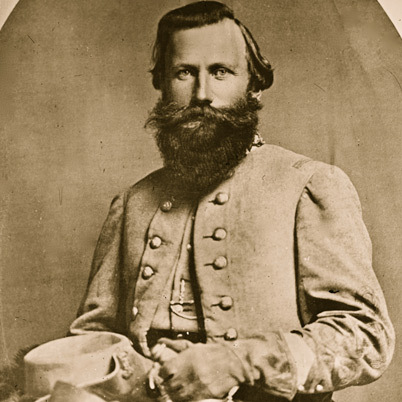
J.E.B. Stuart

While the South did struggle at times with its cavalry arm but did have an advantage in that the vast majority of their cavalry troopers owned their mounts and were experienced horsemen, something that could not be said of the many city dwellers who volunteered for duty in the Union cavalry. But the initial Southern superiority in cavalry was also due to the fact that “the principal of massing regiments into brigades and divisions was pursued earlier than by the Federal.” [11] In contrast McClellan “followed the evil course of reducing mounted regiments to their smallest components for operational use.” Likewise, he “wasted cavalry’s potential and depressed its morale by employing it as couriers, bodyguards for his subordinates, pickets for his encampments, and wagon train escorts, instead of as combat troops.” [12] The result as one would expect was that for the first two years of the war “J.E.B. Stuart and his horsemen were able, literally, to run rings around their opponents.” [13]

One Union writer compared the development of the Confederate and Union cavalry arms during the war:

“The habits of the Southern people facilitated the formation of cavalry corps which were comparatively efficient even without instruction; and accordingly we see Stuart, John Morgan, and Forrest riding around with impunity around the Union armies, and destroying or harassing their communications. Late in the war that agency was reversed. The South was exhausted of horses, while the Northern cavalry increased in numbers and efficiency, and acquired the audacity which had characterized the Southern.” [14]

buford

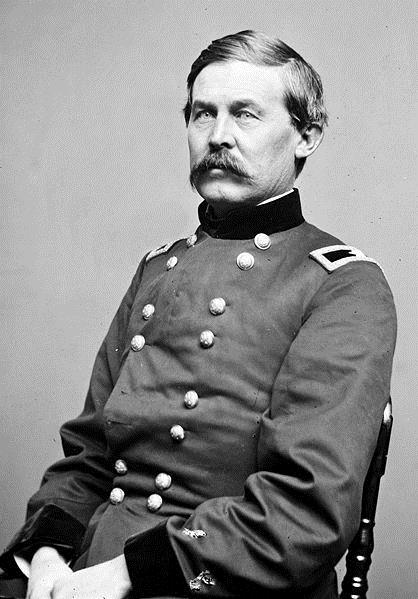
John Buford

As such much of the initial improvement in the Union cavalry arm were due to solid commanders like Brigadier General John Buford to teach new recruits as well as discouraged veterans to become effective cavalrymen.

Cavalry remained a fairly small in comparison to the infantry and artillery branches of service. Even during the wartime expansion the amount of cavalry available was miniscule compared to European armies. On the average only about 8% of the Army of the Potomac was composed of cavalry, compared to Napoleon’s 20 to 25%. [15] Part of this was due to the perceived cost of the cavalry arm which many believed was too expensive to maintain on a large scale: “estimates held that every twelve companies mounted and outfitted at public expense would rob the Treasury of over $300,000 a year merely to cover upkeep on animals, remounts, weapons, and equipment….” [16]

The cost of equipping cavalry was high enough that in the South that troopers had to procure their own mounts. Edwin Coddington noted that the Confederate policy “was a wonderful arrangement for keeping the strength of the cavalry below par, much more than enemy bullets, for it encouraged absenteeism.” [17] The Confederate government paid the own for the use of the horse, and a cash reimbursement if it was lost in combat, but if it was lost in any other manner the soldier had to get another horse if he wanted to remain in the service. Since the Confederates never set up a “centralized replacement service” troopers who lost their mount “had to go home to procure a new horse. If he were a Virginian he needed from thirty to sixty days to accomplish his purpose, and a much longer time should he have to come deeper south.” [18]

Despite the doctrinal predilection to the offense and using the cavalry as a shock unit, the U.S. Army formed no heavy cavalry formations on the order of the famous French Cuirassiers, named after their armored breastplates and metal helmets which were the primary type of cavalry used in Europe for such tactics. As such, during the Civil War both Union and Confederate cavalry formations were primarily assigned to reconnaissance and screening missions normally conducted by light cavalry units in Europe. These larger formations began to be used en masse for the purpose of raiding by both sides “but in the hands of J.E.B Stuart and his friends it became little more than a license to roam off into the enemy’s rear areas looking for plunder and glory.”[19] The cavalry Corps of the Army of the Potomac was used in a similar manner to raid enemy rear areas with often dreadful results which contributed nothing to the overall goal of defeating Lee’s army. A prime example was when Joseph Hooker detached his newly formed Cavalry Corps under George Stoneman to raid Richmond leaving the flank of the army uncovered at Chancellorsville.

Quite often the soldiers assigned to the infantry and artillery had little use for the cavalry who they saw as pampered and contributing little to the war. Many infantrymen held the “cavalry in open contempt. “These cavalry are a positive nuisance,” an officer in the 123rd Illinois wrote. “They won’t fight, and whenever they are around they are always in the way of those who will fight.” [20] Disdainful Confederate infantrymen “greeted their cavaliers with “Here’s your mule!” and “their Federal counterparts would exclaim: “There’d going to be a fight, boy; the cavalry’s running back!” and “Whoever saw a dead cavalryman.”[21]

The lethality of the rifled musket also made the classic Napoleonic cavalry charge against enemy infantry a costly and dangerous enterprise if the enemy infantry still had the means to make organized resistance, and if the cavalry assault was not supported by infantry and cavalry.. An example of this was the ill-fated cavalry attack ordered by Brigadier General Judson Kilpatrick against the men of Lafayette McLaws’s well prepared division on the Confederate right after the failure of Pickett’s Change at Gettysburg.

Cavalry tactics began to change during the war. Both sides used their cavalry for raids, sometimes very large ones, and operations against enemy partisans in their rear areas. In each case the cavalry was typically deployed by itself and even when it accompanied the armies into battle cavalry units were typically employed on the periphery of the battle. As such as Griffith wrote, “Civil War doctrine of raiding… was not only a deliberate turn away from the hope of victory on the battlefield, but it actually removed the means by which victory might have been won at the very moment when those means were at last starting to be properly efficient.” [22] The lack of heavy cavalry of the European model sometimes kept commanders from completing victories, one can only imagine what would have happened had George Meade had a division of heavy cavalry at hand to sweep the Confederates from the battlefield after Pickett’s Charge.

sheridanphiliphbio

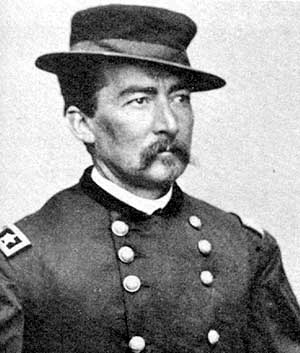
Philip Sheridan

Tactics only began to change when General Philip Sheridan took command of Grant’s cavalry. Sheridan kept the cavalry close to the main body of the arm. Sheridan had replaced Major General Alfred Pleasanton as commander of the Cavalry Corps of the Army of the Potomac in early 1864. It is quite possible had he not died in December 1863 that the post would have gone to John Buford, but Sheridan had a vision for the cavalry that foreshadowed modern operational art. Sheridan wanted to organize the Cavalry Corps by concentrating it “into a powerful striking arm. He desired to do this, first, to deal with the Confederate cavalry, on the theory that “with a mass of ten thousand mounted men… I could make it so lively for the enemy’s cavalry that… the flanks and rear of the Army of the Potomac would require little or no defense.” [23] Sheridan was making no idle boast as by now his troops “were not only more numerous, but they had better leaders, tactics, and equipment than before,” [24] especially when it came to the Spencer repeating rifle which was now standard issue for the cavalrymen, and which gave them a tremendous advantage in firepower over Stuart’s now ill-equipped troops.

Sheridan first did this at the beginning of the Wilderness campaign when he took his 10,000 strong corps around the Confederate flank. Sheridan had been quarreling with Meade about the latter’s insistence that Sheridan’s horsemen were clogging the roads that his infantry needed to advance upon. In the heated discussion Sheridan came very close to being insubordinate with Meade. Meade reportedly told Sheridan that “Stuart “will do about how he pleases anyhow” to which Sheridan supposedly replied “Damn Stuart, I can trash hell out of him any day.” [25] Furious, Meade went and reported the matter to Grant. Grant listened and replied “Did Sheridan say that?… He usually knows what he is talking about. Let him go ahead and do it.” [26] At Grant’s request Meade provided Sheridan with new orders to concentrate his cavalry, march south and engage Stuart’s cavalry. Unlike previous raids which sought to avoid battle with Stuart’s troops in order to hit prescribed objectives, above all Sheridan wanted to engage and defeat the legendary Confederate cavalier. He “defined the raid as “a challenge to Stuart for a cavalry duel behind Lee’s lines in his own country.” And the more there were of the gray riders when the showdown was at hand, the better he would like it, since that would mean there were more to be smashed up.” [27]

Sheridan’s column totaled nearly 13,000 men and was nearly 13 miles long as he proceeded at a slow pace around Lee’s army and south towards Richmond. In addition to his horsemen he brought all of his horse artillery batteries. He was well around Lee’s flank before he was discovered and during the march his troops burned a depot and over one hundred railroad cars containing “close to a million rations of meat and better than a half million of bread, along with Lee’s entire reserve of medical stores.” [28]

On May 11th Stuart managed to intercept Sheridan’s column at a place called Yellow Tavern, just south of Ashland and the Ana River, but his corps was outnumbered by at least three to one. Three well trained, experienced, equipped, and superbly led Federal cavalry divisions confronted Stuart. With no hopes of fighting an offensive action, Stuart’s troops fought dismounted and were routed by the superior Bluecoats who continued on to cut the railroad between Lee’s army and Richmond. During the battle Stuart, who had cheated death on a number of occasions was mortally wounded. The Confederate cavalry of the Army of Northern Virginia would never recover, and to Southerners Stuart’s death was a profound psychological blow, only slightly worse than that of Stonewall Jackson a year before. Robert E. Lee, to who Stuart was like a son took the loss harder than he had taken Jackson’s. “I can scarcely think of him without weeping,” he told one of Stuart’s officers.” [29]

As the armies in the East and West dueled throughout 1864, Sheridan and other Federal cavalry officers transformed the Union cavalry into a striking force which could be the spearhead of the army and use new tactics to overcome the problem of combining fire with rapid maneuver which had never been satisfactory applied by the infantry. There were four components in the new tactical mix: “fast operational mobility on horseback out of contact with the enemy; a willingness to take cover and fight on foot when the enemy was close; new repeating carbines to give enhanced firepower; and a mounted reserve to make the sabre charge when the moment was ripe.” [30] Sheridan would apply these tactics in his later campaigns against Jubal Early in the Shenandoah Valley and during the Appomattox campaign and his cavalry, working with infantry and artillery smashed the beleaguered Confederate armies which tried to oppose them. The reorganized cavalry was not the answer to all of the battlefield problems faced by Civil War commanders but it gave Union commanders an impressive weapon in which the speed and firepower of the cavalry could be readily combined with artillery and infantry to achieve decisive results. On the Confederate side, General Joseph Wheeler who commanded the cavalry in the west, Wheeler usually fought dismounted in “skirmish order using field fortification, whether skirmishing independently or in the line…. In the last major action of the war, he dramatically displayed how cavalry had become tactically integrated with infantry. At Bentonville, while fighting his cavalry dismounted, first on the right, then moving around to the left flank, Wheeler constructed a line of breastworks 1,200 yards long.” [31]

European cavalry officers found little to admire in American use of cavalry. Few paid attention to the importance of fighting dismounted and working as part of a combined arms team. In August 1914 their cavalry formations paid severe price for ignoring the realities of modern war, realities which the Americans, both Union and Confederate learned during the Civil War.

Notes

[1] ____________ Anti-Federalists Fear a Large Military “Brutus I.” “To the Citizens of the State of New York” 1787 in Major Problems in American Military History edited by John Whiteclay Chambers II and G. Kurt Piehler, Houghton-Mifflin and Company, Boston and New York 1999 p. 103

[2] Ibid. Millet and Maslowski For the Common Defense: A Military History of the United States p.122

[3] Ibid. Griffith, Battle Tactics of the Civil War p.181

[4] Ibid. Griffith, Battle Tactics of the Civil War p.181

[5] Longacre, Edward G. John Buford: A Military Biography Da Capo Press, Perseus Book Group, Cambridge MA p.33

[6] Thomas, Emory M. Bold Dragoon: The Life of J.E.B. Stuart University of Oklahoma Press, Norman OK 1986 and 1999 p.30

[7] Ibid. Hagerman The American Civil War and the Origins of Modern Warfare p.21

[8] Longacre, Edward G. The Cavalry at Gettysburg: A Tactical Study of Mounted Operations, during the Civil War’s Pivotal Campaign, 9 June- 14 July 1863. University of Nebraska Press, Lincoln and London 1986 p.44

[9] Ibid. Griffith, Battle Tactics of the Civil War p.182

[10] Ibid. Longacre The Cavalry at Gettysburg: A Tactical Study of Mounted Operations, during the Civil War’s Pivotal Campaign, 9 June- 14 July 1863 p.45

[11] Ibid. Griffith, Battle Tactics of the Civil War p.181

[12] Ibid. Longacre The Cavalry at Gettysburg: A Tactical Study of Mounted Operations, during the Civil War’s Pivotal Campaign, 9 June- 14 July 1863 p.45

[13] Ibid. Griffith, Battle Tactics of the Civil War p.183

[14] Buell, Don Carlos. East Tennessee and the Campaign of Perryville in Battles and Leaders of the Civil War Volume III, The Tide Shifts. Edited by Robert Underwood Johnson and Clarence Clough Buel Castle, Secaucus NJ p.51

[15] Ibid. Griffith, Battle Tactics of the Civil War p.181

[16] Ibid. Longacre The Cavalry at Gettysburg: A Tactical Study of Mounted Operations, during the Civil War’s Pivotal Campaign, 9 June- 14 July 1863 p.43

[17] Coddington, Edwin B. The Gettysburg Campaign: A Study in Command, A Touchstone Book, Simon and Schuster New York, 1968 p.17

[18] Ibid. Coddington The Gettysburg Campaign: A Study in Command p.17

[19] Ibid. Griffith, Battle Tactics of the Civil War p.183

[20] Ibid. Robertson Soldiers Blue and Gray p.20

[21] Ibid. Longacre The Cavalry at Gettysburg: A Tactical Study of Mounted Operations, during the Civil War’s Pivotal Campaign, 9 June- 14 July 1863 p.45

[22] Ibid. Griffith, Battle Tactics of the Civil War pp.183-184

[23] Ibid. Weigley A Great Civil War: A Military and Political History 1861-1865 p.369

[24] Ibid. Whelan Bloody Spring: Forty Days that Sealed the Confederacy’s Fate p.181

[25] Ibid. Thomas Bold Dragoon: The Life of J.E.B. Stuart p.288

[26] Catton, Bruce Grant Takes Command Little, Brown, and Company, New York, Toronto, London 1968 and 1969 p.216

[27]Ibid. Foote The Civil War, A Narrative. Volume Three Red River to Appomattox p.564 p.224

[28] Ibid. Foote The Civil War, A Narrative. Volume Three Red River to Appomattox p.564 p.225

[29] Ibid. Korda, Clouds of Glory p.626

[30] Ibid. Griffith, Battle Tactics of the Civil War p.184

[31] Ibid. Hagerman The American Civil War and the Origins of Modern Warfare p.298

Leave a comment

Filed under civil war, Gettysburg, History, Military, us army

“I imagined leave would be different from this” September 11th 2001 at Seventeen Years

flight_175_photo

Friends of Padre Steve’s World,

September 11th is a day that always makes me more introspective. It brings back so many memories, some that I wish I could forget; but I cannot get the images of that day out of my mind. The burning towers, the people jumping to their deaths to escape the flames, and the scenes of devastation. I knew one of the victims in the attack on the Pentagon, an Army Lieutenant Colonel, Karen Wagner who commanded a Medical training company at Fort Sam Houston where I was serving as the Brigade Adjutant in 1987 and 1988. She was a very nice person, very gracious and decent, admired by everyone who knew her; I was shocked to see her name on the casualty list after the attack.

The emotions that I feel on the anniversary of these terrorist attacks which claimed the lives of so many innocent people, and which devastated so many families, still haunts me, and my subsequent service, especially in Iraq has changed me. Years after he returned from his time in the Middle East, T.E. Lawrence; the immortal Lawrence of Arabia wrote to a friend, “You wonder what I am doing? Well, so do I, in truth. Days seem to dawn, suns to shine, evenings to follow, and then I sleep. What I have done, what I am doing, what I am going to do, puzzle and bewilder me. Have you ever been a leaf and fallen from your tree in autumn and been really puzzled about it? That’s the feeling.” I often feel that way.

Seventeen years ago I was getting ready to go to the French Creek Gym at Camp Le Jeune North Carolina where I was serving as the Chaplain of Headquarters Battalion 2nd Marine Division. I had returned from a deployment to Okinawa, Mainland Japan and Korea just two months before and was preparing to transfer to the USS Hue City, a guided missile cruiser stationed in Mayport, Florida.

At the time of the attack I had already been in the military for over 20 years and I had actually taken a reduction in rank to transfer from the Army, where I was a Major in the reserves, to the Navy to serve on active duty. In those previous 20 years I had served overseas during the Cold War along the Fulda Gap. I had been mobilized to support the Bosnia mission in 1996, and I had just missed being mobilized for Operation Desert Storm as my unit was awaiting its mobilization orders when the war ended. I had done other missions as well as the deployment to the Far East that returned from in July 2001; but nothing prepared me for that day. Like other career military officers I expected that we would be at war again and thought it might be back in the Middle East, and probably a result of some fool’s miscalculations; but like the American officers who were serving at the time of the Pearl Harbor attack, I never expected what happened that morning.

Tuesday, September 11th 2001 had started like so many days in my career. Routine office work, a couple of counseling cases and what I thought would be a good PT session. I was about to close out my computer browser when I saw a little headline on Yahoo News that a plane had crashed into the World Trade Center. I paid little attention and figured that a private plane, something like a Cessna piloted by an incompetent had inadvertently flown into the building.

9-11 jumpers

That delusion lasted about two minutes. I got in my car and the radio, tuned to an AM talk station had a host calling the play by play. He started screaming “oh my God another airliner flew into the other tower.” Seeking to see what was happening I went to the gym where there were many televisions. I got there and saw the towers burning, with stunned Marines and Sailors watching silently, some in tears. I went back out, drove to my office and got into uniform. After checking in with my colonel a made a quick trip to my house for my sea bags and some extra underwear, and personal hygiene items. When I got back the headquarters we went into a meeting, and the base went on lock down mode. The gates were closed and additional checkpoints, and roadblocks established on base. Marines in full battle-rattle patrolled the perimeter and along the waterfront. I did not leave the base until the night of the 15th when things began to settle down and we all went into contingency planning mode for any military response to the attacks.

My wife, who as waiting for a doctor’s appointment with a friend saw the attacks on live television and knew when the first plane struck she told her friend that it was terrorism. Her friend responded “that damned Saddam Hussein.” Like so many of us who initially thought this, my wife’s friend was wrong.

LutjensHonors

Those were tumultuous days, so much fear; so much paranoia; and so much bad information as to who committed the attacks and what was going to happen next.

hue city boarding party


A few months later I deployed aboard Hue City to the Middle East where we supported the air operations in Afghanistan, anti-terrorist operations off the Horn of Africa and in Operation Southern Watch and the U.N. Oil Embargo against Iraq. I then did three years with Marine Security Forces, traveling around the world to support Marine Fleet Anti-Terrorism Security Team companies. For three years I was on the road one to three weeks a month traveling to the Middle East, Europe, the Pacific and many parts of the United States. Then I was promoted and transferred to Explosive Ordnance Disposal Group Two, from which I was deployed with my assistant to Iraq, where we served as members of the Iraq Assistance Group in all Al Anbar Province supporting small teams of Marine Corps, Army and Joint Force adviser teams to the Iraqi Army, Border troops, Port of Entry police, police and highway patrol.

with-mtt-3-7-ronin


When I returned from Iraq I was a changed man and while I am proud of my service I am haunted by my experiences. One cannot go to war, see its devastation, see the wounded and dead, as well as the innocents traumatized by it. One cannot get shot at, or be in enclosed rooms, meeting with people that might be friends, or might be enemies, and while everyone else is armed, you are not.

War changed me, and my homecoming was more difficult than I could have imagined. I never felt so cut off from my country, my society, my church, or even other chaplains. My experience is not uncommon among those who have served in Iraq or Afghanistan, or for that matter those who have served in almost any modern war. Erich Maria Remarque in his classic All Quite on the Western Front wrote:

“I imagined leave would be different from this. Indeed, it was different a year ago. It is I of course that have changed in the interval. There lies a gulf between that time and today. At that time I still knew nothing about the war, we had been only in quiet sectors. But now I see that I have been crushed without knowing it. I find I do not belong here any more, it is a foreign world.”

That being said I would not trade my experience for anything. The experience of PTSD and other war related afflictions has been a blessing as well as a curse. They have changed my world view and made me much more emphatic to the suffering and afflictions of others, as well when they are abused, mistreated, terrorized and discriminated against. These experiences along with my training as a historian, theologian, and hospital chaplain clinician before and after my tour have given me a lot bigger perspective than I had before.

But I have to live with all of the memories. Guy Sajer wrote in his book The Forgotten Soldier“Only happy people have nightmares, from overeating. For those who live a nightmare reality, sleep is a black hole, lost in time, like death.” General Gouverneur Warren, a hero of many Civil War battles including Gettysburg wrote to his wife after the war “I wish I did not dream so much. They make me sometimes to dread to go to sleep. Scenes from the war, are so constantly recalled, with bitter feelings I wish never to experience again. Lies, vanity, treachery, and carnage.”

As hard as this has been these are good things, and as I go on I wonder what will happen next. I do not think that the wars and conflicts which have followed in the wake of the 9-11 attacks will be over for years, maybe even decades. I pray for peace, but too many people, some even in this country seem to live for the bloodlust of war. One can only hope and as my Iraqi friends say, Inshallah, (إن شاء الله) God willing…

I wonder too, if the words of T.E. Lawrence reflecting on his service in the Arab Revolt are not as applicable to me and others who came back from Iraq, “We had been hopelessly labouring to plough waste lands; to make nationality grow in a place full of the certainty of God… Among the tribes our creed could be only like the desert grass – a beautiful swift seeming of spring; which, after a day’s heat, fell dusty.” I have lost too many friends in these wars, including men who could not readjust to home, many like me. I have seen the men and women, broken in body, mind and spirit and I wonder if any of it was worth it, and if in some of our response, especially the invasion of Iraq has not made a bad situation even worse, and turned the war into a generational conflict.

As for me, I am now an old guy by military standards. I recently celebrated 37 years of service and will, God willing, retire next year. Sadly, I know all too well that those who I have worked with, and those who are yet to enlist will be continuing to fight a war which seems to be without end long after I retire.

Yesterday and today there were and will be many ceremonies and services to remember the victims of the attacks. I think that is fitting. As I mentioned last night I did not take place in this year’s commemoration of the event at my base because I had been asked by name to do a funeral for a retired Navy Chief at a local veterans cemetery followed by more planning and preparing for the arrival of Hurricane Florence.

So please, have a good day and whatever you do do not forget those whose lives were forever changed by those dastardly attacks and all that has transpired in the years since. Honestly I did not think that we would still be at war today. It is hard for me to believe that we still are at war and that there is no end in sight.

As Erich Maria Remarque wrote “I imagined that it would be different…”

At the same time I do hope that things will get better and that some semblance of peace will return to the world.

Inshallah, (إن شاء الله) God willing…

Peace

Padre Steve+

2 Comments

Filed under afghanistan, ethics, History, iraq, iraq,afghanistan, leadership, Military, Political Commentary, terrorism

They are Not Just Names: September 11th 2001 at Seventeen Years

Friends of Padre Steve’s World,

In Star Trek Deep Space Nine there is a scene where the deputy commander of the Space Station, Major Kira Nerys gives a casualty report to Captain Benjamin Sisko. It resonates with me every time that I see it and especially on the anniversary of September 11th.

KIRA: Sir, the latest casualty reports have just been posted.
SISKO: How many this time?
KIRA: Including the troops lost at AR five five eight, seventeen hundred and thirty.
SISKO: Seventeen hundred thirty.
KIRA: That’s a lot of names.
SISKO: They’re not just names. It’s important we remember that. We have to remember.

Today marks the seventeenth year since the attacks of September 11th 2001 and we do have to remember those who lost their lives that day, all those Americans and our coalition partners who died, and all the innocents lost, even to those of American military action. None of them are just names, they are real men and women, as well as children cut down by terrorism and unending war.

When we were attacked on September 11th 2001 I had already passed twenty years of service, though about half of them were service in the reserves and National Guard. Now I am over 37 years of service and by this time next year I should be on the retired list unless something very unexpected happens.

My base will be marking it with the dedication of a nature trail that now has plaques commemorating over 80 eighty men and women from our base who have died in action, on deployment, or training to go to combat since that occasion. While this ceremony is taking place I will be driving out to a Veteran’s Cemetery an hour or so away to perform the internment of a retired Navy Chief Petty Officer whose family requested me by name.

Thus I will be turning over the big high profile ceremony to my deputy chaplain. It will give him a chance to be on the big stage and get recognized for his own talents and abilities while I do something less visible but very meaningful to that Navy Chief’s family and to me as the son of a Navy Chief. In addition to conducting the service I will have the honor of presenting the colors of the nation to his daughter.

For me it is a chance to pay back the goodness shown to my dad and family when he passed away in 2010. The base ceremony and the internment were pretty close together time wise. My Commanding Officer and I talked about it decided and decided that since I am now in pretty much constant pain with knee and hip injuries since I fell down my stairs last month that I shouldn’t be doing back to back ceremonies with a long drive in between.

But anyway. Since September 11th 2001 I have lost count of the number of friends and comrades who died during the attack and the subsequent wars. This includes those that died by their own hand during or after their service due to the effects of combat trauma, PTSD, or Traumatic Brain Injury,  or the never ending pain of physical wounds and injuries. I often see their faces when I think about the past 17 years, their names are forever etched in my memory, but they are not just names and we cannot forget them. I cannot and I will not.

It seems like every week or so we lose another soldier, sailor, marine, or airman in Afghanistan, Iraq, or Africa. I loom at their names, where they are from, and the number of deployments that they have made. Some entered service well after me but because of their specialities and assignments made far more deployments that I can imagine. One soldier who was killed in action serving in Iraq had made 13 deployments, 9 of which were combat deployments in a 16 year career, and for the most part they are forgotten by all but their family, friends, and comrades, most barely get a mention elsewhere.

Sadly at this point in my career I believe that for many Americans, especially the faux patriots of the Fox News set, the political preachers of the Christian Right, and the President himself, that the troops are merely a prop to place in the background to promote their political causes and slam other Americans for not being patriotic enough.

Today I will continue to serve and I will mourn in my own way the friends, comrades, and shipmates that I have lost over these past 17 years. For me they are not just numbers or names, they are real people and no amount of flag waving will bring them back. No amount of corporate sponsored “patriotism” will make up for the lost lives, and the destruction of these wars. We can remember and honor the lost, and those who still suffer, including the wounded in body, mind, and spirit, and of the widows and children of the men and women who never came home or were never the same. I came home, but I am not the same.

They are not just names.

So as you go about your activities today take time to remember the victims of war, terrorism, and as I do the men and women who I knew who never came home, couldn’t make the transition back from war, or who still suffer in mind, body or spirit.

Never forget, they are not just names.

Until tomorrow,

Peace

Padre Steve+


Leave a comment

Filed under History, middle east, Military, ministry, News and current events, philosophy, Political Commentary, star trek, terrorism, Tour in Iraq

Mass Murder and Genocide up Close and Personal: The Einsatzgrüppen and Ordungs Polizei in Poland 1939-1940

einsatz1

Friends  of Padre Steve’s World,

I am a bit late posting today as we have a niece, nephew and their children visiting for the Labor Day holiday. Since I posted a new article about Hitler’s attack on Poland yesterday I am following it up with an older article dealing with Hitler’s use of the Einzastzg

Another section of the article dealing with the campaign of mass murder and genocide conducted by Hitler’s legions in Eastern Europe. This section deals with the actions of the Einsatzgrüppen in during the Polish campaign and occupation in 1939 and 1940. In it you will see that the while most of the killing was done by the SS that the German military high command was not guiltless. Some commanders attempted to stop SS actions, but they were the minority.  Most simply turned a blind eye to what was going on and a few would lend their assistance to the Einsatzgrüppen.

Please note, that all of this took place before the first extermination camps began operations. This killing was done up close and personal by  the men of the Einsatzgruppen and the Police battalions, sometimes with the direct support and approval of the Wehrmacht. In all just a few thousand troops massacred hundreds of thousands of Polish Jews as well as the Polish gentile elites.

It is terribly uncomfortable, for as I always say, these men were little different than most of us, they were terribly ordinary.

Peace

Padre Steve+

himmler1

Heinrich Himmler

The Polish campaign was a precursor to the Russian campaign and was not totally race driven. It contained elements of Germany’s perception of the injustice of Versailles which gave Poland the Danzig corridor and Germany’s desire to reconnect East Prussia to the Reich, as well as the perceived necessity to remove a potential enemy from its rear as it faced France, yet it was a campaign steeped in Nazi racial ideology. Poland resisted German efforts to ally itself with Germany in 1939, thus Hitler determined it “would be crushed first.” 80

Meeting with military leaders on 23 May 1939 Hitler “made it plain that the real issue was not Danzig, but securing of Germany’s Lebensraum….” 81 On 22 August Hitler enjoined the generals to “Close your hearts to pity! Act brutally! Eighty million people must obtain what is their right.” 82

Even so, most military leaders failed to appreciate what Hitler was calling on them to do; Erich von Manstein would later note that “what Hitler had to say about an eventual war with Poland, could not, in my opinion, be interpreted as a policy of annihilation.” 83

generaloberst johannes blaskowitz

General Johannes Blaskowitz

Others such as Abwehr director Wilhelm Canaris was “utterly horrified.” As he read his notes to his closest colleagues “His voice trembled as he read, Canaris was acutely aware that he had witnessed something monstrous.” 84 General Johannes Blaskowitz, the controversial commander of the German 8th Army who would become the military commander in Poland did not leave any notes about the meeting. However, his biographer noted that Blaskowitz “may have naively attached a military meaning to these terms since he was busy with military matters and soon to begin operations.” 85 As was noted before this was also the interpretation of Erich Manstein gave Hitler’s words, but one has to wonder as to the veracity of his statements. 86 Field Marshal Keitel noted that the speech was “delivered in the finest sense of psychological timing and application,” with Hitler molding “his words and phrases to suit his audience.” 87

In light of the mixed interpretations by military leaders, it is possible that many misinterpreted Hitler’s intent and did not fully appreciated his ideology as they went into Poland, carefully secluding themselves in the narrow confines of their military world. While such an explanation is plausible for some, it is also true that many others in light of subsequent actions were in full agreement with Hitler. One author notes that “no man who participated in the FührerConferences….and there were present the highest ranking officers of the three services, could thereafter plead ignorance of the fact that Hitler had laid bare his every depth of infamy before them, and they had raised no voice in protest either then or later.” 88 In July, General Wagner, the Quartermaster General issued orders that “authorized German soldiers to take and execute hostages in the event of attacks by snipers or irregulars.” 89

Regardless of the meaning ascribed to Hitler’s speech by his generals, Hitler had already laid plans to destroy the Jews in Poland and decimate the Polish intelligentsia and leadership.   Hitler gave Himmler the task of forming Einsatzgrüppen to follow the German troops as they advanced into Poland and liquidate Poland’s upper class wherever it was to be found.” 90 While senior party leaders remained at Hitler’s side following the conference, Himmler worked to coordinate his troops, including the reinforced Totenkopf battalions and Einsatzgrüppen with the Army. 91

Himmler began planning in early May and the Army, working in close collaboration with the SS decided to “use SS and police units to augment their own forces for security tasks.” 92 Himmler established “five Einsatzgrüppen to accompany each of the numbered German armies at the start of the campaign.” 93 Placed under the aegis of Reinhard Heydrich the groups were broken down into smaller units of 100-150 men and allotted to army corps. All senior posts were occupied by officers of the SD, the Sicherhietsdienst. 94

Two additional Einsatzgrüppen were formed shortly after the invasion. 95Additionally three regiments of the SS Totenkopfverbandeunder the direction of SS General Theodore Eicke were deployed in the rear areas of the advancing armies. These regiments were formed from the Concentration Camp guard units and eventually became the nucleus of the 3rd SS Panzer Division Totenkopf. 96 The SS carefully shielded the real purpose of these units from the Army in the planning stages, while the Army might countenance anti-guerrilla operations and cooperate in arresting people who might lead resistance in Poland, the SS was not yet sure that the Army would support or countenance mass murder. 97 That being said, Heydrich worked with the Army to develop lists of up to 30,000 Poles to be arrested following the invasion including intellectuals, political leaders and clergy. 98

To eliminate the Polish elites without disturbing the Army, Himmler and Heydrich gave the Army “only the bare minimum of information” as to their ultimate intent99 The deception was initially successful and many Wehrmacht commanders welcomed the assistance of the SS units for rear area security missions. Blaskowitz’s 8th Army defined the mission of the Einsatzgrüppen in the traditional doctrinal terms of the Ettapen, noting their mission as “the suppression of all anti-Reich and anti- German elements in the rear of the “fighting troops, in particular, counter espionage arrests of  politically unreliable persons, confiscation of weapons, safeguarding of important counter- espionage materials etc…” 100 General Wagner, the Quartermaster General issued orders in July 1939 that “authorized German soldiers to take and execute hostages in the event of attacks by snipers or irregulars.” Despite the deception, there was no way to disguise the murder of Polish intelligentsia and Jews once it began, and had the Army had the political acumen and moral courage it could have considerably restricted or even halted the terror campaign. 101

The ensuing campaign in Poland demonstrated Hitler’s true intent. Heydrich openly discussed “murdering the Polish ruling class” of the aristocracy, Catholic clergy, communists and Jews at a meeting on September 7th, barely a week after the beginning of the invasion. 102 As the German armies advanced into Poland slicing through the badly deployed and inadequately equipped Polish Army the Einsatzgruppen and the Totenkopf Verbande followed in their wake, conducting mass arrests and executions of those Poles deemed to be a threat.

Many army leaders were worried about Polish soldiers left behind in rear areas as the armies advanced. In some cases that concern became a paranoid mindset and some generals believed that a “brutal guerrilla campaign has broken out everywhere and we are ruthlessly stamping it out.” 103

ordungspolizei

Ordungspolizei Battalion preparing for Mass Murder

Yet some of the actions by Einsatzgruppen and Totenkopf Verbandeagainst the Polish elites and the Jews drew Army reactions. The unit commanded by SS General Woyrsch “behaved with such unparalleled bestiality that it was thrown out of the operational area” by General List of 14th Army.” 104 Another unit, the Totenkopfverbande Brandenburg came to Army attention when its commander remarked that the “SSVT would not obey Army orders.” The conclusion drawn by the Army General was that “the SSVT commander was following orders from some non-military authority to terrorize the local Jews.” 105

These atrocities as well as those of other Waffen-SS units were hard to hide and brought reactions out of army commanders who sought to punish the offenders. Blaskowitz and a few other commanders attempted to put a halt to SS actions against Poles and Jews, 106 but most officers turned a blind eye to the atrocities or outright condoned them. It is believed that General Walter Model and many other senior officers “not only knew what was occurring in Poland but actually took part in what Colonel General Franz Halder himself described in October as “this devilish plan.”” 107

It appears that many of the officers who objected were not motivated so much by humanitarian, moral or legal considerations, but rather by the effect on good order and discipline of their soldiers. 108 Likewise it is clear that many officers, even if they did not participate in the actions probably approved of them. Many of the early biographies and histories of this period were written by authors who were influenced by surviving German officers. Many of these men were being rehabilitated and helping the Americans and British meet the threat of the Soviet Union, made no or little mention of the Army’s part in these actions.

Both Himmler and Heydrich were sensitive to the perception of the Army and resented the fact that the Army believed them to be responsible for actions that they were carrying out under the direction and orders of Hitler himself, They also resented that their troops were characterized as “undisciplined gangs of murderers” by many Army officers. 109

After crushing the Polish armies and dividing Poland with the help of the Red Army, the Germans established what became known as the Government General, which was headed by Hans Frank. The new civilian administration came into conflict with the military governor, General Blaskowitz. Appalled by the actions of the SS, Police and the Nazi administration. Blaskowitz made an “elaborate report on the atrocities of the SS,” 110 expressing concern about his “extreme alarm about illegal executions, his worries about maintaining troop discipline under those circumstances, the failure of discussions with the SD and Gestapo and their assertions that they were only following SS Orders.” 111

While it is unclear if the memorandum made it to Hitler, it is clear that Hitler did know about the protest and Blaskowitz fell into disfavor and was reassigned after a period of continued conflict with the Nazi administration. Hitler was not impressed by the less than ruthless attitudes of Blaskowitz and other commanders. His reaction to Army objections regarding the methods of the SS and police units was characteristically acidic. Hitler’s military adjutant recalled that Hitler accused the Army’s leaders of using “Salvation Army” methods, and called their ideas regarding the occupation as “childish.” 112

Following the reassignment of Blaskowitz, other officers that objected were also relieved of their commands or reassigned. General Georg von Külcher was relieved of command for protesting SS and police atrocities. 113

07102014-461733515

At the beginning of the campaign the SS units and their commanders fell under military justice, and a number of SS officers and their troops were convicted by Army courts-martial for their actions. But soon, SS Officers convicted by Army courts-martial were given amnesty by Hitler and Hitler “removed SS units from the jurisdiction of military courts,” on October 4th 1939. 114 While the army remained, it was no longer in charge and would actively assist the SS and Police in combat and further atrocities against civilians. In November 1939, One German officer, who later was a conspirator in the July 20th plot, remarked, “was ashamed to be German! The minority are dragging our good through the mud by murdering, looting and torching houses will bring disaster on the whole German people if we do not stop it soon…” 115

poland murders

The Army was soon relieved of responsibility for policing Poland which fell on the Ordungspolizei battalions and Gendarmerie. Many officers were pleased as they could now turn their backs on the situation there and begin to prepare for the campaign in the West.

The Ordungspolizei battalions and the Gendarmerie units were composed of mobilized city police and rural constabulary police. These men would soon wreak their own devastation on Poland in the coming months and years. 116Poland was also be the first use of mass evacuations of civilian populations to make room for German settlers, in the newly acquired Lebensraum. Poles were driven into the newly formed Government General and ethnic Germans moved into previously Polish occupied territories. By 1941 over 1,200,000 Poles and 300,000 Jews had been expelled and 497,000 ethnic Germans brought into provinces German had lost in 1919. 117

Prior to the war about 3.3 million Jews lived in Poland. The actions of the Einsatzgruppen and the Police brought a reign of terror to Poland’s Jews. The Jews were rounded up and sent to Ghettos from which they would be dispatched to the death camps following the decision to implement the “Final Solution.”After the war only some 50-70,000 Jews were found to have survived in Poland, the Polish Army and camps in Germany. A further 180,000 were repatriated from the Soviet Union. 118

To be continued….

Notes

80 Ibid. Weinberg. Visions of Victory p.8
81 Ibid. Goerlitz, History of the German General Staff p.346
82 Höhne, Heinze. The Order of the Death’s Head: The Story of Hitler’s SS. Translated by Richard Barry. PenguinBooks, New York and London, 2000. First English edition published by Martin Secker and Warburg Ltd. London 1969. Originally published as Der Orden unter dem Totenkopf, Verlag Der Spiegel, Hamburg 1966 p.259

83 Manstein, Erich von. Forward by B.H. Liddle Hart, Introduction by Martin Blumenson. Lost victories: The War Memoirs of Hitler’s Most Brilliant General. Zenith Press, St Paul MN 2004. First Published 1955 as Verlorene Siege, English Translation 1958 by Methuen Company p.29

84 Ibid. Hohne. Canaris p.347

85 Giziowski, Richard. The Enigma of General Blaskowitz. Hppocrene Books, New York 1997 p.119

86 Ibid. Manstein. Lost Victories p.29

87 Ibid. Goerlitz. The Memoirs of Field Marshal Keitel p.87

88 Wheeler-Bennett, John. The Nemesis of Power: The German Army in Politics 1918-1945. St. Martin’s Press Inc. New York, NY 1954 p.448

89 Ibid. Megargee. War of Annihilation p.13

90 Ibid. Höhne The Order of the Death’s Head p.297

91 Padfield, Peter. Himmler. MJF Books, New York 1990 p.264

92 Ibid. Megargee. War of Annihilation p.13

93 Ibid. Westermann. Hitler’s Police Battalions p.127

94 Ibid. Höhne The Order of the Death’s Head p.297 95 Ibid. Westermann. Hitler’s Police Battalions p.127 96 Ibid. Sydnor Soldiers of Destruction p.37

97 Ibid. Giziowski Blaskowitz p.120

98 Ibid. Witte. The Wehrmacht p.100

99 Ibid. Höhne The Order of the Death’s Head pp. 297-298

100 Ibid. Giziowski Blaskowitz p.120

101 Ibid. Höhne The Order of the Death’s Head p.298

102 Ibid. Witte. The Wehrmacht p.100

103 Newton, Steven H. Hitler’s Commander: Field Marshal Walter Model-Hitler’s Favorite General Da Capo Press a division of Perseus Books Group, Cambridge MA 2005. p.74

104 Ibid. Giziowski. The Enigma of General Blaskowitz pp.165-166

105 Ibid. Sydnor, Soldiers of Destruction pp. 42-43 Note SSVT is the common abbreviation for Verfügungstruppe which was the early designation of the SS Totenkopf Verbande and some other Waffen SS Units.

106 Ibid. Goerlitz. History of the German General Staff p.359

107 Ibid. Newton. Hitler’s Commander p.78

108 Ibid. Witte The Wehrmacht p.102

109 Ibid. Höhne The Order of the Death’s Head p.298

110 Ibid. Goerlitz. History of the German General Staff .p.359 111 Ibid. Giziowski. The Enigma of General Blaskowitz p.173 112 Ibid. Giziowski. TheEnigma of General Blaskowitz p.173

113 Ibid. Witte The Wehrmacht p.102

114 Burleigh, Michael and Wippermann, Wolfgang. The Racial State: Germany 1933-1945 Cambridge University Press, New York NY and Cambridge UK 1991. p.100

115 Ibid. Witte The Wehrmacht p.102

116 For a good account of one of the Police Battalions see Ordinary Men: Reserve Police Battalion 101 and the Final Solution in Poland by Christopher Browning Harper Perennial Publishers, San Francisco CA 1992

117 Reitlinger, Gerald. The SS: Alibi of a Nation. The Viking Press, New York, 1957. Republished by Da Capo Press, New York, NY p.131

118 Ibid. Davidowicz The War Against the Jews pp.395-397

1 Comment

Filed under crime, ethics, History, holocaust, Military, nazi germany, Political Commentary, world war two in europe

PTSD, Medical Records, Malfeasant Malpractice, and the Minstrel Boy: Surprises You Discover by Seeing Your Actual Medical Records

Friends of Padre Steve’s World,

I was going through some of the 1000 pages of my electronic medical records and close to 500 pages of hard medical copy records. My God, they are a treasure trove of information. I am beginning to organize them for my meetings with Disabled American Veterans and Veteran’s Administration for my military disability claim. According from one of my friends, a retired Navy Physician who now works for the VA in dealing with claims I should have an 80-100% disability rating from the VA due to all that is goofed up with me. I’d settle for 80-90%, 100% sounds too extreme. But severe chronic PTSD, Traumatic Brain Injury, chronic insomnia, night terrors, injuries sustained in physically acted out nightmares, severe Sleep Apnea, hearing loss, Tinnitus, speech comprehension at the 3rd percentile, not to mention numerous injuries to my legs, knees, hips, ankles, shoulders and wrists incurred through years of physical abuse in and out of combat environments.

These do not include many of my psychiatric and psychological records which are in a different system, nor the hard copy records from my time in the Army which I still have, but they are impressive and full of surprises.

For me this included an obviously punitive diagnosis made by a Psychiatry Resident four years ago who had only met me for 15 minutes. During that time she treated with such contempt and disrespect that I issued a formal complaint about her. My complaint actually helped get me a competent therapist, but this physician attempted to harm me by diagnosing me with a disorder than cannot be made in such a short time of clinical observation. The fact is that I was dealing with PTSD and combat trauma while she was still in high school, and that was before it happened to me. As a result I am going to seek some kind of sanctions on that doctor through the military or through her accrediting body.

If it wasn’t for the restrictions of the Feres Doctrine I would immediately sue the Navy because how badly that encounter effected me then. I do actually plan on exploring ways to punish that doctor for what she did because the diagnosis was made purely to poison the relationship that any future Navy (Military or Civilian) therapist might have with me, but I digress because I went all of this to write about a Star Trek the Next Generation episode which I just watched as part of my current binge watching of Star Trek TNG seasons. The episode was called The Wounded and dealt with PTSD, combat trauma, loss, and the unwillingness of some to let wars end. It has always been one of my favorite episodes of that franchise, long before I ever went to Iraq or came back with PTSD and TBI.

One of the quotes from the episode was uttered by Captain Jean Luc Picard, played by Sir Patrick Stewart. He made a comment about people who could not get over their anger, that is especially applicable to those who went to war or lost friends or family in war:

“I think, when one has been angry for a very long time, one gets used to it. And it becomes comfortable like…like old leather. And finally… it becomes so familiar that one can’t remember feeling any other way.

I understand that. I still have a lot of anger. Not at the Iraqis, but the men and women who sent us into Iraq. Trust me, I have no lingering sympathy for Saddam Hussein and his thuggish dictatorship, but that being said the justification to go to war was so unjust that had our leaders been in the dock at Nuremberg they would have been found guilty of at least two counts on those charges. No honest person who looks at history or international law can say otherwise, especially it because it was an American, Justice Robert Jackson who organized the trials and who noted before they began:

“If certain acts of violation of treaties are crimes, they are crimes whether the United States does them or whether Germany does them, and we are not prepared to lay down a rule of criminal conduct against others which we would not be willing to have invoked against us.”

Once again I digress, because what brought all about my post tonight was that Star Trek TNG episode that I first saw some 27 years ago. When the episode comes to it’s conclusion Chief Miles O’Brien played by Colm Meaney tells his former Captain, Benjamin Maxwell played by the noted character actor Bob Gunton that the war is over. He then reminds him of the Irish song The Minstrel Boy which they begin to sing:

The Minstrel Boy (Thomas Moore)

The minstrel boy to the war is gone, In the ranks of death ye will find him; His father’s sword he hath girded on, And his wild harp slung behind him; “Land of Song!” said the warrior bard, “Tho’ all the world betray thee, One sword, at least, thy rights shall guard,One faithful harp shall praise thee!”

The Minstrel fell! But the foeman’s chain Could not bring his proud soul under; The harp he lov’d ne’er spoke again, For he tore its chords asunder; And said “No chains shall sully thee, Thou soul of love and bravery! Thy songs were made for the pure and free They shall never sound in slavery!”

The Minstrel Boy will return we pray When we hear the news we all will cheer it, The minstrel boy will return one day, Torn perhaps in body, not in spirit. Then may he play on his harp in peace, In a world such as heaven intended, For all the bitterness of man must cease, And ev’ry battle must be ended.

It is a breakthrough, a new war is averted, a former enemy warned of that future activities would be watched, and the possibility of peace and understanding between old enemies. Honestly, that is what I want to see in life. I have written about that many times.

I have meandered too much tonight, so I wish you a good night and a happy Labor Day Weekend.

Peace

Padre Steve+

2 Comments

Filed under ethics, iraq, mental health, Military, PTSD

“Our Nation Aches for Truth Tellers” Rest In Peace Senator John S. McCain

gettyimages-829707042

Friends of Padre Steve’s World,

Today the United States and the world lost a voice of honor, decency, and courage. Senator John McCain died today after a gallant yet futile battle with an aggressive brain cancer, the same cancer that took the life of his friend Senator Ted Kennedy a decade ago. Senator Ben Sasse remarked: “Our nation aches for truth-tellers. This man will be greatly missed.”

I have always admired Senator McCain for his military service. This included his courage in one of the most frightening and dreadful things a sailor can experience, a fire at sea; in his case the disastrous fire aboard the USS Forrestal which killed over 150 of his shipmates and left him injured. Then his courage under fire and his indefatigable spirit while a prisoner of the North Vietnamese for five years. As a Senator he hewed his own path, while loyal to his party he did not hesitate to oppose it when its policies went against his sense of honor, dignity, or humanity.

I could go on but it is very late. I have been working in my house all day to get ready for laying more flooring in the morning. In fact I didn’t sit down until One A.M. While I was working Judy told me that Senator McCain had died. A few hours later I have to say that Senator Chuck Schumer, who certainly disagreed with McCain more often than not during their time in the Senate said it best:

“As you go through life, you meet few truly great people. John McCain was one of them. His dedication to his country and the military were unsurpassed, and maybe most of all, he was a truth teller — never afraid to speak truth to power in an era where that has become all too rare. The Senate, the United States, and the world are lesser places without John McCain.”

I will take some time to process his death and what it means. But for tonight I will just remember his remarkable life and hope that we as Americans can again rise to the ideals of our country that he tried hard to embody, even when he acknowledged that he had failed to do.

He was a rare man. I think that his defiance of President Trump was very much like that of Senator Stephen A. Douglas against President James Buchanan in the 1858 confrontation regarding the LeCompton Constitution. Like Douglas, McCain was demonized by the President and his supporters in his Party. But honestly I could hear Senator McCain echoing Douglas’s words against Buchanan and his administration:

“After the Christmas recess, the Administration unleashed its heavy horsemen: Davis, Slidell, Hunter, Toombs, and Hammond, all southerners. They damned me as a traitor and demanded that I be stripped of my chairmanship of the Committee on Territories and read out of the Democratic party. Let the fucking bastards threaten, proscribe, and do their worst, I told my followers; it would not cause any honest man to falter. If my course divided the Democratic party, it would not be my fault. We were engaged in a great struggle for principle, I said, and we would defy the Administration to the bitter end.”

Regardless of whether one agreed or disagreed with Senator McCain on the issues, one could never dispute the fact that he tried to operated and stand on principle, especially over the last two years of his life and career where like Douglas he had to stand on principle against an unprincipled President and his equally unprincipled supporters. I only wish that McCain had lived to see his principles overcome the malevolent machinations of President Trump, his unprincipled administration, and his cult like supporters.

Until tomorrow,

Peace

Padre Steve+

2 Comments

Filed under ethics, History, leadership, Military, News and current events, Political Commentary