Category Archives: Military

Warmongers, Chicken Hawks & War Porn Addicts

Iraq-unrest

Make no bones about it, the Islamic State, or ISIL needs to be defeated. It is evil, it is ruthless and it is a danger to the people that it controls and those in its path. Likewise it sates that it has larger goals. Because of this many Americans, over 60 percent in the most recent poll favor sending in ground troops to fight the Islamic State. Politicians talk about sending, 5,000, 10,000 or other nice round numbers of troops which they seem to pull from thin air as fast as they can. Others not only want to take on ISIL, but that the same time seem to want to go after Iran as well. Benjamin Netanyahu got a great round of applause for that boner strategy.

But the real fact of the matter is that American boots on the ground are not the answer. Now can American troops help, most certainly, but despite our great technological ability to kill our enemies and overrun territory, we are not the people to win this war.  The Iraqi Sunni and Shia to get their shit together to beat these guys. T.E. Lawrence so wisely wrote:

“Do not try to do too much with your own hands. Better the Arabs do it tolerably than that you do it perfectly. It is their war, and you are to help them, not to win it for them. Actually, also, under the very odd conditions of Arabia, your practical work will not be as good as, perhaps, you think it is.”

Sadly we ignored that and like the British efforts, our efforts to invade, conquer and re-make Iraq in our image have failed miserably. Our failure is as poetic and terrible as Lawrence’s description of British efforts:

“We had been hopelessly labouring to plough waste lands; to make nationality grow in a place full of the certainty of God… Among the tribes our creed could be only like the desert grass – a beautiful swift seeming of spring; which, after a day’s heat, fell dusty.”  

But to the warmongers, the Chicken Hawks and the War Porn addicts who have no skin in the game this counsel doesn’t matter. Despite the fact that American soldiers, sailors, marines and airmen have been continuously in combat or supporting combat operations for the last thirteen and a half years, this country is not a country at war.  That was something that was shattering for me to realize when I stepped off the plane coming home from Iraq. Believe me, there is a big difference between saying “I support the troops” and having skin in the game.

The fact is that all of those who beat the drums of war but are unwilling to pay the cost, be they the Politicians, Pundits and Preachers, the Trinity of Evil as I call them, or their war addicted followers don’t care about the troops.  In my book the war-mongering preachers are the worst of the lot, but then some of those guys like Mike Huckabee are not only preachers, but politicians and pundits, I guess that must be a new twist on the biblical “prophet, priest and king” thing.  But even as these people counsel war, they refuse to raise taxes to support it, or even pay for the equipment needed by the troops. Likewise, they refuse to make national service, including the military draft a part of national policy. Why don’t we do this? The fact is that then we as a nation would actually have to have skin in the game, give up some of our luxuries and lace up the boots and go to war.

But we will die before we raise taxes or institute the draft. Politicians that suggest such things are driven out of office. Instead we will rely on that under one percent of our population who have shouldered the burden of war for over a decade, even while our political and business leaders scheme to find ways to cut military pay and benefits, especially those medical benefits incurred while serving.

It’s funny, well, no, it’s not funny, that the people leading this charge to war are the same assholes who brought about the Iraq debacle in the first place. But be assured, just as last time their sons and daughters will no serve, and they will not only not be held accountable, but they will profit from the war, just as they have since the days of Smedley Butler.

The fact is that those who brought about this debacle from the Bush administration should be tried as war criminals. But now we have potential Republican presidential candidates, and I might add Evangelical Christians say that there should be no war crimes, that war crimes are not bad, I guess as they are not being committed against us, but I digress.

Supreme Court Justice Robert Jackson, who led the prosecution of the major Nazi War Criminals at Nuremburg wrote something that men like Ben Carson, Mike Huckabee and others cannot seem to fathom:

“If certain acts of violation of treaties are crimes, they are crimes whether the United States does them or whether Germany does them, and we are not prepared to lay down a rule of criminal conduct against others which we would not be willing to have invoked against us.”

I say that there is a special place in hell for the warmongers, Chicken Hawks and War Porn addicts who are so willing to throw other people’s kids into wars that are unwinnable, if those who we are there to defend do not step up and do their part.

So with that my friends I wish you a happy and fun Friday.

Peace

Padre Steve+

2 Comments

Filed under Foreign Policy, History, iraq,afghanistan, middle east, Military, national security, Political Commentary

Vanity Seeking a Legacy: JEB Stuart at Gettysburg

Friends of Padre Steve’s World

Back to my work on the Gettysburg text. I have done a lot of edits and work on this chapter. There is a little bit more to do including an edit from my wife Judy before it goes into the text and I start working on the edits for the next chapter. 

Anyway, yet another crazy weather day in Hampton Roads. Yesterday 73 degrees, today rain with sleet and snow later with temperatures tomorrow barely above freezing. I can’t wait for real spring, and by the way I’m issuing a Fat Wahhh on the Groundhog. Not a Fatwah, but a Fat Wahhh, because I’m short stocky and whining. 

Peace

Padre Steve+

While the embattled Hooker slowly pursued Lee with the Army of the Potomac another drama of major significance was unfolding. The developing drama was of Robert E. Lee’s own making and it was beginning to engulf his army’s operations as leave him blind to the intents and movements of the Federal Army, and it is related to the concept of Commander’s Intent.

The concept “Commander’s Intent” is actually quite old and something that even not using today’s terminology that the commanders of the Civil War, especially those educated at West Point would have understood.

While the older understanding enunciated by Frederick the Great, Napoleon, Jomini, Clausewitz and Dennis Hart Mahan would be couched in different language the concept itself was similar. The modern understanding of the concept is found in numerous doctrinal publications of the U.S. Military and the most concise definition in found in Joint Publication 3-0:

“A clear and concise expression of the purpose of the operation and the desired military end state that supports mission command, provides focus to the staff, and helps subordinate and supporting commanders act to achieve the commander’s desired results without further orders, even when the operation does not unfold as planned” [1]

The drama engulfing Lee’s headquarters was the first of a number of operational mistakes committed by Lee, and dealt with his singular inability to get his commanders to understand his intent. The necessity of subordinate commanders understanding the intent of their superior is essential to the success of any military operation. During the Gettysburg campaign, Robert E. Lee failed miserably at this.

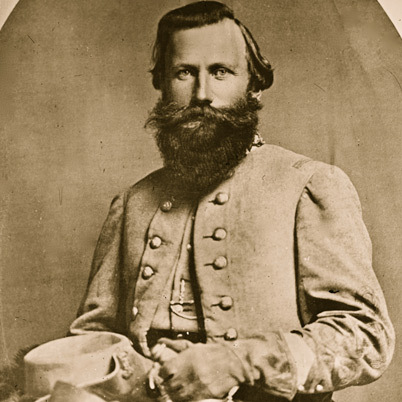
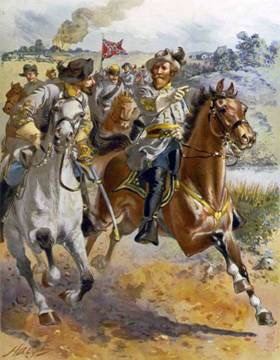
The first instance of this lack of clarity and vagueness in regard to Lee’s orders to his subordinates involved Major General J.E.B. Stuart, who commanded Lee’s cavalry division and the results of this would help doom Lee’s campaign in Pennsylvania.

Lee and Stuart

To understand how this happened we need to start with the character of J.E.B. Stuart and his relationship with Robert E. Lee. Without understanding these men it is impossible for us to understand how such a disastrous series of events and miscommunications could occur in an army which was so used to victory.

Before Brandy Station J.E.B. Stuart was at pinnacle of his fame and celebrity. Only thirty-two years old Stuart had gained an amount of fame, and the romantic aura of a chivalrous, bold and daring commander, something akin the gallant knights of an early era. One of his biographers, Burke Davis, whose work about Stuart is at times closer to hagiography than to history called Stuart “The Last Cavalier.” 

If People magazine had been published in 1863, Stuart would have certainly made the cover.

One of Stuart’s officers wrote after the war “There were few men produced by the war whose character was so mixed with gold and dross as Stuart… He could be “brave as his sword,” but “frivolous to the point of ridicule.” [2] Though faithfully married he was a flirt who women swooned over when they met him. “He possessed a zest for life and a flamboyance of style that made him the embodiment of a knight errant, a cavalier warrior from an evocative past.” [3] This is not to say that Stuart was not a gifted offer, leader or commander. Even before the war he was regarded as “a young officer of great promise, a natural horseman with a reputation for dash and bravery gained in countless clashes with Indians throughout the West, and for steady competence in the pro- and antislavery warfare of Kansas.” [4]

In the early part of the war he proved to be a dependable cavalry officer who supplied Stonewall Jackson, James Longstreet, Joseph Johnston and Robert E. Lee with reliable information regarding the composition, movements and intention of their opponents, and who in battle usually bested his Federal opponents.

However, it was his ride around McClellan during the Seven Days that established Stuart as a Confederate hero.

There had been little good news for Confederates during the previous months, but “there was an air of romantic adventure to Stuart’s exploit which touched every Southerner who read it.” [5] Newspapers published accounts which lauded Stuart’s exploit. The Richmond Examiner called it “one of the most brilliant affairs of the war, bold in its inception and the most brilliant in its execution.” [6] A correspondent from the Charleston Mercury wrote “It is a question of whether the annals of warfare furnish so daring a deed.” [7] The result of the ride was fame for Stuart and a new respect for the Confederate cavalry within the Army of Northern Virginia. “Stuart had become the hero of his troopers and one of the idols of the public.” [8]

The fact that Stuart succeeded in large part due to the inability of the Federal Cavalry commander, General Phillip St. George Cooke, Stuart’s father-in-law, to grasp what was happening or respond in an effectual manner did not dim the luster of the accomplishment. One of Stuart’s officers wrote that the newspapers “were filled with accounts of the expedition, none accurate, and most of them marvelous.” [9] The success and adulation that Stuart received in the Confederate press only cemented in Stuart’s mind that such raids would garner him fame and advance his career.

Stuart was not only adept at using the media to advance himself, but he also used his relationships and cultivated those in power to get ahead. He was a friend of the Lee’s before the war, and Robert E. Lee treated Stuart as if he were a son. He had the good fortune to staying with the Lee’s at Arlington and be at the War Department when John Brown seized Harper’s Ferry, where he had won Lee’s admiration. When Joseph Johnston commanded the army Stuart ingratiated himself to him and used flattery to gain favor saying “Johnston is in capacity head and shoulders above every general in the Southern Confederacy.” [10] At the same time he wrote about Lee’s lack of success in Western Virginia “With profound personal regard for General Lee, he has disappointed me as a General.” [11]

When Johnston was wounded Lee was appointed to command the army and Stuart quickly reconnected with Lee and following the success of his ride around McClellan’s army became Lee’s favorite cavalryman. Following the Seven Days battles when the Cavalry was expanded Lee nominated Stuart to command the division and ensured his promotion to Major General. Stuart responded in kind by recommending Lee’s nephew, Fitzhugh Lee to command a brigade in the division. As the division grew Stuart, knowing Lee’s preference for Virginians in the senior ranks of army leadership appointed “Virginians to command four of his division’s five brigades.” [12] These included Fitzhugh Lee as well as Lee’s son Rooney.

Following the Battle of Antietam Stuart made another spectacular ride around McClellan in Maryland and Pennsylvania, an escapade which helped Lincoln in his decision to relieve that ineffective army commander. Apart from the effect on Northern morale the raid accomplished little of military value, including not achieving its primary objective, the destruction of the B & O railway bridge across the Conococheague River. Porter Alexander wrote that “the raid risked a great deal in proportion to the results it accomplished. It might have easily happened easily happened that the whole command might have been captured.” [13]

At Chancellorsville, after Jackson was mortally wounded and A.P. Hill wounded he took command of Second Corps, and led it well enough that some thought that after Jackson’s death that he should be appointed to command the corps.

Despite his brilliance on the battlefield, Stuart had little capacity for self-reflection and was terribly insecure. “Like many people who rise rapidly from obscurity to prominence, Stuart was insecure in his success.” [14]  During a second raid at the end of the Seven Days his actions helped ensure the escape of the Federal Army, something that fellow commanders and staff officers noticed and which he would not admit. In this action, as well as others, Stuart was “known to take risks with his own life and the lives of his men, sometimes during ill-conceived operations of debatable strategic value.” [15]

Likewise Stuart regarded the Battle of Brandy Station as “the greatest triumph I ever had.” [16] Stuart could not understand how the media or fellow officers could see things differently than him. Brandy Station should have given Stuart ample evidence to reevaluate his performance, but he could not. Instead of working to improve his performance, he insisted “that a poor performance had been just perfect. He seemed more concerned with image than substance because he confused the two.” [17]

A Cavalier Seeks to Redeem His Legacy

After the surprise at Brandy Station Stuart, was unhappy. His pride had been wounded by all of the criticism heaped on him by the Confederate press and well as by politicians and officers of the Army of Northern Virginia. Stuart now found out what many others who have who sought the media spotlight; that the press can rapidly turn from being a friend and promoter, to being strident critic. He expressed his anger to his wife Flora in a number of letters. In one saying “The newspapers are false in every statement except as to the victory….The papers ought to apologize.” [18]

The temptation here would to assume that all that motivated Stuart was the desire to redeem himself, to make up for what happened at Brandy Station. This is at least partially true. However, there was something bigger, and that was Stuart’s need that the myth that he had created around himself, the persona he had taken on, was unsullied. Since the war began he had known nothing but success and celebrity. His unbridled success had not taught him how to deal with failure.

One of more recent biographers, Emory Thomas wrote that Stuart “feared failure perhaps more than anything else in life and certainly more than death. He dealt with failure not by dealing with it, by denying it.” [19] As such his actions are much more than seeking to make up for defeat, but an attempt to build a legacy.

The attacks in the newspapers which had previously fawned over his exploits certainly wounded Stuart. But not all papers had completely lost faith in Stuart, nor doubted that he would redeem himself against the hated Yankee cavalry. The Richmond Whig “concluded an editorial defense of the Beau Sabreur, “We shall be surprised if the gallant Stuart does not, before many days, make the enemy repent sorely the temerity that led them to undertake as bold and insulting feat [as the advance on Brandy]. [20]

The troopers of Stuart’s division screened the right flank of the army as it moved north. The mission of his brigades was to defend the gaps in the Blue Ridge, and to keep Pleasanton’s cavalry from interdicting the march, or discovering the location of Lee’s infantry corps. In this effort Stuart was successful, but not happy.

Between June 17th and June 21st Stuart’s troopers fought a series of engagements at Ashby’s Gap, Middleburg and Upperville. While Stuart’s troopers had held off Pleasanton the “running combats were taking a toll on the Southern mounted arm, however. Stuart had already suffered several hundred casualties defending gaps and passes.” [21] The Confederates also noted the improvements in the Federal cavalry during these battles. Captain William Blackford, who served as an engineer on Stuart’s staff noted:

“the improvement of enemy cavalry was enormous, mainly in the heavy fire from long range carbines, and horse artillery that was a match for Stuart’s own These cavalrymen fought as if they had been taken from infantry regiments, for they knew how to fight with horses left behind.” [22]

Unlike the rest of the army which was now marching into Pennsylvania and Maryland, Stuart’s Cavalry Division had little cause to rejoice. They had been surprised at Brandy Station and Stuart had been humiliated in the Southern press. “Stuart read, raged, and doubtlessly resolved that the Whig’s prediction should be fulfilled. First must come opportunity.” [23]

It would take nearly two weeks before Stuart got his chance as the Federal cavalry under Pleasanton gave him no opportunity to redeem himself during the clashes along the Blue Ridge.

While Pleasanton’s troopers never broke through Stuart’s screen, they had pressed him hard and this had a major effect on Stuart’s division, which was “really fought out during those two weeks from June 9 until the misty morning of June 22….Not only had Stuart’s cavalry been pressed on the defensive as never before, but also they had not been able to gain a spot of information about the enemy.” [24]

In effect, these actions had not only screened Lee’s army from Hooker, but what went unnoticed by Confederate commanders was that “this succession of fights screened the Army of the Potomac as well” leaving Stuart “somewhat in the dark as to the location and intent of the Federal infantry.” [25] This would have exceptionally dire consequences for Lee as Stuart was no longer supplying him with the thing he needed most, information on the location and intentions of the Army of the Potomac.

On the other hand the Federal cavalry, through its interrogations of prisoners and conversations with civilians had now learned that the “main body of the rebel infantry is in the Shenandoah Valley.” [26] Additionally at Ashby’s Gap, some of John Buford’s troopers had gotten past the Confederates and “peering into the valley beyond, they gazed upon a Confederate infantry encampment – tangible evidence at last of Lee’s progress toward Maryland and Pennsylvania.” [27]

Pleasanton’s troopers, under able commanders like John Buford had proved that the days of “easy Confederate cavalry triumphs were gone,” [28] and Stuart “smarting over the cuts to his ego, refused to read the portents.” [29]

The emotional state of Stuart in the wake of Brandy station had much to do with this condition, but where others, including his media critics could see the improvements in the Federal Cavalry arm, Stuart seemed to live with a fair amount of denial regarding the capabilities of his foe. Stuart still not believe that the Union Cavalry arm had reached a point in the war where they could take on his troopers and be successful, despite the mounting evidence.

Stuart had been fighting defensively the entire campaign beginning with the surprise at Brandy Station, but desperately wanted to go on the offensive. As his troops battled Pleasanton’s aggressive and well led troopers at Aldie, Middleburg and Upperville, Stuart formulated a plan to go on the offensive himself, which he submitted to Lee. Stuart reasoned now that “all the infantry were west of the Blue Ridge…that it would be possible to leave one or two brigades of cavalry to defend the gaps and with the remaining three to descend on the enemy and harass Hooker in any advance into Pennsylvania.” [30]

Conditional, Contradictory and Vague: Lee’s Order to Stuart

On the morning of the 22nd of June Stuart noticed that the Federal cavalry which had engaged him at Upperville the previous day was no longer present. This led Stuart to propose an operation to Lee. It was an operation that Stuart hoped would restore his glory, for he had to protect his legend at any cost, and he was extremely sensitive about what people thought, wrote and said about him. “he had cultivated his public image and in turn the poems, songs, and praise seemed to confirm his vision of himself. How could the newspapers and gossips be son wrong?” [31] As such when he found an opportunity he took it. In his after action report he said:


“I submitted to the commanding general the plan of leaving a brigade or so in my present front, passing through Hopewell or some other gap in the Bull Run Mountains, attain the enemy’s rear, passing between his main body and Washington, and cross into Md., joining our army north of the Potomac. The commanding general wrote authorizing this move, if I thought it practicable….” [32]

Lee’s reply via the order that Stuart received from Lee was the first of a series of vague, poorly written and contradictory orders by Lee that were to plague the campaign. It was an order that gave Stuart exactly what needed to embark on an expedition to regain his luster.

The order “offered his cavalry commander wide latitude to select his route in accord with circumstances.” [33] Lee’s order left “the decision to Stuart” [34] as to how he would execute it. It was also an order that gave Stuart the idea “that something better than the drudgery of a march along our flank might be open to him, and that one of General Stuart’s activity and gallantry should not be expected to fail to seek it.” [35]

It was an order that Stuart seized upon to regain his reputation.

Unlike Lee’s two new infantry corps commanders, Ewell and Hill, Stuart was very familiar with Robert E. Lee’s method of command, and Lee had “so much faith in Stuart’s judgment and ability to make the right moves that after indicating his wishes he gave him considerable latitude in carrying them out. His orders were more suggestions than commands….” [36] However well that may have worked for Lee in the past with Jackson and Stuart, at this time it failed Lee.

Lee’s orders to Stuart were conditional in nature, in other words they were operative as long as the conditions allowed. Since they were conditional orders, Lee needed to clearly address “the conditions upon which they are based.” [37] This Lee did not do and it was a critical oversight. His order to Stuart read:


“I judge the efforts of the enemy yesterday were to arrest our progress and ascertain our whereabouts. Perhaps he is satisfied. Do you know where he is and what he is doing? I fear he will steal a march on us and get across the Potomac before we are aware. If you find that he is moving northward and that two brigades can guard the Blue Ridge and take care of your rear, you can move with the other three into Maryland and take position on General Ewell’s right, place yourself in communication with him, guard his flank, keep him informed of the enemy’s movements and collect all the supplies you can….” [38]

Longstreet, who Stuart was cooperating with on the northward march, added his own comments to Lee’s instruction which even further clouded the order:
General Lee has enclosed this letter for you, to be forwarded to you, provided you can be spared from my front, and provided I think that you can move across the Potomac without disclosing our plans. He speaks of your leaving via the Hopewell Gap and passing by the rear of the enemy. If you can get through by that route I think that you will be less likely to indicate what our plans are than if you should be passing to our rear. I forward the letter of instructions with these suggestions. Please advise me of the condition of affairs before you leave, and order General Hampton, whom I suppose will leave here in command, to report to me at Millwood, either by letter or in person, as may be most agreeable to him.” [39] 

Stung by the criticism of his conduct of the Battle of Brandy Station in the Southern press and frustrated by Pleasanton’s constant thrusts Stuart, “who always interpreted cavalry orders to their outer limits” [40] did just that and interpreted them in a manner that appealed to his need to redeem his now tarnished reputation. Stuart believed that he would repeat his triumph of the previous year when he rode around the Army of the Potomac.

For Stuart this was a chance to regain the limelight and add to his luster. Stuart “summed up his interpretation of his orders when he said later: …it was deemed practicable to move entirely in the enemy’s rear, intercepting his communications with his base (Washington), and, inflicting damage upon his rear, to rejoin the army in Pennsylvania in time to participate in its actual conflicts.” [41]

Stuart was already planning his offensive which he believed would restore his glory. Days before Stuart had sent Major John Mosby with a small detachment of troopers to reconnoiter behind the Union lines. Mosby reported the location of all the infantry corps of the Army of the Potomac. Mosby reported to Stuart on June 23rd that the Federal corps of the Army of the Potomac were stationary and “were so widely separated…that a column of cavalry could easily get between them.” [42]

Mosby’s report painted a glowing picture of how an operation using the Hopewell Gap could create havoc in the Federal rear and cause panic in Washington as he could “severe communications between Hooker and Pleasanton, destroy a “large portion” of Hooker’s transportation, and take some of the pressure off Lee by creating a diversion for the Union cavalry.” [43]

The purported inactivity of the Federal army reported by Mosby was exactly the news Stuart wanted to hear, and he asked Lee for permission to plunge into the Federal rear. In his after action report Stuart wrote:

“I submitted to the commanding general the plan of leaving a brigade or so in my present front, and passing through Hopewell, or some other gap in Bull Run Mountain, attaining the enemy’s rear, and passing between his main body and Washington, to cross into Maryland and joining our army north of the Potomac.” [44]

Lee concurred and noted that “Upon the suggestion of the former officer (General Stuart) that he could damage the enemy and delay his passage of the river by getting to his rear, he was authorized to do so.” [45]

In his after action report of the campaign Lee wrote:


“General Stuart was left to guard the passes of the mountains and observe the movements of the enemy, whom he was instructed to impede and harass as much as possible, should he attempt to cross the Potomac. In that event, General Stuart was directed to move into Maryland, crossing the Potomac east or west of the Blue Ridge, as, in his judgment, should be best, and take position on the right of our column as it advanced.” [46]

That night, during a heavy rainstorm Stuart’s chief of staff Major McClellan received Lee’s reply, written by Colonel Charles Marshall, to his superior’s request which he immediately delivered to Stuart. It is this final order which forms the basis of the great controversy of Stuart’s actions during the campaign. Lee’s order stated:
“If General Hooker’s army remains inactive, you can leave two brigades to watch him, and withdraw with three others, but should he not appear to be moving northward, I think you had better withdraw this side of the mountains tomorrow night, cross as Shepherdstown next day, and move over to Frederickstown.

You will, however, be able to judge whether you can pass around their army without hindrance, doing them all the damage you can, and cross the river east of the mountains. In either case, after crossing the river, you must move on and feel the right of Ewell’s troops, collecting information, provisions, etc.” [47]

The order continued with a further paragraph which Stuart seems not to have fully conveyed to the commanders of the brigades being left behind to screen the army:


“Give instructions to the commander of the brigades left behind, to watch the flank and rear of the army, and (in the evidence of the enemy leaving their front) retire from the mountains west of the Shenandoah, leaving sufficient pickets to guard the passes, and bringing everything clear along the Valley, closing upon the rear of the army.” [48]

Finally, Marshall provided an additional admonishment to Stuart “I think the sooner you cross into Maryland, after to-morrow, the better.” [49] However, the orders or suggestions that Lee and Longstreet gave Stuart “are so badly worded that it is difficult to make sense of them.” [50] In them, Stuart was directed maintain contact with Ewell, screen the Blue Ridge gaps, collect information, “raiding around the rear of Hooker’s forces” [51] damaging the enemy, and collecting supplies.

Lee should have “established that Stuart’s most important task was to guard Ewell’s right and report on the direction of Hooker’s advance once Lee crossed the Potomac.” [52]

This he did not do.

Lee’s lack of clarity and vagueness allowed to Stuart interpret the order in the manner that benefited his need to redeem his reputation. The order could easily be interpreted as getting Stuart and his men into Pennsylvania as quickly as possible to guard Ewell’s flank and discern the intentions of the enemy, which in hindsight and according to his aids appears to have been Lee’s intent. But as written, they could easily ben interpreted as permission to conduct a raid to “roam in the enemy’s rear for an unpredictable period of time, raising havoc with his communications, supplies, and isolated commands” and then “seek out Ewell’s corps and use it as a place of refuge from an aroused enemy.” [53]

Porter Alexander was quite critical of Lee’s decision and wrote after the war:
“In view of the issues at stake, and of the fact that he had been deprived of two promised brigades (Corse’s and Jenkins’s), it was unwise even to contemplate sending three brigades of cavalry on such distant service. When one compares the small beneficial results of raids, even when successful, with the risks here involved, it is hard to understand how Lee could have given his consent.” [54]

Stuart, as he was want to do, used “the freedom that he had long enjoyed in implementing Lee’s orders” [55] to carry out his plan. Now smarting from the Brandy Station criticism, Stuart “interpreted them as a sanction for another White House raid….” [56] While it is certain that Lee meant to give Stuart permission for a “joyride around the entire Army of the Potomac or even just the three Federal corps which formed the westernmost wing of Hooker’s pell-mell rush to the Potomac” [57] he had given his knight errant just enough permission to do exactly that, exactly what he wanted to do in the first place.

Had Lee’s orders been clear there is no doubt that Stuart would have obeyed,

The fact is that different standards apply to each of those courses of action, and thus, the orders must be clear. Without such clarity it becomes easy for subordinates to interpret them in a far different way from which they were intended by the issuing commander, with far reaching effects. By giving Stuart the latitude to go around the Federal army Lee had undercut his own preference that Stuart cross into Maryland via Shepherdstown and Frederick on June 24th. Lee had provided Stuart an opportunity for something that “Longstreet half-apologetically called “something better than the drudgery of a march around our flank.” [58] It was a critical mistake, which was then further compounded by Stuart and the movement of the Army of the Potomac.

Porter Alexander compared Stuart’s Ride to Joe Hooker’s use of his cavalry corps at Chancellorsville noting: “I think that Joe Hooker’s defeat was due to the absence of his cavalry on just such a useless raid as this. We ought to have recognized Hooker’s error & avoided repeating it….We took unnecessary risk, which was bad war, & the only bad war too, I think, in all our tactics.” [59] However, in retrospect it does not appear that Lee, Longstreet or Stuart recognized the problems this risk would entail, or just how much it resembled Hooker’s use of his cavalry corps at Chancellorsville.


Historians have long wondered why Lee was not more explicit in his orders to Stuart and why Stuart conducted an operation that left Lee blind and had no obvious advantages, except to allow Stuart to recover his tarnished reputation. Stephen Sears noted in his book Gettysburg that: “The very concept of Stuart’s expedition was fueled by overconfidence and misjudgment at the highest command level.” [60]

In a sense the decision harkens back to the hubris of Lee and others about the superiority of his army, and Lee’s well known distain for the Federal army’s leadership and soldiers. This hubris is even more profound when one considers the fact that as early as June 23rd Lee knew “that the Federals were laying a pontoon bridge at Edward’s Ferry, indicative of a crossing.” [61]

Stuart’s Ride

“Stuart had decided to do what he wanted to do – a march between Hooker’s army and Washington and mix raiding with riding en route to Ewell in Pennsylvania.” [62] In organizing his movement, Stuart decided to take his three best brigades with him, and leave the brigades of “Grumble” Jones and Beverly Robertson to defend gaps and screen the rear of the army. The choice was unfortunate; Jones was considered the “best outpost officer in his command,” [63] but Robertson, though known to be unpredictable was placed in command because he was “senior to the dependable Jones.” [64] The choice ridded Stuart of Robertson, who he did not trust in battle and Jones “whose antipathy for Stuart at least equaled Stuart’s for him.” [65] Stuart instructed Robertson to “observe and harass the Federals as long as they remained in Virginia.” [66]

On the surface to Stuart it appeared the right choice, Robertson “showed neither the initiative or enterprise of a cavalry officer in the Army of Northern Virginia, Robertson could only be used for routine work, such as guarding the mountain passes.” [67]

The intent was that Robertson would screen the army and follow it into Maryland, in fact Stuart gave Robertson “explicit instructions” [68] to do so, but Stuart’s order also contained a statement which Robertson used to justify his actions years later. Stuart instructed Robertson, who could be expected to obey orders:
“After the enemy has moved beyond your reach, leave sufficient pickets in the mountains and withdraw to the west side of the Shenandoah and place a strong and reliable picket to watch the enemy at Harper’s Ferry….

As long as the enemy remains in your front, in force, unless directed otherwise ordered by General R.E. Lee, Lieutenant-General Longstreet, or myself, hold the gaps with a line of pickets reaching across the Shenandoah by Charlestown to the Potomac.

Avail yourselves of every means in your power to increase the efficiency of your command and keep it up to the highest number possible. Particular attention will be paid to the shoeing of horses, and to marching off the turnpikes….” [69]

Robertson, interpreted the order that he was to go to the western side of the Shenandoah and avoid using the turnpikes, which he noted “the only road by which the orders (which particularly specified the avoidance of “turnpikes” on the difficulty and delay of shoeing horses) could be complied with, carried my command to Martinsburg….” [70]

Thus, “the two brigades would remain fixed, as if planted there, in an inanition of command which immobilized the men for whom Lee in Pennsylvania was anxiously watching.” [71] Longstreet had requested the industrious and dependable Hampton to command the remaining cavalry, but Stuart disregarded his counsel and took Hampton with him, after all, he was J.E.B. Stuart, the finest cavalryman on the American continent.

Stuart set off with his three best brigades, those of Wade Hampton, Fitzhugh Lee, and Rooney Lee. Since Lee had been wounded at Brandy Station, his brigade was now under the command of Colonel John R. Chambliss, another former West Pointer retired from the old army. Almost immediately after setting off Stuart and his brigades encountered a situation that should have immediately stopped movement to the Federal rear and instead move west of the Blue Ridge.

Moving through Glasscock’s Gap they “bumped unexpectedly into “an immense wagon train,” which happened to be the tail end of Winfield Hancock’s 2nd Corps, blocking the road in exactly the fashion Lee had described as a hindrance.” [72] In light of his encounter with the Army of the Potomac, it “was now clearly impossible for Stuart to follow the route originally intended.” [73] Stuart was now faced with a critical choice, either withdraw and follow the army, or attempt to continue his raid.

Instead of going back when he had the chance Stuart elected to continue with his “plan to go around the Federal army. It was a crucial decision, for he still could have turned back without losing any more time.” [74] Stuart consulted with “no ranking subordinate or staff member” [75] as he made his decision. On June 25th Stuart’s brigades had to spend a day grazing their horses since they had brought no grain with him, which delayed their advance north and east. This placed him a day behind schedule. Though he made better time on the 26th, advancing twenty-five miles he had to again stop to graze his horses at the Occoquan River. It had “taken forty-eight hours to march thirty-five miles.” [76]

The Price of 125 Wagons

Stuart continued on past the outskirts of Washington on June 27th and was again delayed when attempting to cross the Potomac at Rowser’s Ford by the “water level two feet higher than normal.” [77] He then encountered a large Federal wagon train not far from Washington capturing over 100 wagons and 600 mules. Stuart reveled in that feat and boasted that “he had taken more than one hundred and twenty-five best United States model wagons and splendid teams and gay caparisons,” containing “foodstuffs, oats, hay…bacon, ham, crackers and bread” but his progress was slowed by his enormous wagon train of captured supplies…” [78] He and briefly wondered “whether it might be worth “our entering Washington City” [79] before determining that the effort might be too costly because of the fortifications and proliferation of artillery.

At Fairfax Courthouse Stuart sent a message to Lee, which was never received by Lee, but which did arrive in Richmond on July 1st. It was a dispatch that was late, and even factually incorrect for the bulk of the Army of the Potomac was in Maryland advancing toward Lee in Pennsylvania. His report stated:

“General: – I took possession of Fairfax C.H. this morning at nine o’clock, together with large quantity of stores. The bulk of Hooker’s army has gone toward Lee’sburg, except the garrison at Alexandria and Washington, which has retreated to its fortifications.” [80]

On June 28th, Stuart received word that Hooker and the Army of the Potomac was across the Potomac. It was a major surprise to him, and by now Stuart “knew nothing of Lee’s position,[81] and instead of abandoning the wagon train, he sacrificed the speed and mobility that he needed to support Lee in order to keep it. Douglas Southall Freeman wrote that the “wagon train was Jeb Stuart’s stumbling block.” [82]

Of course it was Lee’s order for Stuart to collect all the supplies that he could justified Stuart’s course of action. Now, Stuart “far from guarding Ewell’s right, he was now moving away from Ewell, with no idea where Hooker’s army might be and no communication with Lee, who frequently inquiring of his aides, “Can you tell me where General Stuart is?” [83] But “ignorant of his chief’s distress, Jeb was not concerned, apparently, over the encumbrance of his wagon train.” [84] Stuart’s chief of staff Henry McClellan wrote after the war that “the capture of the train of wagons was a misfortune. The time occupied in securing it was insignificant; but the delay caused to the subsequent march was serious at a time when minutes counted almost as hours.” [85]

On the wrong side of the federal army, encumbered by the captured wagon train, “Stuart would have to make a half circle of more than fifty miles around Gettysburg before arriving there about noon on the second day of battle with most of his troopers, his artillery, and his wagon train lumbering far behind him.” [86]

On June 30th his men were engaged by Judson Kilpatrick’s Federal near cavalry division near Hanover, and “his men never fought more poorly…and General Stuart and his staff were nearly captured.” [87] As Stuart’s brigades slowly advanced  through Northern Virginia and Maryland the strain was becoming evident. The units had “covered more than one hundred miles since leaving Salem. Horses broke down and were abandoned, with their riders scouring the countryside for replacements. With each successive mile, the problem worsened.” [88]

As Stuart and his men plodded their way around the Army of the Potomac, encumbered by their booty they had to constantly fight off the Federal cavalry units of Judson Kilpatrick who had been dispatched to follow and harass him.

By now, Robert E. Lee was becoming more anxious by the hour. He had no contact with Stuart for nearly five days and he knew little about the locations or intentions of the enemy army. On the 27th at Chambersburg Lee was disquieted and asked various staff members “Can you tell me where General Stuart is?” Have you any news of the enemy’s movements?” [89]

On the morning of July 1st with his army now engaged in battle, “Stuart was practically lost, and had to guess which direction he should go to find Lee’s army.” [90] Lee enquired of Major Campbell Brown of Ewell’s Second Corps staff if Ewell “had heard anything” from Stuart. Brown, who had come to deliver a message from Ewell to Lee noted that Lee’s question was asked “with a particular searching almost quelous impatience.” [91] Lee told Brown that “Gen’l Stuart had not complied with his instructions” but instead had “gone off clear around” the Federal army, because “I see by a (Balto or N.Y.?) paper that he is near Washington.” [92] As Brown left he thought that Lee was “really uneasy & irritated by Stuart’s conduct & had no objection to his [Brown’s] hearing it.” [93]


Return of the Knight Errant

By the time Stuart’s troopers arrived in Gettysburg, “the expedition had occupied eight days, and had traversed in that time about 250 miles.” [94] Meanwhile, Lee had been exceedingly impatient. Stuart’s once proud outfit was “exhausted and too late to be of any service.” [95] The three brigades involved had lost very few men in combat, according to Porter Alexander only eighty-nine men were killed or wounded, [96] however “hundreds, if not thousands, of Stuart’s men had abandoned ranks during the ride, had their mounts break down, or were physically unable to perform their duties.” [97]

Stuart’s arrival at Gettysburg was not a moment of triumph by any means, but was a humiliating experience. Instead of reporting to his commander with information that Lee needed, it was Lee who informed him of the position of his own army and the Army of the Potomac. Lee’s words to his much beloved subordinate were painful. He asked him “General Stuart, where have you been?” [98] Stuart seemed to wilt at his mentor’s words, and attempted to put the best face forward, and told Lee “I have brought you 125 wagons and their teams, General.” This did not mollify Lee, who replied “Yes, General, but they are an impediment to me now.” [99]

Stuart’s raid was disastrous for Lee. He was blind and had no idea where the Federal army was until told by Longstreet’s scout Harrison on June 28th. One historian noted that the ride was “an act of folly- ill-planned, badly conducted, and (until the very end) executed with an almost total disregard for anything for any interest other than the self-promotion of J.E.B. Stuart.” [100] A staff member at Stuart’s headquarters wrote after the war:

“Raiding was Stuart’s hobby…and one which he rode with never failing persistence….What a glorious opportunity was now offered for the indulgence of his love!…What a tempting prize lay within his reach….Here was an undertaking which…would eclipse in brilliance and real importance any exploit of the war.” [101]

Stuart’s actions were heavily criticized by many in the army. Moxey Sorrell who served on Longstreet’s staff described the raid “a useless, showy parade almost under the guns of the Washington forts, and his horse, laurel wreathed, bore the gay rider on amid songs and stories.” [102] Likewise, Lee’s Chief of Staff Colonel Charles Marshall “urged the commanding general to court-martial Stuart” [103]

Lee was gracious to the extreme in his discussion of Stuart’s actions in his after action report. He made but one inference to Staurt without naming him’ but it was damning: “The movements of the army preceding the battle of Gettysburg had been much embarrassed by the absence of the cavalry.” [104] Walter Taylor of Lee’s staff wrote that the report was a “simple statement of facts: a striking illustration of his tendency to always suppress all consideration of self and spare the reputations and feelings of others.” [105]

In his after action report, which was by far the longest of any confederate commander, Stuart admitted to no mistakes. In it he showed a “self-righteous attitude” and showed a “tendency to complain of the failure of others.” [106] and in a manner blamed Lee and the remaining cavalry commanders for the loss, insisting that “he had left Lee with plenty of cavalry and remarked that “properly handled, such a command should have done everything requisite….” [107] There is some truth in this, but at the same time it is a foil which Stuart used to deflect criticism from himself. He blamed Jubal Early and his infantry for not finding him in Pennsylvania, when such responsibility by the doctrine of the day lay with the cavalry and not the infantry and Hill and Longstreet for not conforming their advance to his timetable.

Edward Coddington described Stuart’s report as “a strange document, more of an apology than a report, in which he tried to prove the virtues of his adventure.” [108] It was unfortunate and when Wade Hampton saw the report he wrote to Thomas Munford “Lately I saw for the first time Stuart’s report of the Gettysburg campaign and I never read a more erroneous – to call it no harsher name – one than it was.” [109]

Basically, in Stuart’s fantasy world, the world where his reputation mattered more than truth “Had Lee “properly handled” the cavalry Stuart left with him; had Early’s infantry found the cavalry column; had Hill and Longstreet acted in accord with Stuart’s after the fact assumptions – then all would have been well.” [110]

But despite Stuart’s hearty exaggerations in his after action report and the claims of his post war apologists, John Mosby and Henry McClellan, the raid had little effect on the army of the Potomac. The losses of wagons were rapidly made up by the massive Union war industry, of his prisoners, the majority of who he had to parole, close to half were teamsters and not trained combat soldiers. Though he had destroyed some rail lines, he never severed the ones that Meade used between his army and Washington D.C.

In sum, Stuart’s  gambit to redeem his reputation and build upon his legacywas a major part of Lee’s failure at Gettysburg. It certainly not the only one, Lee, Hill, Ewell, Longstreet and even Jefferson Davis made terrible decisions that contributed to the defeat. But that being said, in terms of the scope of the single decision of a commander which impacted  the campaign, this one is perhaps the only one which is indefensible by any standard of interpretation.

To this point a number of issues important to those involved in planning campaigns became clear: Deception, commander’s intent and unity of command. Lee successfully used deception to prevent the Federals from discerning his purposes. That was counteracted by his lack of clarity in communicating his intent to Stuart, and Stuart’s, Stuart’s own vague orders to Robertson, and the careless disregard by Stuart of any other consideration but his own reputation and vanity.

Notes

[1] ___________. Joint Publication 3-0 Joint Operations Chairman of the Joint Chiefs of Staff, Washington DC August 2011


[2] Guelzo, Allen C. Gettysburg: The Last Invasion Vintage Books a Division of Random House, New York 2013 p.53

[3] Wert, Jeffry D. General James Longstreet The Confederacy’s Most Controversial Soldier, A Touchstone Book, Simon and Schuster, New York and London 1993 p.85

[4] Korda, Michael.

Clouds of Glory: The Life and Legend of Robert E. Lee Harper Collins Publishers, New York 2014 p.xxv


[5] Sears, Stephen W. To the Gates of Richmond: The Peninsula Campaign Houghton Mifflin Company, Boston and New York, 1992 p.173


[6] Wert, Jeffry D. A Glorious Army: Robert E. Lee’s Triumph 1862-1863 Simon and Schuster, New York and London 2011 p.26
[7] Ibid. Sears. To the Gates of Richmond p.173


[8] Freeman, Douglas Southall, Lee’s Lieutenant’s a Study in Command, One volume abridgement by Stephen W Sears, Scribner, New York 1998 p.158


[9] Ibid. Sears. To the Gates of Richmond p.173


[10] Ibid. Guelzo, Gettysburg: The Last Invasion p.53
[11] Davis, Burke J.E.B. Stuart: The Last Cavalier Random House, New York 1957 p.94


[12] Ibid. Guelzo, Gettysburg: The Last Invasion p.53


[13] Alexander, Edward Porter Military Memoirs of a Confederate: A Critical Narrative 1907 republished 2013 by Pickle Partners Publishing, Amazon Kindle Edition location 5633


[14] Thomas, Emory M. Bold Dragoon: The Life of J.E.B. Stuart University of Oklahoma Press, Norman OK 1986 and 1999 p.232


[15] Longacre, Edward G. Gentleman and Soldier: The Extraordinary Life of General Wade Hampton Rutledge Hill Press, Nashville TN 2003 p.82


[16] Ibid. Wert Cavalryman of the Lost Cause p.252


[17] Ibid. Thomas, Emory M. Bold Dragoon p.231
[18] Ibid. Wert Cavalryman of the Lost Cause p.252


[19] Ibid. Thomas Bold Dragoon p.256


[20] Ibid. Freeman Lee’s Lieutenant’s p.552


[21] Petruzzi, J. David and Stanley, Steven The Gettysburg Campaign in Numbers and Losses: Synopses, Orders of Battle, Strengths, Casualties and Maps, June 9 – July 1, 1863 Savas Beatie LLC, El Dorado Hills CA 2012 p.41
[22] Ibid. Davis, Burke J.E.B. Stuart: The Last Cavalier pp.319-320
[23] Ibid. Freeman Lee’s Lieutenant’s p.552


[24] Dowdy, Clifford. Lee and His Men at Gettysburg: The Death of a Nation Skyhorse Publishing, New York 1986, originally published as Death of a Nation Knopf, New York 1958 p.57
[25] Catton, Bruce The Army of the Potomac: Glory Road Doubleday and Company, Garden City New York, 1952 p.253


[26] Ibid. Wert A Glorious Army p.224


[27] Longacre, Edward G. John Buford: A Military Biography Da Capo Press, Perseus Book Group, Cambridge MA p.175


[28] Ibid. Freeman Lee’s Lieutenant’s p.553


[29] Ibid. Dowdy Lee and His Men at Gettysburg p.57
[30] Ibid. Freeman Lee’s Lieutenants p.553


[31] Ibid. Thomas Bold Dragoon p.233


[32] Ibid. Alexander Military Memoirs of a Confederate location 7210


[33] Ibid. Thomas Bold Dragoon p.240


[34] Fuller, J.F.C. Grant and Lee: A Study in Personality and Generalship, Indiana University Press, Bloomington IN 1957 p.195
[35]   McClellan, Henry Brainerd The Life and Campaigns of Major General J.E.B. Stuart Commander of the Cavalry of the Army of Northern Virginia 1885. Digital edition copyright 2011 Strait Gate Publications, Charlotte NC Location 6131
[36] Coddington, Edwin B. The Gettysburg Campaign: A Study in Command, A Touchstone Book, Simon and Schuster New York, 1968 p.108


[37] Ibid. Coddington The Gettysburg Campaign p.108


[38] Ibid. Davis J.E.B. Stuart: The Last Cavalier p.321


[39] Oates, William C. and Haskell, Frank A. Gettysburg: The Confederate and Union Views of the Most Decisive Battle of the War in One Volume Bantam Books edition, New York 1992, originally published in 1905 p.61
[40] Pryor, Elizabeth Brown. Reading the Man: A Portrait of Robert E. Lee Through His Private Letters Penguin Books, New York and London 2007 p.332


[41] Ibid. Freeman Lee’s Lieutenants p.555


[42] Ibid. Coddington The Gettysburg Campaign p.109


[43] Ibid. Coddington The Gettysburg Campaign p.109


[44] Ibid. McClellan The Life and Campaigns of Major General J.E.B. Stuart Location 6087


[45] Ibid. McClellan The Life and Campaigns of Major General J.E.B. Stuart location 6106


[46] Lee, Robert E. Reports of Robert E Lee, C.S. Army, Commanding Army of Northern Virginia Campaign Report Dated January 20th 1864. Amazon Kindle Edition location 285


[47] Ibid. Davis J.E.B. Stuart: The Last Cavalier p.324


[48] Ibid. Wert Cavalryman of the Lost Cause p.259


[49] Ibid. Wert Cavalryman of the Lost Cause p.259


[50] Fuller, J.F.C. Decisive Battles of the U.S.A. 1776-1918 University of Nebraska Press, Lincoln 2007 copyright 1942 The Royal Society for the Prevention of Cruelty to Animals p.226


[51] Ibid Korda Clouds of Glory p.540


[52] Ibid. Korda Clouds of Glory p.540


[53] Ibid. Coddington The Gettysburg Campaign p.110


[54] Ibid. Alexander Military Memoirs of a Confederate location7223 of 12968


[55] Taylor, John M. Duty Faithfully Performed: Robert E Lee and His Critics Brassey’s, Dulles VA 1999 p.136


[56] Ibid. Fuller Decisive Battles of the U.S.A.p.226. Note: The White House Raid was Stuart’s ride around McClellan’s army during the Seven Days.


[57] Ibid. Guelzo, Gettysburg: The Last Invasion p.96
[58] Ibid. Guelzo, Gettysburg: The Last Invasion p.96
[59] Alexander, Edward Porter. Fighting for the Confederacy: The Personal Recollections of General Edward Porter Alexander edited by Gary Gallagher University of North Carolina Press, Chapel Hill 1989 p.228


[60] Sears, Stephen W. Gettysburg, Mariner Books, Houghton Mifflin Company, Boston and New York, 2003 p.106
[61] Ibid. Wert A Glorious Army p.226


[62] Ibid. Thomas Bold Dragoon p.241


[63] Ibid. Davis J.E.B. Stuart: The Last Cavalier p.324


[64] Ibid. Dowdy Lee and His Men at Gettysburg p.63
[65] Ibid. Dowdy Lee and His Men at Gettysburg p.63
[66] Ibid. Thomas Bold Dragoon p.241
[67] Ibid. Coddington The Gettysburg Campaign p.112


[68] Ibid. Coddington The Gettysburg Campaign p.112


[69] Robertson, Beverly The Confederate Cavalry in the Gettysburg Campaign in Battles and Leaders of the Civil War Volume III, The Tide Shifts. Edited by Robert Underwood Johnson and Clarence Clough Buel Castle, Secaucus NJ p.253


[70] Ibid, Robertson The Confederate Cavalry in the Gettysburg Campaign p.253


[71] Ibid. Dowdy Lee and His Men at Gettysburg p.63
[72] Ibid. Guelzo Gettysburg: The Last Invasion p.96


[73] Ibid. Wert Cavalryman of the Lost Cause p.265


[74] Ibid. Coddington The Gettysburg Campaign p.112


[75] Ibid. Wert Cavalryman of the Lost Cause p.266


[76] Ibid. Davis J.E.B. Stuart: The Last Cavalier p.325


[77] Ibid. Coddington The Gettysburg Campaign p.112


[78] Ibid Korda Clouds of Glory p.541


[79] Ibid. Guelzo Gettysburg: The Last Invasion p.98
[80] Ibid. Wert Cavalryman of the Lost Cause p.272


[81] Ibid. Davis J.E.B. Stuart: The Last Cavalier p.325


[82] Ibid. Freeman Lee’s Lieutenants p.558


[83] Ibid Korda Clouds of Glory p.541


[84] Ibid. Freeman Lee’s Lieutenants p.558


[85] Ibid. McClellan The Life and Campaigns of Major General J.E.B. Stuart location 6267 of 12283


[86] Ibid Korda Clouds of Glory p.541


[87] Ibid. Dowdy Lee and His Men at Gettysburg p.73
[88] Ibid. Wert Cavalryman of the Lost Cause p.272


[89] Ibid. Wert Cavalryman of the Lost Cause p.273


[90] Ibid. Alexander Military Memoirs of a Confederate location7248 of 12968


[91] Ibid. Wert Cavalryman of the Lost Cause p.281


[92] Ibid. Coddington The Gettysburg Campaign p.98
[93] Ibid. Wert Cavalryman of the Lost Cause p.281


[94] Ibid. Alexander Military Memoirs of a Confederate location7223 of 12968


[95] Ibid. Fuller Decisive Battles of the U.S.A. 1776-1918 p.227


[96] Ibid. Alexander Military Memoirs of a Confederate location 7261 of 12968


[97] Ibid. Wert Cavalryman of the Lost Cause p.285


[98] Ibid. Davis J.E.B. Stuart: The Last Cavalier p.334


[99] Ibid. Davis J.E.B. Stuart: The Last Cavalier p.334


[100] Ibid. Guelzo Gettysburg: The Last Invasion p.98
[101] Ibid. Wert Cavalryman of the Lost Cause p.268


[102] Sorrell, Moxey G. Recollections of a Confederate Staff Officer [Illustrated Edition] originally published 1905, Pickle Partners Publishing 2013, Amazon Kindle version location 2585 of 5692


[103] Ibid. Thomas Bold Dragoon p.252
[104] Lee, Robert E. Reports of Robert E Lee, C.S. Army, Commanding Army of Northern Virginia Campaign Report Dated January 20th 1864. Amazon Kindle Edition, location 624 of 743


[105] Taylor, Walter. General Lee: His campaigns in Virginia 1861-1865 With Personal Reminiscences University of Nebraska Press, Lincoln Nebraska and London, 1994 previously published 1906 p.185


[106] Ibid. Coddington The Gettysburg Campaign p.202


[107] Ibid. Thomas Bold Dragoon p.254


[108] Ibid. Coddington The Gettysburg Campaign p.202


[109] Ibid. Thomas Bold Dragoon p.253


[110] Ibid. Thomas Bold Dragoon p.255

Leave a comment

Filed under civil war, Gettysburg, History, Military

Fighting Prejudice on the Western Front 1918

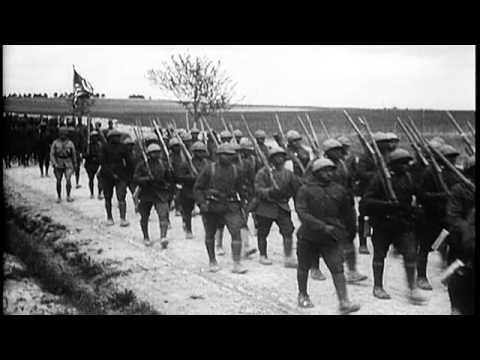
800px-Harlem_Hell_Fighters

They were Americans who in spite of prejudice and in spite of intolerance and persecution loved their country. They were men who labored under the most difficult circumstance to show all Americans and the world that they were worthy of being soldiers and citizens of the United States of America.

They were all volunteers and many of them were veteran soldiers had already served full careers on the Great Plains. They were the Buffalo Soldiers, and when the United States entered the First World War, they were not wanted. Instead, the veterans  were left on the frontier and a new generation of African American draftees and volunteers became the nucleus of two new infantry divisions, the 92nd and 93rd.

lossy-page1-795px-Negro_Troops_in_France._Picture_shows_part_of_the_15th_Regiment_Infantry_New_York_National_Guard_or_._._._-_NARA_-_533488.tif


However in the beginning they too were kept out of action. These men were initially regulated to doing labor service behind the lines and in the United States. But finally, the protests of organizations such as the NAACP and men like W.E.B.DuBois and Phillip Randolph forced the War Department to reconsider the second class status of these men and form them into combat units.

hqdefault1a

Despite this the leadership of the AEF, or the American Expeditionary Force of General John Pershing refused to allow these divisions to serve under American command. Somehow the concept of such men serving alongside White Americans in the “War to end All War” was offensive to the high command.

Instead these divisions were broken up and the regiments sent to serve out of American areas on the Western Front. The regiments of the 93rd Division were attached to French divisions. The 369th “Harlem Hellfighters” were first assigned to the French 16th Division and then to the 161st Division.

The 370th “Black Devils” were detailed to the French 26th Division and the 371st and 372nd Infantry Regiments were assigned to the French 157th (Colonial) Division, which was also known as the Red Hand Division.

These units performed with distinction. The 371st was awarded the French Croix de Guerre and Légion d’honneur and Corporal Freddie Stowers of the 1st Battalion 371st was the only African American awarded the Congressional Medal of Honor in the First World War. The 372nd was also awarded the Croix de Guerre and Légion d’honneur for its service with the 157th Division.

6ASAF00Z

The 157th (Colonial) Division had suffered badly during the war and been decimated in the unrelenting assaults in the trench warfare of the Western Front. It was reconstituted in 1918 with one French Regiment and two American regiments, the Negro 371st and 372nd Infantry. On July 4th 1918 the commanding General of the French 157th Division, General Mariano Goybet issued the following statement:

“It is striking demonstration of the long standing and blood-cemented friendship which binds together our two great nations. The sons of the soldiers of Lafayette greet the sons of the soldiers of George Washington who have come over to fight as in 1776, in a new and greater way of independence. The same success which followed the glorious fights for the cause of liberty is sure to crown our common effort now and bring about the final victory of right and justice over barbarity and oppression.”

220px-Red_Hand_Division

While many white American soldiers depreciated their French hosts and attempted to sow the seeds of their own racial prejudice against the black soldiers among the French, Southerners in particular warned the French of  the “black rapist beasts.” However the French experience of American blacks was far different than the often scornful treatment that they received from white American soldiers.

“Soldiers from the four regiments that served directly with the French Army attested to the willingness of the French to let men fight and to honor them for their achievements. Social interactions with French civilians- and white southern soldiers’ reactions to them- also highlighted crucial differences between the two societies. Unlike white soldiers, African Americans did not complain about high prices in French stores. Instead they focused on the fact that “they were welcomed” by every shopkeeper that they encountered.”

Official and unofficial efforts by those in the Army command and individual soldiers to stigmatize them and to try to force the French into applying Jim Crow to laws and attitudes backfired. Villages now expressed a preference for black over white American troops. “Take back these soldiers and send us some real Americans, black Americans,” wrote one village mayor after a group of rowdy white Americans disrupted the town.”

Stowers

The citation for Corporal Stowers award of the Medal of Honor reads as follows:

Corporal Stowers, distinguished himself by exceptional heroism on September 28, 1918 while serving as a squad leader in Company C, 371st Infantry Regiment, 93d Division. His company was the lead company during the attack on Hill 188, Champagne Marne Sector, France, during World War I. A few minutes after the attack began, the enemy ceased firing and began climbing up onto the parapets of the trenches, holding up their arms as if wishing to surrender. The enemy’s actions caused the American forces to cease fire and to come out into the open. As the company started forward and when within about 100 meters of the trench line, the enemy jumped back into their trenches and greeted Corporal Stowers’ company with interlocking bands of machine gun fire and mortar fire causing well over fifty percent casualties. Faced with incredible enemy resistance, Corporal Stowers took charge, setting such a courageous example of personal bravery and leadership that he inspired his men to follow him in the attack. With extraordinary heroism and complete disregard of personal danger under devastating fire, he crawled forward leading his squad toward an enemy machine gun nest, which was causing heavy casualties to his company. After fierce fighting, the machine gun position was destroyed and the enemy soldiers were killed. Displaying great courage and intrepidity Corporal Stowers continued to press the attack against a determined enemy. While crawling forward and urging his men to continue the attack on a second trench line, he was gravely wounded by machine gun fire. Although Corporal Stowers was mortally wounded, he pressed forward, urging on the members of his squad, until he died. Inspired by the heroism and display of bravery of Corporal Stowers, his company continued the attack against incredible odds, contributing to the capture of Hill 188 and causing heavy enemy casualties. Corporal Stowers’ conspicuous gallantry, extraordinary heroism, and supreme devotion to his men were well above and beyond the call of duty, follow the finest traditions of military service, and reflect the utmost credit on him and the United States Army.

Corporal Stowers is buried at the Meuse-Argonne American Cemetery. The award of the Medal of Honor was not made until 1991 when President George H. W. Bush presented it to Stowers’ two surviving sisters.

The contrast between the American treatment of its own soldiers and that of the French in the First World War is striking. The fact that it took President Harry S. Truman to integrate the U.S. Military in 1948 is also striking. African Americans had served in the Civil War, on the Great Plains, in Cuba and in both the European and Pacific Theaters of Operation in the Second World War and were treated as less than fully human by many Americans.

770px-369th_15th_New_York

Men of the 371st and 372nd Infantry Regiments of the French 157th Division Awarded the Croix d’Guerre

Even after President Truman desegregated the armed forces in 1948, African Americans, as well as other racial minorities, women and gays have faced very real discrimination. The military continues to make great strides, and while overt racist acts and other types of discrimination are outlawed, racism still remains a part of American life.

Today things have changed, and that in large part is due to the unselfish sacrifice in the face of hatred and discrimination of the men of the USCT and the State Black Regiments like the 54th Massachusetts and the Louisiana Home Guards who blazed a way to freedom for so many. Those who followed them as Buffalo Soldiers and volunteers during the World Wars continued to be trail blazers in the struggle for equal rights. A white soldier who served with the 49th Massachusetts wrote “all honor to our negro soldiers. They deserve citizenship. They will secure it! There would be much suffering in what he termed “the transition state” but a “nation is not born without pangs.”

Unfortunately racial prejudice is still exists in the United States. In spite of all the advances that we have made racism still casts an ugly cloud over our country. Despite the sacrifices of the Buffalo Soldiers, the leaders of the Civil Rights movement and others there are some people who like the leaders of the AEF in 1917 and 1918 cannot stomach having blacks as equals or God forbid in actual leadership roles in this country.

A good friend of mine who is a retired military officer, a white man, an evangelical Christian raised in Georgia who graduated from an elite military school in the South, who is a proponent of racial equality has told me that the problem that many white people in the South have with President Obama is that “he doesn’t know his place.” Yes racism is still real and rears its ugly head all too often.

Peace

Padre Steve+


1 Comment

Filed under civil rights, civil war, History, leadership, Military, Political Commentary

Character & Sacrifice: Generals Benjamin O. Davis Sr & Jr.

Benjamin_o_davis

Brigadier General Benjamin O Davis in France 1944

“I have a dream that my four little children will one day live in a nation where they will not be judged by the color of their skin, but by the content of their character.” Dr. Martin Luther King, Jr.

American History would not be the same without the life, work and prophetic ministry of Dr. Martin Luther King Jr. Dr. King was born in a time when most of the country was segregated when “separate by equal” was simply façade to cover the lie that in no way did African Americans have equal rights or privileges in the United States.

Dr King was born less than 60 years after the secession of the Southern states from the Union and the beginning of the American Civil War. Though that blood conflict had freed the slaves it had not freed African Americans from prejudice, violence and discrimination.  When Dr. King began his ministry and was thrust upon the national stage as the strongest voice for equal rights and protections for blacks the discrimination and violence directed towards blacks was a very real and present reality in much of the United States.

However there were cracks beginning to appear in the great wall of segregation in the years preceding Dr. King’s ascent to leadership as the moral voice of the country in the matter of racial equality. In baseball Jackie Robinson became the first African American player in Major League Baseball opening a door for others who would become legends of the game as well as help white America begin its slow acceptance of blacks in sports and the workplace.

Likewise the contributions of a father and son Brigadier General Benjamin O. Davis Sr. and General Benjamin O. Davis Jr. were advancing the cause of blacks in the military which eventually led to the desegregation of the military in 1948.  The impact of these two men cannot be underestimated for they were trailblazers who by their lives, professionalism and character blazed a trail for African Americans in the military as well as society.

Benjamin O. Davis Sr. was a student at Howard University when the USS Maine exploded and sank in Havana Harbor.  He volunteered for service and was commissioned as a temporary 1st Lieutenant in the 8th United States Volunteer Infantry. He was mustered out of service in 1899 but enlisted as a private in the 9th United States Cavalry one of the original Buffalo Soldiers regiments.  He enlisted as the unit clerk of I troop of 3rd Squadron and was promoted to be the squadron Sergeant Major.

Davis was commissioned while the unit was deployed to the Philippines and assigned to the 10th Cavalry.  He was assigned in various positions throughout his career including command, staff and instruction duties including as Professor of Military Science and Tactics in various ROTC programs.  He reached the rank of rank of temporary Lieutenant Colonel and Squadron Commander of 3rd and later 1st Squadron 9th Cavalry from 1917-1920 in the Philippines before reverting to the rank of Captain on his return as part of the post World War I reduction in force.

Davis continued to serve during the inter-war years and assumed command of the 369th Infantry Regiment New York National Guard in 1938. He was promoted to Brigadier General on 25 October 1940 becoming the first African American elevated to that rank in the United States Army and was assigned as Commander 4th Brigade 2nd Cavalry Division. He later served in various staff positions at the War Department and in France and was instrumental in the integration of the U.S. Military. He retired after 50 years service in 1948 in a public ceremony with President Harry S. Truman presiding. He was a member of the American Battle Monuments Commission from 1953-1961 and died in 1970.

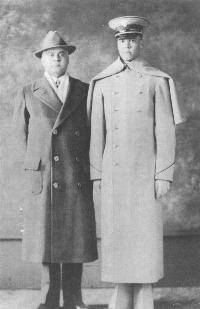
davis-3

Colonel Davis with his son Cadet Benjamin O Davis Jr.

His son Benjamin O. Davis Jr. was appointed to West Point in 1932.  He graduated and was commissioned in 1936 graduating 35 out of 278, the fourth African American graduate of West Point. During his time at the Academy most of his classmates shunned him and he never had a roommate.  Despite this he maintained a dogged determination to succeed.  The Academy yearbook made this comment about him:

“The courage, tenacity, and intelligence with which he conquered a problem incomparably more difficult than plebe year won for him the sincere admiration of his classmates, and his single-minded determination to continue in his chosen career cannot fail to inspire respect wherever fortune may lead him.”

He was denied entrance to the Army Air Corps because of his race and assigned to the Infantry first to the all lack 24th Infantry Regiment at Ft Benning where he was not allowed in the Officers Club due to his race. Upon his commissioning the Regular Army had just 2 African American Line Officers, 2nd Lieutenant Davis and his father Colonel Davis.

After completion of Infantry School he was assigned as an instructor of Military Science and Tactics and the Tuskegee Institute.  In 1941 the Roosevelt Administration moved to create a black flying unit and Captain Davis was assigned to the first black class at the Tuskegee Army Air Field and in March 1942 one his wings as one of the first 5 African Americans to complete flight training.

In July 1942 he was assigned as Commanding Officer of the 99th Pursuit Squadron which served in North Africa and Sicily flying Curtiss P-40 Warhawks. He was recalled to the United States in September 1943 to command the 332nd Fighter Group. However some senior officers attempted to prevent other black squadrons from serving in combat alleging that the 99th had performed poorly in combat. Davis defended his squadron and General George Marshall ordered an inquiry which showed that the 99th was comparable to white squadrons in combat and during a 2 day period over the Anzio beachhead the pilots of the 99th shot down 12 German aircraft.

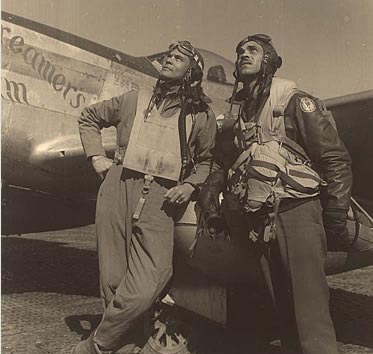
davis Library of congress   photo public domain

Colonel Benjamin O Davis Jr (left) with one of his Tuskegee Airmen

Davis took the 332nd to Italy where they transitioned to P-47 Thunderbolts and in July 1944 to the P-51 Mustang which were marked with a signature red tail. During the war, the units commanded by Davis flew more than 15,000 sorties, shot down 111 enemy planes, and destroyed or damaged 273 on the ground at a cost of 66 of their own planes.

Tuskegee_01


Their record against the Luftwaffe was outstanding and their protection of the bombers that they escorted was superb with very few bombers lost while escorted by them men that the Luftwaffe nicknamed the Schwarze Vogelmenschen and the Allies the Red-Tailed Angels or simply the Redtails. Davis led his Tuskegee Airmen to glory in the war and their performance in combat helped break the color barrier in the U.S. Military which was ended in 1948 when President Truman signed an executive order to end the segregation of the military. Colonel Davis helped draft the Air Force plan and the Air Force was the first of the services to fully desegregate.

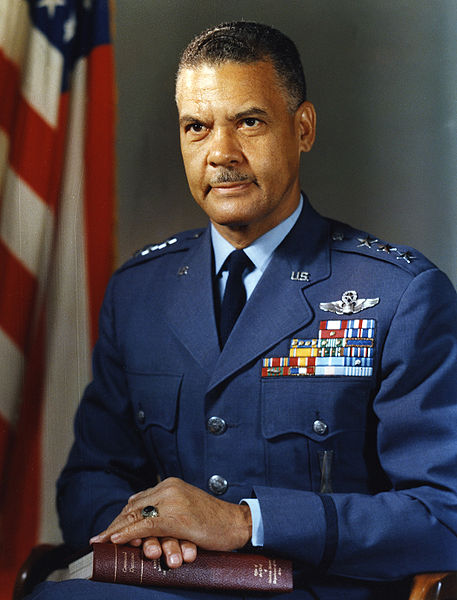
ltgen Benjamindavis

Lieutenant General Benjamin O Davis Jr

Colonel Davis transitioned to jets and let the 51st Fighter Interceptor Wing against Chinese Communist MIGs in the Korean War.  He was promoted to Brigadier General in 1954 and served in numerous command and staff positions. He retired in 1970 with the rank of Lieutenant General and was advanced to General while retired by President Clinton in 1998.  He died in 2002 at the age of 89.

The legacy of Benjamin O. Davis Senior and Benjamin O. Davis Junior is a testament to their character, courage and devotion to the United States of America. They helped pioneer the way for officers such as General Colin Powell and helped change this country for the better.  During times when discrimination was legal they overcame obstacles that would have challenged lesser men.  Benjamin O. Davis Junior remarked:

“My own opinion was that blacks could best overcome racist attitudes through achievements, even though those achievements had to take place within the hateful environment of segregation.”

Such men epitomize the selfless service of so many other African Americans who served the country faithfully and “by the content of their character” triumphed over the evil of racism and helped make the United States a more perfect union.

Peace

Padre Steve+

Leave a comment

Filed under civil rights, History, leadership, Military

Vice Admiral Samuel Gravely Jr. Pioneer of Civil Rights

gravely

Vice Admiral Samuel Gravely Jr.

Vice Admiral Samuel Gravely Jr. is among the great pioneers of civil rights in the U.S. Military. The first African-American ever to be promoted to Flag rank he helped pave the way for so many others. Gravely understood the pressures on him at every stage of his career, He wrote:

“I was sure that I could not afford to fail. I thought that would affect other members of my race if I failed anywhere along the line. I was always conscious of that, particularly in midshipman school and any other schools I went to…I tried to set a record of perfect conduct ashore and at sea.” Vice Admiral Samuel Gravely

gravely_young

Fireman Recruit Samuel Gravely Jr. 

Things have changed much since 1942 when following the attack on Pearl Harbor a young black college student from Richmond Virginia enlisted in the Navy. Samuel Gravely Jr. was the son of a postal worker and Pullman porter while his mother worked as a domestic servant for white families in Richmond. His mother died unexpectedly when he was 15 in 1937 and he remained to help care for his siblings as his father continued to work. Balancing the care of his family with his education he enrolled in Virginia Union College, a Baptist school in Richmond.

It is hard to imagine for most of us now to comprehend the world that the young Gravely grew up in. Segregation was the norm. Blacks in the south and many other locations faced personal as well as entrenched institutional racism. Violence against blacks was quite common and the Ku Klux Klan was strong.

The military was still segregated and a great gulf existed between white military personnel and blacks. Though the selective service law of 1940 called for the conscription of people regardless of race, creed or color the services enjoyed much latitude in determining how minorities could serve. The Secretary of the Navy at the time, Frank Knox resisted integration. Knox determined that African Americans would remain segregated and serve only as Mess Stewards to “prevent undermining and disruptive conditions in the Navy.” Knox told President Roosevelt in the presence of black leaders that “because men live in such intimacy aboard ship that we simply can’t enlist Negroes above the rank of messman. “

That sentiment was strong in both the Navy and the Marines, even more so than in the Army and Army Air Corps. The leaders of both the Navy and Marine Corps resisted attempts to broaden the ability for African Americans to serve and urged that blacks serve in the Army, not the Naval Service.  Marine Corps Commandant Major General Thomas Holcomb agreed with this stance. He commented:

“If we are defeated we must not close our eyes to the fact that once in they [Negroes] will be strengthened in their effort to force themselves into every activity we have. If they are not satisfied to be messmen. they will not be satisfied to go into the constriction or labor battalions. Don’t forger the colleges are turning out a large number of well educated Negroes. I don’t know how long we will be able to keep them out of the V-7 class. I think not very long.”

But Roosevelt was not deterred and by April 1942 changes were announced to allow African Americans to serve in other capacities. Even so African Americans selected for ratings other than messman were to be segregated and commanded by White Officers and Petty Officers.

images-18

The USS PC-1264 and its crew, Gravely is the lone black officer

USS_PC-1264_officers_and_crew

Gravely enlisted in the Navy under these conditions. Serving as a Fireman Apprentice after receiving training as a Motor Machinist in San Diego he worked in menial jobs. In 1943 Gravely was one of only three sailors in his unit to be selected for the V-12 officer training program. He was the only black to make the cut. He was commissioned as an Ensign on December 14th 1944 and assigned to train black recruits at Great Lakes though the vast majority of his class went to sea. The was mainly due to the policy set forth by the General Board in 1942 that prescribed:

“(a) the white man will not accept the negro in a position of authority over him; (b) the white man considers that he is of a superior race and will not admit the negro as an equal; and (c) the white man refuses to admit the negro to intimate family relationships leading to marriage. These concepts may not be truly democratic, but it is doubtful if the most ardent lovers of democracy will dispute them, particularly in regard to inter-marriage.”

Despite this by 1945 the Navy was beginning to change. Gravely was chosen to serve on one of two ships assigned to the “experiment” of seeing how blacks in general ratings could serve at sea. The USS Mason (DE 539) and the USS PC-1264 were assigned black crews with majority white officers, except that Gravely was assigned to PC-1264. Though his commander was pleased with his service Gravely, who had been denied admittance to Officer Clubs and many other “white only” facilities resigned from the Navy in 1946. He believed that the inherent discrimination of the Navy left him no place for advancement. He returned to complete his bachelors degree at Virginia Union.

In 1949, following President Truman’s integration of the military Gravely was asked by the Navy to return to active duty. But the end of the old order was foreshadowed by a Navy pamphlet published in 1944 entitled The Guide to the Command of Negro Personnel. That publication included the statement that ”The Navy accepts no theories of racial differences in inborn ability, but expects that every man wearing its uniform be trained and used in accordance with his maximum individual capacity determined on the basis of individual performance.”

images-17

300px-USS_Taussig_(DD-746)_port_side_1965

cg29

Gravely’s commands (top to bottom) USS Theodore E Chandler, USS Taussig and USS Jouett

Gravely accepted the offer to return to active duty and never looked back. He worked hard for respect and used his natural talents, personality and size to command respect. He was a man who would blaze the way for other African Americans, and later women and most recently gays to go on to greater things.

Gravely would go on to command three ships, all surface combatants. He was the first African American Naval Officer to command a Navy warship, the USS Theodore E Chandler (DD 717), the first to command a Navy ship in combat, the USS Taussig (DD 746) and the first to command a major warship, the USS Jouett (CG 29). Promoted to flag rank he eventually became the first to command a Fleet when he took command of 3rd Fleet. He retired in 1980 and passed away in 2004.

h98996

Commander Gravely and his officers on USS Taussig

Gravely gave his parents and conditions of his upbringing much credit for his success. He believed that those conditions which forced him to “capitalize on his strong points, build his weak areas and sustain the positive self-esteem and self-worth that his parents instilled in him as a young child.”

He was a great leader. LCDR Desiree Linson who interviewed him for her Air Command and Staff College project noted that Gravely like many other great military leaders before him learned to manage the image that he presented, be a caretaker for his people, what we would now call a mentor. He said “[If I was CNO] my responsibility would be to make sure enlisted men and families were taken care of. I would do everything in my power to make sure.”

Vice Admiral Gravely’s pursuit of excellence, self confidence and mastery of professional skills empowered him in an institution where he was still an anomaly and where racism still existed. He believed in effective communication, especially verbal communication and in building teams and in being a good follower, listening, learning and proactively anticipating the needs of his superiors. Gravely was also a believer in personal morality and self discipline and preparedness. He said:

“I did everything I could think of to prepare myself. If the opportunity came, I would be prepared for it. [The question would not be] “Why didn’t you prepare for this opportunity.” I would be prepared for whatever opportunity that came. If it came, fine. If it did not, fine, but I would be prepared if it did come.”

USS_Gravely

The USS Gravely DDG 107

Vice Admiral Gravely blazed a trail for those that followed him and set an example for all Naval Officers to follow. He did it under conditions that most of us could not imagine. I am proud to serve in the Navy that he helped to make.  I happen to work for an African-American Admiral at the Staff College, and I have served under African American commanders throughout every stage of my military career, in the Army and in the Navy. Admiral Gravely’s vision, service and memory are carried on in this navy and in the ship that bears his name, the USS Gravely DDG-107. Today that ship and her crew stand watch in defense of our nation and our friends around the world. It is a fitting tribute to such an amazing leader.

Peace

Padre Steve+

2 Comments

Filed under civil rights, History, Military, US Navy

A Return to “God in the Empty Places”

313_34838767058_2205_n

Leaving Iraq, January 31st 2008

Seven years ago yesterday I arrived home from Iraq. It was the beginning of a new phase in my life.  I wrote an article shortly after my return for the church that I belonged to at the time and I have republished it around this time of year a number of times.

When I wrote it I really had no idea how much I had changed and what had happened to me. When I wrote it I was well on my way to a complete emotional and spiritual collapse due to PTSD.  In some ways things are better, now but it was a very dark time for several years and I still have a lot of bad days.

dien-bien-phu6

French Wounded awaiting Evacuation from Dien Bien Phu

These wars in Iraq and Afghanistan have been terribly costly in lives, treasure and they have lost almost all sense of public support. I have been in the military almost all of my adult life, over 32 years. I am also a historian and the son of a Vietnam Veteran. Thus, I feel special kinship with those that have fought in unpopular wars before me. French Indochina, Algeria and Vietnam, even the Soviet troops in Afghanistan before we ever went there. 

I am honored to have served with or known veterans of Vietnam, particularly the Marines that served at the Battle of Hue City, who are remembering the 44th anniversary of the beginning of that battle.  My dad also served in Vietnam at a place called An Loc. He didn’t talk about it much and I can understand having seen war myself. 

533506_10151366982462059_34997654_n

Border Fort Five “West Virginia” on Syrian Border

When I look up at the moonlit sky I think about seeing all of those stars and the brilliance of the moon over the western desert of Iraq near Syria. Somehow, when I see that brilliant sight it comforts me instead of frightens me. 

Tonight our Soldiers, Marines, Sailors and Airmen serve in harm’s way nearly 10,000 Americans in Afghanistan alone. We are sort back Iraq but Lord knows how things will turn out in the long run, and it appears that the fight with the Islamic State will be long and costly.  

295_26912092058_3949_n

Bedouin Camp

Tonight I am thinking about them, as well as those men who fought in other unpopular wars which their nation’s government’s sent them. 

When I left Iraq I was traumatized. All that I had read about our Vietnam veterans, the French veterans of Indochina and Algeria and the Soviet veterans of Afghanistan resonated in my heart. The words of T. E. Lawrence, Smedley Butler, Erich Maria Remarque and Guy Sager also penetrated the shields I had put around my heart. 

So I wrote, and I wrote, and I still write. But tonight here is God in the empty Places.

262_29132262058_8844_n-2

God in the Empty Places. 

I have been doing a lot of reflecting on ministry and history over the past few months. While both have been part of my life for many years, they have taken on a new dimension after serving in Iraq. I can’t really explain it; I guess I am trying to integrate my theological and academic disciplines with my military, life and faith experience since my return.

481801_10151367001287059_1003164983_n1

British Tombstone: Habbinyah Iraq

The Chaplain ministry is unlike civilian ministry in many ways. As Chaplains we never lose the calling of being priests, and as priests in uniform, we are also professional officers and go where our nations send us to serve our Soldiers, Sailors, Marines and Airmen. There is always a tension, especially when the wars that we are sent to are unpopular at home and seem to drag on without the benefit of a nice clear victory such as VE or VJ Day in World War II or the homecoming after Desert Shield and Desert Storm.

french-chaplain-and-soldiers-2

French Chaplain and Soldiers Indochina

It is my belief that when things go well and we have easy victories that it is easy for us to give the credit to the Lord and equally easy for others to give the credit to superior strategy, weaponry or tactics to the point of denying the possibility that God might have been involved. Such is the case in almost every war and Americans since World War Two have loved the technology of war seeing it as a way to easy and “bloodless” victory. In such an environment ministry can take on an almost “cheer-leading” dimension. It is hard to get around it, because it is a heady experience to be on a winning Army in a popular cause. The challenge here is to keep our ministry of reconciliation in focus, by caring for the least, the lost and the lonely, and in our case, to never forget the victims of war, especially the innocent among the vanquished, as well as our own wounded, killed and their families.

iraqchristmas

Mass at COP South and Blessing a Convoy at Ramadi

377

But there are other wars, many like the current conflict less popular and not easily finished. The task of chaplains in the current war, and similar wars fought by other nations is different. In these wars, sometimes called counter-insurgency operations, guerrilla wars or peace keeping operations, there is no easily discernible victory. These types of wars can drag on and on, sometimes with no end in sight. Since they are fought by volunteers and professionals, much of the population acts as if there is no war since it does often not affect them, while others oppose the war.

Likewise, there are supporters of war who seem more interested in political points of victory for their particular political party than for the welfare of those that are sent to fight the wars. This has been the case in about every war fought by the US since World War II. It is not a new phenomenon. Only the cast members have changed.

legion-algeria1

French Foreign Legion Paratroops Algeria

iraq-2007

Ready for Convoy: Ramadi to Al Asad

This is not only the case with the United States. I think that we can find parallels in other militaries. I think particularly of the French professional soldiers, the paratroops and Foreign Legion who bore the brunt of the fighting in Indochina, placed in a difficult situation by their government and alienated from their own people. In particular I think of the Chaplains, all Catholic priests save one Protestant, at the Battle of Dien Bien Phu, the epic defeat of the French forces that sealed the end of their rule in Vietnam. The Chaplains there went in with the Legion and Paras. They endured all that their soldiers went through while ministering the Sacraments and helping to alleviate the suffering of the wounded and dying. Their service is mentioned in nearly every account of the battle. During the campaign which lasted 6 months from November 1953 to May 1954 these men observed most of the major feasts from Advent through the first few weeks of Easter with their soldiers in what one author called “Hell in a Very Small Place.”

frenchforeignlegionairevtnamdod-2

French Foreign Legion in Indochina

n671902058_1153794_4301

Convoy: Route Uranium west of Ramadi

Another author describes Easter 1954: “In all Christendom, in Hanoi Cathedral as in the churches of Europe the first hallelujahs were being sung. At Dienbeinphu, where the men went to confession and communion in little groups, Chaplain Trinquant, who was celebrating Mass in a shelter near the hospital, uttered that cry of liturgical joy with a heart steeped in sadness; it was not victory that was approaching but death.” A battalion commander went to another priest and told him “we are heading toward disaster.” (The Battle of Dien Bien Phu, Jules Roy, Carroll and Graf Publishers, New York, 1984 p.239)

bedouin

Of course one can find examples in American military history such as Bataan, Corregidor, and certain battles of the Korean War to understand that our ministry can bear fruit even in tragic defeat. At Khe Sanh in our Vietnam War we almost experienced a defeat on the order of Dien Bien Phu. It was the tenacity of the Marines and tremendous air-support that kept our forces from being overrun.

You probably wonder where I am going with this. I wonder a little bit too. But here is where I think I am going. It is the most difficult of times; especially when units we are with take casualties and our troops’ sacrifice is not fully appreciated by a nation absorbed with its own issues.

legion-indo-china

French Convoy Under Attack Indochina

1931281_53208642058_6303_n

Al Waleed

For the French the events and sacrifices of their soldiers during Easter 1954 was page five news in a nation that was more focused on the coming summer. This is very similar to our circumstances today because it often seems that own people are more concerned about economic considerations and the latest in entertainment news than what is going on in Iraq or Afghanistan.

french-at-dien-bien-phu

Commanders of a Doomed Force: French Commanders at Dien Bien Phu

dinner-w-bg-sabah

With Brigadier General Sabah, Interpreter and my Assistant Nelson Lebron: Ramadi

The French soldiers in Indochina were professionals and volunteers, much like our own troops today. Their institutional culture and experience of war was not truly appreciated by their own people, or by their government which sent them into a war against an opponent that would sacrifice anything and take as many years as needed to secure their aim, while their own countrymen were unwilling to make the sacrifice and in fact had already given up their cause as lost. Their sacrifice would be lost on their own people and their experience ignored by the United States when we sent major combat formations to Vietnam in the 1960s.

In a way the French professional soldiers of that era, as well as British colonial troops before them have more in common with our current all volunteer force than the citizen soldier heroes of the “Greatest Generation.” Most of them were citizen soldiers who did their service in an epic war and then went home to build a better country as civilians. We are now a professional military and that makes our service a bit different than those who went before us.

943043_10151694525692059_632653331_n

Advisers at COP South

Yet it is in this very world that we minister, a world of volunteers who serve with the highest ideals. We go where we are sent, even when it is unpopular. It is here that we make our mark; it is here that we serve our Soldiers, Sailors, Marines and Airmen. Our duty is to bring God’s grace, mercy and reconciliation to men and women, and their families who may not see it anywhere else. Likewise we are always to be a prophetic voice within the ranks.

When my dad was serving in Vietnam in 1972 I had a Sunday school teacher tell me that he was a “Baby Killer.” It was a Catholic Priest and Navy Chaplain who showed me and my family the love of God when others didn’t. In the current election year anticipate that people from all parts of the political spectrum will offer criticism or support to our troops. Our duty is to be there as priests, not be discouraged in caring for our men and women and their families because most churches, even those supportive of our people really don’t understand the nature of our service or the culture that we represent. We live in a culture where the military professional is in a distinct minority group upholding values of honor, courage, sacrifice and duty which are foreign to most Americans. We are called to that ministry in victory and if it happens someday, defeat. In such circumstances we must always remain faithful.

flight-to-baghdad-4-me

For those interested in the French campaign in Indochina it has much to teach us. Good books on the subject include The Last Valley by Martin Windrow, Hell in a Very Small Place by Bernard Fall; The Battle of Dien Bien Phu by Jules Roy; and The Battle of Dien Bien Phu- The Battle America Forgot by Howard Simpson. For a history of the whole campaign, read Street Without Joy by Bernard Fall. I always find Fall’s work poignant, he served as a member of the French Resistance in the Second World War and soldier later and then became a journalist covering the Nuremberg Trials and both the French and American wars in Vietnam and was killed by what was then known as a “booby-trap” while covering a platoon of U.S. Marines.

Bundeswehr zeigt "Stalingrad"-Ausstellung

There is a picture that has become quite meaningful to me called the Madonna of Stalingrad. It was drawn by a German chaplain-physician named Kurt Reuber at Stalingrad at Christmas 1942 during that siege. He drew it for the wounded in his field aid station, for most of whom it would be their last Christmas. The priest would die in Soviet captivity and the picture was given to one of the last officers to be evacuated from the doomed garrison. It was drawn on the back of a Soviet map and now hangs in the Kaiser Wilhelm Memorial Church in Berlin where it is displayed with the Cross of Nails from Coventry Cathedral as a symbol of reconciliation. I have had it with me since before I went to Iraq. The words around it say: “Christmas in the Cauldron 1942, Fortress Stalingrad, Light, Life, Love.” I am always touched by it, and it is symbolic of God’s care even in the midst of the worst of war’s suffering and tragedy. I have kept a a copy hanging over my desk in my office since late 2008. It still hangs in my new office.

Peace

Padre Steve+


Leave a comment

Filed under christian life, faith, History, iraq,afghanistan, middle east, Military, shipmates and veterans, Tour in Iraq

“Our Army Would Be Invincible If…” Pt.5 Stuart’s Cavalry

This is the fourth part of my re-written chapter on the leadership of Army of Northern Virginia at Gettysburg. Today is a look at the leaders of Major General J.E.B Stuart as well as three other generals, Brigadier General John Imboden who commanded an independent cavalry brigade, Lee’s Chief of Artillery, Brigadier General William Pendleton, and Major General Isaac Trimble. This like the previous sections of this chapter of my Gettysburg text is interesting because it shows the complexities of the lives and personalities of the men leading these units. Professional soldiers, volunteers with little military experience, soldiers, lawyers, engineers and politicians they are an interesting collection of personalities; some surrounded in myth and others practically unknown. I think it is important for anyone studying a war, a campaign, or a battle to at least look at the lives of the men who planned and fought it. In doing so, even those that oppose what they did in rebelling against the United States can find in them some measure of humanity, and sometimes even gain a sense of empathy for some of them.   

That is why when we look at the lives of soldiers, we have to take the time to at least try to understand the nuance, the contradictions, their strengths and weaknesses as leaders, as well as a measure of their character.

As I get ready to take another group of students to Gettysburg I will be doing more work on my text, editing previously written chapters and writing a chapter similar on the leaders of the Army of the Potomac.

Have a great night

Peace

Padre Steve+

Stuart’s Cavalry Division

CWP015

Major General J.E.B. Stuart C.S.A.

The Cavalry Division was commanded by Major General J.E.B. Stuart. While it was considered a division, Stuart’s command was the size of a Union Army Corps with over 10,000 troopers assigned. Despite its large size at Gettysburg the Division was split by agreement of Lee and Stuart. Stuart who had five brigades at his immediate disposal would take three of them, Hampton’s, Rooney Lee’s and Fitz Lee’s on an ill-fated mission which would leave him and them out of the fight during the most important part of the movement to and first two days of battle. His raid causes him “to be absent on the day of all days when he could reconnoiter the Federal position.” [1] Two, Robertson and Grumble Jones’s would remain guarding passes along the Blue Ridge long after that mission had any relevance. Imboden’s would be far to the west and Jenkin’s ere with Ewell’s vanguard in the advance north.

Major General James Ewell Brown Stuart was the son of a former congressman whose family went back five generations in Virginia. He graduated thirteenth in a class of forty-six at West Point in 1854. Classmates included Dorsey Pender and Oliver O. Howard. A fellow cadet who would serve under Stuart during the war, Fitzhugh Lee wrote:

“His distinguishing characteristics were a strict attention to his military duties, an erect, soldierly bearing, an immediate and almost thankful acceptance of a challenge from any cadet to fight, who might in any way feel himself aggrieved, and a clear, metallic, ringing voice.” [2]

At West Point Stuart was noted for his “lifelong religious devoutness. When he was at West Point he was known as a “Bible Class Man.” [3] Stuart was commissioned as a Second Lieutenant and assigned to the Mounted Rifles, which Stuart noted was “a corps which my taste, fondness for riding, and my desire to serve my country in some acceptable manner led me to select above all the rest.” [4] Stuart would serve with the Mounted Rifles for about a year before being selected to serve in one of the first Cavalry regiments formed, the First Cavalry at Jefferson Barracks Missouri.

In the pre-war years the young officer developed a solid reputation in the army where he served on the frontier and in “Bleeding Kansas.” In those years Stuart “was already a young officer of great promise, a natural horseman with a reputation for dash and bravery gained in countless clashes with Indians throughout the West, and for steady competence in the pro- and antislavery warfare of Kansas.” [5]

In 1859 Stuart was on leave visiting Washington D.C. and staying with the Lee’s at Arlington. He was visiting the War Department when news came of John Brown’s raid at Harper’s Ferry. He was given a letter to take to Lee which ordered Lee to take command of troops to suppress the rebellion. Stuart accompanied Lee on the mission and was send by Lee to present terms of surrender to the raiders, who at the time were still nameless to the Federal authorities. Stuart entered the building and was confronted by Brown who he had previously met in Kansas. After some fruitless negotiation, Stuart realized that Brown was not about to surrender. At some time Stuart broke away and motioned for the Marines to move in. “Three minutes after Stuart had given his signal, the affair was over.” [6]

Stuart resigned his commission when Virginia seceded from the Union in April 1861, while his father-in-law, Colonel Philip St. George Cooke remained in Union service. He commanded the 1st Virginia Cavalry in the Valley and at First Manassas and was promoted to Brigadier General in September 1861. The following month he was given command of the army’s cavalry brigade and distinguished himself in the eyes of both General Joseph Johnston and Robert E. Lee. Johnston wrote to President Jefferson Davis praising the young brigadier “He is a rare man…wonderfully endowed by nature with the qualities necessary for an officer of light cavalry….If you add to this army a real brigade of cavalry, you can find no better brigadier-general to command it.” [7]

Lee came to share that opinion and over the course of his service Stuart had come to:

“demonstrate a real talent for the most mundane and most essential role cavalry played in this war – reconnaissance and intelligence gathering. No intelligence source surpassed his eye for seeing and evaluating a military landscape or an enemy’s strengths and dispositions.” [8]

This would be something that Lee came to rely and which he would dearly miss at Gettysburg.

Despite his excellence in this “most mundane” task Stuart developed a flair and passion for the spectacular, which was first demonstrated during the Seven Days, where he took his cavalry on a circuit of McClellan’s army which not only gathered a significant amount of intelligence also unnerved the Army of the Potomac. His raid was “flawlessly executed….” And Stuart “became a hero to his troopers and one of the idols of the public.” [9] Lee wrote that Stuart’s operation “was executed with great address and daring by accomplished officer.” [10] The raid did have its detractors, especially among the infantry and it also revealed something to Stuart that appealed to his own vanity, “that raiding would easily garner headlines in the Richmond papers.” [11]

Stuart Lee’s staff secretary, Colonel Robert Taylor noted that Stuart was “possessing of great powers of endurance, courageous to an exalted degree, of sanguine temperament, prompt to act, always ready for fight – he was the ideal cavalryman.” [12] Stuart also kept a lively headquarters. Taylor remarked “How genial he was! There was no room for “the blues” around his headquarters; the hesitating and desponding found no congenial atmosphere at his camp; good will, jollity, and even hilarity, reigned there.” [13]

Stuart always had his African-American banjo player with him and frequently sang around camp and on campaign. That was not always appreciated by some other officers. Wade Hampton, who in time became Stuart’s right-hand man was not impressed with the atmosphere at Stuart’s headquarters and “was not certain that he could flourish, or even survive, among such people….” [14] Lafayette McLaws wrote home complaining not only about Stuart but others:

“Stuart carries around with him a banjo player and special correspondent. This claptrap is noticed and lauded as a peculiarity of genius, when, in fact, it is nothing more but the act of a buffoon to get attention.” [15]

But Stuart was always aware of his own mortality and there was a serious side to him, often expressed in his faith, which impressed those around him. His West Point classmate and friend, Oliver O. Howard wrote:

“J.E.B. Stuart was cut out for a cavalry leader. In perfect health, but thirty-two years of age, full of vigor and enterprise, with the usual ideas imbibed in Virginia concerning State Supremacy, Christian thought and temperate by habit, no man could ride faster, endure more hardships, make a livelier charge, or be more hearty and cheerful while so engaged. A touch of vanity, which invited the smiles and applause of the fair maidens of Virginia, but added to the zest and ardor of Stuart’s parades and achievements.” [16]

At Chancellorsville Stuart assumed acting command of Jackson’s Second Corps which he led well during the battle, even impressing the infantry, who had long derided Stuart and his cavalry. Leading by example “seemed on fire.” Stuart sang as he led the Stonewall Brigade into action and “the troops joined him, singing while they loaded and fired.” One officer stated “Jeb impressed himself on the infantry.” [17]

Some believed that Stuart should have been appointed to command Second Corps after Jackson’s death, but evidently Lee valued Stuart’s role as a cavalry commander more and despite his accomplishments refused to proffer the command to Stuart. Colonel Rosser told Stuart, who was grieving the loss of his friend Jackson “On his death bed Jackson said that you should succeed him, and command his corps.” Stuart responded “I would rather know that Jackson said that, than to have the appointment.” [18] One wonders what might have occurred during the Gettysburg campaign if Stuart had commanded Second Corps and left the cavalry to someone like the accomplished and level headed Wade Hampton.

Stuart was mortally wounded less than a year after Gettysburg at the Battle of Yellow Tavern, upon his death Hampton was promoted to command what was left of the Cavalry Corps.

Hampton

Hampton_inline

Brigadier General Wade Hampton C.S.A. 

Brigadier General Wade Hampton is one of the fascinating and complex characters in either army who served at Gettysburg. He defies a one dimensional treatment or stereotype. His complexities, contradictions and character make him one of the most interesting men that I have written about during my study of this battle.

Wade Hampton III was one of the richest, if not the richest man in the Confederacy when the war broke out. He had inherited his family’s expansive plantation and many slaves and studied law at the College of South Carolina. As a slave owner he expressed an aversion for the institution, ensured that his slaves were well cared for by the standards of his day, including medical care, he never condemned slavery or worked for the abolition of a system that had made him and his family quite prosperous. He served in the South Carolina legislature and Senate, where he took an “active and prominent role in the public debate on many issues. He was vocal not only on the perils of reopening the African slave trade but also on whether and how his state should seek redress of wrongs, real and imagined, by the federal government.” [19]

As a state senator Hampton was pragmatic, and while he defended the South’s economic interests in slavery, Hampton cautioned against the rhetoric of secessionist fire-breathers. His argument was about “the preservation of the South’s political power and her social and economic institutions, now threatened by the short sighted policies of otherwise good and decent men.” [20] He did not wish to do anything that would lead to the destruction of the South, and he felt that the “only viable course was moderation, conciliation, compromise….” [21]

Hampton was a classic rich “Southern moderate He had opposed secession, and the fire eaters repulsed him.” [22] However, when Lincoln called for volunteers Hampton volunteered to serve in a war that he did not want, which would cost him dearly, and change him from a moderate to a vociferous opponent of most Reconstructionist policies.

Volunteering at the age of forty-three, Hampton had no prior military training. However, he had great organizational skill, leadership ability and a tremendous care and compassion for those who served under his command. Using his own money Hampton organized what would now be called a combined arms unit, the Hampton Legion, which comprised eight companies of infantry, four of cavalry and a battery of light artillery. He was careful in the appointment of the Legion’s officers choosing the best he could find.

Hampton rapidly rose to prominence as a respected officer and commander despite his lack of military training or experience. His soldiers fought well and took over command of an infantry brigade on the Peninsula, and was promoted to Brigadier General in May of 1862 and given command of a cavalry brigade serving under J.E.B. Stuart in July and he “became Stuart’s finest subordinate.” [23] As a brigade, and later division commander, Hampton had “little fondness or respect for Stuart. He regularly criticized Stuart for pampering the Virginia regiments and assigning his South Carolinians to the more arduous tasks.” [24]

During the war he was wounded several times, including at             Gettysburg where he took two sabre cuts to the head. Eventually he took command of the Cavalry Corps after Stuart was killed in action. He fought in nearly every cavalry engagement under Stuart and led his own raids deep into Union territory. He fought well, but “hated the war. In October 1862 he wrote home: “My heart has grown sick of the war, & I long for peace.” [25] Hampton was “one of only three civilians to attain the rank of Lieutenant General in Confederate service.” [26]At Petersburg his son Preston was mortally wounded and died in his arms even as his other son Wade IV was wounded when coming to Preston’s aid. Douglass South Freeman wrote of Hampton:

“Untrained in arms and abhorring war, the South Carolina planter had proved himself the peer of any professional soldier commanding within the same bounds and opportunities. He may not have possessed military genius, but he had the nearest approach to it.” [27]

The war that he opposed cost him the life of his brother, one of his sons and his livelihood. “His property destroyed, many of his slaves gone, and deep in debt from which he would never recover, Hampton faced the future with $1.75 in his pocket.” [28] The war changed the former moderate into a man who sought vindication in some ways, but reconciliation with the black population.

Hampton again entered politics and became the first post-Reconstruction Governor of South Carolina when President Rutherford Hayes withdrew the Federal troops which had supported the Reconstructionist governor. During his campaign and during his terms as Governor, Hampton “opposed the South’s imposition of so-called “black codes” which so restricted the freedom of former slaves as virtually to return them to civility.” [29] Unlike many in the post-reconstruction South Hampton won the thanks of African Americans for condemning whites that would vote for him if they thought that he would “stand between him and the law, or grant him any privileges or immunities that shall not be granted to the colored man.” [30]

Hampton came to dominate South Carolina politics for fifteen years, after two terms as Governor he served as a U.S. Senator until 1891 when a political enemy won the governorship and forced him from the Senate. When he died on April 11th 1902 his final words were “God bless my people, black and white.” [31]

Like so many leaders of so many tumultuous eras, Hampton was complex and cannot be easily classified. He was certainly not perfect, but in war and in peace gave of himself to his state and community.

Rooney Lee

rooney

Brigadier General William Fitzhugh “Rooney” Lee C.S.A.

Brigadier General William Fitzhugh Lee, who went by his nickname “Rooney” to distinguish himself from his cousin Fitzhugh Lee, was the second son of Robert E. Lee. He was educated at Harvard and received a direct commission into the Army in 1857, which he resigned in 1859 to manage the White House planation which had been left to him by his grandfather. When war came Lee volunteered for service and was named Colonel of the 9th Virginia Cavalry earning the trust and respect of Stuart and the quiet admiration of his father.

Rooney Lee was promoted to Brigadier General in September 1862 and was wounded at the Battle of Brandy Station as the Gettysburg campaign began and while convalescing was captured by Union forces. He was replaced by Colonel John R. Chambliss, an 1853 graduate of West Point who had left the army after a short amount of active service prior to the war. He was viewed as a competent cavalry tactician and “there was no perceptible anxiety when “Rooney” Lee’s brigade came under Chambliss’ command.” [32]

He was paroled and exchanged in March of 1864. He was promoted to Major General in April 1864 and served until his surrender with the army at Appomattox. After the war he would return to farming and serve in the Virginia legislature and as a Congressman.

Robertson

4198ECu5QML._SY355_

Brigadier General Beverly Roberson C.S.A.

Brigadier General Beverly Roberson was a native Virginian who graduated from West Point in 1849. Most of his service was spent on the frontier with the Second Dragoons where for part of his service he served under command of J.E.B. Stuart’s father-in-law Colonel Philip St. George Cooke who “commended him repeatedly in dispatches.” [33]

Robertson was a veteran of much Indian service and “in person the embodiment of the fashionable French cavalry officer of the time.” [34] Robertson was dismissed from the U.S. Army in August 1861 when it was discovered that he had accepted an appointment in the Confederate army in April 1861.

Robertson’s Confederate service was less than distinguished. He never meshed with Jackson when he commanded Jackson’s cavalry, and Stuart was less than impressed when Robertson’s brigade was assigned to his command. During the Second Manassas campaign Stuart observed Robertson’s less than stellar performance, and his centrality to “so many cavalry quarrels” convinced Stuart that the old regular army veteran and West Pointer “must go. Within a month Robertson was transferred. He would finally go, as one of Stuart’s staff noted, “much to the joy of all concerned.” [35]

Robertson and his brigade were transferred to North Carolina, but returned to the Army of Northern Virginia to participate in the Gettysburg campaign. It was far too easy for Lee to obtain. D.H. Hill commanding in North Carolina “characterized Robertson’s command as “wonderfully inefficient,” [36] and Robertson would prove that again in the coming campaign where he would fail “miserably in his primary duty.” [37] After Gettysburg Robertson was relieved and reassigned to the Department of South Carolina where he served with little distinction until the end of the war.

Fitzhugh Lee

220px-Fitzhugh_Lee_General

Brigadier General Fitzhugh Lee C.S.A.

Brigadier General Fitzhugh Lee was a nephew of both Robert E. Lee and Confederate Adjutant General Samuel Cooper. He “graduated forty-fifth in a class of forty-nine at West Point in 1856.” [38] He was wounded on the frontier and was an instructor at West Point when Virginia seceded. He resigned his commission and was appointed as a Captain. Through his friendship with Stuart he was promoted to Colonel and given command of the First Virginia Cavalry after Grumble Jones was reassigned to the 7th Virginia. He and Stuart “shared a frolicsome nature and hearty laughter, but Lee’s abilities as a horse soldier were limited.” [39]

Wade Hampton held Lee in low regard, and Hampton believed that that Lee was representative of the “most objectionable qualities of the Virginia aristocrat – vanity, ostentation, pomposity, and condensation.” [40] Despite a condition which includes arthritis which hampers him he “fights hard and learns much of the art of command.” [41] He serves until the end of the war, finally surrendering his command in North Carolina.

After the war Fitz Lee enters politics, is elected governor of Virginia and following his defeat in attempting to become U.S. Senator was appointed as counsel-general in Havana by President Grover Cleveland. When the United States went to war with Spain, Lee was appointed as a Major General of Volunteers and serves honorably. Wade Hampton, whose regard for Lee did not increase during the war told his son Albert, who had volunteered to serve on Lee’s staff “Under no circumstances would he have a sin of his ever serve under “such an imperious blowhard as Robert E. Lee’s nephew continued to be.” [42] Lee was retired from the United States Army in 1901 with the rank of Brigadier General and died in Washington D.C. on April 28th 1905.

“Grumble” Jones

William_Edmondson_Jones

Brigadier General William “Grumble” Jones C.S.A.

Another of the old army cavalrymen to serve under Stuart was Brigadier General William “Grumble” Jones. Jones was an 1848 graduate of West Point and served on the frontier. In 1852 he and his new bride were in a shipwreck, and she was swept out of his arms and drowned. “Jones never recovered in spirit. Embittered, complaining, suspicious he resigned from the army” [43] in 1857 and returned to Virginia.

Jones raised a company at the beginning of the war, and served under Stuart at First Manassas, and from the beginning took a dislike to his young superior. He grumbled to his men that he “would take no orders from that young whippersnapper.” [44] When Stuart was promoted he was made Colonel of the 1st Virginia Cavalry. The assignment did not go well for him. His loathing for Stuart grew and one officer wrote that it “ripened afterwards into as genuine hatred as I ever remembered to have seen.” [45] His hatred of Stuart expanded into a hatred for his Lieutenant Colonel, Fitzhugh Lee, who was a close friend of Stuart. Jones was unpopular with the regiment and Lee much admired and the situation became so bad that Jones was reassigned to command the 7th Virginia Cavalry. Jones performed well in this duty, well enough to warrant promotion and he was promoted to Brigadier General in September 1862. The promotion allowed Lee to send Jones to serve in the Shenandoah Valley away from Stuart since their relationship was so toxic and Jones’s hatred of Stuart “bordered on pathological.” [46]

The need for cavalry for the upcoming invasion of Pennsylvania forced Lee to bring Jones and his command back to the Army of Northern Virginia. Stuart expressed his misgiving to Lee but was given no choice in the matter. Since Jones “had the biggest brigade in the division and had the reputation of being the “best outpost officer” [47] Stuart solved his problem by leaving Jones with Robertson to guard the passes of the Blue Ridge.

After Gettysburg Jones clashed again with Stuart over not being recommend for promotion when the division became a corps. The affair was so explosive and Jones reportedly “cursed him venomously” [48] an offense so great that Stuart had him arrested and court-martialed. The court found him guilty, and although Lee had great respect for Jones’s abilities as a brigade commander he wrote to Jefferson Davis:

“I consider General Jones a brave and intelligent officer, but his feelings have become so opposed to General Stuart that I have lost all hope of his being useful in the cavalry here… He has been tried by court-martial for disrespect and the proceedings are now in Richmond. I understand he says he will no longer serve under Stuart and I do not think it advantageous for him to do so.” [49]

Jones was assigned to command in Southwestern Virginia where “organized a cavalry brigade and rendered excellent service.” [50] In June of 1864, his understrength command was defeated and he was killed at the Battle of Piedmont. Douglas Southall Freeman called his death “a tragic end to a tragic life.” [51]

Jenkins

220px-AGJenkins

General Albert G. Jenkins C.S.A.

General Albert G. Jenkins was another anomaly in the Army of Northern Virginia. He was a native of the far western county of Virginia, Cabell County which was one of the six counties to secede from Virginia after Virginia seceded from the Union. He had no previous military training and like many of the Confederate volunteer officers was a lawyer and politician before the war. At the outset of the war he raised a company of volunteer cavalry from that area, which grew to become the 8th Virginia Cavalry.

Jenkins was promoted to Brigadier General and he and three regiments of his brigade were requisitioned by Lee for the invasion of Pennsylvania. The brigade was badly needed but the troops “had not been well schooled in cavalry tactics or in hard fighting at close quarters. Some had the complex of home guards, and some preferred the life of a guerilla to that of a trooper, but many were good raw material” [52] who Lee hoped could be wielded into a good cavalry force.

Jenkins was wounded on July 2nd in an action east of Gettysburg and his brigade was commanded by a subordinate during the final cavalry clash on July 3rd 1863. Jenkins and his brigade returned to the Valley where he was mortally wounded at the Battle of Cloyd’s Mountain in May of 1864.

Attached or Staff Officers: Imboden, Pendleton and Trimble

Imboden

25159e61f0fec416be740c018cae4772

Brigadier General John Imboden C.S.A.

Brigadier General John Imboden commanded a cavalry brigade which operated independently of Stuart’s division during the campaign. Imboden had no prior military experience before the war. He was a graduate of Washington College and a lawyer in Staunton Virginia. He raised a volunteer battery of light artillery, occupied “Harpers Ferry less than thirty hours after Virginia’s secession from the Union.” [53]

Imboden fought at Manassas where he and his battery gave a respectable performance. After Manassas Imboden raised another unit, “the 1st Virginia Partisan Rangers (later called the 62nd Virginia Mounted Infantry)” [54] and operated primarily in the valley and western Virginia. His command expanded in size and he was promoted to Brigadier General in January 1862.

His command during the Gettysburg campaign included the 18th Virginia Cavalry, the previously mentioned 62nd Virginia Mounted Infantry, a battery of artillery and several other partisan units. Imboden and his unit had been on “irregular, detached duty, and many of his men had recently been recruited, some from the infantry service.[55] Imboden’s “brigade” was “more an assortment of armed riders even more unruly and untrained than Jenkins’ and possessing a well-developed proclivity to rob civilians, especially of their horses.” [56] However, they were useful for foraging and guarding supply bases and wagon trains during the march north. It was of dubious value in fighting “pitched battles with veteran enemy cavalry” [57] and would not be used in that capacity. Lee and Stuart did understand the limitations of such irregular formations.

During the march north Imboden’s command slipped away and when found was discovered to be “resting idly at Hancock Maryland, more than fifty miles from Chambersburg When this became known it was to provoke the wrath of Lee as did few events of the war.” [58] Imboden and his brigade served well during the army’s withdraw from Gettysburg, protecting the wounded and the trains. Overall Imboden was not well respected by Lee, Stuart or Early who he later served under and the brigade was not an effective fighting force. As such Lee sent it back to the Valley after Gettysburg.

Pendleton

1477804_651224374900088_489425430_n

Brigadier General William Pendleton C.S.A. 

Brigadier General William Pendleton graduated fifth in his class at west Point in 1830, in the class behind Robert E. Lee and was commissioned as an artillery officer. He spent little time on active service and spent most of his active duty in hospitals battling the effects of “fever, nausea, and paralyzed limbs from an illness that may have been yellow fever.” [59] He resigned his commission in 1833, became a teacher and then entered the ministry as an Episcopal Priest. He pastored Grace Episcopal Church in Lexington where after John Brown’s raid he was asked to assist and train some men who had formed a battery of artillery. When war came he was elected Captain of the battery and served at First Manassas. Joseph Johnston appointed Pendleton as Chief of Artillery as he does have a certain amount of organizational skill, and “Johnston appointed him to the post more for his administrative ability, not for his tactical control of cannon on the battlefield.” [60]

When Lee took command he kept Pendleton in the position, in large part due to their friendship and spiritual connection as Episcopalians. As an artillery commander Pendleton showed his limitations during the Malvern Hill, Antietam and Chancellorsville, all of which harmed Confederate efforts on the battlefield. A junior officer remarked: “Pendleton is Lee’s weakness…. He is like the elephant, we have him and we don’t know what on earth to do with him, and it costs a devil of a sight to feed him.” [61]

His miserable performance “makes the younger men of the artillery wonder if he has the basic qualities of command.” [62]As such Lee removed him from command and returned him to his staff position and his “impatient subordinates hoped that would sever him from any combat role.” [63] At Gettysburg, Pendleton’s interference in moving the artillery trains to the rear and repositioning batteries without informing Porter Alexander, would again prove harmful to Confederate efforts.

Pendleton’s relationship with Lee, and his impact as a spiritual leader kept him with the army, today it would be argued that such a man should have been the senior chaplain of the army rather than remain in any form of combatant role. He did have a major effect on many leaders and soldiers as a source of spiritual encouragement. In fact, he “played such an invaluable role in the spiritual well-being of the army, travelling throughout the army and offering Divine Liturgy so frequently that Lee was loath to remove him as artillery chief, even when more accomplished and capable officers were available.” [64] A junior officer remarked: Pendleton was with Lee at Appomattox and after the war the two remained close, Pendleton helping to secure Lee’s appointment at Washington College and Lee serving on the vestry of Pendleton’s parish. When Lee died it was Pendleton who conducted the last rights as the family gathered around Lee’s deathbed. [65]

Trimble

isaactrimble

Major General Isaac Trimble C.S.A.

Major General Isaac Trimble was a General without a command. One of the oldest Confederate Generals at Gettysburg, William “Extra Billy” Smith was older, Trimble graduated from West Point in 1822 and served as a lieutenant of artillery for ten years. He resigned in 1832 and spent the years before the war “as engineer for a succession of Eastern and Southern roads then being constructed.” [66] At the time of secession “Trimble was general superintendent of the Baltimore and Potomac Railroad, and Marylanders regarded him as one of their most distinguished citizens.” [67] He immediately went to Virginia and was appointed as a Colonel of Engineers and was rapidly promoted to Brigadier General. At First Manassas it was his skill with railroads that enabled the troops from the Valley to join with P.T.G. Beauregard’s forces, it was “an assignment that would have overtaxed the ingenuity of any railroad man.” [68] Likewise, it was the first and last time that the Confederacy would use railroads to their fullest advantage.

Trimble led a brigade of Ewell’s division with great verve and skill during the Valley campaign, during the Seven Days and Cedar Mountain. One officer remarked that “there was enough fight in old man Trimble to satisfy a herd of tigers.” [69] His abilities were such that Stonewall Jackson “had him ticked for future command of his own division.” [70] However his was severely wounded at Second Manassas and still convalescing when Lee named Allegheny Johnson to command Jackson’s old division.

Having recovered Trimble was given command of the forces that were to protect Lee’s supply line in the Shenandoah Valley, but “when he reached his new post he found no troops.” [71] This would have deterred or discouraged many an officer, but Trimble wasted no time and riding alone sought out Lee and reported to the army commander at Chambersburg on June 27th 1863. Lee who admired Trimble’s aggressiveness sent him on to Ewell, who he had previously served under as “as a sort of general officer without portfolio.” [72] The old but fiery general would get his chance in battle commanding Pender’s old division during Pickett’s Charge. Badly wounded in the assault he never commands again. He survived the war and died in 1888.

Lee’s Army of Northern Virginia would go into the Gettysburg Campaign with two new and untried corps commanders. Of nine infantry division commanders four were new to division command and another who had never commanded a division in combat. “At brigade level more than one third of the commanders lacked serious combat experience,” [73] of the infantry brigade commanders First Corps was in the best shape with ten of eleven assigned commanders having experience in command at that level, and most were of sound reputation and seasoned by combat. Second Corps was worse off, with six of thirteen assigned brigade commanders new to command, and two of the experienced brigade commanders were not competent to command at that level. Third Corps had nine of its thirteen commanders who had experience as brigade commanders; however, one of them, Brockenbrough was of little value despite being experienced. The Cavalry division too was a mixed bag of solid commanders, especially Wade Hampton but it too suffered its share of less than effective leaders and formations.

Douglas Southall Freeman wrote that the reorganization necessitated by the losses:

“involved an admixture of new units with old, it broke up many associations of long standing, and it placed veteran regiments of a large part of the army under men who were unacquainted with the soldiers and methods of General Lee. The same magnificent infantry were ready to obey Lee’s orders, but many of their superior officers were untried and were nervous in their new responsibilities.” [74]

Had the new commanders had been given a chance to work together in their new command assignments, especially those who had been promoted and or working with new subordinates or superiors before going into action, Lee might have achieved better results. But as Lee told Hood “this army would be invincible if…” In May and June of 1863 Lee did not believe that he had time to do this.

As we know, “if” is the biggest two letter word in the English language, and these men, as Barbara Tuchman noted would be “made bold by the moment, some irresolute, some carefully judicious, some paralyzed and powerless to act.”

[1] Ibid. Freeman Lee’s Lieutenants p.34

[2] Davis, Burke J.E.B. Stuart: The Last Cavalier Random House, New York 1957 p.20

[3] Ibid. Tagg The Generals of Gettysburg p.356

[4] Ibid. Davis J.E.B. Stuart p.27

[5] Ibid. Korda Clouds of Glory p.xxv

[6] Freeman, Douglas Southall, Lee an abridgment by Richard Harwell, Touchstone Books, New York 1997 p.101

[7] Ibid. Freeman Lee’s Lieutenants p.149

[8] Sears, Stephen W. To the Gates of Richmond: The Peninsula Campaign Houghton Mifflin Company, Boston and New York, 1992 p.167

[9] Ibid. Freeman Lee’s Lieutenants p.158

[10] Ibid. Wert A Glorious Army p.26

[11] Ibid. Guelzo, Gettysburg: The Last Invasion p.54

[12] Taylor, Walter. General Lee: His campaigns in Virginia 1861-1865 With Personal Reminiscences University of Nebraska Press, Lincoln Nebraska and London, 1994 previously published 1906 p.92

[13] Ibid. Taylor General Lee p.92

[14] Longacre, Edward G. Gentleman and Soldier: The Extraordinary Life of General Wade Hampton Rutledge Hill Press, Nashville TN 2003 p.83

[15] Ibid. Davis J.E.B. Stuart p.264

[16] Ibid. Girardi. The Civil War Generals p.255

[17] Ibid. Wert A Glorious Army p.198

[18] Ibid. Davis J.E.B. Stuart p.299

[19] Ibid. Longacre, Gentleman and Soldier pp.26-27

[20] Ibid. Longacre, Gentleman and Soldier p.28

[21] Ibid. Longacre, Gentleman and Soldier p.28

[22] Goldfield, David. America Aflame: How the Civil War Created a Nation Bloomsbury Press, New York 2011 p.399

[23] Ibid. Wert A Glorious Army p.64

[24] Ibid. Glatthaar, General Lee’s Army p.352

[25] Ibid. Goldfield, America Aflame p.399

[26] Ibid. Warner Generals in Gray p.123

[27] Ibid. Freeman Lee’s Lieutenants p.770

[28] Ibid. Goldfield, America Aflame p.399

[29] Ibid. Longacre, Gentleman and Soldier p.265

[30] Ibid. Longacre, Gentleman and Soldier p.265

[31] Ibid. Longacre, Gentleman and Soldier p.276

[32] Ibid. Tagg The Generals of Gettysburg p.365

[33] Ibid. Warner Generals in Gray p.259

[34] Ibid. Freeman Lee’s Lieutenants p.286

[35] Ibid. Davis J.E.B. Stuart p.159

[36] Ibid. Sears. Gettysburg p.57

[37] Ibid. Wert A Glorious Army p.227

[38] Ibid. Warner Generals in Gray p.178

[39] Ibid. Wert A Glorious Army p.64

[40] Ibid. Longacre, Gentleman and Soldier pp.84-85

[41] Ibid. Freeman Lee’s Lieutenants p.36

[42] Ibid. Longacre, Gentleman and Soldier p.275

[43] Ibid. Freeman Lee’s Lieutenants p.427

[44] Ibid. Davis J.E.B. Stuart p.54

[45] Ibid. Freeman Lee’s Lieutenants p.427

[46] Ibid. Coddington The Gettysburg Campaign p.15

[47] Ibid. Coddington The Gettysburg Campaign p.111

[48] Ibid. Davis J.E.B. Stuart p.352

[49] Ibid. Davis J.E.B. Stuart p.352

[50] Ibid. Warner Generals in Gray p.167

[51] Ibid. Freeman Lee’s Lieutenants p.723

[52] Ibid. Freeman Lee’s Lieutenants p.532

[53] Brown, Kent Masterson Retreat from Gettysburg: Lee, Logistics, & the Pennsylvania Campaign University of North Carolina Press, Chapel Hill and London, 2005 p.81

[54] Ibid. Warner Generals in Gray p.147

[55] Ibid. Freeman Lee p.306

[56] Ibid. Coddington The Gettysburg Campaign p.17

[57] Ibid. Coddington The Gettysburg Campaign p.17

[58] Ibid. Freeman Lee p.551

[59] Ibid. Tagg The Generals of Gettysburg p.371

[60] Ibid. Wert A Glorious Army p.16

[61] Ibid. Tagg The Generals of Gettysburg p.373

[62] Ibid. Freeman Lee’s Lieutenants p.35

[63] Ibid. Sears. Gettysburg p.57

[64] Ibid. Glatthaar, General Lee’s Army p.239

[65] Ibid. Thomas Robert E. Lee p.415

[66] Ibid. Warner Generals in Gray p.147

[67] Ibid. Dowdy. Lee and His Men at Gettysburg p.129

[68] Ibid. Freeman Lee p.173

[69] Ibid. Pfanz Ewell p.152

[70] Ibid. Dowdy. Lee and His Men at Gettysburg p.129

[71] Ibid. Dowdy. Lee and His Men at Gettysburg p.129

[72] Ibid. Dowdy. Lee and His Men at Gettysburg p.130

[73] Ibid. Wert A Glorious Army p.217

[74] Ibid. Freeman Lee p.306

1 Comment

Filed under civil war, Gettysburg, History, leadership, Military

Heroes or Villains? Snipers and Moral Ambiguity

734631_053

I saw the movie American Sniper when it came out two weeks ago, I have not read the book, though I have read excerpts of it, and both seen and read many of Chris Kyle’s responses to questions in various interviews after he retired from the Navy.  I have seen the shit storm that has developed in response to the movie as well as supporters lift Kyle up to near sainthood, a true hero; while detractors present him as a war criminal, a sociopath and something as close to demonic as a human being can be.

I think that both are right and both are wrong, and that the uncomfortable truth about Kyle lies somewhere in between those extremes.

I find that curious because I do not remember any visceral reaction to the actions of the scripture quoting American sniper, Private Jackson in Saving Private Ryan or the Soviet or German snipers in Enemy at the Gates.

Because of that I think in large part this visceral reaction to either lift Kyle up or tear him down comes from the context of the Iraq War itself. It was horribly divisive, in large part because the invasion of Iraq launched by the Bush Administration was no doubt a major war crime by any standard of international law.

I have written about this before. If the leaders of the Bush Administration had been put on trial for their actions at Nuremberg as were the Nazis, Justice Robert Jackson would have had them all on the gallows. Jackson said during the trial:

“If certain acts of violation of treaties are crimes, they are crimes whether the United States does them or whether Germany does them, and we are not prepared to lay down a rule of criminal conduct against others which we would not be willing to have invoked against us.”

Most, including the former President, Vice President, and Secretary of Defense, not to mention other key players and decision makers would have easily been convicted of all except the charge of genocide. The three major counts that they would have hanged for were:

Count One: Conspiracy to Wage Aggressive War: This count addressed crimes committed before the war began, showing a plan by leaders to commit crimes during the war.

Count Two: Waging Aggressive War, or “Crimes Against Peace” which included “the planning, preparation, initiation, and waging of wars of aggression, which were also wars in violation of international treaties, agreements, and assurances.”

Count Three: War Crimes. This count encompassed the more traditional violations of the law of war already codified in the Geneva and Hague Conventions including treatment of prisoners of war, slave labor, and use of outlawed weapons.

The decision of the Bush Administration to invade Iraq was not only criminal, but the consequences of that decision and the later disastrous post-invasion policies of the administration ensured that the suffering of the Iraqis and the suffering of the American military personnel and their families who shouldered the burden on that war, while 99.3% of the nation sat it out, would continue, even today.

I served in Iraq, supporting small teams of advisors working with the Iraqi military and security services in Al Anbar Province. I know that I hoped, as did the Marines, Soldiers and our Iraqi friends wanted to see peace come to Iraq and see that country rise from the ashes. Instead we have seen our efforts blow away like the sands of the desert. T.E. Lawrence I think wrote words that are all to symbolic of what we tried to do:

“We had been hopelessly labouring to plough waste lands; to make nationality grow in a place full of the certainty of God… Among the tribes our creed could be only like the desert grass – a beautiful swift seeming of spring; which, after a day’s heat, fell dusty.”

So my Iraq war was different. I saw things in a different light from many because I worked with the Iraqis and got to know them, their hopes and their dreams. I also saw it differently because I could place it in a larger historical context. The Iraqis I knew, were not savages, they were human beings with the same kind of hopes and dreams for their families and country at any one of as has as Americans. That being said, none of us, American or Iraqi, felt any sympathy for the terrorists, foreign fighters, and Al Qaeda Iraq operatives who made a habit of killing and brutalizing Iraqi citizens, or those outside the country, who supported the terrorist efforts.

The part where ambiguity comes in is when we look at the men and women who serve in such wars, what they go through and the moral ambiguity that often comes with such service. It is an ambiguity which some need to justify by convincing themselves the all that they did was done in the name of a greater good, and against people who were less than human. That is something that those who serve as snipers in any army must convince themselves.

If you have ever read anything about snipers and how soldiers felt about them in various wars, I would encourage you to do so.

When I read that Michael Moore called Kyle, and all snipers cowards, I cringed. Not to say that Moore’s comments, which he attributed to how he lost a relative to a German sniper in the Second World War were completely unfair, they are actually similar to the views held by many against snipers. British historian and writer Max Hastings sums that up in his book Armageddon which is about the final months of World War Two in Europe:

“Almost every soldier on both sides shared a hatred of snipers, which frequently caused them to be shot out of hand if captured. There was no logic or provision of the Geneva Convention to justify such action. Sniping merely represented the highest refinement of the infantry soldier’s art. Its exercise required courage and skill. Yet, sniping made the random business of killing, in which they were all engaged. become somehow personal and thus unacceptable to ordinary footsoldiers.”

Snipers have a unique place in war and especially in the types of infantry intensive urban operations which Kyle was involved. Their trade is not in contravention of the Geneva Convention or any international military criminal code. So long as they are engaged in combat and are in the uniform of their country, and not engaging in acts that are forbidden by those codes their actions are legal. So to call Kyle a “war criminal” as some have is to misunderstand the law.

To call Kyle and other snipers “cowards” is also to misunderstand the nature of war, especially as it applies to snipers. Snipers have a lonely existence, they can be celebrated but some, but the nature of their war is different. The character Private Jackson in Saving Private Ryan perhaps summed it up what it takes to be a sniper, when he said: “Well, it seems to me, sir, that God gave me a special gift, made me a fine instrument of warfare.” The nature of the sniper’s war dictates that they believe something like this that enables them to survive.

Unlike those who can drop bombs, pilot drones, shoot artillery from afar or even engage in infantry combat with large numbers of others, the sniper has a lonely, yet intimate war.

Snipers usually serve alone, they set up, they wait, they seldom have back up. They are as much the hunted as they are the hunter. They know if captured that their enemy will have no mercy upon them. Unlike others, they have an intimacy with those that they kill, they see them, and in the kinds of wars where the “enemy” is not a uniformed soldier, but an insurgent blending in among civilians, they task of the sniper is incomprehensible. To do that job, combat tour after combat tour, has to do something to the human soul. Those that survive and come home have to try to justify their actions, as Kyle did, asserting that he knew that all of the people he killed were “bad guys.” It is probably the only way that one can keep his sanity when he returns to a world that doesn’t understand what he did.

But the justifications are as corrosive to the soul as anything else. They force people like Kyle, to push under the things that they saw or did which were wrong with a certitude that causes them to make assertions and claims that are either patently false, exaggerated, or which paint them in an even worse light than the truth would. Such would be the case in Kyle’s book where he claims killing thirty Americans in post Hurricane Katrina New Orleans. If he did that he was a criminal, but he is dead, and we will probably never know the truth.

A veteran of the U.S. Marine campaigns against the Japanese in the Pacific, Eugene Sledge wrote in his book With the Old Breed: At Peleliu and Okinawa: 

“To the non-combatants and those on the periphery of action, the war meant only boredom or occasional excitement, but to those who entered the meat grinder itself the war was a netherworld of horror from which escape seemed less and less likely as casualties mounted and the fighting dragged on and on. Time had no meaning, life had no meaning. The fierce struggle for survival in the abyss of Peleliu had eroded the veneer of civilization and made savages of us all.”

That kind of war my friends has a corrosive and toxic effect on the human soul. Sledge noted: “I am the harvest of man’s stupidity. I am the fruit of the holocaust. I prayed like you to survive, but look at me now. It is over for us who are dead, but you must struggle, and will carry the memories all your life. People back home will wonder why you can’t forget.”

War changes those who serve in it, the kind of change is in large part due to the kind of wars that we serve in and what we do in it. When I watched the movie with my former assistant and body guard during our tour in Iraq, Nelson Lebron I was bombarded with memories, of both my time there and my return home, and the hell I have put my wife Judy through at times as I have struggled with PTSD, what I saw in Iraq and my reaction to coming home to a country that knew not war. I didn’t sleep for several days afterward and the shit storm surrounding the movie has brought a lot of anxiety to me, I guess because it seems that few people really understand what war does to people.

I think for me, the part of the movie that had the most effect was the homecoming, and it reminded me of a movie that came out in 1978 about the home front in the Vietnam War, Coming Home staring Jon Voigt, Jane Fonda and Bruce Dern. Both movies dealt with the pain of families affected by war.

I’m certainly not going to sit in judgment of Chris Kyle or his critics, he is dead and unable to defend or even take bak anything that he might have written or said, likewise his critics, in many cases do not know what war can do to a person. I don’t know how much of Chris Kyle’s story is true, or how much is some sort of fiction, or even if what he wrote was filtered through what he saw and did in Iraq. Killing that many people, seeing their faces and to watch the life flowing out of them has to mess up a mind. Though I have been to combat, I have not walked in the shoes of Chris Kyle or any sniper. I have never had to kill anyone, even in self defense.

I would hope that people see the movie. Not so much because I believe in its historical truth, it seems to me to be a composite representation of Kyle, Navy SEALs, Marines and Iraqis that has as much Hollywood myth as it does truth.

But rather I believe people should see it to see how war tears the souls out of people. I would rather have my fellow citizens look at the ugliness of war, and to hold politicians accountable for any decision to go to war. I would rather see my countrymen look upon the pain that war causes, even long after those who fought come home.

Two time Medal of Honor winner Smedley Butler wrote:

What is the cost of war? what is the bill? Major General Smedley Butler wrote: “This bill renders a horrible accounting. Newly placed gravestones. Mangled bodies. Shattered minds. Broken hearts and homes. Economic instability. Depression and all of its attendant miseries. Back -breaking taxation for generations and generations. For a great many years as a soldier I had a suspicion that war was a racket; not only until I retired to civilian life did I fully realize it….”

The effects of war are terrible and had George Bush not made the decision to go to Iraq, Chris Kyle might still be alive, like so many others.

I don’t know if this makes any sense to you but I had to try to put some words and thoughts around what I have been feeling for the past couple of weeks.

Have a great evening,

Peace

Padre Steve+


2 Comments

Filed under film, History, Military, movies, News and current events, PTSD

“Our Army Would Be Invincible If…” Pt.4 A.P. Hill’s Third Corps

Friends of Padre Steve’s World

This is the fourth part of my re-written chapter on the leadership of Army of Northern Virginia at Gettysburg. Today is a look at the leaders of Lieutenant General A.P. Hill’s Third Corps. This like the following sections of this chapter of my Gettysburg text is interesting because it shows the complexities of the lives and personalities of the men leading these units. Professional soldiers, volunteers with little military experience, soldiers, lawyers, engineers and politicians they are an interesting collection of personalities; some surrounded in myth and others practically unknown. I think it is important for anyone studying a war, a campaign, or a battle to at least look at the lives of the men who planned and fought it. In doing so, even those that oppose what they did in rebelling against the United States can find in them some measure of humanity, and sometimes even gain a sense of empathy for some of them.   

That is why when we look at the lives of soldiers, we have to take the time to at least try to understand the nuance, the contradictions, their strengths and weaknesses as leaders, as well as a measure of their character.

In the coming week I will be doing Stuart’s Cavalry Division. I will then get to work on a similar chapter for the Army of the Potomac.

Have a great night

Peace

Padre Steve+

general_a_p_hill

Lieutenant General Ambrose Powell “A.P.” Hill, C.S.A.

The newly created Third Corps under Lieutenant General A.P. Hill was thought to be in good hands. Hill had commanded his large; six brigade “Light Division” with distinction, though having serious conflicts with both Longstreet and Jackson. At Antietam Hill’s hard marching from Harpers Ferry which allowed the Light Division to arrive on the battlefield in a nick of time, had saved the Army of Northern Virginia from destruction.

Hill was a graduate of West Point, class of 1847. He would have been part of the illustrious class of 1846, but the young cadet had a certain proclivity for women and a certain amount of debauchery lost a year of study after contracting “a case of gonorrhea, followed by complications, which were followed by lingering prostatitis” [1] afflictions which caused many other ailments that would plague him the rest of his life. At West Point Hill roomed with and became a longtime friend of a refined cadet from Philadelphia, George McClellan. His delayed graduate put him in the class of 1847 where along with his roommate Julian McAllister and friends Harry Heth and Ambrose Burnside were the social leaders of the class, due to their “practical jokes and boisterous conduct.” [2]

Hill graduated fifteenth in his class and was assigned to the artillery. The young Second Lieutenant accompanied Brigadier General Joseph Lane’s brigade to Mexico where he saw limited action at the end of the war and mainly served on occupation duty. In Mexico and in the following years he was stricken with various fevers including typhoid and yellow fever, as well as recurrences of his prostatitis which so limited his ability to serve in the field with the artillery that he requested a transfer to a desk job. This he was granted by Secretary of War Jefferson Davis who detailed him “for special duty in the United States Coast Survey offices in Washington D.C.” [3]

The assignment to the Coast Survey offices was unusual, especially for Hill’s era of service, for they were a part of the Department of the Navy. Despite much political support Hill could not get promoted to captain, likely due to the fact that he was working for the Navy. As war drew near Hill married Kitty Morgan McClung. His friends at the Coastal Survey attempted to convince him to remain with the Union as serving in their office he would have little chance of taking up arms against Virginia.

Hill was torn, he hated slavery and the depreciations visited on blacks; having in 1850 responded to the lynching of a young black man in his home town of Lynchburg: “Shame, shame upon you all, good citizens…Virginia must crawl unless you vindicate good order or discipline and hang every son of a bitch connected with this outrage.” [4] Likewise he was not in favor of secession, but he, like so many other Southern officers felt a stronger connection to family and his Virginia heritage than to the Union, and resigned his commission on February 26th 1861.

Hill was appointed as a Colonel of infantry in May 1861 to organize and command the 13th Virginia Infantry regiment. He commanded the regiment in the Valley and western Virginia as well as at First Manassas. By February 1862 he was a Brigadier General commanding Longstreet’s old Virginia brigade on the Peninsula where he distinguished himself against McClellan at Williamsburg. On May 26th 1862 he was promoted to Major General and given command of the very large so called “Light Division.” He emerged from the fighting on the Peninsula, the battles around Richmond and the Seven Days “with the reputation of being one of the best combat officers that Lee had.” [5] However, his success on the battlefield, like so many commanders came at great cost. In those battles his division suffered nearly 5,500 casualties. “Six colonels and three majors were killed; two brigadiers (Anderson and Pender), eleven colonels and six lieutenant colonels wounded.” [6]

Hill had an earned reputation as a brilliant division commander with the Light Division. Despite his clashes with Longstreet, and especially with Jackson, who had Hill arrested twice and attempted to have him court-martialed, Lee recommended him to take command of Third Corps. Lee sang his praise of Hill and his abilities to Jefferson Davis noting that Hill was “the best soldier of his grade with me.” [7] However, Hill had never commanded more than one division in action, except for the confused hour after Jackson had been struck down. Hill, however, was devoted, prompt, and energetic, and deserved promotion.” [8]

Hill’s reputation as a superb division commander was well earned, at Antietam where when Lee’s army was in danger of destruction, he “drove his men at a killing pace toward the sound of distant gunfire….” [9] Hill’s “Light Division’s remarkable march from Harper’s Ferry- seventeen miles in less than eight hours- rivaled the best marks by Jackson’s famous foot cavalry.” [10] Upon his arrival “instantly recognized the military situation, Kyd Douglas wrote, “and without waiting for the rest of the division and without a breathing spell he threw his columns into line and moved against the enemy, taking no note of their numbers.” [11] Hill’s march saved the Army of Northern Virginia from destruction as he dealt reverses to his old friends McClellan and Burnside. “Lee’s reference to him in his official Sharpsburg report, “And then A.P. Hill came up,” had become a byword in the army.” [12] There were other times, notably at Second Manassas and Fredericksburg where “he was sometimes careless on the battlefield,” and in both instances “his defensive postings were poor and nearly proved very costly.” [13]

Hill was a “nervous wiry man with a persistent chip of underappreciation on his shoulders and a bevy of chronic illnesses when under stress.” [14] He had an “impetuous streak and fiery temperament that matched his red beard, traits that at times had brought him trouble on the battlefield and off…” [15] He Despite that Hill exhibited a fondness and care for the welfare of his men that earned their respect and admiration. One officer called him “the most loveable of all Lee’s generals,” while “his manner so courteous as almost to lack decision.” [16]

Hill detested Jackson, who he referred to as “that old Presbyterian fool.” [17] His poor relations with Jackson’s confidants at Second Corps ensured that Ewell took Second Corps when Lee reorganized the army after Chancellorsville.

Lee appointed Hill to command Third Corps of which “half of the troops had been with him all along” [18] in the Light Division. Lee liked Hill’s aggressiveness and command instincts, which mirrored his own. Lee hoped that Hill’s aggressive instincts as a division commander would translate into success at the corps level. As such Lee, promoted him over the head of D.H. Hill and Lafayette McLaws who were both senior to him. Longstreet was not in favor of Hill’s appointment, most likely due to his altercation with Hill the previous year and lobbied for the promotion of D.H. Hill.

Regarding the promotion of A.P. Hill and Ewell, Lee wrote to Davis:

“I wish to take advantage of every circumstance to inspire and encourage…the officers and men to believe that their labors are appreciated, and that when vacancies occur that they will receive the advantages of promotion….I do not know where to get better men than those I have named.” [19]

But the decision to promote the Ewell and Hill, both Virginians stirred some dissent among those that believed that Lee was “favoring Virginians over officers from other states. The promotion of A.P. Hill, as previous noted was “made over the head of two Major Generals more senior than Hill- North Carolinian D.H. Hill and Georgian Lafayette McLaws.” [20] There is some validity to this perception, as Longstreet’s biographer Jeffry Wert noted:

“While the bulk of the troops hailed from outside the Old Dominion, two of the three corps commanders, six of the ten division commanders – including Jeb Stuart with the cavalry – and sixteen of forty-seven brigade commanders were natives of Virginia, along with the army commander and the chief of artillery.” [21]

Hill’s corps, like those of Longstreet and Ewell was composed of three divisions, and even more so than Ewell his division suffered a want of senior leaders who had served at the grade they were now expected to serve.

Anderson’s Division

Richard_H._Anderson

Major General Richard Anderson, C.S.A.

The most stable division in Third Corps was Richard Anderson’s, transferred from First Corps. Under Longstreet the division and its commander had served well. Anderson was an 1842 graduate of West Point and classmate of Longstreet and Lafayette McLaws. He served as in the Dragoons on the frontier, in Mexico and again on the frontier, throughout the 1840s and 1850s. He was promoted to Captain in 1855 and stationed in Nebraska when his home state of South Carolina seceded from the Union.
“Tall, strong, and of fine background, Anderson never was disposed to quibble over authority or to indulge in any kind of boastfulness.” [22] He began the war commanding the 1st South Carolina Infantry, and was soon a brigadier. He fought well on the Peninsula and was promoted to Major General and given command of Benjamin Huger’s former division in July of 1862. He commanded the division at Second Manassas and at Antietam, where he was wounded in the vicious fighting at the Bloody Lane. The division saw little action at Fredericksburg, but in “the Battle of Chancellorsville, he and his men fought extremely well.” [23] Lee commented that at Chancellorsville that Anderson was “distinguished for the promptness, courage, and skill with which he and his division executed every order.” [24]

Lee considered Anderson a “capable officer”…and had marked him for future higher command.” [25] Anderson was noted for his modesty and unselfishness, “his easy going ways, combined with his competence and professionalism made him one of the most well liked officers in the Army of Northern Virginia.” [26]

However, there was an incalculable thrown into the equation. During the reorganization of the army, Anderson’s division was detached from Longstreet’s First Corps and assigned to Hill’s new Third Corps. Hill had not yet established his methods of operation as a corps commander, and Anderson, used to “Longstreet’s methodical insistence that everything be just so before he would venture into action” contrasted with Hill’s “tendency to leap before he looked.” [27]

Anderson’s division was composed of five brigades commanded by a mixed lot of commanders, none of whom were professionals.

Wilcox

Brigadier General Cadmus Wilcox was a no-nonsense graduate of the illustrious West Point class of 1846. Hailing from Tennessee, Wilcox was outgoing and popular, and before the end of his first year “had made friends of every member of the class. It was said that no cadet of his time had so many friends and was so universally esteemed.” [28] He kept those friends throughout the years, friends who remained his friends, even though they had to fight against him. Harry Heth said of him “I know of no man of rank who participated in our unfortunate struggle on the Southern side, who had more warm and sincere friends, North and South.” [29]

Wilcox graduated near the bottom of the class fifty-fourth of fifty-eight and was commissioned as an infantry officer. Wilcox served in the Mexican War where he was in the thick of the fight at Chapultepec, on the frontier, and taught tactics for five years at West Point. Following that assignment he studied for two years in Europe. Wilcox is an expert rifleman and instructor. He “wrote a manual, Rifle and Infantry Tactics, and translated an Austrian manual on infantry tactics.” [30]

When war came he resigned his commission and became Colonel of the 9th Alabama Infantry, and by October 1861 he was promoted to Brigadier General and given command of a brigade. He had served with distinction as a brigade commander at Williamsburg, Seven Pines and the Seven Days Battles, and was given acting command of small division at Second Manassas. However, after an uneven performance he is passed over for command of a division which instead was given to his classmate, George Pickett. Wilcox was disgruntled and upset at being “passed over for advancement in favor of a junior officer.” [31] “Restless, sore, and disposed to go to another Confederate army where he will have a chance,” [32] Wilcox asked Lee for a transfer to another army, but “Lee could not afford to lose such an experienced brigadier, and refused to transfer” him. [33]

At Chancellorsville the delaying action of his brigade at Salem’s Church had helped save the army. Sedgwick’s Sixth Corps had succeeded in crossing the Rappahannock and was marching on Lee’s rear areas. On May third with the fate of the army in the balance, Wilcox “reasoned intelligently and promptly when he should leave Banks’ Ford. Then, instead of joining Early, he took his chance on being destroyed in order that he might delay the enemy on the Plank Road.” [34] Wilcox and his troops, supported by other units of McLaws’ division which came up in support thrashed the Union troops, inflicting 1523 casualties for the loss of 674 men. [35] In his post-battle report Lee noted that Wilcox was “entitled to especial praise for the judgment and bravery displayed “in impeding Sedgwick “and for the gallant and successful stand at Salem’s Church.” [36] Three months later he will get his promotion to Major General and command of a division.

Mahone

Brigadier General William “Little Billy” Mahone was a diminutive graduate of VMI with no prior military experience.. Barely five foot five inches tall and weighing just 125 pounds the brigadier was described by Moxie Sorrel as “Very small in height and frame, he seemed a mere atom with little flesh.” [37] There was so little substance to his body that when his wife heard that he had “he had taken a flesh wound at Second Manassas…she knew it had to be serious, she said, “for William has no flesh whatsoever.” [38]

Instead Mahone was an engineer who had “established himself as a resourceful construction engineer for railroads.” [39] When Virginia seceded he was “president, chief engineer and superintendent of the new Norfolk and Petersburg Railroad, which he succeeded in constructing across the bottomless Dismal Swamp.” [40] Hard driven, he had dreams of connecting his railroad with others and linking the Virginia Tidewater with the Mississippi and the Pacific.

Mahone was an ardent secessionist and when Virginia seceded he took leave of his railroad and became Colonel of the 6th Virginia Infantry, with which he occupied Norfolk when Federal forces evacuated it. He was soon a brigadier and his skill in engineering was put to good use at Drewry’s Bluff before Richmond.

He commanded his brigade with reasonable effectiveness before Gettysburg. As a brigadier “he is not lacking in diligence, but he is not without special distinction.” [41] As a brigade commander fought competently at Chancellorsville and by Gettysburg had established himself as a “competent and experienced brigade leader.” [42] His actions at Gettysburg would be controversial, but he rose to fame as the war went on and became one of the hardest fighting division commanders in the Army of Northern Virginia during the Wilderness, Petersburg and to the end of the war where he “one of Lee’s most conspicuous – and trusted – subordinates.” [43]. Following the war Mahone expands the Norfolk and Western Railway system, and entered politics, where won election as a Republican to the U.S. Senate in 1880.

Wright

Brigadier General Ransom “Rans” Wright was a Georgia lawyer who had grown up dirt poor and between hard work and study had made a name for himself. He was a “very gifted man, a powerful writer, an effective orator, and a rare lawyer.” [44]

He had strong Unionist sentiments, something that gained him little popularity in a secession minded state, he was the brother in law of Stephen Douglas’s running mate Herschel Johnson and supported the pro-Union ticket of John Bell and Edward Everett.

Despite his sentiments Wright volunteered when Georgia seceded and despite his lack of military experience was named Colonel of the 3rd Georgia Infantry. He took command of his brigade as a Colonel and was promoted to Brigadier General in June 1862. By the time of Gettysburg he “was considered a well-tested combat veteran.” [45] Despite his earned reputation as a solid brigade commander, Wright “did not endear himself to the Virginia elite in the Army of Northern Virginia.” [46] In 1864 the Governor of Georgia requested that he be detached from the Army of Northern Virginia to serve in that state where he was promoted to Major General.

Posey

Brigadier General Carnot Posey was a highly successful plantation planter and lawyer who had served as a “lieutenant under Col. Jefferson Davis, and suffered a slight wound at the Battle of Buena Vista” [47] in the Mexican War. After the war he returned to his legal practice and was appointed as a United States District Attorney by President Buchanan, a position that he held until Mississippi seceded from the Union. At the outset of the war he organized a company named the “Wilkinson Rifles.” That company became part of the 16th Mississippi Infantry and Posey became its first Colonel. He was badly wounded at Cross Keys in the Valley campaign.

He fought well at Second Manassas and took acting command of Featherston’s brigade at Antietam. Despite a poor showing there by the brigade which collapsed in confusion after doomed counter-attack on the Sunken Road, he was promoted to brigade command prior to Chancellorsville where he and his brigade gave a strong performance under fire. He was mortally wounded at Bristoe Station on October 14th 1863.

Lang

Colonel David Lang commanded the Florida Brigade the smallest in the army. Just twenty-five years old, the graduate of the Georgia Military Institute inherited brigade command when Brigadier General Edward Perry came down with typhoid fever after Chancellorsville. He had only fought in three battles, two as a captain “and he had never led a brigade in combat.” [48] After Gettysburg when Perry returned to the brigade Lang returned to command his regiment, finally taking command of a brigade at Petersburg at the end of the war, without a promotion to Brigadier General.

Pender’s Division

William_Dorsey_Pender

Major General Dorsey Pender, C.S.A

Hill’s old Light Division was divided into two divisions. Major General William Dorsey Pender commanded the old Light Division which now consisted of four rather than six brigades.

Pender was a “pious, serious North Carolinian” [49]and a graduate of West Point when he graduated nineteenth of forty-six in that class. Prior to the war he served on the frontier and in California with the artillery and dragoons. During the secession crisis he “offered his services to the Confederacy even before most of the states, including his own, had seceded.” [50]

Pender was “only seven years out of West Point” [51] in 1863 when he was promoted to Major General and given command of his division, he was only twenty-nine years old, and the “youngest of that rank in the army.” [52] The young general was deeply loyal to Powell Hill and a partisan of the Light Division. However, he had risen “on first rate ability, steadfast ambition and a headlong personal leadership in battle which gave a driving force to his brigade” [53] which he considered “the best brigade of the best division” [54] in the army.

Lee praised him as “a most gallant officer” and was deeply sensitive about keeping Pender with the troops that found him so inspiring noting “I fear the effect upon men of passing him over in favour of another not so identified with them.” [55] Pender was an “intelligent, reflective man, deeply religious and guided by a strong sense of duty.” [56]

Pender’s four veteran brigades were commanded by three experienced officers and one new to brigade command, but the young general would not get to lead them into action for long as he was mortally wounded by a shell fragment before the division was to go into action on July 2nd at Gettysburg. His division would be led by Brigadier General James Lane on July 2nd and turned over to Major General Isaac Trimble shortly before Pickett’s Charge.

Perrin

Colonel Abner Perrin from South Carolina was the least experienced of Pender’s brigade commanders. He had prior Regular Army experience. He enlisted in the army at the age of nineteen and served as a lieutenant in Mexico. He resigned his commission in 1848 and became a successful lawyer. When secession came he volunteered and served as a company commander in the 14th South Carolina. Perrin took command of the regiment after Fredericksburg. He led the regiment in action for the first time at Chancellorsville. Lee named him to command the brigade when his brigade commander, Samuel McGowan, was wounded. He was not promoted to Brigadier General, but despite his inexperience he remained in command of the veteran South Carolina brigade, “whose leadership had been decimated” and had “devolved to lieutenant colonels, majors and captains.” [57] His brigade performed well on the first day, and his leadership earned him his promotion. He was killed in action in the “counterattack at the Bloody Angle at the Battle of Spotsylvania on May 12th, 1864. Just before the battle he promised to emerge a live major general or a dead brigadier.” [58]

Lane

Brigadier General James Lane was an academic. He graduated second in his class at VMI in 1854 and received a degree in science from the University of Virginia three years later. He returned to VMI as an assistant professor then became a professor of natural philosophy at the North Carolina Military Institute. [59]

He led many of his cadets to war when he was commissioned as a major in the 1st North Carolina Volunteer Infantry. He took command of it in September 1861 and was promoted to brigade command in October 1862 after Antietam.

Lane proved himself an able commander at Fredericksburg and Chancellorsville. During the Battle of Chancellorsville his brigade led Jackson’s assault against the Union right, suffering 909 casualties. That night he had the misfortune to be part of one of the saddest episodes of the Confederate war when one of his units mortally wounded Stonewall Jackson on the night of May 2nd 1863. Despite this “he and his men could be counted on to do the right thing when the bullets started to fly.” [60] He was badly wounded at Cold Harbor and missed most of the rest of the war. Following the war he returned to academics and was a professor of civil engineering at the Alabama Polytechnic Institute when he died in 1907.

Thomas

Brigadier General Edward Thomas was a plantation owner from Georgia. He was not completely without military experience having served as a lieutenant of Georgia mounted volunteers in the Mexican War. He was offered a commission in the Regular Army after the war, but he turned it down and returned home.

He became colonel of the 35th Georgia Infantry in October 1861 and led it as part of Pettigrew’s brigade. When Pettigrew was wounded at Seven Pines the regiment was shifted to Joseph Anderson’s brigade of the Light Division. Thomas assumed command of that brigade when Anderson was wounded at Frayser’s Farm and returned to Richmond to “resume direction of the important Tredegar Iron Works.” [61] He commanded it in the thick of the fighting at Second Manassas, and at Fredericksburg helped stop Meade’s advance with a fierce counterattack. He continued to command it at Chancellorsville. Thomas could always be counted on to deliver “a solid, if unspectacular performance.” [62] He remained in command of the brigade through the end of the war and surrendered with Lee at Appomattox.

Scales

Brigadier General Alfred Scales was new to brigade command. A “forty-five year old humorless politician…a duty driven public official-turned-warrior.” [63] Scales had served in the U.S. House of Representatives and left politics when the war began. Since he had no military experience he chose, unlike so many other men of stature, to enlist as a private when North Carolina seceded.

His fellow soldiers elected to a captaincy in Pender’s 3rd North Carolina Volunteers. When Pender was transferred, Scales succeeded him in command of the regiment. He commanded that regiment on the Peninsula and during the Seven Days. From that time Scales’ career was “one of consistent stout service in Pender’s hard fighting brigade.” [64] Scales served as acting commander of the brigade when Pender was wounded at Fredericksburg and “met the test.” [65] He distinguished himself with the 13th at Chancellorsville where he was wounded in the thigh. Scales service with Pender’s brigade “had been one of consistent stout service.” [66]

When Pender was promoted to division command “it was a forgone conclusion that his replacement in brigade command would be Scales.” [67] He had served with the brigade, was known to its soldiers and though inexperienced as a brigade commander he “and the brigade were one, for he had shared its fortunes, was proud of it, and was confident of victory as he led it to Gettysburg.” [68]

Heth’s Division

heth

Major General Harry Heth, C.S.A. 

Hill’s remaining division was commanded by the newly minted Major General Harry Heth. It was composed of the two remaining brigades of the Light Division and two brigades that had recently joined to the army for the offensive.

Harry Heth was a graduate of West Point who had a “high reputation personally and professionally.” [69] He was a cousin of George Pickett and joined Pickett as one of the hell raising cadets of the academy. Their reunion at the academy “developed into a three-year effort to see how much illicit merriment they could initiate without getting booted out.” [70] Heth graduated no higher in his class than Pickett did his the previous year, finishing at the bottom in the forty-five member class of 1847. Heth wrote of his West Point years later admitting that his academic record was

“abominable. My thoughts ran in the channel of fun. How to get to Benny Havens occupied more of my time than Legendre on Calculus. The time given to study was measured by the amount of time necessary to be given to prevent failure at the annual examinations.” [71]

Heth spent fourteen years in the old army, rising to the rank of Captain and spending most of his time on the frontier. Heth came from a family with long ties dating back to the American Revolution where his grandfather had, fought and the War of 1812 where his father had served. He was “well liked for his social graces, and Powell Hill held him in great respect.” [72]

Lee had a high regard for Heth who “had a solid record as Lee’s quartermaster general in the early days of Virginia’s mobilization for war.” [73] Lee considered him a friend and somewhat a protégé, however his regard “cannot be based on any substantive achievements by Heth, whose antebellum career and war experience had been similarly unremarkable.” [74] The appointment would prove to be a mistake. “Heth had little experience under fire, and an earlier petition for Heth’s promotion had been turned down by the Confederate Senate.” [75] When he recommended Heth for command of the new division he assured Jefferson Davis that he had “a high estimate of Genl. Heth.” [76] Heth did know his own deficiencies and candidly “admitted his own weaknesses and resisted the temptation to take himself too seriously.” [77]

Clifford Dowdy wrote that Heth was an example of a “soundly trained soldier of perennial promise. Always seemingly on the verge of becoming truly outstanding” but “never lived up to the army’s expectations.” [78] Heth became a brigade commander in Hill’s division prior to Chancellorsville after having served in Western Virginia and in the West.

Heth was new to command of the newly formed division which was a hastily put together force. In a new division where experienced leadership was needed, Heth had the weakest collection of brigade commanders in the Army of Northern Virginia at Gettysburg. Ironically, it would be the division that stumbled into combat against the Buford’s Cavalry and Reynold’s First Corps at Herr, McPherson and Seminary Ridge on July 1st 1863. After Gettysburg he retained command of his division “with steadfastness and some competence until the final surrender.” [79]

Pettigrew

Newest to the division was Brigadier General Johnston Pettigrew whose North Carolina brigade was one of the largest in the army. This was one of the new brigades provided to Lee by Davis, and “it had no appreciable experience.” [80] Pettigrew was a renaissance man, “the most educated of all Confederate generals.[81] He was a graduate of the University of North Carolina. He was “proficient in French, German, Italian and Spanish, with a reading knowledge of Greek, Hebrew and Arabic.” [82]

Pettigrew had spent a good amount of time abroad on diplomatic service before returning to his law practice in Charleston. He had “even spent time as a volunteer aid with the French and Italian forces against the Austrians in 1859.” [83] He was elected to the state legislature in 1856 when he “sensed the oncoming of hostilities and was named colonel of the 1st Regiment of Rifles, a Charleston militia outfit.” [84] Pettigrew was “one of those natural leaders of a privileged background who, without military ambitions, had been advanced on the application of native intelligence and contagious courage.” [85]

Davis

Brigadier General Joseph Davis, the nephew of President Jefferson Davis commanded a newly raised Mississippi brigade. Davis was “a congenial and conscientious officer,” but “he had never led troops in battle.”[86] Davis owed his appointment to his relationship with the President. He was “entirely without combat experience.[87] Robert Krick wrote that Davis’s “promotion to the rank of brigadier general seems to be as unadulterated an instance of nepotism as the record of the Confederacy offers.” [88] Davis survived Gettysburg and after a bout with typhoid fever returned to command his brigade and “served solidly, though unspectacularly, until the end of the war with Lee’s army.” [89]

Most of the war he had been spent on his uncle’s staff in Richmond and in his new appointment he was not with officers of any experience as “No one serving on Joe Davis’s staff showed strong signs of having the background, experience, and ability that might help the brigadier meet his responsibilities.” [90] Likewise the nine field grade officers assigned to the regiments of his brigade were similarly ill-equipped for what they would face in their first test of combat.

Archer

Heth did have the experienced mixed Alabama-Tennessee brigade of Brigadier General James Archer under his command, but despite its experience and “fine reputation” [91] the brigade was seriously understrength after seeing heavy combat at Chancellorsville.

The brigade commander James Archer was a native of Bel Air Maryland, one of two Maryland officers serving in the Army of Northern Virginia. Archer was graduate of the University of Maryland who practiced law before entering the Regular army as a Captain during the Mexican War. During the war he was brevetted for gallantry at the Battle of Chapultepec. He left the army after the war and then returned to it in 1855 as an infantry Captain and was serving in Walla Walla Washington as the secession crisis deepened.

He resigned his commission in March 1861 and was commissioned in the new Confederate army. He received command of the 5th Texas Regiment “who thought him a tyrant.” [92] Though he had no battle experience he was promoted to Brigadier General and took command of a Tennessee brigade at Seven Pines when its commander was killed. Like the Texans the Tennesseans did not take to him and dubbed him “The Little Game Cock.” [93]

Initially, Archer was not well liked in any of his commands, the Texans considered him a tyrant and he was “very non-communicative, the bearing and extreme reserve of the old army officer made him, for a time, one of the most hated of men.” [94] After being joined to the Light Division Archer transformed his reputation among his men and had “won the hearts of his men by his wonderful judgment and conduct on the field.” [95] He distinguished himself at Antietam, and though quite ill led his brigade solidly. At Fredericksburg Archer helped save the Confederate line by leading a counter-attack following the Union breakthrough at Telegraph Hill.

Brockenbrough

The last brigade of Heth’s division was the small Virginia brigade of the “plodding, uninspiring” [96] Colonel John Brockenbrough. Brockenbrough was a “wealthy, but rough- looking Virginia planter.” [97] He was an 1850 graduate of VMI.

He entered “entered service as colonel of the 40th [Virginia Infantry] in May 1861.” [98] The brigade when it had been commanded by Charles Field had been considered one of the best in the army. Brockenbrough took command of it in 1862 when Field was wounded, but he “had never managed the brigade well, especially at Fredericksburg, and Lee returned him to regimental command.” [99]

Brockenbrough again assumed the command of the brigade after Chancellorsville when Heth was promoted. Lee did not deem him suited for promotion, but believed that Brockenbrough “could be counted on to keep together a command sadly reduced in numbers.” [100] Like Archer’s brigade the brigade was “sadly reduced in numbers” and in morale…” [101] His performance at Gettysburg was dreadful and five days after the battle Lee relived him of command of the brigade, returning to his regiment with lower ranking subordinate in command of the brigade. He resigned from the army in 1864.

Hill’s Third Corps was the least prepared command to go into battle at Gettysburg. While some leaders, particularly Richard Anderson, Dorsey Pender and Cadmus Wilcox were excellent commanders, the corps was led by too many untried, inexperienced, or in some cases incompetent leaders to be committed to an offensive campaign so shortly after it was constituted. Likewise, some of its formations were just shells of what they had been before Chancellorsville and had not been reconstituted

[1] Waugh, John C. The Class of 1846: From West Point to Appomattox, Stonewall Jackson, George McClellan and their Brothers Ballantine Books, New York 1994 p.166

[2] Robertson, James I. Jr. General A.P. Hill: The Story of a Confederate Warrior Random House, New York 1987 p.13

[3] Ibid. Robertson General A.P. Hill p.26

[4] Ibid. Robertson General A.P. Hill p.22

[5] Ibid. Robertson General A.P. Hill p.95

[6] Ibid. Robertson General A.P. Hill p.95

[7] Ibid. Freeman Lee’s Lieutenants p.526

[8] Ibid. Freeman Lee p.304

[9] Ibid. Robertson, General A.P. Hillp.143

[10] Sears, Stephen W. Landscape Turned Red: The Battle of Antietam Houghton-Mifflin Company, Boston and New York 1983 p.285

[11] Ibid. Robertson General A.P. Hill p.144

[12] Ibid. Tagg The Generals of Gettysburg p.301

[13] Ibid. Sears Gettysburg p.45

[14] Ibid. Guelzo, Gettysburg: The Last Invasion p.22

[15] Ibid. Sears Landscape Turned Red p.285

[16] Ibid. Tagg The Generals of Gettysburg p.301

[17] Ibid. Guelzo, Gettysburg: The Last Invasion p.22

[18] Foote, Shelby, The Civil War, A Narrative. Volume Two Fredericksburg to Meridian Random House, New York 1963 p.434

[19] Ibid. Freeman Lee’s Lieutenants p.526

[20] Ibid. Taylor, John Duty Faithfully Performed p.290

[21] Ibid. Wert General James Longstreet p.249

[22] Ibid. Freeman Lee’s Lieutenants p.108

[23] Ibid. Glatthaar General Lee’s Army from Victory to Collapse p.343

[24] Ibid. Freeman Lee’s Lieutenants p.512

[25] Ibid. Dowdy. Lee and His Men at Gettysburg p.86

[26] Ibid. Tagg The Generals of Gettysburg p.306

[27] Ibid. Dowdy. Lee and His Men at Gettysburg pp.86-87

[28] Ibid. Waugh The Class of 1846 p.69

[29] Ibid. Waugh The Class of 1846 p.498

[30] Ibid. Tagg The Generals of Gettysburg p.310

[31] Ibid. Tagg The Generals of Gettysburg p.310

[32] Ibid. Freeman Lee’s Lieutenants p.46

[33] Ibid. Tagg The Generals of Gettysburg p.310

[34] Ibid. Freeman Lee’s Lieutenants p.512

[35] Sears, Stephen W. Chancellorsville Houghton Mifflin Co. Boston and New York 1996 p.385

[36] Ibid. Freeman Lee’s Lieutenants p.512

[37] Trudeau, Noah Andre, The Last Citadel: Petersburg, Virginia, June 1864-April 1865 Little Brown and Company, Boston, Toronto, London 1991 p.117

[38] Ibid. Sears Gettysburg p.55

[39] Ibid. Freeman Lee’s Lieutenants p.243

[40] Ibid. Tagg The Generals of Gettysburg p.314

[41] Ibid. Freeman Lee’s Lieutenants p.48

[42] Ibid. Tagg The Generals of Gettysburg p.315

[43] Ibid. Freeman Lee’s Lieutenants p.243

[44] Ibid. Guelzo, Gettysburg: The Last Invasion p.328

[45] Ibid. Tagg The Generals of Gettysburg p.317

[46] Ibid. Guelzo, Gettysburg: The Last Invasion p.328

[47] Ibid. Tagg The Generals of Gettysburg p.319

[48] ibid. Tagg The Generals of Gettysburg p.322

[49] Ibid. Guelzo, Gettysburg: The Last Invasion p.23

[50] ibid. Tagg The Generals of Gettysburg p.325

[51] Ibid. Dowdy. Lee and His Men at Gettysburg p.85

[52] Ibid. Sears Gettysburg p.47

[53] Ibid. Dowdy. Lee and His Men at Gettysburg p.85

[54] Ibid. Freeman Lee’s Lieutenants p.45

[55] Ibid. Sears Gettysburg p.47

[56] Ibid. Dowdy. Lee and His Men at Gettysburg p.85

[57] Ibid. Tagg The Generals of Gettysburg p.331

[58] Ibid. Tagg The Generals of Gettysburg p.332

[59] Ibid. Tagg The Generals of Gettysburg pp.332-333

[60] Ibid. Tagg The Generals of Gettysburg p.334

[61] Ibid. Freeman Lee’s Lieutenants p.282

[62] Ibid. Tagg The Generals of Gettysburg p.337

[63] Ibid. Tagg The Generals of Gettysburg p.338-339

[64] Ibid. Freeman Lee’s Lieutenants p.421

[65] Ibid. Freeman Lee’s Lieutenants p.421

[66] Ibid. Freeman Lee’s Lieutenants p.421

[67] Ibid. Tagg The Generals of Gettysburg p.338

[68] Ibid. Pfanz Gettysburg: The First Day p.306

[69] Ibid. Freeman Lee’s Lieutenants p.46

[70] Ibid. Longacre Pickett p.13

[71] Ibid. Longacre Pickett p.13

[72] Ibid. Dowdy. Lee and His Men at Gettysburg p.88

[73] Ibid. Robertson General A.P. Hill p.178

[74] Ibid. Krick, Three Confederate Disasters on Oak Ridge: p.96

[75] Ibid. Guelzo, Gettysburg: The Last Invasion p.23

[76] Ibid. Sears Gettysburg p.47

[77] Ibid. Robertson General A.P. Hill p.178

[78] Ibid. Dowdy. Lee and His Men at Gettysburg p.87

[79] Ibid. Tagg The Generals of Gettysburg p.342

[80] Ibid. Sears Gettysburg p.50

[81] Ibid. Robertson General A.P. Hill p.196

[82] Ibid. Tagg The Generals of Gettysburg p.343

[83] Ibid. Guelzo, Gettysburg: The Last Invasion p.129

[84] Ibid. Tagg The Generals of Gettysburg p.343

[85] Ibid. Dowdy. Lee and His Men at Gettysburg p.78

[86] Ibid. Robertson General A.P. Hill p.196

[87] Ibid. Freeman Lee’s Lieutenants p.553

[88] Krick, Robert K. Three Confederate Disasters on Oak Ridge: Failures of Brigade Leadership on the First Day of Gettysburg in The First Day at Gettysburg edited by Gallagher, Gary W. Kent State University Press, Kent Ohio 1992

[89] Ibid. Tagg The Generals of Gettysburg p.354

[90] Ibid. Krick Three Confederate Disasters on Oak Ridge p.101

[91] Ibid. Dowdy. Lee and His Men at Gettysburg p.87

[92] Ibid. Tagg The Generals of Gettysburg p.349

[93] Ibid. Tagg The Generals of Gettysburg p.350

[94] Ibid. Tagg The Generals of Gettysburg p.349

[95] Ibid. Tagg The Generals of Gettysburg p.350

[96] Ibid. Sears Gettysburg p.55

[97] Ibid. Guelzo, Gettysburg: The Last Invasion p.134

[98] Ibid. Pfanz Gettysburg: The First Day p.118

[99] Ibid. Guelzo, Gettysburg: The Last Invasion p.134

[100] Ibid. Freeman Lee’s Lieutenants p.529

[101] Ibid. Guelzo, Gettysburg: The Last Invasion p.134

1 Comment

Filed under civil war, Gettysburg, History, leadership, Military

Our Army Would Be Invincible If: Pt 3 Ewell’s Second Corps

Friends of Padre Steve’s World

This is the third part of my re-written chapter on the leadership of Army of Northern Virginia at Gettysburg. Today is a look at the leaders of Lieutenant General Richard S. “Dick” Ewell’s Second Corps. This like the following sections of this chapter of my Gettysburg text is interesting because it shows the complexities of the lives and personalities of the men leading these units. Professional soldiers, volunteers with little military experience, soldiers, lawyers, engineers and politicians they are an interesting collection of personalities; some surrounded in myth and others practically unknown. I think it is important for anyone studying a war, a campaign, or a battle to at least look at the lives of the men who planned and fought it. In doing so, even those that oppose what they did in rebelling against the United States can find in them some measure of humanity, and sometimes even gain a sense of empathy for some of them.   

That is why when we look at the lives of soldiers, we have to take the time to at least try to understand the nuance, the contradictions, their strengths and weaknesses as leaders, as well as a measure of their character.

In the coming week I will be doing A.P. Hill’s Third Corps, and Stuart’s Cavalry Division. I will then get to work on a similar chapter for the Army of the Potomac.

Have a great night

Peace

Padre Steve+

Richard-Ewell

Lieutenant General Richard S. Ewell C.S.A.

Since Lee believed that the size of his two corps was too ponderous, especially for those that he was considering as successors to Jackson, Lee divided Jackson’s old Second Corps into tow elements. To command the three division that now comprised the Second Corps, Lee promoted Major General Richard Ewell to Lieutenant General.

Dick Ewell was a modest man and “had maintained a reputation for solid competence.” [1] Freeman wrote:

“In part, the appointment of Dick Ewell was made because of sentimental association with the name Jackson, and in part because of admiration for his unique, picturesque, and wholly lovable personality. Of his ability to lead a corps nothing was known. Ewell had never handled more than a division and he had served with Lee directly for less than a month.” [2]

Ewell was native of Virginia, his father, Thomas Ewell, was a physician and scientific writer whose works created controversy with both the Catholic and Episcopal Churches. Though a gifted writer and editor his finances declined even as the size of his family increased, plunging the family into poverty. The elder Ewell struggled with depression and alcoholism and died at the age of forty in in 1826 when Richard was nine years old. Ewell’s maternal grandfather was Benjamin Stoddert who served in the Revolutionary war and as the first Secretary of the Navy by John Adams. Stoddert helped create the Navy that rose to greatness. “In just three years he purchased land for six navy yards, acquired fifty ships, and recruited 6,000 sailors, including a corps of talented young officers that included David Porter, Isaac Hull, Oliver Perry, and Stephen Decatur.[3]

When his father died the family remained in poverty on the family farm, albeit poverty with a distinguished heritage which his mother ensured that her children understood. She also instilled a strict religious faith in her son. With one brother at West Point and another having died of a liver infection, possibly caused by typhoid, Richard took over the management of the family farm. His mother, who sought more than a rudimentary education for him worked to get him an appointment to West Point for several years and he was finally admitted to the academy in 1836. Ewell was an eccentric, in many ways like his father, mother and grandfather:

“In him one could see the practical, precise mind of his grandfather Benjamin Stoddert and, negatively, the cynicism and sharp tongue of his mother, Elizabeth. The similarities to his deceased father were more pronounced. Richard possessed Thomas Ewell’s violent temper, high intellect, nervous energy, and love of alcohol.” [4]

In 1836 Ewell entered West Point, from which he graduated in 1840 along with his classmates, William Tecumseh Sherman and George Thomas. Some of his seniors in his cadet company included Joseph Hooker, John Sedgwick, P.T.G. Beauregard, Henry Halleck, Jubal Early and Henry Hunt, all of whom served as General officers in either the Union or Confederate armies during the Civil War. Some of the underclassmen who served under him included both James Longstreet and Ulysses S. Grant. By the end of his time at West Point Ewell had “developed into not only an impressive student but an impressive soldier.[5] He graduated thirteenth in a class of forty-two and chose to be commissioned in the Dragoons.

Upon graduation and his brevet promotion to Second Lieutenant the young officer reported to the First Dragoons and served on the western territories and plains of the rapidly expanding nation. Ewell was picky as far as relationships went and seeing the often sad examples of men who married on the frontier he elected to wait, which caused him not to marry until after the Civil War began.

On the frontier his Christian faith began to wane. He still believed in God, but he was a skeptic, did not own a Bible and found little solace in region, even as his mother converted to Catholicism and entered a novitiate with a Catholic religious order. His antipathy was deepened as he observed the behavior of Christian missionaries working among the various Indian tribes. Of the missionaries he observed “wife beating, fornication, theft and adultery.” He was taken by surprise when his younger brother William decided to become a missionary. Ewell wrote: “I have seen so much injury done the Indians here by them that I am rather skeptic[c]al of their utility. Some of the greatest scamps we have are missionaries.[6] Despite this he never completely lost faith. Stonewall Jackson had a marked influence on his return to faith. One night before a battle he heard Jackson praying inside his tent and later remarked that “he had never before heard a prayer so devout and beautiful; he then for the first time, felt the desire to be a Christian.[7]

When war came with Mexico Ewell, now a First Lieutenant went with his company. He fought at Vera Cruz, Cerro Gordo, Puebla and Churubusco. While he suffered no physical harm in combat, he developed malaria and he lost his older brother Tom, who was serving with the Mounted Rifles and was mortally wounded at Cerro Gordo, and his cousin Levi Gannt, was killed at Chapultepec. Following Mexico he served in various duties became a noted Indian fighter on the western frontier. Those duties showed that “he had proved his mettle and established his credibility.” [8]

As secession drew near Ewell was very sick again with fever and was being returned to Virginia, some thought to die. However, that did not stop him from offering to fight a group of secessionists in Texas who were threatening to attack a Federal installation. He returned to health and on April 24th 1861 he resigned his commission in the U.S. Army, an act that he wrote “was like death to me.” [9] He was commissioned in the new Confederate Army as a Lieutenant Colonel of Cavalry shortly after his resignation.

Completely bald, and speaking with a lisp, Ewell’s oddities “endeared him to his officers and men,” [10] and by January 1862 he was a division commander and Major General serving under Jackson in the Valley campaign. John Gordon noted that Ewell “had in many respects the most unique personality I have ever known. He was composed of anomalies, the oddest, most eccentric genius in the Confederate Army….” [11] During that campaign he distinguished himself. During the campaign “Next to Jackson himself, Ewell stood out. Every act of Ewell’s in the campaign had been the standard of a competent, alert, and courageous lieutenant.” [12]

William C. Oates wrote of Ewell:

“Ewell was a first-class lieutenant, but he did not have enough confidence in himself to make him successful with an independent command…He hesitated…Therein was Ewell’s deficiency as a general. He had a splendid tactical eye, capable of grand military conceptions, and once resolved quick as lightening to act, yet never quite confident of his own judgment and sought the approval of others before he would execute.” [13]

Ewell had been an effective and dependable division commander under Jackson but had been wounded at Groveton where he was severely wounded and lost a leg, which meant the “absence for long months of the most generous, best disciplined, and in many soldierly qualities, the ablest of Jackson’s subordinates.” [14] Longstreet “regarded him as a superior officer in every respect to Hill.” [15]However, Ewell, though serving long with Jackson in the Shenandoah Valley had served “only briefly under Lee” [16] before being wounded at Groveton. The result was that neither Lee nor Ewell fully knew or understood each other. Lee knew Ewell’s excellent reputation among the soldiers of Second Corps and “may have heard rumors that on his deathbed Jackson expressed a preference for Ewell as his successor” [17] but he had little familiarity with Ewell.

In sending the recommendation on to Richmond Lee termed Ewell “an honest, brave soldier, who has always done his duty well.” [18] It was not a resounding recommendation, but then Lee barely knew Ewell. Lee wrote after the war that he recommended Ewell “with full knowledge of “his faults as a military leader- his quick alternations from elation to despondency[,] his want of decision &c.” [19] Many questions hovered around the appointment of Ewell including how the loss of his leg, his recent marriage, newness to corps command, and unfamiliarity with Lee’s style of command would have on him.

The latter was even more problematic than any residual mental or physical effects of his wound and change in lifestyle. The fact was that Ewell was unfamiliar with Lee’s methods of command in large part because he “had served directly under Lee something less than a month, and then always subject to Jackson’s guidance. Lee never had an opportunity of the lack of self-confidence in Ewell.” [20] Had Lee known that the humble Ewell had reservations of his own about assuming command of a corps and going back to battle after the traumatic amputation of his leg, he had written “I don’t feel up to a separate command” and he had “no desire to see the carnage and shocking sights of another field of battle.” [21] Ewell admitted to his new bride Lizinka that he was “provoked excessively with myself at times at my depression of spirits & dismal way of looking at everything, present & future….” [22] Lee did speak privately about his concerns to Ewell, but no record exists of the conversation, regardless Lee was not concerned enough to remove Ewell from command or to assign his corps to important tasks.

Ewell’s reorganized Second Corps now consisted of his former division, commanded since Antietam by Major General Jubal Early, who in some measure acted as Ewell’s executive officer, on whom “Ewell came to rely on heavily – perhaps too heavily – on his judgment.” [23] The corps also contained the former division of Stonewall Jackson under the command of Edward “Old Allegheny” Johnson, an old regular with a solid record of service. The former division of D.H. Hill was now under the command of Robert Rodes, a VMI graduate and professor who had never served in the Regular Army and only had briefly commanded a division before his appointment to command. The brigade level commanders in the corps were another matter.

Early’s Division

??????????????????????????????????????????????????????????????????????????????????????????????

Major General Jubal Early C.S.A.

Early was an unusual character. Described similarly by many to Ewell in his gruffness and eccentrics, unlike Ewell, who was modest and charitable, Early was “ambitious, critical, and outspoken to the point of insubordination. Under certain circumstances he could be devious and malevolent.” [24] Longstreet’s aide Moxey Sorrel wrote of him: “Jubal Early….was one of the ablest soldiers in the army. Intellectually he was perhaps the peer of the best for strategic combinations, but he lacked the ability to handle troops effectively in the field….His irritable disposition and biting tongue made him anything but popular.” [25] Despite this, Early had proved himself as a brigade commander and acting division commander and Lee referred to him affectionately as “my bad old man.” [26]

Early was the son of a tobacco planter in Franklin County Virginia who had served in the Virginia legislature and was a Colonel of militia. Growing up he had an aptitude for science and mathematics accepted into West Point in 1833 at the age of seventeen. His fellow students included Joe Hooker, John Sedgwick, Braxton Bragg, and John Pemberton, later, the doomed defender of Vicksburg. Also in the class was Lewis Armistead, with whom the young Early, had an altercation that led to Armistead breaking a plate over his head in the mess hall. For the offense Armistead was dismissed from the academy. Early was a good student, but had poor marks for conduct and graduated eighteenth in a class of fifty.

He was commissioned into the artillery on graduation in 1837. However, after experiencing life in the active duty army, including service in the in the Seminole War, left the army and became a highly successful lawyer and active Whig politician. He served in the Mexican war as a Major with Virginia volunteers. Unlike some of his classmates, and later contemporaries in the Civil War, Early, and his men did not see combat, and instead served on occupation duty. In Mexico Zachary Taylor made Early the “military governor of Monterrey, a post that he relished and filled with distinction.” [27]

After his service in Mexico Early returned to Virginia where he returned to his legal practice, served as a prosecuting attorney and to politics where he served as a Whig in the Virginia legislature.

During his time in Mexico contracted rheumatic fever, which left him with painful rheumatoid arthritis for the rest of his life. Due to it he “stooped badly and seemed so much older than his years that his soldiers promptly dubbed him “Old Jube” or Old Jubilee.” [28]

Jubal Early was “notoriously a bachelor and at heart a lonely man.” Unlike many Confederate officers he had “no powerful family connections, and by a somewhat bitter tongue and rasping wit” isolated himself from his peers.[29]

Likewise, in an army dominated by those with deep religious convictions, Early was avowedly irreligious and profane, though he did understand the importance of “the value of religion in keeping his soldiers’ spirits up” and as commander of the Army of the Valley issued orders for a stricter keeping of the Sabbath. [30] Lee’s adjutant Walter Taylor wrote of him “I feared our friend Early wd not accomplish much because he is such a Godless man. He is a man who utterly sets at defiance all moral laws & such a one heaven cannot favor.” [31] That being said Porter Alexander praised Early and noted that his “greatest quality perhaps was the fearlessness with which he fought against all odds & discouragements.” [32]

Early was a Whig, and a stalwart Unionist who opposed Virginia’s secession voting against it because he found it “exceedingly difficult to surrender the attachment of a lifetime to that Union which…I have been accustomed to look upon (in the language of Washington) as the palladium of the political safety and prosperity of the country.” [33] Nonetheless, like so many others he volunteered for service after Lincoln called for 75,000 volunteers to crush the rebellion.

Lee “appreciated Early’s talents as a soldier and displayed personal fondness for his cantankerous and profane Lieutenant …who .Only Stonewall Jackson received more difficult assignments from Lee.” [34] He was the most influential of Ewell’s commanders, and his “record in battle prior to Gettysburg was unsurpassed.” [35]

Early’s brigade commanders included standouts such as Brigadier General John Gordon and Harry Hays, which was balanced out by the weakness of Brigadier General William “Extra Billy” Smith and the inexperience of Colonel Isaac Avery, who commanded the brigade of Robert Hoke who had been wounded at Chancellorsville.

Gordon

Brigadier General John Gordon was one of the most outstanding Confederate commanders in the Civil War, eventually rose to command Second Corps. He is possessed of a naturally chivalrous character, which would be show on the Gettysburg battlefield where he came to the aid of the wounded Union General Francis Barlow. Though lacking in some highest command abilities due to his inexperience, he brings a certain freshness, boldness, freedom and originality to command. At Appomattox he was detailed to lead the remnants of the Army of Northern Virginia as it formally surrendered, the officer receiving the surrender was Major General Joshua Chamberlain, who honored the defeated Rebel army by bringing his division to present arms.

Gordon was not a professional soldier, he raised a company from the northwest corner of Georgia called “the Raccoon Roughs” in the opening weeks of the war.” [36] Georgia had no room in its new military for the company and Gordon offered it to Alabama. After Manassas was elected colonel of the 6th Alabama which he commanded the regiment until he was wounded five times in the defense of the Bloody Lane at Antietam. Though he had no prior military experience he learned his trade well and possessed “an oratorical skill which inspires his troops to undertake anything. His men adore him….he makes them feel as if they can charge hell itself.” [37] He is promoted to Brigadier General Gordon took command of Lawton’s brigade of Georgians prior to Chancellorsville.

Hays

Brigadier General Harry Hays was a New Orleans lawyer who had served as “lieutenant and quartermaster of the 5th Louisiana in the Mexican War” and “When the South seceded Hays was made colonel of the 7th Louisiana.” [38] Harry Hays was a solid commander who was promoted to command a Louisiana brigade before the 1862 Maryland campaign. He would continue to serve with distinction until he was wounded at Spotsylvania.

“Extra Billy” Smith

Brigadier General William “Extra Billy” Smith was a sixty-five year old politician turned soldier who was a “valiant but unmilitary officer.” [39] He refused an appointment as a brigadier from Governor John Letcher of Virginia, because “he was wholly ignorant of drill and tactics,” [40] but he instead accepted an appointment as Colonel of the 49th Virginia, and attempted to learn the trade of being a soldier, though he never gave up his political office, serving in the Confederate Congress while at the same time serving as the Colonel of the 49th Virginia. Smith’s case was certainly an unusual, even in an unusual army.

Though never much of a tactician, he was brave in battle. He commanded that regiment and was acting commander of Early’s brigade at Antietam, where he was wounded three times, but directed his troops until the battle was over. Jeb Stuart observed him during the battle “dripping blood but fighting gallantly.” [41] Smith was “the only political general to survive Lee’s weeding out” [42] of officers after Chancellorsville, and in “commanding a brigade Extra Billy Smith was straining the limits of his martial abilities.” [43] He left the army in 1864, but only after he had been elected Governor of Virginia in 1863. At Gettysburg the caustic Jubal Early would “contend not only with an eccentric brigadier general but also the governor-elect of his state.” [44]

Avery

Colonel Isaac Avery commanded the 6th North Carolina and when Hoke was wounded at Chancellorsville took the brigade. Avery was described as having a “high moral worth,” “genial nature,” “stern inflexible fortitude,” and “chivalrous bearing.” [45] As a brigade commander he was an unknown quantity, and though “his peers had confidence in him, in Pennsylvania Avery would be going into battle for the first time at the head of a brigade of men who did not know him well.” [46]

Johnson’s Division

Edward_Johnson_(general)

Major General Edward Johnson C.S.A.

Edward “Old Allegheny” Johnson, an old regular, a graduate of the West Point class of 1838. He had a solid record of service in the old Army. Johnson served in the Seminole War and received brevet promotions to Captain and Major during the Mexican War. Like many officers that remained in the army after Mexico he served on the frontier on the Great Plains. He resigned his commission when Virginia seceded from the Union and was appointed Colonel of the 12th Virginia Infantry and soon was promoted to Brigadier General in December 1861. He commanded a brigade sized force with the grand name of “the Army of the Northwest” which fell under the command of Stonewall Jackson.[47] He was wounded in the ankle at the Battle of McDowell on May 8th 1862, but the wound took nearly a year to heal, imperfectly at that. He was a favorite of Jackson who insisted that he be promoted to Major General and be given a division.

He took command of Jackson’s old division when Ewell was promoted to command Second Corps after Jackson’s death after Chancellorsville. Despite his wealth of experience in the pre-war army and service with Jackson in the Valley, Johnson was an outsider to the division. Like so many others he had never commanded a division “with no real experience above the brigade level.” Likewise he was “unfamiliar with the qualities and limitations of his four new brigadiers.” [48] Despite this he becomes quite popular with some of his men, and because he walks with limp, and uses a long staff to help him walk “his boys sometimes call him “Old Club.” [49] Gettysburg is his first test as a division commander, but not one that he is given a real opportunity to excel.

As a division commander “Johnson developed a reputation that when he threw his troops into battle, the struck with the punch of a sledgehammer, exactly the way Lee wanted his commanders to fight.” [50] Johnson “does well in nearly all his fights, hits hard and wins the confidence of his men.” [51] He was considered for command of First Corps when Longstreet was seriously wounded during the Wilderness Campaign. [52] One of his subordinates agreed, writing “without hesitation that he was the best Division commander I have ever met with, a thorough soldier and capable officer. I have little doubt that as a corps commander he would have proved himself far superior to others that I knew….” [53]

In Johnson’s division the command situation was more unsettled. Like Johnson, all of his brigade commanders were new to their commands. Johnson’s division had four brigades commanded by Brigadier Generals George “Maryland Steuart, John Marshall Jones and James Walker, as well as Colonel Jesse Williams.

“Maryland” Steuart

Brigadier General George “Maryland” Steuart, was a tough regular army cavalry officer. Steuart was one of the few officers from Maryland who left the army for the Confederacy. He graduated from West Point in 1848 along with John Buford. He entered the army too late to serve in Mexico, but served with the 2nd Dragoons and the 2nd U.S. Cavalry Regiment on the Great Plains. He resigned his commission and entered Confederate service. Initially commissioned as a Captain of Cavalry, he became Colonel of the 1st (Confederate) Maryland Regiment at Bull Run. The Marylander was promoted to Brigadier general in March of 1862 and commanded “brigades of cavalry and infantry in the Shenandoah Valley” under Jackson. [54]

His performance as a cavalry commander was “lackluster” and “he was reassigned to an infantry brigade, which he commanded at Cross Keys,” [55] where he was wounded by a canister ball in his chest, a wound that took a year to heal.

Some wonder why Steuart was not more severely handled by Jackson, who was a harsh disciplinarian and who preferred courts-martial charges on others, including Dick Garnett for similar performance issues. Douglas Southall Freeman believed that “As a Maryland soldier of stranding, Steuart was expected to have a large influence, especially on recruiting. If he we arrested as a failure, Marylanders of Southern sympathy would be disillusioned and resentful. Considerations of policy outweighed personalities.” [56] This is likely the case, the Confederacy was counting on bringing sizable numbers of Marylanders into the fold as late as 1863.

Returning to active service Steuart took command of a troubled brigade, whose commander, Brigadier General Raleigh Colston, “had just been relieved of duty by Lee after a disappointing performance as head of a division at Chancellorsville.” [57] Steuart was a strict disciplinarian, who “Lee hoped would bring harmony to a bickering brigade of Marylanders, Virginians, and North Carolinians.” [58] Though Steuart was somewhat eccentric, he trained hi men well and over time his men came to respect him. Fifty years later, one of the surviving Maryland Confederate Veterans said “No one in the war gave more completely and conscientiously every faculty, every energy that was in him to the southern cause.” [59]

J.M. Jones

Brigadier General John Marshall Jones also was a former regular who was an underclassman in Ewell’s company and a classmate of John Reynolds and Richard Garnett. He graduated thirty-ninth of fifty-two cadets in the class of 1841, and served in the infantry. He had a “routine career” and served on the frontier and was an instructor at West Point during the Mexican War, a position that he heled for seven years. [60]

He resigned his commission in 1861 and served as a staff officer. He had a had a well-known problem with alcohol which had earned him the nickname “Rum” at West Point [61] likely kept him out of command for the first part of the war. Unlike most of the former Regulars Jones had never held a field command, and instead “served in staff assignments at the division level, lastly as a lieutenant colonel” [62] under Early.

Though Ewell thought much of his abilities as a staff officer, Jones was an alcoholic, but by early 1863 he appeared “to have gotten himself sufficiently under control to warrant the opportunity to lead men in battle.” [63] Lee was not confident of the appointment and wrote to Jefferson Davis “Should [Jones] fail his duty, he will instantly resign.” If this meant that Jones’s enemy was strong drink, the new brigadier met and overcame that adversary.” [64] Like Johnson he was new to command at this level, he would continue to serve well until his death in the Wilderness in 1864.

Walker

Brigadier General James Walker commanded the “Stonewall” Brigade. Walker replaced the former brigade commander, Elisha Paxton, who had been killed at Chancellorsville. As a cadet at V.M.I. Walker had a confrontation with his instructor, Stonewall Jackson, where he challenged his professor to a duel. [65] The duel did not take place and Walker “was expelled from the school.” [66] After his expulsion worked in railway construction, then studied law and set up a practice in Pulaski Virginia.

After John Brown’s raid Walker formed a militia company which became part of the 4th Virginia, which a part of Jackson’s command. The past did not haunt him and he and Jackson had an “amicable” relationship during the war and “Jackson did what he could to advance Walker.” [67] Walker became Lieutenant Colonel of the 13th Virginia and took command when A.P. Hill was promoted to Brigadier general. He continued to command the 13th Virginia in Ewell’s division, earning praise from Jubal Early who called him “a most gallant officer, who is always ready to perform a duty.” [68] The solid regimental commander then served as acting commander of different brigades during the Seven Days, Antietam, where he was wounded, and Fredericksburg. Walker had a solid record of success and was deserving of his promotion.

He had just been promoted to Brigadier General and was given the honor of command of the Stonewall Brigade, over the distinguished colonels of all five of its regiments. The appointment of an outsider like Walker was “a shock” [69] and brought an outcry from these officers who “in protest tendered their resignations.” Lee handled the incident with great care, and the “resignations were so declined so quietly and with so much tact that no trace of the incident appears in official records.” [70] Likewise Walker dealt with the situation well, in large part due to his personality:

“He was an extrovert who loved to fight, a two-fisted drinker and practical joker who enjoyed life too much to engage in petty bickering with his new subordinates. By the end of his first month, the Virginians affectionately called the tall and muscular fighter “Stonewall Jim.” [71]

He would lead the brigade until it was annihilated with the rest of the division at Spotsylvania, where he lost an arm. He briefly returned to service to lead a division at the end of the war. Following the war he returned to his law practice as well as politics, serving in the House of Delegates, as Lieutenant Governor, and as a Republican a two term member of Congress in the 1890s.

Williams

Colonel Jesse Williams had just taken acting command of the brigade of Brigadier General Francis Nichols who had been wounded at Chancellorsville. Williams had commanded the 2nd Louisiana Regiment prior to Gettysburg, and had little previous military experience. He remained in commanded due to the lack of a suitable brigadier, “it was an ominous admission that superior, developed material of high command had been exhausted temporarily.” [72] After less than stellar performances at Chancellorsville and Gettysburg Williams returned to his regiment when the brigade received a new commander. He was killed in battle at Spotsylvania Court House on May 12th 1864.

Rodes’ Division

rodes

Major General Robert Rodes C.S.A.

Robert Rodes was a Virginia Military Institute graduate and professor who had never served in the Regular Army, the only non-West Point Graduate at the Corps or Division levels in the Army of Northern Virginia at Gettysburg. Thirty-two years old “more than six feet in height, with a drooping sandy mustache and a fiery, imperious manner on the field of battle” [73] Rodes “as the visage of a Viking warrior” [74] and looks like he had “stepped off the pages of Beowulf.” [75] His physical appearance “seemed a dramatic contrast to his one-legged eccentric corps commander and to the stoop and irascible Early.” [76] One of his Alabama soldiers who served under him when he commanded a brigade wrote “We fear him; but at the same time we respect and love him.” [77]

His career had been remarkable. Rodes was “tough, disciplined and courageous; he was one of those unusual soldiers who quickly grew into each new assignment.” [78] In just two years he had “risen from captaining a company of “Warrior Guards” in Alabama in 1861 to earning the equivalent of a battlefield promotion to major general for the fight he made at Chancellorsville.” [79] As a brigadier he had shown remarkable leadership on the battlefield and off, taking care of the needs of his soldiers and worked to have “at least one company per regiment to drill on a field gun and to keep up that training from time to time, so that his men could service a cannon in a crisis.” [80]

While Rodes only had briefly commanded a division before his appointment, he was a solid officer who in time became an excellent division commander, but at Gettysburg he was still new and untried. In the summer of 1863 Rodes “was one of the Army of Northern Virginia’s brightest stars…because of his effective, up-front style of combat leadership.” [81]

Rodes’ division was the largest in the army with five brigades present at Gettysburg. His brigade commanders were a mixed bag ranging from the excellent to the incompetent. Among the former he had George Doles, Stephen Ramseur and Junius Daniel. However, Rodes was saddled with two commanders of dubious quality, Brigadier General Alfred Iverson, who was hated by his men and Colonel Edward O’Neal, a leading secessionist politician “who had absolutely no military experience before the war” [82] and who had been ineffective as an acting brigade commander when he took over for Rodes at Chancellorsville, however, Lee was forced to leave at the head of his brigade for lack of other senior leaders over Rodes objections.

Doles

While Brigadier General George Doles of Georgia had no formal military training he was no stranger to military life. He ran away from home as a teenager to join the army in the Mexican War but was caught before he could join. He later served in the Georgia militia where he commanded a company, “the Baldwin Blues,” one of the oldest and best-trained military units in the state.” [83] As a Colonel he “had shown fiber and distinction” [84] as commander of the 4th Georgia. He was promoted to Brigadier General after Antietam, and commanded the brigade at Chancellorsville. By Gettysburg he had a reputation for “being among the Southern army’s most daring, hard fighting brigadiers.” [85]

Ramseur

Raided in a devout Presbyterian home in North Carolina, Brigadier General Stephen Ramseur attended Davidson College, a Presbyterian before being accepted into West Point. He graduated fourteenth of forty-one cadets in the West Point class of 1861, the last to graduate before the Civil War commenced. [86]

Ramseur was commissioned as an artillery officer, but resigned shortly after to join the new Confederate army in Alabama even before his native state of North Carolina had seceded. Within seven months he would be a Brigadier General. He was elected captain of the Ellis Light Artillery of Raleigh North Carolina, and became colonel of the 49th Alabama in 1862. He led that regiment at Malvern Hill where he was badly wounded. Ramseur was noted for “being a fighter and for his skill in handling troops in battle.” [87] Ramseur was promoted to Brigadier General in late 1862, becoming the youngest general in the army and led a North Carolina brigade with great daring at Chancellorsville where he was wounded in the shin by a shell fragment. Along with his division commander Robert Rodes, the still injured Ramseur was “one of the brightest lights in Lee’s army as it approached the field at Gettysburg.” [88]Jubal Early, who he succeeded as a division commander when Early took command of Second Corps in 1864 said that Ramseur “was a most gallant and energetic officer whom no disaster appalled, but his courage and energy seemed to gain new strength in the midst of confusion and disorder.” [89] The young General was mortally wounded at Cedar Creek on October 19th 1864 shortly after hearing about the birth of a child.

Daniel

Brigadier General Junius Daniel, a former regular and graduate of the West Point Class of 1851. He had resigned his commission as a lieutenant in 1858 to manage a family planation, but when war came volunteered for service where he served as commander of the 14th North Carolina. [90] He commanded a brigade on the Peninsula and was promoted to Brigadier General in September 1862.

Daniel had much brigade command time but little combat experience, as his brigade had been posted in North Carolina and the Virginia Tidewater and thus had not shared in the Army of Northern Virginia’s year of glory and slaughter. “Daniel’s brigade joined Rodes division in Virginia as a result of the army’s reorganization after Chancellorsville and in time for it to take part in the invasion of Pennsylvania.” [91] Despite the lack of combat experience Junius Daniel was well respected and “had the essential qualities of a true soldier and successful officer, brave, vigilant, honest…gifted as an organizer and disciplinarian, skilled in handling troops.” [92] At Gettysburg he “proved himself a valiant soldier and capable leader….” [93] This officer too would be killed in the fighting in the Wilderness.

O’Neal

Colonel Edward O’Neal was an Alabama Lawyer who occasionally dabbled in politics and after the war was elected Governor of Alabama. He won his rank due to his political connections as nothing he “had studied or experienced before 1861 had prepared him for military command at any level.” [94] In acting command at Chancellorsville he handled Rodes old brigade badly and bungled his assignment when Jackson “gave the go-ahead to commence his famous flank attack.” [95] O’Neal was “quarrelsome and unhappy under Rodes, still mired at the rank of colonel and convinced that Rodes was planning to replace him.” [96]

In fact Rodes had recommended other officers for the position, but was turned down by Lee. However, Lee did not have anyone suitable to take command of the brigade and left O’Neal in command, though he “blocked O’Neal’s promotion to brigadier general…Obviously if Lee distrusted O’Neal’s ability as a brigade commander, Rodes would have to give special attention to his old brigade in the fight ahead.” [97]

Iverson

Brigadier General Alfred Iverson had served in Mexico as a teen and gained a direct appointment to the Regular army “with the help of his congressman father” [98] and served as a Lieutenant in the 1st U.S. Cavalry until Georgia seceded. He was “a Richmond political pet whose promotion was deeply resented by his North Carolina brigade as a vote of no confidence in their political loyalties.” [99] His brigade had never been in combat and “the four regiments …needed judicious and competent leadership. Instead they had Alfred Iverson.” [100] Iverson was at constant loggerheads with his officers and once attempted to arrest all twenty six officers of his former regiment. [101]

The situation faced by Ewell, a new corps commander working with three new division commanders, each of whom had a mixture of subordinates that ranged from stellar to incompetent was unfortunate. Though he kept most of Stonewall Jackson’s experienced headquarters staff, he was new to them as a commander. Unlike Longstreet who’s First Corps maintained good continuity among its senior leadership and units, Ewell’s command was just beginning to coalesce as the campaign began.

Notes

[1] Ibid. Taylor, John Duty Faithfully Performed p.130

[2] Ibid. Freeman Lee’s Lieutenants p.322

[3] Pfanz, Donald. Richard S. Ewell: A Soldier’s Life University of North Carolina Press, Chapel Hill and London 1998 p.9

[4] Ibid. Pfanz Richard S. Ewell p.11

[5] Ibid. Pfanz Richard S. Ewell p.24

[6] Ibid. Pfanz Richard S. Ewell p.33

[7] Ibid. Pfanz Richard S. Ewell p.266

[8] Ibid. Pfanz Richard S. Ewell p.99

[9] Ibid. Pfanz Richard S. Ewell p.121

[10] Ibid. Freeman Lee’s Lieutenants p.172

[11] Ibid. Girardi. The Civil War Generals p.209

[12] Ibid. Freeman Lee’s Lieutenants p.220

[13] Ibid. Girardi. The Civil War Generals p.209

[14] Ibid. Freeman Lee’s Lieutenants p.322

[15] Ibid. Wert A Glorious Army p.214

[16] Gallagher, Gary. Confederate Corps Leadership on the First Day at Gettysburg: A.P. Hill and Richard S. Ewell in a Difficult Debut in The First Day at Gettysburg edited by Gallagher, Gary W. Kent State University Press, Kent Ohio 1992 p.47

[17] Ibid. Gallagher Confederate Corps Leadership on the First Day at Gettysburg p.47

[18] Ibid. Gallagher Confederate Corps Leadership on the First Day at Gettysburg p.48

[19] Ibid. Gallagher Confederate Corps Leadership on the First Day at Gettysburg p..49

[20] Freeman, Douglas Southall, Lee an abridgment by Richard Harwell, Touchstone Books, New York 1997 p.305

[21] Ibid. Guelzo, Gettysburg: The Last Invasion p.23

[22] Ibid. Pfanz Richard S. Ewell p.279

[23] Ibid. Pfanz Richard S. Ewell p.268

[24] Ibid. Pfanz Richard S. Ewell p.268

[25] Ibid. Girardi. The Civil War Generals p.206

[26] Ibid. Wert A Glorious Army p.155

[27] Osborne, Charles C. Jubal: The Life and Times of General Jubal A. Early, CSA Algonquin Books of Chapel Hill, Chapel Hill NC 1992

[28] Ibid. Freeman Lee’s Lieutenants p.83

[29] Ibid. Freeman Lee’s Lieutenants p.33

[30] Ibid. Osborne Jubal p.385

[31] Ibid. Girardi. The Civil War Generals p.207

[32] Alexander, Edward Porter. Fighting for the Confederacy: The Personal Recollections of General Edward Porter Alexander edited by Gary Gallagher University of North Carolina Press, Chapel Hill 1989 p.397

[33] Ibid. Osborne Jubal p.50

[34] Gallagher, Gary W. Jubal A. Early, the Lost Cause, and Civil War History: A Persistent Legacy; Frank L Klement Lecture, Alternate Views of the Sectional Conflict Marquette University Press Marquette WI 2003 p.11

[35] Ibid. Tagg The Generals of Gettysburg p.256

[36] Ibid. Tagg The Generals of Gettysburg p.262

[37] Ibid. Freeman Lee’s Lieutenants p.41

[38] Pfanz, Harry W. Gettysburg: Cemetery Hill and Culp’s Hill University of North Carolina Press, Chapel Hill NC 1993 p.206

[39] Ibid. Freeman Lee’s Lieutenants p.534

[40] Pfanz, Harry W. Gettysburg: Cemetery Hill and Culp’s Hill University of North Carolina Press, Chapel Hill NC 1993 p.69

[41] Ibid. Freeman Lee’s Lieutenants p.380

[42] Ibid. Dowdy. Lee and His Men at Gettysburg p.123

[43] Sears, Stephen W. Gettysburg. Houghton Mifflin Co. Boston and New York 2003 p.53

[44] Ibid. Pfanz Gettysburg: Cemetery Hill and Culp’s Hill p.70

[45] Pfanz, Harry W. Gettysburg: Cemetery Hill and Culp’s Hill University of North Carolina Press, Chapel Hill NC 1993 p.240

[46] Ibid. Tagg The Generals of Gettysburg p.268

[47] Ibid. Pfanz. Gettysburg: Cemetery Hill and Culp’s Hill p.123

[48] Ibid. Tagg The Generals of Gettysburg pp.269-270

[49] Ibid. Freeman Lee’s Lieutenants p.47

[50] Ibid. Glatthaar General Lee’s Army from Victory to Collapse p.345

[51] Ibid. Freeman Lee’s Lieutenants p.47

[52] Ibid. Freeman Lee’s Lieutenants p.672

[53] Ibid. Girardi. The Civil War Generals p.227

[54] Ibid. Pfanz. Gettysburg: Cemetery Hill and Culp’s Hill p.312

[55] Ibid. Pfanz. Gettysburg: Cemetery Hill and Culp’s Hill p.312

[56] Ibid. Freeman Lee’s Lieutenants p.216

[57] Ibid. Tagg The Generals of Gettysburg p.273

[58] Sears, Stephen W. Gettysburg. Houghton Mifflin Co. Boston and New York 2003 p.54

[59] Ibid. Pfanz. Gettysburg: Cemetery Hill and Culp’s Hill p.313

[60] Ibid. Pfanz. Gettysburg: Cemetery Hill and Culp’s Hill p.206

[61] Ibid. Tagg The Generals of Gettysburg p.276

[62] Ibid. Pfanz. Gettysburg: Cemetery Hill and Culp’s Hill p.206

[63] Ibid. Tagg The Generals of Gettysburg p.276

[64] Ibid. Freeman Lee’s Lieutenants p.530

[65] Ibid. Pfanz. Gettysburg: Cemetery Hill and Culp’s Hill p.156

[66] Ibid. Pfanz. Gettysburg: Cemetery Hill and Culp’s Hill p.154

[67] Ibid. Freeman Lee’s Lieutenants p.530

[68] Ibid. Tagg The Generals of Gettysburg p. 279

[69] Ibid. Pfanz. Gettysburg: Cemetery Hill and Culp’s Hill p.156

[70] Ibid. Freeman Lee’s Lieutenants p.530

[71] Ibid. Tagg The Generals of Gettysburg p. 278

[72] Ibid. Freeman Lee’s Lieutenants p.530

[73] Ibid. Freeman Lee’s Lieutenants p.39

[74] Ibid. Sears, Gettysburg p.53

[75] Ibid. Freeman Lee’s Lieutenants p.39

[76] Pfanz Harry W. Gettysburg: The First Day University of North Carolina Press, Chapel Hill and London 2001 p.147

[77] Ibid. Wert A Glorious Army p.178

[78] Ibid. Glatthaar General Lee’s Army from Victory to Collapse p.243

[79] Ibid. Sears, Gettysburg p.53

[80] Ibid. Glatthaar General Lee’s Army from Victory to Collapse p.244

[81] Ibid. Tagg The Generals of Gettysburg p. 284

[82] Ibid. Tagg The Generals of Gettysburg p.299

[83] Ibid. Tagg The Generals of Gettysburg p.287

[84] Ibid. Freeman Lee’s Lieutenants p.386

[85] Ibid. Tagg The Generals of Gettysburg p.288

[86] Ibid. Tagg The Generals of Gettysburg p.289

[87] Pfanz Harry W. Gettysburg: The First Day University of North Carolina Press, Chapel Hill and London 2001

[88] Ibid. Tagg The Generals of Gettysburg p.290

[89] Ibid. Girardi. The Civil War Generals p.251

[90] Ibid. Pfanz Gettysburg: The First Day p.179

[91] Ibid. Pfanz Gettysburg: The First Day p.179

[92] Ibid. Tagg The Generals of Gettysburg p.292

[93] Ibid. Coddington The Gettysburg Campaign p.21

[94] Krick, Robert K. Three Confederate Disasters on Oak Ridge: Failures of Brigade Leadership on the First Day of Gettysburg in The First Day at Gettysburg edited by Gallagher, Gary W. Kent State University Press, Kent Ohio 1992 p.120

[95] Ibid. Tagg The Generals of Gettysburg p.298

[96] Ibid. Guelzo, Gettysburg: The Last Invasion p.170

[97] Ibid. Pfanz. Gettysburg: Cemetery Hill and Culp’s Hill p.162

[98] Ibid. Pfanz . Gettysburg: Cemetery Hill and Culp’s Hill p.152

[99] Ibid. Guelzo, Gettysburg: The Last Invasion p.170

[100] Ibid. Krick Three Confederate Disasters on Oak Ridge p.129

[101] Ibid. Krick Three Confederate Disasters on Oak Ridge p.129

Leave a comment

Filed under civil war, Gettysburg, History, leadership, Military