Category Archives: national security

Your Fear Will Destroy You

Friends of Padre Steve’s World,

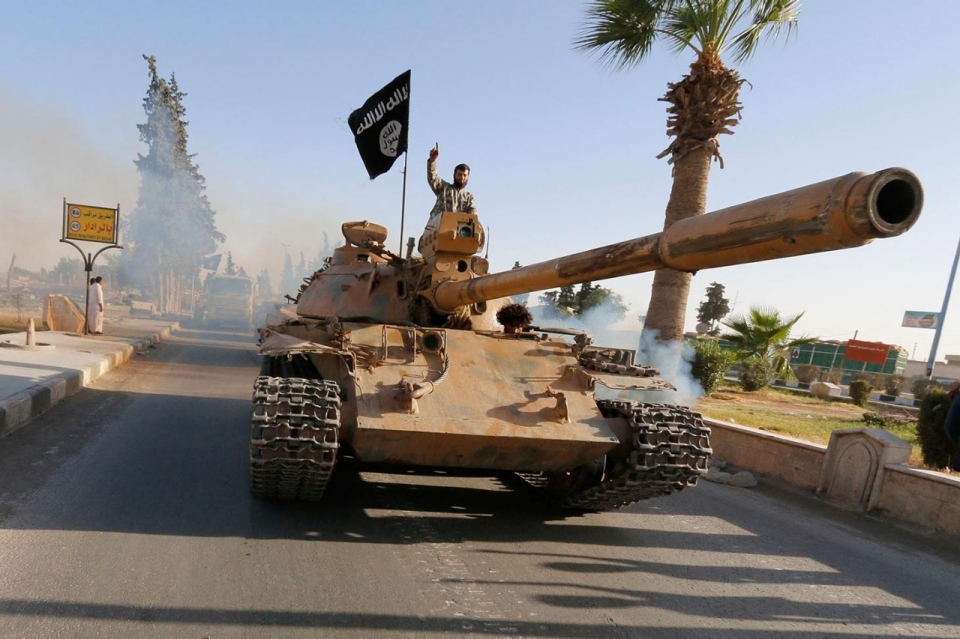
Last night the U.S. State Department issued a worldwide travel alert as Belgium’s government continued its lockdown of Brussels. As this went on the French continued their search for DAESH terrorists who took part in the Paris attacks. Over a week ago the U.S. Government issued an order for military and other government agents to not travel to Paris.

As all of this is going on I am thinking about an episode of Star Trek Deep Space Nine entitled, Paradise Lost that deals with suspected Dominion shape shifters infiltrating Earth that conducted a terror attack in Antwerp. The fact that the episode premiered in 1996 only underscores the fact that human nature is very consistent. We cannot forget the many times in history where peoples and nations have sacrificed essential liberty for the illusion of security.

In the episode Starfleet command declares martial law on Earth, and everyone is a potential terror suspect. Troops were deployed; citizens were subject to random blood tests to determine if they were really human, and false flag operations were conducted to instill even more fear, and for a time the plan worked, people submitted to the measures because of fear.

However, Captain Sisko, of Deep Space Nine who was called back to Earth to head security operations, discovers the plot. In a talk with the commander of Starfleet Captain Sisko asks why he has been brought back to Earth, the conversation is interesting in light of recent events:

SISKO: Then why did you bring me here?

LEYTON: Because I needed someone who knew how to fight shape-shifters, and that’s you. And I suppose on some level I hoped that when you saw what we were accomplishing, you’d join us. You’ve always had a strong sense of duty.

SISKO: My duty is to protect the Federation. 


LEYTON: That’s what we’re trying to do. 


SISKO: What you’re trying to do is to seize control of Earth and place it under military rule.

LEYTON: If that’s what it takes to stop the Dominion. 


SISKO: So you’re willing to destroy paradise in order to save it.

In light of the threat posed by DAESH, with real, suspected and imagined terrorist attacks in Europe, in the Middle East, and potentially in the United States, the conversation is quite relevant.

As the episode unfolds a shape shifter impersonating Chief O’Brien confronts Captain Sisko:

Changeling: Let me ask you a question. How many Changelings do you think are here on Earth right at this moment?

Captain Sisko: I’m not going to play any guessing games with you.

Changeling: Ah. What if I were to tell you that there are only four on this entire planet? Huh? Not counting Constable Odo, of course. Think of it – just four of us. And look at the havoc we’ve wrought.

Captain Sisko: How do I know you’re telling me the truth? 


Changeling: Four is more than enough. We’re smarter than solids. We’re better than you. And most importantly, we do not fear you the way you fear us. In the end, it’s your fear that will destroy you.

The fact is that the numbers of DAESH terrorists are extremely small, and yes they are capable of doing a lot of damage. But at the same time what are we willing to sacrifice to ensure our security? It seems that we are becoming ever more willing to sacrifice liberty in the name of security and to cast suspicion, and on an entire religion, including loyal citizens due to the actions of some. If that happens, DAESH wins, no matter how secure we think we are; but do not get me wrong, security is important, but sacrificing liberty in the name of security has seldom been effective, and once surrendered, liberty seldom returns.

I think the very last line of the spoken by the changeling is the most important. In the end, it is our fear that will destroy us.

Peace

Padre Steve+

1 Comment

Filed under civil rights, laws and legislation, national security, News and current events, Political Commentary, star trek, terrorism

The Belief in a Devil

Friends of Padre Steve’s World

The great American philosopher Eric Hoffer wrote, “Hatred is the most accessible and comprehensive of all the unifying agents. Mass movements can rise and spread without belief in a god, but never without a belief in a devil.”

Hatred is an amazing emotion. I noticed a lot of it comments of a number of people on my Facebook page following the DAESH attack on Paris and their threats against the United States. The bulk of it consisted of meme and statements which demonize Moslems, immigrants, and American liberals. Right now, Moslems, Arabs, immigrants, liberals and homosexuals are the devil to many people. Facebook and other social media platforms allows us to see into the hearts of people that we never would have thought capable of such beliefs. That my friends is the scary part.

Hoffer was quite correct that “Mass movements can rise and spread without belief in a god, but never without a belief in a devil.” History shows us how demagogues can, and do find a convenient devil and then stir the seeds of fear in the hearts of their followers. The tipping point comes when the people that the demagogues demonize become less than human in the eyes of the population.

Sadly, we human beings are not nearly as evolved as we think and we are just one crisis from pogroms, ethnic and religious cleansing, concentration camps and genocide. Just one attack on the United States by DAESH and the politicians, pundits and preachers, especially of the political right and the media whores who are more concerned about market share than truth, will decide that their “devils” must be exterminated.

When they will do they will claim a higher moral, religious, or racial, purpose; or perhaps use the language of Manifest Destiny, the Lost Cause, or the Stab in the Back or some other historical myth that suffices to justify their actions.

In a Star Trek the Next Generation episode, one called The Drumhead Captain Picard has to warn his security officer, Lt Worf about the dangers of rampant paranoia. An Enterprise crewman has his career destroyed because his paternal grandfather was Romulan. As the prosecutor damns him for that and accuses him of being part of a plot that never existed, Picard makes the comment, “Have we become so… fearful, have we become so cowardly… that we must extinguish a man? Because he carries the blood of a current enemy?”

During the investigation, Picard is approached by his security officer Lt. Worf, who wholeheartedly supported the investigation. Worf starts: “Sir, the Federation does have enemies. We must seek them out.” 

Picard pauses and then notes:

“Oh, yes. That’s how it starts. But the road from legitimate suspicion to rampant paranoia is very much shorter than we think. Something is wrong here, Mister Worf. I don’t like what we have become.”

As the investigation continued, Worf too was accused of being a traitor, because of his Klingon ancestry. When the prosecutor was send home in disgrace, Worf returns to Captain Picard. The conversation is enlightening.

“Am I bothering you, Captain?”
“No, please Mr. Worf, come in.”
“It is over. Admiral Henry has called an end to any more hearings on this matter.”
“That’s good.”
“Admiral Satie has left the Enterprise.”
“We think we’ve come so far. Torture of heretics, burning of witches, it’s all ancient history. And then, before you can blink an eye, suddenly it threatens to start all over again.”
“I believed her. I-I HELPED her! I did not see what she was.”
“Mr. Worf, villains who twirl their mustaches are easy to spot. Those who clothe themselves in good deeds are well camouflaged.”
“I think, after yesterday, people will not be so ready to trust her.”
“Maybe. But she or someone like her will always be with us, waiting for the right climate in which to flourish–spreading fear in the name of righteousness. Vigilance, Mr. Worf. That is the price we have to continually pay.”

As I look at the memes and and statements that I see on social media. As I listen to politicians and media pundits sow more suspicion, and incite fear in the people, and as I hear supposedly Christian preachers, demonize people for nothing more than their religious and ethic heritage, I wonder what we have become. To claim Picard’s words for myself I have to admit that I don’t like what we have become either.

Peace

Padre Steve+

4 Comments

Filed under national security, Political Commentary, star trek

A New Grand Alliance to Defeat DAESH

image.adapt.960.high

Friends of Padre Steve’s World,

We are now waking up to the fourth day in the next phase of a war that began too long ago, a war that too many people have been victimized by, which only is getting worse and more widespread.

Winston Churchill wrote, “If Hitler invaded hell I would make at least a favorable reference to the devil in the House of Commons.” That may seem an odd statement, Churchill made it in reference to the alliance with the Soviet Union to defeat Hitler in World War Two, but it bears a particular relevance to the situation that we find ourselves in with ISIL, or as they are also known, DAESH.

This is a follow up to my posts of the last few days regarding the attacks of Islamic State supporters in Paris and it will not be the last. French President Hollande has correctly noted that the attack was an act of war, and he promised that the French campaign against DAESH would be ruthless. Hollande and other leaders, including President Obama are now beginning to plan a coordinated strategy to defeat DAESH. That being said, any real strategy to defeat DAESH has to include more than a few partners, it must be truly a grand alliance. 

I am a career military officer, an Iraq veteran and an anti-war liberal, but I am also a realist in terms of the world. I have no illusions about the world. I do not believe that the United States always acts with honor and I know in my heart of hearts that much of the chaos that we are seeing in the world, particularly the Middle East comes from years of misbegotten American intrigue and intervention. Of course the Americans were not the only ones involved in creating this mess, we can thank the French and the British for the Sykes-Picot agreement. That agreement and the subsequent post-war agreements artificially divided the Middle East based on British and French colonial interests and disregarded the traditional and historic interests of the people in the region. Those agreements also handed the Arabian Peninsula over to the House of Saud, rather than the more moderate Arabs that fought alongside the British against the Ottoman Empire. We can also thank the Russians for their contributions to the instability of the region, as well as the Israelis who in defending their interests have often made things worse. Finally we cannot forget the role played by many corrupt and despotic Arab leaders who have oppressed their people, and exploited their countries riches for their own gain. Finally, back to the Americans it was the ill-advised and criminal invasion of Iraq by the Bush administration that opened Pandora’s Box and unleashed what we now know as the Islamic State. Sadly, almost all the countries currently involved have had a hand in creating the monster that we know as DAESH and the Islamic State, and all should bear part of the responsibility for defeating it.

That being said, whether any of us like it or not we are at war, a war that has been going on in earnest since 2003. This is not a new war, it is simply DAESH’s continuation of the war that was declared by Al Qaeda, and that Al Qaeda Iraq fought against American, allied, and Iraqi forces from 2003 through 2011.

The genie of war is out of its bottle and it will not return on its own accord, and it will create more chaos, death and destruction, both in the Middle East, but also other parts of the world. The threats of DAESH need to be taken seriously and countered.

We have to understand that this war is not a movie, it is not a video game, and it has the potential to change all of our lives, and not for the better.

Likewise, the fight against DAESH will not be solved or won by military action alone. The falsehoods of the warn porn addicts who believe deploying ground troops without the support of the people in the region, nor dropping more bombs will win the war. President Obama noted correctly, in response to suggestions that large numbers of ground troops be deployed, “that that would be a mistake, because we would see a repetition of what we’ve seen before, which is if you do not have local populations that are committed to inclusive governance and who are pushing back against ideological extremes, that they resurface….” He is right for saying this because those who propose sending in large numbers of ground troops are not committed enough to the hard thing and fully mobilize the nation for war. Instead they would as they always do, put the burden of the war on an already worn out professional volunteer military force without being willing to work with other powers, even rivals that have an interest in defeating DAESH.

The full spectrum of national and international power must be deployed to fight DAESH. This includes the U.S., NATO, Russia, China, Japan, the Arab world, and even Iran. Yes, some of these nations are competitors and rivals, but all have a vested interest in defeating DAESH and all have capabilities that would be helpful in the fight. In the Second World War the President Franklin Roosevelt United States and Britain’s Prime Minister Winston Churchill allied themselves with the Josef Stalin and the Soviet Union in what was then known as the Grand Alliance to defeat Hitler. The Grand Alliance was a real world demonstration of the art of realpolitik. Realpolitik demands compromise and finding common ground with nations that we may not like. Those that practice realpolitik also understand that almost all alliances are temporary. This may be unsavory to idealists, but it is reality, and it is the only thing that will defeat DAESH. It is high time the world leaders to get real in combatting DAESH.

Military force seems always to be the first thing that people think of, and while important, it is not the only kind of power that must be used. If we are going to use military force, we need to work with our allies and commit ourselves to a massive use, on the order of World War II, and coupled with a massive new Marshal Plan for the Middle East. We must use diplomatic and economic power, intelligence and information, coordinate national and international law enforcement efforts, and seek to redress many of the wrongs committed against the people in the region.

Since I am a realist, I understand that whether I want it or not, that this war will most likely remain part of our lives, maybe for a generation or more. Honestly, if we do not make a full effort, I expect that a hundred years from now that young men and women will still be fighting this war. Most will have no idea how it began, even as their governments, corporations, and others make a steady profit off of the war.

I will continue this tomorrow with some thoughts on the civil liberties that we will undoubtedly lose as this war progresses. I think that I will write about the dangers of how xenophobic racists, and others who demonize all Moslems, and who want to punish all Moslems for the actions of DAESH, especially those who are the victims of DAESH who have fled to Europe and other areas to escape them. That is already beginning in this country. 

But that is all for today,

Peace

Padre Steve+

1 Comment

Filed under History, middle east, Military, national security, News and current events, Political Commentary

Freedom or Security? The Precarious Balance

sloaninquarters

Friends of Padre Steve’s World,

The Roman philosopher and political theorist Cicero wrote words that are chilling, and over 2000 years after he wrote them, still troubling, “Inter Arma Enim Silent Leges,” in time of war the law stands silent…

Yesterday I wrote a piece that dealt with the moral and ethical costs of fighting a war against the self-proclaimed Islamic State using the lens of the Star Trek Deep Space Nine episode In the Pale Moonlight. I found it troubling and even had some nightmares involving this war, as a result I did not sleep well last night. So today I am going to continue the discussion, with a slightly different emphasis, again using a Deep Space Nine episode, this one called Inter Arma Enim Silent Leges which deals with a Federation security service trying to co-opt the Chief Medical Officer of Deep Space Nine to spy for them.

James Madison wrote that “A popular government, without popular information, or the means of acquiring it, is but a prologue to a farce or a tragedy; or, perhaps both.”

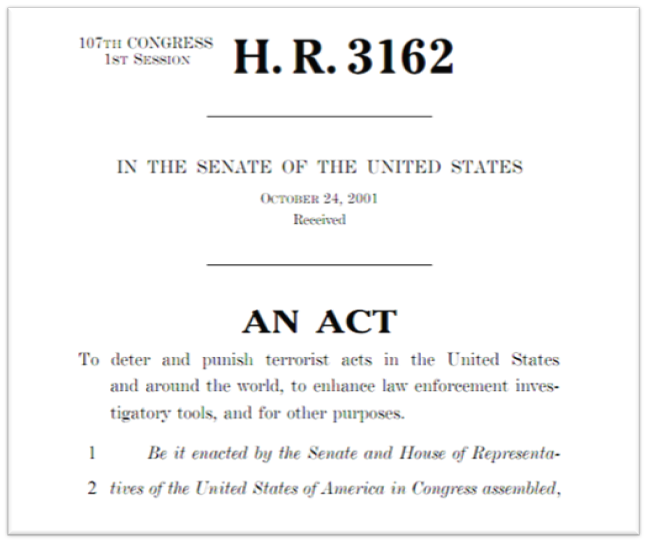
After September 11th 2001 the National Security State went into overdrive with the passage of the so called Patriot Act. That act opened the floodgates for an ever expanding national security state. With the growing likelihood that a Russian airline was destroyed by a terrorist bomb over the Sinai Peninsula, the probability is that more and more civil liberties will disappear in the name of national security. The fact is that we as a society need to wrestle with the questions of maintaining an open and free society in the midst of a world that is growing ever more dangerous. If we are to maintain an open and free society we must have this discussion, and we cannot allow ourselves to be duped into surrendering the very rights and civil liberties that we hold dear, in the name of security against threats real, and imagined. The fact that the threat to civil liberties is growing, and has been for the last decade and a half under both Republican and Democratic administrations, and Congresses controlled at one time or another by the Republican and the Democratic Parties.

Patriot-Act-HR-3162

I have a lot of apprehension when I read the reports about the activities of the National Security Agency, other intelligence and police agencies at all levels of government and the pervasive erosion of civil rights.  The national security state and the seeming all pervasive security and surveillance apparatus which demolishes any sense of privacy, especially the protections enunciated in the Fourth Amendment and to some extent the First Amendment. Of course the use of similar methods by the private sector, often in conduction with government agencies is another concern, but that needs to wait for another day.

I also understand from history and empirical evidence that many others, many from unfriendly countries do not share those apprehensions. Many of these competitors are willing to use whatever openness that we have as a society against us, using similar technology and methods used by our intelligence, police, governmental and private sector. It makes for an ethical, legal and even constitutional conundrum. I know that I am not comfortable with this, and perhaps maybe none of us should be.

It is very easy on one hand in light of history, our Constitution and democratic process to condemn the NSA, the FISA courts and other lawfully constituted agencies and those that drafted the laws over the decades that allow the activities which they now conduct. The same can be said of foreign intelligence agencies which all engage in similar activities including the British GCHQ, the German Bundesnachrichtendienst and so many others including the Chinese and Russians.

Likewise it is equally easy in light of history, current events and national security concerns for people to jump to the other side of the fence and not only defend the activities of the NSA and agencies like it, and to demonize those that protest or expose such activities.

When I see the talking heads on cable news shows defending or condemning such activities and not agonizing over the complexity and issues involved I get worried. Because there are legitimate concerns voiced by critics as well as defenders. But since we live in an era of soundbites, gotcha and half-truths being portrayed as all truth I find it helpful to use either historical examples, literature or fiction, and even science fiction to wrestle with the fundamental truths. So I find looking at such issues through the prism of Star Trek sometimes more interesting and provocative than simply doing the whole moralizing pundit thing.

There was an episode of Star Trek Deep Space Nine that aired well before the events of 9-11-2001, and the subsequent Global War on Terror, that I find fascinating. The episode deals with a secretive agency in Starfleet operating in the gray areas between the laws and ideals of the Federation and the threats that the Federation faces. Even when the Federation is a peace, Section 31, as it is called is engaged in activities https://www.youtube.com/watch?v=DhkfuyBLDlYagainst historic or potential enemies. In a way it is somewhat like the NSA or the Defense Intelligence Agency.

At the beginning of the Deep Space Nine Episode Inter Arma Enim Silent Leges the head of Section 31, a man only known as Sloan comes back Doctor Julia Bashir to involve him in an clandestine operation. An operation to on the Romulans who at this point are a Federation ally against the Dominion.

Sloan makes his approach and Bashir, who expresses his reservations:

BASHIR: You want me to spy on an ally.

SLOAN: To evaluate an ally. And a temporary ally at that. I say that because when the war is over, the following will happen in short order. The Dominion will be forced back to the Gamma Quadrant, the Cardassian Empire will be occupied, the Klingon Empire will spend the next ten years recovering from the war and won’t pose a serious threat to anyone. That leaves two powers to vie for control of the quadrant, the Federation and the Romulans.

BASHIR: This war isn’t over and you’re already planning for the next.

SLOAN: Well put. I hope your report is equally succinct.

BASHIR: How many times do I have to tell you, Sloan? I don’t work for you.

SLOAN: You will. It’s in your nature. You are a man who loves secrets. Medical, personal, fictional. I am a man of secrets. You want to know what I know, and the only way to do that is to accept the assignment.

I find the exchange both illuminating and riveting. The fact is that in the situation we face today the arguments of both sides should make us very uncomfortable.

Whether we like it or not or not, the incredibly rapid technical and communication advances of the past couple of decades have primed us for our present conundrum of liberty and privacy or security. That technology, as wonderful as it is  has enabled a generation to grow up in a virtual world in many ways detached from the moral and ethical balances between individual rights and liberties as well responsibility to community.

All the wonderful gadgets that we employ in everyday life, make it easy for enemies and “friends” to do things that were unimaginable to people other than science fiction writers even twenty to thirty years ago. Likewise they were certainly beyond the wildest imaginations of any of the founders who drafted Constitution.

The reality is, the things that make are lives so easy are also the things that have the potential to remove the very liberties that we treasure, either by our enemies using them, or those that defend us.

The truth is, that throughout history, even our own there have been operatives within the government in charge of secrets, as well as spies. In the Inter Arma Enim Silent Leges episode we see an operation that is full of duplicity and moral ambiguity all committed in the name of security. I won’t go into the details because it is too full of twists, and turns, you can read the plot of the episode at Memory Alpha.org http://en.memory-alpha.org/wiki/Inter_Arma_Enim_Silent_Leges_%28episode%29

There is an exchange between Dr. Bashir and Admiral Ross of Starfleet command which is very enlightening because it practically mirrors how many on both the civil liberties and the national security side of the current controversy feel about the War on Terror.

BASHIR: You don’t see anything wrong with what happened, do you.

ROSS: I don’t like it. But I’ve spent the last year and a half of my life ordering young men and young women to die. I like that even less.

BASHIR: That’s a glib answer and a cheap way to avoid the fact that you’ve trampled on the very thing that those men and women are out there dying to protect! Does that not mean anything to you?

ROSS: Inter arma enim silent leges.

BASHIR: In time of war, the law falls silent. Cicero. So is that what we have become? A twenty fourth century Rome driven by nothing more than the certainty that Caesar can do no wrong!

ROSS: This conversation never happened.

In light of the controversy of today regarding the NSA, FISA Courts, government secrecy and intelligence gathering information on its own citizens, as well as allies, friends and and enemies we face a growing tide of reporters and others seeking to reveal those secrets. Back in 1989 ethicist Sissela Bok wrote something very important in her book Secrets: Moral Choice in Public and Private Life:

“…as government secrecy expands, more public officials become privy to classified information and are faced with the choice of whether or not to leak … growing secrecy likewise causes reporters to press harder from the outside to uncover what is hidden. And then in a vicious circle, the increased revelations give government leaders further reasons to press for still more secrecy.”

As we wade through the continuing controversy surrounding these issues we will see people do exactly what Bok said. These are the exact arguments are being made by the people and officials directly involved in such activities, as well as former elected and appointed officials, and members of the press.

The interesting thing to me is that very few of the people or agencies, past and present, Republican and Democrat involved have clean hands. It is amazing to see former champions of civil liberties defend the NSA actions and those that empowered the NSA in the Patriot Act now condemn it. I find it both fascinating and frightening.

At the end of the Inter Arma Enim Silent Leges episode the mysterious Sloan pops back in on Doctor Bashir who is in his quarters, asleep and depressed by what he experienced during the operation on Romulus and with Admiral Ross.

SLOAN: Good evening.

BASHIR: Are you expecting applause? Have you come to take a bow?

SLOAN: I just wanted to say thank you.

BASHIR: For what? Allowing you to manipulate me so completely?

SLOAN: For being a decent human being. That’s why we selected you in the first place, Doctor. We needed somebody who wanted to play the game, but who would only go so far. When the time came, you stood your ground. You did the right thing. You reached out to an enemy, you told her the truth, you tried to stop a murder. The Federation needs men like you, Doctor. Men of conscience, men of principle, men who can sleep at night. You’re also the reason Section Thirty one exists. Someone has to protect men like you from a universe that doesn’t share your sense of right and wrong.

BASHIR: Should I feel sorry for you? Should I be weeping over the burden you’re forced to carry in order to protect the rest of us?

SLOAN: It is an honor to know you, Doctor. Goodnight.

We live in this kind of world and maybe it is good to sometimes step back and look at issues using a different prism. I really don’t have the answers. I am a civil libertarian who places a high value on the openness of a government to its people. I also know that there are those that have no regard for such openness or, to quote Sloan don’t “share your sense of right and wrong.”

Maybe that is not a good answer. I really don’t know. All I know is that as uncomfortable as this all is that those on both sides of the issue have valid points and concerns. It is a debate that needs to happen if we are able to balance that a society needs to balance individual rights and responsibility to the community; openness and secrecy; civil liberties and national security.

But that being said. it is a debate that needs to happen, even if it makes us uncomfortable. I for one think that it is better that we be uncomfortable when looking at such an important debate than to be prisoners of our certitude.

Peace

Padre Steve+

1 Comment

Filed under civil rights, ethics, laws and legislation, national security, Political Commentary, star trek, terrorism

Where is the Reckoning? Reflections on War

IMG_0463

Friends of Padre Steve’s World,

I finished up my latest Gettysburg Staff Ride and as always I end up in a reflective mood. There was so much this time that caught my attention, both in the actual staff ride and my run up and down Cemetery Ridge on Friday evening. I guess the one thing that continues to strike me is a theological question that I began to wonder about after my return from Iraq.

The question is more theological, philosophical, and sociological in nature, and it goes to a place that most of us are unwilling or unable to go. I say this because so many Americans have no idea what war is really about. We tend to exalt the military, say that we “support the troops” but no one asks the hard questions of whether the wars that we are fighting, and the vast amounts of money we are spending are worth it. Frankly I think that the reason is that because for the vast majority of Americans that war is an abstract concept, and they are so disconnected from the military that they do not understand. As such the military is idolized and even mythologized by a public that is willing to send them to war, but unwilling to understand or question decisions of policy that begin and perpetuate war without end.

I see the sacrifice, the broken lives, bodies, minds and families of our military personnel who have deployed so many times. With the expansion of the war against the self-proclaimed Islamic State the wars will probably continue indefinitely. Do I think that the war against ISIS/ISIL is worth it? I have to admit I do, they are thugs who have commandeered a religion to justify their crusade against all who do not agree with them and who seek to obliterate all history and culture that they do not agree, and to paraphrase Vice President Biden, Hell is where they will reside.

At the same time I cannot support a war in which a tiny minority of citizens have skin in the game while those who send them to war do so with no cost to themselves. In fact it wearies me to think that those who so loudly call for war refuse to support those who fight with increased taxes, or even war bonds. I have no doubt that those who send people to war, and those who allow them to do so without question, have no interest in actually putting their lives, or the lives of their sons and daughters on the line.

Joshua Chamberlain, the hero of Little Round Top asked the question that I think needs to be asked by all of us today:

“…men made in the image of God, marred by the hand of man, and must we say in the name of God? And where is the reckoning for such things? And who is answerable? One might almost shrink from the sound of his own voice, which had launched into the palpitating air words of order–do we call it? – fraught with such ruin. Was it God’s command that we heard, or His forgiveness that we must forever implore?”

My question for those who advocate war without end, who refuse to serve, and even refuse to sacrifice a wooden nickel to support those wars, is, whose forgiveness will you implore?

Peace

Padre Steve+

3 Comments

Filed under civil war, Gettysburg, History, national security, Political Commentary

Happy 240th U.S. Navy!

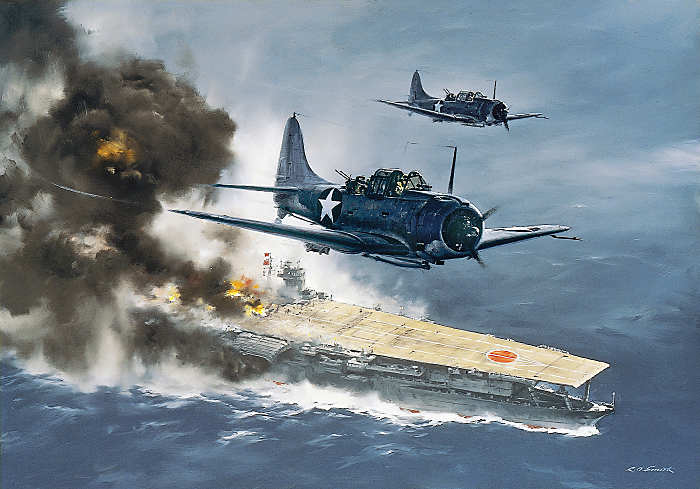
Attack_of_the_Akagi

Friends of Padre Steve’s World,

For me anything to do with the United States Navy is historical as well as decidedly personal as I am both a Naval Officer and I am the son of a Navy Chief Petty Officer.

Navy Heritage WWII Recruitment Poster

Today is the 240th anniversary of the founding of the United States Navy; actually the date is the founding of the Continental Navy but let’s not get too technical. The birthday of the post Continental, U.S. Navy is March 27th 1794 when Congress appropriated funds for the famous “Six Frigates,” the Constitution, President, Congress, Constellation, Chesapeake, and the United States. These ships would establish the U.S. Navy as a force that would ultimately become the most powerful the world has ever seen.

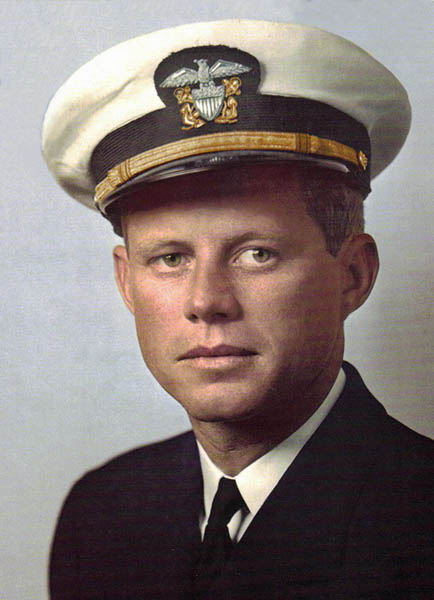
Lieutenant-John-F.-Kennedy

Lieutenant John F. Kennedy

The fact is that back in 1775 most people and political leaders in the revolting colonies felt that founding a Navy was quite foolish. After all, who in their right mind would ever dare to challenge the might and power of the British Royal Navy?

alfred-in-philadelphia

The First Flagship, the Alfred 

In fact had General George Washington not sent a letter to the Continental Congress saying that he had taken some vessels in hand to disrupt the supplies of the British Army, a Navy might not have ever been established. Timing is everything and in this case it the timing of George Washington was pretty good. Early Naval officers, sailing wooden ships with iron men began a tradition of selfless service that endures today.

flamborough-head

Since that fortuitous day in 1775 the United States Navy went from being an annoyance to the Royal Navy to the premier naval power in the world. But it was not always that way. The Navy was allowed to vanish during the 1780s and was reestablished by President Washington and an act of Congress in 1794. Since then the Navy has had its share of ups and downs where politicians very various reasons have ceased to support it. George Washington was right when he wrote to the Marquis de Lafayette, “It follows than as certain as that night succeeds the day, that without a decisive naval force we can do nothing definitive, and with it, everything honorable and glorious.”

USS_Arizona_(BB-39)_-_1930s

President Woodrow Wilson echoed Washington’s words in 1914, “A powerful Navy we have always regarded as our proper and natural means of defense; and it has always been of defense that we have thought, never of aggression or of conquest. But who shall tell us now what sort of Navy to build? We shall take leave to be strong upon the seas, in the future as in the past; and there will be no thought of offense or provocation in that. Our ships are our natural bulwarks.”

Men like John Paul Jones, Edward Preble, Stephen Decatur, Thomas Truxtun, William Bainbridge, Oliver Hazard Perry, David Farragut, David Dixon Porter, George Dewey and many more blazed a path of glory which others, great and small would continue to build on the legacy of the iron men who sailed wooden ships into harm’s way. Men like Arleigh Burke, Howard Gilmore, John C. Waldron, Maxwell Leslie, Bull Halsey, Richard O’Kane, Daniel Callahan, Raymond Spruance, Marc Mitscher, and Ernest Evans built upon that legacy in the Second World War. Other continued that tradition in Korea, Vietnam, the Cold War, and our current wars.

Likewise, others representing people who at one time were excluded from service would build on the legacy, including Robert Smalls who became the first African American to command a U.S. Navy ship during the Civil War, and Samuel Gravely who became the first African American Flag Officer, as Grace Hopper became the first woman line officer to attain flag rank. Others would do so in the Cold War, Vietnam and the Global War on Terrorism.

Great ships like the USS Constitution, USS Monitor, USS Kearsarge, USS Olympia, USS Enterprise, USS Hornet, USS Yorktown, USS Growler, USS Tang, USS Hoel, USS Johnston, USS Samuel B Roberts, USS Laffey, USS San Francisco, USS Houston and USS Arizona, USS Nevada, USS West Virginia and USS California helped build a legacy of valiant sacrifice and service often at great cost in the defense of freedom.

Imacon Color Scanner

Oliver Hazard Perry at the Battle of Lake Erie

The greatness of those ships would not have occurred had it not been for their crews. Over the last 240 years the success of the United States Navy all it came down to the men and women who served in every clime and place, many times outnumbered and facing certain defeat who through their courage, honor and commitment helped secure the liberty of their countrymen and others around the world. Most of these men and women served in obscurity in war and peace but all had the distinction of serving in the United States Navy.

hue-passing-us-on-tanker

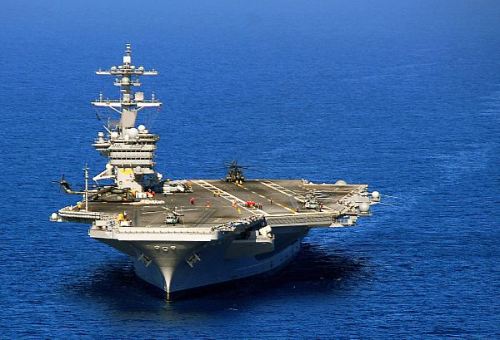
My old ship, the USS Hue City operating in 2002 in the Persian Gulf

Today the men and women of the United States Navy stand in the forefront of our Nation’s defense and in helping others around the world. Fighting against the Islamic State, Al Qaida and other terrorist organizations, attempting to bring stability to Afghanistan and working with allies and partners around the world to secure the freedom of the seas against pirates and others who attempt to disrupt the commerce on which ours and the world’s economy depends.

That being said, the Navy is not primarily an instrument of war, but an instrument of maintaining the peace. Admiral Arleigh Burke said something incredibly important to understand why we have a navy and why those who serve as Naval officers must work to sustain a world of liberty and justice, without resorting to war: “For in this modern world, the instruments of warfare are not solely for waging war. Far more importantly, they are the means for controlling peace. Naval officers must therefore understand not only how to fight a war, but how to use the tremendous power which they operate to sustain a world of liberty and justice, without unleashing the powerful instruments of destruction and chaos that they have at their command.”

uss-carl-vinson1

Even so, the past fourteen years have not been good for the Navy nor for the country, and most of this happened before 2009. Former Secretary of the Navy Ray Mabus noted, “On 9/11, 2001, the Navy stood at 316 ships. By 2008, after one of the great military buildups in American history, we were at 278 ships and had 49,000 fewer sailors.” During that time the United States embroiled itself in ground wars in which had no chance of succeeding, and in doing so hurt itself.

295_26911932058_5614_n-1

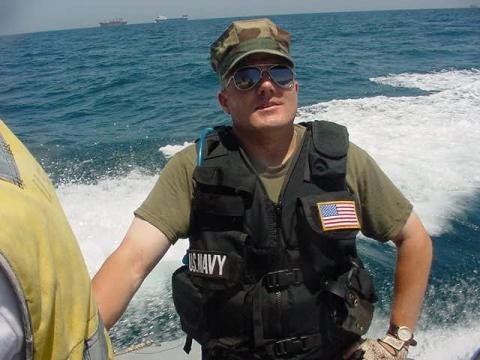
The author on a boarding mission in the Persian Gulf, April 2002

Even so, the Navy still performs its duty, and I am still a part of it, though I serve in non-Navy Joint command.

President John F Kennedy said something that I fully agree, “I can imagine no more rewarding a career. And any man who may be asked in this century what he did to make his life worthwhile, I think can respond with a good deal of pride and satisfaction: ‘I served in the United States Navy.’”

Like my father before me I can say that I am proud to have served and continue to serve in the United States Navy, because we are no matter what some may say or think, a global force for good.

Peace

Padre Steve+

3 Comments

Filed under History, Military, national security, US Navy

Be Clear in Your Mind: The Lesson of 9-11’s Aftermath

IMG_2671

Friends of Padre Steve’s World

I have been reflecting about the attacks of September 11th 2001 and their aftermath, and today a final post on that subject for now. The great German military theorist Carl von Clausewitz wrote, “No one starts a war-or rather, no one in his senses ought to do so-without first being clear in his mind what he intends to achieve by that war and how he intends to conduct it.” Sadly, the leaders of nations seldom heed his sage advice.

Nations and peoples who suffer devastating attacks often respond out of deep anger and emotion, and many times. The United States did so after 9-11-2001, and while the initial response to attempt to kill Osama Bin Laden and destroy Al Qaeda in Afghanistan was considered justified by most of the world, what that war, and the subsequent war invasion of Iraq became can be best described as best ill-advised and at worst criminal. After over fourteen years of war, these wars are by no means over, and I have to use the words of T.E. Lawrence to describe the situation, “We have not reached the limit of our military commitments…”

The great Greek Historian Thucydides wrote words which pretty much describe how we got to where we are in this war without end:

“Think, too, of the great part that is played by the unpredictable in war: think of it now, before you are actually committed to war. The longer a war lasts, the more things tend to depend on accidents. Neither you nor we can see into them: we have to abide their outcome in the dark. And when people are entering upon a war they do things the wrong way round. Action comes first, and it is only when they have already suffered that they begin to think.”

Likewise, we, and I don’t just mean the former Bush administration, but many others today who think that war is always the first and best option. We forget the words of Winston Churchill who, despite his many blunders in both World Wars wrote:

“Never, never, never believe any war will be smooth and easy, or that anyone who embarks on the strange voyage can measure the tides and hurricanes he will encounter. The statesman who yields to war fever must realize that once the signal is given, he is no longer the master of policy but the slave of unforeseeable and uncontrollable events…. Always remember, however sure you are that you could easily win, that there would not be a war if the other man did not think he also had a chance.”

The imperial hubris of our actions following 9-11-2001, most notably the invasion of Iraq have opened the gates of Hell in the Middle East and it will take a lot, and not just military power to contain them. Let’s face it, as much as we don’t like to admit it, General James Mattis was right when he said, “No war is over until the enemy says it’s over. We may think it over, we may declare it over, but in fact, the enemy gets a vote.”

image.adapt.960.high

What is next, I do not know; but if history teaches us anything, people, especially the leaders of nations don’t learn from it. Barbara Tuchman said it so well:

When information is relayed to policy-makers, they respond in terms of what is already inside their heads and consequently make policy less to fit the facts than to fit the notions and intentions formed out of the mental baggage that has accumulated in their minds since childhood.”

Peace

Padre Steve+

1 Comment

Filed under History, iraq,afghanistan, Military, national security, Political Commentary

The Peril of Preventive War

Friends of Padre Steve’s World,

About this time of month one hundred and one years ago the armies of Europe were beginning a four-year bloodletting that killed over ten million soldiers and resulted in twenty million other deaths. That war spawned other wars and conflicts the world over, some of which still go on today. Since I have been to war in Iraq, a war that if we took international law and war crimes seriously would be considered illegal under the codes that we tried the major German and Japanese war criminals under at the end of the Second World War, I take war, and going to war very seriously.

The beginning of the First World War provides an example for us of how out of control things can get when leaders opt for war when doing the hard work to keep the peace is much more in their interests.

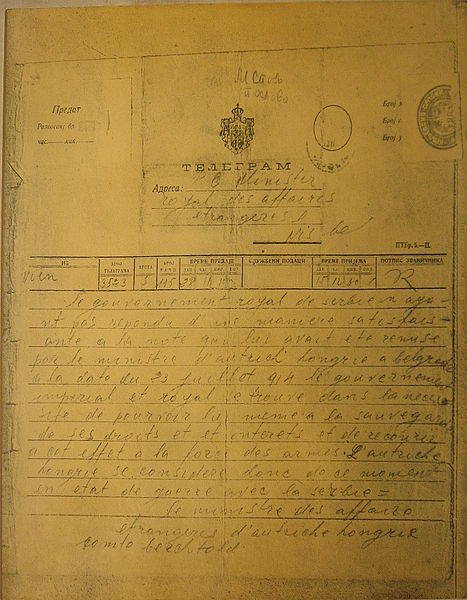
The Austrian Declaration of War against Serbia

One of the premier military and political theorist who has ever lived, Carl von Clausewitz “No one starts a war–or rather, no one in his senses ought to do so–without first being clear in his mind what he intends to achieve by that war and how he intends to conduct it.” Sadly, few political leaders take his advice.

It was a war that should never have happened. It was a war for which the belligerent powers could boast many causes but for which few had any real objectives. One hundred and one years ago this week the armies nations of Europe were beginning clashing on the frontiers of France, Germany, Belgium and Russia. Their leaders were hell bent on waging a war that all thought would be short, decisive and end in victory for their side. The leaders were wrong and nearly a century later the world still pays the price for their misplaced beliefs and hubris of those men.

It was a war in large part brought on by the declining Austro-Hungarian Empire’s fears. Fear of neighbors, ethnic minorities and its place among regional and world powers led the leaders of the Austro-Hungarian Empire to decide for war when the very unpopular heir to the throne Archduke Franz Ferdinand was assassinated in Sarajevo, the capital of the recently annexed province of Bosnia-Herzegovina on June 28th 1914.

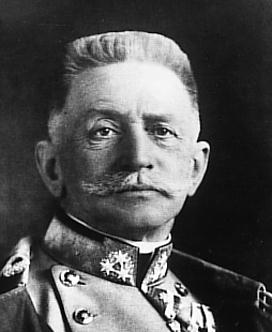
Conrad von Hötzendorf: War was the only means of politics

It was a series of decisions by those in the government of the Empire that brought Europe and the world to war, a war which we still feel the effects of today. In particular it was the decisions of the Austrian Chief of the General Staff Conrad von Hötzendorf, the Foreign Minister Leopold Berchtold and the aging Emperor, Franz Joseph which plunged the world into a world war which spawned revolutions, regional wars, a second world war, a cold war and countless other wars. The decisions were based on the belief, still common today that war is the only means of politics.

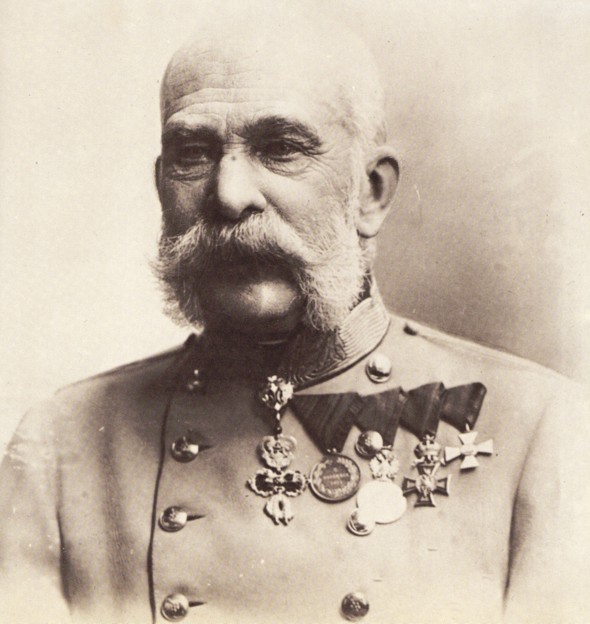
Emperor Franz Joseph: “If we must go under, we better go under decently”

Hötzendorf had been a continual advocate of war in every situation. He lobbied for war in 1907 against Italy and Serbia, in 1908 against Serbia, Russia and Italy, in 1909 against Serbia and Montenegro, in 1910 against Italy and the list increased in the years leading up to the war. He fervently believed that “the use of armed force alone could retard the centrifugal forces of nationalism in the ‘multinational empire’; war was the only means of politics.” The Emperor, Franz Joseph was of the same mindset by 1914 and in the days following the assassination of Franz Ferdinand he gave his approval to the actions of Hötzendorf and the diplomacy of Berchtold that doomed the Austro-Hungarian Empire and would destroy and remake Europe within a span of four years.

Theobald von Bethmann-Hollweg: The Blank Cheque

 The leadership of the Empire had decided on war within days of the assassination. Berchtold dispatched an emissary to Kaiser Wilhelm who decided in counsel with his Imperial Chancellor Theobald von Bethmann-Hollweg gave the Austrians a “blank cheque” of unconditional support for war against Serbia. Berlin was confident that “the Balkan crisis could be localized” and “advised Vienna to “proceed with all means at its disposal” and that Germany would support Austria-Hungary “come what may.” In doing so they willingly ignored the wise counsel of Otto Von Bismarck who considered the Balkans “not worth the life of a single Pomeranian Grenadier.

800px-Bain_News_Service_-_The_Library_of_Congress_-_Kaiser_Wilhelm_(LOC)_(pd)

Kaiser Wilhelm II

After they received German support the Austrians did everything that they could to ensure that war would occur. Their demands of Serbia were intentionally designed to be unacceptable to that country and they held key information from their German allies in the three weeks after they received the unconditional German support.

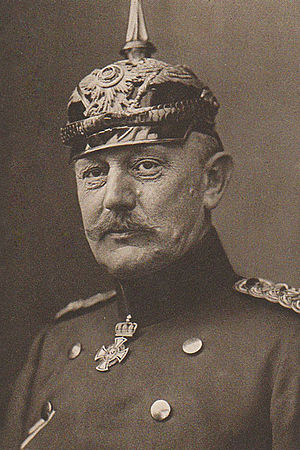
Helmuth Von Molkte: “no alternative but to fight a preventive war…” 

German militarists, particularly the Chief of the General Staff Helmuth Von Molkte the younger saw the coming conflict in racial and cultural terms. Von Molkte said that the coming war   would come “sooner or later” and be a war “primarily a struggle between Germans and Slavs” and compared Serbia to an “abscess.”  As the war cloud built Von Molkte told the Foreign Secretary von Jagrow that there was “no alternative but to fight a preventive war so as to beat the enemy while we could still emerge fairly well from the struggle” ignoring the advice of the Iron Chancellor Otto Von Bismarck who counseled “Preventive war is like committing suicide out of fear of death.”


Austrian Reservists going to war

 The Austrians felt that the threat from Serbia combined with internal political factors related to the Hungarian and other Slavic regions of the Empire, and the increasing influence of Russia and Germany in the Balkans was an existential threat. At the same time they were poorly prepared for war. Their military was large but poorly trained and equipped.  Their national infrastructure, industry and railroads were ill prepared for the demands of war. Their German allies had not planned for war either and were critically short of the required stocks of ammunition needed for a general war in Europe.

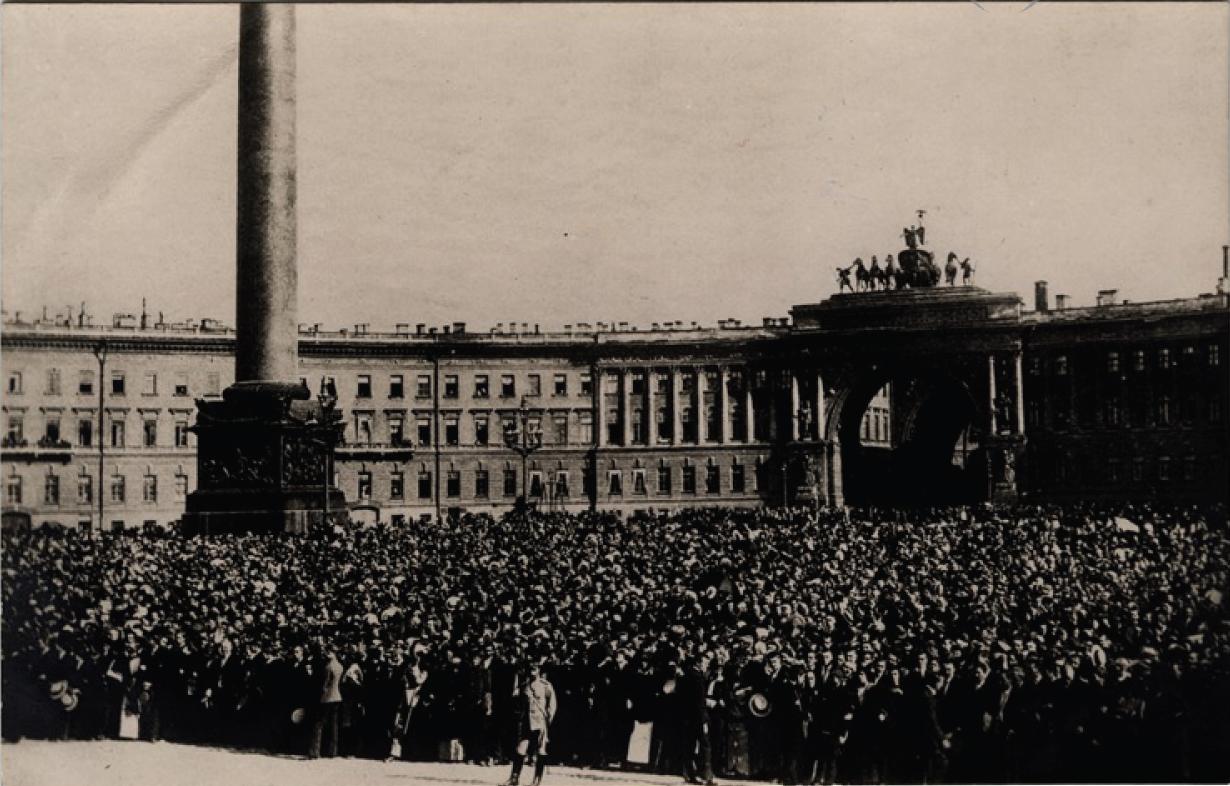
Cheering crowds in Petersburg

The Russians were heavily invested in the Balkans linked to other Slavic people by culture, language and religion. The French were bent on revenge against the Germans for the debacle of 1870 and had no stake in what happened in the Balkans. The British a few years prior to the war had told the Belgians not to expect support if they were invaded by Germany, but declared war to “protect Belgian neutrality.”

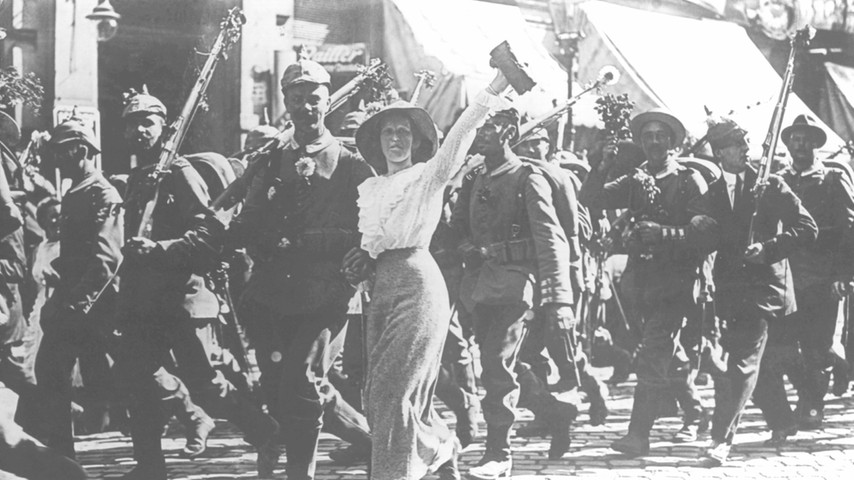
German wives and girlfriends walking alongside the Landser…

 The Austrians thought that with German support that even if Russia intervened that the war could be limited to Serbia. They were wrong. Just as the Germans had given the Austrians a “blank cheque” the French, both officially and unofficially were giving the Russians their own blank cheque. French Ambassador Maurice Paleologue assured Russian Foreign Minister S.D. Sazonov of the “complete readiness” of France to fulfill her obligations as an ally in case of necessity.

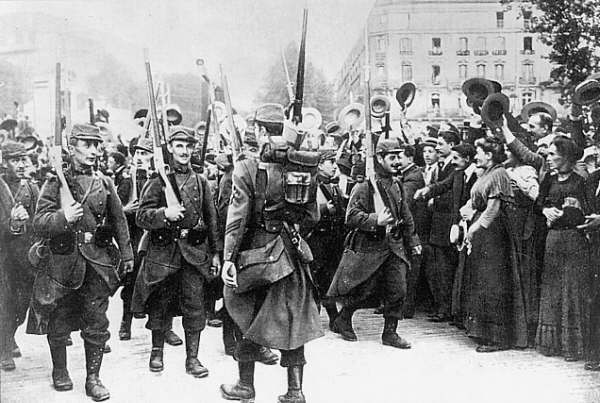
French Soldiers being cheered

Austria declared war on July 28th, Russia followed by a partial mobilization to support Serbia on the 29th. Kaiser Wilhelm attempted to avert war at the last minute but Czar Nicholas II wrote, “An ignoble war has been declared on a weak country. The indignation of Russia, fully shared by me, is enormous. I foresee that very soon I shall be overwhelmed by pressure to which I am exposed and compelled to take measures which will lead to war.”  This was met with German mobilization on the 30th and the French on August 1st. Declarations of war were exchanged and on August 4th in response to Germany’s refusal to respect the neutrality of Belgium Great Britain declared war against Germany.

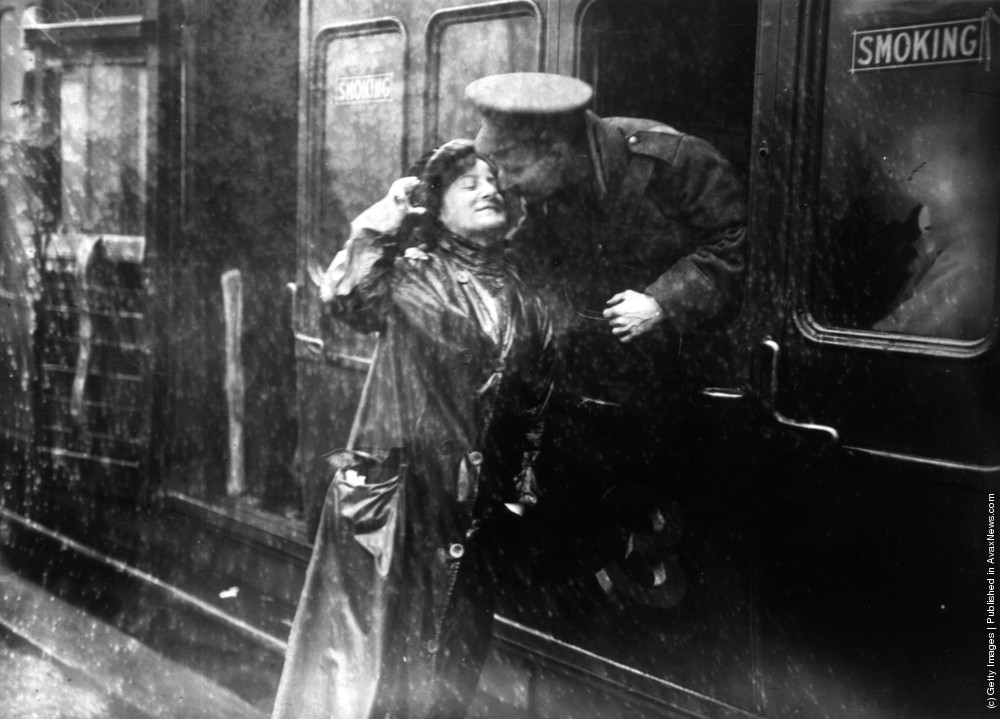
A final kiss from a British Soldier at Victoria Station

They were fateful days. Only the Austrians entered the war with any positive objectives, military or political goals. Every other power lurched into the war without clear objectives or end states. One writer noted that the war had “causes but no objectives.”

The world again finds itself perched at the edge of the abyss of war. There are people, smart and otherwise reasonable people who believe that they can wage “preventive wars” and rely on brute military force to solve nearly any problem. There are others that suggest that we should not criticize “allies” even when their decisions could be disastrous to them and the world, much as the Germans gave their Austrian brothers a “blank cheque.”  I wish that they would just look at the consequences before they commit nations and the world to more war that can only result in calamity and great suffering without benefit for anyone or any nation involved.

Those that counsel “preventive wars” need to remember the words of Otto Von Bismarck that “Preventive war is like committing suicide out of fear of death.”

Peace

Padre Steve+

3 Comments

Filed under Foreign Policy, History, leadership, Military, national security, Political Commentary, world war one

ISIL, the Caliphate and Manifest Destiny: Two sides of the Same Coin

Friends of Padre Steve’s World

Today another section of my Gettysburg Staff Ride text, taken from the second introductory chapter which deals with how religion and ideology plays a huge role in conflict and how it was used during the American Civil War.  This section discusses how a people’s worldview is strongly linked to culture and religion. It deals with the rather uncomfortable truth that the Islamic concept of the Caliphate differs little from the American idea of Manifest Destiny, a concept which may have created our nation as we know it but in practice was as barbaric and dishonorable as nearly conquering power has ever done, in fact there are many on the political right in this country, especially the Christian Right who are apologists for what occurred in the past and who advocate more of the same now. 

This might be an uncomfortable read for some people, and I hope that is the case. Of course in no way am I condoning anything that the Islamic State is doing in its quest to create a Caliphate, that needs to be condemned and fought wherever possible, preferably by the people most affected by it, the Arabs. 

But the truth is, religiously based imperialism, be it Manifest Destiny or the Islamic State’s dream of a Caliphate are two sides of the same coin of evil. 

So with that I bid you a happy Friday.

Peace

Padre Steve+ 

Manife4

One can never separate war and the means by which it is fought from its political ends. According to Clausewitz, war is an extension or continuation of politics. Of course Clausewitz understood the term politics or policy in the light of the concept of a “World View” or to use the German term Weltanschauung. The term is not limited to doctrine or party politics, but it encompasses the worldview of a people or culture. The world view is oft used by the political, media and religious leadership of countries and can be quite instrumental in the decision by a people to go to war; who they war against, their reasons for going to war, the means by which they fight the war, and the end state that they envision. This concept includes racial, religious, cultural, economic and social dimensions of a worldview.

One of the problems that modern Americans and Western Europeans have is that we tend to look at the world, particularly in terms of politics and policy, be it foreign or domestic, through a prism from which we cannot see the forest for the trees. We look at individual components of issues such as economic factors, military capabilities, existing political systems, diplomatic considerations and the way societies get information in isolation from each other. We dissect them, we analyze them, and we do a very good job in examining and evaluating each individual component; but we often do this without understanding the world view and ideological factors that link how a particular people, nation or party understand these components of policy.

Likewise policy makers tend to take any information they receive and interpret it through their own worldview. This is true even if they have no idea what their world-view is or how they came to it. Most often a worldview is absorbed over years. Barbara Tuchman wrote “When information is relayed to policy-makers, they respond in terms of what is already inside their heads and consequently make policy less to fit the facts than to fit the notions and intentions formed out of the mental baggage that has accumulated in their minds since childhood.” [1]

Policy makers often fail to see just how interconnected the most primal elements of the human experience are to the worldview of others as well as their own.

Because of this, many policy makers, be they military or civilian do not understand how critical the understanding of worldview is to designing effective polices. Likewise, many fail to see how the world view of others influence their application of economic, political, diplomatic and military power as well as the use and dissemination of information in their nation or culture. This is true no matter which religion or sect is involved, even if a people or nation is decidedly secular, or at least outwardly non-religious.

Perhaps this is because we do not want to admit that our Western culture itself is very much a product of primal religious beliefs which informed politics, philosophy, ethics, law, economics, views of race, and even the arts for nearly two millennia. Perhaps it is because we are justifiably appalled and maybe even embarrassed at the excesses and brutality of our ancestors in using religion to incite the faithful to war; to use race and religion justification to subjugate or exterminate peoples that they found to be less than human; or to punish and conquer heretics.

The United States Military made a belated attempt to address ideology, culture and religion in terms of counter-insurgency doctrine when it published the U.S. Army/Marine Counterinsurgency Manual. The discussion of these issues is limited to two pages that specifically deal with various extreme Moslem groups that use that religion as a pillar of their ideology, strategy and operations. But the analysis in the counterinsurgency manual of is limited because its focus is very general and focused at a tactical level.

Likewise the analysis of world view, ideology and religion in the counterinsurgency manual is done in an “us versus them” manner. While the manual encourages leaders to attempt to understand the cultural differences there is little in it to help leaders to understand why this understanding of religion and ideology is important at the strategic and operational levels of war.

ISIS-MAP

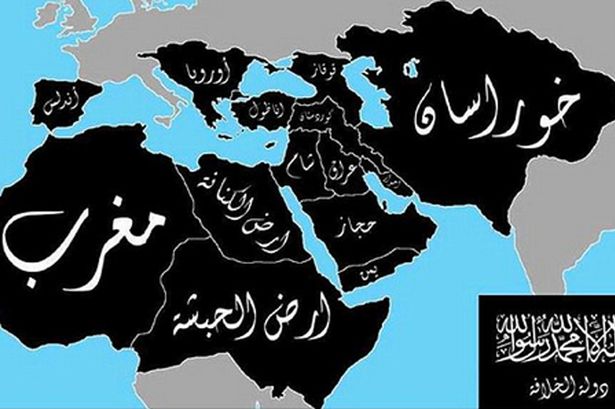
Commendably, the manual discusses how terrorist and insurgent groups use ideology, which is frequently based on religion to create a narrative. The narrative often involves a significant amount of myth presented as history, both Al Qaida and ISIL use the idea of the Caliphate as a religious and political ideal to achieve, because for many Moslems the idea of the Caliphate “produces a positive image of the golden age of Islamic civilization.” [2]

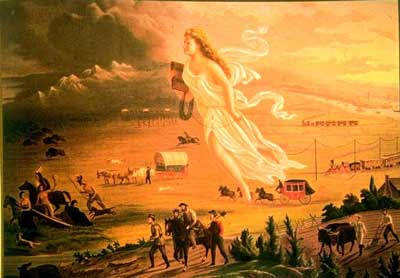
But Islam is not the only religion to do this. Most Americans are blind as to how previous generations Americans have used the Christian religion and race as a theological tool to justify subjugating other peoples and how that impacts us today. Beginning with the “landing of the Mayflower Pilgrims, the notion that the British colonies in the New World had been founded with divine assistance, in order to fulfill a providential mission, was commonly accepted.[3] The idea that it was God’s will for White Protestant settlers to push west, conquer and settle the continent of North America crystalized in the term Manifest Destiny. This concept was what motivated Americans to move into lands claimed by Britain as well as those which belonged to Mexico. The fact that the lands belong to other nations “was a small matter…Because most Americans considered it their “manifest destiny” to absorb these regions into the United States.” [4] There was a hunger in the land for more and Congressman John L. O’Sullivan, the inventor of the phrase proclaimed “Yes, more, more, more!….More…till our national destiny is fulfilled and…the whole boundless continent is ours.” [5]
mex_war_cam_1846_1847

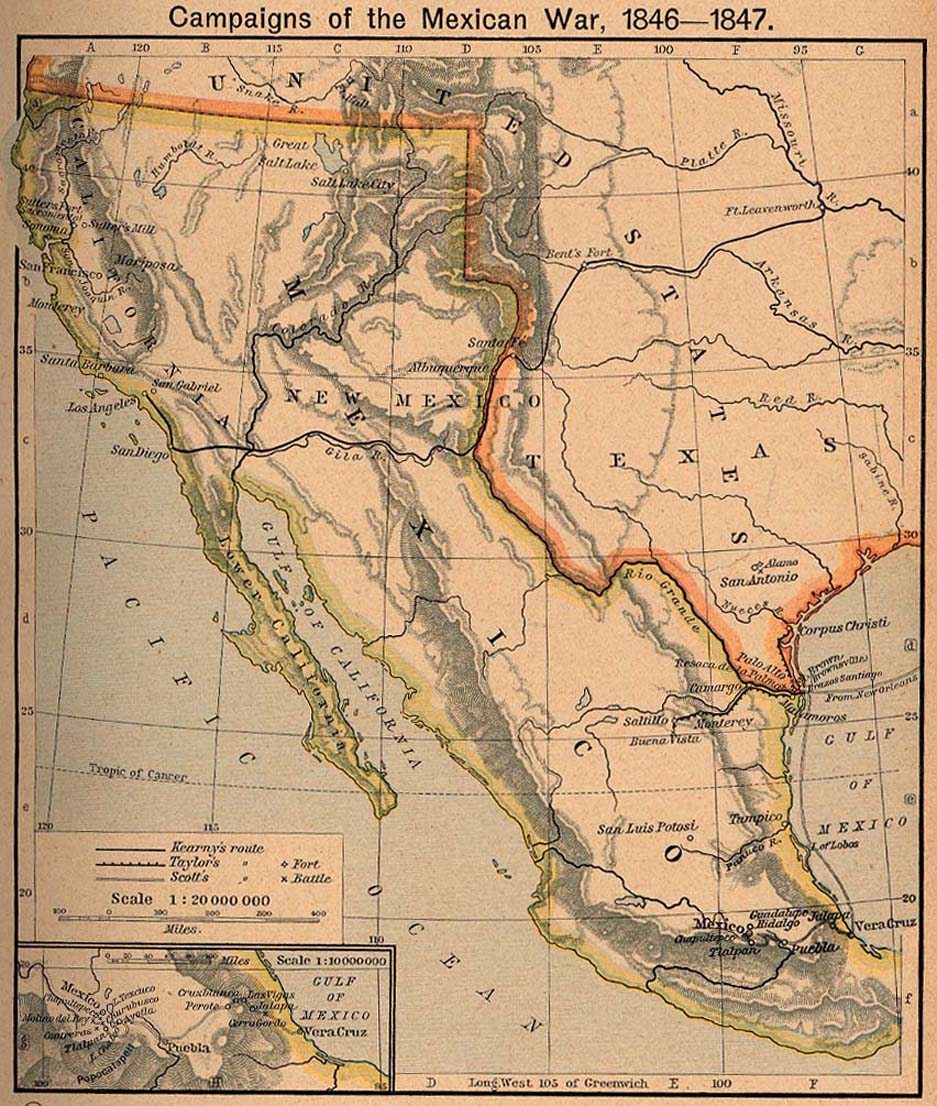
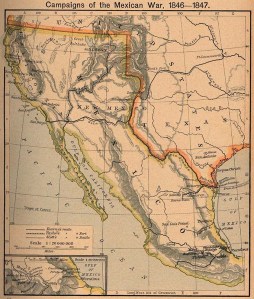
The issue came to a head when American settlers moved into Mexican territory in what is not Texas. The Mexican government allowed the settlers on the provision that they would become Catholic and swear allegiance to Mexico. The settlers did this but had no intention of honoring their word for they believed that their race and the Protestant religion they had denied to settle in Mexico “made them naturally superior to the mestizos – people of mixed Indian and European blood – who governed in the name of Mexico.” [6] This caused serious issues. Especially when the settlers, many of who were Southerners refused to give up their slaves when Mexico abolished slavery in 1829. The American colonists disregarded every agreement they had made with the Mexican government, they flouted the Catholic Church, and they refused to learn Spanish and refused to obey Mexican law. Eventually “their numbers dwarfed the tiny Mexican population of Texas.” [7]

One of the most prominent of the early settlers, Stephen Austin declared “for fifteen years, I have been laboring to Americanize Texas” noting that his enemies were a “population of Indians, Mexican and renegados, all mixed together, and all the natural enemies of white men and civilization.” [8] Eventually General Santa Anna attempted to seal the border between Texas and Louisiana to forestall the movement of any new settlers into the territory, but the move backfired and the Texans revolted and in the ensuing war secured their independence. The agreement pledged that Texas would remain an independent nation and not become part of the United States, but this agreement was broken as well and in 1845 Texas was admitted to the Union as a Slave State, furthering the cries of those advocating Manifest destiny for more. One Congressman asserted that:

“When God crowned American arms with success in the Revolution…he had not “designed the original States should be the only abode of liberty on earth. On the contrary, He only designed them as the great center from which civilization, religion, and liberty should radiate and radiate until the whole continent shall bask in their blessing.” [9]

The year after Texas joined the Union the administration of President James K. Polk provoked a war with Mexico which secured most of the rest of what we now know as the United States. In the process the Americans decided to violate treaties they had made with Native American tribes, and the “manifest destiny that represent hope for white Americans thus spelled doom for red Americans,” [10] and through war and disease the Americans decimated the Indian populations over the next fifty years.

A few voices were raised against the war with Mexico, former President John Quincy Adams said in the House of Representatives that in a war with Mexico “the banners of freedom will be the banners of Mexico; and your banners, I blush to speak the word, will be the banners of slavery.” [11] Abraham Lincoln doomed his reelection prospects in 1848 by condemn the war and criticizing President Polk. Alexander Stephens, a Southern Whig and later Vice President of the Confederacy assailed the President:

“The principle of waging war against a neighboring people to compel them to sale their country, is not only dishonorable, but disgraceful and infamous. What. Shall it be said that American honor aims at nothing higher than land…..never did I expect to live to see the day when the Executive of this country should announce that our honor was such a loathsome, beastly thing, that it could be satisfied with any achievements in arms, however brilliant and glorious, but must feed on the earth – gross, vile, dirt!” [12]

Walt Whitman prophetically noted that “the United States may conquer Mexico, but it will be as the man who swallows arsenic, which brings him down in turn. Mexico will poison us.” [13] Whitman would be proven right as it was the territorial acquisitions gained in the war with Mexico which lit the fuse which ignited the Civil War.

images-4

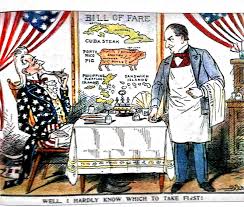
The deeply Christian and imperialist civil-religious concept of Manifest Destiny of can still be seen in pronouncements of some politicians, pundits and preachers who believe that that this is America’s mission in the world. Manifest Destiny is an essential element of the idea of American Exceptionalism which often has been the justification for much American foreign policy from the time of President McKinley. Former President George W. Bush alluded to this in his 2003 State of the Union Address, “that freedom is the right of every person and the future of every nation. The liberty we prize is not America’s gift to the world, it is God’s gift to humanity.” [14] Throughout the Bush presidency the idea that God undergirded the policy of the United States led to a mismatch of policy ends and the means to accomplish them. Former Israeli Ambassador to the U.S. and historian Michael Oren wrote:

“Not inadvertently did Bush describe the struggle against Islamic terror as a “crusade to rid the world of evildoers.” Along with this religious zeal, however, the president espoused the secular fervor of the neoconservatives…who preached the Middle East’s redemption through democracy. The merging of the sacred and the civic missions in Bush’s mind placed him firmly in the Wilsonian tradition. But the same faith that deflected Wilson from entering hostilities in the Middle East spurred Bush in favor of war.” [15]

Policy makers and military leaders must realize that if they want to understand how culture and religious ideology drive others to conquer, subjugate and terrorize in the name of God, they first have to understand how our ancestors did the same thing. It is only when they do that that they can understand that this behavior and use of ideology for such ends is much more universal and easier to understand.

If one wants to see how the use of this compulsion to conquer in the name of God in American by a national leader one needs to go no farther than to examine the process whereby President McKinley, himself a veteran of the Civil War, decided to annex the Philippine in 1898 following the defeat of the Spanish. That war against the Filipinos that we had helped liberate from Spanish rule saw some of the most bloodthirsty tactics employed in fighting the Filipino insurgents, who merely wanted independence. It was a stain on our national honor which of which Mark Twain wrote: “There must be two Americas: one that sets the captive free, and one that takes a once-captive’s new freedom away from him, and picks a quarrel with him with nothing to found it on; then kills him to get his land. . .” [16]

A doubtlessly sincere McKinley sought counsel from God about whether he should annex the Philippines or not.

“He went down on his knees, according to his own account, and “prayed to Almighty God for light and guidance.” He was accordingly guided to conclude “that there was nothing left to do for us but to take them all, and to educate the Filipinos. And uplift and civilize and Christianize them, by God’s grace to do the very best we could by them, as our fellowmen for whom Christ died.” [17]

On the positive side the counterinsurgency manual does mention how “Ideology provides a prism, including a vocabulary and analytical categories, through which followers perceive their situation.” [18] But again it does so at a micro-level and the lessons of it are not applied at the higher levels of strategic thinking and policy. This is often due to the fact that American and other Western policy makers “as a set of theological issues rather than as a profoundly political influence in public life.” [19] Even after nearly a decade and a half of unremitting war against enemies for whom religion is at the center of their politics policy makers still misread or neglect the importance of religion and religiously based ideology in the political motivations of their opponents. In many cases the religion of a people is stronger part of their identity than that of the state. Nations which were created during the post-colonial era “continue to see religion, clan, ethnicity, and other such factors as the markers of community identity.” [20]

Thus when faced with cultures for which religion provides the adhesive which binds each of these elements, such as the Islamic State or ISIL we attempt to deal with each element separately, as if they have no connection to each other. But that is where we err, for even if the religious cause or belief has little grounding in fact, science or logic, and may be the result of a culture’s attempt to seize upon mythology to build a new reality, it is, in the words of Reggie Jackson the “straw that stirs the drink” and to ignore or minimize it is to doom our efforts to combat its proponents.

Perhaps that is because people do not like to look at themselves and their own history in the mirror. People tend to be uncomfortable when the face that they see in the mirror is face too similar to those they oppose, especially those who are perfectly willing to commit genocide in the name of their God. It really does not matter if one holds a predominantly secularist worldview and lives a secular lifestyle, or if one is religious yet embarrassed by the religiously motivated criminal actions of their forefathers, the result is strikingly and tragically similar; it makes them blind to the religious motivations of others and causes them to misread events in often tragic ways.

Notes

[1] Tuchman, Barbara W. Practicing History Alfred A. Knopf, New Your 1981 p.289

[2] ___________ U.S. Army/ Marine Counterinsurgency Field Manual FM 3-24 MCWP 3-33.5 15 December 2006 with and forward by General David A Petraeus and General James Amos, Konecky and Konecky, Old Saybrook CT 2007 p.26

[3] Gonzalez, Justo L. The History of Christianity Volume 2: The Reformation to the Present Day Harper and Row Publishers San Francisco 1985 p.246

[4] McPherson, James. The Battle Cry of Freedom: The Civil War Era Oxford University Press, Oxford and New York 1988 p.42

[5] Ibid. McPherson The Battle Cry of Freedom p.48

[6] Ibid. Gonzales The History of Christianity Volume 2 p.248

[7] Guelzo Allen C. Fateful Lightening: A New History of the Civil War Era and Reconstruction Oxford University Press, Oxford and New York 2012 p.59

[8] Ibid. Gonzales The History of Christianity Volume 2 p.248

[9] Ibid. McPherson The Battle Cry of Freedom p.48

[10] Ibid. McPherson The Battle Cry of Freedom p.48

[11] Ibid. Gonzales The History of Christianity Volume 2 p.249

[12] Ibid. Guelzo Fateful Lightening: p.63

[13] Ibid. McPherson The Battle Cry of Freedom p.51

[14] Bush, George W. State of the Union Address Washington D.C. January 28th 2003 retrieved from Presidential Rhetoric.com http://www.presidentialrhetoric.com/speeches/01.28.03.html 10 June 2015

[15] Oren, Michael Power, Faith and Fantasy: America and the Middle East 1776 to the Present W.W. Norton and Company, New York and London 2007 p.584

[16] Twain, Mark To the Person Sitting in Darkness February 1901 Retrieved from The World of 1898: The Spanish American War The Library of Congress http://www.loc.gov/rr/hispanic/1898/twain.html 12 December 2014

[17] Ibid. Tuchman Practicing History p.289

[18] Ibid. U.S. Army/ Marine Counterinsurgency Field Manual p.27

[19] Rubin, Barry Religion in International Affairs in Religion: The Missing Dimension of Statecraft Oxford University Press, Oxford and New York 1994 p.20

[20] Ibid. Rubin Religion in International Affairs p.22

2 Comments

Filed under civil war, History, middle east, national security, News and current events, Political Commentary, Religion