Category Archives: News and current events

Indifference: the Epitome of All Evil

1483285_10152114931522059_1612934841_n

Friends of Padre Steve’s World,

This week we finished our first class of the year at the Staff College where I teach. In my ethics elective we touched on a number of very difficult subjects, my students gave presentations about the American internment of Japanese Americans in World War Two, the War with Mexico, where the United States according to Ulysses Grant was “one of the most unjust ever waged by a stronger against a weaker nation;” as well as several other deeply uncomfortable subjects which due to our academic non-attribution policy I do not even mention here.

The class was probably the best that I have taught in my two years at the college, the students were amazing, and all showed a tremendous capacity for wrestling with difficult subjects and were capable of deep self-reflection, something that should encourage anyone when they think about the future of our military leadership. Our final class was spend watching a very disconcerting movie called Conspiracy which is about the Wansee Conference which coordinated the Nazi Final Solution against the Jews. It is actually one of the most terrifying movies I have ever seen, mainly because it deals government officials meeting in a very businesslike fashion to condemn millions to death around a conference table while eating the finest food and drink.

Fyodor Dostoyevsky wrote, “Nothing is easier than to denounce the evildoer; nothing is more difficult than to understand him.”

I think one of our problems is that we want to believe that evil is simply done be evil people. That is why when we see a Hitler, Stalin, Pol Pot, or the monsters of the so-called Islamic State, we are often strangely comforted. This is often because we can point to a single person with a wicked ideology and say “they are evil,” all the while forgetting that they are, or were, like us, also human. Aleksandr Solzhenitsyn reminds us of the folly of that type of thinking, “If only it were all so simple! If only there were evil people somewhere insidiously committing evil deeds, and it were necessary only to separate them from the rest of us and destroy them. But the line dividing good and evil cuts through the heart of every human being. And who is willing to destroy a piece of his own heart?”

Last week I took a break from my Gettysburg text and dusted off an old academic paper dealing with the one of the more uncomfortable aspects of the Nazi Holocaust against the Jews. I did that because I felt that I needed to reexamine the nature of evil in the modern world.

When I ponder the evil committed by supposedly civilized men and women of Germany, I realize that they are little different than others who share the culture of the West. These people were the products of a culture of learning, and of science. They were part of a culture formed by the Christian tradition, the Renaissance, the Reformation, and the Enlightenment, the age of Reason. As I pondered this I came to remember something said by the late Iris Chang, “civilization is tissue thin.”

That series of articles about the Einsatzgruppen dealt with the ordinary men, and the bureaucratic systems that implemented an ideology so twisted and evil that it is unimaginable to most people. While most people in the United States know a little about the Holocaust, most do not fully comprehend how devilish and insidious the crimes of the Nazis were. More frightening is the fact that 46% of people worldwide have never heard of the Holocaust, and of the 54% who are aware some 32% think it is a myth or has been greatly exaggerated. The numbers wills only get worse as younger people are far more likely to believe that the Holocaust is a myth or or exaggerated.

We typically know about the extermination camps like Auschwitz, but the lesser known dark side of the Holocaust, perhaps the scariest part, is the story of the men of the Einsatzgruppen. The Einsatzgruppen and affiliated units, including those of the Wehrmacht, the Waffen SS, the mobilized battalions of the Order Police, and locally recruited units, rounded up massive numbers of people and killed them up close and personal. In all these units murdered over two million people, about 1.3 million of whom were Jews.

My study of the Holocaust began in college as an undergraduate. My primary professor at California State University at Northridge, Dr. Helmut Haeussler had been an interpreter and interrogator at the Nuremberg trials. I was able to take a number of lecture classes from him a large amount of research and independent study courses in a year of graduate work while finishing my Army ROTC program at UCLA. It was an immersion in the history, sociology, and the psychology of evil, during which I was able to meet and talk with Jewish survivors of the Holocaust.

Since then I have continued to read and study. I lived in Germany for over four years, and made many other visits, during which I went to a number of Concentration Camp sites. I visited the rebuilt synagogue in Worms which had been destroyed during the infamous Kristallnacht, and other museums and Holocaust memorial sites in Germany. I visited the Zeppelin field, the site of Hitler’s massive Nazi Party rallies in Nuremburg, as well as the graveyards which contain the victims of other Nazi crimes, including the Nacht und Nebel or night and fog actions, where people simply disappeared and were murdered by the Gestapo.

For me, those visits were sobering, maybe even more so because I understood exactly what happened in those sites. These are uncomfortable places to visit, and I can understand why many people would not want to visit them, or even study them.

The darkness that they remind us of is a part of our human condition. The traces of evil that are on display in those places are present in every human being. Frankly, most people cannot bear looking into that abyss, for fear that they might be swallowed by it.

I can understand that and I have to admit that it is hard to do so. I am a historian as well as a clinician with much experience dealing with death and trauma. With my training I do a pretty good job of keeping my emotional distance to maintain objectivity when confronted with evil. However, it is hard for me not to have some emotional reaction when visiting these places, or reading about the events and people, and in writing about them.

Likewise, I am very troubled by the growing lack of awareness about, or even the denial of the Holocaust. It is very hard for me not to have a virulent reaction when I see books and websites dedicated to Holocaust denial, or that minimize other well documented genocides, and crimes against humanity.

My sensitivity to human suffering and the terrible indifference of people in this country to it was greatly increased by my experience of war, and my post-war struggles with PTSD, depression, anxiety, which at points left me very close to committing suicide. A non-chaplain friend, a now retired Navy Command Master Chief Petty Officer that I served with at my last duty station recently remarked that I am a tremendously empathetic person, and that I have a large capacity to feel the pain and suffering of others. This capacity for empathy and the ability to feel the suffering of others is part of who I am. It is a good thing, but it makes my work studying and writing about the Holocaust, other genocides, crimes against humanity, and subjects like American slavery, racism, and Jim Crow a sometimes difficult and often very emotionally consuming task. This sometimes leaves me even more sleepless and anxious than normal; especially when I see the indifference of so many people to the suffering of others today.

It is that indifference which motivates me to write; because if these events are not recalled and retold, they, like any part of history will be ignored and then forgotten. The statistics bear this out. There are people today, who say that we should stop talking about these events, that they are old news, and they cannot happen again; but history tells us different, and not just the Holocaust, but indeed every genocide. Then there are those who shamelessly use the Holocaust imagery to spread fear among their followers even as they openly demonize minority groups and religions as the Nazis did to the Jews.

I have to agree with Elie Wiesel who said, “Indifference to me, is the epitome of all evil.”

The late Iris Chang, who wrote The Rape of Nanking: The Forgotten Holocaust of World War II wrote something that is pertinent to almost every modern episode of genocide, or other crime against humanity. It is the ability of leaders, be they political, military, or religious to convince people to rationalize actions that they normally would find repulsive.

“After reading several file cabinets’ worth of documents on Japanese war crimes as well as accounts of ancient atrocities from the pantheon of world history, I would have to conclude that Japan’s behavior during World War II was less a product of dangerous people than of a dangerous government, in a vulnerable culture, in dangerous times, able to sell dangerous rationalizations to those whose human instincts told them otherwise.”

What we call civilization, to use the words of Iris Chang, is tissue thin; and I believe that the indifference of so many people, especially those of great power and influence to crimes against humanity, to the suffering of people, epitomizes the evil of our day even more than the overt acts of the terrorists and governments committing them. 

That is why we must never forget these terrible events of history, and that part of human nature, and in a sense part of every one of us, that makes them so easy to repeat. That is why we must periodically take the time to remember and reflect on the Holocaust, other genocides and crimes against humanity.

Yes, these are terribly uncomfortable subjects, but we cannot allow this generation to allow them to be forgotten, lest they be repeated. Nor can we allow ourselves to be indifferent to them.

That is why that I must continue to write and teach.

Peace

Padre Steve+


2 Comments

Filed under ethics, History, nazi germany, News and current events

The Promise of Riots 


Friends of Padre Steve’s World,

A short comment on the results of Super Duper Tuesday and the dangers that the day brings for both the Democratic and Reupublican parties. My words are certain to offend the sensibilities of partisans of every candidate in both parties currently fighting to win their party nomination for President, and I really don’t care, because I care more for the country than any candidate, and for the peaceful preservation of the Union and Liberty more than the short term political gain of any party, faction, or individual candidate. 

The Super Duper Tuesday primaries are over. On the Democratic side Hillary Clinton swept states in play. While the results in Missouri and Illinois were close she won each primary and in the popular vote outpolled Bernie Sanders by around 900,000 votes in the four states at play. She also increased here Delaware count in both pledged delegates and Super Delegates. Let it be known that I am not a big fan of the Super Delagate system, but that is the system that the Democratic Party has used for decades, but all the candidates know that going in, even Bernie Sanders. 

But compared to the Republican race the Democratic primaries are positively civil, boring, and mundane. Sanders has made things interesting, and probably made Hillary a better candidate, and Hillary should do her damnedest to reach out to Sanders and his supporters if she wants their support in the general election. Truthfully I like Bernie Sanders a lot, and agree with most of his positions on the issues. His Democratic Socialism is little different that Franlkin Roosevelt’s New Deal. But the fact is Sanders owes his success to the Democrat who did not run, Senator Elizabeth Warren. It was her true populist voice in economic issues and her refusal to run that gave Sanders his opening. At the same time like Hillary, but I am not blind to her faults and some of the things in her past that give people reason not to fully trust her. What does that make me? I guess an unpopular realist who because I am serving in a Federal office cannot publicly endorse any candidate, but I can comment on policy, history, and what I believe. 

Likewise, Sanders supporters who say they are progressive but would vote for Trump to spite Clinton if she wins the nomination are fools, and not at all progressive if they believe what they actually say and then do that. True progressives understand the value of realism and pragmatism and getting what you can get; for sometimes progress is slow, but it if you keep working you achieve it, ithout handing victory to people who hate you. Those Sanders supporters who call themselves “progressives” but would be willing to vote for Trump to spite Clinton are like the German Communist Party members in Weimar Germany who worked against the Social Democrats and gave Germany to Hitler. A pox on them if they do that. The same would go for Clinton supporters who if she lost the nomination to Sanders did something similar. Since I don’t see any way for Sanders to win the nomination short of a total Clinton meltdown or scandal so big that would turn the Super Delagates against her, I don’t see the latter happening, and if there was such an event the Democratic Party would rapidly coalesce around Sanders, or maybe rally to nominate Warren. 

But I digress…

No matter what happens with the Democrats, the really interesting thing is what s going on in the GOP. Trump won a crushing victory in Florida as well as convincing victories in North Carolina and Illinois. He won a very narrow victory in Missouri over Ted “nobody likes me” Cruz, and lost in Ohio to John Kasich because the Repulicans allow “winner take all” primaries means that Kasich won every delegate in his home state, without even winning a majority of the vote. And that is how the GOP hopes to defeat Trump? Give me a break. That is cloud-cuckoo-land thinking. 

That has set up an interesting scenario. The GOP “establishment” has been doing everything that they can to try to stop Trump from winning the nomination outright. Many have actually gone on record with that stirring the ire or Trump and his most vocal supporters on conservative talk radio, media, and the Internet. Prominent leaders of the right wing media including Rush Limbaugh, and Coulter, and Breitbart News are all in for Trump, and they are hammering the GOP establishment, and people still listen to them. It doesn’t matter what Paul Ryan, Mitch McConnell, Reince Prebus, Mitt Romney, or even George W. Bush has to say; they are all weak or even traitors if you ask Trump and his most ardent supporters. In response you have Glenn Beck and many other conservative pundits and politicians  doing all that they can to fight Trump. This is a civil war and existential struggle for the GOP, and truthfully I don’t see it surviving in any form that we once knew, and as a former Republican who spent 32 years as a party loyalist, in my opinion, as much as I hate what the GOP has become, that is not a good thing, and Republicans have only themselves to blame just as the Democrats were for what happened to them in 1860 and 1968, the Republicans in 1964, and German conservatives in 1932 and January of 1933. They all destroyed themselves with little help from their opponents. Thant my friends is history, that is reality. 

What portends is an absolute disaster for the GOP. If they fail to stop Trump from winning a majority, he wins. If they stop him, and keep him from an outright majority, even though he will likely have 400-500 more delagates at the convention than eith Cruz or Kasich, they will have achieved a Pyrrhic victory. Trump is not your run of the mill boring Republican. It is his money and brains in stoking the anger of Republicans, not only against the Democrats and Obama, but the GOP establishment that has brought him thus far, and he is not done. 

He has tacitly endorsed violence against opponents, and journalists, even conservative journalists who get in his way. On Wednesday he said that there “would be riots”  if the GOP tried to deny him the nomination, even if he was short of the majority needed to win the nomination at the GOP convention in Cleveland outright. He is not joking. His supporters have almost as little love for the GOP as they do the Democrats. He and they will not accept what they see as being cheated out of the nomination, and frankly, while I am not a Trump supporter by any means I would have to agree with them if I was in their shoes. The current GOP is Republican in Name Only. It is not the party or Lincoln, not the party of Ulysses Grant or Teddy Roosevelt, not that of Dwight Eisenhower, or even Barry Goldwater or Ronald Reagan. It has become a proto-fascist party run for the most part by Christian radicals bent on establishing a theocracy, embodied by Ted Cruz, that is now collapsing on the weight of unfulfilled promises to people that they have made for decades. Frankly, Trump’s supporters are declaring war against the GOP establishment, and if they don’t win that war they will leave the GOP as a smoldering ruin of hubris as they destroy it in their way out. 

Maybe my analysis of both parties is wrong. As a historian I don’t think it is, but I could be wrong. It wouldn’t be the first time and certainly won’t be the last. But as Mark Twain is reported to have said, “history doesn’t repeat itself, but it does rhyme.”  

But then maybe I’m just too much of a realist and have too much understanding of people and history for any ideologue or radical of any persuasion to take what I have to say seriously. But then as bad is this all is maybe it is what we all need to cause us to wake up and re-embrace the promise of of the words spoken by Abraham Lincoln at Gettysburg, “that this nation, under God, shall have a new birth of freedom – and that government of the people, by the people, for the people shall not shall not perish from the earth. ” 

Until tomorrow, 

Peace

Padre Steve+ 

2 Comments

Filed under News and current events, Political Commentary

Be Careful What You Vote Against

Friends of Padre Steve’s Worl

Since the Illinois and Missouri primary results will not be settled before I pass out tonight I will save my article about the results of what happened last night until tomorrow. As such I see no reason to do much commentary other than to note that Missouri is going to be close in both the Republican and Democratic races. 

Because of that  I am republishing an article that I wrote almost four years ago. Truthfully, no matter what your political leanings are I think that is important and well worth the read. I find that too many people don’t take the time to examine the second, third, and fourth order consequences of their actions, and that includes the action of casting a vote. Far to many votes are cast out of emotions, especially those of fear and anger, and without thought of the long term consequences. That was the case in less than a century ago in Germany. 

was reminded oft his article when a friend of mine remembered it and posted a link to it on Facebook a couple of days ago. In his note about it he noted that I was well ahead of the media. I hate it when that happens, but such is the danger of being a historian who has the capacity of self-reflection. The article is here in its entirety. I have not updated it with any references to Donald Trump or the violence that is occurring with startling regularity on the campaign trail. Even so it is decidedly uncomfortable reading, especially when I see quite a few Evangelical leaders, including pastors, and media pundits endorsing Trump. 

Peace

Padre Steve+

German Pastor Martin Niemoller wrote: “I hated the growing atheistic movement, which was fostered and promoted by the Social Democrats and the Communists. Their hostility toward the Church made me pin my hopes on Hitler for a while. I am paying for that mistake now; and not me alone, but thousands of other persons like me.” 

79623

Martin Niemöller

Martin Niemöller was a war hero. He had served on U-Boats during the First World War and commanded a U-Boat in 1918 sinking a number of ships. After the war he resigned his commission in the Navy in opposition to the Weimar Republic and briefly was a commander in a local Freikorps unit. His book Vom U-Boot zur Kanzel (From U-boat to Pulpit) traced his journey from the Navy to the pastorate. He became a Pastor and as a Christian opposed what he believed to be the evils of Godless Communism and Socialism. This placed him in the very conservative camp in the years of the Weimar Republic and he rose in the ranks of the United Evangelical Church of the Old Prussian Union. Active in conservative politics, Niemöller initially support the appointment of Adolf Hitler as Chancellor.

However, he quickly soured on Hitler due to his insistence on the state taking precedence over the Church. Niemöller was typical of many Germans of his era and harbored ant-Semitic sentiments that he only completely abandoned his anti-Semitic views until after he was imprisoned. He would spend 8 years as a prisoner of the Nazis a period hat he said changed him including his views about Jews, Communists and Socialists. Niemöller was one of the founding members of the Pfarrernotbund (Pastor’s Emergency Federation) and later the Confessing Church. He was tried and imprisoned in concentration camps due to his now outspoken criticism of the Hitler regime.

338101

Herman Maas

Herman Maas was another Evangelical Pastor. Unlike Niemöller, Maas was a active participant in the ecumenical movement, built bridges to the Jewish community and defended the rights of Jews as German citizens. He received a fair amount of criticism for his attendance of Reichspräsident Friedrich Ebert’s funeral. Ebert was both a Socialist and avowed atheist. Maas too was active in the Pfarrernotbund and the Confessing church, and unlike Niemöller maintained his opposition to anti-Semitism and the Nazi policies against the Jews. He would help draft the Barmen declaration. He too would be imprisoned and survive the war. Maas was the first non-Jewish German to be officially invited to the newly formed state of Israelin 1950. In July 1964 Yad Vashem recognized the Maas as one of the Righteous Among the Nations.

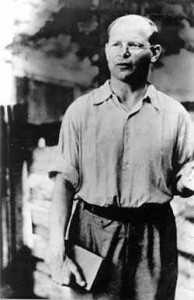
Bonhoeffer-194x300

Dietrich Bonhoeffer

Dietrich Bonhoeffer a young Pastor and theologian would also step up to oppose the Nazis and offer support for the Jews. He helped draft the Bethel Confession which among other things rejected “every attempt to establish a visible theocracy on earth by the church as a infraction in the order of secular authority. This makes the gospel into a law. The church cannot protect or sustain life on earth. This remains the office of secular authority.” He also helped draft the Barmen declaration which opposed and condemned Nazi Christianity. Bonhoeffer would eventually along with members of his family take an active role in the anti-Nazi resistance as a double agent for Admiral Canaris’ Abwehr. For this he would be executed after his final sermon in the concentration camp at Flossenburg just a month prior to the end of the war. Bonhoeffer wrote “If you board the wrong train, it is no use running along the corridor in the other direction.”

Another opponent of the Nazis in the Confessing Church was Swiss-German theologian Karl Barth. Barth went into exile as a Swiss citizen but remained active in the criticism of the Nazi regime.

P8-Bernard

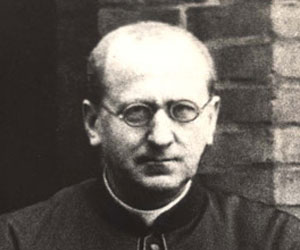
Bernard Lichtenberg

Catholic Bishop Galen of Münster and others including Father Rupert Meyer in Munich who opposed Hitler in the early 1920s would also oppose the Nazi policies toward the Church and the Jews. Some like Meyer would end up in concentrations camps with some like Canon Bernard Lichtenberg of Berlin dying at the hands of the Nazis.

mayer

Rupert Meyer

All these men took risks to defend the Jews who were religious minority group that had been traditionally discriminated against in Germany. They opposed the Nazi policies which were widely supported by much of the German populace making them unpopular in their own churches as among the traditionally conservative supporters of the Evangelical and Catholic Churches. The Jews were not simply discriminated against as a racial or religious group but also identified with the political left, especially the Social Democrats, Independent Socialists, Communists and the Spartacists.

Since the Independent Socialists, Communists and Spartacists were all involved in attempts to create a Soviet state during the early tumultuous years of Weimar and been involved in many acts of violence against traditional German institutions and the state, they were viewed by Hitler and others as part of the Bolshevik-Jewish threat to Germany. A sentiment harbored by many non-Nazi conservatives and Christians.

Karl Liebnicht and Rosa Luxembourg were among the high profile leaders of this movement in Germany and both were Jewish. The fact that many in the leadership of the Bolshevik movement in theSoviet Union were Jewish added fuel to the fire that the Nazis stoked in Germany. Hitler and the Nazis played on the historic, but muted prejudice against German Jews who in many cases were more secular and German than religious and had assimilated well in Germany. Hitler’s rhetoric as well as that of other Nazis and Nazi publications helped identify the Jews as part of the “Stab in the back” myth that was commonly used by the German right to explain the defeat in the First World War. Thus they were painted as a political and social threat to Germany.

sachs-pris

Nazi Political and Religious Opponents in Concentration Camps

When Hitler took power persecution of the Jews began in earnest. Jews were along with Communists, Trade Unions and Socialists enemies of the state. They were banned from the military, civil service and other government employment, professional associations and forced to wear a gold Star of David on their clothing. Their property was seized, many were abused by SA men acting as deputized auxiliary police and many times their businesses, Synagogues and homes were vandalized, burned or seized by the state. Many would be forced to flee in order not to be sent to ghettos and concentration camps. Even those leaving only escaped with the minimum of their possessions as the Nazi regime extorted anything of value from them as they left Germany. This was all done because Hitler and those like him portrayed the Jews as not only an inferior race, but enemies of the state and the German people.

Hitler portrayed himself and his movement as defenders of Christianity. He was not the first or last to do so but his speech of February 1st 1933, the day after he was appointed Chancellor by President Hindenburg made it abundantly clear that he was bent on securing the support of Christians to solidify his grip on power: “The National Government will regard it as its first and foremost duty to revive in the nation the spirit of unity and co-operation. It will preserve and defend those basic principles on which our nation has been built. It regards Christianity as the foundation of our national morality, and the family as the basis of national life. . . .”

23nazibrownshirtschurch

The Sturmabteilung (SA) at Church

Churches became sponsors of Nazi meetings, the Swastika banner hung in the sanctuaries of churches throughout the Reich and Bishops, Priests and Pastors joined Nazi organizations and gave the Nazi salute. They had sold their soul to Hitler and the Nazis out of fear of the Communists, Socialists, Jews and Slavs.

Eric Hoffer noted that “It is when power is wedded to chronic fear that it becomes formidable.” Hitler and his enablers spread fear and took advantage of it to bring those fearful of the left to his support.

20hitlercatholicchurch

Hitler leaving a Church

Today we face a similar phenomena in conservative circles in the United States. This time it is not the Jews but Moslems, Gays, immigrants and racial minorities who are the targets of the xenophobic rage by many influential members of the “conservative” media including Rush Limbaugh, Sean Hannity and numerous others. Their popularity in voicing support for “Christian morale values” such as being against abortion has ingratiated them with conservative Christians. It is so bad that that many “conservative” Christians cannot differentiate between their vitriolic and un-Christian rage against Moslems, Gays and Lesbians, trade unionists, Democrats or anyone else portrayed by the big media talkers and the Gospel.

It is if they have become an appendage to Republican or “conservative” politicians rather than a Christian church. It is not uncommon to see Christians on the web or on the call in talk radio programs identify lock stock and barrel with Limbaugh and others identifying the crass materialism and social Darwinism of “pure” Capitalism and the anti-Christian policy of pre-emptive war. That may seem harsh, but many of these people in the “Conservative Bible project” seek to re-translate the Bible into their own political, social and economic policies even seeking to change or minimize any Scripture that might be equated with the “Social Gospel.” Unfortunately many Christians and others have jumped in on the anti-Moslem and anti-immigrant crusades and anti-Gay launched by those on the far right.

There are those on the far right that advocate eliminating all Moslems from the military, government, security intelligence and police forces and even universities. Similar threats are made against non-European immigrants, legal and illegal alike especially those from Mexico or Latin America. I have a friend; a Navy Officer who served a year in Iraq that was confronted by a member of the “Minutemen” in Texas to show his Green Card and threatened simply because he is Mexican. Others especially conservative Christians suggest criminalizing homosexuality, jailing homosexuals or putting them in concentration camps, deporting them or even punishing gays with the death penalty.

This is so similar to the Nuremberg Laws and the Aryan Paragraph issued by the Nazis that it is scary. Likewise the threats to American Moslems or Gays of placing them “behind razor wire” as we did to American Japanese citizens in World War II are chilling. I wonder how Christians would react if an atheist or someone on the political left suggested all conservative Christians or members of pro-Life groups be imprisoned for the actions of Christians or pro-Life movement members like Scott Roeder or Eric Rudolph who killed to stop abortion or Fred Phelps and his Westboro Baptist Church?

This new found militancy has swept up the “Christian right” and others since 9-11 and has reached proportions that I could never have imagined. After my tour in Iraq I realized that much of what these people were saying was not Christian at all and when taken to their logical conclusion would be a police state in which anyone who opposed them would be persecuted. I question the motivations of the leaders of the movement but believe that most of the Christian conservatives have been caught up in the anger and the emotion of the times versus being true believers in what these men say. That being said, you don’t have to be a true believer to be a willing accomplice in actions that first are not Christian and second trample on the Constitutional rights of American citizens.

I could keep citing examples but if someone can show me where this is condoned in the Gospels I would like to know. The fact is that Christians are to place God first and defend the rights of others, even non-believers. This is found not only in Scripture but runs through the Christian tradition across the denominational spectrum.

The persecution of American Moslems, minorities, Gays and others is dangerous, not just for those minorities but ultimately for Christians who endorse and advocate against those groups. American and English law is based on legal precedence. Once something has been determined to be legal, or constitutional it is considered by the law to be settled law. This is a point made by Chief Justice Roberts regarding Roe v. Wade at his confirmation hearings. If Christians want to use the law against Moslems or for that matter any other minority be it religious or political they tread on very dangerous ground. Not only do they make a mockery of the Gospel command to love our neighbors, care for the foreigners among us and to be a witness to non-Christians support policies or laws that if enacted could and very well would be used against them by their opponents.

During the Republican Presidential primaries major leaders of the Evangelical movement and churches did all that they could to paint Mitt Romney as a religious cultist because he is Mormon. When Romney secured the nomination those same people started backtracking and committing their support to him because they believe that President Obama is an enemy of the country. They don’t like Romney, they are just against Obama. Romney will remember what they called him and their tepid support. If he becomes President he will not be beholden to them and will govern as he desires. Laws and Executive orders that give expanded power to the Executive Branch will not be overturned and if Evangelicals decide that they don’t like what he is doing and act toward him as they have President Obama they could find themselves on the outside and abandoned by the man that they supported.

Law is all about precedent and if such laws were enacted and upheld by the courts they would be settled law that could be used against anyone. What these dear brothers and sisters fail to realize is that such laws can be turned against them if the state should ever decided based on the statements of actions of some that the Christian community is a threat to state security of the public welfare. With the actions of some radical Christians who have committed murder and violence against political, social and religious opponents it would not be hard for the government to label whole churches as enemies of the state. The law is a two edged sword and those who want to use it to have the state enforce their religious, social, ideological or political beliefs on others need to remember what comes around goes around.

The Confessing church understood this and many were imprisoned, exiled or killed for this belief. The founding fathers of this country understood this too, that is why there is the Constitutional protection of Religion in the First Amendment. This was put in because Virginia Baptists who had been persecuted by Anglicans lobbied James Madison for the amendment in the Bill of Rights threatening to withdraw their support for his candidacy if he did not. Niemöller would discover the depths of his earlier folly in prison telling one interviewer after the war:

“I find myself wondering about that too. I wonder about it as much as I regret it. Still, it is true that Hitler betrayed me. I had an audience with him, as a representative of the Protestant Church, shortly before he became Chancellor, in 1932. Hitler promised me on his word of honor, to protect the Church, and not to issue any anti-Church laws. He also agreed not to allow pogroms against the Jews, assuring me as follows: ‘There will be restrictions against the Jews, but there will be no ghettos, no pogroms, in Germany. I really believed given the widespread anti-Semitism in Germany, at that time—that Jews should avoid aspiring to Government positions or seats in the Reichstag. There were many Jews, especially among the Zionists, who took a similar stand. Hitler’s assurance satisfied me at the time. On the other hand, I hated the growing atheistic movement, which was fostered and promoted by the Social Democrats and the Communists. Their hostility toward the Church made me pin my hopes on Hitler for a while. I am paying for that mistake now; and not me alone, but thousands of other persons like me.”

It is easy for well meaning people Niemöller to be bought with promises of support by politicians and media types who speak the words they want to hear in difficult times. So today I suggest the formation of an ecumenical Pastor’s Emergency League which will not be bought by the empty and godless promises of hate mongers on the right or the left. Such a group of men and women spanning the breadth of the Christian tradition and others that see the danger of extremism of all types is becoming necessary. Such a step is becoming necessary due to the militancy of the Christian right as well as the militancy of atheist groups who lobby against all public religious expression by any religion. Such a League would respect the various creeds and statements of faith of each member’s denomination. The movement of the right has set a dangerous course fraught with perils that they do not comprehend.

We have entered a dangerous phase of American history. These movements have the potential not only to oppress law-abiding and patriotic Americans of all faiths and to crush the religious freedoms of all in this county. Suggesting that American citizens, including those who serve the county in the military or government of entire religious, ethnic, political, religious affiliation or sexual preference be jailed, banned from office or fired is totalitarian and dare I say Nazi like.

Niemöller would say it well in this poem:

First they came for the communists, and I did not speak out—because I was not a communist;
Then they came for the socialists, and I did not speak out—because I was not a socialist;
Then they came for the trade unionists, and I did not speak out—because I was not a trade unionist;
Then they came for the Jews, and I did not speak out—because I was not a Jew;
Then they came for me—and there was no one left to speak out for me.

1 Comment

Filed under civil rights, ethics, faith, History, nazi germany, News and current events, Political Commentary

Reflections on Indoctrination & Personal Responsibility

IMG_1931

Friends of Padre Steve’s World

I have written a lot about the dehumanization of people and genocide, and some of the things that create a climate where such events take place, and how political and religious leaders stir the primal passions of otherwise good, decent and law abiding citizens. I wrote yesterday how I am afraid of what is going on in our country, especially in regard to the violence being sanctioned and even promoted by Republican Presidential candidate and real estate mogul Donald Trump.

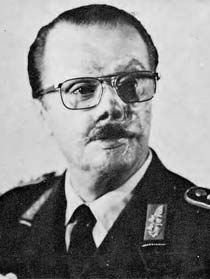
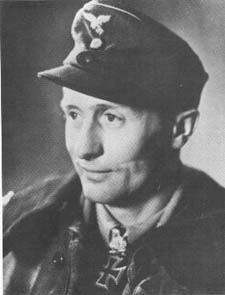
Sunday night I finished reading a book by World War II German Luftwaffe ace Johanes Steinhoff. Steinhoff was unlike many of the German officers who wrote memoirs following the war, memoirs that historian Williamson Murray wrote “fell generally into two categories; generals writing in the genre of “if the fuhrer had only listened to me!” and fighter pilots or tank busters writing about their heroics against the productive flood from America or the primitively masses of the Soviet Union.”

steinhoff6

General Johannes Steinhof (above) as a Bundeswehr and NATO officer, showing his burns and before his crash (below)

steinhoff WW II

In his books, Steinhoff does something that you do not see authors do in most military or political memoirs, he actually does serious self reflection on his role in supporting an evil regime. In his introduction to his book The Final Hours the legendary fighter ace who was horribly disfigured when his Me-262 jet fighter crashed and burned two weeks prior to the end of the war wrote:

“In recalling these events, which had been long buried in my memory, it has not been my intention to make excuses. Our unconditional self-sacrifice in the service of the Third Reich is too well documented for that….

So it is because of what is happening today—with freedom threatened in virtually every respect by its own abuse—that I offer this contribution, in the form of an episode in which I was myself involved, to the history of the soldier in the twentieth century. Soldiers have always, in every century of their existence, been victims of the ruthless misuse of power; indeed, given the opportunity, they have joined in the power game themselves. But it fell to our own century to accomplish, with the aid of a whole technology of mass extermination, the most atrocious massacres in the history of mankind. This fact alone makes pacifism a philosophy worthy of respect, and I have a great deal of sympathy with those who profess it. 

The figure of the soldier in all his manifestations is thus symptomatic of the century now nearing its close, and it is to the history of that figure that I wish to contribute by describing what happened to me. I have tried to show what it is possible to do to men, how insidiously they can be manipulated by education, how they can be hoisted onto a pedestal as “heroes,” how they can be so corrupted as even to enjoy the experience—and how they can be dropped and denounced as mutineers when they discover that they have scruples. The complete lack of scruples that such treatment implies is peculiar to rulers who believe that the problems of their own and other peoples can be solved by imposing, through the use of military force, peace on their, the rulers’, terms—in our case a pax germanica, but the second Latin word is readily interchangeable.” from “The Final Hours: The Luftwaffe Plot Against Goring (Aviation Classics)” by Johannes Steinhoff

Since I am a historian and and a career military officer with service in the Iraq War, a war that was illegal and unjust by all measure I can understand Steinhof’s words. Because much of my undergraduate and graduate work focused on German history, particularly that of Imperial Germany after the unification, the Weimar Republic, and the Nazi Reich, I draw a lot of lessons from the period. I also understand how people in this country can fall for the same kind of vitriolic propaganda that the Germans of that era did. I can understand because for years I fell for the lies and propaganda being put out by the politicians, pundits and preachers of the American political right.

10665323_10154041610267059_5277331492232210946_n

A picture of me (on left) in Iraq 2007 with my assistant and bodyguard RP1 Nelson Lebron

One of those lessons is that in times of crisis, that people, no matter what their race, culture, religious belief system, educational, or economic background are still human. Humanity is the one constant in all of history, our prejudices are often ingrained in us during childhood and reinforced by the words of politicians, pundits, and preachers. In times of stress, crisis, and societal change or upheaval even good people, moral people, people of great intellectual, scientific abilities can fall prey to demagogues who preach hate and blame others, usually racial, ethnic, or religious minorities, as well as civil libertarians who champion the rights of those minorities for the problems of the nation.

Shrewd politicians, preachers, and pundits do this well. They demonize the target group or population and then let the hatred of their disaffected followers flow. The leaders need that disaffected and angry base in order to rise to power; such was how Hitler, Stalin, and so many other despots gained power. They took advantage of a climate of fear, and found others to blame. For Hitler it was the Jews, Slavs, Socialists and Communists; while for Stalin it was various groups like the Ukrainians, or the Poles who were the devil to be feared and destroyed. Timothy Snyder in his book Bloodlands: Europe Between Hitler and Stalin wrote:

“Dead human beings provided retrospective arguments for the rectitude of policy. Hitler and Stalin thus shared a certain politics of tyranny: they brought about catastrophes, blamed the enemy of their choice, and then used the death of millions to make the case that their policies were necessary or desirable. Each of them had a transformative utopia, a group to be blamed when its realization proved impossible, and then a policy of mass murder that could be proclaimed as a kind of ersatz victory.”

But that being said, there are a lot of people who from childhood believe the lies about others without question. In good times such people continue on with life as normal, but in crisis those hatreds and prejudices come to the fore. Rudolf Höss, the notorious sociopath who commanded Auschwitz told American Army psychologist Gustave Gilbert about his reaction when ordered to turn the camp into an extermination center. He said that the order “fitted in with all that had been preached to me for years,” and “at the same time I didn’t think of it as propaganda, but as something one just had to believe.” 

Eugene Davidson in his book on the Nuremberg Trials wrote:

“Every society has in it at all times negative, criminal, sadistic, asocial forces. What holds them in check more than law and police is the consensus of the society – a general belief that despite everything wrong and stupid and muddleheaded in politics, the state is a going concern that will somehow make its way into the future.” (Davidson, The Trial of the Germans p.581)

But when things do not go well, when people do not feel that things will be okay, that the future will be better, and that they have a purpose they look for answers. However, they tend to find their answers in the rantings of demagogues, race baiters, conspiracy theorists, and others who they would tend to dismiss out of hand in good times. In Germany it was the loss of the First World War, the humiliation of Versailles and the economic chaos and social change of the Weimar period which allowed Hitler to gain an audience, then a following, then political power. The demagogues played to what was already in the hearts and minds of the disaffected masses, without that fertile soil, the rantings of Hitler and his propagandists would have never succeeded. Albert Speer wrote:

“As I see it today, Hitler and Goebbels were in fact molded by the mob itself, guided by its yearnings and its daydreams. Of course, Goebbels and Hitler knew how to penetrate through to the instincts of their audiences; but in the deeper sense they derived their whole existence from these audiences. Certainly the masses roared to the beat set by Hitler’s and Goebbels’ baton; yet they were not the true conductors. The mob determined the theme. To compensate for misery, insecurity, unemployment, and hopelessness, this anonymous assemblage wallowed for hours at a time in obsessions, savagery and license. The personal unhappiness caused by the breakdown of the economy was replaced by a frenzy that demanded victims. By lashing out at their opponents and vilifying the Jews, they gave expression and direction to fierce primal passions.”

In a sense a similar thing has happened in the United States which has experienced a series of wars beginning with Vietnam, the shock of the 9-11-2001 attacks, the economic crash of 2007 and 2008 which devastated the savings, home ownership, and investments of many Americans while at the same time benefiting the banking and brokerage houses whose government assisted policies brought about the crash. Of course there are other issues, many religious conservatives hate the progress made by the Women’s and Gay Rights movements, and their leaders play to their fears in apocalyptic terms. I could go on, but I am sure that my readers can identify other issues which demagogues and others use to spread fear and hate to further their goals. The fact is that without the the fertile soil that lays in the hearts of their most fervent followers they would never have a following.

In Weimar Germany hate mongers like Julius Streicher and propagandist Josef Goebbels stuck a chord with disenchanted people who felt that they had lost their country. They were fearful, angry, and desired a leader who would “make Germany great again.” Hitler and his Nazi media sycophants played to that fear, and took advantage of their anger at the existing order. Davidson wrote such people “exist everywhere and in a sick society they can flourish.” 

For decades the way has been prepared for true extremists to take advantage of the fears and doubts of people as modern American versions of Streicher and Goebbels have been at work for years. Rush Limbaugh was a modern pioneer of this in the United States, and he has been joined by so many who are even more extreme in their rantings that it is hard to name them all. Likewise, whole media corporations, websites, and political networks spread such fear every minute of the day, claiming that they, and they alone are real Americans. They actively support politicians who condemn, and sometimes even threaten people who oppose them, and all the while claim that “make America great again.”

When I was younger I devoured that propaganda, despite all of my learning I followed the rantings of men who I realize today are propagandists who promote the basest of lies, and hatred, often in the name of God. I was changed when I was at war, and when I returned home from Iraq in 2008 I realized through hard experience that I had been lied to, and that as a result that thousands of my brothers and sisters were dead, and tens of thousands shattered in body, mind, and spirit. Likewise I saw the massive destruction levied on Iraq and realized how terrible war really is. That was my epiphany, that is what it took to see how much I had been lied to, and it called me to question everything else that I had so willingly believed, things which had been fed to me by years of indoctrination in church, through the media, and by politicians who I believed were truly Christian. I can understand now how Martin Niemoller felt after the Nazi seizure of power when he said, “I hated the growing atheistic movement, which was fostered and promoted by the Social Democrats and the Communists. Their hostility toward the Church made me pin my hopes on Hitler for a while. I am paying for that mistake now; and not me alone, but thousands of other persons like me.”

There was a time that I hated people who espouse the views that I hold today, the views that I write about so often here on this site. I can remember how angry I would get as I listened to the propaganda being put out by Limbaugh, Hannity, the Fox News Channel and all of the others that I listened to every time that I had the chance. But when I changed after Iraq, I felt the sting of that hatred in very real ways. I remember the day I was called by my bishop in my former church, who told me that I had to leave because my views on women, gays, and Moslems were to use his words were now “too liberal.” After that, many men who I considered to be the best of friends turned their backs on me, some in the most bitter and vindictive of ways.

But I realize now that what they did was because I had in a sense left the cult, and had to be ostracized. I can understand that now, because when I was under the spell I too turned my back on people who had fallen out of favor, or people who had rejected the tenants of the church or the political movement, and those are things that I can never undo. But at the time it made sense, it fitted in with all I had been taught for decades, as Albert Speer wrote of Hitler, “One seldom recognizes the devil when he is putting his hand on your shoulder.”

What happened to Steinhoff’s generation is threatening to happen again, in our country, an authoritarian movement is threatening to destroy our democracy and republic. In it soldiers are esteemed, until they realize what is going on and speak out, but by then it is usually too late. I am understanding that fact more and more every day, and having had people troll this blog and call me a traitor and worse, I understand just a bit of what happened to Steinhoff and his fellow officers when they protested to the highest levels what was happening to Germany in early 1945.

Tomorrow we will know more about our nation’s slide into the abyss if authoritarianism as Donald Trump continues his unrelenting march to the GOP nomination. 

Peace

Padre Steve+

3 Comments

Filed under ethics, History, holocaust, Military, News and current events, Political Commentary

A Frenzy that Demands Victims 

  
Friends of Padre Steve’s World

I am afraid. Over the past few weeks violence has become commonplace at the campaign rallies of Donald Trump. In the past week a reporter from the Breitbart News service, an organization that is solidly behind Trump was assaulted by Trump’s campaign manager, and Breitbart threw her under the bus for him. Protesters have been assaulted, reporters threatened, Trump not only condones the actions, he encourages them, threatening to use the law and courts to ruin people’s lives, and offering to pay the legal bills of his supporters who have been charged with crimes. He labels any opponents as “bad people” who need to be punished. The ultimate cruelty is that though he is the one inciting the violence, he and his supporters blame that violence on the victims, be they Democrats or Republicans, protestors or media, pundits, politicians or preachers. He is creating a frenzy among his most violent supporters that demands victims to satiate their new found bloodlust. 

This is a phenomena practically unheard of in American politics. It is not the behavior of someone concerned with the democratic process or representative government, but of someone using that process to promote crass and brutal authoritarianism, and a large number of followers willing to embrace a strong, authoritarian leader.  It is most often seen in movements that become dictatorships, such as happened in Germany, Italy, the Soviet Union, Red China, and other dictatorships. 

As a historian who has devoted much study to the social, political, economic conditions in Weimar Germany that helped fuel the rise of left and right wing extremists that led to the legal takeover of the Republic by Hitler and the Nazi Party, I am concerned with what is going on. 

When Albert Speer discussed the ability of Adolf Hitler to captivate the German people he noted something important. He discussed how Hitler and his minions played to them set by the disgruntled and angry German population. Speer wrote, “The mob determined the theme. To compensate for misery, insecurity, unemployment, and hopelessness, this anonymous assemblage wallowed for hours at a time in obsessions, savagery and license. The personal unhappiness caused by the breakdown of the economy was replaced by a frenzy that demanded victims. By lashing out at their opponents and vilifying the Jews, they gave expression and direction to fierce primal passions.”

Hitler played to that misery, insecurity and the obsessions of the politically and economically disaffected “conservative base” that no longer trusted the party establishments of the old-line conservative parties. He also played to the deep-rooted racism and anti-Semitism of those people. Hitler was an outsider, he was not indebted to any traditional party hierarchy and as such was able to throw away convention and play to the fear and anger of many Germans.

Donald Trump is doing today and he is running circles around the traditional politicians of the Republican Party. Every time Trump says something that would have gotten himself blown out of the race twenty years ago, but today his poll numbers keep going up. Trump spends no time on policy, all questions go back to how he will solve people’s problems and those of the nation. Unlike Hitler or Stalin, Trump shows no particular political ideology, except perhaps that might makes right, and that certain groups (minorities, immigrants, Muslims, liberals) are to blame for the mess created by the American political and business elites over the past fifty years. And for the most part the press is afraid of him and will not call him on it just as his Republican opponents cannot find the courage to openly stand up to him.  

He continues to poll around 35% to 50% in most polls of GOP voters and my guess is that those numbers are low, as some supporters may not be willing to tell a pollster that they are for Trump, at least yet. The party hierarchy and most of Trump’s primary rivals consistently criticize Trump, but most say that they will back him if he is the nominee, although John Kasich and Marco Rubio seem to be waffling on their support should Trump be the GOP nominee. And it appears that the GOP establishment seems to be trying to find a way to stop Trump from becoming the nominee. I doubt if they will succeed in stopping him, but if they do Trump and his supporters will have no problem leaving the Grand Old Party and ashen ruin. Even now his most strident supporters are calling Republican opponents of Trump “traitors.” 

Trump understands the mood of much of the traditionally conservative public better than his Republican establishment competitors. Trump is not stupid, unlike Hitler who actually believed in his message, Trump is not a radical, he cannot be, he has too much invested in the system. Instead, he is a street smart and pragmatic businessman who is exploiting the situation on the ground to his advantage and he is an authoritarian, something that appeals to many frustrated voters, most of whom are not racist or bad people. That being said one cannot ignore the embrace of many neo-Nazi, White Supremacist, and White Nationalist leaders and organizations who are latching onto him to expand their influence among disenchanted and frustrated voters. 

His opponents and the GOP establishment are frightened, but like the hidebound conservatives of the Weimar Republic who either dismissed or Hitler or thought that they could contain him are not willing to make a stand. As a result, Trump is able to play to the mood of the base and to coin a phrase, to “trump the establishment” by channeling the deepest anger, fear, hatred, xenophobia, and racism that the GOP establishment refuses to acknowledge. When there is a push back by the establishment it further angers the base, and Trump, quite adroitly threatens to leave the party; something which would doom the GOP in the 2016 general election, and destroy the party that created him. 

Trump’s GOP opponents have terribly underestimated him, and the anger of the conservatives that they have radicalized for decades and failed to comprehend. There are a lot of establishment Democrats who underestimate him too, as well as the discontent in their own party, something that they will eventually pay for if they are not careful. The Trump phenomena is not ideological, it is a rage against the GOP establishment that the establishment has no answer for because it is bankrupt. There are a lot of Democrats that are incredibly frustrated with thier party, and that frustration can and will turn into an anti-Democratic Party establishment rage if Democrats do not do something to fix their party’s failings. Even now some of that rage is being played out in the race between Hillary Clinton and Bernie Sanders, albeit, without the violence of the Trumped GOP race. 

Trump is using his celebrity bombast and the democratic process to take control of a major political party, and he is a lot smarter than most political analysts give him credit. As such, as a non-establishment outsider, Trump has a chance at taking over a long established political party, something that has never before happened in the United States. If he continues to chum the water by giving grist and cover to his more violent supporters, people will die, just like what happened in Weimar Germany as the Nazis battled their opponents on the streets and in beer halls. 

If he succeeds in his takeover bid, it will forever change American politics, especially if he is able to ride the fear, hatred, and fear to the White House. I don’t think the latter will happen, but I would not exclude it from the realm of the possible. To paraphrase Speer’s words about Hitler and Goebbels: By lashing out at their opponents and vilifying the Muslims and immigrants, Trump gave expression and direction to fierce primal passions of a disaffected GOP base.

Tomorrow is anothe big primary day and I am working on a follow up article to this and will also republish an article entitled Be Careful what You Vote Against that I wrote about four years ago in the next few days. 

Peace

Padre Steve+

3 Comments

Filed under History, News and current events, Political Commentary

Trumped 

  
Friends of Padre Steve’s World,

Yesterday I posted an article about how over the weekend that Ted Cruz seems to have blunted Donald Trump’s relentless drive to the Republican nomination. I mentioned in that article that I believed that Cruz’s highly trumpeted victories on Saturday were not as big as many in the media gave them credit for being. Tonight’s results in Mississippi and Michigan bore me out. 

Trump went on to crushing victories in both states as well as Hawaii. Ted Cruz won in Idaho due to the heavy percentage of Evangelical Christians and Mormons who make up the bulk of the GOP in that state. Cruz’s Idaho victory was a win for the Glenn Beck wing of the GOP and Cruz was certainly helped in Idaho by the efforts of pastors and pundits of the Christian Right. Unfortunately for Cruz there are few states left where he sports that kind of advantage and Trump still got a lot of votes in Idaho. 

Though he finished third in three of four states John Kasich ran strong for a candidate with little money or organization.  Late last night I heard his name being floated as a potential running mate for Trump. While that might mollify some in the GOP establishment it will not play well with Cruz and other supporters in the Christian Right who see him as weak on Gay Rights and Obama Care. 

The biggest loser on the Reuplican side appears to be Marco Rubio, who continues to perform poorly. He is a shallow empty suit incapable of running a winning campaign in his own party, much less the country. 

I’ll do some more detail analysis of this and the Democratic Party races in Mississippi where Hillary Clinton crushed Sanders, and Michigan where Sanders stunned Clinton who had a double digit lead in the polls the day before the primary. I don’t know if I’ll write that before or after next Tuesday, but bottom line, Hillary is in trouble if she cannot will big states in the north like Michigan. 

So until tomorrow.

Peace,

Padre Steve+

Leave a comment

Filed under News and current events, Political Commentary

The Kitchen Sink


Friends of Padre Steve’s World

Ted Cruz appears to have blunted, for the moment Donald Trump’s drive for the Republican presidential nomination. I don’t think it will be much in the long term, but it shows how desperate the GOP is to find a way to keep the real estate mogul from getting enough delegates from securing the nomination outright. we will see more of that play out tonight and a week from now in some very big, delegate rich states.

The GOP is cleaving itself into two parties. One is that of the leaders who for the last thirty plus years has promised stoked the anger of various parts of the party base but election after election done little than to humor the people that it relies upon to retain power. Large parts of the GOP base have been left out of the economic recovery, which has primarily benefits corporations, and feel like they have been abandoned by the party. The party has gone out of its way to channel this anger at minorities, immigrants, women, gays, and Muslims and away from themselves. For years the strategy worked, but like all strategies that simply deflect anger towards others rather than solve the underlying problems their followers have to deal with is collapsing on itself.

Trumps supporters are not a monolithic group, while the majority are white and at least nominally Christian there are others. While some blatantly White Supremacist leaders and groups are supporting Trump, there are many, people who are frustrated and angry about other issues. A lot are older people, retirees who feel that they have lost “their country” while others are people who lost businesses or high paying jobs in the last economic downturn, or have seen their jobs sent overseas. I know a number of former small business owners who had well established and profitable businesses lose them and see major corporations get tax breaks and government bailouts while they were left behind.

The GOP establishment assumed that 2016 would be more of the same. However, they did not could on Donald Trump and his ability to capitalize on the rage that they have stoked for decades. Some compare Trump to the GOP’s version of Frankenstein, and to some extent that is a good analogy. In some ways it is like how German conservatives in the 1920s paved the way to Hitler by demonizing their opponents and paralyzing the government. Like the current GOP power elites they fed the anger and frustration of people who finally rejected them and turned to an outsider. Like the GOP did Trump they thought that they could control Hitler. Mind you I am not comparing Trump to Hitler, despite the similarities in style, stated policy as well as the behavior of people toward non-Trump attendees at his rallies which a so similar to Hitler’s Brwonshirt things that it makes my head swim; but I am directly addressing the dynamics at play in the party.

From 1930 to January 1933 German conservative elites hoped to channel support away from Hitler by supporting the elderly conservative Field Marshal Paul Von Himdenberg for President against Hitler, and by having Hindenberg appoint a succession of “anyone but Hitler” as Chancellor. They failed and in a desperate attempt to control they appointed Hitler as Chancellor and once in power he used legal means to outmaneuver his opponents and within six months elimited all opposition political parties.

With Trump gaining more and more of the frustrated and angry vote the GOP establishment is attempting to find a way to stop Trump, even to the point of rallying around Ted Cruz, a man that they loath. But the Trump supporters are not going to tolerate it, and neither will Trump. In fact if you look at the comments of Trump supporters they despise the party establishment and the media, including some of Fox News who have come out against Trump. They feel that the attack on Trump are unfair and unwarranted, and the crocodile tears of the GOP leadership aside, Trump is only saying what many of them have railed about for years, just in much cruder terms.


In next few weeks the GOP establishment will do everything in their power to try to subvert, derail, and undermine the Trump campaign. Former GOP standard bearer Mitt Romney launched a furious assault on Trump only to be jumped on by Trump and his supporters. The more the GOP leadership does this, the more that Trump and his supporters will fight back. By some chance if they screed in keeping Trump from getting and outright majority of delegates at best it will be a Pyrrhic victory and only the charred remains of the Grand Old Party will remain.

We are watching a political party self-destruct and when it completes its self-immolation it will signal the end of an era. We are in an era of seismic political change, and what is happening to the Republicans cannot be dismissed as something that cannot happen to the Democrats as well.

None of us can know what will follow this and Democrats, especially the  Democratic Party leadership and elites should learn from what is happening to the Republicans. Right now there are many frustrated and angry Democrats and progressives who are as tired of their elites and power brokers as are angry Republicans and they are turning out in large numbers to support an outsider, Bernie Sanders. Democrats need to make sure that they do not dismiss his supporters and assume that they will voter for Hillary Clinton in November.

All that being said, the GOP fight is on and the opposing sides will throw in everything that they can to win, even the kitchen sink.

Peace

Padre Steve+
Leave a comment

Filed under History, News and current events, Political Commentary

When Political Parties Implode, Pt 3: The 1860 General Election

Friends of Padre Steve’s World

Over the past six months or so I have alluded to events in the Republican Party that make it appear that it is about to implode. I am a historian, and there is precedent in American history for the collapse of a national political party. This happened before in the 1854 collapse of the Whig Party, the 1912 division in the republican Party, but more importantly during the 1858 through 1860 collapse of the Democratic Party. Now I am not a person to say that history repeats itself. there are similarities and trends, but nothing is ever exactly the same as to why different parties collapse.  

While the issues of each day may be different there are common threads of humanity, hubris and hatred that unite to destroy political parties. I think that this is happening now in the Republican Party, and that it is possible that something similar may occur with the Democratic Party in the coming years. So it is important to look at history whenever possible to see how different political leaders responded in times of intense ideological, economic, social, national, and sectional division.

This is a three part series on the disaster that the Democratic Party made for itself and the country between 1858 and 1860. The third part deals with the after effects of results of the democratic Party split in the election of 1860.

This is a section of one of the chapters of my Civil War and Gettysburg text and I hope that you will find it interesting and thought provoking.

Peace,

Padre Steve+

tearing1-500x353

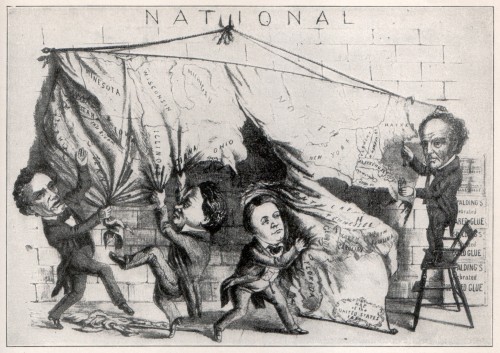
The crisis continued to fester and when Lincoln was elected to the Presidency in November 1860, with no southern states voting Republican, the long festering volcano erupted. The various crises of the 1850s had brought the political emotions nation to a fever pitch and 1860 election season saw a dramatic rise in the overtly racial invective of the pro-slavery Democrats, including many in the North. It was also the election that “marked the crystallization of two fully sectionalized parties,” [1] neither of which could find a place of compromise in order to save the Union. A Mississippian observed that “the minds of the people are aroused to a pitch of excitement probably unparalleled in the history of our country.” [2] In the South

Like the present time where the rise of the internet, social media and other platforms allows people, including radical ideologues of various stripes an unparalleled opportunity to spew hate, the changing nature of technology made the campaign one of the most merciless in American history. “Cheap printing and the telegraph made it easier and easier for the shrillest of ideologues to find audiences, even national ones.” [3] As such the campaign prefigured those of the present time. The newspapers and the ideologues may not have changed many the minds of many voters, most of whom were by now hardened in their position, but “they likely helped spur a gigantic voter turnout – some 80 percent of eligible white males nationwide – which was deemed crucial to Republican success in swing states like Indiana and Pennsylvania.” [4]

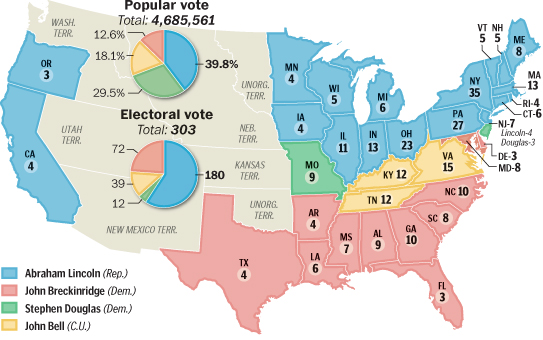
Lincoln had run a masterful campaign, rising from a comparatively unknown to a national figure due to his debates with Stephen Douglas during the 1858 Illinois Senate campaign. The Republican Party that he represented was a “coalition of old Democrats, former Whigs, and members of the nativist American Party.” [5] Lincoln defeated the odds on favorite to win the Republican nomination, Senator William Seward, as well as Senator Salmon Chase and Missouri’s elder statesman Edward Bates. Lincoln took the nomination on the third ballot and then went on to defeat a fractured opposition which was composed of three different tickets, those of the Northern Democrat Stephen Douglas, the Southern Democrat John C. Breckenridge, and the third, a fusion Constitutional Union Party ticket of John C. Bell and Edward Everett.

The split in the Democrat ticket won the election for Lincoln and was in part the idea of fire-eaters in the South, especially those in South Carolina who could not abide the candidacy of Douglas. These Southern Democrats envisioned “the destruction of the national Democratic Party – and its powerful contingent of moderates in the state – as a visible vehicle for protecting slavery in the Union.” [6]  These men hated Douglas, a man that they once cheered, for his opposition to the Lecompton Constitution and the admission of Kansas as a Slave state. When the Democratic national convention met to nominate a presidential candidate the delegates especially the leaders of the Gulf state delegations “redoubled their sworn efforts to keep the nomination away from Douglas.” Douglas and his team of advisors attempted to work out a deal to secure the nomination with them, but they met with a stubborn refusal to cede the nomination to Douglas. The result was “an open party rupture” [7] which destroyed any chance of defeating Lincoln and the Republicans. The ever pragmatic Unionist Alexander Stephens “who stood with Douglas to the last, despaired, not only for his party but for his country: “There is a tendency everywhere, not only in the North, but the South, to strife, dissention, disorder, and anarchy.” [8]

Opponents of Lincoln turned the election to a referendum on race. The New York Herald, which was a strongly Democrat paper and had the largest circulation of any paper in the nation was typical of papers that used race to attack the Republicans. The Herald served up “a patented blend of sarcasm and sensationalism. The Herald’s editorial page cracked wise almost every day about “the Eternal nigger,” the “Almighty nigger,” the “Irrepressible nigger” and the “nigger-loving black republicans.” [9] In both the North and South opponents of Lincoln and the Republicans conjured up the fear of a future black president in order to further stoke the flames of racial hatred and division.

During the campaign Lincoln was careful to not to go beyond the printed words of his published speeches and he refused to issue any statements to mollify the conspiracy theory hysteria that was enveloping the South. “What is it I should say to quiet alarm?” he asked in October. “Is it that no interference by the government, with slaves or slavery within the states, is intended? I have said this so often already, that a repetition of it is but mockery, bearing an appearance of weakness.” [10] To be frank, Lincoln and other Republicans misread the true feelings of the South and “considered the movement South as sort of a political game of bluff, gotten up by politicians, and meant solely to frighten the North. He believed that when the leaders saw their efforts in that direction unavailing, the tumult would subside.” [11] William Seward equated the Southern threats to cries of “wolf” which had little meaning and told a gathering in New York, “For ten, aye twenty years, these threats have been renewed in the same language and in the same form, about the first day of November every four years. I do not doubt that these Southern statesmen and politicians think that they are going to dissolve the Union, but I think that they are going to do no such thing.” [12] The editor of a Tennessee paper admitted “the cry of disunion had been raised so often that few had taken it seriously in the campaign. Evidently, the ‘Northern sectionalists’ had believed it to be ‘all talk’… while most intelligent Southerners had assumed that it was ‘an idle menace, made to sway Northern sentiment.’” [13]

The Republican Party itself was a coalition of individuals who often held opposing views, and Lincoln understood that the election, as nearly every election tends to be, was not going to be about one issue alone and even the Republican doctrine of Free Soil was seen by them more as “an economic policy than an anti-slave policy.” [14] As important as abolition was to the founding of the Republican Party, other interests had to be taken into account. These included protective tariffs, infrastructure and railroads, and homestead legislation. Thus he could not go too far in any direction that might deviate from the party platform without risking a fracture in his own party He noted: “It would be both impudent, and contrary to the reasonable expectation of friends for me to write, or speak anything upon doctrinal points right now. Besides this my published speeches contain nearly all I could willingly say.” [15]

The Presidential campaign of 1860 was unique since it had four different tickets vying for the office and it unfolded into “three distinct campaigns: Douglas against Lincoln in the North; Breckinridge versus Bell in the South; and Douglas contesting Bell in the border states, with Lincoln and Breckinridge hoping for some support there as well.” [16] As purely sectional candidates Breckinridge had no hope of winning in the North and Lincoln no chance of winning in the South.

In the South politicians, preachers and newspaper editors sounded the alarm at the possibility of a Lincoln presidency which bordered on outright paranoid hysteria. Conspiracy theories and outright falsehoods about Negro atrocities were flouted as truth in the South, whipping up passions and stoking rampant fear, “R.S. Holt, a wealthy Mississippi planter and brother of the U.S. postmaster general, reported that “we have constantly a foretaste of what Northern-brotherhood means, in almost daily conflagrations & in discovery of poison, knives & pistols distributed among our slaves by the emissaries sent out for that purpose…. There cannot be found in all the planting States a territory ten miles square in which the footprints of these miscreants have not been discovered.” [17]

One of the most consistent defenders of slavery and long term proponents of secession, Virginia Edmund Ruffin wrote to Yancey that “a Republican victory was obviously coming and that it would be “a clear and unmistakable indication of future & fixed domination of the Northern section & its abolition party over the Southern states & their institutions, & the speedy progress to the extermination of Negro slavery & and the consequent ruin of the South.” [18] A newspaper editorial in Georgia warned “Let the consequences be what they may – whether the Potomac is crimsoned in human gore, and Pennsylvania Avenue is paved ten fathoms deep with mangled bodies…the South will never submit to such humiliation and degradation as the inauguration of Abraham Lincoln.” [19]

Prominent Southern ministers, though more cautious than the newspapermen and politicians sounded the alarm. Evangelical “proslavery had popularized the South’s unique approach to the Bible and the founding of the nation. The bible supported slaveholding; God supported the South. The formula was clear. Right made might. The South had to triumph.” [20] A Presbyterian editor counseled prayer to deal with the crisis but added: “An agitation that perpetually sends dread and disturbance in to every hamlet, and to every home and fireside in the land is intolerable. No people can abide it long. They will prefer the hazard of any convulsion, the perils of any terrible adventure, to a life of anxiety and disquiet. The instincts of nature will drive them to seek relief by any, even the most dangerous means.” [21] A prominent Southern journal remarked “In religious sentiment the South stands as a unit. Its pure doctrines are linked insuperably, though not by legal constraint, with the laws of the land. No isms and schism rankle our hearts. Christ is acknowledged as the common bond of union.” [22] Prominent church leaders like Leonidas Polk Episcopal Bishop of Louisiana made outright demands for secession if the Lincoln won. As it had so many times in the past two decades, religious sentiment helped fuel the Southern fire.

The only hope for the Democrats was for a “fusion” of the three opposition in key northern states to deny Lincoln their electoral votes and throw the election into the House.” [23] But this was not to be as there was far too much bad blood between the Buchanan faction headed by Breckinridge and Douglas, as well as distrust of the Bell ticket due to its connections with the earlier Know Nothing Party and movement. Jefferson Davis, long a proponent of secession went to Douglas to try to sway him from dropping out of the race in favor of a fusion ticket that could unite the Southern vote. Douglas recalled the conversation “If the Democrats run two candidates,” he said, “the Black Republicans will win the election. In that event the slave states will secede…” [24] Davis tried to convince Douglas to drop out saying that Breckinridge and Bell had agreed to if he would, and Douglas, who had a long standing enmity with the Mississippian wrote:

“This was strange talk from Davis, and I was damned suspicious that it might be a trap. It was all I could do to control my hatred for the Goddamned bastard. “The plan is impractical I said coldly. “If I withdraw, my friends in the North will go over to Lincoln. I’m in the hands of my friends and they won’t accept this proposition.

“Then I’ve done all that I can,” he said, rose and walked out.

Why the Goddamned hell should I withdraw? I asked my aides. I was a matter of honor with me. I had won my nomination fairly, on the basis of the party’s time honored principles. I refused to unite with a bunch of traitors and disunionists…

Others pressed me to unite with the “vandals,” as we called the Breckinridge party, but I answered with a thundering no. “I’m utterly opposed to fusing with any man or party who’ll not enforce the laws, maintain the Constitution, and preserve th4e Union in all contingencies,” I said. I wish to God Old Hickory was still alive, so that he could hang northern and southern traitors from the same gallows.” [25]

The split in the Democratic Party was irrevocable. While all factions of the party had some measure of responsibility for the party’s implosion in 1860, it was the old Southern leaders whose actions doomed the party. Bruce Catton wrote:

“Primary responsibility for the Democratic split in 1860 – the act that ensured a Republican triumph and left the South no cohesive national institution through which it could hope to share or regain power – belongs to those respected Southern leaders whose threats of party rupture and secession as political tactics, in the vain hope that a majority in the party and nation would fall in behind them before the tactic got out of hand. Because they would not adjust to circumstances they were engulfed by them – all without understanding that they were the leading architects of their disaster.” [26]

Despite the cleavage in the Democratic Party, the election of 1860 enthralled the nation as candidates and their surrogates made the cases for each. “Americans everywhere – North and South, men and women, slave and free – took an active part in the four-way campaign of 1860. Issues, platforms, speeches, and candidates were reviewed and debated in corn fields and cotton fields, workshops and markets, family gatherings, churches, picnics, races, sewing circles, family gathering, schoolhouses, slave quarters, taverns and beer gardens.” [27]

Unlike now when all states vote the same day for President, the elections of 1860 consisted of votes over a two month period of time in the different states. When Lincoln began to win early contests in the Northern states Douglas took his campaign south where he did not mince words and defied secessionists in his stated desire to preserve the Union. He told his secretary “That does it…Lincoln is the next President. We must try to preserve the Union. I’ll go to the Deep South where the secession spirit is strongest.” [28] In the South the Little Giant was met with scorn.

election-results-1860-map

When all was said and done Douglas received twenty-nine percent of the national vote, Breckinridge eighteen percent, and Bell thirteen. “Lincoln carried seventeen free states and no slave states; Breckinridge, eleven slave states and no free states, Bell three slave states and no free states.” [29] Douglas only won the embattled state of Missouri despite having more of the national popular vote than either Bell or Breckinridge. Lincoln captured forty percent but took 180 electoral votes, far more than the minimum of 152 needed to elect. Lincoln’s gains among former Whigs who were attracted to him by economic versus anti-slavery policies allowed Lincoln to sweep the Northern states and secure the electoral majority. When Douglas heard the final results he was in Mobile Alabama. He told his friend John Forsyth, “Well, John, I am beaten, I said hoarsely. “Lincoln will win by a big margin in the Electoral College. Even if Breckinridge, Bell, and I had withdrawn and united behind a single Democratic candidate, Lincoln would still have won a majority of electoral votes.” [30]

For decades “Southerners had shown how minorities dominate majoritarian processes. The overwhelmingly ant-Slave Power North had now shown how an awakened majority routs a minority.” [31] Even so by November the new President elect realized that the South was not bluffing in terms of secession. “The election had clarified nothing. It simply meant that a nation which had spent a long generation arguing about slavery had grown tired of talk and wanted something done – without specifying what that something might be.” [32] The process “of sectional polarization was almost complete, and it remained to see what the response would come from the section that was at the losing end of the axis.” [33] The answer was not long in coming, in the South those who had talked threatened secession for years now put their words into action as the leaders of states of the Lower South met to plan their exit from the Union.

Notes

[1] Ibid. Potter The Impending Crisis p.447

[2] Ibid. McPherson The Battle Cry of Freedom p.229

[3] Ibid. Goodheart 1861 p.45

[4] Holzer, Harold Lincoln and the Power of the Press: The War For Public Opinion Simon and Schuster, New York 2014 p.255

[5] Ibid. Goodwin Team of Rivals p. 267

[6] Ibid. McCurry Confederate Reckoning p.44

[7] Ibid. Catton Two Roads to Sumter p.202

[8] Ibid. Goldfield America Aflame p.168

[9] Ibid. Goodheart 1861 p.45

[10] Ibid. McPherson The Battle Cry of Freedom p.231

[11] Ibid. Potter The Impending Crisis p.432

[12] Ibid. Catton The Coming Fury p.95

[13] Ibid. Goodwin Team of Rivals pp.274-275

[14] Ibid. Egnal Clash of Extremes p.255

[15] Ibid. Goodwin Team of Rivals p. 266

[16] Ibid. Goldfield America Aflame p.168

[17] Ibid. McPherson The Battle Cry of Freedom p.229

[18] Ibid. Catton The Coming Fury p.97

[19] Ibid. McPherson The Battle Cry of Freedom p.230

[20] Ibid. Daly When Slavery Was Called Freedom p.135

[21] Ibid. Rable God’s Almost Chosen Peoples pp.34-35

[22] Ibid. Daly When Slavery Was Called Freedom p.135

[23] Ibid. McPherson The Battle Cry of Freedom p.232

[24] Ibid. Oates The Approaching Fury p.329

[25] Ibid. Oates The Approaching Fury pp.329-330

[26] Ibid. Catton Two Roads to Sumter p.211

[27] Ibid. Levine Half Slave and Half Free p.223

[28] Ibid. Oates The Approaching Fury p.331

[29] Ibid. Potter The Impending Crisis p.447

[30] Ibid. Oates The Approaching Fury p.337

[31] Ibid. Freehling The Road to Disunion Volume II pp.338-339

[32] Ibid. Catton The Coming Fury p.119

[33] Ibid. Potter The Impending Crisis p.447


4 Comments

Filed under civil war, History, News and current events, Political Commentary

When Political Parties Implode, Pt 2: The 1860 Democratic Convention

democratic convnetion

Friends of Padre Steve’s World

Over the past six months or so I have alluded to events in the Republican Party that make it appear that it is about to implode. I am a historian, and there is precedent in American history for the collapse of a national political party. This happened before in the 1854 collapse of the Whig Party, the 1912 division in the republican Party, but more importantly during the 1858 through 1860 collapse of the Democratic Party. Now I am not a person to say that history repeats itself. there are similarities and trends, but nothing is ever exactly the same as to why different parties collapse.  

While the issues of each day may be different there are common threads of humanity, hubris and hatred that unite to destroy political parties. I think that this is happening now in the Republican Party, and that it is possible that something similar may occur with the Democratic Party in the coming years. So it is important to look at history whenever possible to see how different political leaders responded in times of intense ideological, economic, social, national, and sectional division.

This is a three part series on the disaster that the Democratic Party made for itself and the country between 1858 and 1860. This second part deals with the after effects of the Lecompton Constitution fiasco during the 1860 Democratic Party Conventions in Charleston and Baltimore.

This is a section of one of the chapters of my Civil War and Gettysburg text and I hope that you will find it interesting and thought provoking.

Peace,

Padre Steve+

The fight over Lecompton was a watershed in American politics that those who wrote the Constitution of the United States could not have imagined. The deeply partisan fight served to illuminate how easily “minuscule minorities’ initial concerns ballooned into unmanageable majoritarian crises. The tiny fraction of Missouri slaveholders who lived near the Kansas border, comprising a tinier fraction of the South and a still tinier fraction of the Union, had demanded their chance to protect the southern hinterlands.” [1] The crisis that Kansas Democrats provoked drew in the majority of Southern Democrats who came to their aid in Congress and President Buchanan. This provoked Northerner, including Democrats to condemn the Southern minority, which they believed was disenfranchising the majority of people in the territory in order to expand slavery there and to other territories in the west.

The issue of Lecompton crisis galvanized the political parties of the North and demolished any sense of national unity among the Democrats. The split in the Democratic Party mirrored the national divide and the party split into hostile Northern and Southern factions, which doomed it as a national party for the foreseeable future.

Following Lecompton the intra-party Democrat divide widened as “Pro-Douglas and pro-Buchanan Democrats openly warred on one another for the next two years; an unacknowledged but real split had taken place.” [2]

The battle over the Lecompton Constitution also marked the first time that a coalition Northern Democrats sided with anti-slavery forces to defeat pro-slavery legislation in congress. Though the measure to admit Kansas as a slave state was defeated it was a narrow victory; the “Republicans and anti-Lecompton Douglas Democrats, Congress had barely turned back a gigantic Slave Power Conspiracy to bend white men’s majoritarianism to slavemaster’s dictatorial needs, first in Kansas, then in Congress.” [3]

The political impact of the Lecompton crisis on the Democratic Party was an unmitigated disaster. The party suffered a major election defeat in the 1858 mid-term elections and lost its majority in the House of Representatives even though it barely maintained a slim majority in the Senate. While the victorious Republicans had won the election, they made little legislative headway since the Democrats still controlled the Senate and James Buchanan remained President. In a sense “there were two Democratic parties: one northern, on southern (but with patronage allies in the north); one having its center of power in the northern electorate and in the quadrennial party convention… the other with its center of power in Congress; one intent on broadening the basis of support to attract moderate Republicans, the other more concerned to preserve a doctrinal defense of slavery even if it meant driving heretics out of the party.” [4] Democratic Party divide fulfilled what Lincoln had said about the country, as the Democratic Party had “became increasingly a house divided against itself.” [5]

democrat condenders

Douglas’s courageous opposition to the fraud of Lecompton would be the chief reason for the 1860 split in the Democratic Party as Southern Democrats turned with a vengeance on the man who had been their standard bearer during the 1856 Democratic primary. “Most southern Democrats went to Charleston with one overriding goal: to destroy Douglas.” [6] The party decided to meet in the Charleston to decide on their platform and the man who would be their standard bearer in the election of 1860. When the convention met in April 1860 it rapidly descended into a nightmare for the Democrats as “Southern delegates were much more intent on making a point than on nominating a presidential candidate.” [7] The “Southern delegates demanded a promise of federal protection of slavery in all the territories and a de facto veto in the selection of the party’s presidential candidate” [8] in order to block the nomination of Douglas. Southern radicals “led by William Lowndes Yancey of Alabama stood for seven days agitating for a pro-slavery platform.” [9]

Ohio Democrat George A. Pugh responded to the Southern fire-eaters and said that “Northern Democrats had worn themselves out defending Southern interests – and he declared that the Northern Democrats like himself were now being ordered to hide their faces and eat dirt.” [10] Georgia Senator Alexander Stephens who had moderated his position and was supporting Douglas wrote that the radicals “strategy was to “rule or ruin.” [11] When their attempts to place the pro-slavery measures into the party platform were defeated by Northern delegates, it prompted “a walkout by delegates from Alabama, South Carolina, Georgia, Florida, Mississippi, Louisiana, and Texas.” [12] This deprived Douglass of the necessary two thirds majority needed for the nomination and “the shattered convention adjourned, to reconvene in Baltimore on June 18,” [13] the “incendiary rhetoric left the Democratic Party in ashes.” [14] A friend of Alexander Stephens suggested that the party might patch things up in Baltimore, but Stephens dismissed the suggestion and told his friend, “The party is split forever. The only hope was in Charleston.” [15]

Old line former Whigs who feared the disintegration of the country led by Kentucky Senator John J. Crittenden formed their own convention, the Constitutional Union Party and declared a pox on both the Buchanan and Douglas factions of the Democratic Party. They nominated a rather cold and uninspiring moderate slave owner, the sixty-four year old John Bell of Tennessee as their candidate for President and “then chose a man who overshadowed him, Edward Everett of Massachusetts, aged sixty-seven, as the vice-presidential nominee.” [16] But this ticket had no chance of success, as Bell “stood for moderation and the middle road in a country that just now was not listening to moderates, and the professional operators were not with him.” [17]

When the Democratic Party convention reconvened the results were as Stephens predicted. Another walk out by Southern delegates resulted in another and this time a final split. “Rival delegations from the Lower South States arrived in Baltimore, one side pledged to Douglas and the other to obstruction. When the convention voted for the Douglas delegations, the spurned delegates walked out, this time joined by colleagues from the Upper South.” [18] Though Douglas did not have the two-thirds majority, the convention “adopted a resolution declaring Douglas unanimously nominated.” [19] A day later the radicalized Southern delegates nominated their own candidate, the current Vice President, John C. Breckinridge of Kentucky as their candidate “for president on a slave-code platform.” [20]

There were now four presidential tickets, three composed of Democrats and former Whigs, “each supported by men who felt that they were following the only possible path to salvation. A Republican victory was almost certain, and the Democrats, who had the most to lose from such a victory, were blindly and with a fated stubbornness doing everything they could to bring that victory to pass.” [21]

The Democratic Party had imploded and doomed the candidacies of Douglas and Breckinridge. The Augusta Daily Chronic and Sentinel editorialized, “It is an utterly futile and hopeless task to re-organize, re-unite and harmonize the disintegrated Democratic party unless this is to be done by a total abandonment of principle… No, sensible people might as well make up their minds to the fact that the Democratic party is dissolved forever, that new organizations must take its place.” [22]    

Notes

[1] Ibid. Freehling, The Road to Disunion Volume II: Secessionists Triumphant 1854-1861 p.140

[2] Ibid. Levine Half Slave and Half Free p.213

[3] Ibid. Freehling, The Road to Disunion Volume II: Secessionists Triumphant 1854-1861 p.142

[4] Ibid. Potter The Impending Crisis p.394

[5] Fehrenbacher, Don E. Kansas, Republicanism, and the Crisis of the Union in The Civil War and Reconstruction Documents and Essays Third Edition edited by Michael Perman and Amy Murrell Taylor Wadsworth Cengage Learning Boston MA 2011 p.94

[6] Ibid. McPherson The Battle Cry of Freedom p.213

[7] Ibid. Goldfield America Aflame p.167

[8] Ibid. Levine Half Slave and Half Free p.216

[9] Ibid. Guelzo Fateful Lightening p.121

[10] Catton, Bruce The Coming Fury Phoenix Press, London 1961 p.32

[11] Ibid. McPherson The Battle Cry of Freedom p.215

[12] Ibid. Goldfield America Aflame p.167

[13] Ibid. Guelzo Fateful Lightening p.121

[14] Ibid. Goldfield America Aflame p.167

[15] Ibid. Catton The Coming Fury p.46

[16] Ibid. Potter The Impending Crisis p.417

[17] Ibid. Catton The Coming Fury p.46

[18] Ibid. Goldfield America Aflame p.168

[19] Ibid. Potter The Impending Crisis p.413

[20] Ibid. McPherson The Battle Cry of Freedom p.216

[21] Ibid. Catton The Coming Fury p.69

[22] Ibid. Guelzo Fateful Lightening p.121

3 Comments

Filed under civil war, History, News and current events, Political Commentary

When Political Parties Implode, Pt 1: The Fraud of the Lecompton Constitution

Friends of Padre Steve’s World

Over the past six months or so I have alluded to events in the Republican Party that make it appear that it is about to implode. I am a historian, and there is precedent in American history for the collapse of a national political party. This happened before in the 1854 collapse of the Whig Party, the 1912 division in the republican Party, but more importantly during the 1858 through 1860 collapse of the Democratic Party. Now I am not a person to say that history repeats itself. there are similarities and trends, but nothing is ever exactly the same as to why different parties collapse.  

While the issues of each day may be different there are common threads of humanity, hubris and hatred that unite to destroy political parties. I think that this is happening now in the Republican Party, and that it is possible that something similar may occur with the Democratic Party in the coming years. So it is important to look at history whenever possible to see how different political leaders responded in times of intense ideological, economic, social, national, and sectional division.

This is a three part series on the disaster that the Democratic Party made for itself and the country between 1858 and 1860. The first part deals with the background of the issue, a time when Democratic leaders allowed themselves to be captivated by an extreme minority of slaveholders in eastern Kansas to force that territory’s admission into the Union as a Slave State.

This is a section of one of the chapters of my Civil War and Gettysburg text and I hope that you will find it interesting and thought provoking.

Peace,

Padre Steve+

Stephen-Douglas-in-1858

Senator Stephen A. Douglas

Kansas was politically divided between two competing legislatures, each which claimed to be the voice of the people. The population of Kansas was heavily anti-slavery, in fact slaveholders and their supporters were a minuscule minority in the territory, but they were both load, and often used violence and intimidation to achieve power. As such many citizens felt disenfranchised by the official legislature, which was “a pro-slavery body elected by fraud in 1855.” [1] This body met in the city of Lecompton. In 1857 the Lecompton legislature sensed the opportunity to have Kansas admitted to the Union as a Slave State. To ease the way for this to happen over the will of the majority this legislature elected slavery supporters to be members of a constitutional convention, the goal of which was to draft a constitution which would be submitted to Congress for the admission of the Kansas Territory to the Union as a Slave State.

Free State partisans in Kansas feared that that if they participated in the election that they would be “gerrymandered, and simply counted out by stuffed ballots,” and most decided to sit out of the election. As a result it was “a quiet election, with many proslavery candidates unopposed and only 2,200 out of 9,000 registered voters going to the polls, a large majority of extreme proslavery men won election as delegates to the constitutional convention in September.” [2] But the result of the election was untenable, for “Two thousand voters in a territory with 24,000 eligible for the franchise had elected a body of delegates whom no one seriously regarded as representative of the majority opinion in Kansas.” [3]

The Lecompton legislature passed the proslavery constitution, but it was vetoed by the outgoing governor, John W. Geary. Geary accused “the pro-slavery legislature of attempting to stampede a rush to statehood on pro-slavery terms,” but his veto was overridden. The constitution had several provisions that most of the population found unacceptable. It protected owners of “the 200 slaves in Kansas, banned free blacks from the state, and prohibited any amendments to the constitution for seven years.” [4] In response the pro-Free State legislature in Topeka issued a referendum in which people voted “10,226 votes to 162 votes” [5] against the pro-slavery measures contained in the Lecompton Constitution. The newly appointed governor of the territory, Robert J. Walker opposed the measure and denounced it “as a vile fraud, a bare counterfeit.” [6] Walker demanded a new, fair, referendum, which the newly elected president James Buchanan, also backed. In response many Southerners in Congress “threatened to secede unless the administration fired Walker and backed down on the referendum issue.” [7] The threat of secession by Southerners in support of the radical minority in Lecompton led to chaos in the Democratic Party which controlled the House, the Senate and held the Presidency.

James Buchanan was a pro-slavery Pennsylvania Democrat who had rode into office on the votes of the South. He was now pressured by Southern legislators to change his position on the Lecompton Constitution. Buchanan’s cabinet, which was heavily Southern, and pro-slavery expansion also used its influence to pressure the president into supporting the plan to admit Kansas as a Slave State. In response to the pressure, Buchanan reversed his previous stance in regard to Kansas and endorsed the bill, and he “called on Congress admit Kansas as a slave state with a constitution (drafted by the proslavery territorial government at Lecompton) that was never approved by Kansas voters and obviously opposed by a majority of them.” [8] The decision by Buchanan tossed aside the doctrine of popular sovereignty which had been key to engineering earlier compromises and in response some Northern Democrats opposed Buchanan.

Buchanan’s patently obvious move to placate the slave states and overturn the restrictions on the expansion of slavery contained in the Missouri Compromise, the Compromise of 1850, and the Kansas-Nebraska Act, provoked a new outcry, this time from Northern members of the Democratic Party. Many Northern Democrats were outraged by Buchanan’s flip-flop and the threats of secession emanating from the South if the measure was not approved. Most of the Northern Democrats were willing to accept and even defend slavery where it existed, but they were opposed to the expansion of slavery. His announcement to the House of Representatives “touched off a twelve-hour donnybrook in February 1858” and “about 50 congressmen in various states of inebriation tangled with each other on the House floor… The rumble subsided only when Mississippi congressman William Barksdale tackled an unidentified assailant as the latter snatched his toupee and waved it about like a captured flag. Barksdale finally retrieved his scalp and plopped it on his head wrong side out, the absurdity of the scene giving the combatant’s pause.” [9] Many Northern Democrats felt betrayed by their president’s actions and rose in opposition to the bill that would admit Kansas as a Slave State. Even so Buchanan was a “skilled political infighter swung a remarkable percentage of Northern Democratic members of the House of Representatives, fully 60 percent, behind the Lecompton Constitution,” [10] but he did not contend with the charismatic power of Stephen Douglas in the Senate.

These Democrats were led by the formidable Senator Stephen A. Douglas. Known as the Little Giant Douglas had skillfully crafted the Compromise of 1850 using the principle of popular sovereignty, led these Democrats in their fight against Buchanan’s acceptance and endorsement of Lecompton. Douglas’s previous actions to support the rights of Slave States had made him a hero in much of the South and his stature in both the North and the South made him the frontrunner to win the Democratic nomination for the presidency in 1860.

But Douglas, who had worked so hard to build compromises that would hold the Union together could not countenance the actions and tactics of the Southern members of his party. Douglas was a political realist and not an ideologue. He was very sympathetic to slave holders and was certainly no supporter of emancipation, in fact the Little Giant was an avowed racist. He was completely convinced “of the inferiority of the Negro, and he had a habit of stating it with brutal bluntness, “I do not believe that the Negro is any kin of mine at all…. I believe that this government of ours was founded, and wisely founded upon white basis. It was made by white men, for the benefit of white men and their posterity, to be executed and managed by white men.” [11] But despite his own racist beliefs Douglas understood the danger that the pro-slavery extremists supporting Lecompton were to the Democratic Party and the nation. Douglas understood that if the bill to admit Kansas as a slave state was passed that it would destroy the unity of the Democratic Party and quite possibly the Union itself.

The Illinois Senator found out about the President Buchanan’s new support of the measure when he read the newspaper. He was outraged when he saw the news in the Washington Union that Buchanan had decided to support Lecompton. He was infuriated and the fury showed when he wrote with characteristic honesty:

“This left no doubt were the old bastard stood. “Can you believe his Goddamned arrogance?” I told a friend. “I run the Committee on Territories. He should have consulted me before approving the Lecompton fraud. He’ll pay for that. By God, sir, I made Mr. James Buchanan, and by God, sir, I’ll unmake him.” [12]

As such, the Little Giant threw caution to the wind and stormed to the White House “to confront Buchanan on the “trickery and juggling of the Lecompton constitution.” He warned the president of that his actions in support of the Lecompton party would “destroy the Democratic party in the North,” and we warned that “if Buchanan insisted on going through with it, Douglas swore to oppose him in Congress.” [13]

It was an epic confrontation. Douglas recalled, “The Lecompton constitution, I told Buchannan bluntly, was a blatant fraud on the people of Kansas and the process of democracy, I warned him not to recommend acceptance of it. With his head titled forward in that bizarre habit of his, he said that he intended to endorse the constitution and send it to Congress. “If you do,” I thundered, “I’ll denounce it the moment that it is read.” His face turned red with anger. “I’ll make Lecompton a party test,” he said. “I expect every democratic Senator to support it.” I will not, sir![14]

james-buchanan

President James Buchanan

Angry and offended by the confrontation of Douglas, Buchanan cut the senator off and issued his own threat to Douglas and his political career saying, “I desire you to remember that no Democrat ever yet differed from an administration of his own choice without being crushed….Beware of the fate of Tallmadge and Rives,” two senators who had gone into political oblivion after crossing Andrew Jackson.” The redoubtable Senator from Illinois was undeterred by the President’s threat and fought back, “Douglas riposted: “Mr. President, I wish to remind you that General Jackson is dead, sir.” [15] It was an unprecedented action by a sitting Senator, to confront a President of one’s own party and threaten to oppose him in Congress was simply not done, but now Douglas was doing it, but doing so to his President’s face, and the consequences for him, his party, and the country would be immense.

Following his confrontation with Buchanan, Douglas was even more determined to defeat the Lecompton party and their brazen attempt to admit Kansas as a slave state over the will of the non-slave majority. In a display of righteous anger Douglas did what few politicians would consider doing in our day and age and “took his political life into his own hands and assailed the Lecompton Constitution on the floor of the Senate as a mockery of the popular sovereignty principle.” [16] President Buchanan and his allies in Congress fought back viciously, so much so that the two sides sometimes came into physical confrontation with each other in the chambers of Congress.

When Buchanan’s supporters pushed for Lecompton’s approval and the admission of Kansas as a Slave State, Douglas fired back, warning “You do,” I said, “and it will lead directly to civil war!” I warned the anti-Lecompton Democrats of the North that the President intended to put the knife to the throat of every man who dared to think for himself on this question and carry out principles in good faith. “God forbid,” I said “that I ever surrender my right to differ from a President of the United States for my own choice. I am not a tool of any President!” [17]

Under Douglas the Northern Democrats joined with Republicans for the first time to defeat the admission of Kansas as a Slave State. Douglas recalled the battle:

“After the Christmas recess, the Administration unleashed its heavy horsemen: Davis, Slidell, Hunter, Toombs, and Hammond, all southerners. They damned me as a traitor and demanded that I be stripped of my chairmanship of the Committee on Territories and read out of the Democratic party. Let the fucking bastards threaten, proscribe, and do their worst, I told my followers; it would not cause any honest man to falter. If my course divided the Democratic party, it would not be my fault. We were engaged in a great struggle for principle, I said, and we would defy the Administration to the bitter end.” [18]

Southern Democrats in Congress fought back furiously. As the battle continued their acrimony towards Douglas grew into apocalyptic proportions and their rhetoric against the Little Giant became more heated. According to his opponents Douglas was “at the head of the Black column…stained with the dishonor of treachery without parallel…patent double dealing…detestable heresies…filth of his defiant recreancy…a Dead Cock in the Pit…away with him to the tomb which he is digging for his political corpse.” [19]

But Douglas was undeterred by the threats to his career made by Buchanan, his congressional opponents and the press. He believed that he was in the right, and though he was in agreement with the philosophy of his opponents regarding slavery as an institution to be protected in the South, he realized that appeasing the South was not an option in regard to Lecompton, since that measure undermined the entire concept of popular sovereignty. He wrote:

“My forces in the House fought a brilliant delaying action while I worked to win over wavering Democrats. When we introduced a substitute bill, Buchannan called a dozen congressmen to the White House and exhorted them not to forsake the administration. He was cursing and in tears. He had reason to be: on April first, a coalition of ninety-two Republicans, twenty-two anti-Lecompton Democrats, and six Know-Nothings sent Lecompton down to defeat by passing the substitute bill. This bill provided for a popular vote on the Lecompton constitution and for a new convention if the people rejected that document, as they surely would.” [20]

The substitute bill was passed by the Senate as well and sent back to Kansas for a popular vote. When the Lecompton Constitution was resubmitted to the people of Kansas for a vote, the results of the referendum were devastating to the pro-slave faction, and “to the hideous embarrassment of Buchanan, the voters of Kansas turned on August 30th and rejected Lecompton by a vote of 11,812 to 1,926.” [21] The ever colorful and blunt Little Giant wroteThe agony is over,” cried one of my aides, “and thank God that the right has triumphed. Poor old Buck! Poor old Buck had just had his face rubbed in shit. By our “indomitable courage, “ as another aide put it, we’d whipped this “powerful and proscriptive” Administration and forced the Black Republicans to support a substitute measure which fully embodied the great principles of the Kansas-Nebraska Act.” [22] The victory of Douglas and his faction over the Buchanan faction in the Lecompton fight “ended a political battle which had convulsed the country and virtually destroyed two administrations, but the full consequences of the prolonged struggle had yet to become evident.” [23]

Pro-slavery Southerners were outraged and Buchanan used every measure that he could to crush the anti-Lecompton Democrats, but he had lost “one of the most vicious struggles in the history of Congress, Southern Democrats had seriously damaged the patience of their Northern counterparts, and Buchanan loyalists in the North were unseated wholesale by upstart Republicans in the 1858 congressional elections.” [24] Buchanan’s Presidency was discredited, his party divided, its majority in congress lost, and the South moving closer to secession. Southerners considered Douglas a traitor and accused him of betraying them. “A South Carolinian lamented that “this defection of Douglas has done more than all else to shake my confidence in Northern men on the slavery issue, for I have long regarded him as one of our safest and most reliable friends.” [25]

To be continued…

Notes

[1] Ibid. Guelzo Fateful Lightening p.81

[2] Ibid. Potter The Impending Crisis p.300

[3] Ibid. Potter The Impending Crisis p.314

[4] Ibid. Guelzo Fateful Lightening p.115

[5] Ibid. Freehling, The Road to Disunion Volume II: Secessionists Triumphant 1854-1861 p.138

[6] Ibid. McPherson The Battle Cry of Freedom p.165

[7] Ibid. McPherson The Battle Cry of Freedom p.164

[8] Ibid. Levine Half Slave and Half Free p.211

[9] Ibid. Goldfield America Aflame p.144

[10] Ibid. Freehling, The Road to Disunion Volume II: Secessionists Triumphant 1854-1861 p.138

[11] Ibid. Potter The Impending Crisis p.340

[12] Ibid, Oates The Approaching Fury p.208

[13] Ibid. McPherson The Battle Cry of Freedom p.166

[14] Ibid, Oates The Approaching Fury p.208

[15] Ibid. McPherson The Battle Cry of Freedom p.166

[16] Ibid. Guelzo Fateful Lightening p.115

[17] Ibid, Oates The Approaching Fury p.210

[18] Ibid, Oates The Approaching Fury pp.212-213

[19] Ibid. McPherson The Battle Cry of Freedom p.168

[20] Ibid, Oates The Approaching Fury pp.215-216

[21] Ibid. Guelzo Fateful Lightening p.116

[22] Ibid, Oates The Approaching Fury p.216

[23] Ibid. Potter The Impending Crisis p.325

[24] Ibid. Guelzo Fateful Lightening p.116

[25] Ibid. McPherson The Battle Cry of Freedom p.167


4 Comments

Filed under civil war, History, News and current events, Political Commentary