Category Archives: us army

Arthritis, a Cane, and a Pistol: The Son of the Rough Rider, Theodore Roosevelt III and D-Day

Theodore Roosevelt Jr4

Friends of Padre Steve’s World,

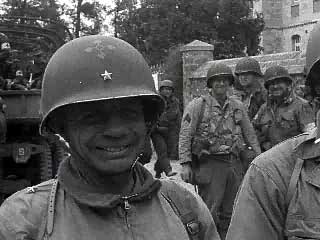
Today I am remembering an American hero who the older and more broken down I get I admire more. Brigadier Theodore Roosevelt III, known affectionately as “Ted” was beloved by his troops, and less that appreciated by senior commanders, mainly because he cared for his troops and he tended to dress down, and often wore non-uniform gear. He also had bad arthritis and needed to walk with a cane. I had to do that for a year when my knees when bad, and without the aid of gel injections in both knees every 3-4 months I would need today. He went ashore in the first wave of the 4th Infantry Division in Normandy. So this adds to my D-Day collection for this year. I hope that you can enjoy and appreciate. 

The Prussian military theorist Carl von Clausewitz wrote: “Courage, above all things, is the first quality of a warrior.”

By the standards of military service on the front line the man was ancient. He was 56 years old, four years younger than I am now. He had arthritis and a history of heart problems, but he was his father’s son and he put himself in harm’s way in the greatest invasion in history.

The oldest man to land on the beaches of Normandy was the son of a President. His father was Theodore “Teddy” Roosevelt who had taken leave of his office as Assistant Secretary of the Navy at the outset of the Spanish-American War to go into harm’s way. With the help of his friend Colonel Leonard Wood, Roosevelt formed the legendary First U.S. Volunteer Cavalry Regiment, the “Rough Riders” and led them in the fight at the Battle of San Juan Hill.

The son of the President entered the business world and then served as a Reserve officer. When the United States entered the First World War he was commissioned as a Major.  He volunteered for overseas service and served as a battalion commander and later as commander of the 26th Infantry Regiment of the 1st Infantry Division. Leading from the front he was wounded and gassed at Soissons in 1918. For his service he was awarded the Distinguished Service Cross and the French Chevalier Légion d’honneur.

After the war he helped found the American Legion and entered politics and was elected to the New York State Assembly. However while serving as Assistant Secretary of the Navy in the Harding Administration he was linked to the Teapot Dome Scandal and though he was cleared of any wrongdoing his name was tarnished. He was opposed by his cousin Franklin Delano Roosevelt and his political fortunes in elections plummeted. However, he was appointed as Governor of Puerto Rico and later Governor-General of the Philippines a post that he served at until 1935.  He returned to the United States and went back into business world with American Express.

Between the wars he continued his Army Reserve service. Like most reservists he attended his annual training periods, but he also took it upon himself to attend the Infantry Officer Basic and Officer Advanced Courses as well as the Command and General Staff College. When war broke out in Europe and the United States began to mobilize for war he again volunteered for active service. He attended a refresher course and was promoted to Colonel in the Army Reserve. He was mobilized in April 1940 and was given command of his old 26th Infantry Regiment assigned to the First Infantry Division. He was promoted to Brigadier General in late 1941 and became the the Assistant Division Commander.

Ted_Cane_France

He served well in that role in North Africa and Sicily and earned citations for bravery being constantly on the front lines with his soldiers. However his association with the Division Commander, the unorthodox Terry Allen earned the enmity of George Patton and Omar Bradley. Patton disliked Allen and hated the way both Allen and Roosevelt eschewed “spit and polish” and “dressed down,” often wearing unauthorized uniform items. After Bradley assumed command of 7th Army he relieved both officers, believing that they were guilty of “loving their division too much.” Bradley later admitted was one of the hardest decisions that he made in the war. Roosevelt then served as a liaison officer with the Free French Forces in Italy before returning to England to assume duties as Assistant Division Commander of the 4th Infantry Division. His superior, Terry Allen would go on to command the 104th Infantry Division in an exemplary manner in France and Germany in 1944-45. Bradley praised him and his new division as one of the best in Europe.

TeddyJr5-530x414

Roosevelt constantly trained with the troops and asked his commander, Major General Raymond “Tubby” Barton for permission to land with the first wave in the invasion. After being denied twice Roosevelt put his request to Barton in writing:

“The force and skill with which the first elements hit the beach and proceed may determine the ultimate success of the operation…. With troops engaged for the first time, the behavior pattern of all is apt to be set by those first engagements. [It is] considered that accurate information of the existing situation should be available for each succeeding element as it lands. You should have when you get to shore an overall picture in which you can place confidence. I believe I can contribute materially on all of the above by going in with the assault companies. Furthermore I personally know both officers and men of these advance units and believe that it will steady them to know that I am with them.”

Barton reluctantly approved the request not expecting Roosevelt to survive the landings. Roosevelt was in the first wave of assault troops at Utah Beach. On landing he discovered that the first wave was about a mile off course and in an area where the German defenses were not strong.

Armed with a pistol and supported by a cane Roosevelt led a reconnaissance patrol  to find the causeways off the beach. He briefed the battalion commanders and then ordered an attack from where the troops had landed telling his officers “We’ll start the war from right here!” It was a moment immortalized in the film The Longest Day in which Henry Fonda played Roosevelt.

fon2

Henry Fonda Portrays Brigadier General Theodore “Ted” Roosevelt III in “The Longest Day”

His actions were key in the success of the Utah Beach landings and he was recommended for the Distinguished Service Cross by General Barton. Just over a month after the invasion after continuously leading his troops in Normandy Roosevelt died of a heart attack on July 12th 1944, the very day he had been selected for his second star and promotion to Major General with orders to take command of the 90th Infantry Division. His award was upgraded to the Congressional Medal of Honor which was posthumously awarded on September 28th 1944. He was buried in the American Cemetery in Normandy. The remains of his younger brother Quentin who had been killed in the First World War were exhumed and interred next to his in 1955.

The Medal of Honor citation reads:

For gallantry and intrepidity at the risk of his life above and beyond the call of duty on 6 June 1944, in France. After 2 verbal requests to accompany the leading assault elements in the Normandy invasion had been denied, Brig. Gen. Roosevelt’s written request for this mission was approved and he landed with the first wave of the forces assaulting the enemy-held beaches. He repeatedly led groups from the beach, over the seawall and established them inland. His valor, courage, and presence in the very front of the attack and his complete unconcern at being under heavy fire inspired the troops to heights of enthusiasm and self-sacrifice. Although the enemy had the beach under constant direct fire, Brig. Gen. Roosevelt moved from one locality to another, rallying men around him, directed and personally led them against the enemy. Under his seasoned, precise, calm, and unfaltering leadership, assault troops reduced beach strong points and rapidly moved inland with minimum casualties. He thus contributed substantially to the successful establishment of the beachhead in France.

Roosevelt’s story is quite amazing. In the modern wars of the late 20th and early 21st Centuries few commanders as senior as Roosevelt would ever be in the first wave of an invasion or offensive operation. The personal courage and example set by Roosevelt in both World Wars, leading from the front and maintaining relationships with the troops that he commanded in combat is something that is unusual today. We in the military talk about a lot in various military leadership classes but often seems to be smothered by business models promoted by think tanks and others with money to be made.

Likewise, a commander suffering from Roosevelt’s infirmities would not be allowed to command troops in combat today. But in the Second World War when many other American Generals failed miserably and often could not be found near the front and were relieved of command for incompetence and cowardice the old, crippled and infirm Roosevelt led from the front. He made decisions on Utah Beach on D-Day that helped ensure that the landings were a success. Bradley, who had fired Roosevelt after the Sicilian Campaign with Allen said that the most heroic act that he had seen in combat was “Ted Roosevelt on Utah Beach.”

Roosevelt was an exception to Clausewitz’s axiom that “boldness becomes rarer, the higher the rank.” I think that even if a General wanted to lead in the manner of Roosevelt today that he would be punished by the institution for risking himself regardless of his success, because I t would make others look bad.

Peace

Padre Steve+

1 Comment

Filed under History, leadership, Military, us army, world war two in europe

True Leadership and Responsibly: Eisenhower’s Letter in Case D-Day Failed

Friends of Padre Steve’s World,

The great Prussian military theorist Carl Von Clausewitz noted: “It is now quite clear how greatly the objective of war makes it a matter of assessing probabilities. Only one more element is needed to make war a gamble – chance: the very last thing that war lacks. No other human activity is so continuously or universally bound up with chance. And through through the element of guesswork and luck come to play a great part in war…. If we now consider briefly the subjective nature of war – the means by which war has to be fought – it will look more like a gamble. The highest of all moral qualities in time of danger is certainly courage.”

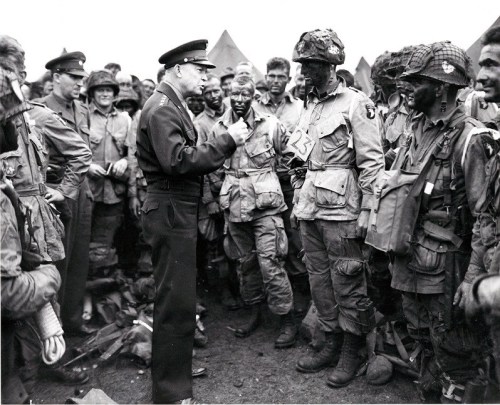
For a year General Dwight D. Eisenhower had worked to marshal the largest force possible to launch the long awaited invasion of Nazi Occupied France. Eisenhower surrounded himself with an exceptional staff, but had to fight for what he would need for the coming invasion. He had to struggle with Admiral Ernest King for the landing ships and crafts he needed, against the competing needs of Admiral Nimitz, and General MacArthur’s Forces in the Pacific Theatre of operations. He had to battle the Allied bomber commands, Air Marshal Arthur “Bomber” Harris’s British Bomber Command, and 8th Air Force and Lieutenant General Carl Spaatz, Commander of Strategic Air Forces for bombers to support the invasion. This meant taking them away from the strategic bombing command against the heart of German industry; and finally he had to battle Winston Churchill to be in overall command of the multi-national force being assembled to attack.

The invasion was his baby. He had the ultimate responsibility for its success or failure. He knew the dangers. In 1942 the British launched a raid using Canadian troops on the English Channel port of Dieppe. It was a disaster. With all the work he had done to get his forces ready for the invasion, Eisenhower knew that he owned the result regardless of the outcome.

Eisenhower understood that everything in war is a gamble and that success is not guaranteed. The weather conditions of the English Channel are unpredictable. They only  offer a few month window of opportunity to successfully mount a cross channel invasion. The Germans found that out in 1940 when after their failure to clear the skies of the Royal Air Force during the Battle of Britain by early September, that the a favorable opportunity for Operation Sea Lion had passed and would never come again.

The Allied invasion required a full moon for a massive three division nighttime paratroop drop, and favorable weather for the landing craft to get ashore. Unfortunately, the weather was not cooperating. High winds, seas, and rain forced a cancellation of the planned June 5th invasion, the open question was whether conditions would be on the 6th would be favorable. If not the next opportunity would not be for at least two more weeks, in which the Germans would continue to strengthen their defensive positions along the Atlantic Wall. 

The German weather forecasters, had lost lost the ability to observe weather in the western and mid-Atlantic due to the allies sweeping the ships that relayed weather information from the Atlantic. Blind to oncoming weather systems, the Wehrmacht and Luftwaffe meteorologists anticipated that the bad weather would continue to be unfavorable for an invasion. With this in mind, Field Marshal Erwin Rommel, Commander of Army Group B which had operational control over the potential landing beaches, decided to make a visit to his wife for her birthday and a trip to Berlin to plead for more resources. Other Senior German Commanders departed to inland areas to conduct war games and were not with their units on the night of June 5th.

Meanwhile, the forecasters at Eisenhower’s headquarters had access to weather data from the mid-Atlantic unavailable to the Germans, predicted a brief lull in the storm, not perfect weather, but acceptable. Eisenhower met with his staff and made the decision to go ahead with the invasion in the night of June 5th and June 6th with the American 82nd and 101st Airborne Divisions, and the British 6th Airborne Division landing behind the German coastal fortifications.

But the weather was just one factor, the Allies did not know the latest German deployments, including the movement of the crack 352nd Infantry Division to Omaha Beach. Likewise, a prompt German response with heavy Panzer units could throw the invaders back into the sea if they moved fast enough. One threat was already deployed, but the other was a real probability knowing German doctrine.

However, neither Eisenhower or his staff knew of the conflict in the German High Command and Hitler regarding the deployment of the Panzer Divisions in France. Rommel argued that the Panzer Divisions should be deployed near the potential invasion beaches. However, traditionalists in the German command and Hitler decided that most of the Panzer Divisions should be held back awaiting a point that they could make a massive and decisive counterattack that would drive the Allies out of Europe. However, most of these men had commanded Panzers in Poland in 1939, France and the Low Countries in 1940, and the Soviet Union. In all of those campaigns the Germans always enjoyed air superiority or parity. But Rommel, a veteran of Africa and the West knew the power of allied tactical air assets, and the havoc they could inflict on the Panzers. Rommel believed that the invasion had to be defeated on the beachheads and the allies not given the chance to advance inland, in which case he knew that there would be no chance of defeating the invasion.

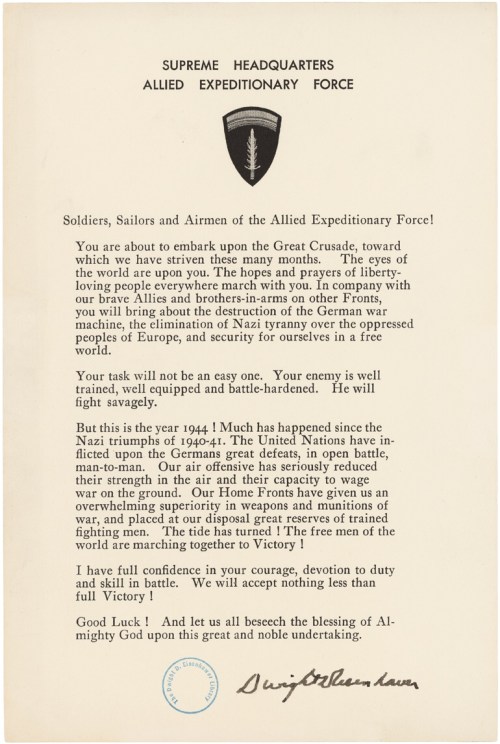
Eisenhower also knew that the success of the invasion depended on the success of the landings. A disaster at any of the landing beaches could doom the it. In light of this and so many other ways that could cause the invasion to fail, Eisenhower, wrote a letter to his troops and the world when the invasion commenced. It read:

“Soldiers, Sailors, and Airmen of the Allied Expeditionary Force:

You are about to embark upon the Great Crusade, toward which we have striven these many months.

The eyes of the world are upon you. The hopes and prayers of liberty-loving people everywhere march with you.

In company with our brave Allies and brothers-in-arms on other Fronts you will bring about the destruction of the German war machine, the elimination of Nazi tyranny over oppressed peoples of Europe, and security for ourselves in a free world.

Your task will not be an easy one. Your enemy is well trained, well equipped, and battle-hardened. He will fight savagely.

But this is the year 1944. Much has happened since the Nazi triumphs of 1940-41. The United Nations1 have inflicted upon the Germans great defeats, in open battle, man-to-man. Our air offensive has seriously reduced their strength in the air and their capacity to wage war on the ground. Our Home Fronts have given us an overwhelming superiority in weapons and munitions of war, and placed at our disposal great reserves of trained fighting men. The tide has turned. The free men of the world are marching together to victory.

I have full confidence in your courage, devotion to duty, and skill in battle. We will accept nothing less than full victory.

Good Luck! And let us all beseech the blessing of Almighty God upon this great and noble undertaking.

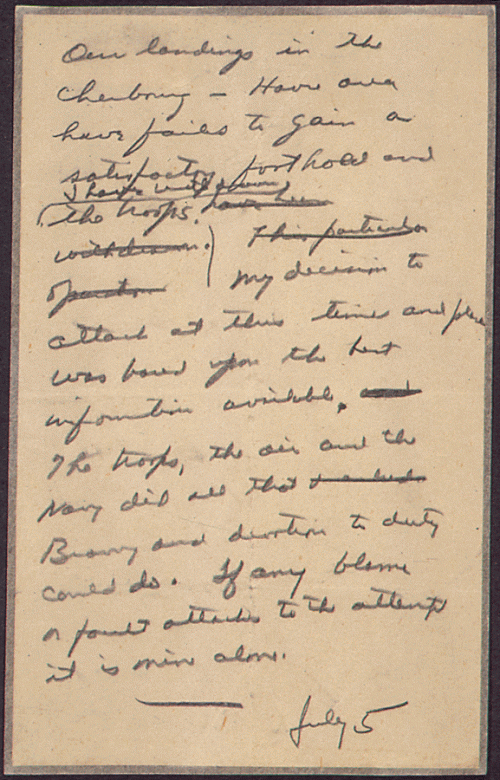
However, prepared for any eventuality he also also wrote a letter in case the invasion failed, as it nearly did on Omaha Beach. That letter noted:

“Our landings in the Cherbourg-Havre area have failed to gain a satisfactory foothold and I have withdrawn the troops. My decision to attack at this time and place was based upon the best information available. The troops, the air and the Navy did all that Bravery and devotion to duty could do. If any blame or fault attaches the attempt it is mine alone.”

It was dated July 5th, not June 5th, the mistake obviously due to the pressure of what he was feeling for his soldiers, and the mission. Likewise, there was very real threat to his own career if the mission failed. He knew that his adversaries in the United States military and in Britain would have seen that would see that he was relieved and sent back to the United States in disgrace. As Eisenhower’s successor as President, John F. Kennedy said: “Victory has a hundred fathers, defeat is an orphan.”

Likewise, defeat could embolden those in the United States and Britain willing to make peace with Germany at any price. Such an outcome could have destroyed the allied alliance that ended up defeating Germany, rebuilding a democratic Western Europe, establishing NATO, the United Nations, and many other international organizations that have done much good for America and the world.

In a sense Eisenhower was in a similar situation to Grant and Sherman in the Summer of 1864, if they failed, Abraham Lincoln could have been defeated by the anti-war pro-Confederacy Copperheads, who would have settled leaving the South independent, the country divided, and slavery in place. Defeat would have ended the American experiment. Defeat in Normandy could easily have destroyed the Allied alliance, and given the Germans  the time they needed to turn defeat into victory. The whole course of the war and history could have changed, for the worse, with Hitler’s Nazi Regime controlling most of Europe, continuing its genocidal policies, and developing weapons far in advance of the Allies.

Eisenhower would not make excuses if the invasion failed. He was ready to take full responsibility if Overlord failed, regardless of how it happened. The buck stopped with him.

Likewise, he knew that the failure of the invasion would have made it possible for the Nazis to divert needed forces to the Eastern Front, where they might have been able to turn back the Soviet Operation Bagration which destroyed the German Army Group Center. Likewise, the success of the invasion opened the way for the Soviets to drive the Nazis from Soviet territory, advance to Warsaw, and knock key German allies out of the war. Before long, Hungary, Romania, and Finland had abandoned the Germans.

The fact that the invasion succeeded was as much as luck as it was the careful planning, and the exceptional courage, and dogged determination of the Allied troops. The American 4th Infantry Division landed on the wrong beach. Had they landed on the correct beach they could have faced slaughter. The Allied Airborne Divisions were scattered over much of Normandy and had to improvise to capture the targets needed to assist the invasion forces. Had Hitler’s lackeys the courage to wake him when the invasion was in its early stages , he might have released Panzer Divisions sooner than he did. Had Rommel not gone back to Germany for his wife’s birthday and to plead with Hitler for more troops, and been on the ground to coordinate the German response; or the number of realistic “might have beens” that could of defeated the the invasion, and Eisenhower was well aware of them.

Eisenhower’s willingness to take responsibility for defeat as well as give his troops credit for the eventual victory over the Nazis sets him apart from so many others then, and now who would deflect blame for a failed operation to their subordinates and lie about the results achieved.

In the age where the American President blatantly refuses to take responsibility for his actions, blames subordinates and allies for his failures, and who abdicates the duties of his office on an hourly basis, the ability for Eisenhower to be ready to acceptance of failure is an example that we must emulate. Donald Trump would have surrendered to Germany, given Hitler a platform to proclaim his defiance of human rights and international law, and the rights of American citizens at home. Interestingly enough over the past week many highly respected Generals and Admirals, active and retired, have warned against the dangers posed by President Trump.

History and humanity are always the product of character, integrity, and responsibility, or their opposites. All qualities Eisenhower had, and Trump does not, and as many well respected American military commanders are now speaking out about. But I was doing this as early as 2015 and 2016.

Peace,

Padre Steve+

5 Comments

Filed under civil war, ethics, History, holocaust, leadership, Military, national security, nazi germany, News and current events, Political Commentary, us army, US Navy, US Presidents, world war two in europe

Decoration Day or Memorial Day 2020: Their Spirits Gather Round Me, as I Muse of Poppy’s, Dreaming of Home Oceans Away

Friends of Padre Steve’s World,

Today is, or should be the most solemn and reflective of holidays that we observe in the United States. It is the one day a year that we specifically put aside to remember those who died in the service of our country. It is not a day to thank a living veteran for their service, be they active military  personnel, veterans or retirees,, we have our own days, Armed Forces Day and Veterans Day. Likewise, and even worse, most Americans completely forget and turn it in to a day to kick off the summer holiday season. Not that has been harder to do this year in the midst of the Coronavirus 19 Pandemic, with its related shutdowns and travel restrictions, and since we will probably mark the 100,000th official death in this country later today, it should be a more reflective time.

But the holiday itself it is more interesting, because when it began it was called Decoration Day. It was a day where the families and friends of the soldiers, North and South who died in the war of the Southern Rebellion (the term that Union Veterans of the Grand Army of the Republic called it) or the War of Northern Aggression (as it was called by many Southerners) to the less divisive term the American Civil War. Personally, though most of my family fought for the Confederate side despite the fact that their counties of West Virginia had gone to the Union, because they were slave owners, I land pretty hard on calling it the War of the Southern Rebellion, because I am a historian.

Now as a kid I absorbed a lot of the revisionist views of the Southern historians who mythologized the cause, The Lost Cause, their honor and culture, The Noble South, and the hagiography surrounding their heroes like Robert E. Lee, and Thomas “Stonewall” Jackson. However, when one looks at their writings, beliefs, and actions, it is far better to label them as rebels and traitors, and the cause that they fought for as evil, but I digress, because even then the truth is more complicated. There were Southerners who never renounced they Union, and close to 40% of Southern graduates of West Point and others that remained loyal to the Union. These included men like General Winfield Scott (Virginia),  George Thomas (Virginia) , General John Buford (Kentucky where his family supported the Confederate Cause) General John Gibbon (North Carolina), Admiral David Farragut (Tennessee) the Union’s master logistician, General Montgomery Meigs of Georgia. Meigs is known for his deep hatred Former U.S. Army officers who fought for the Confederacy, especially Robert E. Lee. He used his position to select Lee’s mansion and plantation property in Arlington, Virginia as the Union’s first, and premiere national cemetery.

But back to Decoration Day. It predates the end of the war in some towns in the south and north where families would go to play flowers on the graves of their relatives or friends who died during the war. In 1865 the newly freed Black population of Charleston, South Carolina dedicated a cemetery to the Union soldiers who had died in Confederate prisons there at the old racehorse track. In 1868, General John Logan, the head of the Union’s largest and most influential veterans organization, the Grand Army of the Republic, called for it to become a National day of remembrance to be held on May 30th. Soon Michigan became the first state to make the day a holiday and they were rapidly followed but most other states. Logan and the G.A.R. headquarters issued the the Decoration Day Order:

GENERAL ORDERS No. 11

I. The 30th day of May, 1868 is designated for the purpose of strewing with flowers or otherwise decorating the graves of comrades who died in defense of their country during the late rebellion, and whose bodies now lie in almost every city, village, and hamlet churchyard in the land. In this observance no form or ceremony is prescribed, but posts and comrades will in their own way arrange such fitting services and testimonials of respect as circumstances may permit.

We are organized, comrades, as our regulations tell us, for the purpose, among other things, “of preserving and strengthening those kind and fraternal feelings which have bound together the soldiers, sailors and marines who united to suppress the late rebellion.” What can aid more to assure this result than by cherishing tenderly the memory of our heroic dead who made their breasts a barricade between our country and its foes? Their soldier lives were the reveille of freedom to a race in chains and their deaths the tattoo of rebellious tyranny in arms. We should guard their graves with sacred vigilance. All that the consecrated wealth and taste of the nation can add to their adornment and security is but a fitting tribute to the memory of her slain defenders. Let no wanton foot tread rudely on such hallowed grounds. Let pleasant paths invite the coming and going of reverent visitors and fond mourners. Let no vandalism of avarice or neglect, no ravages of time, testify to the present or to the coming generations that we have forgotten, as a people, the cost of a free and undivided republic.

If other eyes grow dull and other hands slack, and other hearts cold in the solemn trust, ours shall keep it well as long as the light and warmth of life remains in us.

Let us, then, at the time appointed, gather around their sacred remains and garland the passionless mounds above them with choicest flowers of springtime; let us raise above them the dear old flag they saved from dishonor; let us in this solemn presence renew our pledges to aid and assist those whom they have left among us as sacred charges upon the nation’s gratitude—the soldier’s and sailor’s widow and orphan.

II. It is the purpose of the commander in chief to inaugurate this observance with the hope that it will be kept up from year to year, while a survivor of the war remains to honor the memory of his departed comrades. He earnestly desires the public press to call attention to this order, and lend its friendly aid in bringing it to the notice of comrades in all parts of the country in time for simultaneous compliance therewith.

III. Department commanders will use every effort to make this order effective.

By Command of –
John A. Logan,
Commander in Chief

Over the years Decoration Day began to be know as Memorial Day, especially as the members of the G.A.R. became fewer, but the name was not officially changed until 1967. In 1968 Congress passed an act to move four holidays, Memorial Day, Labor Day, Veterans Day (Formerly Armistice Day), and Washington’s Birthday (now President’s Day) to Monday’s to allow for three day weekends. There have been attempts by Veterans organizations to have Memorial Day moved back to a set date over the past two decades in order to bring emphasis to the solemnity that it should be observed. I would support that, but business leaders and lobbyists have ensured that Congress has take no action to make that change. Thus for most people the day is the kick off of the summer holiday season.

After the end of the American Civil War, the poet Walt Whitman reflected on the human cost of it. Whitman wrote,

“Ashes of soldiers South or North,

As I muse retrospective murmuring a chant in thought, The war resumes, again to my sense your shapes, And again the advance of the armies.

Noiseless as mists and vapors, From their graves in the trenches ascending, From cemeteries all through Virginia and Tennessee, From every point of the compass out of the countless graves,

In wafted clouds, in myriads large, or squads of twos or threes or single ones they come, And silently gather round me…”

Memorial Day is always an emotional time for me, especially since I returned from Iraq in 2008. It is a weekend that I always think about the men and women that I knew who died in action or died after they left the service, some at their own hand, unable to bear the burdens and trauma that they suffered while at war. I was reminded of them again at the memorial service that we conducted for all of our fallen at the Naval Shipyard where I serve.  In an age where less than one percent of Americans serve in the military, I think that it is important that we take the time to remember and reflect on the human cost of wars.

For me I think that is the lives lost that hit me hardest. They were friends who I knew, and also family members that I never met because they lost their lives before I was born.

I think of the battlefields that I have served on in Al Anbar Province, the one my father served on at An Loc, Vietnam, or the battlefields and the graveyards I have been to, Verdun, the Somme, Paschendaele, Waterloo, Arnhem, Normandy, Belleau Wood, Luxembourg, the Shuri Line, the Naktong River, Yorktown, Chancellorsville, Antietam, Stone’s River, Bentonville, Gettysburg, the wrecks of the USS Arizona and USS Utah at Pearl Harbor, and so many more, I think about the men and women who never returned. To me all of these places are hallowed ground, ground that none of us can hallow, the sacrifices of the men who gave their last full measure of devotion have done that better than we can ever do.

There are some songs that are haunting yet comfort me when I reflect on the terrible costs of war, even those wars that were truly just; and yes there are such wars, even if politicians and ideologues demanding revenge or vengeance manage to mangle the peace following them. Of course there are wars that are not just in any manner of speaking and in which the costs far outweigh any moral, legal, or ethical considerations, but I digress…

Joshua Lawrence Chamberlain, the hero of the Battle of Little Round Top at Gettysburg wrote something that talks about the importance and even the transcendence of the deeds of those who lost their lives in those wars fought and died to achieve.

In great deeds, something abides. On great fields, something stays. Forms change and pass; bodies disappear; but spirits linger, to consecrate ground for the vision-place of souls… generations that know us not and that we know not of, heart-drawn to see where and by whom great things were suffered and done for them, shall come to this deathless field, to ponder and dream; and lo! the shadow of a mighty presence shall wrap them in its bosom, and the power of the vision pass into their souls.”

Elton John wrote and performed this song, Oceans Away on the centenary of the First World War. It speaks of the men that never came home, and he related it to those who continue to go off to war today.

I hung out with the old folks, In the hope that I’d get wise

I was trying to bridge the gap, Between the great divide

Hung on every recollection, In the theater of their eyes

Picking up on this and that, In the few that still survive


Call em up, Dust em off, Let em shine

The ones who hold onto the ones, they had to leave behind

Those that flew, those that fell, The ones that had to stay,

Beneath a little wooden cross, Oceans away


They bend like trees in winter, These shuffling old grey lions

Those snow-white stars still gather, Like the belt around Orion

Just to touch the faded lightning, Of their powerful design

Of a generation gathering, For maybe the last time, Oceans away

Where the green grass sways,And the cool wind blows

Across the shadow of their graves, Shoulder to shoulder back in the day

Sleeping bones to rest in earth, oceans away

Call em up, Dust em off, Let em shine

The ones who hold onto the ones, they had to leave behind

Those that flew, those that fell,, The ones that had to stay,

Beneath a little wooden cross, Oceans away

Elton John “Oceans Away”

Likewise I find myself thinking about all those times alone overseas, and realize that many did not come home. The song I’m Dreaming of Home or Hymne des Fraternisés from the film Joyeux Noel which was adapted by French composer Philippe Rombi from the poem by Lori Barth I think speaks for all of us that served so far away, both those who returned and those who still remain oceans away.

I hear the mountain birds, The sound of rivers singing

A song I’ve often heard, It flows through me now, So clear and so loud

I stand where I am, And forever I’m dreaming of home

I feel so alone, I’m dreaming of home


It’s carried in the air, The breeze of early morning

I see the land so fair, My heart opens wide, There’s sadness inside

I stand where I am, And forever I’m dreaming of home

I feel so alone, I’m dreaming of home


This is no foreign sky, I see no foreign light, But far away am I

From some peaceful land, I’m longing to stand, A hand in my hand

… forever I’m dreaming of home, I feel so alone, I’m dreaming of home.

The Canadian physician, John McCrea, served in Flanders with the British Army. There he wrote his  immortal poem, In Flanders Fields: 

In Flanders fields the poppies blow
Between the crosses, row on row,
    That mark our place; and in the sky
    The larks, still bravely singing, fly
Scarce heard amid the guns below.
We are the Dead. Short days ago
We lived, felt dawn, saw sunset glow,
    Loved and were loved, and now we lie,
        In Flanders fields.
Take up our quarrel with the foe:
To you from failing hands we throw
    The torch; be yours to hold it high.
    If ye break faith with us who die
We shall not sleep, though poppies grow
        In Flanders fields.

The 20th Century was the bloodiest in human history. If we and our leaders are not careful, the peace and international institutions that guarded that peace will be destroyed in a cataclysm of Nationalism, Racism, and renewed wars over contested living space. In short, the 21st Century is setting up to be every bit as bloody as the 20th.

The Armistice Day Poppy which became an international symbol of remembrance for the dead of the First World War was introduced to Decoration Day in 1922. Its roots lie in McCrea’s prom, and that of an American woman volunteering with the YMCA to support the troops in France. In 1918 Moina Michael, a professor on sabbatical from the University of Georgia vowed to always wear a red poppy to remember those who died in the war. Her poem We Shall Keep the Faith expressed her feelings:

Oh! you who sleep in Flanders Fields,
Sleep sweet – to rise anew!
We caught the torch you threw
And holding high, we keep the Faith
With All who died.

We cherish, too, the Poppy red
That grows on fields where valor led;
It seems to signal to the skies
That blood of heroes never dies,
But lends a lustre to the red
Of the flower that blooms above the dead
In Flanders Fields.

And now the Torch and Poppy Red
We wear in honor of our dead.
Fear not that ye have died for naught;
We’ll teach the lesson that ye wrought
In Flanders Fields.

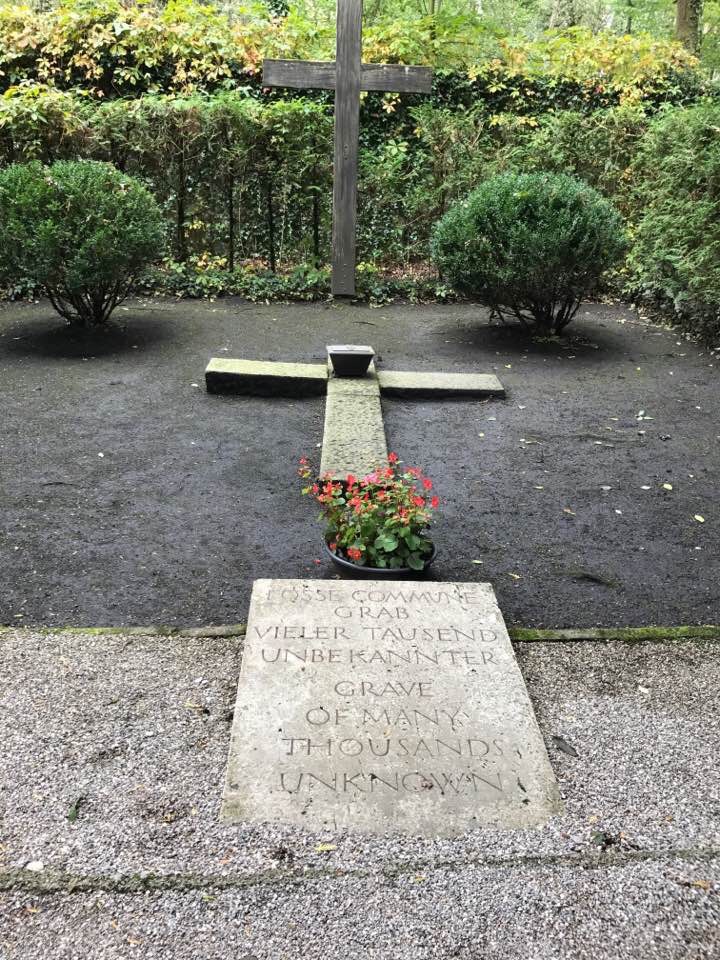
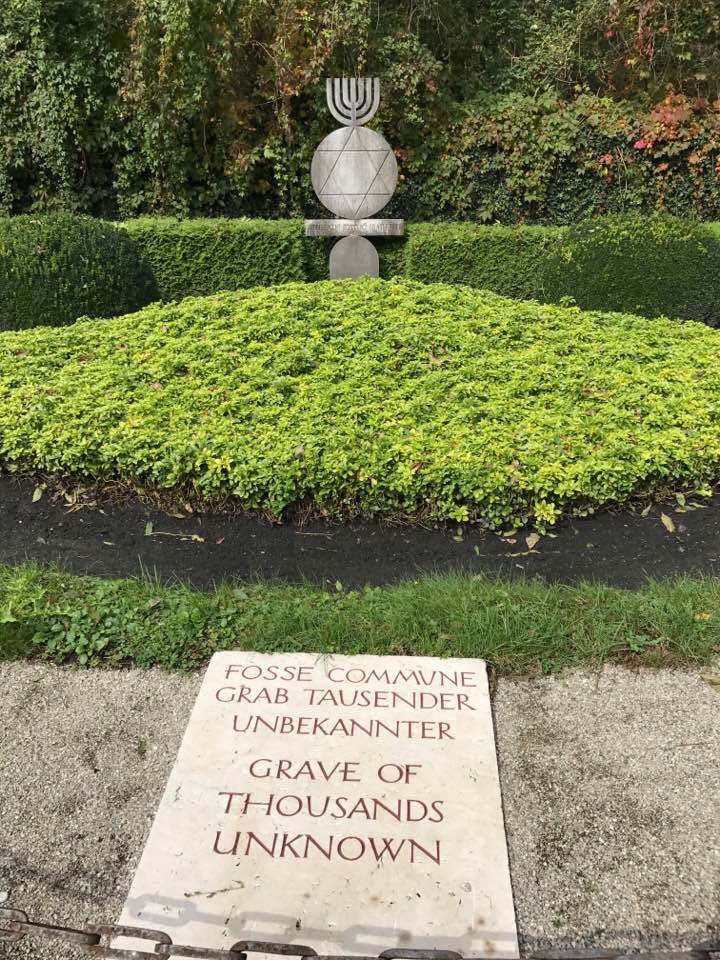
Please take the time to remember those who whose spirits still linger around the battles fields of the Civil War, and those who beneath Crosses, Stars of David, and Islamic Crescent Moons, or plain headstones denoting no religion, who fought for the Allied cause in the First and Second World Wars, and all of the wars since, who still dream of home, oceans away.

Until tomorrow,

Peace,

Padre Steve+

3 Comments

Filed under civil war, History, leadership, Military, Navy Ships, Political Commentary, remembering friends, shipmates and veterans, us army, US Army Air Corps, US Marine Corps, US Navy, Veterans and friends, vietnam, War on Terrorism, World War II at Sea, world war one, world war two in europe, world war two in the pacific

The Liberation of Dachau “Model Camp” at 75 Years

Friends of Padre Steve’s World,

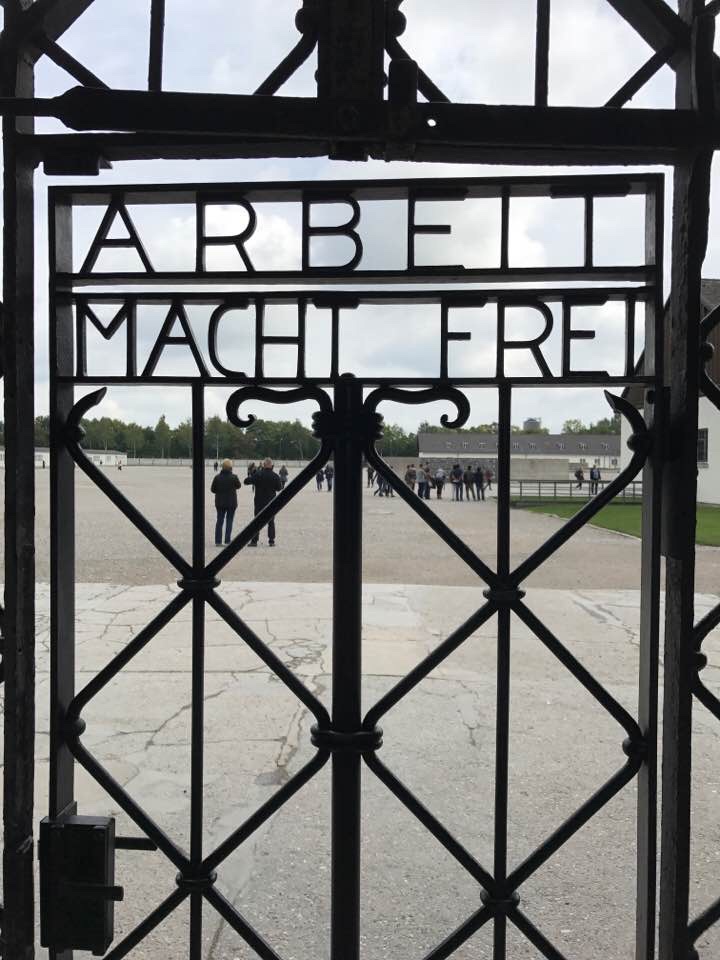
Today marked the 75th anniversary of the liberation of Dachau, the model concentration camp of the the Nazi SS State.


On March 20th 1933, barely a month and a half after the Nazi takeover of the German government and three days before the passage of the Enabling Act the Police President Of Munich, SS Reichsführer Heinrich Himmler ordered the establishment of the Dachau Concentration Camp. He appointed SS Standartenführer Hilmar Wäckerle as Commandant and the first 200 political prisoners from Munich’s Stadelheim prison arrived at Dachau on March 22nd.

The first SS guards assigned to Dachau were given the following instruction:

“Comrades of the SS!
You all know what the Fuehrer has called us to do. We have not come here for human encounters with those pigs in there. We do not consider them human beings, as we are, but as second-class people. For years they have been able to continue their criminal existence. But now we are in power. If those pigs had come to power, they would have cut off all our heads. Therefore we have no room for sentimentalism. If anyone here cannot bear to see the blood of comrades, he does not belong and had better leave. The more of these pig dogs we strike down, the fewer we need to feed.”

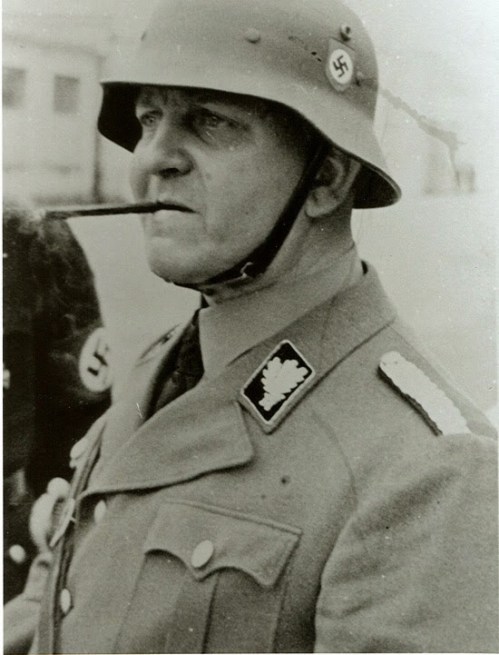
Wäckerle’s brief tenure as Commandant was marked by extraordinary brutality on the part of his staff, so much so that charges were brought against him by the Munich courts which resulted in his relief by SS Gruppenführer Theodore Eicke in July 1933. Eicke would establish the regulations which governed all the later Concentration Camps, and make Dachau the model camp for all others.

Theodore Eiche

Theodore Eicke

Among the later SS killers of the Holocaust who served at Dachau were Adolf Eichmann, and the Commandant of Auschwitz, Rüdolf Höss. It became a training ground for other Concentration Camp commanders and staff. Others would become leaders in the Waffen SS and the Einsatzgruppen death squads.

The announcement of Dachau’s Opening was reported by the German press in this release:

On Wednesday the first concentration camp is to be opened in Dachau with an accommodation for 5000 people. ‘All Communists and—where necessary—Reichsbanner and Social Democratic functionaries who endanger state security are to be concentrated here, as in the long run it is not possible to keep individual functionaries in the state prisons without overburdening these prisons, and on the other hand these people cannot be released because attempts have shown that they persist in their efforts to agitate and organize as soon as they are released.

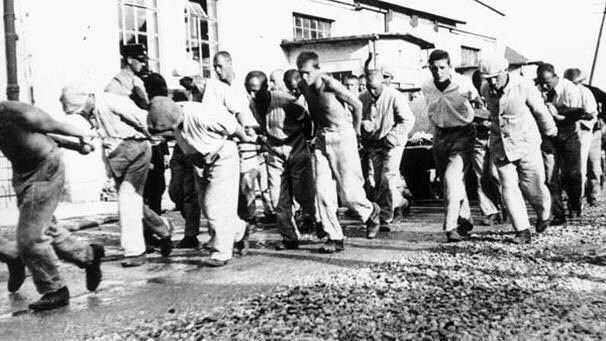
Dachau began as a political prisoner camp for the Nazis to imprison Socialists, Communists, Jehovah’s Witnesses, some Jews, and other dissidents. It wasn’t a “death camp” designed to exterminate people even though tens of thousands of people died or were executed there. It was designed to terrorize, dehumanize, and destroy the souls of its inmates.

It was a place of inhuman medical experiments, a place of terror, and the administrative center of a network of over 30 large and 100 small sub-Camps which were used as sources of slave labor for the German armaments industry. But one has to remember that the SS was not simply an instrument of terror, but an institution also devoted to profit. Prisoners were valued in what their lives equated in profits. A prisoner was valued in what he or her could produce versus the expenses of keeping them alive for a period of 6 to 12 months. Under Himmler and his assistant for production and profits, ObergrüppenfuhrerOswold Pöhl the Concentration Camps, as well as the death camps became centers of profit for the SS in collaboration with German industrial concerns and industries owned by the SS itself.

Dachau was not one of the Death Camps, although it was a place of incredible cruelty, extraordinary suffering, brutality, and death. While not a “death camp” per say, an estimated 40,000 or more  prisoners were murdered there. For tens of thousands of others it served as a transit camp from which they were sent to the death factories in Poland, including Auschwitz, or other work camps, where many died of being worked to death, malnutrition, disease, or the simple cruelty and maltreatment inflicted on them by the guards.

Holocaust survivor Yehuda Bauer wrote: “The horror of the Holocaust is not that it deviated from human norms; the horror is that it didn’t. What happened may happen again, to others not necessarily Jews, perpetrated by others, not necessarily Germans. We are all possible victims, possible perpetrators, possible bystanders.”

The picture that you see above is the memorial to the Unknown Prisoner at Dachau. The words: “Den Toten zur Ehr, den Lebenden zur Mahnung” [To Honor the Dead, to Warn the Living] are engraved at its base.

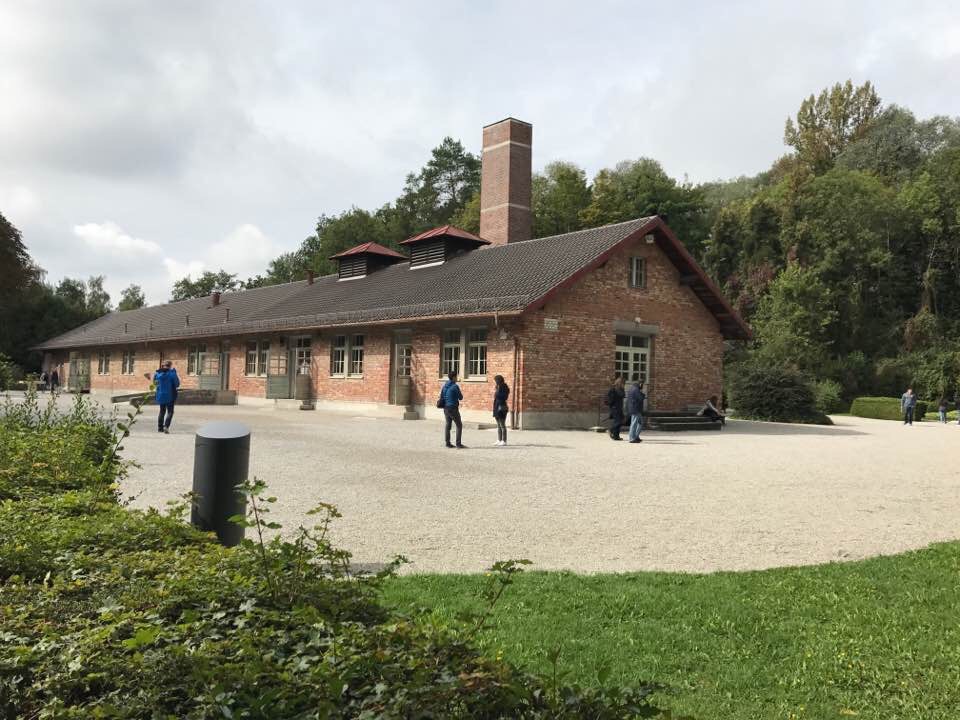
I have been to Dachau at least a half dozen times beginning back in 1996. For me as a historian of the period the trip is both for learning and for meditation, for beyond its historical significance this is a holy place, a place made holy by the blood of tens of thousands of victims of one of the most evil regimes in history. The crimes committed by the staff of Totenkopfverbande SS guards from it’s inception were intended to terrorize and dehumanize the inmates who included political prisoners, religious objectors, Jews, and homosexuals. The inmates were not there because they were convicted of any crimes, in fact many had actually been exonerated by courts. In the case of those who had been convicted by courts, all had served what ever sentence they had been convicted of, but upon their release from prison were picked up by the SS and taken to Dachau where they were imprisoned without being charged with a crime, and an indefinite period and no date of release. Sometimes prisoners would suddenly and without warning be released, but they remained under observation by the local police and Gestapo. If they talked about their experience they were quite often sent back.

Prisoners were told on arrival:

Here you are, and you’re not in a sanatorium! You’ll have got that already. Anyone who hasn’t grasped that will soon be made to. You can rely on that . . . You’re not prison inmates here, serving a sentence imposed by the courts, you’re just ‘prisoners’ pure and simple, and if you don’t know what that means, you’ll soon find out. You’re dishonourable and defenceless! You’re without rights! Your fate is a slave’s fate! Amen.

In the Camp the prisoners were subject to punishment for even the most minor or perceived infractions, beatings, and whippings. Other punishments were meted out by guards who themselves were punished if they showed any mercy or human kindness to a prisoner. “While an offender sentenced to a term in prison knew when he was going to get out, release for the concentration camp inmate was determined by the whim of a quarterly review board, and could be delayed by the malice of any of the SS guards.”

Theodore Eicke, the commandant who systematized the Concentration Camp system created a world that his subordinate, and the later Commandant of Auschwitz, Rudolf Hoess described:

“It was Eicke’s intention that his SS-men, by means of continuous instruction and suitable orders concerning the dangerous criminality of the inmates, should be made basically ill-disposed towards the prisoners. They were to ‘treat them rough’, and to root out once and for all any sympathy they might feel for them. By such means, he succeeded in engendering in simple-natured men a hatred and antipathy for the prisoners which an outsider will find hard to imagine.”

Even a brutal man like Hoess found the brutality hard to watch, he recalled the:

“malicious evil-minded, basically bad, brutal, inferior, common creatures’ amongst the guards, who compensated for their sense of inferiority by venting their anger on the prisoners. The atmosphere of hatred was total.”

In the twelve years of its existence the staff of Dachau, through mistreatment, execution by bullet, gallows, through being used as subjects in grotesque medical experiments, by “execution by work,” or untreated illness and disease, murdered 41,566 prisoners. The point to be remembered is that despite this incredible number of murders that Dachau was not an extermination camp.

As the Third Reich crumbled the Nazis attempted to hide their crimes. Many inmates from Dachau were sent to other camps, by train or forced marched hundreds of miles. During these transits many, already shells of humanity due to maltreatment, disease and malnourishment. Even as this was happening trains from other camps were arriving at Dachau.


On 29 April 1945 units of the U.S. Army 45th and 42nd Infantry Divisions liberated Dachau, which was surrendered by its senior remaining officer, a mere SS 1st Lieutenant, as the commandant and   o ther senior officer had already fled. Most to be captured within days or weeks. The liberators were shocked by what they saw, the piles of dead, the bones in the crematoria, the emaciated prisoners,  and a train car full of dead, and some soldiers took their revenge on some of the guards, and massacred an estimated 20-50 of the surrendered SS men. Although charges were preferred, they were dropped.

The Execution of SS Guards at Dachau 

Regardless of the actions of the American liberators, even those who took justice into their own hands, the fact is that the Dachau guards all knew what was going on and had each to some degree participated in the atrocities at Dachau and in some cases other camps, or on the Eastern Front.

You may wonder why I took the time to go into such detail about my visits to Dachau and its terrible legacy. The answer is the same why I choose to walk American Civil War battlefields, it is to being to try to understand what the people there were seeing and experiencing.

Of course there were the prisoners who were so savagely treated by their jailers. Then there were the bystanders, the citizens of Dachau and other German cities who watched as Jews, political enemies, and others were marched to the camp, which was not a secret installation. Finally, there were the perpetrators, very few of whom were punished for their actions.

But another reason is that the survivors, be they victims, perpetrators, or bystanders are rapidly passing away

Soon none will be left. When that happens it is up to us the living to ensure that this is not forgotten and that those murdered at Dachau, the other Concentration Camps, the extermination camps, and those killed by the murder squads that went from one end of Europe to the other in a systematic attempt to wipe every Jew that they could find off of the face of the earth. Yes, there were other victims, but the Nazi crusade against the Jews knew no boundaries, physical or time included. Unlike every other genocide it extended beyond national borders, or time; it was an eschatological crusade that by the will of Hitler was limited by only one factor, the complete military defeat that was inflicted on Nazi Germany by those who she attacked.


Finally, the story must be told because there are those who either claim it didn’t happen, or are tired of talking about it. In Germany those include leaders of the new-Nazi AfD (Alternative for Germany) Party. In the United States, Britain, and other nations there are members of many new-Nazi and Alt-Right groups who desire very much the same thing. But if decent people decide not to speak out, if we remain silent, there is nothing anywhere that will keep these ideological descendants of Hitler from beginning it again, if not to the Jews, to other despised racial, religious, ethnic, or ideological groups. We live in a world where demagogues take advantage of people’s legitimate anxieties and deeply ingrained prejudices to stir up ungodly anger and hatred in order to both gain new followers and to incite those followers to a campaign of violence.

Doctor Timothy Snyder wrote:

“The European history of the twentieth century shows us that societies can break, democracies can fall, ethics can collapse, and ordinary men can find themselves standing over death pits with guns in their hands. It would serve us well today to understand why.”

But I know why, there are some people who are sociopaths, who though they seem ordinary have no empathy for others, and they are more numerous than we might ever suspect. Captain Gustave Gilbert, a psychologist assigned to the major war crime defendants at the Nuremberg war crimes trials noted:

“In my work with the defendants (at the Nuremberg Trails 1945-1949) I was searching for the nature of evil and I now think I have come close to defining it. A lack of empathy. It’s the one characteristic that connects all the defendants, a genuine incapacity to feel with their fellow men. Evil, I think, is the absence of empathy.”

That absence of empathy runs strong among Trump supporters and others of the religious and political right today. For the rest of my life I will fight them and expose them.

So until tomorrow I wish you all the best and ask that no matter what the leaders of your state say, to obey common sense and facts and be as careful as you can, as the COVID 19 pandemic is far from over.

Peace,

Padre Steve+

5 Comments

Filed under authoritarian government, Coronavirus, Diseases Epidemics and Pandemics, ethics, germany, History, holocaust, Military, nazi germany, News and current events, Political Commentary, racism, Religion, us army, world war two in europe

Pandemics and Their Indirect Effects

Friends of Padre Steve’s World,

We are living in difficult times. We have the COVID-19 pandemic which is claiming thousands of people a day while infecting far more, many of who will be permanently damaged by its effects. We have an economic meltdown going on with businesses going under, millions of people losing their jobs. The unemployment rate is skyrocketing, and many people are left without enough to survive on. They are doing so despite the approved yet unissued $1,200 subsidy, as well as increased unemployment coverage. Many of the newly unemployed have also lost their healthcare insurance.

Of course many of the now failed business offered no health benefits to their employees to begin with. But others did, like Craftworks Holdings, owners of numerous restaurants and brewery restaurant chains, started shutting down many of its most profitable locations in January and February, including our own version of cheers, Gordon Biersch, Virginia Beach. On Sunday, Craftworks closed every one of their remaining 338 restaurants. They notified their 18,000 employees that they were fired with no severance pay or insurance, as they made sure that they had ended their policy to continue health coverage under COBRA before they fired their employees.   However, I am sure that the CEO left with a golden parachute worth more than the severance  that they denied all their employees.

But now, in barely two weeks six and a half million people have filed for unemployment assistance!  over 3 million of those last week. It is worth noting that it is economists expect that the unemployment rate will reach 10% and not go down significantly until sometime next year. We are talking unemployment numbers not seen since the Great Depression, and it will get worse because so many American companies shut down their American operations and moved to countries where they could profit from using near slave labor rather than pay American workers what they worth. Now, like in 1929 we are watching everything collapse before our eyes. In 1929 President Herbert Hoover, maintained a policy of austerity, which only deepened the depression. His actions put more people out of work with no safety net. Food kitchens set up by churches and communities sprang up to feed those without the ability to provide food. Likewise, homeless shelters multiplied, while Shantytowns, nicknamed Hoovervilles popped up all over the country as people  lost their homes.

By the summer of 1932 as the Great Depression crushed the economy, and resulted in massive unemployment.  With no relief from the Republican Administration of Herbert Hoover, the Republican Senate stopped a House attempt to pay WWI Veterans a previously approved bonus for their service,  that was deferred until 1948. In response, veterans from all over the country camped out, many with their families at Anacostia Flats, across the Potomac from the White House and Capital Hill. Eventually the veterans numbered nearly 17,000, with thousands of women and children.

The veterans were falsely accused of being the leaders of a Communist attempt to overthrow the government, which would be backed by the Marines in Washington DC.  President Hoover refused to meet with their leaders, and ordered the Attorney General to send the Metro Police to drive them off. The police attempt failed with the death of two veterans. Hoover then ordered in the Army.  Army Chief of Staff, General Douglas MacArthur took direct command of a force of infantry, cavalry, and tanks, the latter commanded by Major George Patton. On the afternoon of 28 July MacArthur took action and attacked the veterans. He even disobeyed the orders of Hoover to not drive the veterans out of their camps on the Anacostia Flats. MacArthur not only did that,  but had his soldiers burn down their shelters. The unprovoked attack wounded over 50 veterans, while over 150 more were arrested.

What happened in the United States set off a crushing economic ripple effect around the world, especially in countries like Germany which had racked up massive loan debts from banks in the United States in order to help it out of the earlier Weimar depression, as they also tried to alleviate the effects of World War One and the Great Influenza.  When the depression it the American bankers called in their loans and the fragile Weimar Democracy was overwhelmed by massive unemployment and hunger. As this happened the Republic was ripped apart by extreme political movements. On the left there was the Communist Party of Germany KPD, and on the Right, the National Socialist Workers Party, the NSDAP, or the Nazis, led by Adolf Hitler.both had the same goal of overthrowing the Republic and replacing it with an authoritarian state.

However, Hitler was much better at wooing the Conservative parties of the German Right Center to support him, than the KPD was in its relationship to the mainline, slightly left of Center Socialist Party of Germany. The KPD hated the SPD worse than the Nazis. They hated democracy more than anything, and at its birth they attempted to overthrow the incipient Republic and replace it with a Soviet State. This alarmed the essentially moderate leaders of the SPD who had been given leadership of the new Republic by the outgoing Imperial Chancellor based on their parliamentary majority. The SPD allied itself with the Army high command in order to build up a new Army to defend the Republic. The Republic authorized the formation of Freikorps, units raised up by officers and NCOs to fight the Communist threat. Some of these were lead by SPD leaders or Army veterans with SPD backgrounds, but many were either monarchists, or represented the extreme right of the German political spectrum.

These formations fought the Communists in the German Civil war of 1918-1920. Communists had seized control in many cities, from which the better trained and disciplined Freikorps drove them and defeated them. While the civil war went on Freikorps fought battles with Polish troops in the disputed boundary areas. All of this went on during the Great Influenza. In defeating the Communist threat the SPD worked with the Army, conservatives, and business to show that they were responsible and to be trusted with the reigns of government. Eventually this odd coalition held Germany together, despite the humiliation of the Treaty of Versailles. For their efforts the SPD was blamed for Versailles and gave up power to coalitions of the German right and center parties, while Friedrich Ebert of the SPD remained President. For their cooperation with the Army the KPD never forgave them. Ebert died unexpectedly in 1925 and Paul Von Hindenburg, Germany’s top General in WWI was elected President.

For a time things looked good, and then the Great Depression hit. When it really mattered, the KPD would not join a left wing coalition government which might have provided enough stability in the Reichstag and Republic, ride our the storm. But like the My way or the highway ideologues” of any stripe do all the time. The KPD hated the Republic more than it did the Nazis, and frequently coordinated its efforts to destroy the Republic with the Nazis. But only one authoritarian party could win, and many of the people on the German right and center, even non-Nazis trusted them more than the Communists. after numerous coalitions of the right and center failed to establish effective governments to lift the country out of the depression, Hindenburg was encouraged by his son Oskar, and advisor Franz Von Papen to give Hitler a chance. They did not believe that a government led by Hitler, with the Nazis having few seats in the Cabinet could survive which would cause Hitler’s movement to crumble, and if it did not they believed that they could moderate it, and contain its excesses. However, Hitler outmaneuvered all of them. Within six months all political parties and free labor unions were banned, and Hitler given full power. In a year Hindenburg was dead, and Hitler combined his office as chancellor with that of President. He also became the head of the military, while key aids became the heads of the police, and the ministry of justice.

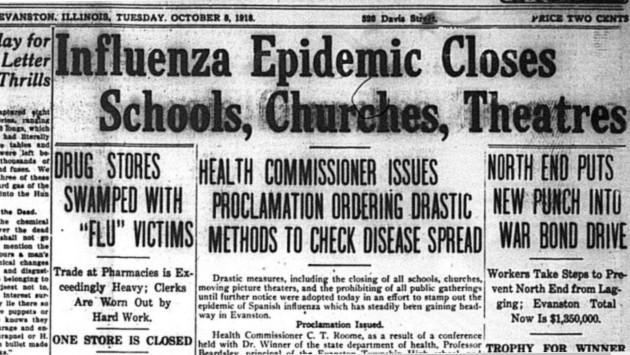
Of course this whole situation was due to a number of factors, all mentioned above, but the Great Flu was significant as it killed another 426,000 Germans on top of the war deaths. The H1N1 pandemic was just one of many factors that resulted in the eventual collapse of the the Weimar Republic, and it did not help the United States, which lost over 600,000 people to it.

Pandemics have direct and indirect effects. Some of those indirect effects are more deadly than the virus itself. I expect that will be the case in many countries as a result of the novel Coronavirus of 2019. It’s effects will be felt for many years to come. It is going to change the course of history, but God only knows how. But as for me, I cannot be a bystander. I must both speak out and care for those in my care and those infected or dying from this horrific pandemic. While doing this it is my full intent and purpose to live through it and to bear witness against those who let it happen.

Until Tomorrow,

Peace,

Padre Steve+


9 Comments

Filed under authoritarian government, Coronavirus, Diseases Epidemics and Pandemics, germany, History, leadership, Military, nazi germany, News and current events, us army

“Therefore Never Send to Know for Whom the bell Tolls, it Tolls for Thee” The Victims, Costs, and Threat of COVID-19


Friends of Padre Steve’s World,

On December 31st the Chinese Government reported the first death from nouveau Coronavirus 19, or COVID 19. By the end of January there were over 12,000 cases and 259 deaths. The first infected American arrived from China in the middle of January. At first, the American Government led by the Trump Administration paid little attention to it or downplayed its significance. It did that until the bottom began falling out of the stock markets, bond markets, and the oil market, the latter was not due to Coronavirus but the productions and price oil war between Saudi Arabia and Russia.

The Trump Administration finally labeled the situation a health emergency at the end of January, but did nothing to prepare.  Belatedly, it began to organize a response led by Vice President Pence at the end of February, but even still the President in his speeches and tweets continued to downplay the situation as members of his political, religious, and media cult amplified his message, until a week ago.

The day I wrote my first article about Coronavirus, March 8th there had been almost 110,000 cases and nearly 3800 deaths. That was an increase of 98,000 cases and over 3500 deaths in just 38 days.

Around midnight last night, there were nearly 198,500 cases and just shy of 8,000 deaths, 7,987 to be exact. So in ten days there were around 100,000 new cases, and close to 4200 new deaths. As of this evening there are a total of 218,721 cases, of which 125,392 are currently active. 93,329 are closed, meaning either recovery or death. Of the closed cases, 8,983 or 10% have died. This means there were over 20,000 new cases and almost 1,000 deaths since last night. Italy was hit hardest in the past day, over 4,200 new cases and 475 deaths.  In other European countries the numbers are spiking, and are about a week or two behind Italy in the progression of the disease.

Since last night the United States, in which testing capabilities are being expanded, there are now a total of 9,301 cases, with 2,890 of them being reported in the last day, and a total of 152 deaths, 43 since yesterday. Our numbers are about two or three weeks behind Italy, and despite the measures to quarantine, shut down, or shelter-in-place enacted by state and local governments there is no uniformity to those actions in light of the limited guidance or funding provided by Federal agencies.

In the United States, we were not prepared despite the warnings of experts that such a deadly pandemic would happen. The country was underprepared and unready for such a condition of affairs. Despite the recent flurry of action by Trump and his administration dithered and denied any real emergency or crisis for over two months, not taking precautions, not ramping up production of test kits, N-95 masks, surgical masks, other personal protective gear for first responders, hospital personnel, or nursing home workers, nor did it anticipate the need for anti-viral disinfectants, cleaners, or urge Americans to begin wearing surgical masks in order to mitigate the possible transmission of the virus.  Nor did it take of whole of government approach to the developing crisis until last week. Even with that move there is much confusion and bureaucratic infighting.

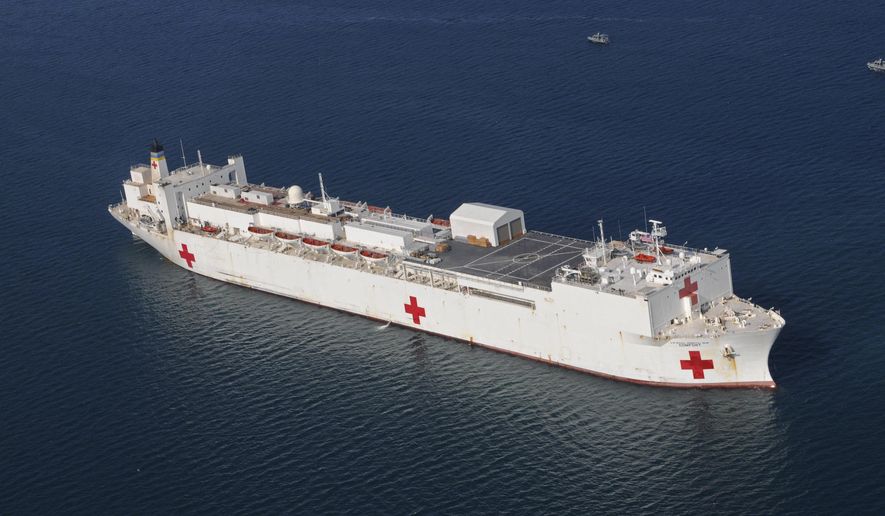
Frankly, most departments are still trying to make sense of what they need to do. Today the Navy was ordered to prepare the Hospital Ships USNS Comfort and USNS Mercy for deployment. Both are converted supertankers built in 1974 and 1975 before being purchased and converted and equipped as 1000 bed hospital ships in 1987. They are approaching 50 years old. They are equipped with operating rooms ICU beds, and medical and surgical wards, Radiology suites, and a full range of labs, but it takes a lot to staff them and make them ready to deploy. In addition to normal pre-deployment activities everyone deploying on them will need to be test for Coronavirus before they set foot on the ship to ensure that they do not become “plague ships.”  Comfort will deploy to New York, and Mercy to a yet to be determined West Coast metropolis. It will take at least a week, and probably more to make them ready to deploy. The crews of the ships are Merchant Marine Officers, deck, and engineering personnel, but the physicians, nurses, other providers, and technicians will leave their duty stations in Naval Hospitals and Clinics which are already at critical manning levels. They have to be augmented by activated Naval Reserve Medical personnel, Uniformed Public Health Service Officers, civilians employees of Navy Medicine and medical personnel from Humanitarian Service Organizations. There also has to be a Navy Security detachment, communications section, and an aviation detachment with its helicopters, as well as Chaplains and Mental Health Providers. These ships seldom deploy at the same time so the demands on Navy Medicine will be quite severe in Navy Medical Centers, Hospitals, and clinics.

Likewise, the administration ordered the activation of a number of mobile field hospitals. There are a number of types and sizes of such self-contained units which can be deployed by air sea, or ground. But like the Navy’s Hospital ships they draw almost all of their medical personnel from active duty hospitals, and mobilized reservists. Likewise,  the reserve and National Guard field hospitals depend on the very civilian health professions working in hospitals and private practices already dealing with the pandemic.

While China has flattened its infection and death curves due to its draconian police power to enforce the will of the government over the past few weeks, COVID-19 has spread across the globe. This includes all  50 U.S. States, Washington D.C., and Puerto Rico. The numbers are expanding exponentially in Europe and the United States, and today, two members of the House of Representatives announced that they had tested positive for the virus. With every passing day that curve will spike in the United States and Europe, and evidence in other countries suggest that a second wave of the virus is spreading in countries that did pretty well in the first wave.

On Friday, the President attempted to contain the damage with a press conference where he again minimized the threat, denied personal responsibility for anything, and then spoke to supporting financial markets, which briefly caused a rally on Wall Street, which collapsed as he and the administration began to acknowledge the truth of the matter and he turned the answering of medical, logistic, and disaster response to experts, such as Dr. Anthony Fauci, and even Vice President Pence seemed to eclipse Trump as more presidential. Over the weekend the President looked like a man who knew that he was in way over his head, even when he blustered and tweeted. Despite the actions being planned to mitigate the economic, public health, and personal costs of the virus, the damage was done. On Monday the stock markets took their heaviest losses ever, gained a little bit back Tuesday, and crashed again today.

Scrambling to find a way out of the situation the Administration and Congress, thanks largely to Speaker of the House Nancy Pelosi have been attempting to work out a stimulus bill which hopefully, would directly benefit all Americans, not just the banks, oil companies, and financial industries. Congress passed a measure to provide paid sick leave for all, and the Treasury Department is arguing for direct monetary payments to Americans who are now being hit with the full reality of an uncontrolled pandemic, massive business closures, job losses, and quarantine in some cities and states. The details of that are still to be worked out, but even that may not be enough to save some people from financial disaster.

Today the President used his authority to use the 70yearold Defense Production Act to force companies to make more respiratory ventilators, testing kits, and personal protective gear for medical personnel. But none of these measures can make up for the lack of ICU beds, General Medical beds, that are a feature of our mostly for profit medical industry. Hospitals have lost their ability to surge because maintaining an unused surge capacity is too expensive, until you really need it. Now, thirty years after the end of the Cold War, even the military medical system too has little surge capacity because like its civilian counterparts it has adopted the business models of civilian medical corporations.  Fewer staff, fewer beds, and less surge capacity.

The economy is taking massive hits, large numbers of the people who can least afford it are being laid off with little chance of going back to work anytime soon.

This is especially true of the airline, cruise, hotel, entertainment, hotel, and restaurant industries. In the restaurant industry nearly 15 million jobs are at stake, by the time it abates, there could be 50 million job losses in the hotel, restaurant, and entertainment sectors as local, state and the Federal government begin shutdowns of these businesses. Sadly most of the workers are living paycheck to paycheck, work for minimum wage and tips. Many are single parents, students, and people who chose the jobs because they liked dealing with people, or who were working to support themselves to get a better paying and more stable career. We know a lot of them. Good people, hard working people who constantly get screwed regardless of whether they work for large or middle sized companies who do not value them as people, or local restaurants which do not have large financial reserves, but it will expand as commercial food suppliers lose their corporate restaurant, entertainment, hotel and resort customers who will have no need of their supplies until the situation gets better.

Hopefully the measures being worked out will not only include direct payments to Americans, support for the restaurant, hotel, entertainment, and travel industries which employ far more people than the oil companies, and financial industries, as well as a provision for paid sick leave which is standard in most countries of the world.

But my friends, every one of these victims of Coronavirus and government incompetence is a real person. Many will recover from the virus but will suffer long term effects. Many will die, leaving behind friends, families, and holes in the community. Others, not infected by the virus will lose their jobs, businesses, or people that they love and care about. These people are not just numbers no matter what country or industry they live or work in. They are real live, men and women, sons and daughters, fathers and mothers, friends, co-workers, and acquaintances.

Behind every number there is a name, and a life connected to others. John Donne put it so well in his No Man is an Island:

“No man is an island, entire of itself; every man is a piece of the continent, a part of the main. If a clod be washed away by the sea, Europe is the less, as well as if a promontory were, as well as if a manor of thy friend’s or of thine own were: any man’s death diminishes me, because I am involved in mankind, and therefore never send to know for whom the bells tolls; it tolls for thee.”

For me and Judy, these are not numbers or statistics, they are friends, neighbors, and even family.

I am old enough to have worked as a hospital chaplain during two pandemics, and seen people die. I helped write the Army personnel policies for HIV infected personnel and worked with many so they could remain in the service back in 1987 and 1988. I worked in a homeless shelter for abysmal wages caring for those with less working for a board of 30 very well off members who didn’t value me as a person. I have been a company commander in the Army at the young age of 25 with just two years of active duty service before I took command. I have also done two combat tours, seen things most Americans have never seen, been shot at by rockets, machine guns, and small arms, all while unarmed. During this current pandemic I am essential personnel. A chaplain cannot telework. Ministry involves real contact with real people, in the flesh. This involves risks, I am almost 60, but I will take them but attempt to mitigate them in order to care for those who be they military.

The sad thing is that I will have friends and family members who will despite the overwhelming evidence downplay the situation, ignore it, or claim it to be “fake news.” Unfortunately, many will become victims of it or be the typhoid Mary’s of our day, spreading the virus without even knowing they have it.

Ignorance and negligence carry a heavy human price. As stupid and senseless as it may be to some, I have to speak out. As Sophie Scholl, who died as a peaceful resistance leader at the hands of the Nazis when she was just twenty-two years old wrote:

“The real damage is done by those millions who want to ‘survive.’ The honest men who just want to be left in peace. Those who don’t want their little lives disturbed by anything bigger than themselves. Those with no sides and no causes. Those who won’t take measure of their own strength, for fear of antagonizing their own weakness. Those who don’t like to make waves—or enemies. Those for whom freedom, honour, truth, and principles are only literature. Those who live small, mate small, die small. It’s the reductionist approach to life: if you keep it small, you’ll keep it under control. If you don’t make any noise, the bogeyman won’t find you. But it’s all an illusion, because they die too, those people who roll up their spirits into tiny little balls so as to be safe. Safe?! From what? Life is always on the edge of death; narrow streets lead to the same place as wide avenues, and a little candle burns itself out just like a flaming torch does. I choose my own way to burn.”

Nothing is safe now. The fantasy world that we lived in since the fall of the Berlin Wall is over. Pandemics and economic crashes are real, as is the potential for military conflict over areas of vast natural resources, and regions where ancient racial and religious scores are still aching to be settled.

Those are unpleasant facts, and until a vaccine is available that can treat the disease, we have to flatten the rate of infection, and the best way to do that is to  practice appropriate levels of  social distancing. The includes attempting to maintain a six foot separation, no hand shaking, and not going to work if you are sick. Actions taken by various, state, county, and local governments, include closing schools and universities and moving to online education, canceling large festivals, shows, and sporting events, and the voluntary shutting down of professional sports leagues, and prestigious tournaments. In response to these measures many restaurants, hotels, and entertainment centers have had to shut down, or limit services.

We were in a locally owned restaurant with a bar tonight when police entered the establishment to make sure that it was observing the state set number of no more than ten patrons inside. The manager on duty was warned and the three or four excess patrons, most who had been there a long time paid up and left. Once the people left the restaurant, the manager locked the door to ensure that no excess people would enter without a corresponding number leaving. The penalty after the warning would have been a $5,000 fine. The place will either set strict limits and hire security to enforce it, or shift to take out.

As we drove around our Town Center, all the major restaurants were closed. They cannot remain open except for take outs or delivery. Many other restaurants that depend on the volume of customers to make a profit are closed. In our area alone thousands of restaurant employees have been laid off. Likewise, movie theaters, museums, zoos, and concert venues shut down. Outside of our area both GM and Ford have shut down their American assembly plants, laying off thousands of workers, airlines have cut back the number of flights and at least one has shut down all of its overseas services. On Sunday I drove by a local mega church which had empty parking lots because they were being responsible and cancelled their services. That was a strange sight.

With people losing their jobs at such a rapid rate there is a likelihood that the rising real estate market could also suffer price devaluation, and while HUD has banned evictions or foreclosures until the end of April, the market could crash as it did in 2008.

As the disease begins to impact the military, infect service members, their families, and our Civilian Workers, it will degrade readiness. Important exercise with allies have already been cancelled, and soon deployments could be impacted, even if military action is required. Transfers are all now on hold, temporarily duty for schools, command visits, inspections, and other operations are now suspended unless they have a direct impact on combat operations. The movement of trainees to their new duty stations or technical schools is now suspended. New recruits cannot go into training and within weeks the effects will be felt throughout the military.

The President called this a wartime situation. If it really is he should declare a Stop Loss to keep as many military personnel ready in case of conflict. Worldwide economic crises often trigger insanely violent nationalistic movements, and subsequent wars. The possibility of that becomes greater as countries become unstable, and local conflicts could quickly become regional conflicts involving open, and undeclared enemies of the United States attacking our friends, allies, and vital interests in the world, which include natural resources not available in the United States, and yes, those include materials used in products that we all depend on.

I started this last night but was too tired to finish it. Hopefully this will help my readers better understand the very real impact that this virus will have on our society. It knows no class, profession, religion, ethnic, political, or racial division. A lot of people will be infected, and many will die. By the time it passes it will probably impact every one of us, if not directly, but because of it sickening and killing relatives and friends, or impacting our personal lives in terms of employment, earnings, and maybe even how we live.

I do a lot of listening, and I hear a lot of conspiracy theories spouted by people who know nothing of this virus, nothing of the powers of local, state and the Federal government in time of national emergency that it is useless to try to convince them that they are wrong.  Most of the time I I listen but don’t comment because I realize that it won’t do any good.

But I am done for tonight. I could write a lot more, and probably will do weekly updates on this crisis.

So until tomorrow, be careful out there.

Peace,

Padre Steve+


6 Comments

Filed under Diseases Epidemics and Pandemics, ethics, Foreign Policy, History, laws and legislation, leadership, Military, national security, natural disasters, Navy Ships, Political Commentary, state government agencies, us army, US Navy

“How Hollow is the Sound of Victory without Someone to Share it with? Honor Gives Little Comfort to a Man Alone in his Home… and in his heart.” Thoughts on Valentine’s Day from a Klingon Perspective


Friends of Padre Steve’s World,

Well it is Valentine’s Day and I think that it completely appropriate to talk about love. Now I know that this particular day brings up a lot of good as well as bad memories. If someone is in the middle of a divorce, break up, or just simply is alone it can be a painful experience. On the other hand if you have discovered love, are in love, or even hopelessly infatuated by someone despite the reality that you might be rejected by them it can be a special, and maybe even an expensive day.

However, some of us get lucky and Cupid, the flying naked kid armed with a bow and arrow, shoots us in the ass one day and we discover that one true love. That happened to me in September of 1978 when I met Judy. I fell in love with her that night, but it took a while to develop. We are coming up on our 37th marriage anniversary this June, 6 days after my projected retirement ceremony, which is exactly 37 years after I was commissioned as an Army Second Lieutenant on June 19th 1983. My career in the military, in the Army and Navy has been difficult on her, especially after I came home from various deployments and combat deployments. Though I am now, and have been a chaplain since 1992, I have always been a warrior and soldier at heart, even when unarmed on combat deployments and getting shot at. Thus I find that I am very much attracted to the Klingons in Star Trek the Next Generation and Deep Space Nine, because it is in those series we discover just how complex Klingon culture, traditions, and religious beliefs are. Thankfully for me Judy shares my love of Star Trek, especially DS9. 

So I was thinking about what to do for her this Valentine’s Day as for much of my life I have been pretty lousy at giving her the attention and honor she is due, especially things like Valentine’s Day, birthdays and anniversaries. No doubt, though a faithful husband, I pretty much have been at the Mendoza Line when it comes to romance. Part of this is because of the fact that for close to half of our marriage I have been away from home, and came back pretty messed up from war.

When I was going through my Clinical Pastoral Education Residency at Parkland Memorial Hospital in Dallas following Seminary, that my CPE Supervisor, Steve Ivy was able to connect my compartmentalization of my emotions with Lieutenant Worf, the Klingon Security Officer of the Enterprise in Star Trek the Next Generation played by Michael Dorn, who reprised the role in Star Trek Deep Space Nine. For me that was an eye opening experience. Though I was by that time an ordained minister, and two years later a Priest, I was always a warrior at heart, wanting, desiring, and volunteering time and time again for dangerous assignments. My first 17 1/2 years in the military were in the Army National Guard, active Duty Army, and Army Reserve, and even though I was mobilized to support Operation Joint Endeavor, the Bosnia Peace Enforcement mission, but in a purely support role. I was not until I entered the Navy, taking off my rank as a Major in the Army Reserve to return to active duty as a Navy Lieutenant in February 1999, and the attacks of 9/11/2001 that I got my chance for action at sea in 2002 in Operation Enduring Freedom and the UN Oil Embargo on Iraq in 2002, where I served as an “advisor” to a boarding team, numerous trips to Marine Security Forces in the Middle East from 2003 to 2006, and service in Iraq from 2007 to 2008 with the Advisors of the Iraq Assistance Group in Al Anbar Province, from the Syrian Border to Fallujah and about everywhere in between. It was an amazing combat tour, mostly outside the big bases, working with small teams of American advisors and Iraqi Army, Police, and Border forces. It was the best and most rewarding of tours of my career, but I came back changed. Since I have written about those experiences many times, I won’t go into details, but if I could have remained in Iraq supporting the advisors I would have stayed on indefinitely, and would have gone back given the chance. I left a lot of my soul in Iraq and I pray for the Iraqis, soldiers and civilians alike, who befriended me as the man they called the American Imam. But I digress…

But back to the Klingons, love, marriage, and Valentine’s Day. In one of the early Next Generation episodes Lieutenant Worf is asked by young Wesley Crusher what Klingon courtship is like. Worf replied:

I will sing Klingon love poems while she throws furniture. I duck a lot.

So today I posted a quote from DS9 on my Facebook timeline this morning while waiting at the Medical Center pharmacy. It was from an episode titled Looking for par’Mach in All the Wrong Places where the Ferengi Bartender, Quark ends up helping his Klingon ex-wife Grilka to deal with the financial situation of her House, which he helped her to gain following the death of her husband. Quark is forced to do battle with Grilka’s bodyguard who cannot abide a Ferengi being part of her house. The bodyguard issues a challenge which Quark could never match without help, which Worf and Jadzia Dax give him, but there is a technical glitch and to stall for time Quark issues a supposed Ferengi tradition, which he invented on the spot, The Right of Proclamation, a speech about his love for Grilka:

To this end my blade soars through the
aquarium of my soul seeking the
kelp of discontent which must be cut so that the
rocky bottom of love lies in waiting, with fertile
sand of the coming seed of Grilka’s
affection.
And yet, does this explain my need for her? No. It is like
oh, a giant cave of emptiness waiting for
the bats of love to hang by –

Judy responded by telling people that she would look at my medication list and look for side effects, and that people could direct message her. It was a perfect riposte.

But Quark’s words are those are the words of a Ferengi, not a Klingon, though Quark gave it his best. As Worf gets ready to marry Jadzia, she has to be approved by the matriarch of the House of Martok, and she makes Jadzia’s life hell.

But Martok encourages Worf, saying:

We are not accorded the luxury of choosing the women we fall in love with. Do you think Sirella is anything like the woman I thought that I’d marry? She is a prideful, arrogant, mercurial woman who shares my bed far too infrequently for my taste. And yet… I love her deeply. We Klingons often tout our prowess in battle, our desire for glory and honor above all else… but how hollow is the sound of victory without someone to share it with? Honor gives little comfort to a man alone in his home… and in his heart.” 

When Jadzia successfully passes the tests of Martok’s wife Sirella, the traditional Klingon wedding takes place in Quark’s bar on DS9. The traditional Klingon marriage includes the Klingon creation story, which is enacted by the bride and groom. It certainly is not a Christian understanding of creation, but it does encapsulate the depth of love between two people:

With fire and steel did the gods forge the Klingon heart. So fiercely did it beat, so loud was the sound, that the gods cried out, ‘On this day we have brought forth the strongest heart in all the heavens. None can stand before it without trembling at its strength.’ But then the Klingon heart weakened, its steady rhythm faltered and the gods said, ‘Why have you weakened so? We have made you the strongest in all of creation. And the heart said ‘I am alone.’ And the gods knew that they had erred. So they went back to their forge and brought forth another heart. But the second heart beat stronger than the first, and the first was jealous of its power. Fortunately, the second heart was tempered by wisdom. ‘ If we join together, no force can stop us.’ And when the two hearts began to beat together, they filled the heavens with a terrible sound. For the first time, the gods knew fear. They tried to flee, but it was too late. The Klingon hearts destroyed the gods who created them and turned the heavens to ashes. To this very day, no one can oppose the beating of two Klingon hearts… 
After either courting each other or being married for over forty years I think that Judy and I are a lot like Klingons. I am the proud, yet damaged warrior, she is the proud and faithful wife, and after all these years our hearts beat together.

This may not make a lot of sense to some readers, unless you are true Star Trek nerds, not that there is anything wrong with that.

The thing is that for all its commercialization, and despite the pain that often accompanies love, that Valentine’s Day is a celebration of love between two people, when their hearts beat together. One of my office mates lost his wife of 38 years two and a half years ago. If someone had not told me that he was a widower, it would be hard to guess it. When we talk about life, music, television, life, and family, he speaks of her in such a way that I know that his love for her did not die when she did. Their hearts still beat as one, and I love that, I wish I had actually met her. But, he has his son and other relatives in the local area and still lives a rich life, he is happy, and is still in love with her.

I hope and pray that everyone gets to experience that kind of undying love.

Until tomorrow,

Peace,

Padre Steve+


2 Comments

Filed under iraq, life, marriage and relationships, Military, PTSD, star trek, televsion, Tour in Iraq, us army, US Navy, War on Terrorism

When the President Calls Military Officers Traitors: Trump, LTC Vindman, and the Testimony of Colonel Johannes Steinhoff

Friends of Padre Steve’s World,

Yesterday, the Commander in Chief, after removing Lieutenant Colonel Alexander Vindman from his post in the National Security Council, and having him escorted out of the White House, something designed to humiliate the combat wounded officer, made an announcement that Vindman should be prosecuted by the military for obeying his oath of office, also known as not giving absolute personal loyalty to the President. The action by the President is unprecedented in American history. It is the act of an man unleashed from the law, the the Constitution, and the institutional guardrails placed by the Founders to prevent an authoritarian regime from taking control of the country.

I have written a lot about the dehumanization of people and genocide, and some of the things that create a climate where such events take place, and how political and religious leaders stir the primal passions of otherwise good, decent and law abiding citizens. I have written about some of my favorite resistance figures in history. But that being said writing about the anti-Nazi resistors caused me to go back are re-read a book by World War II German Luftwaffe ace Johannes Steinhoff.

Steinhoff was unlike many of the German officers who wrote memoirs following the war, memoirs that historian Williamson Murray wrote “fell generally into two categories; generals writing in the genre of “if the fuhrer had only listened to me!” and fighter pilots or tank busters writing about their heroics against the productive flood from America or the primitively masses of the Soviet Union.”

Steinhoff’s book, The Final Hours: The Luftwaffe Plot Against Goering should be essential reading for any currently serving officer, diplomat, Federal law enforcement, intelligence, or Department of Justice official  as the Trump administration becomes more established and capricious.

steinhoff6

General Johannes Steinhof (above) as a Bundeswehr and NATO officer, showing his burns and before his crash (below)

steinhoff WW II

In his books, Steinhoff does something that you do not see authors do in most military or political memoirs, he actually does serious self reflection on his role in supporting an evil regime. In his introduction to his book The Final Hours the legendary fighter ace who was horribly disfigured when his Me-262 jet fighter crashed and burned two weeks prior to the end of the war wrote:

“In recalling these events, which had been long buried in my memory, it has not been my intention to make excuses. Our unconditional self-sacrifice in the service of the Third Reich is too well documented for that….

So it is because of what is happening today—with freedom threatened in virtually every respect by its own abuse—that I offer this contribution, in the form of an episode in which I was myself involved, to the history of the soldier in the twentieth century. Soldiers have always, in every century of their existence, been victims of the ruthless misuse of power; indeed, given the opportunity, they have joined in the power game themselves. But it fell to our own century to accomplish, with the aid of a whole technology of mass extermination, the most atrocious massacres in the history of mankind. This fact alone makes pacifism a philosophy worthy of respect, and I have a great deal of sympathy with those who profess it. 

The figure of the soldier in all his manifestations is thus symptomatic of the century now nearing its close, and it is to the history of that figure that I wish to contribute by describing what happened to me. I have tried to show what it is possible to do to men, how insidiously they can be manipulated by education, how they can be hoisted onto a pedestal as “heroes,” how they can be so corrupted as even to enjoy the experience—and how they can be dropped and denounced as mutineers when they discover that they have scruples. The complete lack of scruples that such treatment implies is peculiar to rulers who believe that the problems of their own and other peoples can be solved by imposing, through the use of military force, peace on their, the rulers’, terms—in our case a pax germanica, but the second Latin word is readily interchangeable.” from “The Final Hours: The Luftwaffe Plot Against Goring (Aviation Classics)” by Johannes Steinhoff

Since I am a historian and and a career military officer with service in the Iraq War, a war that was illegal and unjust by all measure I can understand Steinhof’s words. Because much of my undergraduate and graduate work focused on German history, particularly that of Imperial Germany after the unification, the Weimar Republic, and the Nazi Reich, I draw a lot of lessons from the period. I also understand how people in this country can fall for the same kind of vitriolic propaganda that the Germans of that era did. I can understand because for years I fell for the lies and propaganda being put out by the politicians, pundits and preachers of the American political right.

In fact I wrote about an incident that happened to me in my own chapel where a dedicated Trump supporter attempted to have me charged with Conduct Unbecoming an Officer and Contempt for the President.  He did this because I used biblical preaching backed by sound theology and history to condemn the President’s comparison of immigrants of darker skin colors as “animals” and an “infestation.” I compared those words with the way Hitler and other totalitarian leaders used such terminology to dehumanize their victims. As I mentioned I was completely cleared by the preliminary inquiry but it sends a chill through my spine.

10665323_10154041610267059_5277331492232210946_n

A picture of me (on left) in Iraq 2007 with my assistant and bodyguard RP1 Nelson Lebron

One of those lessons is that in times of crisis, that people, no matter what their race, culture, religious belief system, educational, or economic background are still human. Humanity is the one constant in all of history, our prejudices are often ingrained in us during childhood and reinforced by the words of politicians, pundits, and preachers. In times of stress, crisis, and societal change or upheaval even good people, moral people, people of great intellectual, scientific abilities can fall prey to demagogues who preach hate and blame others, usually racial, ethnic, or religious minorities, as well as civil libertarians who champion the rights of those minorities for the problems of the nation.

Shrewd politicians, preachers, and pundits do this well. They demonize the target group or population and then let the hatred of their disaffected followers flow. The leaders need that disaffected and angry base in order to rise to power; such was how Hitler, Stalin, and so many other despots gained power. They took advantage of a climate of fear, and found others to blame. For Hitler it was the Jews, Slavs, Socialists and Communists; while for Stalin it was various groups like the Ukrainians, or the Poles who were the devil to be feared and destroyed. Timothy Snyder in his book Bloodlands: Europe Between Hitler and Stalin wrote:

“Dead human beings provided retrospective arguments for the rectitude of policy. Hitler and Stalin thus shared a certain politics of tyranny: they brought about catastrophes, blamed the enemy of their choice, and then used the death of millions to make the case that their policies were necessary or desirable. Each of them had a transformative utopia, a group to be blamed when its realization proved impossible, and then a policy of mass murder that could be proclaimed as a kind of ersatz victory.”

But that being said, there are a lot of people who from childhood believe the lies about others without question. In good times such people continue on with life as normal, but in crisis those hatreds and prejudices come to the fore. Rudolf Höss, the notorious sociopath who commanded Auschwitz told American Army psychologist Gustave Gilbert about his reaction when ordered to turn the camp into an extermination center. He said that the order “fitted in with all that had been preached to me for years,” and “at the same time I didn’t think of it as propaganda, but as something one just had to believe.” 

Eugene Davidson in his book on the Nuremberg Trials wrote:

“Every society has in it at all times negative, criminal, sadistic, asocial forces. What holds them in check more than law and police is the consensus of the society – a general belief that despite everything wrong and stupid and muddleheaded in politics, the state is a going concern that will somehow make its way into the future.” (Davidson, The Trial of the Germans p.581)

But when things do not go well, when people do not feel that things will be okay, that the future will be better, and that they have a purpose they look for answers. However, they tend to find their answers in the rantings of demagogues, race baiters, conspiracy theorists, and others who they would tend to dismiss out of hand in good times. In Germany it was the loss of the First World War, the humiliation of Versailles and the economic chaos and social change of the Weimar period which allowed Hitler to gain an audience, then a following, then political power. The demagogues played to what was already in the hearts and minds of the disaffected masses, without that fertile soil, the rantings of Hitler and his propagandists would have never succeeded. Albert Speer wrote:

“As I see it today, Hitler and Goebbels were in fact molded by the mob itself, guided by its yearnings and its daydreams. Of course, Goebbels and Hitler knew how to penetrate through to the instincts of their audiences; but in the deeper sense they derived their whole existence from these audiences. Certainly the masses roared to the beat set by Hitler’s and Goebbels’ baton; yet they were not the true conductors. The mob determined the theme. To compensate for misery, insecurity, unemployment, and hopelessness, this anonymous assemblage wallowed for hours at a time in obsessions, savagery and license. The personal unhappiness caused by the breakdown of the economy was replaced by a frenzy that demanded victims. By lashing out at their opponents and vilifying the Jews, they gave expression and direction to fierce primal passions.”

In a sense a similar thing has happened in the United States which has experienced a series of wars beginning with Vietnam, the shock of the 9-11-2001 attacks, the economic crash of 2007 and 2008 which devastated the savings, home ownership, and investments of many Americans while at the same time benefiting the banking and brokerage houses whose government assisted policies brought about the crash. Of course there are other issues, many religious conservatives hate the progress made by the Women’s and Gay Rights movements, and their leaders play to their fears in apocalyptic terms. I could go on, but I am sure that my readers can identify other issues which demagogues and others use to spread fear and hate to further their goals. The fact is that without the the fertile soil that lays in the hearts of their most fervent followers they would never have a following.

In Weimar Germany hate mongers like Julius Streicher and propagandist Josef Goebbels stuck a chord with disenchanted people who felt that they had lost their country. They were fearful, angry, and desired a leader who would “make Germany great again.” Hitler and his Nazi media sycophants played to that fear, and took advantage of their anger at the existing order. Davidson wrote such people “exist everywhere and in a sick society they can flourish.” 

For decades the way has been prepared for true extremists to take advantage of the fears and doubts of people as modern American versions of Streicher and Goebbels have been at work for years. Rush Limbaugh was a modern pioneer of this in the United States, and he has been joined by so many who are even more extreme in their rantings that it is hard to name them all. Likewise, whole media corporations especially Fox News, websites, and political networks spread such fear every minute of the day, claiming that they, and they alone are real Americans. They actively support politicians who condemn, and sometimes even threaten people who oppose them, and all the while claim that “make America great again.”

When I was younger I devoured that propaganda, despite all of my learning I followed the rantings of men who I realize today are propagandists who promote the basest of lies, and hatred, often in the name of God. I was changed when I was at war, and when I returned home from Iraq in 2008 I realized through hard experience that I had been lied to, and that as a result that thousands of my brothers and sisters were dead, and tens of thousands shattered in body, mind, and spirit. Likewise I saw the massive destruction levied on Iraq and realized how terrible war really is. That was my epiphany, that is what it took to see how much I had been lied to, and it called me to question everything else that I had so willingly believed, things which had been fed to me by years of indoctrination in church, through the media, and by politicians who I believed were truly Christian. I can understand now how Martin Niemoller felt after the Nazi seizure of power when he said, “I hated the growing atheistic movement, which was fostered and promoted by the Social Democrats and the Communists. Their hostility toward the Church made me pin my hopes on Hitler for a while. I am paying for that mistake now; and not me alone, but thousands of other persons like me.”

There was a time that I hated people who espouse the views that I hold today, the views that I write about so often here on this site. I can remember how angry I would get as I listened to the propaganda being put out by Limbaugh, Hannity, the Fox News Channel and all of the others that I listened to every time that I had the chance. But when I changed after Iraq, I felt the sting of that hatred in very real ways. I remember the day I was called by my bishop in my former church, who told me that I had to leave because my views on women, gays, and Moslems were to use his words were now “too liberal.” After that, many men who I considered to be the best of friends turned their backs on me, some in the most bitter and vindictive of ways.

But I realize now that what they did was because I had in a sense left the cult, and had to be ostracized. I can understand that now, because when I was under the spell I too turned my back on people who had fallen out of favor, or people who had rejected the tenants of the church or the political movement, and those are things that I can never undo. But at the time it made sense, it fitted in with all I had been taught for decades, as Albert Speer wrote of Hitler, “One seldom recognizes the devil when he is putting his hand on your shoulder.”

What happened to Steinhoff’s generation is threatening to happen again, in our country, an authoritarian movement is threatening to destroy our democracy and republic. In it soldiers are esteemed, until they realize what is going on and speak out, but by then it is usually too late. I am understanding that fact more and more every day, and having had people troll this blog and call me a traitor and worse, I understand just a bit of what happened to Steinhoff and his fellow officers when they protested to the highest levels what was happening to Germany in early 1945.

In 1944 he and other fighter pilots were subjected to a political indoctrination session and realized that in the Nazi state loyalty and doctrinal purity to Naziism was more important than either combat service or competence. He wrote:

“Now, however, we realized to our horror that a group of officers had decided, after five years of war, to conduct a purge among the troops with the object of eliminating all those “whose past life and present conduct were not consonant with the National-Socialist type” and who did not “stand firm on National-Socialist principles.” We sat there petrified, but some of those present appeared hugely to enjoy the ensuing discussion of what they called “National-Socialist guidelines.” Perhaps, though, for many it was simply an attempt to escape into a less concrete area of discussion than the desperate military situation—and then there was the added satisfaction of being able to censure others. Fanaticism took the place of hopelessness, and phrases like “faith in the Führer,” “rootedness in National-Socialist ideology,” and “irreproachability of character” fell without hesitation from people’s lips. The Luftwaffe leadership, it was said, must be “combed” from top to bottom, and then someone even came out with the “National-Socialist soul…”

We will soon know how military professionals react to being labeled as traitors. President Trump and his followers have been demonizing the personnel of the nation’s intelligence, law enforcement, and diplomatic communities since before the election. The President lambasts critics of any station on his Twitter feed which results in them receiving death threats from his followers. I expect that when Secretary of Defense James Mattis speaks his mind and tells the truth that we will find out.

Personally I expect that when he does that Trump and his most strident supporters will label him as a traitor for doing so. Like a religious cult they have no capacity to tolerate dissent, loyalty to the man will supersede loyalty to the country or the Constitution. When that happens it will be interesting to see the throngs of people in the military and outside of it who make the choice to throw one of the most courageous, selfless, and intellectual soldiers ever produced by our nation under the bus.

Their’s will be a conscious decision. My opinion is that the Constitution and the country will always come first. I wanted to give the President the benefit of the doubt and prayed that he world do the right thing for the country. But I was wrong. I am concerned because of his past and current behavior that his only loyalty is to himself. General Ludwig Beck, who resigned rather than obey Hitler’s order to invade Czechoslovakia in 1938 and died in the anti-Hitler coup attempt in 1944 said:

“It is a lack of character and insight, when a soldier in high command sees his duty and mission only in the context of his military orders without realizing that the highest responsibility is to the people of his country.” 

With all the firings, resignations and shuffling done by the President at the Defense Department, I am less sure than ever of senior officers and civilian leaders in the Pentagon will due with the direct threat directed by the President at Lieutenant Colonel Vindman. Over the past three years I have have many doubts about many of our leaders: be they military, political, business, or religious, than I have ever had in my life and military career. It seems that there are many people who will sell their souls for their personal advancement, the advancement of their agenda, or an increase in their bottom line. It is after all human nature.

At Nuremberg, Hermann Goering was asked by Gustave Gilbert as to “why he and the others had been such abject “yes men,” Goering replied: “Please show me a ‘no man’ in Germany who is not six feet under the ground today.” Goering, who was exceptionally intelligent and talented subordinated himself to Hitler and while not completely correct in regards to the fate of all the “no men” completely understand the principle of unconditional personal loyalty to his leader, which makes the actions of men like Johannes Steinhoff much more remarkable.

But the question is: will we see true men and women of courage who will stand when it appears there is no chance of success? As Atticus Finch said in To Kill a Mockingbird: “Real courage is when you know you’re licked before you begin, but you begin anyway and see it through no matter what.” 

That will be what is demanded in the coming months and years.

Peace

Padre Steve+

9 Comments

Filed under civil rights, ethics, History, leadership, Military, nazi germany, News and current events, Political Commentary, us army, world war two in europe

Military Civil Rights Pioneers, Buffalo Soldier & the Red Tail: Benjamin O. Davis Senior and Junior

Benjamin_o_davis

Brigadier General Benjamin O Davis in France 1944

Friends of Padre Steve’s World,

In his I Have a Dream speech Dr. Martin Luther King Jr. gave all of us a vision of what can and in spite of what I see going on today will be the future of the people of this country:

“I have a dream that my four little children will one day live in a nation where they will not be judged by the color of their skin, but by the content of their character.”

American History would not be the same without the life, work and prophetic ministry of Dr. Martin Luther King Jr. Dr. King was born in a time when most of the country was segregated when “separate by equal” was simply façade to cover the lie that in no way did African Americans have equal rights or privileges in the United States.

Dr King was born less than 60 years after the secession of the Southern states from the Union and the beginning of the American Civil War. Though that blood conflict had freed the slaves it had not freed African Americans from prejudice, violence and discrimination.  When Dr. King began his ministry and was thrust upon the national stage as the strongest voice for equal rights and protections for blacks the discrimination and violence directed towards blacks was a very real and present reality in much of the United States.

However there were cracks beginning to appear in the great wall of segregation in the years preceding Dr. King’s ascent to leadership as the moral voice of the country in the matter of racial equality. In baseball Jackie Robinson became the first African American player in Major League Baseball opening a door for others who would become legends of the game as well as help white America begin its slow acceptance of blacks in sports and the workplace.

Likewise the contributions of a father and son Brigadier General Benjamin O. Davis Sr. and General Benjamin O. Davis Jr. were advancing the cause of blacks in the military which eventually led to the desegregation of the military in 1948.  The impact of these two men cannot be underestimated for they were trailblazers who by their lives, professionalism and character blazed a trail for African Americans in the military as well as society.

Benjamin O. Davis Sr. was a student at Howard University when the USS Maine exploded and sank in Havana Harbor.  He volunteered for service and was commissioned as a temporary 1st Lieutenant in the 8th United States Volunteer Infantry. He was mustered out of service in 1899 but enlisted as a private in the 9th United States Cavalry one of the original Buffalo Soldiers regiments.  He enlisted as the unit clerk of I troop of 3rd Squadron and was promoted to be the squadron Sergeant Major.

Davis was commissioned while the unit was deployed to the Philippines and assigned to the 10th Cavalry.  He was assigned in various positions throughout his career including command, staff and instruction duties including as Professor of Military Science and Tactics in various ROTC programs.  He reached the rank of rank of temporary Lieutenant Colonel and Squadron Commander of 3rd and later 1st Squadron 9th Cavalry from 1917-1920 in the Philippines before reverting to the rank of Captain on his return as part of the post World War I reduction in force.

Davis continued to serve during the inter-war years and assumed command of the 369th Infantry Regiment New York National Guard in 1938. He was promoted to Brigadier General on 25 October 1940 becoming the first African American elevated to that rank in the United States Army and was assigned as Commander 4th Brigade 2nd Cavalry Division. He later served in various staff positions at the War Department and in France and was instrumental in the integration of the U.S. Military. He retired after 50 years service in 1948 in a public ceremony with President Harry S. Truman presiding. He was a member of the American Battle Monuments Commission from 1953-1961 and died in 1970.

davis-3

Colonel Davis with his son Cadet Benjamin O Davis Jr.

His son Benjamin O. Davis Jr. was appointed to West Point in 1932.  He graduated and was commissioned in 1936 graduating 35 out of 278, the fourth African American graduate of West Point. During his time at the Academy most of his classmates shunned him and he never had a roommate.  Despite this he maintained a dogged determination to succeed.  The Academy yearbook made this comment about him:

“The courage, tenacity, and intelligence with which he conquered a problem incomparably more difficult than plebe year won for him the sincere admiration of his classmates, and his single-minded determination to continue in his chosen career cannot fail to inspire respect wherever fortune may lead him.”

He was denied entrance to the Army Air Corps because of his race and assigned to the Infantry first to the all lack 24th Infantry Regiment at Ft Benning where he was not allowed in the Officers Club due to his race. Upon his commissioning the Regular Army had just 2 African American Line Officers, 2nd Lieutenant Davis and his father Colonel Davis.

After completion of Infantry School he was assigned as an instructor of Military Science and Tactics and the Tuskegee Institute.  In 1941 the Roosevelt Administration moved to create a black flying unit and Captain Davis was assigned to the first black class at the Tuskegee Army Air Field and in March 1942 one his wings as one of the first 5 African Americans to complete flight training.

In July 1942 the younger Davis was assigned as Commanding Officer of the 99th Pursuit Squadron which served in North Africa and Sicily flying Curtiss P-40 Warhawks. He was recalled to the United States in September 1943 to command the 332ndFighter Group. However some senior officers attempted to prevent other black squadrons from serving in combat alleging that the 99th had performed poorly in combat. Davis defended his squadron and General George Marshall ordered an inquiry which showed that the 99th was comparable to white squadrons in combat and during a 2 day period over the Anzio beachhead the pilots of the 99thshot down 12 German aircraft.

davis Library of congress photo public domain

Colonel Benjamin O Davis Jr (left) with one of his Tuskegee Airmen

Davis took the 332nd to Italy where they transitioned to P-47 Thunderbolts and in July 1944 to the P-51 Mustang which were marked with a signature red tail. During the war, the units commanded by Davis flew more than 15,000 sorties, shot down 111 enemy planes, and destroyed or damaged 273 on the ground at a cost of 66 of their own planes.

Tuskegee_01

Their record against the Luftwaffe was outstanding and their protection of the bombers that they escorted was superb with very few bombers lost while escorted by them men that the Luftwaffe nicknamed the Schwarze Vogelmenschen and the Allies the Red-Tailed Angels or simply the Redtails. Davis led his Tuskegee Airmen to glory in the war and their performance in combat helped break the color barrier in the U.S. Military which was ended in 1948 when President Truman signed an executive order to end the segregation of the military. Colonel Davis helped draft the Air Force plan and the Air Force was the first of the services to fully desegregate.

ltgen Benjamindavis

Lieutenant General Benjamin O Davis Jr

Colonel Davis transitioned to jets and led the 51st Fighter Interceptor Wing against Chinese Communist MIGs in the Korean War.

Davis Leading a Flight of F-86 Super Sabers in Korea 

He was promoted to Brigadier General in 1954 and served in numerous command and staff positions. He retired in 1970 with the rank of Lieutenant General and was advanced to General while retired by President Clinton in 1998.  He died in 2002 at the age of 89.

The legacy of Benjamin O. Davis Senior and Benjamin O. Davis Junior is a testament to their character, courage and devotion to the United States of America. They helped pioneer the way for officers such as General Colin Powell and helped change this country for the better.  During times when discrimination was legal they overcame obstacles that would have challenged lesser men.  Benjamin O. Davis Junior remarked:

“My own opinion was that blacks could best overcome racist attitudes through achievements, even though those achievements had to take place within the hateful environment of segregation.”

Such men epitomize the selfless service of so many other African Americans who served the country faithfully and “by the content of their character” triumphed over the evil of racism and helped make the United States a more perfect union. That may seem threatened today with the open display of White Supremacy movements which are now openly being supported by many Republican politicians, at all levels of government. However, it was worse before and in the words of the old spiritual, “we shall overcome.” In days like ours it may seem not to be the case, but we must persevere.

Peace

Padre Steve+

Leave a comment

Filed under civil rights, History, Korean Conflicts, laws and legislation, Military, News and current events, Political Commentary, racism, us army, US Army Air Corps, world war two in europe

Fighting For Emancipation and Equality: The Black Soldiers of the Civil War

Friends of Padre Steve’s World,

February is Black History Month, it’s something that no American of any race, color, or creed should forget. African Americans, the decendants of slaves and slaves themselves fought for freedom that was only at best was in the promissory note of the Emancipation Proclamation.

Those men, and women in the case of Harriett Tubman and Sojourner Truth, paved the way for freedom for African Americans and all others who benefited from what they fought for: women, Native Americans, Mexican Americans, and other Hispanics, Asian Americans, and LGBTQ Americans. That promise being made then, must be kept today, to the descendents of  this men, as well as all who benefited through their sacrifice: even the Southern Whites who at the time did not know then, or all too often today, that they too needed emancipation.

This article is a section of one of my yet unpublished Civil War books in which I spend much time dealing with the importance of emancipation and the role of Black soldiers during the American Civil War. I think it is important to remember as we get ready to close out Black History Month just how important these men are to American history and for the civil rights of all Americans.

Emancipation and the U.S. Military

HD_4USCinfantryDetail.preview

Men of the 4th Regiment of U.S. Colored Troops

The war brought about another change to warfare in America. This was a societal and political change that has shaped American military history, culture and life ever since. The Emancipation Proclamation gave African Americans, both Freedmen and recently freed slaves the opportunity to serve in the Union Army. The change of policy instituted by Lincoln was revolutionary as well as controversial and it had strategic implications for the war effort. There were many doubters in the north whose attitudes towards African Americans were not much different than Southerners, especially among the Copperheads.

Prior to the Emancipation some Union commanders in occupied Confederate territory “had unofficially recruited black soldiers in Kansas and in occupied portions of South Carolina and Louisiana in 1862. But the administration had not sanctioned these activities.” [1] The issue for Lincoln in 1861 and 1862 was the necessity of keeping the Border-Slave Sates of Kentucky, Missouri and Maryland, which had not seceded from the Union. Lincoln repudiated the orders of General John Fremont, in Missouri, and his friend General David Hunter, who commanded the Department of the South regarding emancipation, not because he was in complete disagreement, but because he felt that the officers had overstepped their authority.

Lincoln understood that this might hurt him with the abolitionist wing of the Republican Party. While Lincoln was certainly sympathetic to their cause, he insisted that such decisions were not within the prevue of local commanders, but that any such proclamations had to come from him, as Commander-in-Chief. He told Treasure Secretary Salmon Chase, who supported the measures of Hunter and Fremont, “No commanding general shall do such a thing, upon my responsibility, without consulting me.” [2] Lincoln’s decision to reverse and repudiate the decisions of local commanders infuriated some in his cabinet and in the Congress. But Lincoln remained firm in that conviction due to the need to ensure the cooperation of the Border States the continued loyalty of which were absolutely vital to winning the war, without which no meaningful emancipation would be possible.

However, Lincoln did support the efforts of General Benjamin Butler. Butler commanded the Federal forces at Fort Monroe in Hampton Roads. Butler had been a former pro-slavery Democrat who learned that the Confederates were using slaves to construct fortifications and to support their army on the Peninsula. In May 1862 twenty-three slaves escaped to his lines and their owner, a Confederate Colonel, “demanded the return of his property under the Fugitive Slave Law! With as deadpan expression as possible (given his cocked eye), Butler informed him that since Virginia claimed to have left the Union, the Fugitive Slave Law no longer applied.” [3]Butler then declared that since the escaped slaves had worked for the Confederate Army that they were “contraband of war – enemy property subject to seizure.” [4] It was a solid argument, since Southerners themselves referred to African American slaves as property was subject to seizure. Lincoln and Secretary of War Cameron approved of Butler’s action and “eventually, the Congress passed a confiscation law ending the rights of masters over fugitive slaves used to support Confederate troops.” [5]

Salmon Chase and other strong abolitionists opposed Lincoln vehemently for this, but it would not be long until Lincoln made the decision for full emancipation. This was first accomplished by the Emancipation Proclamation, a military order that only applied to the states that had seceded. However, Lincoln would follow this by pushing for a constitutional amendment to end slavery.   The latter occurred when Congress passed the Thirteenth Amendment was passed in January 1865. This amendment abolished slavery in the United States.

Lincoln had already decided upon emancipation in the spring of 1862, however, following the defeat of McClellan on the Peninsula he decided to postpone announcing it, Secretary of State Seward recommended against it until “until you can give it to the country supported by military success.” Otherwise the world might view it as an incitement for slave insurrections, “as the last measure of an exhausted government, a cry for help…our last shriek, on the retreat.” [6] The wisdom of Seward’s advice was profound, and Lincoln put off the announcement until after the Battle of Antietam.

McClellan, true to form opposed any such policy. When Lincoln visited him after his withdraw from the Peninsula, the defeated but still arrogant General handed Lincoln a memorandum on what McClellan viewed as the “proper conduct of the war.” McClellan advised Lincoln that the war “should not be a war looking to the subjugation of any State in any event…but against armed forces and political organizations. Neither confiscation of property, political executions of persons, the territorial organization of States, or the forcible abolition of slavery should be contemplated for a moment.” [7]

Lincoln was not seeking advice from his recalcitrant commander and put the letter in his pocket and simply told McClellan, “All right.” Interestingly enough just a few months earlier Lincoln would have agreed with McClellan’s views on the conduct of the war. However, with the passage of time and the realization that the Confederacy was fully committed to its independence as well as the continuance and even the expansion of slavery had come to the view that fighting a limited war with limited aims was foolish. He told another Unionist Democrat a few days after McClellan offered his advice that the war could not be fought:

“with elder-stalk squirts, charged with rose water….This government cannot much longer play a game in which it stakes all, and its enemies stake nothing. Those enemies must understand that they cannot experiment for ten years trying to destroy this government, and if they fail still come back into the Union unhurt.”[8]

From Slavery to Soldiering

2nd-colored-light-artillery

Gun Crew of 2nd Colored Light Artillery 

But as the war continued on, consuming vast numbers of lives the attitude of Lincoln and his administration began to change. After a year and a half of war, Lincoln and the closest members of his cabinet were beginning to understand that the “North could not win the war without mobilizing all of its resources and striking against Southern resources used to sustain the Confederate war effort.” [9] Slave labor was essential to the Confederate war effort, not only did slaves still work the plantations, they were impressed into service in war industries as well as in the Confederate Army.

Lieutenant Colonel Arthur Freemantle, a British observer who was with Lee’s army at Gettysburg noted, “in the rear of each regiment were from twenty to thirty negro slaves.” [10] The fact is that the slaves who accompanied the army remained slaves, they were not the mythical thousands of black soldiers who rallied to the Confederate cause, nor were they employees. “Tens of thousands of slaves accompanied their owners to army camps as servants or were impressed into service to construct fortifications and do other work for the Confederate army.” [11] This fact attested to by Colonel William Allan, one of Stonewall Jackson’s staff members who wrote “there were no employees in the Confederate army.” [12] slaves served in a number of capacities to free up white soldiers for combat duties, “from driving wagons to unloading trains and other conveyances. In hospitals they could perform work as nurses and laborers to ease the burdens of patients.” [13] An English-born artilleryman in Lee’s army wrote in 1863 that “in our whole army there must be at least thirty thousand colored servants….” [14] When Lee marched to Gettysburg he did so with somewhere between ten and thirty-thousand slaves in support roles and during the advance into Virginia Confederate troops rounded up and re-enslaved as many blacks as they could, including Freedmen.
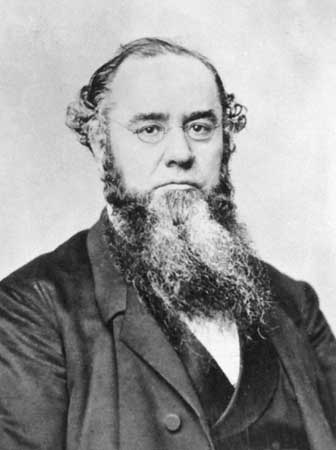
istanto001p1

                                                      Secretary of War Edwin Stanton

Lincoln’s Secretary of War, Edwin Stanton; who was a passionate believer in the justice of emancipation, was one of the first to grasp the importance of slave labor to the Confederate armies and how emancipation was of decided military necessity. Stanton, “Instantly grasped the military value of the proclamation. Having spent more time than any of his colleagues contemplating the logistical problems facing the army, he understood the tremendous advantage to be gained if the massive workforce of slaves could be transferred from the Confederacy to the Union.” [15]

Lincoln emphasized the “military necessity” of emancipation and “justified the step as a “fit and necessary war measure for suppressing the rebellion.” [16] The process of emancipation now became not only a moral crusade, but now became a key part of national strategy, not just in a military means, but politically, economically and diplomatically as Lincoln “also calculated that making slavery a target of the war would counteract the rising clamor in Britain for recognition of the Confederacy.”  [17]

Lincoln wrote to his future Vice President, Andrew Johnson, then the military governor of occupied Tennessee that “The colored population is the great available and yet unavailed of, force for restoration of the Union.”[18] The idea of simply mollifying the border states was dropped and policy changed that of “depriving the Confederacy of slave labor. Mobilizing that manpower for the Union – as soldiers as well as laborers – was a natural corollary.” [19] Reflecting President Lincoln’s and Stanton’s argument for the military necessity of emancipation, General Henry Halleck wrote to Ulysses Grant:

“the character of the war has very much changed within the past year. There is now no possibility of reconciliation with the rebels… We must conquer the rebels or be conquered by them….Every slave withdrawn from the enemy is the equivalent of a white man put hors de combat.” [20]

54thmassposter

Ulysses Grant concurred with Lincoln’s decision. Grant wrote to in a letter to Lincoln after the assault on Battery Wagner by the 54th Massachusetts, “by arming the negro we have added a powerful ally. They will make good soldiers and taking them from the enemy weakens him in the same proportion as it strengthens us.” [21] William Tecumseh Sherman was supportive but also noted some facts that some radical abolitionists did not understand. He noted in his correspondence that, “The first step in the liberation of the Negro from bondage will be to get him and his family to a place of safety… then to afford him the means of providing for his family,… then gradually use a proportion – greater and greater each year – as sailors and soldiers.” [22] Lincoln wrote after the Emancipation Proclamation that “the emancipation policy, and the use of colored troops, constitute the heaviest blow yet dealt to the rebellion.” [23] The change was a watershed in both American history as well as for the future of the U.S. Military services.

In conjunction with the Emancipation Proclamation Secretary of War Stanton “authorized General Rufus Saxton to “arm, uniform, equip, and receive into the service of the United States such number of volunteers of African descent as you may deem expedient, not exceeding 5,000, and [you] may detail officers to instruct them in military drill, discipline, and duty, and to command them.”  [24] The initial regiments of African Americans were formed by Union commanders in liberated areas of Louisiana and South Carolina, and most were composed of newly freed slaves. Others like the 54th and 55th Massachusetts Volunteer Infantry regiments were raised from free black men in the north. Stanton’s authorization was followed by the Enrollment Act passed by Congress in March of 1863 which established the draft also allowed blacks to serve. By March Stanton was working with state governors to establish more black regiments. The units became known as United States Colored Troops, or U.S.C.T. and were commanded by white officers and organized into the infantry, cavalry and, artillery regiments organized on the model of white regiments. The U.S.C.T. “grew to include seven regiments of cavalry, more than a dozen of artillery, and well over one hundred of infantry.” [25]

Some Union soldiers and officers initially opposed enlisting blacks at all, and some “charged that making soldiers of blacks would be a threat to white supremacy, and hundreds of Billy Yanks wrote home that they would no serve alongside blacks.” [26]  But most common soldiers accepted emancipation, especially those who had served in the South and seen the misery that many slaves endured, one Illinois soldier, stationed who served in the Western Theater of war wrote, “the necessity of emancipation is forced upon us by the inevitable events of the war… and the only road out of this war is by blows aimed at the heart of the Rebellion…. If slavery should be left undisturbed the war would be protracted until the loss of life and national bankruptcy would make peace desirable on any terms.” [27]

Another soldier’s letters home show his conversion from being against emancipation to being fully for it. Corporal Chauncey B. Welton from Ohio wrote to his father after the Emancipation proclamation:

“Father I want you to write and tell me what you think of Lincoln’s proclamation of setting all the negroes free. I can tell you we don’t think much of it hear in the army for we did not enlist to fight for the negro and I can tell you that we never shall or many of us any how[.] no never.”

Following over two years of combat in which he served with Sherman’s army he became a vocal critic of the anti-abolitionist Copperheads in the North, especially former Ohio Governor Clement Vallandigham, as well as a strong proponent of abolition and opponent of slavery. By February 1865 his tone had changed “dear parents let us trust in Him that never forsakes the faithful, and never cease to pray… that soon we may look upon an undivided Country and that Country free free free yes free from that blighting curs[e] Slavery the cause of four years of Bloody warfare.” [28]

Even so racial prejudice in the Union ranks never went away and sometimes was accompanied by violence. It remained a part and parcel of life in and outside of the army, even though many Union soldiers would come to praise the soldierly accomplishments and bravery of African American Soldiers. An officer who had refused a commission to serve with a U.S.C.T. regiment watched as black troops attacked the defenses of Richmond in September 1864:

“The darkies rushed across the open space fronting the work, under a fire which caused them loss, into the abattis… down into the ditch with ladders, up and over the parapet with flying flags, and down among, and on top of, the astonished enemy, who left in utmost haste…. Then and there I decided that ‘the black man could fight’ for his freedom, and that I had made a mistake in not commanding them.” [29] Likewise, “Once the Lincoln administration broke the color barrier of the army, blacks stepped forward in large numbers. Service in the army offered to blacks the opportunity to strike a decisive blow for freedom….” [30]

HD_NgroWarFL640116p264cz.preview

                                                    The Defense of Milliken’s Bend 

Emancipation allowed for the formation of regiments of United States Colored Troops (USCT), which were mustered directly into Federal service. In sheer numbers the U.S.C.T. formations soon dwarfed the few state raised Black Regiments.  However, it was the inspiration provided by those first state raised regiments, the heroic accounts of those units reported in Northern newspapers, as well as the unprovoked violence directed against Blacks in the 1863 New York draft riots that helped to provoke “many northerners into a backlash against the consequences of violent racism.” [31]

Despite the hurdles and prejudices that blacks faced even in the North, many African Americans urged others to enlist, self-help mattered more than self-preservation. Henry Gooding, an black sergeant from Massachusetts wrote the editor of the New Bedford Mercury urging fellow blacks to enlist despite the dangers, “As one of the race, I beseech you not to trust a fancied security, laying in your minds, that our condition will be bettered because slavery must die…[If we] allow that slavery will die without the aid of our race to kill it – language cannot depict the indignity, the scorn, and perhaps the violence that will be heaped upon us.” [32]

The valor of the state regiments, as well as the USCT units that managed to get into action was remarkable, especially in regard to the amount of discrimination levied at them by some northerners, including white Northern soldiers, and the very real threat of death that they faced if captured by Confederates. In response to the Emancipation Proclamation and to the formation of African American regiments the Confederate Congress passed measures that would make Union officers who commanded African American troops as war criminals and return any black soldier captured by Confederate forces return to slavery, if those blacks captured in battle were not summarily tortured by their captors or executed as happened at Fort Wagner, Petersburg, and at Fort Pillow.

In late 1862 Major General Nathaniel Banks was in desperate need of soldiers and received permission to form a number of regiments of free blacks. Known as the First, Second and Third Regiments of the Louisiana Native Guards they were primarily composed of former slaves who had escaped to Union lines, as well as some mulattos who were the children of prominent white citizens of the city. During an inspection, the white Colonel of the Guards told another officer:

“Sir, the best blood of Louisiana is in that regiment! Do you see that tall, slim fellow, third file from the right of the second company? One of the ex-governors of the state is his father. That orderly sergeant in the next company is the son of a man who has been six years in the United States Senate. Just beyond him is the grandson of Judge ______ …; and through all the ranks you will find the same state of facts…. Their fathers are disloyal; [but] these black Ishmaels will more than compensate for their treason by fighting in the field.” [33]

In May of 1863 Banks dared to send the First and Third Regiments of “Louisiana Native Home Guard regiments on a series of attacks on Confederate positions at Port Hudson, Louisiana” [34] where they received their baptism of fire. They suffered heavy losses and “of the 1080 men in the ranks, 271 were hit, or one out of every four.” [35] A white Wisconsin soldier commented that the black soldiers “fought like devils,”while a soldier of the 156th New York wrote, “They charged and re-charged and they didn’t know what retreat meant. They lost in their two regiments some four hundred men as near as I can learn. This settles the question about niggers not fighting well. They on the contrary make splendid soldiers and are as good fighting men as we have.” [36] Banks too was caught up in the moment and said of these troops in his after action report: “They answered every expectation…In many respects their conduct was heroic…The severe test to which they were subjected, and the determined manner in which they encountered the enemy, leave upon my mind no doubt of their ultimate success.” [37]

The_Storming_of_Ft_Wagner-lithograph_by_Kurz_and_Allison_1890a

                                                54th Massachusetts at Fort Wagner 

But the most famous African American volunteer regiment was the 54thMassachusetts, commanded by Colonel Robert Gould Shaw, the “North’s showcase black regiment.” [38] Raised in Boston and officered by many men who were the sons of Boston’s blue blood abolitionist elite, the regiment was authorized in March 1863. Since there was still opposition to the formation of units made up of African Americans, Massachusetts Governor John Andrew authorized the formation of the 54th under the command of white officers, a practice that with few exceptions, became standard in the U.S. military until President Truman desegregated the armed forces in 1948. Governor Andrew was determined to ensure that the officers of the 54th were men of “firm antislavery principles…superior to a vulgar contempt for color.”[39]

The 54th Massachusetts first saw action in early June 1863 and at Shaw’s urging were sent into battle against the Confederate positions at Fort Wagner on July 18th 1863. Leading the attack the 54th lost nearly half its men, “including Colonel Shaw with a bullet through his heart. Black soldiers gained Wagner’s parapet and held it for an hour before falling back.” [40]Though they tried to hold on they were pushed back after a stubborn fight to secure a breach in the fort’s defenses. “Sergeant William H Carney staggered back from the fort with wounds in his chest and right arm, but with the regiment’s Stars and Stripes securely in his grasp. “The old flag never touched the ground, boys,” Carney gasped as he collapsed at the first field hospital he could find.” [41] Shaw was buried with his men by the Confederates and when Union commanders asked for the return of his body were told “We have buried him with his niggers,” Shaw’s father quelled a northern effort to recover his son’s body with these words: We hold that a soldier’s most appropriate burial-place is on the field where he has fallen.” [42] As with so many frontal attacks on prepared positions throughout the war, valor alone could not overcome a well dug in enemy. “Negro troops proved that they could stop bullets and shell fragments as good as white men, but that was about all.” [43]

Despite the setback, the regiment went on to further actions where it continued to distinguish itself. The Northern press, particularly abolitionist newspapers brought about a change in the way that many Americans in the North, civilians as well as soldiers, saw blacks. The Atlantic Monthly noted, “Through the cannon smoke of that dark night, the manhood of the colored race shines before many eyes that would not see.”  [44]

55th-mass-at-charleston

                                  55th Massachusetts being welcomed in Charleston SC 

In the African American 55th Massachusetts, which was recruited after the 54th, twenty-one year old Sergeant Isaiah Welch wrote a letter which was published in the Philadelphia Christian Recorder from Folly Island South Carolina:

“I will mention a little about the 55th Massachusetts Regiment. They seem to be in good health at the present and are desirous of making a bold dash upon the enemy. I pray God the time will soon come when we, as soldiers of God, and of our race and country, may face the enemy with boldness. For my part I feel willing to suffer all privations incidental to a Christian and a soldier…. In conclusion, let me say, if I fall in the battle anticipated, remember, I fall in defense of my race and country. Some of my friends thought it very wrong of me in setting aside the work of the Lord to take up arms against the enemy…. I am fully able to answer all questions pertaining to rebels. If taking lives will restore the country to what it once was, then God help me to slay them on every hand.” [45]

Like the 54th Massachusetts, the 55th would see much action. After one particularly sharp engagement in July 1864, in which numerous soldiers had demonstrated exceptional valor under fire the regiment’s commander, Colonel Alfred S. Hartwell “recommended that three of the black sergeants of the 55th be promoted to the rank of 2nd Lieutenant.” But Hartwell’s request was turned down, and a member of the regiment complained, “But the U.S. government has refused so far to must them because God did not make them White…. No other objection is, or can be offered.”[46]


Frederick Douglass
Frederick Douglass, who had two sons serving in the 54th Massachusetts, understood the importance of African Americans taking up arms against those that had enslaved them in order to win their freedom:

“Once let a black man get upon his person the brass letters U.S… let him get an eagle on his button, and a musket on his shoulder and bullets in his pockets, and there is no power on earth which can deny he has won the right to citizenship in the United States.” [47]

Douglass urged African American men to enlist to secure their freedom, even while noting the inequities still prevalent in society and in the military, in which they did not receive the same pay as whites, nor could they become officers. Appealing to duty and reality Douglass noted in a speech in Philadelphia urging black men to volunteer. In it he carefully defined the real differences between the purposes of the Confederacy which was to “nothing more than to make the slavery of the African race universal and perpetual on this continent,” which was “based upon the idea that colored men are an inferior race, who may be enslaved and plundered forever.” [48]
220px-WilliamCarney

                        Sergeant William Carney 54th Massachusetts, Medal of Honor

But the premier leader of the African Americans of his day, who had himself suffered as a slave, did not stop with that. Douglass understood that winning the war was more important that to what had been the attitude of the Federal government before the war and before emancipation, “Now, what is the attitude of the Washington government towards the colored race? What reasons have we to desire its triumph in the present contest? Mind, I do not ask what was its attitude towards us before the war…. I do not ask you about the dead past. I bring you to the living present.” He noted the advances that had been made in just a few months and appealed to his listeners. “Do not flatter yourselves, my friends, that you are more important to the Government than the Government to you. You stand but as the plank to the ship. This rebellion can be put down without your help. Slavery can be abolished by white men: but liberty so won for the black man, while it may leave him an object of pity, can never make him an object of respect…. Young men of Philadelphia, you are without excuse. The hour has arrived, and your place is in the Union army. Remember that the musket – the United States musket with its bayonet of steel – is better than all the mere parchment guarantees of liberty. In your hands that musket means liberty…” [49]

Other African American units less famous than the illustrious 54thMassachusetts distinguished themselves in action against Confederate forces. Two regiments of newly recruited blacks were encamped at Milliken’s Bend Louisiana when a Confederate brigade attempting to relieve the Vicksburg garrison attacked them. The troops were untrained and ill-armed but held on against a determined enemy:

“Untrained and armed with old muskets, most of the black troops nevertheless fought desperately. With the aid of two gunboats they finally drove off the enemy. For raw troops, wrote Grant, the freedmen “behaved well.” Assistant Secretary of War Dana, still with Grant’s army, spoke with more enthusiasm. “The bravery of the blacks,” he declared, “completely revolutionized the sentiment in the army with regard to the employment of negro troops. I heard prominent officers who had formerly in private had sneered at the idea of negroes fighting express after that as heartily in favor of it.”[50]

The actions of the black units at Milliken’s bend attracted the attention and commendation of Ulysses Grant, who wrote in his cover letter to the after action report, “In this battle most of the troops engaged were Africans, who had little experience in the use of fire-arms. Their conduct is said, however, to have been most gallant, and I doubt not but with good officers that they will make good troops.” [51] They also garnered the attention of the press. Harper’s published an illustrated account of the battle with a “double-page woodcut of the action place a black color bearer in the foreground, flanked by comrades fighting hand-to-hand with Confederates. A brief article called it a “the sharp fight at Milliken’s bend where a small body of black troops with a few whites were attacked by a large force of rebels.” [52] In the South the result was chilling and shocked whites, one woman wrote “It is hard to believe that Southern soldiers – and Texans at that – have been whipped by a mongrel crew of white and black Yankees…. There must be some mistake.” While another woman in Louisiana confided in her diary, “It is terrible to think of such a battle as this, white men and freemen fighting with their slaves, and to be killed by such a hand, the very soul revolts from it, O, may this be the last.” [53]

flporthudsonedml

                                          Louisiana Native Guards at Port Hudson 

By the end of the war over 179,000 African American Soldiers, commanded by 7,000 white officers served in the Union armies. For a number of reasons most of these units were confined to rear area duties or working with logistics and transportation operations. The policies to regulate USCT regiments to supporting tasks in non-combat roles “frustrated many African American soldiers who wanted a chance to prove themselves in battle.” [54] Many of the soldiers and their white officers argued to be let into the fight as they felt that “only by proving themselves in combat could blacks overcome stereotypes of inferiority and prove their “manhood.” [55]Even so in many places in the army the USCT and state regiments made up of blacks were scorned:

“A young officer who left his place in a white regiment to become colonel of a colored regiment was frankly told by a staff officer that “we don’t want any nigger soldiers in the Army of the Potomac,” and his general took him aside to say: “I’m sorry to have you leave my command, and am still more sorry that you are going to serve with Negroes. I think that it is a disgrace to the army to make soldiers of them.” The general added that he felt this way because he was sure that colored soldiers just would not fight.”  [56]

The general of course, was wrong, for “Nothing eradicated the prejudices of white soldiers as effectively as black soldiers performing well under fire. And nothing inspired black soldiers to fight as desperately as the fear that capture meant certain death.” [57]  In the engagements where USCT units were allowed to fight, they did so with varying success most of which was often attributable to the direction of their senior officers and the training that they had received. As with any other unit, well led and well trained regiments performed better than those whose leaders had failed their soldiers. When given the chance they almost always fought well, even when badly commanded. This was true as well when they were thrown into hopeless situations.

One such instance was when Ferrero’s Division, comprised of colored troops were thrown into the Battle of the Crater at Petersburg when “that battle lost beyond all recall.” [58] The troops advanced in good order singing as they went, while their commander, General Ferrero took cover in a dugout and started drinking; but the Confederate defenders had been reinforced and “Unsupported, subjected to a galling fire from batteries on the flanks, and from infantry fire in front and partly on the flank,” a witness write, “they broke up in disorder and fell back into the crater.” [59] Pressed into the carnage of the crater where white troops from the three divisions already savaged by the fighting had taken cover, the “black troops fought with desperation, uncertain of their fate if captured.”[60] In the battle Ferrero’s division lost 1,327 of the approximately 4,000 men who made the attack. [61]

Major General Benjamin Butler railed to his wife in a letter against those who questioned the courage of African American soldiers seeing the gallantry of black troops assaulting the defenses of Petersburg in September 1864: The man who says that the negro will not fight is a coward….His soul is blacker than then dead faces of these dead negroes, upturned to heaven in solemn protest against him and his prejudices.” [62]

In another engagement, the 1864 Battle of Saltville in western Virginia the troops of the 5th USCT Cavalry who had been insulted, taunted, and derided by their fellow white Union soldiers went into action against Confederate troops defending the salt works in that town. The regiment’s commander, Colonel Wade, order his troops to attack. Colonel James Brisbin detailed the attack:

“the Negroes rushed upon the works with a yell and after a desperate struggle carried the line killing and wounding a large number of the enemy and capturing some prisoners…. Out of the four hundred men engaged, one hundred and fourteen men and four officers fell killed or wounded. Of this fight I can only say that men could not have behaved more bravely. I have seen white troops in twenty-seven battles and I never saw any fight better…. On the return of the forces those who had scoffed at the Colored Troops on the march out were silent.” [63]

The response of the Confederate government to Emancipation and African Americans serving as soldiers was immediate and uncompromisingly harsh. “When in the autumn of 1862 General Beauregard referred the question of a captured black soldier to Davis’s latest Secretary of War, James A. Seddon, the later replied “…my decision is that the negro is to be executed as an example.” [64] Davis approved of the summary executions of black prisoners carried out in South Carolina in November 1862, and a month later “on Christmas Eve, Davis issued a general order requiring all former slaves and their officers captured in arms to be delivered up to state officials for trial.” [65] Davis warned that “the army would consider black soldiers as “slaves captured in arms,” and therefore subject to execution.” [66] While the Confederacy never formally carried out the edict, there were numerous occasions where Confederate commanders and soldiers massacred captured African American soldiers.

The Lincoln administration responded to the Confederate threats by sending a note to Davis that threatened reprisals against Confederate troops if black soldiers suffered harm. It “was largely the threat of Union reprisals that thereafter gave African-American soldiers a modicum of humane treatment.” [67] Even so, they and their white officers were often in much more danger than the officers and soldiers of all-white regiments if captured by Confederate forces.

When captured by Confederates, black soldiers and their white officers received no quarter from many Confederate opponents. General Edmund Kirby Smith who held overall command of Confederate forces west of the Mississippi instructed General Richard Taylor to simply execute black soldiers and their white officers: “I hope…that your subordinates who may have been in command of capturing parties may have recognized the propriety of giving no quarter to armed negroes and their officers. In this way we may be relieved from a disagreeable dilemma.” [68] This was not only a local policy, but echoed at the highest levels of the Confederate government. In 1862 the Confederate government issued an order that threatened white officers commanding blacks: “any commissioned officer employed in the drilling, organizing or instructing slaves with their view to armed service in this war…as outlaws” would be “held in close confinement for execution as a felon.” [69] After the assault of the 54th Massachusetts at Fort Wagner a Georgia soldier “reported with satisfaction that the prisoners were “literally shot down while on their knees begging for quarter and mercy.” [70]

                                                                       Fort Pillow Massacre 

On April 12th 1864 at Fort Pillow, troops under the command of General Nathan Bedford Forrest massacred the bulk of over 231 Union most of them black as they tried to surrender. While it is fairly clear that Forrest did not order the massacre and even may have attempted to stop it, it was clear that he had lost control of his troops, and “the best evidence indicates that the “massacre”…was a genuine massacre.” [71] Forrest’s soldiers fought with the fury of men possessed by hatred of an enemy that they considered ‘a lesser race’ and slaughtered the Union troops as they either tried to surrender or flee; but while Forrest did not order the massacre, he certainly was not displeased with the result. His subordinate, General James Chalmers told an officer from the gunboat Silver Cloud that he and Forrest had neither ordered the massacre and had tried to stop their soldiers but that “the men of General Forrest’s command had such a hatred toward the armed negro that they could not be restrained from killing the negroes,” and he added, “it was nothing better than we could expect so long as we persisted in arming the negro.” [72] It was a portent of what some of the same men would do to defenseless blacks and whites sympathetic to them as members of the Ku Klux Klan, the White Liners, White League, and Red Shirts, during and after Reconstruction in places like Colfax Louisiana.

Ulysses Grant was infuriated and threatened reprisals against any Confederates conducting such activities, he a later wrote:

“These troops fought bravely, but were overpowered I will leave Forrest in his dispatches to tell what he did with them.

“The river was dyed,” he says, “with the blood of the slaughtered for up to 200 years. The approximate loss was upward of five hundred killed; but few of the officers escaped. My loss was about twenty killed. It is hoped that these facts will demonstrate to the Northern people that negro soldiers cannot cope with Southerners.” Subsequently Forrest made a report in which he left out the part that shocks humanity to read.”  [73]

The bulk of the fanatical hatred of Forrest’s troops was directed at the black soldiers of the 6th U.S. Colored Heavy Artillery, which composed over a third of the garrison. “Of the 262 Negro members of the garrison, only 58 – just over 20 percent – were marched away as prisoners; while of the 295 whites, 168 – just under sixty percent were taken.”  [74] A white survivor of the 13th West Tennessee Cavalry, a Union unit at the fort wrote:

We all threw down our arms and gave tokens of surrender, asking for quarter…but no quarter was given….I saw 4 white men and at least 25 negroes shot while begging for mercy….These were all soldiers. There were also 2 negro women and 3 little children standing within 25 steps of me, when a rebel stepped up to them and said, “Yes, God damn you, you thought you were free, did you?” and shot them all. They all fell but one child, when he knocked it in the head with the breech of his gun.” [75]

A Confederate Sergeant who was at Fort Pillow wrote home a week after the massacre: “the poor deluded negroes would run up to our men, fall upon their knees and with uplifted hands scream for mercy, but were ordered to their feet and shot down.” [76] The captain of the Union gunboat Silver Cloud was allowed by the Confederate to bring his ship to the Fort to evacuate wounded, and to bury the dead was appalled at the sight, he wrote:

“All the buildings around the fort and the tents and huts in the fort had been burned by the rebels, and among the embers of the charred remains of numbers of our soldiers who had suffered terrible death in the flames could be seen. All the wounded who had strength enough to speak agreed that after the fort was taken an indiscriminate slaughter of our troops was carried on by the enemy…. Around on every side horrible testimony to the truth of this statement could be seen, Bodies with gaping wounds,… some with skulls beaten through, others with hideous wounds as if their bowels had been ripped open with bowie-knives, plainly told that little quarter was shown…. Strewn from the fort to the river bank, in the ravines and the hollows, behind logs and under the brush where they had crept for protection from the assassins who pursued them, we found bodies bayoneted, beaten, and shot to death, showing how cold-blooded and persistent was the slaughter…. Of course, when a work is carried by assault there will always be more or less bloodshed, even when all resistance has ceased; but here there were unmistakable evidences of a massacre carried on long after any resistance could have been offered, with a cold-blooded barbarity and perseverance which nothing can palliate.” [77]

The rabidly pro-slavery members of the Confederate press lent their propaganda to cheer the massacre of the captured blacks. John R. Eakin of the Washington (Arkansas) Washington Telegraph, who later became a justice on the Arkansas Supreme Court after Reconstruction, wrote,

“The Slave Soldiers. – Amongst there are stupendous wrongs against humanity, shocking to the moral sense of the world, like Herod’s massacre of the Innocents, or the eve of St. Bartholomew, the crime of Lincoln in seducing our slaves into the ranks of his army will occupy a prominent position….

How should we treat our slaves arrayed under the banners of the invader, and marching to desolate our homes and firesides….

Meanwhile, the problem has been met our soldiers in the heat of battle, where there has been no time for discussion. They have cut the Gordian knot with the sword. They did right….

It follows that we cannot treat negroes in arms as prisoners of war without a destruction of the social system for which we contend. We must be firm, uncompromising and unfaltering. We must claim the full control of all negroes who may fall into our hands, to punish with death, or any other penalty, or remand them to their owners. If the enemy retaliate, we must do likewise; and if the black flag follows, the blood be upon their heads.” [78]

However, when African American Troops were victorious, and even after they had seen their brothers murdered by Confederate troops, that they often treated their Confederate with great kindness. Colonel Brisbin wrote that following Battle of Saltville that “Such of the Colored Soldiers who fell into the hands of the Enemy during the battle were murdered. The Negroes did not retaliate but treated the Rebel wounded with great kindness, carrying them water in their canteens and doing all they could to alleviate the sufferings of those whom the fortunes of war had placed in their hands.” [79]

African American soldiers proved themselves during the war and their efforts paved the way for Lincoln and others to begin considering the full equality of blacks as citizens. If they could fight and die for the country, how could they be denied the right to votes, be elected to office, serve on juries or go to public schools? Under political pressure to end the war during the stalemate before Petersburg and Atlanta in the summer of 1864, Lincoln reacted angrily to Copperheads as well as wavering Republicans on the issue of emancipation:

“But no human power can subdue this rebellion without using the Emancipation lever as I have done.” More than 100,000 black soldiers were fighting for the Union and their efforts were crucial to northern victory. They would not continue fighting if they thought the North intended to betray them….If they stake their lives for us they must be prompted by the strongest motive…the promise of freedom. And the promise being made, must be kept…There have been men who proposed to me to return to slavery the black warriors. “I should be damned in time & in eternity for so doing. The world shall know that I will keep my faith to friends & enemies, come what will.”  [80]

The importance of African Americans cannot be minimized, without them the war could have dragged on much longer or even ended in stalemate, which would have been a Confederate victory. Lincoln wrote about the importance of the African American contribution to the war effort in 1864:

“Any different policy in regard to the colored man, deprives us of his help, and this is more than we can bear. We can not spare the hundred and forty or hundred and fifty thousand now serving us as soldiers, seamen, and laborers. This is not a question of sentiment or taste, but one of physical force which may be measured and estimated as horse-power and Steam-power are measured and estimated. Keep it and you save the Union. Throw it away, and the Union goes with it.” [81]

Despite this, even in the North during and after the war, blacks, including former soldiers faced discrimination, sometimes that of the white men that they served alongside, but more often from those who did not support the war effort. Lincoln wisely took note of this fact, and wrote that after the war:

“there will there will be some black men who can remember that, with silent tongue, the clenched teeth, the steady eye, the well poised bayonet, they have helped  mankind on to this great consummation; while, I fear, there will be some white ones, unable to forget that, with malignant heart, and deceitful speech, they have strove to hinder it.” [82]

swails

Lt Stephen Swails, First African American Officer of 54th Massachusetts 

Those rights would be fought for another century and what began in 1863 with the brave service and sacrifice of these African American soldiers began a process of increased civil rights that is still going on today. It would not be until after the war that some blacks were commissioned as officers in the Army. When Governor John Andrew, the man who had raised the 54th Massachusetts attempted to “issue a state commission to Sergeant Stephen Swails of the 54th…the Bureau of Colored Troops obstinately refused to issue Swails a discharge from his sergeant’s rank, and Swails promotion was held up until after the end of the war. “How can we hope for success to our arms or God’s blessing,” raged the white colonel of the 54th, Edward Hallowell, “while we as a people are so blind to justice?” [83]

The families of the free blacks who volunteered also suffered, especially those who still had families enslaved in Confederate occupied areas or Union States which still allowed slavery. One women in Missouri wrote her husband begging him to come home “I have had nothing but trouble since you left….They abuse me because you went & say they will not take care of our children & do nothing but quarrel with me all the time and beat me scandalously the day before yesterday.”  [84]

However, the Emancipation Proclamation transformed the war, and even jaded White Union soldiers who had been against emancipation and who were deeply prejudiced against blacks began to change their outlook as the armies marched into the South and saw the horrors of slavery, Russell Weigley wrote that Union soldiers: “confronting the scarred bodies and crippled souls of African Americans as they marched into the South experienced a strong motivation to become anti-slavery men…Men do not need to play a role long, furthermore, until the role grows to seem natural and customary to them. That of liberators was sufficiently fulfilling to their pride that soldiers found themselves growing more accustomed to it all the more readily.” [85]

A sergeant of the 19th Michigan who had already lost a stepson in the war wrote to his wife from Georgia before being killed in action during the Atlanta campaign; “the more I learn of the cursed institution of Slavery, the more I feel willing to endure, for its final destruction…. After this war is over, this whole country will undergo a change for the better…. Abolishing slavery will dignify labor; that fact will revolutionize everything…. Let Christians use all their influence to have justice done to the black man.” [86]

But even more importantly for the cause of liberty, the sight of regiments of free African Americans, marching “through the slave states wearing the uniform of the U.S. Army and carrying rifles on their shoulders was perhaps the most revolutionary event of a war turned into revolution.” [87]
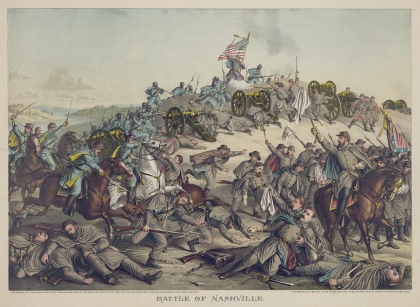
battle_of_nashville_kurz__allison

At peak one in eight Union troops were African American, and Black troops made an immense contribution to the Union victory. “Black troops fought on 41 major battlefields and in 449 minor engagements. Sixteen soldiers and seven sailors received Medals of Honor for valor. 37,000 blacks in army uniform gave their lives and untold sailors did, too.” [88] To fully appreciate the measure as to the importance and significance of the numbers of African American troops serving in the Union ranks has to compare that number with the number of active Confederate troops serving toward the end of the war. The approximately 180,000 African Americans serving in Union ranks at the end of the war outnumbered the “aggregate present” in Confederate ranks on January 1st 1865 by over 20,000 men. Of these troops “134,111 were recruited in states that had stars in the Confederate battle flag, and the latter figure in turn was several thousand greater than the total of 135,994 gray-clad soldiers “present for duty” that same day.” [89]

Of the African American soldiers who faced the Confederates in combat, “deep pride was their compensation. Two black patients in an army hospital began a conversation. One of them looked at the stump of an arm he had once had and remarked: “Oh I should like to have it, but I don’t begrudge it.” His ward mate, minus a leg, replied: “Well, ‘twas [lost] in a glorious cause, and if I’d lost my life I should have been satisfied. I knew what I was fighting for.” [90]

22nd-usct-flags                                                Flags of the 22nd U.S. Colored Troops 

After the war many of the African American soldiers became leaders in the African American community and no less than 130 of these former soldiers held elected office including in the U.S. Congress and various state legislatures. The liberating aspect of “the black military experience radiated from black soldiers and their families into the larger black community, so it spread into white society as well.” [91]  Many abolitionists who had served as officers, and officers who were assigned to the USCT or volunteered to serve with state raised African American regiments became leaders continued to be voices for expanding civil rights in the years following the war.

Following war’s end, the demobilized African American troops became the target of racial discrimination and violence, but even so, “black veterans continued to play a central role in black communities, North and South. The skills and experience black men gained during the war not only propelled many of them into positions of leaders and sustained the prominence of others, but it also shaped the expectations and aspirations of all black people. The achievements and pride engendered by military service helped to make a new world of freedom.” [92]

Sadly, much of the nation has forgotten the efforts of the Free Black Soldiers and Sailors who fought for freedom, but even so their legacy remains in the “contribution of black soldiers to Union victory remained a point of pride in black communities. “They say,” an Alabama planter reported in 1867, “the Yankees never could have whipped the South without the aid of the Negroes.” Well into the twentieth century, black families throughout the United States would recall with pride that their fathers and grandfathers had fought for freedom.” [93]

Notes 

[1] Ibid. McPherson Tried by War: Abraham Lincoln as Commander in Chief

[2] Ibid. Goodwin Team of Rivals p.435

[3] Ibid. McPherson Tried by War p.58

[4] Ibid. McPherson Tried by War p.58

[5] Ibid. Goodwin Team of Rivals p.369

[6] Ibid. McPherson Tried by War p.109

[7] Ibid. Foote, The Civil War, A Narrative Volume Two p.531

[8] Ibid. McPherson. The Battle Cry of Freedom p.503

[9] Ibid. McPherson Drawn With the Sword: Reflections on the American Civil War p.101

[10] Ibid. Guelzo Gettysburg: The Last Invasion p.160

[11] Foner, Eric Forever Free: The Story of Emancipation and Reconstruction Vintage Books a Division of Random House, New York 2005 p.45

[12] Ibid. Guelzo Gettysburg: The Last Invasion p.160

[13] Ibid. Glatthaar General Lee’s Army from Victory to Collapse p.313

[14] Ibid. Guelzo Gettysburg: The Last Invasion p.160

[15] Ibid. Goodwin Team of Rivals p.465

[16] Egnal, Marc Clash of Extremes: The Economic Origins of the Civil War Hill and Wang a division of Farrar, Straus and Giroux New York 2009 p.318

[17] Ibid. Foner Forever Free p.48

[18] Ibid. McPherson Tried by War p.159

[19] Ibid. McPherson Drawn With the Sword p.159

[20] Ibid. McPherson Abraham Lincoln and the Second American Revolution p.35

[21] Ibid. Guelzo Fateful Lightning p.381

[22] Ibid. Dobak Freedom by the Sword: The U.S. Colored Troops, 1862-1867 p.10

[23] Ibid. McPherson Abraham Lincoln and the Second American Revolution p.35

[24] Ibid. Robertson Soldiers Blue and Gray p.31

[25] Ibid. Dobak Freedom by the Sword: The U.S. Colored Troops, 1862-1867 p.11

[26] Ibid. Robertson Soldiers Blue and Gray p.31

[27] Ibid. Gallagher, Gary W. The Union War Harvard University Press, Cambridge MA and London 2011 p.103

[28] Welton, Chauncey B. A Union Soldier’s Changing Views on Emancipationin The Civil War and Reconstruction: A Documentary Collection edited by William Gienapp, W.W. Norton Company, New York and London 2001 pp.242 and 245

[29] Ibid. Robertson Soldiers Blue and Gray p.34

[30] Glatthaar, Joseph T. Black Glory: The African American Role in Union Victory in Why the Confederacy Lost edited by Gabor S. Boritt Oxford University Press, Oxford and New York 1992

[31] Ibid. McPherson. The Battle Cry of Freedom p.686

[32] Ibid. Goldfield America Aflame p.282

[33] Jones, Terry L. The Free Men of Color Go to War in The new York Times Disunion: 106 Articles from the New York Times Opinionator edited by Ted Widmer with Clay Risen and George Kalogerakis, Black Dog and Leventhal Publishers, New York 2013 p.403

[34] Ibid. Guelzo Fateful Lightening p.379

[35] Ibid. Foote The Civil War, A Narrative Volume Two p.398

[36] Ibid. Trudeau Like Men of War p.44

[37] Ibid. Guelzo Fateful Lightening p.379

[38] Ibid. McPherson. The Battle Cry of Freedom p.686

[39] Ibid. McPherson Drawn With the Sword p.101

[40] Ibid. McPherson. The Battle Cry of Freedom p.686

[41] Ibid. Guelzo Fateful Lightening pp. 380-381

[42] Ibid. McPherson. The Battle Cry of Freedom pp.686-687

[43] Ibid. Foote, The Civil War, A Narrative Volume Two p.697

[44] Ibid. McPherson. The Battle Cry of Freedom p.686

[45] Welch, Isaiah H. Letter in the Christian Recorder 24 October 1863 in The Civil War and Reconstruction: A Documentary Collection edited by William E. Gienapp, W.W. Norton and Company, New York and London 2001 pp.225-226

[46] Trudeau, Noah Andre, Like Men of War: Black Troops in the Civil War 1862-1865 Little, Brown and Company, Boston, New York and London, 1998 p.262

[47] Ibid. Guelzo Fateful Lightening p. 381

[48] Douglass, Frederick Philadelphia Speech of July 6th 1863 recorded in the Liberator in The Civil War and Reconstruction: A Documentary Collection edited by William E. Gienapp, W.W. Norton and Company, New York and London 2001 pp.220-221

[49] Ibid. Douglass Philadelphia Speech of July 6th 1863 p.221

[50] Ibid. McPherson. The Battle Cry of Freedom p.634

[51] Ibid. Trudeau Like Men of War: Black Troops in the Civil War 1862-1865p.58

[52] Ibid. Gallagher The Union War p.97

[53] Ibid. Trudeau Like Men of War: Black Troops in the Civil War 1862-1865 p.59

[54] Ibid. Gallagher The Union War p.92

[55] Ibid. McPherson Drawn With the Sword p.89 p.

[56] Catton, Bruce. A Stillness at Appomattox Doubleday and Company Garden City, New York 1953 p.227

[57] Berlin, Ira, Riedy, Joseph P. and Rowland, Leslie S. editors, Freedom’s Soldiers: The Black Military Experience in the Civil War  Cambridge University Press, Cambridge and New York 1998 pp.133-134

[58] Ibid. Catton A Stillness at Appomattox p.249

[59] Foote, Shelby, The Civil War, A Narrative. Volume Three Red River to Appomattox Random House, New York 1974 p.537

[60] Ibid.Wert The Sword of Lincoln: The Army of the Potomac pp.384-385

[61] Ibid. Foote The Civil War, A Narrative Volume Three p.537

[62] Ibid. Robertson Soldiers Blue and Gray p.34

[63] Ibid. Berlin et al, Freedom’s Soldiers: The Black Military Experience in the Civil War  p.135

[64] Ibid. Weigley A Great Civil War p.189

[65] Ibid. McPherson Battle Cry of Freedom p.566

[66] Ibid. Goldfield America Aflame p. 280

[67] Ibid. Weigley A Great Civil War p.188

[68] Ibid. Guelzo Fateful Lightening p. 377

[69] Ibid. Guelzo Fateful Lightening p. 377

[70] Ibid. Goldfield America Aflame p.281

[71] Ibid. Weigley A Great Civil War p.189

[72] Ibid. Dobak Freedom by the Sword: The U.S. Colored Troops, 1862-1867 p.208

[73] Grant, Ulysses S. Preparing for the Campaigns of ’64 in Battles and Leaders of the Civil War Volume IV, Retreat With Honor Edited by Robert Underwood Johnson and Clarence Clough Buel Castle, Secaucus NJ pp.107-108

[74] Ibid. Foote The Civil War, A Narrative Volume Three p.111

[75] Ibid. Guelzo Fateful Lightning p. 378

[76] Ibid. Foote The Civil War, A Narrative Volume Three p.112

[77] Ibid. Dobak Freedom by the Sword: The U.S. Colored Troops, 1862-1867 p.208

[78] Eakin, John R. The Slave Soldiers, June 8, 1864  in Loewen, James W. and Sebesta, Edward H. editors, The Confederate and Neo-Confederate Reader: The “Great Truth” about “The Lost Cause” University of Mississippi Press, Jackson 2010 pp.210 and 212

[79] Ibid. Berlin et al, Freedom’s Soldiers: The Black Military Experience in the Civil War  p.47

[80] Ibid. McPherson Abraham Lincoln and the Second American Revolution p.89

[81] Ibid. Glatthaar Black Glory: The African American Role in Union Victoryp.138

[82] Ibid. McPherson The War that Forged a Nation p. 113

[83] Ibid. Guelzo Fateful Lightning p. 376

[84] Ibid. Goldfield America Aflame p.282

[85] Ibid. Weigley A Great Civil War p.192

[86] Ibid. McPherson For Cause and Comrades p.130

[87] Ibid. Weigley A Great Civil War p.191

[88] Gallagher, Gary, Engle, Stephen, Krick, Robert K. and Glatthaar editors The American Civil War: The Mighty Scourge of War Osprey Publishing, Oxford UK 2003 p.296

[89] Ibid. Foote The Civil War, A Narrative. Volume Three Red River to Appomattox p.756

[90] Ibid. Robertson Soldiers Blue and Gray p.36

[91] Ibid. Berlin et al, Freedom’s Soldiers: The Black Military Experience in the Civil War  p.47

[92] Ibid. Berlin et al. Freedom’s Soldiers: The Black Military Experience in the Civil War pp.49-50

[93] Ibid. Foner Forever Free p.55

2 Comments

Filed under civil rights, civil war, History, Military, Political Commentary, racism, us army