Category Archives: world war one

Joyeux Noël, Christmas Eve 2018: History and Memory, the Stubborn Humanity Within Us

joyeux_noel3

Friends of Padre Steve’s World,

Last night I rewatched the film Joyeux Noel (Merry Christmas) which is one of my Christmas traditions. When I watch it I cannot stop. I don’t look at my social media, I don’t tweet. Although it recounts an incident that occurred over a century ago, I am drawn to it out of a feeling of camaraderie, and a hope that people of good will can, and maybe will someday put and end to the scourge of war. I guess one reason I have to put down everything else is that I cry through most of the film.

I do not think that  end of war will happen anytime soon, for as Henry Wordsworth Longfellow wrote some fifty years before this incident, “for hate is strong, and mocks the song, of peace on earth, goodwill to men.” 

But I dare not, even in the age of a madman in the White House and warmongering dictators and despots wreaking havoc on the world, give up the hope of peace. I tend to watch it before or after reading Stanley Weintraub’s book: Silent Night: the Story Of the World War One Christmas Truce. 

It was a book that I refused to read until after I returned from Iraq in 2008. Of course as a military historian I knew of the Christmas Truce, but it was something that I tried to keep a distance from after September 11th, 2001. After my experience of Christmas on the Iraq – Syrian Border In 2007 I could no longer ignore it.

Weintraub Wrote:

Christmas 1914 evokes the stubborn humanity within us, and suggests an unrealized potential to burst its seams and rewrite a century.

I say that my time in Iraq did that to me. I cannot forget the Masses that I celebrated on the border and my time with Americans, Iraqi Soldiers, and local Bedouin during those days.

In the film, one of the main characters is the Chaplain of the Scottish battalion played by Gary Lewis tells a Lieutenant:

“Tonight, these men were drawn to that altar like it was a fire in the middle of winter. Even those who aren’t devout came to warm themselves. Maybe just to be together, maybe just to forget the war.” 

12010440-mmmain

The war was supposed to be over by Christmas, or so the planners had said. Instead after a series of massive battles that produced unprecedented number of casualties the war settled into a stalemate. As the sides exhausted themselves in a series of meeting engagements throwing the flower of their idealistic youth into the great maw of the front to be torn apart by massed artillery and machine gun fire the planners sought new ways to find military victory.

In December 1914 with neither side having the ability to force the issue and casualties already running over a million dead and wounded the armies dug in. Massive trench networks were constructed in the mud of France and Belgium as the artillery continued its impersonal work of destroying men, machines and the homeland of millions of civilians.
From Clipboard

Despite the stalemate the high commands of the various nations continued to through their troops into meaningless attacks to gain a few yards of their opponent’s trench networks. The attackers always suffered the worst as they went “over the top” and were cut down by well sited machine guns and networks of defensive redoubts.

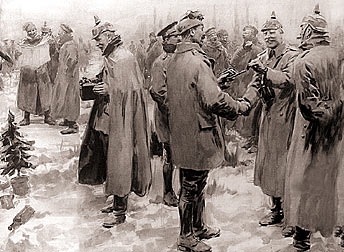
As Christmas neared individual parties of British and German troops began to fraternize exchanging gifts and attempting despite the wishes of their commanders to maintain an attitude of live and let live. On Christmas Eve German troops began to decorate their trenches with Christmas trees and lights, carols were sung and Christmas greetings exchanged as the local truces became widespread and soldiers met in no man’s land to talk and give each other gifts of cigarettes, alcohol, food and souvenirs.  In some places the sides helped each other collect and bury their dead and some Chaplains even led Christmas services in which men of both sides worshipped.

football-truce

The truce would not last as the high commands of each side issued strict orders against them and within days had moved the units that they believed most “infected” by the Christmas spirit to other locations and replaced them with units inculcated with the message of the inhumanity of their enemy. Such messages often included the religious understanding of this being a “holy war” against enemies of God and humanity. It is funny that though Muslims are frequently demonized for committing Jihad, that Christians have a terrible record when it comes to finding theological reasons to kill those that they believe, even other Christians to be the enemy.

Christmas Day December 1914 World War One

joyeux-noel-2


joyeux-noel-3

This really wasn’t surprising, after all for in the years leading up to the war many school children, especially in France and Germany had been propagandized. Churches and ministers cooperated in the carnage.

In the movie Joyeux Noel the British Padre who had cooperated in the Christmas truce is relieved by his Bishop and sent home. The Bishop then preaches to the newly arrived soldiers, those replacing the men who had found peace for a moment. The sermon is not a work of fiction, it is actually part of a sermon that actually was given in Westminster Abbey in 1915. It was a sentiment that fit the mood of the high command who sought to minimize the danger of peace without victory. It was a sermon, the likes of which were preached by ministers, preachers, priests and bishops throughout that terrible war. It is a sermon that many preachers, Christian, Jewish, Islamic and Hindu even today mimic with terrible consequences.

“Christ our Lord said, “Think not that I come to bring peace on earth. I come not to bring peace, but a sword.” The Gospel according to St. Matthew. Well, my brethren, the sword of the Lord is in your hands. You are the very defenders of civilization itself. The forces of good against the forces of evil. For this war is indeed a crusade! A holy war to save the freedom of the world. In truth I tell you: the Germans do not act like us, neither do they think like us, for they are not, like us, children of God. Are those who shell cities populated only by civilians the children of God? Are those who advanced armed hiding behind women and children the children of God? With God’s help, you must kill the Germans, good or bad, young or old. Kill every one of them so that it won’t have to be done again.”

Unfortunately I have met and heard men preach the same message against those they hate, a message that twists the words of Jesus in a diabolical way to justify the worst acts of nations and peoples. In the year 2018 wars rage around the world. Some are conducted by well organized professional militaries but many by militias, paramilitary and terrorists groups. In some cases the brutality and inhumanity exhibited makes the industrialized carnage of the First World War seem sane. Even now preachers of various religions, including Christians, Moslems and Jews advocate the harshest treatment of the enemies of their peoples all in “the name of God.”
295_26912097058_4309_n

n671902058_1153798_5336

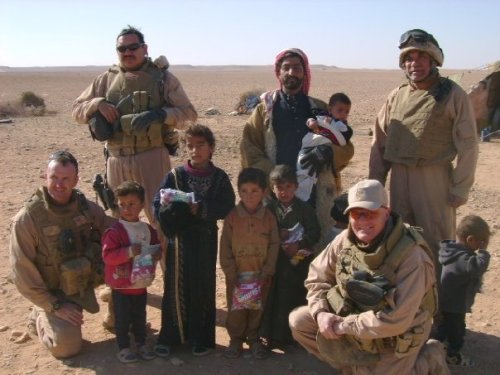
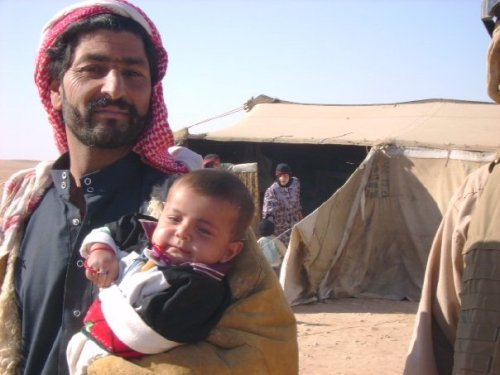
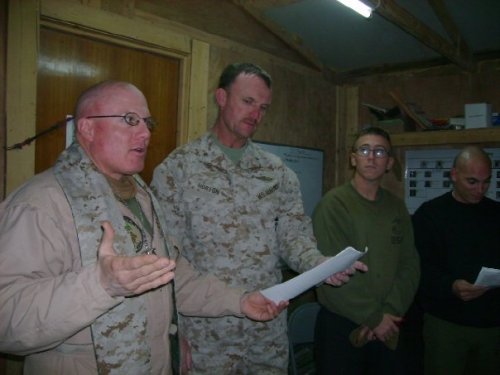
Eleven short years ago I was traveling up and down the western border of Iraq with Syria. I was visiting our Marines that were advising the Iraqi Army and Border Forces, conducting Christmas services for them and also visiting Iraqi soldiers as well as civilians. In a couple of instances Iraqi and Jordanian Christians working as interpreters came to the Eucharist services, for one it had been years since he had received the Body and Blood of Christ in the Holy Communion. While out and about visiting Iraqis we were hosted by Iraqi troops and well as Bedouin tribesmen and their families. The warmth and hospitality and faith of these wonderful people was amazing.

T.E. Lawrence wrote that the Bedouin could not look for God within him: he was too sure that he was within God.” 
n671902058_1153804_6925

I think that for me that Christmas week was the one that will remain with me more than any and despite being in a war zone, it for me was a time of peace on earth and good will toward men. Some people cannot imagine how a career military officer could feel that way. In the movie the French company commander is confronted by his father after the truce, and after the military postal censors had reported the many incidents of fraternization with the enemy to the various high commands in France, Germany, and Great Britain.

The Country? What does it know of what we suffer here? Of what we do without complaints? Let me tell you, I felt closer to the Germans than to those who cry “Kill the Krauts!” before their stuffed turkey…  no, you’re just not living the same war as me. Or as those on the other side.”  

Weintraub wrote:

“To many, the end of the war and the failure of the peace would validate the Christmas cease-fire as the only meaningful episode in the apocalypse. It belied the bellicose slogans and suggested that the men fighting and often dying were, as usual, proxies for governments and issues that had little to do with their everyday lives. A candle lit in the darkness of Flanders, the truce flickered briefly and survives only in memoirs, letters, song, drama and story.”

During World War One there were men who retained their conscience and tried to mitigate the effects of the war and suffering. Likewise there were those who could not let go of their hate. One such Soldier was Adolf Hitler, whose story is recounted in Weintraub’s book:

Although he was out of the line in reserve, discussion arose about crossing into Niemandsland to share Christmas with the British. He refused. “Such a thing should not happen in wartime,” Hitler argued. “Have you no German sense of honor left at all?” More than patriotic scruples were involved. Although a baptized Catholic, he rejected every vestige of religious observance while his unit marked the day in the cellar of the Messines monastery to which they had retired on the 23rd. “Adi” was distinctly odd. He received no mail or parcels, never spoke of family or friends, neither smoked nor drank, and often brooded alone in his dugout. In the ruins open to the sky, Corporal Frobenius, a Lutheran theology student also decorated with the Iron Cross, read the Christmas gospel to a joint congregation of Catholics and Protestants, but not to Corporal Hitler.

Hitler’s Nihilism, racist nationalism, and unrepentant rejection of his religious heritage while gaining the support of the most religious Christians in the Reich would be part  of his life until he took it in his Berlin Bunker In 1945, and it would be shared by all too many men since the First World War until the present.

I will not be one of them.

Maybe someday we will begin to understand, until then, like so many others in so many wars before, I am still dreaming of home.

Until tomorrow,

Peace

Padre Steve+
2 Comments

Filed under ethics, faith, film, History, Military, movies, Political Commentary, world war one

The War that did not End All War: Recommended Reading in Light of the Centennial of the End of the Great War

Fort Vaux, Verdun France, 1984

Friends of Padre Steve’s World,

Many Americans are infatuated with the Second World War. I think this is because it is closer to us and how it has been recorded in history and film. I think much of this is due to the resurgence of popular works such as Tom Brokaw’s The Greatest Generation, Stephen Ambrose’s Band of Brothers and the associated classic mini-series, and Steven Spielberg’s cinema classic Saving Private Ryan. Of course there were many other books and films one World War Two that came out even during the war that made it an iconic event in the lives of Americans born in the 1940s, 1950s, and 1960s. In fact I have many of the books and videos in my library.

But as pervasive as is the literary and filmography of the Second War War remains, the fact is that the First World War is much more important in a continuing historical sense than the Second World War. Edmond Taylor, the author of the classic account The Fall of the Dynasties: 1905-1922 wrote:

“The First World War killed fewer victims than the Second World War, destroyed fewer buildings, and uprooted millions instead of tens of millions – but in many ways it left even deeper scars both on the mind and on the map of Europe. The old world never recovered from the shock.”

First World War is far too often overlooked in our time, yet it was the most important war in the effects that still resonate today. One cannot look at the Middle East, Africa, the Balkans, or Eastern Europe without recognizing that fact. A similar case can be made in Asia where Japan became a regional power capable of challenging the great powers in the Pacific by its participation on the side of the Allies in that war. The same is true of the United States, although in the aftermath of the war it retreated into a narcissistic isolationism that took Japan’s attack on Pearl Harbor to break.

But I digress. The purpose I have tonight it to recommend some books and films that I think are helpful in understanding just how important the First World War remains to us today.

I made my first visit to a World War One battlefield when I went to Verdun in 1984. I was a young Army Second Lieutenant, preparing myself for time time that the Red Army would attack across the Fulda Gap. The walk around the battlefield was one of the most sobering events of my life. It was hard to imagine that a minimum of 700,000 German and French soldiers were killed or wounded on this relatively small parcel of ground over a period of nine months in 1916. The fact that many parts of the battlefield are off limits to visitors due to the vast amount of unexploded ordnance and persistent chemical agents, in this gas Mustard Gas also made an impression on me. But what affected me most was unearthing a bone fragment as I shuffled my feet near Fort Vaux and turning it over to a docent. I am sure that it was added to the Ossuary which contains the skeletal remains of over 130,000 French and German soldiers. It is hard to forget.

Barbara Tuchman wrote:

“Books are the carriers of civilization. Without books, history is silent, literature dumb, science crippled, thought and speculation at a standstill. Without books, the development of civilization would have been impossible. They are engines of change (as the poet said), windows on the world and lighthouses erected in the sea of time. They are companions, teachers, magicians, bankers of the treasures of the mind. Books are humanity in print.”

The literature that came out of the First World War by participants or observers, either as memoirs, works of fiction, or poems is impressive. Likewise the volumes chronicled by soldiers which influenced later military strategic, operational, and tactical developments between the World Wars remains with us today. In fact the military works still remain the basis for much of the current understanding of combined arms, counterinsurgency, and mission command doctrine.

More importantly, and perhaps less appreciated by policy makers and strategists are the personal works of soldiers that fought the in the great battles along the western front during the war. For the most part, the soldiers who served on the Western Front, the Balkans, Italy, and the Eastern Front are part of an amorphous and anonymous mass of people who simply became numbers during the Great War, thus the individual works of men like John McRea, Sigfried Sassoon, Erich Maria Remarque, Winfried Owen, Ernst Junger, Erwin Rommel, and even Adolf Hitler, are incredibly important in understanding the war, the ideology, and the disappointment of the men who served in the trenches. This applies regardless of the particular writer’s experience or political ideology.

The fact is that very few men who served on the ground in Europe reached the distinction of individual recognition is remarkable. More often those who achieved fame as relatively low ranking individuals were the Knights of the Air, the aviators who in individual combat above the trenches were immortalized by friend and foe alike. These men were represented as an almost mythological portrait of chivalry in a war where millions of men died anonymously, riddled by machine gun fire, artillery, and poison gas in mud saturated ground, trenches, and no man’s land. There are war cemeteries in France and Belgium where the majority of those interred are unknowns. On the Eastern Front, even those cemeteries and memorials are sparse, swallowed by war, shifting borders, and massive forced population migrations between 1918 and 1948.

For different reasons the books and poems written by the otherwise anonymous soldiers in Europe are important if we are to understand the world that we have inherited and must live in today. The same is true of men like T. E. Lawrence who served in the Middle East, or his East African counterpart, the German Paul von Lettow-Vorbeck. Both of them made their names by conducting inventive campaigns using indigenous irregular soldiers to tie down and defeat far stronger opponents.

Histories and biographies written about the period by later historians using the documents and words of the adversaries, as well as solid hermeneutics and historiography are also quite important. So are the analysis of economists, sociologists, psychologists, philosophers, and even theologians as to the effects of the war on us today, but I digress.

Tonight I will list a number of books, poems, and films that I think are important in interpreting the Great War, especially, in trying to understand just how the men who directed and fought that war set the stage for today.

Lawrence’s “Seven Pillars of Wisdom” as well as many of his post-war letters, articles, and opinion pieces help us understand the current Middle East through the lens of a brilliant but deeply troubled man. Remarque, Sassoon, McRea, Junger, Owen, and Hitler help us to understand the ideology, motivations, fears, and hopes of men on different sides and even very different ideological and political points of view. Now I would not recommend Hitler’s poorly written, turgid, almost unreadable, and hate filled book to anyone but a scholar of the period or biographer the the Nazi dictator.

Later historians Barbara Tuchman, Holger Herweg, Edmond Taylor, Richard Watt, and Robert Massie help us understand that bigger picture of international politics, intrigue, and strategy. Lest to be trusted, are the memoirs of high ranking men of any side who helped to write, and re-write the history of the war and its aftermath in order to bolster their own historical credibility. The same is true of the men who urged on war in 1914 and retreated from that in 1918 as if they had never heard of the war.

As for the books that came out of the war I would have to recommend Lawrence’s classic Seven Pillars of Wisdom, as well as articles, and letters, written by him available online at T. E. Lawrence Studies . Likewise, Remarque’s All Quiet on the Western Front is a classic account of a combat soldier with a distinct anti-war message. Junger’s Storm of Steel is also an account of a combat soldier who came out of the war but with a message completely different than Remarque’s. The poetry of the British Soldiers McRea, Sasson, and Owen is moving and goes to the heart of the war experience in a way that prose, no matter how well written cannot do.

Of the later histories I think that Taylor’s The Fall of the Dynasties, The Collapse of the Old Order, 1905-1922, Tuchman’s The Proud Tower: A Portrait of the World Before the War, 1890-1914 and The Guns of August, Christopher Clark’s The Sleepwalkers: How Europe Went to War In 1914, and Margaret McMillen’s The War that Ended Peace: The Road to 1914, are essential to understanding the events and conditions leading up to the war.

Herweg’s World War One and Massie’s Castles of Steel: Britain, Germany, and the Winning of the Great War at Sea are both good accounts of the war. Catastrophe 1914: Europe Goes to War by Max Hastings, and Home Before the Leaves Fall: A New History of the German Invasion of 1914, by Ian Senior, and Tannenberg: Clash of Empires by Dennis Showalter are excellent recent histories of the opening months of the war which are a good compliment to Tuchman’s The Guns of August.

Books about battles and campaign outside of the opening months and general histories of the war I have to admit that I have not read many. Most of the ones I have read deal with the ordeal and crisis of the French Army in 1916 and 1917. Alistair Horne’s The Price of Glory: Verdun 1916, Richard Watt’s Dare Call it Treason, and David Murphy’s The Breaking Point of the French Army: The Neville Offensive of 1917 document the valor, sacrifice, and near collapse of the French Army.

A book that is focuses on the American military in the war and how it helped change American society is Jennifer Keene’s Doughboys: The Great War and the Making of American Society.

A book that I found interesting was Correlli Barnett’s The Sword-bearers: Supreme Command in the First World War. The book provides short biographies of the lives and influences of German Field Marshal Von Moltke, British Admiral Jellicoe, French General Petain, and German General Ludendorff. It is a good study in command. Another biography that I recommend is

As for the war at sea, I recommend Edwin Hoyt’s The Last Cruise of the Emden, R. K. Lochner’s The Last Gentleman of War: The Raider Exploits of the Cruiser Emden, Geoffrey Bennett’s Coronel and the Falklands, Holger Herweg’s Luxury Fleet: The Imperial German Navy, 1888 – 1918 in addition to Massie’s Castle’s of Steel, of which the latter is probably the best resource for the naval aspects of the war.

A couple of books that deal with the often overlooked campaign in East Africa are Lettow Von Vorbeck’s My Reminiscences of East Africa, and Königsberg: A German East Africa Raider by Kevin Patience shed light on this obscure but important campaign.

Erwin Rommel’s Infanterie Greift An (Infantry Attacks) is quite possibly the best book on tactics and operational methods published by a participant. Likewise, the the British historians and theoreticians B. H. Liddell-Hart and J. F. C. Fuller, and German Panzer theorist and Commander Heinz Guderian, who also served on the front produced a number of volumes which influenced later strategic and operational advancements which are still in evidence today.

Watt’s The Kings Depart: The Tragedy of Germany: Versailles and the German Revolution is a necessity if one is to understand the rise of the Nazi State. Likewise, a good resource of the deliberations leading to the Treat of Versailles is Margaret McMillen’s 1919: Six Months that Changed the World. Related to this is the very interesting account of the scuttling of the interred German High Seas Fleet at Scapa Flow in the aftermath of Versailles, The Grand Scuttle: The Sinking of the German Fleet at Scapa Flow In 1919 by Dan Van der Vat.

One work of fiction that I can recommend is The General by C. S. Forester.

I am sure that there are many other volumes that others could recommend, but these are mine.

In an age where there are many parallels to the years leading up to the Great War, it is important not to forget just how catastrophic such a war can be.

So until tomorrow,

Peace,

Padre Steve+

1 Comment

Filed under books, books and literature, History, leadership, middle east, Military, News and current events, world war one

The Armistice Day Centenary: A Day of Conscience

Friends of Padre Steve’s World,

Forty years after the guns went silent in on November 11th 1918, General Omar Bradley, spoke these words on the eve of Armistice Day, 1948:

Tomorrow is our day of conscience. For although it is a monument to victory, it is also a symbol of failure. Just as it honors the dead, so must it humble the living. Armistice Day is a constant reminder that we won a war and lost a peace…”

It was supposed to be the “War to end all war,” or so thought President Woodrow Wilson and other American idealists. However, the war to end all war birthed a series of wars which far exceeded the losses of the First World War as ideological wars, exponentially more powerful weapons, and systematized mass murder and genocide birthed new horrors.

Winston Churchill wrote:

“The Great War differed from all ancient wars in the immense power of the combatants and their fearful agencies of destruction, and from all modern wars in the utter ruthlessness with which it was fought. … Europe and large parts of Asia and Africa became one vast battlefield on which after years of struggle not armies but nations broke and ran. When all was over, Torture and Cannibalism were the only two expedients that the civilized, scientific, Christian States had been able to deny themselves: and they were of doubtful utility.”

In the First World War there were over 22 million military casualties including over 8 million dead of which over 126,000 were Americans. Close to 20 million civilians also were casualties of the war.

President Woodrow Wilson established what we know now as Veteran’s Day as Armistice Day in November 1919, a year after the guns went silent.

Wilson wrote:

To us in America, the reflections of Armistice Day will be filled with solemn pride in the heroism of those who died in the country’s service and with gratitude for the victory, both because of the thing from which it has freed us and because of the opportunity it has given America to show her sympathy with peace and justice in the councils of the nations…

That initial proclamation was followed 45 years later by one of President Dwight D. Eisenhower. Eisenhower signed into law what we now know as Veteran’s Day in 1954.

In a sense I wish we had two holidays, one for Veterans from all wars in general and this one which we should never forget. It seems that in combining them we have lost some of the sacredness of the original. As Kurt Vonnegut wrote: “I don’t want to throw away any sacred things.” 

Because of that, I will remember all who served tomorrow as we observe Veterans Day, but I will not forget Armistice Day.

It is important not to forget the horrors and results of the First World War because both it and the Second World War, have faded from memory. Most people today cannot fathom killing on such a large scale, the overthrow of powerful nations and dynasties, the creation of new nations built from diverse, and often rival ethnic and religious groups such as Czechoslovakia and Yugoslavia, or the re-establishment of ancient nations such as Poland.

Yet to those of us who have gone to war and studied past wars the end result is not so distant. It is a part of our lives even today. Edmond Taylor accurately noted in his book, The Fall of the Dynasties: The Collapse of the Old Order, 1905-1922:

“The First World War killed fewer victims than the Second World War, destroyed fewer buildings, and uprooted millions instead of tens of millions – but in many ways it left even deeper scars both on the mind and on the map of Europe. The old world never recovered from the shock.”

The cost in human lives alone is incomprehensible. In the short time that United States forces went into action in late 1917 on the western front and the armistice, 126,000 Americans were killed, 234,000 wounded, and 4,500 missing; 8.2% of the force of 4,355,000 the nation mobilized for war. More Americans were killed in the First World War than Korea, Vietnam, the Gulf War, Iraq, and Afghanistan combined.

But American losses were small in comparison with the European nations who had for over four years bled themselves dry.  If one wonders why Europeans seem to have so little desire for involvement in war, one only needs to see how the concentrated killing of the First World War decimated the best and brightest of that generation. Out of the nearly 8.5 million Frenchmen mobilized lost 1,357,000 killed, 4,266,000 wounded and 537,000 missing, 6,160,000 casualties or 73.3% of its forces. The Russians also lost over 73% of 12 million, Romania 71% of 750,000, Germany 65% of 11 million, Serbia 47% of 707,000, tiny Montenegro 40% of 50,000, Italy 39.9% of 5.6 million, Great Britain 36% of almost 9 million, the Ottoman Empire 34% of 8.5 million. But the dual monarchy of Austria-Hungary which began the war in response to the assassination of Archduke Franz Ferdinand lost 90% of the 7.8 million men that it sent to war.

The human costs were horrifying. In all over over 65 million men served under arms in the war. Over 8.5 million were killed, over 21 million wounded, 7.75 million missing or prisoners or almost 37.5 million military casualties alone. That total would be roughly equivalent to every citizen of the 30 largest American cities being killed, wounded or missing.

Much of Europe was devastated and in the following months and years, mass numbers of refugees the dissolution of previously stable empires were displaced. A Civil War in Russia killed many more people and led to the establishment of the Soviet Union. Germany too was torn apart by civil war that left it bitterly divided and planted the seeds of Hitler’s Nazi regime. Border conflicts between new states with deep seated ethnic hatreds broke out. A flu pandemic spread around the world killing millions more. Economic disasters culminating in the Great Depression and social instability led to the rise of totalitarian regimes which spawned another, even more costly World War and a 40 year Cold War. The bitter results of the First World War are still felt today as conflicts in the Middle East in part fueled by the decisions of Britain and France at the end of the war rage on.

T. E. Lawrence, Lawrence of Arabia, who gained fame during the Arab revolt looked at the results of the war with a great deal of melancholy. He wrote:

“We were fond together because of the sweep of open places, the taste of wide winds, the sunlight, and the hopes in which we worked. The morning freshness of the world-to-be intoxicated us. We were wrought up with ideas inexpressible and vaporous, but to be fought for. We lived many lives in those whirling campaigns, never sparing ourselves: yet when we achieved and the new world dawned, the old men came out again and took our victory to remake in the likeness of the former world they knew. Youth could win, but had not learned to keep, and was pitiably weak against age. We stammered that we had worked for a new heaven and a new earth, and they thanked us kindly and made their peace.”

The his epic war poem, In Flanders Fields, Canadian Lieutenant Colonel John McCrea symbolized the cost of that war and the feelings of the warriors who endured its hell.

In Flanders fields the poppies blow
Between the crosses, row on row,
That mark our place; and in the sky
The larks, still bravely singing, fly
Scarce heard amid the guns below.

We are the Dead. Short days ago
We lived, felt dawn, saw sunset glow,
Loved and were loved, and now we lie
In Flanders fields.

Take up our quarrel with the foe:
To you from failing hands we throw
The torch; be yours to hold it high.
If ye break faith with us who die
We shall not sleep, though poppies grow
In Flanders fields.

Yes there are always consequences to actions. This weekend as we remember what we Americans now call Veteran’s Day, and the British refer to as Remembrance Day let us blood shed by so on the battlefields of Verdun, Gallipoli, Caporetto, Passchendaele, the Marne, the Argonne, Tannenberg, the Somme, Galicia, the Balkans, Flanders Fields, at sea and in the air.

President John F. Kennedy said: “As we express our gratitude, we must never forget that the highest appreciation is not to utter words, but to live by them.”

Kennedy was right, that our appreciation is not just to utter words, but to live by them. Sadly, the current American President has no understanding of such nuances. He continued thump his chest and spit in the face of allies while, courting nations hostile to the very ideals of the United States. Likewise, the President, a man who never served in the military, and spent the Vietnam War avoiding service and dodging the draft while later comparing avoiding sexuality transmitted diseases to combat again dishonored the men who spilt their blood in the First World War. Donald Trump does not understand anything about history, war, courage, or honor. Sadly, he is all too representative of a generation that neither knows or cares about those things. He and others like him will be the ones that lead the world into another disaster.

“Strong prejudices in an ill-formed mind are hazardous to government, and when combined with a position of power even more so.”

I write in the hope of peace and an end to war.

Peace,

Padre Steve

4 Comments

Filed under History, Military, national security, Political Commentary, world war one

The High Cost of Two Battleships: Churchill, Turkey and a Decision that Still Effects us Today

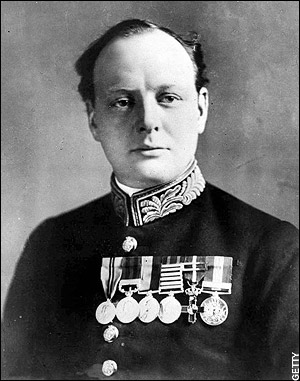
churchill1914

Friends of Padre Steve’s World,

One of the more interesting and overlooked factors in the days leading up to the First World War, which had significant ramifications in the Middle East involved Winston Churchill. Churchill was serving as First Lord of the Admiralty and made a decision which ensured the Ottoman Empire would be pushed into an alliance with Germany.

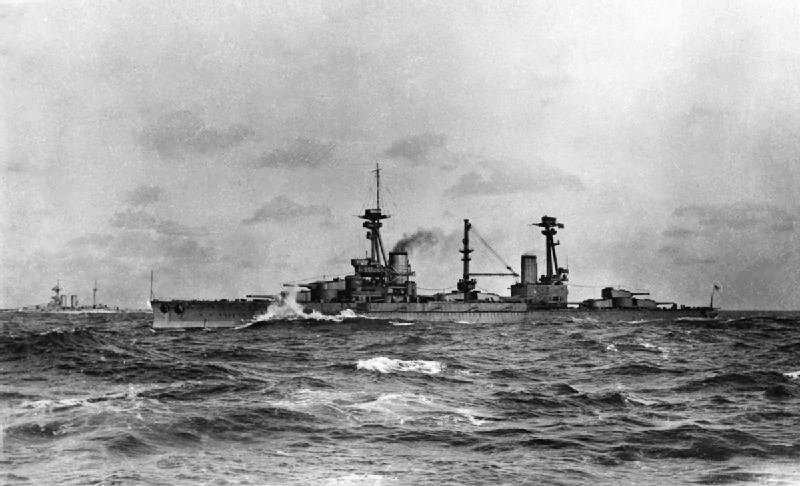
For many years Britain had been the chief supplier of ships for the Ottoman Navy. In fact in the years leading up to World War One the Ottomans had purchased over 40 ships from Great Britain and on August 2nd 1914 was expecting to take delivery of two, extremely modern Dreadnoughts, the Sultan Osman I and the Reshadieh. The Sultan Osman was armed with fourteen 12” guns, the Reshadieh with ten 13” guns, making them the equal or superior to most battleships afloat. The Turkish Government had paid over 4 billion Pounds for the ships and made the final payment on August 2nd shortly before the Turkish Captain and 500 crew members were to come aboard for a ceremony formally handing over the ship to the Turkish Navy.

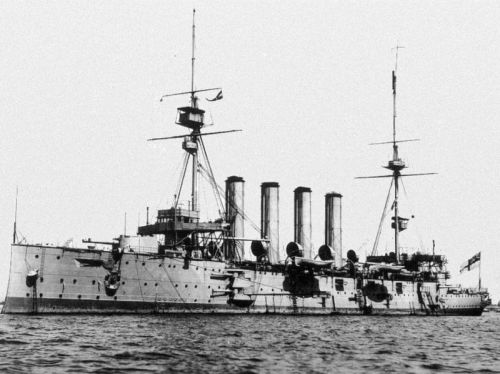
HMS_Agincourt_1915

HMS Agincourt 

Much of the money the Turks used to pay for the ships came from the donations of ordinary Turkish citizens. Money came from taverns, from cafes, schools, Mosques and markets. Those that donated were awarded a commemorative medal, the ships were the pride of Turkey and the empire. The nation awaited the delivery of the ships which would ensure the superiority of the Turkish Navy against its traditional foe, Russia.

HMS_Erin

HMS Erin

As War approached Churchill began to prepare, keeping many of his plans and actions even from the government. Less than an hour before the ceremony Churchill ordered the ships seized and and the Royal Navy kept the Turkish Captain and crew locked aboard a nearby transport. The Turkish Captain later wrote:

“… We paid the last installment (700.000 Turkish liras). The manufacturer and we agreed on that the ships would be hand over on 2 August 1914. Nevertheless, after we made our payment and half an hour before the ceremony, the British declared that they have requisitioned the ships… Although we have protested, nobody paid attention.”

Churchill had gained two modern Dreadnoughts for the Royal Navy, and the British shipyards kept the money, the Turks were never compensated for the loss. The ships were renamed HMS Agincourt and HMS Erin. Both served throughout the war and at the Battle of Jutland, and bother were scrapped in the early 1920s due to the restrictions of the Washington Naval Treaty.

SMS_Goeben-ptbow3

SMS Goeben

But in the process whereby the British gained the ships, ensured that Turkey would ally itself with Germany. The positive effects were mitigated by the Germans providing the very modern dreadnought type  Molkte ClassBattlecruiser Goeben and Light Cruiser Breslau to the Turks, giving them the edge over the Russians. Breslau was mined and sunk in 1918 but Goeben served in the Turkish Navy as the Yavuz Sultan Selim until she was decommissioned in 1954, and scrapped in 1973.

Likewise, Churchill’s decision meant that when Turkey entered the war that the strategically important Bosporus strait which was Russia’s only year round access to foreign shipping was closed, keeping Britain and France from being able to supply their Russian ally. The ill-fated Gallipoli campaign, launched by Churchill was the attempt to break the Turkish stranglehold, and the costly failure of that operation helped ensure the defeat of Russia and the overthrow of the Czar..

In the long term it had affects that we are still feeling the today. The entry or Turkey into the war and the subsequent collapse of the Ottoman Empire was the catalyst for the arbitrary borders drawn by the allies across the Middle East. We still suffer the result today.

Had Turkey remained neutral throughout the war, or even sided with the allies the course of history might be far different. We don’t know, but the Ottoman Empire might have endured or it might have peacefully morphed into something different.

Churchill’s decision turned out to be one of the more important, and less known events before the war broke out, and certainly we still feel the ramifications today. Actions have consequences, and sometimes what seems expedient to give a tactical edge, sometimes has far reaching strategic consequences. Consequences that sometimes linger for generations. In particular, the Trump administration needs to wake up to how their present policies will effect the world for the next century or more.

Peace

Padre Steve+

2 Comments

Filed under Foreign Policy, History, Military, national security, Navy Ships, News and current events, Political Commentary, world war one

The Night the Lamps Went Out in Europe: August 3rd 1914

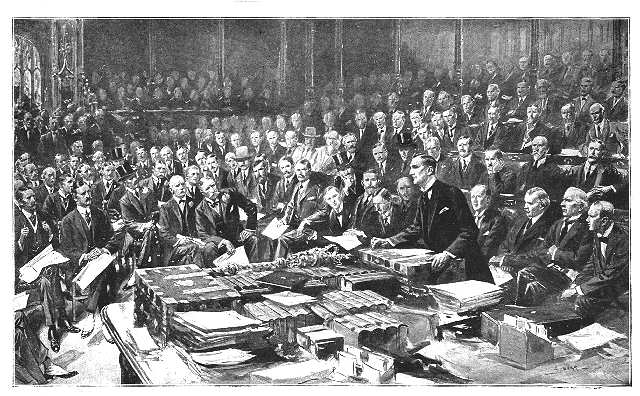
Sir Edward Grey Addresses the House of Commons

Friends of Padre Steve’s World,

One hundred and four years ago the political and military leaders of Europe embarked on a catastrophic war, the results of which are still with us over a century later.

The mobilization of millions of soldiers across Europe was moving rapidly as the sun set on the night of August 2nd 1914 when the German Ambassador to Belgium Klaus Bulow-Selaske delivered an ultimatum to the Belgian government. The ultimatum gave the Belgians 12 hours to decide if they would allow the German armies free passage through the country. The Belgians, treasuring their independence and led by a truly heroic leader, the young and humble King Albert, refused the German ultimatum and vowed to fight.

The next morning the British House of Commons met and for the first time since 1893 every member was present, with many spectators also in attendance. It was a dramatic event, as for the first time in 100 years Britain’s participation in a war on the European Continent was being debated. Britain was divided between those who wanted to intervene and non-interventionists. In a high pressure situation where the armies of the Austro-Hungarian Empire, Russia, France, Germany, and little Belgium were mobilizing for war the was on His Majesty’s Government to make a decision.

The British Foreign Minister, Sir Edward Grey urged giving support to France. He told the assembled Members of Parliament about, British military understandings with France, and the German ultimatum to Belgium. Grey asked them whether Britain “would quietly stand by and witness the perpetration of the dirtiest crime that ever stained the pages of history, and thus become participators in the sin.” He added that “we are going to suffer, I am afraid in this war, whether we are in it or stand aside.” If Britain dis stand aside, forfeiting her “Belgian Treaty obligations” the she would “sacrifice our respect and good name and reputation before the world.” Grey had not convinced everyone, but he had carried the day. However, the Germans did not believe that Britain would go to war over Belgium.

At seven that evening the German Ambassador to France Baron Schoen delivered a declaration of war against France, his counterpart in Berlin, the French Ambassador was given his passports.

As Grey pondered the content of an ultimatum to be sent to Berlin he returned to his office in Whitehall. “Watching with his failing eyes, the lamps being lit in St. James Park, Grey was heard to remark that “the lamps are going out all over Europe; we shall not see them again in our lifetime.”

The next morning the German army began its assault on the Belgian fortress city of Liege. That afternoon Poincare and Foreign Minister Viviani addressed the combined houses of the French Parliament, asking for war credits, discussing German violations of French territory and “implored the deputies, and the French people “to help us in bearing the burden of our heavy responsibility, the comfort of a clear conscience and the conviction that we have done our duty.”

The members of all parties, from the nationalists, the Catholic right and the Socialists overwhelming committed themselves to a sacred union. Poincare recalled later “Never has there been a spectacle as magnificent as that which they have just participated….In the memory of man, there has never been anything more beautiful in France.”

Bethmann-Hollweg Addresses the Reichstag

In Berlin Prime Minister Bethmann-Hollweg accused the French of violating German borders and of the Russian mobilization. He asked the Reichstag deputies “Were we to wait in further patience until the nations on either side of us chose the moment for their attack?” He was interrupted with cries of “No! No!”

Bethmann went on and admitted that Germany had violated Belgian territory and that it was a “breach of international law” ironically what he had just accused the French of doing, but Bethmann promised that “this wrong- I speak openly-the wrong we thereby commit we will try to make good as soon as our military aims have been attained.” Grand Admiral Tirpitz considered the admission of wrongdoing “the greatest blunder ever spoken by a German statesman.”

Bethmann called the nation to stand behind the military and as in France “Reichstag party leaders rose as one to vote war credits.”

A similar ultimatum was delivered to Russia by the German Ambassador and a similar scene repeated as Russia declared war.

That evening the British Ambassador to Germany Sir Edward Goschen paid a visit to Foreign Minister Jagow with a British ultimatum for the Germans to withdraw from Belgium within twelve hours, or face war. Bethmann, who had helped lead his nation into war believing that the British would remain neutral was stunned. Likewise, none had counted on the Russians to fight. The Germans had given Austria-Hungary a “blank check” and that nation’s leaders cashed it with grave consequences for the world. Austria’s actions led to Czar Nicholas making the fateful decision to mobilize on July 29th, which set Europe on course for war.

There was no turning back, in four hours the two greatest military powers in the world, Great Britain and Germany would be at war.

All all of the leaders in their speeches had left out information that would be embarrassing to their claims in their addresses, duplicity was the order of the day. The lights were going out across Europe. And the leaders of all of the nations, with the exception of Belgium shared some degree of responsibility.

The questions for us today are similar: Will all of our leaders allow the lights to go out again, not just in Europe but the Middle East and Asia? and will world leaders allow some foolish action somewhere to bring about more war?

Admittedly the situation is not identical, but there are troubling similarities. It is something to think long and hard about.

Peace

Padre Steve+

Leave a comment

Filed under Foreign Policy, History, Military, national security, Political Commentary, world war one

Repeating Historical Myths: The Trump Administration and the “Stab in the Back”

stab-in-the-back

Friends of Padre Steve’s World,

In light of the many flagrant lies, historical myths and conspiracy theories being floated by President Trump and his supporters  is always appropriate to look at examples of the power of those myths in the lives of nations and their influence on citizens.

It is true that some myths can be positive and inspiring so long as they remain recognized as myth. But myths which are believed as truth lead to conspiracy theories, false accusations and the demonization of others. The vast majority of the time this is done for the purpose of inciting hatred against political, social or religious opponents, or to justify indefensible polices at home or abroad.

Myths also can be used to perpetuate false beliefs about other countries that influence policy decisions, including the decision to go to war that ultimately doom those that believe them. There are many times in history where leaders of nations and peoples embrace myths about their history even when historical, biographical and archeological evidence points to an entirely different record.  Myths are powerful in the way that they inspire and motivate people. They can provide a cultural continuity as a people celebrates the key events and people that shaped their past, even if they are not entirely true.  At the same time myths can be dangerous when they cause leaders and people to make bad choices and actually become destructive.

A good example of this is the Stab in the Back myth that began after the armistice that ended the First World War, as well as the false beliefs held by Hitler and other Nazi leaders about the United States.

Just two days ago President Trump’s Chief Economic Advisor Larry Kudlow accused Canadian Prime Minister Justin Trudeau of “stabbing President Trump in the back” following the G7 meeting in Quebec. The choice of words was not only unfortunate but buttresses every action that the President has taken to delegitimatize faithful allies and partners since long before his inauguration.  In doing so he embraced an infamous term used so often by the Nazis and others on the German right following the defeat of Germany in the First World War.

After the war the belief that the German Army was not defeated but was betrayed by the German people, especially those of the political left.  Like all myths there was an element of truth in the “stab in the back” myth, there were revolts against the Monarchy of Kaiser Wilhelm II and even mutiny on elements of the German High Seas Fleet and Army units stationed in Germany. However the crisis had been brought about by General Ludendorff who until the last month of the war refused to tell the truth about the gravity of Germany’s position to those in the German government.

So when everything came crashing down in late October and early November 1918 the debacle came as a surprise to most Germans.  The myth arose because the truth had not been told by Ludendorff who was arguably the most powerful figure in Germany from 1916-1918.  In the looming crisis which included Ludendorff’s collapse and relief, General Wilhelm Groener presented the facts to the Kaiser and insisted on his abdication.  The Republic that was proclaimed on the 9th of November was saddled with the defeat and endured revolution, civil war and threats from the extreme left and right.  When it signed the Treaty of Versailles it accepted the sole responsibility of Germany for the war and its damages. Ordered to dismantle its military, cede territory that had not been lost in battle and pay massive reparations the legend of the “stab in the back” gained widespread acceptance in Germany.

Hitler always believed that the defeat of Germany in the First World War was due to the efforts of internal enemies of the German Reich on the home front and not due to the fact that the German army was collapsing, the U-Boat campaign had failed, and the Navy’s High Seas Fleet was hopelessly outnumbered and incapable of defeating the Royal Navy and breaking the blockade that was strangling Germany.

The Stab in the Back was a fundamental belief of Hitler and was expressed in his writings, speeches and actions.  The internal enemies of Germany for Hitler included the Jews, as well as the Socialists and Communists who he believed were at the heart of the collapse on the home front.  Gerhard Weinberg believes that the effect of this misguided belief on Hitler’s actions has “generally been ignored” by historians. (Germany, Hitler and World War II p. 196)

Hitler believed that those people and groups that perpetrated the “stab in the back” were “beguiled by the by the promises of President Wilson” (World in the Balance p.92) in his 14 Points.  Thus for him Americans were in part responsible for undermining the German home front, something that he would not allow to happen again.  In fact Hitler characterization of Wilson’s effect on the German people in speaking about South Tyrol.  It is representative of his belief about not only the loss of that region but the war: “South Tyrol was lost by those who, from within Germany, caused attrition at the front, and by the contamination of German thinking with the sham declarations of Woodrow Wilson.” (Hitler’s Second Book p.221)

While others will note Hitler’s lack of respect for the potential power of the United States, no other author that I am familiar with links Hitler’s actions and the reaction of the German political, military and diplomatic elites to the entry of the United States into the war to the underlying belief in the “stab in the back.”   Likewise Hitler had little regard for the military abilities or potential of the United States. Albert Speer notes that Hitler believed “the Americans had not played a very prominent role in the war of 1914-1918,” and that “they would certainly not withstand a great trial by fire, for their fighting qualities were low.” (Inside the Third Reich: Memoirs by Albert Speer p.121)

Hitler not only dismissed the capabilities of the Americans but also emphasized the distance that they were from Germany and saw no reason to fear the United States when “he anticipated major victories on the Eastern Front.” (Germany Hitler and World War II p.92)   Hitler’s attitude was reflected by the majority of the military high command and high Nazi officials. Ribbentrop believed that the Americans would be unable to wage war if it broke out “as they would never get their armies across the Atlantic.” (History of the German General Staff, Walter Goerlitz, p.408).  General Walter Warlimont notes the “ecstasy of rejoicing” found at Hitler’s headquarters after Pearl Harbor and the fact that the he and Jodl at OKW caught by surprise by Hitler’s declaration of war. (Inside Hitler’s Headquarters 1939-1945 pp.207-209) Kenneth Macksey notes Warlimont’s comments about Hitler’s beliefs; that Hitler “tended to dismiss American fighting qualities and industrial capability,” and that Hitler “regarded anyone who tried to show him such information [about growing American strength] as defeatist.”(Why the Germans Lose at War, Kenneth Macksey, p.153.)

Others like Field Marshal Erwin Rommel record the disregard of senior Nazis toward American capabilities in weaponry.  Quoting Goering who when Rommel discussed 40mm anti-aircraft guns on aircraft that were devastating his armored forces Goering replied “That’s impossible. The Americans only know how to make razor blades.” (The Rommel Papers edited by B.H. Liddell-Hart p.295) Rommel was one of the few German commanders who recognized the folly of Hitler’s declaration of war on the United States noting that “By declaring war on America, we had brought the entire American industrial potential into the service of Allied war production. We in Africa knew all about the quality of its achievements.” (The Rommel Papers p.296)

When one also takes into account the general disrespect of the German military for the fighting qualities of American soldiers though often with good reason (see Russell Weigley’s books Eisenhower’s Lieutenants and The American Way of War) one sees how the myth impacted German thought.  This is evidenced by the disparaging comments of the pre-war German military attaché to the United States; General Boeticher, on the American military, national character and capability. (See World in the Balance pp. 61-62)

The overall negative view held by many Germans in regard to the military and industrial power and potential of the United States reinforced other parts of the myth. Such false beliefs served to bolster belief in the stab-in-the back theory as certainly the Americans could not have played any important role in the German defeat save Wilson’s alleged demoralization of the German population.  This was true not only of Hitler, but by most of his retinue and the military, diplomatic and industrial leadership of the Reich. Hitler’s ultimate belief shaped by the stab-in-the back and reinforced by his racial views which held the United States to be an inferior mongrel people. This led him to disregard the impact that the United States could have in the war and ultimately influenced his decision to declare war on the United States, a decision that would be a key factor in the ultimate defeat of Germany.

Myth can have positive value, but myth which becomes toxic can and often does lead to tragic consequences. All societies have some degree of myth in relationship to their history including the United States.  The myths are not all the same, various subgroups within the society create their own myth surrounding historic events. The danger is that those myths can supplant reason in the minds of political, military, media and religious figures and lead those people into taking actions that work to their own detriment or even destruction.

Today the President leads the way in promoting lies patently false myths in the name of his personal greatness which he shrouds himself while conflating that with making America great again all the while endangering the country. He has been promoting conspiracy theories for nearly a decade and has never stopped doing so or offered an apology for those words.

It is the duty of historians, philosophers and others in the society to ensure that myth does not override reality to the point that it moves policy both domestic and foreign in a manner that is ultimately detrimental to the nation.  The lesson of history demonstrated by myths surrounding the German defeat and role of the United States in that defeat shows just how myth can drive a nation to irrational, evil and ultimately tragic actions not only for that nation and its people, but for the world.

Sadly, it appears that the United States led by President Trump is following the path of Hitler’s Germany in terms of how it views the world and treats other nations and history will not be kind to us.

Peace,

Padre Steve+

2 Comments

Filed under History, nazi germany, News and current events, Political Commentary, world war one

They Silently Gather ‘Round Me: Memorial Day 2018

Friends of Padre Steve’s World,

After the end of the American Civil War, the poet Walt Whitman reflected on the human cost of it. Whitman wrote,

“Ashes of soldiers South or North,

As I muse retrospective murmuring a chant in thought, The war resumes, again to my sense your shapes, And again the advance of the armies.

Noiseless as mists and vapors, From their graves in the trenches ascending, From cemeteries all through Virginia and Tennessee, From every point of the compass out of the countless graves,

In wafted clouds, in myriads large, or squads of twos or threes or single ones they come, And silently gather round me…”

Memorial Day is always an emotional time for me, especially since I returned from Iraq in 2008, and this weekend I have been thinking about the men and women that I knew who died in action or died after they left the service, some at their own hand, unable to bear the burdens and trauma that they suffered while at war. I was reminded of them again at the memorial service that we conducted for the sailors and soldiers from our base who have died in action since September 11th 2001. In an age where less than one percent of Americans serve in the military, I think that it is important that we take the time to remember and reflect on the human cost of wars.

I think of the battlefields that I have served on in Al Anbar Province, the one my father served on at An Loc, Vietnam, or the battlefields and the graveyards I have been to, Verdun, Waterloo, Arnhem, Normandy, Belleau Wood, Luxembourg, the Shuri Line, the Naktong River, Yorktown, Chancellorsville, Antietam, Stone’s River, Bentonville, Gettysburg, the wrecks of the USS Arizona and USS Utah at Pearl Harbor, and so many more, I think about the men and women who never returned. To me all of these places are hallowed ground, ground that none of us can hallow, the sacrifices of the men who gave their last full measure of devotion have done that better than we can ever do.

There are some songs that are haunting yet comfort me when I reflect on the terrible costs of war, even those wars that were truly just; and yes there are such wars, even if politicians and ideologues demanding revenge or vengeance manage to mangle the peace following them. Of course there are wars that are not just in any manner of speaking and in which the costs far outweigh any moral, legal, or ethical considerations, but I digress…

Joshua Lawrence Chamberlain, the hero of the Battle of Little Round Top at Gettysburg wrote something that talks about the importance and even the transcendence of the deeds of those who lost their lives in those wars fought and died to achieve.

In great deeds, something abides. On great fields, something stays. Forms change and pass; bodies disappear; but spirits linger, to consecrate ground for the vision-place of souls… generations that know us not and that we know not of, heart-drawn to see where and by whom great things were suffered and done for them, shall come to this deathless field, to ponder and dream; and lo! the shadow of a mighty presence shall wrap them in its bosom, and the power of the vision pass into their souls.”

Elton John wrote and performed this song, Oceans Away on the centenary of the First World War. It speaks of the men that never came home, and he related it to those who continue to go off to war today.

I hung out with the old folks

In the hope that I’d get wise

I was trying to bridge the gap

Between the great divide

Hung on every recollection

In the theater of their eyes

Picking up on this and that

In the few that still survive


Call em up

Dust em off

Let em shine

The ones who hold onto the ones, they had to leave behind

Those that flew, those that fell,

The ones that had to stay,

Beneath a little wooden cross


They bend like trees in winter

These shuffling old grey lions

Those snow-white stars still gather

Like the belt around Orion

Just to touch the faded lightning

Of their powerful design

Of a generation gathering

For maybe the last time

Oceans away

Where the green grass sways

And the cool wind blows

Across the shadow of their graves.

Shoulder to shoulder back in the day

Sleeping bones to rest in earth, oceans away

Call em up

Dust em off

Let em shine

The ones who hold onto the ones, they had to leave behind

Those that flew, those that fell,

The ones that had to stay,

Beneath a little wooden cross

Oceans away

Elton John “Oceans Away”

Likewise I find myself thinking about all those times alone overseas, and realize that many did not come home. The song I’m Dreaming of Home or Hymne des Fraternisés from the film Joyeux Noel which was adapted by French composer Philippe Rombi from the poem by Lori Barth I think speaks for all of us that served so far away, both those who returned and those who still remain oceans away.

I hear the mountain birds

The sound of rivers singing

A song I’ve often heard

It flows through me now

So clear and so loud

I stand where I am

And forever I’m dreaming of home

I feel so alone, I’m dreaming of home


It’s carried in the air

The breeze of early morning

I see the land so fair

My heart opens wide

There’s sadness inside

I stand where I am

And forever I’m dreaming of home

I feel so alone, I’m dreaming of home


This is no foreign sky

I see no foreign light

But far away am I

From some peaceful land

I’m longing to stand

A hand in my hand

… forever I’m dreaming of home

I feel so alone, I’m dreaming of home.

Please take the time to remember those who whose spirits still dream of home, oceans away.

Until tomorrow,

Peace,

Padre Steve+

1 Comment

Filed under civil war, History, Military, music, world war one

Though Poppies Grow: Buddy Poppies & Memorial Day 2018

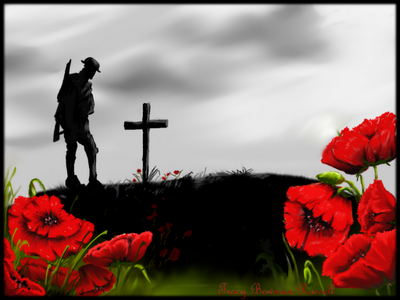
flanders_field

Friends of Padre Steve’s World

This is Memorial Day Weekend, a weekend where we remember those who died in the service of our country. It is not a day to thank the living veterans, that day is Veteran’s Day. Nor is it the day to thank those men and women who currently wear the uniform and fight the wars of our country. This weekend I am reposting a number of articles from past years to remind my regular readers and those new to my writings about how important this remembrance is, not just to me, but to all of us. I do not say that lightly. Memorial Day is the offspring of the families of the American Civil War dead, when people who lost loved ones in the cause of liberty and the defense of the Union honored their loved ones.

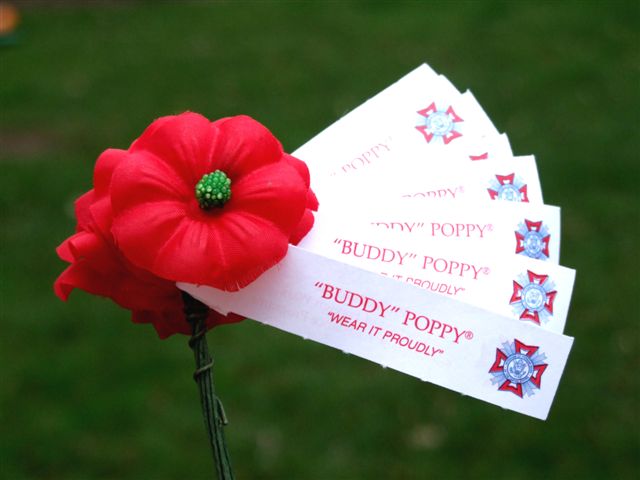
While the Buddy Poppy was something that came out of the First World War, and Armistice Day, which after the Second World War became Veteran’s Day. In time it has also become connected with the original Memorial Day. So today’s post is my first reflection of this weekend on the Buddy Poppy and Memorial Day.

I write this in the disastrous aftermath of President Trump’s high stakes game of chicken with North Korean Leader Kim Jung Un in which he bailed after aggressively praising Kim and pushing for direct talks. When I read the President’s letter to the North Korean I realized that the chances of a catastrophic war have gone up.

I also have been watching Ken Burns’ series The Vietnam War while reading Robert K. Massie’s Castles of Steel: Britain, Germany, and the Winning of the Great War at Sea. Both are filled with stories of hubris and tragedy.

No matter what your political views, ideology, or religious beliefs, please take time to remember the high human cost of war this weekend, especially on Monday when we observe Memorial Day.

Until tomorrow,

Peace,

Padre Steve+

1144221_orig

In Flanders Fields

John McCrae, 1915.

In Flanders fields the poppies blow

Between the crosses, row on row

That mark our place; and in the sky

The larks, still bravely singing, fly

Scarce heard amid the guns below.

We are the Dead. Short days ago

We lived, felt dawn, saw sunset glow,

Loved and were loved, and now we lie

In Flanders fields.

Take up our quarrel with the foe:

To you from failing hands we throw

The torch; be yours to hold it high.

If ye break faith with us who die

We shall not sleep, though poppies grow

In Flanders fields.

Besides the American Flag the Buddy Poppy is perhaps the most ubiquitous symbol of Memorial Day. This poppy as we know it came about when Mrs. Moina Michael read McRea’s poem and inspired wrote this verse:

We cherish too, the Poppy red

That grows on fields where valor led,

It seems to signal to the skies

That blood of heroes never dies.

She then had the inspiration to begin wearing Red Poppies on Memorial Day and sold the poppies to friends and others with the money going to those in need. A French woman visiting the United States, a Madame Guerin discovered the new custom and took it back to France where she began to make artificial red poppies to sell with the proceeds going to the widows and orphans of the First World War. The custom spread to other countries and in 1921 the Franco-American Children’s League sold the poppies but disbanded in 1921. Madame Guerin approached the newly formed Veteran’s of Foreign Wars, the VFW in 1922 for assistance and in 1922 the VFW became the first American organization to sell poppies. Two years later the Buddy Poppy program began. The artificial poppies were made by disabled veterans who were paid for their work in order to provide them some form of income and distributed by other veterans across the country. Today the VFW continues to distribute the Buddy Poppies which are still produced by disabled Veterans at the nation’s Veteran’s Administration Hospitals.

I remember the first Buddy Poppy that I every received. It was just before Memorial Day 1970, before it became a 3 day weekend falling on the last Monday of May. We were living with my Grandparents in Huntington West Virginia as my dad sought suitable housing for us in Long Beach California while he was in the Navy.

Our initial move from the small town of Oak Harbor Washington, where my dad had been stationed at Naval Air Station Whidbey Island to Long Beach had not gone well. The first place we lived was in a dangerous neighborhood and with my dad traveling frequently to Naval Shipyards around the country to help commission new ships the stress on the family, especially my mother in dealing with that and two young boys was too much. Dad sent us back to Huntington where my Grandparents and numerous other relatives still lived for the duration of the school year as he sought better housing.

veterans-day-05-26-10-1

Memorial Day then was filled with visits to cemeteries to place flowers on the graves of departed relatives as well as flags on the graves of relatives who had served in the military. We made a number of stops that day at the Bowen and Dundas cemeteries as well as others where relatives were interred. Afterward we had a home cooked meal prepared by my maternal grandmother Christine and then made a trip on a city bus to to the other side of town to see my paternal grandmother Verdie.

Holidays, were much like that for us during that time that we lived in Huntington, until my dad came back and brought us back to Long Beach in June. Just before my dad arrived to take us back to Long Beach my mom, her cousin Valerie and I were shopping downtown, which at the time before I-64 took traffic around the town and led to a new mall and shopping complex being built just out of town, was a bustling place of commerce and activity. Major retailers all had their stores downtown, while the best movie theaters and restaurants were there as well.

We were coming out of the old SS Kresge store on Fourth Avenue and an elderly man wearing a VFW cap approached us and handed me a poppy. He had to be in his 70s so I presume that he was a Veteran of the First World War. He chatted briefly with my mom and Valerie and I am sure my mom gave him a bit of money for the poppy. I kept it for many years and it was eventually lost in one of our moves. But I will not forget it and any time I see a Veteran distributing them I make sure that I get one.

But I haven’t seen anyone passing them out for years, maybe I will need to start getting them and giving them out myself. Maybe I’ll start that as Veteran’s Day approaches.

Babe-Ruth_MAIN

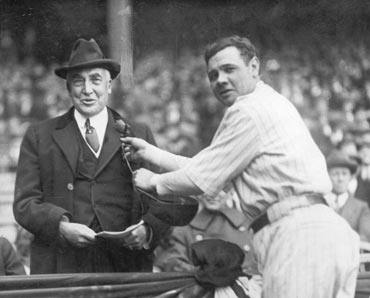
Babe Ruth and President Warren G Harding with the first official Buddy Poppy of 1923

For me the Buddy Poppy is a symbol of thanks for the sacrifices made by so many, those who did not come home from wars being killed or missing in action, as well as the wounded and the families of the dead and those that came home forever changed by their time in war. This year marks the 90th anniversary of it being the official flower of remembrance for those who died in our nation’s wars.

The poppy has even more significance for me now having served in Iraq. Seeing war’s devastation and knowing so many who have either been killed or wounded in the wars that we have engaged since September 11th 2001 has impacted me in ways that I could not have imagined before the war. Likewise having come back changed by my experience and having to deal with the affliction of severe PTSD I sense a camaraderie with those men who came home changed from war and in many cases returned to a country that did not understand them.

I will be observing the “Go Silent” moment at 12:01 Monday with the Iraq Afghanistan Veterans Association to honor those who have given the last full measure.

Peace

Padre Steve+

1 Comment

Filed under books, film, iraq, News and current events, PTSD, vietnam, world war one

The U-9 and the Advent of Submarine Warfare

Friends of Padre Steve’s World,

In September 1914 most naval experts held the submarine was not much of a threat. The submarines of the day were limited in range, diving depth, speed, armament and endurance. The U-9 was powered by kerosine engines on the surface which charged batteries which were used when the boats were submerged. Later submarines would be powered by diesel engines.

U-9 was small, displacing only 543 tons on surface and 674 submerged. She was just 188 feet long and had a beam of just 19.7 feet. As such, the living conditions for her crew of 4 officers and 25 enlisted men were less than spartan. She was armed with four 20 inch torpedo tubes, two forward and two aft and carried six torpedoes, four in the tubes and two reloads for the forward torpedo tubes.

The boat was commissioned in April 1910 and on the outbreak of the First World War she was commanded by Kapitänleutnant Otto Weddigen.  On September 22nd 1914 with enormous battles raging on the Western Front and the High Seas Fleet in port the soon to be famous submarine was patrolling in the North Sea. The U-9 was about 18 miles off the Dutch Coast near the Hook of Holland when she encountered three ships of the Royal Navy’s 7th Cruiser Squadron.

U-9

The squadron was composed of four obsolete Cressy Class Armored Cruisers, the HMS CressyHMS, Aboukir, HMS Hogue, and HMS Euryalus. each displacing 12,000 tons and mounting two 9.2” and 12 6” guns. Manned primarily by recently called up reservists the ships were derisively known as the “Live Bait Squadron” and on that September morning they would unfortunately live up to that title. However, Euryalus had been detached from the squadron on September 20th to return to Harwich to coal. The squadron commander, Rear Admiral Christian aboard Euryalus was prevented from transferring his flag due to high seas and command passed to Captain John Drummond of Aboukir.  Adding to the approaching tragedy was the fact that First Lord of the Admiralty Winston Churchill had sent a commander to the First Sea Lord, Sir Louis Battenberg that the ships should be removed from that duty because of “the risks to such ships is not justified by the services they render.” Battenberg initially agreed but was persuaded by his Chief of Staff, Admiral Charles Sturdee to keep them on station because they were better than nothing. Churchill assumed that his order had been obeyed and never followed up and the rest was history.

800px-HMS_Cressy

HMS Cressy

The ships were steaming in a line ahead formation when Weddigen on the U-9 spotted them about 0600. They were not zig-zagging to lessen the chance of submarine attack and thought they had posted lookouts had no idea that U-9 was stalking them.

Otto Weddigen 

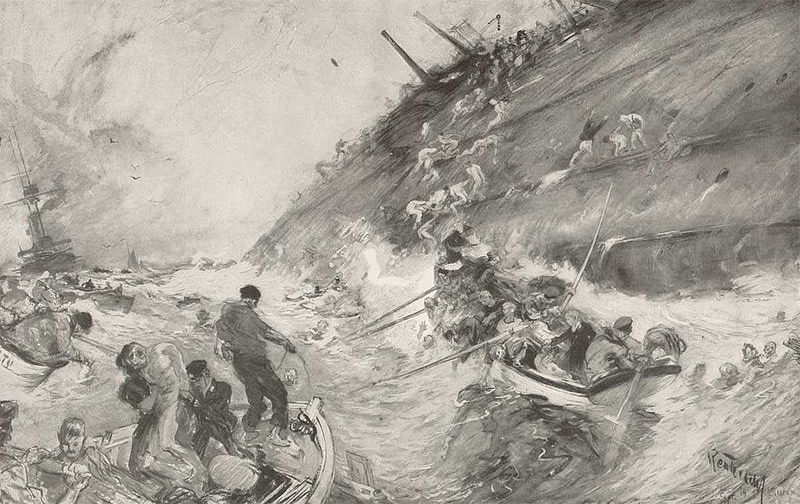
Weddigen on worked the boat into what he felt was a better firing position and launched his first torpedo at the center cruiser, the Aboukir at 0620 from a distance of just 550 yards. The torpedo struck her midships and broke her back. She began to sink and within 25 minutes capsize taking 527 of her crew of 760 down with her. Weddigen described the scene:

“There was a fountain of water, a burst of smoke, a flash of fire, and part of the cruiser rose in the air. Then I heard a roar and felt reverberations sent through the water by the detonation.”

Thinking that Aboukir had struck a mine the Cressy and Hogue moved in to rescue survivors. Weddigen had surfaced to observe the British and then fired two torpedoes into Hogue from a range of just 300 yards and then dived as Hogue opened fire. The torpedoes struck the ancient armored cruiser causing massive damage, which was compounded by the fact that her watertight doors were still open. Thus, within 15 minutes of being hit  Hogue capsized and sank.

Sketch of HMS Cressy Sinking 

The British now knew that a submarine was responsible for the attack and the last ship and after reloading his forward tubes attacked Cressy at 0720 firing two torpedoes from her stern tubes. Weddigen then surfaced in order to bring his bow tubes, now reloaded, into action and fired another shot.  As he did so the British cruiser opened fire and attempted to ram the surfaced U-9. But Cressy was unable to avoid the fate of her sisters, struck by two torpedoes she capsized and then sank at 0755.

In little more than an hour and a half U-9 had sunk three cruisers with a loss of 1459 British sailors. Only 837 crew members from all three ships survived.

Drawing of HMS Aboukir Sinking with HMS Hogue in Background

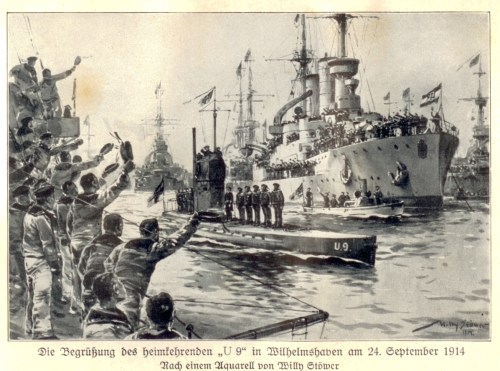
Weddigen then moved off as he knew that the British would be looking for the U-9. When the boat returned to port Weddigen  and his crew were hailed as heroes. Weddigen was awarded the Iron Cross First Class and the boat was one of only two ships of the Imperial Navy awarded the Iron Cross, the other being the Light Cruiser Emden.

The plucky U-9 would survive the war, sinking another cruiser, the HMS Hawke on October 15th 1914, less than a month after sinking Aboukir, Hogue, and Cressy. She would also sink 13 other merchant ships or fishing boats for a total of over 50,000 tons. She was withdrawn from front line service in 1916 and assigned to training duties. Weddigen was killed on March 18th 1915 when his new command the U-29 was sunk.

U9_Heimkehr

The U-9 Returns to Wilhelmshaven on September 24th 1914

Future First Sea Lord Dudley Pound then serving on the Battleship St. Vincent wrote: “Much as one regrets the loss of life one cannot help thinking that it is a useful warning to us — we had almost begun to consider the German submarines as no good and our awakening which had to come sooner or later and it might have been accompanied by the loss of some of our Battle Fleet”.

Submarines would go on to be one of the most feared and effective weapons developed for naval warfare. German U-Boats nearly brought Britain to its knees in both World Wars and the submarines of the US Navy’s Pacific Fleet decimated the Japanese merchant fleet and inflicted great losses on the Imperial Japanese Navy. While the US Navy replaced its losses in early 1942 it was the submarine force that according to Admiral Chester Nimitz “held the lines against the enemy.”

Today the most deadly submarines ever built prowl underneath the surface of the world’s oceans. Nuclear powered and advanced diesel electric boats armed with torpedoes and cruise missiles, and giant nuclear powered ballistic missile submarines armed with long range nuclear intercontinental ballistic missiles provide an invisible deterrent.

Unlike 1914 today all navies take the submarine threat seriously. Should any significant naval war be fought in the Persian Gulf or the Pacific submarines will certainly have an impact not only at sea but in strategic strikes on enemy installations and land based units.

In 1914 no one would have thought that the success of the tiny U-9 would eventually lead to such a dominating weapon.

Peace

Padre Steve+

3 Comments

Filed under History, Navy Ships, world war one

A Crisis of Character: Trump Emulates Kaiser Wilhelm II and War Beckons

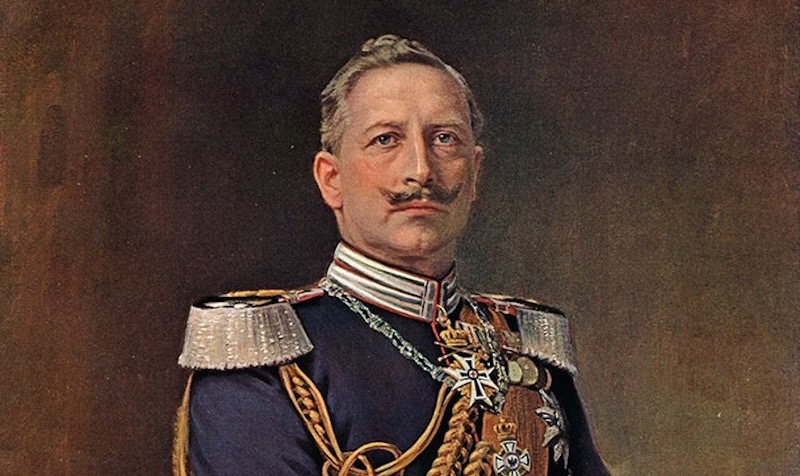
Two of a Kind: Kaiser Wilhelm II and President Trump

Friends of Padre Steve’s World,

With every passing day the words of Theodore Roosevelt keep echoing in my mind. The President and hero of San Juan Hill noted: “Character, in the long run, is the decisive factor in the life of an individual and of nations alike.” That is especially true as we all await to see if the actions of President Trump live up to his Tweet storms to defy the Constitution, and unleash missiles on Syria and the forces of Russia and Iran located in that suffering country.

I could never in a million years believed that I would see the day when the manifold transgressions of an American President threaten the both the Constitution and potentially the very existence of the United Staes.  First growing number of  of crises involving multiple indictments of Trump surrogates involved with the supposedly non-existent Russian interference and the President’s threats against the press, political opponents, prosecutors, and his own Department of Justice regarding the Trump campaign collusion with Russia are frightening on their own merits. But then there is the of potential nuclear war with North Korea. But for just a dash of spice let’s mention the President’s tweets of looming strikes on Syria and taunts against Russia. Frankly as recipes for disaster go this is like adding Ghost Peppers to a Sarin laced cheesecake, but I digress…

I think that it is important to see the President’s words and actions in light of a number of factors. The first and foremost of those is character, just as Theodore Roosevelt noted. President Trump may be a character; he may even be a hoot when he gets peed on by Putin paid prostitutes (if such rumors are true) but he shows little evidence of actually having character or being a man of honor.

That dear reader is really the problem, thus it is important to know how the character other leaders at other historical  influenced how they treated people, reacted to criticism, and led their nations into disaster.

In the American experience one is hard pressed to find a President with a similar temperament and character that corresponds to Donald Trump. Yes, Nixon had some similarities, Jackson as well, but both men even at their worst did, at least in public restrain themselves and Nixon, when confronted with the reality of certain impeachment did the country a favor by resigning. Of course American history is replete with other Presidents and leaders with a corresponding lack of character but none tweeted with their iPhone in one hand and the nuclear football in the other, although I assume that he has to put at least one down to eat his friend chicken as he gets his political strategy and intelligence briefings from Sean Hannity and Steve Doocey.

But the times have changed. At onetime there were leaders in the Republican Party who chose to honor the Constitution and their oaths over blind party loyalty or their determination to pass a certain legislative act. Their resistance to President Nixon was instrumental in his resignation in 1974. But there seem to be few current members of the GOP congressional delegations willing to stand either for fear of the Trump base, or blind determination to press on with tax cuts even if it means the sacrifice of the Constitution, nuclear war, or their own integrity.

But all that being said I do think that there is a leader from historywho in temperament was much like President Trump, who ended up helping to lead his nation and the world to the abyss of World War. That is not Adolf Hitler who many people often compare the President. I think that Trump’s authoritarian tendencies and his reliance on his radicalized base, including armed mobs in the street, and hyper-partisan allies in the right wing media, especially Fox News and Rupert Murdoch’s NewsCorp which serves as his de-facto state media are similar, but they do not speak to the President’s unstable, narcissistic, and paranoid behaviors. I think that the better comparison is to Kaiser Wilhelm II of Germany with whom the President seems to share many similarities, both in temperament and words.

As tensions built in the lead up to the First World War Kaiser Wilhelm alternated between threatening Russia with destruction and pleading with his cousin Czar Nicholas II for peace.

In his book The Sleepwalkers: How Europe Went to War in 1914, Christopher Clark wrote of Wilhelm in words that are strikingly reminiscent of the President.

“It was one of this Kaiser’s many peculiarities that he was completely unable to calibrate his behaviour to the contexts in which his high office obliged him to operate. Too often he spoke not like a monarch, but like an over-excited teenager giving free rein to his current preoccupations.

‘I am the sole master of German policy,’ he remarked in a letter to the Prince of Wales (the future Edward VII), ‘and my country must follow me wherever I go”

“Wilhelm frequently –especially in the early years of his reign –bypassed his responsible ministers by consulting with ‘favourites’, encouraged factional strife in order to undermine the unity of government, and expounded views that had not been cleared with the relevant ministers or were at odds with the prevailing policy.

“It was in this last area –the unauthorized exposition of unsanctioned political views –that the Kaiser achieved the most hostile notice, both from contemporaries and from historians. There can be no doubt about the bizarre tone and content of many of the Kaiser’s personal communications in telegrams, letters, marginal comments, conversations, interviews and speeches on foreign and domestic political themes. Their exceptional volume alone is remarkable: the Kaiser spoke, wrote, telegraphed, scribbled and ranted more or less continuously during the thirty years of his reign, and a huge portion of these articulations was recorded and preserved for posterity…”

Max Hastings wrote that Wilhelm “was a brittle personality whose yearning for respect caused him to intersperse blandishments and threats in ill-judged succession.” Sean McMeekin in his book July 1914 wrote that Wilhelm had an “insecurity complex, a need for constant attention and acclaim. As one of his many critics put it, the kaiser needed to be “the stag at every hunt, the bride at every wedding, and the corpse at every funeral.” He also noted “Eager for praise, taking offense at the merest slight, the kaiser was a difficult man to work for. Bismarck had disdained to gratify Wilhelm II’s fragile ego after he became emperor in 1888, which led to his sacking two years later.”

Like President Trump the Kaiser did experience some push back from different governmental ministers, and was somewhat restrained during the month leading up to the war, but his constant belligerence, instability, and unscripted remarks helped set the diplomatic and governmental crisis that led to the war. Of course this was not his fault alone, the Austrian-Hungarians, Serbians, Russians, French, and British all had a hand, but the Kaiser, through his words and actions during the three decades preceding the war bears much responsibility for what happened in 1914. If the Kaiser had had a Twitter account he would have certainly used it in a similar manner to President Trump.

But Germany had no checks and balances to restrain Wilhelm. He was an absolute monarch. Americans do still have institutional checks and balances to Presidential overreach or abuses should we choose to follow the Constitution, but for that to happen the leadership of the Republican Party must also act, as did their predecessors during the Nixon administration to put principle or party, and rule of law over blind obedience. This is not about partisanship; it is about the Constitution, our form of government, and yes, even the prevention of nuclear war, that being said I don’t think that todays Republicans would pass the test that Wilhelm’s advisors failed in 1914.

Character and temperament are very important in times of crisis and elevated tensions. Character is also fate. We should all tremble when we think of the lack of character and maturity shown by our President.

Until tomorrow,

Peace

Padre Steve+
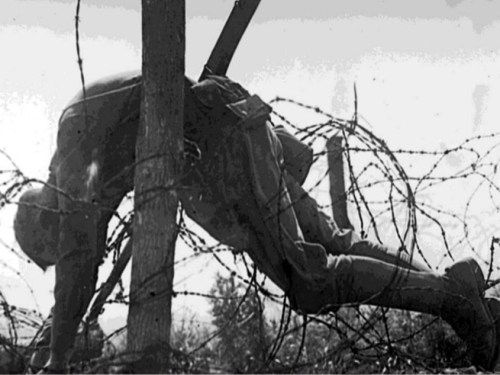
3 Comments

Filed under ethics, History, national security, News and current events, Political Commentary, world war one