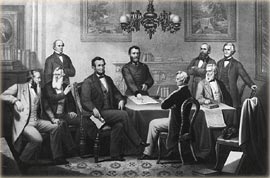
Tag Archives: abraham lincoln

Gettysburg Biographic Vignette: George Gordon Meade

Friends of Padre Steve’s World

I am going to periodically interspersing and publishing short articles about various commanders at Gettysburg  on the site. These all come from my student text and the reason is I am going to do this is because I have found that readers are often more drawn to the lives of people than they are events. As I have noted before that people matter, even flawed people, and we can learn from them.

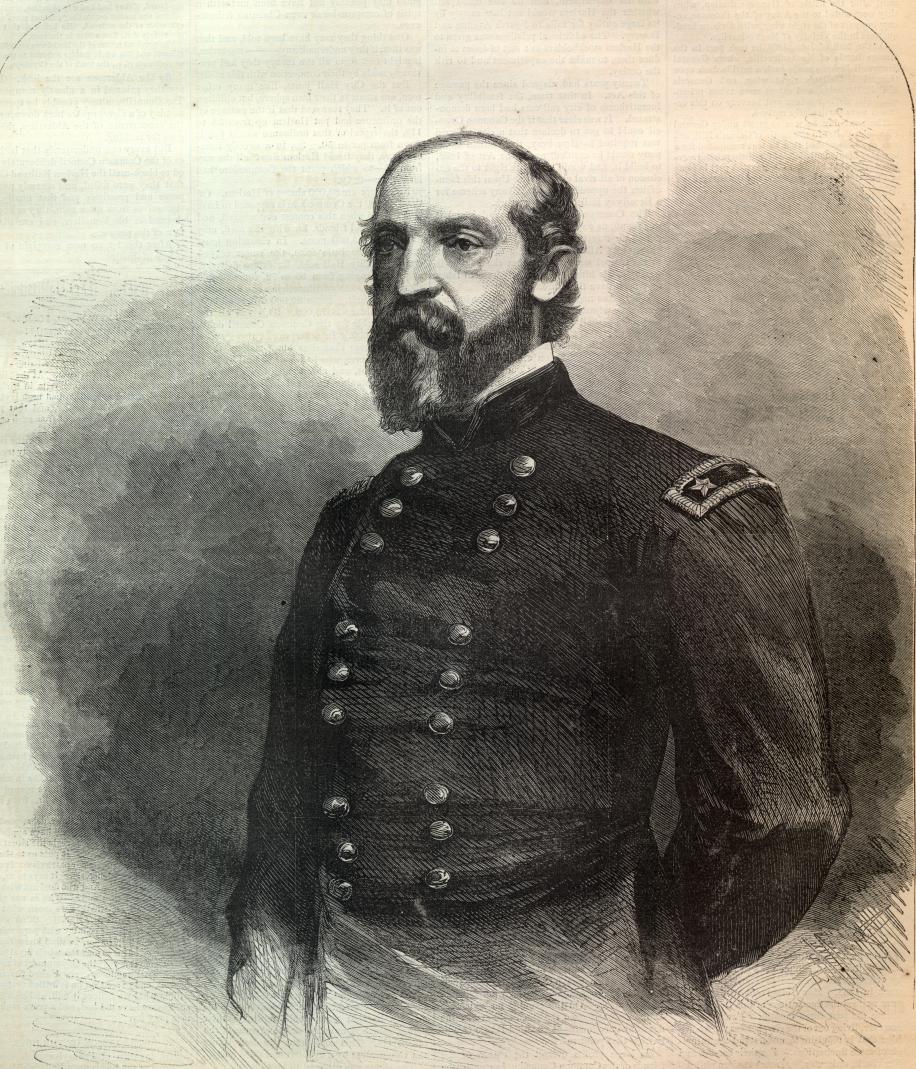
Today’s vignette is about major General George Gordon Meade who assumed command of the Army of the Potomac just three days before it went into action against Robert E. Lee’s Army of Northern Virginia at Gettysburg. He was flamboyant, nor particularly inspirational, but he was smart, had tremendous tactical acumen and great physical and moral courage. Sadly he is often overlooked or discounted. This is just a bit about Meade, his life and career leading up to Gettysburg.

Peace

Padre Steve+

general-george-meade

George Gordon Meade was the son of an American merchant who served as the naval agent for the U.S. government in that country until 1817. Meade was born in Cadiz on December 31st 1815 and grew up in Pennsylvania and Maryland. His father had been ruined financially in Spain when supporting the Spanish government by loaning it over $375,000 in the Peninsular War against Napoleon. Meade’s father remained in Spain to try to recover his lost fortune he sent his wife and children back to the United States where the family lived on the margins of poverty. The money should have been reimbursed to him under the terms of the Treaty of Florida “which obligated the American government to assume any Spanish obligations to American citizens.” However “the U.S. government discovered loopholes that it allowed it to dodge all responsibility to an increasingly bitter and disappointed Richard Meade.” [1]

Meade’s father returned to the U.S. and the family moved from Philadelphia to Washington D.C. were Richard Meade, “worn down physically and mentally by his struggles” [2] died in 1828 when George was just 12 years old and attending “a boarding-school at Mount Airy, a few miles from Philadelphia, known as the American Classical and Military Lyceum.” [3] It was here that Meade got his first taste of military discipline as the school was modeled after West Point and in addition to their studies the students participated in military drill.

At the Lyceum, Meade was known for being “an amiable boy, full of life, but rather disposed to avoid the rough-and-tumble frolics of youths his age; quick at his lessons, and popular with both teachers and scholars.” [4] The family ran out of money to keep him at the school and he returned to Baltimore where he was enrolled in the Mount Hope School in Baltimore as his mother sought to gain him an appointment at West Point. At Mount Hope he studied Latin, English composition and mathematics. A certificate from the headmaster of the school obtained by his mother discussed Meade’s academic acumen.

“The knowledge he has gained…is far greater than is usually acquired by young men of his age in a single year. He possesses an uncommon quickness of perception and is, therefore, capable of acquiring knowledge with great rapidity….” [5]

Meade entered West Point in 1831 when he was just sixteen years old after being nominated by Andrew Jackson. The financial condition of his family was mostly responsible for this as “West Point was the one place where the young Meade could obtain a free college education.” [6] At West Point Meade did not excel in his studies, though he was not near the bottom of his class and his performance in some subjects such as military engineering gave no indication of how he would excel later in life. He graduated nineteenth of fifty-six in the class of 1835. Unlike many classes which were crowed with men destined for greatness, there were few notables in this class. Other than Meade there was Lincoln’s Postmaster General Montgomery Blair, Brigadier General Herman Haupt, who directed the transportation system of the Union army in the East during the war and John Pemberton, who as a Confederate general would surrender Vicksburg to Grant.

Meade was commissioned as a Brevet Second Lieutenant and assigned to the artillery and resigned his commission after serving his one year obligation and entered civilian life as a topographic engineer. Such was not an unusual occurrence in the tiny army of that era, as “over the previous two years more than a hundred West Point graduates had left the army.[7] He found his civilian employment with the Bureau of Topographical Engineers and over the next five years took part in surveying the Texas-Louisiana boundary line, an assignment on the Mississippi River Delta, and the Canadian-United States boundary, an area of perpetual dispute from the time of American independence. It was during his time of civilian work with the Bureau that he met and married his wife Margaret Sergeant Wise, the daughter of Congressman John Sergeant, who had been the running mate of Henry Clay in the 1832 presidential election.

In 1842 Congress passed a measure which limited topographic survey to officers of the Topographic Engineer Corps. For Meade this was a godsend, for with the assistance of Margaret’s brother-in-law Congressman Henry A. Wise of Virginia Meade was reappointed as a Second Lieutenant in the Topographic Engineers on May 19th 1842. He had lost nearly six years of seniority, but “he had fairly earned his rank of Second Lieutenant of Topographic Engineers.” [8] His first assignments included surveying the Aroostook River in Maine and the design and construction of a lighthouse for Brandywine Shoals, Delaware.

In 1845 with a war with Mexico looming due to the annexation of Texas, Lieutenant Meade reported to the headquarters of General Zachary Taylor in Corpus Christi. Here he conducted surveys of the Nueces River and other inland waterways. Meade accompanied Taylor to the disputed border area around between the Nueces and the Rio Grande where some of the first actions of the war took place in 1846. During the war he served in Mexico “principally with Taylor’s army, where he won a brevet for gallantry at Monterrey.” [9] During his time in Texas and Mexico Meade became disgusted with the political machinations that surrounded the war and in a letter home he wrote “the mighty engine of influence, that curse of our country, which forces party politics into everything.” [10]

Meade was transferred to the army of Winfield Scott where he was no longer the senior Topographic Engineer but the junior. He chafed at his inactivity with Scott and complained about it. Major Turnbull, the senior Topographic Engineer told Scott that Meade was “Meade was unexpectedly with the army and that he had quite enough officers without him.” [11] In light of this Scott sent Meade back, where he returned to building lighthouses missing the bulk of the campaign. That assignment was cut short in 1849 when Meade was ordered to Florida “amid an outbreak of violence by the Seminoles.” [12] In Florida he survey a line of forts and upon completion returned to lighthouse work at Brandywine Shoals and then in Key Largo.

When the Army established the Lighthouse Board, Meade was appointed t the Seventh District where he continued his work in Florida. Among the lighthouses that he built was the Sand Key lighthouse at Key West which stands to this day. Meade was still just a First Lieutenant but he was rising in terms of the work that he was doing and was “promoted to superintendent of the Seventh Lighthouse District” [13] and took over the Fourth District as well when its superintendent was transferred to the West Coast. In this work Meade prospered. The most impressive monument to Meade’s work is the 163 foot tall Barnegat Bay Light in New Jersey. Meade was justifiably proud of his accomplishments and after the war noted that “I have always thought my services in the construction of lighthouses, and subsequently on the Lake Survey were of considerable importance.” [14]

In 1856 Meade was promoted to Captain and given charge over the vast Great Lakes survey. In Meade’s words he work involved:

“the delineation of the shores, and bottom of the lakes, bringing to light the hidden dangers; obtaining the evidence and capacity and depth of water in all the harbors and rivers and consequently the most practical mode of improving them; furnishing the evidence of the wants of navigation in reference to lighthouses, beacons and buoys and the proper sites for same.” [15]

Meade had to lobby Congress for funding and expanded the number of officers and personnel involved until by 1860 he had ten teams, some working on land and some aboard ships with a budget which he expanded from $25,000 to $75,000 in three years. It was a remarkable job, but then Meade had matured as an officer and as a leader.

Meade was still involved with this mission when Fort Sumter was attacked. To the consternation of local leaders in Detroit, he and his officers refused to be part of a mass meeting where the locals were insisting the Federal officers publically renew their oaths. This decision was part of Meade’s innate conservatism. Meade felt that doing so without the order of the War Department was not within his prevue.

Meade was not a firebrand, conservative and logical thought that the best course would for both sides to step back and catch their breath. He was “dismayed at the arrogance of the fire-eaters, to whom Southern secession seemed like a simple riot which would be suppressed by the mere appearance of Federal troops.” [16] The decision angered Senator Zach Chandler who had organized the event and Chandler would remain an opponent of Meade throughout the war.

He had never been a political officer and was determined to avoid becoming one, he wrote “as a soldier, holding a commission, it has always been my judgement that duty required that I should disregard all political questions, and obey orders.” [17] Thus he avoided some of the more overtly political displays in Michigan but wrote:

“I have ever held it to be my duty…to uphold and maintain the Constitution and resist the disruption of this Government. With this opinion I hold the other side responsible for this existing condition of affairs.” [18]

He was viewed with suspicion by Radical Republicans as “another politically unreliable McClellan Democrat” and William Lloyd Garrison’s The Liberator noted that his look “reveals a character that never yet efficiently and consistently served a liberal cause.” [19]

He immediately volunteered for field duty, but it his request was not answered due to resistance in the Corps of Topographic Engineers. It was not until after the debacle at Bull Run when he would be appointed a Brigadier General of Volunteers, even as he was preparing to resign his commission to take command of a Michigan Regiment.

Meade was appointed to command a brigade of the Pennsylvania Reserves and saw much action at the head of his brigade on the Peninsula, serving alongside his friend John Reynolds who commanded another brigade in the division. Meade exhibited a coolness under fire that earned the respect of his soldiers and officers. His fearless nature had “resulted in his being wounded twice by bullets almost simultaneously at the Battle of Glendale on the Peninsula” [20] and incurring other wounds and close calls at South Mountain, Antietam and Fredericksburg. In September 1862 he was promoted to command the division and after Fredericksburg he was promoted to command Fifth Corps. His promotions “from brigade commander in the Pennsylvania Reserve Division to corps command had been earned on battlefields.” [21] Serving in almost all of the army’s campaigns in the East Meade “gained increasing distinction as a highly competent and skillful officer. At Fredericksburg his division was the only unit to achieve any kind of success in a battle that otherwise was known as the worst fiasco in the history of the Army of the Potomac.” [22]

Like many of the commanders at Gettysburg Meade’s personality, temperament and character were complex, leading to people who met him or served with him to different conclusions. He possessed little flair for the dramatic or the theatrical. He was quietly religious and modest and “he usually kept aloof and made no effort to make himself popular” especially with reporters and “they exacted a toll for this treatment, and as a result Meade’s reputation suffered from a poor press.” [23]

He did not fit the stereotype of a commanding general of an army, he possessed none of McClellan’s style, Hooker’s dash or Reynold’s handsomeness. Some of his critics in the ranks referred to him as “a damned old goggle-eyed snapping turtle” while others called him “Old Four Eye” based on the glasses that he wore.[24] Meade handled such comments well for he had few delusions about himself, he remarked to an officer “I know they call me a damned old snapping turtle.” [25] As for his physical appearance a reporter noted that Meade “is colorless, being of a ghostly pale,” and “his nose of the antique bend.” [26] Another noted that he looked more like “a learned pundit than a soldier” [27] while his attire did not help, an aide noted “as for clothes, General Meade was nowhere.” Another officer remarked, “it would be rather hard to make him look well dressed.” [28]

Meade was sharp minded and quick tempered, “irritable and touchy in camp, possessed of a famous temper and imperfect means of controlling it.” [29] His temper was rooted in his sense of perfectionism and truthfulness. Theodore Lyman wrote that “I never saw a man in my life who was so characterized by straightforward truthfulness as he is.” [30] But Meade’s often volcanic temper and abject truthfulness were that of a logical man who could not abide “stupidity, negligence or laziness.” [31] Lyman observed “I don’t know any thin old gentleman, with a hooked nose and cold blue eye, who, when he is wrathy, exercises less of Christian charity than my well-beloved Chief!” [32]

Unlike some leaders whose temper led them to make unwise decisions with the lives of their troops, “in matters involving the safety of the army or the lives of thousands of men he exercised self-control and showed great moral courage in his decisions.” [33] At the same time he was a man who if after an angry outburst was full of regret, and as introspective as he was had “a cordial desire, if he had been wrong to make amends.” [34]

He was a man who in the war did not lose his humanity either towards the soldiers that he commanded or the victims of war. He was moved to acts of compassion when he saw suffering women and children whose lives had been upended by war. During the campaign of 1864 Meade:

“happened upon a poorly dressed woman fringed by several crying children – a family which the cavalry had robbed – he pulled out a five-dollar bill and also saw that food was provided for the day’s neediest. “The soft-hearted General…though of his own small children,” Colonel Lyman reflected. “He is a tender hearted man.” [35]

It was this complex man, a modest, conservative perfectionist, prone to volcanic eruptions of temper, but possessing of a strong sense of honesty even in regard to himself, who in the early morning hours of June 28th 1863 would have the fate of the Union thrust upon his shoulders.

Notes

[1] Huntington, Tom Searching for George Gordon Meade: The Forgotten Victor of Gettysburg Stackpole Books, Mechanicsburg PA 2013 p.12

[2] Ibid. Huntington Searching for George Gordon Meade p.12

[3] Meade, George edited by George Gordon Meade The Life and Letters of George Gordon Meade, Major General United States Army Volume I Big Byte Books Amazon Kindle Edition 2014 originally published 1913 location 185 of 7307

[4] Ibid. Huntington Searching for George Gordon Meade p.12

[5] Cleaves, Freeman Meade of Gettysburg University of Oklahoma Press, Norman and London 1960 p.10

[6] Sears, Stephen W. Gettysburg. Houghton Mifflin Co. Boston and New York 2003 p.85

[7] Ibid. Huntington Searching for George Gordon Meade p.13

[8] Ibid. Cleaves Meade of Gettysburg p.18

[9] Pfanz Harry W. Gettysburg: The First Day University of North Carolina Press, Chapel Hill and London 2001 p.43

[10] Ibid. Huntington Searching for George Gordon Meade p.29

[11] Ibid. Cleaves Meade of Gettysburg p.43

[12] Ibid. Huntington Searching for George Gordon Meade p.31

[13] Ibid. Cleaves Meade of Gettysburg p.49

[14] Ibid. Huntington Searching for George Gordon Meade p.32

[15] Ibid. Cleaves Meade of Gettysburg p.50

[16] Ibid. Catton The Army of the Potomac: Glory Roadp.257

[17] Ibid. Huntington Searching for George Gordon Meade p.39

[18] Ibid. Cleaves Meade of Gettysburg p.52

[19] Ibid. Guelzo Gettysburg: The Last Invasion p.88

[20] Tagg, Larry The Generals of Gettysburg: The Leaders of America’s Greatest Battle Da Capo Press Cambridge MA 1998 Amazon Kindle Edition p.2

[21] Ibid. Wert A Glorious Army p.267

[22] Ibid. Coddington The Gettysburg Campaign pp.213-214

[23] Ibid. Coddington The Gettysburg Campaign p.213

[24] Ibid. Guelzo Gettysburg: The Last Invasion p.87

[25] Ibid. Foote The Civil War, A Narrative. Volume Two p.454

[26] Wert, Jeffry D. The Sword of Lincoln: The Army of the Potomac Simon and Schuster, New York and London 2005 p.268

[27] Ibid. Foote The Civil War, A Narrative. Volume Two p.454

[28] Ibid. Wert The Sword of Lincoln p.268

[29] Ibid. Catton The Army of the Potomac: Glory Roadp.257

[30] Ibid. Coddington The Gettysburg Campaign p.211

[31] Ibid. Coddington The Gettysburg Campaign p.211

[32] Ibid Sears. Gettysburg. Pp.125-126

[33] Ibid. Coddington The Gettysburg Campaign p.211

[34] Ibid. Coddington The Gettysburg Campaign p.212

[35] Ibid. Cleaves Meade of Gettysburg p.247

1 Comment

Filed under civil war, Gettysburg, History, leadership, Military

Remembering: Lincoln’s 2nd Inaugural Address

abraham-lincoln-secondinauguration3

Today is President’s Day and instead of doing much I am simply going to post one of the most poignant and meaningful speeches ever given by a President,  Abraham Lincoln’s Second Inaugural Address.

The address was delivered on March 4th 1865 just over a month before Robert E. Lee’s Army surrendered at Appomattox, and just 41 days before Lincoln died at the hands of John Wilkes Booth. A man who the League of the South, a radical group bent on returning the whole country to their neo-Confederate ways plans to honor on April 14th for “executing” Lincoln who they call a criminal tyrant.

Lincoln’s words need to be remembered for what they are, a remarkable statement of reality as well as hope for the future. When he spoke them the war was all but over, but much blood was still being spilt on battlefields across the South. By the time the war, which began in 1861 was over, more than 600,000 Americans would be dead. It was the bloodiest conflict in American History.

To really understand what Lincoln was speaking of one has to remember that just nine years before the Supreme Court had seemed to demolish any hope at all for Blacks in the United States, and not just the enslaved Blacks of the South, in it’s notorious Dred Scott decision. Roger Taney, the Chief Justice writing for the majority, most of whom were Southerners said about Blacks when denying them any form of Constitutional Rights:

“Can a negro, whose ancestors were imported into this country, sold as slaves, become a member of the political community formed and brought into existence by the Constitution of the United States, and as such become entitled to all the rights, and privileges, and immunities, guaranteed by that instrument to the citizen?…It is absolutely certain that the African race were not included under the name of citizens of a state…and that they were not included, and were not intended to be included, under the word “citizens” in the Constitution, and therefore claim none of the rights and privileges which that instrument provides for and secures to citizens of the United States. On the contrary, they were at that time considered as a subordinate and inferior class of beings, who had been subjugated by the dominant race, and, whether emancipated or not, yet remain subject to their authority, and had no rights or privileges but those who held the power and the Government might choose to grant them”

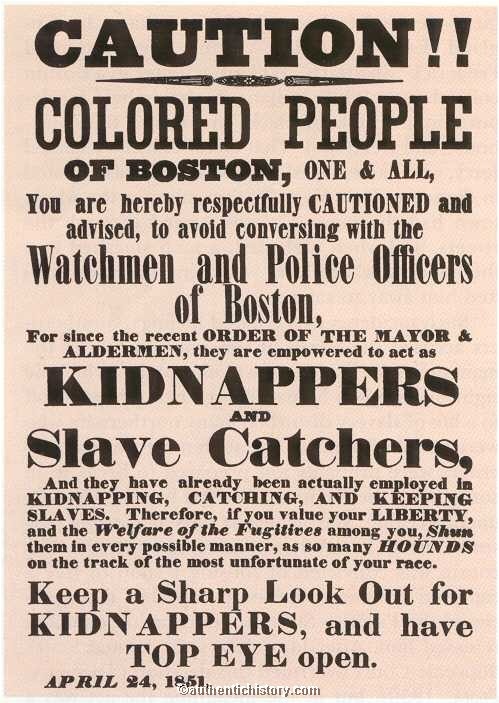
Before that there was the equally noxious Compromise of 1850 which included the Fugitive Slave Act which gave any Southerner claiming his human “property” not only the rights but a legal mechanism to hunt them down in the North and penalize anyone hindering them with weighty fines and jail terms.

One has to look at the words of Confederate Vice President Alexander Stephens in his Cornerstone Speech to understand the truth of what Lincoln spoke on that day in March 1865. Stephens, just four years before had declared in the starkest terms what the war was about and what the Confederacy’s foundation was:

Our new government is founded upon exactly the opposite idea; its foundations are laid, its corner- stone rests upon the great truth, that the negro is not equal to the white man; that slavery — subordination to the superior race — is his natural and normal condition. [Applause.] This, our new government, is the first, in the history of the world, based upon this great physical, philosophical, and moral truth.”

It took four years of bloody war, the first total war waged on American soil to end slavery, sadly within just a few years the Jim Crow laws had regulated Southern Blacks to a status not much better than their previous estate, and again became victims of often state sanctioned violence, discrimination, prejudice and death through lynching.

Southern leaders like Stephens and Jefferson Davis denied that slavery was the cause of the war and the foundation of the Confederacy in their revisionist histories after the war was over. They did so even though the litany of their letters, speeches and laws they supported, damned their words as the bold faced lies that they were. In the mean time many in the South sought to reclaim their pre-war glory in the myth of the Lost Cause which permeated much of the United States in the decades after the war, being glorified by Hollywood in Birth of a Nation, Gone with the Wind, and Walt Disney’s Song of the South. The unconscionable racism and white supremacy promoted by these masterpieces of cinema helped perpetuate racism across the country.

In the North, blacks faced discrimination and prejudice as well. another Supreme Court decision (Plessy v. Ferguson 1896) had legalized segregation and discrimination against Blacks in the form of “Separate but Equal” across the entire United States, something that would remain until a later Supreme Court would overturn Plessy in Brown v. Board of Education in 1954.

Despite all the reverses and the continued fight against the rights of Blacks, as well as women, other minorities and Gays, the struggle continues.

In August 1863, Lincoln was asked to speak at a gathering wrote in support of stronger war efforts and enlistments. Lincoln could not attend and wrote James Conkling a letter to be read on his behalf. That letter addressed those who disagreed with Lincoln on emancipation while still be claiming to be for the Union. Lincoln ended that letter with this:

“Peace does not appear so distant as it did. I hope it will come soon, and come to stay; and so come as to be worth the keeping in all future time. It will then have to be proved that among freemen that there can be no successful appeal from the ballot to to bullet, and that they who take such appeal are sure to lose their case and pay the cost. And there will be some black men who can remember that with silent tongue, and with clenched teeth, and steady eye, and well-poised bayonet, that they will have helped mankind on to this great consummation, while I fear there will be some white ones unable to forget that with malignant heart and deceitful speech they strove to hinder it….” 

Lincoln, unlike many even in the North recognized the heroic nature of African Americans fighting for their rights and how their struggle was beneficial for every American.

Lincoln died too soon, his death was a tragedy for the nation, but today, on President’s Day let us remember the words of the Lincoln’s Second Inaugural Address and the truth that they express. Lincoln’s concluding sentences which began with “With malice toward none, with charity for all…” should be at the heart of our dealings with all people so that we, as Lincoln said so eloquently “may achieve and cherish a just and lasting peace among ourselves and with all nations.”

It is a speech that always encourages me to fight for freedom and truth, even when that truth is less than popular and often uncomfortable. Lincoln’s words still inspire me, because he spoke the truth that many even today do not want to hear:

At this second appearing to take the oath of the Presidential office there is less occasion for an extended address than there was at the first. Then a statement somewhat in detail of a course to be pursued seemed fitting and proper. Now, at the expiration of four years, during which public declarations have been constantly called forth on every point and phase of the great contest which still absorbs the attention and engrosses the energies of the nation, little that is new could be presented. The progress of our arms, upon which all else chiefly depends, is as well known to the public as to myself, and it is, I trust, reasonably satisfactory and encouraging to all. With high hope for the future, no prediction in regard to it is ventured.

On the occasion corresponding to this four years ago all thoughts were anxiously directed to an impending civil war. All dreaded it, all sought to avert it. While the inaugural address was being delivered from this place, devoted altogether to saving the Union without war, insurgent agents were in the city seeking to destroy it without war–seeking to dissolve the Union and divide effects by negotiation. Both parties deprecated war, but one of them would make war rather than let the nation survive, and the other would accept war rather than let it perish, and the war came.

One-eighth of the whole population were colored slaves, not distributed generally over the Union, but localized in the southern part of it. These slaves constituted a peculiar and powerful interest. All knew that this interest was somehow the cause of the war. To strengthen, perpetuate, and extend this interest was the object for which the insurgents would rend the Union even by war, while the Government claimed no right to do more than to restrict the territorial enlargement of it. Neither party expected for the war the magnitude or the duration which it has already attained. Neither anticipated that the cause of the conflict might cease with or even before the conflict itself should cease. Each looked for an easier triumph, and a result less fundamental and astounding. Both read the same Bible and pray to the same God, and each invokes His aid against the other. It may seem strange that any men should dare to ask a just God’s assistance in wringing their bread from the sweat of other men’s faces, but let us judge not, that we be not judged. The prayers of both could not be answered. That of neither has been answered fully. The Almighty has His own purposes. “Woe unto the world because of offenses; for it must needs be that offenses come, but woe to that man by whom the offense cometh.” If we shall suppose that American slavery is one of those offenses which, in the providence of God, must needs come, but which, having continued through His appointed time, He now wills to remove, and that He gives to both North and South this terrible war as the woe due to those by whom the offense came, shall we discern therein any departure from those divine attributes which the believers in a living God always ascribe to Him? Fondly do we hope, fervently do we pray, that this mighty scourge of war may speedily pass away. Yet, if God wills that it continue until all the wealth piled by the bondsman’s two hundred and fifty years of unrequited toil shall be sunk, and until every drop of blood drawn with the lash shall be paid by another drawn with the sword, as was said three thousand years ago, so still it must be said “the judgments of the Lord are true and righteous altogether.”

With malice toward none, with charity for all, with firmness in the right as God gives us to see the right, let us strive on to finish the work we are in, to bind up the nation’s wounds, to care for him who shall have borne the battle and for his widow and his orphan, to do all which may achieve and cherish a just and lasting peace among ourselves and with all nations.

Peace

Padre Steve+

1 Comment

Filed under civil war, History, leadership, Political Commentary

Abraham Lincoln & the New Birth of Freedom

Friends of Padre Steve’s World

On this weekend which we call the “President’s Day Weekend” I think it is appropriate to remember Abraham Lincoln and the Gettysburg Address. This is the last chapter of my Gettysburg text and since Lincoln is most closely connected with Emancipation and the End of Slavery I think that it is important to pause and remember his brief remarks at the dedication of the Gettysburg Soldier’s Cemetery. Those remarks are really important because they draw us back to the real source document of who we are as Americans, the Declaration of Independence. That document made the incredibly bold, and even revolutionary statement, that “all men are created equal.” Lincoln expanded those words to their logical end, that indeed all men, not just white landowners, were created equal. It is a concept that some in our country still struggle to accept. 

In a couple of weeks I will be going back to Gettysburg again with a group of my students.  The last stop on our “staff ride” is the Soldier’s cemetery. We go to the spot where it is believed that Lincoln gave his remarks and I take a few minutes to read his address. 


Have a great weekend and remember that freedom always comes with a price, and that the struggle for freedom, equality and justice has not ended.

Peace

Padre Steve+

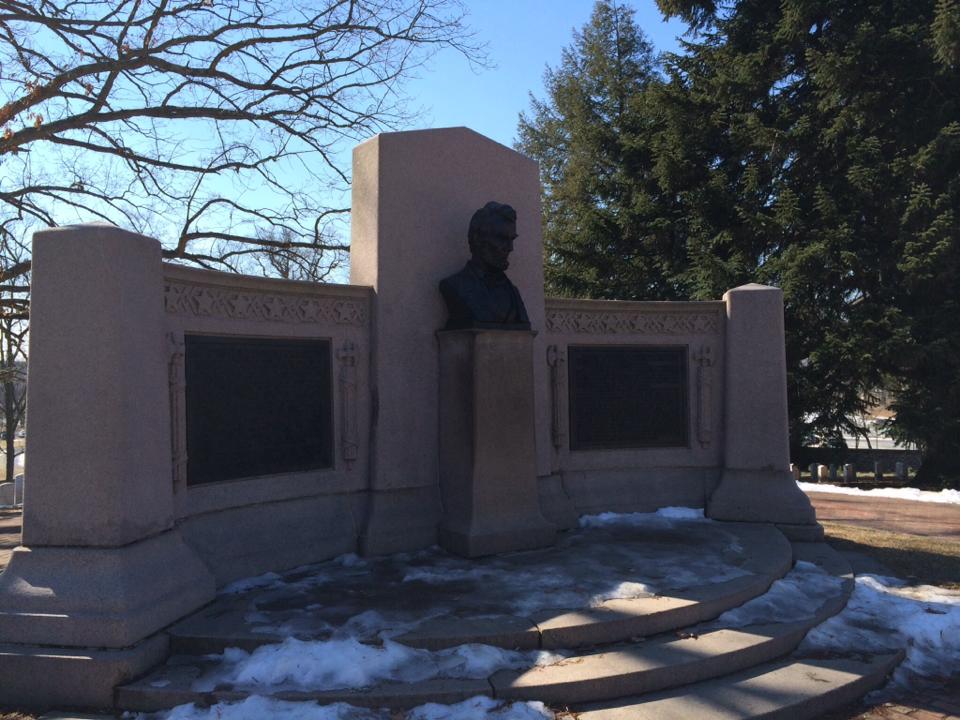
gburg address 

I am always humbled when I travel to Gettysburg as I will again in a couple of weeks. It is hard to believe in that now peaceful pastoral setting that over 157,000 Americans, almost 82,000 Union and 75,000 Confederate met in a three day battle. In those three days over 28,000 Confederates and 23,000 Union soldiers were killed, wounded, missing or captured. It was the greatest number of casualties inflicted in one battle on American soil in history.

The places that the battle was fought have become legendary, for they are “hallowed ground” as President Abraham Lincoln so eloquently put it. The places, McPherson’s and Herr’s Ridge, Seminary Ridge, the Railroad Cut, Barlow’s Knoll, Cemetery Hill, Culp’s Hill, The Wheat Field, Devil’s Den, the Peach Orchard, Little Round Top, Cemetery Ridge, the Apse of Trees, the Angle and the High Water Mark are in a sense holy, or hallowed, consecrated by those who struggled there, those who lived and those who gave the last full measure of devotion to their country. When I take my students there I always finish at the Soldier’s Cemetery where Abraham Lincoln delivered the Gettysburg Address.

I think about those men of both sides, fully convinced of the rightness of their cause who fought valiantly in the struggle. That being said when I go there though my family predominantly fought for the Confederacy my heart is drawn to those men who remained loyal to the Union and those who answered the call of Abraham Lincoln to serve in a cause greater than their own interests, the great and the small alike.

Lincoln was a masterful orator who managed to rally the Union and bring hundreds of thousands of men volunteer before Gettysburg. They came for an ideal an ideal which Lincoln’s oratory was probably the most effective at articulating in a way that men would volunteer to suffer hardship, fight and die to bring about. It was well put in the movie Gettysburg where Colonel Joshua Chamberlain, played by Jeff Daniels said:

“This is a different kind of army. If you look at history you’ll see men fight for pay, or women, or some other kind of loot. They fight for land, or because a king makes them, or just because they like killing. But we’re here for something new. This has not happened much, in the history of the world: We are an army out to set other men free. America should be free ground, all of it, from here to the Pacific Ocean. No man has to bow, no man born to royalty. Here we judge you by what you do, not by who your father was. Here you can be something. Here is the place to build a home. But it’s not the land. There’s always more land. It’s the idea that we all have value, you and me. What we’re fighting for, in the end… we’re fighting for each other…” [1]

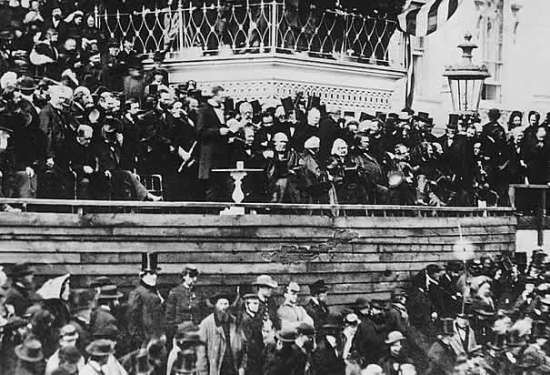
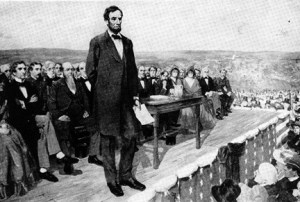
On November 19th 1863 Lincoln delivered a “few words” at Gettysburg which were in all practical aspects a benediction at the dedication of the battlefield cemetery. Lincoln was the second speaker at the ceremony following former Pennsylvania Congressman Edward Everett who spoke for more than two hours, a typical speech from the period.

Everett was one of the leading orators of his day. Everett was “a scholar and Ivy-League diplomat who could hold mass audiences in thrall. His voice, diction, and gestures were successfully dramatic, and he always performed his carefully written text, no matter how long, from memory.” [2]

The 270 words of Lincoln’s address are perhaps the most important of any speech or document in American history save the Declaration of Independence and the Constitution of the United States, in those words “Lincoln, nevertheless managed to justify the ways of democracy more than anyone, then or now.” [3]

The speech was so powerful that Everett wrote Lincoln the next day:

“Permit me also to express my great admiration of the thoughts expressed by you, with such eloquent simplicity & appropriateness, at the consecration of the Cemetery. I should be glad, if I could flatter myself that I came as near to the central idea of the occasion, in two hours, as you did in two minutes.” [4]

The speech is short, but its eloquence is unmatched. Lincoln wrapped ideas, concepts and ideals that men have written volumes about into a speech so powerful that many have memorized it.

But few realize the context that it must be placed. Though the Union had defeated Lee’s Army at Gettysburg and Grant had taken Vicksburg to cut the Confederacy in half the North was growing war weary. During the fall of 1863 after a series of inconclusive battles in northern Virginia both Lee and Meade’s armies had sent significant numbers of troops to the west, to support operations in eastern Tennessee.

Lee sent Longstreet’s First Corps, which took part in the bloody battle of Chickamauga, which “is a Cherokee word meaning “river of death.” [5] where on September 19th and 20th the Federal Army of the Cumberland under General Rosecrans “were soundly whipped at …and driven back into the strategic point of Chattanooga.” [6] The number of casualties on both sides, over 16,000 Federal and 18,000 Confederate, a “combined total of 34,634 was exceeded only the three day slaughter at Gettysburg and by the week-long series of five battles known collectively as the Seven Days.” [7] Despite the number of casualties it was one of the biggest Confederate victories of the war. A clerk in Richmond wrote “The whole South will be filled again with patriotic fervor, and in the North there will be a corresponding depression.” [8] That changed rapidly when the Union reacted quickly and reversed the strategic situation. One action taken was to deploy Oliver Howard’s XI Corps and Henry Slocum’s XII Corps west, where “they would be commanded by Joe Hooker, who was conveniently at hand and unemployed.” [9]

In the east during the following weeks “Lee and Meade, like two wounded, spent gladiators, sparred listlessly along the Rapidan. It seemed to Northerners that the fruits of Gettysburg had been thrown away.” [10] Lee sensed an opportunity to go back on the offensive against Meade’s weakened army, but his offensive was stopped on October 14th when “the Union Second Corps shattered a reckless attack by A.P. Hill’s corps at Bristoe Station, five miles south of Manassas.[11]

There was a faction in the North, the Copperheads, who were willing even after Gettysburg and Vicksburg to end the war on terms favorable to the Confederacy, even allowing for Confederate independence and the continuation of slavery. They “clamored for negotiations with the Confederacy to restore the Union on the basis of status quo antebellum and, until the closing months of the war charged that as long as the antislavery party remained in power the restoration of the Union could not be achieved.” [12] They believed that the war was a failure and that military action could not be achieved by force of arms.

The leading Copperheads included Clement Vallandigham of Ohio and George W. Woodward of Pennsylvania were typical, both opposed the use of force against Confederate secession; Woodward had written in 1860 that “Slavery was intended as a special blessing to the people of the United States,” that “Secession is not disloyalty” and “I cannot condemn the South for withdrawing….I wish Pennsylvania could go with them.” [13] The efforts of the Copperheads to gain governorships in Ohio and Pennsylvania met defeat in November 1863, as the Union victories at Gettysburg and Vicksburg “undercut their theme of the war’s failure.” [14] Their efforts would persist through the 1864 Presidential election, but instead of preaching the war’s failure they would concentrate on defeating emancipation. The Copperheads, “labeled all Republicans, including Lincoln, as radicals bent upon destroying the Union and undermining the Constitution.” [15]

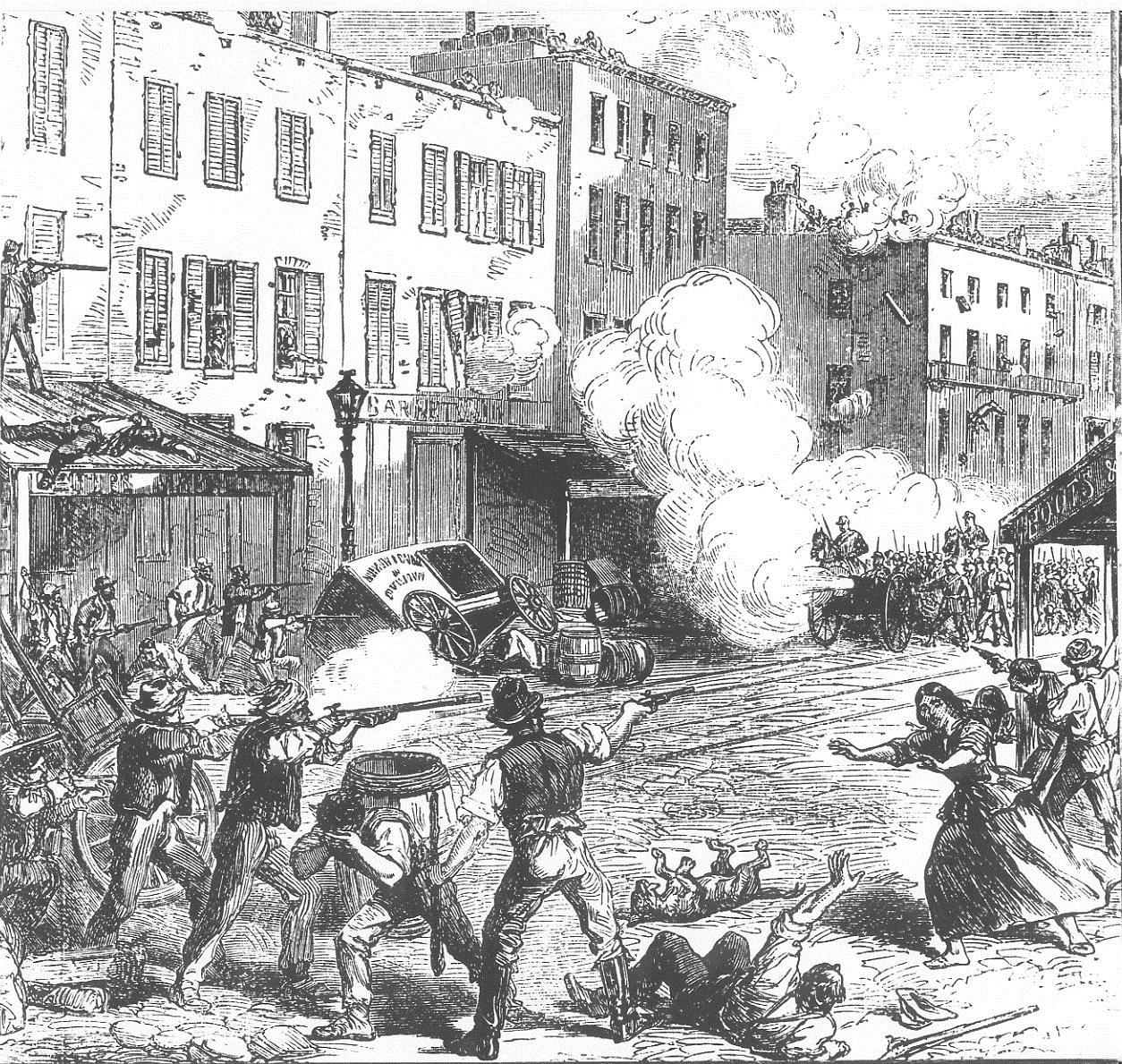
However, the anti-abolitionist and racist views espoused by the northern Democrat Copperheads had begun to lose their potency in the North after July of 1863 with the onset of “the New York draft riot, which shocked many northerners into a backlash against the consequences of virulent racism” [16] and the sacrifice of the African American 54th Massachusetts Infantry when it assaulted Fort Wagner outside of Charleston South Carolina, which occurred “just after the Democratic rioters in New York had lynched black people and burned the Colored Orphan Asylum. Few Republican newspapers failed to point the moral: black men who fought for the Union deserved more respect than white men who fought against it.” [17]

GAFac1

It is also important to understand how Lincoln’s address at Gettysburg is reflective of the various intellectual and philosophical movements of the time. Even the location of the cemetery and the burial plots within it was significant. A Gettysburg lawyer, David Wills proposed to “Governor Andrew Curtain of Pennsylvania the establishment of a soldiers’ cemetery where the Union dead could be reburied with dignity and honor.” [18] The place was then outside the city, a plot of 17 acres purchased by Wills adjacent to the existing town cemetery on Cemetery Hill. That was significant culturally, for the Gettysburg Cemetery was part of a movement called the Rural Cemetery movement. The movement was part of the Greek revival in the United States and connected with the Transcendentalist movement.

The Rural Cemetery movement was launched at Cambridge’s Mount Auburn Cemetery, and Edward Everett was a key figure in it. Mount Auburn “took Athens’s Kerameikos as its model, since that ancient burial ground existed outside the city proper, near the groves of the Akademy, in what was still countryside.” [19] In his speech at Mount Auburn’s dedication, U.S. Supreme Court Justice Joseph Story noted:

“The Greeks exhausted the resources of their exquisite art in adorning the habitations of the dead. They discouraged internments within the limits of their cities; and consigned their relics to shady groves, in the neighborhood of murmuring streams and merry fountains, close by the favorite resorts of those who were engaged in the study of philosophy and nature, and called them, with the elegant expressiveness of their own beautiful language, cemeteries or “places of repose.” [20]

He further noted:

“Our cemeteries, rightly selected and properly arranged, may be made subservient to some of the highest purposes of religion and human duty. They may preach lessons to which none may refuse to listen and which all that live must hear. Truths may there be felt and taught, in the silence of our meditations, more persuasive and more enduring than ever flowed from human lips.” [21]

Everett in his Gettysburg oration linked what they were doing at the Soldiers’ Cemetery with the Greek tradition:

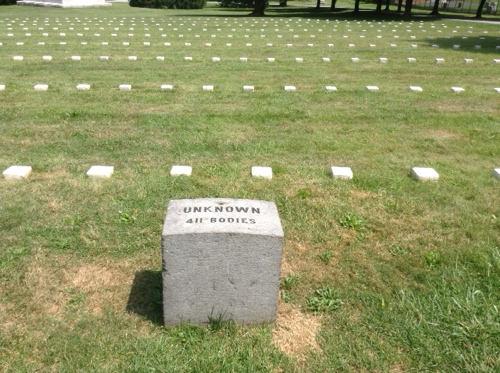
“It was appointed by law in Athens, that the obsequies of the citizens who fell in battle should be performed at the public expense, and in the most honorable manner. Their bones were carefully gathered up from the funeral pyre where their bodies were consumed, and brought home to the city. There, for three days before the interment, they lay in state, beneath tents of honor, to receive the votive offerings of friends and relatives,–flowers, weapons, precious ornaments, painted vases (wonders of art, which after two thousand years adorn the museums of modern Europe),–the last tributes of surviving affection. Ten coffins of funereal cypress received the honorable deposit, one for each of the tribes of the city, and an eleventh in memory of the unrecognized, but not therefore unhonored, dead, and of those whose remains could not be recovered….” [22]

The layout of the cemetery, and the manner in which the dead were buried was also significant when one considers the messages of both Everett and Lincoln that day. “The cemetery at Gettysburg was arranged so that every grave was of equal importance; William Saunders’s design, like Lincoln’s speech, affirmed that every dead soldier mattered equally regardless of rank or station.” [23] In this place “some 3,577 Union soldiers (half of them unknown) from eighteen states are buried.” [24]

The speeches of Everett and Lincoln are deeply connected with Romanticism, the Greek revival and the Transcendentalist movement in the United States. Both were children of the enlightenment, and Everett, a former President of Harvard was well versed in these subjects and Lincoln, though a politician who appealed to the tenets of the Enlightenment, the Declaration of Independence and the Constitution. Lincoln appealed to the “sacred principles of the laws of nature,” and hailed “the constitution and laws” as “hewn from the solid quarry of sober reason.” For Lincoln, the war was a test of the practical worth of liberalism.” [25]

Everett had been a mentor to some of the leading Transcendentalist thinkers of his era including Ralph Waldo Emmerson who found that the experience of “Everett’s classroom gave him an entirely new direction in life. He wrote:

“Germany had created [literary] criticism in vain for us until 1820, when Edward Everett returned from his five years in Europe, and brought to Cambridge his rich results, which no one was so fitted by natural grace and splendor of his rhetoric to introduce and recommend….The novelty of the learning lost northing in the skill and genius of its interpreter, and the rudest undergraduate found a new morning opening to him in the lecture room at Harvard.” [26]

Everett, who had previously dedicated battlefields at Bunker Hill, as well as Lexington and Concord, was at his best when dedicating battlefields and cemeteries. He spent weeks preparing his speech. Everett had studied the battle and knew it well from official reports and talks with those who fought it. Everett painted a vivid picture of the battle for his audience and connected the sacrifice of those who fought and died to preserve the Union form antiquity and from those who founded the nation. He noted why they had gathered:

“We have assembled, friends, fellow-citizens, at the invitation of the Executive of the great central State of Pennsylvania, seconded by the Governors of seventeen other loyal States of the Union, to pay the last tribute of respect to the brave men who, in the hard-fought battles of the first, second, and third days of July last, laid down their lives for the country on these hillsides and the plains before us, and whose remains have been gathered into the cemetery which we consecrate this day. As my eye ranges over the fields whose sods were so lately moistened by the blood of gallant and loyal men, I feel, as never before, how truly it was said of old that it is sweet and becoming to die for one’s country. I feel, as never before, how justly, from the dawn of history to the present time, men have paid the homage of their gratitude and admiration to the memory of those who nobly sacrifice their lives, that their fellow-men may live in safety and in honor. And if this tribute were ever due, to whom could it be more justly paid than to those whose last resting-place we this day commend to the blessing of Heaven and of men?” [27]

In his narrative Everett aspired to more than mere accuracy. Along “with Bancroft and other romantic historians of his time, he meant to create a tradition that would inspire as well as inform. Like the Attic orators- and dramatists- he knew the power of symbols to create a people’s political identity.” [28]

Lincoln was sick when he delivered the address having what was mostly likely a mild form of Smallpox when he gave the address. Thus the tenor, simplicity and philosophical depth of the address are even more remarkable. It is a speech given in the manner of Winston Churchill’s “Blood sweat toil and tears” address to Parliament upon being appoint Prime Minister in 1940. Likewise it echoes the Transcendentalist understanding of the Declaration of Independence as a “test for all other things.”

gburgaddressmemorial

Many in the United States and Europe did not agree and argued that no nation found on such principles could long survive. The more reactionary European subscribers of Romanticism ridiculed the “idea that a nation could be founded on a proposition….and they were not reluctant to point to the Civil War as proof that attempting to build a government around something as bloodless and logical as a proposition was futile.” [29]

But Lincoln disagreed. He believed that the “sacrifices of Gettysburg, Shiloh, Murfreesboro, Chancellorsville, and a hundred other places demonstrated otherwise, that men would die rather than to lose hold of that proposition. Reflecting on that dedication, the living should themselves experience a new birth of freedom, a determination- and he drove his point home with a deliberate evocation of the great Whig orator Daniel Webster- “that government of the people, by the people, for the people, shall not perish from the earth.” [30]

The Unitarian pastor and leading Transcendentalist Theodore Parker wrote:

“Our national ideal out-travels our experience, and all experience. We began our national career by setting all history at defiance- for that said, “A republic on a large scale cannot exist.” Our progress since that has shown that we were right in refusing to be limited by the past. The practical ideas of the nation are transcendent, not empirical. Human history could not justify the Declaration of Independence and its large statements of the new idea: the nation went beyond human history and appealed to human nature.” [31]

Likewise Lincoln’s address echoes the thought of George Bancroft who wrote of the Declaration:

“The bill of rights which it promulgates is of rights that are older than human institutions, and spring from the eternal justice…. The heart of Jefferson in writing the Declaration, and of Congress in adopting it, beat for all humanity; the assertion of right was made for the entire world of mankind and all coming generations, without any exceptions whatsoever.” [32]

Parker’s words also prefigured an idea that Lincoln used in his address, that being: The American Revolution, with American history since, is an attempt to prove by experience this transcendental proposition, to organize the transcendental idea of politics. The ideal demands for its organization a democracy- a government of all, for all, and by all…” [33]

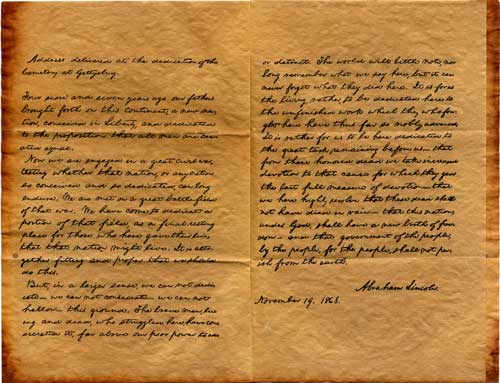
Lincoln delivered these words on that November afternoon:

Four score and seven years ago our fathers brought forth on this continent, a new nation, conceived in Liberty, and dedicated to the proposition that all men are created equal.

Now we are engaged in a great civil war, testing whether that nation, or any nation so conceived and so dedicated, can long endure. We are met on a great battle-field of that war. We have come to dedicate a portion of that field, as a final resting place for those who here gave their lives that that nation might live. It is altogether fitting and proper that we should do this.

But, in a larger sense, we cannot dedicate — we can not consecrate — we can not hallow — this ground. The brave men, living and dead, who struggled here, have consecrated it, far above our poor power to add or detract. The world will little note, nor long remember what we say here, but it can never forget what they did here. It is for us the living, rather, to be dedicated here to the unfinished work which they who fought here have thus far so nobly advanced. It is rather for us to be here dedicated to the great task remaining before us — that from these honored dead we take increased devotion to that cause for which they gave the last full measure of devotion — that we here highly resolve that these dead shall not have died in vain — that this nation, under God, shall have a new birth of freedom — and that government of the people, by the people, for the people, shall not perish from the earth.[34]

In a time where many are wearied by the foibles and follies of our politicians, even wondering about our form of government can survive Lincoln’s words matter. Dr. Allen Guelzo, Professor of Civil War Studies at Gettysburg College wrote in the New York Times:

“The genius of the address thus lay not in its language or in its brevity (virtues though these were), but in the new birth it gave to those who had become discouraged and wearied by democracy’s follies, and in the reminder that democracy’s survival rested ultimately in the hands of citizens who saw something in democracy worth dying for. We could use that reminder again today.” [35]

Dr. Guelzo is quite correct. Many people in this country and around the world are having grave doubts about our democracy. I wonder myself, but I am an optimist. I do believe that we will recover because for the life of me I see no nation anywhere else with our resiliency and ability to overcome the stupidity of politicians, pundits and preachers.

Gettysburg_Unknowns.JPG

The amazing thing was that in spite of everything the Union survived. Lincoln was a big part of that but it was the men who left lives of comfort and security like Joshua Chamberlain and so many others who brought about that victory. Throughout the war, even to the end Southern political leaders failed to understand that Union men would fight and die for an ideal, something greater than themselves, the preservation of the Union and the freedom of an enslaved race. For those men that volunteered to serve, the war was not about personal gain, loot or land, it was about something greater. It was about freedom, and when we realize this fact “then we can contemplate the real meaning of “that cause for which they gave the last full measure of devotion.” [36]

gburg dead2

Now I for one do not think that we are currently living up to the ideals enunciated by Lincoln that day at Gettysburg. I can understand the cynicism disillusionment of Americans as well as those around the world who have for over 200 years looked to us and our system as a “city set on a hill.” That being said, when I read these words and walk that hallowed ground I am again a believer. I believe that we can realize the ideal, even in our lifetime should we desire.

Peace

Padre Steve+

[1] Shaara, Michael. The Killer Angels, Ballantine Books, New York. 1974 p.28

[2] Wills, Garry. Lincoln at Gettysburg: The Words that Remade America Simon and Schuster Paperbacks, New York 1992 p.25

[3] Guelzo Allen C. Fateful Lightening: A New History of the Civil War Era and Reconstruction Oxford University Press, Oxford and New York 2012 p.407

[4] Everett, Edward Letter from Edward Everett to Abraham Lincoln, (Transcription) 20 November 1863 retrieved from http://www.in.gov/judiciary/citc/files/everett-to-lincoln.pdf July 18th 2014

[5] Ibid. Guelzo Fateful Lighteningp.352

[6] Hebert, Walter H. Fighting Joe Hooker University of Nebraska Press, Lincoln and London 1999. Originally published by Bobbs-Merrill, New York 1944

[7] Foote, Shelby, The Civil War, A Narrative. Volume Two Fredericksburg to Meridian Random House, New York 1963 p.758

[8] Ibid. Foote The Civil War, A Narrative. Volume Two p.757

[9] Ibid. Foote The Civil War, A Narrative. Volume Two p.764

[10] Sears, Stephen W. Gettysburg Mariner Books, Houghton Mifflin Company Boston, New York 2004 p.513

[11] McPherson, James M. Tried by War: Abraham Lincoln as Commander in Chief Penguin Books, New York and London 2008 p.200

[12] Harris, William C. With Charity for All: Lincoln and the Restoration of the Union The University Press of Kentucky, Lexington KY 1997 p.7

[13] McPherson, James. The Battle Cry of Freedom: The Civil War Era Oxford University Press, Oxford and New York 1988 p.685

[14] Ibid. McPherson The Battle Cry of Freedom p.685

[15] Ibid. Harris With Charity for All p.7

[16] Ibid. McPherson The Battle Cry of Freedom p.686

[17] Ibid. McPherson The Battle Cry of Freedom p.687

[18] McPherson, James M. This Hallowed Ground Crown Publishers, New York 2003 p.137

[19] Ibid. Wills. Lincoln at Gettysburg p.63

[20] Ibid. Wills. Lincoln at Gettysburg p.64

[21] Ibid. Wills. Lincoln at Gettysburg p.65

[22] Everett, Edward Gettysburg Address retrieved from http://voicesofdemocracy.umd.edu/everett-gettysburg-address-speech-text/ 21 August 2014

[23] Faust, Drew Gilpin, This Republic of Suffering: Death and the American Civil War Vintage Books, a division of Random House, New York 2008 p.100

[24] Ibid. McPherson This Hallowed Ground p.137

[25] Ibid. Guelzo. Fateful Lightening pp.406-407

[26] Ibid. Wills. Lincoln at Gettysburg p.45

[27] Ibid. Everett Gettysburg Address

[28] Ibid. Wills. Lincoln at Gettysburg p.51

[29] Ibid. Guelzo. Fateful Lightening p.409

[30] Ibid. Guelzo. Fateful Lightening p.408

[31] Ibid. Wills. Lincoln at Gettysburg p.110

[32] Ibid. Wills. Lincoln at Gettysburg p.105

[33] Ibid. Wills. Lincoln at Gettysburg p.105

[34] Lincoln, Abraham The Gettysburg Address the Bliss Copy retrieved from http://www.abrahamlincolnonline.org/lincoln/speeches/gettysburg.htm

[35] Guelzo, Allen C. Lincoln’s Sound Bite: Have Faith in Democracy New York Time Opinionator, November 17th 2013 retrieved from http://opinionator.blogs.nytimes.com/2013/11/17/lincolns-sound-bite-have-faith-in-democracy/?_php=true&_type=blogs&_r=0 July 18th 2014

[36] Ibid. McPherson This Hallowed Ground p.138

5 Comments

Filed under civil rights, civil war, Gettysburg, History, leadership, Political Commentary

Emancipation and the U.S. Military: the Civil War and After

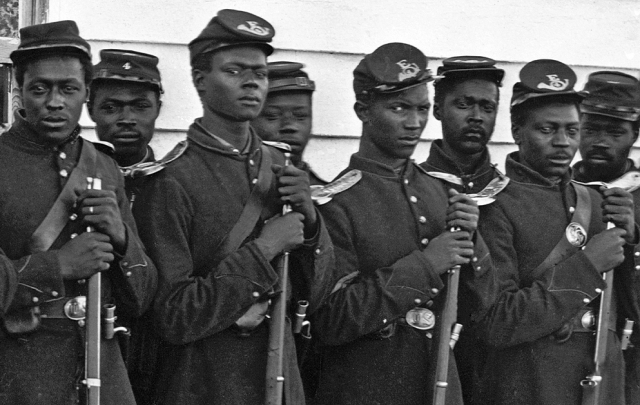
 HD_4USCinfantryDetail.preview

Friends of Padre Steve’s World

Tomorrow is the holiday where we remember the birth of Dr. Martin Luther King Jr. So I felt it appropriate to put out a revised section of my Civil War and Gettysburg text dealing with Emancipation and beginnings of African Americans being allowed to take their place in serving their country.  Sadly, a country that so often, both before, and after emancipation, treated them as either something less than human, or as second class citizens. But the sacrifice of these pioneers helped pave the way for the civil rights of others: women, other ethnic minorities, and most recently the LGBT community. Without blacks, who certainly endured the most odious treatment under slavery than any other group in this country, the long and slow progress others have made would not have been possible. This is certainly not to say that our system, nor our treatment of minorities, immigrants, women and gays is completely fair and equitable. It is not, there are many flaws, and still much discrimination, prejudice and fear mongering which demonizes certain groups as well as seeks to roll back the gains that individuals belonging to these groups have made to be accepted into American society. Thus we continue to strive for “a more perfect Union.” 

Peace

Padre Steve+

The war brought about another change to warfare in America. This was a societal and political change that has shaped American military history, culture and life ever since. The Emancipation Proclamation gave African Americans, both Freedmen and recently freed slaves the opportunity to serve in the Union Army. The change of policy instituted by Lincoln was revolutionary as well as controversial and it had strategic implications for the war effort. There were many doubters in the north whose attitudes towards African Americans were not much different than Southerners, especially among the Copperheads.

Prior to the Emancipation some Union commanders in occupied Confederate territory “had unofficially recruited black soldiers in Kansas and in occupied portions of South Carolina and Louisiana in 1862. But the administration had not sanctioned these activities.” [1] But as the war continued on, consuming vast numbers of lives the attitude of Lincoln and the administration began to change.

Lincoln and the closest members of his cabinet were beginning to understand that the “North could not win the war without mobilizing all of its resources and striking against Southern resources used to sustain the Confederate war effort.” [2]

Lincoln’s Secretary of War, Edwin Stanton; who was a passionate believer in the justice of emancipation “Instantly grasped the military value of the proclamation. Having spent more time than any of his colleagues contemplating the logistical problems facing the army, he understood the tremendous advantage to be gained if the massive workforce of slaves could be transferred from the Confederacy to the Union.” [3]

emancipation

Lincoln emphasized the “military necessity” of emancipation and “justified the step as a “fit and necessary war measure for suppressing the rebellion.” [4] The process of emancipation now became not only a moral crusade, but now became a key part of national strategy. Lincoln wrote to his future Vice President, Andrew Johnson, then the military governor of occupied Tennessee that “The colored population is the great available and yet unavailed of, force for restoration of the Union.” [5] The idea of simply mollifying the border states was dropped and policy changed that of “depriving the Confederacy of slave labor. Mobilizing that manpower for the Union- as soldiers as well as laborers- was a natural corollary.” [6] Reflecting President Lincoln’s and Stanton’s argument for the military necessity of emancipation, General Henry Halleck wrote to Ulysses Grant that:

“the character of the war has very much changed within the past year. There is now no possibility of reconciliation with the rebels… We must conquer the rebels or be conquered by them….Every slave withdrawn from the enemy is the equivalent of a white man put hors de combat.” [7]

Grant concurred with the decision. Grant wrote to in a letter to Lincoln after the assault on Battery Wagner “by arming the negro we have added a powerful ally. They will make good soldiers and taking them from the enemy weakens him in the same proportion as it strengthens us.” [8] Lincoln wrote after the Emancipation Proclamation that “the emancipation policy, and the use of colored troops, constitute the heaviest blow yet dealt to the rebellion.” [9] The change was a watershed in both American history as well as the future of the U.S. Military services.

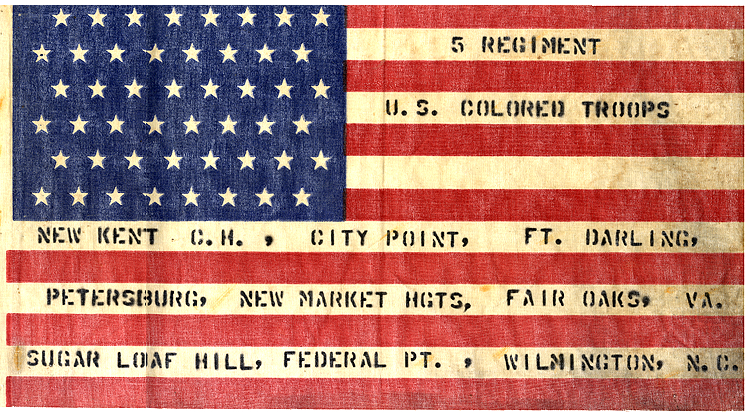
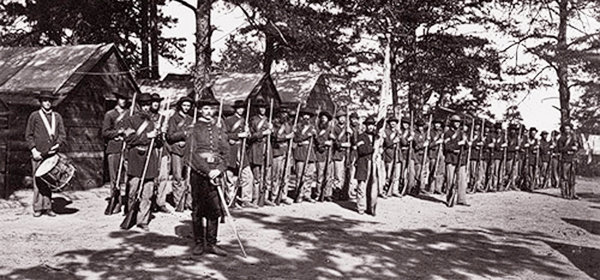
Emancipation allowed for the formation of regiments of United States Colored Troops (USCT), mustered directly into Federal service, which in numbers soon dwarfed the few state raised Black Regiments. However, it was the inspiration provided by those first state raised regiments as well as the violence directed against Blacks in the draft riots helped to provoke “many northerners into a backlash against the consequences of violent racism.” [10] The valor of the state regiments, as well as the USCT units that managed to get into action was remarkable, especially in regard to the amount of discrimination levied at them by some northerners, and the very real threat of death that they faced of captured by Confederates.

In May of 1863 Major General Nathaniel Banks dared to send the First and Third Regiments of “Louisiana Native Home Guard regiments on a series of attacks on Confederate positions at Port Hudson, Louisiana” [11] where they received their baptism of fire. They suffered heavy losses and “of the 1080 men in the ranks, 271 were hit, or one out of every four.” [12] Banks said of them in his after action report: “They answered every expectation…In many respects their conduct was heroic…The severe test to which they were subjected, and the determined manner in which they encountered the enemy, leave upon my mind no doubt of their ultimate success.” [13]

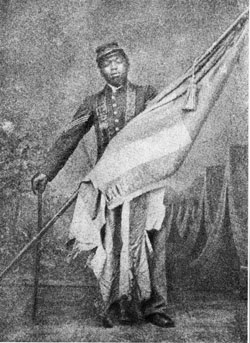
william_carney

Sergeant William H. Carney of the 54th Massachusetts, Medal of Honor

But the most famous African American volunteer regiment was the 54th Massachusetts, commanded by Colonel Robert Gould Shaw, the “North’s showcase black regiment.” [14] Raised in Boston and officered by many men who were the sons of Boston’s blue blood abolitionist elite, the regiment was authorized in March 1863. Since there was still opposition to the formation of units made up of African Americans, Massachusetts Governor John Andrew authorized the formation of the 54th under the command of white officers, a practice that with few exceptions, became standard in the U.S. military until President Truman desegregated the armed forces in 1948. Governor Andrew was determined to ensure that the officers of the 54th were men of “firm antislavery principles…superior to a vulgar contempt for color.” [15]

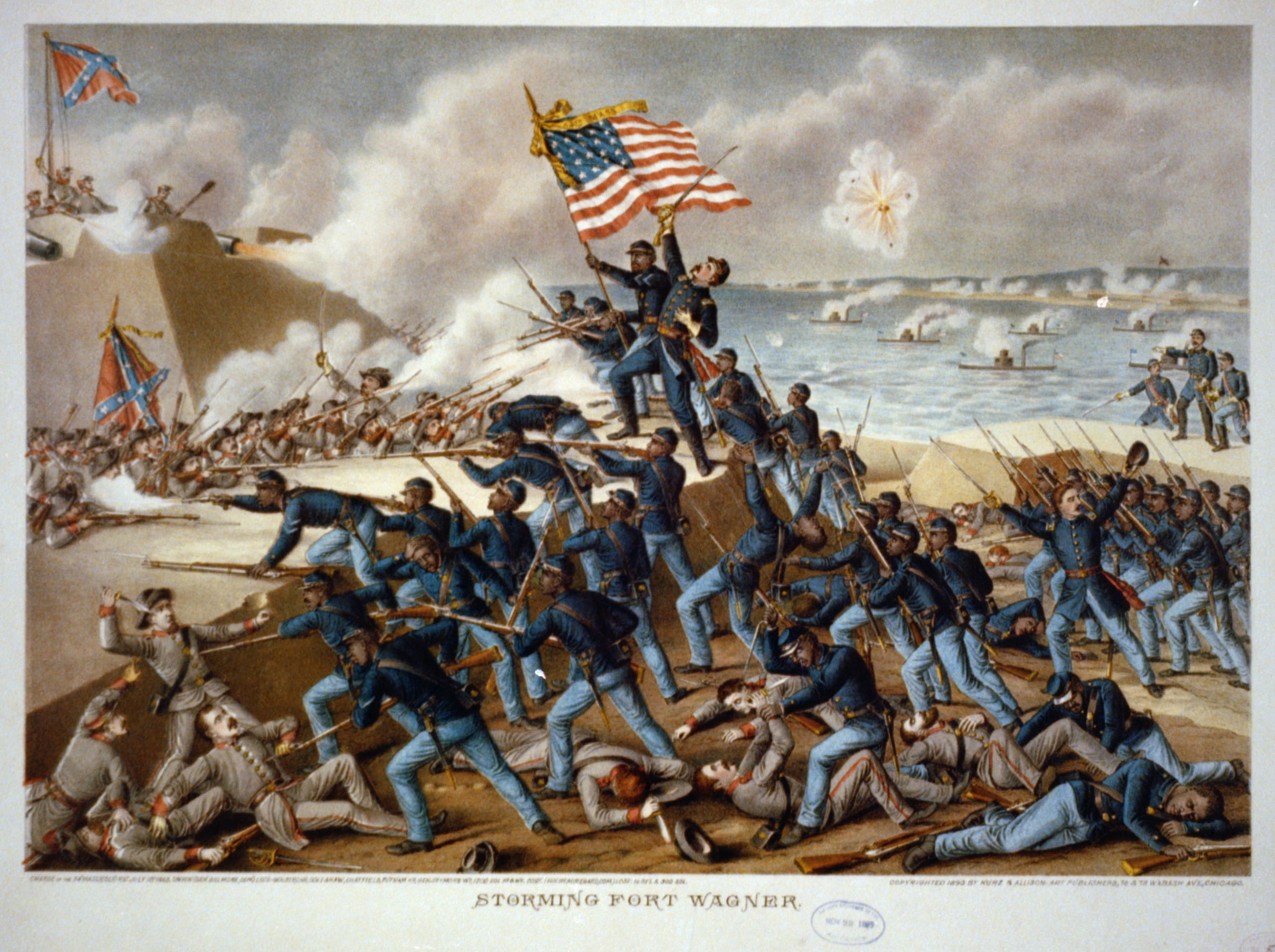
The 54th saw action first in early June and at Gould’s urging sent into battle against the Confederate positions at Fort Wagner on July 18th 1863. Leading the attack the 54th lost nearly half its men, “including Colonel Shaw with a bullet through his heart. Black soldiers gained Wagner’s parapet and held it for an hour before falling back.” [16] Though they tried to hold on they were pushed back after a stubborn fight to secure a breach in the fort’s defenses. “Sergeant William H Carney staggered back from the fort with wounds in his chest and right arm, but with the regiment’s Stars and Stripes securely in his grasp. “The old flag never touched the ground, boys,” Carney gasped as he collapsed at the first field hospital he could find.” [17] Shaw was buried with his men by the Confederates and when Union commanders asked for the return of his body were told “We have buried him with his niggers,” Shaw’s father quelled a northern effort to recover his son’s body with these words: We hold that a soldier’s most appropriate burial-place is on the field where he has fallen.” [18] As with so many frontal attacks on prepared positions throughout the war, valor alone could not overcome a well dug in enemy. “Negro troops proved that they could stop bullets and shell fragments as good as white men, but that was about all.” [19]

Despite the setback, the regiment went on to further actions where it continued to distinguish itself. The Northern press, particularly abolitionists papers brought about a change in the way that many Americans in the North, civilians as well as soldiers, saw blacks. The Atlantic Monthly noted “Through the cannon smoke of that dark night, the manhood of the colored race shines before many eyes that would not see.” [20]

Frederick Douglass, who had two sons serving in the 54th Massachusetts, understood the importance of African Americans taking up arms against those that had enslaved them in order to win their freedom:

“Once let a black man get upon his person the brass letters U.S… let him get an eagle on his button, and a musket on his shoulder and bullets in his pockets, and there is no power on earth which can deny he has won the right to citizenship in the United States.” [21]

The_Storming_of_Ft_Wagner-lithograph_by_Kurz_and_Allison_1890a

Other African American units less famous than the illustrious 54th Massachusetts distinguished themselves in action against Confederate forces. Two regiments of newly recruited blacks were encamped at Milliken’s Bend Louisiana when they were attacked by a Confederate brigade attempting to relieve the Vicksburg Garrison. The troops were untrained and ill-armed but held on against a determined enemy:

“Untrained and armed with old muskets, most of the black troops nevertheless fought desperately. With the aid of two gunboats they finally drove off the enemy. For raw troops, wrote Grant, the freedmen “behaved well.” Assistant Secretary of War Dana, still with Grant’s army, spoke with more enthusiasm. “The bravery of the blacks,” he declared, “completely revolutionized the sentiment in the army with regard to the employment of negro troops. I heard prominent officers who had formerly in private had sneered at the idea of negroes fighting express after that as heartily in favor of it.” [22]

By the end of the war 179,000 African American Soldiers, commanded by 7,000 white officers served in the Union armies. For a number of reasons most of these units were confined to rear area duties or working with logistics and transportation operations. The policies to regulate USCT regiments to supporting tasks in non-combat roles “frustrated many African American soldiers who wanted a chance to prove themselves in battle.” [23] Many of the soldiers and their white officers argued to be let into the fight as they felt that “only by proving themselves in combat could blacks overcome stereotypes of inferiority and prove their “manhood.” [24] Even so in many places in the army the USCT and state regiments made up of blacks were scorned:

“A young officer who left his place in a white regiment to become colonel of a colored regiment was frankly told by a staff officer that “we don’t want any nigger soldiers in the Army of the Potomac,” and his general took him aside to say: “I’m sorry to have you leave my command, and am still more sorry that you are going to serve with Negroes. I think that it is a disgrace to the army to make soldiers of them.” The general added that he felt this way because he was sure that colored soldiers just would not fight.” [25]

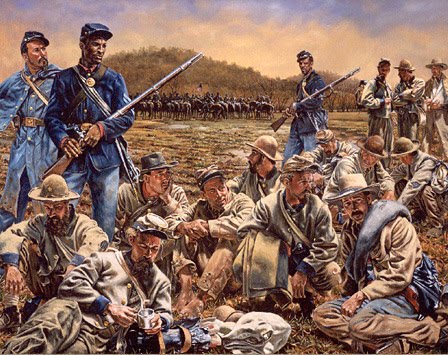
The general of course, was wrong. In the engagements where USCT units were allowed to fight, they did so with varying success most often attributable to the direction of their senior officers. When given the chance they almost always fought well, even when badly commanded. This was true as well when they were thrown into hopeless situations. One such instance was when Ferrero’s Division, comprised of colored troops were thrown into the Battle of the Crater at Petersburg when “that battle lost beyond all recall.” [26] The troops advanced in good order singing as they went, while their commander, General Ferrero took cover in a dugout and started drinking; but the Confederate defenders had been reinforced and “Unsupported, subjected to a galling fire from batteries on the flanks, and from infantry fire in front and partly on the flank,” a witness write, “they broke up in disorder and fell back into the crater.” [27] Pressed into the carnage of the crater where white troops from the three divisions already savaged by the fighting had taken cover, the “black troops fought with desperation, uncertain of their fate if captured.” [28] In the battle the division lost 1327 of just under 4000 men. [29]

When captured by Confederates, black soldiers and their white officers received no quarter from many Confederate opponents. General Edmund Kirby Smith who held overall command of Confederate forces west of the Mississippi instructed General Richard Taylor to simply execute black soldiers and their white officers: “I hope…that your subordinates who may have been in command of capturing parties may have recognized the propriety of giving no quarter to armed negroes and their officers. In this way we may be relieved from a disagreeable dilemma.” [30] This was not only a local policy, but echoed at the highest levels of the Confederate government. In 1862 the Confederate government issued an order that threatened white officers commanding blacks: “any commissioned officer employed in the drilling, organizing or instructing slaves with their view to armed service in this war…as outlaws” would be “held in close confinement for execution as a felon.” [31]

On April 12th 1864 at Fort Pillow, troops under the command of General Nathan Bedford Forrest massacred the bulk of over 231 Union most of them black as they tried to surrender. While it is fairly clear that Forrest did not order the massacre and even attempted to stop it, it was clear that he had lost control of his troops. His soldiers fought with the fury of men possessed by hatred of an enemy that they considered ‘a lesser race’ slaughtered the Union troops as they either tried to surrender or flee; but he was not displeased with the result. Ulysses Grant wrote that:

“These troops fought bravely, but were overpowered I will leave Forrest in his dispatches to tell what he did with them.

“The river was dyed,” he says, “with the blood of the slaughtered for up to 200 years. The approximate loss was upward of five hundred killed; but few of the officers escaped. My loss was about twenty killed. It is hoped that these facts will demonstrate to the Northern people that negro soldiers cannot cope with Southerners.” Subsequently Forrest made a report in which he left out the part that shocks humanity to read.” [32]

”The bulk of the killing was directed at the black soldiers of the 6th U.S. Colored Heavy Artillery, which composed over a third of the garrison. “Of the 262 Negro members of the garrison, only 58- just over 20 percent- were marched away as prisoners; while of the 295 whites, 168- just under sixty percent were taken.” [33] A white survivor of the 13th West Tennessee Cavalry, a Union unit at the fort wrote: “We all threw down our arms and gave tokens of surrender, asking for quarter…but no quarter was given….I saw 4 white men and at least 25 negroes shot while begging for mercy….These were all soldiers. There were also 2 negro women and 3 little children standing within 25 steps of me, when a rebel stepped up to them and said, “Yes, God damn you, you thought you were free, did you?” and shot them all. They all fell but one child, when he knocked it in the head with the breech of his gun.” [34]A Confederate Sergeant wrote home a week after the massacre: “the poor deluded negroes would run up to our men, fall upon their knees and with uplifted hands scream for mercy, but were ordered to their feet and shot down.” [35]

pride_over_prejudice-reeves-b-of-nashville

African American soldiers proved themselves during the war and their efforts paved the way for Lincoln and others to begin considering the full equality of blacks as citizens. If they could fight and die for the country, how could they be denied the right to votes, be elected to office, serve on juries or go to public schools? Under political pressure to end the war during the stalemate before Petersburg and Atlanta in the summer of 1864, Lincoln reacted angrily to Copperheads as well as wavering Republicans on the issue of emancipation:

“But no human power can subdue this rebellion without using the Emancipation lever as I have done.” More than 100,000 black soldiers were fighting for the Union and their efforts were crucial to northern victory. They would not continue fighting if they thought the North intended to betray them….If they stake their lives for us they must be prompted by the strongest motive…the promise of freedom. And the promise being made, must be kept…There have been men who proposed to me to return to slavery the black warriors. “I should be damned in time & in eternity for so doing. The world shall know that I will keep my faith to friends & enemies, come what will.” [36]

Despite this, even in the North during and after the war, blacks, including former soldiers would be discriminated against, sometimes by the white men that they served alongside. Those rights would be fought for another century and what began in 1863 with the brave service and sacrifice of these African American soldiers began a process of increased civil rights that is still going on today. It would not be until after the war that some blacks were commissioned as officers in the Army. When Governor John Andrew, the man who had raised the 54th Massachusetts attempted to:

“issue a state commission to Sergeant Stephen Swails of the 54th…the Bureau of Colored Troops obstinately refused to issue Swails a discharge from his sergeant’s rank, and Swails promotion was held up until after the end of the war. “How can we hope for success to our arms or God’s blessing,” raged the white colonel of the 54th, Edward Hallowell, “while we as a people are so blind to justice?” [37]

The Southern Debate about Emancipation and Black Soldiers

In the South, politicians and many senior Confederate Officers fought against any allowance for blacks to serve, for they knew if they allowed this, that slavery itself must be swept away. Despite this, a few such as General Patrick Cleburne, an Irish immigrant and a division commander in the Army of Tennessee demonstrated the capacity for forward thinking in terms of race: Cleburne advocated that blacks serve as soldiers should be emancipated.

Cleburne, known as “the Stonewall Jackson of the West” was a bold fighter who put together a comprehensive plan. He noted that the Confederacy was losing the war because it did not have soldiers, the supplies or resources; and most significantly that “slavery, from being one of our chief sources of strength at the beginning of the war, has now become in a military point of view, one of our chief sources of weakness.” [38] Cleburne recommended that “we immediately commence training a large reserve of the most courageous of our slaves, and further that we guarantee freedom within a reasonable time to every slave in the South who shall remain to the confederacy in this war.” [39]

His proposal was radical. He was asking more from his fellow Southerners than they could risk. He was “asking them to surrender the cornerstone of white racism to preserve their nation” [40] and he presented it in stark terms that few could stomach “As between the loss of independence and the loss of slavery, we can assume that every patriot will freely give up the latter- give up the Negro slave rather than be a slave himself.” [41]

In January 1864 General W.H.T Walker obtained a copy of Cleburne’s proposal and sent it to Davis. Walker opposed it and expressed his outrage over it. Cleburne’s proposal went from being a military matter to a political matter and Davis intervened to quash the proposal. “Convinced that the “propagation of such opinions” would cause “discouragements, distraction, and dissension” in the army, Jefferson Davis ordered the Generals to stop discussing the matter…The only consequence of Cleburne’s action seemed to be the denial of promotion to this ablest of the army’s division commanders, who was killed ten months later at the Battle of Franklin.” [42] In fact Cleburne was “passed over for command of an army corps and promotion to lieutenant general” three times in the next eight months, and in “each care less distinguished, less controversial men received the honors.” [43] All copies of Cleburne’s proposal were destroyed by the order of Davis.

Cleburne was not the only military man to advocate the formation of Negro units or even emancipation. Robert E. Lee was one of the chief proponents of this. Lee said after the war that he had told Davis “often and early in the war that the slaves should be emancipated, that it was the only way to remove a weakness at home and to get sympathy abroad, and divide our enemies, but Davis would not hear of it.” [44]

Ten months later Davis raised the issue of arming slaves as he now believed that military necessity left him little choice. He was opposed by some of his closest political allies including Howell Cobb who warned “The day that you make soldiers of them is the beginning of the end of the revolution. If slaves will make good soldiers our whole theory of slavery is wrong.” [45] Lee wrote to a member of Virginia’s legislature “we must decide whether slavery shall be extinguished by our enemies and the slaves used against us, or use them ourselves at the risk of the effects which may be produced on our social institutions…” and he pointed out that “any act for the enrolling of slaves as soldiers must contain a “well digested plan of gradual and general emancipation”: the slaves could not be expected to fight well if their service was not rewarded with freedom.” [46]

The debate began in earnest in the fall of 1864 and revealed a sharp divide in the Confederacy between those who supported the measure and those against it. Cabinet members such as Judah Benjamin and a few governors “generally supported arming the slaves.” [47] They were opposed by the powerful governors of Georgia and North Carolina, Joe Brown and Zebulon Vance as well as President pro-tem of the Confederate Senate R.M.T. Hunter, who forcibly opposed the measure. Led by Governor “Extra Billy” Smith, Virginia’s General Assembly voted “to permit the arming of slaves but included no provision for emancipation, either before or after military service.” [48]

Finally in March of 1865 the Confederate Congress passed by one vote a watered down measure to allow for the recruitment of slaves. It stipulated that “the recruits must all be volunteers” [49] and those who volunteered must also have “the approbation of his master by a written instrument conferring, as far as he may, the rights of a freed man.” [50] While this in itself was a radical proposition for a nation which had went to war to maintain slavery, the fact was that the slave’s service and freedom were granted not by the government, but by his owner, and even at this stage of the war, few owners were willing to part with their property. It was understood by many that giving freedom to a few was a means of saving the “particular institution.” The Richmond Sentinel noted during the November debate: “If the emancipation of a part is the means of saving the rest, this partial emancipation is eminently a pro-slavery measure.” [51] Thus the law made “no mention of emancipation as a reward of military service” [52] and in deference to “state’s rights, the bill did not mandate freedom for slave soldiers.” [53]

But even the watered down measure was opposed by diehards. Robert Kean, who headed the Bureau of War and should have understood the stark reality of the Confederacy’s strategic situation, note in his diary, that the law:

“was passed by a panic in the Congress and the Virginia Legislature, under all the pressure the President indirectly, and General Lee directly, could bring to bear. My own judgment of the whole thing is that it is a colossal blunder, a dislocation of the foundations of society from which no practical results will be reaped by us.” [54]

It was Lee’s prestige alone that allowed the measure to pass, but even that caused some to question Lee’s patriotism. The Richmond Examiner dared to express a doubt whether Lee was “a ‘good Southerner’: that is, whether he is thoroughly satisfied of the justice and beneficence of negro slavery.” [55] Robert Toombs of Georgia stated that “the worst calamity that could befall us would be to gain our independence by the valor of our slaves” [56] and a Mississippi congressman stated that “Victory itself would be robbed of its glory if shared with slaves.” [57] On March 23rd 1865 the War Office issued General Order Number 14, which authorized the call up and recruitment of slaves to the Confederate cause and on March 25th two companies were formed for drill in Richmond’s Capitol Square and as they did so to the sounds of fifes and drums, “Small boys jeered and threw rocks” [58] at them. None of those few volunteers would see action as within a week the Confederate government had fled Richmond.

But some would see that history was moving, and attitudes were beginning to change. It took time, and the process is still ongoing. As imperfect as emancipation was and though discrimination and racism remained, African Americans had reached “levels that none had ever dreamed possible before the war.” [59] In April 1865 as Jefferson Davis and his government fled Richmond, with Davis proclaiming “again and again we shall return, until the baffled and exhausted enemy shall abandon in despair his endless and impossible task of making slaves of a people resolved to be free.” [60]

The irony in Davis’s empty vow was stunning. Within a week Lee had surrendered and in a month Davis himself would be in a Federal prison. The Federal troops who led the army into Richmond came from General Godfrey Weitzel’s Twenty-fifth Corps, of Ord’s Army of the James. The Every black regiment in the Army of the James was consolidated in Weitzel’s Corps, along with Ferrero’s former division which had suffered so badly at the Battle of the Crater. “Two years earlier in New Orleans, Weitzel had protested that he did not believe in colored troops and did not want to command them, and now he sat at the gates of Richmond in command of many thousands of them, and when the citadel fell he would lead them in and share with them the glory of occupying the Rebel capital.” [61] were regiments of black “cavalrymen and infantrymen. Many were former slaves; their presence showed their resolve to be free.” [62]

The Post War Experience of Blacks in the U.S. Army

Some of those early African American soldiers went on to distinguish themselves on the prairie as the immortal Buffalo Soldiers. Other Blacks would fight in Cuba and the Philippines during the Spanish American War. In the First World War, despite there being some instances of racial harmony, blacks, including officers faced discrimination and met with violent acts. “Refusals to arrest white soldiers who physically assaulted black soldiers accompanied by the tendency to rescind unpopular racial orders and to discourage black officers from demanding salutes from white soldiers” [63] was common.

Most of the Regular Army “Buffalo Soldier” units were not allowed to fight in the First World War. Instead they were left on the frontier and a new generation of draftees and volunteers became the nucleus of two infantry divisions, the 92nd and 93rd. However, at the beginning they were regulated to labor service units. The protests of organizations such as the NAACP and men like W.E.B. DuBois, and Phillip Randolph forced the War Department to reconsider the second class status of these men and to form them into combat units.

Despite this, the leadership of the AEF, or the American Expeditionary Force, refused to allow these divisions to serve under American command. Instead they were broken up and the regiments of the 93rd Division were attached to French divisions. The 369th “Harlem Hellfighters” were assigned to the French 16th Division and then to the 161st Division. The 370th “Black Devils” were attached to the French 26th Division, while the 371st and 372nd were assigned to the French 157th (Colonial) Division, which was also known as the Red Hand Division. The 157th Division had suffered badly during the war and been decimated in the unrelenting assaults in the trench warfare of the Western Front. It was reconstituted in 1918 with one French Regiment and the two African American regiments. Both fought exceptionally well and were cited by the French government for their efforts. The 371st was awarded the French Croix de Guerre and Légion d’honeur. Corporal Freddie Stowers of the 1st Battalion 371st was the only African American awarded the Congressional Medal of Honor in the First World War. The 372nd was also awarded the Croix de Guerre and Légion d’honeur for its service with the 157th Division.

41_090_lg

While many white American soldiers depreciated their French hosts and attempted to sow the seeds of their own racial prejudice against the black soldiers among the French, Southerners in particular warned the French of “black rapist beasts.” However the French experience of American blacks was far different than the often scornful treatment that they received from white American soldiers.

“Soldiers from the four regiments that served directly with the French Army attested to the willingness of the French to let men fight and to honor them for their achievements. Social interactions with French civilians- and white southern soldiers’ reactions to them- also highlighted crucial differences between the two societies. Unlike white soldiers, African Americans did not complain about high prices in French stores. Instead they focused on the fact that “they were welcomed” by every shopkeeper that they encountered.” [64]

Official and unofficial efforts by those in the Army command and individual soldiers to stigmatize them and to try to force the French into applying Jim Crow to laws and attitudes backfired. Villages now expressed a preference for black over white American troops. “Take back these soldiers and send us some real Americans, black Americans,” wrote one village mayor after a group of rowdy white Americans disrupted the town.” [65]

Even after President Truman desegregated the armed forces in 1948, African Americans, as well as other racial minorities, women and gays have faced very real discrimination. The military continues to make great strides, and while overt racist acts and other types of discrimination are outlawed, racism still remains a part of American life.

Today things have changed, and that in large part is due to the unselfish sacrifice in the face of hatred and discrimination of the men of the USCT and the State Black Regiments like the 54th Massachusetts and the Louisiana Home Guards who blazed a way to freedom for so many. Those who followed them as Buffalo Soldiers and volunteers during the World Wars continued to be trail blazers in the struggle for equal rights. A white soldier who served with the 49th Massachusetts wrote “all honor to our negro soldiers. They deserve citizenship. They will secure it! There would be much suffering in what he termed “the transition state” but a “nation is not born without pangs.” [66]

Those birth pangs helped to bring about a new birth of freedom for the United States.

Notes

[1] McPherson, James M. Tried by War: Abraham Lincoln as Commander in Chief Penguin Books, New York and London 2008

[2] McPherson, James M. Drawn With the Sword: Reflections on the American Civil War Oxford University Press, Oxford and New York 1996 p.101

[3] Godwin, Doris Kearns Team of Rivals: The Political Genius of Abraham Lincoln Simon and Shuster, New York and London 2005

[4] Egnal, Marc Clash of Extremes: The Economic Origins of the Civil War Hill and Wang a division of Farrar, Straus and Giroux New York 2009 p.318

[5] Ibid. McPherson Tried by War p.159

[6] Ibid. McPherson Drawn With the Sword p.159

[7] McPherson, James M. Abraham Lincoln and the Second American Revolution Oxford University Press, New York and Oxford 1991 p.35

[8] Ibid. Guelzo Fateful Lighteningp.381

[9] Ibid. McPherson Abraham Lincoln and the Second American Revolution p.35

[10] Ibid. McPherson. The Battle Cry of Freedom p.686

[11] Ibid. Guelzo Fateful Lightening p.379

[12] Ibid. Foote , The Civil War, A Narrative. Volume Two p.398

[13] Ibid. Guelzo Fateful Lightening p.379

[14] Ibid. McPherson. The Battle Cry of Freedom p.686

[15] Ibid. McPherson Drawn With the Sword p.101

[16] Ibid. McPherson. The Battle Cry of Freedom p.686

[17] Ibid. Guelzo Fateful Lightening pp. 380-381

[18] Ibid. McPherson. The Battle Cry of Freedom pp.686-687

[19] Ibid. Foote , The Civil War, A Narrative. Volume Two p.697

[20] Ibid. McPherson. The Battle Cry of Freedom p.686

[21] Ibid. Guelzo Fateful Lightening p. 381

[22] Ibid. McPherson. The Battle Cry of Freedom p.634

[23] Gallagher, Gary W. The Union War Harvard University Press, Cambridge MA and London 2011

[24] Ibid. McPherson Drawn With the Sword p.89

[25] Catton, Bruce. A Stillness at Appomattox Doubleday and Company Garden City, New York 1953 p.227

[26] Ibid. Catton A Stillness at Appomattox p.249

[27] Foote, Shelby, The Civil War, A Narrative. Volume Three Red River to Appomattox Random House, New York 1974 p.537

[28] Wert, Jeffry D. The Sword of Lincoln: The Army of the Potomac Simon and Schuster, New York and London 2005 pp.384-385

[29] Ibid. Foote The Civil War, A Narrative. Volume Three p.537

[30] Ibid. Guelzo Fateful Lightening p. 377

[31] Ibid. Guelzo Fateful Lightening p. 377

[32] Grant, Ulysses S. Preparing for the Campaigns of ’64 in Battles and Leaders of the Civil War Volume IV, Retreat With Honor Edited by Robert Underwood Johnson and Clarence Clough Buel Castle, Secaucus NJ pp.107-108

[33] Ibid. Foote The Civil War, A Narrative. Volume Three p.111

[34] Ibid. Guelzo Fateful Lightening p. 378

[35] Ibid. Foote The Civil War, A Narrative. Volume Three p.112

[36] Ibid. McPherson Abraham Lincoln and the Second American Revolution p.89

[37] Ibid. Guelzo Fateful Lightening p. 376

[38] Ibid. Thomas, The Confederate Nation p.262

[39] Ibid. Thomas, The Confederate Nation p.262

[40] Ibid. Guelzo Fateful Lightening p. 370

[41] Ibid. Thomas, The Confederate Nation p.262

[42] Ibid. McPherson. The Battle Cry of Freedom p.833

[43] Ibid. Thomas, The Confederate Nation p.262

[44] Ibid. Gallagher The Confederate War p.47.

[45] Ibid. Guelzo Fateful Lightening p. 370

[46] Korda, Michael. Clouds of Glory: The Life and Legend of Robert E. Lee Harper Collins Publishers, New York 2014 p.643

[47] Ibid. Thomas, The Confederate Nation p.293

[48] Ibid. Foote. The Civil War, A Narrative. Volume Three pp.754-755

[49] Ibid. Foote. The Civil War, A Narrative. Volume Three p. 755

[50] Ibid. Thomas, The Confederate Nation p.296

[51] Ibid. McPherson. The Battle Cry of Freedom p.836

[52] Ibid. Foote. The Civil War, A Narrative. Volume Three p.755

[53] Ibid. McPherson. The Battle Cry of Freedom p.837

[54] Ibid. Foote. The Civil War, A Narrative. Volume Three p.860

[55] Ibid. McPherson. The Battle Cry of Freedom p.837

[56] Ibid. Foote. The Civil War, A Narrative. Volume Three p.860

[57] Ibid. McPherson. The Battle Cry of Freedom p.835

[58] Ibid. Foote. The Civil War, A Narrative. Volume Three p.860

[59] Ibid. Guelzo Fateful Lightening p. 386

[60] Levine, Bruce Half Slave and Half Free: The Roots of the Civil War Revised Edition, Hill and Wang, a division of Farrar, Strauss and Giroux, New York 1992 and 1995 p.241

[61] Catton, Bruce Grant Takes Command Little, Brown and Company Boston, Toronto and London 1968 p.411

[62] Ibid. Levine Half Slave and Half Free pp.241-242

[63] Keene, Jennifer D. Doughboys, the Great War, and the Remaking of America The Johns Hopkins University Press, Baltimore and London 2001 p.88

[64] Ibid. Keane Doughboys, the Great War, and the Remaking of America p.128

[65] Ibid. Keane Doughboys, the Great War, and the Remaking of America p.129

[66] Ibid Gallagher The Union War p.113

1 Comment

Filed under civil rights, civil war, History, Military

Mine Eyes Have Seen the Glory: Religion, Ideology and the Civil War Part 2

This is part two of a very long chapter in my Gettysburg Staff Ride Text. Part one was published last night and can be found here: https://padresteve.com/2014/12/11/mine-eyes-have-seen-the-glory-religion-ideology-the-civil-war-part-1/

The chapter is different because instead of simply studying the battle my students also get some very detailed history about the ideological components of war that helped make the American Civil War not only a definitive event in our history; but a war of utmost brutality in which religion drove people and leaders on both sides to advocate not just defeating their opponent, but exterminating them.

But the study of this religious and ideological war is timeless, for it helps us to understand the ideology of current rivals and opponents, some of whom we are in engaged in battle and others who we spar with by other means, nations, tribes and peoples whose world view, and response to the United States and the West, is dictated by their religion. 

Yet for those more interested in current American political and social issues the period is very instructive, for the religious, ideological and political arguments used by Evangelical Christians in the ante-bellum period, as well as many of the attitudes displayed by Christians in the North and the South are still on display in our current political and social debates. 

I will be posting the final part tomorrow. 

Peace

Padre Steve+

62128-004-4A2CB629

Henry Clay argues for the Compromise of 1850

The Disastrous Compromise of 1850

The tensions in the aftermath of the war with Mexico escalated over the issue of slavery in the newly conquered territories brought heated calls by some southerners for secession and disunion. To preserve the Union, Henry Clay and Daniel Webster, supported by the new President Millard Fillmore were able to pass the compromise of 1850 solved a number of issues related to the admission of California to the Union and boundary disputes involving Texas and the new territories. But among the bills that were contained in it was the Fugitive Slave Law, or The Fugitive Slave Act of 1850. The act was the device of Henry Clay which was meant to sweeten the deal for southerners. The law would “give slaveholders broader powers to stop the flow of runaway slaves northward to the free states, and offered a final resolution denying that Congress had any authority to regulate the interstate slave trade.” [1] which for all practical purposes nationalized the institution of slavery, even in Free states by forcing all citizens to assist law enforcement in apprehending fugitive slaves and voided state laws in Massachusetts, Vermont, Ohio, Connecticut, Pennsylvania and Rhode Island which barred state officials from aiding in the capture, arrest or imprisonment of fugitive slaves. “Congress’s law had nationalized slavery. No black person was safe on American soil. The old division of free state/slave state had vanished….” [2]

That law required all Federal law enforcement officials, even in non-slave states to arrest fugitive slaves and anyone who assisted them, and threatened law enforcement officials with punishment if they failed to enforce the law. The law stipulated that should “any marshal or deputy marshal refuse to receive such warrant, or other process, when tendered, or to use all proper means diligently to execute the same, he shall, on conviction thereof, be fined in the sum of one thousand dollars.” [3]

Likewise the act compelled citizens in Free states to “aid and assist in the prompt and efficient execution of this law, whenever their services may be required….” [4] Penalties were harsh and financial incentives for compliance attractive.

“Anyone caught providing food and shelter to an escaped slave, assuming northern whites could discern who was a runaway, would be subject to a fine of one thousand dollars and six months in prison. The law also suspended habeas corpus and the right to trial by jury for captured blacks. Judges received a hundred dollars for every slave returned to his or her owner, providing a monetary incentive for jurists to rule in favor of slave catchers.” [5]

The law gave no protection for even black freedmen. The created a new office, that of Federal Commissioner, to adjudicate the claims of slaveholders and their agents and to avoid the normal Federal Court system. No proof or evidence other than the sworn statement by of the owner with an “affidavit from a slave-state court or by the testimony of white witnesses” [6] that a black was or had been his property was required to return any black to slavery. Since blacks could not testify on their own behalf and were denied representation the act created an onerous extrajudicial process that defied imagination. The commissioners had a financial incentive to send blacks back to slavery. “If the commissioner decided against the claimant he would receive a fee of five dollars; if in favor ten. This provision, supposedly justified by the paper work needed to remand a fugitive to the South, became notorious among abolitionists as a bribe to commissioners.” [7]

Frederick Douglass said:

“By an act of the American Congress…slavery has been nationalized in its most horrible and revolting form. By that act, Mason & Dixon’s line has been obliterated;…and the power to hold, hunt, and sell men, women, and children remains no longer a mere state institution, but is now an institution of the whole United States.” [8]

On his deathbed Henry Clay praised the act, which he wrote “The new fugitive slave law, I believe, kept the South in the Union in ‘fifty and ‘fifty-one. Not only does it deny fugitives trial by jury and the right to testify; it also imposes a fine and imprisonment upon any citizen found guilty of preventing a fugitive’s arrest…” Likewise Clay depreciated the opposition noting “Yes, since the passage of the compromise, the abolitionists and free coloreds of the North have howled in protest and viciously assailed me, and twice in Boston there has been a failure to execute the law, which shocks and astounds me…. But such people belong to the lunatic fringe. The vast majority of Americans, North and South, support our handiwork, the great compromise that pulled the nation back from the brink.” [9]

The compromise had “averted a showdown over who would control the new western territories” [10] but it only delayed disunion. In arguing against the compromise South Carolina Senator John C. Calhoun realized that for Southerners it did not do enough and that it would inspire abolitionists to greater efforts in their cause. He argued for permanent protection of slavery:

“He understood that slavery stood at the heart of southern society, and that without a mechanism to protect it for all time, the Union’s days were numbered.” Almost prophetically he said “I fix its probable [breakup] within twelve years or three presidential terms…. The probability is it will explode in a presidential election.” [11]

Of course it was Calhoun and not the authors of the compromise who proved correct. The leap into the abyss of disunion and civil war had only been temporarily avoided. However, none of the supporters anticipated what would occur in just six years when a train of unexpected consequences would throw an entirely new light on the popular sovereignty doctrine, and both it and the Compromise of 1850 would be wreaked with the stroke of a single judicial pen.” [12]
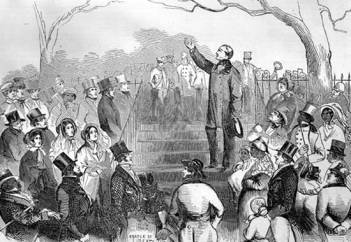
70787-004-784C0452

Religion, Ideology and the Abolitionist Movement

In the North a strident abolitionist movement took root and with each failed compromise, with each new infringement on the rights of northern free-states by the Congress, Courts and the Executive branch to appease southern slaveholders the movement gained added support. The movement developed during the 1830s in New England as a fringe movement among the more liberal elites. One wing of the movement “arose from evangelical ranks and framed its critique of bound labor in religious terms.” [13] The polarization emerged as Northern states abolished slavery as increasing numbers of influential “former slave owners such as Benjamin Franklin changed their views on the matter.” [14]

Many in the movement were inspired by the preaching of revivalist preacher Charles Finney who “demanded a religious conversion with a political potential more radical than the preacher first intended.” [15] Finney and other preachers were instrumental in the Second Great Awakening “which rekindled religious fervor in much of the nation, saw new pressure for abolition.” [16] In fact the “most important child of the Awakening, however, was the abolitionist movement, which in the 1830s took on new life, place the slavery issue squarely on the national agenda, and for the next quarter century aroused and mobilized people in the cause of emancipation.” [17]

The evangelical proponents of abolition understood this in the concept of “free will” something that the pointed out that slavery “denied one group of human beings the freedom of action necessary to free will – and therefore moral responsibility for their behavior. Meanwhile, it assigned to other human beings a degree of temporal power that virtually guaranteed their moral corruption. Both master and slave were thus trapped in a relationship that inevitably led both down the path of sin and depravity” [18]

Finney’s preaching was emboldened and expanded by the American Anti-Slavery Society founded by William Lloyd Garrison “which launched a campaign to change minds, North and South, with three initiatives, public speeches, mass mailings and petitions.” [19] Many of the speakers were seminary students and graduates of Lane Seminary in Cincinnati, who became known as “the Seventy” who received training and then “fanned out across the North campaigning in New England, Pennsylvania, New York, Ohio, Indiana and Michigan[20] where many received hostile receptions, and encountered violence. Garrison used his newspaper, The Liberator to “pledge an all-out attack on U.S. slavery.” [21] Likewise other churches such as the Presbyterians founded new educational institutions such as “Oberlin College in Ohio” which “was founded as an abolitionist institution” [22]

Theodore Parker, a Unitarian pastor and leading Transcendentalist thinker enunciated a very important theological-political analogy for many in the religious wing of the abolitionist movement which concentrated less on using chapter and verse but appealing to “the spirit of the Gospel,” [23] in as Parker’s analogy: as Jesus is to the Bible, so is the Declaration to the Constitution:

“By Christianity, I mean that form of religion which consists of piety – the love of God, and morality – the keeping of His laws. That Christianity is not the Christianity of the Christian church, nor of any sect. It is the ideal religion which the human race has been groping for….By Democracy, I mean government over all the people, by all the people and for the sake of all….This is not a democracy of the parties, but it is an ideal government, the reign of righteousness, the kingdom of justice, which all noble hearts long for, and labor to produce, the ideal whereunto mankind slowly draws near.” [24]

The early abolitionists who saw the issue framed in terms of their religious faith declared slavery a sin against God and man that demanded immediate action.” [25] For them the issue was a matter of faith and belief in which compromise of any kind including the gradual elimination of slavery or any other halfway measures were unacceptable. “William Lloyd Garrison and his fellow abolitionists believed the nation faced a clear choice between damnation and salvation,” [26] a cry that can be heard in much of today’s political debate regarding a number of social issues with religious components including abortion, gay rights and immigration. Harrison wrote that “Our program of immediate emancipation and assimilation, I maintained, was the only panacea, the only Christian solution, to an unbearable program.” [27] The abolitionists identified:

“their cause with the cause of freedom, and with the interests of large and relatively unorganized special groups such as laborers and immigrants, the abolitionists considered themselves to be, and convinced many others that they were, the sole remaining protectors of civil rights.” [28]

The arguments were frequently and eloquently rooted in profoundly religious terms common to evangelical Christianity and the Second Great Awakening. One of the leading historians of the era, Henry Wilson of Massachusetts, a Radical Republican and abolitionist who served as a United States Senator and Vice President in Ulysses Grant’s second administration provides a good example of this. He wrote in his post war history of the events leading to the war explaining basic understanding of the religiously minded abolitionists during the period:

“God’s Holy Word declares that man was doomed to eat his bread in the sweat of his face. History and tradition teach that the indolent, the crafty, and the strong, unmindful of human rights, have ever sought to evade this Divine decree by filching their bread from the constrained and unpaid toil of others…

American slavery reduced man, created in the Divine image, to property….It made him a beast of burden in the field of toil, an outcast in social life, a cipher in courts of law, and a pariah in the house of God. To claim for himself, or to use himself for his own benefit or benefit of wife and child, was deemed a crime. His master could dispose of his person at will, and of everything acquired by his enforced and unrequited toil.

This complete subversion of the natural rights of millions…constituted a system antagonistic to the doctrines of reason and the monitions of conscience, and developed and gratified the most intense spirit of personal pride, a love of class distinctions, and the lust of dominion. Hence a commanding power, ever sensitive, jealous, proscriptive, dominating, and aggressive, which was recognized and fitly characterized as the Slave Power…” [29]

The religious abolitionists took aim at the Southern churches and church leaders who they believed only buttressed slavery but “had become pawns of wealthy slaveholders and southern theologians apologists for oppression.” [30] As the abolitionist movement spread through Northern churches, especially those with ties to the evangelicalism of the Great Awakenings, and for “Evangelical northerners, the belief in individual spiritual and personal rights and personal religious activism made such involvement necessary.” [31]

For Baptists the issue created a deep polarization with northern Baptists mobilizing around abolitionist principles which came out of their association with English Baptists who had been at the forefront of the abolitionist movement in England where the Reverend William Knibb, who also led the fight to end slavery in Jamaica “became an impassioned defender of the human rights of blacks….his flamboyant speeches aroused the people against slavery.” [32] The Baptist Union in England sent a lengthy letter to the Baptist Triennial Convention in the United States on December 31st 1833 in which they condemned “the slave system…as a sin to be abandoned, and not an evil to be mitigated,” and in which they urged all American Baptists to do all in their power to “effect its speedy overthrow.” [33]

In 1835 two English Baptists, Francis Cox and James Hoby, who were active in that nation’s abolitionist movement with William Wilberforce came to the United States “to urge Baptists to abandon slavery. This visit and subsequent correspondence tended to polarize Baptists.” [34] In the north their visit encouraged faith based activism in abolitionist groups. In 1849 the American Baptist Anti-Slavery Convention was formed in New York and launched a polemic attack on the institution of slavery and called southern Baptists to repent in the strongest terms. They urged that the mission agencies be cleansed from “any taint of slavery…and condemned slavery in militant terms.” They called on Southern Baptists to “confess before heaven and earth the sinfulness of holding slaves; admit it to be not only a misfortune, but a crime…” and it warned that “if Baptists in the South ignored such warnings and persisted in the practice of slavery, “we cannot and dare not recognize you as consistent brethren in Christ.” [35] Such divisions we not limited to Baptists and as the decade moved on rose to crisis proportions in every evangelical denomination, provoking Kentucky Senator Henry Clay to wonder: “If our religious men cannot live together in peace, what can be expected of us politicians, very few of whom profess to be governed by the great principles of love?” [36]

The abolition movement aimed to not only stop the spread of slavery but to abolish it. The latter was something that many in the North who opposed slavery’s expansion were often either not in favor of, or indifferent to, became an issue for many after the passage of the Fugitive Slave Act of 1850. So long as slavery was regulated to the South most northerners showed little concern, and even though many profited by slavery, or otherwise reaped its benefits their involvement was indirect. While they may have worn clothes made of cotton harvested by slaves, while the profits of corporations that benefited from all aspects of the Southern slave economy paid the wages of northern workers and shareholders, few thought of the moral issues until they were forced to participate or saw the laws of their states overthrown by Congress.
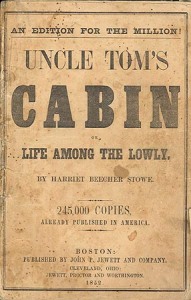
cover22

Uncle Tom’s Cabin and the Popularization of Abolitionism in the North

It was only after this act that the abolitionist movement began to gain traction among people in the North. The movement was given a large boost by the huge popularity of Harriett Beecher Stowe’s 1852 novel Uncle Tom’s Cabin “a vivid, highly imaginative, best-selling, and altogether damning indictment of slavery” [37]
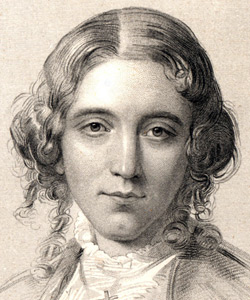
hbs

Harriet Beecher Stowe

Stowe was a well-educated writer, the daughter of the President of Lane Seminary, Lyman Beecher and wife of Calvin Ellis Stowe, a professor at the seminary. She and her family were deeply involved in the abolitionist movement and supported the Underground Railroad, even taking fugitive slaves into her home. These activities and her association with escaped slaves made a profound impact on her. She received a letter from her sister who was distraught over the passage of the Fugitive Slave Law. He sister challenged Stowe to write: “How, Hattie, if I could use a pen as you can, I would write something that would make this whole nation feel what an accursed thing slavery is.” [38]

One communion Sunday she:

“sat at the communion table of Brunswick’s First Parish Church, a vision began playing before my eyes that left me in tears. I saw an old slave clad in rags, a gentle, Christian man like the slave I had read about in American Slavery as It Is. A cruel white man, a man with a hardened fist, was flogging the old slave. Now a cruel master ordered two other slaves two other slaves to finish the task. As they laid on the whips, the old black man prayed for God to forgive them.

After church I rushed home in a trance and wrote down what I had seen. Since Calvin was away, I read the sketch to my ten- and twelve-year-old sons. They wept too, and one cried, “Oh! Mamma, slavery is the most cursed thing in the world!” I named the old slave Uncle Tom and his evil tormenter Simon Legree. Having recorded the climax of my story, I then commenced at the beginning….” [39]

OTCauction

The Auction, engraving from Uncle Tom’s Cabin

Many of Stowe’s characters were fiction versions of people that she actually knew or had heard about and the power of her writing made the work a major success in the United States and in Britain. The abolitionist movement gained steam and power through it and the play that issued from it. The publication of the book and its success “raised a counter indignation among Southerners because they thought Mrs. Stowe’s portrait untrue and because the North was so willing to believe it.” [40]

But despite the furor of many southerners the book gained in popularity and influenced a generation of northerners, creating a stereotype of Southern slaveholders and it caused people “to think more deeply and more personally about the implications of slavery for family, society and Christianity.” [41] The book drew many previously ambivalent to the writings of the abolitionists, and who did not normally read the accounts of escaped slaves. The vivid images in Stowe’s book “were irredeemably hostile: from now on the Southern stereotype was something akin to Simon Legree.” [42] But those images transformed the issue in the minds of many in the north as they “touched on all these chords of feeling, faith, and experience….The genius of Uncle Tom’s Cabin was that it made the personal universal, and it made the personal political as well. For millions of readers, blacks became people.” [43] One northern reader said “what truth could not accomplish, fiction did” [44] as it “put a face on slavery, and a soul on black people.” [45]

George Fitzhugh, a defended of benevolent paternalistic slavery noted Stowe’s book “was “right” concerning the “bitter treatment of slaves….Law, Religion, and Public Opinion should be invoked to punish and correct those abuses….” [46] However, such thoughts could not be spoken too openly for fear of other slaveholders who “could not calmly debate internal correction…while outside agitators advertised their supposed monstrosities.” [47] The inability to debate the issue internally made the southern visceral response to Uncle Tom’s Cabin look petty and impotent.

But others too had an effect on the debate, even escaped former slaves like Frederick Douglass. Douglass became a prominent abolitionist leader was very critical of the role of churches, especially Southern churches in the maintenance of slavery as an institution. His polemic against them in his autobiography reads like the preaching of an Old Testament prophet such as Amos, or Jeremiah railing against the corrupt religious institutions of their day:

“Indeed, I can see no reason, but the most deceitful one, for calling the religion of this land Christianity. I look upon it as the climax of all misnomers, the boldest of all frauds, and the grossest of all libels. Never was there a clearer case of “stealing the livery of the court of heaven to serve the devil in.” I am filled with unutterable loathing when I contemplate the religious pomp and show, together with the horrible inconsistencies, which every where surround me. We have men-stealers for ministers, women-whippers for missionaries, and cradle-plunderers for church members. The man who wields the blood-clotted cowskin during the week fill the pulpit on Sunday, and claims to be a minister of the meek and lowly Jesus. The man who robs me of my earnings at the end of each week meets me as a class-leader on Sunday morning, to show me the way of life, and the path of salvation. He who sells my sister, for purposes of prostitution, stands forth as the pious advocate of purity. He who proclaims it a religious duty to read the Bible denies me the right of learning to read the name of the God who made me. He who is the religious advocate of marriage robs whole millions of its sacred influence, and leaves them to the ravages of wholesale pollution. The warm defender of the sacredness of the family relation is the same that scatters whole families, — sundering husbands and wives, parents and children, sisters and brothers, — leaving the hut vacant and the heart desolate. We see the thief preaching against theft, and the adulterer against adultery. We have men sold to build churches, women sold to support the gospel, and babes sold to purchase Bibles for the poor heathen! All for the glory of God and the good of souls.”[48]

Poet Walt Whitman was radicalized by the passage of the act and in his poem Blood Money he “used the common evangelical technique of applying biblical parables to contemporary events, echoing in literary form William H. Seward’s “higher law” speech.” [49]

Of olden time, when it came to pass

That the Beautiful God, Jesus, should finish his work on earth,

Then went Judas, and sold the Divine youth,

And took pay for his body.

Cursed was the deed, even before the sweat of the clutching hand grew dry…


Since those ancient days; many a pouch enwrapping mean-

Its fee, like that paid for the Son of Mary.

Again goes one, saying,

What will ye give me, and I will deliver this man unto you?

And they make the covenant and pay the pieces of silver…


The meanest spit in thy face—they smite thee with their

Bruised, bloody, and pinioned is thy body,

More sorrowful than death is thy soul.

Witness of Anguish—Brother of Slaves,

Not with thy price closed the price of thine image;

And still Iscariot plies his trade. [50]

The leaders of the Abolitionist movement who had fought hard against acts the Fugitive Slave Act and the Dred Scott decision were now beginning to be joined by a Northern population that was becoming less tolerant of slavery and the status quo. For abolitionists “who had lost their youthful spiritual fervor, the crusade became a substitute for religion. And in the calls for immediate emancipation, one could hear echoes of perfectionism and millennialism.” [51]

But there was resistance of Northern theological circles to abolitionism. Charles B. Hodge, the President of Princeton Theological Seminary “supported slavery on biblical grounds, often dismissing abolitionists as liberal progressives who did not take the Bible seriously.” [52]

With the formation of the Republican Party in 1854, a party founded on opposition to the expansion of slavery in the territories found a formidable political voice and became part of a broad coalition of varied interests groups whose aspirations had been blocked by pro-slavery Democrats. These groups included “agrarians demanding free-homestead legislation, Western merchants desiring river and harbor improvements at federal expense, Pennsylvania iron masters and New England textile merchants in quest of higher tariffs.” The abolitionists also made headway in gaining the support of immigrants, “especially among the liberal, vocal, fiercely anti-slavery Germans who had recently fled the Revolution of 1848.” [53] One of those German immigrants, Carl Schurz observed that “the slavery question” was “not a mere occasional quarrel between two sections of the country, divided by a geographic line” but “a great struggle between two antagonistic systems of social organization.” [54]

Southern Religious Support of Slavery
furman1

In light of the threat posed to slavery by the emerging abolitionist movement forced slaveholders to shift their defense of slavery from it being simply a necessary evil. Slavery became “in both secular and religious discourse, the central component of the mission God had designed for the South.” [55] Like in the North where theology was at the heart of many abolitionist arguments, in the South theology was used to enshrine and defend the institution of slavery. British Evangelical-Anglican theologian Alister McGrath notes how “the arguments used by the pro-slavery lobby represent a fascinating illustration and condemnation of how the Bible may be used to support a notion by reading the text within a rigid interpretive framework that forces predetermined conclusions to the text.” [56]

Southern religion was a key component of something bigger than itself and played a role in the development of an ideology much more entrenched in the culture than the abolitionist cause did in the North, in large part due to the same Second Great Awakening that brought abolitionism to the fore in the North. “Between 1801 when he Great Revival swept the region and 1831 when the slavery debate began, southern evangelicals achieved cultural dominance in the region. Looking back over the first thirty years of the century, they concluded that God had converted and blessed their region.” [57]The Southern ideology which enshrined slavery as a key component of all areas of life was a belief system, it was a system of values, it was a worldview, or to use the more modern German term “Weltanschauung.” The Confederate worldview was the Cause. As Emory Thomas wrote in his book The Confederate Nation:

“it was the result of the secular transubstantiation in which the common elements of Southern life became sanctified in the Southern mind. The South’s ideological cause was more than the sum of its parts, more than the material circumstances and conditions from which it sprang. In the Confederate South the cause was ultimately an affair of the viscera….Questions about the Southern way of life became moral questions, and compromises of Southern life style would become concession of virtue and righteousness.” [58]

Despite the dissent of some, the “dominant position in the South was strongly pro-slavery, and the Bible was used to defend this entrenched position.” [59] The religiously based counter argument to the abolitionists was led by the former Governor of South Carolina, John Henry Hammond. Hammond’s arguments included biblical justification of blacks being biologically inferior to whites and slavery being supported in the Old Testament where the “Hebrews often practiced slavery” and in the New testament where “Christ never denounced servitude.” [60] Hammond warned:

“Without white masters’ paternalistic protection, biologically inferior blacks, loving sleep above all and “sensual excitements of all kinds when awake” would first snooze, then wander, then plunder, then murder, then be exterminated and reenslaved.” [61]

Others in the South, including politicians, pundits and preachers were preaching “that slavery was an institution sanction by God, and that even blacks profited from it, for they had been snatched out of pagan and uncivilized Africa and been given the advantages of the gospel.” [62] The basic understanding was that slavery existed because “God had providential purposes for slavery.” [63]

At the heart of the pro-slavery theological arguments was in the conviction of most Southern preachers of human sinfulness. “Many Southern clergymen found divine sanction for racial subordination in the “truth” that blacks were cursed as “Sons of Ham” and justified bondage by citing Biblical examples.” [64] But simply citing scripture to justify the reality of a system that they repeated the benefit is just part of the story for the issue was far greater than that. The theology that justified slavery also, in the minds of many Christians in the north justified what they considered “the hedonistic aspects of the Southern life style.” [65] This was something that abolitionist preachers continually emphasized, criticizing the greed, sloth and lust inherent in the culture of slavery and plantation life, and was an accusation that Southern slaveholders, especially evangelicals took umbrage, for in their understanding good men could own slaves. Their defense was rooted in their theology and the hyper-individualistic language of Southern evangelicalism gave “new life to the claim that good men could hold slaves. Slaveholding was a traditional mark of success, and a moral defense of slavery was implicit wherever Americans who considered themselves good Christians held slaves.” [66] The hedonism and fundamentalism that existed in the Southern soul, was the “same conservative faith which inspired John Brown to violence in an attempt to abolish slavery…” [67]

Slave owners frequently expressed hostility to independent black churches and conducted violence against them, and “attacks on clandestine prayer meetings were not arbitrary. They reflected the assumption (as one Mississippi slave put it) “that when colored people were praying [by themselves] it was against them.” [68] But some Southern blacks accepted the basic tenets do slave owner-planter sponsored Christianity. Frederick Douglass later wrote “many good, religious colored people who were under the delusion that God required them to submit to slavery and wear their chains with weakness and humility.” [69]

The political and cultural rift began to affect entire church denominations. The heart of the matter went directly to theology, in this case the interpretation of the Bible in American churches. The American Protestant and Evangelical understanding was rooted in the key theological principle of the Protestant Reformation, that of Sola Scripura, which became an intellectual trap for northerners and southerners of various theological stripes. Southerners believed that they held a “special fidelity to the Bible and relations with God. Southerners thought abolitionists either did not understand the Bible or did not know God’s will, and suspected them of perverting both.” [70]The problem was then, as it is now that:

“Americans favored a commonsense understanding of the Bible that ripped passages out of context and applied them to all people at all times. Sola scriptura both set and limited terms for discussing slavery and gave apologists for the institution great advantages. The patriarchs of the Old Testament had owned slaves, Mosaic Law upheld slavery, Jesus had not condemned slavery, and the apostles had advised slaves to obey their masters – these points summed up and closed the case for many southerners and no small number of northerners.” [71]

In the early decades of the nineteenth century there existed a certain confusion and ambivalence to slavery in most denominations. The Presbyterians exemplified this when in 1818 the “General Assembly of the Presbyterian Church, while opposing slavery against the law of God, also went on record as opposing abolition, and deposed a minister for advocating abolition.” [72] There were arguments by some American Christians including some Catholics, Lutherans, Episcopalians and others to offer alternative ways to “interpreting and applying scripture to the slavery question, but none were convincing or influential enough to force debate” [73] out of the hands of literalists.

However the real schisms between the Northern and Southern branches of the major denominations began to emerge in the mid to late 1830s with the actual breakups coming in the 1840s. The first to split were the Methodists when in “1844 the Methodist General Conference condemned the bishop of Georgia for holding slaves, the church split and the following year saw the birth of the Methodist Episcopal Church.” [74] Not all Methodists in the South agreed with this split and Methodist abolitionists in the South “broke away from mainline Methodism to form the Free Methodist Church.” [75]

The Baptists were next, when the Foreign Mission Board “refused to commission a candidate who had been recommended by the Georgia Baptist Convention, on the ground that he owned slaves” [76] resulting in the formation of the Southern Baptist Convention. The Baptist split is interesting because until the early 1800s there existed a fairly strong anti-slavery movement in states such as Kentucky, while in 1790 the General Committee of Virginia “adopted a statement calling slavery “a violent deprivation of the rights of nature, and inconsistent with a republican government; and therefore [we] recommend it to our brethren to make use of every legal measure, to extirpate the horrid evil from the land.” [77]

However, in many parts of the Deep South there existed no such sentiment and in South Carolina noted Baptist preachers including “Richard Furman, Peter Bainbridge, and Edmund Botsford were among the larger slaveholders.” [78] Furman wrote a defense of slavery in 1822 where he made the argument that “the right of holding slaves is clearly established in the Holy Scriptures by precept and example.” [79] After a number of slave uprisings, including the Nat Turner Revolt in Virginia, pro-slavery voices “tended to silence any remaining antislavery voices in the South.” [80]

These voices grew more ever more strident and in 1835 the Charleston Association “adopted a militant defense of slavery, sternly chastising abolitionists as “mistaken philanthropists, and denuded and mischievous fanatics.” [81] Those who met in Augusta Georgia to found the new Southern Baptist Convention indicated that “the division was “painful” but necessary because” our brethren have pressed upon every inch of our privileges and our sacred rights.” [82] Since the Baptist split was brought about by the refusal of the Triennial Convention to appoint slaveholders as foreign missionaries the new convention emphasized the theological nature of their decision:

“Our objects, then, are the extension of the Messiah’s kingdom, and the glory of God. Not disunion with any of his people; not the upholding of any form of civil rights; but God’s glory, and Messiah’s increasing reign; in the promotion of which, we find no necessity for relinquishing any of our civil rights. We will never interfere with what is Caesar’s. We will not compromit what is God’s.” [83]

Of course, to the Baptists who met at Augusta, what was Caesar’s was obviously the institution of slavery.

The last denomination to officially split was the Presbyterians in 1861 who, “reflecting the division of the nation, the Southern presbyteries withdrew from the Presbyterian Church and founded their own denomination.” [84] The split in the Presbyterian Church had been obvious for years despite their outward unity, some of the Southern pastors and theologians were at the forefront of battling their northern counterparts for the theological high ground that defined just whose side God was on. James Henley Thornwell presented the conflict between northern evangelical abolitionists and southern evangelical defenders of slavery in Manichean terms. He believed that abolitionists attacked religion itself.

“The “parties in the conflict are not merely abolitionists and slaveholders,…They are atheists, socialists, communists, red republicans, jacobins, on one side, and friends of order and regulated freedom on the other. In one word, the world is the battle ground – Christianity and Atheism as the combatants; and the progress of humanity at stake.” [85]

Robert Lewis Dabney, a southern Presbyterian pastor who later served as Chief of Staff to Stonewall Jackson in the Valley Campaign and at Seven Pines and who remained a defender of slavery long after the war was over wrote that:

“we must go before the nation with the Bible as the text and ‘Thus saith the Lord’ as the answer….we know that on the Bible argument the abolition party will be driven to reveal their true infidel tendencies. The Bible being bound to stand on our side, they have to come out and array themselves against the Bible. And then the whole body of sincere believers at the North will have to array themselves, though unwillingly, on our side. They will prefer the Bible to abolitionism.” [86]

Southern churches and church leaders were among the most enthusiastic voices for disunion and secession. They labeled their Northern critics, even fellow evangelicals in the abolition movement as “atheists, infidels, communists, free-lovers, Bible-haters, and anti-Christian levelers.” [87] The preachers who had called for separation from their own national denominations years before the war now “summoned their congregations to leave the foul Union and then to cleanse their world.” [88] Thomas R.R. Cobb, a Georgia lawyer, an outspoken advocate of slavery and secession, who was killed at the Battle of Fredericksburg, wrote proudly that Secession “has been accomplished mainly by the churches.” [89]

The Reverend William Leacock of Christ Church, New Orleans declared in his Thanksgiving sermon “Our enemies…have “defamed” our characters, “lacerated” our feelings, “invaded “our rights, “stolen” our property, and let “murderers…loose upon us, stimulated by weak or designing or infidel preachers. With “the deepest and blackest malice,” they have “proscribed” us “as unworthy members… of the society of men and accursed before God.” Unless we sink to “craven” beginning that they “not disturb us,…nothing is now left us but secession.” [90]

The Religious Divide Becomes Political

The breakups of the major Protestant denominations boded ill for the country, in fact the true believers in their cause be it the abolition of slavery or the maintenance and expansion of it were among the most strident politically. “For people of faith these internecine schisms were very troubling. If citizens could not get along in the fellowship of Christ, what did the future hold for the nation?” [91] Both of the major political parties of the 1840s, the Democrats and the Whigs found themselves ever more led by religion as the “fissures among evangelicals, the conflicts between Protestants and Catholics, the slavery debates, and the settlement of the West placed religion at the forefront of American politics.” [92] Of course it was slavery that became the overriding issue as decade moved forward and the divisions among the faithful became deeper.

A Cincinnati minister who preached against secession “citing Absalom, Jeroboam, and Judas” as examples, argued that the “Cause of the United States” and the Cause of Jehovah” were identical…and insisted that “a just defensive war” against southern secessionists is “one of the prominent ways by which the Lord will introduce the millennial day.” [93] In the South many ministers became active in politics and men who at one time had been considered moderates began to speak “in the language of cultural warfare.” Mississippi Episcopal Bishop William Mercer Green denounced the “restless, insubordinate, and overbearing spirit of Puritanism” that was destroying the nation.” [94]

Some political leaders who had worked to craft compromises like South Carolina Senator John C. Calhoun were concerned and observed that the evangelical denominations which were splitting had “contributed greatly to strengthen the bond of the Union.” If all bonds were loosed, he worried, “nothing will be left to hold the Union together except force.” [95] Jefferson Davis and Abraham Lincoln, both who would be considered moderates on the issue of slavery in the late 1840s and early 1850s came to sharply different philosophical and theological understandings of the unfolding dissolution of the country. Davis as early as 1848 was defending slavery as “a common law right to property in the services of man; its origin is in Divine decree – the curse on the graceless sons of Noah.” But Lincoln condemned the expansion of the institution did so in decidedly theological terms, noting that “Slavery is founded in the selfishness of man’s nature…opposition to it is in his love of justice…. Repeal all past human history, you cannot repeal human nature. It will still be the abundance of man’s heart, that slavery extension is wrong.” [96]

God’s Chosen People and the Confederate Union of Church and State
confederate-fasting-1863-granger

Perhaps more than anything the denominational splits helped prepare the Southern people as well as clergy for secession and war. They set precedent by which Southerners left establish national organizations. When secession came, “the majority of young Protestant preachers were already primed by their respective church traditions to regard the possibilities of political separation from the United States without undue anxiety.” [97]

One of the most powerful ideological tools since the days of the ancients has been the linkage of religion to the state. While religion has always been a driving force in American life since they days of the Puritans in the Massachusetts Bay Colony, especially in the belief about the destiny of the nation as God’s “Chosen People” it was in the South where the old Puritan beliefs took firm root in culture, society, politics and the ideology which justified slavery and became indelibly linked to Southern nationalism. “Confederate independence, explained a Methodist tract quoting Puritan John Winthrop, was intended to enable the South, “like a city set on a hill’ [to] fulfill her God given mission to exalt in civilization and Christianity the nations of the earth.” [98]

Religion and the churches “supplied the overarching framework for southern nationalism. As Confederates cast themselves as God’s chosen people” [99] and the defense of slavery was a major part of this mission of the chosen people. A group of 154 clergymen “The Clergy of the South” “warned the world’s Christians that the North was perpetuating a plot of “interference with the plans of Divine Providence.” [100] A Tennessee pastor bluntly stated in 1861 that “In all contests between nations God espouses the cause of the Righteous and makes it his own….The institution of slavery according to the Bible is right. Therefore in the contest between the North and the South, He will espouse the cause of the South and make it his own.” [101]

The effect of such discourse on leaders as well as individuals was to unify the struggle as something that linked the nation to God, and God’s purposes to the nation identifying both as being the instruments of God’s will and Divine Providence:

“Sacred and secular history, like religion and politics, had become all but indistinguishable… The analogy between the Confederacy and the chosen Hebrew nation was invoked so often as to be transformed into a figure of everyday speech. Like the United States before it, the Confederacy became a redeemer nation, the new Israel.” [102]

This theology also motivated men like the convinced hard line Calvinist-Presbyterian, General Stonewall Jackson on the battlefield. Jackson’s brutal, Old Testament understanding of the war caused him to murmur: “No quarter to the violators of our homes and firesides,” and when someone deplored the necessity of destroying so many brave men, he exclaimed: “No, shoot them all, I do not wish them to be brave.” [103]

In effect: “Slavery became in secular and religious discourse, the central component of the mission God had designed for the South….The Confederates were fighting a just war not only because they were, in the traditional framework of just war theory, defending themselves against invasion, they were struggling to carry out God’s designs for a heathen race.” [104]

From “the beginning of the war southern churches of all sorts with few exceptions promoted the cause militant” [105] and supported war efforts, the early military victories of Robert E. Lee’s Army of Northern Virginia and the victories of Stonewall Jackson in the Shenandoah Valley   were celebrated as “providential validations of the cause that could not fail…” Texas Methodist minister William Seat wrote: “Never surely since the Wars of God’s ancient people has there been such a remarkable and uniform success against tremendous odds. The explanation is found in the fact that the Lord goes forth to fight against the coercion by foes of his particular people. Thus it has been and thus it will be to the end of the War.” [106]

This brought about a intertwining of church and state authority, a veritable understanding of theocracy as “The need for the southern people to acknowledge God’s authority was bound up with a legitimation of the authority of clerical and civil rulers. Christian humility became identified with social and political deference to both God and Jefferson Davis.” [107]

Jefferson Davis and other leaders helped bolster this belief:

“In his repeated calls for God’s aid and in his declaration of national days of fasting, humiliation, and prayer on nine occasions throughout the war, Jefferson Davis similarly acknowledged the need for a larger scope of legitimization. Nationhood had to be tied to higher ends. The South, it seemed, could not just be politically independent; it wanted to believe it was divinely chosen.” [108]

Davis’s actions likewise bolster his support and the support for the war among the clergy. A clergyman urged his congregation that the people of the South needed to relearn “the virtue of reverence- and the lesson of respecting, obeying, and honoring authority, for authority’s sake.” [109]

Confederate clergymen not only were spokesmen and supporters of slavery, secession and independence, but many also shed their clerical robes and put on Confederate Gray as soldiers, officers and even generals fighting for the Confederacy. Bishop Leonidas Polk, the Episcopal Bishop of Louisiana, who had been a classmate of Jefferson Davis at West Point was commissioned as a Major General and appointed to command the troops in the Mississippi Valley. Polk did not resign his ecclesiastical office, and “Northerners expressed horror at such sacrilege, but Southerners were delighted with this transfer from the Army of the Lord.” [110] Lee’s chief of Artillery Brigadier General Nelson Pendleton was also an academy graduate and an Episcopal Priest. By its donations of “everything from pew cushions to brass bells, Southern churches gave direct material aid to the cause. Among all the institutions in Southern life, perhaps the church most faithfully served the Confederate Army and nation.” [111] Southern ministers “not only proclaimed the glory of their role in creating the war but also but also went off to battle with the military in an attempt to add to their glory.” [112]

Sadly, the denominational rifts persisted until well into the twentieth century. The Presbyterians and Methodists both eventually reunited but the Baptists did not, and eventually “regional isolation, war bitterness, and differing emphasis in theology created chasms by the end of the century which leaders of an earlier generation could not have contemplated.” [113] The Southern Baptist Convention is now the largest Protestant denomination in the United States and many of its preachers are active in often divisive conservative social and political causes. The denomination that it split from, the American Baptist Convention, though much smaller remains a diverse collection of conservative and progressive local churches. Some of these are still in the forefront of the modern civil rights movement, including voting rights, women’s rights and LGBT issues, all of which find some degree of opposition in the Southern Baptist Convention.

But the religious dimensions were far bigger than denominational disagreements about slavery; religion became one of the bedrocks of Confederate nationalism. The Great Seal of the Confederacy had as its motto the Latin words Deo Vindice which can be translated “With God as our Champion” or “Under God [Our] Vindicator.” The issue was bigger than independence itself, it was intensely theological and secession “became an act of purification, a separation from the pollutions of decaying northern society, that “monstrous mass of moral disease,” as the Mobile Evening News so vividly described it.” [114]

The arguments found their way into the textbooks used in schools throughout the Confederacy. “The First Reader, For Southern Schools assured its young pupils that “God wills that some men should be slaves, and some masters.” For older children, Mrs. Miranda Moore’s best-selling Geographic Reader included a detailed proslavery history of the United States that explained how northerners had gone “mad” on the subject of abolitionism.” [115] The seeds of future ideological battles were being planted in the hearts of white southern children by radically religious ideologues, just as they are today in the Madrassas of the Middle East.

While the various theological and ideological debates played out and fueled the fires of passion that brought about the war, and provided great motivation, especially to Confederates during the war, that their cause was righteous, other very real world decisions and events in terms of politics, law and lawlessness further inflamed passions.

The Deepening Divide: The Dred Scott Decision
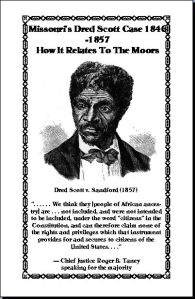
the-dred-scott-case-1846-1857-402x618

As the 1850s wore on the divisions over slavery became deeper and voices of moderation retreated. The trigger for the for the worsening of the division was the political battle regarding the expansion of slavery, even the status of free blacks in the north who were previously slaves, over whom their owners asserted their ownership. Southerners considered the network to help fugitive slaves escape to non-slave states, called the Underground Railroad “an affront to the slaveholders pride” and “anyone who helped a man or woman escape bondage was simply a thief” who had robbed them of their property and livelihood, as an “adult field hand could cost as much as $2000, the equivalent of a substantial house.” [116]

In 1856 the Supreme Court, dominated by southern Democrats ruled in favor of southern views in the Dred Scott decision one pillar of which gave slavery the right to expand by denying to Congress the power to prohibit slavery in Federal territories. The decision was momentous but it was a failure, but it was a disaster for the American people. It solved nothing and further divided the nation:

“In the South, for instance, it encouraged southern rights advocates to believe that their utmost demands were legitimatized by constitutional sanction and, therefore, to stiffen their insistence upon their “rights.” In the North, on the other hand, it strengthened a conviction that an aggressive slavocracy was conspiring to impose slavery upon the nation, and that any effort to reach an accommodation with such aggressors was futile. While strengthening the extremists, it cut the ground from under the moderates.” [117]

The decision in the case is frightening when one looks upon its tenor and implications. The majority opinion which was written by Chief Justice Roger Taney was chilling, not only in its views of race, but the fact that blacks were perpetually property without the rights of citizens. Taney wrote:

“Can a negro, whose ancestors were imported into this country, sold as slaves, become a member of the political community formed and brought into existence by the Constitution of the United States, and as such become entitled to all the rights, and privileges, and immunities, guaranteed by that instrument to the citizen?…It is absolutely certain that the African race were not included under the name of citizens of a state…and that they were not included, and were not intended to be included, under the word “citizens” in the Constitution, and therefore claim none of the rights and privileges which that instrument provides for and secures to citizens of the United States. On the contrary, they were at that time considered as a subordinate and inferior class of beings, who had been subjugated by the dominant race, and, whether emancipated or not, yet remain subject to their authority, and had no rights or privileges but those who held the power and the Government might choose to grant them” [118]

The effect of the ruling on individuals and the states was far reaching. “No territorial government in any federally administered territory had the authority to alter the status of a white citizen’s property, much less to take that property out of a citizen’s hands, without due process of law or as punishment for some crime.” [119] Free slaves were no longer safe, even in Free States from the possibility of being returned to slavery, because they were property.
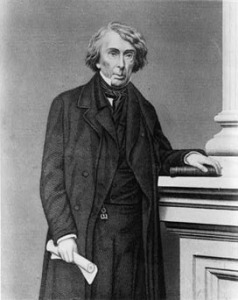
roger-b-taney-1-sized

Chief Justice Roger Taney, Author of the Dred Scott Decision

But the decision had been influenced by President-Elect James Buchanan’s secret intervention in the Supreme Court deliberations two weeks before his inauguration. Buchanan hoped by working with the Justices that he save the Union from breaking apart by appeasing slave owners and catering to their agenda. “The president-elect wanted to know not only when, but if the Court would save the new administration and the Union from the issue of slavery in the territories. Would the judges thankfully declare the explosive subject out of bounds, for everyone who exerted federal power? The shattering question need never bother President Buchanan.” [120] In his inaugural address he attempted to camouflage his intervention and “declared that the Court’s decision, whatever it turned out to be, would settle the slavery issue forever.” [121]

But Buchanan was mistaken, the case made the situation even more volatile as it impaired “the power of Congress- a power which had remained intact to this time- to occupy the middle ground.” [122] Taney’s decision held that Congress “never had the right to limit slavery’s expansion, and that the Missouri Compromise had been null and void on the day of its formulation.” [123]

The Court’s decision “that a free negro was not a citizen and the decision that Congress could not exclude slavery from the territories were intensely repugnant to many people in the free states” [124] and it ignited a firestorm in the north where Republicans now led by Abraham Lincoln decried the decision and southerners basked in their judicial victory. Northerners quite rightly feared that an activist court would rule to deny their states the right to forbid slavery. As early as 1854 Lincoln posed the idea that the Declaration of Independence was “the standard maxim of free society …constantly spreading and deepening its influence,” ultimately applicable “to peoples of all colors everywhere.” [125]

But after the Dred Scott decision Lincoln warned that the Declaration was being cheapened and diluted. Lincoln noted:

“Our Declaration of Independence was held sacred by all, and thought to include all” Lincoln declared, “but now, to aid in making the bondage of the Negro universal and eternal, it is assaulted, and sneered at, and construed, and hawked at, and torn, till, its framers could ride from their graves, they could not recognize it at all.” [126]

Not only that, Lincoln asked the logical question regarding Taney’s judicial activism. How long would it be, asked Abraham Lincoln, before the Court took the next logical step and ruled explicitly that:

“the Constitution of the United States does not permit a state to exclude slavery from its limits?” How far off was the day when “we shall lie down pleasantly thinking that the people of Missouri are on the verge of making their State free; and shall awake to the reality, instead, that the Supreme Court has made Illinois a slave State?” [127]

Lincoln discussed the ramification of the ruling for blacks, both slave and free:

“to aid in making the bondage of the Negro universal and eternal….All the powers of the earth seem rapidly combining against him. Mammon is after him; ambition follows, and philosophy follows, and the theology of the day is fast joining the cry. They have him in his prison house;…One after another they have closed the heavy doors upon him…and they stand musing as to what invention, in all the dominions of mind and matter, can be produced the impossibility of his escape more complete than it is.” [128]

Lincoln was not wrong in his assessment of the potential effects of the Dred Scott decision on Free States. “In 1852 a New York judge upheld the freedom of eight slaves who had left their Virginia owner while in New York City on their way to Texas.” [129] The Dred Scott decision brought that case, Lemon v. The People back to the fore and “Virginia decided to take the case to the highest New York court (which upheld the law in 1860) and would have undoubtedly appealed it to Taney’s Supreme Court had not secession intervened.” [130]

In response to the decision the advocates of the expansion of slavery not only insisted on its westward expansion in Federal territories but “in their must exotic fantasy, proslavery expansionists would land several dozen or several hundred American freedom fighters on Central or South American shores.” [131] Their targets would include Panama, Nicaragua, and Cuba as well. In 1855 one of these adventurers was William Walker who “sailed with about sixty followers (“the immortals”) to participate in a civil war in Nicaragua. Within little more than a year, he made himself President, and Franklin Pierce recognized his government.” [132] In 1857 Jefferson Davis further provoked northern ire when he insisted that “African Slavery as it exists in the United States is a moral, a social, and a political blessing.” [133]

Southern leaders poured political, human and economic capital into the struggle for the imposition of slavery on the Kansas Territory following the passage of the Kansas-Nebraska Act. For the South a pro-slavery victory in Kansas meant “two new U.S. Senators for the South. If a free labor Kansas triumphed, however, the North would gain four senators: Kansas’s immediately and Missouri’s soon.” [134]

To be continued tomorrow….

Notes

[1] Ibid. Guelzo Fateful Lightening p.68

[2] Goldfield, David America Aflame: How the Civil War Created a Nation Bloomsbury Press, New York, London New Delhi and Sidney 2011 p.71

[3] ______________Fugitive Slave Act of 1850 retrieved from the Avalon Project, Yale School of Law http://avalon.law.yale.edu/19th_century/fugitive.asp 11 December 2014

[4] Ibid. Fugitive Slave Act of 1850

[5] Ibid. Goldfield America Aflame p.71

[6] McPherson, James. The Battle Cry of Freedom: The Civil War Era Oxford University Press, Oxford and New York 1988 p.80

[7] Ibid. McPherson The Battle Cry of Freedom p.80

[8] Ibid. Goldfield America Aflame p.72

[9] Ibid. Oates The Approaching Fury p.94

[10] Ibid. Guelzo Fateful Lightening p.71

[11] Ibid. Goldfield America Aflame p.64

[12] Ibid. Guelzo Fateful Lightening p.71

[13] Ibid. Levine Half Slave and Half Free p.93

[14] McGrath, Alister Christianity’s Dangerous Idea: The Protestant Revolution A History from the Sixteenth Century to the Twenty-First Harper Collins Publishers, New York 2007 p.324

[15] Ibid. Freehling The Road to Disunion Volume One p.289

[16] Ibid. McGrath Christianity’s Dangerous Idea p.324

[17] Huntington, Samuel P. Who Are We? America’s Great Debate The Free Press, Simon and Schuster Europe, London 2004 p.77

[18] Ibid. Levine Half Slave and Half Free p.93

[19] Ibid. Egnal Clash of Extremes:pp.125-126

[20] Ibid. Egnal Clash of Extremes p.125

[21] Ibid. Freehling The Road to Disunion Volume One p.12

[22] Ibid. McGrath Christianity’s Dangerous Idea p.324

[23] Ibid. Rable God’s Almost Chosen Peoples p.14

[24] Wills, Garry Lincoln at Gettysburg: The Words that Remade America Simon and Schuster Paperbacks, New York 1992

[25] Ibid. Rable God’s Almost Chosen Peoples p.13

[26] Ibid. Rable God’s Almost Chosen Peoples p.13

[27] Oates, Stephen B. Editor The Approaching Fury: Voices of the Storm, 1820-1861 University of Nebraska Press, Lincoln and London 1997 p.36

[28] Stampp, Kenneth M. editor The Causes of the Civil War 3rd Revised Edition A Touchstone Book published by Simon and Schuster, New York and London 1991 p.23

[29] Ibid. Stampp The Causes of the Civil War p.29

[30] Ibid. Rable God’s Almost Chosen Peoples p.13

[31] Ibid. Goldfield America Aflame p.35

[32] McBeth, H. Leon The Baptist Heritage Broadman Press, Nashville TN 1987 p.301

[33] Ibid. McBeth The Baptist Heritage p.301

[34] Ibid. McBeth The Baptist Heritage p.384

[35] Ibid. McBeth The Baptist Heritage pp.384-385

[36] Ibid. Goldfield America Aflame p.35

[37] Ibid. Catton Two Roads to Sumter p.94

[38] Ibid. Goldfield America Aflame p.75

[39] Ibid. Oates The Approaching Fury p.120

[40] Ibid. Catton Two Roads to Sumter p.94

[41] Ibid. Goldfield America Aflame p.83

[42] Ibid. Catton Two Roads to Sumter p.94

[43] Ibid. Goldfield America Aflame p.79

[44] Ibid. Goldfield America Aflame p.79

[45] Ibid. Goldfield America Aflame p.83

[46] Ibid. Freehling The Road to Disunion Volume One p.48

[47] Ibid. Freehling The Road to Disunion Volume One p.49

[48] Douglass, Frederick. Life and Times of Frederick Douglass: His Early Life as a Slave, His Escape From Bondage, and His Complete History. New York: Collier Books, 1892. Retrieved from http://www.pbs.org/wgbh/americanexperience/features/primary-resources/lincolns-inconsistencies/ December 9th 2014

[49] Ibid. Goldfield America Aflame p.72

[50] Whitman, Walt Blood Money March 22nd 1850 retrieved from the Walt Whitman Archive http://www.whitmanarchive.org/published/periodical/poems/per.00089 11 December 2014

[51] Ibid. Goldfield America Aflame p.13

[52] Ibid. McGrath Christianity’s Dangerous Idea p.324

[53] Catton, William and Bruce, Two Roads to Sumter: Abraham Lincoln, Jefferson Davis and the March to Civil War McGraw Hill Book Company New York 1963, Phoenix Press edition London p.123

[54] Ibid. Levine Half Slave and Half Free p.15

[55] Gallagher, Gary W. The Confederate War: How Popular Will, Nationalism and Military Strategy Could not Stave Off Defeat Harvard University Press, Cambridge MA and London 1999 p.67

[56] Ibid. McGrath Christianity’s Dangerous Idea p.324

[57] Daly, John Patrick When Slavery Was Called Freedom: Evangelicalism, Proslavery, and the Causes of the Civil War The University Press of Kentucky, Lexington KY 2002 p.69

[58] Thomas, Emory The Confederate Nation 1861-1865 Harper Perennial, New York and London 1979 p.4

[59] Ibid. McGrath Christianity’s Dangerous Idea p.324

[60] Ibid. Freehling The Road to Disunion Volume One p.29

[61] Ibid. Freehling The Road to Disunion Volume One p.29

[62] Gonzalez, Justo L. The History of Christianity Volume 2: The Reformation to the Present Day Harper and Row Publishers San Francisco 1985 p.251

[63] Ibid. Daly When Slavery Was Called Freedom p.54

[64] Ibid. Thomas The Confederate Nation p.22

[65] Ibid. Thomas The Confederate Nation p.22

[66] Ibid. Daly When Slavery Was Called Freedom p.30

[67] Ibid. Thomas The Confederate Nation p.22

[68] Ibid. Levine Half Slave and Half Free p.116

[69] Ibid. Levine Half Slave and Half Free p.116

[70] Ibid. Daly When Slavery Was Called Freedom p.60

[71] Ibid. Rable God’s Almost Chosen Peoples p.14

[72] Ibid. Gonzalez The History of Christianity Volume 2 p.251

[73] Ibid. Rable God’s Almost Chosen Peoples p.14

[74] Ibid. Gonzalez The History of Christianity Volume 2 p.251

[75] Ibid. McGrath Christianity’s Dangerous Idea p.324

[76] Ibid. Gonzalez The History of Christianity Volume 2 p.251

[77] Ibid. McBeth The Baptist Heritage p.383

[78] Ibid. McBeth The Baptist Heritage p.384

[79] Ibid. McBeth The Baptist Heritage p.384

[80] Ibid. McBeth The Baptist Heritage p.384

[81] Ibid. McBeth The Baptist Heritage p.384

[82] Shurden, Walter B Not a Silent People: The Controversies that Have Shaped Southern Baptists Broadman Press, Nashville TN 1972 p.58

[83] Ibid. Shurden Not a Silent People p.58

[84] Ibid. Gonzalez The History of Christianity Volume 2 p.251

[85] Ibid. Rable God’s Almost Chosen Peoples p.13

[86] Ibid. Rable God’s Almost Chosen Peoples p.14

[87] Ibid. Daly When Slavery Was Called Freedom p.97

[88] Freehling, William. The Road to Disunion Volume II: Secessionists Triumphant 1854-1861 Oxford University Press, Oxford and New York 2007 p.460

[89] Ibid. Rable God’s Almost Chosen Peoples p.39

[90] Ibid. Freehling The Road to Disunion Volume II p.462

[91] Ibid. Goldfield America Aflame p.35

[92] Ibid. Goldfield America Aflame p.36

[93] Ibid. Rable God’s Almost Chosen Peoples pp.39-40

[94] Ibid. Rable God’s Almost Chosen Peoples p.40

[95] Ibid. Goldfield America Aflame p.35

[96] Ibid. Catton Two Roads to Sumter p.61

[97] Brinsfield, John W. et. al. Editor, Faith in the Fight: Civil War Chaplains Stackpole Books, Mechanicsburg PA 2003 p.67

[98] Faust, Drew Gilpin The Creation of Confederate Nationalism: Ideology and Identity in the Civil War South Louisiana State University Press, Baton Rouge and London p.27

[99] Ibid. Gallagher The Confederate War pp.66-67

[100] Ibid. Daly When Slavery Was Called Freedom p.145

[101] Ibid. Daly When Slavery Was Called Freedom p.138

[102] Ibid. Faust The Creation of Confederate Nationalism p.29

[103] Fuller, J.F.C. Grant and Lee: A Study in Personality and Generalship, Indiana University Press, Bloomington IN 1957

[104] Ibid. Faust, The Creation of Confederate Nationalism: Ideology and Identity in the Civil War South p.60

[105] Ibid. Thomas The Confederate Nation 1861-1865 pp.245-246

[106] Ibid. Daly When Slavery Was Called Freedom pp.145 and 147

[107] Ibid. Faust The Creation of Confederate Nationalism p.26

[108] Ibid. Faust The Creation of Confederate Nationalism p.33

[109] Ibid. Faust The Creation of Confederate Nationalism p.32

[110] Foote, Shelby, The Civil War, A Narrative. Volume One: Fort Sumter to Perryville Random House, New York 1963 1958 p.87

[111] Ibid. Thomas The Confederate Nation p.246

[112] Ibid. Daly When Slavery Was Called Freedom p.142

[113] Ibid. McBeth The Baptist Heritage pp.392-393

[114] Ibid. Faust The Creation of Confederate Nationalism p.30

[115] Ibid. Faust The Creation of Confederate Nationalism p.62

[116] Goodheart, Adam. Moses’ Last Exodus in The New York Times: Disunion, 106 Articles from the New York Times Opinionator: Modern Historians Revist and Reconsider the Civil War from Lincoln’s Election to the Emancipation Proclamation Edited by Ted Widmer, Black Dog and Leventhal Publishers, New York 2013 p.15

[117] Ibid. Potter The Impending Crisis p.291

[118] Guelzo Allen C. Fateful Lightening: A New History of the Civil War Era and Reconstruction Oxford University Press, Oxford and New York 2012 p.91

[119] Ibid. Guelzo Fateful Lightening pp.91-92

[120] Freehling, William. The Road to Disunion Volume II: Secessionists Triumphant 1854-1861 Oxford University Press, Oxford and New York 2007 p.115

[121] Ibid. Freehling, The Road to Disunion Volume II: Secessionists Triumphant 1854-1861 p.109

[122] Ibid. Potter The Impending Crisis p.291

[123] Ibid. Levine Half Slave and Half Free p.210

[124] Ibid. Potter The Impending Crisis p.279

[125] Ibid. Catton Two Roads to Sumter p.139

[126] Ibid. Guelzo Fateful Lightening p.93

[127] Ibid. Levine Half Slave and Half Free p.211

[128] Ibid. Catton Two Roads to Sumter p.139

[129] Ibid. McPherson The Battle Cry of Freedom p.181

[130] Ibid. McPherson The Battle Cry of Freedom p.181

[131] Ibid. Freehling, The Road to Disunion Volume II: Secessionists Triumphant 1854-1861 p.145

[132] Ibid. Potter The Impending Crisis p.193

[133] Ibid. Catton Two Roads to Sumter p.142

[134] Ibid. Freehling, The Road to Disunion Volume II: Secessionists Triumphant 1854-1861 p.124


1 Comment

Filed under civil rights, civil war, History, Political Commentary, Religion

Mine Eyes Have Seen The Glory: Religion, Ideology & the Civil War Part 1

Friends of Padre Steve’s World

This is part one of a very long chapter in my Gettysburg Staff Ride Text. The chapter is different because instead of simply studying the battle my students also get some very detailed history about the ideological components of war that helped make the American Civil War not only a definitive event in our history; but a war of utmost brutality in which religion drove people and leaders on both sides to advocate not just defeating their opponent, but exterminating them.

But the study of this religious and ideological war is timeless, for it helps us to understand the ideology of current rivals and opponents, some of whom we are in engaged in battle and others who we spar with by other means, nations, tribes and peoples whose world view, and response to the United States and the West, is dictated by their religion. 

Yet for those more interested in current American political and social issues the period is very instructive, for the religious, ideological and political arguments used by Evangelical Christians in the ante-bellum period, as well as many of the attitudes displayed by Christians in the North and the South are still on display in our current political and social debates. 

I will be posting the next two parts over the next two days. 

Peace

Padre Steve+

illustration-fort-sumter

“At length on 12th April, the tension could no longer bear the strain. Contrary to instructions, in the morning twilight, and when none could see clearly what the historic day portended, the Confederates in Charleston bombarded Fort Sumter, and the thunder of their guns announced that the argument of a generation should be decided by the ordeal of war. A war, not between two antagonistic political parties, but a struggle to the death between two societies, each championing a different civilization…” 1

War cannot be separated from Ideology, Politics or Religion One can never separate war and the means by which it is fought from its political ends. According to Clausewitz war is an extension or continuation of politics. Of course Clausewitz understood the term politics or policy in the light of the concept of a “World View” or to use the German term Weltungschauung. The term is not limited to doctrine or party politics, but it encompasses the world view of a people or culture. The world view is oft used by the political, media and religious leadership of countries and can be quite instrumental in the decision by a people to go to war; who they war against, their reasons for going to war, the means by which they fight the war, and the end state that they envision. This concept includes racial, religious, cultural, economic and social dimensions of a world view.

One of the problems that modern Americans and Western Europeans have is that we tend to look at the world, particularly in terms of politics and policy, be it foreign or domestic, through a prism from which we cannot see the forest for the trees. We look at individual components of issues such as economic factors, military capabilities, existing political systems, diplomatic considerations and the way societies get information in isolation from each other. We dissect them, we analyze them, and we do a very good job in examining and evaluating each individual component; but we often do this without understanding the world view and ideological factors that link how a particular people, nation or party understand these components of policy.

Likewise policy makers tend to take any information they receive and interpret it through their own world view. This is true even if they have no idea what their world-view is or how they came to it. Most often a world view is absorbed over years. Barbara Tuchman wrote that “When information is relayed to policy-makers, they respond in terms of what is already inside their heads and consequently make policy less to fit the facts than to fit the notions and intentions formed out of the mental baggage that has accumulated in their minds since childhood.” 2

Policy makers often fail to see just how interconnected the most primal elements of the human experience are to the world view of others as well as their own.

Because of this many policy makers, be they military or civilian do not understand how critical the understanding of world view to designing effective polices. Likewise many fail to see how the world view of others influences their application of economic, political, diplomatic and military power as well as the use and dissemination of information in their nation or culture. This is true no matter which religion or sect is involved, even if a people or nation is decidedly secular, and at least outwardly non-religious.

Perhaps this is because we do not want to admit that our Western culture itself is very much a product of primal religious beliefs which informed politics, philosophy, ethics, law, economics, views of race, and even the arts for nearly two millennia. Perhaps it is because we are justifiably appalled and maybe even embarrassed at the excesses and brutality of our ancestors in using religion to incite the faithful to war; to use race and religion justification to subjugate or exterminate peoples that they found to be less than human; or to punish and conquer heretics.

The United States Military made a belated attempt to address ideology, culture and religion in terms of counter-insurgency doctrine when it published the U.S. Army/Marine Counterinsurgency Manual. The discussion of these issues is limited to two pages that specifically deal with various extreme Moslem groups that use that religion as a pillar of their ideology, strategy and operations. But the analysis in the counterinsurgency manual of is limited because its focus is very general and focused at a tactical level.

Likewise the analysis of world view, ideology and religion in the counterinsurgency manual is done in a manner of “us versus them” and though it encourages leaders to attempt to understand the cultural differences there is little in it to help leaders to understand who to do this. Commendably the manual discusses how terrorist and insurgent groups use ideology, frequently based on religion to create a narrative. The narrative often involves a significant amount of myth presented as history, such as how Al Qaida and ISIL using the Caliphate as a religious and political ideal to strive to achieve, because for many Moslems “produces a positive image of the golden age of Islamic civilization.” 3 However, we frequently cannot see how Americans have used, and in some cases continue to the Puritan understanding of a city set on a hill which undergirded Manifest Destiny, the extermination of Native Americans, the War with Mexico, the romanticism of the ante-bellum South and later the Lost Cause.

Policy makers and military leaders must realize that if they want to understand how culture and religious ideology drive others to conquer, subjugate and terrorize in the name of God, they first have to understand how our ancestors did the same thing. It is only when they do that that they can understand that this behavior and use of ideology for such ends is much more universal and easier to understand.

If one wants to see how the use of this compulsion to conquer in the name of God in American by a national leader one needs to go no farther than to examine the process whereby President McKinley, himself a veteran of the Civil War, decided to annex the Philippine in 1898 following the defeat of the Spanish. That war against the Filipinos that we had helped liberate from Spanish rule saw some of the most bloodthirsty tactics employed in fighting the Filipino insurgents, who merely wanted independence. It was a stain on our national honor which of which Mark Twain wrote: “There must be two Americas: one that sets the captive free, and one that takes a once-captive’s new freedom away from him, and picks a quarrel with him with nothing to found it on; then kills him to get his land. . .


A Doubtlessly sincere McKinley sought counsel from God about whether he should annex the the Philippines or not.

“He went down on his knees, according to his own account, and “prayed to Almighty God for light and guidance.” He was accordingly guided to conclude “that there was nothing left to do for us but to take them all, and to educate the Filipinos. And uplift and civilize and Christianize them, by God’s grace to do the very best we could by them, as our fellowmen for whom Christ died.” 4

On the positive side the counterinsurgency manual does mention how “Ideology provides a prism, including a vocabulary and analytical categories, through which followers perceive their situation.” 5 But again it does so at a micro-level and the lessons of it are not applied at the higher levels of strategic thinking and policy.

Thus when faced with cultures for which religion provides the adhesive which binds each of these elements, such as the Islamic State or ISIL we attempt to deal with each element separately, as if they have no connection to each other. But that is where we err, for even if the religious cause or belief has little grounding in fact, science or logic, and may be the result of a cultures attempting to seize upon mythology to build a new reality, it is, in the words of Reggie Jackson the “straw that stirs the drink” and to ignore or minimize it is to doom our efforts to combat its proponents.

Perhaps that is because we do not like to look at ourselves and our own history in the mirror. Perhaps it is because we are uncomfortable with the fact that the face that we see in the mirror is face too similar to those we oppose who are perfectly willing to commit genocide in the name of their God, than we want to admit. Whether this is because we are now predominantly secularist in the way that we do life, or because we are embarrassed by the religiously motivated actions of our forefathers, the result is strikingly and tragically similar.

Clausewitz was a product of classic German Liberalism. He understood the effects of the moral and spiritual concerns inherent in policy, and it flows from his pen, as where he wrote “that the aim of policy is to unify and reconcile all aspects of internal administration as well as of spiritual values, and whatever else the moral philosopher may care to add.” 6 Clausewitz understood that when the motivation behind politics becomes more extreme and powerful; when the politics becomes more than a simple disagreement about isolated policy issues; when the ideology that lays behind the politics, especially ideology rooted in religion evokes primal hatred between peoples, war can come close to reaching the abstract concept of absolute or total war.

Clausewitz wrote:

“The more powerful and inspiring the motives for war, the more they affect the belligerent nations and the fiercer the tensions that precede the outbreak, the closer will war approach its abstract concept, the more important will be the destruction of the enemy, the more closely will the military and the political objects of war coincide, and the more military and less political will war appear to be….” 7

The American Civil War was the first modern war based on the advancement of technology and the changing character of war. But it was also a modern war which reached back to the most primal urges of the people involved, including the primal expressions of religious justification for their actions that both sides accepted as normal.

The American Civil War was caused by the clash of radically different ideologies, ideologies which championed two very different views of civilization, government, economics and the rights of people. However, these different world views were based based upon a common religious understanding:

“whatever their differences over such matters as slavery and political preaching, both sides read their Bibles in remarkably similar ways Ministers had long seen the American republic as a new Israel, and Confederate preachers viewed the southern nation in roughly the same light. The relentless, often careless application of biblical typologies to national problems, the ransacking of scripture for parallels between ancient and modern events produced a nationalistic theology at once bizarre, inspiring and dangerous. Favorite scripture passages offered meaning and hope to a people in the darkest hours and, at the same time, justified remorseless bloodshed.” 8

This understanding manifested itself in each side’s appeal to their Puritan ancestor’s concept of a “city set on a hill,” a mantle that each side claimed to be the legitimate heir. Though they seem radically different, they are actually two sides of the same religious-ideological coin.

The American Civil War was a religious and ideological war. “Like the total wars of the twentieth century, it was preceded by years of violent propaganda, which long before the war had obliterated all sense of moderation, and had awakened in the contending parties the primitive spirit of tribal fanaticism.” 9 It was preceded by the fracturing of political parties and alliances which had worked for compromise in the previous decades to preserve the Union even at the cost of maintaining slavery.

Far from being irrational as some have posited, the actions and behavior of politicians in both the North and the South was completely rational based on their conflicting ideologies and views of their opponents. The “South’s fears of territorial and economic strangulation and the North’s fears of a “slave power” conspiracy are anything but irrational, and only someone who refuses to think through the evidence available to Americans in the 1850s would find either of them at all illogical.” 10

Understanding How Religiously Based Ideology influences Policy, Politics and War Samuel Huntington wrote:

“Blood, language, religion, way of life were what the Greeks had in common and what distinguished them from the Persians and other non-Greeks. Of all the objective elements which define civilizations, however, the most important is usually religion, as the Athenians emphasized. To a very large degree, the major civilizations in human history have been closely identified with the world’s great religions; and who share ethnicity and language but differ in religion may slaughter each other…” 11

The very realistic fears of both sides brought about clash of extremes in politics which defied efforts at compromise and was already resulting in violent and bloody conflicts between ideologues in Kansas, Missouri and Kentucky years before the firing on Fort Sumter. For both sides their views became a moral cause that in the minds of many became an article of their religious faith, and “Religious faith itself became a key part of the war’s unfolding story for countless Americans….” 12 British theorist and military historian J.F.C. Fuller wrote of the religious undergirding of the war:

“As a moral issue, the dispute acquired a religious significance, state rights becoming wrapped up in a politico-mysticism, which defying definition, could be argued for ever without any hope of a final conclusion being reached.” 13

That is why it impossible to simply examine the military campaigns and battles of the Civil War in isolation from the politics, polices, the competing philosophies and the underlying theology which were the worldview that undergirded the arguments of both sides. Those competing philosophies and world views, undergirded by a pervasive nationalistic understanding of religion not only helped to cause on the war but made the war a total war.

Some might wonder where this fits in a text that is about a specific campaign and battle in a war, but for those entrusted with planning national defense and conducting military campaign the understanding of why wars are fought, in particular the ideological causes of war matter in ways that military planners, commanders and even elected political leadership often overlook. Colin Gray notes: “Wars are not free floating events, sufficient unto themselves as objects for study and understanding. Instead, they are entirely the product of their contexts.” 14

Studying the context of the American Civil War is very important in understanding not just it, but also civil wars in other nations which are currently raging. The study of these contexts brings an American or Western historical perspective to those wars, not so much in trying to place a western template over non-western conflicts; but a human perspective from our own past from which we can gain insight into how the people, even people who share a common language, religion and history, can war against each other in the most brutal of fashions. Again I refer to Colin Gray who noted “Policy and strategy will be influenced by the cultural preferences bequeathed by a community’s interpretation of its history as well as by its geopolitical-geostrategic context.” 15

For American and other Western political and military policy makers this is particularly important in Iraq where so many Americans have fought, and in the related civil war in Syria which has brought about the emergence of the Islamic State of Iraq and the Levant.

Likewise in our Western tradition we can see how radical ideology, based on race was central to Hitler’s conduct of war, especially in the East during the Second World War. Hitler’s ideology permeated German military campaigns and administration of the areas conquered by his armies. No branch of the German military, police or civil administration in occupied Poland or Russia was exempt guiltless in the crimes committed by the Nazi regime. It is a chilling warning of the consequences awaiting any nation that allows it to become caught up in hate-filled political, racial or even religious ideologies which dehumanizes opponents and of the tragedy that awaits them and the world. In Germany the internal and external checks that govern the moral behavior of the nation and individuals failed. Caught up in the Nazi system, the Germans, especially the police and military abandoned the norms of international law, morality and decency, banally committing crimes which still reverberate today and which are seen in the ethnic cleansing actions in the former Yugoslavia and other European nations.

Thus the study of the American Civil War, from the cultural, economic, social and religious differences which divided the nation helps us in understanding war. But even more importantly we have to understand the ideological clash between Abolitionists in the North, and Southern proponents of slavery. Both the ideologies of the Abolitionists who believed that African Americans were created by God and had the same rights as whites, as well as the Southern arguments that blacks were inferior and slavery was a positive good, were buttressed by profoundly religious arguments related directly to a divergence in values. It was in this “conflict of values, rather than a conflict of interests or a conflict of cultures, lay at the root of the sectional schism.” 16

Understanding this component of our own nation’s history helps us to understand how those same factors influence the politics, policies, the primal passions and hatreds of people in other parts of the world. Thus they are helpful for us to understand when we as a nation involve ourselves in the affairs of other peoples whose conflicts are rooted in religiously motivated ideology and differences in values, such as in the current Sunni-Shia conflict raging in various guises throughout the Middle East where culture, ideology and economic motivations of the groups involved cannot be separated. We may want to neatly separate economic, strategic, military and geopolitical factors from religious or ideological factors assuming that each exists in some sort of hermetically sealed environment. But to think this is a fallacy of the greatest magnitude. As we have learned too late in the century in our Middle East muddling, it is impossible to separate geopolitical, strategic, military and economic issues from ideological issues rooted in distinctly religious world views, world views that dictate a nation, people or culture’s understanding of the world.

David M. Potter summed up this understanding of the connection between the ideological, cultural and economic aspects and how the issue of slavery connected all three realms in the American Civil War:

“These three explanations – cultural, economic and ideological – have long been the standard formulas for explaining the sectional conflict. Each has been defended as though it were necessarily incompatible with the other two. But culture, economic interest, and values may all reflect the same fundamental forces at work in a society, in which case each will appear as an aspect of the other. Diversity of culture may produce both diversity of interests and diversity of values. Further, the differences between a slaveholding and a nonslaveholding society would be reflected in all three aspects. Slavery represented an inescapable ethical question which precipitated a sharp conflict of values.” 17

o-SLAVERY-facebook


The Impact of Slavery on the Growing Divide between North and South

The political ends of the Civil War came out of the growing cultural, economic, ideological and religious differences between the North and South that had been widening since the 1830s. However, slavery was the one issue which helped produce this conflict in values and it was “basic to the cultural divergence of the North and South, because it was inextricably fused into the key elements of southern life – the staple crop of the plantation system, the social and political ascendency of the planter class, the authoritarian system of social control.” 18 Without slavery and the southern commitment to an economy based on slave labor, the southern economy would have most likely undergone a similar transformation as what happened in the North; thus the economic divergence between North and South would “been less clear cut, and would have not met in such head-on collision.” 19 But slavery was much more than an economic policy for Southerners; it was a key component of their religious, racial and philosophic world view.

The issue of slavery even divided the ante-Bellum United States on what the words freedom and liberty meant, the dispute can be seen in the writings of many before the war, with each side emphasizing their particular understanding of these concepts. Many Southerners, including poor whites saw slavery as the guarantee of their economic freedom. John C. Calhoun said to the Senate in 1848 that “With us, the two great divisions of society are not the rich and poor, but white and black; and all of the former, the poor as well as the rich, belong to the upper class, and are respected and treated as equals.” 20

But it was Abraham Lincoln who cut to the heart of the matter when he noted that “We all declare for liberty” but:

“in using the same word we do not all mean the same thing. With some the word liberty may mean for each man to do as he pleases with himself and the product of his labor; while with others the same word may mean for some men to do as they please with other men and the product of other men’s labor.” 21

The growing economic disparity between the Slave and Free states became more about the expansion of slavery in federal territories as disunion and war approached; for a number of often competing reasons. These differences were amplified by the issue of slavery led to the substitution of stereotypes of each other and had the “effect of changing men’s attitudes toward the disagreements which are always certain to arise in politics: ordinary, resolvable disputes were converted into questions of principle, involving rigid, unnegotiable dogma.” 22 The editor of the Charleston Mercury noted in 1858 that “on the subject of slavery…the North and the South…are not only two peoples, but they are rival, hostile peoples.” 23

This was driven both by the South’s insistence on both maintaining slavery where it was already legal and expanding it into new territories which was set against the vocal abolitionist movement. They were also fighting an even more powerful enemy, Northern industrialists who were not so idealistic, and much more concerned with “economic policy designed to secure Northern domination of Western lands than the initial step in a broad plan to end slavery.” 24 This completion between the regions not only affected politics, it affected religion and culture In the South it produced a growing culture of victimhood which is manifest in the words of Robert Toombs who authored Georgia’s declaration of causes for secession:

“For twenty years past, the Abolitionists and their allies in the Northern states, have been engaged in constant efforts to subvert our institutions, and to excite insurrection and servile war among us…” whose “avowed purpose is to subject our society, subject us, not only to the loss of our property but the destruction of ourselves, our wives and our children, and the dissolution of our homes, our altars, and our firesides.” 25

As the differences grew and tensions rose the South became ever more closed off from the North. “More than other Americans, Southerners developed a sectional identity outside the national mainstream. The Southern life style tended to contradict the national norm in ways that life styles of other sections did not.” 26

The complex relationship of Southern society where the “Southern bodies social, economic, intellectual, and political were decidedly commingled” 27 and politics of the South came more to embrace the need for slavery and its importance, even to poor whites in the South who it did not benefit and actually harmed economically: “the system of subordination reached out still further to require a certain kind of society, one in which certain questions were not publically discussed. It must give blacks no hope of cultivating dissention among the whites. It must commit non slaveholders to the unquestioning support of racial subordination….In short, the South became increasingly a closed society, distrustful of isms from outside and unsympathetic to dissenters. Such were the pervasive consequences of giving top priority to the maintenance of a system of racial subordination.” 28

4.0.4


Southern planters declared war on all critics of their “particular institution” beginning in the 1820s. As Northern abolitionists like William Lloyd Garrison and his newspaper The Liberator grew in its distribution and began to appear in the South various elected officials throughout the South “suppressed antislavery books, newspapers, lectures, and sermons and strove generally to deny critics of bondage access to any public forum.” 29

In response to the proliferation of abolitionist literature in the South, John C. Calhoun proposed that Congress pass a law to prosecute “any postmaster who would “knowingly receive or put into the mail any pamphlet, newspaper, handbill, or any printed, written, or pictorial representation touching the subject of slavery.” 30 Calhoun was not alone as other members of Congress as well as state legislatures worked to restrict the import of what they considered subversive and dangerous literature.

Beginning in 1836 the House of Representatives passed a “gag rule” for its members which “banned all petitions, memorials, resolutions, propositions, or papers related in any way or to any extent whatever to the subject of slavery.” 31 This was challenged by former President John Quincy Adams in 1842 as well as by others so that in 1844 the House voted to rescind it. However Southern politicians “began to spout demands that the federal government and the Northern states issue assurances that the abolitionists would never be allowed to tamper with what John Calhoun had described as the South’s “peculiar domestic institution.” 32 The issue of slavery more than any other “transformed political action from a process of accommodation to a mode of combat.” 33

Around the same time as the gag rule was played out in Congress the Supreme Court had ruled that the Federal government alone “had jurisdiction where escaped slaves were concerned” which resulted in several states enacting “personal liberty laws” to “forbid their own elected officials from those pursuing fugitives.” Southern politicians at the federal and state levels reacted strongly to these moves which they believed to be an assault on their institutions and their rights to their human property. Virginia legislators protested that these laws were a “disgusting and revolting exhibition of faithless and unconstitutional legislation.” 34

The issue of slavery shaped political debate and “structured and polarized many random, unoriented points of conflict on which sectional interest diverged.” 35 As the divide grew leaders and people in both the North and the South began to react to the most distorted images of each other imaginable- “the North to an image of a southern world of lascivious and sadistic slave drivers; the South to the image of a northern world of cunning Yankee traders and radical abolitionists plotting slave insurrections.” 36

Edmund-Ruffin

The Slaveholder Ideology Personified: Edmund Ruffin

Among the people most enraged by Northern opposition to slavery was Edmund Ruffin. Ruffin was a very successful farm paper editor, plantation owner and ardent old line secessionist from Virginia. In 1860 the then 67 year old Ruffin helped change the world forever when, according to popular legend he pulled the lanyard which fired the first shot at Fort Sumter. While he was there and probably was given the honor of firing the first shot from his battery; other guns from other emplacements may have fired first. 37

Ruffin was a radical ideologue, he had been passionately arguing for secession and Southern independence for fifteen years. Ruffin “perceived the planter civilization of the South in peril; the source of the peril was “Yankee” and union with “Yankees.” Thus he preached revolution, Ruffin was a rebel with a cause, a secular prophet…” 38 He was a type of man who understood reality far better than some of the more moderate oligarchs that populated the Southern political and social elite. While in the years leading up to the war these men, including John Calhoun attempted to secure the continued existence and spread of slavery within the Union through the Congress and the courts, as early as 1850, Ruffin recognized that in order for slavery to survive the slaveholding South would have to secede from the Union. Ruffin and other radical secessionists believed that there could be no compromise with the north. In 1850 he and James Hammond attempted to use a meeting in Nashville to “secure Cooperative State Secession” and wrote to Hammond, against those who sought to use the meeting to preserve the Union, “If the Convention does not open the way to dissolution…I hope it shall never meet.” 39 He believed that in order to maintain the institution of slavery the slave holding states that those states had to be independent from the North.

Ruffin’s views were not unique to him, the formed the basis of how most slave owners and supporters felt about slavery’s economic benefits, Ruffin wrote:

“Still, even this worst and least profitable kind of slavery (the subjection of equals and men of the same race with their masters) served as the foundation and the essential first cause of all the civilization and refinement, and improvement of arts and learning, that distinguished the oldest nations. Except where the special Providence and care of God may have interposed to guard a particular family and its descendants, there was nothing but the existence of slavery to prevent any race or society in a state of nature from sinking into the rudest barbarism. And no people could ever have been raised from that low condition without the aid and operation of slavery, either by some individuals of the community being enslaved, by conquest and subjugation, in some form, to a foreign and more enlightened people.”40

a2a9c088d75423b7f457b194d7c9ea9a

Slavery and National Expansion: The Compromise of 1850

The Ante-Bellum South was an agrarian society which depended on the free labor provided by slaves and in a socio-political sense it was an oligarchy that offered no freedom to slaves, openly discriminated against free blacks and provided little hope of social or economic advancement for poor and middle class whites, but it was maintained because in many cases the Southern Yeoman farmer “feared the fall from independent producer to dependent proletarian, a status he equated with enslavement.” 41 But northerners often driven by religious understandings of human rights founded in the concept of a higher law over a period of a few decades abolished slavery in the years after the United States had gained independence.

However, the South had tied its economy and society to the institution of slavery, and was not content to see it remain just in the original states of the Old South.

The expansion of slavery was essential to its continued maintenance in the states where it was already legal. “Because of the need to maintain a balance in the Senate, check unruly slaves, and cultivate fertile soils, many planters and small plantation owners- particularly those living in the southern districts of the cotton states- asserted that their survival depended on new territory.” 42 In those decades “a huge involuntary migration took place. Between 800,000 and 1 million slaves were moved westward….” 43

slavescars

The need for slaves caused prices to soar. In some older states like Virginia where fewer slaves were required the exportation of slaves became a major industry:

“male slaves were marched in coffles of forty or fifty, handcuffed to each other in pairs, with a long chain through the handcuffs passing down the column to keep it together, closely guarded by mounted slave traders followed by an equal number of female slaves and their children. Most of them were taken to Wheeling, Virginia, the “busiest slave port” in the United States, and from there they were transported by steamboat to New Orleans, Natchez, and Memphis.” 44

In the years the before the war, the North embraced the Industrial Revolution leading to advances which gave it a marked economic advantage over the South in which through its “commitment to the use of slave labor inhibited economic diversification and industrialization and strengthened the tyranny of King Cotton.” 45 The population of the North also expanded at a clip that far outpaced the South as European immigrants swelled the population.

The divide was not helped by the various compromises worked out between northern and southern legislators. After the Missouri Compromise Thomas Jefferson wrote:

“but this momentous question, like a fire bell in the night, awakened and filled me with terror. I considered it at once as the knell of the Union. It is hushed indeed for the moment, but this is a reprieve only, not a final sentence. A geographical line, coinciding with a marked principle, moral and political, once conceived and held up to the angry passions of men, will never be obliterated; and every new irritation will mark it deeper and deeper.” 46

The trigger for the increase in tensions was the war with Mexico in which the United States annexed nearly half of Mexico.

The new territories were viewed by those who advocated the expansion of slavery as fresh and fertile ground for its spread. Ulysses S Grant, who served in the war, noted the effects of the war with Mexico in his memoirs:

“In taking military possession of Texas after annexation, the army of occupation, under General [Zachary] Taylor, was directed to occupy the disputed territory.  The army did not stop at the Nueces and offer to negotiate for a settlement of the boundary question, but went beyond, apparently in order to force Mexico to initiate war….To us it was an empire and of incalculable value; but it might have been obtained by other means.  The Southern rebellion was largely the outgrowth of the Mexican war.”47

Robert Toombs of Georgia was an advocate for the expansion of slavery into the lands conquered during the war. Toombs warned his colleagues in Congress “in the presence of the living God, that if you by your legislation you seek to drive us from the territories of California and New Mexico, purchased by the common blood and treasure of the whole people…thereby attempting to fix a national degradation upon half the states of this Confederacy, I am for disunion.” 48

The tensions in the aftermath of the war with Mexico escalated over the issue of slavery in the newly conquered territories brought heated calls by some southerners for secession and disunion. To preserve the Union, Henry Clay and Daniel Webster, supported by the new President Millard Fillmore were able to pass the compromise of 1850 solved a number of issues related to the admission of California to the Union and boundary disputes involving Texas and the new territories. But among the bills that were contained in it was the Fugitive Slave Law, or The Fugitive Slave Act of 1850. The act was the devise of Henry Clay which was meant to sweeten the deal for southerners. The law would “give slaveholders broader powers to stop the flow of runaway slaves northward to the free states, and offered a final resolution denying that Congress had any authority to regulate the interstate slave trade.” 49 which for all practical purposes nationalized the institution of slavery, even in Free states by forcing all citizens to assist law enforcement in apprehending fugitive slaves and voided state laws in Massachusetts, Vermont, Ohio, Connecticut, Pennsylvania and Rhode Island which barred state officials from aiding in the capture, arrest or imprisonment of fugitive slaves. “Congress’s law had nationalized slavery. No black person was safe on American soil. The old division of free state/slave state had vanished….” 50

fugitive-slave-act-1850-granger-1

That law required all Federal law enforcement officials, even in non-slave states to arrest fugitive slaves and anyone who assisted them, and threatened law enforcement officials with punishment if they failed to enforce the law. The law stipulated that should “any marshal or deputy marshal refuse to receive such warrant, or other process, when tendered, or to use all proper means diligently to execute the same, he shall, on conviction thereof, be fined in the sum of one thousand dollars.” 51

Likewise the act compelled citizens in Free states to “aid and assist in the prompt and efficient execution of this law, whenever their services may be required….” 52 Penalties were harsh and financial incentives for compliance attractive.

“Anyone caught providing food and shelter to an escaped slave, assuming northern whites could discern who was a runaway, would be subject to a fine of one thousand dollars and six months in prison. The law also suspended habeas corpus and the right to trial by jury for captured blacks. Judges received a hundred dollars for every slave returned to his or her owner, providing a monetary incentive for jurists to rule in favor of slave catchers.” 53

The law gave no protection for even black freedmen. No proof or evidence other than the sworn statement of the owner that a black was or had been his property was required to return any black to slavery. Frederick Douglass said:

“By an act of the American Congress…slavery has been nationalized in its most horrible and revolting form. By that act, Mason & Dixon’s line has been obliterated;…and the power to hold, hunt, and sell men, women, and children remains no longer a mere state institution, but is now an institution of the whole United States.” 54

On his deathbed Henry Clay praised the act, which he wrote “The new fugitive slave law, I believe, kept the South in the Union in ‘fifty and ‘fifty-one. Not only does it deny fugitives trial by jury and the right to testify; it also imposes a fine and imprisonment upon any citizen found guilty of preventing a fugitive’s arrest…” Likewise Clay depreciated the opposition noting “Yes, since the passage of the compromise, the abolitionists and free coloreds of the North have howled in protest and viciously assailed me, and twice in Boston there has been a failure to execute the law, which shocks and astounds me…. But such people belong to the lunatic fringe. The vast majority of Americans, North and South, support our handiwork, the great compromise that pulled the nation back from the brink.” 55

To be continued tomorrow….

Notes 

1 Fuller, J.F.C. The Conduct of War 1789-1961 Da Capo Press, New York 1992. Originally published by Rutgers University Press, New Brunswick N.J p.98

2 Tuchman, Barbara W. Practicing History Alfred A. Knopf, New Your 1981 p.289

3 ___________ U.S. Army/ Marine Counterinsurgency Field Manual FM 3-24 MCWP 3-33.5 15 December 2006 with and forward by General David A Petreus and General James Amos, Konecky and Konecky, Old Saybrook CT 2007 p.26

4 Ibid. Tuchman Practicing History p.289

5 Ibid. U.S. Army/ Marine Counterinsurgency Field Manual p.27

6 Clausewitz, Carl von On War Indexed edition, edited and translated by Michael Howard and Peter Paret, Princeton University Press, Princeton NJ 1976 p.606

7 Ibid. Clausewitz On War pp.87-88

8 Rable, George C. God’s Almost Chosen Peoples: A Religious History of the American Civil War University of North Carolina Press, Chapel Hill 2010 p.4

9 Ibid. Fuller The Conduct of War 1789-1961 p.99

10 Guelzo Allen C. Fateful Lightening: A New History of the Civil War Era and Reconstruction Oxford University Press, Oxford and New York 2012 p.95

11 Huntington, Samuel P. The Clash of Civilizations and the Remaking of the World Order Touchstone Books, New York 1997 p.42

12 Ibid. Rable God’s Almost Chosen Peoples p.5

13 Fuller, J.F.C. Decisive Battles of the U.S.A. 1776-1918 University of Nebraska Press, Lincoln 2007 copyright 1942 The Royal Society for the Prevention of Cruelty to Animals p.174

14 Gray, Colin S. Fighting Talk: Forty Maxims on War, Peace, and Strategy Potomac Books, Dulles VA 2009 p.3

15 Ibid. Gray Fighting Talk p.25

16 Potter, David M. The Impending Crisis: America before the Civil War 1848-1861 completed and edited by Don E. Fehrenbacher Harper Collins Publishers, New York 1976 p.41

17 Ibid. Potter The Impending Crisis p.41

18 Ibid. Potter The Impending Crisis p.42

19 Ibid. Potter The Impending Crisis p.42

20 McPherson, James M. Drawn With the Sword: Reflections on the American Civil War Oxford University Press, Oxford and New York 1996 p.50

21 Levine, Bruce Half Slave and Half Free: The Roots of the Civil War Revised Edition, Hill and Wang, a division of Farrar, Strauss and Giroux, New York 1992 and 1995 p.122

22 Ibid. Potter The Impending Crisis p.43

23 Ibid. McPherson Drawn With the Sword p.16

24 Egnal, Marc Clash of Extremes: The Economic Origins of the Civil War Hill and Wang a division of Farrar, Straus and Giroux New York 2009 p.6

25 Dew, Charles B. Apostles of Disunion: Southern Secession Commissioners and the Causes of the Civil War University Press of Virginia, Charlottesville and London 2001 p.12

26 Thomas, Emory The Confederate Nation 1861-1865 Harper Perennial, New York and London 1979 p.5

27 Ibid. Thomas The Confederate Nation p.5

28 Ibid. Potter The Impending Crisis pp.457-458

29 Ibid. Levine Half Slave and Half Free p.166

30 Ibid. Guelzo Fateful Lightening pp.50-51

31 Ibid. Levine Half Slave and Half Free pp.169-170

32 Ibid. Guelzo Fateful Lightening pp.51-52

33 Ibid. Potter The Impending Crisis p.43

34 Ibid. Levine Half Slave and Half Free pp.169-170

35 Ibid. Potter The Impending Crisis p.43

36 Ibid. Potter The Impending Crisis p.43

37 Catton, Bruce The Coming Fury Phoenix Press, London 1961 pp.314-315

38 Ibid. Thomas The Confederate Nation p.1

39 Freehling, William W. The Road to Disunion Volume One: Secessionists at Bay Oxford University Press, Oxford and New York 1990 p.481

40 Ruffin, Edmund The Political Economy of Slavery in McKitrick, Eric L. ed. Slavery Defended: The Views of the Old South. Englewood Cliffs, NJ: Prentice Hall/Spectrum Books, 1963.Retrieved from http://www.pbs.org/wgbh/americanexperience/features/primary-resources/lincolns-political-economy/ 24 March 2014

41 Ibid. McPherson Drawn With the Sword p.50

42 Ibid. Egnal Clash of Extremes pp.125-126

43 Korda, Michael. Clouds of Glory: The Life and Legend of Robert E. Lee Harper Collins Publishers, New York 2014 p.203

44 Ibid. Korda Clouds of Glory: The Life and Legend of Robert E. Lee p.203

45 Ibid. Potter The Impending Crisis p.42

46 Jefferson, Thomas Letter to John Holmes dated April 22nd 1824 retrieved from http://www.loc.gov/exhibits/jefferson/159.html 24 March 2014

47 U.S. Grant, Personal Memoirs of U.S. Grant New York 1885 pp.243-245

48 Ibid. Guelzo Fateful Lightening pp.62-63

49 Ibid. Guelzo Fateful Lightening p.68

50 Goldfield, David America Aflame: How the Civil War Created a Nation Bloomsbury Press, New York, London New Delhi and Sidney 2011 p.71

51 ______________Fugitive Slave of Act 1850 retrieved from the Avalon Project, Yale School of Law http://avalon.law.yale.edu/19th_century/fugitive.asp 11 December 2014

52 Ibid. Fugitive Slave Act of 1850

53 Ibid. Goldfield America Aflame p.71

54 Ibid. Goldfield America Aflame p.72

55 Ibid. Oates The Approaching Fury p.94

3 Comments

Filed under civil rights, civil war, faith, History, laws and legislation, Religion

Friday Morning Myth Busting before a Trip to Gettysburg

IMG_1915

Dear Friends of Padre Steve’s World,

Today I head up with my class to Gettysburg for our Staff Ride. Of course this comes on the heals of the San Francisco amazing game seven victory in the 2014 World Series, and if you read this site you understand that I was up until the wee hours of the morning because I was much too excited to sleep. This is actually, despite the lack of sleep a blessing because most of the time that I don’t sleep it is because of anxiety, nightmares, flashbacks and night terrors that torment me. As Gouverneur Warren, one of the heroes of Gettysburg wrote after the war:

“I wish I did not dream that much. They make me sometimes dread to go to sleep. Scenes from the war, are so constantly recalled, with bitter feelings I wish to never experience again. Lies, vanity, treachery, and carnage.”

But last night was different, to was hard to get to sleep because of the excitement of one of the best World Series games in history. That being said I am tired. I revised my chapter on the ideological nature of the American Civil War, and I should have another chapter revision on the Confederate decision to allow Robert E. Lee to invade Pennsylvania in the late spring of 1863 done by the time that I leave tomorrow. But those chapters, which are around 80 pages long are now too big to post in one fell swoop here.

However, in my readings I encountered a quote by historian Drew Faust Gilpin, as well as another that was part of a Methodist tract from 1860 that both seem absolutely timely today. I included both in the chapter, but I am going to post it here as well, because in the religious-historical myth that has become the staple that frauds like David Barton, Glenn Beck and their political and media allies flood the the airways and internet with, it is timely. Gilpin wrote:

“Sacred and secular history, like religion and politics, had become all but indistinguishable…The analogy between the Confederacy and the chosen Hebrew nation was invoked so often as to be transformed into a figure of everyday speech. Like the United States before it, the Confederacy became a redeemer nation, the new Israel.”

The Methodist tract noted:

“Confederate independence, explained a Methodist tract quoting Puritan John Winthrop, was intended to enable the South, “like a city set on a hill’ [to] fulfill her God given mission to exalt in civilization and Christianity the nations of the earth.”

Personally I cannot imagine anymore hatful projections of the Christian faith, but then I was reminded by the Fox News Channel resident Shrink, Dr Keith Ablow, that the United States needs to be conducting it’s own Jihad, its own wars of conquest to impose the American way on the rest of the world. Of course the blowhard shrink Ablow who has no skin in the game doesn’t seem to mind putting the sons and daughters of the nation in harm’s way, to die in unjust, unrighteous, illegal, immoral and certainly un-Christian wars to satiate his bloodlust. Ablow revels in diagnosing the pathologies and motivations of people that he has never met, not a very professional way of doing business as a shrink, but just watching Ablow’s rants on television and reading what he puts out on the internet I wonder if he is a sociopath, a man without empathy, a man who does not seam to be motivated by the desire to help people, nor by the upholding the Hippocratic oath, to do no harm.

I find it fascinating to read what General and later President Ulysses S Grant said about such ideas:

“As the United States is the freest of all nations, so, too, its people sympathize with all people struggling for liberty and self-government; but while so sympathizing it is due to our honor that we should abstain from enforcing our views upon unwilling nations and from taking an interested part, without invitation, in the quarrels between different nations or between governments and their subjects. Our course should always be in conformity with strict justice and law, international and local.”

But that my friends is why history matters, and why you should take your time to study it, including the uncomfortable things that destroy the myths perpetuated by the Lost Causers of the modern “Conservative Christian” revisionists and their allies who sell their crap as truth to people who want to believe it because they have been conditioned by thirty years and more of propaganda, that the myth is true.

Clothed in  the garb of faith and patriotism these lies, and the political, military and economic consequences  that they have spawned over the past thirteen years, have cost more American lives and treasure, as well as destroyed our stature in the world than any series of events in our history. heretical These filthy and polluted ideas helped destroy what could have been a renaissance in international relations because their proponents painted everything in terms of black and white and you either are for us or against us. Yes let me say it, President George Bush’s, uninspired,misguided and down right ignorant  religious world views have taken us to the abyss.

This my friends is why history matters. Sometimes it may seem dry and dusty, and no you cannot get rich as a real historian, while the fake ones like Barton, Beck and Bill O’Reilly are able to make a lot of money because they appear to what people want to hear by lying, by so linking their religion with their politics and their distorted view of history that the reality of history is ground to dust under the heals of their designer jackboots.

So, tomorrow, or is it already today now, I head up to Gettysburg where the brave men of the Army of the Potomac, whose veterans, like those of other Union armies engaged in the struggle for freedom helped give our nation a “new birth of freedom.” 

I think that how the Army of Tennessee, a Union army in the West described the war is at the heart of the issue.

“The Society of the Army of the Tennessee described the war as a struggle “that involved the life of the Nation, the preservation of the Union, the triumph of liberty and the death of slavery.” They had fought every battle…from the firing on the Union flag Fort Sumter to the surrender of Lee at Appomattox…in the cause of human liberty,” burying “treason and slavery in the Potter’s Field of nations” and “making all our citizens equal before the law, from the gulf to the lakes, and from ocean to ocean.”

It is amazing what the study of history and going to the places that it was made can do in someone’s heart. For me, the study of the Battle of Gettysburg and the American Civil War, and not just the military aspects of it has motivated me to be more forceful and speak up against the lies of those like Barton, Beck, O’Reilly, Ablow and the hosts of pundits, preachers and politicians who spread their lies as truth.

But then for me, truth matters. In this I am reminded of a quote from Star Trek the Next Generation. It is from an episode called “The First Duty.” In it the seasoned Captain Jean Luc Picard confronts his young protege Wesley Crusher after a disastrous accident that leaves a Star Fleet Academy cadet dead. Picard tells the young Crusher that “the first duty of every Starfleet officer is to the truth, whether it’s scientific truth, historical truth or personnel truth…

To me, as a miscreant priest, and career officer that quote strikes home. I have a duty to the truth, believe it or not it does matter to me, and sometimes that means that I have to be a myth buster and call out the professional liars who posit themselves as historians, political scientists or experts on military strategy, when none of them have either the education or the experience to be experts in anything but being able to lie for fun and profit.

You see when I go to Gettysburg, and I stand where so many men died do make others free I become ever more inspired to confront the liars.

But now I am preaching and I try not to do that. I do need to attempt to get some sleep, so have a nice night.

Peace

Padre Steve+


Leave a comment

Filed under civil rights, civil war, History, Military, News and current events, Political Commentary, star trek

They Answered Every Expectation: Black Regiments in the Civil War

41_090_lg

Friends of Padre Steve’s World,

The following is a newly added except to the first chapter of my Gettysburg Text. It is part of the chapter the “First Modern War” which I recently updated on this site. In order not to simply repost a massive article I have only posted the new material.

Peace

Padre Steve+

The war brought about another change to warfare in America. This was a societal and political and a political change that has shaped American military history, culture and life ever since. The Emancipation Proclamation gave African Americans, both Freedmen and recently freed slaves the opportunity to serve in the Union Army. The change of policy instituted by Lincoln was revolutionary as well as controversial and it had strategic implications for the war effort. There were many doubters in the north whose attitudes towards African Americans were not much different than Southerners, especially among the Copperheads.

8thUSCT_Olustee

Prior to the Emancipation some Union commanders in occupied Confederate territory “had unofficially recruited black soldiers in Kansas and in occupied portions of South Carolina and Louisiana in 1862. But the administration had not sanctioned these activities.” [1] But as the war continued on, consuming vast numbers of lives the attitude of Lincoln and the administration began to change.

Lincoln and the closest members of his cabinet were beginning to understand that the “North could not win the war without mobilizing all of its resources and striking against Southern resources used to sustain the Confederate war effort.” [2]

Lincoln’s Secretary of War, Edwin Stanton; who was a passionate believer in the justice of emancipation “Instantly grasped the military value of the proclamation. Having spent more time than any of his colleagues contemplating the logistical problems facing the army, he understood the tremendous advantage to be gained if the massive workforce of slaves could be transferred from the Confederacy to the Union.” [3]

emancipation

Lincoln emphasized the “military necessity” of emancipation and “justified the step as a “fit and necessary war measure for suppressing the rebellion.” [4] The process of emancipation now became not only a moral crusade, but now became a key part of national strategy. Lincoln wrote to his future Vice President, Andrew Johnson, then the military governor of occupied Tennessee that “The colored population is the great available and yet unavailed of, force for restoration of the Union.” [5] The idea of simply mollifying the border states was dropped and policy changed that of “depriving the Confederacy of slave labor. Mobilizing that manpower for the Union- as soldiers as well as laborers- was a natural corollary.” [6] Reflecting President Lincoln’s and Stanton’s argument for the military necessity of emancipation, General Henry Halleck wrote to Ulysses Grant that:

“the character of the war has very much changed within the past year. There is now no possibility of reconciliation with the rebels… We must conquer the rebels or be conquered by them….Every slave withdrawn from the enemy is the equivalent of a white man put hors de combat.” [7]

Grant concurred with the decision. Grant wrote to in a letter to Lincoln after the assault on Battery Wagner “by arming the negro we have added a powerful ally. They will make good soldiers and taking them from the enemy weakens him in the same proportion as it strengthens us.” [8] Lincoln wrote after the Emancipation Proclamation that “the emancipation policy, and the use of colored troops, constitute the heaviest blow yet dealt to the rebellion.” [9] The change was a watershed in both American history as well as the future of the U.S. Military services.

Emancipation allowed for the formation of regiments of United States Colored Troops (USCT), mustered directly into Federal service, which in numbers soon dwarfed the few state raised Black Regiments. However, it was the the inspiration provided by those first state raised regiments as well as the violence directed against Blacks in the draft riots helped to provoke “many northerners into a backlash against the consequences of violent racism.” [10] The valor of the state regiments, as well as the USCT units that managed to get into action was remarkable, especially in regard to the amount of discrimination levied at them by some northerners, and the very real threat of death that they faced of captured by Confederates.

In May of 1863 Major General Nathaniel Banks dared to send the First and Third Regiments of “Louisiana Native Home Guard regiments on a series of attacks on Confederate positions at Port Hudson, Louisiana” [11] where they received their baptism of fire. They suffered heavy losses and “of the 1080 men in the ranks, 271 were hit, or one out of every four.” [12] Banks said of them in his after action report: “They answered every expectation…In many respects their conduct was heroic…The severe test to which they were subjected, and the determined manner in which they encountered the enemy, leave upon my mind no doubt of their ultimate success.” [13]

negro-regiment-54th-ma

But the most famous African American volunteer regiment was the 54th Massachusetts, commanded by Colonel Robert Gould Shaw, the “North’s showcase black regiment.” [14] Raised in Boston and officered by many men who were the sons of Boston’s blue blood abolitionist elite, the regiment was authorized in March 1863. Since there was still opposition to the formation of units made up of African Americans, Massachusetts Governor John Andrew authorized the formation of the 54th under the command of white officers, a practice that with few exceptions, became standard in the U.S. military until President Truman desegregated the armed forces in 1948. Governor Andrew was determined to ensure that the officers of the 54th were men of “firm antislavery principles…superior to a vulgar contempt for color.” [15]

220px-WilliamCarney

Sergeant William H Carney of the 54th Massachusetts

The 54th saw action first in early June and at Gould’s urging sent into battle against the Confederate positions at Fort Wagner on July 18th 1863. Leading the attack the 54th lost nearly half its men, “including Colonel Shaw with a bullet through his heart. Black soldiers gained Wagner’s parapet and held it for an hour before falling back.” [16] Though they tried to hold on they were pushed back after a stubborn fight to secure a breach in the fort’s defenses. “Sergeant William H Carney staggered back from the fort with wounds in his chest and right arm, but with the regiment’s Stars and Stripes securely in his grasp. “The old flag never touched the ground, boys,” Carney gasped as he collapsed at the first field hospital he could find.” [17] For his actions at Fort Wagner Carney became the first African American awarded the Medal of Honor.

The_Storming_of_Ft_Wagner-lithograph_by_Kurz_and_Allison_1890a

Shaw was buried with his men by the Confederates and when Union commanders asked for the return of his body were told “We have buried him with his niggers,” Shaw’s father quelled a northern effort to recover his son’s body with these words: We hold that a soldier’s most appropriate burial-place is on the field where he has fallen.” [18] As with so many frontal attacks on prepared positions throughout the war, valor alone could not overcome a well dug in enemy. “Negro troops proved that they could stop bullets and shell fragments as good as white men, but that was about all.” [19]

Despite the setback, the regiment went on to further actions where it continued to distinguish itself. The Northern press, particularly abolitionists papers brought about a change in the way that many Americans in the North, civilians as well as soldiers, saw blacks. The Atlantic Monthly noted “Through the cannon smoke of that dark night, the manhood of the colored race shines before many eyes that would not see.” [20]

Douglass.JPG

Frederick Douglass, who had two sons serving in the 54th Massachusetts, understood the importance of African Americans taking up arms against those that had enslaved them in order to win their freedom:

“Once let a black man get upon his person the brass letters U.S… let him get an eagle on his button, and a musket on his shoulder and bullets in his pockets, and there is no power on earth which can deny he has won the right to citizenship in the United States.” [21]

HD_NgroWarFL640116p264cz.preview

At the Battle of Milliken’s Bend, Louisiana a training camp where two regiments of newly recruited blacks were camped was attacked by a Confederate brigade attempting to provide relief to the Vicksburg garrison was repulsed by raw, ill-armed and untrained black troops:

“Untrained and armed with old muskets, most of the black troops nevertheless fought desperately. With the aid of two gunboats they finally drove off the enemy. For raw troops, wrote Grant, the freedmen “behaved well.” Assistant Secretary of War Dana, still with Grant’s army, spoke with more enthusiasm. “The bravery of the blacks,” he declared, “completely revolutionized the sentiment in the army with regard to the employment of negro troops. I heard prominent officers who had formerly in private had sneered at the idea of negroes fighting express after that as heartily in favor of it.” [22]

HD_4USCinfantryDetail.preview

Soldiers of the 4th USCT Regiment 

By the end of the war 179,000 African American Soldiers, commanded by 7,000 white officers served in the Union armies. While most were confined to rear area duties or working with logistics and transportation. The policies to regulate USCT regiments to supporting tasks in non-combat roles “frustrated many African American soldiers who wanted a chance to prove themselves in battle.” [23] Many of the soldiers and their white officers argued to be let into the fight as they felt that “only by proving themselves in combat could blacks overcome stereotypes of inferiority and prove their “manhood.” [24] Even so in many places in the army the USCT and state regiments made up of blacks were scorned:

“A young officer who left his place in a white regiment to become colonel of a colored regiment was frankly told by a staff officer that “we don’t want any nigger soldiers in the Army of the Potomac,” and his general took him aside to say: “I’m sorry to have you leave my command, and am still more sorry that you are going to serve with Negroes. I think that it is a disgrace to the army to make soldiers of them.” The general added that he felt this way because he was sure that colored soldiers just would not fight.” [25]

The general of course was wrong. In the engagements they USCT units were allowed to fight, they did so with varying success most often attributable to the direction of their senior officers. When given the chance they almost always fought well, even when badly commanded, this was true even when they were thrown into hopeless situations as when Ferrero’s Division, comprised of colored troops were thrown into the Battle of the Crater at Petersburg when “that battle lost beyond all recall.” [26] They advanced in good order singing as they went, while their commander, General Ferrero took cover in a dugout and started drinking; but the Confederate defenders had been reinforced and “Unsupported, subjected to a galling fire from batteries on the flanks, and from infantry fire in front and partly on the flank,” a witness write, “they broke up in disorder and fell back into the crater.” [27] Pressed into to carnage of the crater with white troops from the three divisions already savaged by the fighting had taken cover, the “black troops fought with desperation, uncertain of their fate if captured.” [28] In the battle the division lost 1327 of just under 4000 men. [29]

When captured by Confederates, black soldiers and their white officers received no quarter from many Confederate opponents. General Edmund Kirby Smith who held overall command of Confederate forces west of the Mississippi instructed General Richard Taylor to simply execute black soldiers and their white officers: “I hope…that your subordinates who may have been in command of capturing parties may have recognized the propriety of giving no quarter to armed negroes and their officers. In this way we may be relieved from a disagreeable dilemma.” [30] This was not only a local policy, but echoed at the highest levels of the Confederate government. In 1862 the Confederate government issued an order that threatened white officers commanding blacks: “any commissioned officer employed in the drilling, organizing or instructing slaves with their view to armed service in this war…as outlaws” would be “held in close confinement for execution as a felon.” [31]

On April 12th 1864 at Fort Pillow, troops under the command of General Nathan Bedford Forrest massacred the bulk of over 231 Union most of them black as they tried to surrender. While it is fairly clear that Forrest did not order the massacre and even attempted to stop it, that he had lost control of his troops, who with the fury of men possessed by hatred of a lesser race slaughtered the Union troops as they either tried to surrender or flee; but he was not displeased with the result. Ulysses Grant wrote that:

“These troops fought bravely, but were overpowered I will leave Forrest in his dispatches to tell what he did with them.

“The river was dyed,” he says, “with the blood of the slaughtered for up to 200 years. The approximate loss was upward of five hundred killed; but few of the officers escaped. My loss was about twenty killed. It is hoped that these facts will demonstrate to the Northern people that negro soldiers cannot cope with Southerners.” Subsequently Forrest made a report in which he left out the part that shocks humanity to read.” [32]

”The bulk of the killing was directed at the black soldiers of the 6th U.S. Colored Heavy Artillery which composed over a third of the garrison. “Of the 262 Negro members of the garrison, only 58- just over 20 percent- were marched away as prisoners; while of the 295 whites, 168- just under sixty percent were taken.” [33] A white survivor of the 13th West Tennessee Cavalry, a Union unit at the fort wrote: “We all threw down our arms and gave tokens of surrender, asking for quarter…but no quarter was given….I saw 4 white men and at least 25 negroes shot while begging for mercy….These were all soldiers. There were also 2 negro women and 3 little children standing within 25 steps of me, when a rebel stepped up to the and said, “Yes, God damn you, you thought you were free, did you?” and shot them all. They all fell but one child, when he knocked it in the head with the breech of his gun.” [34]A Confederate Sergeant wrote home a week after the massacre: “the poor deluded negroes would run up to our men, fall upon their knees and with uplifted hands scream for mercy, but were ordered to their feet and shot down.” [35]

African American soldiers proved themselves during the war and their efforts paved the way for Lincoln and others to begin considering the full equality of blacks as citizens. If they could fight and die for the country, how could they be denied the right to votes, be elected to office, serve on juries or go to public schools? Under political pressure to end the war during the stalemate before Petersburg and Atlanta in the summer of 1864 Lincoln reacted angrily to Copperheads as well as wavering Republicans on the issue of emancipation:

“But no human power can subdue this rebellion without using the Emancipation lever as I have done.” More than 100,000 black soldiers were fighting for the Union and their efforts were crucial to northern victory. They would not continue fighting if they thought the North intended to betray them….If they stake their lives for us they must be prompted by the strongest motive…the promise of freedom. And the promise being made, must be kept…There have been men who proposed to me to return to slavery the black warriors. “I should be damned in time & in eternity for so doing. The world shall know that I will keep my faith to friends & enemies, come what will.” [36]

Despite this, even in the North during and after the war, blacks, including former soldiers would be discriminated against sometimes by the white men that they served alongside. Those rights would be fought for another century and what began in 1863 with the brave service and sacrifice of these African American soldiers began a process of increased civil rights that is still going on today. It would not be until after the war that some blacks were commissioned as officers in the Army. When Governor John Andrew, the man who had raised the 54th Massachusetts attempted to:

“issue a state commission to Sergeant Stephen Swails of the 54th…the Bureau of Colored Troops obstinately refused to issue Swails a discharge from his sergeant’s rank, and Swails promotion was held up until after the end of the war. “How can we hope for success to our arms or God’s blessing,” raged the white colonel of the 54th, Edward Hallowell, “while we as a people are so blind to justice?” [37]

8512218

Lieutenant Stephen Swails 

In the South, politicians and many senior Confederate Officers fought against any allowance for blacks to serve, for they knew if they allowed this, that slavery itself must be swept away. Despite this a few such as General Patrick Cleburne, an Irish immigrant, a non-slave owner who commanded a division in the Army of Tennessee demonstrated the capacity for forward thinking in terms of race, blacks serving as soldiers and emancipation.

fig25

Major General Patrick Cleburne 

Cleburne, known as “the Stonewall Jackson of the West” was a bold fighter who put together a comprehensive plan. He noted that the Confederacy was losing the war because it did not have soldiers, that it did not have supplies or resources and most significantly that “slavery, from being one of our chief sources of strength at the beginning of the war, has now become in a military point of view, one of our chief sources of weakness.” [38] Cleburne recommended that “we immediately commence training a large reserve of the most courageous of our slaves, and further that we guarantee freedom within a reasonable time to every slave in the South who shall remain to the confederacy in this war.” [39]

His proposal was radical. He was asking more from his fellow Southerners than they could risk. He was “asking them to surrender the cornerstone of white racism to preserve their nation” [40] and he presented it in stark terms that few could stomach “As between the loss of independence and the loss of slavery, we can assume that every patriot will freely give up the latter- give up the Negro slave rather than be a slave himself.” [41]

In January 1864 General W.H.T Walker obtained a copy of Cleburne’s proposal and sent it to Davis. Walker opposed it and expressed his outrage over it, rather than being a military matter it was now a political matter and Davis intervened to quash the proposal. “Convinced that the “propagation of such opinions” would cause “discouragements, distraction, and dissention” in the army, Jefferson Davis ordered the Generals to stop discussing the matter…The only consequence of Cleburne’s action seemed to be the denial of promotion to this ablest of the army’s division commanders, who was killed ten months later at the Battle of Franklin.” [42] In fact Cleburne was “passed over for command of an army corps and promotion to lieutenant general” three times in the next eight months, and in “each care less distinguished, less controversial men received the honors.” [43] All copies of Cleburne’s proposal were destroyed by the order of Davis.

Cleburne was not the only military man to advocate the formation of Negro units or even emancipation. Robert E. Lee was one of the chief proponents of this. Lee said after the war that he had told Davis “often and early in the war that the slaves should be emancipated, that it was the only way to remove a weakness at home and to get sympathy abroad, and divide our enemies, but Davis would not hear of it.” [44]

Ten months later Davis raised the issue of arming slaves as he now believed that military necessity left him little choice. He was opposed by some of his closest political allies including Howell Cobb who warned “The day that you make soldiers of them is the beginning of the end of the revolution. If slaves will make good soldiers our whole theory of slavery is wrong.” [45] Lee wrote to a member of Virginia’s legislature “we must decide whether slavery shall be extinguished by our enemies and the slaves used against us, or use them ourselves at the risk of the effects which may be produced on our social institutions…” and he pointed out that “any act for the enrolling of slaves as soldiers must contain a “well digested plan of gradual and general emancipation”: the slaves could not be expected to fight well if their service was not rewarded with freedom.” [46]

The debate began in earnest in the fall of 1864 and revealed a sharp divide in the Confederacy between those who supported the measure and those against it. Cabinet members such as Judah Benjamin and a few governors “generally supported arming the slaves.” [47] They were opposed by the powerful governors of Georgia and North Carolina, Joe Brown and Zebulon Vance as well as the president-pro tem of the Confederate Senate R.M.T. Hunter, who forcibly opposed the measure. Led by Governor “Extra Billy” Smith Virginia’s General Assembly voted “to permit the arming of slaves but included no provision for emancipation, either before or after military service.” [48]

Finally in March of 1865 the Confederate Congress passed by one vote a watered down measure to allow for the recruitment of slaves. It stipulated that “the recruits must all be volunteers” [49] and those who volunteered must also have “the approbation of his master by a written instrument conferring, as far as he may, the rights of a freed man.” [50] While this in itself was a radical proposition for a nation which had went to war to maintain slavery, the fact was that the slave’s service and freedom were granted not by the government, but by his owner, and even at this stage of the war, few owners were willing to part with their property. It was understood by many that giving freedom to a few was a means of saving the “particular institution.” The Richmond Sentinel noted during the November debate: “If the emancipation of a part is the means of saving the rest, this partial emancipation is eminently a pro-slavery measure.” [51] Thus the law made “no mention of emancipation as a reward of military service” [52] and in deference to “state’s rights, the bill did not mandate freedom for slave soldiers.” [53]

But even the watered down measure was opposed by diehards. Robert Kean, who headed the Bureau of War and should have understood the stark reality of the Confederacy’s strategic situation, note in his diary, that the law:

“was passed by a panic in the Congress and the Virginia Legislature, under all the pressure the President indirectly, and General Lee directly, could bring to bear. My own judgment of the whole thing is that it is a colossal blunder, a dislocation of the foundations of society from which no practical results will be reaped by us.” [54]

It was Lee’s prestige alone that allowed the measure to pass, but even that caused some to question Lee’s patriotism. The Richmond Examiner dared to express a doubt whether Lee was “a ‘good Southerner’: that is, whether he is thoroughly satisfied of the justice and beneficence of negro slavery.” [55] Robert Toombs of Georgia stated that “the worst calamity that could befall us would be to gain our independence by the valor of our slaves” [56] and a Mississippi congressman stated that “Victory itself would be robbed of its glory if shared with slaves.” [57] On March 23rd 1865 the War Office issued General Order Number 14, which authorized the call up and recruitment of slaves to the Confederate cause and on March 25th two companies were formed for drill in Richmond’s Capitol Square and as they did so to the sounds of fifes and drums, “Small boys jeered and threw rocks” [58] at them. None of those few volunteers would see action as within a week the Confederate government had fled Richmond.

But some would see that history was moving, and attitudes were beginning to change. It took time, and the process is still ongoing. As imperfect as emancipation was and though discrimination and racism remained, African Americans had reached “levels that none had ever dreamed possible before the war.” [59] In April 1865 as Jefferson Davis and his government fled Richmond, with Davis proclaiming “again and again we shall return, until the baffled and exhausted enemy shall abandon in despair his endless and impossible task of making slaves of a people resolved to be free.” [60]

richmond

Entering Richmond 

The irony in Davis’s empty vow was stunning, with a week Lee had surrendered and in a month Davis himself would be in a Federal prison. The Federal troops who led the army into Richmond came from General Godfrey Weitzel’s Twenty-fifth Corps, of Ord’s Army of the James. The Every black regiment in the Army of the James was consolidated in Weitzel’s Corps, along with Ferrero’s former division which had suffered so badly at the Battle of the Crater. “Two years earlier in New Orleans, Weitzel had protested that he did not believe in colored troops and did not want to command them, and now he sat at the gates of Richmond in command of many thousands of them, and when the citadel fell he would lead them in and share with them the glory of occupying the Rebel capital.” [61] were regiments of black “cavalrymen and infantrymen. Many were former slaves; their presence showed their resolve to be free.” [62]

Some of those early African American soldiers went on to distinguish themselves on the prairie as the immortal Buffalo Soldiers. Other blacks would fight in Cuba and the Philippines during the Spanish American War. In the First World War, despite there being some instances of racial harmony, blacks, including officers faced discrimination and met with violent acts. “Refusals to arrest white soldiers who physically assaulted black soldiers accompanied by the tendency to rescind unpopular racial orders and to discourage black officers from demanding salutes from white soldiers” [63] was common.

The all black 94th Division fought in combat under French command in World War one when it was denied the chance to fight as part of the American Army, which mainly regulated black units to rear echelon duties, something that was the standard practice again in the Second World War. Even after President Truman desegregated the armed forces in 1948 African Americans, as well as other racial minorities, women and gays have faced very real discrimination. The military continues to make great strides, and while overt racist acts and other types of discrimination are outlawed, racism still remains a part of American life.

pride_over_prejudice-reeves-b-of-nashville

USCT Guarding Confederate Prisoners after Battle of Nashville

But things have changed, and that in large part is due to the unselfish sacrifice in the face of hatred and discrimination of the men of the USCT and the State Black Regiments like the 54th Massachusetts and the Louisiana Home Guards who blazed a way to freedom for so many. A white soldier who served with the 49th Massachusetts wrote “all honor to our negro soldiers. They deserve citizenship. They will secure it! There would be much suffering in what he termed “the transition state” but a “nation is not born without pangs.” [64]

Those birth pangs helped to bring about a new birth of freedom for the United States.

Notes

[1] McPherson, James M. Tried by War: Abraham Lincoln as Commander in Chief Penguin Books, New York and London 2008

[2] McPherson, James M. Drawn With the Sword: Reflections on the American Civil War Oxford University Press, Oxford and New York 1996 p.101

[3] Godwin, Doris Kearns Team of Rivals: The Political Genius of Abraham Lincoln Simon and Shuster, New York and London 2005

[4] Egnal, Marc Clash of Extremes: The Economic Origins of the Civil War Hill and Wang a division of Farrar, Straus and Giroux New York 2009 p.318

[5] Ibid. McPherson Tried by War p.159

[6] Ibid. McPherson Drawn With the Sword p.159

[7] McPherson, James M. Abraham Lincoln and the Second American Revolution Oxford University Press, New York and Oxford 1991 p.35

[8] Ibid. Guelzo Fateful Lighteningp.381

[9] Ibid. McPherson Abraham Lincoln and the Second American Revolution p.35

[10] Ibid. McPherson. The Battle Cry of Freedom p.686

[11] Ibid. Guelzo Fateful Lightening p.379

[12] Ibid. Foote , The Civil War, A Narrative. Volume Two p.398

[13] Ibid. Guelzo Fateful Lightening p.379

[14] Ibid. McPherson. The Battle Cry of Freedom p.686

[15] Ibid. McPherson Drawn With the Sword p.101

[16] Ibid. McPherson. The Battle Cry of Freedom p.686

[17] Ibid. Guelzo Fateful Lightening pp. 380-381

[18] Ibid. McPherson. The Battle Cry of Freedom pp.686-687

[19] Ibid. Foote , The Civil War, A Narrative. Volume Two p.697

[20] Ibid. McPherson. The Battle Cry of Freedom p.686

[21] Ibid. Guelzo Fateful Lightening p. 381

[22] Ibid. McPherson. The Battle Cry of Freedom p.634

[23] Gallagher, Gary W. The Union War Harvard University Press, Cambridge MA and London 2011

[24] Ibid. McPherson Drawn With the Sword p.89

[25] Catton, Bruce. A Stillness at Appomattox Doubleday and Company Garden City, New York 1953 p.227

[26] Ibid. Catton A Stillness at Appomattox p.249

[27] Foote, Shelby, The Civil War, A Narrative. Volume Three Red River to Appomattox Random House, New York 1974 p.537

[28] Wert, Jeffry D. The Sword of Lincoln: The Army of the Potomac Simon and Schuster, New York and London 2005 pp.384-385

[29] Ibid. Foote The Civil War, A Narrative. Volume Three p.537

[30] Ibid. Guelzo Fateful Lightening p. 377

[31] Ibid. Guelzo Fateful Lightening p. 377

[32] Grant, Ulysses S. Preparing for the Campaigns of ’64 in Battles and Leaders of the Civil War Volume IV, Retreat With Honor Edited by Robert Underwood Johnson and Clarence Clough Buel Castle, Secaucus NJ pp.107-108

[33] Ibid. Foote The Civil War, A Narrative. Volume Three p.111

[34] Ibid. Guelzo Fateful Lightening p. 378

[35] Ibid. Foote The Civil War, A Narrative. Volume Three p.112

[36] Ibid. McPherson Abraham Lincoln and the Second American Revolution p.89

[37] Ibid. Guelzo Fateful Lightening p. 376

[38] Ibid. Thomas, The Confederate Nation p.262

[39] Ibid. Thomas, The Confederate Nation p.262

[40] Ibid. Guelzo Fateful Lightening p. 370

[41] Ibid. Thomas, The Confederate Nation p.262

[42] Ibid. McPherson. The Battle Cry of Freedom p.833

[43] Ibid. Thomas, The Confederate Nation p.262

[44] Ibid. Gallagher The Confederate War p.47.

[45] Ibid. Guelzo Fateful Lightening p. 370

[46] Korda, Michael. Clouds of Glory: The Life and Legend of Robert E. Lee Harper Collins Publishers, New York 2014 p.643

[47] Ibid. Thomas, The Confederate Nation p.293

[48] Ibid. Foote. The Civil War, A Narrative. Volume Three pp.754-755

[49] Ibid. Foote. The Civil War, A Narrative. Volume Three p. 755

[50] Ibid. Thomas, The Confederate Nation p.296

[51] Ibid. McPherson. The Battle Cry of Freedom p.836

[52] Ibid. Foote. The Civil War, A Narrative. Volume Three p.755

[53] Ibid. McPherson. The Battle Cry of Freedom p.837

[54] Ibid. Foote. The Civil War, A Narrative. Volume Three p.860

[55] Ibid. McPherson. The Battle Cry of Freedom p.837

[56] Ibid. Foote. The Civil War, A Narrative. Volume Three p.860

[57] Ibid. McPherson. The Battle Cry of Freedom p.835

[58] Ibid. Foote. The Civil War, A Narrative. Volume Three p.860

[59] Ibid. Guelzo Fateful Lightening p. 386

[60] Levine, Bruce Half Slave and Half Free: The Roots of the Civil War Revised Edition, Hill and Wang, a division of Farrar, Strauss and Giroux, New York 1992 and 1995 p.241

[61] Catton, Bruce Grant Takes Command Little, Brown and Company Boston, Toronto and London 1968 p.411

[62] Ibid. Levine Half Slave and Half Free pp.241-242

[63] Keene, Jennifer D. Doughboys, the Great War, and the Remaking of America The Johns Hopkins University Press, Baltimore and London 2001 p.88

[64] Ibid Gallagher The Union War p.113

5 Comments

Filed under civil rights, civil war, History, Military

The Character, Nature and Context of The Civil War and Why it Still Matters Part 2

Gettysburg-Casualties1

Friends of Padre Steve’s World,

Here is part two to yesterday’s post.

Since I am now working my way back to Gettysburg his is a significant revision of an article that I published here earlier in the year and that is a part of my Gettysburg Staff Ride text. The actual full title of the chapter is The Foundations of the First Modern War: The Character, Nature and Context of the Civil War and its Importance to Us Today but that is rather long to put as the title here. This is pretty detailed and specialized so many may not want to read it, however, for those with in interest in how United States policy in regard to how we use our military today and the myriad of tensions that we wrestle with that have been with us for about 150 years it should prove enlightening. Todays article is more concerned with how the war was waged and developments which began in the Civil War which changed the ways that later wars were conducted.

Have a great night! 

Peace

Padre Steve+

Part Two…

21st-michiganjpg-ee6580567686f3ae

Weaponry, Tactics, Technical Advancements and Mobilization

All of these factors influenced and affected the Union and Confederate armies as they campaigned. Likewise, advances weaponry particularly the rifled musket, posed a conundrum for officers educated in the Napoleonic tactics that both armies began the war. The tactics the officers were educated in were developed at a time when the maximum effective range of muskets was barely 100 meters. Yet by 1860 the rifled muskets had an effective range of about 400 meters, and the advent of the repeating rifle increased the firepower available to individual soldiers. This made it especially difficult for the armies that fought the Civil War to “rise up and deliver a frontal attack became almost always futile against any reasonably steady defenders. Even well executed flank attacks tended to suffer such heavy casualties as experienced riflemen maneuvered to form new fronts against them that they lost the decisiveness they had enjoyed in the Napoleonic Wars.” [1] Despite the increased range and accuracy that came with the rifled musket tactics in all arms were slow to change and even at Gettysburg Lee would demonstrate that he had not fully appreciated the effects of the change of warfare learned during the battles of 1862.

Though there were a number of mounted combats between Union and Confederate cavalry, “they were incidental both to the cavalry’s primary role and to the course of tactical development” [2]which generally fought dismounted. The way in which both sides used their cavalry showed that by the end of 1863 each had “arrived at a war of tactical entrenchment dominated by infantry armed with the rifled musket, and supported by the defensive deployment of smoothbore artillery.” [3]

Another issue faced by all of the officers now commanding large formations in the Civil War was their inexperience in dealing with such large numbers of troops. When the war began, the officers educated at West Point, as well as others who had been directly appointed had previously only commanded small units. Even those who commanded regiments such as Lee seldom had more than a few companies with them at any given time. Those who had campaigned and fought in Mexico, and had some experience in handling larger formations were handicapped because that war was still very much a Napoleonic War fought with Napoleonic era weapons against a more numerous but poorly equipped enemy.

These men were now faced with the task of organizing, training and employing large armies made up primarily of militia units and volunteers. Most had little experience commanding such units and their experience with militia and volunteer formations during the Mexican War did not increase the appreciation of Regulars for them or for their leaders. J.F.C Fuller noted that at the beginning of the war “the Federal soldier was semiregular and the Confederate semiguerilla. The one strove after discipline, the other unleashed initiative. In battle the Confederate fought like a berserker, but out of battle he ceased to be a soldier.” [4] Both required certain kinds of leadership and Regular officers serving in both the Union and Confederate armies “embedded with the volunteers to give them some professional stiffening privately regarded them as uncontrollable adolescents who kicked off every back-home restraint the moment they were on campaign.” [5] Over the course of time this did change as the units of both armies learned to be professional soldiers.

The Regular Army numbered but 16,000 men at the beginning of the war most scattered in isolated posts and coastal defense fortifications around the country. Most of the Army remained loyal to the Union, “except for 313 officers who resigned their commissions, but this force was swamped by a Union war army that reached about 500,000 within four months of the firing on Fort Sumter.” [6] These officers however were among the Army’s best and brightest who rose to prominence and fame in their service to the Confederacy.

At the beginning of the war General George McClellan successful fought the break-up of the Regular Army. He helped keep it separate from the militia units organized by the States. This preserved a professional core in a time where the new volunteer units were learning their craft. In the North a parallel system “composed of three kinds of military organizations” developed as calls went out for “militia, volunteers and an expanded regular army” went out. [7]

Regular Army units were formed for the duration and were exclusively under the control of the Federal government. While comparatively few in number they often held the line and kept the Army of the Potomac intact during the early battles where volunteer units collapsed. Volunteer regiments, often officered by regulars or former regulars “remained state-based, and they signed up for two- or three- year periods, after which they returned to civilian life and their evaporated without any further fiscal obligations.” [8] Some of the volunteer regiments were formed from various state militia units, but since few states had effective militia systems, militia units “were usually employed only on emergency rear-echelon duties, to free up the volunteers and regulars.” [9]

The Confederacy faced a similar situation to the Union, but it did not have a Regular Army and all of its units were raised by the various states. “In early 1861 the Confederate Congress authorized the creation of a provisional army of 100,000 men. To get these troops [the first Confederate Secretary of War Leroy Pope] Walker asked state governors to raise regiments and transfer them to the national army. The War Office provided generals and staff officers and, in theory at least, could employ the troops and their officers in any way it pleased once they mustered the provisional army.” [10] Some states were quite cooperative but others were not and the tension between the central government in Richmond in regard to military policy and some states would continue throughout the war. The quality of these units varied widely, mostly based on the leadership provide by their officers. That being said many of the regiments mustered into service early in the war proved tough, resilient and served with distinction throughout the war.

Southern units were officered by a collection of professionals from the Ante-bellum Army, militia officers, political appointees or anyone with enough money to raise a unit. However command of divisional sized units and above was nearly always reserved to former professional soldiers from the old Army, most being graduates of West Point. At Gettysburg only one officer commanding a division or above was a non-academy graduate, Robert Rodes, who was a graduate of VMI. The quality of these officers varied greatly, as some of the old regulars failed miserably in combat and some of the volunteers such as John Gordon were remarkably successful as leaders of troops in combat. .

As in the North militia and home guard units remained to free up these units. However, the South was always wrestling with the intense independence of every state government, each of which often held back units from service with the field armies in order to ensure their own states’ defense. The withholding of troops and manpower by the states hindered Confederate war efforts, even though “the draft had been “eminently successful” in Virginia, North Carolina and South Carolina, but less so in Georgia, Mississippi, Alabama and Florida.[11]

draft riots

New York Draft Riots

The Changing Character of the Armies and Society

Gettysburg was the last battle where the original volunteer armies predominated as nature of both armies was changed by the war. Initially both sides sought to fight the war with volunteers but the increasingly costly battles which consumed vast numbers of men necessitated conscription and the creation of draft laws and bureaus.

The in April 1862 Confederate Congress passed the Conscription Act of 1862 which stated that “all persons residing in the Confederate States, between the ages of 18 and 35 years, and rightfully subject to military duty, shall be held to be in the military service of the Confederate States, and that a plain and simple method be adopted for their prompt enrollment and organization.” [12] The act was highly controversial and often resisted and the Congress issued a large number of class exemptions. Despite the exemptions “many Southerners resisted the draft or assisted evasion by others” [13] The main purpose of the conscription act was “to stimulate volunteering rather than by its actual use” [14] and while it did help increase the number of soldiers in Confederate service by the end of 1862 it was decidedly unpopular among soldiers, chafing at an exemption for “owners or overseers of twenty or more slaves” [15] who referred to the war as a “rich man’s war but a poor man’s fight.” [16]

CW-BreadRiots-Front

Richmond Bread Riot

Some governors who espoused state’s rights viewpoints “utilized their state forces to challenge Richmond’s centralized authority, hindering efficient manpower mobilization.” [17] Some, most notably Georgia’s governor Joseph Brown “denounced the draft as “a most dangerous usurpation by Congress of the rights of the States…at war with all principles for which Georgia entered the revolution.” [18] Brown and a number of other governors, including Zebulun Vance of North Carolina fought the law in the courts but when overruled resisted it through the many exemption loopholes, especially that of civil servants. Governor Brown “insisted that militia officers were included in this category, and proceeded to appoint hundreds of new officers.” [19] Due to the problems with the act and the abuses by the governors, Jefferson Davis lobbied Congress to pass the Conscription Act of 1864 which “severely limited the number of draft exemption categories and expanded military age limits from eighteen to forty-five and seventeen to fifty. The most significant feature of the new act, however, was the vast prerogatives it gave to the President and War Department to control the South’s labor pool.” [20] Despite the problems eventually “mobilized 75 to 80 percent of its available draft age military population.” [21]

The Congress of the United States authorized conscription in 1863 as the Union Army had reached an impasse as in terms of the vast number of men motivated to serve “for patriotic reasons or peer group pressure were already in the army” while “War weariness and the grim realities of army life discouraged further volunteering” and “the booming war economy had shrunk the number of unemployed men to the vanishing point.” [22] Like the Confederate legislation it was also tremendously unpopular and ridden with exemptions and abuses. The Federal draft was conducted by lottery in each congressional district with each district being assigned a quota to meet by the War Department. Under one third of the men drafted actually were inducted into the army, “more than one-fifth (161,000 of 776,000) “failed to report” and about 300,000 “were exempted for physical or mental disability or because they convinced the inducting officer that they were the sole means of support for a widow, an orphan sibling, a motherless child, or an indigent parent.” [23]

The Union draft law provoked great resentment, more from the way that it was administered than its purpose as “which brought the naked power of military government into play on the home front and went much against the national grain.[24] Open clashes and violence erupted in several cities and President Lincoln was forced to use Union Soldiers, recently victorious at Gettysburg to end the rioting and violence taking place in New York where protestors involved in a three day riot, many of whom were Irish immigrants urged on by Democratic Tammany Hall politicians, “soon degenerated into violence for its own sake” [25] wrecking the draft office, seizing the Second Avenue armory, attacking police, soldiers and blacks on the streets and soon “the mob had undisputed control of the city.” [26] The veteran troops quickly and violently put down the insurrection and “poured volleys into the ranks of protestors with the same deadly effect they had produced against the rebels at Gettysburg two weeks earlier.” [27]

civil-war-earthworks-petersburg

The Rise of Positional Warfare

As the opposing sides prepared, organized and adapted for war, the Union and Confederate armies in the field evolved in terms of their tactical, organizational and operational methods during the war. The realities of the deadliness of the rifled muskets and other advances in firepower which “made the defensive the stronger form of war” [28] brought about a renewal of interest and use of field fortifications, which had been taught to so many at West Point and the state military schools through the work of Mahan, Halleck and their students.

McClellan made extensive use of them on the Peninsula in 1861 and 1862 as did Lee outside of Richmond in 1862 where his troops derisively nicknamed him “the King of Spades.” However after the Seven Days Lee only made sporadic use of them instead following a strategy of the offense which culminated in the defeat at Gettysburg. [29] After Gettysburg, Lee made much more use of field fortifications, especially during the Wilderness campaign and the battles around Richmond culminating in the defense of Petersburg “where both sides became so extensively entrenched that siege warfare set in and lasted for nearly ten months.” [30]

The developments in field works and firepower gave the advantage to the defense, an advantage that made the massed frontal attack by infantry or massed cavalry charge obsolete as a tactic and disastrous to those commanders that attempted it. “On every occasion, a frontal assault delivered against an unshaken enemy led to costly failure. Nevertheless, neither side learnt this lesson.” [31] The examples of Burnside at Fredericksburg, Lee at Malvern Hill and Pickett’s Charge or Grant at Vicksburg and Cold Harbor demonstrated the futility of such tactics.

This was especially the case when opposing armies made the frontal attacks which were at the heart of Jominian offensive tactics.  Early in the war commanders including Grant at Shiloh and Lee at Antietam failed to dig in, but over time both the Union and Confederate armies learned to dig hasty field works as a matter of course.[32] At Gettysburg the well placed and constructed field fortifications and abattis constructed by XII Corps on Culp’s Hill would prove impregnable to the assaults of Ewell’s Second Corps on the night of July 2nd and morning of July 3rd.

Both sides also learned to use maneuver in combination with positional warfare to force the enemy to battle. In the West, Grant, Sherman and Rosecrans all did this successfully, particularly Stone’s River, during the Vicksburg Campaign, and the campaigns in middle Tennessee.[33] During the 1864-65 campaign around Richmond and Sherman’s campaigns in Georgia and the Carolinas the use of field fortifications and entrenchments became common. Of particular note is how Sherman’s forces routinely entrenched while on the offensive [34] where “the mobility of his campaign was due, not only to his skill in maneuvering his men, but also in his ability to manouvere their entrenchments with them.” [35]

Sherman’s opponent Confederate General Joseph Johnston made skillful use of entrenchments on the defensive and his attention to detail and training his men to fight well defensively was a hallmark of his campaign against Sherman, as had Lee against Grant. They were not without their critics. General John Bell Hood who was “the most uncompromising advocate of the orthodox view that weakened moral and made troops cautious” [36] was a stern critic of Johnston, who had relieved him following the fall of Atlanta. Hood’s tactics were costly and produced ghastly numbers of casualties.

The changing nature of how the war was being fought was demonstrated by General Joe Wheeler who commanded Johnston’s cavalry in Georgia and the Carolinas toward the end of the war. Wheel and his troopers made significant use of entrenchments, something not seen before by an arm traditionally known for its dependency on maneuver. He habitually fought his troops dismounted and at Atlanta fought from behind successive lines of barricades. Wheeler successfully integrated his cavalry with the infantry at the Battle of Bentonville North Carolina, constructing a line of breastworks 1200 yards long. Hagerman notes that “it is fitting to the changing nature of warfare that some of the most vivid description of trench warfare is found in Wheeler’s report of cavalry action as fighting came to an end at Bentonville.” [37]

The Corps of Engineers in both armies were changed by the war. Prior to the war the Corps of Engineers was primarily responsible for building coastal fortifications, civil projects and outposts in the west. Both remained small by 1864 the Federal Corps of Engineers numbered only eighty-six officers, split between civil and topographical engineers. The Confederates grew their Corps of Engineers more than the Union during the war and by 1865 the Confederates had “13 regular officers, 115 provisional officers, and 188 officers assigned to engineer troops.” [38] It should be noted the paucity West Point trained engineers of all types in the Confederate Army. Though many senior officers including Lee were trained as engineers they were not serving as such, and Lee’s Engineering Staff Officer at Gettysburg was but a Captain.

During the war both sides created Engineer or Pioneer units from scratch. The Union efforts to form permanent units began under McClellan beginning in 1861 as such units specialized units had not existed in the old army. The Union Army Corps of Engineers initially had a difficult time adapting to war. The dispersion of the Corps among the line and its civil duties were impediments to responding to the needs of war.  There was a hesitancy and resistance to creating engineering units by Congress, despite the pleas of McClellan and Lincoln for specialized engineering units.[39]

By the middle of the war organized units of Pioneers and Engineers were enhancing both offensive and defensive operations. Meade had three battalions of Engineers available to him at Gettysburg, the 15th New York, the 50th New York and the United States Engineer Battalion, but these were not on the battlefield being at Beaver Creek Dam on July 1st before being ordered to the defenses of Washington. [40]

The Confederate army began the war with only thirteen Corps of Engineers officers and Congress never acceded to Secretary of War James Seddon’s pleas “failed to provide the Confederate army with the pioneer troops that Seddon had requested” [41] and it was not until March 1863 that the Confederate Congress authorized the formation of “one company of engineer troops, to consist of one hundred men” [42] from in each division.

When they were established most of the newly organized engineer units had few very few West Point trained Corps of Engineers officers. Most Union Engineer Units were primarily staffed and commanded by officers detailed from the line or who had come from civilian life. The effect was a “decline in the antebellum definition of professionalism embodied in the Corps of Engineers” [43] which prior to the war were considered the elite branch of the Army. While this opened up new ideas, the Corps of Engineers remained resistant to change. In the years following the war as the Corps of Engineers retained its privileged status and the West Point curriculum remained mostly the same as it had during the ante-bellum period.

Strategy and operational level adapted to the new reality of war. Attrition and exhaustion became as important in relation to both positional and maneuver warfare. In 1864 in the East the “ascendancy of positional warfare” allowed Lee to hold out as Grant attempted to fight and maneuver him out of Richmond.[44] Lee was fighting on interior lines at this point and the campaign demonstrated that “an army fighting on interior lines, even under nearly overwhelming conditions of deprivation and against vastly superior numbers, could sustain a prolonged existence by use of field fortification and defensive maneuver.” [45]

Despite the increasing power of positional warfare in relation to fortifications in the East and around Atlanta, maneuver was not ignored. Sherman’s campaign in Georgia and the Carolinas demonstrated how an army could exploit “diversion, dispersion, and surprise to successfully pursue a modern total-war strategy of exhaustion against the enemy’s resources, communications and will.[46] Sherman used maneuver to force his opponents out of their prepared positions and did not hesitate to target the key infrastructure and infrastructure needed by the Confederate armies. The same was true in Virginia where in 1864 General Phillip Sheridan laid waste to the Shenandoah Valley, the breadbasket of the Army of Northern Virginia.

civil-war-city-point-dock

Logistics, Transportation and Signals

While the advances in weaponry, technology turned the adoption of field fortifications and the tactical defense even during offensive operations changed the way that the armies conducted the war; other advances were occurring. These took place in logistics, transportation, signals and communications.

In a country as vast as the United States logistics was a major concern of both armies. The ante-bellum Army developed its logistic doctrine from Napoleonic examples. That doctrine had to be modified in light of the American reality of a less developed continent with far greater distances involved in the movement of troops. “While the North’s logistical mobilization expanded, the South’s peaked in early 1863 and then declined. Fundamental interlocking problems beset logistics. The Confederacy had few preexisting industries to expand and lacked sufficient raw materials upon which to build an industrial base.” [47]

The Confederacy “did not have the material resources to fight a mass industrial war” [48] and the actions of its leaders from Jefferson Davis down did not help their cause. “The South needed a careful weighing of assets and liabilities, the setting of strict priorities, and centralized direction in order to use its resources efficiently. But Confederate leaders allowed events to control planning, resulting in uncoordinated, tardy, and incompetent centralization of the logistical effort.” [49]

The issue was not limited to industry but also agriculture, which in a region as rich as the Confederacy should not have been a problem. However, it was a major issue that became ever more serious throughout the war, not only for the Confederate armies in the field but for the population as a whole. While the South managed to maintain effective armies until the end of 1864, it “failed to preserve the population’s well-being.” [50] By the spring of 1863 five major cities experienced bread riots, the most serious being in Richmond; where Jefferson Davis had to personally give an ultimatum to rioters ordering them to disperse or have the militia open fire. [51] Many blamed merchants in general and the press labeled most businesses as speculators and extortionists. However as a result of the great privations at home and the need for a scapegoat, the specter of anti-Semitism rose in the Confederacy. Many, including some influential newspapers and government officials “focused on the Jews as the worst “extortioners” [52] blaming them for many if not most of the Confederacy’s economic woes.

During the war, both armies learned to adapt their logistical support services to the reality of war, however, the South for a number of reasons especially poor infrastructure and the lack of standardized rail systems, and the inability of the government in Richmond, the various states and the private sector to work together helped doom the Confederacy. The South did not lack food supplies, it was a rich agricultural region, but however its ability to provide sustenance for its people and its armies was hindered due to woeful infrastructure and various self-inflicted political and economic reasons. Several major issues affected the South’s ability to feed its people and its armies.

Among these were “the deficiencies of the Confederate rail system” which deteriorated throughout the war and was made worse by the lack of cooperation of Confederate railroad owners. The South “did not have a railroad network that tied its scant industrial base together or readily permitted long distance movements.” [53] This would hamper Confederate attempts to move and supply its armies as well as sustain its economy throughout the war. The Confederacy never nationalized its railroads, and “no centralized planning or organization developed, and field commanders, supply agencies, and civilian shippers competed for use of Southern rolling stock.” [54] Southern policy towards the use of its railroads was muddled at best and the demands of the war and by 1863, “the excessive wear of wartime rail movement was chewing up southern rail lines[55] which resulted in the “South barely keeping a few lines operating by cannibalizing less important lines and could not replace its rolling stock.” [56] The combination of the lack of a strong industrial base to produce the iron to make replacement rails and the similar lack of producing facilities to manufacture locomotives and rolling stock, combined with the “unsure policies of the Confederate government and military” [57] ran the already feeble Southern railway system into the ground.

The Confederacy also faced a basic unwillingness of many producers of food, textiles and other necessities to cooperate with the Confederate government which often could not even find ways for its own agencies to cooperate with each other. “The government gave no overall direction to the supply bureaus, which often bid against each other for materials and labor.” [58] This was a pervasive problem, and not helped by the efforts of some parts of the Confederate government to nationalize various parts of their economy in direct competition with the private sector. This contrasted starkly with the Union whose “quartermaster and commissary heads contracted out their needs for weapons, horses and clothes by bid on the open market, rather than by appropriating existing industries for government use.” [59]

The confederate policies meant that many citizens and businesses found ways to not submit to government edicts. There was a basic “unwillingness of farmers to sell goods and produce at government rates” [60] and the greed of hoarders and war profiteers who through “hoarding, black marketing and simple withdraw from the market[61] crippled Southern war efforts and by “1862 much of the Confederate economy had become unmanageable.” [62] When Davis attempted to use the religious faith of the people to bolster more and “called for a day of fasting and prayer in March 1863, one man wrote that the president asked for “fasting in the midst of famine.” [63]

Where possible each side used railroads and maritime forces to move troops and supplies. The Confederacy, as has been noted was lacking in both, and was at a severe disadvantage. The Union however enjoyed a great advantage in modern rail networks, as well as ocean and river based maritime power. By late 1863 the Army of the Potomac, as well as forces in the West demonstrated “the close integration of operational planning and that of the general in chief and supply bureaus. In this one area, the development of a mature and modern staff was evident.” [64]

Once the armies were away from railheads or the ports from where they drew supplies both armies, like their Napoleonic cousins relied on wagons to transport essential food, supplies and ammunition when on campaign. In both armies commanders and their logisticians experimented with the number of wagons per regiment and how army commanders, modified that number at various points during the war based on their situation. At the beginning of the war the Napoleonic standards by which both armies based the number of wagons, 12 wagons per 1000 men to support the troops on campaign were found to be insufficient as it “placed too much emphasis on foraging for American conditions” [65] and throughout the war standards for what the armies needed would be debated and commanders in different theaters of the war often set their own standards based on their needs and the availability of wagons and livestock to draw them.

army-potomac-1500

As the war went on the Federal army experimented with the use of the “flying column” as a response to the dependency on wagons in order to increase their mobility. The flying column was an idea drawn from the French by Major General Montgomery Meigs, the Union Quartermaster General. The idea was simple; in order to reduce dependency on wagons the army itself would be reorganized at the lowest level, the infantry squad.

“The soldier in a flying column carried eight days’ compressed rations, including desiccated vegetables on his back. He carried a blanket but no overcoat. The men were divided into squads of eight, one of whom was to carry a covered cooking kettle, another a large mess tin, another an axe, another a pick, and one a shovel. One man in each company carried the hospital knapsack. Each man carried his share of a shelter tent. The cavalry were pickets and grain for their horses.” [66]

After Gettysburg and the unsuccessful pursuit of Lee’s army, Halleck and Rufus Ingalls the Army of the Potomac’s chief quartermaster made provision and set standards “to convert the army into a flying column that would be self-sufficient for eight- and twelve- day periods away from the base of supply.” [67] In contrast the Confederacy lacked in wagons and livestock to support the field operations of the army on campaign. Wagons, especially those suited for military operations were in short supply and any time the opportunity presented Confederate commanders ensured the capture of Union wagons. This turned out to be a major problem during the Gettysburg campaign, when Stuart during his ride around the Army of the Potomac “succumbed to temptation of capturing a beautifully equipped and heavily laden Union supply train near Rockville, Maryland, at the cost of exhausting his cavalry and wasting precious time.” [68] In most cases Stuart’s action would have been commendable, and he certainly felt that such should have been the case here as well, but the cost to his operations and Lee’s need for his cavalry were such that it was a mistake of disastrous consequences.

The basic load of food and ammunition carried by each soldier in order to increase strategic maneuverability was adjusted to meet the operational need. Both armies, but more often the Confederate army frequently had to live off the land. The success and failure of forage operations and the requirements for people and animals in each theater of operations had a large impact on each army. By early 1863 the Army of Northern Virginia was “greatly deficient in all areas of supply….there were extreme shortages of footwear, clothing, draft animals, and wagons.” [69] When the Army of Northern Virginia advanced into Pennsylvania they found it to be “a land of plenty” while “quartermaster and commissary details, acting under official instructions, filled wagons and supplies with foodstuffs.” [70]

While the Federal army never lacked in provisions or supplies the Confederate armies were almost always in short supply, even in regard to adequate food supplies needed to maintain an adequate caloric intake on the march were almost impossible to achieve, but were so critical that they were barely adequate when the army was encamped. In fact one of the reasons which Lee based his invasion of Pennsylvania was to alleviate his desperate supply situation. One regimental commander in Pickett’s division recalled that Lee told him that “the movement was a necessity; that our provisions and supplies of every kind were nearly exhausted in Virginia, and we had to go into Pennsylvania for supplies.” [71]

The size of the armies and the distances involved on the battlefield made command and control difficult.  As such communications became more important and each army experimented with new signals organizations that used both old and new communication technologies. At the beginning of the war both sides made extensive use of visual signals and couriers, but rapidly began to rely on the telegraph for rapid communications.

The organizational tension was particularly evident in the rivalry between the U.S. Army Signal Corps and the Military Telegraph Service.  The Signal Corps focused on wireless communications. It preferred the Beardslee wireless telegraphs which had the limitations of such early wireless technology. The Union Army command favored the traditional wire bound networks operated by the Military Telegraph due to better reliability and security and eventually the Military Telegraph Service and its Morse trained operators were given “jurisdiction for all field telegraph” services at the urging of President Lincoln in November 1863. [72]Though the Army rejected the Beardslee equipment some commanders requested it for their operations.[73] As each Army became more dependent on the telegraph, each feared that their signals could be compromised through wiretapping and made efforts to encode their transmissions.

While the various forms of telegraphic communication were important in keeping higher headquarters in contact with armies in the field, battlefield communication could be difficult. Commanders on both sides relied on messengers to relay orders to subordinate commanders as well as pass information to senior commanders. On the battlefield this took time, and since the messengers were subject to the same dangers as ordinary soldiers messages might not reach the intended commanders. It took approximately an hour for a message to travel from an army commander to a corps commander, 30 minutes from a corps commander to a division commander, 20 from division to brigade, 15 from brigade to regiment and 5 minutes from regiment to company. [74]

Written orders generally provided better clarity if detailed enough but if they were passed orally, as was Lee’s preferred method they could easily be miscommunicated by messengers, or misunderstood or even ignored by commanders. This was a major source of Lee’s consternation during the Gettysburg campaign. A major problem for Lee during the campaign was that his orders, be they written or oral were frequently vague and discretionary, something that we will discuss in detail later, but Lieutenant General Richard Ewell spoke for many Confederate subordinate commanders on the evening of June 30th when he asked his division commanders in frustration “Why can’t a commanding General have someone on his staff who can write an intelligent order?” [75]

The Union Signal Corps also pioneered the use and development with a “modern system of semaphores with a telegraphic alphabet…” as well as “a cipher disk…that allowed the Union Signal Corps to change the code hourly if need be.” [76] The one disadvantage to this form of visual communication was that it could be limited due to weather conditions or the smoke of battle. While semaphore was used with a good deal of success by the Union, and Meade would make good use of it at Gettysburg, it was not used by the Confederate army.

Likewise Meade “set a precedent in command procedures” during the Gettysburg campaign, where “for perhaps the first time in military history the commanding general of a large army was kept in communication during active operations with his corps and division commanders.” Likewise Meade “set a precedent in command procedures when he brought signal officers to the conference table for consultation on the plan of battle” [77] and for the first time Signal Corps officers were assigned directly to each corps, when Meade ordered that two Signal Corps officers be “detached for service with each corps.” [78]

The troops of the Union Signal Corps were also a vital link in the transmission of military intelligence gathered by Colonel George Sharpe’s Bureau of Military Information, whose network of scouts during the Gettysburg campaign were “supported by Signal Corps detachments which could establish chains of flag stations from Harpers Ferry to “South Mountain, Monterey, Greencastle…up to Parnell’s Knob, in the Cumberland Valley.” [79] This link helped provide Meade with much better intelligence regarding the movement of Lee’s army throughout the campaign.

Regardless of the means of transmitting orders the fact was that at Gettysburg the element of friction entered the communication process. Wireless could suffer from encryption problems, semaphore from visibility issues on a smoke covered battlefield, written orders could be delayed, lost or misunderstood and verbal orders were frequently misunderstood or understood in the manner that best fit the situation of the recipient.

The developments in tactics, maneuver, defense and logistics and how those were developed over the course of the war brought about a form of warfare that remained dominant of decades. In studying the campaigns, developments and tensions between the competing theories of Jomini and Mahan in the Civil War a student can begin to recognize them in future wars fought by the US Army including World War Two.

Russell Weigley picks up this theme in his books The American Way of War and Eisenhower’s Lieutenants. Weigley discusses Lee’s use of Napoleonic strategy and Grant’s corresponding strategy of annihilation as well as Sherman’s campaign against Johnston, Sheridan’s devastation of the Shenandoah Valley to impose its aims on the Confederacy, [80] lessons which influenced American strategic doctrine over the next century. “Because it worked so well, achieving total submission, American soldiers thereafter tended to generalize the United States strategy of the Civil War into the appropriate strategy for all major, full scale wars.” [81]

The Timeless Art of Strategy and Statecraft

It is important for planners and commanders at the operational level to see the importance the developments of the Civil War on how we campaign today. While the technology and tactics of the war are now antiquated, the ideas are not and still pervade much of American military thought. Joint Publication 1: Doctrine for the Armed Forces notes that: “The two fundamental strategies in the use of military force are strategy of annihilation and strategy of erosion” both of which were at the heart of Union strategy after 1863.

One example of how the Civil War provides examples of and prefigures how the United States conducts joint operations is the example is that of how Grant and Sherman working together with Flag Officer Samuel Foote and Admiral David Dixon Porter on the Mississippi and Tennessee Rivers. The joint operations of the Army and Navy at Island Number Ten, Fort Donaldson and Fort Henry and in particular during the Vicksburg campaign, still influence modern American thinking in terms of Joint Operations and are mentioned in a number of Joint Publications.

The understanding of war that came out of the Civil War, where for the first time the United States waged a modern war where what we now refer to as the DIME was practiced. The precedents in the use of the diplomatic, informational, military and economic elements of national power are reflected various Joint and Service doctrinal publications including Joint Publication 1 which notes that: “As a nation, the US wages war employing all instruments of national power—diplomatic, informational, military, and economic.” [82]

MCDP 1 Warfighting which discusses the maneuver and attrition warfare continuum.[83] It is important for students of operational art to be able recognize the these developments and principles in what we do today, to see the logical development of each of these elements in modern war and to find new ways to apply them within the scope of the technologies we now use that those that will be available in the coming years.

The important things that we learn from studying the various campaigns of the Civil War and the Gettysburg campaign are timeless. If we only focus on the military aspects of the great battles we can miss the really important lessons. The battles and leadership lessons that we learn from them are important, especially in how we understand and practice the concept of Mission Command. However it is the often arcane but important subjects such as transportation, logistics, communications and signals, fortifications, as well as the diplomatic, economic and informational aspects of the war that are often more important.

At the end of his discussion of the Corps of Engineers and the Army following the war, he notes “that change in war requires time for digestion before lessons are converted-if they are converted-into theory and doctrine.” [84] Such is true in every war and we too will need to reflect on the lessons of the wars that we have been engaged in Iraq, Afghanistan and other lesser known theaters of the War on Terror.

We typically do not do this well. After the Civil War American military theory stagnated, very few took of the mantle of Mahan and Halleck. One who did was John Bigelow, who commanded a battery at the Plum Run during the climactic hour of the second day at Gettysburg. Bigelow attempted to interpret the American experience of the Civil War in light of Jominian maneuver, but no matter how he tried he tried the “American experience on which Bigelow relied for examples tended to undercut confidence that such maneuver could suffice to achieve the object of war….” [85] This sent many American soldiers back to the tradition of Grant as the United States became a world power in the early twentieth century who believed “that the superior weight of military force that America could bring to bear against almost any rival would be their only sure military reliance.” [86]

When the United States entered ground combat operations in the First World War, General John Pershing’s strategy revisited some of the worst mistakes of the Civil War, as well as the bloody lessons learned by the Europeans during the first three years of that war.

Such an observation can be made about the wars that the United States has waged in the Middle East over the past decade as well as our experience in Vietnam where Irregular Warfare has predominated. We need to ask if the lessons of previous insurgencies have been digested, even going back to the lessons of the Union Army operating in the hostile lands of the conquered Confederacy.[87] Likewise it is fair game for us to examine how our military adjusts to developments in weaponry, technology and tactics today in relation to past examples. Such studies must include regular and irregular warfare. Thus when we look at the Civil War, it is important to use those lessons to better understand the timeless aspects of military history, theory, doctrinal development, logistics, communications and experiential learning in war.

History is our guide to war, warfare, diplomacy and statecraft. The American Civil War and the Gettysburg Campaign are part of a historical continuum that we are a part. As Colin Gray noted; “the most important features of statecraft and strategy do not change.” [88]

History serves as our guide in such an understanding, but we must also be aware of the human context of war and how individual and group psychology, sociology as well as political, philosophic and religious ideology cannot be ignored when we examine military history in context. The human actors are still the most important part of the war, because while the characteristics of war may change, and as Gray notes; the challenges that modern leaders face are “identical in nature” to what leaders in previous eras have faced. [89]


Notes

[1] Ibid. Weigley, American Strategy from Its Beginnings through the First World War. In Makers of Modern Strategy, from Machiavelli to the Nuclear Age p.419

[2] Ibid. Hagerman The American Civil War and the Origins of Modern Warfare p.146

[3] Ibid. Hagerman The American Civil War and the Origins of Modern Warfare p.146

[4] Fuller, J.F.C. Decisive Battles of the U.S.A. 1776-1918 University of Nebraska Press, Lincoln 2007 copyright 1942 The Royal Society for the Prevention of Cruelty to Animals p.182

[5] Guelzo, Allen C. Gettysburg: The Last Invasion Vintage Books a Division of Random House, New York 2013 p.12

[6] Ibid. Weigley, American Strategy from Its Beginnings through the First World War. In Makers of Modern Strategy, from Machiavelli to the Nuclear Age p.419

[7] Ibid. Guelzo Fateful Lighteningp.143

[8] Ibid. Guelzo Fateful Lighteningp.143

[9] Ibid. Guelzo Fateful Lighteningp.143

[10] Thomas, Emory The Confederate Nation 1861-1865 Harper Perennial, New York and London 1979 p.74

[11] Gallagher, Gary W. The Confederate War: How Popular Will, Nationalism and Military Strategy Could not Stave Off Defeat Harvard University Press, Cambridge MA and London 1999 p.34

[12] Ibid. Thomas, The Confederate Nation p.152

[13] Ibid. Thomas, The Confederate Nation p.152

[14] Ibid. McPherson. The Battle Cry of Freedom p. 432

[15] Ibid. Thomas, The Confederate Nation p.154

[16] Ibid. McPherson. The Battle Cry of Freedom p.431

[17] Millet, Allan R. and Maslowski, Peter, For the Common Defense: A Military History of the United States The Free Press a Division of Macmillan Inc. New York, 1984 p.166

[18] Ibid. McPherson. The Battle Cry of Freedom p.433

[19] Ibid. McPherson. The Battle Cry of Freedom p.431

[20] Ibid. Thomas, The Confederate Nation p.261

[21] Ibid. Gallagher The Confederate War p.28

[22] Ibid. McPherson. The Battle Cry of Freedom p.600

[23] Ibid. McPherson. The Battle Cry of Freedom p.601

[24] Ibid. Foote , The Civil War, A Narrative. Volume Two p.635

[25] Ibid. Foote , The Civil War, A Narrative. Volume Two p.636

[26] Ibid. Foote , The Civil War, A Narrative. Volume Two p.637

[27] Ibid. McPherson. The Battle Cry of Freedom p.610

[28] Ibid. Fuller The Conduct of War p.105

[29] The most notable use of them between the Peninsula campaign and the Wilderness was at Fredericksburg by Longstreet’s Corps. Many wonder why Lee failed to entrench at Antietam.

[30] Ibid. Fuller The Conduct of War p.104

[31] Ibid. Fuller The Conduct of War p.104

[32] Fuller, J.F.C. Grant and Lee: A Study in Personality and Generalship, Indiana University Press, Bloomington IN 1957.  Fuller comments “Thus over a year of bitter fighting was necessary to open the eyes of both sides to the fact that the trench was a byproduct of the rifle bullet, and like so many by-products, as valuable as the product itself.” (p.269) He calls it “astonishing that Lee, an engineering officer, made no use of entrenchments at the battle of Antietam.” (pp.269-270)

[33] Ibid. Hagerman The American Civil War and the Origins of Modern Warfare pp. 198-21

[34] Ibid. p.295 Hagerman The American Civil War and the Origins of Modern Warfare Hagerman comments on how Sherman’s troops outside Atlanta began to entrench both the front and rear of their positions.

[35] Ibid. Fuller The Conduct of War p.105

[36] Ibid. Hagerman The American Civil War and the Origins of Modern Warfare p.297

[37] Ibid. Hagerman The American Civil War and the Origins of Modern Warfare pp.297-298

[38] Ibid. Hagerman The American Civil War and the Origins of Modern Warfare p.238

[39] Ibid. Hagerman The American Civil War and the Origins of Modern Warfare p.238

[40] Petruzzi, J. David and Stanley, Steven The Gettysburg Campaign in Numbers and Losses: Synopses, Orders of Battle, Strengths, Casualties and Maps, June 9 – July 1, 1863 Savas Beatie LLC, El Dorado Hills CA 2012 p.100

[41] Ibid. Hagerman The American Civil War and the Origins of Modern Warfare p. 238

[42] Ibid. Hagerman The American Civil War and the Origins of Modern Warfare p. 238

[43] Ibid. Hagerman The American Civil War and the Origins of Modern Warfare 238

[44] Ibid. Hagerman The American Civil War and the Origins of Modern Warfare p.272

[45] Ibid. Hagerman The American Civil War and the Origins of Modern Warfare p.274

[46] Ibid. Hagerman The American Civil War and the Origins of Modern Warfare p.293.  Additionally B.H. Liddell-Hart in comparing the campaigns of Grant and Sherman makes an important note that Sherman’s strategy is more “suited to the psychology of a democracy…” and “ he who pays the piper calls the tune, and that strategists might be better paid in kind if they attuned their strategy, so far as rightly possible, to the popular ear.” Liddell-Hart, B.H. Strategy Faber and Faber Ltd, London 1954 and 1967, Signet Edition, The New American Library, New York 1974 p.132

[47] Ibid. Millet and Maslowski For the Common Defense p.216

[48] Ibid. Thomas, The Confederate Nation p.135

[49] Ibid. Millet and Maslowski For the Common Defense pp.216-217

[50] Ibid. Millet and Maslowski For the Common Defense p.218

[51] Ibid. McPherson. The Battle Cry of Freedom p.617-618

[52] Ibid. McPherson. The Battle Cry of Freedom p.441

[53] Ibid. Millet and Maslowski For the Common Defense p.156

[54] Ibid. Thomas, The Confederate Nation p.211

[55] Ibid. Guelzo Fateful Lightening p.319

[56] Ibid. Millet and Maslowski For the Common Defense p.216

[57] Ibid. Guelzo Fateful Lightening p.323

[58] Ibid. Millet and Maslowski For the Common Defense p.217

[59] Ibid. Guelzo Fateful Lightening p.322

[60] Ibid. Guelzo Fateful Lightening p.320

[61] Ibid. Guelzo Fateful Lightening p.322

[62] Ibid. McPherson. The Battle Cry of Freedom p.442

[63] Ibid. Millet and Maslowski For the Common Defense p.219

[64] Ibid. Hagerman The American Civil War and the Origins of Modern Warfare p.79

[65] Ibid. Hagerman The American Civil War and the Origins of Modern Warfare p.44

[66] Ibid. Hagerman The American Civil War and the Origins of Modern Warfare p.71

[67] Ibid. Hagerman The American Civil War and the Origins of Modern Warfare p.76

[68] Coddington, Edwin B. The Gettysburg Campaign: A Study in Command, A Touchstone Book, Simon and Schuster New York, 1968 p.198

[69] Ibid. Hagerman The American Civil War and the Origins of Modern Warfare p.126

[70] Wert, Jeffry D. A Glorious Army: Robert E. Lee’s Triumph 1862-1863 Simon and Schuster, New York and London 2011 p.229

[71] Ibid. West A Glorious Army p.230

[72] Ibid. Hagerman The American Civil War and the Origins of Modern Warfare p.87

[73] Ibid. Hagerman The American Civil War and the Origins of Modern Warfare p.87

[74] Cole, Phillip M. Command and Communication Friction in the Gettysburg Campaign Colecraft Industries, Ortanna PA 2006 p.80

[75] Trudeau, Noah Andre. Gettysburg: A Testing of Courage, Harper Collins Publishers, New York 2002 p.140

[76] Ibid. Hagerman The American Civil War and the Origins of Modern Warfare pp.43-44

[77] Ibid. Hagerman The American Civil War and the Origins of Modern Warfare p.87

[78] Ibid. Guelzo Gettysburg: The Last Invasion p.123

[79] Ibid. Guelzo Gettysburg: The Last Invasion p.42

[80] Ibid. Weigley The American Way of War pp.145-146.

[81] Weigley, Russell  F. Eisenhower’s Lieutenants: The Campaign in France and Germany 1944-1945. Indiana University Press, Bloomington IN 1981 p.3

[82] ___________. JP1 Doctrine for the Armed Forces of the United States, Chairman of the Joint Chiefs of Staff, Washington DC 2013 p.I-1

[83] ___________. MCDP-1 Warfighting. United States Marine Corps, Washington D.C. 1997. pp. 36-39

[84] Ibid. Hagerman The American Civil War and the Origins of Modern Warfare p.239

[85] Ibid. Weigley, American Strategy from Its Beginnings through the First World War. In Makers of Modern Strategy, from Machiavelli to the Nuclear Age p.440

[86] Ibid. Weigley, American Strategy from Its Beginnings through the First World War. In Makers of Modern Strategy, from Machiavelli to the Nuclear Age p.440

[87] Ibid. Fuller. Fuller’s comments on the situation of the Northern Soldier are eerily similar to the wars that the United States has fought in Afghanistan and Iraq over the past decade: “Consequently, minor tactics were definitely against the Northern soldier, because his major tactics demanded the offensive; for without the offensive the South could not be brought to heel.  It was the problem which had faced the French in LaVendee and in the Peninsula of Spain, which faced Napoleon in Russia, and the British in South Africa during the Boer War of 1899-1902. Not only was the Northern soldier, through force of circumstances, compelled to fight in the enemy’s country, but he was compelled to devastate it as well as conquer it, in order to protect himself against the bands of irregular troops which were here, there and everywhere.” pp.247-248

[88] Ibid. Gray Fighting Talk p.149

[89] Ibid. Gray Fighting Talk p.149


Leave a comment

Filed under civil war, History, Military

The Character, Nature and Context of The Civil War and Why it Still Matters Part. 1

IMG_0426

Friends of Padre Steve’s World,

Since I am now working my way back to Gettysburg his is a significant revision of an article that I published here earlier in the year and that is a part of my Gettysburg Staff Ride text. The actual full title of the chapter is The Foundations of the First Modern War: The Character, Nature and Context of the Civil War and its Importance to Us Today but that is rather long to put as the title here. This is pretty detailed and specialized so many may not want to read it, however, for those with in interest in how United States policy in regard to how we use our military today and the myriad of tensions that we wrestle with that have been with us for about 150 years it should prove enlightening.

Since it is pretty long I am dividing it up between two posts. Have a great day!

Peace

Padre Steve+

20140308-231743.jpg

The First Modern War

The American Civil War was the first modern war. It was a watershed time which introduced changes in tactics, logistics, and communications, while showed the world exactly what the concept of total war entailed. Though it did not change the essential nature of war, which Clausewitz says is “is an act of violence to compel our opponent to fulfil our will” [1] it expanded the parameters of it and re-introduced the concept of “total war” to the world and “because its aim was all embracing, the war was to be absolute in character.”[2] In a sense it was a true revolution in military affairs.

Thus it is important to study the Gettysburg campaign in the context of the Civil War, as well as in relationship to the broader understanding of the nature and character of war. To do this one must examine the connection between them and policies made by political leaders; to include the relationship of political to military leaders, diplomats, the leaders of business and industry and not to be forgotten the press and the people. Likewise we must understand the various contexts of war, how they impacted Civil War leaders and why they must be understood by civilian policy makers and military leaders today.

While the essential nature of war remains constant, wars and the manner in which they are fought have changed in their character throughout history, and this distinction matters not only for military professionals, but also policy makers. The changing character of war was something that military leaders as well as policy makers struggled with during the American Civil War much as today’s military leaders and policy makers seek to understand the character of warfare today. British military theorist Colin Gray writes “Since the character of every war is unique in the details of its contexts (political, social-cultural, economic, technological, military strategic, geographical, and historical), the policymaker most probably will struggle of the warfare that is unleashed.” [3] That was not just an issue for Abraham Lincoln and Jefferson Davis, both of whom struggled with the nature of the war which had been unleashed, but it is one for our present political leaders, who as civilian politicians are “likely to be challenged by a deficient grasp of both the nature of war as well as its contemporary context-specific character.” [4]

In addition to being the first modern war, or maybe I should say, the first war of the Industrial Age, the Civil War became a “total war.” It was the product of both the massive number of technological advances which both preceded and occurred during it, in which the philosophical nature of the Industrial Revolution came to the fore. Likewise, the enmity of the two sides for one another which had been fostered by a half century of relentless and violent propaganda which ushered from the mouths of politicians, the press and even from the pulpit, even to the point of outright armed conflict and murder in “Bleeding Kansas” during the 1850s.

As a total war it became a war that was as close to Clausewitz’s understanding of absolute war in its in character waged on the American continent, and it prefigured the great ideological wars of the twentieth century, as J.F.C. Fuller noted “for the first time in modern history the aim of war became not only the destruction of the enemy’s armed forces, but also of their foundations- his entire political, social and economic order.” [5] It was the first war where at least some of the commanders, especially Ulysses S. Grant and William Tecumseh Sherman were men of the Industrial Age, in their thought and in the way that they waged war, in strategy, tactics even more importantly, psychologically. Fuller wrote:

“Spiritually and morally they belonged to the age of the Industrial Revolution. Their guiding principle was that of the machine which was fashioning them, namely, efficiency. And as efficiency is governed by a single end- that every means is justified- no moral or spiritual conceptions of traditional behavior must stand in its way.” [6]

Both men realized in early 1864 that “the South was indeed a nation in arms and that the common European practice of having standing armies engaged each other in set-piece battles to determine the outcome of a war was not enough to win this struggle.” [7] Though neither man was a student of Clausewitz, their method of waging war was in agreement with the Prussian who wrote that “the fighting forces must be destroyed; that is, they must be put in such a position that they can no longer carry on the fight” but also that “the animosity and the reciprocal effects of hostile elements, cannot be considered to have ended so long as the enemy’s will has not been broken.” [8] Sherman told the mayor of Atlanta after ordering the civilian population expelled that “we are not only fighting hostile armies, but a hostile people, and must make the old and young, the rich and poor, feel the hard hand of war.” [9] Sherman not only “carried on war against the enemy’s resources more extensively and systematically than anyone else had done, but he developed also a deliberate strategy of terror directed against the enemy’s minds.” [10]

Abraham Lincoln came to embrace eternal nature of war as well as the change in the character of the war over time. Lincoln had gone to war for the preservation of the Union, something that for him was almost spiritual in nature, as is evidenced by the language he used in both of his inaugural addresses and the Gettysburg Address. Instead of a war to re-unite the Union with the Emancipation Proclamation the war became a war for the liberation of enslaved African Americans, After January 1st 1863 when the Emancipation Proclamation went into effect, Lincoln “told an official of the Interior Department, “the character of the war will be changed. It will be one of subjugation…The [old] South is to be destroyed and replaced by new propositions and ideas.” [11]

Of course, the revolution in military affairs took time and it was the political and military leaders of the North who better adapted themselves and their nation to the kind of war that was being fought. “Lincoln’s remarkable abilities gave him a wide edge over Davis as a war leader, while in Grant and Sherman the North acquired commanders with a concept of total war and the determination to make it succeed.” [12]

At the beginning of the war the leaders and populace of both sides still held a romantic idea of war. The belief that the war would be over in a few months and that would be settled by a few decisive battles was held by most, including many military officers on both sides, there were some naysayers like the venerable General Winfield Scott, but they were mocked by both politicians and the press.

The Civil War became an archetype of the wars of the twentieth century, and the twenty-first century. It became a war where a clash between peoples and ideologies which extended beyond the province of purely military action as “it was preceded by years of violent propaganda, which long before the war had obliterated all sense of moderation, and awakened in the contending parties the primitive spirit of tribal fanaticism.” [13]

The conduct of the American Civil War added new dimensions to war, increased its lethality and for the first time since the 30 Years’ War saw opponents intentionally target the property, homes and businesses of civilian populations as part of their military campaign. The Civil War was a precursor to the wars that followed, especially the First World War which it prefigured in so many ways. [14]

However, like all wars many of its lessons were forgotten by military professionals in the United States as well as in Europe. Thus 50 years later during World War One, British, French, German, Austrian and Russian wasted vast amounts of manpower and destroyed the flower of a generation because they did not heed the lessons of the Civil War. Fuller noted:

“Had the nations of Europe studied the lessons of the Civil War and taken them to heart they could not in 1914-1918 have perpetuated the enormous tactical blunders of which that war bears record.” [15]

The lessons of the war are still relevant today. Despite vast advances in weaponry, technology and the distances with which force can be applied by opponents, war remains an act of violence to compel an enemy to fulfill our will. War according to Clausewitz is “more than a chameleon that slightly adapts its characteristics to the given case.” [16] but it is always characterized by the violence of its elements, the province of chance and its subordination to the political objective and as such forces political and military leaders as well as policy makers to wrestle with “the practical challenge of somehow mastering the challenge of strategy in an actual historical context.” [17]

Colin Gray makes a case for seven essential contexts that must be understood by policy makers and military leaders regarding war, which if ignored or misunderstood “can have strong negative consequences.” [18] The contexts which Gray enunciates: a political context, a social-cultural context, an economic context; a military-strategic context, a geographic context and a historical context and as Gray notes they “define all the essential characteristics of a particular armed conflict.” [19]

The study of the Civil War can be helpful to the joint planner and commander because it so wonderfully shows the interplay of Clausewitz’s “paradoxical trinity- composed of primordial violence, hatred, and enmity, which are to be regarded as a blind natural force; of the play of chance and the element of subordination, as an instrument of policy, which makes it subject to reason alone.” [20] during an era of great technological and philosophical change. The importance of this cannot be underestimated, for in this era of change, like in every era, some leaders and commanders were either resistant to, or failed to understand the changes being forced upon them in their conduct of war by the industrialization of war and its attendant technology; while others, like Sherman, Grant and Sheridan not only understood them, but embraced them and applied them with skill and vigor in ways that stunned the people of the South.

15lincoln_cabinet

The Whole of Government and National Power

Over time the Union developed what we would now refer to as a “whole of government approach” to the war. This included not only the military instrument but the use of every imaginable means of national power, from the diplomatic, the economic and the informational aspects of the Union in the effort to subdue the Confederacy. The understanding and use of the “whole of government approach” to war and conflict is still a cornerstone of United States military policy in “unified action, to achieve leverage across different domains that will ensure conditions favorable to the U.S. and its allies will endure.” [21] The working staff of the War Department headed by Edwin Stanton and Major General Montgomery Meigs developed rapidly. It effectively coordinated with railroads, weapons manufactures and suppliers of clothing, food and other necessities to supply the army and navy so well that “Union forces never seriously lacked the materials necessary to win the war.” [22] Stanton and Meigs were “aided by the entrepreneurial talent of northern businessmen” which allowed “the Union developed a superior managerial talent to mobilize and organize the North’s greater resources for victory in the modern industrialized conflict that the Civil War became.” [23]

The understanding of this eternal nature and ever changing character of war to leaders of nations as well as military commanders and planners has been very important throughout history. It can be seen in the ways that Jefferson Davis and Abraham Lincoln conducted their relationships with their military commanders, including during the Gettysburg campaign and we are reminded by Colin Gray notes that political leaders and policy makers who are in charge of policy often ignorant of the nature and character of war, and this fact “directs attention to the difficulties of translating political judgment into effective warmaking.” [24] Military leaders should be the people to advise and instruct policy makers in aligning their policy to what is actually feasible based on the ends ways and means, as well as the strengths and limitations of the military to carry out policy decisions and history reminds us “that policymakers committed strongly to their political desires are not easily deflected by military advice of a kind that they do not want to hear.” [25]

While there was much support for the Confederacy in the aristocracies of Europe, the effectiveness of the Union military in winning the key battles that allowed Lincoln to make his Emancipation Proclamation ensured that Europe would not recognize the Confederacy, . Charles F. Adams, the United States minister to Britain successfully defused the crisis of the Trent affair, which could have led to British recognition of the Confederacy and intervention in the war. Adams’ efforts were so successful that they “left Anglo-American relations in better shape than before the crisis.” [26]

(c) Southampton City Art Gallery; Supplied by The Public Catalogue Foundation

The Trent Affair

The Importance of Diplomacy

Related to this understanding of warfare one has to also look at the importance of diplomacy, especially in picking the right diplomat for a critical post is a part of a whole of government approach to war and warfare. This was very important in the early stages of the Civil War as there was much support for the Confederacy in the aristocracies of Europe. The effectiveness of the diplomacy was increased by the Union military efforts. The Union suffered many failures at the outset of the war by the time of the Gettysburg campaign they did enough to prevent English or French intervention on the side of the Confederacy, which was also aided by tensions in Europe regarding the Schleswig-Holstein problem between Prussia and Austria as well as unrest in Poland, and the British in particular were loath to risk intervening in a conflict that might be “a disturbance in the precarious balance of power which might be the signal for a general conflagration, they recalled Voltaire’s comment that a torch lighted in 1756 in the forests of the new world had promptly wrapped the old world in flames.” [27] Thus, European leaders and diplomats were very hesitant to allow Southern legations to convince them to intervene.

Though the Confederates won many early battles in 1861 and 1862 it was the success of the Union military that altered the diplomatic landscape and helped doom the Confederacy. The joint operations conducted by Ulysses Grant and Flag Officer Foote at Island Number Ten, Fort Henry, Fort Donaldson and Shiloh opened the door to the western Confederacy making it vulnerable to Union invasion. Likewise, the joint operations conducted by the Union Navy and Army against the Confederacy through the blockade and capture of key ports such as New Orleans by 1862; combined with the bloody repulses of Confederate armies at Perryville and Antietam allowed Lincoln to make his Emancipation Proclamation, an act which reverberated across the Atlantic.

These military successes enabled Lord Palmerston to reject a French proposal for France, England and Russia to propose to the warring parties, a “North-South armistice, accompanied by a six month lifting of the blockade. The result, if they had agreed- as they had been in no uncertain terms warned by Seward in private conversations with British representatives overseas- would have been a complete diplomatic rupture, if not an outright declaration of war.” [28]

The issuance of that proclamation ensured that Europe would not recognize the Confederacy because even pro-Southern English political leaders could not appear to even give the appearance of supporting slavery, especially as both England and France had abolished slavery decades before, while Russia had only recently emancipated its serfs and “was pro-Union from the start….” [29] Popular sentiment in those countries, outside of the ruling class and business elites, was heavily in favor of emancipation, especially among the working classes. The leaders of the workingmen of Manchester England, a major textile producer, who which had been among the “hardest hit by the cotton famine, sent him [Lincoln] an address approved at a meeting on New Year’s Eve, announcing their support of the North in its efforts to “strike off the fetters of the slave.” [30]

There were issues related to the blockade but Charles F. Adams, the United States minister to Britain successfully defused the crisis of the Trent affair, which could have led to British recognition of the Confederacy and intervention in the war in a manner that “left Anglo-American relations in better shape than before the crisis.” [31]

The Union blockade was a key factor in the diplomatic efforts. As I have noted there were many in both Britain and France who sympathized with the South and hoped for Southern victory that were not impressed by Southern moves to subject them to an embargo of Southern cotton until they received recognition. While many Englishmen were offended by Seward’s bluster, many “resented even more the Confederacy’s attempt at economic blackmail.” [32]

The British especially were keen on not going to war for the sake of the South, there was far too much at stake for them. This was something that the Southern leaders and representatives did not fully comprehend. Prime Minister Viscount Palmerston and Foreign Minister Lord Russell were concerned about the economic impact of the loss of Southern cotton but also “recognized that any action against the blockade could lead to a conflict with the United States more harmful to England’s interests than the temporary loss of Southern cotton.” [33] Palmerston well remembered the war of 1812 when he served as Minister of War, and the disastrous results for the British Merchant Marine, and he realized that “England could not only afford the risk of a loss in a sideline war; she could not even afford to win one.” [34]

Mahan_teaser

Dennis Hart Mahan the First American Military Theorist

The Development of American Military Culture and Theory

As we examine the Civil War as the first modern war we have to see it as a time of great transition and change for military and political leaders. As such we have to look at the education, culture and experience of the men who fought the war, as well as the various advances in technology and how that technology changed tactics which in turn influenced the operational and strategic choices that defined the characteristics of the Civil War and wars to come.

The leaders who organized the vast armies that fought during the war were influenced more than military factors. Social, political, economic, scientific and even religious factors influenced their conduct of the war. The officers that commanded the armies on both sides grew up during the Jacksonian opposition to professional militaries, and for that matter even somewhat trained militias. The Jacksonian period impacted how officers were appointed and advanced. Samuel Huntington wrote:

“West Point was the principle target of Jacksonian hostility, the criticism centering not on the curriculum and methods of the Academy but rather upon the manner of how cadets were appointed and the extent to which Academy graduates preempted junior officer positions in the Army. In Jacksonian eyes, not only was specialized skill unnecessary for a military officer, but every man had the right to pursue the vocation of his choice….Jackson himself had an undisguised antipathy for the Academy which symbolized such a different conception of officership from that which he himself embodied. During his administration disciple faltered at West Point, and eventually Sylvanus Thayer, the superintendent and molder of the West Point educational methods, resigned in disgust at the intrusion of the spoils system.” [35]

This is particularly important because of how many officers who served in the Civil War were products of the Jacksonian system and what followed over the next two decades. Under the Jackson administration many more officers were appointed directly from civilian sources than from West Point, often based on political connections. “In 1836 when four additional regiments of dragoons were formed, thirty officers were appointed from civilian life and four from West Point graduates.” [36]

While this in itself was a problem it was made worse by a promotion system based on seniority, not merit. There was no retirement system so officers who did not return to the civilian world hung on to their careers until they quite literally died with their boots on. This held up the advancement outstanding junior officers who merited promotion and created a system where “able officers spent decades in the lower ranks, and all officers who had normal or supernormal longevity were assured of reaching higher the higher ranks.” [37]

Robert E. Lee was typical of many officers who stayed in the Army. Despite his success he was haunted by his lack of advancement. While still serving in Mexico having gained great laurels including a brevet promotion to Lieutenant Colonel, but “the “intrigues, pettiness and politics…provoked Lee to question his career.” He wrote “I wish I was out of the Army myself.” [38] In 1860 on the brink of the war Lee was “a fifty-three year-old man and felt he had little to show for it, and small hope for promotion.” [39] Lee’s discouragement was not unwarranted, despite his exemplary service there was little hope for promotion and to add to it Lee knew that “of the Army’s thirty-seven generals from 1802 to 1861, not one was a West Pointer.” [40] Other exemplary officers including Winfield Scott Hancock languished with long waits for promotion between the Mexican War and the Civil War. The long waits for promotion and duty in often desolate duty stations separated from family caused many officers to leave the Army; a good number of whom in 1861 became prominent in both the Union and Confederate armies. Among these officers were such notables as Thomas “Stonewall” Jackson, Ulysses S. Grant, William Tecumseh Sherman, Henry Halleck, George McClellan and Jubal Early.

The military education of these officers at West Point was based on the Napoleonic tactics and methods espoused by Henri Jomini as Clausewitz’s works had yet to make their way to America. Most were taught by Dennis Hart Mahan. Mahan, who graduated at the top of the West Point class of 1824 and spent four years in France as a student and observer at the “School of Engineering and Artillery at Metz” [41] before returning to the academy where “he was appointed professor of military and civil engineering and of the science of war.” [42]

In France Mahan studied the prevailing orthodoxy of Henri Jomini who along with Clausewitz was the foremost interpreter of Napoleon and the former Chief of Staff of Marshal Ney. Jomini’s influence cannot be underestimated, some have noted, a correctly so that “Napoleon was the god of war and Jomini was his prophet.” [43]

The basic elements of Jominian orthodoxy were that: “Strategy is the key to warfare; That all strategy is controlled by invariable scientific principles; and That these principles prescribe offensive action to mass forces against weaker enemy forces at some defensive point if strategy is to lead to victory.” [44] Jomini interpreted “the Napoleonic era as the beginning of a new method of all out wars between nations, he recognized that future wars would be total wars in every sense of the word.” [45] Jomini laid out a number of principles of war including elements that we know well today, operations on interior and exterior lines, bases of operations, and lines of operation. He understood the importance of logistics in war, envisioned the future of amphibious operations and his thought would be taken to a new level by Alfred Thayer Mahan, the son of Dennis Hart Mahan in his book The Influence of Sea Power on History.

Jomini also foresaw the horrific nature of the coming wars and expressed his revulsion for them and desire to return to the limited wars of the eighteenth century:

“I acknowledge that my prejudices are in favor of the good old times when the French and English guards courteously invited each other to fire first as at Fontenoy, preferring them to the frightful epoch when priests, women. And children throughout Spain plotted the murder of individual soldiers.” [46]

Jomini’s influence was great throughout Europe and was brought back to the United States by Mahan who principally “transmitted French interpretations of Napoleonic war” [47]including that of Jomini. However, Mahan returned from France somewhat dissatisfied knowing that much of what he learned was impractical in the United States where a tiny professional army and the vast expenses of territory were nothing like European conditions. Mahan thought prevailing doctrine “was acceptable for a professional army on the European model, organized and fighting under European conditions. But for the United States, which in case of war would have to depend upon a civilian army held together by a small professional nucleus, the French tactical system was unrealistic.” [48]

Mahan set about rectifying this immediately upon his return and though “steeped in French thought, but acutely sensitive to American conditions that in his lectures and later writings he modified the current orthodoxy by rejecting one of its central tenants-primary reliance on offensive assault tactics.” [49] Mahan believed that “ If the offensive is attempted against a strongly positioned enemy, Mahan cautioned, it should be an offensive not of direct assault but of the indirect approach, of maneuver and deception. Victories should not be purchased by the sacrifice of one’s own army….To do the greatest damage to our enemy with the least exposure of ourselves,” said Mahan, “is a military axiom lost sight of only by ignorance to the true ends of victory.” [50] However, “so strong was the attraction of Napoleon to nineteenth-century soldiers that American military experience, including the generalship of Washington, was almost ignored in military studies here.” [51]

Thus there was a tension in American military thought between the followers of Jomini and Mahan. Conservative Jominian thinking predominated much of the Army, and within the army “Mahan’s decrees failed to win universal applause.” [52] This may have been due in part to the large number of officers accessed directly from civilian life during the Jacksonian period. Despite this it was Mahan who more than any other “taught the professional soldiers who became the generals of the Civil War most of what they knew through the systematic study of war.” [53]

Mahan’s influence on the future leaders of the Union and Confederate armies went beyond the formal classroom setting. Mahan established the “Napoleon Club,” a military round table at West Point.[54] Mahan dominated the academy in many ways, and for the most part he ran the academic board, which ran the academy, and “no one was more influential than Mahan in the transition of officership from a craft into a profession.” [55] Mahan was a unique presence at West Point who all students had to face in their final year. Mahan was:

“aloof and relentlessly demanding, he detested sloppy thinking, sloppy posture, and a sloppy attitude toward duty…Mahan would demand that they not only learn engineering and tactics, but that every manner and habit that characterizes an officer- gentlemanly deportment, strict integrity, devotion to duty, chivalric honor, and genuine loyalty- be pounded into them. His aim was to “rear soldiers worthy of the Republic.” [56]

Mahan’s greatest contributions in for American military doctrine were his development of the active defense and emphasis on victory through maneuver. Mahan stressed “swiftness of movement, maneuver, and use of interior lines of operation. He emphasized the capture of strategic points instead of the destruction of enemy armies,” [57] while he emphasized the use of “maneuver to occupy the enemy’s territory or strategic points.” [58]

That being said Mahan’s “greatest contribution to American military professionalism was, in all probability, his stress upon the lessons to be learned from history. Without “historical knowledge of the rise and progress” of the military art, he argued, it is impossible to get “even tolerably clear elementary notions” beyond “the furnished by mere technical language…It is in military history that we are able to look for the source of all military science.” [59] Mahan emphasized that “study and experience alone produce the successful general” noting “Let no man be so rash as to suppose that, in donning a general’s uniform, he is forthwith competent to perform a general’s function; as reasonably he might assume that in putting on robes of a judge he was ready to decide any point of the law.” [60] Such advice is timeless.

Mahan certainly admired Napoleon and was schooled in Jomini, but he believed that officers needed to think for themselves on the battlefield. And “no two things in his military credo were more important than the speed of movement- celerity, that secret of success- or the use of reason. Mahan preached these twin virtues so vehemently and so often through his chronic nasal infection that the cadets called him “Old Cobbon Sense.” [61] Like Jomini, Mahan was among the first to differentiate between strategy, which involved “fundamental, invariable principles, embodied what was permanent in military science, while tactics concerned what was temporary….and “the line which distinguishes one from another is “that which separates the science from the art.” [62]

Henry_Halleck_by_Scholten,_c1865

Henry Wager Halleck

Mahan’s teaching was both amplified and modified by the work of his star pupil Henry Wager Halleck wrote the first American textbook on military theory Elements of Military Art and Science which was published in 1846 and though it was not a standard text at West Point “it was probably the most read book among contemporary officers.” [63] The text was based on a series of twelve lectures Halleck had given the Lowell Institute in 1845, as Halleck was considered one of America’s premier scholars.

Like Mahan, Halleck was heavily influenced by the writings of Jomini, and the Halleck admitted that his book “was essentially a compilation of other author’s writings,” [64] including those of Jomini and Mahan; and he “changed none of Mahan’s and Jomini’s dogmas.” [65] In addition to his own book, Halleck also “translated Jomini’s Life of Napoleon” from the French. [66] Halleck, like his mentor Mahan “recognized that the defense was outpacing the attack” [67] in regard to how technology was beginning to change war and “five of the fifteen chapters in Halleck’s Elements are devoted to fortification; a sixth chapter is given over to the history and importance of military engineers.” [68] Halleck’s Elements became one of the most influential texts on American military thought during the nineteenth century, and “had a major influence on American military thought” [69] being read by many before, during and after the war, including Abraham Lincoln.

Halleck, as a part of Mahan’s enlightenment too fought against the Jacksonian wave, eloquently speaking out for a more professional military against the Jacksonian critics. Halleck plead “for a body of men who shall devote themselves to the cultivation of military science” and the substitution of Prussian methods of education and advancement for the twin evils of politics and seniority.” [70]

As we look the Gettysburg campaign it is important to note how much of Mahan’s teaching either shows up in the actions of various commanders, such as Meade’s outstanding use of interior lines on the defense; or how in some cases his advice, particularly on attacking strongly held positions was ignored by Lee. In fairness to Lee he “was the only principle general of the war who had attended West Point too early to study the military art under Dennis Mahan.” [71] Likewise, during his tenure as the Superintendent of West Point Lee had little time to immerse himself in new studies due to the changes being wrought at the Academy in terms of discipline and curriculum. If anything can be said about Lee was that he was much more affected by what he read about Napoleon’s battles and campaigns; in which he took a lifelong interest in while a cadet, reading the French editions of the “three volumes of General Montholon’s memoirs of Napoleon dealing with the early campaigns, and the first volume of General Segur’s Expedition de Russie dealing with Napoleon’s advance to Moscow in 1812” [72] than he was with Jomini’s theories, though he certainly would have had some familiarity with them. Lee continued his study of Napoleon’s campaigns during his time as superintendent of West Point, in which “of fifteen books on military subjects that he borrowed from the academy library during his superintendency, no more than seven concerned Napoleon.” [73] Lee’s studies of the emperor’s campaigns allowed him to draw “more aggressive strategic concepts that previous American generals” [74] concepts that he would execute with alacrity during his campaigns of 1862 and 1863.

While West Point was the locus of American military thought and professionalism there was in the South a particular interest in military thought and this “was manifest in the creation of local military schools. Virginia Military Institute was established in 1839, the Citadel and the Arsenal set up in South Carolina in 1842, Kentucky Military Institute in 1845. By 1860 every Southern state, except Texas and Florida, had its own state supported military academy patterned on the models of West Point and VMI.” [75] There was no such development in the North, making these schools a unique part of the American military heritage, only some of which remain.

As the American theorists began their period of enlightenment, there was no real corresponding development in tactical doctrine, in part because “in Europe almost all the tactical experience of the major armies seemed to bear Jomini out.” [76] The American Army lacked “an integrated tactical system for infantry, artillery and cavalry doctrine” [77] which showed up frequently during the Civil War as commanders struggled to adapt tactics to advances in weaponry. The events in Europe, “all seemed to testify that it was the army on offense that won European battles, and at lightning speed.” [78] As such there existed an “ambivalence of thinking on the merits of the offense versus the defense in infantry tactics….while American artillery doctrine firmly subordinated the artillery to the infantry” [79] as many American officers were convinced that this was the face of war and all the major infantry tactics handbooks “borrowed heavily from Napoleonic sources and stressed the virtue of quick, aggressive movements on the battlefield.” [80] The often disjointed developments in infantry, artillery and cavalry tactics of the ante-bellum Army demonstrated that “Military thinking, and even more strategic organization, remained essentially within the Napoleonic tradition filtered through an eighteenth-century world view….” [81] It would take the bloody experience of war to change them. As Fuller noted that “the tactics of this war were not discovered through reflection, but through trial and error.” [82]

To be continued….

Notes

[1] Clausewitz, Carl von. On War Indexed edition, edited and translated by Michael Howard and Peter Paret, Princeton University Press, Princeton NJ 1976 p.75

[2] Fuller, J.F.C. The Conduct of War 1789-1961 Da Capo Press, New York 1992. Originally published by Rutgers University Press, New Brunswick N.J p.99

[3] Gray, Colin S. Fighting Talk: Forty Maxims on War, Peace, and Strategy Potomac Book, Dulles VA 2009 p.36

[4] Ibid. Gray Fighting Talk p.36

[5] Fuller, J.F.C. A Military History of the Modern World, Volume Three: From the Seven Days Battle, 1862, to the Battle of Leyte Gulf, 1944 Minerva Press 1956 p.88

[6] Ibid. Fuller A Military History of the Modern World, Volume Three p.88

[7] Flood, Charles Bracelen, Grant and Sherman: The Friendship that Won the War, Harper Perennial, New York 2005 p.238

[8] Ibid. Clausewitz p.90

[9] McPherson, James. The Battle Cry of Freedom: The Civil War Era Oxford University Press, Oxford and New York 1988 p.809

[10] Weigley, Russell F. The American Way of War: A History of United States Military History and Policy University of Indiana Press, Bloomington IN, 1973 p.149

[11] Ibid. McPherson The Battle Cry of Freedom p.558

[12] Ibid. McPherson The Battle Cry of Freedom p.857

[13] Ibid. Fuller The Conduct of War 1789-1961 p.99

[14] Fuller has an excellent synopsis of this in his book A Military History of the Modern World, Volume Three (p.89). He wrote: The war fought by Grant and Lee, Sherman and Johnston, and others closely resembled the First of the World Wars. No other war, not even the Russo-Japanese War of 1904-1905, offers so exact a parallel. It was a war of rifle bullets and trenches, of slashings, abattis, and even of wire entanglements- an obstacle the Confederates called “a devilish contrivance which none but a Yankee could devise” because at Drewry’s Bluff they had been trapped in them and slaughtered like partridges.” It was a war of astonishing in its modernity, with wooden wire-bound mortars hand and winged grenades, rockets, and many forms of booby traps. Magazine rifles and Requa’s machine guns were introduced and balloons were used by both sides although the confederates did not think much of them. Explosive bullets are mentioned and also a flame projector, and in June, 1864, General Pendleton asked the chief ordnance officer at Richmond whether he could supply him with “stink-shells” which would give off “offensive gases” and cause “suffocating effect.” The answer he got was “stink-shells, none on hand; don’t keep them; will make them if ordered.” Nor did modernity end there; armoured ships, armoured trains, land mines and torpedoes were used. A submarine was built by Horace H. Hundley at Mobile….”

[15] Ibid. Fuller A Military History of the Modern World, Volume Three p.89

[16] Ibid. Clausewitz On War p.89

[17] Ibid. Gray Fighting Talk p.38

[18] Ibid. Gray Fighting Talk p.5

[19] Ibid. Gray Fighting Talk p.3

[20] Ibid. Clausewitz On War p.89

[21] ________ JCWS Student Text 1 3rd Edition, 14 June 2013 p.2-4

[22] Guelzo Allen C. Fateful Lightening: A New History of the Civil War Era and Reconstruction Oxford University Press, Oxford and New York 2012

[23] Ibid. McPherson. The Battle Cry of Freedom p.857

[24] Ibid. Gray Fighting Talk p.38

[25] Ibid. Gray Fighting Talk p.38

[26] Ibid. McPherson. The Battle Cry of Freedom p.391

[27] Foote, Shelby, The Civil War, A Narrative. Volume Two Fredericksburg to Meridian Random House, New York 1963 p.154

[28] Ibid. Foote , The Civil War, A Narrative. Volume Two p.153

[29] Ibid. Foote , The Civil War, A Narrative. Volume Two p.153

[30] Ibid. Foote , The Civil War, A Narrative. Volume Two p.155

[31] Ibid. McPherson. The Battle Cry of Freedom p.391

[32] Ibid. McPherson. The Battle Cry of Freedom p.384

[33] Ibid. McPherson. The Battle Cry of Freedom p.384

[34] Ibid. Foote , The Civil War, A Narrative. Volume Two p.154

[35] Huntington, Samuel P. The Soldier and the State: The Theory and Politics of Civil-Military Relations, The Belknap Press of Harvard University Press, Cambridge MA and London 1957 pp.204-205

[36] Ibid. Huntington The Soldier and the State p.206

[37] Ibid. Huntington The Soldier and the State p.207

[38] Thomas, Emory Robert E. Lee W.W. Norton and Company, New York and London 1995 p.139

[39] Korda, Michael. Clouds of Glory: The Life and Legend of Robert E. Lee Harper Collins Publishers, New York 2014 p.213

[40] Ibid. Huntington The Soldier and the State p.207

[41] Hagerman, Edward. The American Civil War and the Origins of Modern Warfare Midland Book Editions, Indiana University Press. Bloomington IN. 1992. p.7

[42] Ibid. Hagerman The American Civil War and the Origins of Modern Warfare p.7

[43] Hittle, J.D. editor Jomini and His Summary of the Art of War a condensed version in Roots of Strategy, Book 2 Stackpole Books, Harrisburg PA 1987 p. 429

[44] Shy, John Jomini in Makers of Modern Strategy, from Machiavelli to the Nuclear Age edited by Paret, Peter, Princeton University Press, Princeton New Jersey 1986 p.146

[45] Ibid. Hittle, Jomini and His Summary of the Art of War p. 428

[46] Ibid. Hittle Jomini p.429

[47] Ibid. Shy Jomini p.414

[48] bid. Hagerman The American Civil War and the Origins of Modern Warfare p.7

[49] Ibid. Hagerman The American Civil War and the Origins of Modern Warfare p.9

[50] Ibid. Weigley The American Way of War p.88

[51] Ibid. Shy Jomini p.414

[52] Ibid. Hagerman The American Civil War and the Origins of Modern Warfare p.13

[53] Ibid. Shy Jomini p.414

[54] Hagerman also notes the contributions of Henry Halleck and his Elements of Military Art and Science published in 1846 (p.14) and his influence on many American Officers.  Weigley in his essay in Peter Paret’s Makers of Modern Strategy would disagree with Hagerman who notes that in Halleck’s own words that his work was a “compendium of contemporary ideas, with no attempt at originality.” (p.14) Weigley taking exception gives credit to Halleck for “his efforts to deal in his own book with particularly American military issues.” Paret, Peter editor. Makers of Modern Strategy: For Machiavelli to the Nuclear Age Princeton University Press, Princeton NJ 1986 p.416.

[55] Millet, Allan R. and Maslowski, Peter, For the Common Defense: A Military History of the United States The Free Press a Division of Macmillan Inc. New York, 1984 p.126

[56] Waugh, John C. The Class of 1846: From West Point to Appomattox, Stonewall Jackson, George McClellan and their Brothers Ballantine Books, New York 1994 pp.63-64

[57] Wert, Jeffry D. General James Longstreet The Confederacy’s Most Controversial Soldier, A Touchstone Book, Simon and Schuster, New York and London 1993 p.30

[58] Ibid. Hagerman The American Civil War and the Origins of Modern Warfare p.14

[59] Ibid. Huntington The Soldier and the State p.220

[60] Ibid. Huntington The Soldier and the State pp.221

[61] Ibid. Waugh The Class of 1846 p.64

[62] Ibid. Huntington The Soldier and the State pp.220-221

[63] Ibid. Hagerman The American Civil War and the Origins of Modern Warfare p.14

[64] Marszalek, John F. Commander of All of Lincoln’s Armies: A Life of General Henry W. Halleck The Belknap Press of Harvard University Press, Cambridge MA and London 2004 p.42

[65] Ambrose, Stephen E. Halleck: Lincoln’s Chief of Staff Louisiana State University Press, Baton Rouge and London 1962 p.6

[66] Weigley, Russell F. American Strategy from Its Beginnings through the First World War. In Makers of Modern Strategy, from Machiavelli to the Nuclear Age edited by Paret, Peter, Princeton University Press, Princeton New Jersey 1986 p.416

[67] Ibid. Hagerman The American Civil War and the Origins of Modern Warfare p.14

[68] Ibid. Weigley, American Strategy from Its Beginnings through the First World War. In Makers of Modern Strategy, from Machiavelli to the Nuclear Age p.417

[69] Ibid. Ambrose Halleck p.7

[70] Ibid. Huntington The Soldier and the State p.221

[71] Ibid. Weigley, American Strategy from Its Beginnings through the First World War. In Makers of Modern Strategy, from Machiavelli to the Nuclear Age p.415

[72] Ibid. Korda, Clouds of Glory p.35

[73] Ibid. Weigley, American Strategy from Its Beginnings through the First World War. In Makers of Modern Strategy, from Machiavelli to the Nuclear Age p.424

[74] Ibid. Weigley, American Strategy from Its Beginnings through the First World War. In Makers of Modern Strategy, from Machiavelli to the Nuclear Age p.424

[75] Ibid. Huntington The Soldier and the State p.219

[76] Ibid. Guelzo Fateful Lighteningp.147

[77] Ibid. Hagerman The American Civil War and the Origins of Modern Warfare p.20

[78] Ibid. Guelzo Fateful Lighteningp.147

[79] Ibid. Hagerman The American Civil War and the Origins of Modern Warfare pp.20-21

[80] Ibid. Guelzo Fateful Lighteningp.147

[81] Ibid. Hagerman The American Civil War and the Origins of Modern Warfare p.27

[82] Ibid. Fuller. Grant and Lee p.269  A similar comment might be made of most wars including the war in Iraq current Afghanistan war.


Leave a comment

Filed under civil war, Foreign Policy, History, Military, national security