Tag Archives: adolf eichmann

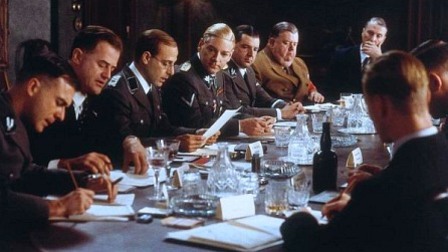
Wansee: Implementing the Final Solution

conspiracy

Friends of Padre Steve’s World,

Primo Levi wrote, “Monsters exist, but they are too few in number to be truly dangerous. More dangerous are the common men, the functionaries ready to believe and to act without asking questions.” 

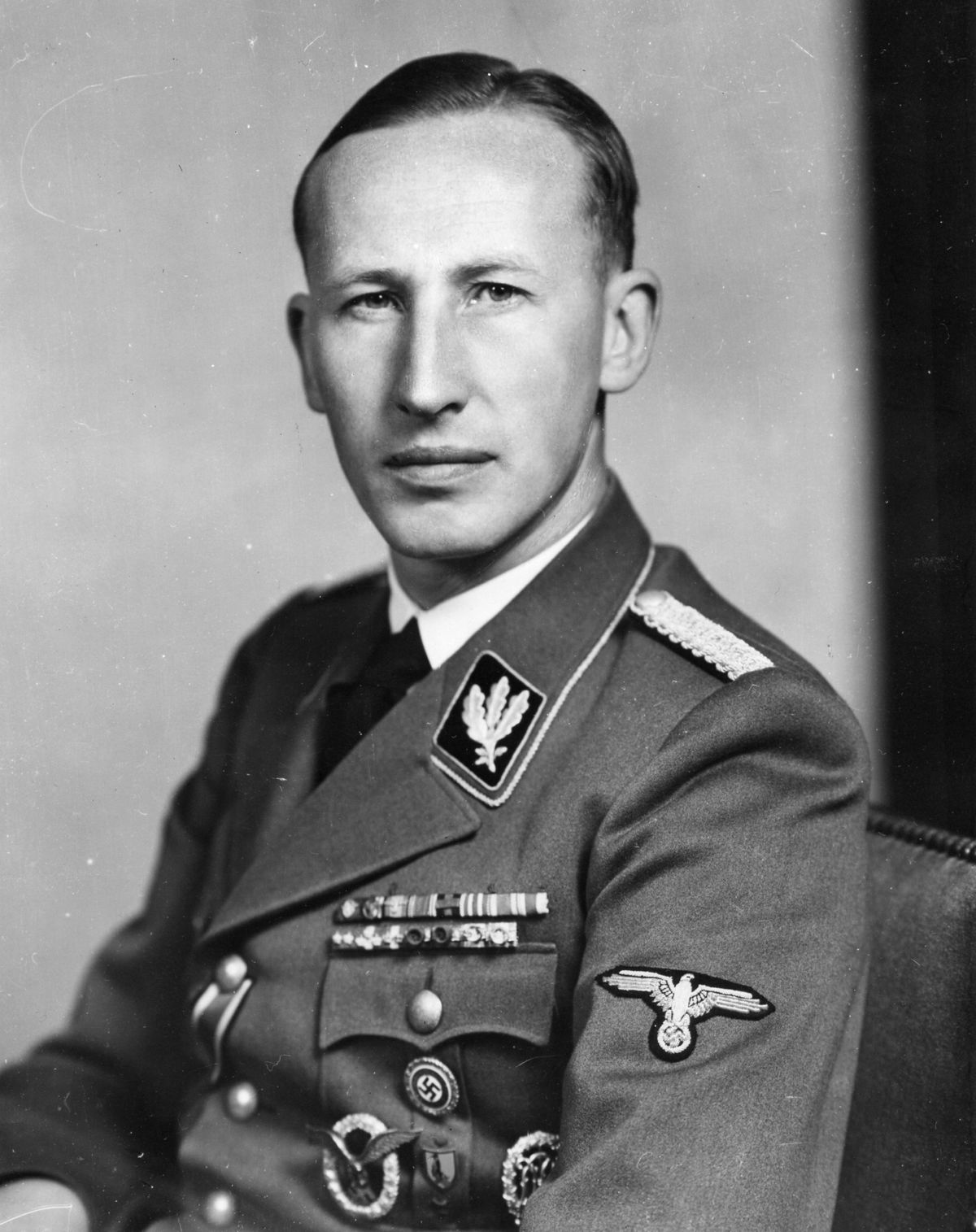
Seventy-four years ago today a group of 15 relatively common men of various German government, police, and party agencies sat around a table and discussed the implementation of what is called the Final Solution. The meeting was chaired by SS Lieutenant General Reinhard Heydrich, who had been charged with the task of solving Germany’s “Jewish Problem” shortly after the German invasion of the Soviet Union. Hermann Goering, the number two man in the Nazi Reich sent Heydrich the following message:

Berlin, July 31st 1941

To: Gruppenfuhrer Heydrich

Supplementing the task assigned to you by the decree of January 24th 1939, to solve the Jewish problem by means of evacuation and emigration in the best possible way by according to present conditions, I hereby charge you to carry out preparations as regards organizational, financial, and material matters for a total solution (Gesamtlosung) of the Jewish question in all the territories of Europe under German occupation.

Where the competency of other organizations touches on this matter, the organizations are to collaborate. 

I charge you further to submit to me as soon as possible a general plan of the administrative material and financial measures necessary for the carrying out the desired final solution (Endlosung) of the Jewish question.”

Goering

1200x-1

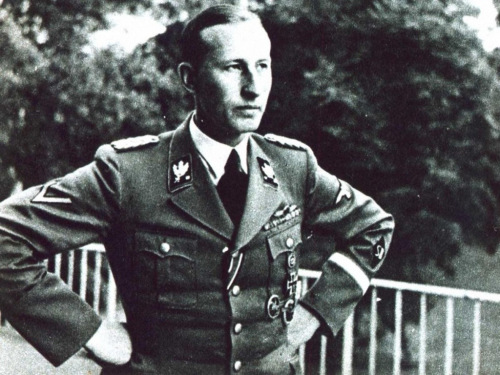
Heydrich

When Goering wrote Heydrich, the head of the Reichssiecherhiethauptampt (RSHA) or Reich Security Main Office, in July 1941 it seemed that Nazi victory in Europe was all but assured. Goering’s words were businesslike. Early measures taken by Heydrich to rid Germany and annexed Austria had been reasonably successful to rid those areas of their Jews through emigration and evacuation. These were not benign measures, people were forced to leave their homes, businesses, communities, and had most of their belongings taken from them in order to leave the Reich. However with the occupation of most of Europe following the Nazi military success and the looming occupation and subjugation of the Soviet Union the process of giving the Jews a chance to emigrate to lands outside Nazi control had come to an end. In fact the Nazis occupied the countries that may Jews had found refuge.

Less than six months after he received the directive from Goering, on January 20th 1942 Heydrich summoned representatives from various Reich agencies were called for what turned out to be a brief, two hour meeting which decided the fate of the Jews. The meeting was held at an estate located in the suburbs of Berlin, called Wansee. Organized by Heydrich’s deputy Adolph Eichmann, involved Heydrich, Eichmann and 13 mid level representatives from various economic, governmental, justice and police entities.

At the conference Heydrich established his authority through Goering’s directive to overcome the bureaucratic and personal attempts of various attendees to take control of the Final Solution process. Despite objections from some attendees who favored sterilization and the use of Jews in the war armaments industries, Heydrich made it clear that the Final Solution would be a campaign of extermination. He was quite clear:

“Approximately 11 million Jews will be involved…in large single sex labor columns, Jews fit to work will work their way eastward constructing roads. Doubtless the large majority will be eliminated through natural causes. Any final remnant that survives will doubtlessly consist of the most resistant elements. They will have to be dealt with appropriately, because otherwise by natural selection, they would form the germ cell of a new Jewish revival.”

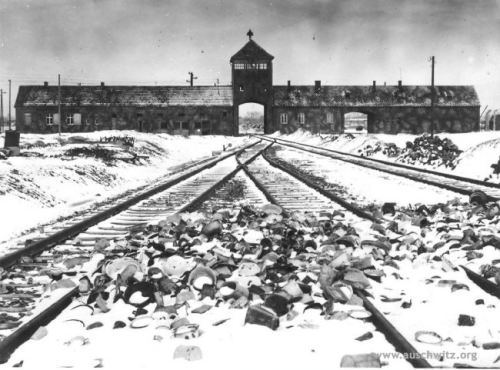
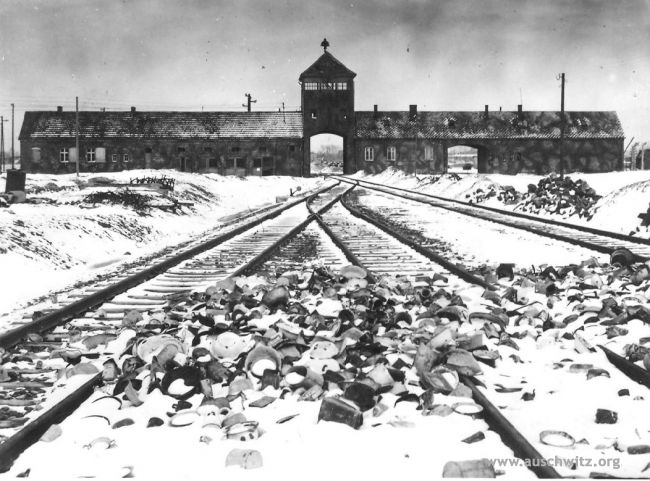
brama_birkenau-2

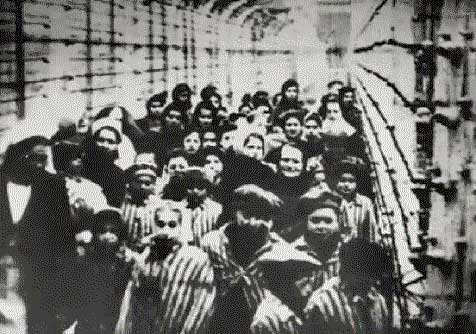
The Nazi leadership decided that its race war against the Jews needed to forge ahead. Within days of Wansee the orders went out and SS commanders at various concentration camps began devising more efficient means to exterminate Jews and other “sub-humans.” It was a matter of pride and efficiency for them. As Rudolph Hoess the Commandant of Auschwitz said at Nuremberg “the camp commandant at Treblinka told me that he had liquidated 80,000 in the course of one half year. He was principally concerned with liquidating all the Jews from the Warsaw Ghetto. He used monoxide gas, and I did not think that his methods were very efficient. So when I set up the extermination building at Auschwitz, I used Zyclon B….” Hoess estimated that some 2.5 million people were exterminated at Auschwitz at rates as high as 10,000 a day.

einsatzgruppen-nazi-death-squads-ww2-german-brutal-002_thumb

Einsatzgruppen in Action

In the Soviet Union four Einsatzgruppen followed each of the German Army Groups and systematically began to massacre the Jews of every city and village which German soldiers captured. The Einsatzgruppen, Ordungspolizei battalions, Army Security Divisions and locally recruited units in fewer than six months, killed over a million and a half Soviet Jews, and the slaughter would continue unabated until the dying days of the Reich.

Heinrich Himmler, Heydrich’s friend and superior told a gathering of senior SS leaders:

“I also want to mention a very difficult subject before you here, completely openly. It should be discussed among us, and yet, nevertheless, we will never speak about it in public…I am talking about the “Jewish evacuation” the extermination of the Jewish people.” 

It is One of the things that is easily said. “The Jewish people is being exterminated,” every Party member will tell you, “perfectly clear, it’s part of our plans, we’re eliminating the Jews, exterminating them, ha!, a small matter.” 

But then along they all come, all the decent upright Germans and each has his decent Jew. They all say: the others are all swine, but here is a first class Jew. And none of them has seen it, has endured it. Most of you will know what it means when 100 bodies lie together, or when there are 500 or 1000. And to have seen this through, and –with the exception of human weaknesses– to have remained decent, has made us hard and is a page of glory never mentioned and never to be mentioned….”

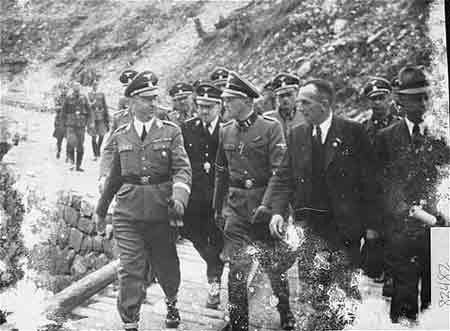
himmlervisit

Himmler and his entourage 

Whether the words are those of Goering, Heydrich, Hoess or Himmler, there is a certain businesslike banality to them. But these men, and many others like them orchestrated a campaign of genocide and race hatred unmatched in history. Yes, there have been other genocides, the Turks killing the Armenians during the First World War and the Hutu and Tutsi slaughter in Rwanda but neither they or the politically motivated campaigns of mass slaughter conducted by the Soviets, the Chinese Communists and the Khamer Rouge killing fields can match the systematized extermination campaign waged by the Nazis against the Jews.

The truly terrifying thing about the Nazi perpetrators of the Holocaust to me is that most of the men at Wansee, men that commanded the Concentration camps and the Einsatzgruppen were very ordinary men who simply believed that they were doing their jobs. Very few could be described as psychopathic killers by nature. They were lawyers, doctors, career police officials, businessmen, and bureaucrats who carried out an extermination campaign that killed by their own numbers between 5.5 and 6 million Jews, not to mention others deemed to be subhuman including the handicapped, the mentally ill, homosexuals, and other non-Jewish minorities like the Gypsies not to mention the wide variety of those considered political enemies. But it was the Jews that bore the most tragic fate.

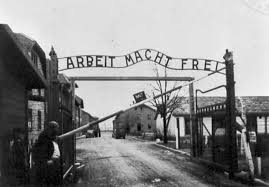
arbeitmachtfrei

It is something that we must never forget.

Peace

Padre Steve+

Leave a comment

Filed under History, holocaust, world war two in europe

The Unspeakable Taboo: Evil, Genocide & Human Nature

Friends of Padre Steve’s World,

This is the final section of the article that I have been posting over the last six days.

The material in this article that I have spread over the past six days is often troubling. At least it is to me because while I earnestly want to believe that humanity is essentially good, I cannot get around the fact that people in every clime and place throughout history often choose to either participate in, or to ignore evil committed against when it is in their own self-interest.  I can see into the darkness and I can understand it.

Joyce Carol Oates wrote, “And this is the forbidden truth, the unspeakable taboo – that evil is not always repellent but frequently attractive; that it has the power to make of us not simply victims, as nature and accident do, but active accomplices.” That is one of the things that makes the Holocaust, but even more so, the actions of those murdered millions of people up close and personal as members of the Einsatzgruppen, the Police battalions, the Romanian Army, or the locally recruited Eastern European militias.

While this of itself is troubling, the fact that many high ranking military and civilian officials in Germany, and some of their allied countries knew about it, and even if they disapproved did nothing to try to stop it. But even more damning is the fact that many other nations, including the United States knew what was happening and before the war would not accept Jewish immigrants who were being forced to leave Germany and Austria, and then during the war did little or nothing to attempt to stop the mass killings in the extermination camps. The fact is that people are people and most of the actors in this ghastly drama were much like us. That is what makes the period so troubling.

Peace

Padre Steve+
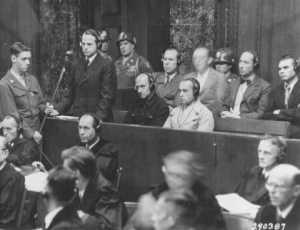
einsatzgruppen trial

Otto Ohlendorf at the Einsatzgruppen Trial

The German war against Poland and the Soviet Union was heavily dependent on the racist ideology of Adolf Hitler. He was the true spirit behind the atrocities committed by his nation as one Nazi leader noted in Russia, “Here too the Führer is the moving spirit of a radical solution in both word and deed.” 187Hitler saw the war in the East as “the chance to stamp out everything that stands against us.” 188Belief in Germany’s right to Lebensraum, was predicated on increasing the standard of living for Germans even if it meant destroying others to do it. The need for food security was one of Hitler’s biggest concerns, and he believed that need would be provided by the conquest of the Soviet Union and the exploitation of the breadbasket of the Ukraine. Hitler’s quest for unlimited natural resources to sustain his Thousand Year Reich and his belief in the racial superiority of the German Volk were combined with his belief in the necessity to settle the Jewish problem. These ideological and economic beliefs provided a fertile ground for Hitler’s followers.

But it was German military doctrine, especially its anti-partisan doctrine and plans for total warfare which allowed Hitler to realize so many of his goals. Without the Army’s support and compliance Hitler could never have succeeded. The post-war and early Cold War myth that the German military had no knowledge of and were not involved in the Holocaust committed against the Jews and others has been shattered as more and more records, correspondence, and testimony emerge.

It is now quite clear that many officers in the Wehrmacht were in agreement with Hitler’s ideology of racial war, including men who have been idolized by military historians and history buffs who marvel at their planning skills and operational precision, but ignore the uncomfortable truth that many either participated in or meekly acquiesced to Hitler’s agenda.
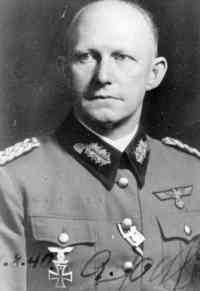
7010_1017630386

Alfred Jodl

These men, like so many in Germany were products of their culture. They were immersed in cultural prejudices against Jews and Slavs. When we examine the long traditions of racist ideology, coupled with military doctrine, the “Prussian and in later German military must be regarded as a significant part of the ideological background of the Second World War.189 General Walther Von Reichenau’s orders to his troops at the beginning of Operation Barbarossa are revealing in this regard, “The most important goal of the campaign against Jewish-Bolshevism is the complete destruction of its grip on power and the elimination of the Asian influence from our European cultural sphere.” 190 Reichenau’s superior, Field Marshal Gerd Von Rundstedt appeared to agree with von Reichenau’s orders, but wanted to keep the hands of the Army clean of the actual dirty work of the mass killings. Rundstedt had no problem with the “use the partisan threat as excuse for persecuting Jews, so long as the dirty work was largely left to SS Einsatzgruppen.” 191

On the whole the Army command…on the whole acquiesced in the extermination of the Jews, or at least closed its eyes to what was happening.” 192 This is absolutely true, but that being said, and as guilty as many of the Generals were, there are factors involved that if are honest might have influenced us to make the same choices as them if we stood in their shoes. This is not an excuse, it is reality and it is borne out by history. The sad truth is that most people act in accordance with their self-interest, especially their economic well-being and social status. We accommodate evil when it serves our needs, especially if we do not actually have to do the dirty work. Their actions show the truth of Primo Levi’s comment “Monsters exist, but they are too few in number to be truly dangerous. More dangerous are the common men, the functionaries ready to believe and to act without asking questions.”
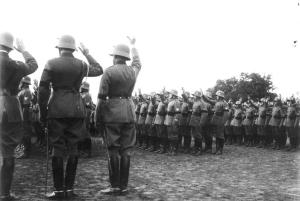
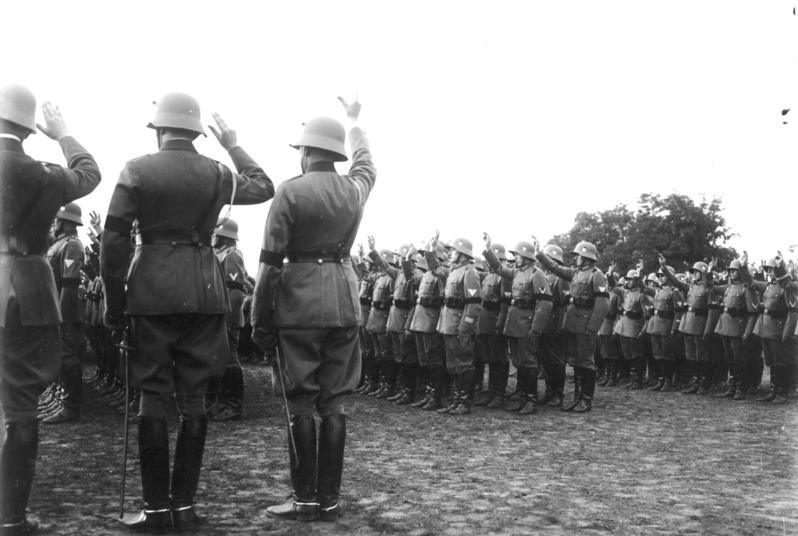
Die feierliche Vereidigung der Reichswehr auf den neuen Reichspräsidenten Adolf Hitler auf dem Kasernenhof der Wachtruppe in Berlin 1934 Offiziere und Mannschaften leisten den feierlichen Eid durcherheben der rechten Hand. Die Reichswehr trägt Trauerflor für den verstorbenen Reichspräsidenten.

Officers and men of the Reichswehr take the Oath to Hitler in 1934 following the death of President Hindenburg

Had the Generals had been more forceful in their opposition, they would have most likely been opposed by the highly Nazified youth that made up the bulk of their Army, especially many of the junior officers, NCOs and enlisted men. Likewise there was the matter of their oath and this is something that many Americans do not understand. During the Kaiser Reich German officers swore an oath to the Kaiser, during Weimar that was changed to the Constitution, when Hitler took power and assumed both the Presidency and Chancellorship following the death of President von Hindenburg, the officer corps swore a new oath, that to Hitler as President and Chancellor. While many saw the danger, almost all officers took the oath, in a sense it was a throwback to the old way of doing things in the Kaiser Reich, and most officers hated the Republic. To them the oath embodied their honor, to break it was to dishonor themselves and their family. When war came it became more than that, to break the oath was considered treason. General Alfred Jodl told American Army psychologist Gustave Gilbert at Nuremberg that “In war the moral pressure of obedience and the stigma of high treason are pretty hard to get around.” 193

Jodl’s superior Keitel stated his helplessness before Hitler saying to Gilbert “What could I do? There were only 3 possibilities: (a) refusal to follow orders, which naturally meant death; (b) resign my post, or (c) commit suicide. I was on the point of resigning my post 3 times, but Hitler made it clear that he considered my resignation in time of war the same as desertion. What could I do?” 194 This was obviously an after the fact excuse by Keitel who had been present in Hitler’s headquarters since the beginning and had witnessed the explosive General Heinz Guderian explode in rage against Hitler in 1945. Following that violent outburst in which Guderian and Hitler engaged in a lengthy heated argument in which those present thought would come to blows and the enraged dictator and general shouted at each other and were held back from contact by others in the conference room. Instead of arrest or imprisonment Hitler ordered Guderian to take extended sick leave and never accosted him afterwards.

heydrich

Reinhard Heydrich

Himmler, Heydrich, Eichmann and other SS leaders fanatically executed Hitler’s policies and were aided by the civil administration, including the leaders of the Reichsbank, and the proponents of long term economic plans. Genocide was to bring the Reich “long term economic gains and trading advantages” and was seen as a way of “financing the war debt without burdening the German taxpayer.” 195

The willing participation of Army commanders is hard to get around. Otto Ohlendorf, commander of Einsatzgruppe D testified at the Einsatzgruppe Trial that Einsatzgruppen reported all of their tasks to the army commanders, and that together, they and the army agreed on the time, place, and possible support of the troops for any particular “liquidation action[s].” 196

Some individuals did attempt to resist the most brutal aspects of the Nazi campaign against the Jews, but few had the fortitude to make more than half-hearted attempts. Wilhelm Kube, the Reichskommissar for White Russia, himself a fanatical Nazi and a virulent anti-Semite was shocked at the mass murders of the Jews taking place in his region. He called them “unworthy of the German cause and damaging to the German reputation.” During his administration Kube would later attempt to spare Jews by employing skilled Jews in war industries, however, Kube’s efforts were “defeated by Himmler’s zealots.” 197

Army officers who objected to the killing of Jews, like Blaskowitz and Külcher in Poland were relieved of command or were reassigned. Others like Field Marshal Ritter von Leeb took their protests to Hitler. Such protests were readily dismissed and those who made them usually took no further action. Leeb was told by Hitler to “in so many words told to mind his own business.” Leeb later stated, “the only thing to do is to hold oneself at a distance.” 198 Field Marshall Erwin Rommel, who had burned the notorious Commando Order in front of his staff in North Africa could not bring himself to believe that Hitler was to blame. While commanding Army Group B in France Rommel heard of the crimes being committed against the Jews and others through information provided by Blaskowitz, and members of his own staff who had served in Russia. But Rommel, who became part of the plot of overthrow Hitler, was then still in the thrall of the Fuhrer and blamed the crimes “on Hitler’s subordinates, not Hitler himself.” 199

Of the men mentioned in this article who survived the war, only four, Wilhelm Keitel, Alfred Jodl, Otto Ohlendorf and Adolf Eichmann paid for their crimes with their lives Keitel and Jodl were found guilty in the major War Crimes Trials at Nuremberg. Ohlendorf at the Einsatzgruppen trial, while Eichmann was caught by the Israelis, tried, convicted and put to death in 1962. Blaskowitz committed suicide while being tried with thirteen other generals during the final Nuremberg trial, that of the generals. Of those eleven were convicted and none served out their full sentence.

keitel-jodl-hitler

Hitler with Jodl

Hitler’s ideology permeated German military campaigns and administration of the areas conquered by his armies. No branch of the German military, police or civil administration in occupied Poland or Russia was exempt guiltless in the crimes committed by the Nazi regime. It is a chilling warning of the consequences awaiting any nation that allows it to become caught up in hate-filled political, racial or even religious ideologies which dehumanizes opponents and of the tragedy that awaits them and the world. In Germany the internal and external checks that govern the moral behavior of the nation and individuals failed. Caught up in the Nazi system, the Germans, especially the police and military abandoned the norms of international law, morality and decency, banally committing crimes which still reverberate today and which were seen in the ethnic cleansing actions in the former Yugoslavia, and now throughout much of the Middle East.

In light of the fact that there is a growing food shortage in the world which will only get worse due to a factors including the global rise in population, the shrinking of the amount land which can be farmed due to climate change.  There are many other factors as well which could such a situation could bring about another Holocaust.  In such a case leaders will decide that the lands and resources of less developed people are theirs for the taking in order to maintain the standards of living of their people, and that the indigenous people who they will victimize are less than human and thus have no rights. The terminology used by them will be very neutral and full of euphemisms which will allow many people to maintain the illusion that any evil carried out is for the good. Politicians, pundits and preachers will talk of problems, and of solutions, and in trying to find a resolution yearn for a conclusive solution, a final solution.

arbiet macht frei

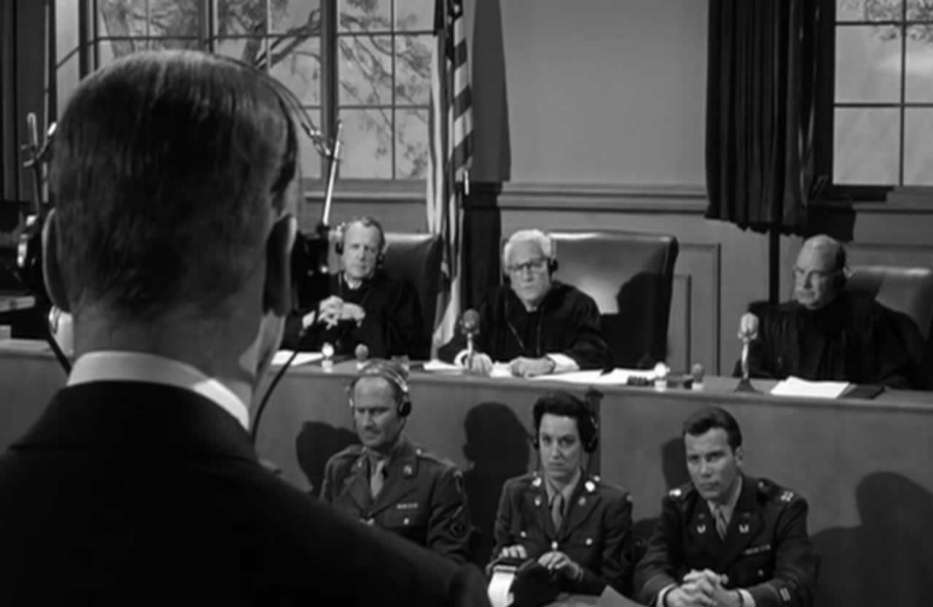
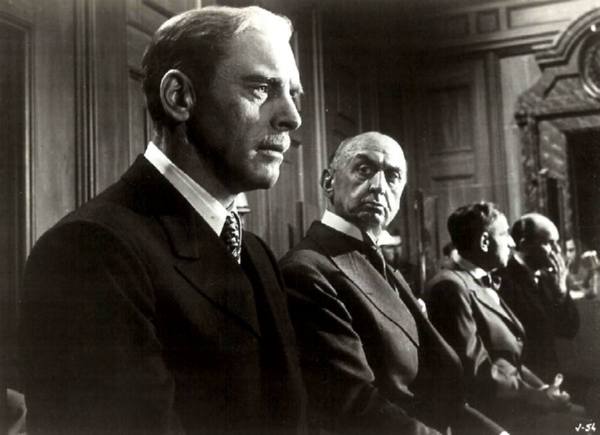
I return to the quote from the movie Judgment at Nuremberg which I included in the first section of this article because it is worth repeating and all too true:

“Janning, to be sure, is a tragic figure. We believe he loathed the evil he did. But compassion for the present torture of his soul must not beget forgetfulness of the torture and the death of millions by the Government of which he was a part. Janning’s record and his fate illuminate the most shattering truth that has emerged from this trial: If he and all of the other defendants had been degraded perverts, if all of the leaders of the Third Reich had been sadistic monsters and maniacs, then these events would have no more moral significance than an earthquake, or any other natural catastrophe. But this trial has shown that under a national crisis, ordinary – even able and extraordinary – men can delude themselves into the commission of crimes so vast and heinous that they beggar the imagination….”

That quote might be applied to many of the people who participated in this genocide. Sadly, the fact is that in truth we are not really all that much different than the victims, the perpetrators and the bystanders who lived and died in the Holocaust, and similarly every other act of genocide.

History serves as a guide and a warning. We must always be alert and we must always when the truly difficult times come, in the midst of crisis, not to take the easy path and denude ourselves into the commission of such crimes.

Notes

187 Ibid. Bracher. The German Dictatorship p.430

188 Ibid. Megargee War of Annihilation p.65

189 Ibid. Wette. The Wehrmacht p.293

190 Ibid. Wette. The Wehrmacht p.97

191 Messenger, Charles. The Last Prussian A Biography of Field Marshal Gerd Von Rundstedt 1875-1953 Brassey’s London, 1991 p148

192 Ibid. Bracher The German Dictatorship pp.430-431

193 Gilbert, Gustave Nuremberg Diary DaCapo Press 1995 copyright G.M. Gilbert 1947 p.290

194 Ibid. Gilbert p.26

195 Ibid. Aly and Heim Architects of Annihilation p.242

196 Ibid. Hebert p.92

197 Ibid. Padfield Himmler pp.341-342

198 Ibid. Megargee War of Annihilation p.97

199 Fraser, David. Knight’s Cross: A Life of Field Marshal Erwin Rommel Harper Perennial, New York 1995, first published by Harper Collins in Britain, 1993. p.536

Bibliography for the series

Aly, Gotz and Heim, Susanne. Architects of Annihilation: Auschwitz and the Logic of Destruction Phoenix Paperbacks, London, 2003, originally published as Vordenker der Vernichtung, Hoffman und Campe, Germany 1991, English translation by Allan Blunden. First published in Great Britain Weidenfeld & Nicholson, London, 2002

Arendt, Hannah, Eichmann in Jerusalem: A Report on the Banality of Evil. Revised and Enlarged Edition. Penguin Books, Harmondsworth, England and New York, NY 1965. Originally published by Viking Press, New York, NY 1963

Blood, Philip. Hitler’s Bandit Hunters: The SS and the Occupation of Europe. Potomoac Books Inc. Washington, DC 2008

Bracher, Karl Dietrich. The German Dictatorship: The Origins, Structure, and Effects of National Socialism. Translated by Jean Steinberg, Holt Rinehart and Winston, New York, NY 1979. Originally Published under the title Die Deutsche Diktatur: Entstehung, Struktur,Folgen des Nationalsocialismus. Verlag Kiepenheuer & Witsch. Koln and Berlin, 1969

Browning, Christopher R. Ordinary Men: Reserve Police Battalion 101 and the Final Solution in Poland. Harper Perennial Books, New York, New York 1993 reissued 1996.

Burleigh, Michael and Wippermann, Wolfgang. The Racial State: Germany 1933-1945 Cambridge University Press, New York NY and Cambridge UK 1991

Condell, Bruce and Zabecki, David T. Editors. On the German Art of War: Truppenführung , Lynn Rienner Publishers, Boulder CO and London 2001

Craig, Gordon A. The Politics of the Prussian Army 1640-1945. Oxford University Press, London and New York, 1955

Davidowicz, Lucy S. The War Against the Jews 1933-1945 Bantam Books, New York, NY 1986.

Di Nardo, Richard L. Germany and the Axis Powers: From Coalition to Collapse. University Press of Kansas, Lawrence, KS. 2005

Erickson, John. The Road to Berlin. Cassel Military Paperbacks, London, 2003. First Published by Weidenfeld and Nicholson, 1983

Evans, Richard J. The Coming of the Third Reich Penguin Books, New York 2004. First published by Allen Lane 2003

Evans, Richard J. The Third Reich in Power 1933-1939. Penguin Press, New York, NY 2005

Ferguson, Niall. The War of the Worlds: Twentieth Century Conflict and the Descent of the West.

The Penguin Press, New York, 2006

Fest, Joachim, Hitler. Translated by Richard and Clara Winston. Harcourt Brace Jovanovich Publishers, San Diego, New York, London, 1974. German Edition by Verlag Ullstein 1973

Fraser, David. Knight’s Cross: A Life of Field Marshal Erwin Rommel Harper Perennial, New York 1995, first published by Harper Collins in Britain, 1993

Friedlander, Saul Nazi Germany and the Jews 1939-1945: The Years of Extermination. Harper Perennial, New York, NY 2007

Fritz, Stephen G. Frontsoldaten: The German Soldier in World War II. The University Press of Kentucky, Lexington, KY 1995

Geyer, Michael. German Strategy 1914-1945 in Makers of Modern Strategy from Machiavelli to the Nuclear Age. Peter Paret, editor. Princeton University Press, Princeton NJ. 198

Gilbert, Gustave Nuremberg Diary DaCapo Press 1995 copyright G.M. Gilbert 1947

Giziowski, Richard. The Enigma of General Blaskowitz. Hppocrene Books, New York 1997

Glantz, David M. and House, Jonathan. When Titans Clashed: How the Red Army Stopped Hitler. University Press of Kansas, Lawrence, KS. 1995

Goerlitz, Walter. History of the German General Staff.” Translated by Brian Battershaw, Westview Press, Boulder and London, 1985. Originally published as Die Deutsche Generalstab Verlag der Frankfurter Hefte, Frankfurt am Main, 1953

Goerlitz, Walter. The Memiors of Field Marshal Wilhelm Keitel: Chief of the German High Command 1938-1945. Translated by David Irving. Cooper Square Press 2000, First English Edition 1966 William Kimber and Company Ltd. German edition published by Musterschmnidt- Verlad, Gottigen 1961.

Hebert, Valerie Genevieve, Hitler’s Generals on Trial: The Last War Crimes Tribunal at Nuremberg University of Kansas Press, Lawrence Kansas 2010

Hitler, Adolf Mein Kampf translated by Ralph Manheim. Mariner Books, Houghton Mifflin Company, New York, NY 1999. Houghton Mifflin Company 1943, copyright renewed 1971. Originally published in Germany by Verlag Frz. Eher Nachf. GmbH 1925

Höhne, Heinze. Canaris: Hitler’s Master Spy. Traslated by J. Maxwell Brownjohn. Cooper Square Press, New York 1999. Originally published by C. Bertelsmann Verlag Gmbh, Munich 1976, first English edition by Doubleday and Company 1979

Höhne, Heinze. The Order of the Death’s Head: The Story of Hitler’s SS. Translated by Richard Barry. Penguin Books, New York and London, 2000. First English edition published by Martin Secker and Warburg Ltd. London 1969. Originally published as Der Orden unter dem Totenkopf, Verlag Der Spiegel, Hamburg 1966.

Hughes, Daniel J. editor. Moltke on the Art of War: Selected Writings, translated by Harry Bell and Daniel J Hughes. Presidio Press, Novato CA 1993

Liddell-Hart, B.H. The German Generals Talk. Quill Publishing, New York, NY. 1979. Copyright 1948 by B.H. Liddell-Hart

Lieber, Franz Instructions for the Government of Armies of the United States in the Field, prepared by Francis Lieber, LL.D., Originally Issued as General Orders No. 100, Adjutant General’s Office, 1863, Washington 1898: Government Printing Office. Retrieved from http://avalon.law.yale.edu/19th_century/lieber.asp 6 May 2014

Lindqvist, Sven Exterminate All the Brutes: One Man’s Oddessy into the Heart of Darkness and the Origins of European Genocide Translated from the Swedish by Joan Tate, The New Press , New York and London 1992

Macksey, Kenneth. Why the Germans Lose at War: The Myth of German Military Superiority. Barnes and Noble Books, New York 2006, originally published by Greenhill Books, 1996

Manstein, Erich von. Forward by B.H. Liddle Hart, Introduction by Martin Blumenson. Lost victories: The War Memoirs of Hitler’s Most Brilliant General. Zenith Press, St Paul MN 2004. First Published 1955 as Verlorene Siege, English Translation 1958 by Methuen Company

Shirer, William L. The Rise and Fall of the Third Reich. A Touchstone Book published by Simon and Schuster, 1981, Copyright 1959 and 1960

Megargee, Geoffrey P. War of Annihilation: Combat and Genocide on the Eastern Front 1941.Bowman and Littlefield Publishers Inc. Lanham, Boulder, New York. 2007

Messinger, Charles, The Last Prussian: A Biography of Field Marshal Gerd Von Rundstedt 1875-1953 Brassey’s (UK) London England 1991

Newton, Steven H. Hitler’s Commander: Field Marshal Walter Model-Hitler’s Favorite General

DaCapo Press a division of Perseus Books Group, Cambridge MA 2005 Novatny, Alfred. The Good Soldier. The Aberjona Press, Bedford, PA 2003 Padfield, Peter. Himmler. MJF Books, New York. 1990

Reitlinger, Gerald. The SS: Alibi of a Nation. The Viking Press, New York, 1957. Republished by Da Capo Press, New York, NY.

Rhodes, Richard. Masters of Death: The SS Einsatzgruppen and the Invention of the Holocaust.

Vintage Books a division of Random House, New York, NY 2002

Shepherd, Ben. War in the Wild East: The German Army and Soviet Partisans. Harvard University Press, Cambridge, MA 2004

Sofsky, Wolfgang. The Order of Terror: The Concentration Camp. Translated by William Templer. Princeton University Press. Princeton, NJ 1997. Originally published as Die Ordnung des Terrors: Das Konzentrationslager. S. Fischer Verlag, GmbH, Frankfurt am Main, 1993

Speer, Albert. Inside the Third Reich. Collier Books, a Division of MacMillan Publishers, Inc. New York, NY 1970.

Strachan, Hew. European Armies and the Conduct of War. George, Allen and Unwin, London, UK 1983

Stein, George H. The Waffen SS 1939-1945: Hitler’s Elite Guard at War. Cornell University Press, Ithaca and London, 1966

Stern, Fritz. Gold and Iron: Bismarck, Bleichroder and Building of the German Empire. Vintage Books a division of Random House, New York 1979 First published by Alfred a Knopf 1977

Sydnor, Charles W. Soldiers of Destruction: The SS Death’s Head Division, 1933-1945. Princeton University Press, Princeton, NY 1977

Taylor, Fred, Editor and Translator. The Goebbels Diaries 1939-1941, Penguin Books Ltd, Harmondsworth UK and New York NY 1984.

Tooze, Adam. The Wages of Destruction Penguin Books, New York, NY, 2008. First Published by Allen Lane Books, Penguin Group, London UK, 2006

Trevor-Roper, H.R. Hitler’s Table Talk 1941-1944 with an introduction by Gerhard L Weinberg, Translated by Norman Cameron and R.H. Stevens, Enigma Books, New York, NY 2000. Originally published in Great Britain by Weidenfeld & Nicholoson, London 1953.

Warlimont, Walter. Inside Hitler’s Headquarters 1939-45. Translated by R.H. Berry, Presido Press, Novato CA, 1964.

Weinberg, Gerhard L. Germany Hitler and World War II . Cambridge University Press, New York, NY 1995

Weinberg, Gerhard L. Ed. Hitler’s Second Book: The Unpublished Sequel to Mein Kampf by Adolph Hitler. Translated by Krista Smith, Enigma Books, New York, NY 2006. Originally published as Hitlers zweites Buch, Gerhard Weinberg editor, 1961.

Weinberg, Gerhard L. Visions of Victory: The Hopes of Eight World War II Leasers. Cambridge University Press, New York, NY 2005

Westermann, Edward B. Hitler’s Police Battalions: Enforcing Racial War in the East.

University Press of Kansas, Lawrence, KS. 2005

Wette, Wolfram. The Wehrmacht: History, Myth, Reality. Translated by Deborah Lucas Schneider. Harvard University Press, Cambridge, MA 2006. Originally published as Die Wehrmacht: Feindbilder, Vernichtungskreig, Legenden. S. Fischer Verlag, GmbH, Frankfurt am Main, 2002

Wheeler-Bennett, John. The Nemesis of Power: The German Army in Politics 1918-1945. St. Martin’s Press Inc. New York, NY 1954



1 Comment

Filed under crime, History, laws and legislation, leadership, Military, Political Commentary, world war two in europe

Military & Legal Foundations of Genocide

Friends of Padre Steve’s World

The next installment of my article on war crimes, genocide and the role of ordinary people in them. This focuses on the legal, ideological, and military doctrine foundations of the German race war in Poland and Russia. Without these foundations it would have been difficult, maybe even impossible for the Germans to implement genocide on such a vast scale.

Peace

Padre Steve+

???????????????

Wilhelm Keitel: “war was a fight for survival….dispense with outdated and traditional ideas about chivalry and the generally accepted rules of warfare…” Bundesarchiv Bild

This study will focus on the German policy of ideological-racial war in Poland and Russia. The German war against the Soviet Union and to a certain extent Poland was waged with an unforgiving ferocity against Hitler’s enemy, the Jewish-Bolshevik state and the Slavic Untermenschen.

The campaigns in Poland and the Soviet Union were characterized by the rise of a “political- ideological strategy.” 25 Operation “Barbarossa showed the fusion of technocracy and ideology in the context of competitive military planning.” 26 Hitler’s “ideological and grandiose objectives, expressed in racial and semi-mystical terms, made the war absolute.” 27

Field Marshal Keitel noted a speech in March 1941 where Hitler talked about the inevitability of conflict between “diametrically opposed ideologies” and that the “war was a fight for survival and that they dispense with their outdated and traditional ideas about chivalry and the generally accepted rules of warfare.” 28 General Halder, Chief of the OKH in his War Dairy for that meeting noted “Annihilating verdict on Bolshevism…the leaders must demand of themselves the sacrifice of understanding their scruples.” 29

Based on Lebensraum and race, the German approach to war would combine “racism and political ideology” for the purpose of the “conquest of new living space in the east and its ruthless Germanization.” 30 Hitler explained that the “struggle for the hegemony of the world will be decided in favor of Europe by the possession of the Russian space.” 31 Conquered territories would be “Reich protectorates…and that these areas were to be deprived of anything in the nature of a Slav intelligentsia.” 32

This goal was manifest in the “Criminal Order” issued by OKW which stated that the war was “more than mere armed conflict; it is a collision between two different ideologies…The Bolshevist-Jewish intelligentsia must be eliminated….” 33 Other displaced inhabitants of the conquered eastern lands would be killed or allowed to starve. 34 Part of this was due to economic considerations in the Reich, which gave Germans priority in distribution of food, even that from the conquered lands. Starvation was a population control measure that supplemented other forms of annihilation. 35 As Fest notes in Russia Hitler was “seeking nothing but “final solutions.”” 36Despite numerous post-war justifications by various Wehrmacht generals, the “Wehrmacht and army fell into line with Hitler because there was “a substantial measure of agreement of “ideological questions.”” 37

Hitler’s racial ideology was central to his worldview and fundamental to understanding his actions in the war. 38 However twisted Hitler’s ideological formulations were his ideas found acceptance beyond the Nazi faithful to the Army and Police, who would execute the campaigns in Poland and Russia in conjunction with the Einsatzgrüppen and Nazi party organizations. In these organizations he found allies with pre-existing cultural, political and doctrinal understandings which allowed them to be willing participants in Hitler’s grand scheme of eastern conquest.

ss recruiting poster

Military Doctrine and Ideology

While Hitler’s racial ideology was more extreme than many in the German military and police, these organizations had cultural beliefs and prejudices as well as doctrinal and ideological foundations which helped them become willing accomplices to Hitler. These factors were often, consciously or unconsciously, excluded from early histories of World War II. The Allies relied on German officers to write these histories at the beginning of the Cold War, developing the “dual myth of German military brilliance and moral correctness.” 39 British historian and military theorist B.H. Liddell-Hart makes the astounding statement that “one of the surprising features of the Second World War was that German Army in the field on the whole observed the rules of war than it did in 1914-1918-at any rate in fighting its western opponents….” 40

While Liddell-Hart might be excused by lack of knowledge of some German army atrocities he could not have been ignorant. It was not just the SS who he blamed the atrocities but many of the men who he interviewed. In doing this Liddell-Hart and others presented a myth as truth. 41 The myths were helped by the trials of Manstein and Kesselring where “historical truth had to be sacrificed…to the demands of the Cold War.” 42 British military historian Kenneth Macksey confronted the myth that only the “Waffen SS committed barbaric and criminal acts” noting: “Not even the Knights of the Teutonic Order and their followers in the Middle Ages sank to the depths of the anti-Bolshevik Wehrmacht of 1941.” 43

Germany had a long running history of anti-Semitism before Hitler. German anti-Semitism often exhibited a “paranoid fear of the power of the Jews,” 44 and included a “fashionable or acceptable anti-Semitism” 45 which became more pronounced as the conditions of the Jews became better and Jews who had fled to Eastern Europe returned to Germany. 46 Sometimes this was tied to religious attitudes, but more often focused on the belief that the Jews “controlled certain aspects of life” and presented in “pseudo-scientific garb” the “myth of a secret Jewish plot for world domination which was simultaneously part of the internationalism of Freemasonry.” 47

Admiral Wilhelm Canaris provides an example as he “had grown up in the atmosphere of “moderate” anti-Semitism prevailing in the Ruhr middle class and in the Navy believed in the existence of a “Jewish problem”” and would “suggest during 1935-1936 that German Jews should be identified by a Star of David as special category citizens….” 48 Wehrmacht soldiers were “subject to daily doses of propaganda since the 1930s” and that with the “start of the Russian campaign propaganda concerning Jews became more and more aggressive.” 49 Some officers objected to Nazi actions against Jews. Von Manstein protested the “Aryan paragraph” in the Reichswehr on general principal.” 50 Yet some of the men who planned and executed the most heinous crimes like, Adolf Eichmann had “no fanatical anti-Semitism or indoctrination of any kind.” 51

The military “looked to the regime to reshape society in every respect: political, ideological, economic and military…Propaganda would hammer home absolute nature of the struggle…” 52 Ideological training began in the Hitler Youth and Reichsarbeitsdienst and produced a soldier in which “Anti-Semitism, anti-communism, Lebensraum – these central tenants of Nazism were all inextricably linked with the Landser’s conception of duty, with his place and role in the vast machinery of war.” 53

Following the dismissal of General Fritsch in 1938, General Brauchitsch promised Hitler that “he would make every effort to bring the Army closer to the State and the State’s ideology.” 54

Alfred Novotny, a Austrian soldier in the Gross Deutschland division noted how training depicted the Russians as Untermenschen and how they were “subjected to official rantings about how the supposedly insidious, endless influence of the Jews in practically every aspect of the enemy’s endeavors…Jews were portrayed as rats, which were overrunning the world….” 55

anti-jewish poster

This ideological component added to the already “harsh military discipline” which had a long tradition in Germany conditioning soldiers to violence and brutalization of their enemy. Similar programs existed in the Order Police which would play a large part in the eastern campaign, the “image of “treasonous” leftists and Jews helped shape the personal and political beliefs of many policemen throughout the interwar period.” 56 Even ordinary police training before the war in German speaking Europe “was brutalizing.” 57 These troops were recipients of an ideological formation which “aimed at shaping the worldview of the police leading to the internalization of belief along National Socialist lines.” 58 Waffen SS soldiers, especially those of the Totenkopf division were subjected to even more systematic political indoctrination on the enemies of National Socialism, the Jews, freemasonry, Bolshevism and the churches. 59

Along with cultural anti-Semitism and the Nazification of German thought in the 1930s, there were aspects of military doctrine which helped prepare the way for the eastern campaign. The most important were the Army’s anti-partisan and rear area security doctrine. The history of security anti-partisan operations dated back to the Prussian Army’s Ettapen, which began in 1813 with the Landwehr’s role in security against looters and others. 60 These units supported and supplied offensive operations from the rear to the combat zone with a secondary mission of countering partisans and preventing disruptions in the rear area. The Ettapen would be reformed and regulated in 1872 following the Franco-Prussian War. 61

The German experience fighting guerrillas and partisans, the francs-tireurs in the Franco- Prussian War, “scarred the Army’s institutional mentality.” 62 Field Marshal Von Moltke the elder was “shattered,” and wrote his brother that “war was now taking on an ever more hate-inspired character.” 63 He was “appalled by improvised armies, irregular elements, and appeals to popular passion, which he described as a “return to barbarism.” 64 He wrote:  “Their gruesome work had to be answered by bloody coercion. Because of this our conduct of the war finally achieved a harshness that we deplored, but which we could not avoid.” 65

The brutal German response to the franc-tireurs found its legal justification in Franz Lieber’s principles for classification of belligerents and non-belligerents, which determined that guerrillas were outlaws or bandits. 66 Leiber’s principles were written for the Federal Army of the United States during the U.S. Civil War. Propagated as General Order 100 and signed by Abraham Lincoln the sections dealing with irregular forces and partisans dealt with this in section IV of that code:

Article 82 stated: “Men, or squads of men, who commit hostilities, whether by fighting, or inroads for destruction or plunder, or by raids of any kind, without commission, without being part and portion of the organized hostile army, and without sharing continuously in the war, but who do so with intermitting returns to their homes and avocations, or with the occasional assumption of the semblance of peaceful pursuits, divesting themselves of the character or appearance of soldiers – such men, or squads of men, are not public enemies, and, therefore, if captured, are not entitled to the privileges of prisoners of war, but shall be treated summarily as highway robbers or pirates.”

Article 84 stated: “Armed prowlers, by whatever names they may be called, or persons of the enemy’s territory, who steal within the lines of the hostile army for the purpose of robbing, killing, or of destroying bridges, roads or canals, or of robbing or destroying the mail, or of cutting the telegraph wires, are not entitled to the privileges of the prisoner of war.”

Article 85 stated: “War-rebels are persons within an occupied territory who rise in arms against the occupying or conquering army, or against the authorities established by the same. If captured, they may suffer death, whether they rise singly, in small or large bands, and whether called upon to do so by their own, but expelled, government or not. They are not prisoners of war; nor are they if discovered and secured before their conspiracy has matured to an actual rising or armed violence.” 67

The German Army adapted that code and incorporated it in its doctrine for dealing with partisans. In response to their experience in France during the Franco-Prussian War the Germans systematically reorganized the Ettapen to include railroad and security troops, special military courts, military police, intelligence and non-military police, including the Landespolizei and the Grenzschutzpolizei. 68

The doctrinal response to partisans, or as they would become known in German writings as “bandits,” was that bandits should be encircled and destroyed. This was employed in the Southwest Africa German colonies. The Germans, influenced by the experience in France, “displayed a ferocity surpassing even that of the racially brutalized campaigns of its imperialist peers.” 69

von trotha

Lothar Von Trotha

The campaign against the Herero tribes which resisted the occupation of Namibia from 1904- 1912 utilized encirclement operations, racial cleansing and what would become known as Bandenkämpfung operations. 70 In 1904 the Herero were banished from their lands which were handed over to German settlers. When the Herero resisted Von Trotha ordered that they be exterminated. “Every Herero found within German borders with or without weapons, was to be shot. But most of them died without violence. The Germans simply drove them out into the desert and sealed off the border.” 71

20030228_Herero

Of about 80,000 Herero some 60,000 died in the desert, a few thousand survived to be “sentenced to hard labor in German concentration camps.” 72 Despite praise from some in the General Staff the brutality shocked many Germans and General Alfred Von Schielffen who had to defend himself from the “accusations that he had harmed the good name of the army” ensured that “Trotha never served in the field again.” 73 Despite this the application of such Bandenkämpfung operations found their way into German military doctrine.

This was further developed in the First World War, especially in the east where General Fritz Gempp described the security problem as a “ruthless struggle” in which German pacification policy “was in reality the application of terror to galvanize the population into accepting German rule.” 74Anti-partisan doctrine was codified in the Truppenführung of 1933 which stated that “area defense against partisan warfare is the mission of all units” and that the preferred method of combating partisan bands was that they be surrounded and destroyed. 75 General Erhard Rauss later described active and passive measures used to deal with partisans, focusing on the tactic of encirclement to destroy the enemy. 76

The accounts of the German General Staff praised Von Trotha’s operation. “The month long sealing of desert areas, carried out with iron severity, completed the work of annihilation…the sentence had been carried out” and “the Hereros had ceased to exist as an independent people.” 77

Anti-partisan doctrine focused on the destruction of the partisans, was coupled a total war philosophy and provided fit well with Hitler’s radical ideology. The “propensity for brutality in anti-guerrilla warfare was complimented by officers’ growing preoccupation, both during and after World War I, with the mastery and application of violence.” 78 Michael Geyer notes: “ideological mobilization for the creation of a new national and international order increasingly defined the parameters of technocratic planning.” 79 The acceptance of long used brutal tactics to destroy the enemy combined with Hitler’s radical racial animus against the Jews could only be expected to create a maelstrom in which all international legal and moral standards would be breached.

To be continued…

Notes

25 Geyer, Michael. German Strategy 1914-1945 in Makers of Modern Strategy from Machiavelli to the Nuclear Age.

Peter Paret, editor. Princeton University Press, Princeton NJ. 1986. p.582

26 Ibid. Geyer. German Strategy p.587

27 Strachan, Hew. European Armies and the Conduct of War. George, Allen and Unwin, London, UK 1983 p.174

28 Goerlitz, Walter. The Memoirs of Field Marshal Wilhelm Keitel: Chief of the German High Command 1938- 1945. Translated by David Irving. Cooper Square Press 2000, First English Edition 1966 William Kimber and Company Ltd. German edition published by Musterschmnidt-Verlad, Gottigen 1961 p. 135

29 Ibid. Fest, Hitler. p. 649

30 Ibid. Megargee, War of Annihilation p.7

31 Trevor-Roper, H.R. Hitler’s Table Talk 1941-1944 with an introduction by Gerhard L Weinberg, Translated by Norman Cameron and R.H. Stevens, Enigma Books, New York, NY 2000. Originally published in Great Britain by

Weidenfeld & Nicholoson, London 1953 p. 27 Goebbels notes a similar theme in his recollection of Hitler’s reasons for destroying Russia a power . See Taylor, Fred, Editor and Translator. The Goebbels Diaries 1939-1941, Penguin Books Ltd, Harmondsworth UK and New York NY 1984 pp. 413-415.

32 Goerlitz, Walter. History of the German General Staff.” Translated by Brian Battershaw, Westview Press, Boulder

and London, 1985. Originally published as Die Deutsche Generalstab Verlag der Frankfurter Hefte, Frankfur am Main, 1953 p.390

33 Warlimont, Walter. Inside Hitler’s Headquarters 1939-45. Translated by R.H. Berry, Presido Press, Novato CA,

1964 p. 150

34 Weinberg, Gerhard L. Visions of Victory: The Hopes of Eight World War II Leasers. Cambridge University Press, New York, NY 2005. p. 24

35 Aly, Gotz and Heim, Susanne. Architects of Annihilation :Auschwitz and the Logic of Destruction Phoenix

Paperbacks, London, 2003, Originally published as Vordenker der Vernichtung, Hoffman und Campe, Germany 1991, English translation by Allan Blunden. First published in Great Britain Weidenfeld & Nicholson, London, 2002 pp. 245-246

36 Ibid. Fest. Hitler p.649

37 Wette, Wolfram. The Wehrmacht: History, Myth, Reality. Translated by Deborah Lucas Schneider. Harvard University Press, Cambridge, MA 2006. Originally published as Die Wehrmacht: Feindbilder, Vernichtungskreig, Legenden. S. Fischer Verlag, GmbH, Frankfurt am Main, 2002 p.93

38 This understanding is different than many historians who as Friedlander notes advocate something like this: “The persecution and extermination of the Jews of Europe was but a secondary consequence of major German policies pursued toward entirely different goals.” See Friedlander p.xvi

39 Ibid. Megargee. War of Annihilation p.xii

40 Liddell-Hart, B.H. The German Generals Talk. Quill Publishing, New York, NY. 1979. Copyright 1948 by B.H. Liddell-Hart p.22

41 It has to be noted that Liddell-Hart published this work in 1948 and was limited in the materials available, his

primary sources being German officers who he viewed with sympathy because he saw them as exponents of his theory of the indirect approach. The time was also around the beginning of the Cold War and the Berlin Blockade when many American and British leaders were trying to end the war crimes trials and bring the West Germans into the new anti-Communist alliance.

42 Ibid. Wette. The Wehrmacht p.224

43 Macksey, Kenneth. Why the Germans Lose at War: The Myth of German Military Superiority. Barnes and Noble Books, New York 2006, originally published by Greenhill Books, 1996. p.139

44 Stern, Fritz. Gold and Iron: Bismarck, Bleichroder and Building of the German Empire. Vintage Books a division of Random House, New York 1979 First published by Alfred a Knopf 1977. p.495

45 Ibid. Stern. Gold and Iron p.494

46 Ibid. Bracher. The German Dictatorship p.34

47 Ibid. Bracher The German Dictatorship pp.34-35

48 Höhne, Heinze. Canaris: Hitler’s Master Spy. Translated by J. Maxwell, Brownjohn. Cooper Square Press,New York 1999. Originally published by C. Bertelsmann Verlag Gmbh, Munich 1976, first English edition by Doubledayand Company 1979 p. 216. Canaris would later protest the Kristalnacht to Keitel (p.334) and become convinced of the crime of the Nazis against the Jews.

49 Ibid. Witte. The Wehrmacht p.98

50 Ibid Witte The Wehrmacht, p.73

51 Arendt, Hannah, Eichmann in Jerusalem: A Report on the Banality of Evil. Revised and Enlarged Edition. Penguin Books, Harmondsworth, England and New York, NY 1965. Originally published by Viking Press, New York, NY 1963 p.26

52 Ibid. Megargee. War of Annihilation p.6

53 Fritz, Stephen G. Frontsoldaten: The German Soldier in World War II. The University Press of Kentucky, Lexington, KY 1995 p.195

54 Craig, Gordon A. The Politics of the Prussian Army 1640-1945. Oxford University Press, London and New York, 1955 p.495

55 Novatny, Alfred. The Good Soldier. The Aberjona Press, Bedford, PA 2003 p.40

56 Westermann, Edward B. Hitler’s Police Battalions: Enforcing Racial War in the East. University Press of Kansas, Lawrence, KS. 2005 p.64 Westermann also notes the preponderance of SA men who entered the Order Police in the 1930s, a factor which helped further the politicization of that organization.

57 Ibid. Rhodes Masters of Death p.23

58 Ibid. Westermann Hitler’s Police Battalions p.103

59 Sydnor, Charles W. Soldiers of Destruction: The SS Death’s Head Division, 1933-1945. Princeton University Press, Princeton, NY 1977 p. 28

60 Shepherd, Ben. War in the Wild East: The German Army and Soviet Partisans. Harvard University Press, Cambridge, MA 2004 p.41

61 Blood, Philip. Hitler’s Bandit Hunters: The SS and the Occupation of Europe. Potomac Books Inc. Washington, DC 2008 p.11

62 Ibid. Shepherd. War in the Wild East p.42

63 Ibid. Goerlitz. History of the German General Staff p.93

64 Rothenburg, Gunther. Moltke, Schieffen, and the Doctrine of Strategic Envelopment in Makers of ModernStrategy from Machiavelli to the Nuclear Age. Peter Paret, editor. Princeton University Press, Princeton NJ. 1986 p.305

65 Hughes, Daniel J. editor. Moltke on the Art of War: Selected Writings, translated by Harry Bell and Daniel J Hughes. Presidio Press, Novato CA 1993. p.32

66 Ibid. Blood Hitler’s Bandit Hunters p.6 Lieber was a Prussian emigrant to the US who taught law at Columbia University.

67 Instructions for the Government of Armies of the United States in the Field, prepared by Francis Lieber, LL.D., Originally Issued as General Orders No. 100, Adjutant General’s Office, 1863, Washington 1898: Government Printing Office. Retrieved from http://avalon.law.yale.edu/19th_century/lieber.asp 6 May 2014

68 Ibid. Blood Hitler’s Bandit Hunters pp.12-13

69 Ibid. Shepherd Wild War in the East p.42

70 Ibid. Blood. Hitler’s Bandit Hunters pp.16-19 71 Ibid. Lindqvist Exterminate the Brutes p.149 72 Ibid. Lindqvist Exterminate the Brutes p.149 73 Ibid. Blood. Hitler’s Bandit Hunters p.19

74 Ibid. Blood. Hitler’s Bandit Hunters p.22

75 Condell, Bruce and Zabecki, David T. Editors. On the German Art of War: Truppenführung, Lynn Rienner Publishers, Boulder CO and London 2001. p.172

76 Tsouras, Peter G. Editor, Fighting in Hell: The German Ordeal on the Eastern Front The Ballantine Publishing

Group, New York, 1998. First published 1995 by Greenhill Books pp. 142-146. It is interesting to note that Rauss does not describe any actual anti-partisan operation

77 Ibid. Lindqvist. P.149

78 Ibid. Shepherd. War in the Wild East p.45

79 Ibid. Geyer. German Strategy p.584


2 Comments

Filed under History, laws and legislation, Military, Political Commentary, world war two in europe

The Fever and the Fear

IMG_0493.JPG

http://movieclips.com/FkTn-judgment-at-nuremberg-movie-dr-janning-explains-his-actions/

Friends of Padre Steve’s World 

My wife is going through surgery today and I have been in the hospital waiting room for a while. I’m anxious, as the surgery is a total hysterectomy being done because she was diagnosed with endometrial cancer. While statistics tell us that the surgery should be the cure, there are some cases where the cancer has spread. Though I am well trained as a clinician and have worked many years in hospital intensive care units and other critical care areas, I don’t wait well and as much as I try to focus on the positive there is always the “what if” it is worse than expected which is in the back of my mind. Truthfully, Judy is the control rod in my nuclear reactor. She keeps me from really doing stupid things and if she weren’t around I would probably be like William Shatner’s character in Boston Legal, Denny Crane. Thankfully the surgeon came out a little while ago and told me that things look good, that Judy did fine in surgery. The only thing now is to wait for a few days to find out if pathology declares her free and clear of the cancer. 

So I decided to go back and edit an older post about something that does concern me, the climate of fear and hate that seems to me to be driving much of the political minded preachers, pundits and politicians of the Christian Right. Like so many of my articles this may be uncomfortable for people who are unfamiliar with history, or those who simply believe what the politicians, pundits and preachers tell them. 

So with that in mind, I hope that you have a good day and please, if you pray, please pray for Judy and pray for me, your miscreant Padre,

Peace

Padre Steve+ 

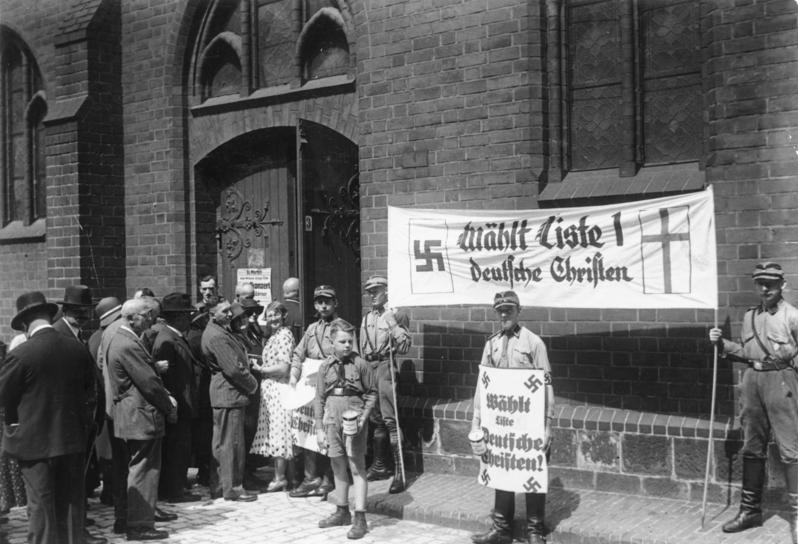
I have written a number of times about the lack of empathy among conservative American Christians. In those articles I drew some comparisons to the German Christians of the 1920s and 1930s who despite the reservations of a few, supported ultra-right wing nationalist parties and later the Nazi Party.

ADN-ZB/Archiv Kirchenwahl am 23.7.1933 in Berlin. Wahl in der Marien Kirche am Neuen Markt. Nazistische Wahlpropaganda unter Maske des Christentums.

ADN-ZB/Archiv
Kirchenwahl am 23.7.1933 in Berlin. Wahl in der Marien Kirche am Neuen Markt. Nazistische Wahlpropaganda unter Maske des Christentums.

Much of the support was brought about by the fear and hate propagated by those who had lost their favored status after the collapse of the Kaiser Reich. There was a lost war, a harsh peace, as well as social and economic chaos. Political radicalism and violence was common in the early years of the Weimar Republic, and many Christians of all denominations became caught up in it. Many Christians were especially fearful of what many believed was the threat of atheistic Socialists and Communists. The brief experiment with democracy was devastated by political battles, the 1919-1920 Weimar Inflation which destroyed the financial security of most Germans, as well as the Stock Market Crash of 1929. The Great Depression made the economic, political and social chaos worse, and this made many people, including many conservative Christians receptive to the “Nazi Gospel.”

I think that conservative American Christians are going the same direction as they get swept up in the climate of fear, hate, distrust and perceived persecution at the hands of liberals, atheists, socialists and their own government. As I have noted in other articles much of this stems not from actual persecution but from the loss of their privileged position as the dominant force in society.

596554178-franz-pfeffer-von-salomon-sa-fuehrer-3 -reichsparteitag-julius-streicher

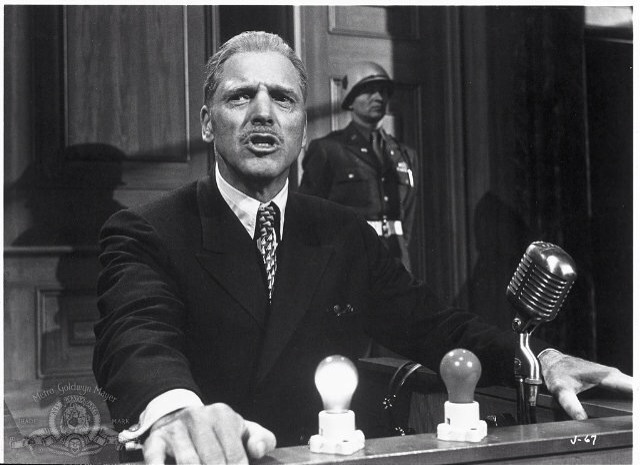
I love the film Judgment at Nuremberg, because I think that it really does reflect how many prominent Germans who should have known better followed Hitler, and reflects how many conservative Christians see the political right as their standard bearers.. In the film Burt Lancaster plays a prominent German legal scholar and jurist named Ernst Janning.

“There was a fever over the land. A fever of disgrace, of indignity, of hunger. We had a democracy, yes, but it was torn by elements within. Above all, there was fear. Fear of today, fear of tomorrow, fear of our neighbors, and fear of ourselves. Only when you understand that – can you understand what Hitler meant to us. Because he said to us: ‘Lift your heads! Be proud to be German! There are devils among us. Communists, Liberals, Jews, Gypsies! Once these devils will be destroyed, your misery will be destroyed.’ It was the old, old story of the sacrificial lamb. What about those of us who knew better? We who knew the words were lies and worse than lies? Why did we sit silent? Why did we take part? Because we loved our country! What difference does it make if a few political extremists lose their rights? What difference does it make if a few racial minorities lose their rights? It is only a passing phase. It is only a stage we are going through. It will be discarded sooner or later. Hitler himself will be discarded… sooner or later. The country is in danger. We will march out of the shadows. We will go forward. Forward is the great password. And history tells how well we succeeded, your honor. We succeeded beyond our wildest dreams. The very elements of hate and power about Hitler that mesmerized Germany, mesmerized the world! We found ourselves with sudden powerful allies. Things that had been denied to us as a democracy were open to us now. The world said ‘go ahead, take it, take it! Take Sudetenland, take the Rhineland – remilitarize it – take all of Austria, take it! And then one day we looked around and found that we were in an even more terrible danger. The ritual began in this courtoom swept over the land like a raging, roaring disease. What was going to be a passing phase had become the way of life. Your honor, I was content to sit silent during this trial. I was content to tend my roses. I was even content to let counsel try to save my name, until I realized that in order to save it, he would have to raise the specter again. You have seen him do it – he has done it here in this courtroom. He has suggested that the Third Reich worked for the benefit of people. He has suggested that we sterilized men for the welfare of the country. He has suggested that perhaps the old Jew did sleep with the sixteen year old girl, after all. Once more it is being done for love of country. It is not easy to tell the truth; but if there is to be any salvation for Germany, we who know our guilt must admit it… whatever the pain and humiliation.”

Hannah Arendt talked about this in her book Eichmann in Jerusalem: A Report on the Banality of Evil, her treatment of the trial of Adolf Eichmann, one of the mid-level Nazi officers who sent millions of people to their deaths. In describing Eichmann and other ordinary people Arendt said:

“The trouble with Eichmann was precisely that so many were like him, and that the many were neither perverted nor sadistic, that they were, and still are, terribly and terrifyingly normal. From the viewpoint of our legal institutions and of our moral standards of judgment, this normality was much more terrifying than all the atrocities put together.”

At the end of the movie Judgment at Nuremberg Spencer Tracy as Presiding Judge Dan Haywood concluded his sentencing remarks with this statement. It is perhaps one of the most powerful statement and something to remember as the Unholy Trinity of Politicians, Pundits and Preachers urge us to hate one another and those different than us. It is something that is especially needed in times of great societal stress as well as real and perceived dangers from without and within.

IMG_2182.JPG

http://www.youtube.com/watch?v=N3BwK51YFgQ

“Janning, to be sure, is a tragic figure. We believe he loathed the evil he did. But compassion for the present torture of his soul must not beget forgetfulness of the torture and the death of millions by the Government of which he was a part. Janning’s record and his fate illuminate the most shattering truth that has emerged from this trial: If he and all of the other defendants had been degraded perverts, if all of the leaders of the Third Reich had been sadistic monsters and maniacs, then these events would have no more moral significance than an earthquake, or any other natural catastrophe.

But this trial has shown that under a national crisis, ordinary – even able and extraordinary – men can delude themselves into the commission of crimes so vast and heinous that they beggar the imagination. No one who has sat through the trial can ever forget them: men sterilized because of political belief; a mockery made of friendship and faith; the murder of children. How easily it can happen. There are those in our own country too who today speak of the “protection of country” – of ‘survival’. A decision must be made in the life of every nation at the very moment when the grasp of the enemy is at its throat. Then, it seems that the only way to survive is to use the means of the enemy, to rest survival upon what is expedient – to look the other way. Well, the answer to that is ‘survival as what’? A country isn’t a rock. It’s not an extension of one’s self. It’s what it stands for. It’s what it stands for when standing for something is the most difficult! Before the people of the world, let it now be noted that here, in our decision, this is what we stand for: justice, truth, and the value of a single human being.”

einsatzgruppen executions

Einsatzgruppen Members finishing off Jewish Women

This is an unsettling subject and people on the political right and left in this country are apt to compare their opponents to those that were tried at Nuremberg and those that led them. This has been an increasingly disturbing trend in the case of hyper-partisan Right Wing and so called Conservative Christians who blatantly demonize those who they hate and urge the use of the police powers of the state to enforce their political-religious agenda. For all intents and purposes they no longer care about “Justice, truth, or the value of a single human being” especially if those human beings are not Christians. That may seem harsh, but sadly it is all too often the truth.

The terrible truth is that it is possible that any parties in any society, including ours, when divided by fear, hate and the desire for power can behave exactly as the industrialists, financiers, doctors, soldiers, jurists, civil servants, pastors and educators who oversaw the heinous crimes committed by the Third Reich.

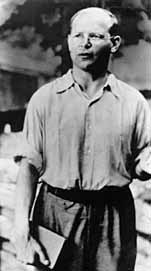
Again, I am not calling anyone, even the people that I am criticizing today Nazis. I am only trying to show the logical end of the thinking that permeates much of the political right, particularly conservative Christians who are following a path that is destructive to the church and for the world. As Dietrich Bonhoeffer said: “if you board the wrong train, it is no use running along the corridor in the other direction.” By selling their birthright to right wing radical politicians and special interest groups who only seek to exploit them for their own power, conservative Christians, like those in the Weimar Republic have boarded the wrong train, and unless they get off that train they will find that they have no redemptive value in society.

Sadly, I doubt that Sarah Palin, Ted Cruz, Mike Huckabee, Michelle Bachmann, Tony Perkins or any of the myriad of pundits, politicians and preachers driving conservative Christians off the rails will ever understand this. Thinking themselves wise, they became fools. Fools who in their quest for temporal power destroyed more lives and souls than they ever could have imagined.

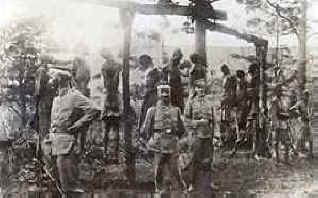
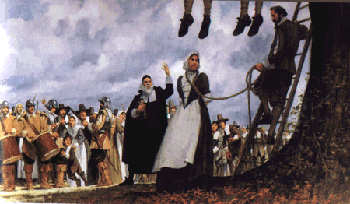
dyer-hanging

Executing Quakers in the Massachusetts Bay Colony 

Unlike Janning, I doubt if any of them have the capacity to reflect upon their words and actions and realize what they did and are doing are morally, ethically and by every measure of humanity are wrong, and are evil masquerading as righteousness, and thus doubly worthy of condemnation, for if they are Christians they should know better. I only hope that the vast number of conservative Christians who have not completely fallen for their hateful propaganda; men and women who have doubts about the message of such leaders are able to discern the truth will pause for just a moment, and like Bonhoeffer and others like him stand for justice, truth, or the value of a single human being.

Those who stood trial at Nuremberg were all people that should have known better, as should we, especially those who claim the name of Christ and presume to be bearing his good news.

Peace

Padre Steve+

Leave a comment

Filed under ethics, faith, film, History, movies, nazi germany, Political Commentary, Religion

Nuremberg: Marking the 67th Year of the Trials of Men Who Should Have Known Better

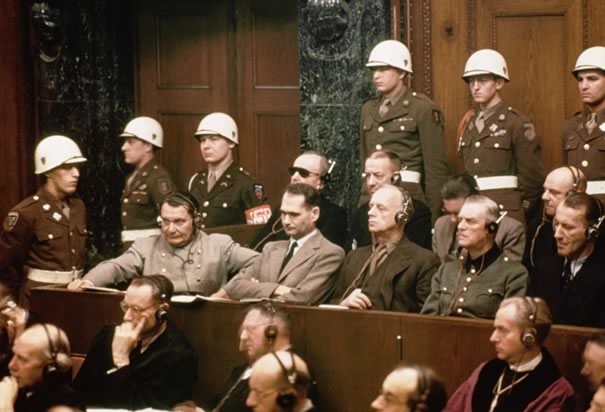
nuremberg-trial

“The sad truth is that most evil is done by people who never make up their minds to be good or evil.” ― Hannah Arendt

The 20th of November is an important day. It is not one that most people think about but it is important. It was the day that the major war criminals of the Nazi Regime were put on trial at Nuremberg. That was the most dramatic of the trials, but later trials were held on those that ran parts of the Nazi regime, the senior and mid-level executioners of Nazi policy. Those men included civil servants, jurists, physicians, military and police officials especially leaders of the Einsatzgruppen.

I studied Weimar and Nazi Germany as well as the Holocaust under Dr. Helmut Heussler at California State University at Northridge as an undergraduate and in a year of graduate studies.  I also continued that study while in Seminary as well as in my Masters Degree in Military History. I was stationed in Germany several times, done an exchange tour with the German Army and my German friends say that I am fluent in German. I have been to Nuremberg, Dachau and Bergen-Belsen. I have stood on the reviewing stand where Adolf Hitler preached to the multitudes of assembled party faithful on the Zepplinfeld in Nuremberg.

As such I am a realist about the unique horror of the Holocaust. I am a realist about people and how and the circumstances of the times brought ordinary people, men and women to either commit, support or simply turn their backs on the greatest atrocities ever committed by a “civilized” Western nation. A nation steeped in the traditions of Christendom and the Enlightenment.

As a Priest, Historian, Military Officer and Ethicist I often find that I return to my old books used in my various degree programs as well as  as the resources of museums and universities now available on the internet. I also watch films about the era. Not war films, films about the ordinary men that carried out these crimes either by pulling the trigger, pushing a button, signing an order or simply turning their backs and remaining silent. I think that is what makes them so compelling.

judgment-at-nuremberg-captain-harrison-byers-3-1

Three of those films I watch at lest once a year, sometimes multiple times. One is Conspiracy starring Kenneth Branagh which is about the Wansee Conference where mid-level officials and bureaucrats met to has out details of the Final Solution. The second is Nuremberg starring Alec Baldwin and Christopher Plummer which is about the major war crimes trials. The last is the classic Judgement at Nuremberg starring Spencer Tracy and Burt Lancaster. It is that film that I have concentrated on today because it deals with men who executed the laws enacted by the Nazi regime, many of whom who before the Nazi seizure of power were perfectly respectable in their dealings with Jews and others that the Nazis would persecute.

That is the chilling thing about this period of history and these films. The show ordinary men who for a variety of reasons chose to violate their own conscience as well as the norms of what they knew was right. They did so often out of fear, fear of change, fear of others and even fear of themselves. The fact that otherwise decent people not only followed Hitler but willingly executed Nazi policies against their former neighbors, colleagues and friends is the most chilling aspect of all. I say this because the people are so ordinary yet perpetrated such evil.

In Judgement at Nuremberg Burt Lancaster plays a jurist who served the Nazi regime, a jurist who before the Nazis was considered to be one of the best legal minds not only in Germany but in Europe. In the film the character played by Lancaster, Ernst Janning discussed who he and others like him ended up doing what they did. It is a penetrating look at how people justified their actions.

photo-jugement-a-nuremberg-judgment-at-nuremberg-1961-1

“There was a fever over the land. A fever of disgrace, of indignity, of hunger. We had a democracy, yes, but it was torn by elements within. Above all, there was fear. Fear of today, fear of tomorrow, fear of our neighbors, and fear of ourselves. Only when you understand that – can you understand what Hitler meant to us. Because he said to us: ‘Lift your heads! Be proud to be German! There are devils among us. Communists, Liberals, Jews, Gypsies! Once these devils will be destroyed, your misery will be destroyed.’. It was the old, old story of the sacrificial lamb. What about those of us who knew better? We who knew the words were lies and worse than lies? Why did we sit silent? Why did we take part? Because we loved our country! What difference does it make if a few political extremists lose their rights? What difference does it make if a few racial minorities lose their rights? It is only a passing phase. It is only a stage we are going through. It will be discarded sooner or later. Hitler himself will be discarded… sooner or later. The country is in danger. We will march out of the shadows. We will go forward. Forward is the great password. And history tells how well we succeeded, your honor. We succeeded beyond our wildest dreams. The very elements of hate and power about Hitler that mesmerized Germany, mesmerized the world! We found ourselves with sudden powerful allies. Things that had been denied to us as a democracy were open to us now…”

Hannah Arendt talked about the Banality of Evil in her treatment of the trial of Adolf Eichmann, one of the mid-level officers who sent millions of people to their deaths. In describing Eichmann and other ordinary people Arendt said: “The trouble with Eichmann was precisely that so many were like him, and that the many were neither perverted nor sadistic, that they were, and still are, terribly and terrifyingly normal. From the viewpoint of our legal institutions and of our moral standards of judgment, this normality was much more terrifying than all the atrocities put together.”

At the end of the movie Judgement at Nuremberg Spencer Tracy as Presiding Judge Dan Haywood concluded his sentencing remarks with this statement. It is perhaps one of the most powerful statement and something to remember as the Unholy Trinity of Politicians, Pundits and Preachers urge us to hate one another and those different than us. It is something that is especially needed in times of great societal stress as well as real and perceived dangers from without and within.

3875441640_6633e249f6

http://www.youtube.com/watch?v=N3BwK51YFgQ

“Janning, to be sure, is a tragic figure. We believe he loathed the evil he did. But compassion for the present torture of his soul must not beget forgetfulness of the torture and the death of millions by the Government of which he was a part. Janning’s record and his fate illuminate the most shattering truth that has emerged from this trial: If he and all of the other defendants had been degraded perverts, if all of the leaders of the Third Reich had been sadistic monsters and maniacs, then these events would have no more moral significance than an earthquake, or any other natural catastrophe.

But this trial has shown that under a national crisis, ordinary – even able and extraordinary – men can delude themselves into the commission of crimes so vast and heinous that they beggar the imagination. No one who has sat through the trial can ever forget them: men sterilized because of political belief; a mockery made of friendship and faith; the murder of children. How easily it can happen. There are those in our own country too who today speak of the “protection of country” – of ‘survival’. A decision must be made in the life of every nation at the very moment when the grasp of the enemy is at its throat. Then, it seems that the only way to survive is to use the means of the enemy, to rest survival upon what is expedient – to look the other way. Well, the answer to that is ‘survival as what’? A country isn’t a rock. It’s not an extension of one’s self. It’s what it stands for. It’s what it stands for when standing for something is the most difficult! Before the people of the world, let it now be noted that here, in our decision, this is what we stand for: justice, truth, and the value of a single human being.”

This is an unsettling subject and people on the political right and left in this country are apt to compare their opponents to those that were tried at Nuremberg and those that led them. This has been an increasingly disturbing trend in the case of hyper-partisan Right Wing so called “Evangelical Christians” who blatantly demonize those who they hate and urge the use of the police powers of the state to enforce their political-religious agenda.

However it is possible that any party in society when divided by fear, hate and the desire for power can behave just as the industrialists, financiers, doctors, soldiers, jurists, civil servants, pastors and educators who oversaw those heinous crimes.

Those tried at Nuremberg were all people that should have known better, as should we.

Peace

Padre Steve+

Leave a comment

Filed under History, laws and legislation, movies, nazi germany

Remembering the Holocaust: The Ordinary Men of Wansee and Two Hours that Doomed a Race

20080713_1383757010_brama_birkenau

“Monsters exist, but they are too few in number to be truly dangerous. More dangerous are the common men, the functionaries ready to believe and to act without asking questions.”  Primo Levi

Today was the International Holocaust Remembrance Day. It was on January 27th 1945 that the Nazi death camp called Auschwitz, in Poland was liberated by the Red Army.

auschwitz

Auschwitz began as a work camp, notoriously harsh in its treatment of its prisoners but a work camp, picked because of its proximity to rail lines and isolation. By the summer of 1941 it was the largest camp in the Concentration Camp system. Within months the process of turning Auschwitz into a factory of mass murder began, quite accidentally when members of the camp staff discovered that a chemical used for the delousing of barracks known as Zyklon-B also worked on large animals, and therefore people.  It was tested on Russian and Polish POWs in September 1941.

As the Nazi desire for efficient extermination grew and early death factories showed their limitations and the “experiments” at Auschwitz resulted in it being selected as a death camp. The camp was expanded and its first gas chamber, the former camp morgue began its operations in February 1942. Other more massive chambers were built, chambers that could hold up to 2000 victims per cycle. By the time the operation was shut down in the weeks leading up to the camp’s liberation Rudolf Höss the Commandant of Auschwitz estimated that 2.5 million people, mostly Jews were exterminated in it. Höss boasted d that his camp could exterminate 10,000 people in a 24 hour period. Other estimates are lower, but still in the millions.

Höss, and other functionaries such Adolf Eichmann, who coordinated the massive effort to exterminate the Jews of Europe following the Wansee Conference of January 20th 1942 approached their jobs dispassionately. This was a common attitude among the civil service, military and police officials that oversaw the Holocaust. They simply did their jobs and followed the law.

Hannah Arendt wrote of Eichmann:

“The trouble with Eichmann was precisely that so many were like him, and that the many were neither perverted nor sadistic, that they were, and still are, terribly and terrifyingly normal. From the viewpoint of our legal institutions and of our moral standards of judgment, this normality was much more terrifying than all the atrocities put together.”

This was what made the Holocaust committed against the Jews of Europe by Nazi Germany a phenomenon different than other genocides. Many of the perpetrators were not driven by centuries old hate as in the Balkans, tribal blood lust as occurred in Rwanda, or the products of Soviet Communism or Communist Chines Maoist regimes.

It was the racial ideology of the Nazis which deemed the Jews and other non-Aryans to be sub-human. That ideology undergirded the German treatment of the Jews, and the conduct of the war, especially in the East. But the execution of the plan required the bureaucratic, administrative, technical and legal skills brought to the table by ordinary men. Men who sought promotion, advancement and economic security for their families. Individually many would have never killed, but in their positions they ran the rail network, the factories, the banking and finance industries and supported the war effort, most not thinking much about the evil that they abetted or if they did finding a way, be it social, scientific, religious, patriotic, legal or simply in the name of efficiency.

That is what makes the evil committed by them so terrifying. It is the product of “normal” people in an advanced Western nation. Make no bones about it, their actions were evil. They aided and abetted the genocide of the Jews, the disabled, other “sub-human” races, particularly Slavs, as well as those that they deemed less than suitable.

This evening I watched the movie Conspiracy which is about the two hour long Wansee Conference headed by Reinhard Heydrich and organized by Eichmann. That conference put the representatives of competing agencies, and in the case of the SS, agencies within agencies together and brought about their cooperation in the execution of the Final Solution.

conspiracy

The film is chilling in the ordinariness of the men involved. civil servants, party officials, they were the men that did the day to day administration of the necessary functions of the Reich. Some were horrified at the potentiality of the effects of what Heydrich referred as “evacuations” entailed. They understood that it meant the extermination of the Jews. Some were concerned about the military and logistical aspects, others in how such actions squared with the German law, especially the Nuremberg Laws, while still others were concerned with diplomatic relations with Germany’s allies or occupied countries and some unnerved by the fact that it would be murder. But when the conference was done, all agreed and worked together and it only took two hours.

It is important that we do not forget the Holocaust. It is also important to recognize that the instruments of that horror were on the whole “ordinary” men who as they saw it were simply doing their job. It is something that everyone needs to remember.

Peace

Padre Steve+

1 Comment

Filed under History, nazi germany, News and current events, world war two in europe

The Promise and Peril of Revolutionary Times: A Warning From History

“In a revolution, as in a novel, the most difficult part to invent is the end.” – Alexis de Tocqueville

“They who clamor loudest for freedom are often the ones least likely to be happy in a free society.”  Eric Hoffer – The True Believer

I don’t know about you but it seems that everywhere I look that revolution is in the air.  Revolutionary times can be exciting to watch or even to participate in because all at least initially cater to the hopes of people, the hope of change, freedom, justice and equity are common themes.   As a historian I find it fascinating to observe revolutions and to read about revolutions throughout history.  But I always have a concern about how even the most well intentioned revolts against real or perceived injustice often miscarry and create conditions ripe for civil war, dictatorship and even regional or world war.

The revolutions sweeping the world today and I include the proto-revolutionary movements of the conservative Tea Party and Occupy Wall Street movements as revolutionary movements are becoming mass movements.  As mass movements they share many things in common even if their ideologies and backers appear to be diametrically opposed.  We now have two diametrically opposed revolutionary movements seeking power in this country and neither side will be satisfied until they achieve it.

Those that dismiss or seek to tame the Tea Party or the Occupy Wall Street movement are foolish. The anger, resentment and the hatred that these movements have for the established order are too great to be easily dismissed.  The politicians that try to channel these movements for their own benefit or party or that attempt to encourage them without actually addressing their grievances will discover too late that lip service and cosmetic change will not be enough.  Peaceful nonviolent protests can turn violent in a moment with very unpredictable results.

In our country there is great dissatisfaction with the status quo on the right and the left which in large part is due to the actions of those in power in government, media, business and even religion to address the concerns of those on both sides of the political abyss.  Likewise it is the same entities that in order to maintain their power have used every opportunity to create enmity among Americans.

Similar events are occurring on the other side of the Atlantic as the crisis in Greece threatens the economic stability and quite possibly the viability of the European Union.  The extremists on the left and right are garnering support that they have not had in decades from people that until the current economic downturn were content with the status quo because they were doing alright.

Even those revolutions that bring positive change tend to bring in some form of social unrest and upheaval to include the maltreatment and sometimes exile of people that did not agree with the revolution.  One only has to take a look at the large numbers of British colonists in the 13 Colonies who were loyal to the British Crown and lost their place in society and many times their homes and livelihoods as they were no longer welcome.  Many fled to Canada, the British West Indies or had to return to England.

Revolutionaries do not take kindly to those that oppose them, especially when they are kinsmen.  Those officers or Federal officials that remained loyal to the Union during the American Civil War that hailed from Southern States often found that they were no longer welcome in their communities and sometimes disowned by their families.  This was the fate of General George Thomas who remained faithful to his oath despite being fromVirginia. His family turned his picture around and refused to have anything to do with him from that point forward even refusing financial assistance from him after the war.

The English Civil Wars of 1641-1653 were some of the most brutal to occur inEuropeand devastated Ireland which lost some 41% of its population and where the lingering scars are still seen today.

The French Revolution was a bloodletting that shaped France to the present day.  People tend to forget that the root cause of this revolution was a financial crisis brought about by the costs of the Seven Years War with England and the French support of the American Revolution which brought the country into more conflict with England. The antiquated and regressive French tax code put a heavy burden on the middle and lower classes but provided many exemptions to the nobility and the clergy.  When comptroller Jacques Necker proposed ending or reducing those exemptions he was fired.  But the crown was so week that it decided to call the Estates General into session for the first time since 1618 and when the three components of the assembly could not agree on credentials the lower assembly of commoners broke off and formed their own National Assembly and when it appeared that the King was bringing foreign troops to Paris it set off an armed revolt.

The revolution was brutal and unleashed an unprecedented series of wars which engulfed the European continent the West Indies and Egypt.  Eventually a young Army officer named Napoleon Bonaparte did much to secure the new regime’s security by a series of brilliant military victories.  He was so successful that he overthrew the government and became a dictator in 1799 and would proclaim himself Emperor in 1804.  The wars in Europe were devastating and would create a situation where a weakened Spain and Portugal would lose their colonies in Central and South America.

When Napoleon was finally defeated for the last time at Waterloo in 1815 the Congress of Vienna reestablished a conservative order and peace inEurope.  There was a brief revolutionary period in 1848 and the wars that led to the unification of Germany and the defeat of France by Prussia in 1870-71. But for the most part stability reigned until the First World War as European powers focused on using their power in imperialist ways in Africa, the Middle East and Asia.   The war set in motion revolutionary movements that would lead to the overthrow of empires and birth the mass movements of Communism, Fascism and Nazism that would be responsible for some of the most destructive wars and crimes against humanity ever seen by the world.

Other revolutions have caused immeasurable suffering, the Cultural Revolution in China, the Iranian revolution, the Bolshevik Revolution in Russia to name a few. The Spartacus revolution in the early days of the Weimar Republic helped doom it and led to the Nazi revolution in Germany. The Nazi revolution was brought about through legal means with the appointment of Adolf Hitler as Chancellor after which his revolutionary policies were put in place.

The revolutions in the Soviet Union and Warsaw pact in aftermath of the Cold War have brought a multiplicity of outcomes, some which appear to have brought forth societies where human rights and individual liberties are respected and others which have become or are in the process of becoming dictatorships.

And so today we live in an age of revolution which is heightened and moves across the globe like a wind fanned wildfire due to the instantaneous nature of the communication and media that we now enjoy.  There is the Arab Spring and the beginnings of revolutionary movements in Europe, Asia and now even North America.  Governments seem impotent to do anything about the conditions that have moved these revolutionary groups to action and have given the ideologues on the left and right respectability that they could have never enjoyed before.  The ideologues make their money by providing a platform for the airing of the grievances of their readers or listeners real and imagined by playing on the need for hope.  The motive of the listener or follower is finding something to believe in a hope and promise, hope around the corner not hope deferred.  Eric Hoffer noted “To have a grievance is to have a purpose in life. It not infrequently happens that those who hunger for hope give their allegiance to him who offers them a grievance.”

The extremists on both sides of the line in the United States have held sway so long that they have turned the extreme into the mainstream inspiring one of the most amazing displays of left-right groupthink that I have ever seen.  I read a lot of conservative and liberal blogs and websites,some which are considered mainstream by their proponents.  I believe that you can tell a lot about movements by what the rank and file write or share.  One thing that I notice is how interchangeable these blogs are and how much they mirror the talking points of their respective echo chambers.  There is little creative though only the endless repetition of talking points. If one ventures a dissenting opinion on one of these sites he or she will find themselves shouted down and demonized and it doesn’t matter if the site is left wing or right wing, religious or secular.  The purity of ideology and necessity of conformity to the group-think ensures that opposing points of view be shouted down.

I first started noticing this when I returned fromIraqin 2008. At that time I was still listening to conservative talk radio on a regular basis and I started noticing that with minor differences all the talk show hosts sounded alike, the same talking points driven home day after day.  Alternative viewpoints even those that differed only slightly from the party line were ridiculed and demonized. That was eye opening to me and I noticed a similar tone emanating from the left.  Both emphasize that they are being oppressed or persecuted and the rank and file believe that they are oppressed and gladly allow themselves to become parts of these mass movements.

It is the real and perceived feelings of oppression or persecution provide these disparate movements their most fervent followers and energy.

One attitude prominently displayed is an absolute hatred and distain of moderation.  Both have an absolute distain of dialogue and neither appear to want a win-win situation to develop simply because to both sides only absolute victory for themselves and destruction of all that that they oppose matters.  It is a nihilistic zero sum game that both sides play.  Both sides are slaves to their doctrine and the vast majorities of the followers of these mass movements are absolutely unaware of this.  Philosopher Eric Hoffer wrote “A doctrine insulates the devout not only against the realities around them but also against their own selves. The fanatical believer is not conscious of his envy, malice, pettiness and dishonesty. There is a wall of words between his consciousness and his real self.”

Revolutionary movements of themselves can be transforming and in the long run quite beneficial but for every one that is such there are many more that in succeeding bring about tyrannies as bad or worse than the ones that they ended.  The evidence of this is widespread.  Much of this is due to a desire not for freedom but for revenge as those that viewed themselves as oppressed or persecuted turn their new found power into a weapon of revenge and retaliation.  Hoffer wrote “It is doubtful if the oppressed ever fight for freedom. They fight for pride and power — power to oppress others. The oppressed want above all to imitate their oppressors; they want to retaliate.”

History shows that in more cases than not that when revolutionaries take power they become oppressors themselves and are perfectly willing to crush dissent by force. They become the conservative faction resistant to change and opposed to dissent.  Hannah Arendt observed that “The most radical revolutionary will become a conservative the day after the revolution.”

Eric Hoffer understood mass movements as few in the last century have.  Hoffer’s book The True Believer (1951) is a study of mass movements and since Hoffer had witnessed the mass movements of the 1920s and 1930s that defined the age, Fascism, Communism and Nazism.  Hoffer notes similarities between political, social and religious mass movements and when it was written in 1951 President Dwight D. Eisenhower praised it.  It is well worth the read.  Hannah Arendt also understood how individuals in mass movements could participate in evil including genocide and think that they were just doing their job and helping society.  Her book Eichmann in Jerusalem: A Report on the Banality of Evil.

Revolutionary times are filled with promise and peril. The wise in Tea Party and the Occupy Wall Street and other movements around the world need to understand that crucial truth.  Movements such as these can be co-opted and driven in ways that those that began them can little anticipate and the leaders of such movements often become victims of the very movement that they helped create.  The names of such instigators that have become victims is too long to list.

As a historian I find the process that we see unfolding as simply fascinating and I cannot predict how this revolutionary era will play out.  I just hope and pray that things don’t get too sporty.

Peace

Padre Steve+

5 Comments

Filed under History, News and current events, Political Commentary

A Few Concerns Regarding Matters of Faith and Morality

“The fearful danger of the present time is that above the cry for authority, we forget that man stands alone before the ultimate authority, and that anyone who lays violent hands on man here, is infringing eternal laws, and taking upon himself superhuman authority, which will eventually crush him.” Dietrich Bonhoeffer

I think I feel a sermon coming on….

I am increasing appalled at the statements of Christians and those that they have allied themselves with in the political arena.  Mind you that almost all of these folks claim to be “pro-life” because they are anti-abortion. However just because someone is against abortion does not mean that they are necessarily pro-life.  They may be pro-life in the instance of abortion but if that is all then they are one dimensionally pro-life, which means that in many other areas they are pro-death.

Several examples I will note and they are so abominable, so un-Christian and so evil that they have to be called out. I am refraining from politics because this is a matter of faith and morals that have had to categorically oppose throughout our history, even when our Christian brothers and sisters are the perpetrators.

I the past couple of weeks alone we have seen bold faced immoral and distinctly un-Christian comments being made in full public view on television for all, even God to see.

First there were the cheers when Governor Rick Perry said that he never “loses sleep” over any of the 234 men and women that he has signed the death warrants of in Texas, not even worrying that some might have been innocent.  When Perry pronounced this authoritative statement “But in the state of Texas, if you come into our state and you kill one of our children, you kill a police officer, you’re involved with another crime and you kill one of our citizens, you will face the ultimate justice in the state of Texas, and that is, you will be executed.” The cheers were raucous.  This despite the fact that the witness of the Christian Church before Constantine was universally against the use of capital punishment, evidently the fact that Jesus was unjustly crucified had some play in their beliefs.   But of course one the Church became part of the establishment that began to change and well we know how that worked out, if you disagreed with the Church the crime was also against the State and those who did not recant well enough were summarily executed, often with a clergyman pronouncing eternal damnation.

You would think that someone who is pro-life would at least reserve the ultimate justice to God, and at least wrestle with the implications of each death warrant that he signs.  The death penalty may be capital punishment but it is still temporal justice, God alone has the right of deciding “ultimate justice.” For anyone not to understand that shows a callous disregard for the earliest witnesses of the Christian faith and cannot in any way be considered to be “pro-life.”  Pope John Paul II in his Papal Encyclical “Evangelium Vitae (The Gospel of Life) said this

“Public authority must redress the violation of personal and social rights by imposing on the offender an adequate punishment for the crime, as a condition for the offender to regain the exercise of his or her freedom. In this way authority also fulfills the purpose of defending public order and ensuring people’s safety, while at the same time offering the offender an incentive and help to change his or her behaviour and be rehabilitated.

It is clear that, for these purposes to be achieved, the nature and extent of the punishment must be carefully evaluated and decided upon, and ought not go to the extreme of executing the offender except in cases of absolute necessity: in other words, when it would not be possible otherwise to defend society. Today however, as a result of steady improvements in the organization of the penal system, such cases are very rare, if not practically non-existent.

In any event, the principle set forth in the new Catechism of the Catholic Church remains valid: ‘If bloodless means are sufficient to defend human lives against an aggressor and to protect public order and the safety of persons, public authority must limit itself to such means, because they better correspond to the concrete conditions of the common good and are more in conformity to the dignity of the human person.'”

The Second little instance was when a question was asked of Ron Paul about what he would do if an uninsured 30 year old man suddenly slipped into a coma and needed care and people in the audience started yelling “Let him die, let him die!”  To be fair Ron Paul as a physician would treat the man, but the fact that people in the audience which was in large part drawn from Evangelicals shouted such epithets in a debate televised for the whole nation to see revealed a sentiment that was in no way pro-life or Christian.  In fact it reminded me of the shouts “crucify him, crucify him!”

The Third and last for tonight’s sermon, I do occasionally like the three point sermon, was prominent televangelist and one time Presidential Candidate Pat Robertson’s comment today on his show The 700 Club. Robertson gave this warm and cuddly advice to a man asking what to say to a friend who had started seeing someone else because his wife had Alzheimer’s Disease “I know it sounds cruel, but if he’s going to do something, he should divorce her and start all over again, but make sure she has custodial care and somebody looking after her.” Citing the Gospel of Mark, Robertson continued “If you respect that vow, you say `til death do us part, this is a kind of death.”  That statement is neither pro-life nor pro-family, nor can it find any support in the Christian tradition, nowhere.

All of these statements that I have described show no respect for the human person and betray what Hannah Arendt called “the fearsome word-and-thought-defying banality of evil” because those that utter them do not believe that they are evil words or acts. The “banality of evil” was  a term she coined about Adolf Eichmann who made sure that the wheels of the Holocaust moved smoothly forward.  Of course Eichmann said in his defense that he didn’t have anything against the Jews, he even had Jewish friends, and it was just his job and that he had done nothing wrong because he acted within the law.

These expressed thoughts and sentiments of Rick Perry, Pat Robertson and those in the debate crowds that cheered for death show a terrible dark side to our supposedly “Christian” nation.  It is easy to use scripture to condemn abortionists as well as those that are considered sexually deviant or to condemn those of foreign creeds enemies, but when the questions are the treatment of the poor, the sick, the aliens among, the prisoners, or to the children of people that we see as enemies far away who just happen to be in the same tent as their woebegone parents who might or might not be terrorists when a drone launched Hellfire missile tears their bodies to shreds we scarcely see the moral, ethical and religious principles that are violated.

Bonhoeffer was indeed correct “that above the cry for authority, we forget that man stands alone before the ultimate authority, and that anyone who lays violent hands on man here, is infringing eternal laws, and taking upon himself superhuman authority, which will eventually crush him.”

Just some things to think about….

Peace

Padre Steve+

5 Comments

Filed under faith, History, philosophy