Tag Archives: adolf hitler

I Will Support and Defend… Reflections on 35 Years of Commissioned Service in the Age of Trump

Friends of Padre Steve’s World,

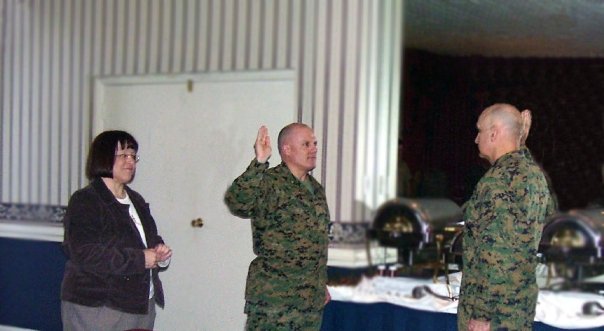
Thirty-five years ago today I swore an oath as a newly commissioned officer in the United States Army. It is an oath that along with my baptismal, confirmation, marriage, and ordination vows is the most important in my life. Almost two years before that I swore an enlistment oath on August 25th 1981.

It was a hot and smoggy summer day in Van Nuys California when drove into the parking lot of the old Armory on Van Nuys Boulevard in my 1975 yellow Chevy Monza with a black vinyl top. That night the San Francisco Giants defeated the St. Louis Cardinals by a score of 4-2 and the Baltimore Orioles defeated the Seattle Mariners 6-5 in 12 innings.  In less important news the Voyager II space craft reached its lowest orbit around Saturn.

Getting out of the car I walked into the offices of the Headquarters, 3rd Battalion 144th Field Artillery of the California Army National Guard.  I had in my sweaty hands the paperwork from the Army ROTC detachment at UCLA the “Bruin Battalion” accepting me into the program and allowing me to enlist simultaneously in the National Guard.

I was met by the Headquarters Battery Commander, Captain Jeff Kramer who after my commissioning would allow me to borrow his sword and sword belt to wear at my wedding with my Dress Blue Uniform.  Jeff finished his career as a full Colonel in the California National Guard. He took me to Major Charles Armagost the battalion S-1 who rapidly had a clerk type up my enlistment papers and administered the oath of enlistment below:

I, do solemnly swear that I will support and defend the Constitution of the United States and the State of California against all enemies, foreign and domestic; that I will bear true faith and allegiance to the same; and that I will obey the orders of the President of the United States and the Governor of California  and the orders of the officers appointed over me, according to law and regulations. So help me God.

That was the beginning of what has turned out to be a very long strange trip.

Renewing the Oath on my Promotion to Lieutenant Commander 2006

In June of 1983 I was commissioned as a Second Lieutenant and I took a different oath, an oath of office versus enlistment, I would repeat it again in February 1984 when I was promoted to First Lieutenant, March of 1987 when promoted to First Lieutenant, and in December 1995 when I was promoted to Major. I swore variations of it in both the Texas and Virginia Army National Guard as well before I commissioned as a Navy Lieutenant  February 9th 1999.  I renewed it in April 2006 upon my promotion to Lieutenant Commander and September of 2011 when I was promoted to Commander. That oath states:

I do solemnly swear that I will support and defend the Constitution of the United States against all enemies, foreign and domestic; that I will bear true faith and allegiance to the same; that I take this obligation freely, without any mental reservation or purpose of evasion; and that I will well and faithfully discharge the duties of the office on which I am about to enter. So help me God.

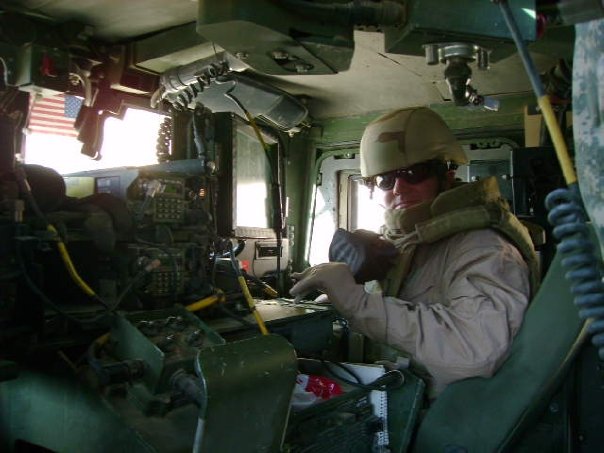
Since I swore the oath the first time  I have served in Europe, Asia and the Middle East, at sea and ashore in war and peace.  I have served as a Company Commander and a Staff Officer before becoming a Chaplain. I believe that even today  that there is no greater honor than to serve this country.

Iraq 2007

It is hard to believe that it has been 35 years.  I do take the oath of office quite seriously especially the part about defending the Constitution against all enemies foreign and domestic.  I have served 30 years I have served under six Presidents

I have not completely agreed with the actions or policies of each President and Congress that I have served. While I have deeply held political views they have never kept me from serving under administrations that I have disagreed with on major policies.  Officers may have strong political views but those must always be subordinated to our oath to support and defend the Constitution.

One of my favorite heroes of the American Civil War, General Winfield Scott Hancock said “We are serving one country and not one man.” Hancock was a states rights Democrat who remained in the Union because he did not believe that secession was legal.  He had no political friends in Washington and he served valiantly during and after the war.  When asked about his opinion on what to do when their home state of Virginia seceded from the Union by his friends and fellow officers George Pickett, Lewis Armistead and Dick Garnett before the war in California he said “I shall not fight upon the principle of state-rights, but for the Union, whole and undivided.”

This is not the case in much of the world. Many militaries swear allegiance to the ruler, the state, ruling political party or the majority religion.  The officers in many Moslem nations combine their oath with the Bya’ah which includes a personal oath to the King or Sheik and the Islamic statement of faith.

The British military swears an oath to the Queen and her successors:

“I  swear by Almighty God that I will be faithful and bear true allegiance to Her Majesty Queen Elizabeth II, her heirs and successors and that I will as in duty bound honestly and faithfully defend Her Majesty, her heirs and successors in person, crown and dignity against all enemies and will observe and obey all orders of Her Majesty, her heirs and successors and of the generals and officers set over me.”

The Red Army of the Soviet Union swore an oath to “to protect with all his strength the property of the Army and the People and to cherish unto death his People, the Soviet homeland and the government of Workers and Peasants, also to respond at the first call from the government of Workers and Peasants to defend the homeland, the USSR.”

Germany has had a rather perilous history with oaths sworn by the military.  The Imperial Army swore an oath to the Kaiser but when the Kaiser abdicated and the Weimar Constitution was ratified German Officers and Soldiers took this oath: “I swear loyalty to the Reich’s constitution and pledge, that I as a courageous soldier always want to protect the German Nation and its legal institutions, (and) be obedient to the Reichspräsident and to my superiors.”  The history of the Republic shows that many officers and soldiers, especially those that had served under the Kaiser resented this oath.

In 1933 Hitler changed the oath to this  “I swear by God this sacred oath, that I will render unconditional obedience to Adolf Hitler, the Fuhrer of the German Reich and people, Supreme Commander of the Armed Forces, and will be ready as a brave soldier to risk my life at any time for this oath.” The current German military oath states: “I swear to serve loyally the Federal Republic of Germany and to defend bravely the right and the freedom of the German people. So help me God.”

All oaths hold potential dangers but those of the United States military officer corps is perhaps the best thought out oath in the world.  The oath is to the Constitution, not a person, political party or religion.  The efficacy of the oath is based on the honor of those that swear to uphold it.  In times of national turmoil it is important for officers and enlisted personnel to ensure that remember that fact.


I pray that I will be faithful to the oath and the people that I serve in the coming years.  It is an honor to still remain in the service of this country.  I have served under six Presidents but until 2017 I never believed that I would fear the actions of the President so much that I would based on my oath to the Constitution as well as my ordination vows that I would preach against those actions in a military chapel.

But I remember that my oath is to the Constitution and not any President. I also know that as a Chaplain that I uphold the faith and values of the church that has endorsed me to remain in service as a Chaplain. My call is to serve all of those in my care, and to provide for their rights to the free exercise of religion under the First Amendment. That also extends to the rights of non-believers to not have a state religion shoved down their throats. It also means that I need to speak truth to those in power.  I also remember the words of German General Ludwig Beck who lost his life in the failed attempt on Hitler’s life on July 20th 1944:

“It is a lack of character and insight, when a soldier in high command sees his duty and mission only in the context of his military orders without realizing that the highest responsibility is to the people of his country.” 

Beck had served 35 years before Hitler came to power and initially supported him and many of his goals, but five years later he realized that it was Hitler leading the nation to war and Germany to its destruction. His words are also something that I hold on to today and because of that I will continue to speak out when the President, his appointees, and supporters speak and act against the Constitution, the law, the American people, and against the principles that the country was founded upon, most importantly the words of the Declaration of Independence which states the most revolutionary concept ever promulgated:

“We hold these truths to be self-evident, that all men are created equal, that they are endowed by their Creator with certain unalienable Rights, that among these are Life, Liberty and the pursuit of Happiness…”

It then goes on to attack the actions of the British Crown, of which many are being repeated by President Trump and his administration.

I may not be a soldier in high command, but I do realize that my highest duty is not to obey without questioning or criticizing the actions of the President when they go against the Constitution, the law, international treaties that the United States has pledged to uphold, and basic human rights. Thus the oath that I first swore to uphold 35 years ago still matters.

Padre Steve+

Leave a comment

Filed under civil rights, civil war, ethics, faith, History, laws and legislation, leadership, Military, News and current events, Political Commentary

Breaking Precedent: Trump and Hitler Compared to their Predecessors

Friends of Padre Steve’s World,

I recently read German historian Joachim Fest’s book Inside Hitler’s Bunker: the Last Days of the Third Reich. The book is the basis for the German language film Downfall which depicted the last ten days of the Third Reich.

I don’t read books or movies about the Third Reich to find comparisons to the present day, I have been studying that period since my years as a college undergraduate and first year graduate student at California State University at Northridge. Most of my history major studies focused on modern German history beginning with Imperial German but really focusing on the Weimar Republic and the Nazi era through the major war crimes trials at Nuremberg. My professor, Dr. Helmut Heussler had served there as a translator.

That was nearly 40 years ago. I continued that study in seminary to some extent, individually during the times that I was stationed in Germany in the 1980s and 1990s, and during my second Masters degree. I have continued those studies since then and used what I learned teaching ethics to senior military officers at the Joint Forces Staff College. We dealt a lot with war crimes and I used the film about the Wannsee Conference, Conspiracy as our capstone exercise. I used it so my students could see how ordinary men, officers, lawyers, bureaucrats, and police officials could cooperate to coordinate their agencies actions in regards to implementing the Final Solution to what they referred to as the Jewish Question.

Since 2014 I have made yearly visits to Germany where I take the time to visit the sites and centers related to the study of the Holocaust and the Nazi period. Thankfully because I read, speak and write German I do pretty well navigating around these sites and many of the materials I have now are in German, but I digress, that was all to state my expertise regarding the subject before some troll comes by to say that I don’t know what I’m talking about.

So anyway going back to Fest’s book and one particular statement that Fest made about Hitler in the context of German history and the various leaders who preceded him. Fest wrote:

“What differentiated Hitler from any conceivable predecessors was the complete lack of sense of responsibility beyond the merely personal, of any clear-headed, selfless ethos of service, and of any historic morality.”

I had to stop reading at that point and go back and re-read the preceding section of that chapter to make sure that I had the context right. Hitler certainly absorbed the ideas of racism, anti-Semitism, racial purity and the superiority of the Aryan Race, which do have precedent in German history. They were part and parcel of ideas that he was exposed to while in Vienna before the war and the people that he socialized with in Munich following Germany’s defeat in 1918.

There are also examples of German military forces conducting what amounted to genocide in Namibia when it was a German colony, as well as very harsh measures being conducted against Belgian civilians during the First World War, but those knew limits, and there the comparison with his predecessors ends. Fest wrote:

“There would be a “New Man”who razed everything to the ground, resettled territories, and sought relaxation from his mission… It was a break with everything the world had ever stood for. Trying to invent an origin for this revolution – an origin it did not have – is to fall retrospectively for the regime’s own propaganda. The origins of this program were entirely self generated. No one had ever gone to such extremes, and with such utter madness….”

Then I began to think about President Trump in the context of his presidential predecessors and I realized that in the context of the American political system that what Fest said about Hitler is also true of the 45th American President. While he may represent some of the more isolationist, and racist parts of our history there is no real American Presidential precedent for him.

He has gone back and borrowed from the worst aspects of the American experience and mythology to create his personal cult of personality based on Making America Great Again. He blends crude ante-Bellum and Jim Crow racism, with the anti-immigrant and religious prejudices of the Know Nothings, as well as the Isolationist and Nazi supporting America First movement of the late 1930s and early 1940s. He tries to link himself to Ronald Reagan but that to is a fallacy based on the policies enacted by both men.

Like Hitler, Trump has been enabled by a cult-like following who themselves were ideologically and socially prepared to sacrifice themselves for him and his repackaging of their beliefs despite overwhelming evidence that he will lead them to ruin despite a veneer of success.

I really don’t try to go out of my way to find connections between our era and the early period of Nazi rule in Germany, but when they jump out like this I cannot ignore them. Such moments are epiphanies and should not be ignored.

Until tomorrow,

Peace,

Padre Steve+

5 Comments

Filed under books, History, News and current events, Political Commentary

Preach the Truth: Silence in the Face of Evil is Itself Evil, Not to Speak is to Speak, Not to Act is to Act

Friends of Padre Steve’s World,

We live in an unsettled world where almost everything that we had grown to accept as normal is being upended including basic understandings of societal responsibility and decency. Edward R. Murrow said in the days of the Red Scare and McCarthy hearings “that we are living in an age of confusion – a lot of us have traded in our beliefs for bitterness and cynicism or for a heavy package of despair, or even a quivering portion of hysteria.”

What is morally abhorrent is now promoted by many Evangelical and Catholic Christians as being obedient to God by being obedient to the state which is the same as being obedient to President Trump. To them the State is Trump and Trump is the State, therefore the ease in which they invoke scriptures out of context in the manner of the Nazis and others who oppressed people who were deemed to be inferior according to race, ethnicity, religion, or political belief.

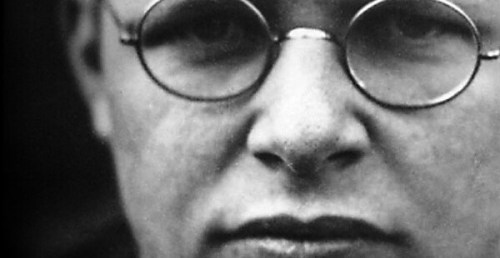
Dr. Martin Luther King Jr. once said “Our lives begin to end the day we become silent about things that matter.” Yes, this does matter. It is a stain upon our nation, but even more for the Christian it is a profound witness against Jesus Christ, and a stain upon his Church. If those who profess the name of Christ cannot stand in the face of evil then what use are we? Dietrich Bonhoeffer noted: Bonhoeffer wrote: “Silence in the face of evil is itself evil: God will not hold us guiltless. Not to speak is to speak. Not to act is to act.”

Over the course of my life I have learned the terrible cost to one’s soul of remaining silent in the face of injustice. At this stage of my life I cannot do anything but tell the truth and be faithful to my baptismal, confirmation, and ordination vows. Likewise I cannot betray my oath to the Constitution. One place I can do this is in the pulpit and as I recall the First Amendment still applies to the pulpit even when one serves in the military.

So I today I preached in my chapel to give my Protestant pastor the day off. The text was the epistle lesson from the lectionary, 2nd Corinthians 5:6-17, which I extended to verse 20. The message was that the call to be ambassadors of Christ and his love for humanity is contrary to the support of the actions of the Trump Administration; especially and most notoriously the imprisonment of tens of thousands of would be immigrants seeking asylum in our country and the forced separation of thousands of children from their families.

The sermon became very political as I tied the words of scripture to the responsibilities of Christians as it applies to what is going on in this country. I condemned the complicity of Christians in the gross injustices being inflicted to immigrants and racial and religious minorities. I quoted Bonhoeffer, Gandhi, Dr. King, Niemoller and Sophie Scholl to condemn the actions of the Trump administration. I then quoted the President’s words of last month where he called immigrants animals and Stephen Miller’s words how the policy to forcibly separate children from their families being a simple decision. I mentioned that once you determined that any group of people were less than human such decisions were indeed simple.

I quoted pastor Robert Jeffress and his support for Trump and opposition to any candidate who would base his Presidency on the principles of the Sermon on the Mount. I compared his words to the words of Reichsbischof Muller who I think is a comparable figure about the Jews before Hitler came to power.

I also said you cannot claim to be a pro-life Christian if you support ripping children from their parents and locking them in cages 22 hours a day to use them as a “bargaining chip” as President Trump did this week and I did not let up. I told the congregation that this Priest and Chaplain would pray for the victims of this administration’s policies and speak out against them.

During the sermon something happened that has never happened when I preached, about half a dozen people walked out. When you are preaching something After the service a number of other people, previously friendly were cold to me. But a number number of men, all African American Marine Corps or Navy retirees thanked me and wanted more of the history that I preached about.

Later I got a text from one of my Chaplains who told me: “Word on the street is that you brought it this morning, I quote “He raised his voice and it was if God was speaking” and they were squirming in their seats (in that good uncomfortable way).”

Anyway, pray for me, you never know when one of the disgruntled parishioners complains to commanding officers or even the media. But all that being said I will speak the truth.  Bonhoeffer wrote:

“For the tyrannical despiser of humanity, popularity is a sign of the greatest love for humanity. He hides his profound distrust of all people behind the stolen words of true community. While he declares himself before the masses to be one of them, he praises himself with repulse vanity and despises the rights of every individual. He considers the people stupid, and they become stupid; he considers them weak, and they become weak; he considers them criminal, and they become criminal. His most holy seriousness is frivolous play; his conventional protestations of solicitude for people are bare-faced cynicism. In  his deep contempt for humanity, the more he seeks the favor of those he despises, the more certainty he arouses the masses to declare him a god…”

Those words were written by Bonhoeffer about Hitler, but they can easily be applied to our President today and the actions of his administration and the acquiescence of his supporters.

Dr. King said “On some positions, Cowardice asks the question, “Is it safe?” Expediency asks the question, “Is it politic?” And Vanity comes along and asks the question, “Is it popular?” But Conscience asks the question “Is it right?” And there comes a time when one must take a position that is neither safe, nor politic, nor popular, but he must do it because Conscience tells him it is right.”

Conscience demands that the truth be told. It is now more important than every to tell the truth from every promontory, from every pedestal, from every pulpit until it is heard throughout the entire land.

Until tomorrow,

Peace,

Padre Steve+

3 Comments

Filed under christian life, civil rights, ethics, faith, History, holocaust, News and current events, Political Commentary

Handshakes, Betrayals and a Piece of Paper: Trump Outdoes Neville Chamberlain as Appeaser in Chief

Friends of Padre Steve’s World,

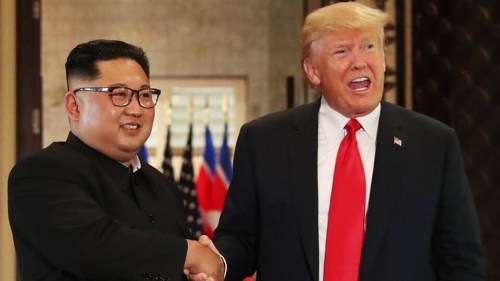
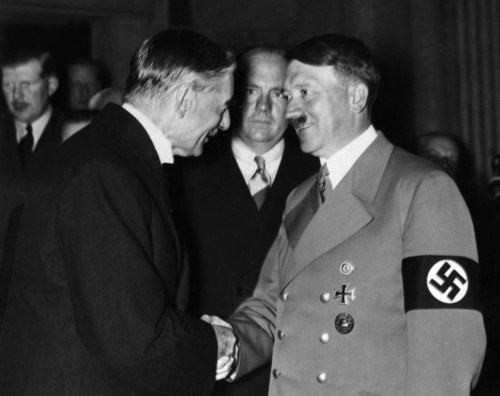
I am an old Cold Warrior. I have served for almost 37 years in the military including tours or deployments on the intra-German border in the 1980s waiting for the Soviets to come pouring across the Fulda Gap, being on the Korean DMZ in 2001, and to complete the Commie Trifecta a bunch of time at Guantanamo Bay Cuba at the Northeast Gate. In those 37 years I have served under six Presidents and never did I believe until now that a President of the United States betray every longstanding ally and then to add insult to injury has very likely surrendered South Korea to the North Korean dictator with no conditions. It reminds me of how Neville Chamberlain sold out Czechoslovakia to Adolf Hitler in 1938.

In 1938 Chamberlain was the supposed leader of the democracies and in order to curry favor with Hitler and to “bring peace to Europe” made a deal which surrendered Czechoslovakia to Hitler. As bad as that was and as horrific the consequences were for Europe and the world Chamberlain actually believed that his actions were required for peace. He believed that he could appease Hitler at the cost of a small multi-ethnic democracy, after all what did the Czech’s really matter?

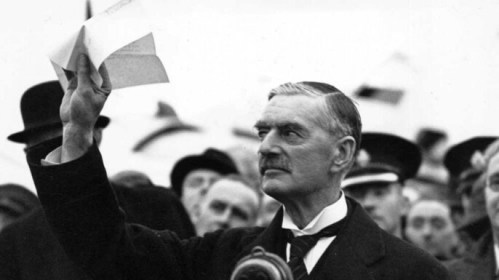
When Chamberlain flew back to London he alighted from his aircraft holding a piece of paper and said:

“The settlement of the Czechoslovakian problem, which has now been achieved is, in my view, only the prelude to a larger settlement in which all Europe may find peace. This morning I had another talk with the German Chancellor, Herr Hitler, and here is the paper which bears his name upon it as well as mine. Some of you, perhaps, have already heard what it contains but I would just like to read it to you: ” … We regard the agreement signed last night and the Anglo-German Naval Agreement as symbolic of the desire of our two peoples never to go to war with one another again.”

Chamberlain realized that his trust in Hitler and his word had been mistaken when Hitler overran the remainder of the Czech state just five months later. Having given up the only democracy in Eastern Europe which was also industrialized and militarily strong to the Nazis, Chamberlain went to war with Hitler over Poland, a authoritarian military dictatorship whose military and geographic position doomed her to the Nazi onslaught. Chamberlain finally did stand up to Hitler when it was too late. He was naive and in the case of Czechoslovakia he acted horribly, but he did recover some sense of honor by not appeasing Hitler in regard to Poland but by then it was too late and he has been forever remembered as an appeaser of Hitler.

Before Chamberlain surrendered Czechoslovakia to Hitler, General Ludwig Beck, Commander of the German Army wrote to the General Von Brauchtisch the War Minister to oppose the planned invasion:

“Now at stake are final decisions regarding the fate of the nation. History will burden these leaders with blood guilt if they do not act according to their professional and statesmanly principles and knowledge…. If a soldier in a position of highest authority in such times sees his duties and tasks only within the limits of his military responsibilities, without consciousness of his higher responsibility to the whole people, then he shows a lack of greatness, a lack of comprehension of responsibility. Extraordinary times demand extraordinary actions!”

That will not be the case for President Trump. He too has touted his “triumph” as something that will bring peace, but in the process he has betrayed an American ally whose freedom was purchased with the lives of close to 40,000 American soldiers, sailors, marines, and airmen and I do not see anyone in high command

Unfortunately the current American President has made war much more likely because he has not only sacrificed military exercises that strengthen the American-South Korean alliance with no actual concessions by Kim Jung Un. His actions not only strengthen the North Korean dictator but also strengthen Kim’s allies, the Russians and the Chinese. The Chinese have been actively working against the United States in the military and economic reams in Asia and Africa while Vladimir Putin’s Russia has actively pursued undermining democratic processes in the United States and Europe.

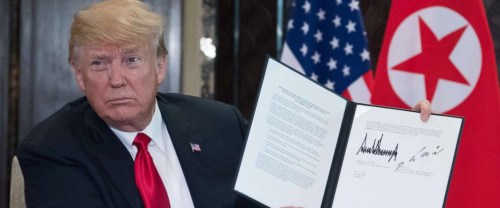
When Donald Trump returns from Asia he will hold up a piece of paper signed by Kim Jung Un and claim that he has brought peace to the world. He may even get a Noble Prize for doing so, but in the end he will sacrifice allies and bring war to the world while making the United States weaker and more vulnerable to our enemies. His actions are not those of a patriot, but a Quisling. His followers will never admit that and like Hitler’s true believers they would much rather die with him in their bunker than admit that they were wrong in the first place.

This is a dangerous time in history and the American Republic is in danger, our alliances which have been crafted with great skill since Franklin Roosevelt and Winston Churchill announced the Atlantic Charter, by Harry Truman, Dwight Eisenhower, John Kennedy, Lyndon Johnson, Richard Nixon, Gerald Ford, Jimmy Carter, Ronald Reagan, George H.W. Bush, Bill Clinton, George W. Bush, and Barak Obama over a period of 77 years have been shredded in less than a year and a half by President Trump.

The actions of the American President in the past 72 hours have endangered the United States and its allies. French Historian Marc Bloch wrote in his book Strange Defeat:

“A genuine alliance is something that has to be worked at all the time. It is not enough to have it set down on paper. It must draw the breath of life from a multiplicity of daily contacts which, taken together, knit the two parties solidly into a single whole. That truth had been too long forgotten at First Army H.Q., and we suffered terribly as a result of our negligence.”

Bloch, who served in the First World War and volunteered to serve in the Second World War would die at the hands of the Nazis while working with the French resistance understood what a minority of Americans do today,

I want peace on the Korean Peninsula, I have served there and been on the DMZ. That being said I do not want that peace to come at the cost of the freedom of South Koreans. Likewise, the President has praised the murderous dictatorship of Kim Jung Un and given that dictator a legitimacy that he does not deserve for a minute. Less than two days before he destroyed the G7 Summit and undermined the nation’s who have stood beside the United States throughout the Cold War and then with diplomacy, economic, and military assistance stood with us when we were attacked on September 11th 2001 to the present day.

On Tuesday the President endorsed Concentration camps, re-education centers, slave labor, and human rights violations by North Korea. Today he has claimed that North Korea no longer is a nuclear threat. His decision to end joint military exercises just happens to coincide with the public demands made for years by North Korea, Russia, and China. Do not expect for one moment that he will not do the same in this country, he has already started with immigrants. One should ask who will be next?

In 1938 Winston Churchill told the House of Commons:

“We have sustained a total, unmitigated defeat…. Do not let us blind ourselves. We must expect that all the countries of central and eastern Europe will make the best terms they can with the triumphant Nazi power…. The road down the Danube… the road to the Black Sea and Turkey, has been broken. It seems to me that all the countries of Mittel Europa and the Danube Valley, one after the other, will be drawn into the vast system of Nazi politics, not only power military politics, but power economic politics, radiating from Berlin.”

Until tomorrow,

Peace,

Padre Steve+

Leave a comment

Filed under Foreign Policy, History, leadership, national security, News and current events, Political Commentary

Repeating Historical Myths: The Trump Administration and the “Stab in the Back”

stab-in-the-back

Friends of Padre Steve’s World,

In light of the many flagrant lies, historical myths and conspiracy theories being floated by President Trump and his supporters  is always appropriate to look at examples of the power of those myths in the lives of nations and their influence on citizens.

It is true that some myths can be positive and inspiring so long as they remain recognized as myth. But myths which are believed as truth lead to conspiracy theories, false accusations and the demonization of others. The vast majority of the time this is done for the purpose of inciting hatred against political, social or religious opponents, or to justify indefensible polices at home or abroad.

Myths also can be used to perpetuate false beliefs about other countries that influence policy decisions, including the decision to go to war that ultimately doom those that believe them. There are many times in history where leaders of nations and peoples embrace myths about their history even when historical, biographical and archeological evidence points to an entirely different record.  Myths are powerful in the way that they inspire and motivate people. They can provide a cultural continuity as a people celebrates the key events and people that shaped their past, even if they are not entirely true.  At the same time myths can be dangerous when they cause leaders and people to make bad choices and actually become destructive.

A good example of this is the Stab in the Back myth that began after the armistice that ended the First World War, as well as the false beliefs held by Hitler and other Nazi leaders about the United States.

Just two days ago President Trump’s Chief Economic Advisor Larry Kudlow accused Canadian Prime Minister Justin Trudeau of “stabbing President Trump in the back” following the G7 meeting in Quebec. The choice of words was not only unfortunate but buttresses every action that the President has taken to delegitimatize faithful allies and partners since long before his inauguration.  In doing so he embraced an infamous term used so often by the Nazis and others on the German right following the defeat of Germany in the First World War.

After the war the belief that the German Army was not defeated but was betrayed by the German people, especially those of the political left.  Like all myths there was an element of truth in the “stab in the back” myth, there were revolts against the Monarchy of Kaiser Wilhelm II and even mutiny on elements of the German High Seas Fleet and Army units stationed in Germany. However the crisis had been brought about by General Ludendorff who until the last month of the war refused to tell the truth about the gravity of Germany’s position to those in the German government.

So when everything came crashing down in late October and early November 1918 the debacle came as a surprise to most Germans.  The myth arose because the truth had not been told by Ludendorff who was arguably the most powerful figure in Germany from 1916-1918.  In the looming crisis which included Ludendorff’s collapse and relief, General Wilhelm Groener presented the facts to the Kaiser and insisted on his abdication.  The Republic that was proclaimed on the 9th of November was saddled with the defeat and endured revolution, civil war and threats from the extreme left and right.  When it signed the Treaty of Versailles it accepted the sole responsibility of Germany for the war and its damages. Ordered to dismantle its military, cede territory that had not been lost in battle and pay massive reparations the legend of the “stab in the back” gained widespread acceptance in Germany.

Hitler always believed that the defeat of Germany in the First World War was due to the efforts of internal enemies of the German Reich on the home front and not due to the fact that the German army was collapsing, the U-Boat campaign had failed, and the Navy’s High Seas Fleet was hopelessly outnumbered and incapable of defeating the Royal Navy and breaking the blockade that was strangling Germany.

The Stab in the Back was a fundamental belief of Hitler and was expressed in his writings, speeches and actions.  The internal enemies of Germany for Hitler included the Jews, as well as the Socialists and Communists who he believed were at the heart of the collapse on the home front.  Gerhard Weinberg believes that the effect of this misguided belief on Hitler’s actions has “generally been ignored” by historians. (Germany, Hitler and World War II p. 196)

Hitler believed that those people and groups that perpetrated the “stab in the back” were “beguiled by the by the promises of President Wilson” (World in the Balance p.92) in his 14 Points.  Thus for him Americans were in part responsible for undermining the German home front, something that he would not allow to happen again.  In fact Hitler characterization of Wilson’s effect on the German people in speaking about South Tyrol.  It is representative of his belief about not only the loss of that region but the war: “South Tyrol was lost by those who, from within Germany, caused attrition at the front, and by the contamination of German thinking with the sham declarations of Woodrow Wilson.” (Hitler’s Second Book p.221)

While others will note Hitler’s lack of respect for the potential power of the United States, no other author that I am familiar with links Hitler’s actions and the reaction of the German political, military and diplomatic elites to the entry of the United States into the war to the underlying belief in the “stab in the back.”   Likewise Hitler had little regard for the military abilities or potential of the United States. Albert Speer notes that Hitler believed “the Americans had not played a very prominent role in the war of 1914-1918,” and that “they would certainly not withstand a great trial by fire, for their fighting qualities were low.” (Inside the Third Reich: Memoirs by Albert Speer p.121)

Hitler not only dismissed the capabilities of the Americans but also emphasized the distance that they were from Germany and saw no reason to fear the United States when “he anticipated major victories on the Eastern Front.” (Germany Hitler and World War II p.92)   Hitler’s attitude was reflected by the majority of the military high command and high Nazi officials. Ribbentrop believed that the Americans would be unable to wage war if it broke out “as they would never get their armies across the Atlantic.” (History of the German General Staff, Walter Goerlitz, p.408).  General Walter Warlimont notes the “ecstasy of rejoicing” found at Hitler’s headquarters after Pearl Harbor and the fact that the he and Jodl at OKW caught by surprise by Hitler’s declaration of war. (Inside Hitler’s Headquarters 1939-1945 pp.207-209) Kenneth Macksey notes Warlimont’s comments about Hitler’s beliefs; that Hitler “tended to dismiss American fighting qualities and industrial capability,” and that Hitler “regarded anyone who tried to show him such information [about growing American strength] as defeatist.”(Why the Germans Lose at War, Kenneth Macksey, p.153.)

Others like Field Marshal Erwin Rommel record the disregard of senior Nazis toward American capabilities in weaponry.  Quoting Goering who when Rommel discussed 40mm anti-aircraft guns on aircraft that were devastating his armored forces Goering replied “That’s impossible. The Americans only know how to make razor blades.” (The Rommel Papers edited by B.H. Liddell-Hart p.295) Rommel was one of the few German commanders who recognized the folly of Hitler’s declaration of war on the United States noting that “By declaring war on America, we had brought the entire American industrial potential into the service of Allied war production. We in Africa knew all about the quality of its achievements.” (The Rommel Papers p.296)

When one also takes into account the general disrespect of the German military for the fighting qualities of American soldiers though often with good reason (see Russell Weigley’s books Eisenhower’s Lieutenants and The American Way of War) one sees how the myth impacted German thought.  This is evidenced by the disparaging comments of the pre-war German military attaché to the United States; General Boeticher, on the American military, national character and capability. (See World in the Balance pp. 61-62)

The overall negative view held by many Germans in regard to the military and industrial power and potential of the United States reinforced other parts of the myth. Such false beliefs served to bolster belief in the stab-in-the back theory as certainly the Americans could not have played any important role in the German defeat save Wilson’s alleged demoralization of the German population.  This was true not only of Hitler, but by most of his retinue and the military, diplomatic and industrial leadership of the Reich. Hitler’s ultimate belief shaped by the stab-in-the back and reinforced by his racial views which held the United States to be an inferior mongrel people. This led him to disregard the impact that the United States could have in the war and ultimately influenced his decision to declare war on the United States, a decision that would be a key factor in the ultimate defeat of Germany.

Myth can have positive value, but myth which becomes toxic can and often does lead to tragic consequences. All societies have some degree of myth in relationship to their history including the United States.  The myths are not all the same, various subgroups within the society create their own myth surrounding historic events. The danger is that those myths can supplant reason in the minds of political, military, media and religious figures and lead those people into taking actions that work to their own detriment or even destruction.

Today the President leads the way in promoting lies patently false myths in the name of his personal greatness which he shrouds himself while conflating that with making America great again all the while endangering the country. He has been promoting conspiracy theories for nearly a decade and has never stopped doing so or offered an apology for those words.

It is the duty of historians, philosophers and others in the society to ensure that myth does not override reality to the point that it moves policy both domestic and foreign in a manner that is ultimately detrimental to the nation.  The lesson of history demonstrated by myths surrounding the German defeat and role of the United States in that defeat shows just how myth can drive a nation to irrational, evil and ultimately tragic actions not only for that nation and its people, but for the world.

Sadly, it appears that the United States led by President Trump is following the path of Hitler’s Germany in terms of how it views the world and treats other nations and history will not be kind to us.

Peace,

Padre Steve+

2 Comments

Filed under History, nazi germany, News and current events, Political Commentary, world war one

“It Can’t Happen Here” but it is Happening Before Our Eyes

img_0327

Friends of Padre Steve’s World,

In 1935 the American writer Sinclair Lewis wrote a novel called It Can’t Happen Here. It was a semi-satirical novel about a Fascist state coming to power in the United States. In it Lewis wrote these words:

“A country that tolerates evil means- evil manners, standards of ethics-for a generation, will be so poisoned that it never will have any good end.”

I believe that we are seeing that happen before our eyes. That being said I realized from the beginning of the Trump campaign that it would to this at home and abroad. I was looking back at my archives going even back to 2012 after President Obama’s re-election and found that I had written about Trump’s maniacal desire to upend defy political and social norms and demonstrate his contempt for the Constitution and our laws. When he announced his campaign he began by appealing to nationalism and racism and he never stopped.

On December 15th 2015 I wrote these words in an article entitled The Mob Determined the Theme. Some people thought that I was writing about the Mafia or gangs, but I was talking about mob rule. Those words are here:

“When Albert Speer discussed the ability of Adolf Hitler to captivate the German people he noted something important. He discussed how Hitler and his minions played to them set by the disgruntled and angry German population. Speer wrote, “The mob determined the theme. To compensate for misery, insecurity, unemployment, and hopelessness, this anonymous assemblage wallowed for hours at a time in obsessions, savagery and license. The personal unhappiness caused by the breakdown of the economy was replaced by a frenzy that demanded victims. By lashing out at their opponents and vilifying the Jews, they gave expression and direction to fierce primal passions.”

Hitler played to that misery, insecurity and the obsessions of the politically and economically disaffected “conservative base” that no longer trusted the party establishments of the old-line conservative parties. He also played to the deep-rooted racism and anti-Semitism of those people. Hitler was an outsider, he was not indebted to any traditional party hierarchy and as such was able to throw away convention and play to the fear and anger of many Germans.

heres-what-donald-trump-supporters-really-believe

Donald Trump is doing today and he is running circles around the traditional politicians of the Republican Party. Every time trump says something that would have gotten himself blown out of the race twenty years ago had he said such things, today his poll numbers keep going up. He is now trending around 35% in most polls of GOP voters and my guess is that those numbers are low, as some supporters may not be willing to tell a pollster that they are for Trump, at least yet. My guess is that Trump’s support in the GOP is probably higher than 40% and won’t go down much. The party hierarchy and most of Trump’s primary rivals consistently criticize Trump, but most say that they will back him if he is the nominee. I cannot imagine that being the case twenty years ago when both the party establishment and the voters would have dumped him in a New York minute.

Aug. 21. 2015 Mobile, AL, Trump supporters at his campaign pep rally in Ladd Peebles Stadium. These women are all party of the Republican Party and plan to vote for Trump.  Over 20 thousand came to the Ladd-Peebles Stadium to attend Trumps campaign pep rally. 40,000 were expected to come.

Trump understands the mood of much of the traditionally conservative public better than his Republican establishment competitors. Trump is not stupid, unlike Hitler who actually believed in his message, Trump is not a radical, he cannot be, he has too much invested in the system. Instead, he is a street smart and pragmatic businessman who is exploiting the situation on the ground to his advantage. His opponents and the GOP establishment are frightened, but like the hidebound conservatives of the Weimar Republic who either dismissed or Hitler or thought that they could contain him are not willing to make a stand. As a result, Trump is able to play to the mood of the base and to coin a phrase, to “trump the establishment” by channeling the deepest anger, fear, hatred, xenophobia, and racism that the GOP establishment refuses to acknowledge. When there is a push back by the establishment it further angers the base, and Trump, quite adroitly threatens to leave the party; something which would doom the GOP in the 2016 general election, and possibly shatter the party.

Trump’s GOP opponents should not underestimate him and neither should establishment Democrats. Trump is using his celebrity bombast and the democratic process to take control of a major political party, and he is a lot smarter than most political analysts give him credit. As such, as a non-establishment outsider, Trump has a chance at taking over a major political party, something that has never before happened in the United States.

If he succeeds in his takeover bid, it will forever change American politics, especially if he is able to ride the fear, hatred, and fear to the White House. I don’t think the latter will happen, but I would not exclude it from the realm of the possible. To paraphrase Speer’s words about Hitler and Goebbels: By lashing out at their opponents and vilifying the Muslims and immigrants, Trump gave expression and direction to fierce primal passions of a disaffected GOP base.”

That was in 2015.

On July 22nd 2017 I wrote I Alone Can Fix It: Trump’s Dictatorial Message as I observed the new GOP nominee at the GOP National Convention. Five months later I wrote on December 27th 2016 I wrote Freedom is Never More than a Generation from Extinction. On March 22nd of this year I wrote Trump’s America: Saving the Form But not the Soul. I could go on and link many other articles but I will not, I have incriminated myself enough tonight.

Now that Donald Trump is in power he has used the Department of Homeland Security through a militarized ICE using mass incarcerations, expulsions, separating children from their families, and operating prison facilities from which people who are not with any crime charged are held indefinitely without legal representation. He has opening given support to White Supremacists including Neo-Nazis. He continues to threaten the Press, the political opposition, and long time allies using his Twitter account and his sycophants at Fox News and a multitude of Right Wing propaganda outlets to peddle lies as truth label those who tell the truth as liars and peddlers of Fake News.

He shows no interest in Civil Rights except support measures at the Federal, State, and local levels to roll back civil rights for ethnic, racial, and religious minorities, women, and LGBTQ people. His economic and social policies are designed to benefit his allies, especially the top 1% and politically reliable Evangelical Christians while impoverishing and disenfranchising all others. He labels all who oppose or criticize him and his policies as enemies of the state and traitors.

In terms of foreign policy he has during the course of his presidency personally undermined and now destroyed alliances and treaties that Presidents from Franklin Roosevelt to Barak Obama worked to sustain. Those Presidents who included Dwight Eisenhower and Ronald Reagan helped build those alliances and forge those treaties for our good and the good of our allies and those who we welcomed into the fold of democratic ideals. Instead he makes diplomatic war on our allies while openly praising dictators abroad and carrying out the dictates of Vladimir Putin.

This brings me back to his attacks on the American Justice system of which almost all are tied to his, his family’s, and his advisor’s connection with Russia attempts to undermine American elections and the military attack and occupation of parts of the Ukraine, which during his campaign he supported by saying that the conquered Ukrainian regions “probably preferred Russian rule.” Neither before or after his election did he, his aides ever condemn the shoot-down of a commercial airliner by Russian forces near the Russian-Ukrainian border. The actions in the Ukraine led the G-7 to expel Russia. This weekend the President proposed reinstating the Russians despite the fact that they are still actively working against the United States and our Allies.

He is launching a trade war with our allies and leading trading partners which will be disastrous to most Americans.

Later today he will attempt to “negotiate a deal” with the North Korean dictator Kim Jung Un while admitting that he has done no preparation for it. I would hope for a lasting peace on the Korean Peninsula but I believe that the President will either come back with a deal that works to the advantage of the North Koreans or which will fail and bring about war in Northeast Asia. If he does come up with a deal it is very possible that he will use it as a means to go to war against Iran which will result in an apocalyptic conflagration in the Middle-East.

As he does all of this he surrounds himself with terrified yes men who are too afraid of him to tell the truth while increasing his attacks on the law, the Constitution, and people that he sees as his personal enemies at home and abroad. As I watch him and read what he writes I am reminded of Winston Churchill’s who wrote:

“You see these dictators on their pedestals, surrounded by the bayonets of their soldiers and the truncheons of their police … yet in their hearts there is unspoken fear. They are afraid of words and thoughts: words spoken abroad, thoughts stirring at home — all the more powerful because forbidden — terrify them. A little mouse of thought appears in the room, and even the mightiest potentates are thrown into panic.” 

The President’s aggressiveness is not brought about by confidence, it is brought about by his fear, he cannot abide criticism of any kind, thus he must crush it.

I fear for what is coming and I am not sure if our institutions, laws, or Constitution will survive in any recognizable form. I want them to, but right now I do not see light at the end of this tunnel, and I would much rather be wrong than right.

Until tomorrow,

Peace

Padre Steve+


2 Comments

Filed under civil rights, ethics, Foreign Policy, History, laws and legislation, leadership, News and current events, Political Commentary

A Cautionary Tale of Soldierly Obedience: The Fate of the Desert Fox

rommel

Friends of Padre Steve’s World,

Some seventy-three years ago in Ulm Germany that a car pulled up to the residence of Field Marshal Erwin Rommel. In the car was the driver and two Generals dispatched by Hitler who had orders to give the hero of Germany a choice, death by suicide or a trial before the kangaroo “People’s Court” of judge Roland Freisler.  Rommel was recuperating following being severely wounded in an air attack in Normandy on July 17th 1944.

Rommel had been awarded the Pour le Merite, Imperial Germany’s highest award for valor in the First World War. He was never an official member of the Nazi Party, but like many Germans he believed Hitler’s promises and propaganda. As Hitler rose to power he like many others was carried away by early Nazi successes, the bloodless conquests of the Rhineland, Austria, Czechoslovakia, and the spectacle of the Olympics.

Like most other officers he would serve the regime as it spread its dark pall over Europe, and unlike so many others when he suffered a crisis in conscience about the Nazi leadership and their policies he refused to obey orders that he knew were illegal and immoral and then risked his life by joining the conspiracy to kill Hitler.

After years of stalled promotion, Hitler’s expansion of the military allowed Rommel to be promoted, and when Germany went to war he was commander of the unit which guarded Hitler’s headquarters train when he went into Poland. Rommel received command of the 7th Panzer Division after Poland and as a division commander in France he led his troops on some of the most epic advances of the French campaign.

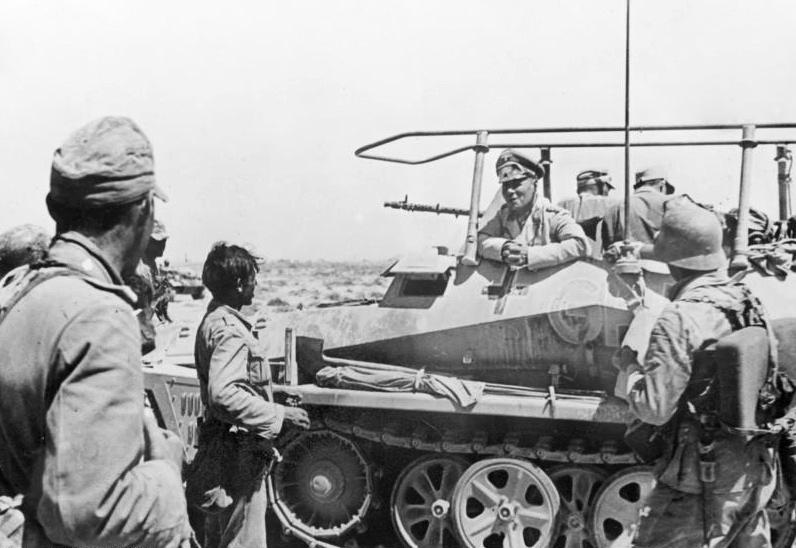
He was then given command of the troops sent to bail out Mussolini’s failed African adventure. His small force and always ill-supplied force, which became known as the Afrika Korps scored impressive victories against British forces. In Africa, Rommel gained fame and earned rapid promotion. Though Africa was a sideshow in the Nazi war effort, Rommel became a poster-child for Joseph Goebbels’ propaganda machine. His fame also earned the resentment of many fellow officers who because he was not an officer of the General Staff regarded him with jealous envy and distain. Even so, Rommel was a soldier’s soldier. He believed in sharing in the suffering of his troops. He once said: “Be an example to your men in your duty and in private life. Never spare yourself, and let the troops see that you don’t in your endurance of fatigue and privation. Always be tactful and well-mannered, and teach your subordinates to be the same. Avoid excessive sharpness or harshness of voice, which usually indicates the man who has shortcomings of his own to hide.”

bundesarchiv_bild_146-1991-031-25a_nordafrika_vor_tobruk_rommel

In Arica Rommel showed himself to be a remarkable tactician and field commander. Likewise, unlike many other German (and sadly Allied) commanders had the ability to recognize the valor and soldierly virtues of his opponents, even those who were not white. A captured South African officer pleaded with Rommel to spare him being imprisoned with Black troops under his command. Rommel told him:

“For me, soldiers are all equal. Those black people wore your same uniform, fought on your side, and so you will be in the same jail.”

That was not until Rommel discovered the reality of Hitler’s promises as the troops of the Afrika Corps were hollow that he began to understand the man he had sworn his allegiance. He and his gallant German and Italian soldiers found themselves subjected to constant privation from lack of supply, air support and reinforcements. As commander of the Afrika Corps and later the Panzer Armee Arfika he and his troops achieved amazing success against an enemy that was always better supplied and equipped and which had air and sea superiority. Battling the British as well as the political machinations of Mussolini and Germany’s Italian Allies as well as opponents in the German government such as Hermann Goering, Rommel saw his troops crushed under the press of the British as well as the Americans who landed in French North Africa. Eventually, sick and worn out, Rommel was sent back to Germany to recuperate.

While visiting Hitler’s headquarters during that leave Rommel was struck by the atmosphere and made this observation:

“During the conference I realised that the atmosphere in the Fuehrer’s H.Q,. was extremely optimistic. Goering in particular was inclined to minimise our difficulties. When I said that British fighter-bombers had shot up my tanks with 4O-mm. shells, the Reichsmarschall, who felt himself touched by this, said: ” That’s completely impossible. The Americans only know how to make razor blades.” I replied: “We could do with some of those razor blades, Herr Reichsmarschall.”

rommel-with-soldier

Rommel had a sense of honor and humanity that many other German generals lacked. He refused to allow anti-Jewish measures in areas occupied by German troops in North Africa, ensuring that the approximately 425,000 Jews living in Libya, Tunisia, Algeria, and Morocco were spared the fate of the Holocaust. He refused to execute Jewish POWs, and refused to follow the notorious “commando order.” In June of 1994 he protested the massacre of the people of the village of Oradour-sur-Glane by units of the 2nd SS Panzer Division directly to Hitler and asked for the authority to punish those responsible, but was his protest was refused.

In late 1943 and early 1944 Rommel began to learn of the mass killings being orchestrated by Himmler’s SS. His son Manfred asked his father’s permission to join the Waffen SS, which Rommel insisted that he not do, the younger Rommel recounted:

“While, he said, he perfectly well recognised the quality of the S.S. troops, under no circumstances did he want me to be under the command of a man who, according to his information, was carrying out mass killings. ” Do you mean Himmler? ” I asked. ” Yes,” he answered, and instructed me to maintain absolute silence about the whole affair. The war was not going at all well and he had heard that people like Himmler were trying, by actions of this kind, to burn the bridges of the German people behind them. I think he was not at all certain at that time whether Hitler knew anything about what was going on, for no mention of the mass executions had ever been made at the Fuehrer’s H.Q. And perhaps he would never have brought himself to the decision to end the war -by a revolt if necessary -if he had not received further information in the early months of 1944 which confirmed these crimes and gave some idea of their extent. From that moment on, all my father’s inner allegiance to Adolf Hitler, whom he had once admired, was destroyed, and he brought himself, from his knowledge of the Fuehrer’s crimes, to act against him.”

His honest assessments of the chances of the Germans winning the war which he spoke candidly to Hitler and the High Command made him persona non grata in Berlin and Berchtesgaden. In the time before he was posted to France in late 1943 he became a part of the plot to end the war and overthrow Hitler. Rommel’s Chief of Staff at OB West, General Hans Speidel, was a key man in the conspiracy and Rommel had contacts with a number of key conspirators. He believed that the war was lost unless his forces could repel the coming Allied invasion on the beaches and worked feverishly to bolster the beach fortifications. He recommended that the Panzer Divisions be deployed near the coast where they could immediately counterattack Allied invasion forces while they were still vulnerable. But his advice was not taken. He was given command of the Army Group but was not given control of most of the Panzer Divisions, which Hitler kept under his direct control.

When the invasion came Rommel was away from Normandy visiting his wife. On learning of the invasion he sped back to Normandy. When he arrived he fought a desperate battle against the Allied forces. His outnumbered forces were under constant assault from the land, sea and air received paltry reinforcements compared to the Allies. Even so, German troops inflicted many local defeats and exacted a heavy price in allied blood in Normandy but were ground to dust. Even so, many American and British infantry regiments suffered 100% casualties but remained in action because of a continuous stream of replacements. Rommel urged Hitler and the High Command to withdraw German forces from Normandy before the allies broke through his front. By doing so he found that he was now considered a defeatist.

Rommel was severely wounded in an air attack on his vehicle by a just days before the attempt on Hitler’s life. Hitler survived the attempted assassination and exacted a terrible revenge on anyone connected with the plot. Show trials and public hangings of officers who had served valiantly at the front were common. Thousands were killed and thousands more imprisoned.

Eventually, other conspirator’s testimony exposed that Rommel was part of the plot. He was recommended by the “Court of Military Honor” to be expelled from the military and tried by the “People’s Court” of Judge Roland Freisler. During the purge that followed the attempt on Hitler’s life, many noted German military commanders were hauled before this court and humiliated by Freisler before they were sent to their deaths. Freisler, a fanatic Nazi judge has been part of the infamous Wansee Conference which planned the details of the Final Solution was killed when his courtroom was bombed in February 1945.

Because of his fame and popularity in Germany Hitler was decided to offer Rommel a choice of being tried by the People’s Court or committing suicide and ensuring his family’s safety. Hitler dispatched two generals from Berlin to personally deliver the message.

492px-Erwin_rommel_death

Rommel suspected that he would be identified and killed and told that to his friends and family in the days leading up to the arrival of Generals Wilhelm Burgorf and Ernst Maisel from OKW with the ultimatum. They met with Rommel for a short time before giving him the opportunity to say goodbye to his family. Rommel told them of his choice and left his home for the last time. 15 minutes later the Generals called his wife to say that he had died of a heart attack. Rommel was given a state funeral and the German people were lied to about his cause of his death.

Winston Churchill wrote of Rommel:

“He also deserves our respect because, although a loyal German soldier, he came to hate Hitler and all his works, and took part in the conspiracy to rescue Germany by displacing the maniac and tyrant. For this, he paid the forfeit of his life. In the sombre wars of modern democracy, chivalry finds no place … Still, I do not regret or retract the tribute I paid to Rommel, unfashionable though it was judged.”

Rommel was just 52 years old when he died. I find in the story of Rommel some commonality in my own life. Before Rommel went to Africa he believed that Germany would win the war, during his command there he discovered that what he believed was lies and that Hitler had little regard for him or his troops. Before I went to Iraq in 2007 I believed much of the political propaganda promoted by the Bush administration and right wing news media and pundits about that war.

The example of Erwin Rommel is a cautionary tale of what can happen when a brilliant and honorable man comes under the spell of a demagogue. Rommel believed Hitler and blindly followed him until he ran into the hard face of reality in Africa at which point he had the moral courage to do the right thing, but many didn’t.

Sadly there are otherwise honorable men and women in the current United States military who are blindly supporting a delusional and quite probably criminal President;  a man who promises to order soldiers to commit war crimes, who threatens to jail political opponents, who condemns whole races of people and religions, a man who has no respect for the courts, the law, or the Constitution.  Personally as a historian I cannot understand that kind of blind loyalty especially when the the leader in question has no loyalty to anyone other than himself. Not long before he was killed Rommel told his son:

“one thing is quite clear, it’s intolerable that the fate and welfare of a whole nation should depend on the whim of a small group. There must be some limit, otherwise, the most fantastic things can happen without anyone noticing.”

Peace,

Padre Steve+

Leave a comment

Filed under History, leadership, Military, nazi germany, world war two in europe

The Longest Day and Afterwards: D-Day and the Normandy Campaign, an Introduction

The author with Marines at Point du Hoc, Normandy in 2004

Friends of Padre Steve’s World,

Every year about this time I try to write about D-Day.  This year I spent more time on the Battle of Midway writing or rewriting a total of five articles.

Since we are now about to begin a time of major repairs to our home due to flooding from an plugged air conditioning condensation drains I have decided to do is to re-post a short research paper that I did for one of my Master’s degree courses tonight, actually posting it on Sunday night for publication today, and hope to follow it up with some more articles over the week on specific aspects and personalities of the campaign.  What I hope is that people that are not familiar with the campaign as well as those that are can use this as a portal to other resources on the web and in print.

I have visited Normandy once in 2004 on a trip with the Marines of the Marine Security Force Company Europe that took me to Belleau Wood as well as Normandy.  In both places I had the good fortune to be able to explain aspects of both battles, at Normandy discussing the invasion from the German side of the fence.  The Normandy battlefields are well worth visiting.  Hopefully in the next few years I will get a chance to go back and do some serious exploring.

Introduction

General Dwight D Eisenhower Commander in Chief Allied Forces Europe

The American landings on Omaha Beach were critical to the success of the Allied invasion northwestern Europe in the overall Overlord plan.  Without success at Omaha there would have been a strong chance that the German 7th Army and Panzer Group West could have isolated the remaining beachheads, and even if unsuccessful at throwing the Allies into the sea could have produced a stalemate that would have bled the Allies white.  This quite possibly could have led to a political and military debacle for the western allies which would have certainly changed the course of World War II and maybe the course of history.[i] This is not to say the Germans would have won the war, but merely to state that a defeat on Omaha could have changed the outcomes of the war significantly.   Subsequent to the successful landing there were opportunities both for the Allies and the Germans to change the way that the campaign unfolded, thus the battles leading up to the breakout at Avranches are critical to its development and the subsequent campaign in France.

OVERLORD: The Preparations

Eisenhower’s Key Lieutenants: Patton, Bradley and Montgomery

The planning for the Normandy invasion began in earnest after the QUADRANT conference in Quebec in August 1943.  The timetable for the operation was established at the Tehran conference where Stalin sided with the Americans on the need for an invasion of France in the spring of 1944.[ii] Prior to this there had been some planning by both the British and Americans for the eventual invasion initially named ROUNDUP.  These preparations and plans included a large scale raid at Dieppe in 1942 which ended in disaster but which provided needed experience in what not to do in an amphibious assault on a heavily defended beach.        The failure at Dieppe also darkened the mood of the Allies, the British in particular to the success of such operations, bringing to mind the failed Gallipoli campaign of 1915 as well as the opposed landings at Salerno and the USMC experience at Tarawa.[iii] Despite this the Americans led by General Marshall pushed for an early invasion of northwest Europe. Churchill and the British due to their weakness in land power pushed for land operations in the Mediterranean, and even in Norway as an option to the assault in France. The conflicted mindset of the Allies left them in the position of planning almost exclusively for the success of the initial landings and build up to the near exclusion of planning for the subsequent campaign once they landed. This especially included what one writer described as “the maze of troubles awaiting behind the French shore.”[iv]

Field Marshal Erwin Rommel, Commander of Army Group B

Despite conflicts between the Americans and British political and military leadership the planning for the Normandy landings detailed in NEPTUNE and OVERLORD moved ahead.  General Dwight Eisenhower was appointed as the commander of SHAEF with his major subordinates for Land, Air and Sea which caused consternation on both sides of the Atlantic.[v] [vi] The planned operation was expanded from the initial 3 division assault on a narrow front to a minimum 5 division assault on a broad front across Normandy[vii]supplemented by a strong airborne force.[viii] Overall the plan as it developed reflected a distinctly “American willingness to confront the enemy head-on in a collision which Britain’s leaders had sought for so long to defer.”[ix] It is ironic in a sense that the British avoidance of the head on attack was based on their known lack of manpower.  Britain had few infantry reserves to sustain the war effort and the Americans only late recognized their own deficiency in both quantity and quality of infantry forces on which their strategy depended.  That the western allies, so rich in material and natural resources would be so deficient in infantry manpower was a key constraint on the subsequent campaign in France and Germany.  The shortage of infantry forces would cause great consternation among the Allies as the campaign in France wore on.

German Beach Obstacles

The Germans too faced manpower shortages due to the immense losses sustained on the Eastern front, those lost in Africa and those tied down in Italy, the Balkans and Norway as well as the drain caused by Luftwaffe Field Divisions and troops diverted into the Waffen-SS.   The German Army resorted to smaller divisions and the created many “static” divisions manned by elderly or invalid Germans to plug the gaps along the Atlantic wall. The Germans were also forced to recruit “Volksdeutsch” and foreign “volunteers” to fill out both Wehrmacht and Waffen-SS formations.

German fortifications at the Pas de Calais

Prior to the final decision to mount an invasion the Allied planners had contended with the location of the assault in northwestern France.  The Pas de Calais provided a direct route was rejected because it was where the Germans would expect the strike to occur and because it was where the German defenses were strongest.  The fiasco at Dieppe had provided ample proof of what could happen when making an assault into a heavily fortified port.  Likewise the mouth of the Seine near Le Harve was rejected because of the few beaches suitable for landing and because the forces would be split on both sides of the river.  Brittany was excluded due to its distance from the campaigns objectives in Germany.[x]This left Normandy which offered access to a sufficient number of ports and offered some protection from the weather. Normandy offered options to advance the campaign toward the “Breton ports or Le Harve as might be convenient.”[xi] Omaha beach, situated on the center right of the strike would be crucial to the success of the assault situated to the left of UTAH and the right of the British beaches.

Rommel inspecting beach obstacles

Once Normandy was selected as the location for the strike by the Allies, the planning sessions remained contentious.  This was especially true when the Allies debated the amount and type of amphibious lift that could be provided for the landings, particularly the larger types of landing ships and craft to support the Normandy invasion and the planned invasion of southern France, Operation ANVIL.  The increase in OVERLORD requirements for landing craft had an impact in the Mediterranean and resulted in ANVIL being postponed until later in the summer.

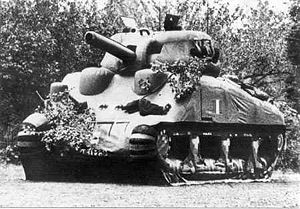
“Dummy” Sherman Tank: The Allies created a fictional Army Group to deceive German planners

As part of their preparations the Allies launched a massive deception campaign, Operation FORTITUDE.  This operation utilized the fictitious First Army Group under the “command” of General George Patton. Patton was still smarting from his relief of command of 7th Army following slapping commanded an “Army Group” which incorporated the use of dummy camp sites, dummy tanks, aircraft and vehicles, falsified orders of battle and communications to deceive German intelligence.[xii] The success of this effort was heightened by the fact that all German intelligence agents in the U.K. had been neutralized or turned by the British secret service.  Additionally the Luftwaffe’s limited air reconnaissance could only confirm the pre-invasion build ups throughout England without determining the target of the invasion.[xiii] The German intelligence chief in the west, Colonel Baron von Roenne “was deceived by FORTITUDE’s fantasy invasion force for the Pas de Calais.”[xiv] Despite this Commander of the 7thArmy recognized by 1943 that Normandy was a likely Allied target and efforts were made to shift 7th Army’s center of gravity from Brittany to Normandy.  The one potential German success in getting wind of when the Allied landings would occur was lost when German intelligence discovered two lines of Verlaine’s “Chason d’ Automme” in June 1944 which were to alert the French Resistance of the invasion.  The security section of 15th Army heard them transmitted on the afternoon of 5 June and notified General Jodl at OKW, but no action was taken to alert forces on the coast.[xv] Allied intelligence was aided by ULTRA intercepts of coded German wireless transmissions. However this was less of a factor than during the African and Italian campaigns as more German communications were sent via secure telephone and telegraph lines vice wireless.[xvi] Allied deception efforts were for the most part successful in identifying German forces deployed in Normandy. However they were uncertain about the location of the 352nd Infantry Division which had been deployed along OMAHA and taken units of the 709th Infantry Division under its command when it moved to the coast.[xvii]

USAAF B-17 Bombers and others helped isolate German forces in Normandy by bombing railroads, bridges, and supply lines

The Allied air campaign leading up to the invasion was based on attempting to isolate the invasion site from German reinforcements. Leigh-Mallory the Air Chief developed the “TRANSPORTATION PLAN” which focused efforts on destroying the French railroad infrastructure.[xviii] A more effective effort was led by General Brereton and his Ninth Air Force which was composed of medium bombers and fighters.  Brereton’s aircraft attacked bridges and rapidly achieved success in crippling German efforts to reinforce Normandy.[xix] Max Hastings gives more credit to the American bombing campaign in Germany to crippling the German defense in the west. General Spaatz and the 8th Air Force destroyed German production capacity in oil and petroleum as well as the degraded the German fighter force.  The American daylight raids so seriously degraded the German fighter force that it could not mount effective resistance to the invasion.[xx] Russell Weigley also notes that Albert Speer the Reich Armaments Minister said that “it was the oil raids of 1944 that decided the war.”[xxi]


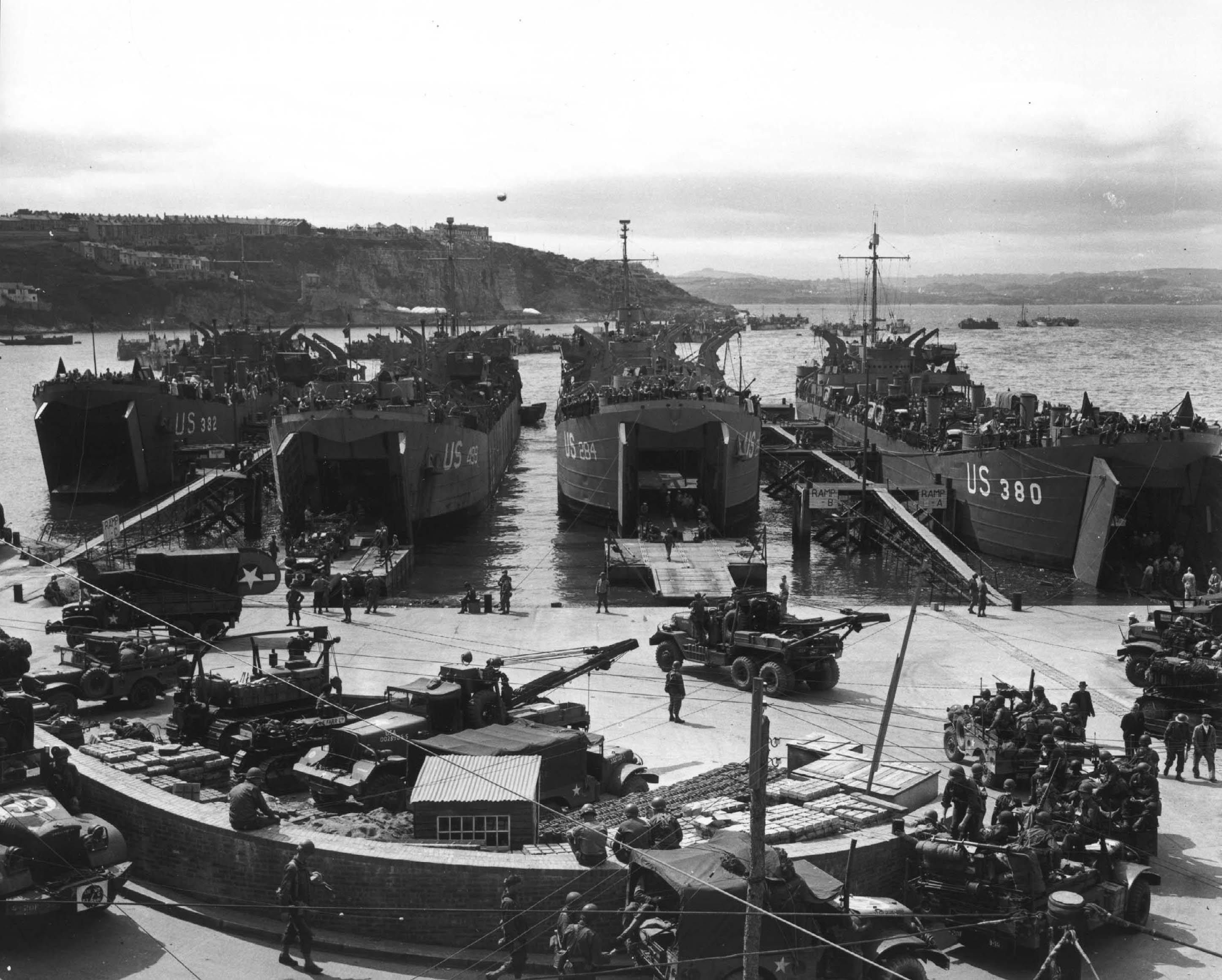
US Navy LST’s being loaded for the invasion

Planning and preparations for OMAHA were based around getting the 1st and 29th Infantry Divisions ashore and them securing a beachhead “twenty-five kilometers wide and eight or nine kilometers deep.”[xxii] American preparations were thorough and ambitious, but the American assault would go through the most heavily defended sector of German defenses in Normandy.  The landing beaches were wide and bordered by dunes which were nearly impassable to vehicles and “scrub covered bluffs thirty to fifty meters high…rough and impassable to vehicles even to tracked vehicles except at a few places.  The exits were unimproved roads running through four or five draws that cut the bluffs.”[xxiii] Dug in along those bluffs was the better part of the 352nd Division. The Americans compounded their selection of a difficult and heavily defended landing zone the Americans failed to take advantage of many of the “gadgets” that were offered by the British which in hindsight could have aided the Americans greatly.  The Americans made use of two battalions of DD (Dual Drive) tanks but turned down the offer of flail tanks, flamethrower tanks, and engineer tanks, the “funnies” developed by General Hobart and the British 79th Armored Division.[xxiv]

Dual Drive amphibious tanks were included as part of the US invasion package

Weigley believes that the American view of “tanks as instruments of mobility rather than of breakthrough power.” Likewise the Americans victories in the First World War were won by infantry with little tank support.[xxv] In this aspect the Americans were less receptive to utilizing all available technology to support their landings, something that when considering the fact that Americans were great lovers of gadgets and technology. The British use of the Armor, including the “Funnies” on the beaches to provide direct fire into German strong points lessened their infantry casualties on D-Day. Due to this lack of armor support on the beach American forces on OMAHA had little opportunity to exercise true combined arms operations during the initial landings.[xxvi]


Rommel with Artillerymen of the 21st Panzer Division in Normandy

German preparations for an Allied landing in Normandy were less advanced than the Pas de Calais.  However they had made great strides since late 1943. Field Marshal Rommel greatly increased defensive preparations along the front, including the Normandy beaches.  One of Rommel’s initiatives was to deploy Panzer Divisions near the coast where they could rapidly respond to an invasion.  However Rommel did not get everything that he wanted.  The OKW only allotted him two Panzer Divisions to be deployed near the Normandy beaches.  Only one of these the 21st Panzer Division was deployed near Caen in the British sector.  One wonders the result had the 12th SS Panzer Division been deployed behind OMAHA. [xxvii]

OMAHA: The Landings

The venerable USS Nevada, resurrected from the mud of Pearl Harbor bombarding German positions at Utah Beach

Like the rest of the Allied invasion forces the 1st and 29th U.S. Infantry Divisions set sail from their embarkation ports with the intent of landing on June 5th.  General Bradley, commanding the First Army until the American XII Army Group would be activated accompanied the invasion force.  The OMAHA landing was under the command of General Gerow and his V Corps while VII Corps led by the 4th Infantry Division landed at Utah supported by airdrops of the 82nd and 101st Airborne Divisions inland.  American command and control during the invasion was exercised from sea as in the Pacific, although General Officers were to go ashore with each of the American divisions.  A severe channel storm disrupted the plan to land on the 5th and Eisenhower delayed the invasion one day catching a break in the weather and electing to go on the 6th.[xxviii] This delay while uncomfortable for the embarked troops caused the Germans to believe that no invasion would take place until the next favorable tide and moon cycle later in the month.[xxix] The assumption that no invasion was possible ensured that a number of key senior German leaders, including Rommel were absent from the invasion front when the Allies landed.[xxx]

US Troops ride a LCVP toward Omaha 

The landing beaches at OMAHA stretched about 6500 meters from Colleville-Sur-Mer to Vierville-Sur-Mere in the west.  The beaches are wide with bluffs overlooking them and a seawall between the beaches and the bluffs.  Additionally several small towns dot the beach. To the west of the town of Vierville, a prominent height overlooked the entire beachhead.  Named Pont du Hoc, it was believed to house a 150mm battery sighted where it could enfilade the OMAHA landing zones.  The Americans assigned to the 2nd Ranger Battalion to make a seaborne assault to land, scale the cliffs and take the battery.  Companies from this battalion made a heroic landing and scaled the cliffs to capture the strongpoint only to discover that the guns had not been emplaced.  The Rangers took heavy casualties and held their isolated beachhead against German counterattacks until relieved by the 29th Division on the morning of June 8th.[xxxi]
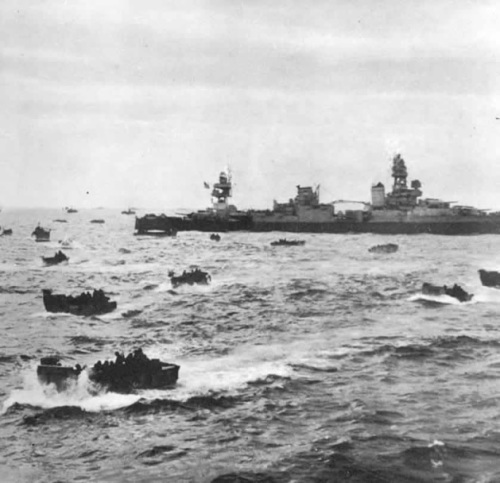
Landing craft passing the USS Augusta in heavy seas heading toward Omaha Beach

H-Hour for OMAHA was 0630.  Unfortunately the assault troops were transferred to their LCVP landing craft 16-20 kilometers from the beach.  The result was a long and dangerous ride in the small craft for the infantry.  Most of the infantry were completely soaked in sea spay and seasick before going ashore and they carried loads far above what they normally would carry into battle.[xxxii] The Armor support was one battalion of DD tanks, the 741stArmored Battalion, supporting the 16th Infantry Regiment of 1st Infantry Division. These were also launched too far out and nearly all of the tanks were swamped and lost before firing a shot in anger.[xxxiii] Other American support units needed to provide firepower on the beach were equally unfortunate. Weigley notes that at OMAHA “at least 10 of the LCVPs sank” as did “the craft carrying almost all of the 105mm howitzers that were to be the first artillery ashore after the tanks.”[xxxiv] The losses would cripple the assault on OMAHA and nearly cause its abandonment.

Bloody Omaha

As the soldiers of the American divisions on OMAHA came ashore they faced German defenders of the 352nd, 716th and a regiment of the 709th Infantry Division, the latter under the tactical command of the 352nd.   Without the bulk of their tanks artillery and lacking close air support the Americans struggled across the beaches and were cut down in large numbers before being pinned down behind the sea wall.[xxxv] With the Americans pinned down on the beach unable to advance, the time tables for the reinforcing waves became snarled amid the German beach obstacles which had not been cleared.  This was in large part due to 40% casualties among the Combat Engineers and the loss of all but five bulldozers.[xxxvi] Naval officers were frustrated in their attempts to provide naval gunfire support by the lack of identifiable targets on the beaches.  Yet German strongpoint’s were “knocked out by either by superbly directed vigorous gunfire from destroyers steaming as close as 800 yards offshore, or by determined action from Rangers or infantry.[xxxvii]


US Infantry struggles ashore at Omaha

Soldiers ashore discovered that they were not facing the static 716th Division but the veteran 352nd Division as well.[xxxviii] Only the leadership and actions of Brigadier General Norman Cota the 29th Division’s Deputy Commander and Colonel Charles Canham of the 116th Infantry kept the situation from complete collapse.  They were able to rally their troops. Under their leadership small units from the 116th which had its linage back to the “Stonewall Brigade” as well as elements of the 16th and 18th Infantry Regiments began to move forward.  Surviving junior leaders began to lead survivors through the dunes and up the bluffs to attack German defenders of the roads leading up from the beach from the flank and rear.  A mid-day break in the weather allowed some close tactical air support giving the troops badly needed support.

US 1st Infantry Division Troops at the Omaha sea wall

With the situation desperate General Bradley considered the evacuation of OMAHA.  At sea events were as confused as Bradley and his staff attempted to make sense of what was going on.  Even later in the evening there was discussion of diverting all further reinforcements from OMAHA to the British beaches.[xxxix]At 1330 hours “Gerow signaled Bradley: “Troops formerly pinned down on beaches…advancing up heights behind beaches.”[xl] By the end of the day Bradley’s aid Major Hansen noted Bradley’s comments to Collins: “They are digging in on Omaha beach with their fingernails. I hope they can push in and get some stuff ashore.”  And Montgomery: “Someday I’ll tell Gen[eral] Eisenhower just how close it was for a few hours.”[xli]

German Fallschirmjaeger Trüppen in Normandy, the German Parachute forces fighting in an infantry role were very effective in the Normandy campaign

The landings at OMAHA succeeded at a cost of over 2000 casualties.  Critical to the success of the landings were the German inability to reinforce their defending troops on the beach.  Likewise the weakness of the units available to mount the standard counterattack that was critical to German defensive plans on D-Day itself kept the Germans from driving the Americans back into the Channel. The 352nd Division fought superbly under the full weight of V Corps and the British XXX Corps on its right suffering heavy casualties as they contested every inch of ground.  The 716th Division composed of second rate troops melted under the onslaught.  Allied air supremacy played a key role as sorties by the 8th and 9th Air Forces helped keep German reinforcements from arriving and interdicted counter attacks inland.  Weigley credits the Allied air superiority with the success of the landings and with limiting casualties.[xlii]Von Rundstedt and other German commanders in France were limited by the delay and refusal of Hitler and OKW to release Panzer reserves when needed most early on June 6th.  By the close of D-Day allied forces had secured the five invasion beaches but not achieved their objectives of taking Caen and Bayuex.  Since the forces on the various beachheads had not linked up the beaches would have been extremely vulnerable had the Germans been able to mount a rapid counterattack by Panzers and strong infantry formations as they had at Salerno.

Major Battles to the Breakout at Avranches

Securing the Beachheads

It took the V and VII Corps nearly a week to secure the beachheads. German forces including the stalwart 352nd Division resisted stubbornly and mounted sharp local counterattacks which kept the Americans off balance.  Elements of the 29th Division and the 90th Division began to push inland and to expand the beachhead toward UTAH. Opposed by the 352nd Division and elements of the 91st Airlanding Division and other non-divisional units the fighting revealed the inexperience of the American infantry formations and the uneven quality of their leadership.  As the Americans tackled the Germans in the labyrinth of the Bocage country the defensive skill of the Germans cost many American lives and delayed the joining of the beachheads. On the 13th the link up was solid enough to enabling the Americans to conduct the follow up operations needed to expand the beachhead, secure Cherbourg and clear the Cotentin.

A Panther tank of the Panzer Lehr Division in Normandy

In some American divisions the hard fighting triggered a leadership crisis.  The lack of success of the 90th Division led General “Lightening Joe” Collins of VII Corps relieve the division commander and two regimental commanders of command, a portent of things to come with other American units.[xliii] As the V and VII corps pushed into the “Bocage” they were followed by a massive build up of troops and equipment delivered to the beaches and to the artificial “Mulberry” harbors.  Despite their numeric superiority, air supremacy and massive Naval gunfire support and facing the weakened 352nd, 91st and the 6thParachute Regiment and other less than quality formations, survivors of the static divisions, the Americans made painfully slow progress as they moved off the beachhead and into the Bocage.[xliv]

The Capture of Cherbourg
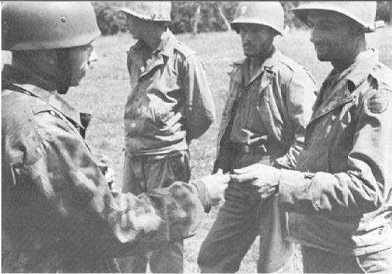
US Soldiers of the 29th Division surrender to German Fallschirmjaeger in Normandy

Once the beachheads had been consolidated the Americans turned their attention toward Cherbourg. Cherbourg was the major naval port at the far northwest tip of the Cotentin.  D-Day planners counted on its swift capture and rehabilitation to serve as a supply port for the Allied forces. The 9th Division drove south to the coast near Barneville on the 18th of June cutting off the German forces covering the approaches to Cherbourg.[xlv] This put the Germans in a bind as the 7th Army “had to split its forces in the peninsula in order to hold the fortress a little longer and thus to gain time for the establishment of the southern front on the Cotentin peninsula.[xlvi] The German forces arrayed before Cherbourg waged a desperate defense centered around the 243rd Infantry Division and other assorted battle groups of LXXXIV Corps, whose commander General Marcks one of the best German Generals was killed in action on 12 June.[xlvii] The U.S. VII Corps under Collins with the 9th, 4th and 79th Divisions pushed up the peninsula capturing Cherbourg on June 29th.  Bradley pushed hard for the capture of the port as the Mulberries had been ravaged by a severe Channel storm the week prior. The port of Cherbourg was thoroughly demolished by German engineers and would not be fully operational for months. The loss of the Mulberries and delay in Cherbourg’s availability meant that few supplies were landed on the beaches would “hinder the escape from the constricting land of the hedgerows into which the Americans had come in search of a port.[xlviii]

The Battle of Caumont Gap

Panzer IV Tank in Normandy

V Corps under Gerow made a cautious advance by phase lines toward Caumont, St Lo and Carentan.  The deliberate advance by the Corps toward a line weakly held by the Reconnaissance battalion of the 17th SS Panzer Grenadier Division was directed by Bradley who did not want to divert attention from the effort against Cherbourg.   After capturing Caumont V Corps halted and continued aggressive patrolling to deceive the Germans while digging in.[xlix] The possibility existed that a strong push against the weak German line could have led to an opportunity to envelope the German line west of Caen. This was a missed opportunity that in part led to the bloody and controversial campaign to capture Caen.[l]

British efforts around Caen
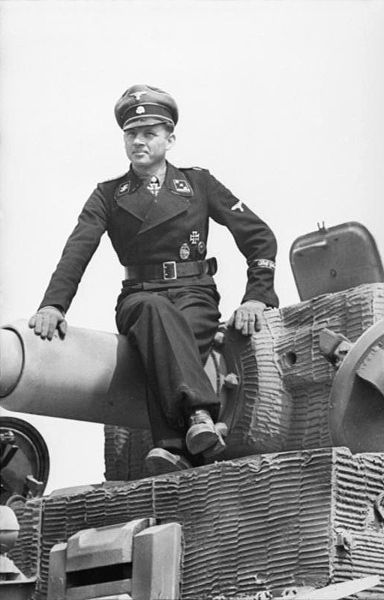
German Panzer Ace Waffen SS Captain Michale Wittman single handedly destroyed a British Battalion at Villers Bocage in his Tiger Tank

Montgomery had ambitious plans to break out of Normandy by capturing Caen on D-Day and driving toward Falaise and Argentan.  The British plans for this were frustrated by the rapid reinforcement of the sector by the Germans and the activities of 21st Panzer, Panzer Lehr, and the 12th SS Panzer Divisions.  A flanking maneuver at Villers-Bocage was frustrated by a few Tiger tanks led by the legendary Waffen SS Panzer commander Captain Michael Wittman whose tanks devastated a British Armored battalion.[li]

Wreckage of a British Battalion at Villers Bocage

A series of disastrous attacks toward Caen (EPSOM, CHARNWOOD and GOODWOOD) strongly supported by air strikes and Naval gunfire finally succeeded in taking that unfortunate city on July 18th but failed to take the heights beyond the town.[lii]

British operations like Operation Epsom met setback after setback against dug in German forces outside of Caen

Against crack well dug in German forces the British took heavy casualties in tanks and infantry seriously straining their ability to conduct high intensity combat operations in the future.[liii] The one benefit, which Montgomery would claim after the war as his original plan was that German forces were fixed before Caen and ground down so they could not be used against Bradley’s breakout in the west at St Lo.[liv]

Clearing the Bocage: The Battle of the Cotentin Plain
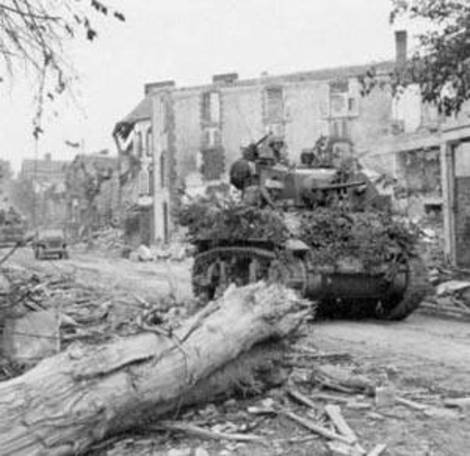
US M-5 Light Tank in Normandy

Other German forces arrived, and reinforced the Caumont gap which no longer “yawned invitingly in front of V Corps.” [lv] Bradley wished to push forward rapidly to achieve a breakthrough in the American sector.[lvi] Facing the most difficult terrain in France amid the Bocage and swamps that limited avenues of approach to the American divisions committed to the offensive.  The Americans now faced their old foe the 352nd division as well various elements of II Parachute Corps, the 17th SS Panzer Grenadier and Panzer Lehr Divisions.  American tanks and infantry made slow progress and incurred high losses as they dueled the Germans at close range.  In the VIII Corps sector alone the attack “consumed twelve days and 10,000 casualties to cross eleven kilometers of the Bocage…the achievements of the VII and XIX Corps were no better than comparable.[lvii]

St. Lo

US Tanks advancing with German prisoners moving back to US lines at St Lo

St. Lo was a key to Bradley’s breakout efforts.  His Army had to capture it and the roads leading out of it to launch Operation COBRA along the coast.  The task of capturing St. Lo was assigned to GEROW’S V Corps and Corlett’s XIX Corps.  They faced opposition from the tough paratroops of the German 3rd Parachute Division of II Parachute Corps.  The 2nd, 29th, 30th and 83rd Divisions fought a tough battle advancing eleven kilometers again with high numbers of casualties especially among the infantry to secure St. Lo on 18 July.[lviii] They finally had cleared the hedgerows.  St Lo epitomized the struggle that the American Army had to overcome in the Bocage.  Hard fighting but outnumbered German troops in excellent defensive country exacted a terrible price in American blood despite the Allied control of the skies.[lix]

Operation COBRA

US 155mm Howitzers in Normandy, the Germans had profound respect for American Artillery, a respect that they did not share for American Infantry or Armor forces

With the Bocage behind him Bradley desired to push the Germans hard.  COBRA was his plan to break out of Normandy.  Bradley ably assisted by Collins they realized that the better terrain, road networks favored a breakout.  American preparations included a technical advance that allowed tanks to plow through hedgerows. This was the “Rhino” device fashioned by American troops which was installed on 3 of every 5 First Army Tanks for the operation.[lx] VII Corps was to lead the attack which was to begin on July 24th. American planning was more advanced than in past operations.  Collins and Bradley planned for exploitation operations once the breakthrough had been made. A massive air bombardment would precede the attack along with an artillery barrage by Collins corps artillery which was reinforced by additional battalions.   A mistake by the heavy bombers in the 24th resulted in the American troops being hit with heavy casualties and a postponement of the attack until the 25th.[lxi] The following day the attack commenced.  Another mistake by the bombers led to more American casualties[lxii] but VII Corps units pressed forward against the determined resistance of the survivors of Panzer Lehr and the remnants of units that had fought the Americans since the invasion began.  Although it was a “slow go” on the 25th Bradley and his commanders were already planning for and beginning to execute the breakout before the Germans could move up reinforcements.  The 26th of June brought renewed attacks accompanied by massive air strikes.

The Devastated town of St Lo 

While not much progress was made on the 26th, the Americans discovered on the 27th that the German forces were retreating.  The capture of Marigny allowed VIII Corps to begin exploitation down the coastal highway to Coutances.  On the 27th General Patton was authorized to take immediate command of VIII Corps a precursor to the activation of his 3rdArmy.  COBRA ripped a hole in the German line and inflicted such heavy casualties on the German 7th Army that it could do little to stop the American push.[lxiii] As the American forces pushed forward they reinforced their left flank absorbing the local German counterattacks which were hampered by the Allied close air support.

Avranches and Beyond

US Forces advance through the ruins of St Lo

As the breakthrough was exploited the command of the forces leading it shifted to Patton and the newly activated 3rd Army. By the 28th VIII Corps led by the 4th and 6th Armored Divisions had reached Avranches and established bridgeheads over the See River with additional bridges being captured intact on the 30th.[lxiv] The capture of Avranches allowed the Americans to begin exploitation operations into Brittany and east toward the Seine. Weigley notes that for the first time in the campaign that in Patton the Americans finally had a commander who understood strategic maneuver and would use it to great effect.[lxv]

Conclusion

The American campaign in Normandy cost the U.S. Army a great deal. It revealed weaknesses in the infantry, the inferiority of the M4 Sherman tank to most German types, problems in tank-infantry cooperation and also deficiencies in leadership at senior, mid-grade and junior levels. Heavy casualties among infantry formations would lead to problems later in the campaign. Numerous officers were relieved including Division and Regimental commanders.  Nonetheless during the campaign the Americans grew in their ability to coordinate air and ground forces and adapt to the conditions imposed on them by their placement in the Cotentin.  The deficiencies would show up in later battles but the American Army learned its trade even impressing some German commanders on the ground in Normandy.[lxvi]

[i] See the alternative history of by Peter Tsouras Disaster at D-Day: The Germans Defeat the Allies, June 1944, Greenhill Books, London 1994. Tsouras describes the defeat of the Omaha landings and the effect on the course of the campaign leading to the overthrow of Hitler and a negotiated armistice in the west.  While this outcome could be rigorously debated other outcomes could have led to the fall of the Roosevelt and Churchill governments and their replacement by those not committed to unconditional surrender or a continuation of the war that brought about more German missile attacks on the U.K. and the introduction of other advanced German weapons that could have forced such a settlement. Another option could have led to the dropping of the Atomic Bomb on a German city vice Hiroshima.

Notes 

[ii] Weigley, Russell F. Eisenhower’s Lieutenants: The Campaign of France and Germany, 1944-1945, Indiana University Press, Bloomington IN, 1981 p.33

[iii] Ibid pp. 34-35

[iv] Ibid p.35

[v] General Montgomery 21st Army group and Land Forces, Admiral Sir Bertram Ramsey as Allied Naval Expeditionary Force and Air Marshall Sir Trafford Leigh-Mallory as Commander in Chief Allied Expeditionary Air Force. Weigley p.43

[vi] Max Hastings in Overlord: D-Day and the Battle for Normandy Vintage Books, New York, 1984, comments that many in Britain wondered if Eisenhower with the lack of actual battle experience could be a effective commander and that Eisenhower was disappointed in the appointment of Leigh-Mallory and Ramsey, and had preferred Alexander over Montgomery, pp. 28-29.

[vii] Ibid. Weigley p.40.  Montgomery was the first to object to the 3 division narrow front invasion rightly recognizing that seizing Caen with its road junctions could provide a springboard for the campaign into open country.

[viii] Ibid. p.37

[ix] Hastings, Max. Overlord: D-Day and the Battle for Normandy Vintage Books, New York, 1984 p.29  Hastings finds the irony in the selection of the British officers to execute the plan that reflected the American way of thinking.

[x] The Germans agreed with this in their planning leaving Brittany very lightly defended.  See  Isby, David C. Ed. “The German Army at D-Day: Fighting the Invasion.” p.27 The report of General Blumentritt, Chief of Staff OB West noted that only 3 divisions were assigned to Brittany.

[xi] Ibid. Weigley, pp. 39-40

[xii] Ibid. p.73

[xiii] See Isby p. 69.  General Max Pemsel of 7th Army noted that “During  the spring of 1944, Seventh Army received only tow good photographs of British southern ports, which showed large concentrations of landing craft.”

[xiv] Ibid. Hastings p.63.  Hastings comments also about the success of using the turned Abwehr agents.

[xv] Warlimont, Walter. “Inside Hitler’s Headquarters: 1939-1945.” Translated from theGerman by R.H. Barry. Presidio Press, Novao CA, English Edition Copyright 1964 Wiedenfeld and Nicholson Ltd. Pp.422-423

[xvi] Ibid. Weigley pp. 53-54

[xvii] Ibid. p. 67

[xviii] Ibid. pp.57-64  Weigley spends a great deal of time on the wrangling between Eisenhower, Leigh Mallory and Spaatz on the nature of the plan, the allocation of forces both strategic and tactical assigned to carry it out and its success, or in the light of postwar analysis the lack of effect that it had on German operations.

[xix] Ibid. p.67-68.

[xx] Ibid. Hastings pp. 43-44 In large part due to the long range P-51 Mustang which accompanied the American bombing raids beginning in 1943.  Another comment is that the campaign drew the German fighters home to defend Germany proper and prevented their use in any appreciable numbers over the invasion beaches.

[xxi] Ibid. Weigley p.69

[xxii] Ibid. p.89

[xxiii] Ibid. pp. 88-89

[xxiv] Ibid. p.87

[xxv] Ibid. Weigley also talks about the rejection of General Corlett’s ideas to use Amtracks used by the Marines in the Pacific to land on less desirable, but less defended beaches to lessen casualties on the beaches and the need for additional support equipment even on smooth beaches.  One of Corlett’s criticisms was that too little ammunition was allotted to supporting the landings and not enough supporting equipment was provided. pp. 46-47

[xxvi] Hastings notes that with the strength and firepower of the German forces on OMAHA that many of these vehicles had they been employed would like have ended up destroyed further cluttering the beachhead. “Overlord” p.102

[xxvii] The battle over the deployment of the Panzer Divisions is covered by numerous historians.  The source of the conflict was between Rommel who desired to place the Panzer Divisions on the Coast under his command due to the fear that Allied air superiority would prevent the traditional Panzer counterthrust, General Gyer von Schweppenburg commander of Panzer Group West (Later the 5th Panzer Army) and Field Marshal Von Rundstedt who desired to deploy the divisions order the command of Rundstedt for a counter attack once the invasion had been launched, a strategy which was standard on the Eastern Front, and Hitler who held most of the Panzer reserve including the SS Panzer Divisions under his control at OKW.  Hitler would negotiate a compromise that gave Rommel the satisfaction of having three Panzer Divisions deployed behind coast areas in the Army Group B area of responsibility.  21stPanzer had those duties in Normandy.

[xxviii] Ibid. p.74-75

[xxix] Von Luck, Hans.  “Panzer Commander“ Dell Publishing, New York, 1989 pp. 169-170.  Von Luck a regiment commander in 21st Panzer noted that General Marcks of 84th Corps had predicted a 5 June invasion at a conference May 30th.

[xxx] Almost every D-Day historian talks about the weather factor and its effect on the German high command’s reaction to the invasion.  Rommel was visiting his wife for her birthday and planned to make a call on Hitler. Others including commanders of key divisions such as the 91st Airlanding Division were off to a war game in Rennes and the 21st Panzer Division to Paris.

[xxxi] Ibid. Weigley p. 96

[xxxii] See Cornelius Ryan, “The Longest Day” Popular Library Edition, New York 1959. pp. 189-193 for a vivid description of the challenges faced by soldiers going from ship to landing craft and their ride in to the beaches.

[xxxiii] Ibid. Weigley. p.78 Weigley talks about the order for the tanks to be carried ashore on their LCTs that did not get transmitted to the 741st.

[xxxiv] Ibid.

[xxxv] Ibid. Weigley  p. 87 The weather prevented the aerial bombardment from being effective. Because the bombers could not see their targets they dropped their bomb loads further inland, depriving the infantry of support that they were expecting.  Naval gunfire support had some effect but had to be lifted as the troops hit the beach leaving much of that support to come from Destroyers and specially equipped landing craft which mounted rockets and guns.

[xxxvi] Ibid. Hastings. pp. 90-91.

[xxxvii] Ibid. p.99

[xxxviii] Ibid. Weigley p.80

[xxxix] Ibid. p.101  Also see Weigley p.80

[xl] Ibid. p.99

[xli] Ibid. Weigleyp.95

[xlii] Ibid. p.94

[xliii] Ibid. p.99 Both Weigley and Hastings make note of the failure of both the Americans and British to train their troops to fight in the bocage once they had left the beaches.

[xliv] Ibid. Hastings. pp.152-153

[xlv] Ibid. Weigley p.101

[xlvi] Isby, David C., Ed. “Fighting in Normandy: The German Army from D-Day to Villers-Bocage.” Greenhill Books, London,  2001.  p.143

[xlvii] Ibid. Hastings p.173 Allied fighter bombers exacted a fearful toll among German commanders. The Commanders of the 243rd and 77th Divisions fighting in the Cotentin were also killed by air attacks on the 17th and 18th.   Further east facing the British the commander of the 12th SS Panzer Division, Fritz Witt on the 17th.

[xlviii] Ibid. Weigley. p.108

[xlix] Ibid. p.111-112.

[l] Ibid.

[li] The efforts of the 51st Highland Division and 7th Armored Division were turned aside by the Germans in the area and were dramatized by the destruction of  a British armored battalion by SS Captain Michael Wittman and his platoon of Tiger tanks.  See Hastings pp.131-135.

[lii] The British 8th Corps under General O’Connor lost 270 tanks and 1,500 men on 18 July attempting to crack the German gun line on the ridge beyond Caen. Weigley, pp.145-146.

[liii] Hastings comments about the critical British manpower shortage and the pressures on Montgomery to not take heavy casualties that could not be replaced. Overlord. pp.241-242.

[liv] Ibid. Weigley pp.116-120

[lv] Ibid. p.122

[lvi] Ibid. p121 Bradley told Eisenhower “when we hit the enemy this time we will hit him with such power that we can keep going and cause a major disaster.”

[lvii] Ibid. 134

[lviii] Ibid. Weigley. pp. 138-143.  Weigley notes of 40,000 U.S. casualties in Normandy up to the capture of St. Lo that 90% were concentrated among the infantry.

[lix] Weigley quotes the 329th Regiment, 83rd Division historian “We won the battle of Normandy, [but] considering the high price in American lives we lost. P.143. This is actually a provocative statement that reflects America’s aversion to massive casualties in any war.

[lx] Ibid. p.149

[lxi] Ibid. p. 152

[lxii] Ibid. pp. 152-153.  Among the casualties were the command group of the 9th Division’s 3rd Battalion 47th Infantry and General Leslie McNair who had come to observe the assault.

[lxiii] Ibid. pp.161-169. Weigley notes the advances in U.S. tactical air support, the employment of massive numbers of U.S. divisions against the depleted German LXXXIV Corps, and the advantage that the “Rhino” device gave to American tanks by giving them the ability to maneuver off the roads for the first time.

[lxiv] Ibid. pp.172-173.

[lxv] Ibid. p.172

[lxvi] Ibid. Isby, David C. “Fighting in Normandy,” p.184, an officer of the 352nd Division referred to the American soldier “was to prove himself a in this terrain an agile and superior fighter.”

Bibliography

Carell, Paul. “Invasion: They’re Coming!” Translated from the German by E. Osers, Bantam, New York 1964.

Hastings, Max. Overlord: D-Day and the Battle for Normandy Vintage Books, New York, 1984

Isby, David C. Ed. “The German Army at D-Day: Fighting the Invasion.” Greenhill Books, London 2004

Isby, David C., Ed. “Fighting in Normandy: The German Army from D-Day to Villers-Bocage.” Greenhill Books, London, 2001.

Ryan, Cornelius, “The Longest Day” Popular Library Edition, New York 1959

Tsouras, Peter. “Disaster at D-Day: The Germans Defeat the Allies, June 1944,”Greenhill Books, London 1994.

Von Luck, Hans.  “Panzer Commander“ Dell Publishing, New York, 1989

Warlimont, Walter. “Inside Hitler’s Headquarters: 1939-1945.” Translated from theGerman by R.H. Barry. Presidio Press, Novao CA, English Edition Copyright 1964 Wiedenfeld and Nicholson Ltd. Warlimont, Walter. “Inside Hitler’s Headquarters: 1939-1945.” Translated from theGerman by R.H. Barry. Presidio Press, Novao CA, English Edition Copyright 1964 Wiedenfeld and Nicholson Ltd.

Weigley, Russell F. Eisenhower’s Lieutenants: The Campaign of France and Germany, 1944-1945, Indiana University Press, Bloomington IN, 1981

Leave a comment

Filed under History, leadership, Military, nazi germany, us army, US Army Air Corps, world war two in europe

Ordinary Men and Genocide

Friends of Padre Steve’s World,

This is another part of my article on the actions of Hitler’s Einsatzgruppen and their campaign of mass murder in Eastern Europe. This section is about the campaign in Russia. It is even more troubling than the previous sections, because in Russia, all pretense of civilization was dropped and even the German Army was heavily engaged in committing some of the grossest and most evil atrocities ever committed by a supposedly civilized and allegedly Christian people.  Likewise, it is important to remember that much of what happened occurred before the decision to implement the Final Solution and the operations of the massive extermination camps such as Auschwitz.

The tragedy is that in so ways that Americans, British, French and the Belgians, as well as the Spanish, not to mention the Russians, Turks, Japanese and so many other have committed genocide. The actions, if they were simply limited to just the Germans of that period could be explained away as a exception, but it is not. That is what makes these heinous crimes so troubling, as the people who committed them were not that different than us, or our own ancestors.

Peace

Padre Steve+

einsattzgruppen map

The Nazi war against Russia was the ultimate test of Hitler’s ideological race war. Planning for the war with the Soviet Union began after the fall of France and during the beginning stages of the Battle of Britain. On 21 July 1940 Hitler made“his intentions plain” to the Army leadership and “von Brauchitsch set his planners to work.” 119 The staff at OKH began preparations for the offensive in the winter of 1940-41 following the Luftwaffe’s failure against Britain and postponement of Operation Sea Lion, the proposed invasion of Great Britain.

Despite the fact that Britain was still in the war and had opened a new front in the Middle East against Italy which required German troops, Hitler decided to open another front and announced his intention to “crush Soviet Russia in a quick campaign which was to begin no later than March 15, 1941, and before the end of the war with England.” 120 Field Marshal Keitel noted the final decision came in “early December 1940” and from then he had “no doubt whatsoever that only some unforeseen circumstance could possibly alter his decision to attack.” 121

The military plan initially focused on the destruction of “the Red Army rather than on any specific terrain or political objective,” 122although the political and geographic objectives would arise in later planning and in the campaign. Hitler stated: “What matters is that Bolshevism must be exterminated. In case of necessity, we shall renew our advance whenever a new center of resistance is formed. Moscow as the center of doctrine must disappear from the earth’s center….” 123

Besides preparations aimed at the destruction of the Red Army and overthrow of the Soviet State, the “war against the Soviet Union was more openly ideological from the start.” 124 Hitler set the stage on March 3rd 1941 by announcing, “the forthcoming campaign is more than a mere armed conflict; it is a collision between two different ideologies…this war will not be ended merely by the defeat of the enemy armed forces” and that “the Jewish-Bolshevist intelligentsia must be eliminated….” 125

ordungspolizie officers

Ordungspolizie Officers

Hitler realized that the task of eliminating the Jews was one that had to be done by his SS men. He noted, that “this is a task so difficult that it cannot be entrusted to the Army.” 126 Reichskommissars, civilian overlords from the Nazi Party would be appointed to administer conquered areas, but since normal civilian powers would be insufficient to eliminate the Bolshevists, Hitler noted that it “might be necessary “to establish organs of the Reichsführer SS alongside the army’s Secret Field Police, even in the operational areas….” 127 The “primary task” of the SS Einsatzgruppen and Police battalions was to liquidate “all Bolshevist leaders or commissars” if possible while still in the operations zones,” 128 yet the orders were vague enough not to offend the sensibilities of Army leaders and did not contain “a syllable that in practice every Jew would be handed over to the extermination machine.” 129

As with almost all German operations which involved cooperation between the Army and the SS, the parties ensured that existing agreements between the agencies, German laws, and army doctrine were followed. On 13 March an agreement was reached between the Army represented by General Wagner and the SS, which stated in part, that “the Reichsführer SS has been given by the Führer special tasks within the operations zone of the Army…to settle the conflict between two opposing political systems.” 130Likewise the agreement dictated that Himmler’s SS units would “act independently and on his own responsibility” while ensuring that “military operations are not affected by measures necessary to carry out his task.” 131

einsatzgruppe troops and victims

Rounding up Jews in Russia

A further instruction was issued by Wagner on 26 March which gave the Army’s agreement for the use of the Einsatzgrüppen in the operations zone. The agreement spelled out the coordinating instructions between the Einsatzgruppen and army authorities in the operational zone and communications zones to the rear. Cooperation between the Army and the SS was based on already existing agreements between the SS and the Army, notably the “principals for co-operation between the State Secret Police and the Field Security organization of the Wehrmacht agreed with the Security branch of the War Ministry on 1 January 1937.” 132

The most significant agreement that the Army reached with the SS was the Commissar Order. This order, sometimes known as the “Criminal Order” was used war as evidence at Nuremberg as against Keitel, Jodl and High Command of the Wehrmacht during the later Generals Trial. The order specified that the Army would cooperated with the SS and kill Soviet Political Commissars attached to the Red Army who were taken prisoner, as “they were not prisoners of war.” Another order specified that “in the event that a German soldier committed against civilians or prisoners, disciplinary action was optional….” 133 The order noted regarding political commissars that “in this struggle consideration and respect for international law with regard to these elements is wrong.” 134 The Army’s “Guidelines for the Conduct of Troops in Russia” issed on May 19, 1941 called for “ruthless and vigorous measures against Bolshevist inciters, saboteurs [and] Jews.” 135

einsatzgruppen executions

Shortly before the Commissar Order was issued, Hitler previewed it to the generals saying that the war in Russia “cannot be conducted in a knightly fashion” and that the war against the Soviet Union would have to be waged with “unprecedented, unmerciful and unrelenting harshness…” 136Hitler told the generals that they would have to “dispense with all of their outdated and traditional ideas about chivalry and the generally accepted rules of warfare: the Bolsheviks had long since dispensed with them.” 137 He explained that he understood that his orders were beyond their comprehension but insisted, “I cannot and will not change my orders and I insist that that they be carried out with unquestioning and unconditional obedience.” 138

General Franz Halder, Chief of the OKH, or the Army High Command took notes on Hitler’s speech. They are chilling to read as none present could have understood them in any other way than Hitler meant:

“Clash of two ideologies. Crushing denunciation of Bolshevism, identified with asocial criminality….We must forget the comradeship between soldiers. A Communist is no comrade before nor after the battle. This is a war of extermination….We do not wage war to preserve the enemy….War against Russia: Extermination of the Bolshevist Commissars and of the Communist intelligentsia….this is no job for military courts. The individual troop commanders must know the issues at stake. They must be leaders in the fight….This war will be very different from war in the West. In the East harshness today means leniency in the future. Commanders must make the sacrifice of overcoming their personal scruples.”139

220px-Bundesarchiv_Bild_146-1970-052-08,_Franz_Halder

Franz Halder

Hitler’s speech was protested by some of the generals according to Von Brauchitsch. 140 Von Brauchitsch refused to protest the order to Hitler but issued an order on his own authority “threatening dire penalties for excesses against civilians and prisoners of war” which he maintained at Nuremberg “was sufficient to nullify the Commissar Order.” 141 Yet during the campaign against the Soviet Union, von Brauchitsch told his commanders to “proceed with the necessary hardness.” 142 Walter Warlimont noted that Field Marshal Fedor von Bock, who would “later emerge as an opponent of the Commissar Order…makes no special comment on the meeting or the restricted conference that followed.”143

At Nuremberg Keitel said that he “stubbornly contested” the clause “relating to the authority of the SS-Reichsführer… in the rearward operational areas.” 144Keitel blamed the Army High Command OKH under Halder, but the order came out with his signature on behalf of Hitler, which was key evidence against him at Nuremberg. Keitel stated that “there was never any possibility of justifying them in retrospect by circumstances obtaining in the Russian campaign.” 145

Some commanders refused to publish the orders and “insisted that the Wehrmacht never implemented such policies…” blaming them instead on the SS. One writer states “such protests were undoubtedly sincere, but in practice German soldiers were far from innocent. The senior professional officers were often out of touch with their subordinates.” 146 The orders were a “license to kill, although not a great departure from German military traditions….” 147 The effect was terrifying, for in a sense the Einsatzgruppen, “could commit ever crime known to God and man, so long as they were a mile or two away from the firing line.” 148 Security Divisions of the Army were “instructed to give material and logistical support to…units of the Einsatzgruppen.” 149 Even worse, other army units in rear areas “could be called on to assist Himmler’s SS police leaders” as the situation dictated, and few commanders refused. 150

For the campaign against the Soviet Union the SS formed four Einsatzgruppen composed of SD, Waffen-SS and Police troops designated A-D. Einsatzgruppe A was assigned to Army Group North, Einsatzgruppe B to Army Group Center, Einsatzgruppe C to Army Group South and Einsatzgruppe D to the 11th Army. The Einsatzgruppen were not standardized in manpower or equipment. In size they were battalion equivalents the largest Einsatzgruppe being Einsatzgruppe A in the North with 990 assigned personnel 151while Einsatzgruppe was the smallest and had only 550 troops assigned. 152 These units had SS, SD or Police commanders. Though these units were not large, they also had the support of nine Ordnungspolizeibattalions, which were initially assigned to the invasion forces to supplement the operations of the Einsatzgruppen153

The police contingent would grow to be a massive force. By 1943, these Ordnungspolizei battalions would be grouped into regiments and number about 180,000 men assisted by 301,000 local non-German auxiliaries. 154 These units acted in concert with nine Army Security Divisions which handled rear area security. 155

197BF44C00000578-3114663-image-a-59_1433720058260

Himmler was so secretive that he initially did not reveal the intent and planned use of their units to the Einsatzgruppen commanders. Instead he spoke to them of a “heavy task…to “secure and pacify” the Russian area using Sicherheitspolizei and SD methods.” 156 Understanding the effect of these operations, Himmler would state that “in many cases it is considerably easier to lead a company in battle than to command a company responsible to…carry out executions, to deport people…to be always consistent, always uncompromising-that is in many cases far, far harder.” 157

The actions of these units are well documented; the Einsatzgruppen, Police, Army and locally recruited Schutzmannschaft battalions 158 ruthlessly exterminated Jews and others in the operational area. No sooner had an Einsatzgruppe unit entered a city, a “deadly stranglehold” would grip the “Jewish inhabitants claiming thousands and thousands of victims day by day and hour by hour.” 159 Non-Jewish Russians were encouraged to conduct programs which Heydrich noted “had to be encouraged.” 160 Einsatzgruppen D report number 153 noted: “During period covered by this report 3,176 Jews, 85 Partisans, 12 looters, 122 Communist functionaries shot. Total 79,276.” 161   By the spring of 1942 Einsatzgruppe A had claimed “more than 270,000 victims, the overwhelming majority of whom were Jewish.” 162 The total killed for all groups by early 1942 was 518,388 people, mostly Jews. 163 Germany’s Romanian ally acted against Jews in their operational areas as well. In Odessa, “on 23 October 1941 19,000 Jews were shot near the harbor… probably 200,000 Jews perished either at Romanian hands or after being turned over by the Romanians to the Germans.” 164

To further cloud the ethics and morality, the operations against Jews were often called anti-partisan operations. Himmler referred to Einsatzgruppen as “anti-Partisan formations” 165 while Wehrmacht Security divisions cooperating with the SS “murdered countless Soviet civilians and burned Russian settlements to the ground under the pretext of subduing partisan resistance.” 166 The attitude by 1941-1942 was that “all Jews are partisans and all partisans are Jews.” From 1943, all armed resistance was “banditry” and all Jews irrespective of circumstances were treated as “bandits.”” 167

Walter_von_Reichenau

Walter von Reichenau

General Von Reichenau issued an order in which he stated: “The soldier in the Eastern territories is not merely a fighter according to the art of war but also a bearer of a ruthless national ideology and the avenger of the bestialities which had been inflicted upon German and racially related nations. Therefore the soldier must have full understanding for the necessity of a severe but just revenge on subhuman Jewry.” 168

Likewise the distinguished Panzer commander General Herman Hoth issued his own order of 17 November 1941 urging his troops to exact revenge on the Jews and Communists:

“Every trace of active or passive resistance or of any kind of machinations by the Bolshevik – Jewish agitators are [sic] to be immediately and pitilessly rooted out. The necessity of severe measures against elements foreign to people and kind must be understood precisely by the soldiers. These circles are the spiritual pillars of Bolshevism, the tablebearers [priests] of its murder organization, the helpers of the partisans. It consists of the same Jewish class of people which have done so much to harm our Fatherland and by its hostile activity…and anti-culture, which promotes anti-German currents in the whole world and which wants to be the bearer of revenge. Their annihilation is a law of self-preservation. Any soldier criticizing these measures has no memory of the former traitorous activity lasting for years carried on among our own people by Jewish-Marxist elements.” 169

 Piaśnica_digging_of_the_graves

Jews digging their own graves

The commander of the 221st Security Division endeavored to persuade his “subordinate units that the Jews were carriers of Bolshevik contamination and, therefore, the ultimate source of any sabotage or difficulty the division faced.” 170 The extermination of the Jews and partisan war were closely intertwined with the Reich’s economic policies designed to exploit the natural resources of the Russia. This included the “hunger plan” which German authorities seemed to imagine that “millionfold starvation could be induced by requisitioning off all available grain and “shutting off” the cities.” 171

einsatzgruppen-brutal-germans-nazi-death-squads1

Einsatzgruppe men and Ordungspolizei above and below in action

“The European history of the twentieth century shows us that societies can break, democracies can fall, ethics can collapse, and ordinary men can find themselves standing over death pits with guns in their hands. It would serve us well today to understand why.” Timothy Snyder

Einsatzgruppe_A

The Wehrmacht’s complicity in these measures is demonstrated in the order drafted by Warlimont and signed by Keitel on 13 May 1941. That order, the “Decree on Exercising Military Jurisdiction in the Area of Barbarossa and Special Measures by the Troops” made it clear that international conventions regarding the treatment of civilians would not be observed in the Soviet Union. The order, relying on the historic precedent of German military law in regard to partisan activity stated

I “Treatment of crimes committed by enemy civilians”

“1. Until further order the military courts and the courts martial will not be competent for crimes committed by enemy civilians.”

2. Francs-tireurs will be liquidated ruthlessly by the troops in combat or while fleeing. “

3. Also all other attacks by enemy civilians against the armed forces, its members, andauxiliaries will be suppressed on the spot by the troops with the most rigorous methods until the assailants are finished (niederkaempfen)”

4. Where such measures were not taken or at least were not possible, persons suspected of the act will be brought before an officer at once. This officer will decide whether they are to be shot. Against localities from which troops have been attacked in or treacherous manner, collective coercive measures be applied immediately upon the order of an officer of the rank of at least battalion etc., commander, if the circumstances do not permit a quick identification of individual perpetrators.”

II. “Treatment of crimes committed against inhabitants by members of the Wehrmacht and its auxiliaries”

1. With regard to offenses committed against enemy civilians by members of the Wehrmacht or by its auxiliaries prosecution is not obligatory, even where the deed is at the same time a military crime or misdemeanor….” 172

Hitler was quite clear in his intent when he told General Halder that in 1941 that he “intended to level Moscow and Leningrad, to make them uninhabitable, so there would be no need to feed their populations during the winter.” 173Economic officials held life and death power over villages. Those that met agricultural quotas were “likely to be spared annihilation and evacuation…the culmination of this process, during 1943, would be the widespread creation of “dead zones.””174All told during the campaign against the Soviet Union the Germans killed nearly 1.5 million Russian Jews. 175

ww2 mizocz1

By 1942, over two million Soviet POW’s had been killed. 600,000 shot outright, 140,000 by the Einsatzkommandos. 176Eventually about 3.3 million Soviet POWs died in German captivity through starvation, disease and exposure, 177are included in a total of over 10 million Red Army Combat deaths. 178 The distinguished German historian Karl Dietrich Bracher wrote, “The reality and irreality of the National Socialism were given their most terrible expression in the extermination of the Jews.” 179

arthur nebe

Arthur Nebe, from Jew killer to anti-Hitler plotter

Himmler and others continued to use euphemistic language to describe their efforts talking in terms of “Jewish resettlement.” 180 Terms such as special actions, special treatment, execution activity, cleansing and resettlement were used in place of the word murder. 181At the same time these operations led to problems in the ranks, one SS trooper observed: “deterioration in morale among his own men who had to be issued increasing rations of vodka to carry out their killing orders.” 182

Even commanders of the Einsatzgruppe were affected. Arthur Nebe would say “I have looked after so many criminals and now I have become one myself.” Nebe became an active participant in the July 20th plot against Hitler 183and a fellow conspirator would describe him as a “shadow of his former self, nerves on edge and depressed.” 184 Erich Bach-Zelewski, who led the SS anti- partisan operations, would suffer a nervous breakdown which included “hallucinations connected to the shootings of Jews” which hospitalized him in 1942. 185 Himmler would state in his Posen speech given in October 1943 that “to have gone through” the elimination of the Jews had “and remained decent, that has made us tough. This is an unwritten, never to be written, glorious page in our history.” 186

To be continued…

Notes

119 Ibid. Megargee. War of Annihilation p.24

120 Ibid. Wheeler-Bennett The Nemesis of Power p.511

121 Ibid. Goerlitz. The Memoirs of Field Marshal Wilhelm Keitel. P.132

122 Glantz, David M. and House, Jonathan. When Titans Clashed: How the Red Army Stopped Hitler. University Press of Kansas, Lawrence, KS. 1995 p.31

123 Trevor-Roper, H.R. Hitler’s Table Talk 1941-1944 with an introduction by Gerhard L Weinberg, Translated byNorman Cameron and R.H. Stevens, Enigma Books, New York, NY 2000. Originally published in Great Britain by Weidenfeld & Nicholoson, London 1953 p.6

124 Ibid. Megargee. War of Annihilation p.10 The campaign against the Soviet Union was to be much more openlyideological as compared to the campaign in Poland.

125 Ibid. Warlimont. Inside Hitler’s Headquarters p.150 126 Ibid. Warlimont. Inside Hitler’s Headquarters p.151

125 Ibid. Warlimont. Inside Hitler’s Headquarters p.150 126 Ibid. Warlimont. Inside Hitler’s Headquarters p.151

127 Ibid. Reitlinger, The SS p.175

128 Ibid. Höhne The Order of the Death’s Head p. 354

129 Ibid. Höhne The Order of the Death’s Head p. 354 Again another deception.

130 Ibid. Warlimont. Inside Hitler’s Headquarters p.153

131 Ibid. Warlimont. Inside Hitler’s Headquarters p.153

132 Ibid. Warlimont. Inside Hitler’s Headquarters pp. 158-159

133 Ibid. Glantz and House. When Titans Clashed p.56

134 Ibid. Davidowicz. The War Against the Jews p.123

135 Ferguson, Niall. The War of the Worlds: Twentieth Century Conflict and the Descent of the West. The Penguin Press, New York, 2006 p.442

136 Ibid. Wheeler-Bennett. Nemesis of Power p.513

137 Ibid. Goerlitz. The Memoirs of Field Marshal Wilhelm Keitel. P.135

138 Ibid. Wheeler-Bennett. Nemesis of Power p.513

139 Hebert, Valerie Genevieve, Hitler’s Generals on Trial: The Last War Crimes Tribunal at Nuremberg University of Kansas Press, Lawrence Kansas 2010 pp.77-78

140 Ibid. Wheeler-Bennett Nemesis of Power p.513 and footnote. He cites the three Army Group commanders, Leeb, Rundstedt and Bock. However Von Rundstedt’s biographer notes that “no evidence exists as to what VonRundstedt’s to this was at the time.” Messenger, Charles, The Last Prussian: A Biography of Field Marshal Gerd Von Rundstedt 1875-1953 Brassey’s (UK) London England 1991. p.134

141 Ibid. Reitlinger, The SS p.176

142 Ibid. Megargee. War of Annihilation p.33

143 Ibid. Warlimont. Inside Hitler’s Headquarters p.162

144 Ibid. Goerlitz. The Memoirs of Field Marshal Keitel p.136

145 Ibid. Goerlitz. The Memoirs of Field Marshal Keitel pp.136-137

146 Ibid. Glantz and House. When Titans Clashed p.56

147 Ibid. Blood. Hitler’s Bandit Hunters p.52

148 Ibid. Reitlinger The SS p. 177

149 Ibid. Shepherd. War in the Wild East p.54

150 Ibid. Reitlinger The SS p. 177

151 Ibid. Rhodes Masters of Death pp.12-13

152 Ibid. Westermann. Hitler’s Police Battalions p.167 153 Ibid. Westermann. Hitler’s Police Battalions p.164 154 Ibid. Blood Hitler’s Bandit Hunters p.141

155 Ibid. Shepherd Wild War in the East p.48. Shepherd notes the deficiencies of these units in terms of organization, manpower and equipment which he calls “far short of the yardstick of military excellence with which the Wehrmacht is so widely associated

156 Ibid. Höhne The Order of the Death’s Head p. 356 Only one of the Einsatzgruppen commanding officers was a

volunteer, Arthur Nebe who was involved in the conspiracy to kill Hitler. It is believed by many that Nebe volunteered to earn the clasp to the Iron Cross to curry favor with Heydrich and that initially “Nebe certainly did not know that “employment in the east” was synonymous with the greatest mass murder in history.

157 Ibid. Bracher. The German Dictatorship p.422

158 Ibid. Blood Hitler’s Bandit Hunters p.55

159 Ibid. Höhne The Order of the Death’s Head p. 360 160 Ibid. Friedlander TheYears of Extermination p.207 161 Ibid. Höhne The Order of the Death’s Head p. 360 162 Ibid. Tooze The Wages of Destruction p.481

163 Ibid. Ferguson. The War of the World p.446

164 Di Nardo, Richard L. Germany and the Axis Powers: From Coalition to Collapse. University Press of Kansas,Lawrence, KS. 2005 p.133 The Hungarians would also engage in ant-Jewish operations. Only the Italian army would not conduct operations against the Jews.

165 Ibid. Höhne The Order of the Death’s Head p. 369

166 Ibid. Wette The Wehrmacht p.127

167 Ibid. Blood. Hitler’s Bandit Hunters p.117

168 Ibid. Hebert p.94

169 Ibid. Hebert pp.94-95

170 Ibid. Shepherd. War in the Wild East pp.90-91

171 Ibid. Tooze The Wages of Destruction p.481

172 Ibid, Hebert p.86

173 Ibid. Magargee. War of Annihilation p.64

174 Ibid. Shepherd. War in the Wild East pp.127-128

175 Ibid. Davidowicz The War Against the Jews from the table on page 403. This included 228,000 from the Baltic republics (90%) 245,000 from White Russia (65%) 900,000 from the Ukraine (60%) and 107,000 from Russia proper

(11%)

176 Ibid. Rhodes. Masters of Death p.241

177 Ibid. Glantz and House When Titans Clashed p.57

178 Ibid. Glantz and House. When Titans Clashed table on p.292

179 Ibid. Bracher. The German Dictatorship p.431

180 Ibid. Bracher. The German Dictatorship p.430

181 Ibid. Höhne The Order of the Death’s Head p. 367

182 Ibid. Rhodes. Masters of Death p.225

183 Ibid. Rhodes Masters of Death p.225

184 Ibid. Höhne The Order of the Death’s Head p. 363 185 Ibid. Höhne The Order of the Death’s Head p. 363 186 Ibid. Bracher. The German Dictatorshipp.423

5 Comments

Filed under ethics, History, holocaust, Military, nazi germany, Political Commentary, war crimes, world war two in europe

Genocide Up Close and Personal: The Einsatzgrüppen in Poland

einsatz1

Friends  of Padre Steve’s World

Another section of the article dealing with the campaign of mass murder and genocide conducted by Hitler’s legions in Eastern Europe. This section deals with the actions of the Einsatzgruppen in Poland in 1939 and 1940. In it you will see that the while most of the killing was done by the SS that the German military high command was not guiltless. Some commanders attempted to stop SS actions, but they were the minority.  Most simply turned a blind eye to what was going on and a few would lend their assistance to the Einsatzgruppen. 

Please note, that all of this took place before the first extermination camps began operations. This killing was done up close and personal by  the men of the Einsatzgruppen and the Police battalions. In all just a few thousand troops massacred hundreds of thousands of Polish Jews as well as the Polish gentile elites.

It is terribly uncomfortable, for as I always say, these men were little different than most of us, they were terribly ordinary.

Peace

Padre Steve+

himmler1

Heinrich Himmler

The Polish campaign was a precursor to the Russian campaign and was not totally race driven. It contained elements of Germany’s perception of the injustice of Versailles which gave Poland the Danzig corridor and Germany’s desire to reconnect East Prussia to the Reich, as well as the perceived necessity to remove a potential enemy from its rear as it faced France, yet it was a campaign steeped in Nazi racial ideology. Poland resisted German efforts to ally itself with Germany in 1939, thus Hitler determined it “would be crushed first.” 80

Meeting with military leaders on 23 May 1939 Hitler “made it plain that the real issue was not Danzig, but securing of Germany’s Lebensraum….” 81 On 22 August Hitler enjoined the generals to “Close your hearts to pity! Act brutally! Eighty million people must obtain what is their right.” 82

Even so, most military leaders failed to appreciate what Hitler was calling on them to do; Erich von Manstein would later note that “what Hitler had to say about an eventual war with Poland, could not, in my opinion, be interpreted as a policy of annihilation.” 83

generaloberst johannes blaskowitz

General Johannes Blaskowitz

Others such as Abwehr director Wilhelm Canaris was “utterly horrified.” As he read his notes to his closest colleagues “His voice trembled as he read, Canaris was acutely aware that he had witnessed something monstrous.” 84 General Johannes Blaskowitz, the controversial commander of the German 8th Army who would become the military commander in Poland did not leave any notes about the meeting. However, his biographer noted that Blaskowitz “may have naively attached a military meaning to these terms since he was busy with military matters and soon to begin operations.” 85 As was noted before this was also the interpretation of Erich Manstein gave Hitler’s words, but one has to wonder as to the veracity of his statements. 86 Field Marshal Keitel noted that the speech was “delivered in the finest sense of psychological timing and application,” with Hitler molding “his words and phrases to suit his audience.” 87

In light of the mixed interpretations by military leaders, it is possible that many misinterpreted Hitler’s intent and did not fully appreciated his ideology as they went into Poland, carefully secluding themselves in the narrow confines of their military world. While such an explanation is plausible for some, it is also true that many others in light of subsequent actions were in full agreement with Hitler. One author notes that “no man who participated in the FührerConferences….and there were present the highest ranking officers of the three services, could thereafter plead ignorance of the fact that Hitler had laid bare his every depth of infamy before them, and they had raised no voice in protest either then or later.” 88 In July, General Wagner, the Quartermaster General issued orders that “authorized German soldiers to take and execute hostages in the event of attacks by snipers or irregulars.” 89

Regardless of the meaning ascribed to Hitler’s speech by his generals, Hitler had already laid plans to destroy the Jews in Poland and decimate the Polish intelligentsia and leadership.   Hitler gave Himmler the task of forming Einsatzgrüppen to follow the German troops as they advanced into Poland and liquidate Poland’s upper class wherever it was to be found.” 90 While senior party leaders remained at Hitler’s side following the conference, Himmler worked to coordinate his troops, including the reinforced Totenkopf battalions and Einsatzgrüppen with the Army. 91

Himmler began planning in early May and the Army, working in close collaboration with the SS decided to “use SS and police units to augment their own forces for security tasks.” 92 Himmler established “five Einsatzgrüppen to accompany each of the numbered German armies at the start of the campaign.” 93 Placed under the aegis of Reinhard Heydrich the groups were broken down into smaller units of 100-150 men and allotted to army corps. All senior posts were occupied by officers of the SD, the Sicherhietsdienst. 94

Two additional Einsatzgrüppen were formed shortly after the invasion. 95Additionally three regiments of the SS Totenkopfverbandeunder the direction of SS General Theodore Eicke were deployed in the rear areas of the advancing armies. These regiments were formed from the Concentration Camp guard units and eventually became the nucleus of the 3rd SS Panzer Division Totenkopf. 96 The SS carefully shielded the real purpose of these units from the Army in the planning stages, while the Army might countenance anti-guerrilla operations and cooperate in arresting people who might lead resistance in Poland, the SS was not yet sure that the Army would support or countenance mass murder. 97 That being said, Heydrich worked with the Army to develop lists of up to 30,000 Poles to be arrested following the invasion including intellectuals, political leaders and clergy. 98

To eliminate the Polish elites without disturbing the Army, Himmler and Heydrich gave the Army “only the bare minimum of information” as to their ultimate intent99 The deception was initially successful and many Wehrmacht commanders welcomed the assistance of the SS units for rear area security missions. Blaskowitz’s 8th Army defined the mission of the Einsatzgrüppen in the traditional doctrinal terms of the Ettapen, noting their mission as “the suppression of all anti-Reich and anti- German elements in the rear of the “fighting troops, in particular, counter espionage arrests of  politically unreliable persons, confiscation of weapons, safeguarding of important counter- espionage materials etc…” 100 General Wagner, the Quartermaster General issued orders in July 1939 that “authorized German soldiers to take and execute hostages in the event of attacks by snipers or irregulars.” Despite the deception, there was no way to disguise the murder of Polish intelligentsia and Jews once it began, and had the Army had the political acumen and moral courage it could have considerably restricted or even halted the terror campaign. 101

The ensuing campaign in Poland demonstrated Hitler’s true intent. Heydrich openly discussed “murdering the Polish ruling class” of the aristocracy, Catholic clergy, communists and Jews at a meeting on September 7th, barely a week after the beginning of the invasion. 102 As the German armies advanced into Poland slicing through the badly deployed and inadequately equipped Polish Army the Einsatzgruppen and the Totenkopf Verbande followed in their wake, conducting mass arrests and executions of those Poles deemed to be a threat.

Many army leaders were worried about Polish soldiers left behind in rear areas as the armies advanced. In some cases that concern became a paranoid mindset and some generals believed that a “brutal guerrilla campaign has broken out everywhere and we are ruthlessly stamping it out.” 103

ordungspolizei

Ordungspolizei Battalion preparing for Mass Murder

Yet some of the actions by Einsatzgruppen and Totenkopf Verbandeagainst the Polish elites and the Jews drew Army reactions. The unit commanded by SS General Woyrsch “behaved with such unparalleled bestiality that it was thrown out of the operational area” by General List of 14th Army.” 104 Another unit, the Totenkopfverbande Brandenburg came to Army attention when its commander remarked that the “SSVT would not obey Army orders.” The conclusion drawn by the Army General was that “the SSVT commander was following orders from some non-military authority to terrorize the local Jews.” 105

These atrocities as well as those of other Waffen-SS units were hard to hide and brought reactions out of army commanders who sought to punish the offenders. Blaskowitz and a few other commanders attempted to put a halt to SS actions against Poles and Jews, 106 but most officers turned a blind eye to the atrocities or outright condoned them. It is believed that General Walter Model and many other senior officers “not only knew what was occurring in Poland but actually took part in what Colonel General Franz Halder himself described in October as “this devilish plan.”” 107

It appears that many of the officers who objected were not motivated so much by humanitarian, moral or legal considerations, but rather by the effect on good order and discipline of their soldiers. 108 Likewise it is clear that many officers, even if they did not participate in the actions probably approved of them. Many of the early biographies and histories of this period were written by authors who were influenced by surviving German officers. Many of these men were being rehabilitated and helping the Americans and British meet the threat of the Soviet Union, made no or little mention of the Army’s part in these actions.

Both Himmler and Heydrich were sensitive to the perception of the Army and resented the fact that the Army believed them to be responsible for actions that they were carrying out under the direction and orders of Hitler himself, They also resented that their troops were characterized as “undisciplined gangs of murderers” by many Army officers. 109

After crushing the Polish armies and dividing Poland with the help of the Red Army, the Germans established what became known as the Government General, which was headed by Hans Frank. The new civilian administration came into conflict with the military governor, General Blaskowitz. Appalled by the actions of the SS, Police and the Nazi administration. Blaskowitz made an “elaborate report on the atrocities of the SS,” 110 expressing concern about his “extreme alarm about illegal executions, his worries about maintaining troop discipline under those circumstances, the failure of discussions with the SD and Gestapo and their assertions that they were only following SS Orders.” 111

While it is unclear if the memorandum made it to Hitler, it is clear that Hitler did know about the protest and Blaskowitz fell into disfavor and was reassigned after a period of continued conflict with the Nazi administration. Hitler was not impressed by the less than ruthless attitudes of Blaskowitz and other commanders. His reaction to Army objections regarding the methods of the SS and police units was characteristically acidic. Hitler’s military adjutant recalled that Hitler accused the Army’s leaders of using “Salvation Army” methods, and called their ideas regarding the occupation as “childish.” 112

Following the reassignment of Blaskowitz, other officers that objected were also relieved of their commands or reassigned. General Georg von Külcher was relieved of command for protesting SS and police atrocities. 113

07102014-461733515

At the beginning of the campaign the SS units and their commanders fell under military justice, and a number of SS officers and their troops were convicted by Army courts-martial for their actions. But soon, SS Officers convicted by Army courts-martial were given amnesty by Hitler and Hitler “removed SS units from the jurisdiction of military courts,” on October 4th 1939. 114 While the army remained, it was no longer in charge and would actively assist the SS and Police in combat and further atrocities against civilians. In November 1939, One German officer, who later was a conspirator in the July 20th plot, remarked, “was ashamed to be German! The minority are dragging our good through the mud by murdering, looting and torching houses will bring disaster on the whole German people if we do not stop it soon…” 115

poland murders

The Army was soon relieved of responsibility for policing Poland which fell on the Ordungspolizei battalions and Gendarmerie. Many officers were pleased as they could now turn their backs on the situation there and begin to prepare for the campaign in the West.

The Ordungspolizei battalions and the Gendarmerie units were composed of mobilized city police and rural constabulary police. These men would soon wreak their own devastation on Poland in the coming months and years. 116Poland was also be the first use of mass evacuations of civilian populations to make room for German settlers, in the newly acquired Lebensraum. Poles were driven into the newly formed Government General and ethnic Germans moved into previously Polish occupied territories. By 1941 over 1,200,000 Poles and 300,000 Jews had been expelled and 497,000 ethnic Germans brought into provinces German had lost in 1919. 117

Prior to the war about 3.3 million Jews lived in Poland. The actions of the Einsatzgruppen and the Police brought a reign of terror to Poland’s Jews. The Jews were rounded up and sent to Ghettos from which they would be dispatched to the death camps following the decision to implement the “Final Solution.”After the war only some 50-70,000 Jews were found to have survived in Poland, the Polish Army and camps in Germany. A further 180,000 were repatriated from the Soviet Union. 118

To be continued….

Notes

80 Ibid. Weinberg. Visions of Victory p.8
81 Ibid. Goerlitz, History of the German General Staff p.346
82 Höhne, Heinze. The Order of the Death’s Head: The Story of Hitler’s SS. Translated by Richard Barry. PenguinBooks, New York and London, 2000. First English edition published by Martin Secker and Warburg Ltd. London 1969. Originally published as Der Orden unter dem Totenkopf, Verlag Der Spiegel, Hamburg 1966 p.259

83 Manstein, Erich von. Forward by B.H. Liddle Hart, Introduction by Martin Blumenson. Lost victories: The War Memoirs of Hitler’s Most Brilliant General. Zenith Press, St Paul MN 2004. First Published 1955 as Verlorene Siege, English Translation 1958 by Methuen Company p.29

84 Ibid. Hohne. Canaris p.347

85 Giziowski, Richard. The Enigma of General Blaskowitz. Hppocrene Books, New York 1997 p.119

86 Ibid. Manstein. Lost Victories p.29

87 Ibid. Goerlitz. The Memoirs of Field Marshal Keitel p.87

88 Wheeler-Bennett, John. The Nemesis of Power: The German Army in Politics 1918-1945. St. Martin’s Press Inc. New York, NY 1954 p.448

89 Ibid. Megargee. War of Annihilation p.13

90 Ibid. Höhne The Order of the Death’s Head p.297

91 Padfield, Peter. Himmler. MJF Books, New York 1990 p.264

92 Ibid. Megargee. War of Annihilation p.13

93 Ibid. Westermann. Hitler’s Police Battalions p.127

94 Ibid. Höhne The Order of the Death’s Head p.297 95 Ibid. Westermann. Hitler’s Police Battalions p.127 96 Ibid. Sydnor Soldiers of Destruction p.37

97 Ibid. Giziowski Blaskowitz p.120

98 Ibid. Witte. The Wehrmacht p.100

99 Ibid. Höhne The Order of the Death’s Head pp. 297-298

100 Ibid. Giziowski Blaskowitz p.120

101 Ibid. Höhne The Order of the Death’s Head p.298

102 Ibid. Witte. The Wehrmacht p.100

103 Newton, Steven H. Hitler’s Commander: Field Marshal Walter Model-Hitler’s Favorite General Da Capo Press a division of Perseus Books Group, Cambridge MA 2005. p.74

104 Ibid. Giziowski. The Enigma of General Blaskowitz pp.165-166

105 Ibid. Sydnor, Soldiers of Destruction pp. 42-43 Note SSVT is the common abbreviation for Verfügungstruppe which was the early designation of the SS Totenkopf Verbande and some other Waffen SS Units.

106 Ibid. Goerlitz. History of the German General Staff p.359

107 Ibid. Newton. Hitler’s Commander p.78

108 Ibid. Witte The Wehrmacht p.102

109 Ibid. Höhne The Order of the Death’s Head p.298

110 Ibid. Goerlitz. History of the German General Staff .p.359 111 Ibid. Giziowski. The Enigma of General Blaskowitz p.173 112 Ibid. Giziowski. TheEnigma of General Blaskowitz p.173

113 Ibid. Witte The Wehrmacht p.102

114 Burleigh, Michael and Wippermann, Wolfgang. The Racial State: Germany 1933-1945 Cambridge University Press, New York NY and Cambridge UK 1991. p.100

115 Ibid. Witte The Wehrmacht p.102

116 For a good account of one of the Police Battalions see Ordinary Men: Reserve Police Battalion 101 and the Final Solution in Poland by Christopher Browning Harper Perennial Publishers, San Francisco CA 1992

117 Reitlinger, Gerald. The SS: Alibi of a Nation. The Viking Press, New York, 1957. Republished by Da Capo Press, New York, NY p.131

118 Ibid. Davidowicz The War Against the Jews pp.395-397

Leave a comment

Filed under History, holocaust, nazi germany, Political Commentary, world war two in europe