Tag Archives: american civil war

The Power of Noble Deeds and the Fallibilty of those that Do Them

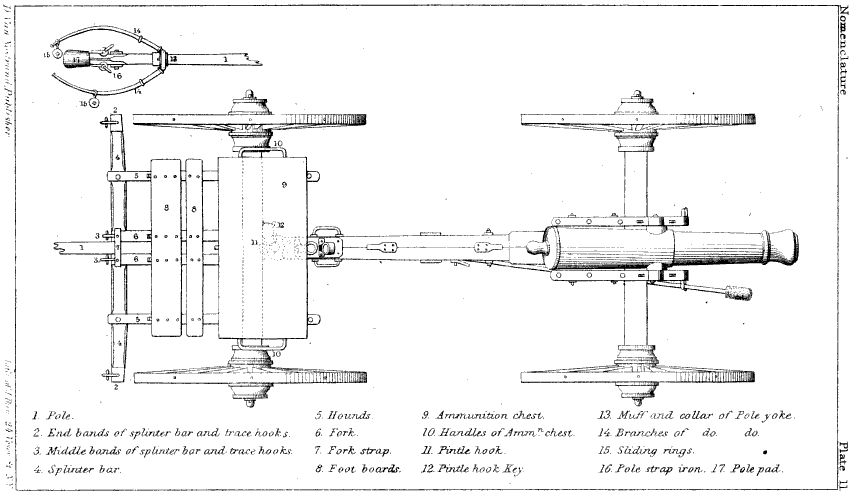
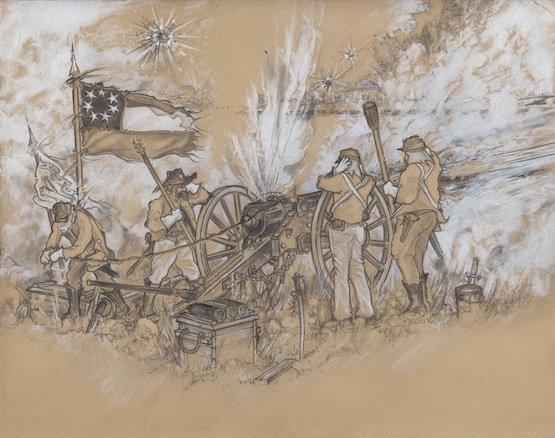
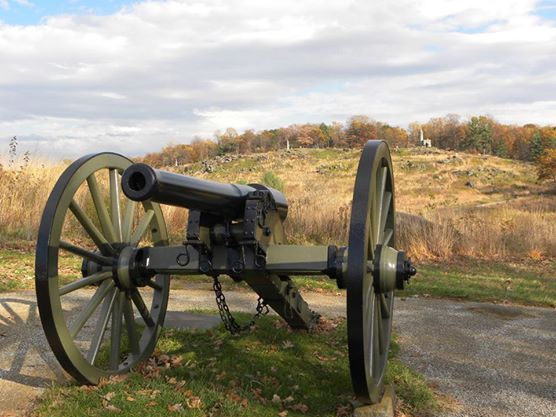
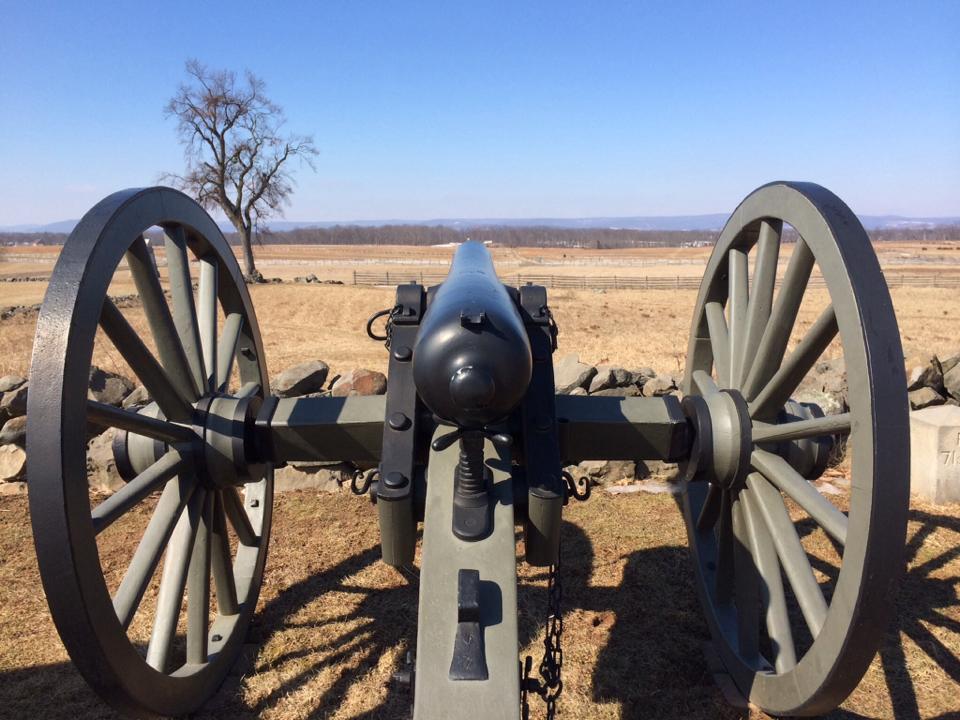
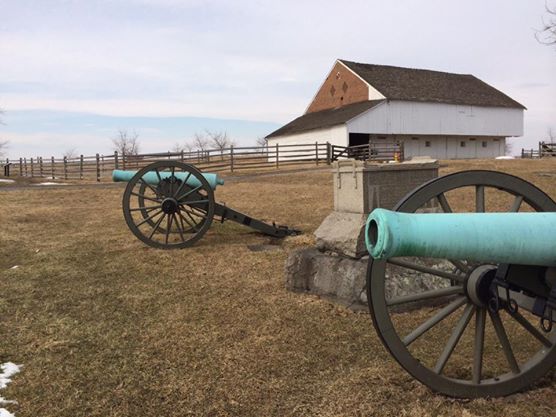
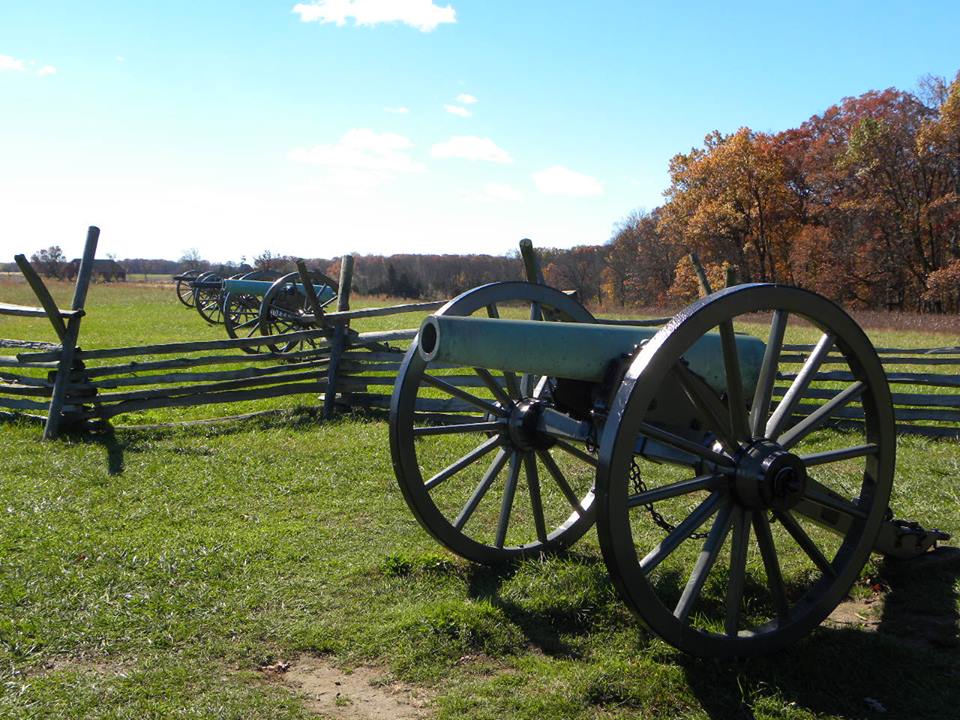
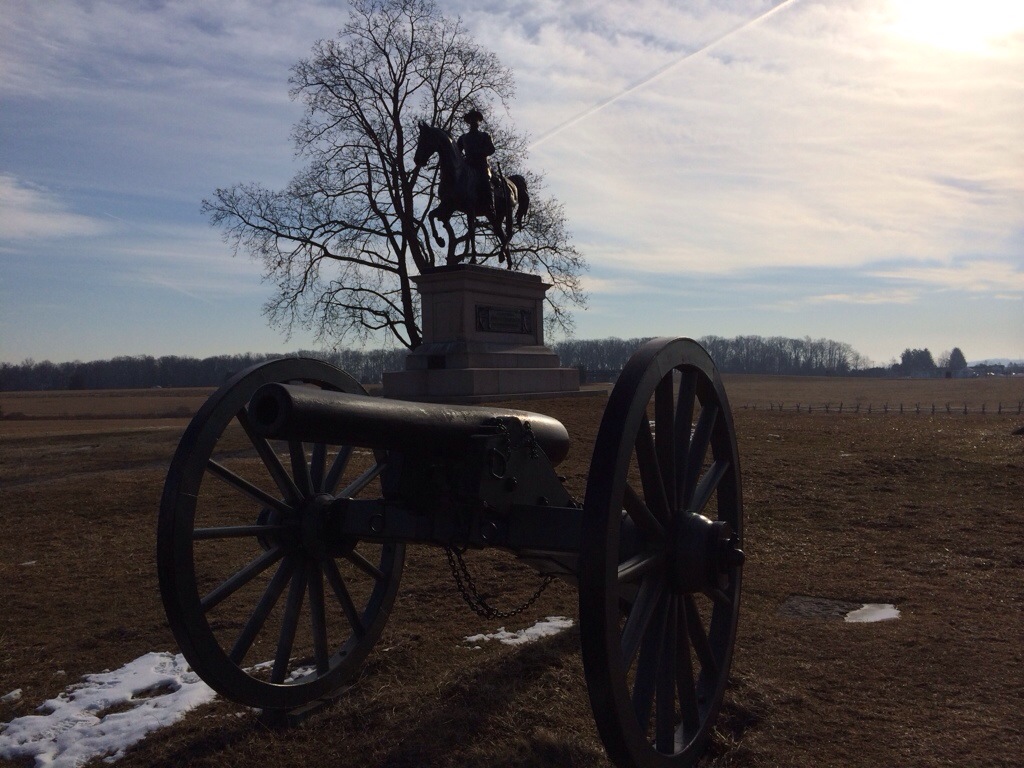
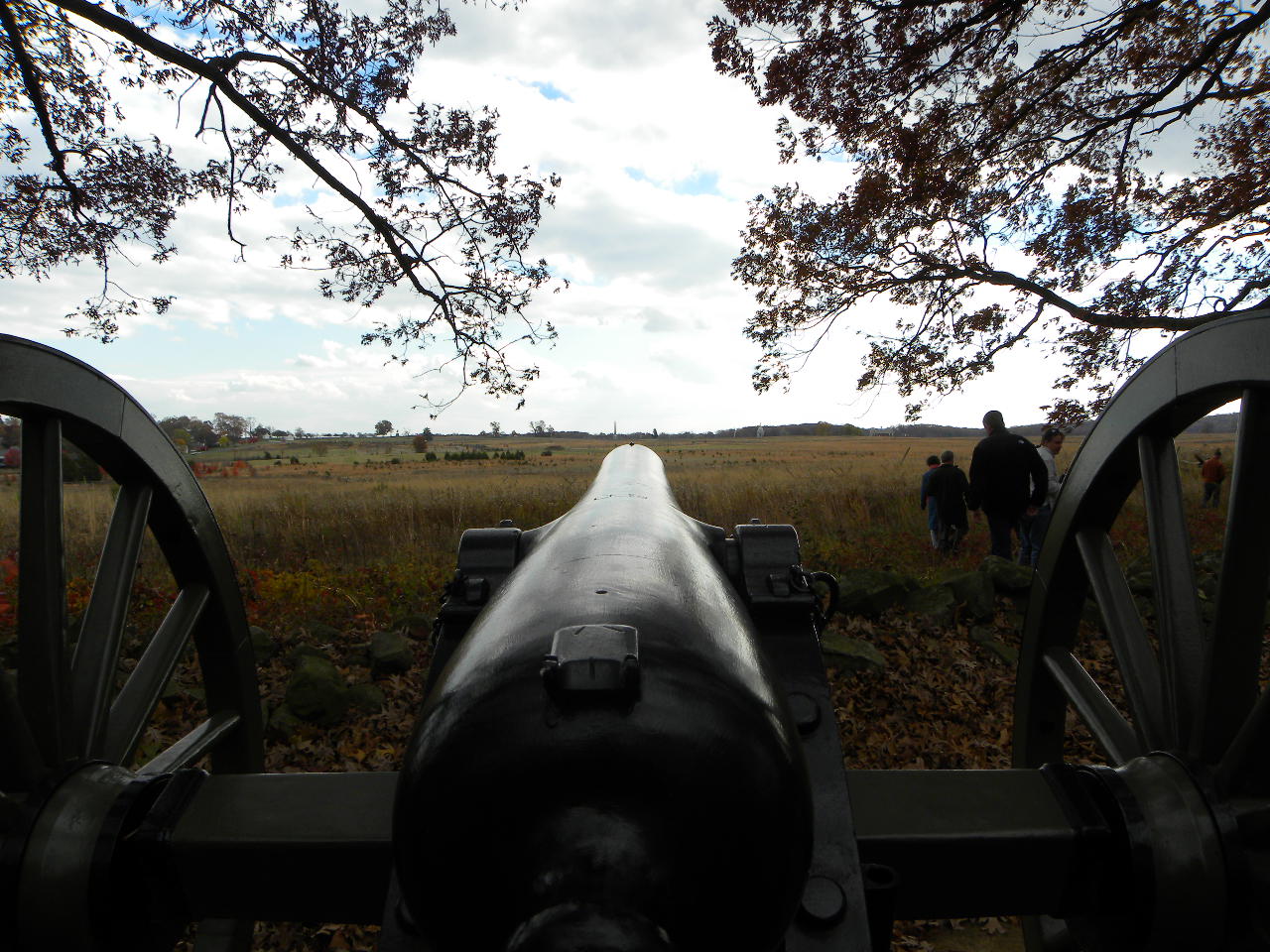
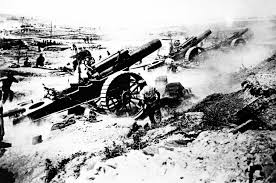
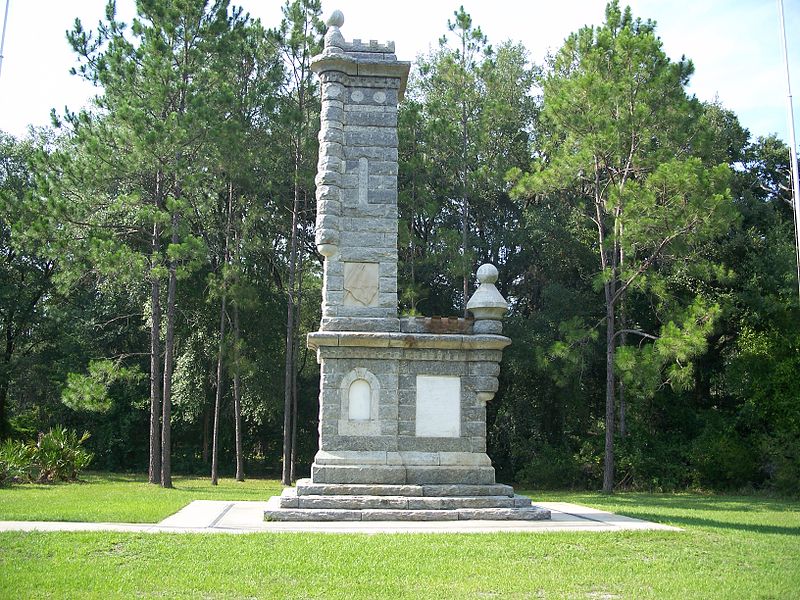
12 pound napoleon

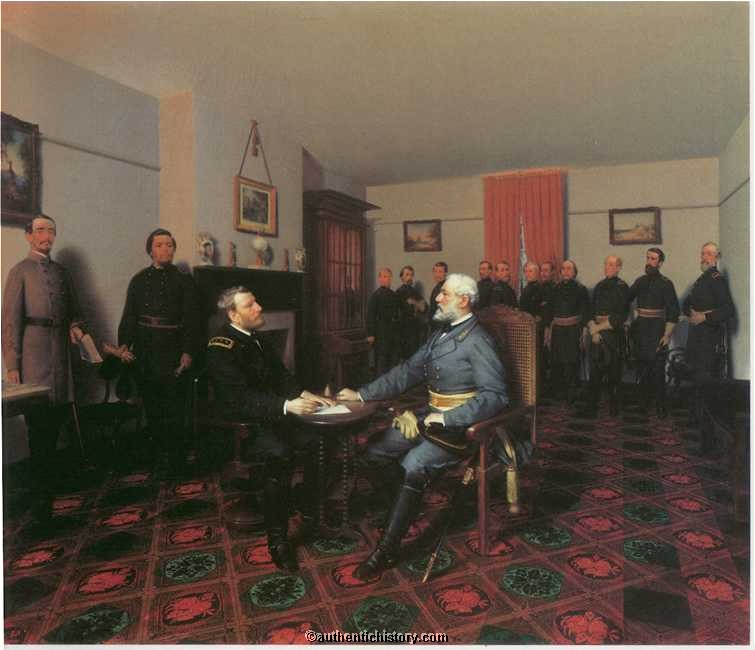
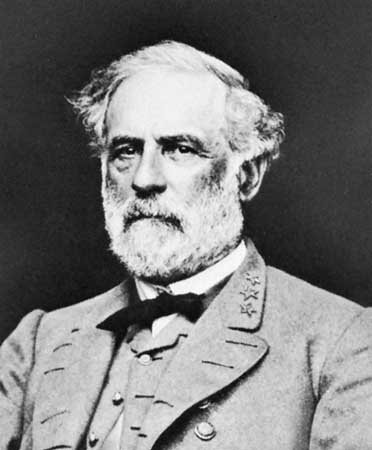
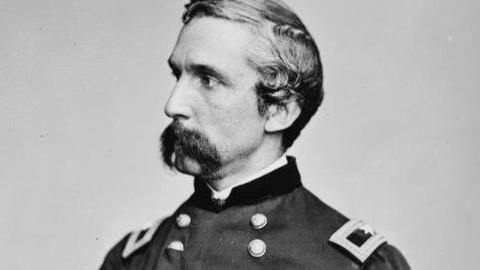
“The power of noble deeds is to be preserved and passed on to the future.” Joshua Chamberlain

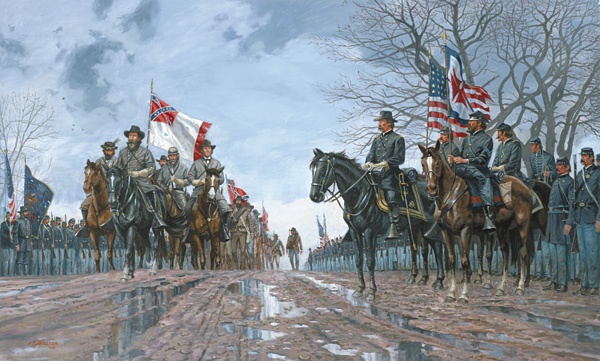
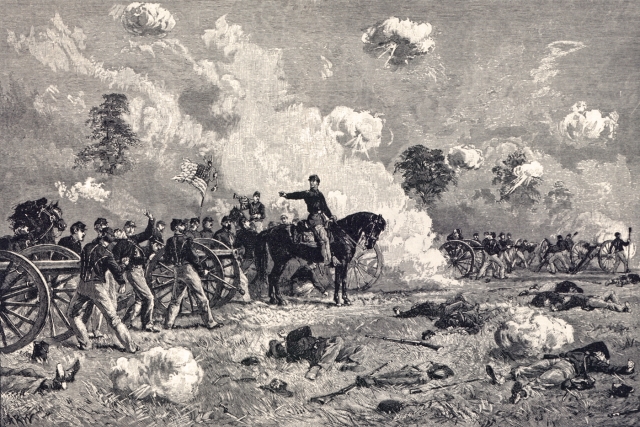
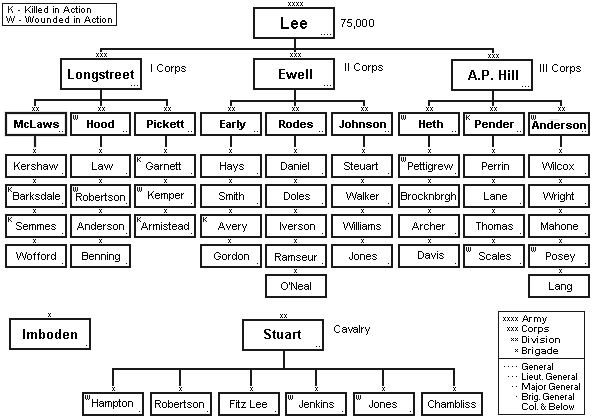
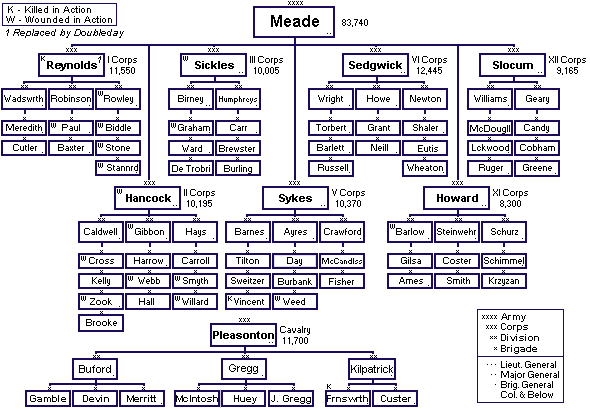
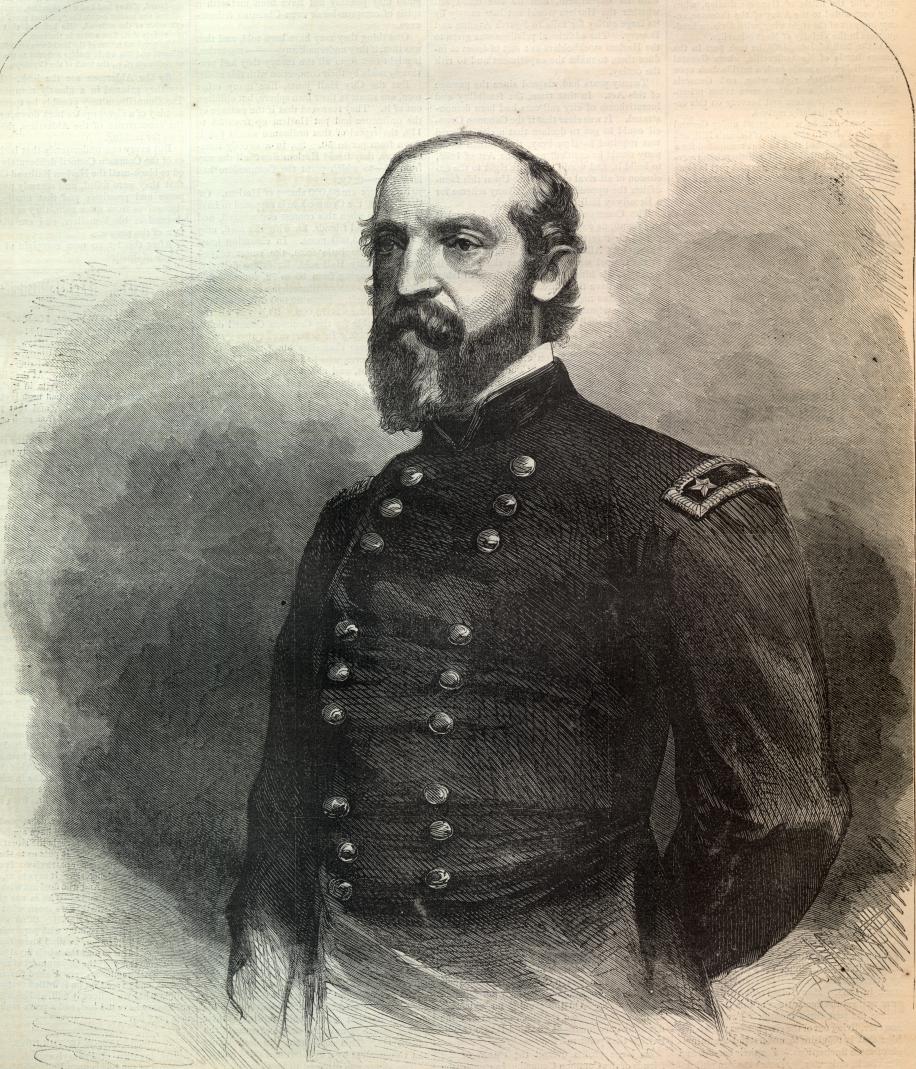
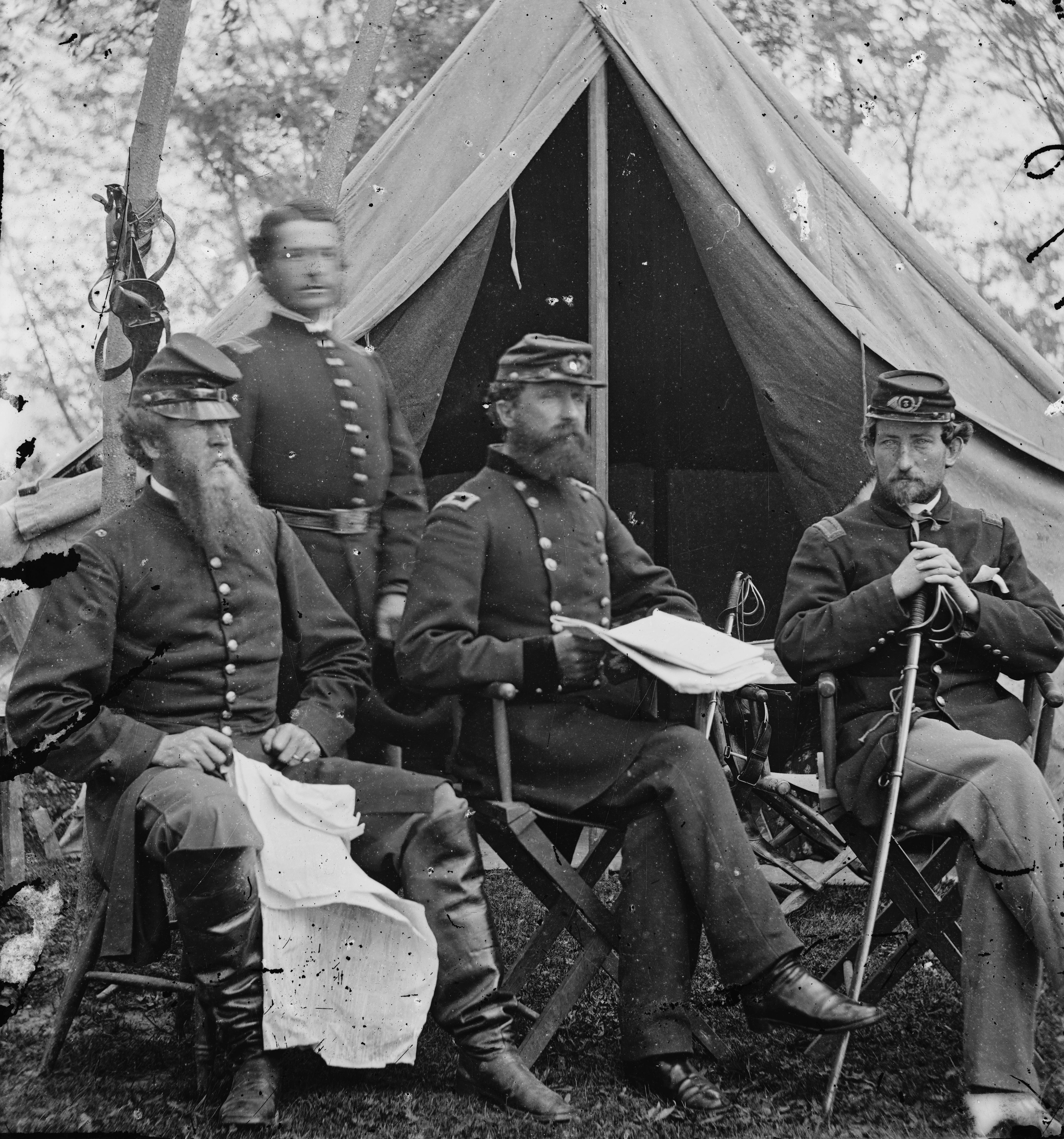
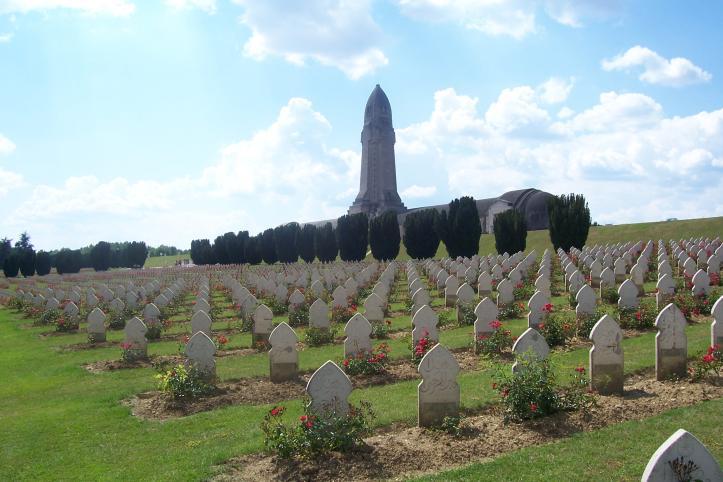
Today I was at the Gettysburg battlefield leading a Staff Ride for students from our Staff College. Today’s portion of the Staff Ride encompassed the first two days of the battle. We will continue it tomorrow with the actions of the night of July second 1863 at Culp’s Hill and the climatic event we know as Pickett’s Charge.

The Staff Ride is a optional trip for our students and the get no academic credit for it. However since I have taken it over I have been working to connect it to aspects of what they are learning in our courses, issues of campaigning, mission command and the diplomatic, information, military and economic aspects of war. I am working with our academic course developers and directors to turn this into an actual elective that students can receive academic credit for in addition to the chance to go the the battlefield.

I have a passion for this. The American Civil War and the Battle of Gettysburg are intrinsic parts of who we are as Americans today. The events of that war and this battle continue to reverberate in many aspects of our political, social and national life. Thus for me teaching about this event and what happened on this “hallowed ground” matters for more than the fact that it is interesting history and a fascinating battle.

As someone who has served in the military for most of my life, coming up on 33 years I feel like Joshua Chamberlain, the hero of Little Round Top that “The power of noble deeds is to be preserved and passed on to the future.” I do this in what I teach and what I write, both in the academic setting as well as on this website.

We live in a time of great cynicism, some of which I can understand. We also live in a time where many people and our institutions operate in a “zero defect” culture, those who fail in any way are shunted aside, punished or even chastised or ostracized. However, when I look at the men who fought at Gettysburg, or for that matter almost any individual who has accomplished great things, very few are perfect people.

Many great leaders, or other men and women that we consider today to be great, influential or important were quite fallible. They made many mistakes and even had great flaws in their character, some even did things in their lives that were not good and in some cases scandalous. Such deeds may tarnish them or take some of the luster away from their accomplishments. But I think that from a historical as well as pastoral point of view that these flaws are often as important as their successes. They demonstrate the amazing capacity of imperfect humanity to accomplish great things, as well as the incredible complexity of who we are as people. No one is perfect. There are degrees of goodness and even evil in all of us. It is part of the human condition. Thus the personal failures of those men and women should not detract from their great accomplishments.

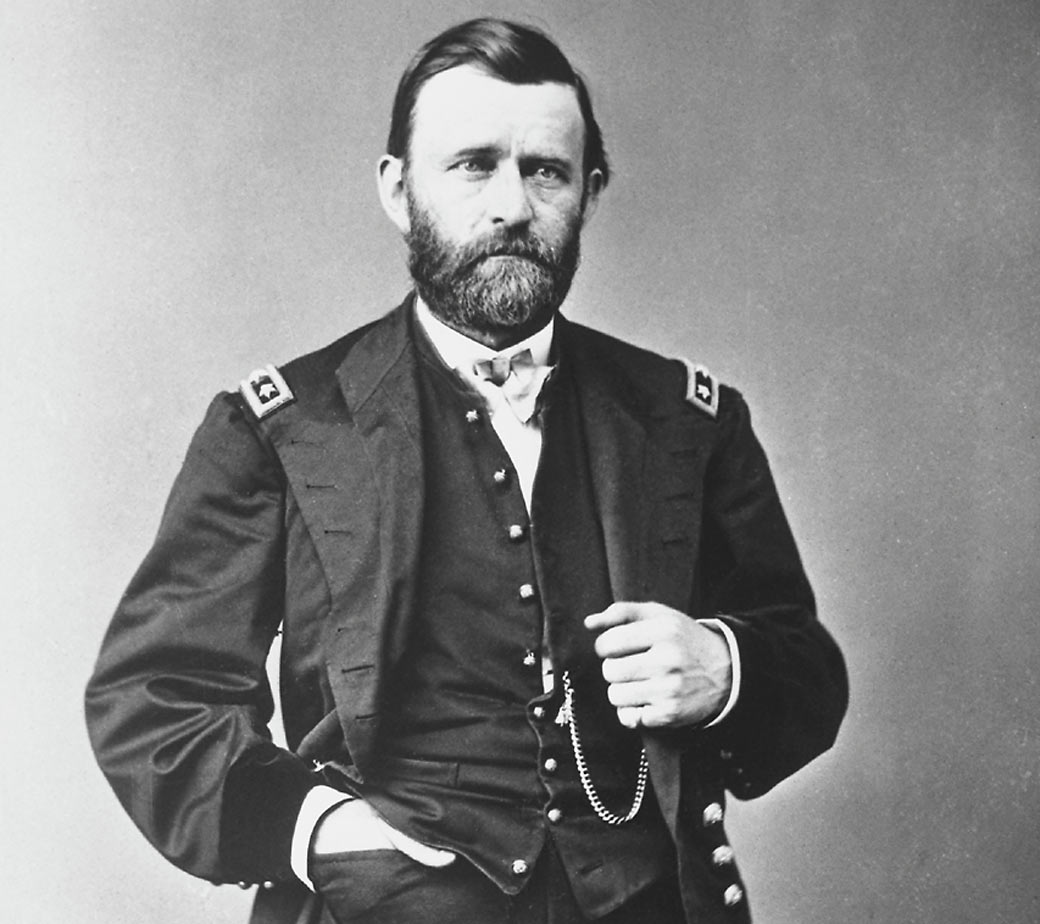
When I look at the perfection that imperfect people expect of others I am reminded of something that William Tecumseh Sherman said about his relationship with Ulysses Grant. The fact is that neither man who were in large part responsible for the Union victory in the Civil War would never reach the level of command that they rose to in our current military culture, nor would they rise to the top in corporate America. Sherman said: “Grant stood by me when I was crazy, and I stood by him when he was drunk, and now we stand by each other.”

That s one of the enduring facts of being human and being in relationship with others. Neither Grant or Sherman were at Gettysburg, they were at Vicksburg preparing to receive the surrender of that city as the Battle of Gettysburg ended. However, what Sherman said is true and needs to be more a part of our lives today.

That being said, even less tan perfect people can rise to do great deeds, deeds that need to be remembered, passed down and told to succeeding generations. That is a part of my passion about Gettysburg and my appreciation and admiration of the brave men who fought in that battle.

Have a great night.

Peace

Padre Steve+

Leave a comment

Filed under civil war, History

“Unparalleled Bestiality” Hitler’s Racial and Ideological War in Poland and Russia

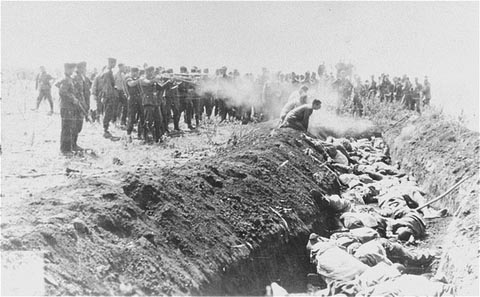
babi yar


As part of my academic work I teach military ethics as related to the Just War Theory. In the class on jus post bellum or justice after war I deal with the implication of participating in war crimes. It is a serious subject and in the class I attempt to make my students, all relatively senior officers as uncomfortable as possible. I use a number of examples from the major war crimes trials at Nuremberg as well as the Generals Trial. I had an exceptionally good class over the past several weeks and that caused me to go back and do some revisions to a number articles that I have written in the past. I have published a version of this before but I have made some additions and expect that like my work on Gettysburg that this work too will be an ongoing project.

I think part of why I write about this is that the witnesses of and those who confronted these crimes and tried the criminals are dying. Very few are left, and those still alive were very junior and very young. For years there has been a closet industry of Holocaust deniers and in many places neo-Nazi and other anti-Semitic groups are rising up. It is something that causes me great concern.

As I went through previous notes and research I felt a tenseness and revulsion for the actions of those that ordered, committed or condoned these crimes, men who were like me professional officers. I realize how easily it is that as Spencer Tracy playing an American justice at the Judges trial at Nuremberg in the movie Judgment at Nuremberg said: “under a national crisis, ordinary – even able and extraordinary – men can delude themselves into the commission of crimes so vast and heinous that they beggar the imagination.”

September 29th 2014 will be the 73rd anniversary of the Babi Yar massacre. It was committed by members of the SS Einsatzgruppen C near Kiev shortly after the German Army captured that city. 33,771 Jews were exterminated by the members of Sonderkommando 4b of Einsatzgruppen C as well as Police battalions. About 10,000 others, mainly Communist Officials and Gypsies were rounded up and killed in the same operation. The victims were stripped of all of their belongings taken to a ravine and shot. It was the second largest killing action by Einsatzgruppen in the war. It was committed by men who either believed that the people that they were killing were sub-human, or did not have the courage to stand up and say no.

Babi Yar is just one example of how civilized people can get can commit great atrocities in the name of ideology and race, and it does not stand alone. The tragic fact is that it really doesn’t take much to condition people to go commit such crimes; just teach people from childhood that people of certain races or religions are less than human. Then subjugate them to incessant propaganda and then turn them loose using the pretext that they are killing terrorists or insurgents.

The article deals with the ideological as well as military reasons that brought about Babi Yar and so many other atrocities committed by the Nazis during the campaigns in Poland and the Soviet Union.
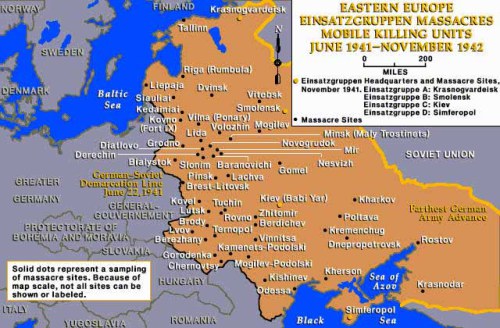
einsattzgruppen map

Einsatzgruppen Massacre sites (www.jewishvirtuallibrary.org)

Introduction

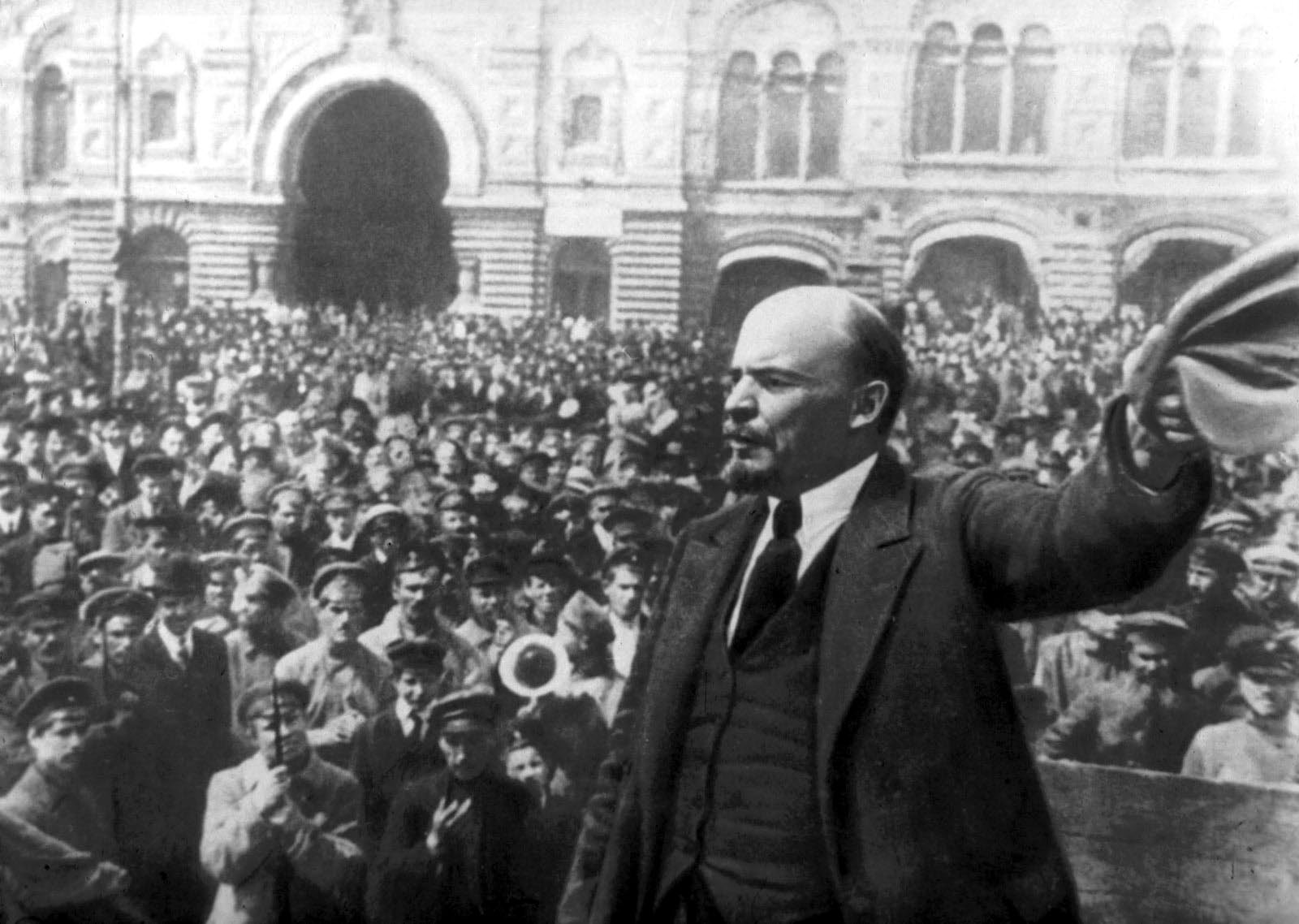
The German war against the Soviet Union was the first truly race-based ideological war in history with the campaign against Poland its precursor.  Adolf Hitler’s racial theories and beliefs played a dominant role in Germany’s conduct of the war in the East in both the military campaign and occupation.  This has become clearer in recent years as historians have had the opportunity to examine Hitler’s writings, those of senior Nazi officials and military officers and documents which had been unavailable until the end of the Cold War.  Understanding the Nazi ideological basis and the underlying cultural prejudice against the Jews and eastern Europeans in general is foundational to understanding Hitler’s conduct of the war and why the destruction of the Jews figured so highly in his calculations.  One must also understand the military and police cultures and doctrines that enabled them to cooperate so closely in the conduct of the war.

The German war in the east would differ from any previous war.  Its underlying basis was ideological. Economic and geopolitical considerations were given importance in relationship to the understanding of the German “Master Race.”  Race and Lebensraum was the goal of the State that “concentrates all of its strength on marking out a way of life for our people through the allocation of Lebensraum for the next one hundred years…the goal corresponds equally to the highest national and ethnic requirements.” [1]

Hitler believed that Germany was “entitled to more land…because it was the “mother of life” not just some “little nigger nation or another.”” [2] The Germans planned to “clear” the vast majority of the Slavic population and the “settlement of millions of hectares of eastern Lebensraum with German colonists” complimented by a short term exploitation of the land to “secure the food balance of the German Grossraum.” [3] Joachim Fest notes that Hitler called it a “crime” to wage war only for the acquisition of raw materials. Only the issue of living space permitted resort to arms. [4]

Following the Peace of Westphalia wars in Europe typically emphasized conquest of territory and natural resources either to expand empires or promote some kind of self-sufficiency. The Thirty Years War, which was ended by the Treaty of Westphalia had a heavy religious component which added to its brutality. However the root of much of this conflict was about increasing the power of emerging nation states led by men not necessarily loyal to their religious brethren. [5]

The American and Russian Civil wars had some ideological basis and helped usher in the brutality of total war. Both had major effect in these nations’ development and both were bitterly contested with the winners imposing to various degrees political changes on their vanquished brothers they were civil wars. [6]

Adam Tooze sees the Holocaust as the first step of the “last great land grab in the long and bloody history of European colonialism…” [7] This does have merit, Hitler’s desire for Lebensraum or living space was a type of colonialism. However, Tooze’s argument does not take away from the basic premise that Germany’s war in the east was at its heart motivated by ideological factors.
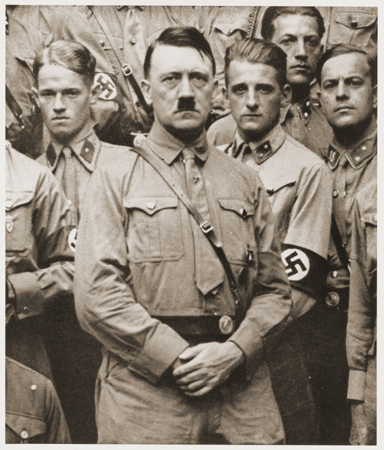
hitler

Adolf Hitler

German Anti-Semitism and Adolf Hitler

The root of this war was in the mind of Adolf Hitler himself. Hitler was born in Linz Austria during a time when various Pan-German and Ant-Semitic groups, publications and propaganda were widespread. As a young man Hitler moved to Vienna hoping to become an artist, something that he found little commercial success. While struggling to make a living in Vienna he was exposed to a culture far different from the provincial city of his youth, a city that had much culture but was also a meeting ground for the various peoples that populated the Austro-Hungarian Empire, including Slavs and many Jews. While many of the Germanic or Austrian Jews were outwardly little different from their Christian neighbors the Jews from Eastern Europe repulsed Hitler.

Hitler’s lack of success, struggle with poverty and resentment of others led him to the writings of the Pan-Germanic and Anti-Semitic movements. His years in Vienna were foundational as he as he absorbed the ideas of these Pan-German, anti-Semitic groups through newspapers like the Deutsches Volksblatt. [8] In Vienna Hitler began to connect the Jews with Marxism.[9] Joachim Fest notes that in Vienna Hitler became obsessed by the fear of the Slavs and Jews, hated the House of Hapsburg, the Social Democratic Party, and “envisioned the end of Germanism.” [10]

Hitler’s racial views were amplified after the war in turbulent Weimar Germany where he became a member of the NDSAP, rising rapidly within it, eventually taking over party leadership, reorganizing it so that it “became the instrument of Hitler’s policies.” [11] Following the unsuccessful Beer Hall Putsch of 1923 Hitler wrote Mein Kampf while imprisoned in the Landsberg prison in which he enunciated his views about the Jews, Slavs and Lebensraum. Hitler believed that Imperial Germany had been “hopelessly negligent” in regard to the Jews [12] and that the Jews in conjunction with the Catholic Center Party and Socialists worked together for “maximum damage to Germany.” [13]

Likewise he saw the Jews as heading the “main ideological scourges of the nineteenth and twentieth century’s.” [14] It was the ideology of Hitler’s “obsessive anti-Semitism” [15] that drove Nazi Germany’s policy in regard to the Jews and against Jewish-Bolshevism.  By the 1920s Hitler had “combined his hatred of the Jews and of the supposedly Jewish dominated Soviet state with existing calls to conquer additional Lebensraum, or living space, in the east.” [16] Hitler wrote: “The fight against Jewish world Bolshevism requires a clear attitude toward Soviet Russia. You cannot drive out the Devil with Beelzebub.” [17] Richard Evans notes that Mein Kampf clearly enunciated that “Hitler considered racial conflict…the essence of history, and the Jews to be the sworn enemy of the German race ….” And that the “Jews were now linked indissolubly in Hitler’s mind with “Bolshevism” and “Marxism.” [18]

When Hitler became the dictator of Germany “his ideology and strategy became the ends and means of German foreign policy.” [19] His aims were clear, Hitler remarked to Czech Foreign Minister Chvalkovsky on 21 January 1939: “We are going to destroy the Jews.” [20]It was clear that Hitler understood his own role in this effort noting to General Heinrici that “he was the first man since Charlemagne to hold unlimited power in his own hand. He did not hold this power in vain, he said, but would know how to use it in the struggle for Germany…” [21]

???????????????

Wilhelm Keitel: “war was a fight for survival….dispense with outdated and traditional ideas about chivalry and the generally accepted rules of warfare…” Bundesarchiv Bild

Race, Anti-Semitism and the German High Command

This study will focus on the German policy of ideological-racial war in Poland and Russia. The German war against the Soviet Union and to a certain extent Poland was waged with an unforgiving ferocity against Hitler’s enemy, the Jewish-Bolshevik state and the Slavic Untermenschen.

The campaigns in Poland and the Soviet Union were characterized by the rise of a “political-ideological strategy.” [22] Operation “Barbarossa showed the fusion of technocracy and ideology in the context of competitive military planning.” [23] Hitler’s “ideological and grandiose objectives, expressed in racial and semi-mystical terms, made the war absolute.” [24]

Field Marshal Keitel noted a speech in March 1941 where Hitler talked about the inevitability of conflict between “diametrically opposed ideologies” and that the “war was a fight for survival and that they dispense with their outdated and traditional ideas about chivalry and the generally accepted rules of warfare.” [25] General Halder, Chief of the OKH in his War Dairy for that meeting noted “Annihilating verdict on Bolshevism…the leaders must demand of themselves the sacrifice of understanding their scruples.” [26]

Based on Lebensraum and race, the German approach to war would combine “racism and political ideology” for the purpose of the “conquest of new living space in the east and its ruthless Germanization.” [27] Hitler explained that the “struggle for the hegemony of the world will be decided in favor of Europe by the possession of the Russian space.” [28] Conquered territories would be “Reich protectorates…and that these areas were to be deprived of anything in the nature of a Slav intelligentsia.” [29]

This goal was manifest in the “Criminal Order” issued by OKW which stated that the war was “more than mere armed conflict; it is a collision between two different ideologies…The Bolshevist-Jewish intelligentsia must be eliminated….” [30] Other displaced inhabitants of the conquered eastern lands would be killed or allowed to starve. [31] Part of this was due to economic considerations in the Reich, which gave Germans priority in distribution of food, even that from the conquered lands. Starvation was a population control measure that supplemented other forms of annihilation. [32]As Fest notes in Russia Hitler was “seeking nothing but “final solutions.”” [33]Despite numerous post-war justifications by various Wehrmacht generals, the “Wehrmacht and army fell into line with Hitler because there was “a substantial measure of agreement of “ideological questions.”” [34]
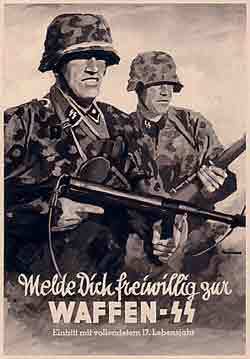
ss recruiting poster

Waffen SS Volksdeutsch Recruiting Poster

Hitler’s racial ideology was central to his worldview and fundamental to understanding his actions in the war. [35] However twisted Hitler’s ideological formulations were his ideas found acceptance beyond the Nazi faithful to the Army and Police, who would execute the campaigns in Poland and Russia in conjunction with the Einsatzgrüppen and Nazi party organizations.  In these organizations he found allies with pre-existing cultural, political and doctrinal understandings which allowed them to be willing participants in Hitler’s grand scheme of eastern conquest.

Doctrinal and Ideological Foundations

While Hitler’s racial ideology was more extreme than many in the German military and police, these organizations had cultural beliefs and prejudices as well as doctrinal and ideological foundations which helped them become willing accomplices to Hitler.  These factors were often, consciously or unconsciously, excluded from early histories of World War II. The Allies relied on German officers to write these histories at the beginning of the Cold War, developing the “dual myth of German military brilliance and moral correctness.” [36] British historian and military theorist B.H. Liddell-Hart makes the astounding statement that “one of the surprising features of the Second World War was that German Army in the field on the whole observed the rules of war than it did in 1914-1918-at any rate in fighting its western opponents….” [37]

While Liddell-Hart might be excused by lack of knowledge of some German army atrocities he could not have been ignorant. It was not just the SS who he blamed the atrocities but many of the men who he interviewed. In doing this Liddell-Hart and others presented a myth as truth. [38] The myths were helped by the trials of Manstein and Kesselring where “historical truth had to be sacrificed…to the demands of the Cold War.” [39] British military historian Kenneth Macksey confronted the myth that only the “Waffen SS committed barbaric and criminal acts” noting: “Not even the Knights of the Teutonic Order and their followers in the Middle Ages sank to the depths of the anti-Bolshevik Wehrmacht of 1941.” [40]

Germany had a long running history of anti-Semitism before Hitler.  German anti-Semitism often exhibited a “paranoid fear of the power of the Jews,” [41] and included a “fashionable or acceptable anti-Semitism” [42] which became more pronounced as the conditions of the Jews became better and Jews who had fled to Eastern Europe returned to Germany. [43] Sometimes this was tied to religious attitudes, but more often focused on the belief that the Jews “controlled certain aspects of life” and presented in “pseudo-scientific garb” the “myth of a secret Jewish plot for world domination which was simultaneously part of the internationalism of Freemasonry.” [44]

Admiral Wilhelm Canaris provides an example as he “had grown up in the atmosphere of “moderate” anti-Semitism prevailing in the Ruhr middle class and in the Navy believed in the existence of a “Jewish problem”” and would “suggest during 1935-1936 that German Jews should be identified by a Star of David as special category citizens….” [45] Wehrmacht soldiers were “subject to daily doses of propaganda since the 1930s” and that with the “start of the Russian campaign propaganda concerning Jews became more and more aggressive.” [46]Some objected to Nazi actions against Jews. Von Manstein protested the “Aryan paragraph” in the Reichswehr on general principal.” [47]Yet some who planned and executed the most heinous crimes like Adolf Eichmann had “no fanatical anti-Semitism or indoctrination of any kind.” [48]

anti-jewish poster

Anti-Jewish Poster: He is guilty for the war

The military “looked to the regime to reshape society in every respect: political, ideological, economic and military…Propaganda would hammer home absolute nature of the struggle…” [49] Ideological training began in the Hitler Youth and Reichsarbeitsdienst and produced a soldier in which “Anti-Semitism, anti-communism, Lebensraum – these central tenants of Nazism were all inextricably linked with the Landser’s conception of duty, with his place and role in the vast machinery of war.” [50]

Following the dismissal of General Fritsch in 1938, General Brauchitsch promised Hitler that “he would make every effort to bring the Army closer to the State and the State’s ideology.” [51] Alfred Novotny, a Austrian soldier in the Gross Deutschland division noted how training depicted the Russians as Untermenschen and how they were “subjected to official rantings about how the supposedly insidious, endless influence of the Jews in practically every aspect of the enemy’s endeavors…Jews were portrayed as rats, which were overrunning the world….” [52]

This ideological component added to the already “harsh military discipline” which had a long tradition in Germany conditioning soldiers to violence and brutalization of their enemy. Similar programs existed in the Order Police which would play a large part in the eastern campaign, the “image of “treasonous” leftists and Jews helped shape the personal and political beliefs of many policemen throughout the interwar period.” [53] Even ordinary police training before the war in German speaking Europe was brutalizing.” [54] These troops were recipients of an ideological formation which “aimed at shaping the worldview of the police leading to the internalization of belief along National Socialist lines.” [55] Waffen SS soldiers, especially those of the Totenkopf division were subjected to even more systematic political indoctrination on the enemies of National Socialism, the Jews, freemasonry, Bolshevism and the churches. [56]

Along with cultural anti-Semitism and the Nazification of German thought in the 1930s, there were aspects of military doctrine which helped prepare the way for the eastern campaign. The most important were the Army’s anti-partisan and rear area security doctrine.  The history of security anti-partisan operations dated back to the Prussian Army’s Ettapen, which began in 1813 with the Landwehr’s role in security against looters and others. [57] These units supported and supplied offensive operations from the rear to the combat zone with a secondary mission of countering partisans and preventing disruptions in the rear area. The Ettapen would be reformed and regulated in 1872 following the Franco-Prussian War. [58]

The German experience fighting guerrillas and partisans, the francs-tireurs in the Franco-Prussian War, “scarred the Army’s institutional mentality.” [59] Von Moltke was “shattered,” writing his brother that “war was now taking on an ever more hate-inspired character.” [60] He was “appalled by improvised armies, irregular elements, and appeals to popular passion, which he described as a “return to barbarism.” [61]He wrote: “Their gruesome work had to be answered by bloody coercion. Because of this our conduct of the war finally achieved a harshness that we deplored, but which we could not avoid.” [62]

The brutal German response to the franc-tireurs found its legal justification in Franz Lieber’s principles for classification of belligerents and non-belligerents, which determined that guerrillas were outlaws or bandits. [63] Leiber’s principles were written for the Federal Army of the United States during the U.S. Civil War. Propagated as General Order 100 and signed by Abraham Lincoln the sections dealing with irregular forces and partisans dealt with this in section IV of that code:

Article 82 stated: “Men, or squads of men, who commit hostilities, whether by fighting, or inroads for destruction or plunder, or by raids of any kind, without commission, without being part and portion of the organized hostile army, and without sharing continuously in the war, but who do so with intermitting returns to their homes and avocations, or with the occasional assumption of the semblance of peaceful pursuits, divesting themselves of the character or appearance of soldiers – such men, or squads of men, are not public enemies, and, therefore, if captured, are not entitled to the privileges of prisoners of war, but shall be treated summarily as highway robbers or pirates.”

Article 84 stated: “Armed prowlers, by whatever names they may be called, or persons of the enemy’s territory, who steal within the lines of the hostile army for the purpose of robbing, killing, or of destroying bridges, roads or canals, or of robbing or destroying the mail, or of cutting the telegraph wires, are not entitled to the privileges of the prisoner of war.”

Article 85 stated: “War-rebels are persons within an occupied territory who rise in arms against the occupying or conquering army, or against the authorities established by the same. If captured, they may suffer death, whether they rise singly, in small or large bands, and whether called upon to do so by their own, but expelled, government or not. They are not prisoners of war; nor are they if discovered and secured before their conspiracy has matured to an actual rising or armed violence.” [64]

The German Army adapted that code and incorporated it in its doctrine for dealing with partisans. In response to their experience in France during the Franco-Prussian War the Germans systematically reorganized the Ettapen to include railroad and security troops, special military courts, military police, intelligence and non-military police, including the Landespolizei and the Grenzschutzpolizei. [65]
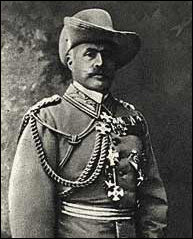
von trotha

Pre-Nazi Exterminator: General Lothar Von Trotha led the Genocide against the Herero in Namibia

The doctrinal response to partisans, or as they would become known in German writings as “bandits,” was that bandits should be encircled and destroyed. This was employed in the Southwest Africa German colonies.  The Germans, influenced by the experience in France, “displayed a ferocity surpassing even that of the racially brutalized campaigns of its imperialist peers.” [66] The campaign against the Herero tribes which resisted the occupation of Namibia from 1904-1912 utilized encirclement operations, racial cleansing and what would become known as Bandenkämpfung operations. [67]

This was further developed in the First World War, especially in the east where General Fritz Gempp described the security problem as a “ruthless struggle” in which German pacification policy “was in reality the application of terror to galvanize the population into accepting German rule.” [68]Anti-partisan doctrine was codified in the Truppenführung of 1933 which stated that “area defense against partisan warfare is the mission of all units” and that the preferred method of combating partisan bands was that they be surrounded and destroyed. [69]General Erhard Rauss later described active and passive measures used to deal with partisans, focusing on the tactic of encirclement to destroy the enemy. [70]

Anti-partisan doctrine focused on the destruction of the partisans, was coupled a total war philosophy and provided fit well with Hitler’s radical ideology.  The “propensity for brutality in anti-guerrilla warfare was complimented by officers’ growing preoccupation, both during and after World War I, with the mastery and application of violence.” [71] Michael Geyer notes: “ideological mobilization for the creation of a new national and international order increasingly defined the parameters of technocratic planning.” [72] The acceptance of long used brutal tactics to destroy the enemy combined with Hitler’s radical racial animus against the Jews could only be expected to create a maelstrom in which all international legal and moral standards would be breached.

Beginnings in Poland

The Polish campaign was a precursor to the Russian campaign and was not totally race driven. It contained elements of Germany’s perception of the injustice of Versailles which gave Poland the Danzig corridor and Germany’s desire to reconnect East Prussia to the Reich, as well as the perceived necessity to remove a potential enemy from its rear as it faced France, yet it was a campaign steeped in Nazi racial ideology.  Poland resisted German efforts to ally itself with Germany in 1939, thus Hitler determined it “would be crushed first.” [73]

Meeting with military leaders on 23 May 1939 Hitler “made it plain that the real issue was not Danzig, but securing of Germany’s Lebensraum….[74] On 22 August he enjoined the generals to “Close your hearts to pity! Act brutally! Eighty million people must obtain what is their right.” [75] Even so, most military leaders failed to appreciate what Hitler was calling on them to do; Manstein would note that “what Hitler had to say about an eventual war with Poland, could not, in my opinion, be interpreted as a policy of annihilation.” [76]

Others such as Canaris was “utterly horrified” as he read his notes to his closest colleagues “His voice trembled as he read, Canaris was acutely aware that he had witnessed something monstrous.” [77]General Johannes Blaskowitz, commander of 8th Army who would be the military commander in Poland did not leave any notes about the meeting, but his biographer notes that he “may have naively attached a military meaning to these terms since he was busy with military matters and soon to begin operations.” [78] This was the interpretation of Manstein as well. [79] Keitel noted that the speech was “delivered in the finest sense of psychological timing and application,” molding “his words and phrases to suit his audience.” [80]

In light of the mixed interpretations by military leaders, it is possible that many misinterpreted Hitler’s intent and did not fully appreciated his ideology as they went into Poland, carefully secluding themselves in the narrow confines of their military world. While such an explanation is plausible for some, it is also true that many others in light of subsequent actions were in full agreement with Hitler. One author notes that “no man who participated in the Führer Conferences….and there were present the highest ranking officers of the three services, could thereafter plead ignorance of the fact that Hitler had laid bare his every depth of infamy before them, and they had raised no voice in protest either then or later.” [81] In July, General Wagner, the Quartermaster General issued orders that “authorized German soldiers to take and execute hostages in the event of attacks by snipers or irregulars.” [82]

Regardless of the meaning ascribed to Hitler’s speech by his generals, Hitler had already laid plans to destroy the Jews in Poland and decimate the Polish intelligentsia and leadership.   Hitler gave Himmler the task of forming “Einsatzgrüppen to follow the German troops as they advanced into Poland and liquidate Poland’s upper class wherever it was to be found.” [83] While senior party leaders remained at Hitler’s side following the conference, Himmler worked to coordinate his troops, including the reinforced Totenkopf battalions and Einsatzgrüppen with the Army. [84]

einsatzgruppe troops and victims

Einsatzgruppen Troops gathering Ukrainian Jews for Execution Hessisches Hauptstaatsarchiv Wiesbaden

Himmler began planning in early May and the Army decided to “use SS and police units to augment their own forces for security tasks.” [85]Himmler established “five Einsatzgrüppen to accompany each of the numbered German armies at the start of the campaign.” [86] Placed under the aegis of Reinhard Heydrich the groups were broken down into smaller units of 100-150 men and allotted to army corps.  All senior posts were occupied by officers of the Sicherhietsdienst. [87]

Two additional Einsatzgrüppen were formed shortly after the invasion. [88]Additionally 3 regiments of the SS Totenkopfverbande, under the direction of SS General Theodore Eicke were deployed in the rear areas of the advancing armies. These regiments were formed from the Concentration Camp guard units and eventually became the nucleus of the 3rd SS Panzer Division Totenkopf.  [89] The purpose of these units was shielded from the Army in the planning stages, [90] although Heydrich worked with the Army to develop lists of up to 30,000 Poles to be arrested including intellectuals, political leaders and clergy. [91]

To eliminate the Polish elites without disturbing the Army, Himmler and Heydrich gave the Army “only the bare minimum of information.” [92] The deception was initially successful.  Blaskowitz’s 8th Army defined the mission of the Einsatzgrüppen in the traditional doctrinal terms of the Ettapen, noting their mission as “the suppression of all anti-Reich and anti-German elements in the rear of the “fighting troops, in particular, counter espionage arrests of politically unreliable persons, confiscation of weapons, safeguarding of important counter-espionage materials etc…” [93] General Wagner issued orders in July 1939 that “authorized German soldiers to take and execute hostages in the event of attacks by snipers or irregulars.” Despite the deception, there was no way to disguise the murder of Polish intelligentsia and Jews, and had the Army had the political acumen and moral courage it could have considerably restricted or even halted the terror campaign. [94].

himmler1

Heinrich Himmler: Implementer of Hitler’s Ideas Authorizes formation of Einsatzgruppen

The ensuing campaign in Poland demonstrated Hitler’s true intent. Heydrich talked about “murdering the Polish ruling class” of the aristocracy, Catholic clergy, communists and Jews on 7 September barely a week after the beginning of the invasion. [95] As the German armies advanced into Poland slicing through the badly deployed and inadequately equipped Polish Army the Einsatzgruppen and Totenkopf Verbande followed in their wake, conducting mass arrests and executions of those Poles deemed to be a threat.

Many army leaders were worried about Polish soldiers left behind in rear areas as the armies advanced. In some cases that concern became a paranoid mindset and some generals believed that a “brutal guerilla campaign has broken out everywhere and we are ruthlessly stamping it out.” [96]

Yet some of the actions by Einsatzgruppen and Totenkopf Verbande against the Polish elites and the Jews drew Army reactions. The unit commanded by SS General Woyrsch “behaved with such unparalleled bestiality that it was thrown out of the operational area” by General List of 14th Army.” [97] Another unit, the Totenkopfverbande Brandenburg came to Army attention when its commander remarked that the “SSVT would not obey Army orders.” The conclusion drawn by the Army General was that “the SSVT commander was following orders from some non-military authority to terrorize the local Jews.” [98]

These atrocities as well as those of other Waffen-SS units were hard to hide and brought reactions out of army commanders who sought to punish the offenders. Blaskowitz and others attempted to put a halt to SS actions against Poles and Jews, [99] but most officers turned a blind eye to the atrocities or outright condoned them.  It is believed that General Walter Model and others “not only knew what was occurring in Poland but actually took part in what Colonel General Franz Halder himself described in October as “this devilish plan.”” [100]

It appears that many who objected were not motivated so much by humanitarian, moral or legal considerations, but rather by the effect on good order and discipline. [101]Likewise it is clear that many officers, even if they did not participate in the actions probably approved of them.  Many biographies and histories of this period written by authors influenced by surviving German officers make no or little mention of the Army’s part in these actions. Himmler and Heydrich were sensitive to the perception of the Army and resented the fact that the Army believed them to be responsible for actions that they were carrying out under the direction and order of Hitler and that their troops were “undisciplined gangs of murderers.” [102]

After the establishment of the Government General led by Hans Frank there was conflict between the Army under Blaskowitz the military commander, the SS, Police and the Nazi administration. Blaskowitz made an “elaborate report on the atrocities of the SS,” [103] expressing concern about his “extreme alarm about illegal executions, his worries about maintaining troop discipline under those circumstances, the failure of discussions with the SD and Gestapo and their assertions that they were only following SS Orders.” [104]

While it is unclear if the memorandum made it to Hitler, it is clear that Hitler did know about the protest and Blaskowitz fell into disfavor and was reassigned after a period of continued conflict with the Nazi administration. Hitler’s reaction to Army objections according to his adjutant was that the Army’s leaders used “Salvation Army” methods, and called their ideas “childish.” [105] others that objected were also relieved of their commands or reassigned. General Georg von Külcher was relieved of command for protesting SS and police atrocities. [106]

SS Officers convicted by Army courts-martial were given amnesty by Hitler on “4 October 1939 who two weeks later removed SS units from the jurisdiction of military courts.” [107]While the army remained, it was no longer in charge and would actively assist the SS and Police in combat and further atrocities against civilians. One German officer, later a conspirator in the July 20th plot, remarked in November 1939 about the killings that he “was ashamed to be German! The minority are dragging our good through the mud by murdering, looting and torching houses will bring disaster on the whole German people if we do not stop it soon…” [108]

ordungspolizei

Ordungspolizei in Action: Street Cops Become Executioners

The Army was relieved of responsibility for policing Poland which fell on the Ordungspolizei battalions and Gendarmerie.  These units were composed of mobilized city police and rural constabulary police and would wreak their own devastation on Poland in the coming months and years. [109] Poland would also be the first Nazi driven shift in population to exploit the newly won Lebensraum as Poles were driven into the newly formed Government General and ethnic Germans moved into previously Polish occupied territories. By 1941 over 1,200,000 Poles and 300,000 Jews had been expelled and 497,000 ethnic Germans brought into provinces lost in 1919. [110] Prior to the war about 3.3 million Jews lived in Poland. After the war 50-70,000 were found to have survived in Poland, the Polish Army and camps in Germany. A further 180,000 were repatriated from the Soviet Union. [111]

Russia

The Nazi war against Russia was the ultimate test of Hitler’s ideological at war. Planning for the war with the Soviet Union began after the Fall of France and during the beginning stages of the Battle of Britain. On 21 July 1940 Hitler made “his intentions plain” to the Army leadership and “von Brauchitsch set his planners to work.” [112] Detailed preparations for the offensive began in the winter of 1940-41 following the Luftwaffe’s failure against Britain and postponement of Operation Sea Lion.  Hitler intended to “crush Soviet Russia in a quick campaign which was to begin no later than March 15, 1941, and before the end of the war with England.” [113] Field Marshal Keitel noted the final decision came in “early December 1940” and from then he had “no doubt whatsoever that only some unforeseen circumstance could possibly alter his decision to attack.” [114]

The military plan initially focused on the destruction of “the Red Army rather than on any specific terrain or political objective,” [115]although the political and geographic objectives would arise in later planning and in the campaign. Hitler stated: “What matters is that Bolshevism must be exterminated. In case of necessity, we shall renew our advance whenever a new center of resistance is formed. Moscow as the center of doctrine must disappear from the earth’s center….” [116]

Besides preparations aimed at the destruction of the Red Army and overthrow of the Soviet State, the “war against the Soviet Union was more openly ideological from the start.” [117] Hitler set the stage on March 3rd 1941: “the forthcoming campaign is more than a mere armed conflict; it is a collision between two different ideologies…this war will not be ended merely by the defeat of the enemy armed forces” and that “the Jewish-Bolshevist intelligentsia must be eliminated….” [118]

Hitler noted that “this is a task so difficult that it cannot be entrusted to the Army.” [119] Reichskommissars would be appointed in the conquered areas, but since normal civilian powers would be insufficient to eliminate the Bolshevists, that it “might be necessary “to establish organs of the Reichsführer SS alongside the army’s Secret Field Police, even in the operational areas….” [120] The “primary task was to liquidate “all Bolshevist leaders or commissars” if possible while still in the operations zones,” [121] yet the orders did not contain “a syllable that in practice every Jew would be handed over to the extermination machine.” [122]

This was followed on 13 March by an agreement between the Army represented by General Wagner and the SS, which stated in part that “the Reichsführer SS has been given by the Führer special tasks within the operations zone of the Army…to settle the conflict between two opposing political systems.” [123]  Likewise the agreement dictated that Himmler would “act independently and on his own responsibility” while ensuring that “military operations are not affected by measures necessary to carry out his task.” [124]

A further instruction of 26 March issued by Wagner gave the Army’s agreement to the use of the Einsatzgrüppen in the operations zone, specifying coordination between them and army authorities in the operational zone and communications zones to the rear.  Cooperation was based on the “principals for co-operation between the State Secret Police and the Field Security organization of the Wehrmacht agreed with the Security branch of the War Ministry on 1 January 1937.” [125]

The most significant act for the Army in this was the Commissar Order. This order is sometimes known as the “Criminal Order” which was used war as evidence at Nurnberg as against Keitel, Jodl and High Command of the Wehrmacht during the later Generals Trial.  The order specified the killing of Soviet Political Commissars attached to the Red Army and as “they were not prisoners of war” and another order specified that “in the event that a German soldier committed against civilians or prisoners, disciplinary action was optional….” [126] The order noted regarding political commissars that “in this struggle consideration and respect for international law with regard to these elements is wrong.” [127] The “Guidelines for the Conduct of Troops in Russia” issued on May 19, 1941 called for “ruthless and vigorous measures against Bolshevist inciters, saboteurs [and] Jews.” [128]

Shortly before the order was issued, Hitler previewed it to the generals saying that the war in Russia “cannot be conducted in a knightly fashion” and that it would have to be waged with “unprecedented, unmerciful and unrelenting harshness…” [129] and that they would have to “dispense with all of their outdated and traditional ideas about chivalry and the generally accepted rules of warfare: the Bolsheviks had long since dispensed with them.” [130] He explained that his orders were beyond their comprehension stating “I cannot and will not change my orders and I insist that that they be carried out with unquestioning and unconditional obedience.” [131]

General Franz Halder, Chief of the OKH, or the Army High Command took notes on Hitler’s speech. They are chilling to read as none present could have understood them in any other way than Hitler meant:

“Clash of two ideologies. Crushing denunciation of Bolshevism, identified with asocial criminality….We must forget the comradeship between soldiers. A Communist is no comrade before nor after the battle. This is a war of extermination….We do not wage war to preserve the enemy….War against Russia: Extermination of the Bolshevist Commissars and of the Communist intelligentsia….this is no job for military courts. The individual troop commanders must know the issues at stake. They must be leaders in the fight….This war will be very different from war in the West. In the East harshness today means leniency in the future. Commanders must make the sacrifice of overcoming their personal scruples.”[132]

Hitler’s speech was protested by some according to Von Brauchitsch. [133] Von Brauchitsch refused to protest to Hitler but issued an order on his own authority “threatening dire penalties for excesses against civilians and prisoners of war” which he maintained at Nurmeberg “was sufficient to nullify the Commissar Order.” [134] Yet Von Brauchitsch later would tell commanders to “proceed with the necessary hardness.” [135] Warlimont noted that Von Bock, who would “later emerge as an opponent of the Commissar Order…makes no special comment on the meeting or the restricted conference that followed.” [136]

At Nuremberg Keitel said that he “stubbornly contested” the clause “relating to the authority of the SS-Reichsführer… in the rearward operational areas.” [137]Keitel blamed the Army High Command OKH under Halder, but the order came out with his signature on behalf of Hitler, which was key evidence against him at Nurnberg. He stated that “there was never any possibility of justifying them in retrospect by circumstances obtaining in the Russian campaign.” [138]

Some commanders refused to publish the orders and “insisted that the Wehrmacht never implemented such policies…” blaming them instead on the SS. One writer states “such protests were undoubtedly sincere, but in practice German soldiers were far from innocent. The senior professional officers were often out of touch with their subordinates.” [139] The orders were a “license to kill, although not a great departure from German military traditions….” [140] The effect was terrifying, for in a sense the Einsatzgruppen, “could commit ever crime known to God and man, so long as they were a mile or two away from the firing line.” [141] Security Divisions were “instructed to give material and logistical support to…units of the Einsatzgruppen.” [142] Even worse, army units in rear areas “could be called on to assist Himmler’s SS police leaders.” [143]

einsatzgruppen executions

Einsatzgruppe troops finishing off Jewish Women

For the campaign in the Soviet Union the SS formed four Einsatzgruppen composed of SD, Waffen-SS and Police troops designated A-D. Einsatzgruppe A was assigned to Army Group North, Einsatzgruppe B to Army Group Center, Einsatzgruppe C to Army Group South and Einsatzgruppe D to the 11th Army.  The Einsatzgruppe were not standardized in manpower or equipment. In size they were battalion equivalents the largest Einsatzgruppe being A in the North with 990 assigned personnel [144]while Einsatzgruppe D had only 550 troops assigned. [145] These units had SS, SD or Police commanders. Additionally nine Ordnungspolizei battalions were initially assigned to the invasion forces to supplement the Einsatzgruppen. [146]

The police contingent would grow over time so that by 1943, these units would be grouped under regiments and number about 180,000 men assisted by 301,000 auxiliaries. [147] These units would act in concert with nine Army Security Divisions which handled rear area security. [148] Himmler initially did not reveal their intent and planned use to Einsatzgruppen commanders, only speaking of a “heavy task…to “secure and pacify” the Russian area using Sicherheitspolizei and SD methods.” [149] Understanding the effect of these operations, Himmler would state that “in many cases it is considerably easier to lead a company in battle than to command a company responsible to…carry out executions, to deport people…to be always consistent, always uncompromising-that is in many cases far, far harder.” [150]

The actions of these units are well documented; the Einsatzgruppen, Police, Army and locally recruited Schutzmannschaft battalions [151] ruthlessly exterminated Jews and others in the operational area. No sooner had an Einsatzgruppe unit entered a city, a “deadly stranglehold” would grip the “Jewish inhabitants claiming thousands and thousands of victims day by day and hour by hour.” [152] Non-Jewish Russians were encouraged to conduct programs which Heydrich noted “had to be encouraged.” [153] Einsatzgruppen D report number 153 noted: “During period covered by this report 3,176 Jews, 85 Partisans, 12 looters, 122 Communist functionaries shot. Total 79,276.” [154]   By the spring of 1942 Einsatzgruppe A had claimed “more than 270,000 victims, the overwhelming majority of whom were Jewish.” [155] The total killed for all groups then was 518,388 people, mostly Jews. [156] Germany’s Romanian ally acted against Jews in Odessa as well; “on 23 October 1941 19,000 Jews were shot near the harbor… probably 200,000 Jews perished either at Romanian hands or after being turned over by the Romanians to the Germans.” [157]

ordungspolizie officers

Many Anti-Jewish Massacres were Labeled “Anti-Partisan” Operations

Operations against Jews were often called anti-partisan operations.  Himmler referred to Einsatzgruppen as “anti-Partisan formations [158] while Wehrmacht Security divisions “murdered countless Soviet civilians and burned Russian settlements to the ground under the pretext of subduing partisan resistance.” [159] The attitude by 1941-1942 was that “’all Jews are partisans and all partisans are Jews.” From 1943, all armed resistance was “banditry” and all Jews irrespective of circumstances were treated as “bandits.”” [160]

General Von Reichenau issued an order in which he stated:

“The soldier in the Eastern territories is not merely a fighter according to the art of war but also a bearer of a ruthless national ideology and the avenger of the bestialities which had been inflicted upon German and racially related nations. Therefore the soldier must have full understanding for the necessity of a severe but just revenge on subhuman Jewry.” [161]
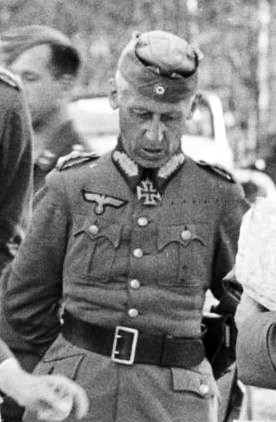
Russland, Generale v. Bock, Hoth, W. v. Richthofen

Herman Hoth

Likewise the distinguished Panzer commander General Herman Hoth issued his own order of 17 November 1941 urging his troops to exact revenge on the Jews and Communists:

“Every trace of active or passive resistance or of any kind of machinations by the Bolshevik -Jewish agitators are [sic] to be immediately and pitilessly rooted out. The necessity of severe measures against elements foreign to people and kind must be understood precisely by the soldiers. These circles are the spiritual pillars of Bolshevism, the tablebearers [priests] of its murder organization, the helpers of the partisans. It consists of the same Jewish class of people which have done so much to harm our Fatherland and by its hostile activity…and anti-culture, which promotes anti-German currents in the whole world and which wants to be the bearer of revenge. Their annihilation is a law of self-preservation. Any soldier criticizing these measures has no memory of the former traitorous activity lasting for years carried on among our own people by Jewish-Marxist elements.” [162]

The commander of the 221st Security Division endeavored to persuade his “subordinate units that the Jews were carriers of Bolshevik contamination and, therefore, the ultimate source of any sabotage or difficulty the division faced.” [163] The extermination of the Jews and partisan war were closely intertwined with the Reich’s economic policies designed to exploit the natural resources of the Russia. This included the “hunger plan” which German authorities seemed to imagine that “millionfold starvation could be induced by requisitioning off all available grain and “shutting off” the cities.” [164]

The Wehrmacht’s complicity in these measures is demonstrated in the order drafted by Warlimont and signed by Keitel on 13 May 1941. That order, the “Decree on Exercising Military Jurisdiction in the Area of Barbarossa and Special Measures by the Troops” made it clear that international conventions regarding the treatment of civilians would not be observed in the Soviet Union. The order, relying on the historic precedent of German military law in regard to partisan activity stated:

I. “Treatment of crimes committed by enemy civilians “1. Until further order the military courts and the courts martial will not be competent for crimes committed by enemy civilians. “2. Francs-tireurs will be liquidated ruthlessly by the troops in combat or while fleeing. “3. Also all other attacks by enemy civilians against the armed forces, its members, and auxiliaries will be suppressed on the spot by the troops with the most rigorous methods until the assailants are finished (niederkaempfen) “4. Where such measures were not taken or at least were not possible, persons suspected of the act will be brought before an officer at once. This officer will decide whether they are to be shot. Against localities from which troops have been attacked in or treacherous manner, collective coercive measures be applied immediately upon the order of an officer of the rank of at least battalion etc., commander, if the circumstances do not permit a quick identification of individual perpetrators.

II. “Treatment of crimes committed against inhabitants by members of the Wehrmacht and its auxiliaries “1. With regard to offenses committed against enemy civilians by members of the Wehrmacht or by its auxiliaries prosecution is not obligatory, even where the deed is at the same time a military crime or misdemeanor….” [165]

Hitler was quite clear in his intent when he told General Halder that in 1941 that he “intended to level Moscow and Leningrad, to make them uninhabitable, so there would be no need to feed their populations during the winter.” [166]Economic officials held life and death power over villages. Those that met agricultural quotas were “likely to be spared annihilation and evacuation…the culmination of this process, during 1943, would be the widespread creation of “dead zones.”” [167]All told during the campaign against the Soviet Union the Germans killed nearly 1.5 million Russian Jews. [168]

By 1942, over two million Soviet POW’s had been killed.  600,000 shot outright, 140,000 by the Einsatzkommandos. [169]Eventually about 3.3 million Soviet POWs died in German captivity through starvation, disease and exposure, [170] are included in a total of over 10 million Red Army Combat deaths. [171] Bracher notes: “The reality and irreality of the National Socialism were given their most terrible expression in the extermination of the Jews.” [172]
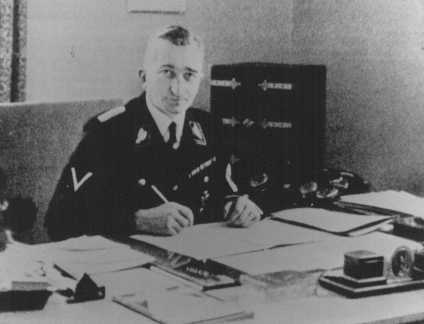
arthur nebe

The Killer Becomes a Victim: Arthur Nebe’s experience commanding an Einsatzgruppe so traumatized him that he would be reassigned and then become active in the attempt to kill Hitler and lose his life

Himmler and others continued to use euphemistic language to describe their efforts talking in terms of “Jewish resettlement.” [173] Terms such as special actions, special treatment, execution activity, cleansing and resettlement were used in place of the word murder. [174]At the same time these operations led to problems in the ranks, one SS trooper observed: “deterioration in morale among his own men who had to be issued increasing rations of vodka to carry out their killing orders.” [175]

Even commanders of the Einsatzgruppe were affected. Arthur Nebe would say “I have looked after so many criminals and now I have become one myself.” Nebe became an active participant in the July 20th plot against Hitler [176]and a fellow conspirator would describe him as a “shadow of his former self, nerves on edge and depressed.” [177] Erich Bach-Zelewski, who led the SS anti-partisan operations, would suffer a nervous breakdown which included “hallucinations connected to the shootings of Jews” which hospitalized him in 1942. [178] Himmler would state in his Posen speech given in October 1943 that “to have gone through” the elimination of the Jews had “and remained decent, that has made us tough. This is an unwritten, never to be written, glorious page in our history.” [179]

Conclusion

The German war against Poland and the Soviet Union was heavily dependent on the racist ideology of Adolf Hitler.  He was the true spirit behind the atrocities committed by his nation as one noted in Russia: “Here too the Führer is the moving spirit of a radical solution in both word and deed.” [180]He saw the partisan war as “the chance to stamp out everything that stands against us.” [181]Belief in Germany’s right to Lebensraum the superiority of the German Volk and necessity to settle the Jewish problem provided a fertile ground for Hitler’s plans.  German military doctrines, especially those of anti-partisan and total warfare abetted Hitler’s goals.

It is quite clear that many in the Wehrmacht were in agreement with Hitler’s ideology of racial-war. Prepared by cultural prejudice and long traditions of thought, the “Prussian and in later German military must be regarded as a significant part of the ideological background of the Second World War.” [182] General Walther Von Reichenau’s orders to his troops are revealing: “The most important goal of the campaign against Jewish-Bolshevism is the complete destruction of its grip on power and the elimination of the Asian influence from our European cultural sphere.” [183] Field Marshal Gerd Von Rundstedt appeared to agree with Reichenau to “use the partisan threat as excuse for persecuting Jews, so long as the dirty work was largely left to SS Einsatzgruppen.” [184]

The Army command…on the whole acquiesced in the extermination of the Jews, or at least closed its eyes to what was happening.” [185] Even if the Generals had been more forceful in their opposition, they would have been opposed by the highly nazified youth that made up the bulk of their Army, especially junior officers and then there was the matter of their oath to Hitler and what they saw as personal honor. General Alfred Jodl told American Army psychologist Gustave Gilbert at Nuremberg that “In war the moral pressure of obedience and the stigma of high treason are pretty hard to get around.” [186]

Jodl’s superior Keitel stated his helplessness before Hitler saying to Gilbert “What could I do? There were only 3 possibilities: 9a) refusal to follow orders, which naturally meant death; (b) resign my post, or (c) commit suicide. I was on the point of resigning my post 3 times, but Hitler made it clear that he considered my resignation in time of war the same as desertion. What could I do?” [187] This was obviously an after the fact excuse by Keitel who had been present in Hitler’s headquarters since the beginning and had witnessed the explosive General Heinz Guderian explode in rage against Hitler in 1945.

SS leaders fanatically executed Hitler’s policies aided by the civil administration. Genocide was to bring the Reich “long term economic gains and trading advantages” and was seen as a way of “financing the war debt without burdening the German taxpayer.” [188] Many in the Army as it has been shown were not only knowledgeable about the crimes committed but urged their soldiers to participate in these crimes.

Otto Ohlendorf, commander of Einsatzgruppe D testified at the Einsatzgruppe Trial that “Einsatzgruppen reported all of their tasks to the army commanders, and that together, they and the army agreed on the time, place, and possible support of the troops for any particular “liquidation action[s].” [189]

Some individuals did attempt to resist the most brutal aspects of the Nazi campaign against the Jews. Wilhelm Kube, Reichskommissar for White Russia and a virulent anti-Semite was shocked at the murders of the Jews calling them “unworthy of the German cause and damaging to the German reputation” and would later attempt to spare Jews by employing them in war industries, would be “defeated by Himmler’s zealots.” [190]Army officers who objected like Blaskowitz and Külcher were relieved, or like Von Leeb, told by Hitler to “in so many words told to mind his own business.” Leeb stated: “the only thing to do is to hold oneself at a distance.” [191] Field Marshall Erwin Rommel knew of crimes being committed against the Jews and others through Blaskowitz but blamed the crimes “on Hitler’s subordinates, not Hitler himself.” [192]
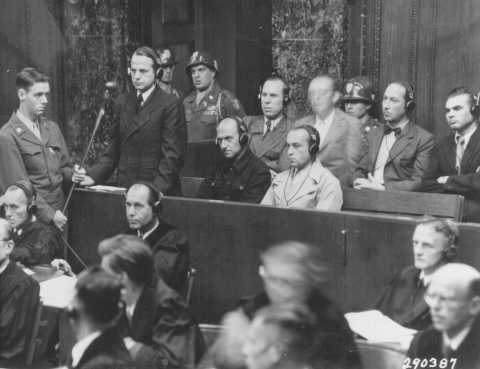
einsatzgruppen trial

Partial Justice: The Einsatzgruppen Trial

Hitler’s ideology permeated German military campaigns and administration of the areas conquered by his armies. No branch of the German military, police or civil administration in occupied Poland or Russia was exempt guiltless in the crimes committed by the Nazi regime. It is a chilling warning of the consequences awaiting any nation that allows it to become caught up in hate-filled political, racial or even religious ideologies which dehumanizes opponents and of the tragedy that awaits them and the world. In Germany the internal and external checks that govern the moral behavior of the nation and individuals failed. Caught up in the Nazi system, the Germans, especially the police and military abandoned the norms of international law, morality and decency, banally committing crimes which still reverberate today and which are seen in the ethnic cleansing actions in the former Yugoslavia, Syria and other nations.

It is something that we should not forget.

Peace

Padre Steve+


Bibliography

Aly, Gotz and Heim, Susanne. Architects of Annihilation: Auschwitz and the Logic of Destruction Phoenix Paperbacks, London, 2003, originally published as Vordenker der Vernichtung, Hoffman und Campe, Germany 1991, English translation by Allan Blunden.  First published in Great Britain Weidenfeld & Nicholson, London, 2002

Arendt, Hannah, Eichmann in Jerusalem: A Report on the Banality of Evil. Revised and Enlarged Edition. Penguin Books, Harmondsworth, England and New York, NY 1965. Originally published by Viking Press, New York, NY 1963

Blood, Philip. Hitler’s Bandit Hunters: The SS and the Occupation of Europe. Potomoac Books Inc. Washington, DC 2008

Bracher, Karl Dietrich. The German Dictatorship: The Origins, Structure, and Effects of National Socialism. Translated by Jean Steinberg, Holt Rinehart and Winston, New York, NY 1979. Originally Published under the title Die Deutsche Diktatur: Entstehung, Struktur,Folgen des Nationalsocialismus. Verlag Kiepenheuer & Witsch. Koln and Berlin, 1969

Browning, Christopher R. Ordinary Men: Reserve Police Battalion 101 and the Final Solution in Poland. Harper Perennial Books, New York, New York 1993 reissued 1996.

Burleigh, Michael and Wippermann, Wolfgang. The Racial State: Germany 1933-1945 Cambridge University Press, New York NY and Cambridge UK 1991

Condell, Bruce and Zabecki, David T. Editors. On the German Art of War: Truppenführung , Lynn Rienner Publishers, Boulder CO and London 2001

Craig, Gordon A. The Politics of the Prussian Army 1640-1945. Oxford University Press, London and New York, 1955

Davidowicz, Lucy S. The War Against the Jews 1933-1945 Bantam Books, New York, NY 1986.

Di Nardo, Richard L. Germany and the Axis Powers: From Coalition to Collapse. University Press of Kansas, Lawrence, KS. 2005

Erickson, John. The Road to Berlin. Cassel Military Paperbacks, London, 2003. First Published by Weidenfeld and Nicholson, 1983

Evans, Richard J. The Coming of the Third Reich Penguin Books, New York 2004.  First published by Allen Lane 2003

Evans, Richard J. The Third Reich in Power 1933-1939. Penguin Press, New York, NY 2005

Ferguson, Niall. The War of the Worlds: Twentieth Century Conflict and the Descent of the West. The Penguin Press, New York, 2006

Fest, Joachim, Hitler. Translated by Richard and Clara Winston.Harcourt Brace Jovanovich Publishers, San Diego, New York, London, 1974.  German Edition by Verlag Ullstein 1973

Fraser, David. Knight’s Cross: A Life of Field Marshal Erwin Rommel Harper Perennial, New York 1995, first published by Harper Collins in Britain, 1993

Friedlander, Saul Nazi Germany and the Jews 1939-1945: The Years of Extermination. Harper Perennial, New York, NY 2007

Fritz, Stephen G. Frontsoldaten: The German Soldier in World War II.  The University Press of Kentucky, Lexington, KY 1995

Geyer, Michael. German Strategy 1914-1945 in Makers of Modern Strategy from Machiavelli to the Nuclear Age. Peter Paret, editor. Princeton University Press, Princeton NJ. 198

Gilbert, Gustave Nuremberg Diary DaCapo Press 1995 copyright G.M. Gilbert 1947

Giziowski, Richard. The Enigma of General Blaskowitz. Hppocrene Books, New York 1997

Glantz, David M. and House, Jonathan. When Titans Clashed: How the Red Army Stopped Hitler. University Press of Kansas, Lawrence, KS. 1995

Goerlitz, Walter. History of the German General Staff.” Translated by Brian Battershaw, Westview Press, Boulder and London, 1985. Originally published as Die Deutsche Generalstab Verlag der Frankfurter Hefte, Frankfurt am Main, 1953

Goerlitz, Walter. The Memiors of Field Marshal Wilhelm Keitel: Chief of the German High Command 1938-1945.  Translated by David Irving. Cooper Square Press 2000,  First English Edition 1966 William Kimber and Company Ltd.  German edition published by Musterschmnidt-Verlad, Gottigen 1961.

Hebert, Valerie Genevieve, Hitler’s Generals on Trial: The Last War Crimes Tribunal at Nuremberg University of Kansas Press, Lawrence Kansas 2010

Hitler, Adolf Mein Kampf translated by Ralph Manheim. Mariner Books, Houghton Mifflin Company, New York, NY 1999. Houghton Mifflin Company 1943, copyright renewed 1971. Originally published in Germany by Verlag Frz. Eher Nachf. GmbH 1925

Höhne, Heinze. Canaris: Hitler’s Master Spy. Traslated by J. Maxwell Brownjohn. Cooper Square Press, New York 1999. Originally published by C. Bertelsmann Verlag Gmbh, Munich 1976, first English edition by Doubleday and Company 1979

Höhne, Heinze. The Order of the Death’s Head: The Story of Hitler’s SS. Translated by Richard Barry. Penguin Books, New York and London, 2000. First English edition published by Martin Secker and Warburg Ltd. London 1969. Originally published as Der Orden unter dem Totenkopf, Verlag Der Spiegel, Hamburg 1966.

Hughes, Daniel J. editor. Moltke on the Art of War: Selected Writings, translated by Harry Bell and Daniel J Hughes. Presidio Press, Novato CA 1993

Liddell-Hart, B.H. The German Generals Talk. Quill Publishing, New York, NY. 1979. Copyright 1948 by B.H. Liddell-Hart

Lieber, Franz Instructions for the Government of Armies of the United States in the Field, prepared by Francis Lieber, LL.D., Originally Issued as General Orders No. 100, Adjutant General’s Office, 1863, Washington 1898: Government Printing Office. Retrieved from http://avalon.law.yale.edu/19th_century/lieber.asp 6 May 2014

Macksey, Kenneth. Why the Germans Lose at War: The Myth of German Military Superiority. Barnes and Noble Books, New York 2006, originally published by Greenhill Books, 1996

Manstein, Erich von. Forward by B.H. Liddle Hart, Introduction by Martin Blumenson. Lost victories: The War Memoirs of Hitler’s Most Brilliant General. Zenith Press, St Paul MN 2004. First Published 1955 as Verlorene Siege, English Translation 1958 by Methuen Company

Shirer, William L. The Rise and Fall of the Third Reich. A Touchstone Book published by Simon and Schuster, 1981, Copyright 1959 and 1960

Megargee, Geoffrey P. War of Annihilation: Combat and Genocide on the Eastern Front 1941.Bowman and Littlefield Publishers Inc. Lanham, Boulder, New York. 2007

Messinger, Charles, The Last Prussian: A Biography of Field Marshal Gerd Von Rundstedt 1875-1953 Brassey’s (UK) London England 1991

Newton, Steven H. Hitler’s Commander: Field Marshal Walter Model-Hitler’s Favorite General DaCapo Press a division of Perseus Books Group, Cambridge MA 2005

Novatny, Alfred. The Good Soldier. The Aberjona Press, Bedford, PA 2003

Padfield, Peter. Himmler. MJF Books, New York. 1990

Reitlinger, Gerald.  The SS: Alibi of a Nation. The Viking Press, New York, 1957. Republished by Da Capo Press, New York, NY.

Rhodes, Richard. Masters of Death: The SS Einsatzgruppen and the Invention of the Holocaust. Vintage Books a division of Random House, New York, NY 2002

Shepherd, Ben. War in the Wild East: The German Army and Soviet Partisans. Harvard University Press, Cambridge, MA 2004

Sofsky, Wolfgang. The Order of Terror: The Concentration Camp. Translated by William Templer. Princeton University Press. Princeton, NJ 1997. Originally published as Die Ordnung des Terros: Das Konzentrationslager. S. Fischer Verlag, GmbH, Frankfurt am Main, 1993

Speer, Albert. Inside the Third Reich. Collier Books, a Division of MacMillan Publishers, Inc. New York, NY 1970.

Strachan, Hew. European Armies and the Conduct of War. George, Allen and Unwin, London, UK 1983

Stein, George H. The Waffen SS 1939-1945: Hitler’s Elite Guard at War. Cornell University Press, Ithaca and London, 1966

Stern, Fritz. Gold and Iron: Bismarck, Bleichroder and Building of the German Empire. Vintage Books a division of Random House, New York 1979 First published by Alfred a Knopf 1977

Sydnor, Charles W. Soldiers of Destruction: The SS Death’s Head Division, 1933-1945. Princeton University Press, Princeton, NY 1977

Taylor, Fred, Editor and Translator. The Goebbels Diaries 1939-1941, Penguin Books Ltd, Harmondsworth UK and New York NY 1984.

Tooze, Adam. The Wages of Destruction Penguin Books, New York, NY, 2008. First Published by Allen Lane Books, Penguin Group, London UK, 2006

Trevor-Roper, H.R. Hitler’s Table Talk 1941-1944 with an introduction by Gerhard L Weinberg,  Translated by Norman Cameron and R.H. Stevens, Enigma Books, New York, NY 2000. Originally published in Great Britain by Weidenfeld & Nicholoson, London 1953.

Warlimont, Walter. Inside Hitler’s Headquarters 1939-45. Translated by R.H. Berry, Presido Press, Novato CA, 1964.

Weinberg, Gerhard L. Germany Hitler and World War II . Cambridge University Press, New York, NY 1995

Weinberg, Gerhard L. Ed. Hitler’s Second Book: The Unpublished Sequel to Mein Kampf by Adolph Hitler. Translated by Krista Smith, Enigma Books,  New York, NY 2006. Originally published as Hitlers zweites Buch, Gerhard Weinberg editor, 1961.

Weinberg, Gerhard L. Visions of Victory: The Hopes of Eight World War II Leasers. Cambridge University Press, New York, NY 2005

Westermann, Edward B. Hitler’s Police Battalions: Enforcing Racial War in the East. University Press of Kansas, Lawrence, KS. 2005

Wette, Wolfram. The Wehrmacht: History, Myth, Reality. Translated by Deborah Lucas Schneider. Harvard University Press, Cambridge, MA 2006. Originally published as Die Wehrmacht: Feindbilder, Vernichtungskreig, Legenden. S. Fischer Verlag, GmbH, Frankfurt am Main, 2002

Wheeler-Bennett, John. The Nemesis of Power: The German Army in Politics 1918-1945. St. Martin’s Press Inc. New York, NY 1954

[1] Weinberg, Gerhard L. Ed. Hitler’s Second Book: The Unpublished Sequel to Mein Kampf by Adolph Hitler. Translated by Krista Smith, Enigma Books, New York, NY 2006. Originally published as Hitlers zweites Buch, Gerhard Weinberg editor, 1961 p. 159


[2] Davidowicz, Lucy S. The War Against the Jews 1933-1945 Bantam Books, New York, NY 1986. p.91

[3] Tooze, Adam. The Wages of Destruction Penguin Books, New York, NY, 2008. First Published by Allen Lane Books, Penguin Group, London UK, 2006. p.463

[4] Fest, Joachim, Hitler. Translated by Richard and Clara Winston.Harcourt Brace Jovanovich Publishers, San Diego, New York, London, 1974.  German Edition by Verlag Ullstein 1973 pp. 607-608

[5] Note the actions of Cardinal Richelieu in France who worked to expand French power at the expense of other Catholic nations and the Vatican itself.

[6] In the United States the Reconstruction policies produced great resentment in the south with decidedly negative results for the newly freed slaves which lasted another 100 years, while in the Soviet Union great numbers of “opponents of Socialism” were killed, imprisoned or driven out of the county

[7] Ibid. Tooze. The Wages of Destruction p.462


[8] Ibid. Davidowicz, The War Against the Jews pp.8-9

[9] Ibid. Davidowicz. The War Against the Jews p.12

[10] Ibid. Fest  Hitler. p.47


[11] Bracher, Karl Dietrich. The German Dictatorship: The Origins, Structure, and Effects of  National Socialism. Translated by Jean Steinberg, Holt Rinehart and Winston, New York, NY 1979. Originally Published under the title Die Deutsche Diktatur: Entstehung, Struktur,Folgen des Nationalsocialismus. Verlag Kiepenheuer & Witsch. Koln and Berlin, 1969 p.93

[12] Weinberg, Gerhard L. Germany Hitler and World War II . Cambridge University Press, New York, NY 1995 p.61

[13] Ibid. Weinberg, Hitler’s Second Book p.60

[14] Friedlander, Saul Nazi Germany and the Jews 1939-1945: The Years of Extermination. Harper Perennial, New York, NY 2007 p.xviii

[15] Ibid. Friedlander, The Years of Extermination p.xvii  Friedlander called this anti-Semitism “Redemptive anti-Semitism” in which “Hitler perceived his mission as a kind of crusade to redeem the world by eliminating the Jews.

[16] Megargee, Geoffrey P. War of Annihilation: Combat and Genocide on the Eastern Front 1941.Bowman and Littlefield Publishers Inc. Lanham, Boulder, New York. 2007 p.4

[17] Hitler, Adolf Mein Kampf translated by Ralph Manheim. Mariner Books, Houghton Mifflin Company, New York, NY 1999. Houghton Mifflin Company 1943, copyright renewed 1971. Originally published in Germany by Verlag Frz. Eher Nachf. GmbH 1925. p.662.

[18] Evans, Richard J. The Coming of the Third Reich Penguin Books, New York 2004.  First published by Allen Lane 2003 p.197

[19] Ibid. Davidowicz The War Against the Jews pp. 88-89

[20] Rhodes, Richard. Masters of Death: The SS Einsatzgruppen and the Invention of the Holocaust. Vintage Books a division of Random House, New York, NY 2002 p.37

[21] Speer, Albert. Inside the Third Reich. Collier Books, a Division of MacMillan Publishers, Inc. New York, NY 1970 p.166

[22] Geyer, Michael. German Strategy 1914-1945 in Makers of Modern Strategy from Machiavelli to the Nuclear Age. Peter Paret, editor. Princeton University Press, Princeton NJ. 1986. p.582

[23] Ibid. Geyer. German Strategy p.587

[24] Strachan, Hew. European Armies and the Conduct of War. George, Allen and Unwin, London, UK 1983 p.174

[25] Goerlitz, Walter. The Memoirs of Field Marshal Wilhelm Keitel: Chief of the German High Command 1938-1945.  Translated by David Irving. Cooper Square Press 2000,  First English Edition 1966 William Kimber and Company Ltd.  German edition published by Musterschmnidt-Verlad, Gottigen 1961 p. 135

[26] Ibid. Fest, Hitler.  p. 649

[27] Ibid. Megargee, War of Annihilation p.7

[28] Trevor-Roper, H.R. Hitler’s Table Talk 1941-1944 with an introduction by Gerhard L Weinberg,  Translated by Norman Cameron and R.H. Stevens, Enigma Books, New York, NY 2000. Originally published in Great Britain by Weidenfeld & Nicholoson, London 1953 p. 27 Goebbels notes a similar theme in his recollection of Hitler’s reasons for destroying Russia a power .  See Taylor, Fred, Editor and Translator. The Goebbels Diaries 1939-1941, Penguin Books Ltd, Harmondsworth UK and New York NY 1984 pp. 413-415.

[29] Goerlitz, Walter. History of the German General Staff.” Translated by Brian Battershaw, Westview Press, Boulder and London, 1985. Originally published as Die Deutsche Generalstab Verlag der Frankfurter Hefte, Frankfur am Main, 1953 p.390

[30] Warlimont, Walter. Inside Hitler’s Headquarters 1939-45. Translated by R.H. Berry, Presido Press, Novato CA, 1964 p. 150

[31] Weinberg, Gerhard L. Visions of Victory: The Hopes of Eight World War II Leasers. Cambridge University Press, New York, NY 2005. p. 24

[32] Aly, Gotz and Heim, Susanne. Architects of Annihilation :Auschwitz and the Logic of Destruction Phoenix Paperbacks, London, 2003, Originally published as  Vordenker der Vernichtung, Hoffman und Campe, Germany 1991, English translation by Allan Blunden.  First published in Great Britain Weidenfeld & Nicholson, London, 2002 pp. 245-246

[33] Ibid. Fest. Hitler p.649


[34] Wette, Wolfram. The Wehrmacht: History, Myth, Reality. Translated by Deborah Lucas Schneider. Harvard University Press, Cambridge, MA 2006. Originally published as Die Wehrmacht: Feindbilder, Vernichtungskreig, Legenden. S. Fischer Verlag, GmbH, Frankfurt am Main, 2002 p.93

[35] This understanding is different than many historians who as Friedlander notes advocate something like this: “The persecution and extermination of the Jews of Europe was but a secondary consequence of major German policies pursued toward entirely different goals.” See Friedlander p.xvi


[36] Ibid. Megargee. War of Annihilation p.xii

[37] Liddell-Hart, B.H. The German Generals Talk. Quill Publishing, New York, NY. 1979. Copyright 1948 by B.H. Liddell-Hart p.22

[38] It has to be noted that Liddell-Hart published this work in 1948 and was limited in the materials available, his primary sources being German officers who he viewed with sympathy because he saw them as exponents of his theory of the indirect approach. The time was also around the beginning of the Cold War and the Berlin Blockade when many American and British leaders were trying to end the war crimes trials and bring the West Germans into the new anti-Communist alliance.

[39] Ibid. Wette. The Wehrmacht p.224

[40] Macksey, Kenneth. Why the Germans Lose at War: The Myth of German Military Superiority. Barnes and Noble Books, New York 2006, originally published by Greenhill Books, 1996. p.139

[41] Stern, Fritz. Gold and Iron: Bismarck, Bleichroder and Building of the German Empire. Vintage Books a division of Random House, New York 1979 First published by Alfred a Knopf 1977.  p.495

[42] Ibid. Stern. Gold and Iron p.494

[43] Ibid. Bracher. The German Dictatorship p.34

[44] Ibid. Bracher The German Dictatorship pp.34-35

[45] Höhne, Heinze. Canaris: Hitler’s Master Spy. Translated by J. Maxwell, Brownjohn. Cooper Square Press,New York 1999. Originally published by C. Bertelsmann Verlag Gmbh, Munich 1976, first English edition by Doubleday and Company 1979 p. 216.  Canaris would later protest the Kristalnacht to Keitel (p.334) and become convinced of the crime of the Nazis against the Jews.


[46] Ibid. Witte. The Wehrmacht p.98

[47] Ibid Witte The Wehrmacht, p.73

[48] Arendt, Hannah, Eichmann in Jerusalem: A Report on the Banality of Evil. Revised and Enlarged Edition. Penguin Books, Harmondsworth, England and New York, NY 1965. Originally published by Viking Press, New York, NY 1963 p.26

[49] Ibid. Megargee. War of Annihilation p.6

[50] Fritz, Stephen G. Frontsoldaten: The German Soldier in World War II.  The University Press of Kentucky, Lexington, KY 1995 p.195


[51] Craig, Gordon A. The Politics of the Prussian Army 1640-1945. Oxford University Press, London and New York, 1955 p.495

[52] Novatny, Alfred. The Good Soldier. The Aberjona Press, Bedford, PA 2003 p.40

[53] Westermann, Edward B. Hitler’s Police Battalions: Enforcing Racial War in the East. University Press of Kansas, Lawrence, KS. 2005 p.64  Westermann also notes the preponderance of SA men who entered the Order Police in the 1930s, a factor which helped further the politicization of that organization.

[54] Ibid. Rhodes Masters of Death p.23

[55] Ibid. Westermann Hitler’s Police Battalions p.103

[56] Sydnor, Charles W. Soldiers of Destruction: The SS Death’s Head Division, 1933-1945. Princeton University Press, Princeton, NY 1977 p. 28

[57] Shepherd, Ben. War in the Wild East: The German Army and Soviet Partisans. Harvard University Press, Cambridge, MA 2004 p.41

[58] Blood, Philip. Hitler’s Bandit Hunters: The SS and the Occupation of Europe. Potomac Books Inc. Washington, DC 2008 p.11

[59] Ibid. Shepherd. War in the Wild East p.42

[60] Ibid. Goerlitz. History of the German General Staff p.93

[61] Rothenburg, Gunther. Moltke, Schieffen, and the Doctrine of Strategic Envelopment in Makers of Modern Strategy from Machiavelli to the Nuclear Age. Peter Paret, editor. Princeton University Press, Princeton NJ. 1986 p.305

[62] Hughes, Daniel J. editor. Moltke on the Art of War: Selected Writings, translated by Harry Bell and Daniel J Hughes. Presidio Press, Novato CA 1993. p.32

[63] Ibid. Blood Hitler’s Bandit Hunters p.6   Lieber was a Prussian emigrant to the US who taught law at Columbia University.

[64] Instructions for the Government of Armies of the United States in the Field, prepared by Francis Lieber, LL.D., Originally Issued as General Orders No. 100, Adjutant General’s Office, 1863, Washington 1898: Government Printing Office. Retrieved from http://avalon.law.yale.edu/19th_century/lieber.asp 6 May 2014

[65] Ibid. Blood Hitler’s Bandit Hunters pp.12-13

[66] Ibid. Shepherd Wild War in the East p.42

[67] Ibid. Blood. Hitler’s Bandit Hunters pp.16-19

[68] Ibid. Blood. Hitler’s Bandit Hunters p.22

[69] Condell, Bruce and Zabecki, David T. Editors. On the German Art of War: Truppenführung, Lynn Rienner Publishers, Boulder CO and London 2001. p.172

[70] Tsouras, Peter G. Editor, Fighting in Hell: The German Ordeal on the Eastern Front The Ballantine Publishing Group, New York, 1998. First published 1995 by Greenhill Books pp. 142-146.  It is interesting to note that Rauss does not describe any actual anti-partisan operation

[71] Ibid. Shepherd. War in the Wild East p.45

[72] Ibid. Geyer. German Strategy p.584

[73] Ibid. Weinberg. Visions of Victory p.8

[74] Ibid. Goerlitz, History of the German General Staff p.346

[75] Höhne, Heinze. The Order of the Death’s Head: The Story of Hitler’s SS. Translated by Richard Barry. Penguin Books, New York and London, 2000. First English edition published by Martin Secker and Warburg Ltd. London 1969. Originally published as Der Orden unter dem Totenkopf, Verlag Der Spiegel, Hamburg 1966 p.259

[76] Manstein, Erich von. Forward by B.H. Liddle Hart, Introduction by Martin Blumenson. Lost victories: The War Memoirs of Hitler’s Most Brilliant General. Zenith Press, St Paul MN 2004. First Published 1955 as Verlorene Siege, English Translation 1958 by Methuen Company p.29

[77] Ibid. Hohne. Canaris p.347

[78] Giziowski, Richard. The Enigma of General Blaskowitz. Hppocrene Books, New York 1997 p.119

[79] Ibid. Manstein. Lost Victories p.29

[80] Ibid. Goerlitz. The Memoirs of Field Marshal Keitel p.87

[81] Wheeler-Bennett, John. The Nemesis of Power: The German Army in Politics 1918-1945. St. Martin’s Press Inc. New York, NY 1954 p.448

[82] Ibid. Megargee. War of Annihilation p.13

[83] Ibid. Höhne The Order of the Death’s Head p.297

[84] Padfield, Peter. Himmler. MJF Books, New York 1990 p.264


[85] Ibid. Megargee. War of Annihilation p.13

[86] Ibid. Westermann. Hitler’s Police Battalions p.127

[87] Ibid.  Höhne The Order of the Death’s Head p.297

[88] Ibid. Westermann. Hitler’s Police Battalions p.127

[89] Ibid. Sydnor Soldiers of Destruction p.37

[90] Ibid. Giziowski Blaskowitz p.120

[91] Ibid. Witte. The Wehrmacht p.100

[92] Ibid. Höhne The Order of the Death’s Head pp. 297-298

[93] Ibid. Giziowski Blaskowitz p.120

[94] Ibid. Höhne The Order of the Death’s Head p.298

[95] Ibid. Witte. The Wehrmacht p.100

[96] Newton, Steven H. Hitler’s Commander: Field Marshal Walter Model-Hitler’s Favorite General Da Capo Press a division of Perseus Books Group, Cambridge MA 2005. p.74

[97] Ibid. Giziowski. The Enigma of General Blaskowitz pp.165-166

[98] Ibid. Sydnor, Soldiers of Destruction pp. 42-43 Note SSVT is the common abbreviation for Verfügungstruppe which was the early designation of the SS Totenkopf Verbande and some other Waffen SS Units.

[99] Ibid. Goerlitz. History of the German General Staff p.359

[100] Ibid. Newton. Hitler’s Commander p.78

[101] Ibid. Witte The Wehrmacht p.102

[102] Ibid. Höhne The Order of the Death’s Head p.298

[103] Ibid. Goerlitz. History of the German General Staff .p.359

[104] Ibid. Giziowski. The Enigma of General Blaskowitz p.173

[105] Ibid. Giziowski. The Enigma of General Blaskowitz p.173

[106] Ibid. Witte The Wehrmacht p.102

[107] Burleigh, Michael and Wippermann, Wolfgang. The Racial State: Germany 1933-1945 Cambridge University Press, New York NY and Cambridge UK 1991. p.100

[108] Ibid. Witte The Wehrmacht p.102

[109] For a good account of one of the Police Battalions see Ordinary Men: Reserve Police Battalion 101 and the Final Solution in Poland by Christopher Browning Harper Perennial Publishers, San Francisco CA 1992

[110] Reitlinger, Gerald.  The SS: Alibi of a Nation. The Viking Press, New York, 1957. Republished by Da Capo Press, New York, NY p.131

[111] Ibid. Davidowicz The War Against the Jews pp.395-397

[112] Ibid. Megargee. War of Annihilation p.24

[113] Ibid. Wheeler-Bennett The Nemesis of Power p.511

[114] Ibid. Goerlitz. The Memoirs of Field Marshal Wilhelm Keitel. P.132

[115] Glantz, David M. and House, Jonathan. When Titans Clashed: How the Red Army Stopped Hitler. University Press of Kansas, Lawrence, KS. 1995 p.31

[116] Trevor-Roper, H.R. Hitler’s Table Talk 1941-1944 with an introduction by Gerhard L Weinberg,  Translated by Norman Cameron and R.H. Stevens, Enigma Books, New York, NY 2000. Originally published in Great Britain by Weidenfeld & Nicholoson, London 1953 p.6

[117] Ibid. Megargee. War of Annihilation p.10 The campaign against the Soviet Union was to be much more openly ideological as compared to the campaign in Poland.

[118] Ibid. Warlimont. Inside Hitler’s Headquarters p.150

[119] Ibid. Warlimont. Inside Hitler’s Headquarters p.151

[120] Ibid. Reitlinger, The SS p.175

[121] Ibid. Höhne The Order of the Death’s Head p. 354

[122] Ibid. Höhne The Order of the Death’s Head p. 354 Again another deception.

[123] Ibid. Warlimont. Inside Hitler’s Headquarters p.153

[124] Ibid. Warlimont. Inside Hitler’s Headquarters p.153

[125] Ibid. Warlimont. Inside Hitler’s Headquarters pp. 158-159

[126] Ibid. Glantz and House. When Titans Clashed p.56

[127] Ibid. Davidowicz. The War Against the Jews p.123


[128] Ferguson, Niall. The War of the Worlds: Twentieth Century Conflict and the Descent of the West. The Penguin Press, New York, 2006 p.442

[129] Ibid. Wheeler-Bennett. Nemesis of Power p.513

[130] Ibid. Goerlitz. The Memoirs of Field Marshal Keitel p.135

[131] Ibid. Wheeler-Bennett. Nemesis of Power p.513

[132] Hebert, Valerie Genevieve, Hitler’s Generals on Trial: The Last War Crimes Tribunal at Nuremberg University of Kansas Press, Lawrence Kansas 2010 pp.77-78

[133] Ibid. Wheeler-Bennett Nemesis of Power p.513 and footnote. He cites the three Army Group commanders, Leeb, Rundstedt and Bock. However Von Rundstedt’s biographer notes that “no evidence exists as to what Von Rundstedt’s to this was at the time.” Messenger, Charles, The Last Prussian: A Biography of Field Marshal Gerd Von Rundstedt 1875-1953 Brassey’s (UK) London England 1991. p.134

[134] Ibid. Reitlinger, The SS p.176

[135] Ibid. Megargee. War of Annihilation p.33

[136] Ibid. Warlimont. Inside Hitler’s Headquarters p.162

[137] Ibid. Goerlitz. The Memoirs of Field Marshal Keitel p.136

[138] Ibid. Goerlitz. The Memoirs of Field Marshal Keitel pp.136-137

[139] Ibid. Glantz and House. When Titans Clashed p.56

[140] Ibid. Blood. Hitler’s Bandit Hunters p.52

[141] Ibid. Reitlinger The SS p. 177

[142] Ibid. Shepherd. War in the Wild East p.54

[143] Ibid. Reitlinger The SS p. 177

[144] Ibid. Rhodes Masters of Death pp.12-13

[145] Ibid. Westermann. Hitler’s Police Battalions p.167

[146] Ibid. Westermann. Hitler’s Police Battalions p.164

[147] Ibid. Blood Hitler’s Bandit Hunters p.141

[148] Ibid. Shepherd Wild War in the East p.48. Shepherd notes the deficiencies of these units in terms of organization, manpower and equipment which he calls “far short of the yardstick of military excellence with which the Wehrmacht is so widely associated

[149] Ibid.  Höhne The Order of the Death’s Head p. 356 Only one of the Einsatzgruppen commanding officers was a volunteer, Arthur Nebe who was involved in the conspiracy to kill Hitler. It is believed by many that Nebe volunteered to earn the clasp to the Iron Cross to curry favor with Heydrich and that initially “Nebe certainly did not know that “employment in the east” was synonymous with the greatest mass murder in history.

[150] Ibid. Bracher. The German Dictatorship p.422

[151] Ibid. Blood Hitler’s Bandit Hunters p.55

[152] Ibid. Höhne The Order of the Death’s Head p. 360

[153] Ibid.  Friedlander The Years of Extermination p.207

[154] Ibid. Höhne The Order of the Death’s Head p. 360

[155] Ibid. Tooze The Wages of Destruction p.481

[156] Ibid. Ferguson. The War of the World p.446

[157] Di Nardo, Richard L. Germany and the Axis Powers: From Coalition to Collapse. University Press of Kansas, Lawrence, KS. 2005 p.133 The Hungarians would also engage in ant-Jewish operations. Only the Italian army would not conduct operations against the Jews

[158] Ibid. Höhne The Order of the Death’s Head p. 369

[159] Ibid. Wette The Wehrmacht p.127

[160] Ibid. Blood. Hitler’s Bandit Hunters p.117

[161] Ibid. Hebert p.94

[162] Ibid. Hebert pp.94-95

[163] Ibid. Shepherd. War in the Wild East pp.90-91

[164] Ibid. Tooze The Wages of Destruction p.481

[165] Ibid, Hebert p.86

[166] Ibid. Magargee. War of Annihilation p.64

[167] Ibid. Shepherd. War in the Wild East pp.127-128

[168] Ibid. Davidowicz The War Against the Jews from the table on page 403. This included 228,000 from the Baltic republics (90%) 245,000 from White Russia (65%) 900,000 from the Ukraine (60%) and 107,000 from Russia proper (11%)

[169] Ibid. Rhodes. Masters of Death p.241

[170] Ibid. Glantz and House When Titans Clashed p.57

[171] Ibid. Glantz and House. When Titans Clashed table on p.292

[172] Ibid. Bracher. The German Dictatorship p.431


[173] Ibid. Bracher. The German Dictatorship p.430

[174] Ibid. Höhne The Order of the Death’s Head p. 367

[175] Ibid. Rhodes. Masters of Death p.225

[176] Ibid. Rhodes Masters of Death p.225

[177] Ibid. Höhne The Order of the Death’s Head p. 363

[178] Ibid. Höhne The Order of the Death’s Head p. 363

[179] Ibid. Bracher. The German Dictatorship p.423

[180] Ibid. Bracher. The German Dictatorship p.430

[181] Ibid. Megargee War of Annihilation p.65

[182] Ibid. Wette. The Wehrmacht p.293

[183] Ibid. Wette. The Wehrmacht p.97

[184] Messenger, Charles. The Last Prussian A Biography of Field Marshal Gerd Von Rundstedt 1875-1953 Brassey’s London, 1991 p148

[185] Ibid. Bracher The German Dictatorship pp.430-431

[186] Gilbert, Gustave Nuremberg Diary DaCapo Press 1995 copyright G.M. Gilbert 1947 p.290

[187] Ibid. Gilbert p.26

[188] Ibid. Aly and Heim Architects of Annihilation p.242

[189] Ibid. Hebert p.92

[190] Ibid. Padfield Himmler pp.341-342

[191] Ibid. Megargee War of Annihilation p.97

[192] Fraser, David. Knight’s Cross: A Life of Field Marshal Erwin Rommel Harper Perennial, New York 1995, first published by Harper Collins in Britain, 1993. p.536


2 Comments

Filed under ethics, History, Military, nazi germany, world war two in europe

Surrender at Appomattox: Ulysses S. Grant, Robert E. Lee and Joshua Lawrence Chamberlain teach us about Reconciliation

The Authentic History Center

It was the day after General Robert E Lee had requested to Lieutenant General Ulysses S. Grant that his Army of Northern Virginia be allowed to surrender. The once mighty army now a haggard but proud force of about 11,000 soldiers faced hopeless odds against a vastly superior enemy. Since Gettysburg Lee’s army had been on the defensive, Lee’s ill fated offensive into Pennsylvania being one of the two climactic blows that sealed the doom of the Confederacy, the other Grant’s victory at Vicksburg which fell a day after Pickett’s Charge.

On the 9th and 10th of April three men, Ulysses S Grant, Robert E Lee and Joshua Lawrence Chamberlain taught succeeding generations the value of mutual respect and reconciliation after a bitter and bloody war.

ileerob001p1

With each battle following Gettysburg the Army of Northern Virginia became weaker and finally after the nine month long siege of Petersburg ended with a Union victory there was little else to do. When his artillery chief Porter Alexander recommended that the Army be released, “take to the woods and report to their state governors” Lee replied:

“Already [the country] is demoralized by the four years of war. If I took your advice, the men would be without rations and under no control of their officers. They would be compelled to rob and steal in order to live…. We would bring on a state of affairs it would take the country years to recover from… You young fellows might go bushwhacking, but the only dignified course for me would be to go to General Grant and surrender myself and take the consequences of my acts.”

Abraham Lincoln had already set the tone for the surrender in his Second Inaugural Address given just over a month before the surrender of Lee’s army. Lincoln closed that speech with these words of reconciliation:

“With malice toward none, with charity for all, with firmness in the right as God gives us to see the right, let us strive on to finish the work we are in, to bind up the nation’s wounds, to care for him who shall have borne the battle and for his widow and his orphan, to do all which may achieve and cherish a just and lasting peace among ourselves and with all nations.”

poor--ulysses-s-grant-president-1040cs021412

Grant provided his vanquished foe generous surrender terms. Grant met with Lee and offered the following terms of surrender:

“In accordance with the substance of my letter to you of the 8th inst., I propose to receive the surrender of the Army of N. Va. on the following terms, to wit: Rolls of all the officers and men to be made in duplicate. One copy to be given to an officer designated by me, the other to be retained by such officer or officers as you may designate. The officers to give their individual paroles not to take up arms against the Government of the United States until properly exchanged, and each company or regimental commander sign a like parole for the men of their commands. The arms, artillery and public property to be parked and stacked, and turned over to the officer appointed by me to receive them. This will not embrace the side-arms of the officers, nor their private horses or baggage. This done, each officer and man will be allowed to return to their homes, not to be disturbed by United States authority so long as they observe their paroles and the laws in force where they may reside.”

When Lee left the building Federal troops began cheering but Grant ordered them to stop. He later noted: “The Confederates were now our countrymen, and we did not want to exult over their downfall.”

The surrender itself was accomplished with a recognition that soldiers who have given the full measure of devotion can know when confronting a defeated enemy. Major General Joshua Lawrence Chamberlain, the heroic victor of Little Round Top was directed by Grant to receive the surrender of the defeated Confederates. As they passed, moved with emotion he ordered his soldiers to salute the defeated enemy for whose cause he had no sympathy.

PH2010062902996
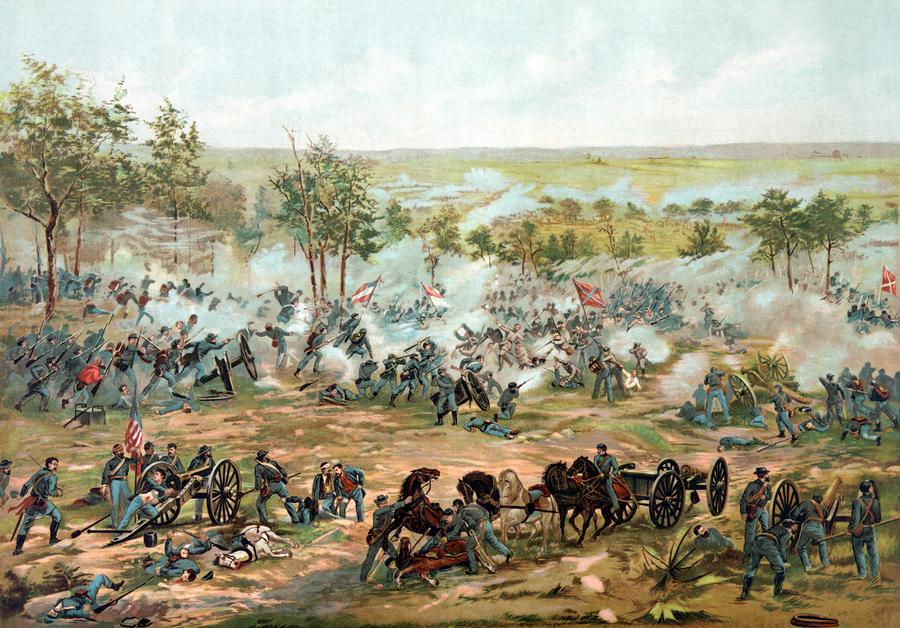
Chamberlain was not just a soldier, but before the war had been Professor of Natural and Revealed Religions at Bowdoin College, and a student of theology before the war. He could not help to see the significance of the occasion. He understood that he would be criticized by some for offering the salute, however unlike some, the staunch abolitionist and Unionist who had nearly died on more than one occasion fighting the defeated Confederate Army understood that no true peace could transpire unless the enemies became reconciled to one another.

He noted that his chief reason for doing so:

“The momentous meaning of this occasion impressed me deeply. I resolved to mark it by some token of recognition, which could be no other than a salute of arms. Well aware of the responsibility assumed, and of the criticisms that would follow, as the sequel proved, nothing of that kind could move me in the least. The act could be defended, if needful, by the suggestion that such a salute was not to the cause for which the flag of the Confederacy stood, but to its going down before the flag of the Union. My main reason, however, was one for which I sought no authority nor asked forgiveness. Before us in proud humiliation stood the embodiment of manhood: men whom neither toils and sufferings, nor the fact of death, nor disaster, nor hopelessness could bend from their resolve; standing before us now, thin, worn, and famished, but erect, and with eyes looking level into ours, waking memories that bound us together as no other bond;—was not such manhood to be welcomed back into a Union so tested and assured? Instructions had been given; and when the head of each division column comes opposite our group, our bugle sounds the signal and instantly our whole line from right to left, regiment by regiment in succession, gives the soldier’s salutation, from the “order arms” to the old “carry”—the marching salute. Gordon at the head of the column, riding with heavy spirit and downcast face, catches the sound of shifting arms, looks up, and, taking the meaning, wheels superbly, making with himself and his horse one uplifted figure, with profound salutation as he drops the point of his sword to the boot toe; then facing to his own command, gives word for his successive brigades to pass us with the same position of the manual,—honor answering honor. On our part not a sound of trumpet more, nor roll of drum; not a cheer, nor word nor whisper of vain-glorying, nor motion of man standing again at the order, but an awed stillness rather, and breath-holding, as if it were the passing of the dead!”

The next day Robert E Lee address his soldiers for the last time. Lee’s final order to his loyal troops was published the day after the surrender. It was a gracious letter of thanks to men that had served their beloved commander well in the course of the three years since he assumed command of them outside Richmond in 1862.

General Order
No. 9


After four years of arduous service marked by unsurpassed courage and fortitude, the Army of Northern Virginia has been compelled to yield to overwhelming numbers and resources.

need not tell the survivors of so many hard fought battles, who have remained steadfast to the last, that I have consented to the result from no distrust of them.
But feeling that valour and devotion could accomplish nothing that could compensate for the loss that must have attended the continuance of the contest, I have determined to avoid the useless sacrifice of those whose past services have endeared them to their countrymen.

By the terms of the agreement, officers and men can return to their homes and remain until exchanged. You will take with you the satisfaction that proceeds from the consciousness of duty faithfully performed, and I earnestly pray that a merciful God will extend to you his blessing and protection.

With an unceasing admiration of your constancy and devotion to your Country, and a grateful remembrance of your kind and generous conideration for myself, I bid you an affectionate farewell. — R. E. Lee, General

Warriors_Tribute_at_Appomattox

The surrender was the beginning of the end. Other Confederate forces continued to resist for several weeks, but with the surrender of the Army of Northern Virginia led by the man that nearly all Southerners saw as the embodiment of their nation the war was effectively over.

Lee had fought hard and after the war was still under the charge of treason, but he understood the significance of defeat and the necessity of moving forward as one nation. In August 1865 Lee wrote to the trustees of Washington College of which he was now President:

“I think it is the duty of every citizen, in the present condition of the Country, to do all in his power to aid the restoration of peace and harmony… It is particularly incumbent upon those charged with the instruction of the young to set them an example of submission to authority.

It is a lesson that all of us in our terribly divided land need to learn regardless of or political affiliation or ideology. Lee learned that Grant’s Aide-de-Camp was a Seneca and said after the surrender “It is good to have one real American here.” The officer replied, “Sir, we are all Americans.”

It is time again that we learn that lesson.

Peace

Padre Steve+

Leave a comment

Filed under civil war, History, Military, philosophy, Political Commentary

The King of Battle at Gettysburg: Union and Confederate Artillery Types and Organization

cemeteryridgearty

Note to my friends at Padre Steve’s World: This is another in my articles on Gettysburg that I am preparing for my next “Staff Ride” for the incoming class at the Staff College where I teach. Eventually I will have a page with a tab at the top of this site for my readers to access all of those articles.

The Artillery of the Army of the Potomac at Gettysburg proved that it was the “King of Battle” and a key part of Union commanders and their use of combined arms. The superiority of the Federal artillery at Gettysburg over their Confederate counterparts was not simply due to the numbers of guns employed, it was in the manner that they were employed and the manner that Federal commanders employed the artillery under their command.

porteralexanderColonel Porter Alexander

This is not to say that the Confederate artillerymen were inferior to their Federal counterparts, Porter Alexander, who commanded First Corps artillery under Longstreet was an excellent artillery commander, although Brigadier General Henry J. Hunt was by far superior to his Confederate Counterpart Brigadier General William Pendleton. The problems lay in equipment, ammunition and their employment by their carious Corps and division commanders.

henryhuntBrigadier General Harry Hunt

Hunt and Pendleton were both graduates of the West Point, however Pendleton had left active service in the 1830s to become an Episcopal Priest and had no combat experience. Hunt remained in the Army, served in Mexico and at the beginning of the war was the the chief artillery instructor at West Point. His treatise on the use of artillery Instructions for Field Artillery published by the War Department in 1861 was the primary instruction for all Union artillery units.

WNPendeltonBrigadier General William Pendleton

Union and Confederate organizations differed. Hunt was instrumental in reorganizing Union artillery organizations. Brigades retained their assigned batteries for direct support of those units. Divisions and Corps lost their artillery which was brought into an Artillery Reserve for greater flexibility on the battlefield. As such the Artillery Reserve became the instrument of of the Army commander and served as what we would now call “general support” artillery. The organization allowed Meade to better manage his artillery at Gettysburg and employ it where he needed at the time where it was most required. This ensured that Meade and his subordinate commanders had a good command of fires throughout the battle.

HD_WilkesonBattery_z.preview

Hunt and his subordinates sought to concentrate their artillery but also to employ cross fires on advancing enemy infantry. During the battle Union artillery was particularly effective during Buford’s delaying action where its skillful employment caused Heth and Pender’s Divisions large number of casualties on July 1st. At Cemetery Hill on the evening of July 1st where Howard’s positioning of batteries on that hill with Steinwehr’s Division ensured that it held.  On July 2nd it was used with great effect during the savage fighting at the Peach Orchard, the Wheat Field, Devil’s Den and Little Round Top. However its greatest effect was in decimating Pickett’s Division and supporting units on July 3rd. 

The Confederate Artillery was assigned to each Army Corps and although Pendleton was Lee’s Artillery Chief he had little influence on the battle. Instead that authority was dispersed to the artillerymen serving under each Corps commander. While this worked well at the corps level it ensured that Lee had no way of effectively coordinating fires throughout the battle. As such on the third day Porter Alexander, a battalion commander and Longstreet’s senior artilleryman was limited to his First Corps batteries and whatever artillery was lent by A. P. Hill’s Third Corps as the artillery of Second Corps was unavailable and on the wrong side of the battlefield when needed.

At the battery level Union artillery was on the whole organized by type in six gun batteries. Confederate artillery units were organized in four or six gun batteries in which types of guns were often mixed, leading to supply problems and inconsistency in rates of fire and range. Union batteries also had better quality ammunition and gunpowder supplies.

smoothboreammorifledammo6pdrcarriagetravelcaisson-and-limber
Field Artillery batteries were of two types. Foot Artillery which accompanied the Infantry and Horse Artillery which accompanied the Cavalry. The crews of the Foot Artillery either marched alongside their guns or rode on the caissons. The crews of the Horse Artillery rode horses in order to better keep up with the Cavalry Units they supported.

Parrott-Answer-LRESM

All the field artillery weapons were line of sight weapons. They had neither the range nor the fire direction capability for indirect fire. Ammunition included solid shot, exploding shells and canister which was used at short range against infantry.

The increase in range and effectiveness of rifled muskets made the job of the artilleryman more dangerous than it had been in previous wars. Thus when employed in the offense or during close assaults artillerymen were exposed to musket fire resulting in heavier casualties among the gun crews.

At Gettysburg the Army of the Potomac about 360 guns, the total number of guns available to Lee and the Army of Northern Virginia varies depending on the source between 262 and 241 guns.

The Union for the most part used weapons made in the United States, whereas the Confederates having few ordnance factories of their own were limited and attempted to obtain weapons from Europe. At Gettysburg it had two of the 2.75 inch Whitworth Breechloading Rifles were the most modern and long range weapons on the battlefield and prefigured the field artillery weapons that would dominate the battlefield in the Twentieth Century.

cannons

There were three basic types of cannon used at Gettysburg. Rifled cannon, Smoothbores and Howitzers. The bulk of Federal Artillery was made up of rifled cannon, especially the 3” Ordnance Rifle of which Meade had 146 at Gettysburg. There were also 142 of the M 1857 12 pound smoothbore “Napoleon’s” named after Emperor Napoleon III of France. Forty to forty-four percent of the guns available to Lee’s Army of Northern Virginia were Napoleons, of which they had 107 at Gettysburg. The technical details of each type are listed below.
Rifled Cannon
 999130_10152038135167059_1801660138_n

10-Pounder Parrott Rifle, M ’63

Bore Diameter             3.0 in (7.64 cm)
Tube Material              Cast and Wrought Iron
Tube Length                78 in (198 cm)
Tube Weight                890 lb (404 kg)
Powder Charge           1 lb (0.45 kg)
Range (5° Elevation)   2,000 yd (1,829 m)

10-Pounder Parrott Rifle, M ’61

Bore Diameter             2.9 in (7.37 cm)
Tube Material              Cast and Wrought Iron
Tube Length                78 in (198 cm)
Tube Weight                890 lb (404 kg)
Powder Charge           1 lb (0.45 kg)
Range (5° Elevation)   2,000 yd (1,829 m)

At Gettysburg (total M61 and M63)
60 Union; 42 Confederate

20-Pounder Parrott Rifle

Bore Diameter                 3.67 in (9.32 cm)
Tube Material                  Cast and Wrought Iron
Tube Length                    89 in (226 cm)
Tube Weight                    1,750 lb (794 kg)
Powder Charge                2 lb (0.91 kg)
Range (5° Elevation)        2,100 yd (1,920 m)
At Gettysburg 24 Union

3.67-Inch Navy Parrott Rifle

Bore Diameter                 3.67 in (9.32 cm)
Tube Material                  Cast and Wrought Iron
Tube Length                    89 in (226 cm)
Tube Weight                    1,750 lb (794 kg)
Powder Charge               2 lb (0.91 kg)
Range (5° Elevation)       2,100 yd (1,920 m)
At Gettysburg                  4 Confederate

cemeteryridge
3-Inch Ordnance Rifle

Bore Diameter                 3.0 in (7.62 cm)
Tube Material                  Wrought Iron
Tube Length                    73 in (185 cm)
Tube Weight                   816 lb (370 kg)
Powder Charge              1 lb (0.45 kg)
Range (5° Elevation)      1,835 yd (1,678 m)
At Gettysburg                 146 Union; 73 Confederate

14-Pounder James Rifle

Bore Diameter                3.80 in (9.65 cm)
Tube Material                 Bronze
Tube Length                   65 in (165 cm)
Tube Weight                   918 lb (416 kg)
Powder Charge              0.75 lb (0.34 kg)
Range (5° Elevation)     1,700 yd (1,554 m)
At Gettysburg                4 Union

12-Pounder (2.75 Inch) Whitworth Breechloading Rifle

Bore Diameter                2.75 in (7 cm)
Tube Material                 Iron and Steel
Tube Length                   104 in (264 cm)
Tube Weight                   1,092 lb (495 kg)
Powder Charge              1.75 lb (0.79 kg)
Range (5° Elevation)      2,800 yd (2,560 m)
At Gettysburg                  2 Confederate

Blakely Rifle

Bore Diameter                 3.4 in (8.64 cm)
Tube Material                  Steel
Tube Length                    59 in (150 cm)
Tube Weight                    800 lb (363 kg)
Powder Charge               1 lb (0.45 kg)
Range (5° Elevation)       1,850 yd (1,691 m)
At Gettysburg                   3 Confederate

Smoothbore

1497705_10152329726382059_1343167358_n

12-Pounder Napoleon-Federal Manufacture

Bore Diameter               4.62 in (11.73 cm)
Tube Material                Bronze
Tube Length                  66 in (168 cm)
Tube Weight                 1,227 lb (557 kg)
Powder Charge            2.5 lb (1.13 kg)
Range (5° Elevation)    1,619 yd (1480 m)
At Gettysburg               142 Union

12-Pounder Napoleon-Confederate Manufacture

Bore Diameter              4.62 in (11.73 cm)
Tube Material               Bronze
Tube Length                 66 in (168 cm)
Tube Weight                 1,227 lb (557 kg)
Powder Charge            2.5 lb (1.13 kg)
Range (5° Elevation)    1,619 yd (1480 m)
At Gettysburg               107 Confederate

6-Pounder Field Gun

Bore Diameter              3.67 in (9.32 cm)
Tube Material               Bronze
Tube Length                 60 in (152 cm)
Tube Weight                 884 lb (401 kg)
Powder Charge            1.25 lb (0.57 kg)
Range (5° Elevation)    1,523 yd (1,393 m)
At Gettysburg                1 Confederate

Howitzers

12-Pounder Field Howitzer

Bore Diameter              4.62 in (11.73 cm)
Tube Material               Bronze
Tube Length                 53 in (135 cm)
Tube Weight                788 lb (357 kg)
Powder Charge           1 lb (0.45 kg)
Range (5° Elevation)   1,072 yd (980 m)
At Gettysburg               2 Union; 26 Confederate

24-Pounder Field Howitzer

1454601_10152040914857059_709344690_n

Bore Diameter               5.82 in (14.78 cm)    
Tube Material                Bronze
Tube Length                  65 in (165 cm)
Tube Weight                  1,318 lb (598 kg)
Powder Charge             2 lb (0.91 kg)
Range (5° Elevation)     1,322 yd (1,209 m)
At Gettysburg                4 Confederate

20140308-231743.jpg

So until tomorrow,

Peace

Padre Steve+

1 Comment

Filed under civil war, History, Military

Gettysburg: The Order of Battle

battle-of-gettysburg-war-is-hell-store

Note: This is a resource for those following my Gettysburg series and for my students that go with me on the Gettysburg Staff Ride. When the armies met at Gettysburg Lee’s Army of Norther Virginia had about 75,000-80,000 effectives, Meade’s Army of the Potomac had about 80,000-85,000 depending on the sources. This meant that they were relatively evenly matched in terms of manpower and that the battle came down to leadership, tactical decisions and strategic factors that were already in play by the time that the armies met at Gettysburg.

As a note of explanation the Confederate forces at the division and brigade level were named after their commander’s, or in some cases previous commanders. Confederate units were allocated to the Army from the various states, thus there is no Confederate “Regulars” as are shown in the Union order of battle. Union Corps were numbered as were the divisions and brigades in each corps. In some cases the brigades or divisions were referred to by the names of their commanders, but this was not consistent. Federal forces consisted of both Regular Army units as well as units allocated by the states. The reader can note the composition of each brigade in both the Union and Confederate armies to see from where the soldiers were recruited from.

So apart from that there is no story to tell tonight. Nothing in the way of commentary. This is simply a resource.
Have a great night.

Peace

Padre Steve+

confeorg

Army of Northern Virginia – General Robert Edward Lee, Commanding


ileerob001p1

General Staff: Chief of Staff and Inspector General: Col Robert H. Chilton; Chief of Artillery: BG William N. Pendleton; Medical Director: Dr. Lafayette Guild; Aide de Camp and Asst. Adjutant General: Maj Walter H. Taylor; Aide de Camp and Asst. Military Secretary: Maj Charles Marshall; Aide de Camp and Asst. Inspector General: Maj Charles S. Venable; Aide de Camp: Maj Thomas M. R. Talcott

General Headquarters
Escort: 39th Virginia Cavalry Battalion (companies A & C)

James_Longstreet

I Corps- Lt. Gen. James Longstreet, Commanding

Lafayette_McLaws

McLaws’ Division- MG Lafayette McLaws

Kershaw’s Brigade-BG Joseph B. Kershaw
2nd South Carolina, 3rd South Carolina, 7th South Carolina, 8th South Carolina,  15th South Carolina; 3rd South Carolina Battalion
Barksdale’s Brigade- BG William Barksdale (mw); Col Benjamin G. Humphreys
13th Mississippi, 17th Mississippi, 18th Mississippi, 21st Mississippi
Semmes’ Brigade- BG Paul J. Semmes (mw); Col Goode Bryan
10th Georgia, 50th Georgia, 51st Georgia, 53rd Georgia
Wofford’s Brigade- BG William T. Wofford
16th Georgia, 18th Georgia, 24th Georgia, Cobb’s (Georgia) Legion, Phillips’ (Georgia) Legion, 3rd Georgia Sharpshooter Battalion
Cabell’s Artillery Battalion- Col Henry C. Cabell; Maj Samuel P. Hamilton
1st North Carolina Artillery, Battery A, Pulaski (Georgia) Artillery, 1st Richmond Howitzers, Troup (Georgia) Artillery

GeorgePickett

Pickett’s Division- MG George E. Pickett

Garnett’s Brigade- BG Richard B. Garnett (k); Maj Charles S. Peyton
8th Virginia, 18th Virginia, 19th Virginia, 28th Virginia, 56th Virginia
Kemper’s Brigade- BG James L. Kemper (w&c); Col Joseph Mayo, Jr
1st Virginia, 3rd Virginia, 7th Virginia, 11th Virginia, 24th Virginia
Armistead’s Brigade- BG Lewis A. Armistead (mw&c); Ltc William White (w); Maj Joseph R. Cabell; Col William R. Aylett
9th Virginia, 14th Virginia, 38th Virginia, 53rd Virginia, 57th Virginia
Dearing’s Artillery Battalion- Maj James Dearing; Maj John P. W. Read (w)
Fauquier (Virginia) Artillery, Hampden (Virginia) Artillery, Richmond Fayette (Virginia) Artillery, Blount’s (Virginia) Battery

Lt._Gen._John_B._Hood

Hood’s Division- MG John Bell Hood (w); BG Evander M. Law

Law’s Brigade-BG Evander M. Law; Col James L. Sheffield
4th Alabama, 15th Alabama, 44th Alabama, 47th Alabama, 48th Alabama
Robertson’s Brigade- BG Jerome B. Robertson (w); Ltc Philip A. Work
3rd Arkansas, 1st Texas, 4th Texas, 5th Texas
Anderson’s Brigade- BG George T. Anderson (w); Ltc William Luffman (w)
7th Georgia, 8th Georgia, 9th Georgia,  11th Georgia,  59th Georgia
Benning’s Brigade- BG Henry L. Benning
2nd Georgia, 15th Georgia,  17th Georgia, 20th Georgia
Henry’s Artillery Battalion- Maj Mathias W. Henry; Maj John C. Haskell
Branch (North Carolina) Battery, Charleston German (South Carolina) Artillery, Palmetto (South Carolina) Light Artillery, Rowan North Carolina Artillery
Artillery Reserve- Col James B. Walton
Alexander’s Artillery Battalion- Col Edward P. Alexander (w)
Ashland (Virginia) Artillery, Bedford (Virginia) Artillery, Brooks (South Carolina) Artillery, Madison (Louisiana) Light Artillery, Richmond (Virginia) Battery, Bath (Virginia) Battery
Washington (Louisiana) Artillery Battalion- Maj Benjamin F. Eshleman
First Company, Second Company, Third Company, Fourth Company

Richard-Ewell

II Corps- Lt. Gen. Richard S. Ewell Commanding

??????????????????????????????????????????????????????????????????????????????????????????????

Early’s Division- MG Jubal A. Early
Hays’ Brigade- BG Harry T. Hays
5th Louisiana, 6th Louisiana, 7th Louisiana, 8th Louisiana, 9th Louisiana
Smith’s Brigade-BG William Smith
31st Virginia, 49th Virginia, 52nd Virginia
Hoke’s Brigade- Col Isaac E. Avery (mw); Col Archibald C. Godwin
6th North Carolina: Maj Samuel McD. Tate, 21st North Carolina: Col William W. Kirkland, Maj James Beall, 57th North Carolina: Col Archibald C. Godwin, Ltc Hamilton C. Jones
Gordon’s Brigade- BG John Brown Gordon
13th Georgia, 26th Georgia, 31st Georgia, 38th Georgia, 60th Georgia, 61st Georgia
Jones’ Artillery Battalion- Ltc Hilary P. Jones
Charlottesville (Virginia) Artillery, Courtney (Virginia) Artillery, Louisiana Guard Artillery, Staunton (Virginia) Artillery
Cavalry 35th Virginia Battalion: Ltc Elijah V. White

JohnsonE

Johnson’s Division- MG Edward Johnson

Steuart’s Brigade- BG George H. Steuart
1st Maryland Battalion, 1st North Carolina, 3rd North Carolina, 10th Virginia, 23rd Virginia, 37th Virginia
Stonewall Brigade- BG James A. Walker
2nd Virginia, 4th Virginia, 5th Virginia, 27th Virginia, 33rd Virginia
Nicholls’ Brigade-Col Jesse M. Williams
1st Louisiana, 2nd Louisiana, 10th Louisiana, 14th Louisiana, 15th Louisiana
Jones’ Brigade- BG John M. Jones (w); Ltc Robert H. Dungan
21st Virginia, 25th Virginia, 42nd Virginia, 44th Virginia, 48th Virginia, 50th Virginia
Andrews’ Artillery Battalion- Maj Joseph W. Latimer (mw); Cpt Charles I. Raine
1st Maryland Battery, Alleghany (Virginia) Artillery, Chesapeake (Maryland) Artillery, Lee (Virginia) Battery

robert-rodes

Rodes’ Division- MG Robert E. Rodes

Daniel’s Brigade-BG Junius Daniel
32nd North Carolina, 43rd North Carolina, 45th North Carolina, 53rd North Carolina, 2nd North Carolina Battalion
Doles’ Brigade-BG George P. Doles
4th Georgia, 12th Georgia, 21st Georgia, 44th Georgia
Iverson’s Brigade- BG Alfred Iverson, Jr.
5th North Carolina, 12th North Carolina, 20th North Carolina, 23rd North Carolina
Ramseur’s Brigade- BG Stephen D. Ramseur
2nd North Carolina, 4th North Carolina, 14th North Carolina, 30th North Carolina
Rodes’ (old) Brigade- Col Edward A. O’Neal
3rd Alabama, 5th Alabama, 6th Alabama, 12th Alabama, 26th Alabama
Carter’s Artillery Battalion-Ltc Thomas H. Carter
Jefferson Davis (Alabama) Artillery, King William (Virginia) Artillery, Morris (Virginia) Artillery, Orange (Virginia) Artillery

Artillery Reserve- Col J. Thompson Brown
First Virginia Artillery Battalion- Cpt Willis J. Dance
2nd Richmond (Virginia) Howitzers, 3rd Richmond (Virginia) Howitzers, Powhatan (Virginia) Artillery, Rockbridge (Virginia) Artillery, Salem (Virginia) Artillery
Nelson’s Artillery Battalion- Ltc William Nelson
Amherst (Virginia) Artillery, Fluvanna (Virginia) Artillery, Milledge’s Georgia Battery

general_a_p_hill

III Corps- Lt. Gen. Ambrose Powell Hill Commanding

Richard_H._Anderson

Anderson’s Division- MG Richard H. Anderson
Wilcox’s Brigade- BG Cadmus M. Wilcox
8th Alabama, 9th Alabama, 10th Alabama, 11th Alabama, 14th Alabama
Mahone’s Brigade- BG William Mahone
6th Virginia, 12th Virginia, 16th Virginia, 41st Virginia, 61st Virginia
Wright’s Brigade-BG Ambrose R. Wright; Col William Gibson; BG Ambrose R. Wright
3rd Georgia, 22nd Georgia, 48th Georgia, 2nd Georgia Battalion
Perry’s Brigade- Col David Lang
2nd Florida, 5th Florida, 8th Florida
Posey’s Brigade- BG Carnot Posey (w); Col. Nathaniel Harris
12th Mississippi, 16th Mississippi, 19th Mississippi, 48th Mississippi
Cutt’s Artillery Battalion- Maj John Lane
Company A, Company B, Company C

heth

Heth’s Division- MG Henry Heth (w); BG James J. Pettigrew (w)
Pettigrew’s Brigade-BG James J. Pettigrew; Col James K. Marshall (k); Maj John T. Jones (w)
11th North Carolina, 26th North Carolina, 47th North Carolina, 52nd North Carolina
Heth’s (old) Brigade- Col John M. Brockenbrough; Col Robert M. Mayo
40th Virginia, 47th Virginia, 55th Virginia, 22nd Virginia Battalion
Archer’s Brigade- BG James J. Archer (w&c); Col Birkett D. Fry (w&c); Ltc Samuel G. Shepard
13th Alabama, 5th Alabama Battalion, 1st Tennessee (Provisional Army), 7th Tennessee,  14th Tennessee
Davis’ Brigade- BG Joseph R. Davis (w)
2nd Mississippi, 11th Mississippi, 42nd Mississippi, 55th North Carolina
Garnett’s Artillery Battalion- Ltc John J. Garnett
Donaldsonville (Louisiana) Artillery, Huger (Virginia) Artillery, Lewis (Virginia) Artillery, Norfolk (Virginia) Blues Artillery

William_Dorsey_Pender

Pender’s Division-MG William D. Pender (mw); BG James H. Lane; MG Isaac R. Trimble (w&c); BG James H. Lane
McGowan’s Brigade-Col Abner M. Perrin
1st South Carolina (Provisional Army), 1st South Carolina Rifles, 12th South Carolina, 13th South Carolina, 14th South Carolina
Lane’s Brigade- BG James H. Lane; Col Clark M. Avery
7th North Carolina, 18th North Carolina, 28th North Carolina, 33rd North Carolina, 37th North Carolina
Thomas’ Brigade- BG Edward L. Thomas
14th Georgia, 35th Georgia, 45th Georgia, 49th Georgia
Scales’ Brigade- BG Alfred M. Scales (w); Ltc George T. Gordon; Col William L. J. Lowrance
13th North Carolina, 16th North Carolina, 22nd North Carolina, 34th North Carolina, 38th North Carolina
Poague’s Artillery Battalion- Maj William T. Poague
Albemarle (Virginia) Artillery, Charlotte (North Carolina) Artillery, Madison (Mississippi) Artillery, Brooke’s Virginia Battery
Artillery Reserve- Col Reuben L. Walker
McIntosh’s Artillery Battalion- Maj David G. McIntosh
Danville (Virginia) Artillery, Hardaway (Alabama) Artillery, 2nd Rockbridge (Virginia) Artillery, Johnson’s Virginia Battery
Pegram’s Artillery Battalion- Maj William R. J. Pegram; Cpt Ervin B. Brunson
Crenshaw (Virginia) Battery, Fredericksburg (Virginia) Artillery, Letcher (Virginia) Artillery, Pee Dee (South Carolina) Artillery, Purcell (Virginia) Artillery

CWP015

Cavalry Division- Maj. Gen. James Ewell Brown Stuart
Hampton’s Brigade- BG Wade Hampton (w)
1st North Carolina, 1st South Carolina, 2nd South Carolina, Cobb’s (Georgia) Legion, Jeff Davis (Mississippi) Legion, Phillips (Georgia) Legion
Robertson’s Brigade (not present at Gettysburg) BG Beverly H. Robertson
4th North Carolina, 5th North Carolina
Fitzhugh Lee’s Brigade- BG Fitzhugh Lee
1st Maryland Battalion, 1st Virginia, 2nd Virginia, 3rd Virginia, 4th Virginia, 5th Virginia
Jenkins’ Brigade- BG Albert G. Jenkins (w); Col Milton J. Ferguson
14th Virginia, 16th Virginia, 17th Virginia, 34th Virginia Battn., 36th Virginia Battn., Jackson’s (Virginia) Battery
William H. F. (Rooney) Lee’s Brigade- Col John R. Chambliss, Jr.
2nd North Carolina Cavalry, 9th Virginia, 10th Virginia, 13th Virginia
Jones’ Brigade- BG William E. Jones
6th Virginia, 7th Virginia, 11th Virginia
Stuart’s Horse Artillery- Maj Robert F. Beckham
Breathed’s (Virginia) Battery, Chew’s (Virginia) Battery, Griffin’s (Maryland) Battery Hart’s (South Carolina) Battery, McGregor’s (Virginia) Battery, Moorman’s (Virginia) Battery
Imboden’s Command- BG John D. Imboden
18th Virginia, 62nd Virginia, McNeill’s Company (Virginia), Staunton (Virginia) Battery

Union Order of Battle
unionorg

general-george-meade

Army of the Potomac – Major General George Gordon Meade, Commanding


General Staff: Chief of Staff: Maj. Gen. Daniel Butterfield, Chief of Artillery: Brig. Gen. Henry J. Hunt, Medical Director: Maj Jonathan Letterman, Chief of Engineers: Brig. Gen. Gouverneur K. Warren, Bureau of Military Information: Col. George H. Sharpe
Command of the Provost Marshal General: Brig. Gen. Marsena R. Patrick
93rd New York: Col. John S. Crocker, 8th United States (8 companies): Capt. Edwin W. H. Read, 2nd Pennsylvania Cavalry: Col. R. Butler Price, 6th Pennsylvania Cavalry (Companies E&I): Capt. James Starr, Regular cavalry
Engineer Brigade: Brig. Gen. Henry W. Benham
15th New York (3 companies): Maj Walter L. Cassin, 50th New York: Col. William H. Pettes, U.S. Battalion: Capt. George H. Mendell

GenJFRenyolds

I Corps- Maj. Gen. John F. Reynolds (k)

JSWadsworthBGenleft

First Division- Brig. Gen. James S. Wadsworth
1st  Brigade (The Iron Brigade)-Brig. Gen. Solomon Meredith (w); Col.. William W. Robinson
19th Indiana, 24th Michigan, 2nd Wisconsin, 6th Wisconsin, 7th Wisconsin
2nd Brigade- Brig. Gen. Lysander Cutler
7th Indiana, 76th New York, 84th New York (14th Militia), 95th New York, 147th New York, 56th Pennsylvania (9 companies)

john_Cleveland_Robinson

Second Division- Brig. Gen. John C. Robinson
1st Brigade- Brig. Gen. Gabriel R. Paul (w); Col. Samuel H. Leonard (w); Col. Adrian R. Root (w&c); Col. Richard Coulter (w); Col. Peter Lyle; Col. Richard Coulter
16th Maine, 13th Massachusetts, 94th New York, 104th New York, 107th Pennsylvania
2nd Brigade-Brig. Gen. Henry Baxter
12th Massachusetts, 83rd New York (9th Militia), 97th New York, 11th Pennsylvania, 88th Pennsylvania, 90th Pennsylvania

abner-doubleday

Third Division- Maj. Gen. Abner Doubleday; Brig. Gen. Thomas A. Rowley; Maj. Gen. Abner Doubleday
1st Brigade- Col. Chapman Biddle; Brig. Gen. Thomas A. Rowley; Col. Chapman Biddle
80th New York (20th Militia), 121st Pennsylvania, 142nd Pennsylvania, 151st Pennsylvania
2nd Brigade-Col. Roy Stone (w); Col. Langhorne Wister (w); Col. Edmund L. Dana
143rd Pennsylvania, 149th Pennsylvania, 150th Pennsylvania
3rd Brigade- Brig. Gen. George J. Stannard (w); Col. Francis V. Randall
13th Vermont, 14th Vermont, 16th Vermont
Artillery Brigade- Col. Charles S. Wainwright
Maine Light, 2nd Battery (B), Maine Light, 5th Battery (E), 1st New York Light, Batteries E&L, 1st Pennsylvania Light, Battery B, 4th United States, Battery B

HancockWinfield_teaser

II Corps- Maj. Gen. Winfield S. Hancock (w); Brig. Gen. John Gibbon; Brig. Gen. William Hays

John_C._Caldwell

First Division- Brig. Gen.  John C. Caldwell
1st Brigade- Col. Edward E. Cross (mw); Col. H. Boyd McKeen
5th New Hampshire, 61st New York, 81st Pennsylvania , 148th Pennsylvania
2nd Brigade (The Irish Brigade) – Col. Patrick Kelly
28th Massachusetts, 63rd New York (2 companies),69th New York (2 companies), 88th New York (2 companies), 116th Pennsylvania (4 companies)
3rd Brigade-Brig. Gen. Samuel K. Zook (mw); Lt. Col.. Charles G. Freudenberg (w); Col. Richard P. Roberts (k); Lt. Col.. John Fraser
52nd New York, 57th New York, 66th New York, 140th Pennsylvania
4th Brigade- Col. John R. Brooke (w)
27th Connecticut (2 companies), 2nd Delaware, 64th New York, 53rd Pennsylvania, 145th Pennsylvania (7 companies)

john_Gibbon

Second Division- Brig. Gen. John Gibbon (w); Brig. Gen. William Harrow
1st Brigade- Brig. Gen. William Harrow; Col. Francis E. Heath
19th Maine, 15th Massachusetts, 1st Minnesota, 82nd New York (2nd Militia)
2nd Brigade- Brig. Gen. Alexander S. Webb (w)
69th Pennsylvania, 71st Pennsylvania, 72nd Pennsylvania, 106th Pennsylvania
3rd Brigade- Col. Norman J. Hall
19th Massachusetts, 20th Massachusetts, 7th Michigan, 42nd New York, 59th New York (4 companies)
Unattached: Massachusetts Sharpshooters, 1st Company

Daniel_Edgar_Sickles

III Corps- Maj. Gen. Daniel E. Sickles (w); Maj. Gen. David B. Birney

David_B._Birney_-_Brady-Handy

First Division- Maj. Gen. David B. Birney; Brig. Gen. J. H. Hobart Ward (w)
1st Brigade- Brig. Gen. Charles K. Graham (w&c); Col. Andrew H. Tippin; Col. Henry J. Madill
57th Pennsylvania (8 companies), 63rd Pennsylvania, 68th Pennsylvania, 105th Pennsylvania, 114th Pennsylvania, 141st Pennsylvania
2nd Brigade- Brig. Gen. J. H. Hobart Ward; Col. Hiram Berdan
20th Indiana, 3rd Maine, 4th Maine, 86th New York, 124th New York, 99th Pennsylvania, 1st United States Sharpshooters, 2nd United States Sharpshooters (8 companies)
3rd Brigade- Col. P. Régis de Trobriand
17th Maine, 3rd Michigan, 5th Michigan, 40th New York, 110th Pennsylvania (6 companies)

HumphreysA

Second Division- Brig. Gen. Andrew A. Humphreys
1st Brigade- Brig. Gen. Joseph B. Carr (w)
1st Massachusetts, 11th Massachusetts, 16th Massachusetts, 12th New Hampshire, 11th New Jersey,26th Pennsylvania
2nd Brigade-Col. William R. Brewster
70th New York, 71st New York, 72nd New York, 73rd New York, 74th New York, 120th New York
3rd Brigade-Col. George C. Burling
2nd New Hampshire, 5th New Jersey, 6th New Jersey, 7th New Jersey, 8th New Jersey,115th Pennsylvania
Artillery Brigade-Capt. George E. Randolph (w); Capt. A. Judson Clark
1st New Jersey Light, Battery B, 1st New York Light, Battery D, New York Light, 4th Battery, 1st Rhode Island Light, Battery E, 4th United States, Battery K

George_Sykes_and_staff_-_Brady-Handy

V Corps-Maj. Gen. George Sykes

James_Barnes

First Division- Brig. Gen. James Barnes (w)
1st Brigade-Col. William S. Tilton
18th Massachusetts, 22nd Massachusetts, 1st Michigan, 118th Pennsylvania
2nd Brigade-Col. Jacob B. Sweitzer
9th Massachusetts, 32nd Massachusetts, 4th Michigan, 62nd Pennsylvania
3rd Brigade-Col. Strong Vincent (mw); Col. James C. Rice
20th Maine, 16th Michigan, 44th New York, 83rd Pennsylvania

2.-Brig.-Gen.-Romeyn-B.-Ayres

Second Division-Brig. Gen. Romeyn B. Ayres
1st Brigade- Col. Hannibal Day
3rd United States (Cos. B, C, E, G, I and K), 4th United States (Cos. C, F, H and K), 6th United States (Cos. D, F, G, H and I), 12th United States (Cos. A, B, C, D and G, 1st Bn. and Cos. A, C and D, 2nd Bn.), 14th United States (Cos. A, B, D, E, F and G, 1st Bn. and Cos. F and G, 2nd Bn.)
2nd Brigade-Col. Sidney Burbank
2nd United States (Cos. B, C, F, H, I and K), 7th United States (Cos. A, B, E and I), 10th United States (Cos. D, G and H), 11th United States (Cos. B, C, D, E, F and G),17th United States (Cos. A, C, D, G and H, 1st Bn. and Cos. A and B, 2nd Bn.)
3rd Brigade-Brig. Gen. Stephen H. Weed (k); Col. Kenner Garrard
140th New York, 146th New York, 91st Pennsylvania, 155th Pennsylvania
Third Division-Brig. Gen. Samuel W. Crawford
1st Brigade-Col. William McCandless
1st Pennsylvania Reserves (9 companies), 2nd Pennsylvania Reserves, 6th Pennsylvania Reserves,13th Pennsylvania Reserves
2nd Brigade (not present—assigned to Washington defenses)
3rd Brigade-Col. Joseph W. Fisher
5th Pennsylvania Reserves, 9th Pennsylvania Reserves, 10th Pennsylvania Reserves, 11th Pennsylvania Reserves, 12th Pennsylvania Reserves (9 companies)
Artillery Brigade-Capt. Augustus P. Martin
Massachusetts Light, 3rd Battery, 1st New York Light, Battery C, 1st Ohio Light, Battery L, 5th United States, Battery D, 5th United States, Battery I

John_Sedgwick

VI Corps-Maj. Gen. John Sedgwick

HGWright

First Division-Brig. Gen. Horatio G. Wright
1st Brigade-Brig. Gen. Alfred T. A. Torbert
1st New Jersey, 2nd New Jersey, 3rd New Jersey, 15th New Jersey
2nd Brigade-Brig. Gen. Joseph J. Bartlett; Col. Emory Upton
5th Maine, 121st New York, 95th Pennsylvania, 96th Pennsylvania
3rd Brigade-Brig. Gen. David A. Russell
6th Maine, 49th Pennsylvania (4 companies), 119th Pennsylvania, 5th Wisconsin

Provost Guard: 4th New Jersey (3 companies): Capt. William R. Maxwell

albion-howe-111-b-4713

Second Division- Brig. Gen. Albion P. Howe
2nd Brigade-Col. Lewis A. Grant
2nd Vermont, 3rd Vermont, 4th Vermont, 5th Vermont, 6th Vermont
3rd Brigade-Brig. Gen. Thomas H. Neill
7th Maine (6 companies), 33rd New York (detachment), 43rd New York, 49th New York, 77th New York, 61st Pennsylvania

NewtonJohn

Third Division-Maj. Gen. John Newton; Brig. Gen. Frank Wheaton
1st Brigade-Brig. Gen. Alexander Shaler
65th New York, 67th New York, 122nd New York, 23rd Pennsylvania, 82nd Pennsylvania
2nd Brigade-Col. Henry L. Eustis
7th Massachusetts, 10th Massachusetts, 37th Massachusetts, 2nd Rhode Island.
3rd Brigade-Brig. Gen. Frank Wheaton; Col. David J. Nevin
62nd New York, 93rd Pennsylvania, 98th Pennsylvania,139th Pennsylvania
Artillery Brigade-Col. Charles H. Tompkins
Massachusetts Light, 1st Battery, New York Light, 1st Battery, New York Light, 3rd Battery, 1st Rhode Island Light, Battery C, 1st Rhode Island Light, Battery G, 2nd United States, Battery D, 2nd United States, Battery G, 5th United States, Battery F

Oliver-Otis-Howard-9345101-1-402

XI Corps-Maj. Gen. Oliver O. Howard; Maj. Gen. Carl Schurz

Francis_C._Barlow

First Division-Brig. Gen. Francis C. Barlow (w); Brig. Gen. Adelbert Ames
1st Brigade-Col. Leopold von Gilsa
1st New York (9 companies), 54th New York, 68th New York, 153rd Pennsylvania
2nd Brigade-Brig. Gen. Adelbert Ames; Col. Andrew L. Harris
17th Connecticut, 25th Ohio, 75th Ohio, 107th Ohio

Adolph_von_Steinwehr

Second Division-Brig. Gen. Adolph von Steinwehr
1st Brigade-Col. Charles R. Coster
134th New York, 154th New York, 27th Pennsylvania, 73rd Pennsylvania
2nd Brigade  Col. Orland Smith
33rd Massachusetts, 136th New York, 55th Ohio, 73rd Ohio

schurz

Third Division-Maj. Gen. Carl Schurz; Brig. Gen. Alexander Schimmelfennig; Maj. Gen. Carl Schurz
1st Brigade-Brig. Gen. Alexander Schimmelfennig; Col. George von Amsberg
82nd Illinois, 45th New York, 157th New York, 61st Ohio, 74th Pennsylvania
2nd Brigade-Col. Wladimir Krzyzanowski
58th New York, 19th New York, 82nd Ohio, 75th Pennsylvania, 26th Wisconsin
Artillery Brigade-Maj Thomas W. Osborn
1st New York Light, Battery I, New York Light, 13th Battery, 1st Ohio Light, Battery I, 1st Ohio Light, Battery K, 4th United States, Battery G

Henry_Warner_Slocum

XII Corps-Maj. Gen. Henry W. Slocum; Brig. Gen. Alpheus S. Williams

alpheus-williams1

First Division-Brig. Gen. Alpheus S. Williams; Brig. Gen. Thomas H. Ruger
1st Brigade-Col. Archibald L. McDougall
5th Connecticut, 20th Connecticut, 3rd Maryland, 123rd New York, 145th New York, 46th Pennsylvania
3rd Brigade-Brig. Gen. Thomas H. Ruger; Col. Silas Colgrove
27th Indiana, 2nd Massachusetts, 13th New Jersey, 107th New York, 3rd Wisconsin

General-John-Geary

Second Division-Brig. Gen. John W. Geary
1st Brigade-Col. Charles Candy
5th Ohio, 7th Ohio, 29th Ohio, 66th Ohio, 28th Pennsylvania, 147th Pennsylvania (8 companies)
2nd Brigade-Col. George A. Cobham, Jr.; Brig. Gen. Thomas L. Kane
29th Pennsylvania, 109th Pennsylvania, 111th Pennsylvania
3rd Brigade-Brig. Gen. George S. Greene (w)
60th New York, 78th New York, 102nd New York, 137th New York, 149th New York
Lockwood’s Brigade-Brig. Gen. Henry H. Lockwood
1st Maryland, Potomac Home Brigade, 1st Maryland, Eastern Shore,150th New York
Artillery Brigade-Lt Edward D. Muhlenberg
1st New York Light, Battery M, Pennsylvania Light, Battery E,4th United States, Battery F  5th United States, Battery K

pleasonton

Cavalry Corps -Maj. Gen. Alfred Pleasonton

buford

First Division-Brig. Gen. John Buford
1st Brigade-Col. William Gamble
8th Illinois, 12th Illinois (4 cos.) & 3rd Indiana (6 cos.), 8th New York
2nd Brigade-Col. Thomas Devin
6th New York (6 companies), 9th New York, 17th Pennsylvania, 3rd West Virginia, Companies A and C
Reserve Brigade-Brig. Gen. Wesley Merritt
6th Pennsylvania, 1st United States, 2nd United States, 5th United States, 6th United States

dmgregg

Second Division-Brig. Gen. David Gregg
1st Brigade-Col. John B. McIntosh
1st Maryland (11 companies), Purnell (Maryland) Legion, Company A, 1st Massachusetts, 1st New Jersey, 1st Pennsylvania, 3rd Pennsylvania, 3rd Pennsylvania Heavy Artillery, Section, Battery H
3rd Brigade-Col. John I. Gregg
1st Maine (10 companies), 10th New York, 4th Pennsylvania, 16th Pennsylvania

Kilpatrick-Judson(1)

Third Division-Brig. Gen. Judson Kilpatrick
1st Brigade-Brig. Gen. Elon J. Farnsworth (k); Col. Nathaniel P. Richmond
5th New York, 18th Pennsylvania, 1st Vermont, 1st West Virginia (10 companies)
2nd Brigade-Brig. Gen. George A. Custer
1st Michigan, 5th Michigan, 6th Michigan, 7th Michigan: (10 companies)
Horse Artillery
1st Brigade-Capt. James M. Robertson
9th Michigan Battery, 6th New York Battery,2nd United States, Batteries B and L, 2nd United States, Battery M, 4th United States, Battery E
2nd Brigade-Capt. John C. Tidball
1st United States, Batteries E and G, 1st United States, Battery K, 2nd United States, Battery A

Robert_O_Tyler

Artillery Reserve-Brig. Gen. Robert O. Tyler, Capt. James M. Robertson

1st Regular Brigade-Capt. Dunbar R. Ransom
1st United States, Battery H, 3rd United States, Batteries F and K, 4th United States, Battery C, 5th United States, Battery C
1st Volunteer Brigade-Lt. Col.. Freeman McGilvery
Massachusetts Light, 5th Battery (E), Massachusetts Light, 9th Battery, New York Light, 15th Battery, Pennsylvania Light, Batteries C and F
2nd Volunteer Brigade-Capt. Elijah D. Taft
1st Connecticut Heavy, Battery B, 1st Connecticut Heavy, Battery M, Connecticut Light, 2nd Battery. New York Light, 5th Battery
3rd Volunteer Brigade-Capt. James F. Huntington
New Hampshire Light, 1st Battery, 1st Ohio Light, Battery H, 1st Pennsylvania Light, Batteries F and G, West Virginia Light, Battery C
4th Volunteer Brigade-Capt. Robert H. Fitzhugh
Maine Light, 6th Battery, Maryland Light, Battery A, New Jersey Light, 1st Battery, 1st New York Light, Battery G, 1st New York Light, Battery K
Train Guard: 4th New Jersey Infantry (7 companies)

Leave a comment

Filed under civil war, History, Military

The First Modern War: The American Civil War, its Lessons and Challenges for Today’s Military Planners

Note: This article is one that I am preparing for my Gettysburg Staff Ride in early March. It is more academic and theoretical in its emphasis being directed at those who will be involved in the planning of joint operations at the operational level of war. 

keith-rocco-hell-for-glory-picketts-charge

Pickett’s Charge Showcased the Futility of Napoleonic Tactics Against Modern Weaponry

The American Civil War was the first modern war. It was a watershed time which introduced changes in tactics, logistics, communications and the concept of total war to the world. Though it did not change the essential nature of war, which Clausewitz says is “is an act of violence to compel our opponent to fulfil our will.”  What the war did was add new dimensions to war, increased its lethality and for the first time since the 30 Years’ War saw opponents take war to civilian populations as part of a military campaign.

The Civil War was a precursor to the wars that followed. However, like all wars many of its lessons were forgotten by military professionals in the United States as well as in Europe. Thus 50 years later during World War One, British, French, German, Austrian and Russian wasted vast amounts of manpower and destroyed the flower of a generation because they did not heed the lessons of the Civil War.

The lessons of the war are still relevant today. Despite vast advances in weaponry, technology and the distances with which force can be applied by opponents, war remains an act of violence to compel an enemy to fulfill our will. War according to Clausewitz is a “chameleon” which changes its nature to some degree in each particular case, but it is always characterized by the violence of its elements, the province of chance and its subordination to the political objective.

The study of the Civil War can be helpful to the joint planner and commander because it so wonderfully shows the interplay of Clausewitz’s Trinity during an era of great technological change. It is my intent to introduce the reader to the manner in which the military theory and doctrine that dominated American military thought before was applied and changed as a result of the experience gained during the war.

dmahan-treastise

Dennis Hart Mahan’s Book: The First American Book on Military Theory

The professional American army officers on both sides were educated at West Point, VMI or the Citadel. In these institutions they were taught Henri Jomini’s interpretation of Napoleonic warfare and the theories of Dennis Hart Mahan and Henry Halleck.

The war exposed the serious weaknesses in all of these theories which were challenged by advances in weaponry and the vastness of the American continent.  During the war both Union and Confederate armies learned to value field fortifications and the limitations of the artillery of the day during offensive operations.

Logistics influenced campaigning on the American continent much more than previous European wars.  An example can be found in Lee’s Gettysburg Campaign where he had to travel far from his railheads and bases of supply, meaning that he had to live off the land in enemy territory. The concept of total war found its first application in the campaigns of General William Tecumseh Sherman and Robert E. Lee’s use of defensive maneuver and fortifications in positional warfare heralded a new era in warfare.

These factors influenced and affected the Union and Confederate armies as they campaigned. Likewise, the advances weaponry particularly the rifled musket, posed a conundrum for officers educated in the Napoleonic tactics that both armies began the war. Those tactics were developed at a time when the maximum effective range of muskets was barely 100 meters. Yet by 1860 the rifled muskets had an effective range of about 400 meters, and the advent of the repeating rifle increased the firepower available to individual soldiers.  Yet despite the increase in range and accuracy that came with the rifled musket tactics were slow to change.

Ante-bellum US Army leadership was most influenced by the theories of Henri Jomini, Clausewitz had yet to make his appearance in America. Dennis Hart Mahan, a professor at West Point challenged Jominian orthodoxy and modified the current orthodoxy by rejecting its central tenants-primarily offensive assault tactics.”[i] Thus there was a tension in American military thought between the followers of Jomini and Mahan. Conservative Jominian thinking predominated much of the Army, and within the army “Mahan’s decrees failed to win universal applause.”[ii]

However, Mahan did influence many future leaders of both the Union and Confederate armies who participated in his “Napoleon Club,” a military round table at West Point. [iii] Mahan’s greatest contributions were his development of the active defense and emphasis on victory through maneuver. Mahan’s thought contrasted with that of Jomini who thought maneuver was risky and believed that purpose of war was the “defeat of the enemy’s army.” As we look the Gettysburg campaign it is important to note how much Lee was affected by the thought of Jomini as he attempted to defeat the Army of the Potomac, while ignoring the advice of Longstreet to use maneuver and active defense too his advantage.

Mahan emphasized the use of “maneuver to occupy the enemy’s territory or strategic points.” [iv] Edward Hagerman wrestles with the disjointed developments in infantry, artillery and cavalry tactics of the ante-bellum Army in his book The American Civil War and the Origins of Modern Warfare.  Hagerman surmised that “Military thinking, and even more strategic organization, remained essentially within the Napoleonic tradition filtered through an eighteenth-century world view….” He asserted that “A broader vision was necessary to pose an alternative to the mechanistic program.”[v]

The leaders who organized the vast armies that fought during the war were influenced more than military factors. Social, political, economic, scientific and even religious factors influenced their conduct of the war. Commanders educated at West Point who had previously commanded small units were faced with the task of organizing, training and employing large armies made up primarily of militia units and volunteers. Most had little experience commanding such units and their experience with militia and volunteer formations during the Mexican War did not increase their appreciation for them or their leaders.

civil-war-2nd-michigan

The 2nd Michigan Regiment: Most Civil War Units on both sides were State Regiments

Both armies were changed by the war. Initially both sides sought to fight the war with volunteers. The South began a draft first followed by the Union in 1863. At the beginning of the war General George McClellan successful fought the break-up of the Regular Army. He helped keep it separate from the militia units organized by the States. This preserved a professional core in a time where the new volunteer units were learning their craft. The Confederacy did not have a Regular Army and all of its units were raised by the States and officered by a collection of professionals from the Ante-bellum Army, militia officers, political appointees or anyone with enough money to raise a unit. The draft laws created much consternation in both the Union and Confederate States and the efforts to enforce the draft were filled with controversy and sometimes violence as was evidenced during the New York Draft Riots of 1863 where Union Soldiers, recently victorious at Gettysburg were employed to end the rioting and violence.


civil-war-city-point-dock

The Integration of Sea and Land Logistics Systems in the Civil War Revolutionized the Way that Modern War is Supplied

The Ante-bellum Army developed its logistic doctrine from Napoleonic examples. That doctrine had to be modified in light of the American reality of a less developed continent with far greater distances involved in the movement of troops. During the war, both armies learned to adapt their logistical support services to the reality of war.

civil-war-locomotive

Railways Meant the Ability to Move Troops and Supplies Great Distances very Quickly

Where possible each side used railroads and maritime forces to move troops and supplies. The Confederacy, lacking in both was at a severe disadvantage. The Union however enjoyed a great advantage in modern rail networks, as well as ocean and river based maritime power. By late 1863 the Army of the Potomac, as well as forces in the West demonstrated “the close integration of operational planning and that of the general in chief and supply bureaus. In this one area, the development of a mature and modern staff was evident.”[vi]

In both armies commanders and their logisticians experimented with the number of wagons per regiment and how army commanders, modified that number at various points during the war based on their situation. Both armies experimented with the use of the “flying column” as a response to the dependency on wagons. The basic load of food and ammunition carried by each soldier in order to increase strategic maneuverability was adjusted to meet the operational need. Both armies often had to live off the land. The success and failure of forage operations and the requirements for people and animals in each theater of operations had a large impact on each army.

The size of the armies and the distances involved on the battlefield made command and control difficult.  As such communications became more important and each army experimented with new signals organizations that used both old and new communication technologies. At the beginning of the war both sides made extensive use of visual signals and couriers, but rapidly began to rely on the telegraph for rapid communications.

civil-war-us-signal-corps

Signal Corps Soldiers and Wire Communications

The organizational tension was particularly evident in the rivalry between the U.S. Army Signal Corps and the Military Telegraph Service.  The Signal Corps focused on wireless communications. It preferred the Beardslee wireless telegraphs which had the limitations of such early wireless technology. The Army command favored the traditional wire bound networks operated by the Military Telegraph due to better reliability and security. Though the Army rejected the Beardslee equipment some commanders requested it for their operations. [vii] As each Army became more dependent on the telegraph, each feared that their signals could be compromised through wiretapping and made efforts to encode their transmissions.

03-Beardslee-telegraph-US-Army-photo

The Beardslee Wireless Telegraph 

The evolution of how Union and Confederate armies used field fortifications is an interesting topic. McClellan made extensive use of them on the Peninsula in 1861 and Lee made sporadic use of them [viii] until 1864.  Lee made much more use of field fortifications during the Wilderness campaign, the battles around Richmond culminating in the defense of Petersburg.  The developments in field works and firepower gave the advantage to the defense. This was especially the case when opposing armies made the frontal attacks which were at the heart of Jominian offensive tactics.  Early in the war commanders including Grant at Shiloh and Lee at Antietam failed to dig in, but over time both the Union and Confederate armies learned to dig hasty field works as a matter of course.[ix]

dictator

Massive Siege Mortar outside Petersburg

Both sides also learned to use maneuver in combination with positional warfare to force the enemy to battle. Hagerman examines the campaigns in the West of Grant, Sherman and Rosencrans, particularly Stone’s River, the Vicksburg Campaign, and the campaign in middle Tennessee.[x] The last two chapters of Hagerman’s book detail these issues in the context of the 1864-65 campaign around Richmond and Sherman’s campaigns in Georgia and the Carolinas. Of particular note is how Sherman’s forces routinely entrenched on the offensive [xi] and how Confederate forces under Joseph Johnston employed entrenchments on the defensive.

civil-war-earthworks-petersburg Petersburg Fortifications a Harbinger of World War One

Surprisingly, it was Confederate Cavalry commander Joe Wheeler toward the end of the war made use of entrenchments, something not seen before by an arm traditionally known fro maneuver. Hagerman noted that Confederate Cavalry “perhaps best displayed the growing intensity of trench warfare” [xii] by the latter part of the war.

The Corps of Engineers in both armies adapted to the war. Prior to the war the Corps of Engineers was primarily responsible for building coastal fortifications and outposts in the west.  Both sides had to develop Engineer or Pioneer units from scratch in 1861.By the middle of the war organized units of Pioneers and Engineers were enhancing both offensive and defensive operations.

engineers-bridging-tenessee-river

Engineering Units were Built from Scratch and Accomplished Many Feats

The Corps of Engineers initially had a difficult time adapting to war. The dispersion of the Corps among the line and its civil duties were impediments to responding to the needs of war.  There was a hesitancy and resistance to creating engineering units by Congress, despite the pleas of McClellan and Lincoln for specialized engineering units.[xiii] When they were established it was ironic how the newly organized engineer units had few very few West Point trained Corps of Engineers officers. Most Union Engineer Units were primarily staffed and commanded by officers detailed from the line or who had come from civilian life. The effect was a “decline in the antebellum definition of professionalism embodied in the Corps of Engineers” [xiv] which prior to the war were considered the elite branch of the Army.

Strategy and operational level adapted to the new reality of war. Attrition and exhaustion became as important in relation to both positional and maneuver warfare. In 1864 in the East the “ascendancy of positional warfare” allowed Lee to hold out and force Grant into winter quarters at Petersburg.[xv] This demonstrated that “an army fighting on interior lines, even under nearly overwhelming conditions of deprivation and against vastly superior numbers, could sustain a prolonged existence by use of field fortification and defensive maneuver.”[xvi]

shermans-march-through-georgia

Sherman’s March to the Sea

Despite the increasing power of positional warfare in relation to fortifications in the East and around Atlanta, maneuver was not ignored. Sherman’s campaign in Georgia and the Carolinas demonstrated how an army could exploit “diversion, dispersion, and surprise to successfully pursue a modern total-war strategy of exhaustion against the enemy’s resources, communications and will.”[xvii] Sherman used maneuver to force his opponents out of their prepared positions and did not hesitate to target the key infrastructure and infrastructure needed by the Confederate armies. The same was true in Virginia where in 1864 General Phillip Sheridan laid waste to the Shenandoah Valley, the breadbasket of the Army of Northern Virginia.

The developments in tactics, maneuver, defense and logistics and how those were developed over the course of the war brought about a form of warfare that remained dominant of decades. In studying the campaigns, developments and tensions between the theories of Jomini and Mahan in the Civil War a student can begin to recognize them in future wars fought by the US Army including World War Two.

Russell Weigley picks up this theme in his book The American Way of War. Weigley  discusses Grant’s strategy of annihilation and its costs as well as Sherman’s campaign against Johnston and his attack upon Southern resources.[xviii] Weigley’s discussion of tactics used by both sides in the Civil War reflects the thought of British theoretician of J.F.C. Fuller. Fuller noted that “the tactics of this war were not discovered through reflection, but through trial and error.”[xix]

It is important for planners and commanders at the operational level to see the importance the developments of the Civil War on how we campaign today. While the technology is now antiquated, the ideas are not. The campaigns of Grant and Sherman in particular influence modern strategy.  This is reflected the Marine Corps which discusses the maneuver and attrition warfare continuum in MCDP 1 Warfighting.[xx] It is important for students of operational art to be able recognize the these developments and principles in what we do today, to see the logical development of each of these elements in modern war and to find new ways to apply them within the scope of the technologies we now use that those that will be available in the coming years.

traindes

The Destruction of Hood’s Ordnance Train Outside Atlanta

The important things that we learn from studying the various campaigns of the Civil War are timeless. If we only focus on the military aspects of the great battles we miss the really important lessons. The battles and leadership lessons that we learn from them are important. However it is the often arcane but important subjects such as transportation, logistics, communications and fortifications, as well as the diplomatic, economic and informational aspects of the war that are more important.

In his book Hagerman makes an astute observation on how change comes to military organizations. At the end of his discussion of the Corps of Engineers and the Army following the war, he notes “that change in war requires time for digestion before lessons are converted-if they are converted-into theory and doctrine.” [xxi] Such is true in every war.

When the United States entered ground combat operations in the First World War, General John Pershing’s strategy revisited some of the worst mistakes of the Civil War, as well as the bloody lessons learned by the Europeans during the first three years of that war. In light of this one wonders if the lessons were ever fully digested by the Army.

john-mosby-raid

Irregular Formations Such as Mosby’s Raiders Would Create Problems Behind Union Lines, much Like Insurgents in Iraq and Afghanistan 

Such an observation can be made about our present wars. We need to ask if the lessons of previous insurgencies have been digested, even going back to the lessons of the Union Army operating in the hostile lands of the conquered Confederacy.[xxii] Likewise it is fair game for us to examine how our military adjusts to developments in weaponry, technology and tactics today in relation to past examples. Such studies must include regular and irregular warfare. Thus when we look at the Civil War, it is important to use those lessons to better understand the timeless aspects of military history, theory, doctrinal development, logistics, communications and experiential learning in war.

If we do not believe that we can learn from history we will in the words of historian George Santayana “be doomed to repeat it.”

Peace

Padre Steve+

Notes: 

[i] Hagerman, Edward. The American Civil War and the Origins of Modern Warfare. Midland Book Editions, Indiana University Press. Bloomington IN. 1992. p.9

[ii] Ibid. p.13.

[iii] Hagerman also notes the contributions of Henry Halleck and his Elements of Military Art and Science published in 1846 (p.14) and his influence on many American Officers.  Weigley in his essay in Peter Paret’s Makers of Modern Strategy would disagree with Hagerman who notes that in Halleck’s own words that his work was a “compendium of contemporary ideas, with no attempt at originality.” (p.14) Weigley taking exception gives credit to Halleck for “his efforts to deal in his own book with particularly American military issues.” Paret, Peter editor. Makers of Modern Strategy: For Machiavelli to the Nuclear Age Princeton University Press, Princeton NJ 1986 p.416.

[iv] Ibid.

[v] Ibid. p.27.

[vi] Ibid. p.79.

[vii] Ibid. p.87.

[viii] The most notable use of them between the Peninsula campaign and the Wilderness was at Fredericksburg by Longstreet’s Corps. Many wonder why Lee failed to entrench at Antietam.

[ix] Fuller, J.F.C. Grant and Lee: A Study in Personality and Generalship, Indiana University Press, Bloomington IN 1957.  Fuller comments “Thus over a year of bitter fighting was necessary to open the eyes of both sides to the fact that the trench was a by product of the rifle bullet, and like so many by-products, as valuable as the product itself.” (p.269) He calls it “astonishing that Lee, an engineering officer, made no use of entrenchments at the battle of Antietam.” (pp.269-270)

[x] Ibid. pp. 198-219.

[xi] Ibid. p.295.  Hagerman comments how Sherman’s troops outside Atlanta began to entrench both the front and rear of their positions.

[xii] Ibid. p.297-298.

[xiii] Ibid. p.238.

[xiv] Ibid.

[xv] Ibid. p.272

[xvi] Ibid. p.274.

[xvii] Ibid. p.293.  B.H. Liddell-Hart in comparing the campaigns of Grant and Sherman makes an important note that Sherman’s strategy is more “suited to the psychology of a democracy…” and “ he who pays the piper calls the tune, and that strategists might be better paid in kind if they attuned their strategy, so far as rightly possible, to the popular ear.” Liddell-Hart, B.H. Strategy Faber and Faber Ltd, London 1954 and 1967, Signet Edition, The New American Library, New York 1974 p.132

[xviii] Weigley, Russell F. The American Way of War: A History of United States Military History and Policy University of Indiana Press, Bloomington IN, 1973. pp.145-146.

[xix] Ibid. Fuller. P.269  A similar comment might be made of most wars including the current Iraq war.

[xx] ___________. MCDP-1 Warfighting. United States Marine Corps, Washington D.C. 1997. pp. 36-39

[xxi] Ibid. Hagerman. P.239

[xxii] Ibid. Fuller. Fuller’s comments on the situation of the Northern Soldier are eerily similar to our current conflict in Iraq : “Consequently, minor tactics were definitely against the Northern soldier, because his major tactics demanded the offensive; for without the offensive the South could not be brought to heel.  It was the problem which had faced the French in LaVendee and in the Peninsula of Spain, which faced Napoleon in Russia, and the British in South Africa during the Boer War of 1899-1902. Not only was the Northern soldier, through force of circumstances, compelled to fight in the enemy’s country, but he was compelled to devastate it as well as conquer it, in order to protect himself against the bands of irregular troops which were here, there and everywhere.” pp.247-248

Bibliography

Fuller, J.F.C. Grant and Lee: A Study in Personality and Generalship, Indiana University Press, Bloomington IN 1957

Hagerman, Edward. The American Civil War and the Origins of Modern Warfare. Midland Book Editions, Indiana University Press. Bloomington IN. 1992

Liddell-Hart, B.H. Strategy Faber and Faber Ltd, London 1954 and 1967, Signet Edition, The New American Library, New York 1974

Paret, Peter editor. Makers of Modern Strategy: From Machiavelli to the Nuclear Age Princeton University Press, Princeton NJ 1986

Weigley, Russell F. The American Way of War: A History of United States Military History and Policy University of Indiana Press, Bloomington IN, 1973

___________. MCDP-1 Warfighting. United States Marine Corps, Washington D.C. 1997

Leave a comment

Filed under civil war, History, Military

The Gettysburg Campaign: Lee Decides to Go on the Offensive

993scr_3a12918e0189d2e

I am preparing to lead a Staff Ride of our students to Gettysburg in early March. As part of my preparation I am doing a lot of study to refresh myself on both the campaign and the battle, not only as an operational study, but at the strategic level. This short essay deals with Lee’s decision to invade the North following his victory at Chancellorsville. I will follow it up with other articles the next talking about the Northern strategy at both the strategic and operational levels.

In early May 1863 General Robert E. Lee, commanding the Army of Northern Virginia realized that the Confederacy was in desperate straits. Despite numerous victories against heavy odds, Lee knew that time was running out. Though he had beaten the Army of the Potomac under General Joseph Hooker at Chancellorsville, he had not destroyed it and that Army, along with a smaller force commanded by General Dix in Hampton Roads still threatened Richmond.

The strategic situation was bad, even if many Confederate politicians realized it or cared in the post Chancellorsville euphoria. In the west the strategic river city of Vicksburg Mississippi was threatened by the Army of Union General Ulysses S Grant, and Naval forces under the command of Admiral David Farragut. If Vicksburg fell the Union would control the entire Mississippi and cut the Confederacy in two. Union forces also maintained a strong presence in the areas of the Virginia Tidewater and the coastal areas of the Carolinas, while in Tennessee a Union Army was stalemated, but still threatening Chattanooga, the gateway to the Deep South. The blockade of the United States Navy had crippled the already tenuous economy of the Confederacy.

Some Confederate leaders realized the danger presented by Grant in the West. Secretary of War James Seddon recognized the danger in the Winter of 1862-1863 both suggested to Lee that he detach significant units to relieve the pressure in the west and blunt Grant’s advance. Lee would have nothing of it, he argued that the war would be won in the East. It was his view that if Virginia was lost, so was the Confederacy, and was concerned that whatever units left behind should he dispatch troops from his Army west, would be unable to defend Richmond.

On May 14th Lee travelled by train to Richmond to meet with President Jefferson Davis and War Secretary James Seddon. At the meeting Lee argued for an offensive campaign in the east, to take the war to Pennsylvania. Lee had two goals three major goals, two which were directly related to the immediate military situation and one which went to the broader strategic situation. Unfortunately no notes from that conference are known to survive.

Lee had long believed that an offensive into the North was necessary, even before Chancellorsville. Lee did not believe that reinforcing the Confederate Armies in the West would provide any real relief, instead he believed that his Army, flush with victory needed to be reinforced and allowed to advance into Pennsylvania. Lee’s Chief of Staff Colonel Charles Marshall crafted a series of courses of action designed to present the invasion option as the only feasible alternative. Although both Seddon and Davis had reservations about the plan they agreed to it, unfortunately for all of them they never really settled the important goals of the campaign.

Lee believed that his offensive would relieve Grant’s pressure on Pemberton’s Army at Vicksburg. Likewise Lee believed that if he was successful in battle and defeated the Army of the Potomac in Pennsylvania that it could give the peace party in the North to bring pressure on the Lincoln Administration to end the war.  He also believed that if he could spend a summer campaign season in the North, living off of Union foodstuffs and shipping booty back to the Confederacy that it would give farmers in Northern Virginia a season to harvest crops unimpeded by major military operations.

However, the meeting evidently did not have all the results that Lee desired. Davis refused Lee reinforcements from the coastal Carolinas, and insisted on units being left to cover Richmond in case General Dix advanced on Richmond from Hampton Roads. Much of this was due to political pressure as well as the personal animus that existed between General D. H. Hill in the Carolinas towards Lee.

Likewise Lee’s decision revealed an unresolved issue in Confederate Grand Strategy. Many in the Confederacy realized that the only hope for success was to fight a defensive campaign that made Union victory so expensive that eventually Lincoln’s government would fall or be forced to negotiate.

However, Lee was convinced that ultimate victory could only be achieved by decisively defeating and destroying Federal military might. His letters are full of references to crush, defeat or destroy Union forces opposing him. His strategy of the offensive was demonstrated on numerous occasions in 1862 and early 1863, however it was unfeasible and counterproductive to Southern strategy. His offensive operations cost his Army dearly in the one commodity that the South could not replace, nor keep pace with its Northern adversary, his men.

When Lee fought defensive actions on ground of his choosing, like a Fredericksburg he was not only successful but husbanded his strength. However, when he went on the offensive in almost every case he lost between 15 and 22 percent of his strength, and the percentage of soldiers that he lost was always more than his Federal counterparts, even when his army inflicted greater aggregate casualties on his opponents. Lee recognized this as was evident in his correspondence but it did not deter his strategy of the offensive until after his defeat at Gettysburg.

The course of action was decided upon, but one has to ask if Lee’s decision was wise decision at a strategic point level, not simply the operational or tactical level where many Civil War students are comfortable. General Longstreet’s artillery commander, Colonel Porter Alexander described the appropriate strategy of the South well, he wrote:

“When the South entered upon war with a power so immensely her superior in men & money, & all the wealth of modern resources in machinery and the transportation appliances by land & sea, she could entertain but one single hope of final success. That was, that the desperation of her resistance would finally exact from her adversary such a price in blood & treasure as to exhaust the enthusiasm of its population for the objects of the war. We could not hope to conquer her. Our one chance was to wear her out.”  (Edward Porter Alexander, Fighting for the Confederacy: The Personal Recollections of General Edward Porter Alexander, ed. Gary W. Gallagher, University of North Carolina Press, Chapel Hill NC, 1989 p.415 

What Alexander describes is the same type of strategy successfully employed by Washington and his more able officers during the American Revolution, Wellington’s campaign on the Iberian Peninsula against Napoleon’s armies, and that of General Giap against the French and Americans in Vietnam. It was not a strategy that completely avoided offensive actions, but saved them for the right moment when victory could be obtained.

It is my belief that Lee erred in invading the North for the simple fact that the risks far outweighed the possible benefits. It was a long shot and Lee was a gambler, audacious possibly to a fault. His decision to go North also exhibited a certain amount of hubris as he did not believe that his army could be beaten, even when it was outnumbered.  Likewise he took the offensive in spite of the fact that many of his commanders were untested at the levels of command that they exercised. He had lost his right arm, General Stonewall Jackson, who died following being wounded at Gettysburg.

He knew from his previous battles the heavy casualties that even a victory over the Army of the Potomac would entail deep in Northern territory and the effect that a costly victory would have on his operations, but he still took the risk. That was short sighted and diametrically opposed to the strategy that the South needed to pursue in order to gain its independence. Of course some will disagree, but I am comfortable in my assertion that it was a mistake that greatly affected the Confederacy’s only real means of securing its independence, the breaking of the will of the Union by making victory so costly that it would not be worth the cost.

Peace

Padre Steve+

Leave a comment

Filed under civil war, History, leadership, Military

Preparing for Gettysburg after the Snow and Amid the Flood

DSCN8783

Well, today has been spent catching up at work after several days off due to the snowstorm which paralyzed the Hampton Roads area last week. Unfortunately for us the storm was the least of the issues as our hot water heater blew out Friday night while we were asleep, leaving our downstairs area flooded. Thankfully tomorrow the people from SERVEPRO will begin to dewater the house and clean up the ungodly mess and stench. The construction company will come in tomorrow too to assess the damage and plan for what will have to be repaired or rebuilt, but I think that I’ve already told you this.

So back to what is going on. Today was a busy day catching up, getting ready for the Staff Ride to Gettysburg that I will be leading in early March, coordinating the assistance of our students and staff who will be volunteering to help at the Norfolk Emergency Shelter on Friday Night and Saturday morning. I have also been talking with my teaching team for our Ethics course.

So today has been busy and tomorrow will be all about trying to begin our damage recovery at our house.

In the mean time I will still be getting ready for the Gettysburg trip. It is an honer to be taking this duty from a man who has been doing it for 20 years, Dr Vardell Nesmith. Thankfully he will still be in the area and come the Spring or Summer may be able to lend his most considerable expertise to the trip as a Professor Emeritus.

Today was our first meeting for the trip which was more administrative in nature. We will have two more meetings before the actual trip, those will be to introduce the participating students to the Gettysburg Campaign and the opening events which began the campaign.

I am going to be spending a lot of time preparing for this and it is quite likely that some of my work will show up here. The obvious intent is to tie in lessons from this campaign to our curriculum of Joint Planning and Campaigning for our students who either serve in or are going to serve in Joint Staff or Command positions.  So my intent will to be to tie the lessons of the Gettysburg campaign to national military strategy, operational level planning and leadership at the operational level.

Of course that will entail things that I like and understand well. The issue in planning this event are more to the emphasis of what I will teach, what I will emphasize and the detail in which I will go in each class, and for the actual Staff Ride at Gettysburg. I will need to talk about weapons and tactics, that is for sure and actually the easiest part.

Of course I need to explain well how each side understood this campaign in relation to its own war aims, and how their respective planning and preparation, as well as the politics, the economic, diplomatic and informational factors that influenced the decisions of the leaders of both the Union and Confederacy during the summer campaign of 1863. The real focus I think needs to be on leadership, relationships and the decision making process, because I believe in all my heart that those are the things that win battles and wars.

Tonight I am musing of what emphasis to give each subject and in the background I have the movie Gods and Generals on.

Well I shall sign off for now. I do have a number of articles bouncing around my head and I must continue to muse… I must, I must.

Peace

Padre Steve+

Leave a comment

Filed under civil war, Loose thoughts and musings

1914: The Beginning of a Century of War

worldwar1-battlefield

This year marks the centennial of the onset of the First World War, a war which ushered in the world that we live today.  It was a war which changed warfare, a war which destroyed a long standing social and political order, a war that radically re-drew national boundaries and a war which planted the seeds of both freedom and tyranny, peace and more war. It was a war like no other before it. 

images-75


It lasted four years and was fought in Europe, Africa, the Middle East and Asia as well as at sea in every corner of the globe. It was a war which introduced humanity to the full effect of industrialized warfare, carnage on a vaster scale than had ever been seen, and the introduction of aircraft, submarines, tanks and poisoned gas as instruments of war. It was the birth of a new era of war. 

canadian-soldiers-going-over-trench

In terms of the human cost it changed war, amplifying the carnage of the U.S. Civil war by an unimaginable magnitude.  Firepower and weaponry had advanced exponentially in the intervening years, but offensive tactics had remained as they were before.  Military experts remained in denial about the changes, even when the evidence was before their eyes. Regiments charged into battle shoulder to shoulder, relaying on élan to overcome firepower, the French Army outfitted in bright blue uniforms with red trousers and kepi forage hats valiantly attacking German’s outfitted in field gray.  Cavalry retained its place on the battlefield for a brief moment, Uhlans, Lancers, Cuirassiers and Dragoons charged about but found that the modern battlefield was not their place. 

images-74

Old Generals looked to the past for answers, and found none while remaining in denial about the power of the weapons and technology their troops faced. Field Marshal Douglas Haig said in 1915, after nearly 2 million men had fallen on the Western Front The machine gun is a much over rated weapon...”

images-73

But as the war progressed the instruments of war, particularly the artillery became the weapon of choice for commanders. The symbolism of the massive French Memorial at Verdun, it’s spire shaped like an artillery round is an apt reminder of the power of artillery during the war and the reliance of the combatants on it.

cimetiere_-_douaumont

The human cost was horrific. Over 65 million soldiers were called up on all sides of the conflict, of which nearly 37.5 million became casualties, some 57.5% of all soldiers involved. Some countries saw the flower of their manhood, a generation decimated. Russia sustained over 9 million casualties of the 12 million men they committed to the war, a casualty rate of over 76%. The other Allied powers suffered as well.  France lost 6.4 million of 8.5 million, or 73%, Great Britain 3.1 million of nearly 9 million, 35%; Italy 2.2 million of 5.6 million, 39%. Their opponents, Germany, Austria-Hungary and the Ottoman Empire suffered greatly. Germany sustained 7.1 million casualties of 11 million men called up, or nearly 65%, Austria 7 million of 7.8 million, 90% and the Ottoman Empire 975,000 of 2.8 million or 34% of the soldiers that they sent to war.

flat,550x550,075,f

The United States, though a late entry into the war suffered 323,000 casualties of over 4.3 million men called to arms in barely a year of combat, most occurring in the summer and fall of 1918.

Erich Maria Remarque wrote of the carnage and casualties in All Quiet on the Western Front:

“A man cannot realize that above such shattered bodies there are still human faces in which life goes its daily round. And this is only one hospital, a single station; there are hundreds of thousands in Germany, hundreds of thousands in France, hundreds of thousands in Russia. How senseless is everything that can ever be written, done, or thought, when such things are possible. It must be all lies and of no account when the culture of a thousand years could not prevent this stream of blood being poured out, these torture chambers in their hundreds of thousands. A hospital alone shows what war is.”

The war brought about the overthrow of Imperial Germany, Imperial Russia, the Austro-Hungarian Empire and the Ottoman Empire. The resultant break up of those empires brought freedom for some in Europe, a change in colonial masters for others in the Middle East, Africa and Asia, as well as civil war, failed attempts at democracy and the establishment of Communist or Fascist dictatorships in Germany, Italy and Russia. 

the-russian-revolution-1917-1923-also-known-as-the-october-revolution-led-by-vladimir-lenin


The promise of a just peace died at the hands of the victors, and the conditions of peace as well as the unrest in Europe eventually brought about another even more horrific Second World War. It was a war to end all war, but the peace became a peace to end all peace.

Lawrence_1519699c-2


The young men who fought the war had hoped for better, but it was not to be. T. E. Lawrence, or as he is often known “Lawrence of Arabia” wrote after the war:

“We were fond together because of the sweep of open places, the taste of wide winds, the sunlight, and the hopes in which we worked. The morning freshness of the world-to-be intoxicated us. We were wrought up with ideas inexpressible and vaporous, but to be fought for. We lived many lives in those whirling campaigns, never sparing ourselves: yet when we achieved and the new world dawned, the old men came out again and took our victory to remake in the likeness of the former world they knew. Youth could win, but had not learned to keep, and was pitiably weak against age. We stammered that we had worked for a new heaven and a new earth, and they thanked us kindly and made their peace.”

I will be writing a lot about this war in 2014. It is something that we cannot forget. The world today is much like it was in 1914. There have been many small wars in far off places fought by a few professionals of the great powers. Tensions rise as established nations and empires shrink and new powers rise to challenge them. The terrible peace and the borders established by Sykes-Picot continue to bring war and misery to the world today.

What I write will include stories of soldiers, battles, weapons and diplomacy and the cost of war.  I will do so because it is still pertinent, it still matters. The terrible costs need to be recounted, because our world could easily fall into a similar tragedy.  

princip460x276

British historian Max Hastings wrote about the changes in Europe leading up to the World War, noting that they occurred in approximately the same span of time as have transpired since the attacks of September 11th 2001. Hasting records in his book Catastrophe 1914: Europe Goes to War that “Austrian writer Carl von Lang wrote early in 1914: “There is a feeling that events re in the air; all that is unpredictable is their timing. Perhaps we will see several more years of peace, but it is equally possible that overnight some tremendous upheaval will happen.”  

Otto von Bismarck prophetically wrote: “If there is ever another war in Europe, it will come out of some damned silly thing in the Balkans.” In July 1914, in the provincial town of  Sarajevo, the assassination of an unappreciated and unloved Austrian Archduke, Franz Ferdinand, who was likely the one man in that country who would have tried to avoid war, proved to be the match that lit the kindling which set off the conflagration of the First World War. 

Peace

Padre Steve+

1 Comment

Filed under History, Military, News and current events

Separate and Unequal: Jim Crow Still Lives at a Florida Civil War Battlefield

n046635

The Battle of Olustee

Something is going on in Florida that shows that Jim Crow is still very much alive in the hearts and motivations of some elected officials and their supporters.

This is going on in regard to the Battle of Olustee, and the Battle of Olustee Battlefield State Park. Last year the Sons of Union Veterans of the Civil War requested permission from the State Parks Department to place a monument at the site. The Parks Department responded favorably to the request and began to determine where on the battlefield to place the memorial to the Union dead. It would stand on ground where three monuments to Confederate units and casualties already stand.

800px-Olustee_Battlefield_Historic_State_Park10

The Main Monument at Olustee

That was when Republican State Representative Dennis Baxley, the House Judiciary Chairman got involved. Baxley is a member of the Sons of Confederate Veterans. He stated that he believed that a Union monument would “redefine” the park. He called it “revisionist history” and objected to a non-elected body making these kinds of decisions.

Baxley was joined by James Davis, the Florida Division Commander of the Sons of Confederate Veterans in opposition to a Union memorial at the site. Davis did not object to a Union memorial per say, but he objected locating one in the park. Davis said: “We are not opposed to the monument at all; we are opposed to the location, and here is why — it’s like any other historical building, you put something brand new in there and it destroys the significance of it.” Davis suggested that the memorial be built across the road from the park, near the museum located on Federal property instead.

The National Commander of the Son’s of Confederate Veterans began an internet campaign against the monument stating  his opposition to the “Darth Vader-esque obscene obsidian obelisk.” Another leader of the group, Jim Shillinglaw noted: “If you have an Iraq war monument, you don’t want to put a Muslim/jihadist monument right in front of it.

There are numerous Confederate monuments on Union soil, including a number of major monuments at Gettysburg. Across the country it is standard practice to include monuments for both Union and Confederate forces that fought at these battles. In fact I know of no battlefields where what is going on at Olustee has ever been an issue.

DSCN8843

The Virginia Monument at Gettysburg 

In fact the Florida State Parks Department is going ahead with plans to have a Union Monument. The chief officer for park planning, Lew Scruggs said: “The mission in the state park system is to commemorate the battle between the two opposing forces; it’s not restricted to one.” The park itself has also been recognized for its past work in remembering the African Americans who fought at the battle.

So why the fuss?

As a historian I wondered why this might be an issue to Baxley and Davis. But then I did some reading on the battle. It was fought in February 1864 and was a significant Confederate tactical victory. The Confederate troops, highly experienced combat veterans, including Colquitt’s Georgia brigade which had been detached to help hold back the Union in Florida inflicted heavy casualties on a badly handled Union force. Both sides had about the same number of troops involved and the Confederate victory kept the Union from setting up a Union government in the state prior to the end of the war. For a relatively small battle it was fierce and bloody, casualties on both sides were considerable. The Union suffered about 2000 casualties to just under 1000 suffered by the Confederates.

However, there is an issue that has not been brought up in most media accounts of this new “Battle of Olustee.” The fact is that nearly half of the Union troops engaged were “Colored Troops,” the 8th and 35th Regiments of U.S. Colored Troops and the illustrious 54th Massachusetts. The 8th and 35th USCT regiments were both new to combat. At the end of the battle the 54th helped cover the Union retreat back to Jacksonville.

After the battle the wounded Union Colored troops left on the battlefield were slaughtered by some units of Confederates. The testimony of Confederate troops in letters and memoirs attests to the slaughter of the wounded and other prisoners. William Frederick Penniman of the 4th Florida Cavalry wrote:

“A young officer was standing in the road in front of me and I asked him, “What is the meaning of all this firing I hear going on”. His reply to me was, “Shooting niggers Sir. “I have tried to make the boys desist but I can’t control them”. I made some answer in effect that it seemed horrible to kill the wounded devils, and he again answered, “That’s so Sir, but one young fellow over yonder told me the niggers killed his brother after being wounded, at Fort Pillow, and he was twenty three years old, that he had already killed nineteen and needed only four more to make the matter even, so I told him to go ahead and finis the job”. I rode on but the firing continued.

The next morning I had occasion to go over the battle field again quite early, before the burial squads began their work, when the results of the shooting of the previous night became quite apparent. Negroes, and plenty of them, whom I had seen lying all over the field wounded, and as far as I could see, many of them moving around from palace to place, now without a motion, all were dead. If a negro had a shot in the shin another was sure to be in the head.” 

Likewise Corporal Henry Shackelford of the 19th Georgia Infantry wrote in a letter home: “We got all their artillery, 8 pieces, took about 400 prisoners and killed about the same number. How our boys did walk into the niggers, they would beg and pray but it did no good.” (Excerpt from letter written by Corporal Henry Shackelford, 19th Georgia Infantry 20 February 1864)

The Commander of the 2nd Florida Cavalry urged his men into battle that day with a clear message:

“Comrades and soldiers of the 2nd Florida Cavalry, we are going into this fight to win. Although we are fighting five or six to one, we will die, but never surrender. General Seamore’s Army is made up largely of negroes from Georgia and South Carolina, who have come to steal, pillage, run over the state and murder, Kill and rape our wives, daughters and sweethearts. Let’s teach them a lesson. I shall not take any negro prisoners in this fight.” (Lawrence Jackson, Company C, 2nd Florida Cavalry, written in 1929 when he was 65 years old.)

The unspoken issue is not that the fact that the troops being honored are simply white Union boys, but rather that so many were African Americans. Baxley’s and Davis’s words speak volumes. This is a racial issue. Davis is not opposed to a monument, he just doesn’t want it to be where the Confederate monuments are. Baxley says that having a monument to the Union troops who fought there is “revisionist history.” Give me a break. It is history. Union troops fought there too and they are entitled to a monument, last this become a shrine to those who murdered the wounded and prisoners after the battle. I wonder how these men would feel if a request by the Confederate Veterans for a monument to Confederate troops at a park in a state that fought for the Union was opposed in such a manner. I’m sure that they would make the same cry of revisionist history, but this time be correct.

450px-Olustee_Battlefield_Historic_State_Park14

Detail of the Main Monument at the Olustee Battlefield State Park

But then maybe that is what Davis and Baxley want. Maybe that is the history that they want to preserve. I would hope not, but their language makes it hard to believe that that is not exactly what they desire. I can only believe that both men still hold to the message “segregation forever” and are still committed to fulfilling the dream of the Lost Cause that died on the battlefields of the Civil War. They may not say so openly but the message is clear, keep the memory of the blacks out, even if they are dead.

Sorry, all the men who fought at Olustee deserve a memorial.  Even the African American Union troops. That is history, that is recognizing all who fought there.

Peace

Padre Steve+

Note: All quotes from soldiers and information about the battle come from The Battle of Olustee and the Battle of Olustee Site Reenactment website, http://www.battleofolustee.org . The quotes from Davis and Baxley are found at the Tampa Bay Times article at http://www.tampabay.com/news/politics/stateroundup/fight-flares-over-sons-of-union-veterans-request-for-monument-in-north/2161556

As a side note I am also eligible to join the Sons of Confederate Veterans, but because the organization frequently acts in this manner I refuse to join.

Leave a comment

Filed under civil war, History, News and current events